1. Introduction
Climate change is widely recognized as one of the greatest threats to planetary and human health in the 21st century, with impacts spanning physical, social, and economic systems [
1,
2]. Beyond morbidity and mortality, it also imposes substantial psychological burdens, eliciting anxiety, grief, anger, guilt, and hopelessness [
3,
4]. The American Psychological Association and ecoAmerica describe eco-anxiety as a “chronic fear of environmental doom” rooted in awareness of environmental degradation and concern for present and future generations [
3]. Overlapping with “climate anxiety,” eco-anxiety is increasingly observed across populations and is generally viewed as an understandable—though potentially impairing—response to the climate crisis rather than a discrete psychiatric disorder [
4,
5].
Recent evidence highlights the scale of climate-related distress, especially among younger cohorts. Large multicountry surveys show that most adolescents and young adults report being very or extremely worried about climate change, and many state that these concerns affect daily functioning and future planning [
6]. Similar patterns have been reported across high- and middle-income contexts, where climate change is increasingly framed as a public mental health challenge [
4,
5]. Importantly, eco-anxiety is not uniformly maladaptive; under some conditions it may relate to information-seeking, civic engagement, and pro-environmental behavior [
4,
7].
Eco-anxiety is a multidimensional construct, spanning affective (e.g., fear, sadness, anger), cognitive (e.g., rumination, catastrophic thinking), behavioral (e.g., avoidance vs. engagement), and functional components [
5,
8]. Accordingly, dedicated instruments such as the Climate Change Anxiety Scale and multifactor eco-anxiety measures capture emotional–cognitive–behavioral–functional dimensions of climate-related distress [
5,
8]. Validation work across cultural settings, including recent Turkish adaptations, supports reliable assessment while also indicating that eco-anxiety intensity and symptom expression vary across individuals [
9]. Yet, most studies treat eco-anxiety as a continuous dimension, leaving open whether qualitatively distinct profiles combine components differently (e.g., high emotional reactivity with low rumination vs. globally high eco-anxiety).
Alongside these developments, attention has turned to links between climate-related emotions and everyday behaviors, particularly food system-related actions. Food production and consumption substantially contribute to greenhouse gas emissions, biodiversity loss, and resource depletion while also shaping population health [
10,
11]. In response, the FAO and WHO have advanced sustainable healthy diets—patterns that support health and well-being, exert low environmental pressure, are affordable and culturally acceptable, and promote equity [
11,
12]. Related behaviors (e.g., reducing food waste, choosing minimally processed and plant-forward foods, preferring local/seasonal products, and environmentally responsible purchasing) are thus key levers for mitigation and noncommunicable disease prevention [
10,
11,
12].
Emerging research suggests positive but often modest and context-dependent associations between climate concern/eco-anxiety and pro-environmental behaviors, including some food-related actions [
4,
7]. However, studies focusing specifically on sustainable nutrition (rather than general environmental behaviors) remain limited. Even fewer investigations integrate eco-anxiety, sustainable nutrition behaviors, and objective health indicators such as body mass index (BMI) in the same framework. This gap may be particularly important in majority-Muslim contexts, where norms around food, waste, and stewardship could shape how climate-related distress relates to dietary choices.
Religiosity is a potentially influential but understudied factor in this nexus. Religious beliefs and practices inform moral frameworks and daily routines, potentially shaping interpretations of ecological threat and behavioral responses. Meta-analytic and empirical evidence indicates that religiosity can support proenvironmental intentions and behaviors through norms, perceived control, and environmental attitudes, although associations vary across contexts and dimensions of religiosity [
13,
14]. Recent findings also suggest that religious affiliation and practice intensity may be associated with differences in climate anxiety, possibly buffering or amplifying distress depending on theological narratives (e.g., environmental responsibility, divine control, eschatology) [
15]. Yet, the combined interplay of religiosity, eco-anxiety, and sustainable nutrition behaviors remains largely unexamined, especially in highly religious settings.
From a health perspective, obesity and elevated BMI continue to rise globally, including in Türkiye, increasing cardiometabolic burden [
16]. More sustainable dietary patterns—often higher in plant foods and lower in ultra-processed, energy-dense products—align with obesity prevention, but empirical links among eco-anxiety, sustainable nutrition, and BMI are still inconsistently characterized. It remains unclear whether higher eco-anxiety relates to more sustainable dietary practices and whether these practices translate into lower BMI or reflect largely independent domains in real-world populations.
Eco-anxiety research increasingly shows that climate-related distress is not monolithic: the same level of “concern” can co-occur with divergent cognitive–affective patterns (e.g., rumination vs. problem-focused engagement) and with markedly different degrees of functional interference [
4,
5,
7,
8]. This is consistent with the multidimensional conceptualization of eco-anxiety, in which affective, cognitive, behavioral, and functional components can cluster in different combinations within individuals [
5,
8]. Such heterogeneity also helps explain why eco-anxiety is not uniformly maladaptive; under some conditions it may coincide with information seeking and civic/pro-environmental engagement, whereas under others it may be associated with impairment and withdrawal [
4,
7].
Accordingly, an important next step is to move beyond treating eco-anxiety as a single continuous dimension and to identify qualitatively distinct patterns of symptom configuration—i.e., profiles that reflect how emotional reactivity, rumination, engagement/avoidance, and functional impact co-occur in real-world populations [
5,
8,
9]. Person-centered methods such as latent profile analysis (LPA) are well suited to this aim because they explicitly model heterogeneity by identifying subgroups with similar indicator patterns rather than assuming a homogeneous distribution [
17]. Establishing such profiles provides a stronger basis for evaluating novelty and generalizability than sample-specific partitioning alone, because profiles can be interpreted against theoretically expected combinations (e.g., low across domains; elevated affective responses with limited functional disruption; high cognitive/functional burden) derived from the multidimensional framework [
5,
8,
17].
Network analysis conceptualizes psychological phenomena as systems of interacting variables and can identify central and bridge components that may inform more targeted interventions [
18,
19]. Applying this approach to eco-anxiety dimensions, religiosity indicators, sustainable nutrition behaviors, and BMI may clarify how these domains are connected in practice—for example, whether specific religiosity dimensions or sustainability behaviors serve as “bridges” linking eco-anxiety to health-relevant outcomes [
18,
19,
20]. In Türkiye, religious moral frameworks may constitute a culturally salient pathway: Islamic ethics often emphasize stewardship (khalīfa/amanah), moderation, and avoidance of waste (israf), which map onto food-related sustainability behaviors (e.g., reducing waste, avoiding excess consumption). Such norms may buffer impairment-related eco-anxiety by providing meaning while also motivating action by framing sustainability as a moral duty. Accordingly, we expected internalized religiosity to relate to lower eco-anxiety-related functional impairment and to be positively associated with sustainable diet intentions/behaviors, and to be relevant for how climate concern/anxiety translates into food-related sustainability practices in the Turkish context. Against this background, the present study sought to: (i) identify latent profiles of eco-anxiety among adults living in Türkiye using a multidimensional measure; (ii) examine how these profiles differ in terms of sociodemographic characteristics, religiosity, sustainable nutrition behaviors, and BMI; and (iii) model the network structure connecting eco-anxiety dimensions, religiosity indicators, sustainable nutrition behaviors, and BMI. By integrating person-centered (LPA) and network analytic approaches in a large community sample, this study aims to provide a more nuanced understanding of how eco-anxiety is embedded within value systems and everyday dietary practices in a highly religious national context and to generate evidence that may inform value-based and faith-sensitive interventions for sustainable nutrition and climate-related wellbeing.
3. Results
The final analytical sample comprised 1105 participants following data cleaning procedures, which included the exclusion of individuals under 18 years of age and cases with missing or implausible anthropometric data.
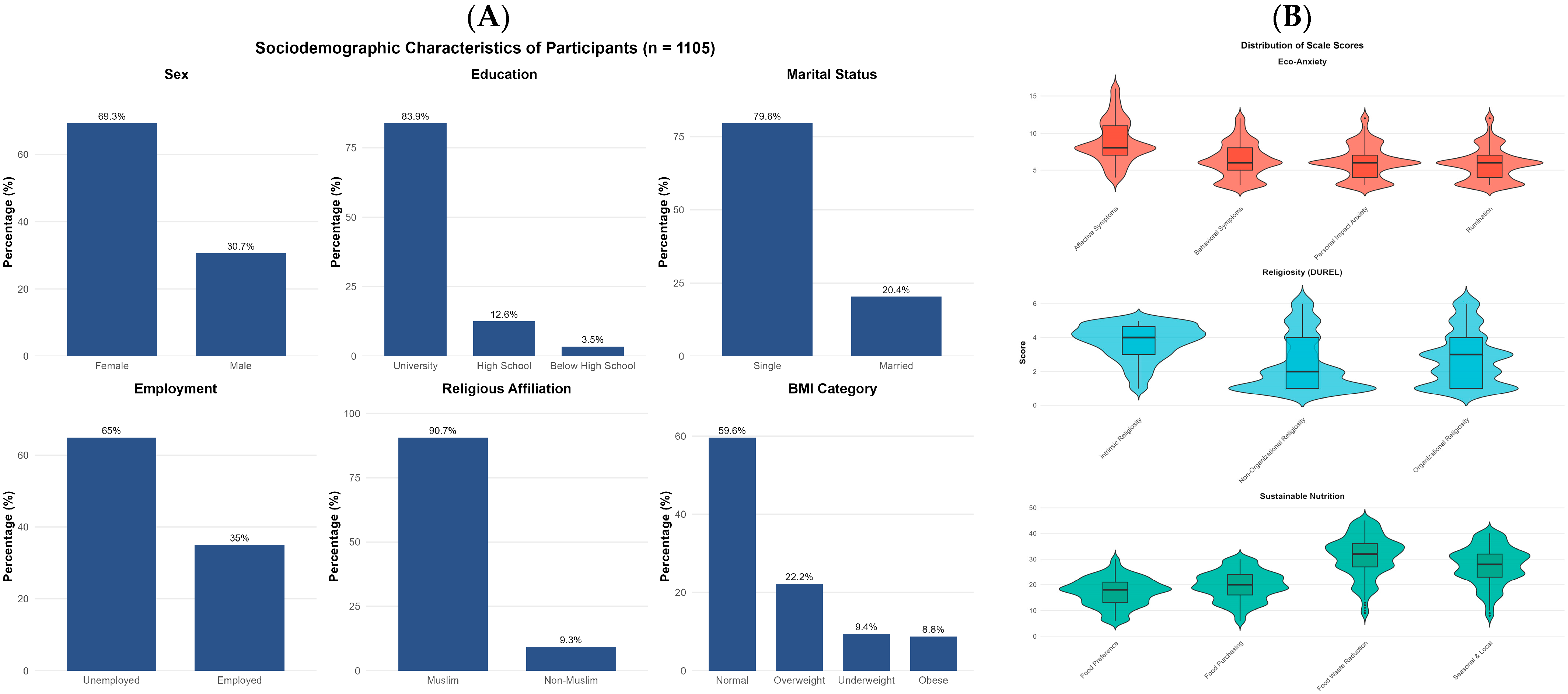
The sample was predominantly female (69.3%), single (79.6%), and university-educated (83.9%). The mean age was 25.75 years (SD = 8.41), and the mean BMI was 23.52 kg/m
2 (SD = 4.50), with most participants falling within the normal weight category (59.6%). Regarding religious affiliation, the vast majority identified as Muslim (90.7%). Employment status indicated that 65.0% of participants were unemployed, which is consistent with the young, student-dominated sample composition (
Figure 2A).
Examination of the scale scores revealed moderate levels of eco-anxiety (M = 27.01, SD = 7.49, possible range: 13–52), with affective symptoms representing the highest scoring subscale. Religiosity scores demonstrated considerable variability, with intrinsic religiosity (M = 3.74, SD = 1.04) being notably higher than organizational (M = 2.76, SD = 1.55) and non-organizational religiosity (M = 2.42, SD = 1.63). Sustainable nutrition behaviors were moderately high (M = 95.50, SD = 23.34, possible range: 29–145), with food waste reduction behaviors scoring highest among the subscales (
Figure 2B).
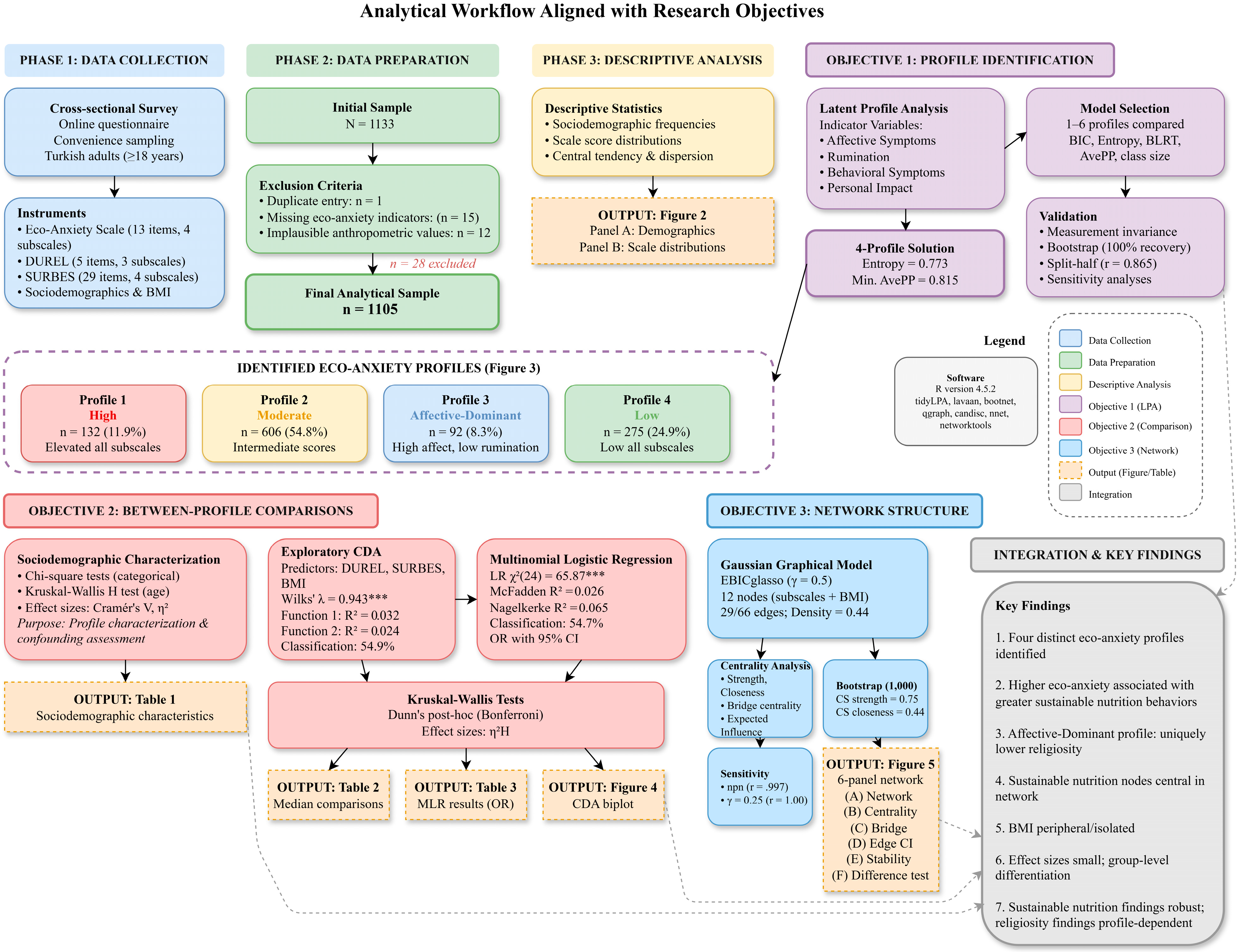
To identify distinct subgroups of individuals based on their eco-anxiety profiles, LPA was conducted using the four eco-anxiety subscales as indicator variables. Models specifying one through six latent profiles were estimated and compared using multiple fit indices, including BIC, entropy, minimum posterior probability, smallest class proportion, and BLRT. The four-profile solution was selected as optimal based on the balance of statistical fit and interpretability: although the six-profile model yielded a lower BIC, its smallest class comprised only 3.4% of the sample, which was considered insufficient for meaningful between-group comparisons. The four-profile solution demonstrated acceptable entropy (0.773) and adequate minimum posterior probability (0.716), and all profiles exceeded the recommended 5% threshold for class size.
Profile-specific means with standard errors and standardized z-scores are provided in
Supplementary Material S2 (Table S6). The z-scores clearly illustrate profile distinctiveness: the High profile exhibited uniformly elevated scores across all subscales (z = 1.18 to 1.60), the Low profile showed consistently below-average scores (z = −0.72 to −0.96), and the Moderate profile clustered near the sample mean (z = −0.14 to 0.15). The Affective-Dominant profile displayed a distinctive pattern with elevated affective (z = 1.37) and behavioral symptoms (z = 0.91) but notably lower rumination (z = −0.27), validating its characterization as emotionally reactive but non-ruminative eco-anxiety.
Model selection also involved the comparison of variance–covariance structures. Alternative specifications, including varying variances and nonzero covariances, either failed to converge or yielded unacceptable fit indices (e.g., entropy = 0.300). Classification quality was further validated through the examination of average posterior probabilities for each profile, which ranged from 0.815 to 0.897, all exceeding the recommended threshold of 0.70 and indicating high classification precision.
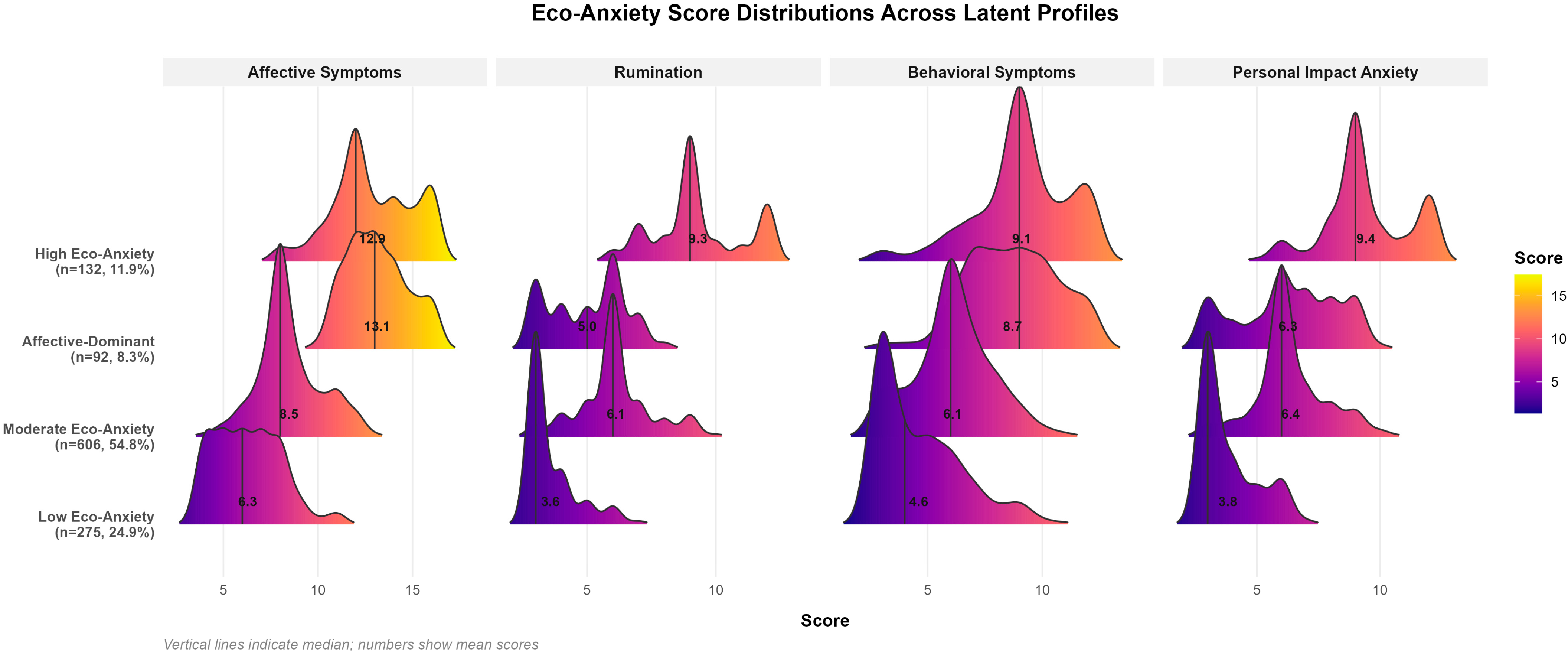
Figure 2 displays the score distributions for each profile across the four eco-anxiety dimensions, revealing a clear separation between profiles and distinct distributional shapes that validate the LPA classification.
The four identified profiles were labeled based on their characteristic patterns across the eco-anxiety subscales. Profile 1 (high eco-anxiety;
n = 132, 11.9%) exhibited uniformly elevated scores across all four subscales, indicating pervasive eco-anxiety symptomatology. Profile 2 (moderate eco-anxiety;
n = 606, 54.8%) represented most participants and displayed intermediate scores across all dimensions. Profile 3 (affective-dominant;
n = 92, 8.3%) demonstrated a distinctive pattern characterized by elevated affective and behavioral symptoms but notably lower rumination, suggesting emotionally reactive but non-ruminative eco-anxiety. Profile 4 (low eco-anxiety;
n = 275, 24.9%) exhibited consistently low scores across all subscales (
Figure 3).
Prior to addressing the second study objective (between-profile comparisons), measurement invariance of the Eco-Anxiety Scale was tested to ensure that the instrument measured the same constructs equivalently across gender and age groups. For gender, fit index changes across invariance levels were minimal: configural to metric (ΔCFI = −0.001, ΔRMSEA = −0.002, ΔSRMR = 0.001), metric to scalar (ΔCFI = −0.006, ΔRMSEA = 0.002, ΔSRMR = 0.001), and scalar to strict (ΔCFI = 0.001, ΔRMSEA = −0.003, ΔSRMR = 0.000). Similarly, for age groups, all changes remained within acceptable thresholds: configural to metric (ΔCFI = 0.000, ΔRMSEA = −0.002, ΔSRMR = 0.001), metric to scalar (ΔCFI = −0.002, ΔRMSEA = 0.000, ΔSRMR = 0.000), and scalar to strict (ΔCFI = −0.002, ΔRMSEA = −0.002, ΔSRMR = 0.001). All values fell within recommended criteria (|ΔCFI| < 0.010, |ΔRMSEA| < 0.015, |ΔSRMR| < 0.030), supporting the validity of subsequent between-group profile comparisons (
Tables S7 and S8 in Supplementary Material S2). Bootstrap analysis demonstrated that the four-profile solution was recovered in 100% of 1000 resamples. Split-half cross-validation revealed high pattern correlations between independently estimated profile centroids across subsamples (mean r = 0.865), with three profiles showing excellent replication (r = 0.929–0.985) and the Affective-Dominant profile showing moderate replication (r = 0.585), consistent with its smaller size (
Table S9) and distinctive configuration. Given this reduced stability, interpretations involving the Affective-Dominant profile should be considered preliminary; sensitivity analyses examining the robustness of key findings when excluding this profile are presented in
Supplementary Material S3.
To characterize the demographic composition of each profile and assess whether profiles differed substantially in sociodemographic features that might confound subsequent between-profile comparisons,
Table 1 presents the sociodemographic characteristics of the four eco-anxiety profiles. Chi-square tests and Kruskal–Wallis analysis revealed statistically significant but practically small differences across profiles for age, age group, and gender. Participants in the High eco-anxiety profile were slightly younger (Median = 22, Q1–Q3: 21–24) than those in the Low eco-anxiety profile (Median = 23, Q1–Q3: 21–28), with a higher proportion of young adults (18–24 years) in the High eco-anxiety profile (76.5%) compared to the Low eco-anxiety profile (62.5%). Gender distribution also differed significantly across profiles (χ
2 = 19.70,
p < 0.001, V = 0.131), with females overrepresented in the High eco-anxiety (75.0%) and Affective-Dominant (80.4%) profiles, whereas males were more prevalent in the Low eco-anxiety profile (40.0%). Marital status, education level, and religious affiliation did not differ significantly across profiles (all
p > 0.05). Effect sizes were uniformly small across all comparisons (Cramér’s V range: 0.055–0.131; η
2 = 0.006), indicating that while statistically significant, the practical magnitude of sociodemographic differences between profiles was modest, and thus unlikely to account for the between-profile differences in religiosity, sustainable nutrition behaviors, and BMI examined subsequently.
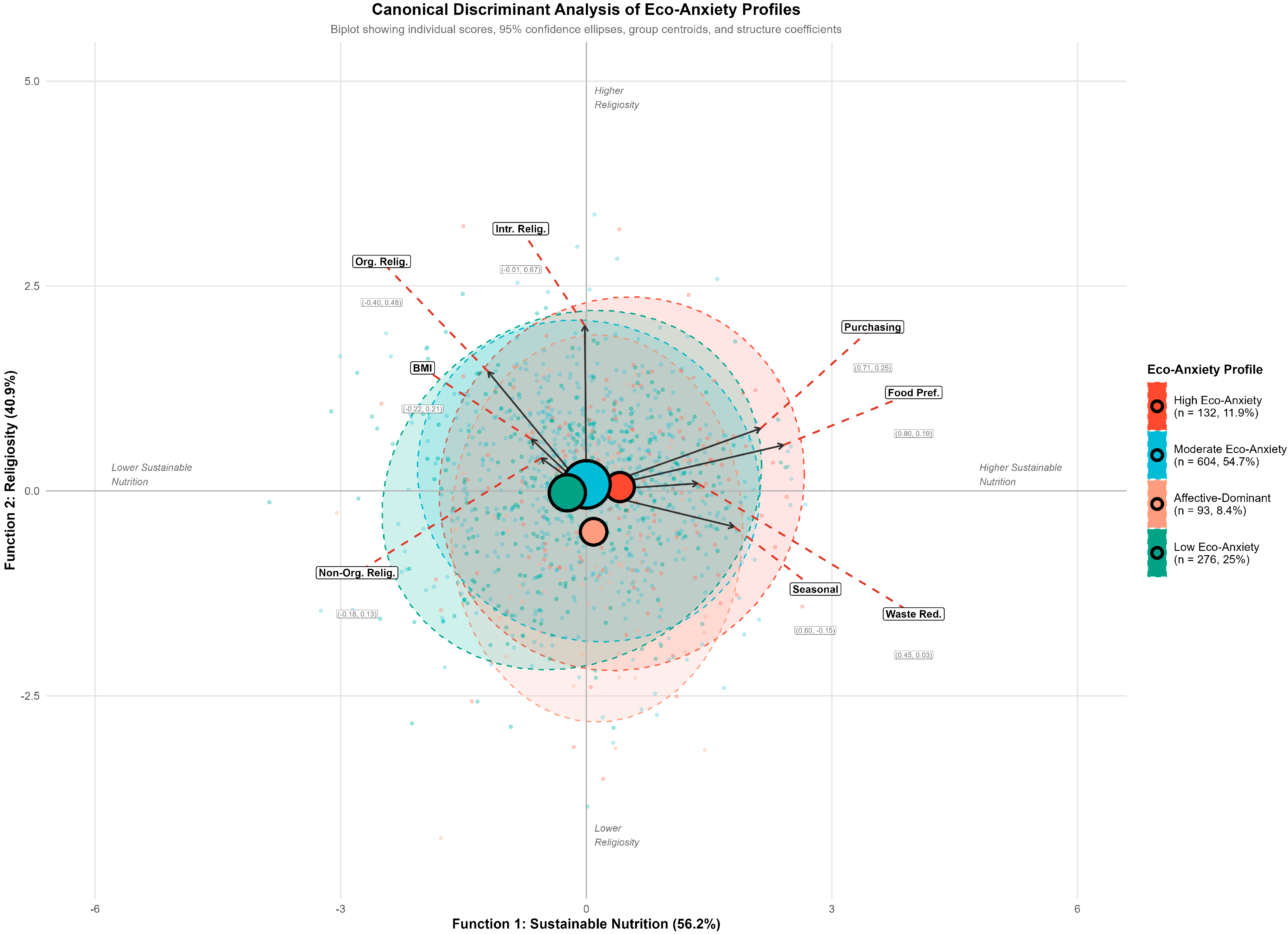
Addressing the second study objective, exploratory canonical discriminant analysis (CDA) was conducted to examine whether religiosity (DUREL subscales), sustainable nutrition behaviors (SURBES subscales), and BMI could discriminate among the four eco-anxiety profiles identified through LPA (
Figure 3). Prior to the analysis, assumptions were evaluated. Box’s M test indicated a violation of homogeneity of covariance matrices (χ
2 = 180.57,
p < 0.001), and Mardia’s test revealed a departure from multivariate normality (skewness
p < 0.001; kurtosis
p < 0.001). However, CDA is robust to these violations with large sample sizes (
n = 1105), and nonparametric Kruskal–Wallis tests were employed as follow-up analyses to corroborate the findings. Examination of the correlation matrix revealed no problematic multicollinearity among predictors (all r < 0.80). The overall model was statistically significant (Wilks’ λ = 0.943, F
(24,3173.5) = 2.68,
p < 0.001), indicating that the predictor variables collectively differentiated among profiles. Two canonical functions emerged as significant: Function 1 (canonical R
2 = 0.032,
p < 0.001) and Function 2 (canonical R
2 = 0.024,
p = 0.014), together accounting for 97.1% of the between-group variance.
Table 2 summarizes the descriptive statistics for each predictor variable across the four eco-anxiety profiles. Follow-up Kruskal–Wallis tests were conducted to corroborate the discriminant findings and identify which variables demonstrated significant between-profile differences.
Despite statistical significance, the model’s practical discriminatory power was limited. According to canonical R
2 values, religiosity, sustainable nutrition behaviors, and BMI collectively explained only a small proportion of the variance in profile membership. Classification accuracy (54.9%) essentially equaled the largest group’s base rate (54.8%), indicating that the predictor variables, while differentiating profiles at the group level, provided no incremental predictive utility at the individual level. To address potential violations of CDA’s homogeneous covariance assumption and provide interpretable effect sizes, multinomial logistic regression was conducted as a complementary analysis. Effect sizes for significant Kruskal–Wallis tests were uniformly small (
range: 0.008–0.014), consistent with typical findings in psychological research. Post hoc Dunn comparisons (Bonferroni-corrected) revealed significant between-profile differences for five of the eight predictor variables. Among sustainable nutrition behaviors, food purchasing (χ
2 = 18.68,
p < 0.001,
= 0.014) showed the clearest differentiation, with the high eco-anxiety profile scoring significantly higher than all other profiles (all
p < 0.05). Food preference (χ
2 = 17.22,
p < 0.001,
= 0.013) and seasonal and local nutrition (χ
2 = 11.62,
p = 0.009,
= 0.008) followed a similar pattern, with pairwise comparisons revealing significant differences primarily between the high and low profiles. This gradient suggests that individuals experiencing greater eco-anxiety tend to engage more actively in sustainable food-related behaviors. In contrast, food waste reduction behaviors did not differ significantly across profiles (
p = 0.144). Regarding religiosity, organizational religiosity (χ
2 = 11.34,
p = 0.010,
= 0.008) and intrinsic religiosity (χ
2 = 12.52,
p = 0.006,
= 0.009) differed significantly across profiles. However, this pattern contrasted with that observed for sustainable nutrition behaviors. For intrinsic religiosity, post hoc comparisons revealed that the affective-dominant profile exhibited significantly lower scores than all other profiles (all
p < 0.05), whereas the high, moderate, and low profiles did not differ from each other. This distinctive pattern tentatively suggests that emotionally reactive but non-ruminative eco-anxiety may be associated with lower internalized religious commitment. However, given the moderate replication stability of the Affective-Dominant profile (r = 0.585), these religiosity-related findings should be interpreted with caution. Sensitivity analyses excluding this profile (
Supplementary Material S3) revealed that organizational religiosity (
p = 0.065) and intrinsic religiosity (
p = 0.902) differences became non-significant, whereas sustainable nutrition associations remained robust (all
p < 0.05), indicating that religiosity-related findings are substantially dependent on this less stable profile. Nonorganizational religiosity and BMI did not significantly differentiate among the eco-anxiety profiles (
Table 2).
Multinomial logistic regression predicting profile membership (reference category: Low eco-anxiety) from standardized religiosity subscales, sustainable nutrition subscales, and BMI yielded a statistically significant overall model (LR χ
2(24) = 65.87,
p < 0.001), though effect size was modest (McFadden R
2 = 0.026; Nagelkerke R
2 = 0.065). Consistent with CDA findings, sustainable nutrition behaviors emerged as the primary discriminators of profile membership (
Table 3).
Food preference significantly predicted increased odds of membership in the Moderate profile (OR = 1.25, 95% CI [1.02, 1.52],
p = 0.030) and High profile (OR = 1.58, 95% CI [1.17, 2.14],
p = 0.003) relative to the Low profile. Food purchasing also predicted High profile membership (OR = 1.47, 95% CI [1.02, 2.12],
p = 0.041). For the Affective-Dominant profile, seasonal and local nutrition was the sole significant predictor (OR = 1.60, 95% CI [1.04, 2.47],
p = 0.032). Notably, neither religiosity subscales nor BMI significantly predicted profile membership in any comparison, though organizational religiosity approached significance for High (OR = 0.77,
p = 0.053) and Affective-Dominant (OR = 0.74,
p = 0.061) profiles, suggesting a trend toward lower organizational religious participation among higher eco-anxiety groups. Classification accuracy from multinomial logistic regression (54.7%) mirrored that of CDA, confirming that while these variables differentiate profiles at the group level, individual-level prediction remains limited (
Table 3).
Returning to the CDA results, the structure coefficients revealed the substantive meaning of the discriminant functions. Function 1, accounting for 56.2% of the discriminant variance, was primarily defined by sustainable nutrition behaviors, with food preference (
= 0.80), food purchasing (
= 0.71), seasonal and local nutrition (
= 0.60), and food waste reduction (
= 0.45) all loading positively. Organizational religiosity negatively impacted this function (
= −0.40). Thus, Function 1 can be interpreted as a “Sustainable Nutrition” dimension, with higher scores indicating greater engagement in environmentally conscious food behaviors and somewhat lower organizational religious participation. Function 2, accounting for 40.9% of the variance, was predominantly characterized by intrinsic religiosity (
= 0.67) and organizational religiosity (
= 0.49), representing a “Religiosity” dimension, where higher scores indicate greater religious commitment. The axis polarity of Function 2 was inverted from the original extraction for intuitive interpretation.
Figure 4 illustrates how the structure coefficients clarified the substantive meaning of the two significant canonical functions.
The positioning of group centroids in the discriminant space provides further insight into profile characteristics. The high eco-anxiety profile occupied the positive end of Function 1 (centroid = 0.41), indicating elevated sustainable nutrition behaviors compared to the other profiles. Conversely, the low eco-anxiety profile was positioned at the negative end (centroid = −0.22), reflecting lower engagement in sustainable food practices. Most notably, the affective-dominant profile was distinctly positioned on Function 2 (centroid = −0.50), indicating markedly lower religiosity relative to the other three profiles, which clustered near zero on this dimension. This spatial configuration corroborates the Kruskal-Wallis findings and visually demonstrates the dual nature of profile differentiation: eco-anxiety severity relates primarily to sustainable nutrition behaviors, whereas the affective-dominant profile is distinguished by its lower religiosity rather than its sustainable nutrition patterns (
Figure 4).
Collectively, both CDA and multinomial logistic regression indicate that eco-anxiety profiles exhibit modest but theoretically meaningful associations with sustainable nutrition behaviors, with limited contribution from religiosity and BMI. The convergent findings across methods—despite different distributional assumptions—strengthen confidence in these associations, while the equivalent classification accuracy (≈55%) across both approaches confirms that individual-level prediction remains limited. Network analysis was conducted to further elucidate the structural connectivity patterns among eco-anxiety, religiosity, sustainable nutrition, and BMI beyond group-level comparisons.
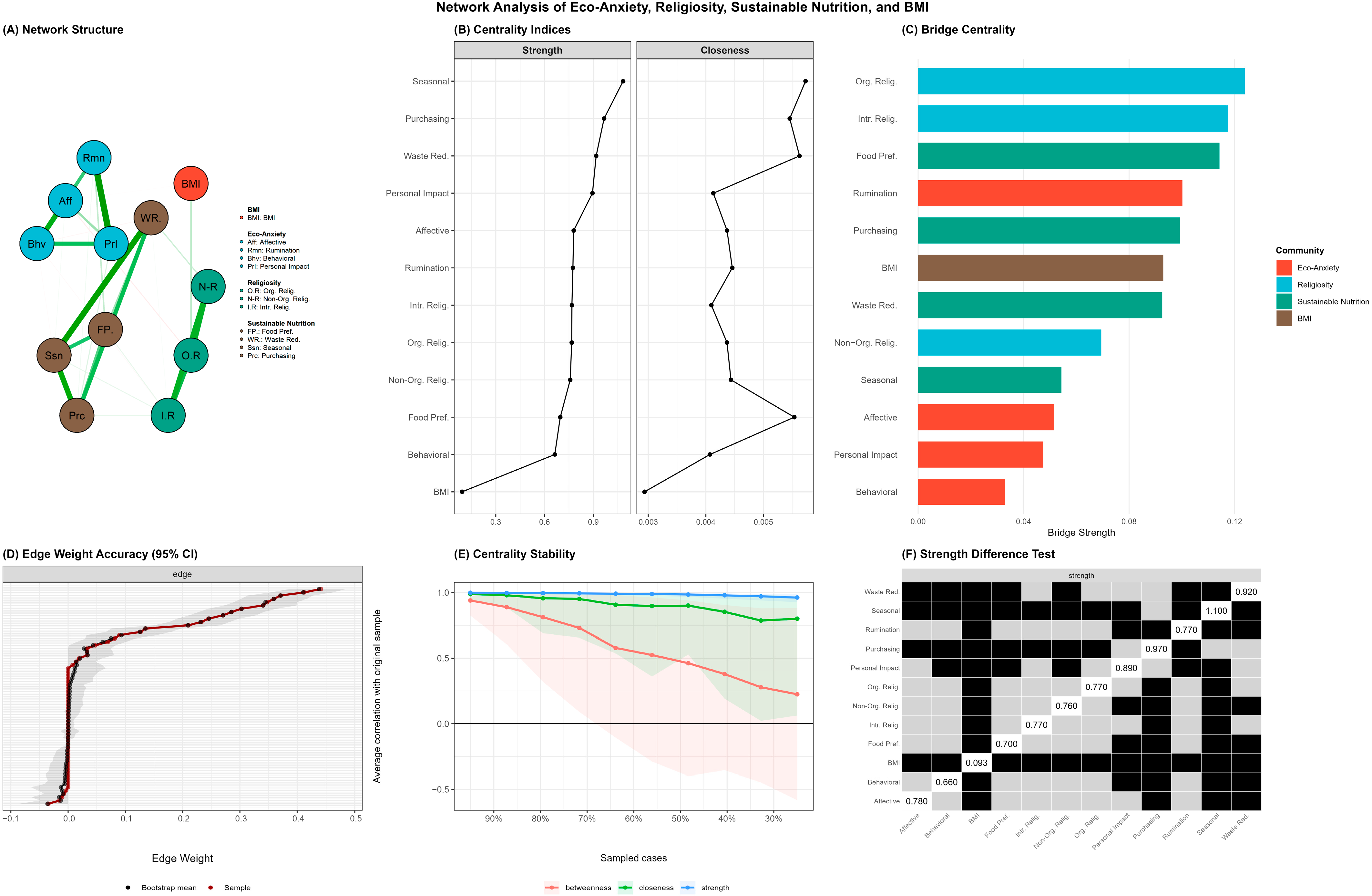
Addressing the third study objective, a Gaussian graphical model was estimated using the EBICglasso algorithm with LASSO regularization (tuning parameter γ = 0.5) to examine the structural relationships among eco-anxiety, religiosity, sustainable nutrition behaviors, and BMI beyond profile-based comparisons. The network included 12 nodes representing the four eco-anxiety subscales, three religiosity subscales, four sustainable nutrition subscales, and BMI. The resulting network contained 29 nonzero edges out of 66 possible connections (density = 0.44), indicating a moderately sparse structure after regularization (
Figure 5A).
The strongest edges emerged within the construct communities rather than between them. Within eco-anxiety, the Personal Impact–Rumination connection exhibited the highest weight in the entire network (r = 0.44), followed by Affective–Behavioral (r = 0.36) and Behavioral–Personal Impact (r = 0.27). Within sustainable nutrition behaviors, seasonal and local nutrition served as a hub connecting strongly to waste reduction (r = 0.41), purchasing (r = 0.37), and Food Preference (r = 0.25). The religiosity subscales formed a tightly interconnected cluster, with Intrinsic–Non-Organizational (r = 0.35), Non-Organizational–Organizational (r = 0.34), and intrinsic–organizational (r = 0.30) connections. Notably, BMI appeared largely isolated from the network, exhibiting only a weak connection with organizational religiosity (r = 0.09). Cross-construct edges were considerably weaker than within-construct connections. Weak partial associations between eco-anxiety and sustainable nutrition were observed, including Rumination–Food Preference (r = 0.08) and Personal Impact–Purchasing (r = 0.05). Similarly, a small partial association linked Non-Organizational Religiosity to Waste Reduction (r = 0.07). These weak cross-construct associations should be interpreted with caution given their small effect sizes; while statistically reliable with the present sample size, their practical significance is limited (
Figure 5).
Centrality analysis revealed that sustainable nutrition nodes occupied the most central positions in the network (
Figure 5B). Seasonal and local nutrition exhibited the highest strength centrality (z = 1.32), followed by purchasing (z = 0.83), Waste Reduction (z = 0.63), and personal impact anxiety (z = 0.54). BMI demonstrated the lowest centrality across all indices, confirming its peripheral position in the network structure.
Bridge centrality analysis identified nodes serving as connectors between construct communities (
Figure 5C). Organizational Religiosity (bridge strength = 0.124) and Intrinsic Religiosity (bridge strength = 0.118) emerged as primary bridges from the religiosity cluster, connecting to BMI and sustainable nutrition behaviors, respectively. Food Preference (bridge strength = 0.114) served as the main bridge from sustainable nutrition to eco-anxiety via its connection with Rumination. Within eco-anxiety, Rumination (bridge strength = 0.100) functioned as the primary bridge to other constructs, consistent with its role as a cognitive process linking emotional experiences to behavioral outcomes.
Network stability and accuracy were assessed using bootstrap procedures with 1000 iterations (
Figure 5D–F). The correlation stability coefficient for strength centrality was 0.75, substantially exceeding the recommended threshold of 0.50 and indicating excellent stability. Closeness centrality demonstrated acceptable stability (CS = 0.44, above the minimum threshold of 0.25). Betweenness centrality was unstable (CS = 0.05) and therefore excluded from interpretation, a common finding in psychological network studies. Edge weight accuracy analysis revealed that the strongest edges were estimated with adequate precision, with bootstrap confidence intervals for the top edges not overlapping zero. The strength difference test confirmed that Seasonal and Local Nutrition had significantly higher strength centrality than most other nodes, whereas BMI had significantly lower strength than all other nodes.
Sensitivity analyses confirmed the robustness of network findings. Re-estimation using nonparanormal transformation to relax normality assumptions yielded near-identical results (edge weight r = 0.997, bridge centrality r = 0.977). Similarly, alternative regularization (γ = 0.25 vs. 0.50) produced identical network structures (all r = 1.00), with the same nodes identified as key bridges across specifications. To facilitate interpretation, we assigned descriptive labels to the four latent profiles based on theoretically expected configurations implied by the multidimensional framework of eco-anxiety (affective, cognitive, behavioral, and functional components) and the logic of person-centered modeling [
5,
8,
17]. Specifically, the profiles were labeled as Profile 1 (globally low), Profile 2 (moderate/engaged), Profile 3 (affective-dominant), and Profile 4 (high cognitive–functional burden), reflecting differences not only in overall severity but also in the patterning of emotional reactivity, rumination/engagement, and functional impact across individuals [
5,
8,
17].
4. Discussion
This study used a person-centered and network-based approach to examine how eco-anxiety, religiosity, sustainable nutrition behaviors, and BMI co-occur in a large community sample. Four distinct eco-anxiety profiles were identified, ranging from globally low symptoms to a high eco-anxiety subgroup, together with an affective-dominant pattern. Higher eco-anxiety was accompanied by more favorable sustainable nutrition behaviors, whereas lower eco-anxiety coincided with weaker engagement in sustainable eating. Network findings further suggest that sustainable nutrition occupies a structurally central position in the system, while BMI remains largely peripheral, and that specific eco-anxiety and religiosity components act as bridges between emotional experiences and everyday food-related practices. Overall, the results indicate that eco-anxiety is a heterogeneous construct that can be linked to psychological burden and potentially adaptive engagement in sustainable behaviors.
Our four-profile solution supports the heterogeneity view that eco-anxiety comprises different configurations of affective, cognitive, behavioral, and functional components rather than a single continuum [
4,
5,
7,
8]. The observed separation between profiles with stronger affective reactivity versus those with higher cognitive/functional burden is consistent with the notion that climate-related distress can be coupled with engagement in some cases and impairment/withdrawal in others [
4,
7]. By linking profiles to sustainable nutrition behaviors, religiosity, and BMI, we extend this framework into a climate-relevant behavioral domain and a culturally salient value system in Türkiye [
10,
11,
12,
13,
14,
15].
The positive association between eco-anxiety and sustainable eating in our sample converges with recent international and Turkish studies linking higher climate-related worry to greener consumption, sustainable food choices, and adherence to plant-forward dietary patterns [
29,
30,
31,
32,
33,
34,
35,
36]. For example, Mathers-Jones and Todd reported that higher eco-anxiety predicted greater engagement in daily proenvironmental behaviors among young adults, although at the cost of increased internalizing symptoms [
29]. Gkargkavouzi similarly concluded that eco-anxiety can foster sustainable consumption when individuals perceive sufficient efficacy and behavioral options [
30]. In the domain of food, Kabasakal-Cetin showed that eco-anxiety was positively associated with sustainable eating and higher EAT-Lancet diet scores in university students [
33], while Memiç-İnan and Şarahman Kahraman observed that concern for ecological health co-occurred with healthier and more sustainable dietary patterns in young adults [
34]. Corroborating these findings, our high eco-anxiety profile showed the most favorable scores across sustainable nutrition subscales, suggesting that, at least in this relatively young and educated sample, eco-anxiety may represent a “concerned, engaged” phenotype rather than a paralyzed or avoidant one.
The present results also resonate with Turkish studies that directly examine the link between eco-anxiety and sustainable food consumption. Memiç-İnan and Şarahman Kahraman reported that adults with higher eco-anxiety scores displayed more sustainable purchasing and eating preferences [
35], and Özkara found that eco-anxiety predicted sustainable consumption behaviors through increased ecological footprint awareness [
36]. These findings align closely with our network results, where sustainable nutrition nodes occupied central positions and eco-anxiety was connected to them through specific cognitive and behavioral bridges rather than uniformly across all items. Converging evidence suggests that eco-anxiety, when accompanied by adequate knowledge, perceived behavioral control, and supportive social norms, can be channeled into sustainable dietary practices rather than devolving into helplessness or denial [
29,
30,
31,
32,
33,
34,
35,
36,
37].
However, the relationship between eco-anxiety and behavior is not linear or universally adaptive. A growing body of work documents ambivalent effects, showing that eco-anxiety may promote and inhibit action, depending on coping resources, rumination, and contextual factors [
4,
29,
31,
37,
38]. Coates et al. found that climate anxiety was associated with some, but not all, proenvironmental behaviors, and that high worry could coexist with inaction in certain groups [
37]. Carasso Romano and Sippori similarly distinguished personal from collective environmental behaviors, showing that ecological anxiety is more strongly related to collective action, possibly because it offers a clearer sense of efficacy and social meaning [
31]. Our network model adds nuance by highlighting rumination as a bridge node that links eco-anxiety to sustainable nutrition behaviors. This pattern suggests that repetitive, focused thinking about environmental threats is a necessary—but potentially double-edged—mechanism: it can transform diffuse worry into concrete, health-related behavioral changes, yet excessive rumination might also amplify distress and impair well-being if not channeled constructively [
4,
29,
31,
32,
38]. This interpretation is consistent with broader stress–vulnerability perspectives in which nutrition-related behaviors can shift under sustained psychological strain, and nutrition is often conceptualized within a wider psychophysiological vulnerability framework [
39].
Our findings regarding mental well-being are broadly consistent with reviews indicating that eco-anxiety is associated with higher levels of anxiety, depressive symptoms, and stress, especially in younger populations [
4,
29,
38]. Boluda-Verdú et al.’s systematic review showed that climate-related worry is robustly linked with adverse mental health outcomes and greater engagement in pro-environmental behavior in several studies, underscoring its ambivalent nature [
38]. Similarly, Kerse and Kerse demonstrated that eco-anxiety exerts a negative direct effect on mental well-being while simultaneously promoting green buying, recycling, and low-carbon behaviors, which in turn partially buffer this negative impact [
32]. Our profile structure fits this “cost–benefit” pattern: the high-eco-anxiety group appears both psychologically burdened and behaviorally engaged, whereas the lower-anxiety profiles show less distress but also weaker commitment to sustainable nutrition. This tension highlights the need for interventions that safeguard mental health while preserving the motivational value of eco-anxiety.
The network results offer additional insights into how sustainable nutrition behaviors, religious variables, and eco-anxiety are embedded within a broader psychosocial system. Sustainable nutrition nodes—particularly seasonal and local nutrition—displayed the highest centrality, suggesting that everyday food decisions structured around seasonality, locality, and minimally processed options serve as a practical “behavioral hub” connecting environmental concern, personal values, and lifestyle. This is compatible with the idea of “dietary eco-wellness,” in which environmentally conscious eating provides co-benefits for physical, planetary, and psychological health [
33,
34,
35,
36]. Religious variables occupied a more peripheral but still relevant position. Organizational and intrinsic religiosity tended to cluster together and showed modest associations with eco-anxiety profiles, particularly through the Affective-Dominant profile’s distinctively lower intrinsic religiosity. However, sensitivity analyses revealed that religiosity differences across profiles were substantially dependent on this less stable profile, with organizational and intrinsic religiosity differences becoming non-significant when excluding the Affective-Dominant profile. These findings indicate that religiosity-related interpretations should be considered preliminary and require replication in independent samples before drawing conclusions about whether faith communities and intrinsic religious commitment offer meaning, social support, and a framework for hope in the face of ecological crisis. Although the effect sizes were small, this pattern suggests that religious resources can help transform eco-anxiety into constructive engagement rather than avoidance or despair, particularly in highly religious contexts.
It should be noted that cross-construct partial correlations in the network were uniformly small (r = 0.05–0.09), indicating limited practical effect sizes despite statistical reliability with the present sample size. While sustainable nutrition nodes displayed high centrality within their own community, their connections to eco-anxiety and religiosity nodes were considerably weaker than within-construct associations. These weak cross-construct associations represent preliminary evidence of construct relationships that warrant replication before drawing strong mechanistic conclusions. The finding that constructs were more strongly connected within than between communities suggests that eco-anxiety, religiosity, and sustainable nutrition operate as relatively distinct psychological domains with only modest overlap, connected primarily through specific bridge nodes rather than through pervasive cross-domain associations.
In contrast, BMI emerged as almost isolated from the main network, with the lowest centrality indices. This is unsurprising given the cross-sectional design and the relatively young age of the sample, in which the long-term anthropometric consequences of sustainable eating patterns may not yet be fully expressed. Sustainable nutrition behaviors are likely to exert cumulative effects on body composition and cardiometabolic risk over the years rather than in the short term captured by our study. The lack of meaningful edges between BMI and either eco-anxiety or religiosity suggests that, in this demographic, weight status is shaped more by conventional determinants (e.g., physical activity, energy balance, genetics) than by climate-related worry or religious orientation. Future longitudinal studies are needed to test whether sustained engagement in ecofriendly dietary patterns predicts favorable trajectories in BMI and metabolic health [
33,
34,
35,
36,
38].
Finally, the latent profile analysis underscores that eco-anxiety cannot be adequately captured by a single mean score or linear trend. The identification of four distinct profiles—including a low eco-anxiety, a moderately concerned, an affective–dominant, and a high eco-anxiety pattern—echoes recent calls to conceptualize eco-anxiety as a spectrum of experiences ranging from adaptive concern to potentially impairing distress [
4,
29]. The Affective-Dominant profile, while theoretically coherent as an emotionally reactive but non-ruminative pattern, showed moderate split-half replication compared to the other three profiles, suggesting that conclusions specific to this subgroup—particularly regarding religiosity—warrant independent replication before being considered robust. This typological view is clinically and policy relevant: interventions may need to be tailored differently for individuals with a high eco-anxiety profile, who might benefit from emotion regulation and burnout prevention strategies, versus those with low or moderate profiles, where the priority could be to build climate awareness and promote more sustainable behaviors. By integrating person-centered (LPA) and variable-centered (network) approaches, the present study contributes to a more differentiated understanding of how eco-anxiety, religiosity, and sustainable nutrition behaviors co-exist in a predominantly young, urban, and educated Turkish sample.
Taken together, these results suggest that sustainability-oriented eating practices co-occur with elevated eco-anxiety profiles, particularly through day-to-day decision points such as food preference formation and purchasing choices. This pattern aligns with emerging evidence that climate/eco-anxiety can accompany pro-environmental or sustainable consumption orientations, although the magnitude of associations is typically modest and directionality cannot be inferred in cross-sectional data. In other words, higher eco-anxiety may coincide with greater attentional focus on climate-related food impacts and thus more sustainable purchasing preferences, but it is equally plausible that individuals already committed to sustainable eating attend more to climate information and consequently report greater eco-anxiety. Prior studies among young adults and university samples similarly report positive associations between eco-anxiety and sustainable dietary patterns or higher adherence to sustainability-oriented dietary scores, supporting the plausibility of this co-occurrence while underscoring heterogeneity across contexts and measures [
29,
30,
33,
34,
37]. The non-significant role of religiosity (with only a marginal trend for organizational participation) may reflect that religious engagement does not uniformly translate into food-related sustainability behaviors in this demographic, or that organizational religiosity is a less sensitive indicator in younger/online convenience samples; this warrants replication and more fine-grained measurement of religious moral norms directly tied to waste avoidance and stewardship in Türkiye, e.g., [
13,
14,
15]. Finally, the lack of BMI differentiation is consistent with BMI’s peripheral role in the network and its limited sensitivity in young samples with self-reported anthropometrics.
The modest discriminative power observed in both CDA and multinomial logistic regression analyses—with classification accuracy not exceeding base rates—suggests that while eco-anxiety profiles differ systematically in sustainable nutrition behaviors at the group level, these differences are insufficient for reliable individual-level classification. Several additional limitations warrant consideration. First, the study relied on online convenience recruitment via social media; accordingly, the sample was predominantly young, female, single, highly educated, and largely composed of students. This composition increases the likelihood of selection bias (e.g., overrepresentation of digitally engaged individuals and those more interested in climate-related topics) and limits generalizability to older adults, individuals with lower educational attainment, rural populations, or groups with more restricted access to sustainable food options. Different sociodemographic and cultural contexts may yield different eco-anxiety profiles and different patterns linking religiosity and sustainable nutrition. Second, while we aimed for transparency, no prospective stage-wise attrition log was retained. To address this, we reconstructed a flow of exclusions from the raw export and data-cleaning flags: 1133 entries were recorded; 1 duplicate was removed; 15 entries with missing key variables were excluded; and 12 entries were removed due to implausible anthropometric values, yielding a final analytic sample of 1105 participants. Nevertheless, the absence of a prospective attrition log limits our ability to evaluate potential non-random dropout processes (e.g., whether individuals with higher distress were more likely to discontinue), which may further contribute to selection effects. Third, the survey did not include embedded attention checks or prespecified time-based quality screens at deployment. Although we implemented pragmatic controls (duplicate/IP/device checks, completeness screening for key indicators, and anthropometric plausibility screening), the lack of formal attention/time screens may increase measurement noise (e.g., satisficing or random responding), potentially attenuating associations and affecting profile separation and network edge estimates. Thus, small effect sizes and weak cross-construct associations should be interpreted cautiously, as they may reflect both true small effects and residual response-quality variability. Fourth, the cross-sectional design precludes causal inference, and the weak cross-construct associations observed in the network analysis do not permit conclusions about temporal ordering or directional pathways. Longitudinal or experimental designs are needed to clarify whether eco-anxiety precedes sustainable nutrition behaviors or whether engagement in sustainability-related practices shapes climate-related emotions over time. Fifth, all measures were self-reported, including height and weight used to compute BMI, which are prone to systematic reporting errors; religiosity and sustainability-related behaviors may also be influenced by social desirability. Objective measures (e.g., clinician-measured anthropometry, waist circumference or WHtR, body composition, cardiometabolic biomarkers, 24 h dietary recalls, purchasing records, or carbon footprint estimates) would strengthen future work and may reveal associations not detectable in this sample. The lack of between-profile differences in BMI may therefore reflect measurement error and restricted variability in a relatively young sample. Sixth, both LPA and network modeling depend on modeling choices and the set of included variables. Unmeasured constructs (e.g., climate activism, environmental knowledge, health anxiety, disordered eating symptoms, or broader coping styles) could alter the profile configuration and network structure. Finally, the study was conducted within a single national and religious context; cross-cultural comparative research is needed to test whether similar profiles and network structures emerge in more secular societies or in settings where sustainable foods are less affordable or accessible. Several design choices may also constrain external validity. Excluding respondents who self-reported diagnosed psychiatric or eating disorders reduces potential clinical confounding but may selectively remove individuals for whom eco-anxiety is most impairing. Likewise, excluding participants following a special diet under dietitian supervision may underrepresent individuals already engaged in strong health- or ethics-driven dietary patterns, potentially biasing associations between eco-anxiety and sustainable nutrition behaviors. Future studies should replicate these analyses in more inclusive samples and formally test sensitivity to alternative inclusion criteria.