The Combined Use of Hydroxymethylbutyrate and Branched-Chain Amino Acids to Counteract Uremic Sarcopenia
 , , , ,
  , and
, and
Abstract
1. Introduction
2. Materials and Methods
2.1. Patients
- -
- Age between 45 and 80 years;
- -
- Both sexes;
- -
- Signature and acceptance of informed consent;
- -
- ESKD under HD treatment for at least three months;
- -
- Utilization of arteriovenous fistula as vascular access for HD.
- -
- Presence of solid or hematological malignancies;
- -
- HIV, HbsAg+, HCV+ patients;
- -
- Non-acceptance of informed consent;
- -
- Subjects with inflammatory and/or infectious diseases in the acute phase;
- -
- Pregnancy and lactation;
- -
- Intake of FFSMP based on essential amino acids in the last three months;
- -
- Intake of FFSMP based on antioxidants in the last three months.
- -
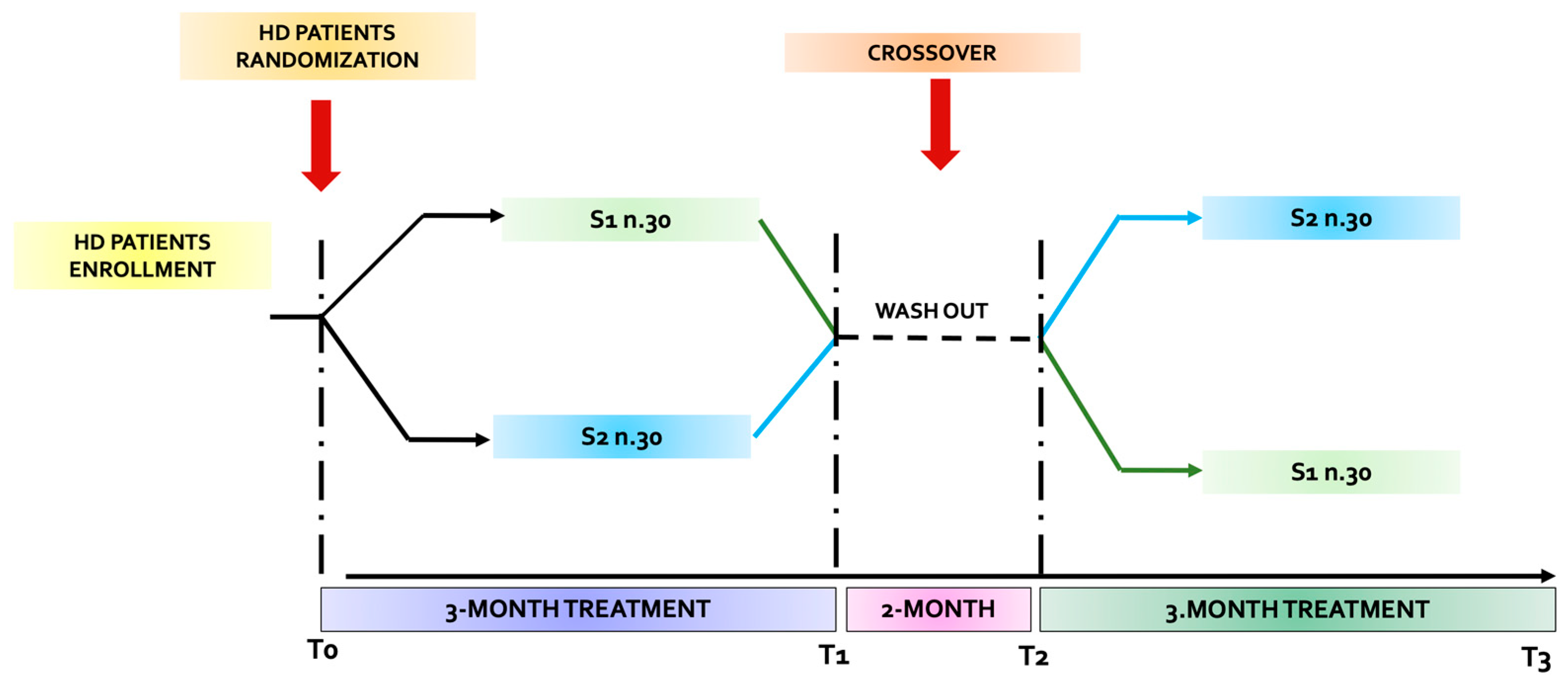
- T0: enrollment time;
- -
- T1: 3 months from the start of the study;
- -
- T2: after the 2-month wash-out period (i.e., 5 months after the start of the study);
- -
- T3: a further 3 months after the wash-out period (i.e., 8 months after the start of the study).
2.2. Composition of the Food for Special Medical Purposes and Placebo
2.3. Laboratory Parameters, Biomarkers of Inflammation and Oxidative Stress
2.4. Measurement of Anthropometric Parameters and Body Composition Assessment
2.5. Ultrasonographic Evaluation of Muscle Mass
2.6. Evaluation of Muscle Strength and Physical Performance
- (a)
- Muscle strength was assessed using the hand grip strength (HGS) test, which employs a dynamometer to measure isometric handgrip force (Jamar Plus, Performance Health, Warrenville, IL, USA). The patients were seated and were instructed to grip the dynamometer as forcefully as possible using the arm, without the vascular access for hemodialysis (arteriovenous fistula), at 90° close to the hip. The test was performed three times, using the same arm, and the average value was calculated. The standardized cut-offs of the HGS test were <27 kg for men and <16 kg for women [68,69].
- (b)
- The short physical performance battery (SPPB) [70] comprises three components: gait speed assessed over a 4 m walk, lower-limb strength evaluated through the five-times sit-to-stand test, and balance measured using the tandem stance. Each component is scored on a scale of 0 to 4, and the total score reflects overall PP. A maximum score of 12 denotes optimal performance.
- The stair climb power test (SCPT) [72] evaluates lower-limb power. Patients were instructed to climb 10 steps as quickly as possible, without running or jumping, and the time required to complete the task was recorded.
2.7. Questionnaires
2.8. Statistical Analysis
2.9. Power Analysis
3. Results
4. Discussion
5. Conclusions
Author Contributions
Funding
Institutional Review Board Statement
Informed Consent Statement
Data Availability Statement
Acknowledgments
Conflicts of Interest
References
- Mitch, W.E.; Goldberg, A.L. Mechanisms of muscle wasting. The role of the ubiquitin-proteasome pathway. N. Engl. J. Med. 1996, 335, 1897–1905. [Google Scholar] [CrossRef]
- Marini, M.; Sarchielli, E.; Brogi, L.; Lazzeri, R.; Salerno, R.; Sgambati, E.; Monaci, M. Role of adapted physical activity to prevent the adverse effects of the sarcopenia. A pilot study. Ital. J. Anat. Embryol. 2008, 113, 217–225. [Google Scholar]
- Giglio, J.; Kamimura, M.A.; Lamarca, F.; Rodrigues, J.; Santin, F.; Avesani, C.M. Association of Sarcopenia with Nutritional Parameters, Quality of Life, Hospitalization, and Mortality Rates of Elderly Patients on Hemodialysis. J. Ren. Nutr. 2018, 28, 197–207. [Google Scholar] [CrossRef] [PubMed]
- Foley, R.N.; Wang, C.; Ishani, A.; Collins, A.J.; Murray, A.M. Kidney function and sarcopenia in the United States general population: NHANES III. Am. J. Nephrol. 2007, 27, 279–286. [Google Scholar] [CrossRef]
- Noce, A.; Fabrini, R.; Dessi, M.; Bocedi, A.; Santini, S.; Rovella, V.; Pastore, A.; Tesauro, M.; Bernardini, S.; Di Daniele, N.; et al. Erythrocyte glutathione transferase activity: A possible early biomarker for blood toxicity in uremic diabetic patients. Acta Diabetol. 2014, 51, 219–224. [Google Scholar] [CrossRef]
- Cruz-Jentoft, A.J.; Baeyens, J.P.; Bauer, J.M.; Boirie, Y.; Cederholm, T.; Landi, F.; Martin, F.C.; Michel, J.P.; Rolland, Y.; Schneider, S.M.; et al. Sarcopenia: European consensus on definition and diagnosis: Report of the European Working Group on Sarcopenia in Older People. Age Ageing 2010, 39, 412–423. [Google Scholar] [CrossRef]
- Janssen, I.; Baumgartner, R.N.; Ross, R.; Rosenberg, I.H.; Roubenoff, R. Skeletal muscle cutpoints associated with elevated physical disability risk in older men and women. Am. J. Epidemiol. 2004, 159, 413–421. [Google Scholar] [CrossRef] [PubMed]
- Fouque, D.; Kalantar-Zadeh, K.; Kopple, J.; Cano, N.; Chauveau, P.; Cuppari, L.; Franch, H.; Guarnieri, G.; Ikizler, T.A.; Kaysen, G.; et al. A proposed nomenclature and diagnostic criteria for protein-energy wasting in acute and chronic kidney disease. Kidney Int. 2008, 73, 391–398. [Google Scholar] [CrossRef] [PubMed]
- Clapp, E.L.; Bevington, A. Exercise-induced biochemical modifications in muscle in chronic kidney disease: Occult acidosis as a potential factor limiting the anabolic effect of exercise. J. Ren. Nutr. 2011, 21, 57–60. [Google Scholar] [CrossRef][Green Version]
- Kalantar-Zadeh, K.; Mehrotra, R.; Fouque, D.; Kopple, J.D. Metabolic acidosis and malnutrition-inflammation complex syndrome in chronic renal failure. Semin. Dial. 2004, 17, 455–465. [Google Scholar] [CrossRef]
- Chiu, Y.W.; Mehrotra, R. What should define optimal correction of metabolic acidosis in chronic kidney disease? Semin. Dial. 2010, 23, 411–414. [Google Scholar] [CrossRef]
- Chiu, Y.W.; Kopple, J.D.; Mehrotra, R. Correction of metabolic acidosis to ameliorate wasting in chronic kidney disease: Goals and strategies. Semin. Nephrol. 2009, 29, 67–74. [Google Scholar] [CrossRef]
- Kopple, J.D.; Kalantar-Zadeh, K.; Mehrotra, R. Risks of chronic metabolic acidosis in patients with chronic kidney disease. Kidney Int. Suppl. 2005, 67, S21–S27. [Google Scholar] [CrossRef]
- Workeneh, B.T.; Mitch, W.E. Review of muscle wasting associated with chronic kidney disease. Am. J. Clin. Nutr. 2010, 91, 1128S–1132S. [Google Scholar] [CrossRef] [PubMed]
- Rajan, V.R.; Mitch, W.E. Muscle wasting in chronic kidney disease: The role of the ubiquitin proteasome system and its clinical impact. Pediatr. Nephrol. 2008, 23, 527–535. [Google Scholar] [CrossRef]
- Roshanravan, B.; Gamboa, J.; Wilund, K. Exercise and CKD: Skeletal Muscle Dysfunction and Practical Application of Exercise to Prevent and Treat Physical Impairments in CKD. Am. J. Kidney Dis. 2017, 69, 837–852. [Google Scholar] [CrossRef] [PubMed]
- Van Craenenbroeck, A.H.; Van Craenenbroeck, E.M.; Van Ackeren, K.; Hoymans, V.Y.; Verpooten, G.A.; Vrints, C.J.; Couttenye, M.M. Impaired vascular function contributes to exercise intolerance in chronic kidney disease. Nephrol. Dial. Transplant. 2016, 31, 2064–2072. [Google Scholar] [CrossRef] [PubMed]
- Powers, S.K.; Kavazis, A.N.; DeRuisseau, K.C. Mechanisms of disuse muscle atrophy: Role of oxidative stress. Am. J. Physiol. Regul. Integr. Comp. Physiol. 2005, 288, R337–R344. [Google Scholar] [CrossRef]
- Powers, S.K.; Smuder, A.J.; Criswell, D.S. Mechanistic links between oxidative stress and disuse muscle atrophy. Antioxid. Redox Signal. 2011, 15, 2519–2528. [Google Scholar] [CrossRef]
- Souza, V.A.; Oliveira, D.; Mansur, H.N.; Fernandes, N.M.; Bastos, M.G. Sarcopenia in chronic kidney disease. J. Bras. Nefrol. 2015, 37, 98–105. [Google Scholar] [CrossRef]
- Fahal, I.H. Uraemic sarcopenia: Aetiology and implications. Nephrol. Dial. Transplant. 2014, 29, 1655–1665. [Google Scholar] [CrossRef]
- Stenvinkel, P.; Carrero, J.J.; von Walden, F.; Ikizler, T.A.; Nader, G.A. Muscle wasting in end-stage renal disease promulgates premature death: Established, emerging and potential novel treatment strategies. Nephrol. Dial. Transplant. 2016, 31, 1070–1077. [Google Scholar] [CrossRef]
- Molfino, A.; Chiappini, M.G.; Laviano, A.; Ammann, T.; Bollea, M.R.; Alegiani, F.; Rossi Fanelli, F.; Muscaritoli, M. Effect of intensive nutritional counseling and support on clinical outcomes of hemodialysis patients. Nutrition 2012, 28, 1012–1015. [Google Scholar] [CrossRef] [PubMed]
- Ortiz, A.; Sanchez-Nino, M.D. Sarcopenia in CKD: A roadmap from basic pathogenetic mechanisms to clinical trials. Clin. Kidney J. 2019, 12, 110–112. [Google Scholar] [CrossRef] [PubMed]
- Phu, S.; Boersma, D.; Duque, G. Exercise and Sarcopenia. J. Clin. Densitom. 2015, 18, 488–492. [Google Scholar] [CrossRef] [PubMed]
- Landi, F.; Marzetti, E.; Martone, A.M.; Bernabei, R.; Onder, G. Exercise as a remedy for sarcopenia. Curr. Opin. Clin. Nutr. Metab. Care 2014, 17, 25–31. [Google Scholar] [CrossRef]
- Landi, F.; Cesari, M.; Calvani, R.; Cherubini, A.; Di Bari, M.; Bejuit, R.; Mshid, J.; Andrieu, S.; Sinclair, A.J.; Sieber, C.C.; et al. The “Sarcopenia and Physical fRailty IN older people: Multi-componenT Treatment strategies” (SPRINTT) randomized controlled trial: Design and methods. Aging Clin. Exp. Res. 2017, 29, 89–100. [Google Scholar] [CrossRef]
- Jyvakorpi, S.K.; Ramel, A.; Strandberg, T.E.; Piotrowicz, K.; Blaszczyk-Bebenek, E.; Urtamo, A.; Rempe, H.M.; Geirsdottir, O.; Vagnerova, T.; Billot, M.; et al. The sarcopenia and physical frailty in older people: Multi-component treatment strategies (SPRINTT) project: Description and feasibility of a nutrition intervention in community-dwelling older Europeans. Eur. Geriatr. Med. 2021, 12, 303–312. [Google Scholar] [CrossRef]
- Marzetti, E.; Cesari, M.; Calvani, R.; Msihid, J.; Tosato, M.; Rodriguez-Manas, L.; Lattanzio, F.; Cherubini, A.; Bejuit, R.; Di Bari, M.; et al. The “Sarcopenia and Physical fRailty IN older people: Multi-componenT Treatment strategies” (SPRINTT) randomized controlled trial: Case finding, screening and characteristics of eligible participants. Exp. Gerontol. 2018, 113, 48–57. [Google Scholar] [CrossRef]
- Madero, M.; Katz, R.; Murphy, R.; Newman, A.; Patel, K.; Ix, J.; Peralta, C.; Satterfield, S.; Fried, L.; Shlipak, M.; et al. Comparison between Different Measures of Body Fat with Kidney Function Decline and Incident CKD. Clin. J. Am. Soc. Nephrol. 2017, 12, 893–903. [Google Scholar] [CrossRef]
- Noce, A.; Ceravolo, M.J.; Gualtieri, P.; Marrone, G.; Romano, L.; Shoshi, A.; Di Lauro, M.; De Lorenzo, A. Uremic sarcopenia: The role of intramuscular adipose tissue as a potential early identifier. Front. Med. 2024, 11, 1372668. [Google Scholar] [CrossRef]
- Chow, S.K.; van Mourik, M.; Hung, V.W.; Zhang, N.; Li, M.M.; Wong, R.M.; Leung, K.S.; Cheung, W.H. HR-pQCT for the Evaluation of Muscle Quality and Intramuscular Fat Infiltration in Ageing Skeletal Muscle. J. Pers. Med. 2022, 12, 1016. [Google Scholar] [CrossRef]
- Tunon-Suarez, M.; Reyes-Ponce, A.; Godoy-Ordenes, R.; Quezada, N.; Flores-Opazo, M. Exercise Training to Decrease Ectopic Intermuscular Adipose Tissue in Individuals with Chronic Diseases: A Systematic Review and Meta-Analysis. Phys. Ther. 2021, 101, pzab162. [Google Scholar] [CrossRef] [PubMed]
- Bruyere, O.; Beaudart, C.; Ethgen, O.; Reginster, J.Y.; Locquet, M. The health economics burden of sarcopenia: A systematic review. Maturitas 2019, 119, 61–69. [Google Scholar] [CrossRef]
- Goates, S.; Du, K.; Arensberg, M.B.; Gaillard, T.; Guralnik, J.; Pereira, S.L. Economic Impact of Hospitalizations in US Adults with Sarcopenia. J. Frailty Aging 2019, 8, 93–99. [Google Scholar] [CrossRef]
- Heymsfield, S.B.; Gonzalez, M.C.; Lu, J.; Jia, G.; Zheng, J. Skeletal muscle mass and quality: Evolution of modern measurement concepts in the context of sarcopenia. Proc. Nutr. Soc. 2015, 74, 355–366. [Google Scholar] [CrossRef]
- Cawthon, P.M. Assessment of Lean Mass and Physical Performance in Sarcopenia. J. Clin. Densitom. 2015, 18, 467–471. [Google Scholar] [CrossRef]
- Addison, O.; Marcus, R.L.; Lastayo, P.C.; Ryan, A.S. Intermuscular fat: A review of the consequences and causes. Int. J. Endocrinol. 2014, 2014, 309570. [Google Scholar] [CrossRef] [PubMed]
- Mak, R.H.; Ikizler, T.A.; Kovesdy, C.P.; Raj, D.S.; Stenvinkel, P.; Kalantar-Zadeh, K. Erratum to: Wasting in chronic kidney disease. J. Cachexia Sarcopenia Muscle 2011, 2, 119. [Google Scholar] [CrossRef] [PubMed]
- Yin, L.; Li, N.; Jia, W.; Wang, N.; Liang, M.; Yang, X.; Du, G. Skeletal muscle atrophy: From mechanisms to treatments. Pharmacol. Res. 2021, 172, 105807. [Google Scholar] [CrossRef]
- Bilodeau, P.A.; Coyne, E.S.; Wing, S.S. The ubiquitin proteasome system in atrophying skeletal muscle: Roles and regulation. Am. J. Physiol. Cell Physiol. 2016, 311, C392–C403. [Google Scholar] [CrossRef]
- Cheng, T.C.; Huang, S.H.; Kao, C.L.; Hsu, P.C. Muscle Wasting in Chronic Kidney Disease: Mechanism and Clinical Implications-A Narrative Review. Int. J. Mol. Sci. 2022, 23, 6047. [Google Scholar] [CrossRef]
- Wang, X.H.; Mitch, W.E. Mechanisms of muscle wasting in chronic kidney disease. Nat. Rev. Nephrol. 2014, 10, 504–516. [Google Scholar] [CrossRef]
- Bataille, S.; Serveaux, M.; Carreno, E.; Pedinielli, N.; Darmon, P.; Robert, A. The diagnosis of sarcopenia is mainly driven by muscle mass in hemodialysis patients. Clin. Nutr. 2017, 36, 1654–1660. [Google Scholar] [CrossRef]
- Silva, M.Z.C.; Antonio, K.J.; Reis, J.M.S.; Alves, L.S.; Caramori, J.C.T.; Vogt, B.P. Age, diabetes mellitus, and dialysis modality are associated with risk of poor muscle strength and physical function in hemodialysis and peritoneal dialysis patients. Kidney Res. Clin. Pract. 2021, 40, 294–303. [Google Scholar] [CrossRef] [PubMed]
- Mafrici, B.; Viramontes-Horner, D.; Gardner, D.S.; Smith, K.; Taal, M.W.; Selby, N.M.; Hall, M. Amino Acid and Protein Losses in Adult Patients Receiving Maintenance Dialysis: A Literature Review. J. Ren. Nutr. 2025, 36, 30–48. [Google Scholar] [CrossRef] [PubMed]
- Taccone-Gallucci, M.; Noce, A.; Bertucci, P.; Fabbri, C.; Manca-di-Villahermosa, S.; Della-Rovere, F.R.; De Francesco, M.; Lonzi, M.; Federici, G.; Scaccia, F.; et al. Chronic treatment with statins increases the availability of selenium in the antioxidant defence systems of hemodialysis patients. J. Trace Elem. Med. Biol. 2010, 24, 27–30. [Google Scholar] [CrossRef][Green Version]
- Kidney Disease: Improving Global Outcomes (KDIGO) CKD Work Group. KDIGO 2024 Clinical Practice Guideline for the Evaluation and Management of Chronic Kidney Disease. Kidney Int. 2024, 105, S117–S314. [CrossRef]
- Grazioli, E.; Romani, A.; Marrone, G.; Di Lauro, M.; Cerulli, C.; Urciuoli, S.; Murri, A.; Guerriero, C.; Tranchita, E.; Tesauro, M.; et al. Impact of Physical Activity and Natural Bioactive Compounds on Endothelial Dysfunction in Chronic Kidney Disease. Life 2021, 11, S117–S314. [Google Scholar] [CrossRef]
- Battaglia, Y.; Baciga, F.; Bulighin, F.; Amicone, M.; Mosconi, G.; Storari, A.; Brugnano, R.; Pozzato, M.; Motta, D.; D’Alessandro, C.; et al. Physical activity and exercise in chronic kidney disease: Consensus statements from the Physical Exercise Working Group of the Italian Society of Nephrology. J. Nephrol. 2024, 37, 1735–1765. [Google Scholar] [CrossRef] [PubMed]
- Kamei, Y.; Hatazawa, Y.; Uchitomi, R.; Yoshimura, R.; Miura, S. Regulation of Skeletal Muscle Function by Amino Acids. Nutrients 2020, 12, 841. [Google Scholar] [CrossRef]
- Yang, S.Y.; Chen, J.H.; Chiang, C.K.; Hung, K.Y. Pathophysiology and potential treatment of uremic sarcopenia. Kidney Res. Clin. Pract. 2025. [Google Scholar] [CrossRef]
- Fuchs, C.J.; Hermans, W.J.H.; Holwerda, A.M.; Smeets, J.S.J.; Senden, J.M.; van Kranenburg, J.; Gijsen, A.P.; Wodzig, W.; Schierbeek, H.; Verdijk, L.B.; et al. Branched-chain amino acid and branched-chain ketoacid ingestion increases muscle protein synthesis rates in vivo in older adults: A double-blind, randomized trial. Am. J. Clin. Nutr. 2019, 110, 862–872. [Google Scholar] [CrossRef]
- Kim, H.K.; Suzuki, T.; Saito, K.; Yoshida, H.; Kobayashi, H.; Kato, H.; Katayama, M. Effects of exercise and amino acid supplementation on body composition and physical function in community-dwelling elderly Japanese sarcopenic women: A randomized controlled trial. J. Am. Geriatr. Soc. 2012, 60, 16–23. [Google Scholar] [CrossRef]
- D’Antona, G.; Ragni, M.; Cardile, A.; Tedesco, L.; Dossena, M.; Bruttini, F.; Caliaro, F.; Corsetti, G.; Bottinelli, R.; Carruba, M.O.; et al. Branched-chain amino acid supplementation promotes survival and supports cardiac and skeletal muscle mitochondrial biogenesis in middle-aged mice. Cell Metab. 2010, 12, 362–372. [Google Scholar] [CrossRef] [PubMed]
- Marrone, G.; Murri, A.; Urciuoli, S.; Di Lauro, M.; Grazioli, E.; Vignolini, P.; Cornali, K.; Tranchita, E.; Masci, C.; Cerulli, C.; et al. Functional Foods and Adapted Physical Activity as New Adjuvant Therapy for Chronic Kidney Disease Patients. Nutrients 2024, 16, 2325. [Google Scholar] [CrossRef]
- Grazioli, E.; Tranchita, E.; Marrone, G.; Urciuoli, S.; Di Lauro, M.; Cerulli, C.; Piacentini, N.; Murri, A.; Celotto, R.; Romani, A.; et al. The Impact of Functional Bars and Adapted Physical Activity on Quality of Life in Chronic Kidney Disease: A Pilot Study. Int. J. Environ. Res. Public Health 2022, 19, 3281. [Google Scholar] [CrossRef]
- Marrone, G.; Grazioli, E.; Tranchita, E.; Parisi, A.; Cerulli, C.; Murri, A.; Minganti, C.; Di Lauro, M.; Piacentini, N.; Galiuto, L.; et al. Effect of Online Home-Based Training on Functional Capacity and Strength in Two CKD Patients: A Case Study. Healthcare 2022, 10, 572. [Google Scholar] [CrossRef] [PubMed]
- Pavlatou, M.G.; Papastamataki, M.; Apostolakou, F.; Papassotiriou, I.; Tentolouris, N. FORT and FORD: Two simple and rapid assays in the evaluation of oxidative stress in patients with type 2 diabetes mellitus. Metabolism 2009, 58, 1657–1662. [Google Scholar] [CrossRef]
- Kyle, U.G.; Bosaeus, I.; De Lorenzo, A.D.; Deurenberg, P.; Elia, M.; Gomez, J.M.; Heitmann, B.L.; Kent-Smith, L.; Melchior, J.C.; Pirlich, M.; et al. Bioelectrical impedance analysis--part I: Review of principles and methods. Clin. Nutr. 2004, 23, 1226–1243. [Google Scholar] [CrossRef] [PubMed]
- Kyle, U.G.; Bosaeus, I.; De Lorenzo, A.D.; Deurenberg, P.; Elia, M.; Manuel Gomez, J.; Lilienthal Heitmann, B.; Kent-Smith, L.; Melchior, J.C.; Pirlich, M.; et al. Bioelectrical impedance analysis-part II: Utilization in clinical practice. Clin. Nutr. 2004, 23, 1430–1453. [Google Scholar] [CrossRef]
- Iglesias-de la Cruz, M.C.; Ziyadeh, F.N.; Isono, M.; Kouahou, M.; Han, D.C.; Kalluri, R.; Mundel, P.; Chen, S. Effects of high glucose and TGF-beta1 on the expression of collagen IV and vascular endothelial growth factor in mouse podocytes. Kidney Int. 2002, 62, 901–913. [Google Scholar] [CrossRef]
- Sahathevan, S.; Khor, B.H.; Singh, B.K.S.; Sabatino, A.; Fiaccadori, E.; Daud, Z.A.M.; Ali, M.S.; Narayanan, S.S.; Tallman, D.; Chinna, K.; et al. Association of Ultrasound-Derived Metrics of the Quadriceps Muscle with Protein Energy Wasting in Hemodialysis Patients: A Multicenter Cross-Sectional Study. Nutrients 2020, 12, 3597. [Google Scholar] [CrossRef]
- Sabatino, A.; Broers, N.J.H.; van der Sande, F.M.; Hemmelder, M.H.; Fiaccadori, E.; Kooman, J.P. Estimation of Muscle Mass in the Integrated Assessment of Patients on Hemodialysis. Front. Nutr. 2021, 8, 697523. [Google Scholar] [CrossRef] [PubMed]
- Sabatino, A.; Regolisti, G.; Delsante, M.; Di Motta, T.; Cantarelli, C.; Pioli, S.; Grassi, G.; Batini, V.; Gregorini, M.; Fiaccadori, E. Noninvasive evaluation of muscle mass by ultrasonography of quadriceps femoris muscle in End-Stage Renal Disease patients on hemodialysis. Clin. Nutr. 2019, 38, 1232–1239. [Google Scholar] [CrossRef]
- Battaglia, Y.; Ullo, I.; Massarenti, S.; Esposito, P.; Prencipe, M.; Ciancio, G.; Provenzano, M.; Fiorini, F.; Andreucci, M.; Storari, A.; et al. Ultrasonography of Quadriceps Femoris Muscle and Subcutaneous Fat Tissue and Body Composition by BIVA in Chronic Dialysis Patients. Nutrients 2020, 12, 1388. [Google Scholar] [CrossRef] [PubMed]
- Sabatino, A.; Regolisti, G.; Bozzoli, L.; Fani, F.; Antoniotti, R.; Maggiore, U.; Fiaccadori, E. Reliability of bedside ultrasound for measurement of quadriceps muscle thickness in critically ill patients with acute kidney injury. Clin. Nutr. 2017, 36, 1710–1715. [Google Scholar] [CrossRef]
- Cruz-Jentoft, A.J.; Bahat, G.; Bauer, J.; Boirie, Y.; Bruyere, O.; Cederholm, T.; Cooper, C.; Landi, F.; Rolland, Y.; Sayer, A.A.; et al. Sarcopenia: Revised European consensus on definition and diagnosis. Age Ageing 2019, 48, 16–31. [Google Scholar] [CrossRef]
- Van Ancum, J.M.; Alcazar, J.; Meskers, C.G.M.; Nielsen, B.R.; Suetta, C.; Maier, A.B. Impact of using the updated EWGSOP2 definition in diagnosing sarcopenia: A clinical perspective. Arch. Gerontol. Geriatr. 2020, 90, 104125. [Google Scholar] [CrossRef] [PubMed]
- Treacy, D.; Hassett, L. The Short Physical Performance Battery. J. Physiother. 2018, 64, 61. [Google Scholar] [CrossRef]
- Agarwala, P.; Salzman, S.H. Six-Minute Walk Test: Clinical Role, Technique, Coding, and Reimbursement. Chest 2020, 157, 603–611. [Google Scholar] [CrossRef]
- Gagliano-Juca, T.; Li, Z.; Pencina, K.M.; Traustadottir, T.; Travison, T.G.; Woodhouse, L.; Basaria, S.; Tsitouras, P.D.; Harman, S.M.; Bhasin, S.; et al. The Stair Climb Power Test as an Efficacy Outcome in Randomized Trials of Function Promoting Therapies in Older Men. J. Gerontol. A Biol. Sci. Med. Sci. 2020, 75, 1167–1175. [Google Scholar] [CrossRef] [PubMed]
- Enright, P.L. The six-minute walk test. Respir. Care 2003, 48, 783–785. [Google Scholar]
- Alvi, Z.; Shukla, M. Evaluation of Functional Capacity and Rate of Perceived Exertion through Six-minute Walk Test in Pre and Post-haemodialysis Patients with Chronic Kidney Disease: A Prospective Cohort Study. J. Clin. Diagn. Res. 2023, 17, YC1–YC5. [Google Scholar] [CrossRef]
- Guasch-Ferre, M.; Salas-Salvado, J.; Ros, E.; Estruch, R.; Corella, D.; Fito, M.; Martinez-Gonzalez, M.A.; Investigators, P. The PREDIMED trial, Mediterranean diet and health outcomes: How strong is the evidence? Nutr. Metab. Cardiovasc. Dis. 2017, 27, 624–632. [Google Scholar] [CrossRef]
- Lins, L.; Carvalho, F.M. SF-36 total score as a single measure of health-related quality of life: Scoping review. SAGE Open Med. 2016, 4, 176. [Google Scholar] [CrossRef]
- Cleland, C.; Ferguson, S.; Ellis, G.; Hunter, R.F. Validity of the International Physical Activity Questionnaire (IPAQ) for assessing moderate-to-vigorous physical activity and sedentary behaviour of older adults in the United Kingdom. BMC Med. Res. Methodol. 2018, 18, 176. [Google Scholar] [CrossRef] [PubMed]
- Hallal, P.C.; Victora, C.G. Reliability and validity of the International Physical Activity Questionnaire (IPAQ). Med. Sci. Sports Exerc. 2004, 36, 556. [Google Scholar] [CrossRef]
- Craig, C.L.; Marshall, A.L.; Sjostrom, M.; Bauman, A.E.; Booth, M.L.; Ainsworth, B.E.; Pratt, M.; Ekelund, U.; Yngve, A.; Sallis, J.F.; et al. International physical activity questionnaire: 12-country reliability and validity. Med. Sci. Sports Exerc. 2003, 35, 1381–1395. [Google Scholar] [CrossRef]
- Lee, P.H.; Macfarlane, D.J.; Lam, T.H.; Stewart, S.M. Validity of the International Physical Activity Questionnaire Short Form (IPAQ-SF): A systematic review. Int. J. Behav. Nutr. Phys. Act. 2011, 8, 115. [Google Scholar] [CrossRef] [PubMed]
- Hagstromer, M.; Oja, P.; Sjostrom, M. The International Physical Activity Questionnaire (IPAQ): A study of concurrent and construct validity. Public Health Nutr. 2006, 9, 755–762. [Google Scholar] [CrossRef] [PubMed]
- Lin, Y.L.; Hsu, B.G. Assessment of uremic sarcopenia in dialysis patients: An update. Tzu Chi Med. J. 2022, 34, 182–191. [Google Scholar] [CrossRef]
- Noce, A.; Marrone, G.; Wilson Jones, G.; Di Lauro, M.; Pietroboni Zaitseva, A.; Ramadori, L.; Celotto, R.; Mitterhofer, A.P.; Di Daniele, N. Nutritional Approaches for the Management of Metabolic Acidosis in Chronic Kidney Disease. Nutrients 2021, 13, 2534. [Google Scholar] [CrossRef]
- Kedzierska-Kapuza, K.; Grudniewska, A.; Durma, A.; Malecki, R.; Franek, E.; Szczuko, M. Dietary and Nutritional Strategies to Prevent Uremic Toxin Formation and Slow the Progression of Diabetic Kidney Disease. J. Clin. Med. 2025, 14, 4701. [Google Scholar] [CrossRef] [PubMed]
- Noce, A.; Marrone, G.; Ottaviani, E.; Guerriero, C.; Di Daniele, F.; Pietroboni Zaitseva, A.; Di Daniele, N. Uremic Sarcopenia and Its Possible Nutritional Approach. Nutrients 2021, 13, 147. [Google Scholar] [CrossRef]
- Hiroshige, K.; Sonta, T.; Suda, T.; Kanegae, K.; Ohtani, A. Oral supplementation of branched-chain amino acid improves nutritional status in elderly patients on chronic haemodialysis. Nephrol. Dial. Transplant. 2001, 16, 1856–1862. [Google Scholar] [CrossRef] [PubMed]
- Pérez, A. “Effect of Hydroxymethylbutyrate Supplementation in Body Composition, Functional Capacity and Muscle Strength in One Chronic Kidney Disease Patient in Hemodialysis”. Biomed. J. Sci. Tech. Res. 2022, 46, 37721–37726. [Google Scholar] [CrossRef]
- Sipahi, S.; Gungor, O.; Gunduz, M.; Cilci, M.; Demirci, M.C.; Tamer, A. The effect of oral supplementation with a combination of beta-hydroxy-beta-methylbutyrate, arginine and glutamine on wound healing: A retrospective analysis of diabetic haemodialysis patients. BMC Nephrol. 2013, 14, 8. [Google Scholar] [CrossRef]
- Zhu, Y.; Hu, Y.; Pan, Y.; Li, M.; Niu, Y.; Zhang, T.; Sun, H.; Zhou, S.; Liu, M.; Zhang, Y.; et al. Fatty infiltration in the musculoskeletal system: Pathological mechanisms and clinical implications. Front. Endocrinol. 2024, 15, 1406046. [Google Scholar] [CrossRef]
- Sabatino, A.; Kooman, J.P.; Di Motta, T.; Cantarelli, C.; Gregorini, M.; Bianchi, S.; Regolisti, G.; Fiaccadori, E. Quadriceps muscle thickness assessed by ultrasound is independently associated with mortality in hemodialysis patients. Eur. J. Clin. Nutr. 2022, 76, 1719–1726. [Google Scholar] [CrossRef]
- Sabatino, A.; D’Alessandro, C.; Regolisti, G.; di Mario, F.; Guglielmi, G.; Bazzocchi, A.; Fiaccadori, E. Muscle mass assessment in renal disease: The role of imaging techniques. Quant. Imaging Med. Surg. 2020, 10, 1672–1686. [Google Scholar] [CrossRef] [PubMed]
- Sabatino, A.; Sola, K.H.; Brismar, T.B.; Lindholm, B.; Stenvinkel, P.; Avesani, C.M. Making the invisible visible: Imaging techniques for assessing muscle mass and muscle quality in chronic kidney disease. Clin. Kidney J. 2024, 17, sfae028. [Google Scholar] [CrossRef]
- Flati, V.; Pasini, E.; D’Antona, G.; Speca, S.; Toniato, E.; Martinotti, S. Intracellular mechanisms of metabolism regulation: The role of signaling via the mammalian target of rapamycin pathway and other routes. Am. J. Cardiol. 2008, 101, 16E–21E. [Google Scholar] [CrossRef]
- Maykish, A.; Sikalidis, A.K. Utilization of Hydroxyl-Methyl Butyrate, Leucine, Glutamine and Arginine Supplementation in Nutritional Management of Sarcopenia-Implications and Clinical Considerations for Type 2 Diabetes Mellitus Risk Modulation. J. Pers. Med. 2020, 10, 19. [Google Scholar] [CrossRef]
- Cimmino, F.; Petrella, L.; Cavaliere, G.; Ambrosio, K.; Trinchese, G.; Monda, V.; D’Angelo, M.; Di Giacomo, C.; Sacconi, A.; Messina, G.; et al. A Bioelectrical Impedance Analysis in Adult Subjects: The Relationship between Phase Angle and Body Cell Mass. J. Funct. Morphol. Kinesiol. 2023, 8, 107. [Google Scholar] [CrossRef]
- Bonaventura, P.; Benedetti, G.; Albarede, F.; Miossec, P. Zinc and its role in immunity and inflammation. Autoimmun. Rev. 2015, 14, 277–285. [Google Scholar] [CrossRef] [PubMed]
- Noce, A.; Bocedi, A.; Campo, M.; Marrone, G.; Di Lauro, M.; Cattani, G.; Di Daniele, N.; Romani, A. A Pilot Study of a Natural Food Supplement as New Possible Therapeutic Approach in Chronic Kidney Disease Patients. Pharmaceuticals 2020, 13, 148. [Google Scholar] [CrossRef]
- Rampersad, C.; Darcel, J.; Harasemiw, O.; Brar, R.S.; Komenda, P.; Rigatto, C.; Prasad, B.; Bohm, C.; Tangri, N. Change in Physical Activity and Function in Patients with Baseline Advanced Nondialysis CKD. Clin. J. Am. Soc. Nephrol. 2021, 16, 1805–1812. [Google Scholar] [CrossRef] [PubMed]
- Johansen, K.L.; Painter, P. Exercise in individuals with CKD. Am. J. Kidney Dis. 2012, 59, 126–134. [Google Scholar] [CrossRef]



| number | 24 |
| Age (years) | 61.5 ± 12.05 |
| Males: females | 17:7 |
| Dialysis age (months) | 123.3 ± 104.3 |
| Comorbidities (%): | |
| Arterial hypertension | 81 |
| Diabetes mellitus | 4.7 |
| Dysthyroidism | 19 |
| AMI | 24 |
| AA ectasia or aneurysm | 9.5 |
| Dyslipidemia | 19 |
| COPD | 9.5 |
| OSAS | 9.5 |
| Cerebral ischemia | 14.2 |
| Food for Special Medical Purposes | Placebo | |||||
|---|---|---|---|---|---|---|
| Parameters | PRE-Treatment | POST-Treatment | p-Value | PRE-Treatment | POST-Treatment | p-Value |
| Red blood cells (millions/μL) | 0.6 | 0.5 | 0.9712 | 0.60 | 0.90 | 0.8623 |
| Hemoglobin (g/dL) | 1.1 | 1.2 | 0.7635 | 1.44 | 0.76 | 0.6534 |
| White blood cells (thousands/μL) | 7.2 ± 2.0 | 6.3 ± 2.5 | 0.8132 | 6.8 ± 1.89 | 6.3 ± 2.63 | 0.8821 |
| Platelets (thousands/μL) | 201.0 ± 62.8 | 199.5 ± 55.5 | 0.9821 | 207.6 ± 62.77 | 208.4 ± 2.44 | 0.9945 |
| Neutrophils (%) | 70.3 ± 12.2 | 69.5 ± 7.5 | 0.9215 | 70.3 ± 9.18 | 68.8 ± 7.59 | 0.7211 |
| Monocytes (%) | 7.4 ± 2.6 | 7.3 ± 2.8 | 0.9112 | 7.3 ± 2.57 | 7.8 ± 2.10 | 0.8871 |
| Eosinophils (%) | 3.1 ± 0.9 | 3.4 ± 0.3 | 0.8712 | 2.8 ± 1.76 | 3.2 ± 1.32 | 0.8653 |
| Basophils (%) | 0.6 ± 0.3 | 1.0 ± 1.0 | 0.4732 | 0.6 ± 0.40 | 0.6 ± 0.36 | 0.9534 |
| Lymphocytes (%) | 17.1 ± 6.0 | 19.3 ± 5.6 | 0.5645 | 18.9 ± 6.35 | 19.7 ± 6.71 | 0.9534 |
| Pre-dialysis azotemia (mg/dL) | 165.6 ± 29.3 | 136.7 ± 31.9 | 0.0007 | 140.6 ± 36.02 | 137.5 ± 36.98 | 0.5532 |
| Transferrin (mg/dL) | 178.1 ± 36.2 | 159.7 ± 27.2 | 0.0046 | 160.4 ± 26.49 | 171.6 ± 39.18 | 0.6425 |
| Ferritin (ng/mL) | 471.5 ± 250.5 | 359.2 ± 201.1 | 0.0381 | 575.90 ± 285.5 | 659.6 ± 586.6 | 0.5342 |
| Glicaemia (mg/dL) | 105.7 ± 28.5 | 98.7 ± 49.0 | 0.5263 | 131.0 ± 119.19 | 105.4 ± 30.49 | 0.2253 |
| Uric acid (mg/dL) | 5.9 ± 1.2 | 5.4 ± 1.2 | 0.4562 | 6.2 ± 0.70 | 6.3 ± 1.28 | 0.4364 |
| Sodium (mmol/L) | 139.6 ± 2.8 | 138.3 ± 2.2 | 0.3425 | 139.4 ± 3.82 | 138.9 ± 2.41 | 0.3542 |
| Potassium (mmol/L) | 5.1 ± 0.6 | 5.5 ± 0.5 | 0.6574 | 5.2 ± 0.89 | 5.5 ± 0.65 | 0.5342 |
| Calcium (mmol/L) | 8.8 ± 0.7 | 8.6 ± 0.6 | 0.3425 | 8.7 ± 0.75 | 8.7 ± 0.43 | 0.4536 |
| Phosphorus (mmol/L) | 5.0 ± 1.3 | 4.9 ± 1.5 | 0.7364 | 5.6 ± 1.64 | 4.9 ± 1.28 | 0.9836 |
| Chlorine (mmol/L) | 106.2 ± 3.2 | 108.2 ± 8.3 | 0.7634 | 109.5 ± 3.10 | 105.5 ± 4.07 | 0.5712 |
| Magnesium (mmol/L) | 0.43 | 0.32 | 0.1892 | 0.35 | 0.44 | 0.4990 |
| Zinc (µg/dL) | 0.0003 | 0.7137 | ||||
| Total cholesterol (mg/dL) | 30.9 | 35.2 | 0.9980 | 29.34 | 29.71 | 0.7645 |
| HDL cholesterol (mg/dL) | 11.7 | 12.4 | 0.9375 | 33.17 | 12.04 | 0.5654 |
| LDL cholesterol (mg/dL) | 30.3 | 31.6 | 0.6748 | 26.88 | 26.36 | 0.6726 |
| Triglycerides (mg/dL) | 69.0 | 77.7 | 0.3254 | 63.56 | 58.69 | 0.8762 |
| Parathyroid hormone (pg/mL) | 380.4 | 525.9 | 0.2290 | 403.24 | 536.34 | 0.5731 |
| Vitamin D (ng/mL) | 17.6 | 25.1 | 0.7920 | 20.62 | 13.71 | 0.5423 |
| Food for Special Medical Purposes | Placebo | |||||
|---|---|---|---|---|---|---|
| Parameter | PRE-Treatment | POST-Treatment | p-Value | PRE-Treatment | POST-Treatment | p-Value |
| ESR (mm/h) | 28.5 | 22.3 | 0.0001 | 27.21 | 30.6 | 0.5378 |
| CRP (mg/L) | 17.0 | 3.7 | 0.0311 | 17.36 | 7.81 | 0.2082 |
| IL-6 (pg/mL) | 5.2 | 3.4 | 0.0412 | 8.74 | 6.9 | 0.0772 |
| FORT (U) | 88.3 | 91.8 | 0.0159 | 96.47 | 84.46 | 0.2382 |
| FORD (mmol/L Trolox) | 0.6 | 0.7 | 0.0385 | 0.54 | 0.65 | 0.9273 |
| Food for Special Medical Purposes | Placebo | |||||
|---|---|---|---|---|---|---|
| Parameter | PRE-Treatment | POST-Treatment | p-Value | PRE-Treatment | POST-Treatment | p-Value |
| QRFT 1/2 left (cm) | 1.23 ± 0.3 | 1.55 ± 0.3 | 0.0017 | 1.6 ± 0.38 | 1.5 ± 0.39 | 0.8532 |
| QRFT 1/2 right (cm) | 1.29 ± 0.4 | 1.73 ± 0.04 | 0.0010 | 1.6 ± 0.4 | 1.5 ± 0.4 | 0.9521 |
| QRFT 2/3 left (cm) | 1.13 ± 0.2 | 1.35 ± 0.39 | 0.0355 | 1.3 ± 0.24 | 1.2 ± 0.31 | 0.9073 |
| QRFT 2/3 right (cm) | 1.09 ± 0.3 | 1.46 ± 0.3 | 0.0001 | 1.3 ± 0.27 | 1.1 ± 0.29 | 0.7289 |
| Food for Special Medical Purposes | Placebo | |||||
|---|---|---|---|---|---|---|
| Parameter | PRE-Treatment | POST-Treatment | p-Value | PRE-Treatment | POST-Treatment | p-Value |
| Weight (kg) | 75.4 ± 16.1 | 76.5 ± 16.7 | 0.9473 | 75.5 ± 15.23 | 75.6 ± 15.42 | 0.9647 |
| BMI (kg/m2) | 25.8 ± 4.6 | 26.3 ± 4.8 | 0.8476 | 25.7 ± 4.44 | 25.6 ± 4.32 | 0.9832 |
| Resistance (Ω) | 549.1 ± 116.4 | 516.1 ± 96.2 | 0.0226 | 537.7 ± 105.92 | 531.2 ± 95.2 | 0.6392 |
| Reactance (Ω) | 49.8 ± 12.8 | 48.3 ± 12.1 | 0.7832 | 48.0 ± 15.8 | 50.3 ± 13.79 | 0.5725 |
| Phase Angle (°) | 4.9 ± 0.7 | 5.5 ± 1.2 | 0.0187 | 5.1 ± 1.33 | 5.4 ± 1.35 | 0.5241 |
| TBW % | 54.5 ± 4.8 | 55.0 ± 5.0 | 0.8846 | 55.0 ± 6.54 | 54.5 ± 4.68 | 0.8471 |
| ICW % | 49.7 ± 6.1 | 49.7 ± 6.1 | 0.9546 | 48.5 ± 9.27 | 50.5 ± 8.40 | 0.7265 |
| ECW % | 50.2 ± 6.1 | 50.3 ± 6.1 | 0.9632 | 51.5 ± 9.24 | 49.7 ± 8.32 | 0.5536 |
| FM % | 27.1 ± 6.2 | 26.2 ± 8.4 | 0.6453 | 28.1 ± 6.29 | 26.7 ± 5.81 | 0.3635 |
| FFM % | 71.7 ± 6.8 | 74.8 ± 7.5 | 0.0464 | 73.0 ± 5.15 | 71.9 ± 6.73 | 0.5364 |
| BCM % | 48.7 ± 6.3 | 49.3 ± 6.8 | 0.8543 | 47.5 ± 9.96 | 49.5 ± 8.97 | 0.6473 |
| BMR (Kcal/day) | 1532.2 ± 213.1 | 1535.8 ± 202.1 | 0.7642 | 1499.2 ± 233.74 | 1553.7 ± 235.34 | 0.3324 |
| Food for Special Medical Purposes | Placebo | |||||
|---|---|---|---|---|---|---|
| Parameter | PRE-Treatment | POST-Treatment | p-Value | PRE-Treatment | POST-Treatment | p-Value |
| SPPB | 3.0 | 1.9 | 0.9836 | 2.48 | 2.15 | 0.9374 |
| SMWT (m) | 130.6 | 134.5 | 0.2847 | 106.04 | 112.92 | 0.7364 |
| SCPT | 5.0 | 4.8 | 0.5364 | 5.04 | 6.24 | 0.6473 |
| HGST (kg) | 7.2 | 7.2 | 0.1093 | 7.99 | 9.07 | 0.4532 |
Disclaimer/Publisher’s Note: The statements, opinions and data contained in all publications are solely those of the individual author(s) and contributor(s) and not of MDPI and/or the editor(s). MDPI and/or the editor(s) disclaim responsibility for any injury to people or property resulting from any ideas, methods, instructions or products referred to in the content. |
© 2026 by the authors. Licensee MDPI, Basel, Switzerland. This article is an open access article distributed under the terms and conditions of the Creative Commons Attribution (CC BY) license.
Share and Cite
Marrone, G.; Di Lauro, M.; Cornali, K.; Hassan, S.S.; D’Urso, G.; Di Marco, L.; Dominijanni, S.; Palumbo, R.; Mitterhofer, A.P.; Noce, A. The Combined Use of Hydroxymethylbutyrate and Branched-Chain Amino Acids to Counteract Uremic Sarcopenia. Nutrients 2026, 18, 483. https://doi.org/10.3390/nu18030483
Marrone G, Di Lauro M, Cornali K, Hassan SS, D’Urso G, Di Marco L, Dominijanni S, Palumbo R, Mitterhofer AP, Noce A. The Combined Use of Hydroxymethylbutyrate and Branched-Chain Amino Acids to Counteract Uremic Sarcopenia. Nutrients. 2026; 18(3):483. https://doi.org/10.3390/nu18030483
Chicago/Turabian StyleMarrone, Giulia, Manuela Di Lauro, Kevin Cornali, Sabri Shamsan Hassan, Gabriele D’Urso, Luca Di Marco, Sara Dominijanni, Roberto Palumbo, Anna Paola Mitterhofer, and Annalisa Noce. 2026. "The Combined Use of Hydroxymethylbutyrate and Branched-Chain Amino Acids to Counteract Uremic Sarcopenia" Nutrients 18, no. 3: 483. https://doi.org/10.3390/nu18030483
APA StyleMarrone, G., Di Lauro, M., Cornali, K., Hassan, S. S., D’Urso, G., Di Marco, L., Dominijanni, S., Palumbo, R., Mitterhofer, A. P., & Noce, A. (2026). The Combined Use of Hydroxymethylbutyrate and Branched-Chain Amino Acids to Counteract Uremic Sarcopenia. Nutrients, 18(3), 483. https://doi.org/10.3390/nu18030483