Prediction Models for Early Identification of Overweight and Obese Children—A National Study
 ,
, 
Abstract
1. Introduction
2. Methods
2.1. The Database
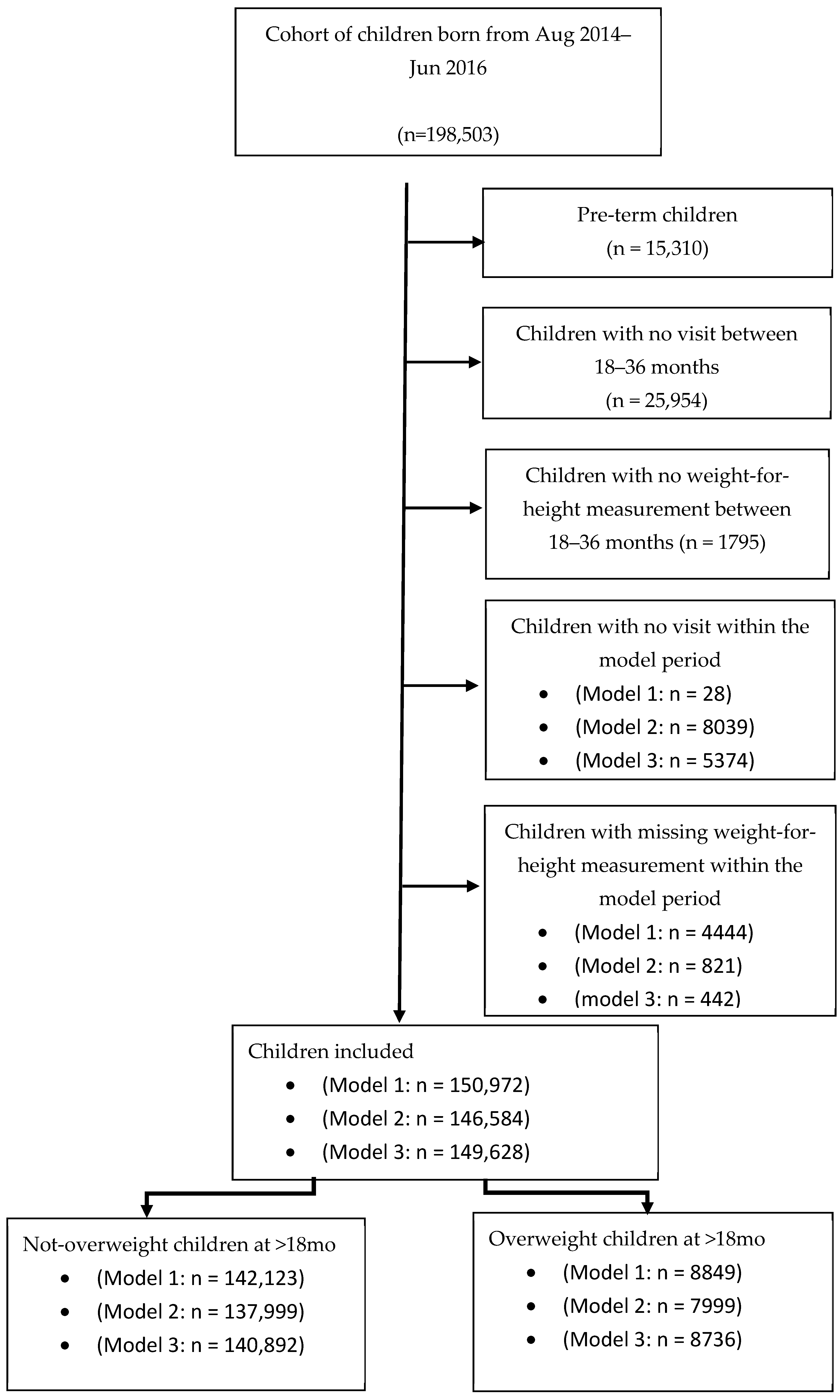
2.2. Inclusion and Exclusion Criteria
2.3. Model Variables
2.4. Machine Learning Algorithms
2.5. Model Evaluation
2.6. Statistical Analyses
2.7. Ethics Declarations
3. Results
3.1. Prediction Equations
3.1.1. Model for 0–3 Months
3.1.2. Model for 3–6 Months
3.1.3. Model for 6–12 Months
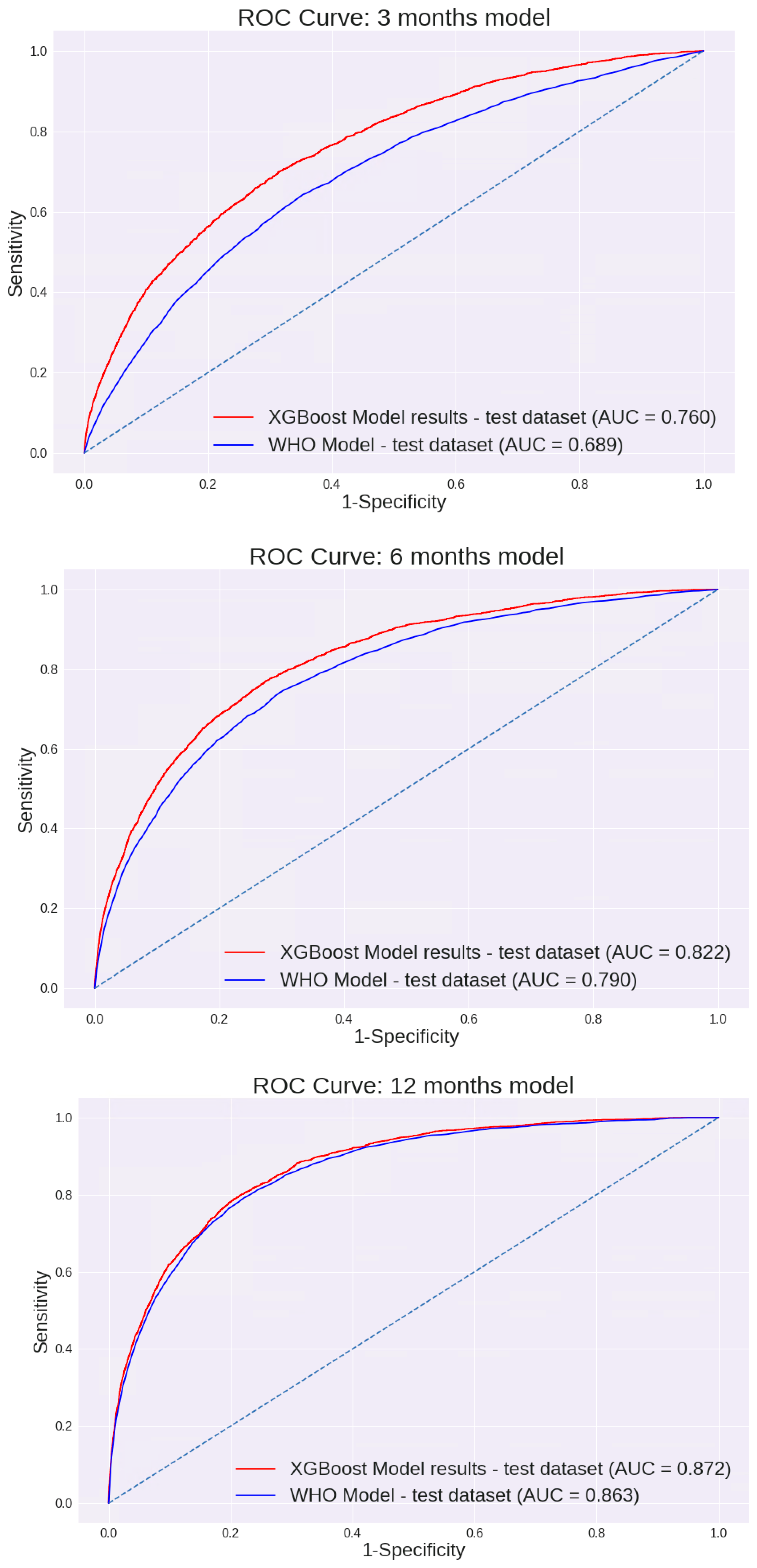
3.1.4. Validity of the Models for Different Target Ages
3.1.5. Validity of the Models in Different Populations
4. Discussion
5. Conclusions
Author Contributions
Funding
Institutional Review Board Statement
Data Availability Statement
Acknowledgments
Conflicts of Interest
Abbreviations
Appendix A

| Model | Target: 18–24 Months | Target: 24–36 Months | ||
|---|---|---|---|---|
| ML Model | WHO | ML Model | WHO | |
| 0–3 months | 77.12% | 69.43% | 75.81% | 68.61% |
| 3–6 months | 83.91% | 81% | 80.96% | 77.50% |
| 6–12 months | 89.27% | 88.43% | 85.55% | 84.64% |
References
- Obesity and Overweight. Available online: https://www.who.int/news-room/fact-sheets/detail/obesity-and-overweight (accessed on 21 December 2019).
- Ogden, C.L.; Carroll, M.D.; Lawman, H.G.; Fryar, C.D.; Kruszon-Moran, D.; Kit, B.K.; Flegal, K.M. Trends in Obesity Prevalence Among Children and Adolescents in the United States, 1988–1994 Through 2013–2014. JAMA 2016, 315, 2292–2299. [Google Scholar] [CrossRef] [Scilit]
- GBD 2015 Obesity Collaborators. Health Effects of Overweight and Obesity in 195 Countries over 25 Years. N. Engl. J. Med. 2017, 377, 13–27. [CrossRef] [Scilit]
- Comorbidities and Complications of Obesity in Children and Adolescents—UpToDate|Prediabetes|Metabolic Syndrome. Scribd. Available online: https://www.scribd.com/document/373770796/Comorbidities-and-Complications-of-Obesity-in-Children-and-Adolescents-UpToDate (accessed on 8 January 2026).
- Geserick, M.; Vogel, M.; Gausche, R.; Lipek, T.; Spielau, U.; Keller, E.; Pfäffle, R.; Kiess, W.; Körner, A. Acceleration of BMI in Early Childhood and Risk of Sustained Obesity. N. Engl. J. Med. 2018, 379, 1303–1312. [Google Scholar] [CrossRef] [Scilit] [PubMed]
- Wen, L.M.; Baur, L.A.; Simpson, J.M.; Rissel, C.; Wardle, K.; Flood, V.M. Effectiveness of home based early intervention on children’s BMI at age 2: Randomised controlled trial. BMJ 2012, 344, e3732. [Google Scholar] [CrossRef] [Scilit] [PubMed]
- WHO. Report of the Commission on Ending Childhood Obesity: Implementation Plan: Executive Summary. Available online: https://iris.who.int/server/api/core/bitstreams/34dc9459-151a-4dc2-abfd-1d8f30ccaef5/content (accessed on 8 January 2026).
- Daniels, S.R.; Hassink, S.G.; Committee on Nutrition. The Role of the Pediatrician in Primary Prevention of Obesity. Pediatrics 2015, 136, e275–e292. [Google Scholar] [CrossRef] [Scilit] [PubMed]
- World Health Organization. WHO Child Growth Standards: Length/Height-for-Age, Weight-for-Age, Weight-for-Length, Weight-for-Height and Body Mass Index-for-Age: Methods and Development; World Health Organization: Geneva, Switzerland, 2006; ISBN 924154693x. [Google Scholar]
- Committee on Obesity Prevention Policies for Young Children; Institute of Medicine. Early Childhood Obesity Prevention Policies; National Academies Press: Washington, DC, USA, 2011; ISBN 978-0-309-21024-9. [Google Scholar]
- Israel: Health System Review. PubMed—NCBI. Available online: https://www.ncbi.nlm.nih.gov/pubmed/?term=israel+health+system+review+2015+rosen (accessed on 17 January 2020).
- Sudry, T.; Zimmerman, D.R.; Yardeni, H.; Joseph, A.; Baruch, R.; Grotto, I.; Greenberg, D.; Eilenberg, R.; Amit, G.; Akiva, P.; et al. Standardization of a Developmental Milestone Scale Using Data from Children in Israel. JAMA Netw. Open 2022, 5, e222184. [Google Scholar] [CrossRef] [Scilit] [PubMed]
- Mother and Child Clinics. Available online: https://www.mevaker.gov.il/sites/DigitalLibrary/Pages/Reports/768-17.aspx?AspxAutoDetectCookieSupport=1 (accessed on 21 December 2019).
- Rajkomar, A.; Dean, J.; Kohane, I. Machine Learning in Medicine. N. Engl. J. Med. 2019, 380, 1347–1358. [Google Scholar] [CrossRef] [Scilit] [PubMed]
- The H2O Python Module—H2O Documentation. Available online: http://docs.h2o.ai/h2o/latest-stable/h2o-py/docs/intro.html (accessed on 21 December 2019).
- General—H2O 3.28.0.1 Documentation. Available online: http://docs.h2o.ai/h2o/latest-stable/h2o-docs/faq/general.html (accessed on 18 January 2020).
- Chen, T.; Guestrin, C. XGBoost: A Scalable Tree Boosting System. In Proceedings of the 22nd ACM SIGKDD International Conference on Knowledge Discovery and Data Mining—KDD 16, San Francisco, CA, USA, 13–17 August 2016; ACM: New York, NY, USA, 2016; pp. 785–794. [Google Scholar] [CrossRef] [Scilit]
- Aiello, S.; Click, C.; Roark, H.; Rehak, L. Machine Learning with Python and H2O; H₂O.ai Inc.: Mountain View, CA, USA, 2015. [Google Scholar]
- American Academy of Pediatrics. Recommendations for Preventive Pediatric Health Care. 2015. Available online: https://pediatrics.aappublications.org/content/136/3/e727 (accessed on 18 January 2020).
- Using the New UK-World Health Organization 0–4 Years Growth Charts—GOV.UK. Available online: https://www.gov.uk/government/publications/using-the-new-uk-world-health-organization-0-4-years-growth-charts (accessed on 18 January 2020).
- Alonzo, T.A. Clinical Prediction Models: A Practical Approach to Development, Validation, and Updating: By Ewout W. Steyerberg. Am. J. Epidemiol. 2009, 170, 528. [Google Scholar] [CrossRef] [Scilit]
- Machine Learning and Prediction in Medicine—Beyond the Peak of Inflated Expectations. Available online: https://www.ncbi.nlm.nih.gov/pmc/articles/PMC5953825/ (accessed on 17 January 2020).
- Levine, R.S.; Dahly, D.L.; Rudolf, M.C.J. Identifying infants at risk of becoming obese: Can we and should we? Public Health 2012, 126, 123–128. [Google Scholar] [CrossRef] [Scilit] [PubMed]
- Lee, I.; Bang, K.S.; Moon, H.; Kim, J. Risk Factors for Obesity Among Children Aged 24 to 80 months in Korea: A Decision Tree Analysis. J. Pediatr. Nurs. 2019, 46, e15–e23. [Google Scholar] [CrossRef] [Scilit] [PubMed]
- Colmenarejo, G. Machine Learning Models to Predict Childhood and Adolescent Obesity: A Review. Nutrients 2020, 12, 2466. [Google Scholar] [CrossRef] [Scilit] [PubMed]
- Pang, X.; Forrest, C.B.; Lê-Scherban, F.; Masino, A.J. Prediction of early childhood obesity with machine learning and electronic health record data. Int. J. Med. Inf. 2021, 150, 104454. [Google Scholar] [CrossRef] [Scilit]
- Butler, É.M.; Derraik, J.G.B.; Taylor, R.W.; Cutfield, W.S. Prediction Models for Early Childhood Obesity: Applicability and Existing Issues. Horm. Res. Paediatr. 2018, 90, 358–367. [Google Scholar] [CrossRef] [Scilit] [PubMed]
- Singh, B.; Tawfik, H. Machine Learning Approach for the Early Prediction of the Risk of Overweight and Obesity in Young People. In Computational Science—ICCS 2020; Krzhizhanovskaya, V.V., Závodszky, G., Lees, M.H., Dongarra, J.J., Sloot, P.M., Brissos, S., Teixeira, J., Eds.; Springer International Publishing: Cham, Switzerland, 2020; pp. 523–535. [Google Scholar]
- Redsell, S.A.; Rose, J.; Weng, S.; Ablewhite, J.; Swift, J.A.; Siriwardena, A.N.; Nathan, D.; Wharrad, H.J.; Atkinson, P.; Watson, V.; et al. Digital technology to facilitate Proactive Assessment of Obesity Risk during Infancy (ProAsk): A feasibility study. BMJ Open 2017, 7, e017694. [Google Scholar] [CrossRef] [Scilit] [PubMed]
- Rotevatn, T.A.; Mortensen, R.N.; Ullits, L.R.; Torp-Pedersen, C.; Overgaard, C.; Høstgaard, A.M.B.; Bøggild, H. Early-life childhood obesity risk prediction: A Danish register-based cohort study exploring the predictive value of infancy weight gain. Pediatr. Obes. 2021, 16, e12790. [Google Scholar] [CrossRef] [Scilit] [PubMed]
- Ministry of Health (Israel). Vaccination Coverage for Routine Vaccines Provided at Tipat Halav (Well-Baby Clinics), 2017–2022. Available online: https://www.gov.il/he/pages/vaccination-coverage-june-2023?utm_source=chatgpt.com (accessed on 8 January 2026).

| Cohort Characteristics | 0–3-Month Model n = 150,572 | 3–6-Month Model n = 146,584 | 6–12-Month Model n = 149,628 |
|---|---|---|---|
| Gender | |||
| Male (%) | 51.2% | 51.3% | 51.2% |
| Female (%) | 48.8% | 48.7% | 48.8% |
| Birth weight in kg (Mean, SD) | 3.28 (0.44) | 3.28 (0.44) | 3.28 (0.44) |
| Gestational age (weeks) | 39.4 (1.19) | 39.4 (1.19) | 39.4 (1.19) |
| Immigrants (%) | 13.1% | 13.1% | 13.1% |
| Religion (%) | |||
| Jewish | 65.5% | 65.2% | 65.3% |
| Muslim | 25.9% | 26.2% | 26.1% |
| Druse | 2.5% | 2.5% | 2.5% |
| Cristian Arab | 1.8% | 1.8% | 1.8% |
| Other | 2.5% | 2.5% | 2.5% |
| Missing | 1.8% | 1.8% | 1.8% |
| Mother’s age (Mean, SD) | 29.7 (5.6) | 29.7 (5.6) | 29.7 (5.6) |
| Type of delivery (%) | |||
| Spontaneous | 76.7% | 76.6% | 76.6% |
| Assisted | 5.5% | 5.6% | 5.6% |
| Caesarian | 16.6% | 16.6% | 16.6% |
| Missing value | 1.2% | 1.2% | 1.2% |
| Mother’s education (%) | |||
| Elementary schools, middle schools | 11.4% | 11.1% | 11.1% |
| High school | 30.3% | 30.3% | 30.3% |
| Academic school | 31.4% | 31.6% | 31.5% |
| Missing | 27% | 26.8% | 26.9% |
| Mother’s family status (%) | |||
| Married | 92.8% | 92.8% | 92.8% |
| Divorced | 1.13% | 1.13% | 1.13% |
| Widowed | 0.05% | 0.05% | 0.05% |
| Single | 2.92% | 2.92% | 2.92% |
| Missing value | 3.1% | 3.1% | 3.1% |
| Target Child age—months (Mean, SD) | 23.8 (4.3) | 23.8 (4.3) | 23.8 (4.3) |
| Infant age at each model–months (Mean, SD) | 2.16 (0.36) | 4.5 (0.53) | 8.9 (1.4) |
| Total number of visits (Mean, SD) | 2.3 (0.7) | 3.4 (0.73) | 5.1 (1.02) |
| Model | Description of Variables Included in the Model | |
|---|---|---|
| 0–3 months | 1 | Weight-for-height percentile at last measurement |
| 2 | Linear slope of the last three weight percentile measurements | |
| 3 | The highest of the last three weight percentile measurements | |
| 4 | Weight percentile at the second measurement | |
| 5 | Head circumference percentile at last measurement | |
| 6 | Leave hospital weight | |
| 7 | Weight percentile at last measurement | |
| 8 | The highest of the last two weight-for-height percentile measurements | |
| 9 | Ratio between birth weight and the pregnancy week at birth | |
| 10 | The highest of the last three weight-for-height percentile measurements | |
| 11 | Height percentile at last measurement | |
| 12 | Birth weight | |
| 13 | Head circumference percentile at 2nd measurement | |
| 14 | Height percentile at 2nd measurement | |
| 15 | Starting formula age (months) | |
| 3–6 months | 1 | Weight percentile at 3rd measurement |
| 2 | Weight percentile at last measurement | |
| 3 | Weight-for-height percentile at last measurement | |
| 4 | The highest of the last four weight-for-height percentile measurements | |
| 5 | The highest of the last four weight percentile measurements | |
| 6 | Weight percentile at 2nd measurement | |
| 7 | Linear slope of the last four weight percentile measurements | |
| 8 | Weight-for-height percentile at 3rd measurement | |
| 9 | Ratio between weight-for-height percentile last two measurements | |
| 10 | The higher of the last two weight-for-height percentile measurements | |
| 11 | Birth Weight | |
| 12 | Weight-for-height percentile at 2nd measurement | |
| 13 | Head circumference percentile at last measurement | |
| 14 | Linear slope of the last four weight-for-height percentile measurements | |
| 6–12 months | 1 | The highest of the last two weight-for-height percentile measurements |
| 2 | The highest of the last six weight-for-height percentile measurements | |
| 3 | Weight-for-height percentile at last measurement | |
| 4 | Weight percentile at last measurement | |
| 5 | Linear slope of the last six weight-for-height percentile measurements | |
| 6 | Weight percentile at 4th measurement | |
| 7 | Weight-for-height percentile at the fifth measurement | |
| 8 | Weight percentile at the fifth measurement | |
| 9 | Linear slope of the last six weight percentile measurements |
| Model | Cut Point | Sensitivity | Specificity | PPV | PPV85 * | NPV | Cumulative Lift |
|---|---|---|---|---|---|---|---|
| 0–3 months | 99 | 7% | 99% | 43% | 77% | 95% | 7.3 |
| 95 | 27% | 95% | 26% | 64% | 96% | 4.4 | |
| 90 | 40% | 91% | 21% | 57% | 96% | 3.6 | |
| 85 | 48% | 86% | 17% | 52% | 96% | 3.0 | |
| 3–6 months | 99 | 9% | 100% | 54% | 86% | 95% | 9.3 |
| 95 | 33% | 96% | 31% | 73% | 96% | 5.4 | |
| 90 | 48% | 91% | 25% | 66% | 97% | 4.3 | |
| 85 | 58% | 87% | 21% | 60% | 97% | 3.6 | |
| 6–12 months | 99 | 11% | 100% | 64% | 94% | 95% | 10.8 |
| 95 | 41% | 96% | 40% | 83% | 96% | 6.8 | |
| 90 | 57% | 92% | 31% | 75% | 97% | 5.2 | |
| 85 | 67% | 87% | 25% | 69% | 98% | 4.2 |
Disclaimer/Publisher’s Note: The statements, opinions and data contained in all publications are solely those of the individual author(s) and contributor(s) and not of MDPI and/or the editor(s). MDPI and/or the editor(s) disclaim responsibility for any injury to people or property resulting from any ideas, methods, instructions or products referred to in the content. |
© 2026 by the authors. Licensee MDPI, Basel, Switzerland. This article is an open access article distributed under the terms and conditions of the Creative Commons Attribution (CC BY) license.
Share and Cite
Sadaka, I.L.; Grotto, I.; Sadaka, Y.; Eilenberg, R.; Peleg, A.; Greenberg, D. Prediction Models for Early Identification of Overweight and Obese Children—A National Study. Nutrients 2026, 18, 441. https://doi.org/10.3390/nu18030441
Sadaka IL, Grotto I, Sadaka Y, Eilenberg R, Peleg A, Greenberg D. Prediction Models for Early Identification of Overweight and Obese Children—A National Study. Nutrients. 2026; 18(3):441. https://doi.org/10.3390/nu18030441
Chicago/Turabian StyleSadaka, Irit Lior, Itamar Grotto, Yair Sadaka, Roni Eilenberg, Assaf Peleg, and Dan Greenberg. 2026. "Prediction Models for Early Identification of Overweight and Obese Children—A National Study" Nutrients 18, no. 3: 441. https://doi.org/10.3390/nu18030441
APA StyleSadaka, I. L., Grotto, I., Sadaka, Y., Eilenberg, R., Peleg, A., & Greenberg, D. (2026). Prediction Models for Early Identification of Overweight and Obese Children—A National Study. Nutrients, 18(3), 441. https://doi.org/10.3390/nu18030441