1. Introduction
The family is the foundation of individual health and development, as well as the cornerstone of the community [
1]. The family’s ecocultural pathway encompasses shared values and goals and daily habits (including routines around meals, choice and preparation of food, joint physical activities, risk behaviors, and social engagement), along with environmental factors such as income, education, and resources, all of which are important in promoting health [
2]. Family health is defined as “a resource at the level of the family unit that develops from the intersection of the health of each family member, their interactions and capacities, as well as the family’s physical, social, emotional, economic, and medical resources” [
3]. Formal and informal family rules, along with health routines, are shaped as family members share their understanding, opinions, and behaviors, which in turn influence individuals’ health behavior patterns [
4].
Family function is reflected in aspects such as communication patterns, role fulfillment, adaptability, and behavioral control, and is associated with healthier outcomes among adolescents, including a lower risk of overweight and obesity, reduced sedentary behavior, decreased fast-food consumption, higher intake of fruits and vegetables, sharing family meals and daily breakfast, and improved sleep duration [
5,
6]. Moreover, family function has been associated with mental health and healthy behavior [
7,
8]. Family health care provided to members across life stages is more economically valuable than that provided by the medical system [
9]. Family-level factors typically considered include household composition, family structure, occasionally income, and the health of individual family members [
10].
Family health climate (FHC) is an example of a family-level factor, reflecting how daily household rituals and interaction between family members shape health behaviors and perceptions. These interactions occur frequently over an extended period and create a “climate” that represents a core aspect of family interrelationships and the family environment. FHC captures shared perceptions and cognitions concerning health and health behaviors among family members [
11]. First defined by Niermann et al. [
11], the framework covers routine health habits such as nutrition and physical activity occurring both inside and outside the home. The FHC scales have been tested and validated in diverse populations [
12,
13] yielding promising results: FHC-PA and FHC-NU scores are associated with individual outcomes, including healthy dietary pattern, physical activity, food parenting style, and children’s body mass index (BMI) [
14,
15], highlighting the influence of family systems on children’s and adolescents’ health behaviors.
Family serves as the foundational cornerstone of the Saudi Arabian society. Families constitute the individual’s core social network and secure both socioeconomic and psychological stability. The traditional Saudi family is characterized by a patriarchal authority structure that fosters loyalty and solidarity among members, and an extended family plays a significant role in the daily social and emotional integration. Family relationships become particularly important when caregiving is needed to support the well-being and happiness of all the family members. Arabic is spoken by more than 450 million people and holds official status in nearly 25 countries. Therefore, we aimed to translate the FHC questionnaire into Arabic, test the validity of the translated version in adult Arabic speakers, assess the internal consistency among all subscales, and confirm its factor structure.
2. Materials and Methods
2.1. Study Design
This cross-sectional study was conducted in two phases. Phase one involved translating the questionnaire from the original English version to Arabic after obtaining permission from the developer of the FHC [
11]. Phase two involved the evaluation of the validity of the FHC scale in the Saudi Arabian population and testing its psychometric properties. This study was approved by the Biomedical Ethics Research Committee of King Abdulaziz University (reference number 42–25) in accordance with guidelines outlined in the Declaration of Helsinki. Before completing the questionnaire, all participants were required to review the objectives of the study and provide electronic informed consent for participation.
2.2. Research Instrument
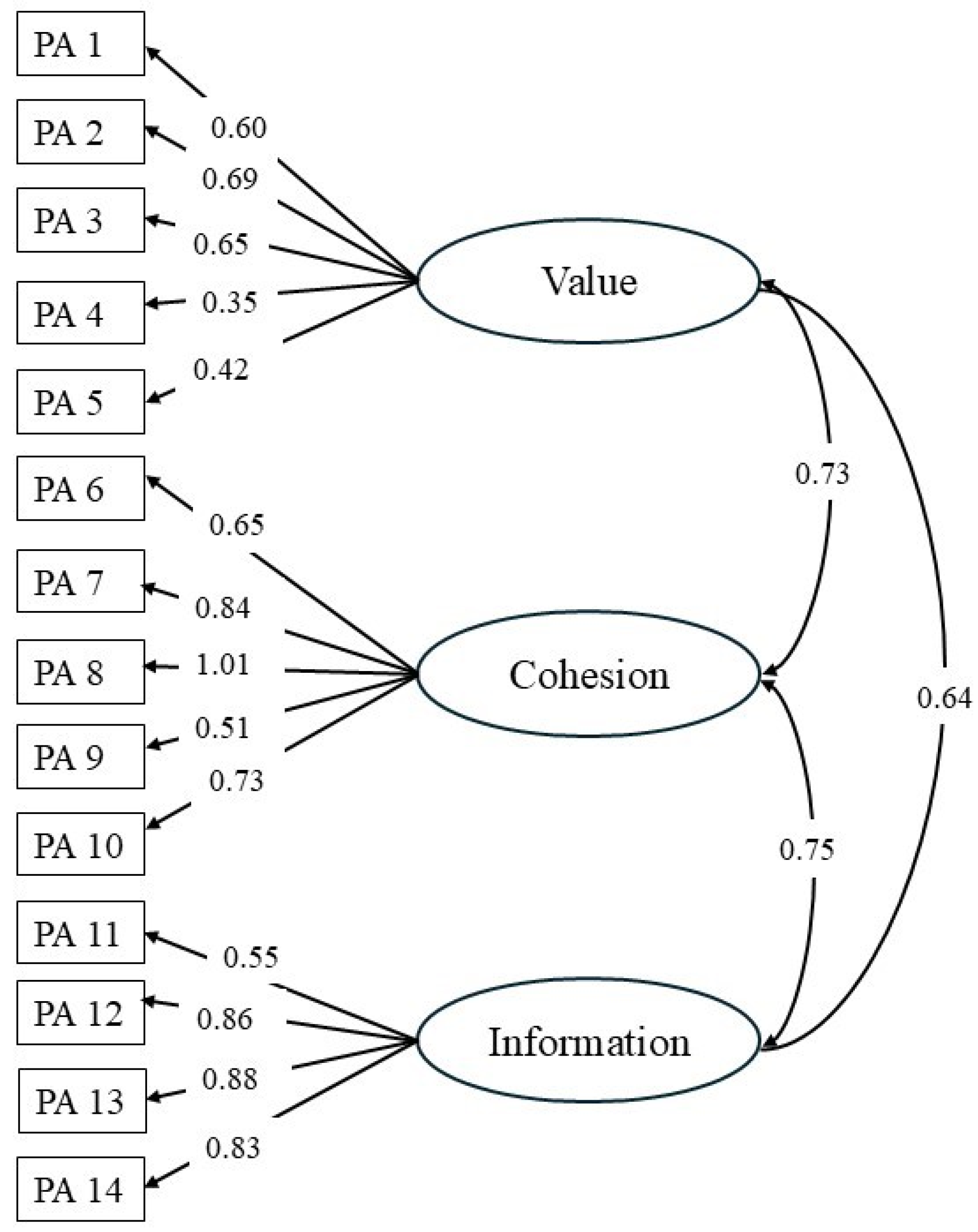
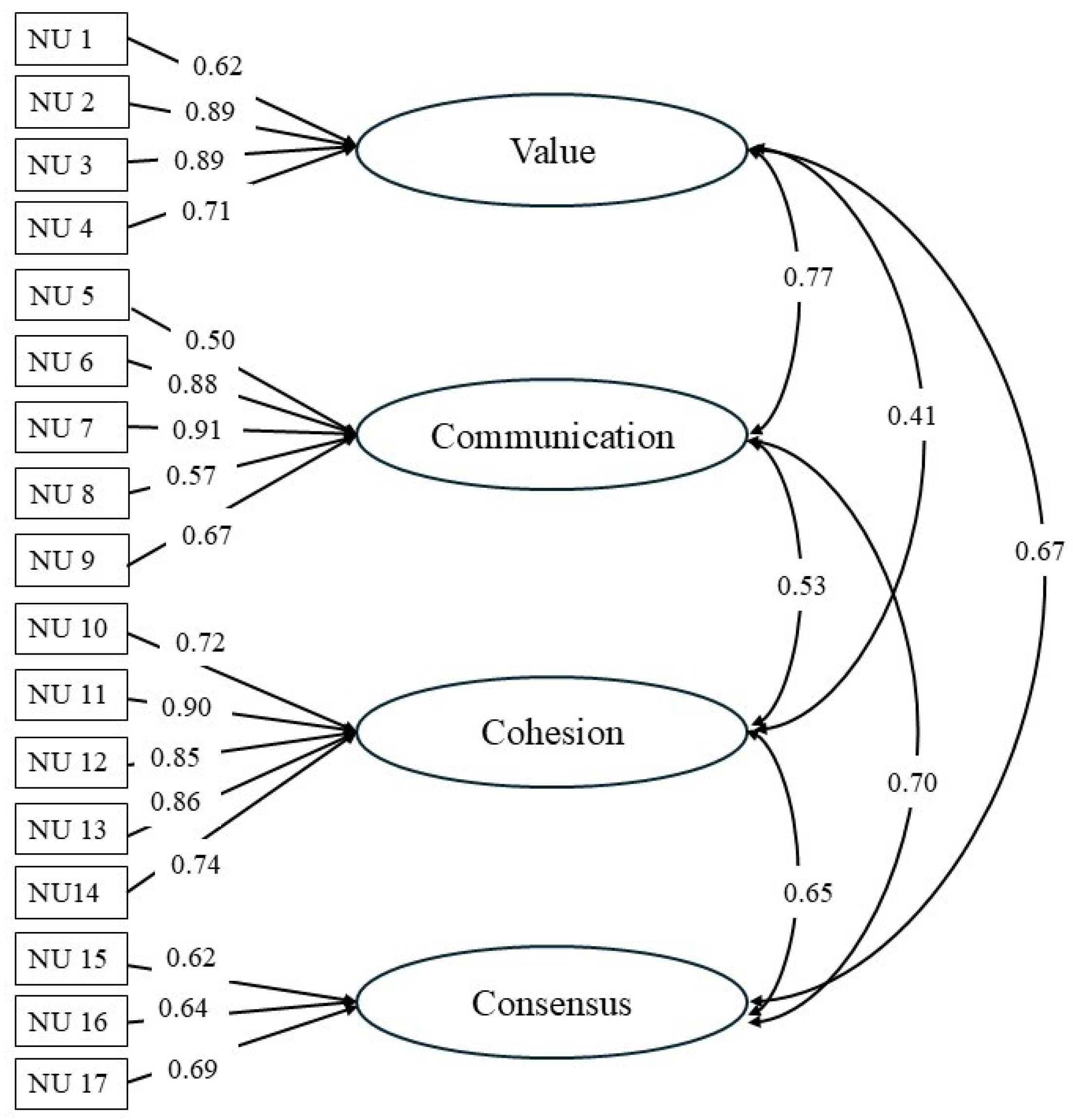
This scale measures the impact of the family on individual dietary behaviors (FCH-NU) and physical activity levels (FHC-PA). The FHC-PA consists of three subscales (value, cohesion, and information) and 14 items. The FHC-NU comprises four subscales (value, cohesion, communication, and consensus) and 17 items. Each item was given on a four-point rating scale (0 = “definitely false”, 1 = “rather false”, 2 = “rather true”, 3 = “definitely true”), and each response had a score. The items were prefaced with a uniform contextual statement “In our family….”. The total scores for FHC-PA and FHC-NU ranged from 0 to 48 and 0 to 51, respectively, with higher scores reflecting an optimal family health climate.
2.3. Cross-Cultural Adaptation Process
The FHC questionnaire was initially conceptualized in German; however, the authors published the English version in their article [
11]. This English version was translated into Arabic by five native Arabic-speaking senior researchers in the Food and Nutrition Department, and the translation was checked by two doctors in the department. Subsequently, a back-translation of the Arabic version into English was conducted by three bilingual doctors who are proficient in the English language. This version was then reviewed by two other doctors for comparison with the original version.
2.4. Participants
The target population for this study was Saudi adults (aged ≥ 18 years) or native Arabic speakers living in Saudi Arabia. Literate, healthy adults of both sexes were invited to participate. Participants were recruited through social media platforms such as WhatsApp, X, and Telegram and e-mail. The recruitment was conducted between March and May 2025. Participants were required to provide their email address to avoid duplicated participation.
2.5. Sample Size
The study utilized a 10:1 item-to-response ratio as the recommended sample size for the validation phase, resulting in a required total of 310 participants [
16]. Moreover, an a priori sample size estimation was applied, resulting in the requirement of 100 participants for the structural equation modeling technique to run factor analysis [
17]. Therefore, the minimum number of participants required to adequately power our analysis was 410 participants.
2.6. Validation Process
After the translation process, the questionnaire was redistributed to 10 nutritionists to test validity (face validity, floor and ceiling effects, and content validity) [
18].
2.6.1. Face Validity
Validity testing involved the measurement of three main aspects: completeness of content, comprehensibility, and time required. A group of 10 experts was involved in this phase. First, they were asked if the questionnaire covered the most important aspect of family health climate; if the answer was “No,” the respondent was asked to indicate “which aspects they would incorporate”. Second, the experts were asked to indicate which questions required enhancement to improve clarity. Lastly, they evaluated the time needed to complete the questionnaire on a scale of 0–10, with 10 corresponding to “completely okay.”
2.6.2. Floor and Ceiling Effect
Ceiling and floor effects occurred when a high frequency of participants achieved the maximum or minimum possible score, which caused non-normal distribution and skewed frequencies at the scale’s boundaries. The floor and ceiling effects of the questionnaire were assessed across all items using the total scores. Ceiling or floor effects were determined if more than 15% of responses scored at the absolute minimum or maximum.
2.6.3. Content Validity
Expert panelists assessed the content validity, i.e., the relevance, of the translated FHC questionnaire items using a four-point Likert Scale from 1 (not relevant) to 4 (is very relevant). Scores of 3 and 4 were recorded as 1 (relevant), while scores of 1 and 2 were recorded as 0 (not relevant). The content validity index (CVI) was calculated using an average scale. The CVI for individual items (I-CVI) and for the scale (S-CVI) was determined by a panel of 10 experts reviewing each question. The relevance of each item was rated on a 5-point Likert scale (1 = not at all relevant to 5 = very relevant). Items with scores of 4 and 5 were categorized as relevant. The SCVI/average and S-CVI/universal agreements were computed following established guidelines [
19].
2.7. Pilot Testing
Prior to distributing the final version of the scale, interviews were conducted with 20 adult participants. The participants provided feedback on the formulation of each item, indicating whether the statements were clear, confusing, or easy to answer. Pilot testing was conducted by distributing the questionnaires online, and comments were provided regarding any confusion or misunderstanding of any item.
2.8. Data Collection
The participants completed the questionnaire electronically using Google Forms. The first part of the questionnaire consisted of questions to collect sociodemographic data including age, sex, marital status, income level, educational level, smoking status, parents’ education, parents’ job, number of family members, number of years family formed, participants’ position in the family, number of meals the family eats together, type of meals, self-reported height and weight, and physical activity levels. The second part was the FHC scale.
2.9. Internal Consistency Reliability
The internal consistency of the research instrument was evaluated utilizing Cronbach’s alpha. An alpha value of 0.70 or higher was considered satisfactory for establishing instrument reliability [
20].
2.10. Statistical Analysis
The data obtained were analyzed using SPSS (version 29.0; SPSS Inc., Chicago, IL, USA), and are presented using means and standard deviations for quantitative data, while categorical variables are expressed as frequencies and percentages. The internal consistency of the FHC was assessed using Cronbach’s alpha. Spearman’s correlation coefficients among the items were calculated to assess correlation between measured concepts and continuous variables (age and BMI). The construct validity of the FHC scale was assessed using exploratory factor analysis (EFA) and Kaiser–Meyer–Olkin (KMO) measurements of sampling adequacy. Bartlett’s test of sphericity was used to assess the factorability of the FHC-PA and FHC-NU separately. EFA was carried out on both FHC-PA and FHC-NU to identify the underlying factor structures using principal axis factor extraction with oblique Promax rotation. The number of factors was extracted based on an initial eigenvalue cutoff of 0.80, to retain factors that have meaningful variance contributions without inflating the model and the original FHC factor model [
21]. Factor loadings ≥ 0.30 were considered significant for item retention. An independent
t-test and one-way ANOVA were used to examine association between total FHCA and its subscales’ scores, and sociodemographics of participants. A
p value ≤ 0.05 was considered significant.
4. Discussion
In this study, we aimed to translate and evaluate the validity and reliability of the Arabic version of the FHC in an Arab population. The findings showed that the translation, validity, and reliability of the FHC tool achieved satisfactory scores based on evaluations performed by a panel of expert nutritionists. The FHC was first developed by Niermann et al. [
11] to build a qualitative approach to explore how families manage their daily health-related routines, as family cohesion encourages members to eat healthy foods and be physically active. Family is a well-known key predictor of an individual’s health status, because it is where habits are built from the earliest age [
22]. Therefore, it is useful to translate the FHC into Arabic to assist researchers in investigating how health-related habits among Arab families are involved in increasing the risk of non-communicable diseases.
Given that the original FHC scale was in German and English, it is necessary to test the accuracy of the Arabic translation because interpretation inevitably reflects a particular understanding of a text, and cultural differences impact encoding and decoding [
23]. For example, two statements in the FHC-PA section on cohesion factors—“we like being together during physical activities” and “we have fun doing physical activities together”—give highly similar meanings in Arabic language; thus, based on panel feedback, a modification of the verb used was applied. Another change made was in the statement “we read newspaper or magazine articles on fitness, physical activity, and exercise”; because social media has replaced traditional sources like newspapers [
24,
25], changes were made accordingly to “following experts on social media”. Both the original and adapted items assess information on consumption behavior and engagement with written/textual media; the transition from traditional to digital platforms represents a change in delivery mechanism while maintaining conceptual equivalence with the original measure. Notably, the overall scale structure and factor composition remained comparable because scores were analyzed at the scale level rather than the item level.
The final items in the FHC scale showed good validity and reliability. The FHC scale was rated high for its clarity and comprehensibility and was completed by an expert panel in face validity. Two values were calculated for the content validity: SCVI/Ave and SCVI/UA. The SCVI/Ave method suggested that the overall content validity of FHC was high (SCVI/Ave = 0.93), whereas the SCVI/UA approach showed a fair level (SCVI/UA = 0.51). The numerator SCVI/Ave will always be greater than SCVI/UA because the likelihood of chance universal agreement around each I-CVI value equal to 1.00 decreases when the number of experts increases [
19]. The results of the SCVI/UA in our study were considered fair according to the recommendation given by Polit & Beck [
26] and similar to other studies that conducted Arabic translation and validation of other nutrition-related scales [
27,
28]. Cronbach’s alpha for the Arabic FHC was 0.9, indicating a very high acceptable internal consistency.
The results of the factor loading analysis of the FHC-PA and FHC-NU demonstrated significant agreement with the original FHC scales. All three original factors (value, cohesion, and information) of the FHC-PA were replicated using the Arabic version. The original four factors of the FHC-NU scale (value, communication, cohesion, and consensus) were replicated. In our study, female participants had higher FHC-PA scores, similarly to a cross-sectional study reporting that female participants scored higher in fitness than male participants [
29]. This can be explained by the increasing interest among women, especially young women, in increasing physical activity to enhance their health. In addition, findings from this study indicated that married and less educated participants had higher FHC, FHC-PA, and FHC-NU scores. Therefore, family structure serves as an important determinant of health outcomes; families that maintain a stable relationship and positive environment exhibited better health outcomes among their members [
30,
31]. In contrast with our findings, a previous study reported that higher education is associated with higher FHC scores [
32]; this may be because people with lower education levels tend to prioritize sharing time with their families, which creates a shared, supportive cultural environment.
This study had certain limitations. Recall bias may have occurred because of the self-reporting nature of the questionnaire. As Saudi participants were dominant in our study sample, further validation studies are needed to confirm the robustness of the Arabic FHC scale in other Arab contexts. The absence of confirmatory factor analysis limits our ability to confirm the factor structure’s replicability; therefore, future researchers are encouraged to conduct confirmatory factor analysis with access to independent larger samples to strengthen the evidence base for this instrument’s validity. The cross-sectional study design is another limitation because it yields weaker evidence for causality. The convenience sampling approach may have also introduced sampling bias because it relies on availability and willingness; thus, the sample only includes individual who are easily accessible and chose to respond. Finally, self-reported anthropometric data may introduce measurement errors and reporting biases; however, it was not a main factor in our validation study.