Review

Seasonal Affective Disorder and the Microbiota–Gut–Brain Axis: Circadian Disruption, Tryptophan Metabolism, and Psychobiotic Potential of Lacticaseibacillus rhamnosus GG

School of Exercise and Health, Shanghai University of Sport, Shanghai 200438, China
*
Author to whom correspondence should be addressed.
Nutrients 2026, 18(14), 2364; https://doi.org/10.3390/nu18142364
Submission received: 17 June 2026 / Revised: 16 July 2026 / Accepted: 17 July 2026 / Published: 18 July 2026
(This article belongs to the Special Issue Microbiome and Mental Health in the Era of Precision Nutrition)

Abstract

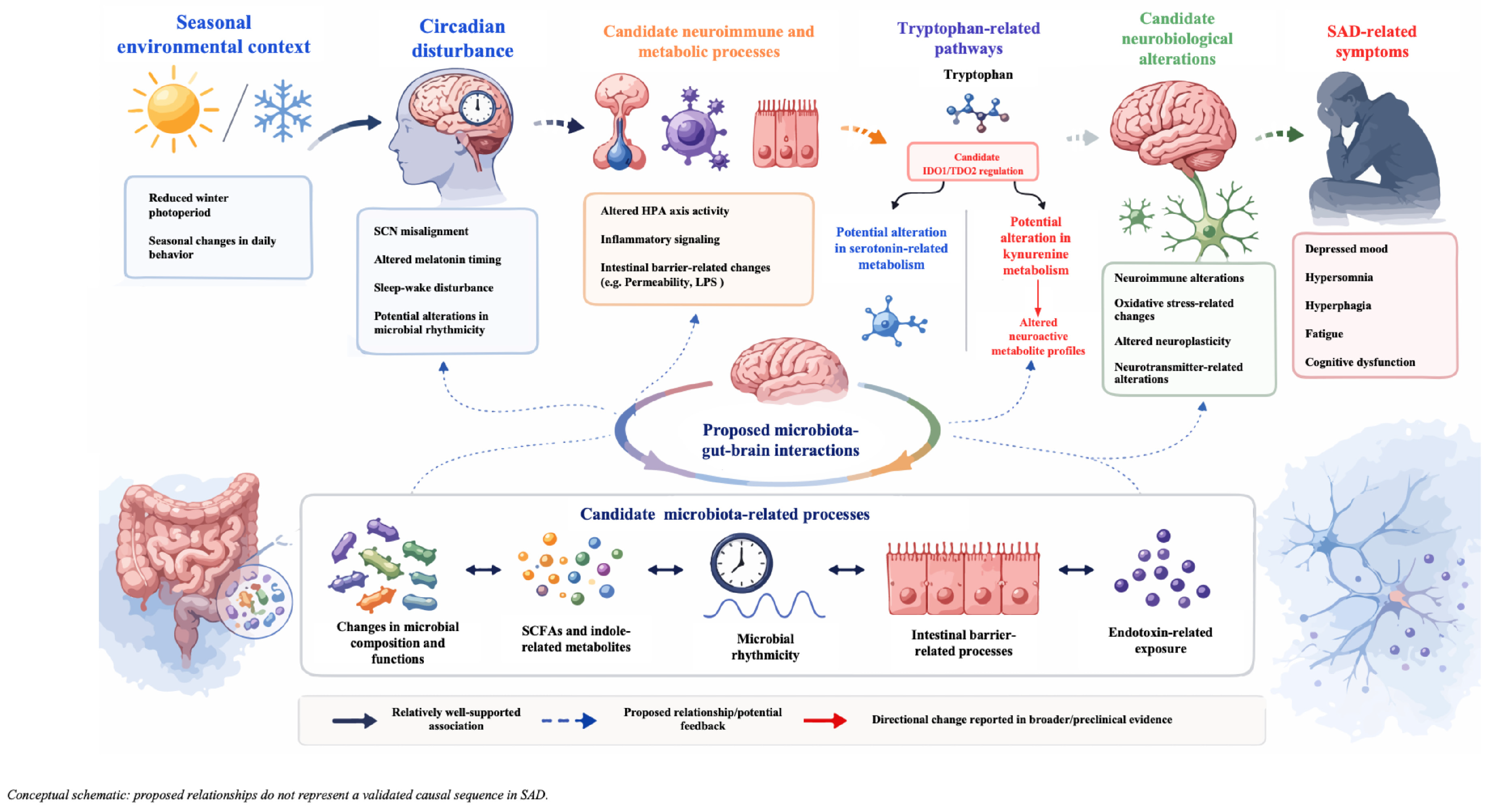
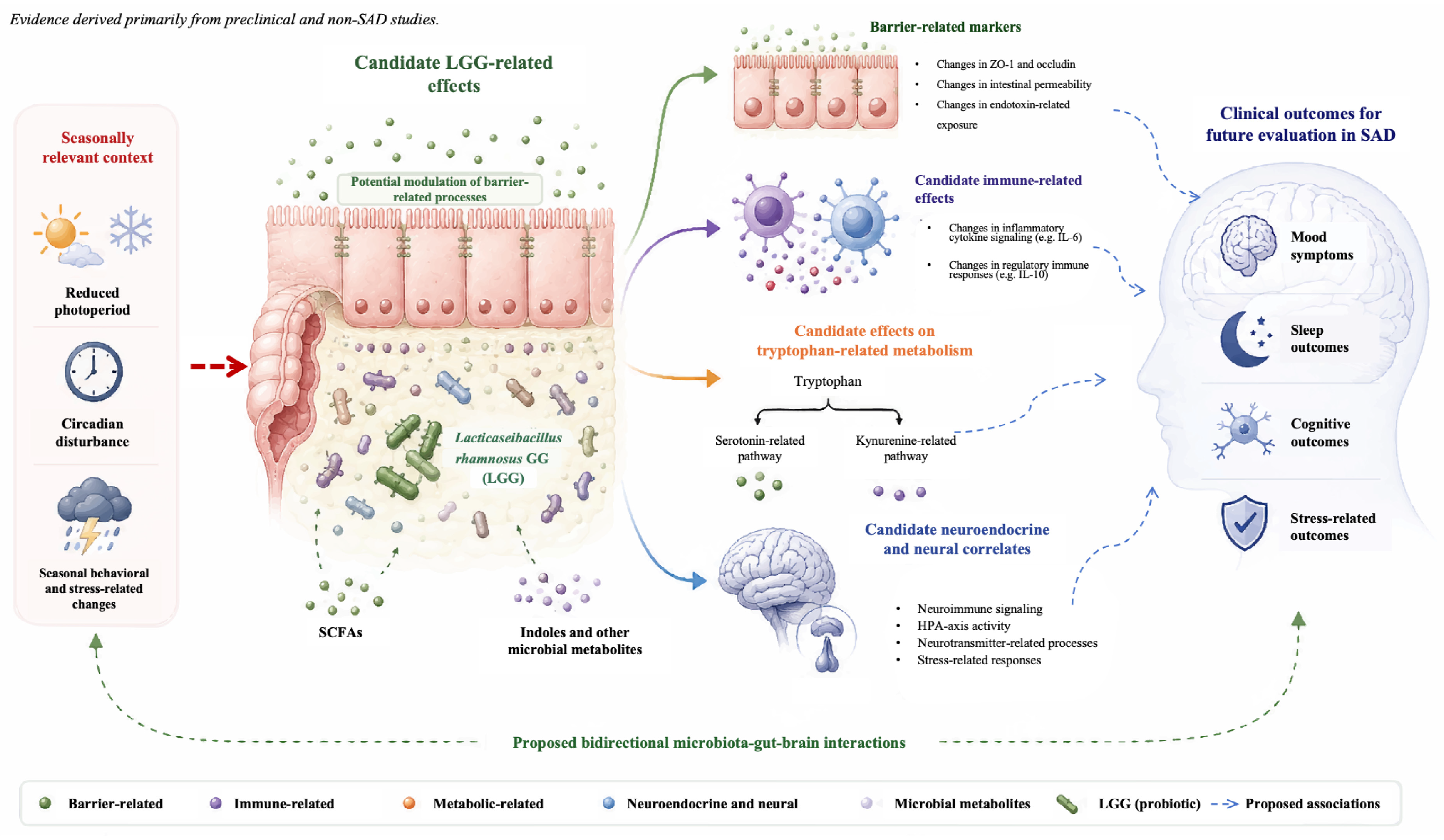
Seasonal affective disorder (SAD) is a recurrent mood disorder associated with reduced photoperiod exposure and circadian disruption during autumn and winter. Emerging evidence links SAD to alterations in serotonergic signaling, neuroimmune activity, metabolism, and the microbiota–gut–brain axis; however, the causal relationships among these systems remain incompletely understood. A structured search of PubMed, Web of Science, and Scopus identified relevant publications from 2000 to 2025, with clinical and preclinical evidence evaluated separately. Proposed links between circadian misalignment, inflammatory signaling, and tryptophan metabolism toward the kynurenine pathway are based largely on associative and preclinical findings rather than confirmed mechanisms in SAD. The microbiota–gut–brain axis in SAD is likely bidirectional, as seasonal changes in feeding behavior, physical activity, and circadian phase may themselves influence gut microbial composition and function. Accordingly, microbiome alterations in affective disorders may reflect both potential upstream modulators and downstream consequences of disease-related behavior. Psychobiotics have been proposed as modulators of gut–brain communication in affective disorders. Among candidate strains, Lacticaseibacillus rhamnosus GG (formerly Lactobacillus rhamnosus GG; LGG) has shown effects on intestinal barrier function, immune signaling, and host tryptophan metabolism in preclinical studies. However, evidence derives largely from animal or non-seasonal depression models, and direct evidence in SAD is lacking. Thus, LGG should be considered a mechanistically plausible candidate for future investigation rather than an established therapy. This review synthesizes evidence on circadian regulation, serotonergic and tryptophan metabolism, and microbiota–gut–brain interactions in SAD, and highlights mechanistic gaps for future studies.
Keywords: seasonal affective disorder; Lacticaseibacillus rhamnosus GG; microbiota–gut–brain axis seasonal affective disorder; Lacticaseibacillus rhamnosus GG; microbiota–gut–brain axis