Sex-Specific Associations of Vegetable and Fruit Intake Categories with Depressive Symptoms Modified by Weight-Adjusted Waist Index Among Chinese Older Adults


Abstract
1. Introduction
2. Materials and Methods
2.1. Participants
2.2. Variables and Instruments
2.2.1. Assessment of Depressive Symptoms
2.2.2. Vegetable and Fruit Intake Categories
2.2.3. Weight-Adjusted Waist Index
2.2.4. Other Variables
2.3. Statistical Analysis
- WWI × sex, to examine sex-specific associations between WWI and depressive symptoms;
- vegetable and fruit intake categories × WWI, to evaluate whether WWI acts as an effect modifier for the dietary-depressive symptoms link.
3. Results
3.1. Participants Characteristics and Sex-Specific Divergence
3.2. Sex-Specific Patterns of Depressive Symptoms and Intake Categories Across WWI Quartiles
3.3. Distribution of Clinical and Functional Characteristics Across WWI Quartiles
3.4. Sociodemographic and Lifestyle Factors
3.5. Main Effects and Interaction Analysis
3.6. Stratified Analyses by WWI Quartiles
4. Discussion
5. Conclusions
Author Contributions
Funding
Institutional Review Board Statement
Informed Consent Statement
Data Availability Statement
Acknowledgments
Conflicts of Interest
Abbreviations
| WWI | Weight-adjusted Waist Index |
| Q | Quartile |
| BMI | Body Mass Index |
| WC | Waist Circumference |
| WHtR | Waist-to-Height Ratio |
| AHLS | Anhui Health and Longevity Survey |
| PHQ-9 | Patient Health Questionnaire |
| MMSE | Mini-Mental State Examination |
| ADL | Activities of Daily Living |
| OR | Odds Ratios |
| AOR | Adjusted Odds Ratios |
| CI | Confidence Intervals |
| RMB | Renminbi |
References
- Wang, Y.; Sun, Y.; Zhang, H.; Ma, K. Association between Brain-Gut Peptides and Depression: A Systematic Review and Meta-Analysis. Psychoneuroendocrinology 2025, 179, 107526. [Google Scholar] [CrossRef] [PubMed]
- Monroe, S.M.; Harkness, K.L. Major Depression and Its Recurrences: Life Course Matters. Annu. Rev. Clin. Psychol. 2022, 18, 329–357. [Google Scholar] [CrossRef] [PubMed]
- GBD 2023 Disease and Injury and Risk Factor Collaborators. Burden of 375 Diseases and Injuries, Risk-Attributable Burden of 88 Risk Factors, and Healthy Life Expectancy in 204 Countries and Territories, Including 660 Subnational Locations, 1990–2023: A Systematic Analysis for the Global Burden of Disease Study 2023. Lancet 2025, 406, 1873–1922. [Google Scholar] [CrossRef] [PubMed]
- Huang, Y.; Wang, Y.; Wang, H.; Liu, Z.; Yu, X.; Yan, J.; Yu, Y.; Kou, C.; Xu, X.; Lu, J.; et al. Prevalence of Mental Disorders in China: A Cross-Sectional Epidemiological Study. Lancet Psychiatry 2019, 6, 211–224. [Google Scholar] [CrossRef] [PubMed]
- Wang, J.; Zhao, Z.; Yang, J.; Wang, L.; Zhang, M.; Zhou, M. The Association Between Depression and All-Cause, Cause-Specific Mortality in the Chinese Population—China, 2010–2022. China CDC Wkly. 2024, 6, 1022–1027. [Google Scholar] [CrossRef] [PubMed]
- Chen, L.; Xu, Y.-Y.; Lin, J.-Y.; Ji, Z.P.; Yang, F.; Tan, S.; Wang, G.; Fang, Y.; Lu, Z.; Yang, H.; et al. The Prevalence and Clinical Correlates of Suicide Attempts in Patients with Bipolar Disorder Misdiagnosed with Major Depressive Disorder: Results from a National Survey in China. Asian J. Psychiatry 2024, 93, 103958. [Google Scholar] [CrossRef] [PubMed]
- Radovic, L.K.; Orr, R.; Lane, M.M.; Jacka, F.N.; Jabeen, T.; Young, L.M.; Saunders, D.; Mahoney, S.; Turner, M.; Bryan, M.; et al. Adherence to Australian Diet, Physical Activity, and Alcohol Guidelines Is Associated with Lower Risk of Depression and Anxiety: A Secondary, Pooled Analysis of the CALM Trial. Int. J. Food Sci. Nutr. 2026, 77, 136–145. [Google Scholar] [CrossRef] [PubMed]
- Mao, T.; Gou, Y.; Qin, L.; Che, Y.; Da, W.; Li, Y.; Wang, H.; Feng, J.; Liu, L.; Liu, H.; et al. Nutrient Intake Is Associated with Incident Mental Disorders: A Population-Based Prospective Cohort Study. Eur. J. Nutr. 2026, 65, 74. [Google Scholar] [CrossRef] [PubMed]
- Lu, X.; Wu, L.; Shao, L.; Fan, Y.; Pei, Y.; Lu, X.; Borné, Y.; Ke, C. Adherence to the EAT-Lancet Diet and Incident Depression and Anxiety. Nat. Commun. 2024, 15, 5599. [Google Scholar] [CrossRef] [PubMed]
- Kabthymer, R.H.; Karimi, L.; Livesay, K.; Lee, M.; Apostolopoulos, V.; Millar, R.; McKay, S.; Barry, S.; Olga, C.N.; Colomer, M.F.; et al. Effect of Mediterranean Diet on Mental Health Outcomes: A Systematic Review. Nutr. Res. Rev. 2026, 39, e9. [Google Scholar] [CrossRef]
- Stelcer, B.; Czlapka-Matyasik, M.; Woźniewicz, M.; Campos, M.J.; Anioła, J. The Association Between MIND Diet Adherence, Nutritional Status, and Psychosomatic Health in Adults Aged 60+: A Pilot Study. Healthcare 2026, 14, 598. [Google Scholar] [CrossRef] [PubMed]
- Lassale, C.; Batty, G.D.; Baghdadli, A.; Jacka, F.; Sánchez-Villegas, A.; Kivimäki, M.; Akbaraly, T. Healthy Dietary Indices and Risk of Depressive Outcomes: A Systematic Review and Meta-Analysis of Observational Studies. Mol. Psychiatry 2019, 24, 965–986. [Google Scholar] [CrossRef] [PubMed]
- Zhang, J.; Wang, Q.; Hao, W.; Zhu, D. Long-Term Food Variety and Dietary Patterns Are Associated with Frailty among Chinese Older Adults: A Cohort Study Based on CLHLS from 2014 to 2018. Nutrients 2022, 14, 4279. [Google Scholar] [CrossRef] [PubMed]
- Hou, F.; Wang, Q.; Zhou, S.; Han, X.; Zhang, J.; Shen, G.; Zhang, Y. Vegetable and Fruit Intake, Its Patterns, and Cognitive Function: Cross-Sectional Findings among Older Adults in Anhui, China. J. Nutr. Health Aging 2022, 26, 529–536. [Google Scholar] [CrossRef] [PubMed]
- Molero, P.; De Lorenzi, F.; Gędek, A.; Strater, C.; Popescu, E.; Ortuño, F.; Van Der Does, W.; Martínez-González, M.A.; Molendijk, M.L. Diet Quality and Depression Risk: A Systematic Review and Meta-Analysis of Prospective Studies. J. Affect. Disord. 2025, 382, 154–166. [Google Scholar] [CrossRef] [PubMed]
- Petre, M.L.; Tsichla, H.; Kontouli-Pertesi, A.N.; Mpoulioglou, O.E.; Kouvela, M.; Vamvakaris, I.; Gkiozos, I.; Syrigos, K.; Anagnostopoulos, A. Precision Nutrition: Is Tailor-made Dietary Intervention a Reality yet? Biomed. Rep. 2025, 22, 86. [Google Scholar] [CrossRef] [PubMed]
- Zhu, W.; Han, X.; Liu, Y.; Li, G.; Wen, J. Sustainable Healthy Diets in China: A Multidimensional Framework and Assessment. Front. Sustain. Food Syst. 2024, 8, 1464965. [Google Scholar] [CrossRef]
- Hu, X.F.; Zhang, R.; Chan, H.M. Identification of Chinese Dietary Patterns and Their Relationships with Health Outcomes: A Systematic Review and Meta-Analysis. Public Health Nutr. 2024, 27, e209. [Google Scholar] [CrossRef] [PubMed]
- Cai, L.; Hu, X.; Liu, S.; Wang, L.; Wang, X.; Tu, H.; Tong, Y. China Is Implementing the National Nutrition Plan of Action. Front. Nutr. 2022, 9, 983484. [Google Scholar] [CrossRef] [PubMed]
- An, R.; Liu, G.; Khan, N.; Yan, H.; Wang, Y. Dietary Habits and Cognitive Impairment Risk Among Oldest-Old Chinese. J. Gerontol. Ser. B 2019, 74, 474–483. [Google Scholar] [CrossRef]
- Braun, B.; Khan, N.A.; Hillman, C.H.; Raine, L.B. Body Composition, Fitness, and Mental Health in Preadolescent Children. JAMA Netw. Open 2025, 8, e2528868. [Google Scholar] [CrossRef] [PubMed]
- Perna, S.; Mazzola, G.; Seniga, M.; Barrile, G.C.; Torello, I.; Moroni, A.; Mansueto, F.; Lazzarotti, A.; Veronica, V.; Gasparri, C.; et al. The Impact of a Multidisciplinary Residential Program (MRP) on Body Composition, Psychological Well-Being, and Hematochemical Parameters in Hospitalized Obese Patients. Nutrients 2025, 17, 2108. [Google Scholar] [CrossRef] [PubMed]
- Liu, X.; Chen, S.; Tan, A.; Zhou, J.; Liu, W. Stay Slim or Get Fat?: An Examination of the “Jolly Fat” Effect in Chinese Older Adults. Risk Manag. Healthc. Policy 2021, 14, 1271–1279. [Google Scholar] [CrossRef] [PubMed]
- Minkwitz, J.; Scheipl, F.; Cartwright, L.; Campbell, I.C.; Chittka, T.; Thormann, J.; Hegerl, U.; Sander, C.; Himmerich, H. Why Some Obese People Become Depressed Whilst Others Do Not: Exploring Links between Cognitive Reactivity, Depression and Obesity. Psychol. Health Med. 2019, 24, 362–373. [Google Scholar] [CrossRef] [PubMed]
- Archangelidi, O.; Mentzakis, E. Body-Weight and Psychological Well-Being in the UK General Population. J. Public Health 2018, 40, 245–252. [Google Scholar] [CrossRef]
- Qian, J.; Li, N.; Ren, X. Obesity and Depressive Symptoms among Chinese People Aged 45 and Over. Sci. Rep. 2017, 7, 45637. [Google Scholar] [CrossRef] [PubMed]
- Park, Y.; Kim, N.H.; Kwon, T.Y.; Kim, S.G. A Novel Adiposity Index as an Integrated Predictor of Cardiometabolic Disease Morbidity and Mortality. Sci. Rep. 2018, 8, 16753. [Google Scholar] [CrossRef] [PubMed]
- Kim, N.H.; Park, Y.; Kim, N.H.; Kim, S.G. Weight-Adjusted Waist Index Reflects Fat and Muscle Mass in the Opposite Direction in Older Adults. Age Ageing 2021, 50, 780–786. [Google Scholar] [CrossRef] [PubMed]
- Qiu, X.; Kuang, J.; Huang, Y.; Wei, C.; Zheng, X. The Association between Weight-Adjusted-Waist Index (WWI) and Cognitive Function in Older Adults: A Cross-Sectional NHANES 2011–2014 Study. BMC Public Health 2024, 24, 2152. [Google Scholar] [CrossRef] [PubMed]
- Cai, S.; Zhou, L.; Zhang, Y.; Cheng, B.; Zhang, A.; Sun, J.; Li, M.; Su, Y.; Bao, Q.; Zhang, Y.; et al. Association of the Weight-Adjusted-Waist Index With Risk of All-Cause Mortality: A 10-Year Follow-Up Study. Front. Nutr. 2022, 9, 894686. [Google Scholar] [CrossRef] [PubMed]
- Sun, F.; Liu, M.; Hu, S.; Xie, R.; Wu, D.; Zhou, N. Association between Weight-Adjusted-Waist Index and Depression: A Cross-Sectional Study. Endocr. Connect. 2024, 13, e230450. [Google Scholar] [CrossRef] [PubMed]
- Furukawa, S.; Fujita, T.; Shimabukuro, M.; Iwaki, M.; Yamada, Y.; Nakajima, Y.; Nakayama, O.; Makishima, M.; Matsuda, M.; Shimomura, I. Increased Oxidative Stress in Obesity and Its Impact on Metabolic Syndrome. J. Clin. Invest. 2004, 114, 1752–1761. [Google Scholar] [CrossRef]
- Fernández-Sánchez, A.; Madrigal-Santillán, E.; Bautista, M.; Esquivel-Soto, J.; Morales-González, Á.; Esquivel-Chirino, C.; Durante-Montiel, I.; Sánchez-Rivera, G.; Valadez-Vega, C.; Morales-González, J.A. Inflammation, Oxidative Stress, and Obesity. Int. J. Mol. Sci. 2011, 12, 3117–3132. [Google Scholar] [CrossRef] [PubMed]
- Godos, J.; Castellano, S.; Ray, S.; Grosso, G.; Galvano, F. Dietary Polyphenol Intake and Depression: Results from the Mediterranean Healthy Eating, Lifestyle and Aging (MEAL) Study. Molecules 2018, 23, 999. [Google Scholar] [CrossRef] [PubMed]
- Berk, M.; Williams, L.J.; Jacka, F.N.; O’Neil, A.; Pasco, J.A.; Moylan, S.; Allen, N.B.; Stuart, A.L.; Hayley, A.C.; Byrne, M.L.; et al. So Depression Is an Inflammatory Disease, but Where Does the Inflammation Come From? BMC Med. 2013, 11, 200. [Google Scholar] [CrossRef] [PubMed]
- Bouayed, J.; Bohn, T. Exogenous Antioxidants—Double-Edged Swords in Cellular Redox State: Health Beneficial Effects at Physiologic Doses versus Deleterious Effects at High Doses. Oxidative Med. Cell. Longev. 2010, 3, 267025. [Google Scholar] [CrossRef] [PubMed]
- Koceva, A.; Herman, R.; Janez, A.; Rakusa, M.; Jensterle, M. Sex- and Gender-Related Differences in Obesity: From Pathophysiological Mechanisms to Clinical Implications. Int. J. Mol. Sci. 2024, 25, 7342. [Google Scholar] [CrossRef] [PubMed]
- Zhang, J.; Dai, C.; Wang, Q.; Zhao, W.; Shen, G.; Cheng, J.; Chen, R.; Zhang, Y. Living and Neighborhood Environments and Anxiety Symptoms among Older Adults in Anhui, China: Evidence from a Cross-Sectional Study. BMC Public Health 2025, 25, 603. [Google Scholar] [CrossRef] [PubMed]
- Huang, L.; Hong, Z.; Guo, Y.; Song, W.; Huang, J.; Cao, W.; Cao, C.; Chen, R.; Bai, Z. Association of Vegetable and Fruit Consumption Patterns with Cognitive Function in Older People with Different BMI Ranges: Findings from China. Clin. Interv. Aging 2025, 20, 587–596. [Google Scholar] [CrossRef] [PubMed]
- Costantini, L.; Pasquarella, C.; Odone, A.; Colucci, M.E.; Costanza, A.; Serafini, G.; Aguglia, A.; Belvederi Murri, M.; Brakoulias, V.; Amore, M.; et al. Screening for Depression in Primary Care with Patient Health Questionnaire-9 (PHQ-9): A Systematic Review. J. Affect. Disord. 2021, 279, 473–483. [Google Scholar] [CrossRef] [PubMed]
- Wang, W.; Bian, Q.; Zhao, Y.; Li, X.; Wang, W.; Du, J.; Zhang, G.; Zhou, Q.; Zhao, M. Reliability and Validity of the Chinese Version of the Patient Health Questionnaire (PHQ-9) in the General Population. Gen. Hosp. Psychiatry 2014, 36, 539–544. [Google Scholar] [CrossRef]
- Bian, Z.; Xu, R.; Shang, B.; Lv, F.; Sun, W.; Li, Q.; Gong, Y.; Luo, C. Associations between Anxiety, Depression, and Personal Mastery in Community-Dwelling Older Adults: A Network-Based Analysis. BMC Psychiatry 2024, 24, 192. [Google Scholar] [CrossRef] [PubMed]
- Qin, A.; Wang, M.; Xu, L. Increased Intake of Vegetables and Fruits Improves Cognitive Function among Chinese Oldest Old: 10-Year Follow-Up Study. Nutrients 2023, 15, 2147. [Google Scholar] [CrossRef] [PubMed]
- Gao, X.; Sang, Y.; Wang, Y.; Zeng, X.; Wang, J.; Si, X.; Liu, Y.; Liu, S. Prevalence of Depression and Anxiety Symptoms and the Influencing Factors Among Older Adults Aged 60 Years and Over—7 PLADs, China, 2024. China CDC Wkly. 2025, 7, 1603–1608. [Google Scholar] [CrossRef] [PubMed]
- Ju, S.; Park, Y.K. Low Fruit and Vegetable Intake Is Associated with Depression among Korean Adults in Data from the 2014 Korea National Health and Nutrition Examination Survey. J. Health Popul. Nutr. 2019, 38, 39. [Google Scholar] [CrossRef] [PubMed]
- Dharmayani, P.N.A.; Mishra, G.D.; Mihrshahi, S. Fruit and Vegetable Consumption and Depression Symptoms in Young Women: Results from 1973 to 1978 Cohort of the Australian Longitudinal Study on Women’s Health. Eur. J. Nutr. 2022, 61, 4167–4178. [Google Scholar] [CrossRef] [PubMed]
- Saghafian, F.; Malmir, H.; Saneei, P.; Milajerdi, A.; Larijani, B.; Esmaillzadeh, A. Fruit and Vegetable Consumption and Risk of Depression: Accumulative Evidence from an Updated Systematic Review and Meta-Analysis of Epidemiological Studies. Br. J. Nutr. 2018, 119, 1087–1101. [Google Scholar] [CrossRef] [PubMed]
- Fernández-Demeneghi, R.; Domínguez-Pantoja, M.; Martínez-Moreno, A.G.; Vargas-Moreno, I.; Ramirez-Rodriguez, R. Positioning Berries in Nutritional Psychiatry: Potential for Prevention and Co-Therapy in Mental Health. Front. Behav. Neurosci. 2025, 19, 1622242. [Google Scholar] [CrossRef] [PubMed]
- Winiarska-Mieczan, A.; Kwiecień, M.; Jachimowicz-Rogowska, K.; Donaldson, J.; Tomaszewska, E.; Baranowska-Wójcik, E. Anti-Inflammatory, Antioxidant, and Neuroprotective Effects of Polyphenols—Polyphenols as an Element of Diet Therapy in Depressive Disorders. Int. J. Mol. Sci. 2023, 24, 2258. [Google Scholar] [CrossRef] [PubMed]
- Qi, X.; Li, J. The Relationship between Social Frailty and Depressive Symptoms in the Elderly: A Scoping Review. Int. J. Environ. Res. Public Health 2022, 19, 16683. [Google Scholar] [CrossRef] [PubMed]
- Kivimäki, M.; Strandberg, T.; Pentti, J.; Nyberg, S.T.; Frank, P.; Jokela, M.; Ervasti, J.; Suominen, S.B.; Vahtera, J.; Sipilä, P.N.; et al. Body-Mass Index and Risk of Obesity-Related Complex Multimorbidity: An Observational Multicohort Study. Lancet Diabetes Endocrinol. 2022, 10, 253–263. [Google Scholar] [CrossRef] [PubMed]
- Newsom, J.T.; Huguet, N.; McCarthy, M.J.; Ramage-Morin, P.; Kaplan, M.S.; Bernier, J.; McFarland, B.H.; Oderkirk, J. Health Behavior Change Following Chronic Illness in Middle and Later Life. J. Gerontol. Ser. B 2012, 67, 279–288. [Google Scholar] [CrossRef]
- Shaper, A.G.; Wannamethee, G.; Walker, M. Alcohol and Mortality in British Men: Explaining the U-Shaped Curve. Lancet 1988, 332, 1267–1273. [Google Scholar] [CrossRef] [PubMed]
- Zhang, Y.; Zhang, M.; Guan, Q.; Liu, P.; Zhang, W.; Yang, S.; Dong, H.; Hou, H. Dietary Intake and Five Types of Mental Disorders: A Bidirectional Mendelian Randomization Study. BMC Psychiatry 2025, 25, 594. [Google Scholar] [CrossRef] [PubMed]



| Characteristics | Total (N = 2621) | WWI Q1 (N = 983) | WWI Q2 (N = 809) | WWI Q3 (N = 617) | WWI Q4 (N = 212) | X2 | p |
|---|---|---|---|---|---|---|---|
| Age in years | 89.25 | <0.001 | |||||
| 60–69 | 1229 (46.89) | 543 (55.24) | 369 (45.61) | 250 (40.52) | 67 (31.60) | ||
| 70–79 | 1049 (40.02) | 355 (36.11) | 342 (42.27) | 264 (42.79) | 88 (41.51) | ||
| ≥80 | 343 (13.09) | 85 (8.65) | 98 (12.11) | 103 (16.69) | 57 (26.89) | ||
| Residential location | 13.91 | 0.003 | |||||
| Urban | 1248 (47.62) | 428 (43.54) | 421 (52.04) | 303 (49.11) | 96 (45.28) | ||
| Rural | 1373 (52.38) | 555 (56.46) | 388 (47.96) | 314 (50.89) | 116 (54.72) | ||
| Living arrangements | 4.11 | 0.249 | |||||
| Living alone | 418 (15.95) | 153 (15.56) | 118 (14.59) | 105 (17.02) | 42 (19.81) | ||
| Living with others | 2203 (84.05) | 830 (84.44) | 691 (85.41) | 512 (82.98) | 170 (80.19) | ||
| Marital condition | 7.59 | 0.055 | |||||
| Married | 2065 (78.79) | 784 (79.76) | 649 (80.22) | 479 (77.63) | 153 (72.17) | ||
| Other | 556 (21.21) | 199 (20.24) | 160 (19.78) | 138 (22.37) | 59 (27.83) | ||
| Educational attainment | 4.94 | 0.551 | |||||
| No formal schooling | 827 (31.55) | 304 (30.93) | 256 (31.64) | 195 (31.60) | 72 (33.96) | ||
| Primary education | 939 (35.83) | 353 (35.91) | 284 (35.11) | 217 (35.17) | 85 (40.09) | ||
| Higher | 855 (32.62) | 326 (33.16) | 269 (33.25) | 205 (33.23) | 55 (25.94) | ||
| Yearly earnings (RMB) | 11.96 | 0.008 | |||||
| <6500 | 1384 (52.80) | 507 (51.58) | 405 (50.06) | 340 (55.11) | 132 (62.26) | ||
| ≥6500 | 1237 (47.20) | 476 (48.42) | 404 (49.94) | 277 (44.89) | 80 (37.74) | ||
| Smoking status | 10.04 | 0.018 | |||||
| Yes | 1054 (40.21) | 432 (43.95) | 316 (39.06) | 230 (37.28) | 76 (35.85) | ||
| No | 1567 (59.79) | 551 (56.05) | 493 (60.94) | 387 (62.72) | 136 (64.15) | ||
| Drinking status | 11.12 | 0.011 | |||||
| Yes | 1577 (60.17) | 597 (60.73) | 513 (63.41) | 357 (57.86) | 110 (51.89) | ||
| No | 1044 (39.83) | 386 (39.27) | 296 (36.59) | 260 (42.14) | 102 (48.11) | ||
| Chronic disease | 26.18 | <0.001 | |||||
| No | 799 (30.48) | 343 (34.89) | 257 (31.77) | 150 (24.31) | 49 (23.11) | ||
| Yes | 1822 (69.52) | 640 (65.11) | 552 (68.23) | 467 (75.69) | 163 (76.89) | ||
| Disability in ADL | 18.14 | <0.001 | |||||
| No | 1169 (44.60) | 464 (47.20) | 371 (45.86) | 267 (43.27) | 67 (31.60) | ||
| Yes | 1452 (55.40) | 519 (52.80) | 438 (54.14) | 350 (56.73) | 145 (68.40) | ||
| Cognitive impairment | 45.47 | <0.001 | |||||
| No | 1944 (74.17) | 760 (77.31) | 617 (76.27) | 449 (72.77) | 118 (55.66) | ||
| Yes | 677 (25.83) | 223 (22.69) | 192 (23.73) | 168 (27.23) | 94 (44.34) | ||
| Depressive symptoms | 6.22 | 0.102 | |||||
| Yes | 678 (25.87) | 273 (27.77) | 188 (23.24) | 155 (25.12) | 62 (29.25) | ||
| No | 1943 (74.13) | 710 (72.23) | 621 (76.76) | 462 (74.88) | 150 (70.75) | ||
| Vegetable and Fruit Intake Categories | 10.06 | 0.346 | |||||
| V+/F+ | 755 (28.81) | 266 (27.06) | 226 (27.94) | 192 (31.12) | 71 (33.49) | ||
| V+/F− | 1774 (67.68) | 686 (69.79) | 552 (68.23) | 404 (65.48) | 132 (62.26) | ||
| V−/F+ | 14 (0.53) | 7 (0.71) | 5 (0.62) | 1 (0.16) | 1 (0.47) | ||
| V−/F− | 78 (2.98) | 24 (2.44) | 26 (3.21) | 20 (3.24) | 8 (3.77) |
| Characteristics | Total (N = 3116) | WWI Q1 (N = 459) | WWI Q2 (N = 607) | WWI Q3 (N = 842) | WWI Q4 (N = 1208) | X2 | p |
|---|---|---|---|---|---|---|---|
| Age in years | 188.24 | <0.001 | |||||
| 60–69 | 1486 (47.69) | 289 (62.96) | 362 (59.64) | 419 (49.76) | 416 (34.44) | ||
| 70–79 | 1214 (38.96) | 142 (30.94) | 200 (32.95) | 322 (38.24) | 550 (45.53) | ||
| ≥80 | 416 (13.35) | 28 (6.10) | 45 (7.41) | 101 (12.00) | 242 (20.03) | ||
| Residential location | 4.75 | 0.191 | |||||
| Urban | 1586 (50.90) | 245 (53.38) | 315 (51.89) | 440 (52.26) | 586 (48.51) | ||
| Rural | 1530 (49.10) | 214 (46.62) | 292 (48.11) | 402 (47.74) | 622 (51.49) | ||
| Living arrangements | 15.10 | 0.002 | |||||
| Living alone | 623 (19.99) | 65 (14.16) | 122 (20.10) | 163 (19.36) | 273 (22.60) | ||
| Living with others | 2493 (80.01) | 394 (85.84) | 485 (79.90) | 679 (80.64) | 935 (77.40) | ||
| Marital condition | 30.44 | <0.001 | |||||
| Married | 2061 (66.14) | 342 (74.51) | 415 (68.37) | 567 (67.34) | 737 (61.01) | ||
| Other | 1055 (33.86) | 117 (25.49) | 192 (31.63) | 275 (32.66) | 471 (38.99) | ||
| Educational attainment | 54.85 | <0.001 | |||||
| No formal schooling | 1988 (63.80) | 270 (58.82) | 348 (57.33) | 551 (65.44) | 819 (67.80) | ||
| Primary education | 665 (21.34) | 82 (17.86) | 156 (25.70) | 169 (20.07) | 258 (21.36) | ||
| Higher | 463 (14.86) | 107 (23.31) | 103 (16.97) | 122 (14.49) | 131 (10.84) | ||
| Yearly earnings (RMB) | 24.44 | <0.001 | |||||
| <6500 | 2051 (65.82) | 260 (56.64) | 393 (64.74) | 560 (66.51) | 838 (69.37) | ||
| ≥6500 | 1065 (34.18) | 199 (43.36) | 214 (35.26) | 282 (33.49) | 370 (30.63) | ||
| Smoking status | 1.73 | 0.631 | |||||
| Yes | 148 (4.75) | 19 (4.14) | 30 (4.94) | 46 (5.46) | 53 (4.39) | ||
| No | 2968 (95.25) | 440 (95.86) | 577 (95.06) | 796 (94.54) | 1155 (95.61) | ||
| Drinking status | 4.71 | 0.194 | |||||
| Yes | 644 (20.67) | 104 (22.66) | 139 (22.90) | 169 (20.07) | 232 (19.21) | ||
| No | 2472 (79.33) | 355 (77.34) | 468 (77.10) | 673 (79.93) | 976 (80.79) | ||
| Chronic disease | 37.05 | <0.001 | |||||
| No | 849 (27.25) | 174 (37.91) | 178 (29.32) | 207 (24.58) | 290 (24.01) | ||
| Yes | 2267 (72.75) | 285 (62.09) | 429 (70.68) | 635 (75.42) | 918 (75.99) | ||
| Disability in ADL | 82.11 | <0.001 | |||||
| No | 1221 (39.18) | 246 (53.59) | 277 (45.63) | 319 (37.89) | 379 (31.37) | ||
| Yes | 1895 (60.82) | 213 (46.41) | 330 (54.37) | 523 (62.11) | 829 (68.63) | ||
| Cognitive impairment | 31.27 | <0.001 | |||||
| No | 1995 (64.02) | 324 (70.59) | 405 (66.72) | 563 (66.86) | 703 (58.20) | ||
| Yes | 1121 (35.98) | 135 (29.41) | 202 (33.28) | 279 (33.14) | 505 (41.80) | ||
| Depressive symptoms | 11.14 | 0.011 | |||||
| Yes | 1184 (38.00) | 151 (32.90) | 223 (36.74) | 312 (37.05) | 498 (41.23) | ||
| No | 1932 (62.00) | 308 (67.10) | 384 (63.26) | 530 (62.95) | 710 (58.77) | ||
| Vegetable and Fruit Intake Categories | 15.16 | 0.087 | |||||
| V+/F+ | 931 (29.88) | 160 (34.86) | 181 (29.82) | 238 (28.27) | 352 (29.14) | ||
| V+/F− | 2099 (67.36) | 286 (62.31) | 407 (67.05) | 586 (69.60) | 820 (67.88) | ||
| V−/F+ | 16 (0.51) | 3 (0.65) | 0 (0.00) | 4 (0.48) | 9 (0.75) | ||
| V−/F− | 70 (2.25) | 10 (2.18) | 19 (3.13) | 14 (1.66) | 27 (2.24) |
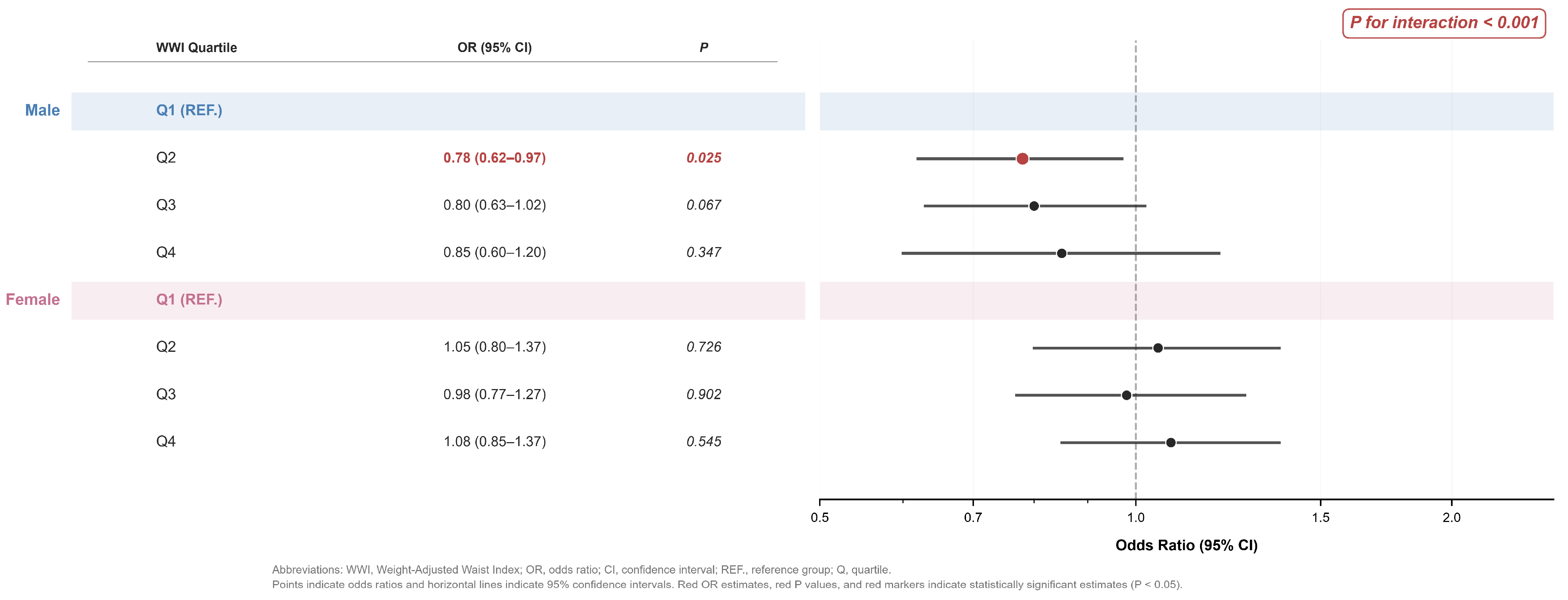
| Variables | Depressive Symptoms | OR, 95% CI | p | |
|---|---|---|---|---|
| No | Yes | |||
| Sex | ||||
| Male (REF.) | 1943 (74.13) | 678 (25.87) | ||
| Female | 1932 (62.00) | 1184 (38.00) | 1.41 (1.21–1.64) | <0.001 |
| Age in years | ||||
| 60–69 (REF.) | 1891 (69.65) | 824 (30.35) | ||
| 70–79 | 1508 (66.64) | 755 (33.36) | 1.03 (0.90–1.17) | 0.679 |
| ≥80 | 476 (62.71) | 283 (37.29) | 1.01 (0.83–1.22) | 0.928 |
| Residential location | ||||
| Urban (REF.) | 2083 (73.50) | 751 (26.50) | ||
| Rural | 1792 (61.73) | 1111 (38.27) | 1.35 (1.18–1.53) | <0.001 |
| Living arrangements | ||||
| Living with others (REF.) | 3225 (68.68) | 1471 (31.32) | ||
| Living alone | 650 (62.44) | 391 (37.56) | 1.11 (0.92–1.33) | 0.265 |
| Marital condition | ||||
| Other (REF.) | 1015 (63.00) | 596 (37.00) | ||
| Married | 2860 (69.32) | 1266 (30.68) | 0.98 (0.83–1.15) | 0.759 |
| Educational attainment | ||||
| No formal schooling (REF.) | 1686 (59.89) | 1129 (40.11) | ||
| Primary education | 1132 (70.57) | 472 (29.43) | 0.79 (0.69–0.92) | <0.001 |
| Higher | 1057 (80.20) | 261 (19.80) | 0.58 (0.49–0.69) | <0.001 |
| Yearly earnings (RMB) | ||||
| <6500 (REF.) | 2135 (62.15) | 1300 (37.85) | ||
| ≥6500 | 1740 (75.59) | 562 (24.41) | 0.87 (0.76–1.00) | 0.047 |
| Smoking status | ||||
| No (REF.) | 2992 (65.98) | 1543 (34.02) | ||
| Yes | 883 (73.46) | 319 (26.54) | 0.93 (0.79–1.10) | 0.382 |
| Drinking status | ||||
| No (REF.) | 2281 (64.87) | 1235 (35.13) | ||
| Yes | 1594 (71.77) | 627 (28.23) | 0.96 (0.84–1.10) | 0.585 |
| Chronic disease | ||||
| No (REF.) | 1250 (75.84) | 398 (24.15) | ||
| Yes | 2625 (64.20) | 1464 (35.80) | 1.68 (1.47–1.92) | <0.001 |
| Disability in ADL | ||||
| No (REF.) | 1791 (74.94) | 599 (25.06) | ||
| Yes | 2084 (62.26) | 1263 (37.74) | 1.43 (1.26–1.62) | <0.001 |
| Cognitive impairment | ||||
| No (REF.) | 2828 (71.79) | 1111 (28.21) | ||
| Yes | 1047 (58.23) | 751 (41.77) | 1.41 (1.24–1.60) | <0.001 |
| Vegetable and Fruit Intake Categories | ||||
| V+/F+ (REF.) | 1241 (73.61) | 445 (26.39) | ||
| V+/F− | 2525 (65.19) | 1348 (34.81) | 1.19 (1.04–1.36) | 0.012 |
| V−/F+ | 21 (70.00) | 9 (30.00) | 0.95 (0.42–2.14) | 0.907 |
| V−/F− | 88 (59.46) | 60 (40.54) | 1.36 (0.95–1.96) | 0.096 |
| WWI | ||||
| Q1 (7.27–10.80) (REF.) | 1018 (70.60) | 424 (29.40) | ||
| Q2 (10.80–11.33) | 1005 (70.97) | 411 (29.03) | 0.87 (0.74–1.03) | 0.118 |
| Q3 (11.33–11.94) | 992 (67.99) | 467 (32.01) | 0.87 (0.73–1.03) | 0.096 |
| Q4 (11.94–16.08) | 860 (60.56) | 560 (39.44) | 0.95 (0.79–1.14) | 0.573 |
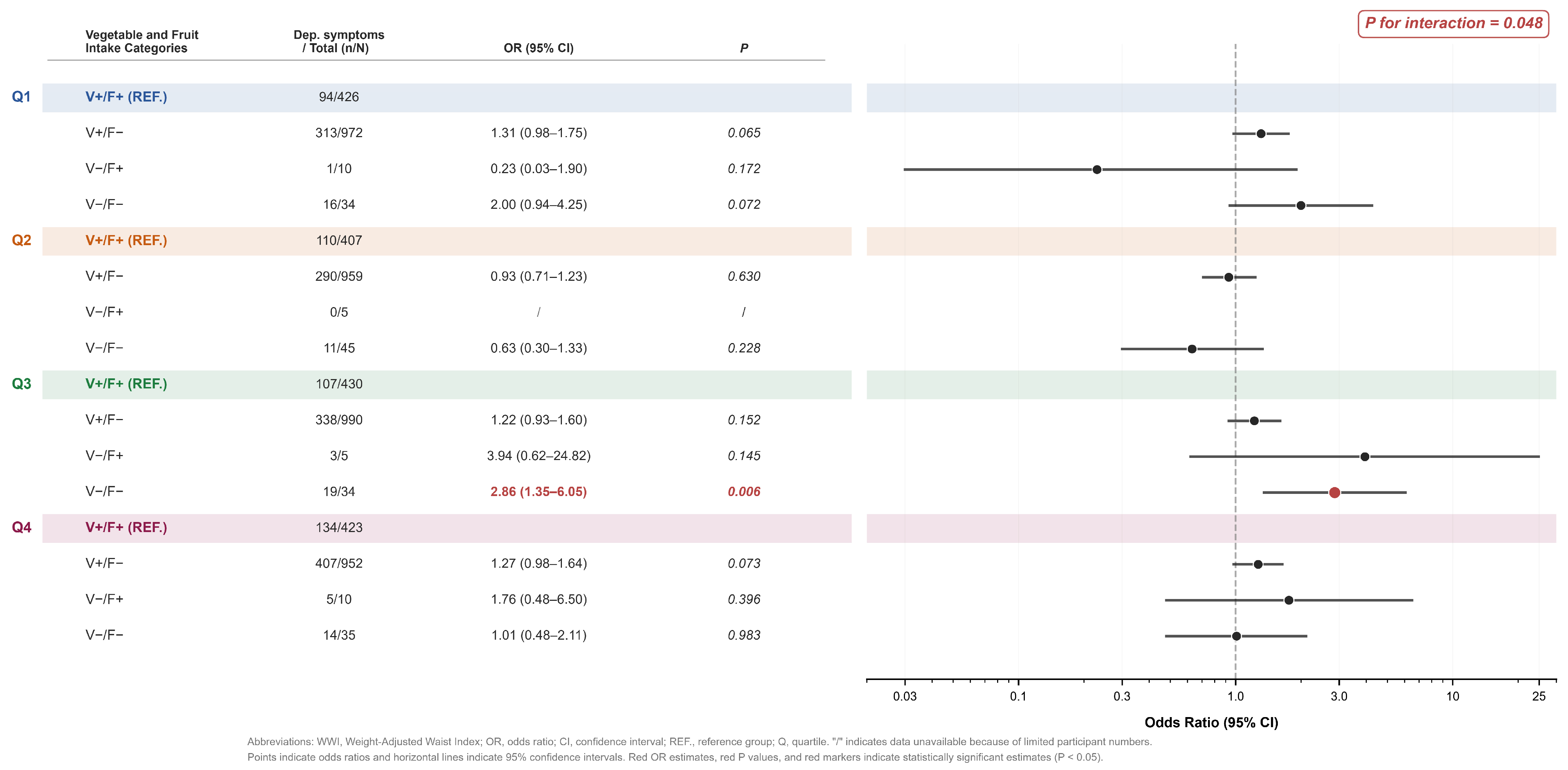
| Participant Group/Intake Categories | Dep. Symptoms /Total (n/N) | Model 1 | Model 2 | ||
|---|---|---|---|---|---|
| OR, 95% CI | p | AOR, 95% CI | p | ||
| Total Participants (N = 5737) | |||||
| Male | |||||
| V+/F+ (REF.) | 164/755 | ||||
| V+/F− | 489/1774 | 1.37 (1.12–1.68) | 0.002 | 1.13 (0.91–1.39) | 0.282 |
| V−/F+ | 1/14 | 0.28 (0.04–2.13) | 0.218 | 0.20 (0.02–1.56) | 0.123 |
| V−/F− | 24/78 | 1.60 (0.96–2.67) | 0.071 | 1.19 (0.70–2.02) | 0.522 |
| Female | |||||
| V+/F+ (REF.) | 281/931 | ||||
| V+/F− | 859/2099 | 1.60 (1.36–1.89) | <0.001 | 1.25 (1.04–1.49) | 0.015 |
| V−/F+ | 8/16 | 2.31 (0.86–6.22) | 0.097 | 1.97 (0.72–5.43) | 0.189 |
| V−/F− | 36/70 | 2.45 (1.50–3.99) | <0.001 | 1.56 (0.93–2.59) | 0.089 |
| WWI Q1 (N = 1442) | |||||
| Male | |||||
| V+/F+ (REF.) | 60/266 | ||||
| V+/F− | 203/686 | 1.44 (1.04–2.01) | 0.030 | 1.07 (0.75–1.53) | 0.716 |
| V−/F+ | 1/7 | 0.57 (0.07–4.85) | 0.609 | 0.24 (0.03–2.25) | 0.212 |
| V−/F− | 9/24 | 2.06 (0.86–4.94) | 0.105 | 1.42 (0.56–3.57) | 0.459 |
| Female | |||||
| V+/F+ (REF.) | 34/160 | ||||
| V+/F− | 110/286 | 2.32 (1.48–3.62) | <0.001 | 2.03 (1.23–3.36) | 0.006 |
| V−/F+ | 0/3 | / | / | / | / |
| V−/F− | 7/10 | 8.65 (2.12–35.23) | 0.003 | 5.12 (1.15–22.81) | 0.032 |
| WWI Q2 (N = 1416) | |||||
| Male | |||||
| V+/F+ (REF.) | 49/226 | ||||
| V+/F− | 136/552 | 1.18 (0.82–1.71) | 0.380 | 1.00 (0.67–1.49) | 0.990 |
| V−/F+ | 0/5 | / | / | / | / |
| V−/F− | 3/26 | 0.47 (0.14–1.64) | 0.236 | 0.38 (0.11–1.35) | 0.133 |
| Female | |||||
| V+/F+ (REF.) | 61/181 | ||||
| V+/F− | 154/407 | 1.20 (0.83–1.73) | 0.337 | 0.87 (0.58–1.30) | 0.496 |
| V−/F+ | 0/0 | / | / | / | / |
| V−/F− | 8/19 | 1.43 (0.55–3.74) | 0.465 | 0.89 (0.32–2.45) | 0.822 |
| WWI Q3 (N = 1459) | |||||
| Male | |||||
| V+/F+ (REF.) | 38/192 | ||||
| V+/F− | 106/404 | 1.44 (0.95–2.19) | 0.087 | 1.21 (0.78–1.89) | 0.398 |
| V−/F+ | 0/1 | / | / | / | / |
| V−/F− | 11/20 | 4.95 (1.92–12.81) | 0.001 | 3.35 (1.22–9.22) | 0.019 |
| Female | |||||
| V+/F+ (REF.) | 69/238 | ||||
| V+/F− | 232/586 | 1.61 (1.16–2.22) | 0.004 | 1.24 (0.88–1.76) | 0.226 |
| V−/F+ | 3/4 | 7.35 (0.75–71.87) | 0.087 | 7.27 (0.71–74.37) | 0.095 |
| V−/F− | 8/14 | 3.27 (1.09–9.76) | 0.034 | 2.42 (0.75–7.82) | 0.140 |
| WWI Q4 (N = 1420) | |||||
| Male | |||||
| V+/F+ (REF.) | 17/71 | ||||
| V+/F− | 44/132 | 1.59 (0.83–3.06) | 0.166 | 1.67 (0.80–3.51) | 0.172 |
| V−/F+ | 0/1 | / | / | / | / |
| V−/F− | 1/8 | 0.45 (0.05–3.96) | 0.474 | 0.25 (0.03–2.48) | 0.237 |
| Female | |||||
| V+/F+ (REF.) | 117/352 | ||||
| V+/F− | 363/820 | 1.60 (1.23–2.07) | <0.001 | 1.24 (0.94–1.65) | 0.127 |
| V−/F+ | 5/9 | 2.51 (0.66–9.53) | 0.176 | 1.95 (0.49–7.81) | 0.348 |
| V−/F− | 13/27 | 1.87 (0.85–4.10) | 0.121 | 1.27 (0.56–2.88) | 0.575 |
Disclaimer/Publisher’s Note: The statements, opinions and data contained in all publications are solely those of the individual author(s) and contributor(s) and not of MDPI and/or the editor(s). MDPI and/or the editor(s) disclaim responsibility for any injury to people or property resulting from any ideas, methods, instructions or products referred to in the content. |
© 2026 by the authors. Licensee MDPI, Basel, Switzerland. This article is an open access article distributed under the terms and conditions of the Creative Commons Attribution (CC BY) license.
Share and Cite
Huang, L.; Hong, Z.; Liu, M.; Zhang, D. Sex-Specific Associations of Vegetable and Fruit Intake Categories with Depressive Symptoms Modified by Weight-Adjusted Waist Index Among Chinese Older Adults. Nutrients 2026, 18, 1941. https://doi.org/10.3390/nu18121941
Huang L, Hong Z, Liu M, Zhang D. Sex-Specific Associations of Vegetable and Fruit Intake Categories with Depressive Symptoms Modified by Weight-Adjusted Waist Index Among Chinese Older Adults. Nutrients. 2026; 18(12):1941. https://doi.org/10.3390/nu18121941
Chicago/Turabian StyleHuang, Liang, Zixuan Hong, Mingming Liu, and Dongmei Zhang. 2026. "Sex-Specific Associations of Vegetable and Fruit Intake Categories with Depressive Symptoms Modified by Weight-Adjusted Waist Index Among Chinese Older Adults" Nutrients 18, no. 12: 1941. https://doi.org/10.3390/nu18121941
APA StyleHuang, L., Hong, Z., Liu, M., & Zhang, D. (2026). Sex-Specific Associations of Vegetable and Fruit Intake Categories with Depressive Symptoms Modified by Weight-Adjusted Waist Index Among Chinese Older Adults. Nutrients, 18(12), 1941. https://doi.org/10.3390/nu18121941