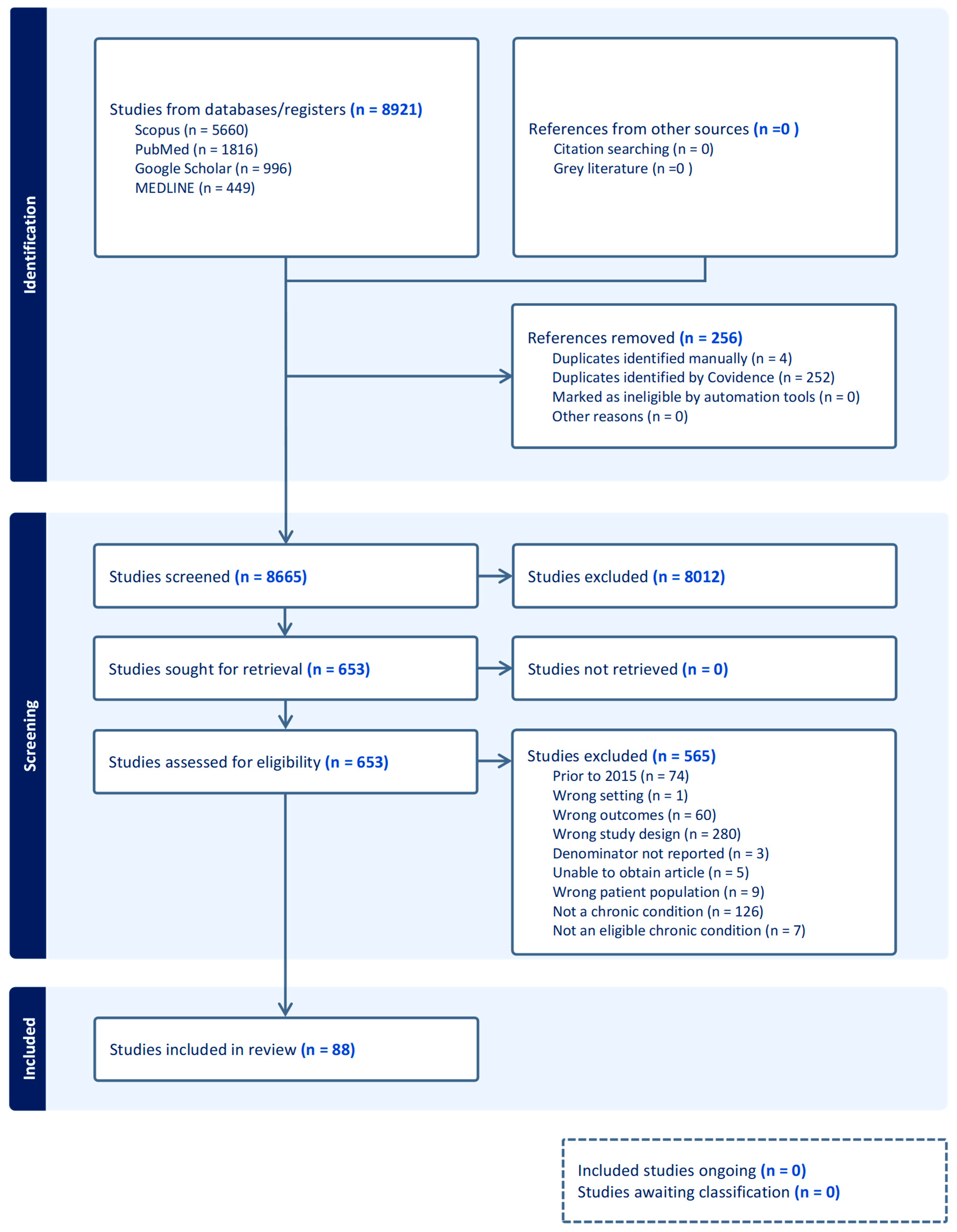
Completion Rates of Food Frequency Questionnaires and Food Records in People with Chronic Conditions: Systematic Review and Meta-Analysis


Abstract
1. Introduction
2. Materials and Methods

| Inclusion Criteria | Exclusion Criteria |
|---|---|
| Observational studies | Abstracts, conference proceedings, editorials, intervention studies. |
| Human Participants: Children aged 2–17 years or adults aged 18 years and older | Animal studies. Studies on the intake of infants less than two years. |
| Participants diagnosed with a chronic condition as per the MeSH definition, i.e., having one or more of the following characteristics: permanent residual disability that is caused by a non-reversible pathological alteration that requires rehabilitation, special training, and extended medical care and supervision of the patient [24] or healthy controls | Acute or temporary conditions. |
| Reported completion rates | Did not report on completion rates. |
| Published on or after 2015 | Published before 2015. |
3. Results
3.1. Completion Rates Overall
3.2. Completion Rates According to Tool Type (FFQ vs. FR)
3.3. Completion Rates According to Format
3.4. Completion Rates According to Age
3.5. Completion Rates According to Disease Category
3.6. Completion Rates According to Timing of Assessment
3.7. Risk of Bias Assessment
4. Discussion
5. Conclusions
Supplementary Materials
Author Contributions
Funding
Institutional Review Board Statement
Informed Consent Statement
Data Availability Statement
Acknowledgments
Conflicts of Interest
References
- Schulze, M.B.; Martínez-González, M.A.; Fung, T.T.; Lichtenstein, A.H.; Forouhi, N.G. Food based dietary patterns and chronic disease prevention. BMJ 2018, 361, k2396. [Google Scholar] [CrossRef] [PubMed]
- Luo, Z.; Chen, H.; Huang, S.; Lai, Q.; Hu, X.; Wang, Y.; Wang, Y.; Wang, J.; Li, Y.; Liu, F. An atlas of associations between dietary nutrients and the risk of 36 major chronic diseases. J. Nutr. Health Aging 2026, 30, 100785. [Google Scholar] [CrossRef]
- Naghavi, M.; Ong, K.L.; Aali, A.; Ababneh, H.S.; Abate, Y.H.; Abbafati, C.; Abbasgholizadeh, R.; Abbasian, M.; Abbasi-Kangevari, M.; Abbastabar, H.; et al. Global burden of 288 causes of death and life expectancy decomposition in 204 countries and territories and 811 subnational locations, 1990–2021: A systematic analysis for the global burden of disease study 2021. Lancet 2024, 403, 2100. [Google Scholar] [CrossRef]
- Hajat, C.; Stein, E. The global burden of multiple chronic conditions: A narrative review. Prev. Med. Rep. 2018, 12, 284–293. [Google Scholar] [CrossRef]
- Harrison, C.; Henderson, J.; Miller, G.; Britt, H. The prevalence of complex multimorbidity in Australia. Aust. N. Z. J. Public Health 2016, 40, 239–244. [Google Scholar] [CrossRef]
- Pradhan, S.K.; Murmu, J.; Nayak, U.; Sinha, A.; van den Akker, M.; Hussain, M.A.; Sahoo, K.C.; Bhattacharya, D.; Kshatri, J.S.; Satapathy, D.M.; et al. The magnitude of multimorbidity in childhood: A global systematic review. Syst. Rev. 2026, 15, 67. [Google Scholar] [CrossRef]
- Willett, W. Nutritional Epidemiology, 3rd ed.; Oxford University Press: Oxford, UK, 2013. [Google Scholar]
- Shim, J.S.; Oh, K.; Kim, H.C. Dietary assessment methods in epidemiologic studies. Epidemiol. Health 2014, 36, e2014009. [Google Scholar] [CrossRef]
- Bailey, R.L. Overview of dietary assessment methods for measuring intakes of foods, beverages, and dietary supplements in research studies. Curr. Opin. Biotechnol. 2021, 70, 91–96. [Google Scholar] [CrossRef] [PubMed]
- Tanweer, A.; Khan, S.; Mustafa, F.N.; Imran, S.; Humayun, A.; Hussain, Z.-U.-N. Improving dietary data collection tools for better nutritional assessment—A systematic review. Comput. Methods Programs Biomed. Update 2022, 2, 100067. [Google Scholar] [CrossRef]
- Singh, R.; Verest, M.T.E.; Salathé, M. Minimum days estimation for reliable dietary intake information: Findings from a digital cohort. Eur. J. Clin. Nutr. 2025, 79, 1007–1017. [Google Scholar] [CrossRef]
- Lambert, K.; Cosier, D.; Jayawardana, T.; Tavakoli, P.; Hold, G.L. Completion rates when collecting detailed dietary information from adults and children in a longitudinal ibd cohort study. J. Gastroenterol. Hepatol. 2024, 39, 210. [Google Scholar]
- Gregersen, L.; Moos, C.; Hikmat, Z.; Fogh Rasmussen, N.; Petersen, S.R.; Heitmann, B.L.; Halldórsson, þ.I.; Andersen, V.; Christensen, R. Study design complexity and participant completion in dietary trials for inflammatory bowel disease: A systematic review and metaresearch study. Adv. Nutr. 2026, 17, 100614. [Google Scholar] [CrossRef]
- Phalle, A.; Gokhale, D. Navigating next-gen nutrition care using artificial intelligence-assisted dietary assessment tools—A scoping review of potential applications. Front. Nutr. 2025, 12, 1518466. [Google Scholar] [CrossRef]
- Dao, M.C.; Subar, A.F.; Warthon-Medina, M.; Cade, J.E.; Burrows, T.; Golley, R.K.; Forouhi, N.G.; Pearce, M.; Holmes, B.A. Dietary assessment toolkits: An overview. Public Health Nutr. 2019, 22, 404–418. [Google Scholar] [CrossRef] [PubMed]
- Das, S.K.; Miki, A.J.; Blanchard, C.M.; Sazonov, E.; Gilhooly, C.H.; Dey, S.; Wolk, C.B.; Khoo, C.S.H.; Hill, J.O.; Shook, R.P. Perspective: Opportunities and challenges of technology tools in dietary and activity assessment: Bridging stakeholder viewpoints. Adv. Nutr. 2022, 13, 1–15. [Google Scholar] [CrossRef]
- Mahal, S.; Kucha, C.; Kwofie, E.M.; Ngadi, M. A systematic review of dietary data collection methodologies for diet diversity indicators. Front. Nutr. 2024, 11, 1195799. [Google Scholar] [CrossRef] [PubMed]
- Carter, M.C.; Burley, V.J.; Nykjaer, C.; Cade, J.E. Adherence to a smartphone application for weight loss compared to website and paper diary: Pilot randomized controlled trial. J. Med. Internet Res. 2013, 15, e32. [Google Scholar] [CrossRef] [PubMed]
- Rangan, A.M.; Tieleman, L.; Louie, J.C.; Tang, L.M.; Hebden, L.; Roy, R.; Kay, J.; Allman-Farinelli, M. Electronic dietary intake assessment (e-dia): Relative validity of a mobile phone application to measure intake of food groups. Br. J. Nutr. 2016, 115, 2219–2226. [Google Scholar] [CrossRef] [PubMed]
- Djuric, Z.; Ruffin, M.T.T.; Rapai, M.E.; Cornellier, M.L.; Ren, J.; Ferreri, T.G.; Askew, L.M.; Sen, A.; Brenner, D.E.; Turgeon, D.K. A mediterranean dietary intervention in persons at high risk of colon cancer: Recruitment and retention to an intensive study requiring biopsies. Contemp. Clin. Trials 2012, 33, 881–888. [Google Scholar] [CrossRef][Green Version]
- Daugherty, B.L.; Schap, T.E.; Ettienne-Gittens, R.; Zhu, F.M.; Bosch, M.; Delp, E.J.; Ebert, D.S.; Kerr, D.A.; Boushey, C.J. Novel technologies for assessing dietary intake: Evaluating the usability of a mobile telephone food record among adults and adolescents. J. Med. Internet Res. 2012, 14, e58. [Google Scholar] [CrossRef]
- Zazpe, I.; Santiago, S.; De la Fuente-Arrillaga, C.; Nunez-Cordoba, J.M.; Bes-Rastrollo, M.; Martinez-Gonzalez, M.A. Paper-based versus web-based versions of self-administered questionnaires, including food-frequency questionnaires: Prospective cohort study. JMIR Public Health Surveill. 2019, 5, e11997. [Google Scholar] [CrossRef] [PubMed]
- Grieco, L.P.; Brasky, T.M.; Spees, C.K.; Krok-Schoen, J.L. The associations between dietary supplement use, diet quality, and health-related quality of life among older female cancer survivors. Nutr. Cancer 2022, 74, 2829–2837. [Google Scholar] [CrossRef] [PubMed]
- National Library of Medicine. Mesh Defintion Chronic Disease. 2026. Available online: https://www.ncbi.nlm.nih.gov/mesh?Db=mesh&Cmd=DetailsSearch&Term=%22Chronic+Disease%22%5BMeSH+Terms%5D (accessed on 3 February 2025).
- Hoy, D.; Brooks, P.; Woolf, A.; Blyth, F.; March, L.; Bain, C.; Baker, P.; Smith, E.; Buchbinder, R. Assessing risk of bias in prevalence studies: Modification of an existing tool and evidence of interrater agreement. J. Clin. Epidemiol. 2012, 65, 934–939. [Google Scholar] [CrossRef]
- Lin, L.; Chu, H. Quantifying publication bias in meta-analysis. Biometrics 2018, 74, 785–794. [Google Scholar] [CrossRef] [PubMed]
- Page, M.J.; McKenzie, J.E.; Bossuyt, P.M.; Boutron, I.; Hoffmann, T.C.; Mulrow, C.D.; Shamseer, L.; Tetzlaff, J.M.; Akl, E.A.; Brennan, S.E.; et al. The prisma 2020 statement: An updated guideline for reporting systematic reviews. BMJ 2021, 372, n71. [Google Scholar] [CrossRef]
- Affret, A.; Wagner, S.; El Fatouhi, D.; Dow, C.; Correia, E.; Niravong, M.; Clavel-Chapelon, F.; De Chefdebien, J.; Fouque, D.; Stengel, B.; et al. Validity and reproducibility of a short food frequency questionnaire among patients with chronic kidney disease. BMC Nephrol. 2017, 18, 297. [Google Scholar] [CrossRef]
- Ahola, A.J.; Forsblom, C.; Groop, P.H. Adherence to special diets and its association with meeting the nutrient recommendations in individuals with type 1 diabetes. Acta Diabetol. 2018, 55, 843–851. [Google Scholar] [CrossRef]
- Ahola, A.J.; Forsblom, C.M.; Harjutsalo, V.; Groop, P.H. Nut consumption is associated with lower risk of metabolic syndrome and its components in type 1 diabetes. Nutrients 2021, 13, 3909. [Google Scholar] [CrossRef]
- Amalia, R.I.; Davenport, A. Estimated dietary sodium intake in peritoneal dialysis patients using food frequency questionnaires and total urinary and peritoneal sodium losses and assessment of extracellular volumes. Eur. J. Clin. Nutr. 2019, 73, 105–111. [Google Scholar] [CrossRef]
- Beeren, I.; de Goeij, L.; Dandis, R.; Vidra, N.; van Zutphen, M.; Witjes, J.A.; Kampman, E.; Kiemeney, L.A.L.M.; Vrieling, A. Limited changes in lifestyle behaviours after non-muscle invasive bladder cancer diagnosis. Cancers 2022, 14, 960. [Google Scholar] [CrossRef]
- Belle, F.N.; Chatelan, A.; Kasteler, R.; Mader, L.; Guessous, I.; Beck-Popovic, M.; Ansari, M.; Kuehni, C.E.; Bochud, M. Dietary intake and diet quality of adult survivors of childhood cancer and the general population: Results from the sccss-nutrition study. Nutrients 2021, 13, 1767. [Google Scholar] [CrossRef]
- Birketvedt, K.; Mikkelsen, A.; Klingen, L.L.; Henriksen, C.; Helland, I.B.; Emblem, R. Nutritional status in adolescents with esophageal atresia. J. Pediatr. 2020, 218, 130–137. [Google Scholar] [CrossRef]
- Bolte, L.A.; Lee, K.A.; Björk, J.R.; Leeming, E.R.; Campmans-Kuijpers, M.J.E.; De Haan, J.J.; Vila, A.V.; Maltez-Thomas, A.; Segata, N.; Board, R.; et al. Association of a mediterranean diet with outcomes for patients treated with immune checkpoint blockade for advanced melanoma. JAMA Oncol. 2023, 9, 705–709. [Google Scholar] [CrossRef]
- Bredin, C.; Naimimohasses, S.; Norris, S.; Wright, C.; Hancock, N.; Hart, K.; Moore, J.B. Development and relative validation of a short food frequency questionnaire for assessing dietary intakes of non-alcoholic fatty liver disease patients. Eur. J. Nutr. 2020, 59, 571–580. [Google Scholar] [CrossRef] [PubMed]
- Chhabra, R.; Davenport, A. Is increased subjective thirst associated with greater interdialytic weight gains, extracellular fluid and dietary sodium intake? Artif. Organs 2024, 48, 91–97. [Google Scholar] [CrossRef]
- Coe, S.; Spruzen, S.L.; Sanchez, C.; Izadi, H.; Dawes, H. A cross-sectional feasibility study of nutrient intake patterns in people with parkinson’s compared to government nutrition guidelines. J. Am. Coll. Nutr. 2020, 39, 187–191. [Google Scholar] [CrossRef] [PubMed]
- Dewinter, L.; Casteels, K.; Corthouts, K.; Van De Kerckhove, K.; Van Der Vaerent, K.; Vanmeerbeeck, K.; Matthys, C. Dietary intake of non-nutritive sweeteners in type 1 diabetes mellitus children. Food Addit. Contam.—Part A Chem. Anal. Control Expo. Risk Assess. 2015, 33, 19–26. [Google Scholar] [CrossRef] [PubMed]
- Drzymała-Czyz, S.; Kałuzny, Ł.; Krzyzanowska-Jankowska, P.; Walkowiak, D.; Mozrzymas, R.; Walkowiak, J. Deficiency of long-chain polyunsaturated fatty acids in phenylketonuria: A cross-sectional study. Acta Biochim. Pol. 2018, 65, 303–308. [Google Scholar] [CrossRef]
- Ericson, J.; Lundell, L.; Lindblad, M.; Klevebro, F.; Nilsson, M.; Rouvelas, I. Assessment of energy intake and total energy expenditure in a series of patients who have undergone oesophagectomy following neoadjuvant treatment. Clin. Nutr. ESPEN 2020, 37, 121–128. [Google Scholar] [CrossRef]
- Ewers, B.; Trolle, E.; Jacobsen, S.S.; Vististen, D.; Almdal, T.P.; Vilsbøll, T.; Bruun, J.M. Dietary habits and adherence to dietary recommendations in patients with type 1 and type 2 diabetes compared with the general population in denmark. Nutrition 2019, 61, 49–55. [Google Scholar] [CrossRef]
- Gingras, V.; Leroux, C.; Desjardins, K.; Savard, V.; Lemieux, S.; Rabasa-Lhoret, R.; Strychar, I. Association between cardiometabolic profile and dietary characteristics among adults with type 1 diabetes mellitus. J. Acad. Nutr. Diet. 2015, 115, 1965–1974. [Google Scholar] [CrossRef]
- Huisman, M.H.B.; Seelen, M.; Van Doormaal, P.T.C.; De Jong, S.W.; De Vries, J.H.M.; Van Der Kooi, A.J.; De Visser, M.; Schelhaas, H.J.; Van Den Berg, L.H.; Veldink, J.H. Effect of presymptomatic body mass index and consumption of fat and alcohol on amyotrophic lateral sclerosis. JAMA Neurol. 2015, 72, 1155–1162. [Google Scholar] [CrossRef]
- Ijpma, I.; Renken, R.J.; Gietema, J.A.; Slart, R.H.J.A.; Mensink, M.G.J.; Lefrandt, J.D.; Ter Horst, G.J.; Reyners, A.K.L. Changes in taste and smell function, dietary intake, food preference, and body composition in testicular cancer patients treated with cisplatin-based chemotherapy. Clin. Nutr. 2017, 36, 1642–1648. [Google Scholar] [CrossRef]
- Ilari, S.; Vitiello, L.; Russo, P.; Proietti, S.; Milić, M.; Muscoli, C.; Cardaci, V.; Tomino, C.; Bonassi, G.; Bonassi, S. Daily vegetables intake and response to copd rehabilitation. The role of oxidative stress, inflammation and dna damage. Nutrients 2021, 13, 2787. [Google Scholar] [CrossRef] [PubMed]
- Klimek, A.; Baerwald, C.; Schwarz, M.; Rutsch, F.; Parhofer, K.G.; Plöckinger, U.; Heddrich-Ellerbrok, M.; Vom Dahl, S.; Schöne, K.; Ott, M.; et al. Everyday life, dietary practices, and health conditions of adult pku patients: A multicenter, cross-sectional study. Ann. Nutr. Metab. 2020, 76, 251–258. [Google Scholar] [CrossRef] [PubMed]
- Kristensen, M.B.; Egholm, C.L.; Vistisen, H.S.; Borregaard, B.; Bruvik, S.M.; Bertelsen, B.M.; Myrup, E.; Mortensen, T.; Viggers, L.; Mols, R.E.; et al. Challenges and benefits of using the heartdiet food frequency questionnaire in cardiac rehabilitation practice. Nutr. Metab. Cardiovasc. Dis. 2024, 34, 1968–1975. [Google Scholar] [CrossRef] [PubMed]
- Lang, S.; Martin, A.; Zhang, X.; Farowski, F.; Wisplinghoff, H.; Vehreschild, M.J.G.T.; Krawczyk, M.; Nowag, A.; Kretzschmar, A.; Scholz, C.; et al. Combined analysis of gut microbiota, diet and pnpla3 polymorphism in biopsy-proven non-alcoholic fatty liver disease. Liver Int. 2021, 41, 1576–1591. [Google Scholar] [CrossRef]
- Laursen, U.B.; Johansen, M.N.; Joensen, A.M.; Overvad, K.; Larsen, M.L. Is cardiac rehabilitation equally effective in improving dietary intake in all patients with ischemic heart disease? J. Am. Coll. Nutr. 2021, 40, 33–40. [Google Scholar] [CrossRef]
- Mardas, M.; Jamka, M.; Mądry, R.; Walkowiak, J.; Krótkopad, M.; Stelmach-Mardas, M. Dietary habits changes and quality of life in patients undergoing chemotherapy for epithelial ovarian cancer. Support. Care Cancer 2015, 23, 1015–1023. [Google Scholar] [CrossRef]
- Mardas, M.; Mądry, R.; Stelmach-Mardas, M. Dietary intake variability in the cycle of cytotoxic chemotherapy. Support. Care Cancer 2016, 24, 2619–2625. [Google Scholar] [CrossRef]
- Mazzeo, T.; Roncoroni, L.; Lombardo, V.; Tomba, C.; Elli, L.; Sieri, S.; Grioni, S.; Bardella, M.T.; Agostoni, C.; Doneda, L.; et al. Evaluation of a modified italian european prospective investigation into cancer and nutrition food frequency questionnaire for individuals with celiac disease. J. Acad. Nutr. Diet. 2016, 116, 1810–1816. [Google Scholar] [CrossRef] [PubMed]
- Piotrowicz, K.; Pałkowska, E.; Bartnikowska, E.; Krzesiński, P.; Stańczyk, A.; Biecek, P.; Skrobowski, A.; Gielerak, G. Self-reported health-related behaviors and dietary habits in patients with metabolic syndrome. Cardiol. J. 2015, 22, 413–420. [Google Scholar] [CrossRef]
- Rej, A.; Shaw, C.C.; Buckle, R.L.; Trott, N.; Agrawal, A.; Mosey, K.; Sanders, K.; Allen, R.; Martin, S.; Newton, A.; et al. The low fodmap diet for ibs; a multicentre uk study assessing long term follow up. Dig. Liver Dis. 2021, 53, 1404–1411. [Google Scholar] [CrossRef]
- Smith, S.; Fisher, A.; Lally, P.J.; Croker, H.A.; Roberts, A.; Conway, R.E.; Beeken, R.J. Perceiving a need for dietary change in adults living with and beyond cancer: A cross-sectional study. Cancer Med. 2024, 13, e7073. [Google Scholar] [CrossRef] [PubMed]
- Tasson, L.; Canova, C.; Vettorato, M.G.; Savarino, E.; Zanotti, R. Influence of diet on the course of inflammatory bowel disease. Dig. Dis. Sci. 2017, 62, 2087–2094. [Google Scholar] [CrossRef] [PubMed]
- van Lanen, A.S.; Kok, D.E.; Wesselink, E.; Derksen, J.W.G.; May, A.M.; Smit, K.C.; Koopman, M.; de Wilt, J.; Kampman, E.; van Duijnhoven, F.J.B.; et al. Associations between low- and high-fat dairy intake and recurrence risk in people with stage i–iii colorectal cancer differ by sex and primary tumour location. Int. J. Cancer 2024, 155, 828–838. [Google Scholar] [CrossRef]
- Wu, W.; Bours, M.J.L.; Koole, A.; Kenkhuis, M.F.; Eussen, S.J.P.M.; Breukink, S.O.; van Schooten, F.J.; Weijenberg, M.P.; Hageman, G.J. Cross-sectional associations between dietary daily nicotina-mide intake and patient-reported outcomes in colorectal cancer survivors, 2 to 10 years post-diagnosis. Nutrients 2021, 13, 3707. [Google Scholar] [CrossRef]
- Aponte, C.A.; Romanczyk, R.G. Assessment of feeding problems in children with autism spectrum disorder. Res. Autism Spectr. Disord. 2016, 21, 61–72. [Google Scholar] [CrossRef]
- Arthur, A.E.; Goss, A.M.; Demark-Wahnefried, W.; Mondul, A.M.; Fontaine, K.R.; Chen, Y.T.; Carroll, W.R.; Spencer, S.A.; Rogers, L.Q.; Rozek, L.S.; et al. Higher carbohydrate intake is associated with increased risk of all-cause and disease-specific mortality in head and neck cancer patients: Results from a prospective cohort study. Int. J. Cancer 2018, 143, 1105–1113. [Google Scholar] [CrossRef]
- Bail, J.R.; Bail, S.V.; Cagle, J.; Tiesi, K.; Caffey, J.; Bakitas, M.; Demark-Wahnefried, W. Health behaviors and well-being among those “living” with metastatic cancer in Alabama. Support. Care Cancer 2022, 30, 1689–1701. [Google Scholar] [CrossRef]
- Basu, A.; Alman, A.C.; Snell-Bergeon, J.K. Dietary fiber intake and glycemic control: Coronary artery calcification in type 1 diabetes (cacti) study. Nutr. J. 2019, 18, 23. [Google Scholar] [CrossRef] [PubMed]
- Basu, A.; Alman, A.C.; Snell-Bergeon, J.K. Associations of dietary patterns and nutrients with glycated hemoglobin in participants with and without type 1 diabetes. Nutrients 2021, 13, 1035. [Google Scholar] [CrossRef] [PubMed]
- Beiner, C.; Qureshi, M.M.; Zhao, J.; Hu, B.; Jimenez, R.; Hirsch, A.E. Depression and anxiety among english- and spanish-speaking patients with breast cancer receiving radiation therapy. Int. J. Radiat. Oncol. Biol. Phys. 2024, 119, 185–192. [Google Scholar] [CrossRef] [PubMed]
- Black, L.J.; Hetherton, S.; Forkan, M.; Gonzales, E.G.; Smith, J.B.; Daly, A.; Lucas, R.M.; Langer-Gould, A. An exploratory study of diet in childhood and young adulthood and adult-onset multiple sclerosis. Mult. Scler. J. 2021, 27, 1611–1614. [Google Scholar] [CrossRef]
- Boucher, B.A.; Wanigaratne, S.; Harris, S.A.; Cotterchio, M. Postdiagnosis isoflavone and lignan intake in newly diagnosed breast cancer patients: Cross-sectional survey shows considerable intake from previously unassessed high-lignan foods. Curr. Dev. Nutr. 2018, 2, nzx009. [Google Scholar] [CrossRef]
- Crowder, S.L.; Li, Z.; Sarma, K.P.; Arthur, A.E. Chronic nutrition impact symptoms are associated with decreased functional status, quality of life, and diet quality in a pilot study of long-term post-radiation head and neck cancer survivors. Nutrients 2021, 13, 2886. [Google Scholar] [CrossRef]
- Dolovich, C.; Shafer, L.A.; Vagianos, K.; Witges, K.; Targownik, L.E.; Bernstein, C.N. The complex relationship between diet, symptoms, and intestinal inflammation in persons with inflammatory bowel disease: The manitoba living with ibd study. J. Parenter. Enter. Nutr. 2022, 46, 867–877. [Google Scholar] [CrossRef]
- Dratsky, D.; McGillivray, E.; Mittal, J.; Handorf, E.A.; Berardi, G.; Astsaturov, I.; Hall, M.J.; Yeh, M.C.; Jain, R.; Fang, C.Y. Food insecurity and dietary quality in african american patients with gastrointestinal cancers: An exploratory study. Nutrients 2024, 16, 3057. [Google Scholar] [CrossRef]
- Ganguzza, L.; Ngai, C.; Flink, L.; Woolf, K.; Guo, Y.; Gianos, E.; Burdowski, J.; Slater, J.; Acosta, V.; Shephard, T.; et al. Association between diet quality and measures of body adiposity using the rate your plate survey in patients presenting for coronary angiography. Clin. Cardiol. 2018, 41, 126–130. [Google Scholar] [CrossRef]
- Gregg, J.R.; Zheng, J.; Lopez, D.S.; Reichard, C.; Browman, G.; Chapin, B.; Kim, J.; Davis, J.; Daniel, C.R. Diet quality and gleason grade progression among localised prostate cancer patients on active surveillance. Br. J. Cancer 2019, 120, 466–471. [Google Scholar] [CrossRef]
- Helm, M.M.; Basu, A.; Richardson, L.A.; Chien, L.C.; Izuora, K.; Alman, A.C.; Snell-Bergeon, J.K. Longitudinal three-year associations of dietary fruit and vegetable intake with serum hs-c-reactive protein in adults with and without type 1 diabetes. Nutrients 2024, 16, 2058. [Google Scholar] [CrossRef]
- Hu, J.; La Vecchia, C.; Negri, E.; de Groh, M.; Morrison, H.; Mery, L. Macronutrient intake and stomach cancer. Cancer Causes Control 2015, 26, 839–847. [Google Scholar] [CrossRef]
- Hussain, S.K.; Dong, T.S.; Agopian, V.; Pisegna, J.R.; Durazo, F.A.; Enayati, P.; Sundaram, V.; Benhammou, J.N.; Noureddin, M.; Choi, G.; et al. Dietary protein, fiber and coffee are associated with small intestine microbiome composition and diversity in patients with liver cirrhosis. Nutrients 2020, 12, 1395. [Google Scholar] [CrossRef]
- Knoerl, R.; Ploutz-Snyder, R.; Smener, L.; Tofthagen, C.; Zick, S. Association of chemotherapy-induced peripheral neuropathy with diet quality among post-treatment cancer survivors. Nutr. Cancer 2024, 76, 717–725. [Google Scholar] [CrossRef]
- Leroux, C.; Gingras, V.; Desjardins, K.; Brazeau, A.S.; Ott-Braschi, S.; Strychar, I.; Rabasa-Lhoret, R. In adult patients with type 1 diabetes healthy lifestyle associates with a better cardiometabolic profile. Nutr. Metab. Cardiovasc. Dis. 2015, 25, 444–451. [Google Scholar] [CrossRef] [PubMed]
- Mehta, P.; Li, Q.; Stahl, M.; Uusitalo, U.; Lindfors, K.; Butterworth, M.D.; Kurppa, K.; Virtanen, S.; Koletzko, S.; Aronsson, C.; et al. Gluten-free diet adherence in children with screening-detected celiac disease using a prospective birth cohort study. PLoS ONE 2023, 18, e0275123. [Google Scholar] [CrossRef] [PubMed]
- Petrick, J.L.; Steck, S.E.; Bradshaw, P.T.; Chow, W.H.; Engel, L.S.; He, K.; Risch, H.A.; Vaughan, T.L.; Gammon, M.D. Dietary flavonoid intake and barrett’s esophagus in western washington state. Ann. Epidemiol. 2015, 25, 730–735.e2. [Google Scholar] [CrossRef] [PubMed]
- Polderman, N.; Cushing, M.; McFadyen, K.; Catapang, M.; Humphreys, R.; Mammen, C.; Matsell, D.G. Pediatric Nephrology Clinical Pathway Development Team. Dietary intakes of children with nephrotic syndrome. Pediatr. Nephrol. 2021, 36, 2819–2826. [Google Scholar] [CrossRef]
- Shi, Z.; Rundle, A.; Genkinger, J.M.; Cheung, Y.K.; Ergas, I.J.; Roh, J.M.; Kushi, L.H.; Kwan, M.L.; Greenlee, H. Distinct trajectories of fruits and vegetables, dietary fat, and alcohol intake following a breast cancer diagnosis: The pathways study. Breast Cancer Res. Treat. 2020, 179, 229–240. [Google Scholar] [CrossRef]
- Silveira, S.L.; Jeng, B.; Cutter, G.; Motl, R.W. Diet quality assessment in wheelchair users with multiple sclerosis. Nutrients 2021, 13, 4352. [Google Scholar] [CrossRef]
- Silveira, S.L.; Jeng, B.; Gower, B.A.; Cutter, G.R.; Motl, R.W. Correlates of inaccuracy in reporting of energy intake among persons with multiple sclerosis. Nutrients 2025, 17, 438. [Google Scholar] [CrossRef]
- Taha, H.M.; Rozek, L.S.; Chen, X.; Li, Z.; Zarins, K.R.; Slade, A.N.; Wolf, G.T.; Arthur, A.E. Risk of disease recurrence and mortality varies by type of fat consumed before cancer treatment in a longitudinal cohort of head and neck squamous cell carcinoma patients. J. Nutr. 2022, 152, 1298–1305. [Google Scholar] [CrossRef]
- Tedeschi, S.K.; Frits, M.; Cui, J.; Zhang, Z.Z.; Mahmoud, T.; Iannaccone, C.; Lin, T.C.; Yoshida, K.; Weinblatt, M.E.; Shadick, N.A.; et al. Diet and rheumatoid arthritis symptoms: Survey results from a rheumatoid arthritis registry. Arthritis Care Res. 2017, 69, 1920–1925. [Google Scholar] [CrossRef]
- Van Blarigan, E.L.; Zhang, S.; Ou, F.S.; Venlo, A.; Ng, K.; Atreya, C.; Van Loon, K.; Niedzwiecki, D.; Giovannucci, E.; Wolfe, E.G.; et al. Association of diet quality with survival among people with metastatic colorectal cancer in the cancer and leukemia b and southwest oncology group 80405 trial. JAMA Netw. Open 2020, 3, e2023500. [Google Scholar] [CrossRef] [PubMed]
- Adanan, N.I.H.; Md Ali, M.S.; Lim, J.H.; Zakaria, N.F.; Lim, C.T.S.; Yahya, R.; Abdul Gafor, A.H.; Karupaiah, T.; Daud, Z.M. Investigating physical and nutritional changes during prolonged intermittent fasting in hemodialysis patients: A prospective cohort study. J. Ren. Nutr. 2020, 30, e15–e26. [Google Scholar] [CrossRef]
- Horikawa, C.; Tsuda, K.; Oshida, Y.; Satoh, J.; Hayashino, Y.; Tajima, N.; Nishimura, R.; Sone, H.; Koya, D.; Shikata, K.; et al. Dietary intake and physical activity in Japanese patients with type 2 diabetes: The Japan diabetes complication and its prevention prospective study (jdcp study 8). Diabetol. Int. 2022, 13, 344–357. [Google Scholar] [CrossRef]
- Khatun, T.; Hoque, A.; Anwar, K.S.; Sarker, M.R.; Ara, F.; Maqbool, D. Dietary habits of patients with coronary artery disease in a tertiary-care hospital of Bangladesh: A case-controlled study. J. Health Popul. Nutr. 2021, 40, 3. [Google Scholar] [CrossRef]
- Kiew, S.J.; Mohd Taib, N.A.; Islam, T.; Abdul Majid, H. Changes in dietary intake of breast cancer survivors: Early findings of a Malaysian breast cancer prospective cohort study. Nutr. Cancer 2022, 74, 2470–2478. [Google Scholar] [CrossRef] [PubMed]
- Lee, H.; Kim, H.; Kim, T.Y.; Ryu, H.; Ju, D.L.; Jang, M.; Oh, K.H.; Ahn, C.; Han, S.N. Dietary assessment of korean non-dialysis chronic kidney disease patients with or without diabetes. J. Korean Med. Sci. 2020, 35, e181. [Google Scholar] [CrossRef] [PubMed]
- Lei, Y.Y.; Ho, S.C.; Kwok, C.; Cheng, A.; Cheung, K.L.; Lee, R.; Mo, F.K.F.; Yeo, W. Association of high adherence to vegetables and fruits dietary pattern with quality of life among Chinese women with early-stage breast cancer. Qual. Life Res. 2022, 31, 1371–1384. [Google Scholar] [CrossRef]
- Lin, I.H.; Wong, T.C.; Nien, S.W.; Chou, Y.T.; Chiang, Y.J.; Wang, H.H.; Yang, S.H. Dietary compliance among renal transplant recipients: A single-center study in Taiwan. Transpl. Proc. 2019, 51, 1325–1330. [Google Scholar] [CrossRef]
- Li, Q.H.; Zou, Y.W.; Lian, S.Y.; Liang, J.J.; Bi, Y.F.; Deng, C.; Mo, Y.Q.; Yang, K.M.; Dai, L. Sugar-sweeten beverage consumption is associated with more obesity and higher serum uric acid in chinese male gout patients with early onset. Front. Nutr. 2022, 9, 916811. [Google Scholar] [CrossRef]
- Na, W.; Lee, Y.; Kim, H.; Kim, Y.S.; Sohn, C. High-fat foods and fodmaps containing gluten foods primarily contribute to symptoms of irritable bowel syndrome in korean adults. Nutrients 2021, 13, 1308. [Google Scholar] [CrossRef]
- Shin, W.K.; Song, S.; Hwang, E.; Moon, H.G.; Noh, D.Y.; Lee, J.E. Development of a ffq for breast cancer survivors in Korea. Br. J. Nutr. 2016, 116, 1781–1786. [Google Scholar] [CrossRef]
- Shu, P.S.; Chan, Y.M.; Huang, S.L. Higher body mass index and lower intake of dairy products predict poor glycaemic control among type 2 diabetes patients in Malaysia. PLoS ONE 2017, 12, e0172231. [Google Scholar] [CrossRef][Green Version]
- Tanaka, Y.; Nakagami, T.; Oya, J.; Ukita-Shibasaki, C.; Takehana, Y.; Sasaki, S.; Babazono, T. Impact of body mass index and age on the relative accuracy of self-reported energy intakes among Japanese patients with type 2 diabetes. Diabetol. Int. 2020, 11, 360–367. [Google Scholar] [CrossRef]
- Thewjitcharoen, Y.; Chotwanvirat, P.; Jantawan, A.; Siwasaranond, N.; Saetung, S.; Nimitphong, H.; Himathongkam, T.; Reutrakul, S. Evaluation of dietary intakes and nutritional knowledge in thai patients with type 2 diabetes mellitus. J. Diabetes Res. 2018, 2018, 9152910. [Google Scholar] [CrossRef]
- Tseng, L.Y.; Xie, W.; Pan, W.; Lyu, H.; Yu, Z.; Shi, W.; He, Y.; Chen, W.; Li, T.; Hsieh, E. Validation of a six-item dietary calcium screening tool among hiv patients in China. Public Health Nutr. 2021, 24, 4786–4795. [Google Scholar] [CrossRef]
- Zeng, G.; Mai, Z.; Xia, S.; Wang, Z.; Zhang, K.; Wang, L.; Long, Y.; Ma, J.; Li, Y.; Wan, S.P.; et al. Prevalence of kidney stones in China: An ultrasonography based cross-sectional study. BJU Int. 2017, 120, 109–116. [Google Scholar] [CrossRef]
- Baleato, C.L.; Ferguson, J.J.A.; Oldmeadow, C.; Mishra, G.D.; Garg, M.L. Plant-based dietary patterns versus meat consumption and prevalence of impaired glucose intolerance and diabetes mellitus: A cross-sectional study in australian women. Nutrients 2022, 14, 4152. [Google Scholar] [CrossRef]
- Conley, M.; Campbell, K.L.; Hawley, C.M.; Lioufas, N.M.; Elder, G.J.; Badve, S.V.; Pedagogos, E.; Milanzi, E.; Pascoe, E.M.; Valks, A.; et al. Relationship between dietary phosphate intake and biomarkers of bone and mineral metabolism in australian adults with chronic kidney disease. J. Ren. Nutr. 2022, 32, 58–67. [Google Scholar] [CrossRef]
- Cooke, Z.M.; Resciniti, S.M.; Wright, B.J.; Hale, M.W.; Yao, C.K.; Tuck, C.J.; Biesiekierski, J.R. Association between dietary factors, symptoms, and psychological factors in adults with dyspepsia: A cross-sectional study. Neurogastroenterol. Motil. 2023, 35, e14684. [Google Scholar] [CrossRef]
- Fisher, E.L.; Weaver, N.A.; Marlow, A.L.; King, B.R.; Smart, C.E. Macronutrient intake in children and adolescents with type 1 diabetes and its association with glycemic outcomes. Pediatr. Diabetes 2023, 2023, 7102890. [Google Scholar] [CrossRef]
- Gilbertson, H.R.; Reed, K.; Clark, S.; Francis, K.L.; Cameron, F.J. An audit of the dietary intake of Australian children with type 1 diabetes. Nutr. Diabetes 2018, 8, 10. [Google Scholar] [CrossRef]
- Morton, H.; Pedley, K.C.; Stewart, R.J.C.; Coad, J. Inflammatory bowel disease: Are symptoms and diet linked? Nutrients 2020, 12, 2975. [Google Scholar] [CrossRef]
- Teasdale, S.B.; Burrows, T.L.; Hayes, T.; Hsia, C.Y.; Watkins, A.; Curtis, J.; Ward, P.B. Dietary intake, food addiction and nutrition knowledge in young people with mental illness. Nutr. Diet. 2020, 77, 315–322. [Google Scholar] [CrossRef]
- Thomson, R.L.; Brown, J.D.; Oakey, H.; Palmer, K.; Ashwood, P.; Penno, M.A.S.; McGorm, K.J.; Battersby, R.; Colman, P.G.; Craig, M.E.; et al. Dietary patterns during pregnancy and maternal and birth outcomes in women with type 1 diabetes: The environmental determinants of islet autoimmunity (endia) study. Diabetologia 2024, 67, 2420–2432. [Google Scholar] [CrossRef]
- Dinparast, F.; Sharifi, A.; Moradi, S.; Alipour, M.; Alipour, B. The associations between dietary pattern of chronic obstructive pulmonary disease patients and depression: A cross-sectional study. BMC Pulm. Med. 2021, 21, 8. [Google Scholar] [CrossRef]
- Godny, L.; Maharshak, N.; Reshef, L.; Goren, I.; Yahav, L.; Fliss-Isakov, N.; Gophna, U.; Tulchinsky, H.; Dotan, I. Fruit consumption is associated with alterations in microbial composition and lower rates of pouchitis. J. Crohn’s Colitis 2019, 13, 1265–1272. [Google Scholar] [CrossRef]
- Milajerdi, A.; Shayanfar, M.; Benisi-Kohansal, S.; Mohammad-Shirazi, M.; Sharifi, G.; Tabibi, H.; Esmaillzadeh, A. A case-control study on dietary acid load in relation to glioma. Nutr. Cancer 2022, 74, 1644–1651. [Google Scholar] [CrossRef]
- Subih, H.S.; Al-Shwaiyat, E.A.; Al-Bayyari, N.; Obeidat, B.S.; Abu-Farsakh, F.; Bawadi, H. Dietary intake is not associated with body composition nor with biochemical tests but with psychological status of cancer patients receiving chemotherapy. Nutrients 2023, 15, 5087. [Google Scholar] [CrossRef]
- Ferrari, A.; de Carvalho, A.M.; Steluti, J.; Teixeira, J.; Marchioni, D.M.L.; Aguiar, S. Folate and nutrients involved in the 1-carbon cycle in the pretreatment of patients for colorectal cancer. Nutrients 2015, 7, 4318–4335. [Google Scholar] [CrossRef]
- Patino, C.M.; Ferreira, J.C. Internal and external validity: Can you apply research study results to your patients? J. Bras. Pneumol. 2018, 44, 183. [Google Scholar] [CrossRef]
- Satija, A.; Stampfer, M.J.; Rimm, E.B.; Willett, W.; Hu, F.B. Perspective: Are large, simple trials the solution for nutrition research? Adv. Nutr. 2018, 9, 378–387. [Google Scholar] [CrossRef]
- Cade, J.E.; Burley, V.J.; Warm, D.L.; Thompson, R.L.; Margetts, B.M. Food-frequency questionnaires: A review of their design, validation and utilisation. Nutr. Res. Rev. 2004, 17, 5–22. [Google Scholar] [CrossRef]
- Lin, K.; Yao, M.; Ji, X.; Li, R.; Andrew, L.; Oosthuizen, J.; Sim, M.; Chen, Y. Measuring treatment burden in people with type 2 diabetes mellitus (t2dm): A mixed-methods systematic review. BMC Prim. Care 2024, 25, 206. [Google Scholar] [CrossRef]
- Eton, D.T.; Ramalho de Oliveira, D.; Egginton, J.S.; Ridgeway, J.L.; Odell, L.; May, C.R.; Montori, V.M. Building a measurement framework of burden of treatment in complex patients with chronic conditions: A qualitative study. Patient Relat. Outcome Meas. 2012, 3, 39–49. [Google Scholar] [CrossRef]
- Healy, J.D.; Pollard, C.M.; Collins, C.E.; Mullan, B.A.; Rollo, M.E.; Dhaliwal, S.S.; Norman, R.; Kirkpatrick, S.I.; McCaffrey, T.A.; Whitton, C.; et al. User preferences for an image-assisted dietary recall: Qualitative study comparing 3 dietary assessment methods. JMIR Hum. Factors 2025, 12, e79565. [Google Scholar] [CrossRef]

| Group | Studies (n) | Participants (n) | Completion Rate (%) | 95% Confidence Interval (%) | I2 (%) | p Value Heterogeneity |
|---|---|---|---|---|---|---|
| All | 88 | 94,735 | 79.1 | 74.38–83.42 | 99.65 | <0.0001 |
| Food Frequency Questionnaires | ||||||
| Group | FFQ Types (n) | Participants (n) | Completion Rate (%) | 95% Confidence Interval (%) | I2 (%) | p Value Heterogeneity |
| All | 83 | 86,229 | 80.6 | 75.13–85.52 | 99.72 | <0.0001 |
| Paper | 52 | 45,289 | 77.7 | 71.58–83.17 | 99.52 | <0.0001 |
| Electronic | 13 | 16,060 | 87.8 | 67.60–98.81 | 99.86 | <0.0001 |
| Both | 2 | 1330 | 89.5 | 86.00–92.60 | 62.22 | 0.104 |
| Unclear | 15 | 23,550 | 81.9 | 69.30–91.68 | 99.72 | <0.0001 |
| Adults | 79 | 84,363 | 81.9 | 76.43–86.78 | 99.73 | <0.0001 |
| Children | 4 | 1866 | 49.4 | 36.14–62.70 | 96.47 | 0.0001 |
| Cancer | 33 | 44,992 | 77.4 | 70.93–83.19 | 99.53 | <0.0001 |
| Cardiometabolic | 7 | 1527 | 88.8 | 82.60–93.79 | 91.63 | 0.0001 |
| Diabetes | 14 | 21,777 | 71.4 | 50.56–88.33 | 99.89 | <0.0001 |
| Gastrointestinal | 10 | 3086 | 84.4 | 70.59–94.46 | 98.79 | <0.0001 |
| Kidney Disease | 6 | 10,948 | 95.4 | 91.16–98.34 | 95.05 | <0.0001 |
| Mental Illness | - | - | - | - | - | - |
| Neurological | 6 | 2732 | 80.2 | 69.38–89.11 | 97.13 | <0.0001 |
| Other | 5 | 935 | 81.7 | 62.20–95.16 | 97.81 | <0.0001 |
| Baseline | 70 | 72,226 | 82.1 | 75.93–87.47 | 99.75 | <0.0001 |
| Follow up | 13 | 14,003 | 72.1 | 61.82–81.25 | 99.23 | <0.0001 |
| Short (1–100 items) | 22 | 20,719 | 81.2 | 69.67–90.45 | 99.68 | <0.0001 |
| Medium (101–150) | 32 | 39,903 | 80.8 | 73.16–87.27 | 99.67 | <0.0001 |
| Long (>151 items) | 24 | 10,579 | 80.4 | 67.30–90.71 | 99.52 | <0.0001 |
| Short electronic | 5 | 10,461 | 86.9 | 63.80–99.08 | 99.57 | <0.0001 |
| Medium electronic | 2 | 1032 | 93.2 | 91.62–94.68 | 0.00 | 0.8669 |
| Long electronic | 5 | 3531 | 87.9 | 42.93–97.90 | 99.68 | <0.0001 |
| Short paper | 14 | 7284 | 78.1 | 66.61–87.68 | 99.13 | <0.0001 |
| Medium paper | 22 | 34,494 | 77.9 | 67.99–86.46 | 99.75 | <0.0001 |
| Long paper | 13 | 2038 | 74.7 | 62.93–84.92 | 96.30 | <0.0001 |
| Food Records Only | ||||||
| Group | FR Types (n) | Participants (n) | Completion Rate (%) | 95% Confidence Interval (%) | I2 (%) | p Value Heterogeneity |
| All | 28 | 8506 | 74.3 | 66.79–81.06 | 98.16 | <0.0001 |
| Paper | 22 | 4070 | 73.9 | 62.98–83.49 | 98.26 | <0.0001 |
| Electronic | 6 | 4436 | 75.0 | 64.42–84.30 | 97.88 | <0.0001 |
| Adults | 22 | 7053 | 75.0 | 67.69–81.65 | 97.62 | <0.0001 |
| Children | 6 | 1453 | 71.4 | 43.04–92.71 | 99.14 | <0.0001 |
| Cancer | 7 | 900 | 76.0 | 52.78–93.04 | 98.14 | <0.0001 |
| Diabetes | 7 | 5033 | 67.6 | 52.490–80.93 | 99.07 | <0.0001 |
| Gastrointestinal | 6 | 1440 | 68.1 | 57.33–77.95 | 94.11 | <0.0001 |
| Kidney Disease | 6 | 1023 | 76.1 | 56.93–90.90 | 97.55 | <0.0001 |
| Baseline | 27 | 8256 | 75.3 | 67.72–82.08 | 98.17 | <0.0001 |
| Short (1 day) | 2 | 355 | 41.5 | 36.40–46.60 | 0.00 | 0.490 |
| Medium (3 days) | 20 | 7316 | 74.1 | 65.60–81.71 | 98.29 | <0.0001 |
| Long (7 days) | 6 | 745 | 78.2 | 57.59–93.21 | 97.26 | <0.0001 |
Disclaimer/Publisher’s Note: The statements, opinions and data contained in all publications are solely those of the individual author(s) and contributor(s) and not of MDPI and/or the editor(s). MDPI and/or the editor(s) disclaim responsibility for any injury to people or property resulting from any ideas, methods, instructions or products referred to in the content. |
© 2026 by the authors. Licensee MDPI, Basel, Switzerland. This article is an open access article distributed under the terms and conditions of the Creative Commons Attribution (CC BY) license.
Share and Cite
Kyei, A.; Miglioretto, C.; Perez, G.; Lambert, K. Completion Rates of Food Frequency Questionnaires and Food Records in People with Chronic Conditions: Systematic Review and Meta-Analysis. Nutrients 2026, 18, 1922. https://doi.org/10.3390/nu18121922
Kyei A, Miglioretto C, Perez G, Lambert K. Completion Rates of Food Frequency Questionnaires and Food Records in People with Chronic Conditions: Systematic Review and Meta-Analysis. Nutrients. 2026; 18(12):1922. https://doi.org/10.3390/nu18121922
Chicago/Turabian StyleKyei, Amanda, Chiara Miglioretto, Geraldine Perez, and Kelly Lambert. 2026. "Completion Rates of Food Frequency Questionnaires and Food Records in People with Chronic Conditions: Systematic Review and Meta-Analysis" Nutrients 18, no. 12: 1922. https://doi.org/10.3390/nu18121922
APA StyleKyei, A., Miglioretto, C., Perez, G., & Lambert, K. (2026). Completion Rates of Food Frequency Questionnaires and Food Records in People with Chronic Conditions: Systematic Review and Meta-Analysis. Nutrients, 18(12), 1922. https://doi.org/10.3390/nu18121922