This is an early access version, the complete PDF, HTML, and XML versions will be available soon.
Open AccessReview
From Leaky Gut to a Vulnerable Brain: Obesity-Associated Gut Barrier Failure in Colorectal Cancer and Cognitive Dysfunction
by
Soo Young Lee
 Soo Young Lee
Sang Hee Cho
Sang Hee Cho  and
and
Juhyun Song
Juhyun Song
1
Department of Surgery, Chonnam National University Hwasun Hospital, Chonnam National University Medical School, Hwasun 58128, Jeollanam-do, Republic of Korea
2
Division of Hemato-Oncology, Department of Internal Medicine, Chonnam National University Hwasun Hospital and Chonnam National University, Gwangju 61469, Gwangju, Republic of Korea
3
Department of Anatomy, Chonnam National University Medical School, Hwasun 58128, Jeollanam-do, Republic of Korea
*
Author to whom correspondence should be addressed.
†
These authors contributed equally to this work.
Nutrients 2026, 18(12), 1909; https://doi.org/10.3390/nu18121909 (registering DOI)
Submission received: 19 May 2026
/
Revised: 10 June 2026
/
Accepted: 11 June 2026
/
Published: 12 June 2026
Abstract
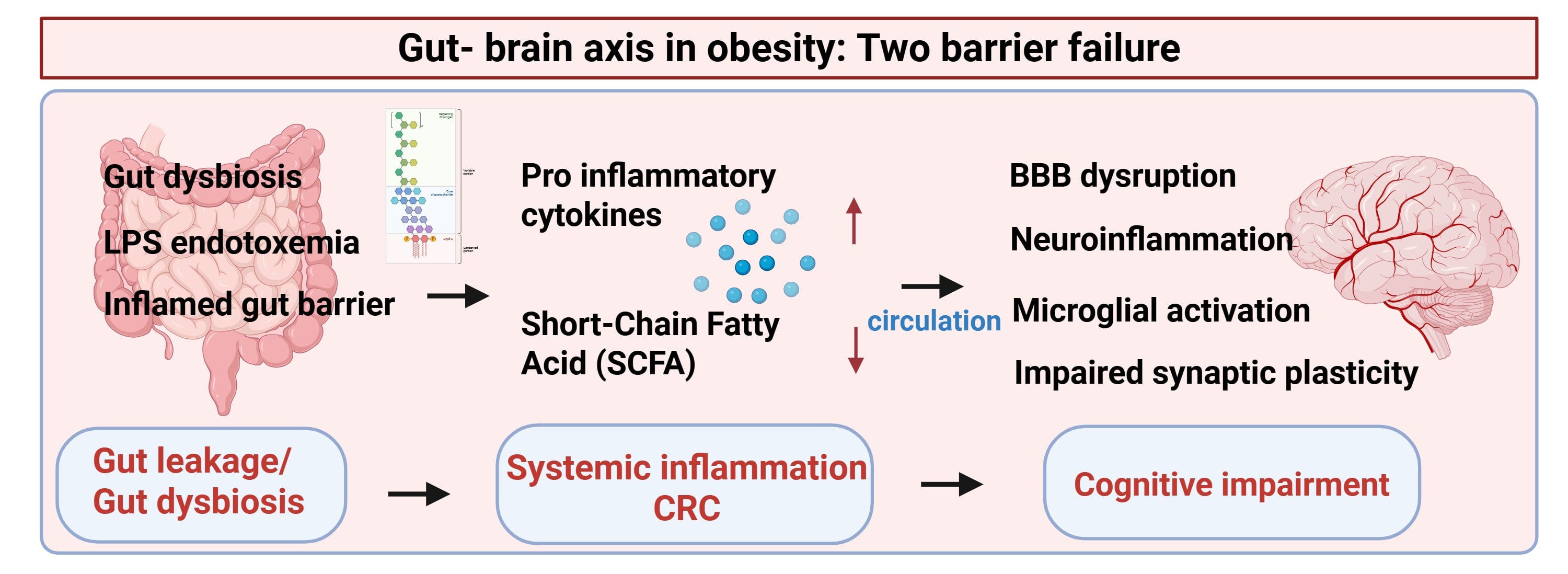
Obesity is a major risk factor for colorectal cancer (CRC) and is increasingly recognized as a contributor to cancer-related cognitive impairment; however, the mechanistic pathways linking metabolic dysfunction, tumor progression, and brain dysfunction remain incompletely defined. Emerging evidence indicates that obesity-induced gut microbial dysbiosis and intestinal barrier disruption may serve as a biologically plausible mechanism connecting these processes via the gut–brain axis although direct clinical causality remains to be firmly established. In obesity, alterations in gut microbiota composition characterized by depletion of barrier-protective taxa and enrichment of pro-inflammatory and genotoxic pathobionts compromise epithelial tight-junction integrity and promote metabolic endotoxemia. The translocation of microbial products, including lipopolysaccharide, sustains chronic systemic inflammation, accelerates CRC progression, and remodels the tumor microenvironment. Notably, these peripheral inflammatory signals extend beyond the intestine and tumor, disrupting blood–brain barrier integrity, activating microglia and astrocytes, and impairing synaptic plasticity within hippocampal and frontal networks. Clinically, these processes manifest as cancer-related cognitive impairment (CRCI), with predominant deficits in attention, processing speed, and working memory, which are often detectable around the time of diagnosis and independent of chemotherapy exposure. This review synthesizes in vivo, in vitro, and human evidence into a proposed theoretical “two-barrier failure” model of obesity-associated CRC and cognitive dysfunction. In addition to mechanistic synthesis, we discuss barrier-centered therapeutic strategies, including targeted probiotics, postbiotics, SCFA supplementation, obesity management through dietary and weight-loss interventions, and potential pharmacological approaches to epithelial and neurovascular barrier protection. We also outline testable clinical trial designs for evaluating these interventions in obesity-associated CRC.
Share and Cite
MDPI and ACS Style
Lee, S.Y.; Cho, S.H.; Song, J.
From Leaky Gut to a Vulnerable Brain: Obesity-Associated Gut Barrier Failure in Colorectal Cancer and Cognitive Dysfunction. Nutrients 2026, 18, 1909.
https://doi.org/10.3390/nu18121909
AMA Style
Lee SY, Cho SH, Song J.
From Leaky Gut to a Vulnerable Brain: Obesity-Associated Gut Barrier Failure in Colorectal Cancer and Cognitive Dysfunction. Nutrients. 2026; 18(12):1909.
https://doi.org/10.3390/nu18121909
Chicago/Turabian Style
Lee, Soo Young, Sang Hee Cho, and Juhyun Song.
2026. "From Leaky Gut to a Vulnerable Brain: Obesity-Associated Gut Barrier Failure in Colorectal Cancer and Cognitive Dysfunction" Nutrients 18, no. 12: 1909.
https://doi.org/10.3390/nu18121909
APA Style
Lee, S. Y., Cho, S. H., & Song, J.
(2026). From Leaky Gut to a Vulnerable Brain: Obesity-Associated Gut Barrier Failure in Colorectal Cancer and Cognitive Dysfunction. Nutrients, 18(12), 1909.
https://doi.org/10.3390/nu18121909
Note that from the first issue of 2016, this journal uses article numbers instead of page numbers. See further details
here.
Article Metrics
Article Access Statistics
For more information on the journal statistics, click
here.
Multiple requests from the same IP address are counted as one view.