


Patient Experiences of Nutrition in Enhanced Recovery After Colorectal Surgery: A Systematic Review †

Abstract
1. Introduction
2. Methods
2.1. Eligibility Criteria
2.2. Information Sources
2.3. Search Strategy
2.4. Selection Process
2.5. Data Collection Process
2.6. Data Items
2.7. Risk of Bias Assessment
2.8. Synthesis Methods
3. Results
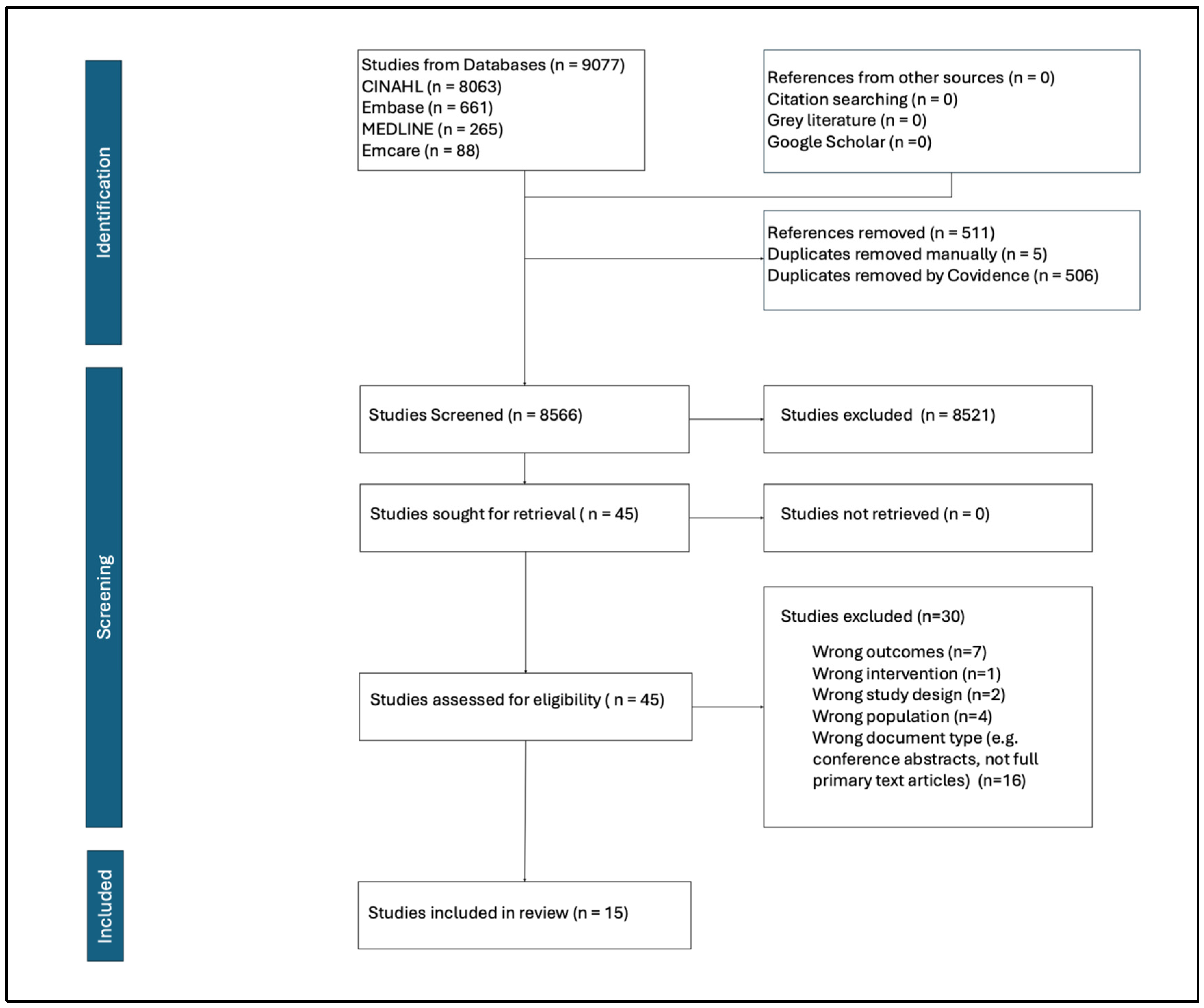
3.1. Study Selection
3.2. Study Characteristics
3.3. Risk of Bias Assessment Results
3.4. Outcomes
- Information Gaps and Misconceptions About Nutrition
- Factors Impacting Oral Intake Post-Surgery
- Experiences with Oral Nutritional Supplements (ONS)
- Role of Healthcare Professionals
- Transition to Home and Discharge Care
“I did it, but didn’t know why. I think people would be more diligent if they knew why the walking was so important, why the protein was so important…”[22]
“vaguely remember them bringing me a full tray at suppertime…are you guys nuts? I didn’t touch it because I felt let’s not overtax the bowel.”[23]
“The first meal consisted of ropy meat, pineapple pie and long pieces of vegetables (peppers) with the skin left on, which is exactly what you should avoid when you have just had surgery and there’s a risk of slowed-down bowel movements.”[28]
“Everything that goes in my mouth I can see coming out and that’s quite off-putting… I think subconsciously I’m probably holding back more on what I’m eating.”[26]
“when I’ve been sick, I feel I want to give my stomach a rest… once I’ve been sick I will tend to say… Well, I won’t have any more food now for a while.”[26]
“I got to the stage that had I stayed for another evening meal I would have walked down to the canteen to get some decent food.”[27]
“The energy drinks were horrible and yet you felt you ought to try to get them down, as I was told they were good for body repair.”[27]
“It was, “What do you want for a drink?” and the first couple of days I said “yes” and then I thought “I don’t really enjoy these, they are just so sweet…”[26]
“I think the best information that I retained and took hold was on nutrition. That was really, really good.”[23]
“I felt taken care of in a good way, they care about what happens to you, it felt good.”[15]
“I’ve asked both the oncologist and the surgeon whether I should or should not be having or following a particular diet or avoid eating certain things and there was no specific information…”[26]
“You can see that the staff has a lot to do, so you feel reticent even though you need to ask a question.”[24]
“The nurses and doctors were pushing me to eat. I did not understand how important it was to eat as soon as possible. I thought the body needs healing…”[22]
“I’m gonna try a bit again today… obviously I’ve got to eat my food before I can go home… if I don’t eat then I won’t be allowed to go home…”[26]
“I was told…when I go home and I’m able to eat again, I can eat or drink anything I want… hopefully I’ll go back to how I was eating and drinking before.”[26]
“The take home sheet that I had, it did say eat more small meals and make sure you drink lots of water. Helpful hints. I wanted more detail like that.”[22]
“I called the contact nurse who said that I should ring the primary care centre, but they said that the operation was the hospital’s responsibility. Then they said: let’s not concern about this anymore; from now on you can fix this yourself.”[25]
4. Discussion
5. Conclusions
Supplementary Materials
Author Contributions
Funding
Data Availability Statement
Acknowledgments
Conflicts of Interest
References
- Fearon, K.C.; Luff, R. The nutritional management of surgical patients: Enhanced recovery after surgery. Proc. Nutr. Soc. 2003, 62, 807–811. [Google Scholar] [CrossRef] [PubMed]
- Ljungqvist, O.; Scott, M.; Fearon, K.C. Enhanced recovery after surgery: A review. JAMA Surg. 2017, 152, 292–298. [Google Scholar] [CrossRef] [PubMed]
- Kehlet, H.; Wilmore, D.W. Multimodal strategies to improve surgical outcome. Am. J. Surg. 2002, 183, 630–641. [Google Scholar] [CrossRef]
- Gustafsson, U.O.; Scott, M.J.; Hubner, M.; Nygren, J.; Demartines, N.; Francis, N.; Rockall, T.A.; Young-Fadok, T.M.; Hill, A.G.; Soop, M.; et al. Guidelines for perioperative care in elective colorectal surgery: Enhanced recovery after surgery (eras®) society recommendations: 2018. World J. Surg. 2019, 43, 659–695. [Google Scholar] [CrossRef]
- Lau, C.S.; Chamberlain, R.S. Enhanced recovery after surgery programs improve patient outcomes and recovery: A meta-analysis. World J. Surg. 2017, 41, 899–913. [Google Scholar] [CrossRef] [PubMed]
- Kannan, V.; Ullah, N.; Geddada, S.; Ibrahiam, A.; Munaf Shakir Al-Qassab, Z.; Ahmed, O.; Malasevskaia, I. Impact of “enhanced recovery after surgery”(eras) protocols vs. Traditional perioperative care on patient outcomes after colorectal surgery: A systematic review. Patient Saf. Surg. 2025, 19, 4. [Google Scholar] [CrossRef]
- Gustafsson, U.O.; Rockall, T.A.; Wexner, S.; How, K.Y.; Emile, S.; Marchuk, A.; Fawcett, W.J.; Sioson, M.; Riedel, B.; Chahal, R.; et al. Guidelines for perioperative care in elective colorectal surgery: Enhanced recovery after surgery (eras) society recommendations 2025. Surgery 2025, 184, 109397. [Google Scholar] [CrossRef]
- Ripollés-Melchor, J.; Ramírez-Rodríguez, J.M.; Casans-Francés, R.; Aldecoa, C.; Abad-Motos, A.; Logroño-Egea, M.; García-Erce, J.A.; Camps-Cervantes, Á.; Ferrando-Ortolá, C.; Suarez de la Rica, A.; et al. Association between use of enhanced recovery after surgery protocol and postoperative complications in colorectal surgery: The postoperative outcomes within enhanced recovery after surgery protocol (power) study. JAMA Surg. 2019, 154, 725–736. [Google Scholar] [CrossRef]
- Weimann, A.; Braga, M.; Carli, F.; Higashiguchi, T.; Hübner, M.; Klek, S.; Laviano, A.; Ljungqvist, O.; Lobo, D.N.; Martindale, R.G.; et al. Espen practical guideline: Clinical nutrition in surgery. Clin. Nutr. 2021, 40, 4745–4761. [Google Scholar] [CrossRef]
- Canzan, F.; Longhini, J.; Caliaro, A.; Cavada, M.L.; Mezzalira, E.; Paiella, S.; Ambrosi, E. The effect of early oral postoperative feeding on the recovery of intestinal motility after gastrointestinal surgery: A systematic review and meta-analysis of randomized clinical trials. Front. Nutr. 2024, 11, 1369141. [Google Scholar] [CrossRef]
- Page, M.J.; McKenzie, J.E.; Bossuyt, P.M.; Boutron, I.; Hoffmann, T.C.; Mulrow, C.D.; Shamseer, L.; Tetzlaff, J.M.; Akl, E.A.; Brennan, S.E.; et al. The PRISMA 2020 statement: An updated guideline for reporting systematic reviews. BMJ 2021, 372, n71. [Google Scholar] [CrossRef]
- Richardson, W.S.; Wilson, M.C.; Nishikawa, J.; Hayward, R.S. The well-built clinical question: A key to evidence-based decisions. ACP J. Club 1995, 123, A12–A13. [Google Scholar] [CrossRef] [PubMed]
- Hong, Q.N.; Fàbregues, S.; Bartlett, G.; Boardman, F.; Cargo, M.; Dagenais, P.; Gagnon, M.P.; Griffiths, F.; Nicolau, B.; O’Cathain, A.; et al. The mixed methods appraisal tool (mmat) version 2018 for information professionals and researchers. Educ. Inf. 2018, 34, 285–291. [Google Scholar] [CrossRef]
- Braun, V.; Clarke, V. One size fits all? What counts as quality practice in (reflexive) thematic analysis? Qual. Res. Psychol. 2021, 18, 328–352. [Google Scholar] [CrossRef]
- Aasa, A.; Hovbäck, M.; Berterö, C.M. The importance of preoperative information for patient participation in colorectal surgery care. J. Clin. Nurs. 2013, 22, 1604–1612. [Google Scholar] [CrossRef]
- Al Ben Ali, S.; Fermi, F.; Olleik, G.; Lapointe-Gagner, M.; Jain, S.; Nguyen-Powanda, P.; Ghezeljeh, T.N.; Elhaj, H.; Alali, N.; Pook, M.; et al. Association between patient activation and adherence to a colorectal enhanced recovery pathway: A prospective cohort study. Surg. Endosc. 2024, 38, 7577–7587. [Google Scholar] [CrossRef]
- Brundrett, D.; Jenkins, I.; Kennedy, R.; Robinson, S.; Rye, B.; Wright, S.; Burch, J. Colorectal service development audits within an enhanced recovery pathway. Gastrointest. Nurs. 2011, 9, 41–45. [Google Scholar] [CrossRef]
- Burch, J. Using patient feedback to improve a colorectal enhanced recovery service. Gastrointest. Nurs. 2015, 13, 43–49. [Google Scholar] [CrossRef]
- Burch, J.; Taylor, C. Patients’ need for nursing telephone follow-up after enhanced recovery. Gastrointest. Nurs. 2012, 10, 51–58. [Google Scholar] [CrossRef]
- Cabellos Olivares, M.; Labalde Martínez, M.; Torralba, M.; Rodríguez Fraile, J.R.; Atance Martínez, J.C. Satisfaction survey after an eras (enhanced recovery after surgery) protocol in colorectal elective surgery in patients over 70 years of age. Colomb. J. Anestesiol. 2018, 46, 187–195. [Google Scholar] [CrossRef]
- Cooper, K. Getting the measure of the patient experience: Measuring the experiences of patients cared for on a colorectal er pathway and how the results will be used to shape services in the future. Nurs. Times 2013, 109, 12–14. [Google Scholar]
- Gillis, C.; Gill, M.; Marlett, N.; MacKean, G.; GermAnn, K.; Gilmour, L.; Nelson, G.; Wasylak, T.; Nguyen, S.; Araujo, E.; et al. Patients as partners in enhanced recovery after surgery: A qualitative patient-led study. BMJ Open 2017, 7, e017002. [Google Scholar] [CrossRef]
- Gillis, C.; Martin, L.; Gill, M.; Gilmour, L.; Nelson, G.; Gramlich, L. Food is medicine: A qualitative analysis of patient and institutional barriers to successful surgical nutrition practices in an enhanced recovery after surgery setting. Nutr. Clin. Pract. 2019, 34, 606–615. [Google Scholar] [CrossRef]
- Partoune, A.; Coimbra, C.; Brichant, J.-F.; Joris, J. Quality of life at home and satisfaction of patients after enhanced recovery protocol for colorectal surgery. Acta Chir. Belg. 2017, 117, 176–180. [Google Scholar] [CrossRef]
- Samuelsson, K.S.; Egenvall, M.; Klarin, I.; Lökk, J.; Gunnarsson, U.; Iwarzon, M. The older patient’s experience of the healthcare chain and information when undergoing colorectal cancer surgery according to the enhanced recovery after surgery concept. J. Clin. Nurs. 2018, 27, e1580–e1588. [Google Scholar] [CrossRef] [PubMed]
- Short, V.; Atkinson, C.; Ness, A.; Thomas, S.; Burden, S.; Sutton, E. Patient experiences of perioperative nutrition within an enhanced recovery after surgery programme for colorectal surgery: A qualitative study. Color. Dis. 2016, 18, O74–O80. [Google Scholar] [CrossRef]
- Taylor, C.; Burch, J. Feedback on an enhanced recovery programme for colorectal surgery. Br. J. Nurs. 2011, 20, 286–290. [Google Scholar] [CrossRef] [PubMed]
- Wennström, B.; Johansson, A.; Kalabic, S.; E-son Loft, A.-L.; Skullman, S.; Bergh, I. Patient experience of health and care when undergoing colorectal surgery within the eras program. Perioper. Med. 2020, 9, 15. [Google Scholar] [CrossRef] [PubMed]
- Xu, P.; Li, D.; Li, J.; Zhang, C. Knowledge, attitude, and practice towards enhanced recovery after surgery among colorectal cancer patients. Sci. Rep. 2024, 14, 9034. [Google Scholar] [CrossRef]
- Tang, J.W.C.; Lam, W.W.T.; Kwong, A.; Ma, A.S.Y.; Fielding, R. Dietary decision-making in chinese breast cancer survivors: A qualitative study. Patient Educ. Couns. 2022, 105, 460–465. [Google Scholar] [CrossRef]
- Tang, J.W.C.; Lam, W.W.T.; Ma, A.S.Y.; Law, W.L.; Wei, R.; Fielding, R. Dietary changes adopted by chinese colorectal cancer patients: A qualitative study. Eur. J. Cancer Care 2019, 28, e13159. [Google Scholar] [CrossRef]
- Ford, K.L.; Trottier, C.F.; Wismer, W.V.; Sawyer, M.B.; Siervo, M.; Deutz, N.E.; Prado, C.M.; Vallianatos, H. Drivers of dietary choice after a diagnosis of colorectal cancer: A qualitative study. J. Acad. Nutr. Diet. 2023, 123, 407–416. [Google Scholar] [CrossRef] [PubMed]
- Rattray, M.; Marshall, A.; Desbrow, B.; Roberts, S. A qualitative exploration of patients’ experiences with and perceptions of recommencing feeding after colorectal surgery. J. Hum. Nutr. Diet. 2019, 32, 63–71. [Google Scholar] [CrossRef]
- Dalsgaard, E.A.; Dolin, T.G.; Lund, C.M.; Lykke, J.; Munk, T.; Vinther, A.; Rosenberg, J. Optimized post-discharge care in patients with frailty after colon cancer surgery (project eras® 3.0): A protocol for a randomized controlled trial. J. Geriatr. Oncol. 2025, 16, 102289. [Google Scholar] [CrossRef] [PubMed]
- Laur, C.; Curtis, L.; Dubin, J.; McNicholl, T.; Valaitis, R.; Douglas, P.; Bell, J.; Bernier, P.; Keller, H. Nutrition care after discharge from hospital: An exploratory analysis from the more-2-eat study. Healthcare 2018, 6, 9. [Google Scholar] [CrossRef]
- Hagger, M.S.; Orbell, S. The common sense model of illness self-regulation: A conceptual review and proposed extended model. Health Psychol. Rev. 2022, 3, 347–377. [Google Scholar] [CrossRef]
- Naithani, S.; Whelan, K.; Thomas, J.; Gulliford, M.C.; Morgan, M. Hospital inpatients’ experiences of access to food: A qualitative interview and observational study. Health Expect. 2008, 11, 294–303. [Google Scholar] [CrossRef]
- Larsen, K.L.; Schjøtler, B.; Melgaard, D. Patients’ experiences eating in a hospital–a qualitative study. Clin. Nutr. ESPEN 2021, 45, 469–475. [Google Scholar] [CrossRef]
- Mikkelsen, S.; Skadhauge, L.B.; Topperup, R.; Rasmussen, H.H.; Holst, M. Patients’ experiences with nutritional care during hospitalization and proposals for improvement. Int. J. Nurs. Health Care Res. 2022, 5, 1337. [Google Scholar]
- Yee, S.L.; Schmidt, R.C.; Satalich, J.; Krumme, J.; Golladay, G.J.; Patel, N.K. Improved outcomes with perioperative dietitian-led interventions in patients undergoing total joint arthroplasty: A systematic review. J. Orthop. 2024, 56, 12–17. [Google Scholar] [CrossRef] [PubMed]
- Maheta, B.; Shehabat, M.; Khalil, R.; Wen, J.; Karabala, M.; Manhas, P.; Niu, A.; Goswami, C.; Frezza, E. The effectiveness of patient education on laparoscopic surgery postoperative outcomes to determine whether direct coaching is the best approach: Systematic review of randomized controlled trials. JMIR Perioper. Med. 2024, 7, e51573. [Google Scholar] [CrossRef] [PubMed]
- Lasithiotakis, K.; Andreou, A.; Migdadi, H.; Kritsotakis, E.I. Malnutrition and perioperative nutritional rehabilitation in major operations. Eur. Surg. 2025, 57, 188–203. [Google Scholar] [CrossRef]
- Weimann, A.; Braga, M.; Carli, F.; Higashiguchi, T.; Hübner, M.; Klek, S.; Laviano, A.; Ljungqvist, O.; Lobo, D.N.; Martindale, R.; et al. Espen guideline: Clinical nutrition in surgery. Clin. Nutr. 2017, 36, 623–650. [Google Scholar] [CrossRef]
- Wobith, M.; Hill, A.; Fischer, M.; Weimann, A. Nutritional prehabilitation in patients undergoing abdominal surgery—A narrative review. Nutrients 2024, 16, 2235. [Google Scholar] [CrossRef] [PubMed]
- Gillis, C.; Carli, F. Promoting perioperative metabolic and nutritional care. Anesthesiology 2015, 123, 1455–1472. [Google Scholar] [CrossRef] [PubMed]
- Loeliger, J.; Francis, J.; Kiss, N.; Stewart, J.; Chandler, S.; Donohoe, K.; Hughes, V.; Swan, W.; Kaegi, K.; Elliott, A.; et al. Enhancing the provision of cancer nutrition information to support care through experience-based co-design: A mixed-methods study. Support. Care Cancer 2024, 32, 257. [Google Scholar] [CrossRef]
- Ang, K.; Stringer, G.; Collins, J.; Barker, L. Exploring patient perspectives on nutrition in enhanced recovery after colorectal surgery: A systematic review (abstract pending formal publication). In Proceedings of the 12th ERAS World Congress, Singapore, 14–16 May 2026. [Google Scholar]

| Inclusion Criteria | |
|---|---|
| Population | Any patients and caregivers of any age at any point in the perioperative period, including before surgery, immediately after surgery and long-term (more than six weeks post-surgery). Any patients undergoing colorectal surgery. |
| Intervention | Colorectal surgery utilising the ERAS pathway. |
| Comparator | No comparator. |
| Outcome | Perceptions, experiences, attitudes, knowledge or views towards the nutrition component of ERAS reported by patients or caregivers. Studies were eligible if they reported patient experiences of nutrition either as a primary focus or as a clearly identifiable component of a broader exploration of ERAS care. Broader studies were retained when they provided extractable data relevant to perioperative nutrition, because patient experiences of nutrition in ERAS are often embedded within wider findings of recovery, symptom management, and discharge care rather than reported as primary or standalone outcomes. This may include:
|
| Study Design | Primary research using qualitative, quantitative or mixed methods design to collect descriptive data through surveys, focus groups, interviews or observation. |
| Study | Study Aim(s) | Language | Country | Sample Size | Study Design |
|---|---|---|---|---|---|
| Brundrett et al. 2011 [17] | To establish if patients were being offered high-energy, high-protein drinks postoperatively as recommended by their enhanced recovery pathway and to obtain patients’ views on these supplements. | English | United Kingdom | 17 patients | Quantitative Descriptive Survey |
| Gillis et al. 2017 [22] | Explore the experience of patients undergoing colorectal surgery within an Enhanced Recovery After Surgery (ERAS) programme. Use these experiential data to inform the development of a framework to support ongoing, meaningful patient engagement in ERAS. | English | Canada | 17 patients | Qualitative |
| Gillis et al. 2019 [23] | A nutrition-focused qualitative analysis of patient experience and of ERAS implementation across our province was conducted to better understand the barriers to successful adoption of ERAS nutrition elements. | English | Canada | 27 patients | Qualitative |
| Samuelsson et al. 2018 [25] | To describe how older patients experience the healthcare chain and information given before, during and after colorectal cancer surgery. | Study conducted in Swedish. Paper written in English. | Sweden | 16 patients | Qualitative |
| Partoune et al. 2017 [24] | To evaluate the feelings and satisfaction of patients when at home after an ERP for colorectal surgery. | Study conducted in French. Paper written in English. | Belgium | 41 patients | Quantitative Descriptive Survey |
| Cooper 2013 [21] | To measure the experience of patients cared for on a colorectal ER pathway. | English | United Kingdom | 48 patients | Mixed methods |
| Burch 2015 [18] | To review patients’ experiences of a colorectal enhanced recovery pathway to enable service evaluation and improvement. | English | United Kingdom | 54 patients | Mixed methods |
| Taylor and Burch 2011 [27] | To examine service users’ views on an enhanced recovery programme (ERP) for colorectal surgery patients, to improve service provision. | English | United Kingdom | 10 patients | Qualitative |
| Wennstrom et al. 2020 [28] | To describe patient experiences of health within the concept of ERAS after colorectal surgery during a hospital stay and within 2 weeks of discharge. | Study conducted in Swedish. Paper written in English. | Sweden | 80 patients | Mixed Methods |
| Short et al. 2015 [26] | To explore the perioperative nutrition experiences of colorectal surgical patients to identify barriers and facilitators to the integration of nutrition within ERAS. | English | United Kingdom | 16 patients | Qualitative |
| Olivares et al. 2018 [20] | To determine the satisfaction of patients following the implementation of an ERAS protocol in elective colorectal surgery. | English | Spain | 55 patients | Quantitative Descriptive Survey |
| Burch and Taylor 2012 [19] | To identify how well patients recover in the period between discharge home from the hospital and surgical follow-up in The outpatient clinic will discuss their support needs following participation in the ERAS programme. | English | United Kingdom | 100 patients | Mixed Methods |
| Aasa et al. 2013 [15] | To identify and describe patients’ experiences of a preoperative information session with a nurse, as part of the enhanced recovery after surgery (ERAS) concept, and its impact on patient participation in their own care. | English | Sweden | 12 patients | Qualitative |
| Xu et al. 2024 [29] | To explore the knowledge, attitude, and practice (KAP) towards enhanced recovery after surgery (ERAS) among colorectal cancer (CRC) patients. | English | China | 652 patients | Quantitative descriptive cross-sectional survey |
| S Ben Ali et al. 2024 [16] | To assess the extent to which patient activation (PA, i.e., knowledge, skills, and confidence to participate in care) is associated with adherence to an ER pathway for colorectal surgery. | English | Canada | 286 patients | Quantitative Survey |
| Article | Study Design | MMAT Criteria Applied | Q1 | Q2 | Q3 | Q4 | Q5 |
|---|---|---|---|---|---|---|---|
| Brundrett et al. et al. 2011 [17] | Quantitative Descriptive | QD1–QD5 | ? | ? | ? | Y | Y |
| Gillis 2017 et al. [22] | Qualitative | QL1–QL5 | Y | Y | Y | Y | Y |
| Gillis 2019 et al. [23] | Qualitative | QL1–QL5 | Y | Y | Y | Y | Y |
| Samuelsson et al. 2018 [25] | Qualitative | QL1–QL5 | Y | Y | Y | Y | Y |
| Partoune et al. 2017 [24] | Quantitative Descriptive | QD1–QD5 | Y | Y | Y | Y | Y |
| Cooper 2013 [21] | Mixed methods | MM1–MM5 | Y | Y | Y | Y | N |
| Burch 2015 [18] | Mixed methods | MM1–MM5 | Y | Y | Y | Y | Y |
| Taylor and Burch 2011 [27] | Qualitative | QL1–QL5 | Y | Y | Y | Y | Y |
| Burch and Taylor 2012 [19] | Mixed methods | MM1–MM5 | N | N | N | N | N |
| Wennstrom et al. 2020 [28] | Mixed methods | MM1–MM5 | Y | Y | Y | ? | Y |
| Short et al. 2015 [26] | Qualitative | QL1–QL5 | Y | Y | Y | Y | Y |
| Olivares et al. 2018 [20] | Quantitative Descriptive | QD1–QD5 | Y | Y | Y | Y | Y |
| Aasa et al. 2013 [15] | Qualitative | QL1–QL5 | Y | Y | Y | Y | Y |
| Xu 2024 [29] | Quantitative Descriptive | QD1–QD5 | Y | Y | Y | Y | Y |
| S Ben Ali et al. 2024 [16] | Quantitative Descriptive | QD1–QD5 | Y | Y | Y | Y | Y |
Disclaimer/Publisher’s Note: The statements, opinions and data contained in all publications are solely those of the individual author(s) and contributor(s) and not of MDPI and/or the editor(s). MDPI and/or the editor(s) disclaim responsibility for any injury to people or property resulting from any ideas, methods, instructions or products referred to in the content. |
© 2026 by the authors. Licensee MDPI, Basel, Switzerland. This article is an open access article distributed under the terms and conditions of the Creative Commons Attribution (CC BY) license.
Share and Cite
Ang, K.Y.H.; Stringer, G.; Collins, J.; Barker, L.A. Patient Experiences of Nutrition in Enhanced Recovery After Colorectal Surgery: A Systematic Review. Nutrients 2026, 18, 1790. https://doi.org/10.3390/nu18111790
Ang KYH, Stringer G, Collins J, Barker LA. Patient Experiences of Nutrition in Enhanced Recovery After Colorectal Surgery: A Systematic Review. Nutrients. 2026; 18(11):1790. https://doi.org/10.3390/nu18111790
Chicago/Turabian StyleAng, Kimberly Yee Hooi, Georgia Stringer, Jorja Collins, and Lisa A. Barker. 2026. "Patient Experiences of Nutrition in Enhanced Recovery After Colorectal Surgery: A Systematic Review" Nutrients 18, no. 11: 1790. https://doi.org/10.3390/nu18111790
APA StyleAng, K. Y. H., Stringer, G., Collins, J., & Barker, L. A. (2026). Patient Experiences of Nutrition in Enhanced Recovery After Colorectal Surgery: A Systematic Review. Nutrients, 18(11), 1790. https://doi.org/10.3390/nu18111790

