


Abstract
Vitamin B12 supplementation among people without proven deficiency has become popularized, driven by perceptions of (i) frequent underdiagnosis of deficiency, (ii) promotion as a natural enhancer of well-being, and (iii) a favourable safety profile. Here, we examine whether these claims align with current evidence. We present guidance from major health authorities, which advises against routine testing in asymptomatic individuals without risk factors. The prevalence of B12 deficiency varies greatly, mainly because definitions of B12 deficiency are not standardized and may include clinical, biochemical, or functional criteria. Biochemical deficiency (typically serum B12 < 148 pmol/L) is the predominant definition in epidemiological and clinical research studies. Using this criterion, deficiency appears uncommon in general populations of high-income countries (~2%), but substantially more frequent in settings with limited access to animal-source foods or B12-fortified products (up to 69%). Studying the effects of supplementation is also challenged by variation in the regimens used, which range from 0.02 to 1 mg/day orally and from 1 to 5 mg/week intramuscularly, with durations spanning ~4 weeks to ~7 years. This limits cross-study comparability. Overall, supplementation has not shown consistent benefits in populations without overt clinical or biochemical B12 deficiency, with no clear improvements in fatigue, mood, cognition, or cardiovascular outcomes. Benefits, when reported, appear confined to selected subgroups (e.g., hyperhomocysteinemia or low–normal B12 status). B12 supplementation is generally well tolerated. There are rare reports of acneiform and hypersensitivity responses, although these cannot be completely distinguished from reactions to, e.g., excipients. Observational studies associate B12 supplementation and higher circulating B12 levels with increased risks of malignancy. However, these findings are inconsistent, and current evidence is insufficient to establish causality, as potential reverse causation remains a major concern.
1. Introduction and Methods
Vitamin B12 supplements are usually prescribed to cover deficiencies and, less frequently, as cofactor therapy for rare inborn errors of metabolism [1,2]. In recent years, vitamin B12 supplementation has expanded to widespread over-the-counter use in people without proven deficiency, driven by perceptions of frequent underdiagnosis and by promotion as a natural enhancer of energy and well-being [3,4]. There is also the assumption that a water-soluble vitamin carries negligible risk [4,5]. A critical appraisal is warranted to delineate evidence-based indications, clarify benefits and harms in replete populations, and guide prudent dosing and monitoring.
We conducted a narrative review following the SANRA quality assessment recommendations. We aimed to evaluate vitamin B12 supplementation, with special interest in adults without established deficiency. For initial contextualization, we examined the recognized biological functions of vitamin B12, its main dietary sources, and the proposed reference intakes. To evaluate whether B12 is actually a “frequent deficiency”, we assessed how vitamin B12 deficiency is defined across the literature and the reported prevalence of deficiency in general populations. To investigate effects beyond deficiency correction, we examined evidence on vitamin B12 pharmacokinetics and routes of administration, as well as studies assessing potential health benefits in non-deficient individuals. We also reviewed reported adverse effects associated with supplementation and the potential mechanisms underlying these reactions.
To this end, we searched MEDLINE/PubMed, Embase, the Cochrane Library, and Web of Science (January 1990 to November 2025; English), and complemented database searches by screening authoritative sources, including guideline repositories (e.g., NICE and ADA) and informational resources (e.g., NIH Office of Dietary Supplements). Search strategies combined controlled vocabulary and free-text terms (the terms used are provided in Supplementary Table S1). Eligible evidence included randomized, cohort, case–control and cross-sectional studies; systematic reviews and meta-analyses, and authoritative guidelines. Single-case reports were excluded except when describing rare adverse events. Non-human studies were used only to support plausible pathophysiological mechanisms. Given substantial heterogeneity across populations, interventions, biomarkers, and outcomes, synthesis was qualitative, and findings are presented thematically.
Because assessment of variability in the definition of vitamin B12 deficiency was itself an objective of the literature search we performed, we did not restrict inclusion to a single diagnostic threshold or biomarker approach. To minimize ambiguity, whenever the term “vitamin B12 deficiency” is used, we report the specific criteria applied in the referenced source. We defined supplementation as administration of vitamin B12 via pharmacological formulations and applied no restrictions on dose, duration, or route. When supplementation regimens are discussed, we specify the dose and duration. For evidence regarding supplementation beyond deficiency correction, we prioritized studies that excluded individuals with overt deficiency or that evaluated supplementation effects in general or asymptomatic populations, and we report the principal inclusion criteria for each study cited.
This review has limitations inherent to its narrative design. Literature identification was not systematic, and no formal inclusion or exclusion criteria, study quality assessment, or risk-of-bias evaluation was performed. As a result, the synthesis may not capture all available evidence, and selective emphasis cannot be fully excluded.
2. Vitamin B12 Function and Sources
Vitamin B12 (cobalamin) is a vital water-soluble cofactor that supports methylation, DNA synthesis, myelin integrity, hematopoiesis, mitochondrial energy, and detoxification of propionate-derived carbon in the TCA cycle [6,7,8,9]. During pregnancy, increased B12 supports DNA synthesis, neurodevelopment, and red blood cell formation for maternal growth and fetal development [10].
Humans obtain vitamin B12 from external sources, i.e., animal-derived foods such as meat, fish, shellfish, eggs, and dairy products. Representative amounts include ~70 µg per 85 g of beef liver, ~20 µg per 85 g of pork liver, ~2.6 µg per 85 g of cooked salmon, ~2.4 µg per 85 g of cooked beef steak, ~1.3 µg per cup (240 mL) of milk, and ~0.5 µg per large egg [9,11,12]. Although trace amounts of vitamin B12 have been detected in certain plant-based foods, including marine algae, wild mushrooms, and brewer’s or nutritional yeast, these foods are not reliable sources of biologically active vitamin B12 [13]. Consequently, the only dependable plant-based sources of vitamin B12 are foods fortified with synthetic vitamin B12, such as certain cereals and vegetarian meat replacement products, which typically provide 0.5–1.8 µg per 100 g [12].
Recommended intakes vary by authority. In the United States, the Recommended Dietary Allowance (RDA) for adults is 2.4 µg/day. This recommended intake increases to 2.6 µg/day in pregnancy and 2.8 µg/day during lactation [9]. These values are derived from an Estimated Average Requirement intended to maintain hematologic status and normal serum B12. In Europe, the European Food Safety Authority (EFSA) suggests Adequate Intakes (AIs) of 4.0 µg/day for adults, 4.5 µg/day in pregnancy, and 5.0 µg/day during lactation, anchored to intake–biomarker relationships across multiple B12 status indicators in adults [14]. However, for pregnant and breastfeeding women, these recommendations were derived from assumptions regarding fetal vitamin B12 accumulation, breast-milk cobalamin concentrations, and average milk transfer [14]. Some national assessments have noted that, despite EFSA’s conservative approach, evidence suggests that lower intakes may be sufficient for many adults [15]. The Netherlands, for example, released in 2023 an RDA of 3.3 µg/day during pregnancy and 3.8 µg/day during lactation [16].
3. Is Vitamin B12 a Frequent Deficiency?
Assessing the prevalence of vitamin B12 deficiency remains challenging for several reasons. First, the absence of an international consensus on screening indications leads to substantial variability in the base populations across studies. Most guidelines agree on recommending against universal screening, as reflected in the advice of major health authorities, including the American Academy of Family Physicians (AAFP) in the United States [17], the National Institute for Health and Care Excellence (NICE) in the United Kingdom [3], The Dutch College of General Practitioners (NHG) in the Netherlands [18], and the British Columbia (BC) Provincial Guidelines in Canada [19]. However, the criteria for when to screen vary significantly. Some, such as the BC, recommend testing primarily based on the presence of risk factors such as low intake or diseases that reduce B12 absorption. Others, like the NHG [18], emphasize testing preferentially when abnormalities suggestive of B12 clinical deficiency are present, like unexplained neurological symptoms or macrocytosis/non-iron-deficiency anemia. Stricter guidelines, such as those from the AAFP and NICE [3,17], require the coexistence of both clinical features and at least one risk factor before recommending evaluation for vitamin B12 deficiency.
Second, the literature uses heterogeneous definitions of “deficiency”, including clinical deficiency (symptomatic disease attributable to B12 deficiency), biochemical deficiency (abnormal biomarkers in the absence of specific symptoms), and functional deficiency (biomarkers suggesting impaired B12 activity). In addition, no single biomarker is universally accepted as a gold standard for biochemical or functional deficiency, and laboratory cut-offs vary by assay and population (Table 1) [3,20]. Total serum B12 is the most widely available test, with common cut-offs of <148 pmol/L for deficiency. This marker is known to have limited sensitivity and specificity for functional deficiency. Values near the reference range are further complicated by assay imprecision (about 5–10% CV) and within-person variation (about 10–20%) [3,21]. For functional deficiency, markers such as methylmalonic acid (MMA) and total homocysteine (tHcy) better reflect intracellular cobalamin insufficiency, yet both rise with declining renal function. tHcy is also pre-analytically demanding, requiring rapid sample processing, and is influenced by folate, vitamin B6, and other metabolic factors [9,22]. Holotranscobalamin (holoTC), the transcobalamin-bound fraction that delivers B12 to cells, correlates slightly better with metabolic sufficiency than total B12 alone, but is less widely available [21]. Composite indices such as the combined indicator (cB12), which integrates total B12, holoTC, MMA, and tHcy, improve discrimination in the subclinical deficiency ranges, though they remain research tools rather than routine practice [23].
For these reasons, estimates of the frequency of vitamin B12 deficiency in the general population vary widely depending on both the population studied and the definition used (Table 1). Across the included studies, populations with adequate intake of animal-source foods, such as those in the United States and South Korea [24,25], consistently show low prevalence (generally <5%), whereas substantially higher rates are observed in settings where such foods are limited, as seen in India (~47% or higher) [26]. Even within high-income countries, important at-risk subgroups emerge; for example, women of childbearing age in the United Kingdom and Saudi Arabia show deficiency rates of around 6–12%, despite apparently adequate intake [27,28], suggesting potential gaps related to absorption, dietary quality, or reporting. Age is another consistent determinant, with older adults more likely to exhibit suboptimal status across populations [29]. In addition to true population differences, methodological factors substantially influence prevalence estimates. Depending on whether biochemical or functional markers are used, estimates within the same population can vary several-fold (e.g., approximately 2–3% vs. up to ~8% in U.S. data) [25], highlighting the impact of biomarker selection.
Table 1.
Reported B12 deficiency prevalence among different populations.
4. Routes and Forms of B12 Supplementation
Cyanocobalamin, hydroxocobalamin, and methylcobalamin are the principal crystalline forms of vitamin B12 used for supplementation. Delivery routes include oral and sublingual formulations, intramuscular or subcutaneous injections, and an intranasal cyanocobalamin spray for maintenance with amounts ranging from 100 to 3000 µg per dose [31]. The oral formulation, as B12 obtained from diet, relies primarily on intrinsic factor and saturates at roughly 1–2 µg per dose, beyond which a small passive-diffusion component accounts for additional uptake [4]. Sublingual dosing achieves similar biomarker responses to swallowed tablets, implying the same gastrointestinal pathway [32,33]. Following IM or SC injection, vitamin B12 is rapidly distributed (peaking at around 1 h), circulates bound to transcobalamin or haptocorrin, and is mainly stored in the liver with subsequent enterohepatic recirculation [9,34]. Intranasal cyanocobalamin is absorbed across the nasal mucosa, bypasses intrinsic factor, and is intended for maintenance after repletion [35].
For patients with confirmed clinical or biochemical deficiency, the choice of supplementation route is commonly guided by patient preference and cost [3,9,36,37]. A 2018 Cochrane systematic review [38], subsequent evidence summaries from the AAFP in 2022 [39], and a 2024 network meta-analysis [33] all found no clinically meaningful differences in efficacy among oral and parenteral routes, as all these routes reached normalization of the B12 values even in malabsorptive etiologies or severe clinical deficiency. Cost considerations generally favor high-dose oral cyanocobalamin as the lowest-cost option [40,41], given that it is self-administered. Because vitamin B12 supplementation is not routinely recommended for non-deficient individuals, there are no recommendations regarding the optimal route of administration in this population.
5. Supplementation Beyond Sufficiency: Are There Benefits?
Multiple randomized trials have examined whether vitamin B12 supplementation improves fatigue and general well-being in populations without overt B12 deficiency or B12-related anemia [42,43,44], including older adults, patients in secondary cardiovascular prevention, and individuals with elevated MMA. These studies have consistently shown no clinically meaningful benefit (Table 2). Notably, all of these studies enrolled selected clinical populations rather than generally healthy individuals, which limits the generalizability of their findings. This limitation was also highlighted in the systematic review by Markun et al., which assessed vitamin B12 supplementation in broader non-deficient populations but identified only a single eligible study [45]. Given the scarcity of eligible evidence the authors did not provide a quantitative meta-analytic estimate for fatigue outcomes.
For cognition and neurodegeneration, meta-analyses in participants without cognitive impairment or diagnosed clinical B12 deficiency (with variable definitions), covering a wide range of doses and durations, conclude that B-vitamin supplementation does not meaningfully alter global cognitive trajectories in unselected populations [46,47] (Table 2). In contrast, the VITACOG trial in patients with mild cognitive impairment (MCI) who were not using B12 supplements at baseline (mean plasma B12 ~330 pmol/L) showed that combined supplementation with vitamin B12, folic acid, and vitamin B6 for 24 months slowed brain atrophy and cognitive decline, particularly among participants with elevated homocysteine or sufficient long-chain omega-3 status [48,49]. The authors proposed several mechanisms to explain this interaction, including that homocysteine lowering may restore pathways involved in the incorporation of docosahexaenoic acid (DHA) into neuronal membranes, making structural benefits more evident when omega-3 substrate availability is adequate. In addition, both omega-3 fatty acids and B vitamins may reduce tau hyperphosphorylation and neurofibrillary tangle formation, and both nutrient classes may attenuate neuroinflammation [50]. However, because these effects derive from a single study and were achieved using combined B-vitamin supplementation, vitamin B12-specific effects cannot be isolated or confirmed.
Regarding mood, two pooled analyses of randomized trials in individuals without depression at baseline show no preventive effect of vitamin B12 supplementation on depressive symptoms [46,51]. Similarly, in individuals with existing depression, meta-analytic evidence indicates no consistent improvement in depressive symptoms with B-vitamin supplementation on top of regular antidepressant therapy compared to antidepressant therapy alone [52]. This is consistent with an RCT in adults ≥50 years with major depression, which found no difference in remission rates when B-vitamin supplementation (including 0.5 mg B12) was added to antidepressant therapy [53]. In contrast, a randomized trial in patients with depression and low–normal vitamin B12 levels (190–300 pg/mL) reported higher response rates when injectable B12 was added to standard antidepressant treatment, suggesting a potential benefit in this subgroup (Table 2).
Finally, in cardiovascular prevention, only one meta-analysis assessed effects in the general population, with a focus on regions without mandatory folate fortification [54]. This study reported a modest reduction in stroke risk with folic acid-based regimens combined with vitamin B12; however, the effect was not significant in analyses restricted to trials using higher B12 doses (>4 mg/day). This may reflect reduced statistical power due to smaller sample sizes, but also suggests that the observed benefit is likely driven primarily by folate rather than vitamin B12. Most of the remaining evidence comes from secondary prevention trials, including large randomized studies such as NORVIT, VITATOPS, HOPE-2, and SU.FOL.OM3, conducted in patients with recent cardiovascular events or established cardiovascular disease, which showed no reduction in major adverse cardiovascular events with multiple B-vitamin supplementation, including B12 [55,56,57,58] Notably, HOPE-2 reported a 25% relative reduction in stroke despite null effects on the composite endpoint (cardiovascular death, myocardial infarction, and stroke) [58]. This finding is consistent with the meta-analytic evidence; however, the specific contribution of vitamin B12 cannot be isolated, as all interventions involved combined B-vitamin regimens.
Table 2.
Studies regarding potential benefits of B12 supplementation in nondeficient populations.
6. Supplementation: Are There Potential Harms?
Vitamin B12 has low acute toxicity, and no tolerable upper intake level has been established [9,59]. The supplementation doses mentioned in the studies above, as well as the much higher doses used in, e.g., the treatment of inborn errors of metabolism, are generally well tolerated [1,2]. Nevertheless, rare adverse reactions have been reported, and observational and experimental studies have raised questions about the possible long-term effects of high B12 exposure. However, most evidence is of low quality and remains hypothesis-generating (Table 3).
Dermatologic reactions have been reported in multiple case reports linking acneiform eruptions and rosacea flares to vitamin B12 supplementation, either as high-dose injections or combined oral preparations. These reactions typically resolved after discontinuation of the supplement [60,61,62,63] (Table 3). However, B12-specific effects are difficult to isolate because these products are often administered as multivitamin formulations, and reactions may also be attributable to other vitamins, excipients, or preservatives. A proposed mechanism, supported by human microbiome studies, is that exogenous vitamin B12 uptake by Cutibacterium acnes downregulates cobalamin biosynthesis pathways and increases porphyrin production, a pro-inflammatory signal, potentially due to a shift in metabolic allocation away from de novo B12 synthesis [64].
Hypersensitivity reactions to vitamin B12 are reported, but they are rare and mainly immediate, including occasional anaphylaxis after high-dose parenteral cyanocobalamin or hydroxocobalamin (1–5 mg) [65,66,67]. In a 29-patient series, most cases were immediate reactions (62%), including anaphylaxis, with some later linked to excipients such as PEG. In the same study, delayed reactions were less frequent and often still compatible with tolerance of alternative oral or injectable formulations [68]. Case reports similarly show that oral vitamin B12 is frequently tolerated after parenteral reactions, supporting a possible role for formulation components rather than cobalamin itself in some cases [65,67]. Cobalt allergy is also relevant, as vitamin B12 contains cobalt at its core, and a subset of referred patients are ultimately sensitized to cobalt rather than the full vitamin B12 preparation [68,69].
Table 3.
Reported potential adverse effects of B12 supplementation.
Beyond acute adverse effects, long-term supplementation with vitamin B12 has also been linked to other potential risks, particularly cancer. This association remains debated. In a Norwegian randomized trial on patients with ischemic heart disease, participants receiving vitamin B12 + folic acid for approximately 3 years had a higher cancer incidence (10%) than controls (8.4%; p = 0.02), although the specific contribution of vitamin B12 versus folic acid cannot be disentangled [71]. In contrast, another randomized trial in U.S. women using combined B vitamins, including vitamin B12 (1 mg/day) for about 7 years, did not replicate this finding [72]. Observational evidence from the VITAL cohort reported an increased lung cancer risk in men using long-term vitamin B12 supplements (self-reported > 55 µg/day based on a 10-year average), independent of multivitamin use [70], but these results have not been replicated by other studies. Much of the remaining evidence does not assess supplementation directly but rather circulating vitamin B12 levels. Three cohort studies on the adult general population (sample sizes between 688 and 757K participants) examined the association of elevated plasma B12—either as a continuous variable or using thresholds (e.g., ≥1000 ng/L)—with incident cancer within relatively short follow-up periods (1–12 months). These studies reported increased cancer risk, with effect estimates ranging from an OR of 1.15 (95% CI 1.06, 1.25) per standard deviation increase to an HR of 5.9 (95% CI 2.79,12.45) for markedly elevated levels (≥1000 ng/L) [73,74,75]. Given the observational nature of these studies, causality remains uncertain. The short interval between B12 measurement and cancer diagnosis suggests that elevated B12 may reflect reverse causation or disease-related alterations in B12 metabolism rather than a direct carcinogenic effect or the effect of external B12 exposure. Consistent with this interpretation, Mendelian randomization analyses examining genetically predicted B12 levels have not demonstrated a causal relationship with cancer risk [76,77].
Other concerns have been raised about potential adverse effects of sustained high vitamin B12 levels. Observational studies in the general population, including the PREVEND cohort (the Netherlands), have reported associations between higher circulating B12 concentrations and increased mortality risk (HR 1.25; 95% CI 1.06–1.47 per 1-SD increase) [78]. Meta-analytic evidence from 22 cohort studies similarly shows a modest, linear increase in mortality per 100 pmol/L rise in serum B12 (HR 1.04; 95% CI 1.01–1.08), with stronger associations in older adults and at higher concentrations (≥600 pmol/L: HR 1.50; 95% CI 1.29–1.74) [79]. However, it is important to emphasize that these findings relate to circulating B12 levels rather than supplementation per se. Interpretation is further limited by the observational design of these studies, where reverse causation is highly plausible. Elevated B12 is frequently observed in conditions such as liver disease, renal dysfunction, malignancy, and systemic inflammation, all of which are independently associated with increased mortality [79,80,81]. Experimental studies also suggest that high exogenous B12 availability may influence microbial metabolism and growth, potentially promoting species such as Salmonella enterica and Listeria monocytogenes [82,83]. While this provides biological plausibility for downstream effects, including infection risk or metabolic byproducts, the clinical relevance in humans remains uncertain.
7. Knowledge Gaps
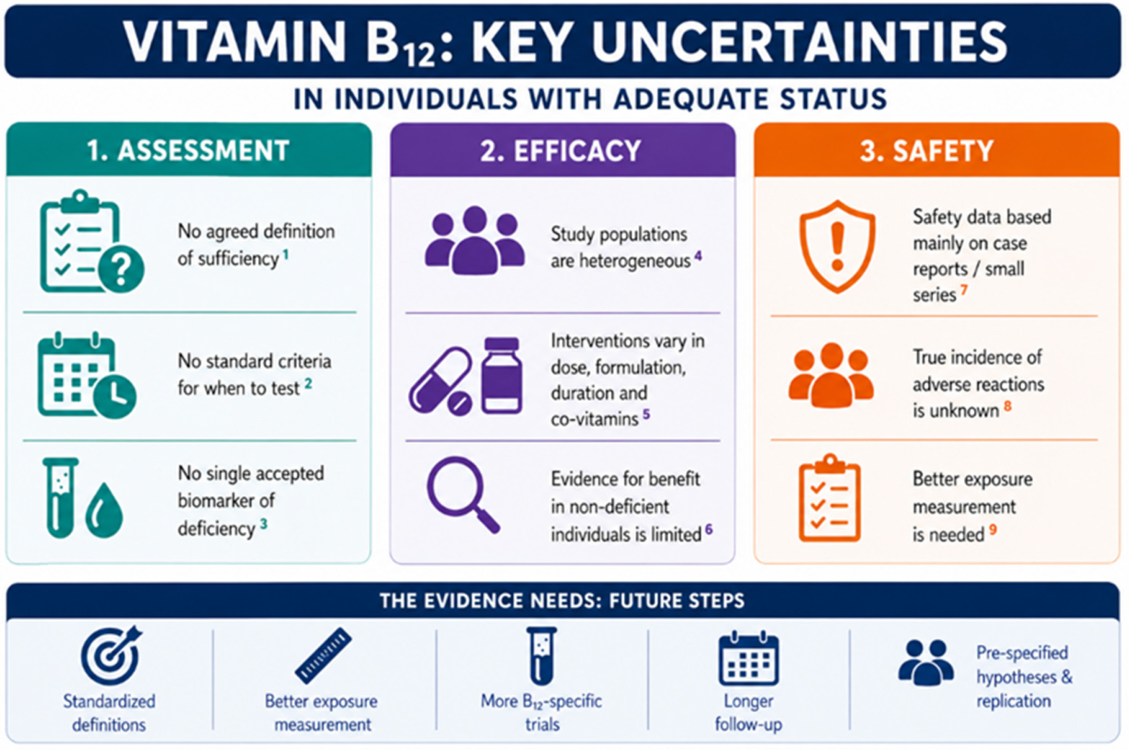
Key uncertainties remain regarding the assessment, efficacy, and safety of vitamin B12 in individuals with adequate status (Figure 1).
Figure 1.
Knowledge gaps regarding B12 supplementation in individuals with adequate status. This figure summarizes the main gaps identified in the different sections of the manuscripts, for which the following sources are cited: 1 [3,20], 2 [3,17,18,19], 3 [3,9,21,22,23], 4,5 [42,43,44,46,47,51,55,56,57,58], 6 [42,43,44,46,47], 7,8 [60,61,62,63,65,66,67], 9 [73,74,75,79].
For assessment, the main limitation is the absence of a universally accepted definition of “true” vitamin B12 sufficiency or insufficiency. The current guideline approaches identified in this Review often favor a clinical definition that incorporates symptoms and risk factors to guide testing, but there is still no consensus on which specific criteria should be applied. Likewise, there is no single accepted biochemical marker of deficiency. Plasma B12 is the most commonly used measure because it is widely available, but it has recognized limitations and only a modest relationship with functional deficiency. Other biomarkers, including holotranscobalamin, methylmalonic acid, and homocysteine, each have important drawbacks that have limited their application in clinical practice and their homogeneous use. As a result, estimates of the prevalence of deficiency remain difficult to compare across studies, and agreement on a common operational definition is a necessary first step before the global burden of B12 deficiency can be meaningfully quantified.
The evidence for benefit of B12 supplementation in non-deficient populations is also limited by heterogeneity in the populations and interventions studied. Although several large trials are available, most tested combined multivitamin regimens rather than B12 alone, with substantial variability in dose, formulation, duration, and the type and concentration of accompanying vitamins. This makes pooling difficult and prevents clear attribution of effects specifically to vitamin B12. Most trials were negative overall, but definitive conclusions about B12 itself remain limited because the independent contribution of the vitamin has rarely been isolated. In addition, many subgroup findings appear to come from post hoc analyses rather than pre-specified hypotheses, and these results have not been consistently replicated. External validation is therefore needed, particularly for signals suggesting benefit in specific contexts such as hyperhomocysteinemia or adequate omega-3 status.
Safety data also require clarification. Most reported adverse reactions are based on case reports or small case series, so the true incidence of dermatologic and hypersensitivity reactions following high-dose vitamin B12 remains poorly quantified. Given the apparent rarity of these reactions, larger observational studies are needed that address the limitations identified in the studies included in this review, particularly when supplementation is self-reported or when exposure is inferred from plasma B12 concentrations rather than documented supplement use. This distinction is critical, as elevated circulating B12 may reflect underlying disease, reverse causation, or metabolic dysregulation rather than supplementation itself. Future studies should therefore measure exposure more precisely, including the exact B12 formulation, dose, duration, route of administration, and the presence of excipients or co-administered vitamins, all of which may confound safety signals. In particular, studies examining high plasma B12 levels should be replicated using detailed supplementation data and long-term follow-up to distinguish true adverse effects of vitamin B12 from markers of underlying illness.
Overall, the evidence base would benefit from standardized definitions, better exposure measurement, more B12-specific trials, and longer follow-up. Until then, conclusions about the effects and safety of vitamin B12 beyond deficiency correction should be considered provisional.
8. Conclusions
Vitamin B12 is an essential nutrient, fundamental for one-carbon metabolism and mitochondrial energy production [6,7,8,9]; however, its evaluation, epidemiology, and management in contemporary populations remain complex.
Regarding the perception that vitamin B12 deficiency is “frequently underdiagnosed,” the reported prevalence in the general population varies widely (approximately 2–69%) [24], but appears consistently low in fortified, high-income settings [24,25] while remaining substantial in regions with limited access to animal-source foods or fortified alternatives, or where malabsorption is common [26,30]. However, the absence of consensus on screening indications and the wide variability in definitions limit comparability across studies.
Concerning the notion that vitamin B12 acts as a “natural well-being enhancer,” the evidence identified in this review does not support routine supplementation beyond sufficiency. Apart from correcting deficiencies or treating inherited metabolic disorders, supplementation has not shown consistent benefits for fatigue [42,43,44], mood [46,51], or global cognition [46,47]. Observed modest effects, particularly in cognitive or cardiovascular outcomes, appear limited to small subgroups (e.g., individuals with hyperhomocysteinemia or adequate omega-3 status [48,49]) rather than being generalizable. Interpretation is further complicated by substantial heterogeneity in study design, including wide ranges in dosing (0.02–1 mg) and duration (4 weeks to ~7 years) and frequent co-supplementation with other vitamins, which limits attribution of effects specifically to vitamin B12.
Regarding safety, vitamin B12 is generally well tolerated, even at doses exceeding recommended intakes. Rare dermatological (e.g., acneiform eruptions, rosacea flares) and hypersensitivity reactions have been reported, mostly in case studies, and typically resolve after discontinuation; however, these reports are limited in quality, and causality cannot be firmly established, as reactions may also be related to other vitamins, excipients, or preservatives [60,61,62,63,65,66,67]. One randomized controlled trial reported an increased cancer risk with combined B-vitamin supplementation including vitamin B12 [71]; however, this finding was not replicated in a later trial [72]. Observational studies have also reported associations between long-term high-dose supplementation and certain cancers (e.g., lung cancer in men) [73,74,75], but these findings are inconsistent [76,77], and their observational nature makes confounding a significant concern.
Finally, the studies presented in this review highlight several key gaps: the need for standardized definitions of vitamin B12 status, trials specifically evaluating vitamin B12 supplementation independent of other nutrients, and well-designed studies with precise exposure assessment and long-term follow-up to evaluate adverse effects. Addressing these limitations is essential to clarify whether the observed associations reflect true causal effects or are driven by underlying confounding factors.
These conclusions should be interpreted in light of the limitations inherent to a narrative review, including potential omissions in the literature, and should be considered descriptive and hypothesis-generating rather than definitive guidance for clinical decision-making.
Supplementary Materials
The following supporting information can be downloaded at: https://www.mdpi.com/article/10.3390/nu18101597/s1, Table S1: Representative core search terms used for literature identification.
Author Contributions
Conceptualization, S.J.L.B.; methodology, M.Y.-C. and C.S.E.D.; investigation, M.Y.-C.; writing—original draft preparation, M.Y.-C.; writing—review and editing, C.S.E.D., M.E.S., D.J.T., H.J.M.H., M.R.H.-F., F.J.v.S. and E.C.; supervision, S.J.L.B. All authors have read and agreed to the published version of the manuscript.
Funding
M.Y.-C. receives funding from the ERA Long-Term Fellowship Programme Call 2024–2025 for the project “The Benzoic Acid, Nutritional and Clinical Health in Kidney Transplantation (BANCH) Trial” and the ERA4Health Joint Transnational Call 2024 (Nutribrain) for the project “Physical Exercise to prevent mild-cognitive impairment progression in advanced chronic kidney disease (CKD) and dialysis patients (Exprecoimp-CKD)”.
Institutional Review Board Statement
Not applicable.
Informed Consent Statement
Not applicable.
Data Availability Statement
No new data were created or analyzed in this study. Data sharing is not applicable to this article.
Acknowledgments
During the preparation of this manuscript/study, the author used Chat GPT version 5 for the purposes of text editing and small grammar improvements. The graphical summary (Figure 1) was created with the assistance of generative artificial intelligence using OpenAI 5.5 image-generation tools. The authors defined the scientific content, structure, and key messages of the figure, and critically reviewed and edited the final output to ensure accuracy and consistency with the manuscript. The authors have reviewed and edited all the generated output and take full responsibility for the content of this publication.
Conflicts of Interest
The authors declare no conflicts of interest.
Abbreviations
The following abbreviations are used in this manuscript:
| AAFP | American Academy of Family Physicians |
| ADA | American Diabetes Association |
| AI | Adequate Intake |
| BC | British Columbia (provincial guideline) |
| cB12 | Combined indicator of vitamin B12 status |
| CI | Confidence interval |
| DHA | Docosahexaenoic acid |
| EAR | Estimated Average Requirement |
| EFSA | European Food Safety Authority |
| holoTC | Holotranscobalamin |
| HR | Hazard ratio |
| IF | Intrinsic factor |
| IM | Intramuscular |
| IV | Intravenous |
| KNHANES | Korea National Health and Nutrition Examination Survey |
| MCI | Mild cognitive impairment |
| MMA | Methylmalonic acid |
| NHANES | National Health and Nutrition Examination Survey |
| NHG | Nederlands Huisartsen Genootschap (Dutch College of General Practitioners) |
| NICE | National Institute for Health and Care Excellence |
| PPI | Proton-pump inhibitor |
| RCT | Randomized controlled trial |
| RDA | Recommended Dietary Allowance |
| RNI | Reference Nutrient Intake |
| SC | Subcutaneous |
| tHcy | Total homocysteine |
References
- Sloan, J.L.; Carrillo, N.; Adams, D.; Venditti, C.P. Disorders of Intracellular Cobalamin Metabolism; University of Washington: Seattle, WA, USA, 1993. [Google Scholar]
- Huemer, M.; Diodato, D.; Schwahn, B.; Schiff, M.; Bandeira, A.; Benoist, J.-F.; Burlina, A.; Cerone, R.; Couce, M.L.; Garcia-Cazorla, A.; et al. Guidelines for Diagnosis and Management of the Cobalamin-Related Remethylation Disorders CblC, CblD, CblE, CblF, CblG, CblJ and MTHFR Deficiency. J. Inherit. Metab. Dis. 2017, 40, 21–48. [Google Scholar] [CrossRef] [Scilit]
- National Institute for Health and Care Excellence. Vitamin B12 Deficiency in over 16s: Diagnosis and Management; National Institute for Health and Care Excellence: London, UK, 2024. [Google Scholar]
- Sobczyńska-Malefora, A.; Delvin, E.; McCaddon, A.; Ahmadi, K.R.; Harrington, D.J. Vitamin B12 Status in Health and Disease: A Critical Review. Diagnosis of Deficiency and Insufficiency—Clinical and Laboratory Pitfalls. Crit. Rev. Clin. Lab. Sci. 2021, 58, 399–429. [Google Scholar] [CrossRef] [Scilit]
- Wolffenbuttel, B.H.; Owen, P.J.; Ward, M.; Green, R. Vitamin B12. BMJ 2023, 383, e071725. [Google Scholar] [CrossRef] [Scilit]
- Allen, L.H.; Miller, J.W.; de Groot, L.; Rosenberg, I.H.; Smith, A.D.; Refsum, H.; Raiten, D.J. Biomarkers of Nutrition for Development (BOND): Vitamin B-12 Review. J. Nutr. 2018, 148, 1995S–2027S. [Google Scholar] [CrossRef] [Scilit]
- Stabler, S.P. Vitamin B12 Deficiency. N. Engl. J. Med. 2013, 368, 149–160. [Google Scholar] [CrossRef] [Scilit] [PubMed]
- O’Leary, F.; Samman, S. Vitamin B12 in Health and Disease. Nutrients 2010, 2, 299–316. [Google Scholar] [CrossRef] [Scilit]
- National Institutes of Health. Vitamin B12: Fact Sheet for Health Professionals. National Institutes of Health, Office of Dietary Supplements. Vitamin B12: Fact Sheet for Health Professionals. Available online: https://ods.od.nih.gov/factsheets/VitaminB12-HealthProfessional/ (accessed on 21 April 2026).
- Dror, D.K.; Allen, L.H. Effect of Vitamin B12 Deficiency on Neurodevelopment in Infants: Current Knowledge and Possible Mechanisms. Nutr. Rev. 2008, 66, 250–255. [Google Scholar] [CrossRef] [Scilit]
- Green, R.; Allen, L.H.; Bjørke-Monsen, A.-L.; Brito, A.; Guéant, J.-L.; Miller, J.W.; Molloy, A.M.; Nexo, E.; Stabler, S.; Toh, B.-H.; et al. Vitamin B12 Deficiency. Nat. Rev. Dis. Primers 2017, 3, 17040. [Google Scholar] [CrossRef] [Scilit] [PubMed]
- Watanabe, F. Vitamin B12 Sources and Bioavailability. Exp. Biol. Med. 2007, 232, 1266–1274. [Google Scholar] [CrossRef] [Scilit] [PubMed]
- Watanabe, F.; Yabuta, Y.; Bito, T.; Teng, F. Vitamin B12-Containing Plant Food Sources for Vegetarians. Nutrients 2014, 6, 1861–1873. [Google Scholar] [CrossRef] [Scilit]
- Scientific Opinion on Dietary Reference Values for Cobalamin (Vitamin B12). EFSA J. 2015, 13, 4150. [CrossRef] [Scilit]
- Health Council of the Netherlands. An Evaluation of the EFSA’s Dietary Reference Values (DRVs). Dietary Reference Values for Vitamins and Minerals for Adults; Health Council of the Netherlands: The Hague, The Netherlands, 2018. [Google Scholar]
- Koninklijke Nederlandse Organisatie van Verloskundigen. Factsheet Vitamine B12 En Zwangerschap; Koninklijke Nederlandse Organisatie van Verloskundigen: Utrecht, The Netherlands, 2023. [Google Scholar]
- Langan, R.C.; Goodbred, A.J. Vitamin B12 Deficiency: Recognition and Management. Am. Fam. Physician 2017, 96, 384–389. [Google Scholar] [PubMed]
- Nederlandse Huisartsen Genootschap Vitamine B12 -Deficiëntie. Available online: https://richtlijnen.nhg.org/landelijke-eerstelijns-samenwerkingsafspraken/laboratoriumdiagnostiek#volledige-tekst-bij-vermoeden-van-een-vitamine-b12-deficientie (accessed on 10 November 2025).
- Province of British Columbia. Cobalamin (Vitamin B12) and Folate Deficiency. Available online: https://www2.gov.bc.ca/gov/content/health/practitioner-professional-resources/bc-guidelines/vitamin-b12?utm_source=chatgpt.com (accessed on 10 November 2025).
- Yetley, E.A.; Pfeiffer, C.M.; Phinney, K.W.; Bailey, R.L.; Blackmore, S.; Bock, J.L.; Brody, L.C.; Carmel, R.; Curtin, L.R.; Durazo-Arvizu, R.A.; et al. Biomarkers of Vitamin B-12 Status in NHANES: A Roundtable Summary. Am. J. Clin. Nutr. 2011, 94, 313S–321S. [Google Scholar] [CrossRef] [Scilit] [PubMed]
- Jarquin Campos, A.; Risch, L.; Nydegger, U.; Wiesner, J.; Vazquez Van Dyck, M.; Renz, H.; Stanga, Z.; Risch, M. Diagnostic Accuracy of Holotranscobalamin, Vitamin B12, Methylmalonic Acid, and Homocysteine in Detecting B12 Deficiency in a Large, Mixed Patient Population. Dis. Markers 2020, 2020, 7468506. [Google Scholar] [CrossRef] [Scilit]
- Riphagen, I.J.; Minović, I.; Groothof, D.; Post, A.; Eggersdorfer, M.L.; Kootstra-Ros, J.E.; de Borst, M.H.; Navis, G.; Muskiet, F.A.J.; Kema, I.P.; et al. Methylmalonic Acid, Vitamin B12, Renal Function, and Risk of All-Cause Mortality in the General Population: Results from the Prospective Lifelines-MINUTHE Study. BMC Med. 2020, 18, 380. [Google Scholar] [CrossRef] [Scilit]
- Fedosov, S.N.; Brito, A.; Miller, J.W.; Green, R.; Allen, L.H. Combined Indicator of Vitamin B12 Status: Modification for Missing Biomarkers and Folate Status and Recommendations for Revised Cut-Points. Clin. Chem. Lab. Med. (CCLM) 2015, 53, 1215–1225. [Google Scholar] [CrossRef] [Scilit]
- Song, S.; Song, B.M.; Park, H.-Y. Folate, Vitamin B12, and Homocysteine Status in the Korean Population: Data from the 2013-2015 Korea National Health and Nutrition Examination Survey. Epidemiol. Health 2023, 46, e2024007. [Google Scholar] [CrossRef] [Scilit] [PubMed]
- Mineva, E.M.; Sternberg, M.R.; Bailey, R.L.; Storandt, R.J.; Pfeiffer, C.M. Fewer US Adults Had Low or Transitional Vitamin B12 Status Based on the Novel Combined Indicator of Vitamin B12 Status Compared with Individual, Conventional Markers, NHANES 1999–2004. Am. J. Clin. Nutr. 2021, 114, 1070–1079. [Google Scholar] [CrossRef] [Scilit]
- Singla, R.; Garg, A.; Surana, V.; Aggarwal, S.; Gupta, G.; Singla, S. Vitamin B12 Deficiency Is Endemic in Indian Population: A Perspective from North India. Indian J. Endocrinol. Metab. 2019, 23, 211–214. [Google Scholar] [CrossRef] [Scilit]
- Sukumar, N.; Adaikalakoteswari, A.; Venkataraman, H.; Maheswaran, H.; Saravanan, P. Vitamin B12 Status in Women of Childbearing Age in the UK and Its Relationship with National Nutrient Intake Guidelines: Results from Two National Diet and Nutrition Surveys. BMJ Open 2016, 6, e011247. [Google Scholar] [CrossRef] [Scilit]
- Al-Musharaf, S.; McTernan, P.G.; Hussain, S.D.; Aleisa, K.A.; Alnaami, A.M.; Wani, K.; Saravanan, P.; Al-Daghri, N. Prevalence and Indicators of Vitamin B12 Insufficiency among Young Women of Childbearing Age. Int. J. Environ. Res. Public Health 2020, 18, 1. [Google Scholar] [CrossRef] [Scilit]
- Papakitsou, I.; Papazachariou, A.; Filippatos, T. Prevalence, Associated Factors, and Impact of Vitamin B12 Deficiency in Older Medical Inpatients. Eur. Geriatr. Med. 2024, 16, 337–346. [Google Scholar] [CrossRef] [Scilit]
- Karakaş, N.M. The Prevalence of Low Serum Levels of Vitamin D, Vitamin B12, Folate and Ferritin in Adolescents: Single Center Experience. Sci. Prog. 2021, 104, 00368504211007667. [Google Scholar] [CrossRef] [Scilit]
- Eussen, S.J.P.M. Oral Cyanocobalamin Supplementation in Older People With Vitamin B12 Deficiency. Arch. Intern. Med. 2005, 165, 1167. [Google Scholar] [CrossRef] [Scilit]
- Sharabi, A.; Cohen, E.; Sulkes, J.; Garty, M. Replacement Therapy for Vitamin B12 Deficiency: Comparison between the Sublingual and Oral Route. Br. J. Clin. Pharmacol. 2003, 56, 635–638. [Google Scholar] [CrossRef] [Scilit]
- Abdelwahab, O.A.; Abdelaziz, A.; Diab, S.; Khazragy, A.; Elboraay, T.; Fayad, T.; Diab, R.A.; Negida, A. Efficacy of Different Routes of Vitamin B12 Supplementation for the Treatment of Patients with Vitamin B12 Deficiency: A Systematic Review and Network Meta-Analysis. Ir. J. Med. Sci. (1971-) 2024, 193, 1621–1639. [Google Scholar] [CrossRef] [Scilit] [PubMed]
- Mylan Pharmaceuticals ULC. Prescribing Information Cyanocobalamin Injection, USP; Mylan Pharmaceuticals ULC: Etobicoke, NO, Canada, 2014. [Google Scholar]
- Tillemans, M.P.H.; Giezen, T.J.; Egberts, T.C.G.; Hooijberg, J.H.; Kalisvaart, K.J. Intranasal Vitamin B12 Administration in Elderly Patients: A Randomized Controlled Comparison of Two Dosage Regimens. Br. J. Clin. Pharmacol. 2024, 90, 1975–1983. [Google Scholar] [CrossRef] [Scilit] [PubMed]
- Vidal-Alaball, J.; Butler, C.C.; Cannings-John, R.; Goringe, A.; Hood, K.; McCaddon, A.; McDowell, I.; Papaioannou, A. Oral Vitamin B12 versus Intramuscular Vitamin B12 for Vitamin B12 Deficiency. Cochrane Database Syst. Rev. 2005, 3, CD004655. [Google Scholar] [CrossRef] [Scilit] [PubMed]
- Vasavada, A.; Patel, P.; Sanghavi, D.K. Cyanocobalamin; StatPearls Publishing: Treasure Island, FL, USA, 2025. [Google Scholar]
- Wang, H.; Li, L.; Qin, L.L.; Song, Y.; Vidal-Alaball, J.; Liu, T.H. Oral Vitamin B12 versus Intramuscular Vitamin B12 for Vitamin B12 Deficiency. Cochrane Database Syst. Rev. 2018, 2018, CD004655. [Google Scholar] [CrossRef] [Scilit]
- Mounsey, A.; Brendle, D.C.; Flowers, K. Oral vs. Intramuscular Vitamin B12 for Treating Vitamin B12 Deficiency. Am. Fam. Physician 2022, 105, 663–664. [Google Scholar]
- Houle, S.K.D.; Kolber, M.R.; Chuck, A.W. Should Vitamin B12 Tablets Be Included in More Canadian Drug Formularies? An Economic Model of the Cost-Saving Potential from Increased Utilisation of Oral versus Intramuscular Vitamin B12 Maintenance Therapy for Alberta Seniors. BMJ Open 2014, 4, e004501. [Google Scholar] [CrossRef] [Scilit]
- Vidal-Alaball, J.; Butler, C.C.; Potter, C.C. Comparing Costs of Intramuscular and Oral Vitamin B12 Administration in Primary Care: A Cost-Minimization Analysis. Eur. J. Gen. Pract. 2006, 12, 169–173. [Google Scholar] [CrossRef] [Scilit] [PubMed]
- Hvas, A.-M.; Juul, S.; Nexø, E.; Ellegaard, J. Vitamin B-12 Treatment Has Limited Effect on Health-related Quality of Life among Individuals with Elevated Plasma Methylmalonic Acid: A Randomized Placebo-controlled Study. J. Intern. Med. 2003, 253, 146–152. [Google Scholar] [CrossRef] [Scilit]
- Dangour, A.D.; Allen, E.; Clarke, R.; Elbourne, D.; Fletcher, A.E.; Letley, L.; Richards, M.; Whyte, K.; Uauy, R.; Mills, K. Effects of Vitamin B-12 Supplementation on Neurologic and Cognitive Function in Older People: A Randomized Controlled Trial. Am. J. Clin. Nutr. 2015, 102, 639–647. [Google Scholar] [CrossRef] [Scilit]
- Andreeva, V.A.; Latarche, C.; Hercberg, S.; Briançon, S.; Galan, P.; Kesse-Guyot, E. B Vitamin and/or n-3 Fatty Acid Supplementation and Health-Related Quality of Life: Ancillary Findings from the SU.FOL.OM3 Randomized Trial. PLoS ONE 2014, 9, e84844. [Google Scholar] [CrossRef] [Scilit]
- Schlichtiger, U.; Rettig, K.; Kauermann, S. Effects of a vitamin B6, B12, folic acid combination on quality of life and vitality of elderly people. Geriatr. Forsch. 1996, 6, 185–196. [Google Scholar]
- Markun, S.; Gravestock, I.; Jäger, L.; Rosemann, T.; Pichierri, G.; Burgstaller, J.M. Effects of Vitamin B12 Supplementation on Cognitive Function, Depressive Symptoms, and Fatigue: A Systematic Review, Meta-Analysis, and Meta-Regression. Nutrients 2021, 13, 923. [Google Scholar] [CrossRef] [Scilit]
- Behrens, A.; Graessel, E.; Pendergrass, A.; Donath, C. Vitamin B—Can It Prevent Cognitive Decline? A Systematic Review and Meta-Analysis. Syst. Rev. 2020, 9, 111. [Google Scholar] [CrossRef] [Scilit] [PubMed]
- Smith, A.D.; Smith, S.M.; de Jager, C.A.; Whitbread, P.; Johnston, C.; Agacinski, G.; Oulhaj, A.; Bradley, K.M.; Jacoby, R.; Refsum, H. Homocysteine-Lowering by B Vitamins Slows the Rate of Accelerated Brain Atrophy in Mild Cognitive Impairment: A Randomized Controlled Trial. PLoS ONE 2010, 5, e12244. [Google Scholar] [CrossRef] [Scilit] [PubMed]
- Oulhaj, A.; Jernerén, F.; Refsum, H.; Smith, A.D.; de Jager, C.A. Omega-3 Fatty Acid Status Enhances the Prevention of Cognitive Decline by B Vitamins in Mild Cognitive Impairment. J. Alzheimers Dis. 2016, 50, 547–557. [Google Scholar] [CrossRef] [Scilit]
- Jernerén, F.; Elshorbagy, A.K.; Oulhaj, A.; Smith, S.M.; Refsum, H.; Smith, A.D. Brain Atrophy in Cognitively Impaired Elderly: The Importance of Long-Chain ω-3 Fatty Acids and B Vitamin Status in a Randomized Controlled Trial. Am. J. Clin. Nutr. 2015, 102, 215–221. [Google Scholar] [CrossRef] [Scilit]
- Almeida, O.P.; Ford, A.H.; Flicker, L. Systematic Review and Meta-Analysis of Randomized Placebo-Controlled Trials of Folate and Vitamin B12 for Depression. Int. Psychogeriatr. 2015, 27, 727–737. [Google Scholar] [CrossRef] [Scilit]
- Almeida, O.P.; Ford, A.H.; Hirani, V.; Singh, V.; vanBockxmeer, F.M.; McCaul, K.; Flicker, L. B Vitamins to Enhance Treatment Response to Antidepressants in Middle-Aged and Older Adults: Results from the B-VITAGE Randomised, Double-Blind, Placebo-Controlled Trial. Br. J. Psychiatry 2014, 205, 450–457. [Google Scholar] [CrossRef] [Scilit] [PubMed]
- Syed, E.U.; Wasay, M.; Awan, S. Vitamin B12 Supplementation in Treating Major Depressive Disorder: A Randomized Controlled Trial. Open Neurol. J. 2013, 7, 44–48. [Google Scholar] [CrossRef] [Scilit]
- Hsu, C.-Y.; Chiu, S.-W.; Hong, K.-S.; Saver, J.L.; Wu, Y.-L.; Lee, J.-D.; Lee, M.; Ovbiagele, B. Folic Acid in Stroke Prevention in Countries without Mandatory Folic Acid Food Fortification: A Meta-Analysis of Randomized Controlled Trials. J. Stroke 2018, 20, 99–109. [Google Scholar] [CrossRef] [Scilit]
- Galan, P.; Kesse-Guyot, E.; Czernichow, S.; Briancon, S.; Blacher, J.; Hercberg, S. Effects of B Vitamins and Omega 3 Fatty Acids on Cardiovascular Diseases: A Randomised Placebo Controlled Trial. BMJ 2010, 341, c6273. [Google Scholar] [CrossRef] [Scilit]
- VITATOPS Trials Study Group. B Vitamins in Patients with Recent Transient Ischaemic Attack or Stroke in the VITAmins TO Prevent Stroke (VITATOPS) Trial: A Randomised, Double-Blind, Parallel, Placebo-Controlled Trial. Lancet Neurol. 2010, 9, 855–865. [Google Scholar] [CrossRef] [Scilit]
- Bønaa, K.H.; Njølstad, I.; Ueland, P.M.; Schirmer, H.; Tverdal, A.; Steigen, T.; Wang, H.; Nordrehaug, J.E.; Arnesen, E.; Rasmussen, K. Homocysteine Lowering and Cardiovascular Events after Acute Myocardial Infarction. N. Engl. J. Med. 2006, 354, 1578–1588. [Google Scholar] [CrossRef] [Scilit] [PubMed]
- The Heart Outcomes Prevention Evaluation (HOPE) 2 Investigators Homocysteine Lowering with Folic Acid and B Vitamins in Vascular Disease. N. Engl. J. Med. 2006, 354, 1567–1577. [CrossRef] [Scilit] [PubMed]
- Otten, J.; Hellwig, J.P.; Meyers, L.D. Dietary Reference Intakes; National Academies Press: Washington, DC, USA, 2006. [Google Scholar]
- Feng, H.-S.; Zhang, W.-T.; Xi, Z.-Y.; Hua, G.-D.; Xue, C.-M.; Li, L.-L.; Qu, S.-Q.; Zhao, L.-L.; Zhang, T.; Zhu, B.-C.; et al. Recurrence of Rosacea Induced by Compound Vitamin Tablets: A Case Report. J. Inflamm. Res. 2025, 18, 3311–3319. [Google Scholar] [CrossRef] [Scilit]
- Bahbouhi, I.; Aboudourib, M.; Hocar, O.; Amal, S. Vitamin B12 Induced Acneiform Eruption. Heliyon 2023, 9, e16120. [Google Scholar] [CrossRef] [Scilit]
- Bowden, A.; Ekeh, O.; Brownstone, N.D.; Hsu, S. Acneiform Eruption Secondary to Over-the-Counter Vitamin B12. Cureus 2023, 15, e43275. [Google Scholar] [CrossRef] [Scilit] [PubMed]
- Jansen, T.; Romiti, R.; Kreuter, A.; Altmeyer, P. Rosacea Fulminans Triggered by High-dose Vitamins B 6 and B12. J. Eur. Acad. Dermatol. Venereol. 2001, 15, 484–485. [Google Scholar] [CrossRef] [Scilit] [PubMed]
- Kang, D.; Shi, B.; Erfe, M.C.; Craft, N.; Li, H. Vitamin B12 Modulates the Transcriptome of the Skin Microbiota in Acne Pathogenesis. Sci. Transl. Med. 2015, 7, 293ra103. [Google Scholar] [CrossRef] [Scilit]
- Wajih Ullah, M.; Amray, A.; Qaseem, A.; Siddiqui, T.; Naeem, T. Anaphylactic Reaction to Cyanocobalamin: A Case Report. Cureus 2018, 10, e2582. [Google Scholar] [CrossRef] [Scilit]
- Branco-Ferreira, M.; Clode, M.H.; Pereira-Barbosa, M.A.; Palma-Carlos, A.G. Anaphylactic Reaction to Hydroxycobalamin. Allergy 1997, 52, 118–119. [Google Scholar] [CrossRef] [Scilit]
- Bilwani, F.; Adil, S.N.; Sheikh, U.; Humera, A.; Khurshid, M. Anaphylactic Reaction after Intramuscular Injection of Cyanocobalamin (Vitamin B12): A Case Report. J. Pak. Med. Assoc. 2005, 55, 217–219. [Google Scholar] [PubMed]
- El Rhermoul, F.-Z.; Mustafa, A.; Wagner, A.; Nakonechna, A.; Kayode, O.S.; Rutkowski, R.; Siew, L.Q.C.; Rutkowski, K. Vitamin B12 Hypersensitivity: A Retrospective Multicenter Study. J. Allergy Clin. Immunol. Pract. 2024, 12, 699–704. [Google Scholar] [CrossRef] [Scilit]
- Medicines and Healthcare products Regulatory Agency. Vitamin B12 (Hydroxocobalamin, Cyanocobalamin): Advise Patients with Known Cobalt Allergy to Be Vigilant for Sensitivity Reactions; Medicines and Healthcare products Regulatory Agency: London, UK, 2023.
- Brasky, T.M.; White, E.; Chen, C.-L. Long-Term, Supplemental, One-Carbon Metabolism–Related Vitamin B Use in Relation to Lung Cancer Risk in the Vitamins and Lifestyle (VITAL) Cohort. J. Clin. Oncol. 2017, 35, 3440–3448. [Google Scholar] [CrossRef] [Scilit]
- Ebbing, M. Cancer Incidence and Mortality After Treatment With Folic Acid and Vitamin B12. JAMA 2009, 302, 2119. [Google Scholar] [CrossRef] [Scilit]
- Zhang, S.M.; Cook, N.R.; Albert, C.M.; Gaziano, J.M.; Buring, J.E.; Manson, J.E. Effect of Combined Folic Acid, Vitamin B6, and Vitamin B12 on Cancer Risk in Women: A Randomized Trial. JAMA 2008, 300, 2012–2021. [Google Scholar] [CrossRef] [Scilit]
- Arendt, J.F.B.; Pedersen, L.; Nexo, E.; Sørensen, H.T. Elevated Plasma Vitamin B12 Levels as a Marker for Cancer: A Population-Based Cohort Study. JNCI J. Natl. Cancer Inst. 2013, 105, 1799–1805. [Google Scholar] [CrossRef] [Scilit]
- Lacombe, V.; Chabrun, F.; Lacout, C.; Ghali, A.; Capitain, O.; Patsouris, A.; Lavigne, C.; Urbanski, G. Persistent Elevation of Plasma Vitamin B12 Is Strongly Associated with Solid Cancer. Sci. Rep. 2021, 11, 13361. [Google Scholar] [CrossRef] [Scilit] [PubMed]
- Arendt, J.F.H.; Sørensen, H.T.; Horsfall, L.J.; Petersen, I. Elevated Vitamin B12 Levels and Cancer Risk in UK Primary Care: A THIN Database Cohort Study. Cancer Epidemiol. Biomark. Prev. 2019, 28, 814–821. [Google Scholar] [CrossRef] [Scilit] [PubMed]
- Cheng, W.-W.; Wang, Z.-K.; Shangguan, H.-F.; Zhu, Q.; Zhang, H.-Y. Are Vitamins Relevant to Cancer Risks? A Mendelian Randomization Investigation. Nutrition 2020, 78, 110870. [Google Scholar] [CrossRef] [Scilit] [PubMed]
- Fanidi, A.; Carreras-Torres, R.; Larose, T.L.; Yuan, J.-M.; Stevens, V.L.; Weinstein, S.J.; Albanes, D.; Prentice, R.; Pettinger, M.; Cai, Q.; et al. Is High Vitamin B12 Status a Cause of Lung Cancer? Int. J. Cancer 2019, 145, 1499–1503. [Google Scholar] [CrossRef] [Scilit]
- Flores-Guerrero, J.L.; Minovic, I.; Groothof, D.; Gruppen, E.G.; Riphagen, I.J.; Kootstra-Ros, J.; Muller Kobold, A.; Hak, E.; Navis, G.; Gansevoort, R.T.; et al. Association of Plasma Concentration of Vitamin B12 With All-Cause Mortality in the General Population in the Netherlands. JAMA Netw. Open 2020, 3, e1919274. [Google Scholar] [CrossRef] [Scilit]
- Liu, K.; Yang, Z.; Lu, X.; Zheng, B.; Wu, S.; Kang, J.; Sun, S.; Zhao, J. The Origin of Vitamin B12 Levels and Risk of All-Cause, Cardiovascular and Cancer Specific Mortality: A Systematic Review and Dose-Response Meta-Analysis. Arch. Gerontol. Geriatr. 2024, 117, 105230. [Google Scholar] [CrossRef] [Scilit]
- Andrès, E.; Serraj, K.; Zhu, J.; Vermorken, A.J.M. The Pathophysiology of Elevated Vitamin B12 in Clinical Practice. QJM Int. J. Med. 2013, 106, 505–515. [Google Scholar] [CrossRef] [Scilit]
- Gerrard, A.; Dawson, C. Homocystinuria Diagnosis and Management: It Is Not All Classical. J. Clin. Pathol. 2022, 75, 744–750. [Google Scholar] [CrossRef] [Scilit]
- Zeng, Z.; Li, S.; Boeren, S.; Smid, E.J.; Notebaart, R.A.; Abee, T. Anaerobic Growth of Listeria monocytogenes on Rhamnose Is Stimulated by Vitamin B12 and Bacterial Microcompartment-Dependent 1,2-Propanediol Utilization. mSphere 2021, 6. [Google Scholar] [CrossRef] [Scilit] [PubMed]
- Price-Carter, M.; Tingey, J.; Bobik, T.A.; Roth, J.R. The Alternative Electron Acceptor Tetrathionate Supports B12-Dependent Anaerobic Growth of Salmonella Enterica Serovar Typhimurium on Ethanolamine or 1,2-Propanediol. J. Bacteriol. 2001, 183, 2463–2475. [Google Scholar] [CrossRef] [Scilit]
Disclaimer/Publisher’s Note: The statements, opinions and data contained in all publications are solely those of the individual author(s) and contributor(s) and not of MDPI and/or the editor(s). MDPI and/or the editor(s) disclaim responsibility for any injury to people or property resulting from any ideas, methods, instructions or products referred to in the content. |
© 2026 by the authors. Licensee MDPI, Basel, Switzerland. This article is an open access article distributed under the terms and conditions of the Creative Commons Attribution (CC BY) license.