Mitigating Weight Gain Side Effects by Reducing Sugar-Sweetened Beverage Consumption in Youth Newly Prescribed Second-Generation Antipsychotic Medication
 , , , , and
Abstract
1. Introduction
2. Materials and Methods
2.1. Ethics Statement
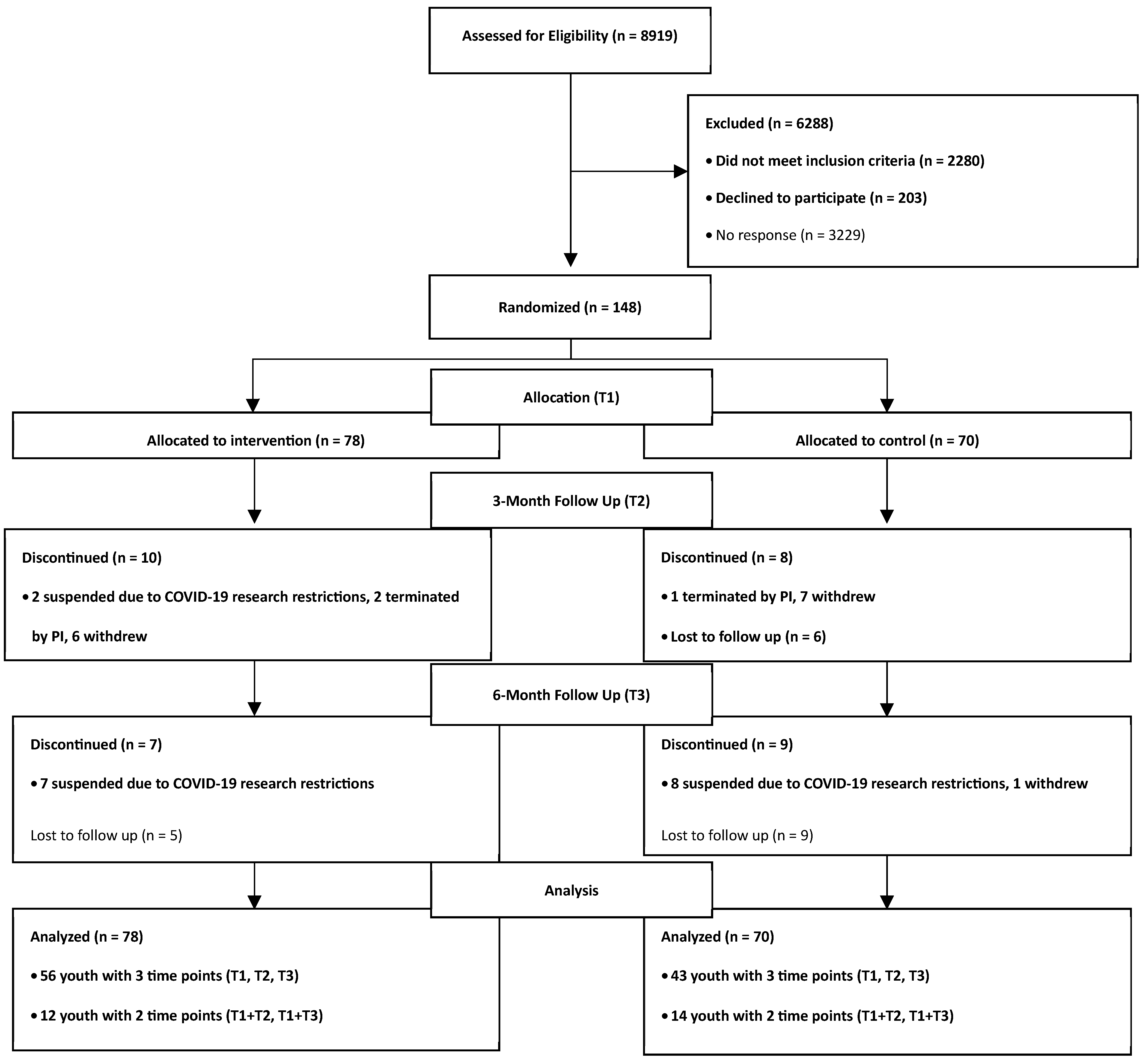
2.2. Participants/Design
2.3. Interventions
2.4. Measures
2.5. Statistical Analysis
3. Results
3.1. Youth Medication Treatment
3.2. Participants Who Completed All Three Visits
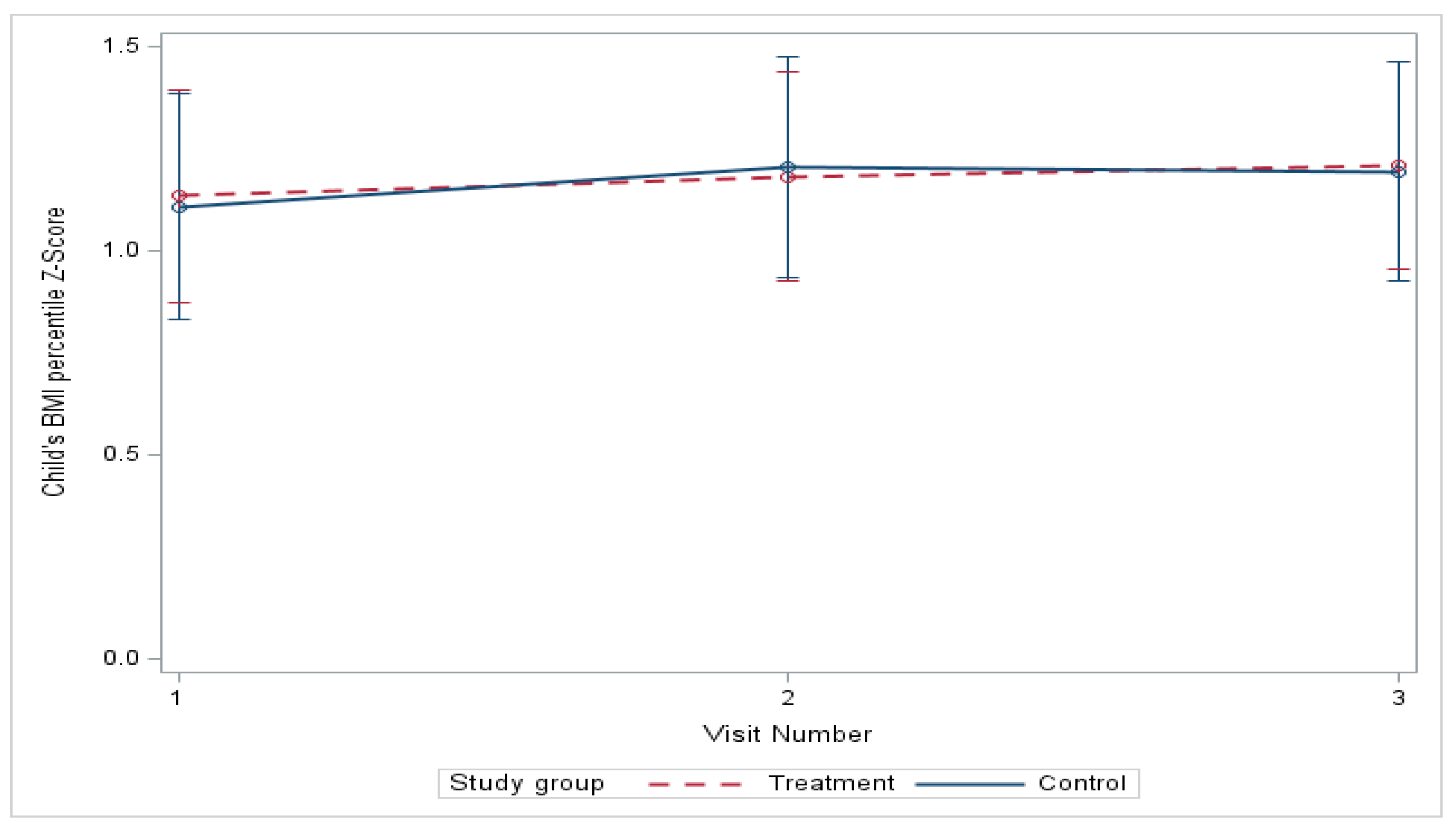
3.3. Change in BMI Z-Score
3.4. Changes in Beverage Consumption
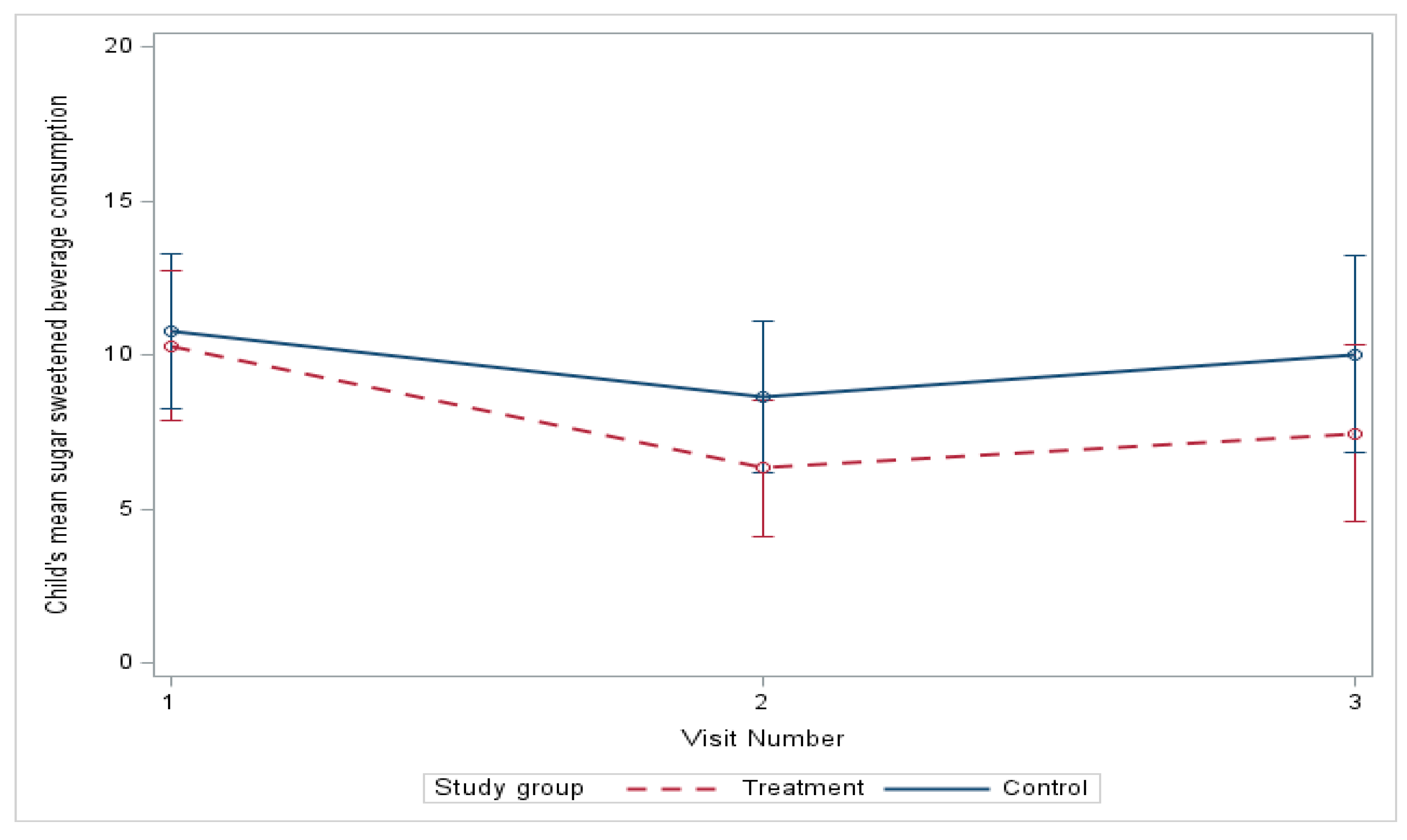
Sugar-Sweetened Beverage Intake
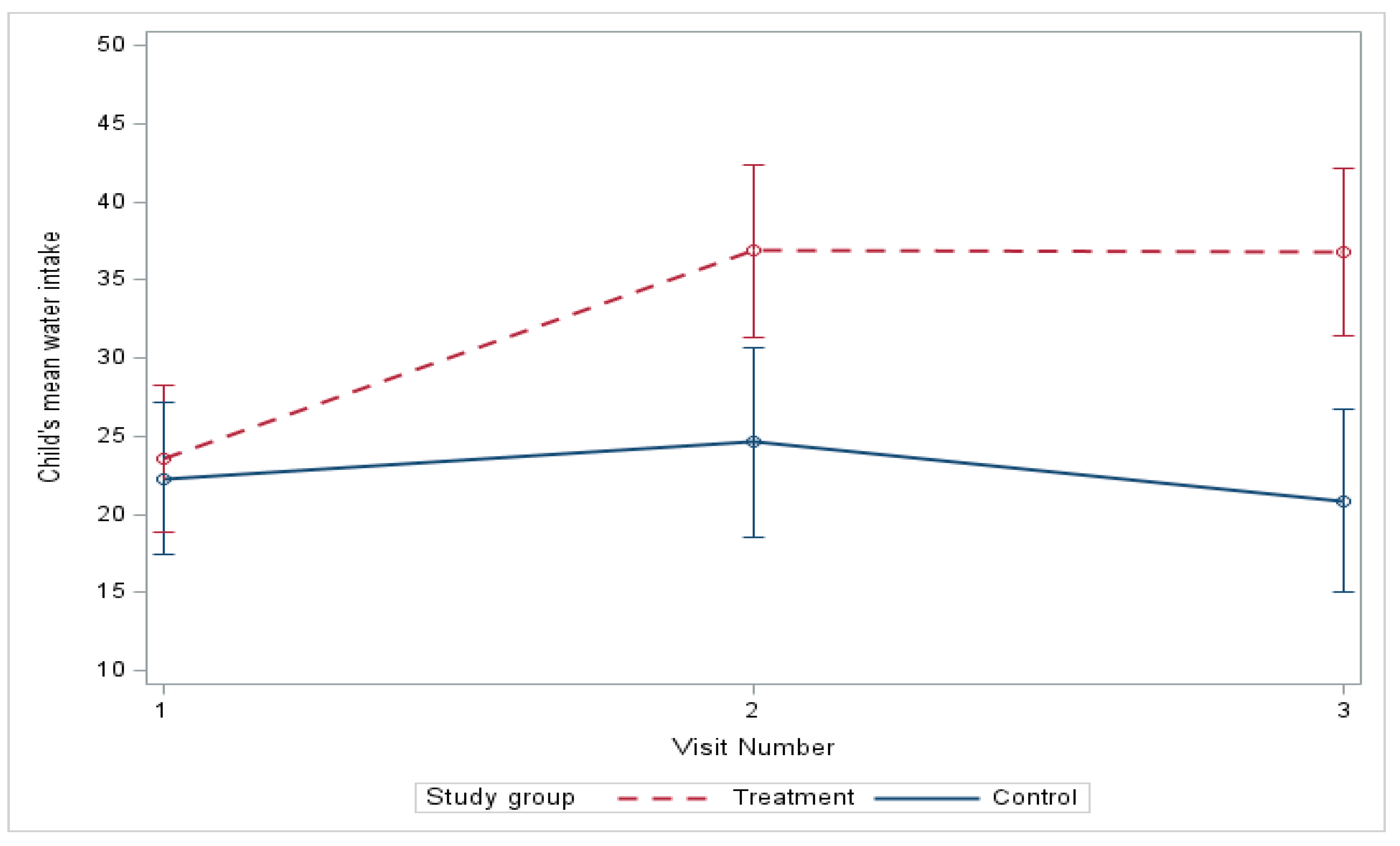
3.5. Water Intake
4. Discussion
Limitations
5. Conclusions
Author Contributions
Funding
Institutional Review Board Statement
Informed Consent Statement
Data Availability Statement
Conflicts of Interest
Abbreviations
| APM | Antipsychotic Medication |
| HL | Healthy Lifestyle |
| SSB | Sugar-Sweetened Beverage |
| FN | Family Navigator |
| HLE | Healthy Lifestyle Education |
| ASA-24 | Automated Self-Administered 24 h dietary recall |
| AMPM | Automated Multiple Pass Method |
| USDA | United States Department of Agriculture |
| NHANES | National Health and Nutrition Examination Survey |
| WWEIA | What We Eat in America |
| FNDD | Food and Nutrient Database for Dietary Studies |
| AIC | Akaike Information Criteria |
| SD | Standard Deviation |
| N | Number of Participants |
| M | Mean |
References
- Hampl, S.E.; Hassink, S.G.; Skinner, A.C.; Armstrong, S.C.; Barlow, S.E.; Bolling, C.F.; Avila Edwards, K.C.; Eneli, I.; Hamre, R.; Joseph, M.M.; et al. Clinical Practice Guideline for the Evaluation and Treatment of Children and Adolescents with Obesity. Pediatrics 2023, 151, e2022060640. [Google Scholar] [CrossRef]
- van Schalkwyk, G.I.; Lewis, A.S.; Beyer, C.; Johnson, J.; van Rensburg, S.; Bloch, M.H. Efficacy of antipsychotics for irritability and aggression in children: A meta-analysis. Expert Rev. Neurother. 2017, 17, 1045–1053. [Google Scholar] [CrossRef]
- Lyu, N.; Lin, Y.; Rowan, P.J.; Abughosh, S.; Varisco, T.J.; Chen, H. Prediction of antipsychotic-associated weight gain in children and adolescents taking second-generation antipsychotics: A machine learning approach. J. Psychiatr. Res. 2025, 191, 454–462. [Google Scholar] [CrossRef] [PubMed]
- Ye, W.; Xing, J.; Yu, Z.; Hu, X.; Zhao, Y. Mechanism and treatments of antipsychotic-induced weight gain. Int. J. Obes. 2023, 47, 423–433. [Google Scholar] [CrossRef] [PubMed]
- Mackie, T.I.; Schaefer, A.J.; Karpman, H.E.; Lee, S.M.; Bellonci, C.; Larson, J. Systematic review: System-wide interventions to monitor pediatric antipsychotic prescribing and promote best practice. J. Am. Acad. Child Adolesc. Psychiatry 2021, 60, 76–104.e7. [Google Scholar] [CrossRef] [PubMed]
- Kuźbicka, K.; Pawłowska, I.; Kocić, I. Drugs used in psychiatry causing an increase in body weight in children—A review. Int. J. Obes. 2025, 49, 478–491. [Google Scholar] [CrossRef]
- Haqq, A.M.; Kebbe, M.; Tan, Q.; Manco, M.; Salas, X.R. Complexity and stigma of pediatric obesity. Child. Obes. 2021, 17, 229–240. [Google Scholar] [CrossRef]
- Klein, C.C.; Topalian, A.G.; Starr, B.; Welge, J.; Blom, T.; Starr, C.; Deetz, I.; Turner, H.; Sage, J.; Utecht, J.; et al. The importance of second-generation antipsychotic-related weight gain and adherence barriers in youth with bipolar disorders: Patient, parent, and provider perspectives. J. Child Adolesc. Psychopharmacol. 2020, 30, 376–380. [Google Scholar] [CrossRef]
- Højlund, M.; Wesselhoeft, R.; Heinrichsen, M.; Pagsberg, A.K.; Correll, C.U.; Steinhausen, H.C. Excess cardiometabolic risk in children and adolescents initiating antipsychotic treatment compared to young adults: Results from a nationwide cohort study. World Psychiatry 2025, 24, 103–112. [Google Scholar] [CrossRef]
- Libowitz, M.R.; Nurmi, E.L. The burden of antipsychotic-induced weight gain and metabolic syndrome in children. Front. Psychiatry 2021, 12, 623681. [Google Scholar] [CrossRef]
- Al Jumaili, W.; Muzwagi, A.; Shah, K.; Trivedi, C.; Durga, P.; Mansuri, Z.; Jain, S.; Al Jumaili, Y. Pharmacological interventions of atypical antipsychotics induced weight gain in the pediatric population: A systematic review of current evidence. Child Psychiatry Hum. Dev. 2024, 55, 479–487. [Google Scholar] [CrossRef]
- Nicol, G.E.; Kolko, R.; Lenze, E.J.; Yingling, M.D.; Miller, J.P.; Ricchio, A.R.; Schweiger, J.A.; Findling, R.L.; Wilfley, D.; Newcomer, J.W. Adiposity, hepatic triglyceride, and carotid intima media thickness during behavioral weight loss treatment in antipsychotic-treated youth: A randomized pilot study. J. Child Adolesc. Psychopharmacol. 2019, 29, 439–447. [Google Scholar] [CrossRef]
- Detke, H.C.; DelBello, M.P.; Landry, J.; Hoffmann, V.P.; Heinloth, A.; Dittmann, R.W. A 52-week study of olanzapine with a randomized behavioral weight counseling intervention in adolescents with schizophrenia or bipolar I disorder. J. Child Adolesc. Psychopharmacol. 2016, 26, 922–934. [Google Scholar] [CrossRef]
- Rice, J.; Ramtekkar, U. Integrative management of metabolic syndrome in youth prescribed second-generation antipsychotics. Med. Sci. 2020, 8, 34. [Google Scholar] [CrossRef] [PubMed]
- World Health Organization; Regional Office for Europe. Policy Brief on the Association Between Sugar-Sweetened Beverage Consumption and Childhood Overweight and Obesity; WHO Regional Office for Europe: Copenhagen, Denmark, 2024. [Google Scholar]
- Malik, V.S.; Hu, F.B. The role of sugar-sweetened beverages in the global epidemics of obesity and chronic diseases. Nat. Rev. Endocrinol. 2022, 18, 205–218. [Google Scholar] [CrossRef]
- Dibay Moghadam, S.; Krieger, J.W.; Louden, D.K.N. A systematic review of the effectiveness of promoting water intake to reduce sugar-sweetened beverage consumption. Obes. Sci. Pract. 2020, 6, 229–246. [Google Scholar] [CrossRef] [PubMed]
- Tobiassen, P.A.; Køster-Rasmussen, R. Substitution of sugar-sweetened beverages with non-caloric alternatives and weight change: A systematic review of randomized trials and meta-analysis. Obes. Rev. 2024, 25, e13652. [Google Scholar] [CrossRef] [PubMed]
- Rosen, D.S. Physiologic growth and development during adolescence. Pediatr. Rev. 2004, 25, 194–220. [Google Scholar] [CrossRef]
- Ebbeling, C.B.; Feldman, H.A.; Chomitz, V.R.; Antonelli, T.A.; Gortmaker, S.L.; Osganian, S.K.; Ludwig, D.S. A randomized trial of sugar-sweetened beverages and adolescent body weight. N. Engl. J. Med. 2012, 367, 1407–1416. [Google Scholar] [CrossRef]
- Reeves, G.M.; Wehring, H.J.; Connors, K.M.; Bussell, K.; Schiffman, J.; Medoff, D.R.; Tsuji, T.; Walker, J.; Brown, A.; Strobeck, D.; et al. The Family Value of Information, Community Support, and Experience Study: Rationale, Design, and Methods of a “Family-Centered” Research Study. J. Nerv. Ment. Dis. 2015, 203, 896–900. [Google Scholar] [CrossRef]
- Rodearmel, S.J.; Wyatt, H.R.; Stroebele, N.; Smith, S.M.; Ogden, L.G.; Hill, J.O. Small changes in dietary sugar and physical activity as an approach to preventing excessive weight gain: The America on the Move family study. Pediatrics 2007, 120, e869–e879. [Google Scholar] [CrossRef]
- National Cancer Institute. ASA24® Evaluation & Validation. Available online: https://epi.grants.cancer.gov/asa24/respondent/validation.html (accessed on 4 November 2025).
- Centers for Disease Control and Prevention (CDC). NHANES Interviewer Procedures Manual 2019–2020; National Center for Health Statistics: Hyattsville, MD, USA, 2019. Available online: https://wwwn.cdc.gov/nchs/nhanes/continuousnhanes/manuals.aspx?BeginYear=2019 (accessed on 10 October 2025).
- Thompson, F.E.; Kirkpatrick, S.I.; Subar, A.F.; Reedy, J.; Schap, T.E.; Wilson, M.M.; Krebs-Smith, S.M. The National Cancer Institute’s Dietary Assessment Primer: A resource for diet research. J. Acad. Nutr. Diet. 2015, 115, 1986–1995. [Google Scholar] [CrossRef]
- National Cancer Institute. ASA24® Dietary Assessment Tool. Available online: https://epi.grants.cancer.gov/asa24/ (accessed on 4 November 2025).
- U.S. Department of Agriculture; Agricultural Research Service. What We Eat in America Food Categories 2017–March 2020 Prepandemic; Agricultural Research Service: Washington, DC, USA, 2022. Available online: https://www.ars.usda.gov/nea/bhnrc/fsrg (accessed on 4 November 2025).
- Bussell, K.; Reeves, G.; Hager, E.; Zhu, S.; Correll, C.U.; Riddle, M.A.; Sikich, L. Dietary consumption among youth with antipsychotic-induced weight gain and changes following healthy lifestyle education. J. Child Adolesc. Psychopharmacol. 2021, 31, 364–375. [Google Scholar] [CrossRef]
- Baylor College of Medicine Children’s Nutrition Research Center. BMI Z-Score & Percentile Calculator for Children and Adolescents. Available online: https://www.bcm.edu/cnrc-apps/bodycomp/bmiz2.html (accessed on 4 November 2025).
- SAS, Version 9.4. SAS Institute Inc.: Cary, NC, USA, 2013. Available online: https://www.sas.com (accessed on 4 November 2025).
- Murimi, M.W.; Moyeda-Carabaza, A.F.; Nguyen, B.; Saha, S.; Amin, R.; Njike, V. Factors that contribute to effective nutrition education interventions in children: A systematic review. Nutr. Rev. 2018, 76, 553–580. [Google Scholar] [CrossRef]
- Bowling, A.; Blaine, R.E.; Kaur, R.; Davison, K.K. Shaping healthy habits in children with neurodevelopmental and mental health disorders: Parent perceptions of barriers, facilitators and promising strategies. Int. J. Behav. Nutr. Phys. Act. 2019, 16, 52. [Google Scholar] [CrossRef] [PubMed]
- Varimo, E.; Aronen, E.T.; Mogk, H.; Rättö, H.; Saastamoinen, L.K. Antipsychotic treatment duration in children and adolescents: A register-based nationwide study. J. Child Adolesc. Psychopharmacol. 2021, 31, 421–429. [Google Scholar] [CrossRef] [PubMed]
- Noguera, A.; Ballesta, P.; Baeza, I.; Arango, C.; de la Serna, E.; González-Pinto, A.; Parellada, M.; Graell, M.; Moreno, C.; Otero, S.; et al. Twenty-four months of antipsychotic treatment in children and adolescents with first psychotic episode: Discontinuation and tolerability. J. Clin. Psychopharmacol. 2013, 33, 463–471. [Google Scholar] [CrossRef] [PubMed]
- Jansen, P.W.; Derks, I.P.M.; Mou, Y.; van Rijen, E.H.M.; Gaillard, R.; Micali, N.; Voortman, T.; Hillegers, M.H.J. Associations of parents’ use of food as reward with children’s eating behaviour and BMI in a population-based cohort. Pediatr. Obes. 2020, 15, e12662. [Google Scholar] [CrossRef]
- Shonkoff, E.T.; Anzman-Frasca, S.; Lynskey, V.M.; Chan, G.; Glenn, M.E.; Economos, C.D. Child and parent perspectives on healthier side dishes and beverages in restaurant kids’ meals: Results from a national survey in the United States. BMC Public Health 2017, 18, 56. [Google Scholar] [CrossRef]
- Gillis, L.J.; Bar-Or, O. Food away from home, sugar-sweetened drink consumption and juvenile obesity. J. Am. Coll. Nutr. 2003, 22, 539–545. [Google Scholar] [CrossRef]
- Lott, M.; Reed, L.; Deuman, K.; Story, M.; Cradock, A.; Patel, A.I. Healthy beverage consumption in school-age children and adolescents: Recommendations from key national health and nutrition organizations. In Consensus Statement; Healthy Eating Research: Durham, NC, USA, 2025; Available online: http://healthyeatingresearch.org (accessed on 3 December 2025).
- Werneke, U.; Taylor, D.; Sanders, T.A. Behavioral interventions for antipsychotic-induced appetite changes. Curr. Psychiatry Rep. 2013, 15, 347. [Google Scholar] [CrossRef] [PubMed]
- Zborowski, M.; Skotnicka, M. The role of hydration in children and adolescents—A theoretical framework for reviewing recommendations, models, and empirical studies. Nutrients 2025, 17, 2841. [Google Scholar] [CrossRef]
- Benton, D.; Young, H.A. Do small differences in hydration status affect mood and mental performance? Nutr. Rev. 2015, 73, 83–96. [Google Scholar] [CrossRef] [PubMed]
- Khan, N.A.; Raine, L.B.; Drollette, E.S.; Scudder, M.R.; Cohen, N.J.; Kramer, A.F.; Hillman, C.H. The relationship between total water intake and cognitive control among prepubertal children. Ann. Nutr. Metab. 2015, 66, 38–41. [Google Scholar] [CrossRef]
- Almalki, J.A.; Knight, S.N.; Poulos, S.P.; Stanfield, D.L.; Killen, L.G.; Waldman, H.S.; O’Neal, E.K. Hydration and cognitive task performance in children: A systematic review. J. Cogn. Enhanc. 2022, 6, 519–530. [Google Scholar] [CrossRef]
- Lee, J.W.; Kim, Y. Association of plain water intake with self-reported depression and suicidality among Korean adolescents. Epidemiol. Health 2024, 46, e2024019. [Google Scholar] [CrossRef]
- Olatunde, K.; Patton, S.K.; York, M.; Igboanugo, J. Public perception of drinking water quality in the United States: A thirty-three year (1990–2023) systematic review of primary research articles. Am. J. Water Resour. 2025, 13, 26–50. [Google Scholar] [CrossRef]
- Bottin, J.H.; Morin, C.; Guelinckx, I.; Perrier, E.T. Hydration in children: What do we know and why does it matter? Ann. Nutr. Metab. 2019, 74, 11–18. [Google Scholar] [CrossRef]
- Varimo, E.; Saastamoinen, L.K.; Rättö, H.; Mogk, H.; Aronen, E.T. New users of antipsychotics among children and adolescents in 2008–2017: A nationwide register study. Front. Psychiatry 2020, 11, 316. [Google Scholar] [CrossRef]
- Pozzi, M.; Ferrentino, R.I.; Scrinzi, G.; Scavone, C.; Capuano, A.; Radice, S.; Nobile, M.; Formisano, P.; Clementi, E.; Bravaccio, C.; et al. Weight and body mass index increase in children and adolescents exposed to antipsychotic drugs in non-interventional settings: A meta-analysis and meta-regression. Eur. Child Adolesc. Psychiatry 2022, 31, 21–37. [Google Scholar] [CrossRef]



| Variables | All (N = 148) | Control (N = 70, 47%) | Treatment (N = 78, 53%) | p-Value |
|---|---|---|---|---|
| Age, years | ||||
| Mean (SD) * | 13 (2) | 13 (2) | 12 (3) | 0.842 |
| Sex (n/%) | ||||
| Male | 66 (44.6) | 32 (45.7) | 34 (43.6) | 0.795 |
| Female | 82 (55.4) | 38 (54.3) | 44 (56.4) | |
| Race (n/%) | ||||
| White | 70 (47.3) | 35 (50.0) | 35 (44.9) | 0.798 |
| Black | 59 (39.9) | 26 (37.1) | 33 (42.3) | |
| Other race ** | 19 (12.8) | 9 (12.9) | 10 (12.8) | |
| Ethnicity (n/%) | ||||
| Hispanic or Latino | ||||
| NO | 131 (88.5) | 63 (90.0) | 68 (87.2) | 0.591 |
| YES | 17(11.5) | 7(10.0) | 10 (12.8) | |
| Primary Diagnosis (n/%) | ||||
| Disruptive Mood Dysregulation | 24 (16.4) | 9 (13.0) | 15 (19.5) | 0.612 |
| Bipolar Disorder | 19 (13.0) | 11 (15.9) | 8 (10.4) | |
| Mood Disorder NOS | 9 (6.2) | 4 (5.8) | 5 (6.5) | |
| Major Depressive Disorder | 32 (21.9) | 12 (17.4) | 20 (26.0) | |
| Schizophrenia | 7 (4.8) | 5 (7.2) | 2 (2.6) | |
| Autism Spectrum Disorder | 25 (17.1) | 13 (18.8) | 12 (15.6) | |
| Attention Deficit Hyperactivity | 22 (15.1) | 10 (14.5) | 12 (15.6) | |
| Intellectual Disability | 1 (0.7) | 1 (1.4) | 0 | |
| Generalized Anxiety Disorder | 3 (2.0) | 1 (1.4) | 2 (2.6) | |
| Post-Traumatic Stress Disorder | 4 (2.7) | 3 (4.4) | 1 (1.3) | |
| N missing | 2 | |||
| Repeated a grade in school (n/%) | ||||
| No | 126 (85.1) | 60 (85.7) | 66 (84.6) | 0.851 |
| Yes | 22 (14.9) | 10 (14.3) | 12 (15.4) |
| Variables | All (N = 148) | Control (N = 70) | Treatment (N = 78) | p-Value |
|---|---|---|---|---|
| Age in years (continuous) | ||||
| Mean (SD) | 43 (9) | 44 (10) | 42 (9) | 0.183 |
| Sex (n/%) | ||||
| Male | 14 (9.5) | 5 (7.1) | 9 (11.5) | 0.362 |
| Female | 134 (90.5) | 65 (92.9) | 69 (88.5) | |
| Race (original) (n/%) | ||||
| White | 80 (54.0) | 40 (57.1) | 40 (51.3) | 0.931 |
| Black | 60 (40.5) | 27 (38.6) | 33 (42.3) | |
| Asian | 4 (2.7) | 2 (2.9) | 2 (2.6) | |
| Hawaiian Pacific | 1 (0.7) | 0 | 1 (1.3) | |
| >1 race | 3 (2.0) | 1 (1.4) | 2 (2.6) | |
| Race (new) (n/%) | ||||
| White | 80 (54.0) | 40 (57.1) | 40 (51.3) | 0.764 |
| Black | 60 (40.5) | 27 (38.6) | 33 (42.3) | |
| Other race | 8 (5.4) | 3 (4.3) | 5 (6.4) | |
| Hispanic/Latino Ethnicity (n/%) | ||||
| NO | 134 (91.2) | 62 (89.9) | 72 (92.3) | 0.601 |
| YES | 13 (8.8) | 7 (10.1) | 6 (7.7) | |
| N missing | 1 | |||
| Household Income (n/%) | ||||
| <20,000 | 49 (33.3) | 23 (33.3) | 26 (33.3) | 0.836 |
| 20,000–40,000 | 51 (34.7) | 26 (37.7) | 25 (32.0) | |
| 40,000–60,000 | 23 (15.6) | 10 (14.5) | 13 (16.7) | |
| 60,000–80,000 | 12 (8.2) | 5 (7.2) | 7 (9.0) | |
| 80,000–100,000 | 7 (4.8) | 4 (5.8) | 3 (3.8) | |
| >100,000 | 5 (3.4) | 1 (1.4) | 4 (5.1) | |
| N missing | 1 | |||
| Employment Status | ||||
| Employed | 66 (44.6) | 31 (44.3) | 35 (44.8) | 0.812 |
| Unemployed | 72(48.6) | 33(47.2) | 39(50) | |
| Student | 4(2.7) | 2(2.8) | 2(2.6) | |
| Retired | 6(4.1) | 4(5.7) | 2(2.26) |
| Study Visit Time Point | Treatment | Control | p-Value | ||
|---|---|---|---|---|---|
| BMI Z-Score | N | M (SD) | N | M (SD) | |
| Visit 1 | 77 | 1.13 (1.15) | 70 | 1.11 (1.17) | 0.901 |
| Visit 2 | 57 | 1.11 (1.08) | 43 | 1.22 (0.97) | 0.802 |
| Visit 3 | 43 | 1.29 (1.04) | 34 | 1.04 (1.04) | 0.257 |
| Sugar-Sweetened Beverage Intake (ounces) | |||||
| Visit 1 | 72 | 10.34 (8.74) | 67 | 10.82 (11.96) | 0.532 |
| Visit 2 | 64 | 6.33 (8.02) | 52 | 8.38 (10.01) | 0.449 |
| Visit 3 | 52 | 7.42 (10.74) | 42 | 9.76 (10.34) | 0.089 |
| Water Intake (ounces) | |||||
| Visit 1 | 72 | 23.70 (18.28) | 67 | 22.11 (21.84 | 0.641 |
| Visit 2 | 64 | 37.14 (23.48) | 52 | 25.18 (22.32) | 0.006 |
| Visit 3 | 52 | 36.35 (20) | 42 | 20.53 (18.57) | 0.0002 |
| Difference in Effect Between Treatment and Control | Estimate | Standard Error | p-Value |
|---|---|---|---|
| Difference in BMI Z-Score | |||
| Visit 3 vs. Visit 1 | −0.00894 | 0.07838 | 0.909 |
| Visit 2 vs. Visit 1 | −0.04653 | 0.05745 | 0.419 |
| Visit 3 vs. Visit 2 | 0.03759 | 0.05227 | 0.473 |
| Difference in Sugar-Sweetened Beverage Intake | |||
| Visit 3 vs. Visit 1 | −2.0928 | 2.5257 | 0.409 |
| Visit 2 vs. Visit 1 | −1.8417 | 1.9841 | 0.355 |
| Visit 3 vs. Visit 2 | −0.2511 | 2.5379 | 0.921 |
| Difference in Water Intake | |||
| Visit 3 vs. Visit 1 | 14.6695 | 4.3106 | 0.0009 |
| Visit 2 vs. Visit 1 | 10.9708 | 3.6309 | 0.003 |
| Visit 3 vs. Visit 2 | 3.6987 | 4.2471 | 0.385 |
| Comparison | Estimate | Standard Error | p-Value |
|---|---|---|---|
| BMI Z-Score | |||
| Treatment vs. Control | |||
| Visit 1 | 0.02466 | 0.192 | 0.898 |
| Visit 2 | −0.02187 | 0.1886 | 0.908 |
| Visit 3 | 0.01572 | 0.1864 | 0.933 |
| Control | |||
| Visit 3 vs. Visit 1 | 0.08503 | 0.05874 | 0.149 |
| Visit 2 vs. Visit 1 | 0.09536 | 0.04330 | 0.029 |
| Visit 3 vs. Visit 2 | −0.01033 | 0.03899 | 0.791 |
| Treatment | |||
| Visit 3 vs. Visit 1 | 0.07609 | 0.05189 | 0.198 |
| Visit 2 vs. Visit 1 | 0.04884 | 0.03776 | 0.198 |
| Visit 3 vs. Visit 2 | 0.02725 | 0.03481 | 0.435 |
| Sugar-Sweetened Beverage | |||
| Treatment vs. Control | |||
| Visit 1 | −0.4615 | 1.7657 | 0.794 |
| Visit 2 | −2.3032 | 1.664 | 0.169 |
| Visit 3 | −2.5544 | 2.1761 | 0.243 |
| Control | |||
| Visit 3 vs. Visit 1 | −0.7597 | 1.8601 | 0.684 |
| Visit 2 vs. Visit 1 | −2.1273 | 1.4573 | 0.147 |
| Visit 3 vs. Visit 2 | 1.3677 | 1.888 | 0.470 |
| Treatment | |||
| Visit 3 vs. Visit 1 | −2.8525 | 1.7085 | 0.097 |
| Visit 2 vs. Visit 1 | −3.969 | 1.3464 | 0.004 |
| Visit 3 vs. Visit 2 | 1.1165 | 1.6961 | 0.511 |
| Water | |||
| Treatment vs. Control | |||
| Visit 1 | 1.2637 | 3.3986 | 0.711 |
| Visit 2 | 12.2345 | 4.1436 | 0.004 |
| Visit 3 | 15.9333 | 3.9956 | 0.0001 |
| Control | |||
| Visit 3 vs. Visit 1 | −1.4447 | 3.1792 | 0.65 |
| Visit 2 vs. Visit 1 | 2.3197 | 2.6887 | 0.39 |
| Visit 3 vs. Visit 2 | −3.7645 | 3.1597 | 0.236 |
| Treatment | |||
| Visit 3 vs. Visit 1 | 13.2248 | 2.9109 | <0.0001 |
| Visit 2 vs. Visit 1 | 13.2906 | 2.4401 | <0.0001 |
| Visit 3 vs. Visit 2 | −0.06575 | 2.838 | 0.982 |
Disclaimer/Publisher’s Note: The statements, opinions and data contained in all publications are solely those of the individual author(s) and contributor(s) and not of MDPI and/or the editor(s). MDPI and/or the editor(s) disclaim responsibility for any injury to people or property resulting from any ideas, methods, instructions or products referred to in the content. |
© 2025 by the authors. Licensee MDPI, Basel, Switzerland. This article is an open access article distributed under the terms and conditions of the Creative Commons Attribution (CC BY) license.
Share and Cite
Bussell, K.; Wehring, H.; dosReis, S.; Love, R.C.; Schiffman, J.; Sorkin, J.; Feng, Z.; Edwards, S.; Hager, E.; Dennis, E.A.; et al. Mitigating Weight Gain Side Effects by Reducing Sugar-Sweetened Beverage Consumption in Youth Newly Prescribed Second-Generation Antipsychotic Medication. Nutrients 2026, 18, 24. https://doi.org/10.3390/nu18010024
Bussell K, Wehring H, dosReis S, Love RC, Schiffman J, Sorkin J, Feng Z, Edwards S, Hager E, Dennis EA, et al. Mitigating Weight Gain Side Effects by Reducing Sugar-Sweetened Beverage Consumption in Youth Newly Prescribed Second-Generation Antipsychotic Medication. Nutrients. 2026; 18(1):24. https://doi.org/10.3390/nu18010024
Chicago/Turabian StyleBussell, Kristin, Heidi Wehring, Susan dosReis, Raymond C. Love, Jason Schiffman, John Sorkin, Zhaoyong Feng, Sarah Edwards, Erin Hager, Elizabeth A. Dennis, and et al. 2026. "Mitigating Weight Gain Side Effects by Reducing Sugar-Sweetened Beverage Consumption in Youth Newly Prescribed Second-Generation Antipsychotic Medication" Nutrients 18, no. 1: 24. https://doi.org/10.3390/nu18010024
APA StyleBussell, K., Wehring, H., dosReis, S., Love, R. C., Schiffman, J., Sorkin, J., Feng, Z., Edwards, S., Hager, E., Dennis, E. A., Connors, K., McDonald, K., Roberts, M., Wolfe, E., Resnik, S., & Reeves, G. (2026). Mitigating Weight Gain Side Effects by Reducing Sugar-Sweetened Beverage Consumption in Youth Newly Prescribed Second-Generation Antipsychotic Medication. Nutrients, 18(1), 24. https://doi.org/10.3390/nu18010024