Influence of APOE4 Genotypes on Nutrient–Cognition Relationship in Taiwanese Older Adults: Longitudinal Findings from the HALST
 , ,
, ,
Abstract
1. Introduction
2. Materials and Methods
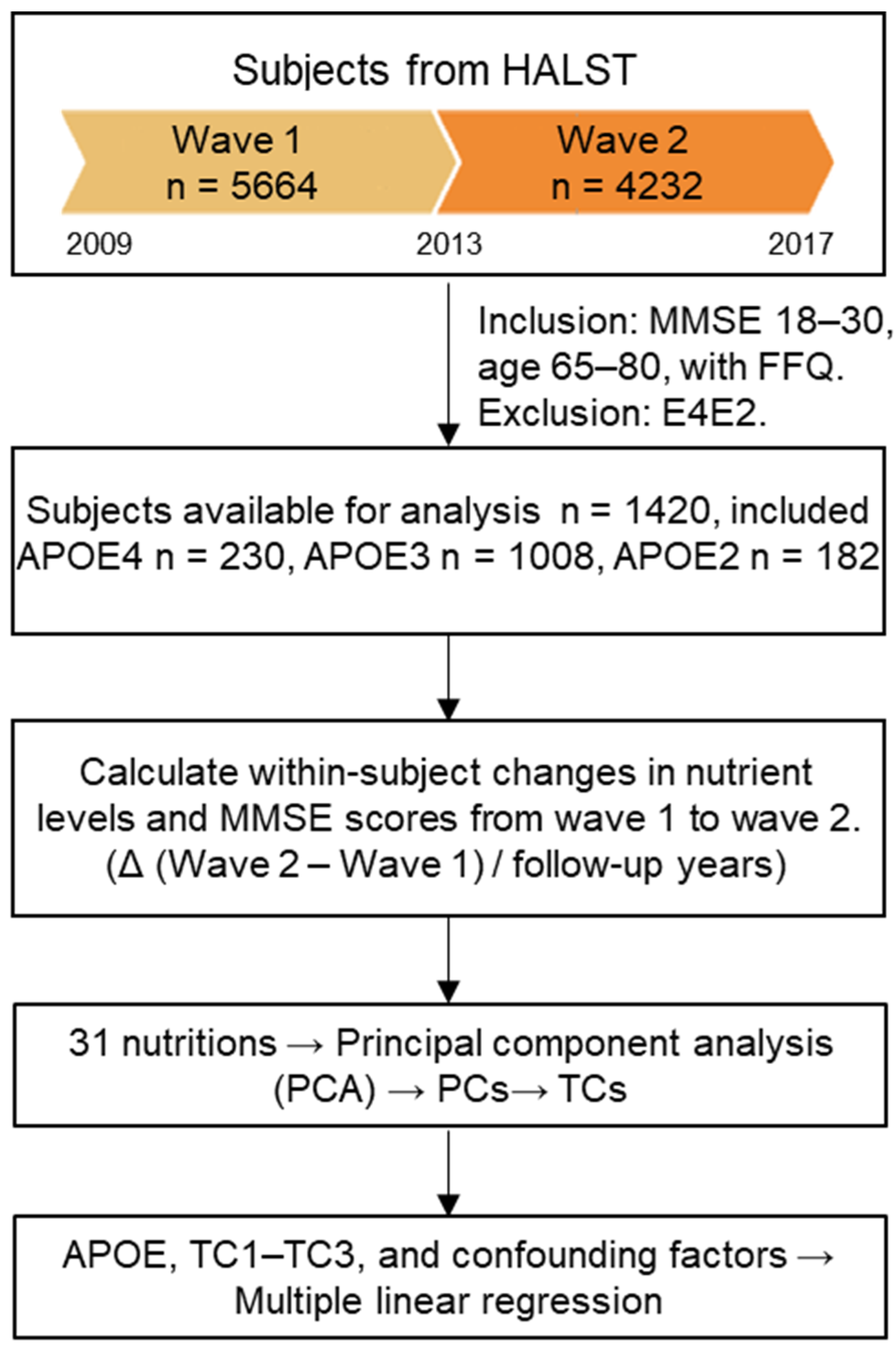
2.1. Study Population
2.2. Dietary Assessment
2.3. Cognitive Measurement
2.4. APOE Genotyping
2.5. Principal Component Analysis of Nutrient Intake
2.6. Blood Collection and Biochemical Measurements
2.7. Longitudinal Regression Analysis
3. Results
3.1. Participant Characteristics
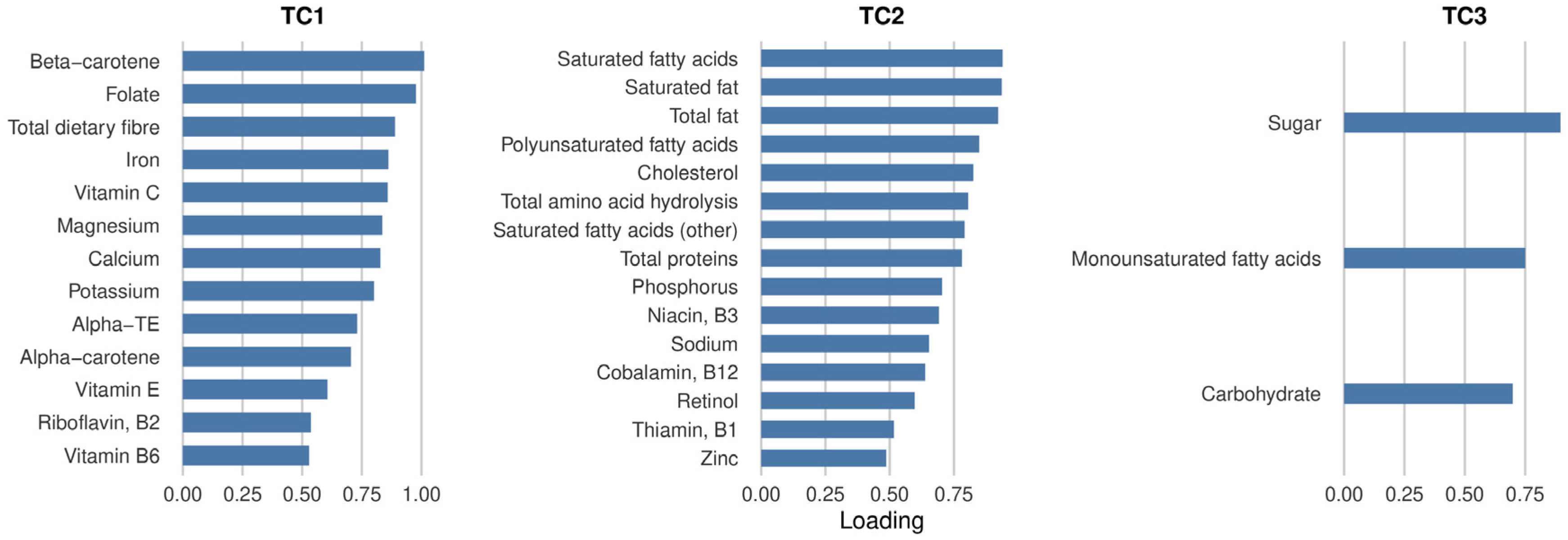
3.2. Principal Component Scores
3.3. Main Effects of Demographic and Clinical Variables
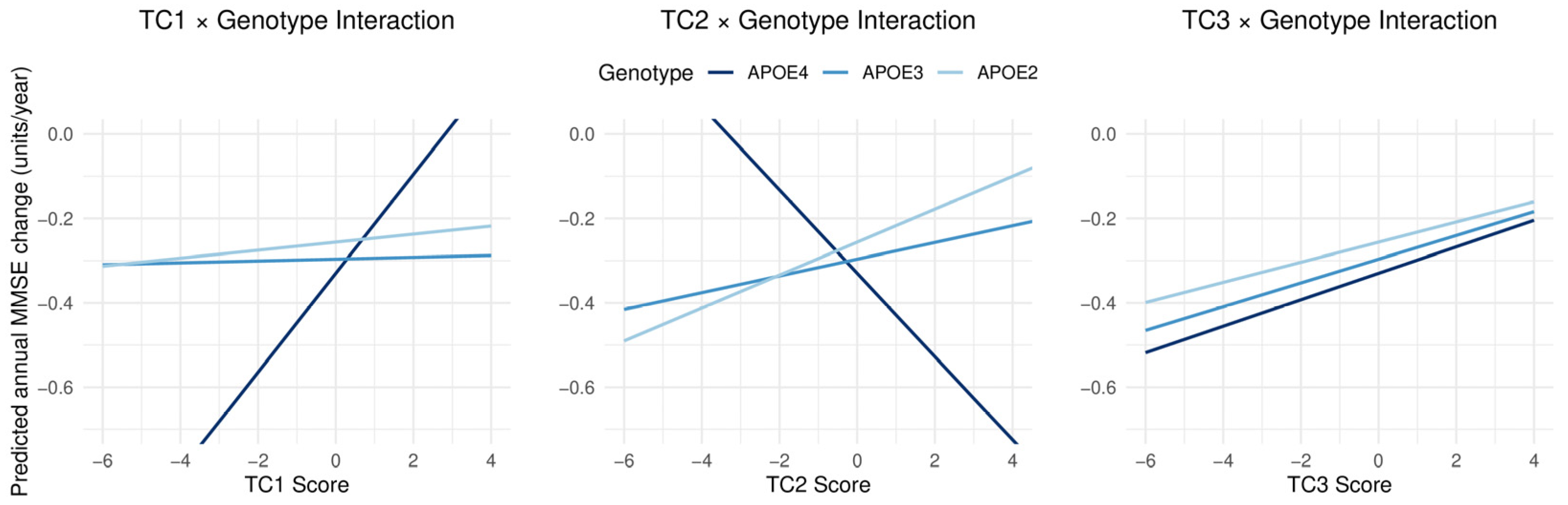
3.4. Principal Component Scores and Genotype Interactions
4. Discussion
5. Conclusions
Supplementary Materials
Author Contributions
Funding
Institutional Review Board Statement
Informed Consent Statement
Data Availability Statement
Acknowledgments
Conflicts of Interest
References
- Arnold, S.E.; Hyman, B.T.; Betensky, R.A.; Dodge, H.H. Pathways to personalized medicine-Embracing heterogeneity for progress in clinical therapeutics research in Alzheimer’s disease. Alzheimers Dement. 2024, 20, 7384–7394. [Google Scholar] [CrossRef] [PubMed]
- Zhang, J.; Zhang, Y.; Wang, J.; Xia, Y.; Zhang, J.; Chen, L. Recent advances in Alzheimer’s disease: Mechanisms, clinical trials and new drug development strategies. Signal Transduct. Target. Ther. 2024, 9, 211. [Google Scholar] [CrossRef] [PubMed]
- Shi, Y.; Yamada, K.; Liddelow, S.A.; Smith, S.T.; Zhao, L.; Luo, W.; Tsai, R.M.; Spina, S.; Grinberg, L.T.; Rojas, J.C.; et al. ApoE4 markedly exacerbates tau-mediated neurodegeneration in a mouse model of tauopathy. Nature 2017, 549, 523–527. [Google Scholar] [CrossRef] [PubMed]
- Wang, C.; Xiong, M.; Gratuze, M.; Bao, X.; Shi, Y.; Andhey, P.S.; Manis, M.; Schroeder, C.; Yin, Z.; Madore, C.; et al. Selective removal of astrocytic APOE4 strongly protects against tau-mediated neurodegeneration and decreases synaptic phagocytosis by microglia. Neuron 2021, 109, 1657–1674.e7. [Google Scholar] [CrossRef]
- Bhatti, G.K.; Reddy, A.P.; Reddy, P.H.; Bhatti, J.S. Lifestyle Modifications and Nutritional Interventions in Aging-Associated Cognitive Decline and Alzheimer’s Disease. Front. Aging Neurosci. 2019, 11, 369. [Google Scholar] [CrossRef]
- Gentreau, M.; Raymond, M.; Chuy, V.; Samieri, C.; Feart, C.; Berticat, C.; Artero, S. High Glycemic Load Is Associated with Cognitive Decline in Apolipoprotein E epsilon4 Allele Carriers. Nutrients 2020, 12, 3619. [Google Scholar] [CrossRef]
- Zhang, Y.; Jin, X.; Lutz, M.W.; Ju, S.Y.; Liu, K.; Guo, G.; Zeng, Y.; Yao, Y. Interaction between APOE epsilon4 and dietary protein intake on cognitive decline: A longitudinal cohort study. Clin. Nutr. 2021, 40, 2716–2725. [Google Scholar] [CrossRef]
- Union-Caballero, A.; Merono, T.; Andres-Lacueva, C.; Hidalgo-Liberona, N.; Rabassa, M.; Bandinelli, S.; Ferrucci, L.; Fedecostante, M.; Zamora-Ros, R.; Cherubini, A. Apolipoprotein E gene variants shape the association between dietary fibre intake and cognitive decline risk in community-dwelling older adults. Age Ageing 2023, 52, afac329. [Google Scholar] [CrossRef]
- Henderson, S.T.; Vogel, J.L.; Barr, L.J.; Garvin, F.; Jones, J.J.; Costantini, L.C. Study of the ketogenic agent AC-1202 in mild to moderate Alzheimer’s disease: A randomized, double-blind, placebo-controlled, multicenter trial. Nutr. Metab. 2009, 6, 31. [Google Scholar] [CrossRef]
- Arellanes, I.C.; Choe, N.; Solomon, V.; He, X.; Kavin, B.; Martinez, A.E.; Kono, N.; Buennagel, D.P.; Hazra, N.; Kim, G.; et al. Brain delivery of supplemental docosahexaenoic acid (DHA): A randomized placebo-controlled clinical trial. EBioMedicine 2020, 59, 102883. [Google Scholar] [CrossRef]
- Urich, T.J.; Tsiknia, A.A.; Ali, N.; Park, J.; Mack, W.J.; Cortessis, V.K.; Dinalo, J.E.; Yassine, H.N. APOE epsilon4 and Dietary Patterns in Relation to Cognitive Function: An Umbrella Review of Systematic Reviews. Nutr. Rev. 2025, 83, e2113–e2126. [Google Scholar] [CrossRef]
- Lin, C.S.; Lee, W.J.; Lin, S.Y.; Lin, H.P.; Chen, R.C.; Lin, C.H.; Chen, L.K. Predicting New-Onset Diabetes Mellitus by Component Combinations of Premorbid Metabolic Syndrome among Older Adults in Taiwan. J. Nutr. Health Aging 2020, 24, 650–658. [Google Scholar] [CrossRef] [PubMed]
- Lee, M.S.; Huang, Y.C.; Su, H.H.; Lee, M.Z.; Wahlqvist, M.L. A simple food quality index predicts mortality in elderly Taiwanese. J. Nutr. Health Aging 2011, 15, 815–821. [Google Scholar] [CrossRef] [PubMed]
- Chuang, S.Y.; Chang, H.Y.; Fang, H.L.; Lee, S.C.; Hsu, Y.Y.; Yeh, W.T.; Liu, W.L.; Pan, W.H. The Healthy Taiwanese Eating Approach is inversely associated with all-cause and cause-specific mortality: A prospective study on the Nutrition and Health Survey in Taiwan, 1993–1996. PLoS ONE 2021, 16, e0251189. [Google Scholar] [CrossRef]
- Hsu, C.C.; Chang, H.Y.; Wu, I.C.; Chen, C.C.; Tsai, H.J.; Chiu, Y.F.; Hsiung, C.A. Cohort profile: The Healthy Aging Longitudinal Study in Taiwan (HALST). Int. J. Epidemiol. 2017, 46, 1106–1106j. [Google Scholar] [CrossRef] [PubMed]
- Lee, M.M.; Chang, I.Y.H.; Horng, C.F.; Chang, J.S.; Cheng, S.H.; Huang, A. Breast cancer and dietary factors in Taiwanese women. Cancer Causes Control 2005, 16, 929–937. [Google Scholar] [CrossRef]
- Folstein, M.F.; Folstein, S.E.; McHugh, P.R. “Mini-mental state”: A practical method for grading the cognitive state of patients for the clinician. J. Psychiatr. Res. 1975, 12, 189–198. [Google Scholar] [CrossRef]
- Millstein, J.; Battaglin, F.; Arai, H.; Zhang, W.; Jayachandran, P.; Soni, S.; Parikh, A.R.; Mancao, C.; Lenz, H.J. fdrci: FDR confidence interval selection and adjustment for large-scale hypothesis testing. Bioinform. Adv. 2022, 2, vbac047. [Google Scholar] [CrossRef]
- Muga, M.A.; Owili, P.O.; Hsu, C.Y.; Rau, H.H.; Chao, J.C. Dietary patterns, gender, and weight status among middle-aged and older adults in Taiwan: A cross-sectional study. BMC Geriatr. 2017, 17, 268. [Google Scholar] [CrossRef]
- Liu, X.; Dhana, K.; Barnes, L.L.; Tangney, C.C.; Agarwal, P.; Aggarwal, N.; Holland, T.M.; Beck, T.; Evans, D.A.; Rajan, K.B. A healthy plant-based diet was associated with slower cognitive decline in African American older adults: A biracial community-based cohort. Am. J. Clin. Nutr. 2022, 116, 875–886. [Google Scholar] [CrossRef]
- Rajaram, S.; Jones, J.; Lee, G.J. Plant-Based Dietary Patterns, Plant Foods, and Age-Related Cognitive Decline. Adv. Nutr. 2019, 10, S422–S436. [Google Scholar] [CrossRef]
- de Crom, T.O.E.; Steur, M.; Ikram, M.K.; Ikram, M.A.; Voortman, T. Plant-based dietary patterns and the risk of dementia: A population-based study. Age Ageing 2023, 52, afad178. [Google Scholar] [CrossRef] [PubMed]
- Clemente-Suarez, V.J.; Redondo-Florez, L.; Martin-Rodriguez, A.; Curiel-Regueros, A.; Rubio-Zarapuz, A.; Tornero-Aguilera, J.F. Impact of Vegan and Vegetarian Diets on Neurological Health: A Critical Review. Nutrients 2025, 17, 884. [Google Scholar] [CrossRef] [PubMed]
- Ding, K.; Zeng, J.; Zhang, X.; Wang, Y.; Liang, F.; Wang, L.; Guo, T.; Moore, J.B.; Li, R. Changes in Plant-Based Dietary Quality and Subsequent Risk of Cognitive Impairment Among Older Chinese Adults: A National Community-Based Cohort Study. Am. J. Clin. Nutr. 2023, 118, 201–208. [Google Scholar] [CrossRef] [PubMed]
- Safieh, M.; Korczyn, A.D.; Michaelson, D.M. ApoE4: An emerging therapeutic target for Alzheimer’s disease. BMC Med. 2019, 17, 64. [Google Scholar] [CrossRef]
- Jofre-Monseny, L.; Minihane, A.M.; Rimbach, G. Impact of apoE genotype on oxidative stress, inflammation and disease risk. Mol. Nutr. Food Res. 2008, 52, 131–145. [Google Scholar] [CrossRef]
- Tao, Q.; Ang, T.F.A.; DeCarli, C.; Auerbach, S.H.; Devine, S.; Stein, T.D.; Zhang, X.; Massaro, J.; Au, R.; Qiu, W.Q. Association of Chronic Low-grade Inflammation with Risk of Alzheimer Disease in ApoE4 Carriers. JAMA Netw. Open 2018, 1, e183597. [Google Scholar] [CrossRef]
- Colton, C.A.; Brown, C.M.; Cook, D.; Needham, L.K.; Xu, Q.; Czapiga, M.; Saunders, A.M.; Schmechel, D.E.; Rasheed, K.; Vitek, M.P. APOE and the regulation of microglial nitric oxide production: A link between genetic risk and oxidative stress. Neurobiol. Aging 2002, 23, 777–785. [Google Scholar] [CrossRef]
- Cronin, P.; Joyce, S.A.; O’Toole, P.W.; O’Connor, E.M. Dietary Fibre Modulates the Gut Microbiota. Nutrients 2021, 13, 1655. [Google Scholar] [CrossRef]
- Vinelli, V.; Biscotti, P.; Martini, D.; Del Bo, C.; Marino, M.; Merono, T.; Nikoloudaki, O.; Calabrese, F.M.; Turroni, S.; Taverniti, V.; et al. Effects of Dietary Fibers on Short-Chain Fatty Acids and Gut Microbiota Composition in Healthy Adults: A Systematic Review. Nutrients 2022, 14, 2559. [Google Scholar] [CrossRef]
- Olufunmilayo, E.O.; Gerke-Duncan, M.B.; Holsinger, R.M.D. Oxidative Stress and Antioxidants in Neurodegenerative Disorders. Antioxidants 2023, 12, 517. [Google Scholar] [CrossRef] [PubMed]
- Feng, J.; Zheng, Y.; Guo, M.; Ares, I.; Martinez, M.; Lopez-Torres, B.; Martinez-Larranaga, M.R.; Wang, X.; Anadon, A.; Martinez, M.A. Oxidative stress, the blood-brain barrier and neurodegenerative diseases: The critical beneficial role of dietary antioxidants. Acta Pharm. Sin. B 2023, 13, 3988–4024. [Google Scholar] [CrossRef] [PubMed]
- Chaudhary, P.; Janmeda, P.; Docea, A.O.; Yeskaliyeva, B.; Abdull Razis, A.F.; Modu, B.; Calina, D.; Sharifi-Rad, J. Oxidative stress, free radicals and antioxidants: Potential crosstalk in the pathophysiology of human diseases. Front. Chem. 2023, 11, 1158198. [Google Scholar] [CrossRef] [PubMed]
- Irwin, R.E.; Pentieva, K.; Cassidy, T.; Lees-Murdock, D.J.; McLaughlin, M.; Prasad, G.; McNulty, H.; Walsh, C.P. The interplay between DNA methylation, folate and neurocognitive development. Epigenomics 2016, 8, 863–879. [Google Scholar] [CrossRef]
- Bhargava, S.; Tyagi, S.C. Nutriepigenetic regulation by folate-homocysteine-methionine axis: A review. Mol. Cell. Biochem. 2014, 387, 55–61. [Google Scholar] [CrossRef]
- An, Y.; Feng, L.; Zhang, X.; Wang, Y.; Wang, Y.; Tao, L.; Qin, Z.; Xiao, R. Dietary intakes and biomarker patterns of folate, vitamin B(6), and vitamin B(12) can be associated with cognitive impairment by hypermethylation of redox-related genes NUDT15 and TXNRD1. Clin. Epigenetics 2019, 11, 139. [Google Scholar] [CrossRef]
- Liaquat, M.; Le Gall, G.; Scholey, A.; Pontifex, M.G.; Bastiaanssen, T.F.S.; Muller, M.; Minihane, A.M.; Vauzour, D. APOE4 genotype shapes the role of dietary fibers in cognitive health through gut microbiota changes. Gut Microbes 2025, 17, 2526133. [Google Scholar] [CrossRef]
- Yin, F. Lipid metabolism and Alzheimer’s disease: Clinical evidence, mechanistic link and therapeutic promise. FEBS J. 2023, 290, 1420–1453. [Google Scholar] [CrossRef]
- Zhu, L.; Zhong, M.; Elder, G.A.; Sano, M.; Holtzman, D.M.; Gandy, S.; Cardozo, C.; Haroutunian, V.; Robakis, N.K.; Cai, D. Phospholipid dysregulation contributes to ApoE4-associated cognitive deficits in Alzheimer’s disease pathogenesis. Proc. Natl. Acad. Sci. USA 2015, 112, 11965–11970. [Google Scholar] [CrossRef]
- Yang, L.G.; March, Z.M.; Stephenson, R.A.; Narayan, P.S. Apolipoprotein E in lipid metabolism and neurodegenerative disease. Trends Endocrinol. Metab. 2023, 34, 430–445. [Google Scholar] [CrossRef]
- Siri-Tarino, P.W.; Sun, Q.; Hu, F.B.; Krauss, R.M. Saturated fatty acids and risk of coronary heart disease: Modulation by replacement nutrients. Curr. Atheroscler. Rep. 2010, 12, 384–390. [Google Scholar] [CrossRef] [PubMed]
- Mititelu, M.; Lupuliasa, D.; Neacsu, S.M.; Olteanu, G.; Busnatu, S.S.; Mihai, A.; Popovici, V.; Maru, N.; Boroghina, S.C.; Mihai, S.; et al. Polyunsaturated Fatty Acids and Human Health: A Key to Modern Nutritional Balance in Association with Polyphenolic Compounds from Food Sources. Foods 2024, 14, 46. [Google Scholar] [CrossRef] [PubMed]
- Dyall, S.C.; Michael-Titus, A.T. Neurological benefits of omega-3 fatty acids. Neuromolecular Med. 2008, 10, 219–235. [Google Scholar] [CrossRef] [PubMed]
- Mazereeuw, G.; Lanctot, K.L.; Chau, S.A.; Swardfager, W.; Herrmann, N. Effects of omega-3 fatty acids on cognitive performance: A meta-analysis. Neurobiol. Aging 2012, 33, 1482.e17–1482.e29. [Google Scholar] [CrossRef]
- Cutuli, D. Functional and Structural Benefits Induced by Omega-3 Polyunsaturated Fatty Acids During Aging. Curr. Neuropharmacol. 2017, 15, 534–542. [Google Scholar] [CrossRef]
- Lovden, M.; Fratiglioni, L.; Glymour, M.M.; Lindenberger, U.; Tucker-Drob, E.M. Education and Cognitive Functioning Across the Life Span. Psychol. Sci. Public Interest 2020, 21, 6–41. [Google Scholar] [CrossRef]
- Ritchie, S.J.; Tucker-Drob, E.M.; Cox, S.R.; Corley, J.; Dykiert, D.; Redmond, P.; Pattie, A.; Taylor, A.M.; Sibbett, R.; Starr, J.M.; et al. Predictors of ageing-related decline across multiple cognitive functions. Intelligence 2016, 59, 115–126. [Google Scholar] [CrossRef]
- Salthouse, T.A. When does age-related cognitive decline begin? Neurobiol. Aging 2009, 30, 507–514. [Google Scholar] [CrossRef]
- Tombaugh, T.N. Test-retest reliable coefficients and 5-year change scores for the MMSE and 3MS. Arch. Clin. Neuropsychol. 2005, 20, 485–503. [Google Scholar] [CrossRef]
- Frerichs, R.J.; Tuokko, H.A. A comparison of methods for measuring cognitive change in older adults. Arch. Clin. Neuropsychol. 2005, 20, 321–333. [Google Scholar] [CrossRef]
- Rogosa, D.R.; Willett, J.B. Understanding correlates of change by modeling individual differences in growth. Psychometrika 1985, 50, 203–228. [Google Scholar] [CrossRef]
- Gupta, A.; Stead, T.S.; Ganti, L. Determining a Meaningful R-squared Value in Clinical Medicine. Acad. Med. Surg. 2024. [Google Scholar] [CrossRef]
- Falk, R.F.; Miller, N.B. A primer for soft modeling. In A Primer for Soft Modeling; University of Akron Press: Akron, OH, USA, 1992. [Google Scholar]



| Characteristic | APOE4 (n = 230) | APOE3 (n = 1008) | APOE2 (n = 182) | p-Value |
|---|---|---|---|---|
| Age (Mean ± SD) | 70.31 ± 3.54 | 70.45 ± 3.57 | 70.73 ± 3.52 | 0.480 |
| Female (%) | 132 (57.4) | 550 (54.6) | 101 (55.5) | 0.735 |
| Education (year) | 8.34 ± 4.39 | 8.21 ± 4.53 | 7.90 ± 4.51 | 0.594 |
| ΔMMSE | −0.31 ± 0.56 | −0.29 ± 0.52 | −0.27 ± 0.56 | 0.701 |
| ΔTotal energy intake (kcal) | −24.24 ± 134.82 | −10.48 ± 123.54 | −11.39 ± 125.51 | 0.322 |
| ΔTotal carbohydrate (g) | −6.00 ± 23.63 | −2.80 ± 20.68 | −2.56 ± 22.05 | 0.108 |
| ΔTotal dietary fiber (g) | −0.62 ± 2.32 | −0.47 ± 2.32 | −0.44 ± 2.03 | 0.637 |
| ΔTotal proteins (g) | −1.08 ± 6.68 | −0.67 ± 6.38 | −0.64 ± 5.61 | 0.659 |
| ΔTotal fat (g) | 0.41 ± 4.57 | 0.33 ± 4.42 | 0.17 ± 5.10 | 0.860 |
| Variable | Estimate | Std. Error | 95% CI | p-Value |
|---|---|---|---|---|
| Intercept | 0.751 | 0.284 | (0.195, 1.307) | 0.008 ** |
| Genotype | ||||
| APOE4 carrier (vs E3) | −0.033 | 0.037 | (−0.106, 0.039) | 0.369 |
| APOE2 carrier (vs E3) | 0.040 | 0.041 | (−0.040, 0.121) | 0.323 |
| Age | −0.018 | 0.004 | (−0.025, −0.010) | <0.001 *** |
| Education | 0.029 | 0.003 | (0.023, 0.035) | <0.001 *** |
| Sex (female) | −0.006 | 0.029 | (−0.063, 0.050) | 0.831 |
| ΔTotal energy intake | 0.000 | 0.000 | (−0.001, 0.000) | 0.112 |
| TC1 | 0.002 | 0.020 | (−0.036, 0.040) | 0.911 |
| TC2 | 0.020 | 0.024 | (−0.027, 0.066) | 0.403 |
| TC3 | 0.028 | 0.024 | (−0.019, 0.075) | 0.239 |
| Hypertension (ref = No diagnosis) | ||||
| Baseline diagnosis | −0.043 | 0.030 | (−0.102, 0.015) | 0.145 |
| New-onset by wave 2 | −0.050 | 0.045 | (−0.139, 0.038) | 0.265 |
| Diabetes (ref = No diagnosis) | ||||
| Baseline diagnosis | −0.094 | 0.035 | (−0.163, −0.025) | 0.008 ** |
| New-onset by wave 2 | −0.094 | 0.051 | (−0.194, 0.006) | 0.065 . |
| Hyperlipidemia (ref = No diagnosis) | ||||
| Baseline diagnosis | 0.050 | 0.033 | (−0.014, 0.114) | 0.127 |
| New-onset by wave 2 | 0.036 | 0.041 | (−0.044, 0.116) | 0.379 |
| Interaction Terms | Estimate | Std. Error | 95% CI | p-Value | q-Value |
|---|---|---|---|---|---|
| APOE4 × TC1 | 0.115 | 0.044 | (0.029, 0.201) | 0.009 ** | 0.026 * |
| APOE2 × TC1 | 0.007 | 0.050 | (−0.091, 0.106) | 0.884 | 0.939 |
| APOE4 × TC2 | −0.119 | 0.043 | (−0.202, −0.035) | 0.005 ** | 0.026 * |
| APOE2 × TC2 | 0.019 | 0.046 | (−0.072, 0.110) | 0.678 | 0.939 |
| APOE4 × TC3 | 0.003 | 0.042 | (−0.080, 0.086) | 0.939 | 0.939 |
| APOE2 × TC3 | −0.004 | 0.043 | (−0.088, 0.079) | 0.920 | 0.939 |
Disclaimer/Publisher’s Note: The statements, opinions and data contained in all publications are solely those of the individual author(s) and contributor(s) and not of MDPI and/or the editor(s). MDPI and/or the editor(s) disclaim responsibility for any injury to people or property resulting from any ideas, methods, instructions or products referred to in the content. |
© 2025 by the authors. Licensee MDPI, Basel, Switzerland. This article is an open access article distributed under the terms and conditions of the Creative Commons Attribution (CC BY) license.
Share and Cite
Lai, R.-H.; Yang, S.-J.; Hsu, P.-Y.; Chen, Y.-C.; Chuang, S.-C.; Hsu, C.-C.; Hsiung, C.A.; Kuo, F.-L. Influence of APOE4 Genotypes on Nutrient–Cognition Relationship in Taiwanese Older Adults: Longitudinal Findings from the HALST. Nutrients 2026, 18, 106. https://doi.org/10.3390/nu18010106
Lai R-H, Yang S-J, Hsu P-Y, Chen Y-C, Chuang S-C, Hsu C-C, Hsiung CA, Kuo F-L. Influence of APOE4 Genotypes on Nutrient–Cognition Relationship in Taiwanese Older Adults: Longitudinal Findings from the HALST. Nutrients. 2026; 18(1):106. https://doi.org/10.3390/nu18010106
Chicago/Turabian StyleLai, Rai-Hua, Shiu-Ju Yang, Pei-Yi Hsu, Yi-Chung Chen, Shu-Chun Chuang, Chih-Cheng Hsu, Chao Agnes Hsiung, and Fang-Lin Kuo. 2026. "Influence of APOE4 Genotypes on Nutrient–Cognition Relationship in Taiwanese Older Adults: Longitudinal Findings from the HALST" Nutrients 18, no. 1: 106. https://doi.org/10.3390/nu18010106
APA StyleLai, R.-H., Yang, S.-J., Hsu, P.-Y., Chen, Y.-C., Chuang, S.-C., Hsu, C.-C., Hsiung, C. A., & Kuo, F.-L. (2026). Influence of APOE4 Genotypes on Nutrient–Cognition Relationship in Taiwanese Older Adults: Longitudinal Findings from the HALST. Nutrients, 18(1), 106. https://doi.org/10.3390/nu18010106