Abstract
Background: Immune-regulatory genes such as CTLA-4, FOXO-3, and PTPN-22 influence immune tolerance and metabolic adaptation, but their interaction with environmental factors in type 1 diabetes (T1DM) remains unclear. Methods: In this observational associated study, we analyzed CTLA-4 (rs3087243, rs231775), FOXO-3 (rs2802292, rs9400239), and PTPN-22 (rs12730735) polymorphisms in 277 adults with T1DM, assessing associations with probiotic and vitamin D use, self-reported dietary patterns, metabolic control, autoimmune thyroid disease (AITD), and metabolic dysfunction-associated steatotic liver disease (MASLD). Results: Across the cohort, CTLA-4 rs3087243 G and FOXO-3 rs2802292 T alleles were associated with higher AITD risk (p = 0.016–0.03), significant in both dominant and additive models. The effect persisted by sex: CTLA-4 in women and FOXO-3 in men. Stratified analyses revealed metabolic advantages for CTLA-4 G and FOXO-3 T carriers (vegetarian diet, lower HbA1c, stress adaptation). FOXO-3 rs9400239 T was linked to MASLD (p ≈ 0.037–0.041), with similar trends for CTLA-4 rs231775, stronger in men. Vitamin D supplementation showed protective trends, particularly in FOXO-3 rs2802292 GG and CTLA-4 GG/AG carriers. Conversely, probiotic use was associated with higher AITD in FOXO-3 rs2802292 GT and CTLA-4 rs3087243 GG genotypes. Conclusions: CTLA-4, FOXO-3, and PTPN-22 variants may modulate the metabolic and autoimmune response to environmental factors including nutrients in T1DM.
Keywords:
environmental factors; genetic factors; metabolic adaptation; type 1 diabetes; MASLD; AITD; diet; Vitamin D; probiotic 1. Introduction
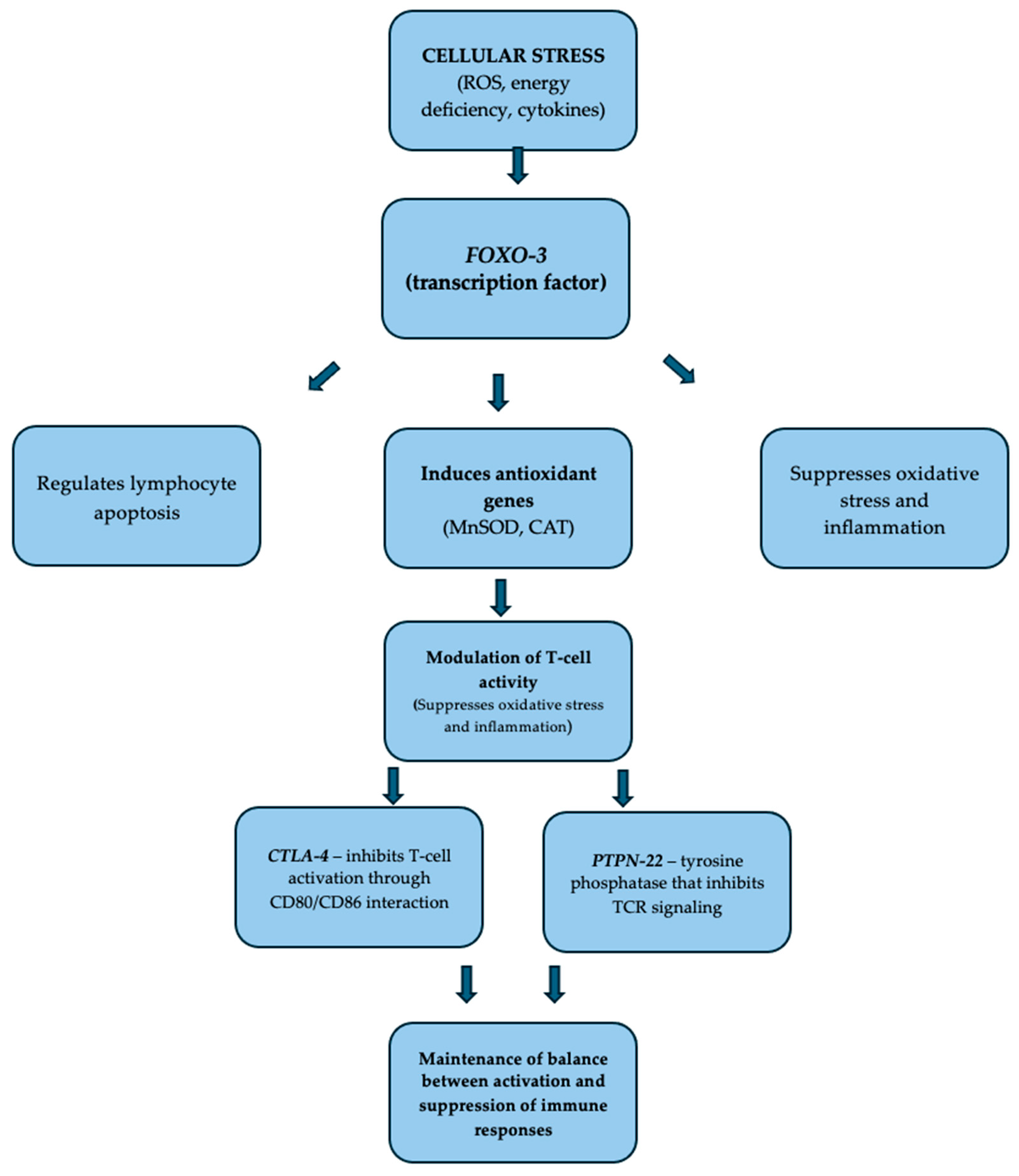
Type 1 diabetes (T1DM) is a chronic autoimmune disease characterized by immune-mediated destruction of pancreatic β-cells, leading to absolute insulin deficiency and long-term metabolic imbalance [1,2]. While the genetic background—particularly the HLA complex—remains the strongest determinant of T1DM risk, accumulating evidence indicates that non-HLA immune-regulatory genes and environmental exposures jointly influence disease onset, progression, and clinical phenotype [3,4,5]. In type 1 diabetes, HLA class II alleles—particularly the HLA-DR3-DQ2 and HLA-DR4-DQ8 haplotypes—represent the strongest genetic determinants of disease risk by creating a high-risk HLA background that favors presentation of β-cell antigens. Their peptide-binding grooves stabilize the presentation of key islet autoantigens (e.g., insulin B:9–23, GAD65, IA-2, ZnT8), leading to activation of autoreactive CD4+ T cells. At the same time, these alleles present self-antigens inefficiently during thymic selection, allowing diabetogenic T-cell clones to escape deletion. The synergistic effect of the DR3/DR4 genotype further enhances susceptibility, promoting breakdown of tolerance and progression of autoimmune β-cell destruction [6,7]. In turn, among these non-HLA loci, cytotoxic T-lymphocyte-associated protein 4 (CTLA-4), forkhead box O3 (FOXO-3), and protein tyrosine phosphatase non-receptor type 22 (PTPN-22) have emerged as important regulators of immune tolerance and metabolic homeostasis—see Table 1 and Figure 1 [2,8,9,10,11,12]. Table 2 summarizes the characteristics of the analyzed genetic variants together with their clinical interpretation. For this purpose, we used the ClinVar database (NCBI), which is considered one of the most reliable and transparent sources of information on the clinical relevance of genetic variants. ClinVar allows verification of whether a variant has been previously reported in individuals with a given disease phenotype and whether its classification is supported by consistent evidence. This database was chosen because it is widely used in molecular diagnostics and research and serves as a key reference for the classification and interpretation of genetic variants. Variants in selected genes affect immune checkpoint function, T-cell activation, apoptosis, and cytokine signaling, thereby contributing to the balance between tolerance and autoimmunity [8,13], as well as potentially influencing metabolic adaptation. However, the functional consequences of common polymorphisms in these genes are not uniform and may be strongly modulated by environmental and lifestyle factors. In parallel, environmental and nutritional factors—including dietary composition, nutrient intake (e.g., vitamins), and gut microbiota-derived metabolites—are increasingly recognized as modulators of immune and metabolic pathways [13,14]. Nutrients such as fatty acids, vitamins D, antioxidants, and polyphenols may affect immune regulation, oxidative stress responses, and metabolic signaling. Therefore, interaction between genetic predisposition and environmental factors could shape disease phenotype in T1D, influencing not only disease onset but also comorbidities, metabolic control, and adaptation [13,15,16,17]. It is worth mentioning that vitamin D plays an immunomodulatory role partly by downregulating TLR-4 (Toll-like receptor 4) expression through binding of the vitamin D receptor (VDR) to regulatory elements in the TLR4 promoter, thereby reducing pro-inflammatory signaling in innate immune cells [18]. Short-chain fatty acids (SCFAs), particularly butyrate and propionate, also enhance peripheral immune tolerance by promoting FoxP3+ regulatory T-cell (Treg) differentiation via histone deacetylase (HDAC) inhibition and GPR43/GPR109A (G protein-coupled receptors) receptor signaling [19,20]. Together, these pathways provide a mechanistic framework linking environmental exposures, gut microbial metabolites, and modulation of inflammatory responses.
Table 1.
Functional roles and interactions of CTLA-4, PTPN-22, and FOXO-3 in immune tolerance and metabolic balance.
Figure 1.
Interplay between FOXO-3, CTLA-4, and PTPN-22 in maintaining immune homeostasis (adaptation from [10,11,12]).
Despite these insights, relatively few studies have examined gene and environment interactions in T1DM by combining genetic variants in immune-regulatory genes with detailed environmental/nutritional data [21,22,23,24]. This gap is relevant because genetic variants may predispose to altered immune or metabolic responses, but the manifestation of those predispositions could depend heavily on modifiable factors such as diet, supplementation, or gut microbiota. Understanding these mechanisms may support the development of personalized nutritional strategies aimed at improving metabolic outcomes and modulating autoimmune activity. We selected these mentioned SNPs because they lie in functionally relevant immune-regulatory or metabolic genes (CTLA-4, PTPN-22, FOXO-3), and prior studies have shown associations between these SNPs (or closely linked variants) and autoimmune diseases or metabolic traits (e.g., FOXO-3 rs2802292 has been linked to metabolic health.
The aim of this study was to investigate whether common variants in CTLA-4 (rs3087243, rs231775), FOXO-3 (rs2802292, rs9400239), and PTPN-22 (rs12730735) modify the association between environmental/nutritional factors (dietary patterns, vitamin D supplementation, probiotic use) and metabolic or autoimmune-related outcomes (metabolic control, autoimmune thyroid disease (AITD), metabolic dysfunction-associated steatotic liver disease (MASDL) in adults with T1D. By focusing on these interactions, we aimed to clarify how genetic predisposition and modifiable lifestyle factors jointly influence immune tolerance and metabolic adaptation in T1D.
Table 2.
Genetic characteristics of the analyzed genetic variants.
Table 2.
Genetic characteristics of the analyzed genetic variants.
| SNP ID (Gene) | Reference/ Alternative Allele | Genomic Location (hg38) | HGVS Nomenclature | Minor Allele Frequency (EUR) | ClinVar Accession | Associated Phenotypic or Disease Trait |
|---|---|---|---|---|---|---|
| rs3087243 (CTLA-4) | A/G | chr2:203874196 | NG_011502.1:g. 11411G > A | 0.35 | RCV001515646.7 | T1D, AID [1,2] |
| rs231775 (CTLA-4) | G/A | chr2:203867991 | NG_011502.1:g. 5206A > G | 0.45 | RCV001255201.1 | T1D, general autoimmunity [1,2,8] |
| rs12730735 (PTPN-22) | T/C | chr1:113838835 | NG_007403.2:g. 331 + 713T > C | 0.25 | Not listed in ClinVar | AITD, region-specific effects [2,3] |
| rs2802292 (FOXO-3a) | T/G | chr6:108587315 | NG_158842.1:g. 239G > T | 0.40 | Not listed in ClinVar | Longevity, immune system regulation [22] |
| rs9400239 (FOXO-3a) | C/T | chr6:108656460 | NG_012124.2:g. 62345C > T | 0.30 | Not listed in ClinVar | Longevity, metabolic characteristics [22] |
Abbreviations: ClinVar—public archive with free access to reports on the relationships between human genetic variations and phenotypes; HGVS—Human Genetic Variation Society; hg—human genome; SNP—single-nucleotide polymorphism; rs—reference SNP cluster ID; A—adenine; C—cytosine; T—thymine; G—guanine; chr—chromosome; CTLA-4—cytotoxic T-lymphocyte-associated protein 4; FOXO-3—forkhead box O3; PTPN-22—protein tyrosine phosphatase non-receptor type 22; T1D—type 1 diabetes; AID—autoimmune disease.
2. Materials and Methods
2.1. Study Group
The study protocol was approved by the Bioethics Committee of the Medical University of Silesia, Poland (PCN/0022/KB1/104/19). All eligible participants provided written informed consent prior to enrolment in the study. The study cohort consisted of 277 consecutive adults with T1D who were admitted to the Department of Internal Medicine, Diabetology and Nephrology or were under the care of the Diabetes Outpatient Clinic, Medical University of Silesia between 2021 and 2024 (Zabrze, Poland). Demographic and anthropometric data, including sex, age, body weight, and height, were collected. Clinical and environmental information was also recorded, including diabetes duration and therapy, all comorbidities, particularly AITD and MASLD, and medication use.
MASLD (Metabolic Dysfunction-Associated Steatotic Liver Disease), according to the applicable guidelines, was defined as liver fat accumulation (steatosis) in someone with at least one cardiometabolic risk factor, such as obesity, type 2 diabetes, hypertension, or high triglycerides, while excluding significant alcohol intake [25].
Participants provided additional data on lifestyle and nutritional factors, including smoking habits, alcohol consumption, physical activity, probiotic and vitamin D supplementation (defined as supplementation at least 2000 IU per day), and self-reported dietary patterns (defined as following a balanced diet with restricted intake of simple sugars and, in some individuals, also lactose or gluten-free diets, or vegetarianism). Metabolic control parameters were also assessed.
Perceived stress was evaluated using the validated Perceived Stress Scale–10 (PSS-10). Participants completed the 10-item questionnaire, and total scores were calculated according to the standardized scoring protocol. In accordance with established cutoffs, a score >27 was defined as high perceived stress, and this categorical variable was used in subsequent statistical analyses.
Exclusion criteria included the presence of other types of diabetes or refusal to provide informed consent. All procedures were conducted in accordance with the ethical standards of the institutional research committee and the Declaration of Helsinki.
2.2. Biochemical and Genetic Analyses
Venous blood samples (2 × 4.9 mL) were collected from each participant. Glycated hemoglobin (HbA1c) was measured using high-performance liquid chromatography (HPLC). Thyroid function and autoimmunity were assessed via thyroid-stimulating hormone (TSH), thyroid peroxidase (TPO) antibodies, and antithyroglobulin (TG) antibodies, with positivity defined as TPO > 30 IU/mL and TG > 4.11 IU/mL.
SNPs associated with autoimmune conditions were identified from the literature and the NCBI SNP database. Five SNPs were selected for genotyping: CTLA-4 (rs3087243, rs231775), PTPN-22 (rs12730735), and FOXO-3a (rs2802292, rs9400239). We selected these mentioned SNPs because they lie in functionally relevant immune-regulatory or metabolic genes (CTLA-4, PTPN-22, FOXO-3), and prior studies have shown associations between these SNPs (or closely linked variants) and autoimmune diseases or metabolic traits (e.g., FOXO-3 rs2802292) has been linked to metabolic health. Genomic DNA was extracted from erythrocytes using the MagCore Genomic DNA Whole Blood Kit (RBC Bioscience Corp., New Taipei City, Taiwan) and stored at −20 °C. Genotyping was performed using TaqMan probes on a Roche LifeCycler 96 qPCR system (Roche, Basel, Switzerland), with two blank controls included per plate. To ensure the reliability of the SNP analyses, we repeated genotyping for a randomly selected 10–15% of DNA samples. The repeatability of the results obtained was 100%, which confirmed consistency with previously obtained genotyping analyses. Allelic frequencies were calculated for all five loci.
2.3. Statistical Analysis
Statistical analyses were performed in R (version 2024.04.2+764.pro1) via RStudio (version 2024.04.1+748). Categorical variables were expressed as counts and percentages, and continuous variables as mean ± SD or median (Q1–Q3), depending on distribution. The normality of the distribution was evaluated based on histograms and Q–Q plots. Associations between categorical variables were evaluated using the chi-square or Fisher’s exact test, as appropriate. Continuous variables were compared between two independent groups using Student’s t-test for normally distributed data or the Wilcoxon rank-sum (Mann–Whitney) test for non-parametric data. For continuous outcomes across multiple genotype groups, differences were assessed using one-way ANOVA for normally distributed data or the Kruskal–Wallis test otherwise, followed by Bonferroni-corrected post hoc comparisons when applicable.
Allele distributions were checked for Hardy–Weinberg equilibrium and compared with Central European population frequencies (The proportion test). In the additive genetic model, each additional copy of the minor allele was assumed to have a linear (dose-dependent) effect on the outcome variable. Genotypes were coded as 0, 1, and 2, corresponding to the number of minor alleles. The regression coefficient therefore represented the change in log-odds (for logistic regression) or in mean value (for linear models) per one additional minor allele.
In the dominant model, carriers of at least one minor allele were grouped together and compared with homozygotes for the major allele (e.g., AA vs. AG + GG). This model tested whether the presence of the minor allele, regardless of dosage, influenced the outcome.
Univariate logistic regression was used to estimate odds ratios (ORs) and 95% confidence intervals (CIs) for binary traits. Multivariable logistic regression models were constructed to examine SNP interactions with sex, disease duration, and metabolic parameters, including effects on glycaemic control. Model fit was assessed using the Hosmer–Lemeshow goodness-of-fit test.
Interactions between genetic variants and environmental or lifestyle factors (e.g., stress exposure, probiotic use, physical activity, or dietary habits) were explored using two-way ANOVA or the Scheirer–Ray–Hare test for non-parametric data. The Benjamini–Hochberg false discovery rate (FDR) correction was applied to control for multiple testing and to reduce the probability of type I errors arising from the large number of SNP comparisons. All tests were two-tailed, and statistical significance was set at p < 0.05.
3. Results
The clinical characteristics of the study population are summarized in Table 2. The cohort included 277 adults with T1D, of whom 65.7% were female. The mean age was 33.13 ± 12.47 years, with a median diabetes duration of 12 (4; 19) years. Most participants were treated with multiple daily insulin (MDI) injections (59.5%), and 58.8% used continuous glucose monitoring (CGM) systems. The average HbA1c level was 8.15 ± 2.04%, with no significant differences between sexes. Additionally, the prevalence of chronic diabetes complications and other comorbidities, including AITD and MASLD, and data on individual environmental factors was assessed (Table 3).
Table 3.
General characteristics of the study population.
The frequencies of alleles and genotypes for the analyzed polymorphisms are summarized in Supplementary Table S1. Genotype distributions complied with the Hardy–Weinberg equilibrium (p > 0.01). A statistically significant variation was observed in the allele frequencies of the rs3087243 polymorphism within the CTLA-4 gene when compared with data from the Central European population. In contrast, the remaining analyzed polymorphisms showed no significant differences relative to the Central European reference group (Supplementary Table S2).
We evaluated the association between selected SNPs and the risk of AITD. In the overall population, CTLA-4 rs3087243 and FOXO-3 rs2802292 were significantly associated with increased AITD risk under the dominant model (carriers of ≥1 risk allele vs. non-carriers; p = 0.016 and p = 0.017, respectively). Additionally, FOXO-3 rs2802292 showed a significant association under the additive model (0–1–2 risk alleles; p = 0.030). When stratified by sex, male carriers of the FOXO-3 rs2802292 risk allele also had an increased risk of AITD (p = 0.043) (Table 4 and Table 5). After applying the Benjamini–Hochberg false discovery rate (FDR) correction for multiple testing, the strength of evidence for the initially observed associations between SNPs and AITD was attenuated. The adjusted p-values clustered around the 0.04–0.05 range (CTLA-4 rs3087243 and FOXO-3 rs2802292 in the dominant model), indicating borderline rather than robust statistical significance. Importantly, the effects did not disappear entirely after correction; however, their magnitude and statistical support were weakened. Therefore, the detected signals should be interpreted as exploratory and requiring independent replication.
Table 4.
Association between selected SNPs and the risk of AITD.
Table 5.
Significant associations between SNPs and AITD and MASLD.
We next examined the relationship between SNPs and MASLD. In males, carriers of at least one risk allele of FOXO-3 rs9400239 had an increased risk of MASLD under the dominant model (p = 0.037). Additionally, PTPN-22 rs12730735 C allele carriers had a lower mean MASLD risk under the additive model, suggesting a potential protective effect (mean difference = −0.20; p = 0.049) (Table 6).
Table 6.
Association between selected SNPs and the risk of MASLD.
The distribution of selected SNP genotypes was assessed in participants with MASLD and vitamin D supplementation. For CTLA-4 rs3087243, the AA genotype was present in 32.0% of individuals, GG in 59.5%, and AG in 55.1% among those with MASLD and vitamin D supplementation (pχ2 = 0.042). Similarly, FOXO-3 rs2802292 genotypes showed significant associations, with GG at 39.1%, GT at 56.8%, and TT at 61.3% in participants with MASLD and vitamin D supplementation (pχ2 = 0.047) (Table 7).
Table 7.
Genotype distribution of selected SNPs in relation to MASLD and vitamin D supplementation (χ2 test).
The convergence of p-values obtained from the χ2 test and Fisher’s exact test in both the dominant and recessive models reflects the stability of the observed associations, suggesting that the effect is primarily driven by the difference between carriers and non-carriers of the minor allele (Table 8).
Table 8.
Genotype distribution of selected SNPs in relation to MASLD and vitamin D supplementation (Fisher’s test).
We also evaluated the relationship between SNPs and probiotic use. The FOXO-3 rs2802292 T allele was significantly associated with higher probiotic use under the additive model (mean difference = 0.33; p = 0.037), which may have potential implications for clinical relevance (Table 9).
Table 9.
Association between selected SNPs and the probiotic use.
We investigated interactions between genetic variants and stress exposure on probiotic use. In the overall cohort, carriers of at least one risk allele of CTLA-4 rs3087243 and CTLA-4 rs231775 were more likely to use probiotics under stress (OR = 1.80, 95% CI: 1.06–3.05; p = 0.034 and OR = 2.08, 95% CI: 1.15–3.76; p = 0.018, respectively). For FOXO-3, carriers of the rs2802292 risk allele also had increased probiotic use under stress (OR = 1.86, 95% CI: 1.07–3.22; p = 0.029), while non-carriers of FOXO-3 rs9400239 showed higher probiotic use under stress in both the total cohort (OR = 2.40, 95% CI: 1.08–5.33; p = 0.048) and in females (OR = 3.06, 95% CI: 1.17–8.00; p = 0.034) (Table 10).
Table 10.
Significant gene–environment interactions.
For a comprehensive analysis, we also assessed the relationships between the studied genetic variants and adherence to vegetarian diets, as well as alcohol consumption. All results obtained showed no statistical significance (p > 0.05), which does not allow us to confirm the existence of an association between the analyzed polymorphisms and these environmental factors in the studied population. In our analysis using standard genetic association formulas, we show that the study had ~80% power to detect moderate effects (OR ≥ 1.8) for SNPs with MAF ≥ 0.25, with lower power for subgroup analyses.
4. Discussion
In this study, we examined the interplay of selected genetic polymorphisms (in CTLA-4, FOXO-3, and PTPN-22) with AITD, MASLD, probiotics, and vitamin D supplementation and stress exposure in a cohort of patients with T1D. Consistent with previous studies, thyroid disorders were the most prevalent autoimmune conditions in our T1D cohort, affecting over 30% of participants [26,27]. Our results also indicate that CTLA-4 rs3087243 and FOXO-3 rs2802292 are significantly associated with increased AITD risk under both dominant and additive genetic models. These findings align with prior evidence highlighting the role of CTLA-4 in immune regulation and FOXO-3 in inflammatory responses and immune aging.
Sex-stratified analysis revealed that male carriers of FOXO-3 rs2802292 also have an elevated risk of AITD, suggesting possible sex-specific genetic effects, which warrant further investigation. This finding is consistent with meta-analytic evidence that CTLA-4 CT60 (rs3087243) confers susceptibility to AITD across multiple ethnic groups (OR ~1.26 for HT; OR ~1.45 in Asians) as shown by Ni et al. in 2014 [28]. Although FOXO-3 is more widely studied in the context of longevity and metabolic regulation rather than thyroid autoimmunity, its role in stress response and immune modulation (e.g., via chromatin hubs and enhancer regulation) has been described [29].
Our findings also suggest that the PTPN-22 rs12730735 polymorphism may play a protective role in the development of MASLD in our cohort, and male carriers of FOXO-3 rs9400239 showed increased susceptibility, emphasizing a potential link between PTPN-22 and FOXO-3 variants and metabolic liver dysfunction in T1D.
The emerging literature supports the role of FOXO-3 variants in metabolic regulation and liver fat accumulation; for example, in a Southern Italian cohort the FOXO-3 rs2802292 G allele was found to influence food intake and MASLD risk [30,31]. Taken together, our results point to a dual involvement of immune regulation and metabolic pathways via CTLA-4, PTPN-22, and FOXO-3 variants in this T1D sample.
In addition to disease associations, our study observed significant genotype distribution differences in relation to vitamin D supplementation and MASLD occurrence. CTLA-4 rs3087243 genotype distributions (AA, GG, AG) were associated with differing proportions of MASLD or vitamin D use (pχ2 = 0.042). The interplay between genotype and nutrient behavior supports the concept of the nutrigenetic idea that genetic background modulates responses to nutrients or supplementation [32]. Although studies specifically linking CTLA-4 or FOXO-3 to vitamin D or probiotic use are limited, our observation of higher probiotic use in carriers of FOXO-3 rs2802292 (mean difference = 0.33; p = 0.037) may suggest a potential genotype-related influence on health-related behavior. However, this finding should be interpreted with caution. An important extension of our findings concerns gene–environment interactions. We found that under stress exposure, carriers of CTLA-4 rs3087243 and rs231775, and carriers or non-carriers of FOXO-3 variants, had increased probiotic use. For example, CTLA-4 rs231775 carriers had OR = 2.08 (95% CI 1.15–3.76; p = 0.018).
These results reinforce the possibility that stress exposure, probiotic behavior, and genotype may operate in concert; stress can influence gut-microbiome composition and immune regulation, probiotics also influence the microbiome and immune function, and genetic variants such as those in CTLA-4 and FOXO-3 can modulate these pathways. This gene-nutrient-environment connection is increasingly recognized as a promising paradigm in precision nutrition research [33,34,35]. Our findings could have important implications for precision nutrition and personalized medicine. However, these results should be interpreted with caution due to the analyses of many comparisons. Identifying T1D patients carrying at-risk alleles in CTLA-4 or FOXO-3 may enable targeted interventions such as optimized vitamin D supplementation, tailored probiotic regimens, stress management strategies, and lifestyle modifications to reduce AITD or MASLD risk. Importantly, genotype alone does not determine outcome—nutrient behavior, supplementation, and environmental exposures shape phenotype expression.
This study has several limitations. First, its cross-sectional design precludes causal inference regarding the observed associations between genetic variants, environmental factors, and clinical outcomes. Second, although the overall sample size was sufficient to detect moderate effects in the total cohort, it was relatively limited for stratified analyses (e.g., sex-specific models—with particularly small numbers of males—or gene–environment interaction strata), which reduces statistical power and increases the risk of type II error. Third, environmental and nutritional exposures were assessed using self-reported measures and were restricted mainly to stress and supplementation behaviors; other relevant factors that may modulate genotype–phenotype associations were not captured. Moreover, we did not collect detailed quantitative dietary data, objective nutritional biomarkers (e.g., metabolomic profiles or specific nutrient biomarkers), or microbiome profiles, and vitamin D status was inferred from self-reported supplementation rather than serum 25(OH)D concentrations (we plan to include laboratory measurements of vitamin D levels in future analyses). Finally, although the single-center design ensured highly standardized clinical assessment and laboratory procedures, it may limit the generalizability of the results. Larger, multicenter, longitudinal studies with comprehensive dietary quantification, biomarker measurements, and microbiome analyses are needed to validate and extend our observations. A key unmet need is the quantitative characterization of diet and nutrient–gene interactions in T1D. In our study, dietary information was limited to self-reported patterns (e.g., vegetarian vs. non-vegetarian), without detailed quantification of macronutrient or micronutrient intake, meal timing or dietary quality indices. Future work should incorporate standardized dietary assessment tools (such as weighed food records or validated food frequency questionnaires), combined with metabolomic profiling and microbiome analyses, to capture nutrient-derived metabolites and gut microbial products. Integrating these layers with genetic data in formal nutrient–gene interaction models (e.g., genotype-stratified regression, multi-omics integration) will be crucial to elucidate how specific nutrients, microbial metabolites and genetic variants jointly shape immune and metabolic phenotypes in T1D.
Therefore, while our findings suggest intriguing associations and generate hypotheses for personalized nutritional/therapeutic strategies, they should be regarded as exploratory.
5. Conclusions
Our study provides preliminary evidence that common variants in CTLA-4, PTPN-22, and FOXO-3 may contribute to the heterogeneity of autoimmune and metabolic comorbidities in T1D. The associations identified appear to depend, at least in part, on environmental and lifestyle exposures, indicating that genetic susceptibility interacts with modifiable factors rather than acting in isolation. These findings highlight the potential relevance of gene–nutrient and gene–environment interactions in shaping clinical expression of T1D.
Given the exploratory and observational character of the study, limited statistical power in subgroup analyses, and reliance on self-reported environmental data, the results should be interpreted cautiously. Nonetheless, they generate hypotheses suggesting that nutrition- and microbiota-oriented interventions, when aligned with genetic background, may hold potential for improving the management of T1D-related comorbidities.
6. Future Perspectives
Future research should validate these findings in larger, multi-center cohorts and, ideally, through longitudinal designs capable of capturing temporal relationships among genetic predisposition, environmental exposures, and clinical outcomes. To advance understanding of gene–nutrient interactions, upcoming studies should integrate detailed dietary quantification, standardized assessment of supplementation and stress, biomarker-based nutritional profiling, and microbiome analyses.
In the long term, genotype-stratified interventional trials will be essential to determine whether personalized nutritional, microbial, or lifestyle-based strategies can effectively reduce the risk or severity of autoimmune and metabolic complications in T1D. Such work is necessary before translating preliminary associations into clinical or public-health recommendations.
Supplementary Materials
The following supporting information can be downloaded at https://www.mdpi.com/article/10.3390/nu17243886/s1, Table S1. The allele and genotype frequencies of the analyzed polymorphisms. Table S2. The allele distribution in the study population compared to that in the Central European population.
Author Contributions
Conceptualization, E.C., A.M.-P. and J.G.; methodology, E.C., N.S.-G. and S.B.G.-K.; validation, E.C., A.M.-P. and J.G.; formal analysis, E.C. and N.S.-G.; investigation, A.M.-P. and S.B.G.-K.; resources, E.C.; data curation, E.C., A.M.-P. and N.S.-G.; writing—original draft preparation, E.C. and A.M.-P.; writing—review and editing, E.C., A.M.-P. and S.B.G.-K.; supervision, J.G.; project administration, E.C., N.S.-G., S.B.G.-K. and J.G., funding acquisition, E.C., A.M.-P. and J.G. All authors have read and agreed to the published version of the manuscript.
Funding
The study was financed by PCN-1-184/N/0/K and PCN-1-2-212/K/1/K.
Institutional Review Board Statement
The study was conducted in accordance with the Declaration of Helsinki, and approved by the Bioethics Committee of Medical University of Silesia (Permission No. PCN/0022/KB1/104/19). Date: 22 October 2019.
Informed Consent Statement
Informed consent was obtained from all subjects involved in the study.
Data Availability Statement
The original contributions presented in this study are included in the article/Supplementary Materials. Further inquiries can be directed to the corresponding author.
Conflicts of Interest
The authors declare no conflicts of interest.
References
- Ohtani, H.; Inoue, N.; Iwatani, Y.; Takeno, Y.; Arakawa, Y.; Hidaka, Y.; Watanabe, M. Effect of DNA methylation at the CTLA4 gene on the clinical status of autoimmune thyroid diseases. Clin. Immunol. 2024, 267, 110338. [Google Scholar] [CrossRef] [PubMed]
- Sharma, C.; Ali, B.R.; Osman, W.; Afandi, B.; Aburawi, E.H.; A Beshyah, S.; Al-Mahayri, Z.; Al-Rifai, R.H.; Al Yafei, Z.; ElGhazali, G.; et al. Association of variants in PTPN22, CTLA-4, IL2-RA, and INS genes with type 1 diabetes in Emiratis. Ann. Hum. Genet. 2021, 85, 48–57. [Google Scholar] [CrossRef] [PubMed]
- Redondo, M.J.; Onengut-Gumuscu, S.; Gaulton, K.J. Genetics of Type 1 Diabetes. 2023. In Diabetes in America; Lawrence, J.M., Casagrande, S.S., Herman, W.H., Wexler, D.J., Cefalu, W.T., Eds.; National Institute of Diabetes and Digestive and Kidney Diseases (NIDDK): Bethesda, MD, USA, 2023. [Google Scholar]
- Steck, A.K.; Zhang, W.; Bugawan, T.L.; Barriga, K.J.; Blair, A.; Erlich, H.A.; Eisenbarth, G.S.; Norris, J.M.; Rewers, M.J. Do non-HLA genes influence development of persistent islet autoimmunity and type 1 diabetes in children with high-risk HLA-DR, DQ genotypes? Diabetes 2009, 58, 1028–1033. [Google Scholar] [CrossRef]
- Thomas, S.M.; Veerabathiran, R. Deciphering autoimmune susceptibility: A meta-analysis of PTPN22 gene variants. Immunol. Res. 2025, 1, 59. [Google Scholar] [CrossRef]
- Robino, A.; Bevilacqua, E.; Aldegheri, L.; Conti, A.; Bazzo, V.; Tornese, G.; Catamo, E. Next-generation sequencing reveals additional HLA class I and class II alleles associated with type 1 diabetes and age at onset. Front. Immunol. 2024, 15, 1427349. [Google Scholar] [CrossRef]
- Sharma, R.; Amdare, N.P.; Ghosh, A.; Schloss, J.; Sidney, J.; Garforth, S.J.; Lopez, Y.; Celikgil, A.; Sette, A.; Almo, S.C.; et al. Structural and biochemical analysis of highly similar HLA-B allotypes differentially associated with type 1 diabetes. J. Biol. Chem. 2024, 9, 107702. [Google Scholar] [CrossRef]
- Żurawęk, M.; Dzikiewicz-Krawczyk, A.; Iżykowska, K.; Ziółkowska-Suchanek, I.; Skowrońska, B.; Czaińska, M.; Podralska, M.; Fichna, P.; Przybylski, G.; Fichna, M.; et al. miR-487a-3p up-regulated in type 1 diabetes targets CTLA-4 and FOXO3. Diabetes Res. Clin. Pract. 2018, 142, 146–153. [Google Scholar] [CrossRef]
- Gootjes, C.; Zwaginga, J.J.; Roep, B.O.; Nikolic, T. Functional Impact of Risk Gene Variants on the Autoimmune Responses in Type 1 Diabetes. Front. Immunol. 2022, 13, 886736. [Google Scholar] [CrossRef]
- Hossen, M.; Ma, Y.; Yin, Z.; Xia, Y.; Du, J.; Huang, J.Y.; Huang, J.J.; Zou, L.; Ye, Z.; Huang, Z. Current understanding of CTLA-4: From mechanism to autoimmune diseases. Front. Immunol. 2023, 14, 1198365. [Google Scholar] [CrossRef]
- Brownlie, R.J.; Zamoyska, R.; Salmond, R.J. Regulation of autoimmune and anti-tumour T-cell responses by PTPN22. Immunology 2018, 154, 377–382. [Google Scholar] [CrossRef] [PubMed]
- Pang, H.; Luo, S.; Huang, G.; Li, X.; Xie, Z.; Zhou, Z. The Association of CTLA-4 rs231775 and rs3087243 Polymorphisms with Latent Autoimmune Diabetes in Adults: A Meta-Analysis. Biochem. Genet. 2022, 4, 1222–1235. [Google Scholar] [CrossRef]
- Lampousi, A.M.; Carlsson, S.; Löfvenborg, J.E. Dietary factors and risk of islet autoimmunity and type 1 diabetes: A systematic review and meta-analysis. EBioMedicine 2021, 72, 103633. [Google Scholar] [CrossRef]
- Kaya, D.G.; Arslan, N.; Ayyıldız, F.; Bayramoğlu, E.; Turan, H.; Ercan, O. The potential of the Mediterranean diet to improve metabolic control and body composition in youths with Type 1 Diabetes Mellitus. BMC Endocr. Disord. 2024, 24, 63. [Google Scholar] [CrossRef]
- Zakarneh, S.; Khial, Y.; Tayyem, R. Dietary Factors Associated with Glycemic Control in Children and Adolescents with Type 1 Diabetes. Curr. Pediatr. Rev. 2024, 21, 29–39. [Google Scholar] [CrossRef] [PubMed]
- Iakovliev, A.; McGurnaghan, S.J.; Hayward, C.; Colombo, M.; Lipschutz, D.; Spiliopoulou, A.; Colhoun, H.M.; McKeigue, P.M. Genome-wide aggregated trans-effects on risk of type 1 diabetes: A test of the “omnigenic” sparse effector hypothesis of complex trait genetics. Am. J. Hum. Genet. 2023, 110, 913–926. [Google Scholar] [CrossRef]
- Guo, K.; Ye, J.; Li, J.; Huang, J.; Zhou, Z. Effects of gut microbiome on type 1 diabetes susceptibility and complications: A large-scale bidirectional Mendelian randomization and external validation study. Diabetes Obes. Metab. 2024, 8, 3306–3317. [Google Scholar] [CrossRef]
- Sîrbe, C.; Rednic, S.; Grama, A.; Pop, T.L. An Update on the Effects of Vitamin D on the Immune System and Autoimmune Diseases. Int. J. Mol. Sci. 2022, 17, 9784. [Google Scholar] [CrossRef] [PubMed]
- Kim, C.H. Complex regulatory effects of gut microbial short-chain fatty acids on immune tolerance and autoimmunity. Cell Mol. Immunol. 2023, 20, 341–350. [Google Scholar] [CrossRef] [PubMed]
- Du, Y.; He, C.; An, Y.; Huang, Y.; Zhang, H.; Fu, W.; Wang, M.; Shan, Z.; Xie, J.; Yang, Y.; et al. The Role of Short Chain Fatty Acids in Inflammation and Body Health. Int. J. Mol. Sci. 2024, 25, 7379. [Google Scholar] [CrossRef]
- Guo, K.; Huang, J.; Zhou, Z. Host gene effects on gut microbiota in type 1 diabetes. Biochem. Soc. Trans. 2022, 50, 1133–1142. [Google Scholar] [CrossRef] [PubMed]
- Marchelek-Mysliwiec, M.; Nalewajska, M.; Turoń-Skrzypińska, A.; Kotrych, K.; Dziedziejko, V.; Sulikowski, T.; Pawlik, A. The role of Forkhead Box O in Pathogenesis and Therapy of Diabetes Mellitus. Int. J. Mol. Sci. 2022, 23, 11611. [Google Scholar] [CrossRef]
- Starling, S. Blood signature for β-cell autoimmunity. Nat. Rev. Endocrinol. 2019, 10, 564–565. [Google Scholar] [CrossRef]
- Igudesman, D.; Nally, L.M.; Grimshaw, A.A.; Gunderson, C.G.; Considine, E.G.; Jacobsen, L.M.; Tosur, M.; Gottlieb, P.A.; Hirsch, I.B.; Laffel, L.M.; et al. Dietary Patterns for Weight and Glycemic Management in Persons with Type 1 Diabetes: A Meta-analysis of Clinical Trials. J. Clin. Endocrinol. Metab. 2025, 110, 3289–3300. [Google Scholar] [CrossRef] [PubMed]
- European Association for the Study of the Liver (EASL); European Association for the Study of Diabetes (EASD); European Association for the Study of Obesity (EASO). EASL-EASD-EASO Clinical Practice Guidelines on the management of metabolic dysfunction-associated steatotic liver disease (MASLD). J. Hepatol. 2024, 81, 492–542. [CrossRef]
- Mäkimattila, S.; Harjutsalo, V.; Forsblom, C.; Groop, P.-H. Every fifth individual with type 1 diabetes suffers from an additional autoimmune disease: A Finnish Nationwide Study. Diabetes Care 2020, 43, 1041–1047. [Google Scholar] [CrossRef]
- Ellervik, C.; Boulakh, L.; Teumer, A.; Marouli, E.; Kuś, A.; Hesgaard, H.B.; Heegaard, S.; Blankers, L.; Sterenborg, R.; Åsvold, B.O.; et al. Thyroid function, diabetes, and common age-related eye diseases: A Mendelian Randomization Study. Thyroid 2024, 34, 1414–1423. [Google Scholar] [CrossRef] [PubMed]
- Ni, J.; Qiu, L.J.; Zhang, M.; Wen, P.F.; Ye, X.R.; Liang, Y.; Pan, H.F.; Ye, D.Q. CTLA-4 CT60 (rs3087243) polymorphism and autoimmune thyroid diseases susceptibility: A comprehensive meta-analysis. Endocr. Res. 2014, 39, 180–188. [Google Scholar] [CrossRef]
- Sanese, P.; Forte, G.; Disciglio, V.; Grossi, V.; Simone, C. FOXO3 on the Road to Longevity: Lessons From SNPs and Chromatin Hubs. Comput. Struct. Biotechnol. J. 2019, 17, 737–745. [Google Scholar] [CrossRef]
- Donghia, R.; Di Nicola, E.; Tatoli, R.; Forte, G.; Lepore Signorile, M.; Bonfiglio, C.; Latrofa, M.; De Marco, K.; Manghisi, A.; Disciglio, V.; et al. The Protective Effect of FOXO3 rs2802292 G-Allele on Food Intake in a Southern Italian Cohort Affected by MASLD. Nutrients 2025, 17, 1315. [Google Scholar] [CrossRef]
- Górczyńska-Kosiorz, S.; Kosiorz, M.; Dzięgielewska-Gęsiak, S. Exploring the Interplay of Genetics and Nutrition in the Rising Epidemic of Obesity and Metabolic Diseases. Nutrients 2024, 16, 3562. [Google Scholar] [CrossRef]
- Forte, G.; Donghia, R.; Lepore Signorile, M.; Tatoli, R.; Bonfiglio, C.; Losito, F.; De Marco, K.; Manghisi, A.; Guglielmi, F.A.; Disciglio, V.; et al. Exploring the Relationship of rs2802292 with Diabetes and NAFLD in a Southern Italian Cohort—Nutrihep Study. Int. J. Mol. Sci. 2024, 25, 9512. [Google Scholar] [CrossRef]
- Kapellou, A.; Salata, E.; Vrachnos, D.M.; Papailia, S.; Vittas, S. Gene-Diet Interactions in Diabetes Mellitus: Current Insights and the Potential of Personalized Nutrition. Genes 2025, 16, 578. [Google Scholar] [CrossRef] [PubMed]
- Sekar, P.; Ventura, E.F.; Dhanapal, A.C.T.A.; Cheah, E.S.G.; Loganathan, A.; Quen, P.L.; Appukutty, M.; Taslim, N.A.; Hardinsyah, H.; Noh, M.F.M.; et al. Gene–Diet Interactions on Metabolic Disease-Related Outcomes in Southeast Asian Populations: A Systematic Review. Nutrients 2023, 15, 2948. [Google Scholar] [CrossRef] [PubMed]
- Blok, L.; Hanssen, N.; Nieuwdorp, M.; Rampanelli, E. From Microbes to Metabolites: Advances in Gut Microbiome Research in Type 1 Diabetes. Metabolites 2025, 15, 138. [Google Scholar] [CrossRef] [PubMed]
Disclaimer/Publisher’s Note: The statements, opinions and data contained in all publications are solely those of the individual author(s) and contributor(s) and not of MDPI and/or the editor(s). MDPI and/or the editor(s) disclaim responsibility for any injury to people or property resulting from any ideas, methods, instructions or products referred to in the content. |
© 2025 by the authors. Licensee MDPI, Basel, Switzerland. This article is an open access article distributed under the terms and conditions of the Creative Commons Attribution (CC BY) license (https://creativecommons.org/licenses/by/4.0/).