“What Do You Need?” Formative Research to Develop a Comprehensive Maternal Needs Assessment Tool for Infant and Young Child Nourishment and Care in the United States



Abstract
1. Introduction
2. Methods
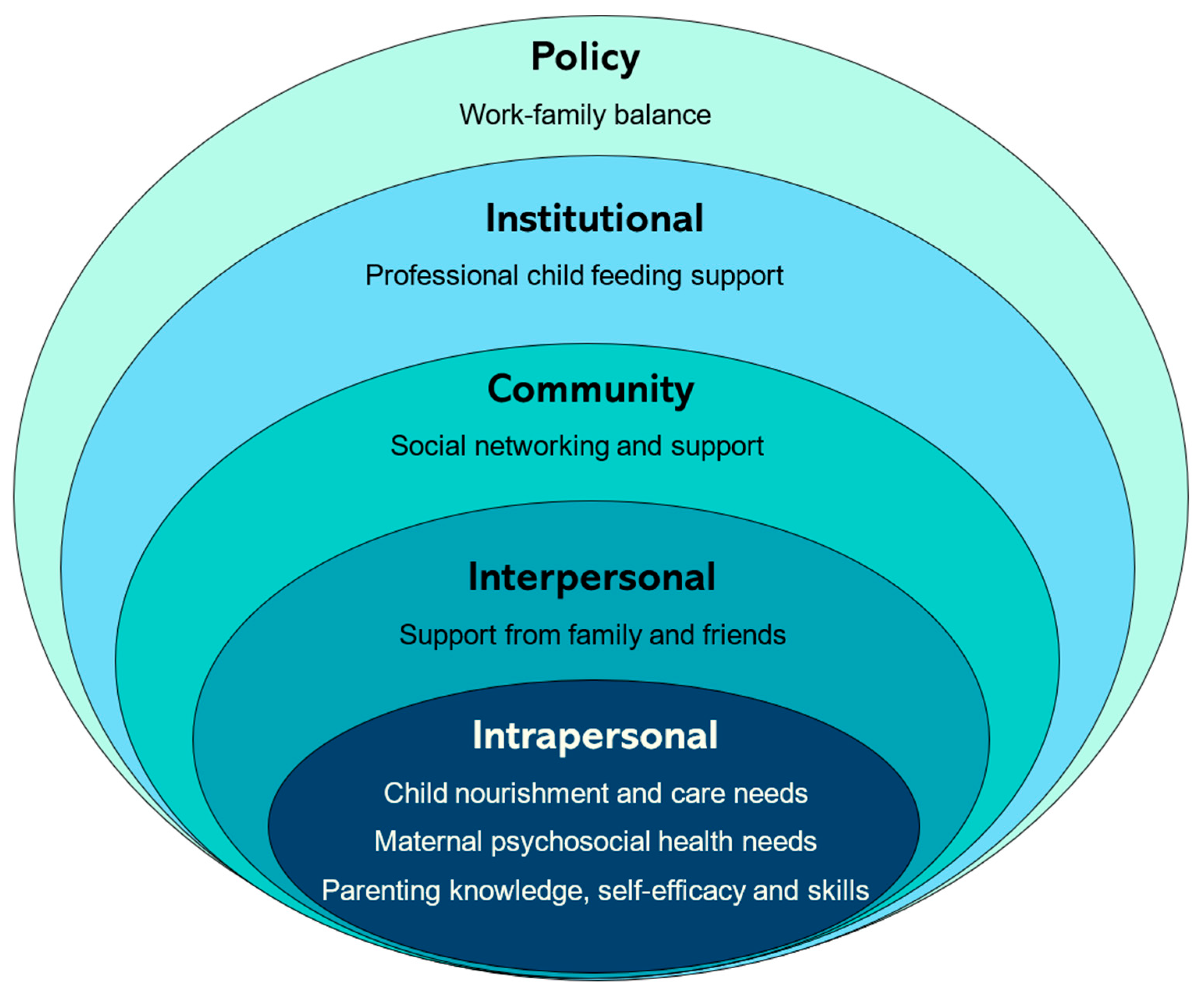
2.1. Theoretical Framework
2.2. Study Design, Setting, and Participants
2.3. Data Collection
2.4. Data Analyses
2.5. Ethical Considerations
3. Results
3.1. Study Themes
3.2. Theme 1: Infant and Young Child Feeding and Care Needs
JE: So, um. Being a pediatrician, I thought I knew how to do it. But being a first-time mom, I clearly did not know what I was doing. And so had a lot of pain and damage and latch issues early on.
VR: So I had a goal to breastfeed my son before he was born, and he also had a tongue tie. It was very frustrating at first, but I kept trying, and I would talk to his pediatrician, and we had a lactation consultant at his pediatrician’s office. I remember I gave him just 2 ounces of formula, and I felt so bad, because my goal was really to breastfeed him. They introduced me to a nipple shield which helped a lot, so we were able to breastfeed without him having a procedure. I pump when I’m at work. He’s almost 10 and a half months, and my supply has been dipping recently, so it’s been more feelings of stress to make it to our goal of a year.
AR: Since the AAP raised the breastfeeding guideline to two years, I tried to find high-quality information to justify continuing, but it was really hard. I read a lot online, even doom-scrolled, and talked to my pediatrician and a lactation consultant. My doctor eventually said the two-year recommendation was based on WHO guidance for global populations, not necessarily ours, since we have access to other nutritious foods.
EC: And also you should look into the formula feeding guides. They should try to give information on what to choose, like the right formula, and then how to prepare the bottle for the child and also try to manage the formula feeding.
AF: Okay, so when we were in the hospital, they gave us Enfamil. And he (my son) rejected Enfamil. He’s a very picky baby so Enfamil, he could not take and we had to switch to Similac. And Similac Sensitive was the only one that he would take. We would try you know different ones, but Similac Sensitive was the only one he wanted. And so when it came to the WIC, in order for me to get the only formula that he can drink, which is Similac, I had to get a doctor’s note to prove to them like, hey, the baby is only drinking this and this is what we can only give him. And so if I didn’t have that doctor’s note, they weren’t going to be able to supply me with that specific formula. I would have had to have 20 plus dollars out of pocket every time for each can. And it’s only like 12 ounces in a can of powder. And so I’m like, $20 for 12 ounces, that’s gone within three, four days. And so imagine having to buy four or five cans every week and that gets pretty expensive.
CC: I do wish, like my doctor gave more specifics about the food, like, what foods to try first, and when and what to do, like what to look for allergies. That sort of thing. Uh, or at least point me to resources. And there’s a million things on the Internet, but what are the most reliable sources? Or point me towards like the better like things to read in terms of like being valid or researched.
JE: Making sure he has a healthy diet is a top concern. I am not always the most healthy diet person. I’m definitely a chicken tenders and French fries girl, which I blame my mom for, but that’s okay. And so, of course, that’s what we eat a lot at home. I’m not the biggest veggie eater. And so I’m just trying to be very mindful of what I feed him and trying to not you know just give him chicken nuggets and French fries but expand all of those things.
PW: So child development also is very important. And when to know that your child is developing in the right way, or when you need to ask, or when you need to be concerned in case of anything. Because I’ve not seen, like, so far, any information about that. I just rely on what I Google online, because sometimes you might have concerns. But you just have to Google and check, but you don’t know even if that’s a reliable source that gives you that information. I’m just nervous, because I want to know if she’s meeting her milestones at the specific age, if she’s having the right weight, because sometimes you go, they tell you ‘Oh, she’s not meeting her milestones’, so it’s very stressful for a mother. So that is what I usually worry about meeting milestones and just being healthy because it can be stressful when they are not healthy, and especially if you don’t know what the problem is.
EF: What a mother is always afraid of is when you give birth to your child at that early stage, then you lose your child. That is the most painful thing.
3.3. Theme 2: Maternal Psychosocial Needs
DC: But, like, you know, when you finally have your baby, and you know, this is actually reality. No one tells you really, that postpartum depression hits you like a train. You just don’t feel like yourself, and then you’re left wondering, you know, like, is this normal? Will this ever, you know, get better? And thankfully, you know they do have treatment, but I think something that would be better, or at least for me, I wish there was some kind of information that I was given about postpartum depression and like options sooner before I was like 2 months into it and miserably, you reached out to the doctor and got help.
CH: I think I did have more of a postpartum depression period where I felt just different, and like um. It was really hard to enjoy that time with the baby when my hormones were just out of whack! After having my baby my own wellbeing kind of took a backseat. There were days I felt isolated and emotionally drained, when I didn’t feel like I had the space or time to prioritize self-care. I think a lot of moms go through that, but don’t always talk about it.
3.4. Theme 3: Parenting Knowledge, Self-Efficacy, and Skills
EC: I would be interested in like child development courses and some parenting skills. I would prefer some online resources like there should be parenting books and online parenting courses. If possible, there should be online parenting apps which can actually help some new parents.
C: I did some training before the birth of my child. There also was a Lactation Center nearby, called the Care Connection, that did the infant CPR and a breastfeeding class. So those are all great in person things where you could talk to other people. You actually had like a doll, or like a dummy, you know, to play with, uh to practice with. You can practice like swaddling a baby. All of that, I think, is really helpful. But again, like the hands on, once you have the child, you still need another refresh, or a person that’s right there with you in the hospital, too, to support you, so I think both are important for different reasons. But um, in person trainings and interacting with other moms is so helpful, so they can share their experiences.
3.5. Theme 4: Support from Family and Friends
LB: I think I’ve lacked a lot of support. My partner works um he works an hour and a half away from where we live. So he commutes about three hours a day, which is a lot. So he’s gone from like 5:30 in the morning until 8:30 at night. So I’m with the baby all day, which I love. And I love that I have this time. I’m still on leave, which is amazing up until a year. So I feel really fortunate that I have this time with him, but I definitely feel like I don’t have a lot of support. And my parents have sadly passed. So my sisters will come down occasionally and the other side of my baby’s family is in the Midwest. So I don’t feel like I have that village to help. So a lot of it has fallen on me. And my partner is good when he has time off. He helps with like meal preparation, cleaning, and he’s really amazing about all of that stuff but during the week, I definitely take on those roles um and so It can kind of get to me where I definitely require time to myself to help relax my mind and to process things. And so that’s been a challenge for me not having that time. So yeah, it does fall a lot on me. And I definitely think like You know, they say it takes a village. And I think when you don’t have that village, your mental health does suffer a little bit. Like we all need support.
LB: So that’s been a struggle just because, like my partner is a little bit more lax about things. So getting him to be on the same page as me and also dealing with like the in-laws and them having their opinions around like oh you should be adding rice cereal to his milk. It’ll make him sleep better. And I’m like, I don’t like the arsenic levels in the rice cereal. You know, like there’s just a lot of things that people did 50 years ago that they don’t do now. It’s hard to talk to people about that and have them understand where you’re coming from without them finding it disrespectful. So those conversations were challenging. But also just having to like be firm in my boundaries and like my child’s health is the most important thing. And so I’ve had to like put my foot down about some things and then I worry like, oh, if I leave him alone with them, are they going to just do it anyways, which luckily they live in Chicago, while I’m on the West Coast. So they’re not close by. So that’s a nice boundary in itself too. That makes me worry less.
LC: mm, but now, interestingly enough, our nanny, she’s amazing, but what we are struggling with, with her is I think she’s scared to give my daughter, anything other than a pureed food. And I’m not really adhering to pureed or baby led weaning, it’s kind of like whatever we’re eating, just give it to her. I don’t really care and just monitor her. But she’s absolutely terrified to give her anything that’s not pureed and like a stage 1 baby food kind of thing, so I’m struggling with like, how do we educate the nanny of like what is appropriate? Are we holding back development, you know, in terms of her trying different textures because the nanny that’s with her 50% of the time, won’t give her what I feel like is appropriate. Umm we did have to have a conversation with the nanny about like, you know if she’s more cranky or more hungry, here are other things to try because the nanny at one point was using like way more milk, to the point we were digging into my freezer supply during the day umm but not the days where the baby was only with my husband, it was only when the nanny was there we were having to dip into the freezer because she was feeding her so much milk. And so we kinda had to do some education of like, okay here’s what we’re gonna do instead of tanking mom’s milk supply because we’re trying to quiet the baby who won’t take a pacifier. And so, we’ve had some of the same struggles but it’s been a journey for sure.
3.6. Theme 5: Social Norms, Networking, and Support in the Community
PW: For breastfeeding, like in my culture, you’re not supposed to breastfeed like in front of people. You have to go somewhere, or you have to cover yourself, which is something I had not also expected or seen before, because when you talk to other people they’d be like, ‘Oh, when the child is hungry, just feed them’. But then there’s a cultural difference. You can’t just feed the baby anywhere. You have to look for a secure place, then sit down and maybe cover yourself, then feed the baby there.
CC: And there was actually this pressure to exclusively breastfeed. But it wasn’t working for us. Well, even though it was the right decision that I made, I felt a lot of judging around it.
AR: I think raising her in a society or bubble, I guess, of like good people is very important to me. I’m very surrounded by the federal government and government employees, politics. And kind of the hatred directed at us and it’s really, really hard for me to think about how to raise her in a society that has the values that I want to impart and avoid the values that I don’t want. And when it seems to me like we’re so surrounded by views that I find abhorrent. It scares me about like how to not raise her that way.
3.7. Theme 6: Support from Health and Childcare Systems and Personnel
OA: So for me, the hospital I was registered at had a special program called the Healthy Beginnings where they have, like, a home nurse who comes to visit you before and during pregnancy and after birth, and even right after the baby is born. She still visits till now. So she made available so many resources, information, and all of those things, and I remember, after I got back from the hospital, in one of our visits, she discovered that my blood pressure was really high, and she sent me back to the hospital. And with such resources. It saved my life at least, and I know that for many others who are in the network the different nurses at the Healthy Beginnings program help the patients with food related information, information in terms of how to take care of the baby. They provide pamphlets that contain information on what to expect postpartum in terms of milestone for the kids, and all those things.
JE: And I think one of the issues that I ran into with breastfeeding was when he moved up in classrooms at daycare, they were pretty adamant that like “breast bottles and breast milk was done.” And he literally turned one and moved up like three days later. And I was like, well, I can get down with taking the bottles away because like I said, I’m in healthcare, so I wanted to get rid of the bottle, but I had pumped like 400 ounces of breast milk. And I was like, I want him to get this breast milk. And so it was a little bit of a challenge with the daycare.
3.8. Theme 7: Work-Related and Social Policies
EF: The house chores were stressful, then the household meal preparation too. Because I wouldn’t have the time to prepare meals for my baby and all of that, then also check up on myself. It was always so tiring. When my baby falls asleep, that’s the only time I can squeeze just to manage to prepare something for my own self and also try to prepare food that when my spouse comes back he can go on with that. So the challenge was always too much on me.
DC: And then I also found it hard to return to work after having my baby. I just had no motivation to, you know, even attempt to go back. And even though I was working remotely, I still didn’t have the energy or desire to go back to work. And then, of course, the work–family balance as well—once I finally started going back to work, it was also difficult because it seems like with your baby, it’s never done. There’s always something they need. It’s the never-ending task of being a mom, I guess. And I love every second of it, don’t get me wrong, but it does make it harder to find that balance between work, taking care of the baby, and quality time with your family.
Yeah, when it came to the maternity leave, it was really limited. I only had a short time, and even that wasn’t fully paid, which added a lot of financial stress. It felt like I was being pushed to recover and return to work before I was emotionally ready. I also struggled with sick leave—it wasn’t always easy to take time off, and I constantly worried about job security. There just isn’t enough time for working parents.
4. Discussion
4.1. Intrapersonal Determinants
4.2. Interpersonal and Community Dynamics
4.3. Institutional and Workplace Barriers
4.4. Cross-Cutting Issues
5. Limitations
6. Conclusions
Supplementary Materials
Author Contributions
Funding
Institutional Review Board Statement
Informed Consent Statement
Data Availability Statement
Acknowledgments
Conflicts of Interest
References
- Organisation for Economic Co-operation and Development (OECD). Per Capita Health Expenditure in Selected Countries in 2022 (in U.S. Dollars); Statista: Hamburg, Germany, 2023; Available online: https://www.statista.com/statistics/236541/per-capita-health-expenditure-by-country/ (accessed on 16 September 2024).
- Ely, D.M.; Driscoll, A.K. Infant Mortality in the United States, 2022: Data From the Period Linked Birth/Infant Death File. In National Vital Statistics Reports; National Center for Health Statistics: Hyattsville, MD, USA, 2024. [Google Scholar] [CrossRef]
- Kim, H.J.; Min, K.B.; Jung, Y.J.; Min, J.Y. Disparities in infant mortality by payment source for delivery in the United States. Prev Med. 2021, 145, 106361. [Google Scholar] [CrossRef] [PubMed]
- Department of Health and Human Services. Maternal, Infant, and Child Health Workgroup Objectives. 2020. Available online: https://health.gov/healthypeople/about/workgroups/maternal-infant-and-child-health-workgroup (accessed on 24 September 2024).
- Fuentes-Afflick, E.; Perrin, J.M.; Moley, K.H.; Díaz, Á.; McCormick, M.C.; Lu, M.C. Optimizing health and well-being for women and children: Commentary highlights interventions and recommends key improvements in programs and policies to optimize health and well-being among women and children in the United States. Health Aff. 2021, 40, 212–218. [Google Scholar] [CrossRef]
- Department of Health and Human Services. Social Determinants of Health. Available online: https://health.gov/healthypeople/priority-areas/social-determinants-health (accessed on 24 September 2024).
- Marshall, N.E.; Abrams, B.; Barbour, L.A.; Catalano, P.; Christian, P.; Friedman, J.E.; Hay, W.W., Jr.; Hernandez, T.L.; Krebs, N.F.; Oken, E.; et al. The importance of nutrition in pregnancy and lactation: Lifelong consequences. Am. J. Obstet. Gynecol. 2022, 226, 607–632. [Google Scholar] [CrossRef] [PubMed] [PubMed Central]
- World Health Organization. Infant and Young Child Feeding; World Health Organization: Geneva, Switzerland, 2023. Available online: https://www.who.int/news-room/fact-sheets/detail/infant-and-young-child-feeding (accessed on 18 September 2024).
- U.S. Department of Agriculture; U.S. Department of Health and Human Services. Dietary Guidelines for Americans, 2020–2025, 9th ed.; U.S. Department of Agriculture: Washington, DC, USA; U.S. Department of Health and Human Services: Washington, DC, USA, 2020. Available online: https://www.dietaryguidelines.gov/ (accessed on 28 January 2024).
- Meek, J.Y.; Noble, L. Technical report: Breastfeeding and the use of human milk. Pediatrics 2022, 150, e2022057989. [Google Scholar] [CrossRef] [PubMed]
- Centers for Disease Control and Prevention. Breastfeeding Report Card United States, 2022; Centers for Disease Control and Prevention: Washington, DC, USA, 2022. [Google Scholar]
- Odom, E.C.; Li, R.; Scanlon, K.S.; Perrine, C.G.; Grummer-Strawn, L. Reasons for earlier than desired cessation of breastfeeding. Pediatrics 2013, 131, e726–e732. [Google Scholar] [CrossRef] [PubMed]
- Sriraman, N.K.; Kellams, A. Breastfeeding: What are the barriers? Why women struggle to achieve their goals. J. Womens Health 2016, 25, 714–722. [Google Scholar] [CrossRef] [PubMed]
- Feltner, C.; Weber, R.P.; Stuebe, A.; Grodensky, C.A.; Orr, C.; Viswanathan, M. Breastfeeding Programs and Policies, Breastfeeding Uptake, and Maternal Health Outcomes in Developed Countries; Agency for Healthcare Research and Quality (US): Rockville, MD, USA, 2018. [Google Scholar]
- Quintero, S.M.; Strassle, P.D.; Londoño, T.A.; Ponce, S.; Alhomsi, A.; Maldonado, A.I.; Ko, J.S.; Wilkerson, M.J.; Nápoles, A.M. Race/ethnicity-specific associations between breastfeeding information source and breastfeeding rates among U.S. women. BMC Public Health 2023, 23, 520. [Google Scholar] [CrossRef]
- Hoyt-Austin, M.S.; Dove, R.; Abrahão, Z.L.R.; Kair, E.B. Schwarz. Awareness that breastfeeding reduces breast cancer risk. Obstet. Gynecol. 2020, 136, 1154–1156. [Google Scholar] [CrossRef]
- Iwuagwu, C.; Chen, M.J.; Hoyt-Austin, A.E.; Kair, L.; Fix, M.; Schwarz, E.B. Awareness of the Maternal Health Benefits of Lactation Among U.S. Pregnant Individuals. Womens Health Issues 2024, 34, 283–290. [Google Scholar] [CrossRef] [PubMed]
- Centers for Disease Control and Prevention. Public Health Strategies for Breastfeeding; Centers for Disease Control and Prevention: Atlanta, GA, USA, 2025. Available online: https://www.cdc.gov/breastfeeding/php/breastfeeding-strategies/index.html (accessed on 30 November 2025).
- LFeldman-Winter, T.; Van, D.; Varadi, A.C.; Adams, B.; Kural, E.C.J. Rouw. Academy of Breastfeeding Medicine position statement: Breastfeeding as a basic human right. Breastfeed. Med. Off. J. Acad. Breastfeed. Med. 2022, 17, 633–634. [Google Scholar] [CrossRef]
- Chiang, K.V.; Hamner, H.C.; Li, R.; Perrine, C.G. Timing of Introduction of Complementary Foods—United States, 2016–2018. Morb. Mortal. Wkly. Rep. 2023, 69, 1969–1973. [Google Scholar] [CrossRef]
- Thompson, A.L. Evaluating the pathways linking complementary feeding practices to obesity in early life. Nutr. Rev. 2020, 78 (Suppl. 2), 13–24. [Google Scholar] [CrossRef] [PubMed] [PubMed Central]
- Ha, E.K.; Kim, J.H.; Baek, H.-S.; Lee, E.; Baek, J.H.; Shim, S.; Kim, Y.H.; Moreno, L.A.; Lee, S.W.; Han, M.Y. Association between complementary food introduction before age 4 months and body mass index at age 5–7 years: A retrospective population-based longitudinal cohort study. J. Hum. Nutr. Diet. 2023, 36, 787–797. [Google Scholar] [CrossRef]
- Juan, S. Maternal Health: Global Perspectives, Challenges and Issues; Women’s Issues; Nova Medicine and Health: New York, NY, USA, 2019. [Google Scholar]
- Office of the Surgeon General. The Surgeon General’s Call to Action to Improve Maternal Health; US Department of Health and Human Services: Washington, DC, USA, 2020. Available online: https://www.hhs.gov/sites/default/files/call-to-action-maternal-health.pdf (accessed on 24 September 2024).
- Marti-Castaner, M.; Pavlenko, T.; Engel, R.; Sanchez, K.; Crawford, A.E.; Brooks-Gunn, J.; Wimer, C. Poverty after Birth: How Mothers Experience and Navigate U.S. Safety Net Programs to Address Family Needs. J. Child Fam. Stud. 2022, 31, 2248–2265. [Google Scholar] [CrossRef] [PubMed] [PubMed Central]
- Gross, R.S.; Brown, N.M.; Mendelsohn, A.L.; Katzow, M.W.; Arana, M.M.; Messito, M.J. Maternal stress and infant feeding in hispanic families experiencing poverty. Acad. Pediatr. 2022, 22, 71–79. [Google Scholar] [CrossRef]
- Taylor, K.; Compton, S.; Kolenic, G.E.; Scott, J.; Becker, N.; Dalton, V.K.; Moniz, M.H. Financial Hardship Among Pregnant and Postpartum Women in the United States, 2013 to 2018. JAMA Netw Open 2021, 4, e2132103. [Google Scholar] [CrossRef]
- Schuler, B.R.; Shipe, S.L.; O’Reilly, N.; Uhl, A.; Vazquez, C.E.; Tripicchio, G.L.; Hernandez, D.C. Balancing nutrition and budgets: Socio-ecological impacts on nutritional environments of families with low incomes. Appetite 2024, 203, 107706. [Google Scholar] [CrossRef]
- Kent-Marvick, J.; Simonsen, S.; Pentecost, R.; Taylor, E.; McFarland, M.M. Loneliness in pregnant and postpartum people and parents of children aged 5 years or younger: A scoping review. Syst. Rev. 2022, 11, 196. [Google Scholar] [CrossRef]
- Honda, H.; Kita, T.; Hirano, M.; Saeki, K. A strategy to rescue mothers from isolated parenting: Development of the “social connectivity of mother with people in the community scale”. Child. Youth Serv. Rev. 2020, 118, 105395. [Google Scholar] [CrossRef]
- Lee, E. Experts and parenting culture. In Parenting Culture Studies; Springer International Publishing: Cham, Switzerland, 2023; pp. 69–97. [Google Scholar]
- Heller, R.L.; Chiero, J.D.; Trout, N.; Mobley, A.R. A qualitative study of providers’ perceptions of parental feeding practices of infants and toddlers to prevent childhood obesity. BMC Public Health 2021, 21, 1276. [Google Scholar] [CrossRef] [PubMed] [PubMed Central]
- Murthy, V. Parents Under Pressure: The US Surgeon General’s Advisory on the Mental Health & Well-Being of Parents. Available online: https://www.hhs.gov/sites/default/files/parents-under-pressure.pdf (accessed on 18 October 2024).
- Motlagh, M.E.; Mirzaei-Alavijeh, M.; Hosseini, S.N. Information Needs Assessment among Parents of Children with Cancer. Asian Pac. J. Cancer Prev. 2019, 20, 1865–1870. [Google Scholar] [CrossRef]
- Entsieh, A.A.; Hallström, I.K. First-time parents’ prenatal needs for early parenthood preparation-A systematic review and meta-synthesis of qualitative literature. Midwifery 2016, 39, 1–11. [Google Scholar] [CrossRef]
- Ciupitu-Plath, C.; Tietz, F.; Herzberg, J. Parent needs assessment instruments in neonatal intensive care units: Implications for parent education interventions. Patient Educ. Couns. 2021, 104, 2661–2669. [Google Scholar] [CrossRef]
- Pelentsov, L.J.; Laws, T.A.; Esterman, A.J. The supportive care needs of parents caring for a child with a rare disease: A scoping review. Disabil. Health J. 2015, 8, 475–491. [Google Scholar] [CrossRef]
- McLeroy, K.R.; Bibeau, D.; Steckler, A.; Glanz, K. An ecological perspective on health promotion programs. Health Educ. Q. 1988, 15, 351–377. [Google Scholar] [CrossRef]
- ATLAS.ti Scientific Software Development GmbH. ATLAS.ti (Version 25.0.33023); ATLAS.ti Scientific Software Development GmbH: Berlin, Germany, 2025. [Google Scholar]
- IBM Corp. IBM SPSS Statistics for Windows; Version 30.0; Computer Software; IBM Corp: Armonk, NY, USA, 2024. [Google Scholar]
- Gonzalez, J.M. A Guide to Measuring and Interpreting Attribute Importance. Patient 2019, 12, 287–295. [Google Scholar] [CrossRef] [PubMed]
- Siegel, A.F. Practical Business Statistics, 6th ed.; Elsevier Science & Technology: Burlington, VT, USA, 2011. [Google Scholar]
- Ward, K. Perceived Needs of Parents of Critically Ill Infants in a Neonatal Intensive Care Unit (NICU). Pediatr Nurs. 2001, 27, 281–286. [Google Scholar] [PubMed]
- Bully, P.; Artieta-Pinedo, I.; Paz-Pascual, C.; García-Álvarez, A.; Ema-Q Group; Espinosa, M. Development and Evaluation of the Psychometric Properties of a Digital Questionnaire for the Evaluation of Perinatal Psychosocial Needs. BMC Pregnancy Childbirth. 2023, 231, 736. [Google Scholar] [CrossRef] [PubMed] [PubMed Central]
- Modak, A.; Ronghe, V.; Gomase, K.P. The Psychological Benefits of Breastfeeding: Fostering Maternal Well-Being and Child Development. Cureus 2023, 15, e46730. [Google Scholar] [CrossRef] [PubMed] [PubMed Central]
- Biagianti, B.; Gripsrud, B.H. Breastfeeding, mutual gratification, and emotion self-regulation: Bridging gaps across object relations, drive-and attachment-based psychoanalytic theories. Psychoanal. Psychol. 2024, 41, 27–35. [Google Scholar] [CrossRef]
- Muneeswari, J. Mutual Interdependency during Breastfeeding: A Harmonious Exchange of Nourishment and Connection. Asian J. Nurs. Educ. Res. 2025, 15, 175–176. [Google Scholar] [CrossRef]
- Loewenberg Weisband, Y.; Keim, S.A.; Keder, L.M.; Geraghty, S.R.; Gallo, M.F. Early Breast Milk Pumping Intentions Among Postpartum Women. Breastfeed. Med. 2017, 12, 28–32. [Google Scholar] [CrossRef] [PubMed] [PubMed Central]
- Sağlik, M.; Karaçam, Z. Effectiveness of structured education and follow-up in the management of perceived breastmilk insufficiency: A randomized control trial. Health Care Women Int. 2023, 44, 276–294. [Google Scholar] [CrossRef] [PubMed]
- Whelan, C.; O’Brien, D.; Hyde, A. Mother’s Emotional Experiences of Breastfeeding with Primary Low Milk Supply in the First Four Months Postpartum: An Interpretative Phenomenological Analysis. Breastfeed. Med. 2024, 19, 197–207. [Google Scholar] [CrossRef] [PubMed]
- Frame, A.; Katari, P.; Wang, J.; Bagley, S.; Cook, Q. Impact of access to allergen-free food options through WIC on food allergy-related quality of life. Ann. Allergy Asthma Immunol. 2022, 129, S64. [Google Scholar] [CrossRef]
- Ayalasomayajula, S.; Herrera, Y.M.; Frank, H.E.; Guzman, L.E.; Fu, E.S.; Martínez, R.G.; Ramalho, B.; Blau, S.; Tovar, A. Leveraging Implementation Science to Identify and Address Facilitators and Barriers to WIC Enrollment, Participation, and Retention. J. Nutr. 2025, 155, 1246–1257. [Google Scholar] [CrossRef]
- Abrams, S.A.; Daniels, S.R. Protecting vulnerable infants by ensuring safe infant formula use. J. Pediatr. 2019, 211, 201–206. [Google Scholar] [CrossRef]
- SA Abrams, C.P. Duggan Infant and child formula shortages: Now is the time to prevent recurrences. Am. J. Clin. Nutr. 2022, 116, 289–292. [Google Scholar] [CrossRef]
- Graf, M.D.; Lutenbacher, M.; Wasser, H.; Dietrich, M.S.; Karp, S.M. Choking, allergic reactions, and pickiness: A qualitative study of maternal perceived threats and risk avoidance strategies during complementary feeding. Appetite 2022, 171, 105914. [Google Scholar] [CrossRef]
- US Preventive Services Task Force. Primary Care Behavioral Counseling Interventions to Support Breastfeeding: US Preventive Services Task Force Recommendation Statement. JAMA 2025, 333, 1520–1526. [Google Scholar] [CrossRef]
- Harris, G.; Mason, S. Are There Sensitive Periods for Food Acceptance in Infancy? Curr. Nutr. Rep. 2017, 6, 190–196. [Google Scholar] [CrossRef]
- Mott Poll Report: Top Health Concerns for 2025. C.S. Mott Children’s Hospital/University of Michigan Health. 2025. Available online: https://www.newswise.com/pdf_docs/175502925548531_081825_Top10.pdf (accessed on 15 August 2025).
- Majority of Parents Believe Children’s Physical and Mental Health is Getting Worse. News Release. Newswise. 2025. Available online: https://www.newswise.com/articles/majority-of-parents-believe-children-s-physical-and-mental-health-is-getting-worse/?sc=dwhr&xy=10026574 (accessed on 15 August 2025).
- Pew Research Center. Parenting in America Today; Pew Research Center: Washington, DC, USA, 2023. [Google Scholar]
- Ventura, A.K.; Drewelow, V.M. Knowledge and Use of Paced Bottle-Feeding Among Mothers of Young Infants. J. Nutr. Educ. Behav. 2023, 55, 796–802. [Google Scholar] [CrossRef] [PubMed]
- Paul, I.M.; Savage, J.S.; Anzman-Frasca, S.; Buxton, O.M.; Loken, E.; Paul, I.M. Effect of the INSIGHT Responsive Parenting Intervention on Rapid Infant Weight Gain and Overweight Status at Age 1 Year. Pediatrics 2022, 150, e2021055244. [Google Scholar] [CrossRef]
- Jiang, L.; Zhu, Z. Maternal mental health and social support from online communities during pregnancy. Health Soc. Care Community 2022, 30, e6332–e6344. [Google Scholar] [CrossRef] [PubMed] [PubMed Central]
- Shah, L.; Chua, J.Y.X.; Goh, Y.S.; Chee, C.Y.I.; Chong, S.C.; Mathews, J.; Lim, L.H.K.; Chan, Y.H.; Mörelius, E.; Shorey, S. Effectiveness of peer support interventions in improving mothers’ psychosocial well-being during the perinatal period: A systematic review and meta-analysis. Worldviews Evid. Based Nurs. 2024, 21, 652–664. [Google Scholar] [CrossRef] [PubMed]
- University of Illinois Chicago, Division of Specialized Care for Children (DSCC). Champaign-Urbana Healthy Beginnings. Available online: https://dscc.uic.edu/dscc_resource/champaign-urbana-healthy-beginnings/ (accessed on 30 October 2025).
- Li, B.; Jin, N.; Wang, Y.; Hou, X.; Meng, J.; Zhang, Y. Perinatal Women’s Perception of Maternal Health Information Quality on Digital Media: Scoping Review. J. Med. Internet Res. 2025, 27, e67620. [Google Scholar] [CrossRef] [PubMed] [PubMed Central]
- Interrante, J.D.; Admon, L.K.; Carroll, C.; Henning-Smith, C.; Chastain, P.; Kozhimannil, K.B. Association of Health Insurance, Geography, and Race and Ethnicity With Disparities in Receipt of Recommended Postpartum Care in the US. JAMA Health Forum 2022, 3, e223292. [Google Scholar] [CrossRef]
- Dressler, C.M.; Shreffler, K.M.; Wilhelm, I.R.; Price, J.R.; Gold, K.P. Maternal Satisfaction with Perinatal Care and Breastfeeding at 6 Months Postpartum. Int. J. Environ. Res. Public Health 2025, 22, 1246. [Google Scholar] [CrossRef]
- Vedam, S.; Stoll, K.; Taiwo, T.K.; Rubashkin, N.; Cheyney, M.; Strauss, N.; McLemore, M.; Cadena, M.; Nethery, E.; Rushton, E.; et al. The Giving Voice to Mothers study: Inequity and mistreatment during pregnancy and childbirth in the United States. Reprod. Health 2019, 16, 77. [Google Scholar] [CrossRef] [PubMed] [PubMed Central]
- Van Niel, M.S.; Bhatia, R.; Riano, N.S.; de Faria, L.; Catapano-Friedman, L.; Ravven, S.; Weissman, B.; Nzodom, C.; Alexander, A.; Budde, K.; et al. The Impact of Paid Maternity Leave on the Mental and Physical Health of Mothers and Children: A Review of the Literature and Policy Implications. Harv. Rev. Psychiatry 2020, 28, 113–126. [Google Scholar] [CrossRef] [PubMed]
- Rioux, C.; Childers-Rockey, Z.A.; Konkin, A.; Cameron, E.E.; Tomfohr-Madsen, L.; MacKinnon, A.L.; Watts, D.; Murray, J.; Pharazyn, A.; Roos, L.E. Parent preferences for peer connection in virtual mental health and parenting support platforms. J. Technol. Behav. Sci. 2025, 10, 1–6. [Google Scholar] [CrossRef]



| Socioecological Level | Emerging Themes | Maternal Needs | Weighted Mean Rank (SD) | N |
|---|---|---|---|---|
| Intrapersonal | Infant and young child feeding and care needs | Breastfeeding | ||
| ||||
| - Concerns about breast milk supply and adequacy, leading to over-pumping, and self-doubt | 3.47 (1.25) | 14 | ||
| - Maternal health and physiological barriers (hormonal imbalances, cracked nipples/mastitis) | 3.33 (1.40) | 15 | ||
| - Challenges with breast milk expression (aversion to pumping, exclusive pumping, breast pump attachment) | 3.20 (1.32) | 10 | ||
| - Expert breastfeeding guidance (quantities, duration, benefits and scientific basis for AAP recommendations on exclusive breastfeeding, breastfeeding goals and expectations) | 3.07 (1.25) | 15 | ||
| - Stress and burden of continuous breastfeeding | 3.17 (1.19) | 12 | ||
| - Aversion to breast milk expression | 3.00 (1.41) | 9 | ||
| - Challenges with establishing supply after supplementing with infant formula | 2.50 (1.08) | 10 | ||
| ||||
| - Latching, ill health, disability, breast milk aversion, distractibility | 3.71 (1.26) | 17 | ||
| Formula feeding | ||||
| ||||
| - Access and affordability barriers | 2.75 (0.71) | 8 | ||
| - Conflicting guidance and confusion in formula selection | 3.25 (1.04) | 8 | ||
| - Unintended early introduction of formula | 2.89 (0.78) | 9 | ||
| ||||
| - Infant rejection of formula and difficulty finding acceptable options | 3.14 (0.86) | 14 | ||
| - Allergies or negative reaction, with no options except breastfeeding | 3.27 (1.10) | 11 | ||
Complementary feeding | ||||
| ||||
| - Knowledge of right timing, type, amounts and procedures for introducing solids | 3.54 (1.13) | 13 | ||
| - Concern about food texture to prevent choking | 3.77 (1.17) | 13 | ||
| - Skills in food preparation and nutrition (child-appropriate, healthy, household meals/snacks, obesity prevention) | 3.37 (1.03) | 16 | ||
| - Concerns about long-term impacts of convenience foods | 3.00 (1.25) | 10 | ||
| - Modeling appropriate eating behavior | 3.55 (1.13) | 11 | ||
| - Conflict with popular infant feeding principles (e.g., baby-led weaning) | 2.90 (1.29) | 10 | ||
| ||||
| - Navigating food allergies | 3.55 (1.13) | 11 | ||
| - Rejection of complementary food, gagging, and picky eating | 3.25 (1.49) | 8 | ||
Child development, care, and health | ||||
| 3.70 (0.95) | 10 | ||
| 3.20 (0.79) | 10 | ||
| 3.27 (1.03) | 15 | ||
| 3.30 (0.82) | 10 | ||
| 3.58 (1.31) | 12 | ||
| 3.42 (1.17) | 12 | ||
| 3.67 (1.07) | 12 | ||
| 2.75 (1.29) | 12 | ||
| Maternal psychosocial needs |
| 3.42 (1.24) | 12 | |
| 3.50 (1.32) | 16 | ||
| 3.18 (1.24) | 17 | ||
| 3.22 (1.39) | 9 | ||
| 3.13 (1.13) | 15 | ||
| 3.21 (1.48) | 14 | ||
| 3.23 (1.42) | 13 | ||
| 3.15 (1.14) | 13 | ||
| 3.07 (1.14) | 14 | ||
| 2.77 (1.24) | 13 | ||
| Parenting knowledge, self-efficacy and skills |
| 3.33 (1.16) | 13 | |
| 3.00 (1.32) | 9 | ||
| 3.18 (1.25) | 11 | ||
| 3.43 (1.22) | 14 | ||
| 2.92 (1.19) | 13 | ||
| 3.29 (1.33) | 14 | ||
| 3.00 (1.35) | 12 | ||
| 2.64 (1.64) | 14 | ||
| 3.15 (1.14) | 13 | ||
| 3.29 (1.07) | 14 | ||
| Interpersonal needs | Support from family and friends |
| 3.08 (1.38) | 12 |
| 2.50 (1.18) | 10 | ||
| 2.82 (1.78) | 11 | ||
| 3.30 (1.16) | 10 | ||
| 2.89 (1.27) | 9 | ||
| 3.36 (1.15) | 14 | ||
| 3.55 (1.04) | 11 | ||
| Community-related needs | Social norms, networking, and support |
| 3.20 (1.14) | 10 |
| 3.11 (0.93) | 9 | ||
| 3.29 (1.27) | 14 | ||
| 2.83 (1.40) | 12 | ||
| 3.22 (1.20) | 9 | ||
| 3.19 (1.42) | 16 | ||
| 3.58 (1.24) | 12 | ||
| 3.36 (0.92) | 11 | ||
| Institutional needs | Support from health and childcare systems and personnel |
| 3.45 (1.13) | 11 |
| 3.17 (1.12) | 12 | ||
| 2.88 (0.99) | 8 | ||
| 2.91 (0.94) | 11 | ||
| 3.20 (1.14) | 10 | ||
| 3.00 (1.16) | 10 | ||
| 2.70 (1.49) | 10 | ||
| 3.22 (1.09) | 9 | ||
| 3.00 (0.71) | 9 | ||
| 3.00 (1.00) | 7 | ||
| 3.22 (1.39) | 9 | ||
| 2.86 (1.22) | 7 | ||
| 3.00 (1.31) | 8 | ||
| 2.17 (0.75) | 6 | ||
| 3.11 (1.45) | 9 | ||
| 2.63 (1.06) | 8 | ||
| 2.73 (1.19) | 11 | ||
| 2.78 (1.20) | 9 | ||
| Policy frameworks | Work-related policies |
| 3.69 (1.08) | 16 |
| 2.78 (1.48) | 9 | ||
| 3.22 (0.83) | 9 | ||
| 3.25 (1.22) | 12 | ||
| 2.90 (1.37) | 10 | ||
| 2.58 (1.31) | 12 | ||
| 2.67 (1.00) | 9 | ||
| 3.09 (0.94) | 11 |
Disclaimer/Publisher’s Note: The statements, opinions and data contained in all publications are solely those of the individual author(s) and contributor(s) and not of MDPI and/or the editor(s). MDPI and/or the editor(s) disclaim responsibility for any injury to people or property resulting from any ideas, methods, instructions or products referred to in the content. |
© 2025 by the authors. Licensee MDPI, Basel, Switzerland. This article is an open access article distributed under the terms and conditions of the Creative Commons Attribution (CC BY) license (https://creativecommons.org/licenses/by/4.0/).
Share and Cite
Sosanya, M.E.; Mueller, L.B.; Martin, C.; Temple, J.L. “What Do You Need?” Formative Research to Develop a Comprehensive Maternal Needs Assessment Tool for Infant and Young Child Nourishment and Care in the United States. Nutrients 2025, 17, 3825. https://doi.org/10.3390/nu17243825
Sosanya ME, Mueller LB, Martin C, Temple JL. “What Do You Need?” Formative Research to Develop a Comprehensive Maternal Needs Assessment Tool for Infant and Young Child Nourishment and Care in the United States. Nutrients. 2025; 17(24):3825. https://doi.org/10.3390/nu17243825
Chicago/Turabian StyleSosanya, Mercy Eloho, Laura Birgit Mueller, Caleb Martin, and Jennifer L. Temple. 2025. "“What Do You Need?” Formative Research to Develop a Comprehensive Maternal Needs Assessment Tool for Infant and Young Child Nourishment and Care in the United States" Nutrients 17, no. 24: 3825. https://doi.org/10.3390/nu17243825
APA StyleSosanya, M. E., Mueller, L. B., Martin, C., & Temple, J. L. (2025). “What Do You Need?” Formative Research to Develop a Comprehensive Maternal Needs Assessment Tool for Infant and Young Child Nourishment and Care in the United States. Nutrients, 17(24), 3825. https://doi.org/10.3390/nu17243825