1. Introduction
Since the beginning of the 21st century, the health of school-age children has been recognized as one of the key public health priorities worldwide [
1,
2,
3]. The physical and mental well-being of children, who are in a period of intensive development, is important not only for their individual functioning but also for the future human capital of society. Over the past two decades, children have increasingly struggled with various health problems, such as deteriorating eyesight, excessive weight, and mental health issues [
4]. In Poland, despite alarming rates of overweight and obesity among children [
5,
6], there is still a lack of research comprehensively analyzing the socio-demographic determinants of mothers’ feeding strategies. In particular, the interaction between family structure, the mother’s occupational status, and the number of children in the household has not yet been thoroughly investigated in this region. Health problems at school age are associated with negative consequences throughout life, increasing the risk of serious complications such as cardiovascular disease and type 2 diabetes [
7]. Longitudinal data from the Bogalusa Heart Study indicate that risk factors such as obesity and hypertension in children often persist into adulthood [
8]. In addition, these diseases generate increasing treatment costs and affect children’s social functioning through school absenteeism, educational losses, and reduced future productivity [
9].
The early development of healthy eating habits is crucial, as it determines energy balance, current body weight, and its changes in the long term [
10,
11]. Making the right dietary choices affects not only physical health but also the mental well-being and overall well-being of children [
10]. Parents play a special role in this process, as they create the eating environment that shapes taste preferences and attitudes towards food [
12,
13]. How mothers choose food products, what verbal and non-verbal messages they convey during meals, and how they regulate access to food have a significant impact on children’s behavior. Strategies of excessive control and pressure to eat can lead to overeating or selective eating, while positive patterns, such as modeling or supporting the child, promote the maintenance of a healthy body weight [
14,
15]. The Comprehensive Feeding Practices Questionnaire (CFPQ) is used to comprehensively assess parenting practices. It allows for the analysis of many dimensions of behavior and has been used in various cultural contexts [
16]. There are many tools designed to measure eating habits, preferences, and behaviors in children and parents (Child Feeding Questionnaire—CFQ or Parental Feeding Style Questionnaire—PFSQ) [
17,
18]. However, from the perspective of the proposed strategies, the CFPQ is particularly interesting, as it captures a broad spectrum of feeding practices and enables the identification of both supportive and potentially harmful approaches. The CFPQ subscales reflect different parenting styles. Encouragement and modeling are closer to a supportive approach, while control and food rewards are more associated with a restrictive style. This allows the tool to assess not only feeding practices but also parents’ broader approach to parenting.
The choice of feeding strategies is influenced by a wide range of factors: parents’ level of education, financial situation, cultural norms, food availability, and general living conditions [
19]. Although these factors are important and well-documented in the literature, not all of them can be captured in population-level studies. Therefore, this study focuses on three key socio-demographic determinants that directly shape the organization of family life and parenting decisions: family structure (single motherhood vs. co-parenting), maternal employment status (employed vs. not employed), and the number of children in the household. Research suggests that working mothers are more likely to use monitoring and modeling strategies, while not being employed encourages more frequent use of food as a reward or to regulate emotions [
20]. Similarly, having more children may be associated with less control over diet and difficulties in monitoring consumption [
21]. Although numerous studies have analyzed feeding practices in Western countries, there is still limited research examining how these three factors interact in Central and Eastern European contexts, including Poland. Although parental feeding practices have been the subject of numerous studies in Western countries [
22], the context of Central and Eastern Europe, including Poland, remains relatively poorly understood. Studies conducted in countries such as Croatia [
23] emphasize the importance of cultural and social factors in shaping feeding practices.
Filling this research gap is crucial for designing effective and context-specific interventions that promote healthy eating habits among children. Therefore, the aim of this study was to comprehensively analyze the feeding practices of mothers of school-age children in the Pomeranian Province, with particular emphasis on their links to three socio-demographic factors.
3. Result
3.1. General Characteristics of Maternal Feeding Strategies
The study evaluated eight strategies related to control and regulation of eating behavior: monitoring, emotion regulation, control, environment, food as a reward, encouragement, modeling, and restriction for health.
As shown in
Table 3, the strategies most frequently used by mothers were encouragement and modeling, which achieved the highest mean scores. In contrast, monitoring was the least frequently reported strategy among the studied feeding practices. This means that mothers most often used precisely these parenting strategies in the context of nutrition, that is, they used encouraging the child to try new foods and participate in preparing meals. On the other hand, modeling often presented positive nutrition patterns in the family, such as eating healthy foods in the presence of the child and talking about their benefits. In contrast, the lowest mean value was observed for monitoring (
6.83), which may indicate that mothers are less likely to use strategies that involve active control over what and how often the child eats—especially with regard to products considered unhealthy, such as sweets and salty snacks. The results suggest that the surveyed group is most likely to base their strategies on encouraging and promoting appropriate eating behaviors, thus limiting the benefits of controlling and monitoring (
Table 3).
3.2. Statistical Analysis of the Distribution of Responses Among Mothers Regarding Children’s Feeding Behavior
In the analysis of mothers’ eating behaviors toward their children, a number of important attitudes and habits were identified that may have a significant impact on the formation of children’s preferences and lifestyles. Based on the results obtained and the chi-square test (χ2) conducted, it was found that the distribution of responses for all 16 questions differed significantly from the random distribution (p < 0.05), confirming that the mothers surveyed present clear, well-established behavioral patterns.
Analysis of the mothers’ responses regarding their children’s eating behaviors revealed a range of ambivalent and varied strategies. The results from the monitoring subscale indicate that many mothers report being aware of the amount and frequency of their child’s consumption of sweets and salty snacks, suggesting active monitoring of these dietary aspects. At the same time, however, there is a noticeable tendency to use food as a tool for regulating emotions, both in the context of boredom and sadness—by offering food to the child regardless of perceived hunger. Among the mothers surveyed, the practice of giving in to the child’s preferences—such as preparing alternative meals when the child does not accept what has been served or allowing the child to freely choose food—is quite common. Analysis of responses revealed several key patterns. A majority of mothers reported frequently accommodating their child’s food preferences, with over half (58.6%) often or very often allowing the child to eat what they want. Furthermore, more than one-third of mothers frequently prepared an alternative meal if the child disliked what was served. These practices indicate a tendency to avoid conflict at mealtimes. Interestingly, despite this, a significant proportion of mothers also reported positive modeling behaviors, such as talking about the benefits of healthy food (
Table 4). This indicates an attempt to reduce conflict while weakening the dietary structure. On the other hand, many mothers show positive modeling, try to eat healthy in the presence of the child, talk to the child about the virtues of healthy food, and actively encourage the consumption of a variety of products. It is also worth noting the presence of inconsistent control strategies. Some mothers admit that they reward their child with sweets for good behavior while restricting their access to them in response to undesirable behavior (
Table 4).
3.3. Comparison of Parenting Strategies for Child Feeding According to Family Status (Joint Parenting with Father/Partner vs. Single Parenting)
The purpose of the analysis was to examine whether the mother’s family status of joint parenting with a partner/father or single parenting differentiates the use of parenting strategies for child nutrition. The results of a one-way analysis of variance (ANOVA) showed statistically significant differences (
p < 0.05) for four of the eight strategies studied. Mothers raising their children jointly with a partner/father had significantly higher scores for monitoring the child’s eating behavior, controlling eating, using food as a reward, and modeling proper eating habits. For the other strategies, no statistically significant differences were found between the groups. The results suggest that the presence of a second parent/guardian in the household may promote the use of more varied and active eating strategies, especially those requiring consistent monitoring and modeling of behavior (
Table 5).
3.4. Comparison of Parenting Strategies According to Mother’s Occupational Status
The next part of the study analyzed the association between maternal occupational status and the use of child feeding strategies. The analysis revealed significant differences in the strategies used by employed and non-employed mothers. Significant differences were indicated in the use of most of the studied feeding strategies according to the mother’s occupational status. Statistically significant differences (
p < 0.05) were observed for seven strategies: monitoring, regulation of emotions, environmental influence, use of food as a reward, encouragement, modeling, and health restrictions. Only for the control strategy was there no significant difference between groups (
p = 0.123). Working mothers had significantly higher levels of monitoring their children’s eating behavior, were more likely to encourage certain behaviors, were more active in modeling proper eating habits, and used health restrictions. In contrast, non-working mothers were more likely to use food in regulating emotions and to use food as a reward. The results suggest that a mother’s occupational status may significantly affect the choice and frequency of use of different parenting strategies in raising children. These differences may be due to different patterns of time organization, access to resources, and dietary priorities depending on the work situation. The results of the survey indicate the need to consider parents’ professional contexts in child nutrition education programs (
Table 6).
3.5. Differences in Parenting Strategies According to the Number of Children in the Family
The final component of the comparative analysis was to see if the number of children in the family differentiated the use of parenting strategies in the area of nutrition. For this purpose, eight one-way analyses of variance (ANOVAs) were conducted, with the number of children in the household as the grouping factor. Seven of the eight strategies analyzed showed statistically significant differences between parent groups (p < 0.05). Only the encourage strategy showed no significant differences (p > 0.05). To further identify the source of the differences, post hoc (Tukey) tests were conducted to determine between which groups there were significant differences. After post hoc analysis, for the control strategy, the test showed significant differences between parents with four or more children and parents of only children (p = 0.002) and between parents with two children and parents of only children (p = 0.000). There was also a significant difference between parents of only children and parents of three children (p = 0.0115). This means that parents of only children use the control strategy significantly less intensively than parents with more children. For the emotion regulation strategy, there is a significant difference between two children and one child (p = 0.0001) and between one and three children (p = 0.0017). This allows us to conclude that parents with two or three children are more likely to use the emotion regulation strategy than parents of only children. In this case, the other comparisons showed no statistically significant differences. For the food as a reward strategy, there is a significant difference between two children and one child (p = 0.0003) and between one and three children (p = 0.0078). Parents of two and three children are more likely to use food as a reward than parents of only children. Other comparisons by number of children in the household were not statistically significant. For the environment strategy, there was a significant difference between one and two children in the household (p = 0.0037), as well as between one and three children (p = 0.0303). Parents with two and three children are more likely to target environmental factors (e.g., food availability, environment) than parents of only children. For monitoring strategies, the Tukey test revealed significant differences in two cases: when parents have four or more children compared to one child (p = 0.0435) and when there are two children in the family compared to one child (p = 0.0033). The analysis shows that parents of only children are less likely to monitor their child’s eating behavior than parents with more children.
3.6. Relationships of Feeding Strategies
The next stage of the analysis examined the co-occurrence of different child feeding strategies. Spearman’s coefficients were used to assess the relationships between specific strategies. This was justified due to the non-normal distribution of the variables and the ordinal nature of some of the data, confirmed by the Shapiro–Wilk test. The results indicate the existence of consistent patterns of parenting behavior, which can form the basis for further factor analyses or cluster analysis. Eight strategies, including monitoring, emotion regulation, control, environment, food as a reward, encouragement, modeling, and restriction for health, were analyzed to examine the co-occurrence of different feeding strategies. All variables were measured on numerical scales. The results showed that all strategies were significantly positively correlated with each other (
p < 0.05), indicating a tendency for parents to use different parenting approaches together. The strongest correlations were noted between control vs. emotion regulation, control vs. environment, control vs. food as a reward, and environment vs. food as a reward. The values of the correlation coefficients suggest that strategies of a directing or regulating nature often co-occur. Parents who use control simultaneously monitor their child’s environment and use food as a reward tool (
Table 7).
3.7. Identification of Patterns of Parents’ Feeding Strategies—K-Means Cluster Analysis
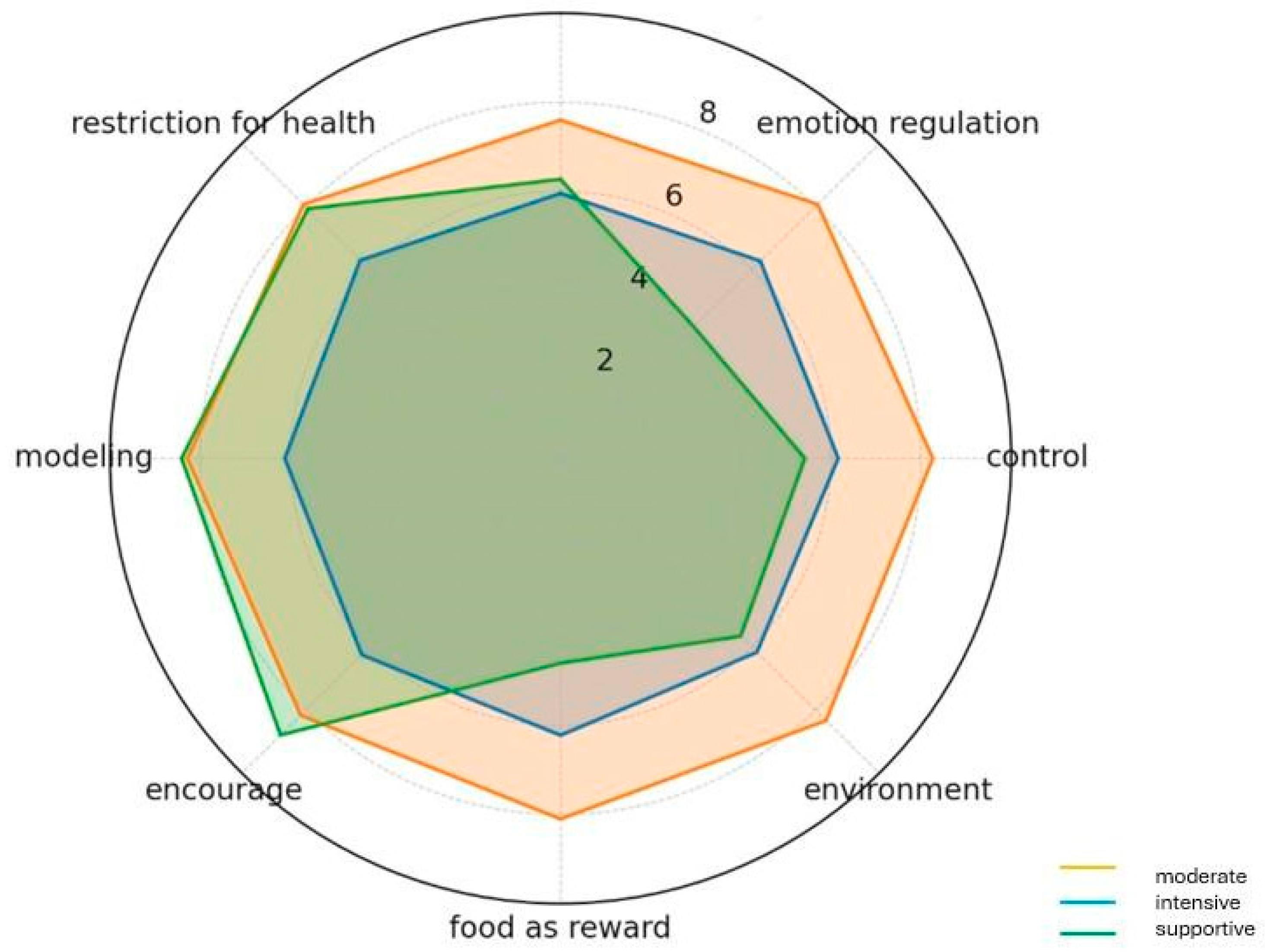
Finally, as a summary of the parenting strategies analyzed, an attempt was made to identify patterns of parenting strategies used based on k-means cluster analysis (K-means). The data were previously standardized. Three sets were proposed. Each of the identified sets was described on the basis of the mean values of the variables included in the analysis, which made it possible to identify three distinct parenting profiles:
Set 0—Moderate: average intensity of all strategies, no dominant approach—possible interpretation as balanced or adaptive parenting.
Set 1—Intensely Directing: high intensity in all strategies, especially controlling and supportive, suggesting a high-involvement and structure-based style.
Set 2—Emotional-supportive: high intensity in positive reinforcement strategies (encouragement, modeling), low use of control and regulation of emotions by eating.
Based on the silhouette factor, three profiles were identified as child-feeding parenting strategies.
The characteristics of this set are the average values of strategies oscillating around 6. Neither the control strategy nor the support strategy is dominant, which may indicate a balanced parenting strategy or a flexible approach with no clear dominance of one strategy.
Parents belonging to this set were characterized by high values in all analyzed strategies, in particular control (8.26), environment (8.33), emotion regulation (8.07), and monitoring (7.60). Also high in supportive strategies: encourage (8.16) and modeling (8.28). This profile may correspond to a parenting strategy with a high degree of involvement and control over the child’s environment and emotions.
Parents in this set use very high support and modeling: encouragement (8.79), modeling (8.41), low emotion regulation (4.18), and food as a reward (4.60). Medium monitoring and control. This may be indicative of a parenting strategy based on positive reinforcement and one’s own example, without relying on the tools of control or food as a reward.
The analysis revealed the presence of three distinct parenting profiles, varying in intensity and type of strategies used. These profiles are not merely statistical constructs but represent coherent and meaningful patterns of feeding practices. The ‘Intensely Directing’ profile reflects a highly structured, parent-centered approach, while the ‘Emotional-Supportive’ profile represents a more child-centered, autonomy-supportive style. The ‘Moderate’ group likely employs a flexible, context-dependent mix of strategies. The identified parenting strategies can provide a basis for developing more tailored educational and preventive programs for parents (
Figure 1). Knowing that some parents use an intensely controlling approach, others a moderate approach, and still others an approach based primarily on support and modeling allows the content and methods of intervention to be tailored to the needs of each group. For instance, the ‘Intensely Directing’ group might benefit from guidance on fostering healthy child autonomy, while the ‘Emotional-Supportive’ group could be reinforced in their positive modeling behaviors. This makes it possible to more effectively support the formation of healthy eating habits for children.
4. Discussion
This study identified the feeding strategies most frequently used by mothers of school-aged children. Encouragement (
7.60) and modeling (
7.56) obtained the highest mean scores, suggesting that mothers in our sample favor supportive approaches to shaping their children’s eating habits. Similar results were reported by Vandenplas et al. and Mazza et al. [
30]. From a practical perspective, these strategies should be emphasized in public health interventions, as they strengthen positive behaviors without coercion.
Monitoring was the least frequent strategy (
6.83). Although less common, previous research indicates that even limited monitoring may positively influence children’s dietary patterns [
31]. In our study, about one-third of mothers were aware of their children’s consumption of sweets and salty snacks. This finding aligns with previous studies using the CFPQ [
32], suggesting that improving parental supervision could help reduce unhealthy snacking. These monitoring practices do not operate in isolation; parental strategies are often intertwined with emotional regulation and broader patterns of feeding behavior.
The strongest correlations were observed between emotion regulation and food as a reward and between control and emotion regulation. These findings are consistent with earlier studies showing that food-based emotion regulation is associated with weaker self-regulation in children [
33,
34]. Our results confirm that feeding strategies are not isolated but occur in patterns shaped by maternal emotional responses. Practically, this highlights the importance of supporting mothers in managing stress and emotions to prevent reliance on food as a tool for control or comfort.
The use of food as a reward emerged as a recurring theme. Mothers reported offering sweets when children were bored or sad, reflecting emotional feeding. Prior studies showed that these practices may increase caloric intake and promote emotional overeating [
35,
36,
37]. Such mechanisms can impair children’s ability to self-regulate intake and should be discouraged. Public health programs should provide parents with alternative ways to reinforce positive behavior.
Children’s preferences also strongly influenced family practices. Some mothers allowed children to dictate food choices or prepared alternative meals when a dish was rejected. While this supports autonomy, it may encourage unhealthy eating. Greater availability of sweets and snacks at home, reported by many mothers, may further reduce diet quality [
38]. On the other hand, involving children in cooking was common and aligns with previous findings that helping in the kitchen supports healthier food preferences [
39]. These results suggest that interventions should encourage shared meal planning while maintaining clear family rules on food choices.
Sociodemographic factors were associated with feeding strategies. Mothers raising children with a partner reported greater use of modeling and monitoring. This finding aligns with the work of Douglas et al. (2024), who highlighted that the presence of a co-parent facilitates a more consistent and structured feeding environment, allowing for better monitoring and positive role modeling [
40]. Working mothers scored higher across most supportive subscales (monitoring, encouragement, and modeling), a pattern also observed by Brito et al. (2024) in a large Brazilian cohort [
41]. Mothers of only children reported less intensive use of control and monitoring compared to mothers with larger families. This is consistent with the findings of Hu et al. (2022), who suggested that as the number of children increases, parental resources and attention become diluted, which may lead to more frequent but less individualized control in response to household chaos [
42]. These findings suggest that family structure and workload shape feeding practices and should be considered when designing interventions. Beyond individual sociodemographic influences, these feeding behaviors tend to cluster into distinct patterns, which can help identify groups of mothers who may benefit from targeted interventions.
Cluster analysis distinguished three profiles of feeding strategies, comparable to those described in adolescent populations [
43]. These profiles have practical implications: “intensely directive” mothers may need guidance on balancing control with autonomy, the “moderate” group could benefit from reinforcement of positive strategies, while the “emotional-supportive” group should be encouraged to avoid permissive feeding. Tailoring educational programs to these profiles could improve their effectiveness.
The use of the validated CFPQ allowed a comprehensive assessment of diverse feeding practices. The relatively large sample adds value to our findings. However, several limitations must be acknowledged. First, the study relied on mothers’ self-reports, which may be affected by recall and social desirability bias. Second, the convenience of online samples limits representativeness, particularly regarding fathers and underrepresented groups. Third, no objective measures of children’s dietary intake were collected. Finally, the cross-sectional design prevents causal inferences between sociodemographic factors and maternal feeding practices. Additionally, the lack of exclusion criteria means that the sample may have included children with chronic diseases, medical dietary restrictions, or unusual care contexts. Such cases require specific nutritional strategies and may have introduced bias in comparisons between groups, limiting the interpretation of the results. Future studies should use longitudinal and observational methods, include more diverse samples, and consider variables such as income, education, and cultural background.
Our findings suggest that maternal feeding strategies are shaped both by personal factors (emotional regulation, responsiveness to children) and by family context (partnership status, employment, number of children). Public health programs should therefore address emotional aspects of caregiving, promote supportive strategies such as modeling and shared cooking, and discourage reward-based or permissive feeding. Tailoring interventions to parental profiles and family contexts may enhance their impact on the development of healthy eating habits in children. Based on the identified profiles, more targeted actions can be identified. For mothers who use an intensely directive approach, interventions that teach how to balance control with developing the child’s autonomy (e.g., psychological and nutritional workshops) may be beneficial. The emotionally supportive group, on the other hand, could be supported in maintaining positive modeling and encouragement through school programs or campaigns promoting joint meal preparation. The moderate profile, on the other hand, mainly requires reinforcement of existing practices, e.g., through simple educational materials and counseling in primary health care.