How Do Nutritionists/Dietitians Use Social Media to Communicate with Their Public? Global Perspectives on Social Media Practices: A Systematic Review
 ,
,  ,
,  and
and
Abstract
1. Introduction
2. Materials and Methods
2.1. Search Criteria and Strategy
2.2. Studies Selection
2.3. Eligibility Criteria
- Peer-reviewed studies published in English.
- Studies involving RNDs who act as content creators in any field of nutrition (e.g., sports nutrition, pediatric nutrition).
- Studies focused on the use of social media platforms.
- Studies with quantitative, qualitative or mixed methods designs.
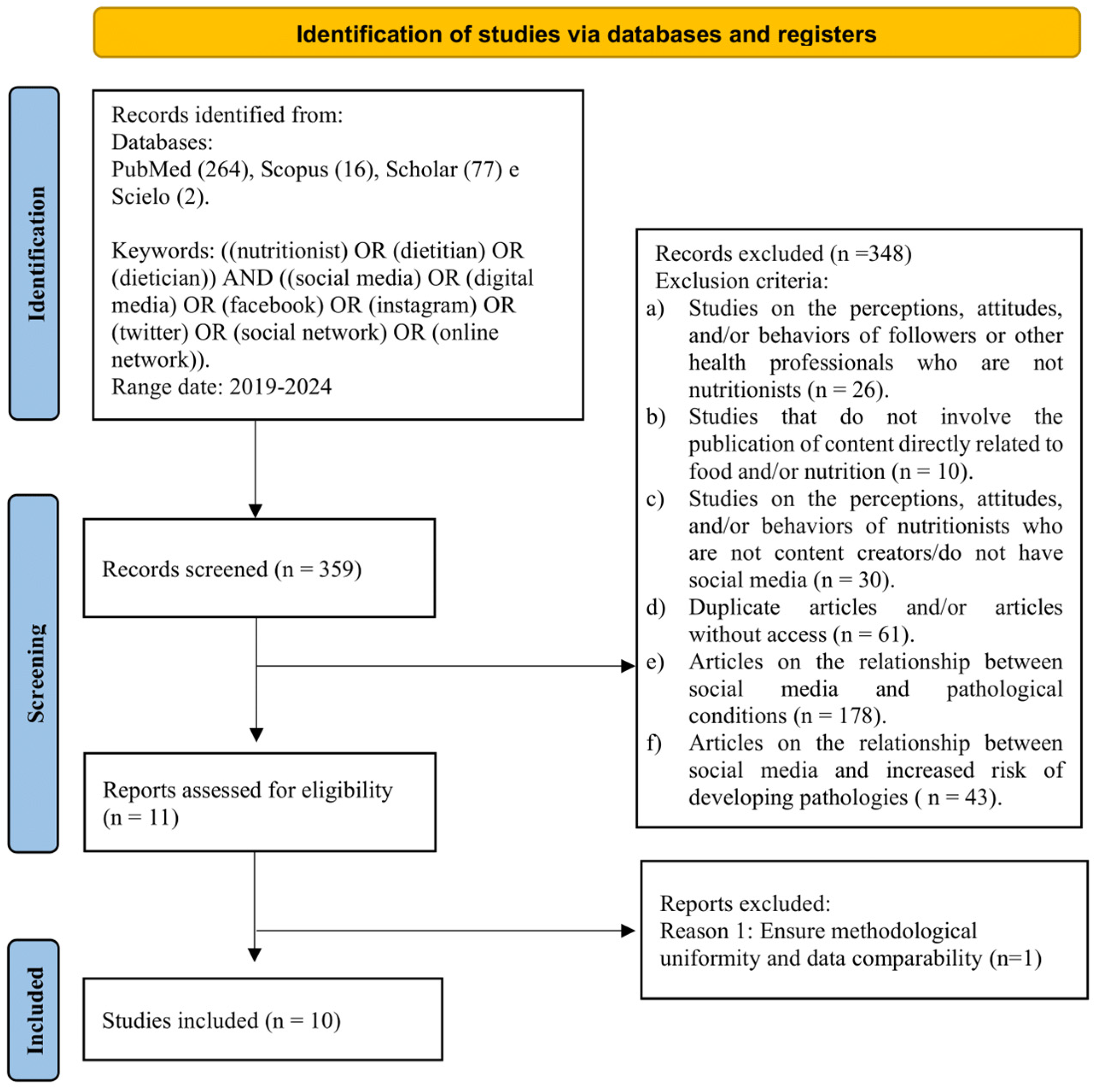
- Studies that did not involve the publication of content directly related to food and/or nutrition.
- Studies in which content creators did not use social media.
- Studies focusing on the relationship between social media and pathological conditions or increased risk of developing pathologies.
2.4. Quality Assessment
2.5. Data Extraction and Synthesis
3. Results
3.1. Literature Search
3.2. Quality Scores of Studies
3.3. Characteristics of the Included Studies
3.4. Profiles of the RNDs Participants by Gender and Age
3.5. Analysis of Social Media Practices and Use
3.6. Themes and Shared Content
3.7. Attitudes and Opinions of RNDs Regarding Social Media
3.7.1. Social Media Skills
3.7.2. Importance of Social Media for RND’s Careers
3.7.3. Ethical Practices for Social Media
4. Discussion
5. Conclusions
Author Contributions
Funding
Data Availability Statement
Conflicts of Interest
Abbreviations
| RNDs | Registered Nutritionists and Dietitians |
| MMAT | Mixed Methods Appraisal Tool |
| HPCSA | Health Professions Council of South Africa |
References
- Saboia, I.; Almeida, A.; Sousa, P.; Pernencar, C. Dietitians and Nutritionists Behaviour on Social Media: A Scoping Literature Review. In Proceedings of the 13th International Joint Conference on Biomedical Engineering Systems and Technologies, Valletta, Malta, 24–26 February 2020; SCITEPRESS—Science and Technology Publications: Setúbal, Portugal, 2020; pp. 530–538. [Google Scholar]
- Chen, J.; Wang, Y. Social Media Use for Health Purposes: Systematic Review. J. Med. Internet Res. 2021, 23, e17917. [Google Scholar] [CrossRef] [Scilit]
- Moorhead, S.A.; Hazlett, D.E.; Harrison, L.; Carroll, J.K.; Irwin, A.; Hoving, C. A New Dimension of Health Care: Systematic Review of the Uses, Benefits, and Limitations of Social Media for Health Communication. J. Med. Internet Res. 2013, 15, e85. [Google Scholar] [CrossRef] [Scilit]
- Diekman, C.; Ryan, C.D.; Oliver, T.L. Misinformation and Disinformation in Food Science and Nutrition: Impact on Practice. J. Nutr. 2023, 153, 3–9. [Google Scholar] [CrossRef] [Scilit]
- Sbardelotto, J.; Martins, B.B.; Buss, C. Use of Social Networks in the Context of the Dietitian’s Practice in Brazil and Changes During the COVID-19 Pandemic: Exploratory Study. JMIR Form. Res. 2022, 6, e31533. [Google Scholar] [CrossRef] [Scilit]
- Bookari, K.; Arrish, J.; Alkhalaf, M.M.; Alharbi, M.H.; Zaher, S.; Alotaibi, H.M.; Tayyem, R.; Al-Awwad, N.; Qasrawi, R.; Allehdan, S.; et al. Perspectives and Practices of Dietitians with Regards to Social/Mass Media Use During the Transitions from Face-to-Face to Telenutrition in the Time of COVID-19: A Cross-Sectional Survey in 10 Arab Countries. Front. Public Health 2023, 11, 1–10. [Google Scholar] [CrossRef] [Scilit]
- Probst, Y.C.; Peng, Q. Social Media in Dietetics: Insights into Use and User Networks. Nutr. Diet. 2019, 76, 414–420. [Google Scholar] [CrossRef] [Scilit] [PubMed]
- Zielińska-Tomczak, Ł.; Przymuszała, P.; Tomczak, S.; Krzyśko-Pieczka, I.; Marciniak, R.; Cerbin-Koczorowska, M. How Do Dieticians on Instagram Teach? The Potential of the Kirkpatrick Model in the Evaluation of the Effectiveness of Nutritional Education in Social Media. Nutrients 2021, 13, 2005. [Google Scholar] [CrossRef] [Scilit] [PubMed]
- Squires, K.; Brighton, A.; Urquhart, L.; Kocanda, L.; Heaney, S. Informing Online Professional Dietetics Practice: The Development and Pilot Testing of the Social Media Evaluation Checklist. Nutr. Diet. 2023, 80, 351–361. [Google Scholar] [CrossRef] [Scilit]
- Saboia, I.; Pisco Almeida, A.M.; Sousa, P.; Pernencar, C.; Silva, R. What Are Dietitians and Nutritionists Doing on Social Media? A Proposal of an Online Survey. Procedia Comput. Sci. 2021, 181, 793–802. [Google Scholar] [CrossRef] [Scilit]
- Dunne, D.M.; Lefevre, C.; Cunniffe, B.; Tod, D.; Graeme, L.; Morton, J.P.; Murphy, R.; Dunne, D.M.; Lefevre, C.; Cunniffe, B.; et al. Performance Nutrition in the Digital Era—An Exploratory Study into the Use of Social Media by Sports Nutritionists. J. Sports Sci. 2019, 37, 2467–2474. [Google Scholar] [CrossRef] [Scilit]
- Khadem Al-Hoseini, M.; Lotfi, M.; Mohammadi, F.; Ferns, G.A.; Akbarzadeh, M. Opinions of Iranian Dietitians on Virtual Nutritional Consulting on the Instagram Platform: A Descriptive, Cross-Sectional Study. J. Health Sci. Surveill. Syst. 2023, 2019, 1–10. [Google Scholar]
- Liikkanen, J.; Virtanen, H.E.K.; Mikkonen, S.; Laitinen, A.L. The Role of Social Media in the Professional Sphere of Finnish Registered Dietitians. J. Hum. Nutr. Diet. 2024, 37, 726–736. [Google Scholar] [CrossRef] [Scilit]
- Visser, J.; van Niekerk, E.; Marais, M.; Koen, N. Social Media and Electronic Communication Usage by South African Dietitians. S. Afr. J. Clin. Nutr. 2024, 37, 97–105. [Google Scholar] [CrossRef] [Scilit]
- Hong, Q.; Pluye, P.; Fàbregues, S.; Bartlett, G.; Boardman, F.; Cargo, M.; Dagenais, P.; Pierre, M.; Griffiths, F.; Nicolau, B.; et al. Mixed Methods Appraisal Tool (MMAT), Version 2018 User Guide; McGill: Montreal, QC, Canada, 2018. [Google Scholar]
- Almutairi, M.; Simpson, A.; Khan, E.; Dickinson, T. The Value of Social Media Use in Improving Nursing Students’ Engagement: A Systematic Review. Nurse Educ. Pract. 2022, 64, 103455. [Google Scholar] [CrossRef] [Scilit]
- Dumas, A.-A.; Lapointe, A.; Desroches, S. Users, Uses, and Effects of Social Media in Dietetic Practice: Scoping Review of the Quantitative and Qualitative Evidence. J. Med. Internet Res. 2018, 20, e55. [Google Scholar] [CrossRef] [Scilit]
- Peregrin, T. Telehealth Is Transforming Health Care: What You Need to Know to Practice Telenutrition. J. Acad. Nutr. Diet. 2019, 119, 1916–1920. [Google Scholar] [CrossRef] [Scilit]
- Sahin, E.; Sanlier, N. Relationships among Nutrition Knowledge Level, Healthy Eating Obsessions, Body Image, and Social Media Usage in Females: A Cross—Sectional Study. BMC Public Health 2025, 25, 1711. [Google Scholar] [CrossRef] [Scilit] [PubMed]
- Barklamb, A.M.; Molenaar, A.; Brennan, L.; Evans, S.; Choong, J.; Herron, E.; Reid, M.; Mcca, T.A. Learning the Language of Social Media: A Comparison of Engagement Metrics and Social Social Media Accounts. Nutrients 2020, 12, 2839. [Google Scholar] [CrossRef] [Scilit] [PubMed]
- Klemm, S. Guidance for Professional Use of Social Media in Nutrition and Dietetics Practice. J. Acad. Nutr. Diet. 2022, 122, 403–409. [Google Scholar] [CrossRef] [Scilit] [PubMed]
- Vander Wyst, K.B.; Vercelli, M.E.; O’Brien, K.O.; Cooper, E.M.; Pressman, E.K.; Whisner, C.M. A Social Media Intervention to Improve Nutrition Knowledge and Behaviors of Low Income, Pregnant Adolescents and Adult Women. PLoS ONE 2019, 14, e0223120. [Google Scholar] [CrossRef] [Scilit]
- Shine, D.; Minehan, M.; Knight-Agarwal, C. #Healthpromotion: A Qualitative Exploration of How Dietitians Can Use Social Media to Positively Influence Women Aged 18–35 Years. Nutr. Diet. 2022, 79, 489–496. [Google Scholar] [CrossRef] [Scilit] [PubMed]
- Silva, P.; Lopes, F.; Ray, S. Nutrition and Food Literacy: Framing the Challenges to Health Communication. Nutrients 2023, 15, 4708. [Google Scholar] [CrossRef] [Scilit] [PubMed]
- Kabata, P.; Winniczuk-Kabata, D.; Maciej Kabata, P.; Ja’skiewicz, J.; Połom, K. Can Social Media Profiles Be a Reliable Source of Information on Nutrition and Dietetics? Healthcare 2022, 10, 397. [Google Scholar] [CrossRef] [Scilit] [PubMed]


| 4. Quantitative Descriptive Studies | 5. Mixed Methods Studies | Quality Score (%) | |||||||||
|---|---|---|---|---|---|---|---|---|---|---|---|
| References | 4.1 | 4.2 | 4.3 | 4.4 | 4.5 | 5.1 | 5.2 | 5.3 | 5.4 | 5.5 | |
| Dunne et al. (2019) [11] | Yes | Yes | Yes | Yes | Yes | 100% good | |||||
| Probst e Peng (2019) [7] | Yes | Yes | Yes | Yes | Yes | 100% good | |||||
| Zielińska-Tomczak et al. (2021) [8] | Yes | Yes | Yes | Yes | Yes | 100% good | |||||
| Saboia et al. (2021) [10] | Yes | No (pilot study) | Yes | No | No | 40% poor | |||||
| Sbardelotto et al. (2022) [5] | Yes | Yes | Yes | Yes | Yes | 100% good | |||||
| Khadem Al-Hoseini et al. (2023) [12] | Yes | No | Yes | Can’t tell | Yes | 60% fair | |||||
| Squires et al. (2023) [9] | Yes | Yes | Yes | Yes | Yes | 100% good | |||||
| Bookari et al. (2023) [6] | Yes | Can’t tell | Yes | Yes | Yes | 75% fair | |||||
| Liikkanen et al. (2024) [13] | Yes | No | Yes | Can’t tell | Yes | 60% fair | |||||
| Visser et al. (2024) [14] | Yes | Yes | Yes | Yes | Yes | 100% good | |||||
| Authors | Country | Journal | Study Design | Sample Size | Aim |
|---|---|---|---|---|---|
| Dunne et al. (2019) [11] | UK | Journal of Sports Sciences | Cross-sectional study (Online questionnaire) | 44 | Explore how sports nutritionists use social media and gather opinions and experiences regarding its use in professional practice. |
| Probst & Peng (2019) [7] | Australia | Nutrition & Dietetics | Cross-sectional study (Online questionnaire) | 340 | Determine the influence level of dietitians on social media and assess a metric tool (NodeXL) to measure this influence. |
| Zielińska-Tomczak et al. (2021) [8] | Poland | Nutrients | Cross-sectional study (Analysis of Instagram profiles) | 10 Instagram profiles | Examine the use of the Kirkpatrick Model versus the New World Kirkpatrick Model to evaluate the effectiveness of educational nutrition content shared on social media. |
| Saboia et al. (2021) [10] | Portugal | Procedia Computer Science (Conference paper) | Cross-sectional study (Literature review and questionnaire) | 30 | Describe the creation process of an online questionnaire for Portuguese dietitians/nutritionists using the Design Thinking method. |
| Sbardelotto et al. (2022) [5] | Brazil | JMIR Formative Research | Cross-sectional study (Online questionnaire) | 288 | Describe the role of social media in professional practice, dietitians’ perceptions and behavioural changes during the COVID-19 pandemic in Brazil. |
| Khadem Al-Hoseini et al. (2023) [12] | Iran | Research Square | Cross-sectional study (Online questionnaire) | 131 | Evaluate Iranian dietitians’ opinions on virtual nutrition counselling via Instagram. |
| Squires et al. (2023) [9] | Australia | Nutrition & Dietetics | Cross-sectional study (Checklist questionnaire) | 50 (25 RNDs & 25 SDs) | Develop a tool to assess the ethical and professional practices of dietitians and dietetic students on social media. |
| Bookari et al. (2023) [6] | Saudi Arabia | Frontiers in Public Health | Cross-sectional study (Questionnaire) | 2542 | Understand nutritionists’ perspectives and practices regarding the use of social and mass media during the shift to tele-nutrition in the COVID-19 era. |
| Liikkanen et al. (2024) [13] | Finland | Journal of Human Nutrition and Dietetics | Cross-sectional study (Online questionnaire) | 107 | Describe how Finnish dietitians use different social media channels in their professional practice and assess their digital competencies. |
| Visser et al. (2024) [14] | South Africa | South African Journal of Clinical Nutrition | Cross-sectional study (Online questionnaire & platform review) | 125 | Investigate the use of social media and electronic communication by South African dietitians and their adherence to the HPCSA ethical guidelines. |
| Authors | Gender | Age |
|---|---|---|
| Dunne et al. (2019) [11] | Not mentioned | Not mentioned |
| Probst & Peng (2019) [7] | Female: 97% Male: 3% | 26–35 years: 44.8% 36–45 years: 51% |
| Zielińska-Tomczak et al. (2021) [8] | Female: 90% Male: 10% | Not mentioned |
| Saboia et al. (2021) [10] | Female: 80% Male: 20% | Mean: 27 years |
| Sbardelotto et al. (2022) [5] | Female: 97.9% Male: 2.1% | Mean: 29 years |
| Khadem Al-Hoseini et al. (2023) [12] | Female: 87.8% Male: 12.2% | Mean: 30.8 years |
| Squires et al. (2023) [9] | Not mentioned | Not mentioned |
| Bookari et al. (2023) [6] | Female: 88.2% Male: 11.8% | 18–34 years: 67.1% 35–64 years: 32.6% ≥65 years: 0.3% |
| Liikkanen et al. (2024) [13] | Not mentioned | Mean: 40.5 years |
| Visser et al. (2024) [14] | Female: 96.0% Male: 3.2% | Mean: 35.4 years |
| Authors | Social Media (%) | Instagram (%) | Facebook (%) | Twitter (%) | LinkedIn (%) | WhatsApp (%) | Others (%) |
|---|---|---|---|---|---|---|---|
| Dunne et al. (2019) [11] | 89% | 68% | 93% | 100% | 86% | 86% | 52% |
| Probst & Peng (2019) [7] | 37.5% | NM | 58% | Yes (not quantified) | NM | NM | NM |
| Zielińska-Tomczak et al. (2021) [8] | 100% 1 | 100% | NA | NA | NA | NA | NA |
| Saboia et al. (2021) [10] | NM | 97.0% | 80% | NM | NM | 77.0% | NM |
| Sbardelotto et al. (2022) [5] | 91.7% | 84.8% | 1.5% | 0% | 0.8% | 11% | 1.9% |
| Khadem Al-Hoseini et al. (2023) [12] | 100% 1 | 100% | NA | NA | NA | NA | NA |
| Squires et al. (2023) [9] | 100% 2 | 100% | NA | NA | NA | NA | NA |
| Bookari et al. (2023) [6] | BC: 68.9% AC: 80% | BC: 47.1% AC: 51.7% | BC: 37.8% AC: 40.9% | BC: 18.5% AC: 21.1% | BC: 6% AC: 8.3% | BC: 2.7% AC: 2.2% | NM |
| Liikkanen et al. (2024) [13] | 58% | 71% | 89.0% | 35.0% | 68% | NM | 19% |
| Visser et al. (2024) [14] | 79.2% | 45.5% | 31.6% | 2.1% | 0% | 6.1% | 14.3% |
| Authors | Nutrition Information or Facts (% RNDs) | Cooking Methods/Recipes (% RNDs) | Counselling, Planning, and/or Professional Activity Promotion (% RNDs) |
|---|---|---|---|
| Dunne et al. (2019) [11] | WhatsApp (69%) Facebook (46%) Twitter (79%) Instagram (21%) LinkedIn (10%) | WhatsApp (59%) Facebook (41%) Twitter (44%) Instagram (44%) LinkedIn (3%) | WhatsApp (44%) Facebook (10%) Twitter (5%) Instagram (5%) LinkedIn (3%) |
| Zielińska-Tomczak et al. (2021) [8] | Instagram (100%) a | Not mentioned | Not mentioned |
| Sbardelotto et al. (2022) [5] | Social network not specified (18–57.6%) b | Not mentioned | Social network not specified (25–39.6%) |
| Squires et al. (2023) [9] | Instagram (49%) | Instagram (21%) | Instagram (19%) |
| Bookari et al. (2023) [6] | Social network not specified BC (35.7%) AC (44.1%) | Social network not specified BC (17.5%) AC (21.6%) | Social network not specified BC (51.1%) AC (63%) |
| Liikkanen et al. (2024) [13] | Facebook (20%) Twitter (46%) Instagram (27%) LinkedIn (24%) | Facebook (24%) Twitter (36%) Instagram (46%) LinkedIn (21%) | YouTube (17%) Instagram (4.5%) Facebook/Twitter/LinkedIn/WhatsApp (0%) |
| Visser et al. (2024) [14] | Social network not specified 62.6% | Social network not specified 29.3% | Facebook (60.6%) Twitter (9.1%) Instagram (53.5%) LinkedIn (22.2%) |
| Authors | Motivating Factors/Enablers | Challenges/Barriers | Importance of Use/Opinions/Benefits |
|---|---|---|---|
| Dunne et al. (2019) [11] | Better communication with customers Improved client mobile learning | Insufficient training in digital interventions | – |
| Sbardelotto et al. (2022) [5] | – | – | Social media is a good tool to promote services |
| Saboia et al. (2021) [10] | – | – | Networking with peer professionals Dissemination of knowledge on healthy eating Sharing evidence-based nutrition content Engagement with individuals interested in nutrition |
| Liikkanen et al. (2024) [13] | Inclusion of social media in the workplace Measurable advantages of social media use Improved social media skills- Appropriate communication environment Effective self-created content | – | – |
| Visser et al. (2024) [14] | Better reach through digital platforms User-friendly and accessible Use of platforms preferred by younger audiences | Lack of time Unfamiliarity with some platforms Limited active participation | – |
| Bookari et al. (2023) [6] | – | Time constraints Communication challenges Anthropometric assessments compromised Connectivity issues Limited social media experience Restricted access to paid apps Lack of face-to-face interaction | Quick and efficient information exchange Broad reach in a short time Networking with colleagues Flexible and location Independent Cost-effective |
Disclaimer/Publisher’s Note: The statements, opinions and data contained in all publications are solely those of the individual author(s) and contributor(s) and not of MDPI and/or the editor(s). MDPI and/or the editor(s) disclaim responsibility for any injury to people or property resulting from any ideas, methods, instructions or products referred to in the content. |
© 2025 by the authors. Licensee MDPI, Basel, Switzerland. This article is an open access article distributed under the terms and conditions of the Creative Commons Attribution (CC BY) license (https://creativecommons.org/licenses/by/4.0/).
Share and Cite
Gamito, M.; Pereira, D.R.; Delgado, M.; Vicente, F.; Silva, M.L.; Pereira, P. How Do Nutritionists/Dietitians Use Social Media to Communicate with Their Public? Global Perspectives on Social Media Practices: A Systematic Review. Nutrients 2025, 17, 3513. https://doi.org/10.3390/nu17223513
Gamito M, Pereira DR, Delgado M, Vicente F, Silva ML, Pereira P. How Do Nutritionists/Dietitians Use Social Media to Communicate with Their Public? Global Perspectives on Social Media Practices: A Systematic Review. Nutrients. 2025; 17(22):3513. https://doi.org/10.3390/nu17223513
Chicago/Turabian StyleGamito, Maria, Diana Rico Pereira, Mayumi Delgado, Filipa Vicente, Maria Leonor Silva, and Paula Pereira. 2025. "How Do Nutritionists/Dietitians Use Social Media to Communicate with Their Public? Global Perspectives on Social Media Practices: A Systematic Review" Nutrients 17, no. 22: 3513. https://doi.org/10.3390/nu17223513
APA StyleGamito, M., Pereira, D. R., Delgado, M., Vicente, F., Silva, M. L., & Pereira, P. (2025). How Do Nutritionists/Dietitians Use Social Media to Communicate with Their Public? Global Perspectives on Social Media Practices: A Systematic Review. Nutrients, 17(22), 3513. https://doi.org/10.3390/nu17223513