Abstract
Noncommunicable diseases (NCDs) are the main cause of death globally (70%) and in the Region of the Americas (80%), and poor diets are a leading driver of NCDs. In response, the Pan American Health Organization (PAHO)/World Health Organization (WHO) introduced a set of evidence-based regulatory measures to help countries improve diets through the reduced consumption of processed and ultra-processed foods. This paper aims to describe the needs of and propose actions for key actors to advance these measures. A workshop was designed to assess member states’ regulatory capacity. A thematic analysis was conducted to analyze regional needs, successes and challenges. Thereafter, the Government Capacity-Building Framework for the prevention and control of NCDs was used to examine findings. The findings were organized in two sets: (i) PAHO/WHO actions to support member states and (ii) key actors’ actions to advance regulatory policies. The results show notable regulatory progress across the Region of the Americas. However, progress differs between countries, with opportunities to strengthen measures in most countries, mainly in conflict of interest management. The results identified important actions to strengthen the regulatory capacity of PAHO/WHO member states. To maximize momentum for these actions, timelines must be identified, and political commitment can be boosted by applying human rights-based and food system-wide approaches.
1. Introduction
Globally, noncommunicable diseases (NCDs) and their risk factors are the main causes of morbidity, disability and mortality. NCDs cause greater than 70% of deaths worldwide and constitute one of the major public health challenges of the 21st century [1]. Specifically in the Region of the Americas, NCDs account for over 80% of all deaths, with diet-related NCDs, including ischemic heart disease and type 2 diabetes, being the leading drivers [2].
Food environments determine the type of dietary patterns people are able to follow [3]. On a global scale, the availability, affordability and marketing of ultra-processed food and drink products favor eating choices that increase the incidence and worsen outcomes of diet-related NCDs [4,5]. Ultra-processed food and drink products are industrial formulations synthesized from food substrates or prepared with substances extracted from foods or food constituents. These formulations contain little or no whole natural food; are typically energy dense and lacking in nutrients that are key to health maintenance and healthy growth; and are generally high in added sugars, saturated fat, trans fat and/or sodium (e.g., soft drinks, sweetened yogurts, sweetened breakfast cereals, convenience foods, industrially produced baked goods, ice creams or savory snacks) [5,6]. Due to their nutrient profiles, the regular intake of these products can increase the risk of developing diet-related NCDs [5,6,7,8,9,10,11,12,13,14,15,16,17,18,19,20].
Given that ultra-processed foods have market advantages over less-processed items [21], and considering their role in the development of diet-related NCDs [4,5,6,7,8,9,10,11,12,13,14,15,16,17,18,19,20], a comprehensive and coherent strategy that spans across multiple sectors is needed [22]. Evidence has shown the cost-effectiveness of implementing certain regulatory measures that help reduce the demand for and offer of processed and ultra-processed products [21,22,23]. Key technical advisory documents have been issued globally and in the Region of the Americas to support countries to adopt, implement and strengthen these regulatory measures as part of the package of efforts to prevent and control diet-related NCDs [23,24,25,26,27,28]. Based on the best evidence available of cost-effective interventions, these documents call for (a) labeling and marketing regulations of processed and ultra-processed products high in critical nutrients; (b) the taxation of sugar-sweetened beverages (SSBs) and processed and ultra-processed products high in critical nutrients; and (c) the regulation of food in school environments and other settings where food is served or offered [23,24,25,26].
One of the most cost-effective interventions to address NCD risk factors from a population-level approach is the front-of-pack labeling (FOPL) system, which provides consumers with direct, fast-capturing information to easily identify products that contain excessive amounts of critical nutrients [29,30,31,32,33,34]. Among FOPL systems, research has provided evidence that those with nutrition warning signs are more effective in informing consumers of unhealthy food and drinks and contributing to healthier purchases [32,33,35].
Moreover, taxation on SSBs and food products high in critical nutrients is recommended to modify behavioral risk factors associated with NCDs. Taxation implies a triple-fold advantage because it (1) can improve consumption choices, (2) generates revenue and (3) has the potential to reduce long-term associated healthcare costs and productivity losses [36]. Furthermore, policies that restrict the marketing of processed and ultra-processed food and drinks can help reduce the demand for and consumption of these products [37]. Additionally, strategies to improve school food environments by removing less-healthy food and drink products can support the adoption of healthy eating habits from early ages [38,39].
Despite the potential benefits of these interventions, there is strong evidence that actors within and associated with the industry of ultra-processed food and drink products often attempt to weaken, distort, delay and/or impede public policies that promote dietary health and sustainability [27,28]. To combat this growing issue, in 2012, the Sixty-Fifth World Health Assembly adopted resolution WHA65.6, which, among other items, urged member states to introduce adequate mechanisms to safeguard against potential conflicts of interest (COI) in nutrition policy development and implementation. Following this request, the World Health Organization (WHO) developed a draft approach to guide countries for this purpose [27]. Next, in 2021, after consideration of the member states, PAHO/WHO launched a roadmap for the implementation of the approach in the Region of the Americas [28].
Many countries in the Region of the Americas have been seeking to adopt sound policies, actions, laws and regulations to reduce the demand for and offer of processed and ultra-processed products, in an attempt to reshape food environments in favor of healthier eating. For example, Argentina’s Healthy Eating Law came into effect in 2022, establishing front-of-pack warning labels (FOPWLs) and regulating the marketing, promotion, sponsorship and offer of products high in critical nutrients in schools, according to PAHO/WHO’s nutrient profile model [39]; Brazil developed a tool based on PAHO/WHO’s COI tool to assist key actors in identifying and preventing COI within the scope of the National School Meal Program (PNAE) [40]; and Mexico recently amended its General Health Law to include the internet and other digital platforms (e.g., social networks) in the list of advertising platforms subject to restrictions, in addition to prohibiting the use of child-targeted elements (among others) in the advertising of prepackaged food and non-alcoholic beverages [41].
Despite notable progress in the adoption of these cost-effective measures, significant barriers are often present, adversely impacting policy development and implementation [4,42,43,44]. Barriers include the interference of commercial actors in policy-making, the lack of political commitment to advance regulations and insufficient human and financial resources [42,43,44]. Therefore, there is an urgent need to generate support for countries in building their capacity to overcome such barriers [37].
Capacity building refers to the development of knowledge, skills, commitment, structures, systems and leadership to enable effective action [27,37]. Building the capacity of the Ministry of Health, policy-makers and civil society organizations (CSOs) to safeguard decision-making processes from the interference of opposing actors, and to best prevent and manage COI, is essential to attain effective and sustainable regulatory frameworks [27,37].
Recognizing the importance of building the capacity of countries to improve food environments in the region, PAHO/WHO developed a virtual workshop from March to July 2022 that sought to provide PAHO/WHO member states with an opportunity to identify capacity needs to adopt, implement and monitor regulatory nutrition measures and discuss possible actions to address such needs. The workshop was called “Regional Capacity Building of Regulatory Measures to Prevent and Manage Diet-Related Non Communicable Diseases in the Region of the Americas” and gathered insights from Ministry of Health officials, health and food policy-makers, CSO and non-governmental organization (NGO) representatives, public health advocates, academics, health practitioners and PAHO/WHO staff from country, subregional and headquarter offices. By means of a thematic analysis of participants’ contributions, this article aims to propose an action route to advance evidenced-based regulatory measures that can improve food environments and help curb diet-related NCDs in the Region of the Americas.
2. Materials and Methods
2.1. The Workshop Design
A peer-review process was conducted to determine the design of the virtual workshop. A technical meeting with six international capacity-building and nutrition experts was convened to refine the workshop’s concept note and agenda, including the number of days the workshop would take place for and the timing of each workshop session. Based on this process, the method of the workshop was defined: seven 150 min virtual sessions from 5 to 13 July 2022 (excluding the weekend), with actors from a variety of sectors, including Ministry of Health officials, health and food policy-makers, CSO and NGO representatives, public health advocates, such as academics, health practitioners and PAHO/WHO staff from country, sub-regional and headquarter offices. To identify potential participants to invite to the workshop, PAHO/WHO staff conducted purposeful sampling by choosing candidates based on their professional expertise. Workshop organizers sought candidates across PAHO/WHO member states whose work pertained to at least one of the five evidence-based regulatory measures to improve food systems: FOPL regulations of processed and ultra-processed products; the taxation of SSBs and processed and ultra-processed products; marketing regulations of processed and ultra-processed products; regulations on ultra-processed products in schools and other settings; and COI management and prevention. Additionally, a small number of individuals from outside the Region of the Americas were invited to participate in the workshop due to their expertise in global public health nutrition, governance and COI management. All individuals were sent an invitation to attend the workshop, which included a concept note with a registration link. Those who registered were sent a background technical paper to review and key questions to consider to support them in preparing for the workshop discussions.
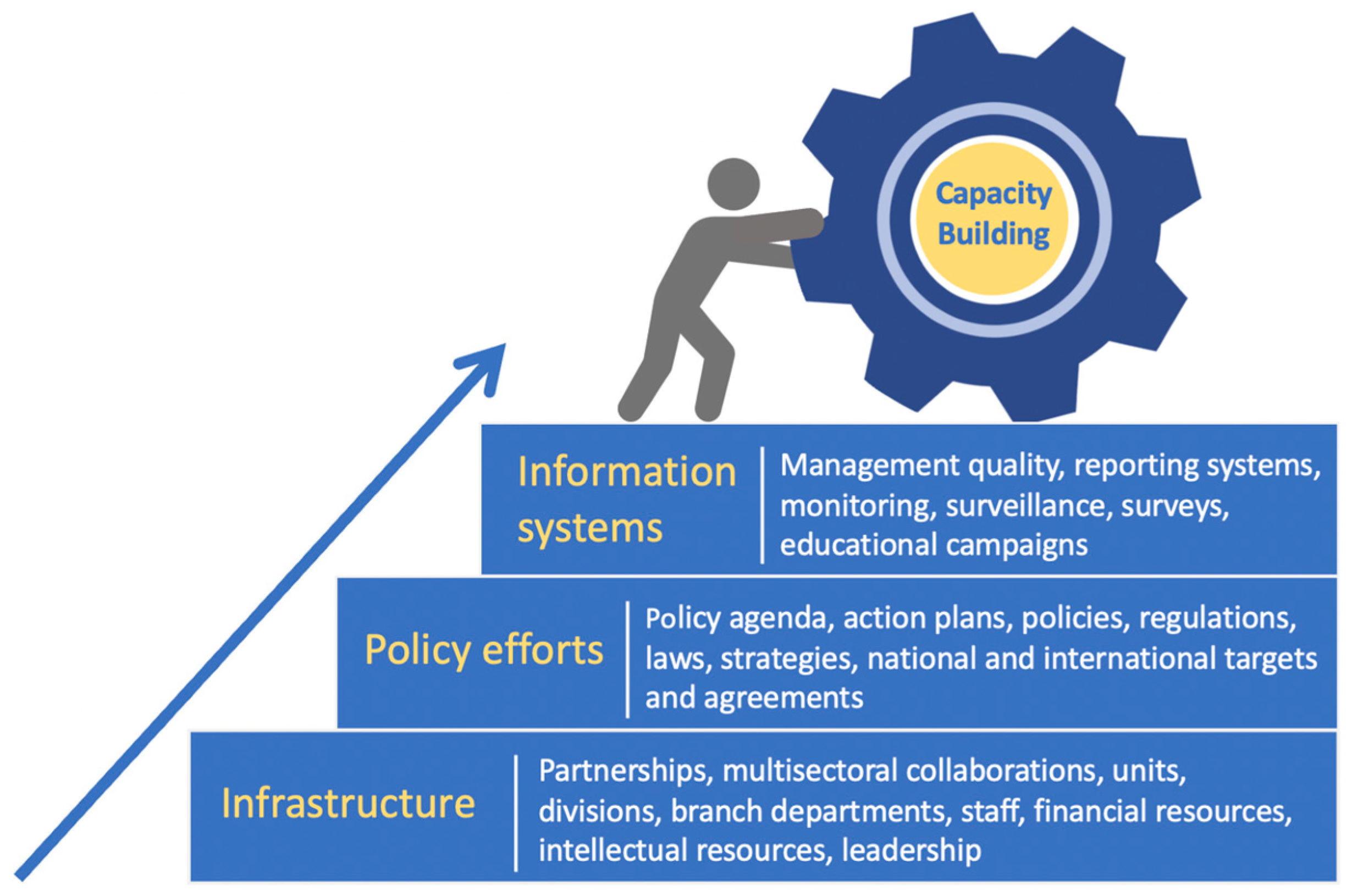
The workshop methodology and content were designed following the Government Capacity-Building Framework by Patiño et al. (2021) to assess national capacity for the prevention and control of NCDs [37]. The framework (Figure 1) depicts three elements of capacity building that are often used to enhance the impact and performance of public health strategies, including (1) public health infrastructure (i.e., organizational development, workforce, multisectoral collaboration and human and financial resources); (2) policy efforts (i.e., policy-making and action plans); and (3) information systems (i.e., systems to collect, monitor, report and disseminate data; surveillance and surveys). This paper also uses the Capacity-Building Framework to assess and present the findings.
Figure 1.
Redesigned diagram of the Government Capacity-Building Framework for the Prevention and Control of NCD proposed by Patiño et al. (2021) [38].
2.2. Workshop Description
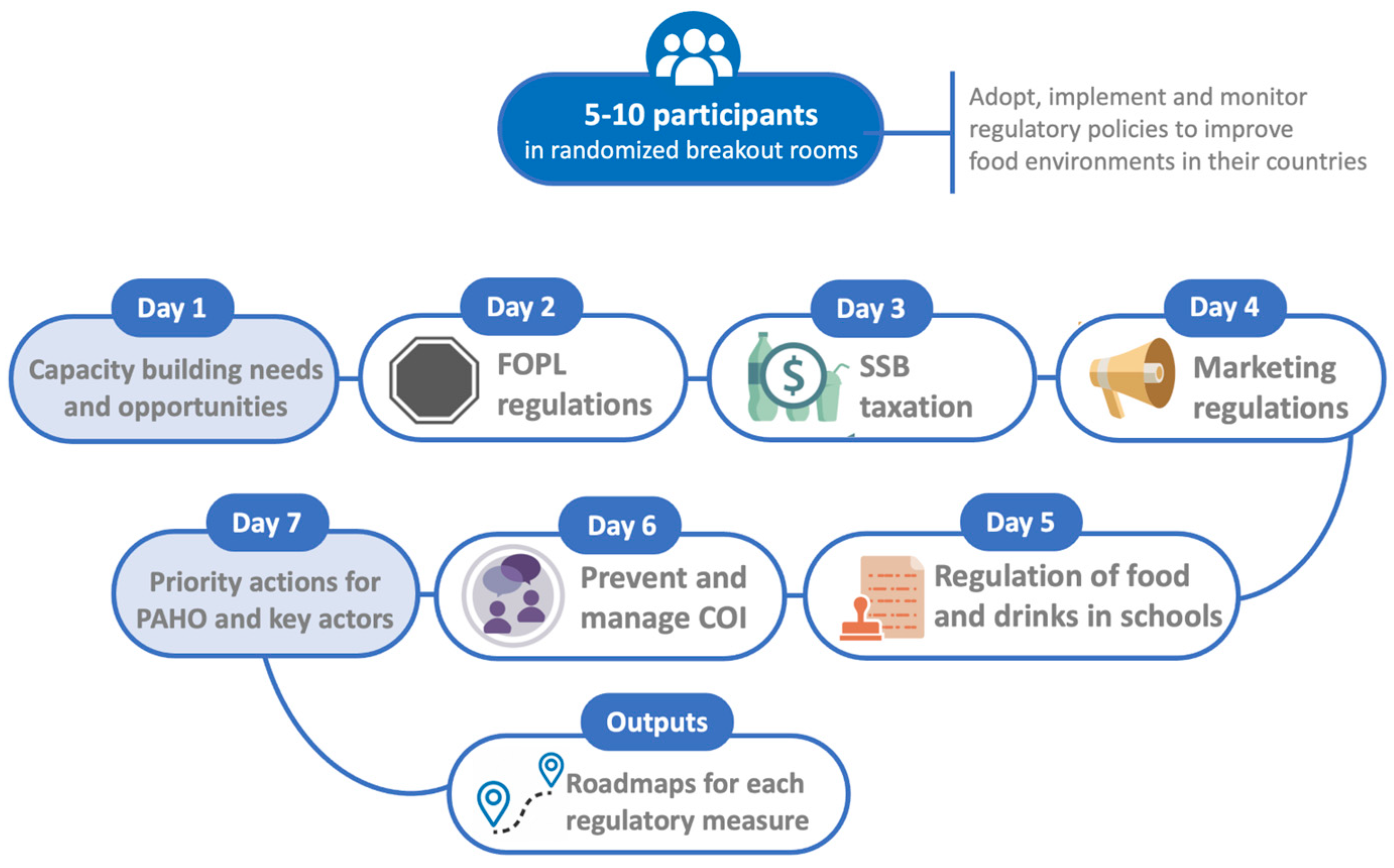
Day one of the workshop focused on discussing the capacity-building needs and opportunities to adopt, implement and monitor regulatory measures that improve food environments in the Region of the Americas. The participants then moved into randomized pre-assigned English- or Spanish-speaking breakout rooms, consisting of five to ten people to ensure a variety of sectors, and participated in a collaborative dynamic activity using Jamboard 0.2. Jamboard 0.2 is a digital platform where different persons or groups can simultaneously add information in the form of sticky notes, drawings or graphics [45]. Each group was instructed to answer questions about the capacity-building needs of their countries to adopt, implement and monitor regulatory measures that reduce the demand for and offer of processed and ultra-processed products.
Days two to six were each dedicated to discussing the capacity of PAHO/WHO member states to adopt, implement and monitor specific regulatory measures, with a different topic assigned to each day. Day two focused on FOPL regulations of processed and ultra-processed products; day three, on the taxation of SSBs and processed and ultra-processed products; day four, on marketing regulations of processed and ultra-processed products; day five, on regulating processed and ultra-processed products in schools and other settings; and day six, on building the capacity of countries to prevent and manage COI related to the previously mentioned regulatory measures. During the first half of the workshop sessions on days two to six, the participants were organized into randomized breakout rooms based on the primary language of the country they were representing to answer three questions via Jamboard 0.2 about the capacity-building successes, challenges and needs of their country, following the same methodology as day one (described above). During the second half of the workshop sessions on days two to six, the participants were organized into breakout rooms to develop roadmaps on capacity-building strategies for countries to adopt, implement and monitor each of the regulatory measures discussed and on preventing and managing COI. On the final day of the workshop, the capacity-building roadmaps for each regulatory measure that were developed on previous workshop days were reviewed. The participants outlined priority actions for PAHO/WHO and key actors to support member states to advance the regulatory measures discussed (Figure 2).
Figure 2.
Visual synthesis of the themes discussed in the seven-day workshop.
2.3. Data Analysis
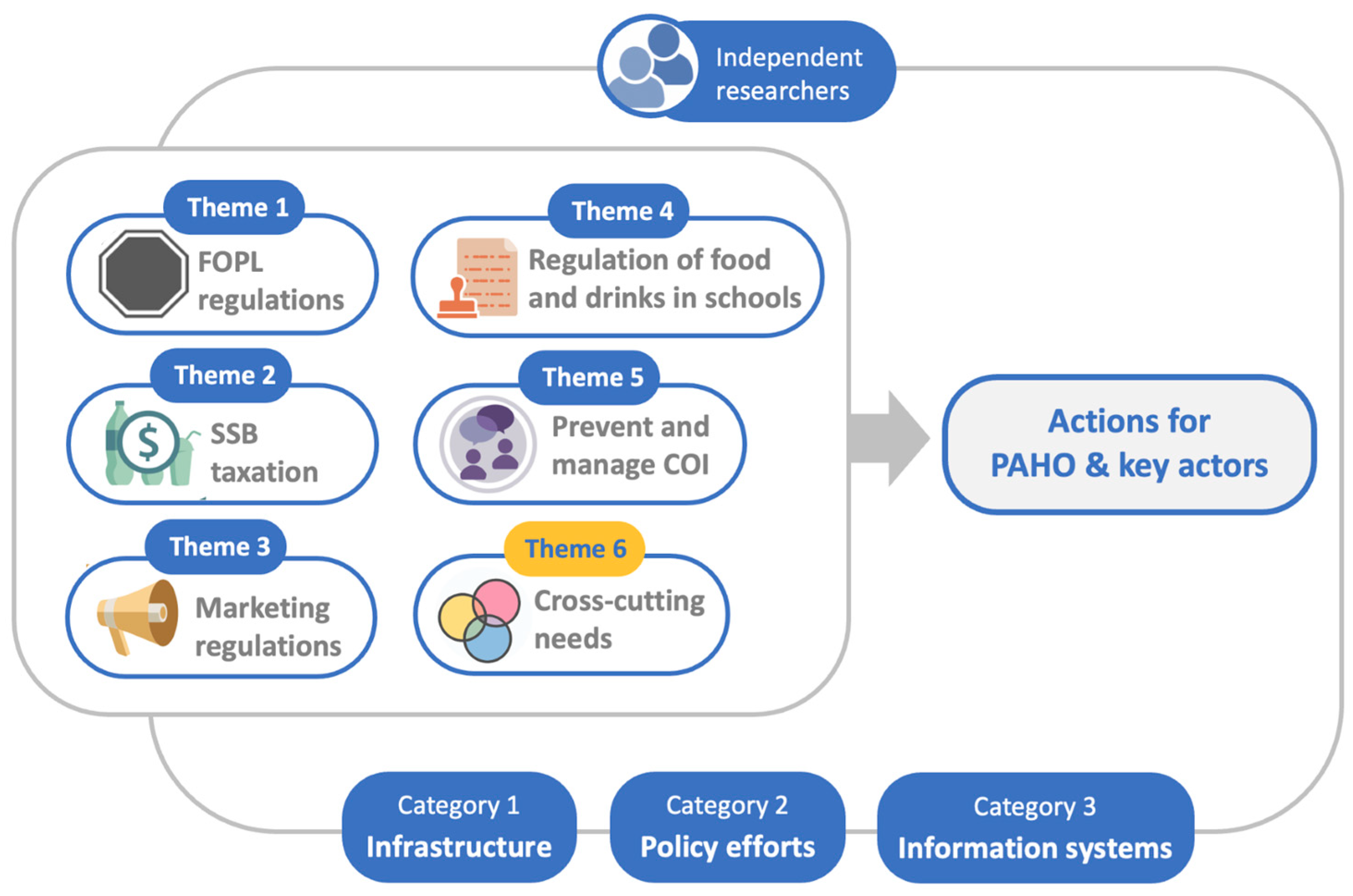
Two independent researchers examined the insights collected during the seven-day workshop, conducting a thematic analysis based on the methodology proposed by Gajaweera and Johnson [46]. The analysis was carried out in several steps. To begin, the workshop discussions and content of the Jamboard 0.2 sticky notes were carefully reviewed to identify capacity needs, related concepts and possible inter-relations between concepts and to remove repeated information. Thereafter, the concepts were organized in three categories based on the Government Capacity-Building Framework: infrastructure, policy efforts and information systems [37]. Subsequently, these categories were broken into five themes concerning the main regulatory measures to improve food environments in the Americas and a sixth theme concerning capacity-building needs that cross-cut each of the matters that need regulation. A table (Table A1) was created to match the workshop contributions with their corresponding themes and categories. Using this table, contributions were analyzed, identifying patterns, divergences and convergences across contributions and themes.
Next, the roadmaps developed by the workshop participants and the stemming recommendations were analyzed. Following this analysis, Table A2 was created by consolidating key actions identified for PAHO/WHO to support member states to address their capacity-building needs to advance regulatory measures to improve food environments. These actions were organized under the three categories of the Capacity-Building Framework. Since several of the key actions intersected with multiple categories, the authors placed each action into the one category they deemed to best correspond with the action to avoid repetition.
Next, Table A3 was created to present an action route with a set of capacity-building actions for key actors (i.e., government officials; policy-makers; CSO and NGO representatives; public health advocates, such as academics, health practitioners and PAHO/WHO staff from country, sub-regional and headquarter offices). Each actor’s set of actions was identified by establishing key themes from both the five roadmaps developed during the workshop sessions and the final workshop discussion and recommendations. The resulting themes were considered priority actions for all actors and were sorted into the three categories of the Capacity-Building Framework: infrastructure, policy efforts and information systems [37]. Table A3 also includes information on the recommended stage of each action within the five-stage Public Policy Cycle model [47,48]. The five stages of the model are (1) agenda setting, (2) policy formulation, (3) adoption (or decision-making), (4) implementation and (5) evaluation. It is worth noting that these stages rarely follow one another in linear progression, but often occur simultaneously, appear in inverse order or are rapidly skirted [47,48]. Figure 3 shows a diagram of the workshop’s overall data analysis.
Figure 3.
Visual synthesis of the thematic analysis of workshop results.
3. Results
The virtual setting of the workshop contributed to strong attendance, resulting in a total of 126 participants (Table 1), with country representation from 27 of the 35 PAHO/WHO member states, and 5 participants who attended from countries outside of the region (Australia, Italy, Spain, the United Kingdom and Vietnam). In total, 74 of the participants worked with government organizations, 20 with PAHO/WHO, 19 with CSOs and 13 with academia.
Table 1.
Participants’ characteristics.
3.1. Regional Capacity-Building Needs
The contributions of the workshop participants are shown in Appendix A, Table A1 regarding the regional and country capacity-building needs to adopt, implement and monitor key regulatory policies to improve food environments and prevent and manage diet-related NCDs in the Region of the Americas. Eight capacity-building needs were identified under the theme regulatory measures on FOPL and warning signs including education on the use of FOPL and related advocacy. Fifteen needs were identified under taxation on SSBs and ultra-processed foods, encompassing the need for local studies to predict the socioeconomic effects of taxation and strengthened intersectoral collaboration for tax enforcement. Ten needs emerged under the regulation of the marketing of ultra-processed food and drink products, where the need for increased civic advocacy stood out. Ten needs were obtained under regulatory measures of school food environments and other settings. In this category, one of the needs most underlined by the workshop participants was the insertion of a mandatory nutrition education course within the national school curriculum. Nineteen needs emerged under the prevention and management of COI, making this the category with the highest number of reported needs. Moreover, fourteen needs were identified as cross-cutting all of the aforementioned themes.
3.2. Regional Capacity-Building Actions
The initiatives that participants proposed for PAHO/WHO to support member states to advance or strengthen the aforementioned regulatory policies were summarized into twelve capacity-building actions under the three Capacity-Building Framework categories (infrastructure, policy efforts and information systems). As shown in Appendix B, Table A2, four actions were categorized into the infrastructure category: (1) providing support for financial and human resources; (2) identifying and sharing existing member states’ government structures; (3) independent structures; and (4) hosting leadership programs. Five actions were categorized into the policy efforts category: (1) safeguarding against conflict of interest; (2) facilitating courses, workshops and webinars; (3) publishing policy guidelines and materials; (4) hosting retreats; and (5) providing technical support to member states. Lastly, three actions were identified in the information systems category: creating, managing and/or sharing: (1) observatories, (2) repositories and (3) databases.
To strengthen the capacity of PAHO/WHO member states to advance regulatory policies to help prevent diet-related NCDs in the Region of the Americas, priority actions for all relevant actors (government officials; policy-makers; CSO and NGO representatives; public health advocates, such as academics, health practitioners and PAHO/WHO staff from country, sub-regional and headquarter offices) were identified based on the roadmap results and workshop discussions. As shown in Appendix C, Table A3, the priority actions were organized into the categories of the Capacity-Building Framework, and key actors were identified for each action. Three actions were identified within the infrastructure category: (1) mapping key actors; (2) forming civil society coalitions; and (3) establishing a policy-overseeing body. Ten actions were identified within the policy efforts category: (1) creating advocacy campaigns; (2) banning industry involvement; (3) best-practice polices; (4) educational strategies for civil participation; (5) effective communication materials; (6) evidenced-based plans to face industry arguments; (7) mapping existing policies; (8) establishing legal resources; (9) identifying and mapping policy strategies; and (10) identifying and using existing resources. Six actions were identified within the information systems category: (1) obtaining country-level data; (2) developing databases; (3) evaluating policies; (4) utilizing food classification systems; (5) monitoring policy barriers; and (6) identifying monitoring systems and protocols. Furthermore, two priority challenges were identified as having the potential to hinder all of the proposed capacity-building actions: COI and financial constraints.
Although the five stages of the Public Policy Cycle model rarely follow one another in linear progression, it was determined that identifying best-practice policies, mapping existing policies, establishing policy strategies and determining an evidenced-based plan to face industry arguments are likely carried out in the agenda-setting and policy-formulation stages. Actions related to the mapping of key actors and the formation of civil society coalitions often take place during the agenda-setting, policy-formulation and implementation stages, while creating databases for processed and ultra-processed food and drink products and obtaining country-level data that identify dietary patterns and diet-related NCD rates are actions that take place during the agenda-setting, policy-formulation and evaluation stages. Monitoring systems and protocols, establishing a policy-overseeing body and evaluating policies are emphasized within the evaluation stage, while creating advocacy campaigns, banning industry from involvement in events and activities, developing effective communication materials and educational strategies for civil participation, establishing legal resources, using existing and developing new training materials and resources, monitoring policy barriers and utilizing food classification systems are actions that were identified as taking place in all stages of the policy cycle. Furthermore, it was identified that COI and limited financial resources are major challenges that could emerge in all stages of the policy process.
4. Discussion
This paper analyzed self-reported country needs and proposed actions for different key actors to support countries of the Region of the Americas to implement regulatory measures to improve food environments and diet-related NCDs. The results identify ten key themes for country needs; sixteen capacity-building actions for PAHO/WHO to support member states to fulfil these needs; and nineteen overall capacity-building actions for all actors.
Although capacity-building actions were identified for the region, the results indicate there are still several needs to be addressed and actions to be advanced at the country level for PAHO/WHO member states to adopt, implement and monitor the suggested regulatory measures. This is emphasized by the fact that an insufficient number of PAHO/WHO member states have implemented policies to prevent or manage NCDs: 10/35 have implemented FOPL policies (with only 8/35 using best-practice FOPWL policies) [49,50,51,52,53,54,55,56,57], 21/35 have SSB taxation policies (although most of these taxes could be further leveraged to achieve best practices and improve their impact on SSB consumption and health) [58,59] and 13/35 have food marketing regulations [35]. Furthermore, COI prevention and management to safeguard public health policies stands out as an urgent gap to address, as workshop participants reported the highest number of capacity needs under this category.
As for schools, most countries within the region have implemented at least one school food policy targeting an element of the school food environment. However, these policies are most effective when they are implemented together as part of a comprehensive food and nutrition policies approach, because this can synergistically improve the impact of all policies [60,61]. Similarly, considering food environments beyond schools are multifaceted, integrating regulatory policies that comprehensively target different aspects of these environments can also increase the overall positive impact on food environments and diet-related NCDs [62].
Most of the capacity-building needs and actions to address them that were identified during the workshop fall into the infrastructure capacity-building category [37], with a focus on two areas: augmenting human capacity and increasing funding. These results add to prior research that found an insufficient amount of human resources and infrastructure to adopt and implement diet-related regulations to address NCDs in the Region of the Americas [37]. As other studies show, investments in workforce employment and training, partnership building, research, monitoring and evaluation can effectively improve country capacities to advocate, adopt, implement and surveil policies [63,64]. Moreover, as the workshop identified, the insufficiency of human capacity can be minimized by the identification and use of pre-existing training materials and resources that help advance regulatory measures (e.g., The Virtual Campus for Public Health [65]), in addition to the use of hybrid training tools, such as the Massive Open Online Courses (MOOC), webinars and strategies like “train the trainer”.
Additionally, due to the cyclic nature of most actors and technical staff in governmental positions, it is of utmost importance to develop a sustainable system to build human capacity in order to regulate the food environment in the region. A multi-scalar approach, which incorporates inclusive planning and regular meetings to identify emerging needs and create momentum for action, can support effective collaboration on all scales, increasing human capacity in a sustainable way over time [66]. Furthermore, given that the capacity-building needs of countries and the actions to address them typically require various actors from multiple sectors (as outlined in Table A3), creating coalitions, technical advocacy and advisory groups (TAAGs) and working groups without industry interference, through the mapping of key actors who support the advancement of regulatory measures to improve food environments, could facilitate the achievement of consensus in policy development and implementation.
Another type of capacity need refers to the knowledge gap in law and jurisprudence specific to legal theories and provisions that endorse food environment regulatory initiatives. While this workshop did not explore such gaps in detail, workshop discussions revealed major knowledge gaps in this aspect across the region. First, there is a lack of clear understanding of the legal resources available at the country level that support policy development and protect food environments in defense of the human right to adequate food and nutrition, as well as children’s rights and business obligations to respect and support children’s rights in advertising and marketing. These knowledge gaps intersect with a lack of clear understanding that, first, when a risk factor is widespread in a country and affects most of the population, regulatory actions must be taken at an environmental level rather than at the individual level. Second, governments have the right and legal duty to regulate commercial activities based on arguments that support population health, and these regulations can over-ride commercial rights and international trade agreements [67]. Addressing these gaps requires the development of spaces for interdisciplinary collaboration between law and public health nutrition experts.
In this regard, across all stages of the policy cycle, COI of commercial, academic and civil society actors were identified as a common barrier to all PAHO/WHO member states to achieving the adequate implementation of unbiased, best-practice policies to improve food environments and the status of diet-related NCDs. This was an expected result as there is unequivocal evidence showing that the influence of and opposition from industries producing processed and ultra-processed food and drinks have contributed to delaying or halting the development and implementation of nutrition programs and regulatory measures that improve food environments and help prevent diet-related NCDs in many countries [43,44]. Therefore, building the human capacity to sufficiently identify, prevent and manage COI is recommended, which can be accomplished through the use of available risk assessment, disclosure and management tools that help safeguard policy development, implementation, monitoring and evaluation against possible COI, including the WHO draft approach [26] and tool [68] for the prevention and management of conflicts of interest in the policy development and implementation of nutrition programs at the country level and PAHO/WHO’s roadmap for implementing WHO’s draft approach [28]. Furthermore, mapping key actors (e.g., academia, civil society and policy-makers) can help prevent COI as it allows for the identification of coalitions, influences and interests, which supports the design of targeted mechanisms to ensure that actors who benefit from the commercialization of unhealthy commodities remain outside food/nutrition policy agenda setting and formulation [43]. In turn, this can result in strengthened transparency, partnership productivity and governance [69].
Regarding the actions proposed by the workshop participants to address the needs outlined above, specific timelines must be identified. Assigning timelines to planned policy actions is key to success in their implementation [70,71]. Empirical experience has shown that timelines can help mobilize political will, for example, through the global trans-fatty acids (TFAs) elimination strategy, where the WHO established a clear timeline with supporting tools to accelerate action towards the elimination of TFAs from the global food supply by 2023 [71]. The Public Policy Cycle stages identified for each recommended capacity-building action within Table A3 can be used to help create realistic yet flexible timelines for country action. Moreover, coordinating country timelines across the region can increase momentum, through inertia from states with more advanced regulatory performance. State actions can align on the basis of global commitments and transnational and multisectoral agendas such as the United Nations Decade of Action on Nutrition and the Sustainable Development Goals. Therefore, PAHO/WHO and key actors should consider adding timelines to the priority actions at regional, national and local levels while utilizing relevant tools to help advance policy action.
Furthermore, grounding actions by PAHO/WHO and other key actors and timelines in human rights law could help mobilize political commitment throughout all Public Policy Cycle stages [37]. For example, integrating a human rights lens during the policy agenda-setting stage could help sensitize policy-makers to the urgency of formulating, implementing and evaluating regulatory measures [37]. This is because the human rights law system has significant relevance in the legal framework of most countries in the Region of the Americas [72]. Moreover, human rights seek to protect human dignity, a principle shared across different cultures and nations [73], and adequate food and nutrition is an area of human rights inherent to human dignity and essential for the realization of other rights [74,75]. Recognizing this, most of the countries in the Region of the Americas have signed and ratified the International Covenant of Economic, Social and Cultural Rights (ICESCR) [76], which is binding to its member parties and enshrines the human right to adequate food [Art. 11(1)] and the right to the highest attainable status of health [Art. 12] [77].
Strengths and Limitations
The main strength of this research was the data collection process. The virtual set-up of the workshop made it more accessible for actors to attend, with participation from approximately 80% of PAHO/WHO member states and eight countries outside of the Americas, including individuals from lower-funded countries. This allowed for the workshop discussions and suggestions to come from diverse country perspectives, enhancing the key learnings from the workshop and increasing the generalizability of the results. Additionally, the use of breakout rooms and activities, including the Jamboards 0.2 and roadmap templates, enabled plenty of rich discussion and information to be gathered from workshop participants, including those who were not as comfortable speaking in large groups. Furthermore, the format of the workshop—where the specific policy topics were each assigned to a different day—enabled individuals to only attend the sessions they found the most relevant to their expertise or interests. Moreover, the workshop design allowed actors to identify specific opportunities to strengthen member states’ capacity-building efforts to adopt, implement and monitor regulatory measures that, according to the best available evidence, help prevent diet-related NCDs. Finally, the workshop was also based on methodology that allowed for the collection of information in a systematic, repeatable way across countries.
The limitations of this research relate to the theoretical framework utilized to plan and execute the workshop, the characteristics of the participant sample, the design of the workshop and the specificity of the results. Although the workshop was planned using the Capacity-Building Framework by Patiño et al. (2021), it is possible that using other human capacity-building frameworks that hold other factors constant could have yielded different results. The validity of our findings could therefore be tested in future workshops. Another limitation was that, although PAHO/WHO invited different types of actors from various sectors and different regions of the Americas, the sampling was biased towards government officials, with almost 60% of participants falling into this category. This could have resulted in unique perspectives being missed from actors working at different levels within sectors and in other areas related to the regulatory measures discussed previously. Furthermore, the seven-day workshop format with sessions lasting 2.5 h each may have led to fatigue and lower engagement for participants who attended multiple sessions. Thus, opportunities for future research include an exploration of the viewpoints and contributions of the member states and relevant sectors who were not represented during the workshop. Lastly, the results presented in this paper are specific to the Region of the Americas, which is advanced in the adoption and implementation of many of these regulatory measures. Caution should therefore be applied when applying the key actions and recommendations to other regions.
5. Conclusions
This research provides an initial overview of the needs and recommended capacity-building actions to support PAHO/WHO, member states and other actors to advance regulatory measures that, based on the best evidence available, curb diet-related NCDs, especially when implemented as a complimentary set of measures. The findings showed that COI prevention and management currently stands as the area of greatest capacity-building need in the Region of the Americas. Therefore, efforts must focus on safeguarding policies against COI interference in every stage of the policy cycle, from agenda setting to evaluation, so as to avoid policy delays and halts. Concurrently, national financial constraints were reported as a major capacity-building challenge for the region. Thus, key actors should seek to utilize the existing capacity-building resources available in each stage of the policy cycle to help mitigate this challenge. Prioritizing these major capacity-building needs and challenges could provide a clearer path forward for PAHO/WHO member states to develop and align regional and national regulatory strategies to reduce NCDs, including action on FOPL, taxation and marketing of processed and ultra-processed products. When these actions are implemented in a coordinated manner across sectors, through a food system- and human rights-based approach, with defined timelines, meaningful change toward improving food environments and preventing diet-related NCDs can be achieved in the Region of the Americas.
Author Contributions
Conceptualization, C.L., C.M.T., F.d.S.G. and S.R.G.P.; methodology, C.L., C.M.T., F.d.S.G. and S.R.G.P.; formal analysis, C.L. and C.M.T.; investigation, C.L., C.M.T., F.d.S.G. and S.R.G.P.; writing—original draft preparation, C.L., C.M.T., S.R.G.P. and F.d.S.G.; writing—review and editing, C.L., C.M.T., C.S., F.d.S.G., S.R.G.P. and V.E.V.-D.; visualization, C.L., C.M.T. and C.S.; supervision, F.d.S.G.; project administration, C.L., C.M.T., F.d.S.G. and S.R.G.P. All authors have read and agreed to the published version of the manuscript.
Funding
This research received no external funding.
Institutional Review Board Statement
Not applicable because this study is not considered public health research involving human participants.
Informed Consent Statement
Not applicable because this study is not considered public health research involving human participants.
Data Availability Statement
Data supporting reporting results can be found here: https://drive.google.com/drive/folders/1aUvpULZ9ULm5rA3Bsl-bb6qtt2BZPROw?usp=drive_link (accessed on 10 December 2022).
Conflicts of Interest
The authors declare no conflict of interest.
Appendix A
Table A1.
Thematic analysis of the capacity needs discussed during the workshop, “Regional Capacity Building of Regulatory Measures to Prevent and Manage Diet-Related Non Communicable Diseases in the Region of the Americas” (5 to 13 July 2022).
Table A1.
Thematic analysis of the capacity needs discussed during the workshop, “Regional Capacity Building of Regulatory Measures to Prevent and Manage Diet-Related Non Communicable Diseases in the Region of the Americas” (5 to 13 July 2022).
| CAPACITY-BUILDING NEEDS | |
|---|---|
| |
| Category 1: Infrastructure |
|
| Category 2: Policy efforts |
|
| Category 3: Informationsystems |
|
| |
| Category 1: Infrastructure |
|
| Category 2: Policy efforts |
|
| Category 3: Information systems |
|
| |
| Category 1: Infrastructure |
|
| Category 2: Policy efforts |
|
| Category 3: Information systems |
|
| |
| Category 1: Infrastructure |
|
| Category 2: Policy efforts |
|
| Category 3: Information systems |
|
| |
| Category 1: Infrastructure |
|
| Category 2: Policy efforts |
|
| Category 3: Informationsystems |
|
| |
| Category 1: Infrastructure |
|
| Category 2: Policy efforts |
|
| Category 3: Information systems |
|
* NOTE: The “cross-cutting needs” theme corresponds to all the needs referred to by the workshop participants that apply to all the themes previously analyzed (Theme 1, regulatory measures on front-of-package labeling (FOPL) and warning signs; Theme 2, taxation on sugar-sweetened beverages (SSBs) and unhealthy foods; Theme 3, regulation of the marketing of unhealthy food and drink products; Theme 4, regulatory measures of school food environments and other settings; Theme 5: prevention and management of conflicts of interest).
Appendix B
Table A2.
PAHO/WHO capacity-building actions to improve nutrition in the Region of the Americas.
Table A2.
PAHO/WHO capacity-building actions to improve nutrition in the Region of the Americas.
| CAPACITY-BUILDING FRAMEWORK CATEGORIES | |
|---|---|
| Category 1: Infrastructure | Financial and human resources
|
| Category 2: Policy efforts | Conflict of interests
|
| Category 3: Information systems | Observatories
|
Appendix C
Table A3.
Capacity-building actions for all actors to improve nutrition in the Region of the Americas, with actors’ roles and stages of the Public Policy Cycle identified for each capacity-building action.
Table A3.
Capacity-building actions for all actors to improve nutrition in the Region of the Americas, with actors’ roles and stages of the Public Policy Cycle identified for each capacity-building action.
| CAPACITY-BUILDING FRAMEWORK CATEGORIES | ||
|---|---|---|
| Capacity-Building Actions | Actors’ Roles * | |
| Category 1: Infrastructure | Key actors and connections 1,2,4
| Government officials, PAHO/WHO, CSOs, NGOs, academia ______________________________ Government officials, PAHO/WHO, CSOs, NGOs, academia ___________________________ Government officials, PAHO, CSOs, NGOs, academia ___________________________ Government officials, PAHO/WHO, CSOs, NGOs, academia ___________________________ Government officials, PAHO/WHO ___________________________ Government officials, PAHO/WHO, CSOs, NGOs ___________________________ Government officials, CSOs, NGOs ___________________________ Government officials, PAHO/WHO, CSOs |
| Category 2: Policy efforts | Bans 1,2,3,4,5
| Government officials ___________________________ Government officials, PAHO/WHO, CSOs, NGOs, academia ___________________________ Government officials, public health advocates ___________________________ Government officials, CSOs, public health advocates ___________________________ Government officials, CSOs, public health advocates ___________________________ Government officials, PAHO/WHO, CSOs ___________________________ Government officials, PAHO/WHO, CSOs ___________________________ Government officials, PAHO/WHO, CSOs, academia ___________________________ Government officials, PAHO/WHO, CSOs ___________________________ Government officials, PAHO/WHO, academia ___________________________ Government officials, PAHO/WHO, academia ___________________________ Government officials, PAHO/WHO ___________________________ Government officials, PAHO/WHO ___________________________ Government officials, PAHO/WHO, academia ___________________________ Government officials, PAHO/WHO ___________________________ Government officials, PAHO/WHO ___________________________ Government officials, PAHO/WHO ___________________________ Government officials, PAHO/WHO ___________________________ Government officials, PAHO/WHO ___________________________ Government officials, PAHO/WHO, public health advocates ___________________________ Government officials, CSOs |
| Category 3: Information Systems | Country level data 1,2,5
| Government officials, PAHO/WHO ___________________________ PAHO/WHO, government officials, CSOs ___________________________ Government officials, PAHO/WHO, academia ___________________________ Government officials, PAHO/WHO, CSO ___________________________ Government officials, PAHO/WHO, CSOs, academia ___________________________ PAHO/WHO, CSOs, academia ___________________________ Government officials, NGOs, CSOs |
| Priority challenges that can hinder all actions | ||
Conflicts of interest 1,2,3,4,5
| ||
* Actors’ Roles: For each capacity-building action, the key actors that are commonly involved in that work were listed. However, depending on the specific country and context, the actors involved may vary. 1 Agenda setting: This step refers to the process through which a policy and the problem it is intended to address are acknowledged to be of public interest. 2 Formulation: In this step, the public administration concerned examines the various policy options it considers to be possible solutions. 3 Adoption: Adoption is the stage during which decisions are made at the governmental level, resulting in a decision that favors one or more approaches to addressing a given problem. 4 Implementation: At this stage, the policy’s implementation parameters are established, which can directly affect the eventual outcome of the policy. 5 Evaluation: This is the stage during which a policy is evaluated, to verify whether its implementation and its effects are aligned with the objectives that were explicitly or implicitly set out (NCCHPP, 2013). 6 To avoid the country-to-country differences in the legal age to define children or minors. These differences create legal gaps that can be used by the industry to advertise unhealthy commodities.
References
- NCD Countdown 2030 Collaborators. NCD Countdown 2030: Worldwide trends in non-communicable disease mortality and progress towards Sustainable Development Goal target 3.4. Lancet 2018, 392, 1072–1088. [Google Scholar] [CrossRef] [PubMed]
- World Health Organization. Leading Causes of Death and Disability A Visual Summary of Global and Regional Trends 2000–2019. Available online: https://www.who.int/data/stories/leading-causes-of-death-and-disability-2000-2019-a-visual-summary (accessed on 30 May 2023).
- United Nations Children’s Fund; United Nations Special Rapporteur on the Right to Food. Protecting Children’s Right to a Healthy Food Environment; UNICEF and United Nations Human Rights Council: Geneva, Switzerland, 2019; Available online: https://www.unicef.org/media/96101/file/Protecting-Childrens-Right-Healthy-Food-Environment.pdf (accessed on 24 November 2023).
- Swinburn, B.A.; Kraak, V.I.; Allender, S.; Atkins, V.J.; Baker, P.I.; Bogard, J.R.; Brinsden, H.; Calvillo, A.; De Schutter, O.; Devarajan, R.; et al. The global syndemic of obesity, undernutrition, and climate change: The Lancet Commission report. Lancet 2019, 393, 791–846. [Google Scholar] [CrossRef] [PubMed]
- Monteiro, C.A.; Cannon, G.; Levy, R.B.; Moubarac, J.C.; Louzada, M.L.; Rauber, F.; Khandpur, N.; Cediel, G.; Neri, D.; Martinez-Steele, E.; et al. Ultra-processed foods: What they are and how to identify them. Public Health Nutr. 2019, 22, 936–941. [Google Scholar] [CrossRef] [PubMed]
- Monteiro, C.; Cannon, G.; Moubarac, J.; Levy, R.; Louzada, M.; Jaime, P. The UN Decade of Nutrition, the NOVA food classification and the trouble with ultra-processing. Public Health Nutr. 2018, 21, 5–17. [Google Scholar] [CrossRef] [PubMed]
- Köncke, F.; Toledo, C.; Berón, C.; Klaczko, I.; Carriquiry, A.; Cediel, G.; Gomes, F.S. Estimation of intake of critical nutrients associated with noncommunicable diseases according to the PAHO/WHO criteria in the diet of school-age children in Montevideo, Uruguay. Nutrients 2022, 14, 528. [Google Scholar] [CrossRef]
- Neri, D.; Steele, E.M.; Khandpur, N.; Cediel, G.; Zapata, M.E.; Rauber, F.; Marrón-Ponce, J.A.; Machado, P.; da Costa Louzada, M.L.; Andrade, G.C.; et al. NOVA Multi-Country Study Group on Ultra-Processed Foods, Diet Quality and Human Health. Ultraprocessed food consumption and dietary nutrient profiles associated with obesity: A multicountry study of children and adolescents. Obes. Rev. 2022, 23 (Suppl. S1), e13387. [Google Scholar] [CrossRef]
- Martínez Steele, E.; Popkin, B.M.; Swinburn, B.; Monteiro, C.A. The share of ultra-processed foods and the overall nutritional quality of diets in the US: Evidence from a nationally representative cross-sectional study. Popul. Health Metr. 2017, 15, 6–16. [Google Scholar] [CrossRef] [PubMed]
- Costa, C.S.; Del-Ponte, B.; Assunção, M.C.F.; Santos, I.S. Consumption of ultra-processed foods and body fat during childhood and adolescence: A systematic review. Public Health Nutr. 2018, 21, 148–159. [Google Scholar] [CrossRef] [PubMed]
- Costa, C.S.; Rauber, F.; Leffa, P.S.; Sangalli, C.N.; Campagnolo, P.D.B.; Vitolo, M.R. Ultra-processed food consumption and its effects on anthropometric and glucose profile: A longitudinal study during childhood. Nutr. Metab. Cardiovasc. Dis. 2019, 29, 177–184. [Google Scholar] [CrossRef] [PubMed]
- Chang, K.; Khandpur, N.; Neri, D.; Touvier, M.; Huybrechts, I.; Millett, C.; Vamos, E.P. Association between Childhood Consumption of Ultraprocessed Food and Adiposity Trajectories in the Avon Longitudinal Study of Parents and Children Birth Cohort. JAMA Pediatr. 2021, 175, e211573. [Google Scholar] [CrossRef]
- Costa, C.D.S.; Assunção, M.C.F.; Loret de Mola, C.; Cardoso, J.S.; Matijasevich, A.; Barros, A.J.D.; Santos, I.S. Role of ultra-processed food in fat mass index between 6 and 11 years of age: A cohort study. Int. J. Epidemiol. 2021, 50, 256–265. [Google Scholar] [CrossRef]
- Machado, P.P.; Steele, E.M.; Levy, R.B.; Sui, Z.; Rangan, A.; Woods, J.; Gill, T.; Scrinis, G.; Monteiro, C.A. Ultra-processed foods and recommended intake levels of nutrients linked to non-communicable diseases in Australia: Evidence from a nationally representative cross-sectional study. BMJ Open 2019, 9, e029544. [Google Scholar] [CrossRef] [PubMed]
- Marrón-Ponce, J.A.; Flores, M.; Cediel, G.; Monteiro, C.A.; Batis, C. Associations between Consumption of Ultra-Processed Foods and Intake of Nutrients Related to Chronic Non-Communicable Diseases in Mexico. J. Acad. Nutr. Diet. 2019, 119, 1852–1865. [Google Scholar] [CrossRef] [PubMed]
- Rauber, F.; da Costa Louzada, M.L.; Steele, E.M.; Millett, C.; Monteiro, C.A.; Levy, R.B. Ultra-Processed Food Consumption and Chronic Non-Communicable Diseases-Related Dietary Nutrient Profile in the UK (2008–2014). Nutrients 2018, 10, 587. [Google Scholar] [CrossRef] [PubMed]
- Hall, K.D.; Ayuketah, A.; Brychta, R.; Cai, H.; Cassimatis, T.; Chen, K.Y.; Chung, S.T.; Costa, E.; Courville, A.; Darcey, V.; et al. Ultra-Processed Diets Cause Excess Calorie Intake and Weight Gain: An Inpatient Randomized Controlled Trial of Ad Libitum Food Intake. Cell Metab. 2019, 30, 67–77. [Google Scholar] [CrossRef] [PubMed]
- Khandpur, N.; Neri, D.A.; Monteiro, C.; Mazur, A.; Frelut, M.-L.; Boyland, E.; Weghuber, D.; Thivel, D. Ultra-Processed Food Consumption among the Paediatric Population: An Overview and Call to Action from the European Childhood Obesity Group. Ann. Nutr. Metab. 2020, 76, 109–113. [Google Scholar] [CrossRef] [PubMed]
- Bawaked, R.A.; Fernández-Barrés, S.; Navarrete-Muñoz, E.M.; González-Palacios, S.; Guxens, M.; Irizar, A.; Lertxundi, A.; Sunyer, J.; Vioque, J.; Schröder, H.; et al. Impact of lifestyle behaviors in early childhood on obesity and cardiometabolic risk in children: Results from the Spanish INMA birth cohort study. Pediatr. Obes. 2020, 5, e12590. [Google Scholar] [CrossRef] [PubMed]
- Juul, F.; Vaidean, G.; Parekh, N. Ultra-processed foods and cardiovascular diseases: Potential mechanisms of action. Adv. Nutr. 2021, 12, 1673–1680. [Google Scholar] [CrossRef] [PubMed]
- Popkin, B.M.; Barquera, S.; Corvalan, C.; Hofman, K.J.; Monteiro, C.; Ng, S.W.; Swart, E.C.; Taillie, L.S. Towards unified and impactful policies to reduce ultra-processed food consumption and promote healthier eating. Lancet Diabetes Endocrinol. 2021, 9, 462–470. [Google Scholar] [CrossRef] [PubMed]
- Geissler, C. Capacity building in public health nutrition. Proc. Nutr. Soc. 2015, 74, 430–436. [Google Scholar] [CrossRef]
- World Health Organization. Global Action Plan for the Prevention and Control of NCDs 2013–2020. Available online: https://www.who.int/publications/i/item/9789241506236 (accessed on 30 April 2023).
- Pan American Health Organization. Strategic Plan of the Pan American Health Organization 2020–2025: Equity at the Heart of Health. Available online: https://www.paho.org/en/documents/paho-strategic-plan-2020-2025 (accessed on 29 May 2023).
- Pan American Health Organization. Plan of Action for the Prevention and Control of Noncommunicable Diseases in the Americas 2013–2019. Available online: https://www.paho.org/hq/dmdocuments/2015/action-plan-prevention-control-ncds-americas.pdf (accessed on 27 May 2023).
- Pan American Health Organization. Plan of Action for the Prevention of Obesity in Children and Adolescents. Available online: https://www.paho.org/hq/dmdocuments/2015/Obesity-Plan-Of-Action-Child-Eng-2015.pdf (accessed on 5 June 2023).
- Executive Board 142. Safeguarding against Possible Conflicts of Interest in Nutrition Programmes: Draft Approach for the Prevention and Management of Conflicts of Interest in the Policy Development and Implementation of Nutrition Programmes at Country Level: Report by the Director-General; World Health Organization: Geneva, Switzerland, 2018; Available online: https://apps.who.int/iris/handle/10665/274165 (accessed on 1 September 2023).
- Pan American Health Organization. Preventing and Managing Conflicts of Interest in Country-Level Nutrition Programs: A Roadmap for Implementing the World Health Organization’s Draft Approach in the Americas. 2021. Available online: https://iris.paho.org/bitstream/handle/10665.2/55055/PAHONMHRF210014_eng.pdf?sequence=1&isAllowed=y (accessed on 1 September 2023).
- Cabrera, M.; Machín, L.; Arrúa, A.; Antúnez, L.; Curutchet, M.R.; Giménez, A.; Ares, G. Nutrition warnings as front-of-pack labels: Influence of design features on healthfulness perception and attentional capture. Public Health Nutr. 2017, 2, 29. [Google Scholar] [CrossRef]
- Franco-Arellano, B.; Vanderlee, L.; Ahmed, M.; Oh, A.; L’Abbé, M. Influence of front-of-pack labelling and regulated nutrition claims on consumers’ perceptions of product healthfulness and purchase intentions: A randomized controlled trial. Appetite 2020, 149, 104629. [Google Scholar] [CrossRef]
- Machín, L.; Aschemann-Witzel, J.; Curutchet, M.R.; Giménez, A.; Ares, G. Traffic Light System Can Increase Healthfulness Perception: Implications for Policy Making. J. Nutr. Educ. Behav. 2018, 50, 668–674. [Google Scholar] [CrossRef] [PubMed]
- Deliza, R.; de Alcántara, M.; Pereira, R.; Ares, G. How do different warning signs compare with the guideline daily amount and traffic-light system? Food Qual. Prefer. 2020, 80, 103821. [Google Scholar] [CrossRef]
- Khandpur, N.; de Morais Sato, P.; Mais, L.A.; Bortoletto Martins, A.P.; Spinillo, C.G.; Garcia, M.T.; Urquizar Rojas, C.F.; Jaime, P.C. Are Front-of-Package Warning Labels More Effective at Communicating Nutrition Information than Traffic-Light Labels? A Randomized Controlled Experiment in a Brazilian Sample. Nutrients 2018, 10, 688. [Google Scholar] [CrossRef] [PubMed]
- Goodman, S.; Vanderlee, L.; Acton, R.; Mahamad, S.; Hammond, D. The Impact of Front-of-Package Label Design on Consumer Understanding of Nutrient Amounts. Nutrients 2018, 10, 1624. [Google Scholar] [CrossRef]
- Crosbie, E.; Gomes, F.S.; Olvera, J.; Rincon-Gallardo Patino, S.; Hoeper, S.; Carriedo, A. A policy study on front–of–pack nutrition labeling in the Americas: Emerging developments and outcomes. Health Policy 2022, 18, 100400. [Google Scholar] [CrossRef] [PubMed]
- Pan American Health Organization. Sugar-Sweetened Beverage Taxation in the Region of the Americas. Available online: https://iris.paho.org/handle/10665.2/53252 (accessed on 13 June 2023).
- Patiño, S.R.; Da Silva Gomes, F.; Constantinou, S.; Lemaire, R.; Hedrick, V.E.; Serrano, E.L.; Kraak, V.I. An assessment of government capacity building to restrict the marketing of unhealthy food and non-alcoholic beverage products to children in the region of the Americas. Int. J. Environ. Res. Public Health 2021, 18, 8324. [Google Scholar] [CrossRef] [PubMed]
- World Health Organization. Action Framework for Developing and Implementing Public Food Procurement and Service Policies for a Healthy Diet. Available online: https://apps.who.int/iris/handle/10665/338525 (accessed on 15 June 2023).
- Argentina Presidencia. Promoción de la Alimentación Saludable: Decreto 151/2022. Available online: https://www.boletinoficial.gob.ar/detalleAviso/primera/259690/20220323 (accessed on 18 July 2023).
- Fundo Nacional De Desenvolvimento Da Educacoa. Nota Tecnica Nº 3228950/2022/Cosan/Cgpae/Dirae. Processo Nº 23034.035777/2022-17. Available online: https://www.gov.br/fnde/pt-br/acesso-a-informacao/acoes-e-programas/programas/pnae/NTCOIVERSOFINAL.pdf (accessed on 1 September 2023).
- Diario Oficial de la Federación. Decreto por el que se Reforman, Adicionan y Derogan Diversas Disposiciones del Reglamento de Control Sanitario de Productos y Servicios y del Reglamento de la Ley General de Salud en Materia de Publicidad. Available online: https://www.dof.gob.mx/nota_detalle.php?codigo=5332691&fecha=14/02/2014#gsc.tab=0 (accessed on 18 July 2023).
- Popkin, B.; Schneider, P.; Shekar, M. Addressing overweight/obesity: Lessons for future actions. In Obesity: Health and Economic Consequences of an Impending Global Challenge, 1st ed.; World Bank Publications: Washington, DC, USA, 2020; pp. 109–159. [Google Scholar]
- Mialon, M.; Julia, C.; Hercberg, S. The policy dystopia model adapted to the food industry: The example of the Nutri-Score saga in France. World Nutr. 2018, 9, 109–120. [Google Scholar] [CrossRef]
- Mialon, M.; Gomes, F. Public health and the ultra-processed food and drink products industry: Corporate political activity of major transnationals in Latin America and the Caribbean. Public Health Nutr. 2019, 22, 1898–1908. [Google Scholar] [CrossRef]
- Bring Learning to Life with Jamboard. Available online: https://edu.google.com/intl/ALL_ca/jamboard/ (accessed on 3 November 2022).
- Gajaweera, N.; Johnson, A. Qualitative Methodologies for Studying Religious Communities. Available online: https://crcc.usc.edu/report/studying-faith-qualitative-methodologies-for-studying-religious-communities/how-do-i-analyze-my-interview-data/ (accessed on 2 December 2022).
- National Collaborating Centre for Healthy Public Policy. Public Policy Models and Their Usefulness in Public Health: The Stages Model. 2013. Available online: http://www.ncchpp.ca/docs/ModeleEtapesPolPubliques_EN.pdf#:~:text=Various%20authors%20have%20developed%20stages%20models%2C%20with%20the,briefly%20examine%20each%20of%20these%20stages.%20AGENDA%20SETTING (accessed on 19 November 2022).
- Howlett, M.; Ramesh, M. Studying Public Policy: Policy Cycles and Policy Subsystems; Oxford University Press: Oxford, UK, 2003. [Google Scholar]
- Gaceta Oficial de la República Bolivariana de Venezuela. Ministerio del Poder Popular para la Salud. Resolución no. 137. Caracas: Gaceta Oficial de la República Bolivariana de Venezuela No. 42271. 2021. Available online: https://drive.google.com/file/d/1WE91XKwo9JRyqI3hShy98kJOsIV7YFPr/view (accessed on 10 November 2022).
- Government of Canada. Front-of-Package Nutrition Labelling. 2022. Available online: https://www.canada.ca/en/health-canada/news/2022/06/front-of-package-nutrition-labelling.html (accessed on 15 November 2022).
- Republica Colombia. Ministerio de Salud y Proteccion Social: Resolucion Numero 2492 De 2022. 2022. Available online: https://www.minsalud.gov.co/Normatividad_Nuevo/Resoluci%C3%B3n%20No.%202492de%202022.pdf (accessed on 8 November 2023).
- Ministério da Saúde de Brazil. Instrução Normativa-in N. 75: Estabelece os Requisitos Técnicos para Declaração da Rotulagem Nutricional nos Alimentos Embalados. 2020. Available online: https://www.in.gov.br/en/web/dou/-/instrucao-normativa-in-n-75-de-8-de-outubro-de-2020-282071143 (accessed on 24 November 2022).
- Poder Ejecutivo Nacional. Decreto 151/2022: Apruébase la Reglamentación de la ley Nº 27.642. 2022. Available online: https://www.argentina.gob.ar/normativa/nacional/decreto-151-2022-362577/texto.ar (accessed on 5 November 2022).
- República de Chile. Decreto 13: Modifica Decreto Supremo Nº 977, de 1996, Reglamento Sanitario de los Alimentos. 2015. Available online: https://www.bcn.cl/leychile/navegar?idNorma=1078836%26buscar%3D20606 (accessed on 4 November 2022).
- República del Perú. Aprueban Manual de Advertencias Publicitarias en el Marco de lo Establecido en la Ley No 30021, Ley de Promoción de la Alimentación Saludable para Niños, Niñas y Adolescentes, y su Reglamento Aprobado por Decreto Supremo No 017-2017-AS. 2018. Available online: https://busquedas.elperuano.pe/dispositivo/NL/1660606-1 (accessed on 9 November 2022).
- República Oriental del Uruguay. Decreto N° 272/018: Modificació n del Reglamento Bromatoló Gico Nacional, Relativo al Rotulado de Alimentos. 2018. Available online: https://www.impo.com.uy/bases/decretos/272-2018/1 (accessed on 11 November 2022).
- Secretaria de Economia de Mexico. Modificación a la Norma Oficial Mexicana nom051-Scfi/Ssa1-2010: Especificaciones Generales de Etiquetado para Alimentos y Bebidas no Alcohólicas Preenvasados-Información Comercial y Sanitaria. 2020. Available online: http://dof.gob.mx/2020/SEECO/NOM_051.pdf (accessed on 7 November 2022).
- Sandoval, R.C.; Roche, M.; Belausteguigoitia, I.; Alvarado, M.; Galicia, L.; Gomes, F.S.; Paraje, G. Excise taxes on sugar-sweetened beverages in Latin America and the Caribbean. Am. J. Public Health 2021, 45, 21. [Google Scholar] [CrossRef]
- World Health Organization. Assessing National Capacity for the Prevention and Control of Noncommunicable Diseases: Report of the 2019 Global Survey. 2020. Available online: www.who.int/publications-detail/ncd-ccs-2019 (accessed on 9 November 2022).
- Global Nutrition Policy Review 2016–2017: Country Progress in Creating Enabling Policy Environments for Promoting Healthy Diets and Nutrition; World Health Organization: Geneva, Switzerland, 2018; Available online: https://www.who.int/publications/i/item/9789241514873 (accessed on 24 February 2023).
- World Health Organization. Assessing the Existing Evidence Base on School Food and Nutrition Policies: A Scoping Review. 2021. Available online: https://apps.who.int/iris/bitstream/handle/10665/341097/9789240025646-eng.pdf?sequence=1&isAllowed=y (accessed on 12 November 2022).
- Duran, A.C.; Mialon, M.; Crosbie, E.; Jensen, M.L.; Harris, J.L.; Batis, C.; Corvalán, C.; Taillie, L.S. Food environment solutions for childhood obesity in Latin America and among Latinos living in the United States. Obes. Rev. 2021, 22, 13237. [Google Scholar] [CrossRef] [PubMed]
- Magnusson, R.S.; McGrady, B.; Gostin, L.; Patterson, D.; Taleb, H.A. Legal capacities required for preventing and control of noncommunicable diseases. Bull. World Health Organ. 2019, 97, 108–117. [Google Scholar] [CrossRef] [PubMed]
- Mensah, G.; Rempel, B.; Manson, H. Theories, models and frameworks used in capacity building interventions relevant to public health: A systematic review. BMC Public Health 2017, 17, 914. [Google Scholar] [CrossRef]
- Pan American Health Organization. The Virtual Campus for Public Health. Available online: https://campus.paho.org/en (accessed on 1 January 2024).
- Ojo, M.; Jieutsa, L.; Orekoya, H.; Eke-okocha, P.N. Digital Public Service: Multi-Scalar Approach to Inclusive Planning for Sustainable Development. United Nations Sustainable Development Solution Network Youth, Bangkok, Thailand. 2023; to be submitted. [Google Scholar]
- Mitchell, A.D.; Samlidis, T. The implications of the WTO tobacco plain packaging disputes for public health measures. Int. Comp. Law Q. 2021, 70, 1011–1027. [Google Scholar] [CrossRef]
- Pan American Health Organization. WHO Tool—Prevention and Management of Conflicts of Interest in the Policy Development and Implementation of Nutrition Programs at Country Level. 2021. Available online: https://www.smartsurvey.co.uk/s/ONGA5 (accessed on 15 November 2022).
- Kraak, V.I.; Rincón-Gallardo Patiño, S.; Sacks, G. An accountability evaluation for the International Food & Beverage Alliance’s Global Policy on marketing communications to children to reduce obesity: A narrative review to inform policy. Obes. Rev. Off. J. Int. Assoc. Study Obes. 2019, 20, 90–106. [Google Scholar] [CrossRef]
- Sheikh, K.; Sriram, V.; Rouffy, B.; Lane, B.; Soucat, A.; Bigdeli, M. Governance roles and capacities of ministries of health: A multidimensional framework. Int. J. Health Policy Manag. 2020, 5, 237–243. [Google Scholar] [CrossRef]
- World Health Organization (WHO). WHO Plan to Eliminate Industrially Produced Trans-Fatty Acids from Global Food Supply. Available online: https://www.who.int/news/item/14-05-2018-who-plan-to-eliminate-industriallyproduced-trans-fatty-acids-from-global-food-supply (accessed on 23 May 2023).
- Inter-American Court of Human Rights. Inter-American Human Rights System. Available online: https://www.corteidh.or.cr/que_es_la_corte.cfm?lang=en (accessed on 1 January 2024).
- United Nations. The Foundation of International Human Rights Law. 2022. Available online: https://www.un.org/en/about-us/udhr/foundation-of-international-human-rights-law (accessed on 13 December 2022).
- United Nations Committee on Economic, Social and Cultural Rights (CESCR) (20TH Sess.: 1999: Geneva). The Right to Adequate Food (art.11): General Comment 12 (20th session, 1999). Available online: https://digitallibrary.un.org/record/1491194 (accessed on 15 June 2023).
- Mejía Toro, C.; Carriedo, A.; Pérez Tamayo, E.M.; Crosbie, E. Barriers to Overcoming Child Hunger and Malnutrition: Applying a Human Rights Approach to Improve Policy and Action. Int. J. Public Health 2023, 68, 1605969. [Google Scholar] [CrossRef]
- United Nations; United Nations Treaty Collection. International Covenant on Economic, Social and Cultural Rights New York, 16 December 1966. Status as at: 09-04-2024 11:16:07 EDT. Available online: https://treaties.un.org/Pages/ViewDetails.aspx?src=IND&mtdsg_no=IV-3&chapter=4 (accessed on 10 April 2024).
- United Nations. International Covenant on Economic, Social and Cultural Rights. Available online: https://treaties.un.org/Pages/ViewDetails.aspx?src=IND&mtdsg_no=IV-3&chapter=4 (accessed on 10 April 2024).
Disclaimer/Publisher’s Note: The statements, opinions and data contained in all publications are solely those of the individual author(s) and contributor(s) and not of MDPI and/or the editor(s). MDPI and/or the editor(s) disclaim responsibility for any injury to people or property resulting from any ideas, methods, instructions or products referred to in the content. |
© 2024 by the authors. Licensee MDPI, Basel, Switzerland. This article is an open access article distributed under the terms and conditions of the Creative Commons Attribution (CC BY) license (https://creativecommons.org/licenses/by/4.0/).