Programs Addressing Food Security for First Nations Peoples: A Scoping Review

 , ,
, ,  ,
,  , , and
 .jpeg)
Abstract
1. Introduction
2. Materials and Methods
2.1. Review Team and Protocol
2.2. Inclusion Criteria
2.2.1. Participants
2.2.2. Concept
2.2.3. Context
2.3. Types of Studies
2.4. Search Strategy
2.5. Selection Process
2.6. Data Extraction and Charting
2.7. Critical Appraisal
2.8. Synthesis of Results
3. Results
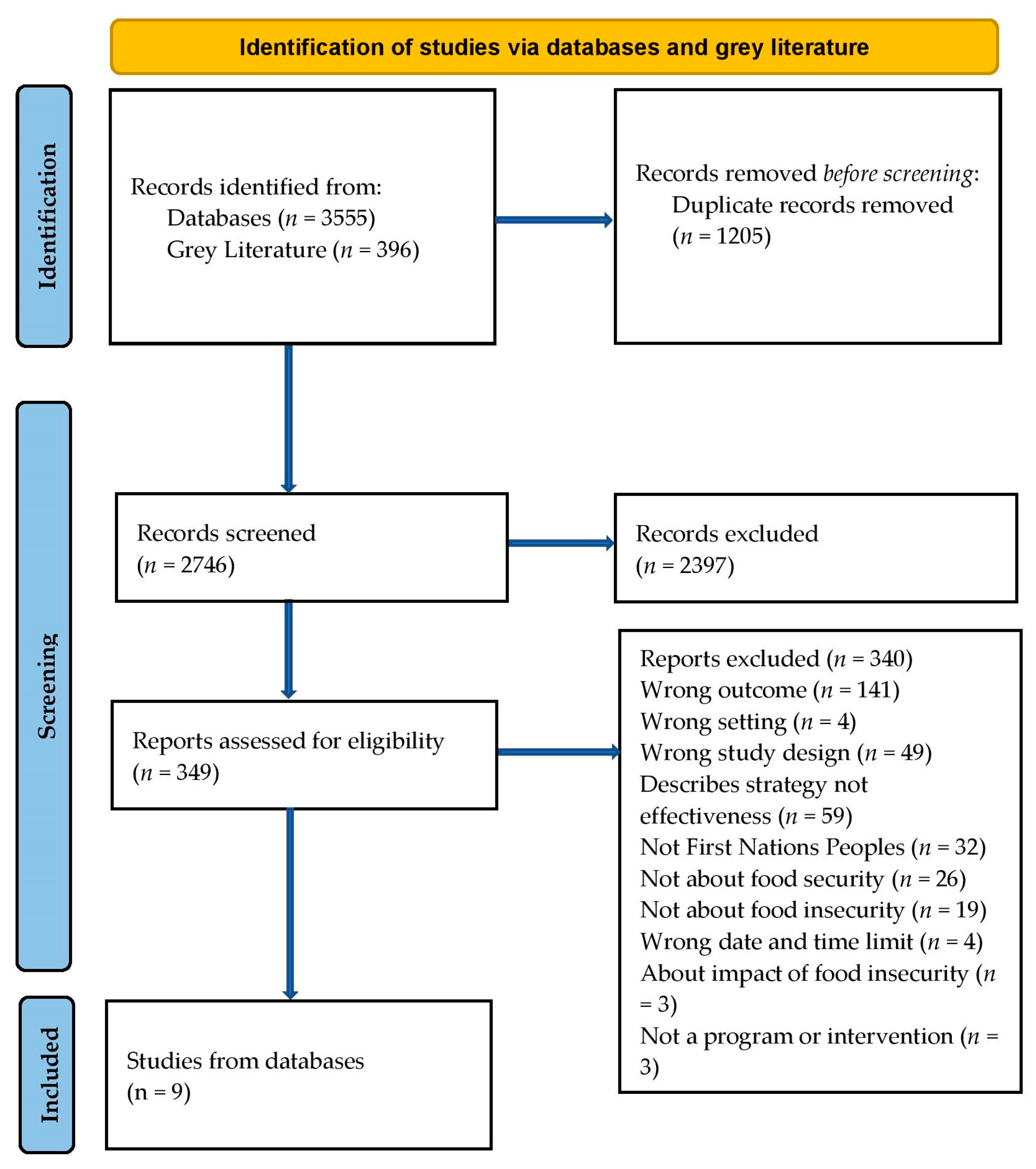
3.1. Search Results
3.2. Program Selection and Characteristics
3.3. Program Aims
3.4. Measurement of Food Security and Diet
3.5. Implementation Methods of the Interventions
3.6. Community-Based Participatory Research
3.7. Program Outcome
3.8. Critical Appraisal
4. Discussion
5. Conclusions
Supplementary Materials
Author Contributions
Funding
Institutional Review Board Statement
Informed Consent Statement
Data Availability Statement
Acknowledgments
Conflicts of Interest
References
- Davies, A.; Gwynn, J.; Flood, V.; Allman-Farinelli, M.; Dickson, M.; Turner, N.; Lock, M. Evidence for Improving Food Security in Aboriginal Communities in NSW: An Evidence Check Rapid Review Brokered by the Sax Institute (www.saxinstitute.org.au) for Aboriginal Affairs NSW, Department of Premier and Cabinet. Available online: https://www.aboriginalaffairs.nsw.gov.au/media/website_pages/research-and-publications/completed-research-and-evaluation/AANSW-Review_Aborigin_FoodSecurity_21122022_FINAL-[accessible].pdf (accessed on 26 April 2023).
- World Food Summit. Rome Declaration on World Food Security. Food and Agriculture Organization of the United Nations. 1996. Available online: https://www.fao.org/3/w3613e/w3613e00.htm#:~:text=The%20Rome%20Declaration%20on%20World,national%2C%20regional%20and%20global%20levels (accessed on 26 April 2023).
- Aboriginal Medical Services Alliance Northern Territory. Food Security in the Northern Territory. Consultation Analysis and Discussion Paper. AMSANT. 2021. Available online: http://www.amsant.org.au/wp-content/uploads/2021/10/Community-Consultation-Results-and-Discussion-Paper-V2.pdf (accessed on 26 April 2023).
- Ashby, S.; Kleve, S.; McKechnie, R.; Palermo, C. Measurement of the dimensions of food insecurity in developed countries: A systematic literature review. Public Health Nutr. 2016, 19, 2887–2896. [Google Scholar] [CrossRef] [PubMed]
- Leroy, J.L.; Ruel, M.; Frongillo, E.A.; Harris, J.; Ballard, T.J. Measuring the Food Access Dimension of Food Security: A Critical Review and Mapping of Indicators. Food Nutr. Bull. 2015, 36, 167–195. [Google Scholar] [CrossRef] [PubMed]
- Clapp, J.; Moseley, W.G.; Burlingame, B.; Termine, P. Viewpoint: The case for a six-dimensional food security framework. Food Policy 2022, 106, 102164. [Google Scholar] [CrossRef]
- United Nations. Universal Declaration of Human Rights. Available online: https://www.un.org/en/about-us/universal-declaration-of-human-rights#:~:text=Everyone%20has%20the%20right%20to%20a%20standard%20of,lack%20of%20livelihood%20in%20circumstances%20beyond%20his%20control (accessed on 25 April 2023).
- Bowden, M. Understanding Food Insecurity in Australia. Available online: https://aifs.gov.au/sites/default/files/publication-documents/2009_cfca_understanding_food_insecurity_in_australia_0.pdf (accessed on 3 April 2023).
- Tonkin, T.; Deane, A.; Trindall, A.; Weatherall, L.; Madden, T.; Moore, B.; Earle, N.; Nathan, M.; Young, S.; McCausland, R.; et al. Food and Water for Life, Key Findings from the Food and Water Security Surveys in Walgett, Yuwaya Ngarra-li Community Briefing Report; Yuwaya Ngarra-li. 2023. Available online: https://www.igd.unsw.edu.au/sites/default/files/documents/Walgett%20Food%20and%20Water%20Security%20Survey%20Report%20Feb23.pdf (accessed on 4 May 2023).
- Browne, J.; Laurence, S.; Thorpe, S. Acting on Food Insecurity in Urban Aboriginal and Torres Strait Islander Communities: Policy and Practice Interventions to Improve Local Access and Supply of Nutritious Food. Available online: https://healthinfonet.ecu.edu.au/uploads/docs/nutrition-urban-review.pdf (accessed on 2 April 2023).
- McKerchar, C.; Bowers, S.; Heta, C.; Signal, L.; Matoe, L. Enhancing Māori food security using traditional kai. Glob. Health Promot. 2015, 22, 15–24. [Google Scholar] [CrossRef] [PubMed]
- Macaulay, G.C.; Simpson, J.; Parnell, W.; Duncanson, M. Food insecurity as experienced by New Zealand women and their children. J. R. Soc. N. Z. 2022, 553–569. [Google Scholar] [CrossRef]
- Rosol, R.; Huet, C.; Wood, M.; Lennie, C.; Osborne, G.; Egeland, G.M. Prevalence of affirmative responses to questions of food insecurity: International Polar Year Inuit Health Survey, 2007–2008. Int. J. Circumpolar Health 2011, 70, 488–497. [Google Scholar] [CrossRef]
- The First Nations Information Governance Centre: First Nations Regional Health Survey (RHS) Phase 2 (2008/10) National Report on Adults, Youth and Children Living in First Nations Communities. Available online: https://fnigc.ca/what-we-do/research-and-information/our-surveys/ (accessed on 2 April 2023).
- Nikolaus, C.J.; Johnson, S.; Benally, T.; Maudrie, T.; Henderson, A.; Nelson, K.; Lane, T.; Segrest, V.; Ferguson, G.L.; Buchwald, D.; et al. Food Insecurity among American Indian and Alaska Native People: A Scoping Review to Inform Future Research and Policy Needs. Adv. Nutr. 2022, 13, 1566–1583. [Google Scholar] [CrossRef]
- Australian Government Department of Health. The new National Aboriginal and Torres Strait Islander Health Plan 2021–2031. Canberra: Commonwealth of Australia. Available online: https://www.health.gov.au/health-topics/aboriginal-and-torres-strait-islander-health/how-we-support-health/health-plan (accessed on 8 June 2023).
- Agriculture and Agri-Food Canada. Food Policy for Canada: Everyone at the Table. Ottawa: Government of Canada. Available online: https://agriculture.canada.ca/sites/default/files/legacy/pack/pdf/fpc_20190614-en.pdf (accessed on 8 June 2023).
- Graham, R.; Stolte, O.; Hodgetts, D.; Chamberlain, K. A Food Secure New Zealand. Int. Perspect. Psychol. Res. Pract. Consult. 2019, 8, 103–106. [Google Scholar] [CrossRef]
- Signal, L.N.; Walton, M.D.; Mhurchu, C.N.; Maddison, R.; Bowers, S.G.; Carter, K.N.; Gorton, D.; Heta, C.; Lanumata, T.S.; McKerchar, C.W.; et al. Tackling ‘wicked’ health promotion problems: A New Zealand case study. Health Promot. Int. 2013, 28, 84–94. [Google Scholar] [CrossRef]
- Byker Shanks, C.; Ahmed, S.; Dupuis, V.; Houghtaling, B.; Running Crane, M.A.; Tryon, M.; Pierre, M. Perceptions of food environments and nutrition among residents of the Flathead Indian Reservation. BMC Public Health 2020, 20, 1536. [Google Scholar] [CrossRef]
- Shi, Y.; Davies, A.; Allman-Farinelli, M. The Association between Food Insecurity and Dietary Outcomes in University Students: A Systematic Review. J. Acad. Nutr. Diet. 2021, 121, 2475–2500.e1. [Google Scholar] [CrossRef] [PubMed]
- Martin, K.; Mirraboopa, B. Ways of knowing, being and doing: A theoretical framework and methods for indigenous and indigenist re-search. J. Aust. Stud. 2003, 27, 203–214. [Google Scholar] [CrossRef]
- Smith, L.T. Decolonizing Methodologies: Research and Indigenous Peoples, 3rd ed.; Zed Books: London, UK, 2021. [Google Scholar]
- Tricco, A.C.; Lillie, E.; Zarin, W.; O’Brien, K.K.; Colquhoun, H.; Levac, D.; Moher, D.; Peters, M.D.; Horsley, T.; Weeks, L. PRISMA extension for scoping reviews (PRISMA-ScR): Checklist and explanation. Ann. Intern. Med. 2018, 169, 467–473. [Google Scholar] [CrossRef] [PubMed]
- Peters, M.D.J.; Marnie, C.; Tricco, A.C.; Pollock, D.; Munn, Z.; Alexander, L.; McInerney, P.; Godfrey, C.M.; Khalil, H. Updated methodological guidance for the conduct of scoping reviews. JBI Evid. Synth. 2020, 18, 2119–2126. [Google Scholar] [CrossRef]
- Harfield, S.; Pearson, O.; Morey, K.; Kite, E.; Canuto, K.; Glover, K.; Gomersall, J.S.; Carter, D.; Davy, C.; Aromataris, E.; et al. Assessing the quality of health research from an Indigenous perspective: The Aboriginal and Torres Strait Islander quality appraisal tool. BMC Med. Res. Methodol. 2020, 20, 79. [Google Scholar] [CrossRef]
- Harfield, S.; Pearson, O.; Morey, K.; Kite, E.; Glover, K.; Canuto, K.; Streak Gomersall, J.C.D.; Davy, C.; Aromataris, E.B.-M.A.T. The Aboriginal and Torres Strait Islander Quality Appraisal Tool: Companion Document. Adelaide, Australia: South Australian Health and Medical Research Institute. 2018. Available online: https://create.sahmri.org/wp-content/uploads/2020/04/Aboriginal-and-Torres-Strait-Islander-QAT-Companion-Document.pdf (accessed on 26 April 2023).
- Christidis, R.; Lock, M.; Walker, T.; Egan, M.; Browne, J. Concerns and priorities of Aboriginal and Torres Strait Islander peoples regarding food and nutrition: A systematic review of qualitative evidence. Int. J. Equity Health 2021, 20, 1–220. [Google Scholar] [CrossRef]
- Majid, K.; Grier, S. The Food Mail Program: “When Figs Fly”—Dispatching Access and Affordability to Healthy Food. Soc. Mark. Q. 2010, 16, 78–95. [Google Scholar] [CrossRef]
- Galloway, T. Canada’s northern food subsidy Nutrition North Canada: A comprehensive program evaluation. Int. J. Circumpolar. Health 2017, 76, 1279451. [Google Scholar] [CrossRef]
- Timler, K.; Varcoe, C.; Brown, H. Growing Beyond Nutrition. Int. J. Indig. Health 2019, 14, 95–114. [Google Scholar] [CrossRef]
- Blanchet, R.; Willows, N.; Johnson, S.; Okanagan Nation Salmon Reintroduction, I.; Batal, M. Enhancing cultural food security among the Syilx Okanagan adults with the reintroduction of Okanagan sockeye salmon. Appl. Physiol. Nutr. Metab. 2022, 47, 124–133. [Google Scholar] [CrossRef]
- Pindus, N.; Hafford, C. Food security and access to healthy foods in Indian country: Learning from the Food Distribution Program on Indian Reservations. J. Public Aff. 2019, 19, e1876. [Google Scholar] [CrossRef]
- Gordon, A.R.; Briefel, R.R.; Collins, A.M.; Rowe, G.M.; Klerman, J.A. Delivering Summer Electronic Benefit Transfers for Children through the Supplemental Nutrition Assistance Program or the Special Supplemental Nutrition Program for Women, Infants, and Children: Benefit Use and Impacts on Food Security and Foods Consumed. J. Acad. Nutr. Diet. 2017, 117, 367–375.e2. [Google Scholar] [CrossRef] [PubMed]
- Mucioki, M.; Sowerwine, J.; Sarna-Wojcicki, D. Thinking inside and outside the box: Local and national considerations of the Food Distribution Program on Indian Reservations (FDPIR). J. Rural Stud. 2018, 57, 88–98. [Google Scholar] [CrossRef]
- Bersamin, A.; Izumi, B.T.; Nu, J.; O’Brien D, M.; Paschall, M. Strengthening adolescents’ connection to their traditional food system improves diet quality in remote Alaska Native communities: Results from the Neqa Elicarvigmun Pilot Study. Transl. Behav. Med. 2019, 9, 952–961. [Google Scholar] [CrossRef]
- Briefel, R.R.; Chojnacki, G.J.; Gabor, V.; Forrestal, S.G.; Kleinman, R.; Cabili, C.; Gleason, P.M. A Cluster Randomized Controlled Trial of a Home-Delivered Food Box on Food Security in Chickasaw Nation. J. Acad. Nutr. Diet 2021, 121, S46–S58. [Google Scholar] [CrossRef]
- Oetzel, J.G.; Wallerstein, N.; Duran, B.; Sanchez-Youngman, S.; Nguyen, T.; Woo, K.; Wang, J.; Schulz, A.; Keawe’aimoku Kaholokula, J.; Israel, B.; et al. Impact of Participatory Health Research: A Test of the Community-Based Participatory Research Conceptual Model. BioMed Res. Int. 2018, 2018, 7281405. [Google Scholar] [CrossRef]
- Belone, L.; Lucero, J.E.; Duran, B.; Tafoya, G.; Baker, E.A.; Chan, D.; Chang, C.; Greene-Moton, E.; Kelley, M.A.; Wallerstein, N. Community-Based Participatory Research Conceptual Model: Community Partner Consultation and Face Validity. Qual. Health Res. 2016, 26, 117–135. [Google Scholar] [CrossRef]
- Tamwoy, N.; Rosas, S.; Davis, S.; Farthing, A.; Houghton, C.; Johnston, H.; Maloney, C.; Samulkiewicz, N.; Seaton, J.; Tuxworth, G.; et al. Co-design with aboriginal and torres strait islander communities: A journey. Aust. J. Rural Health 2022, 30, 816–822. [Google Scholar] [CrossRef]
- Cullen, P.; Clapham, K.; Lo, S.; Rogers, K.; Hunter, K.; Treacy, R.; Porykali, B.; Keay, L.; Senserrick, T.; Ivers, R. Communities driving change: Evaluation of an Aboriginal driver licensing programme in Australia. Health Promot. Int. 2018, 33, 925–937. [Google Scholar] [CrossRef]
- Ahmed, S.; Shanks, C.; Dupuis, V.; Pierre, M. Advancing healthy and sustainable food environments: The Flathead Reservation case study. UNSCN Nutr. 2019, 44, 38. [Google Scholar]
- Jernigan, V.B.B.; Salvatore, A.L.; Styne, D.M.; Winkleby, M. Addressing food insecurity in a Native American reservation using community-based participatory research. Health Educ. Res. 2012, 27, 645–655. [Google Scholar] [CrossRef] [PubMed]
- Ahmed, S.; Dupuis, V.; Tyron, M.; Running Crane, M.; Garvin, T.; Pierre, M.; Byker Shanks, C. Intended and Unintended Consequences of a Community-Based Fresh Fruit and Vegetable Dietary Intervention on the Flathead Reservation of the Confederated Salish and Kootenai Tribes. Front. Public Health 2020, 8, 331. [Google Scholar] [CrossRef] [PubMed]
- Farmer, A.; Gage, J.; Kirk, R.; Edgar, T. Applying Community-Based Participatory Research to Create a Diabetes Prevention Documentary with New Zealand Māori. Prog. Community Health Partnersh. 2016, 10, 383–390. [Google Scholar] [CrossRef] [PubMed]
- Bell, R.; Tumilty, S.; Kira, G.; Smith, C.; Hale, L. Using a community based participatory research model within an indigenous framework to establish an exploratory platform of investigation into obesity. Obes. Med. 2016, 2, 19–24. [Google Scholar] [CrossRef]
- Tremblay, M.-C.; Martin, D.H.; McComber, A.M.; McGregor, A.; Macaulay, A.C. Understanding community-based participatory research through a social movement framework: A case study of the Kahnawake Schools Diabetes Prevention Project. BMC Public Health 2018, 18, 487. [Google Scholar] [CrossRef]
- Tobias, J.K.; Richmond, C.A.M.; Luginaah, I. Community-Based Participatory Research (CBPR) with Indigenous Communities: Producing Respectful and Reciprocal Research. J. Empir. Res. Hum. Res. Ethics 2013, 8, 129–140. [Google Scholar] [CrossRef] [PubMed]
- The Sydney Morning Herald. ‘We’ve had enough erosion of our culture’: Indigenous fishing threatened by cruise plan. Available online: https://www.smh.com.au/national/nsw/we-ve-had-enough-erosion-of-our-culture-indigenous-fishing-threatened-by-cruise-plan-20181203-p50jw3.html (accessed on 19 April 2023).
- Kuhnlein, H.V.; Chotiboriboon, S. Why and How to Strengthen Indigenous Peoples’ Food Systems with Examples from Two Unique Indigenous Communities. Front. Sustain. Food Syst. 2022, 6, 8670. [Google Scholar] [CrossRef]
- Gwynn, J.; Sim, K.; Searle, T.; Senior, A.; Lee, A.; Brimblecombe, J. Effect of nutrition interventions on diet-related and health outcomes of Aboriginal and Torres Strait Islander Australians: A systematic review. BMJ Open 2019, 9, e025291. [Google Scholar] [CrossRef]
- Estabrooks, P.A.; Brownson, R.C.; Pronk, N.P. Dissemination and Implementation Science for Public Health Professionals: An Overview and Call to Action. Prev. Chronic Dis. 2018, 15, E162. [Google Scholar] [CrossRef]
- Porykali, B.; Davies, A.; Brooks, C.; Melville, H.; Allman-Farinelli, M.; Coombes, J. Effects of Nutritional Interventions on Cardiovascular Disease Health Outcomes in Aboriginal and Torres Strait Islander Australians: A Scoping Review. Nutrients 2021, 13, 4084. [Google Scholar] [CrossRef]
- Chapman, K.; Kelly, B.; Bauman, A.; Innes-Hughes, C.; Allman-Farinelli, M. Trends in the cost of a healthy food basket and fruit and vegetable availability in New South Wales, Australia, between 2006 and 2009. Nutr. Diet. 2014, 71, 117–126. [Google Scholar] [CrossRef]
- New South Wales Aboriginal Land Council. Submission to the Legislative Assembly Committee on Environment and Planning Inquiry into Food Production and Supply in NSW. NSW Aboriginal Land Council. 2022. [Google Scholar]
- Walch, A.K.; Ohle, K.A.; Koller, K.R.; Alexie, L.; Lee, F.; Palmer, L.; Nu, J.; Thomas, T.K.; Bersamin, A. Impact of Assistance Programs on Indigenous Ways of Life in 12 Rural Remote Western Alaska Native Communities: Elder Perspectives Shared in Formative Work for the “Got Neqpiaq?” Project. Int. J. Circumpolar Health 2022, 81, 2024679. [Google Scholar] [CrossRef] [PubMed]
- Sherriff, S.; Kalucy, D.; Tong, A.; Naqvi, N.; Nixon, J.; Eades, S.; Ingram, T.; Slater, K.; Dickson, M.; Lee, A.; et al. Murradambirra Dhangaang (make food secure): Aboriginal community and stakeholder perspectives on food insecurity in urban and regional Australia. BMC Public Health 2022, 22, 1066. [Google Scholar] [CrossRef] [PubMed]
- Black, A.P.; Vally, H.; Morris, P.S.; Daniel, M.; Esterman, A.J.; Smith, F.E.; O’Dea, K. Health outcomes of a subsidised fruit and vegetable program for Aboriginal children in northern New South Wales. Med. J. Aust. 2013, 199, 46–50. [Google Scholar] [CrossRef]


| First Author, Year, Ref | Country of Origin | Aims */Purpose | Study Population and Sample Size | Methodology/Methods | Intervention | Key Findings |
|---|---|---|---|---|---|---|
| Majid, 2010 [29] | Canada. (northern remote regions). | To increase access to healthy foods for those in isolated communities in the north by subsidising the cost of food transport. | Northern communities (n = 135) were eligible to receive subsidised food. Isolation for short periods of time (ineligible). | Program evaluation. Qualitative (stakeholder consultations by internal/external consultants and an independent appointee from the Canadian Government) Analysis not described. | Food Mail Program. (1) orders placed; (2) items transported from wholesalers and flown by regional carriers to distribution points; (3) delivery to final destination between 3 and 7 days depending on recipient location. | Program impact: mixed results Very few First Nations communities familiar with the program/leadership. Never taken part in the program (at least n = 30 eligible communities). Program growth over five years with more healthy food being consumed (compared to previous years). Price: surveyed participants questioned if retailers were passing on the subsidy. Place: collecting the orders proved difficult for both retailers and individual consumers (limited transport and dangerous weather conditions). No access to credit card to place orders. Produce: foods eligible were criticised and reported to be not cultural/stable foods. Spoilage of perishable food. |
| Galloway, 2017 [30] | Canada. (remote northern regions). | To provide an independent and comprehensive evaluation of the Nutrition North Canada program. | Northern communities (n = 128). | Program evaluation. Mixed methods employing a modified conceptual framework. Focus on program performance/equity of outcomes. Independent, comprehensive evaluation conducted. Data extracted from program documents (fiscal and food cost reports), compliance reports from retailers and program audits. Program performance measurement strategy used to understand if the subsidy is meeting its objectives (comprehensive and equitable across regions/communities) Descriptive statistics to compare results among provinces, territories, and communities. | Nutrition North Canada Program (replaced Food Mail Program). Retail subsidy to provide reliable and affordable access to fresh/nutritious food. Operates within a context of food insecurity (severe) within a budget of CAD 60 million per year. Subsidy is paid to retailers directly who sell the eligible foods in local stores. The retailers participate in nutrition education activities. Program promoted on cash register, receipts, signage, and displays. | The program did not ensure fair and equitable access to fresh/nutritious food across regions/communities. The program did not respond to a range of concerns (eligibility of community/foods, rates of subsidies). Retailer accountability raised by community members, critics, the Auditor General of Canada. Program’s own Advisory Board Program lacked adequate evidence base. |
| Timler, 2019 [31] | Canada. Prisoners and Tŝilhqot’in community members in British Columbia. (rural and remote). | A prison garden program to address inmate rehabilitation and First Nations community food insecurity by supporting incarcerated men to grow and subsequently donate organic produce to rural and remote First Nations communities. | Interviews conducted (n = 10; Tsilhqot’in community members); prison garden workers (n = 10; men); program stakeholders (n = 5). | Design: Ethnographic Qualitative (data collected via interviews and participant observation). Conducted within the context of a broader prison-community partnership research program. Purposive sampling. Community-based participatory research. Decolonising and ethical research undertaken. Iterative thematic analysis to explore descriptive patterns and develop interpretive themes. Interviews coded using NVivo. | Prison-community vegetable distribution process. The prison garden operates within the wider colonial context. The garden was founded in 2004 with the intention of reducing idle time by providing meaningful work for federally incarcerated men through the growing and donating of organic produce, intended to address food insecurity in surrounding communities. Vegetables donated to local food banks, school lunch programs, homeless shelters, and First Nations communities. Cooking workshops conducted within three communities. | The benefits for the men working were layered, deepening over the time, and influenced by personal histories and contexts. There is potential that the prison garden may increase community engagement and recognise strengths of the community. The benefits for the community receiving the produce were minimal as the distribution of vegetables aimed at addressing food security and was thus unable to redress the ongoing colonial context that impedes access to meaningful and culturally mediated foods and foodways. Community cooking workshops increased benefit by strengthening relationships and responsibilities among the communities, the men in prison, and the foods they share. |
| Blanchet, 2022 [32] | Canada. Syilx Okanagan Nation. | To describe the reach of the Syilx-led reintroduction of Okanagan Sockeye salmon intervention and assess its impact on Syilx households’ income-related and cultural food security status. | All Syilx communities were invited to participate (n = 7) and (n = 3) agreed. Completed interviews (n = 265 households). Participation rate (82.8%). | Cross-sectional interviewer survey. Community-based participatory research. Decolonising health promotion framework used. Randomly selected: More than (n = 250 households) in the community. All selected: Less than (n = 250 households) in the community. Food security measurement: (1) adapted 18-item USDA Household Food Security Survey Module; (2) questions on cultural food security (worried about running out of traditional foods) Dietary assessment: traditional food consumption evaluated using a traditional FFQ (adapted by the participating community). Frequencies and means, Spearman correlation, v2 tests, Fisher’s exact tests, and t-tests. Analysis done in SAS. | 12-year Syilx-led Sockeye Salmon Reintroduction (First Nations food sovereignty intervention). Hatchery supplementation for sockeye salmon restoration. Education components included that allowed children to raise salmon fry in class/release at a yearly Ceremony. Fishing camps organised in the first year of the intervention (knowledge and skill transmission). | Food insecurity was prevalent; income (47%) and cultural related (63%). 21% would often or sometimes (42%) worry that traditional food would run out. Benefits of intervention: households received salmon from a community program (80%), harvested more salmon (28%), accessed store-bought salmon (13%), or equipment/other resources to fish (9%). Households that accessed salmon were less frequently worried that traditional food would run out and reported that traditional food was important in ensuring their household had enough food compared to households with limited access to salmon. First Nations food sovereignty initiatives increase access to and consumption of traditional foods and supports cultural food security. |
| Pindus, 2019 [33] | America. American Indian and Alaska Natives. | To develop a national profile of FDPIR participation and an understanding of program operations. | Households of all ages (n = 1053). Completed interviews (n = 849). Response rate (83%). Survey response: consistently high across the programs (range 69 to 95%). | Mixed methods, culturally responsive study design. Cross-sectional survey with qualitative interviews with trial leaders/extensive outreach with certain tribes and FDPIR sites. Sampling strategy had two stages. Primary data collection and analysis of secondary data in order to establish a national profile of participation in FDPIR and have an understanding of the operations of the program. 30 min survey administered with the FDPIR applicants (in person or over the phone). Food security measurement: 6 item short form measure (used by the Economic Research Service). Site visits: obtain information about nutrition education and health promotion. Researchers interviewed FDPIR directors and staff, tribal leaders, and other community members. Food access: examined using the research atlas (produced by Economic Research Service). No description of analysis. | A study of the FDPIR program (program administered at the federal level). Supplemental food package program. Monthly food packages provided to income eligible households living on Indian reservations/tribal lands/Alaskan Native villages and American Indians residing in designated areas near reservations or in the state of Oklahoma. Administration of the program locally: ITO/state government agencies. | 44% households (food secure); 34% of households (low food security, reduced food quality, variety, or desirability of diet but not reduced intake); 22% of households (very low food security)/disrupted eating patterns and reduced intake. Primary food source for 38% of households, contributing 81 to 100% of food supply. Multisector partnerships facilitated access to healthy food options by providing transportation, offering food delivery at the community level, encouraging home gardening, and expanding farmer’s markets (partnerships illustrate how federal nutrition assistance programs can co-exist with initiatives at a local level). Promotes healthy eating through nutrition education activities using a variety of federal, state, and local tribal resources (nutrition education suggested as a worthwhile investment). |
| Gordon, 2017 [34] | America. 8 states and 2 ITOs (Cherokee Nation, Chickasaw Nation) | To inform food assistance policy and describe how demonstrations using WIC and the SNAP models differed in benefit take-up and impacts on food security and children’s food consumption. | Grantees (n = 8 states); (n = 2 ITO) selected school districts for many low-income children. The evaluation sample (n = 42,000 households). Response rate: 73% (spring); 80% (summer). Summer Electronic Benefit Transfers for Children (SEBTC); WIC model grantees—Cherokee Nation/Chickasaw Nation: evaluation subsample (n = 17,000). | Mixed-methods randomised trial. Sites delivered SEBTC using SNAP or WIC, EBF. Households randomly assigned to benefit group or control. Household interviews: baseline (during spring) and at 30 days to measure effects of SEBTC on child food security and food intake (during summer). Food security measurement: USDA food security scale. Dietary assessment: FFQ used in the NHANES Dietary Screener Questionnaire. Mean outcome differences between the benefit and control group measured impact (adjustments for household characteristics) using a weighted linear regression. | Intervention: households received benefits from grantees of USD 60 per child during summer using SNAP or WIC EBT systems. Most foods covered by SNAP-model benefits/specific foods covered in WIC-model benefits. Outcome: food security and food consumption for children. | Large reductions (very low food security) among children for the benefit group. SEBTC benefits had a positive impact on children’s food consumption from healthy foods. Larger for WIC-model than SNAP-model benefits. |
| Mucioki, 2018 [35] | America. Indian Reservations, Klamath Basin, Karuk tribe, Yurok tribe, Klamath tribe. | To investigate opportunities and challenges of the FDPIR to achieve food security as well as the extent to which integration of traditional foods can enhance Native American food security, food sovereignty and wellbeing. | Klamath, Karuk, and Yurok tribes. Karuk people (n = 6115), Klamath people (n = 4413), Yurok people (n = 6504) included. Key informant interviews (n = 9 interviews). Focus groups (n = 20) with a total of (n = 128 Native American participants). Tribes: Karuk (5 groups), Yurok (8 groups) and Klamath (7 groups). Average of (n = 7) per group. Household survey (n = 3851 distributed, n = 707 complete) to assess food access, utilization of food systems and food assistance including FDPIR. In depth interviews (n = 14) with tribal cultural practitioners. | Program evaluation using mixed methods (consisted of key informant interviews of FDPIR program managers, administrators, advocates (national and local level), focus groups, and a household survey co-created with tribal partners). Tribal cultural practitioners involved interviews for insight into the local experience of FDPIR and complemented food assistance related survey questions. Interviews and focus groups coded using NVivo. Analysis of quantitative data from surveys (descriptive statistics and two-tailed Fisher’s exact test). Stata used to establish significance of key outcomes. | Food costs: USD 57 per participant/M (USD 1.90//day). USDA purchased and shipped FDPIR foods. Logistics (e.g., ordering, storing, distribution of food); determining eligibility; nutrition education to FDPIR clients by ITOs (n = 120) and state agencies (n = 3) (serving 276 tribes, pueblos, or nations). | 60% reliance on food assistance. Commodity boxes needed for food security (low-income Native American households). Monthly commodity boxes stretched income to cover other monthly expenses. Integrate traditional foods requested. Households continue to source traditional foods (hunt and fish). Drop-off services helped those with limited access/costs associated with transportation. All FDPIR managers (n = 3) reported ongoing problems with receiving spoiled produce. |
| Bersamin, 2019 [36] | America. Alaska Native (rural and remote) | To evaluate the preliminary efficacy of a school-based intervention on diet quality, fish intake, and attitudes and beliefs around traditional foods. | Middle school/high school students from (n = 2 communities). (n = 76 participants), time points (T1 baseline, T2 4 M; and T3 9 M). Yup’ik (99% identified); followed a Yup’ik way of life (32%). Attrition rate: 27% (intervention) 26% (control). | Quantitative pre-/postcomparison design. Community-based participatory research. Consideration to the sample size/contamination between schools. Dietary assessment: Single 24 hr recall and biomarkers to measure fish intake. Descriptive statistics and multilevel analyses conducted in HLM. | “Fish to School Program” (Neqa Elicarvigmun) Overarching intervention framework: SCT combined with First Nations traditional knowledge. School-based, theoretical framework multilevel intervention. Intervention included activities in (1) cafeteria (salmon offered weekly for lunch); (2) classroom (cultural lessons, benefits of traditional diets, specifically fish; (3) community (intergenerational events which celebrated traditional foods which linked to school activities). Outcomes: Intake of fish, diet quality and attitudes/beliefs of traditional foods. | Strengths-based approach. Reconnected students to culture and their traditional food system. Benefit to student’s diet quality (4.57 times greater in the intervention group; p < 0.05). Increased fish intake (0.16 times greater in the intervention group; p < 0.05) |
| Briefel, 2021 [37] | America. Oklahoma, Chickasaw Nation Territory (12 rural countries). | To determine if the Packed Promise intervention reduces food insecurity among low-income households with children eligible for free school meals. | Low-income households (with children older than 4 years). Schools (n = 115). School districts (n = 40), randomly assigned to a treatment or control district (n = 20 each). A total (n = 4750 households) actively consented and randomised to participate in the evaluation (some determined ineligible at a later date) Survey response rates: 62% (baseline); 62% (follow-up 1); 61% (follow-up 2). | Quantitative cluster randomised control trial. Data collection: baseline (n = 2859); 2 follow-ups (n = 2852; n = 2790). Study design: random sample stratified by school district. Food security measurement: Standardised 18-item US Household Food Security Module (30-day reference period). Dietary assessment: telephone surveys (30 min) on food consumption (child) and food supply within the household. Sample weights applied (as a complex design/adjustment for non-responders). Standard errors accounted for clustering and stratification of households. Differences between the treatment and control groups estimated by regression models (controlling for baseline characteristics) in STATA. | Packed Promise intervention. Households selected shelf-stable nutritious food boxes (5 varieties prepared by tribal nutritionists who communicated with Chickasaw families). Cost of food in each box (USD 38) and households given USD 15 to purchase fruit and vegetables. Nutrition education handouts included. 25 M intervention. Outcome: Child food insecurity (primary). Adult/household food security and food expenditures (secondary). | Successful delivery of nutritious food boxes to children of low-income households. Did not significantly reduce child food insecurity at 12 or 18 M. Food insecurity (adults) reduced by 3% points at 12 M, but not at 18 M. Intervention led to a USD 27 (12 M) and USD 16 decline (18 M) in median household monthly out of pocket food expenditures. Treatment households (97%) ordered at least one food box. Participation rate in monthly orders had a mean of 61% during the course of the intervention (project admin data). |
Disclaimer/Publisher’s Note: The statements, opinions and data contained in all publications are solely those of the individual author(s) and contributor(s) and not of MDPI and/or the editor(s). MDPI and/or the editor(s) disclaim responsibility for any injury to people or property resulting from any ideas, methods, instructions or products referred to in the content. |
© 2023 by the authors. Licensee MDPI, Basel, Switzerland. This article is an open access article distributed under the terms and conditions of the Creative Commons Attribution (CC BY) license (https://creativecommons.org/licenses/by/4.0/).
Share and Cite
Davies, A.; Gwynn, J.; Allman-Farinelli, M.; Flood, V.; Dickson, M.; Turner, N.; Porykali, B.; Lock, M. Programs Addressing Food Security for First Nations Peoples: A Scoping Review. Nutrients 2023, 15, 3127. https://doi.org/10.3390/nu15143127
Davies A, Gwynn J, Allman-Farinelli M, Flood V, Dickson M, Turner N, Porykali B, Lock M. Programs Addressing Food Security for First Nations Peoples: A Scoping Review. Nutrients. 2023; 15(14):3127. https://doi.org/10.3390/nu15143127
Chicago/Turabian StyleDavies, Alyse, Josephine Gwynn, Margaret Allman-Farinelli, Victoria Flood, Michelle Dickson, Nicole Turner, Bobby Porykali, and Mark Lock (Ngiyampaa). 2023. "Programs Addressing Food Security for First Nations Peoples: A Scoping Review" Nutrients 15, no. 14: 3127. https://doi.org/10.3390/nu15143127
APA StyleDavies, A., Gwynn, J., Allman-Farinelli, M., Flood, V., Dickson, M., Turner, N., Porykali, B., & Lock, M. (2023). Programs Addressing Food Security for First Nations Peoples: A Scoping Review. Nutrients, 15(14), 3127. https://doi.org/10.3390/nu15143127