Abstract
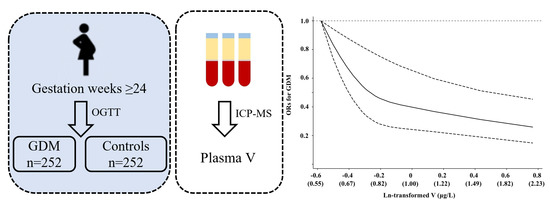
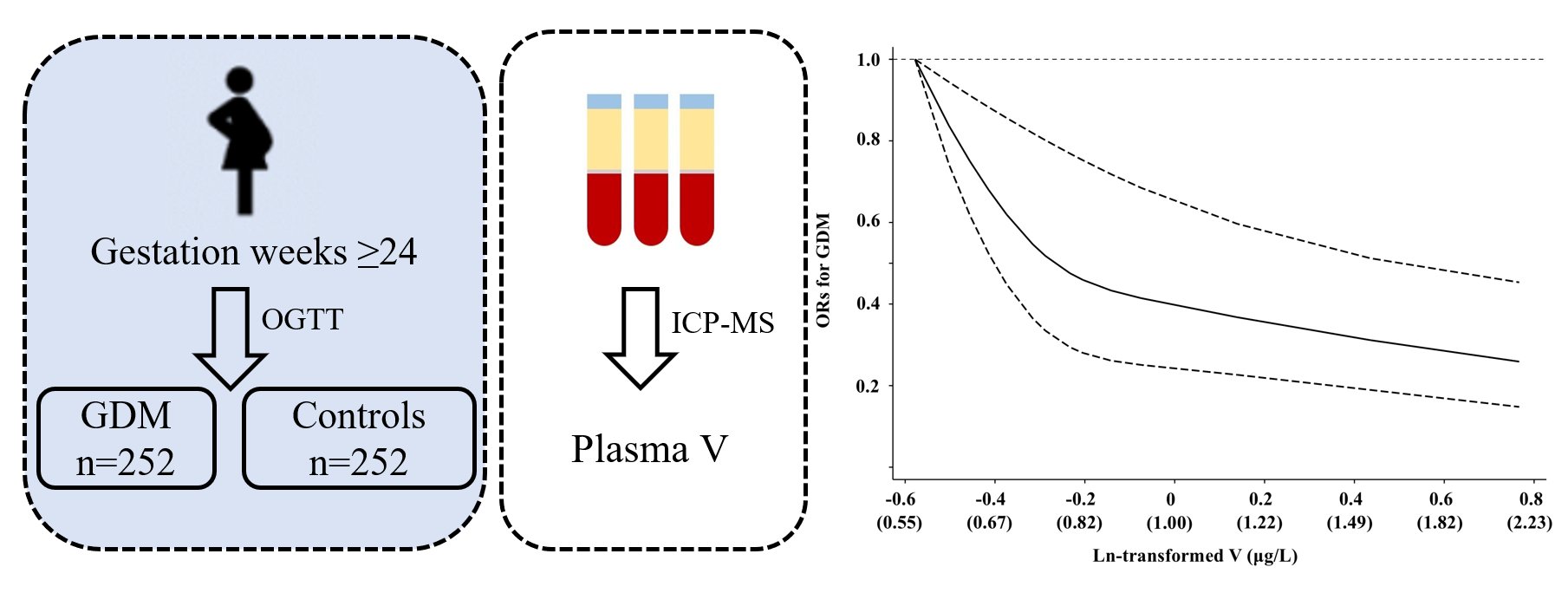
Vanadium compounds were identified to be beneficial for the control of glucose homeostasis. We aimed to explore the association of plasma vanadium (V) with gestational diabetes mellitus (GDM). We performed a case-control study including 252 newly diagnosed GDM cases and 252 controls matched by age, parity, and gestational age. Fasting blood samples were collected from each participant at GDM screening (≥24 weeks of gestation). The plasma concentrations of V were determined utilizing inductively coupled plasma mass spectrometry. Plasma V levels were significantly lower in the GDM group than those in the control group (p < 0.001). The adjusted OR (95% CI) of GDM comparing the highest V tertile with the lowest tertile was 0.35 (0.20–0.61). According to the cubic spline model, the relation between plasma V and odds of GDM was potentially nonlinear (p < 0.001). Moreover, plasma V was negatively correlated with 1-h post-glucose load, 2-h post-glucose load, and lipid metabolism indices (all p < 0.05). The present study indicates an inverse association of plasma V with GDM. Further prospective cohort studies are required to validate our results.
1. Introduction
Gestational diabetes mellitus (GDM) refers to any degree of glucose intolerance with onset or first recognition in pregnancy [1]. GDM has serious negative consequences on both mothers and children. During pregnancy, hyperglycemia possibly leads to a series of adverse perinatal outcomes, for example, high caesarean section rate, pre-eclampsia, preterm birth, and neonatal metabolic disturbances [2]. After parturition, those with GDM are more likely to develop GDM or type 2 diabetes mellitus (T2DM) [3]. Meanwhile, their offspring also have an increased risk of diabetes and obesity [4]. Thus, it is imperative to prevent GDM and identifying modifiable factors associated with GDM is of great significance.
Vanadium (V) is a trace element with an essential role in carbohydrates and lipids metabolism and modulations of activities of key enzymes involved in the phosphorylation and dephosphorylation of proteins, kinases, and phosphatases for normal human function [5]. For the general population, the major source of V is food, including mushrooms, shellfish, dill seed, parsley, black pepper, etc. [6]. V deficiency leads to disturbances in thyroid function and the metabolism of glucose and lipid [7]. It is commonly accepted that V compounds exhibit insulin-mimetic properties. In 1985, Heyliger et al. described an anti-diabetic effect of V in streptozotocin-induced diabetic rats [8]. Since then, a large amount of evidence demonstrated beneficial actions of the supplementation of V compounds in various diabetic animals or human patients [9]. Additionally, plasma V concentrations were reported to be negatively associated with newly diagnosed T2DM in a case-control study [10]. However, studies on the potential association of V exposure with GDM are limited and yield inconsistent results [11,12].
Accordingly, we performed a case-control study among the Chinese population to assess whether the plasma levels of V were associated with GDM as well as its metabolic risk factors.
2. Materials and Methods
2.1. Study Population
In the current hospital-based case-control study, 252 newly diagnosed GDM patients and 252 matched controls were enrolled from Tongji Hospital (Wuhan, China) between August 2012 and April 2015. We included the subjects according to the following criteria: age ≥ 20 years, gestational age ≥ 24 weeks, singleton pregnancy. Participants with a history of GDM, diabetes, or systemic diseases, and those who received medication for regulating glucose metabolism, were excluded.
GDM was diagnosed according to the American Diabetes Association criteria [13]. After overnight fasting, all subjects underwent a 75 g oral glucose tolerance test (OGTT) in the morning. Plasma glucose was measured at fasting, 1 h, and 2 h after the glucose load. GDM was defined if someone had one or more abnormal value: fasting plasma glucose (FPG) ≥ 5.1 mmol/L (92 mg/dL), 1-h plasma glucose ≥ 10.0 mmol/L (180 mg/dL), or 2-h plasma glucose ≥ 8.5 mmol/L (153 mg/dL). Controls were randomly selected from participants with normal glucose levels and 1:1 matched to GDM cases by age (±2 years), gestational age at blood drawing (±2 weeks), and the same parity.
Personal information on sociodemographic characteristics, including age, parity, gestational age, alcohol drinking, smoking habits, and family history of diabetes, were collected through a structured questionnaire by trained investigators. Pre-pregnancy body mass index (BMI) was calculated as weight divided by the square of height (kg/m2). Fasting blood was drawn at the time of GDM screening. Then, the plasma was separated and stored at −80 °C for subsequent analysis.
This study was approved by the Ethics Committee of Tongji Medical College (approval No. 2021S044), and all the participants signed informed consents at enrollment. This study has also been registered at www.clinicaltrials.gov (accessed on 10 February 2022) (NCT05267457).
2.2. Laboratory Measurements
Plasma total cholesterol (TC), triglycerides (TG), high-density lipoprotein cholesterol (HDL-C), low-density lipoprotein cholesterol (LDL-C), and FPG were analyzed using commercial assay kits (Biosino Bio-Technology and Science Inc., Beijing, China). Fasting plasma insulin (FPI) was measured using enzyme-linked immunosorbent assay kits (Mercodia Company, Uppsala, Sweden). The homeostasis model of assessment-insulin resistance (HOMA-IR) score was computed according to the following formulas: HOMA-IR = FPG (mmol/L) × FPI (μU/mL)/22.5.
The concentrations of plasma V were determined by inductively coupled plasma mass spectrometry (Agilent 7700 Series ICP-MS, Agilent Technologies, Santa Clara, CA, USA) [14]. We set 0.02 μg/L, the concentration of the lowest standard solution, as the limit of quantification for measurement. For quality assurance, the certified reference material ClinChek No. 8883 and No. 8884 human plasma controls were used (1 out of 20 samples). For No. 8883 and No. 8884, the determined concentrations of V were 1.31 ± 0.09 μg/L (certified: 1.11 ± 0.29 μg/L) and 9.28 ± 0.50 μg/L (certified: 9.85 ± 1.97 μg/L). The inter-assay and intra-assay coefficients of variation were both <5%.
2.3. Statistical Analysis
Data were summarized according to cases and controls, as mean ± standard deviation (SD) (parametrically distributed) or median with interquartile ranges (IQRs) (nonparametrically distributed) if continuous, and as number (percentage) if categorical. Comparisons of differences in each pair of continuous variables between groups were assessed using Student’s t-test or Mann–Whitney U test. The Chi-square test was adopted to detect differences in categorical variables. Participants were categorized into tertiles defined according to the distribution of V among the control subjects. Conditional logistic regression analysis was utilized to estimate the strength of the association of plasma V with GDM by odds ratios (ORs) and 95% confidence intervals (CIs). The regression model was adjusted for age, gestational age at blood sample collection, pre-pregnancy BMI, family history of diabetes (yes or no), drinking habits (yes or no), and smoking status (yes or no). The median value of each tertile of V was considered as a continuous variable in the logistic regression models to test for a linear trend. A logarithmic transformation was adopted to make the distribution of plasma V follow a normal distribution. The potential nonlinearity of the association of plasma V with odds of GDM was further examined using a restricted cubic spline with three knots at the 25th, 50th, 75th percentiles of ln (plasma V concentrations) used via Stata version 13 (StataCorp). Correlation between plasma V levels and TC, TG, LDL-C, HDL-C, FPG, FPI, HOMA-IR, 1-h post-glucose load, and 2-h post-glucose load were performed using Pearson or Spearman correlation coefficient. Additionally, we also calculated the partial correlation coefficients after adjusting the confounding factors mentioned before.
Statistical analyses were carried out with SPSS software package 24.0 (SPSS Inc., Chicago, IL, USA). A p value < 0.05 (two-tailed) was considered statistically significant.
3. Results
In Table 1, the basic characteristics of the 504 subjects (252 GDM cases and 252 non-GDM controls) were presented. No significant between-group differences were found in age, parity, and gestational age. GDM cases have a higher proportion of family history of diabetes, higher pre-pregnancy BMI, higher levels of FPG, OGTT-1h, OGTT-2h, FPI, HOMA-IR index, TG, and LDL cholesterol than controls without GDM. In addition, compared to controls, GDM cases had a significantly lower concentration of plasma V (p < 0.001).
Table 1.
Characteristics of GDM and control groups.
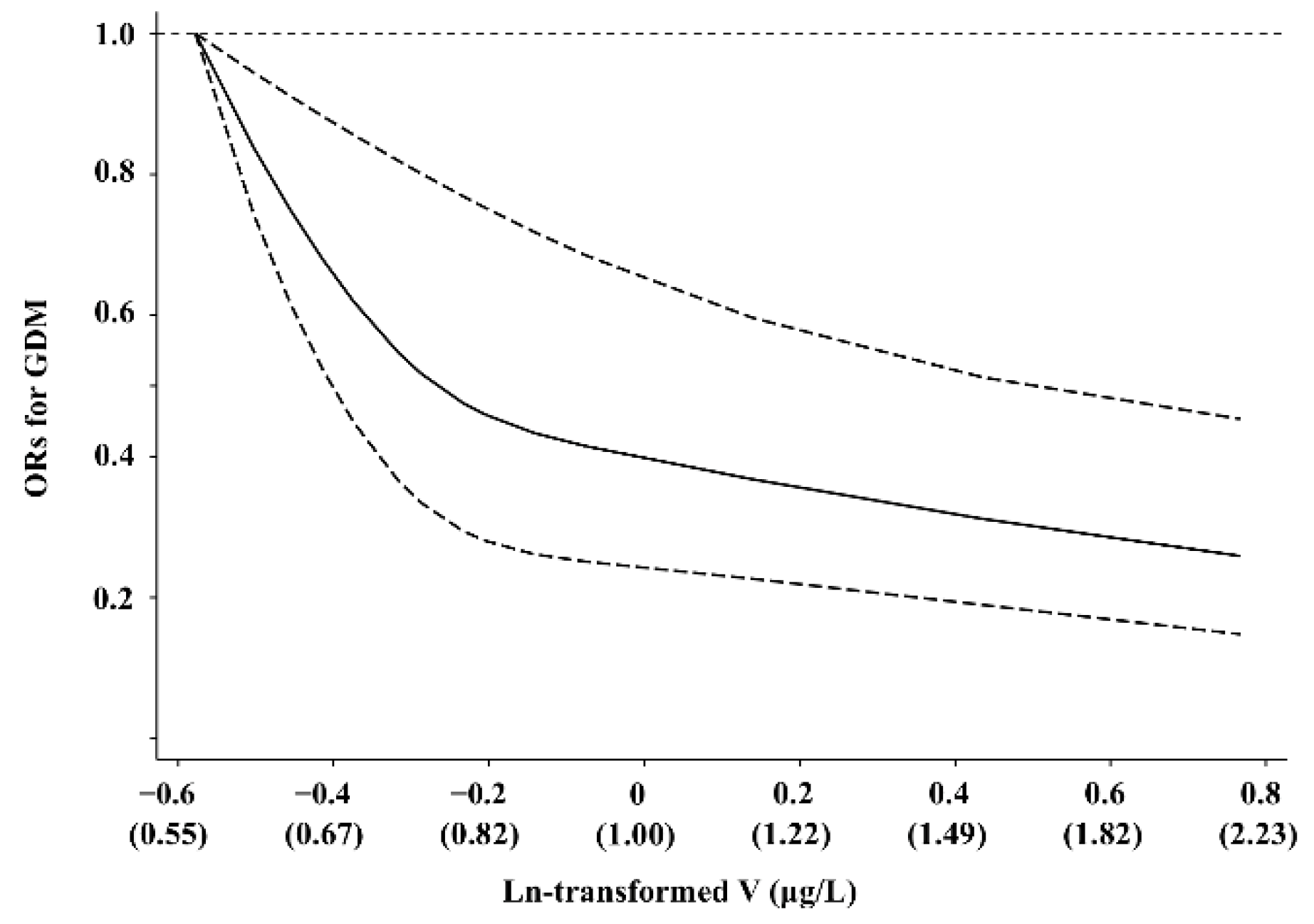
Higher levels of plasma V were associated with lower odds of GDM. The crude ORs (95% CI) of GDM across increasing tertiles of plasma V levels were 1 (referent), 0.48 (0.30–0.76), 0.40 (0.25–0.65), respectively (Table 2). Moreover, the association remained statistically significant after adjusting for age, gestational age at blood sample collection, pre-pregnancy BMI, family history of diabetes, drinking habits, and smoking status (p-trend = 0.002). For each SD increment of ln-transformed plasma V, the risk of GDM decreased 32% (OR: 0.68; 95% CI: 0.56, 0.84). In addition, the potential nonlinearity of the relation between plasma V and odds of GDM was found in the restricted cubic spline model (p < 0.001) (Figure 1). The odds of GDM reduced dramatically when the concentration of plasma V was less than 0.82 μg/L, while they declined slightly afterward.
Table 2.
Association of plasma V concentrations with GDM.
Figure 1.
Representation of restricted cubic spline regression for ln-transformed plasma V and GDM. The solid line indicated ORs derived from restricted cubic spline regression, with knots at 25th, 50th, and 75th percentiles of ln-transformed plasma V concentrations and dashed lines indicating 95% CIs. Results were adjusted with age, gestational age at blood sample collection, pre-pregnancy body mass index, family history of diabetes, drinking habits, and smoking status. V, vanadium; GDM, gestational diabetes mellitus.
As displayed in Table 3, plasma V was negatively correlated with FPG, OGTT-1h, OGTT-2h, FPI, HOMA-IR, and LDL cholesterol (all p < 0.05). After adjusting aforementioned confounding factors, V concentrations still maintained significantly inverse associations with OGTT-1h (r = −0.10, p = 0.040), OGTT-2h (r = −0.09, p = 0.043), TC (r = −0.09, p = 0.046), TG (r = −0.10, p = 0.030), and LDL cholesterol (r = −0.14, p = 0.002).
Table 3.
Correlation coefficients between V and metabolic characteristics.
4. Discussion
In the present case-control study, we found an inverse association of plasma V concentrations with odds of GDM, independent of potential confounding risk factors of GDM. Moreover, plasma V was negatively correlated with OGTT-1h, OGTT-2h, TC, TG, and LDL cholesterol.
Previous studies on the relation between the levels of V and GDM are limited and yield inconsistent results. One case-control study reported that V exposure, reflected by meconium V concentrations, was negatively associated with GDM risk in 137 GDM cases and 197 controls [15], which was similar to our findings. In a prospective cohort study, Zhang et al. found that serum V had no statistically significant association with GDM, but inversely correlated with OGTT-1h (β = −0.09, p = 0.014) [12], which was partly consistent with our results. The participants in the current study had lower blood V concentrations (median (IQR): 0.73 (0.63–0.89) μg/L in GDM cases and 0.80 (0.70–1.11) μg/L in controls) than those in Zhang’s study (median (IQR): 1.96 (0.44–2.46) μg/L), which might contribute to the discrepancies in findings. In addition, an opposite result was observed in another Chinese cohort study, which reported that V exposure in early pregnancy was positively associated with GDM risk [11]. However, this study used urinary V levels as the exposure biomarker and we used blood concentrations. Due to the absence of evidence on the relationship between blood V and urine V, it is hard to compare these two results directly. Moreover, our findings were consistent with the results of studies focusing on T2DM among non-pregnant populations. A case-control study in the Chinese population, including 223 T2DM cases and 302 controls, reported that serum V was inversely associated with T2DM risk [16]. Similarly, another study including 802 T2DM cases and 796 controls indicated a negative relationship of plasma V concentrations with the odds of T2DM [10]. Furthermore, previous studies have shown that V intervention yielded beneficial effects on glucose metabolism in animal models with impaired glucose regulation [17,18] and patients with non-insulin-dependent diabetes mellitus [19]. Accordingly, our study provided convincing support to the assumption that V had a beneficial role in the control of glucose homeostasis.
Though an inverse relationship of plasma V with GDM was indicated in our study, the exact biological mechanisms have not been clarified. One of the mechanisms is likely to be related to the protein kinase pathway [20]. The phosphate analog vanadium compounds could bind to the active site of protein tyrosine phosphatase (PTP) to inhibit PTP activity and activate phosphatidylinositol 3-kinase signaling through the enhancement of tyrosine phosphorylation of insulin receptors, thereby leading to the translocation of glucose transporter 4 to the cell membrane [21]. Vanadium-induced phosphatidylinositol 3-kinase activation pathway has been found to play a critical role in mediating vanadyl sulfate- and sodium orthovanadate-induced stimulation of glucose uptake [22], glycogen synthesis [23], and glucose transporter translocation [24] in varieties of cells. On the other hand, vanadium compounds may also exert the insulin-sensitizing effect through the protein kinase B-dependent transduction pathway by increasing adiponectin level [25].
Besides, since dyslipidaemia has been identified as one of the major risk factors of GDM [26], the preventive effect of V on GDM may be partly through improving lipid metabolism. According to previous studies, three weeks of vanadyl sulfate oral treatment improved hepatic and skeletal muscle insulin sensitivity in diabetic patients, and, meanwhile, suppressed the level of plasma free fatty acids and lipid oxidation [27,28]. Treatment with vanadyl sulfate on streptozocin-induced diabetic rats reversed abnormal levels of serum TC, TG, LDL-C, HDL-C, and phospholipid [29]. The hypoglycaemic effect is possibly mediated by inducing autophagy via activating the liver kinase B-1 (LKB1) and adenosine mono-phosphate-activated protein kinase (AMPK) signaling pathway to reduce hepatic lipid accumulation according to intervention studies in vivo and in vitro [30,31,32]. The LKB1/AMPK signal pathway has been shown to be indispensable in lipid metabolic regulation [30,33].
Our study displayed several strengths. To exclude the artificial interference after GDM diagnosis, we confined all the GDM patients to the newly diagnosed patients, because treatments such as lifestyle changes may distort the association. Furthermore, all the GDM cases were matched with controls by age, parity, and gestational age to minimize the potential confounding data derived from these factors. However, several potential limitations still exist. First, as a case-control study, it could not allow us to infer causality relationships. That is to say, it is not yet possible to decide whether low levels of V were causing GDM, or whether the disease was leading to lower V concentrations, or whether there is even a self-amplifying cycle between them. Therefore, further prospective studies need to be conducted to confirm our findings. Second, all the participants were enrolled from a certain city in China, which makes this study population relatively homogenous in ethnic background and V exposure and enhances the internal validity of our findings. However, it restricts the generalizability of these results to other populations. Third, although there were various confounding factors, we still lack the information on other residual confounding variables that may have an impact on the association we examined.
5. Conclusions
In conclusion, our results suggest that higher plasma V concentrations are associated with lower odds of newly diagnosed GDM in a Chinese population. Further prospective cohort studies are required to validate our results.
Author Contributions
Conceptualization, X.L. and Y.Z.; methodology, X.L. and Y.Z.; software, X.L.; validation, Y.Z., J.Y. and P.L.; formal analysis, X.L.; investigation, B.L., B.C. and Q.W.; resources, L.L.; data curation, X.L.; writing—original draft preparation, X.L.; writing—review and editing, P.L., J.X. and L.L.; visualization, X.L.; supervision, X.L.; project administration, X.L.; funding acquisition, L.L. All authors have read and agreed to the published version of the manuscript.
Funding
This research was funded by the National Natural Science Foundation of China, grant number 81773423; the National Key Research and Development Program of China, grant number 2020YFC2006300; and the Young Scientists Fund of the National Natural Science Foundation of China, grant number 82103822.
Institutional Review Board Statement
The study was conducted in accordance with the Declaration of Helsinki and approved by the Ethics Committee of Tongji Medical College.
Informed Consent Statement
Informed consent was obtained from all subjects involved in the study.
Data Availability Statement
The data presented in this study are available on reasonable request from the corresponding author.
Acknowledgments
We gratefully acknowledge the cooperation of the pregnant women who took part in these studies. We are sincerely grateful to everyone in the Department of Endocrinology, Tongji Hospital.
Conflicts of Interest
The authors declare no conflict of interest. The funders had no role in the design of the study; in the collection, analyses, or interpretation of data; in the writing of the manuscript, or in the decision to publish the results.
References
- American Diabetes Association. Gestational diabetes mellitus. Diabetes Care 2004, 27 (Suppl. S1), S88–S90. [Google Scholar] [CrossRef] [Green Version]
- Farrar, D.; Simmonds, M.; Bryant, M.; Sheldon, T.A.; Tuffnell, D.; Golder, S.; Dunne, F.; Lawlor, D.A. Hyperglycaemia and risk of adverse perinatal outcomes: Systematic review and meta-analysis. BMJ 2016, 354, i4694. [Google Scholar] [CrossRef] [PubMed] [Green Version]
- Reece, E.A.; Leguizamon, G.; Wiznitzer, A. Gestational diabetes: The need for a common ground. Lancet 2009, 373, 1789–1797. [Google Scholar] [CrossRef] [PubMed]
- Sellers, E.A.; Dean, H.J.; Shafer, L.A.; Martens, P.J.; Phillips-Beck, W.; Heaman, M.; Prior, H.J.; Dart, A.B.; McGavock, J.; Morris, M.; et al. Exposure to Gestational Diabetes Mellitus: Impact on the Development of Early-Onset Type 2 Diabetes in Canadian First Nations and Non-First Nations Offspring. Diabetes Care 2016, 39, 2240–2246. [Google Scholar] [CrossRef] [PubMed] [Green Version]
- Scibior, A.; Pietrzyk, L.; Plewa, Z.; Skiba, A. Vanadium: Risks and possible benefits in the light of a comprehensive overview of its pharmacotoxicological mechanisms and multi-applications with a summary of further research trends. J. Trace Elem. Med. Biol. 2020, 61, 126508. [Google Scholar] [CrossRef] [PubMed]
- Barceloux, D.G. Vanadium. J. Toxicol. Clin. Toxicol. 1999, 37, 265–278. [Google Scholar] [CrossRef]
- Mukherjee, B.; Patra, B.; Mahapatra, S.; Banerjee, P.; Tiwari, A.; Chatterjee, M. Vanadium—An element of atypical biological significance. Toxicol. Lett. 2004, 150, 135–143. [Google Scholar] [CrossRef]
- Heyliger, C.E.; Tahiliani, A.G.; McNeill, J.H. Effect of vanadate on elevated blood glucose and depressed cardiac performance of diabetic rats. Science 1985, 227, 1474–1477. [Google Scholar] [CrossRef]
- Trevino, S.; Diaz, A.; Sanchez-Lara, E.; Sanchez-Gaytan, B.L.; Perez-Aguilar, J.M.; Gonzalez-Vergara, E. Vanadium in Biological Action: Chemical, Pharmacological Aspects, and Metabolic Implications in Diabetes Mellitus. Biol. Trace Elem. Res. 2019, 188, 68–98. [Google Scholar] [CrossRef] [Green Version]
- Wang, X.; Sun, T.; Liu, J.; Shan, Z.; Jin, Y.; Chen, S.; Bao, W.; Hu, F.B.; Liu, L. Inverse association of plasma vanadium levels with newly diagnosed type 2 diabetes in a Chinese population. Am. J. Epidemiol. 2014, 180, 378–384. [Google Scholar] [CrossRef] [Green Version]
- Wang, X.; Gao, D.; Zhang, G.; Zhang, X.; Li, Q.; Gao, Q.; Chen, R.; Xu, S.; Huang, L.; Zhang, Y.; et al. Exposure to multiple metals in early pregnancy and gestational diabetes mellitus: A prospective cohort study. Environ. Int. 2020, 135, 105370. [Google Scholar] [CrossRef] [PubMed]
- Zhang, Y.; Chen, T.; Zhang, Y.; Hu, Q.; Wang, X.; Chang, H.; Mao, J.H.; Snijders, A.M.; Xia, Y. Contribution of trace element exposure to gestational diabetes mellitus through disturbing the gut microbiome. Environ. Int. 2021, 153, 106520. [Google Scholar] [CrossRef] [PubMed]
- American Diabetes Association. 2. Classification and Diagnosis of Diabetes: Standards of Medical Care in Diabetes-2018. Diabetes Care 2018, 41, S13–S27. [Google Scholar] [CrossRef] [Green Version]
- Li, P.; Yin, J.; Zhu, Y.; Li, S.; Chen, S.; Sun, T.; Shan, Z.; Wang, J.; Shang, Q.; Li, X.; et al. Association between plasma concentration of copper and gestational diabetes mellitus. Clin. Nutr. 2019, 38, 2922–2927. [Google Scholar] [CrossRef]
- Wu, Y.; Zhang, J.; Peng, S.; Wang, X.; Luo, L.; Liu, L.; Huang, Q.; Tian, M.; Zhang, X.; Shen, H. Multiple elements related to metabolic markers in the context of gestational diabetes mellitus in meconium. Environ. Int. 2018, 121, 1227–1234. [Google Scholar] [CrossRef]
- Lv, Y.; Xie, L.; Dong, C.; Yang, R.; Long, T.; Yang, H.; Chen, L.; Zhang, L.; Chen, X.; Luo, X.; et al. Co-exposure of serum calcium, selenium and vanadium is nonlinearly associated with increased risk of type 2 diabetes mellitus in a Chinese population. Chemosphere 2021, 263, 128021. [Google Scholar] [CrossRef]
- Brichard, S.M.; Bailey, C.J.; Henquin, J.C. Marked improvement of glucose homeostasis in diabetic ob/ob mice given oral vanadate. Diabetes 1990, 39, 1326–1332. [Google Scholar] [CrossRef]
- Wang, J.; Yuen, V.G.; McNeill, J.H. Effect of vanadium on insulin sensitivity and appetite. Metab. Clin. Exp. 2001, 50, 667–673. [Google Scholar] [CrossRef] [Green Version]
- Boden, G.; Chen, X.; Ruiz, J.; van Rossum, G.D.; Turco, S. Effects of vanadyl sulfate on carbohydrate and lipid metabolism in patients with non-insulin-dependent diabetes mellitus. Metab. Clin. Exp. 1996, 45, 1130–1135. [Google Scholar] [CrossRef]
- Molero, J.C.; Perez, C.; Martinez, C.; Villar, M.; Andres, A.; Fermin, Y.; Carrascosa, J.M. Activation of MAP kinase by insulin and vanadate in adipocytes from young and old rats. Mol. Cell. Endocrinol. 2002, 189, 77–84. [Google Scholar] [CrossRef]
- Lu, B.; Ennis, D.; Lai, R.; Bogdanovic, E.; Nikolov, R.; Salamon, L.; Fantus, C.; Le-Tien, H.; Fantus, I.G. Enhanced sensitivity of insulin-resistant adipocytes to vanadate is associated with oxidative stress and decreased reduction of vanadate (+5) to vanadyl (+4). J. Biol. Chem. 2001, 276, 35589–35598. [Google Scholar] [CrossRef] [PubMed] [Green Version]
- Li, J.; Elberg, G.; Sekar, N.; bin He, Z.; Shechter, Y. Antilipolytic actions of vanadate and insulin in rat adipocytes mediated by distinctly different mechanisms. Endocrinology 1997, 138, 2274–2279. [Google Scholar] [CrossRef] [PubMed]
- Marita, A.R.; Anilkumar, K.L. Effect of vanadate on glycogen synthesis in dexamethasone-treated 3T3 adipocytes: Evidence for a novel insulin sensitizing action. Diabetes Obes. Metab. 2001, 3, 271–278. [Google Scholar] [CrossRef] [PubMed]
- Donthi, R.V.; Huisamen, B.; Lochner, A. Effect of vanadate and insulin on glucose transport in isolated adult rat cardiomyocytes. Cardiovasc. Drugs Ther. 2000, 14, 463–470. [Google Scholar] [CrossRef]
- Seale, A.P.; de Jesus, L.A.; Park, M.C.; Kim, Y.S. Vanadium and insulin increase adiponectin production in 3T3-L1 adipocytes. Pharmacol. Res. 2006, 54, 30–38. [Google Scholar] [CrossRef]
- Han, E.S.; Krauss, R.M.; Xu, F.; Sridhar, S.B.; Ferrara, A.; Quesenberry, C.P.; Hedderson, M.M. Prepregnancy Adverse Lipid Profile and Subsequent Risk of Gestational Diabetes. J. Clin. Endocrinol. Metab. 2016, 101, 2721–2727. [Google Scholar] [CrossRef] [Green Version]
- Cohen, N.; Halberstam, M.; Shlimovich, P.; Chang, C.J.; Shamoon, H.; Rossetti, L. Oral vanadyl sulfate improves hepatic and peripheral insulin sensitivity in patients with non-insulin-dependent diabetes mellitus. J. Clin. Investig. 1995, 95, 2501–2509. [Google Scholar] [CrossRef] [Green Version]
- Halberstam, M.; Cohen, N.; Shlimovich, P.; Rossetti, L.; Shamoon, H. Oral vanadyl sulfate improves insulin sensitivity in NIDDM but not in obese nondiabetic subjects. Diabetes 1996, 45, 659–666. [Google Scholar] [CrossRef]
- Tunali, S.; Yanardag, R. Effect of vanadyl sulfate on the status of lipid parameters and on stomach and spleen tissues of streptozotocin-induced diabetic rats. Pharmacol. Res. 2006, 53, 271–277. [Google Scholar] [CrossRef]
- Seo, M.S.; Kim, J.H.; Kim, H.J.; Chang, K.C.; Park, S.W. Honokiol activates the LKB1-AMPK signaling pathway and attenuates the lipid accumulation in hepatocytes. Toxicol. Appl. Pharmacol. 2015, 284, 113–124. [Google Scholar] [CrossRef]
- Zhang, L.; Huang, Y.; Liu, F.; Zhang, F.; Ding, W. Vanadium(IV)-chlorodipicolinate inhibits 3T3-L1 preadipocyte adipogenesis by activating LKB1/AMPK signaling pathway. J. Inorg. Biochem. 2016, 162, 1–8. [Google Scholar] [CrossRef] [PubMed]
- Huang, Y.; Liu, F.; Zhang, F.; Liu, P.; Xu, T.; Ding, W. Vanadium(IV)-chlorodipicolinate alleviates hepatic lipid accumulation by inducing autophagy via the LKB1/AMPK signaling pathway in vitro and in vivo. J. Inorg. Biochem. 2018, 183, 66–76. [Google Scholar] [CrossRef] [PubMed]
- Ahmadian, M.; Suh, J.M.; Hah, N.; Liddle, C.; Atkins, A.R.; Downes, M.; Evans, R.M. PPARgamma signaling and metabolism: The good, the bad and the future. Nat. Med. 2013, 19, 557–566. [Google Scholar] [CrossRef] [PubMed] [Green Version]
Publisher’s Note: MDPI stays neutral with regard to jurisdictional claims in published maps and institutional affiliations. |
© 2022 by the authors. Licensee MDPI, Basel, Switzerland. This article is an open access article distributed under the terms and conditions of the Creative Commons Attribution (CC BY) license (https://creativecommons.org/licenses/by/4.0/).