Article

Development of a Spatiotemporal Estimation Method for Rice Plant Height Using Pattern Matching Based on Time-Series Satellite-Derived Vegetation Indices and In Situ Measurements


Earth Observation Research Center (EORC), Japan Aerospace Exploration Agency (JAXA), Tsukuba 305-8505, Ibaraki, Japan
*
Author to whom correspondence should be addressed.
Remote Sens. 2026, 18(9), 1388; https://doi.org/10.3390/rs18091388
Submission received: 18 February 2026 / Revised: 16 April 2026 / Accepted: 27 April 2026 / Published: 30 April 2026

Highlights

What are the main findings?
  • Data-efficient daily height estimation: We developed a Bayesian pattern-matching framework that integrates time-series satellite vegetation indices (GCVI) with sparse in situ measurements to generate continuous daily rice plant height estimates at the field scale (R2 = 0.85, RMSE = 7.08 cm).
  • Pixel-level uncertainty quantification: We produced spatially explicit uncertainty maps that capture ambiguity in growth trajectories, providing a practical reliability measure for remote sensing-based crop monitoring.
What are the implications of the main findings?
  • Scalable and interpretable monitoring: The framework enables cost-effective, large-scale crop growth tracking, supporting precision agriculture and carbon accounting in rice production systems.
  • Improved phenological insight: Daily height mapping allows robust identification of key growth stages, including the timing of canopy structural transitions relevant to radar-based inundation analysis.

Abstract

Rice plant height is a key indicator of crop growth and phenology, yet continuous daily estimation remains challenging under limited field observations. This study proposes an interpretable Bayesian LUT-based framework to estimate rice plant height from time-series, satellite-derived GCVI, and sparse in situ measurements. Daily plant height was estimated as a posterior-weighted ensemble of multiple LUT-derived heights, together with uncertainty reflecting ambiguity among plausible growth trajectories. Applied to rice paddies in Ryugasaki City, Japan, using Harmonized Landsat–Sentinel-2 data from the 2025 growing season, the method achieved R 2 = 0.85 and RMSE = 7.08 cm on the validation dataset, outperforming simple baseline approaches. The estimated daily height time series also enabled evaluation of the timing at which plant height reached 70 cm, revealing clear spatial variability among fields and an associated uncertainty of approximately 10 days. Although this threshold was discussed with reference to previous studies on L-band SAR sensitivity, the present study relied solely on optical observations. Overall, the proposed framework provides a data-efficient and explainable approach for daily, spatially explicit rice growth monitoring, while current limitations include the single-region, single-year LUT construction and the simplified statistical assumptions used in the Bayesian weighting framework.

1. Introduction

Securing a sustainable and equitable global food supply amid continued population growth and environmental change is a central challenge of the 21st century [1]. To address this, efficient crop-monitoring methods are essential to support timely, informed decision-making for improving agricultural productivity. Furthermore, in countries facing an aging and shrinking agricultural workforce, such as Japan, there is an increasing demand for automated and scalable approaches to monitoring agricultural fields [2]. Rice plant height is an important indicator of yield, and the severity of pests and diseases [3]. In addition, rice plant height is one of the determining factors of electromagnetic wave scattering observed in L-band SAR satellite [4].
Various direct and indirect crop-monitoring methods have been developed. Direct methods include field-based measurements, such as manual plant height observations using rulers, which can provide accurate reference data for validating indirect approaches. Indirect methods include remote-sensing approaches using different sensing platforms, ranging from proximal systems such as Terrestrial Laser Scanning (TLS) [5,6,7] and drones [8,9] to satellite observations, depending on the required spatial scale and accuracy. While TLS and drone-based observations can provide digital surface models (DSMs) that can be converted into crop height by subtracting terrain height, these approaches are generally limited to relatively small areas and infrequent repeated observations. In contrast, satellite remote sensing is more suitable for monitoring large areas covering hundreds of paddy fields at frequent observation intervals and is therefore beneficial for quantifying the rapid growth of rice plants.
Satellite observations have increasingly been used to estimate crop structural variables over large agricultural areas. Both optical and Synthetic Aperture Radar (SAR) data have been utilized for growth monitoring of the crop physiology of various crops at a large scale. For example, drone-measured height maps have served as ground truth for machine-learning models to produce canopy height models from PlanetScope data in Brazilian maize fields, achieving an RMSE of 15.07 cm using Random Forest [10]. Combining optical (Sentinel-2) and SAR (Sentinel-1) data has also demonstrated high performance in estimating the height of wheat [11] and maize [12]. Temporal SAR data alone can be used as input values to estimate maize height by using RADARSAT-2 data [13]. Collectively, these studies demonstrate the utility of satellite remote sensing for estimating field-crop height over large agricultural areas.
In rice paddies, satellite-based height estimation has been explored using both physically based and data-driven approaches. Indoor experiments demonstrated the feasibility of Polarimetric Interferometric SAR (PolInSAR) on rice-height estimation [14]. A rice canopy scattering model (RCSM) was used to estimate rice height from the RADARSAT-2 HH polarization band, demonstrating the effectiveness of SAR backscatter data for rice height mapping [15]. Sentinel-1 VV and VH backscatter was also used to estimate rice height, achieving an R2 of 0.92 and a root mean square error (RMSE) of 7.9 cm using a Random Forest (RF) model in France [16]. Similarly, Sentinel-1 backscatter values were used as inputs to regression models, and non-parametric methods such as support vector regression achieved better performance than parametric models, with an R2 of 0.90 and an RMSE of 11.7 cm against measured rice plant height [17]. Parametric representation of rice plant growth was combined with a particle filter (PF), enabling RMSE of 7.36 cm and R2 of 0.95 [18]. Not only SAR data but also optical satellite data are useful for estimating rice plant height. Quantile Regression Forest (QRF) model was utilized to estimate rice plant height with R2 values at around 0.7, and RMSE of 13~17 cm [19].
Despite the potential of remote sensing to quantify crop status from parcel to national scales, significant research gaps remain in satellite-based growth monitoring. Current studies rely mostly on data-driven machine-learning models, such as Random Forest, to relate input variables (e.g., VIs and radar backscatter) to measured crop heights [10,13,16]. However, these models may require large, representative datasets for training, making the necessary field surveys both costly and time-consuming. Moreover, machine-learning models often have an inherent “black-box” nature [20], which limits their explainability, a critical factor for building trust among agricultural stakeholders such as local farmers and for ensuring practical adoption. In addition to these modeling-related limitations, existing studies on rice plant height estimation have relied primarily on SAR backscatter data. Meanwhile, optical satellite data have also been shown to contain useful structural information in other vegetation systems, such as forest canopy height estimation [21]. Although the target vegetation structure differs between forests and rice paddies, these findings suggest that optical data may also have potential for rice plant height estimation and therefore deserve further investigation. Consequently, there is a need for a more data-efficient and interpretable estimation framework that can effectively utilize optical time-series satellite data.
In this study, we propose an interpretable framework for daily rice plant height estimation using time-series satellite observations together with a limited number of in situ measurements. The primary objectives are (1) to develop a method for estimating rice plant height at a daily scale from irregular satellite observations and sparse field measurements, and (2) to evaluate the timing at which the estimated plant height reaches 70 cm and to examine its physical and practical significance. The contribution of this study lies in an explainable multi-LUT-based framework that integrates sparse optical GCVI observations and in situ plant height measurements to generate daily continuous rice plant height estimates together with trajectory-based uncertainty. By preserving explicit correspondence among the observed GCVI series, candidate LUTs, posterior weights, and the final height estimate, the proposed approach offers greater transparency and interpretability of the predictive processes.

2. Materials and Methods

2.1. Flowchart of the Study

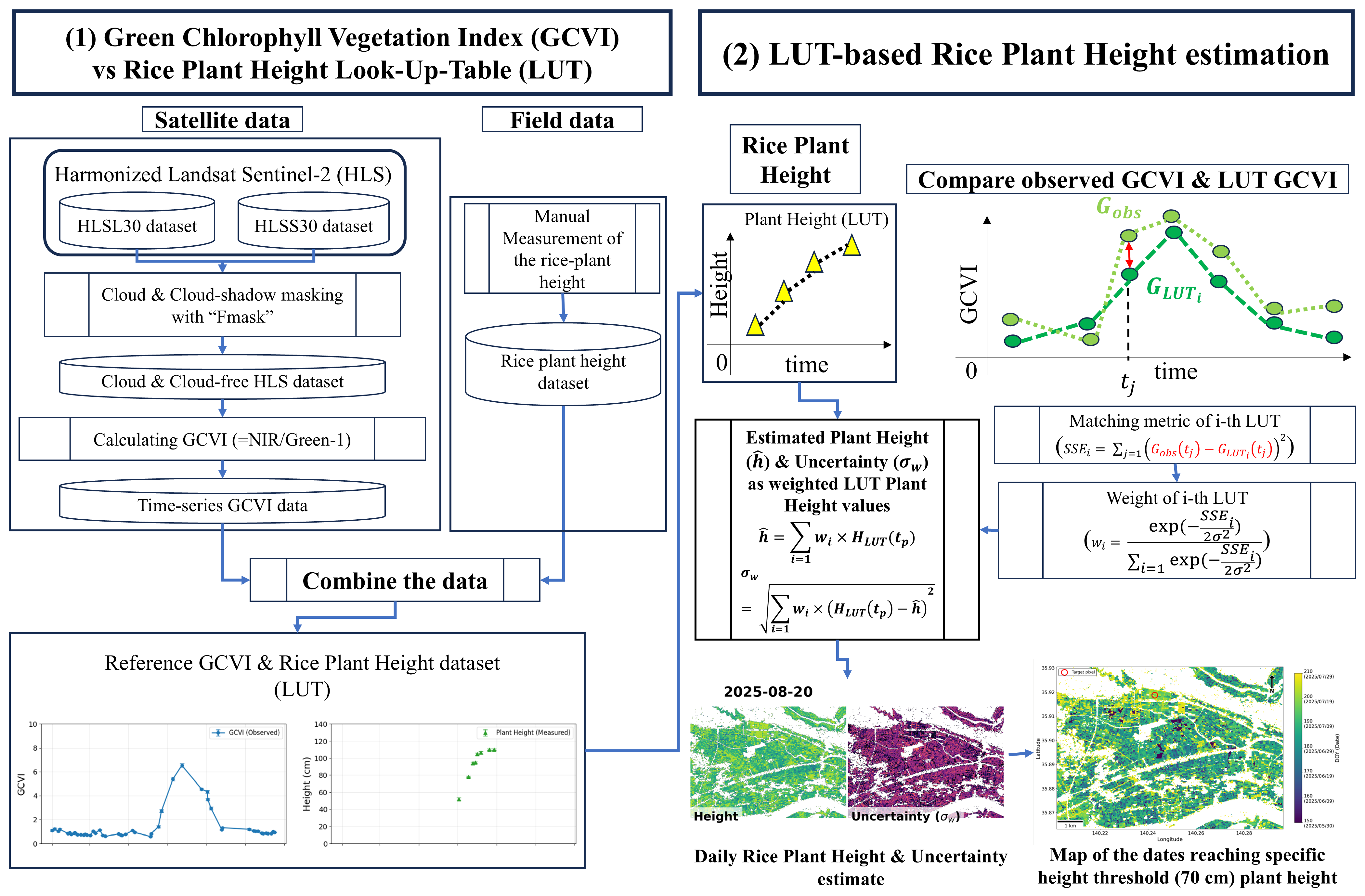
The overall workflow of this study is illustrated in Figure 1 and consists of two main components. First, a look-up table (LUT) was constructed by integrating field-measured rice canopy height data with satellite-derived vegetation indices. Specifically, cloud-free HLS imagery was generated through cloud and cloud-shadow masking, and the green chlorophyll vegetation index (GCVI) was calculated to produce time-series satellite observations. These were then combined with in situ measurements of rice canopy height to establish a reference relationship between GCVI and canopy height. Second, this LUT was used to estimate daily rice canopy height across space and time. For each pixel, the observed GCVI time series was compared with LUT-derived GCVI trajectories, and a Bayesian pattern-matching approach was applied to evaluate their similarity. Based on this matching, canopy height was estimated as a weighted average of LUT candidates, and the associated uncertainty was quantified from the dispersion of the weighted estimates. This framework enables the generation of spatially explicit daily maps of rice canopy height and uncertainty, as well as the identification of key growth-stage timing.

2.2. Study Area and Rice Height Measurement Campaign

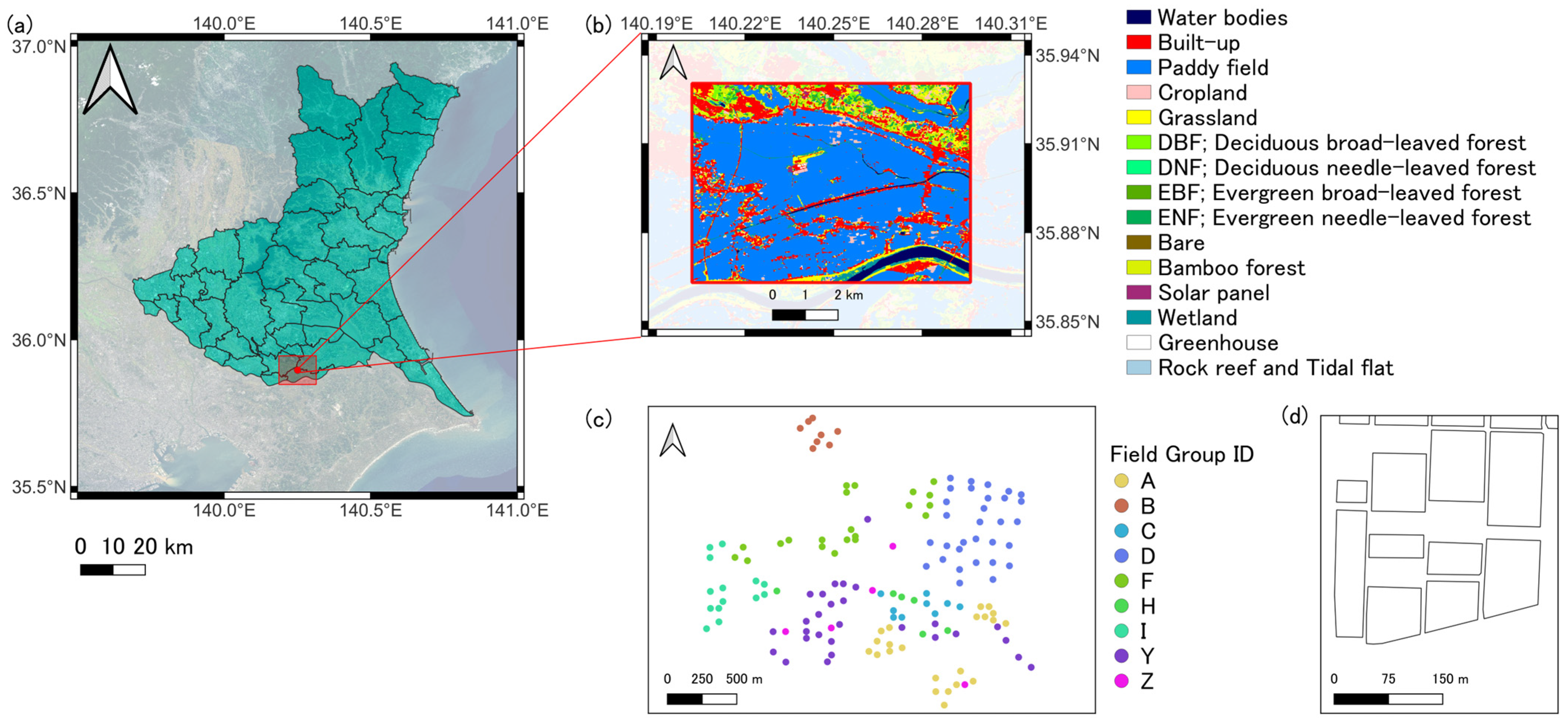
The study area was chosen in Ryugasaki City, Ibaraki Prefecture, Japan. This area is located near Lake Kasumigaura, and the southern edge of Ibaraki prefecture, as shown in Figure 2a. Ryugasaki is known for the significant rice production, of which 1770 ha (68% of the total cropland area) is dedicated to rice paddy according to the year 2024 (Reiwa-6th) governmental statistics (https://www.maff.go.jp/j/tokei/kouhyou/sakumotu/menseki/#c (last accessed on 26 April 2026)).
The target area for rice plant height estimation was defined around Ryugasaki Airport, where the field measurement campaign was conducted, as shown in Figure 2b. This area is almost entirely used for rice production. The rice plant height field campaign was conducted nine times between 20 June 2025 and 28 August 2025. Figure 2c shows the candidate paddy fields as representative points. These points correspond to representative HLS pixels identified through geometric filtering based on the spatial relationship between HLS pixel size and field scale, as described in the next section. Not all candidate fields were necessarily measured during every campaign. These paddy fields were classified into 9 groups, where the different field groups have a different variety of rice. The field-campaign dates and targeted fields are summarized in Table 1. The plant height, defined as the length from the base of the plant body to the top of the plant, was manually measured by using a ruler and recorded to the nearest centimeter.

2.3. Satellite Data and GCVI-Based Rice Phenology Extraction

The “Harmonized Landsat Sentinel-2 (HLS)” dataset consists of combined Sentinel-2 (Multi-Spectral Instrument, MSI sensor) and Landsat-8/9 (Operational Land Imager OLI sensor) satellite observation records. It provides seamless products of MSI and OLI sensors, including spatial co-registration, common gridding, illumination, view-angle normalization, and spectral band adjustment. We obtained the HLS dataset from the Google Earth Engine (GEE) platform, where the cloud and cloud–shadow masks were applied by using the “Fmask” band. In addition, GCVI values over 10 or below −5 were considered invalid and removed from the analysis due to remaining clouds. These thresholds were determined by the qualitative analysis of the time-series GCVI plots. The HLS dataset is provided separately: HLSL-30 and HLSS-30 for Landsat and Sentinel-2, respectively. They were combined into a single dataset on GEE.
We utilized the green chlorophyll vegetation index (GCVI) as defined by Equation (1) [22]. It is known not to saturate under high leaf area conditions, and crop-mapping studies have utilized the index to track and map crop types [23]. Therefore, we chose it as a suitable index to quantify the temporal changes in rice growth. We took B5 and B3 for the HLSL dataset, and B8 and B3 for the HLSS dataset for near-infrared (NIR) and green bands, respectively, to calculate the GCVI after the cloud-masking preprocessing step.
G C V I = N e a r   I n f r a r e d G r e e n 1
We extracted GCVI time series from satellite data using a representative pixel selection approach to minimize mixed-pixel effects, rather than sampling at field centroids or averaging values within fields. Pixel polygons were first generated from the HLS dataset using affine transformation parameters and intersected with mapped paddy field polygons. For each field, candidate pixels were evaluated based on (1) pixel purity, defined as the proportion of the pixel area covered by the field, (2) overlap ratio, defined as the proportion of the field area covered by the pixel, and (3) distance to the field centroid. Only pixels with a purity greater than 0.9 were retained to ensure minimal contamination from surrounding land cover. Among these, a single representative pixel was selected by prioritizing higher purity, greater overlap, and proximity to the field center (see Supplementary Figure S1). The centroid of the selected pixel polygon was then used as a point location to extract the GCVI time-series by using ee.ImageCollection.getRegion function. In addition, a simple linear regression was conducted to see the “baseline” performance of the plant height estimation from the GCVI dataset observed by the satellites.

2.4. LUT-Construction from the Field Rice Plant Height Measurement, and GCVI Values

The proposed method exploits the strong relationship between the green chlorophyll vegetation index (GCVI) and plant height. This relationship was represented as a set of look-up tables (LUTs) constructed from field measurements and satellite observations. Given a time series of observed GCVI values, posterior probabilities were assigned to individual LUTs, and plant height was estimated as a weighted average of LUT-derived heights.
For each field, a LUT was constructed to describe the temporal relationship between GCVI and plant height. Discrete satellite-derived GCVI observations and field-measured plant heights were projected onto a fixed daily time axis spanning from 1 January to 31 December of the target year using numpy.interp function with linear interpolation. This interpolation step was introduced to harmonize irregular observation timings within a common daily framework for LUT matching, rather than to impose additional smoothing on the growth trajectory itself. Linear interpolation was adopted as a simple and conservative approach because more flexible interpolation schemes may introduce artificial oscillations between sparse observation dates.
To retain meaningful vegetation growth signals, only GCVI values greater than zero were used for LUT construction. A binary validity mask was also stored for each LUT to represent the effective interpolated observation window derived from the available GCVI and plant height records. The i -th LUT is defined in Equation (2), where t denotes day-of-year, G LUT , i ( t ) is the interpolated GCVI value, and H LUT , i ( t ) is the interpolated plant height.
L U T i = t ,   G L U T , i   t ,   H L U T , i   ( t )

2.5. Bayesian Framework for Rice Plant Height Estimation

We adopted a Bayesian framework combined with the LUT approach to estimate rice plant height and its associated uncertainty from satellite observations. Let the observed GCVI time series be denoted by D , as shown in Equation (3), where t j represents normalized time within the annual cycle and G o b s ( t j ) is the GCVI value observed from the HLS dataset. This workflow was implemented in Python 3.12, using the following main packages: numpy 2.0.2, pandas 2.2.2, scikit-learn 1.6.1, geopandas 1.1.3, shapely 2.1.2, rasterio 1.5.0, pyproj 3.7.2, earthengine-api 1.7.22, geemap 0.37.2, and matplotlib 3.10.0.
D = D 1 ,   D 2 ,   . ,   D J = t 1 , G o b s t 1 , t 2 , G o b s t 2 , , t J , G o b s t J
Using Bayes’ theorem, the posterior probability that the observations D originates from the i-th LUT is expressed in Equation (4).
P L U T i D = P D L U T i P L U T i P D
Assuming uniform prior probabilities for all LUTs, the posterior probability is proportional to the likelihood, as shown in Equation (5), where k is a constant term.
P L U T i D = k × P D L U T i
The likelihood of observing data D given the i-th LUT can be calculated in Equation (6).
P D L U T i = P D 1 , D 2 , L U T i = P D 1 L U T i × P D 2 L U T i × = j = 1 P D j L U T i
The likelihood was formulated by assuming independent Gaussian errors between observed GCVI values and LUT-derived GCVI values on the daily interpolated time axis. The comparison was performed between daily interpolated GCVI trajectories derived from the available observations, rather than being restricted strictly to the original raw observation dates only. Posterior weights were updated sequentially on the daily interpolated time axis using cumulative residual errors between the observed GCVI series and each LUT trajectory. The j-th observation, assuming that it originated from the i-th LUT, can be formulated in Equation (7).
G o b s t j = G L U T i t j + ϵ j ϵ j = G o b s t j G L U T i t j
We also assume that the error term follows a normal distribution with zero mean. ϵ j ~ N ( 0 , σ 2 ) . Substituting Equation (7) allows the prior probability to be expressed by a simple normal distribution as shown in Equation (8).
P ( ϵ j ) = 1 2 π σ 2 exp ϵ j 2 2 σ 2 P D j L U T i = 1 2 π σ 2 exp G o b s t j G L U T i t j 2 2 σ 2
Substituting Equation (8) into Equation (6) allows the prior probability (likelihood) to be expressed by the sum of squared error value ( S S E i =   j = 1 G o b s t j G L U T i t j 2 ) and an exponential function multiplied by a constant term as shown in Equation (9).
G o b s t j = G L U T i t j + ϵ j ϵ j = G o b s t j G L U T i t j
Equations (5) and (9) show that the posterior probability of the i-th LUT given the GCVI observation D is also proportional to the exponential equation as shown in Equation (10), where α is a normalization constant.
P L U T i D = k × P D L U T i = k ( 2 π σ 2 ) × exp S S E i 2 σ 2 = α × exp S S E i 2 σ 2
Finally, the posterior probability was normalized to compute the weight w i , representing the contribution of each LUT to the plant height estimation as shown in Equation (11).
w i = α × e x p ( S S E i 2 σ 2 ) i = 1 α × e x p ( S S E i 2 σ 2 ) = e x p ( S S E i 2 σ 2 ) i = 1 e x p ( S S E i 2 σ 2 )
To improve robustness and reduce the influence of poorly matching templates, posterior normalization was restricted to the top K LUTs with the smallest residual loss L i . LUTs outside this subset were assigned to zero weight. The sensitivity analysis will be explained following the parameter σ optimization.
The probabilistic assumptions used here should be interpreted as practical approximations rather than a fully rigorous stochastic error model. Specifically, the likelihood formulation assumes that GCVI residuals are independent and identically distributed and follow a Gaussian distribution with a common variance parameter σ 2 . In reality, temporally adjacent observations are likely to retain serial dependence, and the supplementary Q–Q plot analysis showed that the normality assumption was only approximately satisfied, with some field groups showing noticeable departures, particularly in the distribution tails (Supplementary Figure S3). In addition, the use of a single common σ for all groups is a simplified treatment. Therefore, the present Bayesian formulation is intended as an approximate probabilistic weighting scheme that enables tractable LUT matching, while more flexible error structures, such as temporally correlated or group-specific residual models, should be explored in future work.
The parameter σ represents the assumed observation uncertainty of GCVI and controls the sensitivity of the likelihood function to residual errors. A small σ emphasizes LUT templates that closely match local GCVI fluctuations, which may lead to temporal instability caused by frequent switching among disparate templates. In contrast, a large σ produces a flatter posterior distribution, resulting in smoother estimates but potentially higher RMSE due to over-smoothing.
To determine the optimal σ , we conducted a sensitivity analysis using the LUT construction dataset, corresponding to 80% of the total samples. All LUTs were used at this stage. For each candidate σ , daily plant height was estimated and compared against a 15-day moving average, which was used as a proxy for the physiological growth trend under the assumption that rice plant height changes smoothly over time without abrupt day-to-day growth or shrinkage. The Instability Metric was defined as the maximum absolute deviation between the daily estimates and this trend. The optimal σ was then selected qualitatively by balancing mean RMSE and average maximum deviation so that the resulting growth curve remained physiologically plausible without substantially compromising predictive accuracy.
Following the optimization of the parameter σ, the best K value was determined through sensitivity analysis. Similarly to the σ optimization step, the LUT construction dataset was utilized to avoid data leakage to the validation step. Using the best σ value, RMSE and R2 values were calculated by changing the parameter K from 3 (using only the top-three LUTs) to 30 + all the samples. The best K value was determined by maximizing the R2 and minimizing the RMSE value.
The weighted LUT height ( h ^ ) values were used as the estimation of the rice plant height given a record of GCVI observation. In addition, the uncertainty ( σ w ) is defined as the weighted square difference in the LUT recorded height and the estimated height value. This uncertainty reflects ambiguity among plausible growth trajectories rather than measurement noise and increases when observational constraints are weak.
h ^ = i = 1 w i × H L U T ( t p )
σ w = i = 1 w i × H L U T t p h ^ 2

2.6. Spatial Estimation of the Rice Plant Height, and Evaluation of the Timing to Reach a Target Plant Height

Using the Bayesian framework described in Section 2.3 and Section 2.4, rice plant height was estimated for each pixel as the posterior-weighted mean of LUT-derived heights. The associated uncertainty was quantified as the posterior-weighted standard deviation, reflecting ambiguity among plausible growth trajectories.
To characterize crop growth dynamics, we evaluated the timing at which the estimated plant height reached a predefined target value. A threshold height of 70 cm was adopted, as previous studies have reported this height above which the contribution from the surface scattering started to decrease, and reduced the accuracy of surface inundation classification in L-band SAR data [4]. For each pixel, the date at which the estimated plant height first exceeded the threshold was identified by linearly interpolating the threshold-crossing time between consecutive daily estimates. Importantly, this interpolation was applied only to determine the timing of the threshold-crossing event and not to smooth or interpolate the plant height estimates themselves. Uncertainty in the threshold-reaching date was quantified by applying the same procedure to the upper and lower bounds of the plant height uncertainty, defined as h ^ ( t ) ± σ w ( t ) , yielding the earliest and latest plausible crossing date.

3. Results

3.1. Relationship Between GCVI Vegetation Index and In Situ Measurements

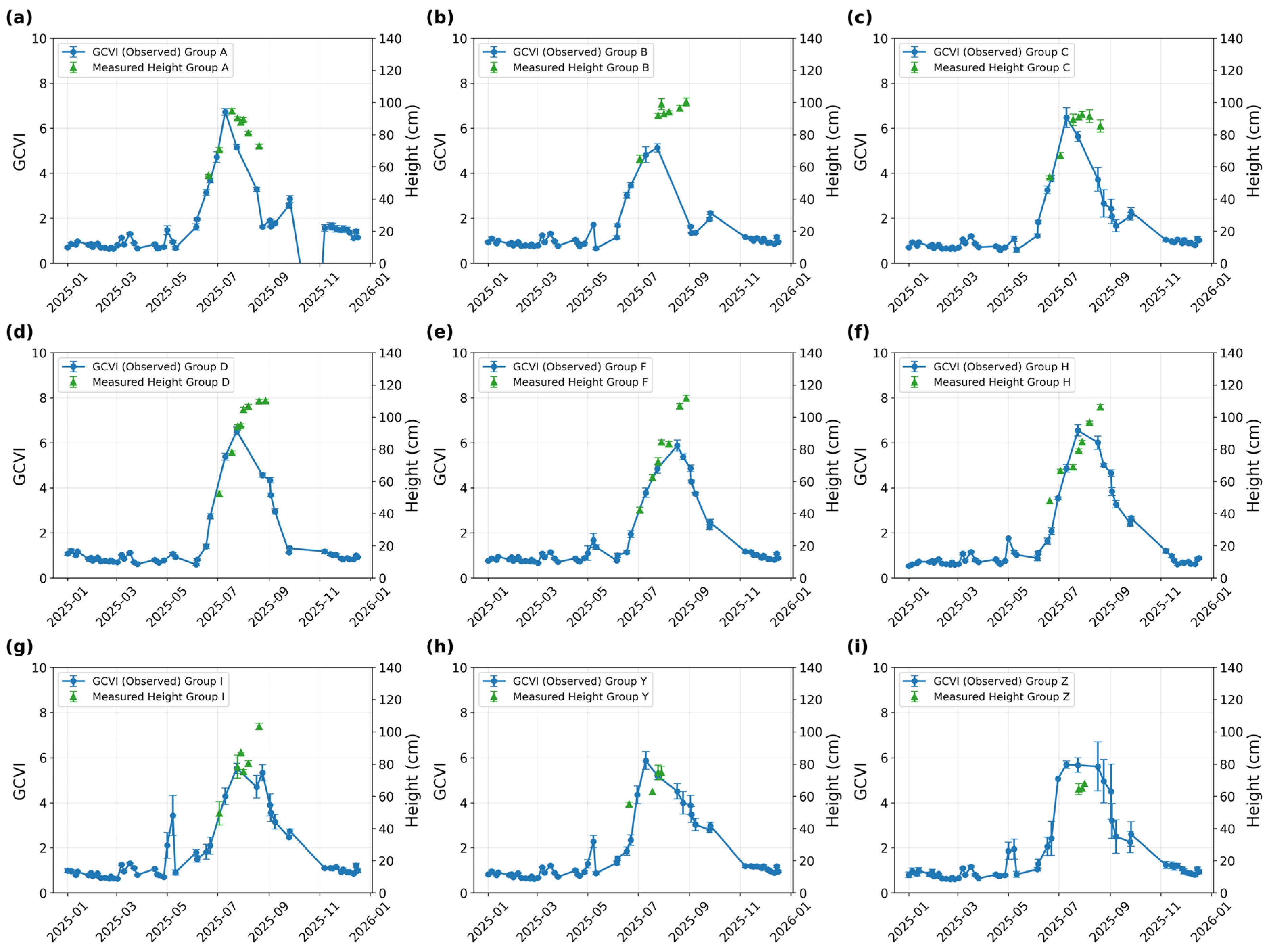
Figure 3 shows the observed time series of GCVI and in situ measured plant height for representative rice field groups during the 2025 growing season. Across all field groups, GCVI exhibits a clear seasonal trajectory, increasing during the vegetative growth phase, peaking in mid-season, and declining toward the late growing stage.
The in situ plant height measurements show a concurrent increase during the period of rising GCVI, indicating that plant height development broadly progresses alongside the seasonal evolution of GCVI. At the same time, differences in the timing and magnitude of both GCVI peaks and plant height growth are observed among field groups, reflecting field-specific growth characteristics.
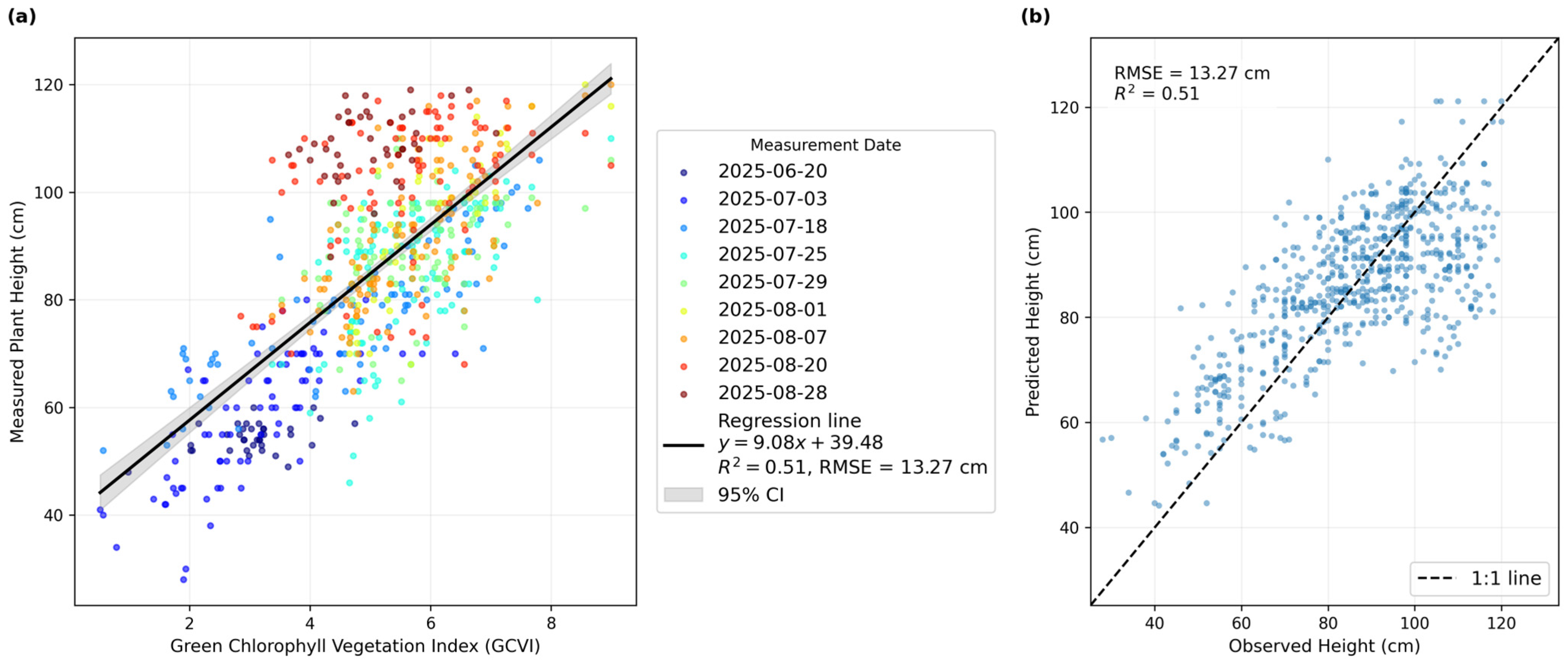
Figure 4 illustrates the relationship between the green chlorophyll vegetation index (GCVI) and in situ measured rice plant height. As shown in Figure 4a, higher GCVI values are generally associated with higher plant heights across the full dataset, indicating an overall positive relationship between GCVI and plant height. At the same time, the scatter plot reveals systematic differences among measurement dates. While early and mid-season observations (June–July) show higher GCVI values for increasing plant height, observations from the later period, particularly in late August (20 August and 28 August), exhibit lower GCVI values at comparable plant heights. This shift is evident from the color-coded points, where late-season measurements are distributed toward lower GCVI values relative to earlier observations at similar plant height levels.
Figure 4b presents the comparison between observed plant height and plant height predicted by a simple linear regression model based solely on GCVI, of which the relationship was found to be M e a s u r e d   C a n o p y   H e i g h t   cm = 9.08 × G C V I + 39.48 . This result is shown as a baseline representation of the height estimation performance using the GCVI–plant height relationship. The predicted values are distributed around the 1:1 line, with an RMSE of 13.27 cm and an R 2 of 0.51.

3.2. Bayesian LUT-Based Rice Plant Height Estimation Process

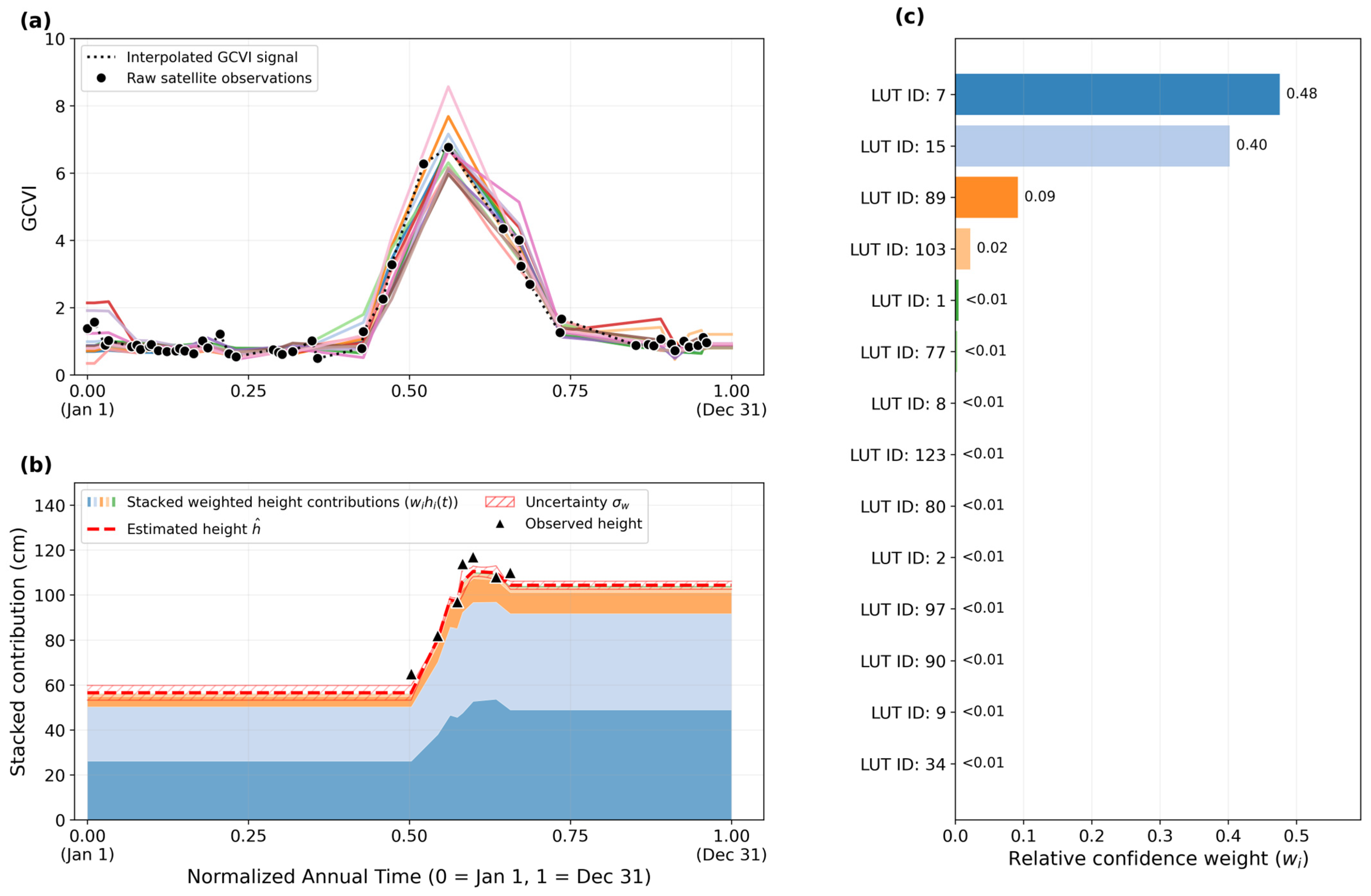
The σ adjustment steps were executed by changing the values at 0.1, 0.5, 1.0, 1.5, 2.0, 2.5, 3.0, 3.5, 4.0, 4.5, and 5.0. It was found that σ = 1.5 would produce a good balance between the reduction in temporal instability and the increase in RMSE (see Supplementary Figure S4). Figure 5 illustrates the Bayesian LUT-based rice plant height estimation process using a representative example. The top 14 LUTs having the largest likelihood values were used for the computation of the weights because it was found to be the best choice, maximizing the R-squared, while minimizing the RMSE, given σ = 1.5 (see Supplementary Figure S5). Figure 5a compares the interpolated GCVI signal derived from raw satellite observations with multiple LUT GCVI templates on a normalized time axis. The black points indicate the original GCVI observations, while the colored lines represent GCVI trajectories from individual LUTs. The observed GCVI time series shows varying degrees of agreement with different LUT templates over the growing season.
Figure 5b shows the corresponding plant height estimates derived from the LUT ensemble. The colored lines represent individual LUT-derived plant height trajectories considered in the posterior weighting process, whereas the red dashed line represents the posterior-weighted ensemble mean plant height estimate. The shaded region indicates the associated uncertainty range, calculated from the posterior-weighted dispersion of LUT-derived height values. Black triangles mark held-out ground survey measurements used for comparison.
Figure 5c presents the relative confidence weights assigned to each LUT, calculated from the posterior probabilities of the pattern matching. The weight distribution indicates that the top-five LUTs contribute more strongly to the ensemble estimate, while the remaining LUTs have very little contribution, close to zero in this field.

3.3. Accuracy Assessment and Validation of Height Estimation

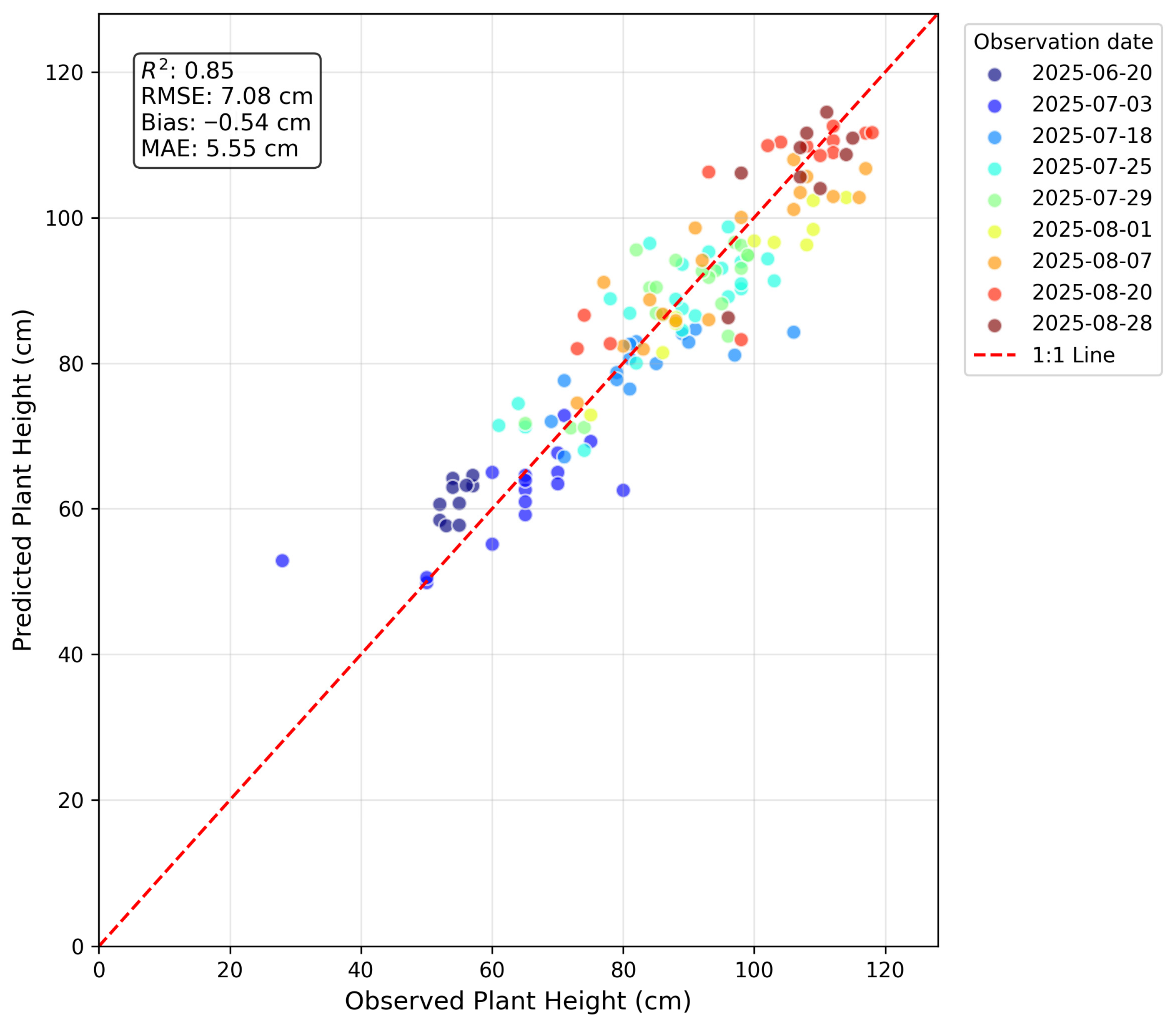
To evaluate the proposed approach, 80% of the fields were used for constructing the LUT, and the remaining 20% were spared for the accuracy evaluation. The scatter plot compares predicted plant height with in situ observed plant height, with the dashed line indicating the 1:1 correspondence. A total of 133 validation measurements is included, where each comparison consists of the field-measured rice plant height and the predicted plant height by the LUT and Bayesian approach.
The predicted plant heights show a strong correspondence with the observed values across the full range of plant heights. The coefficient of determination is R 2 = 0.84 , and the root mean square error (RMSE) is 7.08 cm. The mean absolute error (MAE) is 7.73 cm, and the bias is −2.44 cm, indicating a slight underestimation of the rice-crop height on average. Compared with the baseline regression-based results shown in Figure 4b, the scatter in Figure 6 is more tightly distributed around the 1:1 line.
We also compared the proposed Bayesian approach with three simple baseline methods evaluated on the same validation dataset: a linear regression model based solely on GCVI, a Random Forest regression model using GCVI as the predictor, and a temporal-average baseline derived from the mean growth trajectory of the training fields (see Supplementary Figures S6–S8). All three baseline approaches showed lower predictive performance than the proposed method. Specifically, the linear regression, Random Forest, and temporal-average baselines achieved R 2 = 0.538 , 0.552, and 0.567, with RMSE values of 12.58, 12.40, and 12.19 cm, respectively, whereas the proposed Bayesian LUT-based approach achieved R 2 = 0.85 and RMSE = 7.08 cm. These results indicate that the proposed framework more effectively captured field-specific growth trajectories than either simple GCVI-based prediction or simple temporal smoothing, while maintaining interpretability.

3.4. Spatiotemporal Mapping of Plant Height and Uncertainty

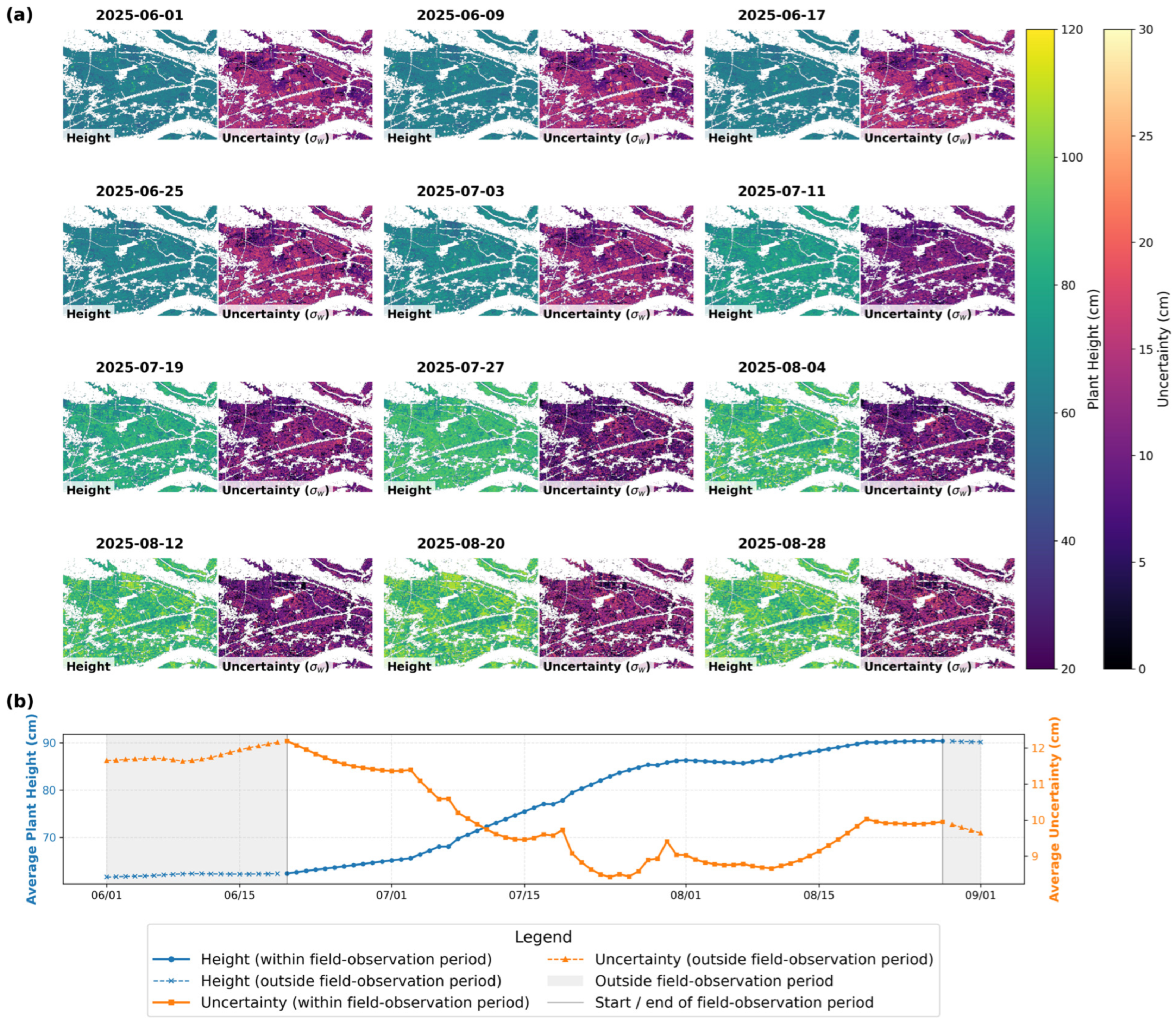
Figure 7 shows the spatiotemporal distribution of estimated rice plant height and the associated uncertainty across the Ryugasaki region from June to August 2025 at an 8-day interval. The rice-paddy mask was taken from the 2024 HRLULC v25.04 dataset to focus on the rice fields [24]. For each date, the estimated plant height and the corresponding uncertainty ( σ w ) are shown in paired maps. Temporal changes in the spatial average of the estimated rice plant height and the uncertainty were also shown in Figure 7. The plant height maps show a clear seasonal increase, with low values in early June and higher values becoming widespread by August. Comparison between consecutive dates reveals pronounced spatial variability in the timing and rate of plant height increase, with some fields exhibiting earlier or more rapid growth than neighboring fields. The uncertainty maps exhibit spatially heterogeneous patterns throughout the season, and regions with similar plant height values do not necessarily show similar uncertainty levels.
The spatial average of the rice plant height and the associated uncertainty showed the general growth in rice plants during the summer season. Starting from the end of June, rice steadily grew over 80 cm in August. The average uncertainty was high both in the early and later stages of the study period.

3.5. Identification of the Timing to Reach the 70 cm Height Threshold

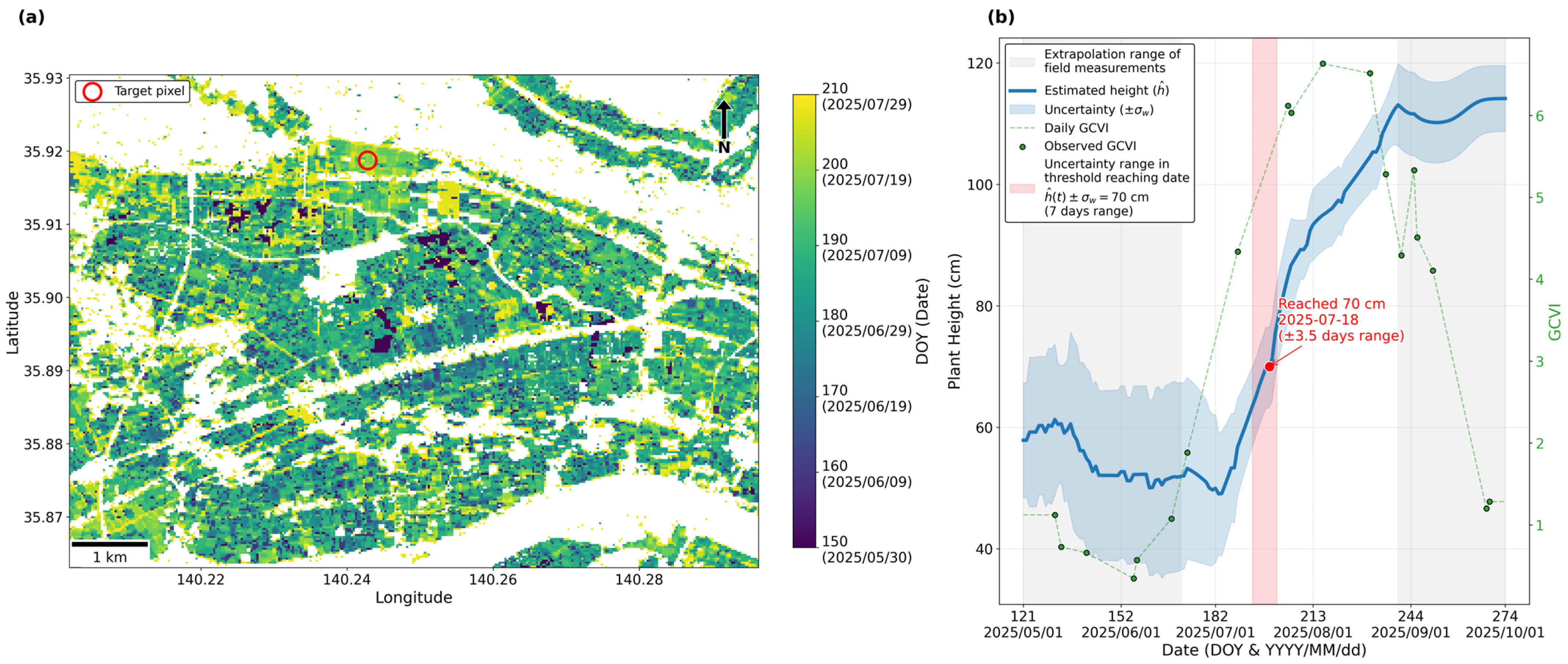
Figure 8 illustrates the spatial distribution and pixel-level diagnostics of the timing at which the estimated rice plant height reached the 70 cm threshold. This threshold corresponds to the plant height at which L-band SAR sensitivity to surface water conditions in rice paddies is known to decrease; therefore, it represents a critical transition stage for SAR-based monitoring [4].
Figure 8a shows the day of year (DOY) when each pixel first exceeded the 70 cm plant height, revealing clear spatial variability in the timing of this transition across the study area. The threshold-reaching dates range from late June to late July, with distinct field-scale patterns observed even among neighboring paddies. Figure 8b presents a diagnostic time series for a representative target pixel. The estimated plant height increases steadily and exceeds the 70 cm threshold on a specific date, indicated by the vertical marker. The associated uncertainty range defines an interval of plausible threshold-reaching dates, while the GCVI time series provides complementary information on vegetation development during this transition period.
By explicitly identifying the timing of this threshold, the results demonstrate the capability to delineate the period during which L-band SAR observations remain effective for capturing paddy surface conditions, which is directly relevant to monitoring rice water management.

4. Discussion

4.1. Advantages of the Bayesian Pattern Matching Approach

The proposed Bayesian pattern-matching approach offers a high degree of data efficiency, enabling continuous daily estimation without the large training datasets typically required by conventional machine-learning models. Using only nine field measurement campaigns across nine distinct field groups, the LUT templates were constructed from 110 fields in total, and the method achieved a validation accuracy of R 2 = 0.85 and RMSE = 7.08 cm (number of validation fields = 28; number of validation measurement records = 133). This level of performance is comparable to previously reported rice plant height estimation studies using machine-learning models, which generally reported R 2 values of approximately 0.8–0.9 and RMSE values around 10 cm [16,17,19].
In addition, direct comparisons on the same validation dataset showed that the proposed method outperformed all three simple baseline approaches examined in this study, namely the GCVI-based linear regression baseline, the GCVI-based Random Forest baseline, and the temporal-average baseline. These baseline models yielded markedly lower R 2 values and higher RMSE values than the proposed method, indicating that the Bayesian LUT-based framework more effectively captured field-specific growth trajectories than either simple GCVI-based prediction or simple temporal smoothing. Another important advantage of the framework is its explainability. By explicitly preserving the correspondence among the observed GCVI time series, candidate LUTs, posterior weights, and the final height estimate, the method allows transparent interpretation of why a particular prediction was obtained, unlike black-box machine-learning models.
Furthermore, the proposed method showed clear robustness against phenological transitions, particularly the decline in GCVI during the late growth stage in August. It is known that vegetation indices such as EVI and NDVI often decrease after the heading stage [25,26]. Under such conditions, simple regression-based models [27] can misinterpret a decline in GCVI as a reduction in plant height, even though the actual plant height remains high. This behavior is also evident in the simple GCVI-based baselines examined in this study. In contrast, the Bayesian framework evaluates the entire temporal trajectory rather than relying only on an instantaneous GCVI–height relationship. As a result, plant height estimates remained more stable and accurate during crop maturation, as shown in Figure 6. This ability to incorporate temporal growth context is a key strength of the proposed framework and makes it particularly suitable for continuous monitoring under limited in situ observations.

4.2. Spatiotemporal Variability of Rice Growth in the Ryugasaki Region, and Characterization of Regional Phenology

The generated maps (Figure 7) facilitate the characterization of regional phenology by capturing growth variability driven by diverse transplanting dates and rice varieties across the nine studied field groups. A key feature of this framework is the pixel-level uncertainty map ( σ w ), which serves as a practical reliability metric for the plant height estimates. Regions exhibiting high spatial uncertainty likely indicate cropping patterns not currently represented in the look-up table (LUT) ensemble. Identifying these areas provides a strategic basis for targeted farmer interviews or future field surveys to refine and expand the LUT database. The observed increase in uncertainty toward late August (Figure 7) can be attributed to the physiological plateau or decline in green chlorophyll vegetation index (GCVI) as the crop reaches maturity. During this phase, the distinct growth signals characterized by the rapid GCVI increases seen in June and July diminish, thereby reducing the sensitivity of the pattern-matching process because they show similar triangular patterns in the GCVI history, as shown in Figure 3. In addition, the uncertainty was also high at the earlier state, as shown in Figure 7b. At the early rice growing stage, most of the rice plants are small and show similar patterns in the GCVI time series; hence, it might have resulted in the low separability amongst the GCVI templates included in the LUT.
Furthermore, σ w is expected to increase significantly if growth trajectories deviate from typical regional patterns due to environmental stressors such as drought. This capability underscores the potential of uncertainty maps as an effective tool for identifying growth anomalies and supporting precision crop monitoring.

4.3. Physical and Practical Significance of the 70 cm Height Threshold

A key advantage of spatiotemporal plant height mapping is that rice growth conditions can be quantified explicitly in both space and time. In this study, we demonstrated this capability by evaluating the timing at which rice plant height reached a specific threshold. Figure 8 shows that the timing of reaching a plant height of 70 cm varied among fields, indicating clear field-scale heterogeneity in growth progression. This 70 cm threshold was discussed with reference to previous studies reporting reduced sensitivity of L-band SAR to sub-canopy surface conditions beyond this height [4].
From a practical perspective, the spatial map of the 70 cm threshold-reaching date shown in Figure 8a provides a useful way to characterize field-to-field differences in the timing of canopy structural development. In addition, the pixel-level uncertainty information allows uncertainty in the threshold-reaching date to be quantified. As shown in Figure 8b, this uncertainty was on the order of approximately 10 days, reflecting uncertainty arising from satellite observations and model ambiguity. Although the threshold may be relevant for interpreting SAR-based monitoring in light of previous studies, its relationship to SAR sensitivity was not directly validated in the present study.

4.4. Limitations and Future Perspectives

A primary limitation of the proposed approach is that the LUTs were constructed using data from a single region (Ibaraki Prefecture) and year (2025). Although the GCVI–plant height relationship was consistently observed, the robustness of the LUTs under different climatic conditions, rice varieties, management practices, or extreme weather events remains to be examined. Extending the LUT framework to multi-year and multi-region datasets is therefore an important future direction. In addition, the current validation was based on a random 80/20 split within the same region and year, and thus does not directly test generalization across years, climates, or seasonal conditions.
Another limitation is that, although GCVI showed a strong overall relationship with plant height, rice growth dynamics are also influenced by factors such as planting density, tillering intensity, and phenological stage, particularly during plateau phases and after heading. Incorporating such structural or phenological information into the LUT framework could improve discrimination of GCVI variations that are not directly reflected in plant height alone.
From a methodological perspective, the Bayesian weighting framework relies on practical simplifying assumptions, including independent and approximately Gaussian residuals with a common variance parameter. These assumptions may not be fully satisfied in real observations, because temporally adjacent GCVI values are likely to retain serial dependence, and the residual distribution may vary among field groups. In addition, the parameter tuning for (\sigma) and top-(K) was based on empirical sensitivity analysis rather than formal cross-validation; therefore, it should be regarded as a practical calibration step within the present framework.
The present study also relied solely on optical observations. Although the 70 cm threshold was discussed with reference to previous studies on SAR sensitivity, no direct SAR data were used for validation in this study. Future work should therefore examine multimodal integration with SAR observations, particularly under cloudy conditions and during late growth stages when optical sensitivity decreases.

5. Conclusions

This study proposed a Bayesian LUT-based pattern-matching approach for estimating rice plant height at a daily scale by integrating time-series satellite-derived GCVI with limited in situ measurements. The method achieved higher accuracy than simple baseline approaches while also providing pixel-level uncertainty that reflects ambiguity among plausible growth trajectories. Using the estimated plant height time series, we further evaluated the timing at which rice plant height reached 70 cm and quantified the associated uncertainty, revealing clear spatial variability among fields. These results demonstrate the practical value of the proposed framework for daily, spatially explicit rice growth monitoring from irregular optical satellite observations. Current limitations include that the LUTs were constructed from a single region and year, and that the statistical assumptions used in the Bayesian weighting framework, such as independent and approximately Gaussian residuals, are practical simplifications. Overall, the proposed framework provides a data-efficient and interpretable solution for spatiotemporal rice growth monitoring and offers a useful basis for future validation and methodological extension.

Supplementary Materials

The following supporting information can be downloaded at: https://www.mdpi.com/article/10.3390/rs18091388/s1, Figure S1: Selecting the data sampling point based on the “purity” and the distance to the paddy-field polygon centroids; Figure S2: The number of measured fields at each field-survey date; Figure S3: Approximate group-wise Q–Q plots of GCVI residuals, shown for the pooled dataset and for individual field groups; Figure S4: The effect of different sigma on the instability of the estimated rice canopy height, and the RMSE values of the predicted and measured height values; Figure S5: Results of the sensitivity analysis for the “Top-K” template used to calculate the rice-plant heights; Figure S6: Validation performance of the simple GCVI-based linear regression baseline. Predicted rice canopy height is plotted against observed canopy height for the independent validation dataset, with points color-coded by observation date. The red dashed line indicates the 1:1 correspondence. The figure shows the baseline performance obtained when canopy height was estimated using only a single linear relationship between GCVI and canopy height. Figure S7: Validation result of the temporal-average baseline. The left panel shows predicted versus observed rice canopy height for the independent validation dataset, with points color-coded by observation date and the red dashed line indicating the 1:1 correspondence. The right panel shows the temporal average canopy-height trajectory derived from the training fields, together with its ±1 standard deviation and the corresponding validation observations. Figure S8: Validation performance of the simple GCVI-based Random Forest baseline. Predicted rice canopy height is plotted against observed canopy height for the independent validation dataset, with points color-coded by observation date. The red dashed line indicates the 1:1 correspondence.

Author Contributions

Conceptualization, S.S.; methodology, S.S.; software, S.S.; validation, S.S.; formal analysis, S.S.; investigation, S.S.; resources, S.S., G.S., and K.O.; data curation, S.S., G.S., and K.O.; writing—original draft preparation, S.S.; writing—review and editing, S.S., G.S., and K.O.; visualization, S.S.; supervision, K.O.; project administration, K.O.; funding acquisition, K.O. All authors have read and agreed to the published version of the manuscript.

Funding

This research received no external funding.

Data Availability Statement

The HLS satellite data used for this research are freely available. The research codes would be available upon request.

Acknowledgments

Two AI tools, ChatGPT-5.5 thinking and Gemini 3.1 pro, were used for improving the grammatical quality of the manuscript. The authors would like to thank Yokota Nojo for allowing data collection for this study.

Conflicts of Interest

The authors declare no conflicts of interest.

References

  1. Godfray, H.C.J.; Beddington, J.R.; Crute, I.R.; Haddad, L.; Lawrence, D.; Muir, J.F.; Pretty, J.; Robinson, S.; Thomas, S.M.; Toulmin, C. Food Security: The Challenge of Feeding 9 Billion People. Science 2010, 327, 812–818. [Google Scholar] [CrossRef]
  2. Usman, M.; Sawaya, A.; Igarashi, M.; Gayman, J.J.; Dixit, R. Strained Agricultural Farming under the Stress of Youths’ Career Selection Tendencies: A Case Study from Hokkaido (Japan). Humanit. Soc. Sci. Commun. 2021, 8, 19. [Google Scholar] [CrossRef]
  3. Chen, H.; Wu, Y.-C.; Teng, C.-Y.; Li, C.-H. A Century-Long Monitoring of Rice Plant Height during Growth Period in Central Taiwan. Sci. Data 2025, 12, 740. [Google Scholar] [CrossRef]
  4. Segami, G.; Oyoshi, K.; Sobue, S.; Takeuchi, W. Characterizing L-Band Backscatter in Inundated and Non-Inundated Rice Paddies for Water Management Monitoring. Remote Sens. 2026, 18, 370. [Google Scholar] [CrossRef]
  5. Karmakar, P.; Teng, S.W.; Murshed, M.; Pang, S.; Li, Y.; Lin, H. Crop Monitoring by Multimodal Remote Sensing: A Review. Remote Sens. Appl. 2024, 33, 101093. [Google Scholar] [CrossRef]
  6. Li, P.; Zhang, X.; Wang, W.; Zheng, H.; Yao, X.; Tian, Y.; Zhu, Y.; Cao, W.; Chen, Q.; Cheng, T. Estimating Aboveground and Organ Biomass of Plant Canopies across the Entire Season of Rice Growth with Terrestrial Laser Scanning. Int. J. Appl. Earth Obs. Geoinf. 2020, 91, 102132. [Google Scholar] [CrossRef]
  7. Jing, L.; Wei, X.; Song, Q.; Wang, F. Research on Estimating Rice Canopy Height and LAI Based on LiDAR Data. Sensors 2023, 23, 8334. [Google Scholar] [CrossRef] [PubMed]
  8. Lu, W.; Okayama, T.; Komatsuzaki, M. Rice Height Monitoring between Different Estimation Models Using UAV Photogrammetry and Multispectral Technology. Remote Sens. 2021, 14, 78. [Google Scholar] [CrossRef]
  9. Pun Magar, L.; Sandifer, J.; Khatri, D.; Poudel, S.; KC, S.; Gyawali, B.; Gebremedhin, M.; Chiluwal, A. Plant Height Measurement Using UAV-Based Aerial RGB and LiDAR Images in Soybean. Front. Plant Sci. 2025, 16, 1488760. [Google Scholar] [CrossRef] [PubMed]
  10. Ferraz, M.A.J.; Barboza, T.O.C.; Arantes, P.d.S.; Von Pinho, R.G.; Santos, A.F.d. Integrating Satellite and UAV Technologies for Maize Plant Height Estimation Using Advanced Machine Learning. AgriEngineering 2024, 6, 20–33. [Google Scholar] [CrossRef]
  11. Nduku, L.; Munghemezulu, C.; Mashaba-Munghemezulu, Z.; Ratshiedana, P.E.; Sibanda, S.; Chirima, J.G. Synergetic Use of Sentinel-1 and Sentinel-2 Data for Wheat-Crop Height Monitoring Using Machine Learning. AgriEngineering 2024, 6, 1093–1116. [Google Scholar] [CrossRef]
  12. Arslan, İ.; Topakcı, M.; Demir, N. Monitoring Maize Growth and Calculating Plant Heights with Synthetic Aperture Radar (SAR) and Optical Satellite Images. Agriculture 2022, 12, 800. [Google Scholar] [CrossRef]
  13. Xie, Q.; Wang, J.; Lopez-Sanchez, J.; Peng, X.; Liao, C.; Shang, J.; Zhu, J.; Fu, H.; Ballester-Berman, J. Crop Height Estimation of Corn from Multi-Year RADARSAT-2 Polarimetric Observables Using Machine Learning. Remote Sens. 2021, 13, 392. [Google Scholar] [CrossRef]
  14. Zhang, B.; Li, K.; Zhang, F.; Shao, Y.; Wang, D.; Lou, L. Rice Height Estimation with Multi-Baseline PolInSAR Data and Optimal Detection Baseline Combination Analysis. Remote Sens. 2024, 16, 358. [Google Scholar] [CrossRef]
  15. Zhang, Y.; Liu, X.; Su, S.; Wang, C. Retrieving Canopy Height and Density of Paddy Rice from Radarsat-2 Images with a Canopy Scattering Model. Int. J. Appl. Earth Obs. Geoinf. 2014, 28, 170–180. [Google Scholar] [CrossRef]
  16. Ndikumana, E.; Ho Tong Minh, D.; Dang Nguyen, H.T.; Baghdadi, N.; Courault, D.; Hossard, L.; El Moussawi, I. Estimation of Rice Height and Biomass Using Multitemporal SAR Sentinel-1 for Camargue, Southern France. Remote Sens. 2018, 10, 1394. [Google Scholar] [CrossRef]
  17. Sharifi, A.; Hosseingholizadeh, M. Application of Sentinel-1 Data to Estimate Height and Biomass of Rice Crop in Astaneh-Ye Ashrafiyeh, Iran. J. Indian Soc. Remote Sens. 2020, 48, 11–19. [Google Scholar] [CrossRef]
  18. Yang, H.; Li, H.; Wang, W.; Li, N.; Zhao, J.; Pan, B. Spatio-Temporal Estimation of Rice Height Using Time Series Sentinel-1 Images. Remote Sens. 2022, 14, 546. [Google Scholar] [CrossRef]
  19. Narin, O.G.; Ganeva, D.; Abdikan, S.; Sekertekin, A.; Bayik, C.; Chanev, M.; Dimitrov, Z.; Esetlili, M.T.; Alpat, M.; Bektas, M.; et al. Integration of Multi-Temporal Sentinel-1 and Sentinel-2 Data for Paddy Rice Crop Height Estimation and Uncertainty Assessment Using Quantile Regression Forests. Precis. Agric. 2025, 26, 94. [Google Scholar] [CrossRef]
  20. Carvalho, D.V.; Pereira, E.M.; Cardoso, J.S. Machine Learning Interpretability: A Survey on Methods and Metrics. Electronics 2019, 8, 832. [Google Scholar] [CrossRef]
  21. Lang, N.; Jetz, W.; Schindler, K.; Wegner, J.D. A High-Resolution Canopy Height Model of the Earth. Nat. Ecol. Evol. 2023, 7, 1778–1789. [Google Scholar] [CrossRef]
  22. Gitelson, A.A.; Viña, A.; Ciganda, V.; Rundquist, D.C.; Arkebauer, T.J. Remote Estimation of Canopy Chlorophyll Content in Crops. Geophys. Res. Lett. 2005, 32, L08403. [Google Scholar] [CrossRef]
  23. Wang, S.; Di Tommaso, S.; Deines, J.M.; Lobell, D.B. Mapping Twenty Years of Corn and Soybean across the US Midwest Using the Landsat Archive. Sci. Data 2020, 7, 307. [Google Scholar] [CrossRef] [PubMed]
  24. Japan Aerospace Exploration Agency ALOS Research and Application Project. High-Resolution Land-Use and Land-Cover Map of Japan [2024·2022·2020]. Available online: https://www.eorc.jaxa.jp/ALOS/en/dataset/lulc/lulc_v2504_e.htm (accessed on 11 December 2025).
  25. Shibayama, M.; Akiyama, T. Seasonal Visible, near-Infrared and Mid-Infrared Spectra of Rice Canopies in Relation to LAI and above-Ground Dry Phytomass. Remote Sens. Environ. 1989, 27, 119–127. [Google Scholar] [CrossRef]
  26. Sakamoto, T.; Yokozawa, M.; Toritani, H.; Shibayama, M.; Ishitsuka, N.; Ohno, H. A Crop Phenology Detection Method Using Time-Series MODIS Data. Remote Sens. Environ. 2005, 96, 366–374. [Google Scholar] [CrossRef]
  27. Kazuhiro, S.; Tsuyoshi, S.; Yuuichi, F.; Ichiro, F.; Yoshiki, O.; Yasuhiro, H.; Tsuyoshi, I.; Hiroko, K.; Shuhei, M.; Tomonori, S. Relationship between Drone Remote Sensing and Ground Measurements in Paddy Rice Growth Surveys—Information That Can Be Inferred from GNDVI. J. Jpn. Agric. Syst. Soc. 2025, 41, 11–19. (In Japanese) [Google Scholar] [CrossRef]
Figure 1. The flowchart of the study.
Remotesensing 18 01388 g001
Figure 2. Overview of the study area and field survey sites. (a) Location of the field survey sites for rice plant height measurements. (b) Land-cover status of the target area in 2024, based on the JAXA HRLULC map dataset v25.04. (c) Distribution of the field groups shown by representative points. (d) Example of the spatial scale of a paddy field.
Remotesensing 18 01388 g002
Figure 3. Mean observed time series of GCVI and plant height by field group. Panels (ai) show the mean GCVI (blue circles with lines) and in situ measured plant height (green triangles) for representative field groups (Groups A, B, C, D, F, H, I, Y, and Z) throughout the 2025 growing season. Error bars indicate ±1 standard error (SE).
Remotesensing 18 01388 g003
Figure 4. Empirical relationship between GCVI and measured plant height. (a) Scatter plot of measured plant height against GCVI. Points are color-coded by measurement date, showing the temporal shifts in the height-GCVI relationship. The black line represents the linear regression. (b) Comparison of predicted height from the linear regression model versus observed height. The dashed line represents the 1:1 correspondence.
Remotesensing 18 01388 g004
Figure 5. Illustration of the LUT-based Bayesian pattern-matching and height-estimation process. (a) Comparison between the interpolated GCVI signal from raw satellite observations (black points) and multiple LUT templates (colored lines) on a normalized time axis. (b) Stacked weighted height contributions from the selected LUTs (colored areas, w i h i ( t ) ), the ensemble mean estimated plant height ( h ^ , red dashed line), and the associated uncertainty ( σ w , red shaded area). The colors correspond to the LUT IDs and relative confidence weights shown in panel (c). Black triangles represent independent ground-survey observations. (c) Relative confidence weights ( w i ) assigned to each LUT ID, calculated based on the posterior probability of the pattern matching.
Remotesensing 18 01388 g005
Figure 6. Accuracy assessment of the proposed Bayesian height estimation method. Scatter plot comparing observed plant height versus predicted plant height for the validation measurement records (n = 133).
Remotesensing 18 01388 g006
Figure 7. Spatiotemporal distribution of estimated plant height and uncertainty across the Ryugasaki region. (a) The grid shows a time series of estimated height maps (left panels in each pair) and the corresponding estimation uncertainty ( σ w right panels in each pair) from 1 June to 28 August 2025. (b) The spatial average of the estimated rice plant height and the associated uncertainty time-series. Masked periods show the time window for which no field-survey data were available.
Remotesensing 18 01388 g007
Figure 8. Spatial mapping and diagnostic analysis of the 70 cm height threshold reaching date. (a) Regional map showing the day of year (DOY) when each pixel reached the 70 cm plant height threshold. The color gradient from dark blue to yellow represents the progression from late June to late July. (b) Diagnostic time-series for a target pixel (indicated by the red circle in (a)), showing the estimated height progression, observed GCVI, and the specific timing of reaching the 70 cm threshold (red point) with its associated uncertainty range.
Remotesensing 18 01388 g008
Table 1. The crop-height measurement field campaign dates and targeted field groups amongst the 9 groups, A, B, C, D, F, H, I, Y, and Z. If the field is not included in the measurement targets, the names are not shown in the table.
Measurement DateTargeted Field Groups
20 June 2025A, C, H, Y
3 July 2025A, B, C, D, F, H, I, Y
18 July 2025A, B, C, D, F, H, Y
25 July 2025A, B, C, D, F, H, I, Y, Z
29 July 2025A, B, C, D, F, H, I, Y, Z
1 August 2025A, B, D, I, Y, Z
7 August 2025A, B, C, D, F, H, I
20 August 2025A, B, C, D, F, H, I
28 August 2025A, B, D, F
Disclaimer/Publisher’s Note: The statements, opinions and data contained in all publications are solely those of the individual author(s) and contributor(s) and not of MDPI and/or the editor(s). MDPI and/or the editor(s) disclaim responsibility for any injury to people or property resulting from any ideas, methods, instructions or products referred to in the content.