Article

Automated Mapping of Patched Cropland Parcels Using Bi-Temporal UAS Elevation and Spectral Features at Cadastral Level

1
College of Earth and Planetary Sciences, Chengdu University of Technology, Chengdu 610059, China
2
Key Laboratory of Digital Cartography and Land Information Application, Ministry of Natural Resources, Wuhan 430072, China
3
Observation and Research Station of Land Ecology and Land Use in Chengdu Plain, Ministry of Natural Resources, Chengdu 610045, China
4
Surveying and Mapping Geographic Information Center, Sichuan Institute of Geological Survey, Chengdu 610072, China
5
Department of Land Management, Zhejiang University, Hangzhou 310058, China
*
Author to whom correspondence should be addressed.
Remote Sens. 2026, 18(9), 1367; https://doi.org/10.3390/rs18091367
Submission received: 12 January 2026 / Revised: 16 March 2026 / Accepted: 24 March 2026 / Published: 29 April 2026
(This article belongs to the Section Remote Sensing in Agriculture and Vegetation)

Highlights

What are the main findings?
  • A cadastral-level delineation method of patched parcel was proposed combining UAS-derived bi-temporal DOM and DSM in a typical agricultural landscape.
  • High accuracy was achieved with an area precision of 98.1%, OA of 96.1%, KC of 0.92 and relative edge-length error.
What are the implications of the main findings?
  • Phenological variations in cropland and other land cover types can be reflected by combining the UAS-derived spectral and elevation data in agricultural landscapes.
  • This study provides an effective solution for parcel boundary extraction in heterogeneous landscapes including non-crop features like villages and roads.

Abstract

Cropland parcels are fundamental units in agricultural production, and their precise delineation is critical for cadastral management and precision agriculture. However, heterogeneous agricultural landscapes with fragmented patches, complex land cover, and indistinct boundaries pose significant challenges for automated parcel delineation. Unmanned aerial systems (UASs) offer flexible, high-resolution multi-temporal spectral and elevation data, providing potential opportunities for mapping patched parcels. This study proposed an automated method for mapping patched cropland parcels using centimeter-level digital surface models (DSMs) and digital orthophoto maps (DOMs), validated at three typical sites in the Sichuan Basin. The method integrates (1) threshold segmentation of topographic relief to distinguish field surfaces from borders; (2) vegetation removal using a visible-band difference vegetation index (VDVI) mask; and (3) morphological refinement to produce high-precision vectorized field polygons. Results show that integrating bi-temporal UAS elevation and spectral data enables accurate, automated field extraction. Area-based mapping accuracy reached 98.1%, with an overall accuracy (OA) of 96.1% and a Kappa coefficient (KC) of 0.92. Field-count correctness was 93.3%, and the relative error of boundary length was 4.55%. Notably, parcels with regular shapes achieved even higher accuracy, with OA of 99.1% and KC of 0.98. By leveraging UAS-based elevation and spectral data, the proposed method can offer an alternative way to precise delineation of patched field boundary and provides reliable technical support for cadastral mapping and cropland surveys in agricultural regions.

1. Introduction

Cropland parcels are the fundamental units of agricultural management and field operations [1], and changes in these parcels directly or indirectly affect food supply, economic development, and other relevant aspects [2]. China is dominated by smallholder agriculture, which is characterized by small, heterogeneous, and often indistinct field patterns. According to estimates, 72% of the world’s farmland area is in farms smaller than 1 hectare (ha) [3]; the average farm size is 3000 ha in Australia and 121 ha in North America, respectively. In contrast, China exhibits prominent cropland fragmentation, with an average parcel size of only 0.6 ha, which is far smaller than that of most other countries. This poses high requirements for cropland parcel mapping [4]. However, over the past three decades, rapid urbanization in China has led to a sharp decline in the agricultural labor force. Problems such as cropland area reduction, land abandonment, and non-grain crop cultivation (i.e., the use of cropland for non-food purposes) have become particularly prominent [5], posing significant challenges to the national food security supply. There is an urgent need for scientific and efficient cropland management and agricultural production to boost crop yields, which relies on the fine-grained identification of cropland parcels and science-based decision-making for field management. Therefore, the accurate mapping of cropland parcels at the tillage unit scale is of great significance. It will facilitate efficient cadastral surveys of fragmented cropland, the extraction of crop planting distribution, and science-based decision-making for agricultural field management (e.g., irrigation, fertilization, and pest and disease control).
The extraction of cropland parcels has primarily relied on in situ surveying instruments [6], satellite remote sensing [7], and unmanned aircraft system (UAS) photogrammetry [8]. Traditional surveying instruments, for example total stations and real-time kinematic global navigation satellite system, are typically used for field investigation and manual digitization [9]. This approach delivers high reliability and accuracy, but it is constrained by heavy labor demands and time-consuming costs for a large-scale task [10]. Satellite imagery at medium or low resolution has been widely used for national or regional cropland mapping, such as Sentinel-2 [11], Landsat [12], and MODIS [13]. However, fine boundaries of individual parcels are hardly recognized for their limited spatial resolution (10–250 m), especially in highly fragmented agricultural landscapes. High-resolution optical imagery, including Gaofen-2 [14] and WorldView-2 [15], provides sub-meter spatial resolution to support the border identification of cropland patches, but the mapping results are hardly able to meet the accuracy requirements of cadastral mapping. Because cropland parcels are often interspersed with villages, roads and ditches in a typical agricultural setting, this results in the imagery showing spectral confusion of boundaries between different patches [16]. In addition, high-resolution earth observations tend to have long revisit cycles and are easily hindered by cloud or rain in southern China, which reduces the poor availability of optical data acquisition [17]. By contrast, airborne remote sensing has been characterized by operational flexibility with images at the millimeter to decimeter level, enabling the improvement of satellite revisit and cloud-cover constraints [18]. In this way, cropland details and parcel boundaries can be easily identified with high accuracy, providing a potential pathway for automated cadastral mapping of cropland parcels.
Current methods for cropland boundary extraction are primarily categorized into four types: edge-detection-based methods [19], region-based segmentation approaches [20], hybrid edge-region strategies [21], and deep learning-based framework [22]. Edge-detection methods identify boundaries by locating gradient changes or grayscale break between adjacent parcels, which are strongly sensitive to grayscale contrasts but easily impacted by noise to yield the discontinuous boundaries. Region-based methods utilize pixel homogeneity in texture, spectral features or other characteristics to obtain enclosed regions through region growing or segmentation. But these methods are sensitive to parameter settings, and often lead to the situation of over-segmentation or under-segmentation in areas with complex textures. Hybrid methods combine edge and region information to improve boundary completeness and accuracy, yet the computational complexity is higher, and their performance depends on the design of the integration strategy. Deep learning methods are mainly based on convolutional neural networks (CNNs) [23] for automated feature learning and support end-to-end boundary extraction. However, they require large amounts of high-quality labeled data, and the generalization ability is constrained by the quality and diversity of the training data. The four existing mainstream extraction methods mainly rely on satellite images with meter-level accuracy, which are insufficient to meet the precision requirements for cadastral mapping of patchy cropland parcels. In recent years, UAS-based imagery has provided a new approach for cropland parcel extraction. Most current studies achieve high-precision extraction using single-temporal UAS imagery, which not only ensures favorable classification accuracy but also exhibits strong interpretability [24]. However, practical applications have shown that single-temporal data still has room for improvement in scenarios such as capturing dynamic changes in crop growth and subtle adjustments of parcel boundaries, and provides an exploration direction for the application of multi-temporal imagery.
Fine-scale cropland mapping using UAS remote sensing has been reported in striped cropland at the North China Plain [25] and terraced fields in mountainous regions [26]. Cropland strips are characterized by long length and short width with narrow ridges between adjacent cropland fields. The research proposed an automated method for cropland strip mapping using UAS-derived DOM and DSM in clipped sites without other coverage, achieving the precision > 95% and KC > 0.97. However, it requires image collection on an individual date at an early stage of crop growth and would show poor performance in large-scale agricultural environment within non-cropland features. In addition, a Light Detection and Ranging (LiDAR)-derived DTM index of slope autocorrelation local length (SLLAC) was successfully employed for terrace delineation under vegetation cover of the mountainous region. But the method suffers from limited adaptability of computing window size, and insufficient robustness across diverse land cover types. In southern China, a representative agricultural scenario of grain production zone is often a double-cropping system with well-conditioned irrigation facilities. Such landscape includes a large number of cultivated parcels, as well as artificial features; for example, villages, roads and ditches. These cropland units exhibit patch-like shapes with 50–80 m in length and 35–60 m in width, as well as significant ridge height differences greater than 0.3 m, especially in Chengdu Plain. In addition, heterogeneity in planting structures and dates leads to differentiated phenological characteristics, which are hardly reflected in a specific stage of crop growth. Therefore, bi-temporal or multiple-stage UAS data [27] is useful for the abovementioned situation, and it allows us to capture the difference between cropland with other land cover types in temporal and vertical dimensions [28].
To address the automated extraction of patched cropland parcels at fine spatial scales in the heterogeneous agricultural region of China’s Sichuan Basin, this study collected bi-temporal UAS data to produce digital orthophoto maps (DOMs) and digital surface models (DSMs). Initially, a binary map was generated by threshold segmentation of terrain relief derived from post-harvest DSM. Subsequently, vegetation removal was conducted via combining global threshold mask of visible difference vegetation index (VDVI) during the crop heading stage with the binary map. Then, parcel boundaries were refined via morphological operations and two additional image improvement steps. Mapping accuracy was evaluated across three aspects: pixel area consistency, parcel count correctness, and boundary length error. The proposed method contributes to the accurate cadastral mapping of patched cropland and improves the efficiency of farmland management and decision-making.

2. Methodology

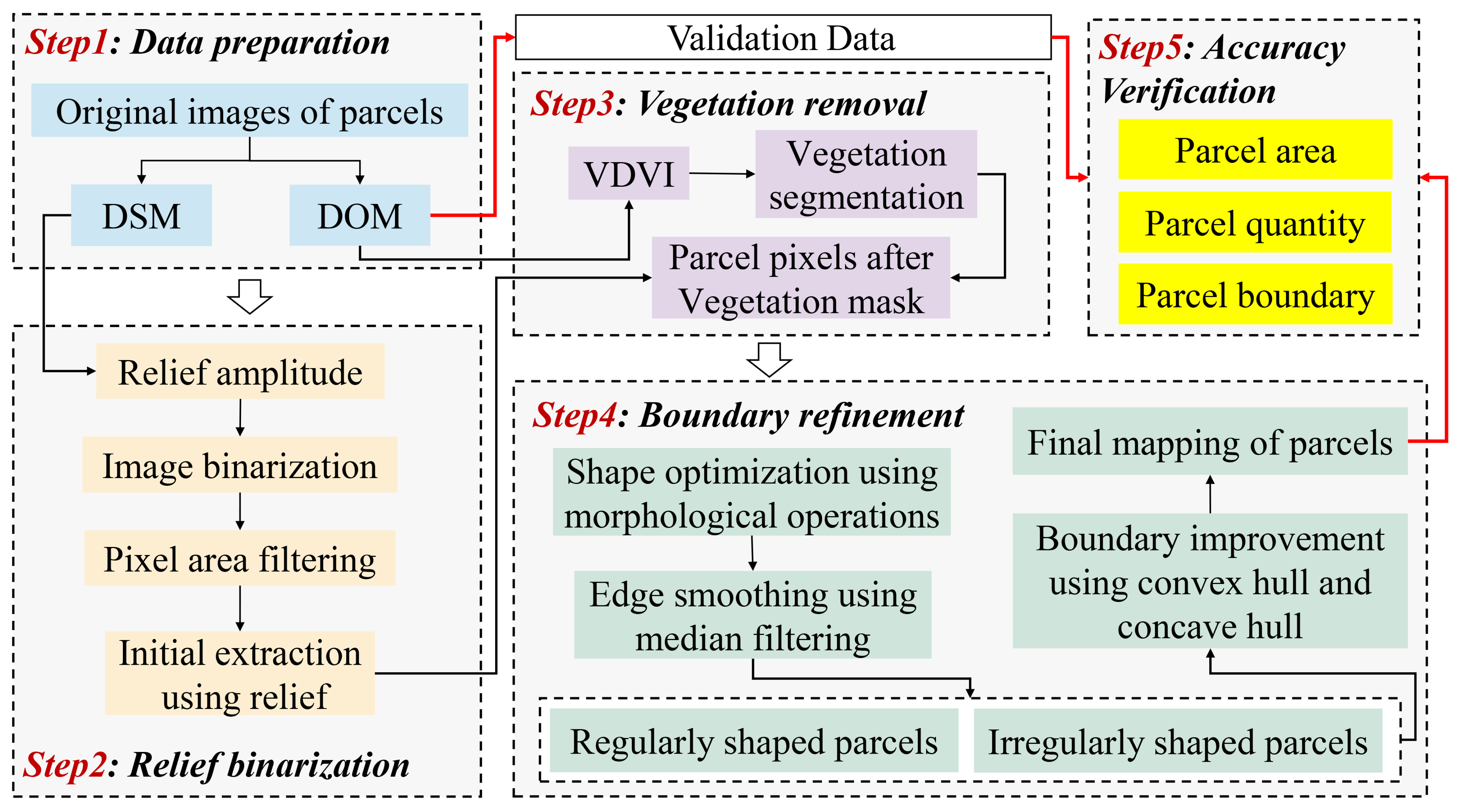
To achieve automated and high-precision extraction of patched parcels in the agricultural landscapes incorporating non-cropland elements, this study proposed a synergistic method using bi-temporal UAS-derived elevation and spectral features. This approach integrates threshold segmentation of post-harvest topographic relief and a VDVI-based vegetation mask derived from the growing stage, and then conducts boundary optimization for regular parcels and deviated patches, respectively. The proposed method was structured into five steps: data preparation, relief binarization, vegetation removal, boundary refinement, and accuracy verification (Figure 1).

2.1. Study Site and Dataset Preparation

2.1.1. Site Description

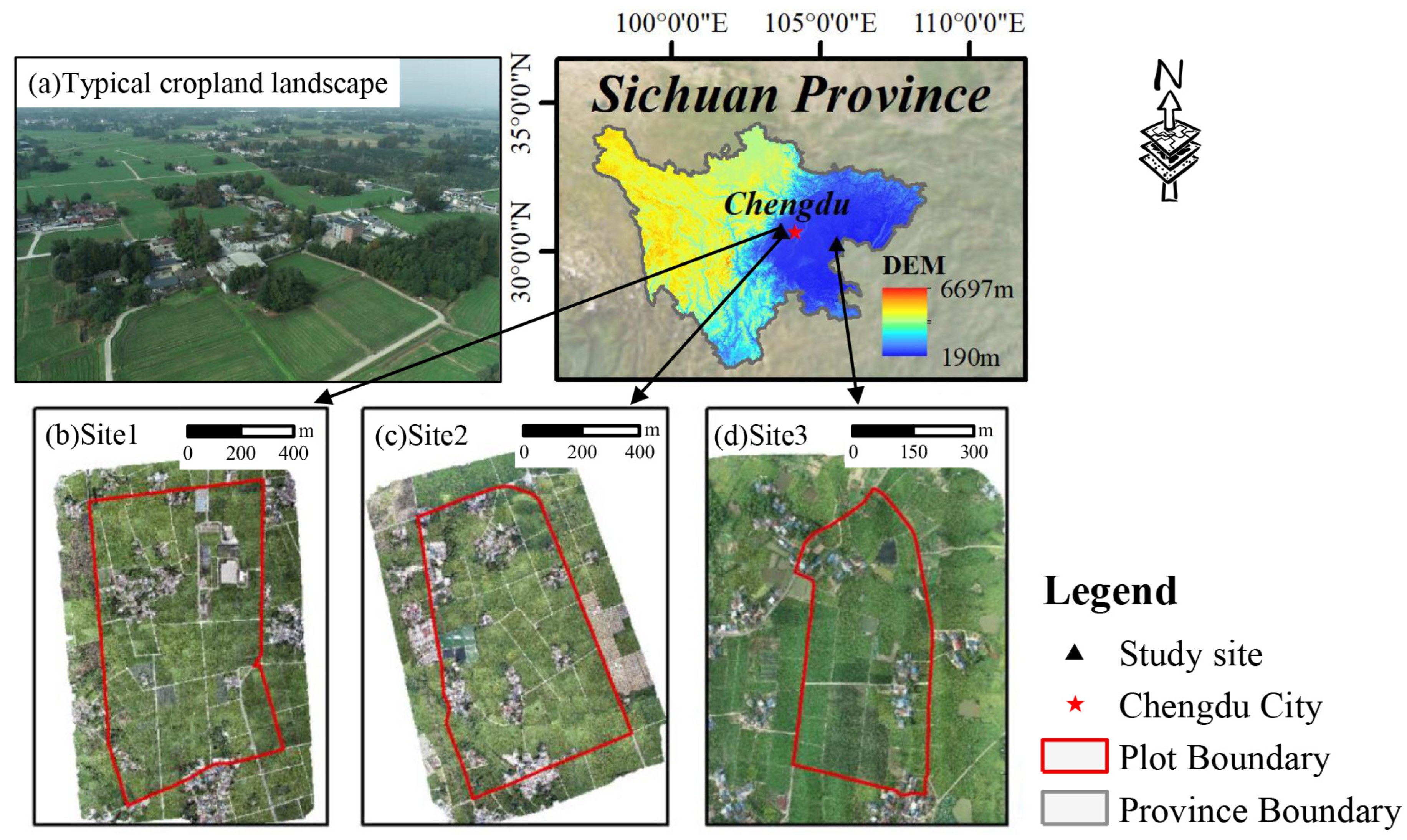
Three typical sites of patched cropland were located in the Sichuan Basin, eastern Sichuan Province, China (Figure 2). The region is characterized by a subtropical humid monsoon climate and its total area of cropland accounts for approximately 85% of the whole of Sichuan Province. Sichuan Province is recognized as a major grain-producing region in western China, and primarily cultivates rice, maize, rapeseed, and wheat. In 2024, it ranked ninth in terms of total grain output nationwide, and produced the most yield of rapeseed. Site 1 and Site 2 were located in the Dujiangyan Irrigation Zone of the Chengdu Plain (103°39′53″E, 30°41′33″N) with a mean elevation of ~550 m. It is an alluvial plain formed by the Min River. The soil is gray calcareous alluvial paddy soil. Site 3 was situated along the Qiongjiang River in the central Sichuan hilly area (105°32′31″E, 30°15′05″N), with average elevation of 230 m. The landform is dominated by riverside flatland. Its soil types are primarily purple soils and paddy soils, and it belongs to a mid-subtropical humid monsoon climate. Site 1 and Site 2 are characterized by diverse land cover types, including villages, woodlands, cropland, and paved roads, and dominated by crops. A rice–rapeseed rotation is mainly practiced. Generally, rice is sown in May and harvested in September, while rapeseed is sown in October and harvested next May. Tillage conditions are favorable, with over three-quarters of the field boundaries exhibiting a quadrilateral shape, and are conducive to mechanized farming. Cropland parcels are predominantly patch-like, and parcel lengths range from 50 to 80 m and widths from 35 to 60 m, with ridges approximately 0.9 m in width and ~0.6 m higher than the parcel surface. Site 3 has similar conditions and is distinguished by the presence of orchards in its southeastern sector.

2.1.2. UAS and Image Acquisition

Imagery was acquired using a small unmanned aerial system (UAS; DJI Phantom 4 RTK, Shenzhen, China). This UAS consists of a quadrotor drone platform, a sensor payload, an autopilot control system, a GPS unit, and a ground station. Equipped with a 20-megapixel camera, the system has a camera pixel size of 2.41 μm, which enables the UAS to capture imagery with a nominal resolution of 2.7 cm when operating at a flight altitude of 100 m. Additionally, a high-precision Global Navigation Satellite System (GNSS) receiver is integrated into the system to obtain real-time differential correction data, thereby ensuring high positioning accuracy. The technical specifications of this UAS are detailed in Table 1.
Bi-temporal drone images were collected at both high vegetation coverage of crops and bare soil after harvest of crops in JPEG format. Forward and side overlaps were set to 80% and 60%, respectively. Flight height was conducted at 80 m, 100 m and 119 m above ground level for Site 1 with the corresponding ground sampling distance (GSD) of 2.2 cm, 2.7 cm and 3.3 cm, respectively. In addition, flight altitude was 110 m for Site 2 and 140 m for Site 3. All other photogrammetric parameters were consistent for the different flights of each site. The specific parameters can be seen in Table 2.
In order to obtain accurate georeferenced maps, ground control points (GCPs) were captured as evenly as possible on the marked L-shaped symbol using red spray paint. The coordinate of each GCP was measured using a GNSS receiver.

2.1.3. Dataset Preparation

Raw UAS images were processed using Context Capture (version 2016; Bentley Systems, Exeter, PA, USA) to generate the DSM and the DOM. The experimental data were then partitioned into three datasets (Table 3):
Dataset 1: This dataset includes DOM and DSM products of Site 1 acquired at three flight altitudes (80 m, 100 m, and 119 m), and is used for developing the cropland parcel extraction method.
Dataset 2: The parcel data of Site 1 was resampled into 8 different spatial resolutions (ranging from 2.2 cm to 10 cm) using the nearest-neighbor sampling method. This dataset is employed to investigate the applicable spatial resolution range of the proposed extraction method.
Dataset 3: This dataset contains DOM and DSM products of Site 1 (flight altitude: 110 m) and Site 3 (flight altitude: 140 m) obtained in two time periods. It is used to evaluate the robustness of the method across different regions.

2.1.4. Validation Data

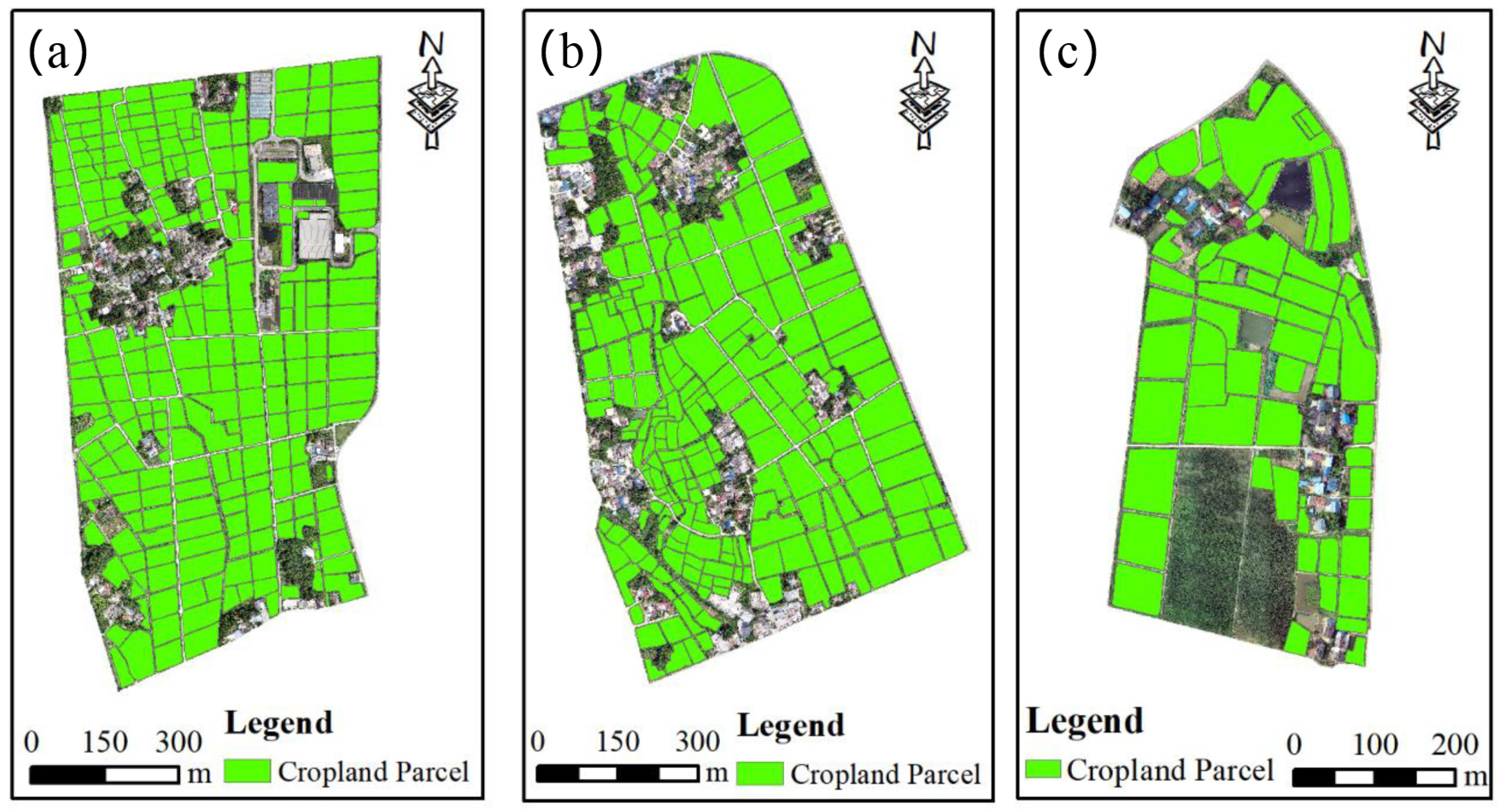
Validation data were obtained by visual interpretation of the DOM imagery according to the requirements of cadastral mapping in ArcGIS 10.6, and displayed in Figure 3. These parcels include different sizes of length, width and area, as well as azimuth.

2.2. Relief Amplitude Binarization for Cropland Identification

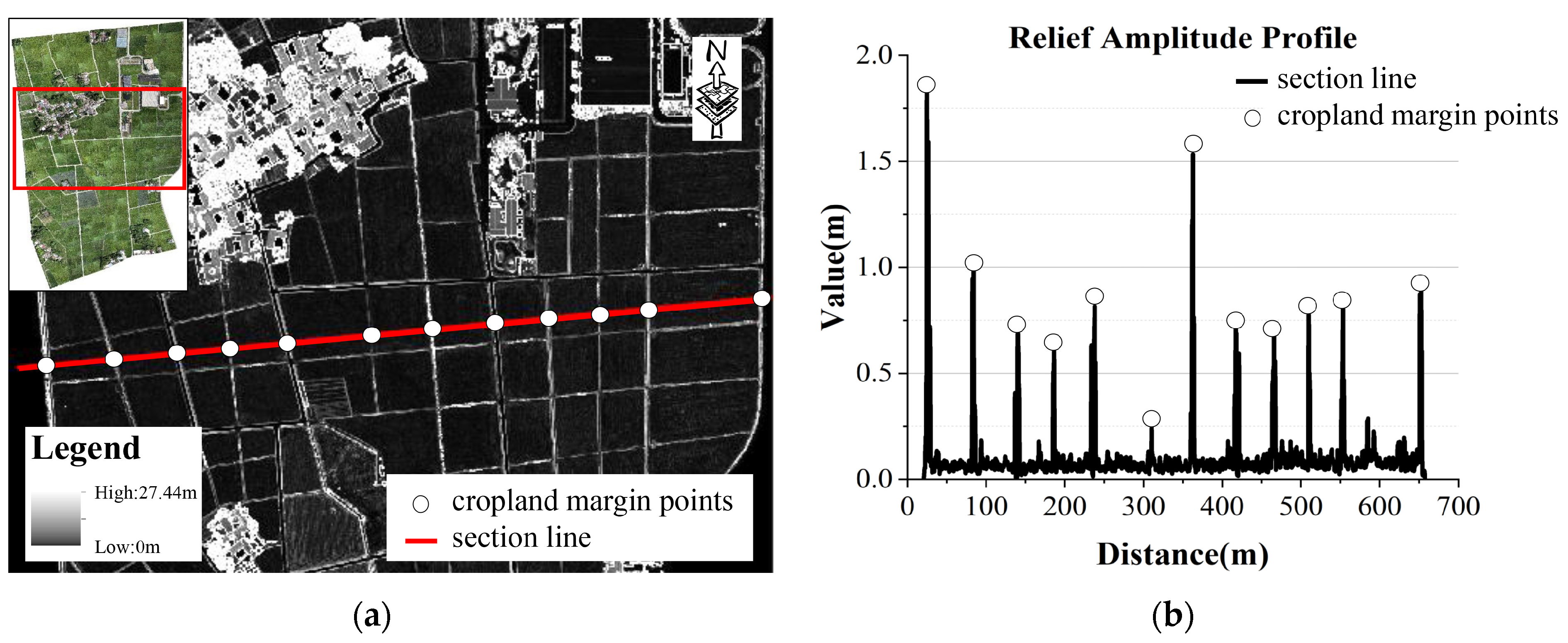
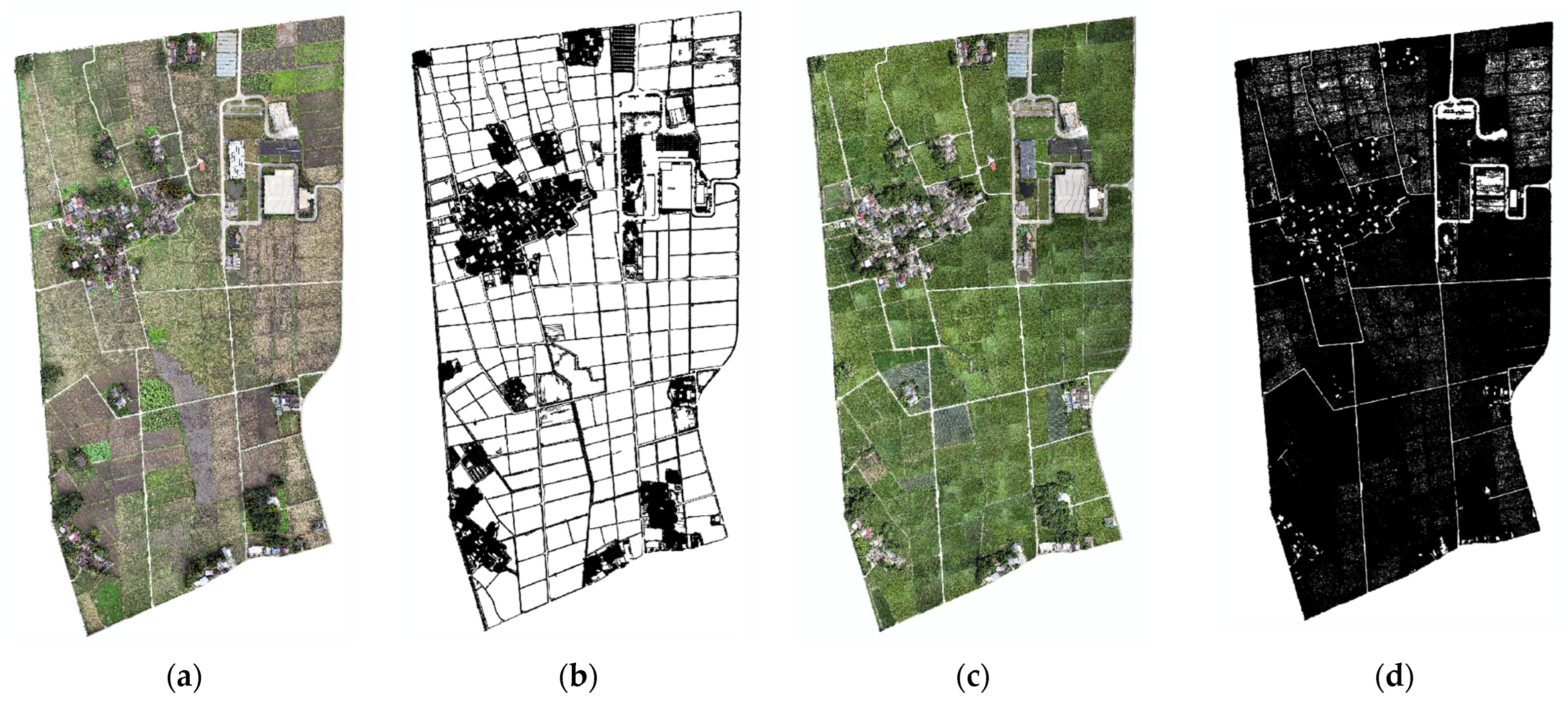
Relief amplitude has been recognized as an important indicator of macro-topographic characteristics [29]. DSM-derived topographic relief maps can exhibit significant variations between the crop peak growing stage and crop harvest (see Figure A1 of Appendix A). During the harvest stage in flat regions, elevation profiles are observed to exhibit regular peak patterns: cropland parcel interiors are flat, whereas pronounced height differences are present along parcel edges, by which the identification of parcel-edge zones from UAS imagery is facilitated (Figure 4).
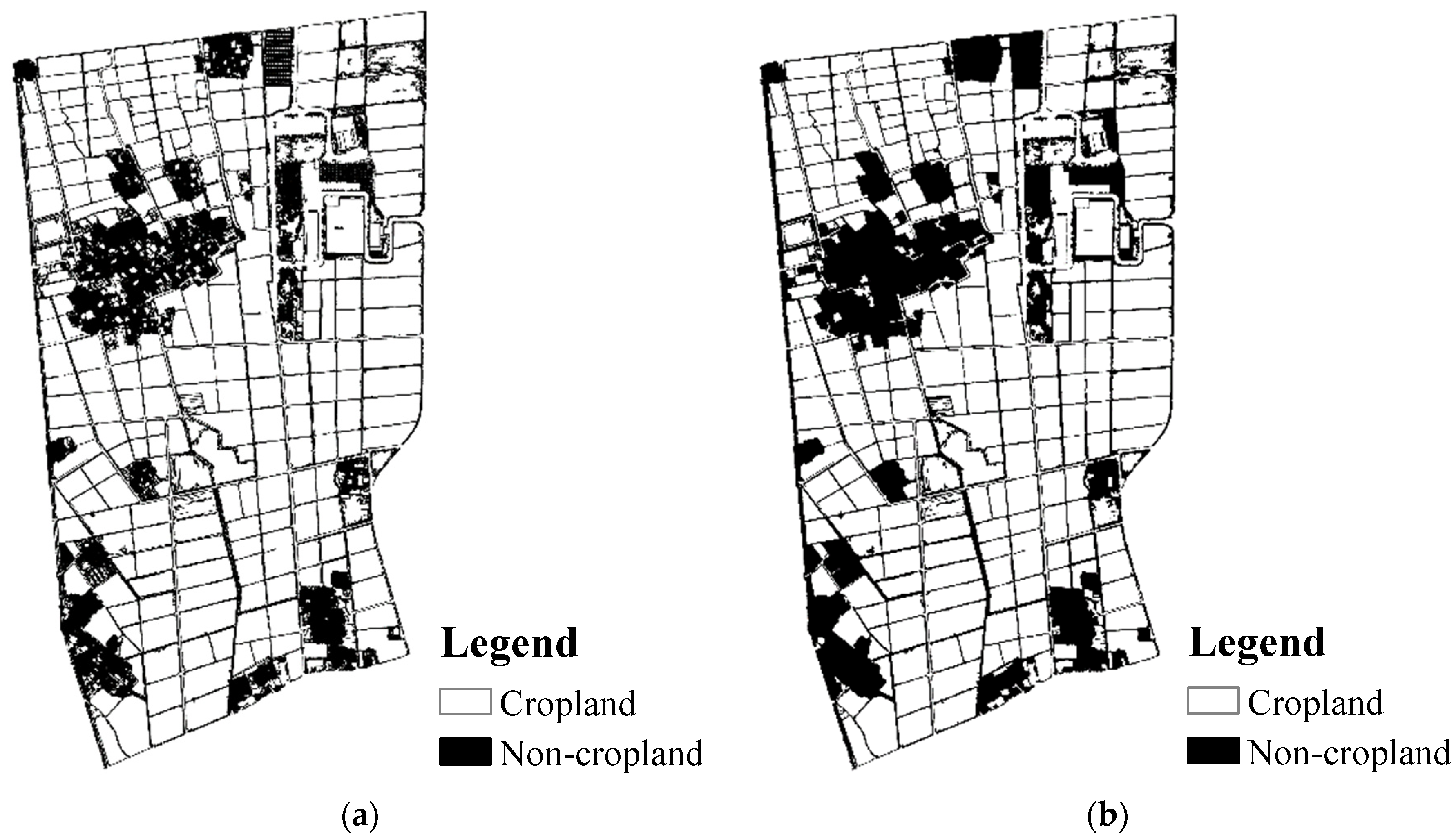
Terrain relief amplitude was obtained by computing the elevation deviation of the DSM within a sliding window. The window size was determined according to the regional mean ridge width (0.9 m) and image resolution to highlight the edge features of patched cropland with good applicability after repeated testing. The topographic relief image was binarized using a global threshold set as the absolute value of the mean minus half the standard deviation. Pixels with values above this threshold were classified as patch edge pixels; otherwise, they were assigned as non-patch edge pixels (Figure 5a). To suppress the noise from the coverage of non-cropland, including woodland, grassland, building area and other features, the threshold of potential patch area (100 m2) was employed to remove abovementioned small patches after initial binarization segmentation (Figure 5).

2.3. Vegetation Removal for Parcel Rectification

2.3.1. VDVI Calculation and Vegetation Segmentation

Vegetation indices have been widely used as indicators of vegetation cover and growth status [30]. Considering the local double-cropping system, spectral contrasts were obvious between vegetation and non-vegetation during the vigorous growth months of crops, especially in July and August. Vegetation coverage could be separated via image segmentation. UAS-based visible imageries provide high spatial resolution with the band of red, blue and green. Therefore, the VDVI [31] was computed and employed to vegetation segmentation, and its equation was defined as follows:
VDVI = 2 × D N G D N R + D N B 2 × D N G + D N R + D N B = 2 × D N G D N R D N B 2 × D N G + D N R + D N B
where DNR, DNG and DNB denote the pixel values of the red, green, and blue bands, respectively; the theoretical range of VDVI is [−1, 1].
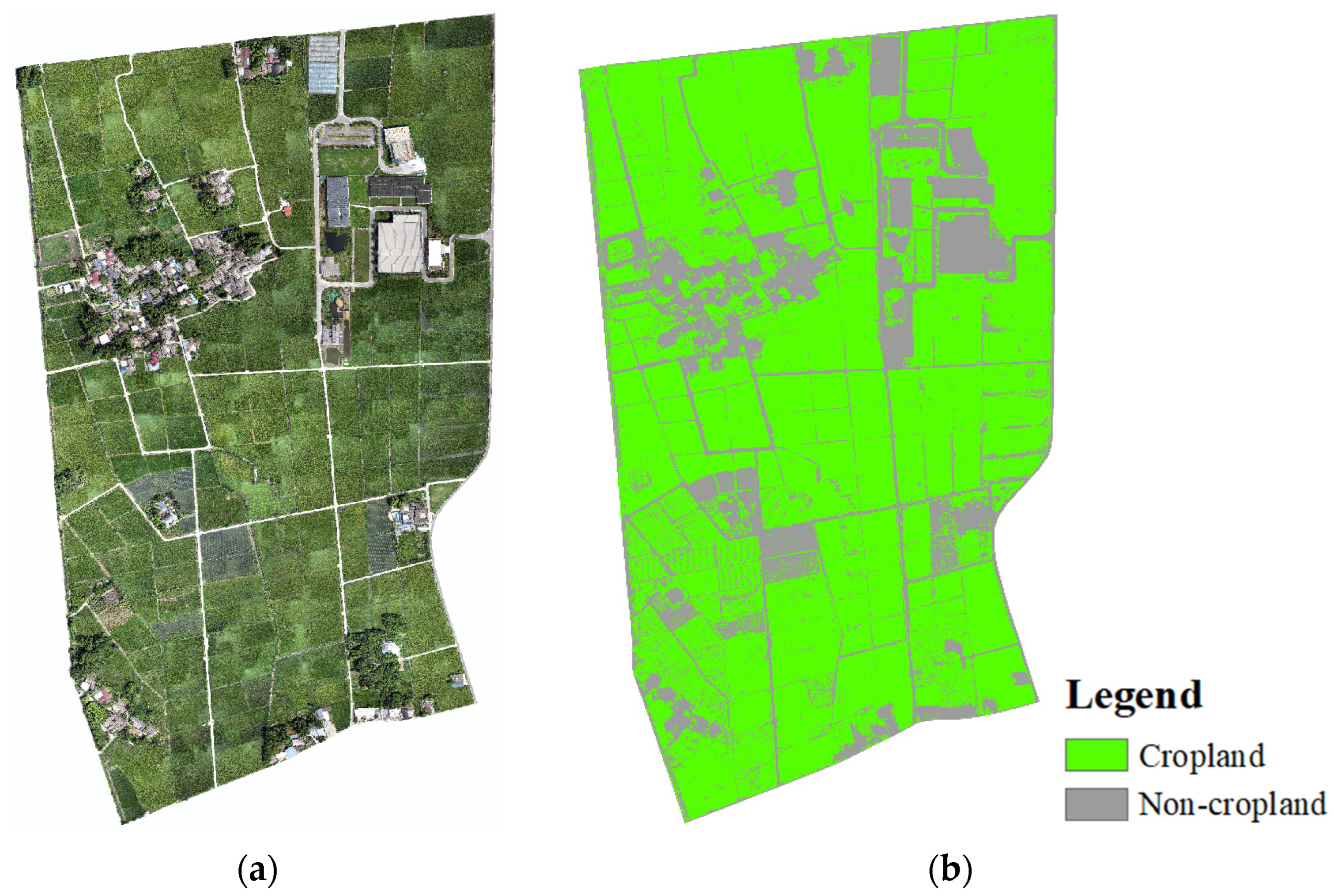
Otsu’s thresholding method has been proven to effectively separate vegetation regions from grayscale images of visible light vegetation indices [32]. This study calculated VDVI using drone-based orthomosaics at the rice heading stage, and then Otsu thresholding was applied to VDVI histogram to obtain a vegetation binary map (Figure 6).

2.3.2. Parcel Mapping Using Relief Amplitude Binary Masked by Vegetation Factor

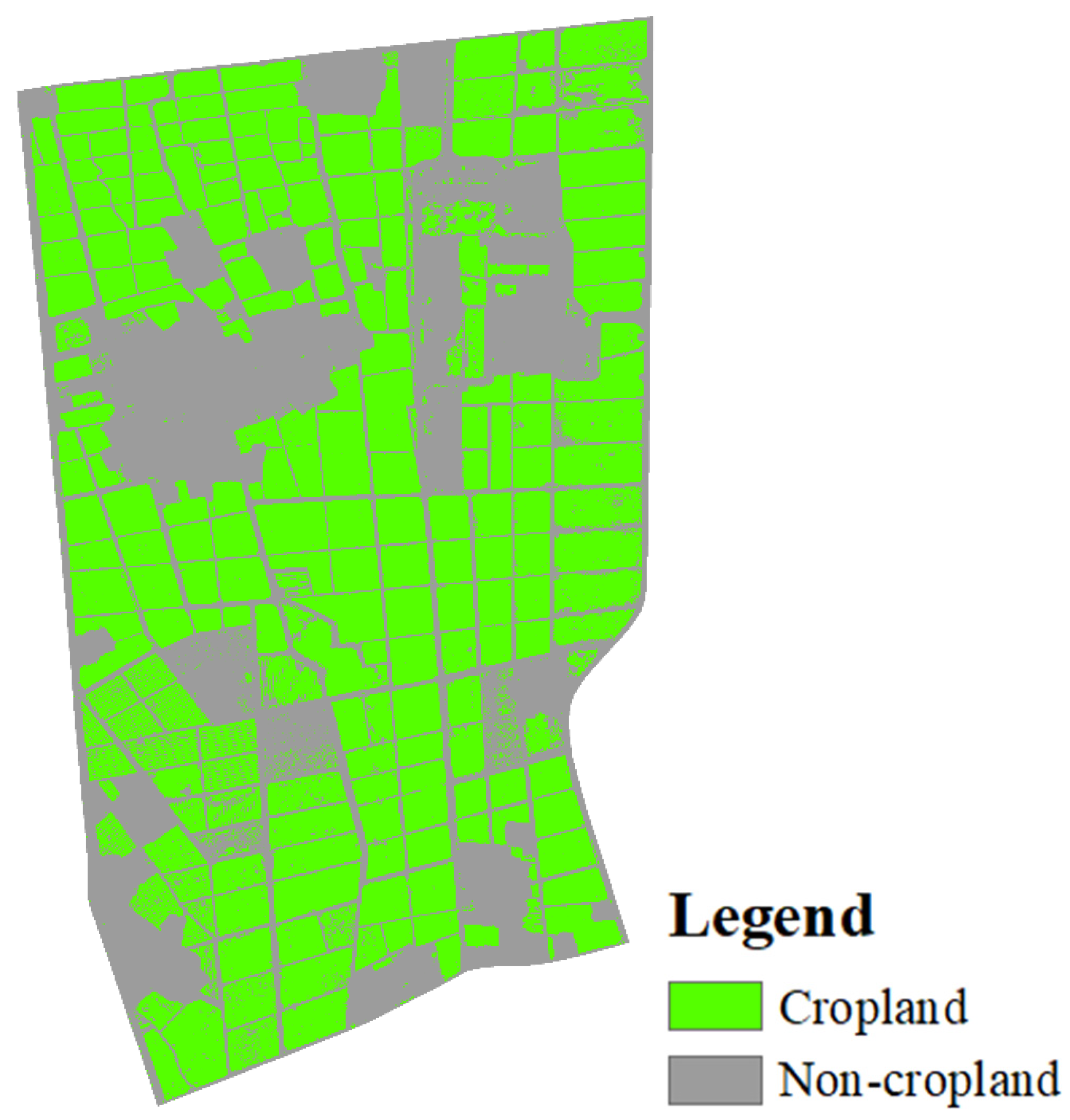
In a typical agricultural landscape, it is suggested to reduce misclassification of non-cropland pixels by combining elevation difference between parcel surfaces and edges with vegetation-cover information [25]. Therefore, vegetation coverage was further removed from initial relief-derived binary to refine the candidate boundaries of cropland patches (Figure 7).

2.4. Boundary Refinement of Extracted Parcel

2.4.1. Shape Optimization of Patched Croplands Using Morphological Operations

Numerous small and fragmented patches were still present after abovementioned processing. Therefore, morphological operations were employed to improve the extracted result, including closing operation, hole filling, opening operation, and area filtering [33]. Specifically, closing operations were performed using a rectangular structuring element of the same size as the mean ridge width. Adjacent pixels were connected using dilation followed by erosion to improve the morphology of cropland parcel. Then, hole filtering was conducted to infill the pixels of hole patch according to their relationship with neighboring pixels. This step enhanced intra-parcel consistency and effectively suppressed the noise. Subsequently, opening operation was applied using a circular structuring element with the half size of mean ridge width. Patch outlines were smoothed using erosion followed by dilation to remove small burrs and sharpen the parcel boundaries. Finally, the same area threshold was adopted as the hole filtering to remove the small regions.
Closing was performed with a rectangular structuring element (sized to the mean ridge width) so that adjacent pixels were connected by dilation followed by erosion, thereby improving the integrity of cropland parcel morphology. Hole filling was then conducted based on neighboring pixel intensities to infill internal cavities, by which intra-parcel consistency was improved, noise was effectively suppressed, and image representation was enhanced. Opening was subsequently applied using a circular structuring element (sized to one-half of the mean ridge width), with erosion followed by dilation to smooth patch outlines, remove fine spurs, and sharpen parcel boundaries. Finally, the area of each connected component was computed, and components were filtered using an area threshold consistent with that applied after hole filling, so that small noisy regions and irrelevant patches were removed and a morphologically optimized cropland parcel result was obtained. The parcel extraction accuracy for the three study areas after applying different morphological operations is presented in Table A1 of Appendix A, where the results demonstrate improvements in the parcel area ratio, overall accuracy (OA), and Kappa coefficient (KC).

2.4.2. Edge Smoothing of Parcels Using Median Filtering

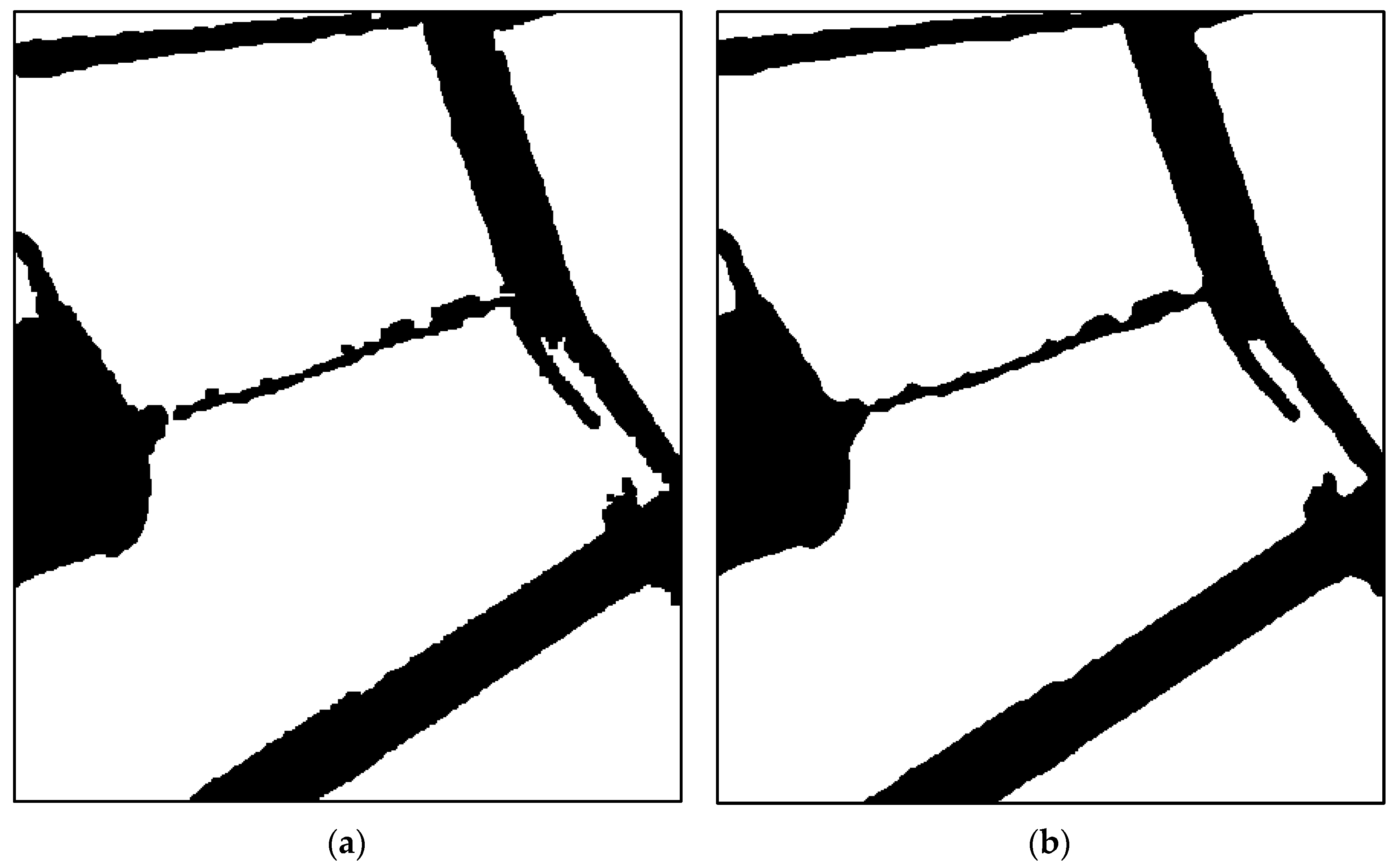
Jagged edges were still observed after morphological processing for pixel-based extraction of cropland parcels, which inevitably lead to inaccurate boundary delineation for the cadastral purpose of parcel mapping. Thus, median filtering was considered to enhance the boundary accuracy of patched cropland. This filtering is a nonlinear technique to effectively suppress the impulse noise, such as salt-and pepper noise, and preserve both image details and edge information, as well as avoid the excessive blurring of images [34]. The filtering window size was set to the pixel dimension, corresponding to one-half of the mean ridge width for local agricultural fields. As a result, boundary smoothness was greatly promoted and the separability of adjacent parcels was enhanced, which contributed to improving the accuracy of parcel number extraction (Figure 8).

2.4.3. Boundary Improvement of Cropland Field Using Convex Hull and Concave Hull

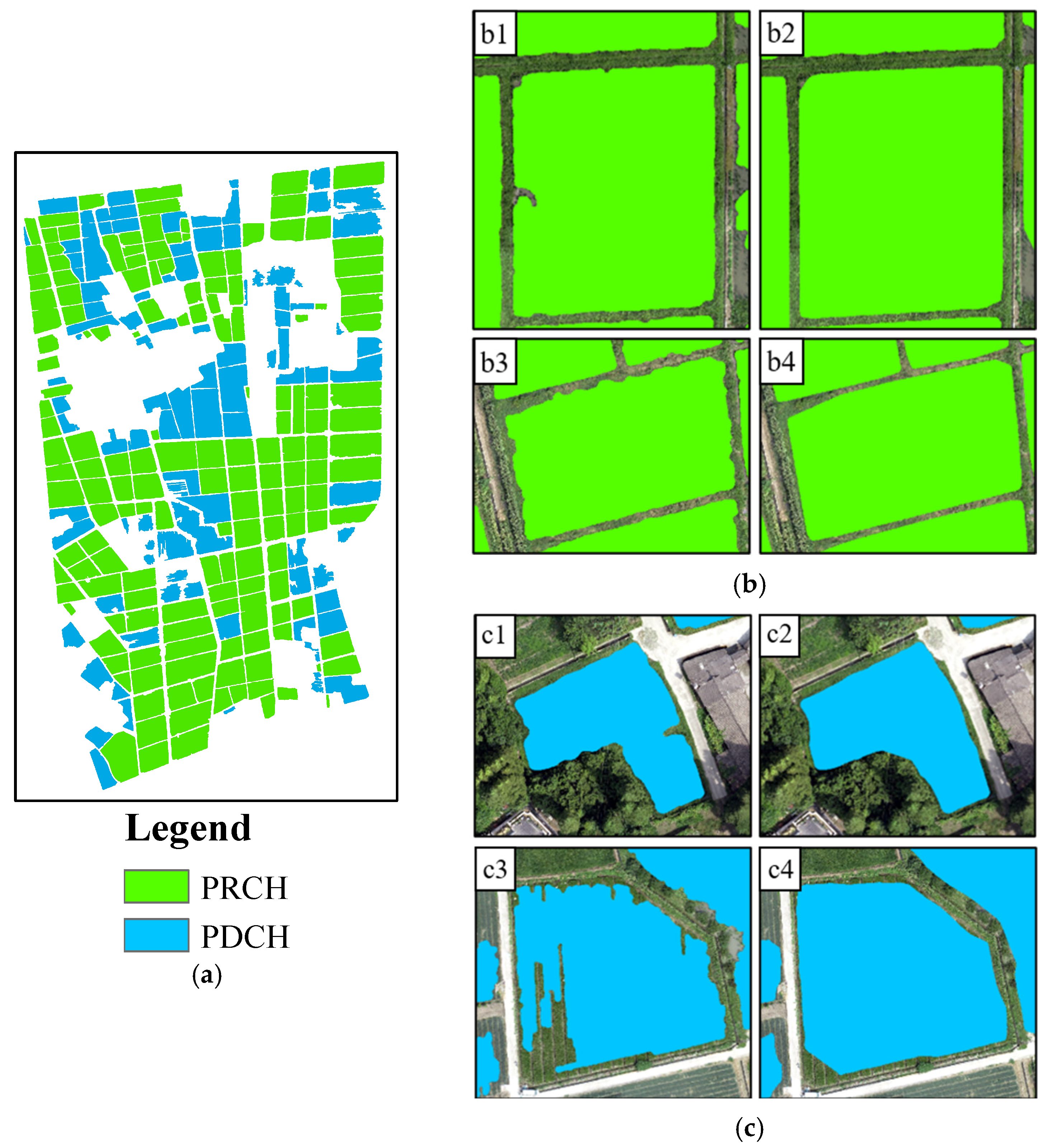
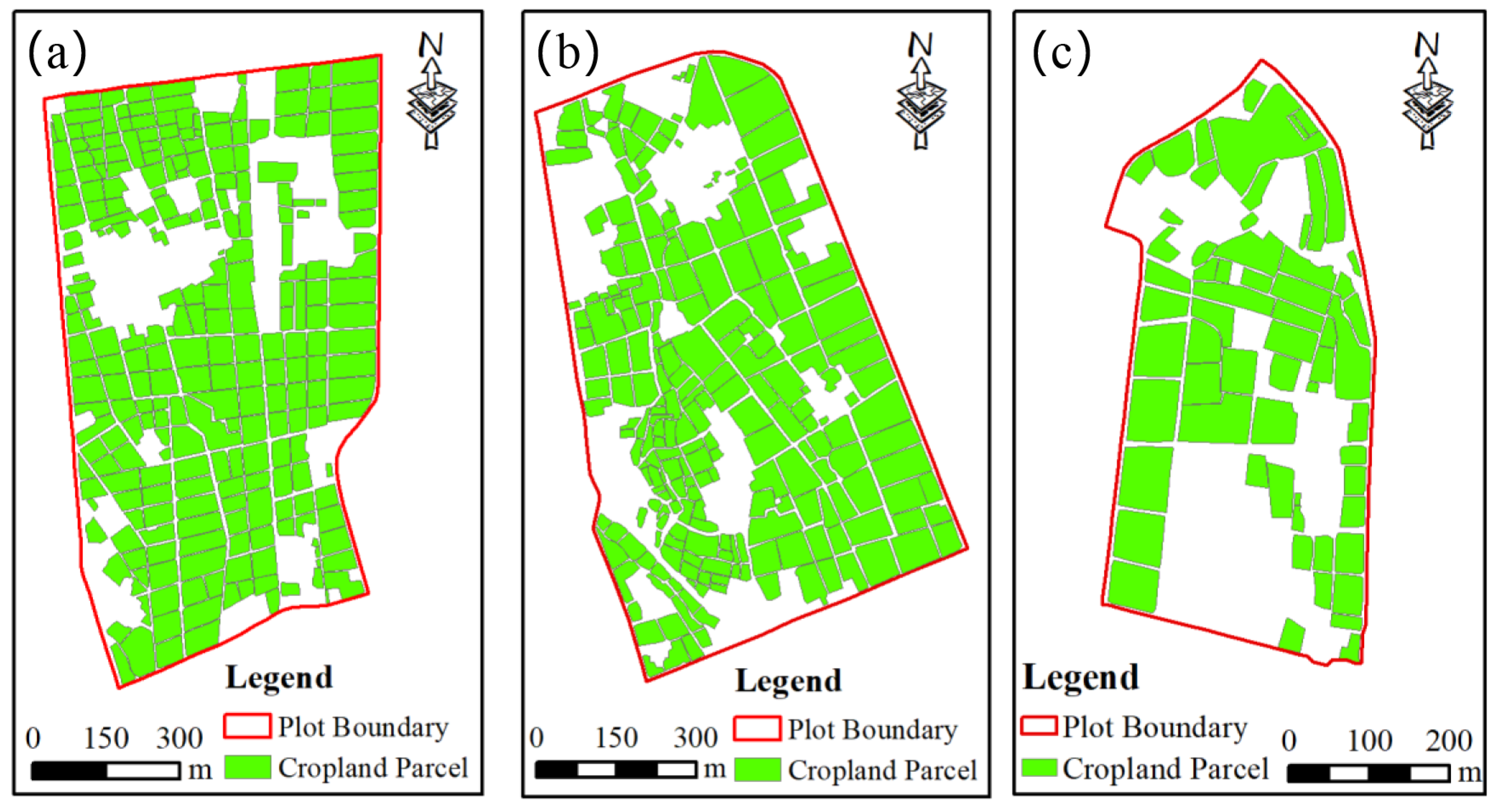
To address the irregularity of extracted parcel boundaries, the shape deviation was used to detect the shape outlier by the area ratio of each mapped parcel between the cropland patch and its convex hull. A parcel with a regular convex hull (PRCH) was identified when the area ratio was lower than the threshold of 105%; otherwise these were parcels with deviated convex hulls (PDCH) (Figure 9). Afterwards, two types of patched parcels were further refined using different strategies. On the one hand, the outline of the individual parcel was replaced by its convex hull for the PRCH. Because a convex hull is a fundamental structure in the field of computational geometry, the objective of this algorithm is to determine the smallest convex polygon that encloses a given point set or patched pixels in the 2D plane [35]. On the other hand, the contour of each PDCH was improved to generate the refined polygon using a concave hull algorithm with a shrink parameter of 0.7, which could enhance the boundary continuity for such cropland parcels. Finally, two types of parcels were merged to obtain the refined result (Figure 10).

2.5. Accuracy Assessment

Mapping accuracy was evaluated against visual interpretation as references at three levels, including parcel area, parcel count, and boundary delineation. Area accuracy was quantified using OA and the KC. Count accuracy was measured by the correct extraction rate (CER), the commission error rate (MER), and the omission error rate (OER). Boundary accuracy was assessed in terms of recall, precision, and the length error ratio (LER).

2.5.1. Accuracy Evaluation of Parcel Area Mapping

To assess the extraction accuracy, a confusion matrix was constructed by pixel-wise comparison between visually interpreted reference data and the mapping results, and OA together with the KC were used to evaluate the performance. OA was interpreted as the consistency between the extraction and the reference, with higher values indicating higher accuracy. The KC measures the agreement between the extraction results and reference data, corrected for chance. Higher values indicate superior mapping accuracy. The formula is as follows:
O A = T P + T N T P + T N + F P + F N
P = ( T P + F P ) × ( T P + F N ) + ( F N + T N ) × ( F P + T N ) ( T P + T N + F P + F N ) 2
K a p p a = O A P 1 P
where TPs (true positives) denote the number of pixels that were actually positive and were correctly predicted as positive; FNs (false negatives) denote the number of pixels that were actually positive but were incorrectly predicted as negative; FPs (false positives) denote the number of pixels that were actually negative but were incorrectly predicted as positive; and TNs (true negatives) denote the number of pixels that were actually negative and were correctly predicted as negative. P denotes the expected accuracy under random classification.

2.5.2. Assessing the Accuracy of Cropland Counting Extraction

To evaluate the accuracy of parcel extraction, three indicators were used: the CER, the OER, and the MER. CER was interpreted as the ability to correctly identify parcels, OER represented the extent of missed parcels, and MER reflected the extent to which non-parcels were misidentified as parcels. Together, these three metrics provided a comprehensive assessment from the perspectives of correct identification, omission, and misclassification. They were computed as follows:
C E R = N C N T × 100 %
M E R = N F N E × 100 %
O E R = N M N T = N T N C N T × 100 %
where NC denotes the number of correctly extracted parcels, NT denotes the total number of ground-truth parcels, NM denotes the number of omitted parcels, NF denotes the number of incorrectly extracted non-parcels (commission errors), and NE denotes the total number of extracted parcels.

2.5.3. Boundary Delineation Accuracy for Agricultural Parcels

To evaluate the quality of boundary extraction, recall, precision, and the LER were computed from TP, FP, and FN using the polyline features concerted from both extracted and referenced polygons. Completeness was defined as the percentage of the reference boundary that fell within the buffer zone of the extracted boundary. Correctness was interpreted as the proportion of the extracted boundary overlapping the buffer of the reference boundary. LER quantified the relative error between the total extracted length and the total reference length. These metrics were computed as follows:
R e c a l l =   l e n g t h   o f   m a t c h e d   r e f e r e n c e     l e n g t h   o f   r e f e r e n c e   × 100 % = T P T P + F N × 100 %
P r e c i s i o n = l e n g t h   o f   m a t c h e d   e x t r a c t i o n l e n g t h   o f   t h e   e x t r a c t i o n × 100 % = T P T P + F P × 100 %
L e n g t h   e r r o r   r a t i o = L 1 L 0 L 0
where TP, FP, and FN denote the lengths of matched extracted boundary, unmatched extracted boundary, and unmatched reference boundary, respectively; L1 and L0 denote the total lengths of the extracted and reference boundaries, respectively. A buffer width of 1 m was adopted for rural southern China according to the National Standard of Current Land Use Classification (GB/T 21010-2017), and this width directly affects the evaluation results.
Additionally, the shape index, mean perimeter difference and perimeter-area ratio were employed to evaluate the geometric characteristics of the patches. The shape index quantifies the geometric complexity of a patch, with values approaching 1 indicating a more regular shape (e.g., a circle or square). The perimeter–area ratio reflects the boundary compactness and fragmentation level of patches, where higher values indicate more complex or elongated shapes. The mean perimeter difference measures the average deviation between the perimeter of the extracted patch and that of the corresponding reference parcel, with smaller values indicating closer alignment with the ground truth.

3. Results

3.1. Mapping Improvement of Boundary Refinement

All evaluation metrics were improved after the processing of boundary refinement. OA increased to 96.1%, KC ascended to 0.92, mapping accuracy of parcel area increased to 98.1%, and LER decreased from 3.30% to −4.55%. In addition, shape characteristics of extracted patches were also enhanced in terms of shape index, area–perimeter ratio, and average perimeter difference in Table 4.
The boundaries of PRCH were further improved, as evidenced by a higher OA (99.1%) and KC (0.98), along with a slight elevation in three shape-related indices (Table 5). This fully demonstrates the excellent adaptability of the method for regular parcel extraction. But PDCH displayed a weak decrease of 2.1% in the patch count (Table 6). It might be that the edge areas between adjacent deviated parcels were not effectively identified during the optimization process, leading the refinement algorithm to merge adjacent parcels into a single parcel, thus reducing the number of independently identified deviated parcels.

3.2. Accuracy of Cropland Area Extraction

The extraction of parcel area achieved high accuracy across the three testing sites, with an OA of 96.1–97.0% and KC of 0.92–0.94 (Table 7). Comparable accuracies have been reported in similar studies of cropland mapping. For example, flat croplands were extracted using multi-source remote sensing data to achieve an OA of 92.5% and a KC of 0.85 [36]. Cropland in Loess Plateau was mapped using a drone mounted with multispectral, thermal and LiDAR sensors, and yielded an OA of 92.7% and a KC of 0.92 [37]. In an ideal agricultural landscape of North China Plain, stripped cropland were delineated using consumer-level camera and small UAS, and the KC reached 97.4–99.9% without any other land cover types [25]. In contrast, the proposed method has made significant progress to meet the requirements of cadastral mapping regulation under the agricultural scene with villages, woodlands, and roads.

3.3. Accuracy of Cropland Quantity Extraction

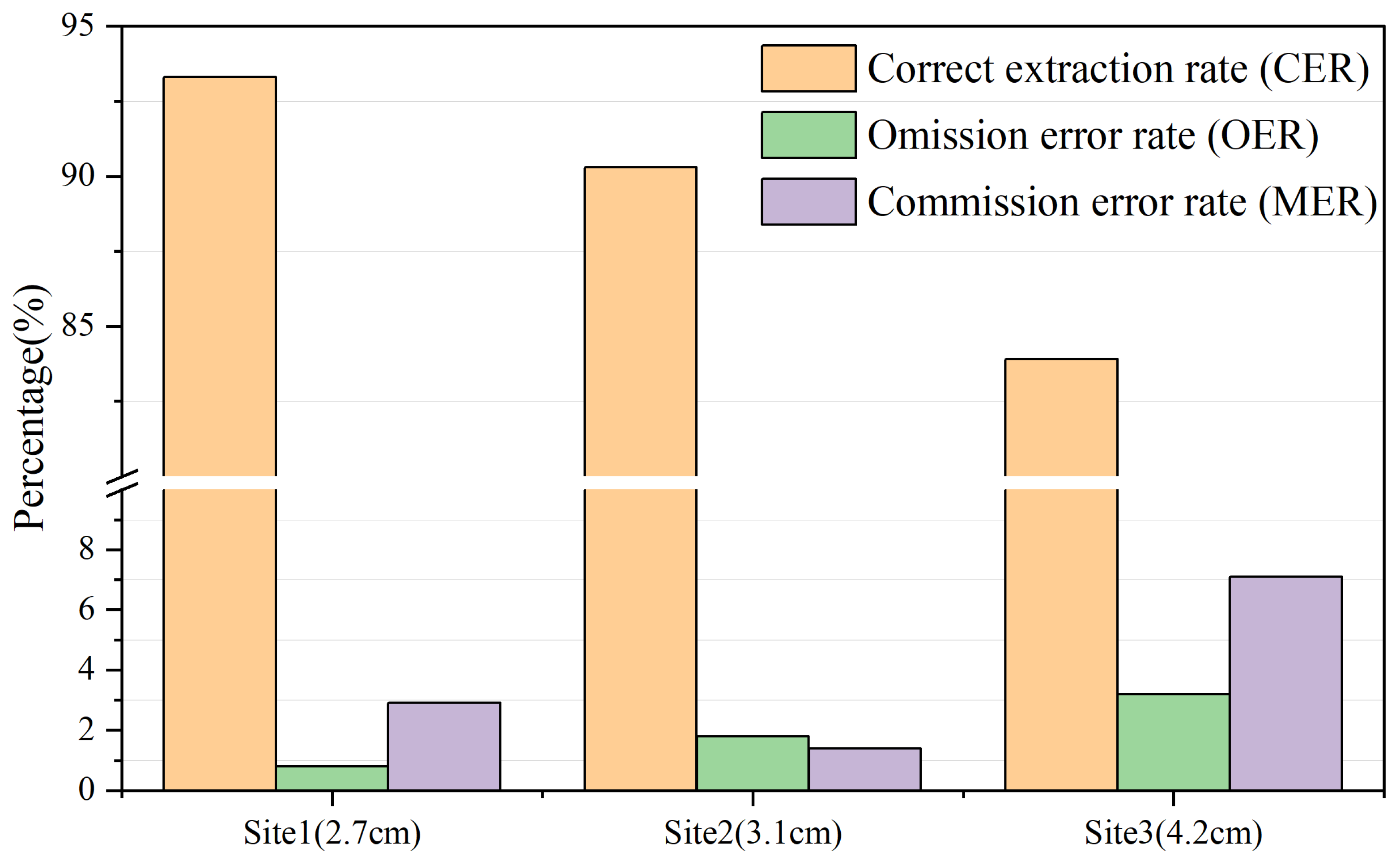
Number of mapped parcels received accurate results with a CER of 83.9–93.3%, OER of 0.8–3.2%, and MER of 1.4–7.1% (Figure 11). These indices indicated high correctness with low omission and commission errors.

3.4. Accuracy of Cropland Boundary Extraction

Boundary mapping received acceptable results. However, the case was divided by the shape of cropland parcels (Table 8). For PRCH, the extracted boundary showed the better performance with a higher recall of 80.2~90.0% and a precision of 83.2~92.2%, as well as a lower LER of −2.54~−3.89%. By contrast, ISP exhibited poorer accuracy compared to the total parcels for each site. PRCH is usually rectangular and can be accurately extracted, whereas PDCH generally has more than six sides or even more complex shape, which often leads to lower accuracy.

4. Discussion

4.1. Impact of Selected Features on Croplands Extraction Accuracy

4.1.1. Single-Period Thresholding of DSM for Extracting Cropland Parcels

To assess the mapping accuracy using UAS-derived DSM, a global mean threshold method was individually applied to six DSM at different crop growing stages (Table 9). The accuracy was poor with a low OA of 32.8~40.1% and KC of −0.27~−0.16, as well as extremely low parcel count (<16.1%). It indicated that parcel extraction was apparently constrained only using single-date DSM.

4.1.2. Single-Period Thresholding of Relief Amplitude for Agricultural Fields Mapping

The performance of parcel extraction was also investigated using DSM-computed terrain relief amplitude (Table 10). The mapping result exhibited strongly temporal variability with OA ranging from 34.0% to 86.9% and KC ranging from −0.06 to 0.70, as well as area ratio 6.1~107.6%. Crop phenology of image acquisition greatly impacts the separability between parcels and non-parcels. Moreover, the best result was achieved at rice harvest stage (November 2023) with a highest OA of 86.9% and KC of 0.70. This might result from the greatest difference between parcel interiors and edge zones. Therefore, relief thresholding segmentation was suggested when considering the imaging stage for such patched parcels.

4.1.3. Single-Period Thresholding of VDVI for Cropland Patches Delineation

VDVI is a typical vegetation index for airborne RGB cameras, and OTSU thresholding method was adopted for each VDVI map (Table 11). Accuracy varied across crop stages with an OA of 36.9~81.2% and KC of −0.10~0.56, and the best performance was received at the heading stage of rice (August 2023). Thus, specific phases of crop phenology should be considered to explore the good discrimination of cropland parcels from non-cropland patches.

4.2. Impact of Spatial Resolution

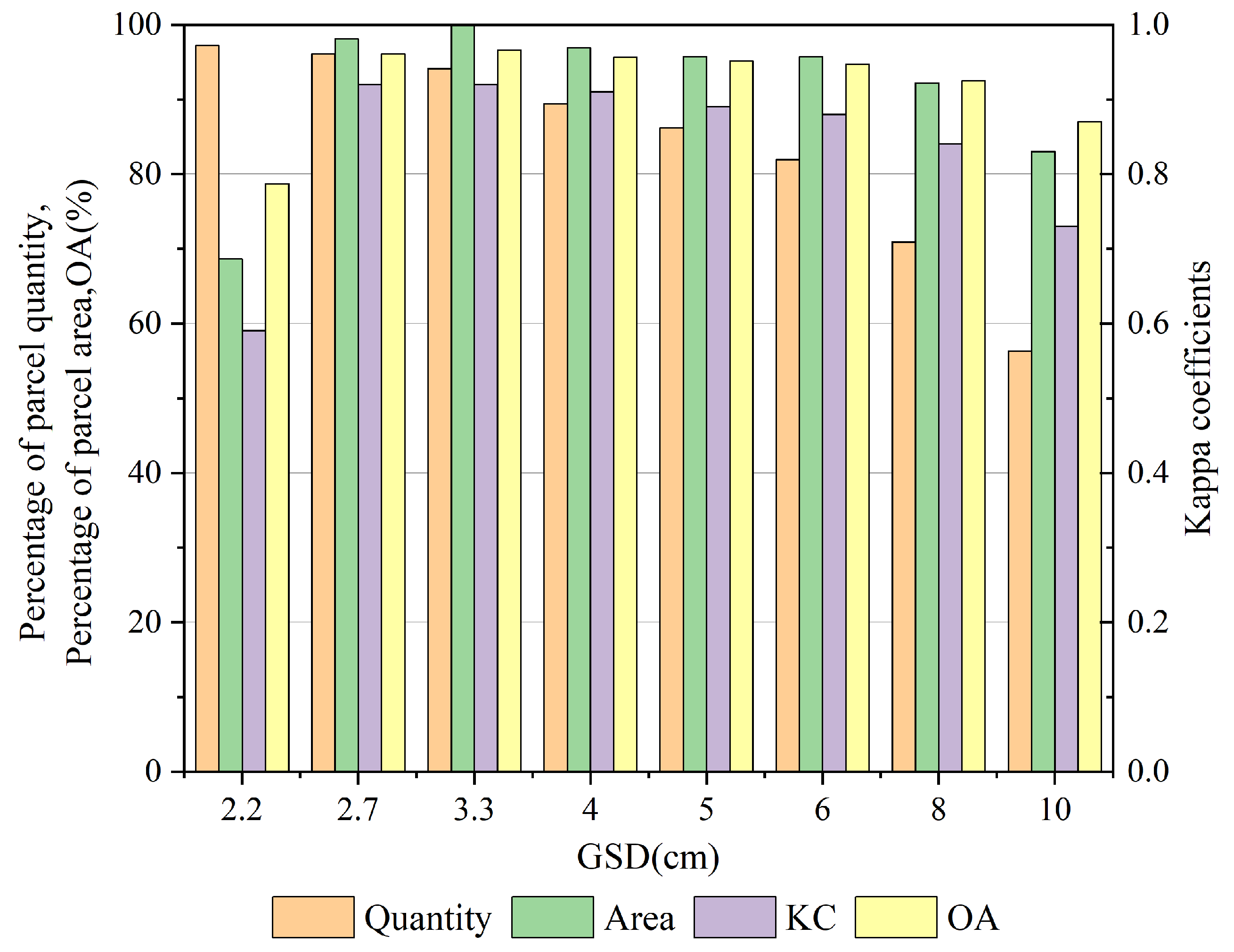
To examine the effects of spatial resolution on the mapping accuracy [38], simulated image dataset was constructed by resampling the image of Site 1 from the GSD of 2.7 cm (Figure 12). The results indicated that high accuracy was achieved (OA ≥ 96.1%, KC ≥ 0.92) around the GSD of 2.7~3.3 cm with flying at 100~119 m. The performance was still maintained at the GSD of 4.2 cm with an altitude of 140 m. The accuracy displayed a gradual decline when GSD was lower than 5 cm, and substantially decreased when GSD was larger than 6 cm. Notably, the accuracy obviously reduced at the GSD of 2.2 cm because the processing of area filtering led to over-removal of small pixels. Therefore, the extent of spatial resolution is applicable within a range of approximately 2.7~5.0 cm to ensure the mapping accuracy of cropland parcels.

4.3. Potential Strategy for Accuracy Improvement

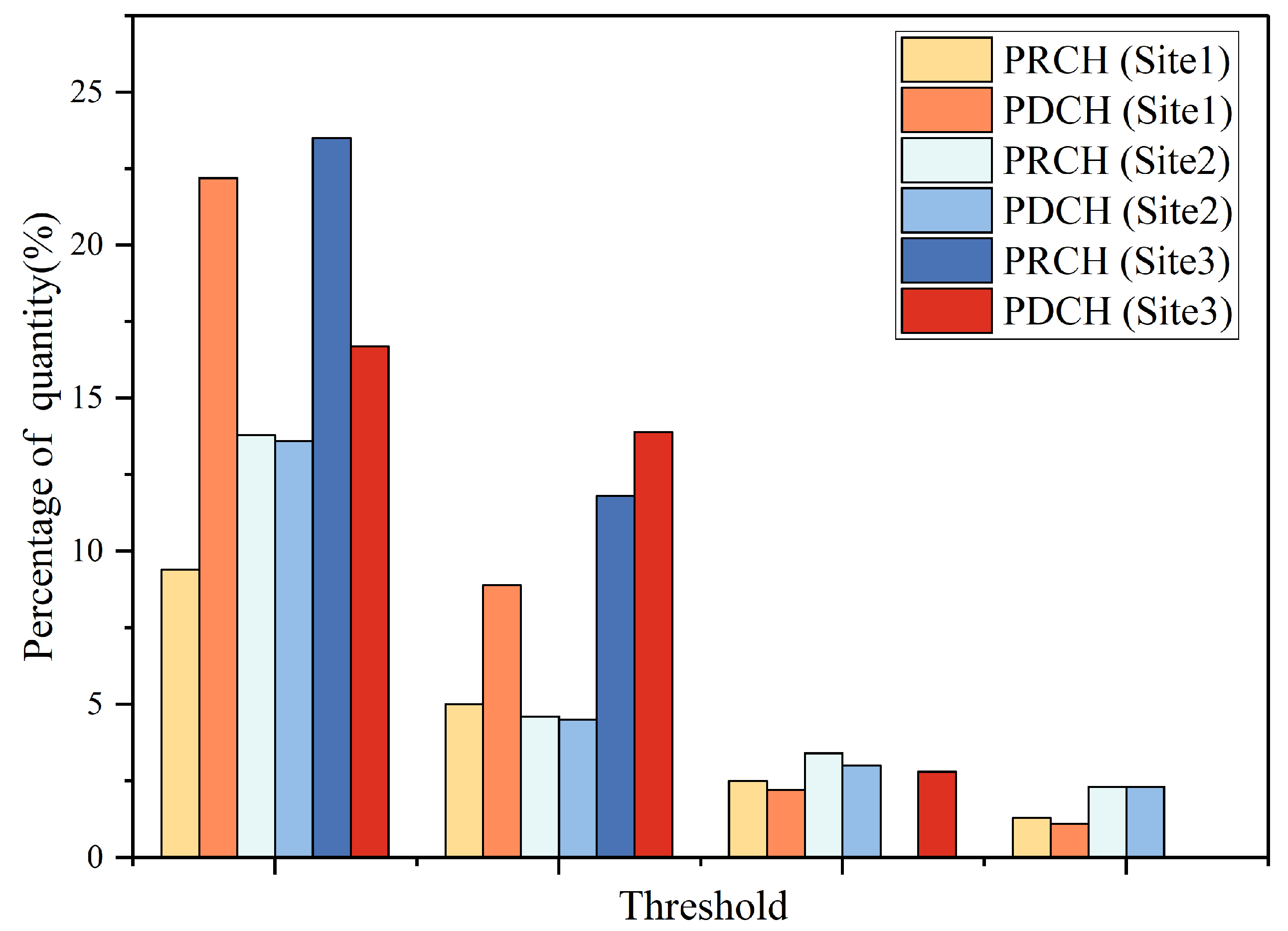
Considering the poor extraction of PDCH, this study suggested a combining strategy of automated mapping for majority parcels with high accuracy and manual correction for minority patches in low accuracy. This hybrid strategy could improve accuracy while maintaining efficiency, which makes it easier to put into practice. For example, in similar cropland extraction cases in plain areas, such as the Guanzhong Plain in China and the irrigated agricultural plains of Washington and California in the United States, comparable or even lower accuracies have been observed. Several recent studies have reported parcel extraction overall accuracies exceeding 80% [39] and 87% [40], with Kappa coefficients higher than 0.82 [39] and 0.91 [40], respectively. Therefore, mapped parcels with low accuracy were identified through threshold screening of perimeter difference before and after boundary optimization. Different thresholds ( ω ± 1 2 ψ , ω ± ψ , ω ± 2 ψ , ω ± 3 ψ ) were parameterized by the mean value ( ω ) and standard deviation ( ψ ) of the perimeter difference, and the relationship was analyzed between selected thresholds with the number of anomalous parcels identified, as well as the mapping accuracy (Table 12).
The results indicated that the standard deviation of the perimeter difference decreased markedly for both types of parcels after outlier removal, demonstrating clear optimization (Figure 13). This thresholding strategy exhibited good applicability in Site 2 and Site 3 as well, effectively identifying cropland parcels with anomalous perimeter differences. For PRCH, the threshold of ω ± 2 ψ is recommended, with the proportion of cropland parcel boundaries requiring correction ranging from 0% to 3.4%. For PDCH, the threshold of ω ± ψ is suggested, and the corresponding proportion of cropland parcel boundaries that need correction is 4.5% to 13.9%. By adjusting to a smaller perimeter difference threshold and applying targeted manual corrections to the screened low-accuracy parcels, this study can achieve even higher accuracy.

4.4. Limitations and Future

4.4.1. Methodological Limitations

Firstly, the proposed method is sensitive to terrain relief and performs well for cropland extraction with regular parcel shapes in the relatively flat cultivated land, especially for paddy rice fields. Because post-harvest elevation contrast is obvious between the inner surface and edge of parcel, its applicability remains to be fully validated for more complex agricultural landscapes, such as highly fragmented cropland, terraced fields, sloped farmland systems, or regions where natural vegetation boundaries blend with cultivated edges. Secondly, the current approach relies on a predefined set of features, including topographic relief and VDVI. The processing parameters were determined empirically from three specific sites (0.2–0.7 km2). While these parameters are physically interpretable, their transferability might be limited without recalibration to larger regions or significantly different environments. Thirdly, an operational constraint is the dual-stage UAS imagery acquisition at both vigorous growth and post-harvest stages, which is a potential bottleneck. Because the accuracy of parcel extraction is sensitive to the precise timing of these acquisitions, this would reduce the spectral and topographic contrast essential for accurate delineation if imaging is dated too early or too late relative to critical phenological events. Furthermore, this temporal dependency may limit the applicability of method in regions where UAS flights are legally prohibitive. Finally, while morphological processing was employed to refine parcel boundaries, issues may still be observed in complex scenarios, such as over-segmentation or under-segmentation [41].

4.4.2. Recommendations for Future Improvements

A critical solution is to investigate the feasibility of single-stage data acquisition to reduce temporal costs. Future work should aim to identify an optimal phenological period where crop foliage adequately covers the planted area while simultaneously maintaining a measurable height difference relative to parcel boundaries. The optimal period would allow for the extraction of both vegetation coverage and topographic relief from a single UAS flight. However, it must be noted that extraction using optimized single-stage data may not yet achieve the same level of accuracy as the dual-stage method. Therefore, the trade-off between efficiency and precision requires thorough investigation. To overcome the limitations of optical UAS data and strengthen the distinction between parcel edges and surfaces, future studies should integrate additional data sources. For instance, LiDAR and Synthetic Aperture Radar (SAR). UAS-derived SAR imagery is sensitive to soil moisture and crop structure, and could provide complementary information for parcel delineation. Similarly, LiDAR data could offer more detailed terrain and canopy height information, potentially improving the accuracy of edge detection in complex topographies. The applicability of proposed method should be further extended by examining a wider range of terrain features, such as slope, aspect, surface roughness, as well as vegetation indices for different crop types and growth stages. The most effective combination of features should be examined for specific agricultural contexts to develop a more practical tool.
Future efforts should explore more sophisticated morphological operations or develop adaptive algorithms for parcel extraction, particularly when relying on single-stage data. This could involve leveraging machine learning to optimize the sequence and parameters of morphological transformations based on local image characteristics. To enhance the adaptability across larger and more diverse regions, future work should focus on developing self-calibrating or learning-based methods to determine processing thresholds, rather than relying on fixed values derived from three given study sites. The topological relationships between neighboring patches have the potential to improve the shape integrity of extracted parcels. Such rules could facilitate the automatic correction of over-segmentation or under-segmentation errors after initial morphological processing. Finally, the performance of proposed method must be evaluated across multiple growing seasons and under varying climatic conditions. Inter-annual variability in crop phenology may shift the optimal acquisition periods, potentially requiring annual recalibration of flight timing or the development of models that are robust to such variations.
In summary, while our method provides an alternative for cadastral mapping in specific agricultural landscapes, future research should prioritize reducing the amount of data requirements, enhance the adaptability for complex environments, and validate the robustness.

5. Conclusions

This study proposed an automated method for extracting patched cropland parcels in a flat agricultural scene utilizing drone-based imagery from two crop growth stages. The approach combined a binary map of terrain relief derived from DSM after rice harvest with the vegetation segmentation of VDVI calculated from DOM at the rice heading stage. Parcel boundaries were further refined through shape optimization, edge smoothing and boundary improvement. Validation was conducted at three representative sites in the Sichuan Basin. The results showed high precision in pixel-area extraction (98.1%), good correctness in field count (93.3%), and low relative error in boundary length (4.55%). These parcels with regular shapes achieved even higher accuracy, with an OA of 99.1% and a KC of 0.98. The approach was effective for drawing patched cropland parcels within heterogeneous agricultural landscapes containing non-crop features such as villages, roads, and woodlands. This method offers an alternative solution for the precise cadastral mapping of patched cropland units in complex agricultural settings. However, its suitability and robustness required further investigation for regional-scale applications, which could substantially provide reliable technical support for the quantitative monitoring of cultivated land use and cropland protection efforts.

Author Contributions

Conceptualization, J.Z. and X.Y.; methodology and formal analysis, X.Y., Y.Z. and Q.C.; software, X.Y.; validation, Y.Z., Y.C. and S.Q.; investigation, Q.C., X.Y., Y.Z., S.Q. and Y.L.; data curation, X.Y. and Q.C.; writing—original draft preparation, X.Y. and J.Z.; writing—review and editing, J.Z. and W.X.; funding acquisition, J.Z. and Y.L. All authors have read and agreed to the published version of the manuscript.

Funding

This research was funded by the Open Research Fund Program of Key Laboratory of Digital Mapping and Land Information Application, Ministry of Natural Resources (No. ZRZYBWD202204); the National Natural Science Foundation of China (No. 42401541); and Open Fund of Observation and Research Station of Land Ecology and Land Use in Chengdu Plain, Ministry of Natural Resources (Grant No. CDORS-2024-03).

Data Availability Statement

The authors do not have permission to share data.

Acknowledgments

Thanks to Ziying Du, Haoran Li, and Haolun Xu for the field data collection.

Conflicts of Interest

The authors declare no conflicts of interest.

Appendix A

Figure A1. UAS orthophotos and corresponding relief degree of terrain images during the crop harvest period and peak growing stage. (a) Orthophoto after crop harvest, (b) Binary image of terrain relief after crop harvest, (c) Orthophoto of the crop growth peak stage, (d) Binary image of terrain relief during crop growth peak stage.
Remotesensing 18 01367 g0a1
Table A1. Accuracy assessment of morphological optimization operations for the three study areas.
PlotStepParcel Area RatioOAKC
Site 1Before closing operation91.61%92.37%0.84
After closing operation95.48%94.44%0.88
Hole filling96.67%95.10%0.89
Opening operation96.00%95.10%0.89
Area filtering95.01%95.21%0.90
Site 2Before closing operation59.43%94.18%0.88
After closing operation88.34%95.50%0.88
Hole filling89.12%94.88%0.89
Opening operation87.91%94.91%0.89
Area filtering87.83%95.06%0.90
Site 3Before closing operation96.59%94.72%0.89
After closing operation99.10%95.20%0.90
Hole filling99.31%95.17%0.90
Opening operation97.63%95.86%0.92
Area filtering96.62%96.30%0.93

References

  1. Xie, Y.; Zheng, S.; Wang, H.; Qiu, Y.; Lin, X.; Shi, Q. Edge detection with direction guided postprocessing for farmland parcel extraction. IEEE J. Sel. Top. Appl. Earth Obs. Remote Sens. 2023, 16, 3760–3770. [Google Scholar] [CrossRef]
  2. Cao, X.; Chen, X.; Zhang, W.; Liao, A.; Chen, L.; Chen, Z.; Chen, J. Global cultivated land mapping at 30 m spatial resolution. Sci. China Earth Sci. 2016, 59, 2275–2284. [Google Scholar] [CrossRef]
  3. Zhao, J.; Zhong, Y.; Hu, X.; Wei, L.; Zhang, L. A robust spectral-spatial approach to identifying heterogeneous crops using remote sensing imagery with high spectral and spatial resolutions. Remote Sens. Environ. 2020, 239, 111605. [Google Scholar] [CrossRef]
  4. Hu, Q.; Xiang, M.; Chen, D.; Zhou, J.; Wu, W.; Song, Q. Global cropland intensification surpassed expansion between 2000 and 2010: A spatio-temporal analysis based on GlobeLand30. Sci. Total Environ. 2020, 746, 141035. [Google Scholar] [CrossRef] [PubMed]
  5. Xu, Y.; Zhu, Z.; Guo, M.; Huang, Y. Multiscale edge-guided network for accurate cultivated land parcel boundary extraction from remote sensing images. IEEE Trans. Geosci. Remote Sens. 2024, 62, 1–20. [Google Scholar] [CrossRef]
  6. Appeaning Addo, K.; Walkden, M.; Mills, J.P. Detection, measurement and prediction of shoreline recession in Accra, Ghana. ISPRS J. Photogramm. Remote Sens. 2008, 63, 543–558. [Google Scholar] [CrossRef]
  7. Stefanov, W.; Ramsey, M.; Christensen, P. Monitoring urban land cover change: An expert system approach to land cover classification of semiarid to arid urban centers. Remote Sens. Environ. 2001, 173–185. [Google Scholar] [CrossRef]
  8. Appeaning Addo, K. Urban and Peri-Urban Agriculture in Developing Countries Studied using Remote Sensing and In Situ Methods. Remote Sens. 2010, 2, 497–513. [Google Scholar] [CrossRef]
  9. Gond, A.K.; Ohri, A.; Gaur, S.; Das, N. Accuracy assessment and optimization of the photogrammetric process variables for 3D mapping using unmanned aerial vehicle (drones). J. Indian Soc. Remote Sens. 2025, 53, 3141–3164. [Google Scholar] [CrossRef]
  10. Liu, X.; Zhang, J.; Duan, Y.; Zhou, J. CPVF: Vectorization of agricultural cultivation field parcels via a boundary–parcel multi-task learning network in ultra-high-resolution remote sensing images. ISPRS J. Photogramm. Remote Sens. 2025, 226, 267–299. [Google Scholar] [CrossRef]
  11. Watkins, B.; Van Niekerk, A. Automating field boundary delineation with multi-temporal Sentinel-2 imagery. Comput. Electron. Agric. 2019, 167, 105078. [Google Scholar] [CrossRef]
  12. Graesser, J.; Ramankutty, N. Detection of cropland field parcels from Landsat imagery. Remote Sens. Environ. 2017, 201, 165–180. [Google Scholar] [CrossRef]
  13. Pervez, M.S.; Brown, J.F.; Pervez, M.S.; Brown, J.F. Mapping irrigated lands at 250-m scale by merging MODIS data and national agricultural statistics. Remote Sens. 2010, 2, 2388–2412. [Google Scholar] [CrossRef]
  14. Xie, M.; Liu, G.; He, J.; Li, Z.; Li, Z.; Huang, Y.; Li, D. Fine extraction of cultivated land parcels in Chengdu plain area based on CDUSU-net network model of gaofen-2 imagery. J. Indian Soc. Remote Sens. 2025, 53, 1785–1798. [Google Scholar] [CrossRef]
  15. Li, C.; Fu, L.; Zhu, Q.; Zhu, J.; Fang, Z.; Xie, Y.; Guo, Y.; Gong, Y. Attention enhanced U-net for building extraction from farmland based on google and WorldView-2 remote sensing images. Remote Sens. 2021, 13, 4411. [Google Scholar] [CrossRef]
  16. Chen, J.; Chen, T.; Mei, X.; Shao, Q.; Deng, M. Hilly farmland extraction from high resolution remote sensing imagery based on optimal scale selection. Trans. Chin. Soc. Agric. Eng. 2014, 30, 99–107. [Google Scholar]
  17. Zhu, W.; Li, S.; Zhang, X.; Li, Y.; Sun, Z. Estimation of winter wheat yield using optimal vegetation indices from unmanned aerial vehicle remote sensing. Trans. Chin. Soc. Agric. Eng. Trans. CSAE 2018, 34, 78–86. [Google Scholar] [CrossRef]
  18. Zhang, J.; Hu, Z.; Zhao, Y.; Xiao, W.; Yang, K.; Chen, J. Estimating canopy surface height of wheat and corn crops in reclaimed cropland using multispectral images from a small unmanned aircraft system. J. Appl. Remote Sens. 2021, 15, 034506. [Google Scholar] [CrossRef]
  19. Watkins, B.; van Niekerk, A. A comparison of object-based image analysis approaches for field boundary delineation using multi-temporal sentinel-2 imagery. Comput. Electron. Agric. 2019, 158, 294–302. [Google Scholar] [CrossRef]
  20. Schultz, B.; Immitzer, M.; Formaggio, A.R.; Sanches, I.D.A.; Luiz, A.J.B.; Atzberger, C. Self-guided segmentation and classification of multi-temporal Landsat 8 images for crop type mapping in southeastern Brazil. Remote Sens. 2015, 7, 14482–14508. [Google Scholar] [CrossRef]
  21. Kong, M.; Zheng, H. Research progress in farmland boundary extraction methods based on remote sensing image. J. Chin. Agric. Mech. 2024, 45, 168. [Google Scholar]
  22. Bhattad, R.; Patel, V.; Patel, U. Deep learning fusion for dynamic cropland monitoring: Integrating MUNet with Siamese networks and convolutional LSTM2D. Model. Earth Syst. Environ. 2024, 10, 5381–5398. [Google Scholar] [CrossRef]
  23. Lu, H.; Fu, X.; Liu, C.; Li, L.; He, Y.; Li, N. Cultivated land information extraction in UAV imagery based on deep convolutional neural network and transfer learning. J. Mt. Sci. 2017, 14, 731–741. [Google Scholar] [CrossRef]
  24. Wagner, M.P.; Oppelt, N. Deep Learning and Adaptive Graph-Based Growing Contours for Agricultural Field Extraction. Remote Sens. 2020, 12, 1990. [Google Scholar] [CrossRef]
  25. Zhang, J.; Zhao, Y.; Abbott, A.L.; Wynne, R.H.; Hu, Z.; Zou, Y.; Tian, S. Automated Mapping of Typical Cropland Strips in the North China Plain Using Small Unmanned Aircraft Systems (sUAS) Photogrammetry. Remote Sens. 2019, 11, 2343. [Google Scholar] [CrossRef]
  26. Sofia, G.; Marinello, F.; Tarolli, P. A new landscape metric for the identification of terraced sites: The slope local length of auto-correlation (SLLAC). ISPRS J. Photogramm. Remote Sens. 2014, 96, 123–133. [Google Scholar] [CrossRef]
  27. Yan, Q. Advantage and Application of Unmanned Aerial Vehicle Remote Sensing in Engineering Survey. Remote Sens. 2020, 9, 22. [Google Scholar] [CrossRef]
  28. Zhang, J.; Xu, S.; Zhao, Y.; Sun, J.; Xu, S.; Zhang, X. Aerial orthoimage generation for UAV remote sensing: Review. Inf. Fusion 2023, 89, 91–120. [Google Scholar] [CrossRef]
  29. Wan, P.; Zhang, W.; Skidmore, A.K.; Qi, J.; Jin, X.; Yan, G.; Wang, T. A simple terrain relief index for tuning slope-related parameters of LiDAR ground filtering algorithms. ISPRS J. Photogramm. Remote Sens. 2018, 143, 181–190. [Google Scholar] [CrossRef]
  30. Zhou, H.; Sharma, R.P.; Lei, Y.; Guo, J.; Fu, L. A hybrid approach of combining random forest with texture analysis and VDVI for desert vegetation mapping based on UAV RGB data. Remote Sens. 2021, 13, 1891. [Google Scholar] [CrossRef]
  31. Wang, X.; Wang, M.; Wang, S.; Wu, D. Extraction of vegetation information from visible unmanned aerial vehicle images. Trans. Chin. Soc. Agric. Eng. 2015, 31, 152–159. [Google Scholar]
  32. Neigh, C.S.; Carroll, M.L.; Wooten, M.R.; McCarty, J.L.; Powell, B.F.; Husak, G.J.; Enenkel, M.; Hain, C.R. Smallholder crop area mapped with wall-to-wall WorldView sub-meter panchromatic image texture: A test case for Tigray, Ethiopia. Remote Sens. Environ. 2018, 212, 8–20. [Google Scholar] [CrossRef]
  33. Hasan, S.M.A.; Ko, K. Depth edge detection by image-based smoothing and morphological operations. J. Comput. Des. Eng. 2016, 3, 191–197. [Google Scholar] [CrossRef]
  34. Ahmed, S.; Islam, S. Methods in detection of median filtering in digital images: A survey. Multimed. Tools Appl. 2023, 82, 43945–43965. [Google Scholar] [CrossRef]
  35. Wu, X.; Dou, X.; Wahle, A.; Sonka, M. Region detection by minimizing intraclass variance with geometric constraints, global optimality, and efficient approximation. IEEE Trans. Med. Imaging 2011, 30, 814–827. [Google Scholar] [CrossRef]
  36. Lu, Y.; Li, L.; Dong, W.; Zheng, Y.; Zhang, X.; Zhang, J.; Wu, T.; Liu, M. A method for cropland layer extraction in complex scenes integrating edge features and semantic segmentation. Agriculture 2024, 14, 1553. [Google Scholar] [CrossRef]
  37. Wang, L.; Qi, Y.; Zhang, J.; Yang, R.; Wang, H.; Zhang, J.; Ma, C. Early mapping of farmland and crop planting structures using multi-temporal UAV remote sensing. Agriculture 2025, 15, 2186. [Google Scholar] [CrossRef]
  38. Sohl, M.A.; Mahmood, S.A. Low-cost UAV in photogrammetric engineering and remote sensing: Georeferencing, DEM accuracy, and geospatial analysis. J. Geovis. Spat. Anal. 2024, 8, 14. [Google Scholar] [CrossRef]
  39. Zhang, W.; Liu, J.; Jia, R.; Wang, X.; Yan, X.; Wang, Z.; Wang, J.; Li, W.; Sun, P. Mapping cropland use changes in the guanzhong plain of China based on a two-level classification framework. Int. J. Remote Sens. 2025, 46, 4021–4053. [Google Scholar] [CrossRef]
  40. Li, W.; Sun, Y.; Zhou, Y.; Gong, L.; Li, Y.; Xin, Q. Mapping irrigated croplands from sentinel-2 images using deep convolutional neural networks. Remote Sens. 2023, 15, 4071. [Google Scholar] [CrossRef]
  41. Jiao, W.; Cheng, H.; Vosselman, G.; Persello, C. LDPoly: Latent diffusion for polygonal road outline extraction in large-scale topographic mapping. ISPRS J. Photogramm. Remote Sens. 2025, 230, 820–842. [Google Scholar] [CrossRef]
Figure 1. Pipeline of this study.
Remotesensing 18 01367 g001
Figure 2. Study site.
Remotesensing 18 01367 g002
Figure 3. Validated data. (a) Site 1, (b) Site 2, (c) Site 3.
Remotesensing 18 01367 g003
Figure 4. Typical profiles of cropland parcels: (a) profile location with the relief amplitude map as background, (b) representative profile graphic.
Remotesensing 18 01367 g004
Figure 5. Cropland parcel extraction results based on terrain relief amplitude. (a) Initial cropland parcel regions, (b) extraction results from terrain relief amplitude.
Remotesensing 18 01367 g005
Figure 6. Vegetation extraction results using VDVI thresholding. (a) DOM imagery at the rice heading stage, (b) VDVI-based vegetation extraction.
Remotesensing 18 01367 g006
Figure 7. Vegetation removal with the initial binary after relief segmentation.
Remotesensing 18 01367 g007
Figure 8. Boundary smoothing using median filtering. (a) Before median smoothing. (b) After median filtering.
Remotesensing 18 01367 g008
Figure 9. Boundary optimization of regular and irregular cropland parcel. (a) Cropland parcel classification, (b) regular-shaped cropland parcels before optimization (b1,b3) and after refinement (b2,b4). (c) irregular-shaped cropland parcels before optimization (c1,c3) and after refinement (c2,c4).
Remotesensing 18 01367 g009
Figure 10. Cropland parcel extraction results. (a) Site 1, (b) Site 2, (c) Site 3.
Remotesensing 18 01367 g010
Figure 11. Cropland parcel count extraction results across study areas.
Remotesensing 18 01367 g011
Figure 12. Comparison of cropland parcel extraction results at different image resolutions.
Remotesensing 18 01367 g012
Figure 13. Identification of cropland parcels with anomalous perimeter differences under different thresholds.
Remotesensing 18 01367 g013
Table 1. Specifications of UAS employed in this study.
No.UAS SpecificationUAS ParameterDigital Camera SpecificationDigital Camera Parameter
1Take-off weight895 gsensor4/3” CMOS, 20 MP effective pixels
2Diagonal length380.1 mm
3Operational Limit
Altitude
(Above Sea Level)
6000 mlensFOV84°, 8.8 mm/24 mm (equivalent to 35 mm format), Aperture f/2.8 to f/11,with auto focus (focus distance 1 m–∞)
4Maximum flight speed
(no wind)
5 m/s (C mode)
15 m/s (N mode)
21 m/s (S mode)
5Maximum flight time
(no wind)
46 minISO SensitivityVideo: 100–6400
Photo: 100~6400
6Maximum cruising
range
30 kmShutter speedElectronic shutter: 8-1/8000 s
7Maximum Wind
Resistance
12 m/sMaximum still
image size
Main Unit: 5280 × 3956
8Operating environment temperature−10~40 °C
Table 2. Flight parameters are listed.
PlotFlying DateFlying Height (m)Growing PeriodNumber of GCPsGSD (cm)
Site 122 August 202380heading stage222.2
1002.7
1193.3
16 November 202380harvest stage2.2
1002.7
1193.3
Site 222 August 2023110heading stage143.1
16 November 2023harvest stage
Site 324 July 2022140maturity stage114.2
3 June 2023sowing stage
Table 3. Specific parameters of three sites.
PlotSite 1Site 2Site 3
Area (km2)
number of cropland parcels
ridge width (m)
0.70.60.2
25422762
0.90.90.7
cropland, length × width range (m)
elevation, mean (min–max) (m)
relief Degree of Land Surface,
mean (min–max)
(50–80) × (35–60)(45–70) × (35–60)(40–65) × (20–45)
526.5 (506–547)520.5 (500–541)238 (223–253)
13.8 (0–27.6)8.3 (0–16.6)15.3 (0–30.6)
Table 4. Accuracy evaluation for all cropland parcels before and after optimization.
PlotStepParcel Area
Ratio (%)
Parcel Quantity
Ratio (%)
OA (%)KCLER (%)Shape IndexMean Perimeter Difference (m)Perimeter–Area Ratio
Site 1Before95.093.395.20.903.300.002810.580.10
After98.193.396.10.92−4.550.0034−1.290.09
Site 2Before87.896.595.10.903.080.003110.800.11
After90.791.696.10.92−6.320.0038−1.710.10
Site 3Before96.698.496.30.935.740.011012.060.11
After99.890.397.00.94−3.880.01384.440.09
Table 5. Accuracy evaluation for regular croplands before and after optimization.
PlotStepParcel Area
Ratio (%)
Parcel Quantity
Ratio (%)
OA (%)KCLER (%)Shape IndexMean Perimeter Difference (m)Perimeter–Area Ratio
Site 1Before97.098.198.50.970.180.00503.570.09
After99.398.199.10.98−2.850.0054−1.700.09
Site 2Before90.198.998.60.974.900.00912.870.09
After92.498.999.10.98−3.860.0102−4.810.08
Site 3Before97.210099.00.971.510.03082.540.09
After100.396.299.40.98−2.520.0345−4.230.09
Table 6. Accuracy evaluation for deviated croplands before and after optimization.
PlotStepParcel Area
Ratio (%)
Parcel Quantity
Ratio (%)
OA (%)KCLER (%)Shape IndexMean Perimeter Difference (m)Perimeter–Area Ratio
Site 1Before91.095.796.70.909.040.006222.670.12
After95.793.697.10.91−6.850.0089−0.810.10
Site 2Before85.595.096.40.915.020.004315.590.13
After89.089.296.90.93−8.150.0059−0.380.11
Site 3Before96.097.297.30.938.940.016718.910.12
After99.391.797.60.94−3.970.02232.640.10
Table 7. Accuracy assessment of cropland parcels in the view of area extraction.
PlotParcel Area RatioOAKC
Site 1 (2.7 cm)98.1%96.1%0.92
Site 2 (3.1 cm)90.7%96.1%0.92
Site 3 (4.2 cm)99.8%97.0%0.94
Table 8. Cropland parcel edge extraction across study areas.
PlotParcel TypeRecallPrecisionLER
Site 1 (2.7 cm)Total77.6%81.0%−4.55%
PRCH90.0%92.2%−2.85%
PDCH55.5%59.5%−6.85%
Site 2 (3.1 cm)Total63.1%67.5%−6.73%
PRCH80.2%83.2%−3.89%
PDCH50.2%54.6%−8.19%
Site 3 (4.2 cm)Total71.1%73.8%−3.91%
PRCH88.7%90.5%−2.54%
PDCH59.1%61.4%−4.00%
Table 9. Cropland parcel extraction using single-epoch DSM thresholding.
Acquisition PeriodParcel Quantity RatioParcel Area RatioOAKC
November 202213.0%61.0%33.4%−0.25
March 202315.4%68.1%40.1%−0.16
June 202311.0%61.1%32.8%−0.27
August 202316.1%58.9%36.2%−0.19
September 202315.4%57.0%35.0%−0.21
November 202310.2%61.0%32.9%−0.26
Table 10. Cropland parcel extraction using single-epoch relief-amplitude thresholding.
Acquisition PeriodParcel Quantity RatioParcel Area RatioOAKC
November 202298.0%90.9%78.5%0.53
March 202352.0%14.3%36.5%−0.05
June 2023107.1%92.8%81.9%0.60
August 202320.9%6.1%34.0%−0.06
September 202387.4%45.6%57.0%0.21
November 202380.3%107.6%86.9%0.70
Table 11. Cropland parcel extraction using single-epoch VDVI thresholding.
Acquisition PeriodParcel Quantity RatioParcel Area RatioOAKC
November 202254.3%27.6%36.9%−0.10
March 202325.6%94.4%74.5%0.45
June 202348.4%30.9%37.2%−0.10
August 202320.5%114.6%81.2%0.56
September 202329.1%98.7%72.0%0.38
November 202359.8%31.5%37.5%−0.10
Table 12. Accuracy evaluation removal of anomalous parcels.
TypeStepParcel Area
Ratio (%)
Parcel Quantity
Ratio (%)
OA
(%)
KCLER
(%)
Shape IndexStd. Dev. of Perimeter DifferencePerimeter–Area Ratio
PRCHBefore96.9100.798.50.970.320.005112.940.09
After99.110099.10.98−1.870.00555.900.09
PDCHBefore90.789.597.00.902.500.007585.110.12
After94.989.597.20.91−10.130.010247.110.10
TotalBefore94.996.795.50.911.080.003186.090.10
After97.896.296.30.92−4.740.003647.470.09
Disclaimer/Publisher’s Note: The statements, opinions and data contained in all publications are solely those of the individual author(s) and contributor(s) and not of MDPI and/or the editor(s). MDPI and/or the editor(s) disclaim responsibility for any injury to people or property resulting from any ideas, methods, instructions or products referred to in the content.