Article

Satellite-Observed Acceleration in the Occurrence of Compound Marine Heatwave and Phytoplankton Bloom Events in the Global Coastal Ocean

1
Laboratory of Tropical Oceanography, South China Sea Institute of Oceanology, Chinese Academy of Sciences, Guangzhou 510301, China
2
University of Chinese Academy of Sciences, Beijing 101408, China
3
Global Ocean and Climate Research Center, South China Sea Institute of Oceanology, Chinese Academy of Sciences, Guangzhou 510301, China
4
Guangdong Key Laboratory of Ocean Remote Sensing, South China Sea Institute of Oceanology, Chinese Academy of Sciences, Guangzhou 510301, China
*
Author to whom correspondence should be addressed.
Remote Sens. 2026, 18(9), 1322; https://doi.org/10.3390/rs18091322
Submission received: 8 March 2026 / Revised: 10 April 2026 / Accepted: 23 April 2026 / Published: 25 April 2026
(This article belongs to the Special Issue Remote Sensing in Monitoring Coastal and Inland Waters)

Highlights

What are the main findings?
  • Compound marine heatwave–phytoplankton bloom events are increasing globally at 4.8% yr−1, constrained below random expectation by biological suppression mechanisms.
  • Despite dominant bloom suppression in low latitudes, compound event frequency accelerates nearly twice as fast there (6.1% yr−1) as at high latitudes (3.5% yr−1), driven by rapid tropical MHW acceleration.
What are the implications of the main findings?
  • These diverging regimes signal dual risks: trophic mismatches in upwelling systems and escalating hypoxia and harmful algal bloom hazards in coastal waters.
  • Satellite observations combined with interpretable machine learning offer a scalable framework for monitoring compound thermal–biological extremes globally.

Abstract

The occurrence of marine heatwaves (MHWs) and phytoplankton blooms is accelerating under climate change, yet the frequency and drivers of their compound co-occurrence remain poorly understood. Using coastal-optimized satellite observations from 2003–2020, we mapped global compound MHW–phytoplankton bloom (MHW-PB) events across coastal large marine ecosystems and quantified their spatiotemporal trends and environmental predictors. Compound events are increasing at 4.8% yr−1, driven primarily by a 6.5% yr−1 rise in MHW frequency; a temporal shuffle test confirms this trend falls below random co-occurrence expectation, indicating biological suppression actively constrains compound event growth. The compound independence factor (CIF) reveals latitudinal heterogeneity: low-latitude upwelling systems show MHW–PB mutual exclusivity, while high-latitude and eutrophic coastal regions show positive co-occurrence tendency. Interpretable machine learning further shows that nutrient availability dominates bloom responses at low latitudes whereas light dominates at high latitudes, with MHW intensity exhibiting nutrient-dependent non-linear associations with bloom probability. Paradoxically, compound frequency accelerates nearly twice as fast in low latitudes (6.1% yr−1) as in high latitudes (3.5% yr−1), driven by rapid tropical MHW acceleration. These diverging regimes signal dual ecological risks: trophic mismatches in upwelling systems and escalating hypoxia and harmful algal bloom hazards in eutrophic coastal waters.

1. Introduction

Marine heatwaves (MHWs) and phytoplankton blooms represent two dominant drivers of ecosystem variability in the contemporary ocean [1,2,3]. MHWs are prolonged warm-water events that impose acute thermal stress, triggering mass mortality and habitat collapse [4,5]. While phytoplankton blooms form the productive foundation of marine food webs, their intense proliferation often leads to severe hypoxia and degradation of water quality [6,7]. Under intensifying anthropogenic pressures, the accelerating frequency of both thermal extremes and algal outbreaks threatens marine ecosystem stability worldwide [2,8,9].
The co-occurrence of these phenomena generates compound events with potentially catastrophic consequences, including mass fish mortality driven by the synergistic effects of heat stress, hypoxia, and toxicity [10]. The biophysical coupling underlying such events, however, exhibits marked spatial heterogeneity [11,12,13]. In light-limited high-latitude waters, warming can enhance productivity through both water column stabilization and direct metabolic stimulation of phytoplankton [14,15,16,17]. By contrast, in tropical waters, the enhanced stratification associated with warming often suppresses blooms by restricting nutrient supply [11,18,19,20]. Beyond biomass changes, MHWs also drive community shifts toward smaller picophytoplankton or dinoflagellates at the expense of carbon-exporting diatoms [21,22]. The occurrence of compound events thus depends critically on the synchronization between thermal anomalies and nutrient availability mechanisms [17,23,24].
Despite the escalating threat, characterizing large-scale dynamics of these events remains challenging due to inconsistent sampling in historical databases [25] and limitations of satellite algorithms in optically complex coastal waters [2,26,27]. To address these limitations, we leverage state-of-the-art satellite observations (2003–2020) specifically optimized for complex coastal environments [2] with satellite-derived MHW records to map the global distribution and temporal trends of compound events and examine their latitudinal heterogeneity. We further develop the compound independence factor (CIF) to quantify the statistical dependence between MHWs and blooms, providing a mechanistic framework for understanding their coupled dynamics. To resolve the underlying drivers, we employ an XGBoost machine learning framework interpreted via SHAP (SHapley Additive exPlanations) values [28,29,30,31], complemented by correlation analysis, to quantify the non-linear interactions and latitudinal heterogeneity of environmental controls governing these compound events.

2. Materials and Methods

2.1. Data

To characterize coastal phytoplankton blooms, we used a global satellite-derived dataset (2003–2020) generated with state-of-the-art algorithms based on MODIS imagery [2]. The data, originally at 1 km resolution, were spatially aggregated to a 0.05° × 0.05° grid to facilitate comparison with the sea surface temperature dataset. The study domain covers 54 coastal Large Marine Ecosystems (LMEs), with spatial boundaries sourced from [32] (Figure 1), excluding polar regions to minimize observational uncertainty of phytoplankton blooms [2,32].
To investigate the drivers of compound events, we harmonized multiple environmental datasets to the same daily 0.05° grid. Sea surface temperature (SST)—critical for identifying marine heatwaves—was obtained from the ESA Climate Change Initiative (CCI) and C3S v2.1 reprocessed analyses [33,34]. Photosynthetically active radiation (PAR) was sourced from NASA MODIS products [35]. Physical and biogeochemical variables, including sea surface velocity (U), mixed layer depth (MLD), and dissolved concentrations of nitrate (NO3), phosphate (PO4), and oxygen (O2), were retrieved from CMEMS global reanalysis products (GLORYS2V4 and Global Ocean Biogeochemistry Hindcast). All datasets were accessed between September 2023 and November 2024.

2.2. Methods

2.2.1. Phytoplankton Bloom Identification

Phytoplankton blooms were identified using the global coastal satellite dataset [2], which covers 2003–2020 at 1 km resolution based on MODIS imagery. Rather than relying on chlorophyll-a concentration—which is subject to substantial retrieval uncertainty in optically complex coastal waters (Case II waters) due to interference from suspended sediments and colored dissolved organic matter—this dataset employs a water-color-based bloom detection approach. Specifically, MODIS visible-band remote sensing reflectances (red, green, blue) are transformed into the two-dimensional chromaticity space defined by the International Commission on Illumination (CIE). Since bloom waters exhibit a characteristic green hue, bloom occurrence is determined by computing the distance of each pixel from the green boundary in the CIE chromaticity diagram—a classification scheme implemented within the source dataset [2] and applied directly here without modification. This hue-based classification, independent of absolute biomass concentration, effectively circumvents turbidity-induced biases and enables consistent bloom identification across diverse biogeographic regions within a unified framework.

2.2.2. Marine Heatwave Definition and Compound Event Identification

We define MHWs using a relative threshold based on a fixed 1982–2011 climatology, following the framework established by Hobday et al. (2016) [4]. While some studies employ trend-corrected climatology to isolate internal variability, we deliberately retain the long-term warming signal to capture the total thermal forcing experienced by coastal ecosystems during the 2003–2020 period. This fixed climatology approach ensures that our results reflect the cumulative thermal stress relevant to biological impacts, rather than just variability-driven extremes.
We defined a compound event as the spatiotemporal co-occurrence of a MHW and a phytoplankton bloom (hereafter referred to as a MHW-PB event)—specifically, when both conditions are satisfied simultaneously at the same grid point on the same day. Frequency was quantified as annual MHW-PB days, representing the total count of co-occurring days per year at each grid point. To assess coupling intensity, we calculated the MHW-PB ratio as the proportion of total bloom days coinciding with MHWs. For each grid point, MHW-PB ratio = total MHW-PB days/total bloom days (2003–2020).
For latitudinal analysis, the study domain was stratified into low-latitude (<40°) and high-latitude (>40°) zones. The 40° threshold was chosen based on the pronounced latitudinal discontinuity in MHW–PB ratio patterns and the distinct spatial distribution of independence. This division is also consistent with previous findings that phytoplankton exhibit contrasting thermal responses across these latitudes [11,18,19,20].

2.2.3. Temporal Trends and Null Hypothesis Test

Temporal trends were evaluated using the non-parametric Mann–Kendall test. Because time-series data exhibited non-normal and skewed distributions, this framework provided more robust trend characterization than ordinary least squares regression. Sen’s slope and associated p-values quantified trend magnitude and statistical significance.
To evaluate whether the observed compound event trend exceeds the expectation under random co-occurrence, we performed a temporal shuffle test. Bloom occurrence time series were randomly permuted 10,000 times at each grid point while preserving observed MHW records, and compound event trends were recomputed for each permutation using the same Mann–Kendall–Sen framework applied to the observations. The resulting empirical null distribution represents the expected compound event trend if bloom timing were statistically independent of MHW occurrence. The observed global trend was evaluated against this null distribution to determine whether it exceeds or falls below random expectation, providing a rigorous test of genuine biophysical coupling.
We note that fully random permutation may disrupt seasonal structures; however, because our primary interest is in the long-term trend rather than seasonal coupling, and because MHW climatology itself exhibits strong seasonality that is preserved in the observed record, we treat the resulting null distribution as a conservative reference for the trend-level test rather than a model of seasonal independence.

2.2.4. Compound Independence Factor (CIF)

To quantify dependence between MHWs and phytoplankton blooms, we developed the compound independence factor (CIF) by adapting the likelihood multiplication factor (LMF) [36]. The LMF (Equation (1)) assesses whether compound events occur more frequently than expected under statistical independence:
LMF = P ( MHW PB ) P ( MHW ) × P ( PB )
where P ( MHW PB ) is the observed probability of compound events and P ( MHW ) × P ( PB ) represents the theoretical co-occurrence probability under independence. P ( MHW ) and P ( PB ) are estimated as the annual proportion of days with detected MHW or bloom conditions, respectively, averaged over 2003–2020 at each grid point. P ( MHW PB ) is the corresponding proportion of days with simultaneous co-occurrence.
However, direct LMF application has limitations. While MHWs are globally defined by statistical thresholds, phytoplankton blooms represent biological entities whose occurrence frequency varies drastically across ecosystems [2,27]. Simple probability ratios could yield inflated values in oligotrophic regions where blooms are rare, potentially overstating ecological significance due to small denominators. To mitigate this bias, we modified the LMF through logarithmic transformation and weighting by event duration using Equation (2):
CIF = ln ( P ( MHW PB ) P ( MHW ) × P ( PB ) ) × N MHW-PB
The logarithmic term centers the metric around zero, indicating coupling direction (positive values suggest promotion, negative values suggest suppression). N MHW-PB denotes total cumulative compound days over 2003–2020. This weighting ensures CIF highlights regions where compound events are both statistically significant and ecologically prominent, effectively reducing bias toward regions with sparse bloom data.

2.2.5. Interpretable Machine Learning Framework

To identify environmental predictors of phytoplankton bloom occurrence during MHW periods, we developed an XGBoost–SHAP framework trained exclusively on MHW-period data. Six environmental predictor groups were included: photosynthetically active radiation (PAR), sea surface temperature (SST), nitrate (NO3), phosphate (PO4), dissolved oxygen (O2), and sea surface current velocity (U). For each variable group, features were generated at multiple temporal scales: instantaneous (same-day) values, 7-day running means capturing sub-weekly variability, 30-day running means representing monthly scale background conditions, and linear trends within each MHW period to capture longer-term directional change. This multi-scale temporal design allows the model to represent both immediate environmental states and the accumulated environmental context within which blooms occur.
To mitigate multicollinearity among candidate features, we computed the Variance Inflation Factor (VIF) for all features and retained only those with VIF < 10 [30]. Feature selection then followed a multi-step procedure: (1) XGBoost tree-based importance scores quantified predictive contribution; (2) univariate F-statistics assessed the marginal linear association between each feature and bloom occurrence; (3) Pearson correlation coefficients quantified the sign and direction of that association. Although both metrics capture linear relationships, their combination provides complementary information: F-statistics rank predictive utility irrespective of direction, while Pearson coefficients indicate whether the relationship is positive or negative—a distinction relevant to physical interpretation. The three metrics were normalized to a common scale and combined into a weighted composite score. Based on this composite, the two most influential features per variable group were selected for the final model, yielding a compact and interpretable feature set.
XGBoost classifiers were optimized via a grid search (learning rate: 0.03–0.05; tree depth: 3–6; scale_pos_weight: 5–16) to address class imbalance and validated using 10-fold cross-validation on a stratified 64:16:20 split (training: validation: test). Model performance was evaluated using AUC-ROC, Average Precision (AP), and F1-score. Post-modeling, SHAP values were used to quantify predictor contributions: mean absolute SHAP values ranked global feature importance, while SHAP interaction values identified synergistic and non-linear dependencies between coupled environmental variables.

3. Results

3.1. Global Distribution and Trends

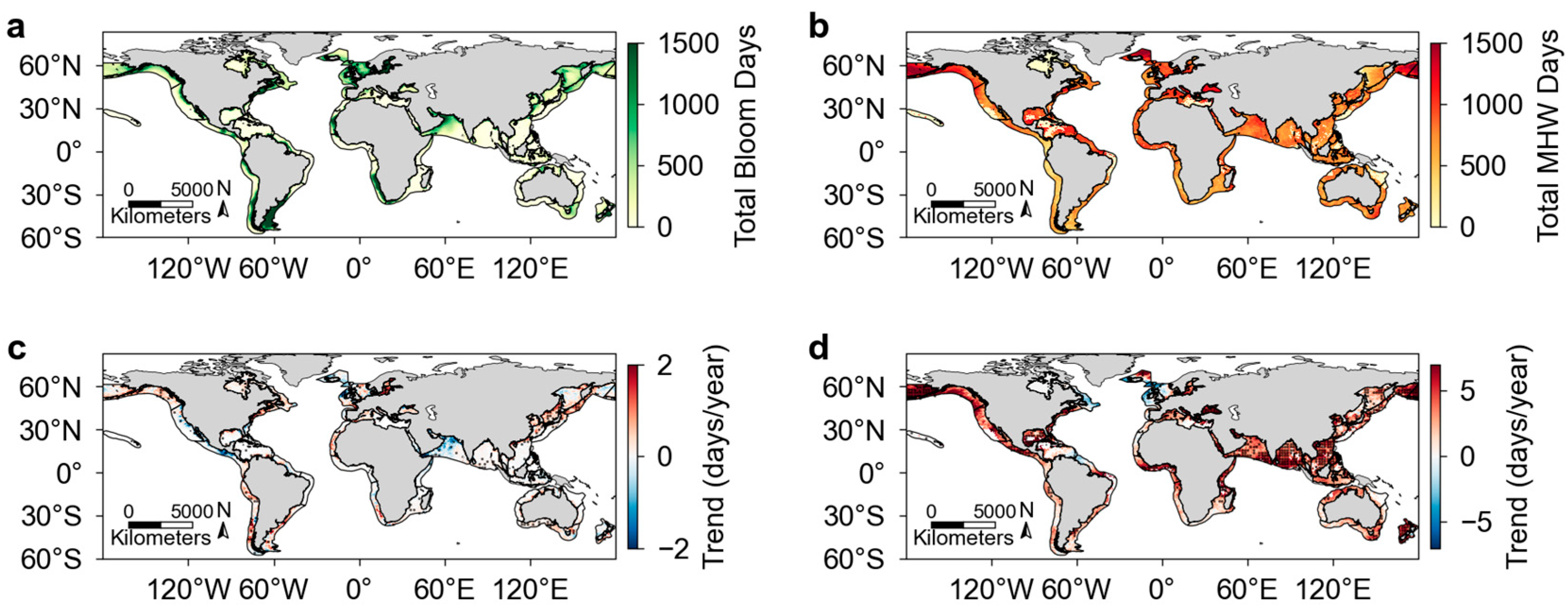
Global hotspots of phytoplankton blooms are concentrated in major upwelling systems, western boundary currents, the Baltic Sea, the Arabian Sea, and the Sea of Okhotsk (Figure 2a). While MHWs are prevalent in most coastal areas, with notable hotspots off North America, within the tropics, and in European marginal seas (Figure 2b).
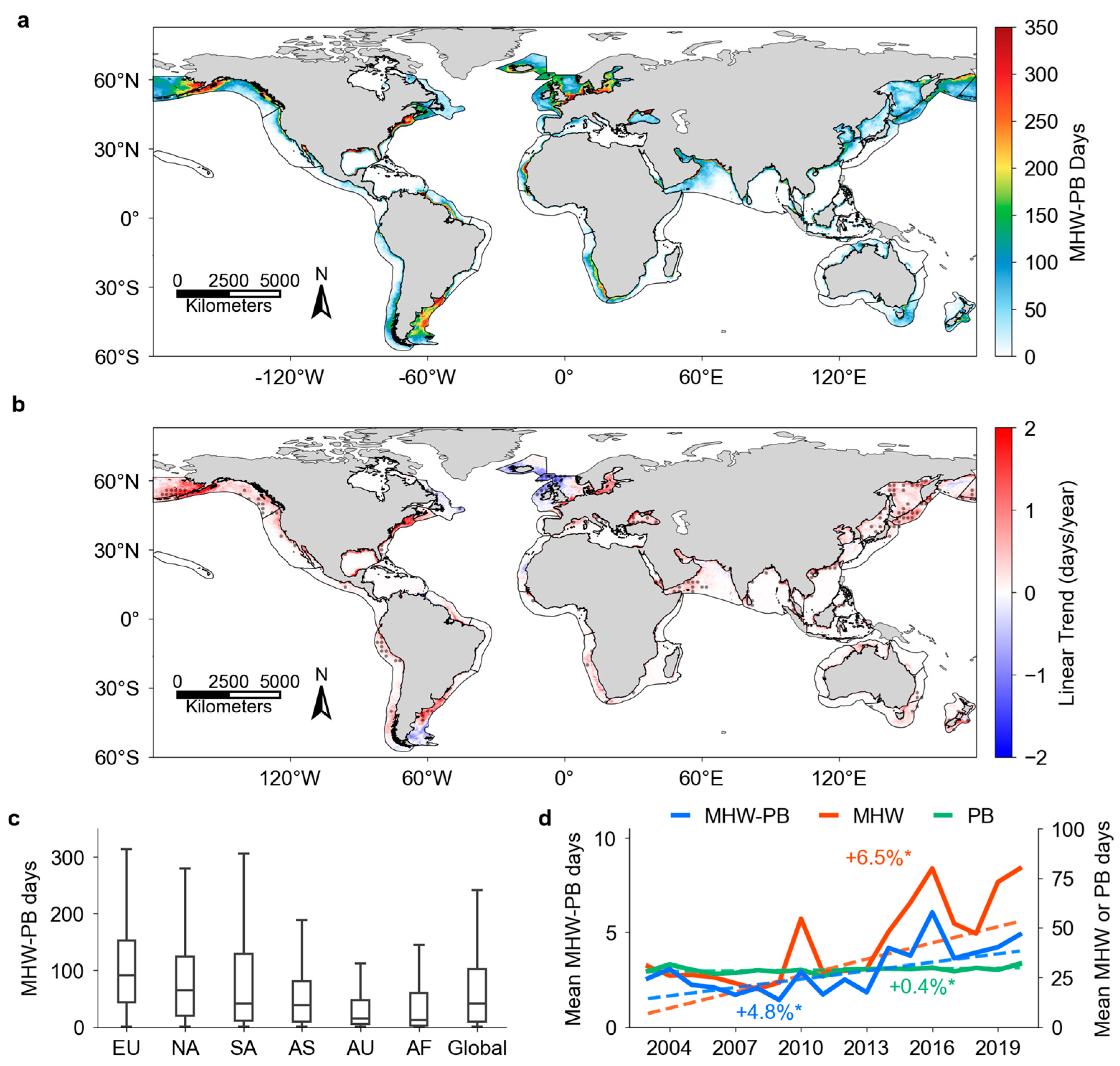
Compound MHW-PB events broadly follow total bloom patterns but with notable divergences: major eastern boundary upwelling systems (EBUSs; California, Humboldt, Canary, and Benguela currents) exhibit relatively few compound events despite frequent blooms, whereas east coast regions (e.g., Gulf of Mexico, East Asian coasts) and high-latitude seas (e.g., Bering Sea, North Atlantic) show stronger MHW-PB co-occurrence (Figure 3a).
Statistically, Europe (EU) and the Americas experience the highest compound event frequency (Figure 3c). Over 2003–2020, the global median number of compound–event days is 42; Europe records a markedly higher median of 92 days, while Africa (AF) exhibits the lowest at 12 days. The single grid point with the greatest cumulative duration is in North America (NA) (519 days), exceeding Europe’s maximum of 496 days. Asia (AS) and Australia (AU) display substantially lower overall frequencies despite widespread mid-to-high-latitude coastal occurrences.
Compound events exhibit positive trends across most regions, averaging 0.15 days/year globally (Figure 3b). Along the U.S. East Coast, the average increase reaches 1.3 days/year. The Northwest European Shelf shows a significant decreasing trend around the Faroe Plateau (0.9 days/year), driven by a sharp reduction in bloom frequency (Figure 2c) coupled with concurrent MHW decreases (Figure 2d). In the Arabian Sea, a declining bloom trend is overridden by surging MHW frequency (Figure 2c,d), resulting in a net increase in compound events (Figure 3b).
Globally, compound event days are growing at 4.8% yr−1 (Figure 3d), alongside a 6.5% yr−1 rise in MHW frequency, while bloom frequency shows comparatively modest growth, suggesting that compound event growth is primarily driven by the thermal component. A temporal shuffle test (n = 10,000 permutations) further confirms that the observed 4.8% yr−1 trend falls significantly below the null expectation (mean: 5.8% yr−1; 95% CI: 5.2–6.4% yr−1; observed at the 0.4th percentile of the null distribution). This result indicates that, if bloom timing were statistically independent of MHW occurrence, compound events would grow even faster than observed—the deficit between null and observed trends is consistent with biological suppression of blooms during MHW periods, most prominently in low-latitude upwelling systems where MHW-induced stratification is expected to inhibit bloom development [11,18,19,20]; however, we acknowledge that reduced co-occurrence relative to the null model does not unambiguously establish causality, as co-variability driven by shared environmental forcing (e.g., stratification or nutrient limitation) could produce a similar pattern. El Niño years (2010, 2016) correspond to peaks in compound event frequency, reflecting the synchronous intensification of both MHWs and regional bloom dynamics under ENSO modulation [8,20].

3.2. Latitudinal and Coastal Patterns of Co-Occurrence

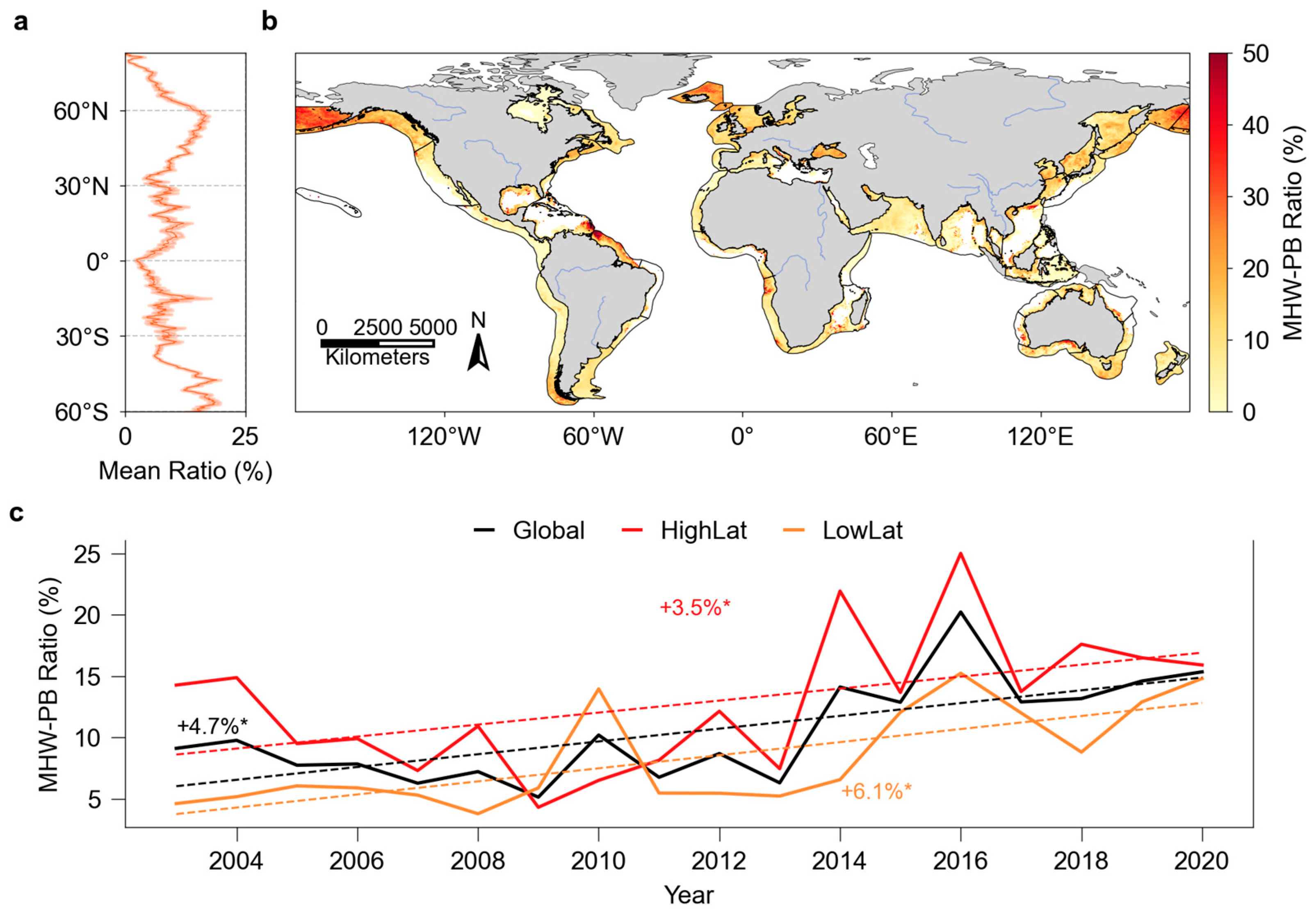
Latitudinally, equatorial regions (within 10° N/S) show the lowest average proportion (5.9%), while high latitudes exhibit the highest (14.5%) (Figure 4a). Globally, the proportion averages 10.4% with a significantly increasing trend (Figure 4c). A clear transition around 40° N/S divides the domain into low-latitude (<40°) and high-latitude (≥40°, excluding polar regions) zones.
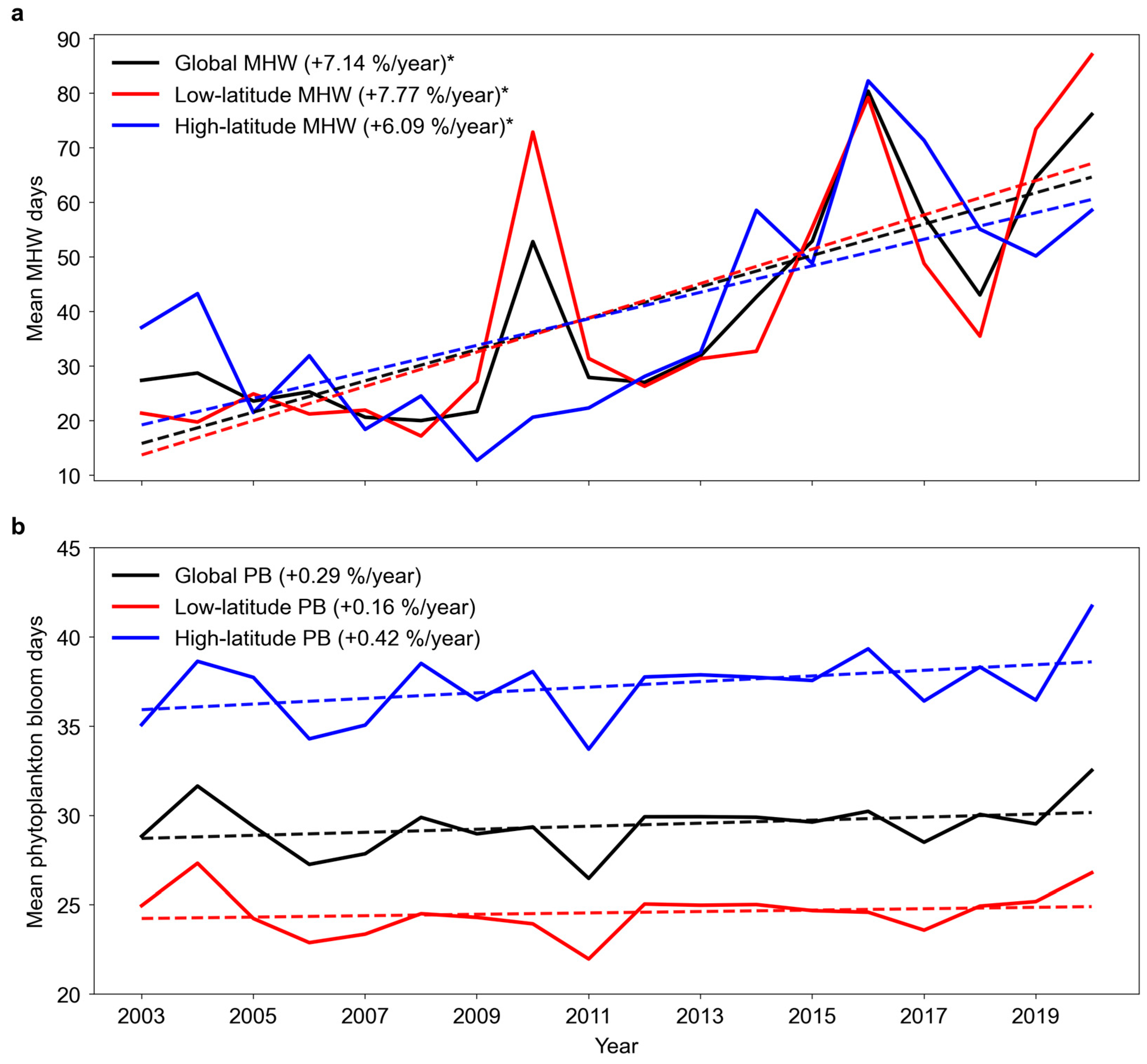
Although high latitudes show a higher mean ratio than that of low latitudes (12.8% vs. 8.3%), low latitudes are experiencing faster growth (6.1% yr−1 vs. 3.5% yr−1; Figure 4c), driven by rapid tropical MHW acceleration (~7.8% yr−1; Figure 5).
The east–west coastal dichotomy is particularly pronounced at low latitudes (Figure 4b). Low-latitude western coasts, especially major upwelling regions, exhibit low MHW-PB ratios (e.g., 4.4% in the Canary Current), consistent with MHW-associated stratification suppressing the vertical nutrient supply that sustains blooms [19,22,37]. Conversely, continental east coasts show markedly higher proportions (e.g., 14.3% in the Gulf of Mexico). River mouths (Amazon, Congo, Yangtze) exhibit exceptionally high proportions often exceeding 20% (Figure 4b), where terrestrial nutrient loading sustains bloom-favorable conditions during warm periods [38,39,40,41].
In conclusion, the MHW-PB ratio displays three distinct spatial characteristics: strong latitudinal gradients, pronounced east–west coastal asymmetry, and significant riverine influence.

3.3. Compound Independence Factor Analysis

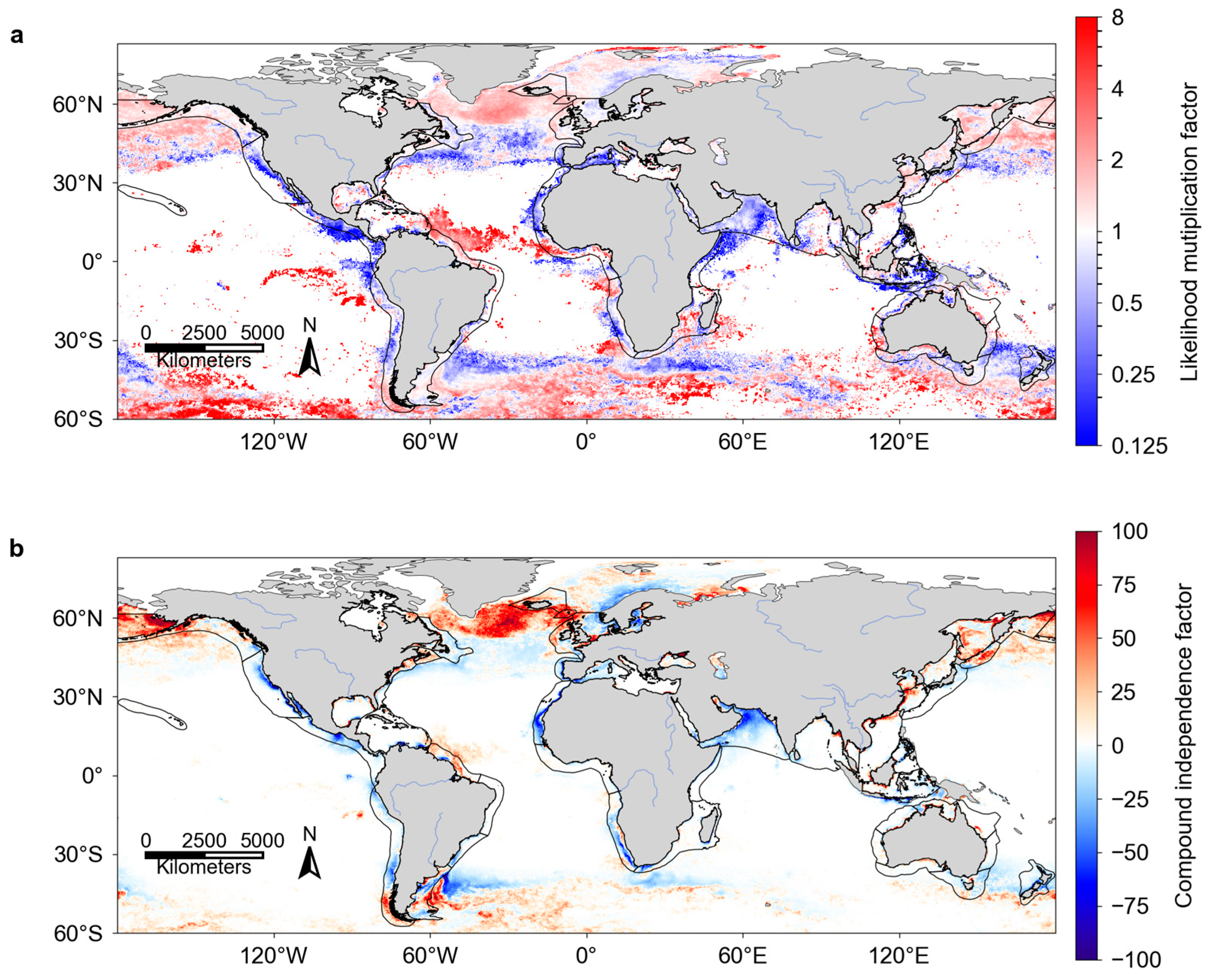
The global distribution of the LMF provides an initial assessment of the statistical coupling between MHWs and PBs (Figure 6a). However, because the LMF is based strictly on mathematical probability ratios without accounting for the biological characteristics of phytoplankton, it is prone to producing spurious results. In oligotrophic waters where blooms rarely occur, near-zero denominators inflate the ratios, resulting in extensive regions of anomalously high or low values that lack ecological significance. Although the primary scope of this study is restricted to LMEs, the LMF for the global open ocean is nevertheless presented here to explicitly demonstrate these methodological limitations.
To address these limitations, the CIF was developed (Figure 6b). The CIF refines the statistical association by weighting the log-transformed probability ratio by the cumulative duration of compound events. This approach effectively suppresses the mathematical noise found in bloom-sparse regions while retaining sensitivity in areas where compound events are both statistically significant and ecologically meaningful.
Despite the differences in calculation, the CIF patterns broadly mirror the LMF, and their agreement collectively confirms the robustness of the latitudinal dipole structure in MHW–PB coupling. As shown in the CIF distribution (Figure 6b), the spatial structure of these associations reveals a distinct latitudinal heterogeneity divided at approximately 40° N/S, characterized by pronounced east–west coastal contrasts and strong estuarine signals. Within this framework, a positive CIF indicates a co-occurrence tendency above independence, while a negative CIF signals mutual exclusivity between MHWs and PBs.
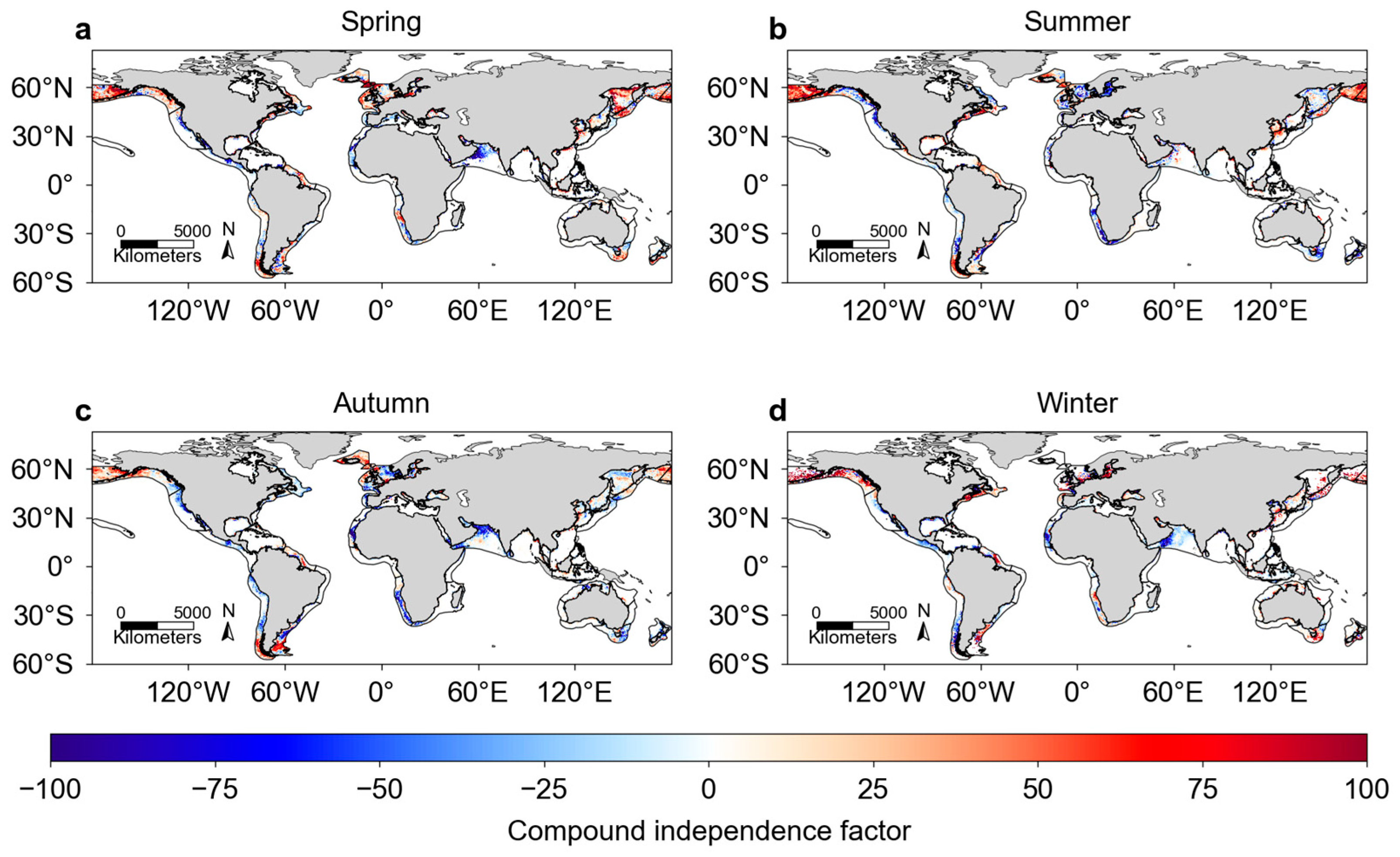
In low latitudes, MHWs and blooms predominantly show a statistically exclusive relationship, most pronounced in major upwelling systems (e.g., California Current) and seasonal upwelling zones (e.g., Southern Caribbean, Java, Arafura Sea, Southeast Australia) (Figure 6). High-latitude regions are dominated by positive CIF, indicating MHWs and blooms co-occur more frequently than expected by chance. Notable low-latitude exceptions include nearshore East Asian coastal waters, which exhibit extensive positive CIF owing to riverine nutrient subsidies [40,41]. In high latitudes, nearshore Northern Europe and the Baltic Sea show moderate exclusion primarily in summer and autumn (Figure 7).
Coupling exhibits strong seasonality (Figure 7). Spring shows widespread positive association at high latitudes, where post-winter nutrient availability is high, and warming alleviates light and temperature limitation [13,14]. While the distribution of CIF in autumn resembles that of spring in its general pattern, autumn is characterized by more extensive negative CIF regions that extend further poleward into high latitudes, such as the European coastal waters and the Gulf of Alaska LME. Summer, conversely, is marked by a high prevalence of zero CIF values across the tropical regions. The negative associations observed in both summer and autumn are consistent with stratification-driven nutrient depletion during MHW periods [22]. Winter shows strong exclusion in low latitudes, while compound events are nearly absent at high latitudes due to light limitation [3].

3.4. Environmental Predictors from Machine Learning

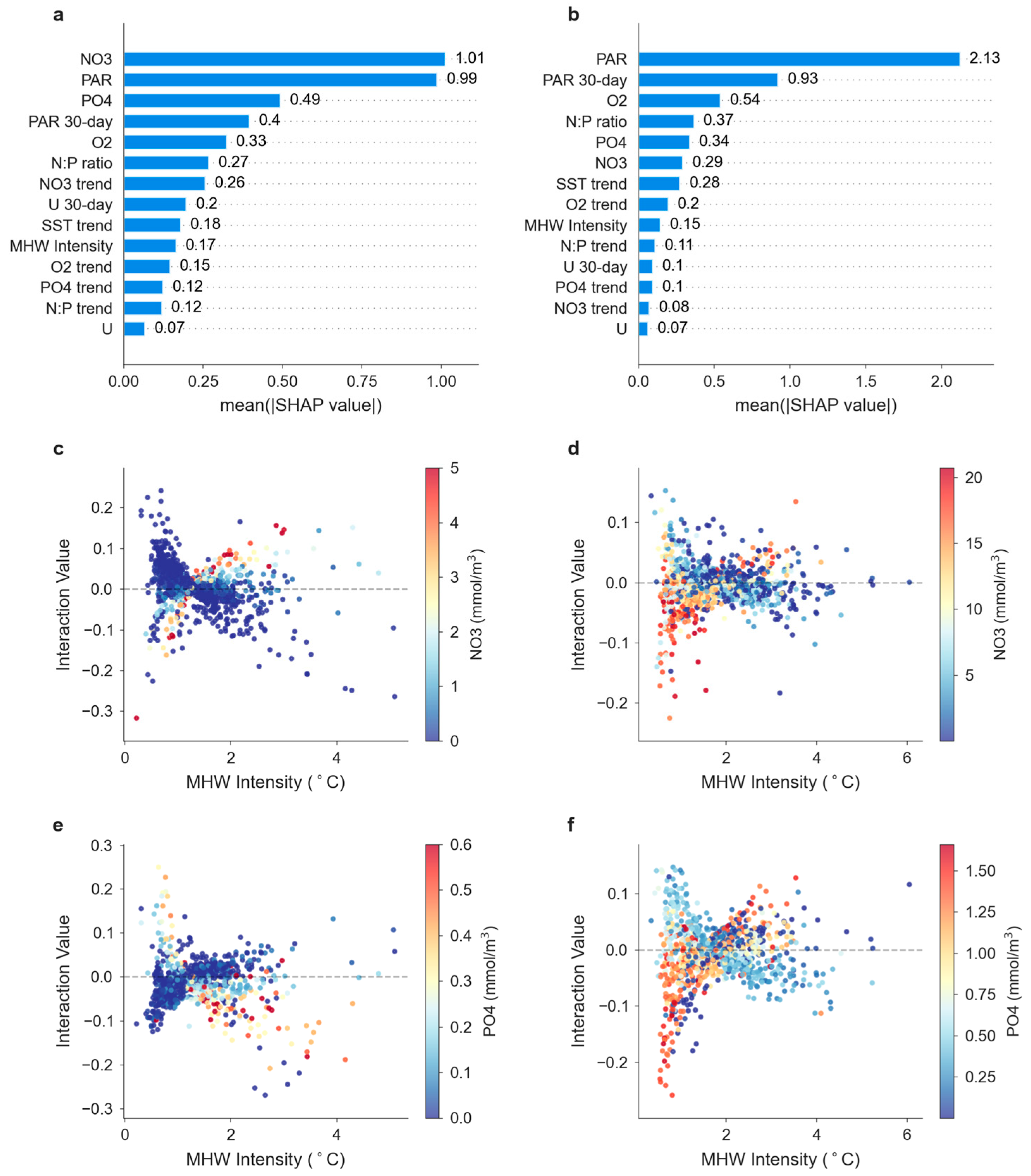
To quantitatively attribute bloom occurrence during MHW periods across latitudinal zones, we employed an interpretable XGBoost–SHAP framework that explicitly accounts for the temporally lagged responses of phytoplankton to environmental forcing. The model was trained on the entire population of identified MHW events, categorized into compound events and non-compound MHW events. This inclusive approach allows the model to capture the critical environmental thresholds that distinguish whether an MHW will trigger a biological response. By generating features at multiple temporal scales—same-day values, 7-day and 30-day running means, and within-MHW linear trends—the framework captures both immediate environmental states and the accumulated background conditions under which blooms develop. To ensure model parsimony and interpretability, multicollinearity among candidate features was addressed by retaining only those with VIF < 10, followed by a multi-step selection procedure combining XGBoost importance scores, univariate F-statistics, and correlation coefficients into a weighted composite score, from which the two most representative features per variable group were selected. The predictors visualized in Figure 8a,b represent a subset of non-redundant variables selected after a rigorous multicollinearity check. Specifically, 7-day running means were excluded due to their high collinearity with same-day values (VIF > 10). This pruning ensures that the SHAP importance scores reflect the independent contribution of each environmental driver, avoiding the dilution of predictive power among temporally correlated features.
The XGBoost–SHAP framework identifies a clear latitudinal dichotomy in the environmental predictors of bloom occurrence during MHW periods (Figure 8). In low latitudes, bloom probability is most strongly associated with nutrient availability, specifically NO3 (Figure 8a). At high latitudes, light (PAR) emerges as the dominant predictor, with nutrient importance diminished (Figure 8b). MHW intensity contributes equally in absolute SHAP terms (0.16) across both zones but carries relatively greater importance at high latitudes.
SHAP interaction analysis reveals a pronounced “X-shaped” pattern between MHW intensity and NO3 at low latitudes (Figure 8c,e): under low-NO3 conditions, increasing MHW intensity is associated with suppressed bloom probability, consistent with stratification-induced reductions in vertical nutrient flux [11,18]; under high-NO3 conditions, MHW intensity is positively associated with bloom occurrence, consistent with temperature-driven metabolic stimulation when nutrients are sufficient [39]. PO4 displays an inverse pattern, with inhibitory MHW associations at high PO4 concentrations, likely reflecting stoichiometric imbalance in nitrogen-limited waters [38]. At high latitudes, NO3 promotes blooms only when abundant (Figure 8d), while PO4 shows positive associations at both concentration extremes.
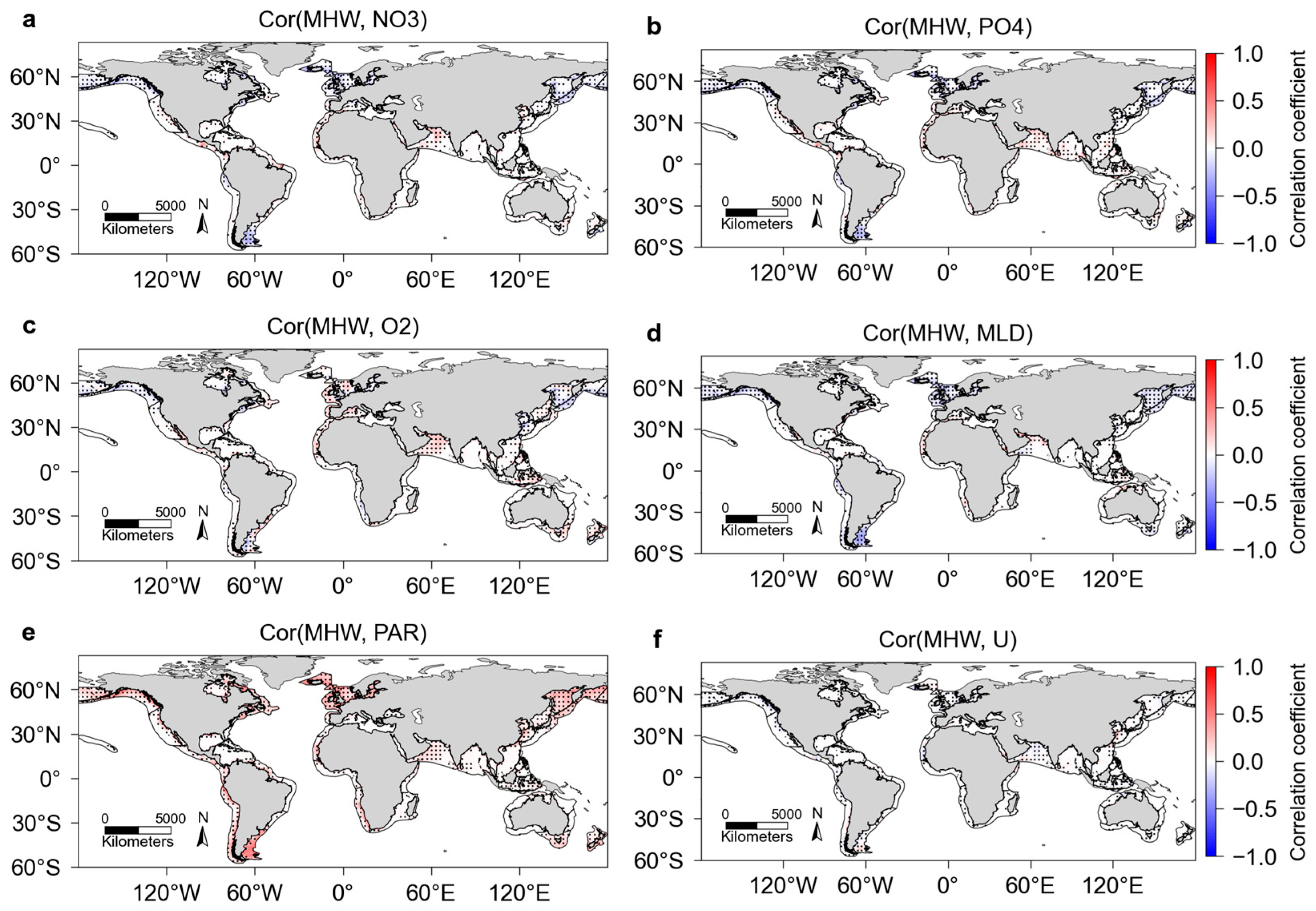
Physical–chemical correlations provide additional context (Figure 9). MHW intensity correlates negatively with MLD globally, confirming stratification intensification under stronger warming [37,42]. An exception occurs in the equatorial Eastern Pacific, where the opposite pattern may be linked to El Niño-related thermocline deepening. Near major estuaries (e.g., Amazon, Yangtze), positive correlations between MHW intensity and NO3 suggest that terrestrial runoff or horizontal advection supplies nutrients concurrently with warm periods [43,44]. The positive correlation between MHW intensity and PAR identifies solar shortwave radiation as a common driver of both surface warming and high light availability [3,45].

4. Discussion

This study provides a satellite-based global assessment of compound MHW–PB events over 2003–2020, revealing a 4.8% yr−1 acceleration that tracks rising MHW frequency rather than bloom frequency alone. A central methodological contribution is the CIF, which moves beyond simple co-occurrence counting to quantify whether MHWs and blooms co-occur more or less frequently than expected under statistical independence. By incorporating logarithmic transformation and weighting by cumulative event duration, the CIF simultaneously captures the direction and ecological prominence of MHW–PB coupling across diverse coastal ecosystems. The resulting global CIF map reveals a coherent latitudinal structure—negative in low-latitude upwelling systems, positive in high-latitude and eutrophic coastal environments—that is consistent across seasons and robust to regional variability, suggesting the metric captured a genuine biophysical signal rather than statistical noise.
The finding that compound event frequency accelerates faster in low latitudes (6.1% yr−1) than at high latitudes (3.5% yr−1), despite dominant biological suppression in the tropics, reflects a fundamental tension between biological regulation and physical forcing. The sheer pace of tropical MHW acceleration (7.8% yr−1) is sufficiently rapid that even a suppressed co-occurrence rate increases substantially in absolute terms as MHWs become increasingly pervasive. This pattern echoes Le Grix et al. (2021) [18], who documented increasing compound high-temperature, low-chlorophyll extremes in tropical oceans, and extends it to the global coastal domain with explicit quantification of the suppression signal. Within low latitudes, river plume and shallow shelf environments constitute important exceptions where terrestrial nutrient loading decouples productivity from vertical upwelling constraints, allowing warming to act as a positive environmental predictor—a mechanism consistent with documented harmful algal bloom (HAB) intensification near major estuaries under warming [46,47,48].
The machine learning results highlight that the ecological outcome of an MHW depends critically on the local nutrient regime. The “X-shaped” NO3–MHW interaction at low latitudes—suppression under nutrient-poor conditions, promotion under nutrient-rich conditions—provides a unifying framework reconciling apparently contradictory regional findings in the literature, where MHWs have been reported to both suppress and enhance blooms depending on location [11,23,49]. At high latitudes, the dominance of PAR as a predictor, combined with the positive role of MHW-associated stratification in retaining cells within the euphotic zone, is consistent with observations of MHW-enhanced spring blooms in the Southern Ocean and Arctic [50,51].
On the strengths side, the use of coastal-optimised satellite retrievals based on CIE chromaticity hue rather than chlorophyll-a concentration substantially reduces the turbidity-related biases that afflict standard ocean-colour algorithms in optically complex Case II waters, enabling consistent bloom detection across globally diverse coastal ecosystems within a single unified framework [2]. The CIF provides a more ecologically grounded measure of MHW–PB coupling than simple co-occurrence counting: by incorporating both the direction of statistical dependence via logarithmic transformation and the weight of cumulative event duration, it suppresses spurious signals in bloom-sparse oligotrophic regions while retaining sensitivity where compound events are both statistically significant and ecologically prominent [36]. The temporal shuffle test (n = 10,000 permutations) provides a rigorous null-hypothesis framework that quantifies biological suppression as a demonstrable deficit below random expectation rather than a qualitative inference, confirming that the observed 4.8% yr−1 compound trend is constrained by genuine biophysical mechanisms. The XGBoost–SHAP framework captures non-linear and interaction effects among environmental predictors that linear methods would miss [28,29,30,31], and the multi-scale temporal feature design—combining same-day values, 7-day and 30-day running means, and within-MHW linear trends—partially accounts for lagged phytoplankton responses to environmental forcing.
On the limitations side, several caveats constrain interpretation. First, the fixed-baseline MHW definition means that events driven by secular warming are included alongside interannual extremes; trend-corrected definitions would yield lower acceleration rates, and comparisons with such studies require caution (see Section 2.2.2). Second, the positive correlation between MHW intensity and photosynthetically active radiation (PAR) identified in the SHAP analysis represents a potential confounding factor: solar shortwave radiation simultaneously drives surface warming and increases light availability, which could generate statistical MHW–PB co-occurrence without direct thermal–biological coupling [3,45]; fully disentangling these contributions requires process-based biogeochemical modelling. Third, the same-day co-occurrence definition captures direct satellite-observed coincidence but does not account for lagged biological responses operating on timescales of days to weeks; while the incorporation of multi-scale predictor values in the machine learning framework partially addresses this, dedicated lead–lag analyses would more explicitly resolve temporal coupling dynamics. Fourth, reliance on surface satellite observations means that subsurface chlorophyll maxima are invisible to the analysis; in oligotrophic waters where MHWs deepen the nutricline [50,52], this may lead to underestimation of bloom suppression in low latitudes. Fifth, the bloom detection algorithm identifies bulk phytoplankton presence but lacks the taxonomic resolution to distinguish functional types or specific HAB species [53,54], precluding direct inference about carbon export efficiency or toxicity risk. Sixth, the environmental predictors used in the machine learning analysis are drawn from reanalysis products rather than in situ measurements, introducing uncertainties particularly in coastal regions with complex bathymetry and strong riverine influence. These limitations point to clear priorities for future work: sensitivity analysis using trend-adjusted MHW definitions, integration of autonomous profiling float and Bio-Argo data to constrain subsurface chlorophyll responses, and development of hyperspectral satellite algorithms capable of phytoplankton functional type discrimination [27,53].

5. Conclusions

This study quantifies compound MHW–phytoplankton bloom events in global coastal waters over 2003–2020 using a novel Compound Index Factor (CIF) derived from coastal-optimised satellite retrievals. The key findings are as follows: (1) compound event frequency increased at 4.8% yr−1 globally, driven primarily by rising MHW frequency; (2) the CIF reveals a coherent latitudinal structure, with MHWs suppressing blooms in low-latitude upwelling systems and promoting them in high-latitude and eutrophic coastal environments; (3) low-latitude acceleration (6.1% yr−1) exceeds that of high latitudes (3.5% yr−1), despite net biological suppression in the tropics; and (4) machine learning analysis identifies local nutrient availability (NO3) and light (PAR) as the dominant modulators of bloom response to MHW forcing. These diverging coupling regimes carry significant implications for marine ecosystem services: bloom suppression in low-latitude upwelling systems threatens fisheries and upper-trophic-level populations through a metabolic–energetic mismatch, while MHW-associated bloom amplification in eutrophic and high-latitude regions heightens risks of HAB intensification, coastal hypoxia, and weakening of the biological carbon pump [22,55,56,57,58]. As MHWs transition from discrete anomalies toward prolonged background states [8,59], these compound risks are likely to intensify, underscoring the need for integrated satellite monitoring and predictive biogeochemical modelling frameworks to support coastal ecosystem management and early warning of compound ecological extremes. Future work should prioritize sensitivity analysis using trend-adjusted MHW definitions, integration of Bio-Argo float data to constrain subsurface chlorophyll responses, and development of hyperspectral satellite algorithms for phytoplankton functional type discrimination [27,53].

Author Contributions

C.W. and J.M. designed the study. J.M. performed the data analyses and wrote the initial manuscript draft. C.W. contributed to the editing the manuscript and provided constructive comments and indispensable guidance for the study. All authors have read and agreed to the published version of the manuscript.

Funding

This research was funded by the National Natural Science Foundation of China (42192560 and W2441014), and the development fund of South China Sea Institute of Oceanology of the Chinese Academy of Sciences (SCSIO202208).

Data Availability Statement

We acknowledge the Copernicus Marine Service (CMEMS) and the European Space Agency Climate Change Initiative (ESA CCI) for providing SST CCI and C3S analysis v2.1 data (https://doi.org/10.48670/moi-00169). Phytoplankton data can be accessed at https://doi.org/10.5281/zenodo.7359262. PAR data are available from NASA GSFC at https://oceancolor.gsfc.nasa.gov/resources/atbd/par/ (accessed on 24 October 2024). Nutrient, oxygen, sea surface velocity, and mixed layer depth data were obtained from CMEMS (https://doi.org/10.48670/moi-00019, https://doi.org/10.48670/moi-00024).

Acknowledgments

The numerical computations were supported by the High Performance Computing Division in the South China Sea Institute of Oceanology. We thank Y. Yao, Y. Hu, Q. Song, and J. Ren for their insightful discussions and suggestions.

Conflicts of Interest

The authors declare no conflicts of interest.

Abbreviations

The following abbreviations are used in this manuscript:
MHWMarine heatwave
MHW-PBMarine heatwave–Phytoplankton bloom
HABHarmful algal bloom
LMFLikelihood multiplication factor
CIFCompound independence factor
SHAPShapley additive explanations
XGBoostExtreme gradient boosting
CIEInternational commission on illumination
SSTSea surface temperature
MODISModerate-resolution imaging spectroradiometer
PARPhotosynthetically active radiation

References

  1. Oliver, E.C.J.; Benthuysen, J.A.; Darmaraki, S.; Donat, M.G.; Hobday, A.J.; Holbrook, N.J.; Schlegel, R.W.; Sen Gupta, A. Marine Heatwaves. Ann. Rev. Mar. Sci. 2021, 13, 313–342. [Google Scholar] [CrossRef] [PubMed]
  2. Dai, Y.; Yang, S.; Zhao, D.; Hu, C.; Xu, W.; Anderson, D.M.; Li, Y.; Song, X.P.; Boyce, D.G.; Gibson, L.; et al. Coastal phytoplankton blooms expand and intensify in the 21st century. Nature 2023, 615, 280–284. [Google Scholar] [CrossRef]
  3. Huisman, J.; Codd, G.A.; Paerl, H.W.; Ibelings, B.W.; Verspagen, J.M.H.; Visser, P.M. Cyanobacterial blooms. Nat. Rev. Microbiol. 2018, 16, 471–483. [Google Scholar] [CrossRef]
  4. Hobday, A.J.; Alexander, L.V.; Perkins, S.E.; Smale, D.A.; Straub, S.C.; Oliver, E.C.J.; Benthuysen, J.A.; Burrows, M.T.; Donat, M.G.; Feng, M.; et al. A hierarchical approach to defining marine heatwaves. Prog. Oceanogr. 2016, 141, 227–238. [Google Scholar] [CrossRef]
  5. Smale, D.A.; Wernberg, T.; Oliver, E.C.J.; Thomsen, M.; Harvey, B.P.; Straub, S.C.; Burrows, M.T.; Alexander, L.V.; Benthuysen, J.A.; Donat, M.G.; et al. Marine heatwaves threaten global biodiversity and the provision of ecosystem services. Nat. Clim. Change 2019, 9, 306–312. [Google Scholar] [CrossRef]
  6. Kuhlisch, C.; Shemi, A.; Barak-Gavish, N.; Schatz, D.; Vardi, A. Algal blooms in the ocean: Hot spots for chemically mediated microbial interactions. Nat. Rev. Microbiol. 2024, 22, 138–154. [Google Scholar] [CrossRef]
  7. Anderson, D.M. Turning back the harmful red tide. Nature 1997, 388, 513–514. [Google Scholar] [CrossRef]
  8. Oliver, E.C.J.; Donat, M.G.; Burrows, M.T.; Moore, P.J.; Smale, D.A.; Alexander, L.V.; Benthuysen, J.A.; Feng, M.; Sen Gupta, A.; Hobday, A.J.; et al. Longer and more frequent marine heatwaves over the past century. Nat. Commun. 2018, 9, 1324. [Google Scholar] [CrossRef]
  9. Zhao, H.; Manizza, M.; Lozier, M.S.; Cassar, N. Greener green and bluer blue: Ocean poleward greening over the past two decades. Science 2025, 388, 1337–1340. [Google Scholar] [CrossRef] [PubMed]
  10. Roberts, S.D.; Van Ruth, P.D.; Wilkinson, C.; Bastianello, S.S.; Bansemer, M.S. Marine Heatwave, Harmful Algae Blooms and an Extensive Fish Kill Event During 2013 in South Australia. Front. Mar. Sci. 2019, 6, 610. [Google Scholar] [CrossRef]
  11. Hayashida, H.; Matear, R.J.; Strutton, P.G. Background nutrient concentration determines phytoplankton bloom response to marine heatwaves. Glob. Chang. Biol. 2020, 26, 4800–4811. [Google Scholar] [CrossRef]
  12. Chen, Y.; Shen, C.; Zhao, H.; Pan, G. The impact of marine heatwaves on surface phytoplankton chlorophyll-a in the South China Sea. Sci. Total Environ. 2024, 949, 175099. [Google Scholar] [CrossRef]
  13. Wolf, K.K.E.; Hoppe, C.J.M.; Rehder, L.; Schaum, E.; John, U.; Rost, B. Heatwave responses of Arctic phytoplankton communities are driven by combined impacts of warming and cooling. Sci. Adv. 2024, 10, eadl5904. [Google Scholar] [CrossRef]
  14. Fernandez-Gonzalez, C.; Tarran, G.A.; Schuback, N.; Woodward, E.M.S.; Aristegui, J.; Maranon, E. Phytoplankton responses to changing temperature and nutrient availability are consistent across the tropical and subtropical Atlantic. Commun. Biol. 2022, 5, 1035. [Google Scholar] [CrossRef]
  15. Noh, K.-M.; Lim, H.-G.; Kug, J.S. Global chlorophyll responses to marine heatwaves in satellite ocean color. Environ. Res. Lett. 2022, 17, 064034. [Google Scholar] [CrossRef]
  16. Hunter-Cevera, K.R.; Neubert, M.G.; Olson, R.J.; Solow, A.R.; Shalapyonok, A.; Sosik, H.M. Physiological and ecological drivers of early spring blooms of a coastal phytoplankter. Science 2016, 354, 326–329. [Google Scholar] [CrossRef]
  17. Cahill, B.; Chrysagi, E.; Vortmeyer-Kley, R.; Gräwe, U. Deconstructing co-occurring marine heatwave and phytoplankton bloom events in the Arkona Sea in 2018. Front. Mar. Sci. 2024, 11, 1323271. [Google Scholar] [CrossRef]
  18. Le Grix, N.; Zscheischler, J.; Laufkötter, C.; Rousseaux, C.S.; Frölicher, T.L. Compound high-temperature and low-chlorophyll extremes in the ocean over the satellite period. Biogeosciences 2021, 18, 2119–2137. [Google Scholar] [CrossRef]
  19. Zhan, W.; Zhang, Y.; He, Q.; Zhan, H. Shifting responses of phytoplankton to atmospheric and oceanic forcing in a prolonged marine heatwave. Limnol. Oceanogr. 2023, 68, 1821–1834. [Google Scholar] [CrossRef]
  20. Li, Z.; Sun, D.; Wang, S.; Huan, Y.; Zhang, H.; Yuan, Y.; He, Y. Ocean-scale patterns of environment and climate changes driving global marine phytoplankton biomass dynamics. Sci. Adv. 2024, 10, eadm7556. [Google Scholar] [CrossRef] [PubMed]
  21. Arteaga, L.A.; Rousseaux, C.S. Impact of Pacific Ocean heatwaves on phytoplankton community composition. Commun. Biol. 2023, 6, 263. [Google Scholar] [CrossRef] [PubMed]
  22. Zhan, W.; Feng, M.; Zhang, Y.; Shen, X.; Zhan, H.; He, Q. Reduced and smaller phytoplankton during marine heatwaves in eastern boundary upwelling systems. Commun. Earth Environ. 2024, 5, 629. [Google Scholar] [CrossRef]
  23. Fischer, A.D.; Houliez, E.; Bill, B.D.; Kavanaugh, M.T.; Alin, S.R.; Collins, A.U.; Kudela, R.M.; Moore, S.K. Nutrient limitation dampens the response of a harmful algae to a marine heatwave in an upwelling system. Limnol. Oceanogr. 2025, 70, S69–S85. [Google Scholar] [CrossRef]
  24. Wei, W.; Han, Y.; Zhou, Y. Nutrients and sea surface temperature drive harmful algal blooms in China’s coastal waters over the past decades. Environ. Res. Lett. 2023, 18, 094068. [Google Scholar] [CrossRef]
  25. Hallegraeff, G.M.; Anderson, D.M.; Belin, C.; Bottein, M.-Y.D.; Bresnan, E.; Chinain, M.; Enevoldsen, H.; Iwataki, M.; Karlson, B.; McKenzie, C.H.; et al. Perceived global increase in algal blooms is attributable to intensified monitoring and emerging bloom impacts. Commun. Earth Environ. 2021, 2, 117. [Google Scholar] [CrossRef] [PubMed]
  26. Zhang, F.; Kung, H.; Zhang, F.; Yang, C.; Gan, J. AI-powered spatiotemporal imputation and prediction of chlorophyll-a concentration in coastal ecosystems. Nat. Commun. 2025, 16, 7656. [Google Scholar] [CrossRef]
  27. Nicholson, S.A.; Ryan-Keogh, T.J.; Thomalla, S.J.; Chang, N.; Smith, M.E. Satellite-derived global-ocean phytoplankton phenology indices. Earth Syst. Sci. Data 2025, 17, 1959–1975. [Google Scholar] [CrossRef]
  28. Di Giuseppe, F.; McNorton, J.; Lombardi, A.; Wetterhall, F. Global data-driven prediction of fire activity. Nat. Commun. 2025, 16, 2918. [Google Scholar] [CrossRef]
  29. Lin, S.; Pierson, D.C.; Mesman, J.P. Prediction of algal blooms via data-driven machine learning models: An evaluation using data from a well-monitored mesotrophic lake. Geosci. Model. Dev. 2023, 16, 35–46. [Google Scholar] [CrossRef]
  30. Yan, Y.; Piao, S.; Hammond, W.M.; Chen, A.; Hong, S.; Xu, H.; Munson, S.M.; Myneni, R.B.; Allen, C.D. Climate-induced tree-mortality pulses are obscured by broad-scale and long-term greening. Nat. Ecol. Evol. 2024, 8, 912–923. [Google Scholar] [CrossRef]
  31. Yu, P.; Gao, R.; Zhang, D.; Liu, Z.-P. Predicting coastal algal blooms with environmental factors by machine learning methods. Ecol. Indic. 2021, 123, 107334. [Google Scholar] [CrossRef]
  32. Sherman, K. Adaptive management institutions at the regional level: The case of Large Marine Ecosystems. Ocean. Coast. Manag. 2014, 90, 38–49. [Google Scholar] [CrossRef]
  33. Embury, O.; Merchant, C.J.; Good, S.A.; Rayner, N.A.; Høyer, J.L.; Atkinson, C.; Block, T.; Alerskans, E.; Pearson, K.J.; Worsfold, M.; et al. Satellite-based time-series of sea-surface temperature since 1980 for climate applications. Sci. Data 2024, 11, 326. [Google Scholar] [CrossRef] [PubMed]
  34. Good, S.; Fiedler, E.; Mao, C.; Martin, M.J.; Maycock, A.; Reid, R.; Roberts-Jones, J.; Searle, T.; Waters, J.; While, J.; et al. The Current Configuration of the OSTIA System for Operational Production of Foundation Sea Surface Temperature and Ice Concentration Analyses. Remote Sens. 2020, 12, 720. [Google Scholar] [CrossRef]
  35. NASA Ocean Biology Processing Group. MODIS-Terra Ocean Color Data; NASA Goddard Space Flight Center: Greenbelt, MD, USA, 2014. Available online: https://oceancolor.gsfc.nasa.gov/resources/atbd/par/ (accessed on 24 October 2024).
  36. Burger, F.A.; Terhaar, J.; Frolicher, T.L. Compound marine heatwaves and ocean acidity extremes. Nat. Commun. 2022, 13, 4722. [Google Scholar] [CrossRef]
  37. Sun, W.; Wang, Y.; Yang, Y.; Yang, J.; Ji, J.; Dong, C. Marine Heatwaves/Cold-Spells Associated with Mixed Layer Depth Variation Globally. Geophys. Res. Lett. 2024, 51, e2024GL112325. [Google Scholar] [CrossRef]
  38. Moore, C.M.; Mills, M.M.; Arrigo, K.R.; Berman-Frank, I.; Bopp, L.; Boyd, P.W.; Galbraith, E.D.; Geider, R.J.; Guieu, C.; Jaccard, S.L.; et al. Processes and patterns of oceanic nutrient limitation. Nat. Geosci. 2013, 6, 701–710. [Google Scholar] [CrossRef]
  39. Toseland, A.; Daines, S.J.; Clark, J.R.; Kirkham, A.; Strauss, J.; Uhlig, C.; Lenton, T.M.; Valentin, K.; Pearson, G.A.; Moulton, V.; et al. The impact of temperature on marine phytoplankton resource allocation and metabolism. Nat. Clim. Change 2013, 3, 979–984. [Google Scholar] [CrossRef]
  40. Trombetta, T.; Vidussi, F.; Mas, S.; Parin, D.; Simier, M.; Mostajir, B. Water temperature drives phytoplankton blooms in coastal waters. PLoS ONE 2019, 14, e0214933. [Google Scholar] [CrossRef]
  41. Xu, M.; Wang, Y.; Feng, Z.; Wu, H. Rapid variations of phytoplankton blooms and their dynamics off the Changjiang River Estuary. Front. Mar. Sci. 2024, 11, 1345940. [Google Scholar] [CrossRef]
  42. Holbrook, N.J.; Sen Gupta, A.; Oliver, E.C.J.; Hobday, A.J.; Benthuysen, J.A.; Scannell, H.A.; Smale, D.A.; Wernberg, T. Keeping pace with marine heatwaves. Nat. Rev. Earth Environ. 2020, 1, 482–493. [Google Scholar] [CrossRef]
  43. England, M.H.; Li, Z.; Huguenin, M.F.; Kiss, A.E.; Sen Gupta, A.; Holmes, R.M.; Rahmstorf, S. Drivers of the extreme North Atlantic marine heatwave during 2023. Nature 2025, 642, 636–643. [Google Scholar] [CrossRef]
  44. Sanford, E.; Sones, J.L.; Garcia-Reyes, M.; Goddard, J.H.R.; Largier, J.L. Widespread shifts in the coastal biota of northern California during the 2014-2016 marine heatwaves. Sci. Rep. 2019, 9, 4216. [Google Scholar] [CrossRef]
  45. Holbrook, N.J.; Scannell, H.A.; Sen Gupta, A.; Benthuysen, J.A.; Feng, M.; Oliver, E.C.J.; Alexander, L.V.; Burrows, M.T.; Donat, M.G.; Hobday, A.J.; et al. A global assessment of marine heatwaves and their drivers. Nat. Commun. 2019, 10, 2624. [Google Scholar] [CrossRef] [PubMed]
  46. McCabe, R.M.; Hickey, B.M.; Kudela, R.M.; Lefebvre, K.A.; Adams, N.G.; Bill, B.D.; Gulland, F.M.D.; Thomson, R.E.; Cochlan, W.P.; Trainer, V.L. An unprecedented coastwide toxic algal bloom linked to anomalous ocean conditions. Geophys. Res. Lett. 2016, 43, 10366–10376. [Google Scholar] [CrossRef]
  47. Dodrill, T.N.; Pan, Y.; Peterson, T.D. River Discharge Mediates Extent of Phytoplankton and Harmful Algal Bloom Habitat in the Columbia River Estuary (USA) During North Pacific Marine Heat Waves. Estuaries Coasts 2023, 46, 166–181. [Google Scholar] [CrossRef]
  48. Tremblay, J.É.; Raimbault, P.; Garcia, N.; Lansard, B.; Babin, M.; Gagnon, J. Impact of river discharge, upwelling and vertical mixing on the nutrient loading and productivity of the Canadian Beaufort Shelf. Biogeosciences 2014, 11, 4853–4868. [Google Scholar] [CrossRef]
  49. Takagi, S.; Kuroda, H.; Hasegawa, N.; Watanabe, T.; Unuma, T.; Taniuchi, Y.; Yokota, T.; Izumida, D.; Nakagawa, T.; Kurokawa, T.; et al. Controlling factors of large-scale harmful algal blooms with Karenia selliformis after record-breaking marine heatwaves. Front. Mar. Sci. 2022, 9, 939393. [Google Scholar] [CrossRef]
  50. Ma, X.; Chen, G. Marine heatwaves are shaping the vertical structure of phytoplankton in the global ocean. Commun. Earth Environ. 2025, 6, 715. [Google Scholar] [CrossRef]
  51. Gou, R.; Wolf, K.K.E.; Hoppe, C.J.M.; Wu, L.; Lohmann, G. The changing nature of future Arctic marine heatwaves and its potential impacts on the ecosystem. Nat. Clim. Change 2025, 15, 162–170. [Google Scholar] [CrossRef]
  52. Garg, S.; Gauns, M.; Pratihary, A.K. Response of oceanic subsurface chlorophyll maxima to environmental drivers in the Northern Indian Ocean. Environ. Res. 2024, 240, 117528. [Google Scholar] [CrossRef]
  53. Zhang, Y.; Shen, F.; Zhao, H.; Sun, X.; Zhu, Q.; Li, M. Optical distinguishability of phytoplankton species and its implications for hyperspectral remote sensing discrimination potential. J. Sea Res. 2024, 202, 102540. [Google Scholar] [CrossRef]
  54. Sonnet, V.; Mouw, C.B.; Ciochetto, A.B.; Carney-Almeida, J. Hit or miss? Impact of time series resolution on resolving phytoplankton dynamics at hourly, weekly, and satellite remote sensing frequencies. Limnol. Oceanogr. Methods 2024, 22, 254–267. [Google Scholar] [CrossRef]
  55. Bif, M.B.; Kellogg, C.T.E.; Huang, Y.; Anstett, J.; Traving, S.; Peña, M.A.; Hallam, S.J.; Johnson, K.S. Marine heatwaves modulate food webs and carbon transport processes. Nat. Commun. 2025, 16, 8535. [Google Scholar] [CrossRef] [PubMed]
  56. Luongo, S.M.; Schneider, E.V.C.; Harborne, A.R.; Kessel, S.T.; Papastamatiou, Y.P. Habitat-specific impacts of climate change on the trophic demand of a marine predator. Ecology 2024, 105, e4222. [Google Scholar] [CrossRef]
  57. Guo, S.; Sun, X.; Zhang, J.; Yao, Q.; Wei, C.; Wang, F. Unveiling the evolution of phytoplankton communities: Decades-long insights into the southern Yellow Sea, China (1959–2023). Mar. Pollut. Bull. 2024, 201, 116179. [Google Scholar] [CrossRef]
  58. Gao, G.; Zhao, X.; Jiang, M.; Gao, L. Impacts of Marine Heatwaves on Algal Structure and Carbon Sequestration in Conjunction with Ocean Warming and Acidification. Front. Mar. Sci. 2021, 8, 758651. [Google Scholar] [CrossRef]
  59. Frolicher, T.L.; Fischer, E.M.; Gruber, N. Marine heatwaves under global warming. Nature 2018, 560, 360–364. [Google Scholar] [CrossRef] [PubMed]
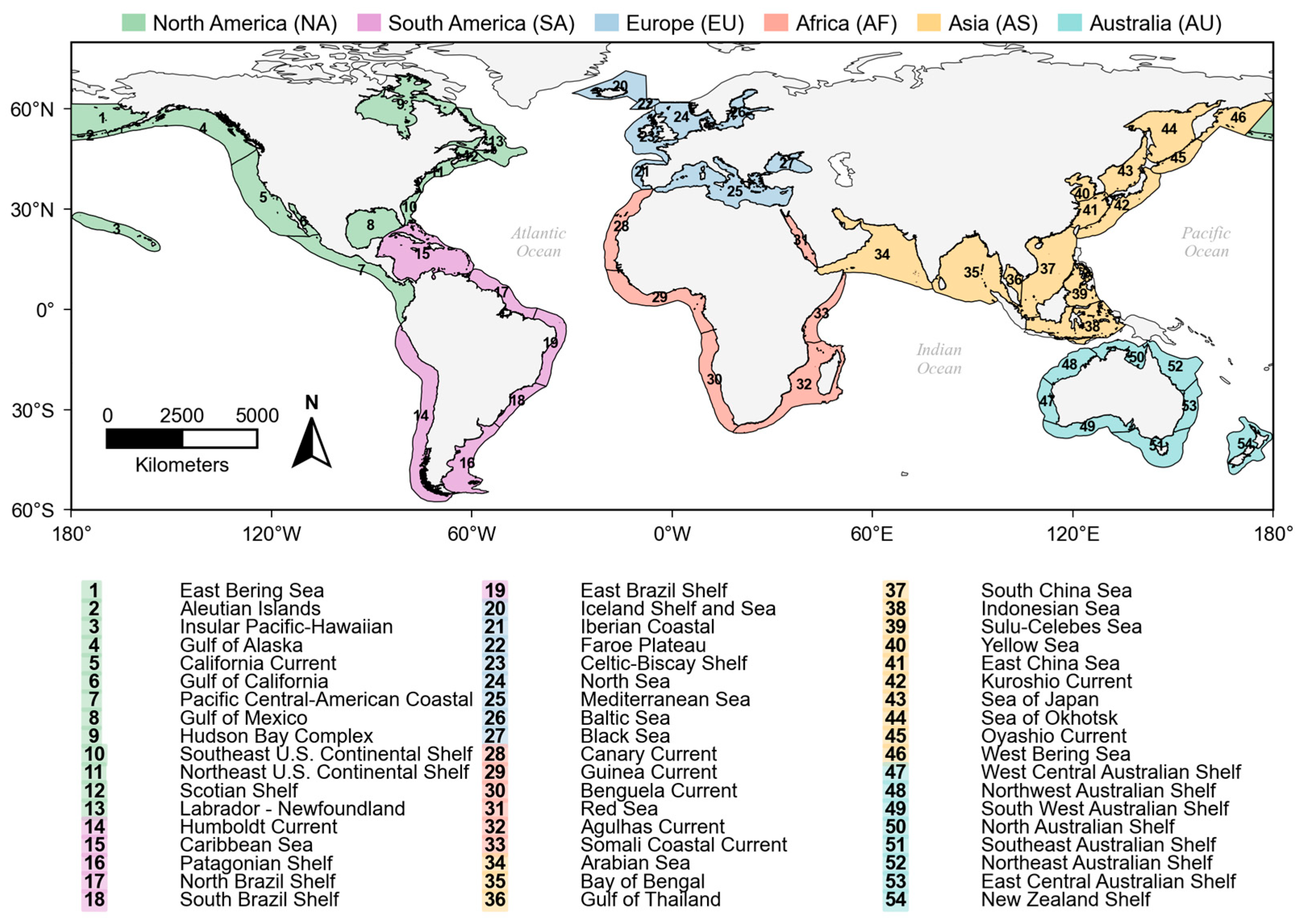
Figure 1. Global distribution and regional classification of the 54 non-polar Large Marine Ecosystems (LMEs). The LMEs are color-coded into six regional groups: North America (NA), South America (SA), Europe (EU), Africa (AF), Asia (AS), and Australia (AU). The numerical IDs on the map correspond to the LME names listed in the lower panel. Note that polar LMEs are excluded from this analysis.
Remotesensing 18 01322 g001
Figure 2. Spatial distribution and temporal trends of phytoplankton blooms and marine heatwaves (MHWs) within non-polar LMEs from 2003 to 2020. (a), Total number of days with detected phytoplankton bloom events over the 18-year period. (b), Total number of MHW days over the same period. (c), Linear trend in the annual number of phytoplankton bloom days (days yr−1). (d), Linear trend in the annual number of MHW days (days yr−1). In panels (c,d), black stippling indicates regions where the trend is statistically significant (p < 0.05).
Remotesensing 18 01322 g002
Figure 3. Global distribution and trends of compound marine heatwave–phytoplankton bloom (MHW-PB) events within non-polar large marine ecosystems (LMEs) from 2003 to 2020. (a), Spatial distribution of the total days of compound events. (b), Linear trends in the annual days of compound events. Stippling (dots) indicates regions with statistically significant trends (p < 0.05). (c), Regional statistics of annual compound event days, aggregated by LMEs for each continent. (d), Time series of annual mean days for MHWs, phytoplankton blooms, and compound events, averaged within all considered LMEs, superimposed with their linear trends. Trend magnitudes and p-values are annotated in colors corresponding to each time series. The asterisk (*) indicates statistical significance at the p < 0.05 level.
Remotesensing 18 01322 g003
Figure 4. Spatiotemporal patterns of the co-occurrence between marine heatwaves and phytoplankton blooms within non-polar LMEs. All panels depict the MHW–PB co-occurrence ratio, defined as the proportion of phytoplankton bloom events that coincide with a marine heatwave. (a), Latitudinal distribution of the co-occurrence ratio, presented as a zonal mean. The shaded area denotes the 95% confidence interval. (b), Spatial distribution of the co-occurrence ratio, showing the spatial variation in the frequency with which blooms are accompanied by MHWs. (c), Temporal trends in the co-occurrence ratio averaged over the studied LMEs (global average, low-, and high-latitude regions). Linear trends are shown as solid lines, with the corresponding slope and statistical significance (p-value) indicated in the panel. The asterisk (*) indicates statistical significance at the p < 0.05 level.
Remotesensing 18 01322 g004
Figure 5. Time series of annual mean days of (a) MHWs and (b) phytoplankton blooms averaged over LMEs for 2003–2020. Black, red and blue lines represent global LMEs, low-latitude LMEs and high-latitude LMEs, respectively. Solid lines show the original annual means and dashed lines denote the linear trends. Numbers in the legend indicate the relative trend expressed as percentage change per year (% yr−1) relative to the 2003–2020 mean of the corresponding category. All values are calculated only within LME boundaries. The asterisk (*) indicates statistical significance at the p < 0.05 level.
Remotesensing 18 01322 g005
Figure 6. Global comparison of dependency metrics between marine heatwaves and phytoplankton blooms (2003–2020). (a), Global distribution of the likelihood multiplication factor (LMF). Values greater than 1 indicate a positive dependence between the two events (facilitation), while values less than 1 indicate mutual exclusivity. (b), Global distribution of the compound independence factor (CIF). This factor quantifies the weighted mutual independence of the two events, providing a more robust measure of their association. Positive values indicate statistical dependence (co-occurrence), while negative values suggest mutual exclusivity. Higher values denote a stronger association and a greater frequency of compound events. In both panels, black outlines denote the boundaries of non-polar LMEs, highlighting the distinct dependency patterns within these productive regions compared to the open ocean.
Remotesensing 18 01322 g006
Figure 7. Seasonal distribution of the compound independence factor (CIF) between MHWs and phytoplankton blooms within non-polar LMEs. Panels (ad) show CIF values for spring, summer, autumn, and winter, respectively. Seasons are defined locally for the Northern and Southern Hemispheres.
Remotesensing 18 01322 g007
Figure 8. Interpretable machine learning analysis of environmental drivers and their interactions during MHWs. (a,b), Global importance ranking of environmental predictors for phytoplankton blooms in low-latitude (a) and high-latitude (b) regions, quantified by mean absolute SHAP values. Numerical labels indicate the magnitude of each bar. (c,d), SHAP interaction values between MHW intensity and nitrate (NO3) for low and high latitudes, respectively. (e,f), Corresponding SHAP interaction effects between MHW intensity and phosphate (PO4).
Remotesensing 18 01322 g008
Figure 9. Spatial correlations between MHW intensity and environmental variables within non-polar LMEs. Panels (af) display the correlation coefficients for nitrate concentration (NO3), phosphate concentration (PO4), dissolved oxygen (O2), mixed layer depth (MLD), photosynthetically available radiation (PAR), and sea surface current speed (U), respectively. Black stippling (dots) indicates regions where the correlation is statistically significant (p < 0.05).
Remotesensing 18 01322 g009
Disclaimer/Publisher’s Note: The statements, opinions and data contained in all publications are solely those of the individual author(s) and contributor(s) and not of MDPI and/or the editor(s). MDPI and/or the editor(s) disclaim responsibility for any injury to people or property resulting from any ideas, methods, instructions or products referred to in the content.