Article

Insights into Spatial Heterogeneity of Land Subsidence Susceptibility Using InSAR and Explainable Machine Learning

1
School of Electrical Engineering and Automation, Nantong University, Nantong 226019, China
2
Key Laboratory of Land Subsidence Mechanism and Mitigation, Ministry of Education, Capital Normal University, Beijing 100048, China
3
Department of Electronic & Electrical Engineering, University of Bath, Bath BA2 7AY, UK
4
Beijing Laboratory of Water Resources Security, Capital Normal University, Beijing 100048, China
5
Hebei Cangzhou Groundwater and Land Subsidence National Observation and Research Station, Cangzhou 061000, China
*
Author to whom correspondence should be addressed.
Remote Sens. 2026, 18(9), 1298; https://doi.org/10.3390/rs18091298
Submission received: 28 February 2026 / Revised: 10 April 2026 / Accepted: 20 April 2026 / Published: 24 April 2026

Highlights

What are the main findings?
  • The marginal effects of contributing factors are determined on regional subsidence, and their corresponding threshold responses are quantified.
  • The spatial heterogeneity of dominant factors is revealed in regional land subsidence.
What are the implications of the main findings?
  • This study presents a transparent machine learning subsidence framework to identify where and how dominant factors and their interactions influence regional land subsidence, further deepening the understanding of the land subsidence process.
  • The findings of this study provide data- and pattern-based support for targeted regional subsidence prevention and mitigation measures, informing regional decision-making.

Abstract

Land subsidence (LS) is a widespread geoenvironmental problem driven by both natural processes and human activities. Identifying the main factors controlling LS susceptibility and their spatial contribution patterns is essential for LS management and mitigation. In this study, an interpretable earth observation framework was developed for the North China Plain (NCP) to quantify both spatial and non-spatial contributions of dominant LS drivers. Land displacement was derived from Sentinel-1A SAR images using Multi-Temporal Interferometric Synthetic Aperture Radar (MT-InSAR) processing. The displacement map was then combined with nine geoenvironmental variables to construct an LS susceptibility model using the eXtreme Gradient-Boosting (XGBoost) algorithm. The model performed well, with an R2 of 0.96, an EVS of 0.96, and an MAE of 2.25 mm/yr. SHapley Additive exPlanations (SHAP) analysis was employed to quantify feature contributions and their effects on LS susceptibility. The results show that a deep groundwater level (DGL) was the dominant factor, followed by elevation and a shallow groundwater level (SGL). The effect of DGL was strongest when it ranged from −75 to 20 m. Elevation showed a clear effect on LS occurrence when values fall between 30 and 50 m. Relatively high subsidence sensitivity was mainly observed in areas where SGL was below −7 m. Interaction effects, particularly those between DGL and elevation and between DGL and SGL, further increased LS susceptibility in specific areas. The highest predicted susceptibility occurred in areas with DGL below −20 m and elevations below 30 m. Higher susceptibility was also identified where DGL was high and SGL ranged between −20 and −10 m, and where DGL was low and SGL ranged from 15 to 20 m. In contrast, factors such as slope and aspect had limited influence at the regional scale. The contributions of the predominant factors show obvious marginal effects and significant spatial heterogeneity to LS susceptibility. The results clarify where and how key factors shape subsidence and can inform targeted mitigation measures and urban planning by local authorities.

1. Introduction

Land subsidence (LS), defined as the lowering of the Earth’s surface, has become a significant global environmental and geological hazard [1]. Regional experiences of LS threaten urban infrastructure, reduce aquifer storage capacity, and increase risk of ground fissures and flooding [1,2,3]. Recent global studies indicate that by 2040, LS may threaten approximately 8% of the global land surface and 19% of the world’s population [1]. This calls for a comprehensive study of its distribution, magnitude, mechanisms, and driving factors. Interferometric Synthetic Aperture Radar (InSAR) can measure surface displacement with millimetre-scale accuracy [4]. Advanced multi-temporal InSAR (MT-InSAR) methods, including persistent scatterer InSAR (PS-InSAR) and a small baseline subset (SBAS), eliminate the effects of temporal–spatial decorrelation and atmospheric delays [5,6]. These approaches are widely used to monitor time-dependent LS. Furthermore, accurate LS inventory maps derived from MT-InSAR measurements provide a reliable basis for regional assessment [7,8].
Beyond monitoring, understanding spatial distribution and driving mechanisms of LS is essential for effective risk management and mitigation. Approaches to LS modelling are generally divided into physics-based models and data-driven models. Physical-based numerical and hydrogeological models can simulate land displacement processes in an explicit manner [9,10]. However, these models often rely on numerous complex parameters, which are limited in large areas. In recent years, data-driven techniques, especially machine learning (ML), have been increasingly used to predict LS from historical observations and environmental predictors [11,12,13,14,15,16] (Table S1). Previous studies have applied various ML methods to LS susceptibility mapping. For instance, Rahmati et al. [17] evaluated the influence of land use, geology, qanat locations, and groundwater-level drawdown in relation to LS susceptibility in Iran using several ML algorithms. Ghorbanzadeh et al. [18] developed a GIS-based adaptive neuro-fuzzy inference system to map land subsidence susceptibility in northern Iran, using InSAR-derived surface deformation and nine conditioning factors. Arabameri et al. mapped LS susceptibility in the Shahroud Plain using multiple ML models and showed that land use/land cover and groundwater were the most influential factors according to the Random Forest (RF) model [19]. Hakim et al. [7] developed a hybrid framework for LS susceptibility mapping by combining ML and deep learning methods, and identified the relative importance of related factors based on information gain ratio values.
These studies demonstrate the potential of ML for LS susceptibility mapping. However, despite their strong predictive performance, many ML-based LS susceptibility models remain difficult to interpret. The relationship between input variables and model outputs is often not explicitly described. Recent advances in model interpretation, particularly SHapley Additive exPlanations (SHAP), provide a systematic framework for interpreting complex models by breaking down predictions into feature-level contributions. SHAP not only identifies the relative importance of input features, but also reveals how different values of each factor contribute to model predictions. This makes it possible to quantify both the direction and magnitude of each factor’s effect, and SHAP has been widely used in LS studies to improve the transparency of susceptibility modelling [20,21,22,23,24]. For example, Zhao et al. used SHAP to explain the contributions of various factors in LS susceptibility produced by RF. The results from SHAP highlight thickness as the most influential feature, where the thinner the thickness of the underlying bedrock, the higher the probability of LS in the Houhu urban area [20]. Seihani et al. applied four methods—interaction plots, permutation feature importance (PFI), SHAPs, and accumulated local effects (ALEs)—to interpret and explain the output of the LS in southern Iran. SHAP, in conjunction with these four methods, can capture both positive and negative contributions of effective variables to LS susceptibility [22]. Zhang et al. further quantified the marginal contributions of variables in a CatBoost-based model for coal mining-induced LS, and reported that the SHAP-derived feature contributions were generally consistent with engineering understanding [24]. Although previous studies employed SHAP to identify both the direction and magnitude of factor effects on LS susceptibility, it cannot fully reveal how these effects vary in space. This limitation is important for LS studies due to their characteristics of strong spatial heterogeneity and non-stationary controls.
The North China Plain (NCP) is one of the fastest-subsiding regions in the world. Since the 1970s, long-term groundwater overexploitation has caused severe LS across the region. Previous studies have used InSAR to investigate LS phenomena of the NCP, with particular attention given to the response of regional subsidence to groundwater-level changes [25,26,27]. The spatial distribution of LS is influenced by factors such as the thickness and compressibility of clay in the aquifer system, as well as the activation of faults [26,28,29]. Additionally, human activities (land-use types and infrastructure construction) accelerated the process of LS in the local regions of the NCP [30]. However, the spatial effects of influential factors on regional subsidence remain insufficiently explored. Consequently, the mechanisms underlying spatial heterogeneity in LS remain poorly understood. To address this gap, this study takes the NCP as an example and integrates MT-InSAR with explainable ML to quantify both the magnitude and spatial variability of feature contributions. Land surface deformation derived by MT-InSAR is combined with geo-referenced environmental factors to construct an LS susceptibility model. SHAP is then used to characterise both spatial heterogeneity and global effects of key driving factors on susceptibility patterns. By connecting MT-InSAR-derived deformation data with spatial model interpretation, this study clarifies the spatial behaviour of LS. The findings provide scientific evidence to support local governments in developing management strategies to mitigate LS.

2. Study Area

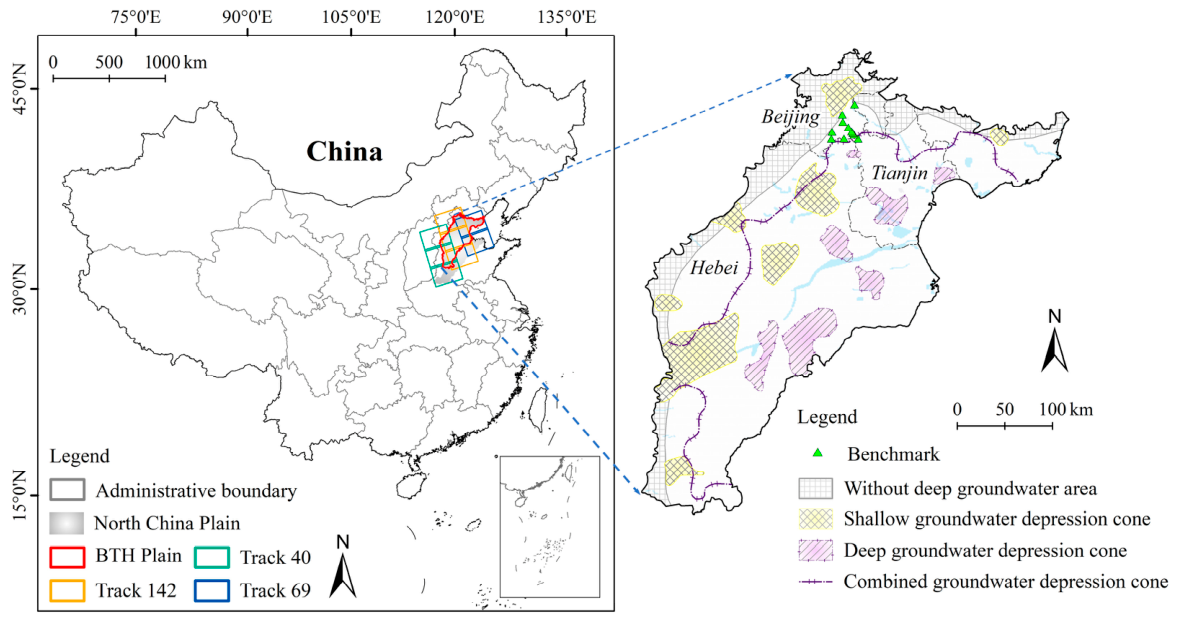
The North China Plain (NCP) (34°46′–40°25′N, 112°30′–119°30′E) covers an area of about 140,000 km2. The area is characterised by a typical warm, semi-humid monsoon climate, with mean annual precipitation ranging from 500 to 600 mm [31]. The Quaternary aquifers in the NCP are divided into four groups [32,33,34]. Aquifer 1 and aquifer 2 are defined as shallow groundwater. Aquifer 1 is an unconfined aquifer (with depths of 10–50 m), whereas aquifer 2 is a shallow confined aquifer (with depths of 120–210 m). Aquifers 3 and 4, at depths of 250–310 m and 350–550 m, respectively, are confined aquifers and are classified as deep groundwater. The NCP has experience of long-term intensive groundwater extraction, which has caused widespread groundwater depletion and formed large groundwater depression cones, especially in the Beijing–Tianjin–Hebei (BTH) region. The locations of the shallow and deep groundwater depression cones in the BTH region are shown in Figure 1. Comparable subsidence caused by groundwater overexploitation has been documented worldwide, including in Mexico, Iran, Jakarta, Japan, and the Netherlands [1,27,35,36]. In the NCP, this process has also produced significant LS. The significant subsidence is mainly concentrated in Beijing, Tianjin, and Hebei [27]. Therefore, this study focuses on the BTH region. Given the spatial distribution of deep groundwater (Figure 1), the analysis is further limited to the deep groundwater-covered area within the BTH region.

3. Materials and Methods

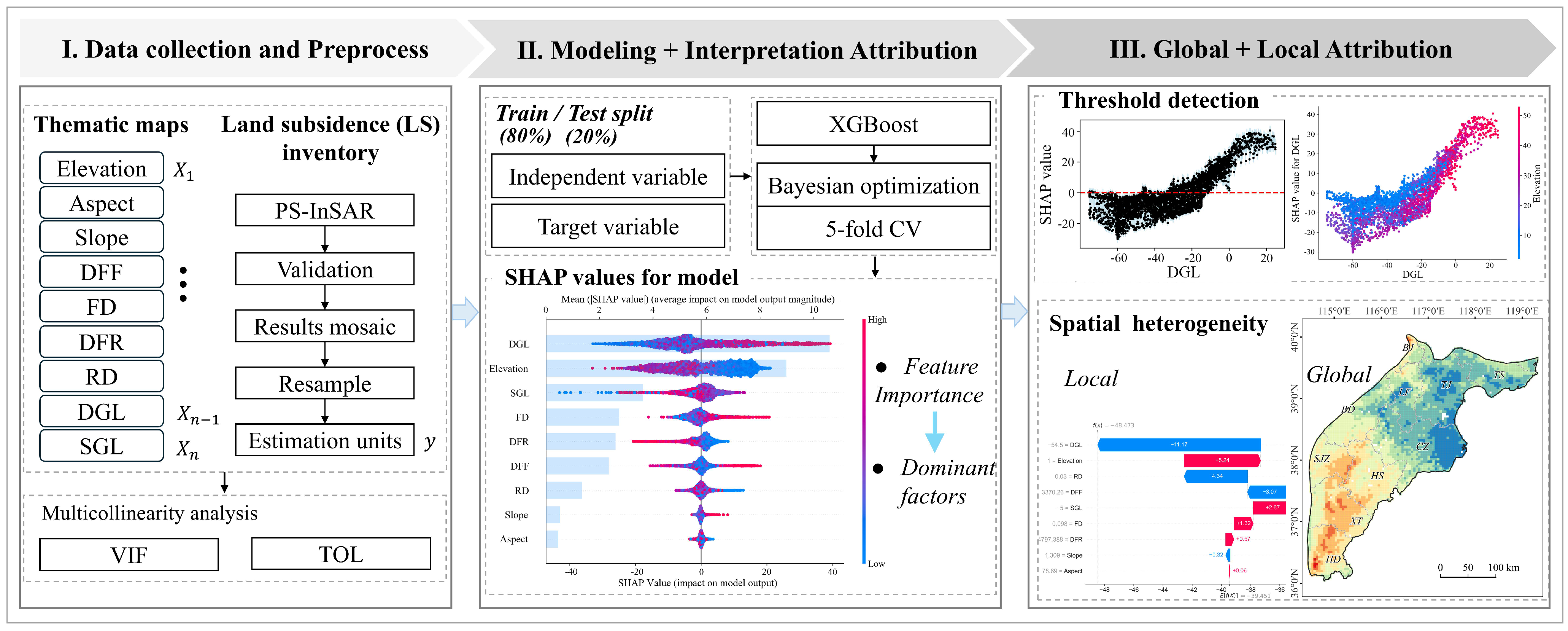
The overall flowchart is shown in Figure 2. The methodology includes three components: (1) constructing an LS inventory from PS-InSAR-derived surface deformation; (2) developing and evaluating an LS susceptibility model using the XGBoost algorithm; and (3) interpreting the model using the SHAP framework. Section 3.1 describes the SAR datasets and the InSAR processing methods. Section 3.2 details the preparation of geo-referenced conditioning factor maps used as model inputs. Section 3.3 and Section 3.4 briefly describe XGBoost and SHAP, respectively. XGBoost is used to produce the LS susceptibility map. SHAP is applied to quantify the magnitude of feature contributions and their spatial heterogeneity.

3.1. Subsidence Inventory Map

MT-InSAR combines SAR imaging and interferometry techniques to retrieve land surface deformation with millimetre-level precision. In this study, LS was quantified using the PS-InSAR method and Sentinel-1A (S1A) data. S1A is a C-band earth observation mission satellite operated by the European Space Agency, featuring a 12-day revisit cycle and a line-of-sight (LOS) incidence angle between 31° and 46°. A total of 404 ascending S1A images belonging to three tracks (40, 69, and 142) downloaded from the Alaska Satellite Facility (https://search.asf.alaska.edu/, accessed on 25 February 2026) were used to derive a displacement inventory map over the BTH region. The entire dataset was acquired in interferometric wide swath (IW) mode with vertical–vertical (VV) polarisation, providing a spatial resolution of 5 × 20 m and a width of 250 km. Detailed information on S1A images is shown in Table 1.
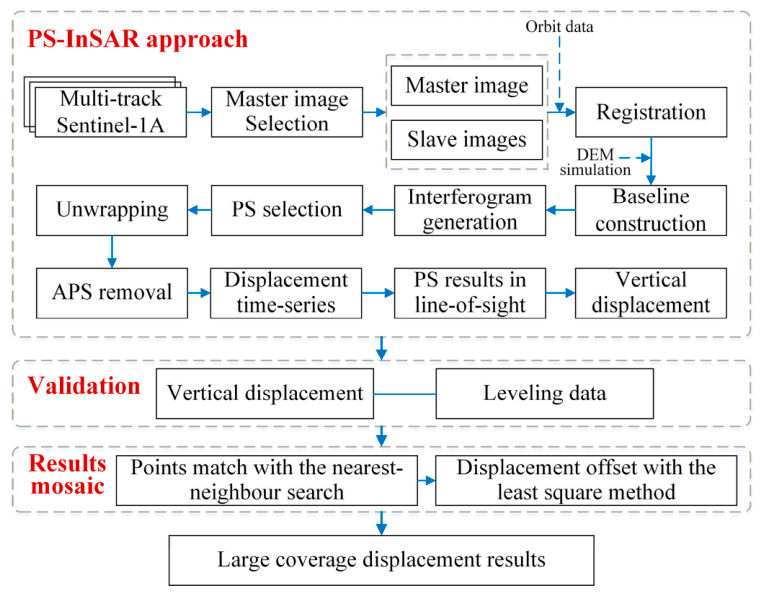
Because the study area is covered by multiple SAR tracks, each track was processed independently using the PS-InSAR technique implemented in SARProZ. Precise orbit data were used to correct orbital errors. A 90 m Shuttle Radar Topography Mission (SRTM) DEM was introduced to eliminate the topographic phase contribution. PS candidates were identified using an amplitude stability index (ASI) threshold of 0.8 to preserve points with stable phase and high coherence. The deformation results from the three tracks were mosaicked to produce a regional deformation map. The framework of the multi-track processing is shown in Figure 3.
At first, LOS deformation was converted to vertical displacement to obtain vertical subsidence velocity. Horizontal motion was assumed to be negligible, consistent with regional geodetic evidence [38,39]. Vertical displacement ( d V ) was calculated from LOS measurements ( d L O S ) and the incidence angle ( θ ) was calculated as d V = d L O S / c o s θ . Then the nearest-neighbour search and least square method were employed to match PS points and calculate the deformation offset in the overlapping areas between adjacent tracks. As illustrated in Figure 1, track 142 overlaps with the SAR data from another two tracks. Subsequently, track 142 was selected as the reference for offset estimation. Its vertical displacement was validated using levelling measurements. The three tracks were then mosaicked after compensating for mean offsets. And a continuous subsidence velocity map was produced for the entire study area.
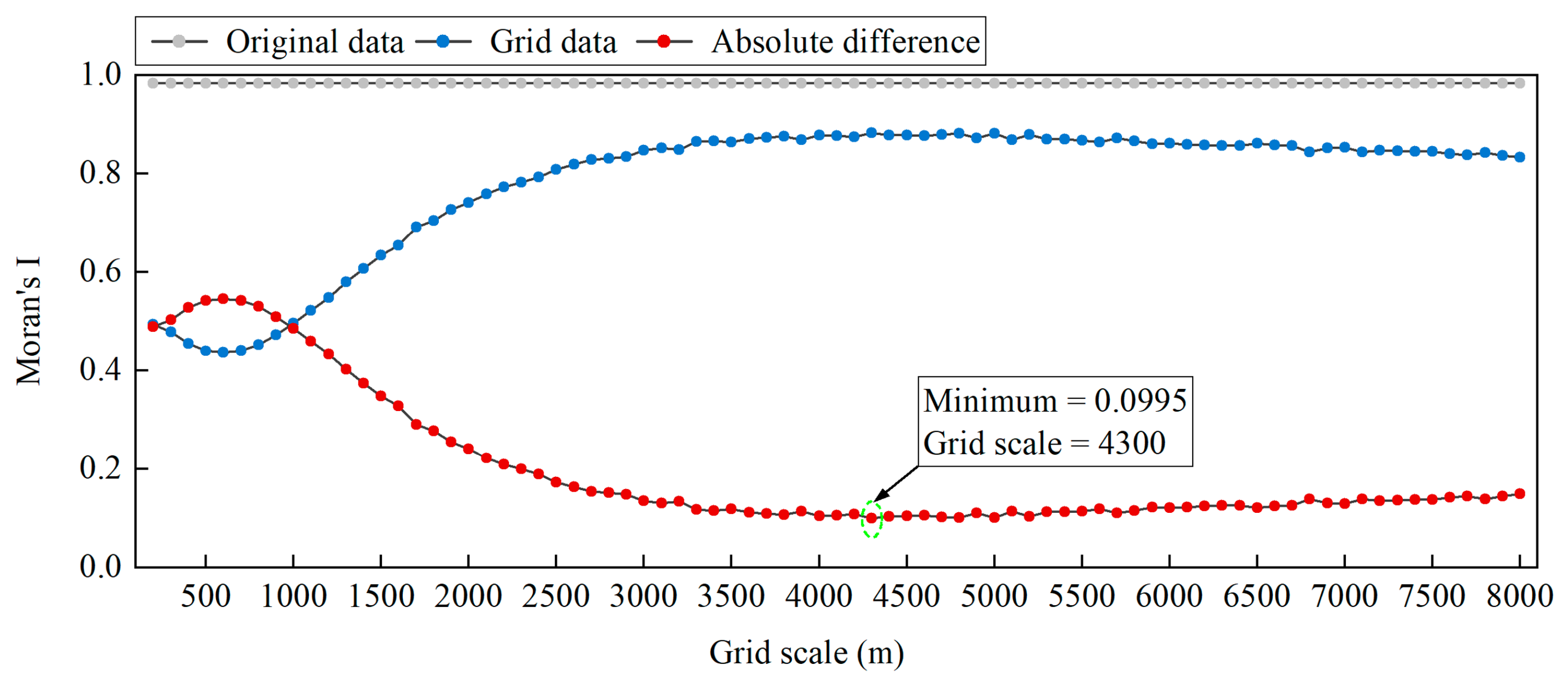
For susceptibility modelling, PS-InSAR points were converted into grid-based samples. The optimal grid size was determined using the difference Moran’s I method [40,41]. The grid size minimises the absolute difference in spatial autocorrelation between the original points and the gridded data:
S = I g I b
where I g and I b denote Moran’s I values of the gridded and original LS velocity data, respectively. Moran’s I was computed across multiple grid scales using GeoDa 1.20 (https://geodacenter.github.io/, accessed on 25 February 2026). As shown in Figure 4, the minimum difference was achieved at a grid scale of 4300 m. Consequently, LS velocity data was transformed using a grid scale of 4300   ×   4300 m. This produced 4088 spatial units for model development and analysis of LS spatial heterogeneity.

3.2. Preparation of the Spatial Database

LS is governed by regional geological conditions and their interaction with external factors. Previous LS susceptibility studies have used different conditioning factors, depending on local hydrogeological and geomorphological settings. For example, Ghorbanzadeh et al. [18] used the adaptive neuro-fuzzy inference system (ANFIS) to map LS susceptibility with topographic-, lithological-, climatic-, and groundwater-related variables. Azarakhsh et al. [42] identified lithology, land use, fault-related indicators, and groundwater-level drawdown as the main LS drivers in Tehran province. Liu et al. [43] analysed the combined effects of elevation, strata lithology, groundwater exploitation, soft soil thickness, and land-use patterns on LS susceptibility in the Pearl River Delta. These studies show that LS is driven by multiple factors and that the conditioning factors should be selected for the regional settings [8].
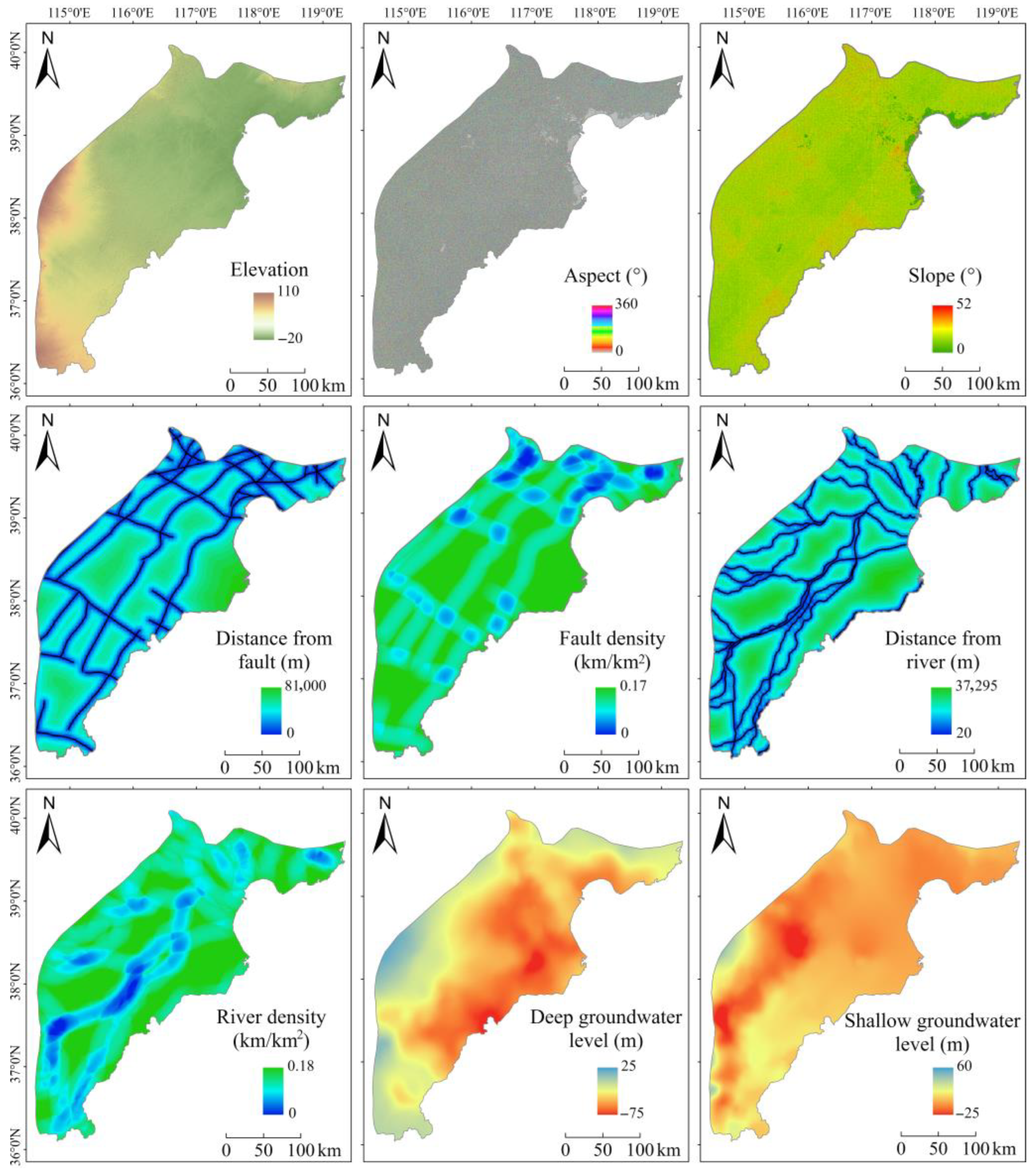
In the NCP, LS is mainly caused by aquifer-system compaction associated with long-term groundwater depletion. According to previous studies in the NCP [27,29,44,45], nine geoenvironmental factors were selected for LS susceptibility modelling (Figure 5). The groundwater contour maps, including shallow groundwater contour and deep groundwater contour, were obtained from the China Geological Environmental Monitoring Institute (https://geocloud.cgs.gov.cn/ (accessed on 15 February 2020)). The groundwater-level surfaces were interpolated from contour data using the Inverse Distance Weighting method. The fault data were digitised from a geo-referenced fault map obtained from the China Geological Survey. Fault distance and fault density were derived using the Euclidean Distance method and Line Density, respectively. The major river data in the study area were obtained from OpenStreetMap (OSM) (www.openstreetmap.org, accessed on 25 February 2026). Then, river distance and river density were derived from these river datasets using the same methods. Other factors, such as elevation, slope, and aspect, were derived from the Advanced Spaceborne Thermal Emission and Reflection Radiometer Global Digital Elevation Model (ASTER GDEM) at 30 m resolution. The dataset was accessed through the Geospatial Data Cloud (https://www.gscloud.cn/ (accessed on 20 June 2024)).
To preserve the spatial autocorrelation of the original displacement, the minimum difference Moran’s I method was used to determine the optimal grid size (4300 × 4300 m). To unify the spatial analysis units of the response variable and the driving factors, this grid size was adopted as the modelling unit. The above conditioning factors were then sampled for this unit. Potential multicollinearity among the selected factors was evaluated using tolerance (TOL) and variance inflation factor (VIF). A TOL value below 0.1 or a VIF value above 10 indicates severe multicollinearity. The multicollinearity diagnosis was used to identify redundant predictors and improve model stability. Variables showing severe multicollinearity were removed.

3.3. XGBoost Model Algorithm

In this study, LS susceptibility was estimated using the PS-InSAR and an ML framework. First, land displacement was derived using PS-InSAR, and the PS points were gridded for subsequent modelling. Then, nine selected conditioning factors and grid-transformed PS-InSAR data were used as predictor variables and targets, respectively, for the XGBoost algorithm. XGBoost is a scalable tree-boosting algorithm that combines multiple weak tree learners to form a stronger learner [46]. Compared with conventional boosting algorithms, XGBoost improves computational efficiency through specialised system optimisations. This algorithm has been widely used in geoscience studies [47,48,49]. It has also been used for LS analysis [23].
An XGBoost regression model was developed in Python 3.11 with the ‘xgboost’ package. Gradient-boosted trees (gbtree) were used as the base learner. The input was then split into two sets: 80% for training and 20% for testing. Bayesian optimisation with five-fold cross-validation was used to select hyperparameters. The details of model hyperparameters are given in Table 2. Model accuracy was evaluated with four indicators, including coefficient of determination (R2), root mean squared error (RMSE), mean absolute error (MAE), and explained variance score (EVS).

3.4. SHapley Additive exPlanations

To improve model interpretability, the SHAP framework proposed by Lundberg and Lee [50] was applied. SHAP is a post hoc explanation method rooted in cooperative game theory. It explains model prediction by assigning contributions to individual features using Shapley values. Feature contributions are quantified under the properties of local accuracy, consistency, and missingness [50].
In SHAP, the contribution of feature i is defined as the weighted average of its marginal contributions over all possible feature subsets [51]. The definition is given as follows:
ϕ i = S N \ ( i ) S ! ( N S 1 ) ! N ! [ q S i x S i q S ( x S ) ]
where ϕ i is the Shapley value of feature i ; N represents the full set of input features; and S is a subset of features excluding i . x S denotes the feature values in subset S , and q is a function that calculates the contribution of all features.
SHAP explanations can also be expressed as an additive feature attribution model, as shown in Equation (3):
g ( z ) = ϕ 0 + i = 1 M ϕ i z i
where g is a linear function of binary features; z indicates whether a feature is present ( z i = 1 ) or unknown ( z i = 0 ) ; M is the number of simplified features; and ϕ 0 represents the expected model output when no features are present.
Aggregating instance-level Shapley values across samples supports both local and global interpretation. It summarises the feature importance, contribution direction, and interaction effects [52,53]. SHAP was implemented in Python with the ‘shap’ package to interpret the XGBoost-based LS susceptibility model in this paper. LS predictions and conditioning factors are geo-referenced. Therefore, SHAP-derived feature attributions were mapped to support spatial interpretation of model behaviour. This approach identifies dominant drivers of LS susceptibility and reveals spatial heterogeneity in feature contributions across the study area.

4. Results

4.1. Diagnosis of Impact Factors

Multicollinearity among the conditioning factors was assessed using TOL and VIF. As shown in Table 3, river density (RD) (TOL = 0.998) had the highest TOL value, while elevation (TOL = 0.397) had the lowest. The VIF for the variables ranged from 1.002 to 2.516. The overall TOL and VIF for the nine feature variables were greater than 0.1 and less than 10, respectively, indicating the absence of multicollinearity among them. Therefore, we retained all nine independent variables for the subsidence susceptibility modelling.

4.2. Ground Displacements Derived from the InSAR Technique

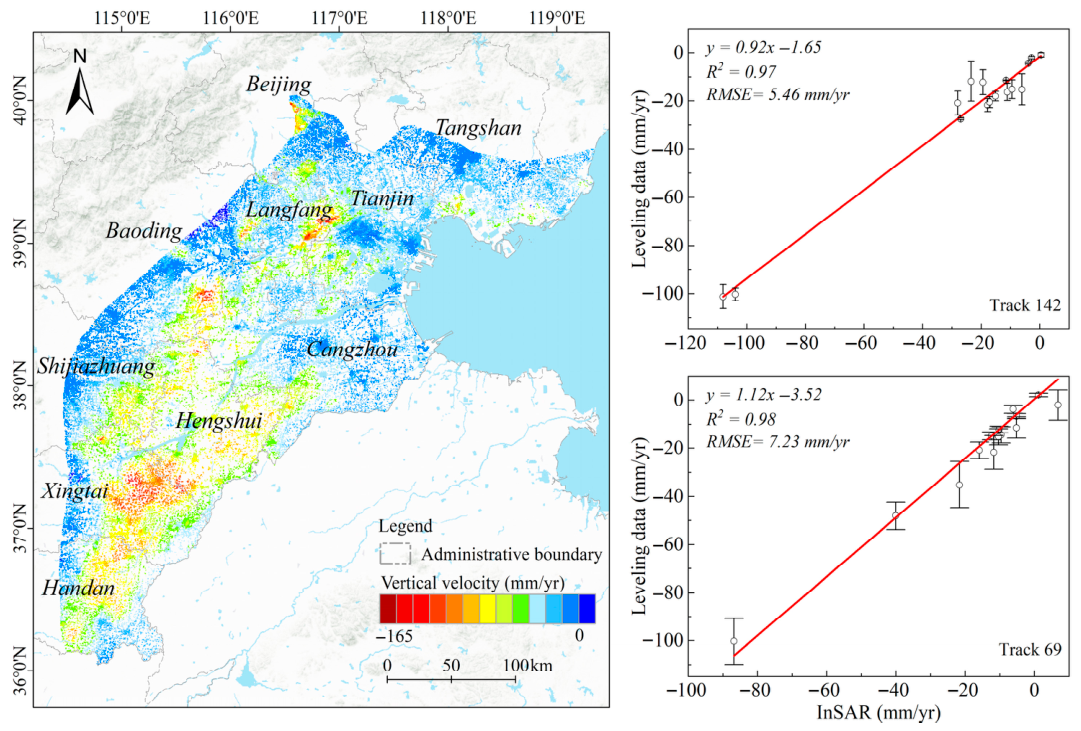
The left panel in Figure 6 shows the vertical displacement velocity obtained from S1A through the PS-InSAR technique. In total, 1,063,230 PS points with coherence values above 0.85 were detected within the study region. The overall displacement velocity ranged from −165.4 (where negative values denote subsidence) to 8.5 mm/yr (with positive values indicating uplift), with a mean velocity of −40.2 mm/yr and a standard deviation of 29.5 mm/yr over the observation period. PS points with velocity below −20 mm/yr accounted for 68.6% of all detections. Significant subsidence (velocity < −50 mm/yr) was mainly observed in the southwestern study area, southeastern Beijing, and the Langfang–Tianjin junction. These points accounted for 31.6% of the total. To prepare the deformation date for ML modelling, PS points were rasterised to avoid multiple observations within the same grid unit. The optimal grid size was determined using the difference Moran’s I method to preserve the spatial autocorrelation of the original PS points. Based on this analysis, a grid scale of 4300 × 4300 m was selected. The rasterised subsidence velocity was used as the target variable for susceptibility modelling.
The accuracy of the InSAR-derived deformation was evaluated using ground-levelling data. For each levelling benchmark, the mean PS-derived displacement rate within a 100 m radius was extracted as the corresponding InSAR observation. Deformation variability within 100 m was assumed to be negligible. Validation was conducted for two S1A tracks (tracks 142 and 69), as illustrated in the right panel of Figure 6. Correlation coefficients between levelling measurement and InSAR-derived displacement rates for track 142 and track 69 were 0.97 and 0.98, respectively. For track 142, the maximum and minimum errors were 11.6 mm/yr and 0.2 mm/yr, respectively, with an average RMSE of 5.46 mm/yr. For track 69, absolute differences ranged from 1.0 to 13.5 mm/yr, with an RMSE of 7.23 mm/yr. The results indicate favourable agreement between InSAR-derived and levelling measurements.

4.3. LS Susceptibility Mapping

In this study, LS susceptibility was mapped using XGBoost, with nine conditioning factors as predictors and PS-InSAR-derived displacement velocity as the target variable. Model performance was evaluated using four metrics. The model achieved an R2 of 0.96, indicating close agreement between predicted and observed subsidence rates. The RMSE was 5.4 mm/yr, while the MAE and EVS were 2.25 mm/yr and 0.96, respectively.
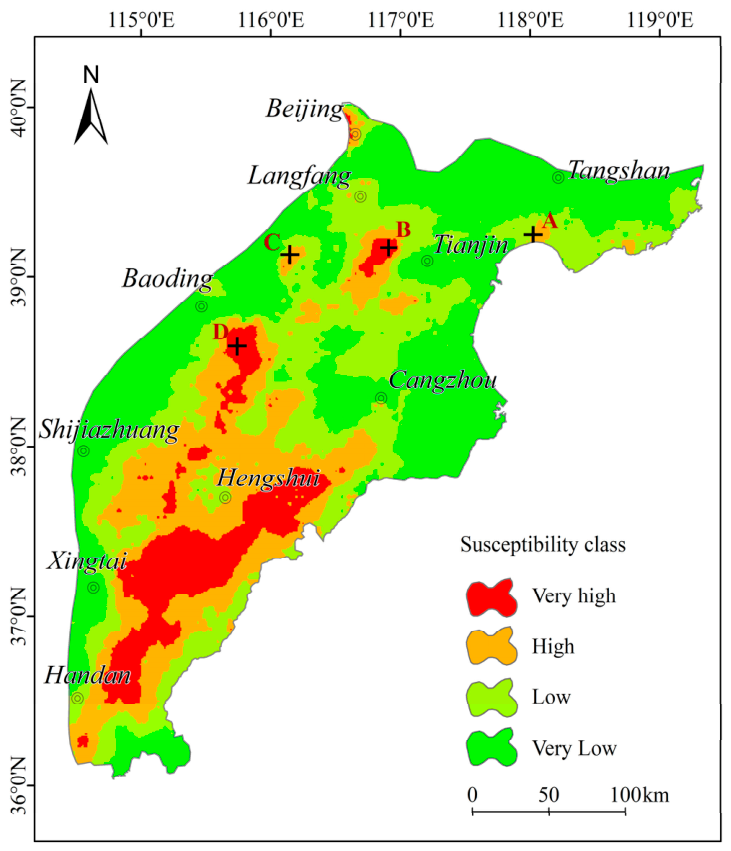
Figure 7 displays the spatial pattern of LS susceptibility. Susceptibility values were divided into four categories using the natural fracture approach. Areas with a surface displacement velocity greater than −20 mm/yr were defined as having very low LS susceptibility. Areas with velocity between −20 and −35 mm/yr were classified as having low susceptibility. Areas with velocity between −35 and −60 mm/yr and those lower than −60 mm/yr were classified as having high and very high susceptibility, respectively. High and very high susceptibility accounted for 20.5% and 11.0% of the total area, respectively (Table 4). Areas of elevated and high LS susceptibility were primarily distributed in eastern Beijing, the Langfang–Tianjin junction, northern Tangshan, and the southwestern part of the study region. Very high susceptibility was concentrated in the Hengshui–Xingtai–Handan region.

4.4. Global Importance and Marginal Effects of Conditioning Factors

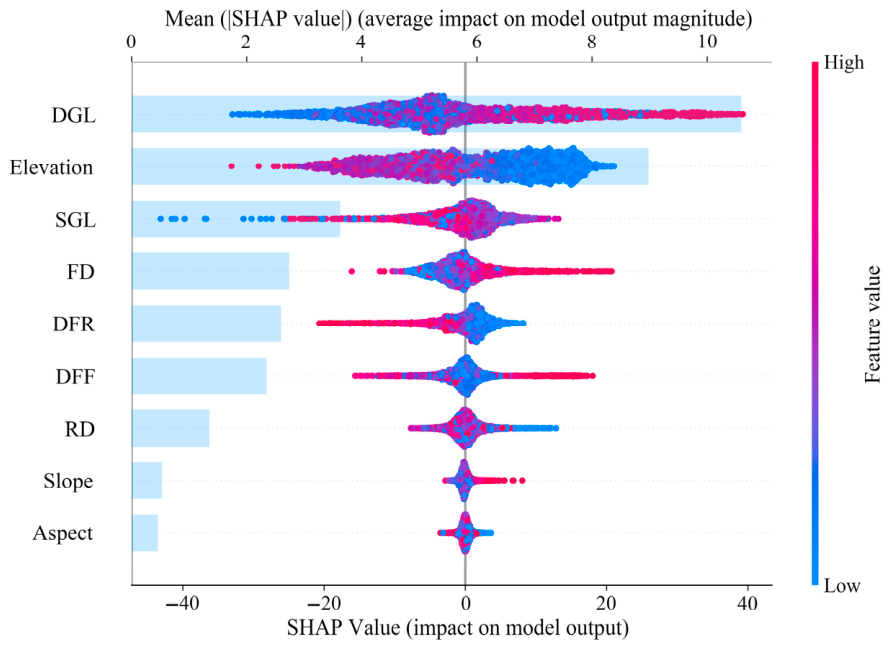
Figure 8 shows global feature importance of the BTH region, quantified by mean absolute SHAP values. The results show that deep groundwater levels (DGLs), elevation, and shallow groundwater levels (SGLs) are the most influential factors, whereas aspect exhibits the lowest relative importance among the variables. SHAP value distributions also indicate how each factor shifts the model output. Many samples with low DGL (blue points) show negative SHAP values. This suggests that low DGL tends to shift predictions toward a larger subsidence magnitude. Therefore, a lower DGL is associated with higher LS susceptibility. Similar patterns were observed for SGL, the distance from the fault (DFF), and the distance from the river (DFR). Lower SGL, smaller DFF, and larger DFR were linked to higher susceptibility. In contrast, higher DGL and DFF, together with smaller DFR, tended to reduce the occurrence of LS. Other factors, such as slope and fault density (FD), had a limited influence on predictions.
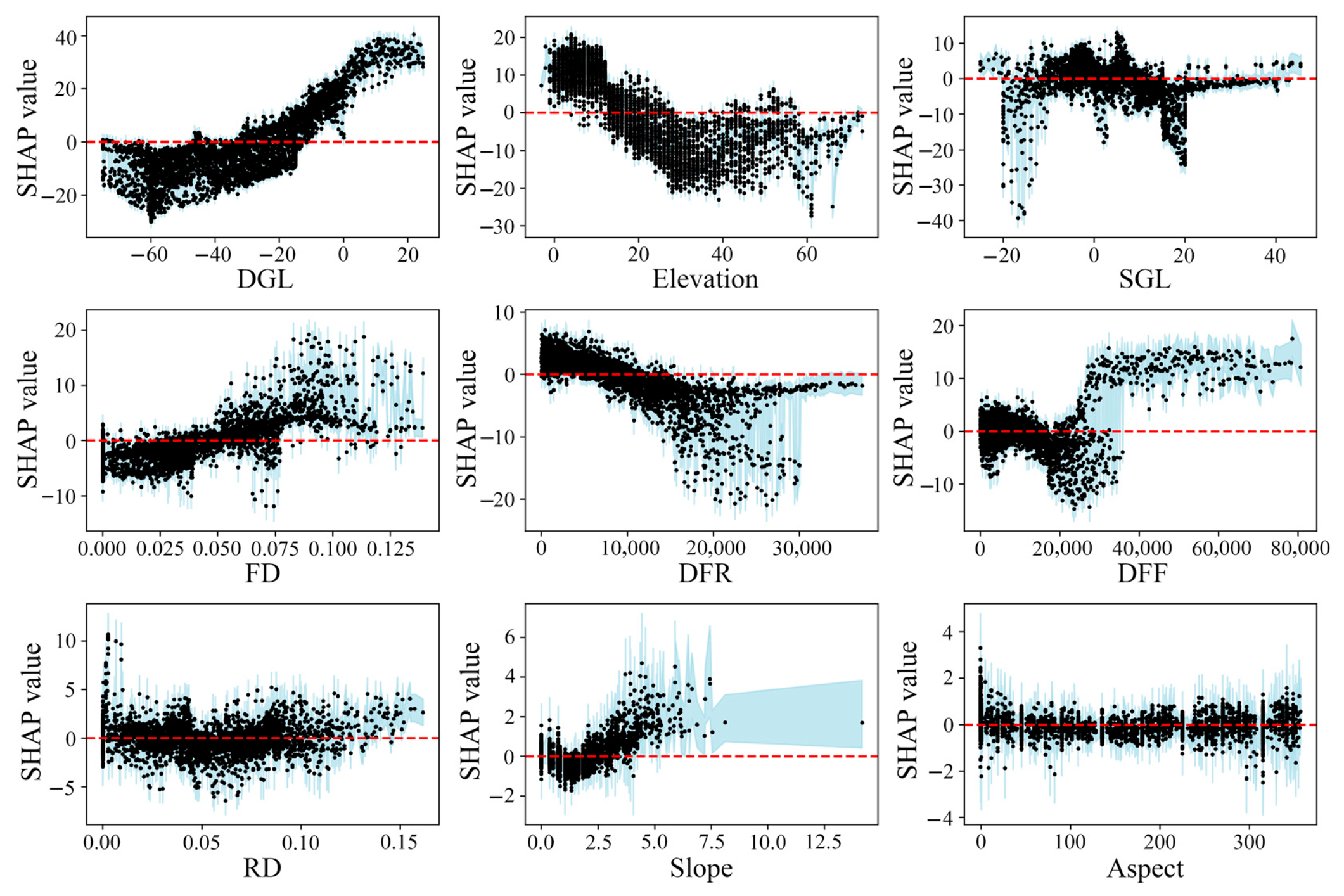
Figure 9 shows the marginal effects of non-spatial predictors on LS susceptibility. DGL shows a strong nonlinear relationship with predicted susceptibility across its full range. LS susceptibility increases markedly when DGL ranges from −75 to −20 m. Elevation has a clear effect on LS occurrence when values fall between 30 and 50 m. Overall, SGL has a weaker marginal effect than DGL. Susceptibility to LS increases when SGL is below −7 m, whereas an SGL above 20 m shows little effect. FD and slope show consistent patterns: lower fault density and gentler slopes are associated with higher LS susceptibility. LS susceptibility also increases with greater DFR. DFF has the greatest effect at short distances, which decreases as the distance increases. River density (RD) and aspect have limited effects across their ranges.

4.5. Interaction Effects Between Predisposing Factors

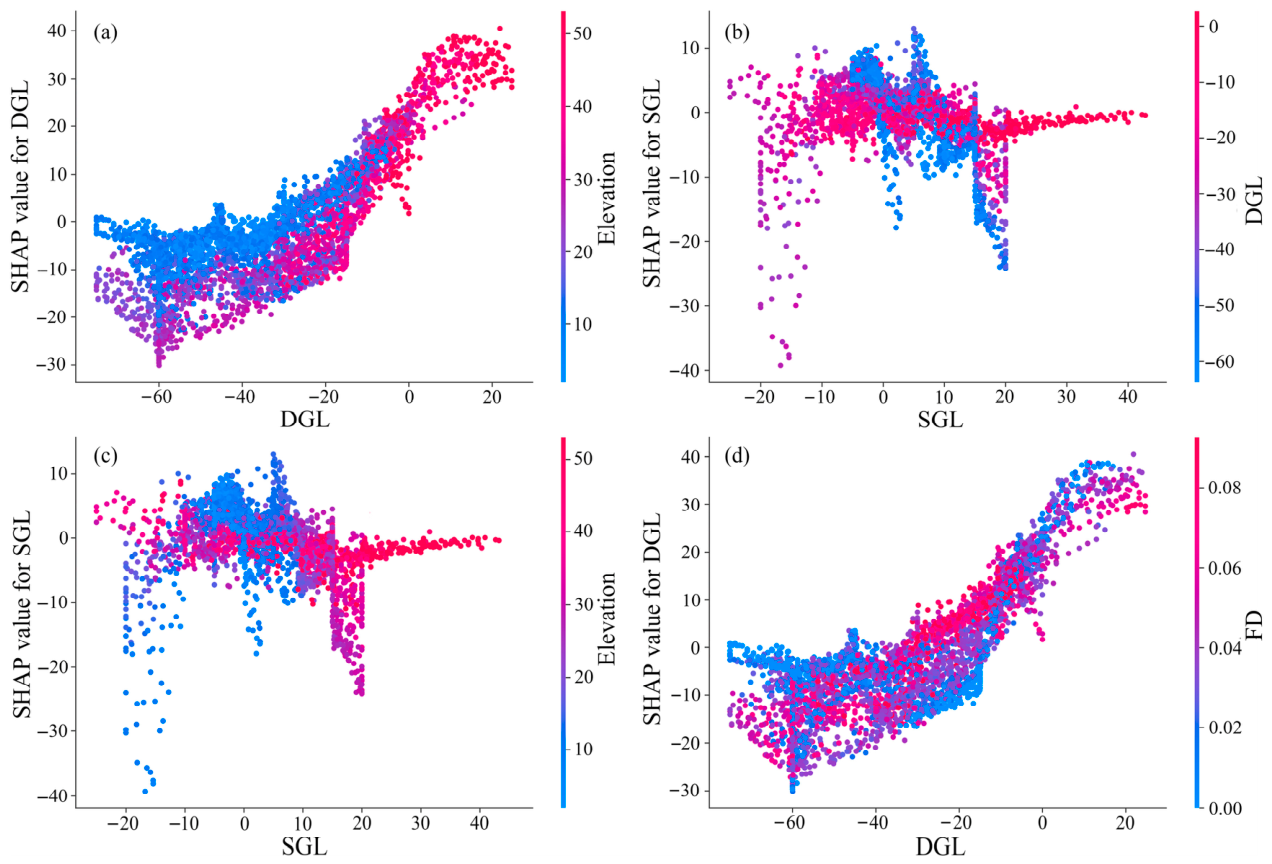
To further examine the combined influence of multiple variables, SHAP interaction values were calculated. Figure S1 shows the SHAP summary plot for the top 15 features by contribution. Relative contributions differed from the global importance ranking (Figure 8) when interactions were included. Interactions between DGL and elevation, and between SGL and DGL, had the largest interaction effects on predicted susceptibility. Figure 10a shows that the effect of DGL on the model output changes as DGL increases. At a higher DGL, SHAP values become more positive, indicating a reduced likelihood of LS. Colour-coding by elevation shows that areas with a DGL below −20 m and elevations below 30 m have the highest predicted susceptibility to LS. This indicates that the DGL–elevation interaction varies with topographic setting. Figure 10b shows the interaction between SGL and DGL. Higher susceptibility for LS occurs when DGL is high and SGL is between −20 and −10 m, and when DGL is low and SGL is 15 to 20 m. These patterns indicate that LS occurrence is controlled by complex, non-additive interactions between groundwater levels at different depths.
The interaction effects between SGL and elevation, as well as between DGL and FD, also influence LS susceptibility in the study area. A relatively high LS susceptibility occurs with an SGL value between −20 and 10 m with low elevation. Compared with Figure 10b, this region always has relatively deep groundwater levels. In Figure 10c, colour-coding by elevation shows that areas with an SGL value between 15 and 20 m and elevations above 30 m have a high predicted LS susceptibility. Figure 10d shows that some areas with DGL below −20 m and FD values greater than 0.06 km/km2 exhibited high LS susceptibility. However, high LS susceptibility was also observed in some areas where FD was lower than 0.02 km/km2 and the DGL was below −20 m. Although the interaction effects between SGL and elevation, as well as between DGL and FD, were observed, a comparison with Figure 8 indicates that their contributions to LS susceptibility are very limited.

5. Discussions

5.1. Dominant Controls and Spatial Heterogeneity of LS Drivers in the BTH Region

SHAP-based interpretation results indicate that groundwater-related variables, particularly DGL, are the dominant drivers of LS across the BTH region. Among the nine factors, DGL has the highest global importance, followed by elevation and SGL. In contrast, FD, slope, and aspect play comparatively secondary roles. These findings agree with previous studies in the NCP that identify groundwater depletion as the primary driver of regional LS [26,28,29].
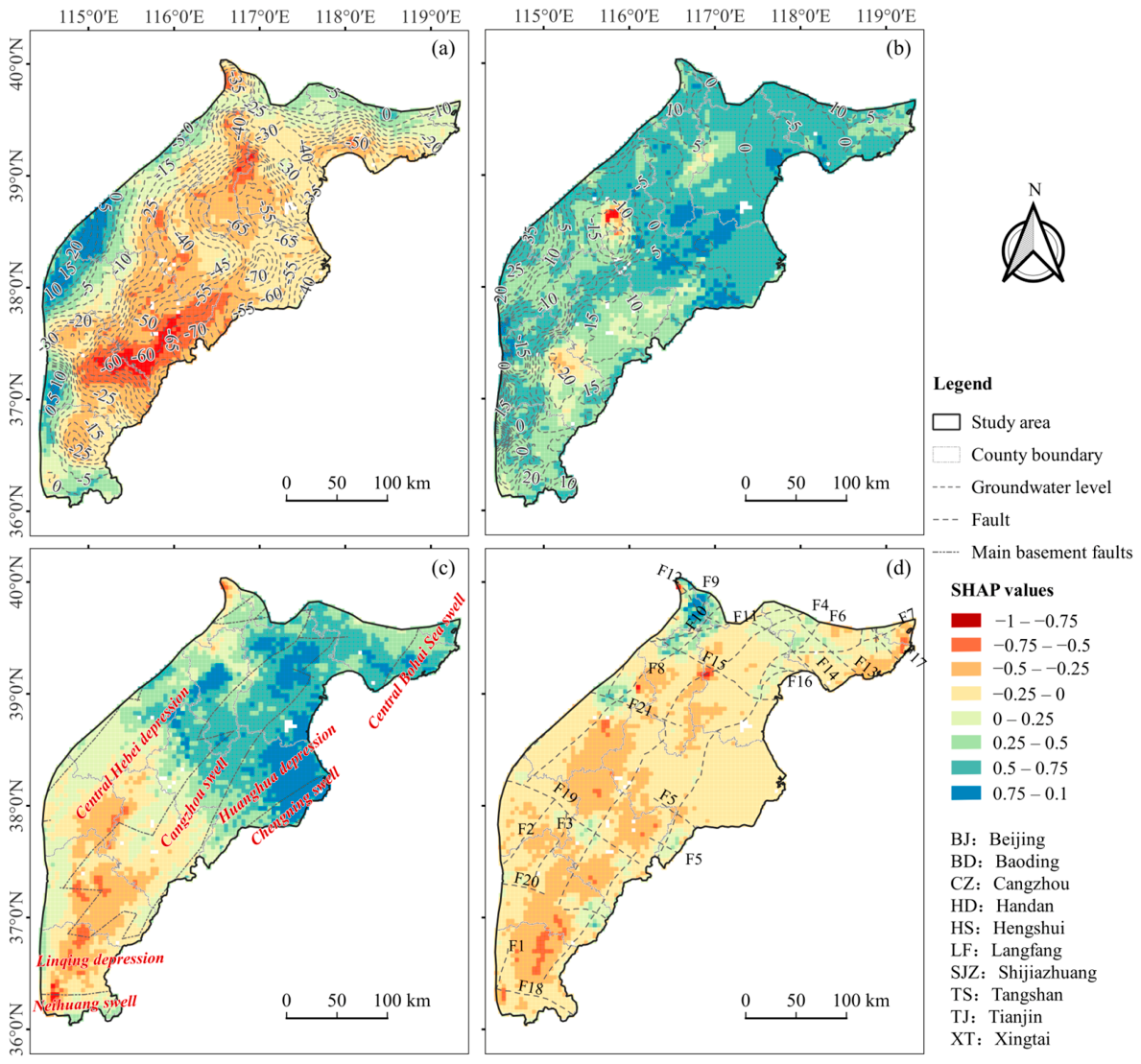
Marginal effects derived by SHAP analysis reveal a threshold-like relationship between DGL and LS susceptibility, with a critical depth range of −75 to −20 m. Similar threshold behaviour has been reported in the NCP, including warning depths identified in Cangzhou and Tianjin [54,55]. This consistency suggests that SHAP-captured nonlinear responses reflect groundwater-sediment compaction mechanisms rather than spurious correlations. Normalised SHAP maps highlight strong spatial heterogeneity in LS controls (Figure 11). Areas with negative SHAP values for DGL and SGL generally coincide with regions experiencing significant groundwater drawdown. This spatial correspondence supports the physical plausibility of SHAP-derived groundwater contributions. It also reinforces the central role of aquifer depletion in shaping the spatial variability of LS.
Elevation is the second most influential factor, but its effect is predominantly indirect. Higher LS susceptibility associated with elevation is mainly aligned in a northeast-trending belt along basement depressions, such as the Central Hebei and Linqing depressions (Figure 11c). Elevation also enhances LS susceptibility in the Cangzhou Swell area, where thick Quaternary sediments coincide with intensive mid-to-deep groundwater pumping [28]. Together, these patterns suggest that elevation acts as a proxy for sediment thickness, aquifer compressibility, and groundwater exploitation intensity.
FD contributes to LS susceptibility, with higher predicted LS susceptibility mainly occurring in areas between major fault zones (Figure 11d). Detailed fault information is shown in Table S2. Faults can create discontinuities in hydrogeological units, which may influence the spatial distribution of LS [28]. Regions with lower FD SHAP values often overlap with areas showing negative DGL SHAP values. This pattern may indicate coupled effects of geological structure and groundwater depletion on LS. Overall, elevation and FD are unlikely to act as independent drivers of LS. Instead, they appear to proxy subsurface conditions and pumping-related stress, consistent with studies emphasising sediment thickness and groundwater depletion in the NCP [26,27,28,29,56,57].

5.2. Interaction Effects and Local-Scale Mechanisms Revealed by SHAP Explanations

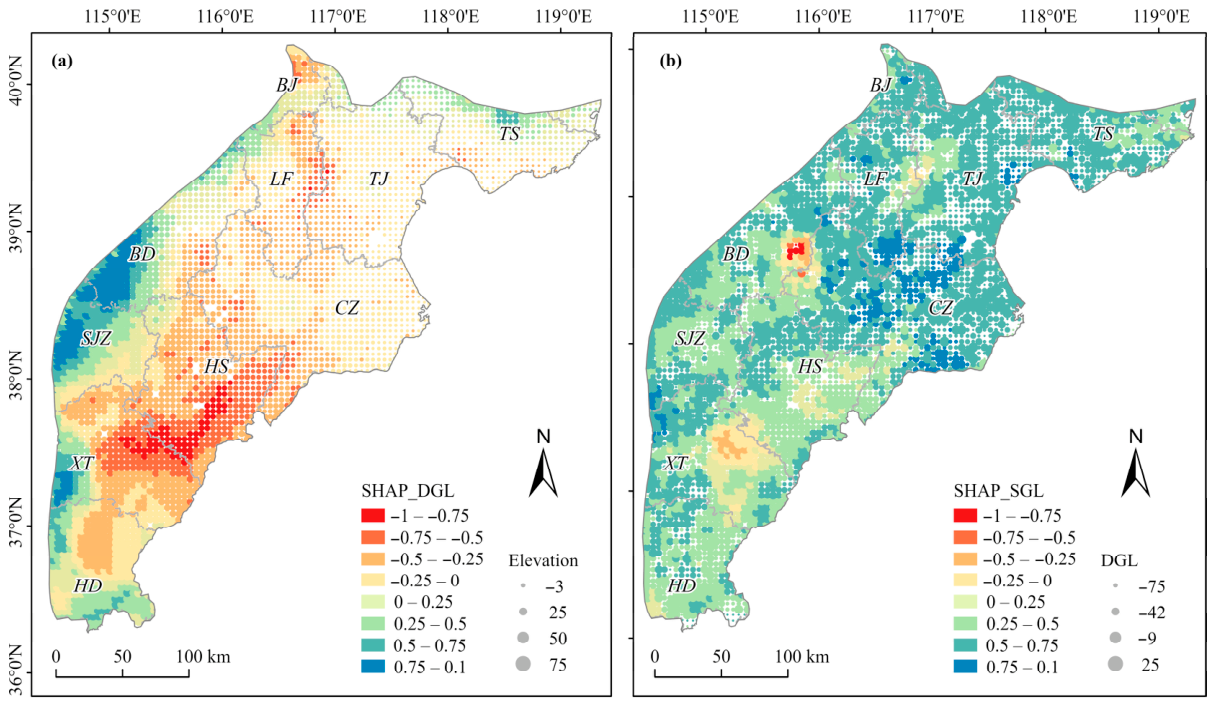
Beyond individual effects, interactions among key variables are important in shaping the spatial distribution of LS susceptibility. Previous studies have examined factor interactions using approaches such as the Geographical Detector. These studies suggest that LS is often driven by combined effects of groundwater use, geological structure and geomorphological conditions [41]. However, such methods mainly quantify interaction strength and provide limited information on spatial variation or local expression of interactions. Therefore, the spatial expression of coupled LS-driving mechanisms remains insufficiently resolved. Here, SHAP interaction analysis provides a complementary, spatially explicit view of factor interactions. Model predictions were broken down into pairwise interaction contributions, and their spatial patterns were mapped. This allows identification of where interactions increased to predict susceptibility. Figure 12 shows the spatial patterns of the strongest interactions, especially DGL–elevation and SGL-DGL.
Figure 11. Spatial distribution of normalised SHAP values for the four most influential factors controlling LS: (a) DGL, (b) SGL, (c) elevation, and (d) FD. Negative SHAP values indicate a promotive contribution to LS, whereas positive values indicate a suppressive effect. (The basement structure of the study area was revised after [58]).
Remotesensing 18 01298 g011
The interaction between DGL and elevation varies markedly across the study area. At elevations > 50 m, DGL is associated with higher predicted LS susceptibility in the southwestern study area. This pattern is most evident around Hengshui, Xingtai, and Handan (Figure 12a). Along the Langfang–Tianjin boundary, high susceptibility related to DGL was also observed under low-elevation conditions. These contrasts indicate that subsidence response to groundwater depletion depends on local geological and geomorphological conditions. The interaction between SGL and DGL highlights the role of multi-layer aquifer dynamics. In eastern Baoding, higher susceptibility related to SGL is observed, where DGL is relatively low (Figure 12b). Figure 11a shows that this area also has negative DGL SHAP values. This suggests that shallow and deep groundwater depletion jointly increase susceptibility. These interactions indicate that susceptibility is shaped by coupled groundwater dynamics across aquifer systems, rather than by changes in a single layer.
Figure 12. Spatial patterns of SHAP-based interaction effects between key influencing factors: (a) interaction between DGL and elevation, and (b) interaction between SGL and DGL. Positive and negative interaction SHAP values indicate promotive and suppressive contributions to LS, respectively.
Remotesensing 18 01298 g012
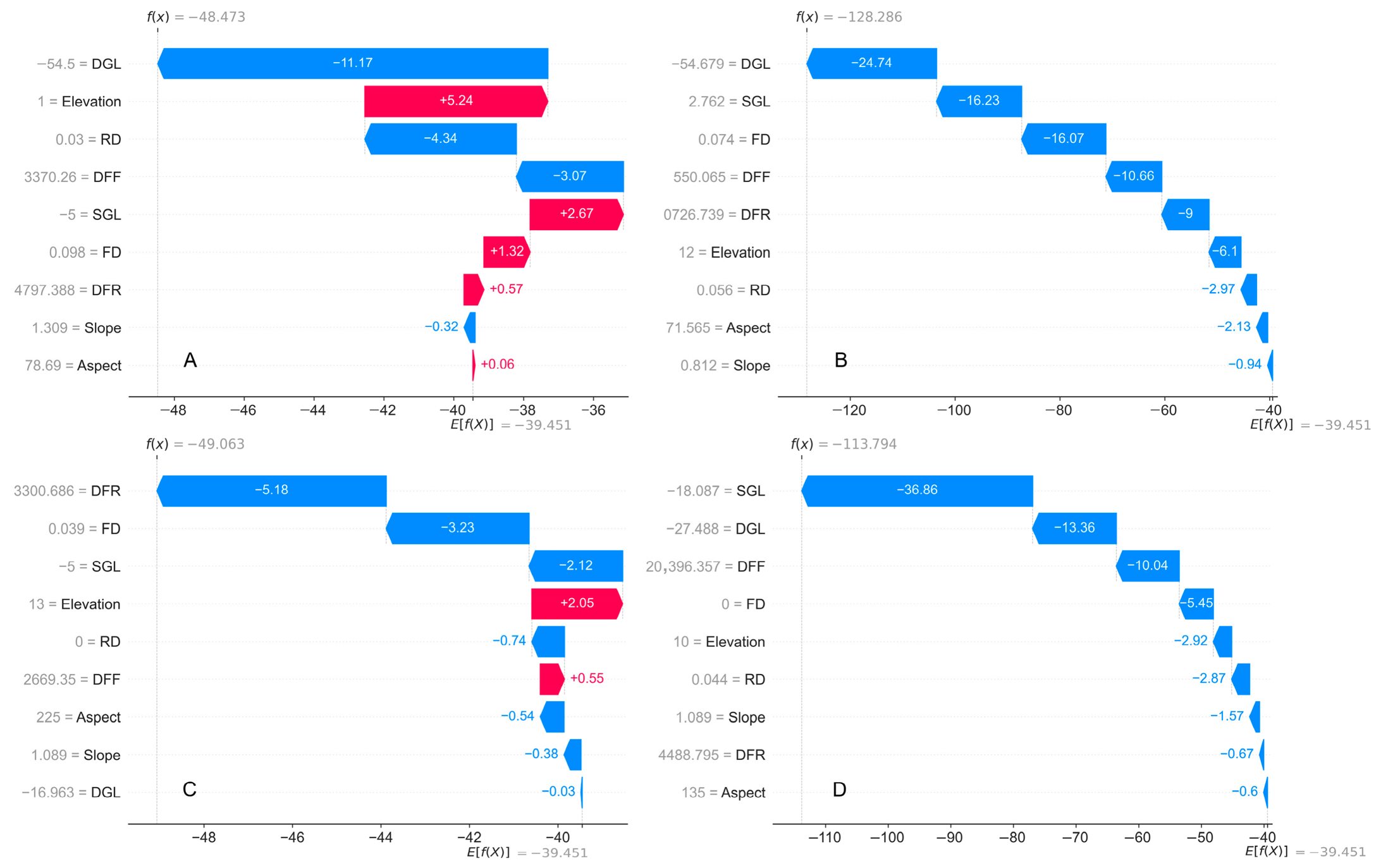
Local SHAP explanations provide further insights into heterogeneity in mechanisms driving LS (Figure 13). At low LS susceptibility (points A and C), different predictor combinations dominate the model output. Although dominant contributors differ between these locations, elevation consistently reduces predicted susceptibility at both locations. This suggests that favourable geomorphological settings can locally limit subsidence even under groundwater drawdown [59,60,61,62]. In contrast, points B and D fall within high-susceptibility zones and coincide with the combined groundwater depression cone. Their predictions are mainly driven by groundwater-related variables. At these sites, either DGL or SGL is the main contributor, depending on whether deep or shallow depletion dominates.
Together, interaction and local analyses suggest that LS in the BTH region arises from coupled hydrogeological processes modulated by subsurface and surface conditions. The SHAP-based framework links earth observation-derived deformation with nonlinear interactions among controlling factors. It supports both regional attribution and site-specific interpretation of LS mechanisms. These results support mitigation strategies that consider groundwater abstraction, local geology, and cross-aquifer interactions.

6. Conclusions

Based on the interpretable Earth observation framework, this study systematically analysed the spatial heterogeneity and driving mechanisms of LS susceptibility in the NCP. The results indicate that the combination of MT-InSAR and ML is effective for regional LS assessment. SHAP-based analysis further identified DGL as the dominant factor, followed by elevation and SGL. DGL showed a significant marginal effect on LS, with susceptibility increasing markedly when DGL ranged from −75 to 20 m. Elevation also showed a clear effect, especially within the range of 30–50 m, while relatively higher susceptibility was mainly observed where SGL was below −7 m. In contrast, slope and aspect had limited influence at the regional scale. This study also demonstrated that LS susceptibility was not controlled by a single factor alone. The strongest interaction effects occurred between DLG and elevation and between DGL and SGL. These interactions reveal that the response of LS to declines in groundwater depends on local geomorphological and hydrogeological conditions. The SHAP-based feature contributions and interaction effects present significant spatial heterogeneity. By mapping SHAP-based feature effects, this study clarifies where and how the dominant factors and their interactions shape LS susceptibility.
The findings of this study can inform targeted groundwater management and subsidence mitigation. Constrained by the shallow and deep groundwater level data (2016) collected, the model was constructed using the land displacement results from the same period. Therefore, this paper did not investigate the spatial–temporal mechanisms driving LS. Further research will integrate a time-series variation dataset to reveal the nonlinear response thresholds between influencing factors and the dynamic evolution of LS. Overall, combining MT-InSAR observations with explainable ML techniques supports regional LS monitoring and risk assessment.

Supplementary Materials

The following supporting information can be downloaded at https://www.mdpi.com/article/10.3390/rs18091298/s1, Figure S1: Summary plot SHAP interaction values for the first fifteen features; Table S1: Summary of relevant studies on ML-based LS simulation; Table S2: Information on fault zones.

Author Contributions

Conceptualisation, M.S. and X.W.; methodology, M.S.; software, X.W. and M.G.; validation, C.Z. and M.G.; writing—original draft preparation, M.S.; writing—review and editing, M.S. and C.G.; project administration, H.G.; funding acquisition, M.S. All authors have read and agreed to the published version of the manuscript.

Funding

This study is supported by the Basic Research Program of Jiangsu (BK20230620) and National Natural Science Foundation of China (42371081).

Data Availability Statement

The data presented in this study are available from the corresponding author upon reasonable request.

Acknowledgments

We thank the European Space Agency for their great efforts in developing and distributing the remotely sensed SAR data and for generosity in making Sentinel-1 available at no cost.

Conflicts of Interest

The authors declare no conflicts of interest.

References

  1. Herrera-García, G.; Ezquerro, P.; Tomas, R.; Béjar-Pizarro, M.; López-Vinielles, J.; Rossi, M.; Mateos, R.M.; Carreón-Freyre, D.; Lambert, J.; Teatini, P.; et al. Mapping the Global Threat of Land Subsidence. Science 2021, 371, 34–36. [Google Scholar] [CrossRef]
  2. Miller, M.M.; Shirzaei, M. Land Subsidence in Houston Correlated with Flooding from Hurricane Harvey. Remote Sens. Environ. 2019, 225, 368–378. [Google Scholar] [CrossRef]
  3. van der Horst, T.; Rutten, M.M.; van de Giesen, N.C.; Hanssen, R.F. Monitoring Land Subsidence in Yangon, Myanmar Using Sentinel-1 Persistent Scatterer Interferometry and Assessment of Driving Mechanisms. Remote Sens. Environ. 2018, 217, 101–110. [Google Scholar] [CrossRef]
  4. Tomás, R.; Romero, R.; Mulas, J.; Marturià, J.J.; Mallorquí, J.J.; Lopez-Sanchez, J.M.; Herrera, G.; Gutiérrez, F.; González, P.J.; Fernández, J.; et al. Radar Interferometry Techniques for the Study of Ground Subsidence Phenomena: A Review of Practical Issues through Cases in Spain. Environ. Earth Sci. 2014, 71, 163–181. [Google Scholar] [CrossRef]
  5. Lin, H.; Ma, P.; Wang, W. Urban Infrastructure Health Monitoring with Spaceborne Multi-Temporal Sysnthetic Aperture Radar Interferometry. Acta Geod. Cartogr. Sin. 2017, 46, 1421–1433. [Google Scholar]
  6. Crosetto, M.; Monserrat, O.; Cuevas-González, M.; Devanthéry, N.; Crippa, B. Persistent Scatterer Interferometry: A Review. ISPRS J. Photogramm. Remote Sens. 2016, 115, 78–89. [Google Scholar] [CrossRef]
  7. Hakim, W.L.; Fadhillah, M.F.; Park, S.; Pradhan, B.; Won, J.S.; Lee, C.W. InSAR Time-Series Analysis and Susceptibility Mapping for Land Subsidence in Semarang, Indonesia Using Convolutional Neural Network and Support Vector Regression. Remote Sens. Environ. 2023, 287, 113453. [Google Scholar] [CrossRef]
  8. Rahmati, O.; Falah, F.; Naghibi, S.A.; Biggs, T.; Soltani, M.; Deo, R.C.; Cerdà, A.; Mohammadi, F.; Tien Bui, D. Land Subsidence Modelling Using Tree-Based Machine Learning Algorithms. Sci. Total Environ. 2019, 672, 239–252. [Google Scholar] [CrossRef] [PubMed]
  9. Ye, S.; Luo, Y.; Wu, J.; Yan, X.; Wang, H.; Jiao, X.; Teatini, P. Three-Dimensional Numerical Modeling of Land Subsidence in Shanghai, China. Hydrogeol. J. 2016, 24, 695–709. [Google Scholar] [CrossRef]
  10. Zhu, L.; Franceschini, A.; Gong, H.; Ferronato, M.; Dai, Z.; Ke, Y.; Pan, Y.; Li, X.; Wang, R.; Teatini, P. The 3-D Facies and Geomechanical Modeling of Land Subsidence in the Chaobai Plain, Beijing. Water Resour. Res. 2020, 56, e2019WR027026. [Google Scholar] [CrossRef]
  11. Ding, Q.; Shao, Z.; Huang, X.; Altan, O.; Zhuang, Q.; Hu, B. Monitoring, Analyzing and Predicting Urban Surface Subsidence: A Case Study of Wuhan City, China. Int. J. Appl. Earth Obs. Geoinf. 2021, 102, 102422. [Google Scholar] [CrossRef]
  12. Li, H.; Zhu, L.; Dai, Z.; Gong, H.; Guo, T.; Guo, G.; Wang, J.; Teatini, P. Spatiotemporal Modeling of Land Subsidence Using a Geographically Weighted Deep Learning Method Based on PS-InSAR. Sci. Total Environ. 2021, 799. [Google Scholar] [CrossRef]
  13. Lyu, M.; Li, X.; Ke, Y.; Jiang, J.; Zhu, L.; Guo, L.; Gong, H.; Chen, B.; Xu, Z.; Zhang, K.; et al. Reconstruction of Spatially Continuous Time-Series Land Subsidence Based on PS-InSAR and Improved MLS-SVR in Beijing Plain Area. GISci. Remote Sens. 2023, 60, 2230689. [Google Scholar] [CrossRef]
  14. Radman, A.; Akhoondzadeh, M.; Hosseiny, B. Integrating InSAR and Deep-Learning for Modeling and Predicting Subsidence over the Adjacent Area of Lake Urmia, Iran. GISci. Remote Sens. 2021, 58, 1413–1433. [Google Scholar] [CrossRef]
  15. Wang, Z.; Guo, L.; Gong, H.; Li, X.; Zhu, L.; Sun, Y.; Chen, B.; Zhu, X. Land Subsidence Simulation Based on Extremely Randomized Trees Combined with Monte Carlo Algorithm. Comput. Geosci. 2023, 178. [Google Scholar] [CrossRef]
  16. Yuan, Y.; Zhang, D.; Cui, J.; Zeng, T.; Zhang, G.; Zhou, W.; Wang, J.; Chen, F.; Guo, J.; Chen, Z.; et al. Land Subsidence Prediction in Zhengzhou’s Main Urban Area Using the GTWR and LSTM Models Combined with the Attention Mechanism. Sci. Total Environ. 2024, 907. [Google Scholar] [CrossRef]
  17. Rahmati, O.; Golkarian, A.; Biggs, T.; Keesstra, S.; Mohammadi, F.; Daliakopoulos, I.N. Land Subsidence Hazard Modeling: Machine Learning to Identify Predictors and the Role of Human Activities. J. Environ. Manag. 2019, 236, 466–480. [Google Scholar] [CrossRef]
  18. Ghorbanzadeh, O.; Blaschke, T.; Aryal, J.; Gholaminia, K. A New GIS-Based Technique Using an Adaptive Neuro-Fuzzy Inference System for Land Subsidence Susceptibility Mapping. J. Spat. Sci. 2020, 65, 401–418. [Google Scholar] [CrossRef]
  19. Arabameri, A.; Chandra Pal, S.; Rezaie, F.; Chakrabortty, R.; Chowdhuri, I.; Blaschke, T.; Thi Ngo, P.T. Comparison of Multi-Criteria and Artificial Intelligence Models for Land-Subsidence Susceptibility Zonation. J. Environ. Manag. 2021, 284, 112067. [Google Scholar] [CrossRef] [PubMed]
  20. Zhao, F.; Miao, F.; Wu, Y.; Xiong, Y.; Gong, S.; Sun, D. Land Subsidence Susceptibility Mapping in Urban Settlements Using Time-Series PS-InSAR and Random Forest Model. Gondwana Res. 2024, 125, 406–424. [Google Scholar] [CrossRef]
  21. Alesheikh, A.A.; Chatrsimab, Z.; Rezaie, F.; Lee, S.; Jafari, A.; Panahi, M. Land Subsidence Susceptibility Mapping Based on InSAR and a Hybrid Machine Learning Approach. Egypt. J. Remote Sens. Space Sci. 2024, 27, 255–267. [Google Scholar] [CrossRef]
  22. Seihani, R.; Gholami, H.; Esmaeilpour, Y.; Kamali, A.; Zareh, M. Interpretation Techniques to Explain the Output of a Spatial Land Subsidence Hazard Model in an Area with a Diverted Tributary. Appl. Comput. Geosci. 2024, 23, 100191. [Google Scholar] [CrossRef]
  23. Haaf, E.; Wikby, P.; Abed, A.; Sundell, J.; McGivney, E.; Rosén, L.; Karstunen, M. A Metamodel for Estimating Time-Dependent Groundwater-Induced Subsidence at Large Scales. Eng. Geol. 2024, 341, 107705. [Google Scholar] [CrossRef]
  24. Zhang, B.; Xu, C.; Dai, X.; Xiong, X. Research on Mining Land Subsidence by Intelligent Hybrid Model Based on Gradient Boosting with Categorical Features Support Algorithm. J. Environ. Manag. 2024, 354, 120309. [Google Scholar] [CrossRef]
  25. Jiang, M.; Wu, Z.; Wang, X.; Bai, L.; Li, Z.; Lu, Z. Mapping Wide-Area Land Subsidence from Groundwater Use in the North China Plain by Machine Learning-Based InSAR Adjustment. Remote Sens. Environ. 2026, 334, 115226. [Google Scholar] [CrossRef]
  26. Zhang, X.; Hu, J.; Motagh, M.; Li, M.; Wang, Y.; Yang, Q.; Su, G.; Wang, H. Groundwater Volume Loss and Land Subsidence in the North China Plain Investigated Using Wide-Area InSAR Surveying and Mechanical Modeling. Remote Sens. Environ. 2026, 333, 115164. [Google Scholar] [CrossRef]
  27. Shi, M.; Gong, H.; Gao, M.; Chen, B.; Zhang, S.; Zhou, C. Recent Ground Subsidence in the North China Plain, China, Revealed by Sentinel-1a Datasets. Remote Sens. 2020, 12, 3579. [Google Scholar] [CrossRef]
  28. Guo, H.; Bai, J.; Zhang, Y.; Wang, L.; Shi, J.; Li, W.; Zhang, Z.; Wang, Y.; Zhu, J.; Wang, H. The Evolution Characteristics and Mechanism of the Land Subsidence in Typical Areas of the North China Plain. Geol. China 2017, 44, 1115–1127. [Google Scholar] [CrossRef]
  29. Su, G.; Wu, Y.; Zhan, W.; Zheng, Z.; Chang, L.; Wang, J. Spatiotemporal Evolution Characteristics of Land Subsidence Caused by Groundwater Depletion in the North China Plain during the Past Six Decades. J. Hydrol. 2021, 600, 126678. [Google Scholar] [CrossRef]
  30. Zhou, C.; Gong, H.; Chen, B.; Gao, M.; Cao, Q.; Cao, J.; Duan, L.; Zuo, J.; Shi, M. Land Subsidence Response to Dierent Land Use Types and Water Resource Utilization in Beijing-Tianjin-Hebei, China. Remote Sens. 2020, 12, 457. [Google Scholar] [CrossRef]
  31. Yang, H.; Cao, W.; Zhi, C.; Li, Z.; Bao, X.; Ren, Y.; Liu, F.; Fan, C.; Wang, S.; Wang, Y. Evolution of Groundwater Level in the North China Plain in the Past 40 Years and Suggestions on Its Overexploitation Treatment. Geol. China 2021, 48, 1142–1155. [Google Scholar]
  32. Chen, Z.; Qi, J.; Xu, J.; Xu, J.; Ye, H.; Nan, Y. Paleoclimatic Interpretation of the Past 30 Ka from Isotopic Studies of the Deep Confined Aquifer of the North China Plain. Appl. Geochem. 2003, 18, 997–1009. [Google Scholar] [CrossRef]
  33. Chen, Z.; Nie, Z.; Zhang, Z.; Qi, J.; Nan, Y. Isotopes and Sustainability of Ground Water Resources, North China Plain. Groundwater 2005, 43, 485–493. [Google Scholar] [CrossRef]
  34. Xue, X.; Li, J.; Xie, X.; Qian, K.; Wang, Y. Impacts of Sediment Compaction on Iodine Enrichment in Deep Aquifers of the North China Plain. Water Res. 2019, 159, 480–489. [Google Scholar] [CrossRef]
  35. Chaussard, E.; Wdowinski, S.; Cabral-Cano, E.; Amelung, F. Land Subsidence in Central Mexico Detected by ALOS InSAR Time-Series. Remote Sens. Environ. 2014, 140, 94–106. [Google Scholar] [CrossRef]
  36. Haghshenas, M.; Motagh, M. Ground Surface Response to Continuous Compaction of Aquifer System in Tehran, Iran: Results from a Long-Term Multi-Sensor InSAR Analysis. Remote Sens. Environ. 2019, 221, 534–550. [Google Scholar] [CrossRef]
  37. Fei, Y.; Miao, J.; Zhang, Z.; Chen, Z.; Song, H.; Yang, M. Analysis on Evolution of Groundwater Depression Cones and Its Leading Factors in North China Plain. Resour. Sci. 2009, 31, 394–399. [Google Scholar]
  38. Xie, J.; Yang, G.; Bo, W. Study on the Regional Deformation Field and Strong Earthquake Risk of Beijing Area in the near Future. North China Earthq. Sci. 2002, 20, 1–9. [Google Scholar]
  39. Guo, L.; Bo, W.; Yang, G. Characteristics of Current Deformation of Fault Belts in North China. Crustal Deform. Earthq. 2003, 23, 29–36. Available online: http://dx.chinadoi.cn/10.3969/j.issn.1671-5942.2003.02.005 (accessed on 25 February 2026). (In Chinese)
  40. Lian, S.; Ding, L.; Chen, J. Scale Selecting of Geographic National Conditions Information Statistical—A Case Study of Grids with Spatial Autocorrelation—Vegetation Cover Information Statistics. Bull. Surv. Mapp. 2017, 3, 46–51. [Google Scholar]
  41. Xiao, W.; Yang, W.; Li, C.; Tian, H.; Zheng, D.; Bo, P. Detection of Influence Factors and Their Interaction of Land Subsidence in Beijing Based on PS-InSAR. Geomat. World 2020, 27, 7–13. [Google Scholar]
  42. Azarakhsh, Z.; Azadbakht, M.; Matkan, A. Estimation, Modeling, and Prediction of Land Subsidence Using Sentinel-1 Time Series in Tehran-Shahriar Plain: A Machine Learning-Based Investigation. Remote Sens. Appl. Soc. Environ. 2022, 25, 100691. [Google Scholar] [CrossRef]
  43. Liu, Z.; Ng, A.H.M.; Wang, H.; Chen, J.; Du, Z.; Ge, L. Land Subsidence Modeling and Assessment in the West Pearl River Delta from Combined InSAR Time Series, Land Use and Geological Data. Int. J. Appl. Earth Obs. Geoinf. 2023, 118, 103228. [Google Scholar] [CrossRef]
  44. Zhou, C.; Gong, H.; Chen, B.; Li, X.; Li, J.; Wang, X.; Gao, M.; Si, Y.; Guo, L.; Shi, M.; et al. Quantifying the Contribution of Multiple Factors to Land Subsidence in the Beijing Plain, China with Machine Learning Technology. Geomorphology 2019, 335, 48–61. [Google Scholar] [CrossRef]
  45. Han, J.; Gong, H.; Guo, L.; Li, X.; Zhu, L.; Chen, B.; Zhang, Q.; Wu, L.; Lei, J.; Zhu, X. Mechanism the Land Subsidence from Multiple Spatial Scales and Hydrogeological Conditions—A Case Study in Beijing-Tianjin-Heibei, China. J. Hydrol. Reg. Stud. 2023, 50, 101531. [Google Scholar] [CrossRef]
  46. Chen, T.; Guestrin, C. XGBoost: A Scalable Tree Boosting System. In Proceedings of the ACM SIGKDD International Conference on Knowledge Discovery and Data Mining, San Francisco, CA, USA, 13–17 August 2016. [Google Scholar]
  47. Ma, M.; Zhao, G.; He, B.; Li, Q.; Dong, H.; Wang, S.; Wang, Z. XGBoost-Based Method for Flash Flood Risk Assessment. J. Hydrol. 2021, 598, 126382. [Google Scholar] [CrossRef]
  48. Zhang, W.; Wu, C.; Tang, L.; Gu, X.; Wang, L. Efficient Time-Variant Reliability Analysis of Bazimen Landslide in the Three Gorges Reservoir Area Using XGBoost and LightGBM Algorithms. Gondwana Res. 2022, 123, 41–53. [Google Scholar] [CrossRef]
  49. Zhang, J.; Ma, X.; Zhang, J.; Sun, D.; Zhou, X.; Mi, C.; Wen, H. Insights into Geospatial Heterogeneity of Landslide Susceptibility Based on the SHAP-XGBoost Model. J. Environ. Manag. 2023, 332, 117357. [Google Scholar] [CrossRef]
  50. Lundberg, S.M.; Lee, S.I. A Unified Approach to Interpreting Model Predictions. In Proceedings of the Advances in Neural Information Processing Systems, Long Beach, CA, USA, 4–9 December 2017. [Google Scholar]
  51. Lundberg, S.M.; Erion, G.; Chen, H.; DeGrave, A.; Prutkin, J.M.; Nair, B.; Katz, R.; Himmelfarb, J.; Bansal, N.; Lee, S.I. From Local Explanations to Global Understanding with Explainable AI for Trees. Nat. Mach. Intell. 2020, 2, 56–67. [Google Scholar] [CrossRef] [PubMed]
  52. Doumard, E.; Aligon, J.; Escriva, E.; Excoffier, J.B.; Monsarrat, P.; Soulé-Dupuy, C. A Quantitative Approach for the Comparison of Additive Local Explanation Methods. Inf. Syst. 2023, 114, 102162. [Google Scholar] [CrossRef]
  53. Jiang, S.; Sweet, L.-b.; Blougouras, G.; Brenning, A.; Li, W.; Reichstein, M.; Denzler, J.; Shangguan, W.; Yu, G.; Huang, F.; et al. How Interpretable Machine Learning Can Benefit Process Understanding in the Geosciences. Earths Future 2024, 12, e2024EF004540. [Google Scholar] [CrossRef]
  54. Bai, Y.; Zhang, L. Study on Relationship between Geological Hazard and Groundwater in Cangzhou, Hebei Province. Chin. J. Geol. Hazard Control 2005, 16, 71–73. [Google Scholar]
  55. Dong, K.; Xu, M.; Yu, Q.; Wang, W. Threshold of Groundwater Over-Exploitation and Conservation-Restoration in Tianjin Land Subsidence Area. Groundwater 2010, 32, 30–33. [Google Scholar]
  56. Gong, H.; Pan, Y.; Zheng, L.; Li, X.; Zhu, L.; Zhang, C.; Huang, Z.; Li, Z.; Wang, H.; Zhou, C. Long-Term Groundwater Storage Changes and Land Subsidence Development in the North China Plain (1971–2015). Hydrogeol. J. 2018, 26, 1417–1427. [Google Scholar] [CrossRef]
  57. Huang, Z.H.; Huo, Z.B.; Wang, W.; Zhu, J.X.; Zhang, C.H.; Xi, R.P. Analysis of Driving Factors for Land Subsidence in Typical Cities of the North China Plain Based on Geodetector Technology. J. Groundw. Sci. Eng. 2025, 13, 74–89. [Google Scholar] [CrossRef]
  58. Qinghai, X.; Chen, W.; Xiaolan, Y.; Ningjia, Z. Palaeochannels on the North China Plain: Relationships between Their Development and Tectonics. Geomorphology 1996, 18, 27–35. [Google Scholar] [CrossRef]
  59. Chen, B.; Gong, H.; Lei, K.; Li, J.; Zhou, C.; Gao, M. Geoinformation Land Subsidence Lagging Quantification in the Main Exploration Aquifer Layers in Beijing Plain, China. Int. J. Appl. Earth Obs. Geoinf. 2019, 75, 54–67. [Google Scholar] [CrossRef]
  60. Yu, H.; Gong, H.; Chen, B.; Liu, K.; Gao, M. Analysis of the Influence of Groundwater on Land Subsidence in Beijing Based on the Geographical Weighted Regression (GWR) Model. Sci. Total Environ. 2020, 738, 139405. [Google Scholar] [CrossRef] [PubMed]
  61. Shi, M.; Gao, M.; Chen, Z.; Lyu, M.; Gong, H.; Zhai, Y.; Pan, Y. Land Subsidence in Beijing: Response to the Joint Influence of the South-to-North Water Diversion Project and Ecological Water Replenishment, Observed by Satellite Radar Interferometry. GIScience Remote Sens. 2024, 61, 2315708. [Google Scholar] [CrossRef]
  62. Zhu, L.; Gong, H.; Chen, Y.; Wang, S.; Ke, Y.; Guo, G.; Li, X.; Chen, B.; Wang, H.; Teatini, P. Effects of Water Diversion Project on Groundwater System and Land Subsidence in Beijing, China. Eng. Geol. 2020, 276, 105763. [Google Scholar] [CrossRef]
Figure 1. The location of the study site. The location of the groundwater depression cone and the coverage of the deep groundwater area are derived from [37].
Remotesensing 18 01298 g001
Figure 2. Flowchart of methodology applied in this study.
Remotesensing 18 01298 g002
Figure 3. The framework of the InSAR processing procedure used in this study.
Remotesensing 18 01298 g003
Figure 4. Moran’s I difference for grid data.
Remotesensing 18 01298 g004
Figure 5. Geoenvironmental factors.
Remotesensing 18 01298 g005
Figure 6. The left panel shows the vertical displacement velocity obtained from Sentinel-1A (S1A) observations using the InSAR technique. The right panel presents a comparison between the InSAR-derived results and levelling measurements.
Remotesensing 18 01298 g006
Figure 7. Land subsidence hazard map generated using XGBoost.
Remotesensing 18 01298 g007
Figure 8. SHAP values for contribution of features to LS prediction.
Remotesensing 18 01298 g008
Figure 9. SHAP dependence scatter plots for all independent features. The blue shade shows the bootstrap 95% confidence interval for SHAP values.
Remotesensing 18 01298 g009
Figure 10. SHAP dependence scatter plots showing interactions: (a) DGL between Elevation; (b) SGL between DGL; (c) SGL between Elevation and (d) DGL between FD.
Remotesensing 18 01298 g010
Figure 13. SHAP-based explanations of the contributions of factors influencing LS at four randomly selected sample locations. The locations of the sample points are indicated by black crosses in Figure 6.
Remotesensing 18 01298 g013
Table 1. Characteristics of the SAR dataset used in this study.
Track Sentinel-1A
4014269
Band/wavelength (cm)C/5.6
Altitude (km)693
Orbit directionAscending
Image modeInterferometric wide swath
PolarisationVertical-vertical
Number of images16514198
Data range160107–181128160114–181018160109–181001
Table 2. Details of XGBoost model hyperparameters.
NameDefault Value
colsample_bytree0.9
gamma1.5
learning_rate0.05
max_depth7
min_child_weight5
subsample0.8
reg_alpha3
reg_lambda1
Table 3. Summary of variable TOL and VIF values.
VariablesTOLVIF
Aspect0.9671.034
Deep groundwater level0.5031.990
Distance from faults0.5141.945
Distance from rivers0.9021.108
Elevation0.3972.516
Fault density0.4822.073
River density0.9981.002
Shallow groundwater level0.6741.483
Slope0.9631.038
Table 4. Classification statistics of LS hazard mapping results.
Susceptibility ClassVery LowLowHighVery High
Area (%)38.829.720.511.0
Disclaimer/Publisher’s Note: The statements, opinions and data contained in all publications are solely those of the individual author(s) and contributor(s) and not of MDPI and/or the editor(s). MDPI and/or the editor(s) disclaim responsibility for any injury to people or property resulting from any ideas, methods, instructions or products referred to in the content.