1. Introduction
The ocean plays a crucial role in global transportation and economic exchange. With the increasing frequency of marine resource exploitation and global maritime activities, the monitoring of ship targets in the sea has become a key technical requirement for safeguarding maritime rights and maintaining maritime security. Synthetic aperture radar (SAR) is an active microwave remote sensing technology. By the coherent processing of scattered signals obtained from the movement trajectory of radar platform, SAR can synthesize a larger antenna aperture effectively, thereby breaking through the physical limitation of antenna size and achieving higher resolution beyond that of traditional real-aperture radars. SAR has the ability to capture images day and night. Its working wavelength is usually between 3 and 75 cm (equivalent to X, C, S, L and P bands), which enables SAR signals to penetrate clouds, vegetation and certain surface materials effectively [
1]. Therefore, SAR plays a significant role in applications such as Earth observation, environment monitoring and marine management.
Obtaining real SAR echo signals of ship targets in the marine environment is not only costly and inefficient, but also subject to various limitations such as weather and equipment conditions. Therefore, establishing a high-precision simulation system to simulate SAR echo data in actual scenarios is of great significance. By simulating SAR echo signals, various complex marine scenarios can be realistically simulated, including the characteristics of sea clutter under different sea conditions, the movement patterns of different ship targets, and different SAR imaging mechanisms [
2,
3]. This provides a virtual testing environment for the design and optimization of SAR systems, helping to analyze the system performance deeply and reducing the cost and risks of actual development.
In recent years, various SAR echo simulation technologies have been developed, which can be broadly classified into two categories: those based on hardware and those based on software. Hardware-based simulation methods aim to reproduce SAR echo signals through physical devices, such as radar target simulators and hardware-in-the-loop (HIL) systems. These methods can generate highly realistic echo signals by modeling the signal transmission, delay, Doppler effect and system response directly in real time. In 2014, Yuan developed an FPGA-based SAR echo simulator to address the high computational burden of traditional software-based echo generation. By implementing the SAR signal generation algorithm on a dedicated digital signal processing board, the simulator is capable of producing echo signals in a significantly accelerated manner with reduced energy consumption [
4]. In 2015, Xu proposed a real-time SAR echo simulator based on multi-FPGA parallel computing architecture. The system employs a pipeline structure and multi-channel parallel processing to accelerate echo generation, enabling real-time simulation for both point targets and natural scenes [
5].
Although hardware-based SAR simulators provide high real-time performance and fidelity, they are typically optimized for fixed or small-scale test scenarios, such as single-point targets or static environments. When applied to large-scale, dynamic marine scenes with multiple moving vessels or complex sea clutter, these systems become difficult to adapt without substantial redesign, limiting their flexibility and scalability across different application domains.
In contrast to hardware-based simulators, software-based SAR simulation techniques provide greater adaptability and lower implementation cost by numerically modeling the radar signal formation process. Broadly speaking, software approaches can be classified into image-level simulation and echo-level simulation. Image-level methods focus on generating SAR images directly by modeling scene reflectivity or scattering characteristics without simulating SAR raw echo signal explicitly. These methods are highly efficient in computation, but at the cost of sacrificing the physical consistency with actual SAR signal generation [
6].
By contrast, echo-level simulation methods seek to reproduce complete SAR signal acquisition processes, including electromagnetic wave propagation, target scattering and coherent signal collection at the sensor, followed by processing with conventional imaging algorithms. A fundamental and widely adopted framework is the time-domain point target method, which has been systematically formulated in the literature, notably in
Synthetic Aperture Radar Processing by Franceschetti. In this method, the observed scene is discretized into a collection of point scatterers, and the raw echo is synthesized by coherently summing the time-delayed and phase-modulated contributions from each scatterer according to the radar geometry [
7]. This approach provides high physical fidelity and strong modeling flexibility, but suffers from extremely high computational complexity when applied to large-scale scenes. In 2005, Cumming presented a frequency-domain framework for SAR signal modeling in
Digital Processing of Synthetic Aperture Radar Data, where SAR system is characterized by a two-dimensional transfer function in range–Doppler or wavenumber domain. Based on this framework, echo signals can be generated efficiently via inverse transforms [
8]. This method offers high computational efficiency, but is generally less flexible in handling complex motion and scattering scenarios compared with time-domain approaches.
Whichever category is used, a core technical challenge in software SAR simulation lies in accurate modeling of scattering characteristics of the scene and targets, because radar cross section (RCS) and its spatial and temporal variation directly determine the amplitude and phase of received echo signal. In 2024, Hua proposed a time-domain RCS modeling method based on a forward scattering center model, which constructs the unit impulse response of complex targets and convolves it with arbitrary wideband signals to generate synthetic echoes [
9]. This approach improves computational efficiency significantly and allows flexible adaptation to different waveforms, though it mainly targets static objects and relies on the accuracy of the scattering center model for more complex or dynamic scenarios. In 2025, Li focused on marine ship targets, combining physical optics-based RCS computation with echo generation algorithms to simulate SAR echo under varying incident angles, distances and target materials [
10]. This method produces realistic amplitude variations in simulated echo, but its applicability is mainly limited to ships and sea targets, and it provides only simplified phase information, which may restrict its use in high-fidelity coherent imaging scenarios.
Although the aforementioned methods can effectively generate SAR echo or simulate target RCS in specific scenarios, they each have certain limitations. Some approaches are only suitable for particular target types or static scenes and struggle to handle large-scale sea surfaces with multiple ships. High-fidelity electromagnetic simulation, while accurate, is computationally expensive and time-consuming, whereas fast RCS modeling methods offer efficiency but have limited capability in capturing dynamic behaviors or complex scattering structures.
This paper aims to develop a complete method for simulating the SAR echo signals of various ship motion targets under complex sea conditions. Therefore, this paper has referenced, integrated and improved various existing methods, and combined multiple software platforms to propose a SAR echo simulation method based on model segmentation and electromagnetic scattering characteristic simulation. This method aims to maximize efficiency while ensuring authenticity and accuracy of the simulation, providing a practical solution for SAR echo simulation of large-scale sea surface ship targets.
The content arrangement of this article is as follows:
Section 1 is the introduction, where some existing technologies are summarized and analyzed, and the purpose and significance of this research are clarified.
Section 2 is materials and methods, which is further divided into four sections. The first part focuses on the research of sea surface model simulation and segmentation methods under complex sea conditions. The second part studies a method for segmenting complex ship models rapidly. The third part focuses on the simulation methods for electromagnetic scattering characteristics of the sea surface and the ship model. The fourth part studies an efficient and accurate method for simulating SAR echo signals.
Section 3 corresponds to
Section 2, and it presents the results of each part of the research, as well as conducts analysis and verification.
Section 4 conducts a detailed analysis and discussion on the application value, shortcomings, and subsequent improvement directions of the research content of this article.
Section 5 summarizes the research work and results of this paper.
2. Materials and Methods
2.1. Simulation and Segmentation of Sea Model
Wave spectrum refers to the distribution of wave energy on sea surface in terms of frequency and direction. It is obtained through Fourier transform of the autocorrelation function of sea surface height variations and reveals the second-order statistical characteristics of waves and the distribution laws of wave energy in different wavelengths and directions. By establishing an actual sea model based on wave spectrum, the wave fluctuation characteristics under various sea conditions can be described, which helps to improve accuracy, prediction ability and practical application of the sea surface electromagnetic scattering model, and reveal the influence of different marine environments on electromagnetic wave scattering [
11,
12]. The commonly used wave spectrum includes the PM spectrum, the JONSWAP spectrum, the Elfouhaily spectrum, etc.
The PM wave spectrum is one of the most classic and fundamental empirical wave spectrum models. It was derived by Pierson and Moskowitz based on the analysis of a large amount of measured data from the North Atlantic. Its core assumption is that the sea surface is in a fully developed state, that is, the wind speed is constant, the wind direction is constant, the wind blowing time is long enough, and the wind blowing distance is infinite. At this time, wave energy can only be determined by wind speed and reaches statistical equilibrium [
13]. The PM wave spectrum can be expressed as follows:
where
and
are dimensionless empirical constants,
is the gravitational acceleration,
is wave number and
is wind speed at a height of 19.5 m above sea level. Its relationship with
, wind speed at a height of 10 m above sea level is:
.
The JONSWAP wave spectrum is an empirical wave spectrum derived from measurements in the North Sea, designed to represent fetch-limited seas. Unlike the PM spectrum, which assumes a fully developed sea, the JONSWAP spectrum accounts for finite fetch effects by introducing a peak enhancement factor
, which sharpens the spectral peak near the dominant wavenumber. This allows it to better capture the energy concentration in developing seas and the associated higher wave heights around the spectral peak. For fully developed sea, the peak enhancement factor
is 1, and the JONSWAP spectrum simplifies to the PM spectrum [
14].
The Elfouhaily wave spectrum is a unified directional sea surface spectrum that combines both long gravity waves and short capillary-gravity waves. It is derived based on a combination of theoretical considerations and field observations, providing a smooth transition between low-frequency (gravity) and high-frequency (capillary) components [
15].
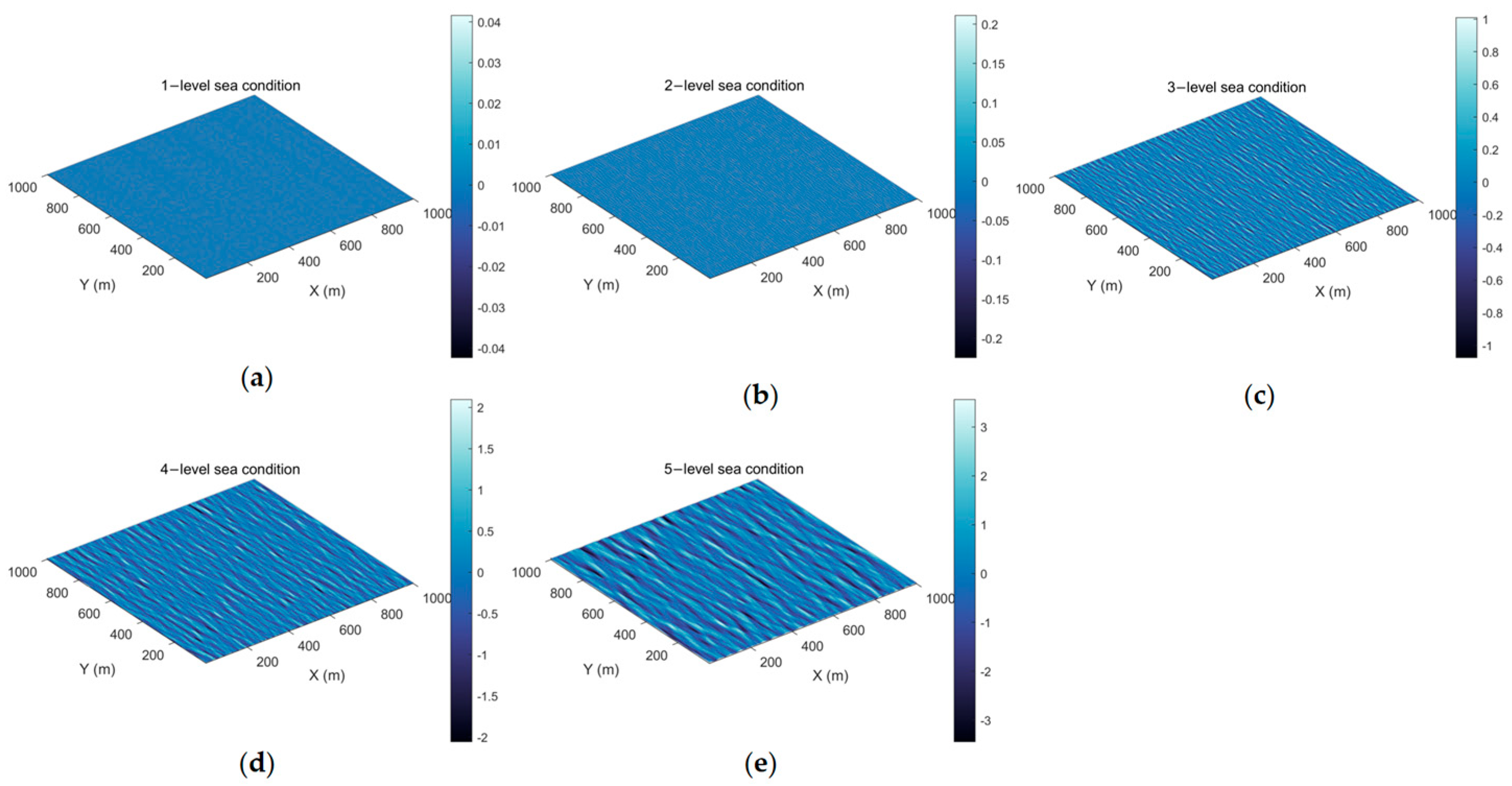
Internationally, the sea states codes based on Douglas sea scale is commonly used to describe the level of ocean waves. It uses wind speed and wave height to describe specific changes on the sea surface. The corresponding relationship is shown in
Table 1 [
16].
The Monte Carlo method conducts inversion simulation based on the wave spectrum model, thereby obtaining actual wave fluctuations. It is the most commonly used two-dimensional linear sea surface modeling method. This method regards waves as a superposition of a series of harmonics with different wavelengths, periods, and initial phases. Firstly, it converts the white noise to frequency domain through Fourier transformation. Then, it uses wave spectrum to filter the result. Finally, it obtains the expression of filtered rough sea surface height fluctuations through inverse Fourier transformation [
17,
18]:
where
,
,
,
and
respectively represent the total length of the sea surface in
and
directions.
is a complex Gaussian random sequence,
denotes taking complex conjugate,
represents two-dimensional sea spectrum. To ensure that the sea surface height
is a real number, the Hermitian form of equation
should satisfy following condition:
Finally, through IFFT, it obtains that:
Throughout the entire process, FFT and IFFT are required. Therefore, the spatial geometric length of the sea surface needs to be discretized, and at the same time, the Nyquist theorem must be satisfied:
where
represents the sampling frequency in
direction,
represents the sampling interval of
. Similarly, the sampling in
direction also needs to comply with the Nyquist theorem.
and
respectively represent cutoff wavenumber and minimum wavenumber, and their values determine bandwidth of the band to be extracted on the wave spectrum. Due to different energy intervals of wave spectrum corresponding to different wind speeds, it is necessary to ensure that the energy distribution range of the wave spectrum under current wind speed is as much as possible included within the wave number range
[
19].
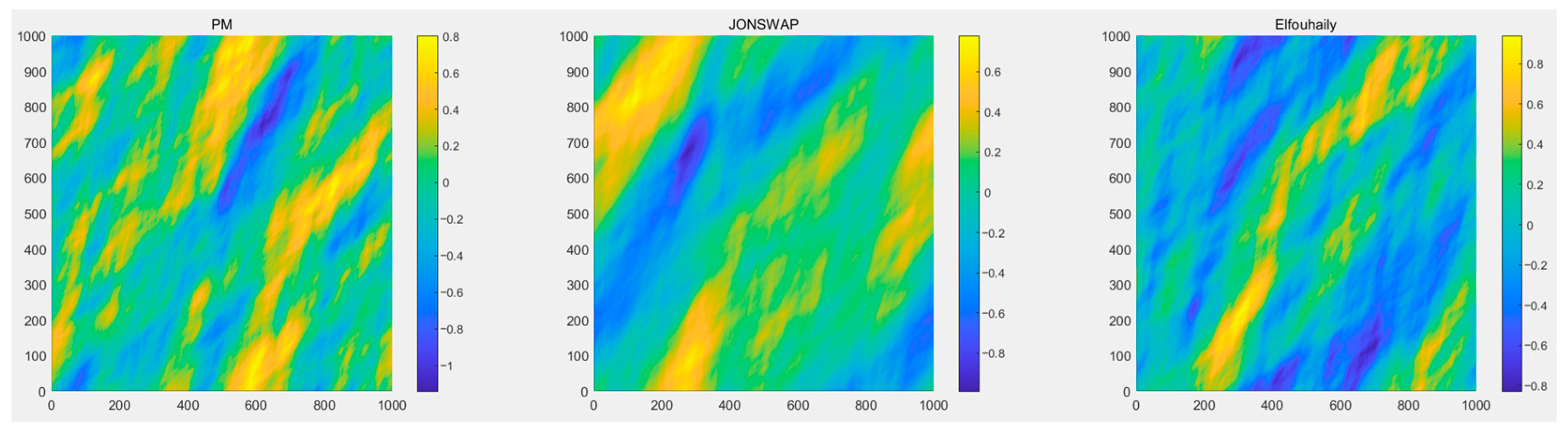
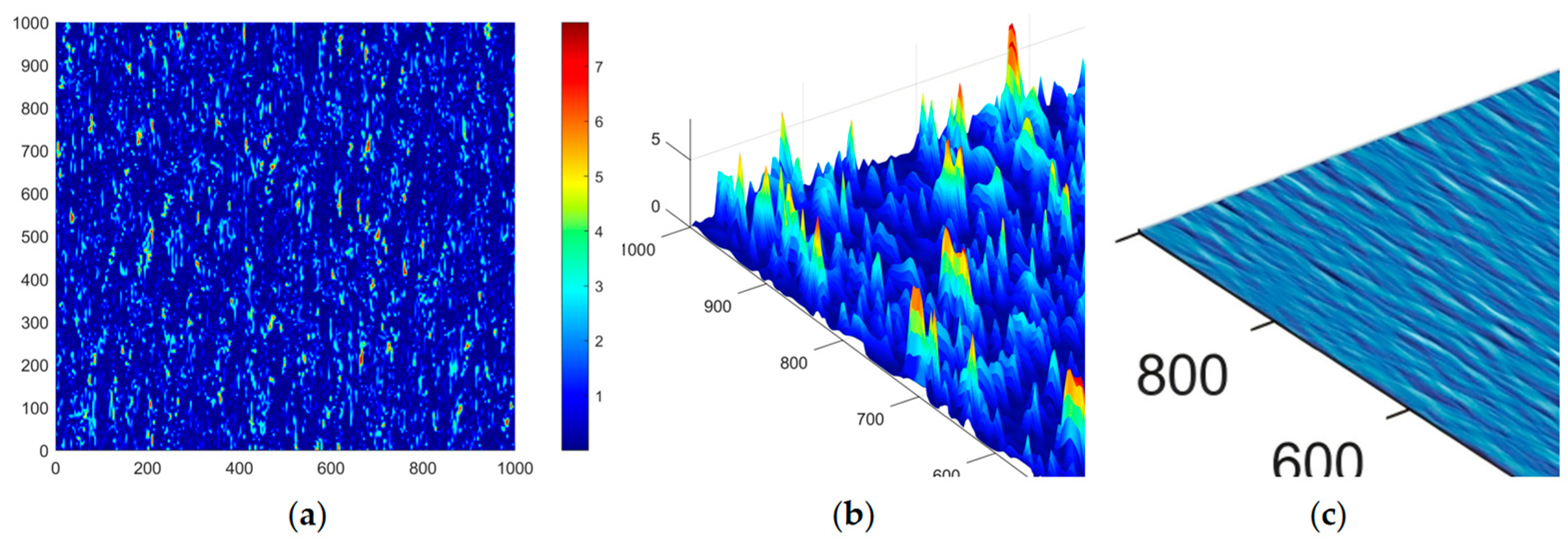
To compare the differences among the PM spectrum, the JONSWAP spectrum and the Elfouhaily spectrum, taking 3-level sea condition as an example, the sea model simulations were conducted using these three models respectively. The time consumption, RMS (root mean square) height, skewness, and kurtosis were measured as indicators. Among them, the RMS height
, which is equivalent to the standard deviation of sea surface height and characterizes the intensity of sea surface’s undulation. The skewness
, which is used to measure whether the distribution is symmetrical. When the skewness is equal to 0, the sea surface is completely symmetrical. When the skewness is greater than 0, the wave peaks on sea surface are sharper and the wave troughs are flatter. When the skewness is less than 0, the troughs on the sea surface are deeper. The kurtosis
, which is used to measure the sharpness of the distribution. When the kurtosis is equal to 3, the sea surface conforms to a Gaussian distribution. When the kurtosis is greater than 3, more peaks appear on the sea surface. When the kurtosis is less than 3, the sea surface becomes smoother [
20,
21]. The simulation results and analysis can be found in the first part of
Section 3.
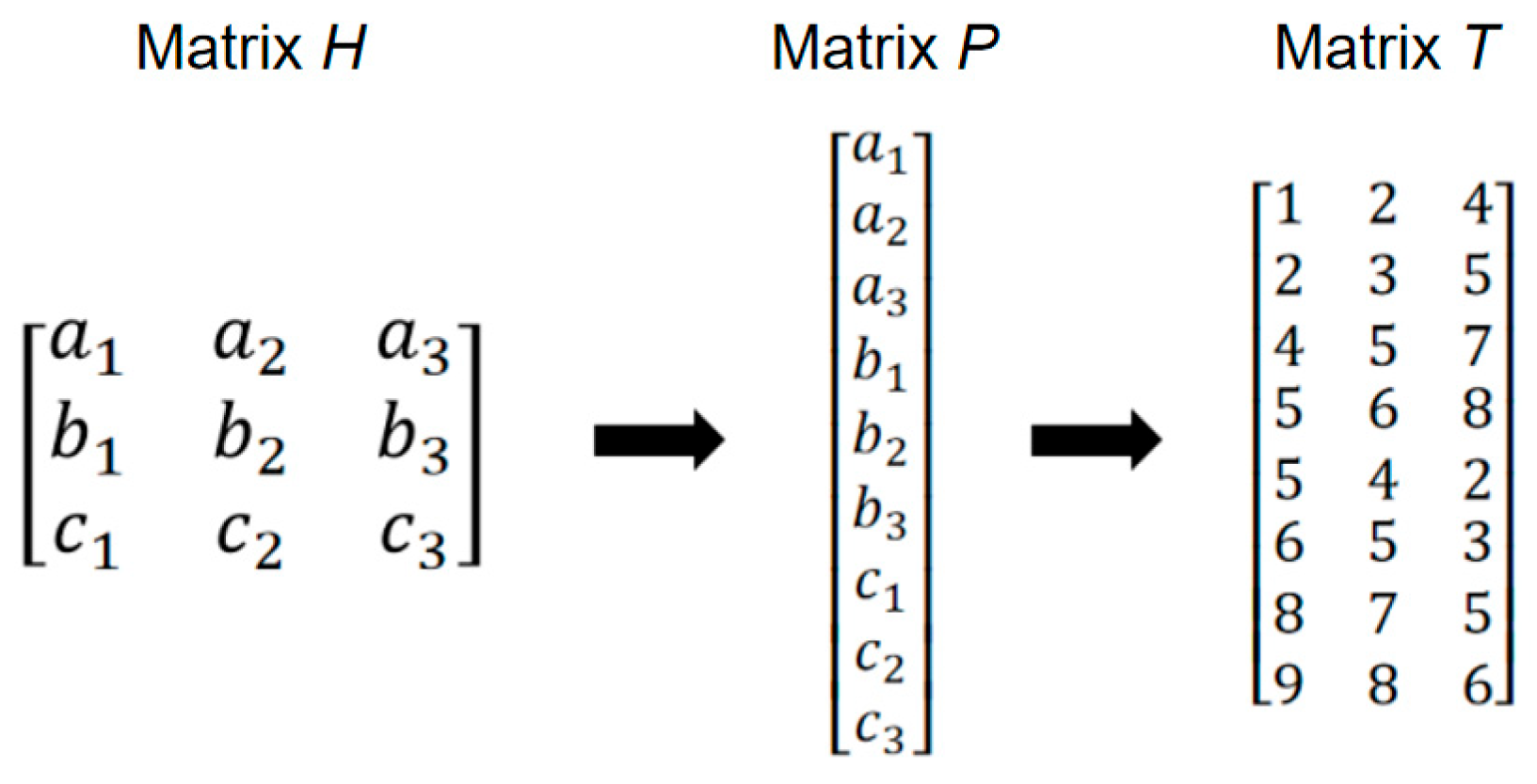
In order to facilitate the subsequent simulation of electromagnetic scattering characteristics, the complete sea model needs to be divided into multiple sub-blocks, and each sub-block should be triangulated. Then, it should be saved as a STL format file. STL format is the most common file format in 3D printing field, which is used to record triangular face element data of the model surface. The principle of converting ordinary matrix data into STL format is shown in
Figure 1.
The STL format file stores two matrices, P and T. Matrix P converts the data from the original two-dimensional matrix H into a one-dimensional matrix, while matrix T is composed of multiple three-dimensional vectors. Each vector records the sequence of three vertex data of a certain triangular face element in matrix P. In this paper, a local data matrix H is extracted from the complete sea model and converted into matrix P each time. Then, an autonomous design combination algorithm is used to generate matrix T, so that every four (2 × 2) adjacent sampling points in matrix H form a square that is divided into two triangular face elements in an “upper right—lower left” manner. Finally, it is exported in STL format to achieve the segmentation of the entire sea model.
2.2. Ship Target Model Segmentation
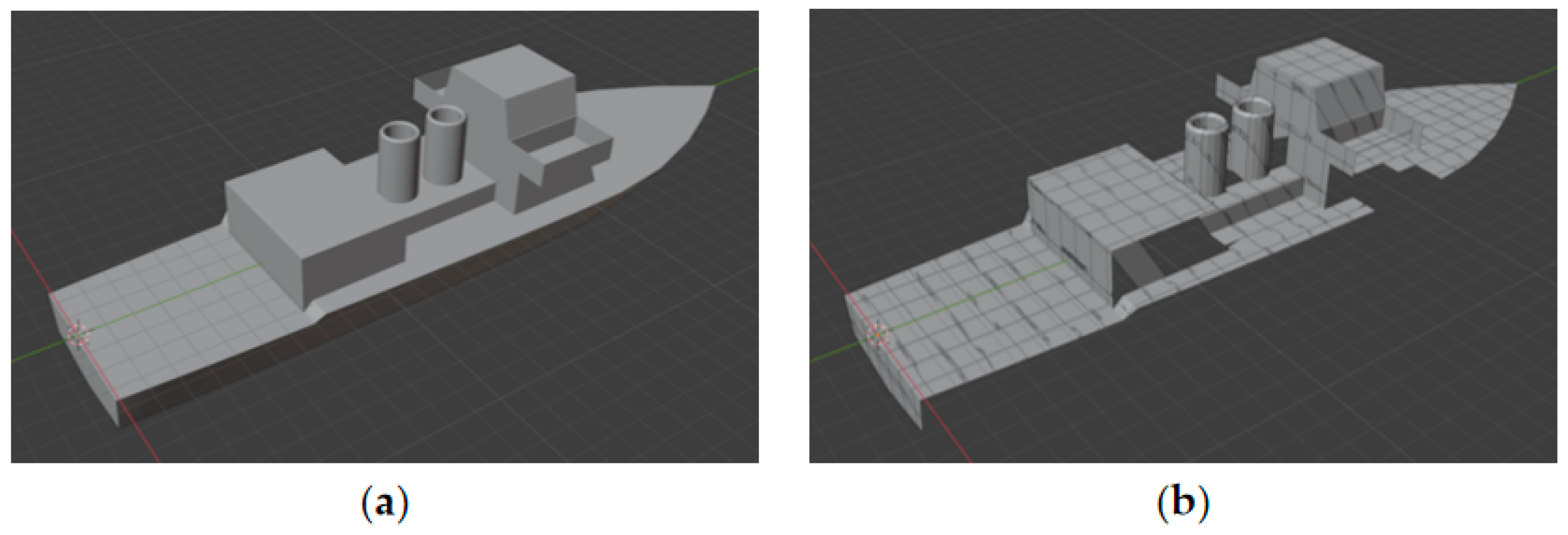
The segmentation of the ship target model is achieved through Blender. Blender is a powerful and lightweight 3D graphics and image software that offers a wide range of functions such as 3D modeling, materials and textures, animation system, rendering engine and visual effects. It also has a complete Python API that enables quick execution of various operations within the software, making it highly suitable for large-scale repetitive model segmentation tasks [
22].
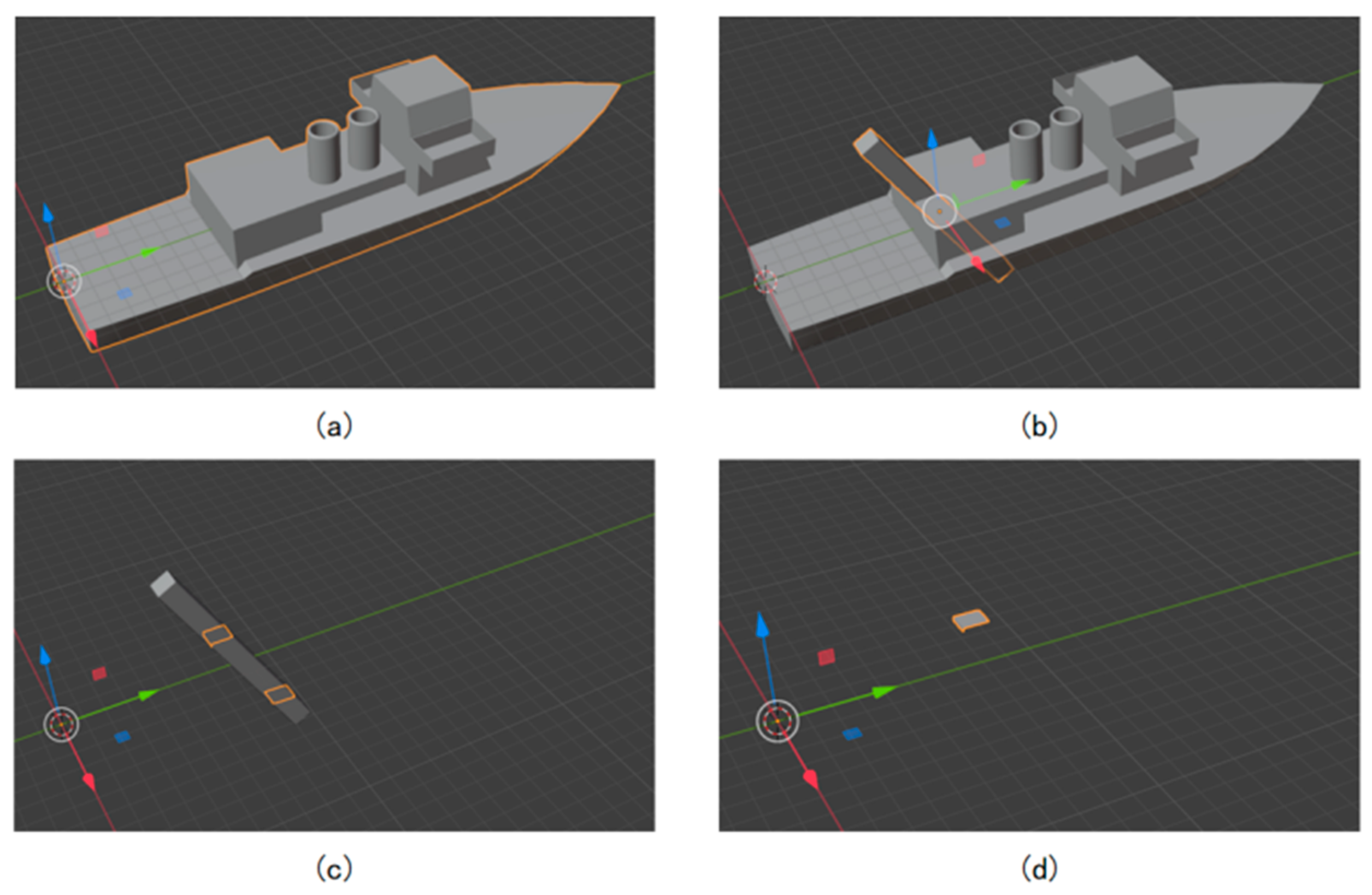
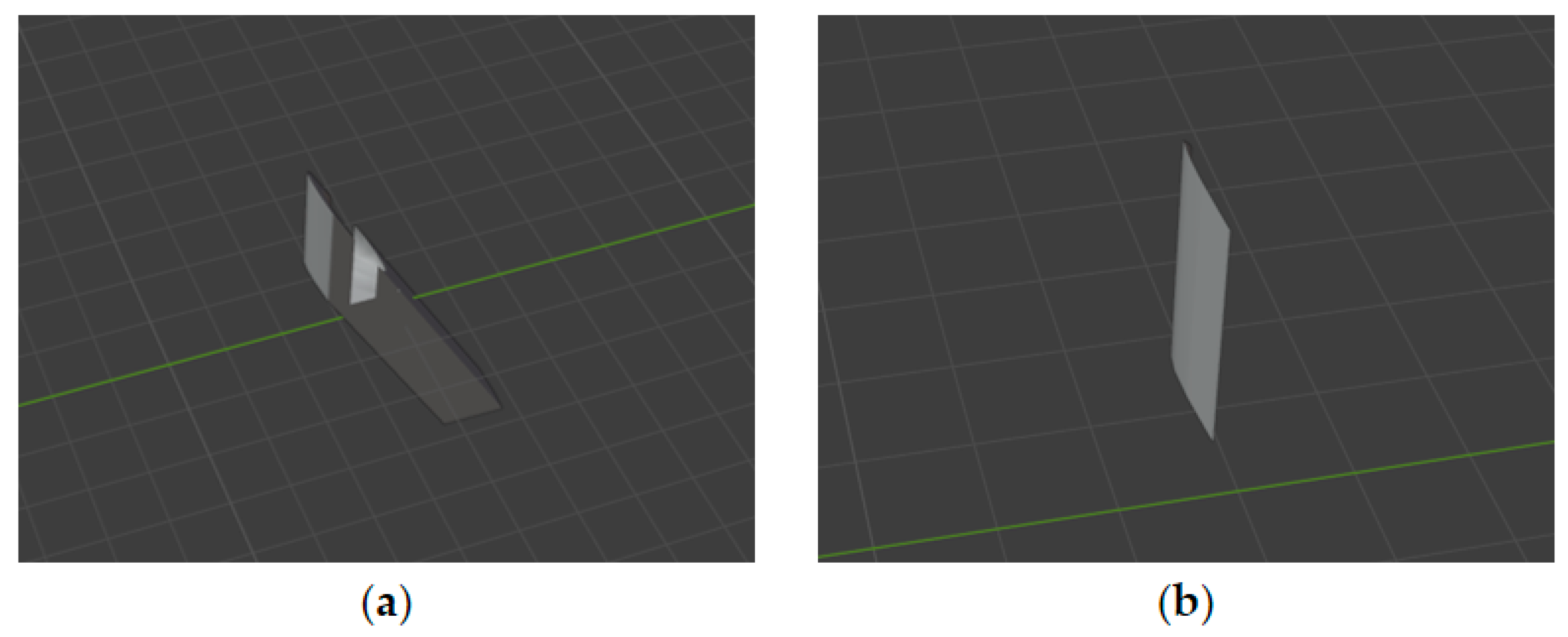
The main steps for model segmentation in Blender are shown in
Figure 2.
By using Python script programs, the above operations can be carried out automatically. Firstly, construct a temporary rectangular cutter. Then, determine the boundary values around entire model manually and build a segmentation grid according to the requirements of simulation resolution. Next, realize the above model segmentation function by writing a script program and adjusting construction position of the cutter through grid coordinates continuously. Finally, the automatic segmentation function of the entire model is achieved.
2.3. Simulation of Electromagnetic Scattering Characteristics of Sea Surface and Ship Targets
The electromagnetic scattering characteristics simulation of sea surface and ship targets is achieved through Feko. Feko is a powerful three-dimensional full-wave electromagnetic field simulation software, renowned for its hybrid solution technology and ability to handle problems involving large-scale and complex structures. It also includes a comprehensive Lua API, enabling the automation of electromagnetic scattering characteristic simulation tasks for a large number of models through script programming.
Feko possesses a wide range of solution methods which are applicable to various different simulation scenarios, such as the Method of Moments (MOM), the Multi-Layer Fast Multipole Method (MLFMM), as well as the Physical Optics Method (PO), the Geometrical Optics Method (GO) and the Large Element Physical Optics Method (LEPO), which are adapted to high-frequency conditions.
The PO is based on integral equations and is grounded on surface currents. It assumes that each point on the scattering body is largely independent of other points, and the resulting effects can be disregarded. By decomposing the target into many triangular sub-element surfaces and solving the scattering fields of each sub-element independently based on the integral of incident field, the sum of all the element solutions is thus obtained. Since the summation of scattering fields of the triangular sub-element surfaces is achieved by converting the area integral into an integral-free calculation, the computational load is reduced and the calculation speed is improved, making it very convenient to solve scattering fields of large-scale electrical objects [
23,
24].
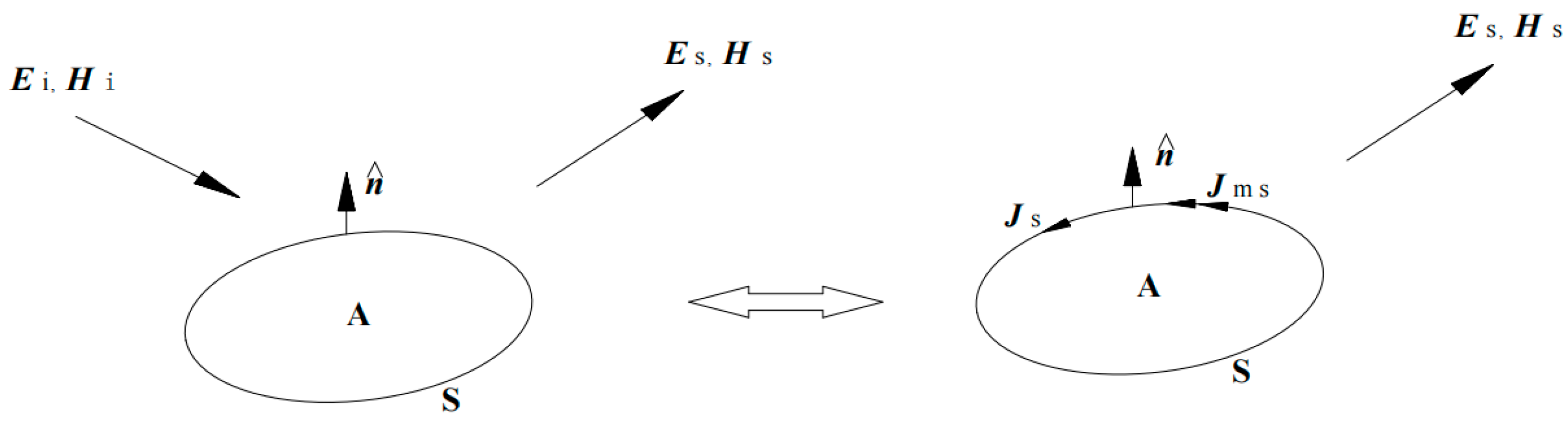
Figure 3 shows the schematic diagram of electromagnetic scattering model of the PO, where
and
are incident fields,
and
are scattering fields,
is unit normal vector of the target, and
and
are surface currents and surface magnetic flux densities of the target.
From Stratonovich-Zhilin Integral Equation of Electromagnetic Field, it can be obtained that:
where
represents the gradient of free-space Green’s function,
where
represents the distance from the source point to the field point. The calculations of target surface current
and surface magnetic flux density
are shown as follows:
where
and
represent the density of target surface charges and surface magnetic charges. By rearranging the above equation, it can be obtained that:
In the process of grid division using the PO, grid edge length is limited by wavelength. When the incident frequency is high and the target is large, the number of grids to be divided is extremely large, and the requirements for memory and time in the solution process are still relatively high. The LEPO improves it by correcting the phase of basis function and using multiple wavelengths to divide the target. This reduces the number of divided grids significantly, thereby reducing memory and time required for the calculation, which is conducive to the simulation of electromagnetic scattering characteristics of large-scale ship targets [
25,
26]. The corrected expression of the basis function is as follows:
In FEKO, simulations were conducted for flat plate, dihedral angle and ship target using multiple methods. The results are shown in
Table 2:
From the results in
Table 2, it can be seen that the memory required for the MOM and MLFMM operations is much greater than that of the PO. Moreover, as the target size increases, the operation time will multiply exponentially, and it may even be impossible to calculate. For the LEPO derived from the PO, the computing time is significantly reduced, the memory usage is reasonable, and there is no significant difference in accuracy compared to other methods. Therefore, the engineering requirements can be met [
27].
The main steps for conducting electromagnetic scattering characteristic simulations in Feko are as follows:
Create the engineering file and configure the simulation environment, including dielectric constant, magnetic permeability, dielectric properties, etc.;
Import model files and perform mesh subdivision. The models used in this paper are all in STL format. During model segmentation process, the mesh subdivision work has been completed simultaneously;
Set the excitation source to be far-field excitation of a plane wave. Set the excitation parameters referring to the parameters of SAR system, including wavelength, polarization form, azimuth angle, elevation angle, etc.;
Choose solution method as the LEPO. Set the solution range to excitation direction and adjust parameters such as solution accuracy. Then, begin simulation.
By using Lua script programs, the above operations can be executed repeatedly and quickly, enabling the automation of a large number of electromagnetic scattering characteristic simulation tasks for models. At the same time, working status can be monitored in real time through process logs, error logs, etc. Simulation process and results are completely recorded in the “.out” files, including CPU/GPU thread scheduling, electric/magnetic field intensity, phase, RCS, etc. By extracting and integrating the RCS data in each file, complete RCS simulation results of the model can be obtained.
The mesh size in the LEPO is determined based on both wavelength and geometric features of the target. In general, the facet size is chosen to be smaller than
to ensure accurate representation of induced currents. For regions with sharp edges or strong current variations, a finer discretization (
–
) is adopted. Additionally, geometric features are resolved with at least 3–5 elements per smallest structural dimension [
28].
In order to determine the appropriate grid size, simulations were conducted for the targets at different grid resolutions, and the convergence of the test results was analyzed. Define relative error:
When
, it can be considered as converging. The test results and analysis are presented in the third part of
Section 3.
2.4. SAR Echo Simulation
The simulation of SAR echo signals mainly includes two methods: time-domain algorithm and frequency-domain algorithm. The frequency-domain algorithm first performs a Fourier transform on RCS data of the imaging scene and multiplies it by the SAR system response function. Then, through inverse Fourier transform, it returns to the time domain to generate echo signal. This method has a relatively small computational load, but it cannot introduce the velocity beamforming effect during echo generation process, and the generated echo signal has limited accuracy. The time-domain algorithm obtains echo signal by simulating the actual working process of SAR. Although it has a large computational load, the generated echo signal is more accurate [
29].
When using the time-domain algorithm, it is assumed that the SAR operates in forward-looking mode. According to the SAR working principle and the SAR working parameters set during simulation process, the echo signal model of a single-point target is:
where
represents the backscatter cross section of the point target,
indicates the bidirectional amplitude weighting of antenna,
represents the time of the
th pulse emitted by SAR. By expressing one-dimensional echo signal in a two-dimensional form regarding azimuth and range directions and removing the carrier through orthogonal demodulation, the echo of a single point target can be written as follows:
The echoes of all the imaging points can be obtained by superimposition, as shown in the following equation:
where
represents the number of imaging points.
,
.
The traditional single-channel SAR echo simulation method can effectively reproduce the basic characteristics of static scenes, but it has certain limitations when dealing with marine scenes. Factors such as sea clutter, platform motion error, and target motion can all cause problems like image blurring and defocusing. Therefore, the multi-channel SAR technology has been extensively studied. By using multiple receiving channels with certain intervals in the flight direction, SAR can obtain more phase and amplitude information, thereby effectively suppressing sea clutter and improving the imaging performance of the target.
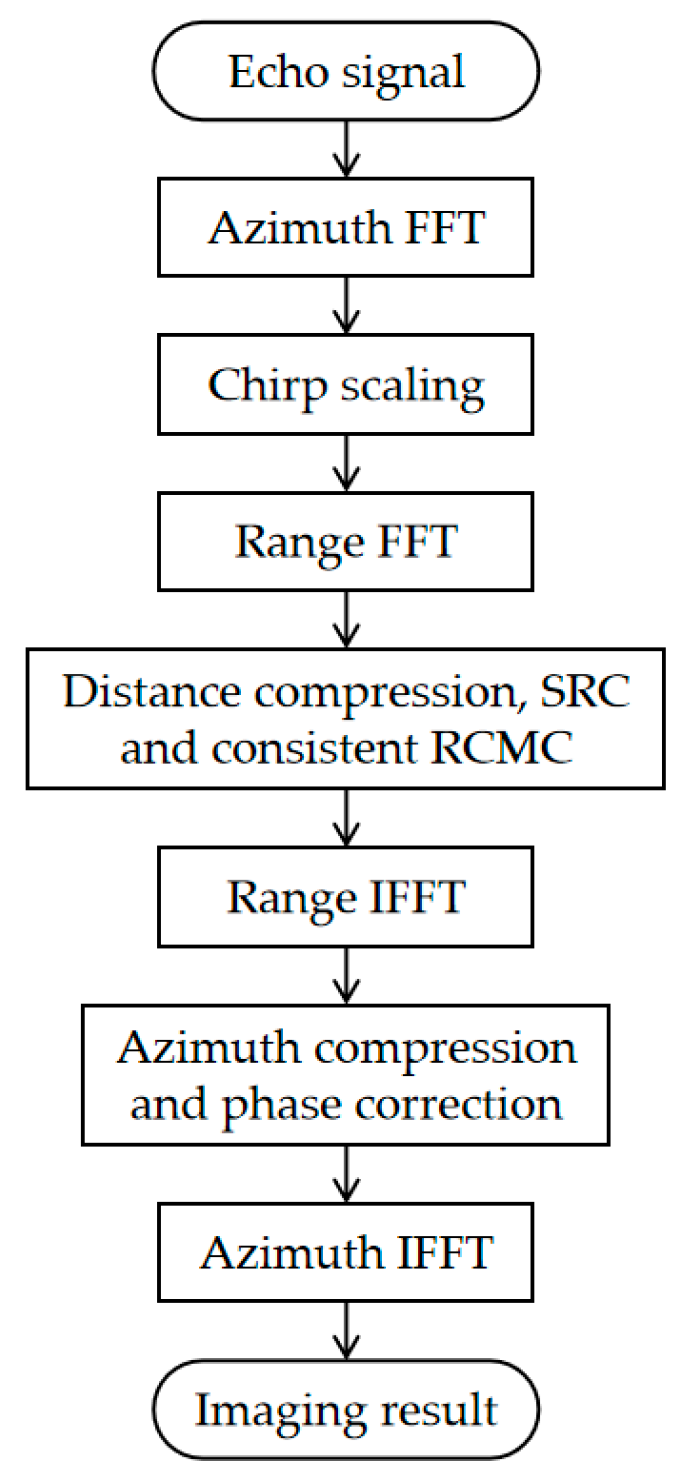
To verify the accuracy of simulation results, the chirp scaling (CS) imaging algorithm was employed for the initial imaging processing of the data. The CS imaging algorithm is one of the classic frequency-domain algorithms in SAR imaging processing, as shown in
Figure 4. Its core idea is to achieve range cell migration correction (RCMC) through phase multiplicative compensation. Since no interpolation operation is required, it has high computational efficiency [
30].
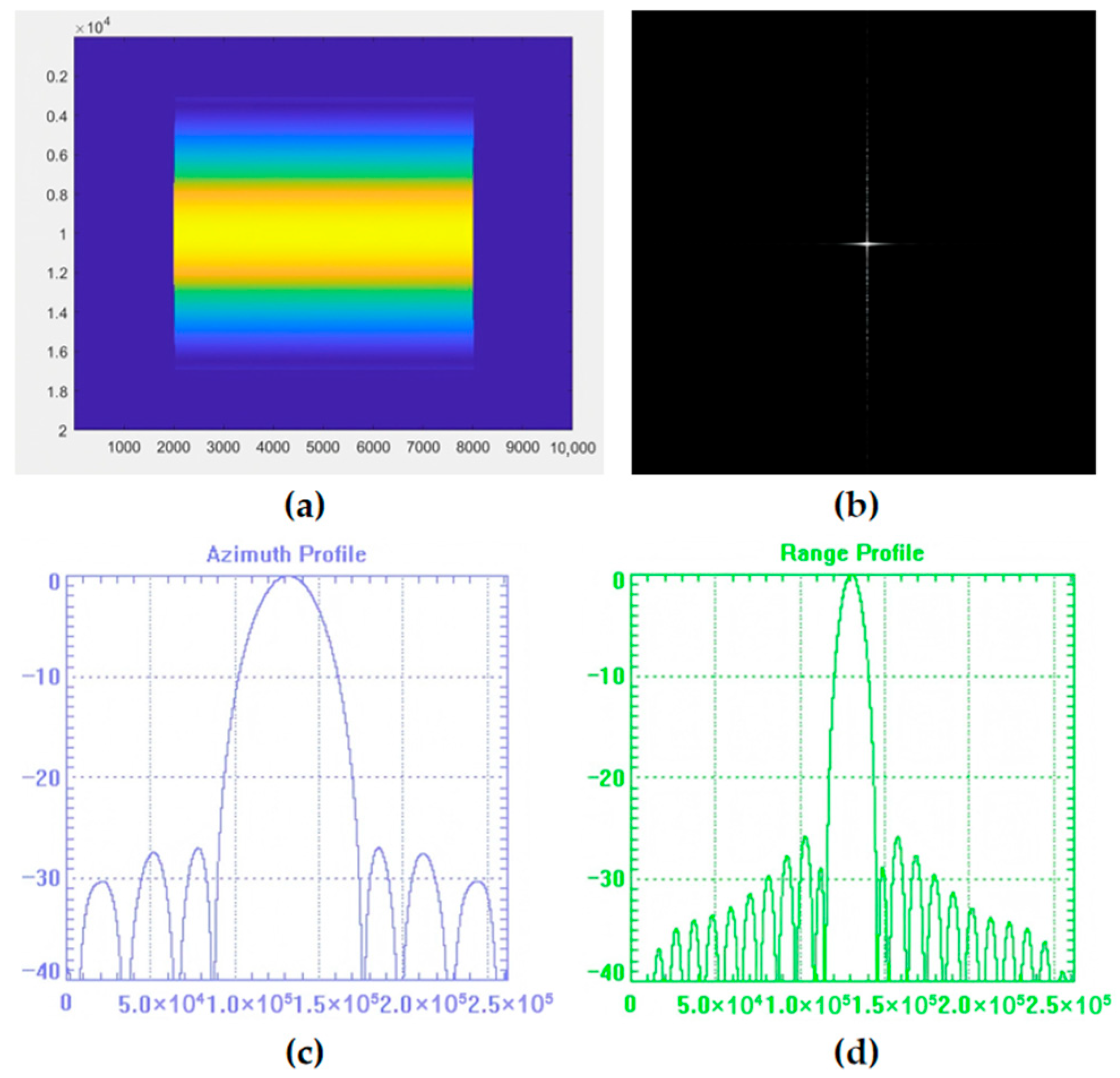
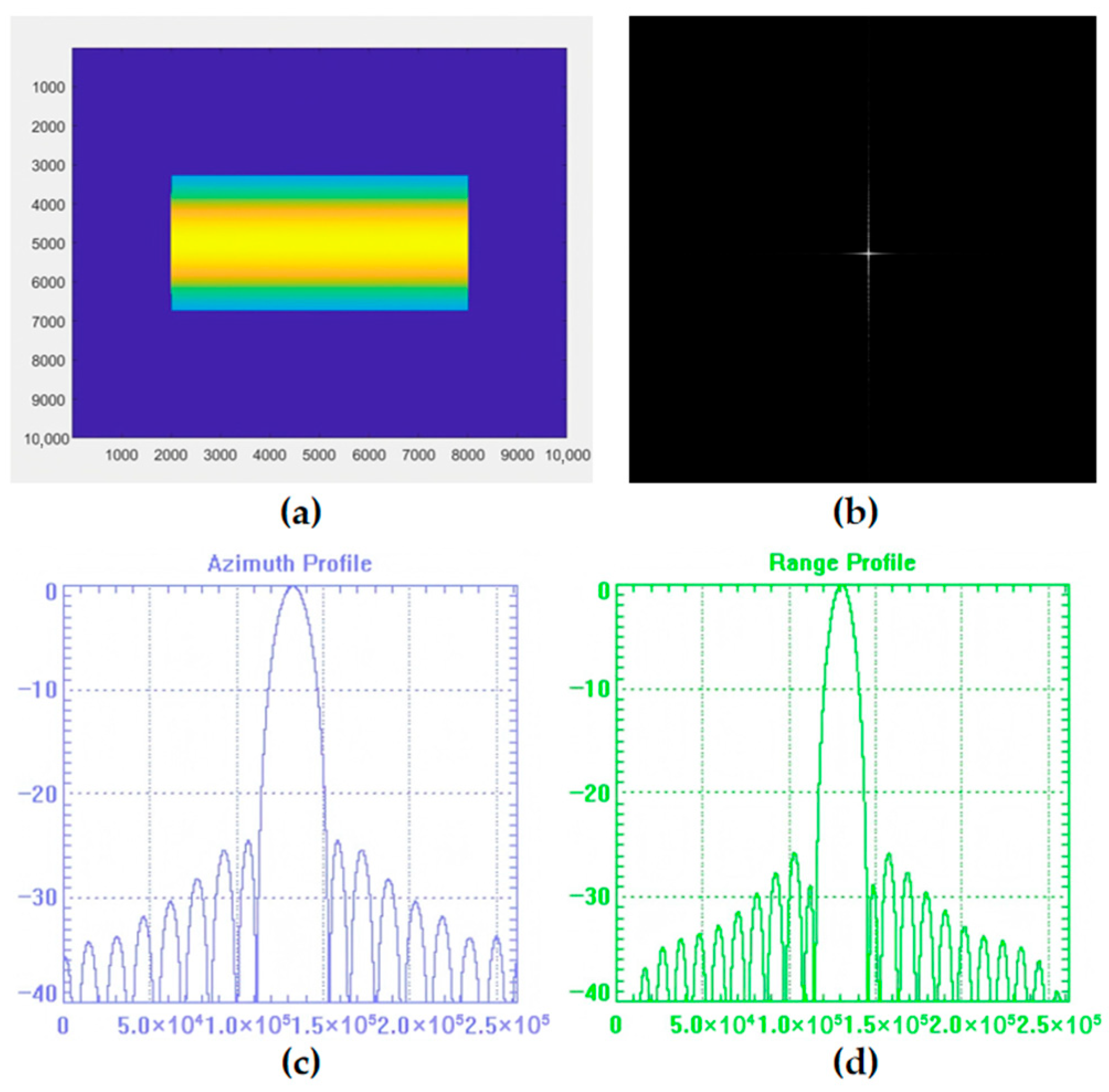
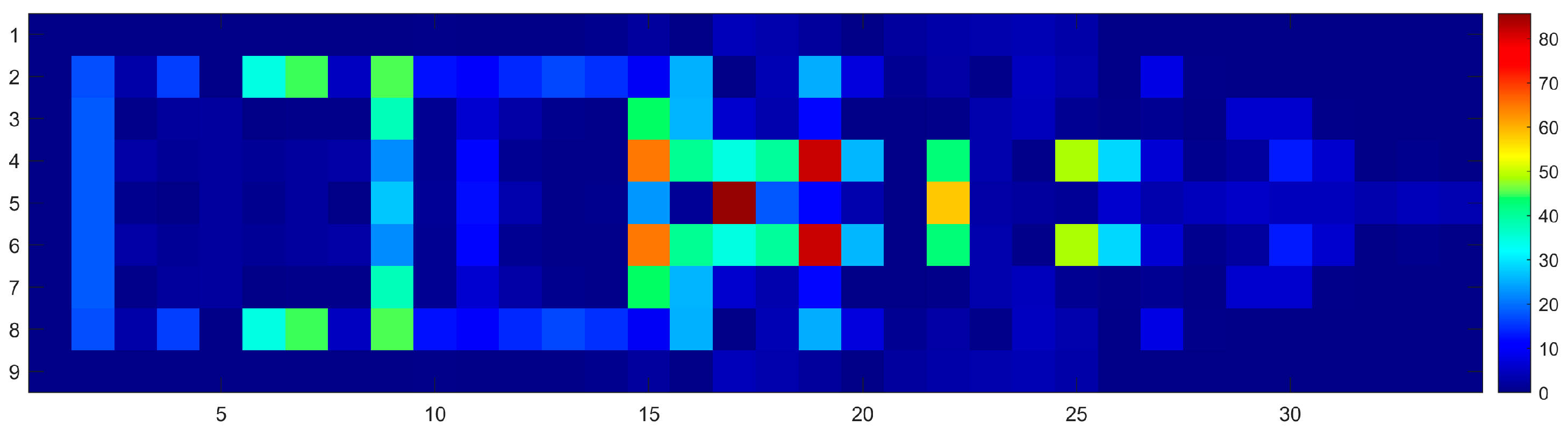
Simulations and imaging tests were conducted on a single-point target using single-channel and dual-channel SAR respectively. The results are shown in
Figure 5 and
Figure 6.
Based on the above results, an analysis and calculation were conducted, and the performance evaluation data of the single-point target are shown in
Table 3 and
Table 4 as follows:
From the above results, it can be seen that the performance in the range direction of dual-channel SAR and single-channel SAR is basically the same. However, in the azimuth direction, dual-channel SAR can better suppress the side lobe signals and is more suitable for the simulation and imaging of ship targets in the sea. Therefore, in the subsequent part of this article, all simulations will be conducted using dual-channel SAR.
4. Discussion
Numerous experiments have demonstrated the feasibility of the method described in this paper, while also revealing some shortcomings and limitations. The PM spectrum, as one of the classic wave spectrum models, has achieved good results in fully developed sea. However, in some specific situations, its effect is not satisfactory. For instance, the focus would be on the process of wave generation, or in coastal areas. At these points, using more advanced spectrum models yields better results.
During the process of ship model segmentation, there may occasionally be cases where the segmentation results are incorrect. In the context of this study, the error rate falls within an acceptable and relatively low range. However, as the resolution requirements keep increasing, the error rate also rises rapidly. By using the “EXACT” mode of the solver in the Boolean modifier, the error rate can be reduced effectively, but the processing efficiency will be affected significantly. The root cause of the problem might lie in the model itself, such as imperfect connections between various elements, or an unreasonable distribution structure, etc. If the model itself can be optimized, it might solve this problem effectively. If that does not work, perhaps an intelligent model can be incorporated into the Python automated segmentation script. By identifying incorrect segmentation results automatically, the solver can be promptly adjusted to “EXACT” mode and reprocessed, thereby achieving efficient and accurate model segmentation tasks. If this method can be implemented, it will completely solve this problem.
The previous experiments have shown that the PO/LEPO performs well in handling simple model structures such as sea surface and ship targets. When the model structure is very complex, this method still has some drawbacks. The PO/LEPO belongs to a high-frequency progressive method dominated by single scattering, so it will ignore some multiple scattering mechanisms. For example, multiple reflections between surfaces, multiple reflections within cavities and concave structures, re-illumination in blocked areas, etc. [
31]. This may result in underestimated intensity of some strong scattering points, causing the intensity of bright spots in the SAR image to be insufficient and the overall contrast of the image to decrease. Furthermore, multiple scattering paths imply an additional propagation distance. The PO/LEPO ignores these paths, which may result in incomplete phase information of the SAR echo signals and cause the defocusing problem [
32].
In response to the aforementioned issues, many scholars have already proposed improvement plans. Among them, the shooting and bouncing ray (SBR) method, which considers multi-bounce reflections by tracing ray paths based on the GO, has been widely adopted. By combining SBR with PO, higher-order interactions such as inter-facet reflections and cavity scattering can be effectively modeled, significantly improving the RCS prediction accuracy for electrically large and complex targets [
33]. In addition, the physical theory of diffraction (PTD) and the uniform theory of diffraction (UTD) are commonly incorporated to compensate for the deficiencies of PO in modeling edge diffraction. These methods introduce diffraction coefficients associated with edges and wedges, enabling accurate prediction of scattering contributions in shadow regions and around sharp discontinuities. It has been demonstrated that the integration of SBR and UTD can effectively capture both multi-reflection and diffraction mechanisms [
34]. Combining the above method with the one presented in this paper will effectively solve the problem that the PO/LEPO cannot handle the multiple scattering mechanism, thereby enabling the method in this paper to achieve a performance that is basically consistent with that of the “SAR Software”.
The running time and system status of each stage of the method in this article were statistically analyzed, and the results are shown in
Table 14:
According to the results in
Table 14, the time required to conduct a complete SAR echo simulation of a ship target in the sea is approximately 19 h, while the time needed to perform a similar simulation using the SAR Software is approximately 26 h. It can be seen that this method has excellent simulation efficiency. The test revealed that this method takes a relatively long time to process the RCS simulation of sea and ships. Due to the fact that the data volume for RCS simulation of the sea is much larger than that for ship targets, the RCS simulation of the ship is the main factor that slows down the entire method. A further analysis of this process revealed that the program spent approximately 70% of its time on reading and preprocessing the model. The main reason for this is that Feko simulates each sub-model one by one. Only when conducting electromagnetic calculations for a single model can the CPU parallel technology be utilized. Therefore, there is still some chance for optimization in this method. As mentioned earlier in this chapter, by optimizing the structure of the model itself, it might be possible to effectively increase the speed at which Feko reads the model. In addition, it is possible to attempt to implement the RCS simulation work using GPU. By leveraging GPU parallel technology, such as CUDA, it might be possible to simultaneously conduct RCS simulations for multiple sub-models, thereby enhancing the efficiency of the whole process. Theoretically, this method can at least increase the efficiency by 30–40%.
5. Conclusions
SAR echo simulation is of great significance for marine monitoring and protection. However, the simulation system is often complex in terms of hardware equipment and the acquisition cost of RCS data is high, which leads to certain difficulties in practical applications. This paper proposes a SAR echo simulation method that solely relies on software simulation and numerical calculation. The method can be divided into four parts. The first part utilizes the PM wave spectrum model and the Monte Carlo method to simulate the sea model under various sea conditions, and employs an independently designed method to segment the model. By comparing various wave spectrum models, the effectiveness of this method was demonstrated. The second part uses Blender to achieve the automatic segmentation of the ship model. The experimental results demonstrate the effectiveness of this method, and also reveal some areas that can be optimized. The third part used Feko to conduct electromagnetic scattering characteristic simulations for the sea and the ship model. By comparing various electromagnetic simulation methods, the effectiveness and applicability of this method were demonstrated, and the subsequent optimization directions were also pointed out. The final part efficiently realizes SAR echo simulation using dual-channel technology. By comparing with the SAR Software, it was proved that this method has excellent performance and is fully applicable to this research.
In conclusion, this method demonstrates excellent performance and wide applicability. It can, in a complex marine environment, using limited software and hardware resources, simulate SAR echo signals of various ship targets quickly and accurately, and has considerable application value.