1. Introduction
Maritime search and rescue (SAR) is a time-critical public safety task in which unmanned aerial vehicles (UAVs) and unmanned surface vehicles (USVs) are increasingly used to search large-scale sea areas for rescue-critical targets such as persons overboard and floating rescue devices. In practical maritime remote sensing, however, reliable perception remains difficult because these targets often appear as extremely small and weakly contrasted instances under long observation distance, large viewpoint variation, and highly dynamic water-surface backgrounds. Recent UAV-oriented SAR benchmarks such as SeaDronesSee [
1] have shown that humans in open water may occupy only a few pixels, making robust real-time detection a persistent bottleneck for practical maritime remote-sensing perception.
From the perspective of remote sensing, maritime SAR detection belongs to a particularly challenging form of small-object detection in complex optical observation scenes. In addition to extreme scale variation, rescue-critical targets are often embedded in clutter-dominated backgrounds with strong interference from waves, foam, specular reflection, haze, and spray. A recent survey on maritime UAV detection [
2] highlights that small-object sparsity and background clutter remain two central obstacles to robust perception in maritime environments. More broadly, optical remote-sensing object detection studies have likewise shown that inadequate small-object representation and complex scene interference remain long-standing bottlenecks in aerial imagery analysis [
3], while maritime benchmark studies further indicate that sea-surface scenes differ substantially from conventional detection datasets in terms of target distribution, environmental variability, and background statistics [
4]. Therefore, the core difficulty of maritime SAR detection lies not merely in generic object localization, but in jointly addressing tiny-target perception, clutter suppression, and efficiency constraints under practical maritime observation conditions.
For maritime remote-sensing tasks requiring real-time inference, one-stage CNN detectors remain important because of their favorable computational efficiency. Representative models such as YOLOX [
5] and YOLOv7 [
6] improve the speed–accuracy trade-off through architectural and training refinements, while maritime adaptations such as YOLOv7-sea [
7] introduce task-specific detection heads and attention modules to strengthen small-target perception under sea-surface interference. More recent real-time detectors such as YOLOv10 [
8] further push the efficiency boundary of end-to-end detection. However, in maritime SAR scenarios, efficiency alone is insufficient, because rescue-critical targets are typically tiny, sparse, and visually fragile, and thus require feature representations that preserve discriminative cues under severe clutter conditions.
Multi-scale feature fusion is widely recognized as a key strategy for small-object detection. FPN [
9] builds a top-down pyramid with lateral connections, PANet [
10] strengthens information flow through bottom-up augmentation, and BiFPN in EfficientDet [
11] introduces efficient weighted bidirectional fusion. These architectures improve the interaction between shallow detail features and deep semantic representations, thereby enhancing scale adaptability. Recent remote-sensing studies have further confirmed that stronger shallow-detail preservation and multi-scale enhancement remain crucial for small-target detection in aerial imagery [
12,
13]. However, in maritime SAR scenarios, richer fusion often comes at the cost of additional feature-processing overhead, whereas overly lightweight designs may fail to preserve the weak visual evidence of rescue-critical targets. Thus, the practical challenge is not simply to deepen the fusion hierarchy, but to preserve tiny-target cues under a bounded computational cost.
Transformer-based detectors provide an alternative paradigm by formulating detection as set prediction. DETR [
14] established this direction, while Deformable DETR [
15] improved convergence and small-object perception through sparse attention. More recently, RT-DETR [
16] demonstrated that DETR-style detection can be made real-time by combining an efficient hybrid encoder with query selection. In parallel, efficient attention mechanisms such as Linformer [
17], Performer [
18], and Efficient Attention [
19] were proposed to reduce the cost of global interaction while preserving long-range dependency modeling. These advances are highly relevant to maritime SAR because weak rescue targets often require broader contextual support to be distinguished from clutter-dominated water surfaces. However, directly transferring generic real-time detectors to maritime SAR remains insufficient: heavier models often incur substantial attention or feature-fusion overhead, whereas lightweight models tend to sacrifice tiny-target sensitivity and clutter robustness. Recent man-overboard studies, including MOB-DETR [
20] and MOB-Detector [
21], as well as very recent maritime rescue work such as SR-DETR [
22] and ultra-lightweight DETR-style designs such as AUHF-DETR [
23], collectively indicate that practical maritime SAR perception requires a detector that can simultaneously maintain efficient multi-scale representation, clutter-robust global context modeling, and bounded inference cost.
Despite these advances, two limitations remain insufficiently addressed in current maritime SAR research. First, existing public datasets still provide limited support for rescue-oriented perception under severe sea clutter, particularly when rescue-critical targets appear at very small scales and coexist with large amounts of non-critical floating clutter that is operationally irrelevant but visually confusing. Second, many existing detectors are not jointly optimized for the coupled requirements of tiny-target sensitivity, clutter suppression, and operational efficiency. Consequently, a clear gap remains between laboratory-level detection accuracy and practical maritime SAR perception.
To bridge this gap, we propose R-DET, a real-time Transformer-based detector tailored to maritime SAR scenarios. Built upon the RT-DETR framework, R-DET integrates three rescue-oriented components. Rescue-Net serves as a lightweight multi-scale backbone that preserves shallow spatial details while maintaining hierarchical efficiency. Rescue Attention performs clutter-suppressed global context modeling with bounded cost, thereby reducing the interference caused by repetitive sea-surface patterns. Rescue-FPN injects high-resolution cues for tiny rescue-critical targets through efficient cross-scale fusion without maintaining an expensive dense pyramid. In addition, we establish MarineRescue-8K, a maritime SAR dataset collected from real operations and equipped with a mission-aligned ignore-region protocol, so that both optimization and evaluation better reflect practical rescue conditions.
The main contributions of this work are summarized as follows:
- (1)
We establish MarineRescue-8K, a rescue-oriented maritime detection dataset collected from real operations, and define a mission-aligned ignore-region protocol that reduces the influence of low-value floating clutter during training and evaluation.
- (2)
We propose R-DET, a set-prediction detector for maritime SAR imagery, in which Rescue-Net, Rescue Attention, and Rescue-FPN are jointly designed to address three tightly coupled bottlenecks: efficient multi-scale representation, clutter-robust global context modeling, and high-resolution cue propagation for tiny rescue-critical targets.
- (3)
We conduct comprehensive experiments on MarineRescue-8K and two public water-surface benchmarks, including ablation studies, cross-dataset comparisons, qualitative analyses, and controlled perturbation-based robustness evaluation, to assess the proposed method in terms of detection accuracy, inference efficiency, cross-dataset generalization, and resilience under degraded maritime visual conditions.
To support the above contributions, the remainder of this paper proceeds from task definition to method design and experimental validation.
Section 2 introduces MarineRescue-8K together with its rescue-oriented annotation and evaluation protocol.
Section 3 presents the proposed R-DET framework,
Section 4 reports the experimental results and analyses, and
Section 5 concludes the paper with limitations and future research directions.
2. MarineRescue-8K Dataset
Existing maritime detection datasets often provide limited support for rescue-oriented perception in cluttered maritime environments, particularly when rescue-critical targets appear at small scales and with weak visual saliency. To address this gap, we construct MarineRescue-8K as a dataset tailored to maritime SAR detection, with an emphasis on practical target categories, cluttered scene conditions, and deployment-relevant evaluation.
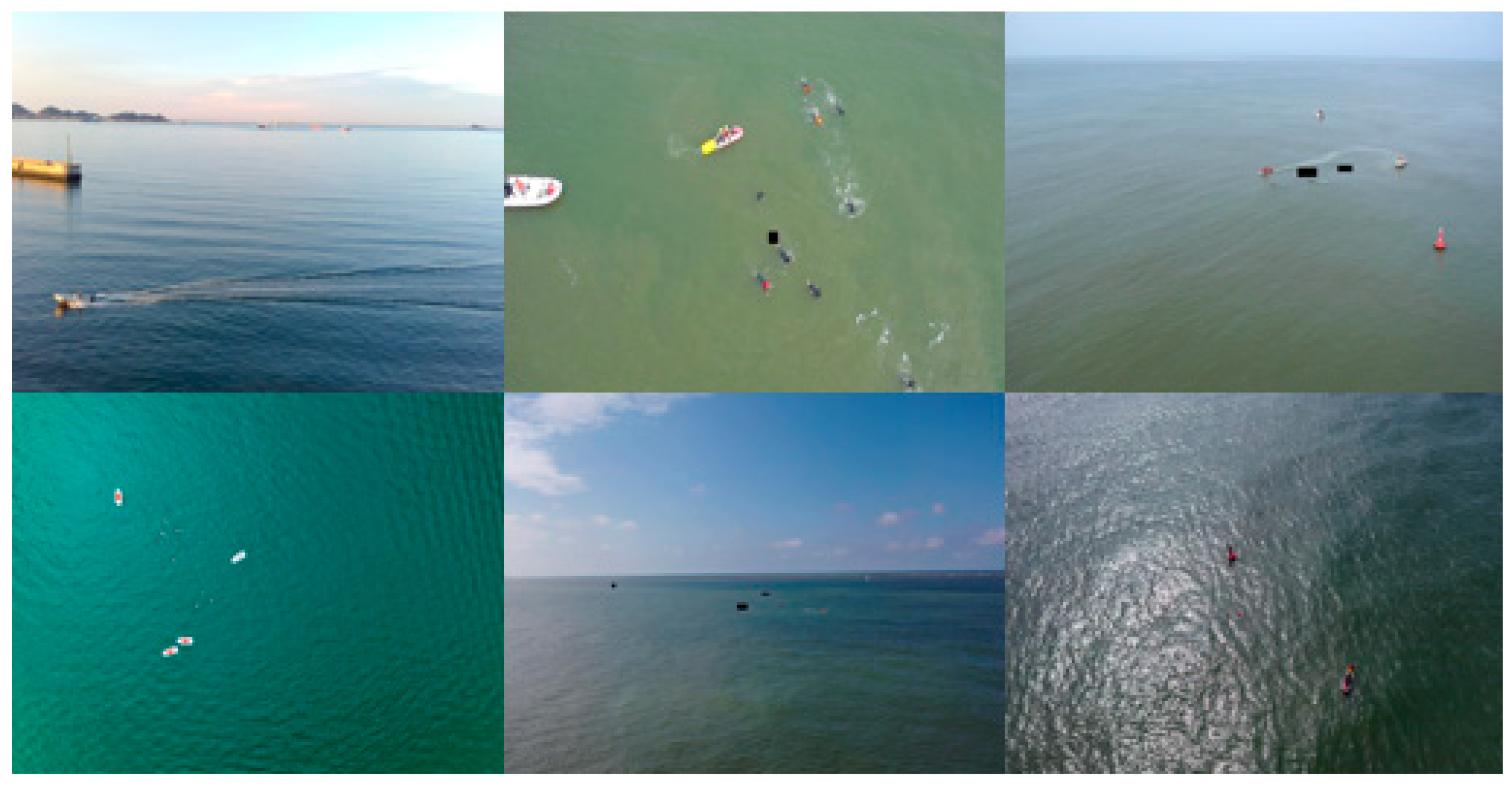
MarineRescue-8K was collected from real maritime operations across multiple coastal regions under different illumination conditions and sea-surface appearances. Videos were captured by onboard visual sensors at a resolution of 1920 × 1080 and then sampled into images to reduce temporal redundancy. Manual filtering was further conducted to remove severely blurred, overexposed, and near-duplicate frames.
Figure 1 shows representative examples from MarineRescue-8K under different maritime backgrounds and illumination conditions. After filtering, 8390 images were retained for subsequent annotation.
The label space of MarineRescue-8K is defined to match practical SAR requirements. We annotate five rescue-critical categories, namely swimmer (persons overboard), life_saving_appliances (e.g., life buoys and life rafts), boat, jet_ski, and buoy, and additionally define an ignored label that is used only to specify ignore regions for non-critical floating clutter or visually ambiguous distant objects. The ignored label is not treated as a detection target. During training, ignored annotations are excluded from classification and box-regression losses; during evaluation, they are excluded from mAP computation so that the reported performance reflects the five rescue-critical categories. Detections overlapping ignore regions are handled as described in
Section 4.1. This protocol reduces the influence of non-critical clutter during optimization while keeping evaluation aligned with SAR mission objectives.
To ensure annotation quality, consistency, and reproducibility, all images in MarineRescue-8K were labeled under a unified protocol using the LabelImg tool. Each instance was annotated with an axis-aligned bounding box in YOLO format (normalized center coordinates, width, and height). We adopted three practical rules. First, for partially submerged objects, only the visible region was annotated rather than the physically inferred full extent, to maintain a consistent bounding-box definition in wave-occluded scenes. Second, a partially occluded target was retained as a valid annotated instance only when its estimated visible proportion was no smaller than 30% and its semantic category remained identifiable; otherwise, it was assigned to the ignored category. Third, for tiny objects (pixel area < 32 × 32), annotators zoomed in to draw tight bounding boxes around visible evidence, while blurred or ambiguous instances were double-checked by two annotators and removed if uncertainty remained. This protocol improves annotation consistency for persons overboard and small rescue devices under sea-surface occlusion.
MarineRescue-8K comprises 8390 images with a total of 18,650 annotated instances. In terms of scene composition, 5123 images (61.0%) are from open-sea areas, 1954 images (23.3%) are from coastal waters, and 1313 images (15.7%) are from harbor regions. This distribution indicates that the dataset is dominated by open-water scenes while still covering coastal and harbor environments with distinct clutter characteristics, such as shore structures, moored vessels, and complex reflections.
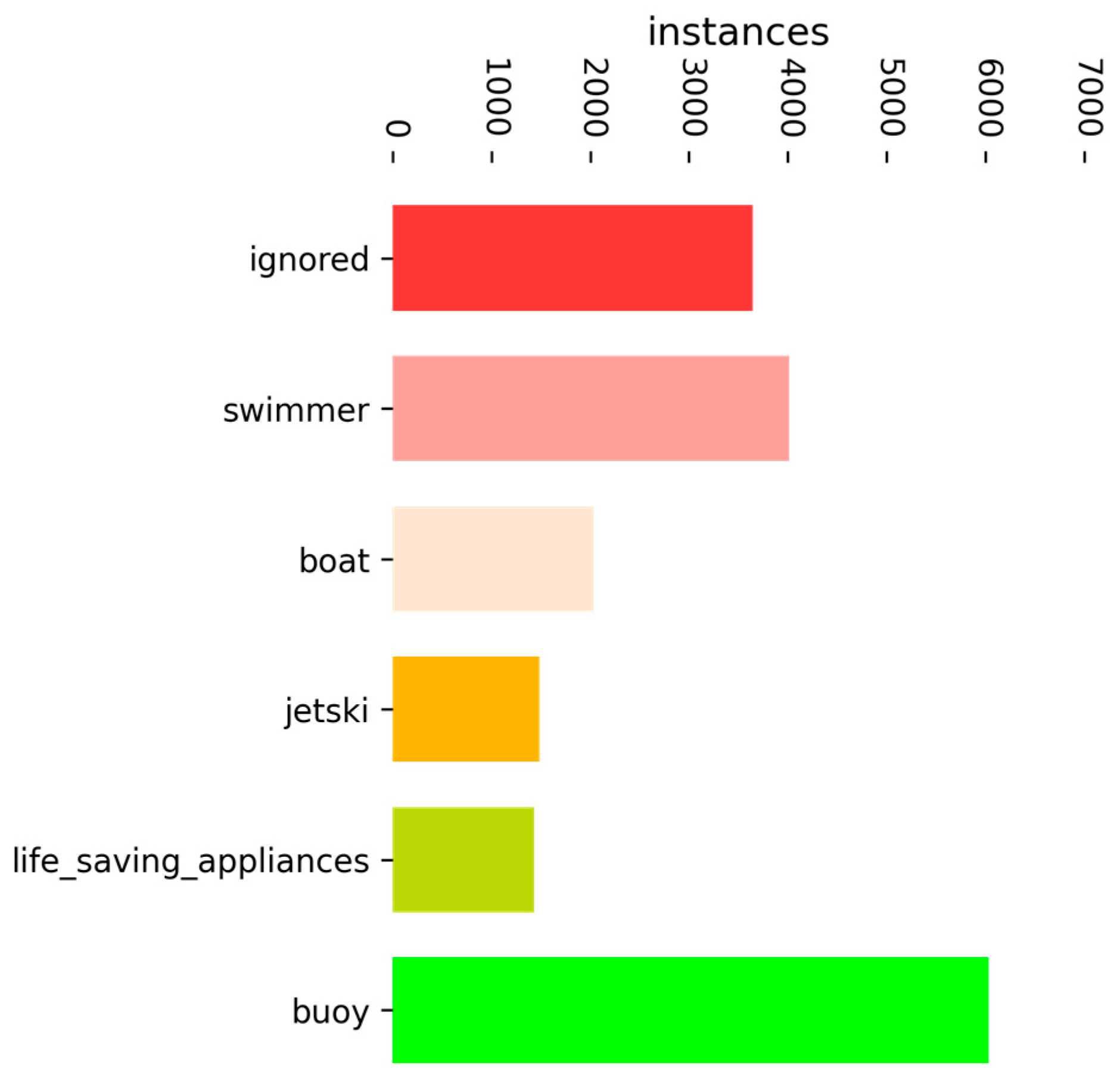
Figure 2 summarizes the category composition of MarineRescue-8K in terms of the original annotated instance counts. The dataset exhibits a practically relevant long-tailed class distribution, with buoy and swimmer appearing more frequently than several other categories, while life_saving_appliances and jet_ski remain comparatively scarce. Specifically, buoy contains 6032 instances, swimmer 4015 instances, ignored 3648 instances, boat 2031 instances, jet_ski 1489 instances, and life_saving_appliances 1435 instances. This distribution is important for the present study because maritime SAR perception is not performed under class-balanced laboratory conditions; rather, rescue-critical targets must be detected under realistic category imbalance and in the presence of a substantial amount of non-critical clutter. Therefore, MarineRescue-8K provides a more task-aligned benchmark for evaluating whether a detector can remain sensitive to mission-critical objects without being overwhelmed by dominant but operationally less important scene content.
To further characterize the intrinsic detection difficulty of MarineRescue-8K beyond category counts, we next analyze the target-scale distribution, since the practical challenge of maritime SAR is strongly shaped by the prevalence of extremely small rescue-critical objects.
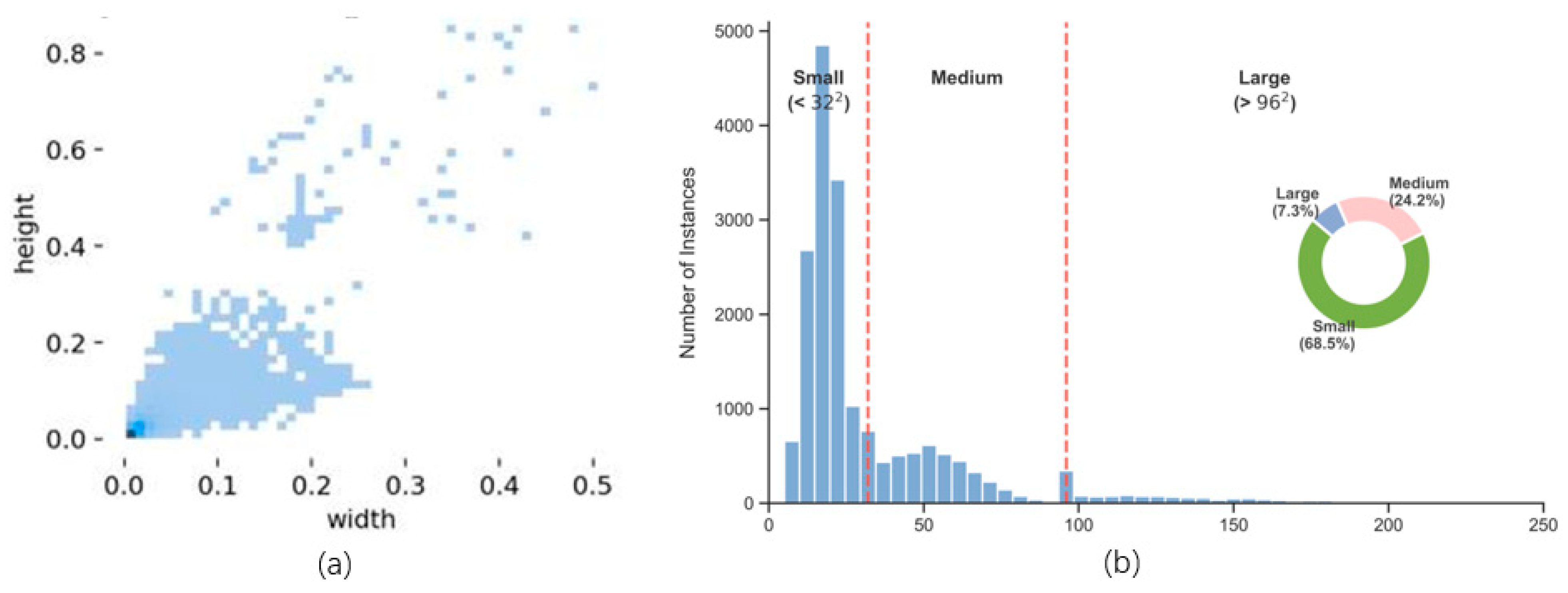
Figure 3 summarizes the scale statistics of annotated objects in MarineRescue-8K. Following the commonly used area-based definition, objects are categorized as small (area < 32
2), medium (32
2 ≤ area < 96
2), and large (area ≥ 96
2) instances. As shown in
Figure 3, small objects account for 68.5% of all annotated instances, while medium and large objects account for 24.2% and 7.3%, respectively. This distribution confirms that the dominant challenge of MarineRescue-8K is not generic object localization, but rescue-oriented perception under a strongly small-object-dominated regime. In other words, a detector must preserve weak high-resolution evidence for tiny targets, suppress clutter that can easily overwhelm such weak responses, and do so under a bounded computational cost. This observation directly motivates the subsequent design of Rescue-Net, Rescue Attention, and Rescue-FPN.
To assess cross-dataset generalization beyond MarineRescue-8K, we additionally evaluate R-DET on two widely used public benchmarks for water surface object detection, namely WSODD [
24] and FloW-Img [
25]. These datasets provide complementary scene characteristics, background complexity, and target scales, thereby enabling a broader evaluation of cross-dataset transferability under diverse aquatic conditions. Unless otherwise stated, we adopt the standard splits and evaluation settings used in prior work on each benchmark for fair comparison.
3. Method
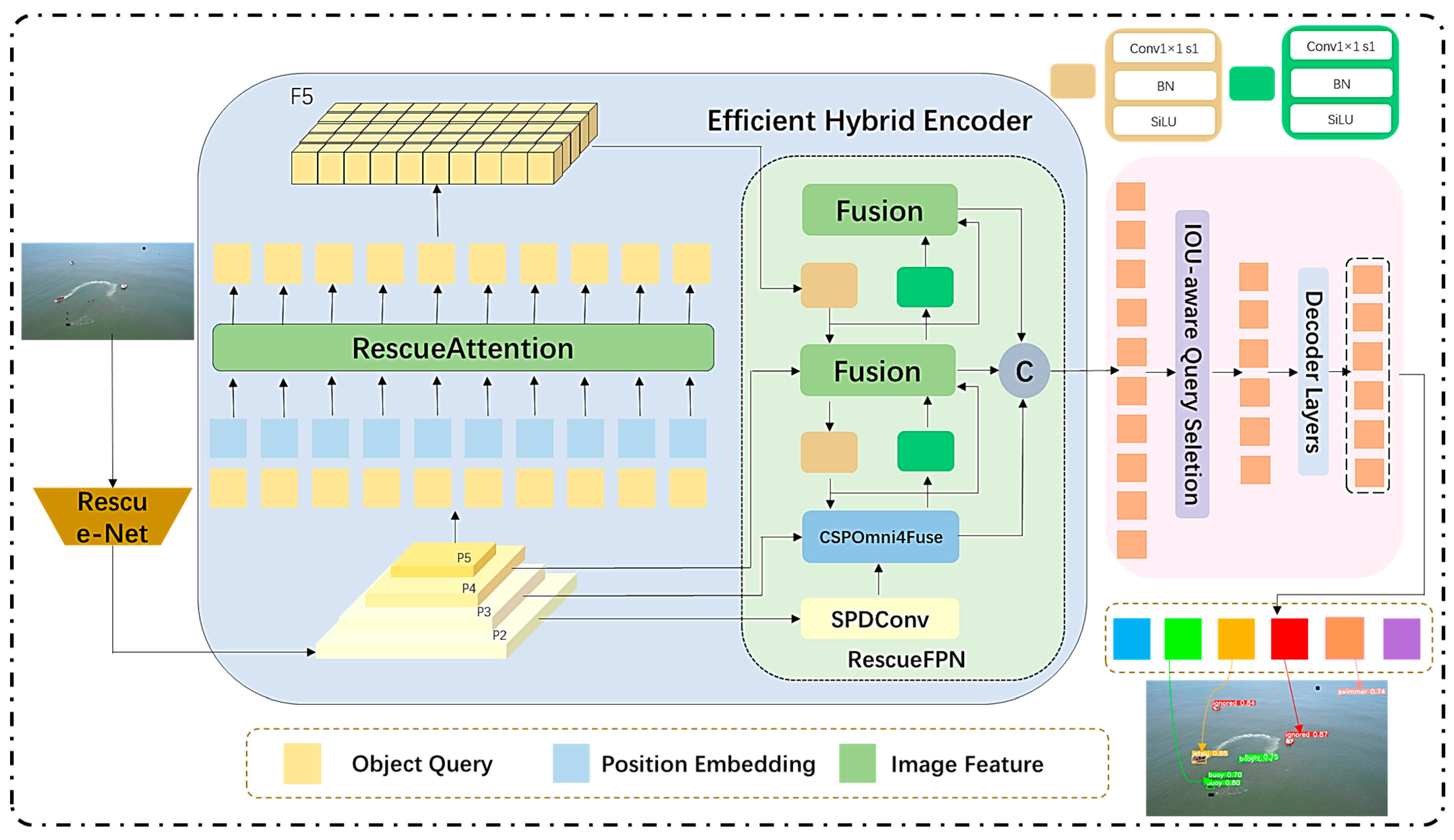
Maritime SAR detection is constrained by an accuracy–clutter–latency trade-off: tiny, low-contrast rescue targets require high-resolution cues for recall, sea-surface interference introduces clutter that causes false alarms, and practical deployment imposes bounded compute and latency. We build R-DET on the RT-DETR set-prediction framework and redesign three components to address these constraints in a complementary manner: Rescue-Net for efficient multi-scale feature extraction, Rescue Attention for clutter-suppressed global context with a bounded cost, and Rescue-FPN for selectively injecting high-resolution details into the decoder without maintaining an expensive dense pyramid. As illustrated in
Figure 4, the overall architecture of R-DET consists of three components: a backbone network, a hybrid encoder, and a Transformer decoder.
The operational pipeline of R-DET is designed to address the requirements of maritime rescue imagery. Initially, the Rescue-Net backbone extracts multi-scale hierarchical features (S2, S3, S4, S5) from the input imagery. The shallow S2 features are particularly rich in fine-grained details of small targets, such as the heads of persons overboard and rescue equipment, while features from S3 to S5 progressively encode mid- to high-level semantic information, establishing a comprehensive foundation for subsequent recognition and localization tasks. Subsequently, the hybrid encoder refines these feature representations: the Rescue Attention module performs efficient global context modeling on the deep feature S5, aiming to reduce the impact of sea-surface clutter, including waves and sun glint, through global context modeling. Simultaneously, the Rescue-FPN module seamlessly integrates the refined S5 with features from S2, S3, and S4 through cross-scale fusion, systematically enhancing the propagation and reinforcement of small target features to form a unified image feature sequence. Finally, initial object queries are selected via IoU-aware query selection and iteratively refined by the Transformer decoder, which generates bounding boxes and confidence scores encompassing all rescue-critical targets.
Unless otherwise stated, R-DET strictly follows the RT-DETR/DETR set-prediction paradigm: the Transformer decoder outputs a fixed set of
object queries (anchor-free, NMS-free). Predictions are matched to ground-truth boxes via Hungarian one-to-one bipartite assignment using the standard RT-DETR matching cost
where the matching weights are set to
,
, and
in all experiments, while the training-loss coefficients are fixed to
,
,
, following the RT-DETR paradigm. These coefficients are kept unchanged throughout all comparisons to preserve direct comparability with the baseline and to avoid confounding the proposed architectural gains with additional loss rebalancing. This choice is also task-compatible: in maritime SAR imagery, rescue-critical targets often occupy only a few pixels and are therefore more sensitive to localization instability than to moderate classification uncertainty. Consequently, relatively stronger box-regression terms are beneficial for stable one-to-one assignment and box refinement under extreme scale variation and sea-clutter interference. Therefore, the improvements reported in this work are intended to reflect the contribution of Rescue-Net, Rescue Attention, and Rescue-FPN, rather than gains introduced by retuning the matching or loss coefficients.
3.1. Rescue-Oriented Multi-Scale Network (Rescue-Net)
In complex maritime rescue scenarios, critical targets such as persons overboard and life rafts exhibit significant scale variation and are often partially occluded by waves. Conventional backbone networks like ResNet [
26] may struggle to maintain robust multi-scale feature extraction for these targets under strict efficiency constraints, due to their fixed receptive fields and computationally redundant structures.
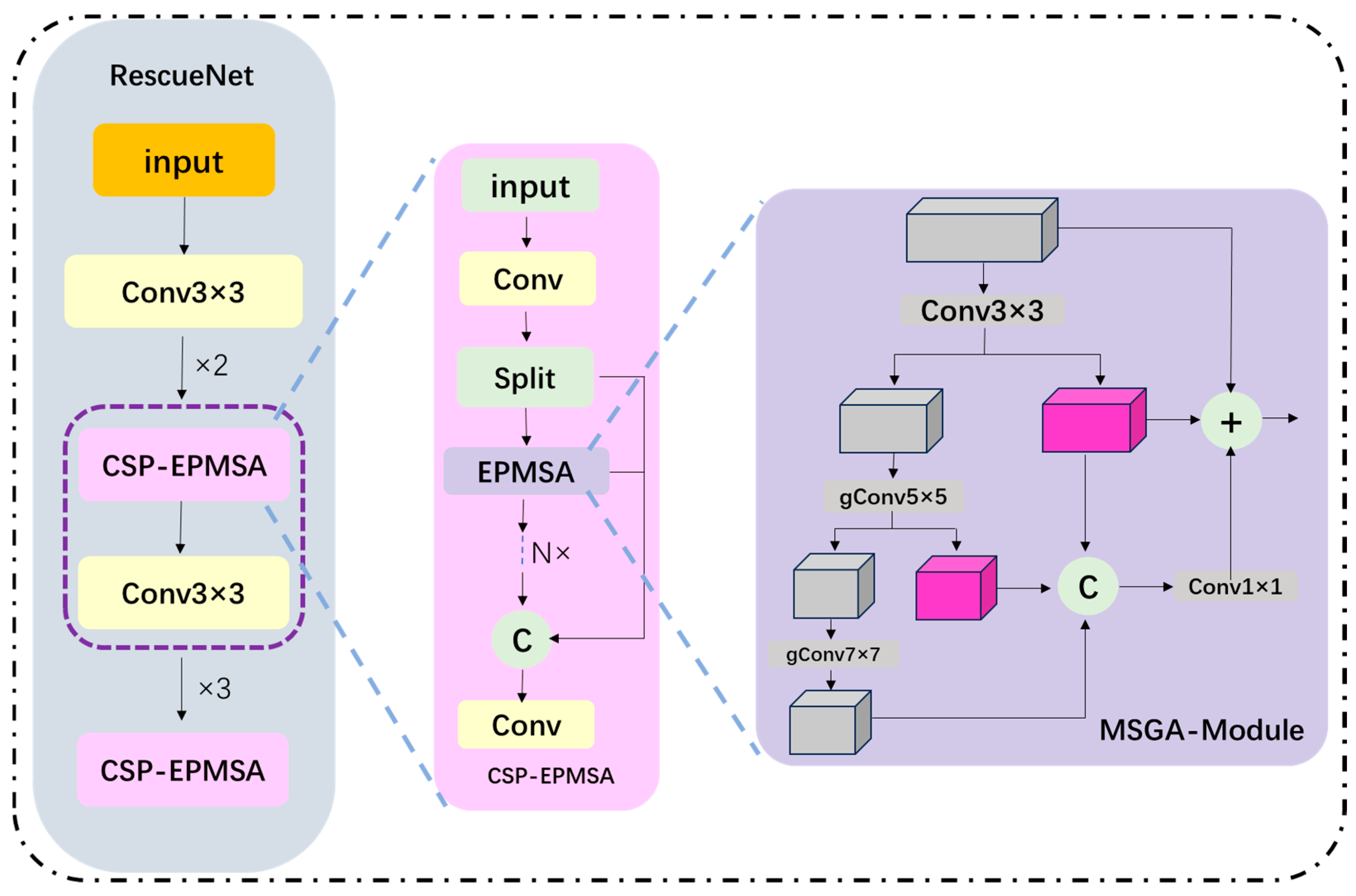
To address this limitation, we designed the Rescue-Net backbone network. As illustrated in
Figure 5, its core innovation is the newly proposed Multi-Scale Aggregation and Attention Module (MSGA-Module). This module employs parallel convolutional kernels of different sizes (3 × 3, 5 × 5, 7 × 7) to construct a progressively expanding receptive field. Specifically, the smaller kernels focus on capturing fine-grained details such as the contours of persons in water and the texture of life jackets, while the larger kernels efficiently extract cross-channel, medium-to-long-range semantic features (e.g., the overall structure of rescue vessels) through a grouped convolution strategy. This design is intended to improve the model’s adaptability to extreme scale variations characteristic of rescue scenarios, while maintaining computational efficiency.
However, powerful multi-scale perception capability may be impractical in onboard settings if it comes with excessive computational load. To address this, the MSGA-Module incorporates an innovative progressive channel compression strategy in its channel processing, as shown in the branch paths of
Figure 5. Each convolutional operation splits the feature map channels into two halves: one half undergoes subsequent complex computations to learn deep features, while the other half serves as an “express pathway,” preserved directly until the final fusion stage. This design not only establishes a pyramidal channel reduction flow that improves computational efficiency but, more fundamentally, ensures that valuable shallow texture features are not excessively abstracted or lost in the deep network—a characteristic crucial for accurately identifying partially wave-occluded persons in water. Finally, the convolutional outputs from all branches are fused with the preserved shallow features via concatenation and residual connections. This approach enriches the global contextual information while effectively mitigating the vanishing gradient problem in deep networks.
It should be noted that the 7 × 7 branch is not introduced to resolve additional internal texture details of extremely tiny targets. Instead, its role is to enlarge the effective receptive field and capture the surrounding local context, which is crucial for discriminating weak rescue-critical targets from chaotic sea clutter. In maritime SAR scenes, a faint swimmer or small floating object may share highly similar local pixel-level responses with wave crests, foam, or specular reflections. Under such conditions, reliable detection depends not only on the target itself, but also on the contextual cues in its neighborhood. Following this functional division, the smaller kernels mainly preserve fine-grained texture information, whereas the larger kernels progressively aggregate cross-channel medium-to-long-range semantic information. Therefore, the 7 × 7 branch serves as a context-aware complement rather than a redundant enlargement of the local feature extractor. To avoid excessive parameter growth, the large-kernel branch is implemented with grouped convolution and progressive channel compression, which expands the receptive field while keeping the computational burden compatible with the deployment-oriented objective of the proposed network.
To ensure the reproducibility of the proposed detector, the detailed architectural parameters of the Rescue-Net backbone are summarized in
Table 1. The network is designed with a hierarchical structure comprising five stages (Stem and Stages 2–5) to extract multi-scale features (denoted as S2, S3, S4, and S5) required by the subsequent hybrid encoder.
For reproducibility,
Table 1 explicitly summarizes the stage-wise configuration of Rescue-Net, including the feature resolution, output stride, channel width, and the number of stacked MSGA-Modules at each stage. The backbone follows the stacking configuration
N = [1, 3, 3, 1] across Stages 2–5, while the Stem performs the initial downsampling and feature embedding. This hierarchical design provides multi-scale features S2, S3, S4, and S5 for the subsequent hybrid encoder, while keeping the overall backbone compact and deployment-oriented.
By stacking multiple MSGA-Modules within a CSP [
27] architecture, Rescue-Net reduces the parameter count and avoids redundant operations while achieving more robust and efficient multi-scale feature extraction for rescue-critical targets. This design is intended to improve the model’s adaptability to extreme scale variations characteristic of rescue scenarios, while keeping the overall architecture lightweight for deployment.
3.2. Rescue-Oriented Attention Mechanism (Rescue Attention)
In complex maritime rescue scenarios, long token sequences and heavy sea clutter make global-context modeling beneficial but potentially expensive. Standard multi-head self-attention [
28] (MHSA) introduces quadratic complexity with respect to token length, which can become a runtime bottleneck under resource-constrained settings. Moreover, small rescue-critical targets may be overwhelmed by background interference during feature interaction, motivating a more efficient global-context module.
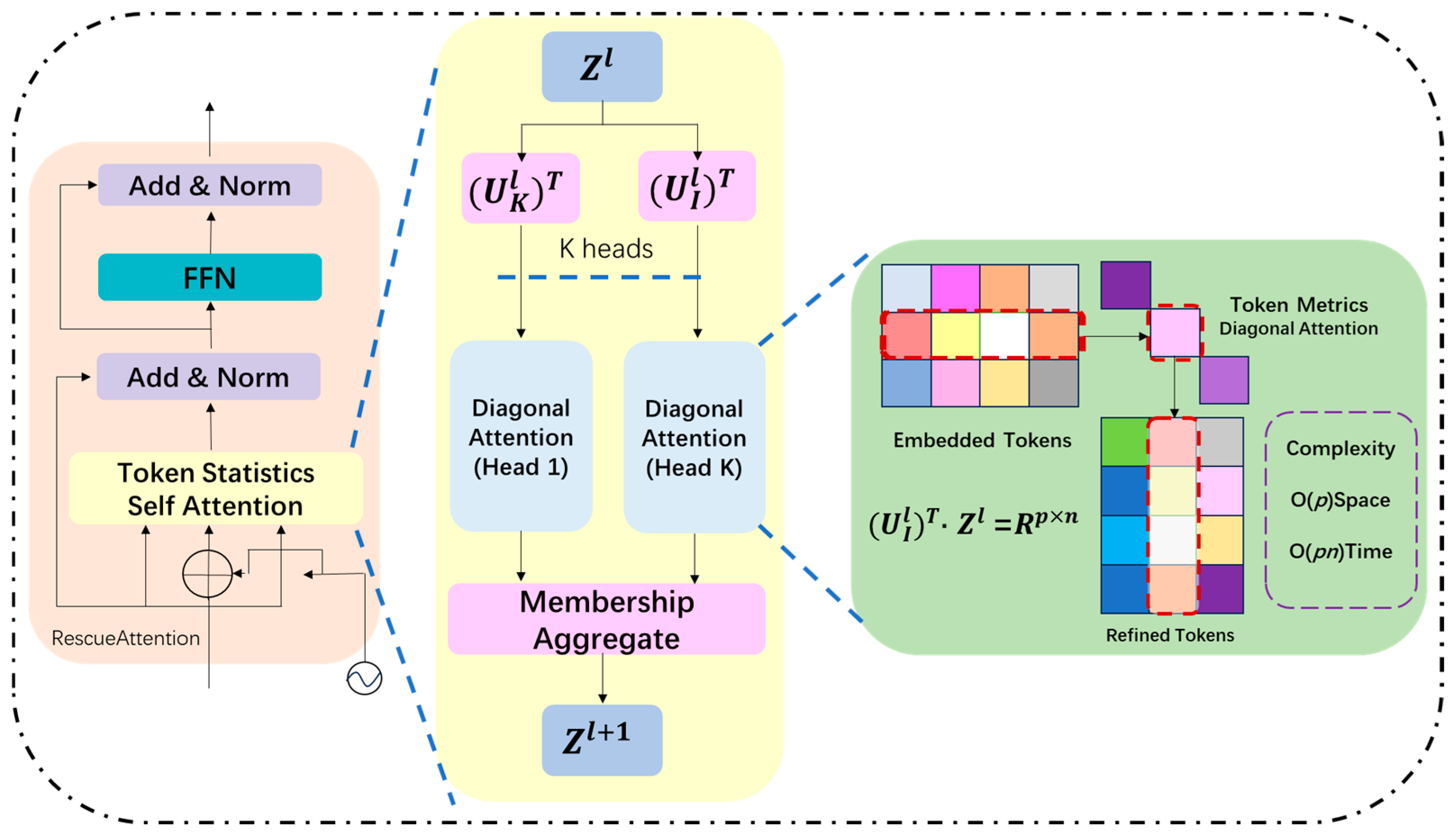
To address this core bottleneck, we adopt Token Statistics Self-Attention (TSSA) [
29] and build an optimized intra-scale interaction module, termed Rescue Attention, on top of it. The architecture of this module is illustrated in
Figure 6.
The design of TSSA stems from the need to optimize encoding efficiency and computational complexity. Its core idea is to avoid the pairwise similarity computation in traditional self-attention by instead using statistical features to represent token distributions, thereby reducing complexity. The TSSA operator is defined as follows:
where
is the token feature matrix,
represents a set of low-rank projection matrices, τ denotes the gradient descent step size, π
k is the token assignment probability vector,
denotes a compact second-order token-statistics operator (implemented as a covariance-style descriptor in our experiments) that summarizes the global distribution of tokens in the projected low-rank subspace. This operator leverages low-rank projections and statistical computations to eliminate the high cost of pairwise similarity calculations, thereby reducing computational complexity to a linear level while maintaining feature interaction capabilities.
For reproducibility, we explicitly instantiate each term in Equation (1). Let denote the token matrix with token length and channel dimension . For each statistical component , we use a learnable low-rank projection () to obtain projected tokens . Token membership is produced by a soft assignment (softmax gating) over components for each token, i.e., , where is a lightweight linear gating function and .
We define the statistic operator
as the (projected) weighted second-order descriptor over the token dimension:
where
is the
-th row of
. Accordingly, we instantiate
in Equation (1) as
, i.e., a compact covariance-style descriptor that summarizes global token distribution in the low-rank subspace. The step-size/temperature
is implemented as a fixed scalar initialized to 1.0 in all experiments for stable training.
In practice, controls the number of token-distribution components and r controls the low-rank projection dimension. In the maritime SAR setting considered here, the dominant background variability is mainly induced by several recurrent clutter patterns, such as waves, foam, and specular reflections, rather than by a large number of semantically distinct components. We therefore adopt a relatively small component number ( = 4) to capture the principal clutter modes while keeping the statistical grouping stable and computationally bounded. Meanwhile, r = 32 is used as a moderate projection dimension that preserves sufficient distributional structure for second-order statistical modeling without introducing excessive overhead in the attention block. Accordingly, the choice of = 4 and r = 32 should be understood as a deployment-oriented operating point that balances representational adequacy and inference efficiency in cluttered maritime scenes.
The practical motivation for adopting this statistical attention mechanism is closely related to the visual characteristics of maritime SAR imagery. In standard multi-head self-attention, feature interaction is established through pairwise similarity computation between all tokens. However, when the input sequence is dominated by repetitive wave patterns, foam, and sun-glint interference, the weak responses of small rescue-critical targets can be easily diluted during dense token-to-token interaction. In such cases, background clutter occupies most of the spatial support and tends to dominate the attention map.
In contrast, Rescue Attention does not rely on exhaustive pairwise similarity. Instead, it characterizes the global token distribution through weighted second-order statistics in a low-rank space. From this perspective, repetitive sea clutter forms the dominant background distribution, whereas faint rescue targets behave as sparse but informative deviations from that distribution. The covariance-style descriptor therefore summarizes the overall distributional structure of clutter-dominant tokens, rather than treating each token pair independently. This makes the global representation less sensitive to repetitive background responses and more sensitive to statistically atypical target-related cues.
The membership probability further acts as a soft grouping mechanism. Rather than assigning all tokens to a single global context indiscriminately, it softly partitions tokens into different statistical components according to their distributional characteristics. As a result, tokens dominated by sea clutter can be absorbed into one or several background-oriented components, while weak rescue-target tokens can contribute to components that preserve informative deviations from the dominant clutter distribution. In this way, global context modeling is better aligned with rescue-critical structures instead of being overwhelmed by noisy background patterns. This statistical grouping effect is the main reason why Rescue Attention improves target–clutter discrimination in complex maritime environments.
The Rescue Attention module is designed for scenarios with long token sequences and limited compute budgets (e.g., onboard maritime platforms), with the goal of providing bounded-cost global context modeling in our RT-DETR-based pipeline. Its workflow begins with low-rank projection, where the input multi-scale feature sequence is mapped to a low-rank subspace through channel dimension compression, obtaining a compact representation that establishes the foundation for subsequent efficient computation. Subsequently, in the statistical feature extraction stage, multiple attention heads within the TSSA unit operate in parallel. Instead of performing traditional Q-K-V similarity calculations, they directly extract statistical characteristics of the token distribution using the operator defined in Formula (1), thereby efficiently capturing global context. Following this, the extracted statistical features enter the feature fusion and refinement stage, undergoing sequential processing through membership aggregation, residual connections, layer normalization, and a feed-forward network to enhance feature robustness and representation. Ultimately, the module outputs a refined high-level feature enriched with enhanced global contextual information, providing robust support for subsequent decoding and localization tasks.
For implementation clarity, Rescue Attention is applied to the deepest feature map S5 in the hybrid encoder after spatial flattening into a token sequence where N is determined by the spatial resolution of S5 and d is the channel dimension. Each TSSA block uses K = 4 statistical components, a low-rank projection dimension r = 32, and a fixed step-size/temperature parameter τ = 1.0. Token memberships are generated by lightweight softmax gating, and the block follows a residual refinement form composed of low-rank projection, token-statistics self-attention, membership aggregation, layer normalization, and a feed-forward network. The resulting refined token representation is then reshaped back to the feature space for subsequent cross-scale fusion and decoding.
In our experimental setting, introducing this module improves runtime throughput on the desktop-GPU benchmark while maintaining competitive detection accuracy (see the ablation results under the same evaluation protocol). All runtime results reported in this paper are measured on a desktop-class GPU (NVIDIA RTX 2080 SUPER) under the same input resolution and implementation settings.
3.3. Rescue Feature Pyramid (Rescue-FPN)
Detecting persons overboard is particularly challenging as they often occupy only a few pixels, with their faint features easily lost in complex marine backgrounds. Traditional Feature Pyramid Networks often struggle to balance semantic information and spatial details: either losing crucial shallow contours to preserve deep semantics or sacrificing real-time performance in pursuit of detail. As a result, practical systems may struggle when facing “small, fast, and faint” targets, especially under heavy sea clutter and extreme scale variation.
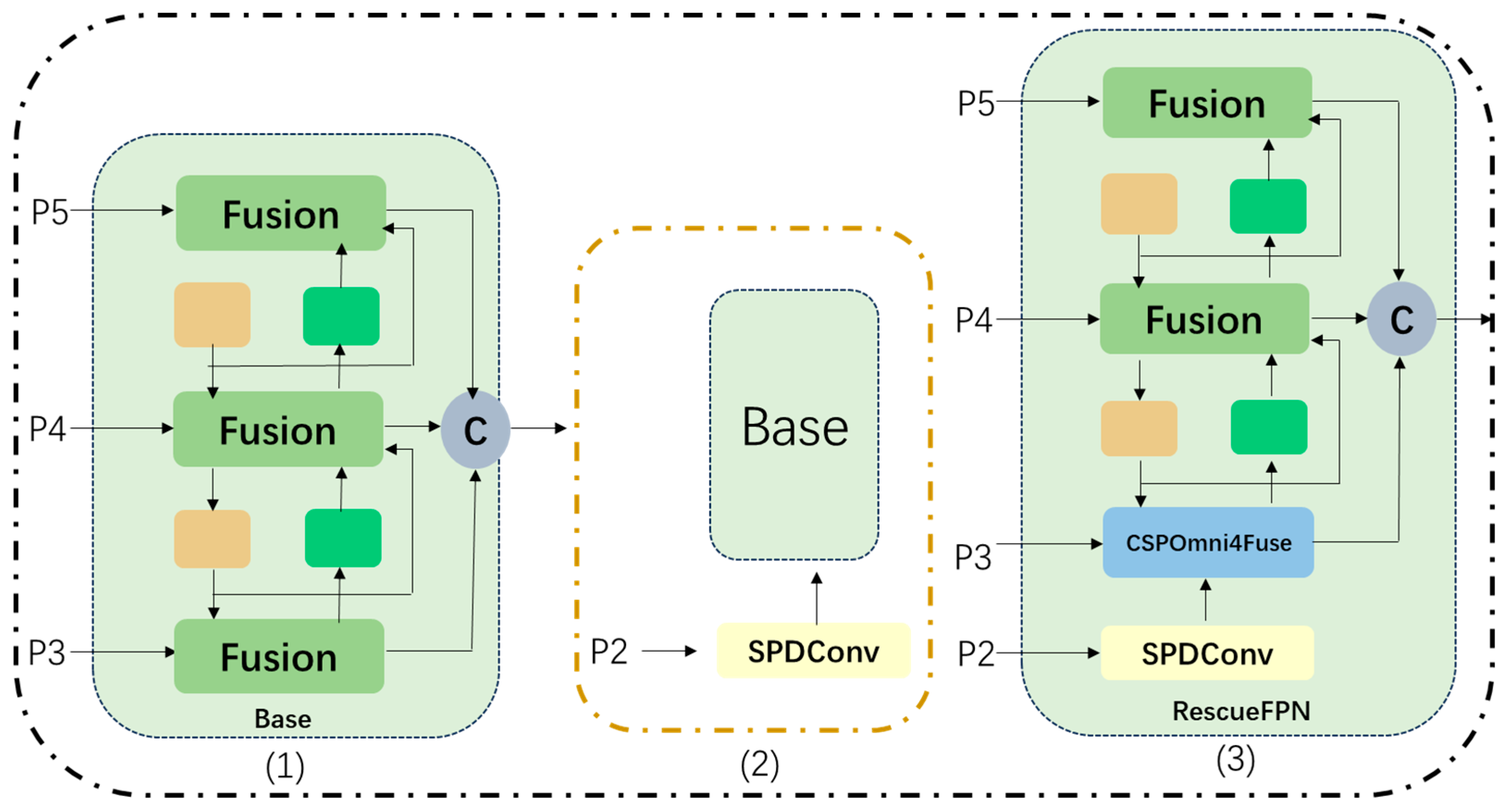
To address this, we designed the Rescue Feature Pyramid (Rescue-FPN), a feature fusion architecture specifically optimized for maritime rescue missions. As shown in
Figure 7, we compare three representative structures to illustrate the design evolution: Here, Base denotes the RT-DETR-style feature pyramid used in our baseline implementation (without the P2 layer), and all variants share the same training/inference settings for fair comparison. (1) Base: the conventional feature pyramid without high-resolution details; (2) Base + P2: introducing the P2 layer to enhance small target representation at the cost of increased model size and inference burden; and (3) Our Proposed Rescue-FPN: the complete architecture that achieves an optimal balance between detail preservation and computational efficiency through the synergistic operation of two innovative components.
Compared with common FPN variants such as PANet and BiFPN, Rescue-FPN follows a different efficiency–detail trade-off in terms of information flow and feature reuse. Instead of stacking repeated bidirectional fusion blocks with learnable fusion weights (typical in BiFPN) or adding a full bottom-up augmentation path to propagate all pyramid features (PANet), Rescue-FPN emphasizes: (i) injecting high-resolution tiny-target cues via SPD-Conv on the P2 layer to preserve fine structures without strided downsampling; and (ii) controlling computation via CSP-style partial-channel fusion (CSPOmni4Fuse), where only a subset of channels undergo heavy multi-kernel modeling while the remaining channels are reused through lightweight shortcut concatenation. This design strengthens small-target details while avoiding the substantial overhead introduced by deeper fusion stacks or full bidirectional paths.
The proposed Rescue-FPN comprises three core components working in concert: the lightweight structure-aware module SPD-Conv, the multi-scale fusion module CSPOmni4Fuse, and the cross-scale feature integration strategy.
First, to preserve fine-grained structural information in low-level feature maps, Rescue-FPN introduces the Space-to-Depth Convolution [
30] (SPD-Conv) module to process the P2 feature layer. Traditional CNNs typically employ strided convolution or pooling operations for feature downsampling. While these strategies reduce feature map dimensions, they inevitably lead to the loss of crucial local information, particularly when detecting extremely small targets like persons overboard. SPD-Conv utilizes a “space-to-depth” transformation to restructure the original feature map
into a set of sub-feature maps
, where the scaling factor
. This process maps spatial structures into the channel dimension, preserving positional information while enhancing the representational capacity of channel features. The specific transformation is as follows:
where
. All sub-feature maps are then concatenated along the channel dimension:
To prevent redundancy caused by increased channel count, a stride-free convolution is introduced to compress the channels of the SPD output, preserving discriminative features as much as possible while reducing computational load. The final output features of the SPD module thus preserve the fine-grained details that are crucial for maintaining information about distant, small rescue targets like persons overboard—details that are often lost in conventional downsampling operations.
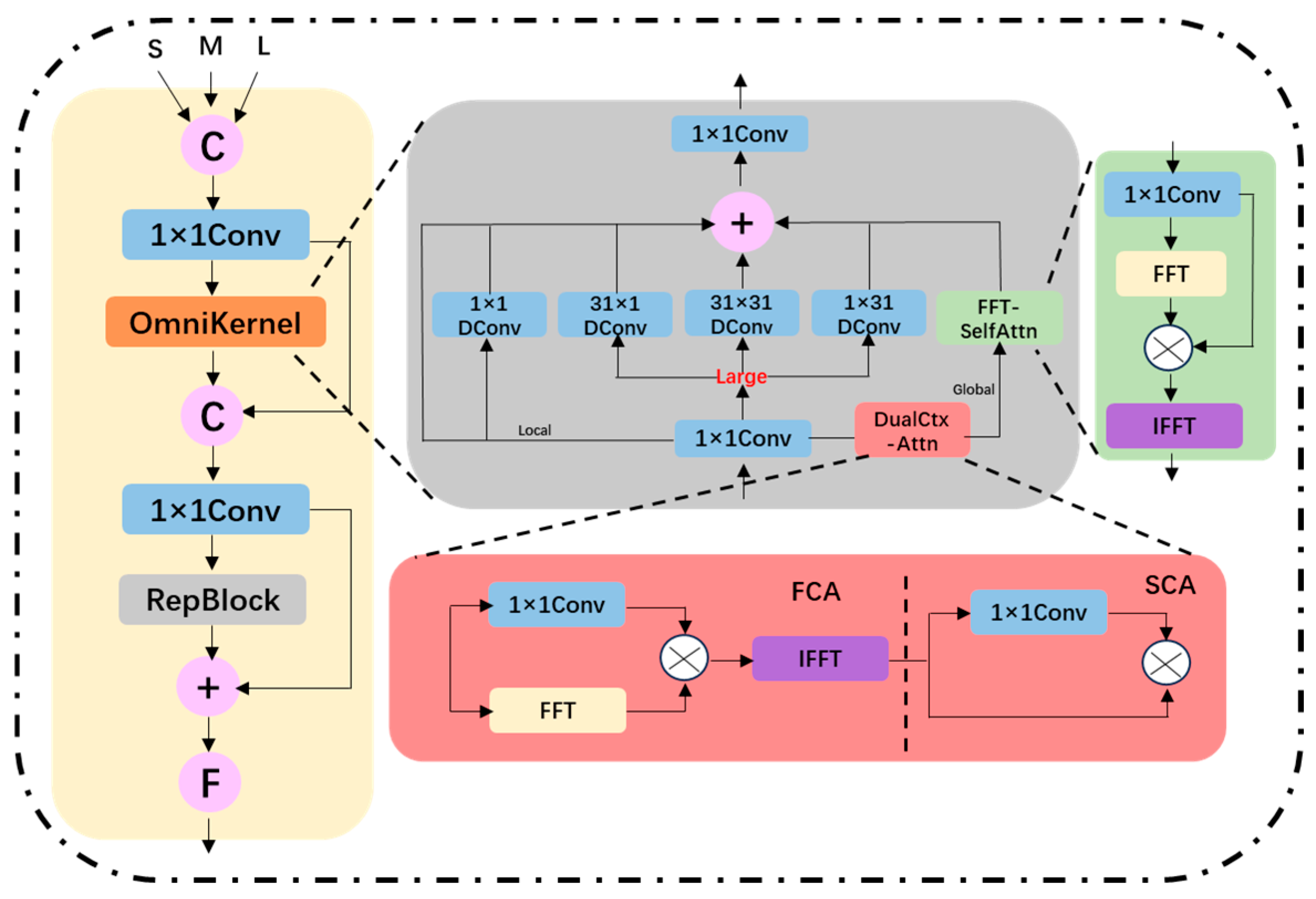
To efficiently integrate and enhance these multi-scale features—specifically, the detail-rich output from the SPD module and the semantic features from the P3 layer—we propose the CSPOmni4Fuse module as the core of the fusion stage. As shown in
Figure 8, this module inherits the efficient design philosophy of the CSP architecture by dividing the input channels into four groups. Only one group is fed into the OmniKernel network [
31] for deep feature modeling, while the remaining three groups bypass complex computations and directly participate in subsequent concatenation. Structurally (i.e., under the 1/4–3/4 channel partition), this design can theoretically reduce the heavy-branch convolutional computation by up to ~75% under the 1/4–3/4 partition, while the actual end-to-end speed also depends on implementation overhead (e.g., concatenation and 1 × 1 alignment).
The OmniKernel network employs a specifically designed triple-branch heterogeneous architecture to address the core challenge of extreme scale variations in rescue scenarios. This architecture achieves collaborative perception of global semantics, large-scale context, and local details through division of labor:
- (1)
We choose the kernel size 31 to approximate long-range context/stripe perception on low-resolution pyramid features (e.g., P3/P4), where wave textures and horizon-aligned structures are prevalent. The separable/strip design (31 × 31 separable and 31 × 1/1 × 31) enlarges the effective receptive field and captures orientation-sensitive cues while keeping the computation bounded. Importantly, 31 is not a hard requirement: we also evaluated more moderate configurations (e.g., 15 and 21) and observed that performance is generally stable, while the 31-based design provides the best overall accuracy–efficiency trade-off on MarineRescue-8K. Therefore, we adopt 31 as the default setting in this paper, and the kernel size/aspect ratio can be adjusted according to input resolution and deployment constraints.
- (2)
To address global modeling challenges in complex maritime conditions, we construct a novel dual-domain attention enhancement mechanism in the global branch. This mechanism consists of three core components working synergistically:
- (i)
Frequency-Channel Attention [
32] (FCA) module: First transforms features
to the frequency domain, uses global average pooling to guide high-frequency noise filtering, and recovers through inverse transform. The process is defined as
, capturing global distribution characteristics.
- (ii)
Spatial-Channel Attention [
33] (SCA) module: Subsequently performs channel-wise weight modulation on the FCA output, enhancing feature responses of critical channels, expressed as
.
- (iii)
Frequency-Spatial Attention Module [
34] (FSAM): Finally refines spatial relationships in the frequency domain through
, enhancing spatial structure consistency.
This serial processing pathway constructed in our work fully leverages the complementarity between frequency and spatial domains, enabling the network to maintain powerful contextual modeling capability under dramatically varying imaging conditions.
- (3)
To preserve fine features crucial for small-target detection, the local branch adopts our optimized lightweight 1 × 1 depthwise-separable convolution. This design focuses on extracting fine-grained local features such as limb contours of persons overboard and lifebuoy textures, preventing their loss in deep networks.
Finally, through our designed feature integration strategy, the outputs of OmniKernel’s three branches are concatenated with the previously preserved channel groups, followed by efficient dimensional alignment and feature fusion via a single 1 × 1 convolution. This design ensures a comprehensive and efficient feature representation, equipping the subsequent detection tasks with robust multi-scale cues critical for complex maritime environments.
For reproducibility, the implementation of Rescue-FPN can be summarized as follows. The module operates on the multi-scale features S2–S5 produced by Rescue-Net and the hybrid encoder. The high-resolution P2 feature is first processed by SPD-Conv with scaling factor s = 2, after which a stride-free convolution is used for channel compression. The subsequent CSPOmni4Fuse module adopts a four-group channel partition: one group is routed to the OmniKernel branch for heavy multi-kernel modeling, whereas the remaining three groups are preserved through lightweight bypass concatenation. Within OmniKernel, the context branch uses the default kernel size 31, the global branch performs dual-domain enhancement through FCA, SCA, and FSAM, and the local branch employs lightweight 1 × 1 depthwise-separable convolution for fine-detail extraction. The outputs of all branches are finally concatenated and aligned by a single 1 × 1 convolution to form the fused representation used by the detector.
This multi-branch, efficient fusion strategy directly addresses the core challenges of maritime rescue: achieving high-resolution context for small targets and large-receptive fields for scene understanding, all within a computationally bounded framework motivated by real-time onboard constraints.
4. Experimental Results and Analysis
This section systematically evaluates the effectiveness of the proposed R-DET framework for maritime rescue object detection tasks through comprehensive experiments. To thoroughly evaluate model performance, experiments were conducted on three representative datasets, namely MarineRescue-8K, WSODD, and FloW-Img as detailed in
Section 2.
4.1. Experimental Setup
Model training and evaluation were conducted on a Linux server with 8× NVIDIA RTX 2080 SUPER GPUs (8 GB each) using PyTorch 2.0.0. All models were trained for 200 epochs with a batch size of 16. Unless otherwise specified, FPS is measured on a single NVIDIA RTX 2080 SUPER GPU with batch size 1 at an input resolution of 640 × 640, using the same preprocessing, model inference, and postprocessing pipeline for all compared methods. These runtime results are reported to reflect the relative efficiency of different methods under a consistent desktop-GPU setting. A dedicated end-to-end latency benchmark on embedded platforms (e.g., Jetson-class devices) is left for future work. For all experiments, we follow RT-DETR’s set-prediction training and keep the matching coefficients (class/bbox/GIoU = 2/5/2) and loss weights (class/bbox/GIoU = 1/5/2) fixed throughout, so that the reported gains can be attributed to the proposed architectural modifications rather than to retuning the assignment or loss balance.
For evaluation on MarineRescue-8K, we report mAP@0.5 over the five rescue-critical categories, namely swimmer, life_saving_appliances, boat, jet_ski, and buoy. The ignored category is excluded from mAP computation because it represents non-critical floating clutter and is annotated only to define ignore regions. We follow the standard one-to-one matching protocol between predictions and ground-truth boxes of the five evaluated categories to determine TP and FP at each IoU threshold. After this assignment, an ignore-region filter is applied only to unmatched predictions: an unmatched prediction is marked as ignored, and thus not counted as FP, if its IoU with any ignore-region annotation exceeds 0.5. By contrast, predictions matched to valid ground-truth boxes are always retained as TP and are never re-labeled as ignored, even when overlap with an ignore region exists. This rule avoids ambiguity when a prediction overlaps both a valid object and an ignore region, and ensures that the ignore mechanism does not artificially inflate true positives. Unless otherwise stated, all MarineRescue-8K results in this paper follow this five-class evaluation protocol.
Unified training settings. For fair comparison, we train all methods under a unified setting on MarineRescue-8K using an input resolution of 640 × 640, 200 training epochs, and a batch size of 16. Unless a baseline provides an official training recipe, we adopt AdamW with an initial learning rate of 1 × 10⁻⁴ and weight decay of 1 × 10⁻⁴. We use the standard RT-DETR-style data augmentation pipeline (including random color distortion, random expand, random crop, random flip, and multi-scale random resizing during training) whenever compatible; otherwise, we keep identical resizing and normalization settings across methods. Backbone weights are initialized from ImageNet-pretrained models when available.
4.2. Evaluation Metrics
In this study, we used multiple evaluation metrics, including Precision (P), Recall (R), mean average precision (mAP), and parameter count. Here, Param (M) denotes the total number of learnable parameters of the detector (in millions).
In these formulas,
TP,
, and
FN denote the numbers of true positives, false positives, and false negatives, respectively, computed under the standard object-detection matching rule at a given IoU threshold for the evaluated categories.
where
is the number of evaluated categories (
= 5 for MarineRescue-8K following the 5-class protocol), and
is the per-class average precision of the
i-th evaluated category at a given IoU threshold (e.g., IoU = 0.5 for mAP50). We report both
, evaluated at an IoU threshold of 0.5, and
, which averages mAP over IoU thresholds from 0.5 to 0.95 with a step size of 0.05.
4.3. Backbone Network Comparative Experiments
To examine whether the proposed Rescue-Net actually provides a more task-aligned feature extractor for maritime SAR, we compare it with several representative backbone designs under the same RT-DETR detection head and unified training/evaluation protocol. This comparison is intended to assess not only generic feature-extraction capability, but more importantly whether the backbone can better preserve weak rescue-critical cues under severe scale compression and sea clutter while remaining compatible with the deployment-oriented objective of the detector.
Table 2 shows that Rescue-Net achieves 81.5% mAP@0.5 and 49.4% mAP@0.5:0.95 with only 14.1M parameters. Relative to the baseline backbone, it improves mAP@0.5 by 1.1 percentage points while reducing the parameter count by 29.1%, indicating that the proposed backbone provides a more favorable feature-extraction efficiency profile under the evaluated setting. More importantly, although Rescue-Net does not reach the highest overall mAP@0.5 among all compared backbones, it yields the strongest performance on the most task-relevant indicators, namely APS (57.6%), swimmer AP (77.9%), and life_saving_appliances AP (79.1%). This distinction is important because maritime SAR performance should not be judged solely by generic overall mAP; the more critical question is whether weak rescue-critical objects can be better preserved under severe scale compression and sea clutter. From this perspective, Rescue-Net should be understood not as a heavier generic substitute, but as a lightweight rescue-oriented backbone that preferentially strengthens tiny-target-sensitive representation while remaining compatible with the deployment objective of the overall detector.
4.4. Comparative Experiments on Feature Fusion Networks
To further evaluate whether high-resolution cue propagation can be strengthened without breaking the deployment-oriented efficiency objective, we compare three progressively enhanced variants: the baseline pyramid, a direct P2-enhanced version, and the proposed Rescue-FPN. This comparison is intended to clarify whether the key issue is simply adding more shallow features, or selectively propagating tiny-target cues under bounded computational cost.
Table 3 reveals a clear detail-efficiency trade-off in feature-fusion design. Adding a full P2 layer (Base + P2) improves mAP@0.5 from 80.4% to 82.4%, confirming that additional high-resolution cues are indeed beneficial for maritime SAR. However, this direct enhancement also increases the parameter count from 19.9M to 21.4M, thereby raising the deployment burden. By contrast, Rescue-FPN further improves mAP@0.5 to 82.6% and mAP@0.5:0.95 to 50.4%, while keeping the parameter count lower than Base + P2. These results indicate that the key issue is not simply whether more shallow features are introduced, but whether tiny-target cues can be propagated selectively and efficiently. In this sense, Rescue-FPN better matches the central requirement of maritime SAR perception, namely to preserve weak small-target evidence without relying on a heavy dense pyramid.
4.5. Grad-CAM Heatmap Analysis
To further analyze the perceptual behavior of the detector under representative maritime SAR conditions, we employ Gradient-weighted Class Activation Mapping (Grad-CAM) [
35] to compare the attention patterns of RT-DETR and the proposed R-DET. The selected samples in
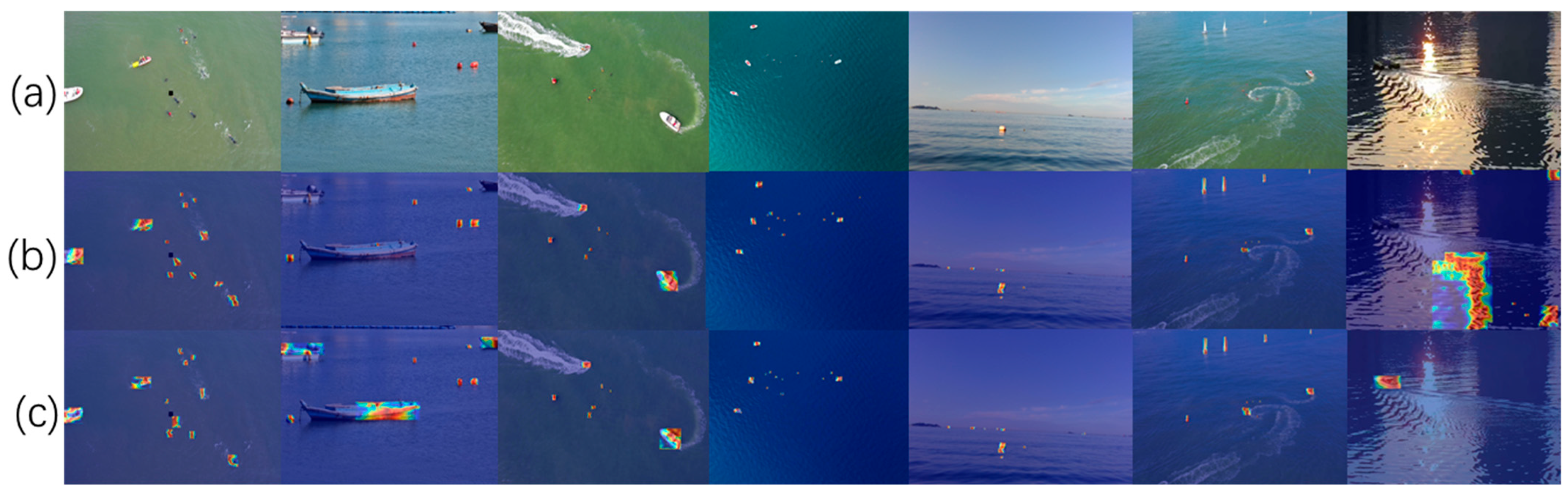
Figure 9 are not limited to a single illustrative example, but cover three representative difficulty types frequently encountered in maritime SAR imagery: extremely small rescue-critical targets with very limited spatial support, targets strongly affected by wave clutter and surrounding sea-surface structures, and targets observed under strong specular reflection or low-contrast illumination conditions. These cases are particularly suitable for qualitative analysis because target evidence is weak and is easily overwhelmed by background interference.
Figure 9 compares the attention patterns of RT-DETR and the proposed R-DET under these representative conditions. As shown in
Figure 9, RT-DETR tends to produce relatively diffuse activation over clutter-dominated water surfaces, especially when the target occupies only a few pixels, is embedded in wave or wake structures, or appears near strong reflective regions. By contrast, R-DET exhibits more compact and target-aligned activation across all representative cases. In long-range tiny-target samples, it maintains clearer focus on the limited target region despite extremely weak spatial support. In clutter-dominated or low-contrast samples, it suppresses a larger portion of irrelevant sea-surface responses while preserving stronger activation around the true target. These qualitative differences are consistent with the functional roles of the proposed modules: Rescue-Net improves weak tiny-target representation, Rescue Attention reduces clutter-dominated global interference, and Rescue-FPN strengthens the propagation of high-resolution cues. Grad-CAM is used here as a qualitative diagnostic tool rather than as a standalone quantitative metric; nevertheless, the multi-sample visual evidence in
Figure 9 is consistent with the quantitative improvements reported later, supporting the interpretation that R-DET improves target-clutter discrimination under representative maritime SAR conditions rather than benefiting from a single isolated visual example.
4.6. Comparative Evaluation with Representative Detectors
To move from feature-level evidence to detector-level behavior in real scenes, we next compare the qualitative predictions of representative detectors under failure-prone maritime SAR conditions. This comparison is intended to reveal whether the proposed detector advantage is reflected not only in internal feature responses, but also in the final prediction behavior under visually challenging rescue scenarios.
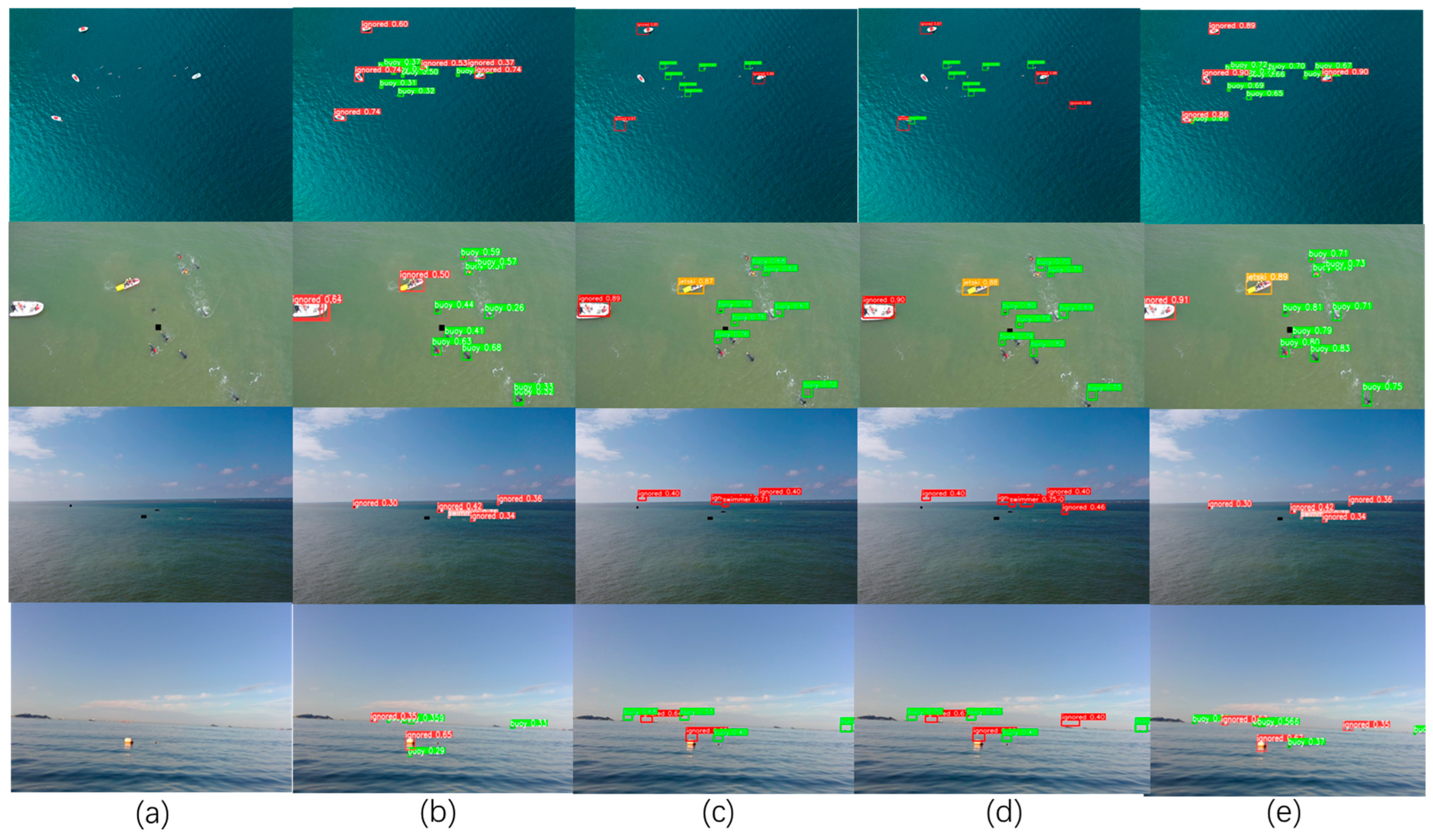
Figure 10 shows that the advantage of R-DET is not limited to isolated activation patterns, but is also reflected in actual detector outputs under long-range tiny-target scenes, cluttered nearshore backgrounds, horizon-scale low-saliency conditions, and low-contrast floating-target cases. Across these examples, R-DET yields more complete detections of small and distant rescue-critical objects while producing fewer clutter-induced responses than RT-DETR, YOLOv8-M, and YOLOv10-L.
Notably, the prediction labeled as ignored is intentionally retained as a visual instantiation of the evaluation protocol in
Section 4.1, whereby unmatched predictions overlapping ignore regions are excluded from false-positive counting. This retained prediction therefore reflects protocol-consistent detector behavior rather than an unfiltered false positive.
These qualitative observations are consistent with the intended roles of the proposed modules. Rescue-Net preserves fine-grained multi-scale cues for weak tiny targets, Rescue Attention enhances clutter-suppressed global context modeling, and Rescue-FPN strengthens the propagation of high-resolution details for small rescue-critical objects. Taken together,
Figure 10 provides detector-level visual evidence that the proposed design improves both target completeness and clutter robustness, which is then quantitatively verified in the comparison reported in
Table 4.
Table 4 reports the quantitative comparison results on MarineRescue-8K. Among the compared methods, R-DET achieves the best overall performance, reaching 84.1% mAP@0.5 and 52.6% mAP@0.5:0.95 with 14.5M parameters at 63.2 FPS. In addition to leading the overall detection metrics, R-DET also attains the highest class-wise AP on the two mission-critical categories, namely swimmer (78.9%) and life_saving_appliances (80.8%).
Compared with RT-DETR-R50 and RT-DETR-R101, R-DET improves mAP@0.5 by 1.6 and 0.9 percentage points, respectively, while using only about one-third of the parameters of RT-DETR-R50 and less than one-fifth of those of RT-DETR-R101. Among the methods with reported full-pipeline speed under the unified desktop-GPU setting, R-DET also preserves real-time throughput at 63.2 FPS. These results indicate that the proposed rescue-oriented modifications improve detection accuracy without sacrificing deployment-oriented efficiency.
Taken together with the qualitative evidence in
Figure 10, the gains in both overall mAP and class-wise AP are consistent with the intended roles of the proposed modules. Rescue-Net improves lightweight multi-scale representation, Rescue Attention enhances clutter-suppressed global context modeling, and Rescue-FPN strengthens the propagation of high-resolution cues for tiny rescue-critical targets. Their joint effect enables R-DET to better accommodate the severe scale variation and background interference characteristic of maritime SAR imagery.
To further examine whether this rescue-oriented advantage extends beyond the in-domain benchmark, we next evaluate the compared methods on the public WSODD dataset. The corresponding cross-dataset comparison results are reported in
Table 5.
Table 5 reports the cross-dataset comparison results on WSODD. Under the unified evaluation protocol, R-DET achieves the highest overall mAP@0.5 (80.5%) and mAP@0.5:0.95 (47.9%) among the compared methods, while also leading the class-wise AP on swimmer (76.1%) and life_saving_appliances (77.8%). Compared with RT-DETR-R50 and RT-DETR-R101, the proposed model improves mAP@0.5 by 3.0 and 1.6 percentage points, respectively. These results indicate that the proposed rescue-oriented design does not merely overfit the in-domain benchmark, but transfers favorably to broader aquatic scenes in which target appearance, background composition, and clutter statistics differ from those of MarineRescue-8K.
To further challenge cross-dataset transferability in more dynamic floating-object scenes, we additionally evaluate the compared methods on FloW-Img. The results are presented in
Table 6.
Table 6 further evaluates cross-dataset generalization on FloW-Img, which contains more complex dynamic water-surface backgrounds. R-DET achieves the best overall performance among the compared methods, reaching 85.6% mAP@0.5 and 49.6% mAP@0.5:0.95, together with the highest precision (88.2%) and recall (79.0%). It also obtains the best class-wise AP on swimmer (82.3%) and life_saving_appliances (83.1%). Taken together with the WSODD results, this comparison suggests that the proposed detector improves not only in-domain accuracy, but also the stability of rescue-oriented target perception under broader aquatic domain shifts. In other words, the gain of R-DET is not tied to a single benchmark distribution, but is reflected in a more transferable balance between tiny-target sensitivity and clutter robustness.
4.7. Ablation Study
To verify whether the performance gain of R-DET arises from complementary architectural effects rather than from a single dominant modification, ablation studies were conducted on MarineRescue-8K starting from the baseline model. In
Table 7, Model 1 serves as the baseline control, whereas Models 2–8 represent different combinations of Rescue-Net, Rescue Attention, and Rescue-FPN progressively integrated into the baseline model. Here, “√” indicates the inclusion of the corresponding module.
By decomposing the full detector into different module combinations,
Table 7 enables a systematic examination of the individual and joint effects of Rescue-Net, Rescue Attention, and Rescue-FPN under a unified evaluation setting. In particular, it clarifies how lightweight multi-scale representation, clutter-suppressed global context modeling, and efficient high-resolution cue propagation contribute to the final performance of R-DET. These three aspects directly correspond to the coupled bottlenecks identified in the Introduction, namely tiny-target sensitivity, clutter robustness, and deployment efficiency.
The ablation results in
Table 7 confirm that the three proposed modules contribute in a complementary rather than redundant manner. Introducing Rescue-Net alone improves mAP@0.5 from 80.4% to 81.5% and mAP@0.5:0.95 from 48.3% to 49.4%, while simultaneously reducing the parameter count from 19.9M to 14.1M and increasing FPS from 63.9 to 68.0. This result indicates that Rescue-Net provides a more favorable feature-extraction efficiency profile than the baseline backbone under the evaluated setting.
Introducing Rescue Attention alone also yields consistent gains in both mAP@0.5 and mAP@0.5:0.95, while keeping the parameter count nearly unchanged and improving runtime throughput. This behavior is consistent with its design objective, namely to enhance clutter-suppressed global context modeling with bounded computational overhead. Rescue-FPN produces the largest single-module gain in mAP@0.5:0.95, suggesting that strengthening high-resolution cue propagation is particularly beneficial for tiny rescue-critical targets under severe sea clutter.
The two-module combinations further support the complementarity of the proposed design. The Rescue-Net + Rescue Attention configuration achieves the most favorable efficiency profile among the two-module variants, reaching 82.2% mAP@0.5 and 49.9% mAP@0.5:0.95 with only 14.0M parameters at 76.9 FPS, which indicates that lightweight multi-scale representation and efficient global context modeling can be jointly strengthened without breaking the deployment-oriented objective. The Rescue-Net + Rescue-FPN configuration reaches 83.4% mAP@0.5 and 51.2% mAP@0.5:0.95, confirming that lightweight backbone redesign and high-resolution cue propagation are mutually beneficial under maritime SAR conditions. Meanwhile, the Rescue Attention + Rescue-FPN configuration achieves the strongest accuracy among the two-module variants, reaching 83.5% mAP@0.5 and 51.5% mAP@0.5:0.95, indicating that improved global context modeling and enhanced small-target feature propagation reinforce each other effectively.
When all three modules are integrated, the full model attains the best overall result, reaching 84.1% mAP@0.5 and 52.6% mAP@0.5:0.95 with 14.5M parameters at 63.2 FPS. Although the full model is not the fastest configuration, it provides the best overall accuracy-efficiency balance under the unified evaluation setting, which is more consistent with the deployment-oriented objective of maritime SAR perception than optimizing accuracy or speed in isolation.
Overall, the ablation study shows that Rescue-Net, Rescue Attention, and Rescue-FPN address different but coupled bottlenecks in maritime SAR detection, namely lightweight multi-scale representation, clutter-robust global context modeling, and high-resolution detail preservation. Their joint use therefore improves the overall accuracy-efficiency trade-off more effectively than any individual module or partial combination.
Beyond the architectural components, the performance and efficiency of the Rescue Attention mechanism are sensitive to its internal statistical configurations—the number of token-distribution components K and the low-rank projection dimension r. To justify our deployment-oriented design, we further conducted a sensitivity analysis on these hyperparameters. As detailed in
Table 8, we varied K from 2 to 8 and r from 16 to 64 to observe their impact on accuracy and throughput.
The results in
Table 8 reveal a clear accuracy-efficiency trade-off in the internal statistical configuration of Rescue Attention. Increasing the number of token-distribution components from K = 2 to K = 4 yields a clear gain in detection accuracy, indicating that a moderate number of components is beneficial for disentangling dominant clutter patterns in maritime scenes. However, further increasing K to 8 produces only marginal additional gains while noticeably reducing inference throughput, suggesting diminishing returns beyond the moderate-complexity setting.
A similar trend is observed for the low-rank projection dimension r. Setting r = 32 provides a favorable operating point that preserves sufficient distributional structure for second-order statistical modeling while maintaining efficient runtime. Although r = 64 offers a slight improvement in mAP, it also incurs a clear drop in FPS and increases parameter count. Therefore, the adopted configuration (K = 4, r = 32) should be understood as a deployment-relevant compromise between representational adequacy and inference efficiency, rather than as a purely accuracy-maximizing choice.
Taken together, the results in
Table 7 and
Table 8 further support the central claim of this work: the advantage of R-DET does not arise from indiscriminately increasing model complexity, but from coordinating lightweight multi-scale representation, clutter-robust global context modeling, and efficient high-resolution cue propagation under practical deployment constraints.
4.8. Robustness Evaluation Under Degraded Visual Conditions
Beyond clean-condition benchmark evaluations, maritime SAR imagery is frequently affected by environmental degradations such as sensor noise, platform-induced motion blur, and adverse illumination, all of which can further weaken already fragile rescue-target evidence. To assess whether the advantage of R-DET remains stable under such degraded visual conditions, we conducted controlled robustness tests by injecting synthetic perturbations into the MarineRescue-8K test set and comparing the resulting performance with the RT-DETR baseline.
Table 9 quantifies the performance degradation of RT-DETR and R-DET under three representative perturbation types, namely Gaussian noise, motion blur, and low illumination. Under all tested conditions, R-DET preserves higher mAP@0.5 than RT-DETR and exhibits consistently smaller accuracy drops relative to the clean condition. In particular, under medium-intensity motion blur, which simulates platform vibration during image acquisition, the baseline RT-DETR decreases from 82.5% to 68.1%, corresponding to a degradation of 14.4 percentage points, whereas R-DET decreases from 84.1% to 75.4%, corresponding to a smaller drop of 8.7 percentage points. Similar trends are observed under Gaussian noise and low-illumination perturbations, indicating that the proposed detector maintains a more stable performance profile when visual evidence is degraded.
This robustness advantage is consistent with the intended roles of the proposed modules. Rescue-Net improves scale-sensitive representation for weak targets, Rescue Attention suppresses clutter-dominated global interference through statistical context modeling, and Rescue-FPN strengthens the propagation of high-resolution target cues that would otherwise be easily corrupted under degraded visual conditions. From this perspective, the robustness results provide controlled evidence that the benefit of R-DET is not limited to clean-condition benchmark accuracy, but extends to visually degraded maritime scenes that are relevant to practical SAR operations.
Nevertheless, these experiments should be interpreted as controlled perturbation tests on visual inputs rather than as a substitute for full embedded-deployment validation under real operational conditions. Even so, they remain important because they strengthen the deployment-oriented claim of this work by showing that the proposed detector degrades more gracefully than the baseline under representative adverse visual conditions.
5. Discussion
This study addresses a central bottleneck in maritime search-and-rescue (SAR) perception, namely how to maintain reliable rescue-target detection under severe sea clutter while preserving practical real-time efficiency. The experimental results show that this challenge cannot be effectively resolved by relying on generic detector scaling alone; instead, it requires coordinated improvement in lightweight multi-scale representation, clutter-suppressed global context modeling, and high-resolution cue propagation for weak tiny targets. Within this design framework, R-DET achieves 84.1% mAP@0.5 on MarineRescue-8K with only 14.5M parameters at 63.2 FPS, while also maintaining favorable performance on WSODD and FloW-Img and exhibiting smaller accuracy degradation than RT-DETR under representative perturbations such as noise, motion blur, and low illumination. Taken together, these results indicate that the proposed detector improves not only overall accuracy, but also the accuracy-efficiency-robustness balance required by deployment-oriented maritime SAR perception.
Beyond the numerical gains, the value of this work lies in narrowing the gap between generic object detection research and mission-oriented maritime SAR perception. In practical rescue scenarios, the most critical targets are often small, sparse, weakly contrasted, and heavily disturbed by repetitive sea-surface clutter. Under such conditions, detector quality is determined not only by aggregate mAP, but by whether weak rescue-critical objects can still be separated from waves, foam, wakes, and reflective background structures. From this perspective, the joint design of Rescue-Net, Rescue Attention, and Rescue-FPN is meaningful because it directly targets the coupled bottlenecks of extreme scale variation, target-clutter confusion, and bounded computational budget. Together with MarineRescue-8K and its ignore-region protocol, the proposed framework provides a more task-aligned basis for future research on maritime remote-sensing perception in rescue settings.
Several limitations nevertheless remain. Although R-DET improves target-clutter discrimination under the evaluated settings, false positives may still arise when persistent wave crests, foam, or specular reflections exhibit local appearance patterns similar to those of rescue-critical objects. Missed detections remain more likely when the target is heavily occluded, located near the horizon, or occupies only an extremely small number of pixels, such that the available visual evidence becomes too weak for stable discrimination. In addition, severe domain shifts caused by extreme weather, unfamiliar sea states, or strong illumination changes may reduce the stability of the learned representation. These observations indicate that the present model, while more robust than the compared baselines under the reported settings, still relies primarily on visible-spectrum appearance cues and therefore has not fully closed the perception gap under all-weather and all-day SAR conditions.
A further limitation concerns deployment scope. The present study evaluates efficiency under a unified desktop-GPU protocol and therefore does not yet constitute a completed embedded-deployment demonstration. The reported FPS results should be interpreted as desktop-GPU full-pipeline measurements rather than as device-level evidence on embedded hardware. For this reason, future work will explicitly move toward deployment-oriented validation. First, we will conduct embedded benchmarking on Jetson-class platforms and report end-to-end latency covering preprocessing, model inference, and postprocessing. Second, we will investigate edge-oriented acceleration strategies, including quantization, pruning, and TensorRT-based optimization, to further improve runtime efficiency under resource-constrained onboard settings. Third, we will extend the current RGB-based detector toward multimodal SAR perception by integrating visible imagery with complementary sensing streams such as thermal infrared and radar, so as to improve robustness under low illumination, haze, glare, and other adverse conditions. In parallel, systematic failure-case analysis and dynamic adaptation mechanisms will be studied to better cope with evolving maritime environments and heterogeneous platform constraints.