1. Introduction
With the rapid development of remote sensing technology, object detection in high-resolution images has become essential for tasks such as urban monitoring and military reconnaissance [
1,
2]. In recent years, using Convolutional Neural Networks (CNN) for feature extraction has greatly improved general object detection performance [
3,
4,
5]. However, applying these methods directly to remote sensing fields faces significant challenges. Unlike natural images, objects in remote sensing images often show large scale variations and are densely distributed [
6,
7,
8]. Moreover, targets like bridges, ships, and vehicles usually appear in arbitrary directions and have very large aspect ratios. In such complex scenes, traditional horizontal bounding boxes (HBox) often include substantial background noise, lowering the quality of feature extraction, and struggle to handle crowded objects [
9,
10,
11]. For example, in ports or airports, the high overlap between horizontal boxes may cause non-maximum suppression (NMS) to mistake real targets for duplicates. In contrast, oriented object detection (OBB) adds an angle parameter to create tighter boxes that fit the object’s shape more accurately, effectively separating dense targets. As a result, OBB provides more accurate localization and has become a key technique for high-precision remote sensing analysis [
12].
However, most existing remote sensing benchmark datasets are annotated with HBox. While this approach is more cost-effective than using rotated boxes [
13], it has resulted in a significant gap between the currently available training dataset and the growing demand for oriented object detection [
14]. Weakly supervised oriented object detection (WS-OOD) provides an effective solution to this issue. Weakly supervised oriented object detection based on HBox aims to reduce the cost of manual annotation by using coarser-grained labels for training compared to fully supervised methods, while preserving, to the greatest extent possible, the accuracy of fully supervised methods [
15]. This method does not rely on precisely labeled rotated bounding boxes (RBox), solving the problem of time-consuming and laborious oriented bounding box annotation in dense or extremely small-scale remote sensing object scenes. Furthermore, it can utilize existing large-scale horizontal labeling datasets without the need for secondary labeling, making it a more efficient alternative.
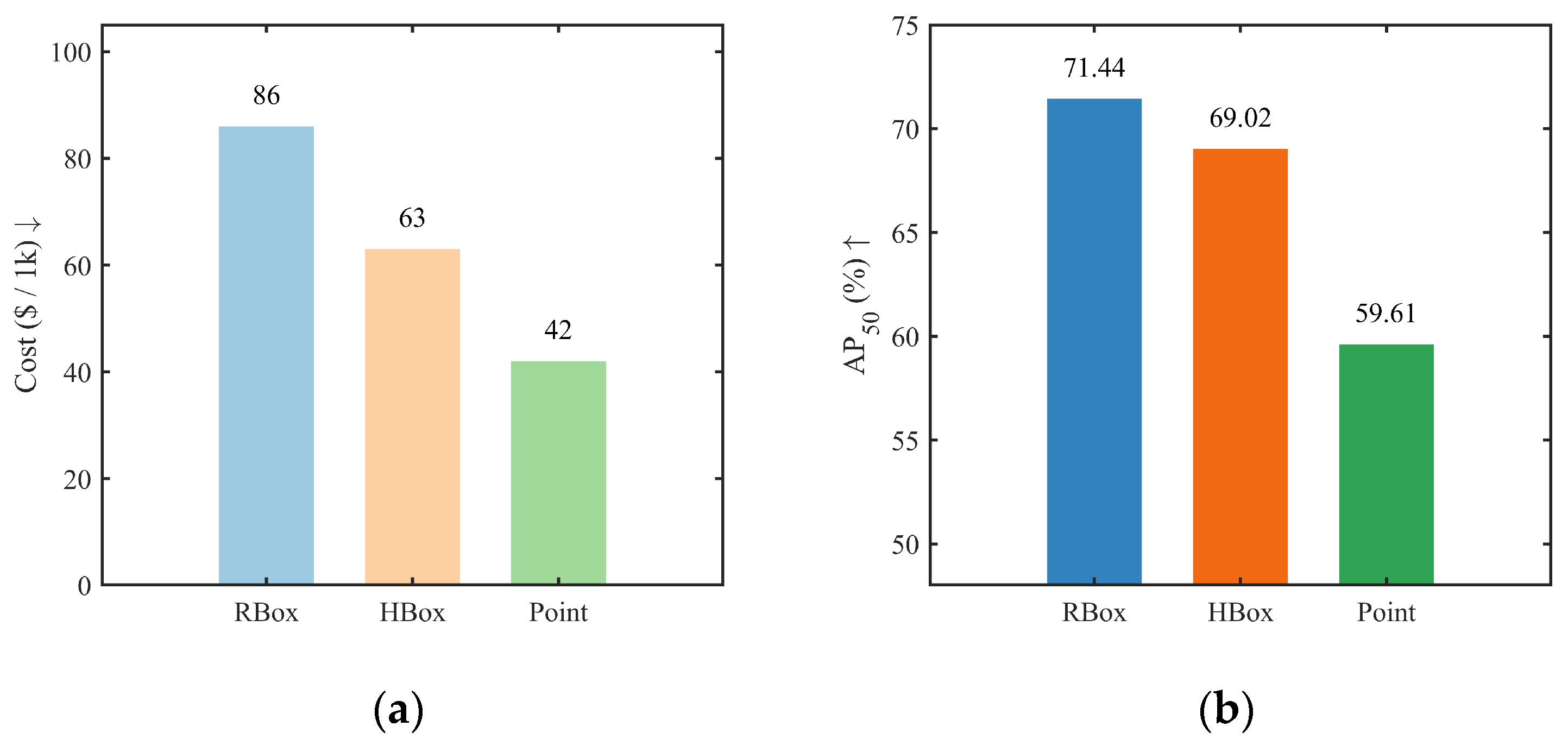
Furthermore, as shown in
Figure 1, in contrast to other forms of weakly supervised labeling (such as image-level labels and point annotations), horizontal bounding box-based supervision strikes a superior balance between labeling cost and model performance. As it provides more precise spatial location and scale information, this method offers stronger geometric priors, thereby reducing the uncertainty in inferring rotated bounding boxes despite the lack of angular information. Therefore, using HBox as weak supervision signals offers greater practicality and robustness than other weak labeling methods, making it the optimal choice for achieving high-performance oriented object detection while ensuring low cost.
Weakly supervised object detection methods based on HBox can be broadly categorized into three types based on the weak label derivation process: segmentation-driven methods, region proposal-based methods, and transformation consistency-based methods. Compared to segmentation-driven methods which are limited by mask quality, and proposal-based methods which lack adaptability to objects with large aspect ratios, transformation consistency-based methods exhibit distinct advantages: avoiding complex intermediate mask generation processes and proposal presets. By constructing a weakly supervised–self-supervised network and imposing geometric consistency constraints between views, end-to-end angle adaptive learning is achieved, resulting in regression efficiency and accuracy far exceeding other methods.
As a representative method based on transformation consistency, H2RBox [
16] achieves performance close to that of fully supervised methods. It follows the idea of self-supervised learning, generating rotated and flipped transformed views based on the same image and learning consistency among the prediction results of the three views, thus reconstructing angle information even without angle labels. The improved H2RBox-v2 [
17] introduces prior knowledge of object symmetry, allowing the self-supervised branch to learn angles independently. Simultaneously, a new angle encoding method is used to transform the angle regression problem into a continuous phase prediction problem, effectively solving the boundary discontinuity problem caused by angle periodicity. Building on this, subsequent researchers optimized the angle encoding method, proposing the Unit Circle Angle Resolver (UCR) and incorporating a unit circle loss to further enhance the model’s ability to perceive subtle angle changes [
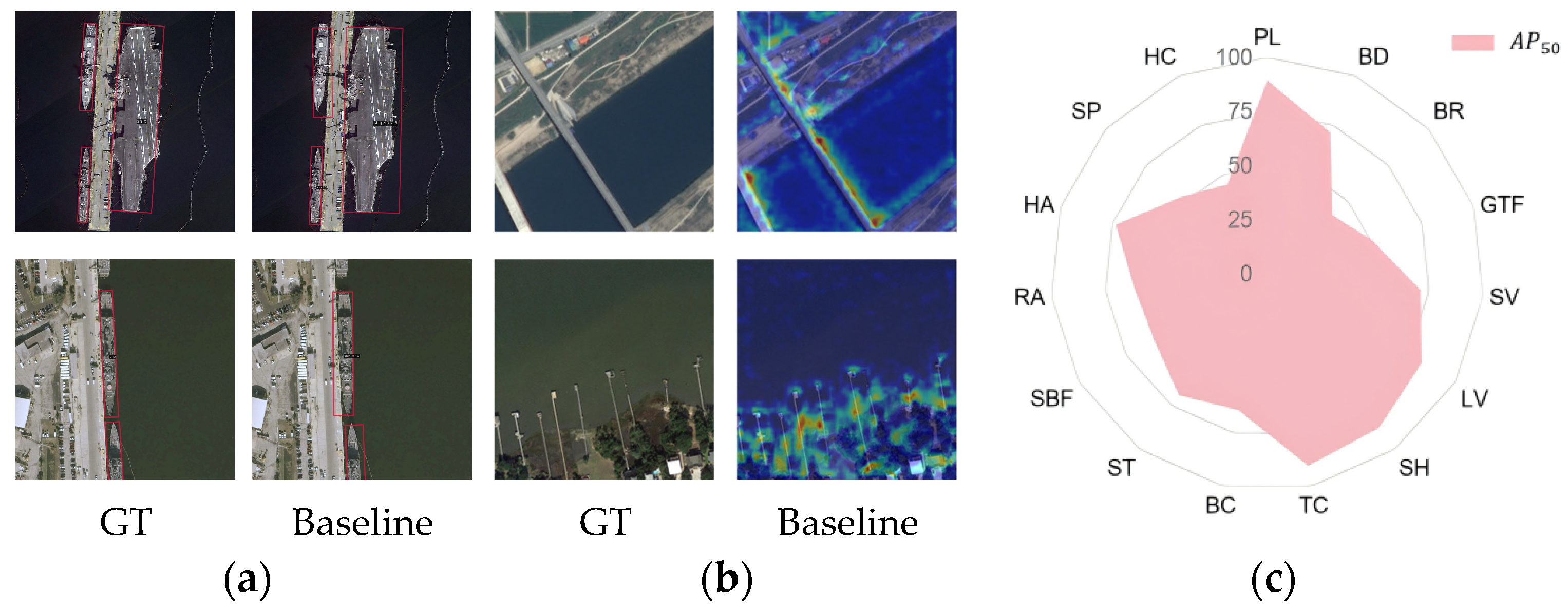
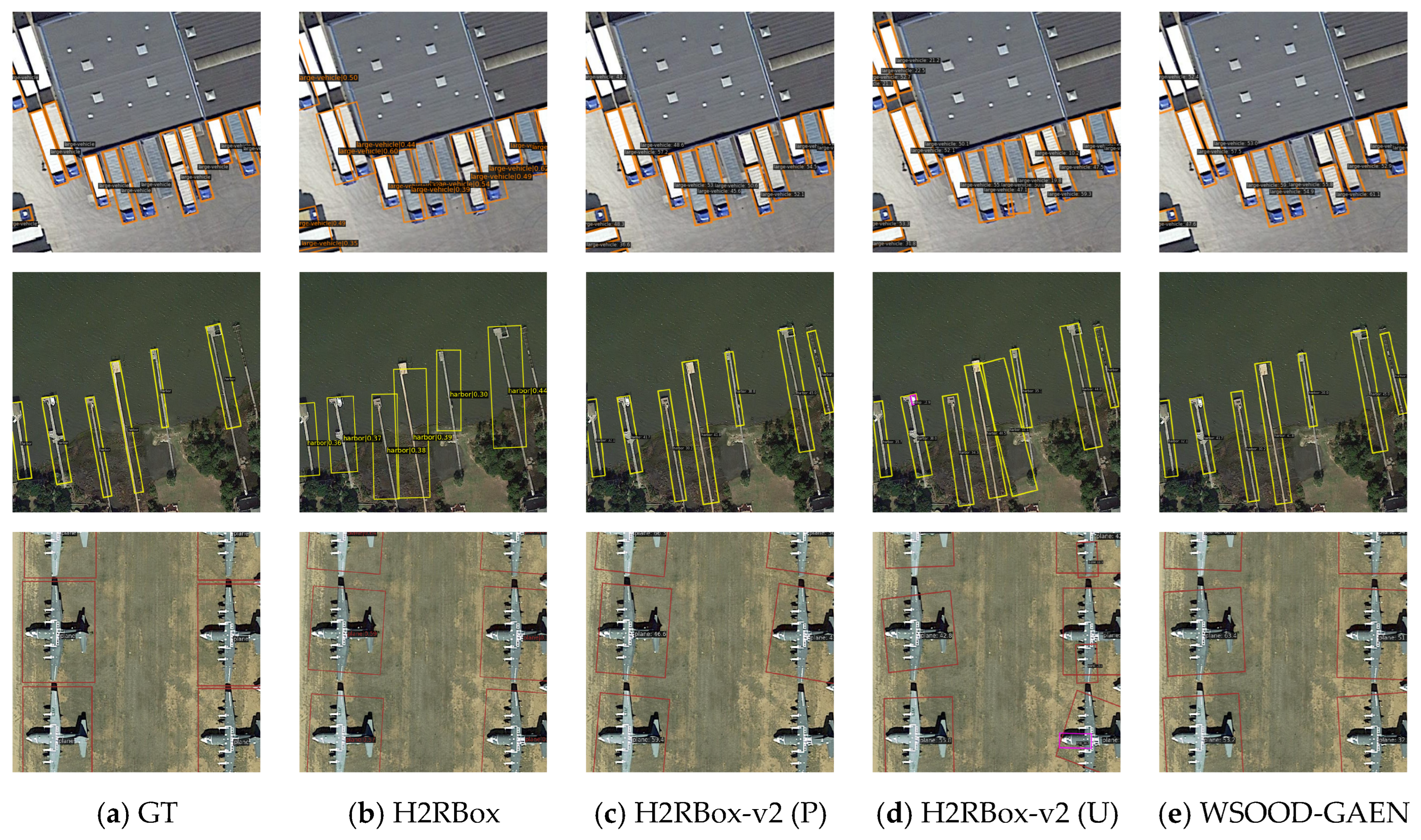
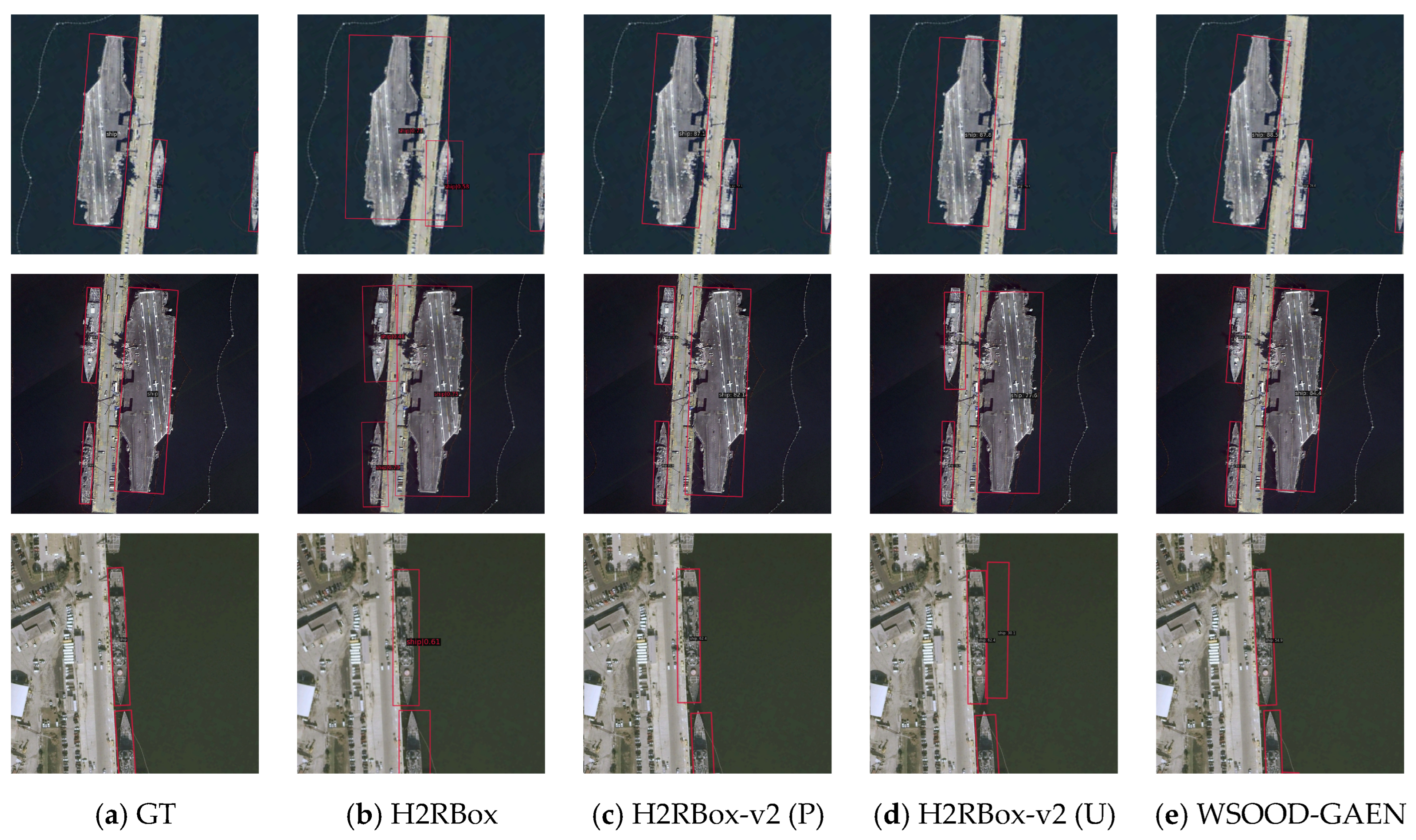
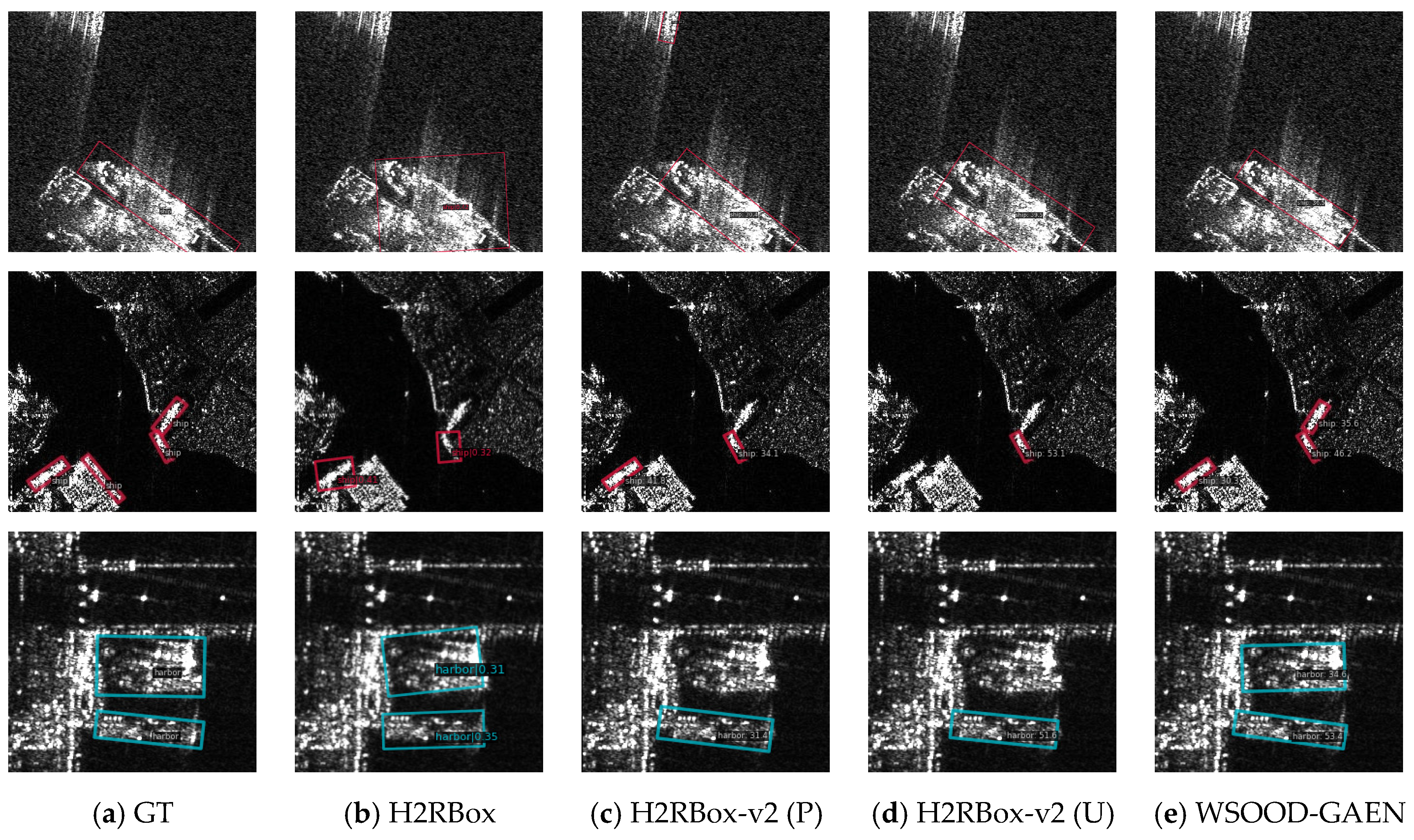
18]. These methods optimize the model’s learning of angle and scale information in complex scenes and alleviate the problem of missing angular supervision to some extent. However, in-depth analysis of the results reveals (as shown in
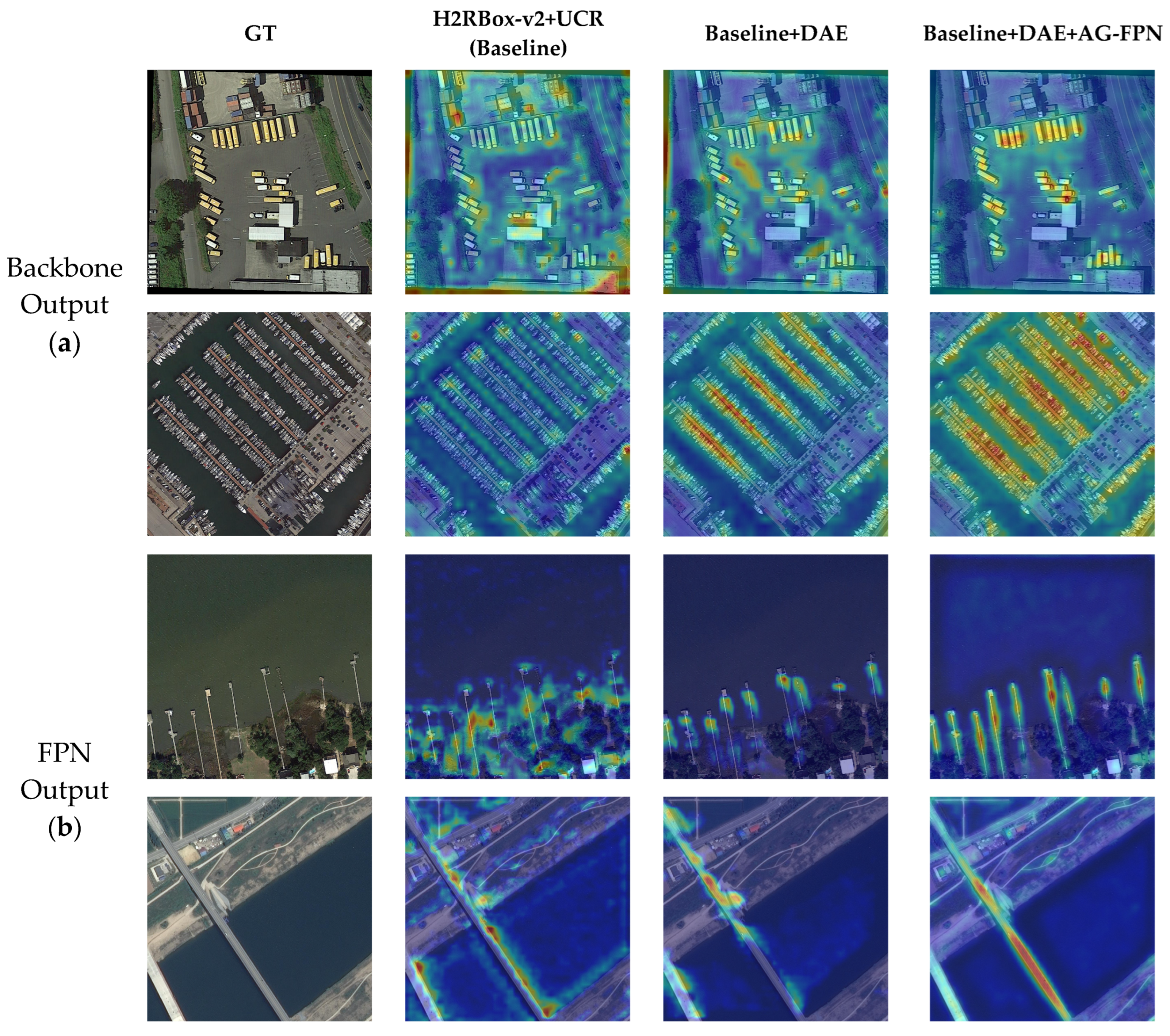
Figure 2) that existing methods still face the following three major problems:
- (1)
Remote sensing images are predominantly captured from high-altitude overhead views, covering extensive areas with complex backgrounds where targets are frequently densely distributed—this renders feature extraction significantly more challenging than in general images [
19,
20]. Furthermore, the feature distribution under weak supervision signals is overly dispersed, and relying exclusively on backpropagation of the regression branch makes it arduous for the network to autonomously focus on the key semantic regions of objects. Because traditional backbone design lacks proactive geometric adaptation and semantic filtering of key features, it is susceptible to background clutter in complex backgrounds [
21]. As shown in
Figure 2a, the prediction box of the ship is not accurate enough and introduces substantial irrelevant background regions.
- (2)
Remote sensing images encompass extensive regions, with target scales exhibiting significantly broader variations than those of typical images. Moreover, remote sensing targets are often elongated geometries, requiring feature representations to aggregate along the target’s principal axis for accurate identification. Existing methods, in the feature extraction stage, employ conventional convolutional operations, which fail to extract directional information and fail to have sampling points align with object edges, thus limiting the directional representation capabilities of the features [
22,
23,
24]. As shown in
Figure 2b, the feature responses of the port and bridge in the heat map exhibit scattered distributions and fail to be focused around the main axis of the target.
- (3)
Remote sensing datasets contain various targets with significantly different geometric characteristics and an imbalanced distribution. However, existing methods employ a fixed consistency loss weight across all categories, and the weight ratios of the flip consistency loss and rotation consistency loss are fixed, leading to lower detection accuracy for some few-shot categories. As shown in
Figure 2c, the detection accuracy for few-shot categories is low.
To address the aforementioned issues, this paper proposes the WSOOD-GAEN method based on the concepts of multi-scale angle guidance and adaptive form perception, optimizing it from three levels:
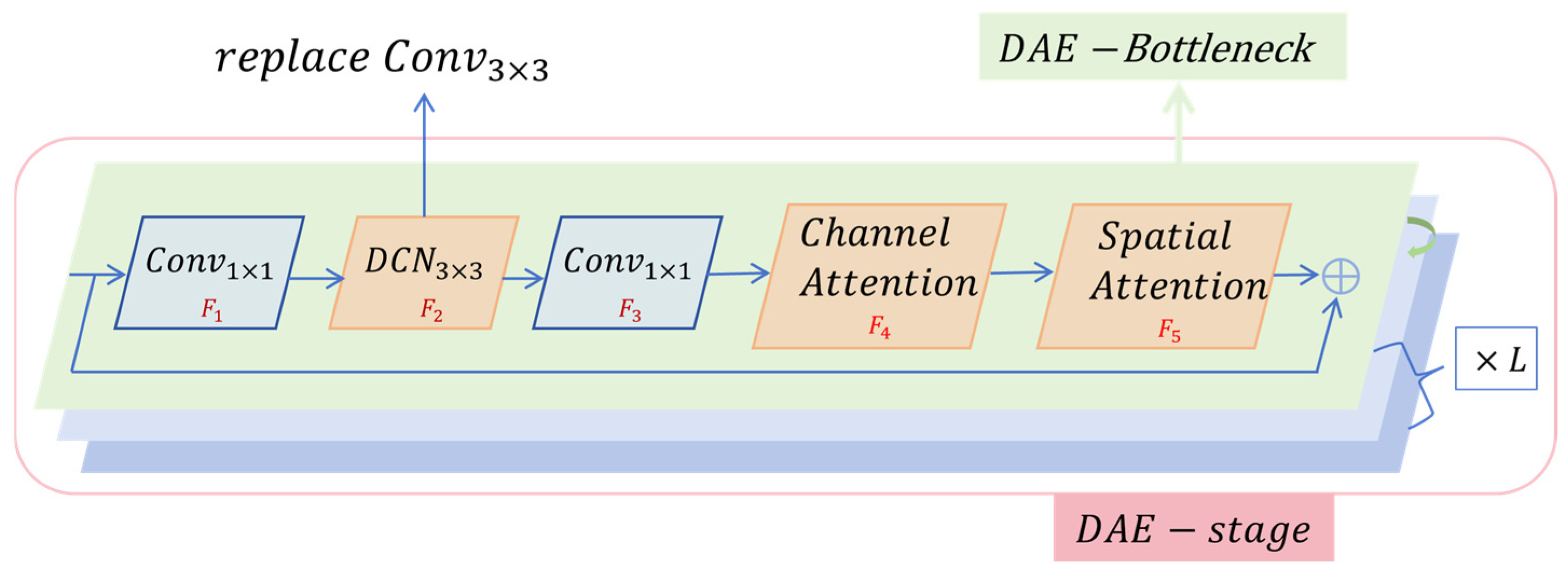
At the backbone level, a channel-spatial deformable attention module (DAE-ResNet) was designed to address the feature dispersion problem arising from the shape variability of oriented targets and cluttered backgrounds in remote sensing images. By incorporating deformable convolutions [
25], an adaptive deformation mechanism is introduced into the backbone network, enabling it to dynamically align with the geometric contours of oriented objects. Channel and spatial attention calculations are then performed on the aligned features of the oriented objects, allowing the model to automatically focus on the object itself and filter out irrelevant background noise. This design produces features that are better aligned with object geometry while suppressing background noise.
At the feature pyramid level (Neck), to address the limitations of existing weakly supervised methods in orientation representation for multi-scale, high-aspect-ratio remote sensing targets, we propose the Angle-Guided Feature Pyramid Network (AG-FPN). AG-FPN introduces an explicit geometric guidance mechanism, explicitly rotating the offset field of sampling points by predicting dense pixel-level angle maps at the feature layer, thus endowing the feature pyramid with rotational equivariance. Utilizing this prior, multi-scale features can be aggregated along the principal axis of the object, enhancing the representation capability for oriented objects with high aspect ratios.
At the loss function level, to address the challenges of geometric diversity across target categories and low detection accuracy for few-shot classes in remote sensing datasets, this paper proposes Adaptive Geometry-Aware Loss (AGL). Inspired by the adaptive weighting mechanism of focal loss, AGL assigns learnable weights (including rotation loss weights and flip loss weights) to each category during training, automatically adapting to the geometric characteristics of each class through gradient backpropagation. This improves the prediction accuracy for few-shot class objects. The contributions of this paper are summarized as follows:
- (1)
This paper proposes the WSOOD-GAEN method. Compared with other HBox-based weakly supervised methods, this method optimizes feature extraction and loss function from the perspective of fine excavation of orientation information, enhances the semantic discriminativeness of key features in complex backgrounds, and enables feature extraction to more accurately perceive target contours, thereby improving the model’s learning ability for high-aspect-ratio objects and small sample objects in remote sensing images.
- (2)
The proposed DAE-ResNet is designed to focus on the semantics of key object regions, enabling the backbone to possess both geometric adaptability and semantic discriminativeness between foreground and background, thus solving the problem of feature extraction being easily interfered with by background noise under weak supervision signals.
- (3)
We propose AG-FPN, which introduces multi-scale pixel-level angle guidance in the FPN stage to provide angle prior knowledge for subsequent learning in the detection head, thereby achieving higher accuracy detection and positioning of high-aspect-ratio objects.
- (4)
We propose AGL, which optimizes geometric consistency loss through class-adaptive weights, allowing the network to automatically adapt to the geometric characteristics of different classes, improving learning efficiency compared to fixed weight strategies.
- (5)
Compared with other HBox-based weakly supervised methods, WSOOD-GAEN achieves improvements of 1.5% and 1.21% in AP50 and AP75 on the DOTA-v1.0 [
26], 0.69% and 9.86% on the HRSC [
27], and 4.27% and 3.35% on the RSAR [
18], respectively. These results significantly outperform existing methods, validating the effectiveness of our proposed optimizations.
The remaining chapters are structured as follows.
Section 2 introduces related works on oriented object detection and weakly supervised methods.
Section 3 elaborates on our WSOOD-GAEN method.
Section 4 presents experimental results and analysis.
Section 5 summarizes the entire paper.
2. Related Works
Based on the level of supervision required for model training, oriented object detection can currently be divided into fully supervised, semi-supervised, and weakly supervised paradigms. In Earth observation tasks, acquiring large-scale and precise oriented bounding box annotations for massive high-resolution satellite imagery is highly labor-intensive and time-consuming. Therefore, the latter two paradigms can effectively alleviate the heavy annotation burden associated with remote sensing datasets. Unlike weakly supervised methods, semi-supervised learning trains the model using a small number of oriented bounding box annotations and a large amount of unlabeled data [
28,
29], and still relies on some high-cost bounding box annotations. Therefore, this paper focuses on the more challenging weakly supervised paradigm, which operates without any angle priors.
2.1. Full-Supervision Oriented Object Detection in Remote Sensing
Oriented object detection aims to predict bounding boxes (x, y, w, h, θ) containing orientation information [
20]. While fully supervised methods have made progress in areas such as remote sensing imagery [
30,
31] and scene text detection [
32], early approaches directly regressed these parameters, facing numerous challenges in practical applications. Among these challenges, the angular periodicity caused by the arbitrary orientations of remote sensing objects can lead to boundary discontinuity and training divergence; in dense remote sensing scenarios, traditional IoU loss suffers from gradient vanishing for non-overlapping boxes and insensitivity to subtle angular deviations; furthermore, the axis-aligned features of standard convolutions struggle to adapt to the complex rotations of remote sensing targets. Consequently, related research has primarily focused on the following three directions:
In terms of angle encoding strategies, to resolve the periodic ambiguity caused by the arbitrary orientations of remote sensing targets, CSL transforms angle regression into a classification problem by discretizing angles into multiple intervals and introduces circular smooth labels to resolve the boundary discontinuity problem [
33]. Building on CSL, DCL introduces dynamic classification labels and utilizes dense coded labels to further improve the prediction accuracy for subtle angle variations in remote sensing targets [
34]. In addition, approaches such as denoising-based methods [
35] have explored enhancing the feature sensitivity to the angular transformation of remote sensing targets through denoising reconstruction.
Regarding detection architectures, various approaches have been developed to accommodate the arbitrary orientations of remote sensing objects [
36,
37,
38]. Two-stage methods, such as RoI Transformer [
39], align horizontal candidate boxes to rotated targets through spatial transformation. Single-stage methods, such as S2A-Net [
40] and R3Det, design feature alignment and refinement modules, effectively alleviating the mismatch between features and anchor boxes for objects with large aspect ratios (e.g., bridges and ships in ports) in remote sensing images. More recently, LSKNet [
41] uses a large selective kernel network for dynamic adjustment to better model the ranging context of various objects in remote sensing scenes.
In the design of loss functions, to address the gradient vanishing problem of non-overlapping boxes in dense remote sensing object detection, early methods like PIoU [
42] and SCRDet [
43] provide continuous gradients by approximating the Intersection over Union (IoU). Rotated IoU loss directly optimizes the IoU through a differentiable computation graph, achieving consistency between the training objective and evaluation metrics. Gaussian modeling-based methods such as GWD [
44] and KLD [
45] model the rotated boxes as a two-dimensional Gaussian distribution, optimizing bounding box regression in highly dense remote sensing scenes. CircumIoU [
46] introduces a circumscribed rectangle constraint, further enhancing regression robustness for objects with high aspect ratios in remote sensing images.
These methods highlight the importance of explicit geometric modeling for oriented object detection in remote sensing. However, their heavy reliance on costly, fine-grained annotations makes them impractical for the massive volumes of data generated by Earth observation systems. Therefore, the key to closing the performance gap between weakly and fully supervised methods lies in adapting these geometric concepts for feature extraction in complex remote sensing scenes, using only HBox as supervision.
2.2. Weak-Supervision Oriented Object Detection in Remote Sensing
To reduce annotation costs, weakly supervised oriented object detection methods have been proposed. These methods learn to predict oriented boxes from coarser-grained annotations. Based on the richness of the supervision information, existing weakly supervised methods can be mainly divided into point-supervised methods and horizontal box supervision methods:
Point-supervised methods. Early approaches like P2BNet [
47] and RepPoints [
48] explored the application of point set representation in object detection. Tailored for remote sensing scenes, PointOBB [
49] combines weak and self-supervision within a Multiple Instance Learning (MIL) framework, optimizing the model using generated proposals. Point2RBox [
50] combines simple geometric priors for object size and rotation with point annotations for classification, enabling joint learning. Furthermore, Point2RBox-v2 [
51] leverages the mutual constraints between different instances in the same scene, designing Gaussian overlap and related loss functions to further improve size prediction accuracy. However, due to the scarcity of directly usable datasets, points must still be manually annotated for each instance. Moreover, the limited scale and orientation information provided by such annotations often leads to suboptimal detection accuracy.
Horizontal box-supervised methods. The idea behind the horizontal bounding box-supervised instance segmentation algorithm introduced in
Section 1 is to obtain a mask from the horizontal bounding box, and then generate directional bounding boxes based on the mask, such as BoxInst [
52] and BoxLevelSet [
53]. However, the computational efficiency of the models is limited, and the prediction accuracy is insufficient. Secondly, there are proposal-based or geometric prior-based methods. These algorithms usually generate a large number of candidate boxes with different angles inside the HBox and use geometric constraints or classification confidence to select the best orientation box. However, when facing objects with large aspect ratios, the pre-set anchor boxes are prone to misalignment, resulting in a large deviation in the final selection results. The H2RBox series of methods introduced below solves these problems well.
The H2RBox series of methods is based on transform consistency. H2RBox is a pioneering work that introduces self-supervised learning into horizontal bounding box-supervised oriented detection. By generating multiple views of the same image (original, flipped, and rotated) and imposing consistency constraints between the predicted angles of different views, H2RBox can learn rich angular information in the absence of oriented bounding box annotations. H2RBox-v2 extends the method by introducing flip consistency and rotation consistency losses, leveraging the object’s symmetry prior, resulting in a significant improvement in angle prediction performance. Furthermore, subsequent research proposed a Unit Cycle Resolver (UCR) [
18], which further enhances performance by mapping angles to points on a unit circle and introducing a corresponding distribution loss. A comprehensive, large-scale rotated SAR object detection dataset was also constructed based on the prediction results and manual refinement [
18]. Aside from optimizing angle encoding, other parallel directions based on H2RBox-v2 explore bounding box representations and scale matching. For example, AFWS [
54] decouples parameters using concentric circles, and ABBSPO [
55] handles scale variations with symmetric priors.
Nonetheless, the methods described above still have limitations. Feature extraction lacks geometric adaptability, relying on axis-aligned convolutions methods, resulting in extracted features that are often corrupted by complex background noise inherent to remote sensing images. Secondly, the learning of angle information is limited to the regression branch of the detection head, neglecting the potential of angle-guided feature learning in the feature pyramid stage. Finally, the geometric constraint strategy is oversimplified: the consistency loss function uses a uniform weight configuration for all categories, failing to consider the geometric differences between different objects. These limitations undermine the orientation-awareness of feature representations. Consequently, the model struggles to accurately localize and recognize multi-category oriented objects in complex real-world remote sensing scenarios, such as varying illumination and cloud occlusion.
3. Materials and Methods
This paper proposes WSOOD-GAEN (Weakly Supervised Oriented Object Detection via Fine-Grained Orientation Perception Network) to address the aforementioned limitations. It addresses these issues through three innovations: (1) to overcome the limitation of feature extraction not adapting to object deformation, DAE-ResNet is proposed, which deeply integrates deformable convolution and dual attention mechanisms in the backbone network, endowing the feature extraction process with dynamic geometric adaptability and semantic discriminative ability; (2) to address the lack of directional guidance in multi-scale feature fusion, AG-FPN is proposed, which predicts dense angle maps in the feature pyramid stage and explicitly rotates the sampling offset of the convolution, achieving rotational-equivariant feature alignment at the feature level; (3) to address the limitation of geometric constraint strategies ignoring class differences, AGL is proposed, which automatically learns rotation and flip consistency loss weights adapted to the geometric characteristics of each class through gradient backpropagation, achieving refined regulation of the supervision signal. Compared with existing methods, WSOOD-GAEN achieves multi-level angle guidance from the backbone network to the detection head, providing a more comprehensive solution for horizontal bounding box-supervised oriented object detection.
3.1. Overview of the WSOOD-GAEN Method
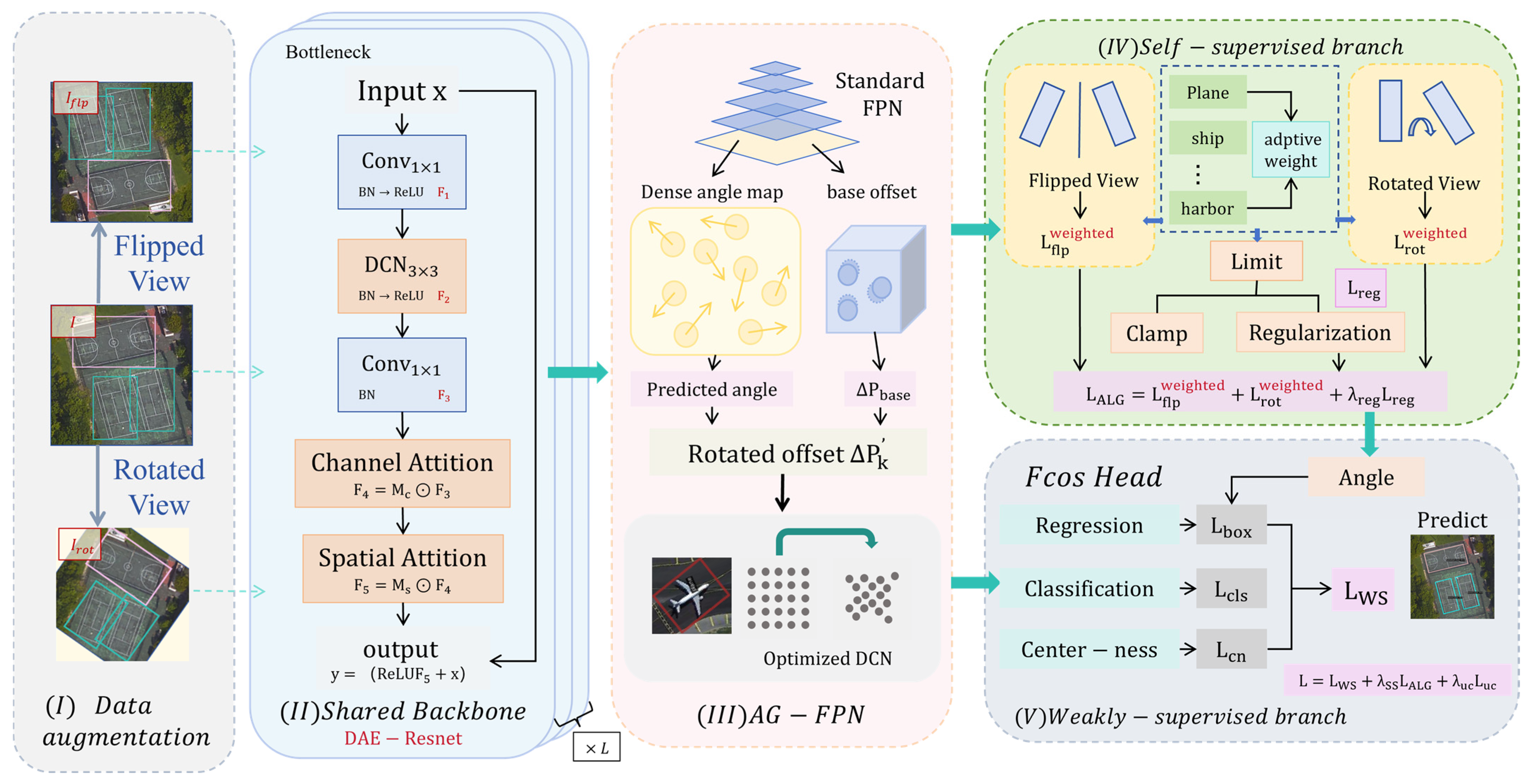
In weakly supervised oriented object detection methods, the H2RBox method pioneered the learning of rotated boxes from horizontal box supervision. Our method adopts the overall framework of H2RBox-v2 while incorporating significant improvements. The overall framework, from data augmentation to feature extraction, detection head stage, and loss calculation, is further divided into weakly supervised and self-supervised branches, corresponding to a scale regression branch based on horizontal bounding box supervision and an angle learning branch based on self-supervised geometric constraints.
Specifically, in the data augmentation stage, the original input image and its rotated and flipped views are provided to facilitate subsequent learning of rotation consistency. In the feature extraction stage, we use an improved DAE-ResNet to extract multi-scale features in the backbone network (details in
Section 3.2). In the feature pyramid network, we propose AG-FPN, which adds an angle guidance module to the standard FPN (details in
Section 3.3). For the detection head, we adopt an anchor-free FCOS-based architecture [
56], comprising classification, regression and centrality branches. The loss calculation is divided into two branches: weakly supervised and self-supervised. The calculation process in the weakly supervised branch is the same as that in H2RBox-v2. The self-supervised branch calculates the angle learning loss, accurately locating the object’s orientation by incorporating rotation consistency constraints and flip consistency constraints, and also includes the unit circle loss mentioned earlier. In this branch, we added Adaptive Geometry-Aware Loss (AGL) to learn adaptive weights for each category; details are in
Section 3.4. The framework is shown in
Figure 3.
3.2. Deformable Attention Enhancement ResNet
The standard ResNet backbone network uses a standard 3 × 3 convolution in the second layer, which lacks adaptability to geometric changes in rotated objects and has significant room for optimization in information utilization. DAE-ResNet improves upon the ResNet Bottleneck structure by changing the standard Bottleneck to:
The second 3 × 3 convolution is replaced with a deformable convolution, and channel attention and spatial attention are applied sequentially before the residual connection. The first and third layers remain unchanged, as shown in
Figure 4.
Specifically, the weights for channel attention and spatial attention are calculated as follows:
In this model, and represent global average pooling and max pooling, respectively; and represent the average and maximum values along the channel dimension; is the sigmoid activation function; and represents channel concatenation, resulting in 2 × H × W features. The first formula assigns weights between 0 and 1 to each channel, suppressing irrelevant channels and enhancing useful ones. The second formula goes further, assigning weights to each spatial location to highlight object regions and suppress background regions. In each step, the weighted modulated features can be obtained using .
Compared to the fixed sampling positions of ResNet’s convolutional kernels, the proposed deformable attention enhancement strategy mitigates the lack of geometric adaptability to rotated objects by incorporating explicit semantic guidance into deformable convolutions. This allows the backbone to simultaneously possess adaptability to diverse morphologies (adapting to object deformation through deformable convolution) and semantic discriminability (focusing on features of key regions through attention).
3.3. Angle-Guided Feature Pyramid Network
Standard FPN [
57] uses a uniform feature extraction strategy for objects in all orientations, without utilizing the object’s orientation information. Although simply optimizing the convolution sampling method can allow the learning of the spatial pose of a rotated object, this learning is implicit and lacks robust generalizability. Since it can only directly learn the offset, it lacks explicit directional constraints, often requiring massive amounts of data to converge, and it is difficult to guarantee the rotational equivariance of feature sampling. Our core innovation lies in explicitly predicting the angle at each position. This prediction is optimized in an end-to-end manner, and the sampling offset of the DCN [
25,
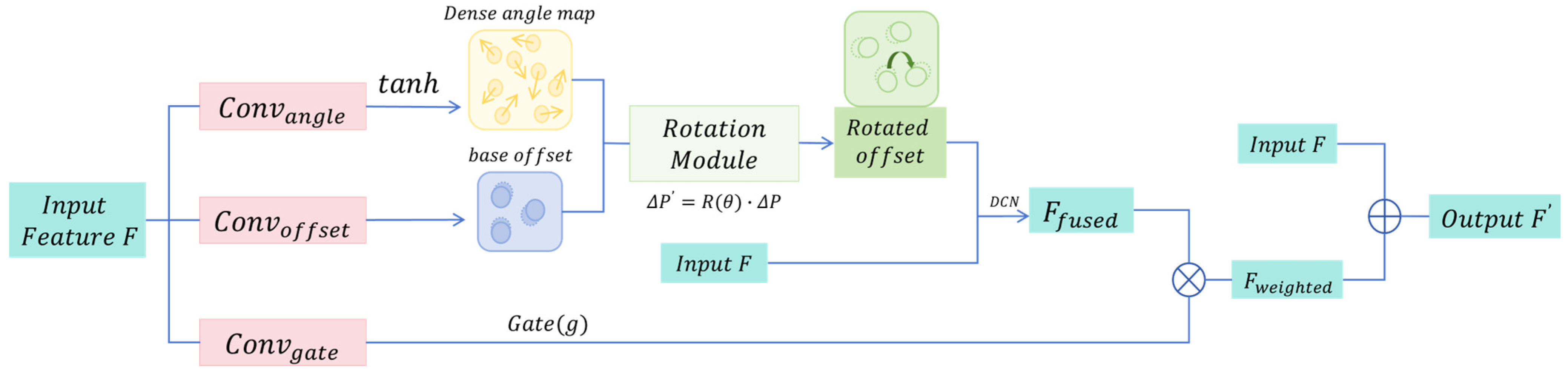
58] is rotated based on the result, thereby achieving rotation-equivariant feature extraction. Therefore, it is easier to learn and can achieve the same effect with less data. AG-FPN adds angle guidance modules to the P3, P4, and P5 layers based on standard FPN. Each module includes the following steps: (I) predicting dense angle maps; (II) predicting the base DCN offset; (III) rotating the offset based on the angle; (IV) applying modulated deformable convolution; (V) feature fusion and gating (as illustrated in
Figure 5). In general, it can be divided into two main stages:
Dense Angle Map and Base Offset Prediction: For a feature
at a certain level of FPN, we predict the angle of each spatial location and the base offset of DCN. Notably, the angle map serves as a deformable offset rotation/alignment auxiliary variable. We do not apply an explicit angle regression loss; rather, it is implicitly optimized via the overall detection loss. This setup naturally conforms to the le90 angle definition and guarantees no discontinuities at the boundaries. For the latter, we initialize the offset and mask to 0, which ensures that AG-FPN is equivalent to standard FPN in the early stages of training, thus guaranteeing the stability of training and avoiding feature destruction caused by random offsets in the initial stage. The specific calculation formula is as follows:
Here, the 18 channels represent 9 sampling points with 2 coordinates each. For every spatial location
, the 9 sampling point offsets along the
x-axis and
y-axis are defined as:
Angle-guided offset rotation: This is the core innovation of AG-FPN. We rotate the offset at this position based on the predicted angle
. This explicit rotation mechanism ensures rotational equivariance; if the input image rotates by
degrees, the sampling point will also rotate by
degrees, accordingly. The specific formulas are as follows:
where ⊙ represents element-wise multiplication. The result of the offset rotation is that when the object angle is 0°, the offset remains unchanged. When the object angle is 45°, the offset rotation is 45° to align the sampling point with the object edge. Finally, to adaptively regulate the contribution of the alignment feature and improve computational efficiency, we introduce a gating mechanism [
59]:
where
is the fused feature. Acknowledging that not all positions require angular alignment, the formula regulates the alignment feature based on the value of
. When
≈ 1, the alignment feature is fully utilized, and when
≈ 0, the original feature is maintained.
3.4. Adaptive Geometry-Aware Loss
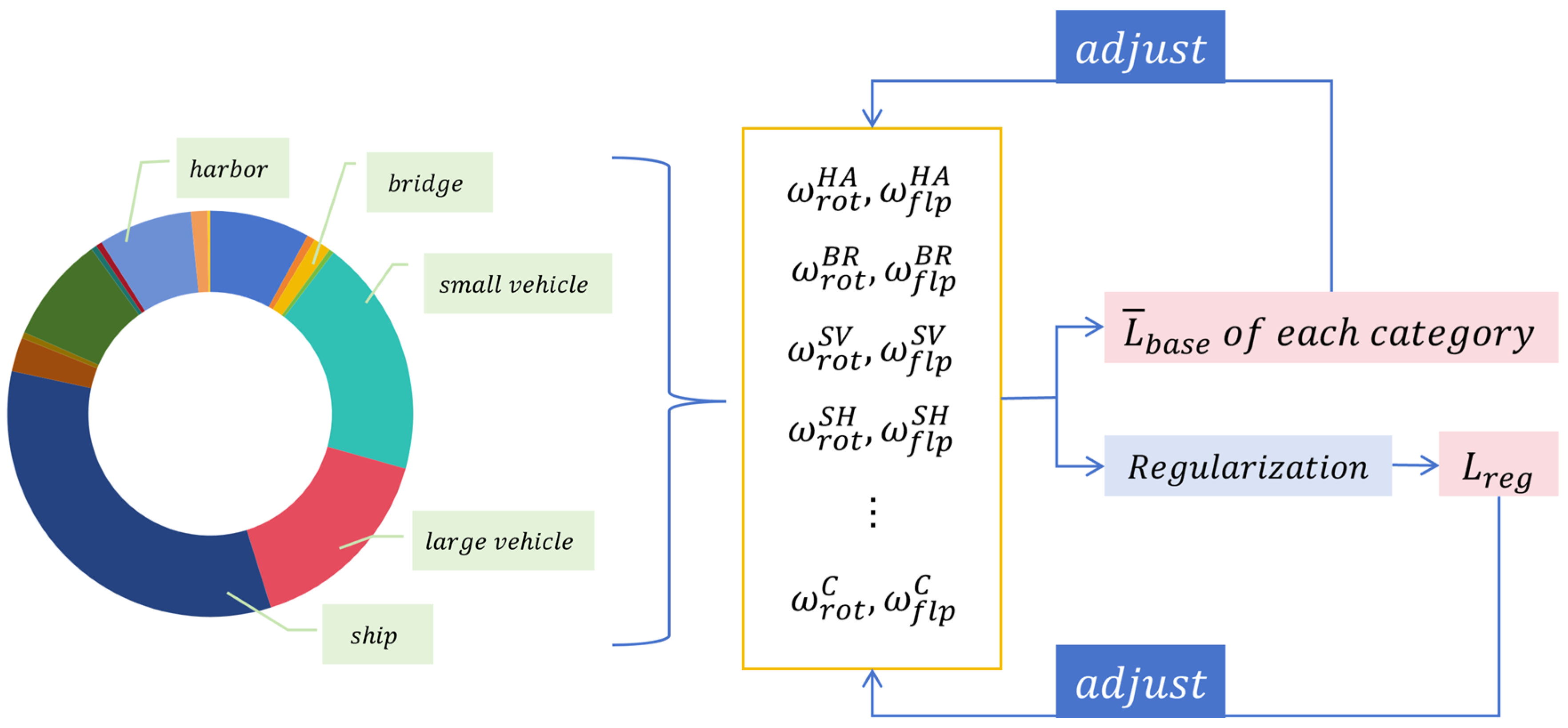
The original consistency loss function disregards the rotational characteristics of the objects themselves, using instead uniform weights. Our Adaptive Geometry-Aware Loss (AGL), however, employs different metrics for each object, defining two sets of learnable weight parameters to optimize the calculation of flip and rotation losses, as shown in
Figure 6. The calculation process is performed in two branches: self-supervised branch loss function and weakly supervised branch loss function.
Self-supervised branch loss function. In H2RBox-v2, the self-supervised loss
is defined as a linear weighted sum of the flip consistency loss and rotation consistency loss, i.e.,
[
17]. Our innovative AGL adds weight adjustments for different object categories. During training, the network automatically learns the weights for each category. First, we define two sets of weighted learning parameters for
categories:
Initially,
and
can be set to 1.0. However, to prevent extreme weight divergence due to sample balance, we apply weight clamping:
where
and
are the minimum and maximum values of the truncation function clamp. The specific threshold settings will be analyzed in detail in the parameter sensitivity analysis in
Section 4.4. The rotation loss
for each object category is multiplied by the weight
to obtain the weighted value
. The total weighted rotation loss and weighted flip loss are then summed and averaged over each category. Furthermore, we have a regularization loss function, which is a key factor in adjusting the loss for each object category.
The AGL function is calculated as:
In Equation (18),
can be expanded as follows:
The gradient formula for the weight
of category c can well elucidate how
is learned and adjusted:
The above equation is derived directly by differentiating with respect to . Here, serves as a unified notation for and . Specifically, when computing the partial derivative regarding the rotation weights, corresponds to and becomes . The gradient equation intuitively explains the adaptive adjustment mechanism of the weights: the first term is the data-driven term; when the average base loss of a certain class is high (indicating that the class is difficult to learn), the gradient is positive, driving the weights to increase to strengthen attention; the second term is a regularization term, used to constrain the degree of weight deviation and prevent training instability.
The situation is different when the dataset has only one target class. This is because AGL operates through two different mechanisms: class-level rebalancing for multi-class scenarios, and regularization applicable to all datasets to achieve stable multi-objective optimization. Therefore, for the single-class dataset HRSC, the first mechanism becomes ineffective, and the final performance improvement comes solely from the second. The regularization prevents extreme weight configurations and enhances the model’s generalization ability through balanced learning.
Weakly supervised branch loss function. Similar to H2RBox-v2, we use HBox to label the output of the supervised detection head. This module is mainly responsible for learning scale information. The total loss function in the weakly supervised stage is:
where
,
, and
use the same formulations as H2RBox-v2. In our implementation,
is the sigmoid focal loss,
is an IoU-based regression loss, and
is the sigmoid cross-entropy loss for centerness. Our Adaptive Geometric Perception Loss focuses on learning the weights
,
, and
during training, without changing the definitions of these losses. Based on this, the total loss function is:
where
is the weight of the self-supervised branch, generally set to 1 by default, and
is the unit-circle-based loss used to supervise angle prediction (via the UCResolver module). In the revised manuscript, we state its explicit definition as follows:
where
is the encoded value, and
is a segmentation function, taking the value 1 when n is 3 and 0 when n is 2.