Investigating the Evolution of Active Deformation Areas (ADAs) in the Veneto-Friulian Plain Using Multi-Platform SAR Data

 ,
,  ,
,  ,
,  ,
, 
Highlights
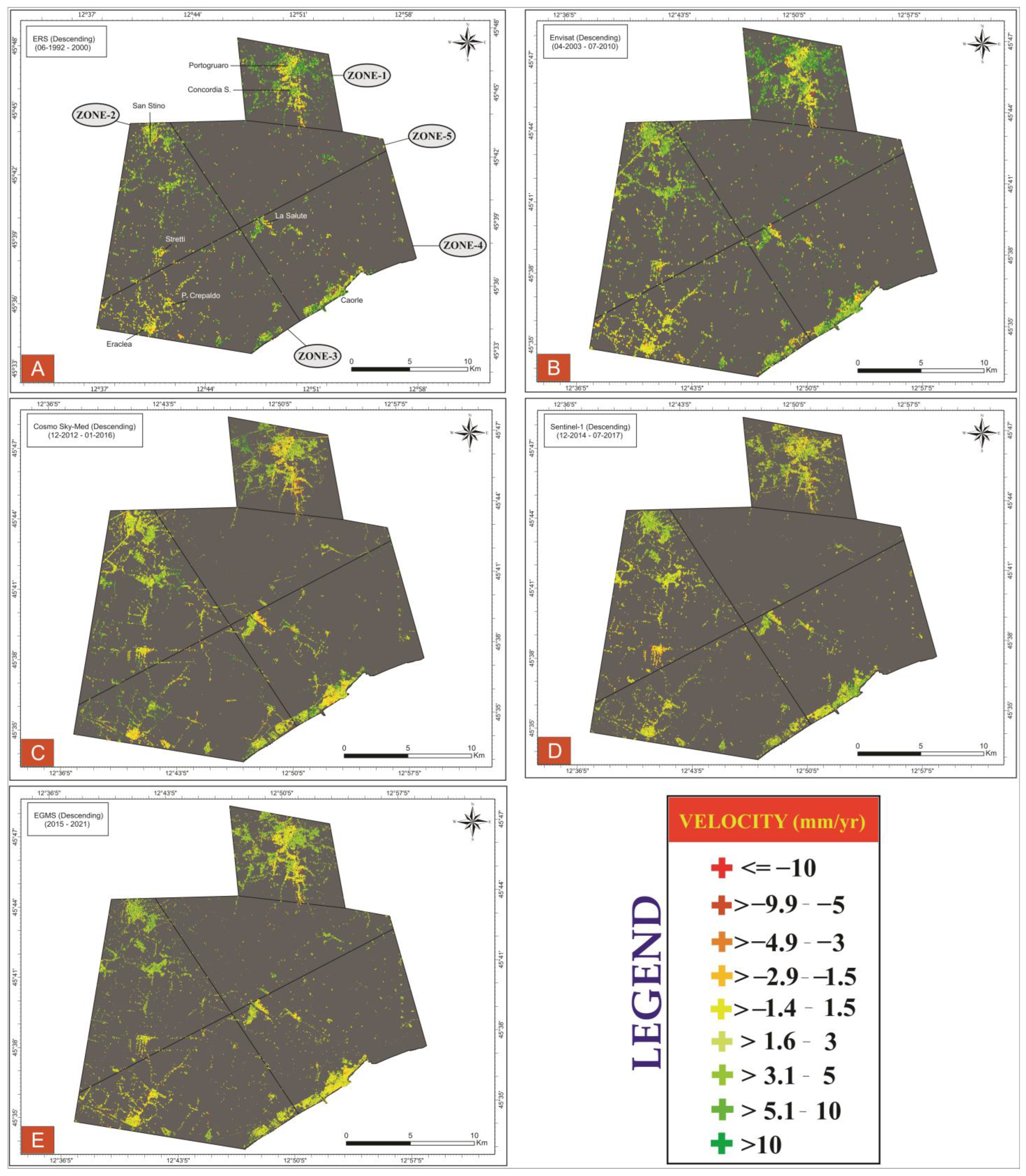
- The 30-year multi-platform SAR data has proven effective in subsidence evolution from strong early deformation to slower, more stable trends.
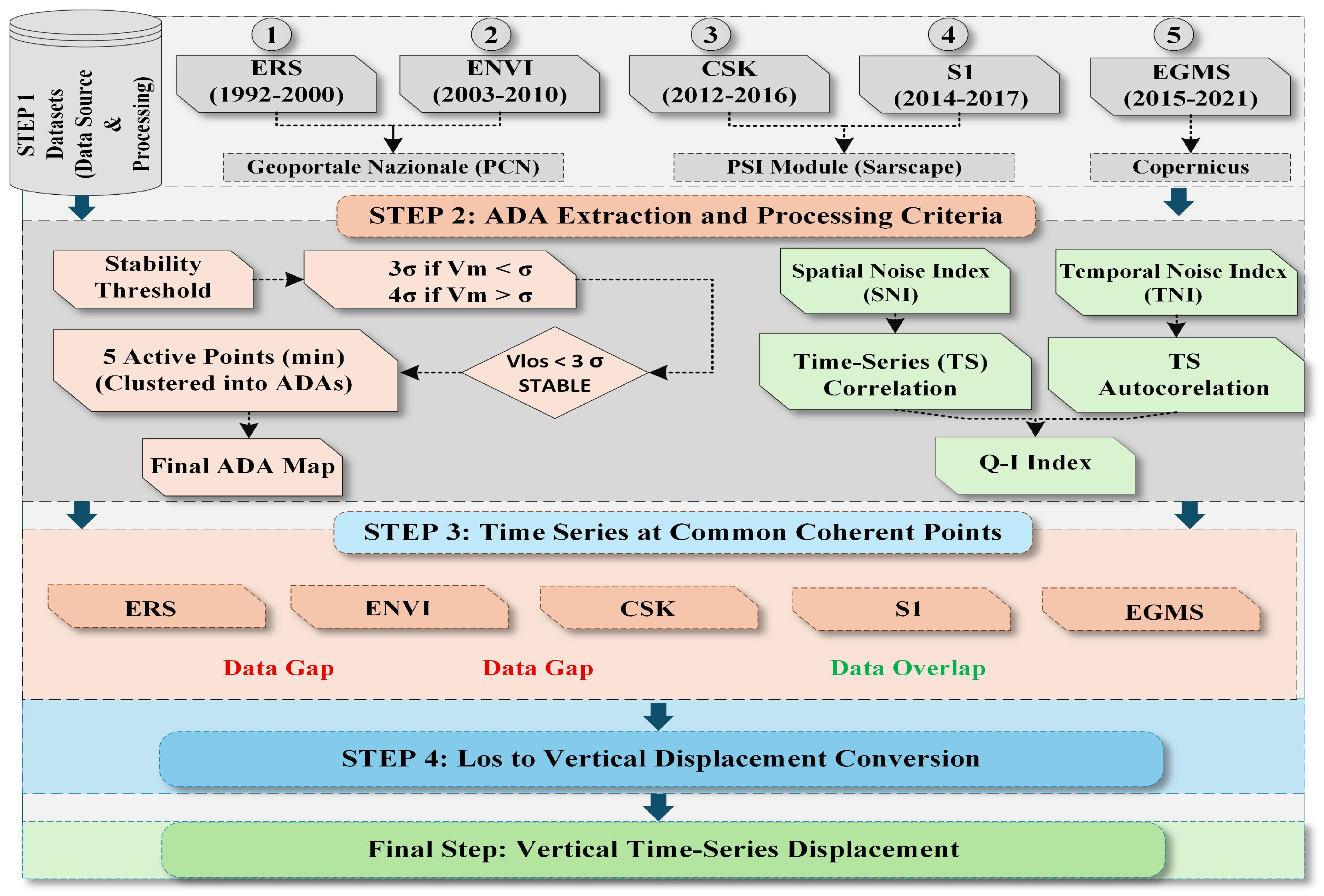
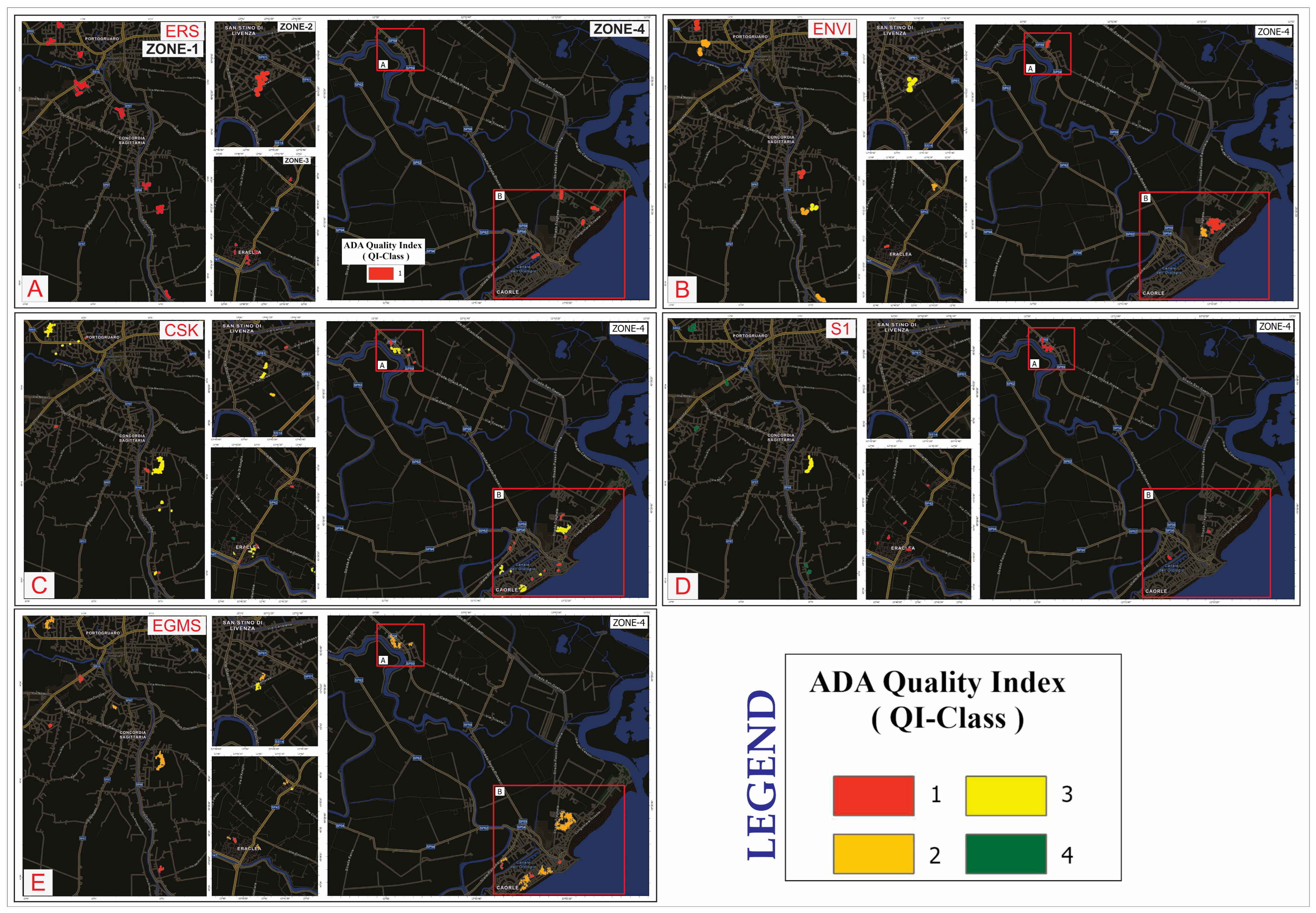
- ADAFinder’s workflow helped in isolating coherent deformation clusters, and the ADA Quality Index (QI) helped in separating reliable ADAs from noisy ones.
- Subsidence is not purely natural; construction loads significantly amplify subsidence over compressible Holocene deposits.
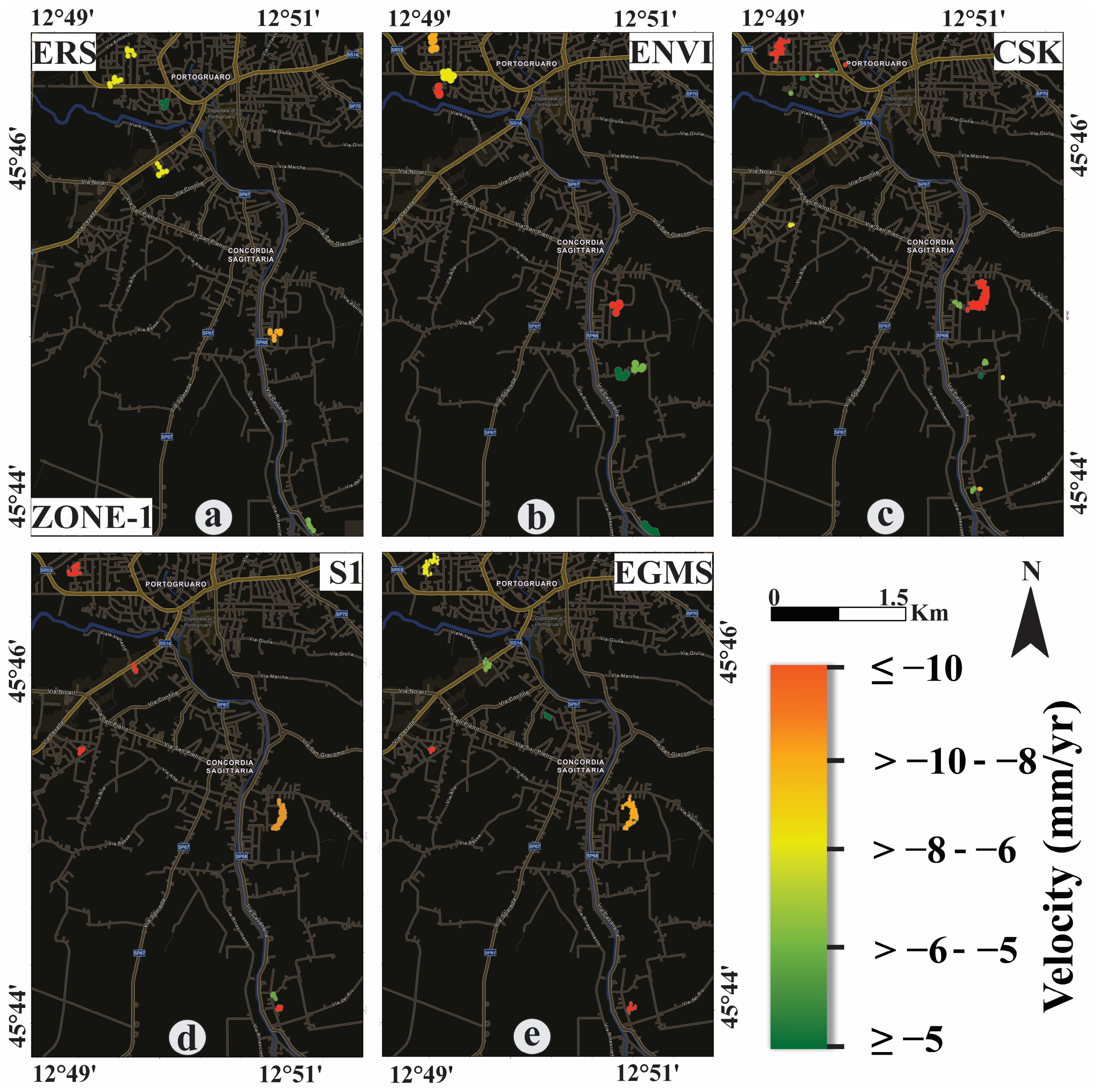
- The Multi-Platform SAR dataset allowed for consistent tracking of ground motion across decades, providing evidence for prioritizing inspections and mitigation measures.
Abstract
1. Introduction
2. Study Area
3. Materials and Methods
3.1. Materials
3.2. Methods
3.2.1. LOS Interpretation and Estimation of Vertical Deformation
3.2.2. ADA’s Extraction and Processing Parameters
3.2.3. (i) The Automated Extraction of the Most Reliable Active Deformation Areas (ADAs)
- The total count of aggregated active points (APs).
- The mean, maximum, and lowest values of the velocities of the APs.
- The average value of the total deformations of the APs. To mitigate the substantial impact of atmospheric or digital elevation model inaccuracies, we calculate the final accumulated deformation as the mean of the accumulated values from the last four acquisition instances of all APs within the ADA. The categorization of velocity, which classifies the ADA based on its maximum velocity , is established as 1 when || is greater than 1 cm/year or 0 if it falls within the range of < || < 1 cm/year.
3.2.4. (ii) ADA Quality Index (Q-I)
4. Results
4.1. PS Velocity Maps
4.2. ADA Quality Index (Q-I) Derivation Based on the Data Used
4.3. Temporal Evolution of ADAs
5. Discussion
5.1. Geological Control on the Spatial Distribution of Subsidence
5.2. Anthropogenic Controls
5.3. Considerable Limitations and Future Recommendations
6. Conclusions
Author Contributions
Funding
Data Availability Statement
Conflicts of Interest
Correction Statement
References
- Buffardi, C.; Ruberti, D. The Issue of Land Subsidence in Coastal and Alluvial Plains: A Bibliometric Review. Remote Sens. 2023, 15, 2409. [Google Scholar] [CrossRef] [Scilit]
- Antoniadis, N.; Alatza, S.; Loupasakis, C.; Kontoes, C. Land Subsidence Phenomena vs. Coastal Flood Hazard—The Cases of Messolonghi and Aitolikon (Greece). Remote Sens. 2023, 15, 2112. [Google Scholar] [CrossRef] [Scilit]
- Xotta, R.; Zoccarato, C.; Minderhoud, P.S.J.; Teatini, P. Modeling the Role of Compaction in the Three-Dimensional Evolution of Depositional Environments. J. Geophys. Res. Earth Surf. 2022, 127, e2022JF006590. [Google Scholar] [CrossRef] [Scilit]
- Tosi, L.; Da Lio, C.; Strozzi, T.; Teatini, P.; Mishra, D.R.; Gould, R.W.; Li, X.; Stramondo, S.; Thenkabail, P.S. Combining L- and X-Band SAR Interferometry to Assess Ground Displacements in Heterogeneous Coastal Environments: The Po River Delta and Venice Lagoon, Italy. Remote Sens. 2016, 8, 308. [Google Scholar] [CrossRef] [Scilit]
- Tosi, L.; Strozzi, T.; Da Lio, C.; Teatini, P. Regional and Local Land Subsidence at the Venice Coastland by TerraSAR-X PSI. In Proceedings of the International Association of Hydrological Sciences; International Association of Hydrological Sciences: Wallingford, UK, 2015; Volume 372, pp. 199–205. [Google Scholar]
- Artese, G.; Fiaschi, S.; Di Martire, D.; Tessitore, S.; Fabris, M.; Achilli, V.; Ahmed, A.; Borgstrom, S.; Calcaterra, D.; Ramondini, M.; et al. Monitoring of land subsidence in Ravenna municipality using integrated SAR—GPS techniques: Description and first results. In The International Archives of the Photogrammetry, Remote Sensing and Spatial Information Sciences; International Society for Photogrammetry and Remote Sensing: Vienna, Austria, 2016; Volume XLI-B7, pp. 23–28. [Google Scholar] [CrossRef] [Scilit]
- Chen, H.; Zhang, Y.; Zhao, C.; Wu, H.; Kang, Y.; Wang, L. Monitoring Repetitive Mining Induced Deformation Using Multi-Temporal InSAR Technology. In 2019 SAR in Big Data Era, BIGSARDATA 2019—Proceedings; Institute of Electrical and Electronics Engineers: Beijing, China, 2019. [Google Scholar] [CrossRef] [Scilit]
- Liu, Y.; Wang, S.; Zhao, B.; Kong, X. Research and Application of Geological Hazard Identification Based on D-InSAR Method. In Proceedings of the IMCEC 2024—IEEE 6th Advanced Information Management, Communicates, Electronic and Automation Control Conference, Chongqing, China, 24–26 May 2024; pp. 146–153. [Google Scholar] [CrossRef] [Scilit]
- Hooper, A.; Zebker, H.; Segall, P.; Kampes, B. A New Method for Measuring Deformation on Volcanoes and Other Natural Terrains Using InSAR Persistent Scatterers. Geophys. Res. Lett. 2004, 31, 1–5. [Google Scholar] [CrossRef] [Scilit]
- De Novellis, V.; Carlino, S.; Castaldo, R.; Tramelli, A.; De Luca, C.; Pino, N.A.; Pepe, S.; Convertito, V.; Zinno, I.; De Martino, P.; et al. The 21 August 2017 Ischia (Italy) Earthquake Source Model Inferred From Seismological, GPS, and DInSAR Measurements. Geophys. Res. Lett. 2018, 45, 2193–2202. [Google Scholar] [CrossRef] [Scilit]
- Raucoules, D.; Colesanti, C.; Carnec, C. Use of SAR Interferometry for Detecting and Assessing Ground Subsidence. C. R. Geosci. 2007, 339, 289–302. [Google Scholar] [CrossRef] [Scilit]
- Solari, L.; Ciampalini, A.; Raspini, F.; Bianchini, S.; Moretti, S. PSInSAR Analysis in the Pisa Urban Area (Italy): A Case Study of Subsidence Related to Stratigraphical Factors and Urbanization. Remote Sens. 2016, 8, 120. [Google Scholar] [CrossRef] [Scilit]
- Barboux, C.; Delaloye, R.; Lambiel, C. Inventorying Slope Movements in an Alpine Environment Using DInSAR. Earth Surf. Process. Landf. 2014, 39, 2087–2099. [Google Scholar] [CrossRef] [Scilit]
- Barra, A.; Monserrat, O.; Mazzanti, P.; Esposito, C.; Crosetto, M.; Scarascia Mugnozza, G. First Insights on the Potential of Sentinel-1 for Landslides Detection. Geomat. Nat. Hazards Risk 2016, 7, 1874–1883. [Google Scholar] [CrossRef] [Scilit]
- Hussain, M.A.; Chen, Z.; Zhou, Y.; Meena, S.R.; Ali, N.; Shah, S.U. Landslide Susceptibility Mapping Using Artificial Intelligence Models: A Case Study in the Himalayas. Landslides 2025, 22, 2089–2103. [Google Scholar] [CrossRef] [Scilit]
- Daud, H.; Tanoli, J.I.; Asif, S.M.; Qasim, M.; Ali, M.; Khan, J.; Bhatti, Z.I.; Jadoon, I.A.K. Modelling of Debris-Flow Susceptibility and Propagation: A Case Study from Northwest Himalaya. J. Mt. Sci. 2024, 21, 200–217. [Google Scholar] [CrossRef] [Scilit]
- Daud, H.; Dou, J.; Tanoli, J.I.; Ali, N.; Khan, N.G.; Xiang, Z.; Dong, A.; Xing, K.; Ullah, H.; Zhang, L. The Role of Multi-Resolution DEMs and Sampling Strategy Uncertainty in Deep Learning-Based Debris Flow Susceptibility Mapping. Acta Geotech. 2026, 21, 395–418. [Google Scholar] [CrossRef] [Scilit]
- Haghshenas Haghighi, M.; Motagh, M. Ground Surface Response to Continuous Compaction of Aquifer System in Tehran, Iran: Results from a Long-Term Multi-Sensor InSAR Analysis. Remote Sens. Environ. 2019, 221, 534–550. [Google Scholar] [CrossRef] [Scilit]
- Perissin, D.; Wang, Z.; Lin, H. Shanghai Subway Tunnels and Highways Monitoring through Cosmo-SkyMed Persistent Scatterers. ISPRS J. Photogramm. Remote Sens. 2012, 73, 58–67. [Google Scholar] [CrossRef] [Scilit]
- Sun, Q.; Li, Z.W.; Ding, X.L.; Zhu, J.J.; Hu, J. Multi-Temporal InSAR Data Fusion for Investigating Mining Subsidence. In Proceedings of the 2011 International Symposium on Image and Data Fusion, ISIDF, Tengchong, China, 9–11 August 2011. [Google Scholar] [CrossRef] [Scilit]
- Bonì, R.; Meisina, C.; Cigna, F.; Herrera, G.; Notti, D.; Bricker, S.; McCormack, H.; Tomás, R.; Béjar-Pizarro, M.; Mulas, J.; et al. Exploitation of Satellite A-DInSAR Time Series for Detection, Characterization and Modelling of Land Subsidence. Geosciences 2017, 7, 25. [Google Scholar] [CrossRef] [Scilit]
- Bonì, R.; Pilla, G.; Meisina, C.; Li, Z.; Tomas, R.; Lu, Z.; Gloaguen, R.; Thenkabail, P.S. Methodology for Detection and Interpretation of Ground Motion Areas with the A-DInSAR Time Series Analysis. Remote Sens. 2016, 8, 686. [Google Scholar] [CrossRef] [Scilit]
- Floris, M.; Fontana, A.; Tessari, G.; Mulè, M. Subsidence Zonation through Satellite Interferometry in Coastal Plain Environments of Ne Italy: A Possible Tool for Geological and Geomorphological Mapping in Urban Areas. Remote Sens. 2019, 11, 165. [Google Scholar] [CrossRef] [Scilit]
- Barra, A.; Solari, L.; Béjar-Pizarro, M.; Monserrat, O.; Bianchini, S.; Herrera, G.; Crosetto, M.; Sarro, R.; González-Alonso, E.; Mateos, R.M.; et al. A Methodology to Detect and Update Active Deformation Areas Based on Sentinel-1 SAR Images. Remote Sens. 2017, 9, 1002. [Google Scholar] [CrossRef] [Scilit]
- Navarro, J.A.; Tomás, R.; Barra, A.; Pagán, J.I.; Reyes-Carmona, C.; Solari, L.; Vinielles, J.L.; Falco, S.; Crosetto, M. ADAtools: Automatic Detection and Classification of Active Deformation Areas from PSI Displacement Maps. ISPRS Int. J. Geoinf. 2020, 9, 584. [Google Scholar] [CrossRef] [Scilit]
- Cuervas-Mons, J.; Zêzere, J.L.; Domínguez-Cuesta, M.J.; Barra, A.; Reyes-Carmona, C.; Monserrat, O.; Oliveira, S.C.; Melo, R. Assessment of Urban Subsidence in the Lisbon Metropolitan Area (Central-West of Portugal) Applying Sentinel-1 SAR Dataset and Active Deformation Areas Procedure. Remote Sens. 2022, 14, 4084. [Google Scholar] [CrossRef] [Scilit]
- Mele, A.; Crosetto, M.; Miano, A.; Prota, A. ADAfinder Tool Applied to EGMS Data for the Structural Health Monitoring of Urban Settlements. Remote Sens. 2023, 15, 324. [Google Scholar] [CrossRef] [Scilit]
- Gambolati, G.; Teatini, P. Numerical Analysis of Land Subsidence Due to Natural Compaction of the Upper Adriatic Sea Basin. In CENAS: Coastline Evolution of the Upper Adriatic Sea Due to Sea Level Rise and Natural and Anthropogenic Land Subsidence; Springer: Dordrecht, The Netherlands, 1998; pp. 103–131. [Google Scholar]
- Alfarè, L.; Donnici, S.; Marini, M.; Moscatelli, M.; Tosi, L.; Vallone, R. The Impact of Land Subsidence on Preservation of Cultural Heritage Sites: The Case Study of Aquileia (Venetian-Friulian Coastland, North-Eastern Italy). In Engineering Geology for Society and Territory–Volume 4: Marine and Coastal Processes; Springer: Cham, Switzerland, 2014; pp. 179–182. [Google Scholar]
- Smiraglia, D.; Cavalli, A.; Giuliani, C.; Assennato, F. The Increasing Coastal Urbanization in the Mediterranean Environment: The State of the Art in Italy. Land 2023, 12, 1017. [Google Scholar] [CrossRef] [Scilit]
- Strollo, A.; Smiraglia, D.; Bruno, R.; Assennato, F.; Congedo, L.; De Fioravante, P.; Giuliani, C.; Marinosci, I.; Riitano, N.; Munafò, M. Land Consumption in Italy. J. Maps 2020, 16, 113–123. [Google Scholar] [CrossRef] [Scilit]
- Fontana, A.; Mozzi, P.; Bondesan, A. Late Pleistocene Evolution of the Venetian-Friulian Plain. Rend. Lincei 2010, 21, 181–196. [Google Scholar] [CrossRef] [Scilit]
- Bezzi, A.; Pillon, S.; Martinucci, D.; Fontolan, G. Inventory and Conservation Assessment for the Management of Coastal Dunes, Veneto Coasts, Italy. J. Coast. Conserv. 2018, 22, 503–518. [Google Scholar] [CrossRef] [Scilit]
- Fontana, A.; Mozzi, P.; Bondesan, A. Alluvial Megafans in the Venetian-Friulian Plain (North-Eastern Italy): Evidence of Sedimentary and Erosive Phases during Late Pleistocene and Holocene. Quat. Int. 2008, 189, 71–90. [Google Scholar] [CrossRef] [Scilit]
- Bondesan, A.; Furlanetto, P. Artificial Fluvial Diversions in the Mainland of the Lagoon of Venice during the 16th and 17th Centuries Inferred by Historical Cartography Analysis. Géomorphol. Relief Process. Environ. 2012, 18, 175–200. [Google Scholar] [CrossRef] [Scilit]
- Tosi, L.; Teatini, P.; Strozzi, T.; Carbognin, L.; Brancolini, G.; Rizzetto, F. Ground Surface Dynamics in the Northern Adriatic Coastland over the Last Two Decades. Rend. Lincei 2010, 21, 115–129. [Google Scholar] [CrossRef] [Scilit]
- Toscani, G.; Marchesini, A.; Barbieri, C.; Di Giulio, A.; Fantoni, R.; Mancin, N.; Zanferrari, A. The Friulian-Venetian Basin I: Architecture and Sediment Flux into a Shared Foreland Basin. Ital. J. Geosci. 2016, 135, 444–459. [Google Scholar] [CrossRef] [Scilit]
- Nicolich, R.; Vedova, D.; Giustiniani, M.; Fantoni, R. Carta Del Sottosuolo Della Pianura Friulana; Regione Autonoma Friuli Venezia Giulia—Servizio Geologico: Trieste, Italy, 2005. [Google Scholar]
- Brambati, A.; Carbognin, L.; Quaia, T.; Teatini, P.; Tosi, L. The Lagoon of Venice: Geological Setting, Evolution and Land Subsidence. Epis. J. Int. Geosci. 2003, 26, 264–268. [Google Scholar] [CrossRef] [Scilit] [PubMed]
- Tosi, L.; Teatini, P.; Carbognin, L.; Brancolini, G. Using High Resolution Data to Reveal Depth-Dependent Mechanisms That Drive Land Subsidence: The Venice Coast, Italy. Tectonophysics 2009, 474, 271–284. [Google Scholar] [CrossRef] [Scilit]
- Ferretti, A.; Prati, C.; Rocca, F. Permanent Scatterers in SAR Interferometry. IEEE Trans. Geosci. Remote Sens. 2001, 39, 8–20. [Google Scholar] [CrossRef] [Scilit]
- Strozzi, T.; Wegmuller, U.; Tosi, L.; Bitelli, G.; Spreckels, V. Land Subsidence Monitoring with Differential SAR Interferometry. Photogramm. Eng. Remote Sens. 2001, 67, 1261–1270. [Google Scholar]
- Dai, K.; Liu, G.; Li, Z.; Li, T.; Yu, B.; Wang, X.; Singleton, A. Extracting Vertical Displacement Rates in Shanghai (China) with Multi-Platform SAR Images. Remote Sens. 2015, 7, 9542–9562. [Google Scholar] [CrossRef] [Scilit]
- Chang, Z.; Yu, W.; Wang, W.; Zhang, J.; Liu, X.; Zhu, J. An Approach for Accurately Retrieving the Vertical Deformation Component from Two-Track InSAR Measurements. Int. J. Remote Sens. 2017, 38, 1702–1719. [Google Scholar] [CrossRef] [Scilit]
- Teatini, P.; Tosi, L.; Strozzi, T.; Carbognin, L.; Cecconi, G.; Rosselli, R.; Libardo, S. Resolving Land Subsidence within the Venice Lagoon by Persistent Scatterer SAR Interferometry. Phys. Chem. Earth Parts A/B/C 2012, 40, 72–79. [Google Scholar] [CrossRef] [Scilit]
- Tosi, L.; Carbognin, L.; Teatini, P.; Strozzi, T.; Wegmüller, U. Evidence of the Present Relative Land Stability of Venice, Italy, from Land, Sea, and Space Observations. Geophys. Res. Lett. 2002, 29, 3-1–3-4. [Google Scholar] [CrossRef] [Scilit]
- Fontana, A.; Bondesan, A.; Meneghel, M.; Toffoletto, F.; Campana, R.; Albanese, D.; Abbà, T.; Vitturi, A.; Bassan, V. Carta Geologica d’Italia Alla Scala 1:50.000—Foglio 107 “Portogruaro”. 2023. Available online: https://www.openaccessrepository.it/records/211730 (accessed on 8 December 2025).
- Ronchi, L.; Fontana, A.; Cohen, K.M.; Stouthamer, E. Late Quaternary Landscape Evolution of the Buried Incised Valley of Concordia Sagittaria (Tagliamento River, NE Italy): A Reconstruction of Incision and Transgression. Geomorphology 2021, 373, 107509. [Google Scholar] [CrossRef] [Scilit]
- Cassiani, G.; Bellizia, E.; Fontana, A.; Boaga, J.; D’Alpaos, A.; Ghinassi, M. Geophysical and Sedimentological Investigations Integrate Remote-Sensing Data to Depict Geometry of Fluvial Sedimentary Bodies: An Example from Holocene Point-Bar Deposits of the Venetian Plain (Italy). Remote Sens. 2020, 12, 2568. [Google Scholar] [CrossRef] [Scilit]
- Barbero, R.S.; Lezziero, A.; Albani, A.; Zoppi, U. Late Pleistocene and Holocene Deposits in the Venetian Underground: Palaeo Environments and History. Alp. Mediterr. Quat. 2001, 14, 9–22. [Google Scholar]
- Stefani, C.; Tessari Mariachiara Mulè Mario Floris Alessandro Fontana, G. Satellite Radar in Investigations Lowland Areas Subject to Phenomena Geological and Geomorphological in the Contribution of Interferometry of Subsidence: The Case of the Area of Portogruaro (VE). Master’s Thesis, Università degli Studi di Padova, Padova, Italy, 2015. [Google Scholar]
- Fontana, A. Evoluzione Geomorfologica Della Bassa Pianura Friulana e Sue Relazioni Con Dinamiche Insediative Antiche; Museo Friulano di Storia Naturale: Udine, Italy, 2006. [Google Scholar]
- Shahbazi, S.; Barra, A.; Gao, Q.; Crosetto, M. Detection of Buildings with Potential Damage Using Differential Deformation Maps. ISPRS J. Photogramm. Remote Sens. 2024, 218, 57–69. [Google Scholar] [CrossRef] [Scilit]
- Navarro, J.; Cuevas, M.; Tomás, R.; Barra, A.; Crosetto, M. Automating the Detection and Classification of Active Deformation Areas—A Sentinel-Based Toolset. Proceedings 2019, 19, 15. [Google Scholar]
- Kim, S.W.; Wdowinski, S.; Dixon, T.H.; Amelung, F.; Kim, J.W.; Won, J.S. Measurements and Predictions of Subsidence Induced by Soil Consolidation Using Persistent Scatterer InSAR and a Hyperbolic Model. Geophys. Res. Lett. 2010, 37, 5304. [Google Scholar] [CrossRef] [Scilit]
- Lewis, R.W.; Schrefler, B. A Fully Coupled Consolidation Model of the Subsidence of Venice. Water Resour. Res. 1978, 14, 223–230. [Google Scholar] [CrossRef] [Scilit]
- Koppad, A.G.; Sarfin, S.; Das, A.K. Application of Synthetic Aperture Radar Remote Sensing in Forestry. In Radar Remote Sensing: Applications and Challenges; Elsevier: Amsterdam, The Netherlands, 2022; pp. 149–174. [Google Scholar] [CrossRef] [Scilit]
- Ruiz, J.J.; Lemmetyinen, J.; Merkouriadi, I.; Cohen, J.; Kontu, A.; Pulliainen, J.; Praks, J.; Ruiz, J.J.; Lemmetyinen, J.; Merkouriadi, I.; et al. Analysis of ALOS2 L-Band Repeat-Pass InSAR for the Retrieval of Snow Water Equivalent over Boreal Forest. In Proceedings of the EGU General Assembly, Vienna, Austria, 24–28 April 2023. [Google Scholar] [CrossRef] [Scilit]





| Satellite Mission | Orbit | Period | N. of Images | Revisit Time (Days) | Band/ Wavelength (cm) | Resol. Az./Range (m) | LOS Incidence Angle, θ | LOS Azimut, α |
|---|---|---|---|---|---|---|---|---|
| ERS | Desc. | 14 June 1992–13 December 2000 | 63 | 36 | C/5.6 | 6/24 | ~23° | ~274 |
| ENVISAT | Desc. | 2 April 2003–14 July 2010 | 71 | 36 | C/5.6 | 6/24 | ~23° | ~274 |
| COSMO–SkyMED | Desc. | 18 February 2012–12 January 2016 | 66 | 12 | X/3.1 | 2.5/2.5 | ~33° | ~277 |
| Sentinel-1 | Desc. | 23 December 2014–22 July 2017 | 91 | 6/12 | C/5.6 | 5/20 | ~37° | 277 |
| EGMS | Desc. | 17 February 2015–30 December 2021 | 353 | 6/12 | C/5.6 | 5/20 | ~37° | 277 |
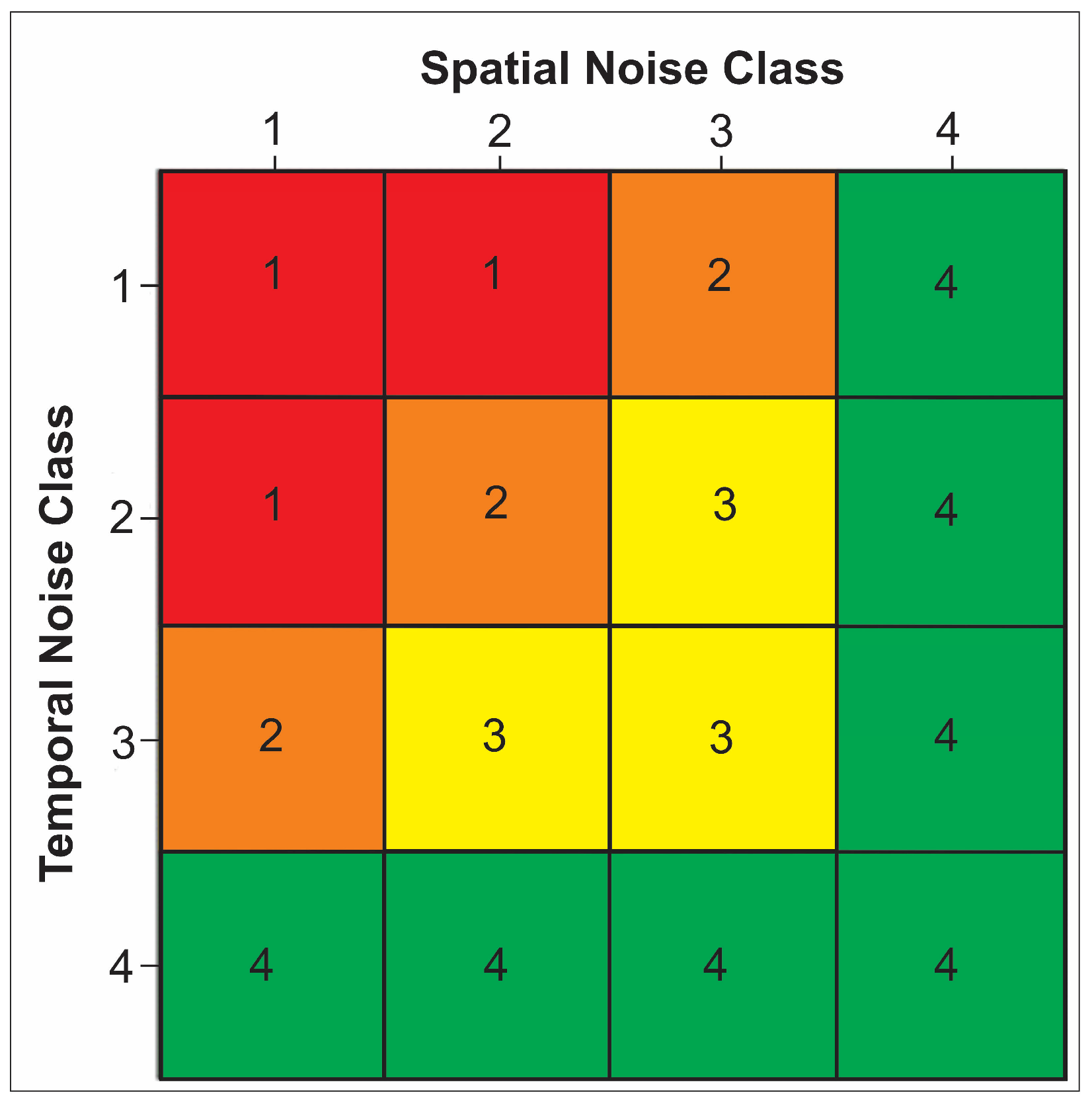
| Med(ρ) | Noise-Velocity Ratio (%) | Class |
|---|---|---|
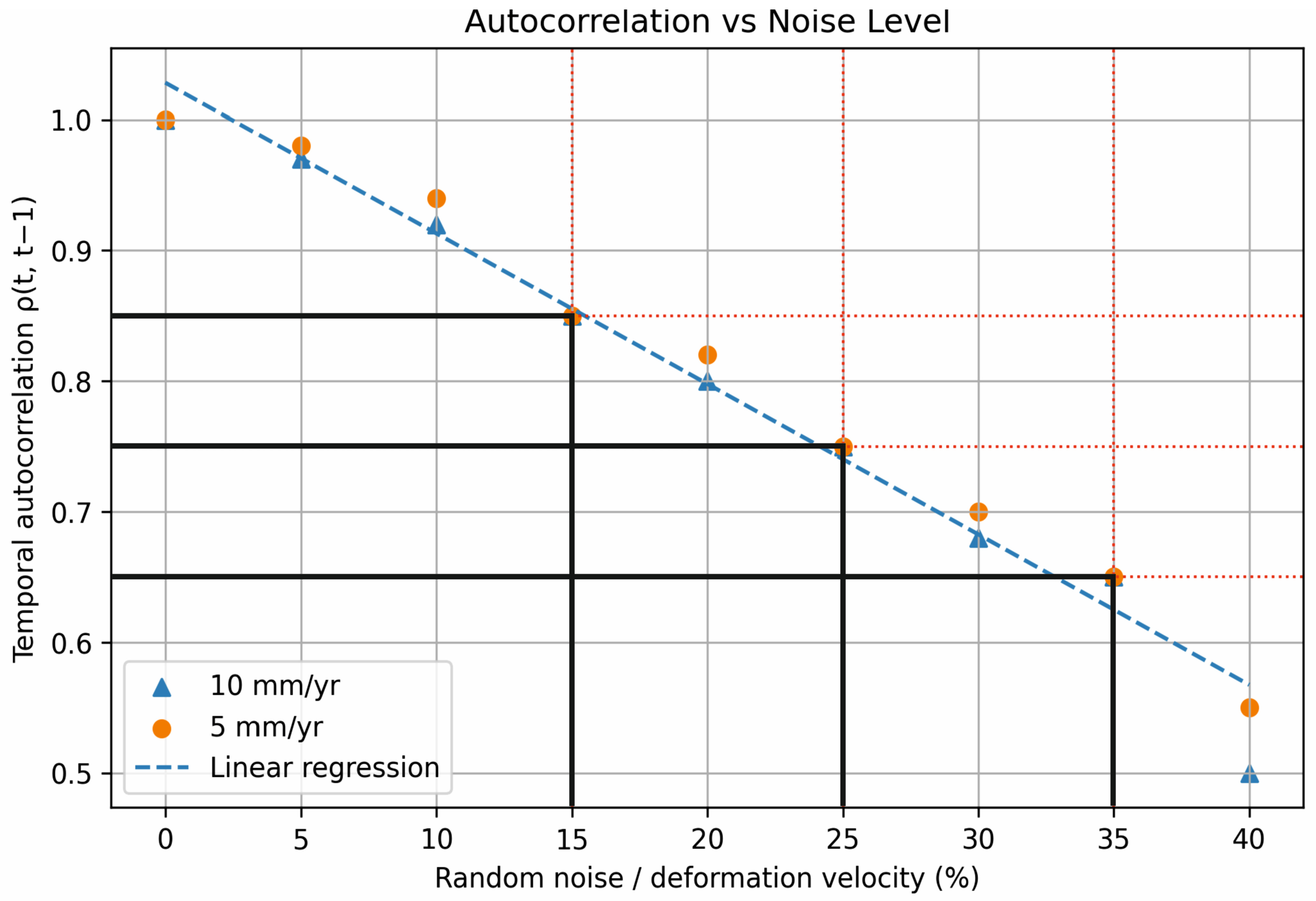
| >0.85 | <15 | 1 |
| 0.75–0.85 | 15–25 | 2 |
| 0.65–0.75 | 25–35 | 3 |
| <0.65 | >35 | 4 |
| Med(ρ) | Cumulative Frequency (%) | Class |
|---|---|---|
| >0.85 | >75 (1st quartile) | 1 |
| 0.75–0.85 | 25–75 (2nd and 3rd quartiles) | 2 |
| 0.65–0.75 | 2–25 (4th quartile) | 3 |
| <0.65 | <2 (Poor spatial consistency) | 4 |
| Field | Description | Units |
|---|---|---|
| Join Count | Number of unstable points grouped in the hotspot | - |
| F1 | Geographic Latitude | ° |
| Lambda | Geographic Longitude | ° |
| E | X-coordinate (Easting) | m |
| N | Y-coordinate (Northing) | m |
| H | SRTM Height | m |
| Accumulated Deformation | Accumulated deformation of PS | mm |
| Velocity (Mean) | Mean velocity of the hotspot | mm/year |
| Velocity (Max) | Maximum velocity of the PSs | mm/year |
| Velocity (Min) | Minimum velocity of the PSs | mm/year |
| QI | Quality index of the ADA | - |
| Class | Classification of the hotspots based on the max velocity | - |
Disclaimer/Publisher’s Note: The statements, opinions and data contained in all publications are solely those of the individual author(s) and contributor(s) and not of MDPI and/or the editor(s). MDPI and/or the editor(s) disclaim responsibility for any injury to people or property resulting from any ideas, methods, instructions or products referred to in the content. |
© 2026 by the authors. Licensee MDPI, Basel, Switzerland. This article is an open access article distributed under the terms and conditions of the Creative Commons Attribution (CC BY) license.
Share and Cite
Khan, J.; Rosi, A.; Catani, F.; Daud, H.; Hussain, M.A.; Yingbo, D.; Floris, M. Investigating the Evolution of Active Deformation Areas (ADAs) in the Veneto-Friulian Plain Using Multi-Platform SAR Data. Remote Sens. 2026, 18, 1252. https://doi.org/10.3390/rs18081252
Khan J, Rosi A, Catani F, Daud H, Hussain MA, Yingbo D, Floris M. Investigating the Evolution of Active Deformation Areas (ADAs) in the Veneto-Friulian Plain Using Multi-Platform SAR Data. Remote Sensing. 2026; 18(8):1252. https://doi.org/10.3390/rs18081252
Chicago/Turabian StyleKhan, Junaid, Ascanio Rosi, Filippo Catani, Hamza Daud, Muhammad Afaq Hussain, Dong Yingbo, and Mario Floris. 2026. "Investigating the Evolution of Active Deformation Areas (ADAs) in the Veneto-Friulian Plain Using Multi-Platform SAR Data" Remote Sensing 18, no. 8: 1252. https://doi.org/10.3390/rs18081252
APA StyleKhan, J., Rosi, A., Catani, F., Daud, H., Hussain, M. A., Yingbo, D., & Floris, M. (2026). Investigating the Evolution of Active Deformation Areas (ADAs) in the Veneto-Friulian Plain Using Multi-Platform SAR Data. Remote Sensing, 18(8), 1252. https://doi.org/10.3390/rs18081252