Article

Identifying Hydrological Drivers of Surface Water Extent in Endorheic and Exorheic Basins over the Mu Us Sandy Land

1
Key Laboratory of Water Cycle and Related Land Surface Processes, Institute of Geographic Sciences and Natural Resources Research, Chinese Academy of Sciences, Beijing 100101, China
2
Sino-Danish College, University of Chinese Academy of Sciences, Beijing 101400, China
3
College of Resources and Environment, University of Chinese Academy of Sciences, Beijing 100190, China
4
Department of Geosciences and Natural Resource Management, University of Copenhagen, 1958 C Frederiksberg, Denmark
*
Author to whom correspondence should be addressed.
Remote Sens. 2026, 18(8), 1251; https://doi.org/10.3390/rs18081251
Submission received: 12 March 2026 / Revised: 8 April 2026 / Accepted: 17 April 2026 / Published: 21 April 2026
(This article belongs to the Special Issue Remote Sensing for Landscape Dynamics)

Highlights

What are the main findings?
  • An improved method was developed to extract long-term (1987–2024) surface water extent (SWE) in the Mu Us Sandy Land.
  • SWE dynamics exhibit contrasting hydrological controls: coupled with soil moisture and groundwater storage in endorheic basins but dominated by human regulation in exorheic regions.
What are the implications of the main findings?
  • SWE expansion in exorheic regions mainly reflects groundwater redistribution rather than increases in regional terrestrial water storage.
  • Integrated management of surface and subsurface water is essential for sustaining water security in semi-arid regions.

Abstract

Surface water extent (SWE) is a key indicator of the regional water balance in dryland environments. However, the hydrological processes regulating SWE responses remain poorly constrained. Focusing on the Mu Us Sandy Land (MUSL), this study integrates multi-source remote sensing and hydrological datasets to investigate the long-term evolution of SWE and, critically, to distinguish the hydrological linkages between SWE dynamics and water storage variability in endorheic and exorheic regions during 1987–2024. An improved water extraction method was implemented on the Google Earth Engine platform, and SWE dynamics were interpreted within a water-balance framework supported by attribution analysis using machine learning. The results show that total SWE exhibited a significant increasing trend (7.95 km2 yr−1, p < 0.05) during 1987–2024, primarily driven by permanent SWE, while fundamentally different hydrological regimes governed SWE evolution. In the endorheic basin, SWE exhibited strong co-variation with subsurface water storage, with soil moisture and groundwater storage changes occurring concurrently with SWE changes. In contrast, no synchronous increase in SWE with groundwater storage was observed in the exorheic region. Instead, SWE expansion was mainly associated with accelerated groundwater storage depletion and reservoir construction. These contrasting patterns indicated that SWE dynamics in the endorheic basin were primarily controlled by subsurface water storage, whereas in exorheic regions they were largely driven by human-induced water redistribution rather than increases in total water storage. These findings highlight the importance of integrated surface–subsurface water management for sustaining long-term water security under climate change and increasing human water regulation.

1. Introduction

Surface water bodies play a critical role in sustaining ecosystem stability, supporting agricultural production and human livelihoods, and regulating regional climate [1]. The expansion and shrinkage of surface water bodies serve as sensitive indicators of the combined impacts of climate change and human activities [2]. In arid and semi-arid regions, where water scarcity and supply–demand conflicts are particularly pronounced, variations in surface water extent (SWE) directly reflect regional water-balance conditions [3,4]. Over the past several decades, many lakes and rivers in global drylands have exhibited a shrinking tendency, with some even disappearing entirely [5,6]. However, certain lakes have recovered or expanded due to engineered water transfer or localized climatic amelioration, highlighting substantial spatial heterogeneity and complexity [7,8].
Optical remote sensing imagery has been widely used for retrieving SWE due to its rich spectral information and relatively high spatial resolution [9]. Satellite missions such as Landsat and Sentinel-2 provide continuous long-term archives that support multi-decadal monitoring of SWE dynamics across large spatial extents [10,11]. The Google Earth Engine (GEE) is a cloud-based geospatial platform that enables large-scale, multi-temporal SWE extraction through its massive data storage and efficient computational capabilities [12,13,14]. Methodologically, water pixel detection in optical imagery is generally achieved through spectral feature-based indices or classification-based approaches [15]. The former distinguishes water pixels from other land-use and land-cover (LULC) types using reflectance characteristics in the visible, near-infrared, and short-wave infrared bands, while the latter applies supervised or unsupervised learning methods for discrimination [16]. Recent studies have widely adopted combinations of water and vegetation indices on the GEE platform, achieving overall accuracies above 90% with kappa coefficients of 0.85–0.95 [17,18,19,20], thereby enhancing the robustness of SWE mapping over long time periods. In addition to optical sensors, synthetic aperture radar (SAR) offers an all-weather, cloud-penetrating alternative for SWE mapping and has demonstrated strong performance in inundation and flood detection [21,22]. However, SAR data are constrained by their relatively coarse spatial resolution, particularly for long-term historical archives, which limits their ability to capture small and fragmented water bodies that are prevalent in dryland environments. Consequently, optical imagery remains the primary data source for long-term SWE monitoring in drylands, while SAR provides a complementary pathway for improving water detection under cloudy conditions.
In recent years, SWE dynamics across the Ordos Plateau and its surrounding regions have been jointly influenced by global climate change and intensive human activities, exhibiting pronounced spatiotemporal heterogeneity. Between 2000 and 2011, under the combined effects of drying trends and coal mining, most lakes on the Ordos Plateau experienced significant shrinkage, with their total surface-extent declining by 18% between 2012 and 2022. However, lake-surface-extent generally recovered due to increased precipitation and policy interventions, including mining-area remediation, ecological restoration, and water resource management [23]. In southern Inner Mongolia (Ordos, Bayannur, and Baotou), both SWE and terrestrial water storage (TWS) declined significantly during 1991–2009 because of drying tendencies and groundwater exploitation, but rebounded during 2009–2021 following ecological restoration programs, inter-basin water transfer from the Yellow River, and reservoir and wetland rehabilitation projects, making the region a representative case of water resource recovery in the southern Mongolian Plateau [24]. In China’s Loess Plateau, hydraulic engineering measures such as the Yellow River transfer project and reservoir regulation have promoted SWE expansion [25], while check-dam systems and ecological water supplementation have also played positive roles [26,27]. Located at the core of these regions, the Mu Us Sandy Land (MUSL) is a typical arid to semi-arid fragile region within the northern agro-pastoral ecotone of China. The region has long been characterized by agricultural reclamation, coal mining [28], and large-scale ecological restoration, leading to highly intertwined hydrological processes and anthropogenic disturbances [29,30]. Climatically, precipitation exhibits strong spatial and temporal variability, while potential evapotranspiration greatly exceeds precipitation, resulting in persistent water deficits. Ecological restoration programs have substantially increased regional evapotranspiration [31,32], indicating that vegetation recovery enhances carbon sequestration but simultaneously aggravates water consumption [33,34]. Gravity Recovery and Climate Experiment (GRACE/GRACE-FO)-derived observations reveal a significant decline in TWS over the past three decades, with cumulative losses exceeding 30.1 × 10⁹ m3, primarily driven by groundwater depletion [30,35,36]. Although shallow soil moisture has shown a slight increasing tendency due to vegetation restoration [37], it is insufficient to offset the overall downward trend in TWSA [38]. Over the past three decades, SWE in the MUSL has undergone notable phase transitions, overall exhibiting a pattern of shrinkage followed by recovery. From 1990 to 2005, SWE decreased markedly under the combined influences of climatic drying, coal mining, and agricultural irrigation expansion [39]. After 2005, SWE gradually recovered at an annual rate of approximately 3% due to increased precipitation and the implementation of ecological engineering measures, including the “Grain for Green project” (GGP) and Yellow River water transfer project [40]. Spatially, lake and reservoir extent in the northern subregion remained relatively stable, whereas SWE in the southern subregion fluctuated substantially. Regarding attribution, variations in precipitation and evapotranspiration are generally recognized as dominant drivers of SWE dynamics [41,42,43]. However, agricultural irrigation, mining-induced dewatering, ecological restoration, and hydraulic engineering may amplify or even reverse hydrological responses at regional scales [7,23,29,38,44]. Existing attribution analyses primarily rely on correlation analysis, time series-driven machine learning models [43,45], or multivariate statistical regression [19,46] to quantify the influence of climatic and anthropogenic factors. Although these approaches reveal statistical relationships among variables, they often fail to distinguish causal pathways and underlying physical mechanisms, posing limitations. For example, some studies attribute positive correlations between increasing Normalized Difference Vegetation Index (NDVI) and expanding SWE to vegetation restoration [47], while overlooking the potential processes through which ecological restoration enhances evapotranspiration and accelerates soil moisture and groundwater depletion, potentially leading to misinterpretation when based solely on statistical associations. In contrast, the water balance-based method provides a physically grounded and process-oriented framework by quantifying water sources and sinks through precipitation, evapotranspiration, TWS, and water consumption, offering more mechanistic insights into the expansion or shrinkage of SWE [48,49].
In this study, the MUSL is selected as the study region, and long-term Landsat imagery from 1987 to 2024 is used to retrieve SWE via the GEE [13]. Unlike previous studies, this study provides a comprehensive characterization of SWE spatiotemporal dynamics across the MUSL. Furthermore, by integrating a water-balance-based hydrological framework with machine learning modeling (XGBoost), we quantitatively investigated the factors influencing SWE variability across contrasting hydrological systems, particularly between endorheic and exorheic basins. Specifically, this study aims to address the following scientific questions: (1) What are the long-term spatiotemporal dynamics of SWE in the MUSL during 1987–2024? (2) How do SWE dynamics and influencing factors differ among hydrological units.

2. Materials and Methods

2.1. Study Area

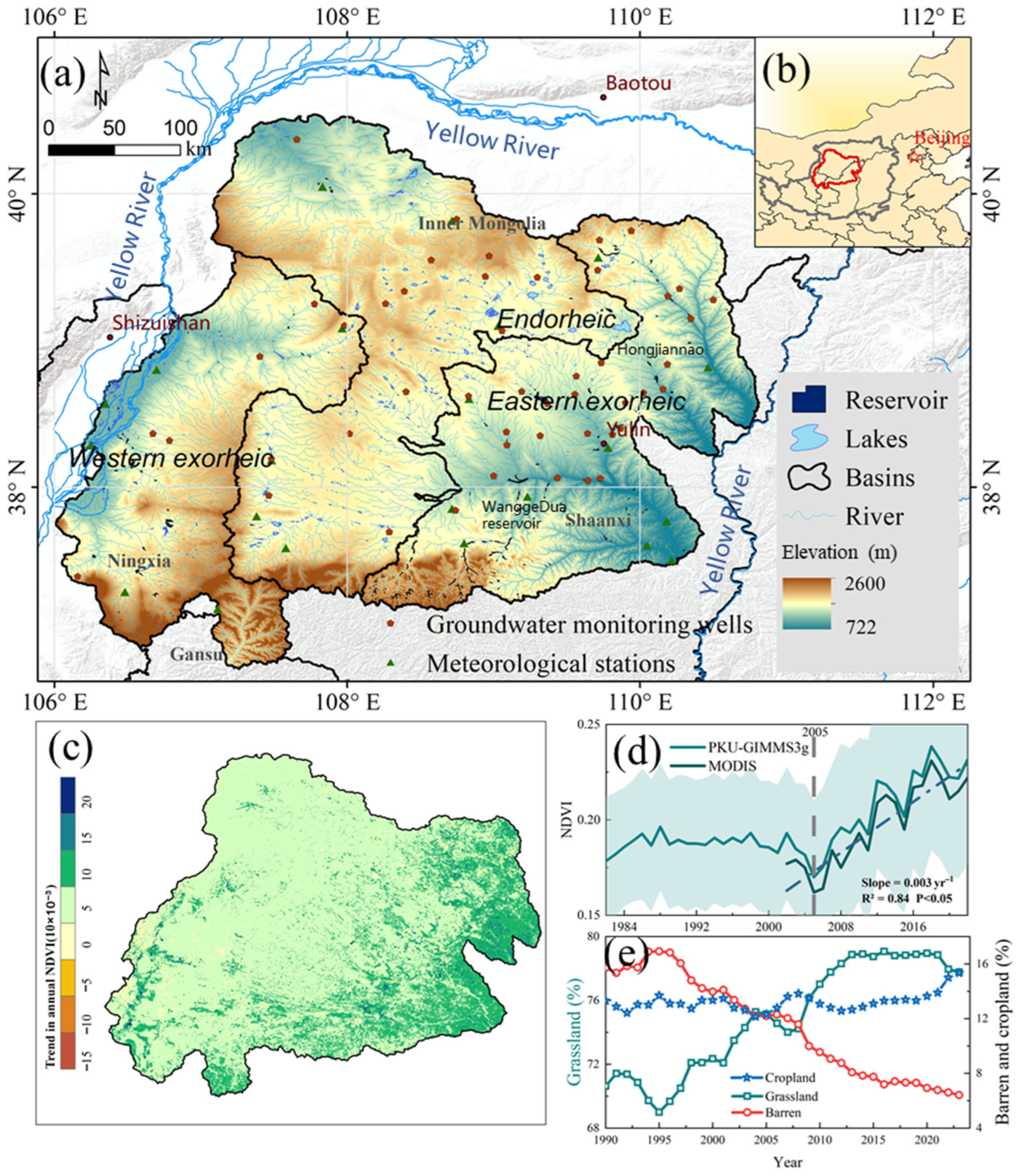
The MUSL and its surrounding areas are located at the junction of the northern Shaanxi Loess Plateau and the Ordos Plateau (Figure 1a,b). The region covers about 130,000 km2, with elevations ranging from 722 to 2600 m, and represents a typical arid to semi-arid fragile zone. Far from large water bodies, the area is characterized by a dry climate, with a mean annual temperature of 6.0–8.5 °C [50] and mean annual precipitation of 250–440 mm, most of which falls during June to September. The Aridity Index (AI = P/PET = 0.11–0.42), where P represents precipitation and PET denotes potential evapotranspiration, indicates a pronounced moisture deficit. Landforms are dominated by sandy terrain and loess hills, and the overall topographic gradient declines from northwest to southeast.
Land-use and land-cover types in the MUSL are dominated by grassland (77.3%), followed by cropland (~15%) and barren land (6.55%) (Figure S5). Prior to the mid-20th century, prolonged warfare, reclamation, overgrazing, and unsustainable water use caused severe ecological degradation, wind erosion, and desertification [51,52]. Since the 1970s, large-scale ecological restoration programs, such as the Three-North Shelterbelt Project and the Grain-for-Green Program, have markedly increased vegetation cover. From 1990 to 2023, the proportion of grassland increased by roughly 10%, and the overall NDVI exhibited a clear upward trend (Figure 1c,d). However, extensive afforestation and grassland enclosure have simultaneously intensified soil moisture and groundwater consumption [30,35]. The region is also rich in coal resources, and the Yulin and Ordos areas constitute major energy bases of China. Large-scale coal mining and industrial water consumption have further exacerbated groundwater extraction and ecohydrological deficits [53].
In previous studies, the spatial extent of the MUSL has often been delineated according to administrative boundaries at the banner or county level. However, administrative units do not accurately represent the natural heterogeneity of hydrological processes and may lead to scale mismatches in hydrological statistics. In this study, we adopted hierarchical watershed boundaries derived from the HydroSHEDS dataset [54]. By overlaying these boundaries with administrative divisions and selecting sub-basins whose areas are primarily located within the sandy region (≥seventh-order basins), we refined the hydrological delineation of the study area. The region was further divided into eastern and western exorheic zones, separated from the central endorheic basin.
The MUSL exhibits a composite hydrological configuration comprising both endorheic and exorheic systems. The central endorheic basin is characterized by topographically closed drainage, where surface runoff does not flow into external river networks but is retained within the basin and equilibrated primarily through evaporation and groundwater exchange [55]. River networks are sparse, and surface water extent is largely controlled by precipitation inputs and shallow groundwater dynamics, leading to high interannual variability in water availability. In contrast, the eastern exorheic zone benefits from more favorable hydrological conditions, with surface runoff ultimately discharging into downstream river systems.

2.2. Data

2.2.1. Hydrometeorological Data

The meteorological and hydrological data used in this study include: precipitation (P) data from the Monthly Temperature and Precipitation Dataset for China [56]; evapotranspiration (ET) from the GLEAM v4 dataset [57] (Text S1); terrestrial water storage from the GRAiCE [58] and river discharge from the GloFAS; root zone soil moisture (RZSM) from ESA CCI RZSM [59]; and groundwater levels from the underground well water level observation grid dataset for China [60].

2.2.2. Land Use and Vegetation Index

Land-cover information was obtained from the China Land Cover Dataset (CLCD) [61]. NDVI were obtained from the MOD13Q1 product and the PKU GIMMS dataset [62].

2.2.3. Energy Production and Water Consumption

Coal production data were collected from the Yulin and Ordos Statistical Yearbook, Industrial and domestic water consumption (IWC&DWC) were obtained from the High-resolution Statistical Water Use Dataset (HSWUD) [63].

2.2.4. Reference and Auxiliary Data

Existing global and regional surface water products were used as reference datasets for comparison and interpretation of SWE dynamics. These include the Global Surface Water (GSW) dataset developed by the Joint Research Centre [14]; the China Reservoir Dataset (CRD), a high-resolution national reservoir invention [64]; and the Global Lakes (GLAKES) dataset [65].
These datasets were used to support water body type classification, distinguish reservoir and natural lake distributions, and provide independent references for SWE spatial pattern interpretation.
Temporal coverage and dataset attributes are provided in Table 1.

2.3. Method

2.3.1. Improved Method for SWE Extraction Based on Landsat Imagery

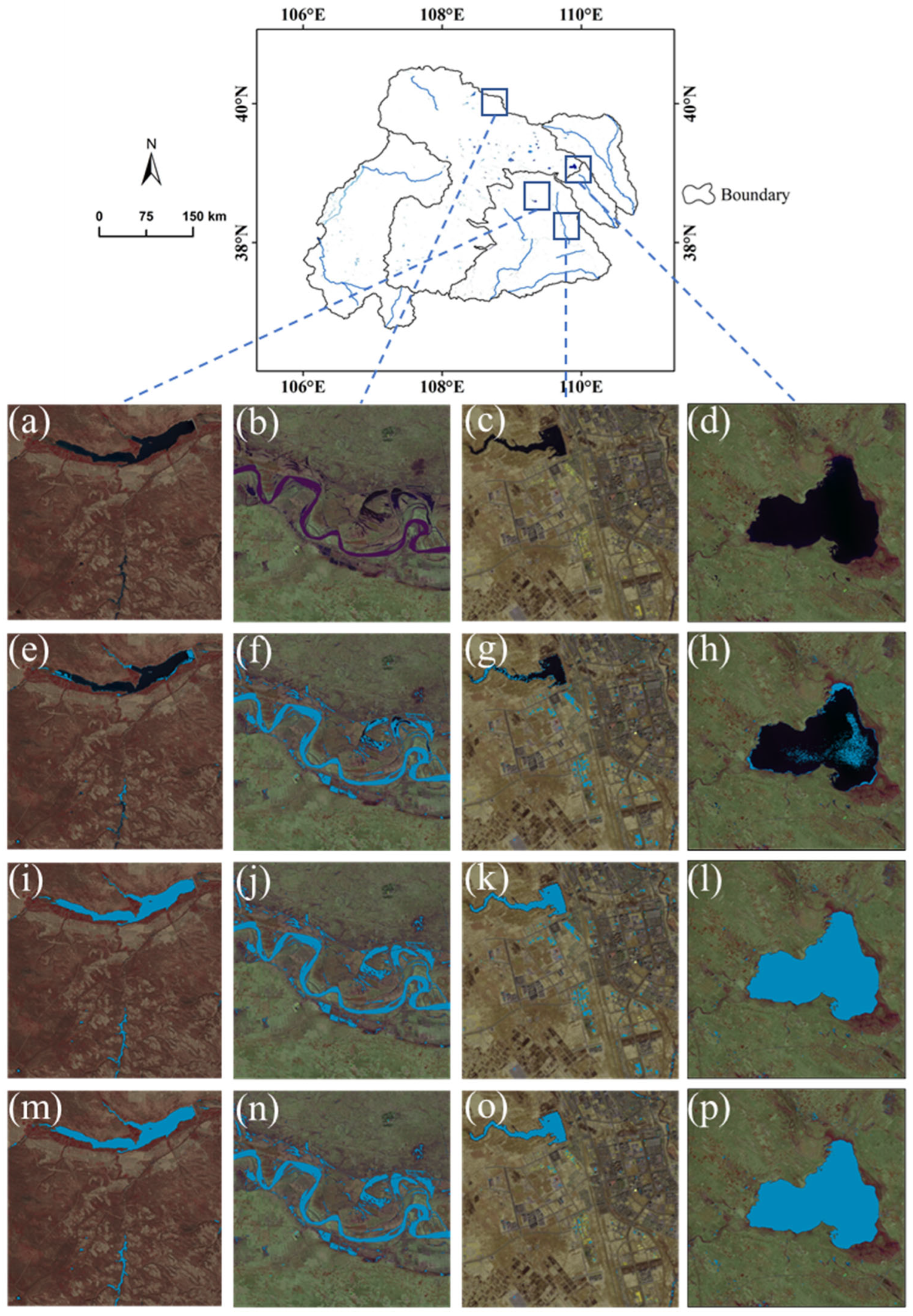
In arid and semi-arid regions, surface water bodies are typically fragmented and small in size, and traditional index-based methods often suffer from misclassification and omission errors under complex surface conditions. The MNE method [66] (MNDWI > NDVI or MNDWI > EVI and EVI < 0.1) can effectively distinguish water pixels from vegetation to some extent and has been widely used for rapid large-scale SWE extraction. However, the EVI < 0.1 constraint tends to incorrectly exclude shallow water pixels in mountainous and arid areas, leading to the omission of small water bodies [19] (Figure 2). To mitigate this issue, the IMNE method (MNDWI > NDVI or MNDWI > EVI) was proposed. Moreover, the discriminative rule between MNDWI and NDVI is easily affected by shadows and roof reflections in urban and mountainous settings, resulting in the extraction of pseudo-water pixels [17,67].
To overcome the above limitations, this study proposes an enhanced noise-controlled SWE detection method, termed NIMNE (MNDWI > NDVI or MNDWI > EVI and MNDWI > 0.1 and NDWI > −0.1). Landsat surface reflectance imagery (TM, ETM+, OLI, and OLI-2) was used as the primary dataset for SWE extraction in this study. All preprocessing and image processing were conducted within the Google Earth Engine platform.
In this approach, the constraint MNDWI > 0.1 strengthens the discrimination between water pixels and bare land or built-up pixels [68], while NDWI > −0.1 effectively removes shadow interference. Furthermore, noise was reduced by incorporating the digital elevation model (DEM) from the Shuttle Radar Topography Mission (SRTM) [69], the Global Human Settlement Layer (GHSL) and JRC GSW layers, thereby improving the detection capability for small and fragmented water bodies in arid and semi-arid regions.
Accuracy assessment based on Sentinel-2 MSI obtained from the Copernicus Open Access Hub showed that all three methods achieved high producer’s accuracy (PA ≥ 0.99) for water body identification, whereas their performance in non-water classification differed markedly. The MNE method exhibited relatively low non-water PA (0.43; OA = 0.71), which was substantially improved in IMNE (non-water PA = 0.998; OA = 0.911). The proposed NIMNE method performed best overall, achieving a water-body PA of 0.999, a non-water PA of 0.957, an overall accuracy (OA) of 0.978, and a Kappa coefficient of 0.957 (Table S3).
Visual comparison of the results (Figure 2) shows that the NIMNE method more effectively delineates lakes, river channels, and small ponds, while substantially reducing misclassifications caused by building roofs and shadows. In contrast, the MNE and IMNE methods exhibit evident omissions and pseudo-water detections.

2.3.2. Correction of Terrestrial Water Storage

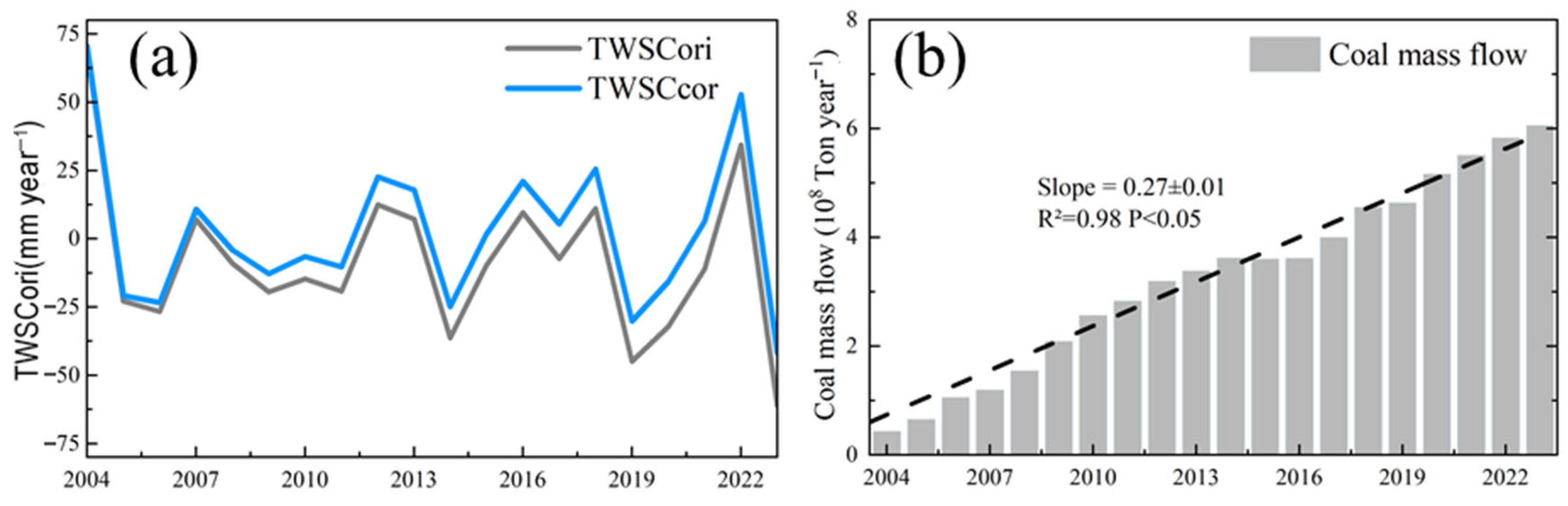
Increasing coal production (Figure 3b) and associated mine-dewatering discharge in the study area have led to substantial mass loss and groundwater depletion, resulting in an overestimation of terrestrial water storage change ( T W S C o r i ). To address this bias, annual raw coal production data from Yulin City were collected and converted into an equivalent water thickness (mm) to correct T W S C o r i , yielding the corrected terrestrial water storage change ( T W S C c o r ). The procedures for mass conversion and estimation of mine-drainage discharge follow [29]:
First, the mass loss associated with raw coal extraction was converted into an equivalent water column height (mm), and the corresponding mine-drainage discharge was then estimated:
T W S M =   M c m f +   M w m f
The annual mass loss caused by coal mining ( M c m f , i.e., the total amount of extracted raw coal) was converted into an equivalent water-layer thickness (mm yr−1). T W S M represents the total equivalent water loss induced by coal extraction each year, while M w m f denotes the volume of water drained during mining operations to reduce the moisture content of coal seams. This drained water is typically utilized in industrial production, discharged to the surface, or evaporated into the atmosphere. M w m f can be estimated using the unit water consumption coefficient for coal mining, as follows:
M w m f =   μ M c m f S 1000
where μ (mean = 0.45 m3 ton−1) is the unit water consumption coefficient for coal mining, derived from field investigations of 25 coal mines in the MUSL. M c m f (ton yr−1) represents the annual raw coal production, S denotes the area of the study region, and 1000 is the conversion factor from meters to millimeters.
On this basis, the T W S C c o r for the period 2004–2023 was calculated using the following equation:
T W S C c o r =   T W S C o r i T W S M
where T W S C o r i represents the terrestrial water storage change derived from the GRAiCE TWSA data.
TWS comprises surface water storage (SWS), groundwater storage (GWS), soil moisture storage (SMS), canopy interception (CI), and snow water equivalent (SW) [38]. Therefore,
T W S = S W S + S M S + G W S + C I + S W
However, SWS in the MUSL is scarce, and no glaciers are present within the region. The dominant vegetation type is grassland. Due to the absence of significant snow and glacier meltwater inputs and minimal interannual variations in lake storage, canopy interception, and snow water equivalent, changes in SWS can be neglected. Therefore, terrestrial water storage can be approximated as the sum of groundwater storage and soil moisture storage.

2.3.3. Agricultural and Ecological Water Consumption Separation Using ET and Land Cover

To quantify the respective contributions of agricultural irrigation and vegetation restoration to regional evapotranspiration (ET), and to further use them as explanatory factors for SWE changes, this study constructed a 9 × 9 pixel moving-window linear regression model based on land-use proportions to decompose ET sources. The fundamental concept of this method is to decompose regional ET into the weighted sum of ET from different land-use types. Specifically, within a given year and within the same 9 × 9 pixel moving-window, each land-use category is assumed to maintain a relatively stable ET intensity, and the total ET of a pixel can therefore be approximated as the area-weighted average of ET across land-use types [70].
This assumption is based on two primary premises:
1. Within a 9 × 9 pixel moving window, variations in atmospheric forcing (e.g., precipitation, radiation, and temperature) are minimal, allowing the evapotranspiration intensity of a given land-use type to be reasonably treated as spatially uniform. In addition, land-use categories are assumed to remain relatively stable within each year.
2. The same land-use categories across the study area exhibit similar vegetation composition and management practices, with intra-class variability being much smaller than inter-class variability [71].
Based on these premises, this study employed the annual evapotranspiration (ET) dataset from GLEAM v4.0 at a 0.1° spatial resolution as the response variable, and 30 m resolution land-use data to extract the area proportions of cropland, ecological land (grassland, forest, and shrubland), and other land-cover types within each GLEAM grid cell as explanatory variables.
Accordingly, a no-intercept linear regression model was established as follows:
E T A A i 1 + E T E A i 2 + E T O A i 3 = E T i ¯ A t o t a l
where E T i ¯ represents the evapotranspiration (mm) of the i-th GLEAM pixel; A i 1 , A i 2 and A i 3 denote the fractional areas of cropland, ecological land, and other land types within the pixel, respectively, with A t o t a l = 1. E T A , E T E and E T O correspond to the regression-estimated evapotranspiration intensities (mm) for agricultural, ecological, and other land types. To ensure the robustness of the estimates, a 9 × 9 local moving-window regression was applied across the GLEAM grid. In addition, pure-pixel constraints (land-type proportion > 85%) and coefficient range corrections were introduced to maintain the physical plausibility of evapotranspiration components across different land-use types (Text S2).
A W C + E W C + O W C = E T

2.3.4. Water-Balance-Constrained Attribution Framework for Water Frequency Dynamics Based on Spatial Hydrological Units

1.
Spatial harmonization of water frequency and hydroclimatic variables, mask construction and selection of study domine
In arid and semi-arid regions, particularly in sandy or desert environments, surface runoff is typically minimal or absent [72]. However, numerous small closed lakes are widely distributed across the study area [73]. The changes in lake water storage can theoretically be treated as the terminal output of the watershed and analyzed in a manner similar to surface runoff. Meanwhile, due to the relatively stable basin morphology of natural lakes, variations in lake surface-extent are generally consistent with changes in lake water storage. Therefore, lake surface-extent dynamics can be used as an effective proxy for lake water storage variability.
Annual water frequency derived from Landsat was aggregated to a 0.1° spatial grid to match the spatial resolution of hydroclimatic variables. To focus the analysis on areas with persistent surface water signals, multi-year accumulated water frequency at a 0.1° resolution was used to construct a spatial mask. Grid cells with cumulative frequency > 1 were identified as water-distributed pixels and retained for subsequent modeling, thereby reducing noise from non-water or ephemeral-water regions. Meanwhile, all hydroclimatic variables, including precipitation, ET components, groundwater storage change, and soil moisture storage change, were resampled to the same 0.1° grid using bilinear interpolation to ensure spatial consistency for pixel-level machine learning analysis.
2.
Water-balance decomposition and storage component representation
At the annual scale, regional water balance was expressed as:
T W S C =   P E T Q I W C D W C
where P is precipitation, E T represents total evapotranspiration, I W C and D W C represent industrial and domestic water consumption, respectively, and T W S C represents terrestrial water storage change.
To resolve hydrological process contributions, ET can be expressed as Equation (6). Meanwhile, TWSC was decomposed into:
T W S C =   S M S C + G W S C + S W S C
where SMSC is the SMS change, GWSC is the GWS change, and SWSC is the SWS change. In this study, SMSC and GWSC were treated as the primary storage-change components controlling SWE dynamics. SWSC was represented using water frequency change as a proxy indicator.
So the final water-balance equation is expressed as:
S W S C =   P E T Q S M S C G W S C I W C D W C
Conceptually Q corresponds to the river discharge, i.e., the total flow measured in the river channel after surface runoff and subsurface (groundwater) runoff have been routed and aggregated through the river network, not the surface or subsurface runoff, and the Q is zero in the endorheic basin [70,74].
3.
Construction of spatial hydrological response units using a 9 × 9 moving window
Lakes are typically controlled by hydroclimatic forcing and groundwater exchanges across their contributing areas rather than by strictly local pixel conditions [75]. To account for this spatial dependency, spatial hydrological response units were introduced.
For each water grid cell and its corresponding hydroclimatic variables, spatial averages were calculated within a 9 × 9 pixel moving window on the unified 0.1° grid. This window represents an effective local hydrological control region with a spatial scale of approximately 90–100 km, capturing integrated effects of precipitation input, evapotranspiration losses, and lateral groundwater contributions.
All predictor variables (P, AWC, EWC, OWC, IWC, DWC, SMSC, and GWSC) were processed using this spatial averaging approach after spatial harmonization.
4.
Feature selection and multicollinearity control
Prior to model construction, multicollinearity was assessed using Pearson correlation coefficients and variance inflation factors (VIFs), primarily to identify redundancy. Variables were removed only when they exhibited both strong redundancy and limited explanatory value.
Extreme Gradient Boosting (XGBoost) is a machine learning algorithm proposed by [76]. As a tree-based method, XGBoost is relatively insensitive to multicollinearity among predictors. Therefore, even when strong correlations existed, variables were retained if they represented distinct components of the water-balance framework, ensuring the preservation of physical completeness and supporting subsequent SHAP-based interpretation.
5.
Model construction, validation, and SHAP-based attribution
Within the spatial mask-defined surface water regions, all valid pixel–year combinations from 1990 to 2021 were assembled into a spatiotemporal sample dataset. Water frequency change was used as the target variable, while hydroclimatic and water consumption variables processed through the spatial hydrological response unit framework were used as predictors.
Samples were randomly split into training (70%) and validation (30%) subsets to evaluate model predictive performance.
After model training, SHAP (Shapley Additive Explanations) implemented within the XGBoost framework was applied to decompose predicted surfacewater changes into additive contributions from each predictor variable. This approach enables quantitative identification of dominant hydrological drivers and their nonlinear regulatory effects on lake and SWE dynamics under combined climate variability and human water consumption pressures.

3. Results

3.1. Spatial Distribution of SWE in the MUSL

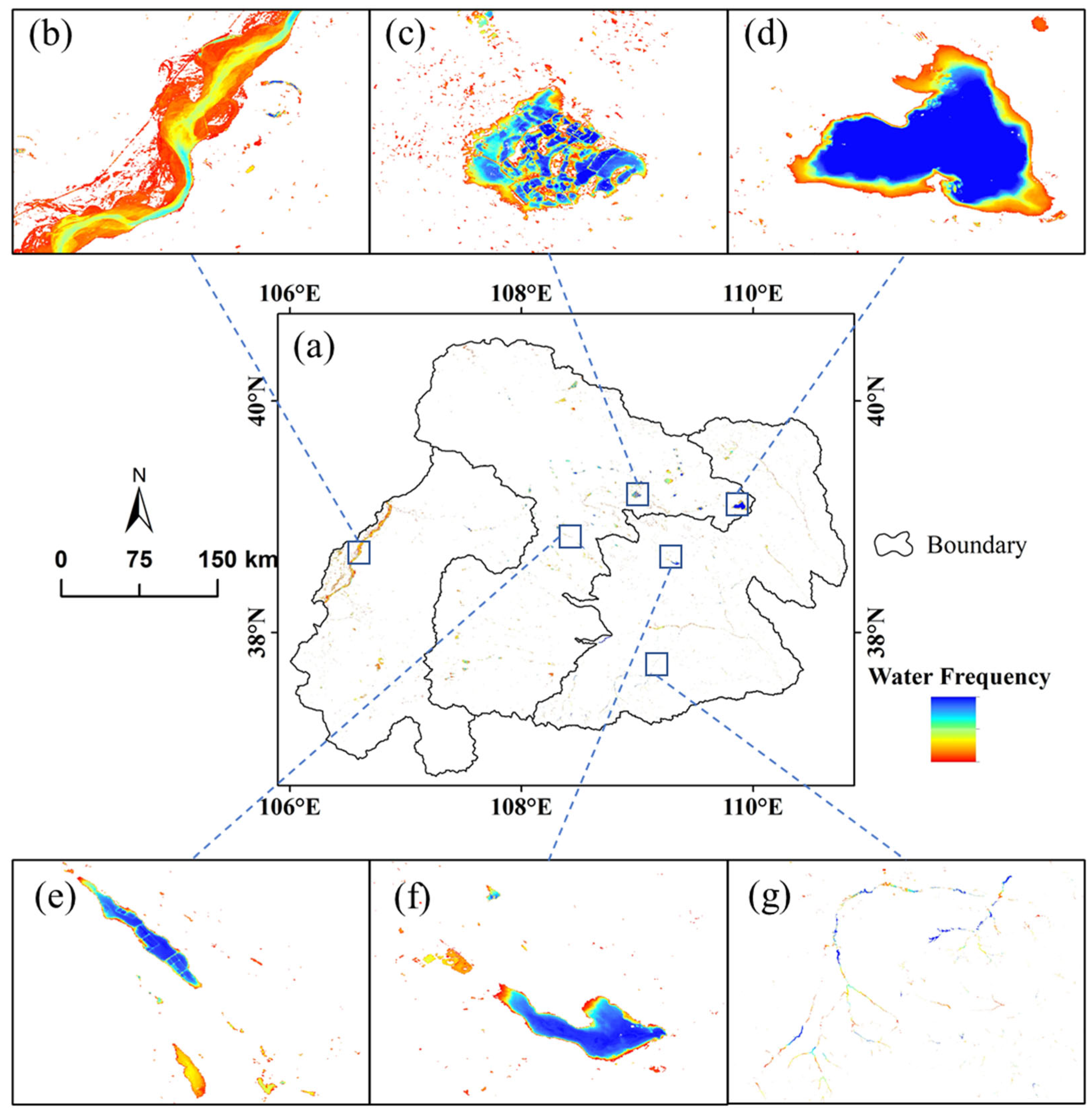
The surface water bodies in the MUSL consisted of lakes of various sizes, reservoirs, rivers, and numerous small ponds and depressional wetlands. Statistics analysis revealed that the total SWE (WF > 0) reached 782.6 km2, accounting for 0.5% of the study area (Table 2). Among them, ephemeral SWE (0 < WF ≤ 0.25) accounted for the smallest proportion (26% of the total SWE) and primarily occurred in temporary depressions and fragmented zones along the margins of lakes and rivers (Figure 4a). Ephemeral SWE was strongly influenced by precipitation and evaporation and frequently experienced inundation–drying cycles. It often disappeared during repeated freeze–thaw and thermal cycles, due to their shallow depth and limited storage capacity. Permanent SWE (0.75 < WF ≤ 1) accounted for 42.5% of the total SWE and was mainly composed of large natural lakes and artificial reservoirs, where the water level remained stable and persistent. Seasonal SWE (0.25 < WF ≤ 0.75) made up 31.5% and primarily included seasonal rivers, irrigation channels, saline lakes, and aquaculture ponds, representing transitional types between permanent and ephemeral SWE.
By refining and modifying the CRD and GLAKES datasets, we delineated the spatial distribution patterns of reservoirs, natural lakes, and rivers within the MUSL. Spatially, natural lakes were concentrated in the central–northern low-lying areas of the endorheic basin (Figure 1a), with endorheic lakes representing 86.3% of the total lake area in the MUSL. Due to the poorly developed drainage network, these lakes were highly sensitive to precipitation variability and human disturbance. Reservoirs were mainly concentrated in the eastern exorheic zone, accounting for 78% of the total reservoir area.

3.2. Temporal Trends of SWE in the MUSL

3.2.1. SWE Trends and Contributions of Water Types in the MUSL

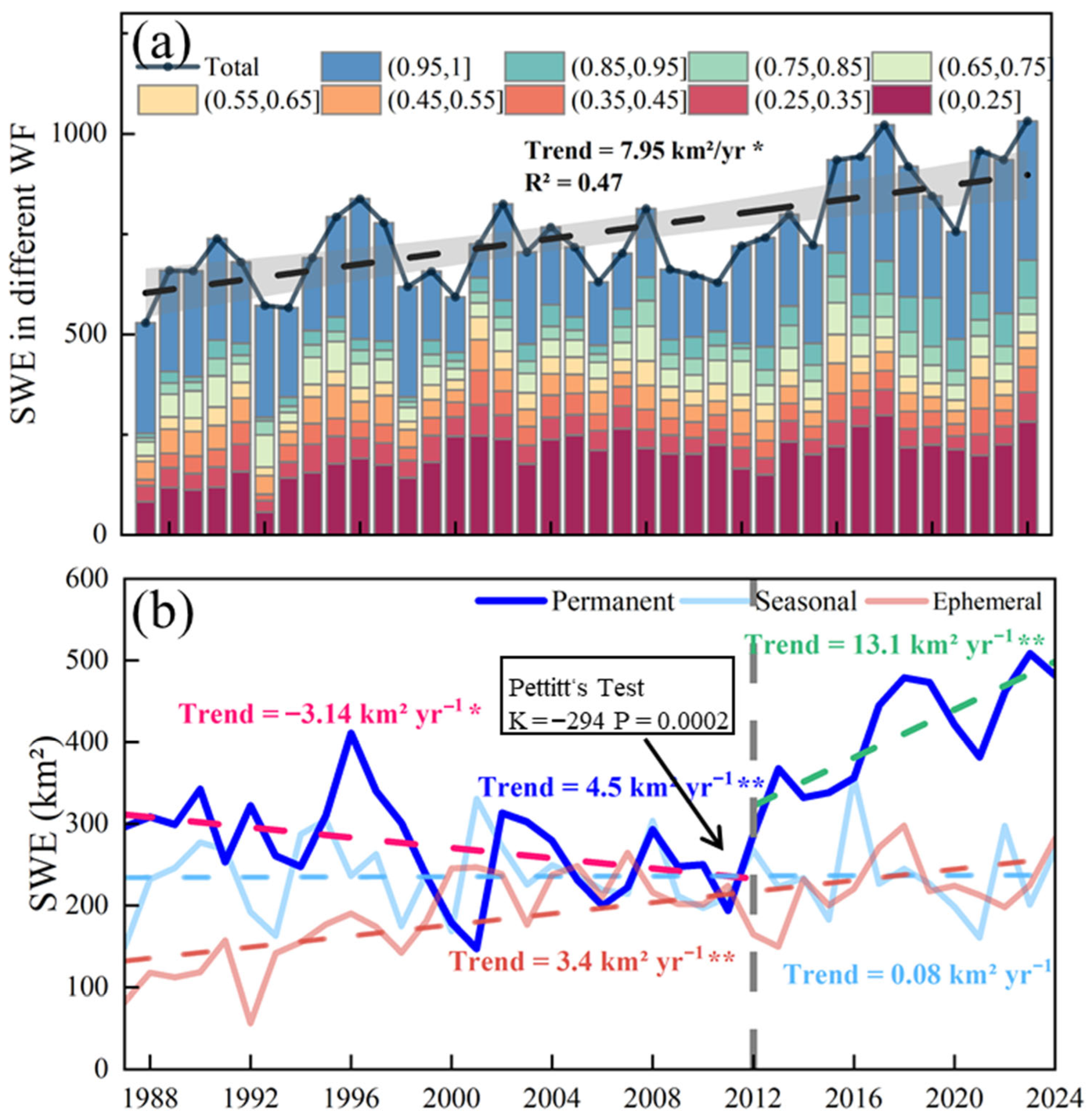
The interannual statistics of SWE across different frequency intervals from 1987 to 2024 indicated a significant increasing trend in the total SWE of the MUSL (Trend = 7.95 km2 yr−1, p < 0.05) (Figure 5a). The continuous expansion of ephemeral SWE had a relatively high SWE growth rate (Trend = 3.4 km2 yr−1, p < 0.01), while seasonal SWE showed no significant change (0.08 km2 yr−1) (Figure 5b). Permanent SWE served as the primary driver of total SWE variability and showed the highest rate of expansion (Trend = 4.5 km2 yr−1, p < 0.01).
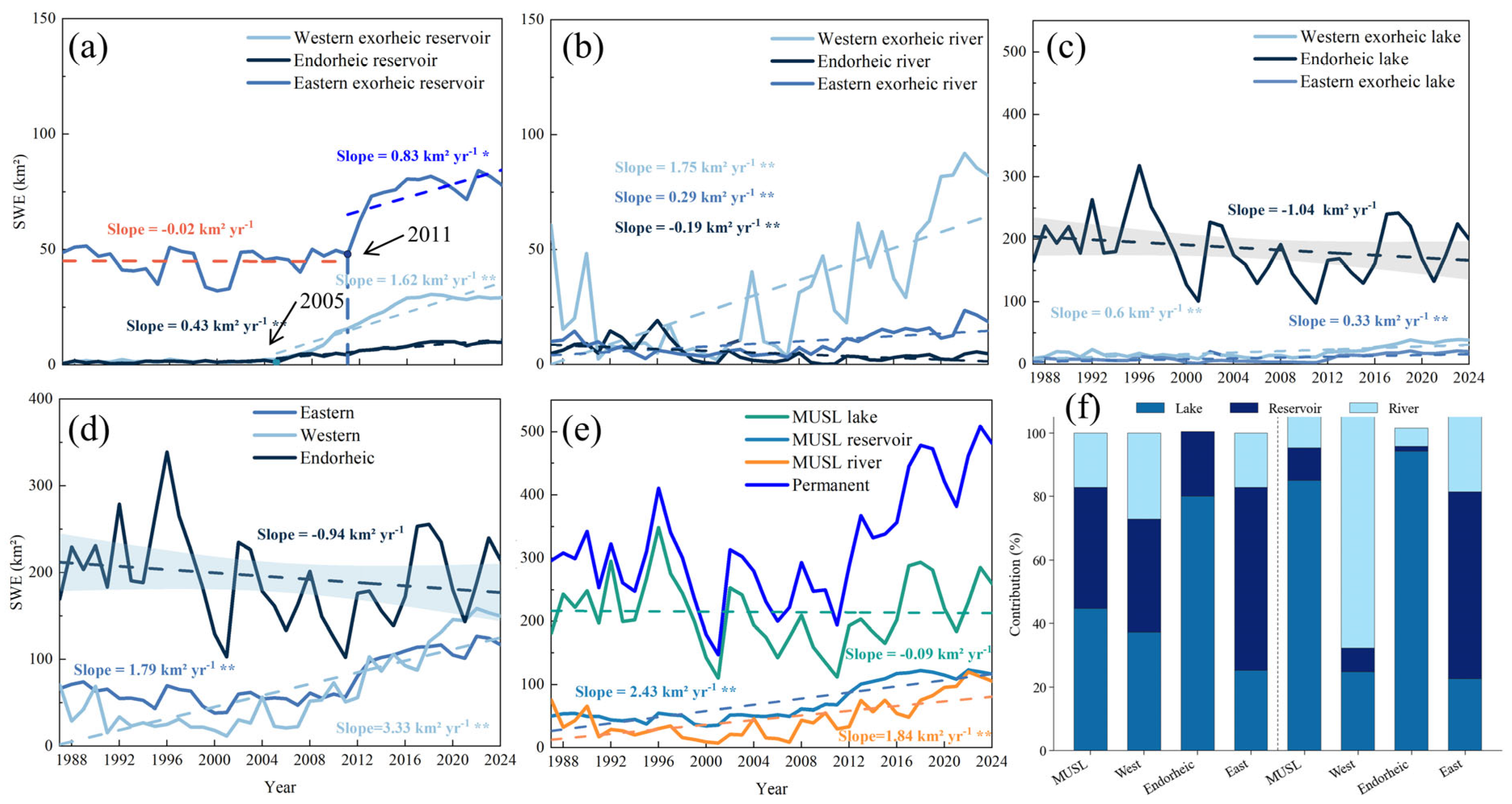
Among different water types, natural lakes dominated long-term permanent SWE variability in the MUSL. The lake-surface-extent exhibited substantial interannual fluctuations ranging from 100 to 350 km2 (Figure 6d). From 1987 to 2024, lake-surface-extent showed a non-significant declining trend (−0.1 km2 yr−1), with a mean area of 214.8 km2, accounting for 64.5% of total permanent SWE (Table 3). The increase in lake-surface-extent contributed 44.8% to the total increase in permanent SWE, while its absolute contribution accounted for 85.1% (Table 4), indicating that lakes dominated permanent SWE variability across the MUSL.
Reservoir expansion represented the second largest contributor to permanent SWE increase, contributing 38.1% to total permanent SWE growth across the MUSL, with a significant increasing trend (2.43 km2 yr−1, p < 0.01). In contrast, rivers contributed a smaller but still important share of SWE dynamics.
River-surface-extent exhibited the third largest increasing trend among major water body types (1.84 km2 yr−1), contributing 17.1% to the total permanent SWE increase across the MUSL.
To further clarify the spatial heterogeneity of SWE evolution, SWE temporal trends were analyzed across different hydrological units, with particular emphasis on the contrasting behaviors between the endorheic basin and the exorheic regions.

3.2.2. SWE Trend Patterns in the Endorheic Basin

Permanent SWE dynamics in the endorheic basin were overwhelmingly dominated by natural lakes. Lakes accounted for 94.3% of total permanent SWE variability magnitude and 80% of the total increase in permanent SWE within the endorheic basin (Table 4). Although lake-surface-extent showed a slight overall declining trend during 1987–2024, interannual fluctuations were pronounced, reflecting strong sensitivity to climatic and hydrological variability.
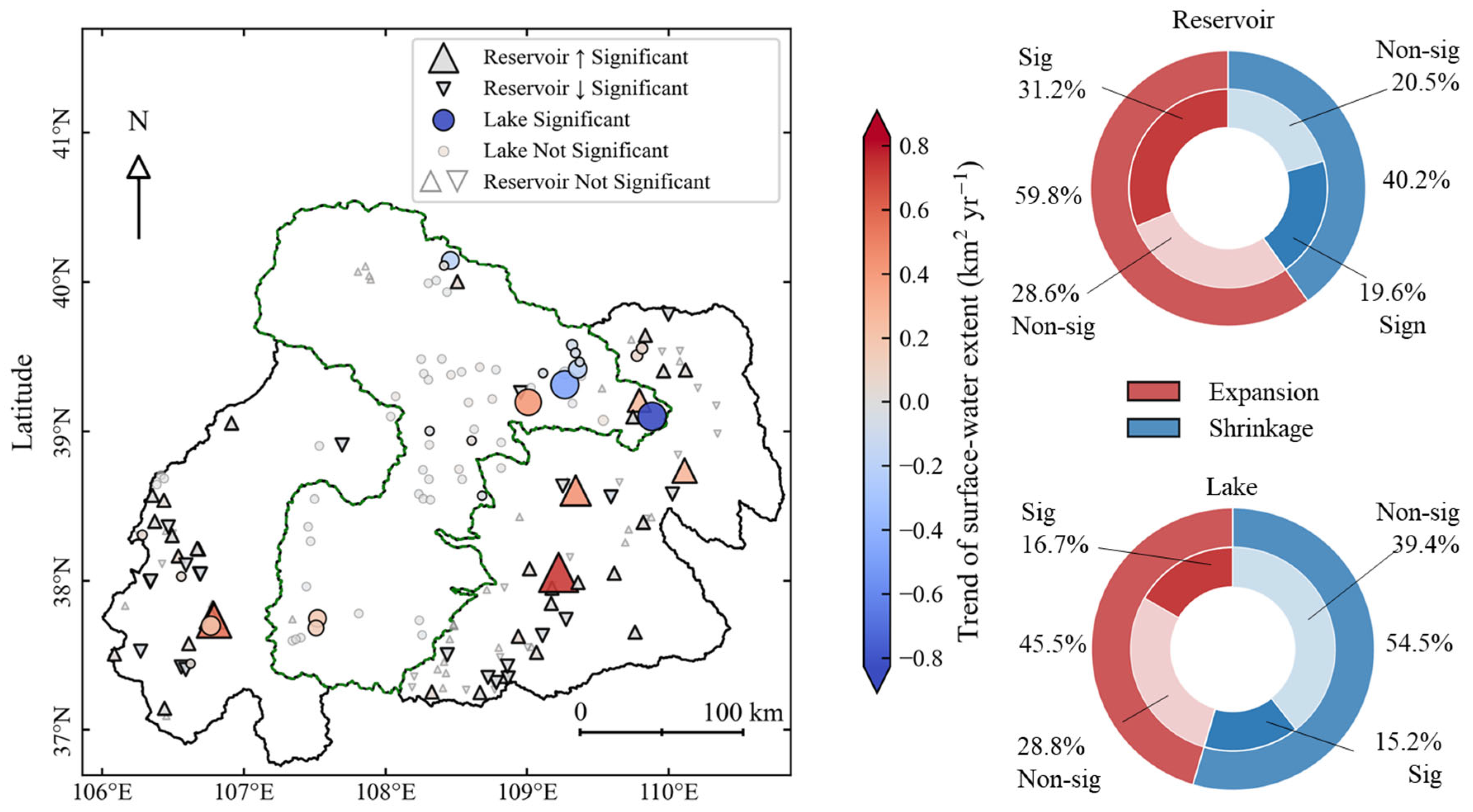
The statistics of 66 lakes larger than 0.1 km2 from 1987 to 2024 indicate that approximately 45.5% exhibited expansion trends, while 31.9% showed statistically significant area changes (p < 0.05). The most pronounced variations were concentrated in the northern part of the endorheic basin (Figure 7). Individual lake responses differed markedly. Hongjiannao experienced the most rapid shrinkage (−0.72 km2 yr−1; total decrease = −26.1 km2), mainly due to intense evaporation and upstream water interception by the Zhasake Reservoir after 2004. However, its area gradually recovered after 2016 under ecological water supplementation [77].
Medium-sized lakes such as Bagannur also showed decreasing trends, contributing to overall contraction of total lake-surface-extent before 2012. In contrast, lakes such as Haotongyin Chagannur and Chagannur expanded rapidly after 2016, with Haotongyin Chagannur showing the most pronounced increase (0.42 km2 yr−1; total increase = 15.22 km2). In addition, saline lakes such as Kushu Lake in the western exorheic transition zone also exhibited significant expansion.
The post-2012 rebound of lake extent aligns closely with strengthened environmental regulations across the Erdos Plateau [23]. These policies included reductions in agricultural water extraction through improved irrigation management, grazing restrictions, grassland restoration, and large-scale ecological rehabilitation such as reforestation and wetland conservation. These measures reduced anthropogenic water consumption and alleviated ecological degradation, collectively promoting SWE recovery.

3.2.3. SWE Trend Patterns in the Eastern Exorheic Region

In contrast to the lake-dominated endorheic basin, permanent SWE dynamics in the eastern exorheic region were primarily controlled by reservoir expansion. Reservoir-surface-extent increase contributed 57.7% to permanent SWE increase and 58.8% to total SWE variability magnitude in this region (Table 4).
Reservoir-surface-extent exhibited a clear abrupt change point around 2011. Before 2011, reservoir area remained relatively stable (−0.02 km2 yr−1), whereas after the shift, rapid expansion occurred (0.83 km2 yr−1, p < 0.01, R2 = 0.43). In the endorheic and western exorheic regions, abrupt changes occurred earlier, around 2005, with reservoir-surface-extent showing slow increases before 2005 and significant expansion afterward (0.43 km2 yr−1 and 1.62 km2 yr−1, respectively, p < 0.01) (Figure 6a).
Analysis of spatial patterns of reservoir-surface-extent change (Figure 7) reveals strong regional heterogeneity across the MUSL. Among 112 reservoirs, 57 (50.9%) exhibited statistically significant trends (p < 0.05), indicating active reservoir changes over the past decade. A total of 67 reservoirs (59.8%) showed positive trends, whereas 45 (40.2%) showed negative trends, suggesting that although both expansion and contraction occurred, expansion was dominant overall.
Spatially, significant positive reservoir expansions were concentrated in the central and northern parts of the eastern exorheic region, where dense hydraulic infrastructure, developed irrigation systems, and reliance on inter-basin water transfer and ecological water supplementation prevail [7]. In addition, extensive check-dam systems and small reservoir clusters on the Loess Plateau enhanced runoff retention and regulation capacity [78], contributing to persistent reservoir expansion.
In contrast, more reservoirs in the southern part of the eastern exorheic region showed negative trends. This area is characterized by high cropland proportion and strong irrigation demand. Recent reductions in agricultural water withdrawals weakened reservoir inflow conditions, resulting in declining reservoir-surface-extent [79].

3.2.4. SWE Trend Patterns in the Western Exorheic Region

Permanent SWE dynamics in the western exorheic region were primarily controlled by river-connected surface water systems, particularly the main channel of the Yellow River. River-surface-extent showed the most significant increase (1.75 km2 yr−1, p < 0.01; Table 3), accounting for 89.8% of the permanent SWE increase in this region (Table 4).
In contrast, river-surface-extent in the endorheic basin remained nearly stable (Figure 6b), consistently maintaining a low level (<10 km2), reflecting the closed and hydrologically fragile nature of fluvial systems in the endorheic basin. River channels in this region are mainly sustained by short-duration heavy precipitation events under highly variable climatic conditions, which limit the formation of persistent streamflow.
Further, Sen’s slope trend analysis of the Yellow River channel in the western exorheic region (Figure S7) revealed clear channel expansion characteristics. The area of pixels with increasing water frequency reached 82.5 km2, whereas pixels with decreasing frequency accounted for 40.5 km2, indicating an overall increase in channel water occurrence. Spatially, areas with increasing frequency were mainly distributed along the main channel and major floodplains, reflecting increased Yellow River discharge, consistent with previous studies [80].
Conversely, areas with declining water frequency were concentrated along channel margins, tributary sections, irrigation districts, and aquaculture zones, forming a spatial pattern characterized by “main-channel expansion and marginal contraction.” This pattern is closely associated with intensive agricultural irrigation and aquaculture activities [81] along both banks of the Yellow River in the Ningxia section. Shallow ponds in these zones frequently experience cyclic inundation–drying processes driven by temperature variability and high evaporation, further amplifying the instability of marginal water bodies.

3.3. Influence of Hydroclimatic and Anthropogenic Factors on SWE Variability

3.3.1. Subsurface Water Storage Controlled SWE Variability in the Endorheic Basin

SWE dynamics in the endorheic basin exhibit an overall decreasing trend, which dominate the interannual variability of SWE across the MUSL. Surface water bodies in this region are primarily composed of natural lakes. Therefore, the factors influencing SWE dynamics in the endorheic basin were quantified using a water-balance-constrained framework combined with the XGBoost model and SHAP-based interpretability analysis (Section 2.3.4).
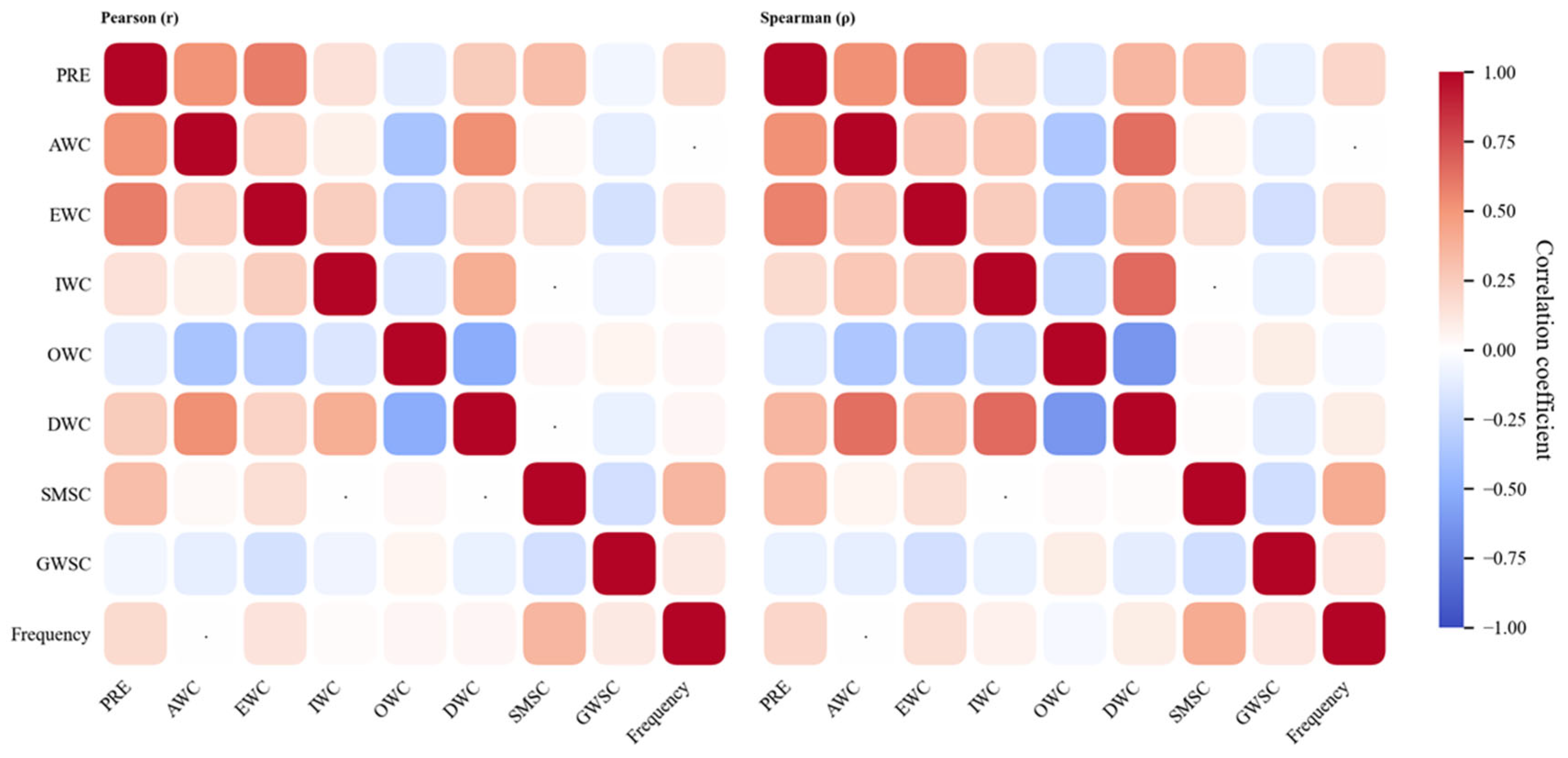
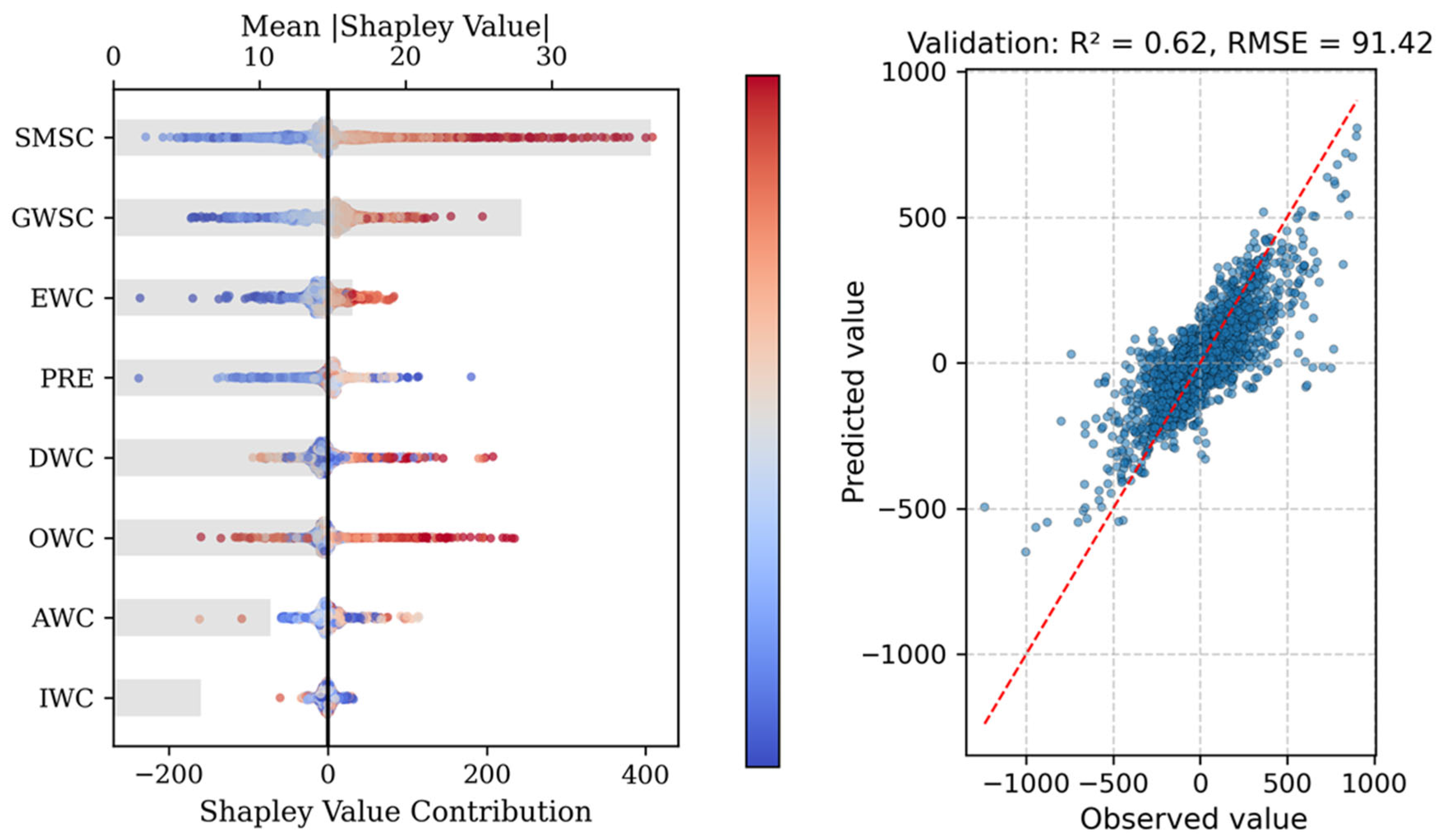
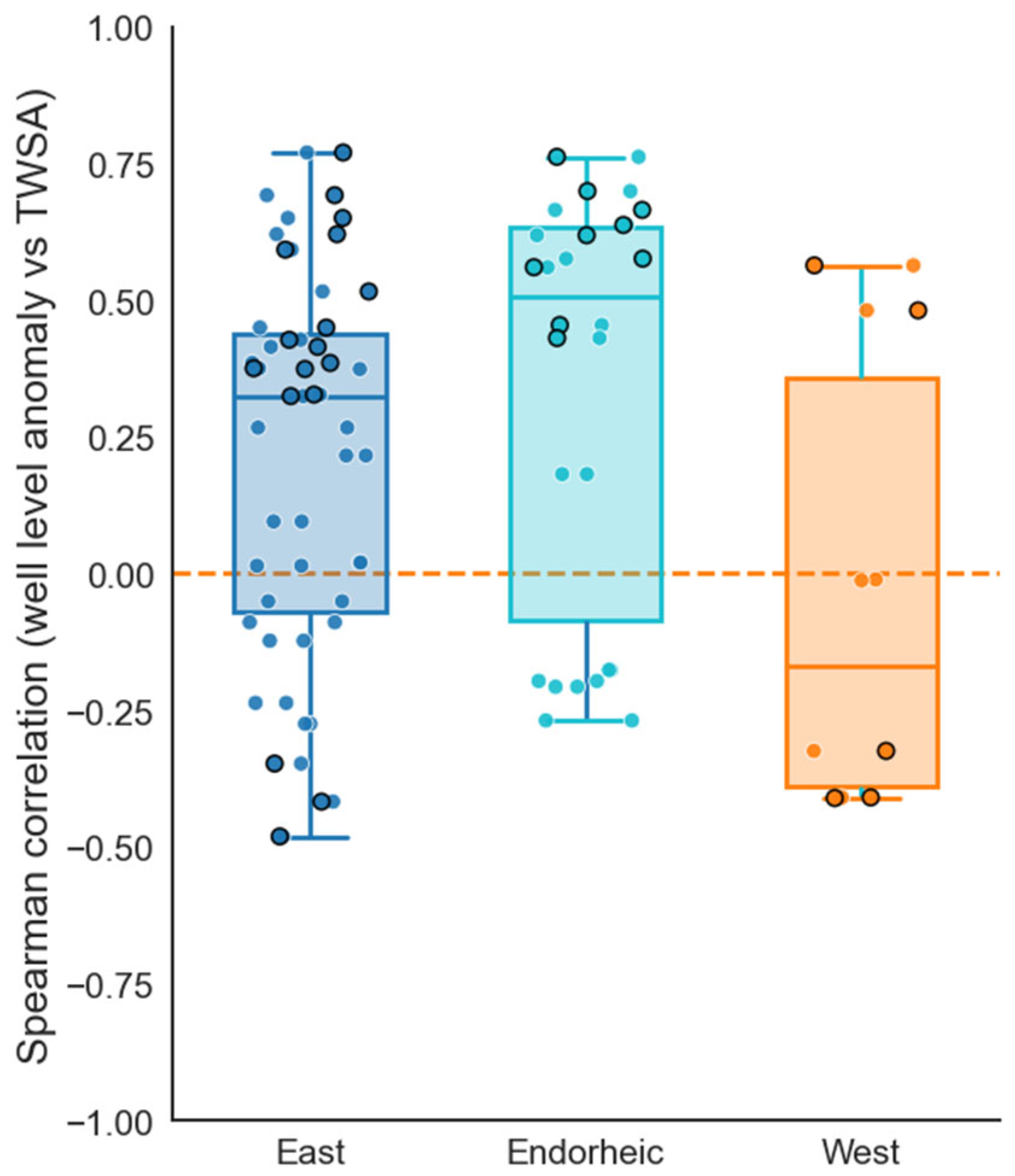
Correlation analysis (Figure 8), VIF-based multicollinearity diagnostics (Table S6), and XGBoost–SHAP attribution results (Figure 9) consistently indicate that variations in water frequency are strongly associated with subsurface water storage processes. Among all predictors, SMSC and GWSC exhibit the highest contributions, with mean absolute Shapley values substantially exceeding those of climatic variables and anthropogenic water consumption components. The model demonstrates good predictive performance in the validation dataset (R2 = 0.62, RMSE = 91.42), indicating that the selected water-balance components effectively capture the primary variability in water frequency.
The SHAP response patterns show that SWE is positively associated with both SMSC and GWSC. This relationship remains stable under different water frequency thresholds, including scenarios where only large and persistent water bodies are retained. These results suggest that subsurface water storage variables are the dominant associated factors explaining SWE variability in the endorheic basin, whereas short-term climatic variability mainly influences ephemeral water bodies. In closed hydrological systems, subsurface water storage conditions are likely important for sustaining and stabilizing permanent SWE.
Precipitation and ecological water consumption (EWC) exhibit strong collinearity (Table S6), suggesting that vegetation evapotranspiration is largely constrained by climate-driven water availability. From a spatial attribution perspective, regions with high EWC generally correspond to positive SHAP contributions, indicating that enhanced vegetation evapotranspiration tends to co-occur with increased water frequency under relatively wet hydroclimatic conditions. This pattern likely reflects coupled ecohydrological feedback, where vegetation restoration and precipitation variability jointly influence regional water cycling. For example, vegetation recovery may enhance local moisture recycling and boundary-layer humidity, potentially affecting regional precipitation patterns [82]. Conversely, increased precipitation can promote vegetation growth and ecosystem recovery [83,84]. In contrast, precipitation itself shows a positive but relatively weaker contribution, suggesting that in endorheic basins precipitation mainly influences lake-surface-extent dynamics indirectly through soil moisture recharge and shallow groundwater replenishment rather than through direct surface runoff generation.
Although strong collinearity exists between EWC and precipitation, its impact on XGBoost’s predictive performance is limited. Tree-based gradient boosting models do not require strict linear independence among predictors and are generally robust to multicollinearity. We further conducted a variable-removal test by excluding precipitation (PRE), which exhibited relatively high collinearity, and found that the main attribution results remained largely unchanged. The high model performance in the validation dataset further confirms that multicollinearity does not appear to substantially degrade model reliability (Figure S8). Anthropogenic water consumption variables, including DWC and IWC, show relatively small contributions, primarily because their magnitudes are much smaller than major hydroclimatic fluxes such as precipitation input and evapotranspiration losses.

3.3.2. Human Regulation Controlled on SWE Variability in the Exorheic Region

In contrast to the endorheic basin, the expansion of SWE in the eastern exorheic region was primarily controlled by hydrological redistribution processes rather than synchronous changes in GWS change. The phased evolution of SWE was closely associated with reservoir dynamics and engineering regulation.
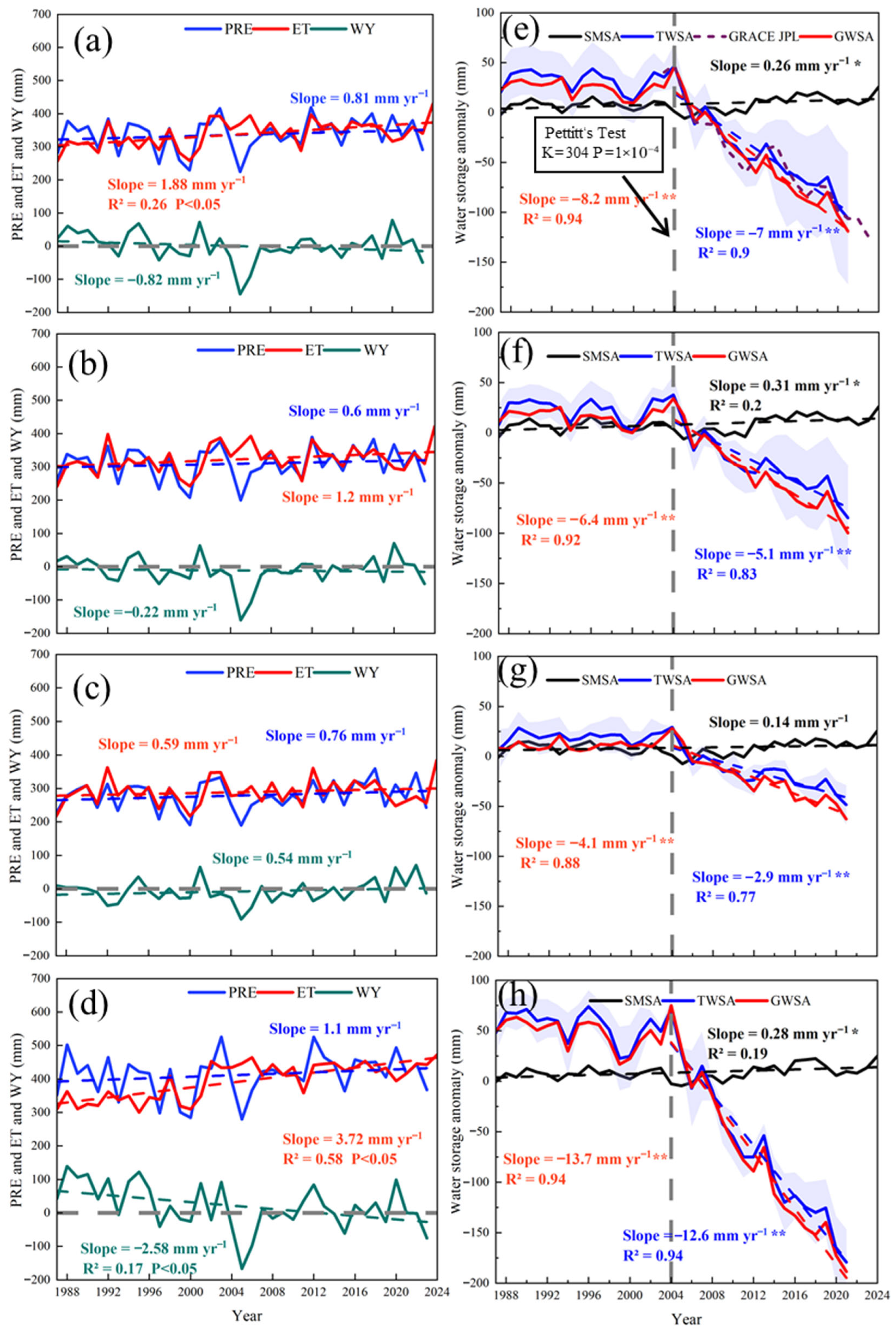
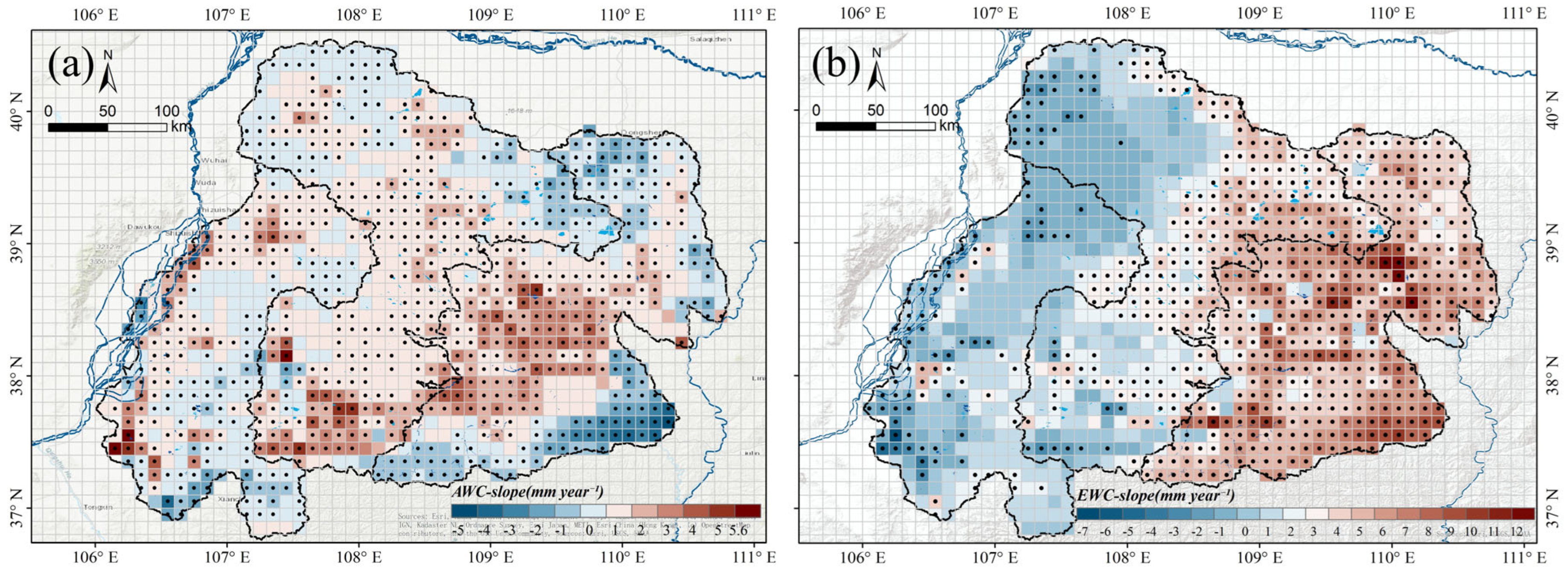
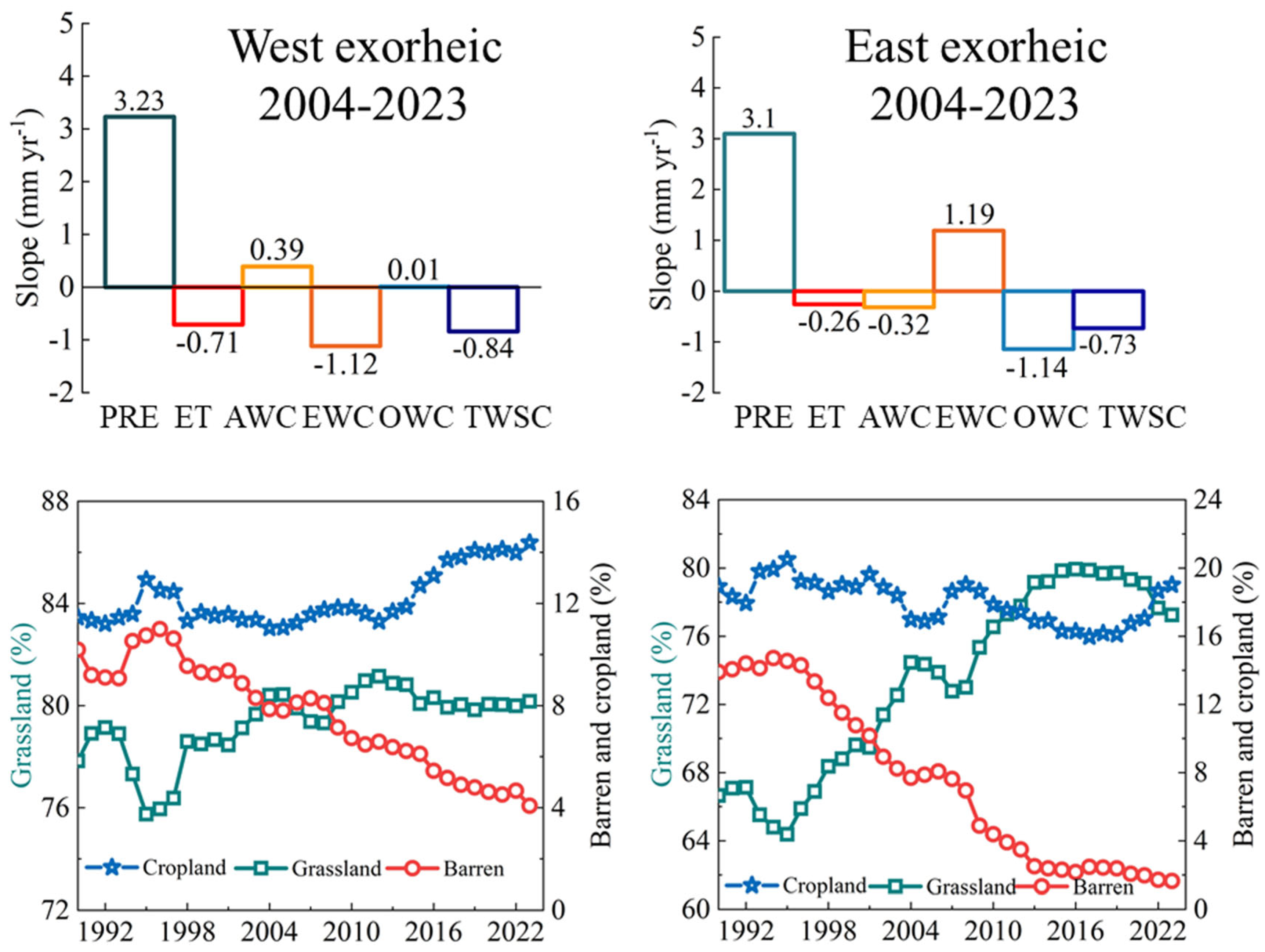
Over the past four decades (1987–2024), precipitation increased slightly at a rate of +1.1 mm yr−1, whereas evapotranspiration increased at a much higher rate of +3.72 mm yr−1 (p < 0.05), resulting in a significant decline in water availability of −2.58 mm yr−1 (Figure 10d). During the past two decades (2004–2023), precipitation showed a stronger increasing trend (+3.1 mm yr−1), while evapotranspiration stabilized, leading to a phased recovery in water availability (+1.6 mm yr−1). Decomposition of evapotranspiration indicated that the long-term increase in ET was mainly driven by EWC (Figure 11), which increased significantly at +1.19 mm yr−1, whereas AWC decreased at −0.32 mm yr−1 due to cropland reduction (Figure 12).
TWSA and GWSA exhibited a significant turning point around 2004, after which both showed pronounced declining trends, with rates of −12.6 mm yr−1 and −13.7 mm yr−1, respectively. In contrast, SMSA showed an increasing trend of 0.28 mm yr−1 from 1987 to 2024. Groundwater observations further confirmed widespread substantial water level declines (Figure 13), particularly in northern mining areas and southeastern vegetation restoration zones. [85]. Coal mining introduced additional uncertainties into TWSA estimates. The extraction of raw coal resulted in an apparent multi-year mean TWS decline of −7.2 mm, while mine dewatering water pumped to the surface averaged −3.2 mm. After correcting for this bias, the long-term decline in TWSA was −4.8 mm yr−1, and GWSA decreased at −4.1 mm yr−1, confirming sustained groundwater depletion across the region.
Under these conditions, SWE expansion was primarily sustained by the redistribution of water from groundwater to surface reservoirs through groundwater depletion, mine-drainage discharge, and intensified runoff retention by reservoir and check-dam systems [86,87]. Overall, SWE expansion in the eastern exorheic region reflects a redistribution of GWS toward the engineered surface water storage system rather than a net increase in regional terrestrial water storage.
Over the past four decades, the western exorheic region has experienced relatively stable climatic conditions. Precipitation increased slightly at +0.76 mm yr−1, while evapotranspiration increased at +0.59 mm yr−1, resulting in changes in water availability (0.54 mm yr−1, not significant) (Figure 10c), indicating weakened natural recharge and limited climatic support for SWE expansion.
SWE expansion in the western exorheic region was primarily sustained by inflows from the Yellow River. After excluding the Yellow River channel area within the study boundary, SWE in the western exorheic region still exhibited an increasing trend after 2005. This indicates that SWE expansion was also controlled by accelerated depletion of terrestrial water storage (Figure 12) and increased precipitation. In addition, irrigation and aquaculture activities along the river corridor generated numerous artificial water bodies. Although these systems experience high evaporative losses, they collectively contributed to the long-term increase in regional SWE.

4. Discussion

4.1. Water-Balance Constraints on SWE Dynamics

Previous studies have widely identified precipitation as a primary driver of SWE dynamics in arid and semi-arid regions [88], as it directly controls runoff generation and water input to lakes and rivers. However, our results reveal a relatively weak correlation between precipitation and SWE in the MUSL (Figure 8), suggesting that precipitation alone cannot adequately explain SWE variability in this dryland system. This apparent inconsistency can be attributed to the strong evaporative demand characteristic of arid environments. Under a “warming and humidifying” climate background, although precipitation exhibits a slight increasing trend, evapotranspiration increases at a much faster rate, leading to a net decline in water availability (Figure 10d). Similar findings have been reported in the MUSL [34] and other dryland regions, such as the Ordos Plateau and Central Asia, where enhanced evapotranspiration constrains lake expansion despite increasing precipitation [4,23,89,90]. Therefore, SWE variability should be interpreted within a coupled water-balance framework that explicitly accounts for both water inputs and losses.
In contrast to studies that rely on statistical approaches, such as geographical detectors [17,91] or multi-factor correlation analyses [47] incorporating topography, soil type, and land cover, our framework emphasizes physically consistent variable selection based on the water-balance equation. While statistical methods can identify potential associations, they often lack explicit representation of hydrological processes and may introduce spurious relationships. By constraining predictor variables within the water-balance framework, this study ensures that all explanatory factors correspond to physically meaningful hydrological components, thereby improving the interpretability and robustness of SWE attribution.

4.2. Contrasting Hydrological Drivers of SWE in Endorheic and Exorheic Basins

The dominant role of subsurface water storage in controlling SWE dynamics in the endorheic basin reflects the fundamental characteristics of closed hydrological systems. In such environments, precipitation inputs are typically buffered by soil and vadose zone storage before contributing to groundwater recharge, which subsequently regulates lake water levels [92,93]. Increases in soil moisture content enhance vertical infiltration and lateral subsurface flow, promoting groundwater recharge and strengthening hydraulic connectivity between lakes and surrounding aquifers [94]. Elevated groundwater storage increases hydraulic head gradients toward lake basins, thereby sustaining lake levels and facilitating lateral expansion. These groundwater–lake interactions have been widely documented in endorheic basins [95,96], including northern China [55], where groundwater discharge represents a key water source for maintaining perennial lakes.
In contrast to the endorheic basin, SWE dynamics in the exorheic regions are primarily controlled by human-induced water redistribution rather than natural hydrological replenishment. Water conservancy facility construction, irrigation practices, coal mining, and river regulation collectively reshape the spatial distribution of water resources. In the eastern exorheic region, reservoir and check-dam construction and engineering regulation enhance runoff retention and convert groundwater and upstream inflows into surface water storage [78,97]. In addition, mining-induced dewatering actively pumps groundwater to the surface, further contributing to surface water accumulation and intensifying the redistribution of subsurface water storage [29]. Studies on the Mongolian Plateau also indicate that coal mining accelerates groundwater depletion through aquifer drainage and structural disruption [24]. In the western exorheic region, SWE expansion is sustained by inflows from the Yellow River, while irrigation and aquaculture activities generate numerous artificial water bodies. Similar patterns have been observed in the North China Plain, particularly in Shandong Province [81]. In recent years, inter-basin water transfer projects, including water diversion from the Yellow River, have been implemented in this region. Previous studies have shown that such water transfer activities can contribute to the expansion of SWE [7]. These processes contribute to SWE expansion even under conditions of declining groundwater storage.

4.3. Methodological Advances in SWE Detection and Attribution

In addition to the hydrological findings, this study highlights several methodological advances for improving the detection and attribution of SWE dynamics in dryland environments.
First, the proposed NIMNE method enhances the detection of small and fragmented water bodies and reduces misclassification caused by vegetation interference and surface heterogeneity. Compared with conventional index-based approaches [19,68,98], this method provides more reliable long-term SWE estimates, which is particularly critical in arid and semi-arid regions where surface water bodies are often small, ephemeral, and spatially heterogeneous. Previous studies have shown that traditional spectral indices may underestimate small water bodies or misclassify vegetation-covered water surfaces [17,19], whereas the improved method proposed here effectively addresses these limitations.
Second, this study introduces a water-balance-constrained machine learning attribution framework. Instead of directly selecting explanatory variables based solely on statistical correlations, predictor variables were first screened using the water-balance equation, ensuring that all variables represent physically meaningful hydrological components with consistent units. This strategy improves the physical interpretability of the machine learning model and avoids spurious correlations that are common in purely data-driven approaches.
Third, to address the mismatch between water-balance variables (expressed in water storage units) and the primary response variable (surface water extent), this study innovatively employs water frequency (WF) as a proxy for surface water storage. In the endorheic basin, where natural lakes dominate and basin morphology remains relatively stable, variations in lake water storage are strongly and approximately linearly related to changes in SWE. This approach effectively overcomes a key limitation in dryland hydrology, where the lack of satellite altimetry data makes it difficult to quantify storage changes in small and medium-sized lakes. By linking SWE observations with water-balance components through WF-based representation, this framework enables a more physically consistent and scalable attribution of SWE dynamics and provides a transferable methodological framework for analyzing SWE dynamics in data-scarce dryland regions.

4.4. Implications for Water Resource Management and Future Sustainability in Dryland Regions

The findings of this study have important implications for water resource management in semi-arid regions beyond the MUSL. The contrasting mechanisms observed between endorheic and exorheic systems highlight that SWE dynamics cannot be interpreted without considering subsurface water storage and human regulation. In endorheic basins, the strong correlation between SWE and groundwater storage implies that groundwater depletion can directly threaten lake sustainability and ecosystem stability [55,95]. In exorheic regions, SWE expansion driven by engineering regulation may conceal underlying water deficits.
These findings are consistent with global assessments showing widespread groundwater depletion under increasing human water consumption [99,100]. They emphasize the need for integrated surface–subsurface water management strategies that explicitly account for groundwater sustainability. Policies focused solely on increasing surface water storage, such as reservoir construction, may lead to unintended consequences if groundwater depletion is not properly addressed. Therefore, future water management in dryland regions should adopt a holistic water-balance perspective, incorporating both climatic variability and anthropogenic water consumption, to ensure long-term hydrological sustainability.

5. Conclusions

Based on multi-source remote sensing and hydrological datasets, this study developed an improved water pixel extraction method (NIMNE) on the GEE platform and combined it with a regional water-balance framework to elucidate the long-term evolution and influencing factors of SWE in the MUSL.
Permanent SWE dominated the overall SWE dynamics of the MUSL, exhibiting a significant increasing trend (4.5 km2 yr−1, p < 0.01) and clear spatial differentiation across hydrological units. In the endorheic basin, surface water bodies were primarily composed of natural lakes and showed pronounced variability (approximately 100–350 km2), with a slight declining trend (−0.09 km2 yr−1), which dominated the overall SWE variability across the MUSL. In contrast, the expansion of permanent SWE in the exorheic regions accounted for the majority of the net increase in total permanent SWE. Reservoir expansion was the dominant contributor in the eastern exorheic region, contributing approximately 57.7% of the total increase, while in the western exorheic region, river-connected water bodies and artificial water extent jointly supported SWE expansion, accounting for approximately 90% of the increase.
Distinct hydrological mechanisms were identified between the endorheic and exorheic regions. In the endorheic basin, SWE variations were primarily influenced by subsurface water storage conditions, with soil moisture and groundwater storage changes occurring concurrently with SWE dynamics. In contrast, SWE expansion in the exorheic regions was mainly controlled by human regulation, with depletion rather than synchronous increases in groundwater storage. In the eastern exorheic region, groundwater storage depletion caused by mine-drainage discharge, runoff retention by reservoir and check dams redistributed groundwater toward engineered surface water systems. In the western exorheic region, aquaculture ponds increased SWE.
Overall, SWE evolution in the MUSL reflects the combined effects of climatic variability and intensive human regulation. The coexistence of increasing SWE and persistent groundwater storage depletion highlights the importance of integrated water resource management that considers both visible surface water storage gains and hidden groundwater losses. Future water management should prioritize strengthening long-term monitoring of groundwater–surface water interactions, optimizing the balance between ecological restoration and water consumption, and enhancing cross-regional water governance. From a research perspective, further efforts are needed to improve the quantification of groundwater–surface water exchanges, integrate multi-source high resolution observations, and develop process-based frameworks for assessing the long-term sustainability of water resources under combined climate change and anthropogenic pressures.

Supplementary Materials

The following supporting information can be downloaded at: https://www.mdpi.com/article/10.3390/rs18081251/s1. Figure S1. Box plots of MRE, RMSE, and correlation coefficient. Figure S2. Interannual trends of evapotranspiration intensities. Figure S3. Trends in AWC and EWC across hydrological units. Figure S4. NDVI trends across different regions. Figure S5. Land-use types and proportions in 2023. Figure S6. Comparison of SWE from NIMNE and JRC GSW. Figure S7. Water frequency trend in the Yellow River channel. Figure S8. Sensitivity test of SHAP-based attribution. Table S1. Evaluation of precipitation datasets. Table S2. Evaluation of evapotranspiration datasets. Table S3. Accuracy assessment of water extraction. Table S4. Water balance components and SWE drivers. Table S5. Trends of different water types. Table S6. VIF test of driving factors. Table S7. Sensitivity of model performance to window size. Text S1. Adaptability evaluation and selection of remote sensing products. Text S2. Constraints of the method for separating agricultural and ecological water consumption based on evapotranspiration and land use data. Text S3. Computation of surface water frequency, classification of water body types, and validation sampling strategy. Text S4. Computation of water indices and false-color composite generation. Text S5. Computation of Contributions of Different Water Types to Permanent SWE Change and Variability.

Author Contributions

Conceptualization, G.C. and X.M.; Methodology, G.C., X.M. and P.B.-G.; Software, G.C.; Validation, G.C.; Formal Analysis, G.C., X.M. and P.B.-G.; Investigation, G.C. and X.M.; Resources, X.M.; Data Curation, G.C.; Writing—Original Draft Preparation, G.C.; Writing—Review and Editing, G.C., X.M., S.H., S.L. and P.B.-G.; Visualization, G.C.; Supervision, X.M., S.L. and P.B.-G.; Funding Acquisition, X.M. All authors have read and agreed to the published version of the manuscript.

Funding

This research was supported by the National Key Research and Development Program of China (Grant No. 2022YFF0801804).

Data Availability Statement

The data presented in this study are available from the corresponding author on reasonable request. Publicly available datasets used in this study are cited in the manuscript.

Acknowledgments

The authors sincerely appreciate the anonymous reviewers for their valuable comments and suggestions, which significantly improved the clarity, rigor, and overall quality of this manuscript.

Conflicts of Interest

The authors declare no conflicts of interest.

Abbreviations

AEIAgriculture evaporation intensity
AWCAgricultural Water Consumption
AIAridity Index
CICanopy interception
CLCDChina Land Cover Dataset
CRDChina Reservoir Dataset
DEMDigital elevation model
DWCdomestic water consumption
EEIEcological evaporation intensity
ETEvapotranspiration
EVIEnhanced vegetation index
EWCEcological water consumption
GEEGoogle Earth Engine
GGPGrain for Green project
GHSLGlobal Human Settlement Layer
GLAKESGlobal Lakes
GLDASGlobal Land Data Assimilation System
GLEAMGlobal Land Evaporation Amsterdam Model
GRACE/GRACE-FOGravity Recovery and Climate Experiment/Follow on
GSWGlobal Surface Water
GWS/GWSAGroundwater storage/Anomaly
HSWUDHigh-resolution Statistical Water Use Dataset
IWCIndustrial water consumption
JRCJoint Research Centre
LULCLand use and land cover
MNDWIModified normalized difference water index
MODISModerate-Resolution Imaging Spectroradiometer
MUSLMu Us Sandy Land
MPEMean percent error
NDVINormalized difference vegetation index
NDWINormalized difference water index
OAOverall accuracy
PAProducer’s Accuracy
PETPotential evapotranspiration
PKU-GIMMSPeking University Global Inventory Modeling and Mapping Studies
PML-V2Penman–Monteith–Leuning Model Version 2
RZSMRoot zone soil moisture
SARSynthetic aperture radar
SDStandard Deviation
SMSSoil moisture storage
SRTMShuttle Radar Topography Mission
SWESurface water extent
TWS/TWSATerrestrial water storage/Anomaly
USGSUnited States Geological Survey
WFWater frequency
WYWater availability

References

  1. Palmer, S.C.J.; Kutser, T.; Hunter, P.D. Remote Sensing of Inland Waters: Challenges, Progress and Future Directions. Remote Sens. Environ. 2015, 157, 1–8. [Google Scholar] [CrossRef]
  2. Vörösmarty, C.J.; Green, P.; Salisbury, J.; Lammers, R.B. Global Water Resources: Vulnerability from Climate Change and Population Growth. Science 2000, 289, 284–288. [Google Scholar] [CrossRef] [PubMed]
  3. Yao, F.; Livneh, B.; Rajagopalan, B.; Wang, J.; Crétaux, J.-F.; Wada, Y.; Berge-Nguyen, M. Satellites Reveal Widespread Decline in Global Lake Water Storage. Science 2023, 380, 743–749. [Google Scholar] [CrossRef]
  4. Zhao, G.; Liu, S.; Deng, H.; Tang, Q.; Zhang, C.; Su, Y.; Chen, F. Identifying Drivers of Storage Dynamics of Lakes and Reservoirs in the Arid Central Asia. Environ. Res. Lett. 2024, 20, 014021. [Google Scholar] [CrossRef]
  5. Bhaga, T.D.; Dube, T.; Shekede, M.D.; Shoko, C. Impacts of Climate Variability and Drought on Surface Water Resources in Sub-Saharan Africa Using Remote Sensing: A Review. Remote Sens. 2020, 12, 4184. [Google Scholar] [CrossRef]
  6. Li, L.; Long, D.; Wang, Y.; Woolway, R.I. Global Dominance of Seasonality in Shaping Lake-Surface-Extent Dynamics. Nature 2025, 642, 361–368. [Google Scholar] [CrossRef]
  7. Chang, L.; Cheng, L.; Zhang, L.; Li, S.; Guo, Z.; Wang, X.; Wang, S.; Liu, D.; Liu, P.; Xiong, L.; et al. Faster and More Effective Recovery of Surface Water in the Water-Receiving Area of the Middle Route South-to-North Water Diversion Project. Water Resour. Res. 2025, 61, e2025WR040214. [Google Scholar] [CrossRef]
  8. Zhao, G.; Gao, H.; Li, Y.; Tang, Q.; Woolway, R.I.; Merder, J.; Rosa, L.; Michalak, A.M. Decoupling of Surface Water Storage from Precipitation in Global Drylands Due to Anthropogenic Activity. Nat. Water 2025, 3, 80–88. [Google Scholar] [CrossRef]
  9. Li, Y.; Dang, B.; Zhang, Y.; Du, Z. Water Body Classification from High-Resolution Optical Remote Sensing Imagery: Achievements and Perspectives. ISPRS J. Photogramm. Remote Sens. 2022, 187, 306–327. [Google Scholar] [CrossRef]
  10. Yang, X.; Zhao, S.; Qin, X.; Zhao, N.; Liang, L. Mapping of Urban Surface Water Bodies from Sentinel-2 MSI Imagery at 10 m Resolution via NDWI-Based Image Sharpening. Remote Sens. 2017, 9, 596. [Google Scholar] [CrossRef]
  11. Forkuor, G.; Dimobe, K.; Serme, I.; Tondoh, J.E. Landsat-8 vs. Sentinel-2: Examining the Added Value of Sentinel-2’s Red-Edge Bands to Land-Use and Land-Cover Mapping in Burkina Faso. GISci. Remote Sens. 2018, 55, 331–354. [Google Scholar] [CrossRef]
  12. Dervisoglu, A. Investigation of Long and Short-Term Water Surface Area Changes in Coastal Ramsar Sites in Turkey with Google Earth Engine. ISPRS Int. J. Geo-Inf. 2022, 11, 46. [Google Scholar] [CrossRef]
  13. Gorelick, N.; Hancher, M.; Dixon, M.; Ilyushchenko, S.; Thau, D.; Moore, R. Google Earth Engine: Planetary-Scale Geospatial Analysis for Everyone. Remote Sens. Environ. 2017, 202, 18–27. [Google Scholar] [CrossRef]
  14. Pekel, J.-F.; Cottam, A.; Gorelick, N.; Belward, A.S. High-Resolution Mapping of Global Surface Water and Its Long-Term Changes. Nature 2016, 540, 418–422. [Google Scholar] [CrossRef] [PubMed]
  15. Pickens, A.H.; Hansen, M.C.; Hancher, M.; Stehman, S.V.; Tyukavina, A.; Potapov, P.; Marroquin, B.; Sherani, Z. Mapping and Sampling to Characterize Global Inland Water Dynamics from 1999 to 2018 with Full Landsat Time-Series. Remote Sens. Environ. 2020, 243, 111792. [Google Scholar] [CrossRef]
  16. Sun, A.Y.; Scanlon, B.R. How Can Big Data and Machine Learning Benefit Environment and Water Management: A Survey of Methods, Applications, and Future Directions. Environ. Res. Lett. 2019, 14, 073001. [Google Scholar] [CrossRef]
  17. Lu, H.; Zhao, R.; Zhao, L.; Lyu, B.; Wang, J.; Zhang, L. A Contrarian Growth: The Spatiotemporal Dynamics of Open-Surface Water Bodies on the Northern Slope of Kunlun Mountains. Ecol. Indic. 2023, 157, 111249. [Google Scholar] [CrossRef]
  18. Zhou, Y.; Dong, J.; Xiao, X.; Xiao, T.; Yang, Z.; Zhao, G.; Zou, Z.; Qin, Y. Open Surface Water Mapping Algorithms: A Comparison of Water-Related Spectral Indices and Sensors. Water 2017, 9, 256. [Google Scholar] [CrossRef]
  19. Zhou, H.; Liu, S.; Hu, S.; Mo, X. Retrieving Dynamics of the Surface Water Extent in the Upper Reach of Yellow River. Sci. Total Environ. 2021, 800, 149348. [Google Scholar] [CrossRef]
  20. Zou, Z.; Dong, J.; Menarguez, M.A.; Xiao, X.; Qin, Y.; Doughty, R.B.; Hooker, K.V.; David Hambright, K. Continued Decrease of Open Surface Water Body Area in Oklahoma during 1984–2015. Sci. Total Environ. 2017, 595, 451–460. [Google Scholar] [CrossRef]
  21. Misra, A.; White, K.; Nsutezo, S.F.; Straka, W.; Lavista, J. Mapping Global Floods with 10 Years of Satellite Radar Data. Nat. Commun. 2025, 16, 5762. [Google Scholar] [CrossRef]
  22. Zhao, B.; Sui, H.; Liu, J.; Shi, W.; Wang, W.; Xu, C.; Wang, J. Flood Inundation Monitoring Using Multi-Source Satellite Imagery: A Knowledge Transfer Strategy for Heterogeneous Image Change Detection. Remote Sens. Environ. 2024, 314, 114373. [Google Scholar] [CrossRef]
  23. Naeem, M.; Zhang, Y.; Nourani, V.; Tian, X.; Miao, P. Both Climate and Anthropogenic Impacts on Recent Lake Area Change in the Erdos Plateau. J. Environ. Manag. 2025, 373, 123443. [Google Scholar] [CrossRef] [PubMed]
  24. Gao, Z.; Zhou, Y.; Cui, Y.; Dong, J.; Wang, X.; Zhao, G.; Zou, Z.; Xiao, X. Rebound of Surface and Terrestrial Water Resources in Mongolian Plateau Following Sustained Depletion. Ecol. Indic. 2023, 156, 111193. [Google Scholar] [CrossRef]
  25. Liu, Y.; Xie, X.; Tursun, A.; Wang, Y.; Jiang, F.; Zheng, B. Surface Water Expansion Due to Increasing Water Demand on the Loess Plateau. J. Hydrol. Reg. Stud. 2023, 49, 101485. [Google Scholar] [CrossRef]
  26. Chen, Z.; Chen, S.; Yin, P.; Yu, S.; Zhang, N. Check Dams on China’s Loess Plateau: An Overview. River 2025, 4, 1–20. [Google Scholar] [CrossRef]
  27. Xu, Y.D.; Fu, B.J.; He, C.S. Assessing the Hydrological Effect of the Check Dams in the Loess Plateau, China, by Model Simulations. Hydrol. Earth Syst. Sci. 2013, 17, 2185–2193. [Google Scholar] [CrossRef]
  28. Gao, N.; Liang, W.; Gou, F.; Liu, Y.; Fu, B.; Lü, Y. Assessing the Impact of Agriculture, Coal Mining, and Ecological Restoration on Water Sustainability in the Mu Us Sandyland. Sci. Total Environ. 2024, 929, 172513. [Google Scholar] [CrossRef]
  29. Shen, X.; Niu, L.; Jia, X.; Yang, T.; Hu, W.; Wu, C.; Chu, J.; Biswas, A.; Shao, M. Disentangling Ecological Restoration’s Impact on Terrestrial Water Storage. Geophys. Res. Lett. 2025, 52, e2024GL111669. [Google Scholar] [CrossRef]
  30. Zhao, M.; Geruo, A.; Zhang, J.; Velicogna, I.; Liang, C.; Li, Z. Ecological Restoration Impact on Total Terrestrial Water Storage. Nat. Sustain. 2021, 4, 56–62. [Google Scholar] [CrossRef]
  31. Zhang, X.; Yin, Y. Regional Greening Intensifies Transpiration Water Consumption but Enhances the Positive Feedback Process between Vegetation and Precipitation. J. Hydrol. 2026, 664, 134483. [Google Scholar] [CrossRef]
  32. Zheng, Y.; Dong, L.; Xia, Q.; Liang, C.; Wang, L.; Shao, Y. Effects of Revegetation on Climate in the Mu Us Sandy Land of China. Sci. Total Environ. 2020, 739, 139958. [Google Scholar] [CrossRef]
  33. Jia, X.; Shen, X.; Hu, W.; Shao, M. Beyond GRACE: A Framework to Quantify the Impacts of Ecological Restoration on Terrestrial Water Storage. Sci. Bull. 2025, 71, 1636–1640. [Google Scholar] [CrossRef]
  34. Li, J.; Wu, R.; Li, M.; Wang, Z.; Cui, C.; Liu, J. The Hydrological Impact of Greening and Climate Change on the Mu Us Sandy Land of China under the Background of Declining Ecological Efficiency. Ecol. Indic. 2025, 174, 113495. [Google Scholar] [CrossRef]
  35. Cao, Y.; Xie, Z.; Woodgate, W.; Ma, X.; Cleverly, J.; Pang, Y.; Qin, F.; Huete, A. Ecohydrological Decoupling of Water Storage and Vegetation Attributed to China’s Large-Scale Ecological Restoration Programs. J. Hydrol. 2022, 615, 128651. [Google Scholar] [CrossRef]
  36. Luan, J.; Zhang, Y.; Li, X.; Ma, N.; Naeem, S.; Xu, Z.; He, S.; Miao, P.; Tian, X.; Wang, R. Unexpected Consequences of Large-Scale Ecological Restoration: Groundwater Declines Are Reversed. Ecol. Indic. 2023, 155, 111008. [Google Scholar] [CrossRef]
  37. Zhou, H.; Sun, Y.; Chen, J.; He, Q.; Hu, H.; Ji, X.; Zhou, Z.; Luo, Z. Ecological Restoration Reverses Terrestrial Water Storage Losses in the Mu Us Sandyland in China. Commun. Earth Environ. 2025, 7, 80. [Google Scholar] [CrossRef]
  38. Runa, A.; Pan, X.; Zhu, L.; Chan, K.T.F.; Qin, Z.; Guo, E.; Bao, Y.; Qing, S.; Cui, T. Human-Induced Water Loss Potentially Threatens Sustainable Development of Sandy Regions in China. Commun. Earth Environ. 2025, 6, 68. [Google Scholar] [CrossRef]
  39. Bai, X.; Wang, Y.; Wang, Y. Changes and driving factors of water body area in Mu Us Sandy Land. J. Desert Res. 2023, 43, 65–73. [Google Scholar]
  40. Zhang, P.; Wang, K.; Wang, G. Spatial-temporal changes and factor analysis of surface water in the middle Mu Us Sandy Land areas from 1999 to 2015. Arid Land Geogr. 2017, 40, 633–639. [Google Scholar] [CrossRef]
  41. Che, X.; Feng, M.; Sexton, J.; Channan, S.; Sun, Q.; Ying, Q.; Liu, J.; Wang, Y. Landsat-Based Estimation of Seasonal Water Cover and Change in Arid and Semi-Arid Central Asia (2000–2015). Remote Sens. 2019, 11, 1323. [Google Scholar] [CrossRef]
  42. Huang, W.; Duan, W.; Nover, D.; Sahu, N.; Chen, Y. An Integrated Assessment of Surface Water Dynamics in the Irtysh River Basin during 1990–2019 and Exploratory Factor Analyses. J. Hydrol. 2021, 593, 125905. [Google Scholar] [CrossRef]
  43. Gaines, M.D.; Tulbure, M.G.; Perin, V. Effects of Climate and Anthropogenic Drivers on Surface Water Area in the Southeastern United States. Water Resour. Res. 2022, 58, e2021WR031484. [Google Scholar] [CrossRef]
  44. Tian, L.; Zhang, B.; Chen, S.; Wang, X.; Ma, X.; Pan, B. Large-Scale Afforestation Enhances Precipitation by Intensifying the Atmospheric Water Cycle over the Chinese Loess Plateau. J. Geophys. Res. Atmos. 2022, 127, e2022JD036738. [Google Scholar] [CrossRef]
  45. Lu, D.; Cheng, L.; Liu, X.; Zheng, Y.; Zhang, H.; Chang, J. Quantifying Human Impacts on Surface Water Dynamics via a Convolutional LSTM Approach. J. Hydrol. 2025, 661, 133656. [Google Scholar] [CrossRef]
  46. Zhao, Z.; Li, H.; Song, X.; Sun, W. Dynamic Monitoring of Surface Water Bodies and Their Influencing Factors in the Yellow River Basin. Remote Sens. 2023, 15, 5157. [Google Scholar] [CrossRef]
  47. Zeng, Y.; Yang, X.; Fang, N.; Shi, Z. Large-Scale Afforestation Significantly Increases Permanent Surface Water in China’s Vegetation Restoration Regions. Agric. For. Meteorol. 2020, 290, 108001. [Google Scholar] [CrossRef]
  48. Gao, J.; Li, C.; Zhou, X.; Yi, Y.; Wang, X.; Liu, Q. Climate Change and Human Activities Amplify Runoff Variability Risks in Lower Reaches of Large Rivers. Commun. Earth Environ. 2025, 6, 794. [Google Scholar] [CrossRef]
  49. Sun, G.; Gao, H.; Hao, L. Comments on “Large-Scale Afforestation Significantly Increases Permanent Surface Water in China’s Vegetation Restoration Regions” by Zeng, Y., Yang, X., Fang, N., & Shi, Z. (2020). Agricultural and Forest Meteorology, 290, 108001. Agric. For. Meteorol. 2021, 296, 108213. [Google Scholar] [CrossRef]
  50. Zhang, M.; Wu, X. The Rebound Effects of Recent Vegetation Restoration Projects in Mu Us Sandy Land of China. Ecol. Indic. 2020, 113, 106228. [Google Scholar] [CrossRef]
  51. Zha, Y.; Gao, J. Characteristics of Desertification and Its Rehabilitation in China. J. Arid Environ. 1997, 37, 419–432. [Google Scholar] [CrossRef]
  52. Huang, D.; Gao, S. Impact of Different Reanalysis Data on WRF Dynamical Downscaling over China. Atmos. Res. 2018, 200, 25–35. [Google Scholar] [CrossRef]
  53. Ma, R.; Gao, J.; Guan, C.; Zhang, B. Coal Mine Closure Substantially Increases Terrestrial Water Storage in China. Commun. Earth Environ. 2024, 5, 418. [Google Scholar] [CrossRef]
  54. Lehner, B.; Verdin, K.; Jarvis, A. New Global Hydrography Derived From Spaceborne Elevation Data. Eos Trans. Am. Geophys. Union 2008, 89, 93–94. [Google Scholar] [CrossRef]
  55. Wang, J.; Song, C.; Reager, J.T.; Yao, F.; Famiglietti, J.S.; Sheng, Y.; MacDonald, G.M.; Brun, F.; Schmied, H.M.; Marston, R.A.; et al. Recent Global Decline in Endorheic Basin Water Storages. Nat. Geosci. 2018, 11, 926–932. [Google Scholar] [CrossRef]
  56. Peng, S.; Ding, Y.; Liu, W.; Li, Z. 1 km Monthly Temperature and Precipitation Dataset for China from 1901 to 2017. Earth Syst. Sci. Data 2019, 11, 1931–1946. [Google Scholar] [CrossRef]
  57. Miralles, D.G.; Bonte, O.; Koppa, A.; Baez-Villanueva, O.M.; Tronquo, E.; Zhong, F.; Beck, H.E.; Hulsman, P.; Dorigo, W.; Verhoest, N.E.C.; et al. GLEAM4: Global Land Evaporation and Soil Moisture Dataset at 0.1° Resolution from 1980 to near Present. Sci. Data 2025, 12, 416. [Google Scholar] [CrossRef] [PubMed]
  58. Palazzoli, I.; Ceola, S.; Gentine, P. GRAiCE: Reconstructing Terrestrial Water Storage Anomalies with Recurrent Neural Networks. Sci. Data 2025, 12, 146. [Google Scholar] [CrossRef] [PubMed]
  59. Lems, J.; Preimesberger, W.; Dorigo, W.A. ESA CCI SM RZSM Long-Term Climate Data Record of Root-Zone Soil Moisture from Merged Multi-Satellite Observations; TU Wien: Getreidemarkt, Vienna, 2025. [Google Scholar] [CrossRef]
  60. Wang, M.; Yao, J.; Chang, H.; Liu, R.; Xu, N.; Liu, Z.; Gong, H.; Zheng, H.; Wang, J.; Guo, X.; et al. Underground Well Water Level Observation Grid Dataset from 2005 to 2022. Sci. Data 2025, 12, 728. [Google Scholar] [CrossRef]
  61. Yang, J.; Huang, X. The 30 m Annual Land Cover Dataset and Its Dynamics in China from 1990 to 2019. Earth Syst. Sci. Data 2021, 13, 3907–3925. [Google Scholar] [CrossRef]
  62. Li, M.; Cao, S.; Zhu, Z.; Wang, Z.; Myneni, R.B.; Piao, S. Spatiotemporally Consistent Global Dataset of the GIMMS Normalized Difference Vegetation Index (PKU GIMMS NDVI) from 1982 to 2022. Earth Syst. Sci. Data 2023, 15, 4181–4203. [Google Scholar] [CrossRef]
  63. Zhang, Y.; Yin, Y.; Yin, M.; Zhang, X. A High-Resolution Gridded Dataset for China’s Monthly Sectoral Water Use. Sci. Data 2025, 12, 1157. [Google Scholar] [CrossRef]
  64. Song, C.; Fan, C.; Zhu, J.; Wang, J.; Sheng, Y.; Liu, K.; Chen, T.; Zhan, P.; Luo, S.; Yuan, C.; et al. A Comprehensive Geospatial Database of Nearly 100,000 Reservoirs in China. Earth Syst. Sci. Data 2022, 14, 4017–4034. [Google Scholar] [CrossRef]
  65. Pi, X.; Luo, Q.; Feng, L.; Xu, Y.; Tang, J.; Liang, X.; Ma, E.; Cheng, R.; Fensholt, R.; Brandt, M.; et al. Mapping Global Lake Dynamics Reveals the Emerging Roles of Small Lakes. Nat. Commun. 2022, 13, 5777. [Google Scholar] [CrossRef] [PubMed]
  66. Li, C.; Zhang, S.; Zhang, D.; Zhou, G. An Intra-Annual 30-m Dataset of Small Lakes of the Qilian Mountains for the Period 1987–2020. Sci. Data 2023, 10, 365. [Google Scholar] [CrossRef]
  67. Mcfeeters, S.K. The Use of the Normalized Difference Water Index (NDWI) in the Delineation of Open Water Features. Int. J. Remote Sens. 1996, 17, 1425–1432. [Google Scholar] [CrossRef]
  68. Chen, J.; Kang, T.; Yang, S.; Bu, J.; Cao, K.; Gao, Y. Open-Surface Water Bodies Dynamics Analysis in the Tarim River Basin (North-Western China), Based on Google Earth Engine Cloud Platform. Water 2020, 12, 2822. [Google Scholar] [CrossRef]
  69. Farr, T.G.; Rosen, P.A.; Caro, E.; Crippen, R.; Duren, R.; Hensley, S.; Kobrick, M.; Paller, M.; Rodriguez, E.; Roth, L.; et al. The Shuttle Radar Topography Mission. Rev. Geophys. 2007, 45, RG2004. [Google Scholar] [CrossRef]
  70. Wang, X.; Liu, H.; Jia, Y.; Wang, J.; Wei, X.; Wang, Y.; Wang, X.; Ji, Y.; Dang, L.; Hu, P. A Technical Framework for Determining Water Consumption Thresholds in the Semi-Arid Xiliao River Plain Based on Terrestrial Water Balance. J. Hydrol. Reg. Stud. 2025, 58, 102261. [Google Scholar] [CrossRef]
  71. Zhang, K.; Kimball, J.S.; Nemani, R.R.; Running, S.W. A Continuous Satellite-Derived Global Record of Land Surface Evapotranspiration from 1983 to 2006. Water Resour. Res. 2010, 46, W09522. [Google Scholar] [CrossRef]
  72. Zhang, Y.; Liu, T.; Shamseldin, A.Y.; Tong, X.; Duan, L.; Jia, T.; Bao, Y.; Lun, S. Unraveling Threshold Effects and Feature Contributions in Hydrological-Soil-Vegetation Response to Budyko Parameters: A Data-Driven Perspective. J. Hydrol. 2026, 664, 134612. [Google Scholar] [CrossRef]
  73. Zhang, Y.; Tong, X.; Liu, T.; Duan, L.; Hao, L.; Singh, V.P.; Jia, T.; Lun, S. Spatio-Temporal Evolution of Inland Lakes and Their Relationship with Hydro-Meteorological Factors in Horqin Sandy Land, China. Remote Sens. 2023, 15, 2719. [Google Scholar] [CrossRef]
  74. Xiong, J.; Abhishek; Xu, L.; Chandanpurkar, H.A.; Famiglietti, J.S.; Zhang, C.; Ghiggi, G.; Guo, S.; Pan, Y.; Vishwakarma, B.D. ET-WB: Water-Balance-Based Estimations of Terrestrial Evaporation over Global Land and Major Global Basins. Earth Syst. Sci. Data 2023, 15, 4571–4597. [Google Scholar] [CrossRef]
  75. Zhang, G.; Yao, T.; Chen, W.; Zheng, G.; Shum, C.K.; Yang, K.; Piao, S.; Sheng, Y.; Yi, S.; Li, J.; et al. Regional Differences of Lake Evolution across China during 1960s–2015 and Its Natural and Anthropogenic Causes. Remote Sens. Environ. 2019, 221, 386–404. [Google Scholar] [CrossRef]
  76. Chen, T.; Guestrin, C. XGBoost: A Scalable Tree Boosting System. In Proceedings of the 22nd ACM SIGKDD International Conference on Knowledge Discovery and Data Mining; Association for Computing Machinery: New York, NY, USA, 2016; pp. 785–794. [Google Scholar]
  77. Cao, H.; Han, L.; Liu, Z.; Li, L. Monitoring and Driving Force Analysis of Spatial and Temporal Change of Water Area of Hongjiannao Lake from 1973 to 2019. Ecol. Inform. 2021, 61, 101230. [Google Scholar] [CrossRef]
  78. Ke, G.; Cheng, S.; Li, Z.; Wang, T.; Wu, H.; Zhen, Y. Impact of Different Types of Sediment-Filled Check Dam Systems on Runoff Erosion Dynamics in a Loess Plateau Watershed. Int. J. Sediment Res. 2025, 40, 322–332. [Google Scholar] [CrossRef]
  79. He, J.; Hu, Y.; Shi, L.; Wang, H.; Tong, Y.; Dai, W.; Zhang, M. Spatio-Temporal Dynamics and Contributing Factors of Irrigation Water Use in the Loess Plateau. Land 2025, 14, 1286. [Google Scholar] [CrossRef]
  80. Huang, Z.; Tang, Z.; Tian, J.; Zhang, X.; Ma, N.; Bai, X.; Zhang, Y. Climate Change Dominates Recent Increase in Streamflow in the Yellow River Basin. J. Hydrol. 2025, 661, 133737. [Google Scholar] [CrossRef]
  81. Zhou, Y.; Dong, J.; Cui, Y.; Zhou, S.; Li, Z.; Wang, X.; Deng, X.; Zou, Z.; Xiao, X. Rapid Surface Water Expansion Due to Increasing Artificial Reservoirs and Aquaculture Ponds in North China Plain. J. Hydrol. 2022, 608, 127637. [Google Scholar] [CrossRef]
  82. Zhang, H.; Wang, S.; Li, C.; Li, Z.; Wang, Y.; Ye, Q. The Effects of Increased Evapotranspiration on Precipitation in the Yellow River Basin. J. Hydrol. 2026, 664, 134453. [Google Scholar] [CrossRef]
  83. Yan, W.; Li, F.; Wei, X.; Zhao, Y. Observational Evidences in the Effects of Large-Scale Reforestation on Precipitation. Water Resour. Res. 2025, 61, e2025WR040446. [Google Scholar] [CrossRef]
  84. Zhang, C.; Long, D.; Liu, T.; Slater, L.J.; Wang, G.; Zuo, D.; Duan, L.; Cui, Y.; Cui, Y. Grassland Greening and Water Resource Availability May Coexist in a Warming Climate in Northern China and the Tibetan Plateau. Earth’s Future 2023, 11, e2023EF004037. [Google Scholar] [CrossRef]
  85. Zhu, Y.; Jiang, S.; Ren, L.; Yan, Y.; Zhu, Q.; Yang, X.; Fang, X.; Liu, Y.; Xu, C.-Y. Identifying Cumulative Transition Effects of Large-Scale Vegetation Restoration on Climate and Hydrology via a Dynamically Separating Framework. Agric. For. Meteorol. 2025, 366, 110494. [Google Scholar] [CrossRef]
  86. Min, Y.; Ai, M.; Zhang, Y.; Huang, B. A Dataset of High-Resolution Optical Remote Sensing Satellite Image Samples of Sediment Storage Dams in the Upper and Middle Reaches of the Yellow River. CSD 2024, 9, 1–11. [Google Scholar] [CrossRef]
  87. Zeng, Y.; Jing, T.; Xu, B.; Yang, X.; Jian, J.; Zong, R.; Wang, B.; Dai, W.; Deng, L.; Fang, N.; et al. Vectorized Dataset of Silted Land Formed by Check Dams on the Chinese Loess Plateau. Sci. Data 2023, 11, 348. [Google Scholar] [CrossRef] [PubMed]
  88. Hu, Z.; Zhang, Z.; Sang, Y.-F.; Qian, J.; Feng, W.; Chen, X.; Zhou, Q. Temporal and Spatial Variations in the Terrestrial Water Storage across Central Asia Based on Multiple Satellite Datasets and Global Hydrological Models. J. Hydrol. 2021, 596, 126013. [Google Scholar] [CrossRef]
  89. Zan, B.; Ge, J.; Mu, M.; Sun, Q.; Luo, X.; Wei, J. Spatiotemporal Inequality in Land Water Availability Amplified by Global Tree Restoration. Nat. Water 2024, 2, 863–874. [Google Scholar] [CrossRef]
  90. Zhu, H.; Chen, Y.; Huang, Z. Quantifying the Runoff Generation Mechanisms Response to Vegetation Restoration in the Loess Plateau in China: A Novel Dual-Index Identification Framework Integrated with Multinomial Logistic Regression. J. Hydrol. 2026, 664, 134480. [Google Scholar] [CrossRef]
  91. Zhang, X.; Zhang, X.; Xie, J.; Ma, W.; Jin, T.; Yang, X.; Hou, J.; Wang, R. Evolving Driver Dominance: A 35-Year Analysis of Xinjiang’s Surface Water Area and Its Management Implications. JAWRA J. Am. Water Resour. Assoc. 2026, 62, e70103. [Google Scholar] [CrossRef]
  92. Caschetto, M.; Sacchi, E.; Pinti, D.L.; Riparbelli, C.; Bruno, S.; Zanotti, C.; Bonomi, T.; Rotiroti, M. Surface-Water-Irrigation Return Flow Dominates Groundwater Recharge, Groundwater Age and Nitrate Dynamics in an Alluvial Basin Aquifer. Water Res. 2025, 285, 124040. [Google Scholar] [CrossRef]
  93. Chen, J.; Qian, H.; Gao, Y.; Wang, H.; Zhang, M. Insights into Hydrological and Hydrochemical Processes in Response to Water Replenishment for Lakes in Arid Regions. J. Hydrol. 2020, 581, 124386. [Google Scholar] [CrossRef]
  94. Bai, Y.; Seki, K.; Zhang, Q.; Hu, Y.; Wang, L. Groundwater Recharge Responses to Vadose Zone Thickness Variation and Rainfall Patterns in Arid Mongolian Pine Plantations. Groundw. Sustain. Dev. 2025, 31, 101519. [Google Scholar] [CrossRef]
  95. Kilic-Germec, H.; Yazicigil, H. Modeling Lake-Groundwater Interactions under Climatic and Anthropogenic Stressors in a Mediterranean Closed Basin: Burdur Lake, Türkiye. J. Hydrol. Reg. Stud. 2025, 62, 102933. [Google Scholar] [CrossRef]
  96. Sun, X.; Du, Y.; Xu, J.; Tian, H.; Deng, Y.; Gan, Y.; Wang, Y. Control of Groundwater-Lake Interaction Zone Structure on Spatial Variability of Lacustrine Groundwater Discharge in Oxbow Lake. Water Resour. Res. 2025, 61, e2024WR039334. [Google Scholar] [CrossRef]
  97. Liu, Y.; Xie, X.; Wang, Y.; Tursun, A.; Peng, D.; Wu, X.; Xue, B. Increased Surface Water Evaporation Loss Induced by Reservoir Development on the Loess Plateau. Hydrol. Earth Syst. Sci. 2026, 30, 67–89. [Google Scholar] [CrossRef]
  98. Zou, Z.; Xiao, X.; Dong, J.; Qin, Y.; Doughty, R.B.; Menarguez, M.A.; Zhang, G.; Wang, J. Divergent Trends of Open-Surface Water Body Area in the Contiguous United States from 1984 to 2016. Proc. Natl. Acad. Sci. USA 2018, 115, 3810–3815. [Google Scholar] [CrossRef] [PubMed]
  99. Yao, Y.; Thiery, W.; Ducharne, A.; Cook, B.I.; Ding, A.; De Hertog, S.J.; Sieber, P.; Aas, K.S.; Arboleda-Obando, P.F.; Colin, J.; et al. Irrigation-Induced Land Water Depletion Aggravated by Climate Change. Nat. Water 2025, 3, 1424–1435. [Google Scholar] [CrossRef]
  100. Rodell, M.; Famiglietti, J.S.; Wiese, D.N.; Reager, J.T.; Beaudoing, H.K.; Landerer, F.W.; Lo, M.-H. Emerging Trends in Global Freshwater Availability. Nature 2018, 557, 651–659. [Google Scholar] [CrossRef]
Figure 1. Location of the MUSL and observation. (a) The MUSL endorheic area (black polygon), and distribution of lakes, reservoirs, groundwater monitoring wells and meteorological stations. (b) Location of the MUSL in Northern China (the gray polygon is the Loess plateau). (c) Trend in annual NDVI over the MUSL during 2005–2022. (d) Annual mean NDVI time series from PKU GIMMS-3g and MODIS averaged over the study region. (e) Temporal changes in the area percentage of three major land-cover types (bare land, grassland and cropland) from 1990 to 2023.
Remotesensing 18 01251 g001
Figure 2. Comparison of SWE extraction results derived from the MNE, IMNE and NIMNE methods. Panels (ad) show the original false-color composite images. For details on color representation, please refer to Text S4. (eh), (il) and (mp) present the results obtained using MNE, IMNE and NIMNE, respectively.
Remotesensing 18 01251 g002
Figure 3. Water balance and the impact of coal mining on TWS in the eastern exorheic zone. (a) Annual original terrestrial water storage change ( T W S C o r i ) and coal-mining corrected terrestrial water storage change ( T W S C c o r ) from 2004 to 2023. (b) Annual raw coal production in the eastern exorheic zone. The dashed line represents the linear regression trend.
Remotesensing 18 01251 g003
Figure 4. Spatiotemporal distribution of multi-year water frequency in the MUSL from 1987 to 2024. (a) Multi-year mean spatial distribution of water frequency. (b) Main channel of the Yellow River (Ningxia section). (c) Haotongyin Chagannaoer Lake. (d) Hongjiannao Lake. (e) Daotuhaizi Lake. (f) Hekou Reservoir. (g) Southern reservoir cluster.
Remotesensing 18 01251 g004
Figure 5. Tends of different types of SWE in the MUSL. (a) Temporal trends of water frequency across different frequency ranges from 1987 to 2024. Total represents the total SWE. (b) Temporal trends of permanent, seasonal and ephemeral SWE. * and ** represent p < 0.05 and 0.01 respectively.
Remotesensing 18 01251 g005
Figure 6. Trends of SWE and contribution across three water types in three hydrological units and the MUSL. (a) Reservoirs; (b) rivers; (c) natural lakes; (d) permanent SWE in three units; (e) total SWE of the three water types and permanent SWE in the MUSL. * and ** represent p < 0.05 and 0.01 respectively. (f) Change in (left) and absolute (right) contribution of three water types to total SWE dynamics across the MUSL and its subregions.
Remotesensing 18 01251 g006
Figure 7. Spatial patterns and statistics of long-term trends in SWE for lakes (>0.1 km2) and reservoirs across the MUSL during 1987–2024. Note: Colors and marker orientation indicate the direction of change (expansion or shrinkage), marker size represents the magnitude of SWE change (km2 yr−1), and marker shape distinguishes water body types (circles for lakes and triangles for reservoirs). Black outlines denote statistically significant trends (p < 0.05), while gray outlines indicate non-significant trends. Sig and Non-sig represent significant and non-significant.
Remotesensing 18 01251 g007
Figure 8. Pearson and Spearman correlation matrices between hydroclimatic variables, storage changes, and water frequency. Black dots indicate non-significant correlations (p > 0.05).
Remotesensing 18 01251 g008
Figure 9. Contributions of hydrological drivers based on water-balance method to surface water extent in the endorheic basin based on SHAP, and validation of the XGBoost prediction model. Note that the target variable (water frequency) is dimensionless; therefore, RMSE is also unitless.
Remotesensing 18 01251 g009
Figure 10. Trends in precipitation (PRE), evapotranspiration (ET), and water availability (WY) in the MUSL from 1987 to 2023 in the endorheic, western exorheic, and eastern exorheic regions (ad), and trends of terrestrial water storage anomalies, groundwater storage anomalies, and soil moisture storage anomalies from 1987 to 2023 in the same four regions (eh). * and ** indicate significant (p < 0.05) and highly significant (p < 0.01) trends, respectively.
Remotesensing 18 01251 g010
Figure 11. Long-term spatial trends of key water cycle components in the MUSL. Spatial trends of AWC (a) and EWC (b) across the MUSL during 1990–2023. Black dots indicate locations where the trends are statistically significant at p < 0.05.
Remotesensing 18 01251 g011
Figure 12. Water-balance schematic (2004–2023) and land-use change (1990–2023) in the exorheic region.
Remotesensing 18 01251 g012
Figure 13. Spearman correlation between groundwater level anomalies from 47 monitoring wells and TWSA across different hydrological units. Dots with black outlines indicate statistically significant correlations (p < 0.05), while dots with white outlines indicate non-significant correlations.
Remotesensing 18 01251 g013
Table 1. Data information and sources used in this study.
VariableData SourceTemporal ResolutionTime PeriodSpatial
Resolution
Source (All Accessed on 16 April 2026)
Remote sensingLandsat 5/7/8/916 days1987–202430 mhttps://earthexplorer.usgs.gov/
Sentinel-2 MSI10 days2020–202210 mhttps://scihub.copernicus.eu/dhus/#/home
SWEGSW JRCMonthly1987–202130 mhttps://global-surface-water.appspot.com
ReservoirCRD///https://zenodo.org/records/6984619
LakeGLAKES///https://doi.org/10.5281/zenodo.7016548
DEMSRTM//30 mhttps://www.earthdata.nasa.gov/data/instruments/srtm
PTPDCMonthly1980–20231 kmhttps://doi.org/10.5281/zenodo.3114194
ETGLEAM4Monthly1980–20230.1°https://www.gleam.eu
TWSGRAiCEMonthly1984–20210.25°https://zenodo.org/records/10953658
GWLGround well water Level Monthly2005–20221 kmhttps://doi.org/10.11888/Terre.tpdc.301342
RZSMESA CCIMonthly1980–20240.25°https://researchdata.tuwien.at/records/tqrwj-t7r58
River dischargeGloFasMonth1979–20240.05°https://cds.climate.copernicus.eu/cdsapp#!/dataset/cems-glofas-historical?tab=form
LULCCLCDYearly1990–202330 mhttp://doi.org/10.5281/zenodo.4417809
NDVIMODIS16 day2000–2022250 mhttp://ladsweb.modaps.eosdis.nasa.gov/
PKU GIMMS15 day1982–20221/12°https://doi.org/10.5281/zenodo.8253971
Coal massStatistical yearbookYearly2004–20231 kmhttps://tjj.yl.gov.cn/ and https://tjj.ordos.gov.cn/
IWC&DWCHSWUDMonthly2004–20220.1°https://doi.org/10.6084/m9.figshare.27610524
Table 2. Statistics of SWE based on the classification of WF ranges and their temporal trends.
Water TypesWFArea (km2)Proportion (%)Slope (km2 yr−1)
TotalWF > 0782.617.95 *
Permanent0.75 < WF ≤ 1332.942.54.5 **
Seasonal0.25 < WF ≤ 0.75246.231.50.08
Ephemeral0 < WF ≤ 0.25203.6263.4 **
Note: * and ** represent p < 0.05 and 0.01 respectively.
Table 3. Multi-year mean (km2) and temporal trends of SWE (km2yr−1) in different water types across three hydrological units.
Type/RegionMUSLWest ExorheicEndorheicEast Exorheic
Sum332.9/4.18 **63.4/3.33 **194.6/−0.9475/1.79 **
Lake214.8/−0.119.6/0.6 **185.4/−1.049.8/0.33 *
Reservoir71.6/2.43 **11.5/0.98 **4.3/0.3 **55.9/1.17 **
River46.6/1.84 **32.3/1.75 **4.9/−0.2 **9.3/0.29 **
Note: * and ** indicate significant (p < 0.05) and highly significant (p < 0.01) trends, respectively.
Table 4. Multi-year contribution of change in and absolute contribution in different water types across MUSL and three hydrological units.
Type/RegionMUSL (Change/Absolute, %)West Exorheic
(Change/Absolute, %)
Endorheic
(Change/Absolute, %)
East Exorheic
(Change/Absolute, %)
Sum/45.3/28.525.8/82.628.9/14.5
Lake44.8/85.137.2/24.880/94.325.2/22.6
Reservoir38.1/10.335.7/7.420.4/1.557.7/58.8
River17.1/27.727.1/89.8−0.4/5.717.1/31.5
Note: Change contribution indicates the relative role of each water type in driving SWE change, whereas absolute contribution reflects the proportional composition of each water type in total SWE.
Disclaimer/Publisher’s Note: The statements, opinions and data contained in all publications are solely those of the individual author(s) and contributor(s) and not of MDPI and/or the editor(s). MDPI and/or the editor(s) disclaim responsibility for any injury to people or property resulting from any ideas, methods, instructions or products referred to in the content.