Article

UAV-Based Multispectral Phenotyping and Machine-Learning Modeling Reveals Early Canopy Traits as Strong Predictors of Yield and Weed Competitiveness in Oat (Avena sativa L.)

1
Department of Plant Science, Faculty of Agricultural and Food Sciences, University of Manitoba, Winnipeg, MB R3T 2N2, Canada
2
Department of Plant Sciences, College of Agriculture and Bioresources, University of Saskatchewan, Saskatoon, SK S7N 5A8, Canada
*
Author to whom correspondence should be addressed.
Remote Sens. 2026, 18(8), 1211; https://doi.org/10.3390/rs18081211
Submission received: 22 January 2026 / Revised: 8 April 2026 / Accepted: 10 April 2026 / Published: 17 April 2026

Highlights

What are the main findings?
  • UAV-based temporal multispectral and structural traits (NDVI, NDRE, canopy cover, height, and volume) revealed strong differences among oat cultivars in early canopy development and weed-competitive ability.
  • Machine-learning models (RF, GBM, PLS) showed that early-season traits—particularly ground cover and NDRE at 3 WAP—accurately predicted the grain yield in both weed-free and weedy conditions.
What are the implications of the main findings?
  • Early canopy traits measured in weed-free conditions can reliably predict cultivar performance under weed pressure, reducing the need for labor-intensive weed trials.
  • The combined UAV + ML framework provides a scalable approach for breeding programs to identify high-yielding, competitive oat cultivars suited to environments with increasing herbicide-resistant weeds.

Abstract

Understanding how oat (Avena sativa L.) cultivars differ in canopy development and competitive ability is essential for improving yield stability under increasing weed pressure. This study used unmanned aerial vehicle (UAV)-based multispectral imaging to characterize the temporal spectral and structural traits of sixteen oat cultivars grown under weed-free and weedy conditions across two locations for two years. Weedy conditions involved natural weed populations and pseudo-weeds where canola (Brassica napus) seeded as a weed. Weekly drone imaging was carried out using a multispectral sensor, which provided vegetation indices (NDVI, NDRE, ExG) and canopy metrics (ground cover, height, volume). Logistic and Gompertz models were fitted to cultivar traits to describe growth trajectories and obtain dynamic growth parameters. Cultivars showed clear differences in early canopy expansion, maximum NDVI, and canopy volume, with forage types expressing aggressive growth and several grain types combining high early growth rate with high yield potential. Machine-learning models integrating static and dynamic UAV-derived plant traits identified early ground cover and NDRE at three weeks after planting as the strongest predictors of grain yield. Models accurately predicted both weed-free (MAE = 262, R2 = 0.90) and weedy yield (MAE = 258, R2 = 0.90), demonstrating that early-season UAV traits capture the physiological and structural characteristics associated with competitive ability and grain yield. These findings show that high-throughput UAV phenotyping can reliably identify traits linked to yield formation and weed tolerance, providing a scalable approach for selecting competitive oat cultivars without relying solely on labor-intensive weedy field trials.

1. Introduction

The rapid development of herbicide resistance among weeds and the increasing pressure to reduce reliance on chemical weed control have renewed interest in crop competitiveness as a fundamental approach in integrated weed management globally. Integrated weed management is increasingly emphasizing non-chemical tools, such as planting density, narrow rows, early seeding, and competitive cultivars [1,2]. Competitive cultivars are particularly attractive because they can enhance weed suppression and reduce yield losses without requiring additional field operations or specialized equipment. Research has shown 10–45% yield variation among cereal cultivars under weed competition [3,4]. Crop competitiveness involves both suppression and tolerance to weeds [5], though tolerance is often inconsistent due to environmental effects [6,7]. Traits such as LAI, plant height, and early vigor have been identified as key contributors to crop competitiveness [8,9,10]. Early vigor, linked to crop establishment and above-ground development, is particularly important but difficult to assess in conventional breeding. A major limitation in breeding and agronomy research is that crop competitiveness has often been inferred from a small number of manual measurements. Traits such as plant height, early vigor, leaf area development, tillering, and canopy architecture are relevant to crop–weed competition and typically measured at a single crop growth stage. However, crop–weed interference is strongly influenced by the timing of early canopy development and light interception, especially during crop stages that coincide with the critical period for weed control [11]. As a result, single-time-point or crop-stage trait measurements may fail to identify the key traits important for crop CA and advanced breeding programs.
High-throughput phenotyping has substantially improved the capacity to characterize crop growth, but ground-based systems are often constrained by labor, scale, and throughput [12]. Advances in UAV-based remote sensing systems offer an effective alternative because it enables repeated, non-destructive measurements across many plots with high spatial and temporal resolution [13]. UAV-based remote sensing can obtain diverse phenotypic traits depending on the type of sensors used. Some common sensors include RGB, multispectral, hyperspectral, and thermal. These can provide both spectral traits and structural traits related to crop growth and development. Commonly measured traits include plant height, LAI, canopy cover, biomass, senescence rate, and vegetation indices [14,15,16]. Among the spectral traits, NDVI is widely used to monitor plant health (including stay green and senescence), crop phenology, stress response, and nitrogen status [17,18,19,20,21]. NDVI has also been found to correlate with biomass in many crops and thus with yields [22,23]. However, vegetation indices may respond differently to crop stress depending on growth stage and spatial variability in conditions [24]. This limitation can be overcome by collecting data sequentially across growth stages. This repeated sensing capability is especially valuable for crop competitiveness research, where the most informative traits are often those that describe how quickly a canopy develops rather than only its final size or condition.
Among the remotely sensed structural traits, crop canopy cover is particularly relevant to crop–weed competition. Canopy cover integrates several biological processes that contribute to competitive ability, including stand establishment, leaf area expansion, plant spatial arrangement, tillering, and early vigor [9,10,25,26]. From a weed management perspective, rapid canopy development is important because it enhances light interception and reduces resources to the weeds. CC helps identify temporal and genetic differences in early vigor and senescence [20,27,28] and has been widely used to estimate biomass, LAI, and crop growth traits [22,29,30,31,32]. Cover trajectories captured by UAVs represent light interception dynamics, with early canopy closure and higher growth rates reflecting competitive potential [33]. Fractional vegetation cover derived from RGB imagery correlates remarkably with LAI (R2 = 0.99) and above-ground biomass (R2 = 0.93), providing non-destructive proxies for weed suppression potential [34]. Beyond its importance, this trait is often less studied because quantifying it in large breeding experiments is difficult. CC can be estimated from RGB sensors (excess green index) or multispectral imagery (NDVI) by segmenting green plants from the soil background [35,36,37,38]. At the same time, crop height is a highly used crop trait to understand crop CA due to its ease of assessment [3]. Taller canopies and faster vertical development can improve light capture and contribute to weed suppression. However, crop height measurement has been carried out at crop maturity and may not be relevant to cop competitiveness during the critical crop–weed competition period. Thus, the temporal assessment of crop height may provide better insights into crop CA. Traits linked to early canopy closure, height development, and temporal canopy persistence are likely to be informative for yield prediction in weedy environments.
The combination of UAV-derived spectral and structural data with machine learning approaches has further expanded the capabilities of high-throughput phenotyping. Machine learning with ensemble models has been applied to improve yield prediction using diverse sets of remote sensing traits. The application of machine learning to cereal yield prediction has demonstrated substantial improvements over traditional regression modeling. Evaluation of multiple machine learning algorithms at vegetative (V6) and reproductive (R5) growth stages showed that treatment-specific model selection improved the prediction accuracy, with support vector regression (SVR) achieving R2 = 0.84 (RMSE = 0.69 Mg/ha) at V6 [39]. Ref. [40] evaluated spectral, structural, and textural features from UAV multispectral imagery across six oat genotypes, two seeding rates, and two locations over multiple growth stages. They compared partial least squares regression (PLSR), support vector regression (SVR), and random forest regression (RFR) for above-ground biomass estimation, with RFR achieving the best performance at R2 = 0.926. These cereal yield prediction studies collectively demonstrate that machine learning, particularly deep learning and ensemble methods, can extract complex, non-linear relationships between remotely sensed traits and agronomic performance that may not be apparent through conventional statistical approaches. Furthermore, many studies have used a combination of Rs traits and ML in crop breeding to achieve high yields; we have not come across any studies that integrated these technologies to select cultivars for competitive ability against weeds.
Therefore, this study aims to investigate the differences in crop tolerance to weed competition among commercially available oat cultivars in Western Canada and identify traits associated with CA integrating UAV-based RS and machine learning modeling. Initial work has shown variability in oat genotypes for competitive ability [41], but most studies used diverse breeding lines rather than commercially grown types. This study focused on commercially grown oat cultivars, aiming to (1) determine their variation in spectral and structural traits identified using UAV sensors, (2) identify traits that best predict yield under both weed-free and weedy conditions, and (3) evaluate the importance of temporal features of plant growth traits in selecting competitive cultivars.

2. Materials and Methods

2.1. Field Experiments

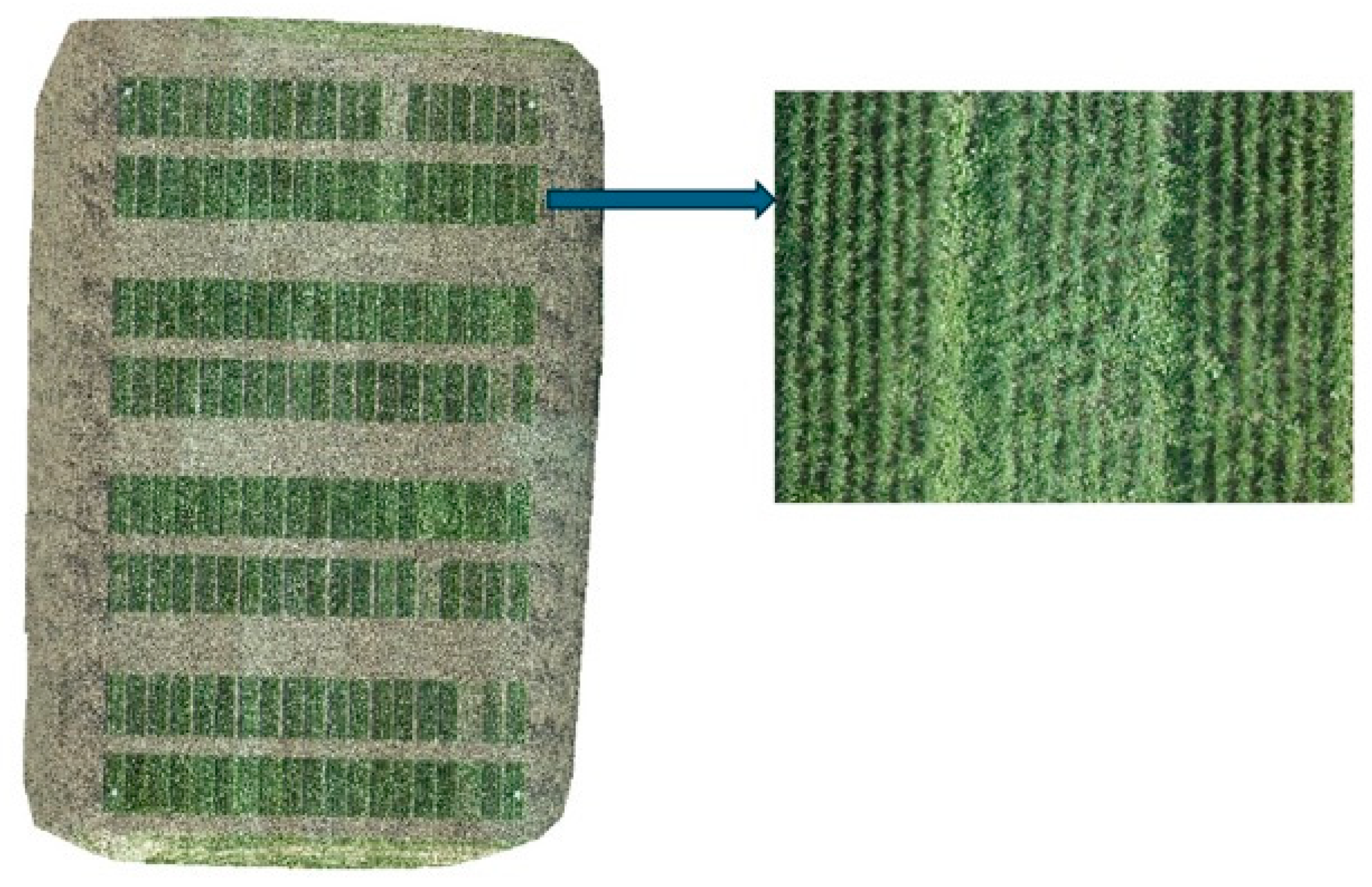
Three field experiments were conducted in two locations in Saskatchewan: The Kernen Crop Research Farm (KCRF) (52°9′N and 106°32′W) near Saskatoon in 2021 and 2022, and at Goodale Research Farm (GRF) (52°03′N and 106°29′W) in 2022 near Saskatoon. The KCRF is located on Dark Brown Chernozemic, clay-textured soil; the GRF site was located on Dark Brown fine sandy loam soil. The experimental design was a randomized split-block with four replications per treatment. There were sixteen (seventeen in 2021) different oat cultivars that made up the treatments. The split-block factor was weed competition (weedy vs. weed-free), with one block kept weed-free and the other weedy, with naturally occurring weeds and a surrogate weed in which canola (Brassica napus L.) was seeded to augment weed competition. Oat cultivars were randomly allocated to each split block. Cultivars included Camden, AC Morgan, Summit, Souris, CDC Ruffian, AC Mustang, CDC Dancer, CDC Nasser, CDC SO-1, CDC Baler, CDC Haymaker, ORE3542M, CDC Morrison, CDC Arborg, CDC Endure, AAC Oravena, and AAC Kongsore (Figure 1). AAC and AC refer to varieties developed by Agriculture Agri-Food Canada, and CDC refers to varieties developed by the Crop Development Center at the University of Saskatchewan, Saskatoon, Canada. The organically bred cultivars were included to assess whether they differed in their response to competitors compared with conventionally bred cultivars. Cultivars were selected for their pedigree diversity and to provide variation in traits that could be important for competitive ability. Also, these varieties represent different end-use classes (Table 1).
Oat cultivars were planted in 2 × 12-m main plots, with subplots being 2 × 6-m in size. Soil test recommendations were used to determine fertilizer rates at seeding to achieve an oat yield of 6700 kg/ha. Sites were seeded with a small plot seeder equipped with ConservaPak openers with a row spacing of 25 cm. Oats were planted at a depth of 2 cm at a targeted plant density of 300 plants/m2. The sub-block factor was weed competition (weedy and weed-free), with one block kept weed-free and the other weedy, with naturally occurring weeds and a surrogate weed in which canola (Brassica napus L.) was seeded to augment weed competition. Volunteer canola was sown perpendicular to the oats at the time of seeding. The target density for surrogate weed species was 25 plants/m2. Uniform weed density was maintained by hand-weeding the weedy block 1–2 times throughout the season. Weeds were removed in weed-free plots by hand.

2.2. Data Collection

2.2.1. Drone Data Collection

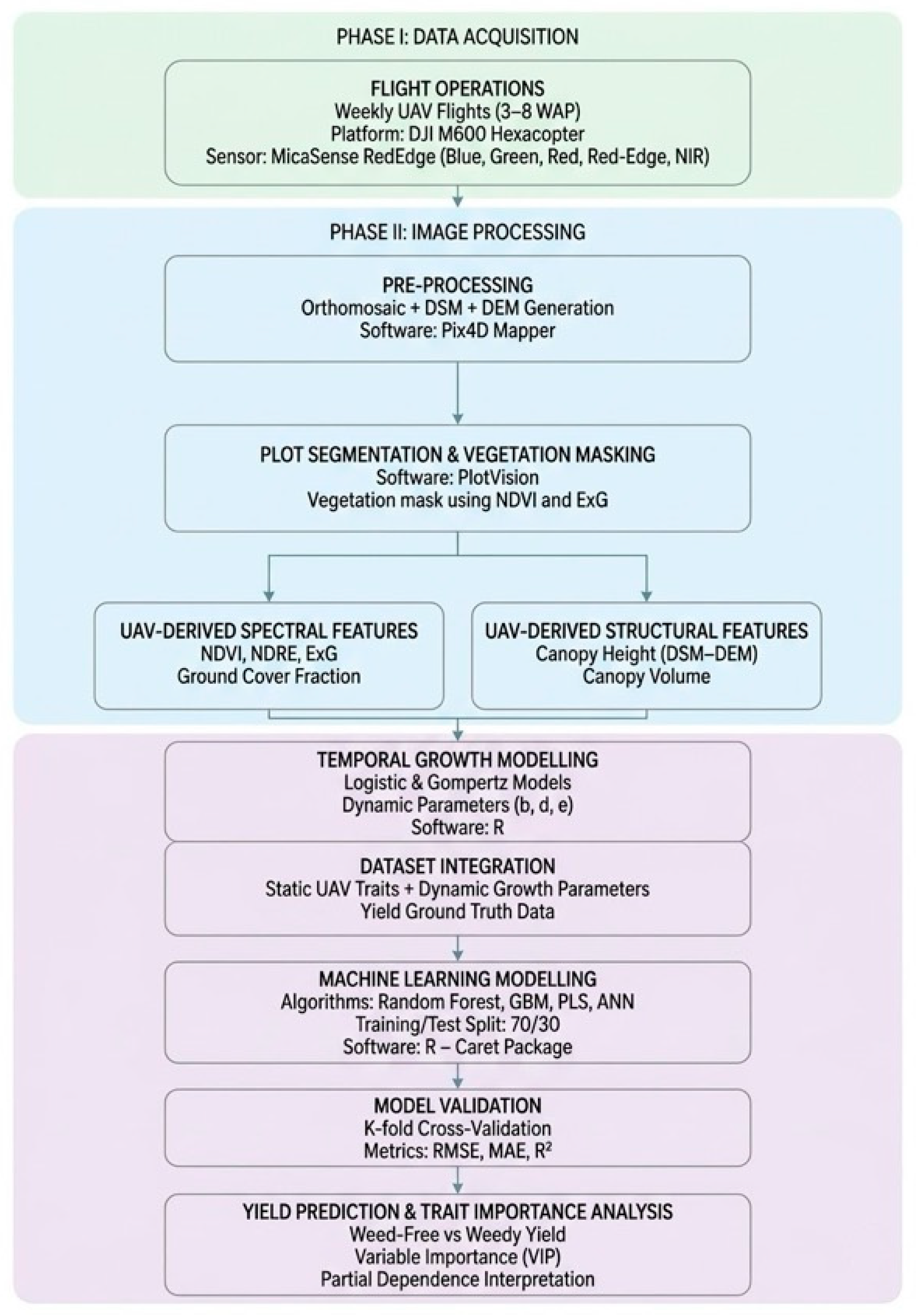
The entire drone data collection and data processing workflow is depicted in Figure 2. Weekly aerial data were collected using a Micasense RedEdge multispectral camera (MicaSense Inc., Seattle, WA, USA) mounted on a DJI M600 hexacopter UAV (SZ DJI Technology Co., Shenzhen, China). The camera consists of a 3.2-megapixel resolution and a focal length of 5.5 mm. The multispectral camera provides five-band images in red (668 nm), green (560 nm), blue (475 nm), red-edge (717 nm), and near-infrared (840 nm). The spectral ranges covered by these bands were 545–555 nm, 640–660 nm, 710–720 nm, and 840–860 nm, respectively. The UAV was programmed to follow a preset flight path autonomously at a ground speed of 3 m/s, with 70% frontal and 75% side image overlap, and images were captured at 20 m above ground level (AGL). All images were captured in NADIR view. Reflectance calibrations were carried out before and after flight using the Micasense calibration panel. All images were orthomosaiced using pix 4 Pix4D Mapper software version 4.7.5 (Figure 1). PiX4 D standard parameters were used with ground control points and calibration panels for orthomosaicing. Individual plot segmentation and data extraction were carried out using an automated workflow in Plot Vision software (developed by the University of Saskatchewan, Saskatoon, SK, Canada). The vegetation mask was automatically calculated and applied using both NDVI or the Excess green index (EXG) to separate the background soil from the vegetation. Both NDVI and EXG were used for the segmentation, and canopy traits such as ground cover and volume were extracted separately from both of these segmentations. Several vegetation indices were calculated using the individual five bands, such as NDVI and NDRE EXG, for each week’s flight images. In addition to spectral information, structural information was extracted from drone images. The structural features of the crop canopy, such as height and volume, were obtained using the point cloud digital terrain model (DTM) and digital surface model (DSM). The digital surface model was obtained from the standard procedure of the Pix4D mapper software. The DTM was obtained from point cloud classification using Pix4D mapper tools.

2.2.2. Crop Ground Cover (CGC)

The crop canopy area was calculated by first computing a vegetation segmentation of the plot image, separating it into vegetation and non-vegetation pixels. Then, the vegetation area, n square meters, was obtained from geographic positioning system (GPS) information [42].
CGC = V/N × A
where V is the number of vegetation pixels in the plot image, N is the number of pixels in the plot image, and A is the area of the plot as calculated from UTM coordinates.

2.2.3. Canopy Height (CH)

Canopy height was calculated by segmenting vegetation in each plot using NDVI, EXG, or both. The elevation values for crop and ground pixels were obtained by subtracting the digital elevation model from the digital surface model. The aggregate heights were obtained using the following formula [42].
CH = f(H) − f(G)
where f is the vegetation segmentation function; H is the elevations of each pixel in the plot; G is the elevations of the ground level in the plot.

2.2.4. Canopy Volume

Canopy volume was obtained from each plot by multiplying the mean crop pixel area by the mean crop height of each plot. The volume is in cubic meters [42].
CV = CH × CGC

2.2.5. Ground Data Collection

Plots were harvested using a 1.6 m wide small plot combine at maturity (Zadoks 9.0). Harvested grain samples were air-dried to a constant moisture content (2–4 days). Each harvested grain sample was cleaned using a dockage tester, the Carterday XT3 (CEA-Carter Day Company, Minneapolis, MN, USA), which separated weed seeds from the crop to help determine dockage. Clean samples were weighed to obtain a plot yield. Sample moisture was measured with an Agrotronix MT-Pro (Agratronix Corporate, Streetsboro, OH, USA), and yield was adjusted to 12% moisture content.

2.3. Data Analysis

2.3.1. Dynamic Growth Modeling

Spectral and structural features extracted from weekly drone flights across three locations were utilized to fit non-linear regression models to describe temporal growth, enabling the derivation of dynamic growth parameters (Figure 2). Non-linear models, including three-parameter and four-parameter Gompertz, logistic, and log-logistic models, were evaluated for each trait. These models provide biologically interpretable parameters critical for understanding plant growth dynamics. The three three-parameter models yield an asymptote (d), representing the maximum growth approached and, in this case, indicating the maximum reflectance or structural features for each genotype. The b parameter reflects the growth rate, the speed at which the curve transitions from the initial value to the asymptote, capturing the rate of growth. The inflection point (e) denotes the time or growth stage at which the growth rate is highest, highlighting the critical time of rapid change. The four-parameter models extend this by including the lower limit (c), which represents the initial baseline value of the response variables. The best-fitting model for each scenario was selected based on the AIC. Initial model fitting focused on genotypes showing the highest variation in crop yields, representing low, medium, and high yields, as comparing 17 genotypes was computationally intensive and difficult to interpret. This analysis aimed to explore variation among genotypes in their spectral and structural features, with varying yield potential. Genotypes with high, moderate, and low yields were selected for this analysis (AAC Kongsore, AC Morgan, Camden, CDC Arborg, CDC Baler, CDC Dancer, CDC Haymaker, CDC Morrison, CDC Nasser, CDC Ruffian, and ORE3542M). Parallel to the above approach, non-linear models were fitted to each genotype and to each replicate within a site year (non-linear models were fitted to each plot) to obtain parameter estimates for subsequent machine learning model fitting.

2.3.2. Machine Learning Modeling

A machine learning modeling approach was used to identify the spectral and structural variables associated with crop yield under weedy and weed-free conditions (Figure 2). The parameter estimates derived for each genotype from the non-linear models, and the original reflectance and structural features obtained for each genotype on each weekly flight were combined to create a single dataset (static data and dynamic data) as predictors (70 variables) and ground truth data for grain yield (weed-free and weedy as response variables. The total dataset consisted of 16 genotypes × four replicates × three site years (192 rows) and 70 columns (70 RS variables). The same weed-free RS trait dataset previously described was used to predict both the weedy and weed-free yields using several ML models. The objective of this approach was to determine the most important RS traits that are associated with weed-free and weedy yields. Four machine learning algorithms, i.e., random forest (RF), partial least squares regression (PLS), gradient boosted machines (GBM), and artificial neural networks (ANN), were fitted to the data, and their performances were compared. These models were chosen to represent complementary modeling strategies that we think are appropriate for our small dataset, which consisted of tabular RS-derived predictors with high collinearity. Specifically, PLS was included as a parsimonious linear baseline model that is appropriate for high-dimensional correlated predictors. RF and GBM were included as tree-based ensemble methods capable of capturing non-linear relationships and complex interactions and ANN was included as a flexible non-linear learner to evaluate whether a neural-network approach offered additional predictive benefit. Random forest models are widely used ML models and are ensemble learning algorithms that construct multiple decision trees during training and aggregate their predictions to improve accuracy and robustness [43,44]. Also, the multiple-solution approaches reduce variance and mitigate the risk of overfitting. Due to the use of a subset of features and data samples per tree, it is highly effective at handling large datasets with complex interactions. PLS is a linear regression technique that reduces predictors to a small set of uncorrelated components, thereby optimizing the relationship between independent and dependent variables based on principal component analysis [45]. This method is effective for high-dimensional, collinear datasets where traditional regression methods are insufficient. PLS is widely used in chemometrics, genomics, and agronomy [45,46]. GBM is another ensemble learning technique that sequentially combines weak learners to minimize prediction error [47]. It is a flexible algorithm in handling different loss functions and feature interactions, making it suitable for structured data analysis. Artificial neural networks mimic the structure and function of biological neurons to capture complex, non-linear relationships in data [48]. The ANN predicts the outcome by adjusting neuron weights and thresholds using the backpropagation technique [49]. All models were fitted using the “Caret” package in R (version 3.8, R Development Core Team 2024). The dataset was split into training and test sets at 70:30 to ensure robust model development and evaluation. To preserve the hierarchical structure of the data (site-year and replicate), stratified partitioning was performed using the rsample package in R software. This approach ensures the distribution of data across hierarchical factors, site-year and replicate, in similar proportions for both the training and testing datasets, which enhances the generalization and reliability of the model predictions.
Hyperparameter tuning is a critical step in developing robust ML models, as it allows each algorithm to be tailored to the data’s structure. For the random forest (RF) models, we tuned the number of predictors randomly sampled at each split (mtry), which directly influences tree diversity and helps balance overfitting and underfitting [50]. In the partial least squares (PLS) model, we optimized the number of components using the tuneLength argument, selecting the smallest number of components that captured sufficient variance without unnecessarily increasing model complexity [51]. For the gradient boosting machine (GBM) model, we tuned the three key parameters: the number of boosting iterations (n.trees), the maximum tree depth (interaction depth), and the learning rate (shrinkage), following the principles outlined by Friedman [47]. For the neural network model, we used a grid search (expand.grid) to systematically explore combinations of hyperparameters, including the weight decay parameter, which regularizes the network and improves generalization. Across all algorithms, this structure-tuning procedure was designed to identify hyperparameter settings that achieve strong predictive accuracy while preserving the model’s ability to generalize beyond the training data.

2.3.3. Cross-Validation

We evaluated model performance and tuned hyperparameters specific to each model using K-fold cross-validation (K-fold CV) to assess predictive accuracy while limiting overfitting. The full training dataset was partitioned into K roughly equal subsets (folds). For each CV iteration, one-fold was held out as the validation set, and the remaining folds were used for model training, cycling through all folds so that each observation contributed once to validation. Wherever possible, the hierarchical structure of the data was retained in the way folds were defined (e.g., grouping by higher-level experimental units), following the recommendations of Roberts, et al. [52]. This strategy helps maintain the integrity of the experimental design and reduces the risk of data leakage across folds [52].
For each model, cross-validation produced an error estimate at each iteration, which was then summarized to identify the tuning configuration with the lowest average prediction error. Model performance was quantified using two widely adopted metrics: root mean squared error (RMSE) and mean absolute error (MAE). RMSE is calculated as the square root of the mean squared difference between observed and predicted values, making it particularly sensitive to large errors and helpful in identifying models that avoid occasional large mispredictions. MAE, in contrast, averages the absolute differences between the observed and predicted values and therefore provides a more intuitive measure of typical prediction error without giving extra weight to outliers. To interpret the fitted models, we quantified each predictor’s contribution using the varImp function from the caret package. This procedure ranks variables according to their influence on the response, providing a relative importance score that highlights which RS-derived traits were most informative for predicting the target outcome.
To explore how the most important predictors (identified via VIP) influenced the response, we used partial dependence plots (PDPs). PDPs show the marginal effect of a single predictor on the response, averaging over the distributions of all other variables in the model. In doing so, they help unpack the “black box” nature of machine learning models by revealing how changes in each trait are associated with changes in the predicted outcome. This is particularly useful for ML models, where relationships are often non-linear and involve complex, non-additive interactions among predictors. By visualizing these relationships, PDPs allowed us to examine whether highly ranked VIP variables had biologically meaningful effects and to identify potential thresholds, plateaus, or other patterns in the response surface [53].

3. Results

3.1. Variability in Grain Yield

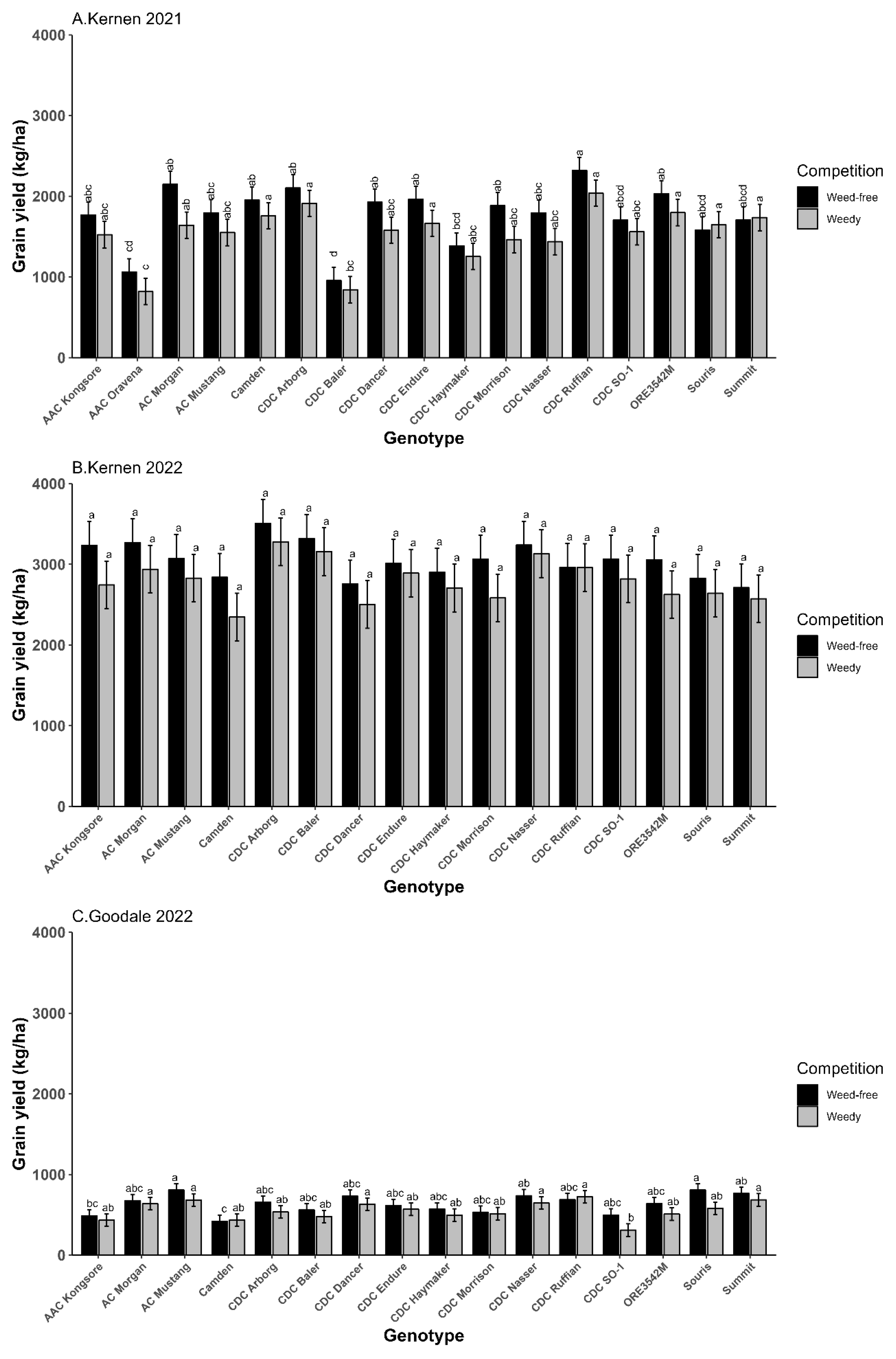
Across the three site-years (Kernen 2021, Kernen 2022, and Goodale 2022), oat genotypes showed clear differences in yield performance under weedy versus weed-free conditions (Figure 3). As expected, most varieties yielded more in the absence of weed competition. A small group of cultivars, such as CDC Morrison, CDC Ruffian, and CDC Dancer, consistently yielded well in both management conditions, especially at the Kernen sites. This pattern suggests that these varieties combine strong inherent yield potential with good competitive ability, allowing them to maintain yield even when weeds are present (Figure 3). In this study, the competitiveness of crop varieties was assessed based on the ability to produce high yields under weed competition (weed tolerance). In contrast, AAC Kongsore, Camden, and ORE3542M tended to have lower yields across all locations and management conditions, suggesting limited yield capacity and weaker competitive traits (Figure 2). Some varieties changed their relative ranking depending on weed pressure. For example, CDC Endure and CDC Haymaker were high-yielding in weed-free conditions but experienced greater yield losses under weed interference. In contrast, varieties such as Summit and Souris, which produced only moderate yields in weed-free environments, maintained relatively stable yields when weeds were present. Although their maximum yield potential was not among the highest, their ability to sustain yields under competition suggests that these varieties are useful under weedy conditions.

3.2. Oat Variety Response over Time

Oat variety responses over time were evaluated by modeling growth using non-linear models. Non-linear growth models were fitted to all spectral and structural parameters obtained from drone imagery. However, only the key traits (NDVI, ground cover, and canopy height) will be discussed here to understand genotype variability. All growth parameters obtained from non-linear model fitting for individual RS traits were used to predict subsequent yield.

3.2.1. Spectral Dynamics (NDVI)

To assess genotype-specific differences in vegetative vigor and canopy greenness across site-years, we analyzed the temporal dynamics of the normalized difference vegetation index (NDVI) using sigmoidal growth curve models. A three-parameter logistic model was applied to Kernen 2021 and Goodale 2022, while a four-parameter Gompertz model was used for Kernen 2022. Key parameters included the slope (b), indicating the rate of NDVI increase; the initial NDVI (c) for the Gompertz model; the maximum NDVI (d); and the inflection point (e), representing the time to reach 50% of maximum NDVI.
At Kernen 2021, oat cultivars did not differ significantly in the slope parameter (b), indicating similar rates of NDVI increase (Table 2). However, significant differences were observed for the maximum NDVI (d). Forage and feed types of CDC Baler, CDC Haymaker, and CDC Nasser had the highest peak NDVI, while milling cultivars such as Camden and AAC Kongsore had the lowest. CDC Arborg also grouped with the high-NDVI cultivars, whereas most other milling types (AC Morgan, Camden, CDC Morrison, CDC Dancer, CDC Ruffian, and ORE3542M) were intermediate. Variation in the inflection parameter (e) was limited. CDC Arborg reached 50% of its maximum NDVI earlier than most genotypes, but overall, mid-season greening timing was similar across lines. These NDVI trends were reflected in grain yields. CDC Morrison, CDC Ruffian, and CDC Dancer combined intermediate to high d values with high yields and minimal yield penalties under weed pressure. In contrast, AAC Kongsore and Camden, with low d and earlier e, had the lowest yields in both weed-free and weedy plots. Forage types showed the greatest greenness but only moderate grain yield, consistent with their focus on biomass production.
At Kernen 2022, cultivars did not show any statistical differences for all three growth parameters (Table 2). However, numerically, the d parameter separated several groups. CDC Baler, CDC Haymaker, and CDC Nasser achieved numerically higher maximum NDVI with CDC Arborg and CDC Morrison often not different from them, while AAC Kongsore and Camden tended to fall into lower d groups. The yield ranking followed these patterns, where milling cultivars with moderate to high d (CDC Morrison, CDC Ruffian, CDC Dancer) were among the top yielders in weed-free plots and maintained good yield under weed pressure, whereas AAC Kongsore and Camden, with the lowest d, again produced lower yields in both management systems. Forage and feed types expressed the highest peak NDVI but did not consistently translate that to grain yields.
At Goodale 2022, several milling cultivars and ORE3542M (organic cultivar) increased the NDVI more rapidly (higher b) than AC Morgan and the forage lines (Table 2). For the asymptote d, forage/feeding types, CDC Baler, CDC Haymaker, and CDC Nasser again expressed the highest maximum NDVI, significantly exceeding AAC Kongsore, which had the lowest plateau, and exceeding several milling cultivars that formed an intermediate group (AC Morgan, Camden, CDC Arborg, CDC Dancer, CDC Morrison, CDC Ruffian, ORE3542M). The inflection point e separated two broad sets: Camden, CDC Arborg, CDC Morrison, and ORE3542M reached 50% of the maximum NDVI earlier (lower e) than most other cultivars, while AAC Kongsore, AC Morgan, CDC Baler, CDC Dancer, CDC Haymaker, CDC Nasser, and CDC Ruffian maintained greener canopies later into the season (higher e). These parameter groupings again showed similarities with the grain yield rankings, where CDC Morrison and CDC Ruffian, which yielded well and showed relatively small yield losses under weeds, exhibited moderate to high d and adequate b, whereas AAC Kongsore and ORE3542M, with low d and, in the case of AAC Kongsore, relatively modest slope, were consistently at the bottom of the yield distribution. Forage/feeding cultivars had good canopy development dynamics (high d, later e), but their grain yields remained similar to or only slightly better than those of the stronger milling genotypes.

3.2.2. Structural Dynamics

Crop Ground Cover Trajectories and Their Relationship with Grain Yield
Sigmoidal models were used to track crop ground cover (CCGC) in weed-free plots, showing how different genotypes expanded their canopies over time. Like the NDVI, the model parameters included the rate of increase (b), maximum ground cover (d), time to reach 50% of the maximum (e), and for Kernen 2022 and Goodale 2022, the initial CCGC (c). At Kernen 2021, there were no significant differences in any of the three parameters for ground cover growth (Table 3). Forage and feed types such as CDC Baler, CDC Haymaker, and CDC Nasser generally reached a higher maximum CCGC, while milling cultivars like CDC Morrison and CDC Ruffian also had good coverage. AAC Kongsore, Camden, and ORE3542M did not stand out. At Kernen 2022, early CCGC development was similar across genotypes, as neither the slope (b) nor initial CCGC (c) differed between cultivars (Table 3).
The main differences were in the maximum ground cover (d), and to a lesser extent, the time to reach 50% maximum (e). CDC Baler had a much higher maximum CCGC than ORE3542M, with the other lines falling in between. This shows that CDC Baler formed the densest canopy, while ORE3542M had the least ground cover. For the time to reach 50% maximum CCGC, CDC Baler did so earlier than AAC Kongsore, with most milling cultivars and CDC Nasser in between. Therefore, CDC Baler not only reached the highest ground cover but did so sooner, while AAC Kongsore had both lower canopy density and the latest closure. When looking at yield, milling cultivars with strong performance (CDC Morrison, CDC Ruffian, CDC Dancer) had intermediate to high maximum CGC and mid-range times to canopy closure. Their canopies closed early and reached good ground cover, though not as much as the forage types. In contrast, ORE3542M and AAC Kongsore, which had the lowest yields in both management systems, either had a much lower maximum CGC (ORE3542M) or took longer to close their canopies (AAC Kongsore).
At Goodale 2022, cultivar differences in CGC were most pronounced in the initial cover c and maximum cover d (Table 3). The rate parameter b and the late-season plateau timing e did not differ significantly among genotypes. Forage cultivars CDC Baler and CDC Haymaker had a significantly higher c parameter, significantly exceeding AAC Kongsore and was higher than AC Morgan and some other milling cultivars, indicating early CGC establishment of forage types. Similar patterns were observed for the d parameter, where CDC Baler and CDC Haymaker again occupied the top group numerically, with CDC Nasser and AC Morgan at intermediate levels, and AAC Kongsore, Camden, CDC Arborg, CDC Morrison, and ORE3542M in the lower group. Also, CDC Baler and CDC Haymaker had a statistical difference with the lowest group. Here, no differences were identified among cultivars for the e parameter. These CGC groupings broadly align with the grain yield responses at Goodale 2022. CDC Morrison and CDC Ruffian, which still ranked near the top for grain yield and maintained yield reasonably well under weed pressure, showed moderate initial and maximum ground cover. In contrast, AAC Kongsore again combined the lowest early ground cover with among the lowest yields in both weedy and weed-free conditions, reinforcing the association between poor canopy occupation and low productivity. Forage and feed cultivars, particularly CDC Baler, CDC Haymaker, and CDC Nasser, achieved the strongest CGC dynamics, yet their grain yields at Goodale were only moderate relative to the best milling cultivars, consistent with their breeding emphasis on biomass rather than grain.
Crop Height
  • Kernen 2021
No differences were identified in the slope (d) or initial height (c), indicating similar early crop elongation rates and initial heights among cultivars (Table 4). However, the maximum height (d) showed differences among cultivars. The tallest group comprised AAC Kongsore, CDC Baler, and CDC Nasser, while an intermediate group included most milling cultivars (AC Morgan, Camden, CDC Arborg, CDC Dancer, CDC Haymaker, CDC Ruffian). The shortest plants were CDC Morrison and ORE3542M. At Kernen 2021, there were subtle differences for the e parameter, where CDC Nasser showed a later inflection point compared with all other cultivars. The crop height difference among cultivars does not necessarily translate into grain yields. The consistently high-yielding milling cultivars CDC Morrison and CDC Ruffian did not form the tallest group; CDC Ruffian was in the intermediate height group, and CDC Morrison was in the shortest. Conversely, tall cultivars such as AAC Kongsore and the forage/feed types (CDC Baler, CDC Nasser) did not dominate the grain yield ranking, particularly under weed pressure. AAC Kongsore, despite belonging to the tallest height group, remained among the lowest yielders in both weed-free and weedy plots.
  • Kernen 2022
There were no significant differences identified for b and c parameters at Kernen 2022, again suggesting comparable initial and early elongation across cultivars. Cultivar difference for height growth dynamics can be identified in the d and e parameters (Table 4). Cultivars CDC Morrison and ORE3542M formed a significantly shorter group, whereas all other cultivars, including forage types (CDC Baler, CDC Haymaker), feed (CDC Nasser), and milling cultivars (Camden, CDC Arborg, AC Morgan, CDC Dancer, CDC Ruffian, AAC Kongsore) belonged to the taller group with a higher d value. At the same time, Camden, CDC Arborg, CDC Haymaker, CDC Nasser, and CDC Ruffian had later inflection times, indicating a slower height development, while AAC Kongsore, AC Morgan, CDC Baler, CDC Dancer, CDC Morrison, and ORE3542M reached 50% maximum height earlier. In relating this pattern to grain yield, the high-yielding, competitive milling cultivars CDC Morrison, CDC Ruffian, and CDC Dancer again did not stand out as the tallest. CDC Ruffian was in the tall-height group with moderately late e, whereas CDC Morrison was significantly shorter but still among the best yielders under both weed-free and weedy conditions. The high-yielding, competitive milling cultivars CDC Morrison, CDC Ruffian, and CDC Dancer again did not stand out as the tallest. CDC Ruffian was in the tall-height group with moderately late e, whereas CDC Morrison was significantly shorter but still among the best yielders under both weed-free and weedy conditions. The forage cultivars, despite showing differences compared with milling cultivars, did not show any relationships in ranking grain yields.
  • Goodale 2022
At Goodale, no significant differences were identified in the slope parameter, indicating similar height accumulation rates among cultivars (Table 4). However, both maximum height d and inflection time e showed meaningful separation. For d, AC Morgan formed the tallest group, while CDC Morrison represented the shortest group; all other cultivars, including CDC Baler, CDC Haymaker, CDC Nasser, CDC Ruffian, ORE3542M, and AAC Kongsore, occupied an intermediate height group. For e, CDC Arborg, CDC Baler, and CDC Nasser had significantly later inflection points than most other cultivars, implying more prolonged stem elongation and a later plateau in height. The rest, including high-yield milling cultivars (CDC Morrison, CDC Ruffian, CDC Dancer) and organic lines (AAC Kongsore, ORE3542M), reached their height plateau earlier. As with other site years in Goodale, the height patterns only partly mirrored the grain yield rankings. CDC Morrison and CDC Ruffian were among the better milling cultivars for yield (both under weedy and weed-free treatments). However, CDC Morrison was in the shortest height group, and CDC Ruffian was in the intermediate group. In comparison, taller or later-growing cultivars such as AC Morgan, CDC Baler, and CDC Nasser did not consistently top the yield ranking. This suggests that in this environment, as in the Kernen site-years, moderate or even shorter height can still support strong yield and competitive performance when combined with favorable canopy greenness and ground cover.

3.2.3. Summary of Growth Dynamics

Across the three site-years, NDVI, ground cover, and crop height each described different but related aspects of oat canopy performance and showed some relationships to grain yield and weed tolerance. Milling cultivars like CDC Morrison, CDC Ruffian, and CDC Dancer, which consistently produced good yields and had smaller yield losses under weed pressure, showed moderate to high NDVI plateaus (maximum NDVI). In contrast, organic milling lines such as AAC Kongsore and ORE3542M had low NDVI and were low-yielding in both weed-free and weedy plots. Forage and feed types had the highest NDVI but did not always produce the highest grain yields. Forage and feed cultivars covered the ground earliest and most completely, while low-performing organic milling lines were sparse or slow to close. High-yield milling cultivars were never in the lowest ground cover groups, suggesting that at least moderate and timely cover is important for keeping yields up when weeds are present. Crop height mostly separated forage and feed types from milling types and identified very tall or short cultivars, but was less closely linked to grain yield. Overall, cultivars that combined moderate height with moderate–high NDVI and sufficient, timely ground cover consistently gave high yields in weed-free plots and kept yields under weed competition. However, these relationships are purely descriptive and based on their yield and RS trait rankings. To further understand their relationship, the results from ML modeling are discussed in the next section.

3.3. Predicting Yield Using Remotely Sensed Traits

3.3.1. Weed-Free Yield

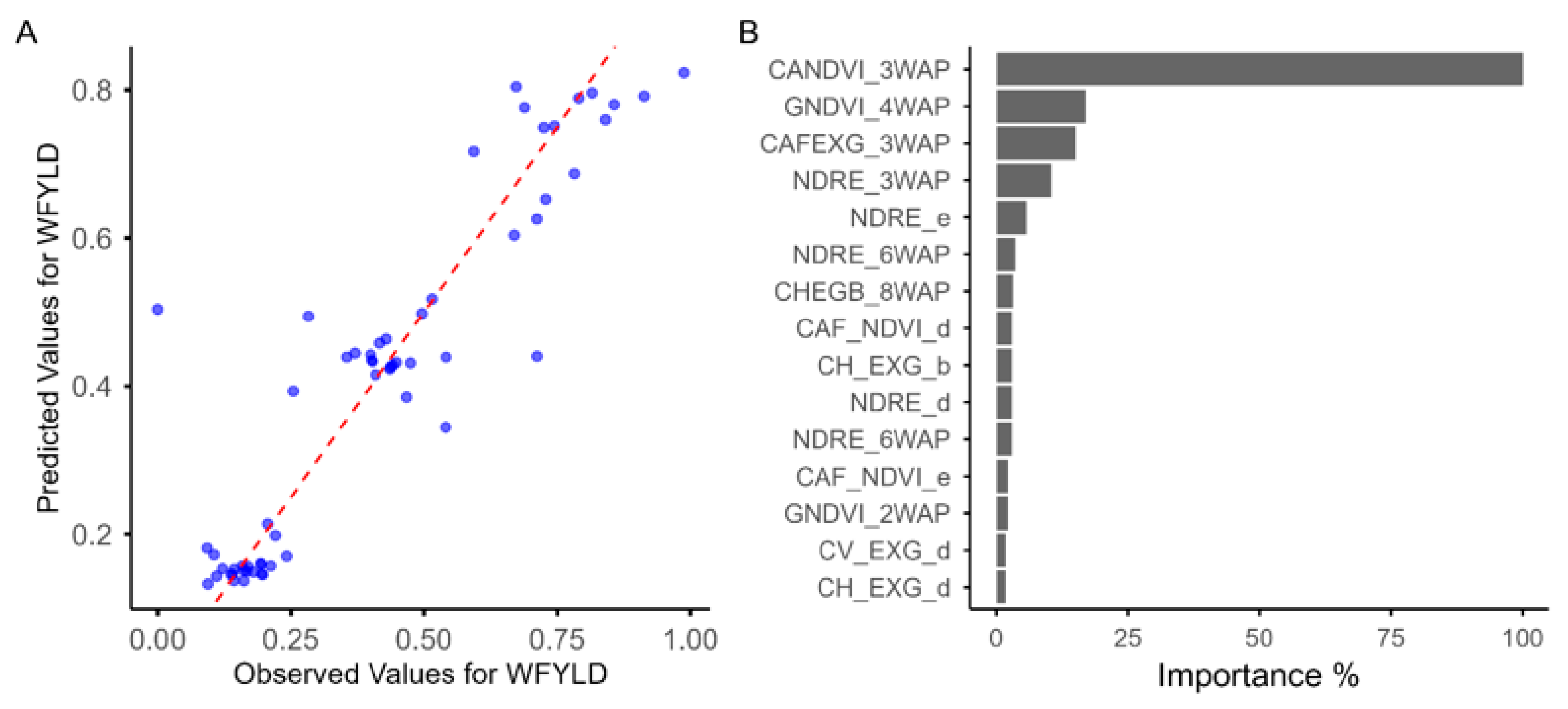
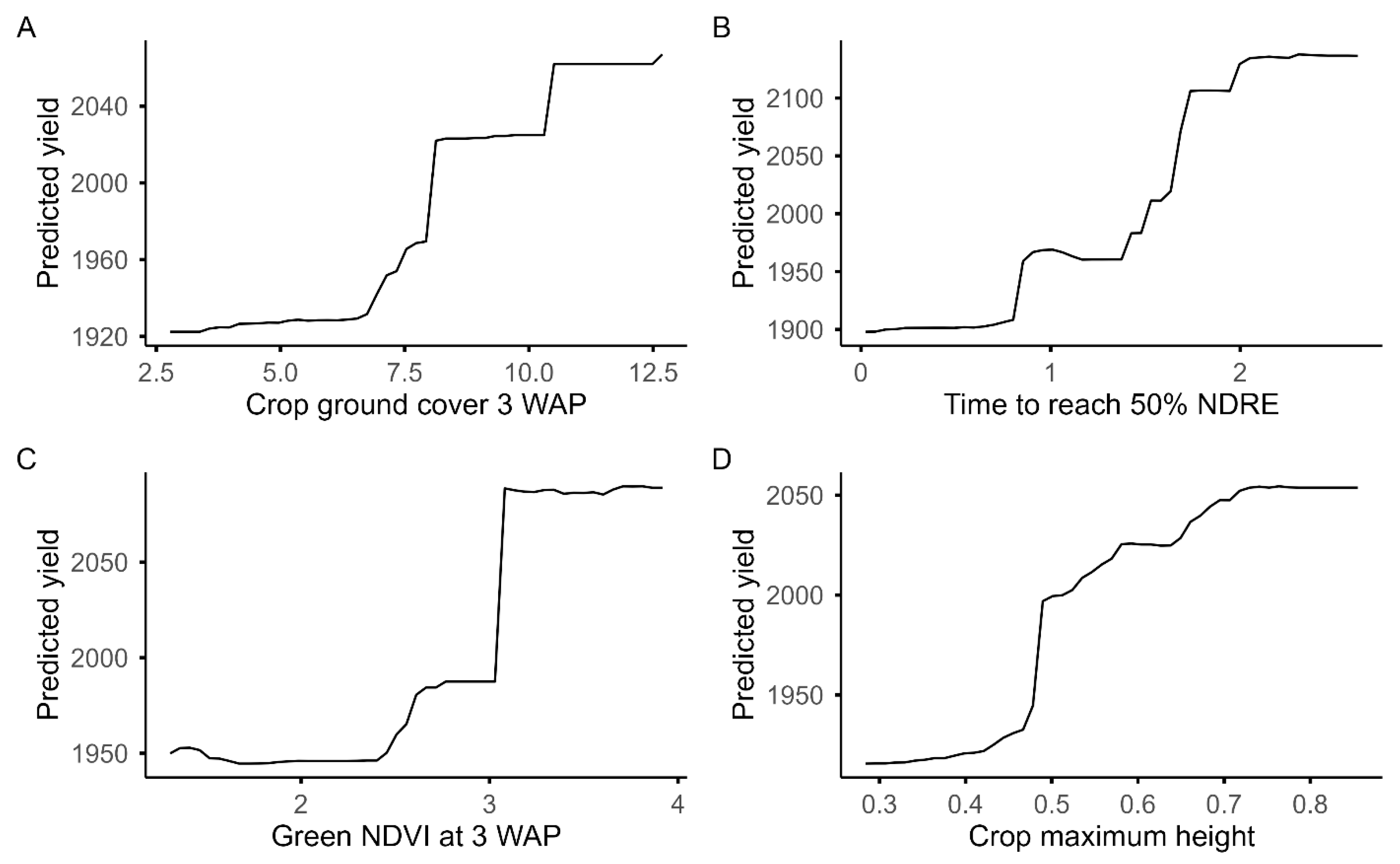
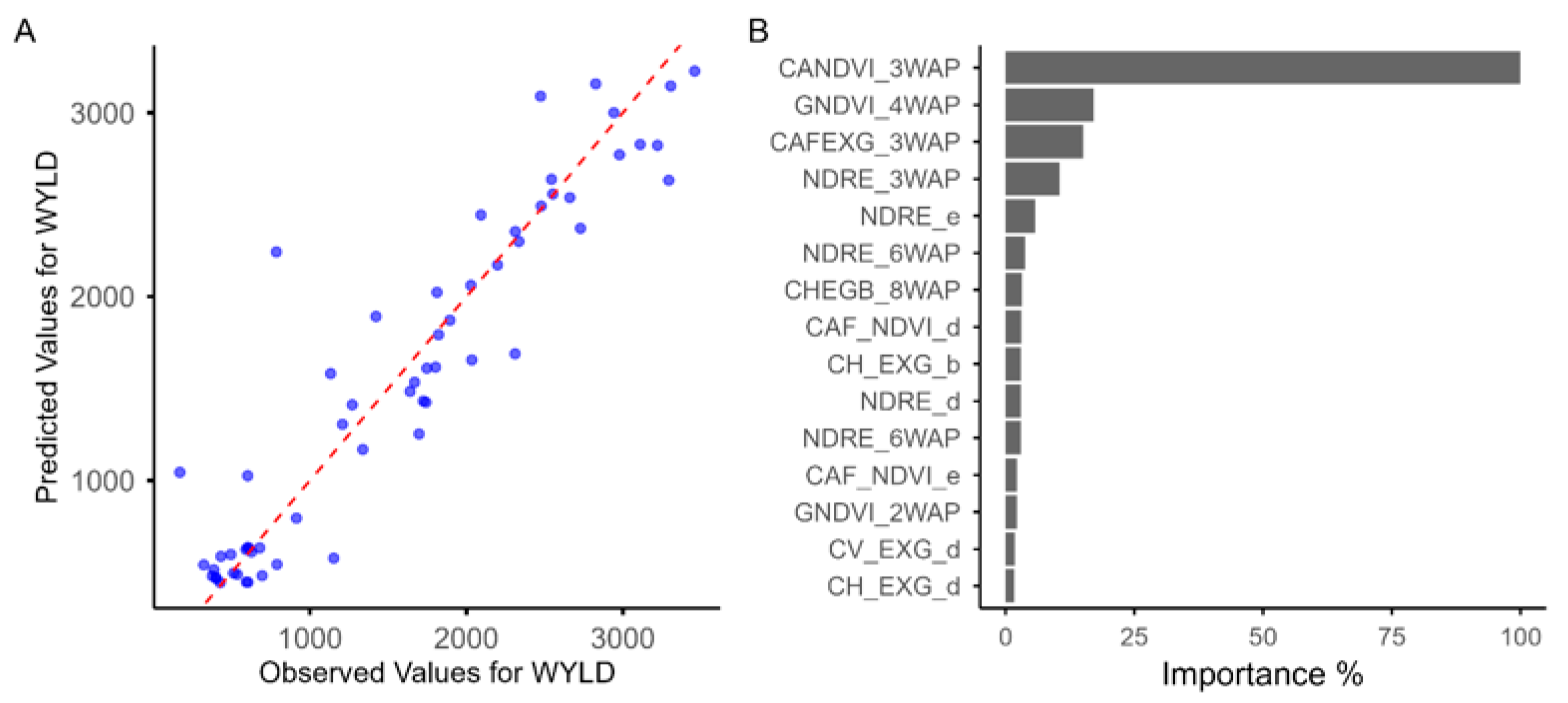
The association between RS traits across genotypes and grain yields under weed-free and weedy conditions was explored using machine learning models. Both static and dynamic RS traits were used to predict grain yields and identify the best RS traits associated with crop yields under both weed-free and weedy conditions. All models performed well on the training set, with MAE (262–330 kg ha−1), RMSE (353–447 kg ha−1), and R2 (0.8–0.9) (Table 5). The best model was selected based on the best average performance on the cross-validation from the training set. Thus, the RF model was selected from all models, with an MAE of 262 kg ha−1, RMSE of 353 kg ha−1, and an R2 of 0.90. The predicted vs. observed values further illustrate a good model fit for RF (Figure 4A). The variables important for predicting weed-free yield are depicted in Figure 3B. Accordingly, the crop ground cover estimated based on the NDVI (CANDVI_3WAP-Crop area based on NDVI) at 3 weeks after planting was found to be the most critical RS variable for predicting weed-free yield, followed by green NDVI at 4 WAP (GNDVI_4WAP), crop ground cover fraction at 3 WAP estimated from excess green index (CAFEXG_3WAP), and NDRE and 3 WAP. Even though these variables were given high importance values, their direct relationship with weed-free yield could be identified only with partial dependency plots. Based on PDP, the top four variables that had a clear positive relationship were crop ground cover at 3 weeks, time to reach 50% NDRE, green NDVI at 3 WAP, and crop maximum height at maturity (Figure 5A–D). At 3WAP, crop area represents early ground cover, and at low crop ground cover, yield responses were low. A sharp rise in response was observed at 0.7–10 ground cover percentage units, followed by a plateau.
A similar pattern was observed with the other three variables: at lower values, there were no responses in yield, but at higher values, a sharp reaction could be observed, followed by a plateau. Overall, the random forest model predicted weed-free yield on the test dataset with an MAE of 263.63 Kg ha−1 and an R2 of 0.85, further indicating the accuracy of the model fit. The random forest model provided good predictions on the test set (Figure 3A).

3.3.2. Weedy Yield

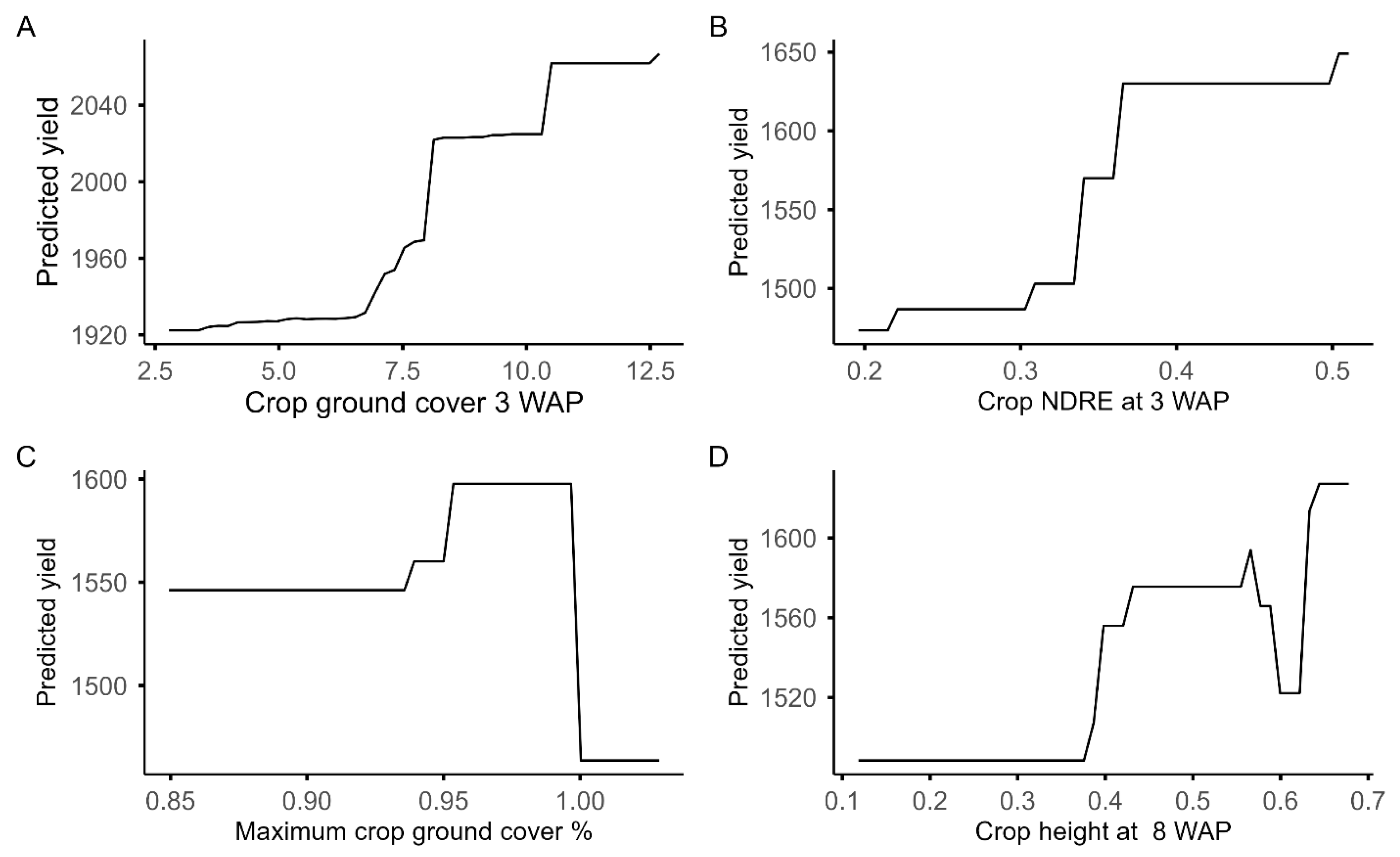
Among the competing models for predicting weedy-yield from RS traits measured under weed-free conditions, the gradient-boosted machine learning algorithm was found to be the best model based on the training data, with an MAE of 230 kg ha−1, RMSE of 343 kg ha−1, and R2 of 0.90 (Table 5). The predicted vs. observed values further illustrate a good model fit for GBM (Figure 6A). The variables that were most important for predicting weedy yield are depicted in Figure 6B. Among the top 15 variables, crop ground cover at 3 WAP based on NDVI-based segmentation (CANDVI_3WAP), green NDVI at 4 WAP, and crop area fraction based on excess green segmentation at 3 WAP (CAFEXG_3WAP) were found to be the top-most important variables. However, the PDP plots (Figure 7) indicated that the variables crop ground cover at 3 WAP, crop NDRE at 3 WAP, maximum crop ground cover %, and crop height at 8 WAP had the clearest positive relationships with weedy yield. The variable green NDVI, although ranked highest by VIP, did not show a clear positive relationship, suggesting that it interacts with other variables in predicting weedy yield. Overall, the GBM model predicted weedy yield in the test dataset with an MAE of 234 Kg ha−1 and an R2 of 0.87, indicating good model performance.

4. Discussion

4.1. Crop Traits and Their Relationship with Yield and Tolerance to Weed Competition

This study revealed that across different environments, the contrasting yield responses of oat cultivars under weedy and weed-free conditions closely matched their spectral and structural growth patterns. The remote sensing approach with non-linear growth modeling of traits revealed this relationship. High-yielding grain cultivars like CDC Morrison, CDC Ruffian, and CDC Dancer consistently showed rapid early canopy development, as indicated by steep NDVI slopes, rapid ground-cover expansion, and rapid height and volume growth, while still reaching moderate to high peak NDVI. This growth pattern likely supports efficient resource acquisition and effective early shading of the understory, helping to sustain yield when weeds are present. Similar links between early vigor, early leaf area index (LAI), and reduced weed cover or yield loss have been reported in winter oats [54], spring oats [55], and other cereals [56]. These genotypes therefore fit the “competitive yet productive” ideotype described for competitive cereal cultivars, where early growth, tillering, canopy architecture, and height contribute to yield stability in weedy fields without necessarily compromising potential yield in weed-free conditions [3].
In contrast, cultivars that yielded poorly in both weedy and weed-free environments (e.g., AAC Kongsore, Camden, ORE3542M) generally combined lower maximum NDVI or canopy area with shorter final height or slower canopy expansion rates, indicating constrained canopy development and reduced capacity to intercept light and pre-empt resources. These conservative growth profiles appear insufficient to compensate for weed competition, leading to lower yields under both weed-free and weedy conditions. Forage types (CDC Baler, CDC Haymaker, CDC Nasser) occupied an intermediate functional role, as they consistently exhibited the most aggressive canopy development, with high maximum NDVI, rapid and early ground cover, and tall stature, traits classically associated with strong weed suppression. However, their grain yields were not always among the top performers. This suggests that while forage cultivars may be highly effective at suppressing weeds, their biomass-oriented growth and potential lodging risk may limit grain yield under high-input conventional management. Similar results were also reported in previous studies on oats in Western Canada [55]. Finally, cultivars such as Summit, Souris, or AAC Kongsore illustrate that conservative or stability-oriented growth dynamics do not necessarily translate into competitive advantage under conventional weedy scenarios. AAC Kongsore, for example, combined lower and shorter-duration NDVI with slower ground-cover expansion, and despite its relatively tall stature in some site-years, did not convert this into higher yield or improved weed tolerance. Together, these patterns indicate that under conventional systems, the most desirable oat ideotypes are not simply the tallest or the most biomass-productive, but those that couple rapid early spectral and structural development (fast NDVI rise, early canopy closure, timely height accumulation) with efficient partitioning to grain, thereby securing yield in weed-free conditions while minimizing yield loss when weeds are present.

4.2. Machine Learning as a Tool for Crop Breeding

The machine learning analysis in this study helped pinpoint which RS-derived traits were most strongly associated with yield under both weed-free and weedy conditions, and supports the general ranking based on yield and trait relationships (previously discussed). A clear and consistent signal was that early canopy traits are critical for achieving high grain yield in both management scenarios. This aligns with a large body of work showing that rapid early-season canopy development is a major driver of crop productivity across environments and management systems. Interestingly, this study highlighted the importance of canopy development rate (time to reach 50% NDRE) as a key trait for grain yield under weed-free conditions. This points to an important distinction between the amount of canopy development (e.g., LAI, ground cover, or peak NDVI) and the speed at which that canopy is built, which is better described by the temporal dynamics of vegetation indices.
Under weed-infested conditions, four traits emerged as important for explaining variation in grain yield: crop ground cover at three weeks after planting (3 WAP), crop NDRE at 3 WAP, maximum ground cover (the asymptotic value from the non-linear growth model), and crop height at 8 WAP. Together, these traits explain how effectively a cultivar can establish an early canopy, capture resources, and maintain a competitive edge over weeds. The fact that ground cover and NDRE measured as early as 3 WAP were strong yield predictors under weedy conditions highlights the crucial role of early canopy establishment in determining the outcome of crop–weed interactions. Around three weeks after planting, most weed seedlings are still in their most vulnerable growth stages, so the crop’s ability to rapidly occupy space and intercept light during this window largely sets the trajectory of competition for the rest of the season. This is consistent with previous work showing that early vigor traits in cereals are central to weed-competitiveness [10,57].
The importance of NDRE at 3 WAP indicates that competitive success depends not only on the amount of canopy the crop has developed, but also on the physiological quality of that canopy, indicated by its chlorophyll content and nitrogen status. A crop that combines extensive ground cover with high NDRE at 3 WAP has already achieved rapid leaf area expansion and elevated photosynthetic capacity, allowing it to pre-empt light resources and efficiently convert intercepted radiation into biomass. The maximum ground cover percentage indicates an ability to achieve and sustain near-complete ground cover, thereby restricting the light available to weeds during the critical mid-season period when both crop and weed growth rates are highest [58,59]. Crop height at 8 WAP also emerged as an essential predictor of yield under weedy conditions, highlighting the role of vertical structure in competitive interactions [3]. By this stage, the crop is typically in the mid–late vegetative or early reproductive phase, and its height influences its capacity to overtop weeds and intercept incoming radiation before it reaches the weed canopy. Taller crops cast deeper shade and create steeper light gradients within mixed crop–weed stands, reducing the light available to shorter weed species. Overall, across both weed-free and weedy scenarios, the analyses consistently pointed to the role of early canopy development, though this emerged through slightly different metrics. Under weedy conditions, the additional importance of early and maximum ground cover, along with crop height, highlights the need for traits that physically dominate the canopy. These structural attributes allow the crop to occupy space, intercept light before it reaches emerging weeds, and create a shaded microenvironment unfavorable to weed growth.

4.3. Implications of Integrating RS and ML for Weed Management

This study evaluated sixteen oat cultivars under both weed-free and weedy conditions with two main goals: (i) to identify cultivars that maintain high yields across both management scenarios, and (ii) to assess how remote sensing (RS) and machine learning (ML) can be used to pinpoint traits linked to yield under weed-free and weedy environments. The experimental design and analytical framework were developed to address several key gaps in current crop breeding and weed management research, particularly around early-season canopy traits that are difficult to measure reliably with conventional field assessments. The key novelty of this study is the demonstration that RS-derived traits measured under weed-free conditions can be meaningfully linked to cultivar performance under weedy conditions. This has direct implications for cultivar selection and breeding efficiency, as conventional breeding programs typically focus on selecting high-yielding lines under optimal, weed-free conditions, assuming that superior yield potential will also translate into better performance under stress or competition. However, this assumption is often false, because the traits that drive high yield in resource-rich environments can differ from those that underpin competitive ability in resource-limited or weedy environments [60,61].
By combining RS phenotyping with machine learning, this study illustrates how traits can be related across management contexts. Image-based, high-throughput phenotyping of canopy cover, canopy spectral features, and height enables breeders to evaluate large populations in controlled, weed-free trials while still identifying genotypes likely to perform well in weedy fields, thereby reducing the cost and logistical complexity of running replicated weedy trials [60,62,63,64]. Recent work has shown that image-derived canopy traits associated with early vigor and weed-competitiveness can be captured non-destructively and at scale, providing practical proxies for direct weed-competition that can help ease the phenotyping bottleneck for competitive cultivars [62,63,64,65]. This is particularly important because one of the major constraints in conventional breeding and agronomy is the difficulty of accurately and efficiently quantifying early-season canopy traits. Traditional methods, including visual scoring, manual ground-cover estimation, and destructive sampling, are labor-intensive, subjective, and poorly suited to tracking the rapid temporal dynamics of early canopy development. As a result, early-season traits are often underrepresented in breeding indices, despite strong evidence that they are critical for both yield formation and competitive ability.
Second, this study provides a mechanistic understanding of which aspects of canopy development and physiology contribute to both yield potential and competitive ability, enabling more targeted selection strategies. Third, it facilitates the identification of genotypes that combine high intrinsic productivity with strong competitive traits, an ideal combination for low-input and organic systems where weed pressure is inevitable. The integration of RS and ML approaches in this study addresses these limitations by enabling high-throughput, objective, and temporally resolved measurement of canopy traits. The use of ML approaches is particularly valuable for identifying non-linear relationships and complex interactions among traits that may not be apparent through traditional statistical analysis [66,67].
Overall, this approach is more critical for oat cropping systems than for any other crops. The significance of developing competitive oat cultivars is heightened by the unique challenge posed by wild oat (Avena fatua) in cultivated oat (Avena sativa) production systems, as wild oat and cultivated oat belong to the same genus (Avena), making selective chemical control extremely difficult [55]. Overall, the integration of RS and ML demonstrated in this study represents a template for future crop improvement efforts targeting complex, multi-trait objectives such as yield stability under variable weed pressure.

5. Conclusions

This study demonstrated that commercially grown oat cultivars differ markedly in their ability to maintain grain yield under weed-free and weedy conditions, and that these differences are closely linked to canopy development captured by UAV-based remote sensing. By integrating non-linear growth modeling with machine learning, we showed that a relatively small set of early-season canopy traits can explain a large share of yield variation. Under weed-free conditions, grain yield was best predicted by crop ground cover at 3 WAP, NDRE dynamics (including time to 50% of maximum NDRE), and maximum crop height. Under weedy conditions, crop ground cover and NDRE at 3 WAP, maximum ground cover, and crop height at 8 WAP were the key predictors of weedy yield. Together, these results highlight that both the rate and extent of early canopy development, rather than final canopy size alone, are critical for yield formation and competitive ability. A central finding is that RS-derived traits measured in weed-free plots can be used to predict cultivar performance under weed competition. This provides a practical pathway for breeders to select for weed-competitive ideotypes using high-throughput UAV phenotyping in weed-free trials, reducing the dependence on numerous labor-intensive weedy experiments while still targeting traits that confer competitive ability. Given the challenge of managing wild oat in cultivated oat, the integration of UAV-based temporal phenotyping and ML modeling presented here offers a scalable template for developing cultivars that combine high yield potential with strong competitive traits, and can be extended to other crops and environments where weed pressure threatens yield stability. However, this methodology can be further developed by conducting additional multi-site experiments to collect a larger dataset for ML modeling and exploring other vegetation indices, as this study considered only three years of data and used the most common vegetation indices.

Author Contributions

C.W. and D.B. designed the experiment; D.B., B.S., S.S. and C.W. performed the data curation and investigation; D.B. performed the formal analysis; D.B. and M.H. wrote the first draft of the manuscript; M.H., S.S. and C.W. reviewed the manuscript. C.W. provided funding and project administration. All authors have read and agreed to the published version of the manuscript.

Funding

This project was funded by the Saskatchewan Ministry of Agriculture through the Agriculture Development Fund (ADF) and by the Western Grains Research Foundation. The fund number is ADF 20190130.

Institutional Review Board Statement

Not applicable.

Informed Consent Statement

Not applicable.

Data Availability Statement

The authors declare that data supporting the findings of this study are available on request from the corresponding author.

Acknowledgments

The authors would like to acknowledge Aeron Gerain and Scott Ife at the University of Saskatchewan for their dedicated work running the field experiments at both sites. Also, we would like to acknowledge Seunbum Ryu for drone imaging the experiment.

Conflicts of Interest

The authors declare that they have no known competing financial interests or personal relationships that could have influenced the work reported in this paper.

Abbreviations

The following abbreviations are used in this manuscript:
AGLAbove Ground Level
AICAkaike Information Criterion
ANNArtificial Neural Networks
CCCanopy Cover
CVCross Validation
DEMDigital Elevation Model
DSMDigital Surface Model
ExGExcess Green Index
GBMGradient Boosted Machines
CGCCrop Ground Cover
haHectare
hlHectoliter
HTPHigh Throughput Phenotyping
kgKilogram
LAILeaf Area Index
lbPound
LiDARLight Detection and Ranging
MAEMean Absolute Error
MLMachine Learning
NDRENormalized Difference Red Index
NDVINormalized Difference Vegetative Index
PDPPartial Dependence Plot
PLSPartial Least Squares
RFRandom Forest
RMSERoot Mean Square Error
RSRemote Sensing
UAVUnmanned Aerial Vehicle
UTMUniversal Time Model
VIPVariable Importance Plot
WAPWeeks After Planting
WFYLDWeed Free Yield
WYLDWeedy Yield

References

  1. Ofosu, R.; Agyemang, E.D.; Márton, A.; Pásztor, G.; Taller, J.; Kazinczi, G. Herbicide resistance: Managing weeds in a changing world. Agronomy 2023, 13, 1595. [Google Scholar] [CrossRef]
  2. Kaur, A.; Singh, G.; Menon, S.; Kumari, K. Integrated weed management: A comprehensive review of conventional, non-conventional, and emerging strategies for sustainable agriculture. J. Adv. Biol. Biotechnol. 2024, 27, 156–167. [Google Scholar] [CrossRef]
  3. Andrew, I.; Storkey, J.; Sparkes, D. A review of the potential for competitive cereal cultivars as a tool in integrated weed management. Weed Res. 2015, 55, 239–248. [Google Scholar] [CrossRef] [PubMed]
  4. Benaragama, D.; Shirtliffe, S.J.; Gossen, B.D.; Brandt, S.A.; Lemke, R.; Johnson, E.N.; Zentner, R.P.; Olfert, O.; Leeson, J.; Moulin, A. Long-term weed dynamics and crop yields under diverse crop rotations in organic and conventional cropping systems in the Canadian prairies. Field Crops Res. 2016, 196, 357–367. [Google Scholar] [CrossRef]
  5. Siddiqui, A.O.; Jabran, K. Weed tolerance and suppressive ability of potato cultivars to natural weed infestations. J. Crop Health 2025, 77, 47. [Google Scholar] [CrossRef]
  6. Olesen, J.E.; Hansen, P.K.; Berntsen, J.; Christensen, S. Simulation of above-ground suppression of competing species and competition tolerance in winter wheat varieties. Field Crops Res. 2004, 89, 263–280. [Google Scholar] [CrossRef]
  7. Benaragama, D.; Shirtliffe, S.J. Integrating cultural and mechanical methods for additive weed control in organic systems. Agron. J. 2013, 105, 1728–1734. [Google Scholar] [CrossRef]
  8. Fang, S.; Gao, K.; Hu, W.; Wang, S.; Chen, B.; Zhou, Z. Foliar and seed application of plant growth regulators affects cotton yield by altering leaf physiology and floral bud carbohydrate accumulation. Crops Res. 2019, 231, 105–114. [Google Scholar] [CrossRef]
  9. Kehoe, S.; Byrne, T.; Spink, J.; Barth, S.; Ng, C.K.; Tracy, S. A novel 3D X-ray computed tomography (CT) method for spatio-temporal evaluation of waterlogging-induced aerenchyma formation in barley. Plant Phenome J. 2022, 5, e20035. [Google Scholar] [CrossRef]
  10. Hendriks, P.-W.; Gurusinghe, S.; Ryan, P.R.; Rebetzke, G.J.; Weston, L.A. Competitiveness of early vigour wheat (Triticum aestivum L.) genotypes is established at early growth stages. Agronomy 2022, 12, 377. [Google Scholar] [CrossRef]
  11. Knezevic, S.Z.; Evans, S.P.; Mainz, M. Row spacing influences the critical timing for weed removal in soybean (Glycine max). Weed Technol. 2003, 17, 666–673. [Google Scholar] [CrossRef]
  12. Roth, L.; Marzougui, A.; Walter, A. A review of the journey of field crop phenotyping: From trait stamp collections and fancy robots to phenomics-informed crop performance predictions. J. Plant Physiol. 2025, 311, 154542. [Google Scholar] [CrossRef] [PubMed]
  13. Herrero-Huerta, M.; Rodriguez-Gonzalvez, P.; Rainey, K.M. Yield prediction by machine learning from UAS-based multi-sensor data fusion in soybean. Plant Methods 2020, 16, 78. [Google Scholar] [CrossRef]
  14. Tanaka, T.S.T.; Wang, S.; Jørgensen, J.R.; Gentili, M.; Vidal, A.Z.; Mortensen, A.K.; Acharya, B.S.; Beck, B.D.; Gislum, R. Review of crop phenotyping in field plot experiments using UAV-mounted sensors and algorithms. Drones 2024, 8, 212. [Google Scholar] [CrossRef]
  15. Han, L.; Yang, G.; Yang, H.; Xu, B.; Li, Z.; Yang, X. Clustering field-based maize phenotyping of plant-height growth and canopy spectral dynamics using a UAV remote-sensing approach. Front. Plant Sci. 2018, 9, 1638. [Google Scholar] [CrossRef]
  16. Gano, B.; Bhadra, S.; Vilbig, J.M.; Ahmed, N.; Sagan, V.; Shakoor, N. Drone-based imaging sensors, techniques, and applications in plant phenotyping for crop breeding: A comprehensive review. Plant Phenome J. 2024, 7, e20100. [Google Scholar] [CrossRef]
  17. Stamford, J.D.; Vialet-Chabrand, S.; Cameron, I.; Lawson, T. Development of an accurate low cost NDVI imaging system for assessing plant health. Plant Methods 2023, 19, 9. [Google Scholar] [CrossRef]
  18. Hnizil, O.; Baidani, A.; Khlila, I.; Nsarellah, N.; Laamari, A.; Amamou, A. Integrating NDVI, SPAD, and Canopy Temperature for Strategic Nitrogen and Seeding Rate Management to Enhance Yield, Quality, and Sustainability in Wheat Cultivation. Plants 2024, 13, 1574. [Google Scholar] [CrossRef]
  19. Lunetta, R.S.; Knight, J.F.; Ediriwickrema, J.; Lyon, J.G.; Worthy, L.D. Land-cover change detection using multi-temporal MODIS NDVI data. In Geospatial Information Handbook for Water Resources and Watershed Management, Volume II; CRC Press: Boca Raton, FL, USA, 2022; pp. 65–88. [Google Scholar]
  20. Liebisch, F.; Kirchgessner, N.; Schneider, D.; Walter, A.; Hund, A. Remote, aerial phenotyping of maize traits with a mobile multi-sensor approach. Plant Methods 2015, 11, 9. [Google Scholar] [CrossRef] [PubMed]
  21. de Moura, Y.M.; Galvão, L.S.; Hilker, T.; Wu, J.; Saleska, S.; do Amaral, C.H.; Nelson, B.W.; Lopes, A.P.; Wiedeman, K.K.; Prohaska, N. Spectral analysis of amazon canopy phenology during the dry season using a tower hyperspectral camera and modis observations. ISPRS J. Photogramm. Remote Sens. 2017, 131, 52–64. [Google Scholar] [CrossRef]
  22. Sharma, P.; Leigh, L.; Chang, J.; Maimaitijiang, M.; Caffé, M. Above-ground biomass estimation in oats using UAV remote sensing and machine learning. Sensors 2022, 22, 601. [Google Scholar] [CrossRef]
  23. Atanasov, A.I.; Atanasov, A.Z.; Evstatiev, B.I. A Remote Sensing Approach for Biomass Assessment in Winter Wheat Using the NDVI Second Derivative in Terms of NIR. Sustainability 2025, 17, 7299. [Google Scholar] [CrossRef]
  24. Yang, Q.; Shi, L.; Han, J.; Yu, J.; Huang, K. A near real-time deep learning approach for detecting rice phenology based on UAV images. Agric. For. Meteorol. 2020, 287, 107938. [Google Scholar] [CrossRef]
  25. Suchy, J.; Lukow, O.; Brown, D.; DePauw, R.; Fox, S.; Humphreys, G. Rapid assessment of glutenin and gliadin in wheat by UV spectrophotometer. Crop Sci. 2007, 47, 91–99. [Google Scholar] [CrossRef]
  26. Feng, Z.; Guan, H.; Yang, T.; He, L.; Duan, J.; Song, L.; Wang, C.; Feng, W. Estimating the canopy chlorophyll content of winter wheat under nitrogen deficiency and powdery mildew stress using machine learning. Comput. Electron. Agric. 2023, 211, 107989. [Google Scholar] [CrossRef]
  27. Washburn, J.D.; Adak, A.; DeSalvio, A.J.; Arik, M.A.; Murray, S.C. High temporal resolution unoccupied aerial systems phenotyping provides unique information between flight dates. Plant Phenome J. 2024, 7, e20113. [Google Scholar] [CrossRef]
  28. Tschurr, F.; Roth, L.; Storni, N.; Zumsteg, O.; Walter, A.; Anderegg, J. Temporal resolution trumps spectral resolution in UAV-based monitoring of cereal senescence dynamics. Plant Methods 2024, 20, 188. [Google Scholar] [CrossRef]
  29. Liu, S.; Jin, X.; Bai, Y.; Wu, W.; Cui, N.; Cheng, M.; Liu, Y.; Meng, L.; Jia, X.; Nie, C. UAV multispectral images for accurate estimation of the maize LAI considering the effect of soil background. Int. J. Appl. Earth Obs. Geoinf. 2023, 121, 103383. [Google Scholar]
  30. Feng, D.T.; Gui, L.J.; Li, S.J.; Dong, Q.B.; Luo, M.B.; Kovacs, J.; Walters, D.; Feng, J.X.; Yuan, G.X.; Chao, S.Y. Assessment of red-edge vegetation indices for crop leaf area index estimation. Remote Sens. Environ. 2019, 222, 133–143. [Google Scholar]
  31. Makanza, R.; Zaman-Allah, M.; Cairns, J.E.; Magorokosho, C.; Tarekegne, A.; Olsen, M.; Prasanna, B.M. High-throughput phenotyping of canopy cover and senescence in maize field trials using aerial digital canopy imaging. Remote Sens. 2018, 10, 330. [Google Scholar]
  32. Grüner, E.; Wachendorf, M.; Astor, T. The potential of UAV-borne spectral and textural information for predicting aboveground biomass and N fixation in legume-grass mixtures. PLoS ONE 2020, 15, e0234703. [Google Scholar] [CrossRef]
  33. Ge, Y.; Bai, G.; Stoerger, V.; Schnable, J.C. Temporal dynamics of maize plant growth, water use, and leaf water content using automated high throughput RGB and hyperspectral imaging. Comput. Electron. Agric. 2016, 127, 625–632. [Google Scholar] [CrossRef]
  34. Gée, C.; Denimal, E. RGB image-derived indicators for spatial assessment of the impact of broadleaf weeds on wheat biomass. Remote Sens. 2020, 12, 2982. [Google Scholar]
  35. He, Y.; Dosanjh, M.; Shang, J.; Liu, J.; Drury, C.F.; Yang, X.; Yang, J.; Dao, P.D.; Axiotis, A.; Proctor, C. Mapping crop fractional green canopy cover using high spatial resolution thermal and optical remote sensing in southern Ontario, Canada. Geomatica 2021, 75, 116–129. [Google Scholar]
  36. Nethala, P.; Um, D.; Vemula, N.; Montero, O.F.; Lee, K.; Bhandari, M. Techniques for Canopy to Organ Level Plant Feature Extraction via Remote and Proximal Sensing: A Survey and Experiments. Remote Sens. 2024, 16, 4370. [Google Scholar]
  37. Geipel, J.; Link, J.; Claupein, W. Combined spectral and spatial modeling of corn yield based on aerial images and crop surface models acquired with an unmanned aircraft system. Remote Sens. 2014, 6, 10335–10355. [Google Scholar] [CrossRef]
  38. Holman, F.H.; Riche, A.B.; Michalski, A.; Castle, M.; Wooster, M.J.; Hawkesford, M.J. High throughput field phenotyping of wheat plant height and growth rate in field plot trials using UAV based remote sensing. Remote Sens. 2016, 8, 1031. [Google Scholar]
  39. Kumar, C.; Mubvumba, P.; Huang, Y.; Dhillon, J.; Reddy, K. Multi-stage corn yield prediction using high-resolution UAV multispectral data and machine learning models. Agronomy 2023, 13, 1277. [Google Scholar] [CrossRef]
  40. Dhakal, R.; Maimaitijiang, M.; Chang, J.; Caffe, M. Utilizing spectral, structural and textural features for estimating oat above-ground biomass using UAV-based multispectral data and machine learning. Sensors 2023, 23, 9708. [Google Scholar] [CrossRef] [PubMed]
  41. Willenborg, C.J.; Rossnagel, B.G.; Shirtliffe, S.J. Oat caryopsis size and genotype effects on wild oat–oat competition. Crop Sci. 2005, 45, 1410–1416. [Google Scholar] [CrossRef]
  42. Adak, A.; Murray, S.C.; Božinović, S.; Lindsey, R.; Nakasagga, S.; Chatterjee, S.; Anderson, S.L.; Wilde, S. Temporal vegetation indices and plant height from remotely sensed imagery can predict grain yield and flowering time breeding value in maize via machine learning regression. Remote Sens. 2021, 13, 2141. [Google Scholar] [CrossRef]
  43. Breiman, L. Random forests. Mach. Learn. 2001, 45, 5–32. [Google Scholar] [CrossRef]
  44. Livingston, F. Implementation of Breiman’s random forest machine learning algorithm. ECE591Q Mach. Learn. J. Pap. 2005, 1, 1–13. [Google Scholar]
  45. Wold, S.; Sjöström, M.; Eriksson, L. PLS-regression: A basic tool of chemometrics. Chemom. Intell. Lab. Syst. 2001, 58, 109–130. [Google Scholar] [CrossRef]
  46. Godoy, J.L.; Vega, J.R.; Marchetti, J.L. Relationships between PCA and PLS-regression. Chemom. Intell. Lab. Syst. 2014, 130, 182–191. [Google Scholar] [CrossRef]
  47. Friedman, J.H. Greedy function approximation: A gradient boosting machine. Ann. Stat. 2001, 29, 1189–1232. [Google Scholar] [CrossRef]
  48. McCulloch, W.S.; Pitts, W. A logical calculus of the ideas immanent in nervous activity. Bull. Math. Biophys. 1943, 5, 115–133. [Google Scholar] [CrossRef]
  49. Zou, J.; Han, Y.; So, S.-S. Overview of artificial neural networks. In Artificial Neural Networks: Methods and Applications; Humana Press: Totowa, NJ, USA, 2008; pp. 14–22. [Google Scholar]
  50. Liaw, A.; Wiener, M. Classification and regression by randomForest. R News 2002, 2, 18–22. [Google Scholar]
  51. Mevik, B.-H.; Wehrens, R. The pls package: Principal component and partial least squares regression in R. J. Stat. Softw. 2007, 18, 1–23. [Google Scholar] [CrossRef]
  52. Roberts, D.R.; Bahn, V.; Ciuti, S.; Boyce, M.S.; Elith, J.; Guillera-Arroita, G.; Hauenstein, S.; Lahoz-Monfort, J.J.; Schröder, B.; Thuiller, W. Cross-validation strategies for data with temporal, spatial, hierarchical, or phylogenetic structure. Ecography 2017, 40, 913–929. [Google Scholar] [CrossRef]
  53. Molnar, C. Interpretable Machine Learning: A Guide for Making Black Box Models Explainable, 3rd ed.; Christoph Molnar: Munich, Germany, 2025; Available online: https://christophm.github.io/interpretable-ml-book/ (accessed on 22 March 2026).
  54. Fradgley, N.S.; Creissen, H.E.; Pearce, H.; Howlett, S.A.; Pearce, B.D.; Döring, T.F.; Girling, R.D. Weed suppression and tolerance in winter oats. Weed Technol. 2017, 31, 740–751. [Google Scholar] [CrossRef]
  55. Benaragama, D.; Rossnagel, B.G.; Shirtliffe, S.J. Breeding for competitive and high-yielding crop cultivars. Crop Sci. 2014, 54, 1015–1025. [Google Scholar] [CrossRef]
  56. Christensen, S. Weed suppression ability of spring barley varieties. Weed Res. 1995, 35, 241–247. [Google Scholar] [CrossRef]
  57. Kropff, M.; Lotz, L. Systems approaches to quantify crop-weed interactions and their application in weed management. Agric. Syst. 1992, 40, 265–282. [Google Scholar] [CrossRef]
  58. Kropff, M.; Spitters, C. A simple model of crop loss by weed competition from early observations on relative leaf area of the weeds. Weed Res. 1991, 31, 97–105. [Google Scholar] [CrossRef]
  59. Ngouajio, M.; Lemieux, C.; Leroux, G.D. Prediction of corn (Zea mays) yield loss from early observations of the relative leaf area and the relative leaf cover of weeds. Weed Sci. 1999, 47, 297–304. [Google Scholar] [CrossRef]
  60. Zhao, D.; Atlin, G.; Bastiaans, L.; Spiertz, J. Cultivar weed-competitiveness in aerobic rice: Heritability, correlated traits, and the potential for indirect selection in weed-free environments. Crop Sci. 2006, 46, 372–380. [Google Scholar] [CrossRef]
  61. Wolfe, M.; Baresel, J.; Desclaux, D.; Goldringer, I.; Hoad, S.; Kovacs, G.; Löschenberger, F.; Miedaner, T.; Østergård, H.; Lammerts van Bueren, E. Developments in breeding cereals for organic agriculture. Euphytica 2008, 163, 323–346. [Google Scholar] [CrossRef]
  62. Aharon, S.; Fadida-Myers, A.; Nashef, K.; Ben-David, R.; Lati, R.N.; Peleg, Z. Genetic improvement of wheat early vigor promote weed-competitiveness under Mediterranean climate. Plant Sci. 2021, 303, 110785. [Google Scholar] [CrossRef]
  63. Aharon, S.; Peleg, Z.; Argaman, E.; Ben-David, R.; Lati, R.N. Image-based high-throughput phenotyping of cereals early vigor and weed-competitiveness traits. Remote Sens. 2020, 12, 3877. [Google Scholar] [CrossRef]
  64. Rebetzke, G.; Jimenez-Berni, J.; Fischer, R.; Deery, D.; Smith, D. High-throughput phenotyping to enhance the use of crop genetic resources. Plant Sci. 2019, 282, 40–48. [Google Scholar] [CrossRef] [PubMed]
  65. Anandan, A.; Mahender, A.; Sah, R.P.; Bose, L.K.; Subudhi, H.; Meher, J.; Reddy, J.N.; Ali, J. Non-destructive phenotyping for early seedling vigor in direct-seeded rice. Plant Methods 2020, 16, 127. [Google Scholar] [CrossRef] [PubMed]
  66. Niazian, M.; Niedbała, G. Machine learning for plant breeding and biotechnology. Agriculture 2020, 10, 436. [Google Scholar] [CrossRef]
  67. Wang, X.; Shi, S.; Wang, G.; Luo, W.; Wei, X.; Qiu, A.; Luo, F.; Ding, X. Using machine learning to improve the accuracy of genomic prediction of reproduction traits in pigs. J. Anim. Sci. Biotechnol. 2022, 13, 60. [Google Scholar] [CrossRef] [PubMed]
Figure 1. Experimental site view and plot overview from the drone orthomosaic at Kernen 2021.
Remotesensing 18 01211 g001
Figure 2. Workflow of UAV-based multispectral data acquisition, processing, and machine-learning-driven yield prediction.
Remotesensing 18 01211 g002
Figure 3. Weed-free and weedy yield of the cultivars at (A) Kernen 2021, (B) Kernen 2022, and (C) Goodale 2022. Means were compared within groups (weed-free and weedy), and similar letters indicate no significant differences at p = 0.05.
Remotesensing 18 01211 g003
Figure 4. Random forest model outcome from the test dataset. (A) Predicted vs. observed plot. (B) Variable importance plot (VIP) from the Kernen 2022, Kernen 2022, and Goodale 2022 data for weed-free yield (WFYLD).
Remotesensing 18 01211 g004
Figure 5. Partial dependence plots (PDPs) from the random-forest model predicting weed-free yield from (A) crop ground cover at 3 WAP, (B) time to reach 50% NDRE, (C) green NDVI at 3 WAP, and (D) crop maximum height. Each panel shows the marginal effect of a single predictor on predicted yield while all other variables are held at their observed distributions.
Remotesensing 18 01211 g005
Figure 6. Gradient boosted machine (GBM) model outcome from the test dataset. (A) Predicted vs. observed plot. (B) Variable importance plot (VIP) from the Kernen 2021, Kernen 2022, and Goodale 2022 data for weedy yield (WYLD).
Remotesensing 18 01211 g006
Figure 7. Partial dependence plots (PDPs) from the GBM model predicting weedy yield from (A) crop ground cover at 3 WAP, (B) crop NDRE at 3 WAP, (C) maximum crop ground cover %, and (D) crop height at 8 WAP. Each panel shows the marginal effect of a single predictor on predicted yield while all other variables are held at their observed distributions.
Remotesensing 18 01211 g007
Table 1. Oat cultivars, their market class, plant height, and test weight from the Alberta Seed Guide (2022) and Saskatchewan Seed Guide (2022).
CultivarMarket ClassHeight (cm)Test Weight (g/0.5 L)
CS CamdenMilling94242
CDC ArborgMilling108250
AC MorganMilling101236
SummitMilling94256
SourisMilling98253
CDC RuffianMilling9740
CDC DancerMilling103253
CDC EndureMilling102245
CDC MorrisonMilling95248
AC MustangMilling/Feed12043 (lb/bu)
CDC SO-1Feed/forage10345.9 (kg/hl)
CDC BalerForage11043
CDC HaymakerForage111225
CDC NasserFeed Oat106233
ORE3542MOrganic Milling93247
AAC KongsoreOrganic Milling11457.8 (kg/hl)
AAC OravenaOrganic11857(kg/hl)
lb—pound, bu—bushel, hl—hectoliter.
Table 2. Non-linear model parameters describing the NDVI dynamics of oat cultivars at Kernen 2021, Kernen 2022, and Goodale 2022.
Kernen 2021Kernen 2022 Goodale 2022
Genotypebdebcdebde
AAC Kongsore1.52 a0.81 ab1.00 a0.74 a0.36 a0.80 ab2.39 a1.40 a0.77 c1.22 a
AC Morgan1.85 a0.81 ab0.89 ab0.90 a0.36 a0.81 acd2.36 a1.29 b0.79 b1.23 a
Camden1.64 a0.80 a0.91 ab0.99 a0.41 a0.75 e2.18 a1.48 a0.78 b1.05 b
CDC Arborg1.94 a0.83 bc0.85 b0.83 a0.40 a0.80 ab2.27 a1.60 a0.78 b1.12 b
CDC Baler1.92 a0.85 c0.88 ab0.87 a0.40 a0.85 c2.46 a1.24 b0.83 a1.23 a
CDC Dancer1.72 a0.83 abc0.89 ab0.96 a0.37 a0.78 bde2.072 a1.45 a0.80 b1.14 a
CDC Haymaker1.74 a0.85 cd0.90 ab0.73 a0.38 a0.85 ac2.55 a1.17 b0.82 a1.21 a
CDC Morrison1.79 a0.81 ab0.89 ab0.75 a0.36 a0.82 acd2.28 a1.43 a0.78 b1.08 b
CDC Nasser1.53 a0.83 bc0.94 ab0.76 a0.39 a0.83 ac2.48 a1.35 a0.82 a1.24 a
CDC Ruffian1.88 a0.82 abd0.87 ab0.94 a0.39 a0.78 bde2.27 a1.38 a0.79 b1.13 a
ORE3542M1.77 a0.81 ab0.87 ab0.89 a0.41 a0.77 be2.14 a1.49 a0.78 b1.09 b
Where b represents the rate of NDVI increase, c—the initial NDVI for the Gompertz model, d—the maximum NDVI, and e—the inflection point, representing the time to reach 50% of the maximum NDVI. Means were compared between genotypes, and similar letters indicate no significant differences at p = 0.05.
Table 3. Non-linear model parameters describing the crop ground cover dynamics of oat cultivars at Kernen 2021, Kernen 2022, and Goodale 2022.
Kernen 2021 Kernen 2022 Goodale 2022
Genotypebdebcdebcde
AAC Kongsore0.58 a0.99 a0.77 a1.14 a0.22 a0.93 ab3.55 a1.91 a0.23 b0.42 a3.63 a
AC Morgan3.28 a0.99 a0.35 a1.00 a0.19 a0.96 ab3.01 bc1.39 a0.25 bc0.52 cd3.17 a
Camden0.93 a0.98 a0.60 a1.23 a0.27 a0.91 ab3.44 ab3.32 a0.30 abc0.41 a3.42 a
CDC Arborg1.89 a1.00 a0.33 a1.11 a0.25 a0.92 ab3.35 abc2.38 a0.30 ac0.44 ac3.88 a
CDC Baler1.82 a1.00 a0.34 a0.80 a0.22 a1.05 a2.80 c1.09 a0.36 a0.63 b3.57 a
CDC Dancer3.11 a1.00 a0.36 a0.87 a0.21 a0.95 ab3.02 bc0.50 a0.29 abc0.57 abcd2.89 a
CDC Haymaker2.11 a1.00 a0.34 a0.79 a0.21 a1.00 ab3.30 abc1.18 a0.36 a0.63 b3.32 a
CDC Morrison1.52 a0.99 a0.42 a0.99 a0.23 a0.93 ab3.33 abc2.05 a0.31 ac0.45 ac3.45 a
CDC Nasser0.80 a1.00 a0.56 a1.16 a0.24 a0.96 ab3.42 ab1.33 a0.32 ac0.59 bd3.30 a
CDC Ruffian2.85 a1.00 a0.32 a1.17 a0.25 a0.87 ab3.33 abc0.56 a0.28 abc0.55 abcd3.29 a
ORE3542M3.68 a0.99 a0.33 a1.29 a0.28 a0.85 b3.35 ab2.83 a0.32 ac0.45 ac3.44 a
Where b represents the rate of NDVI increase, c—the initial NDVI for the Gompertz model, d—the maximum NDVI, and e—the inflection point, representing the time to reach 50% of maximum NDVI. Means were compared between genotypes, and similar letters indicate no significant differences at p = 0.05.
Table 4. Non-linear model parameters describing crop height dynamics of oat cultivars at Kernen 2021, Kernen 2022, and Goodale 2022.
Kernen 2021Kernen 2022Goodale 2022
Genotypesbcdebcdebde
AAC Kongsore0.87 a0.07 a0.64 c3.96 a1.36 a0.02 a0.63 b4.91 a1.66 a0.39 b4.04 a
AC Morgan0.90 a0.09 a0.57 b3.37 a1.18 a0.01 a0.68 b4.83 a1.81 a0.43 c4.05 a
Camden1.17 a0.11 a0.55 b3.72 a1.41 a0.02 a0.61 b5.01 b2.08 a0.37 b3.96 a
CDC Arborg1.18 a0.13 a0.60 b3.83 a1.29 a0.02 a0.67 b5.19 b2.00 a0.39 b4.35 b
CDC Baler0.98 a0.11 a0.63 c3.89 a1.04 a0.00 a0.76 b5.03 a2.49 a0.40 b4.30 b
CDC Dancer1.20 a0.13 a0.58 b3.39 a1.08 a−0.01 a0.67 b4.68 a1.64 a0.48 c4.09 a
CDC Haymaker0.95 a0.10 a0.62 b3.63 a1.24 a0.01 a0.67 b5.08 b2.48 a0.38 b4.14 a
CDC Morrison1.17 a0.10 a0.49 a3.71 a1.44 a0.03 a0.55 a5.02 a2.16 a0.30 a4.16 a
CDC Nasser0.95 a0.12 a0.64 c4.25 b1.26 a0.02 a0.63 b5.12 b1.77 a0.41 b4.53 b
CDC Ruffian1.08 a0.12 a0.57 b3.58 a1.11 a0.01 a0.64 b5.15 b1.41 a0.40 b4.28 a
ORE3542M1.13 a0.13 a0.51 a3.24 a1.92 a0.03 a0.48 a4.55 a2.15 a0.39 b4.20 a
Where b represents the rate of NDVI increase, c—the initial NDVI for the Gompertz model, d—the maximum NDVI, and e—the inflection point, representing the time to reach 50% of maximum NDVI. Means were compared between genotypes, and similar letters indicate no significant differences at p = 0.05.
Table 5. Performance of machine learning models for predicting weed-free and weedy grain yield using UAV-derived spectral and structural traits (RF—random forest; PLS—partial least squares; GBM—gradient boosted machine; ANN—artificial neural network).
Weed-Free YieldWeedy Yield
ModelMAERMSER2MAERMSER2
RF262.30353.430.90258.66340.890.90
PLS267.60374.460.89291.21365.030.87
GBM273.45363.950.90243.33330.370.90
ANN330.17447.590.82339.81452.740.80
MAE—mean absolute error, RMSE—root mean squared error.
Disclaimer/Publisher’s Note: The statements, opinions and data contained in all publications are solely those of the individual author(s) and contributor(s) and not of MDPI and/or the editor(s). MDPI and/or the editor(s) disclaim responsibility for any injury to people or property resulting from any ideas, methods, instructions or products referred to in the content.