SwathSel: A Swath-Based Optimal Remote Sensing Image Selection Method with Visual Consistency for Large-Scale Mapping


Highlights
- A novel swath-based optimal remote sensing image selection model named SwathSel is proposed. This model can select a set of images within the area of interest that offers low redundancy and high visual quality while covering the entire area.
- We construct connected subsets with the same swath and similar cloud cover, using them as the fundamental units for image selection.
- The proposed model utilizes swath information through a composite grouping strategy and a dynamic adjustment mechanism, overcoming the limitations of scene-by-scene selection while maintaining flexibility in selection size.
- Local and global swath consistency constraints are designed based on the topology and metadata of connected subsets, effectively improving visual consistency among selected images.
Abstract
1. Introduction
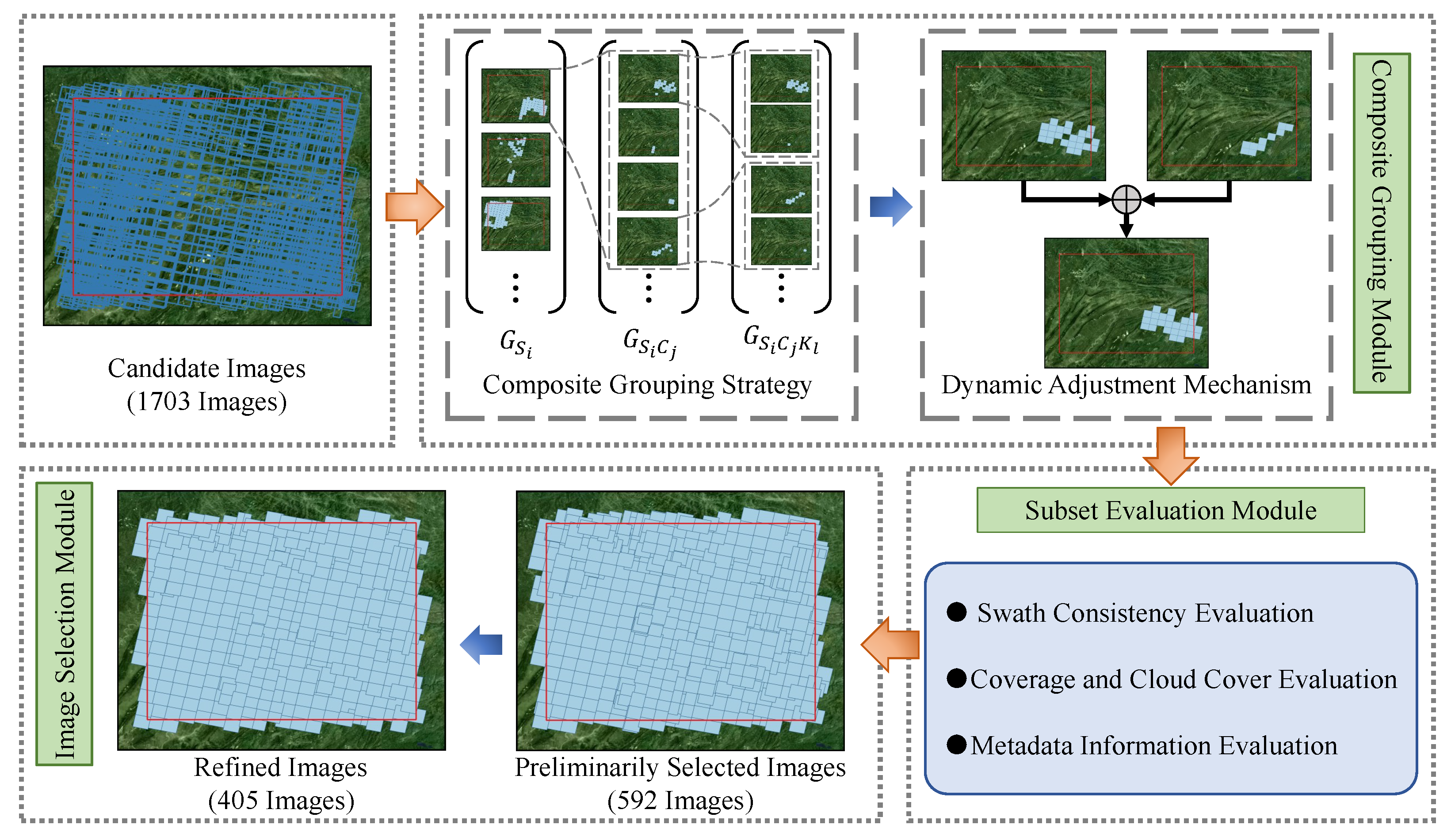
- To the best of our knowledge, we are the first to incorporate swath information into the optimal selection of remote sensing images. We propose a framework named SwathSel, which balances swath, coverage, cloud cover, and metadata information.
- We propose a composite grouping strategy and a dynamic adjustment mechanism that extend the processing unit of the optimal selection algorithm from single-scene images to connected subsets. These connected subsets partition swath data into smaller units, enabling flexible subset-size selection and improving the efficiency of swath information utilization.
- To ensure visual consistency of the selected images, we apply local and global swath consistency constraints based on the topological structure of connected subsets and metadata information, respectively. We also construct four metrics to quantitatively evaluate the visual consistency performance of different methods.
- We conducted experiments on four different datasets, and our SwathSel model achieved state-of-the-art results in terms of redundancy, cloud cover, and visual consistency compared to the baseline models.
2. Materials
2.1. Experimental Satellite Information
2.2. Data Sources
3. Methods
3.1. Composite Grouping Module
3.1.1. Swath Data of Optical Remote Sensing Satellites
3.1.2. Composite Grouping Strategy
3.1.3. Dynamic Adjustment Mechanism
3.2. Subset Evaluation Module
3.2.1. Swath Consistency Evaluation
- 1.
- Local Swath Consistency Evaluation
- 2.
- Global Swath Consistency Evaluation
3.2.2. Coverage and Cloud Cover Evaluation
3.2.3. Metadata Information Evaluation
3.3. Image Selection Module
3.3.1. Preliminary Selection
3.3.2. Image Refinement
| Algorithm 1 SwathSel |
| Input: Candidate images I, the extent of the area of interest |
Output: Optimal image set O
|
4. Results
4.1. Experimental Setup
4.1.1. Implementation Details
4.1.2. Quantitative Evaluation Metrics
- Coverage Ratio (CR):The ratio of the AOI covered by the selected optimal image set O. We merge the extents of all selected images and calculate the ratio of the covered area to that of the virtual image , which precisely matches the extent of AOI. The coverage ratio (CR) is calculated as follows:where calculates the coverage area of the input data, calculates the coverage vector of the input data, and denotes the vector range of the AOI covered by the selected images.
- Redundancy Ratio (RR): The ratio of the sum of the areas of all selected images to the area of the AOI, minus 1. This metric serves as a key method for measuring image redundancy. Following Tao et al. [22] and Li et al. [23], RR is calculated as below:where x represents a single scene image in the optimal set O.
- Cloud Area Ratio (CAR): The ratio of cloud area to AOI area across all selected images. This metric reflects the upper limit of cloud cover when mosaicking the selected images, i.e., when all clouds are retained in the final mapping product. The CAR is calculated as follows:where represents the cloud cover percentage of each image x.
- Root Mean Square Error of Satellite Source Continuity (): The root mean square error of the satellite source differences between each image and its intersecting images in the dataset. This metric quantifies the overall visual consistency of a dataset from the perspective of satellite source continuity. The is calculated as follows:where denotes the set of images in O that intersect with , is the indicator function defined on , and calculates the satellite source difference between images and , as defined in Equation (4).
- Root Mean Square Error of Acquisition Time Continuity (): The root mean square error of the acquisition time differences between each image and its intersecting images in the dataset. This metric quantifies the overall visual consistency of a dataset from the perspective of acquisition time continuity. The is calculated as follows:where computes the absolute value of the time interval between images and , as defined in Equation (5).
- Root Mean Square Error of Solar Elevation Angle Continuity (): The root mean square error of the solar elevation angle differences between each image and its intersecting images in the dataset. This metric quantifies the overall visual consistency of a dataset from the perspective of solar elevation angle continuity. The is calculated as follows:where calculates the absolute value of the difference in solar elevation angle between images and , as defined in Equation (6).
- Root Mean Square Error of Roll Angle Continuity (): The root mean square error of the roll angle differences between each image and its intersecting images in the dataset. This metric quantifies the overall visual consistency of a dataset from the perspective of roll angle continuity. The is calculated as follows:where calculates the absolute value of the difference in roll angle between images and , as defined in Equation (7).
4.2. Optimized Selection Results and Analysis
4.2.1. Quantitative Results and Analysis
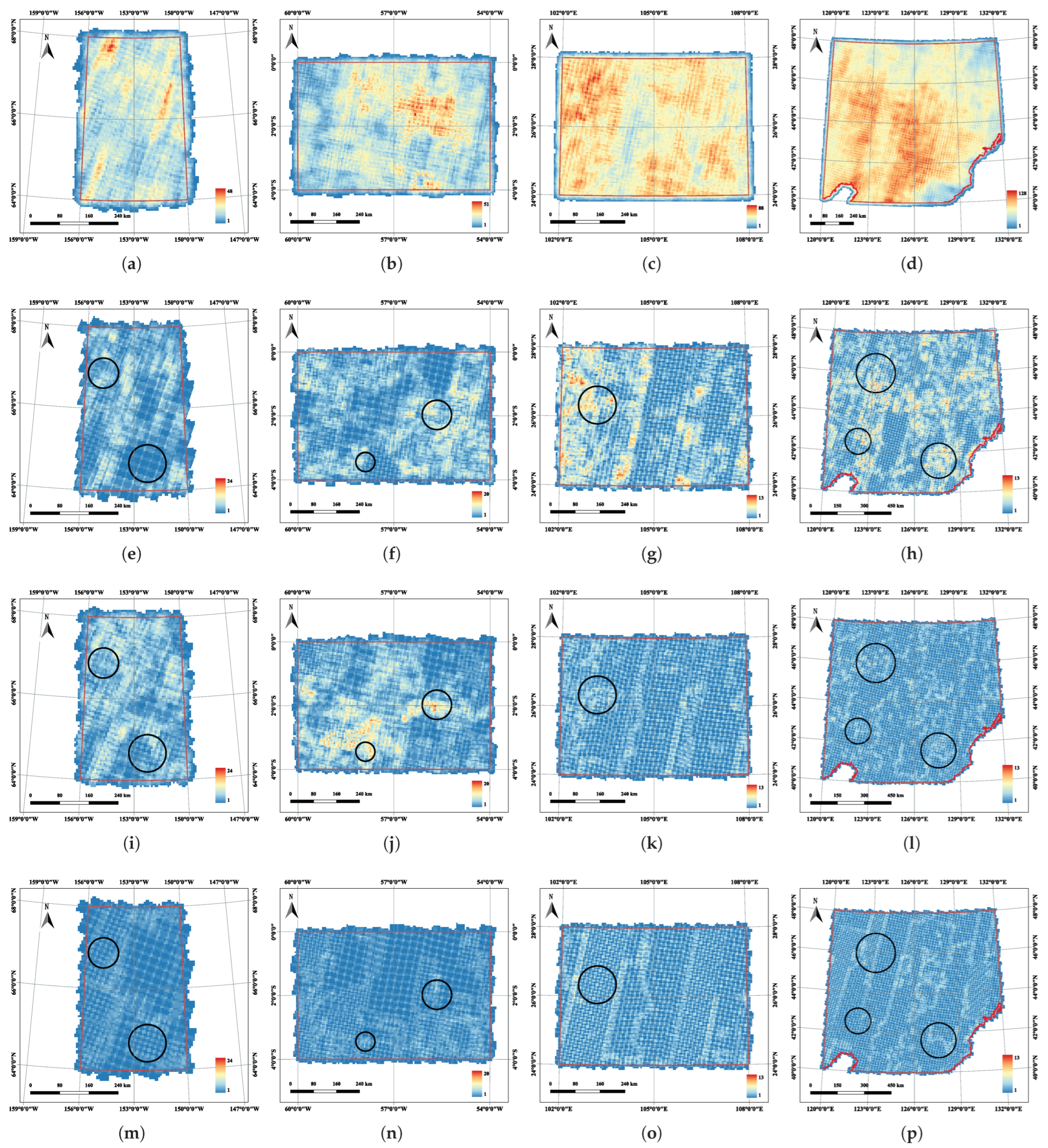
4.2.2. Density Distribution Results and Analysis
- 1.
- NQ05 dataset
- 2.
- SA21 dataset
- 3.
- NG48 dataset
- 4.
- NKL4 dataset
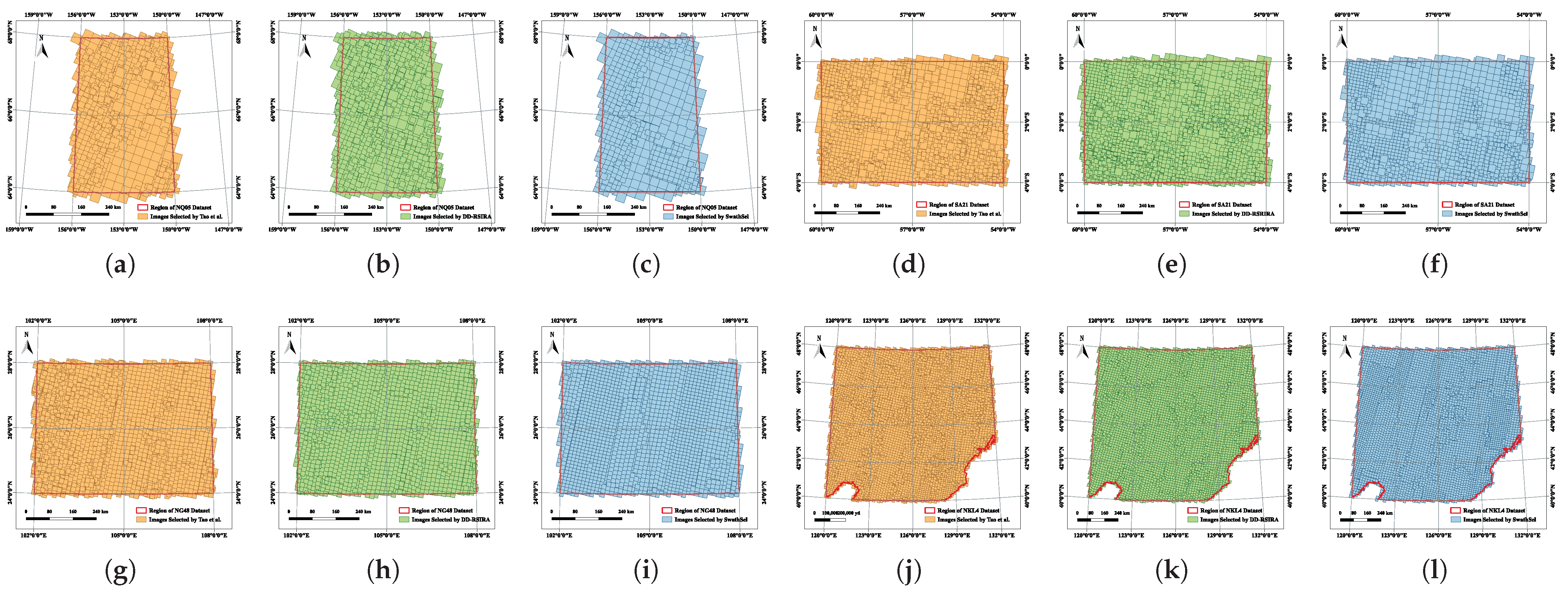
4.2.3. Spatial Distribution Results and Analysis
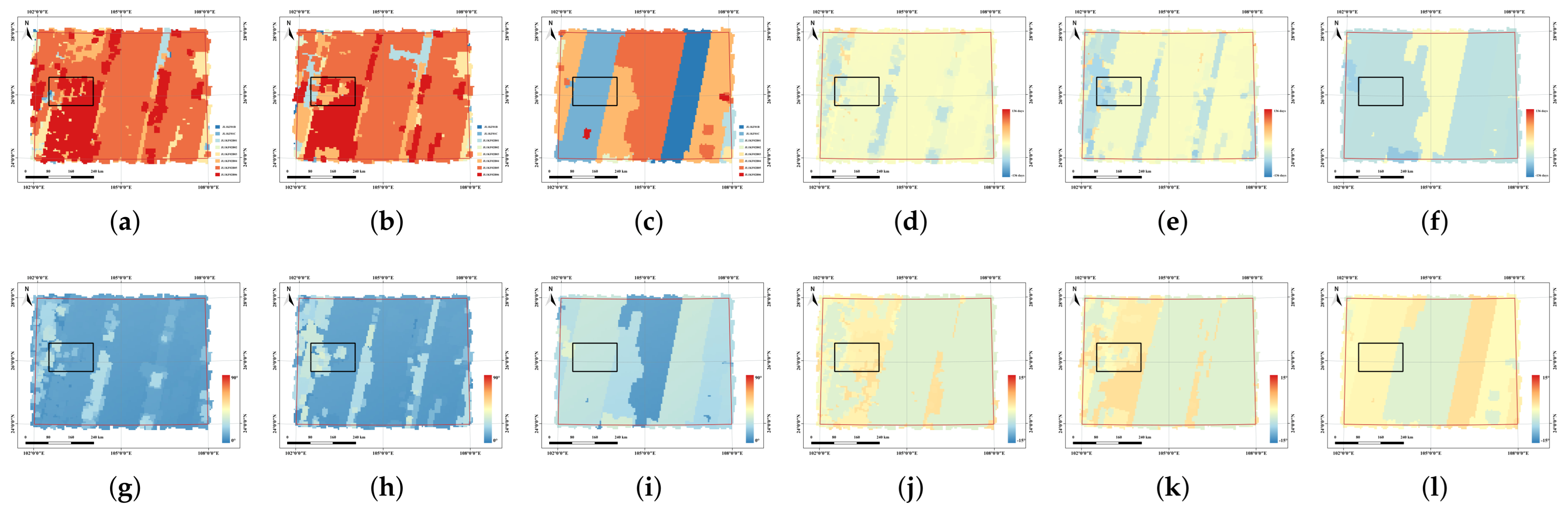
4.2.4. Visual Consistency Analysis
- 1.
- Satellite Source Continuity
- 2.
- Acquisition Time and Solar Elevation Angle Continuity
- 3.
- Roll Angle Continuity
4.3. Analysis of the Cloud Cover Intervals
4.4. Ablation Study
5. Discussion
6. Conclusions
Author Contributions
Funding
Data Availability Statement
Acknowledgments
Conflicts of Interest
Abbreviations
| AOI | Area of Interest |
| CR | Coverage Ratio |
| RR | Redundancy Ratio |
| CCI | Cloud Cover Interval |
| CAR | Cloud Area Ratio |
| Root Mean Square Error of Acquisition Time Continuity | |
| Root Mean Square Error of Satellite Source Continuity | |
| Root Mean Square Error of Solar Elevation Angle Continuity | |
| Root Mean Square Error of Roll Angle Continuity | |
| DD-RSIRA | Remote Sensing Image Retrieval Algorithm for Dense Data |
| SwathSel-WC | SwathSel Model without Swath Consistency Constraints |
| SwathSel-WD | SwathSel Model without Dynamic Adjustment Mechanism |
Appendix A
- 1.
- Prior to incorporating , the original set contains no redundant scenes.
- 2.
- The connected subset contains no redundant scenes, since all scenes in belong to the same swath.
- 3.
- According to the satellite characteristics in Table 1, the maximum scene width does not exceed twice the minimum scene width, i.e., .

References
- Kulu, E. Satellite constellations—2024 survey, trends and economic sustainability. In Proceedings of the International Astronautical Congress, IAC, Milan, Italy, 14–18 October 2024; pp. 14–18. [Google Scholar]
- Paravano, A.; Patrizi, M.; Razzano, E.; Locatelli, G.; Feliciani, F.; Trucco, P. The impact of the new space economy on sustainability: An overview. Acta Astronaut. 2024, 222, 162–173. [Google Scholar] [CrossRef]
- Urabe, T. Overview of satellite-based Earth observation missions in Japan. In Proceedings of the Sensors, Systems, and Next-Generation Satellites XXIX, SPIE, Madrid, Spain, 15–18 September 2025; Volume 13667, pp. 200–207. [Google Scholar]
- Secker, J.; Biron, K.; Dessureault, D.; Lamontagne, P.; Rear, R. Automated Collection Planning for Civilian and Commercial Satellite Imagery, and Definition and Exploitation of the Collection Asset Specification Data Structure. IEEE J. Sel. Top. Appl. Earth Obs. Remote Sens. 2025, 18, 9764–9797. [Google Scholar] [CrossRef]
- Chu, Y.; Ye, M.; Qian, Y. Fine-grained image recognition methods and their applications in remote sensing images: A review. IEEE J. Sel. Top. Appl. Earth Obs. Remote Sens. 2024, 17, 19640–19667. [Google Scholar] [CrossRef]
- Dong, X.; Cao, J.; Zhao, W. A review of research on remote sensing images shadow detection and application to building extraction. Eur. J. Remote Sens. 2024, 57, 2293163. [Google Scholar] [CrossRef]
- Li, Q.; Mou, L.; Sun, Y.; Hua, Y.; Shi, Y.; Zhu, X.X. A review of building extraction from remote sensing imagery: Geometrical structures and semantic attributes. IEEE Trans. Geosci. Remote Sens. 2024, 62, 4702315. [Google Scholar] [CrossRef]
- Marques, P.; Pádua, L.; Sousa, J.J.; Fernandes-Silva, A. Advancements in remote sensing imagery applications for precision management in olive growing: A systematic review. Remote Sens. 2024, 16, 1324. [Google Scholar] [CrossRef]
- Sun, Z.; Zhong, Y.; Wang, X.; Zhang, L. Identifying cropland non-agriculturalization with high representational consistency from bi-temporal high-resolution remote sensing images: From benchmark datasets to real-world application. ISPRS J. Photogramm. Remote Sens. 2024, 212, 454–474. [Google Scholar] [CrossRef]
- Kumari, S.; Agarwal, S.; Agrawal, N.K.; Agarwal, A.; Garg, M.C. A Comprehensive Review of Remote Sensing Technologies for Improved Geological Disaster Management. Geol. J. 2025, 60, 223–235. [Google Scholar] [CrossRef]
- Shen, S.; Zhang, T.; Zhao, Y.; Wang, Z.; Qian, F. Automatic benggang recognition based on latent semantic fusion of UHR DOM and DSM features. ISPRS Ann. Photogramm. Remote Sens. Spat. Inform. Sci. 2020, 3, 331–338. [Google Scholar] [CrossRef]
- Chen, S.; Zhang, Y.; Nie, K.; Li, X.; Wang, W. Extracting building areas from photogrammetric DSM and DOM by automatically selecting training samples from historical DLG data. ISPRS Int. J. Geo-Inf. 2020, 9, 18. [Google Scholar] [CrossRef]
- Som-Ard, J.; Atzberger, C.; Izquierdo-Verdiguier, E.; Vuolo, F.; Immitzer, M. Remote sensing applications in sugarcane cultivation: A review. Remote Sens. 2021, 13, 4040. [Google Scholar] [CrossRef]
- Warner, T.A.; Nellis, M.D.; Foody, G.M. Remote sensing scale and data selection issues. In The Sage Handbook of Remote Sensing; Foody, G., Warner, T., Nellis, M.D., Eds.; Sage: New York, NY, USA, 2009; pp. 1–17. [Google Scholar]
- Lefsky, M.A.; Cohen, W.B. Selection of remotely sensed data. In Remote Sensing of Forest Environments: Concepts and Case Studies; Springer: Berlin/Heidelberg, Germany, 2003; pp. 13–46. [Google Scholar]
- Sudha, S.; Aji, S. A review on recent advances in remote sensing image retrieval techniques. J. Indian Soc. Remote Sens. 2019, 47, 2129–2139. [Google Scholar] [CrossRef]
- Caprara, A.; Toth, P.; Fischetti, M. Algorithms for the set covering problem. Ann. Oper. Res. 2000, 98, 353–371. [Google Scholar] [CrossRef]
- Álvarez-Miranda, E.; Goycoolea, M.; Ljubić, I.; Sinnl, M. The generalized reserve set covering problem with connectivity and buffer requirements. Eur. J. Oper. Res. 2021, 289, 1013–1029. [Google Scholar] [CrossRef]
- Ren, Z.G.; Feng, Z.R.; Ke, L.J.; Zhang, Z.J. New ideas for applying ant colony optimization to the set covering problem. Comput. Ind. Eng. 2010, 58, 774–784. [Google Scholar] [CrossRef]
- Chu, B.; Gao, F.; Chai, Y.; Liu, Y.; Yao, C.; Chen, J.; Wang, S.; Li, F.; Zhang, C. Large-area full-coverage remote sensing image collection filtering algorithm for individual demands. Sustainability 2021, 13, 13475. [Google Scholar] [CrossRef]
- Yan, X.; Liu, S.; Liu, W.; Dai, Q. An improved coverage-oriented retrieval algorithm for large-area remote sensing data. Int. J. Digit. Earth 2022, 15, 606–625. [Google Scholar] [CrossRef]
- Tao, P.; Xi, K.; Niu, Z.; Chen, Q.; Liao, Y.; Liu, Y.; Liu, K.; Zhang, Z. Optimal selection from extremely redundant satellite images for efficient large-scale mapping. ISPRS J. Photogramm. Remote Sens. 2022, 194, 21–38. [Google Scholar] [CrossRef]
- Li, X.; Liu, S.; Liu, W. Remote Sensing Image Retrieval Algorithm for Dense Data. Remote Sens. 2023, 16, 98. [Google Scholar] [CrossRef]
- Liu, S.; Hodgson, M.E. Satellite image collection modeling for large area hazard emergency response. ISPRS J. Photogramm. Remote Sens. 2016, 118, 13–21. [Google Scholar] [CrossRef]
- Kempeneers, P.; Soille, P. Optimizing Sentinel-2 image selection in a Big Data context. Big Earth Data 2017, 1, 145–158. [Google Scholar] [CrossRef]
- Pan, J.; Chen, L.; Shu, Q.; Zhao, Q.; Yang, J.; Jin, S. Spatiotemporal imagery selection for full coverage image generation over a large area with HFA-Net based quality grading. Geo-Spat. Inf. Sci. 2024, 27, 1524–1541. [Google Scholar] [CrossRef]
- Liu, Z.; Lin, Y.; Cao, Y.; Hu, H.; Wei, Y.; Zhang, Z.; Lin, S.; Guo, B. Swin transformer: Hierarchical vision transformer using shifted windows. In Proceedings of the IEEE/CVF International Conference on Computer Vision, Montreal, BC, Canada, 10–17 October 2021; pp. 10012–10022. [Google Scholar]
- Boggs, S. The International Map of the World. Mil. Eng. 1929, 21, 112–114. [Google Scholar]
- He, X.; Yang, X.; Liu, P.; Du, J.; Fu, Z.; Cheng, M.; Xu, T. Wide-Swath and High-Resolution Continuous Multi-Strip Scanning Imaging Technology Based on Satellite-Payload Collaboration. IEEE Trans. Geosci. Remote Sens. 2025, 63, 5618014. [Google Scholar]
- Katayama, H.; Kato, E.; Imai, H.; Sagisaka, M. Wide swath and high resolution optical imaging satellite of Japan. In Proceedings of the Earth Observing Missions and Sensors: Development, Implementation, and Characterization IV; SPIE: New Delhi, India, 2016; Volume 9881, pp. 111–116. [Google Scholar]
- Bannari, A.; Morin, D.; Bénié, G.; Bonn, F. A theoretical review of different mathematical models of geometric corrections applied to remote sensing images. Remote Sens. Rev. 1995, 13, 27–47. [Google Scholar] [CrossRef]
- Kobayashi, S.; Sanga-Ngoie, K. The integrated radiometric correction of optical remote sensing imageries. Int. J. Remote Sens. 2008, 29, 5957–5985. [Google Scholar] [CrossRef]
- Sun, G.; Hu, Q.; Li, W.; Luo, D.; Lu, Y. Review of Multi-Source High-Resolution Remote Sensing Satellites. J. Phys. Conf. Ser. 2025, 3109, 012039. [Google Scholar] [CrossRef]
- Hagihara, Y.; Okamoto, H.; Yoshida, R. Development of a combined CloudSat-CALIPSO cloud mask to show global cloud distribution. J. Geophys. Res. Atmos. 2010, 115. [Google Scholar] [CrossRef]
- Kopeika, N.S.; Arbel, D. Imaging through the atmosphere: An overview. Opt. Pulse Beam Propag. 1999, 3609, 78–89. [Google Scholar]
- Gui, S.; Song, S.; Qin, R.; Tang, Y. Remote sensing object detection in the deep learning era—A review. Remote Sens. 2024, 16, 327. [Google Scholar] [CrossRef]
- Huang, L.; Jiang, B.; Lv, S.; Liu, Y.; Fu, Y. Deep-learning-based semantic segmentation of remote sensing images: A survey. IEEE J. Sel. Top. Appl. Earth Obs. Remote Sens. 2023, 17, 8370–8396. [Google Scholar] [CrossRef]
- Bai, T.; Wang, L.; Yin, D.; Sun, K.; Chen, Y.; Li, W.; Li, D. Deep learning for change detection in remote sensing: A review. Geo-Spat. Inf. Sci. 2023, 26, 262–288. [Google Scholar] [CrossRef]
- Schenk, T. Towards automatic aerial triangulation. ISPRS J. Photogramm. Remote Sens. 1997, 52, 110–121. [Google Scholar] [CrossRef]
- Yu, L.; Zhang, Y.; Sun, M.; Zhou, X.; Liu, C. An auto-adapting global-to-local color balancing method for optical imagery mosaic. ISPRS J. Photogramm. Remote Sens. 2017, 132, 1–19. [Google Scholar] [CrossRef]





| Satellite Name | Launch Date | Spatial Resolution | Swath Width | Standard Scene Width (Nadir) |
|---|---|---|---|---|
| JL1KF01A | January 2020 | 0.75 m | 136 km | 23 km |
| JL1KF01B | July 2021 | 0.5 m | 150 km | 13 km |
| JL1KF01C | May 2022 | 0.5 m | 150 km | 13 km |
| JL1KF02B01-06 | September 2024 | 0.5 m | 150 km | 15 km |
| JL1GF03D Series | July 2021–June 2023 | 0.75 m | 17 km | 17 km |
| Dataset | Acquisition Time | Roll Angle | Resolution | Cloud | Solar Elevation Angle | Satellite Source |
|---|---|---|---|---|---|---|
| NQ05 | 1 January 2025 to 30 September 2025 | ∼ | 0.75 m | ∼ | ALL | |
| SA21 | 1 January 2025 to 30 September 2025 | ∼ | 0.75 m | ∼ | ALL | |
| NG48 | 1 January 2025 to 30 September 2025 | ∼ | 0.5 m | ∼ | UHRS | |
| NKL4 | 1 January 2025 to 30 September 2025 | ∼ | 0.5 m | ∼ | UHRS |
| Dataset | Method | Scenes | CR (%) | RR (%) | CAR (%) | Time Consumption (s) | ||||
|---|---|---|---|---|---|---|---|---|---|---|
| NQ05 | Raw | 4611 | 100 | 853.72 | 413.47 | 0.908 | 64.298 | 13.261 | 10.585 | - |
| Tao et al. [22] | 1084 | 100 | 156.90 | 39.14 | 1.592 | 31.410 | 5.602 | 8.972 | 132.47 | |
| DD-RSIRA [23] | 1271 | 100 | 171.55 | 45.53 | 0.778 | 32.494 | 5.530 | 7.954 | 173.7 | |
| SwathSel | 530 | 100 | 40.69 | 15.04 | 0.516 | 30.777 | 5.904 | 4.622 | 223.75 | |
| SA21 | Raw | 12,360 | 100 | 929.41 | 247.99 | 0.852 | 50.705 | 9.299 | 3.107 | - |
| Tao et al. [22] | 2477 | 100 | 125.64 | 40.69 | 0.975 | 41.086 | 5.733 | 2.573 | 487.39 | |
| DD-RSIRA [23] | 2542 | 100 | 152.14 | 31.62 | 0.727 | 38.830 | 4.339 | 2.552 | 373.96 | |
| SwathSel | 1394 | 100 | 38.29 | 10.12 | 0.495 | 25.694 | 3.996 | 1.737 | 634.40 | |
| NG48 | Raw | 33,217 | 100 | 2452.79 | 442.40 | 0.904 | 102.241 | 18.538 | 3.458 | - |
| Tao et al. [22] | 2253 | 100 | 89.37 | 13.24 | 0.655 | 21.948 | 5.047 | 2.258 | 1337.27 | |
| DD-RSIRA [23] | 1534 | 100 | 33.90 | 3.66 | 0.491 | 21.464 | 6.278 | 1.847 | 432.86 | |
| SwathSel | 1717 | 100 | 27.04 | 0.60 | 0.306 | 11.597 | 4.195 | 0.964 | 259.32 | |
| NKL4 | Raw | 133,908 | 100 | 3719.72 | 371.77 | 0.908 | 107.046 | 20.184 | 3.901 | - |
| Tao et al. [22] | 6651 | 100 | 92.10 | 2.02 | 0.627 | 18.361 | 3.710 | 2.525 | 18,504.82 | |
| DD-RSIRA [23] | 4487 | 100 | 34.87 | 1.66 | 0.541 | 12.077 | 2.598 | 2.375 | 2584.83 | |
| SwathSel | 4613 | 100 | 27.59 | 0.58 | 0.341 | 14.355 | 3.791 | 1.291 | 3049.65 |
| Method | Scenes | CAR (%) | ||||
|---|---|---|---|---|---|---|
| Tao et al. [22] | 200 | 37.93 | 0.767 | 24.683 | 5.647 | 1.913 |
| DD-RSIRA [23] | 131 | 9.91 | 0.647 | 30.644 | 9.235 | 1.741 |
| SwathSel | 147 | 0.10 | 0.230 | 3.066 | 1.589 | 0.746 |
| CCI Number | Division Ratio | Scenes | CR (%) | RR (%) | CAR (%) | Time Consumption (s) | ||||
|---|---|---|---|---|---|---|---|---|---|---|
| 1 | 1 | 1559 | 100 | 23.99 | 2.35 | 0.294 | 12.256 | 4.584 | 1.017 | 167.28 |
| 2 | 1:1 | 1559 | 100 | 24.32 | 2.09 | 0.297 | 13.215 | 4.843 | 1.023 | 187.36 |
| 3 | 1:1:1 | 1603 | 100 | 26.11 | 1.16 | 0.278 | 14.209 | 4.383 | 0.862 | 208.43 |
| 4 | 1:1:1:1 | 1608 | 100 | 26.41 | 0.89 | 0.291 | 12.249 | 4.122 | 0.912 | 209.21 |
| 5 | 1:1:1:1:1 | 1611 | 100 | 26.72 | 0.82 | 0.299 | 12.321 | 3.844 | 0.969 | 246.07 |
| 4 | 1:1:1:1 | 1608 | 100 | 26.41 | 0.89 | 0.291 | 12.249 | 4.122 | 0.912 | 209.21 |
| 4:3:2:1 | 1479 | 100 | 26.82 | 2.44 | 0.326 | 16.725 | 5.774 | 0.974 | 237.02 | |
| 1:3:5:7 | 1721 | 100 | 27.43 | 0.58 | 0.309 | 12.021 | 4.400 | 0.965 | 259.72 | |
| 1:2:3:4 | 1717 | 100 | 27.04 | 0.60 | 0.306 | 11.597 | 4.195 | 0.964 | 259.32 |
| Dataset | Method | Scenes | CR (%) | RR (%) | CAR (%) | Time Consumption (s) | ||||
|---|---|---|---|---|---|---|---|---|---|---|
| NQ05 | SwathSel-WC | 500 | 100 | 39.90 | 14.00 | 0.568 | 33.617 | 7.251 | 5.182 | 169.20 |
| SwathSel-WD | 532 | 100 | 42.36 | 14.14 | 0.541 | 32.073 | 6.251 | 5.282 | 226.78 | |
| SwathSel | 530 | 100 | 40.69 | 15.04 | 0.516 | 30.777 | 5.904 | 4.622 | 223.75 | |
| SA21 | SwathSel-WC | 1423 | 100 | 37.26 | 9.90 | 0.495 | 27.721 | 4.282 | 1.765 | 517.11 |
| SwathSel-WD | 1393 | 100 | 38.43 | 10.10 | 0.502 | 26.045 | 3.954 | 1.765 | 687.89 | |
| SwathSel | 1394 | 100 | 38.29 | 10.12 | 0.495 | 25.694 | 3.996 | 1.737 | 634.40 | |
| NG48 | SwathSel-WC | 1643 | 100 | 30.88 | 0.67 | 0.362 | 14.769 | 5.330 | 0.997 | 220.30 |
| SwathSel-WD | 1719 | 100 | 27.70 | 0.53 | 0.330 | 11.740 | 4.202 | 1.016 | 275.62 | |
| SwathSel | 1717 | 100 | 27.04 | 0.60 | 0.306 | 11.597 | 4.195 | 0.964 | 259.32 | |
| NKL4 | SwathSel-WC | 4545 | 100 | 28.56 | 0.52 | 0.356 | 18.820 | 3.486 | 1.370 | 2647.29 |
| SwathSel-WD | 4716 | 100 | 29.00 | 0.49 | 0.356 | 16.247 | 4.054 | 1.299 | 3210.03 | |
| SwathSel | 4613 | 100 | 27.59 | 0.58 | 0.341 | 14.355 | 3.791 | 1.291 | 3049.65 |
Disclaimer/Publisher’s Note: The statements, opinions and data contained in all publications are solely those of the individual author(s) and contributor(s) and not of MDPI and/or the editor(s). MDPI and/or the editor(s) disclaim responsibility for any injury to people or property resulting from any ideas, methods, instructions or products referred to in the content. |
© 2026 by the authors. Licensee MDPI, Basel, Switzerland. This article is an open access article distributed under the terms and conditions of the Creative Commons Attribution (CC BY) license.
Share and Cite
Zhang, B.; Xu, Z.; Liu, Y.; Ai, W.; Fan, L.; An, Y.; Yu, S. SwathSel: A Swath-Based Optimal Remote Sensing Image Selection Method with Visual Consistency for Large-Scale Mapping. Remote Sens. 2026, 18, 1212. https://doi.org/10.3390/rs18081212
Zhang B, Xu Z, Liu Y, Ai W, Fan L, An Y, Yu S. SwathSel: A Swath-Based Optimal Remote Sensing Image Selection Method with Visual Consistency for Large-Scale Mapping. Remote Sensing. 2026; 18(8):1212. https://doi.org/10.3390/rs18081212
Chicago/Turabian StyleZhang, Bai, Zongyu Xu, Yunhe Liu, Wenhao Ai, Liming Fan, Yuan An, and Shuhai Yu. 2026. "SwathSel: A Swath-Based Optimal Remote Sensing Image Selection Method with Visual Consistency for Large-Scale Mapping" Remote Sensing 18, no. 8: 1212. https://doi.org/10.3390/rs18081212
APA StyleZhang, B., Xu, Z., Liu, Y., Ai, W., Fan, L., An, Y., & Yu, S. (2026). SwathSel: A Swath-Based Optimal Remote Sensing Image Selection Method with Visual Consistency for Large-Scale Mapping. Remote Sensing, 18(8), 1212. https://doi.org/10.3390/rs18081212