Article

LeGNSS-Based Cycle Slip Detection Method for High-Precision PPP

1
School of Information and Communication, Guilin University of Electronic Technology, Guilin 541004, China
2
Key Laboratory of Cognitive Radio and Information Processing, Guilin University of Electronic Technology, Ministry of Education, Guilin 541004, China
3
Joint International Research Laboratory of Spatio-Temporal Information and Intelligent Location Services, Guilin 541004, China
4
Guangxi Key Laboratory of Precision Navigation Technology and Application, Guilin University of Electronic Technology, Guilin 541004, China
5
School of Aerospace, Harbin Institute of Technology, Shenzhen 518055, China
6
School of Computer Science and Engineering, Guilin University of Aerospace Technology, Guilin 541004, China
7
Faculty of Electrical and Electronics Engineering Technology, Universiti Malaysia Pahang Al-Sultan Abdullah, Pekan 26600, Malaysia
*
Author to whom correspondence should be addressed.
Remote Sens. 2026, 18(8), 1199; https://doi.org/10.3390/rs18081199
Submission received: 17 March 2026 / Revised: 9 April 2026 / Accepted: 14 April 2026 / Published: 16 April 2026

Highlights

What are the main findings?
  • Because the rapid motion of LEO satellites significantly increases the inter-epoch ionospheric variation, inter-epoch differencing fails to adequately eliminate ionospheric errors, and the resulting residuals interfere with cycle slip detection. The method proposed in this paper addresses this issue for the first time, effectively eliminating ionospheric delay residuals of up to four cycles induced by rapid ionospheric variation. Furthermore, the proposed generalized combination method overcomes the inherent limitation of traditional approaches, which fail to detect special cycle slip pairs, by constructing two independent optimized combination equations, ensuring that cycle slips on all frequencies are reliably identified and correctly resolved with a maximum detection deviation of only 0.14 cycles.
  • Beyond cycle slip detection, the integration of LEO satellites significantly accelerates positioning convergence, achieving a 63% reduction in convergence time compared with the standalone GPS system and a 65% reduction compared with the GPS + BDS system.
What are the implications of the main findings?
  • The method fundamentally overcomes two limitations of traditional cycle slip detection: the common assumption of negligible inter-epoch ionospheric variations adopted by many conventional methods, which is severely violated by LEO satellites due to their high orbital velocities, and the inherent insensitivities of conventional MW and GF combinations in detecting specific cycle slip pairs. This enables comprehensive and reliable cycle slip detection and repair for LEO satellite signals.
  • The method effectively eliminates cycle slips induced by signal obstruction in challenging environments such as urban canyons, mountainous terrain, and tree canopies. Moreover, with the integration of LEO satellites, positioning convergence times are consistently reduced across elevation cutoff angles ranging from 10° to 40°, demonstrating robust applicability under varying degrees of signal blockage.

Abstract

Low earth orbit (LEO)-enhanced global navigation satellite systems (GNSSs) (LeGNSSs) have emerged as a promising paradigm for next-generation precise point positioning (PPP). However, the highly dynamic nature of LEO satellites results in significant ionospheric variations with more frequent cycle slips. Thus, identifying fractional cycle slips and evaluating false alarms present significant challenges. In this paper, we propose an ionospheric preprocessing generalized combination (IPGC) method to improve the reliability of cycle slip detection. The ionospheric delay in the carrier phase is mitigated using the NeQuick model. Additionally, a set of specifically designed coefficients is used to combine LEO and GNSS observations, which increases the sensitivity of cycle slip detection. The simulation results indicate that the proposed method can effectively eliminate ionospheric interference of up to 4 cycles in LEO satellite cycle slip detection and can accurately detect all combinations of cycle slips with a maximum deviation of 0.14 cycles. Compared with solutions without cycle slip repair, this method accelerates the positioning convergence time by 0.96 / 0.89 / 1.2 min on the north/east/up (NEU) components, and the reconvergence efficiency is increased by factors of 10, 5.5 , and 2, respectively. Even with an elevated cutoff angle of 40 , the system achieves centimeter-level positioning accuracy ( 0.38 / 1.08 / 1.86 cm). These results confirm the effectiveness of the proposed method in LEO satellite cycle slip detection, providing key algorithmic guidance for the practical implementation of PPP in hybrid constellation systems.

1. Introduction

Global navigation satellite systems (GNSSs) represent the technology underlying the modern positioning, navigation, and timing (PNT) infrastructure. Nevertheless, conventional GNSSs face intrinsic limitations, including weak signal power, long convergence times in precise point positioning (PPP), and insufficient robustness in highly dynamic scenarios. To overcome these challenges, the integration of LEO satellites into the GNSS has become a prominent research avenue for next-generation high-precision navigation [1].
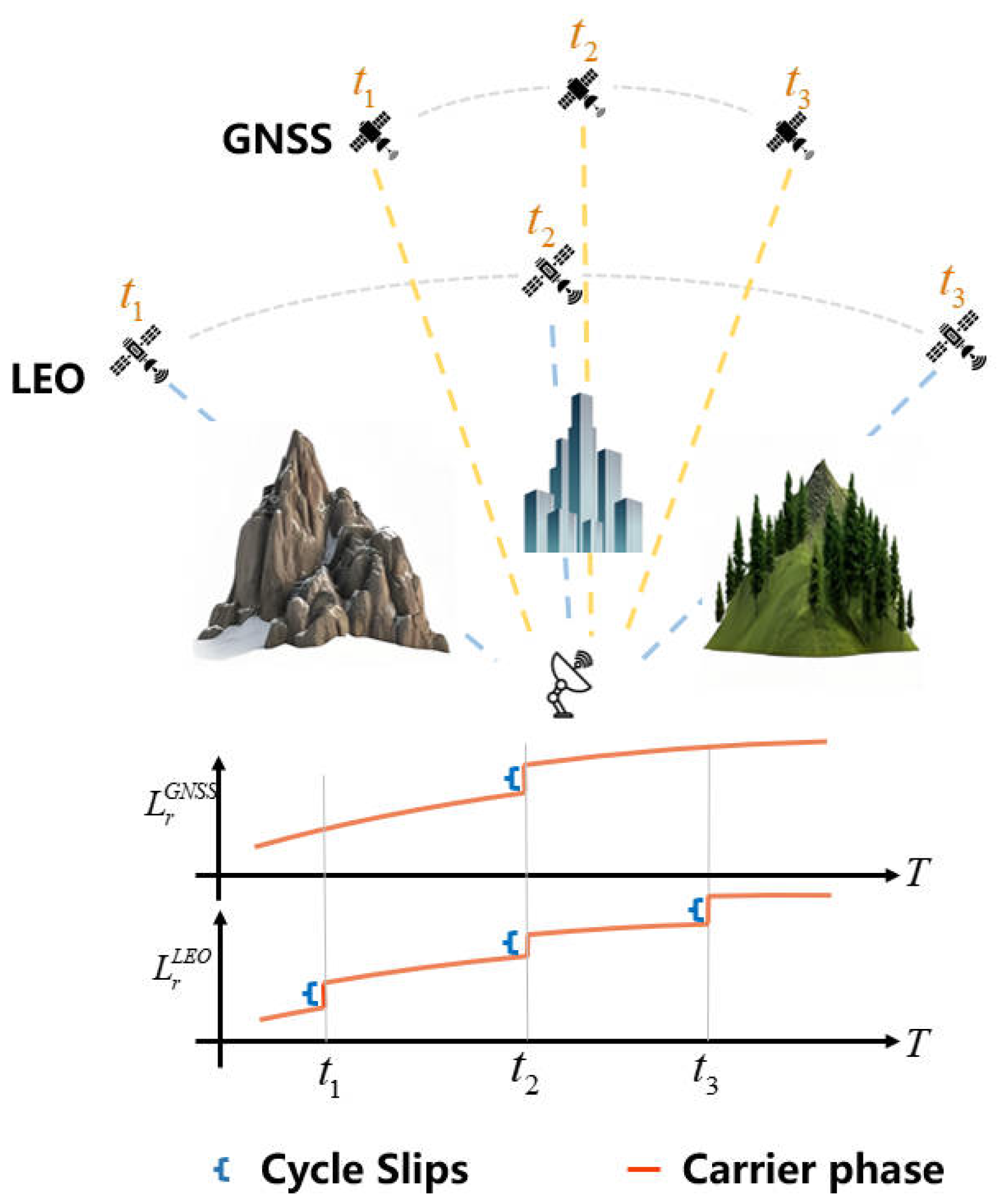
LEO satellites have distinct advantages, including higher signal strength, shorter propagation paths, and rapidly changing geometry [2]. Their integration effectively increases the number of visible satellites, optimizes the spatial geometry of the navigation constellation, reduces PPP convergence times, and increases both the continuity and accuracy of high-precision positioning [3]. However, the ultrahigh dynamics of LEO satellites create unprecedented challenges for cycle slip detection and repair [4], a critical preprocessing stage in high-precision PPP. A cycle slip is defined as an abrupt loss of an integer number of cycles in carrier phase observations, typically caused by signal outages, ionospheric anomalies, or satellite attitude changes. A cycle slip disrupts phase continuity and results in integer ambiguity resolution failures, compromising the stability and accuracy of PPP solutions. The observed carrier phase cycle slips in both the GNSS and LEO systems are shown in Figure 1. Owing to their high relative velocities and low orbital altitudes, compared with medium earth orbit (MEO) GNSS satellites, LEO carrier phase observations exhibit more frequent cycle slips. Consequently, robust cycle slip detection is essential for ensuring solution continuity in LEO environments.
Cycle slip detection in conventional GNSSs is a well-established field. Early contributions include a recursive slippage test formulated within a state space filtering framework [5], a Kalman filtering approach for fixing cycle slips in dual-frequency kinematic applications [6], and a comprehensive quality control framework treating cycle slip detection as a special case of statistical hypothesis testing for model misspecifications [7]. These foundational concepts have since evolved into diverse practical algorithms. Dual-frequency combination methods remain the most prevalent, with representative approaches such as the Hatch–Melbourne–Wübbena (HMW) method [8], pseudorange phase combination methods [9,10], and ionospheric residual detection [11] relying on linear models of multifrequency observations to isolate and amplify cycle-slip signatures. Model-based Kalman filtering [12], Doppler shift analysis [13], and polynomial fitting [14] have also achieved high detection accuracy and low false alarm rates in static or low-dynamic scenarios.
Many of these methods assume, either implicitly or explicitly, that ionospheric delay variations between consecutive epochs are negligible—a premise that generally holds for MEO GNSS satellites. Notable exceptions exist where minimal detectable biases under a weighted ionosphere have been systematically investigated [15,16], and time-differenced ionospheric delays have been modeled as a first-order autoregressive process, demonstrating that phase-slip detectability is strongly governed by the ionospheric disturbance level [17]. Nonetheless, existing approaches are fundamentally tailored to the relatively benign ionospheric environment of ground-based MEO GNSS. For LeGNSS based PPP, however, the high dynamics of LEO satellites cause signal paths to traverse rapidly changing ionospheric regions, producing abrupt and potentially non-stationary ionospheric variations [18] that may exceed the modeling capacity of conventional approaches, causing strong coupling between ionospheric residuals and cycle slip signals and limiting the applicability of traditional techniques to LEO observations [19,20].
Current research on LeGNSS has primarily addressed cycle slips in onboard GPS receivers of LEO satellites induced by high-speed motion and severe ionospheric disturbances. Proposed solutions include the error expansion model (EEM) [8] and the dynamic force model [4]. With respect to dynamical precise orbit determination (POD) for LEO satellites, traditional cycle slip detection often faces high false alarm rates and degraded orbit accuracy because of ambiguity resolution failures. To mitigate these shortcomings, techniques such as the second-order, time-difference, and geometry-free (STG) method [21], the linear fit forward and backward moving window averaging (LFBMWA) algorithm, and a modified second-order time-difference phase ionospheric residual (MSTPIR) [22] have been employed. The previously mentioned studies focus on cycle slip issues in onboard receivers during orbit determination. With respect to ground-based receivers, existing LEO-enhanced hybrid PPP algorithms [23] primarily address sustained ambiguity reconvergence caused by frequent loss of lock in challenging environments, which hinders real-time high-precision positioning. These algorithms do not, however, resolve the cycle slips caused by abrupt ionospheric variations.
In this study, an ionospheric preprocessing generalized combination (IPGC) method, which employs a two-stage processing strategy involving ionospheric preprocessing and optimized combination coefficient selection, is proposed. A GPS/BDS/LEO simulation system is established to generate pseudorange and carrier phase observations. Additionally, we considered the interference with cycle slip detection caused by severe ionospheric delay variations induced by the rapid motion of LEO satellites. The detection performance of cycle slips under different system conditions is evaluated, and the positioning performance in various environments is analyzed. The remainder of this paper is organized as follows: Section 2 presents the GPS/BDS/LEO simulation framework, analyzes the LEO-specific characteristics affecting cycle slip detection, and describes the proposed IPGC methodology, including ionospheric preprocessing and the cycle slip detection algorithm. Section 3 validates the method through comparative experiments and positioning performance analysis. Section 4 discusses and analyzes the proposed method and experimental results.

2. Proposed Method

2.1. GNSS/LEO Simulation System

Because most LEO navigation constellations remain under construction, we established a simulation system to evaluate LeGNSS PPP. Here, the LEO constellation is generated through the Satellite Tool Kit (STK) [24].
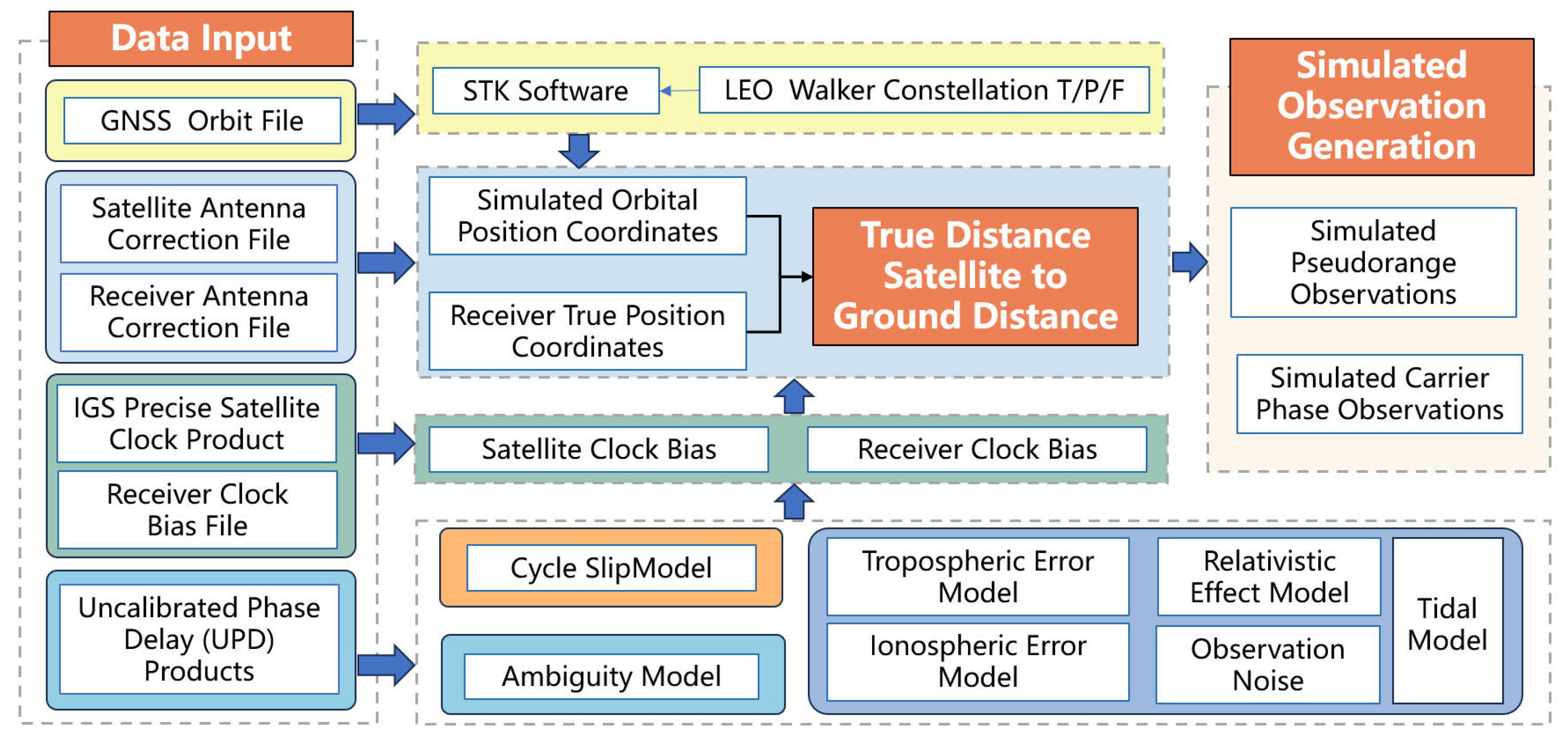
The simulation framework is shown in Figure 2. First, GNSS orbital data are extracted from two-line element (TLE) files [25], whereas LEO satellite orbits are generated through systems tool kit (STK) by implementing a Walker constellation configuration, yielding simulated satellite position coordinates for both systems. Second, the true satellite-ground geometric range between the satellites and ground receivers is computed by combining the simulated orbital coordinates with the actual receiver coordinates and incorporating antenna phase center corrections through official calibration files. Satellite and receiver clock offsets are obtained from the corresponding clock products. Third, comprehensive error modeling is implemented to simulate realistic observation conditions, such as relativistic effects, ionospheric delays (modeled via spherical harmonics), tropospheric delays (dry and wet components with mapping functions), solid Earth tide displacements, observation noise (Gaussian white noise), carrier phase ambiguities (integer components from random generation and fractional components from Uncalibrated Phase Delay (UPD) products), and artificially introduced cycle slips. Last, synthetic pseudorange and carrier phase observations are generated by integrating the geometric range, clock biases, and all previously mentioned error components. This comprehensive simulation architecture enables rigorous evaluation of cycle slip detection algorithms under controlled yet realistic observational scenarios [26,27].
The simulated satellite-to-ground distance can be expressed as follows:
ρ = u r s · ( o s r s ) + d p c o s + d p c v s + d r , p c o + d r , p c v + d r , d i s p
In the formula, ρ denotes the true distance between the satellite and the ground; u r s represents the unit vector in the line-of-sight direction from the receiver to the satellite; o s and r s denote the satellite center of mass coordinates and the receiver antenna reference point coordinates at the station, respectively; d p c o s and d p c v s denote the satellite-side antenna phase center offset (PCO) and phase center variation (PCV), respectively, while d r , p c o and d r , p c v denote the receiver-side PCO and PCV; and d r , d i s p represents the solid Earth tide displacement correction. The required GNSS products for precise positioning and the simulated LEO satellite data are imported.
The official satellite clock offset products are used for the GPS and LEO satellites. With respect to the LEO satellite clock offsets, the GPS satellite clock offset file is used. The receiver clocks are estimated from GPS solutions [28]. The simulated pseudorange observations and carrier phase observations are obtained by adding the computed geometric range to the above correction and noise terms, yielding Equations (2) and (3), respectively.
P r , j s = ρ r , j s + c · ( δ t r δ t s ) + γ j I r s + T r s + ε P r , j s
L r , j s = λ j φ r = ρ r , j s + c · ( δ t r δ t s ) γ j I r s + T r s + λ j N r , j s + ε φ r , j s
where P and L represent the pseudorange observations and carrier phase observations, respectively, measured in meters. φ denotes the carrier phase observation measured in cycles. The superscript s indicates the satellite, and the subscript r indicates the receiver. j represents the number of satellite frequencies. ρ denotes the geometric range between the satellite and the receiver. c indicates the speed of light. δ t represents the clock offset, which is obtained directly from the imported clock bias file. λ denotes the wavelength. N denotes the carrier phase ambiguity, which consists of an integer part obtained from random integers and a fractional part simulated using UPD products. γ j = f 1 2 f j 2 represents the ionospheric mapping coefficient. I denotes the ionospheric delay. T denotes the tropospheric delay, which is computed as the dry delay times the dry mapping function plus the wet delay times the wet mapping function. f denotes the satellite signal frequency. ε P and ε φ indicates the pseudorange measurement noise and carrier phase measurement noise, respectively, which are modeled as zero mean Gaussians.
In this study, the GPS constellation uses L1 (1575.42 MHz) and L2 (1227.60 MHz), and the LEO constellation uses the same frequencies. The BDS constellation uses B1C (1575.42 MHz) and B2a (1176.45 MHz). To standardize acquisition and facilitate subsequent processing, all the data are sampled at 30 s intervals.

2.2. Observation Model for GNSS-LEO Hybrid Constellation

To mitigate the significant effect of the ionospheric delay on cycle slip detection for LEO satellites, this study proposes the IPGC method. The IPGC performs ionospheric preprocessing on carrier phase observations before the cycle slip detection combination is formed, thereby reducing the effect of rapid ionospheric variations induced by the high-speed motion of the LEO. The constructed composite observables use carefully designed coefficients to eliminate geometric and clock error terms while maintaining high sensitivity to cycle slips.
On the basis of Equations (2) and (3), the observation equation for a hybrid constellation of GNSS and LEO satellites can be expressed in the standard linear form:
y = H x + ε
where
y = ϕ 1 ϕ 2 P 1 P 2 , x = ρ c · ( δ t r δ t s ) I T N 1 N 2 , ε = ε ϕ 1 ε ϕ 2 ε P 1 ε P 2
The design matrix H maps the state vector to the observations:
H = 1 / λ 1 1 / λ 1 γ 1 / λ 1 1 / λ 1 1 0 1 / λ 2 1 / λ 2 γ 2 / λ 2 1 / λ 2 0 1 1 1 γ 1 1 0 0 1 1 γ 2 1 0 0
where, y is the observation vector comprising carrier phase measurements (in cycles) and pseudorange measurements (in meters); x is the state vector containing the geometric range ρ , the combined clock bias term c · ( δ t r δ t s ) , the first-order ionospheric delay I on the reference frequency f 1 , the tropospheric delay T, and the integer ambiguities N 1 and N 2 ; and ε is the measurement noise vector. The ionospheric mapping coefficient is γ j = f 1 2 / f j 2 . This formulation clearly separates the deterministic design matrix from the stochastic noise term, facilitating subsequent linear combination design in the IPGC method.

2.3. Ionospheric Preprocessing

In Equation (4), the residual ionospheric term is combined with the cycle slip term, resulting in biased cycle slip detection or false alarms. Before the application of the IPGC, the NeQuick model was used to calculate the electron density distribution [29]. The model requires three categories of input parameters: (1) the geographic coordinates of the receiver ( φ r , λ r ) and the satellite position, which collectively define the signal ray geometry; (2) the observation epoch, specified by universal time (UT) and month; and (3) the solar activity level, parameterized by the effective ionization level A z , which can be derived from the solar radio flux index (F10.7). Given these inputs, NeQuick computes the three-dimensional electron density N e ( φ , λ , h ) at any spatial point, where h denotes the altitude above Earth’s surface.
The slant total electron content (STEC) along the signal path from satellite s to receiver r is obtained by numerically integrating the electron density profile along the line-of-sight direction [30]:
S T E C r s = P r P s N e φ ( l ) , λ ( l ) , h ( l ) d l
where l represents the path length parameter along the ray and φ ( l ) , λ ( l ) , h ( l ) denote the geographic coordinates and altitude, respectively, at each point along the ray path.
The first-order ionospheric delay on frequency f j is computed from the STEC as follows [31]:
I r , j s = 40.3 f j 2 · S T E C r s
Using the model-estimated ionospheric delay, the carrier phase and pseudorange observations are corrected as follows:
P ˜ r , j s = P r , j s γ j I r s
L ˜ r , j s = λ j φ ˜ r = L r , j s + γ j I r s

2.4. IPGC Method

By linearly combining the multifrequency carrier phase and pseudorange observations with scalar coefficients ( A , B , m , n ) , a generalized observation is obtained as follows:
L IPGC = [ A B m n ] φ ˜ 1 φ ˜ 2 P ˜ 1 / λ IPGC P ˜ 2 / λ IPGC
The wavelength of the combination is λ IPGC = c A f 1 + B f 2 .

2.4.1. Coefficient Constraints and Optimization Criteria

Substituting Equations (9) and (10) into Equation (11), the IPGC observable is expressed as follows:
R = ( A / λ 1 + B / λ 2 + ( m + n ) / λ IPGC ) · ρ δ t = ( A / λ 1 + B / λ 2 + ( m + n ) / λ IPGC ) · c · ( δ t r δ t s ) T = A · T 1 / λ 1 B · T 2 / λ 2 + m / λ IPGC · T 1 + n / λ IPGC · T 2 N = A · N 1 + B · N 2 ε = A · ε φ 1 + B · ε φ 2 + m / λ IPGC · ε P 1 + n / λ IPGC · ε P 2
To eliminate most errors, key constraints must be specified:
A λ 1 + B λ 2 + m + n λ IPGC = 0
Through appropriate constraints on coefficients ( A , B , m , n ) , the combination eliminates geometric and clock terms but retains integer ambiguities and hardware delays. This approach allows cycle slips to be detected as distinct discontinuities in the detection statistic, greatly increasing sensitivity.
The larger λ I P G C is, the greater the meter-level transition caused by unit cycle slips, and the more robust the detection. This combination is insensitive to the geometric and clock terms, but it is highly sensitive to the cycle slip term Δ N = A · N 1 + B · N 2 , which exhibits a distinct jump when a cycle slip occurs. Simultaneously, controllable tropospheric components are retained to enable further suppression through subsequent time differencing.
To obtain a feasible solution for the coefficients ( A , B , m , n ) , we use an optimal performance search method and Equation (14). The least squares method is used for estimation and determination to decrease η I P G C .
η I P G C | ( A , B , m , n ) = ( m + n f 1 2 / f 2 2 ) · 2 ( A 2 + B 2 ) σ φ ˜ 2 + 2 ( m 2 + n 2 ) · ( σ p ˜ 2 / λ I P G C 2 ) λ I P G C
The standard deviation of the raw carrier phase observations is σ φ ˜ = 0.01 cycles; the standard deviation of the raw code observations is σ p ˜ = 0.3 m [32]. First, the pseudorange combination coefficients m and n are analyzed. This study prioritizes minimizing η I P G C , which requires minimizing m 2 + n 2 . According to the Cauchy–Schwarz inequality, when m + n = 1 , m 2 + n 2 1 2 , with equality holding if m = n . Therefore, ( 1 2 ,   1 2 ) is selected as the pseudorange combination coefficients.
For the selection of carrier-phase combination coefficients ( A , B ) , it is necessary to maximize the combined wavelength so as to reduce the inter-epoch observation noise and the effects of multipath. In this study, a grid search is performed over the range [ 5 ,   5 ] with a step size of 1 for the combination coefficients. For each candidate coefficient set, the equivalent wavelength λ I P G C and the optimal performance search value η I P G C are computed. The following filtering criteria are imposed during the search process: (1) a positive equivalent wavelength constraint, i.e., λ I P G C > 0 ; (2) minimization of the optimal performance search value η I P G C , where the coefficient combination yielding the smallest η I P G C subject to criterion (1) is selected as the first set of coefficients ( A 1 , B 1 ) ; (3) a dual-combination independence constraint, requiring that the second set of coefficients ( A 2 , B 2 ) satisfies | A 1 B 2 A 2 B 1 | > 0 to ensure the non-singularity of the cycle-slip resolution matrix, under which the coefficient set with the next smallest η I P G C is selected as the second set. The specific parameters of the partially optimized characteristic coefficients are presented in Table 1.

2.4.2. Cycle Slip Detection and Repair

By developing a scalar time series that is sensitive to cycle slips using linear combinations of observables at each epoch, the detection parameter at epoch t is computed as follows:
L IPGC ( t ) = A φ ˜ 1 ( t ) + B φ ˜ 2 ( t ) m P ˜ 1 ( t ) + n P ˜ 2 ( t ) λ IPGC
The difference between epoch t and the previous epoch t 1 is as follows:
Δ L IPGC = L IPGC ( t ) L IPGC ( t 1 )
Because the tropospheric delay T varies slowly, it is largely eliminated by differencing adjacent epochs.
To determine the cycle slip values ( Δ N 1 , Δ N 2 ) at different frequencies, two distinct sets of coefficient values can be used:
Δ L IPGC 1 Δ L IPGC 2 = A 1 B 1 m 1 / λ IPGC 1 n 1 / λ IPGC 1 A 2 B 2 m 2 / λ IPGC 2 n 2 / λ IPGC 2 Δ φ ˜ 1 Δ φ ˜ 2 Δ P ˜ 1 Δ P ˜ 2
The cycle slip magnitude can be determined as follows:
Δ N 1 = B 2 Δ L IPGC 1 B 1 Δ L IPGC 2 A 1 B 2 A 2 B 1 Δ N 2 = A 2 Δ L IPGC 1 A 1 Δ L IPGC 2 A 1 B 2 A 2 B 1
σ IPGC is given by Equation (19) and varies adaptively with [ A B m n ] .
σ I P G C = 2 ( A 2 + B 2 ) σ φ ˜ 2 + 2 ( m 2 + n 2 ) · ( σ p ˜ 2 / λ I P G C 2 )
Since the pseudorange noise ε P and carrier phase noise ε φ are modeled as independent zero-mean Gaussian white noise processes, i.e., ε φ N ( 0 ,   σ φ 2 ) and ε P N ( 0 ,   σ P 2 ) . The IPGC detection statistic Δ L IPGC , being a linear combination of these Gaussian-distributed observables, also follows a Gaussian distribution under the null hypothesis. Accordingly, the normalized test statistic follows the standard normal distribution:
T = Δ L IPGC σ IPGC H 0 N ( 0 ,   1 )
The null hypothesis H 0 represents the absence of a cycle slip, and the alternative hypothesis H 1 represents the presence of a cycle slip.
The cycle slip detection criterion in Equation (21) is therefore equivalent to a two-sided hypothesis test at significance level α :
| T | k | Δ N ( A , B ) |   k σ IPGC
The false alarm probability (i.e., the probability of incorrectly declaring a cycle slip when none exists) is:
P fa = P ( | T | k H 0 ) = 2 Φ ( k )
where Φ ( · ) denotes the cumulative distribution function of the standard normal distribution. A statistical threshold k (typically 3 to 5) controls the false alarm rate. In this study, the threshold coefficient is set to k = 4 , corresponding to a false alarm probability of 6.33 × 10 5 and a confidence level of 99.99 % . This value provides a balance between detection sensitivity and false alarm suppression, which is particularly important for LEO satellites where the high-frequency ionospheric residuals may mimic small cycle slips.
Once a cycle slip is detected, the LAMBDA method is employed to resolve the integer-valued cycle slip vector Δ N = ( Δ N 1 , Δ N 2 ) from the float estimates, and the Bootstrapping success rate is adopted as a lower bound for the cycle slip resolution reliability [33,34]. The Bootstrapping method is based on the principle of sequential least squares, and its success rate is computed as
P s , B = i = 1 n 2 Φ 1 2 σ I P G C i 1
where n is the number of integer parameters to be estimated (for dual-frequency cycle slip detection, n = 2 ).
After cycle slip detection, the carrier phase observations are corrected as Equation (24), the IPGC combination is reconstructed using the corrected observations. The post-repair residual is computed with Equation (25).
φ j ( t ) = φ ˜ j ( t ) + Δ N j
r = Δ L IPGC corrected = L IPGC corrected ( t ) L IPGC corrected ( t 1 )
Under the hypothesis that the cycle slip has been correctly repaired, the residual should follow
r N ( 0 , σ IPGC 2 )
The validation criterion is
| r | < k v σ IPGC
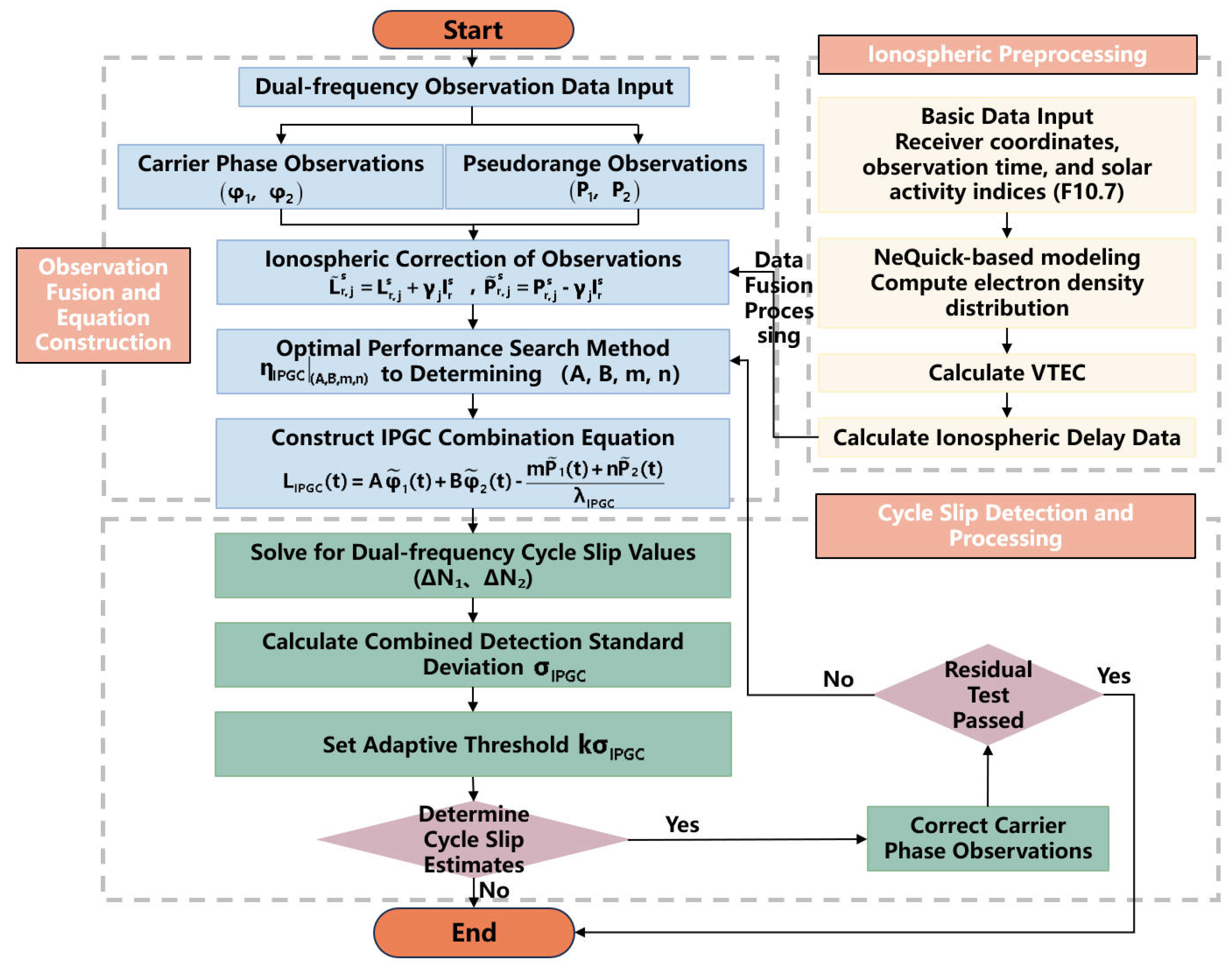
For imposing a stricter criterion on the repair quality, this research sets k v to 3 (corresponding to a 99.73% confidence level). If this condition is satisfied, the repair is accepted. Otherwise, the next-best candidate integer solution from the LAMBDA search is tested. Epochs for which all candidate solutions fail the validation after a maximum of three iterations are flagged and excluded as outliers. The flowchart of the IPGC-based cycle slip detection and correction algorithm for the GNSS-LEO hybrid constellation systems is shown in Figure 3.

3. Experiment

3.1. GNSS/LEO Constellation Configuration

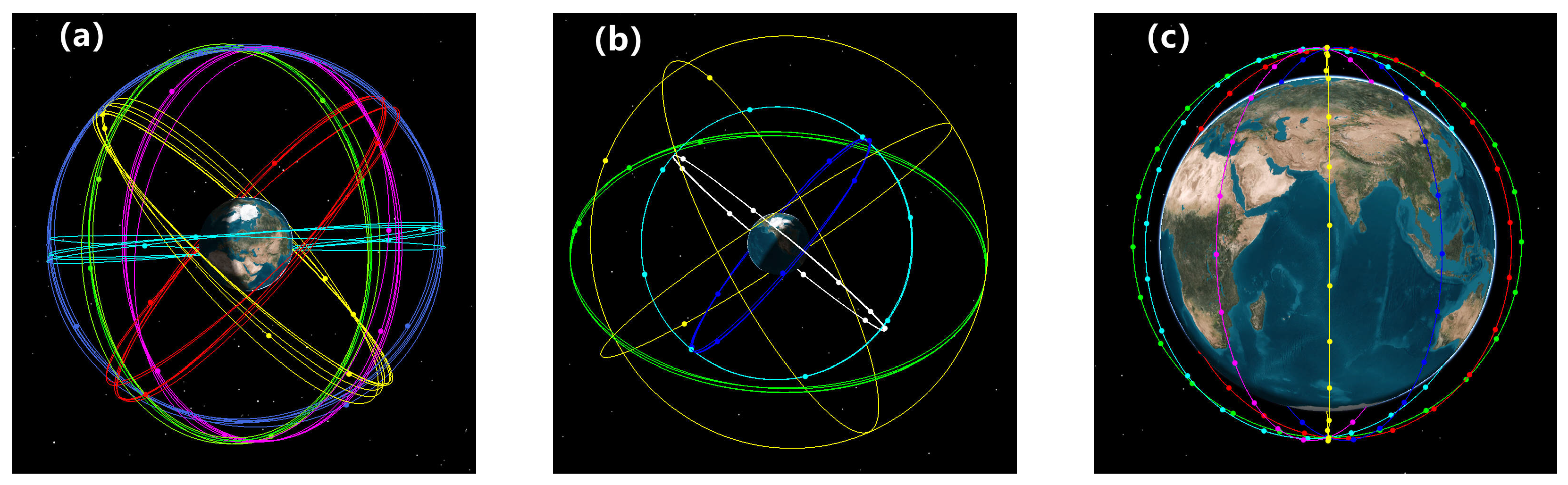
We use STK to generate orbital data for the GPS, BDS, and LEO constellations. The GPS constellation has 32 satellites in six 20,200 km orbits at a 55 inclination. The BDS comprises 35 satellites: 5 GEO satellites (35,786 km), 3 IGSO satellites (35,786 km, 55 ), and 27 MEO satellites (21,500 km, 55 ). The LEO constellation uses a Walker delta pattern with 144 satellites in six 1100 km orbits with 7.5 phasing. The main parameters are listed in Table 2, and the orbital configurations are shown in Figure 4 [27,35].
All experiments in Section 3.2, Section 3.3 and Section 3.4 are based on the simulation framework in Section 2.1 and the constellation configurations in Table 2, except for a real-data comparison experiment in Section 3.3.1 (2). Observations are generated for a station in Guilin (25.29°N, 110.33°E) on 14 May 2024, with a 30 s sampling interval and a 10° elevation cutoff angle. Any deviations from these default settings are explicitly noted in the corresponding subsections.

3.2. Impact of the Ionosphere on Cycle Slip Detection

3.2.1. Analysis of LEO Characteristics

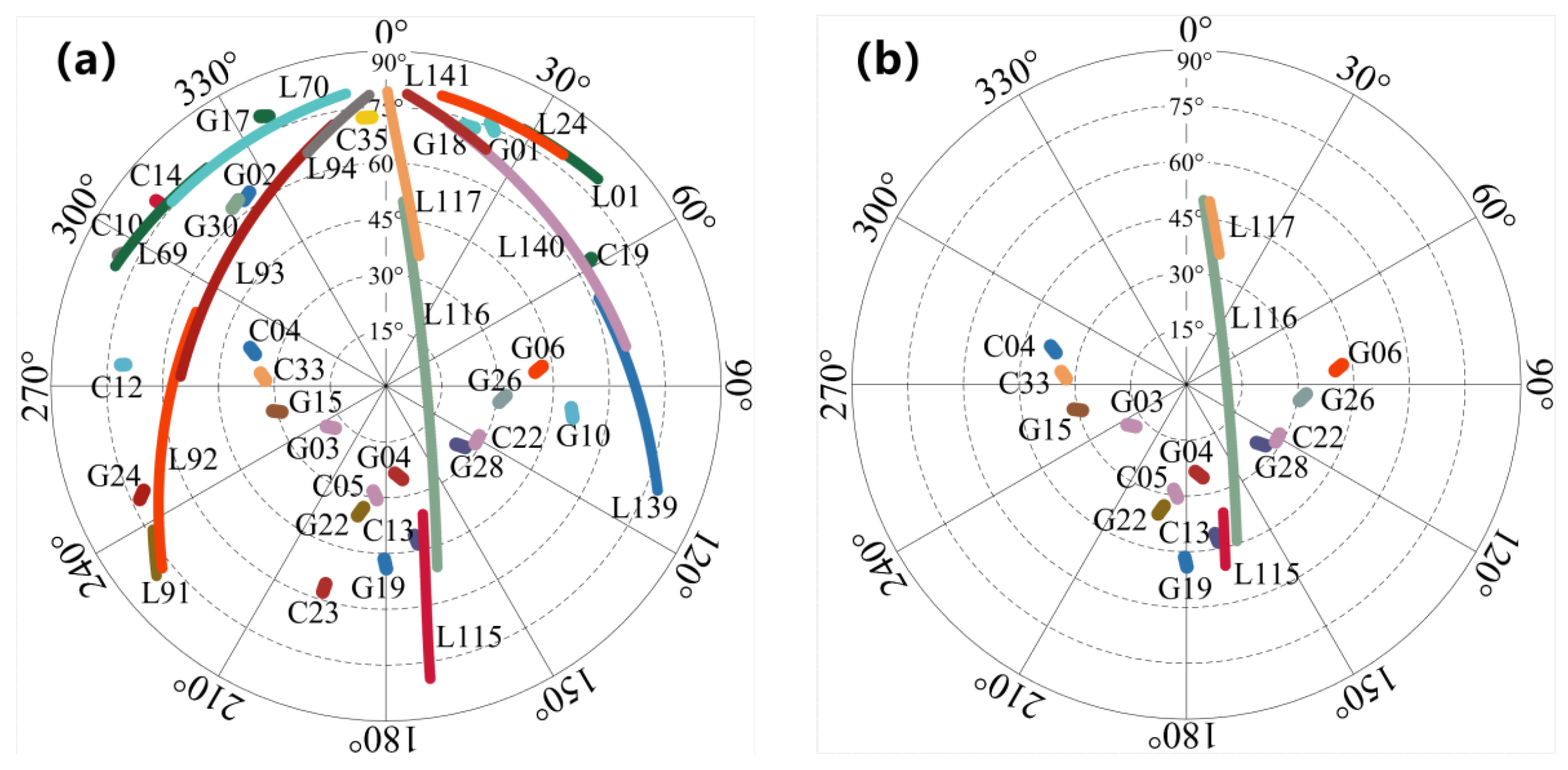
As discussed in Section 1, many traditional cycle slip detection methods assume, either implicitly or explicitly, that the ionospheric delay varies only slightly between adjacent epochs. The use of LEO satellites, however, may severely violate this assumption [36]. I is primarily determined by the total electron content (TEC) along the signal propagation path, which is closely related to the satellite position. The elevation and azimuth angles of LEO satellites change so rapidly that the resulting large ionospheric delay variations are often indistinguishable from cycle slip-induced phase jumps because of their high velocity. This finding directly challenges the main assumption of traditional cycle slip detection methods, namely, the minimal variation in the ionospheric delay between consecutive epochs. The five-minute trajectories of the GNSS and LEO satellites at 10 and 40 cutoff elevations are shown in Figure 5. With respect to GPS satellite G26, the elevation changes from 59.30 to 57.67 (max span of 0.15 per epoch) and the azimuth changes from 98.14 to 94.55 (max span of 0.34 ). With respect to BDS satellite C33, the elevation shifts from 56.14 to 57.60 (max span of 0.14 ), and the azimuth shifts from 275.82 to 272.73 (max span of 0.29 ). In contrast, LEO satellite L116 shows significant changes in elevation from 39.45 to 40.25 (max span of 8.75 ) and changes in azimuth from 164.17 to 5.32 (max span of 54.15 ). With angular change rates approximately 60 (elevation) and 180 (azimuth) times those of the GNSS, LEO satellites traverse far more diverse ionospheric regions between epochs, thereby incurring substantially greater ionospheric delay variations.

3.2.2. Analysis on Ionospheric Delay Correction

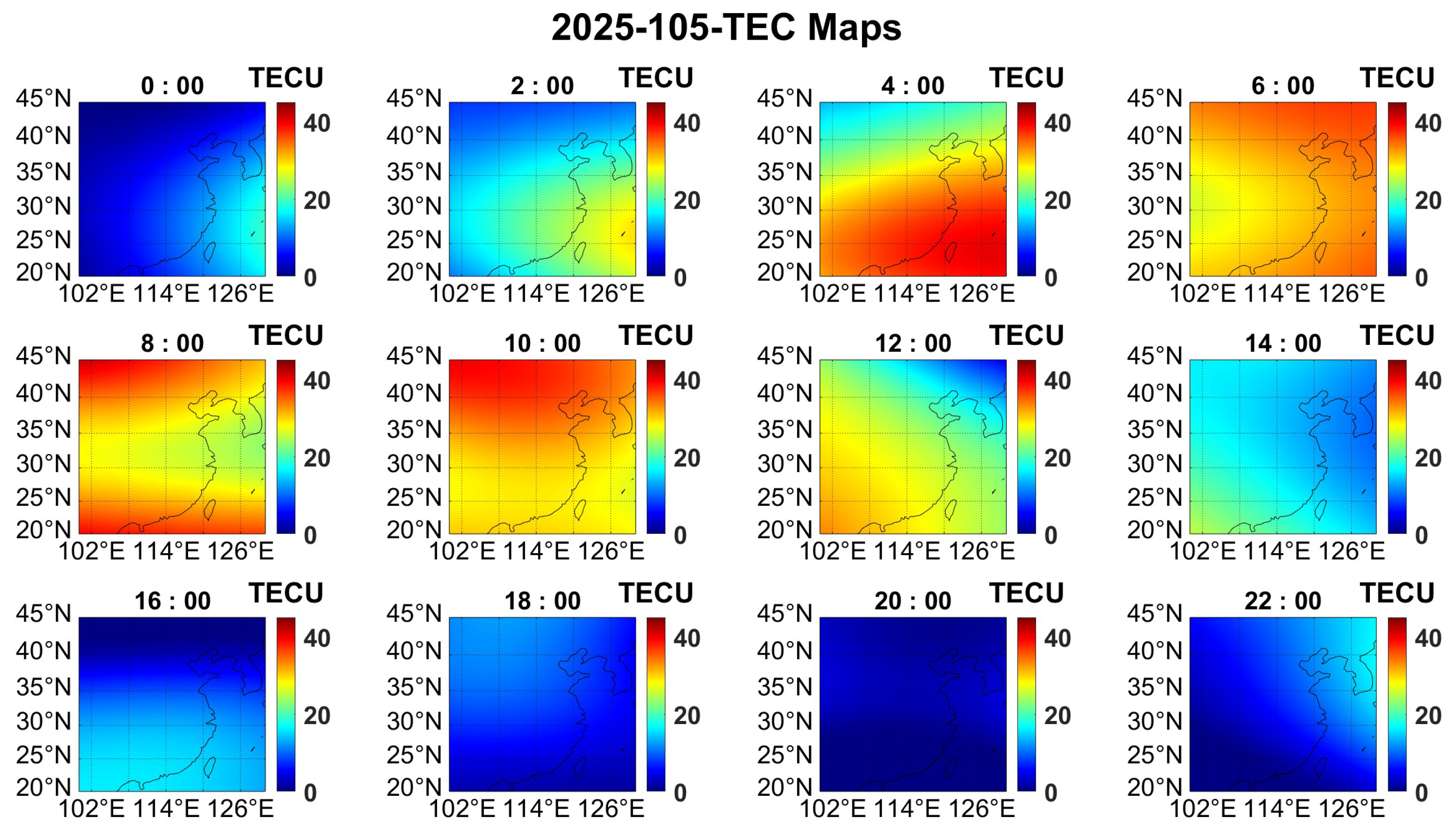
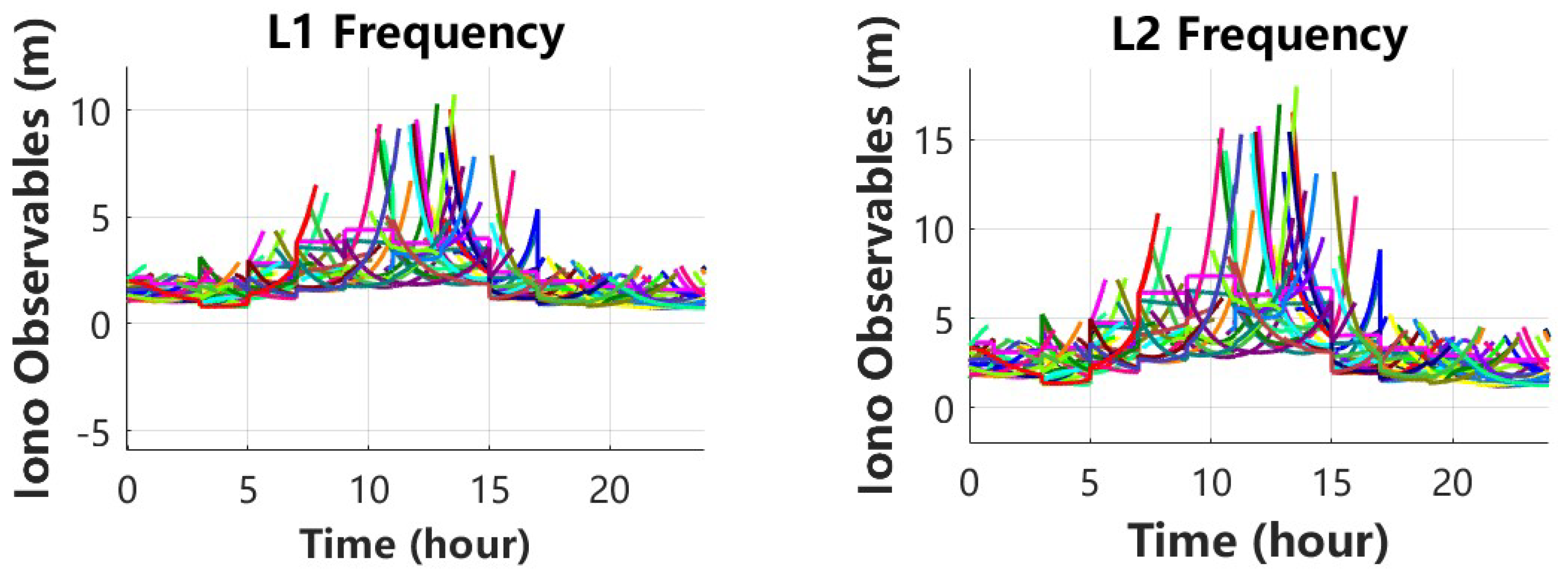
The cycle slip detection experiment in this section is based on simulation analysis with realistic ionospheric conditions using the observation data generated by the framework described in Section 2.1, with the constellation configurations specified in Section 3.1. To faithfully reproduce the ionospheric environment, real ionospheric data were obtained from ionospheric monitoring stations. The NeQuick model [37] was then employed to construct a regional ionospheric model, from which Vertical Total Electron Content (VTEC) values were derived. These VTEC values were incorporated into the simulated GNSS and LEO carrier phase observations to account for the actual ionospheric delay effects. The VTEC estimates obtained from the regional ionospheric model are shown in Figure 6, whereas the corresponding ionospheric delays on the L1 and L2 frequencies recorded on 14 May 2024 are presented in Figure 7. The results indicate that positioning errors of up to 10 m can occur between 10:00 and 15:00 UTC, highlighting the need for a systematic evaluation of the effects of ionospheric error on the performance of the IPGC algorithm.
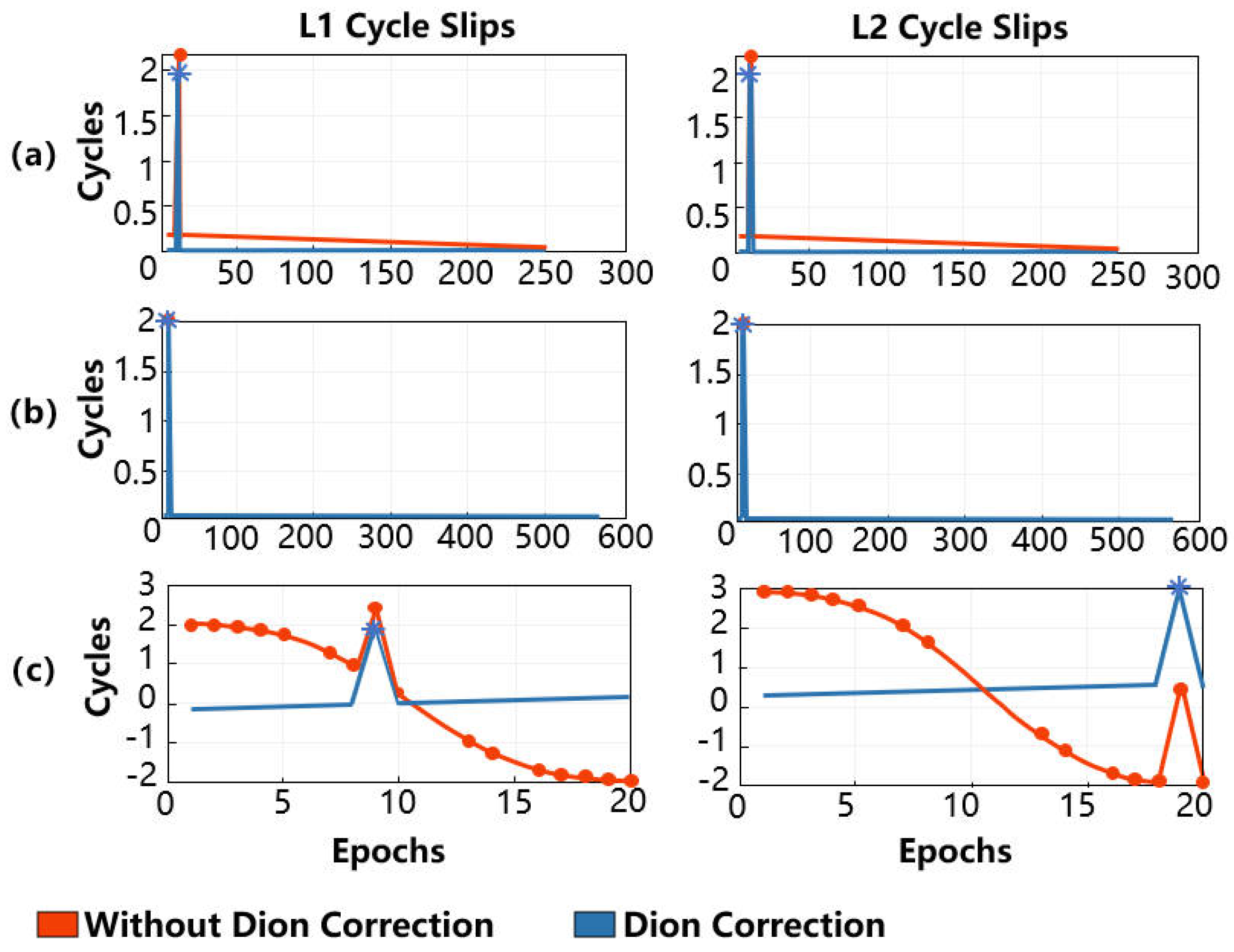
With respect to the GPS, BDS, and LEO, the experiments used a 30 s sampling interval and a 2 h processing span. To quantitatively assess the necessity of ionospheric preprocessing, a comparative experiment was conducted by incorporating 2-cycle slips at epochs 10 (L1 frequency) and 20 (L2 frequency). The detection performance of the IPGC method was compared with and without ionospheric correction. The ionospheric delay characteristics of dual-frequency observations from the GPS, BDS, and LEO systems are presented in Figure 8. The results indicate that the IPGC method accurately detects cycle slips for GPS and BDS systems (with or without ionospheric correction). For LEO satellites, without ionospheric correction, ionospheric delays introduce cycle slips to the carrier phase observations up to 4 cycles. This method can solve the effects of ionospheric delays on LEO satellites. The comparative results confirm that the critical role of ionospheric correction preprocessing in the IPGC method for enabling high-sensitivity cycle slip detection.

3.3. Performance Comparison

3.3.1. Comparison of Methods

(1)
Simulated Cycle Slip Scenario
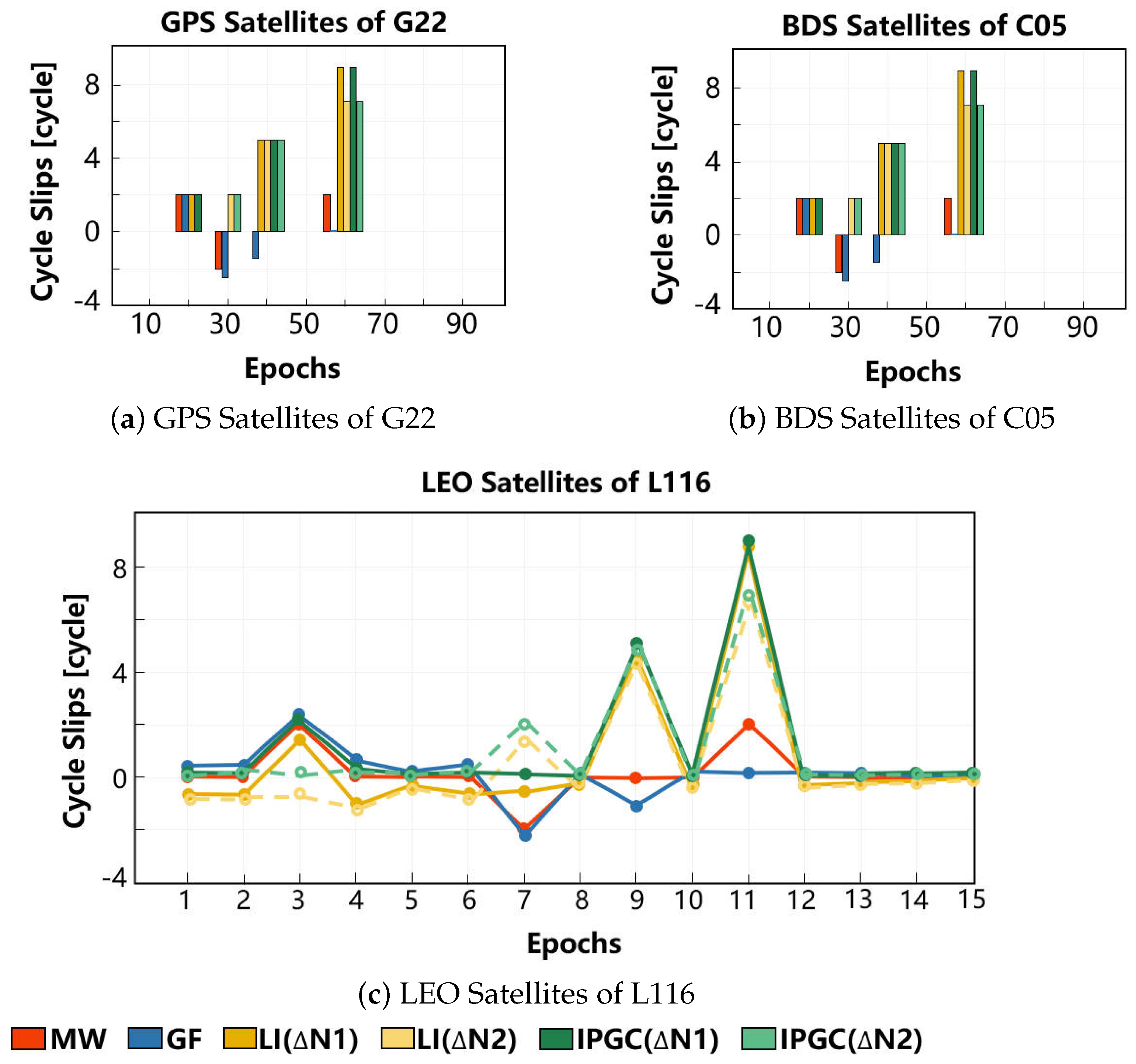
Building upon the same simulation platform and constellation configuration as in Section 3.2, the experiments used a 30 s sampling interval and a 24 h processing span with respect to the GPS, BDS, and LEO. Table 3 presents the simulated cycle slip scenarios and detection results for the three systems and compares the system performance of the MW [38,39], GF [40], LI [23], and proposed IPGC methods. A comparison of the four methods is shown in Figure 9. In terms of the GPS and BDS in Figure 9a,b, when the four cycle slip pairs ( 2 ,   0 ) , ( 0 ,   2 ) , ( 5 ,   5 ) , and ( 9 ,   7 ) are processed, the MW method outputs 2, 2 , 0, and 2, respectively. The GF method yields 2, −2.57/−2.59, −1.42/−1.47, and 0.05 . These results indicate that the MW and GF cannot correctly identify all cycle slip pairs. MW on ( 5 ,   5 ) and GF on ( 9 ,   7 ) are nearly undetectable for some pairs. In contrast, the LI and IPGC correctly identify all pairs in the GPS and BDS, with the estimates matching the true slips. With respect to the LEO in Figure 9c, MW and GF exhibit the same behavior.
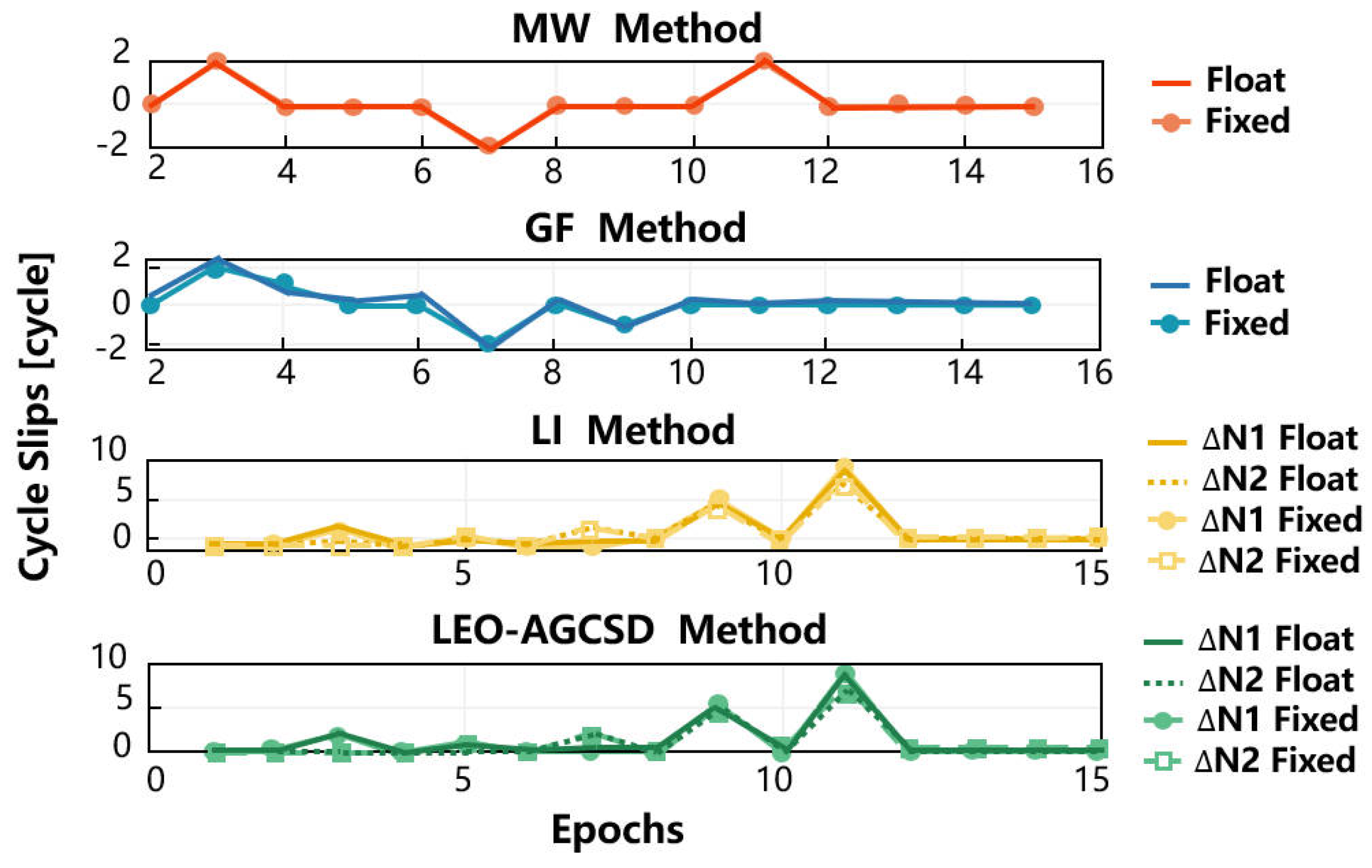
After the float slips are fixed with the LAMBDA method in Figure 10, the LI estimates deviate markedly from the true LEO cycle slips. With respect to true slip ( 5 ,   5 ) , the LI deviates by nearly 0.5 cycles; with respect to true slip ( 9 ,   7 ) , the error is approximately 0.2 cycles. These errors can easily lead to systematic deviations of one cycle in the integer fixed process. In contrast, the IPGC method yields results with minimal deviation from the actual cycle slip values in terms of LEO systems, with a maximum deviation not exceeding 0.14 cycles. These findings reveal the superior performance of the IPGC for low Earth orbit observations. Based on the optimality criterion, this research selects the coefficient combinations ( A , B ) as ( 4 ,   5 ) and ( 3 ,   4 ) , respectively. The corresponding standard deviations σ IPGC are ( 0.19 ,   0.20 ) . The Bootstrapping success rate reaches 98.1%. In the following, we perform cycle slip threshold detection and residual verification for the IPGC method under the LEO scenario. The results shown in Table 4 indicate that the selected coefficient combinations can guarantee that the maximum residuals remain well below the 3 σ IPGC limit, while the zero components do not trigger false alarms, ensuring no false detections and all integer fixings are correct. The IPGC yields more accurate slip estimates while maintaining detection rates and eliminates the systematic biases typical of integer fixing.
(2)
Real Data Validation
To further validate the proposed IPGC method under realistic ionospheric conditions, real observation data from the Wuhan monitoring station on 11 May 2024 were used. This date was selected because a strong geomagnetic storm ( K p 7 ) occurred, producing significantly elevated ionospheric disturbances that represent a challenging scenario for cycle slip detection. The raw dual-frequency observations were preprocessed to ensure that no pre-existing cycle slips remained, while preserving the strong ionospheric delay signatures. Cycle slips identical to those in the simulation experiment— ( 2 ,   0 ) , ( 0 ,   2 ) , ( 5 ,   5 ) , and ( 9 ,   7 ) —were then artificially injected at the same designated epochs for the GPS and BDS systems. The MW, GF, LI, and IPGC methods were applied and compared.
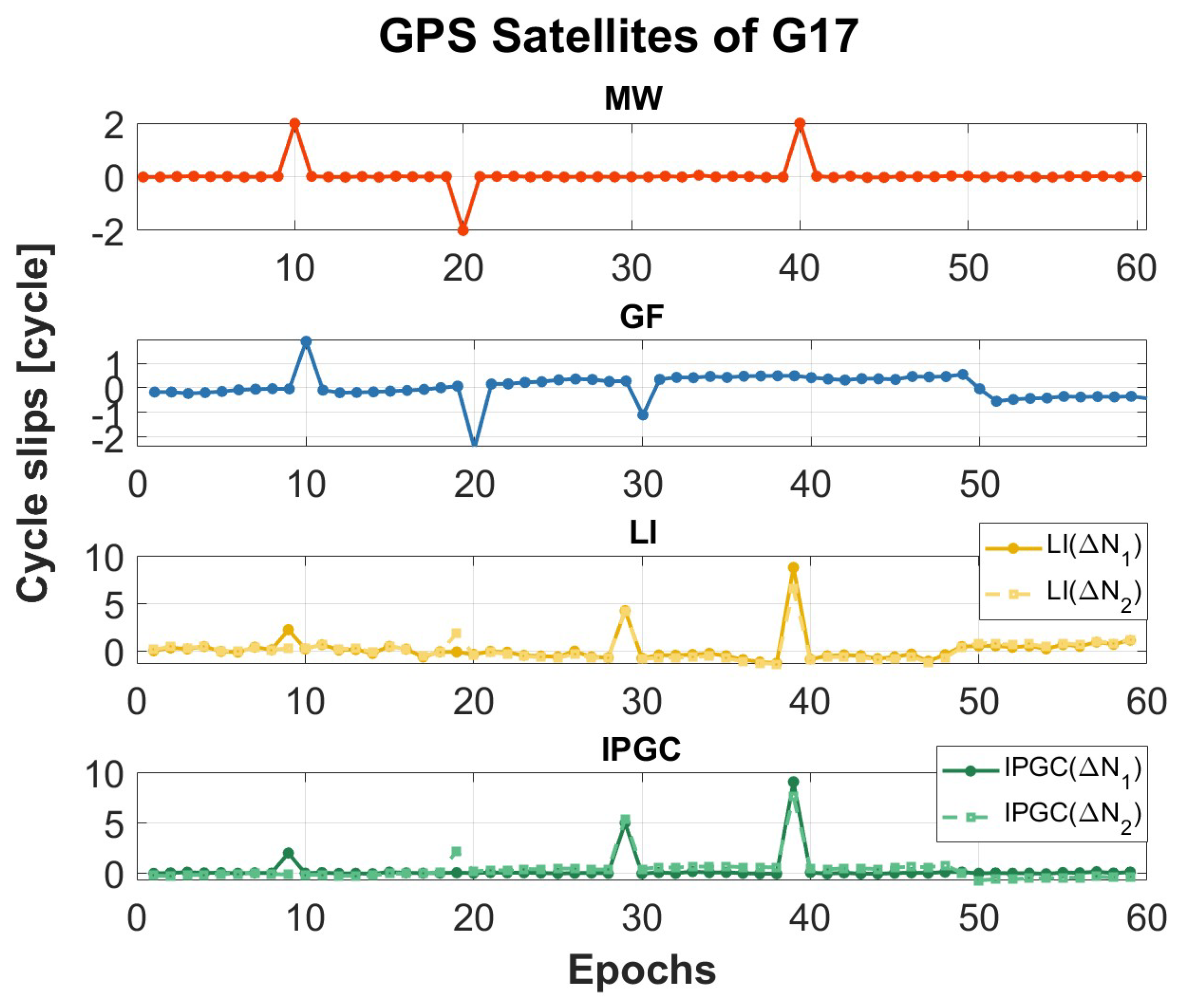
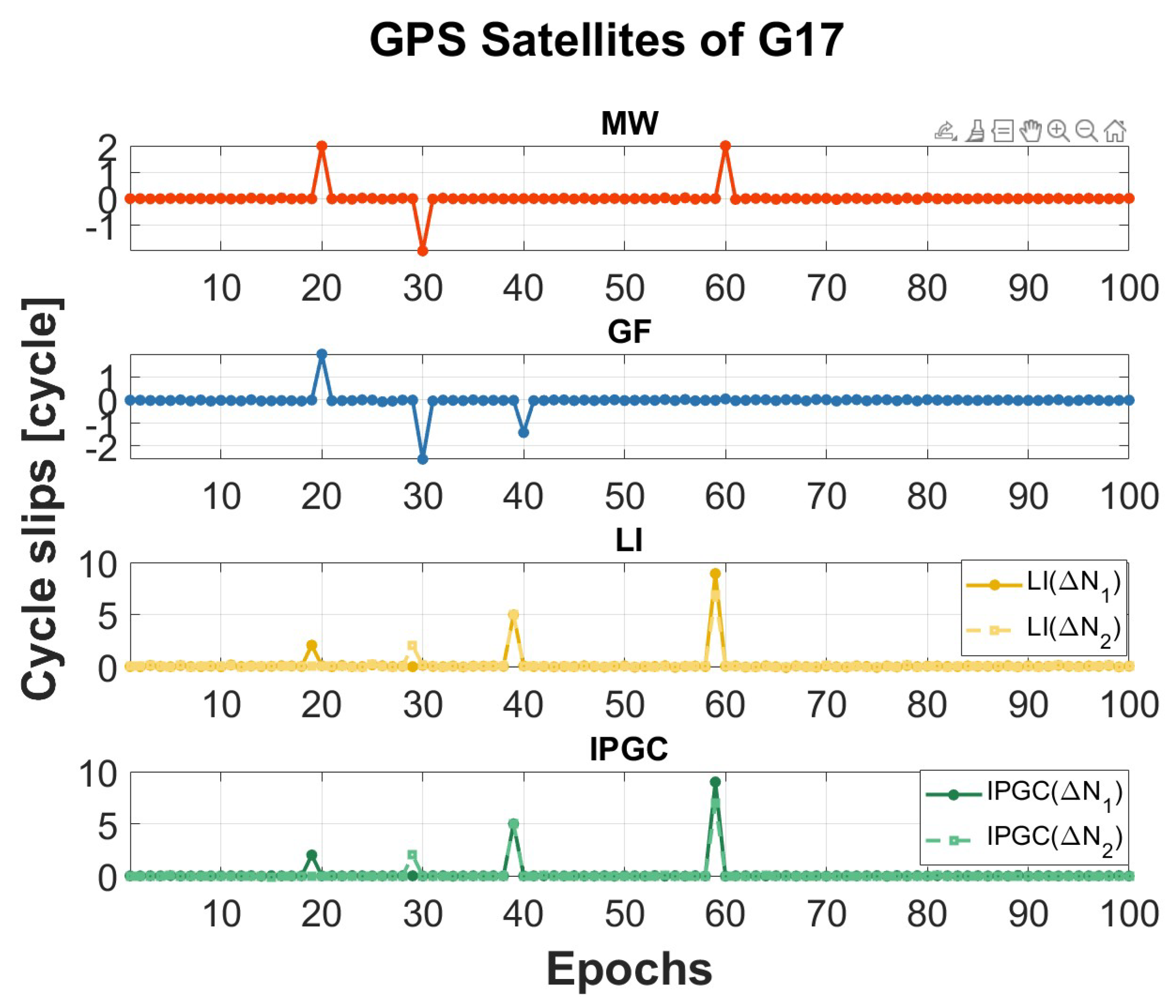
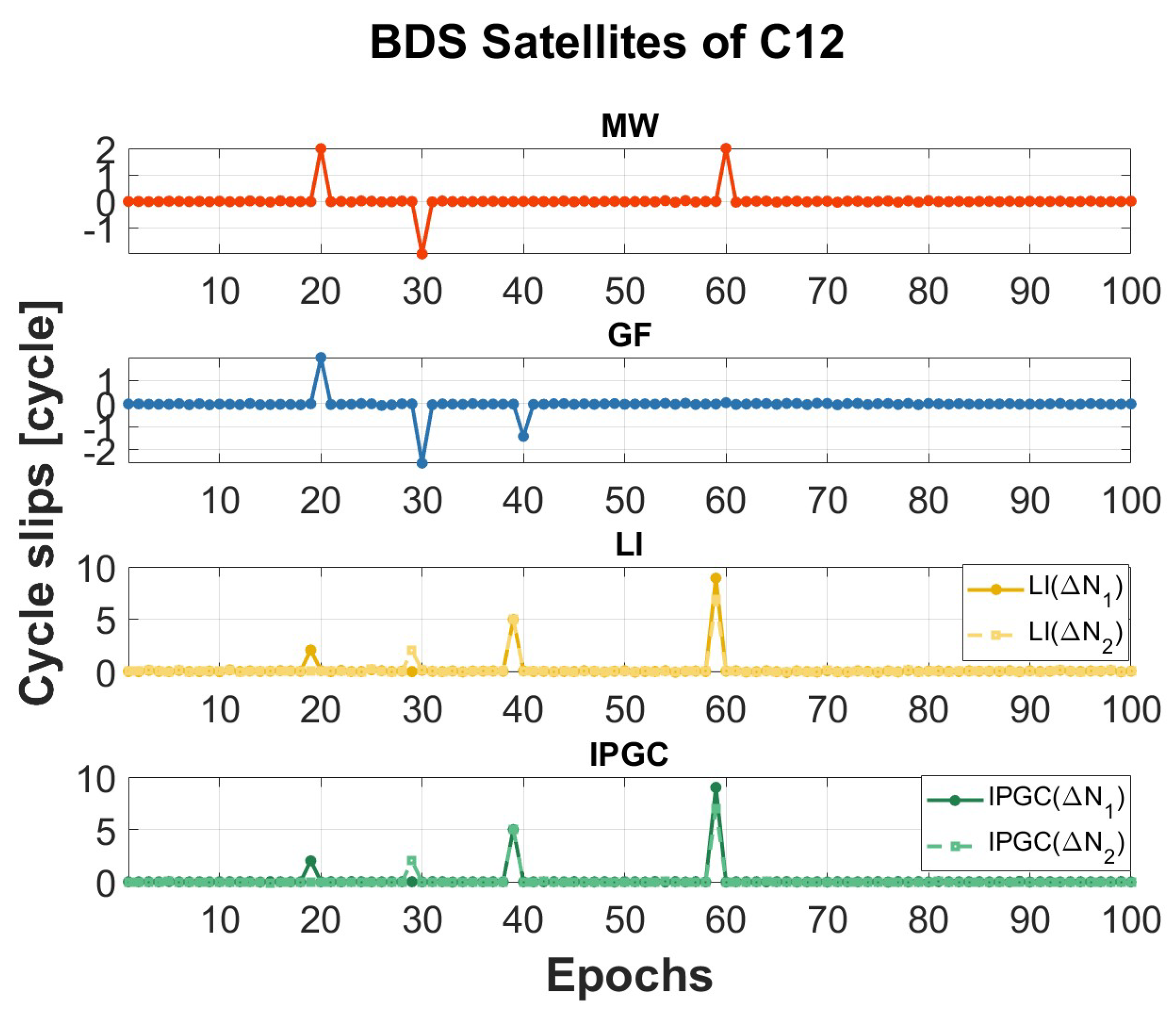
Table 5 summarizes the detection results at the standard 30 s sampling rate, and Figure 11 and Figure 12 illustrate the detection time series for GPS satellite G17 and BDS satellite C12, respectively. Consistent with the simulation findings in Section 3.3.1, the MW method fails to resolve the equal-ratio cycle slip pair ( 5 ,   5 ) , yielding values of only 0.22 and 0.26 for the GPS and BDS, respectively. The GF method remains insensitive to the ( 9 ,   7 ) pair, producing values of 0.23 (GPS) and 0.31 (BDS) that are far below the detection threshold. In contrast, both the LI and IPGC methods correctly identify all four cycle slip pairs on both frequencies for both systems.
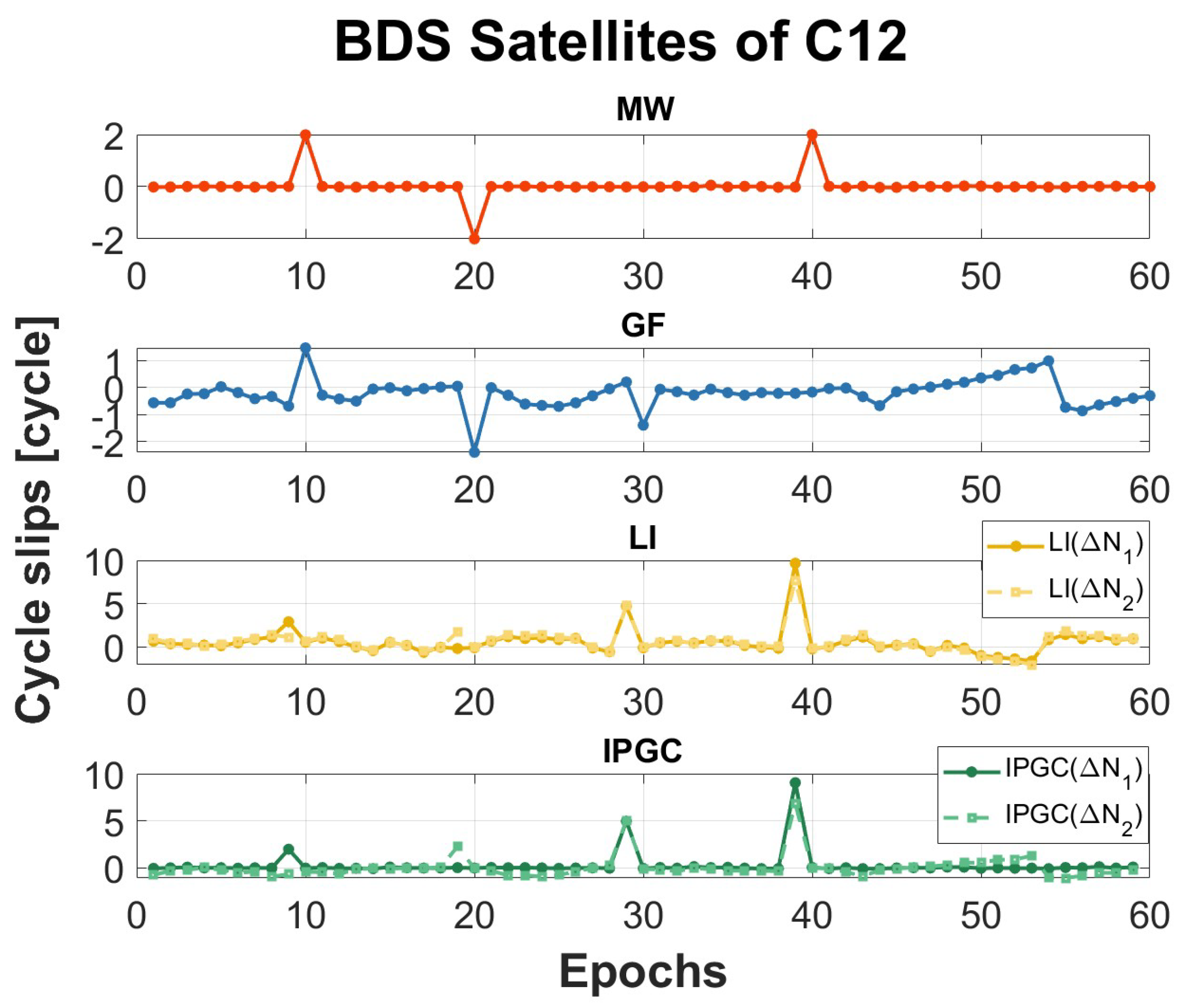
To emulate the large inter-epoch ionospheric variations experienced by LEO satellites using real GNSS data, the sampling interval was increased to 300 s. This significantly amplifies the ionospheric delay change between consecutive epochs, reproducing the condition in which the satellite–ionosphere piercing point traverses a large spatial extent between observations, analogous to the high-speed motion of LEO satellites. Cycle slip pairs were inserted at epochs 10, 20, 30, and 40. The detection results are presented in Table 6, and Figure 13 and Figure 14 depict the time series for GPS G17 and BDS C12.
Under this extended sampling interval, the MW and GF methods exhibit the same structural limitations as in the 30 s case: MW cannot detect the ( 5 ,   5 ) pair (outputs of 0.36/−0.36), and GF remains insensitive to the ( 9 ,   7 ) pair (outputs of 0.41/−0.35). More importantly, the enlarged ionospheric variation between epochs significantly degrades the performance of the LI method. For example, the LI estimates for the GPS ( 0 ,   2 ) pair are ( 0.46 , 1.55 ) , corresponding to per-component deviations of 0.46 and 0.45 cycles; for the GPS ( 5 ,   5 ) pair, the LI estimates are ( 4.56 ,   4.52 ) . Across both systems, the LI method exhibits a maximum deviation of up to 0.48 cycles on individual frequency components, which critically endangers correct integer rounding during the LAMBDA fixing stage.
In comparison, the IPGC method demonstrates substantially better robustness. For the majority of cycle slip pairs, the IPGC float estimates remain close to the true values. The most notable deviations occur for the ( 2 ,   0 ) pair under the 300 s interval, where the GPS estimate is ( 1.92 ,   0.14 ) and the BDS estimate is ( 1.78 ,   0.29 ) . These represent the worst case IPGC deviations of 0.22 and 0.29 cycles, respectively. The residual test confirms that the maximum post-repair residuals remain well below the 3 σ IPGC limit, ensuring that the LAMBDA integer fixing produces the correct solution. Overall, the IPGC method maintains reliable detection and repair performance across all tested cycle slip pairs under severe ionospheric conditions, confirming its advantage over the LI method in scenarios with large inter-epoch ionospheric delay variations.

3.3.2. Signal Blocking Conditions

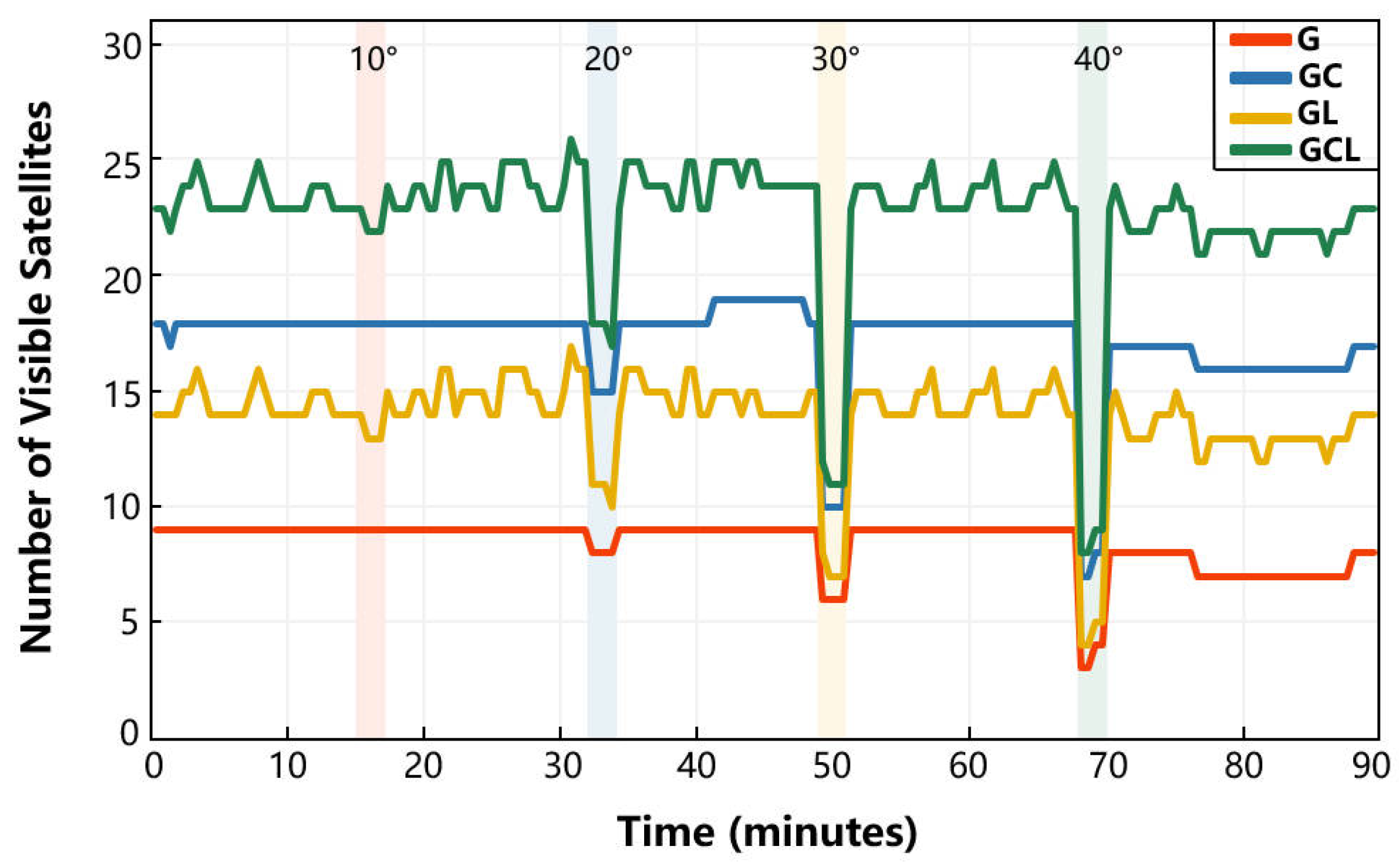
The number of visible satellites over 1.5 h for different system combinations in the mountainous urban environment of Guilin is shown in Figure 15, and the effects of different cutoff elevation angles on visibility are examined. As the cutoff angle increases, the number of visible satellites decreases markedly. At a cutoff angle of 40 , even with all three systems combined, only eight satellites remain visible. In urban areas with mountains and forests, signal blockage directly decreases the continuity and geometric strength of observations. At different levels of signal obstruction, the IPGC method achieves stable positioning and consistent accuracy.
To comprehensively evaluate the performance of different cycle slip detection algorithms under simulated signal blockage conditions, three conventional methods of MW, GF, and LI are introduced as baselines for comparison with the proposed IPGC method. Consistent with Section 3.3.1, the same four cycle slip pairs are simultaneously injected into the GPS + BDS + LEO system at two-hour intervals under elevation cutoff angles of 10 , 20 , 30 , and 40 .
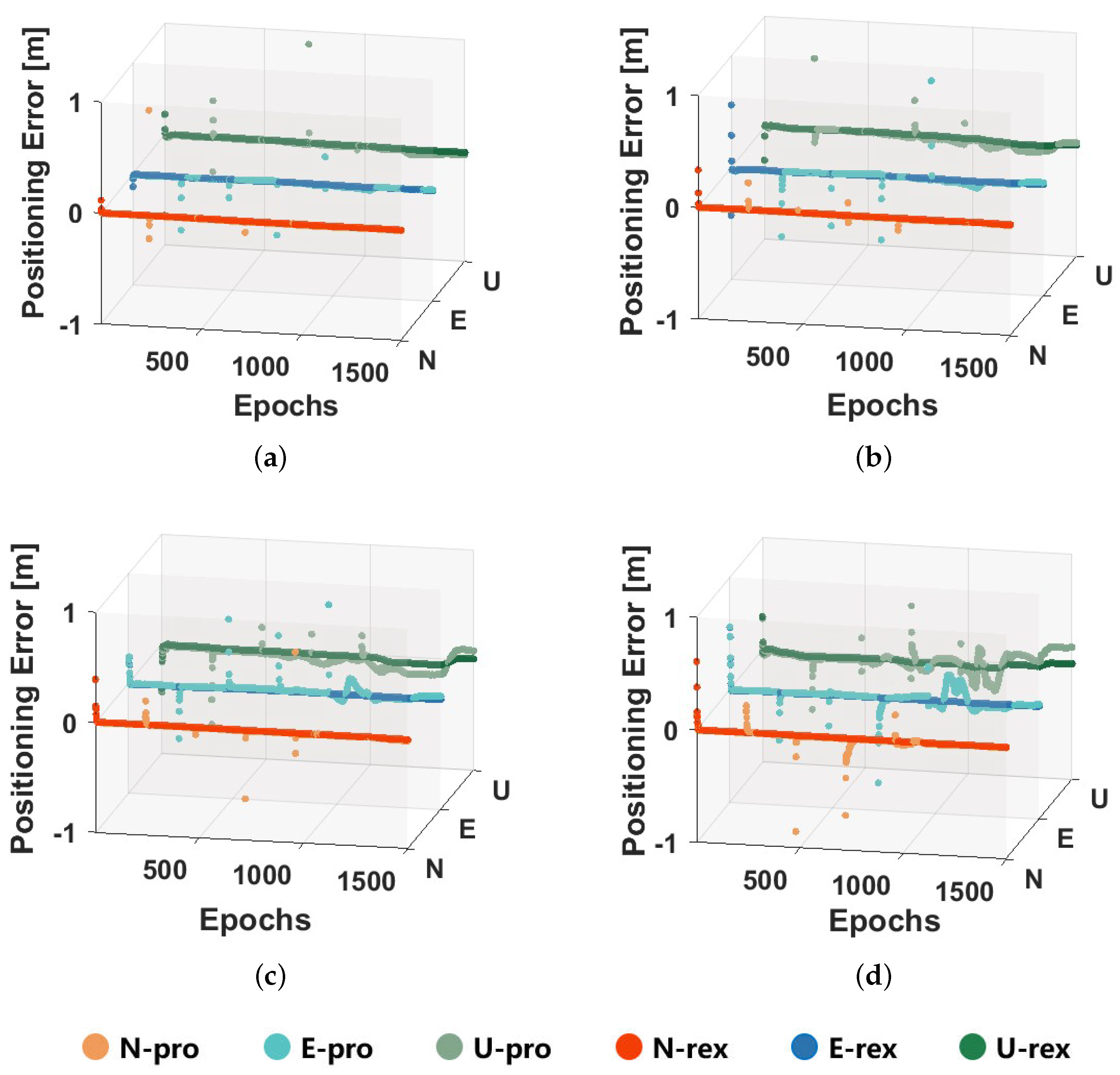
Convergence performance of the IPGC method before and after cycle slips at various elevation angles is shown in Figure 16. The convergence performance before and after the cycle slip is analyzed below. As the cutoff angle increases, the localization convergence performance deteriorates significantly without repair of the cycle slip. Table 7 presents the positioning accuracy of the three system combinations in the north, east, and up directions. With fixed slips, in the north direction, the positioning accuracy improves by 63.81 % , 59.83 % , 60.45 % , and 83.60 % from 10 to 40 . In the east direction, the errors increase by 68.51 % , 79.36 % , 88.98 % , and 95.28 % . In the up direction, the errors increase by 69.85 % , 69.13 % , 63.71 % , and 77.54 % . After the IPGC cycle slip correction is applied, the system achieves stable convergence even under severe conditions with a cutoff angle of 40 .
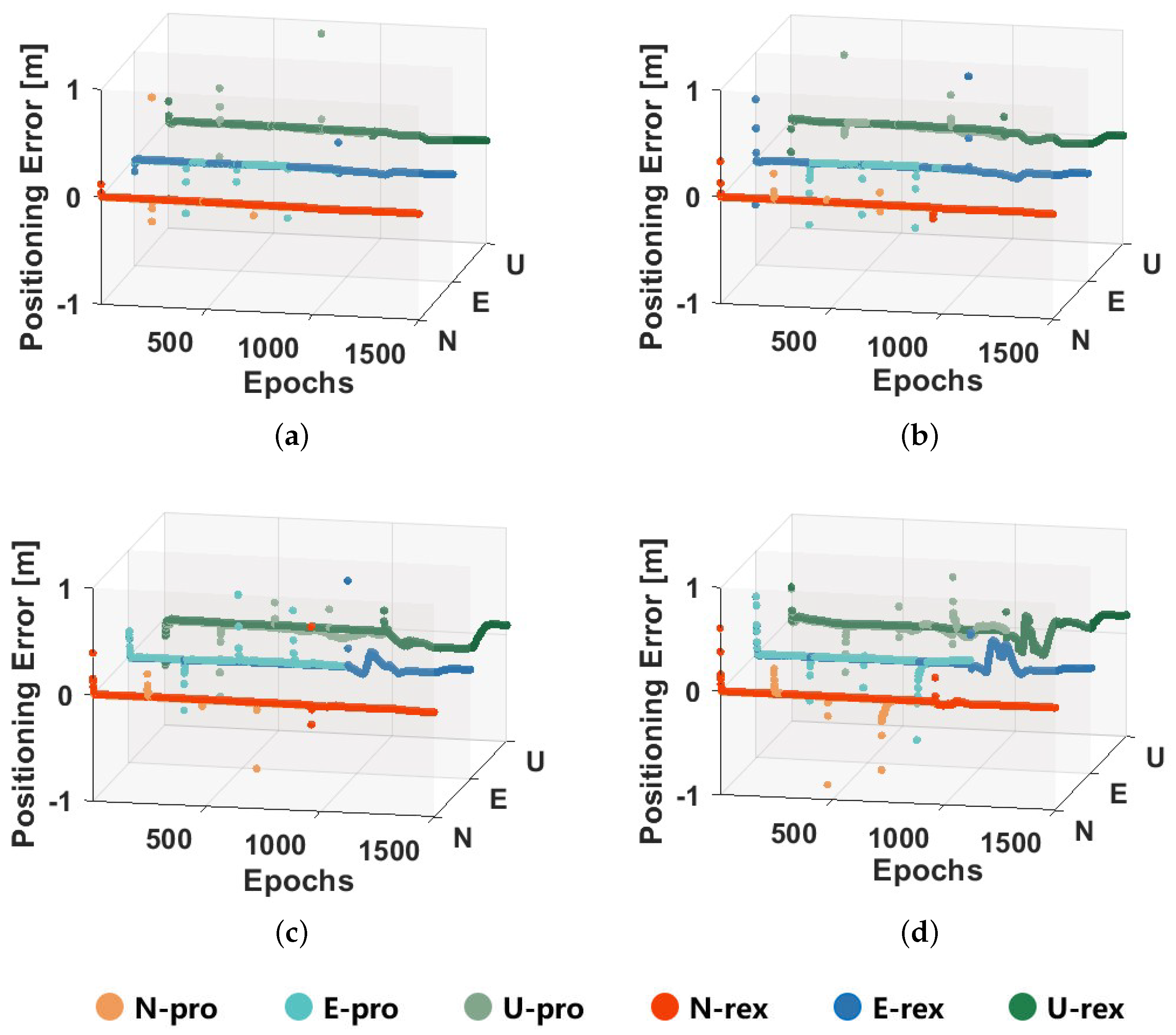
As analyzed in Section 3.3.1, the MW combination is inherently unable to detect the equal-value cycle slip pair ( 5 ,   5 ) . Figure 17 and Table 8 present the PPP positioning results using the MW method at the four elevation cutoff angles. At 10 and 20 , the MW method repairs the detectable cycle slip pairs ( 2 ,   0 ) , ( 0 ,   2 ) , and ( 9 ,   7 ) , achieving improvement rates of up to 71.47% and 76.78% in the U and E components, respectively. However, the unrepaired ( 5 ,   5 ) pair still introduces residual positioning disturbances. At 30 , the N and E components exhibit negative improvement rates of 5.08 % and 14.63 % , indicating that the positioning accuracy after MW repair is worse than that without correction. This is because, under reduced satellite visibility, the unrepaired ( 5 ,   5 ) cycle slips carry amplified weight in the solution, and the partial repair of other pairs introduces ambiguity inconsistencies that further degrade the positioning performance. At 40 , although the improvement rates recover to over 80%, the residual errors (0.48/1.56/4.82 cm in N/E/U) remain considerably larger than those of the IPGC method, confirming the inherent limitation of the MW combination under signal-blockage conditions.
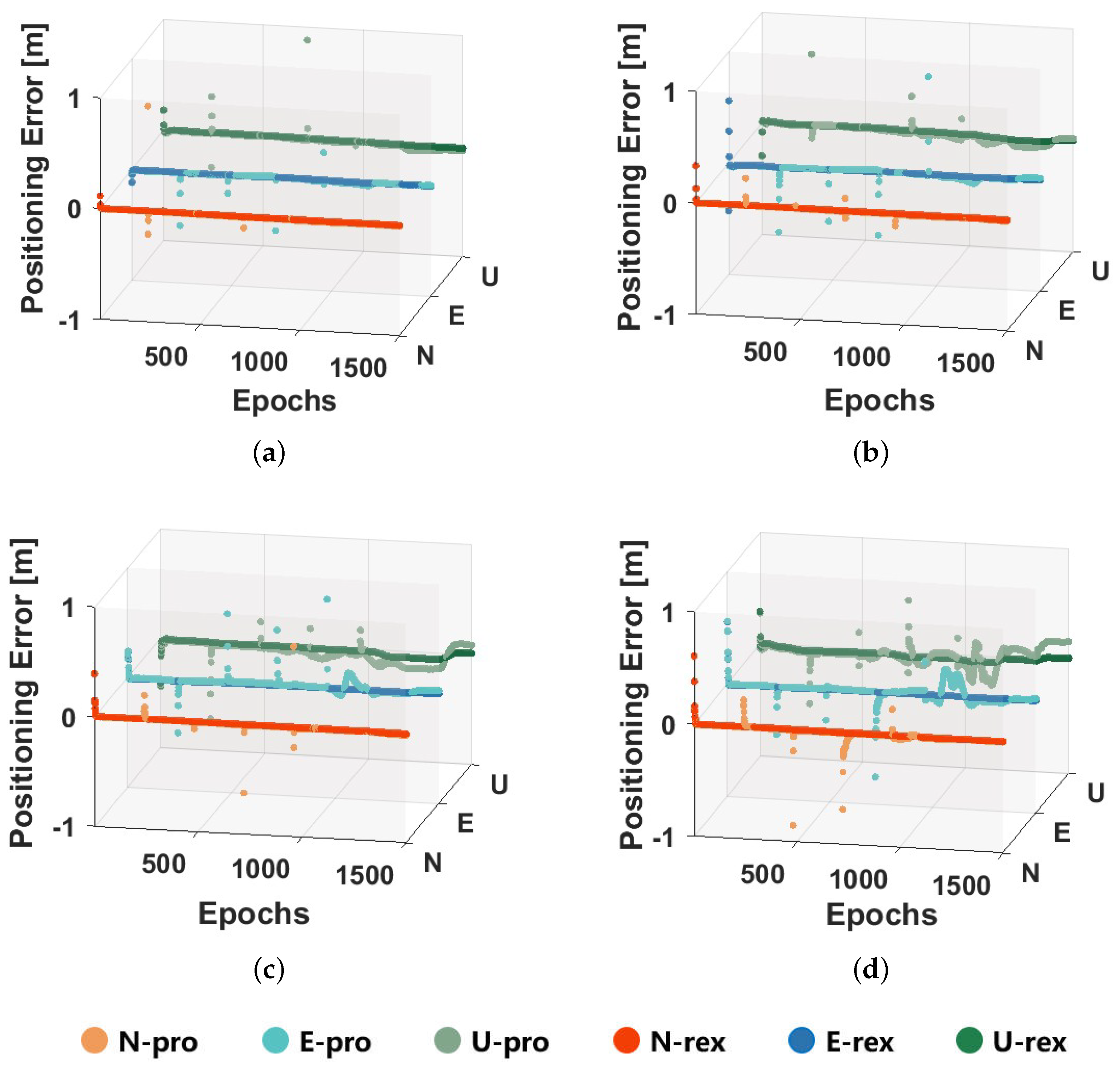
The GF combination fails to detect the insensitive cycle slip pair ( 9 ,   7 ) , as its detection value falls well below the threshold. Figure 18 and Table 9 present the PPP results using the GF method at the four elevation cutoff angles. At 10 30 , the GF method achieves positive improvement rates in most components, with the E component reaching up to 84.15% at 30 . However, at 40 , all three components exhibit negative improvement rates ( 10.50 % / 9.11 % / 12.78 % in N/E/U), indicating that the unrepaired ( 9 ,   7 ) cycle slips, combined with the severely degraded satellite geometry, cause the corrected solution to perform worse than the uncorrected one.
Unlike the MW and GF combinations, the LI method is capable of detecting and repairing all four types of cycle slip pairs, including the insensitive pairs ( 5 ,   5 ) and ( 9 ,   7 ) . Figure 19 and Table 10 present the PPP positioning results using the LI method at the four elevation cutoff angles. At 10 40 , which confirms the effectiveness of the LI method in handling all tested cycle slip types. Nevertheless, as the cutoff angle increases from 10 to 40 , the reduced number of visible satellites weakens the geometric configuration, leading to gradually degraded positioning accuracy. The RMS errors increase from 0.59/1.25/2.41 cm (N/E/U) at 10 to 0.86/1.52/6.41 cm at 40 , with the U component being the most affected. Compared with the proposed IPGC method (Table 7), the LI method yields noticeably larger residual errors at most cutoff angles. For instance, at 10 , the RMS errors of the LI method (0.59/1.25/2.41 cm) are 55.3%/15.7%/29.6% larger than those of the IPGC method (0.38/1.08/1.86 cm); at 40 , the differences become even more pronounced, with the LI errors (0.86/1.52/6.41 cm) exceeding those of the IPGC method (0.63/1.12/5.66 cm) by 36.5%/35.7%/13.3%, respectively. This is because the LI combination relies solely on carrier-phase geometry-free observations, which are more susceptible to observation noise and multipath effects, especially under weak satellite geometry. In contrast, the IPGC method integrates multi-frequency pseudo-range and carrier-phase information with an optimized combination strategy, enabling more precise cycle slip estimation and thus superior positioning performance under all tested conditions.

3.4. Analysis of PPP Positioning Convergence and Accuracy

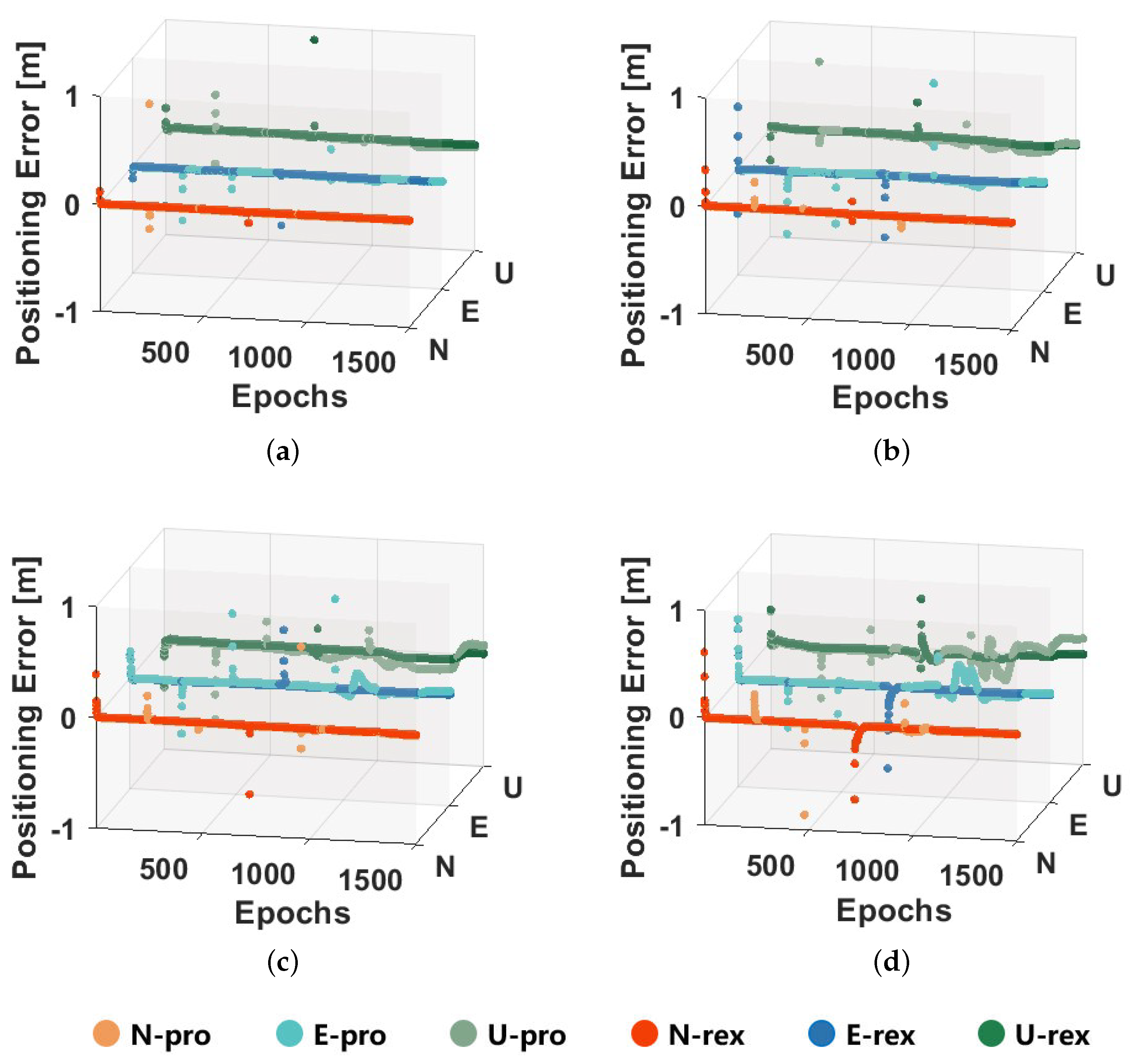
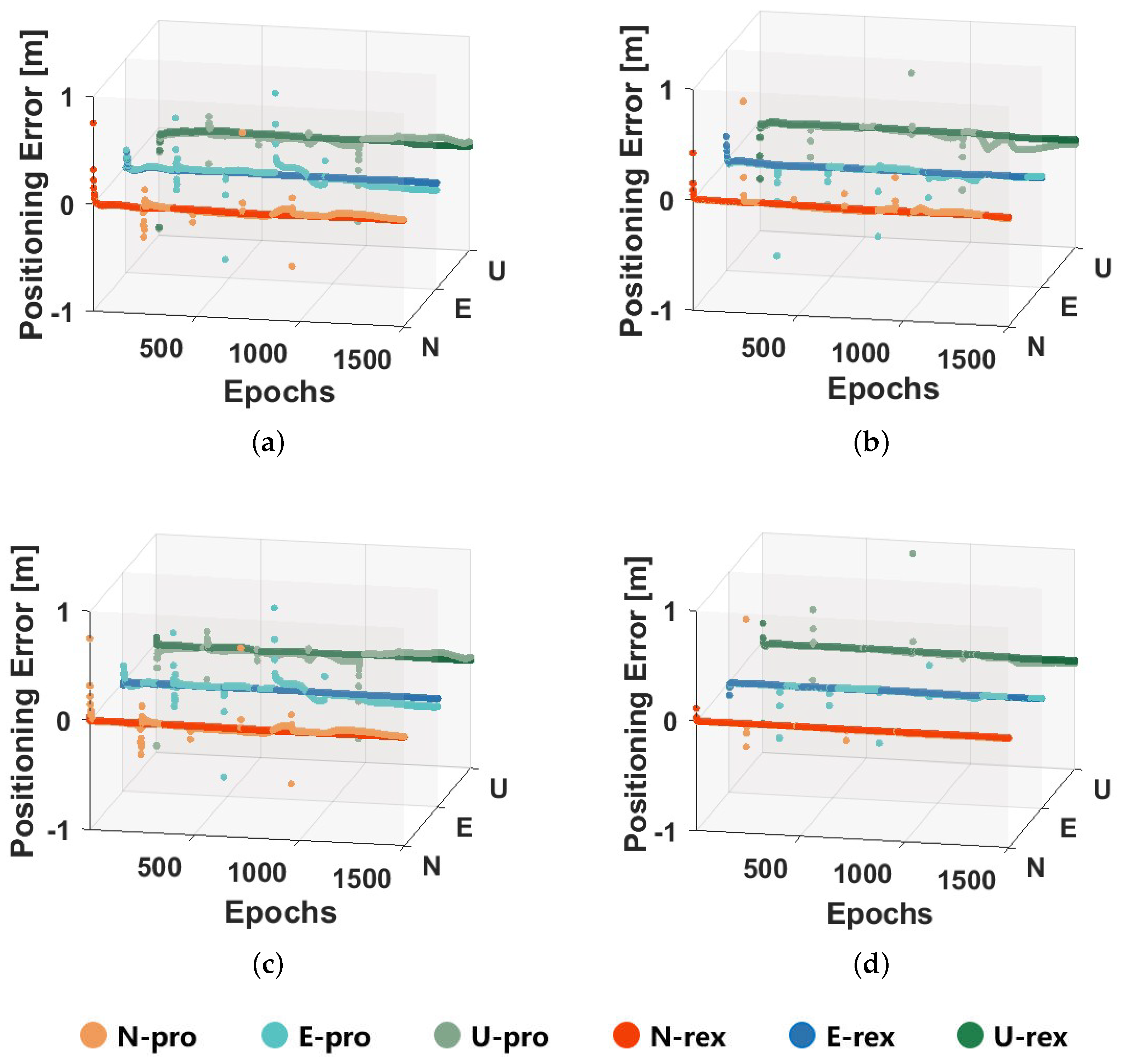
In this experiment, four constellation configurations are compared: GPS-only, GPS + BDS, GPS + LEO, and GPS + BDS + LEO. The analysis uses the same cycle slip settings as in the previous experiment. In Figure 20, the orange, cyan and light green points represent PPP solutions without cycle slip detection and repair, whereas the red, blue and green points represent PPP solutions with cycle slip detection and repair.
Table 11 also presents the convergence time and positioning accuracy across different system combinations. In this research, the convergence time is defined as the duration from the start of the first epoch until the positioning errors for each component (North, East, and Up) fall below 10cm. With the inclusion of LEO satellites, the convergence time is greatly reduced, and the positioning accuracy is markedly improved. With respect to convergence time, the convergence times of the GPS + BDS + LEO model are 0.96 , 0.89 , and 1.20 min for the north, east, and up components, respectively. The GPS + BDS system requires 4.8 , 4.5 , and 1.8 min in the three directions. Compared with the GPS + BDS system, the combination of the three systems significantly reduces the convergence time. The addition of LEO satellites reduces the horizontal convergence time by approximately 80 % . With respect to the reconvergence capability after cycle slip correction, the GPS + BDS + LEO combination requires only 0.5 , 1.0 , and 1.5 min to recover, whereas the standalone GPS system requires 5.0 , 5.5 , and 3.0 min. Specifically for the north component, the three-system combination converges in only one-tenth the time of that of the GPS alone. In terms of positioning accuracy, the GPS + BDS + LEO combination achieves high precision values of 0.38 , 1.08 , and 1.86 cm, representing a significant improvement over the values of 1.42 , 2.12 , and 3.20 cm achieved by the standalone GPS system. The accuracy of the northward component has increased by 73 % , whereas that of the upward component has increased by 42 % . The IPGC method accurately identifies cycle slips, specifically for LEO observations. After slip correction, multiple system combinations exploit their geometric advantages to achieve rapid reconvergence.

4. Discussion

This study develops and evaluates the IPGC method, which uses a two-stage processing strategy to address cycle slip detection challenges in LEO satellite-augmented, multi-GNSS PPP systems. First, carrier phase observations are preprocessed through the NeQuick model to mitigate ionospheric delay variations. Second, optimized combination coefficients are derived to achieve high-sensitivity cycle slip detection while eliminating geometric and clock bias terms. Experimental validation demonstrates the capability of IPGC in cycle slip detection and repair under signal obstruction conditions, multiple satellite system combinations, and high masking environments.
Compared with conventional MW, GF, and LI methods, the IPGC approach effectively mitigates cycle slips induced by significant interepoch ionospheric variations resulting from the rapid motion of the LEO. When actual cycle slip values of ( 2 ,   0 ) , ( 0 ,   2 ) , ( 5 ,   5 ) , and ( 9 ,   7 ) are tested, the method achieves detection results with minimal deviations not exceeding 0.14 cycles.
With elevation cutoff angles of 10 , 20 , 30 , and 40 , the positioning convergence time improvements after IPGC-based cycle slip detection and repair are 63.81 % , 59.83 % , 60.45 % , and 83.60 % in the north; 68.51 % , 79.36 % , 88.98 % , and 95.28 % in the east; and 69.85 % , 69.13 % , 63.71 % , and 77.54 % in the up direction, respectively.
Four distinct GNSS/LEO system configurations were analyzed. With LEO satellite integration, the convergence time of the GPS + LEO combination decreases to 1.2 , 1.08 , and 1.5 min in the N/E/U directions, respectively, an approximately 63 % improvement over that of GPS processing. After IPGC cycle slip detection and repair, the GPS + BDS + LEO integrated system achieves reconvergence within 1.0 , 2.5 , and 2.0 min, with positioning accuracy within 4 cm. Compared with the GPS + BDS system, the GPS + BDS + LEO combination decreases the convergence time to 0.96 , 0.89 , and 1.2 min, an improvement of approximately 65 % . The reconvergence requires only 0.5 , 1.0 , and 1.5 min to achieve positioning accuracy within 2 cm.
The research on LEO cycle slip detection accuracy under strong ionospheric conditions remains limited, making it a key focus for future work. With continued optimization of LEO data preprocessing models, improved PPP navigation and positioning performance is anticipated.

5. Conclusions

The rapid orbital motion of LEO satellites induces inter-epoch ionospheric delay variations orders of magnitude larger than those of MEO GNSS satellites, posing a fundamental barrier to reliable cycle slip detection. The proposed IPGC method addresses this barrier through a two-stage strategy. First, the NeQuick-based ionospheric preprocessing suppresses the dominant delay residuals. Then, optimized linear combination coefficients eliminate geometric and clock terms while preserving maximum sensitivity to cycle slips. Both simulation and real-data experiments confirm that the method effectively removes ionospheric-induced biases and correctly resolves all tested cycle slip pairs.
The reliable cycle slip correction by the IPGC method enables full exploitation of LEO geometric diversity for PPP convergence acceleration. The GPS + BDS + LEO configuration converges within approximately 1 min in horizontal components, reducing convergence time by 63% and 65% relative to GPS-only and GPS + BDS solutions, respectively. After repair, reconvergence is accomplished within 1.5 min, and centimeter-level accuracy is maintained even at a 40 elevation cutoff angle. These results demonstrate that cycle slip handling quality directly governs the convergence benefit attainable from LEO augmentation.
Several limitations warrant further investigation. The simulation framework does not fully replicate operational LEO constellation characteristics. Additionally, ionospheric correction performance under severe geomagnetic storms requires systematic validation with long-term real observations. Future work will focus on operational LEO data validation, adaptive coefficient selection for diverse constellation geometries, and computationally efficient ionospheric models suitable for real-time deployment.

Author Contributions

Conceptualization, X.J., Y.J. and X.S.; methodology, X.J.; validation, X.J. and J.L.; formal analysis, X.J. and X.S.; resources, F.Z. and S.R.; data curation, X.J. and J.L.; writing—original draft preparation, X.J.; writing—review and editing, X.J., J.L. and Y.J.; visualization, F.Z.; supervision, Y.J. and X.S.; project administration, X.S.; funding acquisition, X.J. All authors have read and agreed to the published version of the manuscript.

Funding

This research was partially supported by the National Key R&D Program of China (2025YFE0115800); the Guangxi Science and Technology Program (Grant No. Guike AB25069126); the National Natural Science Foundation of China (Grant Nos. U23A20280, 62471153); the Innovation Project of Guangxi Graduate Education (Grant No. YCBZ2024171); the 2022 Guangxi Universities Middle-aged and Young Teachers’ Scientific Research Basic Competency Improvement Project (Grant No. 2022KY0181); the Key Laboratory of Cognitive Radio and Information Processing, Ministry of Education, China (Grant No. CRKL230104); the Joint International Research Laboratory of Spatio-temporal Information and Intelligent Location Services, China (Grant No. C25GAH11); and the Guangxi Science and Technology Base and Talent Special Project: Research and Application of Key Technologies for Precise Navigation (Grant No. Gui Ke AD25069103).

Data Availability Statement

The multi-GNSS precise satellite clock products and SP3 precise orbit products for GPS and BDS used in this study are publicly available from the Crustal Dynamics Data Information System (CDDIS) at ftp://cddis.nasa.gov/gnss/products/ (accessed on 12 April 2026). The satellite and receiver antenna phase center correction file was obtained from the IGS Antenna Working Group at https://igs.org/wg/antenna/ (accessed on 12 April 2026). The GNSS and LEO simulated orbits, ground tracking observations, and experimental solutions can be made available by the corresponding author upon reasonable request.

Acknowledgments

The authors thank the reviewers for their beneficial comments and suggestions.

Conflicts of Interest

The authors declare no conflicts of interest. The funders had no role in the design of the study; in the collection, analyses, or interpretation of data; in the writing of the manuscript; or in the decision to publish the results.

References

  1. Ge, H.; Meng, G.; Li, B. LEO enhanced GNSS (LeGNSS) precise point positioning with emphasis on model comparison. Adv. Space Res. 2024, 74, 2156–2168. [Google Scholar] [CrossRef]
  2. Ge, H.; Li, B.; Jia, S.; Nie, L.; Wu, T.; Yang, Z.; Shang, J.; Zheng, Y.; Ge, M. LEO enhanced global navigation satellite system (LeGNSS): Progress, opportunities, and challenges. Geo-Spat. Inf. Sci. 2022, 25, 1–13. [Google Scholar] [CrossRef]
  3. Li, X.; Ma, F.; Li, X.; Lv, H.; Bian, L.; Jiang, Z.; Zhang, X. LEO constellation-augmented multi-GNSS for rapid PPP convergence. J. Geod. 2019, 93, 749–764. [Google Scholar] [CrossRef]
  4. Gao, G.; Zou, X.; Zhang, S.; Wei, H.; Kuang, K.; Zhu, K. Improved real-time cycle-slip detection for Low Earth Orbit satellites based on the dynamic force model. Adv. Space Res. 2023, 72, 1983–1993. [Google Scholar] [CrossRef]
  5. Teunissen, P.J.; Salzmann, M. A recursive slippage test for use in state-space filtering. Manuscripta Geod. 1989, 14, 383–390. [Google Scholar] [CrossRef]
  6. Bastos, L.; Landau, H. Fixing cycle slips in dual-frequency kinematic GPS-applications using Kalman filtering. Manuscripta Geod. 1988, 13, 249–256. [Google Scholar] [CrossRef]
  7. Teunissen, P. Quality control in integrated navigation systems. IEEE Aerosp. Electron. Syst. Mag. 2002, 5, 35–41. [Google Scholar] [CrossRef]
  8. Yang, Z.; Liu, X.; Guo, J.; Xia, Y.; Chang, X. An Enhanced Method for Detecting and Repairing the Cycle Slips of Dual-Frequency Onboard GPS Receivers of LEO Satellites. J. Sens. 2020, 2020, 8817626. [Google Scholar] [CrossRef]
  9. Gao, Y.; Zhang, Y. Pseudo-range phase method combined with ultra long wavelength combination detection and repair cycle slip. GNSS World China 2018, 43, 28–32. [Google Scholar]
  10. Zhang, Z.; Zeng, J.; Li, B.; He, X. Principles, methods and applications of cycle slip detection and repair under complex observation conditions. J. Geod. 2023, 97, 50. [Google Scholar] [CrossRef]
  11. Liu, Z. A new automated cycle slip detection and repair method for a single dual-frequency GPS receiver. J. Geod. 2011, 85, 171–183. [Google Scholar] [CrossRef]
  12. Li, P.; Jiang, X.; Zhang, X.; Ge, M.; Schuh, H. Kalman-filter-based undifferenced cycle slip estimation in real-time precise point positioning. GPS Solut. 2019, 23, 99. [Google Scholar] [CrossRef]
  13. Zhao, J.; Hernández-Pajares, M.; Li, Z.; Wang, L.; Yuan, H. High-rate Doppler-aided cycle slip detection and repair method for low-cost single-frequency receivers. GPS Solut. 2020, 24, 80. [Google Scholar] [CrossRef]
  14. Li, K.; Shen, Y.; Yue, X.; Jiao, Y.; Wang, K.; Yue, Z.; Xu, K. A modified cycle slip detection method with GNSS Doppler assistance and optimizing by adaptive threshold and sliding polynomial fitting. Int. J. Aerosp. Eng. 2023, 2023, 9421399. [Google Scholar] [CrossRef]
  15. Teunissen, P.J.G. Minimal detectable biases of GPS data. J. Geod. 1998, 72, 236–244. [Google Scholar] [CrossRef]
  16. De Jong, K.; Teunissen, P.J.G. Minimal detectable biases of GPS observations for a weighted ionosphere. Earth Planets Space 2000, 52, 857–862. [Google Scholar] [CrossRef]
  17. Teunissen, P.; De Bakker, P. Single-receiver single-channel multi-frequency GNSS integrity: Outliers, slips, and ionospheric disturbances. J. Geod. 2013, 87, 161–177. [Google Scholar] [CrossRef]
  18. Gao, C.; Jin, S.; Yuan, L. Ionospheric responses to the June 2015 geomagnetic storm from ground and LEO GNSS observations. Remote Sens. 2020, 12, 2200. [Google Scholar] [CrossRef]
  19. Beeck, S.; Mitchell, C.N.; Jensen, A.B.; Stenseng, L.; Pinto Jayawardena, T.; Olesen, D.H. Experimental determination of the ionospheric effects and cycle slip phenomena for Galileo and GPS in the Arctic. Remote Sens. 2023, 15, 5685. [Google Scholar] [CrossRef]
  20. Cai, C.; Liu, Z.; Xia, P.; Dai, W. Cycle slip detection and repair for undifferenced GPS observations under high ionospheric activity. GPS Solut. 2013, 17, 247–260. [Google Scholar] [CrossRef]
  21. Wei, H.; Li, J.; Zhang, S.; Xu, X. Cycle slip detection and repair for dual-frequency LEO satellite GPS carrier phase observations with orbit dynamic model information. Remote Sens. 2019, 11, 1273. [Google Scholar] [CrossRef]
  22. Zeng, J.; Geng, J.; Li, G.; Tang, W. Improving cycle slip detection in ambiguity-fixed precise point positioning for kinematic LEO orbit determination. GPS Solut. 2024, 28, 135. [Google Scholar] [CrossRef]
  23. Li, M.; Xu, T.; Guan, M.; Gao, F.; Jiang, N. LEO-constellation-augmented multi-GNSS real-time PPP for rapid re-convergence in harsh environments. GPS Solut. 2022, 26, 29. [Google Scholar] [CrossRef]
  24. Zhao, Q.; Pan, S.; Gao, C.; Gao, W.; Xia, Y. BDS/GPS/LEO triple-frequency uncombined precise point positioning and its performance in harsh environments. Measurement 2020, 151, 107216. [Google Scholar] [CrossRef]
  25. Paulet, T.; Cazabonne, B. An open-source solution for TLE based Orbit Determination. In Proceedings of the 8th European Conference on Space Debris, Darmstadt, Germany, 20–23 April 2021. [Google Scholar]
  26. Prol, F.S.; Bhuiyan, M.Z.H.; Kaasalainen, S.; Lohan, E.S.; Praks, J.; Çelikbilek, K.; Kuusniemi, H. Simulations of dedicated LEO-PNT systems for precise point positioning: Methodology, parameter analysis, and accuracy evaluation. IEEE Trans. Aerosp. Electron. Syst. 2024, 60, 6499–6516. [Google Scholar] [CrossRef]
  27. Huang, J.; Yang, R.; Gao, W.; Zhan, X. Geometric characterization on gnss direct position estimation in navigation domain. IEEE Trans. Aerosp. Electron. Syst. 2024, 60, 4105–4123. [Google Scholar] [CrossRef]
  28. Bahadur, B.; Nohutcu, M. PPPH: A MATLAB-based software for multi-GNSS precise point positioning analysis. GPS Solut. 2018, 22, 113. [Google Scholar] [CrossRef]
  29. Mei, D.; Ren, X.; Le, X.; Liu, H.; Zhang, X. Ionospheric tomography: A compressed sensing technique based on dictionary learning. IEEE Trans. Geosci. Remote Sens. 2023, 61, 5800410. [Google Scholar] [CrossRef]
  30. Schaer, S. Mapping and Predicting the Earth’s Ionosphere Using the Global Positioning System; Institut für Geodäsie und Photogrammetrie, Eidg. Technische Hochschule: Zurich, Switzerland, 1999; Volume 59. [Google Scholar]
  31. Bhardwaj, S.C.; Vidyarthi, A.; Jassal, B.; Shukla, A.K. Evaluation of seasonal variability of first-order ionospheric delay correction at L5 and S1 frequencies using dual-frequency NavIC system. Wirel. Pers. Commun. 2022, 126, 3345–3366. [Google Scholar] [CrossRef]
  32. Ning, Y.; Cui, J.; Zhao, W.; Chai, D.; Sun, Y.; Xing, J.; Wang, S. A novel cycle slips detection and repair method with AR model of BDS-3 dual-frequency signal in severe multipath environments. Appl. Sci. 2022, 13, 27. [Google Scholar] [CrossRef]
  33. Teunissen, P.J. Success probability of integer GPS ambiguity rounding and bootstrapping. J. Geod. 1998, 72, 606–612. [Google Scholar] [CrossRef]
  34. Teunissen, P.J. An optimality property of the integer least-squares estimator. J. Geod. 1999, 73, 587–593. [Google Scholar] [CrossRef]
  35. Li, X.; Yuan, Y.; Han, X.; Li, X.; Fu, Y. Toward wide-area and high-precision positioning with LEO constellation augmented PPP-RTK. IEEE Trans. Instrum. Meas. 2023, 73, 5500213. [Google Scholar] [CrossRef]
  36. Zhao, D.; Hancock, C.M.; Roberts, G.W.; Jin, S. Cycle slip detection during high ionospheric activities based on combined triple-frequency GNSS signals. Remote Sens. 2019, 11, 250. [Google Scholar] [CrossRef]
  37. Imad, M.; Grenier, A.; Zhang, X.; Nurmi, J.; Lohan, E.S. Ionospheric error models for satellite-based navigation—paving the road towards leo-pnt solutions. Computers 2023, 13, 4. [Google Scholar] [CrossRef]
  38. Melbourne, W.G. The case for ranging in GPS-based geodetic systems. In Proceedings of the First International Symposium on Precise Positioning with the Global Positioning System; US Department of Commerce Rockville: Rockville, MD, USA, 1985; pp. 373–386. [Google Scholar]
  39. Bezmenov, I.; Blinov, I.Y.; Naumov, A.; Pasynok, S. An algorithm for cycle-slip detection in a Melbourne–Wübbena combination formed of code and carrier phase GNSS measurements. Meas. Tech. 2019, 62, 415–421. [Google Scholar] [CrossRef]
  40. Ji, S.; Wang, Z.; Chen, W.; Weng, D.; Xu, Y.; Fan, S.; Huang, B.; Sun, G.; Wang, H.; He, Y. Geometry-free and non-geometry-free testing quantities for cycle slip detection and correction in case of strong atmospheric variations with static observations. Surv. Rev. 2014, 46, 104–111. [Google Scholar] [CrossRef]
Figure 1. Carrier phase cycle slips observed in GNSS and LEO satellite systems at identical time intervals ( t 1 , t 2 , t 3 ), with LEO exhibiting a higher frequency of cycle slips than GNSS.
Remotesensing 18 01199 g001
Figure 2. Flowchart of the GNSS and LEO Satellite Simulation System. The main components include STK-based constellation design, error modeling, and GNSS observation data generation.
Remotesensing 18 01199 g002
Figure 3. Flowchart of the IPGC-based cycle slip detection and correction algorithm for GNSS-LEO hybrid constellation systems.
Remotesensing 18 01199 g003
Figure 4. Schematic of GPS/BDS/LEO satellite constellations, with different colors representing distinct orbits: (a) GPS constellation, where the six colors correspond to the six orbital planes; (b) BDS constellation, where green denotes GEO orbits, yellow denotes IGSO orbits, and blue, cyan, and white represent the three MEO orbital planes; (c) LEO constellation, where the six colors correspond to the six orbital planes.
Remotesensing 18 01199 g004
Figure 5. Satellite visibility sky plots for the GPS, BDS, and LEO constellations: (a) satellite cutoff altitude angle of 10 and (b) satellite cutoff altitude angle of 40 . Different colors represent the trajectories of individual satellites, where prefixes G, C, and L denote GPS, BDS, and LEO satellites, respectively.
Remotesensing 18 01199 g005
Figure 6. VTEC value estimation using regional ionospheric models, which presents the diurnal VTEC distribution over East Asia on 14 May 2024, showing variations from 0 to more than 40 TECU.
Remotesensing 18 01199 g006
Figure 7. Ionospheric delay effects at L1 and L2 frequencies, where different colors represent the ionospheric delay variations of different LEO satellites. The ionospheric delay variations between consecutive epochs can be substantial for LEO satellites, particularly during periods of high ionospheric activity (10:00–15:00 UTC).
Remotesensing 18 01199 g007
Figure 8. Ionospheric delay characteristics of dual-frequency observations on cycle slips: (a) GPS, (b) BDS, and (c) LEO.
Remotesensing 18 01199 g008
Figure 9. Comparison of the four methods: (a) GPS, (b) BDS, and (c) LEO. Red represents the cycle slip detection results of the MW method; blue represents the GF method; yellow and light yellow represent the LI method on the L1 and L2 frequencies, respectively; green and light green represent the IPGC method on the L1 and L2 frequencies, respectively.
Remotesensing 18 01199 g009
Figure 10. Comparison between float and fixed-cycle slip estimates for LEO satellites.
Remotesensing 18 01199 g010
Figure 11. Cycle slip detection results for GPS satellite G17 using real data from the Wuhan station (11 May 2024) at a 30 s sampling interval. From top to bottom: MW, GF, LI ( Δ N 1 and Δ N 2 ), and IPGC ( Δ N 1 and Δ N 2 ). Cycle slip pairs ( 2 ,   0 ) , ( 0 ,   2 ) , ( 5 ,   5 ) , and ( 9 ,   7 ) are injected at epochs 20, 30, 40, and 60, respectively.
Remotesensing 18 01199 g011
Figure 12. Cycle slip detection results for BDS satellite C12 using real data from the Wuhan station (11 May 2024) at a 30 s sampling interval. The experimental configuration is the same as in Figure 11.
Remotesensing 18 01199 g012
Figure 13. Cycle slip detection results for GPS satellite G17 using real data from the Wuhan station (11 May 2024) at a 300 s sampling interval. From top to bottom: MW, GF, LI ( Δ N 1 and Δ N 2 ), and IPGC ( Δ N 1 and Δ N 2 ). Cycle slip pairs ( 2 ,   0 ) , ( 0 ,   2 ) , ( 5 ,   5 ) , and ( 9 ,   7 ) are injected at epochs 10, 20, 30, and 40, respectively.
Remotesensing 18 01199 g013
Figure 14. Cycle slip detection results for BDS satellite C12 using real data from the Wuhan station (11 May 2024) at a 300 s sampling interval. The experimental configuration is the same as in Figure 13.
Remotesensing 18 01199 g014
Figure 15. Number of visible satellites per 1.5 h (red indicates GPS satellites; blue indicates GPS and BDS satellites; yellow indicates GPS and LEO satellites; and green indicates GPS, BDS, and LEO satellites). The colored shaded regions indicate the transition periods when the satellite cutoff elevation angle changes from 10° to 20°, 30°, and 40°, respectively.
Remotesensing 18 01199 g015
Figure 16. Convergence performance of the IPGC method before and after cycle slips at various elevation angles: (a) elevation cutoff angle of 10 , (b) elevation cutoff angle of 20 , (c) elevation cutoff angle of 30 , and (d) elevation cutoff angle of 40 .
Remotesensing 18 01199 g016
Figure 17. Convergence performance of the MW method before and after cycle slips at various elevation angles: (a) elevation cutoff angle of 10 , (b) elevation cutoff angle of 20 , (c) elevation cutoff angle of 30 , and (d) elevation cutoff angle of 40 .
Remotesensing 18 01199 g017
Figure 18. Convergence performance of the GF method before and after cycle slips at various elevation angles: (a) elevation cutoff angle of 10 , (b) elevation cutoff angle of 20 , (c) elevation cutoff angle of 30 , and (d) elevation cutoff angle of 40 .
Remotesensing 18 01199 g018
Figure 19. Convergence performance of the LI method before and after cycle slips at various elevation angles: (a) elevation cutoff angle of 10 , (b) elevation cutoff angle of 20 , (c) elevation cutoff angle of 30 , and (d) elevation cutoff angle of 40 .
Remotesensing 18 01199 g019
Figure 20. Four satellite constellation configurations: (a) GPS-only, (b) GPS + BDS, (c) GPS + LEO, and (d) GPS + BDS + LEO integration.
Remotesensing 18 01199 g020
Table 1. Candidate carrier-phase combination coefficients ( A , B ) with corresponding equivalent wavelengths λ I P G C and noise amplification factors η I P G C for the IPGC combination.
Combination Coefficients ( A , B ) λ IPGC /m η IPGC
(4, −5)1.83160.1352
(3, −4)1.62810.1604
(1, −1)0.86190.5353
(2, −3)0.56361.2558
(2, −2)0.43102.1413
(1, −2)0.34083.4215
(3, −3)0.28734.8179
(0, 1)0.22426.6579
(4, −4)0.21558.5652
(3, −5)0.21248.8195
Table 2. Configuration Parameters of the Three Designed Constellations.
SystemGPSBDSLEO
Orbit Type MEO GEO IGSO MEO
Satellite Count325324144
Orbit6 58.75 E , 84 E ,
110.5 E , 140 E , 160 E
336
Inclination 55 0 55 55 90
Altitude (km)20,20035,78635,78621,5001100
Table 3. System performance of the MW, GF, LI, and IPGC methods for mitigating periodic slip in three systems.
SystemEpochsCycle Slip
Combination
Detection Results
MW GF LI IPGC
GPS20 ( 2 ,   0 ) 22 ( 2 ,   0 ) ( 2 ,   0 )
30 ( 0 ,   2 ) 2 2.57 ( 0 ,   2 ) ( 0 ,   2 )
40 ( 5 ,   5 ) 0 1.42 ( 5 ,   5 ) ( 5 ,   5 )
60 ( 9 ,   7 ) 2 0.05 ( 9 ,   7 ) ( 9 ,   7 )
BDS20 ( 2 ,   0 ) 22 ( 2 ,   0 ) ( 2 ,   0 )
30 ( 0 ,   2 ) 2 2.59 ( 0 ,   2 ) ( 0 ,   2 )
40 ( 5 ,   5 ) 0 1.47 ( 5 ,   5 ) ( 5 ,   5 )
60 ( 9 ,   7 ) 2 0.05 ( 9 ,   7 ) ( 9 ,   7 )
LEO4 ( 2 ,   0 ) 1.992.32 ( 1.49 ,   0.64 ) ( 2.13 ,   0.10 )
8 ( 0 ,   2 ) 2.01 2.24 ( 0.53 ,   1.34 ) ( 0.14 ,   2.11 )
10 ( 5 ,   5 ) 0 1.11 ( 4.51 ,   4.38 ) ( 5.13 ,   5.10 )
12 ( 9 ,   7 ) 1.990.12 ( 8.82 ,   6.78 ) ( 9.03 ,   7.02 )
Table 4. Cycle slip detection threshold and residual verification for the IPGC method under the LEO scenario (Y indicates that the detection requirement is satisfied; “−” indicates T < k , meaning the detection threshold is not triggered).
Cycle Slip
Combination
( Δ N 1 , Δ N 2 )
Normalized
Test
Statistic
T
Detection
Threshold
| T | > 4
Theoretical
False Alarm
Rate
p ( T ) < 6.334 × 10 5
ResidualResidual
Verification
< 3 σ IPGC
( 2.13 ,   0.10 ) ( 11.21 ,   0.50 ) ( Y , ) Y ( 0.13 ,   0.10 ) Y
( 0.14 ,   2.11 ) ( 0.74 ,   10.55 ) ( , Y ) Y ( 0.14 ,   0.11 ) Y
( 5.13 ,   5.10 ) ( 27.00 ,   25.50 ) ( Y , Y ) Y ( 0.13 ,   0.10 ) Y
( 9.03 ,   7.02 ) ( 47.53 ,   35.10 ) ( Y , Y ) Y ( 0.03 ,   0.02 ) Y
Table 5. Detection results of the MW, GF, LI, and IPGC methods using real data from the Wuhan station (11 May 2024) at a 30 s sampling interval.
SystemEpochsCycle Slip
Combination
Detection Results
MW GF LI IPGC
GPS20 ( 2 ,   0 ) 2.161.86 ( 2.29 ,   0.21 ) ( 2.05 ,   0.12 )
30 ( 0 ,   2 ) 1.93 2.57 ( 0.19 ,   1.88 ) ( 0.11 ,   1.93 )
40 ( 5 ,   5 ) 0.22 1.48 ( 4.87 ,   4.83 ) ( 4.93 ,   4.90 )
60 ( 9 ,   7 ) 2.270.23 ( 8.82 ,   6.88 ) ( 9.12 ,   7.11 )
BDS20 ( 2 ,   0 ) 2.211.91 ( 2.12 ,   0.18 ) ( 2.08 ,   0.14 )
30 ( 0 ,   2 ) 1.89 2.49 ( 0.12 ,   1.90 ) ( 0.14 ,   2.06 )
40 ( 5 ,   5 ) 0.26 1.51 ( 4.91 ,   4.86 ) ( 4.89 ,   5.10 )
60 ( 9 ,   7 ) 2.180.31 ( 8.87 ,   6.83 ) ( 9.18 ,   7.21 )
Table 6. Detection results of the MW, GF, LI, and IPGC methods using real data from the Wuhan station (11 May 2024) at a 300 s sampling interval.
SystemEpochsCycle Slip
Combination
Detection Results
MW GF LI IPGC
GPS10 ( 2 ,   0 ) 1.821.89 ( 2.24 ,   0.27 ) ( 1.92 ,   0.14 )
20 ( 0 , 2 ) 2.36 2.47 ( 0.46 ,   1.55 ) ( 0.13 ,   2.17 )
30 ( 5 ,   5 ) 0.36 1.18 ( 4.56 ,   4.52 ) ( 5.17 ,   5.24 )
40 ( 9 ,   7 ) 2.380.41 ( 8.67 ,   6.51 ) ( 9.04 ,   7.25 )
BDS10 ( 2 ,   0 ) 1.821.48 ( 2.41 ,   0.46 ) ( 1.78 ,   0.29 )
20 ( 0 ,   2 ) 2.36 2.4 ( 0.47 ,   1.71 ) ( 0.26 ,   2.13 )
30 ( 5 ,   5 ) 0.36 1.39 ( 4.73 ,   4.65 ) ( 5.12 ,   5.08 )
40 ( 9 ,   7 ) 2.38 0.35 ( 9.46 ,   7.45 ) ( 9.14 ,   6.82 )
Table 7. Positioning accuracy of the integrated system using the IPGC method in the N/E/U directions.
Elev.
Angle
Error of Unfixed
Cycle Slip (cm)
Error of Fixed
Cycle Slip (cm)
Improvement
Rate (%)
N E U N E U N E U
10°1.053.436.170.381.081.8663.8168.5169.85
20°1.176.598.780.471.362.7159.8379.3669.13
30°1.7714.7015.540.701.625.6460.4588.9863.71
40°3.8123.7125.200.631.125.6683.6095.2877.54
Table 8. Positioning accuracy of the integrated system using the MW method in the N/E/U directions.
Elev.
Angle
Error of Unfixed
Cycle Slip (cm)
Error of Fixed
Cycle Slip (cm)
Improvement
Rate (%)
N E U N E U N E U
10°1.053.436.170.621.231.7640.9564.1471.47
20°1.176.598.780.341.533.1670.9476.7864.01
30°1.7714.7015.541.8616.8513.28−5.08−14.6314.54
40°3.8123.7125.200.481.564.8287.4093.4280.87
Table 9. Positioning accuracy of the integrated system using the GF method in the N/E/U directions.
Elev.
Angle
Error of Unfixed
Cycle Slip (cm)
Error of Fixed
Cycle Slip (cm)
Improvement
Rate (%)
N E U N E U N E U
10°1.053.436.171.080.871.86−2.8674.6469.85
20°1.176.598.780.841.463.0128.2177.8465.72
30°1.7714.7015.541.252.336.3229.3884.1559.33
40°3.8123.7125.204.2125.8728.42−10.50−9.11−12.78
Table 10. Positioning accuracy of the integrated system using the LI method in the N/E/U directions.
Elev.
Angle
Error of Unfixed
Cycle Slip (cm)
Error of Fixed
Cycle Slip (cm)
Improvement
Rate (%)
N E U N E U N E U
10°1.053.436.170.591.252.4143.8163.5660.94
20°1.176.598.780.801.422.8931.6278.4567.08
30°1.7714.7015.540.651.825.5963.2887.6264.03
40°3.8123.7125.200.861.526.4177.4393.5974.56
Table 11. Convergence performance, reconvergence time and positioning accuracy of different GNSS integration schemes in the north (N), east (E) and upper (U) components.
SystemConvergence
Time (min)
Reconvergence Time
(min)
Positioning
Accuracy (cm)
N E U N E U N E U
GPS35.4355.531.422.123.20
GPS + BDS4.84.51.812.51.50.802.022.79
GPS + LEO1.21.081.512.520.530.702.85
GPS + BDS + LEO  0.960.891.20.511.50.381.081.86
Disclaimer/Publisher’s Note: The statements, opinions and data contained in all publications are solely those of the individual author(s) and contributor(s) and not of MDPI and/or the editor(s). MDPI and/or the editor(s) disclaim responsibility for any injury to people or property resulting from any ideas, methods, instructions or products referred to in the content.