Article

Deformation Characteristics of Lumei Landslide in the Tibetan Plateau Combined with PS-InSAR and SBAS-InSAR


1
School of Geosciences, Yangtze University, International Cooperation Center for Mountain Multi-Disasters Prevention and Engineering Safety, Wuhan 430100, China
2
Hubei Key Laboratory of Complex Shale Oil and Gas Geology and Development in Southern China, Wuhan 430100, China
*
Author to whom correspondence should be addressed.
These authors contributed equally to this work.
Remote Sens. 2026, 18(8), 1128; https://doi.org/10.3390/rs18081128
Submission received: 4 March 2026 / Revised: 3 April 2026 / Accepted: 7 April 2026 / Published: 10 April 2026

Highlights

  • Long-term time-series monitoring of the Lumei landslide in the Tibetan Plateau is conducted based on PS-InSAR and SBAS-InSAR methods.
  • Spatial zoning of deformation intensity for large landslides was conducted.

Abstract

Due to the highly complex geological environment of the Tibetan Plateau, landslides occur frequently, and signs of ancient landslide reactivation are widespread, posing significant threats to major infrastructure and local communities. Taking the Lumei landslide in Cuomei County as a case study, detailed field investigations were conducted, and Sentinel-1A SAR data (84 scenes from January 2017 to December 2023) were collected to characterize surface deformation. Both PS-InSAR and SBAS-InSAR methods were applied for long-term time-series monitoring, and the results of the two techniques were comparatively analyzed. Furthermore, the influencing factors of landslide deformation were explored on the basis of analyzing the deformation characteristics. The findings reveal that the surface deformation rate exhibits significant spatial heterogeneity, with deformation values decreasing progressively outward from the central region. The surface deformation rates obtained from PS-InSAR and SBAS-InSAR range from −36.55 to −21.81 mm/yr and from −30 to −10 mm/yr, respectively. Both methods indicate a general subsidence trend along the line-of-sight (LOS) direction and show strong spatial consistency and high correlation. By combining the high-precision point results obtained from PS-InSAR and the spatially continuous surface results derived from SBAS-InSAR, the fine spatial deformation characteristics of the Lumei landslide are revealed. The research results can provide an important reference for landslide monitoring, disaster prevention and mitigation in this region.

1. Introduction

Landslide hazards on the Tibetan Plateau are generally characterized by their large scale, complex formation mechanisms, and severe impacts [1,2,3]. This is especially evident in the Himalayan alpine mountainous region, where intricate climatic conditions, steep terrain, highly developed river networks, and active tectonic structures converge. This area exhibits some of the most rapid uplift rates, intense tectonic activity, and the most severe landslide disasters on the plateau [4].
The widespread occurrence of latent high-elevation slope hazards and the reactivation of ancient landslides are both intrinsic outcomes of this distinctive geological and climatic setting. As human engineering activities expand and extreme climate events become more frequent, the reactivation of ancient landslides has increased markedly, posing serious threats to critical infrastructure and public safety [5,6,7,8]. Consequently, accurate identification of landslide surface deformation is essential to support landslide prediction and early-warning research [9,10,11,12,13].
Current primary methods for measuring landslide deformation include precise leveling, Global Positioning System (GPS), and displacement monitoring [14]. However, these approaches are often limited by sparse spatial coverage and labor-intensive operations, rendering them impractical for continuous, large-area landslide monitoring. In contrast, Interferometric Synthetic Aperture Radar (InSAR), an advanced space-based measurement technique, is unaffected by weather conditions and offers high precision, low cost, wide coverage, and continuous monitoring capability, enabling surface deformation detection at millimeter to sub-millimeter scales [15,16,17]. Owing to these advantages, InSAR effectively overcomes the limitations of conventional landslide monitoring methods. As a result, it has become a prominent tool for capturing spatiotemporal deformation patterns and studying landslide kinematics.
Traditional InSAR, however, is susceptible to errors caused by spatiotemporal decorrelation and atmospheric delays [18]. Time-series InSAR techniques overcome these limitations by utilizing pixels that maintain phase coherence over long periods or within specific time intervals, thereby effectively mitigating atmospheric artifacts and enabling the detection of subtle surface displacements [19,20,21,22]. These methods ultimately support the reconstruction of long-term deformation fields. Common time-series InSAR approaches include Persistent Scatterer InSAR (PS-InSAR) and Small Baseline Subset InSAR (SBAS-InSAR). Both techniques effectively address the spatiotemporal decorrelation inherent in conventional Differential InSAR (D-InSAR) and have been widely adopted for continuous, large-area landslide monitoring, playing a vital role in safeguarding lives and infrastructure [23,24,25].
In recent years, numerous scholars have conducted extensive research on landslide hazard identification through InSAR technology and achieved significant results. Dai [26] used InSAR for the early identification of potential landslides and detected 10 potential landslide areas at an early stage. The results show that InSAR can serve as an effective method for the early identification of landslides. Zhang [27] applied time-series InSAR technology to investigate slowly moving landslides in steep mountainous areas, identifying 11 active earth flows, 19 active landslides with deformation rates exceeding 100 mm/a, and 20 new unstable landslides. He [28] adopted five InSAR techniques, namely, Differential Interferometric Synthetic Aperture Radar (D-InSAR), Distributed Scatterer InSAR (DS-InSAR), Small Baseline Subset InSAR (SBAS-InSAR), Permanent Scatterer InSAR (PS-InSAR), and Offset-tracking. Combining the technical characteristics of each method, they proposed an InSAR-based technical route for the identification of potential geological hazards suitable for alpine and canyon regions, which effectively improved the efficiency and accuracy of identification. Huang Huibao [29] identified 143 potential landslides along the Dadu River from Jinchuan to Ebian section using SBAS-InSAR and JS-InSAR techniques. Although certain progress has been made in the identification of potential landslide hazards based on InSAR technology, different InSAR methods have distinct application conditions and limitations. Given the complex geological environment and diverse disaster-forming patterns of landslides in mountainous areas, it is often difficult to achieve effective identification using only a single technical method [30,31,32].
This study takes the Lumei landslide in Cuomei County, Tibetan Plateau, as a case study. The deformation characteristics of the Lumei landslide are obtained through PS-InSAR and SBAS-InSAR technologies, revealing the fine deformation patterns in different zones of the landslide. Combined with detailed field geological surveys for cross-validation, the effectiveness of these two monitoring techniques in landslide deformation monitoring is analyzed and verified. This study aims to provide basic data and methodological support for the early identification of extra-large landslides and the prevention and control of geological hazards in the Tibetan Plateau.

2. Study Area

2.1. Region Background

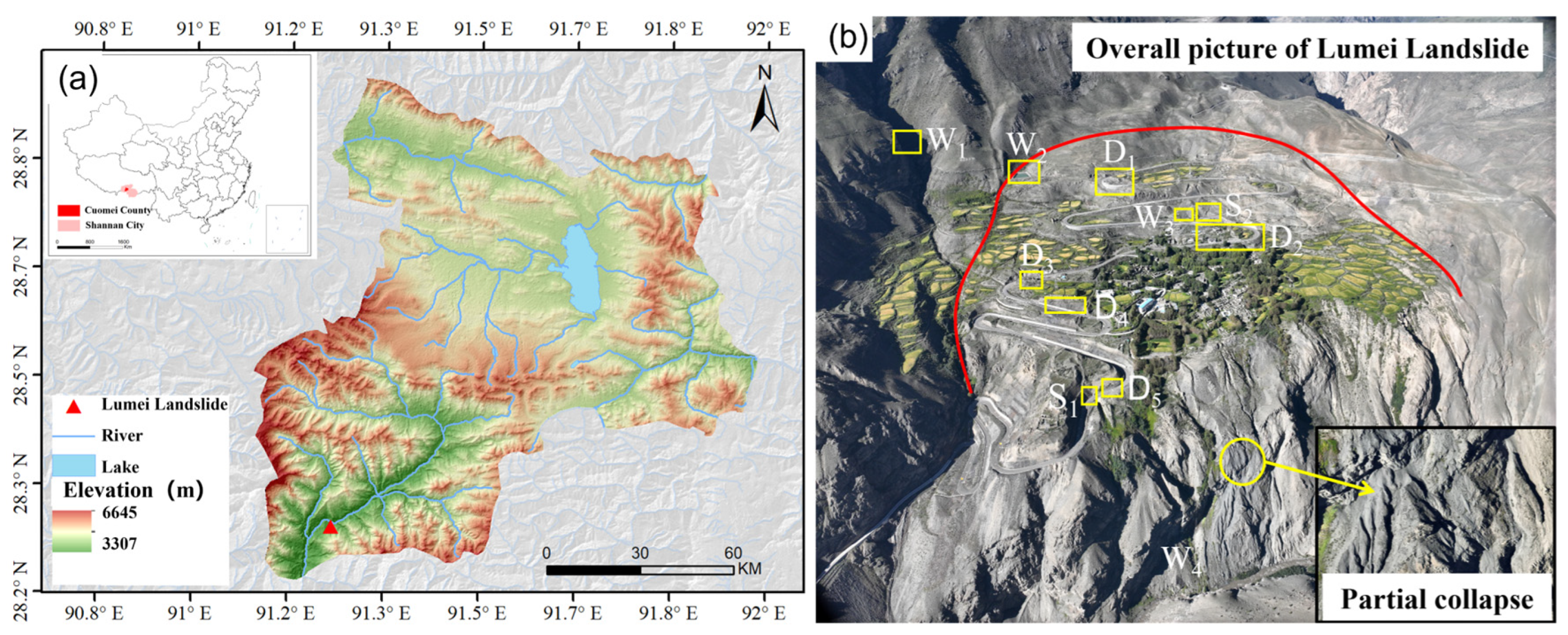
Cuomei County, situated in southern Tibet, features a topography that ascends from south to north (Figure 1). The region is dissected by numerous river basins, forming multiple watersheds dominated by mountainous terrain. Climatically, it falls within the plateau temperate semi-arid monsoon zone, characterized by low temperatures, significant diurnal and seasonal temperature variations, and distinct seasonal rainfall. Seasonal snow accumulates on upper mountain slopes, which melts during summer months. This snow and ice melt generates substantial runoff, reducing slope stability and increasing susceptibility to landslide hazards [33].
The Lumei landslide, administratively located in Lumei Village, Naixi Township, is classified as an ancient landslide (Figure 1). Lumei Village is situated on the platform in the middle of the ancient landslide. The landslide is typically chair-shaped in its overall morphology, the left is bounded by a gully, and the front scarp reaches the Naixi River. Structurally, it is a dip-slope with an overall steep gradient, presenting a stepped profile of steep–gentle–steep terrain. The slope attitude is 5° ∠ 7°, with slope angles ranging from 25° to 35° and significant local relief. The elevation varies from 4235 m at the head scarp to 3931 m at the front scarp. The landslide body measures approximately 582 m in length, 452 m in width, and 14 m in average thickness, yielding an estimated volume of 3.7 × 10⁶ m3. The Lumei landslide can be classified as a large-scale retrogressive soil landslide. In recent years, the landslide has exhibited obvious signs of reactivation and sliding. The basic information, such as deformation features and hydrogeological conditions, is shown in Figure 1b, and the specific analysis content is provided in the subsequent figures (Figure 2, Figure 3 and Figure 4).

2.2. Landslide Deformation Characteristics

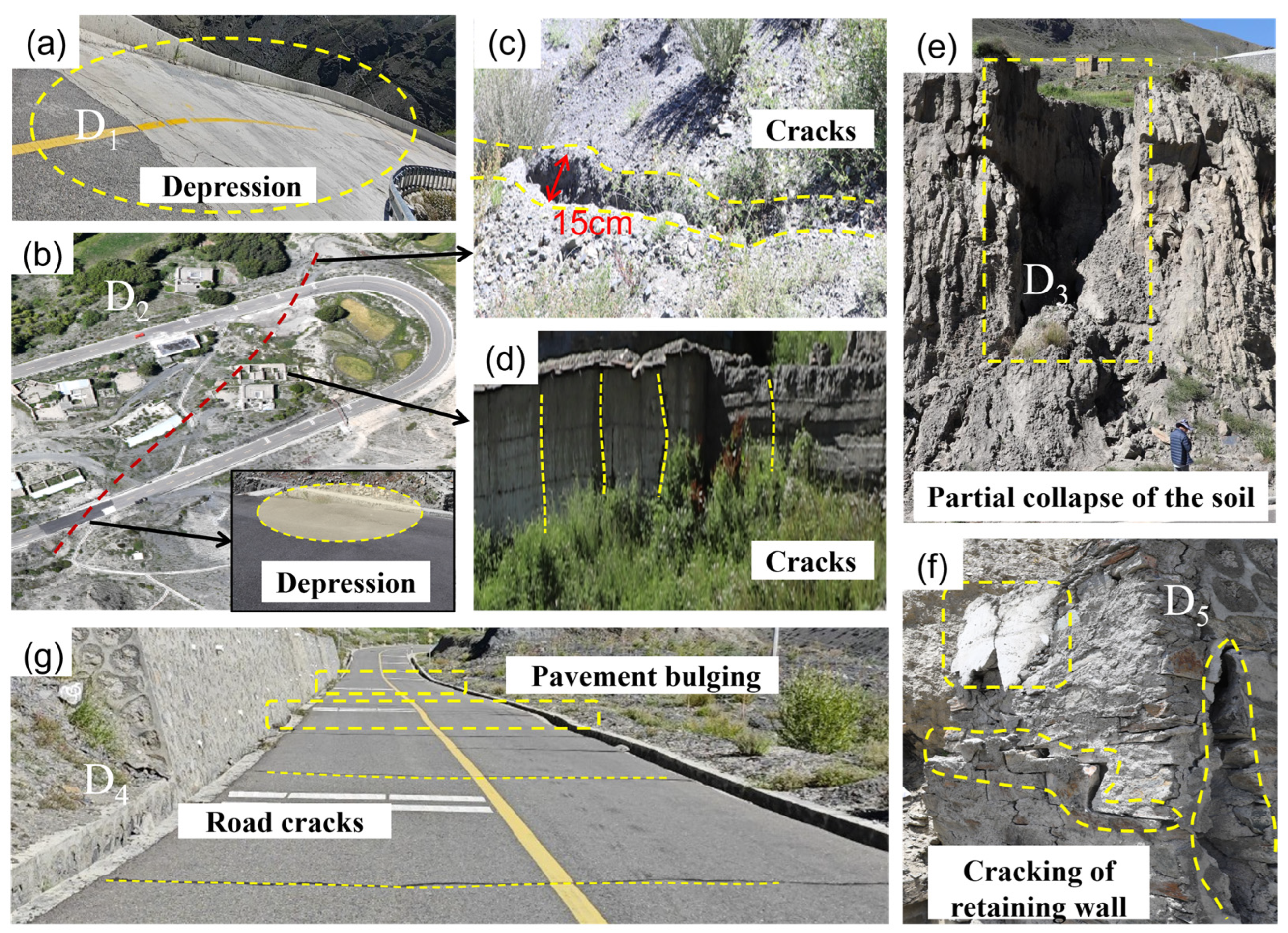
The Lumei landslide exhibits pronounced surface deformation characteristics, including tension cracks and localized failures induced by road excavation. At the head scarp, depression induced by cracking of the road surface is evident (Figure 2a). Multiple cracks have developed within the landslide body, with a particularly extensive crack observed in its central section (Figure 2b). This major crack extends approximately 220 m in length, with a width ranging from 0.15 to 0.5 m and a depth between 0.5 and 2 m. It has effectively transected the mass, generating a network of subordinate cracks that form a crisscross pattern of longitudinal and transverse fractures (Figure 2b,c). The existing house’s wall constructed in this area shows distinct cracking (Figure 2d), coinciding with ongoing ground settlement along the roadway. Further expansion of these cracks poses a direct threat to nearby houses, highways, and power transmission lines. In the central portion of the landslide, roadcutting has created a free face, resulting in soil collapse on both sides of the road (Figure 2e). The front scarp of the landslide shows significant bulging deformation and extensive cracking of the road surface (Figure 2g). Retaining walls in this area display cracks attributable to differential settlement (Figure 2f). Furthermore, erosion by the Naixi River has triggered partial collapse at the front scarp forming a localized steep scarp deformation zone along the riverbank (Figure 1b). Therefore, this landslide is in a state of resurrection.

2.3. Characteristics of Sliding Zone

The landslide mass is composed of sandstone containing approximately 18% gravel. The underlying bedrock belongs to Middle–Upper Jurassic sandstone, and a distinct, easily identifiable interface forms between the loose overburden and the bedrock. Due to tectonic activity and prolonged weathering, the rock mass in this area is highly fractured, with well-developed joints and a substantial weathered layer. The surface of the bedrock is overlain by Quaternary loose deposits of variable thickness, identified as landslide accumulations. These deposits consist of crushed blocky soil, sand–gravel mixtures, angular gravel, and clay.
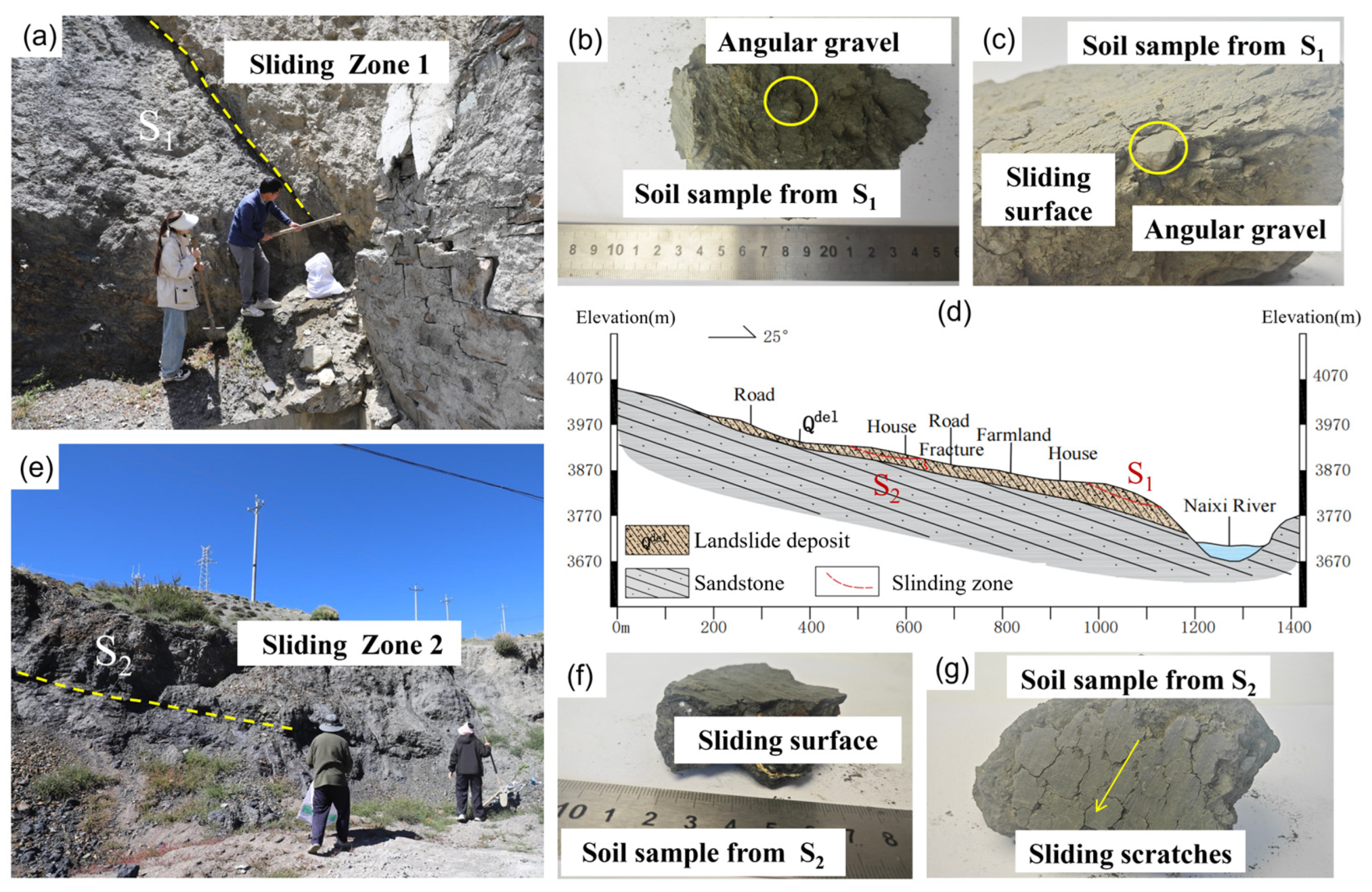
Two distinct sliding zones have developed within the landslide mass. Sliding zone 1, situated at the front scarp of the landslide (Figure 3a), has a dip direction of 283° and a dip angle of 40°. It is primarily composed of yellow to yellowish-brown silty clay containing angular gravel (Figure 3b,c), with a gravel content of approximately 20% and particle sizes ranging from 0.5 to 1.5 cm. Sliding zone 2 has developed in the mid-section of the landslide. The material in this zone is generally gray to grayish-black (Figure 3e) and consists of angular gravelly soil (Figure 3f,g), with an angular gravel content of 60–70% and a predominant particle size of 1–2 cm.
Soil samples were collected from both sliding zones for mineralogical analysis. X-ray diffraction (XRD) results indicate that the sliding-zone materials are predominantly composed of quartz and clay minerals, with quartz constituting approximately 40–45%, clay minerals 20–40%, and mica 20–35%. Among the clay minerals, chlorite accounts for approximately 80–90%, accompanied by mixed-layer clays of illite and montmorillonite.

2.4. Hydrological Characteristics

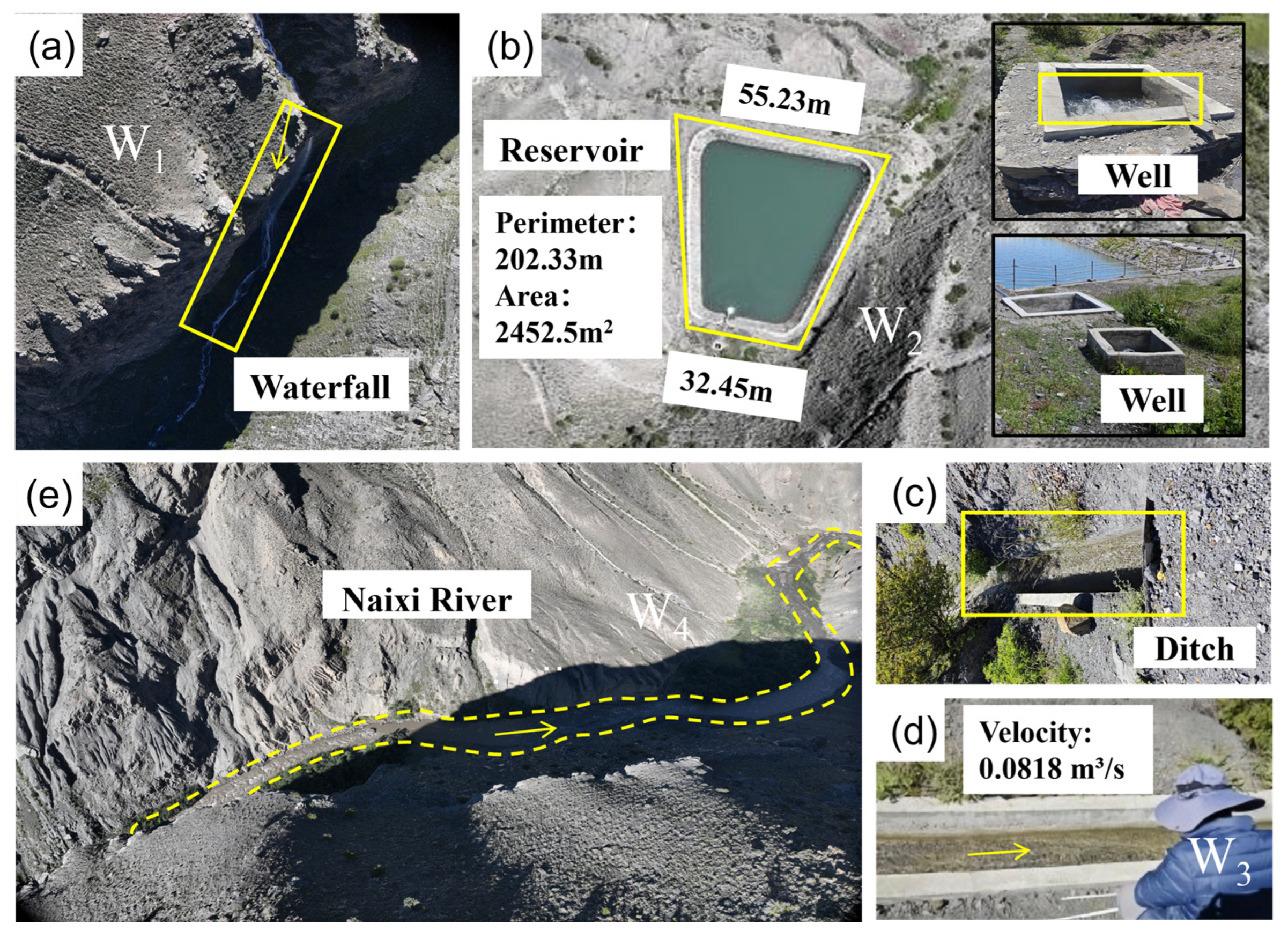
The Lumei landslide is situated in a topographical setting characterized by high, steep mountains forming a chair-shaped depression conducive to water accumulation. A prominent gully, approximately 10 m wide, has developed on the left of the head scarp, shaped by prolonged scouring from snowmelt originating at the mountain summit. At this location, a small waterfall emerges from bedrock fissures (Figure 4a). Further contributing to the local hydrology, a water storage tank with an area of 2452.5 m2 is present near the head scarp (Figure 4b), accompanied by two water-spraying wells on its rear side. An artificial irrigation channel traverses the central portion of the landslide (Figure 4c,d). This channel measures 41 cm in width and 7 cm in height, with a measured flow velocity of 0.0818 m3/s. The front scarp is bounded by the Naixi River (Figure 4e), a fast-flowing alpine stream with a significant gradient. The long-term erosive action of the river against this structurally weakened front scarp has significantly contributed to slope instability.

3. Data Sources and Processing

3.1. Data Sources

Sentinel-1A satellite SAR data are utilized. Sentinel-1A, launched by the European Space Agency (ESA), is a radar Earth observation satellite carrying a C-band Synthetic Aperture Radar (SAR) instrument capable of multiple polarization and imaging modes. A total of 84 scenes covering the period from January 2017 to December 2023 were acquired.
Surface deformation was monitored by applying both Persistent Scatterer Interferometric SAR (PS-InSAR) and Small Baseline Subset InSAR (SBAS-InSAR) time-series analysis techniques to the 84 SAR images. The consistency between the results derived from these two independent methods was validated by comparing the deformation time series of co-located feature points and by performing correlation analysis and normal distribution fitting on their respective cumulative deformation values. This cross-validation enhances the reliability and accuracy of the derived deformation measurements for the study area.
The deformation of the Lumei landslide was monitored based on PS-InSAR and SBAS-InSAR time-series analysis techniques. By analyzing the deformation curves of feature points obtained by the two techniques and performing correlation analysis and normal distribution fitting on the cumulative deformation of feature points with the same longitude and latitude, the consistency of the results obtained by the two techniques was verified. This further ensures the reliability and authenticity of the monitoring deformation results in the study area.

3.2. Data Processing Methods

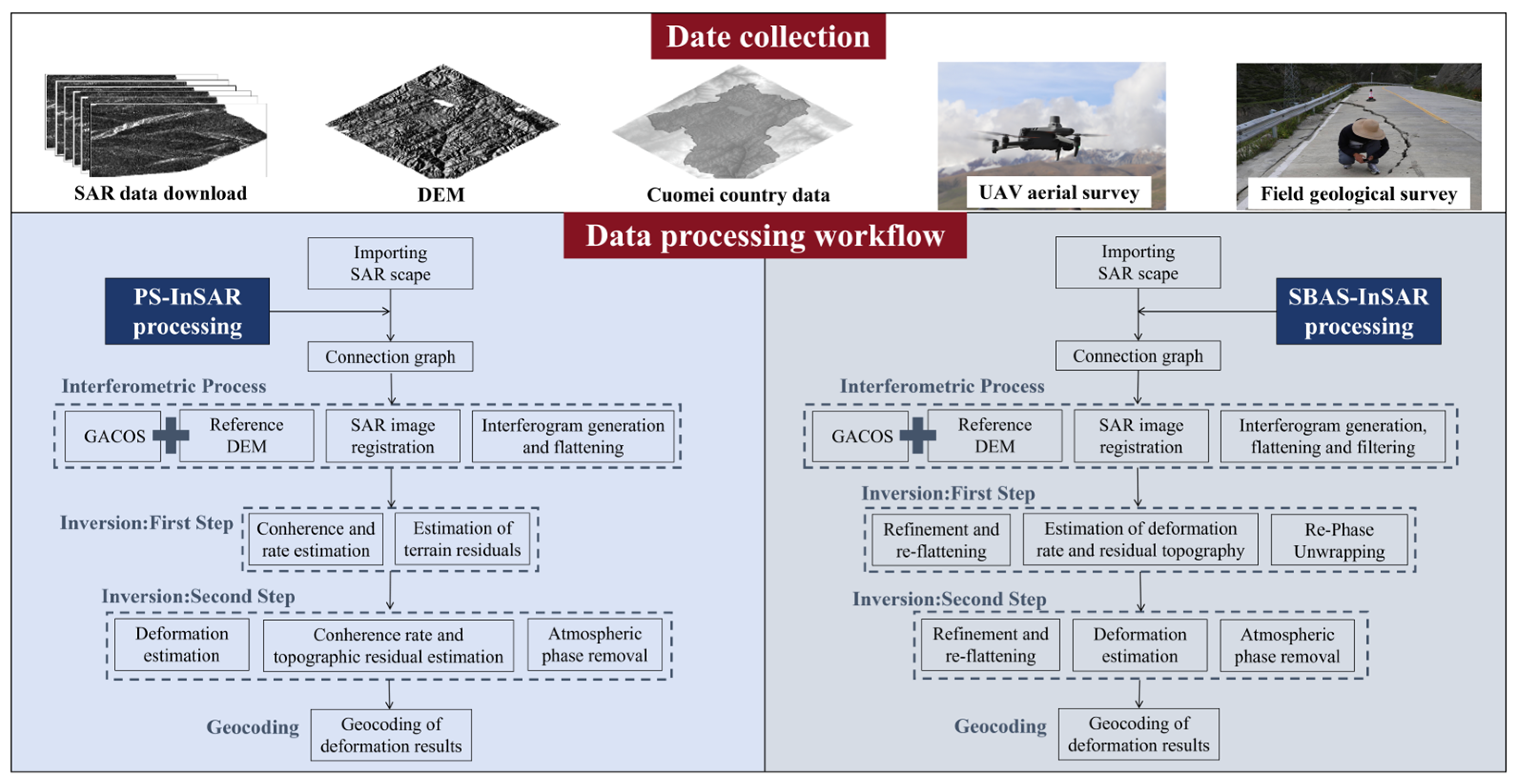
During the data preprocessing stage, the raw Sentinel-1A images were first imported. To ensure consistency across the dataset, standardized preprocessing procedures were applied to address variations inherent to the sensor data formats. Although the acquired scenes cover the broader Cuomei County region, the actual area of interest for this study is significantly smaller. Cropping the images to the approximate extent of the study area prior to further analysis reduces computational burden and improves processing efficiency. Accordingly, each imported scene was individually clipped to the target spatial domain. Data processing was conducted through the ENVI 5.6 SARscape platform with a 90 m resolution SRTM DEM, and the specific process is shown in Figure 5 [34].

3.2.1. Data Processing of PS-InSAR

The data processing workflow for the PS-InSAR technique is implemented as follows: First, following the import of all preprocessed SAR images, the algorithm selects the image acquired on 30 November 2021 as the super master image from the input dataset, with the remaining images serving as slaves to form interferometric pairs. By setting the coherence precision reference threshold to 0.75, phase-stable interferometric pairs are filtered out. This step generates a corresponding temporal–spatial baseline plot for the dataset. Second, during the intervention processing stage, coregistration and interferogram generation are performed for each image pair, followed by atmospheric correction using GACOS. (According to the imaging time of SAR images and the scope of the study area, the corresponding data packages were obtained from the GACOS official website and imported into SARscape. The preprocessed GACOS data were loaded into the corresponding list.) Third, in the first inversion, the surface deformation rate for the study area is constrained between −35 mm/yr and 35 mm/yr, and the residual topographic height is bounded between −30 m and 30 m. In the second inversion, the spatial distribution of atmospheric variations is set to 1200 m, and the temporal distribution of atmospheric variations is set to 365 days, yielding the final surface deformation rate. Finally, geocoding is applied to project the deformation results from the SAR coordinate system into the geographic coordinate system, yielding deformation data and corresponding vector outputs [35,36].

3.2.2. Data Processing of SBAS-InSAR

The data processing workflow for the SBAS-InSAR technique proceeds as follows. First, the process of generating a connection graph is the same as PS-InSAR; a total of 190 interferometric image pairs are generated. Within this dataset, the temporal baselines range from 12 to 180 days, while the spatial baselines vary between 3.94 m and 296.53 m, and the maximum Doppler difference is 291.892. The average connectivity per image is 7, satisfying the minimum requirement of at least 5 connections. Second, in the interferometric processing stage, image pairs are co-registered to generate interferograms. Differential interferograms are subsequently filtered to reduce phase noise, followed by coherence estimation. After unifying the coordinate system for all pairs, phase unwrapping is performed. GACOS is used for atmospheric correction, the minimum cost flow (MCF) method is used for phase unwrapping, the unwrapping grade is set to 1, and the unwrapping coherence threshold is set to 0.2. Third, the first inversion is conducted to optimize and re-flatten the unwrapped phase, yielding residual topography and an initial estimate of the mean deformation rate. The second inversion is then applied to refine the overall deformation rate and derive the complete time series of displacement for the study area. Finally, geocoding is implemented, employing a projection transformation algorithm consistent with that used in the PS-InSAR processing chain [37,38].

4. Comparative Analysis

4.1. Surface Deformation Based on PS-InSAR

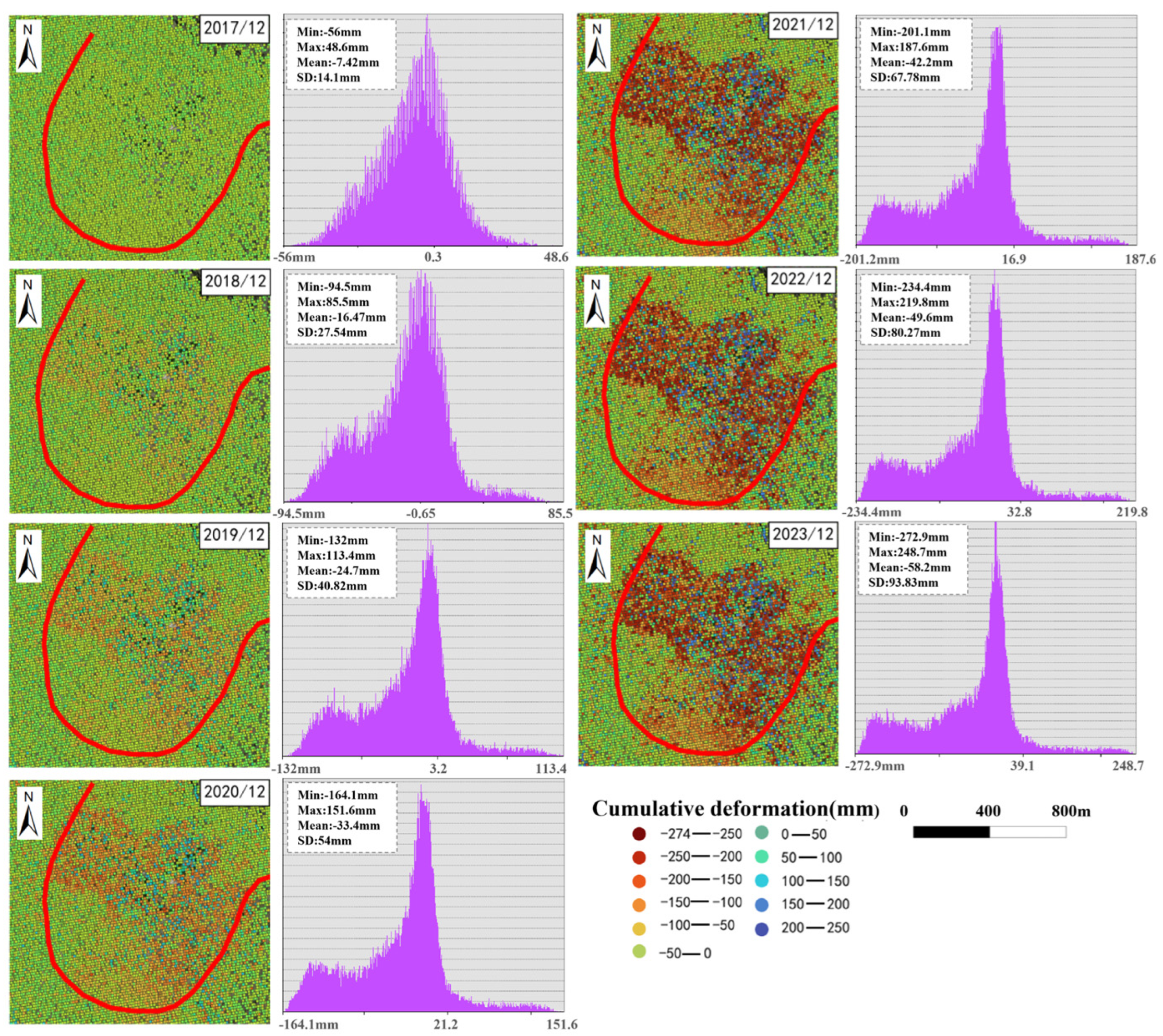
Based on PS-InSAR processing, the map of cumulative displacement of the study area along the radar line-of-sight (LOS) direction from January 2017 to December 2023 was obtained, as shown in Figure 6. The cumulative deformation ranges from −274 mm to 248.7 mm. Negative values indicate movement away from the satellite along the LOS, whereas positive values represent movement toward the satellite.
Analysis of Figure 6 reveals the following observations. Over the landslide area, the overall surface deformation exhibits a dominant downward trend along the LOS, with only isolated patches showing uplift. (Field investigations show that the extreme point with surface deformation of 248.7 mm is sporadically distributed within the building area. Owing to its very small quantity and sparse distribution, this phenomenon is likely related to housing construction activities.) Pronounced deformation is observed in the residential zone of Lumei Village as well as in adjacent farmland and woodland areas. The central and northwestern portions of the landslide body are characterized by consistent subsidence along the LOS. In contrast, surface deformation is relatively minor in the southwestern part of the study area, where structures are primarily built along roads. Across most of the study area, cumulative deformation values lie between −100 mm and −250 mm. However, localized subsidence reaches magnitudes as high as −257.5 mm in certain areas.

4.2. Surface Deformation Based on SBAS-InSAR

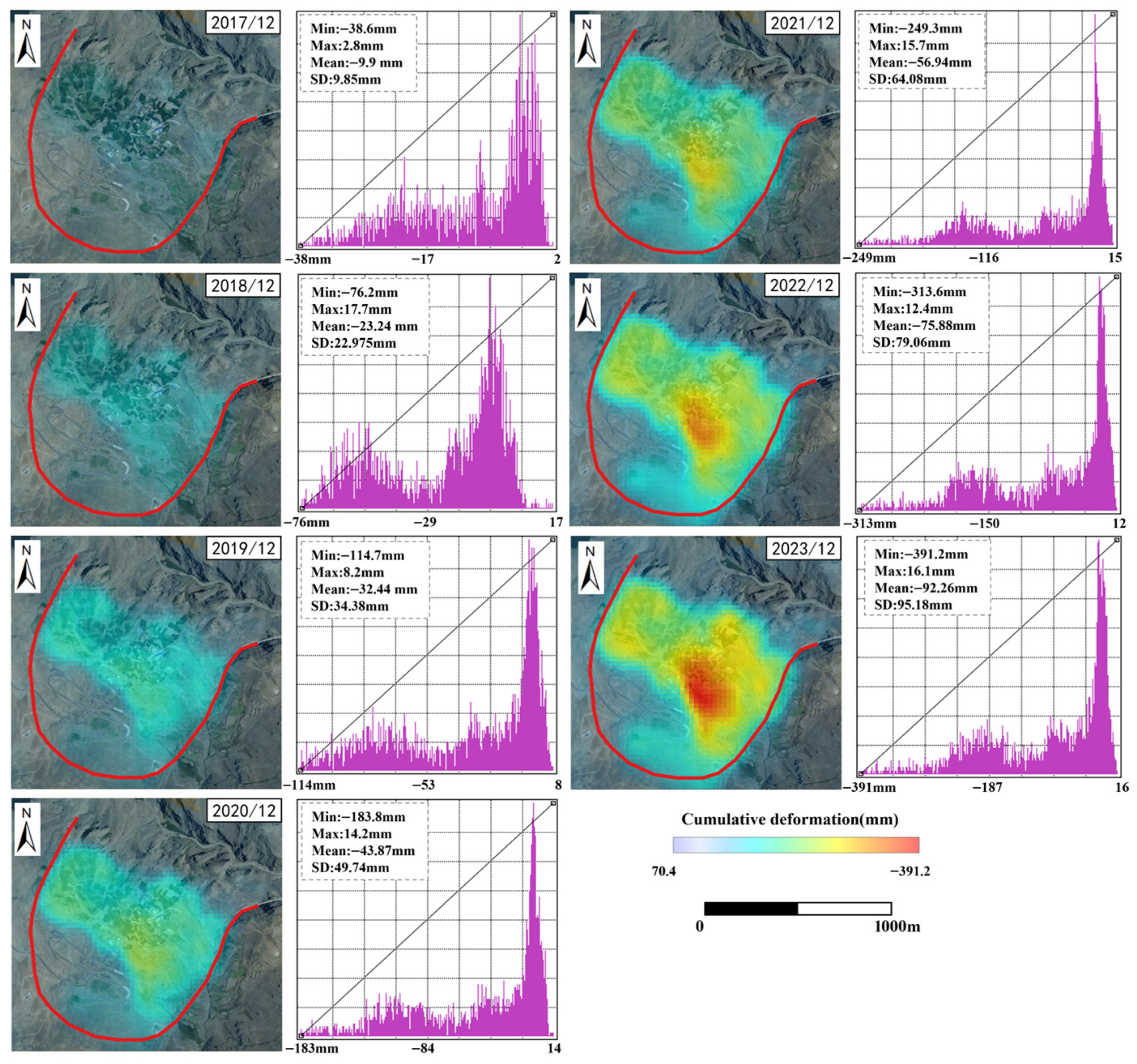
Based on SBAS-InSAR processing, the map of cumulative displacement of the study area along the radar line-of-sight (LOS) direction from January 2017 to December 2023 was derived, as presented in Figure 7. The cumulative deformation ranges from −391.2 mm to 70.4 mm. The following patterns are evident from Figure 7. The central part of the study area exhibits a dominant downward trend along the LOS, with the highest deformation rate concentrated in the east-central region. Deformation magnitude gradually decreases outward from this core zone, though significant subsidence is also observed in the town and its vicinity. In contrast, the northwestern part of the study area, which is predominantly covered by woodland, shows relatively minor deformation. Across most of the region, cumulative deformation values fall between −120 mm and −350 mm, with localized subsidence reaching up to −391.2 mm.

4.3. Surface Deformation Rate Based on SBAS-InSAR and PS-InSAR

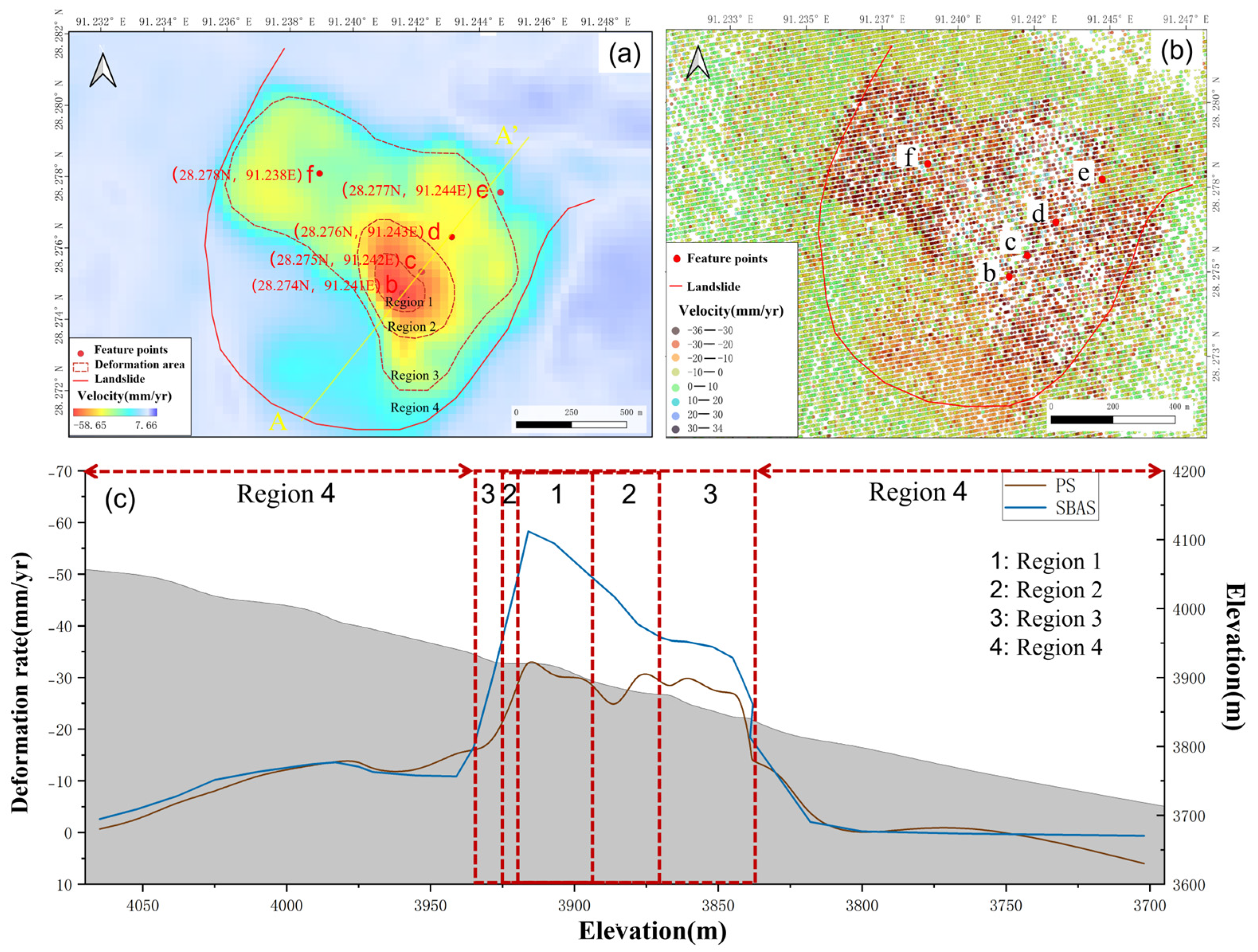
The performance of the two techniques in landslide deformation identification and interpretation was comparatively analyzed. Since the SBAS-InSAR can clearly identify regions with different degrees of deformation, as shown in Table 1, the study area was divided into four zones according to the distribution characteristics of deformation rates obtained by SBAS-InSAR (Figure 8a). Five representative feature points (specific coordinates are marked next to the points) were selected from these zones for detailed localized comparison.
As shown in Figure 8a, the surface deformation rate based on SBAS-InSAR ranges from −58.65 to 7.66 mm/yr, and the deformation rate across the entire study area is mainly concentrated between −36.55 and −21.81 mm/yr. As illustrated in Figure 8b, the deformation rate based on PS-InSAR ranges from −32.03 to 16.74 mm/yr, with the overall rate concentrated within the range of −30 to −10 mm/yr. A surface deformation rate profile (A—A’) along the slope was constructed using the SBAS-InSAR and PS-InSAR surface deformation rates, which intuitively displays the deformation rates of the landslide deformation zone (Figure 8c) and identifies the zones with different deformation degrees on the profile.
The deformation rate profile shows that the deformation magnitude in the middle part of the landslide is more significant. Although there are differences between the SBAS-InSAR and PS-InSAR results, the maximum deformation rates from both methods are concentrated in this area, showing good spatial correspondence. Among them, the maximum surface deformation rate identified by SBAS-InSAR reaches −58.65 mm/yr, and the maximum surface deformation rate identified by PS-InSAR is −32.03 mm/yr. In terms of deformation curve characteristics, the SBAS-InSAR results are more sensitive to local intense deformation, with larger fluctuations and more prominent deformation peaks. In contrast, the PS-InSAR results are generally smoother with smaller fluctuations. The differences in deformation amplitude and curve morphology between the two methods reflect the applicability and complementarity of different InSAR techniques in landslide monitoring.

4.4. Cumulative Deformation Based on SBAS-InSAR and PS-InSAR

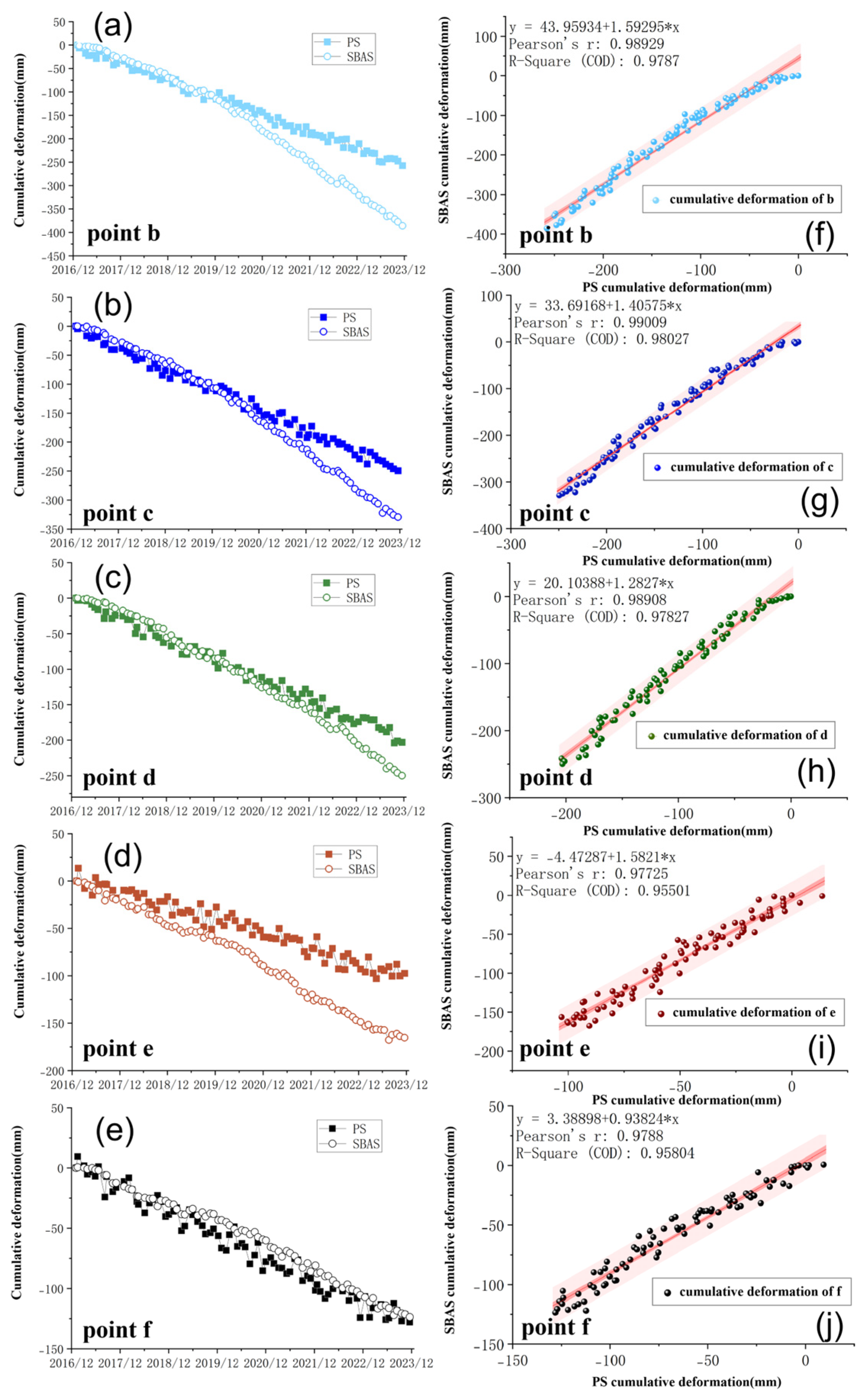
As shown in Figure 9a–e, the time-series curves of cumulative deformation from 2017 to 2023 for the five feature points were obtained by SBAS-InSAR and PS-InSAR. For point b, the maximum cumulative deformation is −385.9 mm (SBAS-InSAR) and −257.5 mm (PS-InSAR), reflecting a consistent downward trend along the LOS (Figure 9a). At point c, cumulative deformation reaches −329.2 mm (SBAS-InSAR) and −249.5 mm (PS-InSAR) between January 2017 and December 2023 (Figure 9b). As shown in Figure 9c, for point d, the maximum values are −249.8 mm (SBAS-InSAR) and −203.10 mm (PS-InSAR). At point e (Figure 9d), a slight uplift along the LOS is observed from January to March 2017, with cumulative deformation reaching −123.7 mm (SBAS-InSAR) and −128 mm (PS-InSAR) by December 2023. For point f, the maximum cumulative deformation during the same period is −165.3 mm according to SBAS-InSAR and −100.4 mm according to PS-InSAR (Figure 9e).
The data presented in Figure 9a–e support the following observations. The overall deformation trends of the five feature points obtained from PS-InSAR and SBAS-InSAR are generally consistent. However, the deformation rates derived from PS-InSAR are systematically lower than those from SBAS-InSAR. This discrepancy may be attributed to the limited ability of PS-InSAR to capture rapid or seasonally varying deformation in a timely and comprehensive manner. Notably, for point b, the maximum difference in cumulative deformation reaches 133.7 mm.
A deeper analysis was conducted to examine the differences between the two sets of monitoring results. Deformation values at the five feature points were extracted from both methods, and a regression analysis was performed to assess their correlation. As shown in Figure 9f–j and Table 2, the deformation values obtained from the two monitoring methods are highly correlated. For all feature points, Pearson’s correlation coefficients (r) are greater than 0.97, and the coefficients of determination (R2) are greater than 0.95, demonstrating a strong positive linear correlation between the cumulative deformation results derived from the two techniques. This high consistency not only validates the scientific reliability of both monitoring approaches but also enhances confidence in the dataset.
After comparative analysis of surface deformation rates derived from PS-InSAR and SBAS-InSAR, certain differences between the two methods are evident. Overall, however, both techniques exhibit consistent surface deformation trends that align with the actual conditions observed in the study area.

4.5. Analysis of Deformation Characteristics

Based on the deformation results obtained by SBAS-InSAR and PS-InSAR, an analysis was conducted on the local areas where the four feature points are located.
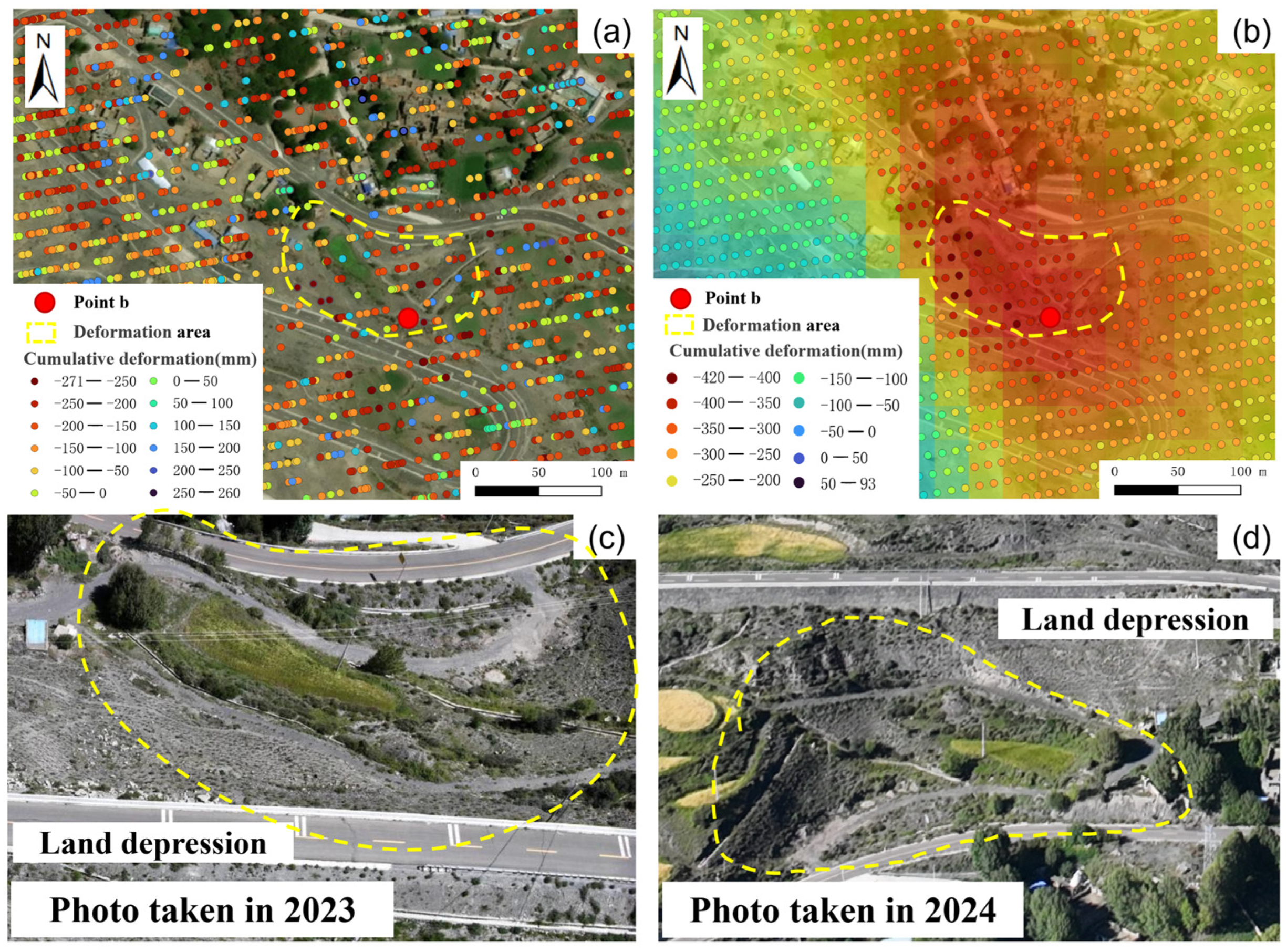
As shown in Figure 10a,b, the PS-InSAR cumulative deformation in the deformation area of point b ranges from −268.7 mm to 195.3 mm, while the SBAS-InSAR results are concentrated between −417.7 mm and −348.8 mm. This indicates that the two methods differ in spatial coverage and deformation detection capability, and jointly confirm the existence of sustained and heterogeneous deformation in this area.
Field investigations (Figure 10c,d) reveal that surface deformation in this central area is highly significant. Compared with the surrounding areas, it exhibits an obvious depression morphology with clearly visible ground subsidence characteristics. The soil mass at the location of maximum deformation shows a prominent free-face condition, with a slope much steeper than the surrounding areas, indicating distinct signs of differential deformation. Validation results demonstrate that the deformation features observed in the field are highly consistent with the overall deformation trend revealed by SBAS-InSAR (Figure 10b,d). Meanwhile, the small-scale detailed deformation identified by PS-InSAR also agrees well with the uplift phenomena of on-site buildings or localized soil masses (Figure 10a,c), which corroborates its accuracy in detailed monitoring.
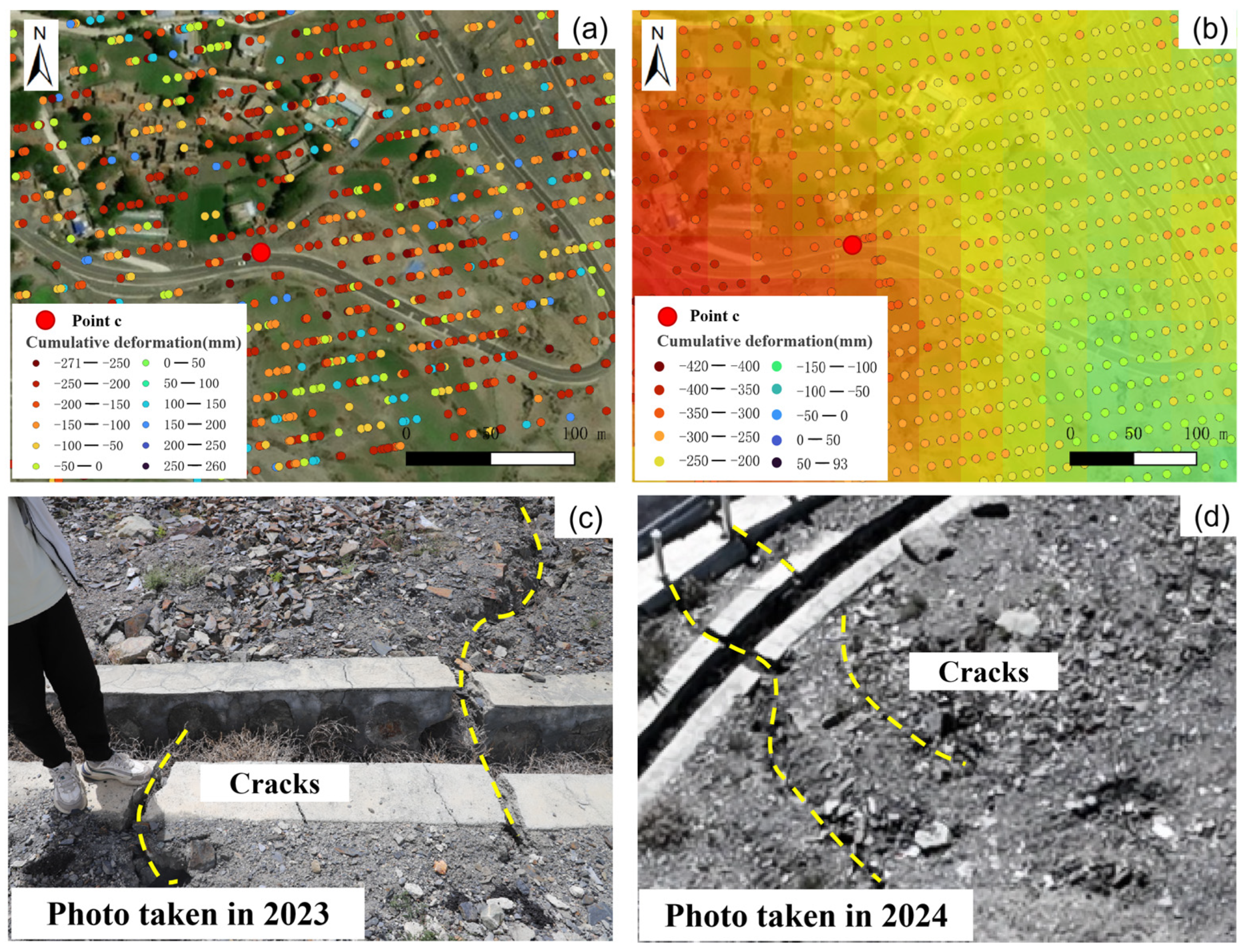
As shown in Figure 11a,b, the cumulative deformation obtained by PS-InSAR in the deformation area of point c ranges from −261.8 mm to −178.6 mm, while the SBAS-InSAR result ranges from −339.0 mm to −318.7 mm. The results of the two methods jointly verify the consistency of the overall deformation trend in this area. Field investigations (Figure 11c,d) reveal that a large number of cracks have developed along the roads around feature point c, and these cracks show a trend of continuous expansion, deepening and extension over time.
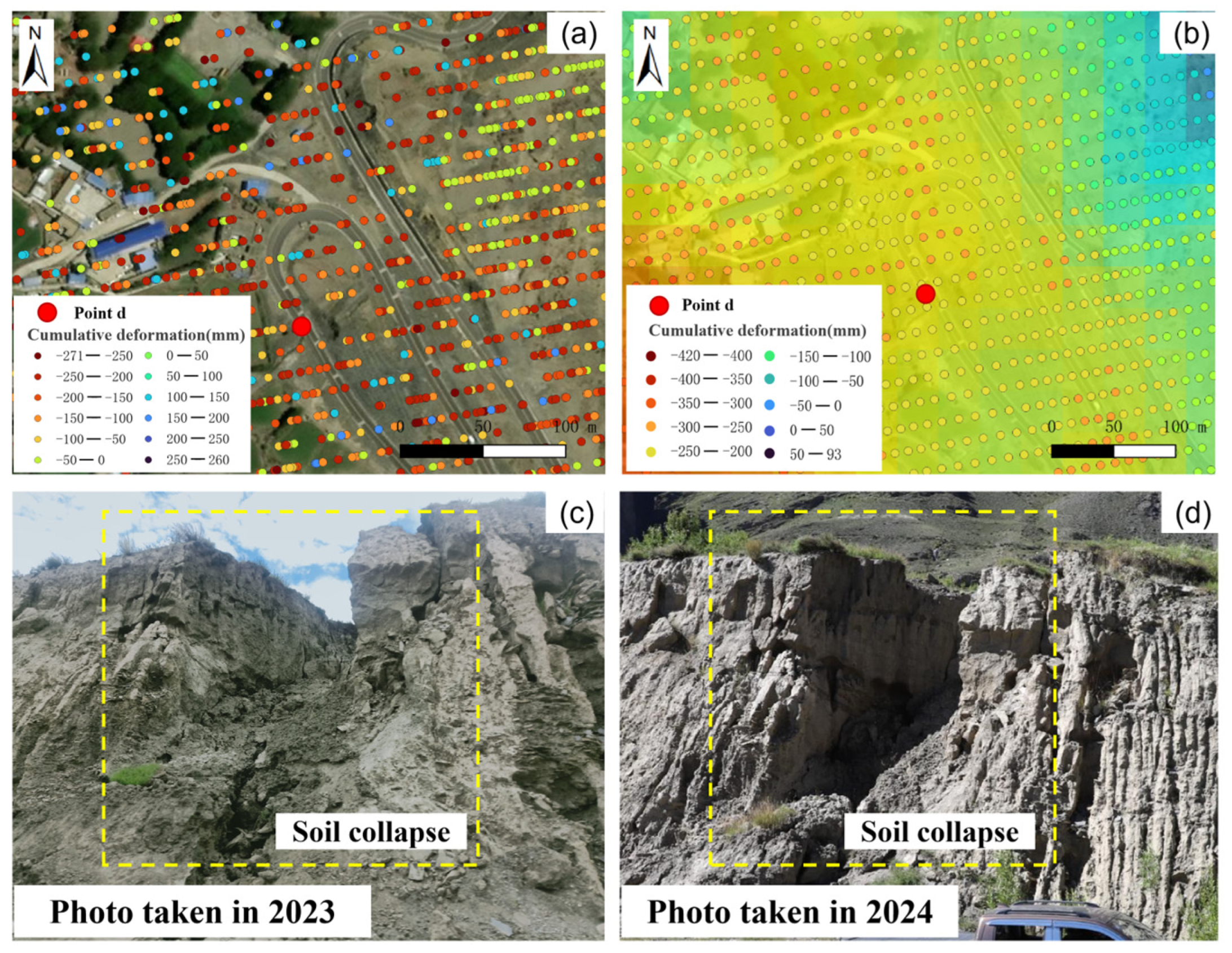
As shown in Figure 12a,b, the cumulative deformation derived from PS-InSAR in the local deformation area of point d ranges from −240.9 mm to −52.2 mm, and the cumulative deformation from SBAS-InSAR is −250.4 mm to −229.9 mm. Both monitoring methods indicate that the local area has sustained sliding deformation along the radar line of sight. Combined with field investigation results (Figure 12c,d), obvious soil collapse has developed beside the road in the area of point d, and the soil mass remains in a state of continuous collapse and progressive instability.
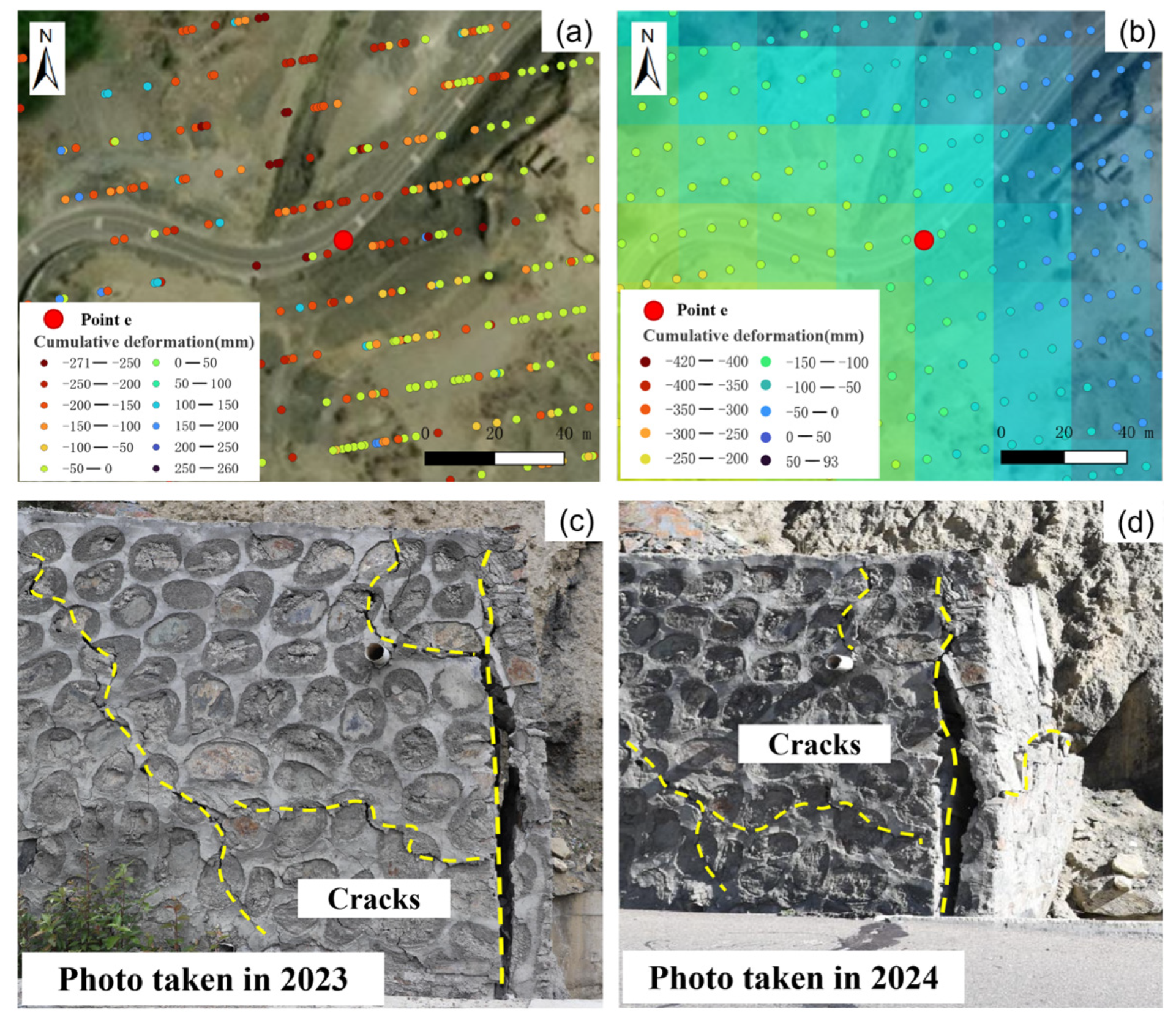
As shown in Figure 13a,b, the cumulative deformation of PS-InSAR in the deformation area of point e ranges from −253.0 mm to −189.6 mm, while the SBAS-InSAR result ranges from −142.6 mm to −125.4 mm. There are certain differences between the two monitoring results, indicating that PS-InSAR is more sensitive to the local deformation at this point and can characterize the surface deformation in greater detail. Combined with field investigation results (Figure 13c,d), numerous structural cracks have developed in the retaining wall beside the road near feature point e. Further comparison between field images taken in 2023 and 2024 reveals that the width and development degree of the cracks in the retaining wall were significantly aggravated in 2024, showing a trend of continuous propagation and penetration.

5. Discussion

5.1. Influencing Factors

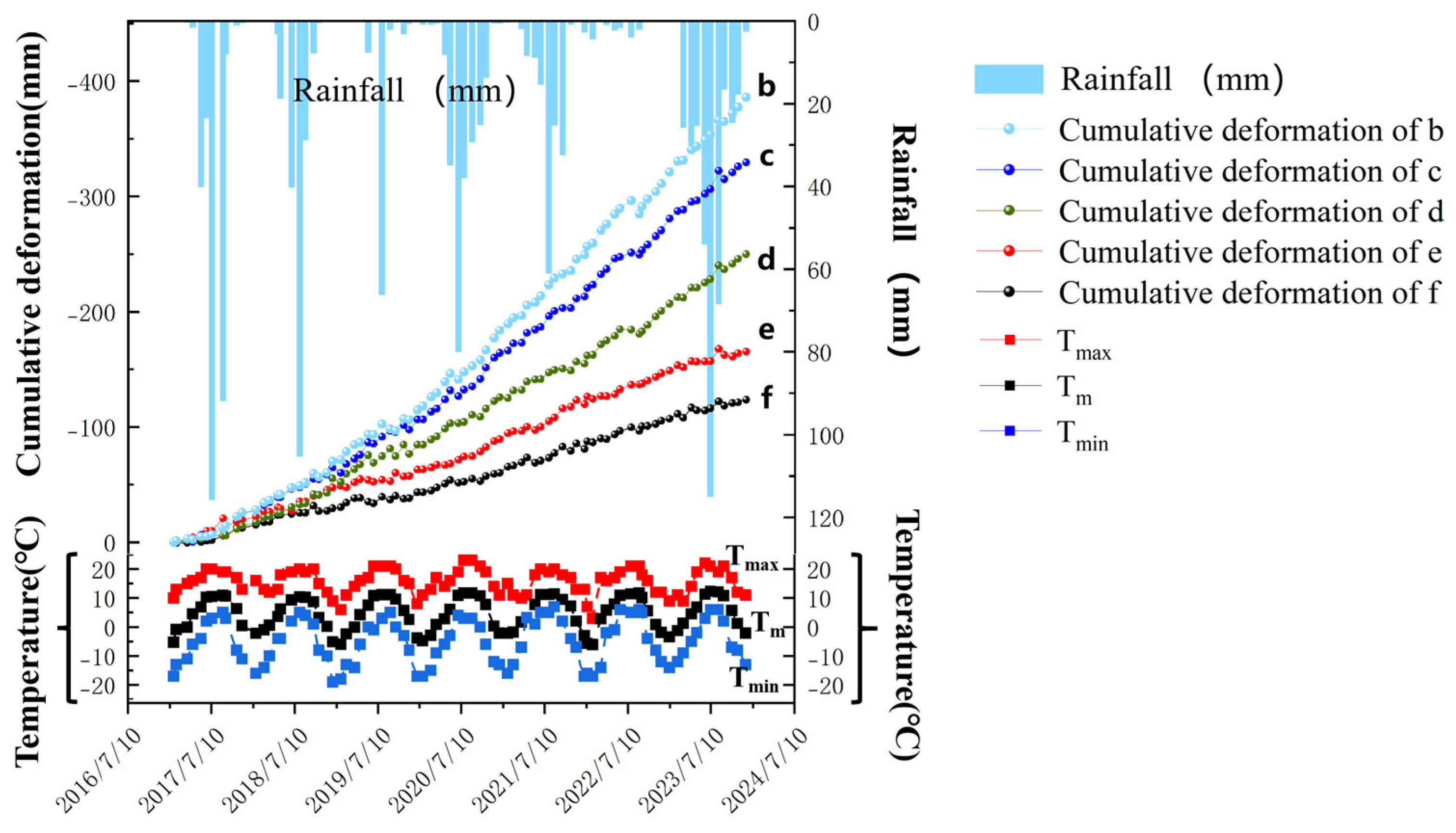
Figure 14 presents a correlation analysis between the SBAS time series of deformation of the five selected feature points and local rainfall from January 2017 to December 2023. Point b was taken as a representative case, and its surface deformation in 2020 was examined in detail in conjunction with rainfall records and climatic data from the Cuomei County meteorological station.
From January to March 2020, the deformation rate at point b remained relatively stable. A noticeable acceleration occurred from April to May, during which cumulative deformation reached approximately 4.7 mm, corresponding to an average monthly displacement of about 2.3 mm. This period coincided with an average monthly rainfall of 21 mm, accompanied by steadily rising temperatures and daily maximum temperatures consistently above 0 °C. The infiltration of snowmelt from higher elevations altered the slope’s internal hydrodynamic regime. Meanwhile, the sliding-zone soil tends to swell upon water infiltration, further softening the soil and reducing its shear strength, which in turn promotes slope movement. Based on this analysis, it can be inferred that snowmelt infiltration and freeze–thaw cycles were the primary drivers of landslide deformation during this phase.
During the 2020 rainy season (May to August), monitoring indicated that the landslide initially entered a brief stable phase, followed by progressive deformation, with cumulative displacement reaching 5.6 mm (equivalent to approximately 1.4 mm per month). This period coincided with the annual rainfall peak, with an average monthly rainfall of 51.8 mm. Continuous rainfall infiltration resulted in soil saturation and a notable increase in slope self-weight, thereby promoting deformation. Such displacement typically exhibits a temporal lag following rainfall events, suggesting that concentrated rainfall was the dominant trigger for slope instability during this period.
In early autumn (September), the displacement rate at point b remained gradual. From late autumn to early winter (October–December), deformation accelerated before gradually slowing after entering a phase of more pronounced movement, accumulating 9.7 mm (averaging about 3.2 mm per month). Rainfall in October was 13.7 mm and decreased substantially thereafter. Notably, prior to December, monthly maximum temperatures (Tmax) generally remained above 0 °C, while monthly minimum temperatures (Tmin) often fell below 0 °C. By late December, temperatures consistently remained below freezing. Based on the above characteristics, it can be inferred that the formation of frozen perched water and repeated freeze–thaw cycles were the primary factors driving landslide deformation during this stage.
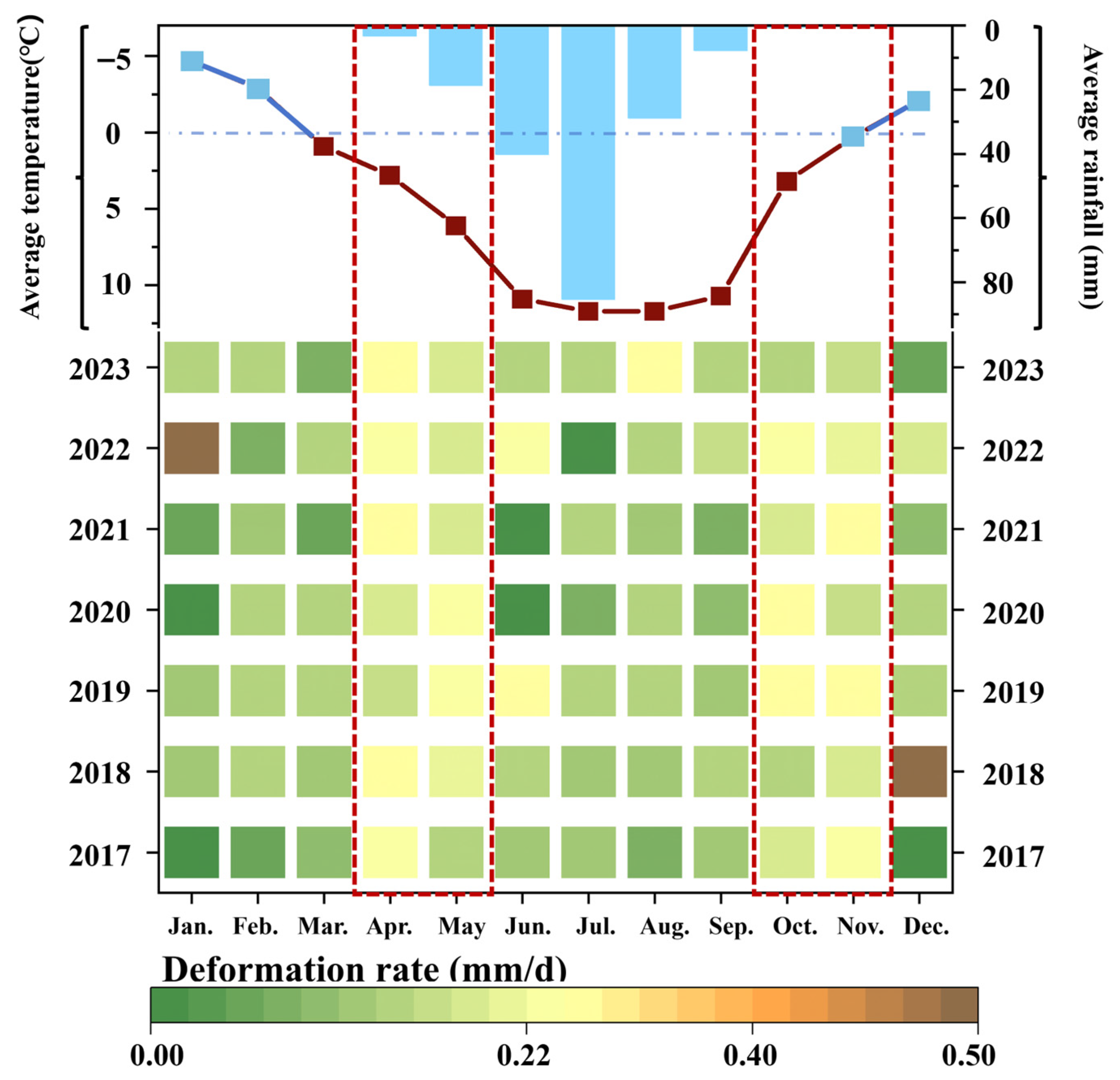
To systematically analyze the temporal variation characteristics of landslide surface deformation, the monthly average deformation rates at point b from 2017 to 2023 were statistically compiled, as shown in Figure 15. It can be clearly observed from the variation characteristics of the rate at point b that the deformation activity at this point exhibits distinct seasonal and periodic features: the months with relatively obvious deformation each year are mainly concentrated in April–May and October–November. In addition, significant large-scale deformation occurred in December 2018 and January 2022, and the deformation rate was significantly higher than the general level in the corresponding periods. Notably, these two intense deformation events occurred exactly during the periods with the lowest annual temperature, indicating that extreme low temperature may have exacerbated slope deformation.
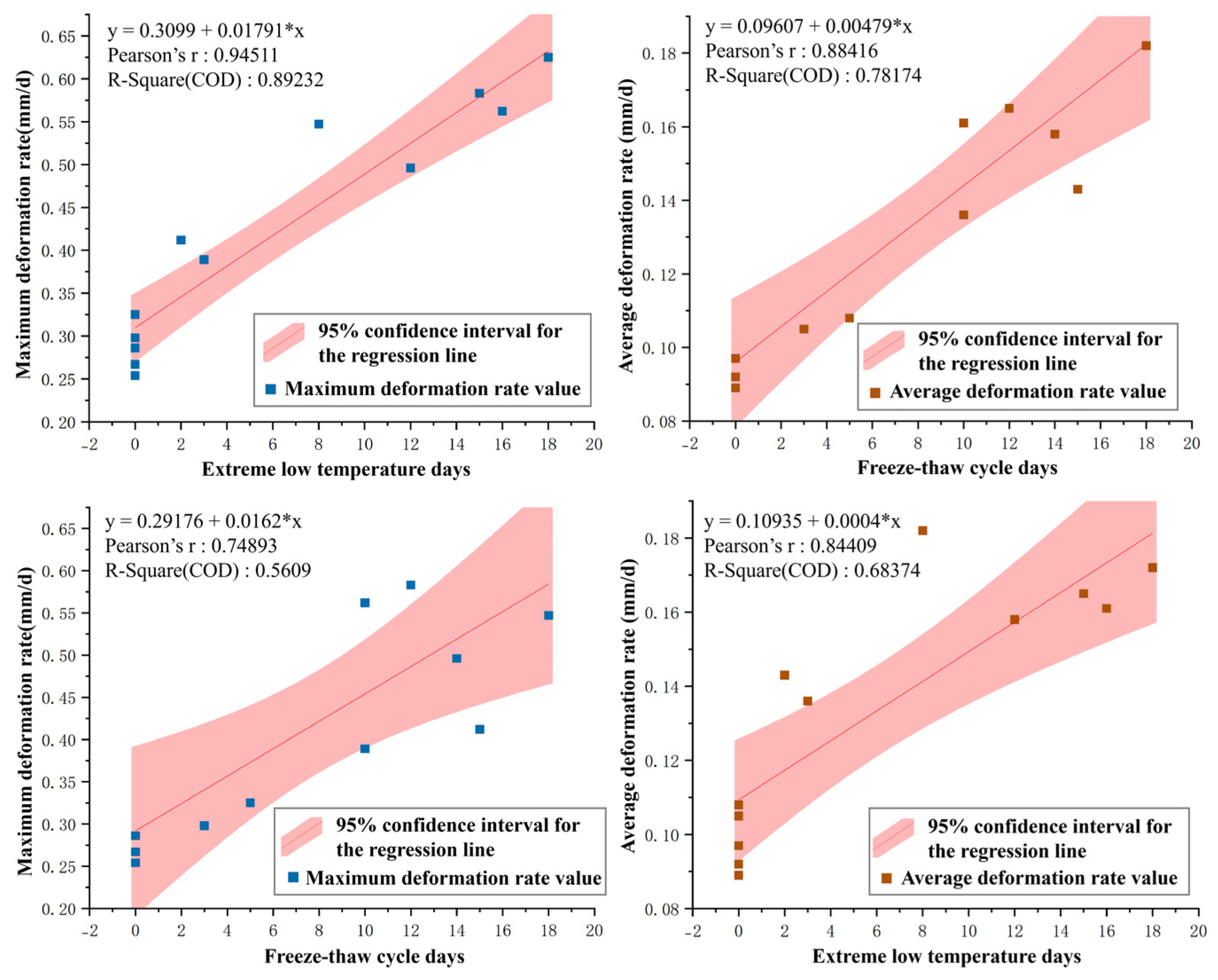
To further verify the relationship between the aforementioned deformation and climatic factors, an in-depth analysis was conducted on the monthly deformation rates of five characteristic points from 2017 to 2023, as shown in Figure 16. Correlation analyses were performed separately between the monthly average and maximum deformation rates of each point and the number of freeze–thaw cycles and extremely low-temperature days. The results indicate that both freeze–thaw cycles and extremely low temperatures exhibit a significant positive correlation with surface deformation. However, extremely low temperatures exert a more significant influence on the occurrence of deformation peaks (maximum deformation values) (Pearson’s R = 0.94511) and often trigger intense short-term deformation. In contrast, freeze–thaw cycles mainly promote the accumulation and expansion of the overall deformation magnitude of the slope through periodic frost heave and thaw settlement processes (Pearson’s R = 0.88416). The combined effect of these two factors drives the continuous deformation of the Lumei landslide at a seasonal scale.
Through the analysis of deformation characteristics based on monitoring data, the driving effects of external factors such as extremely low temperature and freeze–thaw cycles on landslide deformation have been clarified from a micro perspective. It is worth noting that the continuous deformation of the landslide and the reactivation process of the ancient landslide are the result of the combined action of internal and external factors. The inherent geological conditions of the study area, including its unique topographic and geomorphic features, rock–soil mass structure and mineral composition, jointly determine the initial stability of the slope and provide a material basis for the functioning of external factors.
Influenced by the alpine plateau climate, the region experiences pronounced diurnal and seasonal temperature variations, leading to intense freeze–thaw activity. Temperature records from 2017 to 2023 indicate that freezing and thawing processes alternate year-round, representing a typical freeze–thaw cycle regime. Between March and October, snowmelt infiltrates the slope mass via the gully system, increasing groundwater percolation and erosion. Subsequently, from December to February, retained groundwater freezes, expands, and damages the internal structure of the landslide mass, progressively degrading its stability. The landslide area enters its rainy season between June and August. Rainfall during this period increases the self-weight of the rock–soil mass and enhances downslope driving forces, thereby promoting slope instability.
As shown in Figure 3, the upper sliding mass consists of plastic silty clay and loose to moderately dense gravelly soil, underlain by highly weathered sandstone bedrock. Field investigations indicate that a sliding zone has developed locally between the superficial gravelly soil and the bedrock. Differences in weathering degree, permeability, and physical properties between these materials result in a distinct transitional interface. This sliding zone is primarily composed of gravel-bearing silty clay. The increased proportion of cohesive soil at the contact exhibits plastic behavior. In addition, the high contents of mica and clay minerals here (dominated by hydrophilic chlorite and illite–montmorillonite mixed layers) are prone to swelling and softening when exposed to water, which significantly reduces the shear strength of the sliding-zone soils and causes structural degradation.
The deformation and reactivation of the Lumei landslide are influenced by multiple factors, including regional topography and geomorphology, rock mass structure, rainfall, extremely low temperature, and freeze–thaw cycles: Steep geomorphology provides favorable topographic conditions for the landslide. The fractured and loose rock mass structure reduces the self-stability of the slope; rainfall infiltration softens the rock–soil mass and increases pore water pressure. In addition, seasonal freeze–thaw cycles and frost heave caused by extremely low temperatures continuously degrade the rock mass structure and propagate internal fractures. The combined effect of these factors ultimately leads to the deformation and reactivation of the landslide.

5.2. Comparison of Application Effects of InSAR Techniques

A comparison of the results obtained from PS-InSAR and SBAS-InSAR highlights distinct differences in their technical characteristics and application performance for landslide monitoring.
For spatial monitoring, SBAS-InSAR can provide continuous spatial deformation results, which reveal the spatial differences in deformation rates within the landslide and allow effective zoning of areas with different deformation intensities. In contrast, PS-InSAR only yields discrete point deformation information, with a scattered overall spatial distribution, making it less capable of reflecting the overall deformation pattern of the landslide. For monitoring accuracy, PS-InSAR can effectively identify the uplift changes in point targets, and the detailed information obtained significantly improves the accuracy of monitoring results. However, the accuracy of this method is limited by the spatial distribution density of monitoring points. In contrast, SBAS-InSAR is inferior to PS-InSAR in the identification accuracy of detailed deformations. In terms of monitoring density, the point density of PS-InSAR ranges from 0 to 38.027 points/m2, whereas that of SBAS-InSAR ranges from 0 to 46.48 points/m2. Overall, the point density yielded by SBAS-InSAR is consistently higher than that of PS-InSAR. Furthermore, the PS-InSAR results exhibit an uneven distribution, with relatively sparse coverage in certain regions. In contrast, SBAS-InSAR is capable of maintaining a more uniform and stable spatial sampling density across the study area.
In summary, PS-InSAR provides high-accuracy point measurements, whereas SBAS-InSAR captures spatially continuous areal deformation. By combining the two, the high-precision point data from PS-InSAR can be used to calibrate the continuous deformation field of SBAS-InSAR, while the spatial distribution information from SBAS-InSAR can supplement the limitations of PS-InSAR’s point data. This approach can effectively reduce uncertainties in the processing process and enhance the overall reliability of landslide displacement monitoring.

6. Conclusions

Based on the integration of PS-InSAR and SBAS-InSAR techniques with field geological surveys, surface displacement monitoring, and UAV aerial mapping, the deformation monitoring and reactivation mechanism analysis of the Lumei landslide are performed. The main conclusions are as follows:
(1)
Using Sentinel-1A data from January 2017 to December 2023, displacement time-series models were developed to derive cumulative deformation and deformation rates across the study area. Surface deformation rates obtained from PS-InSAR and SBAS-InSAR were concentrated in the ranges of −36.55 to −21.81 mm/yr and −30 to −10 mm/yr, respectively, and their spatiotemporal deformation patterns were analyzed. Field verification confirms that the InSAR monitoring results align well with observed surface deformation, demonstrating the reliability and accuracy of InSAR technology for geological hazard identification.
(2)
The Lumei landslide exhibits obvious deformation characteristics, with the deformed zone concentrated in the accumulation body above the shallow slip zone. InSAR monitoring reveals that regions with significant landslide deformation are mainly distributed in the middle part of the landslide, while deformation at the front scarp is relatively weak. The landslide as a whole is in a state of slow creep deformation.
(3)
It is feasible to identify potential landslide hazard areas in the Tibetan Plateau using InSAR technology. Combined monitoring by PS-InSAR and SBAS-InSAR, fully exploiting the advantages of both techniques, allows for the spatial zoning of deformation intensity in large-scale landslides and obtains more refined results of spatial deformation characteristics. This provides a more reliable scientific basis for the identification, prevention and control of geological hazards in the Tibetan Plateau.

Author Contributions

T.W.: Methodology, Formal Analysis, Investigation, Validation, Writing—Original Draft, and Funding Acquisition. X.S.: Methodology, Investigation, and Writing—Original Draft. Y.W. and Y.Y.: Supervision, Project Administration, and Funding Acquisition. All authors have read and agreed to the published version of the manuscript.

Funding

The work was funded by the Science and Technology Program of Xizang Autonomous Region (XZ202402ZD0001, XZ202601YD0002, XZ202301YD0034C); the National Natural Science Foundation of China (No. 42477174); the Qinghai Province Basic Research Program Project (2024-ZJ-904); and the Opening Fund of State Key Laboratory of Geohazard Prevention and Geoenvironment Protection (Chengdu University of Technology) (SKLGP2025K018).

Data Availability Statement

The datasets generated during and/or analyzed during the current study are available from the corresponding author on reasonable request.

Conflicts of Interest

The authors declare no conflicts of interest.

References

  1. Chen, B.; Li, Z.; Song, C.; Yu, C.; Tomás, R.; Du, J.; Li, X.; Mugabushaka, A.; Zhu, W.; Peng, J. Slip surface, volume and evolution of active landslide groups in Gongjue County, eastern Tibetan Plateau from 15-year InSAR observations. Remote Sens. Environ. 2025, 324, 114763. [Google Scholar] [CrossRef]
  2. Fan, X.; Xu, Q.; Alonso-Rodriguez, A.; Subramanian, S.S.; Li, W.; Zheng, G.; Dong, X.; Huang, R. Successive landsliding and damming of the Jinsha River in eastern Tibet, China: Prime investigation, early warning, and emergency response. Landslides 2019, 16, 1003–1020. [Google Scholar] [CrossRef]
  3. Lai, Q.; Zhao, J.; Huang, R.; Wang, D.; Ju, N.; Li, Q.; Wang, Y.; Xu, Q.; Zhao, W. Formation mechanism and evolution process of the Chada rock avalanche in Southeast Tibet, China. Landslides 2021, 19, 331–349. [Google Scholar] [CrossRef]
  4. Qi, W.; Yang, W.; He, X.; Xu, C. Detecting Chamoli landslide precursors in the southern Himalayas using remote sensing data. Landslides 2021, 18, 3449–3456. [Google Scholar] [CrossRef]
  5. Yan, Y.; Guo, C.; Zhang, Y.; Qiu, Z.; Li, C.; Li, X. Development and Deformation Characteristics of Large Ancient Landslides in the Intensely Hazardous Xiongba-Sela Section of the Jinsha River, Eastern Tibetan Plateau, China. J. Earth Sci. 2024, 35, 980–997. [Google Scholar] [CrossRef]
  6. Bao, Y.; Zhai, S.; Chen, J.; Xu, P.; Sun, X.; Zhan, J.; Zhang, W.; Zhou, X. The evolution of the Samaoding paleolandslide river blocking event at the upstream reaches of the Jinsha River, Tibetan Plateau. Geomorphology 2020, 351, 106970. [Google Scholar] [CrossRef]
  7. Ma, S.; Xu, C.; Shao, X.; Xu, X.; Liu, A. A Large Old Landslide in Sichuan Province, China: Surface Displacement Monitoring and Potential Instability Assessment. Remote Sens. 2021, 13, 2552. [Google Scholar] [CrossRef]
  8. Li, D.; Yan, L.; Wu, L.; Yin, K.; Leo, C. The Hejiapingzi landslide in Weining County, Guizhou Province, Southwest China: A recent slow-moving landslide triggered by reservoir drawdown. Landslides 2019, 16, 1353–1365. [Google Scholar] [CrossRef]
  9. Jia, W.; Wen, T.; Chen, N.; Cui, R.; Luo, Q. Dry–wet cycle may trigger the catastrophic landslide in Junlian on February 8, 2025. Landslides 2026, 23, 635–649. [Google Scholar] [CrossRef]
  10. Jia, W.; Wen, T.; Wang, Y.; Chen, N. Deformation and failure mechanisms of shallow landslides in the Qinghai-Tibet Plateau, China: A case study of Zhaxuecun landslide. Bull. Eng. Geol. Environ. 2026, 85, 133. [Google Scholar] [CrossRef]
  11. Wang, Z.; Wen, T.; Chen, N.; Tang, R. Assessment of Landslide Susceptibility Based on the Two-Layer Stacking Model—A Case Study of Jiacha County, China. Remote Sens. 2025, 17, 1177. [Google Scholar] [CrossRef]
  12. Wen, T.; Chen, N.; Huang, D.; Wang, Y. A medium-sized landslide leads to a large disaster in Zhenxiong, Yunnan, China: Characteristics, mechanism and motion process. Landslides 2025, 22, 3365–3383. [Google Scholar] [CrossRef]
  13. Wen, T.; Jia, W.; Quan, Z.; Guo, W.; Wang, Y.; Chen, N. Shear behavior of gravel-block soil of the Qinghai-Tibet Plateau based on large-scale direct shear test and numerical simulation. Bull. Eng. Geol. Environ. 2025, 84, 294. [Google Scholar] [CrossRef]
  14. Yarmohammad Touski, M.; Dehghani, M.; Veiskarami, M. Monitoring and modeling of a landslide in Kahroud, Iran, by InSAR measurements and slope stability analysis. Nat. Hazards 2023, 117, 2249–2268. [Google Scholar] [CrossRef]
  15. Achache, J.; Fruneau, B.; Delacourt, C. Applicability of SAR Interferometry for Monitoring of Landslides. In Proceedings of the Second International ERS Applications Workshop, London, UK, 6–8 December 1995. [Google Scholar]
  16. Yu, W.L.; Li, W.L.; Wu, Z.L.; Lu, H.Y.; Xu, Z.X.; Wang, D.; Dong, X.J.; Li, P.F. Integrated Remote Sensing Investigation of Suspected Landslides: A Case Study of the Genie Slope on the Tibetan Plateau, China. Remote Sens. 2024, 16, 2412. [Google Scholar] [CrossRef]
  17. Li, R.R.; Gong, X.H.; Zhang, G.; Chen, Z.W. Wide-Area Subsidence Monitoring and Analysis Using Time-Series InSAR Technology: A Case Study of the Turpan Basin. Remote Sens. 2024, 16, 1611. [Google Scholar] [CrossRef]
  18. Berardino, P.; Fornaro, G.; Lanari, R.; Sansosti, E. A new algorithm for surface deformation monitoring based on small baseline differential SAR interferograms. IEEE Trans. Geosci. Remote Sens. 2002, 40, 2375–2383. [Google Scholar] [CrossRef]
  19. Li, Z.; Chen, J.; Cao, C.; Zhang, W.; Li, Y.; Hu, J.; Li, Z. Detecting subtle nonlinear changes in slow-moving landslides with a hybrid InSAR change point detection framework: Methodological assessment and validation. Int. J. Appl. Earth Obs. Geoinf. 2025, 144, 104949. [Google Scholar] [CrossRef]
  20. Intrieri, E.; Raspini, F.; Fumagalli, A.; Lu, P.; Del Conte, S.; Farina, P.; Allievi, J.; Ferretti, A.; Casagli, N. The Maoxian landslide as seen from space: Detecting precursors of failure with Sentinel-1 data. Landslides 2017, 15, 123–133. [Google Scholar] [CrossRef]
  21. Hu, J.; Li, Z.W.; Ding, X.L.; Zhu, J.J.; Zhang, L.; Sun, Q. Resolving three-dimensional surface displacements from InSAR measurements: A review. Earth-Sci. Rev. 2014, 133, 1–17. [Google Scholar] [CrossRef]
  22. Eker, R.; Aydın, A. Long-term retrospective investigation of a large, deep-seated, and slow-moving landslide using InSAR time series, historical aerial photographs, and UAV data: The case of Devrek landslide (NW Turkey). Catena 2021, 196, 104895. [Google Scholar] [CrossRef]
  23. Wang, Q.J.; Yu, W.Y.; Xu, B.; Wei, G.G. Assessing the Use of GACOS Products for SBAS-InSAR Deformation Monitoring: A Case in Southern California. Sensors 2019, 19, 3894. [Google Scholar] [CrossRef] [PubMed]
  24. Rosi, A.; Tofani, V.; Tanteri, L.; Tacconi Stefanelli, C.; Agostini, A.; Catani, F.; Casagli, N. The new landslide inventory of Tuscany (Italy) updated with PS-InSAR: Geomorphological features and landslide distribution. Landslides 2017, 15, 5–19. [Google Scholar] [CrossRef]
  25. Wang, S.Y.; Zhang, G.; Chen, Z.W.; Cui, H.; Zheng, Y.Z.; Xu, Z.X.; Li, Q.H. Surface deformation extraction from small baseline subset synthetic aperture radar interferometry (SBAS-InSAR) using coherence-optimized baseline combinations. GIScience Remote Sens. 2022, 59, 295–309. [Google Scholar] [CrossRef]
  26. Dai, K.; Chen, G.; Xu, Q.; Li, Z.; Qu, T.; Hu, L.; Lu, H. Potential Landslide Early Detection near Wenchuan by a Qualitatively Multi-Baseline Dinsar Method. Int. Arch. Photogramm. Remote Sens. Spat. Inf. Sci. 2018, XLII-3, 253–256. [Google Scholar] [CrossRef]
  27. Zhang, Y.; Meng, X.; Jordan, C.; Novellino, A.; Dijkstra, T.; Chen, G. Investigating slow-moving landslides in the Zhouqu region of China using InSAR time series. Landslides 2018, 15, 1299–1315. [Google Scholar] [CrossRef]
  28. He, J.; Ju, N.; Xie, M.; Wen, Y.; Zuo, X.; Deng, M. Comparison of InSAR Technology for Identification of Hidden Dangers of Geological Hazards in Alpine and Canyon Areas. Earth Sci.-J. China Univ. Geosci. 2023, 48, 4295–4310. [Google Scholar] [CrossRef]
  29. Huang, H.; Ju, S.; Duan, W.; Jiang, D.; Gao, Z.; Liu, H. Landslide Monitoring along the Dadu River in Sichuan Based on Sentinel-1 Multi-Temporal InSAR. Sensors 2023, 23, 3383. [Google Scholar] [CrossRef]
  30. Giorgini, E.; Orellana, F.; Arratia, C.; Tavasci, L.; Montalva, G.; Moreno, M.; Gandolfi, S. InSAR Monitoring Using Persistent Scatterer Interferometry (PSI) and Small Baseline Subset (SBAS) Techniques for Ground Deformation Measurement in Metropolitan Area of Concepción, Chile. Remote Sens. 2023, 15, 5700. [Google Scholar] [CrossRef]
  31. Sharma, G.; Nayak, K.; Biswakarma, P.; Gogoi, R.B.; Singh, M.S.; Sarma, K.K.; Aggarwal, S.P. Multi-temporal InSAR analysis for assessment of earthquake precursory deformation. Geod. Geodyn. 2025; in press. [CrossRef]
  32. Sharma, G.; Singh, M.S.; Nayak, K.; Dutta, P.P.; Sarma, K.K.; Aggarwal, S.P. Earthquake Damage Susceptibility Analysis in Barapani Shear Zone Using InSAR, Geological, and Geophysical Data. Geosciences 2025, 15, 45. [Google Scholar] [CrossRef]
  33. Ma, H.S.; Wu, R.A.; Zhao, W.B.; Wang, J.; Qi, C.; Deng, P.; Li, Y. Development characteristics and reactivation deformation mechanism of the Lumai landslide in Shannan City, Xizang. Chin. J. Geol. Hazard Control. 2024, 35, 32–41. [Google Scholar]
  34. Yao, J.M.; Yao, X.; Liu, X.H. Landslide Detection and Mapping Based on SBAS-InSAR and PS-InSAR: A Case Study in Gongjue County, Tibet, China. Remote Sens. 2022, 14, 4728. [Google Scholar] [CrossRef]
  35. Pangeni, K.; Dhakal, K.; K.C., D.; Dahal, B.K. Landslide monitoring using PS-InSAR: A cost-effective approach for the Himalayas. Discov. Appl. Sci. 2025, 7, 702. [Google Scholar] [CrossRef]
  36. Ferretti, A.; Prati, C.; Rocca, F. Nonlinear Subsidence Rate Estimation Using Permanent Scatterers in Differential SAR Interferometry. IEEE Trans. Geosci. Remote Sens. 2000, 38, 2202–2212. [Google Scholar] [CrossRef]
  37. Zeng, J.; Tuo, W.; Wang, X.; Zhao, X. Potential landslide detection and influencing factors analysis in the upper Yellow River based on SBAS-InSAR technology. Open Geosci. 2025, 17, 20250862. [Google Scholar] [CrossRef]
  38. Hussain, S.; Pan, B.; Hussain, W.; Sajjad, M.M.; Ali, M.; Afzal, Z.; Abdullah-Al-Wadud, M.; Tariq, A. Integrated PSInSAR and SBAS-InSAR analysis for landslide detection and monitoring. Phys. Chem. Earth Parts A/B/C 2025, 139, 103956. [Google Scholar] [CrossRef]
Figure 1. Overview map of study area (the letters with numbers represent different research elements: D represents the deformation zone, S represents the sliding zone, and W represents the hydrological monitoring point): (a) Topographic map of Cuomei County. (b) Overall picture of Lumei landslide.
Remotesensing 18 01128 g001
Figure 2. Landslide deformation phenomena (the letter codes with numbers in this figure correspond to specific locations in the overall view of the landslide in Figure 1. D represents the deformation zone, such as D1 being the No. 1 deformation zone): (a) Road surface depression. (b) An overall picture of the long fracture. (c,d) Cracks. (e) Partial collapse of the soil beside the road. (f) Cracking of the retaining wall. (g) Road cracks and pavement bulging.
Remotesensing 18 01128 g002
Figure 3. Detailed views of the two sliding zones (the letter codes with numbers in this figure correspond to specific locations in the overall view of the landslide in Figure 1. S represents the slip zone, such as S1 being the No. 1 sliding zone/Sliding zone 1): (a) Sliding zone 1. (b,c) Soil samples from S1. (d) Engineering geological profile. (e) Sliding zone 2. (f,g) Soil samples from S2.
Remotesensing 18 01128 g003
Figure 4. Hydrological distribution characteristics of landslide (the letter codes with numbers in this figure correspond to specific locations in the overall view of the landslide in Figure 1. W represents the hydrological monitoring point, such as W1 being the No. 1 hydrological monitoring point): (a) Waterfall on the left of the head scarp. (b) Reservoir and well at the head scarp. (c,d) Artificial irrigation ditches. (e) Naixi River at the head scarp.
Remotesensing 18 01128 g004
Figure 5. Data processing workflow of PS-InSAR and SBAS-InSAR.
Remotesensing 18 01128 g005
Figure 6. The map of cumulative displacement based on PS-InSAR.
Remotesensing 18 01128 g006
Figure 7. The map of cumulative displacement based on SBAS-InSAR.(Diagonal line: 1:1 reference baseline (ideal fit line/zero-residual baseline).
Remotesensing 18 01128 g007
Figure 8. Identification results. (a) The surface deformation rate of SBAS-InSAR. (Points b, c, d, e and f denote five representative feature points chosen from the four regions) (b) The surface deformation rate of PS-InSAR. (c) The surface deformation rate profile (A—A’) along the slope.
Remotesensing 18 01128 g008
Figure 9. Deformation results of SBAS-InSAR and PS-InSAR. (ae) Cumulative deformation of five feature points. (fj) The correlation among five feature points.
Remotesensing 18 01128 g009
Figure 10. Comparison and field validation of cumulative deformation in the area of point b. (a) Cumulative deformation based on PS-InSAR. (b) Cumulative deformation based on SBAS-InSAR. (c) Photo of land depression taken in 2023. (d) Photo of land depression taken in 2024.
Remotesensing 18 01128 g010
Figure 11. Comparison and field validation of cumulative deformation in the area of point c. (a) Cumulative deformation based on PS-InSAR. (b) Cumulative deformation based on SBAS-InSAR. (c) Photo of cracks taken in 2023. (d) Photo of cracks taken in 2024.
Remotesensing 18 01128 g011
Figure 12. Comparison and field validation of cumulative deformation in the area of point d. (a) Cumulative deformation based on PS-InSAR. (b) Cumulative deformation based on SBAS-InSAR. (c) Photo of soil collapse taken in 2023. (d) Photo of soil collapse taken in 2024.
Remotesensing 18 01128 g012
Figure 13. Comparison and field validation of cumulative deformation in the area of point e. (a) Cumulative deformation based on PS-InSAR. (b) Cumulative deformation based on SBAS-InSAR. (c) Photo of cracks taken in 2023. (d) Photo of cracks taken in 2024.
Remotesensing 18 01128 g013
Figure 14. SBAS time series of deformation of five feature points and related influencing factors.
Remotesensing 18 01128 g014
Figure 15. Deformation rate of point b from 2017 to 2023. (Squares of different colors represent the deformation rates for each month in different years. In the line-dot plot, the red line with dots denotes the periods with temperatures above 0 °C, and the blue line with dots represents the periods with temperatures below 0 °C.).
Remotesensing 18 01128 g015
Figure 16. Correlations of deformation rate with freeze–thaw cycles and extreme low-temperature days.
Remotesensing 18 01128 g016
Table 1. Classification table of deformation rates.
Deformation Rate of SBAS-InSAR
(mm/yr)
Deformation Rate Classification
−58.65 to −501
−50 to−402
−40 to−203
>−204
Table 2. Regression statistical table.
Feature PointsLinear Regression EquationPearson’s RR-Square (COD)
Point by = 43.95934 + 1.59295x0.989290.97870
Point cy = 33.69168 + 1.40575x0.990090.98027
Point dy = 20.10388 + 1.28270x0.989080.97827
Point ey = −4.47287 + 1.58210x0.977250.95501
Point fy = 3.38898 + 0.93824x0.978800.95804
Disclaimer/Publisher’s Note: The statements, opinions and data contained in all publications are solely those of the individual author(s) and contributor(s) and not of MDPI and/or the editor(s). MDPI and/or the editor(s) disclaim responsibility for any injury to people or property resulting from any ideas, methods, instructions or products referred to in the content.