Article

Modeling Spatio-Temporal Surface Elevation Changes in Argentino and Viedma Lakes, Patagonia, Employing ICESat-2

by
Federico Suad Corbetta
1,2,
María Eugenia Gómez
1,2 and
Andreas Richter
3,*
1
Centro de Meteorología Espacial, Atmósfera Terrestre, Geodesia, Geodinámica, Diseño de Instrumental y Astrometría (MAGGIA), Universidad Nacional de La Plata, Paseo del Bosque s/n, Buenos Aires B1900FWA, Argentina
2
Centro Científico Tecnológico La Plata, Consejo Nacional de Investigaciones Científicas y Técnicas (CONICET), Calle 8 N° 1467, Buenos Aires B1904CMC, Argentina
3
Institut für Planetare Geodäsie, Technische Universität Dresden, 01069 Dresden, Germany
*
Author to whom correspondence should be addressed.
Remote Sens. 2026, 18(7), 993; https://doi.org/10.3390/rs18070993
Submission received: 30 January 2026 / Revised: 20 March 2026 / Accepted: 23 March 2026 / Published: 25 March 2026

Highlights

What are the main findings?
  • Lake-level variation models based on ICESat-2 explain >95% of spatio-temporal elevation variance.
  • ICESat-2’s single lake-level elevation standard deviation is below 2 cm on calm days.
What are the implications of the main findings?
  • Residual lake level variability is related to surface waves.
  • ICESat-2 allows for water resources monitoring in regions of sparse hydrological infrastructure.

Abstract

Lago Argentino and Lago Viedma are large lakes fed by glaciers in Southern Patagonia, characterized by extraordinarily strong, persistent westerly winds and sharp gradients in regional relief, climate, and gravity field. We present operational models of spatio-temporal lake-level variations that represent instantaneous ellipsoidal lake-surface height as the superposition of three components: (i) a time-averaged lake-level topography derived from geoid modeling and ICESat-2 residuals, (ii) temporally varying water-volume changes in the lake estimated from tide gauge time series corrected for atmospherically driven perturbations, and (iii) a static hydrodynamic response to wind stress and air-pressure forcing. The atmospheric response is parametrized through empirically derived transfer functions obtained by regressing instantaneous lake-level anomalies against ERA5 wind and pressure fields, capturing wind-driven tilting. Standard deviations of ICESat-2 ATL13 elevations amount to 106 cm and 70 cm over Lago Argentino and Lago Viedma, respectively. The subtraction of our models reduces these standard deviations to 8 cm (Argentino) and 14 cm (Viedma). Surface waves incompletely averaged out within ICESat-2’s narrow footprint are identified as a principal source for the residual variability. A standard deviation of ATL13 elevations below 2 cm on calm days demonstrates ICESat-2’s unprecedented capability of monitoring water resources from space in a region of sparse hydrological infrastructure.

1. Introduction

Lago Argentino and Lago Viedma are lakes in Southern Patagonia with surface areas of 1330 and 1200 km2, respectively. Río La Leona drains Lago Viedma into Lago Argentino, and Río Santa Cruz drains both lakes into the Atlantic Ocean. Argentino and Viedma are representatives of a chain of large glacial lakes along the Southern Andes. This chain also includes, from north to south, the lakes Buenos Aires/General Carrera, Pueyrredón/Cochrane, San Martín/O’Higgins and Fagnano (in Tierra del Fuego), which are shared between Argentina and Chile. All these lakes acquired their present shape during Late-Pleistocene glaciations when their valleys were occupied by outlet glaciers of the Patagonian Ice Sheet. The Northern and Southern Patagonian Icefields that crown today the Southern Andes are tiny remnants of this continental ice sheet. Argentino, Viedma and San Martín/O’Higgins lakes are directly fed by glaciers descending from the Southern Patagonian Icefield. But also the other lakes are governed in their hydrological cycle by the glaciers in their catchment basins and by seasonal snow cover in the surrounding mountains. These lakes share an environment that is characterized by extraordinarily strong, persistent westerly winds and a sharp contrast between the steep high-mountain relief, cold and humid climate and dense forests in the western parts of the lakes and the dry, flat Patagonian steppe in their eastern parts. Atmospheric dynamics and humidity transport from the Pacific are locally modulated by the relief of the Southern Andes ridge. The diversity in physical conditions over short distances poses a challenge to numerical models of spatio-temporal lake-level variations, while the scarce infrastructure and rugged terrain challenge fieldwork and in situ observations.
The Patagonian Icefields have been experiencing an intense mass loss over the last decades (e.g., [1]). The change in ice load causes a solid-earth response of an intensity enhanced by the peculiar tectonic-rheological conditions imposed by the Patagonian Slab Window [2,3]. This places Southern Patagonia in the focus of the geodetic [4,5] and gravimetric [6] observation of the response to ice-load changes and an improved understanding of the driving mechanisms through regional models of glacial-isostatic adjustment (GIA; [7,8,9]). However, many of the observation sites are concentrated close to the shores of Argentino and Viedma lakes. Water-mass changes in the lakes produce loading effects that significantly affect geodetic and gravimetric observables. An accurate determination of GIA effects thus demands the removal of the perturbing hydrological loading effects. Also the quantification of mass-change time series of the Patagonian Icefields based on GRACE satellite gravimetry is affected by the gravity effect of water-mass changes in the lakes [10]. However, available lake-level records [11] are of insufficient spatial (one station per lake) and temporal (one daily reading) coverage for a reliable separation of fluctuations in water volume and mass from water displacements within the lakes.
Beyond local observations, satellite radar altimetry missions have provided multi-decadal lake-level time series, enabling the monitoring of seasonal and interannual water storage variations in large lakes worldwide [12,13]. Traditional radar altimeters, however, exhibit performance issues over inland water bodies due to the large size of the radar footprint [14] and, while they offer robust temporal continuity, represent spatial averages along ground tracks and are unable to resolve intra-lake surface slopes. Recent altimetry missions such as SWOT [15] and CryoSat-2 [16] have fixed these limitations through the implementation of synthetic aperture radar (SAR) based modes [17], but their temporal coverage is still far from the daily measurements provided by local tide gauges. Laser altimetry missions, beginning with ICESat and continued by ICESat-2, present a similarly accurate and high-resolution dataset, while being limited in temporal resolution.
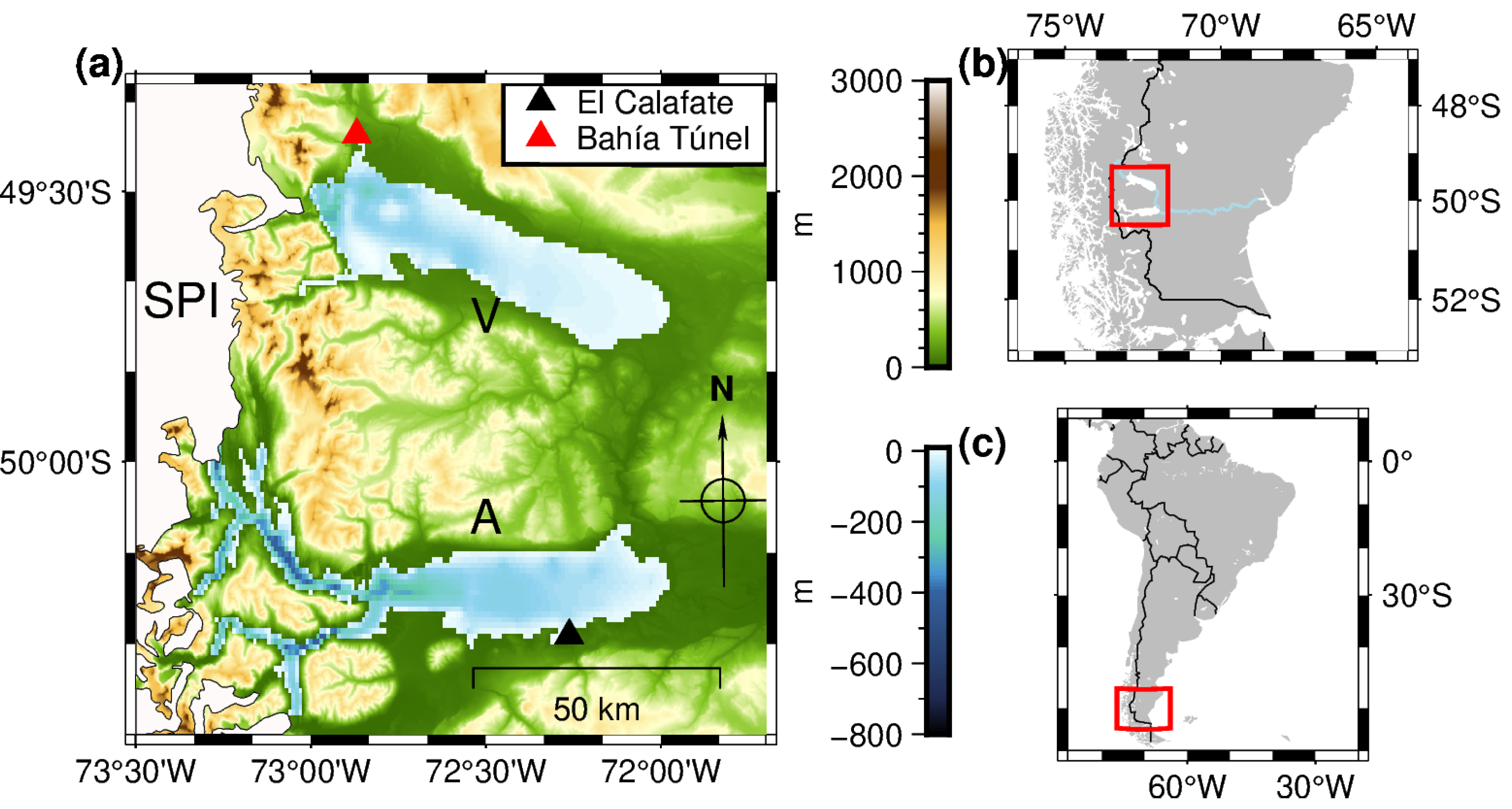
Our need for precise corrections for hydrological loading effects motivates the exploration of the capability of the satellite laser altimetry dataset provided by the ICESat-2 mission as an observational basis for the parametrization of models of spatio-temporal lake-level variations in Lago Argentino and Lago Viedma. The dynamic and variable environment of these lakes turns this experiment also into an objective evaluation of ICESat-2’s performance under challenging conditions. Figure 1a shows the extent of these lakes, highlighting the challenges posed by their size and surrounding topography. Panels b and c further illustrate the remoteness of their location.
Despite their considerable size and touristic attractiveness, there is very little geoscientific research published on Argentino and Viedma lakes. Basic information, such as bathymetric models, water density distribution, internal circulation, currents and related processes is limited. Only few works so far have addressed the lake-level variations of these lakes. Richter et al. [18] conducted pressure tide gauge observations over three years in Lago Argentino and analyzed the derived lake-level records with regard to the major drivers of local lake-level variations. Bergé-Nguyen et al. [19] utilized satellite radar altimetry for the determination of the mean lake-level topography of large lakes, including Lago Argentino. These mean topography models were used to validate geoid models but do not account for persistent non-gravitational contributions. Franze et al. [20] combine ICESat-2 laser altimetry with radar altimetry missions to determine gravity anomalies over 18 lakes in North America. The present analysis is limited to the ICESat-2 elevation dataset, using the precursor mission ICESat and a preliminary dataset of the SWOT mission as data sources for an independent validation of the derived models. It aims at an operational model of spatio-temporal lake-level variations as opposed to the static models of mean lake-surface topography presented by [19,20].

2. Data

2.1. Satellite Laser Altimetry

Satellite altimetry has evolved, since its initial application in 1973, into a powerful tool for mapping the surface elevation of the ocean and polar ice sheets. However, the pulse-limited radar altimeters employed in the early missions are restricted in their application to extended targets of smooth gradients due to their kilometers-wide surface footprint. Laser satellite altimetry, with footprints below 20 m nowadays, allows for the observation of much smaller targets even in mountainous regions.
The first mission to apply this principle was the Ice, Cloud, and Land Elevation Satellite (ICESat), launched in 2003. Its on-board altimeter, the Geoscience Laser Altimeter System (GLAS), was operated for periodical one-month intervals until 2009. It produced single laser footprints of approximately 70 m in diameter, separated by nearly 170 m, at a 40 Hz pulse frequency. Its initial orbit produced repeat ground tracks every eight days, switching to a 91-day repeating ground track in 2004. The GLAH06 data product [21] contains global surface elevation with respect to the ellipsoid at the spot location derived from the measured nadir range after instrument corrections, atmospheric delays and tides have been applied.
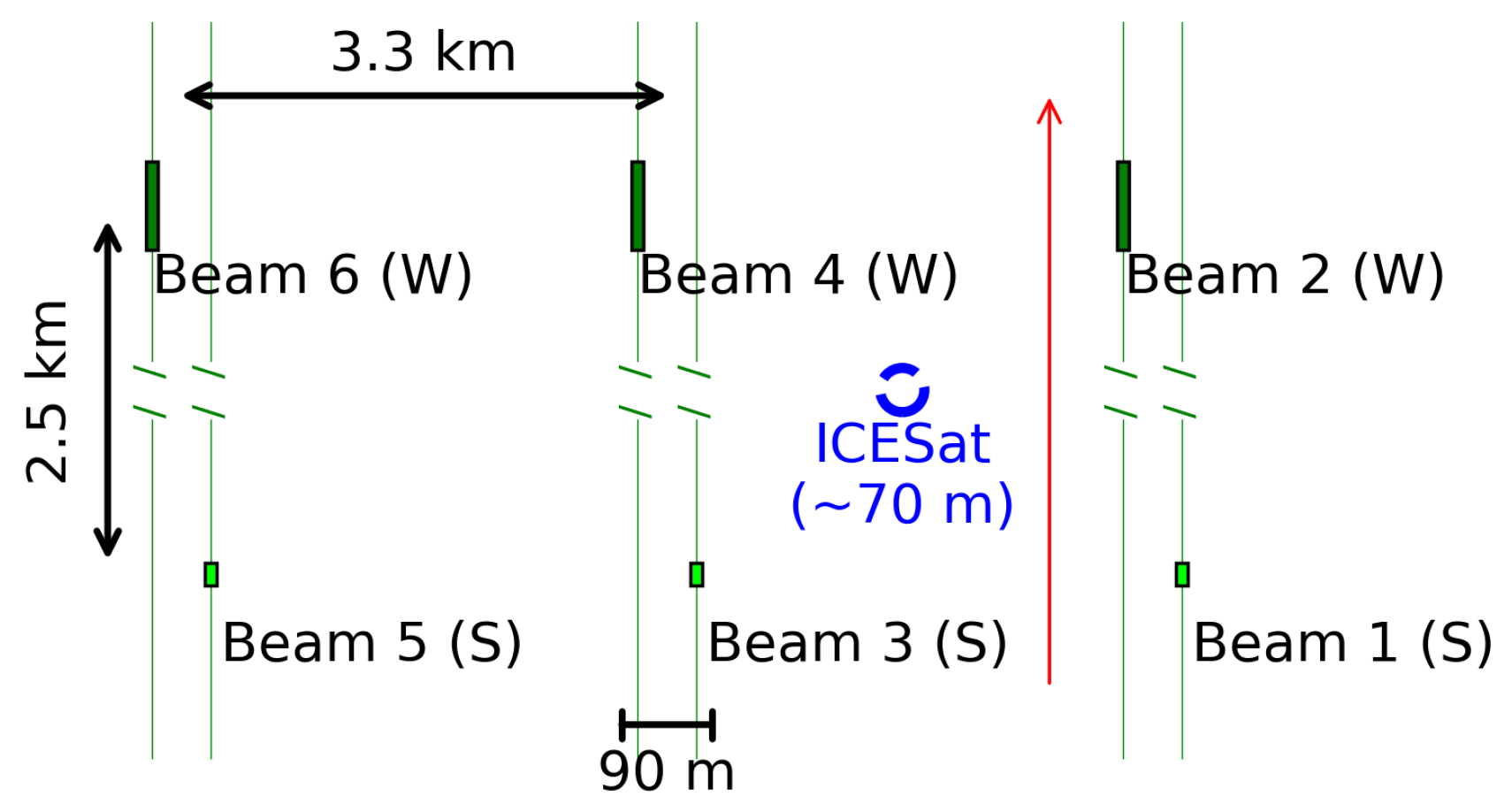
The Ice, Cloud, and Land Elevation Satellite-2 (ICESat-2) is a laser satellite altimetry mission launched on 15 September 2018, as a successor to ICESat. This new mission significantly improves the amount of data by utilizing six simultaneous beams configured in three pairs with a weak and a strong beam, with the weak beams leading in the forward orientation (see Figure 2), and the strong beams leading in the backward orientation, with yaw flips being conducted periodically. The lasers measure continuously at a rate of 10 MHz to obtain measurements spaced by 0.7 m, in contrast to ICESat’s 40 Hz pulses, with an operational off-nadir pointing over mid-latitude land areas to generate denser spatial coverage. The latter, however, comes at the expense of limiting repeat-track capabilities over land areas, with the ground track moving 3.6 km for each repetition period of 91 days, resulting, in our study area, in a precise ground track repetition every two years. The ICESat-2 data is also of improved quality, utilizing single-photon counting detection, instead of the full waveform approach of its predecessor.
For this work, the ICESat-2 ATL13 dataset [22], containing along-track water surface heights and descriptive statistics for inland water bodies from November 2018 to December 2023 is used. This product provides the elevation measurements relative to the WGS84 ellipsoid, generated through 100-photon averages and therefore varying in segment length “from approximately 30 m to several hundred meters, depending on factors such as signal quality and water and atmospheric conditions” [22]. While direct photon-level elevation determination is documented to be affected by subsurface scattering, and can even be utilized for subsurface studies and bathymetry determination on shallow waters [23], the ATL13 surface height algorithm implements both theoretical and statistical corrections in order to more accurately represent the water surface [24]. Backscattering is modeled through a combination of specular reflectance, foam scattering, volume scattering, bottom reflectance, the relative magnitude of anticipated returns, and required atmospheric and meteorological inputs. Water surface height is then determined through statistical analysis, identifying the dominant surface photon distribution through short against long photon segment fit comparisons, filtering subsurface backscatter and noise, and applying geophysical and geodetic corrections. Finally, the instrument response is determined and deconvolved from the elevation dataset, in order to obtain corrected along-track inland water elevations. The resulting dataset, while significantly lower in spatial resolution, represents a more accurate estimate of the water surface elevation.
For the Argentino and Viedma lakes in particular, the corrected ATL13 data presents an average segment length of 35 m for the strong beams, and 130 m for the weak beams, matching the 4:1 energy ratio between them, with a representative width of 17 m due to the laser’s surface footprint. While the strong beams are expected to generate a higher signal-to-noise ratio [25] and previous works have opted to only utilize strong beams [26], weak beam measurements are considered here to be valuable information to include, particularly with the secondary goal of studying beam biases.
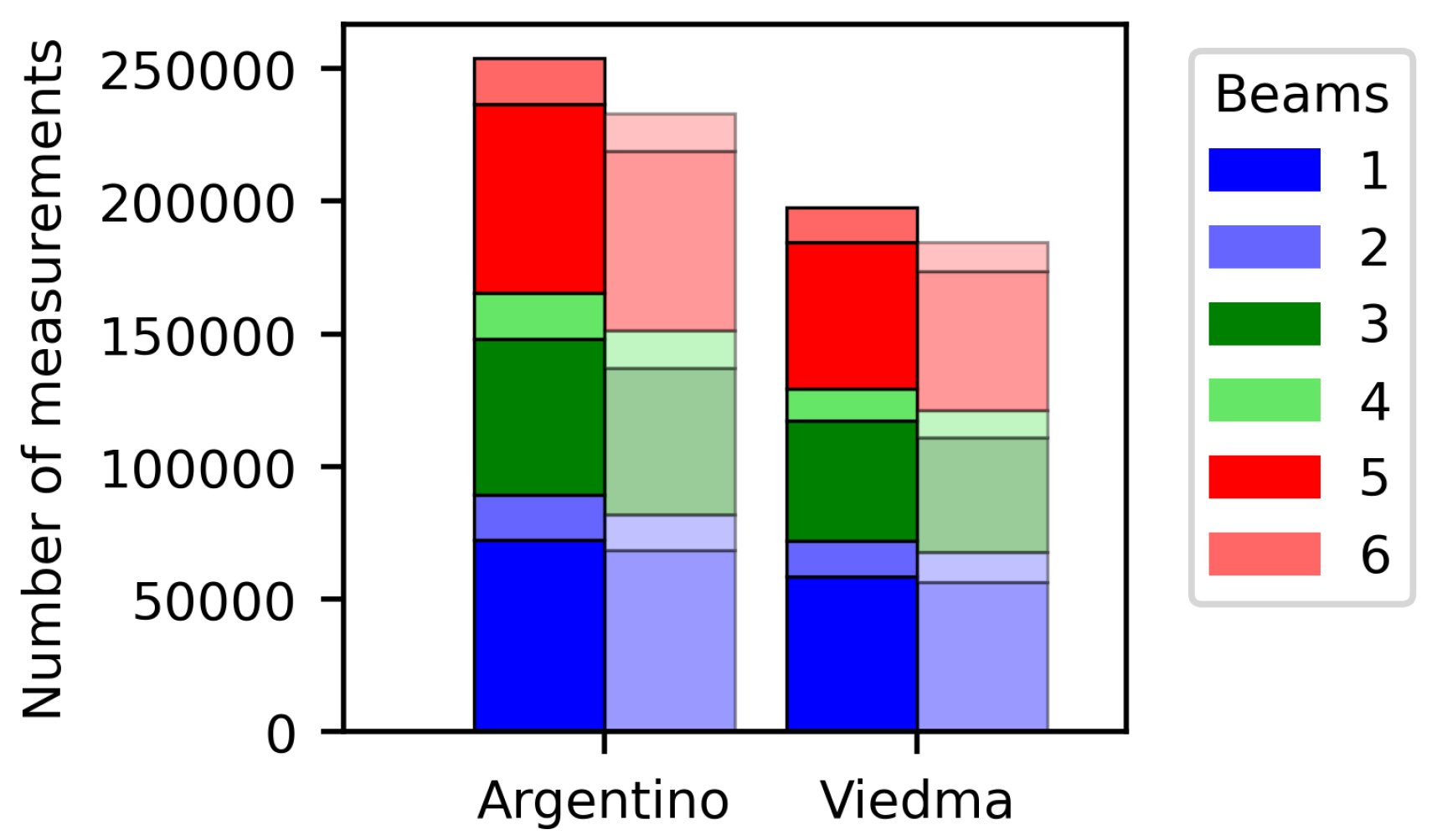
The records are limited to the lakes’ water surface applying high-resolution shoreline polygons, resulting in 927 unique elevation profiles generating 252,000 elevation measurements over Lago Argentino, and 738 unique profiles generating 197,000 elevation measurements over Lago Viedma. Our shoreline polygon and ICESat-2 dataset of Lago Argentino excludes the south-eastern branches Brazo Rico and Brazo Sur, periodically detached from the main lake body by Perito Moreno glacier. An edge buffer, as proposed by [27,28], is applied in our analysis of the elevation data, discarding observations with partial footprints outside the water surface. The data was filtered with the provided “observed standard deviation” quality flag, which gives standard deviation thresholds for differences of short (∼100 signal photons) segments and its encompassing very long segment, composed of 30 contiguous short segments (∼3000 signal photons). Excluding all elevation measurements with this standard deviation flag higher than 0.5 m discards approximately 8% of the measurements, while reducing significantly the elevation scatter. Figure 3 shows the number of measurements provided by each ICESat-2 beam before and after the filtering.
With the aim of an independent validation of the performance of our lake-level variation models, we analyze ICESat GLAH06 elevation data [21] over Lago Argentino acquired between March 2003 and October 2008. Due to the lack of synchronous tide gauge data, this validation cannot be extended over Lago Viedma. For this reason, we utilize a limited dataset of water-surface elevation provided by the Surface Water and Ocean Topography (SWOT) mission by wide-swath SAR interferometry. Our preliminary analysis employs the SWOT Level 2 Water Mask Raster Image Data Product, Version C [29] dataset at nominal ground resolution of 250 m, with an observation period limited by simultaneous tide gauge observations from July 2023 to February 2024.

2.2. Tide Gauge Records

In situ lake-level records from the Argentino and Viedma lakes are published by the Argentine Hydrological Information System [11]. In Lago Argentino, the El Calafate tide gauge, located at the southern shore close to the center of the lake’s main body (Figure 1), provides daily lake-level recordings usually at 9:00 am local time, without data gaps in the analyzed period (November 2018–December 2023). The Bahía Túnel tide gauge in the north-western corner of Lago Viedma recorded one daily lake level at variable times of the day until September 2018, and since then at a 4 h interval. About 6% of the epochs are missing in this record. Both tide gauges inform the lake level with a resolution of 1 cm and relative to a local, arbitrary reference. No information is available on the sensor type, calibration and control levelings.
Tide gauge records provide water-level measurements at high temporal resolution at the cost of limited spatial representativeness and possible location-specific biases. Section 3 introduces the methods implemented in order to model spatial variations of the water-surface elevation and, therefore, make tide gauge measurements comparable to altimetry data for any epoch and location.

2.3. Atmospheric Forcing

The modeling of the lake-level response to atmospheric forcing requires a time-variable description of the air-pressure and near-surface wind fields over the lakes. For this purpose, we use hourly wind speeds and directions at 10 m above the ground provided by the ERA5-Land reanalysis data at 0.1° × 0.1° resolution [30]. Atmospheric pressure at sea level is obtained from the ERA5 hourly reanalysis data on single levels at 0.25° × 0.25° resolution [31]. Despite its lower spatial resolution, this dataset avoids systematic uncertainties regarding the topographic pressure correction in the steep mountain relief.

2.4. Topographic Data

Our local, preliminary geoid model involves a residual terrain correction which requires a 3D description of the major boundary surfaces that separate different densities. The SRTM90 digital elevation model (DEM; [32]) is used to represent the interface between the atmosphere and higher densities beneath. A recent ice thickness model of the Southern Patagonian Icefield [33] is employed to locate the ice–bedrock interface below the glaciers in our model domain. Bathymetric models are needed to determine the water–bedrock interface beneath the lakes. In the case of Lago Argentino, we make use of a recent lake floor depth grid derived from a seismic survey [34]. No bathymetric model is available with complete coverage of Lago Viedma, but recent surveys have provided bathymetric information over the western part of the lake through sonar sounding [35,36] and seismic profiling [37]. We build composite topographic models for both lakes that include all available bathymetric grids and a zero depth boundary condition, complementing the Lago Viedma model by a hypothetical depth distribution in the eastern part in generalized analogy to that of Lago Argentino [34]. The bathymetric models are considered static. Lacking any information and models on water circulation within these lakes, the net sediment redistribution must be expected to be a slow, steady process with a negligible impact on ellipsoidal water-surface elevations over our 5-year observation period. The impact of differential crustal deformation within the lake areas on the ellipsoidal lake level is also insignificant throughout the observation period; however the impact of GIA is considered in the lake water-mass correction presented in Section 6.

3. Methods

3.1. Basic Concepts

Lake-level elevation varies in both space and time. Many applications require a separation between the temporal and spatial contributions to this variability. For example, the determination of equipotential surfaces should be free of temporal effects, while the prediction of surface changes caused by atmospheric forcing on a specific date should not include stable spatial variations. This lake-level variation can be perceived as a mean surface of lake-level topography—in equilibrium with average fields of forces that act on the water surface—and spatio-temporal anomalies. We consider the gravity field and the temporally averaged air pressure and surface wind fields to be forces affecting the mean lake-level topography. The commonly accepted concept is that the lake level adjusts to an equipotential surface (e.g., [19,20,38]) representing the effect of gravity. Temporal variations over the mean topography arise from water-volume changes in response to the hydrological balance of the drainage basin, and from instantaneous-local deviations of the atmospheric forces from their mean fields. In this way, we consider a static response to atmospheric forcing resolved in space and time. In practice, the response of a lake surface to external forces includes also dynamic responses such as surface waves, seiches and variable lake circulation in the form of Kelvin or Poincaré waves [39]. However, hydrodynamic modeling of lake circulation is a challenge and beyond the scope of the present work. Surface waves are expected to average out to a large extent over the ICESat-2 laser footprint. Therefore, dynamic responses to wind and air pressure are not considered here.
Our general approach is to subtract, from each individual ICESat-2 elevation within the lake shores, deterministic corrections for the spatio-temporal lake-level variations caused by the considered processes. In particular, a preliminary mean lake-level topography model is subtracted, which combines a local geoid model and the static response to the mean air pressure and wind fields. In addition, the temporal variations resulting from water-volume changes and the static response to the instantaneous air pressure and wind fields are removed.
Throughout the lake-level reduction we refrain from eliminating or averaging individual elevations, striving for a preservation of the maximum empiric basis and a realistic quantification of residual variability. The elevation residuals are averaged within bins and a smooth surface is fitted to the averaged residuals. This residual topography is interpreted as an empirical improvement of the preliminary geoid model and thus added to the preliminary mean lake-level model to yield, in an iterative procedure, our final mean lake-level topography model. The following sections describe how the individual corrections are derived.

3.2. Assessment of Observational Uncertainty

The observational uncertainty inherent to the surface elevations of the ATL13 product can be separated into random measurement noise and systematic biases. Conceptually, above an ideal horizontal surface, the measurement noise affects the internal precision of consecutive elevation values along a continuous profile segment. Systematic effects can cause differences in the elevation values between the individual laser beams, and may also evolve over time. In practice, the elevations are not measured on a horizontal surface but reflect real surface-elevation changes. Thus, the separation of the contributions from real variations, random noise and systematic biases to the observed profiles becomes a challenging task.
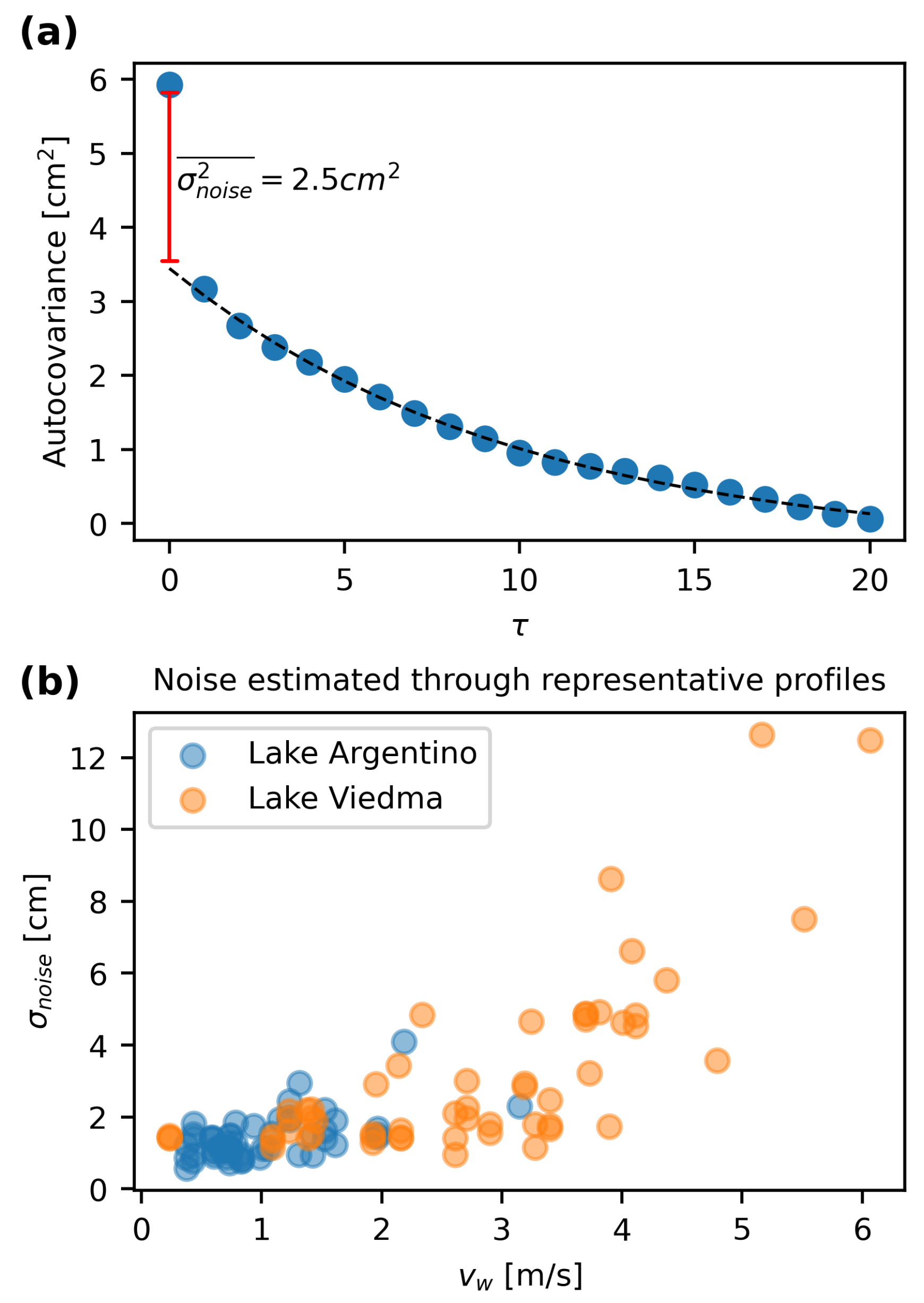
The autocovariance of along-track elevation profiles is employed to estimate the precision of the ATL13 elevations over the region. For this purpose, we derive autocovariance functions for representative elevation profiles across the studied lakes. As expected, the highest autocovariance is observed at lag τ = 0, representing the correlation of the profile with itself, and a sharp decline is observed for the following lags. This decline is composed of the statistical lake-level elevation change over a distance corresponding to the along-track data interval (35 m for strong-beam profiles) and the random uncertainty according to the model of white noise. Since the surface of the water on a calm lake is sufficiently smooth, the correlation decline due to surface elevation changes is also expected to be smooth. Therefore, by fitting a smooth curve to the autocovariance at lags 1 through 20, the correlation at lag zero caused by the surface elevation can be extrapolated. The difference between this estimation and the lag zero correlation is interpreted as the random observational error σ noise , as expressed in Equation (1), where R x x ( 0 ) represents the autocovariance at lag zero, and R x x ˜ ( 0 ) the extrapolated autocovariance by fitting a smooth curve.
σ noise R x x ( 0 ) R x x ˜ ( 0 )
ICESat elevations reveal systematic offsets between the individual lasers and campaigns, referred to as laser operation period (LOP) biases (e.g., [40]). This motivates us to explore possible systematic biases between the individual laser beams of ICESat-2. Adjacent lasers measure the surface of the lakes on nearby locations, and practically at the same time (with a delay below 1 s), so they should be comparable in elevation, with differences produced by random surface heterogeneities or the direct effect of inherent differences between beams. The result of these analyses is presented in Section 4.1.

3.3. Models of Contributions to Spatio-Temporal Water-Level Variations

3.3.1. Preliminary Geoid Model

Global Geopotential Models (GGMs) are mathematical approximations of the external gravity field of the Earth [41]. They combine satellite gravimetry and altimetry datasets, along with terrestrial, shipborne and airborne gravity measurements. As the data sources and processing techniques differ among models, their performance varies by region, so the best-performing GGM depends on the geographic area of interest. GGM are a valuable tool for the determination of local geoid models, and become increasingly necessary in regions with limited ground data. However, the quality and distribution of the datasets used in a GGM solution (especially terrestrial gravity) constrain the accuracy of any gravity field functional computed via a spherical harmonic synthesis. Thus, in regions without terrestrial observations, GGM will not deliver the best results even when used to the highest degree of their harmonic expansion [42,43]. To enhance accuracy, they are often complemented by residual terrain modeling (RTM), which completes the gravity signal beyond the expansion degree of a GGM to augment its spectral content [44].
RTM correction is based on the principle that the terrain around a measurement point affects the gravitational field. This correction is particularly important in mountainous regions, where terrain-induced gravity anomalies can be significant. The process typically involves three stages. First, a high-resolution DEM is used to model the terrain. Second, a smoother or lower-resolution surface (such as a mean topography) is subtracted from the high-resolution model to obtain a “residual” terrain model. Finally, the gravitational effect of this residual terrain is computed using Newtonian gravity equations and incorporated to the geoid model derived from the GGM. For this purpose, we employ the TC routine of the GRAVSOFT package [45] that implements a classical approach in which the integration of the terrain effects is performed using the formulas for the gravitational effects of homogeneous rectangular prisms.
The RTM approach implies a density reference model which has crustal density up to the elevation of the reference surface. A DEM representing the regional topography is referred to that reference surface, producing a residual topography which accounts for the high frequency of the gravity field spectrum if the reference surface has the same wavelength as the GGM used [46,47,48].
It must be stated that all high-degree GGM use the National Geospatial-Intelligence Agency gravity anomaly grid which, according to Pavlis et al. [49], does not cover all the studied region. It can be seen that fill-in data is used instead. This is caused by the absence of gravity data due to a lack of infrastructure. Thus, as in Gomez et al. [38], we do not expect GGM to perform well when used at their full resolution.
For the selection of a suitable GGM for this peculiar region, three models including EGM2008 [49], XGM2019e [50] and SGG-UGM-2 [51] are tested against preliminary mean lake-level topography grids derived from ICESat-2 as a proxy for the geoid undulation. All models yield an RMS misfit close to 20 cm when evaluated on GPS/leveling points only available on the surrounding eastern areas. This result is obtained even when using the GGM up to degree and order 720, 1080 or 2190, reflecting the absence of real gravimetric data. This manifests the need to replace the high degrees and orders of the GGM, which in other parts of the world contribute high-resolution gravity information, by RTM.
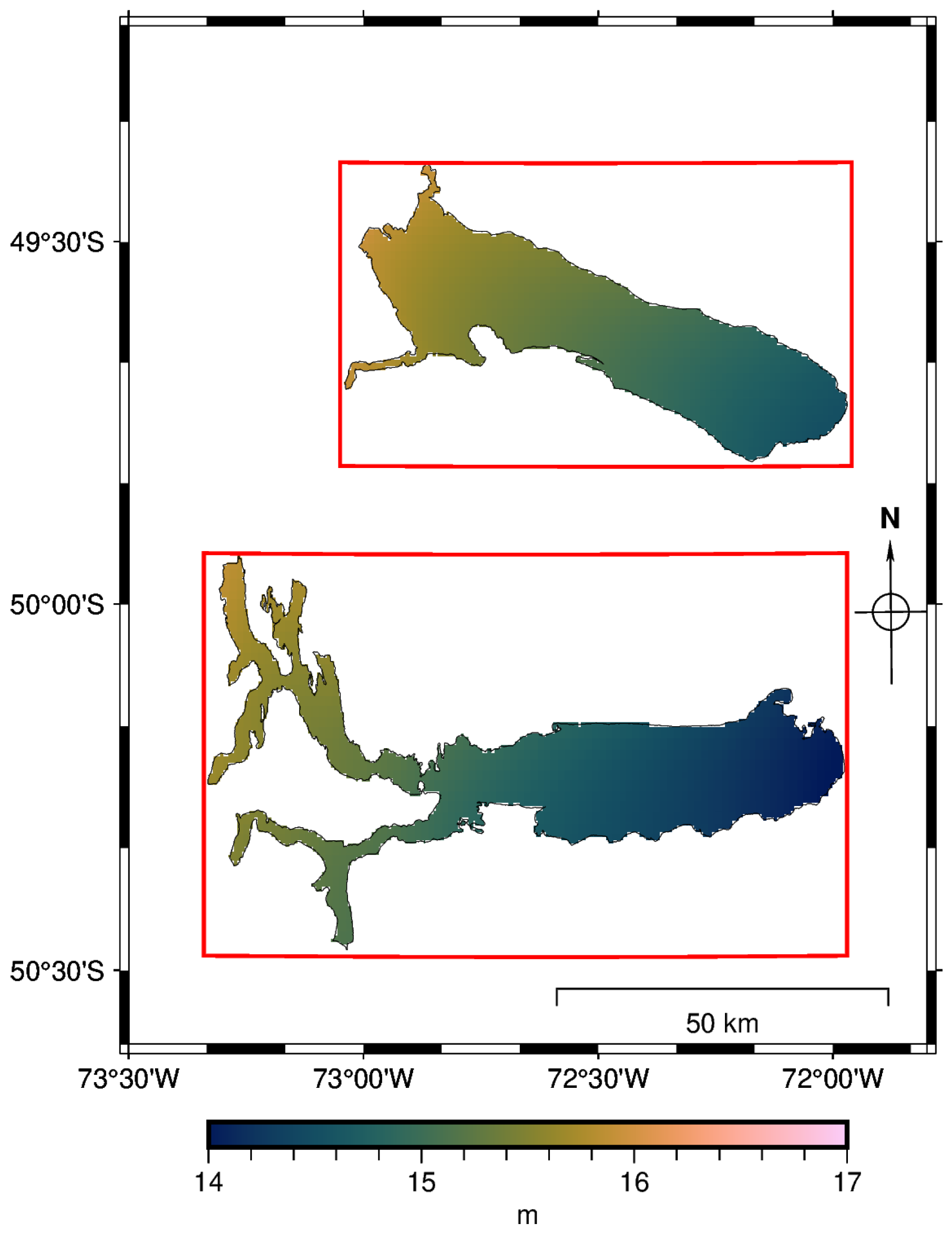
After testing several models to different degrees and orders and extending them with RTM, following the procedure described in Gomez et al. [38], SGG-UGM-2 shows slightly better performance. As a result, our preliminary geoid model is based on SGG-UGM-2 up to degree and order 300, with the RTM combining the SRTM90 DEM with ice-thickness [33] and bathymetric models [34] as described in Section 2.4. With the present work being focused on the lakes’ water surfaces, the geoid model is restricted to the interior of the lakes as presented in Figure 4.

3.3.2. Water Volume Variation

The volume of water contained in a lake changes continuously, reflecting the balance between the inflow (driven by precipitation and the fusion of snow and ice over the catchment area) and the lake’s downstream discharge. These volume fluctuations cause lake-level changes whose magnitude depends on the ratio of the lake’s surface area to that of its upstream drainage basin. They are the primary contributors to the elevation variation measured by ICESat-2 over the studied lakes.
Previous work has shown that the volume fluctuations are dominated by an annual cycle, with a significant interannual variability in the range and shape of this seasonal cycle [18]. The amplitude of the seasonal volume-driven lake-level cycle in Lago Argentino is typically 1.2 m, and slightly smaller in Lago Viedma [18]. The principal contributor to the annual water-volume cycle in both lakes is the seasonal variation in water influx governed by glaciers and snow melt. A minor contribution, well within a few centimeters, can be expected from the steric effect of seasonal water temperature variations. A pressure tide gauge record in central Lago Argentino (site C in [18]) demonstrates that at 1.5 m depth, the water temperature variation range has not reached 10 K in 3 years. At greater depth and closer to the glaciers, the temperature variability is much smaller. It shows that water temperature and density are homogeneous during the southern winter. This temperature record suggests that stratification develops progressively with a steady increase in near-surface water temperature and thermocline depth from August (spring) through March (autumn). In addition, Lago Argentino has experienced sporadic, sudden water volume injections during the Perito Moreno glacier dam ruptures, which can produce a lake-level rise of several decimeters in the lake’s main body [18,52]. Subdaily volume changes are roughly two orders of magnitude smaller, with a mean diurnal amplitude around 2 mm in Lago Argentino [18].
Therefore, the tide gauge records available for Argentino and Viedma lakes with daily resolution are an efficient way to monitor the volume changes in both lakes. However, they are affected also by local variations driven by atmospheric forcing, which are not representative of the entire lake surface and, thus, the water volume. This is of particular relevance in Lago Viedma, where the tide gauge is situated eccentrically with respect to the lake’s water body (see Figure 1).
Our altimetry data reduction procedure involves subtracting the lake-level anomaly recorded at the tide gauge from each ICESat-2 elevation measurement as a preliminary volume-change correction. ICESat-2 elevations taken more than 48 h apart from the closest tide-gauge recording are discarded. In a later step, atmospherically driven lake-level variations are modeled (see Section 3.3.3). The spatio-temporal lake-level difference between the time and location of each ICESat-2 measurement and the corresponding tide-gauge reading used for the preliminary volume correction is derived from these models and subtracted from each ICESat-2 elevation. In this way, the corrected ICESat-2 elevations are free of volume changes according to tide-gauge readings corrected for atmospherically induced local variations.

3.3.3. Response to Atmospheric Forcing

The primary atmospheric forces to which a lake responds statically through lake-level variations are air pressure and wind. The hydrostatic response to air-pressure changes is denoted as inverse-barometer effect (IB): where the relative air pressure over the lake is high, the water level drops, to rise in parts of the lake under lower air pressure. We assume that this process conserves water volume in the lake and that the lake-level responds instantaneously to pressure changes. This implies that the vertical deformation of the lake surface follows, with opposite sign, the pattern of instantaneous air pressure anomalies P over the lake with respect to the instantaneous spatial pressure average P mean .
Hourly ERA5 grids of pressure at sea level are linearly interpolated to the ICESat-2 observation epoch. For each satellite passage, this epoch consists of the mean time tag of the valid elevations over the lake, with an ICESat-2 passage across the lakes taking under 10 s. At each of these ICESat-2 epochs, the temporally interpolated ERA5 pressure field is spatially interpolated onto a high-resolution grid (100 m spacing) of the lake’s water surface. Over this high-resolution grid, the instantaneous mean pressure P mean is integrated and subtracted from the grid’s pressure values. This residual pressure field is then converted into hydrostatic lake-level change Δ h IB according to Equation (2), where g represents the local gravity acceleration and ρ w the water density. Utilizing an average gravity value of 9.8 m/s2, an average freshwater density of 1000 kg/m3, and introducing the pressure differential in Pascal, Equation (2) determines the elevation produced by the IB effect in meters:
Δ h IB = P P mean g · ρ w .
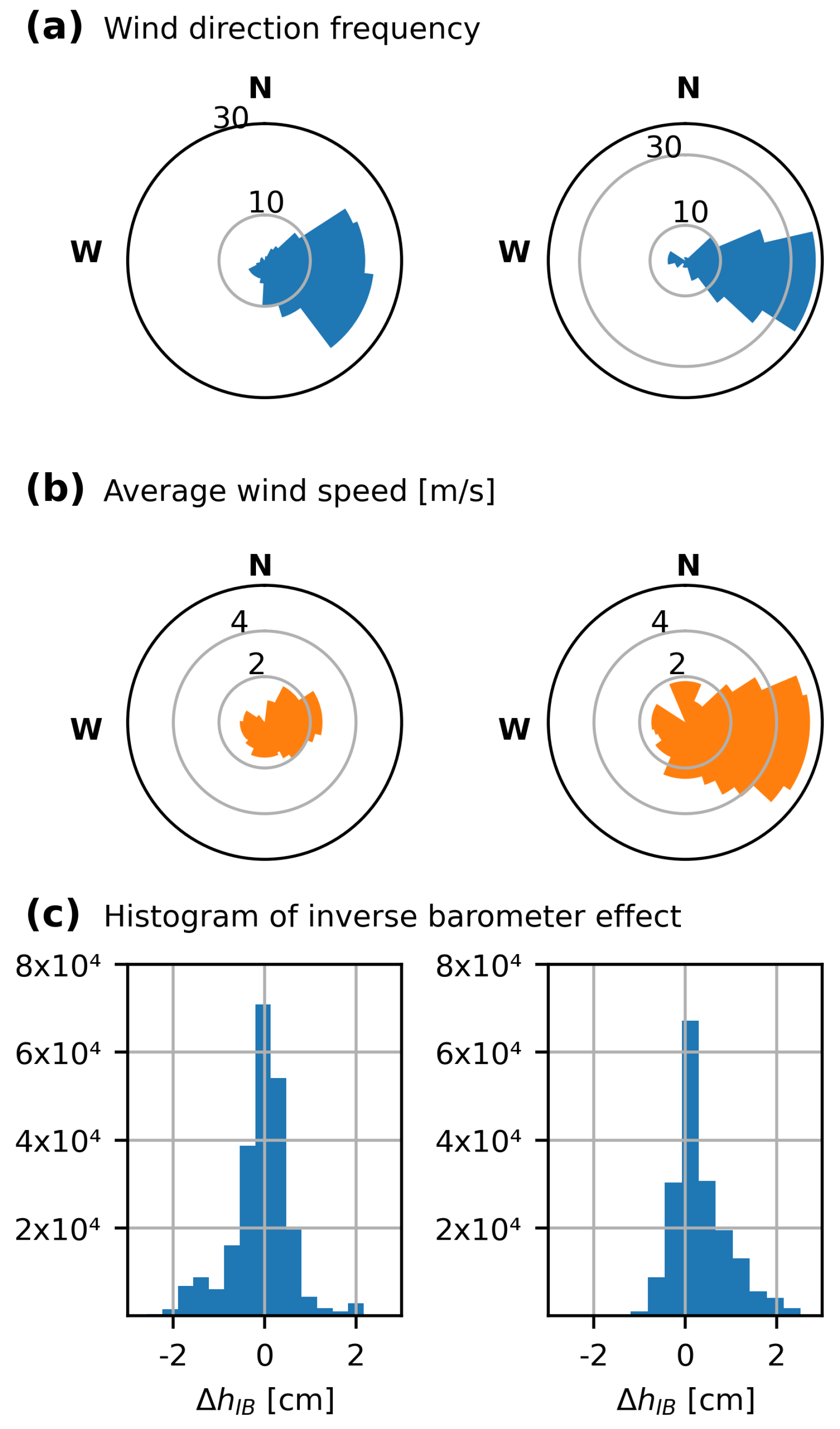
Lake-level changes Δ h IB are calculated for the location and time of each ICESat-2 elevation, as well as for the tide gauge reading adopted as volume correction. The difference in Δ h IB between the time and location of the ICESat-2 measurement and that of the tide gauge observation is applied as IB correction to the ICESat-2 elevation. Figure 5c shows histograms of the resulting IB corrections for the Argentino and Viedma lakes. The corrections are within ±3 cm, and more than 80% of them are below ±1 cm.
Wind forcing is highly relevant for Argentino and Viedma lakes, perhaps more than for many other lakes because of the strong westerlies for which Southern Patagonia is notorious. Figure 5a,b show the wind direction and velocity distribution for the studied period. Wind acts horizontally on the water surface, biasing the net water flow towards the downwind direction, where the excess water piles up, away from hydrostatic equilibrium. Water volume conservation requires the water level to drop in the upwind parts of the lake. The efficiency of the wind to deviate the lake level out of hydrostatic equilibrium is more complex to model than IB, as it depends on numerous parameters and conditions. We choose a simple, empiric approach which relates lake-level change to the wind-velocity field provided by ERA5. It assumes that the lake level responds by an upward tilt in the downwind direction. For each wind direction there is a perpendicular nodal line that bisects the lake area. Within each cell of our high-resolution lake-surface grid, the tilt produces a vertical displacement proportional to the cell’s horizontal distance from this nodal line. The tilt angle is assumed proportional to the wind speed averaged over a build-up period. This integration period accounts for the time it takes the surface water to move horizontally through the lake and accumulate. Our formulation includes two a priori unknown parameters: an “efficiency coefficient” which scales the wind velocity to observable lake-level tilt, and the duration of the build-up period.
The hourly ERA5 wind fields are spatially averaged over the lake area and integrated over the build-up period preceding each ICESat-2 passage epoch to yield a representative wind direction α wind and wind speed v wind . A preliminary tilt model is calculated based on these representative wind parameters. Residual lake-level deviations are derived from ICESat-2 elevations corrected for the preliminary geoid model, the volume and IB corrections. Then, the efficiency coefficient c is obtained by a least-squares adjustment of a scaling factor that minimizes the misfit between the residual lake-level deviations and the prediction of the preliminary tilt model for the location of the ICESat-2 measurement. The initial scale of the wind tilt model is elevation change (in m) per distance (from the bisector nodal line, in km) and wind speed (in m/s); thus, the efficiency coefficient unit is m   km 1 ( m / s ) 1 = s / km .
The wind-induced, local lake-level change Δ h wind at a distance d from the nodal line corresponding to the wind direction α wind is obtained as
Δ h wind = c · v wind · d ( α wind ) .
As in the case of the IB correction, the wind correction is applied to both the ICESat-2 elevations and the respective tide gauge observations.
Lake-level residuals are computed from the ICESat-2 elevations after application of the preliminary geoid model, the volume, IB and wind corrections. This procedure is repeated, varying the build-up period between 1 and 24 h. The optimal build-up period is the one that minimizes the standard deviation of the lake-level residuals. For each lake, individual values for both the efficiency coefficient and the build-up period are determined.

3.4. Operational Lake-Level Variation Model

Our procedure for reducing ICESat-2 water-surface elevations consists in the following steps: (a) ATL13 data filtering (applying the standard deviation flag and the coastline buffer); (b) correction for water-volume changes (incorporating tide gauge records); (c) correction for mean lake-level topography (applying the preliminary geoid model); (d) hydrostatic IB correction (applying ERA5 pressure fields); (e) wind correction (applying ERA5 wind fields and empirically determined transfer function parameters); and (f) computation and analysis of lake-level residuals (ICESat-2 elevations after application of all corrections). The lake-level residuals are examined both in the time domain and in space. They reveal a spatial correlation which suggests the presence of persistent lake-level topography signals not modeled by our preliminary geoid model. Thus, the ICESat-2 dataset over the lakes is used for a local geoid model improvement. For this purpose, we implement our procedure in an iteration.
From the lake-level residuals remaining after the first run through the procedure, all data belonging to epochs with less than 300 measurements are excluded, conserving all profiles that provide an accurate representation of the transverse lake-level shape. The lake-level residuals are spatially averaged (bin dimension: 0.01° × 0.01°), effectively reducing stochastic contributions. The surface of bin averages is smoothed by fitting a continuous surface [53]. This residual surface is added to the preliminary geoid model to yield the “refined geoid model”. The new geoid undulations, in turn, change the lake-level residuals and, thus, the wind-tilt regression. In the second iteration, improved wind corrections are computed. This iteration converges quickly. Already after the second loop, the lake-level residuals are significantly smaller in magnitude and randomly distributed, rendering any further geoid model refinement needless.
Our models of lake-level response to air pressure and wind, Δ h IB and Δ h wind , allow us to predict atmospherically induced lake-level variations throughout the ERA5 data period. Combined with the improved geoid models and water-volume information (e.g., tide gauge data), they integrate an operational model for the accurate prediction of ellipsoidal lake-level elevations anywhere within the lakes under study.
Furthermore, a mean lake-level topography model is determined, independent of the observational period. Mean air pressure and wind fields over the lakes are derived from the complete ERA5 records throughout the utilized ICESat-2 data period, and used to derive the mean hydrostatic lake-surface deformation due to IB and the mean lake-surface tilt due to wind. These mean atmospheric perturbations are added to the refined geoid model, yielding a mean lake-level surface representative for average conditions.
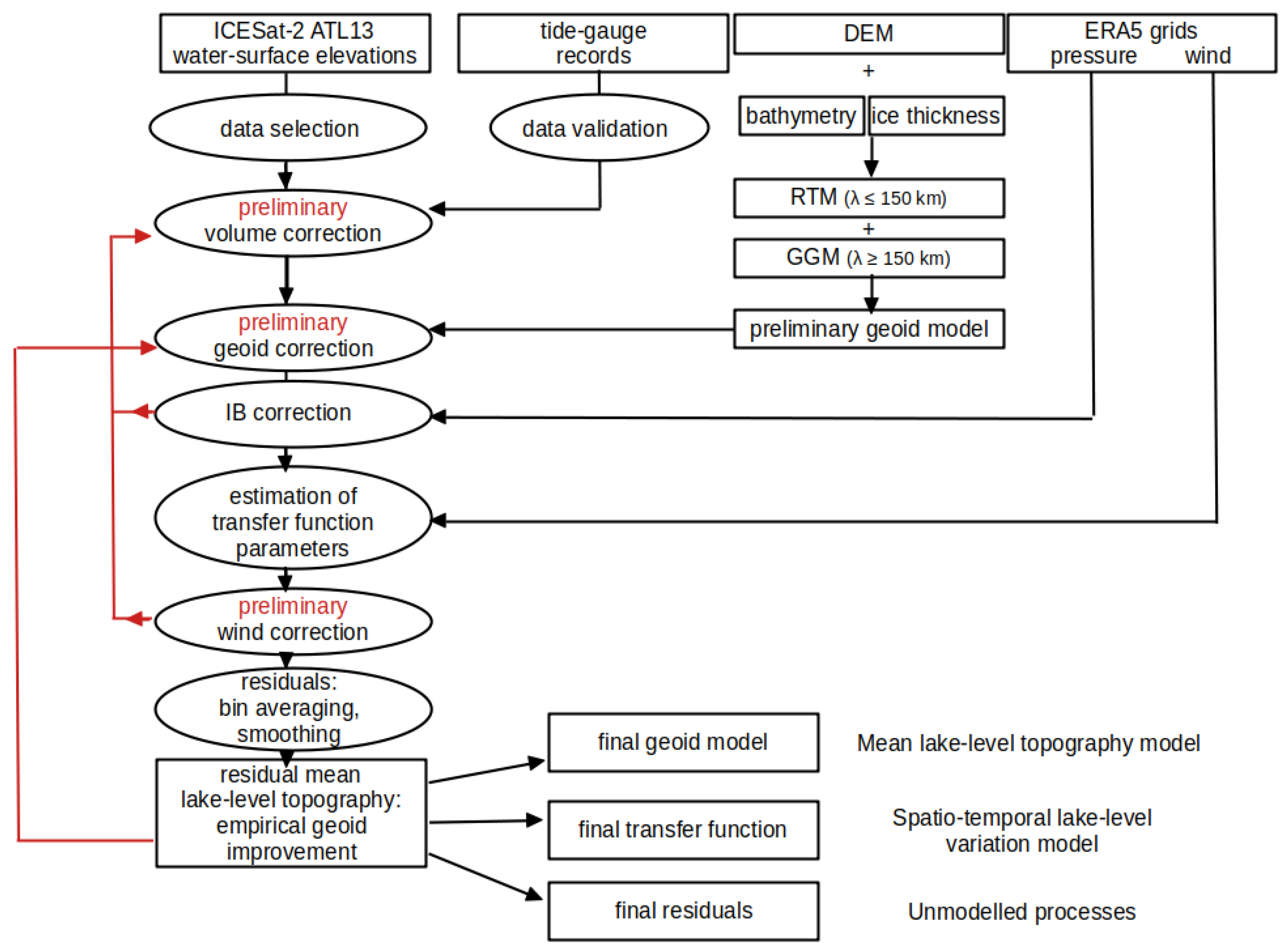
Figure 6 shows a flow chart of the modeling procedure applied in the determination of spatio-temporal lake-level variations in Argentino and Viedma lakes.

3.5. Lake-Level Variations Model Validation: Synthesis and Comparison with ICESat and SWOT

Our spatio-temporal lake-level variation model needs to be validated by independent data. For this purpose, we use the elevations provided by the GLAH06 product of the ICESat mission over Lago Argentino. The El Calafate tide gauge record and the ERA5 fields are used to derive volume, IB and wind corrections for the locations and times of available ICESat measurements. These corrections, as well as the refined geoid model, must be subtracted from the ICESat elevations. A statistical analysis of the residuals provides an objective insight into the efficiency and accuracy of our operational model based on ICESat-2.
A similar model validation with ICESat data is not possible over Lago Viedma due to the lack of simultaneous tide gauge data. Therefore, SWOT elevation data are used for a preliminary analysis over both lakes. The selection of the SWOT dataset is conditioned in time by the availability of tide gauge data and in space by the limited resolution that prevents the surface-elevation sampling in the narrow western lake arms.

4. Results

4.1. ICESat-2 Elevation Accuracy

Our autocovariance analysis of individual elevation profiles yields estimates of uncorrelated noise in the ATL13 product. This estimate is observed to be strongly dependent on the wind speed over the lake during the acquisition of the profile. We derive a standard deviation of ICESat-2 random measurement noise σ noise of 1.6 cm by stacking autocovariance functions of elevation profiles with wind speeds below 2 m/s (Figure 7a). This estimate reflects the repeatability of a single elevation value and is consistent with previous works [54,55]. The estimated noise increases at higher wind speeds (Figure 7b). We interpret this increase as the effect of surface waves which only partially average out within the 100-photon integration interval and increase in elevation with wind intensity. The wind-correlated elevation uncertainty in Lago Viedma is shown to be statistically twice that of Lago Argentino.
The consistency among individual laser beams is examined based on the comparison of quasi-simultaneous surface elevation residuals after application of all the corrections described in Section 3.3. Table 1 presents an internal comparison between the strong and weak beams of each laser beam pair. The differences are calculated by subtracting the elevation measured by the weak beam from the one measured by the strong beam (illustrated in the forward direction in Figure 2) at the closest proximity of both profiles (distances between 90 and 100 m), and are presented along with their standard deviation. This comparison reveals, consistently over both lakes, a distinct behavior of the central pair compared to the lateral pairs. The positive mean difference obtained for the central pair suggests that the strong beam yields surface elevations systematically higher (i.e., shorter nadir distances) than the central weak beam. For both lateral pairs, the opposite is observed: the strong beams produce lower elevations than the weak beams. In the uncertainty estimation of the pair-internal differences, the profiles from different passages are regarded as uncorrelated. The differences are generally of a similar magnitude as their uncertainties, indicating a moderate statistical significance. Uncertainties are significantly larger in Lago Viedma than in Lago Argentino as a consequence of a greater dispersion of the short-distance elevation differences. We attribute this to stronger winds (Figure 5b) producing higher deviations (Figure 7b) in Lago Viedma.
Table 2 shows a comparison of the individual beams also across different pairs. For each laser beam and corresponding epoch, the closest simultaneous measurement by every other beam is selected, restricted to within maximum distances of 100 m (for its adjacent beam), 3500 m (for adjacent pairs), or 7000 m (opposite pairs, 1–2 vs. 5–6). This comparison sustains that the central weak beam (Beam 4) produces lower surface elevations than the other beams, although it is not considered statistically significant enough to determine a bias correction with the available data.
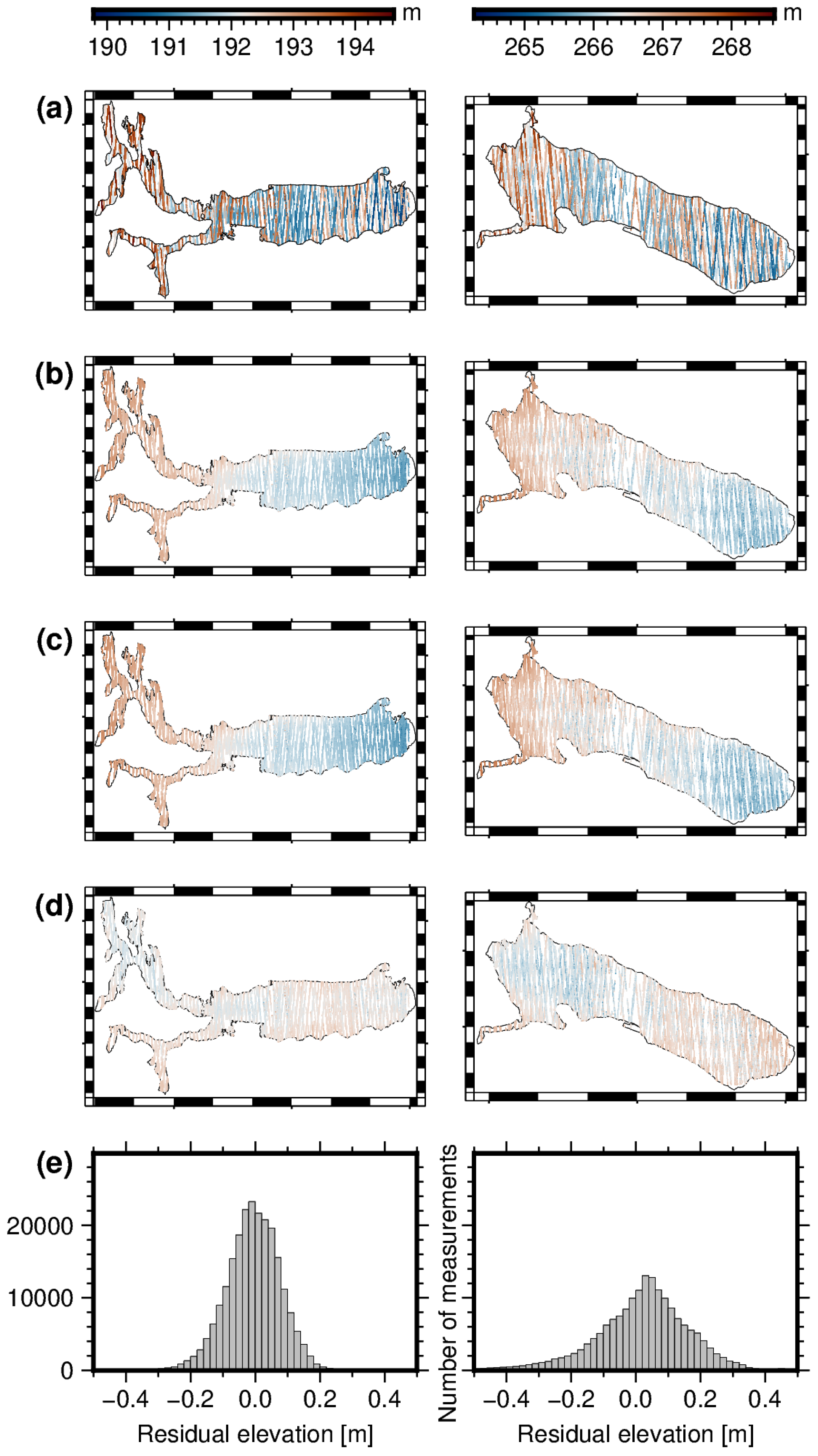
After verifying the precision of ICESat-2 measurements, the resulting distribution of elevation measurements from the ATL13 product is analyzed. The elevation measurements are noticeably noisy, with significant elevation changes over short distances that are not congruent with expected mean water-surface elevations (Figure 8a,b). This is mostly caused by temporal changes between elevation measurements. After correcting for volume changes by subtracting the tide gauge measurements, residual surface elevations show a smoother distribution (Figure 8c,d). The standard deviation of residual elevations when subtracting tide gauge measurements decreases from 106 cm to 49 cm in Lago Argentino, and from 70 cm to 33 cm in Lago Viedma. In addition, the spatial changes in elevation are significantly smoother, being more consistent with the expected wavelength of residual variations.
As described in Section 3, some of the corrections implemented to the elevation measurements are strictly deterministic. One of them is the inverse-barometer effect. As shown in Figure 5c, this effect is of very small magnitude in the Argentino and Viedma lakes, usually within the observational uncertainty.
The second deterministic correction is generated from the preliminary geoid model as described in Section 3. The geoid model used for both lakes is shown in Figure 4. Utilizing the preliminary geoid and IB correction, the standard deviation of elevation measurements drops to 13 cm for Lago Argentino, and 24 cm for Lago Viedma.

4.2. Empiric Model Components

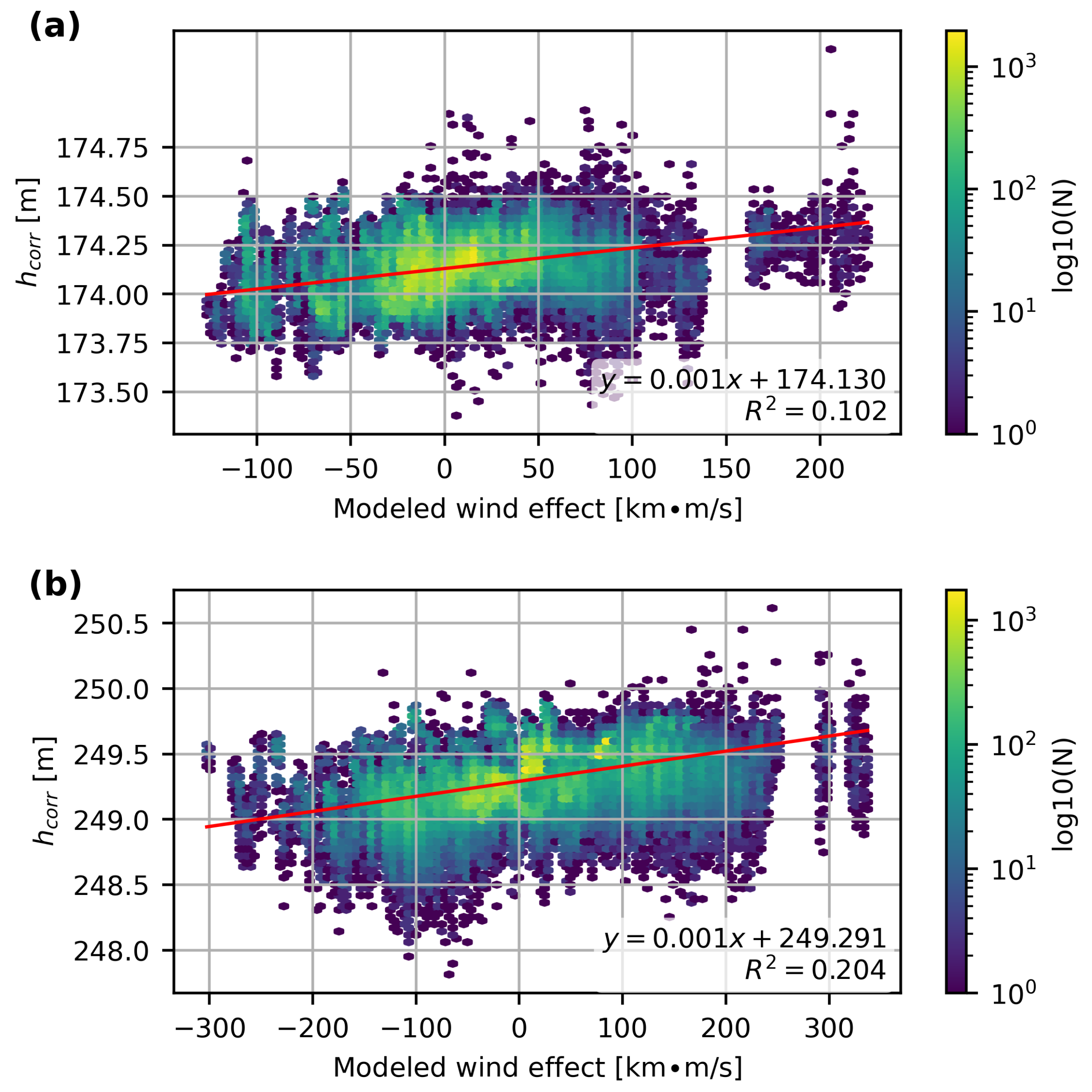
The remaining spatio-temporal variation models are adjusted by utilizing the ICESat-2 elevation residuals that incorporate all previous deterministic corrections. Although the wind effect is modeled independently by utilizing ERA5 wind fields and a sloped surface, the scaling of this slope is determined through a linear regression of the corrected elevation measurements against the modeled wind effect. Figure 9 shows this linear regression for Argentino and Viedma lakes. We derive wind efficiency coefficients of 7.93 · 10 4 s/km and 4.43 · 10 4 s/km for Argentino and Viedma lakes, respectively, with an optimal build-up period of 4 h for Lago Argentino and 7 h for Lago Viedma. Lago Viedma also presents a higher correlation between the corrected elevation measurements and the modeled wind effect, with a Pearson coefficient of 0.45, compared to Lago Argentino (0.33). This can be explained by the simpler shape of Lago Viedma, better approximated by the linear slope model and implying longer fetch, as well as the higher average wind speed more strongly conditioning elevation changes. As suggested by these statistical estimators, the wind effect correction has a significant impact on the standard deviation of ICESat-2 measurements over Lago Viedma, dropping to 21 cm. Figure 8 shows the elevation residuals after each correction is applied, illustrating the improved fit of the modeled surface to the data.
Once all corrections for atmospheric forcing and volume fluctuations are applied, the resulting residual elevation is a combination of stochastic effects, such as observational uncertainty and short-wavelength lake-level variability (e.g., due to waves), and a residual geoid signal that is inadequately represented by the preliminary geoid model. One prominent, persistent feature in the lake-level residuals derived from ICESat-2 is the concave curvature across the principal lake axis (Figure 10). This curvature is consistent with the effect of the mass deficit of the valleys occupied by the lakes on the local geoid, and has already been reported by [38] for Lago Fagnano, and [19] for a wide range of lakes. The inadequate representation of this mean transversal topography by our preliminary geoid model (green curves in Figure 10) indicates an insufficient resolution of the bathymetric information (especially for Lago Viedma) and the computed RTM correction. The sum of the preliminary geoid models with the smoothed residual surfaces yields the refined geoid model (Figure 11a,b). By adding the atmospheric effects of the mean air-pressure and wind fields over the lakes to the refined geoid models, the mean lake-level topography is derived (Figure 11c,d).

4.3. Operational Lake-Level Variation Model and Its Validation

Figure 8 demonstrates the progressive reduction of residual lake-level variation with the application of each correction. The stepwise decrease in residual standard deviation is summarized in Table 3. After the subtraction of all corrections (Figure 8d), the residuals show a coherent spatial distribution attributable to residual geoid undulations. After the application of the refined geoid model and the improved wind correction, that is, after the second iteration of the elevation reduction procedure, the residuals are composed of observational uncertainties, unmodeled contributions to spatio-temporal lake-level variations (e.g., surface waves, lake circulation, and seiches), and imperfections of our model (e.g., deviation of the response to wind from a linear tilt).
For an average ATL13 measurement, the standard deviation of these contributions is estimated at 8 cm and 14 cm over Argentino and Viedma lakes, respectively. These values are close to the standard deviations of differences between nearest measurements for adjacent beams (Table 1) and therefore considered indicative of the repeatability limit for the technique.
However, these residual standard deviations should not be interpreted as the uncertainty of the derived mean lake-level surface, as the spatial averaging of the elevation measurements reduces this uncertainty. Both lakes accumulate on average 125 measurements per 0.01° × 0.01° bin. If the residuals within a bin are considered uncorrelated, the uncertainty of the bin average is estimated at 0.8 cm and 1.2 cm in Argentino and Viedma lakes, respectively.
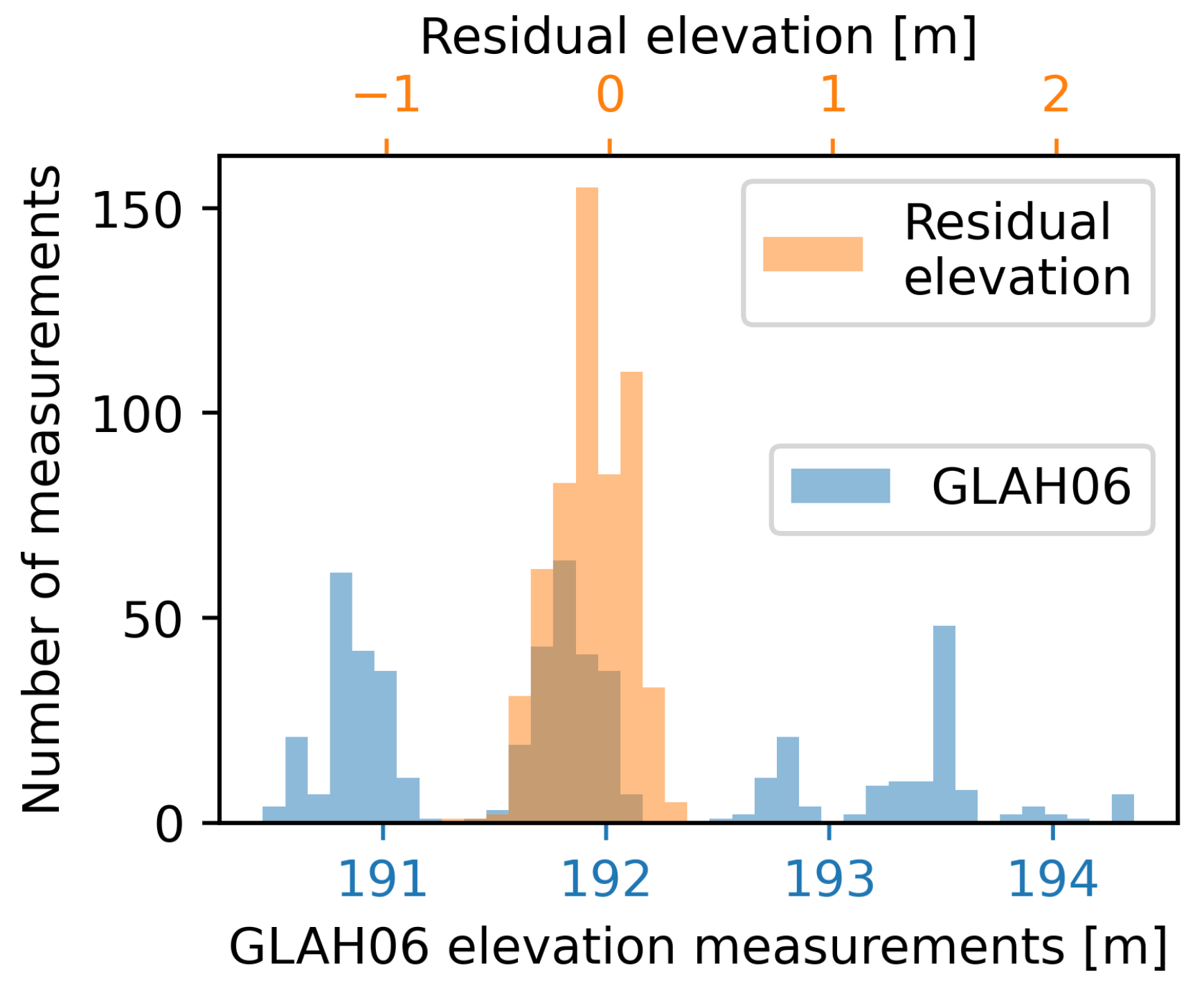
The models developed are tested against ICESat data. Implementing the spatial and temporal variation models obtained for Lago Argentino, surface changes were calculated for the observation epochs of ICESat. Figure 12 shows that the dispersion is significantly reduced after subtracting the modeled elevation changes from the ICESat data. From an initial 110 cm standard deviation, the applied corrections yield a residual standard deviation of 16 cm. ICESat LOP bias corrections [56] are not applied in this analysis and therefore contribute to the larger residual standard deviation of ICESat compared to ICESat-2. This analysis cannot be extended over Lago Viedma because the Bahía Túnel tide gauge was not in operation throughout the ICESat period.
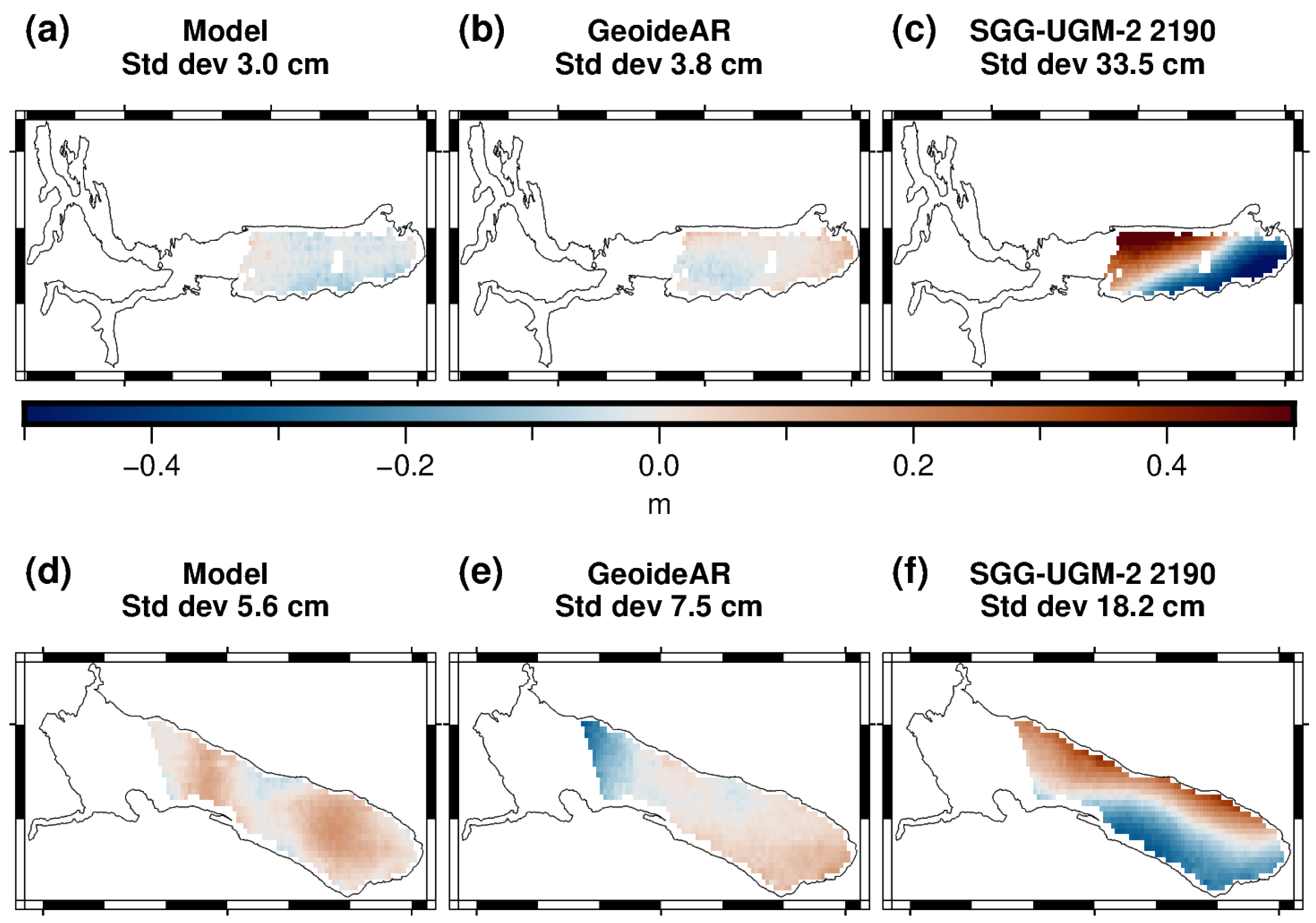
We use a limited set of SWOT elevation data to extend the validation of our models over both lakes. Our selection of the employed SWOT data to the period July 2023–February 2024 is conditioned by the availability of simultaneous tide gauge data, which are published with a delay and require an extensive validation and correction. Another limitation arises from the SWOT lower spatial resolution compared to ICESat-2, which makes the SWOT dataset impractical for the narrow arms and fjords in the western parts of Argentino and Viedma lakes. Figure 13 presents the analysis of SWOT water-surface elevations over Lago Argentino (panel a) and Lago Viedma (panel b). In both lakes, the subtraction of our spatio-temporal lake-level variation model reduces significantly the residual elevation variability from a standard deviation of 18 cm to 3 cm (Argentino) and from 16 cm to 6 cm (Viedma). The improved variance reduction compared to the subtraction of the recent, static geoid models GeoideAR and SGG-UGM-2 demonstrates the efficiency of our spatio-temporal models.
In both cases, the residual standard deviation of SWOT elevations is significantly smaller than that obtained with ICESat-2 elevations (Argentino: 3 vs. 8 cm, Viedma: 6 vs. 14 cm). This supports our attribution of a major part of ICESat-2 residual variability to unmodeled short-wavelength variations such as surface waves, which are effectively removed in the SWOT broader integration area. Another reason is that the intricate fjords in the western lake parts, with their increased dynamics and variability, are not included in the SWOT comparison.
Table 4 summarizes a generalized estimation of the principal uncertainty contributions to our spatio-temporal lake-level variation models, individually for each lake and observation sensor. Observation uncertainty varies with the employed sensor but is assumed uniform over either lake. The volume correction depends mainly on the quality of tide gauge data. For the early ICESat mission period, we allow for a slightly lower precision of the Calafate tide gauge record. The geoid model is less accurate in Lago Viedma than in Lago Argentino, mainly due the incomplete bathymetric model used in the RTM computation. SWOT samples only the broad, shallow eastern lake bodies, where geoid undulations are not expected to vary as much as in the western parts. Wind is stronger and more variable over Lago Viedma than in Lago Argentino; we therefore allow for an increased uncertainty contribution in this lake. Surface waves and other unmodeled processes are also greater in Lago Viedma than in Lago Argentino but are more efficiently removed in SWOT elevations. In essence, we identify unmodeled processes, dominated by surface waves, and residual uncertainty in the final geoid models as the principal sources of uncertainty.

5. Discussion

Our models predict spatio-temporal lake-level variations over Lago Argentino and Lago Viedma with a decimeter-level accuracy. This is confirmed by the validation with independent ICESat and SWOT elevations, and fulfills our requirements for a load model in the determination of geodetic and gravimetric corrections. The residual standard deviation of ICESat-2 elevations after subtraction of the model predictions amounts to 8 cm in Lago Argentino and 14 cm in Lago Viedma. Observational uncertainties inherent to the ICESat-2 ATL13 elevations do not explain this unequal residual variability, as they are expected to be identical over both lakes. The standard deviations of the pairwise comparison of simultaneous elevations 100 m apart between strong and weak beams amount to 6.0 cm and 10.5 cm in Argentino and Viedma lakes, respectively, and are thus only slightly smaller than the model residuals all over the lake surface and the analyzed period. For both the local, instantaneous elevation differences and the lake-wide model residuals, the standard deviations are 75% larger in Lago Viedma compared to Lago Argentino. A qualitatively similar proportion results also from the autocovariance analysis over a wide range of wind speeds (Figure 7b). We infer that a large part of the overall residual variability is due to wind-correlated, short-wavelength (within the 100 m distance between strong and weak beam) lake-surface variation not included in our model, primarily surface waves. The rather marginal increase in variability between local, simultaneous differences and model residuals is, on the other hand, indicative of the high efficiency of our models of spatio-temporal lake-level variations.
Thus, our results suggest that a future inclusion of additional hydrodynamic processes such as surface waves in our model will significantly reduce the residual variability. Surface waves are expected to have an anisotropic effect on ICESat-2 elevation dispersion in the studied lakes. Their height is proportional to both wind speed and fetch, and their crests align approximately perpendicular to the wind direction. The predominant westerly wind direction coincides with the maximum fetch in Lago Viedma, producing roughly north–south orientated wave crests. Their effect on across-track elevation differences (e.g., strong vs. weak beams, roughly east-west) is more pronounced and of shorter wavelength than along-track. Furthermore, the slight WNW-ESE tendencies of the lake axis, fetch and predominant wind direction are likely to differentiate the sensitivity to surface waves and their characteristic wavelength between ascending and descending ICESat-2 satellite tracks. The higher wind speeds according to ERA5, as well as the longer effective fetch, explain the 75% increase in residual variability in Lago Viedma compared to Lago Argentino. We emphasize that the sensitivity of ICESat-2 elevation data to surface waves varies among individual lakes as it depends not only on the intensity and persistence of the local wind field but also on its alignment with the lake axis and satellite tracks. Radar altimeters, both in the classical pulse-limited design and in recent interferometric modes, sample broader areas of the lake surface and thus average out surface waves more efficiently than ICESat-2’s 17 m footprint.
The main axes and maximum fetch of the studied lakes not only coincide with the predominant wind direction but also with principal regional gradients of relief and geoid undulation (Figure 4). This correlation requires special care in the separation between the equipotential contribution and the wind contribution to the lake-level topography sampled by ICESat-2. In this regard, Lago Viedma is a more challenging case than Lago Argentino. The stronger winds and longer fetch result in a more intense lake-surface deformation along Lago Viedma’s axis than in Lago Argentino. Additionally, the lack of comprehensive bathymetric information in Lago Viedma causes additional uncertainty in the RTM component of the preliminary geoid model. Nevertheless, our specifically designed analysis of the great amount of ICESat-2 elevations collected over more than five years under a wide range of wind conditions, and the distribution of the residuals (Figure 8d) provides confidence in the successful separation of both contributions through the refined geoid model and the final wind correction.
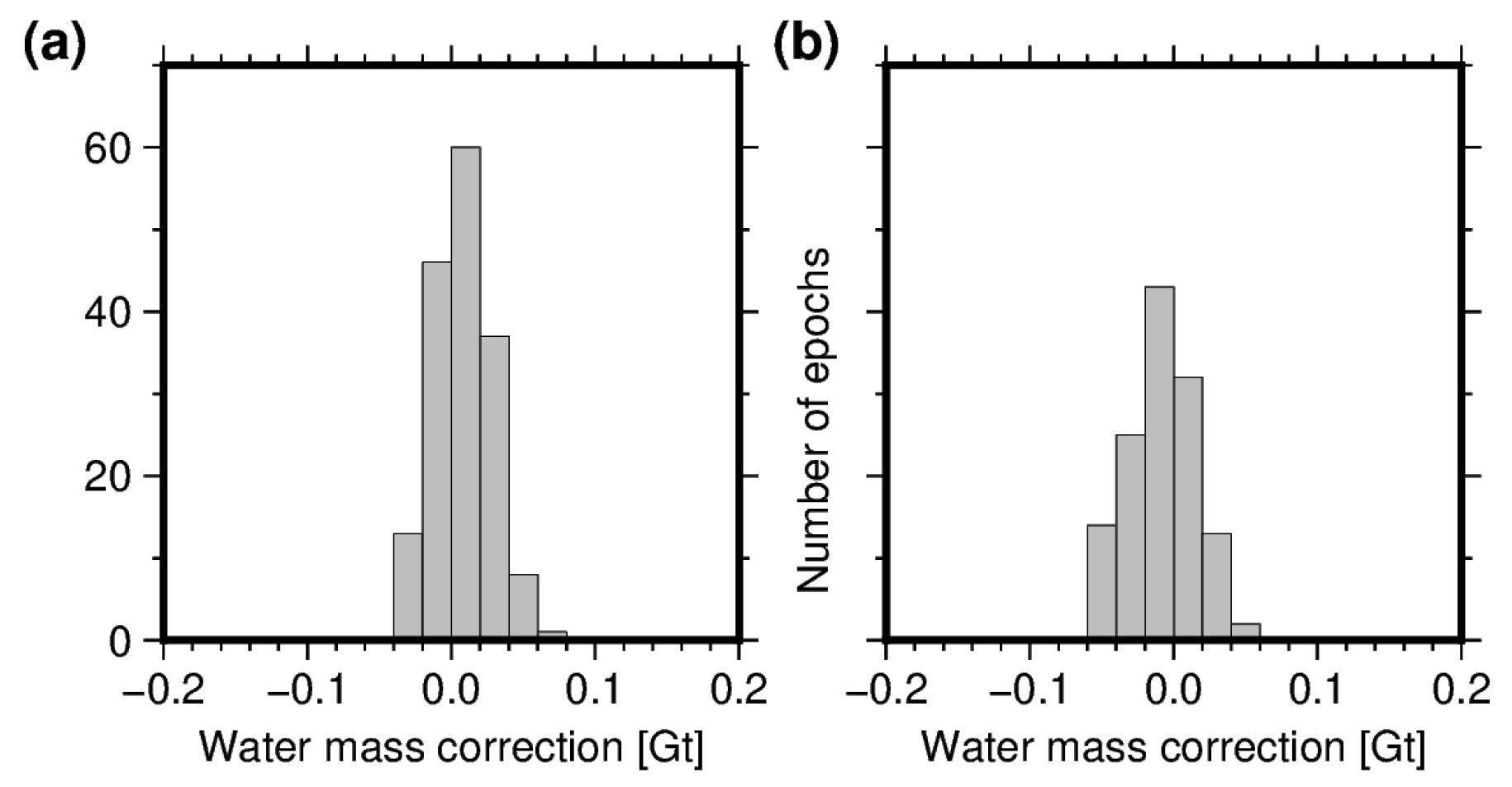
Our models of lake-level response to atmospheric forcing allow to untangle water-volume changes and water displacements within the lakes based on level readings at a single location. In particular, they provide accurate water-volume time series by correcting the tide gauge records in both lakes for atmospherically induced lake-surface deformations and differential crustal deformation. This is especially relevant in Lago Viedma, with the Bahía Túnel tide gauge located close to the north-western, upwind extreme of the lake where the wind-driven tilt causes local lake-level changes of several decimeters and where the crustal uplift driven by the solid-earth response to glacial unloading is maximum. While crustal deformation does not affect significantly ellipsoidal lake-level elevations, it is relevant for the assessment of the water mass and volume contained in the lake. Both lakes are situated in an area of intense uplift [5], whose rate increases from their discharge outlet at the eastern extremes towards the west. This lifts the lakes’ beds relative to their outflow sills, reducing the reservoir volume by 7.2 · 10 3 km3/a in Lago Argentino (corresponding to 3 · 10 5 of its total volume per year, neglecting erosional modification of the outlet) and 7.8 · 10 3 km3/a in Lago Viedma. The tide gauge records include the local effect of that differential uplift, yet the location of the tide gauge relative to the uplift pattern over the lake area determines its representativeness for the entire lake. Water mass contained in Lago Argentino decreases by 5.1 · 10 3 Gt/a relative to the tide-gauge record, whereas in Lago Viedma the water mass increases by + 8.6 · 10 3 Gt/a compared to the Bahía Túnel tide gauge. Figure 14 shows the impact of this correction for both tide gauges in terms of lake-water mass change, accounting for both wind tilt and crustal deformation. The application of this correction improves the accuracy of hydrological balance estimates and the determination of local water cycle components. Furthermore, our lake-level model based on ICESat-2 elevations provides an accurate determination of ellipsoidal reference elevations for the tide gauges in Argentino and Viedma lakes. The El Calafate (Lago Argentino) and Bahía Túnel (Lago Viedma) tide gauges are referenced to 188.78 m and 265.44 m above the WGS84 ellipsoid, respectively.
Our operational model of spatio-temporal lake-level variations allows also the integration of lake-level observations at different sites, using different techniques. During the gravimetric measurements, Ref. [6] carried out high-resolution lake-level observation in the vicinity of the gravimetric stations using a GNSS buoy and GNSS interferometric reflectometry [58]. From these isolated, short-term observations, the water mass distribution within the lakes can now be reconstructed with hourly resolution, independent from the availability and resolution of simultaneous tide gauge data. Our lake-level variation models provide a key resource for accurate altimeter calibrations. One example is the ICESat-2 inter-beam bias determination (Table 1 and Table 2). The models and methods presented here allow for future cross-calibrations between ICESat-2 and diverse radar altimetry missions, including an in-depth analysis of SWOT elevation data. The tide-gauge record in Lago Argentino allows to extend such a multi-mission calibration back in time to Topex-Poseidon. Also air-borne laser altimeters employed over the Patagonian Icefields for ice-mass balance determinations are calibrated over the great Patagonian lakes and benefit from precise information on spatio-temporal lake-level variations. The mean lake-level topography model is used as reference surface for the interpretation of lacustrine terraces at Lago Argentino in terms of differential crustal deformations since their formation in the Late Pleistocene.
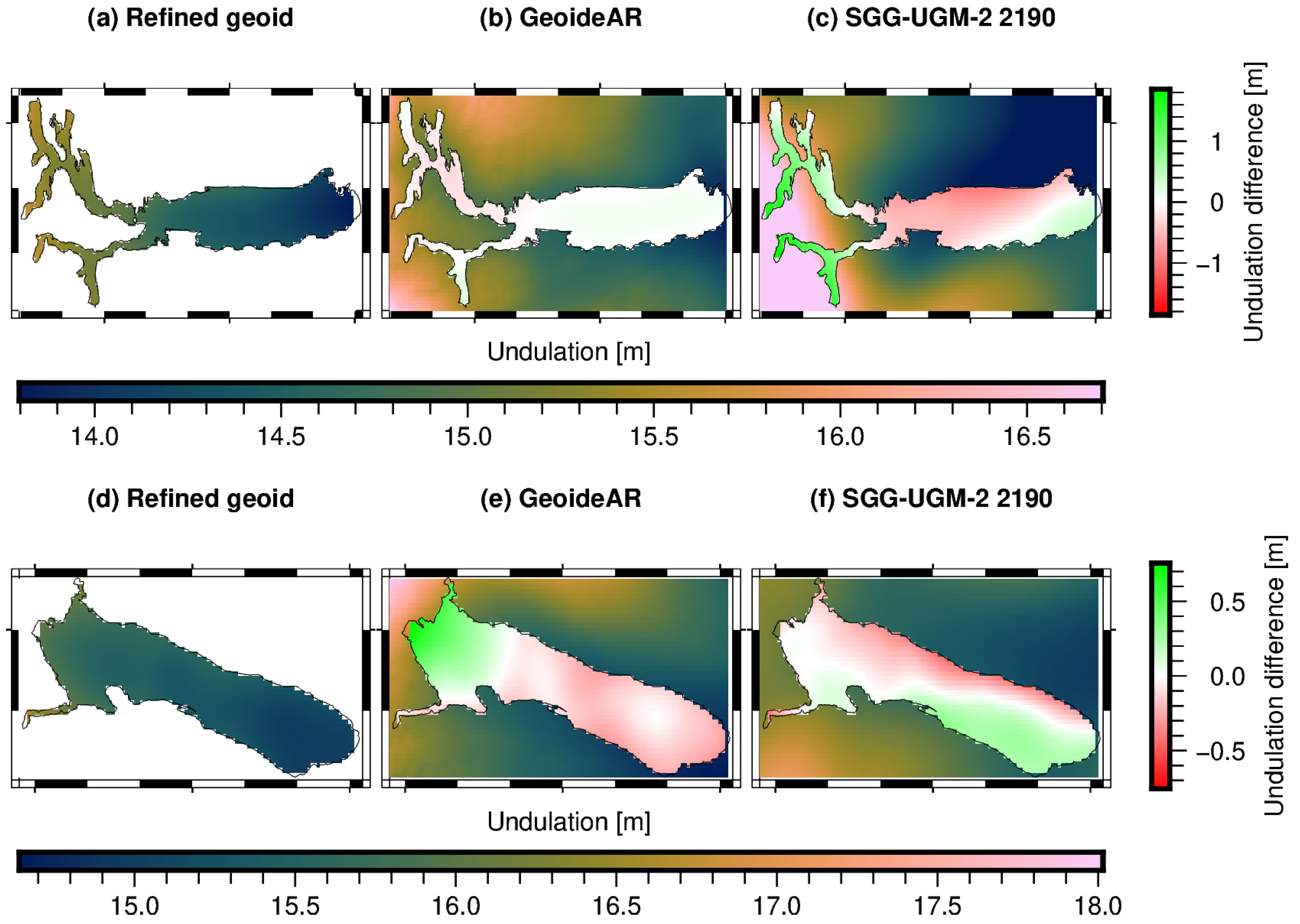
The refined equipotential models derived from the corrected ICESat-2 elevations over the lakes provide valuable, high-resolution information for the validation and local improvement of geoid models. Figure 15a,d shows the equipotential surfaces determined for each lake after application of the final lake-level corrections. They are compared to the geoid undulations of GeoideAR16, the official quasi-geoid model published by the Argentine Instituto Geográfico Nacional [57], and the geopotential model SGG-UGM-2 at its maximum degree and order 2190. GeoideAR16 shows excellent agreement with the lake-level derived equipotential surface of Lago Argentino, with maximum differences of a few decimeters confined to the lake’s narrow western branches. For Lago Viedma, somewhat larger differences are found. A reason for the different performance of GeoideAR16 over the two lakes might lie in the incorporation of gravimetric observations along the southern shore of Lago Argentino, which are unavailable around Lago Viedma. The differences over Lago Viedma include a concave curvature across the lake’s transverse profile, present in the lake-level model but not adequately reflected by GeoideAR16. Figure 10 shows two examples of lake-level elevation profiles across the lake axes. The lake-level trough reaches half a meter in depth in the deepest part of Lago Viedma. These examples illustrate the improvement in the reproduction of this short-wavelength feature of the equipotential surface between our preliminary geoid model (green) and the refined equipotential surface model derived from corrected ICESat-2 elevations (red). In fact, our final equipotential surface contains information of the mass deficit beneath the water body and can be used, through an inversion employing an iterative RTM correction, to constrain the depth of Lago Viedma, or other lakes lacking bathymetric models so far. Another difference between GeoideAR16 and our lake-level derived equipotential surface over Lago Viedma, shown in Figure 15, is the location of the onset of the sharp geoid slope towards the mountain range in the west. GeoideAR16 locates this step further to the east than observed in the lake level. A larger disagreement over both lakes is found between our equipotential surface and the global SGG-UGM-2 model as expected from the limited effective resolution of the latter in our study region.
Our mean lake-level topography model derived for Lago Argentino (Figure 11c) is very similar to that presented by [19]. A major advance of our method compared to that study is our modeling of temporal lake-level variations, in addition to the utilization of an observational dataset of much higher spatial resolution. This reduces significantly residual dispersion and renders an aggressive, massive data rejection, as applied by [19], unnecessary. Another significant progress by the present study over [19], particularly relevant for the lakes under investigation, is the subtraction of the impact of the temporally mean atmospheric forcing from the mean lake-level topography model prior to its interpretation in terms of an equipotential surface (Figure 11a). Ref. [19] attribute their mean lake-level topography exclusively to the geoid, without any account of the effect the strong, persistent Patagonian winds have on the mean lake levels.

6. Conclusions and Perspectives

Our analysis confirms the high accuracy of the ICESat-2 ATL13 elevations, in agreement with previous works [55]. On calm days, the along-track precision in terms of the standard deviation of a single elevation value is below 2 cm, and elevations originating from different laser beams are consistent within a few centimeters. The evidence we find in Argentino and Viedma lakes for small systematic inter-beam biases would be desirable to further investigate over less dynamic reference targets.
We present operational models for Lago Argentino and Lago Viedma of spatio-temporal lake-level variations that allow to predict ellipsoidal elevations of the instantaneous, local lake level for any location within the lake and any time covered by local tide gauge records and the ERA5 climate model. The lake-level models have an accuracy of a few decimeters and meet the requirements for the determination of geodetic and gravimetric corrections for hydrological loading effects. ICESat-2 elevation residuals after subtraction of the modeled lake-level variations amount to 8.0 and 13.9 cm in Argentino and Viedma lakes, respectively. The significant and (among both lakes) differentiated impact of surface waves on the residual variability demonstrates that ICESat-2 elevations are accurate enough to sample more processes than we aimed for in our modeling. Thus, the presented residual variability is an invitation to refine the hydrodynamic modeling of these lakes rather than an indication for observational uncertainty.
Our final geoid models reveal that the shape of the equipotential surfaces over the lakes is governed by two main features: first, an intense, localized slope rising towards the crest of the Southern Andes to the west, which is located further to the west than current geoid models predict (Figure 15); and second, a concave curvature perpendicular to the lake’s main axis (Figure 10). Regarding the temporal lake-level variations, we identify the principal driving mechanisms: first, overall lake-level changes indicative of water-volume changes governed by an annual cycle and dominated by seasonal variations in water influx; and second, a tilt of the water table in response to wind. Residual variations resemble a random distribution in space and time, suggesting residual effects of short-wavelength variations, primarily surface waves, and contributions from non-stationary circulation and other dynamic processes. The transversal curvature of the mean lake-level topography and the equipotential surfaces is consistent with the results of [19], observed also in other lakes in different regions. That study did not model temporal lake-level variations; thus, our identification of the principal processes responsible for spatio-temporal lake-level variations and residual variability are novel insights. The results and models derived from five years of ICESat-2 satellite laser altimetry complement consistently the conclusions drawn from the local lake-level records of high temporal resolution based on pressure tide gauge observations [18].
The methods and results presented here provide a foundation for the expansion of the analysis of spatio-temporal lake-level variations over the other great Patagonian lakes, for the refinement of our modeling approach, and for adding the complementary data of radar altimetry missions, less susceptible to surface waves. In fact, the main limitation of the presented method, in terms of the greatest unmodeled contribution to residual dispersion, is that short-wavelength lake-level variations induced by surface waves are not accounted for in our model.


Author Contributions

All authors contributed to the methodology and writing. F.S.C. carried out the formal analysis, software development, visualization, and validation. M.E.G. contributed investigation on RTM and geoid modeling. A.R. contributed to the conceptualization. All authors have read and agreed to the published version of the manuscript.

Funding

FSC is funded by a CONICET doctoral scholarship. This work was partly funded by the Argentine Agencia Nacional de Promoción de la Investigación, el Desarrollo Tecnológico y la Innovación under project no. 01-PICT-2023-02-00007 and by CONICET under project no. 11220200102919CO.

Data Availability Statement

All datasets used in this study are of open access: ICESat-2 ATL13 and ICESat GLAH06 elevation data: https://nsidc.org/data/ (accessed on 11 August 2025); tide gauge data: https://snih.hidricosargentina.gob.ar (accessed on 11 August 2025); ERA5 reanalysis datasets: https://cds.climate.copernicus.eu/datasets/ (accessed on 1 October 2025); SGG-UGM-2 geopotential model: https://icgem.gfz-potsdam.de/ (accessed on 1 October 2025); GeoideAR16 quasi-geoid model: https://www.ign.gob.ar/NuestrasActividades/Geodesia/Geoide-Ar16/ (accessed on 1 September 2025); SWOT Raster Image Data Product: https://cmr.earthdata.nasa.gov/virtual-directory/collections/C2799438288-POCLOUD (accessed on 1 March 2026). The datasets produced and presented for this study, including the mean lake-level surface grids, tide gauge measurements free of atmospheric effects, and average wind effect are available by request to the corresponding author.

Conflicts of Interest

The authors declare that they have no conflicts of interest.

References

  1. Zemp, M.; Jakob, L.; Dussaillant, I.; Nussbaumer, S.U.; Gourmelen, N.; Dubber, S.; A, G.; Abdullahi, S.; Andreassen, L.M.; Berthier, E.; et al. Community estimate of global glacier mass changes from 2000 to 2023. Nature 2025, 639, 382–388. [Google Scholar] [CrossRef] [PubMed]
  2. Mark, H.F.; Wiens, D.A.; Ivins, E.R.; Richter, A.; Ben Mansour, W.; Magnani, M.B.; Marderwald, E.; Adaros, R.; Barrientos, S. Lithospheric Erosion in the Patagonian Slab Window, and Implications for Glacial Isostasy. Geophys. Res. Lett. 2022, 49, e2021GL096863. [Google Scholar] [CrossRef]
  3. Ben-Mansour, W.; Maupin, V.; Wiens, D.A.; Richter, A. Deep Source Regions for Back-Arc Volcanism in the Patagonian Slab Window Imaged by Finite Frequency P and SH Body Wave Tomography. Geophys. Res. Lett. 2025, 52, e2025GL115915. [Google Scholar] [CrossRef]
  4. Dietrich, R.; Ivins, E.; Casassa, G.; Lange, H.; Wendt, J.; Fritsche, M. Rapid crustal uplift in Patagonia due to enhanced ice loss. Earth Planet. Sci. Lett. 2010, 289, 22–29. [Google Scholar] [CrossRef]
  5. Richter, A.; Ivins, E.; Lange, L.; Mendoza, L.; Schröder, L.; Hormaechea, J.L.; Casassa, G.; Marderwald, E.; Fritsche, M.; Perdomo, R.; et al. Crustal deformation across the Southern Patagonian Icefield observed by GNSS. Earth Planet. Sci. Lett. 2016, 452, 206–215. [Google Scholar] [CrossRef]
  6. Gebauer, A.; Pasquaré, A.; Lothhammer, A.; Rülke, A.; Scheinert, M.; Richter, A.; Döhne, T.; Marderwald, E.; Romero, A.; Brunini, C.; et al. Absolute gravimetry in South Patagonia for geodynamic applications. In Proceedings of the EGU General Assembly 2023, Vienna, Austria, 23–28 April 2023. [Google Scholar] [CrossRef]
  7. Ivins, E.; James, T. Antarctic glacial isostatic adjustment: A new assessment. Antarct. Sci. 2005, 17, 541–553. [Google Scholar] [CrossRef]
  8. Lange, H.; Casassa, G.; Ivins, E.R.; Schröder, L.; Fritsche, M.; Richter, A.; Groh, A.; Dietrich, R. Observed crustal uplift near the Southern Patagonian Icefield constrains improved viscoelastic Earth models. Geophys. Res. Lett. 2014, 41, 805–812. [Google Scholar] [CrossRef]
  9. Russo, R.M.; Luo, H.; Wang, K.; Ambrosius, B.; Mocanu, V.; He, J.; James, T.; Bevis, M.; Fernandes, R. Lateral variation in slab window viscosity inferred from global navigation satellite system (GNSS)—Observed uplift due to recent mass loss at Patagonia ice fields. Geology 2022, 50, 111–115. [Google Scholar] [CrossRef]
  10. Richter, A.; Groh, A.; Horwath, M.; Ivins, E.; Marderwald, E.; Hormaechea, J.L.; Perdomo, R.; Dietrich, R. The Rapid and Steady Mass Loss of the Patagonian Icefields throughout the GRACE Era: 2002–2017. Remote Sens. 2019, 11, 909. [Google Scholar] [CrossRef]
  11. Rodriguez, C.; Villa Uría, G.; Storani, P. (Eds.) Red Hidrológica Nacional: Publicaciones Hidrometeorológicas 2017, 2018 y 2019, 2021st ed.; Base Cartográfica del Sistema Nacional de Información Hídrica; Ministerio de Obras Públicas, Secretaría de Infraestructura y Política Hídrica: Ciudad Autónoma de Buenos Aires, Argentina, 2021. [Google Scholar]
  12. Alsdorf, D.E.; Rodríguez, E.; Lettenmaier, D.P. Measuring surface water from space. Rev. Geophys. 2007, 45. [Google Scholar] [CrossRef]
  13. Schwatke, C.; Dettmering, D.; Bosch, W.; Seitz, F. DAHITI—An innovative approach for estimating water level time series over inland waters using multi-mission satellite altimetry. Hydrol. Earth Syst. Sci. 2015, 19, 4345–4364. [Google Scholar] [CrossRef]
  14. Kossieris, S.; Tsiakos, V.; Tsimiklis, G.; Amditis, A. Inland Water Level Monitoring from Satellite Observations: A Scoping Review of Current Advances and Future Opportunities. Remote Sens. 2024, 16, 1181. [Google Scholar] [CrossRef]
  15. Biancamaria, S.; Lettenmaier, D.; Pavelsky, T. The SWOT Mission and Its Capabilities for Land Hydrology. Surv. Geophys. 2016, 37, 307–337. [Google Scholar] [CrossRef]
  16. Jiang, L.; Schneider, R.; Andersen, O.B.; Bauer-Gottwein, P. CryoSat-2 Altimetry Applications over Rivers and Lakes. Water 2017, 9, 211. [Google Scholar] [CrossRef]
  17. Nielsen, K.; Stenseng, L.; Andersen, O.; Knudsen, P. The Performance and Potentials of the CryoSat-2 SAR and SARIn Modes for Lake Level Estimation. Water 2017, 9, 374. [Google Scholar] [CrossRef]
  18. Richter, A.J.; Marderwald, E.R.; Hormaechea, J.L.; Mendoza, L.P.O.; Perdomo, R.A.; Connon, G.C.; Scheinert, M.; Horwath, M.; Dietrich, R. Lake-level variations and tides in Lago Argentino, Patagonia: Insights from pressure tide gauge records. J. Limnol. 2015, 75, 62–77. [Google Scholar] [CrossRef]
  19. Bergé-Nguyen, M.; Cretaux, J.F.; Calmant, S.; Fleury, S.; Satylkanov, R.; Chontoev, D.; Bonnefond, P. Mapping mean lake surface from satellite altimetry and GPS kinematic surveys. Adv. Space Res. 2021, 67, 985–1001. [Google Scholar] [CrossRef]
  20. Franze, S.E.; Andersen, O.B.; Nilsson, B.; Nielsen, K. Lake gravity anomalies from ICESat-2 laser altimetry and geodetic radar altimetry. Adv. Space Res. 2024, 74, 4487–4501. [Google Scholar] [CrossRef]
  21. Zwally, H.J.; Schutz, R.; Dimarzio, J.; Hancock, D. GLAS/ICESat L1B Global Elevation Data (HDF5) (GLAH06, Version 34). Data Set, 2014. Available online: https://nsidc.org/data/glah06/versions/34 (accessed on 23 October 2025).
  22. Jasinski, M.F.; Stoll, J.D.; Hancock, D.; Robbins, J.; Nattala, J.; Pavelsky, T.M.; Morison, J.; Jones, B.M.; Ondrusek, M.E.; Parrish, C.; et al. ATLAS/ICESat-2 L3A Along Track Inland Surface Water Data (ATL13, Version 6). 2023. Available online: https://nsidc.org/data/atl13/versions/6 (accessed on 11 August 2025).
  23. Guo, X.; Jin, X.; Jin, S. Shallow Water Bathymetry Mapping from ICESat-2 and Sentinel-2 Based on BP Neural Network Model. Water 2022, 14, 3862. [Google Scholar] [CrossRef]
  24. Jasinski, M.F.; Stoll, J.D.; Hancock, D.; Robbins, J.; Nattala, J.; Morrison, J.; Jones, B.; Ondrusek, M.; Parrish, C.; Pavelsky, T.M.; et al. Algorithm Theoretical Basis Document (ATBD) for Along Track Inland Surface Water Data (ATL13), Release 7; Technical Report; NASA Goddard Space Flight Center: Greenbelt, MD, USA, 2025. [Google Scholar] [CrossRef]
  25. Chen, G.; Jiang, W.; Zhang, Z.; Jin, T.; Li, D. Arctic Sea Surface Determination with Combined CryoSat-2 and ICESat-2 Data. EGUsphere 2024, 2024, 1–29. [Google Scholar] [CrossRef]
  26. Zhong, J.; Sun, J.; Lai, Z.; Song, Y. Nearshore Bathymetry from ICESat-2 LiDAR and Sentinel-2 Imagery Datasets Using Deep Learning Approach. Remote Sens. 2022, 14, 4229. [Google Scholar] [CrossRef]
  27. Luo, S.; Song, C.; Zhan, P.; Liu, K.; Chen, T.; Li, W.; Ke, L. Refined estimation of lake water level and storage changes on the Tibetan Plateau from ICESat/ICESat-2. CATENA 2021, 200, 105177. [Google Scholar] [CrossRef]
  28. Chen, Y.; Liu, Q.; Ticehurst, C.; Sarker, C.; Karim, F.; Penton, D.; Sengupta, A. Refining ICESAT-2 ATL13 Altimetry Data for Improving Water Surface Elevation Accuracy on Rivers. Remote Sens. 2024, 16, 1706. [Google Scholar] [CrossRef]
  29. SWOT. SWOT Level 2 Water Mask Raster Image Data Product [Data Set]. 2024. Available online: https://www.earthdata.nasa.gov/data/catalog/pocloud-swot-l2-hr-raster-2.0-2.0 (accessed on 1 March 2026).
  30. Muñoz Sabater, J. ERA5-Land Hourly Data from 1950 to Present. 2019. Available online: https://cds.climate.copernicus.eu/datasets/reanalysis-era5-land?tab=overview (accessed on 1 October 2025).
  31. Hersbach, H.; Bell, B.; Berrisford, P.; Biavati, G.; Horányi, A.; Muñoz Sabater, J.; Nicolas, J.; Peubey, C.; Radu, R.; Rozum, I.; et al. ERA5 Hourly Data on Single Levels from 1940 to Present. 2023. Available online: https://cds.climate.copernicus.eu/datasets/reanalysis-era5-single-levels?tab=overview (accessed on 1 October 2025).
  32. Farr, T.G.; Rosen, P.A.; Caro, E.; Crippen, R.; Duren, R.; Hensley, S.; Kobrick, M.; Paller, M.; Rodriguez, E.; Roth, L.; et al. The Shuttle Radar Topography Mission. Rev. Geophys. 2007, 45. [Google Scholar] [CrossRef]
  33. Fürst, J.J.; Farías-Barahona, D.; Blindow, N.; Casassa, G.; Gacitúa, G.; Koppes, M.; Lodolo, E.; Millan, R.; Minowa, M.; Mouginot, J.; et al. The foundations of the Patagonian icefields. Commun. Earth Environ. 2024, 5, 142. [Google Scholar] [CrossRef]
  34. Fedotova, A.; Magnani, M.B. Glacial Erosion Rates Since the Last Glacial Maximum for the Former Argentino Glacier and Present-Day Upsala Glacier, Patagonia. J. Geophys. Res. Earth Surf. 2024, 129, e2024JF007960. [Google Scholar] [CrossRef]
  35. Rivera Ibañez, S.A.; Lannutti, E.; Lenzano, M.G.; Moragues, S.; Lenzano, L.E.; Lenz, J.; Vich, A.I. Estudio de la profundidad del lago Viedma, parque nacional los glaciares, Argentina. Geoacta 2022, 43, 4–6. [Google Scholar]
  36. Minowa, M.; Schaefer, M.; Skvarca, P. Effects of topography on dynamics and mass loss of lake-terminating glaciers in southern Patagonia. J. Glaciol. 2023, 69, 1580–1597. [Google Scholar] [CrossRef]
  37. Restelli, F.B.; Lozano, J.G.; Bran, D.M.; Bunicontro, S.; Lodolo, E.; Tassone, A.A.; Vilas, J.F. Submerged imprint of glacier dynamics in the NW sector of Lago Viedma (southern Patagonia, Argentina). J. Quat. Sci. 2024, 39, 765–780. [Google Scholar] [CrossRef]
  38. Gomez, M.E.; Perdomo, R.; Del Cogliano, D. Validation of recent geopotential models in Tierra Del Fuego. Acta Geophys. 2017, 65, 931–943. [Google Scholar] [CrossRef]
  39. Mortimer, C.H. Lake hydrodynamics. Int. Ver. Theor. Angew. Limnol. Mitteilungen 1974, 20, 124–197. [Google Scholar] [CrossRef]
  40. Ewert, H.; Popov, S.V.; Richter, A.; Schwabe, J.; Scheinert, M.; Dietrich, R. Precise analysis of ICESat altimetry data and assessment of the hydrostatic equilibrium for subglacial Lake Vostok, East Antarctica. Geophys. J. Int. 2012, 191, 557–568. [Google Scholar] [CrossRef][Green Version]
  41. Pavlis, N.K. Global Gravitational Models. In Geoid Determination: Theory and Methods; Springer: Berlin/Heidelberg, Germany, 2013; pp. 261–310. [Google Scholar] [CrossRef]
  42. Ferreira, V.G.; Zhang, Y.; de Freitas, S.R.C. Validation of GOCE gravity field models using GPS-leveling data and EGM08: A case study in Brazil. J. Geod. Sci. 2013, 3, 209–218. [Google Scholar] [CrossRef]
  43. Gruber, T.; Visser, P.; Ackermann, C.; Hosse, M. Validation of GOCE gravity field models by means of orbit residuals and geoid comparisons. J. Geod. 2011, 85, 845–860. [Google Scholar] [CrossRef]
  44. Isik, M.S.; Çevikalp, M.R.; Erol, B.; Erol, S. Improvement of GOCE-Based Global Geopotential Models for Gravimetric Geoid Modeling in Turkey. Geosciences 2022, 12, 432. [Google Scholar] [CrossRef]
  45. Forsberg, R.; Tscherning, C. An Overview Manual for the GRAVSOFT Geodetic Gravity Field Modelling Programs; Technical Report; National Space Institute (DTU-Space): Kongens Lyngby, Denmark, 2008. [Google Scholar]
  46. Forsberg, R.; Tscherning, C.C. The use of height data in gravity field approximation by collocation. J. Geophys. Res. Solid Earth 1981, 86, 7843–7854. [Google Scholar] [CrossRef]
  47. Forsberg, R. A Study of Terrain Reductions, Density Anomalies and Geophysical Inversion Methods in Gravity Field Modelling; Technical Report OSU/DGSS-355; Ohio State University of Columbus, Department of Geodetic Science and Surveying: Columbus, OH, USA, 1984. [Google Scholar] [CrossRef]
  48. Rizos, C.; Willis, P. Earth on the Edge: Science for a Sustainable Planet: Proceedings of the IAG General Assembly, Melbourne, Australia, 28 June–2 July 2011; Springer Science & Business Media: Cham, Switzerland, 2013; Volume 139. [Google Scholar] [CrossRef]
  49. Pavlis, N.K.; Holmes, S.A.; Kenyon, S.C.; Factor, J.K. The development and evaluation of the Earth Gravitational Model 2008 (EGM2008). J. Geophys. Res. Solid Earth 2012, 117. [Google Scholar] [CrossRef]
  50. Zingerle, P.; Pail, R.; Gruber, T.; Oikonomidou, X. The Experimental Gravity Field Model XGM2019e. Data Set. 2019. Available online: https://dataservices.gfz-potsdam.de/icgem/showshort.php?id=escidoc:4529896 (accessed on 1 October 2025). [CrossRef]
  51. Liang, W.; Li, J.; Xu, X.; Zhang, S.; Zhao, Y. A High-Resolution Earth’s Gravity Field Model SGG-UGM-2 from GOCE, GRACE, Satellite Altimetry, and EGM2008. Engineering 2020, 6, 860–878. [Google Scholar] [CrossRef]
  52. Marderwald, E.R.; Paz, J.M.A.; Richter, A.J.; Busch, P.; Malz, P.; Mendoza, L.P.O.; Romero, A.; Guerrero, L.; Hormaechea, J.L.; Connon, G.; et al. Perito Moreno Glacier dam rupture - A recurrent natural experiment to probe solid-earth elasticity. J. S. Am. Earth Sci. 2020, 104, 102904. [Google Scholar] [CrossRef]
  53. Uieda, L. Verde: Processing and gridding spatial data using Green’s functions. J. Open Source Softw. 2018, 3, 957. [Google Scholar] [CrossRef]
  54. He, Y.; Li, H.; Qiao, G.; Hao, T.; Hai, G.; Xie, H.; Li, R. Validation of ICESat-2 Elevation Accuracy in Antarctica Using CCR Arrays. IEEE Trans. Geosci. Remote Sens. 2024, 62, 4301317. [Google Scholar] [CrossRef]
  55. Gu, Y.; Li, R.; An, L.; Qiao, G.; Hao, T.; Li, H.; He, Y. Validation of ICESat-2 elevation accuracy using multiyear kinematic GNSS along the CHINARE traverse. Proc. SPIE 2025, 13642, 61. [Google Scholar] [CrossRef]
  56. Schröder, L.; Richter, A.; Fedorov, D.V.; Eberlein, L.; Brovkov, E.V.; Popov, S.V.; Knöfel, C.; Horwath, M.; Dietrich, R.; Matveev, A.Y.; et al. Validation of satellite altimetry by kinematic GNSS in central East Antarctica. Cryosphere 2017, 11, 1111–1130. [Google Scholar] [CrossRef]
  57. Piñón, D.A.; Zhang, K.; Wu, S.; Cimbaro, S.R. A New Argentinean Gravimetric Geoid Model: GEOIDEAR. In Proceedings of the International Symposium on Earth and Environmental Sciences for Future Generations; Freymueller, J.T., Sánchez, L., Eds.; Springer International Publishing: Cham, Switzerland, 2018; pp. 53–62. [Google Scholar] [CrossRef]
  58. Larson, K.M.; Ray, R.D.; Williams, S.D.P. A 10-Year Comparison of Water Levels Measured with a Geodetic GPS Receiver versus a Conventional Tide Gauge. J. Atmos. Ocean. Technol. 2017, 34, 295–307. [Google Scholar] [CrossRef]
Figure 1. Maps of the area under investigation. (a) Lago Viedma (V) and Lago Argentino (A). The locations of the Bahía Túnel and El Calafate tide gauges are indicated. Topography is plotted in meters above WGS84 ellipsoid (top color bar) and bathymetry in meters below average respective lake levels (bottom color bar). SPI: Southern Patagonian Icefield, shown as white area. (b) Location of the map extent of (a) in Southern Patagonia. (c) Location of the map extent of (b) in South America.
Remotesensing 18 00993 g001
Figure 2. Distribution of ICESat-2 beams in the forward orientation, flight direction indicated in red. Rectangles indicate the effective footprint of a single ATL13 [22] elevation measurement, ICESat footprint for comparison (blue).
Remotesensing 18 00993 g002
Figure 3. Number of measurements for each lake, before (bright colors) and after (faint colors) filtering by standard deviation flag. Weak-beam measurements (even-numbered) represent along-track sections about four times longer than strong-beam measurements.
Remotesensing 18 00993 g003
Figure 4. Local preliminary geoid models for the investigated Argentino (bottom) and Viedma (top) lakes, derived by combining the SGG-UGM-2 [51] with a residual terrain correction model. Red borders show the extent of the frame boundaries utilized for posterior lake-specific figures.
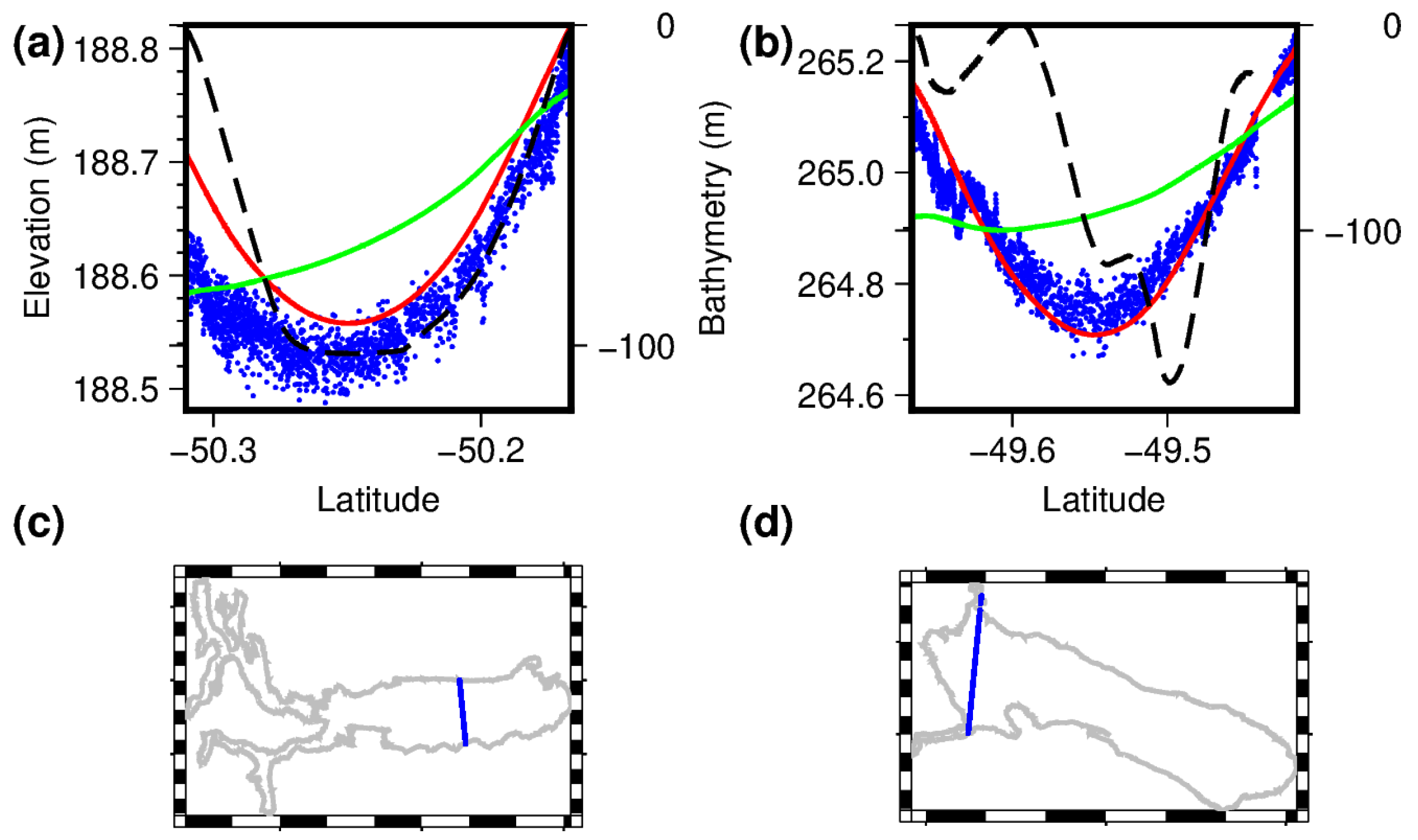
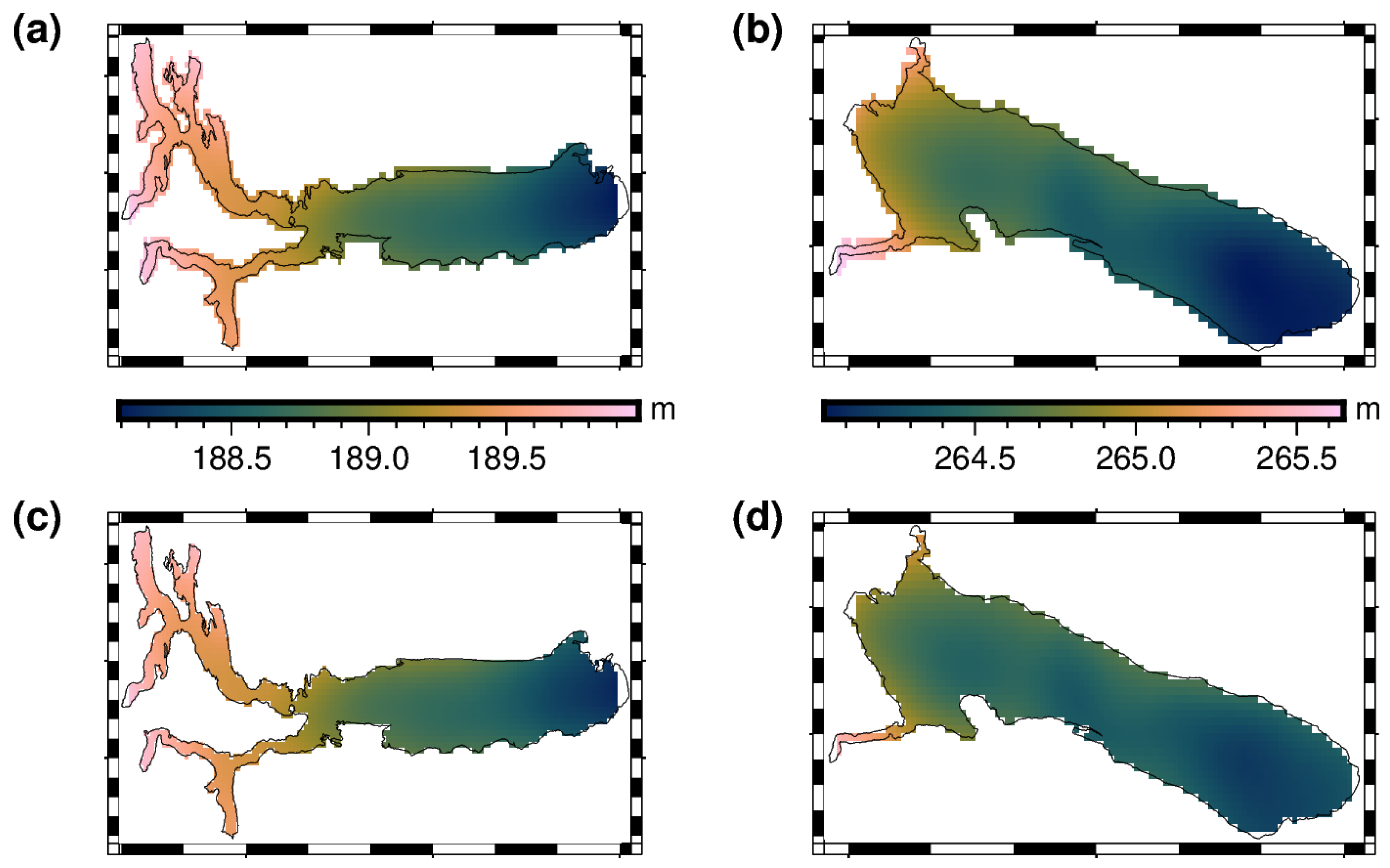
Remotesensing 18 00993 g004
Figure 5. Atmospheric lake-level forcing over Argentino (left) and Viedma (right) lakes. (a) Wind direction frequency; (b) average wind speed as a function of direction; (c) histograms of lake-level variations due to air-pressure changes, modeled as IB correction at the time and location of the ICESat-2 elevation data.
Remotesensing 18 00993 g005
Figure 6. Flow chart illustrating the operational lake-level variation model process. Contributions that change between iterations are highlighted in red, and red arrows denote the return of updated variables to earlier stages of the workflow.
Remotesensing 18 00993 g006
Figure 7. Quantification of ICESat-2 ATL13 elevation measurement noise. (a) Stacked autocovariance as a function of along-track shift τ (every shift step equals 35 m) of representative ICESat-2 elevation profiles across Argentino and Viedma lakes, with a fitted smooth curve. Strong beam profiles with wind speeds below 2 m/s were considered. (b) Standard deviation estimated from autocovariance fitting of longest strong beam elevation profiles, as a function of wind speed.
Remotesensing 18 00993 g007
Figure 8. Lake-level elevations over Argentino (left) and Viedma (right) lakes derived from ICESat-2 (ATL13) elevations through the cumulative application of corrections for spatio-temporal lake-level variations: (a) uncorrected ATL13 elevations; (b) after volume-change correction; (c) after inverse-barometer and wind corrections of (b); (d) after a preliminary geoid correction of (c); (e) histograms of final elevation residuals after all corrections, including refined geoid and wind corrections. Lake-level elevations are given in meters above the WGS84 ellipsoid. The map frames are shown as red highlights in Figure 4.
Remotesensing 18 00993 g008
Figure 9. Modeled wind-driven elevation change versus corrected ICESat-2 elevation measurements for Argentino (a) and Viedma (b) lakes. Lake-level elevations are given in meters above the WGS84 ellipsoid. Right color bar represents point density for each region of corrected elevation and modeled wind effect.
Remotesensing 18 00993 g009
Figure 10. Top: Transversal lake-level profiles across Lago Argentino (a) and Lago Viedma (b) showing ICESat-2 elevations after application of volume, IB and wind corrections (blue dots), mean-value adjusted preliminary geoid model (green) and mean-value adjusted final equipotential model (red). Lake bathymetry (dashed black line) is given in meters below average surface (right side vertical labels). Lake-level elevations are given in meters above the WGS84 ellipsoid. Bottom: Maps of the location of the shown profiles (blue) in Lago Argentino (c) and Lago Viedma (d). The map frames are shown as red highlights in Figure 4.
Remotesensing 18 00993 g010
Figure 11. Refined models of an equipotential surface (top) and the mean lake-level topography (bottom) for Lago Argentino (a,c) and Lago Viedma (b,d). The surfaces are given in meters above the WGS84 ellipsoid. The map frames are shown as red highlights in Figure 4.
Remotesensing 18 00993 g011
Figure 12. Histograms of lake-level elevations in Lago Argentino according to ICESat GLAH06 elevations (March 2003–October 2008, blue) and after application of corrections for spatio-temporal lake-level variations (orange) derived from ICESat-2 (November 2018–December 2023). Lake-level elevations are given in meters above the WGS84 ellipsoid.
Remotesensing 18 00993 g012
Figure 13. SWOT water-surface elevation residuals after subtraction of modeled lake-level elevations for Lago Argentino (top) and Lago Viedma (bottom). (a,d): Spatio-temporal lake-level variation model developed in this study (color scales on the bottom; b, in meters). Center (b,e): Quasi-geoid model GeoideAR16 by Instituto Geográfico Nacional [57], with mean difference subtracted; (c,f): Geoid undulations derived from the geopotential model SGG-UGM-2 surrounding the lakes, with mean difference subtracted. Color scale in the center, in meters. The map frames are shown as red highlights in Figure 4.
Remotesensing 18 00993 g013
Figure 14. Histograms of the effect of correcting tide-gauge readings in Lago Argentino (a) and Lago Viedma (b) for local lake-level variation driven by wind and air-pressure changes as well as crustal deformation on water-mass estimates for the dates of analyzed ICESat-2 epochs (November 2018 through December 2023). A negative sign means that the uncorrected tide-gauge reading underestimates the lake’s water mass.
Remotesensing 18 00993 g014
Figure 15. Geoid models for Lago Argentino (top) and Lago Viedma (bottom). (a,d): Equipotential surfaces derived from corrected, smoothed ICESat-2 elevations, after subtraction of a constant lake-level elevation for each lake (color scales on the bottom; in meters above WGS84 ellipsoid). (b,e): Quasi-geoid model GeoideAR16 by Instituto Geográfico Nacional [57] surrounding the lakes (color scales on the bottom), differences GeoideAR16 minus lake-level derived equipotential surface over the lake areas (color scales to the right; in meters). (c,f): Geoid undulations derived from the geopotential model SGG-UGM-2 surrounding the lakes (color scales on the bottom; in meters), differences SGG-UGM-2 minus lake-level derived equipotential surface over the lake areas (color scales to the right; in meters). The map frames are shown as red highlights in Figure 4.
Remotesensing 18 00993 g015
Table 1. Mean difference and standard deviation of corrected elevation measurements between strong and weak beam of the indicated laser beam pairs, at the closest simultaneous measurement locations. Shot count determined as the number of measurement pairs utilized for the calculation.
Beam PairΔhs-w [cm] σ [cm]Shot Count
Argentino
1–2−3.36.313,562
3–42.75.813,172
5–6−3.25.913,131
Viedma
1–2−1.410.910,982
3–45.19.79404
5–6−0.710.89660
Table 2. Mean difference of corrected elevation measurements between the indicated beam and all others, at the closest simultaneous measurement locations. N Argentino and N Viedma determined as the number of measurement pairs utilized for the calculation for lakes Argentino and Viedma, respectively.
BeamArgentinoN ArgentinoViedmaN Viedma
1−1.2 cm247,6640.5 cm209,865
22.6 cm60,7610.5 cm49,706
31.1 cm207,4041.8 cm178,569
4−2.2 cm61,838−4.0 cm50,466
5−3.4 cm250,9710.1 cm227,569
6−0.1 cm62,7221.5 cm55,066
Table 3. Residual standard deviation after the cumulative application of lake-level corrections.
Standard DeviationArgentinoViedma
Uncorrected elevations106 cm70 cm
Volume correction49 cm33 cm
Preliminary geoid correction13 cm24 cm
Atmospheric corrections12 cm21 cm
Final geoid and wind corrections8 cm14 cm
Table 4. Tentative uncertainty budget of the spatio-temporal lake-level variation models for Argentino and Viedma lakes. Standard deviations are given in centimeters as generalized estimates for lake-wide, year-round averages. From left to right: observational uncertainty, volume correction uncertainty, geoid correction uncertainty, IB and wind correction uncertainty, unmodeled processes, total uncertainty, and comparison with the residual standard deviation after subtracting the models. “Unmodeled processes” include dynamic responses such as surface waves, geostrophic circulation, internal and surface seiches. Our estimate of ICESat observational uncertainty includes the effect of laser operation period biases that are not corrected in this study. Lakes: A—Argentino, V—Viedma.
LakeSensorObs.Volume Corr.Geoid Corr.IB + Wind Corr.Unmod. ProcessesTotal Uncert.Residual std. dev.
AICESat-22 cm2 cm5 cm4 cm4 cm8.1 cm8 cm
AICESat13 cm3 cm5 cm5 cm4 cm15.6 cm16 cm
ASWOT1 cm2 cm2 cm1 cm1 cm3.3 cm3 cm
VICESat-22 cm2 cm7 cm6 cm10 cm13.9 cm14 cm
VSWOT1 cm2 cm4 cm4 cm1 cm6.2 cm6 cm
Disclaimer/Publisher’s Note: The statements, opinions and data contained in all publications are solely those of the individual author(s) and contributor(s) and not of MDPI and/or the editor(s). MDPI and/or the editor(s) disclaim responsibility for any injury to people or property resulting from any ideas, methods, instructions or products referred to in the content.