A Block-Wise ICP Method for Retrieving 3D Landslide Displacement Vectors Based on Terrestrial Laser Scanning Point Clouds

Highlights
- A block-wise ICP approach is proposed to directly retrieve 3D displacement vectors from multi-temporal TLS point clouds.
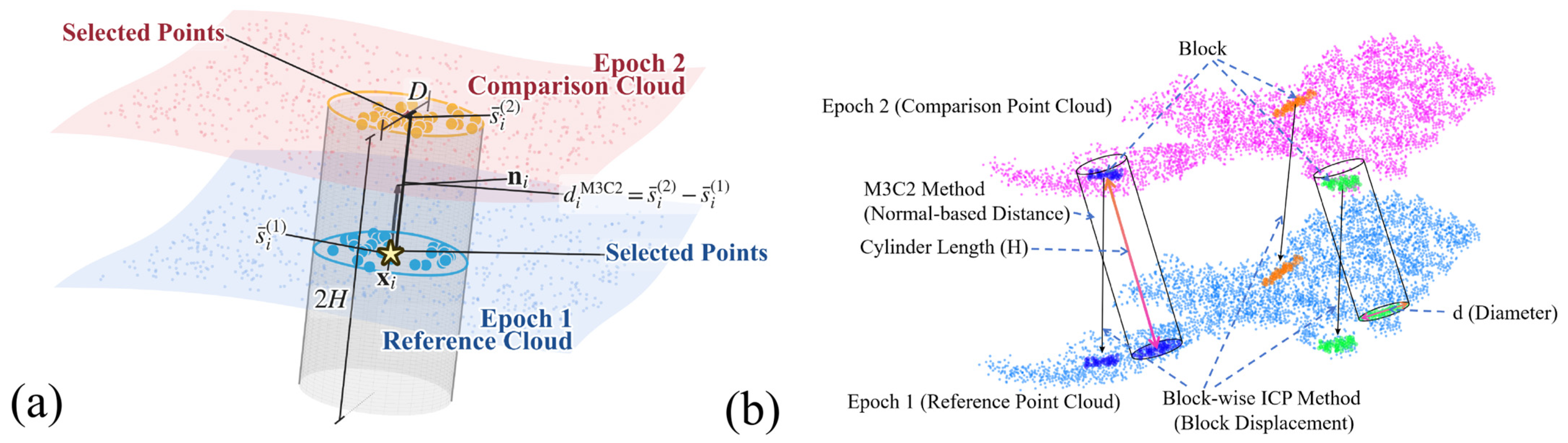
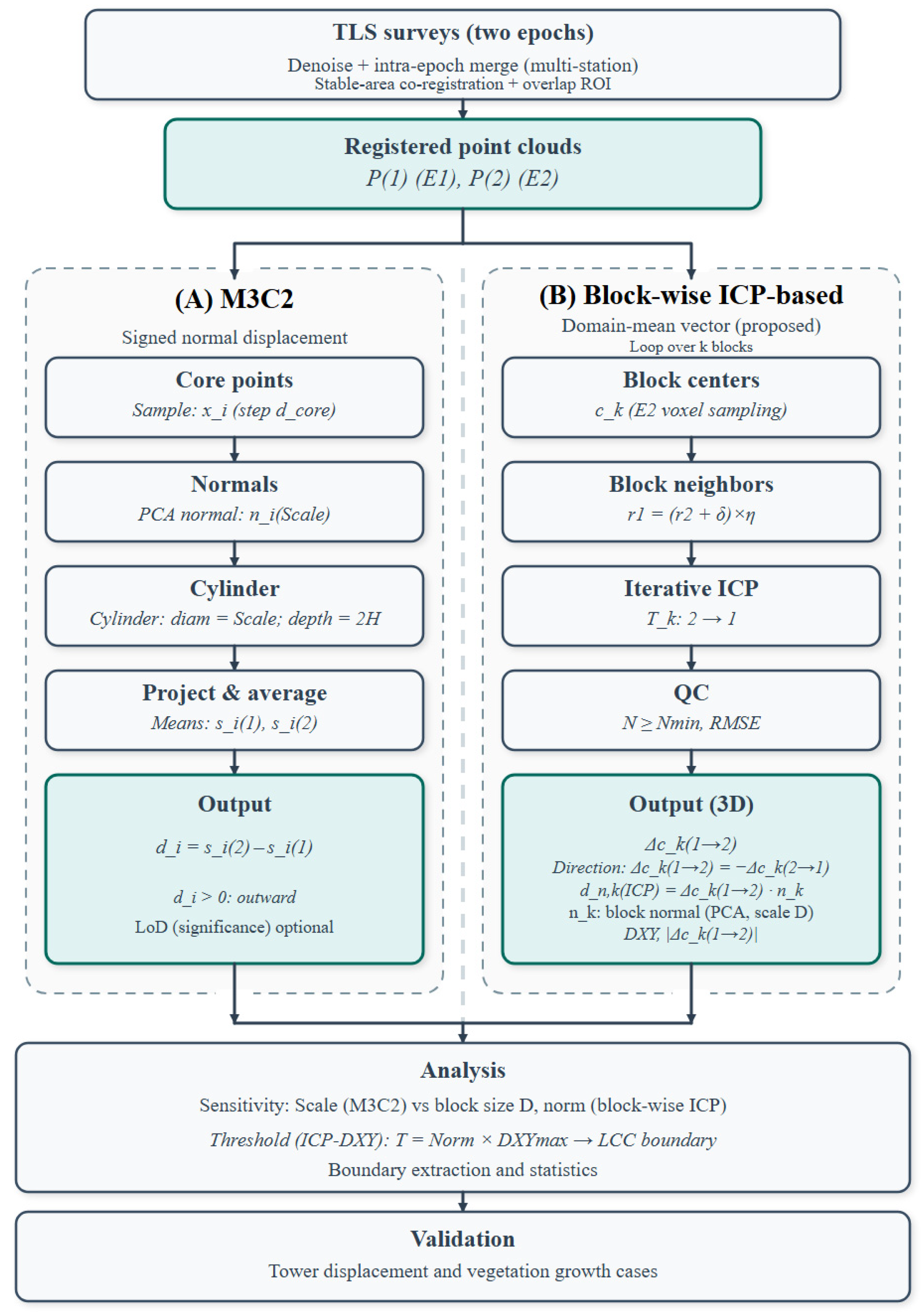
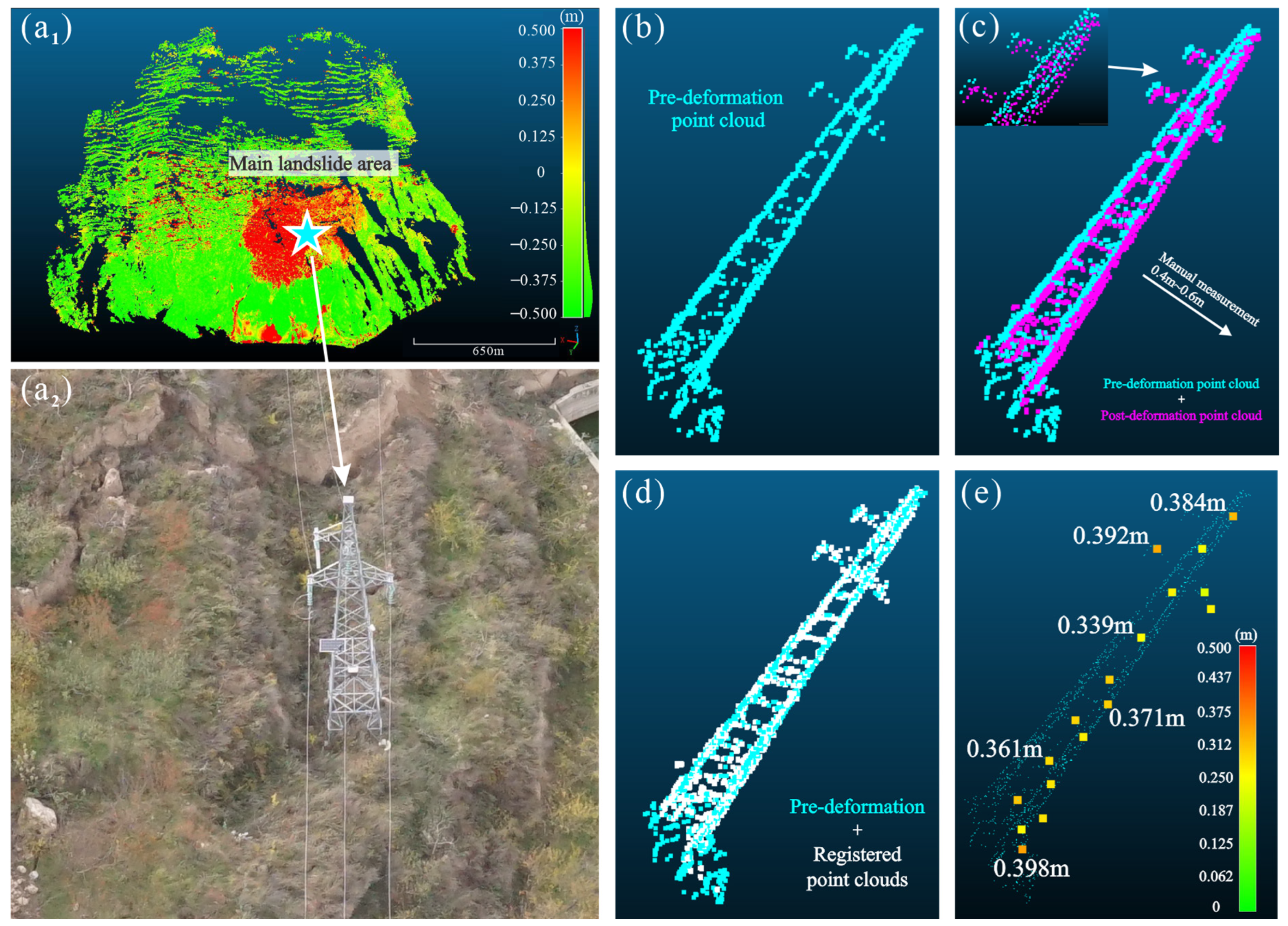
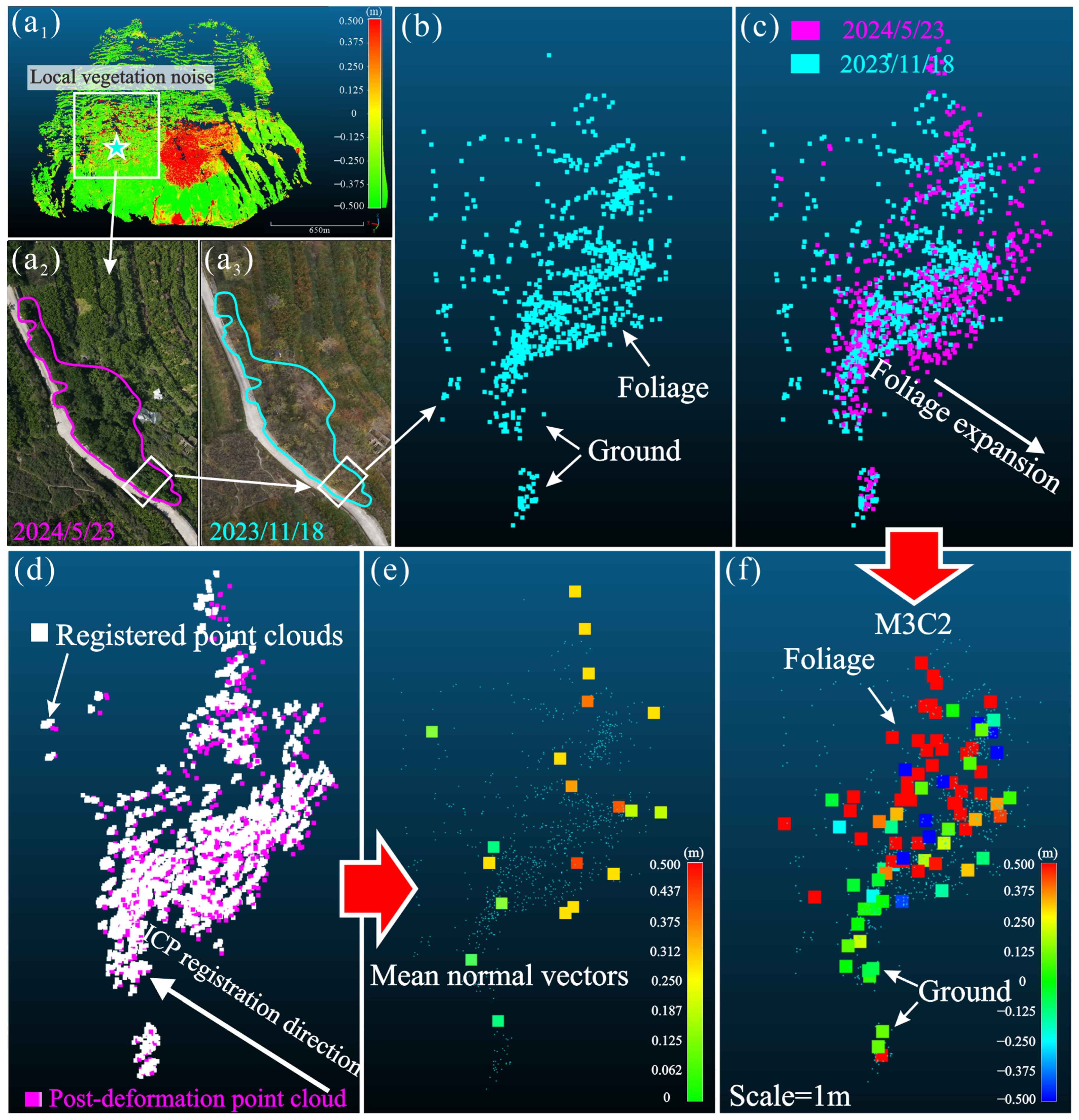
- Compared with M3C2, it produces a more continuous displacement field and clearer deformation boundaries, which were validated using a tower target and a seasonal vegetation change scene.
- The method improves interpretable deformation mapping under occlusion, heterogeneous point density, and vegetation disturbances, which are common in field landslide monitoring.
- It supports practical boundary delineation and target-based displacement verification and can be extended via adaptive multi-scale blocking and uncertainty quantification.
Abstract
1. Introduction
2. Materials and Methods
2.1. Study Area Overview
2.2. Data Acquisition, Preprocessing, and Point-Cloud Characteristics
2.3. Methods for Landslide Deformation Calculation from TLS Point Clouds Using M3C2 and a Block-Wise ICP-Based Approach
3. Results
3.1. M3C2 Displacement Monitoring Results and Sensitivity to the Scale Parameter
3.2. Displacement Interpretation Results and Accuracy Performance of the Block-Wise ICP Method
3.3. Accuracy Analysis of Displacement Estimation: Comparison in a Downslope Sliding Scenario
3.4. Vegetation Change Analysis: Effects of Defoliation Growth Disturbance on Displacement Estimation
4. Discussion
5. Conclusions
Author Contributions
Funding
Data Availability Statement
Acknowledgments
Conflicts of Interest
Abbreviations
| TLS | Terrestrial laser scanning |
| ICP | Iterative closest point |
| M3C2 | Multiscale model-to-model cloud comparison |
| C2C | Cloud-to-cloud |
| C2M | Cloud-to-mesh |
| LCC | Largest connected component |
| DSM | Digital surface model |
References
- Froude, M.J.; Petley, D.N. Global fatal landslide occurrence from 2004 to 2016. Nat. Hazards Earth Syst. Sci. 2018, 18, 2161–2181. [Google Scholar] [CrossRef]
- Casagli, N.; Intrieri, E.; Tofani, V.; Gigli, G.; Raspini, F. Landslide detection, monitoring and prediction with remote-sensing techniques. Nat. Rev. Earth Environ. 2023, 4, 51–64. [Google Scholar] [CrossRef]
- Gili, J.A.; Corominas, J.; Rius, J. Using Global Positioning System techniques in landslide monitoring. Eng. Geol. 2000, 55, 167–192. [Google Scholar] [CrossRef]
- Uhlemann, S.; Smith, A.; Chambers, J.; Dixon, N.; Dijkstra, T.; Haslam, E.; Meldrum, P.; Merritt, A.; Gunn, D.; Mackay, J. Assessment of ground-based monitoring techniques applied to landslide investigations. Geomorphology 2016, 253, 438–451. [Google Scholar] [CrossRef]
- Wang, S. Time prediction of the Xintan landslide in Xiling Gorge, the Yangtze River. In Landslide Disaster Mitigation in Three Gorges Reservoir, China; Springer: Berlin/Heidelberg, Germany, 2009; pp. 411–431. [Google Scholar]
- Wang, F.; Zhang, Y.; Huo, Z.; Peng, X.; Araiba, K.; Wang, G. Movement of the Shuping landslide in the first four years after the initial impoundment of the Three Gorges Dam Reservoir, China. Landslides 2008, 5, 321–329. [Google Scholar] [CrossRef]
- Pecoraro, G.; Calvello, M.; Piciullo, L. Monitoring strategies for local landslide early warning systems. Landslides 2019, 16, 213–231. [Google Scholar] [CrossRef]
- Intrieri, E.; Gigli, G.; Mugnai, F.; Fanti, R.; Casagli, N. Design and implementation of a landslide early warning system. Eng. Geol. 2012, 147, 124–136. [Google Scholar] [CrossRef]
- Macciotta, R.; Hendry, M.; Martin, C.D. Developing an early warning system for a very slow landslide based on displacement monitoring. Nat. Hazards 2016, 81, 887–907. [Google Scholar] [CrossRef]
- Fan, X.; Xu, Q.; Scaringi, G.; Dai, L.; Li, W.; Dong, X.; Zhu, X.; Pei, X.; Dai, K.; Havenith, H.-B. Failure mechanism and kinematics of the deadly June 24th 2017 Xinmo landslide, Maoxian, Sichuan, China. Landslides 2017, 14, 2129–2146. [Google Scholar] [CrossRef]
- Intrieri, E.; Raspini, F.; Fumagalli, A.; Lu, P.; Del Conte, S.; Farina, P.; Allievi, J.; Ferretti, A.; Casagli, N. The Maoxian landslide as seen from space: Detecting precursors of failure with Sentinel-1 data. Landslides 2018, 15, 123–133. [Google Scholar] [CrossRef]
- Dong, J.; Zhang, L.; Li, M.; Yu, Y.; Liao, M.; Gong, J.; Luo, H. Measuring precursory movements of the recent Xinmo landslide in Mao County, China with Sentinel-1 and ALOS-2 PALSAR-2 datasets. Landslides 2018, 15, 135–144. [Google Scholar]
- Kang, Y.; Lu, Z.; Zhao, C.; Zhang, Q.; Kim, J.-W.; Niu, Y. Diagnosis of Xinmo (China) landslide based on interferometric synthetic aperture radar observation and modeling. Remote Sens. 2019, 11, 1846. [Google Scholar] [CrossRef]
- Jaboyedoff, M.; Oppikofer, T.; Abellán, A.; Derron, M.-H.; Loye, A.; Metzger, R.; Pedrazzini, A. Use of LIDAR in landslide investigations: A review. Nat. Hazards 2012, 61, 5–28. [Google Scholar] [CrossRef]
- Telling, J.; Lyda, A.; Hartzell, P.; Glennie, C. Review of Earth science research using terrestrial laser scanning. Earth-Sci. Rev. 2017, 169, 35–68. [Google Scholar] [CrossRef]
- Oppikofer, T.; Jaboyedoff, M.; Blikra, L.; Derron, M.-H.; Metzger, R. Characterization and monitoring of the Åknes rockslide using terrestrial laser scanning. Nat. Hazards Earth Syst. Sci. 2009, 9, 1003–1019. [Google Scholar] [CrossRef]
- Abellán, A.; Oppikofer, T.; Jaboyedoff, M.; Rosser, N.J.; Lim, M.; Lato, M.J. Terrestrial laser scanning of rock slope instabilities. Earth Surf. Process. Landf. 2014, 39, 80–97. [Google Scholar]
- Abellán, A.; Jaboyedoff, M.; Oppikofer, T.; Vilaplana, J. Detection of millimetric deformation using a terrestrial laser scanner: Experiment and application to a rockfall event. Nat. Hazards Earth Syst. Sci. 2009, 9, 365–372. [Google Scholar] [CrossRef]
- Kromer, R.A.; Hutchinson, D.J.; Lato, M.J.; Gauthier, D.; Edwards, T. Identifying rock slope failure precursors using LiDAR for transportation corridor hazard management. Eng. Geol. 2015, 195, 93–103. [Google Scholar] [CrossRef]
- Lindenbergh, R.; Pietrzyk, P. Change detection and deformation analysis using static and mobile laser scanning. Appl. Geomat. 2015, 7, 65–74. [Google Scholar]
- Mukupa, W.; Roberts, G.W.; Hancock, C.M.; Al-Manasir, K. A review of the use of terrestrial laser scanning application for change detection and deformation monitoring of structures. Surv. Rev. 2017, 49, 99–116. [Google Scholar] [CrossRef]
- Girardeau-Montaut, D.; Roux, M.; Marc, R.; Thibault, G. Change detection on points cloud data acquired with a ground laser scanner. Int. Arch. Photogramm. Remote Sens. Spat. Inf. Sci. 2005, 36, W19. [Google Scholar]
- Teza, G.; Galgaro, A.; Zaltron, N.; Genevois, R. Terrestrial laser scanner to detect landslide displacement fields: A new approach. Int. J. Remote Sens. 2007, 28, 3425–3446. [Google Scholar] [CrossRef]
- Barnhart, T.B.; Crosby, B.T. Comparing two methods of surface change detection on an evolving thermokarst using high-temporal-frequency terrestrial laser scanning, Selawik River, Alaska. Remote Sens. 2013, 5, 2813–2837. [Google Scholar] [CrossRef]
- Lague, D.; Brodu, N.; Leroux, J. Accurate 3D comparison of complex topography with terrestrial laser scanner: Application to the Rangitikei canyon (NZ). ISPRS J. Photogramm. Remote Sens. 2013, 82, 10–26. [Google Scholar] [CrossRef]
- DiFrancesco, P.-M.; Bonneau, D.; Hutchinson, D.J. The implications of M3C2 projection diameter on 3D semi-automated rockfall extraction from sequential terrestrial laser scanning point clouds. Remote Sens. 2020, 12, 1885. [Google Scholar] [CrossRef]
- Winiwarter, L.; Anders, K.; Höfle, B. M3C2-EP: Pushing the limits of 3D topographic point cloud change detection by error propagation. ISPRS J. Photogramm. Remote Sens. 2021, 178, 240–258. [Google Scholar] [CrossRef]
- Williams, J.G.; Rosser, N.J.; Hardy, R.J.; Brain, M.J.; Afana, A.A. Optimising 4-D surface change detection: An approach for capturing rockfall magnitude–frequency. Earth Surf. Dyn. 2018, 6, 101–119. [Google Scholar] [CrossRef]
- Williams, J.G.; Anders, K.; Winiwarter, L.; Zahs, V.; Höfle, B. Multi-directional change detection between point clouds. ISPRS J. Photogramm. Remote Sens. 2021, 172, 95–113. [Google Scholar] [CrossRef]
- Soudarissanane, S.; Lindenbergh, R.; Menenti, M.; Teunissen, P. Scanning geometry: Influencing factor on the quality of terrestrial laser scanning points. ISPRS J. Photogramm. Remote Sens. 2011, 66, 389–399. [Google Scholar] [CrossRef]
- Brodu, N.; Lague, D. 3D terrestrial lidar data classification of complex natural scenes using a multi-scale dimensionality criterion: Applications in geomorphology. ISPRS J. Photogramm. Remote Sens. 2012, 68, 121–134. [Google Scholar] [CrossRef]
- Anders, K.; Winiwarter, L.; Mara, H.; Lindenbergh, R.; Vos, S.E.; Höfle, B. Fully automatic spatiotemporal segmentation of 3D LiDAR time series for the extraction of natural surface changes. ISPRS J. Photogramm. Remote Sens. 2021, 173, 297–308. [Google Scholar] [CrossRef]
- Besl, P.J.; McKay, N.D. Method for registration of 3-D shapes. In Proceedings of the Sensor Fusion IV: Control Paradigms and Data Structures, Boston, MA, USA, 12–15 November 1991; pp. 586–606. [Google Scholar]
- Chen, Y.; Medioni, G. Object modelling by registration of multiple range images. Image Vis. Comput. 1992, 10, 145–155. [Google Scholar] [CrossRef]
- Ning, X.-Y.; Zhang, K.; Jiang, N.; Luo, X.-L.; Zhang, D.-M.; Peng, J.-W.; Luo, X.-X.; Zheng, Y.-S.; Guo, D. 3D deformation analysis for earth dam monitoring based on terrestrial laser scanning (TLS) and the iterative closest point (ICP) algorithm. Front. Earth Sci. 2024, 12, 1421705. [Google Scholar] [CrossRef]
- Pfeiffer, J.; Zieher, T.; Bremer, M.; Wichmann, V.; Rutzinger, M. Derivation of three-dimensional displacement vectors from multi-temporal long-range terrestrial laser scanning at the Reissenschuh landslide (Tyrol, Austria). Remote Sens. 2018, 10, 1688. [Google Scholar] [CrossRef]
- Sang, M.; Wang, W.; Pan, Y. RGB-ICP method to calculate ground three-dimensional deformation based on point cloud from airborne LiDAR. Remote Sens. 2022, 14, 4851. [Google Scholar] [CrossRef]
- Yang, Y.; Holst, C. Piecewise-ICP: Efficient and robust registration for 4D point clouds in permanent laser scanning. ISPRS J. Photogramm. Remote Sens. 2025, 227, 481–500. [Google Scholar] [CrossRef]
- Lucks, L.; Holst, C. Segment-wise ICP for Enhanced Point Cloud Registration in Low-Cost Photogrammetric Landslide Monitoring. Int. Arch. Photogramm. Remote Sens. Spat. Inf. Sci. 2025, 48, 123–129. [Google Scholar] [CrossRef]




| Category | Symbol/Parameter | Description | Value |
|---|---|---|---|
| General | Horizontal displacement magnitude, | Calculated (m) | |
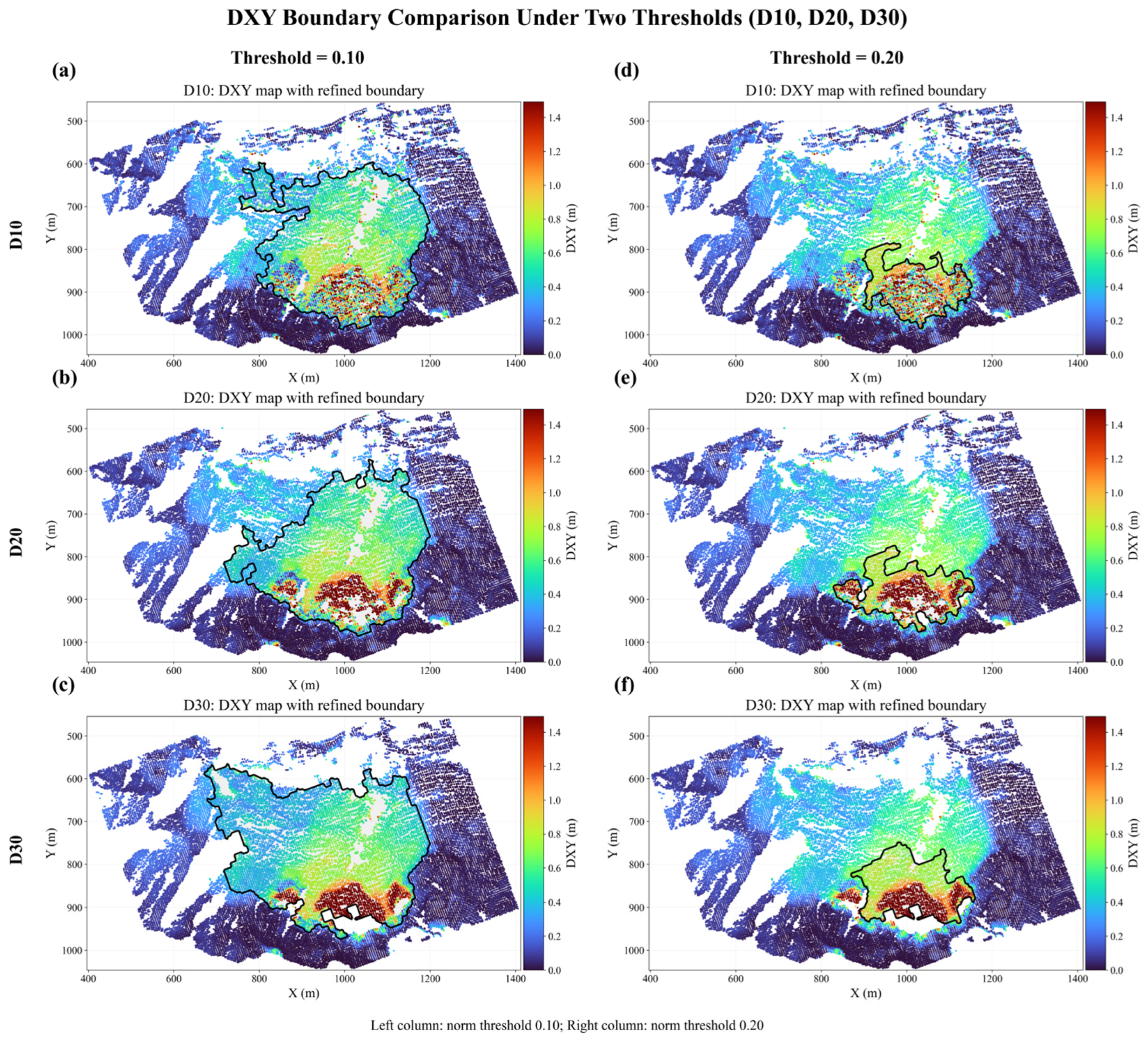
| Normalization factor for segmentation threshold | 0.10, 0.20 | ||
| LCC | Largest connected component | --- | |
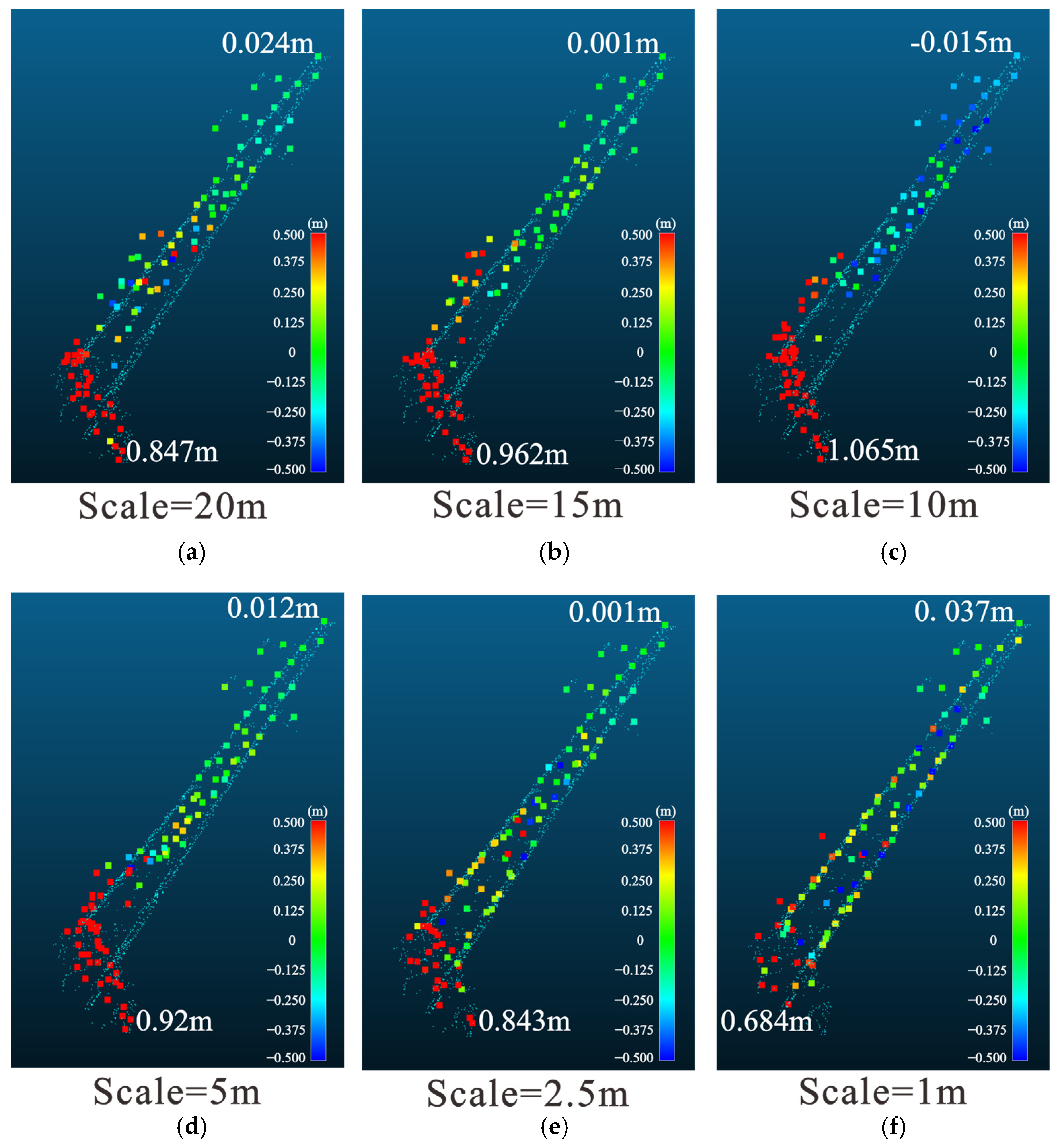
| M3C2 | Normal-neighborhood and projection-cylinder diameter | 1, 2.5, 5, 10, 15, 20 (m) | |
| Max depth | Full depth of projection cylinder | 12 (m) | |
| Block-wise ICP | Tested block diameters | Block-size cases used for comparison | 10, 20, 30 (m) |
| Maximum correspondence distance | 6 (m) | ||
| Displacement convergence threshold | 0.001 (m) | ||
| Iteration limit | Maximum ICP iterations | 200 |
| Statistic | Manual Measurement | M3C2 | Block-Wise ICP |
|---|---|---|---|
| Repeated-measurement range (m) | 0.41~0.63 | −0.25~0.25 | 0.33~0.4 |
| Mean (m) | 0.52 | 0 | 0.37 |
Disclaimer/Publisher’s Note: The statements, opinions and data contained in all publications are solely those of the individual author(s) and contributor(s) and not of MDPI and/or the editor(s). MDPI and/or the editor(s) disclaim responsibility for any injury to people or property resulting from any ideas, methods, instructions or products referred to in the content. |
© 2026 by the authors. Licensee MDPI, Basel, Switzerland. This article is an open access article distributed under the terms and conditions of the Creative Commons Attribution (CC BY) license.
Share and Cite
Xian, Z.; Zhou, J.-W.; Li, Z.-Y.; Xu, Y.-M.; Jiang, N. A Block-Wise ICP Method for Retrieving 3D Landslide Displacement Vectors Based on Terrestrial Laser Scanning Point Clouds. Remote Sens. 2026, 18, 923. https://doi.org/10.3390/rs18060923
Xian Z, Zhou J-W, Li Z-Y, Xu Y-M, Jiang N. A Block-Wise ICP Method for Retrieving 3D Landslide Displacement Vectors Based on Terrestrial Laser Scanning Point Clouds. Remote Sensing. 2026; 18(6):923. https://doi.org/10.3390/rs18060923
Chicago/Turabian StyleXian, Zhao, Jia-Wen Zhou, Zhi-Yu Li, Yuan-Mao Xu, and Nan Jiang. 2026. "A Block-Wise ICP Method for Retrieving 3D Landslide Displacement Vectors Based on Terrestrial Laser Scanning Point Clouds" Remote Sensing 18, no. 6: 923. https://doi.org/10.3390/rs18060923
APA StyleXian, Z., Zhou, J.-W., Li, Z.-Y., Xu, Y.-M., & Jiang, N. (2026). A Block-Wise ICP Method for Retrieving 3D Landslide Displacement Vectors Based on Terrestrial Laser Scanning Point Clouds. Remote Sensing, 18(6), 923. https://doi.org/10.3390/rs18060923