Article

Optimization of Formation Parameters for Single-Pass/Cross-Track Interferometry Through the Harmony Mission


1
Department of Industrial Engineering, University of Naples Federico II, 80125 Naples, Italy
2
Institute for Electromagnetic Sensing of the Environment, National Research Council (IREA-CNR), 80124 Naples, Italy
3
European Space Research and Technology Centre, European Space Agency, 2200 Noordwijk, The Netherlands
*
Author to whom correspondence should be addressed.
Remote Sens. 2026, 18(6), 877; https://doi.org/10.3390/rs18060877
Submission received: 21 January 2026 / Revised: 9 March 2026 / Accepted: 10 March 2026 / Published: 12 March 2026
(This article belongs to the Special Issue Multi-Satellite SAR Missions in Earth Orbit: Programs and Studies)

Highlights

What are the main findings?
  • A novel and general method to optimize satellite formations for interferometry applications in a long-baseline scenario like the one foreseen by Harmony mission.
  • Optimal configurations for both low- and high-latitude regions.
What are the implications of the main findings?
  • Mission Feasibility. The findings ensure that the Harmony mission can achieve its scientific objectives globally while maintaining safe and fuel-efficient satellite formations.
  • Conceptual Design. The findings contribute to a multistatic SAR mission design, offering insights into the trade-offs between interferometric performance and formation stability.

Abstract

In the framework of Harmony, the 10th ESA Earth Explorer mission, this paper presents a general methodology to optimize the formation parameters relevant to the single-pass, cross-track interferometry (XTI) configuration. The proposed method considers the requested height sensitivity and the maximum allowable temporal lag and derives the formation parameters for an optimal coverage over different ranges of latitudes by leveraging the relative eccentricity and inclination vector formalism. Our approach addresses the problem of interferometric coherence through the wavenumber support alignment method which is able to take into account the specific geometry of XTI in Harmony, which is a long-baseline multistatic configuration with large squint angles. The analysis is completed by an estimate of the propellant budget, required to maintain the optimized formation, which can be used as a further trade-off parameter within the mission design process. The results indicate that the passively stable helix configuration (with relative eccentricity and inclination phase angles set to 90°) provides a robust solution at equatorial and mid-latitude regions with perpendicular baselines up to the order of 1 km and temporal lag below 10 ms. Conversely, for high-latitude and polar regions, two alternative strategies are identified, revealing a trade-off between enhanced interferometric performance and increased formation maintenance requirements. For polar regions, a first strategy adopts relative eccentric and phase angles of 10°, achieving satisfactory performance across most latitudes, whereas an alternative approach retains the value of 90° and optimizes the formation specifically for high latitudes. These two options result in distinct station-keeping demands since the former strategy requires a Δ V budget about two orders of magnitude higher, while the latter remains within a Δ V range that is typical for missions of the considered class.

1. Introduction

The accurate knowledge of the Earth’s surface topography and motions is essential to understand key dynamic processes, and, in this regard, the Interferometric Synthetic Aperture Radar (InSAR) technique has become a powerful tool, especially when used in orbital configurations that allow for bistatic or multi-angle acquisition geometries [1,2,3]. In this framework, the Harmony mission stands out, being the 10th Earth Explorer mission of the European Space Agency (ESA) scheduled for launch in 2029. The Harmony mission consists of two receiving companion satellites, called Harmony-A (Concordia) and Harmony-B (Discordia) that will fly in a loose formation with the Copernicus Sentinel-1D satellite, which acts as the illuminator sensor [4,5]. Moreover, over the five years of its operations, Harmony will switch between two configuration phases. The first one is the Stereo phase, in which the Harmony satellites will fly 350 km ahead of and behind a Sentinel-1D satellite, respectively. This configuration with three directional views will yield surface directional roughness information that is used to obtain velocity-vector estimates using repeat-pass differential interferometry (for solid-Earth and land-ice) or Doppler-based analysis (for ocean surface motions and sea ice). The second configuration is the Across-Track Interferometry (XTI) phase and entails a cross-track separation of hundreds of meters to over a kilometer, depending on the formation parameters and the argument of latitude, while both spacecraft fly approximately 350 km behind Sentinel-1 in the along-track direction. Through this configuration it will be possible, for instance, to yield time series of surface elevation maps, which can be used to measure volume changes over glaciers and volcanoes.
This paper focuses on the XTI phase of the mission and on optimizing the relative orbital parameters describing the motion between the two companions. The goal of the optimization is to find the parameters that maximize the interferometric performance, specifically the temporal lag and the height sensitivity, while maintaining safe and fuel-efficient relative motion. To this aim, this study adds to the fundamental design work needed to support Harmony’s scientific objectives by utilizing the legacy of past bi/multistatic missions and the contemporary developments relevant to the bistatic and formation flying SAR theory [6,7,8,9]. Indeed, over the past 20 years, several studies have been conducted on the design and optimization of satellite formations for bistatic SAR interferometry [10,11,12]. What drives this effort is the necessity for accurate, wide-swath, and temporally coherent observations, particularly for applications that need precise maps of the surface elevation and ocean surface monitoring. An example of a bistatic mission in close formation is offered by the TanDEM-X mission [3], which employed two nearly identical TerraSAR-X satellites to generate a global Digital Elevation Model (DEM) with HRTI-3 level accuracy [13]. In that mission, the so-called Helix formation, a specific orbital configuration that has since become a reference configuration for bistatic SAR missions, has been implemented [3]. When optimally configured, the Helix orbital arrangement guarantees safe along-track, radial, and cross-track separations between the satellites, while also fulfilling key interferometric performance requirements. Other bistatic interferometric missions are those relevant to the LuTan-1 [14] and Hongtu-1 [15] sensors, both of which rely on relatively short-baseline configurations and aim at single-pass DEM generation. However, in contrast to the above-mentioned missions, the two Harmony satellites, in the XTI phase, will operate in a more complex flight geometry, namely a long-baseline multistatic configuration with large squint angles with respect to the Sentinel-1D transmitter. This configuration requires a more detailed analysis in terms of both interferometric performance and the propellant needed to maintain the formation. In addition, these conditions have to be met across all latitudes, as Harmony is conceived as a global mission.
To contextualize the present study, the next section introduces the formation requirements to outline the technical and scientific framework relevant to the XTI phase of the Harmony mission. Section 3 describes the strategy adopted to optimize, across different latitudes, the relative orbital parameters and to enhance the interferometric performance during the XTI phase. The corresponding results are discussed in Section 4 and complemented by a preliminary fuel consumption estimate. This provides an order-of-magnitude indication of the propellant required to maintain the optimized configurations and can be used as a further trade-off parameter within the mission design process. Finally, Section 5 summarizes the main findings of the article, together with possible future developments.

2. Formation Requirements

In the context of multistatic SAR missions and close satellite formations, it is essential to have a compact and accurate representation of the relative motion between satellites. For this purpose, we used the relative eccentricity Δ e and relative inclination Δ i vectors [8,9] as these parameters enable modeling relative motion in a compact way and with a clear geometric interpretation. Specifically, Δ e is responsible for the oscillations in the along-track and radial directions (in-plane motion), while Δ i is responsible for the oscillations in the cross-track direction (out-of-plane motion). Following [9], the relative motion is formulated as:
Δ e = Δ e cos φ sin φ
and
Δ i = sin δ i cos ψ sin ψ
where Δ e and sin δ i are the module of the relative eccentricity and inclination vectors, respectively. The angle φ defines the relative periapsis while the angle ψ is the longitude of the relative ascending node, i.e., the position along the orbit where one of the satellites crosses the orbital plane of the other in the ascending direction. The introduced quantities are illustrated in Figure 1.
According to (1)–(2) Δ e and sin δ i define the amplitude of the oscillation, φ and ψ localizes where the minimum and the maximum of the oscillations occur as the argument of latitude changes. Assuming small differences in the orbital elements, Δ i can also be rewritten as:
Δ i i Ω sin i 1
where the first component is given by the pure difference in orbital inclination i between the two orbital planes, the second component depends on the difference in Right Ascension of the Ascending Node (RAAN) Ω , which is the horizontal separation between the orbital planes, and on the inclination of the reference s/c denoted by i 1 (see Figure 1) [9].
Based on this formalism, the Helix formation [8,9,16] is one of the mostly used orbital configurations in multistatic and interferometric missions. In the Helix formation, the two satellites maintain relative physical separations in the radial, along-track, and cross-track directions which can be useful for different applications. An important aspect to emphasize is that, setting Δ e and Δ i to be parallel (i.e., φ = ψ ) reduces the probability of collision because the maximum of the radial separation occurs when the cross-track separation is zero and vice versa [9]. Then, setting the relative inclination phase to ψ = ± 90 ° , suppresses the secular drift of the relative inclination vector induced by J 2 , yielding a passively stable configuration [9]. To preserve the collision-mitigation property, Δ e is then phased accordingly ( φ = ψ ), leading to the commonly adopted case where φ = ψ = ± 90 ° . In this setup, also implementing the small-angle approximation to (2), vectors are redefined as:
Δ e = 0 ± Δ e Δ i = 0 ± δ i .
Although the Helix formation represents an efficient orbital configuration, it must be suitably adapted to the Harmony mission context to meet specific interferometric requirements. It is necessary to ensure perpendicular baselines to maximize height sensitivity at different orbital latitudes, while maintaining a low temporal lag between the signals received by the two Harmony satellites to preserve interferometric coherence. For this reason, specific thresholds should be considered when evaluating candidate orbital configurations. Specifically, the height sensitivity is governed by the perpendicular baseline b , or equivalently, by the Height of Ambiguity (HoA), namely the height difference that induces a 2 π –phase change in the interferogram [10], defined as:
H o A = λ r sin γ b
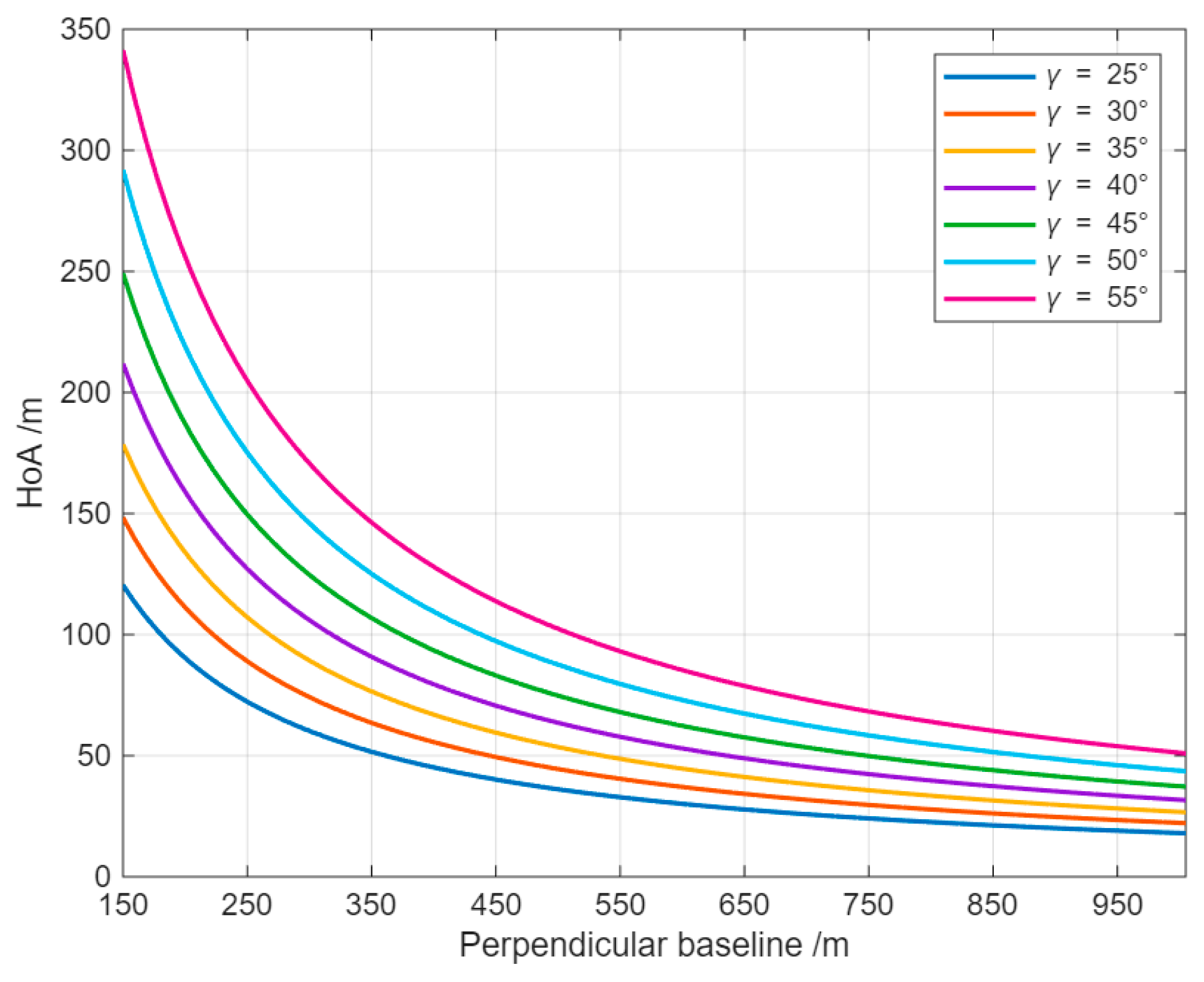
In (5), γ is the incidence angle, λ is the wavelength and r is the range distance. The curve in Figure 2 shows the variation of HoA computed according to (5).
A minimum threshold of 30 m is set for the HoA, in analogy with the TanDEM-X mission, where HoA values were selected as a trade-off between altimetric accuracy and robustness against Phase Unwrapping (PhU) errors [3,17]. For what attains the temporal lag, it refers to the time difference between the receivers’ acquisitions of the same target on the ground. In simplified bistatic geometries, this lag is linked to the along-track baseline and can be calculated as:
Δ t ~ b A T I v
Here b A T I is the along-track baseline between the receivers, and v is the orbital velocity. In this work, the temporal lag is constrained within the range of ±15 ms, in order to ensure optimal alignment (>90%) of the Doppler spectra between the two received signals and to mitigate temporal decorrelation effects due to the presence of water surfaces. While delays of a few tens of milliseconds generally have limited impact over most land covers, stronger decorrelation is expected over water surfaces, motivating the adoption of short interferometric delays in missions targeting water surfaces [18]. Moreover, it is worth remarking that the requirement of a small temporal lag is particularly crucial in critical areas such as vegetated or oceanic surfaces, where even small temporal misalignments can generate significant decorrelation and compromise interferogram quality.
These fundamental mission objectives require the identification of optimized relative orbital configurations, still based on the Helix concept, but tuned to the operating conditions and characteristics of the orbit. The most important difference between Harmony and the already existing interferometric SAR missions, e.g., TanDEM-X, is that the Harmony satellites work in a long-baseline configuration with respect to the transmitter, so that the interferometric geometry is squinted. This means that the traditional concepts of along-track, cross-track, and vertical baselines coming from relative orbit dynamics do not directly transform into either the perpendicular baseline or the temporal lag. In other words, the use of geometric formulas such as (5) and (6) seems to be inadequate to calculate interferometric parameters of complex multistatic formations with squinted Line of Sight (LoS), as in the case of Harmony. For this reason, a different approach is adopted in this paper to define the critical baselines and, thus, the formation requirements. This is based on the wavenumber support alignment between the radar images [7,19]. This method stems from the fact that interferometric measurements can be obtained only when these spectral supports align, i.e., when the same point on the surface is observed with the same scattering geometry. Therefore, if the purpose is to quantify parameters such as the temporal lag or the perpendicular baseline, it is necessary to evaluate t and k , i.e., the time and frequency shift at which the ground-projected wavenumber supports align, as shown in [7]. This results in the inversion of the following system [7]:
k 0 ( l + l t τ c ) x l + l x k 0 ( l + l t τ c ) y l + l y t k = k 0 l
where k 0 ( f r ) = 2 π f r / c 0 is the wavenumber magnitude, f r is the range frequency, and c 0 is the light speed in vacuum. The vector l = l ^ T 1 ( τ c ) + l ^ R 1 ( τ c ) is the sum of the transmitter and receiver 1 (Harmony-A) LoS unit vectors, evaluated at the beam-center time τ c . The term Δ l = Δ l T ( τ c ) + Δ l R ( τ c ) denotes the change in LoS unit vectors between the two Harmony companions (i.e., between the two bistatic geometries used to form the interferogram), evaluated at τ c ; hence k 0 Δ l represents the initial misaignment between the two corresponding wavenumber supports. The subscripts x and y denote the projection along the azimuth and ground range directions (the plane tangent to the surface). From the estimated Δ t and Δ k , the second bistatic support is evaluated at the aligned time and frequency, i.e., at t + Δ t and f r + Δ f (with Δ f = Δ k c 0 / ( 2 π ) ). This allows computing the residual 3-D support separation between the two acquisitions, which is the quantity that drives height sensitivity. In particular, height sensitivity is obtained by projecting this vector difference onto the elevation direction, i.e., the direction which is sensitive to changes in height, as detailed in [7].

3. Optimization of Relative Orbit Parameters

This section describes the optimization process developed to identify the optimal relative orbital configurations for the XTI phase of the Harmony mission. It is worth remarking that, beyond these specific considerations relevant to this mission, the proposed methodology and considerations are of general validity, and they can be applied to design similar multistatic formations that must comply with different requirements and constraints. In particular, the search for the optimal orbital configuration is performed separately for equatorial/mid-latitude and polar/high-latitude regions. Equatorial regions are defined as areas located within the tropics (latitudes between ± 23 ° ), while polar regions correspond to the Arctic and Antarctic Circles locations (latitudes greater than 67 ° in both hemispheres). All remaining portions of the Earth’s surface are therefore classified as mid-latitude regions. This distinction makes it possible to explicitly account for latitude-dependent variations in interferometric geometry, as these variations can affect the optimal configuration in terms of perpendicular baseline and temporal coherence. Accordingly, in an operational context, the resulting latitude-tailored configurations could be alternated depending on the targeted observation scenario. The required maneuvers for formation reconfiguration are not expected to significantly affect mission budgets as discussed in [20,21]. For the equatorial and mid-latitude regions, the analysis is conducted by assuming the classical Helix formation, defined by φ = ψ = 90 ° , as it provides a passively stable geometry and favorable interferometric conditions near the equator. For the polar regions, two different strategies are explored, distinguished by the phase angle values of Δ e and Δ i . In the first configuration, the phases are set to a smaller value ( φ = ψ = 10 ° ), representative of a geometry in which the cross-track separation tends to reach its maximum at higher latitudes. In the second configuration, the classical Helix formation ( φ = ψ = 90 ° ) is explored, to assess the formation behavior in a more well-established reference geometry. It is worth remarking that the study of interferometric performance at additional intermediate φ and ψ values is not reported since as φ = ψ is varied, the performance changes gradually and the latitude of the best-performing regime progressively shifts. For this reason, the analysis is restricted to two limiting configurations ( φ = ψ = 10 ° and φ = ψ = 90 ° ), which are sufficient to capture the trend and optimize two markedly different regions of the globe.
To sum up, the problem is approached in two stages as detailed in Table 1. Each stage is modeled mathematically as a multi-objective optimization problem, whose purpose is to seek the values of relative orbital parameters that satisfy the goals of this mission phase.

3.1. Equatorial and Mid-Latitude Regions

Based on the discussion in the previous section, the search for the optimum is initially conducted under the assumption of a nominal Helix-type configuration with φ = ψ = 90 ° , which is chosen to ensure passive safety and stable orbital geometry. Therefore, the optimization problem is formulated as a classical multi-objective case with constraints. The aim is to minimize the temporal lag t and the average value of the H o A while ensuring that the HoA and the temporal lag do not exceed the allowable limits (see Section 2). The problem is formulated as a constrained multi-objective optimization. Specifically, it is solved using the NSGA-II algorithm [22] through the PyMOO framework [23], which allows for the generation of a Pareto front containing the optimal solutions in terms of a joint optimum between height sensitivity and temporal lag. It is worth remarking that the outcome is a set of trade-off solutions rather than a single optimum, and no cost function is defined a priori to combine height sensitivity and temporal lag. The algorithm is expressed in this form:
m i n i m i z e f 1 x = m e a n [ H o A x ]
m i n i m i z e f 2 x = m e a n [ | t | ]
s u b j e c t t o g 1 x = 30 min H o A x 0 g 2 x = max ( t x ) 15 0
where x = [ a Δ e , a Δ Ω ] is the vector of the decision parameters, in which a represents the semi-major axis. Moreover, m e a n H o A x is the average H o A and m e a n [ | t | ] is the average temporal lag; both are calculated using the wavenumber support alignment method described in [7]. The constraint g 1 x and g 2 x ensure that H o A remains greater than 30 m and the maximum t remains below 15 ms. Furthermore, the solution domain is restricted to a Δ e 200 , 750 m and a Δ Ω 900 , 2100 m , according to the initial ranges specified in the system requirements documentation for the mission [24]. These intervals offer a reference framework consistent with the early design assumptions, even though they are not meant to be strict limitations.

3.2. Polar and High-Latitude Regions

The first strategy to improve the performance of the Harmony mission at high latitudes changes the orientation of the relative orbital vectors, by setting φ = ψ = 10 °. With ψ no longer equal to 90°, a difference in the orbital inclination i between the orbital planes is introduced. Indeed, it follows directly from (2) and (3) that:
ψ tan 1 Ω sin i i
The optimization is conducted by keeping the same multi-objective structure used for the equator and mid-latitude regions (8a–c). However, unlike the previous case, here the solution domain is limited only by safety considerations between the two companions, thus requiring both a Δ e a n d a Δ Ω > 100 m . This relaxed definition is adopted intentionally to avoid solutions that, in the presence of ψ 90 ° (and therefore a Δ i 0 ) would produce excessive cross-track separations when a Δ Ω is kept too high, resulting in an increase in temporal lag. For this reason, by keeping a Δ Ω and a Δ e within a range that is not overly constrained but physically reasonable, the optimization algorithm can explore configurations that balance perpendicular baseline and temporal lag values. However, it is worth remarking that Δ i 0 leads to a time-dependent drift in the y-component of the relative inclination vector, driven by the perturbation due to Earth’s oblateness J 2 [9,25]. Therefore, in this configuration, the angle between the two relative vectors Δ e and Δ i would increase more rapidly over time, reaching the critical condition, i.e., Δ e Δ i , corresponding to the loss of safety in terms of possible collisions between the two companions, significantly earlier than in the nominal case.
As a result of the limitations that emerged in the previous strategy, a second option is explored, again imposing φ = ψ = 90 ° , but restricting the optimization to polar regions only. The goal of this strategy is to preserve the orbital stability and passive safety guaranteed by the nominal Helix formation, while focusing on improving interferometric performance near the poles. To achieve this, the optimization function is reformulated as:
m i n i m i z e f 1 x = m e a n H o A P o l e x m e a n H o A E q u a t o r x
m i n i m i z e f 2 x = m e a n H o A P o l e x
s u b j e c t t o g 1 x = 30 min H o A P o l e x 0
It is worth remarking that (10a) is introduced to explicitly favor orbital configurations that provide enhanced height sensitivity at high latitudes with respect to equatorial regions. Moreover, the same relaxed constraint on the solution domain adopted in the φ = ψ = 10 ° case ( a Δ e a n d a Δ Ω > 100 m ) is applied here to allow for a broader optimized configuration exploration. Finally, it is worth noting that no explicit constraint on the temporal lag is imposed. This is because a direct constraint on temporal lag would have restricted the problem too much, thus limiting the search for alternative solutions. As a further note, within the φ = ψ = 90 ° case, the behavior of the separation components ensures that, at the poles, two out of three physical separations (along-track and cross-track components) are zero, naturally minimizing the temporal lag in that region. Eventually, the verification of the assigned constraint on the temporal lag shall be checked, manually, on the formations resulting from the carried-out optimization.

4. Results and Discussion

The following section will show and discuss the results relevant to the optimization process at different latitudes. The results are then complemented by a preliminary Δ V estimate, i.e., the velocity change required for formation-keeping maneuvers. All simulations assume a multistatic configuration in which Sentinel-1D acts as the transmitter, whose orbital parameters are reported in Table 2. Harmony-A shares the same reference orbit, and it is kept at a fixed relative position with respect to Sentinel-1D, i.e., 350 km behind in the along-track direction (obtained by computing the corresponding mean-anomaly offset), and it serves as the chief. Harmony-B acts as the deputy and its relative position to Harmony-A is the element optimized in this work.

4.1. Performance Evaluation of Optimized Relative Orbits

4.1.1. Equatorial and Mid-Latitude Regions

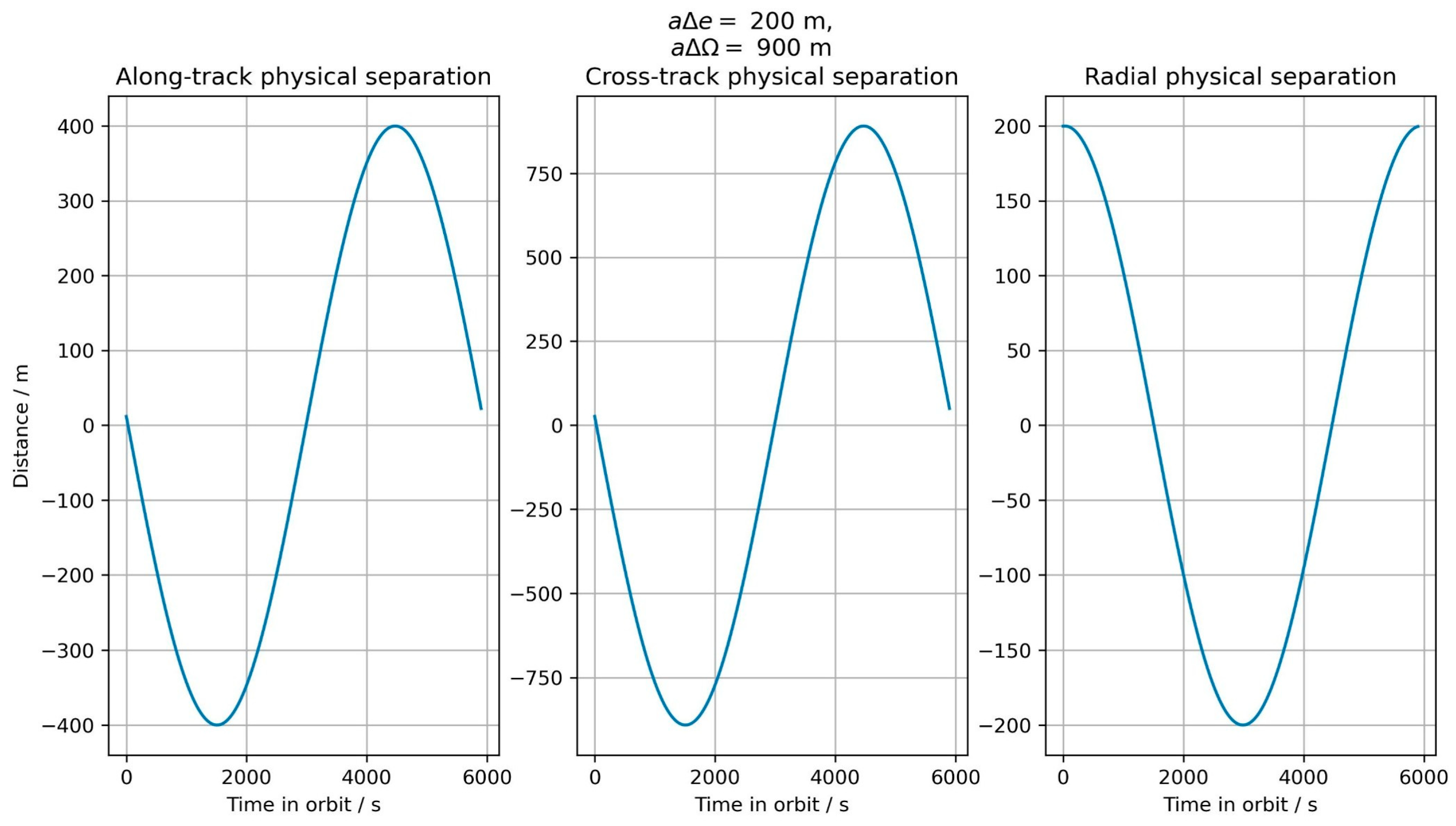
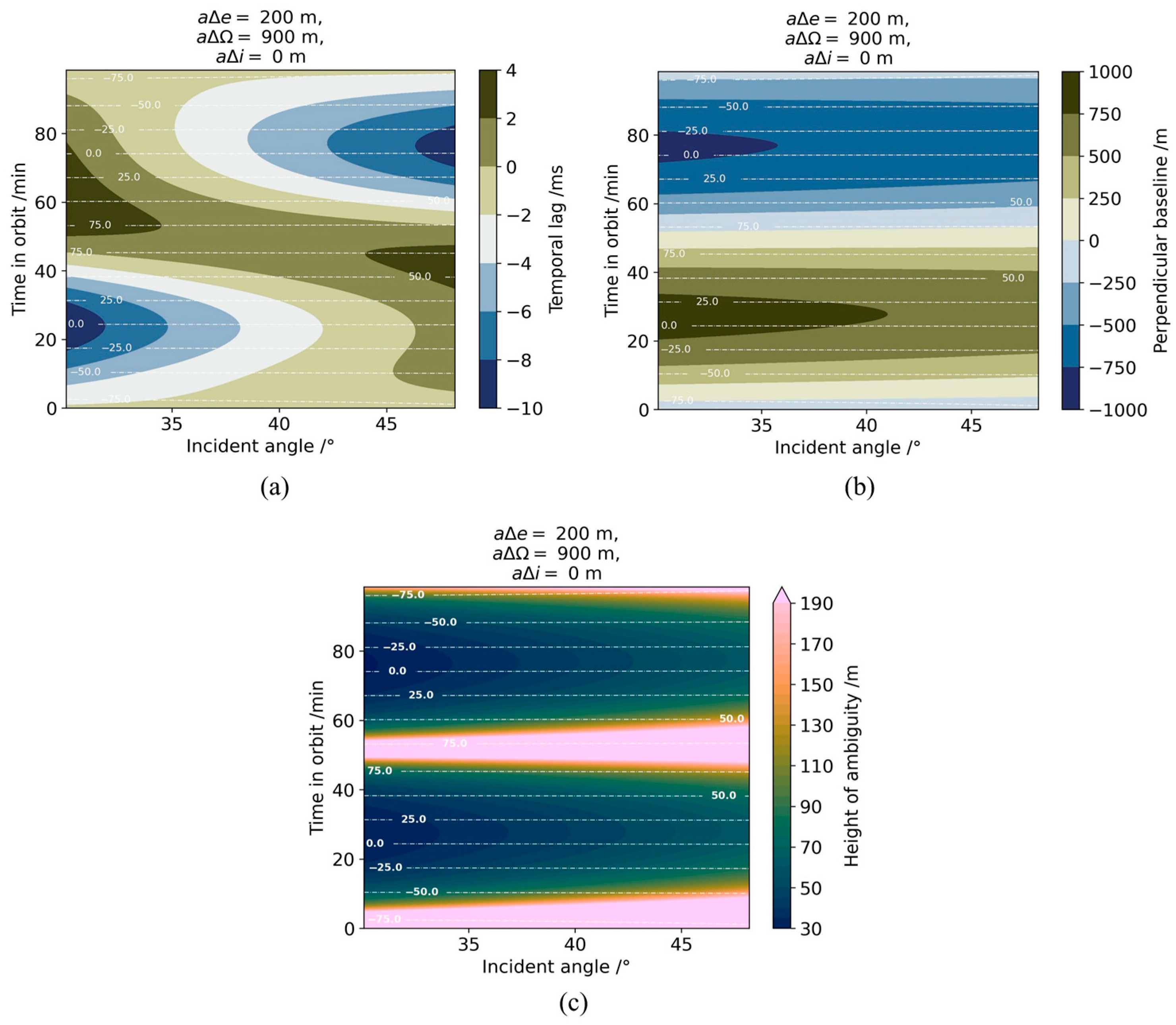
The execution of the multi-objective optimization for equatorial and mid-latitude regions, see (8a–c), constrained to the nominal Helix configuration with φ = ψ = 90 ° , yielded a set of solutions concentrated in a very narrow neighborhood of the values a Δ e = 200 m and a Δ Ω = 900 m . Specifically, the solutions identified by the Pareto front are found to be located near these values, with negligible variations of less than ±2 m, suggesting that this configuration represents a robust result. Accordingly, one representative solution is reported, as the Pareto set provides an essentially unique outcome under the adopted constraints. Figure 3 illustrates the physical three-dimensional separation between the two satellites: at the poles, the separation vector between the two satellites is only radial, while at the other latitudes, the combination of radial, cross-track, and along-track separation results in a more useful baseline.
The pattern observed in Figure 3 reappears in Figure 4, which, by taking into account the actual multistatic and squinted viewing geometry, illustrates the temporal lag and the perpendicular baseline as a function of time in orbit and radar incidence angle. In Figure 4a it is evident that the temporal lag remains within 10 , + 4 m s , along the entire orbit and for the entire range of incidence angles, demonstrating that this solution is compatible with the temporal coherence objectives of the Harmony mission. On the other hand, the perpendicular baseline, depicted in Figure 4b, exhibits a regular oscillation that reflects the geometric evolution of the Helix formation along the orbit. Specifically, minimum values are observed at the orbital poles (orbital times of 0 and 90 min), and maximum values in equatorial zones. Figure 4c shows the corresponding HoA values. As expected from (5), its behavior is consistent with the perpendicular baseline pattern observed in Figure 4b. Specifically, around the equatorial region where the perpendicular baseline reaches its largest values, the HoA decreases and reaches values slightly above 30 m, which, as already stated in Section 2, represents the minimum HoA threshold for the Harmony mission. Conversely, near the orbital poles, where the perpendicular baseline approaches zero, the HoA rapidly increases, resulting in a reduction in sensitivity to the topography. To conclude this part, the evolution of the formation with φ = ψ = 90 ° , a Δ e = 200 m and a Δ Ω = 900 m , is simulated by exploiting the General Mission Analysis Tool (GMAT). The specific settings used in the GMAT simulation are summarized in Table 3.
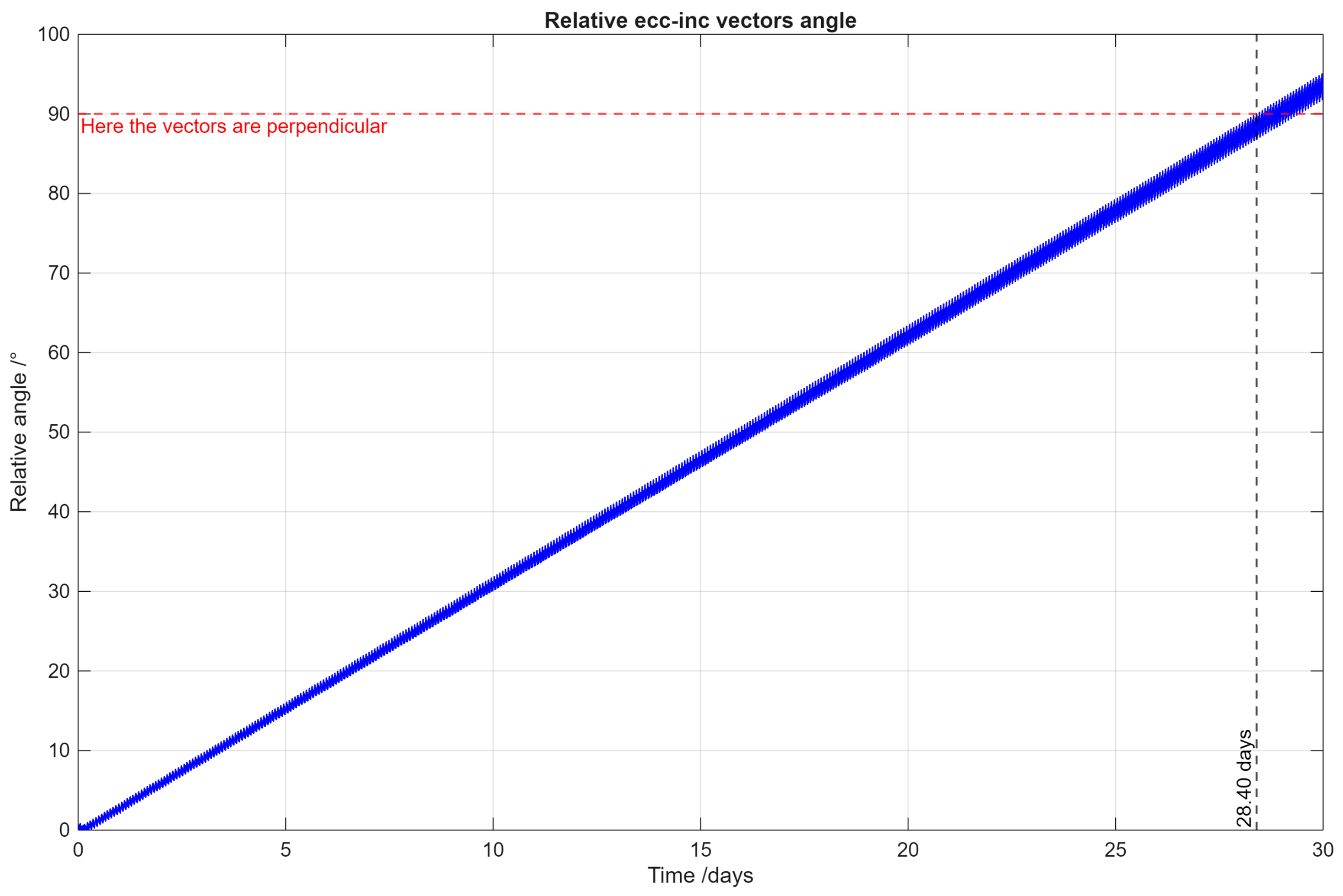
Based on the 30-day propagation with the parameters summarized in Table 3, our simulation reveals that, as shown in Figure 5, the condition of perpendicularity between the two relative vectors is reached after approximately 28.4 days. At that point, both the cross-track and radial separations simultaneously reach zero, thus indicating that a loss of safety is reached. This drift is determined by the long-term rotation of the relative eccentricity vector due to J 2 , since setting i = 0 eliminates the secular drift of the relative inclination vector, which therefore remains nearly constant [9]. The apparent width of the blue trace, depicted in Figure 5, reflects short-period oscillations of the osculating equinoctial elements.

4.1.2. Polar and High-Latitude Regions: φ = ψ = 10 °

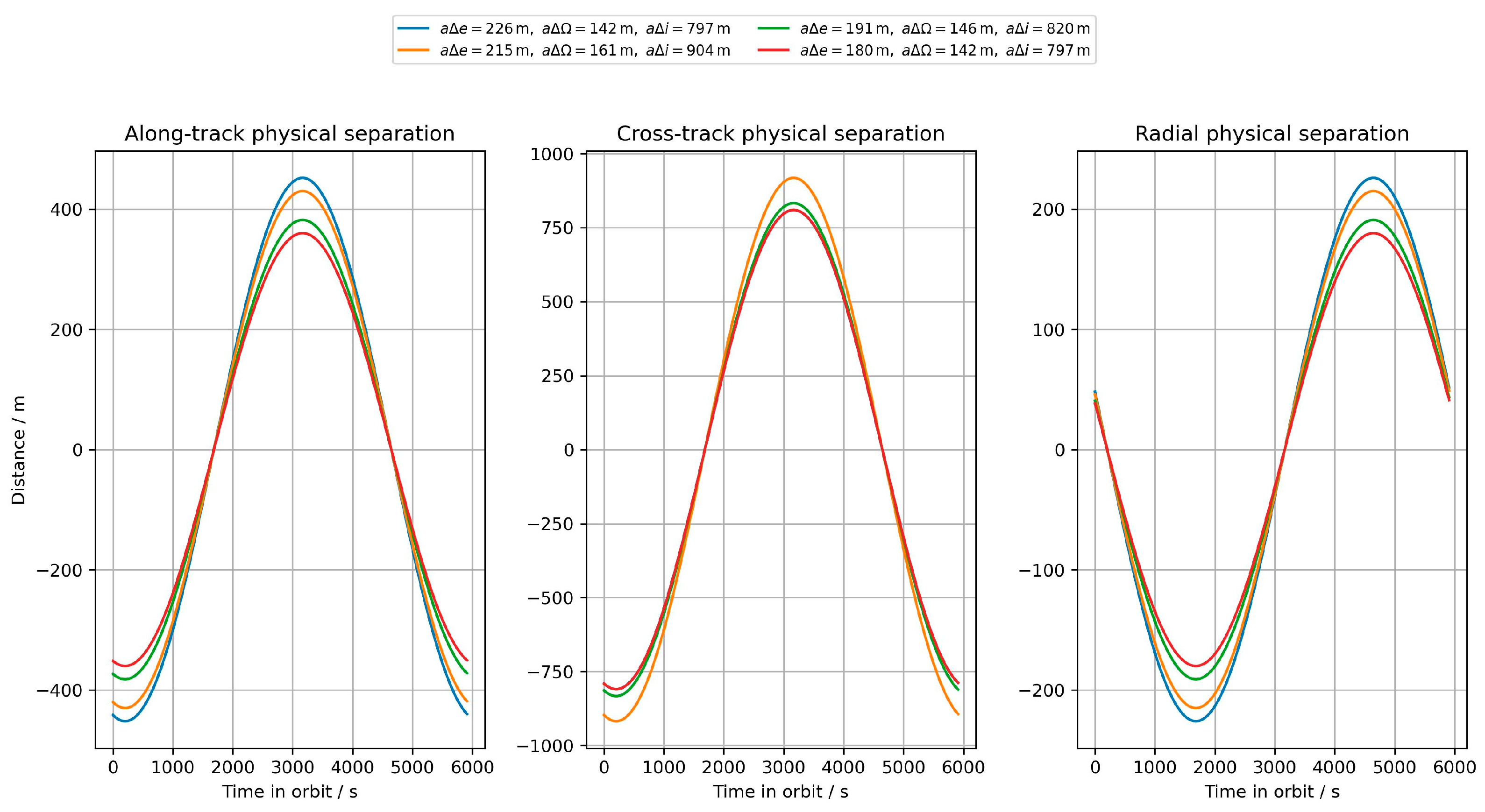
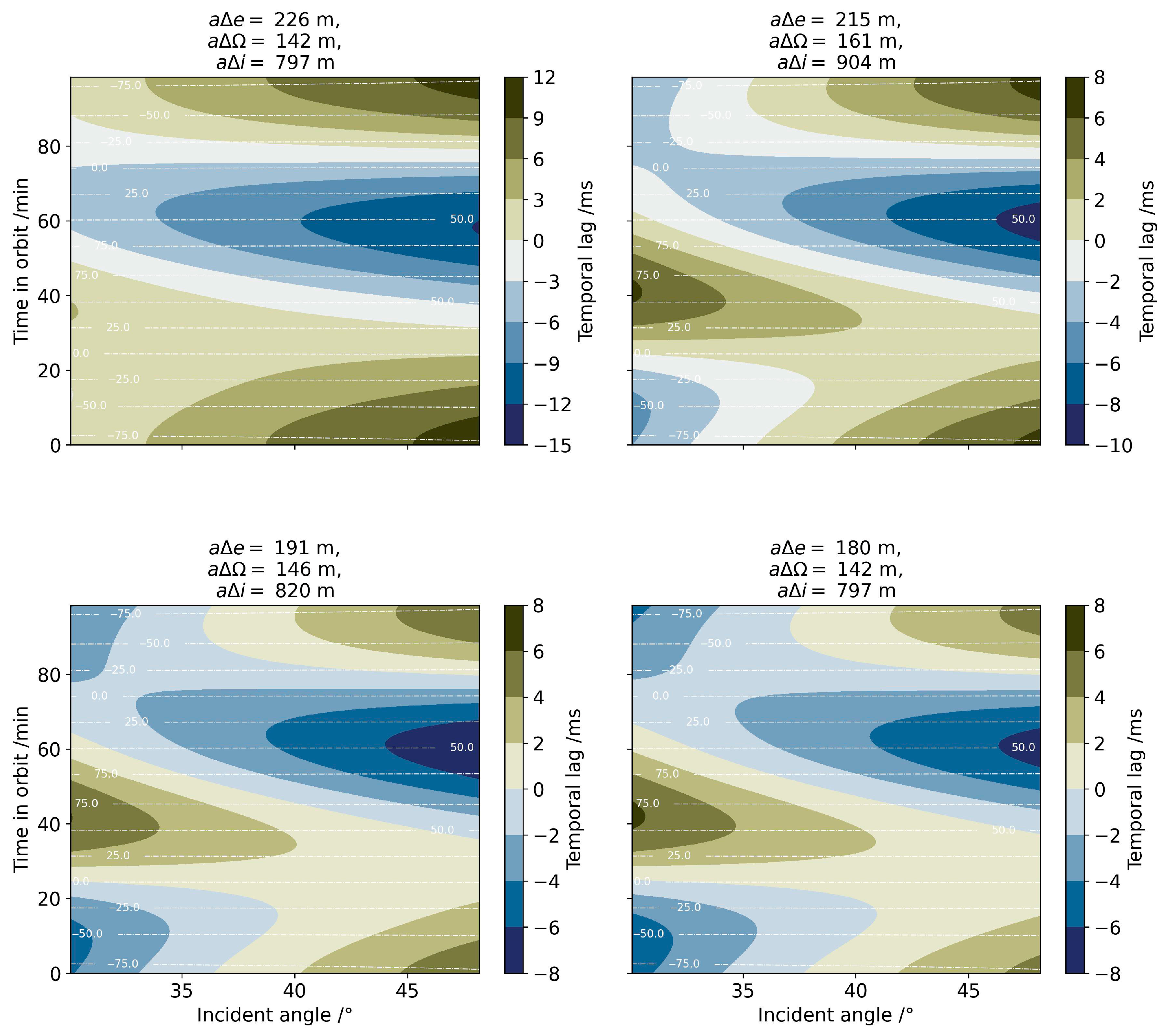
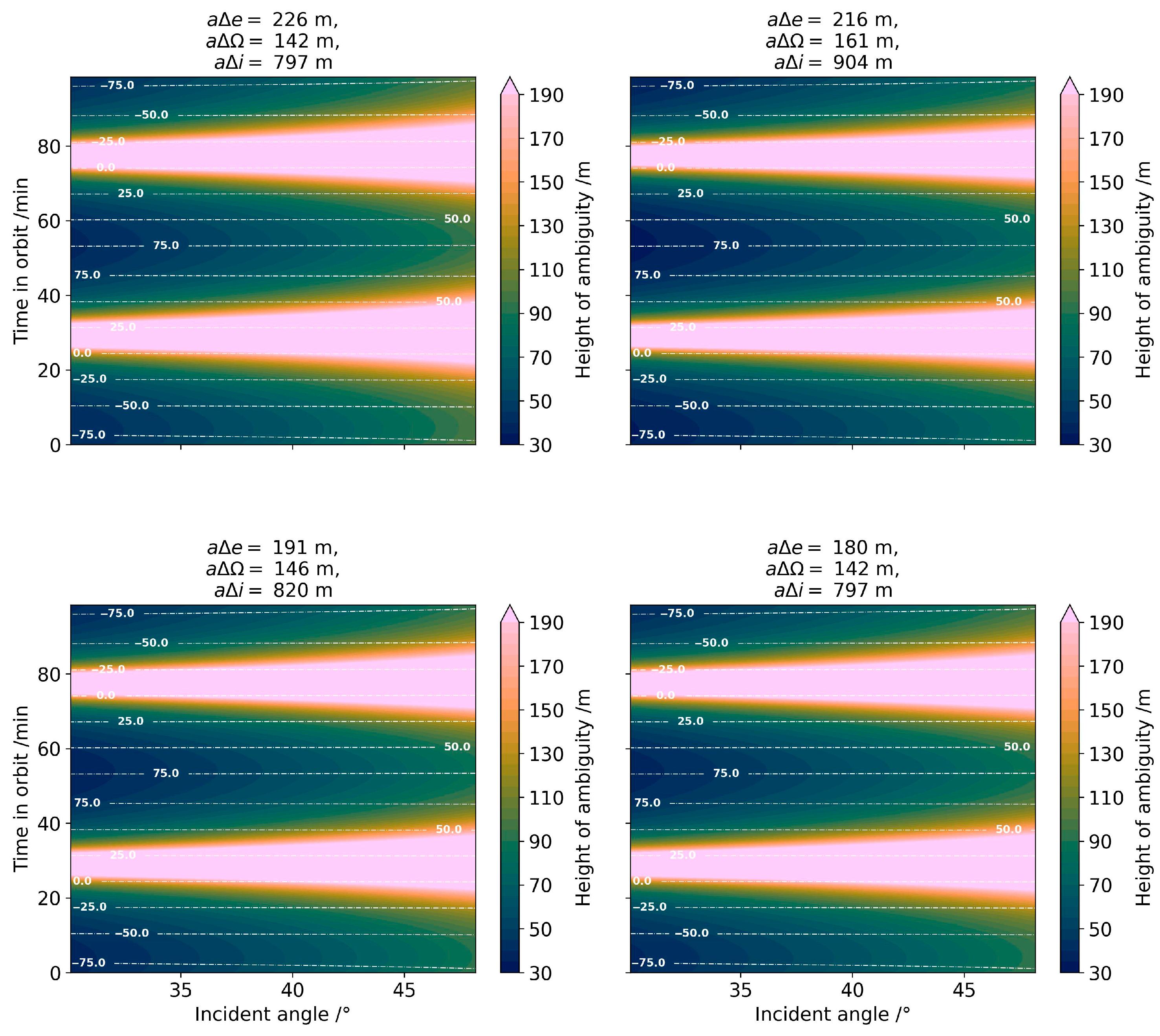
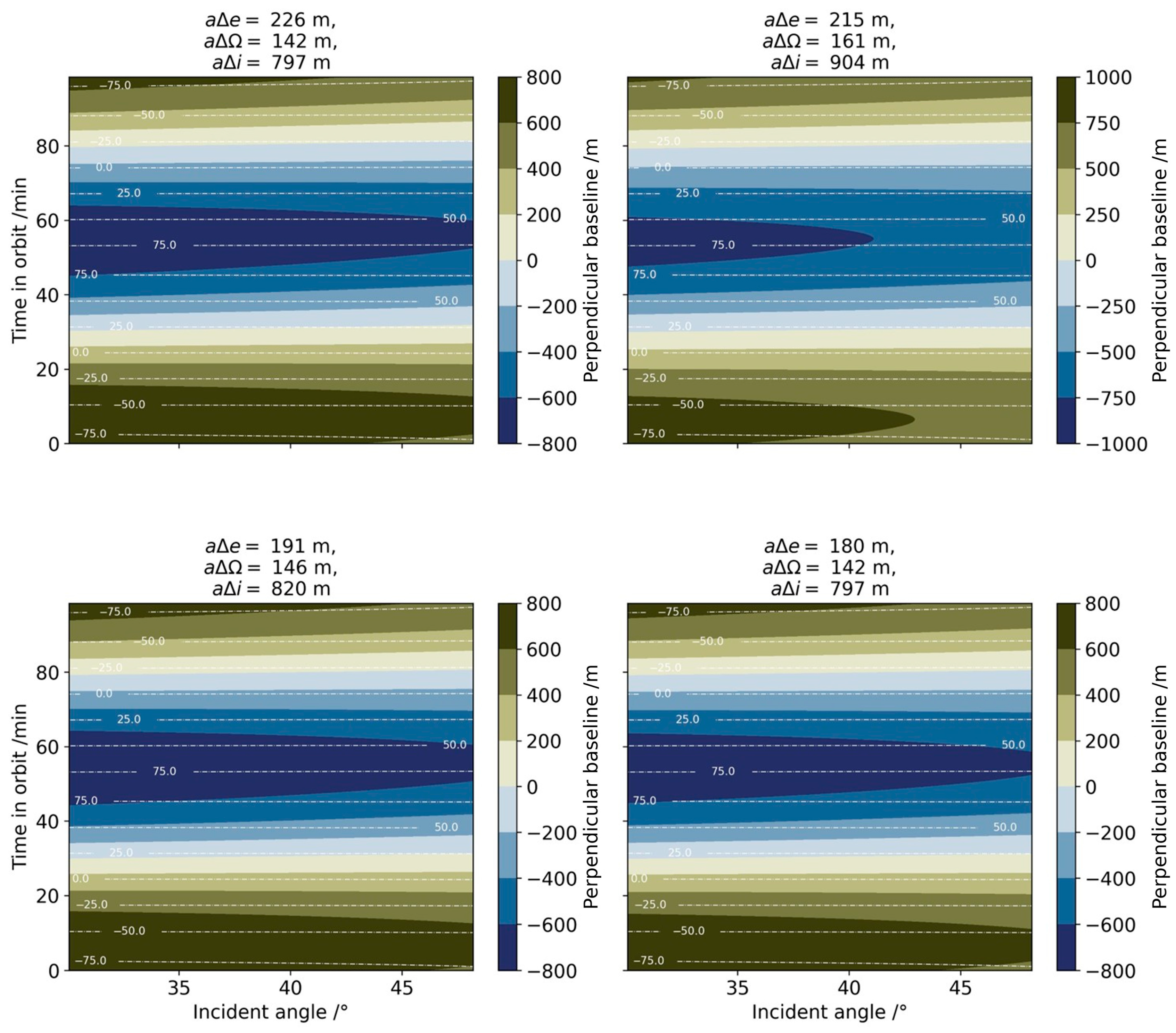
After identifying an effective orbital configuration for equatorial and mid-latitudes, it is necessary to evaluate optimized solutions for high latitudes and polar regions. A first strategy to improve the performance of the Harmony mission at high latitudes involved changing the orientation of the relative orbital vectors, by setting φ = ψ = 10 °. In this case, multiple non-dominated solutions are obtained. Therefore, four representative configurations are reported to span distinct trade-offs within the Pareto set and illustrate the variability of the resulting interferometric performance. The obtained configurations generally show values of a Δ e between 180 and 226 m, and a Δ Ω between 142 and 161 m, with values of a Δ i close to 800–900 m. This choice of selecting smaller phase-angle values allows for the reshaping of the spatial distribution of the three physical separation components (see Figure 6). In addition, the condition φ = ψ nominally ensures parallelism of the relative vectors over the orbital period, as already stated in Section 2. This is evident in Figure 6, where the cross-track and radial components of the selected optimal configurations are out of phase, resulting in safe out-of-plane motion. A similar behavior is observed for the along-track and radial components, whose phase offset ensures nominal safety also in the in-plane direction. The interferometric performance associated with these configurations is illustrated in Figure 7, Figure 8 and Figure 9, which show the temporal lag, the perpendicular baseline and the HoA maps, respectively. We remark that the perpendicular baseline maintains high values in the polar regions, while the temporal lag remains contained within ± 15 ms for most of the orbit. As for the HoA, it exhibits an opposite behavior with respect to that shown in Figure 4c, reaching values close to 30 m in the polar regions and increasing around the equatorial regions. With these assumptions, these configurations prove to be highly satisfactory for the latitudes of interest.
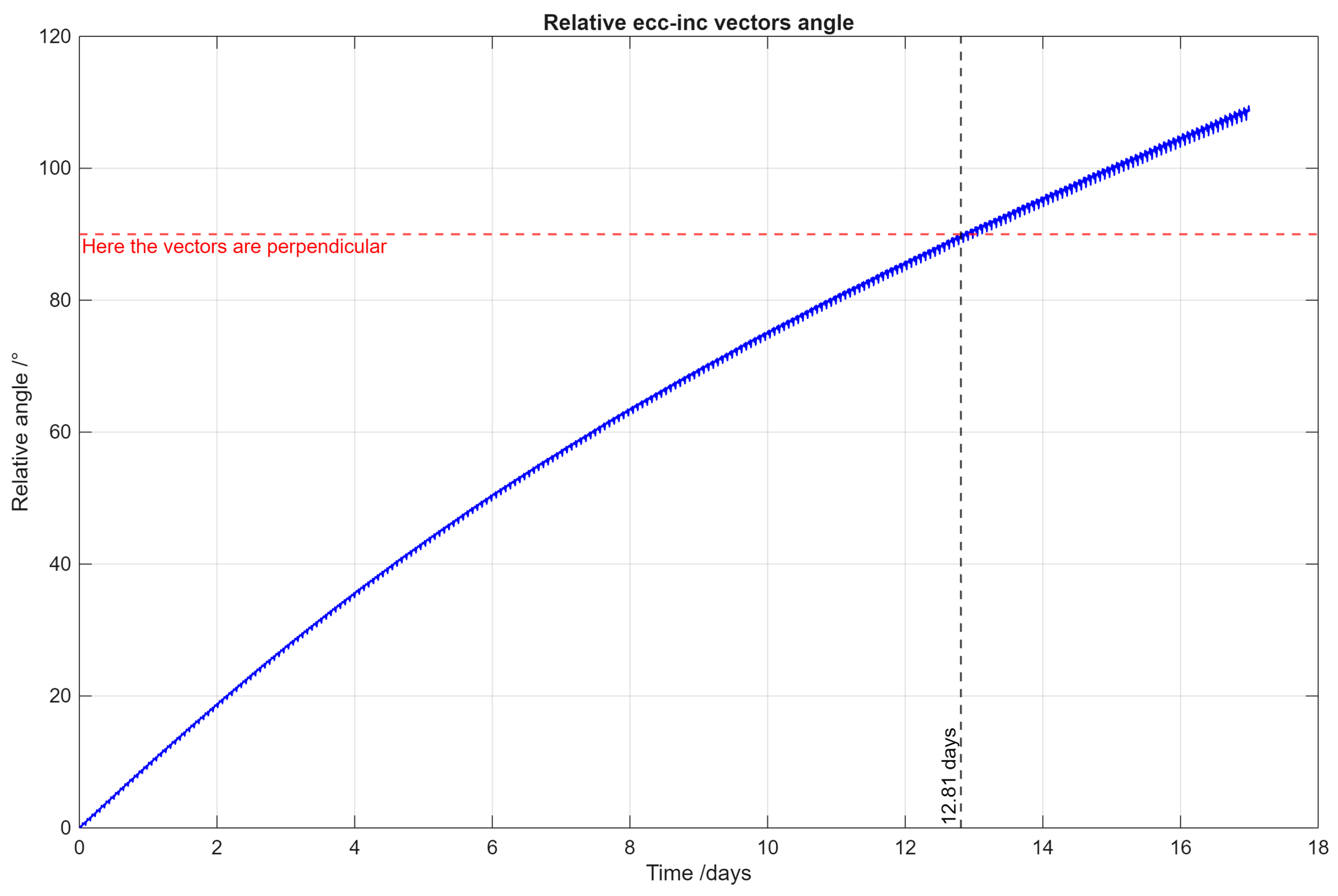
However, this strategy entails some critical issues in terms of the time evolution of the formation, as already stated in Section 3. Indeed, the critical perpendicular condition between Δ e and Δ i is expected earlier than the φ = ψ = 90 ° case, requiring more frequent and costly correction maneuvers to counteract the secular drift and preserve the geometry formation. It is worth remarking that this is due to a non-zero i (9) which introduces a secular drift to the y-component of the relative inclination vector [9]. This is indeed confirmed by the simulation carried out in GMAT using the same parameters as in Table 3 and with φ = ψ = 10 ° , a Δ e = 215 m and a Δ Ω = 161 m . For this configuration, the critical perpendicular condition occurs significantly earlier, namely at around 12.81 days, as confirmed by the results shown in Figure 10.

4.1.3. Polar and High-Latitude Regions: φ = ψ = 90 °

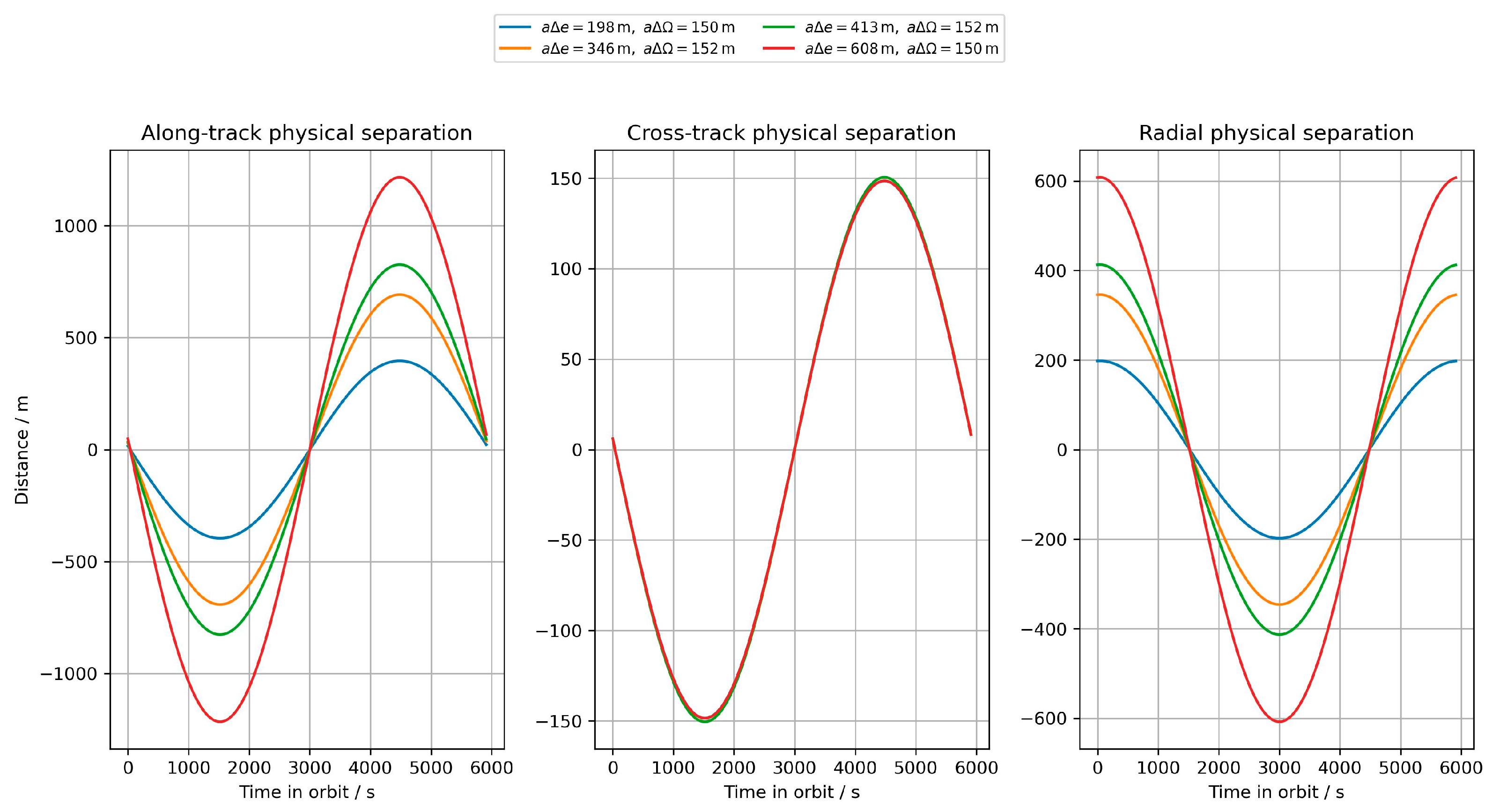
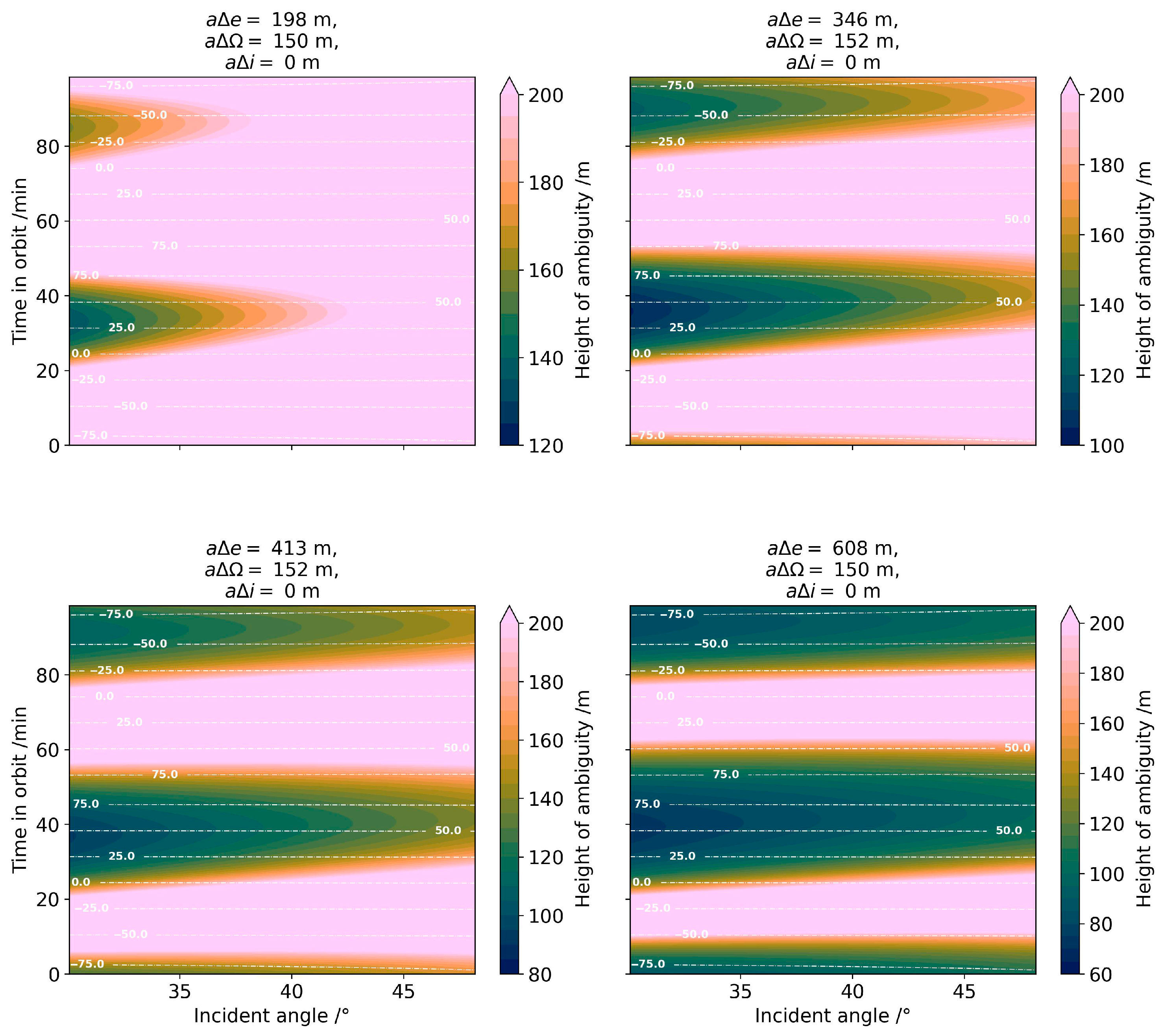
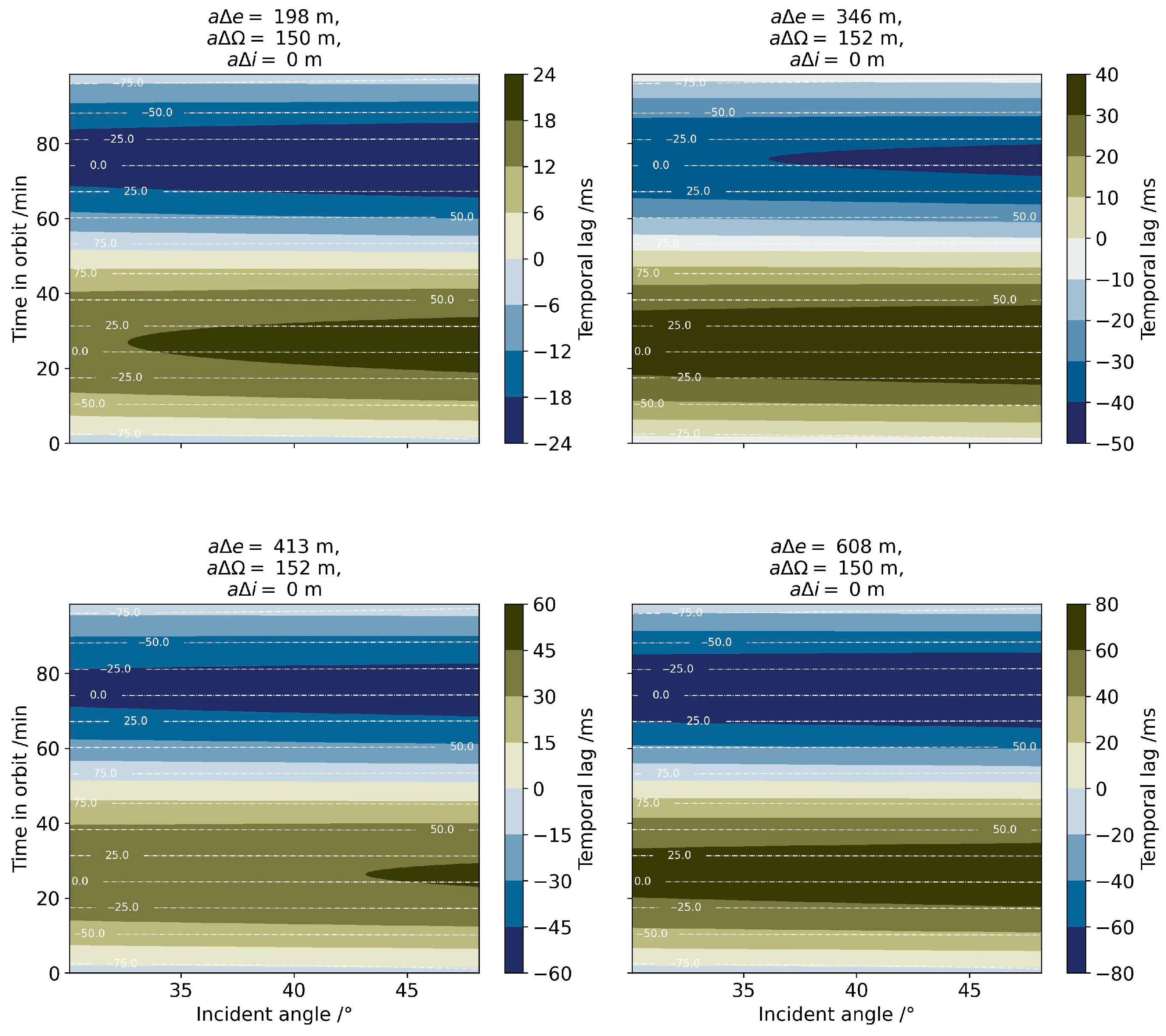
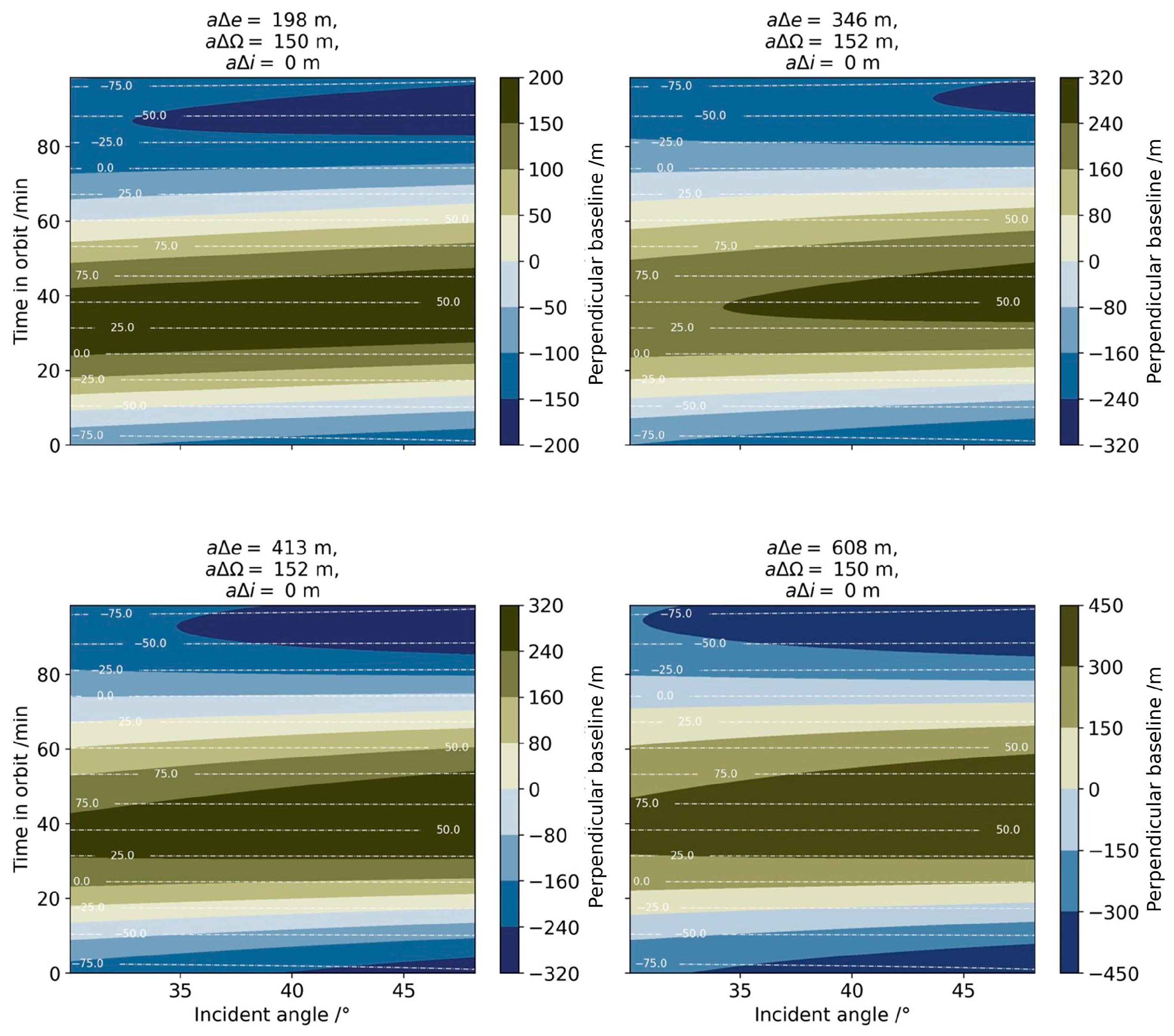
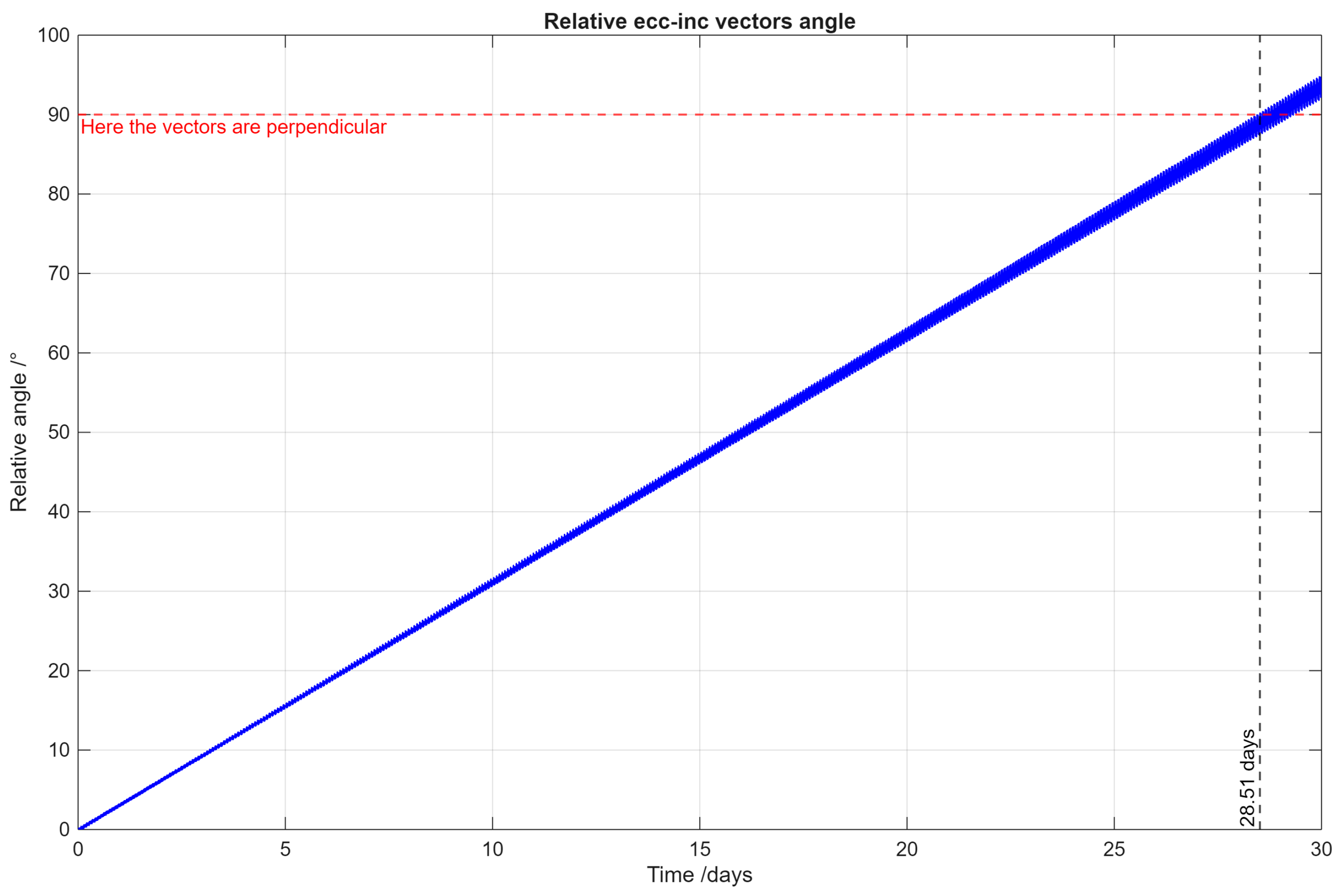
By solving (10a)–(10c) with φ = ψ = 90 ° , a Pareto set of solutions is obtained; from this set, four representative configurations with a Δ e values between 198 m and 608 m are reported. This variability can be attributed to the absence of stringent constraints on the temporal lag and to the broader search domain, which is no longer limited to predefined intervals for a Δ e and a Δ Ω . In this case, as well, Figure 11 is first presented, illustrating the three physical separation components between the two Harmony satellites. These components clearly follow the same pattern, as shown in Figure 3. Nonetheless, it is worth noting that in this case, unlike in Figure 3, the radial component exhibits larger absolute peaks than the cross-track component, a behavior directly linked to the condition a Δ e > a Δ Ω , which is observed in all the evaluated configurations, and which contributes to a larger perpendicular baseline at polar and high-latitude regions. Indeed, from a geometric standpoint, the condition a Δ e > a Δ Ω in the φ = ψ = 90 case indicates that the optimization prefers an in-plane dominated relative motion to build the perpendicular baseline at the poles. This behavior is also observable in Figure 11 where at the pole crossing (t~0 s, t~3000 s and t~6000 s), both the along-track and cross-track separations vanish, while the radial separation remains non-zero and scales with a Δ e . Accordingly, increasing a Δ e is the most direct way in this geometry to build a larger perpendicular baseline at the poles. However, as may be noticed from Figure 11, the amplitude of the along-track separation increases as well when a Δ e changes from 198 m to 608 m. This downside highlights a trade-off that lies at the core of this mission design: larger physical separations between the two companions help to achieve larger perpendicular baselines and thus improved sensitivity to topography, but, at the same time, these larger separations also increase the acquisition time offset between the two companions, directly worsening the temporal lag and consequently the temporal coherence, which is critical especially considering the Harmony mission objectives. However, this also introduces an implicit limitation: excessively large values of a Δ e , while enhancing sensitivity to the topography, inevitably lead to higher temporal lag even at the poles, thus creating a trade-off between altimetric accuracy and temporal coherence. Also in this case, the interferometric performance of these configurations is illustrated in Figure 12, Figure 13 and Figure 14. Regarding temporal lag, illustrated in Figure 12, higher values are observed on a global scale (up to ±80 ms), but focusing just on high latitudes, the values remain small. For instance, in the configuration with a Δ e = 198 m and a Δ Ω = 150 m , the temporal lag at the poles remains within ±6 ms, while in the case with a Δ e = 608 m and a Δ Ω = 150 m , it reaches values between ±20 ms, as expected for greater in-plane separation. The achieved perpendicular baseline distribution (see Figure 13) shows minimum values at the equator and maximum values at the poles, where, however, moderate peaks are reached (up to ~450 m). The corresponding HoA distribution, shown in Figure 14, reflects the moderate perpendicular baseline values reached at high latitudes. In particular, the configuration with a Δ e = 198 m and a Δ Ω = 150 m exhibits minimum HoA values at the poles slightly above 100 m , whereas for the other configurations the minimum HoA decreases below 100 m . The lowest values are obtained for the case with a Δ e = 608 m and a Δ Ω = 150 m , where the minimum HoA at the poles is about 60 m . To conclude, also in this case, it is reported in Figure 15 the evolution in GMAT of one of the four retrieved configurations, specifically the one with a Δ e = 346 m and a Δ Ω = 152 m, confirming that the critical perpendicular condition occurs after 28.51 days. In summary, a purely interferometric assessment indicates that the φ = ψ = 10 configuration outperforms the φ = ψ = 90 case at high latitudes, yielding performance comparable to that obtained with φ = ψ = 90 in equatorial and mid-latitude regions. However, this comes at the expense of reduced formation stability. The trade-off between these two conflicting aspects motivates the need for a preliminary Δ V budget analysis and a comparison of the derived solutions, which are reported in Section 4.2.

4.2. Preliminary Δ V Budget Analysis for Formation Maintenance

Following the orbital design of the Harmony phase, a preliminary estimate of the Δ V required to maintain the satellite formation has been carried out. This approach aims to provide a rough order-of-magnitude estimate, sufficient to understand whether the formation maintenance requirements are potentially manageable. The strategy is as follows: the formation is allowed to evolve freely in GMAT for a given time window, from t = 0 to t = t end, where the latter is 28 days in the case where φ = ψ = 90 ° , and 12 days in the case where φ = ψ = 10 ° . At the end of the window, the relative orbital elements are analyzed. Specifically, the relative orbital parameters of Harmony-B, with respect to Harmony-A, are compared at time t = 0 (nominal configuration) and at t = t end, when the safety condition is nearly violated. The change in relative orbital elements, indicated with D · , is then used to compute the Δ V required to restore the nominal configuration. The underlying assumption is that restoring the nominal relative orbital elements brings the system back to a safe state. Mathematically, this can be expressed as:
D = | n o m u n s a f e |
Here, n o m denotes the nominal relative orbital element between Harmony-B and Harmony-A at the initial epoch, while u n s a f e represents the corresponding relative orbital element evaluated after the uncontrolled evolution. Equation (11) is applied to all relevant orbital parameters (semi-major axis, eccentricity, RAAN, and inclination), while the argument of perigee and true anomaly are assumed constant in this simplified analysis. The total required Δ V is then obtained by independently evaluating the in-plane and out-of-plane contributions. The in-plane maneuvers correct the changes in the semi-major axis ( D a ) and the relative eccentricity vector ( D e ). The impulse corresponding to the eccentricity correction Δ V e can be approximated by two symmetric tangential burns ( ± Δ V e ) [9]:
Δ V e = v 2 · D e
where v is the orbital velocity of Harmony-B at the maneuver point. The nominal value of the relative semi-major axis is restored based on the Hohmannian two-impulse transfer [25] from the current unsafe orbit to the desired safe one. Concerning out-of-plane maneuvers, two separate sequential corrections are required to compensate for deviations in orbital inclination ( D i ) and RAAN ( D Ω ), with the inclination correction performed as first. To achieve a pure inclination change, the burn is applied at orbit nodes and the corresponding impulse ( Δ V i ) is computed as per to [25]:
Δ V i = 2 v · sin D i 2
Once the inclination has been restored to its nominal value, the residual RAAN deviation is corrected following [25]:
Δ V Ω = 2 v · sin Ψ 2
With Ψ as the rotation angle between the current unsafe and the desired safe plane of Harmony-B. It is worth noting that, in this context, the subscript safe refers to the target orbital configuration of Harmony-B that re-establishes the nominal formation geometry. To define this state, the current orbital parameters of Harmony-A (in the unsafe condition) are taken as reference, and the nominal relative offsets ( n o m ), which describe the desired separation in orbital elements, are applied. This leads to the following relationship:
H b s a f e = H a u n s a f e + n o m
where H b denotes a generic orbital parameter of Harmony-B, while H a denotes a generic orbital parameter of Harmony-A. Thus, the methodology described above has been applied to three representative Harmony configurations. The results are summarized in Table 4, which reports the in-plane and out-of-plane contributions, the total Δ V required for the relative formation keeping, and the frequency of the corrective maneuver. It is evident from Table 4 that the Δ V allowing to maintain the formation with φ = ψ = 10 ° is at least two orders of magnitude greater than that relevant to the φ = ψ = 90 ° configurations, suggesting that controlling formations at low relative angles is significantly more demanding.
It is also worth remarking that this analysis aims to highlight the main parameters on which configuration trade-offs should be based, as well as the order of magnitude of the involved quantities. The specific numerical results presented here should therefore be regarded as general guidelines to support decision-making. For instance, if maximizing interferometric performance is a strict requirement, the configuration with φ = ψ = 10 ° should be preferred at high latitudes, and the resulting maintenance costs would be addressed at the satellite and mission level, possibly through the implementation of suitable control laws. In fact, for a general small/mini satellite mission in LEO, i.e., even beyond Harmony scenario, a Δ V requirement of approximately 50 m/s per year remains manageable. Moreover, again in a general case, the Δ V may be distributed between the two satellites, as there is no inherent requirement for only the deputy to perform all maneuvers. Conversely, those considerations do not perfectly fit the Harmony budgets and requirements. Specifically, the chief satellite in Harmony is also requested to guarantee precise revisiting in a repeat-pass scenario and cannot support formation maintenance. Moreover, the onboard resources do not make the required Δ V available for long time spans. Hence, if high latitude coverage is to be maintained for long periods, the configuration with φ = ψ = 90 ° should be preferred even though it involves a partial reduction in the achieved interferometric performance.

5. Conclusions

The presented work provides an applicative contribution to the orbital design of multistatic SAR missions operating in formation and paves the way for the exploration of Helix configurations based on the unconventional selection of key parameters. In particular, the presented activity is part of the conceptual definition of the XTI phase of the Harmony mission, the 10th Earth Explorer ESA Mission, and contributes to the design of the relative orbital dynamics of the satellite formations suitable for interferometric applications. The adopted approach made it possible to identify configurations that are geometrically compatible with the scientific requirements of the mission, i.e., low temporal lag and high height sensitivity, considering the safety constraints between the two companions.
In equatorial and mid-latitude regions, the classical Helix geometry with φ = ψ = 90 ° proves to be the optimal solution. The retrieved configuration ensures both low temporal lag and satisfactory perpendicular baseline while maintaining passive stability, with the relative eccentricity vector being the main driver of long-term drift. Moreover, the required Δ V to preserve the nominal formation is extremely small, only 0.377 m/s per year as reported in Table 4, confirming the robustness of this configuration over prolonged periods.
However, this nominal configuration becomes suboptimal at high latitudes, where a significant reduction in height sensitivity occurs. To address this limitation, two alternative strategies were explored. The first one, based on φ = ψ = 10 ° , provides excellent interferometric performance in polar regions. Nevertheless, the loss of passive stability caused by i 0 results in a rapid approach to the critical perpendicularity condition, specifically after only ~12 days, and requires frequent and costly formation-keeping maneuvers. The preliminary Δ V analysis confirms that this geometry demands a propulsion budget of about 50 m/s per year, that is two orders of magnitude larger than the φ = ψ = 90 ° case, making this solution difficult to sustain over mission lifetime.
A second high-latitude-focused strategy, still based on φ = ψ = 90 ° but optimized only at high latitudes, offers a more balanced trade-off. Although the resulting perpendicular baseline is lower than in the φ = ψ = 10 ° case, it remains adequate for topographic retrieval, and the temporal lag stays within acceptable limits near the high latitudes. Most importantly, the passive stability of the Helix configuration significantly reduces the required maneuvering effort, making this solution compatible with long-term operations.
To conclude, considering both interferometric performance and formation-maintenance requirements, the φ = ψ = 90 ° configuration emerges as the most feasible option for high-latitude operations. Moreover, as a potential future development, an active control scheme could be studied for this complex multistatic geometry to obtain more accurate Δ V estimates, thereby providing an additional metric to support the trade-off between alternative configurations at high latitudes.

Author Contributions

Conceptualization, F.C. and A.R.; Methodology, F.C., A.T., B.R., M.S. and F.P.; Software, F.C., A.T., M.S. and F.P.; Formal analysis, F.C. and M.M.; Writing—original draft, F.C.; Writing—review & editing, M.M., R.L., M.S. and A.R.; Visualization, F.C.; Supervision, B.R., R.L. and A.R. All authors have read and agreed to the published version of the manuscript.

Funding

This research received no external funding.

Data Availability Statement

The original contributions presented in this study are included in the article. Further inquiries can be directed to the corresponding author.

Conflicts of Interest

The authors declare no conflicts of interest.

Abbreviations

The following abbreviations are used in this manuscript:
DEMDigital Elevation Model
ESAEuropean Space Agency
GMATGeneral Mission Analysis Tool
HoAHeight of Ambiguity
InSARInterferometric Synthetic Aperture Radar
LoSLine of Sight
PhUPhase Unwrapping
RAANRight Ascension of the Ascending Node
S/CSpacecraft
XTIAcross-Track Interferometry

References

  1. Moreira, A.; Krieger, G.; Hajnsek, I.; Werner, M.; Hounam, D.; Riegger, S.; Settelmeyer, E. TanDEM-X: A TerraSAR-X add-on satellite for single-pass SAR interferometry. IEEE Int. Geosci. Remote Sens. Symp. 2004, 2, 1000–1003. [Google Scholar] [CrossRef]
  2. Hajnsek, I.; Moreira, A. TanDEM-X: Mission and Science Exploration. In Proceedings of the EUSAR 2006, Dresden, Germany, 16–18 May 2006. [Google Scholar]
  3. Krieger, G.; Moreira, A.; Fiedler, H.; Hajnsek, I.; Werner, M.; Younis, M.; Zink, M. TanDEM-X: A Satellite Formation for High-Resolution SAR Interferometry. IEEE Trans. Geosci. Remote Sens. 2007, 45, 3317–3341. [Google Scholar] [CrossRef]
  4. López-Dekker, P.; Rott, H.; Prats-Iraola, P.; Chapron, B.; Scipal, K.; De Witte, E.D. Harmony: An Earth Explorer 10 Mission Candidate to Observe Land, Ice, and Ocean Surface Dynamics. In Proceedings of the IEEE International Geoscience and Remote Sensing Symposium, Yokohama, Japan, 28 July–2 August 2019; IEEE: New York, NY, USA, 2019; pp. 8381–8384. [Google Scholar] [CrossRef]
  5. López-Dekker, P.; Biggs, J.; Chapron, B.; Hooper, A.; Kääb, A.; Masina, S.; Mouginot, J.; Buongiorno Nardelli, B.; Pasquero, C.; Prats-Iraola, P.; et al. The Harmony Mission: End of Phase-0 Science Overview. In Proceedings of the IEEE International Geoscience and Remote Sensing Symposium, Brussels, Belgium, 11–16 July 2021; IEEE: New York, NY, USA, 2021; pp. 7752–7755. [Google Scholar] [CrossRef]
  6. Theodosiou, A.; Kleinherenbrink, M.; López-Dekker, P. Wide-Swath Ocean Altimetry Using Multisatellite Single-Pass Interferometry. IEEE Trans. Geosci. Remote Sens. 2023, 61, 5210721. [Google Scholar] [CrossRef]
  7. Theodosiou, A.; López-Dekker, P. On the Sensitivity to Height and Motion of Bistatic SAR Interferometry: A Spectral View. IEEE Trans. Geosci. Remote Sens. 2024, 62, 5212212. [Google Scholar] [CrossRef]
  8. Montenbruck, O.; Wendt, K.; Arnold, D.; D’Amico, S. E/I-Vector Separation for Safe Switching of the GRACE Formation. Aerosp. Sci. Technol. 2006, 10, 628–635. [Google Scholar] [CrossRef]
  9. D’Amico, S.; Montenbruck, O. Proximity Operations of Formation-Flying Spacecraft Using an Eccentricity/Inclination Vector Separation. J. Guid. Control. Dyn. 2006, 29, 554–563. [Google Scholar] [CrossRef]
  10. Bamler, R.; Hartl, P. Synthetic Aperture Radar Interferometry. Inverse Probl. 1998, 14, R1–R54. [Google Scholar] [CrossRef]
  11. Moccia, A.; Fasano, G. Analysis of Spaceborne Tandem Configurations for Complementing COSMO with SAR Interferometry. EURASIP J. Adv. Signal Process. 2005, 20, 3304–3315. [Google Scholar] [CrossRef]
  12. Krieger, G.; Moreira, A. Spaceborne Bi- and Multistatic SAR: Potential and Challenges. IEE Proc. Radar Sonar Navig. 2006, 153, 184–198. [Google Scholar] [CrossRef]
  13. Huber, S.; Younis, M.; Krieger, G. The TanDEM-X Mission: Overview and Interferometric Performance. Int. J. Microw. Wirel. Technol. 2010, 2, 379–389. [Google Scholar] [CrossRef][Green Version]
  14. Tang, X.; Li, T.; Chen, J.; Wei, C.; Zhang, X.; Liu, Y.; Liu, D.; Zhang, X.; Zhou, X.; Lu, J.; et al. Twin-Satellite Constellation Design and Realization for Terrain Mapping and Deformation Monitoring: LuTan-1. IEEE Trans. Geosci. Remote Sens. 2025, 63, 5214014. [Google Scholar] [CrossRef]
  15. Deng, Y.; Zhang, H.; Liu, K.; Wang, W.; Ou, N.; Han, H.; Yang, R.; Ren, J.; Wang, J.; Ren, X.; et al. Hongtu-1: The First Spaceborne Single-Pass Multibaseline SAR Interferometry Mission. IEEE Trans. Geosci. Remote Sens. 2025, 63, 5202518. [Google Scholar] [CrossRef]
  16. Di Mauro, G.; Bevilacqua, R.; Spiller, D.; Sullivan, J.; D’Amico, S. Continuous Maneuvers for Spacecraft Formation Flying Reconfiguration Using Relative Orbit Elements. Acta Astronaut. 2018, 153, 311–326. [Google Scholar] [CrossRef]
  17. Zink, M.; Bachmann, M.; Brautigam, B.; Fritz, T.; Hajnsek, I.; Moreira, A.; Wessel, B.; Krieger, G. TanDEM-X: The New Global DEM Takes Shape. IEEE Geosci. Remote Sens. Mag. 2014, 2, 8–23. [Google Scholar] [CrossRef]
  18. Tucker, M.J. The Decorrelation Time of Microwave Radar Echoes from the Sea Surface. Int. J. Remote Sens. 1985, 6, 1075–1089. [Google Scholar] [CrossRef]
  19. Gatelli, F.; Monti Guamieri, A.; Parizzi, F.; Pasquali, P.; Prati, C.; Rocca, F. The wavenumber shift in SAR interferometry. IEEE Trans. Geosci. Remote Sens. 1994, 32, 855–865. [Google Scholar] [CrossRef]
  20. Sarno, S.; D’Errico, M.; Guo, J.; Gill, E. Path planning and guidance algorithms for SAR formation reconfiguration: Comparison between centralized and decentralized approaches. Acta Astronaut. 2020, 167, 404–417. [Google Scholar] [CrossRef]
  21. Scala, F.; Gaias, G.; Colombo, C.; Martin-Neira, M. Design of optimal low-thrust manoeuvres for remote sensing multi-satellite formation flying in low Earth orbit. Adv. Space Res. 2021, 68, 4359–4378. [Google Scholar] [CrossRef]
  22. Deb, K.; Pratap, A.; Agarwal, S.; Meyarivan, T. A Fast and Elitist Multiobjective Genetic Algorithm: NSGA-II. IEEE Trans. Evol. Comput. 2002, 6, 182–197. [Google Scholar] [CrossRef]
  23. Blank, J.; Deb, K. Pymoo: Multi-Objective Optimization in Python. IEEE Access 2020, 8, 89497–89509. [Google Scholar] [CrossRef]
  24. Harmony Project Team. Harmony System Requirement Document (SRD); European Space Agency (ESA ESTEC): Noordwijk, The Netherlands, 2024; HMY-RS-ESA-SYS-0002, Issue 3.0. [Google Scholar]
  25. Vallado, D.A. Fundamentals of Astrodynamics and Applications; Springer: Berlin/Heidelberg, Germany, 2001. [Google Scholar]
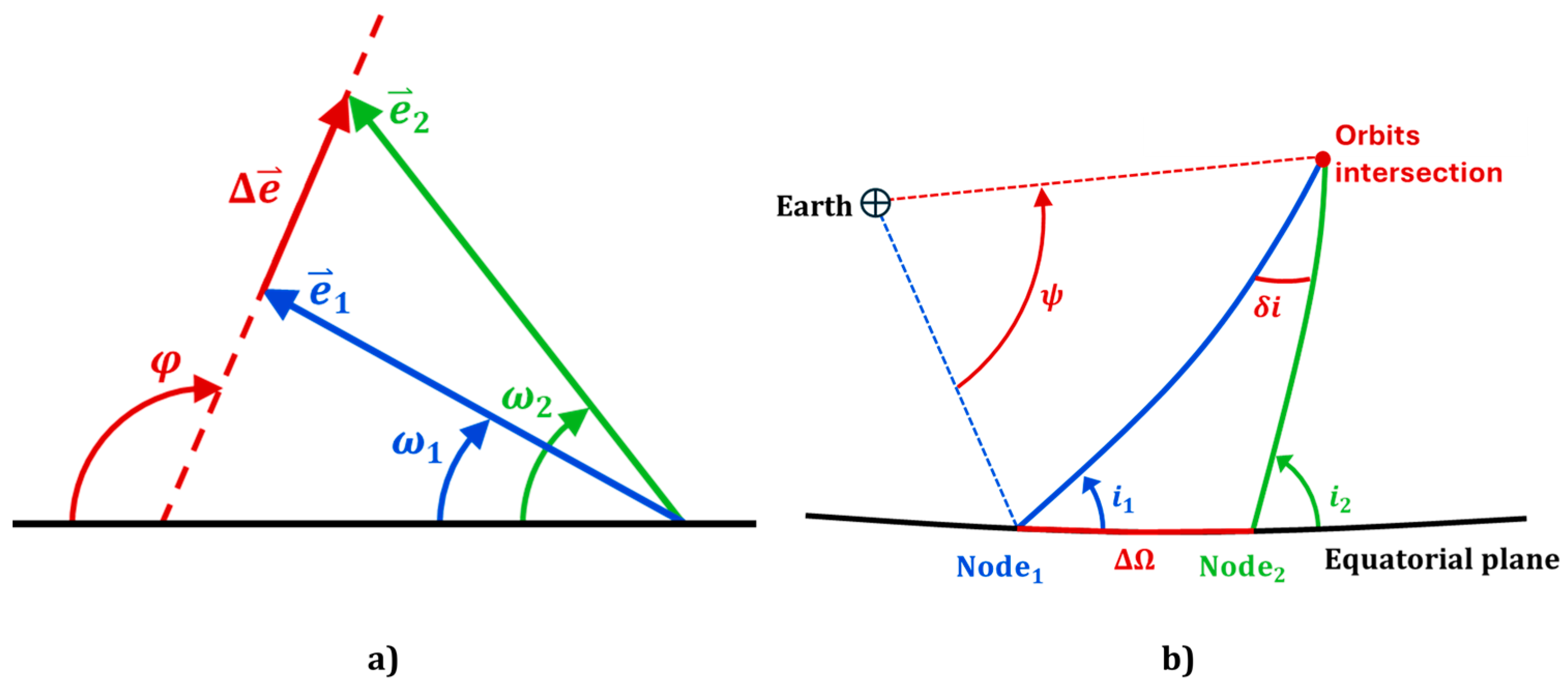
Figure 1. Representation of the relative vectors. (a) Relative eccentricity vector Δ e (red) defined as the vector difference between the deputy and chief eccentricity vectors, e 2 (green) and e 1 (blue) respectively. The angle φ denotes the orientation of the relative eccentricity vector in the orbital plane. (b) Relative inclination vector Δ i derived from the spherical triangle formed by the chief and deputy’s orbit nodes, Node1 and Node2, and the intersection of their orbital planes. The angle ψ denotes the argument of latitude of the orbit’s intersection with respect to the chief’s node. Adapted from [9].
Remotesensing 18 00877 g001
Figure 2. HoA as a function of the perpendicular baseline b for different incidence angles.
Remotesensing 18 00877 g002
Figure 3. Physical separation components between the two companions during an orbital period and for a single value of the incidence angle. φ = ψ = 90 ° case. Time 0 corresponds to the satellite pass over the South Pole.
Remotesensing 18 00877 g003
Figure 4. (a) Temporal lag [ms], (b) perpendicular baseline [m], and (c) HoA [m] as functions of orbit time and radar incident angle, for the configuration a Δ e = 200 m and a Δ Ω = 900 m . White dash-dot lines denote the latitudes of the points observed in the Sentinel-1D swath.
Remotesensing 18 00877 g004
Figure 5. Evolution of the angle between Δ e and Δ i for the configuration with φ = ψ = 90 ° , a Δ e = 200 m and a Δ Ω = 900 m . The perpendicular condition is reached at day 28.40.
Remotesensing 18 00877 g005
Figure 6. Physical separation components between the two companions over one orbital period, shown for the four optimal configurations obtained for the φ = ψ = 10 case (single incidence-angle slice).
Remotesensing 18 00877 g006
Figure 7. Temporal lag of four optimal configurations in the case where φ = ψ = 10 ° . White dash-dot lines denote the latitudes of the points observed in the Sentinel-1D swath.
Remotesensing 18 00877 g007
Figure 8. Perpendicular baseline of four optimal configurations in the case where φ = ψ = 10 ° . White dash-dot lines denote the latitudes of the points observed in the Sentinel-1D swath.
Remotesensing 18 00877 g008
Figure 9. HoA of four optimal configurations in the case where φ = ψ = 10 ° . White dash-dot lines denote the latitudes of the points observed in the Sentinel-1D swath.
Remotesensing 18 00877 g009
Figure 10. Evolution of the angle between Δ e and Δ i for the configuration with φ = ψ = 10 ° , a Δ e = 215 m and a Δ Ω = 161 m . The perpendicular condition is reached at day 12.81.
Remotesensing 18 00877 g010
Figure 11. Physical separation components between the two companions over one orbital period, shown for the four optimal configurations obtained for the φ = ψ = 90 case (single incidence-angle slice).
Remotesensing 18 00877 g011
Figure 12. Temporal lag of four optimal configurations in the case where φ = ψ = 90 ° . White dash-dot lines denote the latitudes of the points observed in the Sentinel-1D swath.
Remotesensing 18 00877 g012
Figure 13. Perpendicular Baseline of four optimal configurations in the case where φ = ψ = 90 ° . White dash-dot lines denote the latitudes of the points observed in the Sentinel-1D swath.
Remotesensing 18 00877 g013
Figure 14. HoA of four optimal configurations in the case where φ = ψ = 90 ° . White dash-dot lines denote the latitudes of the points observed in the Sentinel-1D swath.
Remotesensing 18 00877 g014
Figure 15. Evolution of the angle between Δ e and Δ i for the configuration with φ = ψ = 90 ° , a Δ e = 346 m and a Δ Ω = 152 m . The perpendicular condition is reached at day 28.51.
Remotesensing 18 00877 g015
Table 1. Overview of the adopted two-stage framework.
StageConfigurationOptimization Focus
Stage 1 φ = ψ = 90 ° Equatorial and Mid-Latitude regions
Stage 2—Strategy A φ = ψ = 10 ° Polar and High-Latitude regions
Stage 2—Strategy B φ = ψ = 90 ° Polar and High-Latitude regions
Table 2. Orbital parameters of the reference orbit shared by Sentinel-1D (transmitter) and Harmony-A (chief).
ParameterSetting
Altitude693 km
Inclination98.146°
Eccentricity0.001132
Orbit typeSSO (Dawn-Dusk)
Number of orbits per cycle175
Cycle Length12
Table 3. Summary of the GMAT simulation settings for propagating the configuration with φ = ψ = 90 ° , a Δ e = 200 m and a Δ Ω = 900 m .
ParameterSetting
Epoch31 Dec 2022 22:32:16 (UTC Gregorian)
PropagatorRungeKutta89
Gravity ModelEGM-96
Degree of Harmonics70
Order of Harmonics70
Atmosphere ModelJacchia/Roberts
Solar Radiation PressureDisabled
Third Body PerturbationLuna and Sun
Integration modeSynchronized (the two companions are propagated jointly)
Table 4. Preliminary Δ V estimation for relative formation maintenance in three Harmony configurations.
ConfigurationParameters In - Plane Δ V  1 Out - of - Plane Δ V  1 Total Δ V Frequency of Maneuver
φ = ψ = 90 °
(mid-latitude)
a e = 200 m ,
a Ω = 900 m
2.98 cm/s0.398 cm/s0.440 m/s per year28 days
φ = ψ = 10 °
(high latitude)
a e = 215 m ,
a Ω = 161 m
6.60 cm/s141 cm/s44.9 m/s per year12 days
φ = ψ = 90 °
(high latitude)
a e = 346 m ,
a Ω = 152 m
1.93 cm/s0.096 cm/s0.264 m/s per year28 days
1 In-Plane Δ V and Out-of-Plane Δ V refer to the maneuvers performed at the frequency indicated in the last column.
Disclaimer/Publisher’s Note: The statements, opinions and data contained in all publications are solely those of the individual author(s) and contributor(s) and not of MDPI and/or the editor(s). MDPI and/or the editor(s) disclaim responsibility for any injury to people or property resulting from any ideas, methods, instructions or products referred to in the content.