Article

Assessing Drought-Induced Tree Mortality in Open Mediterranean Forests Integrating Landsat Time Series, Spectral Unmixing, and UAS Validation

1
Department of Natural Resources, Faculty of Geo-Information Science and Earth Observation (ITC), University of Twente, 7500 AE Enschede, The Netherlands
2
International Methane Emission Observatory (IMEO), United Nations Environment Programme, 75015 Paris, France
3
Natural History Museum of Crete, School of Sciences and Engineering, University of Crete, 71409 Heraklion, Greece
*
Author to whom correspondence should be addressed.
Remote Sens. 2026, 18(5), 792; https://doi.org/10.3390/rs18050792
Submission received: 26 November 2025 / Revised: 17 February 2026 / Accepted: 27 February 2026 / Published: 5 March 2026

Highlights

What are the main findings?
  • Spectral Unmixing in LandTrendr effectively detects drought-induced tree loss.
  • Spectral Unmixing has the potential to improve three mortality detection at subpixel level.
What is the implication of the main finding?
  • UAS and satellite data integration enables early detection of tree mortality.
  • UAS imagery provides a robust reference for tree mortality assessments.

Abstract

Drought-induced tree mortality is a growing threat to Mediterranean ecosystems, which host high biodiversity but face increasing water stress under climate change. Detecting mortality over large areas with satellite data remains challenging due to open canopies and mixed pixels that obscure vegetation signals. This study evaluates the performance of two widely used vegetation indices—the Normalized Difference Vegetation Index (NDVI) and Normalized Difference Water Index (NDWI)—alongside a novel application of Spectral Unmixing derived vegetation cover Spectral Unmixing (SU) within the LandTrendr algorithm to track tree mortality in southwest Crete, Greece. High-resolution Unmanned Aerial System (UAS) imagery was used to validate satellite observations, demonstrating strong agreement with field data ( R 2 = 0.95) and confirming its suitability as reference data. LandTrendr applied to NDVI, NDWI, and SU detected major mortality events between 1995 and 2008, with SU identifying the largest affected area. While NDVI and NDWI achieved higher accuracy in distinguishing unaffected plots, SU performed best at detecting mortality. Regression analysis revealed a limited ability of all approaches to quantify mortality magnitude, though SU improved when high-mortality plots were excluded. Overall, NDVI effectively tracked canopy changes, NDWI provided early warnings of drought stress, and SU reduced soil interference to better capture mortality patterns. By integrating satellite time series with UAS validation, this study demonstrates a scalable approach for detecting forest decline and offers actionable insights to guide Mediterranean forest management under increasing drought pressure.

1. Introduction

Drought, defined as an abnormal shortage of water, significantly reduces environmental, social, and economic benefits [1,2]. As climate change intensifies, droughts are expected to become more frequent and severe, increasing risks such as wildfires, habitat loss, and biodiversity decline [3]. Forests, essential for biodiversity conservation and climate regulation, are particularly vulnerable. Drought can cause physiological stress (e.g., reduced water content) and heighten susceptibility to pests [4].
Mediterranean ecosystems, covering only 5% of the Earth’s surface yet hosting 20% of its plant species, are especially sensitive due to their unique biodiversity and high rates of endemism [5,6]. Although adapted to extended dry seasons, these ecosystems are now facing droughts that exceed their resilience, increasing the risk of desertification in areas with declining rainfall and rising temperatures [7]. Drought-induced tree mortality, widespread in Mediterranean and semi-arid regions, is a key indicator of drought impact. It alters the carbon cycle by reducing carbon sequestration and increasing emissions from decaying biomass [8,9]. Mortality in Mediterranean forests often results from hydraulic failure, sometimes worsened by pest outbreaks, which further degrades ecosystem services, increases wildfire risk, and accelerates climate change through increased respiration and reduced carbon uptake [10,11]. Protecting mature forests and studying Mediterranean ecosystems is therefore critical for sustaining biodiversity and essential ecosystem functions [12].
Given their ecological importance, detecting and mapping drought-induced tree mortality in Mediterranean forests is vital. Remote sensing (RS) enables large-scale, cost-effective monitoring over inaccessible areas and long time periods. Among RS methods, Vegetation indices (VIs) from satellite multispectral data are widely used to assess forest health. The NDVI is one of the most established indices for detecting vegetation changes, including mortality [13,14]. For example, [15] achieved 97.9% accuracy in detecting mortality in a mixed-species U.S. forest, and [16] found NDVI to outperform other indices such as Enhanced Vegetation Index (EVI) and Normalized Difference Infrared Index (NDII) in an Australian plantation. The NDWI, which is sensitive to vegetation moisture, is particularly effective at detecting drought stress [17,18]. Studies have shown strong negative correlations between NDWI and tree mortality, as in Amazon forests post-drought [19], and its usefulness for monitoring drought resistance and recovery in Central European forests [20].
However, low- to mid-resolution Remote Sensing (RS) analyses of Mediterranean forests face the “mixed pixel” challenge, where soil and understory vegetation influence reflectance in open canopies. SU can address this by decomposing pixel reflectance into fractional abundances of land cover types, improving vegetation signal accuracy [21]. SU has been used to assess mortality and disease in various forest types, for instance. In [22], the authors detected oak mortality from disease in the western U.S., [23] mapped post-drought changes in pinyon-juniper woodlands, and [24] identified eucalyptus defoliation in Australia.
In addition, LandTrendr provides a robust approach to tracking vegetation change over time by segmenting RS time series into discrete periods of disturbance and recovery [25,26]. While NDVI has proven effective for mortality detection, its performance in open-canopy Mediterranean forests, where soil interference is high, remains underexplored [27]. Similarly, although NDWI has been used for drought monitoring, its ability to detect tree mortality in Mediterranean ecosystems has not been fully assessed. Furthermore, the potential of applying SU within LandTrendr for mortality detection in these ecosystems is yet to be investigated.
This study compares NDVI, NDWI, and SU to detect drought-induced tree mortality in Mediterranean forests. Specifically, it evaluates: (i) the effectiveness of these vegetation metrics in tracking mortality over time; (ii) the extent to which SU-derived vegetation fractions reduce soil background effects and improve detection accuracy in open Mediterranean forests; and (iii) the use of high- and ultra-high-resolution multispectral and RGB imagery as reference data for validating mortality detection. The findings aim to guide more accurate monitoring and inform strategies to mitigate drought impacts in Mediterranean forests.

2. Materials and Methods

2.1. Study Area and Period

The study area lies on the southern slopes of Lefka Ori (Samaria) National Park in southwest Crete, Greece. This mountainous region is both a UNESCO Man and the Biosphere (MAB) Reserve and a Natura 2000 site, recognized for its exceptional biodiversity, unique landforms, and natural ecosystems. Lower elevations host Mediterranean semi-arid forests dominated by Pinus brutia. In recent decades, these forests have suffered increased tree mortality, often occurring years after extreme droughts. This delayed die-off raises concerns about large-scale forest loss, shrubland expansion, and eventual desertification, threatening the park’s ecological integrity.
The terrestrial part of the Natura 2000 site (code 4340008), which includes the Lefka Ori massif and aligns with the Protected Area (PA) management boundaries, covers approximately 49,664 ha [28]. Its southern slopes drop steeply to the Libyan Sea, forming rugged landscapes, while the northern foothills are gentler [29]. The climate is warm and semi-arid, with 450–600 mm of annual rainfall at lower elevations and over 2000 mm at higher altitudes, much of it as snow; most precipitation falls from November to April [30,31]. Lefka Ori hosts the highest local and regional endemism of any Greek mountain range [32]. Calcareous forests here are dominated by Pinus brutia, Cupressus sempervirens, and Quercus coccifera, with tree growth reaching 1600–1650 m a.s.l. on the southern slopes [33]. Sheep and goat grazing remains the main human pressure.
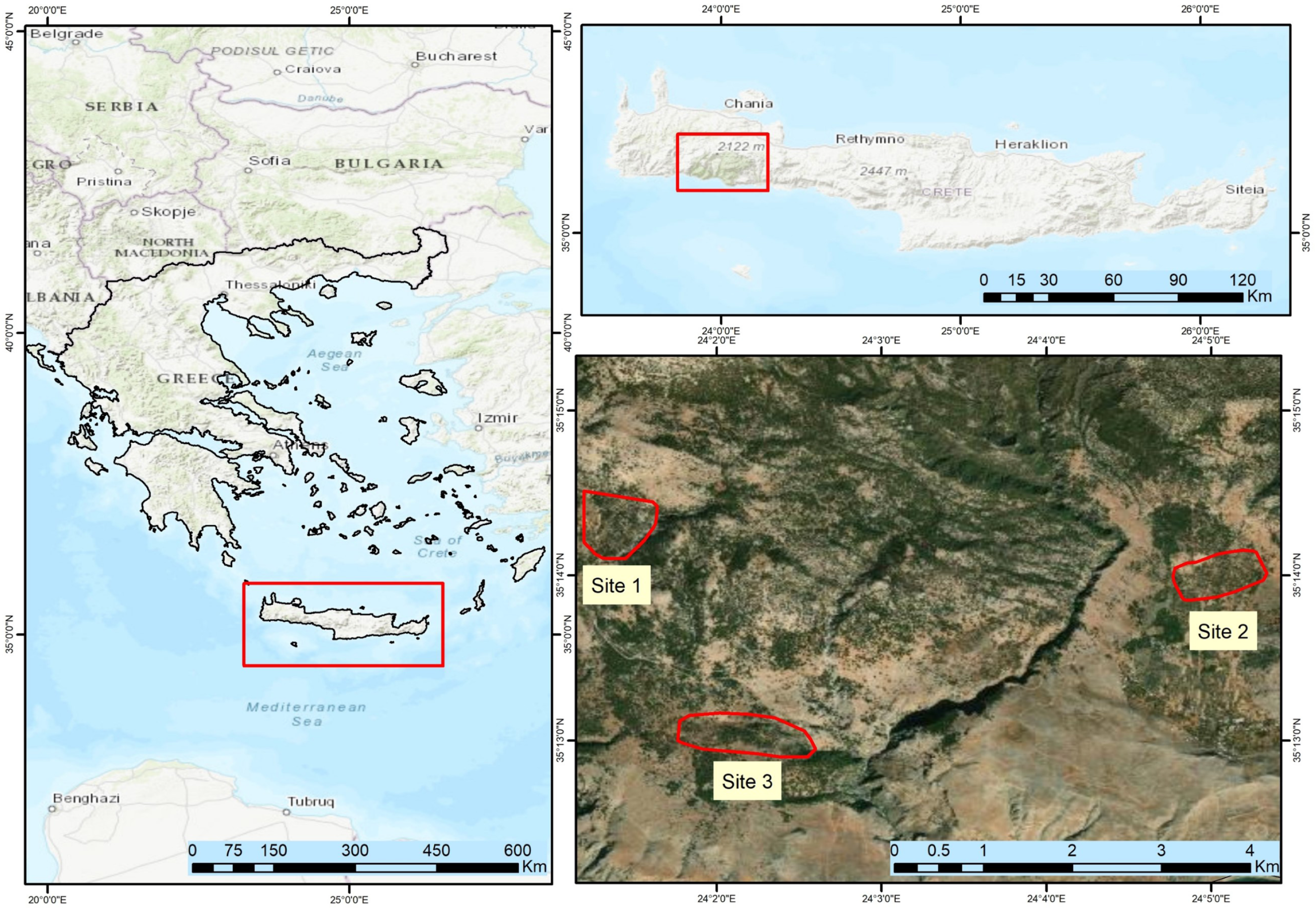
Three study sites (Figure 1) were selected, differing in elevation, terrain, and vegetation:(1) Site 1 (39.6 ha): 750–1000 m a.s.l., steep slopes, diverse stands of cypress, pine, and scattered oaks, (2) Site 2 (33.4 ha): 650–700 m a.s.l., mid-valley location, gentler slopes, pine-dominated, and Site 3 (46.7 ha): 460–650 m a.s.l., north-facing, pine-dominated.

2.2. Datasets

This study used multispectral satellite imagery from the Landsat program, selected for its long-term availability, 30 m spatial resolution, and 16-day revisit time—well-suited for calculating NDVI, NDWI, and SU derived vegetation cover to assess vegetation greenness and water content in the last 30 years. Landsat has provided consistent Earth observation data since 1972 [34], and all imagery was accessed via the Google Earth Engine (GEE) platform. Landsat-7 ETM+ imagery acquired after 2003 contains data gaps due to the Scan Line Corrector (SLC) failure. All SLC-off pixels were masked and excluded from the annual medoid compositing. As each annual composite was built from multiple Landsat-5, Landsat-7, and Landsat-8 acquisitions, missing data in individual Landsat-7 scenes were filled by valid observations from overlapping scenes and other sensors, preventing SLC-off gaps from affecting the time series.
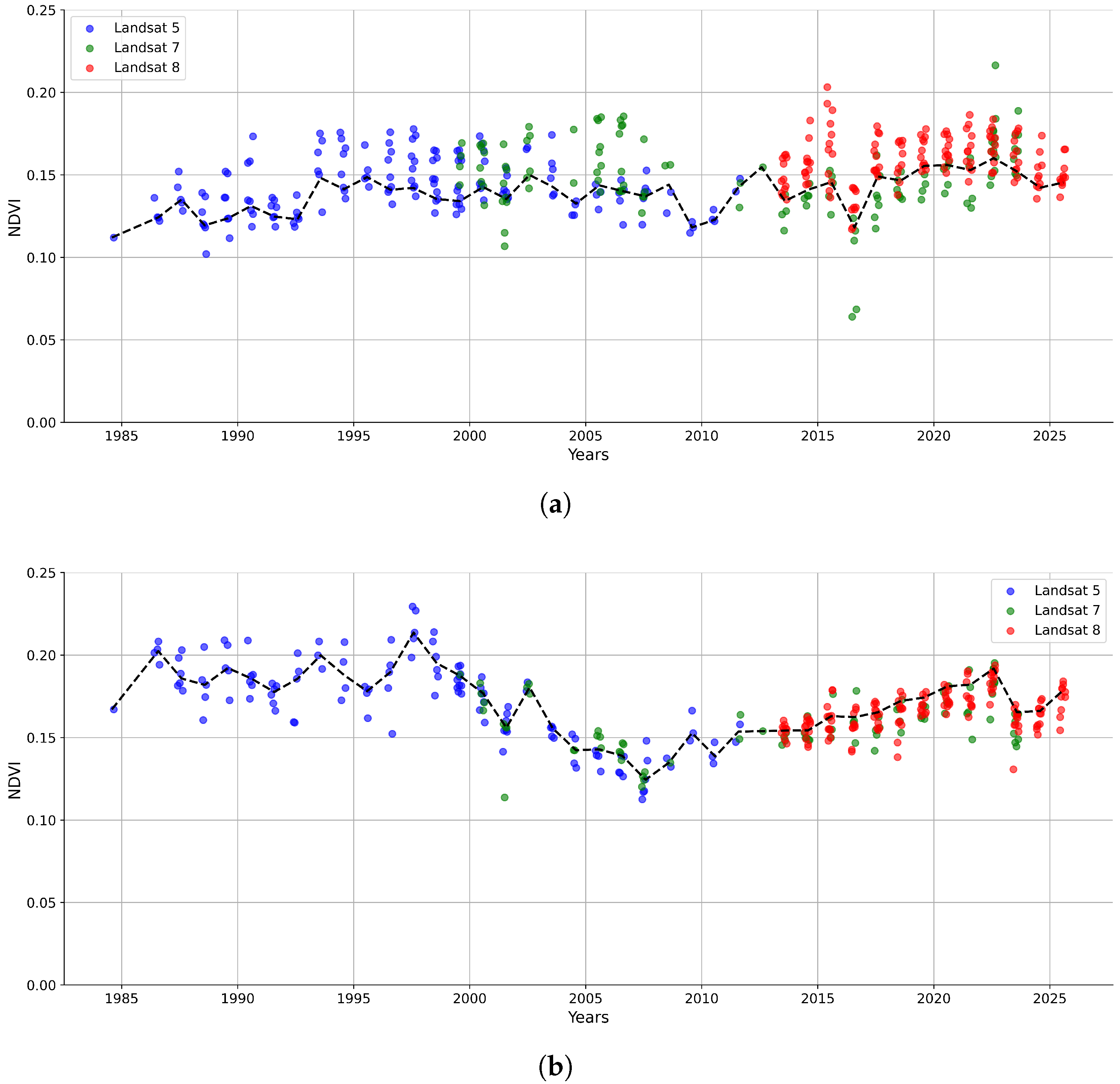
Field surveys revealed widespread tree mortality across the study area. Time-series analysis indicated that the most severe die-off likely began in the late 1990s and continued through the late 2000s. A broad temporal range of satellite data was selected to capture both interannual variability and major drought events evident in climatic records. Given the observed lag between drought occurrence and mortality, imagery from three Landsat missions—Landsat 5 TM, Landsat 7 ETM+, and Landsat 8 OLI—was used to cover the 1995–2022 study period. Figure 2 shows an example of an area with (a) low mortality, and (b) high mortality.
UAS data were acquired on 31 August , 2 and 3 September from Site 2, Site 3, and Site 1, respectively, using a DJI Mavic 3M drone (SZ DJI Technology Co., Ltd., Shenzhen, China) equipped with a 20 MP high-resolution RGB camera and Real-Time Kinematic Global Navigation Satellite System (RTK GNSS), enabling georeferenced imagery with sub-decimeter accuracy (≺3 cm in all directions). Flights were conducted at a constant altitude of 100 m above ground level, with the terrain-follow function compensating for the area’s rugged topography. Data collection followed a single-grid flight pattern at 6.7 m/s, with 85% forward and 75% side overlap. For sites 1, 2, and 3, a total of 1192, 952, and 1010 images were captured, respectively, producing orthomosaics with spatial resolutions between 3.13 and 3.26 cm.
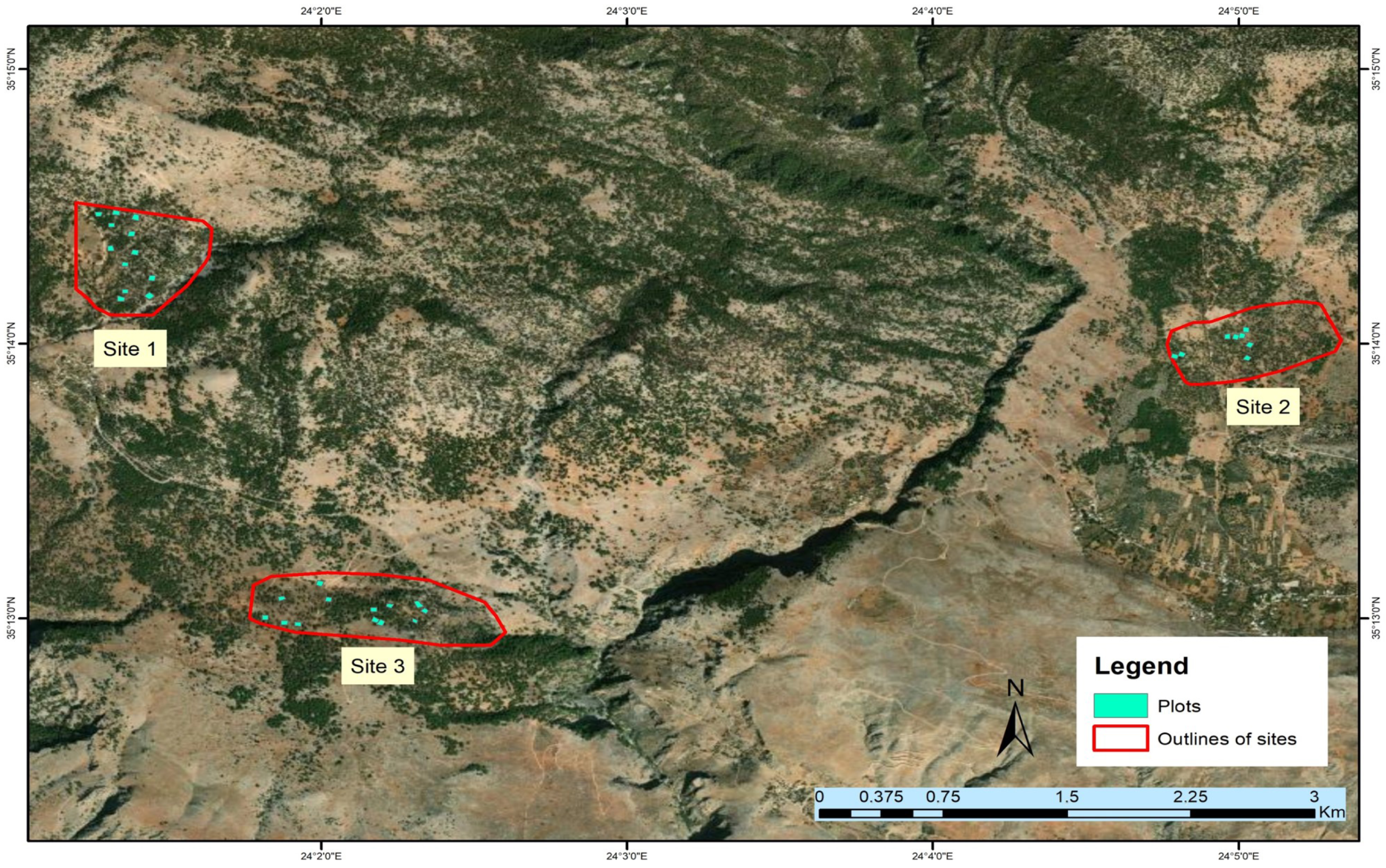
Fieldwork was carried out from 31 August to 7 September 2023. Thirty-three square plots, each measuring 30 m on a side, were surveyed across the three sites (Figure 3). The recorded attributes included the location of the plot (RTK GNSS), the species of trees, the Diameter at the Breast Height (DBH) and the state of defoliation/discoloration, following the FAO visual assessment guidelines [35]. Site 1 comprised 12 plots (IDs 22–33), Site 2 had nine plots (IDs 1–8), and Site 3 had 13 plots (IDs 9–21), with more plots allocated to Sites 1 and 3 due to greater topographic heterogeneity.
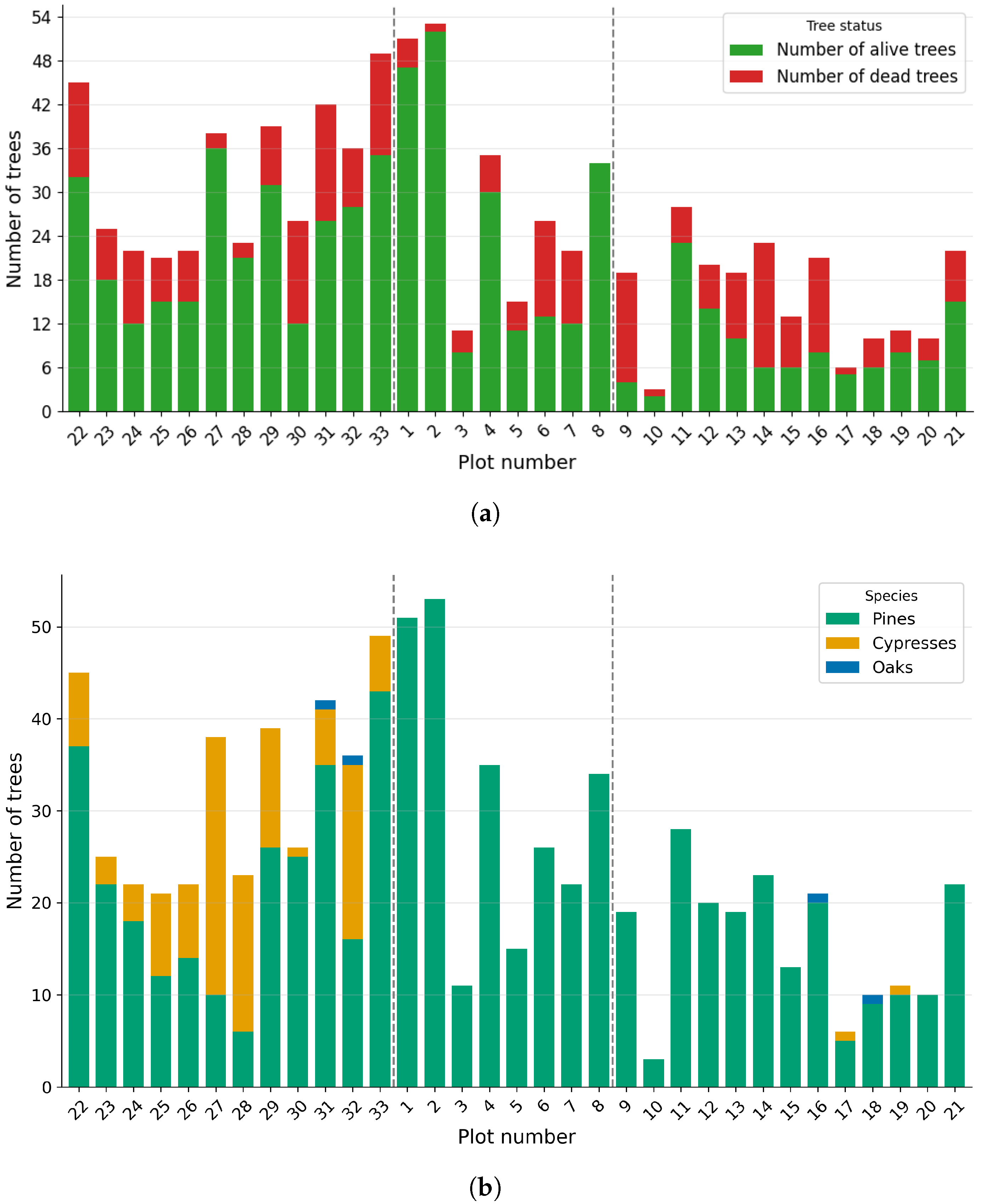
Tree density varied across sites. Site 2 exhibited the widest range (11–53 trees per plot), while Site 3 ranged from 3 to 28 trees per plot (Figure 4a). Mortality rates were highest in Site 3 (30–79%), with pines dominating Site 2 and cypresses more present in Site 1 (Figure 4b). A few oak specimens were also recorded. Field observations indicated that much of the mortality occurred years ago, with dead trees still standing and minimal regeneration. Expert input from forest managers helped validate the timing and distribution of mortality events.

2.3. Methods

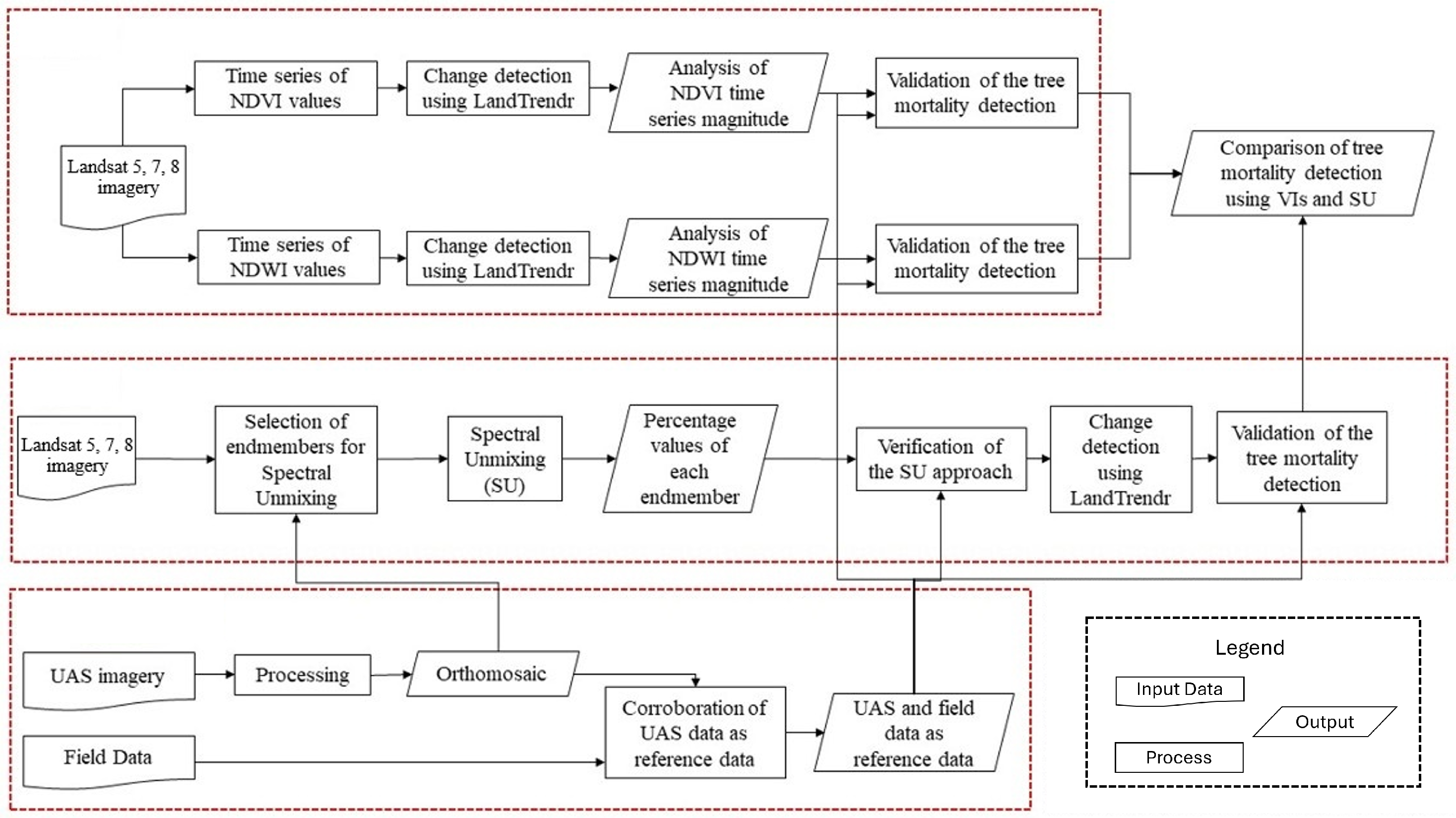
This section presents the methodology, organised into three phases: (1) estimating tree mortality using NDVI and NDWI, (2) estimating tree mortality through SU, and (3) evaluating the suitability of UAS data as reference data (Figure 5).

2.3.1. Ortho-Rectification and Mosaicking of UAS Imagery

UAS drones capture a sequence of surface images along a predefined flight path. Flying at low altitudes, they cover a limited area per shot, resulting in multiple overlapping images instead of one wide view. These images are stitched into a complete mosaic using geolocation data and front/side overlaps. Because sensor movement and atmospheric effects can cause distortions, geometric ortho-rectification was applied before mosaicking [36]. Processing was carried out in Pix4Dmapper (Pix4D SA, version 4.9.0), which automatically performed ortho-rectification and mosaicking to generate the final orthomosaic of the study area.

2.3.2. NDVI and NDWI Time Series Generation

Time series of NDVI and NDWI were generated from Landsat 5, 7, and 8 imagery using GEE.
NDVI was calculated using Equation (1) from Rouse [37]:
N D V I = ρ N I R ρ r e d ρ N I R + ρ r e d
where NIR corresponds to band 4 for Landsat 5/7 and band 5 for Landsat 8. And Red corresponds to band 3 for Landsat 5/7 and band 4 for Landsat 8.
NDVI values range from –1 to 1. Negative values typically indicate water, 0–0.25 represent mainly bare soil, 0.25–0.4 indicate sparse vegetation, and values above 0.4 generally represent healthy vegetation, with values near 1 showing dense, vigorous growth [38].
NDWI was calculated using Equation (2) from Gao [17]:
N D W I = ρ NIR ρ SWIR ρ NIR + ρ SWIR
where ρ NIR is NIR reflectance at 842 nm, and ρ SWIR is SWIR reflectance at 1610 nm.
NDWI values also range from –1 to 1. In the NIR–SWIR formulation of Gao [17], NDWI is sensitive to the liquid water content of vegetation canopies: green, water-rich vegetation typically exhibits positive NDWI values, whereas dry vegetation and bare soils have near-zero or negative values. Consequently, higher NDWI values correspond to higher vegetation water content, and decreases in NDWI indicate reductions in canopy water content (i.e., increasing water stress), even where greenness indices such as NDVI show little variation [17]. The resulting time series spans 1995–2022, with 378 total observations.

2.3.3. Spectral Unmixing Approach

SU was applied to decompose Landsat surface reflectance into sub-pixel fractions of three ecologically meaningful components: acPV, Non-Photosynthetically active Vegetation (NPV), and bare soil. This three-endmember linear mixture model is widely applied in forest disturbance and vegetation change studies to separate live canopy, senescent or woody vegetation, and exposed substrate [39].
Endmembers were selected once using a field-anchored, image-based approach. Ultra-high-resolution UAS imagery acquired during field campaigns was used to identify spectrally homogeneous reference areas dominated by (i) live green vegetation, (ii) dead or senescent vegetation and woody material (NPV), and (iii) bare soil. These areas were transferred to the Landsat imagery to extract representative spectral signatures for each endmember. Multiple pixels were sampled for each class and averaged to reduce noise and ensure spectral stability. The same fixed endmembers were applied across all years, ensuring that temporal changes in fractional abundances reflect real biophysical change rather than shifting reference spectra.
To enable consistent SU across Landsat 5 TM, Landsat 7 ETM+, and Landsat 8 OLI, all surface reflectance data were harmonized using spectral response normalization following [40], as implemented in the GEE Landsat collections.
SU was applied to annual medoid composites generated from multiple summer-season observations. Medoid compositing suppresses illumination and shadow effects by selecting the most representative reflectance value from all valid acquisitions, minimizing the influence of canopy shadows, terrain shadows, and transient illumination effects. Under these conditions, a three-endmember model (PV–NPV–Soil) is sufficient to characterize sub-pixel surface composition without explicitly modeling shade.
Fractional abundances were estimated using a linear spectral mixture model in which the reflectance of each pixel is expressed as a linear combination of the three endmembers subject to a sum-to-one constraint [39]. The resulting PV, NPV, and soil fraction images were generated for each annual composite and subsequently used as inputs to the LandTrendr time-series analysis to track vegetation decline and substrate exposure over time.

2.3.4. Change Detection Using the LandTrendr Algorithm

LandTrendr, a pixel-based change detection algorithm, was applied to Landsat time series to detect both sudden and gradual changes in vegetation over time. This algorithm was selected because it is specifically designed for long-term Landsat time-series analysis and is widely used in forest disturbance studies [26,41]. It allows the detection of both abrupt and gradual changes at the pixel level, which is crucial for capturing tree mortality events and subsequent recovery phases. It tracks when changes occur, where they happen, and their magnitude by breaking each pixel’s spectral history into straight-line segments connected by vertices—points marking change or stability.
LandTrendr is implemented in GEE, enabling efficient, cloud-based forest disturbance monitoring. The workflow included, (1) pre-processing where cloud, shadow, snow, and water pixels were masked following [42], and annual medoid composites were generated to produce one representative value per pixel per year, (2) sensor harmonization, where data from Landsat 5, 7, and 8 were djusted using methods from [43] to ensure consistency, and (3) seasonal filtering, where images from June 1–August 31 were used to reflect dry-season conditions with minimal variability. A novel adaptation of the LandTrendr script was carried out to allow its use on SU outputs to detect changes in vegetation percentage per pixel.
The LandTrendr algorithm parameters were iteratively fine-tuned to achieve optimal segmentation taking into account the forest canopy dynamics of the study area. The maxSegments parameter was set to 6 to capture multiple change and recovery events, while the spikeThreshold of 0.9 enabled detection of rapid spikes while filtering noise. A vertexCountOvershoot value of 3 allowed additional vertices for improved accuracy, and preventOneYearRecovery was set to true to avoid false one-year recoveries. The recoveryThreshold of 0.25 filtered out minor recoveries, and a pvalThreshold of 0.05 ensured only statistically significant changes were considered. The bestModelProportion was set to 0.75 to prioritize the most representative model, and minObservationsNeeded was fixed at 6 to ensure sufficient data for reliable analysis.

2.3.5. Validation

Field observations, including counts of live and dead trees across all 33 plots, were compared with tree counts derived from visual interpretation of UAS imagery. The number of plots per site was proportional to the site’s area. Plot locations were generated using the ’Random Points in Polygon’ tool in QGIS. When a plot fell within an inaccessible area or one devoid of trees, it was replaced by a newly generated point.
A regression analysis was carried out to assess the agreement between the two methods and to confirm the suitability of UAS data as ground truth. This validation dataset was then expanded to 63 plots, comprising the original 33 field plots and 30 randomly selected UAS plots. These plots were also used to validate and verify SU results at the subpixel level.
Tree mortality detection using NDVI, NDWI, and SU was evaluated with a confusion matrix comparing LandTrendr outputs to the 63 reference plots. In addition, regression analyses were performed between the magnitude of decreases in VIs or vegetation fraction from SU and the percentage of tree mortality from the reference plots, assessing LandTrendr’s ability to quantify mortality magnitude.

3. Results

3.1. Reference Data Derived from UAS Imagery

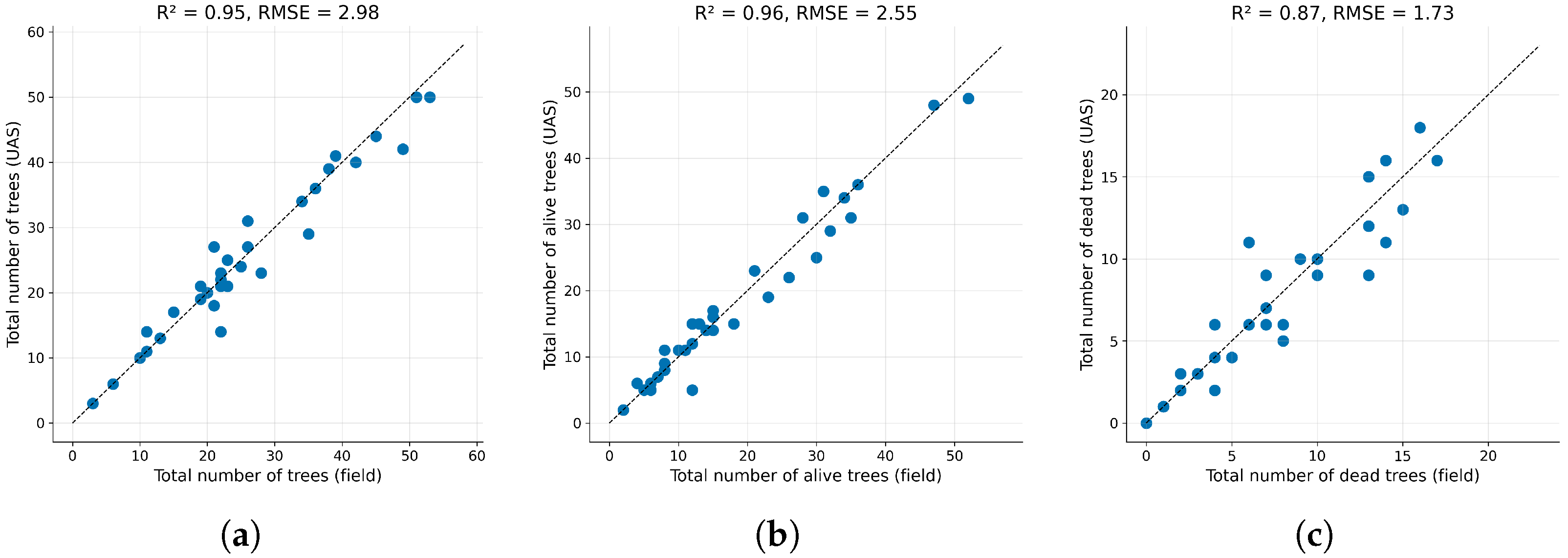
A regression model was developed to assess the suitability of UAS data as ground truth and to expand the number of observations by comparing it with field measurements. The results revealed a strong agreement between the two datasets, with an R 2 value of 0.95 and a low Root Mean Squared Error (RMSE) of 2.98, indicating high consistency in tree counts per plot (Figure 6). In over 80% of cases (i.e., 27 out of 33 plots), the total number of trees recorded in the field differed from the UAS estimates by only 1 to 3 trees. In 12% of plots (i.e., 4 out of 33), the difference ranged from 4 to 6 trees, while in just 6% (i.e., 2 out of 33), the discrepancy reached 7 to 8 trees. Given this high level of precision, an additional 30 randomly selected plots from UAS imagery were included alongside the 33 field plots, resulting in a validation dataset comprising 63 observations.

3.2. Verification of the SU Approach

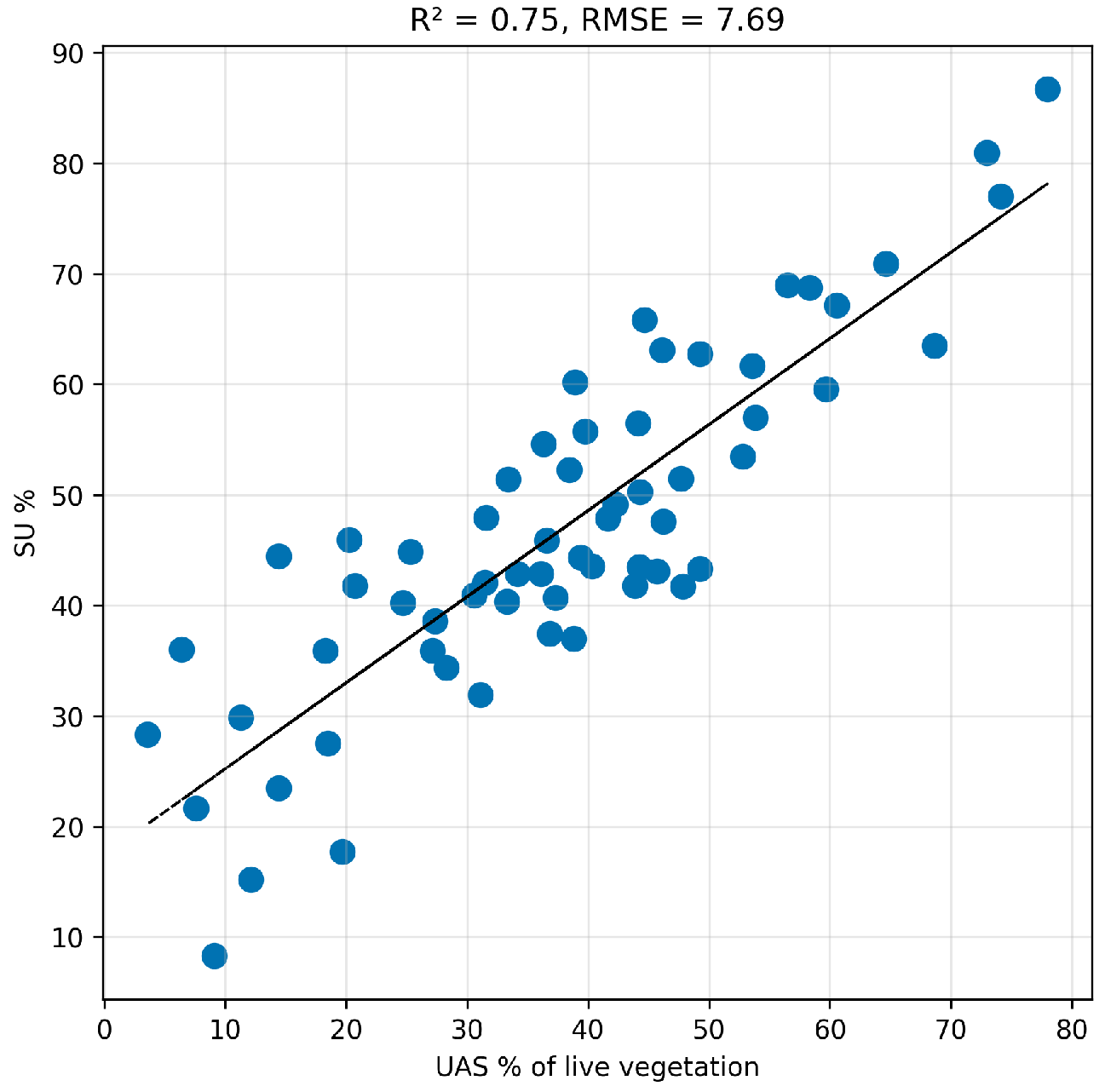
The SU algorithm was applied to the study area using two selected endmembers: bare soil and live vegetation. This produced two outputs, each representing the proportion of the respective endmember within each pixel. For validation, live vegetation output was compared with vegetation area per pixel derived from UAS imagery, using the combined dataset of 33 field plots and 30 randomly selected UAS plots. A regression analysis (Figure 7) showed that SU estimates explained 75% of the variation in UAS data, with an RMSE of 7.98, indicating a reasonably strong relationship.
However, SU values consistently overestimated vegetation cover compared to UAS estimates. This bias was more pronounced in sparsely vegetated areas, with the largest discrepancies observed around 20% vegetation per pixel. Consequently, the SU algorithm performs more reliably in densely vegetated areas but tends to overestimate coverage where vegetation is sparse.

3.3. Tree Mortality Detection Using VIs and SU Time Series and LandTrendr Algorithm

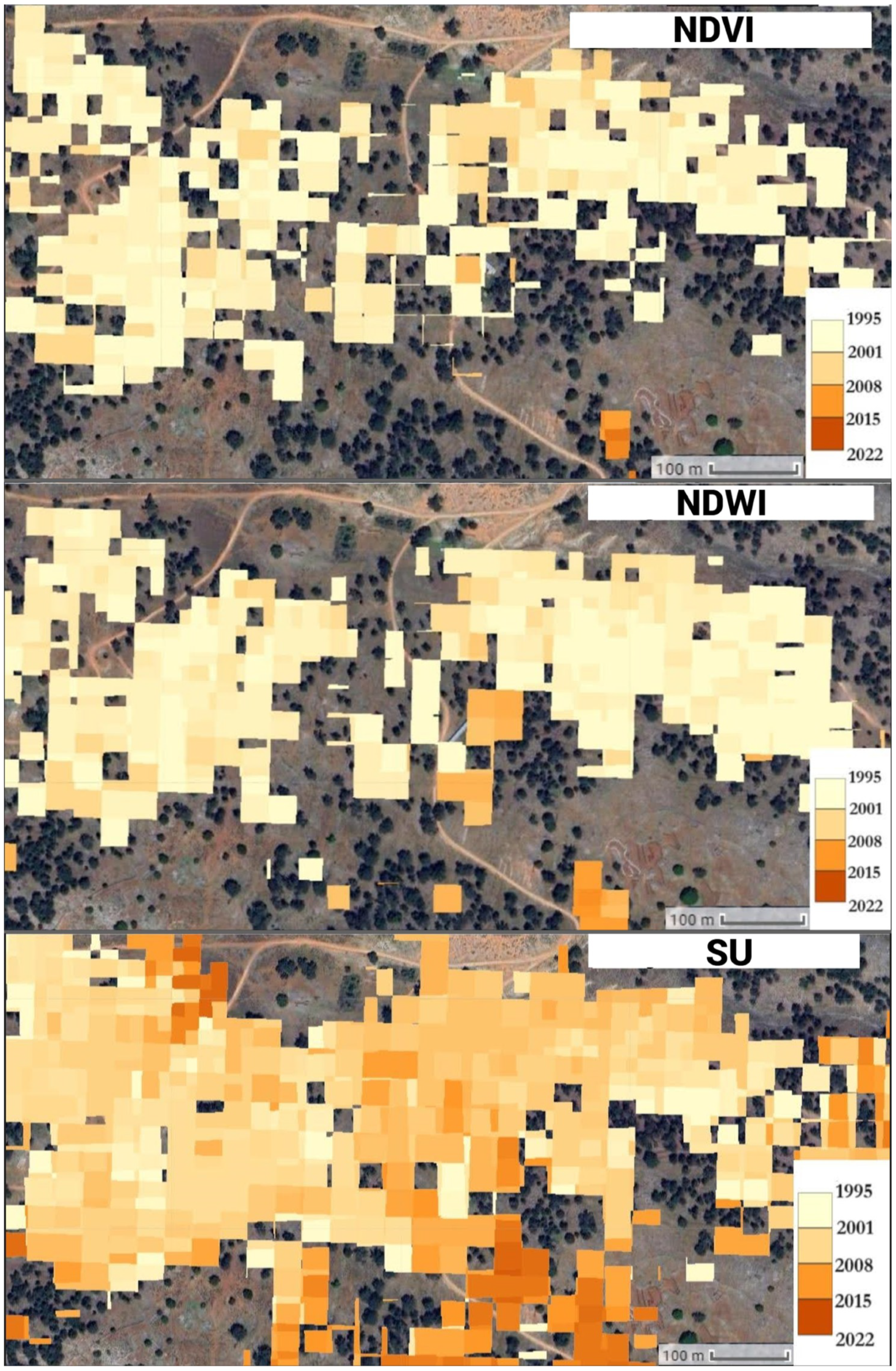
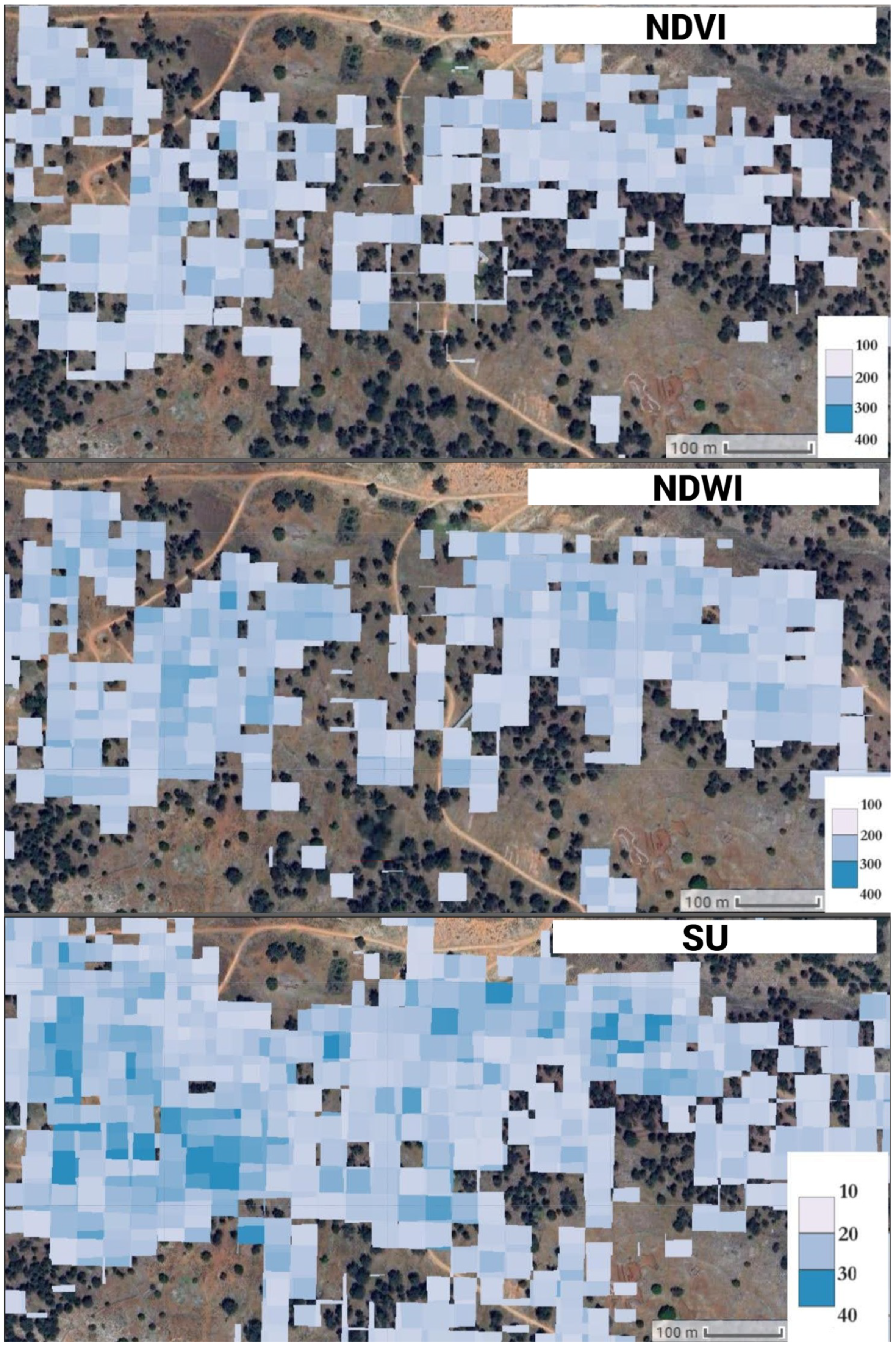
LandTrendr was applied to NDVI, NDWI, and the percentage of vegetation cover derived from SU to identify abrupt changes in the time series, under the hypothesis that such changes correspond to tree mortality events. Figure 8 illustrates the year in which abrupt changes were detected for NDVI multiplied by 1000, NDWI multiplied by 1000, and SU values, respectively. For VIs, most changes occurred early in the study period (1995–2008), with the most notable events between 1997–1999 and 2001–2005. Only a few patches, particularly in the southern part of site 3, exhibited changes in 2009 or 2022. When applied to SU, LandTrendr similarly identified the bulk of changes between 1995 and 2008, with more recent changes concentrated in the southern area. Although the spatial distribution of changes was fragmented, key periods included 2001–2003 and 2008.
The magnitude of change (Figure 9) shows that most pixels experienced decreases in NDVI and NDWI values of approximately 0.1–0.3 (100 to 300 points), with NDWI generally exhibiting larger magnitudes than NDVI. For SU, detected changes typically ranged from 10% to 20% vegetation cover loss. To focus on significant changes and exclude bare ground pixels, only pixels with a magnitude greater than 100 for VIs were analyzed, retaining those with pre-change values above 300 for NDVI (i.e., indicating vegetation presence) or above 0 for NDWI (i.e., indicating vegetation or higher moisture). For SU, only pixels with more than 10% change were considered for comparison with VIs.
Overall, NDWI, NDVI, and SU detected changes in 41%, 35%, and 47% of the study area, respectively (i.e., NDWI: 0.23 km 2 ; NDVI: 0.19 km 2 ; SU: 0.26 km 2 out of 0.55 km 2 ). Comparable patterns were observed in sites 1 and 2 (Figures S1–S4, Supplementary Materials).

3.4. Validation of Tree Mortality Detection Using VIs and SU

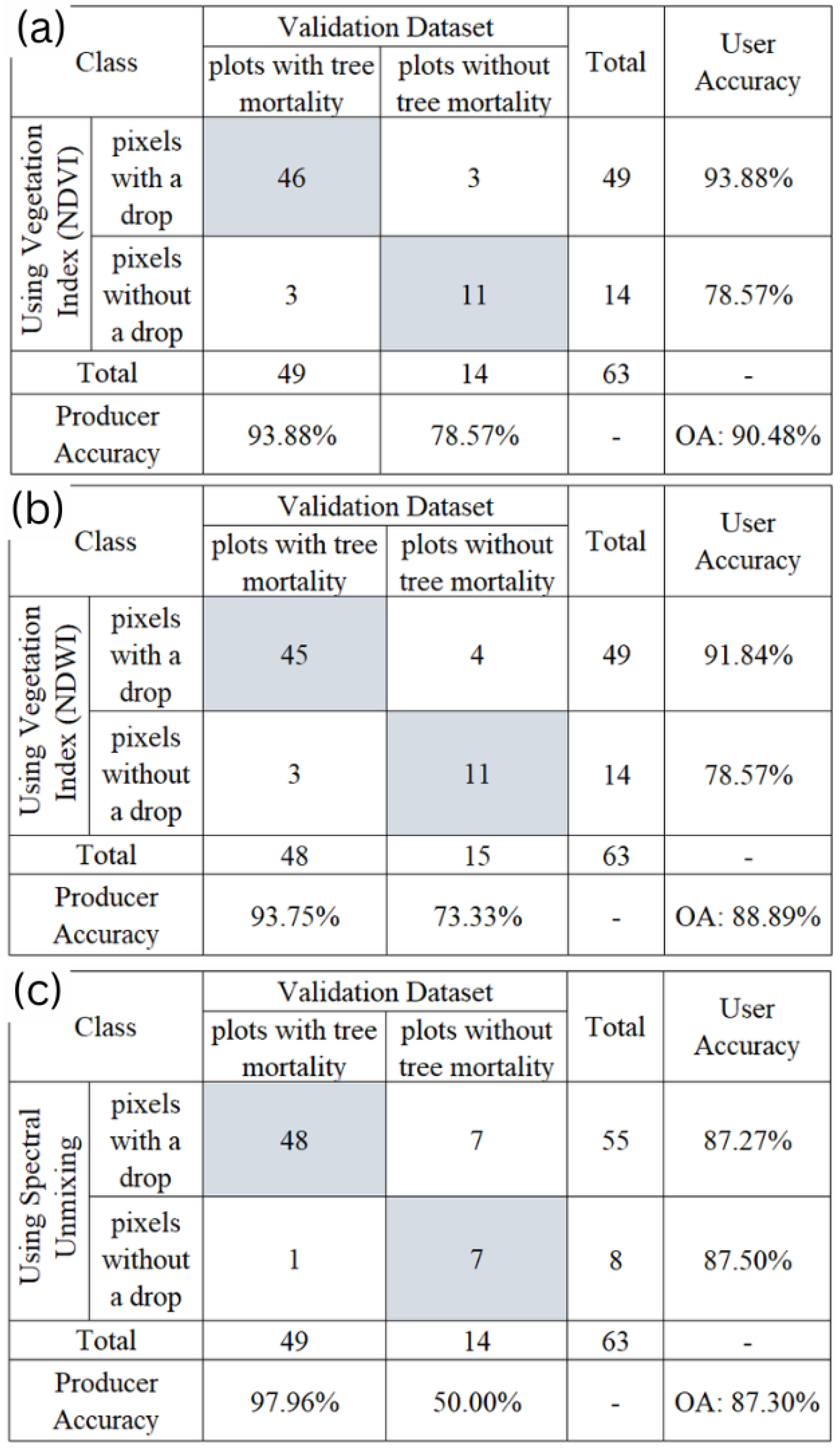
The accuracy of tree mortality detection using VIs and SU was evaluated through confusion matrices based on 63 validation plots, 49 with observed tree mortality and 14 without. Using NDVI, tree mortality was correctly detected in 46 of the 49 affected plots (Figure 10a). For unaffected plots, NDVI correctly indicated no decrease in 11 of 14 cases. This resulted in producer accuracies of 93.88% for mortality plots and 78.57% for non-mortality plots, with an overall accuracy of 90.48%.
NDWI identified tree mortality in 45 of the 49 affected plots (Figure 10b) and correctly detected no decline in 11 of the 14 unaffected plots. Producer accuracies for mortality and non-mortality plots were 93.75% and 73.33%, respectively, while user accuracies were 91.84% and 78.57%, leading to an overall accuracy of 88.89%. Although both indices performed equally well in detecting unaffected plots, NDVI showed slightly higher overall performance.
SU approach detected mortality in 48 of the 49 affected plots and correctly identified no decline in 7 of the 14 unaffected plots (Figure 10c). Producer accuracy was 97.96% for mortality plots and 50% for non-mortality plots. User accuracies were 87.27% for pixels with a decline and 87.50% for those without. The resulting overall accuracy of SU-based detection was 87.30%.

3.5. Relationship Between the VIs and SU’s Magnitude of Change and Tree Mortality

Regression analyses were conducted to examine the relationship between observed tree mortality and the magnitude of decline detected by LandTrendr, using both the percentage of tree mortality per plot and the number of dead trees per plot as response variables.
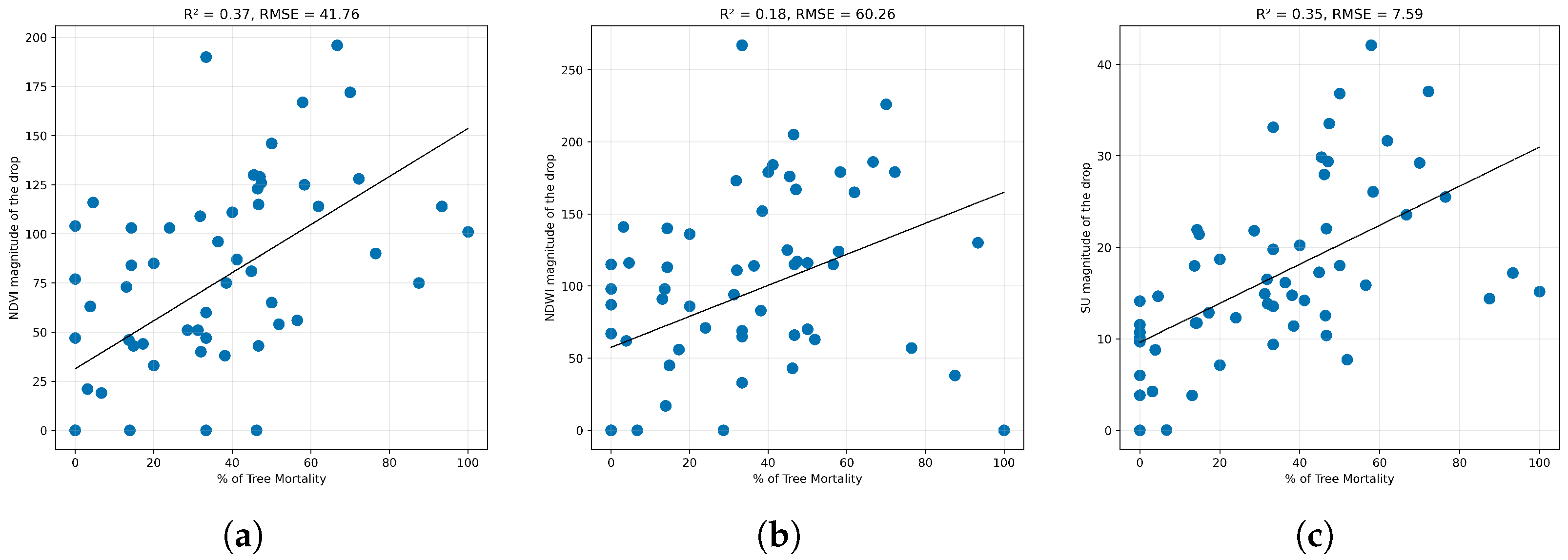
When relating percentage tree mortality to the magnitude of decline, correlations were generally weak, especially for plots with very high mortality. Using NDVI values, only 37% of the variation was explained, with a relatively high RMSE of 41.8. (Figure 11a). Excluding the three plots with more than 80% mortality increased the explained variation to 42%. For NDWI, the relationship was weaker still, explaining just 18% of the variation with an even larger RMSE of 60.3 (Figure 11b). Notably, NDWI generally recorded larger drops than NDVI for the same plots. The SU-based regression explained 35% of the variation (Figure 11c), rising to 51% when the high-mortality plots were excluded.
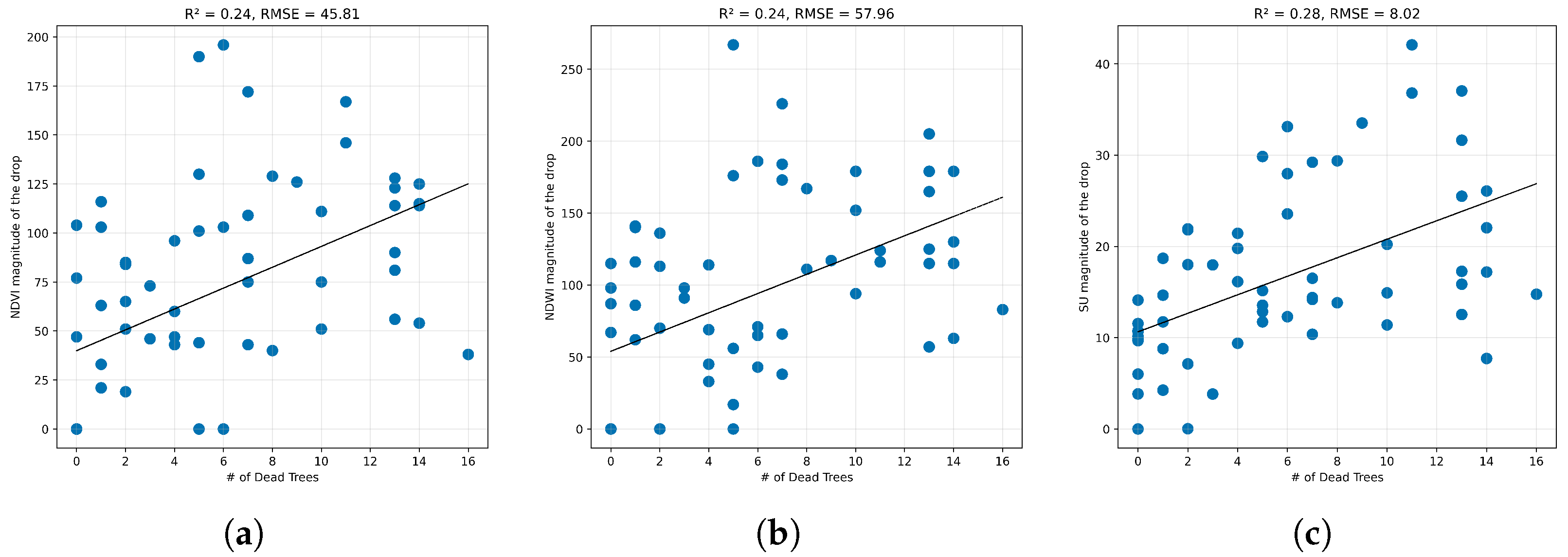
When drop magnitudes were compared against the number of dead trees per plot, correlations remained poor for both NDVI and NDWI (Figure 12a,b), each explaining only 24% of the variation, with RMSE values of 45.8 and 57.9, respectively. Removing plots with more than 80% mortality increased the explained variation to 35%. SU analysis (Figure 12c) explained 28% of the variation.
Overall, while declines in VIs and SU values are associated with tree mortality, the magnitude of decline does not consistently correspond to higher mortality levels. The algorithms perform more reliably in low- or no-mortality cases, where pixels show little to no drop in value.

4. Discussion

UAS imagery has proven to be a highly reliable reference dataset, achieving an R 2 of 0.95 and an RMSE of 2.97, outperforming previous studies [44]. This level of accuracy allows UAS data to complement field observations and expand data collection. By reducing the need for extensive fieldwork, UAS offers a practical alternative in areas that are difficult to access due to high costs, time constraints, inaccessible terrain or other logistic reasons.
A key challenge in assessing tree mortality, particularly estimating dead tree crown cover, lies in obtaining spatially explicit reference data through conventional field campaigns [45,46]. Satellite missions such as Landsat and Sentinel have limitations in detecting individual trees due to their spatial resolution, making it difficult to link satellite observations with ground-level data [47]. UAS imagery addresses this limitation by providing ultra-high spatial resolution capable of accurately segmenting dead tree crowns, especially for standing trees. Its flexible deployment further facilitates the monitoring of tree mortality across large or inaccessible regions. These findings establish a foundation for integrating advanced pattern recognition and deep learning methods, such as convolutional neural networks (CNN), to improve segmentation of standing dead trees [48,49,50].
Despite the high overall accuracy of UAS as reference data, errors occur in dense plots where individual canopies are difficult to distinguish. In these cases, UAS-based counts tend to underestimate tree numbers compared to field surveys. While this limitation is minor in open forests, it could become significant in denser forest types. A similar issue arises for dead trees: regression between field data and UAS estimates is lower ( R 2 = 0.88), particularly in dense canopies where surrounding trees obscure dead trunks. Open Mediterranean forests facilitate the detection of standing deadwood, yet dead and fallen trunks, often thin, clustered, or removed by residents for firewood or construction, remain challenging to quantify accurately.
Comparisons between SU and UAS imagery demonstrated good agreement ( R 2 = 0.75, RMSE = 7.69), supporting SU as a viable method for estimating vegetation cover in mixed pixels. However, SU tended to overestimate vegetation, possibly due to variability in understory vegetation or misalignment between field plots and Landsat pixels. Furthermore, part of the unexplained variability could also be due to the variability of tree health associated with the variable greenness of the canopy, and overall foliage condition. Integrating UAS data with field observations could refine live and dead tree counts per pixel, and higher-resolution satellite imagery is expected to further enhance SU performance [51].
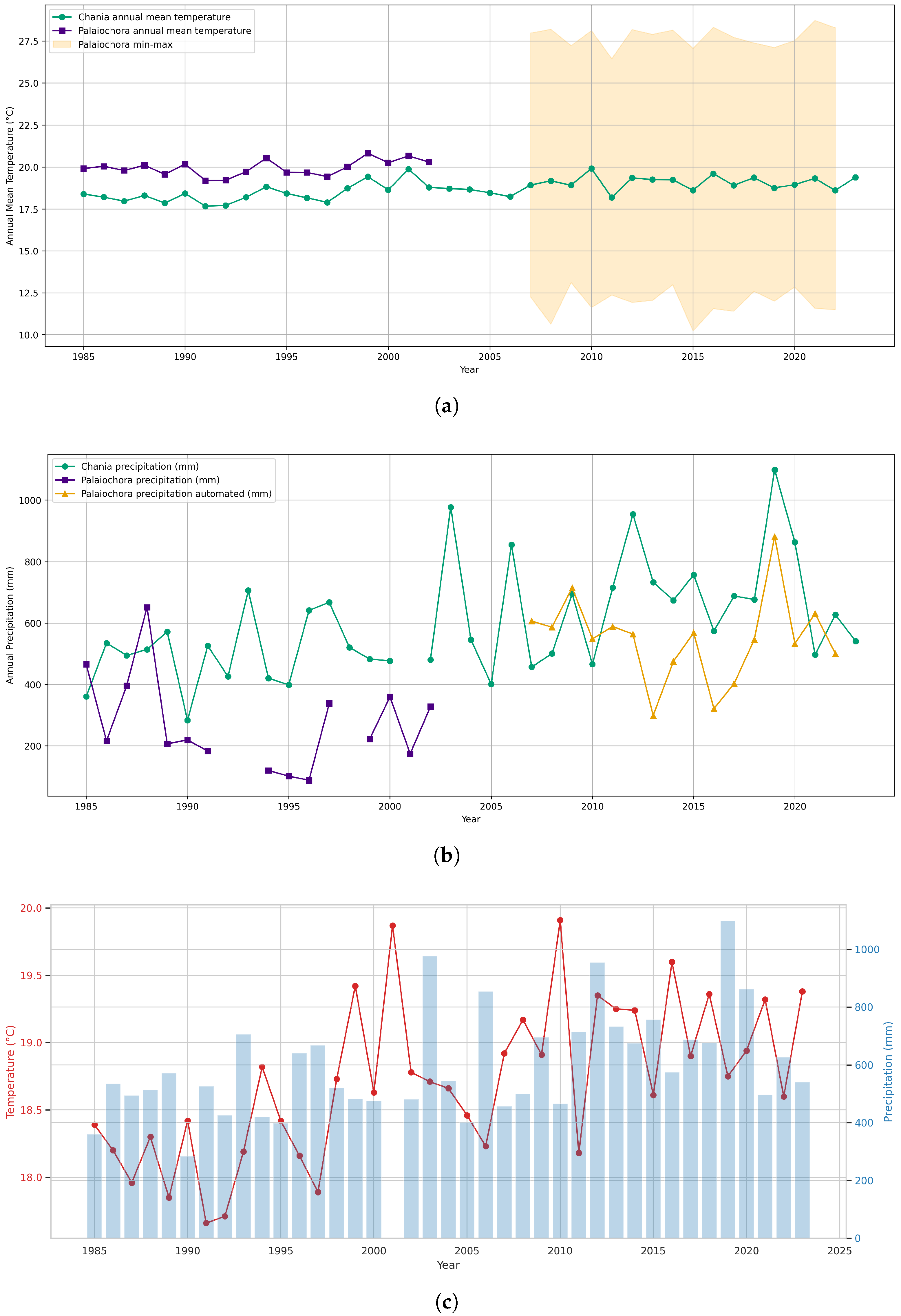
Time series analysis of selected VIs revealed minimal changes in response to the severe 2015–2016 drought in Crete [52]. Pixels representing areas with high versus low tree mortality showed little variation, with more vigorous vegetation exhibiting minor declines followed by rapid recovery. These findings align with [53], who observed cumulative drought effects exacerbating tree mortality in Israel. Similarly, historical droughts in Crete contributed to elevated mortality in the Lefka Ori region, particularly during the mid-1990s, corresponding with significant VI declines (Figure 13c) and supporting the ’resulting damage’ hypothesis [54]. In contrast, the 2015–2016 drought had limited impact, likely due to preceding stable precipitation and temperature conditions. Meteorological data from Chania and Palaiochora indicate consistent temperature patterns, though Palaiochora is 1.5–2 °C warmer, and precipitation is lower by 20–550 mm depending on the year (Figure 13a,b).
The LandTrendr algorithm was employed to detect changes in the time series of VIs and SU. All three metrics (NDVI, NDWI, and SU) identified largely overlapping areas of change. Notably, changes were concentrated near roads and newly constructed buildings, indicating a significant influence of human activities. Accurate identification of change was sensitive to the chosen start year. For example, setting 1995 as the start year often highlighted 1996 as a year of substantial change, while starting in 1990 identified 1991. However, without a sufficiently long pre-change time series, it is difficult to distinguish genuine disturbances from natural variability, underscoring the importance of including several years of preceding data to minimize false positives.
We observed that NDWI frequently detected changes earlier or concurrently with NDVI, whereas SU typically identified changes several years later. This reflects their underlying mechanisms: VIs capture subtle variations in vegetation condition, such as water content or photosynthetic activity, whereas SU represents live vegetation fraction, which responds slower. The earlier detection by NDWI aligns with previous studies [55] and offers potential as an early warning for drought and tree mortality. Nonetheless, NDWI’s performance can be affected by atmospheric interference in its SWIR band or by droughts that simultaneously reduce water and biomass, while drought-tolerant species may decrease greenness before water content [56].
Both NDVI and NDWI showed comparable accuracy in identifying plots with and without tree mortality, with NDVI performing slightly better. SU achieved the highest accuracy in detecting plots with tree mortality but tended to overestimate mortality, likely due to overestimation of vegetation cover. Regression analyses revealed weak correlations between the magnitude of change and tree mortality percentages. While SU showed closer alignment to tree mortality, it was not a reliable predictor. In general, SU better matched predicted values with observed data, whereas NDVI explained variability more effectively.
From a practical perspective, NDVI benefits from requiring only red and NIR bands, which are widely available on free satellite platforms (e.g., SPOT, Proba-V, PlanetScope), enhancing its applicability. NDWI, needing NIR and SWIR bands, is less widely supported. Despite the tendency of spectral indices to overpredict tree mortality, they remain valuable for identifying high-risk forests [57]. It is important to note, however, that spectral metrics provide indirect evidence of tree mortality and cannot definitively confirm dead crowns [58].
Performance of SU and VIs can be improved through several approaches. Using ensembles of multiple indices or metrics, rather than relying on a single method, has been shown to improve disturbance detection [59,60,61,62]. Ensemble approaches that combine multiple change detection methods outperform single time series analyses [63]. Higher spatial resolution imagery, such as sub-meter aerial imagery, can capture individual dead trees that are missed by coarser satellite data [64]. This is particularly relevant for recent tree mortality, whereas our study addressed older mortality events, where fallen or removed trees complicate detection.
Discrepancies between the magnitude of change and tree mortality percentages can arise from several factors. Validation data for this study were collected in 2023 using field observations and UAS, assuming low vegetation regeneration in the area. However, local removal of dead trees for firewood complicated visual estimation, affecting both VIs and SU accuracy and their correlation with actual tree mortality. Heterogeneous landscapes further exacerbate disagreements due to the coarser spatial resolution of satellite data compared to validation datasets [65].
Other sources of uncertainty include: (1) the lack of a universal threshold for tree mortality, as index reductions may not always indicate death; (2) VIs being normalized values that indicate relative, not absolute, vegetation or water content; and (3) mortality calculations based on the ratio of dead to total trees rather than surface coverage, which is difficult to measure, especially for fallen trees. Variations in vegetation health, brief disturbances, and recovery dynamics [66] can also cause temporary VI drops without resulting in mortality. Incorporating measures such as dead tree surface area or DBH could improve accuracy.
Mapping tree mortality with RS provides multiple benefits for forest management. It enables early detection of high-mortality areas, supports efficient allocation of restoration resources, facilitates continuous monitoring over large areas and time periods, and informs decision-making regarding forest health, resilience, and vulnerability. Future research could leverage higher spatial resolution time series or hyperspectral data from upcoming missions (e.g., PRISMA, EnMAP, Surface Biology and Geolog (SBG)) to improve global monitoring of tree mortality.
It is important to emphasize that tree mortality is not a result of a single drought event and often is not evident immediately after the event(s). It is expected that drought intensity, tree resilience, and thus the severity of impacts will vary in space and time, which could explain differences in the estimated timing of VI drop. Possible explanations include variability in soil attributes and groundwater availability, topography, the age of trees, and the fraction of vegetation cover. This complexity may be further intensified by the cumulative pressure of successive dry years, potentially resulting in a more complex relationship between drought and mortality. Indeed, mortality may occur only after repeated drought events, even if a subsequent drought is minor.
An obvious interpretation of VI drops that are not related to mortality is the pines’ resilience. Furthermore, a drop in the value of a vegetation index does not necessarily imply tree mortality; a decline in plant vigor, such as discoloration and defoliation of the canopy, can likewise be reflected as a reduction in the index. Mediterranean pines are highly drought-resilient species, which makes this analysis more challenging, as there is not an immediate or direct relationship between drought stress, plant deterioration, and mortality.
Arguably, other factors can also contribute to tree mortality. For example, pest infestation can cause deterioration of forest health and a decrease in vegetation index. Water-stressed trees may be more susceptible to infestations to which they might otherwise be resistant. The effect of multiple stressors is an aspect that could be explored in future analyses, particularly to determine whether and how the impacts of drought and pest infection can be disentangled. The results of the present study could serve as a useful starting point for such investigations.

5. Recommendations

Preventing tree mortality requires tools capable of detecting forest health decline early enough for intervention. Monitoring inter-annual changes in spectral metrics offers greater potential for early detection than single-date classifications [67]. Future studies should track changes across full phenological cycles rather than relying solely on annual composites, as this could yield more accurate assessments of forest health and allow proactive management before mortality occurs.
Water- and greenness-related indices respond differently to drought stress depending on species resilience. In drought-resistant species, greenness and biomass typically decline before water content. A drop in NDVI without a corresponding drop in NDWI may therefore indicate early-stage stress in such forests, when vegetation water content remains unaffected. Conversely, if NDWI declines before NDVI, it likely signals that water stress is already impacting less drought-tolerant species. Under severe drought with limited regeneration, reductions in greenness eventually lead to significant losses in canopy water content, increasing mortality risk.
The LandTrendr algorithm, while reliable for detecting change, often shows a one-year lag between disturbance and detection [62,68,69]. This delay should be considered in future applications, as disturbances may be recorded in the year after they occur. Although our validation dataset did not include years of severe mortality, prior studies suggest that this lag can result in apparent vegetation loss being assigned to the wrong year.
SU is an effective method for detecting tree mortality, generally outperforming VIs in accuracy. Both SU and VIs can capture multiple stages of forest health decline, not just mortality. However, SU can overestimate the percentage of vegetation, especially in areas with few canopies, potentially leading to misinterpretation. Recognizing these limitations is essential when applying SU for mortality assessments.

6. Conclusions

UAS imagery served as a reliable reference dataset, enabling satellite-based analyses by deriving visual mortality estimates that supported the evaluation of Landsat-derived products. The strong agreement between UAS-based mortality assessments and field observations confirms that UAS imagery can function as a dependable ground-truth source in open Mediterranean forest.
Landsat-derived VIs proved effective for detecting mortality in open Mediterranean forests, demonstrating their suitability for landscape-scale forest health monitoring. Furthermore, we introduced a novel application of Spectral Unmixing-derived vegetation cover percentages within the LandTrendr algorithm to detect temporal changes associated with mortality events. By incorporating fractional vegetation cover metrics into temporal segmentation analysis, this approach enhanced the detection of disturbance dynamics while leveraging UAS-based reference data to increase confidence in satellite-derived mortality signals.
Despite these advances, challenges remain in accurately quantifying mortality magnitude. The spatial resolution limitations of current satellite missions constrain the detection of small or dispersed mortality patches. Distinguishing between standing dead trees and fallen deadwood remains difficult using multispectral imagery alone. While the SU-based approach showed strong potential for capturing vegetation loss dynamics, further refinement is needed to improve the estimation of mortality extent and severity.
Future research should focus on integrating multiple spectral metrics, incorporating biomass and structural information, and applying advanced machine learning and deep learning techniques to improve mortality detection and predictive modeling. Expanding validation datasets across different forest structures and disturbance regimes will also be essential to enhance the robustness and transferability of the proposed methodology.

Supplementary Materials

The following supporting information can be downloaded at: https://www.mdpi.com/article/10.3390/rs1010000/s1, Figure S1: Year of detection for all three metrics, NDVI, NDWI, and SU, for Site 1, using LandTrendr; Figure S2: Magnitude of change for all three metrics, NDVI, NDWI, and SU, for Site 1, using LandTrendr. Figure S3: Year of detection for all three metrics, NDVI, NDWI, and SU, for Site 2, using LandTrendr. Figure S4: Magnitude of change for all three metrics, NDVI, NDWI, and SU, for Site 2, using LandTrendr.

Author Contributions

A.R. conceived the original research idea, organized the fieldwork, processed the datasets, performed the data analysis, interpreted the results, and wrote the manuscript. M.H. and P.N. contributed to the original idea, supervised the research, contributed to refining the methodology, provided guidance during fieldwork, data analysis, and result interpretation, and reviewed and edited the manuscript. UAS data collection design and acquisition was done by P.N. C.P. contributed to perform data analysis, provided guidance during the revision and edited the manuscript. All authors contributed to the final manuscript and approved its submission. All authors have read and agreed to the published version of the manuscript.

Funding

This research was supported by the Faculty of Geo-Information Science and Earth Observation (ITC), University of Twente, through a scholarship awarded to A. Raunak (internal reference: FvdM/2961938).

Data Availability Statement

Satellite data are open access, while field data, UAS imagery, and codes can be made available upon request to the authors.

Acknowledgments

We thank Manolis Kontoudakis and Nikiforos Nikiforakis for providing a Leica differential GNSS receiver for use during fieldwork, and METRICA A.E. (Athens, Greece) for providing access to the HxGN SmartNet network for RTK corrections during UAS image acquisition. We also thank Jonathan V. Solórzano for his assistance in adapting a script to run LandTrendr using SU outputs. During the preparation of this work, the authors used ChatGPT (OpenAI, GPT-4-based model, ChatGPT web interface, accessed February 2026) for English language editing and to improve clarity and readability. The authors reviewed and edited the content as needed and take full responsibility for the publication’s content.

Conflicts of Interest

The authors declare no conflicts of interest.

References

  1. Li, K.; Kirkland, S.; Yeo, B.; Tubbesing, C.; Bandaru, V.; Song, L.; Holstege, L.; Hartsough, B.; Kendall, A.; Jenkins, B. Integrated economic and environmental modeling of forest biomass for renewable energy in California: Part I—Model development. Bioenergy Res. 2023, 173, 106774. [Google Scholar] [CrossRef]
  2. Haied, N.; Foufou, A.; Khadri, S.; Boussaid, A.; Azlaoui, M.; Bougherira, N. Spatial and Temporal Assessment of Drought Hazard, Vulnerability and Risk in Three Different Climatic Zones in Algeria Using Two Commonly Used Meteorological Indices. Sustainability 2023, 15, 7803. [Google Scholar] [CrossRef]
  3. Mo, C.; Tang, P.; Huang, K.; Lei, X.; Lai, S.; Deng, J.; Bao, M.; Sun, G.; Xing, Z. Evolution of Drought Trends under Climate Change Scenarios in Karst Basin. Water 2023, 15, 1934. [Google Scholar] [CrossRef]
  4. Hartmann, H.; Bastos, A.; Das, A.J.; Esquivel-Muelbert, A.; Hammond, W.M.; Martínez-Vilalta, J.; McDowell, N.G.; Powers, J.S.; Pugh, T.A.M.; Ruthrof, K.X.; et al. Climate Change Risks to Global Forest Health: Emergence of Unexpected Events of Elevated Tree Mortality Worldwide. Annu. Rev. Plant Biol. 2022, 73, 673–702. [Google Scholar] [CrossRef]
  5. Cowling, R.M.; Rundel, P.W.; Lamont, B.B.; Kalin Arroyo, M.; Arianoutsou, M. Plant diversity in mediterranean-climate regions. Trends Ecol. Evol. 1996, 11, 362–366. [Google Scholar] [CrossRef]
  6. Barbeta, A.; Mejía-Chang, M.; Ogaya, R.; Voltas, J.; Dawson, T.E.; Peñuelas, J. The combined effects of a long-term experimental drought and an extreme drought on the use of plant-water sources in a Mediterranean forest. Glob. Change Biol. 2015, 21, 1213–1225. [Google Scholar] [CrossRef] [PubMed]
  7. Schröter, D.; Cramer, W.; Leemans, R.; Prentice, I.C.; Araújo, M.B.; Arnell, N.W.; Bondeau, A.; Bugmann, H.; Carter, T.R.; Gracia, C.A.; et al. Ecosystem Service Supply and Vulnerability to Global Change in Europe. Science 2005, 310, 1333–1337. [Google Scholar] [CrossRef]
  8. Liu, Q.; Peng, C.; Schneider, R.; Cyr, D.; McDowell, N.G.; Kneeshaw, D. Drought-induced increase in tree mortality and corresponding decrease in the carbon sink capacity of Canada’s boreal forests from 1970 to 2020. Glob. Change Biol. 2023, 29, 2274–2285. [Google Scholar] [CrossRef]
  9. Anderegg, W.; Kane, J.; Anderegg, L. Consequences of widespread tree Mortality triggered by drought and temperature stress. Nat. Clim. Change 2012, 3, 30–36. [Google Scholar] [CrossRef]
  10. Gaylord, M.L.; Kolb, T.E.; McDowell, N.G. Mechanisms of piñon pine mortality after severe drought: A retrospective study of mature trees. Tree Physiol. 2015, 35, 806–816. [Google Scholar] [CrossRef] [PubMed]
  11. Brando, P.M.; Paolucci, L.; Ummenhofer, C.C.; Ordway, E.M.; Hartmann, H.; Cattau, M.E.; Rattis, L.; Medjibe, V.; Coe, M.T.; Balch, J. Droughts, Wildfires, and Forest Carbon Cycling: A Pantropical Synthesis. Ann. Rev. Earth Planet. Sci. 2019, 47, 555–581. [Google Scholar] [CrossRef]
  12. Woodall, C.; Kamoske, A.; Hayward, G.; Schuler, T.; Hiemstra, C.; Palmer, M.; Gray, A. Classifying mature federal forests in the United States: The forest inventory growth stage system. For. Ecol. Manag. 2023, 546, 121361. [Google Scholar] [CrossRef]
  13. Almalki, R.; Khaki, M.; Saco, P.M.; Rodriguez, J.F. Monitoring and Mapping Vegetation Cover Changes in Arid and Semi-Arid Areas Using Remote Sensing Technology: A Review. Remote Sens. 2022, 14, 5143. [Google Scholar] [CrossRef]
  14. Chaulagain, S.; Stone, M.C.; Morrison, R.R.; Yang, L.; Coonrod, J.; Villa, N.E. Determining the response of riparian vegetation and river morphology to drought using Google Earth Engine and machine learning. J. Arid Environ. 2023, 219, 105068. [Google Scholar] [CrossRef]
  15. Garrity, S.R.; Allen, C.D.; Brumby, S.P.; Gangodagamage, C.; McDowell, N.G.; Cai, D.M. Quantifying tree mortality in a mixed species woodland using multitemporal high spatial resolution satellite imagery. Remote Sens. Environ. 2013, 129, 54–65. [Google Scholar] [CrossRef]
  16. Verbesselt, J.; Robinson, A.; Stone, C.; Culvenor, D. Forecasting tree mortality using change metrics derived from MODIS satellite data. For. Ecol. Manag. 2009, 258, 1166–1173. [Google Scholar] [CrossRef]
  17. Gao, B.-C. NDWI—A normalized difference water index for remote sensing of vegetation liquid water from space. Remote Sens. Environ. 1996, 58, 257–266. [Google Scholar] [CrossRef]
  18. Chou, C.B.; Weng, M.C.; Huang, H.P.; Chang, Y.C.; Chang, H.C.; Yeh, T.Y. Monitoring the Spring 2021 Drought Event in Taiwan Using Multiple Satellite-Based Vegetation and Water Indices. Atmosphere 2022, 13, 1374. [Google Scholar] [CrossRef]
  19. Anderson, L.O.; Malhi, Y.; Aragão, L.E.O.C.; Ladle, R.; Arai, E.; Barbier, N.; Phillips, O. Remote sensing detection of droughts in Amazonian forest canopies. New Phytol. 2010, 187, 733–750. [Google Scholar] [CrossRef]
  20. Sturm, J.; Santos, M.J.; Schmid, B.; Damm, A. Satellite data reveal differential responses of Swiss forests to unprecedented 2018 drought. Glob. Change Biol. 2022, 28, 2956–2978. [Google Scholar] [CrossRef] [PubMed]
  21. Elmore, A.J.; Mustard, J.F.; Manning, S.J.; Lobell, D.B. Quantifying Vegetation Change in Semiarid Environments: Precision and Accuracy of Spectral Mixture Analysis and the Normalized Difference Vegetation Index. Remote Sens. Environ. 2000, 73, 87–102. [Google Scholar] [CrossRef]
  22. He, Y.; Chen, G.; Potter, C.; Meentemeyer, R.K. Integrating multi-sensor remote sensing and species distribution modeling to map the spread of emerging forest disease and tree mortality. Remote Sens. Environ. 2019, 231, 111238. [Google Scholar] [CrossRef]
  23. Brewer, W.L.; Lippitt, C.L.; Lippitt, C.D.; Litvak, M.E. Assessing drought-induced change in a piñon-juniper woodland with Landsat: A multiple endmember spectral mixture analysis approach. Int. J. Remote Sens. 2017, 38, 4156–4176. [Google Scholar] [CrossRef]
  24. Somers, B.; Verbesselt, J.; Ampe, E.; Sims, N.; Verstraeten, W.; Coppin, P. Spectral mixture analysis to monitor defoliation in mixed-aged Eucalyptus globulus Labill plantations in southern Australia using Landsat 5-TM and EO-1 Hyperion data. Int. J. Appl. Earth Obs. Geoinf. 2010, 12, 270–277. [Google Scholar] [CrossRef]
  25. Cohen, W.B.; Yang, Z.; Stehman, S.V.; Schroeder, T.A.; Bell, D.M.; Masek, J.G.; Huang, C.; Meigs, G.W. Forest disturbance across the conterminous United States from 1985–2012: The emerging dominance of forest decline. For. Ecol. Manag. 2016, 360, 242–252. [Google Scholar] [CrossRef]
  26. Kennedy, R.E.; Yang, Z.; Cohen, W.B. Detecting trends in forest disturbance and recovery using yearly Landsat time series: 1. LandTrendr — Temporal segmentation algorithms. Remote Sens. Environ. 2010, 114, 2897–2910. [Google Scholar] [CrossRef]
  27. Eliades, F.; Sarris, D.; Bachofer, F.; Michaelides, S.; Hadjimitsis, D. Understanding Tree Mortality Patterns: A Comprehensive Review of Remote Sensing and Meteorological Ground-Based Studies. Forests 2024, 15, 1357. [Google Scholar] [CrossRef]
  28. European Environment Agency; European Commission. Standard Data Form: GR4340008 [Natura 2000 Site Data]. Natura 2000 SDF Viewer, 2020. Available online: https://www.eea.europa.eu/en/datahub/datahubitem-view/6fc8ad2d-195d-40f4-bdec-576e7d1268e4 (accessed on 8 February 2026).
  29. Vogiatzakis, I.N.; Griffiths, G.H.; Mannion, A.M. Environmental factors and vegetation composition, Lefka Ori massif, Crete, S. Aegean. Glob. Ecol. Biogeogr. 2003, 12, 131–146. [Google Scholar] [CrossRef]
  30. Grove, A.; Rackham, O. Threatened landscapes in the Mediterranean: Examples from Crete. Landsc. Urban Plan. 1993, 24, 279–292. [Google Scholar] [CrossRef]
  31. Varouchakis, E.A.; Corzo, G.A.; Karatzas, G.P.; Kotsopoulou, A. Spatio-temporal analysis of annual rainfall in Crete, Greece. Acta Geophys. 2018, 66, 319–328. [Google Scholar] [CrossRef]
  32. Strid, A. The Greek mountain flora, with special reference to the Central European element. Bocconea 1996, 5, 99–112. [Google Scholar]
  33. Turland, N.J.; Chilton, L.; Press, J.R. Flora of the Cretan Area: Annotated Checklist and Atlas; H.M. Stationery Office: London, UK, 1993. [Google Scholar]
  34. Li, P.; Jiang, L.; Feng, Z. Cross-Comparison of Vegetation Indices Derived from Landsat-7 Enhanced Thematic Mapper Plus (ETM+) and Landsat-8 Operational Land Imager (OLI) Sensors. Remote Sens. 2014, 6, 310–329. [Google Scholar] [CrossRef]
  35. Lakatos, F.; Mirtchev, S. Manual for Visual Assessment of Forest Crown Condition; FAO: Rome, Italy, 2014. [Google Scholar]
  36. Zhang, J.; Xu, S.; Zhao, Y.; Sun, J.; Xu, S.; Zhang, X. Aerial orthoimage generation for UAV remote sensing: Review. Inf. Fusion 2023, 89, 91–120. [Google Scholar] [CrossRef]
  37. Rouse, J.W., Jr.; Haas, R.H.; Schell, J.A.; Deering, D.W. Monitoring Vegetation Systems in the Great Plains with ERTS. In Third Earth Resources Technology Satellite-1 Symposium, Washington, DC, USA, 10–14 December 1973; Scientific and Technical Information Office, National Aeronautics and Space Administration: Washington, DC, USA, 1974; Volume 1, pp. 309–317. [Google Scholar]
  38. Filgueiras, R.; Coelho, C.M.G.D.; Demattê, J.A.M.; Vicente, M.R.; Galvão, J.L.S.; dos Santos, J.R.; de Souza Filho, J.A.C.P. Crop NDVI Monitoring Based on Sentinel 1. Remote Sens. 2019, 11, 1441. [Google Scholar] [CrossRef]
  39. Roberts, D.; Gardner, M.; Church, R.; Ustin, S.; Scheer, G.; Green, R. Mapping Chaparral in the Santa Monica Mountains Using Multiple Endmember Spectral Mixture Models. Remote Sens. Environ. 1998, 65, 267–279. [Google Scholar] [CrossRef]
  40. Roy, D.P.; Li, J.; Zhang, H.K.; Yan, L.; Huang, H.; Li, Z. Examination of Sentinel-2A multi-spectral instrument (MSI) reflectance anisotropy and the suitability of a general method to normalize MSI reflectance to nadir BRDF adjusted reflectance. Remote Sens. Environ. 2017, 199, 25–38. [Google Scholar] [CrossRef]
  41. Kennedy, R.E.; Yang, Z.; Cohen, W.B. Implementation of the LandTrendr Algorithm on Google Earth Engine. Remote Sens. 2018, 10, 691. [Google Scholar] [CrossRef]
  42. Zhu, Z.; Woodcock, C.E. Improvement and expansion of the Fmask algorithm: Cloud, cloud shadow, and snow detection for Landsats 4–7, 8, and Sentinel 2 images. Remote Sens. Environ. 2015, 159, 269–277. [Google Scholar] [CrossRef]
  43. Roy, D.P.; Wulder, M.A.; Loveland, T.R.; Woodcock, C.E.; Allen, R.G.; Anderson, M.C.; Helder, D.; Irons, J.; Johnson, D.M.; Kennedy, R.; et al. Characterization of Landsat-7 to Landsat-8 reflective wavelength and normalized difference vegetation index continuity. Remote Sens. Environ. 2016, 185, 57–70. [Google Scholar] [CrossRef]
  44. Riihimäki, H.; Koenig, B.R.S.; Forbes, B.C.; Heiskanen, M. Estimating fractional cover of tundra vegetation at multiple scales using unmanned aerial systems and optical satellite data. Remote Sens. Environ. 2019, 222, 119–136. [Google Scholar] [CrossRef]
  45. Frolking, S.; Palace, M.W.; Clark, D.B.; Chambers, J.Q.; Shugart, H.H.; Hurtt, G.C. Forest disturbance and recovery: A general review in the context of spaceborne remote sensing of impacts on aboveground biomass and canopy structure. Remote Sens. Environ. 2009, 114. [Google Scholar] [CrossRef]
  46. Schuldt, B.; Buras, A.; Arend, A.A.B.; Kristensen, J.G.A.; Böhmer, J.; Braun, L.A.; Fuchs, R.A.; Günther, I.G.; Hauck, J.; Herrmann, S.; et al. A first assessment of the impact of the extreme 2018 summer drought on Central European forests. Basic Appl. Ecol. 2020, 45, 86–103. [Google Scholar] [CrossRef]
  47. Pause, M.; Schweitzer, C.; Rosenthal, J.E.; Keuck, J.; Bumberger, A.; Dietrich, L.; Heurich, J.; Jung, M.; Kosak, G.; Siegmann, P.; et al. In Situ/Remote Sensing Integration to Assess Forest Health—A Review. Remote Sens. 2016, 8, 471. [Google Scholar] [CrossRef]
  48. Alvarez-Vanhard, E.; Aragon, M.J.; Rouquié, B.; Durrieu, S.; Balaguer, P.; Couteron, P. UAV & satellite synergies for optical remote sensing applications: A literature review. Remote Sens. Environ. 2020, 247, 111942. [Google Scholar] [CrossRef]
  49. Kattenborn, T.; Eichel, P.; Fassnacht, P. UAV data as alternative to field sampling to map woody invasive species based on combined Sentinel-1 and Sentinel-2 data. Remote Sens. Environ. 2019, 227, 61–73. [Google Scholar] [CrossRef]
  50. Schiefer, F.; Schmidtlein, S.; Frick, A.; Frey, J.; Klinke, R.; Zielewska-Büttner, K.; Uhl, A.; Junttila, S.; Kattenborn, T. UAV-based reference data for the prediction of fractional cover of standing deadwood from Sentinel time series. ISPRS Open J. Photogramm. Remote Sens. 2023, 1, 100034. [Google Scholar] [CrossRef]
  51. Zhou, Q.; Hill, M.J.; Sun, Q.; Schaaf, C.B. Retrieving understorey dynamics in the Australian tropical savannah from time series decomposition and linear unmixing of MODIS data. Int. J. Remote Sens. 2016, 37, 2141–2163. [Google Scholar] [CrossRef]
  52. Proutsos, N.D.; Solomou, A.D.; Bourletsikas, A.; Chatzipavlis, N.; Petropoulou, M.; Bourazani, K.; Nikolopoulos, J.N.; Georgiadis, C.; Kontogianni, A.B. Assessing Drought for the Period 1955–2021 in Heraklion-Crete (S. Greece) Urban Environment. In Proceedings of the 10th International Conference on Information and Communication Technologies in Agriculture, Food and Environment (HAICTA 2022), Athens, Greece, 22–25 September 2022; pp. 464–471. [Google Scholar]
  53. Dorman, M.; Svoray, T.; Perevolotsky, A.; Sarris, D. Forest performance during two consecutive drought periods: Diverging long-term trends and short-term responses along a climatic gradient. For. Ecol. Manag. 2013, 310, 1–9. [Google Scholar] [CrossRef]
  54. Varlas, G.; Stefanidis, K.; Papaioannou, G.; Panagopoulos, Y.; Pytharoulis, I.; Katsafados, P.; Papadopoulos, A.; Dimitriou, E. Unravelling Precipitation Trends in Greece since 1950s Using ERA5 Climate Reanalysis Data. Climate 2022, 10, 12. [Google Scholar] [CrossRef]
  55. Fisher, J.B.; Melton, F.; Middleton, E.; Hain, C.; Anderson, M.; Allen, R.; McCabe, A.; Peters-Lidard, C.D.; Wood, E.F.; Baldocchi, D.; et al. The Future of Evapotranspiration: Global Requirements for Ecosystem Functioning, Carbon and Climate Feedbacks, Agricultural Management, and Water Resources. Water Resour. Res. 2017, 53, 2618–2626. [Google Scholar] [CrossRef]
  56. Liu, F.; Liu, H.; Xu, C.; Zhu, X.; He, W.; Qi, Y. Remotely sensed birch forest resilience against climate change in the northern China forest-steppe ecotone. Ecol. Indic. 2021, 125, 107526. [Google Scholar] [CrossRef]
  57. Bergmüller, K.O.; Vanderwel, M.C. Predicting Tree Mortality Using Spectral Indices Derived from Multispectral UAV Imagery. Remote Sens. 2022, 14, 2195. [Google Scholar] [CrossRef]
  58. Glenn, E.P.; Huete, A.R.; Nagler, P.L.; Nelson, S.G. Relationship Between Remotely-sensed Vegetation Indices, Canopy Attributes and Plant Physiological Processes: What Vegetation Indices Can and Cannot Tell Us About the Landscape. Sensors 2008, 8, 2136–2160. [Google Scholar] [CrossRef] [PubMed]
  59. De Marzo, T.; Pflugmacher, D.; Baumann, M.; Lambin, E.F.; Gasparri, I.; Kuemmerle, T. Characterizing forest disturbances across the Argentine Dry Chaco based on Landsat time series. Int. J. Appl. Earth Obs. Geoinf. 2021, 98, 102310. [Google Scholar] [CrossRef]
  60. Grogan, K.; Pflugmacher, D.; Hostert, P.; Kennedy, R.; Fensholt, R. Cross-border forest disturbance and the role of natural rubber in mainland Southeast Asia using annual Landsat time series. Remote Sens. Environ. 2015, 169, 438–453. [Google Scholar] [CrossRef]
  61. Hislop, S.; Jones, S.; Soto-Berelov, M.; Skidmore, A.; Haywood, A.; Nguyen, T.H. A fusion approach to forest disturbance mapping using time series ensemble techniques. Remote Sens. Environ. 2019, 221, 188–197. [Google Scholar] [CrossRef]
  62. Qiu, D.; Liang, Y.; Shang, R.; Chen, J.M. Improving LandTrendr Forest Disturbance Mapping in China Using Multi-Season Observations and Multispectral Indices. Remote Sens. 2023, 15, 2381. [Google Scholar] [CrossRef]
  63. Hermosilla, T.; Wulder, M.A.; White, J.C.; Coops, N.C.; Hobart, G.W. Regional detection, characterization, and attribution of annual forest change from 1984 to 2012 using Landsat-derived time-series metrics. Remote Sens Environ. 2015, 170, 121–132. [Google Scholar] [CrossRef]
  64. Cheng, Y.; Oehmcke, S.; Brandt, M.; Rosenthal, L.; Das, A.; Vrieling, A.; Saatchi, S.; Wagner, F.; Mugabowindekwe, M.; Verbruggen, W.; et al. Scattered tree death contributes to substantial forest loss in California. Nat. Commun. 2024, 15, 641. [Google Scholar] [CrossRef]
  65. Spruce, J.P.; Hicke, J.A.; Hargrove, W.W.; Grulke, N.E.; Meddens, A.J.H. Use of MODIS NDVI Products to Map Tree Mortality Levels in Forests Affected by Mountain Pine Beetle Outbreaks. Forests 2019, 10, 811. [Google Scholar] [CrossRef]
  66. Gazol, A.; Camarero, J.; Sangüesa-Barreda, G.; Vicente-Serrano, S. Post-drought Resilience After Forest Die-Off: Shifts in Regeneration, Composition, Growth and Productivity. Front. Plant Sci. 2018, 9, 1546. [Google Scholar] [CrossRef]
  67. Bárta, V.; Lukeš, P.; Homolová, L. Early detection of bark beetle infestation in Norway spruce forests of Central Europe using Sentinel-2. Int. J. Appl. Earth Obs. Geoinf. 2021, 100, 102335. [Google Scholar] [CrossRef]
  68. Bright, B.; Hudak, A.; Kennedy, R.; Braaten, J.; Henareh Khalyani, A. Examining post-fire vegetation recovery with Landsat time series analysis in three western North American forest types. Fire Ecol. 2019, 15, 8. [Google Scholar] [CrossRef]
  69. Zhu, L.; Liu, X.; Wu, L.; Tang, Y.; Meng, Y. Long-Term Monitoring of Cropland Change near Dongting Lake, China, Using the LandTrendr Algorithm with Landsat Imagery. Remote Sens. 2019, 11, 1234. [Google Scholar] [CrossRef]
Figure 1. Location of the study area showing the three study sites with different elevation, terrain, and vegetation characteristics (background imagery: Google, Maxar Technologies, accessed via QGIS).
Remotesensing 18 00792 g001
Figure 2. NDVI time series (1984–2025) from the Landsat archive, using datasets of Landsat 5 TM, Landsat 7 ETM+, and Landsat 8 OLI, for an area with: (a) low tree mortality, and (b) high tree mortality. The dashed line shows the Landsat time series more clearly.
Remotesensing 18 00792 g002
Figure 3. Spatial distribution of the plots surveyed within the three study sites (background imagery: Google, Maxar Technologies, accessed via QGIS).
Remotesensing 18 00792 g003
Figure 4. Distribution of (a) alive and dead trees, and (b) tree species per plot. Plots 22–33 belonging to Site 1, Plots 1–8 belonging to Site 2, and Plots 9–21 belonging to Site 3. Vertical dashed lines indicate the separation between Sites.
Remotesensing 18 00792 g004
Figure 5. A flowchart depicting the overall methodology of the research. The upper red box shows tree mortality assessed using NDVI and NDWI. The middle box presents a novel approach based on endmember percentages from spectral unmixing in LandTrendr. The lower box shows the assessment comparing UAV imagery with field data.
Remotesensing 18 00792 g005
Figure 6. Scatter plot comparing the total number of trees per plot measured in the field and estimated from UAS data for (a) total number of tress, (b) total number of alive tress and (c) total number of dead trees. R 2 and RMSE indicate the agreement between field and UAS counts.
Remotesensing 18 00792 g006
Figure 7. Linear regression analysis between vegetation percentage per pixel estimated with SU (y-axis) and UAS-derived data (x-axis). R 2 and RMSE values are reported.
Remotesensing 18 00792 g007
Figure 8. Year of detection for all three metrics, NDVI, NDWI, and SU, for Site 3, using LandTrendr.
Remotesensing 18 00792 g008
Figure 9. Magnitude of change for all three metrics, NDVI, NDWI, and SU, for Site 3, using LandTrendr.
Remotesensing 18 00792 g009
Figure 10. Evaluating (a) NDVI, (b) NDWI, and (c) SU values’ performance with a confusion matrix. The grey background indicates agreement between the estimated values and the validation dataset.
Remotesensing 18 00792 g010
Figure 11. Linear regression between (a) NDVI’s, (b) NDWI’s, and (c) SU’s drop magnitude and estimated percentage of tree mortality.
Remotesensing 18 00792 g011
Figure 12. Linear regression between (a) NDVI’s, (b) NDWI’s, and (c) SU’s drop magnitude and the count of dead trees.
Remotesensing 18 00792 g012
Figure 13. Annual (a) mean temperature for Chania, Palaiochora, annual mean max and min temperatures for Palaiochora automated station, (b) precipitation for Chania, Palaiochora, and Palaiochora automated station, (c) mean temperature (red dot line) and annual precipitation (blue bars) for Chania. Unconnected lines indicate missing data due to data recording or transmission failure at the station.
Remotesensing 18 00792 g013
Disclaimer/Publisher’s Note: The statements, opinions and data contained in all publications are solely those of the individual author(s) and contributor(s) and not of MDPI and/or the editor(s). MDPI and/or the editor(s) disclaim responsibility for any injury to people or property resulting from any ideas, methods, instructions or products referred to in the content.