Uncertainty Analysis of Gross Primary Production (GPP) Remote-Sensing Products and Its Influencing Factors in Southwest China



Highlights
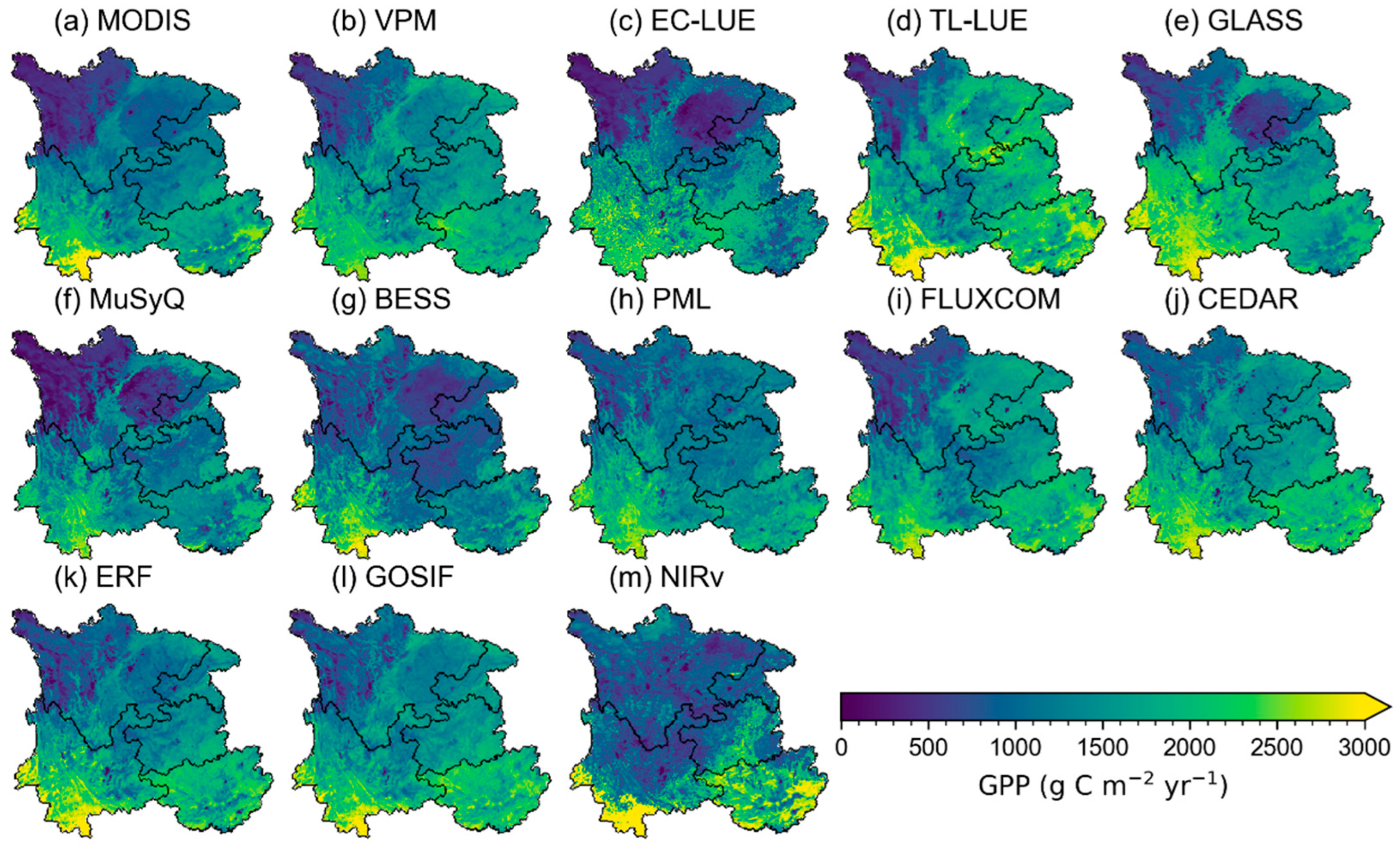
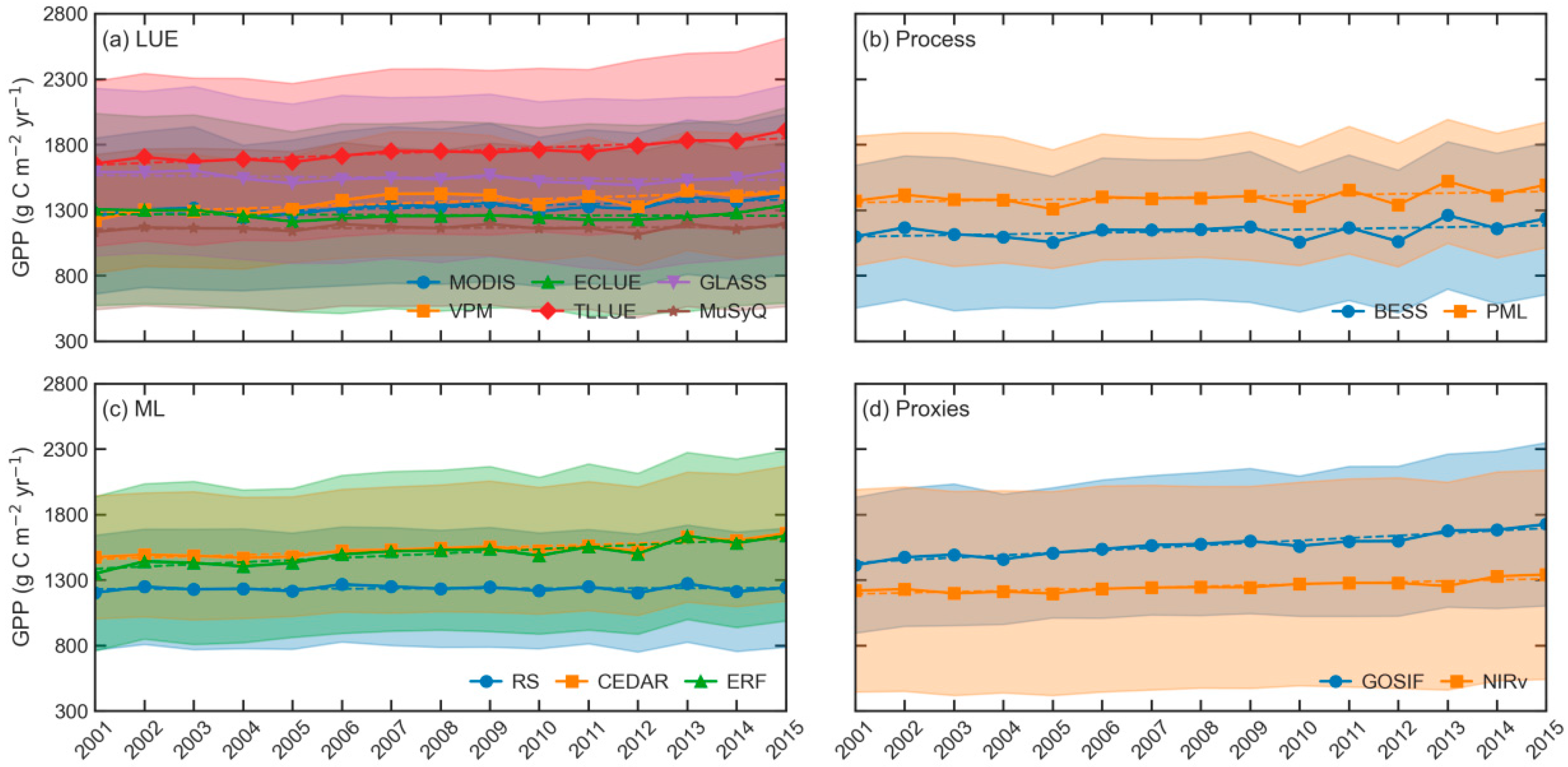
- GPP products in Southwest China exhibit broadly consistent large-scale spatial patterns, but show substantial differences in magnitude, temporal variability, and uncertainty across model categories and temporal scales.
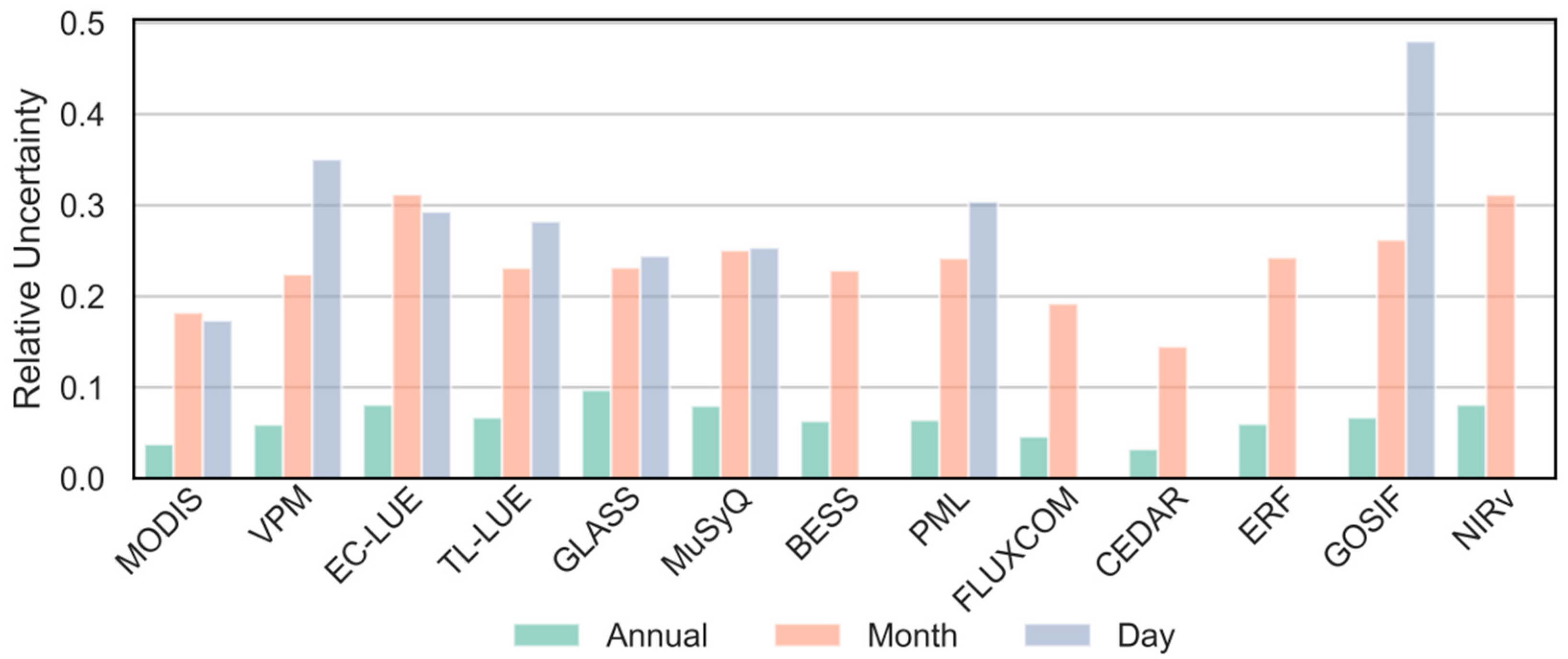
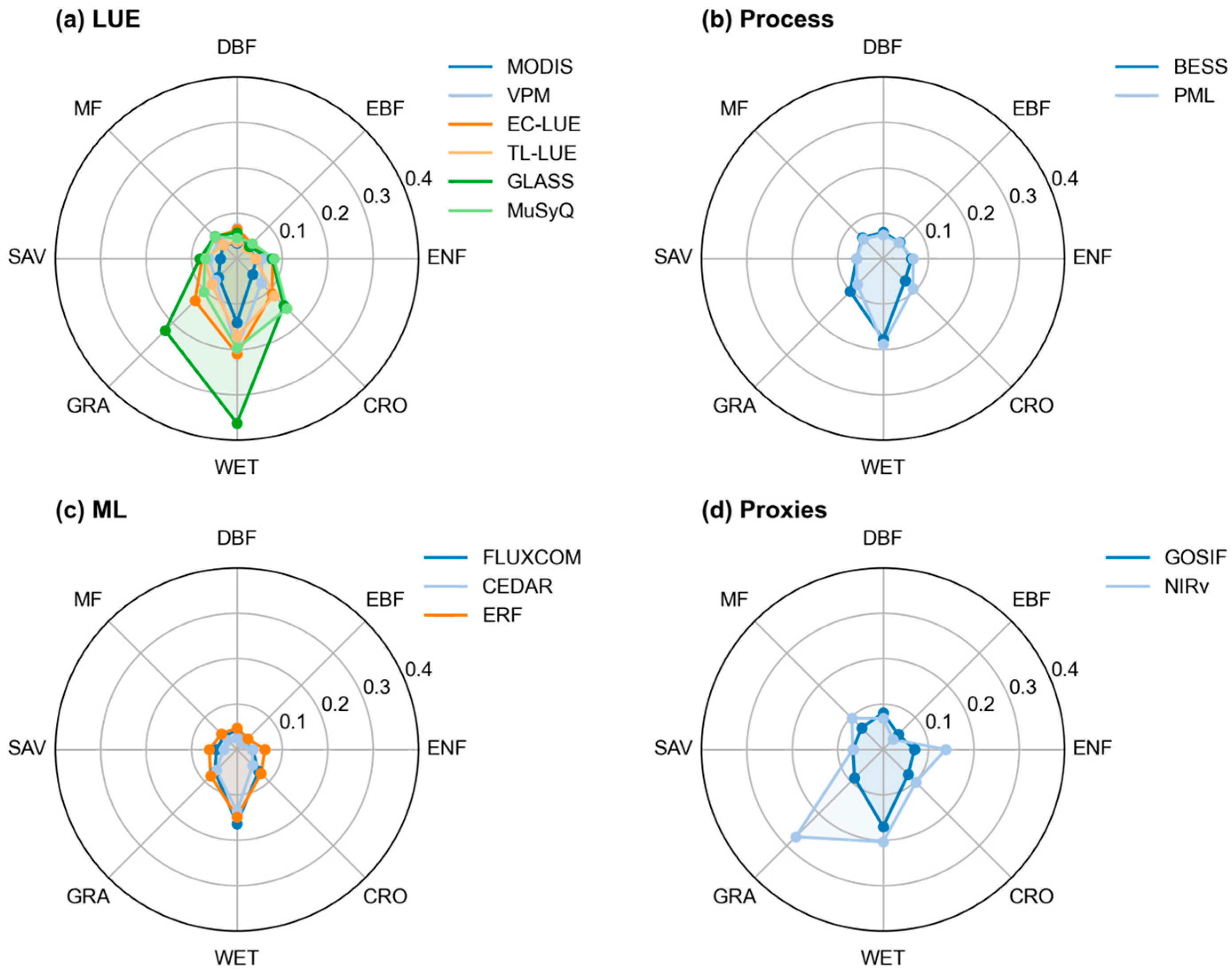
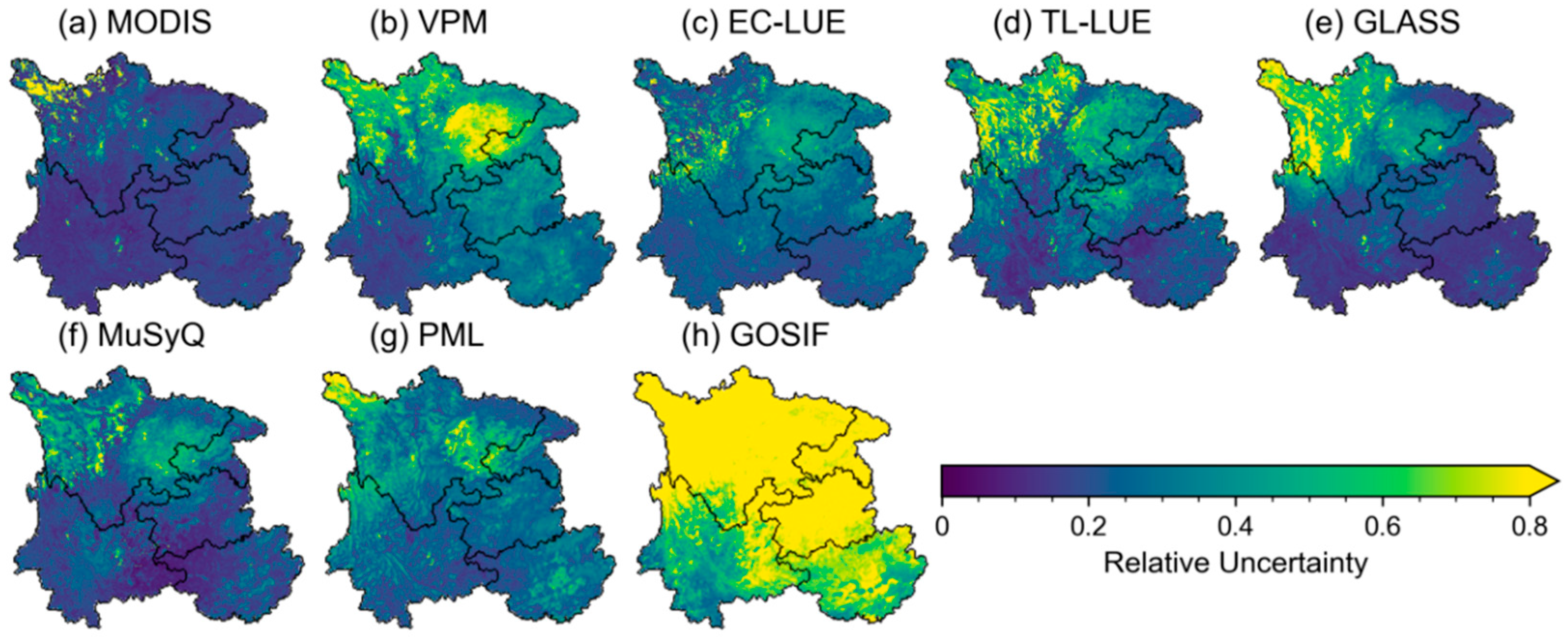
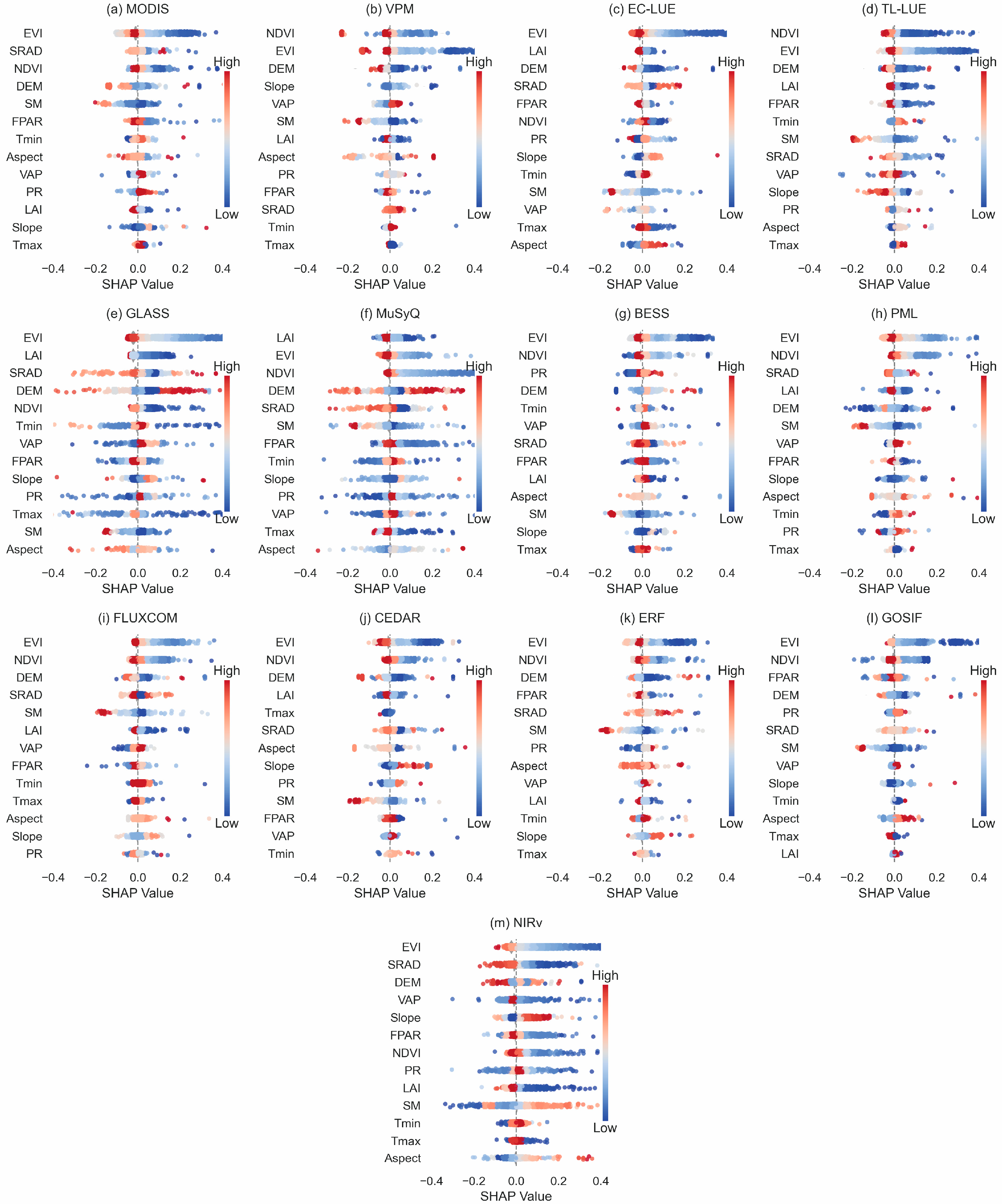
- Machine-learning-based GPP products demonstrate higher stability and lower relative uncertainty than other products, while vegetation indices, topography, and radiation emerge as the dominant drivers of GPP uncertainty.
- Quantitative uncertainty assessment using three-cornered hat and explainable machine learning methods provides an effective framework for evaluating GPP products in regions with complex terrain and sparse flux towers.
- The results offer practical guidance for region-specific GPP product selection and highlight key pathways for reducing uncertainty in carbon sink assessment under heterogeneous environmental conditions.
Abstract
1. Introduction
2. Materials and Methods
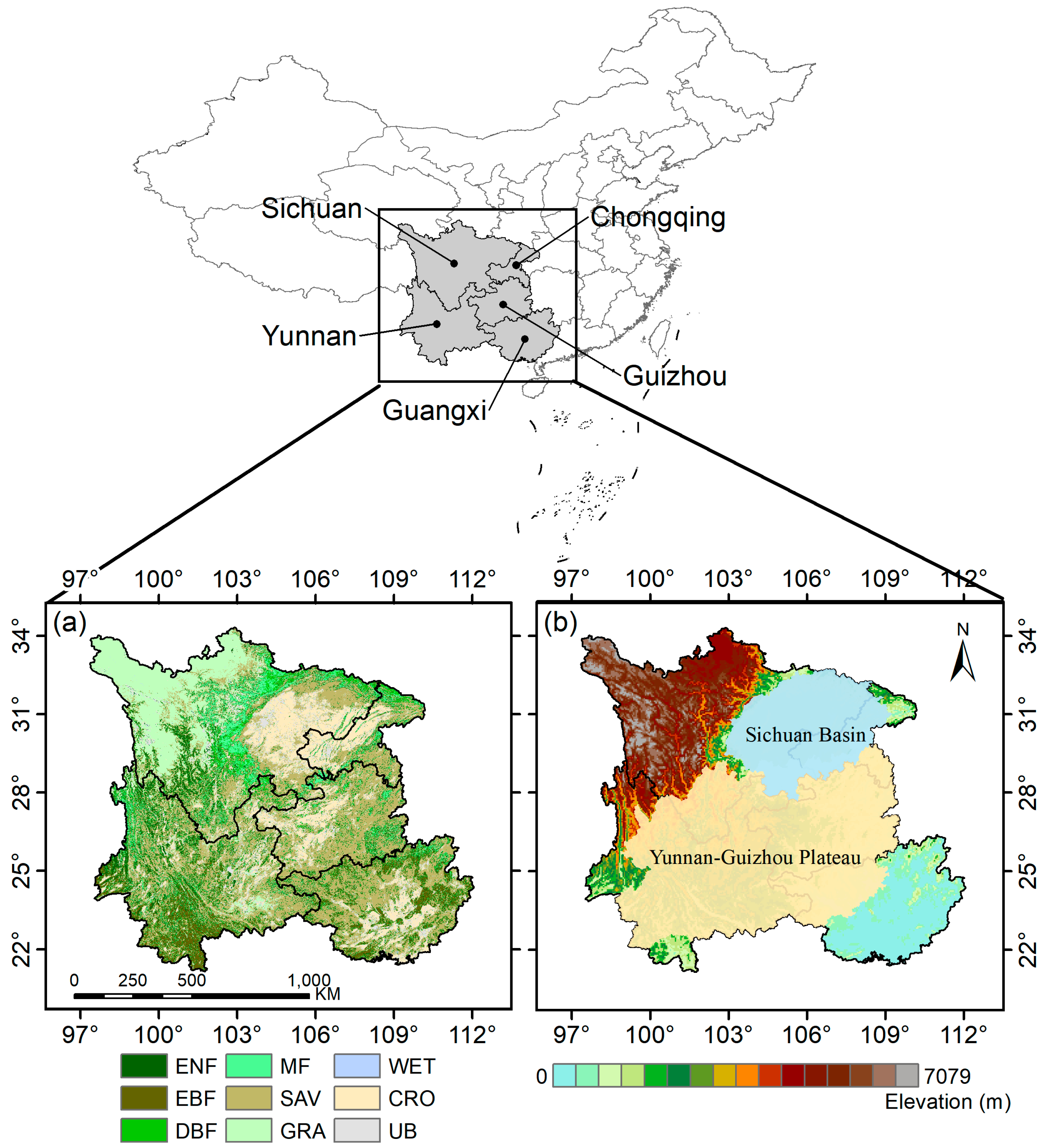
2.1. Study Area
2.2. Materials
2.2.1. GPP Remote-Sensing Products
- (1)
- LUE Products
- (a)
- The Moderate Resolution Imaging Spectroradiometer (MODIS) GPP product is derived based on the classical LUE framework. In this model, temperature and water stress are represented by the daily minimum temperature and the vapour pressure deficit (VPD), respectively [5,23]. In this study, we used the MOD17A2H V6.1 product, which is available from https://developers.google.com/earth-engine/datasets/catalog/MODIS_061_MOD17A2H (accessed on 12 February 2025). The estimation equation is given by:where is the fraction of photosynthetically active radiation absorbed by the canopy, is the photosynthetically active radiation, is the maximum light use efficiency, and are the temperature and water stress scalars, respectively, denotes the daily minimum temperature, and represents the vapour pressure deficit.
- (b)
- The Vegetation Photosynthesis Model (VPM) is developed based on the traditional LUE framework, with an emphasis on the regulation of actual light use efficiency by temperature, moisture, and phenology. The model employs the Land Surface Water Index (LSWI) to characterize water stress [24,25]. The dataset used in this study was obtained from https://data.casearth.cn/dataset/5c19a5660600cf2a3c557ad3?utm_source=chatgpt.com (accessed on 12 February 2025). The estimation equation is given by:where is the temperature scalar, and represent water and phenology stress functions, respectively, and denotes the land surface water index.
- (c)
- The Eddy Covariance Light Use Efficiency (EC-LUE) GPP is a flux-based approach that estimates GPP using eddy covariance tower observations. It assumes that light use efficiency is jointly constrained by temperature and water availability, with a focus on parameter optimization and generalization at the site scale [26,27]. The dataset used in this study was obtained from https://figshare.com/articles/dataset/Improved_estimate_of_global_gross_primary_production_for_reproducing_its_long-term_variation_1982-2017/8942336/3 (accessed on 12 February 2025). The estimation equation is given by:where denotes the minimum value between and , representing their combined limitation.
- (d)
- The Two-Leaf Light Use Efficiency (TL-LUE) model builds upon the MODIS GPP framework and assumes that the canopy consists of sunlit and shaded leaves. It separately models the photosynthetic activity of both components to enhance the estimation accuracy [28]. The data source is https://datadryad.org/dataset/doi:10.5061/dryad.dfn2z352k#methodsn (accessed on 12 February 2025). The estimation formula is expressed as:where and denote the light use efficiency of sunlit and shaded leaves, respectively, and and represent the absorbed photosynthetically active radiation by sunlit and shaded leaves, respectively.
- (e)
- The Global Land Surface Satellite (GLASS) GPP product is primarily based on the EC-LUE model and is driven by temperature, radiation, and vapour pressure deficit data derived from GLASS products [29]. The data source is https://www.geodata.cn/main/ (accessed on 12 February 2025).
- (f)
- The Multi-Source Data Synergized Quantitative (MuSyQ) GPP product builds upon the GLASS GPP dataset by incorporating the clear-sky index and vegetation functional types to analyse stress responses by integrating multi-source data [30]. The data source is https://www.geodata.cn/data/index.html?word=MuSyQ (accessed on 12 February 2025). The estimation formula is given as:where denotes the clear-sky index, and and represent the light use efficiency of sunlit and shaded leaves, respectively.
- (2)
- Process products
- (a)
- Breathing Earth System Simulator (BESS) GPP product is driven by multiple modules and represents a coupled simulation system integrating atmospheric radiative transfer, canopy radiative transfer, photosynthesis, two-leaf canopy conductance and temperature, and evapotranspiration. GPP is directly derived from energy and mass flux processes within this framework [31]. Data source: https://www.environment.snu.ac.kr/bessv2 (accessed on 12 February 2025).
- (b)
- Penman–Monteith–Leuning (PML) GPP is based on the Penman–Monteith–Leuning framework, which applies stomatal conductance theory to couple transpiration and photosynthesis. By constraining GPP and evapotranspiration (ET) simultaneously, the model enhances estimation robustness. Data source: https://zenodo.org/records/10647618 (accessed on 12 February 2025).
- (3)
- ML products
- (a)
- FLUXCOM GPP uses flux-tower-derived GPP as the reference and is computed using multiple machine learning algorithms [32]. The database provides two global gridded products: one driven by MODIS remote-sensing (RS) data and another driven by a combination of remote-sensing and meteorological (RS + METEO) data. In this study, the RS product with a spatial resolution of 0.083° is used. Data source: http://fluxcom.org/ (accessed on 12 February 2025).
- (b)
- Upscaling Ecosystem Dynamics with ARtificial intelligence (CEDAR) is a ML upscaling model that explicitly accounts for the atmospheric CO2 fertilisation effect, enabling more accurate estimation of terrestrial ecosystem carbon sink capacity [33]. In this study, the ST_DT GPP product from CEDAR is used. Data source: https://zenodo.org/records/8212707 (accessed on 12 February 2025).
- (c)
- Ensemble Random Forest (ERF) GPP is an upscaled dataset constructed using an ensemble random forest framework. By integrating multiple models, this approach improves generalisation performance and robustness [34]. Data source: https://bg.copernicus.org/articles/21/4285/2024/ (accessed on 12 February 2025).
- (4)
- Proxies products
- (a)
- Global OCO-2 Solar-Induced Fluorescence (GOSIF) GPP uses solar-induced chlorophyll fluorescence (SIF) as the core proxy and combines it with flux tower observations to estimate GPP [35]. Data source: https://globalecology.unh.edu/data/GOSIF-GPP.html (accessed on 12 February 2025).
- (b)
- Near-Infrared Reflectance of Vegetation (NIRv) GPP employs the near-infrared reflectance of vegetation index as a proxy for photosynthetic activity and estimates GPP using simple regression relationships [36]. Data source: https://figshare.com/articles/dataset/Long-term_1982-2018_global_gross_primary_production_dataset_based_on_NIRv/12981977/2 (accessed on 12 February 2025).
2.2.2. Ground-Based Flux Observation Data
2.2.3. Ancillary Datasets
2.3. Methods
2.3.1. Correlation Analysis
2.3.2. Trend Analysis
2.3.3. TCH Method
2.3.4. Quantitative Analysis of GPP Uncertainty
3. Results
3.1. Spatiotemporal Differences Among GPP Products
3.1.1. Spatial Differences Among GPP Products
3.1.2. Temporal Differences Among GPP Products
3.2. Uncertainty Analysis of Different GPP Products
3.2.1. Comparison Based on Flux Tower Observations
3.2.2. Relative Uncertainty of GPP Products
3.2.3. GPP Uncertainty Across Different Vegetation Types
3.3. GPP Uncertainty Under the Influencing Factors
4. Discussion
4.1. Differences Among GPP Products
4.2. Drivers of Uncertainty in GPP Products
4.3. Limitations and Outlook
5. Conclusions
- (1)
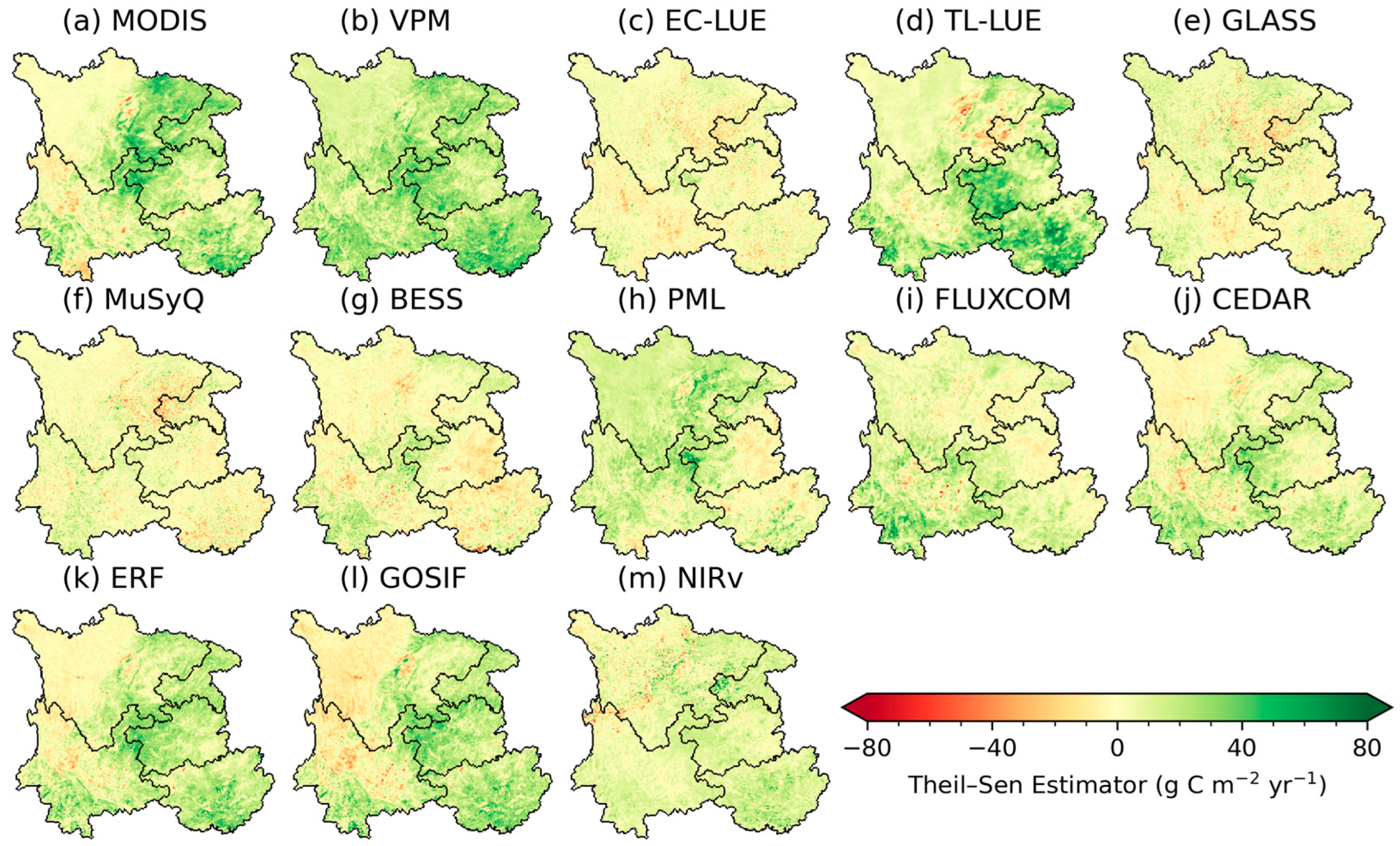
- The spatial patterns of most GPP products are broadly consistent, exhibiting a distribution characterised by “lower values in the northwest and higher values in the south”. In terms of temporal trends, GPP derived from Process model shows pronounced fluctuations in specific years (2010, 2011, and 2014), whereas variations in the other model categories are relatively small.
- (2)
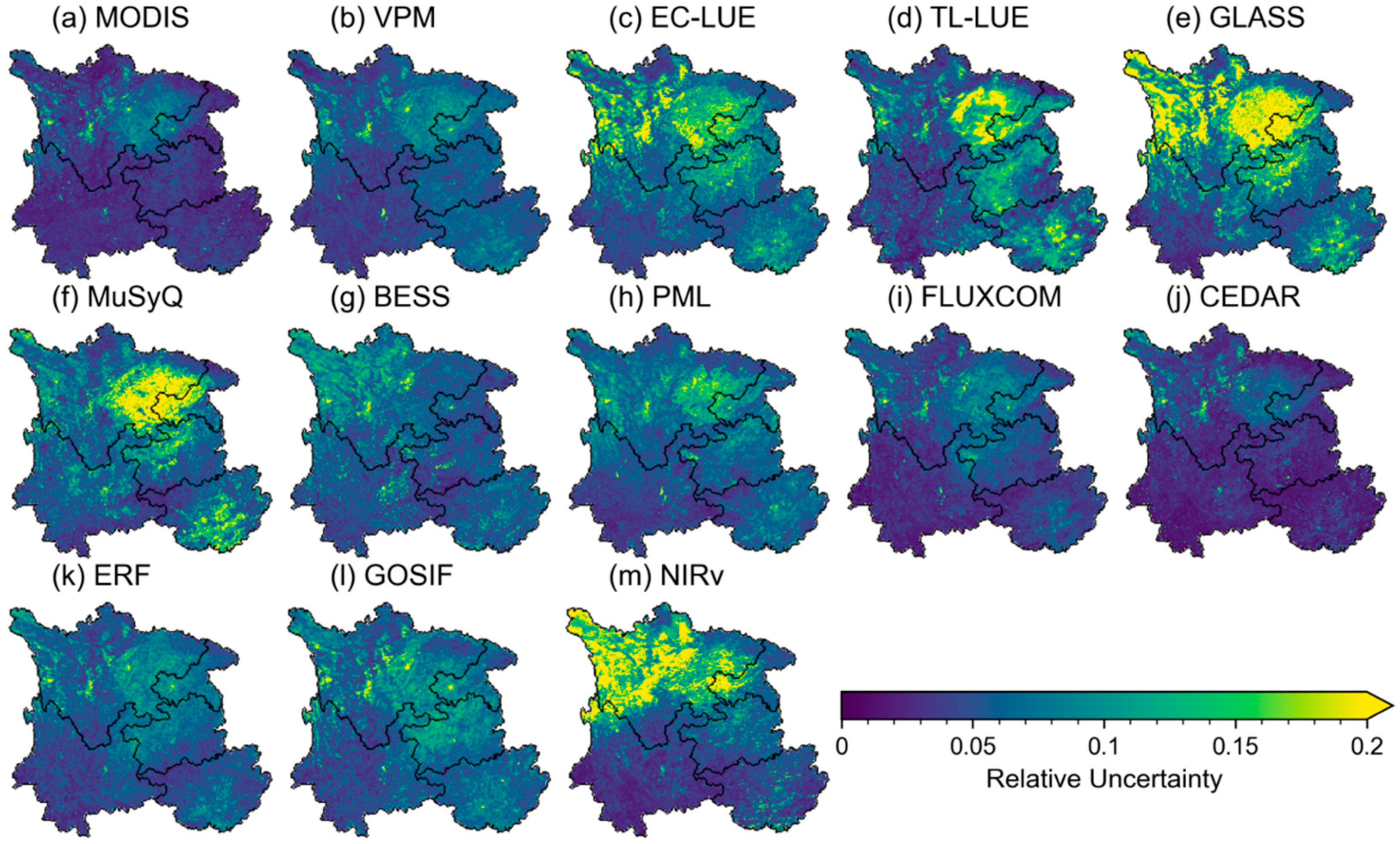
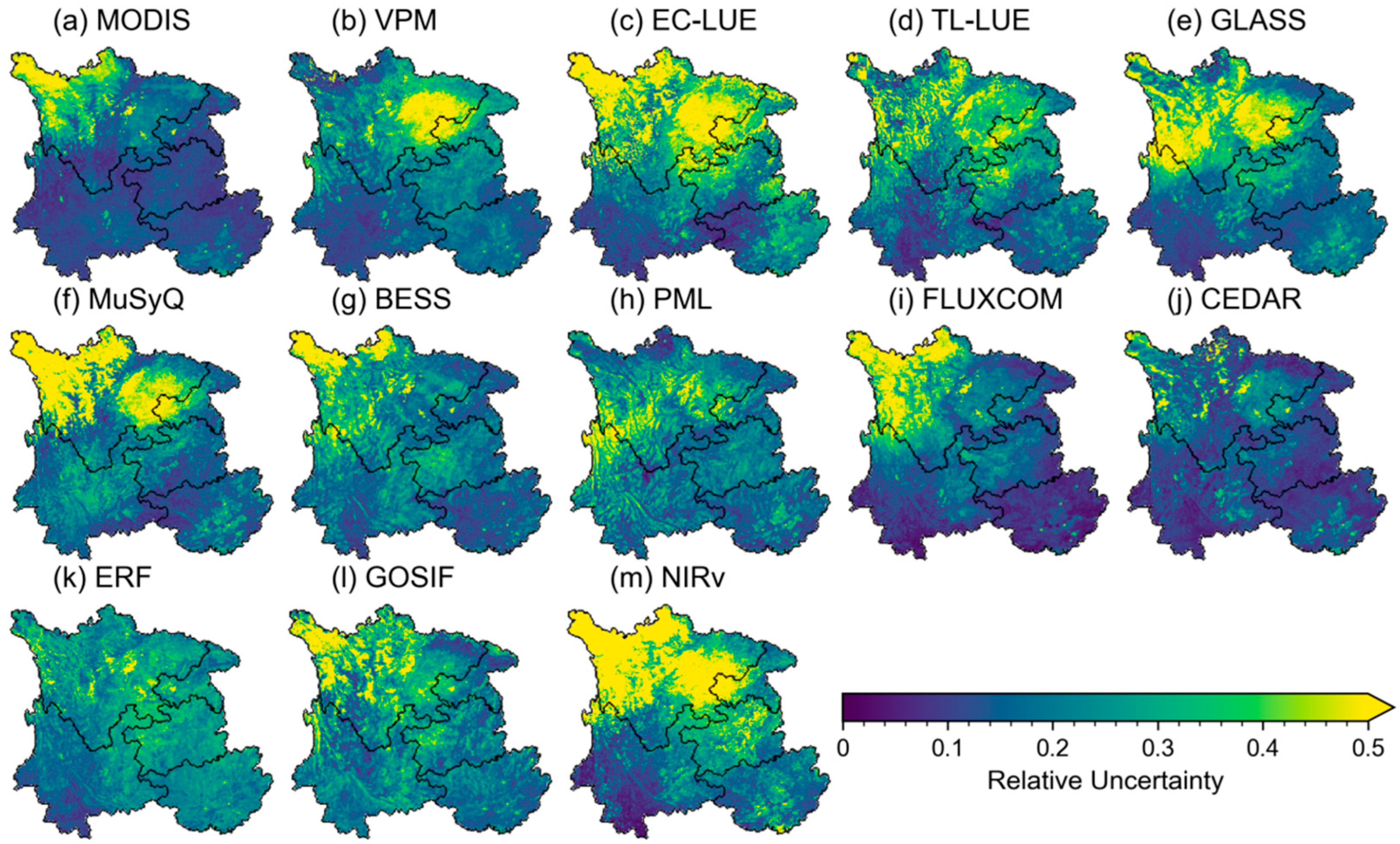
- The ranking of relative uncertainty across temporal scales is daily > monthly > annual. Products based on ML exhibit higher overall stability across model categories. Among the 13 products, CEDAR has the lowest relative uncertainty and shows a strong correlation with flux tower observations (r = 0.82), whereas EC-LUE has the highest relative uncertainty and the weakest correlation with flux tower data (r = 0.29).
- (3)
- Compared with other factors, EVI, NDVI, LAI, DEM, and SRAD contribute more substantially to GPP uncertainty, indicating that vegetation parameters, topography, and radiation in the complex mountainous terrain of Southwest China are key sources of uncertainty in GPP products.
Author Contributions
Funding
Data Availability Statement
Conflicts of Interest
References
- Beer, C.; Reichstein, M.; Tomelleri, E.; Ciais, P.; Jung, M.; Carvalhais, N.; Rödenbeck, C.; Arain, M.A.; Baldocchi, D.; Bonan, G.B.; et al. Terrestrial gross carbon dioxide uptake: Global distribution and covariation with climate. Science 2010, 329, 834–838. [Google Scholar] [CrossRef] [Scilit]
- Zheng, Y.; Zhang, L.; Xiao, J.; Yuan, W.; Yan, M.; Li, T.; Zhang, Z. Sources of uncertainty in gross primary productivity simulated by light use efficiency models: Model structure, parameters, input data, and spatial resolution. Agric. For. Meteorol. 2018, 263, 242–257. [Google Scholar] [CrossRef] [Scilit]
- Baldocchi, D. How eddy covariance flux measurements have contributed to our understanding of global change biology. Glob. Change Biol. 2020, 26, 242–260. [Google Scholar] [CrossRef] [Scilit]
- Monteith, J.L. Solar radiation and productivity in tropical ecosystems. J. Appl. Ecol. 1972, 9, 747–766. [Google Scholar] [CrossRef] [Scilit]
- Running, S.W.; Nemani, R.R.; Heinsch, F.A.; Zhao, M.; Reeves, M.; Hashimoto, H. A continuous satellite-derived measure of global terrestrial net primary production. BioScience 2004, 54, 547–560. [Google Scholar] [CrossRef] [Scilit]
- Ryu, Y.; Baldocchi, D.D.; Kobayashi, H.; van Ingen, C.; Li, J.; Black, T.A.; Beringer, J.; van Gorsel, E.; Knohl, A.; Law, B.E.; et al. Integration of MODIS land and atmosphere products with a coupled-process model to estimate gross primary productivity and evapotranspiration from 1 km to global scales. Global Biogeochem. Cycles 2011, 25, GB4017. [Google Scholar] [CrossRef] [Scilit]
- Gan, R.; Zhang, Y.; Shi, H.; Yang, Y.; Eamus, D.; Cheng, L.; Chiew, F.; Yu, Q. Use of satellite leaf area index estimating evapotranspiration and gross assimilation for Australian Ecosystems. Ecohydrology 2018, 11, e1974. [Google Scholar] [CrossRef] [Scilit]
- Anav, A.; Friedlingstein, P.; Beer, C.; Ciais, P.; Harper, A.; Jones, C.; Murray-Tortarolo, G.; Papale, D.; Parazoo, N.C.; Peylin, P.; et al. Spatiotemporal patterns of terrestrial gross primary production: A review. Rev. Geophys. 2015, 53, 785–818. [Google Scholar] [CrossRef] [Scilit]
- Tramontana, G.; Ichii, K.; Camps-Valls, G.; Tomelleri, E.; Papale, D. Uncertainty analysis of gross primary production upscaling using Random Forests, remote sensing and eddy covariance data. Remote Sens. Environ. 2015, 168, 360–373. [Google Scholar] [CrossRef] [Scilit]
- Jung, M.; Reichstein, M.; Margolis, H.A.; Cescatti, A.; Richardson, A.D.; Arain, M.A.; Arneth, A.; Bernhofer, C.; Bonal, D.; Chen, J.; et al. Global patterns of land-atmosphere fluxes of carbon dioxide, latent heat, and sensible heat derived from eddy covariance, satellite, and meteorological observations. J. Geophys. Res. 2011, 116, G00J07. [Google Scholar] [CrossRef] [Scilit]
- Badgley, G.; Field, C.B.; Berry, J.A. Canopy near-infrared reflectance and terrestrial photosynthesis. Sci. Adv. 2017, 3, e1602244. [Google Scholar] [CrossRef] [Scilit] [PubMed]
- Li, X.; Xiao, J.; He, B. Chlorophyll fluorescence observed by OCO-2 is strongly related to gross primary productivity estimated from flux towers in temperate forests. Remote Sens. Environ. 2018, 204, 659–671. [Google Scholar] [CrossRef] [Scilit]
- Wang, Z.; Chen, W.; Piao, J.; Cai, Q.; Chen, S.; Xue, X.; Ma, T. Synergistic effects of high atmospheric and soil dryness on record-breaking decreases in vegetation productivity over southwest China in 2023. NPJ Clim. Atmos. Sci. 2025, 8, 6. [Google Scholar] [CrossRef] [Scilit]
- Qiu, J. China drought highlights future climate threats. Nature 2010, 465, 142–143. [Google Scholar] [CrossRef] [Scilit]
- Tong, X.; Brandt, M.; Yue, Y.; Horion, S.; Wang, K.; De Keersmaecker, W.; Tian, F.; Schurgers, G.; Xiao, X.; Luo, Y.; et al. Increased vegetation growth and carbon stock in China karst via ecological engineering. Nat. Sustain. 2018, 1, 44–50. [Google Scholar] [CrossRef] [Scilit]
- Wang, J.; Feng, L.; Palmer, P.I.; Liu, Y.; Fang, S.; Bösch, H.; O’Dell, C.W.; Tang, X.; Yang, D.; Liu, L.; et al. Large Chinese land carbon sink estimated from atmospheric carbon dioxide data. Nature 2020, 586, 720–723. [Google Scholar] [CrossRef] [Scilit]
- Peng, B.; Zhou, Z.; Cai, W.; Li, M.; Xu, L.; He, N. Maximum potential of vegetation carbon sink in Chinese forests. Sci. Total Environ. 2023, 905, 167325. [Google Scholar] [CrossRef] [Scilit] [PubMed]
- Xie, X.; Li, A.; Chen, J.M.; Guan, X.; Leng, J. Quantifying scaling effect on gross primary productivity estimation in the upscaling process of surface heterogeneity. J. Geophys. Res. Biogeosci. 2022, 127, e2021JG006775. [Google Scholar] [CrossRef] [Scilit]
- Coops, N.C.; Waring, R.H. The use of multiscale remote sensing imagery to derive regional estimates of forest growth capacity using 3-PGS. Remote Sens. Environ. 2001, 75, 324–334. [Google Scholar] [CrossRef] [Scilit]
- Zhao, M.; Running, S.W. Drought-induced reduction in global terrestrial net primary production from 2000 through 2009. Science 2010, 329, 940–943. [Google Scholar] [CrossRef] [Scilit] [PubMed]
- Chen, H.; Chen, H.; Huang, X.; Zhang, S.; He, T. Landscape ecological risk assessment and driving factor analysis in southwest China. Sci. Rep. 2024, 14, 23208. [Google Scholar] [CrossRef] [Scilit]
- Zhang, W.; Luo, G.; Hamdi, R.; Ma, X.; Li, Y.; Yuan, X.; Li, C.; Ling, Q.; Hellwich, O.; Termonia, P.; et al. Can gross primary productivity products be effectively evaluated in regions with few observation data? GIScience Remote Sens. 2023, 60, 2213489. [Google Scholar] [CrossRef] [Scilit]
- Zhao, M.; Heinsch, F.; Nemani, R.; Running, S. Improvements of the MODIS terrestrial gross and net primary production global data set. Remote Sens. Environ. 2005, 95, 164–176. [Google Scholar] [CrossRef] [Scilit]
- Xiao, X.; Hollinger, D.; Aber, J.; Goltz, M.; Davidson, E.A.; Zhang, Q.; Moore, B. Satellite-based modeling of gross primary production in an evergreen needleleaf forest. Remote Sens. Environ. 2004, 89, 519–534. [Google Scholar] [CrossRef] [Scilit]
- Xiao, X.; Zhang, Q.; Braswell, B.; Urbanski, S.; Boles, S.; Wofsy, S.; Berrien, M.; Ojima, D. Modeling gross primary production of temperate deciduous broadleaf forest using satellite images and climate data. Remote Sens. Environ. 2004, 91, 256–270. [Google Scholar] [CrossRef]
- Yuan, W.; Liu, S.; Zhou, G.; Zhou, G.; Tieszen, L.L.; Baldocchi, D.; Bernhofer, C.; Gholz, H.; Goldstein, A.H.; Goulden, M.L.; et al. Deriving a light use efficiency model from eddy covariance flux data for predicting daily gross primary production across biomes. Agric. For. Meteorol. 2007, 143, 189–207. [Google Scholar] [CrossRef] [Scilit]
- Yuan, W.; Zheng, Y.; Piao, S.; Ciais, P.; Lombardozzi, D.; Wang, Y.; Ryu, Y.; Chen, G.; Dong, W.; Hu, Z.; et al. Increased atmospheric vapor pressure deficit reduces global vegetation growth. Sci. Adv. 2019, 5, eaax1396. [Google Scholar] [CrossRef] [Scilit]
- He, M.; Ju, W.; Zhou, Y.; Chen, J.; He, H.; Wang, S.; Wang, H.; Guan, D.; Yan, J.; Li, Y.; et al. Development of a two-leaf light use efficiency model for improving the calculation of terrestrial gross primary productivity. Agric. For. Meteorol. 2013, 173, 28–39. [Google Scholar] [CrossRef] [Scilit]
- Liang, S.; Cheng, J.; Jia, K.; Jiang, B.; Liu, Q.; Xiao, Z.; Yao, Y.; Yuan, W.; Zhang, X.; Zhao, X.; et al. The global land surface satellite (GLASS) product suite. Bull. Am. Meteorol. Soc. 2021, 102, E323–E337. [Google Scholar] [CrossRef] [Scilit]
- Wang, J.; Sun, R.; Zhang, H.; Xiao, Z.; Zhu, A.; Wang, M.; Yu, T.; Xiang, K. New global MuSyQ GPP/NPP remote sensing products from 1981 to 2018. IEEE J. Sel. Top. Appl. Earth Obs. Remote Sens. 2021, 14, 5596–5612. [Google Scholar] [CrossRef] [Scilit]
- Li, B.; Ryu, Y.; Jiang, C.; Dechant, B.; Liu, J.; Yan, Y.; Li, X. BESSv2.0: A satellite-based and coupled-process model for quantifying long-term global land–atmosphere fluxes. Remote Sens. Environ. 2023, 295, 113696. [Google Scholar] [CrossRef] [Scilit]
- Jung, M.; Koirala, S.; Weber, U.; Ichii, K.; Gans, F.; Camps-Valls, G.; Papale, D.; Schwalm, C.; Tramontana, G.; Reichstein, M. The FLUXCOM ensemble of global land–atmosphere energy fluxes. Sci. Data 2019, 6, 74. [Google Scholar] [CrossRef] [Scilit]
- Kang, Y.; Bassiouni, M.; Gaber, M.; Lu, X.; Keenan, T.F. CEDAR-GPP: A spatiotemporally upscaled dataset of gross primary productivity incorporating CO2 fertilization. Earth Syst. Sci. Data 2025, 17, 3009–3046. [Google Scholar] [CrossRef] [Scilit]
- Chen, X.; Chen, T.; Li, X.; Chai, Y.; Zhou, S.; Guo, R.; Dai, J. A 2001–2022 global gross primary productivity dataset using an ensemble model based on the random forest method. Biogeosciences 2024, 21, 4285–4300. [Google Scholar] [CrossRef] [Scilit]
- Li, X.; Xiao, J. A global, 0.05-degree product of solar-induced chlorophyll fluorescence derived from OCO-2, MODIS, and reanalysis data. Remote Sens. 2019, 11, 517. [Google Scholar] [CrossRef] [Scilit]
- Yuan, W.; Liu, S.; Yu, G.; Bonnefond, J.-M.; Chen, J.; Davis, K.; Desai, A.R.; Goldstein, A.H.; Gianelle, D.; Rossi, F.; et al. Global estimates of evapotranspiration and gross primary production based on MODIS and global meteorology data. Remote Sens. Environ. 2010, 114, 1416–1431. [Google Scholar] [CrossRef] [Scilit]
- Chen, W.; Wang, S.; Niu, S. A dataset of carbon, water and heat fluxes of Zoige alpine meadow from 2015 to 2020. China Sci. Data 2023, 8, 1–8. [Google Scholar] [CrossRef] [Scilit]
- Qi, D.; Yang, D.; Song, Q.; Liu, Y.; Zhang, Y.; Fei, X.; Sha, L.; Zhou, W.; Chen, A.; Wen, G.; et al. An observation dataset of carbon and water fluxes at Yuanjiang dry-hot valley ecological station (2013–2015). China Sci. Data 2021, 6. [Google Scholar] [CrossRef] [Scilit]
- Qi, D.; Fei, X.; Song, Q.; Zhang, Y.; Sha, L.; Liu, Y.; Zhou, W.; Lu, Z.; Fan, Z. A dataset of carbon and water fluxes observation in subtropical evergreen broad-leaved forest in Ailao Shan from 2009 to 2013. China Sci. Data 2021, 6. [Google Scholar] [CrossRef] [Scilit]
- Qi, D.; Zhang, Y.; Song, Q.; Fei, X.; Sha, L.; Liu, Y.; Zhou, W.; Zhou, L.; Deng, X.; Luo, Y.; et al. A dataset of carbon, water and energy fluxes observed in Xishuangbanna tropical seasonal rain forest from 2003 to 2010. China Sci. Data 2021, 6. [Google Scholar] [CrossRef] [Scilit]
- Wang, Y.; Luo, W.; Chen, J.; Cai, X.; Zhang, L.; Cheng, A.; Wang, S. A dataset of carbon and water fluxes in the sample plots of natural regeneration at Puding station of Guizhou Province (2015–2019). China Sci. Data 2023, 8. [Google Scholar] [CrossRef] [Scilit]
- Didan, K. MOD13A2 MODIS/Terra vegetation indices 16-day L3 global 1 km SIN grid (Version 006). NASA Eosdis 2015. [Google Scholar] [CrossRef] [Scilit]
- Myneni, R.; Knyazikhin, Y.; Park, T. MODIS/Terra leaf area index/FPAR 8-day L4 global 500 m SIN grid (Version 061). NASA Eosdis 2021. [Google Scholar] [CrossRef]
- Friedl, M.; Sulla-Menashe, D. MODIS/Terra+Aqua land cover type yearly L3 global 0.05° CMG (Version 061). NASA Eosdis 2022. [Google Scholar] [CrossRef]
- Abatzoglou, J.T.; Dobrowski, S.Z.; Parks, S.A.; Hegewisch, K.C. TerraClimate, a high-resolution global dataset of monthly climate and climatic water balance from 1958–2015. Sci. Data 2018, 5, 170191. [Google Scholar] [CrossRef] [Scilit]
- Carabajal, C.C.; Harding, D.J.; Boy, J.-P.; Danielson, J.J.; Gesch, D.B.; Suchdeo, V.P. Evaluation of the Global Multi-Resolution Terrain Elevation Data 2010 (GMTED2010) using ICESat geodetic control. Proc. SPIE 2011, 8286, 82861Y. [Google Scholar]
- Lu, M.; Sun, H.; Yang, Y.; Xue, J.; Ling, H.; Zhang, H.; Zhang, W. Assessing recovery time of ecosystems in China: Insights into flash drought impacts on gross primary productivity. Hydrol. Earth Syst. Sci. 2025, 29, 613–625. [Google Scholar] [CrossRef] [Scilit]
- Premoli, A.; Tavella, P. A revisited three-cornered hat method for estimating frequency standard instability. IEEE Trans. Instrum. Meas. 1993, 42, 7–13. [Google Scholar] [CrossRef]
- Grekousis, G. Geographical-XGBoost: A new ensemble model for spatially local regression based on gradient-boosted trees. J. Geogr. Syst. 2025, 27, 169–195. [Google Scholar] [CrossRef] [Scilit]
- Zhao, Y.; Wang, L.; Jiang, Q.; Wang, Z. Sensitivity of gross primary production to precipitation and the driving factors in China’s agricultural ecosystems. Sci. Total Environ. 2024, 948, 174938. [Google Scholar] [CrossRef] [Scilit]
- Fang, H.; Baret, F.; Plummer, S.; Schaepman-Strub, G. An overview of global leaf area index (LAI): Methods, products, validation, and applications. Rev. Geophys. 2019, 57, 739–799. [Google Scholar] [CrossRef] [Scilit]
- Zheng, Y.; Shen, R.; Wang, Y.; Li, X.; Liu, S.; Liang, S.; Chen, J.M.; Ju, W.; Zhang, L.; Yuan, W. Improved estimate of global gross primary production for reproducing its long-term variation, 1982–2017. Earth Syst. Sci. Data 2020, 12, 2725–2746. [Google Scholar] [CrossRef] [Scilit]
- Tong, L.; He, T.; Ma, Y.; Zhang, X. Evaluation and intercomparison of multiple satellite-derived and reanalysis downward shortwave radiation products in China. Int. J. Digit. Earth 2023, 16, 1853–1884. [Google Scholar] [CrossRef] [Scilit]
- Lu, H.; Xie, M.; Zhuang, B.; Ma, D.; Liu, B.; Zhan, Y.; Wang, T.; Li, S.; Li, M.; Zhu, K. Impacts of atmospheric circulation patterns and cloud inhibition on aerosol radiative effect and boundary layer structure during winter air pollution in Sichuan Basin, China. Atmos. Chem. Phys. 2024, 24, 8963–8982. [Google Scholar] [CrossRef] [Scilit]
- Wang, M.; Sun, R.; Zhu, A.; Xiao, Z. Evaluation and comparison of light use efficiency and gross primary productivity using three different approaches. Remote Sens. 2020, 12, 1003. [Google Scholar] [CrossRef] [Scilit]
- Jin, J.; Hou, W.; Wang, L.; Wang, S.; Wang, Y.; Zhu, Q.; Fang, X.; Ren, L. Non-ignorable differences in NIRv-based estimations of gross primary productivity considering land cover change and discrepancies in multisource products. Remote Sens. 2023, 15, 4693. [Google Scholar] [CrossRef] [Scilit]
- Badgley, G.; Anderegg, L.D.L.; Berry, J.A.; Field, C.B. Terrestrial gross primary production: Using NIRv to scale from site to globe. Glob. Change Biol. 2019, 25, 3731–3740. [Google Scholar] [CrossRef] [Scilit] [PubMed]
- Jung, M.; Schwalm, C.; Migliavacca, M.; Walther, S.; Camps-Valls, G.; Koirala, S.; Anthoni, P.; Besnard, S.; Bodesheim, P.; Carvalhais, N.; et al. Scaling carbon fluxes from eddy covariance sites to globe: Synthesis and evaluation of the FLUXCOM approach. Biogeosciences 2020, 17, 1343–1365. [Google Scholar] [CrossRef] [Scilit]
- Xu, X.; Jiao, F.; Lin, D.; Liu, J.; Zhang, K.; Yang, R.; Lin, N.; Zou, C. Carbon Sink Trends in the Karst Regions of Southwest China: Impacts of Ecological Restoration and Climate Change. Land 2023, 12, 1906. [Google Scholar] [CrossRef] [Scilit]
- Yu, T.; Sun, R.; Xiao, Z.; Zhang, Q.; Liu, G.; Cui, T.; Wang, J. Estimation of global vegetation productivity from global land surface satellite data. Remote Sens. 2018, 10, 327. [Google Scholar] [CrossRef] [Scilit]
- Liu, L.; Gao, X.; Cao, B.; Ba, Y.; Chen, J.; Cheng, X.; Zhou, Y.; Huang, H.; Zhang, J. Comparing different light use efficiency models to estimate the gross primary productivity of a cork oak plantation in northern China. Remote Sens. 2022, 14, 5905. [Google Scholar] [CrossRef] [Scilit]
- Zhang, X.; Yue, Y.; Tong, X.; Wang, K.; Qi, X.; Deng, C.; Brandt, M. Eco-engineering controls vegetation trends in southwest China karst. Sci. Total Environ. 2021, 770, 145160. [Google Scholar] [CrossRef] [Scilit]
- Wang, Y.; She, X.; Zhu, C.; Chen, J.; Kong, D.; Shi, W.; Guan, X.; Xie, Q.; Gao, X.; Li, W.; et al. Unveiling the accuracy of global GPP products in data-scarce mountain ecosystems of southwest China. Int. J. Appl. Earth Obs. Geoinf. 2025, 144, 104908. [Google Scholar] [CrossRef] [Scilit]
- Yuan, W.; Tian, J.; Wang, M.; Wang, S.; Xu, W.; Wang, Y.; Fu, Z.; Girardin, M.P.; Green, J.K.; Zhou, S.; et al. Impacts of rising atmospheric dryness on terrestrial ecosystem carbon cycle. Nat. Rev. Earth Environ. 2025, 6, 712–727. [Google Scholar] [CrossRef] [Scilit]
- Zheng, H.; Lin, H.; Zhu, X.; Jin, Z.; Bao, H. Divergent spatial responses of plant and ecosystem water-use efficiency to climate and vegetation gradients in the Chinese Loess Plateau. Glob. Planet. Change 2019, 181, 102995. [Google Scholar] [CrossRef] [Scilit]
- He, H.; Liu, M.; Xiao, X.; Ren, X.; Zhang, L.; Sun, X.; Yang, Y.; Li, Y.; Zhao, L.; Shi, P.; et al. Large-scale estimation and uncertainty analysis of gross primary production in Tibetan alpine grasslands. J. Geophys. Res. Biogeosci. 2014, 119, 466–486. [Google Scholar] [CrossRef] [Scilit]
- Li, Y.; Zhang, Y.; Lv, J. Interannual variations in GPP in forest ecosystems in southwest China and regional differences in the climatic contributions. Ecol. Inform. 2022, 69, 101591. [Google Scholar] [CrossRef] [Scilit]
- Liu, Y.; Xiao, J.; Ju, W.; Zhu, G.; Wu, X.; Fan, W.; Li, D.; Zhou, Y. Satellite-derived LAI products exhibit large discrepancies and can lead to substantial uncertainty in simulated carbon and water fluxes. Remote Sens. Environ. 2018, 206, 174–188. [Google Scholar] [CrossRef] [Scilit]
- Piao, S.; Yin, G.; Tan, J.; Cheng, L.; Huang, M.; Li, Y.; Liu, R.; Mao, J.; Myneni, R.B.; Peng, S.; et al. Detection and attribution of vegetation greening trend in China over the last 30 years. Glob. Change Biol. 2015, 21, 1601–1609. [Google Scholar] [CrossRef] [Scilit] [PubMed]
- Zhang, Y.; Kong, D.; Gan, R.; Chiew, F.H.S.; McVicar, T.R.; Zhang, Q.; Yang, Y. Coupled estimation of 500 m and 8-day resolution global evapotranspiration and gross primary production in 2002–2017. Remote Sens. Environ. 2019, 222, 165–182. [Google Scholar] [CrossRef] [Scilit]
- Knauer, J.; Werner, C.; Zaehle, S. Evaluating stomatal models and their atmospheric drought response in a land surface scheme: A multibiome analysis. J. Geophys. Res. Biogeosci. 2015, 120, 1894–1911. [Google Scholar] [CrossRef] [Scilit]
- Wu, J.; Serbin, S.P.; Ely, K.S.; Wolfe, B.T.; Dickman, L.T.; Grossiord, C.; Michaletz, S.T.; Collins, A.D.; Detto, M.; McDowell, N.G.; et al. The response of stomatal conductance to seasonal drought in tropical forests. Glob. Change Biol. 2020, 26, 823–839. [Google Scholar] [CrossRef] [Scilit]
- Zheng, Y.; Zhao, W.; Chen, A.; Chen, Y.; Chen, J.; Zhu, Z. Vegetation canopy structure mediates the response of gross primary production to environmental drivers across multiple temporal scales. Sci. Total Environ. 2024, 917, 170439. [Google Scholar] [CrossRef] [Scilit] [PubMed]
- Fratini, G.; Sabbatini, S.; Ediger, K.; Riensche, B.; Burba, G.; Nicolini, G.; Vitale, D.; Papale, D. Eddy covariance flux errors due to random and systematic timing errors during data acquisition. Biogeosciences 2018, 15, 5473–5487. [Google Scholar] [CrossRef] [Scilit]
- Fang, J.; Chen, B.; Zhang, H.; Dilawar, A.; Guo, M.; Liu, S. Assessing spatial representativeness of global flux tower eddy-covariance measurements using data from FLUXNET2015. Sci. Data 2024, 11, 569. [Google Scholar] [CrossRef] [Scilit] [PubMed]
- Xu, T.; Guo, Z.; Xia, Y.; Ferreira, V.G.; Liu, S.; Wang, K.; Yao, Y.; Zhang, X.; Zhao, C. Evaluation of twelve evapotranspiration products from machine learning, remote sensing and land surface models over conterminous United States. J. Hydrol. 2019, 578, 124105. [Google Scholar] [CrossRef] [Scilit]
- Liu, J.; Fang, J.; Chai, L.; Dong, J.; Zheng, D.; Wigneron, J.-P.; Liu, S.; Zhou, J.; Xu, T.; Yang, S.; et al. Uncertainty analysis of eleven multisource soil moisture products in the Third Pole environment based on the three-cornered hat method. Remote Sens. Environ. 2021, 255, 112225. [Google Scholar] [CrossRef] [Scilit]
- Mercado, L.M.; Bellouin, N.; Sitch, S.; Boucher, O.; Huntingford, C.; Wild, M.; Cox, P.M. Impact of changes in diffuse radiation on the global land carbon sink. Nature 2009, 458, 1014–1017. [Google Scholar] [CrossRef] [Scilit]
- Cai, W.; Yuan, W.; Liang, S.; Zhang, X.; Dong, W.; Xia, J.; Fu, Y.; Chen, Y.; Liu, D.; Zhang, Q. Improved estimations of gross primary production using satellite-derived photosynthetically active radiation. J. Geophys. Res. Biogeosci. 2014, 119, 110–123. [Google Scholar] [CrossRef] [Scilit]
- Xing, X.; Wu, M.; Zhang, W.; Ju, W.; Tagesson, T.; He, W.; Wang, S.; Wang, J.; Hu, L.; Yuan, S.; et al. Modeling China’s terrestrial ecosystem gross primary productivity with the BEPS model: Parameter sensitivity analysis and model calibration. Agric. For. Meteorol. 2023, 343, 109789. [Google Scholar] [CrossRef] [Scilit]
- Chen, A.; Mao, J.; Ricciuto, D.; Lu, D.; Xiao, J.; Li, X.; Thornton, P.E.; Knapp, A.K. Seasonal changes in GPP/SIF ratios and their climatic determinants across the Northern Hemisphere. Glob. Change Biol. 2021, 27, 5186–5197. [Google Scholar] [CrossRef] [Scilit] [PubMed]





| Type | Product | Temporal Resolution | Spatial Resolution | Temporal Coverage |
|---|---|---|---|---|
| LUE | MODIS | 8-day | 0.05° | 2000–present |
| VPM | 8-day | 0.05° | 2000–2020 | |
| EC-LUE | 8-day | 0.05° | 1982–2017 | |
| TL-LUE | 8-day | 0.05° | 1992–2020 | |
| GLASS | 8-day | 0.05° | 1982–2018 | |
| MuSyQ | 8-day | 0.05° | 1981–2018 | |
| Process | BESS | 8-day | 0.05° | 1982–2019 |
| PML | 8-day | 0.05° | 2000–2023 | |
| ML | FLUXCOM | Monthly | 0.083° | 2001–2015 |
| CEDAR | Monthly | 0.05° | 2001–2020 | |
| ERF | Monthly | 0.05° | 2001–2022 | |
| Proxies | GOSIF | 8-day | 0.05° | 2000–2024 |
| NIRv | Monthly | 0.05° | 1982–2018 |
| Site Name | Site | Longitude | Latitude | Time Period | Reference |
|---|---|---|---|---|---|
| Xishuangbanna | XSBN | 105°15′55″E | 21°55′39″N | 2003–2010 | [40] |
| Ailao Mountains | ALS | 101°01′40″E | 24°32′26″N | 2005–2007 | [39] |
| Puding | PD | 105°47′24″E | 26°21′36″N | 2015–2019 | [41] |
| Yuanjiang | YJ | 102°10′39″E | 23°28′26″N | 2013–2015 | [38] |
| Zoigê | RGE | 102°19′48″E | 32°28′48″N | 2015–2019 | [37] |
| Type | Product | r | RMSE g C m−2 mon−1 | MAE g C m−2 mon−1 |
|---|---|---|---|---|
| LUE | MODIS | 0.72 | 67.30 | 57.79 |
| VPM | 0.77 | 48.19 | 38.76 | |
| EC-LUE | 0.29 | 81.80 | 65.78 | |
| TL-LUE | 0.80 | 78.59 | 68.54 | |
| GLASS | 0.75 | 66.65 | 55.39 | |
| MuSyQ | 0.67 | 55.96 | 47.06 | |
| Process | BESS | 0.75 | 75.05 | 63.40 |
| PML | 0.49 | 77.04 | 64.49 | |
| ML | FLUXCOM | 0.73 | 50.89 | 39.13 |
| CEDAR | 0.82 | 54.33 | 43.44 | |
| ERF | 0.80 | 77.83 | 66.62 | |
| Proxies | GOSIF | 0.80 | 74.70 | 59.85 |
| NIRv | 0.56 | 84.04 | 69.06 |
Disclaimer/Publisher’s Note: The statements, opinions and data contained in all publications are solely those of the individual author(s) and contributor(s) and not of MDPI and/or the editor(s). MDPI and/or the editor(s) disclaim responsibility for any injury to people or property resulting from any ideas, methods, instructions or products referred to in the content. |
© 2026 by the authors. Licensee MDPI, Basel, Switzerland. This article is an open access article distributed under the terms and conditions of the Creative Commons Attribution (CC BY) license.
Share and Cite
Ge, Z.; Qu, Y.; Teng, H.; Tang, B.-H. Uncertainty Analysis of Gross Primary Production (GPP) Remote-Sensing Products and Its Influencing Factors in Southwest China. Remote Sens. 2026, 18, 764. https://doi.org/10.3390/rs18050764
Ge Z, Qu Y, Teng H, Tang B-H. Uncertainty Analysis of Gross Primary Production (GPP) Remote-Sensing Products and Its Influencing Factors in Southwest China. Remote Sensing. 2026; 18(5):764. https://doi.org/10.3390/rs18050764
Chicago/Turabian StyleGe, Zhongxi, Yanda Qu, Huiqin Teng, and Bo-Hui Tang. 2026. "Uncertainty Analysis of Gross Primary Production (GPP) Remote-Sensing Products and Its Influencing Factors in Southwest China" Remote Sensing 18, no. 5: 764. https://doi.org/10.3390/rs18050764
APA StyleGe, Z., Qu, Y., Teng, H., & Tang, B.-H. (2026). Uncertainty Analysis of Gross Primary Production (GPP) Remote-Sensing Products and Its Influencing Factors in Southwest China. Remote Sensing, 18(5), 764. https://doi.org/10.3390/rs18050764