Evaluating Disturbance Regime Stratification for Aboveground Biomass Estimation in a Heterogeneous Forest Landscape: Insights from the Atewa Landscape, Ghana


Highlights
- Excessive heterogeneity or homogeneity in regimes may affect forest aboveground biomass modeling.
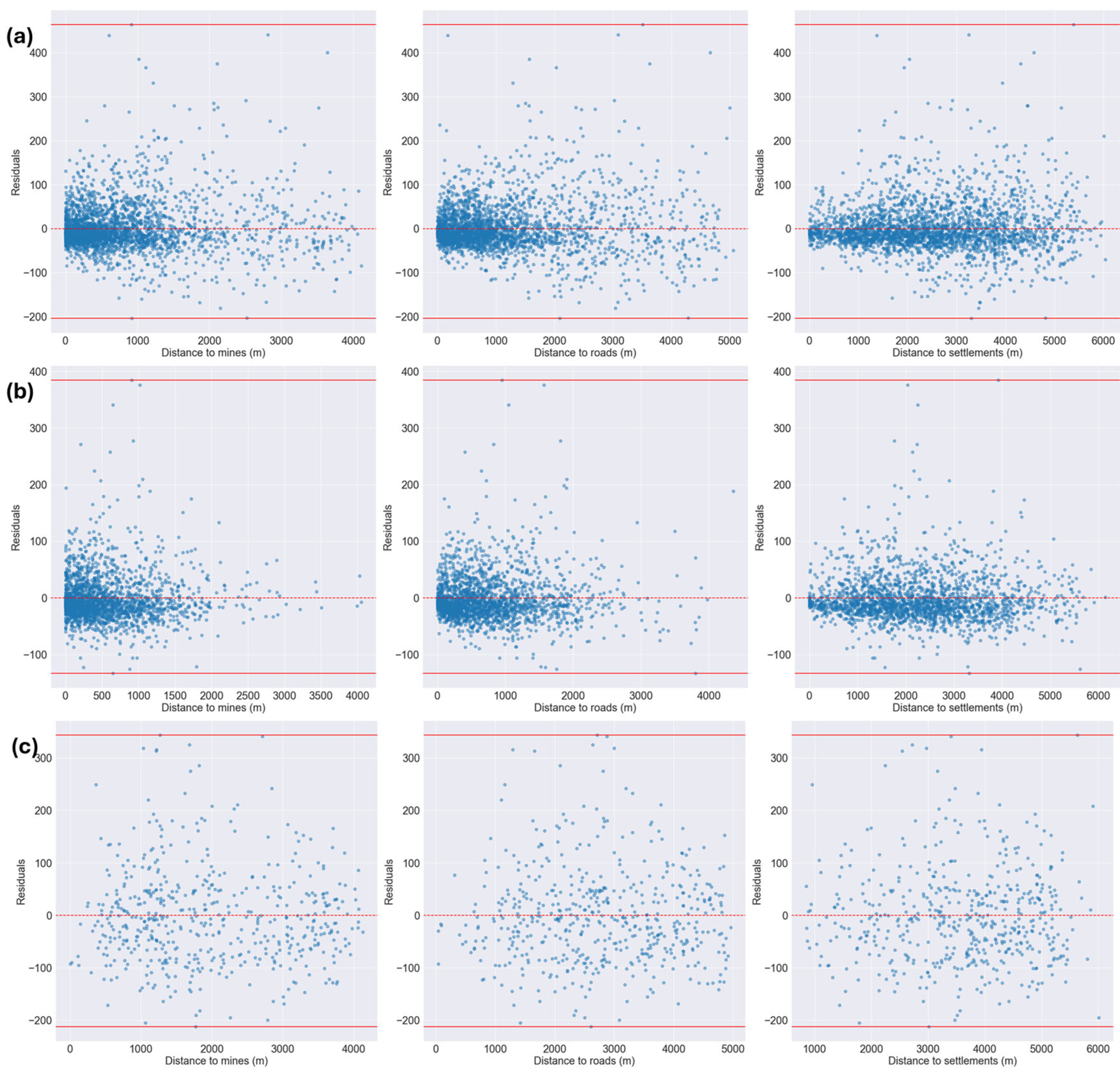
- Human-mediated disturbance factors exhibited weaker heteroscedastic behavior with increasing distance and showed intermediate importance in aboveground biomass modeling.
- A combination of heterogeneous and homogeneous regimes overcomes the challenge of increased noise or reduced variance, thereby improving modeling accuracy.
- Human-mediated disturbance factors counter model biases introduced by other predictor variables.
Abstract
1. Introduction
2. Materials and Methods
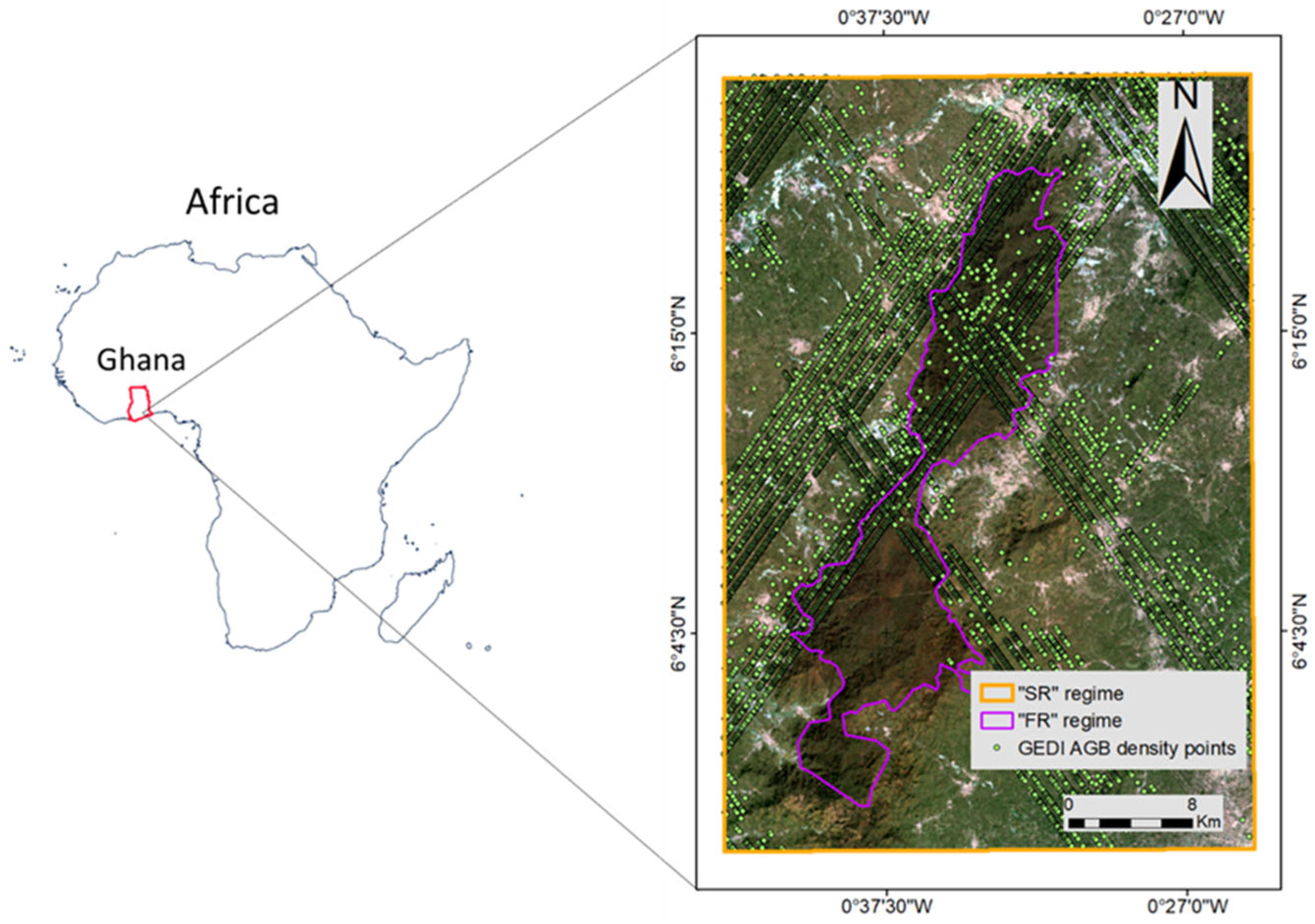
2.1. Study Area
2.2. Data Pre-Processing
2.2.1. GEDI AGBD Data
2.2.2. Earth Observation Data
2.2.3. Human-Induced Disturbance Data
2.3. Machine Learning Algorithms
2.3.1. Random Forest
2.3.2. Support Vector Machine
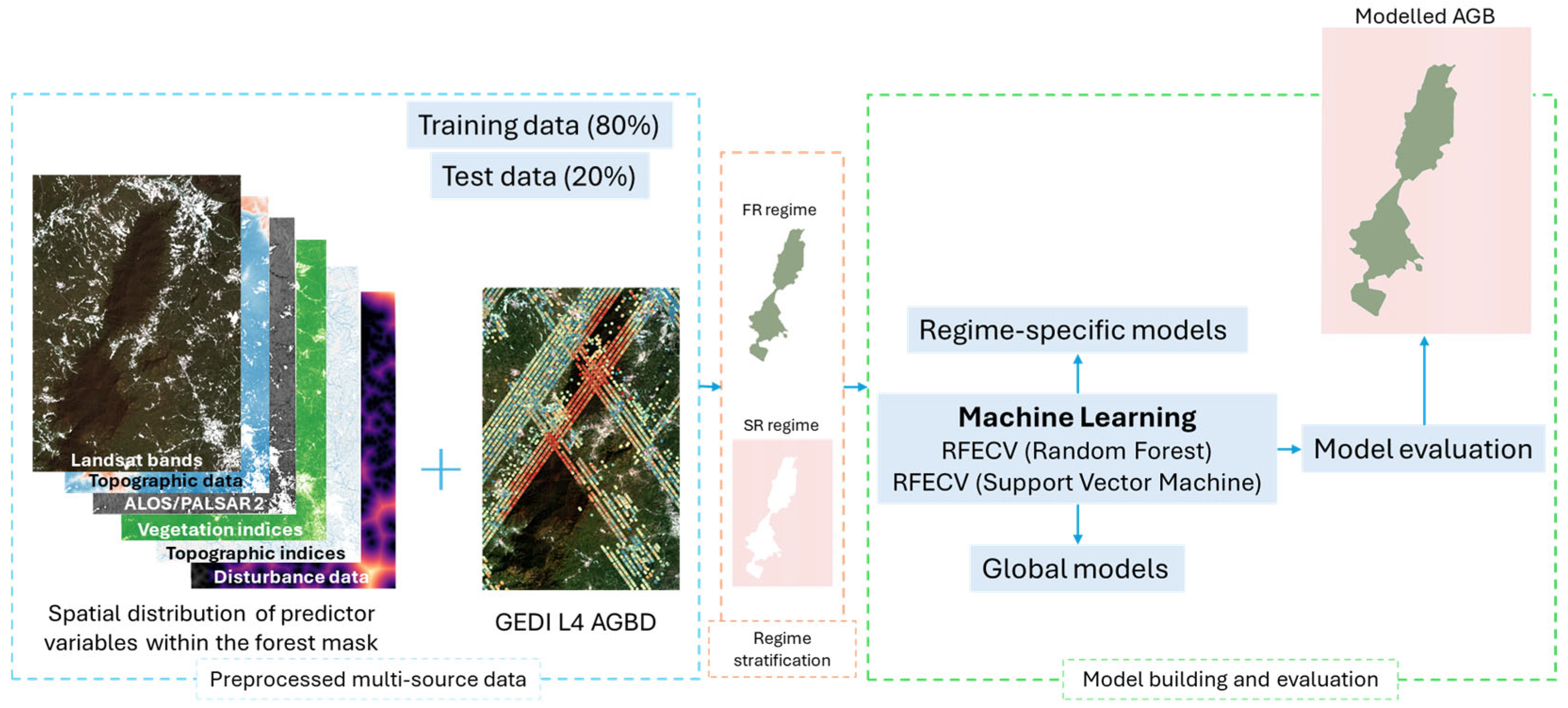
2.4. Model Building and Evaluation
3. Results
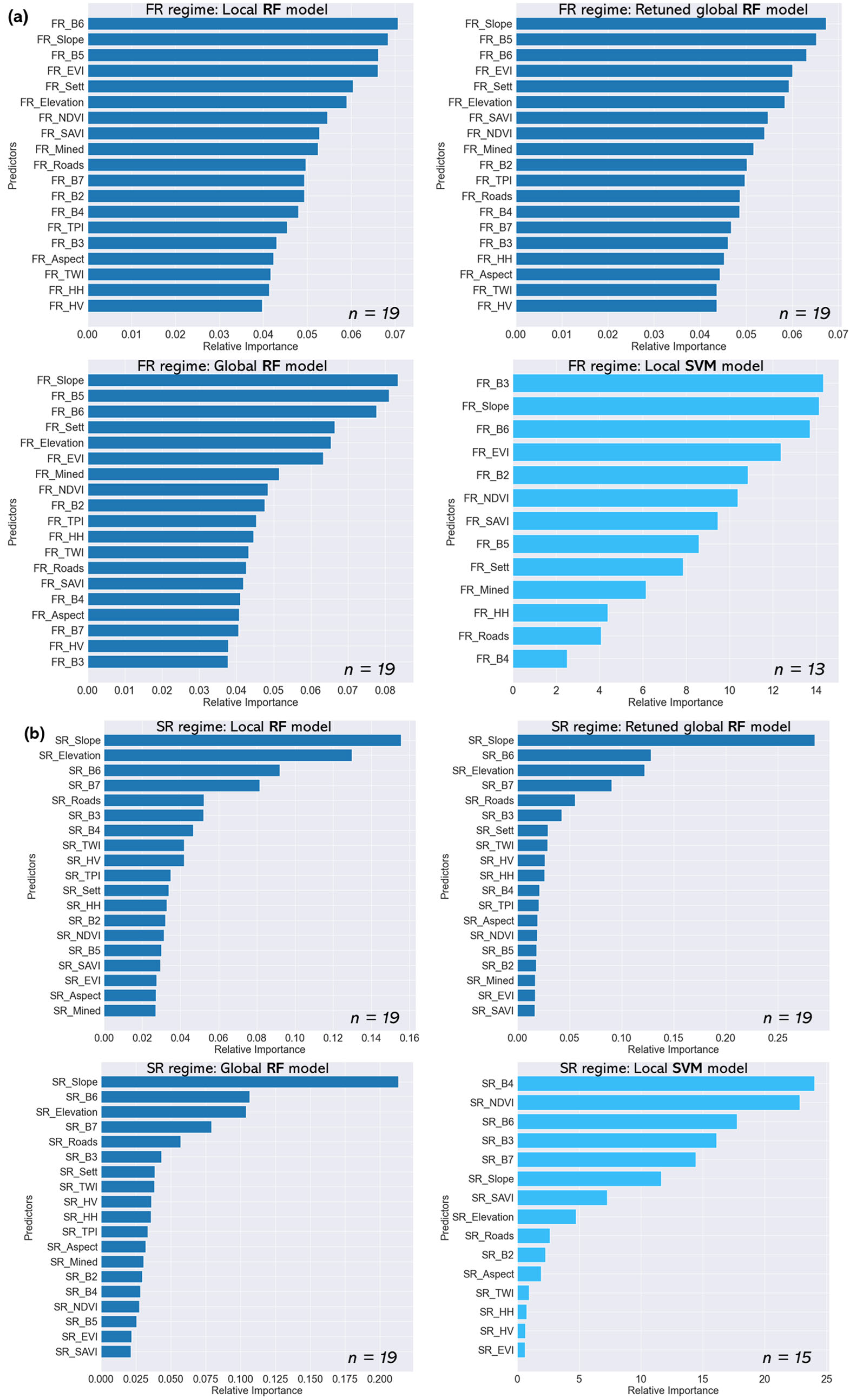
3.1. Feature Selection
3.2. AGB Model Comparisons
3.3. Influence of Human-Induced Disturbances on Model Prediction Errors
3.4. AGB Spatial Distribution
4. Discussion
4.1. The Effect of Regime Stratification on Predicting AGB
4.2. Influence of Human-Induced Disturbances on Predicting AGB
5. Conclusions
Author Contributions
Funding
Data Availability Statement
Acknowledgments
Conflicts of Interest
Abbreviations
| AGB | Aboveground biomass |
| AGBD | Aboveground biomass density |
| ARFR | Atewa Range Forest Reserve |
| CART | Classification and Regression Trees |
| DEM | Digital Elevation Model |
| EVI | Enhanced Vegetation Index |
| GEDI | Global Ecosystem Dynamics and Investigations |
| GEE | Google Earth Engine |
| GEOBIA | Geographic Object-based Image Analysis |
| HFZ | High Forest Zone |
| ISS | International Space Station |
| JAXA | Japan Aerospace Exploration Agency |
| ML | Machine learning |
| NFI | National Forest Inventory |
| NIR | Near-infrared |
| OLI | Operational Land Imager |
| PALSAR | Phased Array type L-band Synthetic Aperture Radar |
| RBF | Radial Basis Function |
| RF | Random forest |
| RFE | Recursive Feature Elimination |
| RFECV | Recursive Feature Elimination with cross-validation |
| RMSE | Root Mean Square Error |
| SAR | Synthetic Aperture Radar |
| SAVI | Soil Adjusted Vegetation Index |
| SRTM | Shuttle Radar Topography Mission |
| SVM | Support Vector Machine |
| TPI | Topographic Position Index |
| TWI | Topographic Wetness Index |
References
- O’Callaghan, C.J.; Irwin, S.; Byrne, K.A.; O’Halloran, J. The role of planted forests in the provision of habitat: An Irish perspective. Biodivers. Conserv. 2017, 26, 3103–3124. [Google Scholar] [CrossRef] [Scilit]
- Thom, D.; Rammer, W.; Seidl, R. The impact of future forest dynamics on climate: Interactive effects of changing vegetation and disturbance regimes. Ecol. Monogr. 2017, 87, 665–684. [Google Scholar] [CrossRef] [Scilit]
- Torre-Tojal, L.; Bastarrika, A.; Boyano, A.; Lopez-Guede, J.M.; Grana, M. Above-ground biomass estimation from LiDAR data using random forest algorithms. J. Comput. Sci. 2022, 58, 101517. [Google Scholar] [CrossRef] [Scilit]
- Mehmood, K.; Anees, S.A.; Rehman, A.; Tariq, A.; Liu, Q.; Muhammad, S.; Rabbi, F.; Pan, S.; Hatamleh, W.A. Assessing forest cover changes and fragmentation in the Himalayan temperate region: Implications for forest conservation and management. J. For. Res. 2024, 35, 82. [Google Scholar] [CrossRef] [Scilit]
- Ibrahim, S.A.; Balzter, H.; Tansey, K. Machine learning feature importance selection for predicting aboveground biomass in African savannah with landsat 8 and ALOS PALSAR data. Mach. Learn. Appl. 2024, 16, 100561. [Google Scholar] [CrossRef] [Scilit]
- Wang, Z.; Ma, Y.; Zhang, Y.; Shang, J. Review of remote sensing applications in grassland monitoring. Remote Sens. 2022, 14, 2903. [Google Scholar] [CrossRef] [Scilit]
- Khan, M.N.; Tan, Y.; Gul, A.A.; Abbas, S.; Wang, J. Forest aboveground biomass estimation and inventory: Evaluating remote sensing-based approaches. Forests 2024, 15, 1055. [Google Scholar] [CrossRef] [Scilit]
- Hojo, A.; Avtar, R.; Nakaji, T.; Tadono, T.; Takagi, K. Modeling forest above-ground biomass using freely available satellite and multisource datasets. Ecol. Inform. 2023, 74, 101973. [Google Scholar] [CrossRef] [Scilit]
- Tadese, S.; Soromessa, T.; Bekele, T.; Bereta, A.; Temesgen, F. Above Ground Biomass Estimation Methods and Challenges: A Review. Measurement 2019, 9, 12–25. [Google Scholar]
- Ji, L.; Wylie, B.K.; Nossov, D.R.; Peterson, B.; Waldrop, M.P.; McFarland, J.W.; Rover, J.; Hollingsworth, T.N. Estimating aboveground biomass in interior Alaska with Landsat data and field measurements. Int. J. Appl. Earth Obs. Geoinf. 2012, 18, 451–461. [Google Scholar] [CrossRef] [Scilit]
- Zhou, Y.; Liu, T.; Batelaan, O.; Duan, L.; Wang, Y.; Li, X.; Li, M. Spatiotemporal fusion of multi-source remote sensing data for estimating aboveground biomass of grassland. Ecol. Indic. 2023, 146, 109892. [Google Scholar] [CrossRef] [Scilit]
- Duncanson, L.; Kellner, J.R.; Armston, J.; Dubayah, R.; Minor, D.M.; Hancock, S.; Healey, S.P.; Patterson, P.L.; Saarela, S.; Marselis, S.; et al. Aboveground biomass density models for NASA’s Global Ecosystem Dynamics Investigation (GEDI) lidar mission. Remote Sens. Environ. 2022, 270, 112845. [Google Scholar] [CrossRef] [Scilit]
- Zhang, L.; Yang, L.; Sun, J.; Zhu, Q.; Wang, T.; Zhao, H. Estimation of Tree Species Diversity in Warm Temperate Forests via GEDI and GF-1 Imagery. Forests 2025, 16, 570. [Google Scholar] [CrossRef] [Scilit]
- Alvites, C.; O’sullivan, H.; Francini, S.; Marchetti, M.; Santopuoli, G.; Chirici, G.; Lasserre, B.; Marignani, M.; Bazzato, E. High-resolution canopy height mapping: Integrating nasa’s global ecosystem dynamics investigation (gedi) with multi-source remote sensing data. Remote Sens. 2024, 16, 1281. [Google Scholar] [CrossRef] [Scilit]
- Guo, Q.; Du, S.; Jiang, J.; Guo, W.; Zhao, H.; Yan, X.; Zhao, Y.; Xiao, W. Combining GEDI and sentinel data to estimate forest canopy mean height and aboveground biomass. Ecol. Inform. 2023, 78, 102348. [Google Scholar] [CrossRef] [Scilit]
- Adrah, E.; Jaafar, W.S.W.M.; Bajaj, S.; Omar, H.; Leite, R.V.; Silva, C.A.; Cardil, A.; Mohan, M. Analyzing canopy height variations in secondary tropical forests of Malaysia using NASA GEDI. IOP Conf. Ser. Earth Environ. Sci. 2021, 880, 012031. [Google Scholar] [CrossRef] [Scilit]
- Hunka, N.; Santoro, M.; Armston, J.; Dubayah, R.; McRoberts, R.E.; Næsset, E.; Quegan, S.; Urbazaev, M.; Pascual, A.; May, P.B.; et al. On the NASA GEDI and ESA CCI biomass maps: Aligning for uptake in the UNFCCC global stocktake. Environ. Res. Lett. 2023, 18, 124042. [Google Scholar] [CrossRef] [Scilit]
- Zhang, Y.; Zou, Y.; Wang, Y. Remote Sensing of Forest Above-Ground Biomass Dynamics: A Review. Forests 2025, 16, 821. [Google Scholar] [CrossRef] [Scilit]
- Thapa, B.; Lovell, S.; Wilson, J. Remote sensing and machine learning applications for aboveground biomass estimation in agroforestry systems: A review. Agrofor. Syst. 2023, 97, 1097–1111. [Google Scholar] [CrossRef] [Scilit]
- Lu, D.; Chen, Q.; Wang, G.; Liu, L.; Li, G.; Moran, E. A survey of remote sensing-based aboveground biomass estimation methods in forest ecosystems. Int. J. Digit. Earth 2014, 9, 63–105. [Google Scholar] [CrossRef] [Scilit]
- Yan, X.; Li, J.; Smith, A.R.; Yang, D.; Ma, T.; Su, Y.; Shao, J. Evaluation of machine learning methods and multi-source remote sensing data combinations to construct forest above-ground biomass models. Int. J. Digit. Earth 2023, 16, 4471–4491. [Google Scholar] [CrossRef] [Scilit]
- McRoberts, R.E.; Tomppo, E.O. Remote sensing support for national forest inventories. Remote Sens. Environ. 2007, 110, 412–419. [Google Scholar] [CrossRef] [Scilit]
- Haakana, H.; Heikkinen, J.; Katila, M.; Kangas, A. Efficiency of post-stratification for a large-scale forest inventory—Case Finnish NFI. Ann. For. Sci. 2019, 76, 9. [Google Scholar] [CrossRef] [Scilit]
- Wu, Z.; Liu, X.; Cheng, S.; Yang, C.; Wang, Z.; Liu, Y.; Dong, L.; Li, F.; Hao, Y. Evaluating the effectiveness of forest type stratification for aboveground biomass inference. Int. J. Appl. Earth Obs. Geoinf. 2025, 143, 104829. [Google Scholar] [CrossRef] [Scilit]
- Chen, L.; Ren, C.; Zhang, B.; Wang, Z.; Man, W.; Liu, M. Improved object-based mapping of aboveground biomass using geographic stratification with GEDI data and multi-sensor imagery. Remote Sens. 2023, 15, 2625. [Google Scholar] [CrossRef] [Scilit]
- Jiang, X.; Li, G.; Lu, D.; Chen, E.; Wei, X. Stratification-based forest aboveground biomass estimation in a subtropical region using airborne lidar data. Remote Sens. 2020, 12, 1101. [Google Scholar] [CrossRef] [Scilit]
- Latifi, H.; Fassnacht, F.E.; Hartig, F.; Berger, C.; Hernández, J.; Corvalán, P.; Koch, B. Stratified aboveground forest biomass estimation by remote sensing data. Int. J. Appl. Earth Obs. Geoinf. 2015, 38, 229–241. [Google Scholar] [CrossRef] [Scilit]
- Kumar, A.; Gopal, R.; Sabnam, S.; Kumar, R.; Prasad, M.; Mahto, D.; Kumari, V. Impact of Forest Degradation on the Livelihood of Forest-Dependent Communities. In Forest Degradation and Management: An Indian Perspective; Springer Nature: Cham, Switzerland, 2025; pp. 255–265. [Google Scholar]
- Kumar, R.; Kumar, A.; Saikia, P. Deforestation and forests degradation impacts on the environment. In Environmental Degradation: Challenges and Strategies for Mitigation; Springer International Publishing: Cham, Switzerland, 2022; pp. 19–46. [Google Scholar]
- Souza, C., Jr.; Siqueira, J.; Sales, M.; Fonseca, A.; Ribeiro, J.; Numata, I.; Cochrane, M.A.; Barber, C.P.; Roberts, D.A.; Barlow, J. Ten-year Landsat classification of deforestation and forest degradation in the Brazilian Amazon. Remote Sens. 2013, 5, 5493–5513. [Google Scholar] [CrossRef] [Scilit]
- Ioki, K.; Tsuyuki, S.; Hirata, Y.; Phua, M.-H.; Wong, W.V.C.; Ling, Z.-Y.; Saito, H.; Takao, G. Estimating above-ground biomass of tropical rainforest of different degradation levels in Northern Borneo using airborne LiDAR. For. Ecol. Manag. 2014, 328, 335–341. [Google Scholar] [CrossRef] [Scilit]
- Muhe, S.; Argaw, M. Estimation of above-ground biomass in tropical afro-montane forest using Sentinel-2 derived indices. Environ. Syst. Res. 2022, 11, 5. [Google Scholar] [CrossRef] [Scilit]
- Brede, B.; Calders, K.; Lau, A.; Raumonen, P.; Bartholomeus, H.M.; Herold, M.; Kooistra, L. Non-destructive tree volume estimation through quantitative structure modelling: Comparing UAV laser scanning with terrestrial LIDAR. Remote Sens. Environ. 2019, 233, 111355. [Google Scholar] [CrossRef] [Scilit]
- Amponsah, A.; Nasare, L.I.; Tom-Dery, D.; Baatuuwie, B.N. Land cover changes of Atewa Range Forest Reserve, a biodiversity hotspot in Ghana. Trees For. People 2022, 9, 100301. [Google Scholar] [CrossRef] [Scilit]
- Nyamekye, C.; Ghansah, B.; Agyapong, E.; Kwofie, S. Mapping changes in artisanal and small-scale mining (ASM) landscape using machine and deep learning algorithms—A proxy evaluation of the 2017 ban on ASM in Ghana. Environ. Chall. 2021, 3, 100053. [Google Scholar] [CrossRef] [Scilit]
- Garcia-Montiel, D.C.; Scatena, F.N. The effect of human activity on the structure and composition of a tropical forest in Puerto Rico. For. Ecol. Manag. 1994, 63, 57–78. [Google Scholar] [CrossRef] [Scilit]
- Milodowski, D.T.; Coomes, D.A.; Swinfield, T.; Jucker, T.; Riutta, T.; Malhi, Y.; Svátek, M.; Kvasnica, J.; Burslem, D.F.R.P.; Ewers, R.M.; et al. The impact of logging on vertical canopy structure across a gradient of tropical forest degradation intensity in Borneo. J. Appl. Ecol. 2021, 58, 1764–1775. [Google Scholar] [CrossRef] [Scilit]
- Gobbi, B.; Van Rompaey, A.; Gasparri, N.I.; Vanacker, V. Forest degradation in the Dry Chaco: A detection based on 3D canopy reconstruction from UAV-SfM techniques. For. Ecol. Manag. 2022, 526, 120554. [Google Scholar] [CrossRef] [Scilit]
- McCullough, J.; Alonso, L.E.; Naskrecki, P.; Wright, H.E.; Osei-Owusu, Y. A rapid biological assessment of the Atewa Range Forest Reserve, eastern Ghana. RAP Bull. Biol. Assess. 2007, 47, 180–191. [Google Scholar]
- Adams, L.B.; Hayakawa, Y.S. Mapping alluvial mine dynamics in the Atewa landscape in Ghana using Geographic Object-Based Image Analysis (GEOBIA) and GIS. Environ. Monit. Assess. 2025, 197, 473. [Google Scholar] [CrossRef] [Scilit]
- Kusimi, J.M. Characterizing land disturbance in Atewa range forest reserve and buffer zone. Land Use Policy 2015, 49, 471–482. [Google Scholar] [CrossRef] [Scilit]
- NASA. Earthdata Search. Available online: https://search.earthdata.nasa.gov/ (accessed on 8 August 2025).
- Dubayah, R.O.; Armston, J.; Kellner, J.R.; Duncanson, L.; Healey, S.P.; Patterson, P.L.; Hancock, S.; Tang, H.; Bruening, J.M.; Hofton, M.A.; et al. GEDI L4A Footprint Level Aboveground Biomass Density, Version 2.1; ORNL DAAC: Oak Ridge, TN, USA, 2022. [Google Scholar]
- Shendryk, Y. Fusing GEDI with earth observation data for large area aboveground biomass mapping. Int. J. Appl. Earth Obs. Geoinf. 2022, 115, 103108. [Google Scholar] [CrossRef] [Scilit]
- Liu, A.; Cheng, X.; Chen, Z. Performance evaluation of GEDI and ICESat-2 laser altimeter data for terrain and canopy height retrievals. Remote Sens. Environ. 2021, 264, 112571. [Google Scholar] [CrossRef] [Scilit]
- JAXA. ALOS. Available online: https://www.eorc.jaxa.jp/ALOS (accessed on 8 July 2025).
- Parhad, S.V.; Warhade, K.K.; Shitole, S.S. Speckle noise reduction in sar images using improved filtering and supervised classification. Multimed. Tools Appl. 2024, 83, 54615–54636. [Google Scholar] [CrossRef] [Scilit]
- USGS. Earthexplorer. Available online: https://earthexplorer.usgs.gov/ (accessed on 23 August 2025).
- Lemke, D.; Dimov, L.; Czech, H.; Knight, P.; Finch, W.; Condit, R. Relationship between topographic variables and live aboveground tree biomass on a large temperate forest plot. For. Ecosyst. 2025, 14, 100338. [Google Scholar] [CrossRef] [Scilit]
- Salinas-Melgoza, M.A.; Skutsch, M.; Lovett, J.C. Predicting aboveground forest biomass with topographic variables in human-impacted tropical dry forest landscapes. Ecosphere 2018, 9, e02063. [Google Scholar] [CrossRef] [Scilit]
- OpenStreetMap Contributors. Planet Dump. OpenStreetMap Foundation, 2022. Available online: https://www.openstreetmap.org (accessed on 18 August 2025).
- QGIS Development Team. QGIS Geographic Information System (Version 3.34); Open Source Geospatial Foundation: Beaverton, OR, USA, 2023; Available online: https://qgis.org (accessed on 20 August 2025).
- Liu, Z.; Peng, C.; Work, T.; Candau, J.N.; DesRochers, A.; Kneeshaw, D. Application of machine-learning methods in forest ecology: Recent progress and future challenges. Environ. Rev. 2018, 26, 339–350. [Google Scholar] [CrossRef] [Scilit]
- Amin, G.; Imtiaz, I.; Haroon, E.; Saqib, N.U.; Shahzad, M.I.; Nazeer, M. Assessment of machine learning algorithms for land cover classification in a complex mountainous landscape. J. Geovisualization Spat. Anal. 2024, 8, 34. [Google Scholar] [CrossRef] [Scilit]
- Dhanda, P.; Nandy, S.; Kushwaha, S.P.; Ghosh, S.; Murthy, Y.K.; Dadhwal, V.K. Optimizing spaceborne LiDAR and very high resolution optical sensor parameters for biomass estimation at ICESat/GLAS footprint level using regression algorithms. Prog. Phys. Geogr. 2017, 41, 247–267. [Google Scholar] [CrossRef] [Scilit]
- Mountrakis, G.; Im, J.; Ogole, C. Support vector machines in remote sensing: A review. SPRS. J. Photogramm. Remote Sens. 2011, 66, 247–259. [Google Scholar] [CrossRef] [Scilit]
- Pedregosa, F.; Varoquaux, G.; Gramfort, A.; Michel, V.; Thirion, B.; Grisel, O.; Blondel, M.; Prettenhofer, P.; Weiss, R.; Dubourg, V.; et al. Scikit-learn: Machine learning in Python. J. Mach. Learn. Res. 2011, 12, 2825–2830. [Google Scholar]
- Roy, A.D.; Debbarma, S. Comparing the allometric model to machine learning algorithms for aboveground biomass estimation in tropical forests. Ecol. Front. 2024, 44, 1069–1078. [Google Scholar] [CrossRef] [Scilit]
- Breiman, L. Random forests. Mach. Learn. 2001, 45, 5–32. [Google Scholar] [CrossRef] [Scilit]
- Vapnik, V. The Nature of Statistical Learning Theory; Springer Science & Business Media: Berlin/Heidelberg, Germany, 2013. [Google Scholar]
- Mantero, P.; Moser, G.; Serpico, S.B. Partially supervised classification of remote sensing images through SVM-based probability density estimation. IEEE Trans. Geosci. Remote Sens. 2005, 43, 559–570. [Google Scholar] [CrossRef] [Scilit]
- Awad, M.; Fraihat, S. Recursive feature elimination with cross-validation with decision tree: Feature selection method for machine learning-based intrusion detection systems. J. Sens. Actuator Netw. 2023, 12, 67. [Google Scholar] [CrossRef] [Scilit]
- Qiu, A.; Yang, Y.; Wang, D.; Xu, S.; Wang, X. Exploring parameter selection for carbon monitoring based on Landsat-8 imagery of the aboveground forest biomass on Mount Tai. Eur. J. Remote Sens. 2020, 53, 4–15. [Google Scholar] [CrossRef] [Scilit]
- Ramezan, C.A.; Warner, T.E.; Maxwell, A. Evaluation of sampling and cross-validation tuning strategies for regional-scale machine learning classification. Remote Sens. 2019, 11, 185. [Google Scholar] [CrossRef] [Scilit]
- Lamahewage, S.H.; Witharana, C.; Riemann, R.F.R.; Worthley, T. Comparing Machine Learning and Statistical Models for Remote Sensing-Based Forest Aboveground Biomass Estimations. Forests 2025, 16, 1430. [Google Scholar] [CrossRef] [Scilit]
- Yang, C.; Liu, A.; Chen, Y. Seventeen-year reconstruction of tropical forest aboveground biomass dynamics in Borneo using GEDI L4B and multi-sensor data fusion. Remote Sens. 2025, 17, 3231. [Google Scholar] [CrossRef] [Scilit]
- Yu, X.; Ge, H.; Lu, D.; Zhang, M.; Lai, Z.; Yao, R. Comparative study on variable selection approaches in establishment of remote sensing model for forest biomass estimation. Remote Sens. 2019, 11, 1437. [Google Scholar] [CrossRef] [Scilit]
- Cochran, W. Sampling Techniques; John Wiley: New York, NY, USA, 1977. [Google Scholar]
- Soja, M.J.; Quegan, S.; d’Alessandro, M.M.; Banda, F.; Scipal, K.; Tebaldini, S.; Ulander, L.M. Mapping above-ground biomass in tropical forests with ground-cancelled P-band SAR and limited reference data. Remote Sens. Environ. 2021, 253, 112153. [Google Scholar] [CrossRef] [Scilit]
- Zhao, P.; Lu, D.; Wang, G.; Wu, C.; Huang, Y.; Yu, S. Examining Spectral Reflectance Saturation in Landsat Imagery and Corresponding Solutions to Improve Forest Aboveground Biomass Estimation. Remote Sens. 2016, 8, 469. [Google Scholar] [CrossRef] [Scilit]
- Avelino, J.G.; Cavalcanti, G.D.; Cruz, R.M. Resampling strategies for imbalanced regression: A survey and empirical analysis. Artif. Intell. Rev. 2024, 57, 82. [Google Scholar] [CrossRef] [Scilit]
- Guyon, I.; Elisseeff, A. An introduction to variable and feature selection. J. Mach. Learn. Res. 2003, 3, 1157–1182. [Google Scholar]
- Gong, Z.; Zhong, P.; Hu, W. Diversity in machine learning. IEEE Access 2019, 7, 64323–64350. [Google Scholar] [CrossRef] [Scilit]
- Abbas, S.; Wong, M.S.; Wu, J.; Shahzad, N.; Muhammad Irteza, S. Approaches of satellite remote sensing for the assessment of above-ground biomass across tropical forests: Pan-tropical to national scales. Remote Sens. 2020, 12, 3351. [Google Scholar] [CrossRef] [Scilit]
- Li, Y.; Li, M.; Li, C.; Liu, Z. Forest aboveground biomass estimation using Landsat 8 and Sentinel-1A data with machine learning algorithms. Sci. Rep. 2020, 10, 9952. [Google Scholar] [CrossRef] [Scilit]
- Zhou, J.; Zan, M.; Zhai, L.; Yang, S.; Xue, C.; Li, R.; Wang, X. Remote sensing estimation of aboveground biomass of different forest types in Xinjiang based on machine learning. Sci. Rep. 2025, 15, 6187. [Google Scholar] [CrossRef] [Scilit] [PubMed]
- Chen, Z.; Sun, Z.; Zhang, H.; Zhang, H.; Qiu, H. Aboveground forest biomass estimation using tent mapping atom search optimized backpropagation neural network with Landsat 8 and Sentinel-1A data. Remote Sens. 2023, 15, 5653. [Google Scholar] [CrossRef] [Scilit]
- Wu, Y.; Chen, Y.; Tian, C.; Yun, T.; Li, M. Estimation of subtropical forest aboveground biomass using active and passive Sentinel data with canopy height. Remote Sens. 2025, 17, 2509. [Google Scholar] [CrossRef] [Scilit]






| Data Source | Feature |
|---|---|
| Landsat 8 | Band 2—Blue |
| Band 3—Green | |
| Band 4—Red | |
| Band 5—NIR | |
| Band 6—SWIR 1 | |
| Band 7—SWIR 2 | |
| Landsat Vegetation Indices | NDVI |
| SAVI | |
| EVI | |
| ALOS/PALSAR 2 | HH |
| HV | |
| SRTM DEM | Elevation |
| Slope | |
| Aspect | |
| Topographic indices | TPI |
| TWI | |
| Proximity data | Distance to mines |
| Distance to roads | |
| Distance to settlements |
| FR | SR | LS | |||||
|---|---|---|---|---|---|---|---|
| Test Value Range | Local | LS_r | Local | LS_r | |||
| RF | n_estimators | 1–200 | 173 | 287 | 173 | 275 | 181 |
| min_samples_split | 2–6 | 4 | 5 | 4 | 4 | 3 | |
| min_samples_leaf | 2–6 | 4 | 2 | 4 | 4 | 7 | |
| max_features | ‘sqrt’, 0.5–1.0 | ‘sqrt’ | ‘sqrt’ | ‘sqrt’ | 8 | 0.7 | |
| max_depth | 1–100 | 5 | 5 | 7 | 7 | 5 | |
| SVM | kernel | ‘rbf’ | ‘rbf’ | ‘rbf’ | ‘rbf’ | ‘rbf’ | |
| gamma | ‘scale’, 0.01–1 | ‘scale’ | ‘scale’ | ‘scale’ | ‘scale’ | ‘scale’ | |
| C | 1–100 | 100 | 100 | 100 | 100 | 10 | |
| epsilon | 0.1–0.5 | 0.5 | 0.5 | 0.5 | 0.5 | 0.1 | |
| Regime | Model | |||||||||||
|---|---|---|---|---|---|---|---|---|---|---|---|---|
| RF | SVM | |||||||||||
| Local | FSR_r | FSR | Local | FSR_r | FSR | |||||||
| r2 | RMSE | r2 | RMSE | r2 | RMSE | r2 | RMSE | r2 | RMSE | r2 | RMSE | |
| FSR | 0.54 | 57.71 | 0.46 | 62.91 | ||||||||
| SR | 0.26 | 41.73 | 0.26 | 41.72 | 0.26 | 41.83 | 0.23 | 42.54 | 0.23 | 42.68 | 0.21 | 43.00 |
| FR | 0.17 | 90.93 | 0.17 | 90.86 | 0.16 | 90.99 | 0.13 | 92.86 | 0.14 | 92.39 | 0.13 | 93.10 |
Disclaimer/Publisher’s Note: The statements, opinions and data contained in all publications are solely those of the individual author(s) and contributor(s) and not of MDPI and/or the editor(s). MDPI and/or the editor(s) disclaim responsibility for any injury to people or property resulting from any ideas, methods, instructions or products referred to in the content. |
© 2026 by the authors. Licensee MDPI, Basel, Switzerland. This article is an open access article distributed under the terms and conditions of the Creative Commons Attribution (CC BY) license.
Share and Cite
Adams, L.B.; Hayakawa, Y.S. Evaluating Disturbance Regime Stratification for Aboveground Biomass Estimation in a Heterogeneous Forest Landscape: Insights from the Atewa Landscape, Ghana. Remote Sens. 2026, 18, 765. https://doi.org/10.3390/rs18050765
Adams LB, Hayakawa YS. Evaluating Disturbance Regime Stratification for Aboveground Biomass Estimation in a Heterogeneous Forest Landscape: Insights from the Atewa Landscape, Ghana. Remote Sensing. 2026; 18(5):765. https://doi.org/10.3390/rs18050765
Chicago/Turabian StyleAdams, Lukman B., and Yuichi S. Hayakawa. 2026. "Evaluating Disturbance Regime Stratification for Aboveground Biomass Estimation in a Heterogeneous Forest Landscape: Insights from the Atewa Landscape, Ghana" Remote Sensing 18, no. 5: 765. https://doi.org/10.3390/rs18050765
APA StyleAdams, L. B., & Hayakawa, Y. S. (2026). Evaluating Disturbance Regime Stratification for Aboveground Biomass Estimation in a Heterogeneous Forest Landscape: Insights from the Atewa Landscape, Ghana. Remote Sensing, 18(5), 765. https://doi.org/10.3390/rs18050765