Article

Application of Quasi-Uniform B-Spline Surfaces with Different Degrees to Mesoscale Eddy Fitting

1
State Key Laboratory of Physical Oceanography, Ocean University of China, Qingdao 266100, China
2
Laboratory for Ocean Dynamics and Climate, Qingdao Marine Science and Technology Center, Qingdao 266237, China
3
Equipment Public Service Center, South China Sea Institute of Oceanology, Chinese Academy of Sciences, Guangzhou 510301, China
*
Author to whom correspondence should be addressed.
Remote Sens. 2026, 18(5), 735; https://doi.org/10.3390/rs18050735
Submission received: 4 November 2025 / Revised: 18 December 2025 / Accepted: 22 December 2025 / Published: 28 February 2026
(This article belongs to the Section Ocean Remote Sensing)

Highlights

What are the main findings?
  • Based on the dense along-track observations from an eight-altimeter constellation (yielding approximately one data point per 40 km × 40 km area over a composite period), a 6-day optimal temporal window is identified for mesoscale eddy reconstruction in the South Indian Ocean, balancing data coverage against the physical advection of moving eddies.
  • An application-oriented principle is established: the bi-quadratic B-spline is optimal for efficient sea surface height reconstruction, while the bi-quartic B-spline is essential for obtaining physically plausible vorticity fields.
What are the implications of the main findings?
  • The findings provide a methodological framework for selecting appropriate interpolation techniques based on specific scientific objectives, from operational eddy detection to advanced dynamical analysis.
  • Leveraging the dense along-track observations from the current multi-satellite constellation, the demonstrated performance of B-spline methods offers a versatile and accurate tool for processing the new generation of high-resolution along-track satellite data (e.g., from SWOT), with significant potential for operational oceanography.

Abstract

Satellite altimetry technology provides along-track sea level anomaly (SLA) data for studying mesoscale eddies. However, accurately reconstructing their spatial structures from discrete and non-uniform along-track observations remains a significant challenge. This study systematically evaluates the performance of bi-quadratic, bi-cubic, and bi-quartic quasi-uniform B-spline surface fitting methods for mesoscale eddy reconstruction in the South Indian Ocean (60°S–30°S, 75°E–105°E). By combining idealized experiments with real satellite data, a comprehensive comparison is conducted across several dimensions, including fitting accuracy, computational efficiency, parameter robustness, error distribution, and the physical plausibility of derived vorticity fields. For SLA surface fitting, all three methods achieve comparable accuracy, but the bi-quadratic B-spline demonstrates marked advantages in computational efficiency. Its single-fit time is only 53% and 27% of that of the bi-cubic and bi-quartic methods, respectively, and it shows insensitivity to node configuration, highlighting its practicality. In contrast, vorticity field inversion, which relies on the second derivative of the fitted surface, requires higher-order continuity. Only the bi-quartic B-spline, with C3 continuity, produces physically credible and smooth vorticity fields, whereas lower-degree methods result in discontinuous or non-smooth fields. Based on these findings, this study proposes an application-oriented selection principle: the bi-quadratic B-spline is recommended for efficiency-focused tasks, such as eddy detection, while the bi-quartic B-spline is necessary for dynamic analyses involving vorticity.

1. Introduction

Satellite altimetry has profoundly transformed ocean observation over the past five decades by providing globally distributed, high-precision sea surface height (SSH) data, offering critical insights into ocean dynamics and climate change [1,2,3]. Among its core products, sea level anomaly (SLA) data is crucial for capturing mesoscale eddies—rotational structures with spatial scales of tens to hundreds of kilometers and lifespans of days to months [4,5]. These eddies account for approximately 90% of the ocean’s kinetic energy and play a vital role in energy transfer, biogeochemical cycles, and air–sea interactions [6,7,8,9,10,11,12,13,14,15].
Traditionally, eddy identification and analysis have relied on gridded SLA products derived from multi-mission data interpolation [16,17,18,19]. However, the increasing volume of high-resolution along-track measurements from modern satellite constellations (e.g., the SWOT mission) presents both an opportunity and a challenge. The opportunity lies in the potential for more timely and higher-resolution monitoring directly from the along-track data. The challenge remains the accurate reconstruction of continuous spatial fields from these discrete, non-uniformly sampled measurements.
The evolution of methods for reconstructing oceanic fields from discrete data reflects changing observational capabilities and scientific needs. Early approaches focused on mathematical smoothness using cubic splines [20,21]. Subsequent methods incorporated spatial statistics (e.g., Kriging) or physics through data assimilation frameworks [22,23]. Recently, B-spline surface fitting has emerged as a powerful alternative, particularly for along-track data, due to its favorable properties: local support that confines the influence of erroneous data, numerical stability avoiding the Runge phenomenon common in high-degree polynomials, and controllable smoothness via knot placement rather than polynomial degree [24]. Specifically, the application of bi-cubic quasi-uniform B-spline surfaces has demonstrated improved computational efficiency and effectiveness for mesoscale eddy characterization from along-track SLA data [25].
Although the effectiveness of bi-cubic quasi-uniform B-splines in reconstructing mesoscale eddies has been validated, two critical knowledge gaps persist. First, the feasibility of lower-degree implementations (e.g., bi-quadratic B-splines) remains unproven for eddy parameterization tasks. Second, the potential benefits of higher-degree variants require systematic assessment regarding their computational tradeoffs and physical fidelity enhancements. This study evaluates bi-quadratic, bi-cubic, and bi-quartic quasi-uniform B-spline fitting methods across basin scales (South Indian Ocean: 60°S–30°S, 75°E–105°E), comparing their accuracy, efficiency, and derived parameters such as geostrophic currents and vorticity. Results show that bi-quadratic B-splines achieve comparable SLA fitting precision, with superior computational efficiency (53% and 27% faster than bi-cubic and bi-quartic methods, respectively), making them ideal for large-scale eddy detection. However, vorticity inversion—requiring smooth second derivatives—necessitates bi-quartic B-splines with C3 continuity to ensure physically plausible results.
The structure of this paper follows the logical flow of our research. First, Section 2 presents the foundational satellite along-track SLA datasets. Subsequently, Section 3 describes the core methodology of quasi-uniform B-spline fitting and the 10-fold cross-validation technique. The practical application and evaluation of this method are then detailed in Section 4, which conducts idealized experiments to test robustness against noise and a full-scale real-data analysis to optimize parameters and derive vorticity. Finally, the key outcomes are condensed in Section 5, while Section 6 explores broader discussions and future research paths.

2. Data

The satellite along-track data and Level-4 gridded SLA data used in this study were sourced from the Copernicus Marine Environment Monitoring Service (CMEMS; https://marine.copernicus.eu/, accessed on 10 September 2025), encompassing eight satellite altimeters: HY-2B, Cryosat-2 (on its new orbit), Sentinel-3A, Sentinel-3B, Sentinel-6A, Jason-3, Saral/AltiKa, and SWOT. We utilized the Level 3 (L3) global near-real-time (NRT) product derived from preprocessed along-track measurements, with detailed metadata summarized in Table 1. Along-track data comprise both sea level anomaly (SLA) and mean dynamic topography (MDT), with their sum representing the absolute dynamic topography (ADT). This dataset offers high temporal resolution and global coverage, making it suitable for oceanographic studies, particularly in regions with complex mesoscale dynamics. The 12-day period from 1 July to 12 July 2024, was selected primarily to ensure the availability and continuity of high-quality along-track data from all eight altimeters. Unlike studies relying on the repeat cycle of a single altimeter, the dense multi-satellite observations used here provide sufficient spatial coverage within a much shorter timeframe. While common thresholds such as 7, 10, or 30 days are often applied for eddy tracking and lifetime analysis based on gridded products, this study focuses on the spatial reconstruction of sea surface height anomalies from along-track measurements. The choice of a 12-day window allowed us to systematically evaluate reconstruction performance over composite durations ranging from 1 to 12 days.
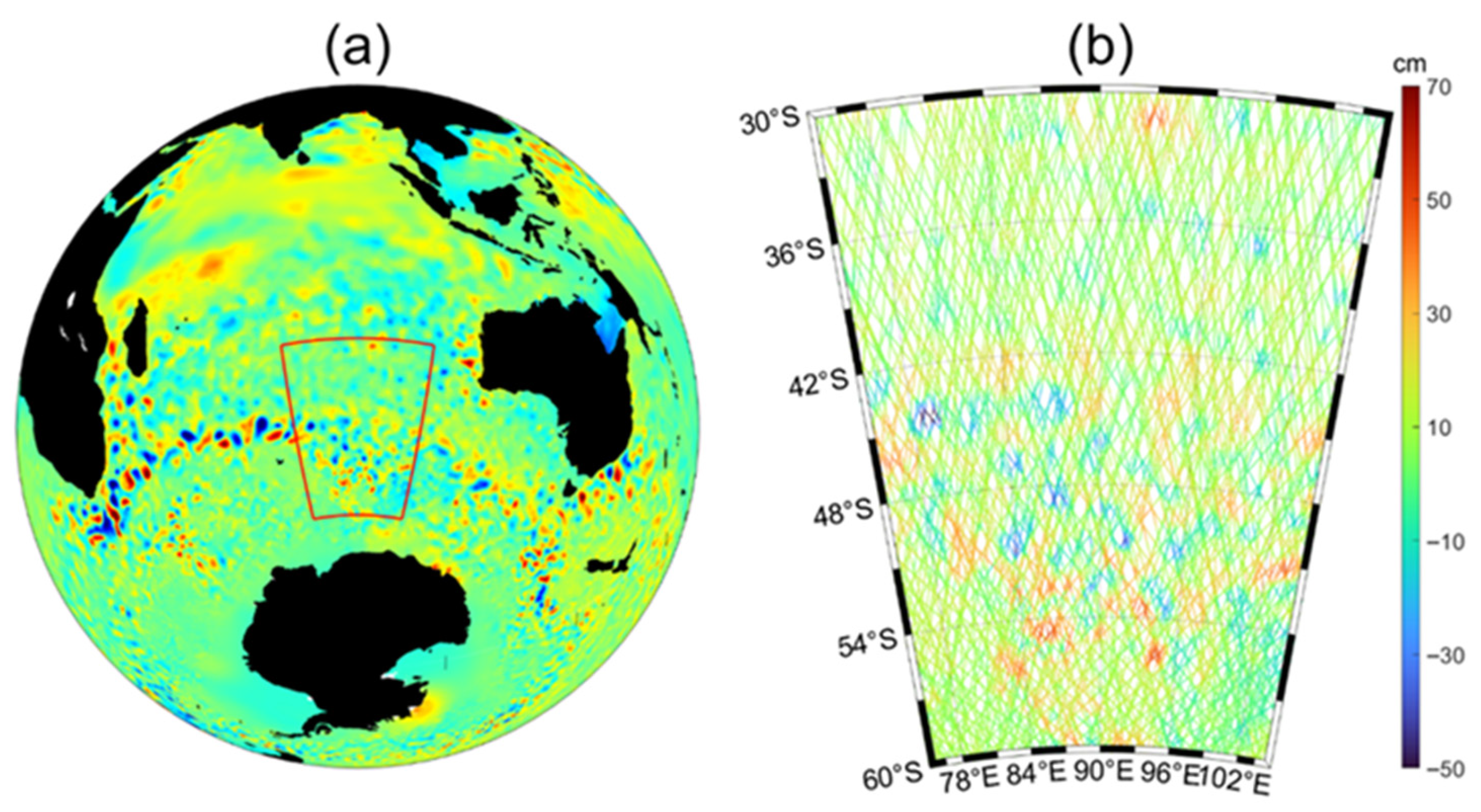
For the purposes of this study, we focused on a 12-day dataset spanning from 1 July to 12 July 2024, over the South Indian Ocean (60°S–30°S, 75°E–105°E), as shown in Figure 1a. For idealized experiments, we extracted subsatellite points from a smaller subregion (35°S–30°S, 70°E–75°E), allowing for a controlled analysis of the data. Synthetic observations were generated by simulating a mesoscale eddy using a two-dimensional Gaussian function. This Gaussian surface, constructed by evaluating the function at each subsatellite point, served as the idealized data for the subsequent evaluation of the fitting algorithms. The use of this synthetic data enabled us to assess the ability of the quasi-uniform B-spline fitting technique to accurately recover the original mesoscale structure from noisy satellite measurements.
The Level-4 gridded dataset is a daily averaged product with a spatial resolution of 0.125°. This study compares the fitting results of bi-quadratic, bi-cubic, and bi-quartic quasi-uniform B-splines against the Level-4 gridded data. As the study employs six-day satellite along-track data for fitting, the Level-4 gridded data corresponding to the same temporal coverage is time-averaged and used as the reference dataset.
The visualization was generated by plotting data points at each grid cell without additional interpolation or smoothing, in order to faithfully illustrate the differences in data resolution inherent to each product.

3. Methods

3.1. Quasi-Uniform B-Spline

In the field of computer graphics, B-spline curve and surface fitting technology has long been a key research focus. Due to their superior continuity and locality, B-splines offer greater flexibility in determining the tangent directions of curves defined by control polygons, making them an essential tool for modeling complex geometric shapes [26,27]. Quasi-uniform B-splines, a special class within B-spline theory, combine the advantages of both uniform and non-uniform B-splines. In these splines, the degree of repetition at the leading and trailing nodes is (k + 1) (where k is the degree), while the middle nodes are evenly distributed [28]. This unique structure enables quasi-uniform B-splines to precisely interpolate the endpoints while maintaining a uniform parameterization in the interior, making them particularly valuable in geometric modeling [29]. When k is set to 2, 3, or 4, quasi-uniform B-splines effectively balance computational complexity and fitting accuracy, catering to various application needs.
For the specific problem of reconstructing the spatial structure of mesoscale eddies from satellite along-track data, this study employs the quasi-uniform B-spline surface fitting method, as opposed to statistical assimilation techniques like Optimal Interpolation (OI) or the Multi-Instrument Optimal Supervised Technique (MIOST) commonly used in operational products. This choice is primarily driven by the alignment between our research objective and the algorithmic strengths of B-splines. While OI/MIOST aims to produce globally statistically optimal, uniformly smooth gridded fields for broad oceanic and climate monitoring, our goal is the precise recovery of the fine-scale geometric form of discrete oceanic features—a targeted spatial shape-reconstruction problem. The B-spline method, particularly due to its local support property, effectively isolates potential localized errors in along-track data (e.g., coastal noise) from contaminating the entire reconstruction domain. Furthermore, by flexibly selecting the spline degree, one can balance computational efficiency (e.g., bi-quadratic) against the smoothness of derived physical fields (e.g., bi-quartic), offering a customizable solution for diverse applications ranging from rapid eddy detection to in-depth dynamical analysis.
The double k-th degree B-spline surface, a form of tensor-product surface, can flexibly fit complex three-dimensional data by combining k-th degree basis functions in two directions. In surface fitting, optimizing the layout of control vertices and selecting appropriate node vectors are crucial for enhancing fitting accuracy. Least squares-based B-spline fitting is a core technique for parameterizing and reconstructing discrete data points. The primary approach involves determining the optimal control vertices by minimizing the sum of squared errors between the fitted surface and the data points. This section provides a comprehensive introduction to the least squares fitting algorithm for quasi-uniform double k-degree B-splines with k = 2, 3, and 4. It systematically discusses the fundamental principles, fitting strategies, and specific application characteristics of these B-splines, offering valuable insights for researchers and advancing the application of B-spline fitting technology in scientific computing.
A B-spline curve is defined by control vertices, node vectors, and basis functions. Given an ordered set of data points Q 0 , Q 1 , , Q m with corresponding coordinates T 0 , T 1 , , T m , the goal is to construct a quasi-uniform k-degree B-spline curve C t that best approximates these data points. The mathematical expression for the curve is [29]:
C t = i = 0 n N i , k t P i
where P i are the coefficients (a total of n + 1), N i , k t is the k-th degree B-spline basis function defined over a knot vector   U = u 0 , u 1 , , u n + k + 1 , computed using the Cox-de Boor recursive formula. The node vector U has the following structure:
The first and last k + 1 knots are clamped (0 and 1, respectively), while interior knots are uniformly distributed across [0, 1], dividing it into n – k + 1 equal intervals [30].
The recursive formula for the B-spline basis function is [31]:
N i , k t = t t i t i + k t i N i , k 1 t + t i + k + 1 t t i + k + 1 t i + 1 N i + 1 , k 1 t
Properties of quasi-uniform B-spline basis functions [32]:
Non-negativity: N i , k t 0 .
Partition of unity: i = 0 n N i , k t = 1 .
Local support: Each N i , k t is non-zero only over [ u i , u i + k + 1 ). Modifying a control point affects only the curve segment within its support.
The support interval of a basis function depends on the degree of the B-spline. A higher order means a wider support interval, leading to a smoother curve but increased computational complexity [33].
The coefficients are computed using the least squares method, where the objective is to minimize the following function:
F P = j = 1 m C t j Q j 2
where t j corresponds to the parameterized coordinates of Q j . A common parameterization method is:
t 0 = 0 , t i = t i 1 + T j T j 1 L
with L = m a x T a T b , a b .
The objective function F P can be rewritten in matrix form. Let the basis function matrix N be:
N = N 0 , k t 0 N 1 , k t 0 N n , k t 0 N 0 , k t 1 N 0 , k t m N 1 , k t 1 N n , k t 1 N 1 , k t m N n , k t m
The data point matrix Q is:
Q = Q 0 Q 1 Q m
The coefficient matrix P is:
P = P 0 P 1 P n
The optimal coefficients are obtained by solving:
N T N P = N T Q
A double k-th degree quasi-uniform B-spline surface   S u , v approximating data points Q i , j ( i = 0,1 , , m u ;   j = 0,1 , , m v ) is defined as:
S u , v = i = 0 n u j = 0 n v N i , k u N j , k v P i , j
where P i , j are the coefficients to be computed, with the method for solving them being the same as for the B-spline curve. N i , k u and N j , k v are the k-degree B-spline basis functions in the u and v directions, respectively [34].
The double k-th degree B-spline surface inherits the excellent properties of B-spline curves and can be used to flexibly construct complex free-form surfaces.
Quadratic B-Splines (Degree k = 2) exhibit C1 continuity, achieving moderate smoothness suitable for scenarios where real-time performance is prioritized. Their computational efficiency makes them ideal for applications requiring rapid processing, such as interactive design or dynamic simulations. However, when fitting data with complex curvature features, quadratic B-splines require a significantly larger number of control points to match the accuracy of higher-degree methods. This increased demand for control points partially offsets their computational efficiency advantages, making them less favorable for high-precision tasks.
Cubic B-Splines (Degree k = 3), with C2 continuity, are the most widely used form in industrial design and engineering applications. They balance smoothness and computational complexity effectively, providing sufficient curvature continuity for most practical needs—from automotive surface modeling to animated character rigging. The C2 continuity ensures seamless transitions between adjacent curve segments, meeting the requirements of both aesthetic smoothness and functional precision without imposing excessive computational overhead.
Quartic B-Splines (Degree k = 4) offer C3 continuity, delivering exceptionally smooth curves and surfaces critical for specialized applications such as high-fidelity physical field reconstruction (e.g., vorticity fields) or advanced geometric modeling. While their superior smoothness enables precise derivative calculations and avoids artifacts in high-order analyses, the computational cost escalates significantly due to the broader support intervals of their basis functions. This trade-off limits their adoption to scenarios where ultra-smoothness is non-negotiable, and computational resources are abundant.

3.2. Ten-Fold Cross-Validation

Ten-fold cross-validation is a resampling technique designed to evaluate the generalization performance of statistical models on independent datasets, particularly when available data are limited. Its core principle lies in iteratively partitioning the data into training and validation subsets, maximizing data utility to obtain a stable and reliable estimation of model predictive performance. If all data are used for training, it becomes impossible to assess the model’s generalization capability; conversely, a single random split into one training and one validation set introduces significant variability due to partitioning randomness. Cross-validation addresses this limitation through repeated partitioning, training, and validation [35].
As the most widely used form of k-fold cross-validation, the standard workflow of ten-fold cross-validation proceeds as follows [36]: First, the complete dataset D containing M samples is randomly shuffled to ensure that the distribution within each fold aligns with the overall dataset. This step is critical for achieving unbiased evaluation results. The shuffled dataset is then divided into 10 mutually exclusive subsets (folds), denoted as D 1 , D 2 , , D 10 , each containing approximately M/10 samples. During 10 iterations, the i-th iteration (i = 1, 2, …, 10) designates D i as the validation set, while the remaining nine folds are combined as the training set. The model is trained on the training data and evaluated on the validation set using the Mean Absolute Error (MAE) as the performance metric. After completing all iterations, the final model performance is reported as the average of the 10 validation results.
Ten-fold cross-validation is regarded as the gold standard in practice due to its key advantages. Each iteration uses 90% of the data for training and 10% for validation, ensuring that every sample is validated exactly once. This approach is particularly advantageous for small-to-medium datasets, avoiding the bias caused by undersized training sets or the high variance from small validation sets in traditional holdout methods. By averaging results across 10 iterations, it effectively mitigates fluctuations induced by random data partitioning.
The choice of k = 10 represents an empirical balance between computational efficiency and statistical reliability. Theoretically, a larger k (e.g., Leave-One-Out Cross-Validation, k = M) reduces bias by making training sets nearly identical to the full dataset, but it dramatically increases computational costs. Moreover, high overlap between training folds in such cases leads to strongly correlated validation results, potentially inflating variance. In contrast, k = 10 strikes a pragmatic compromise, minimizing both bias and variance while maintaining manageable computational demands. This balance has made ten-fold cross-validation a universally accepted method in both academia and industry, ensuring robust model evaluation across diverse applications.
In the real-data analysis (Section 4.2), this ten-fold cross-validation framework was employed with specific configurations to identify the optimal temporal data window and node parameters. The temporal range of the input along-track data was incrementally adjusted from 1 to 12 days. For each duration, the number of surface nodes in both the east–west and north–south directions was systematically varied between 35 and 40. For every resulting spatiotemporal configuration, surface fittings using bi-quadratic, bi-cubic, and bi-quartic quasi-uniform B-splines were executed and evaluated via ten-fold cross-validation, with MAE as the performance metric. The actual along-track SLA measurements served as the reference truth for error calculation. Preliminary tests indicated that datasets with 1–2 day ranges yielded disproportionately high MAE due to insufficient data coverage; thus, these short durations were excluded from the final comparative analysis presented in Section 4.2.

4. Results

4.1. Idealized Experiments Comparing Bi-Quadratic, Bi-Cubic, and Bi-Quartic Quasi-Uniform B-Spline Fitting

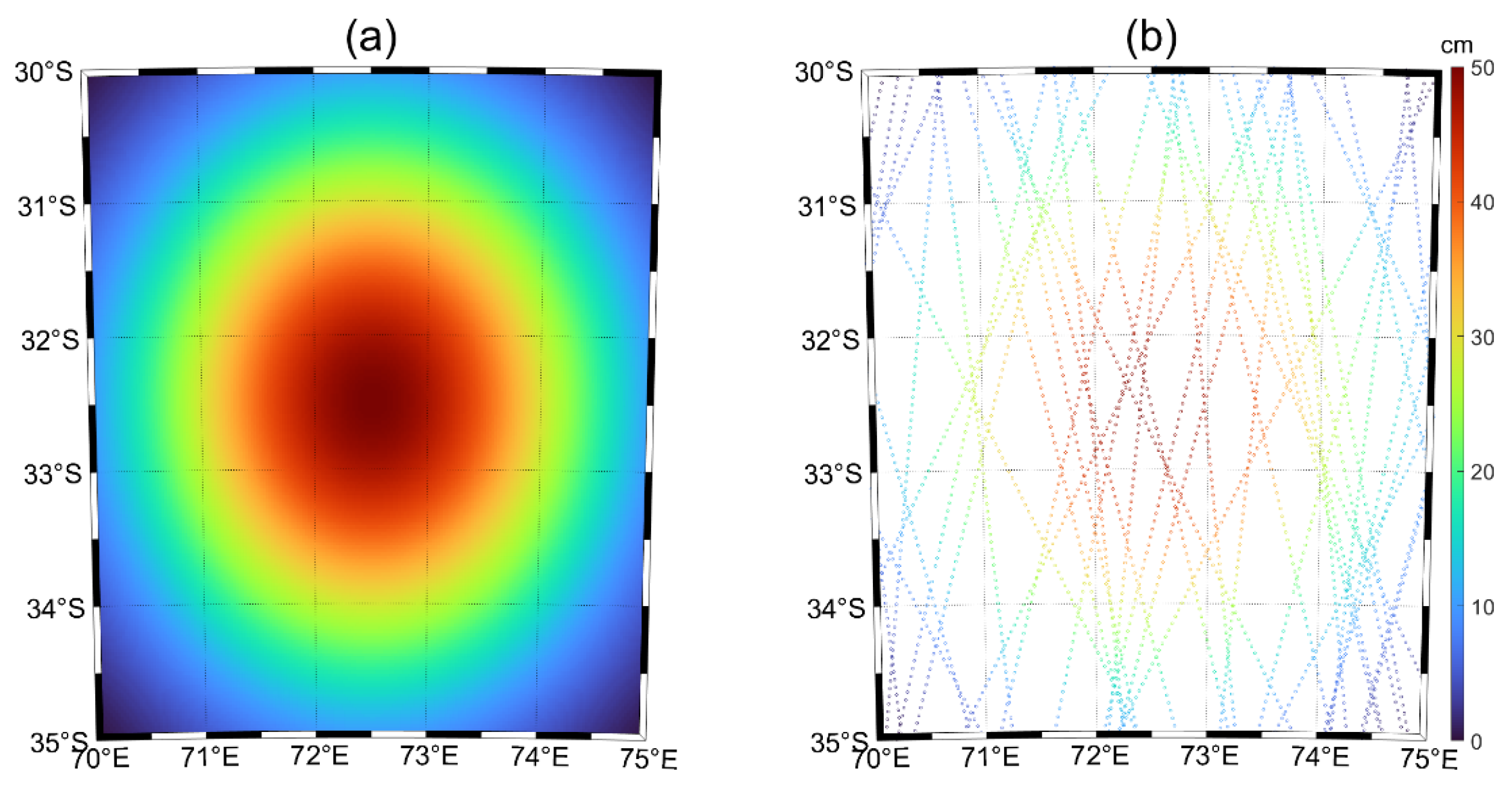
To model mesoscale eddies in the region bounded by 35°S to 30°S latitude and 70°E to 75°E longitude, as illustrated in Figure 2a, a two-dimensional Gaussian function is applied to compute the values at each grid point defined by these latitude and longitude coordinates. This approach generates a surface that serves as an idealized model for mesoscale eddies. Figure 2b illustrates the corresponding surface elevation values sampled at the satellite’s subsatellite points.
The Gaussian function is defined as:
f x , y = 1 2 π σ 1 σ 2 1 ρ 2 exp 1 2 1 ρ 2 x μ 1 2 σ 1 2 2 ρ x μ 1 y μ 2 σ 1 σ 2 + y μ 2 2 σ 2 2 H = h m i n + h m a x h m i n f x , y f m i n f m a x f m i n
Here, both σ 1 and σ 2 are set to 1.5, ρ is set to 0, h m i n is defined as 0 cm, and h m a x is set to 50 cm. x denotes longitude, y denotes latitude, and H represents the surface elevation value corresponding to the latitude and longitude coordinates of the satellite’s subsatellite point.
The experimental design explicitly assumes stationary mesoscale eddies, thereby disregarding their dynamic translational motion. To investigate the interplay between data temporal coverage and B-spline parametrization, the time range of the dataset was systematically varied from 1 to 12 days. For each temporal window, the spatial node configuration was independently adjusted in both east–west and north–south directions, spanning a comprehensive range of 5–15 nodes per axis. All quasi-uniform B-spline models (bi-quadratic, bi-cubic, and bi-quartic B-splines) were fitted to these spatiotemporal configurations, with their performance rigorously evaluated through ten-fold cross-validation using Mean Absolute Error (MAE) as the quantitative metric.
Initial analysis revealed disproportionately high MAE values for 1-day and 2-day datasets, attributable to insufficient satellite track coverage. Consequently, these short-duration results were excluded from further consideration. For the remaining 3–12 day datasets, a comparative analysis was then conducted to assess duration-dependent performance variations.
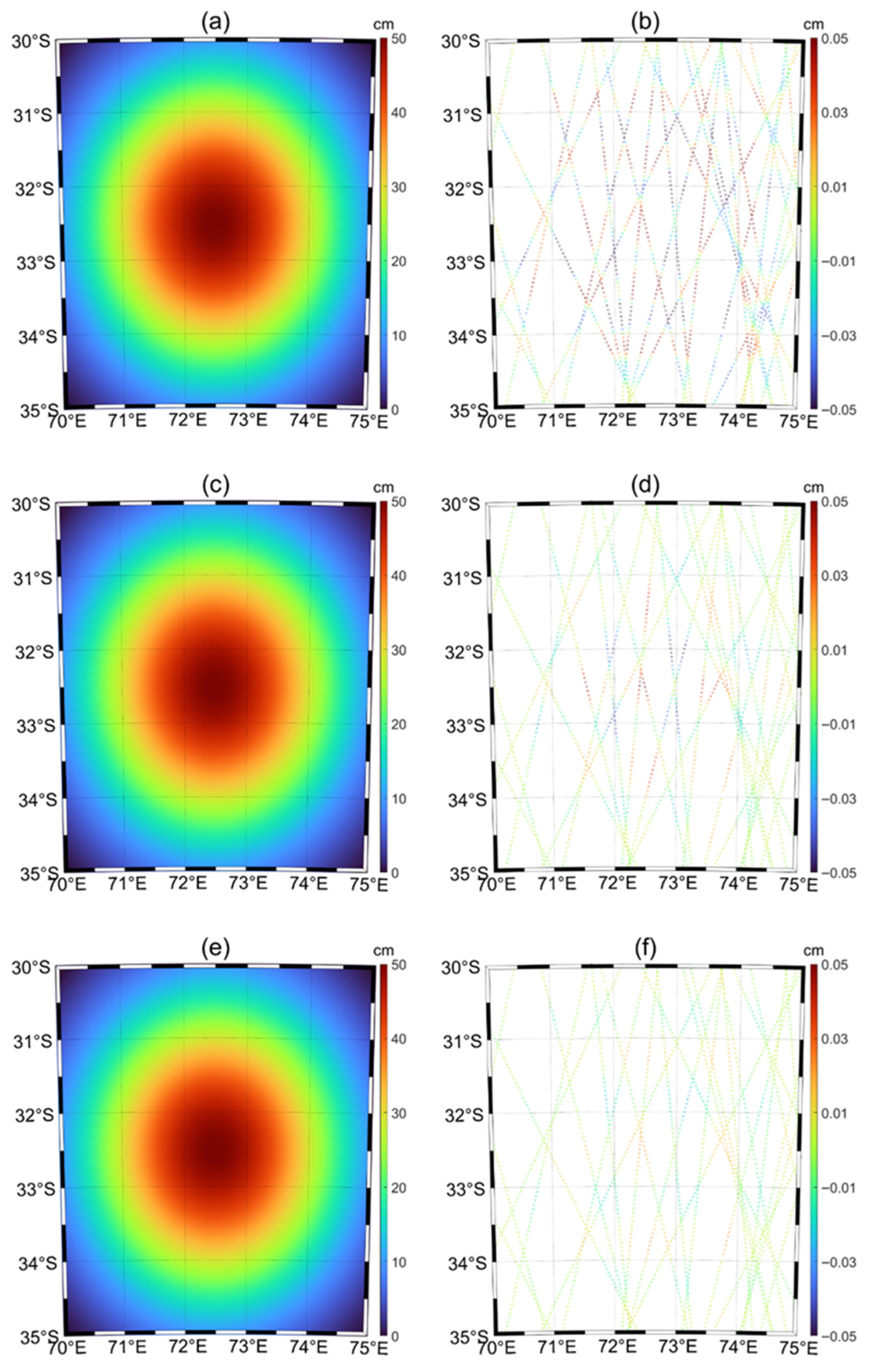
As evidenced by Table 2, the MAE values of bi-quadratic, bi-cubic, and bi-quartic quasi-uniform B-spline fittings exhibit a consistent decreasing trend as the temporal duration increases from 3 to 12 days. However, the error reduction rate diminishes significantly for datasets exceeding 9 days, with MAE improvements remaining below 0.2 cm per additional day. Notably, all three methods achieve comparable accuracy for any fixed temporal window, demonstrating their inherent methodological equivalence under static eddy assumptions. A critical performance threshold emerges at 8-day durations, where all methods achieve error percentages below 10% relative to the 50 cm amplitude benchmark. This justifies the selection of 8–12 day datasets for stationary mesoscale eddy modeling, as it optimally balances observational sufficiency and computational economy. Figure 3 visualizes the reconstruction results and error distribution patterns for an 8-day dataset under each method’s optimal node configuration.
Under identical time ranges, the bi-quadratic quasi-uniform B-spline demonstrated faster computational speed and higher efficiency in the idealized experiments. It should be clarified that all data processing and computational programming in this study were executed on a high-performance workstation equipped with a 12th Generation Intel® Core™ i7-12700 processor and 32.0 GB of RAM (Intel Corporation, Santa Clara, CA, USA). All programs were developed and executed on a 64-bit operating system using MATLAB (version R2022b). Repeated timing tests on this workstation revealed the following average computation times for single fittings on 7–12 day datasets: 1.0 s for bi-quadratic, 1.9 s for bi-cubic, and 3.7 s for bi-quartic quasi-uniform B-splines, with variations across different durations limited to two decimal places.
In real-world scenarios, data often contains various forms of interference and noise. Understanding noise impacts helps evaluate fitting method performance on practical datasets. A robust fitting method should resist overfitting noise while maintaining accuracy. To address this, we designed controlled experiments introducing simulated noise at different levels to replicate measurement errors. Tests were conducted on 6-, 7-, and 8-day datasets, with results summarized in Table 3, showing 10-fold cross-validated MAE trends under increasing noise. For a specified noise-to-signal ratio of p%, a set of random values was drawn from a uniform distribution over the interval [−A, A], where A = (p/100) × h m a x and h m a x = 50 cm is the maximum amplitude of the Gaussian surface. This noise was then added directly to the idealized SLA value at each subsatellite point to create the noisy synthetic dataset for the robustness tests.
The analysis of fitting robustness under varying noise levels and time ranges demonstrates that both data noise intensity and temporal coverage length are critical factors influencing fitting accuracy. As shown in Table 3, when the noise level increases from 0% to 8%, the minimum MAE values for all three B-spline fitting methods exhibit a systematic rise, unequivocally confirming the significant negative impact of data noise on model performance. Simultaneously, under high noise conditions, extending the fitting duration from 6 to 8 days still effectively reduces MAE, indicating that longer observational datasets remain beneficial for improving precision and stability even in noisy environments.
Among the three fitting methods, none demonstrates absolute superiority. Under ideal noise-free conditions, the performance baselines of the three methods are nearly identical. With the introduction of noise, the differences in MAE between the methods remain small overall. Thus, within the temporal ranges and noise levels investigated in this study, the choice of B-spline degree is not a decisive factor. In terms of accuracy, the MAE differences among the three methods under varying noise levels and time ranges are negligible. However, computation time increases significantly with higher spline degrees. Specifically, for 7–12 day datasets, the average computation time for a single fitting using the bi-quadratic B-spline is 53% and 27% of that required by the bi-cubic and bi-quartic methods, respectively. Considering practical applications, where researchers often perform dozens of fittings during cross-validation to determine optimal parameters, this difference in computational efficiency substantially impacts research timelines. By synthesizing both fitting accuracy and computational efficiency, a clear conclusion emerges: for idealized mesoscale vortex surface models, the bi-quadratic quasi-uniform B-spline is the recommended method for achieving the optimal balance between precision and speed. Therefore, given comparable fitting accuracy, selecting the computationally efficient bi-quadratic B-spline enables equivalent performance with minimal resource consumption, offering a cost-effective and practical solution.

4.2. Comparison of Actual Along-Track Data Fitted Using Bi-Quadratic, Bi-Cubic, and Bi-Quartic Quasi-Uniform B-Splines

For the region spanning 60°S–30°S latitude and 75°E–105°E longitude, this study investigates the influence of time ranges on fitting performance, following procedures similar to idealized experiments. A critical distinction arises in real-world applications: mesoscale eddies are mobile, and two along-track satellite datasets acquired at proximate coordinates but differing times exhibit increasing divergence in values as the temporal span expands. For example, at a fixed latitude-longitude coordinate, observations collected within a short time window (e.g., 1–3 days) consistently reflect sea surface height anomalies (SSHAs) under the influence of a single eddy system, as typical eddy translation speeds (several to tens of kilometers daily) remain within the eddy’s radius of influence. However, over extended durations (e.g., ≥7 days), the original eddy migrates beyond the coordinate’s effective impact zone, potentially replaced by other eddies or non-eddy states. Consequently, prolonged observational datasets amalgamate physically inconsistent eddy states, introducing fitting ambiguities that degrade reconstruction accuracy—contrary to idealized scenarios where longer time ranges improve results through increased data density.
The results in Table 4 show a non-monotonic dependence between reconstruction accuracy and temporal data duration in real oceanic environments, diverging fundamentally from conclusions drawn in idealized experiments. Data analysis reveals that the MAE does not consistently decrease as the temporal duration increases. When the temporal duration expands from 3 to 6 days, the MAE values for all three B-spline methods drop sharply, driven by the increased data points effectively characterizing the static structure of mesoscale vortices within the fitting region. At the 6-day threshold, the MAE reduces to approximately 3 cm. Beyond this duration, the MAE decline decreases and exhibits minor fluctuations. This phenomenon is consistent with the theoretical expectation: excessively long temporal ranges introduce data points representing mixed information from different vortex states or oceanic background fields rather than a single coherent eddy system. The resulting fitting ambiguities create an antagonistic relationship between the benefits of increased data volume and the noise from dynamical complexity. Therefore, the optimal temporal range for fitting using along-track data from 8 satellites is determined to be 6 days.
The performance differences among the three B-spline methods also follow systematic trends across temporal ranges. During shorter durations (3–5 days), higher-degree methods (e.g., bi-cubic and bi-quartic) exhibit slight advantages due to their greater flexibility in handling limited data. However, within the optimal 6-day window and subsequent antagonistic phases, the MAE differences between all three methods diminish to negligible levels. To enable detailed comparisons of method performance, Table 5 presents the ten-fold cross-validated MAE values for bi-quadratic, bi-cubic, and bi-quartic quasi-uniform B-spline fittings using 6-day along-track data across varying node configurations.
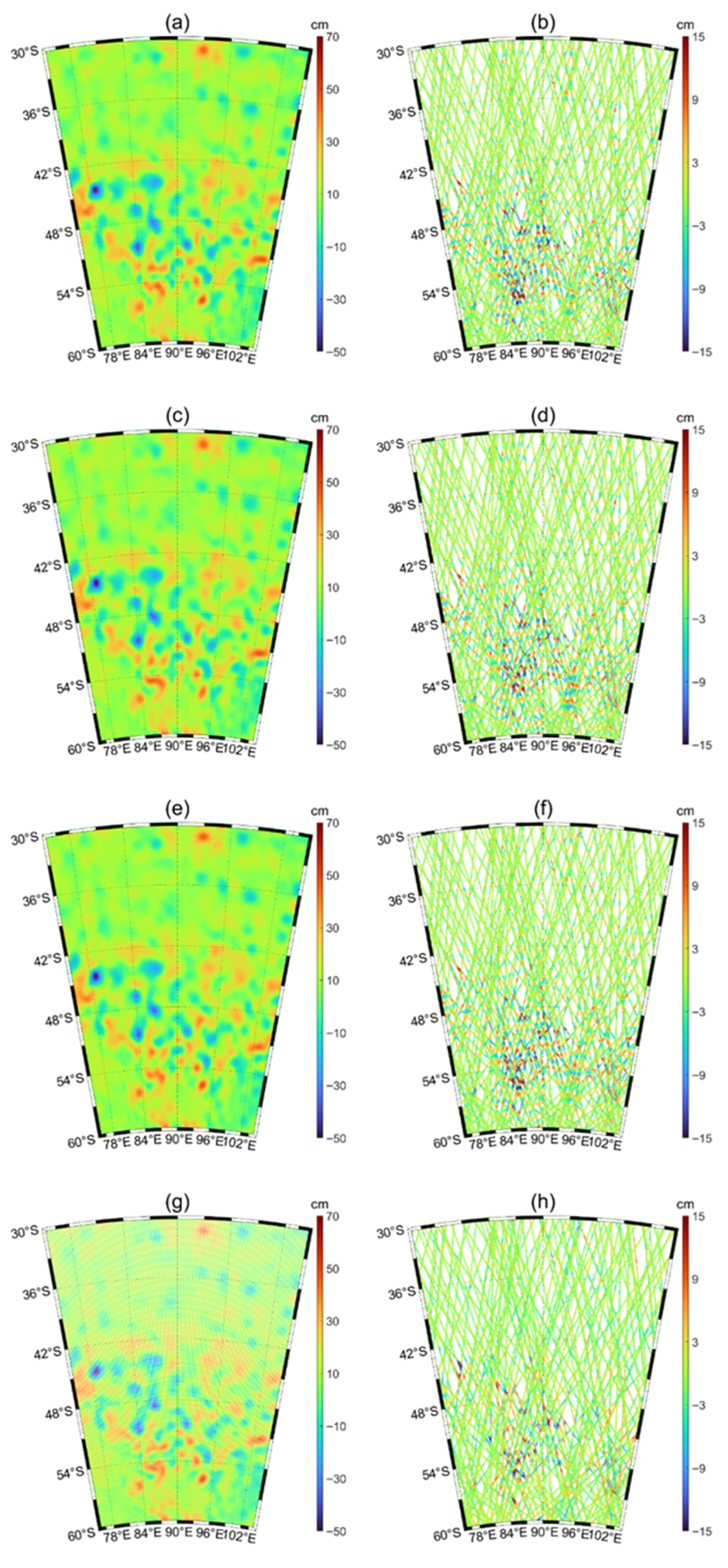
The bi-quadratic B-spline demonstrates exceptional stability, with MAE values exhibiting minimal variation across the entire node configuration parameter space—confined within a narrow range of 3.0 cm to 3.7 cm without anomalous outliers. This consistency confirms its strong robustness and insensitivity to node number selection. In contrast, while the bi-cubic and bi-quartic B-splines occasionally achieve marginally lower MAE values (potentially enabling higher theoretical precision), their performance is critically dependent on optimal node configurations, with improper parameter choices leading to significant accuracy degradation. Integrating these findings with prior conclusions on computational efficiency and temporal adaptability, the bi-quadratic quasi-uniform B-spline has been established as the optimal solution balancing accuracy, efficiency, and operational stability, making it the most practical choice for mesoscale eddy reconstructions. To intuitively compare the three methods, Figure 4a–f illustrates fitting results and error distributions under their respective optimal node configurations using 6-day satellite along-track data. Figure 4g shows the temporally averaged CMEMS Level-4 gridded data over the same period, while Figure 4h illustrates differences between the satellite along-track data and the Level-4 data linearly interpolated to the satellite ground tracks.
The MAE for the bi-quadratic, bi-cubic, and bi-quartic quasi-uniform B-splines were 1.94 cm, 2.12 cm, and 2.25 cm, respectively, with corresponding root mean square errors (RMSE) of 2.73 cm, 3.03 cm, and 3.20 cm. Comparatively, the linear interpolation of Level-4 gridded data yielded the MAE of 1.95 cm and RMSE of 2.76 cm. These results indicate that the bi-quadratic B-spline achieves accuracy comparable to the operational CMEMS Level-4 product, with a negligible MAE difference of 0.01 cm. While the bi-cubic and bi-quartic methods exhibit slightly larger errors (MAE increments of 0.17 cm and 0.30 cm, respectively), statistical tests confirm these discrepancies are not significant for characterizing mesoscale eddies, highlighting the practical equivalence of all three methods in geometric reconstruction tasks. The performance advantage demonstrated here, particularly in achieving accuracy comparable to the operational Level-4 product, is underpinned by the contemporary constellation of eight altimeters providing dense along-track coverage. The increased data volume mitigates interpolation ambiguity and allows sophisticated methods like B-splines to realize their full potential, highlighting the dependency of optimal method selection on the available observational infrastructure. To validate the effectiveness of our reconstructions, we performed a systematic comparison against the CMEMS Level-4 gridded product, which incorporates multi-source in situ observations. After interpolating the three B-spline fitting results onto the same regular grid as the L4 product, the MAE between the bi-quadratic, bi-cubic, bi-quartic B-spline surfaces and the L4 data were calculated to be 1.82 cm, 1.84 cm, and 1.90 cm, respectively. The corresponding RMSE were 2.72 cm, 2.81 cm, and 2.87 cm. These errors are smaller than the discrepancies between the B-spline fittings and the original along-track data. This indicates that our reconstructions show high consistency with the state-of-the-art, in situ-constrained operational analysis field, recovering the large-scale and mesoscale ocean states corroborated by independent observations. This agreement validates the geometric accuracy and physical plausibility of our method at the scales of interest.
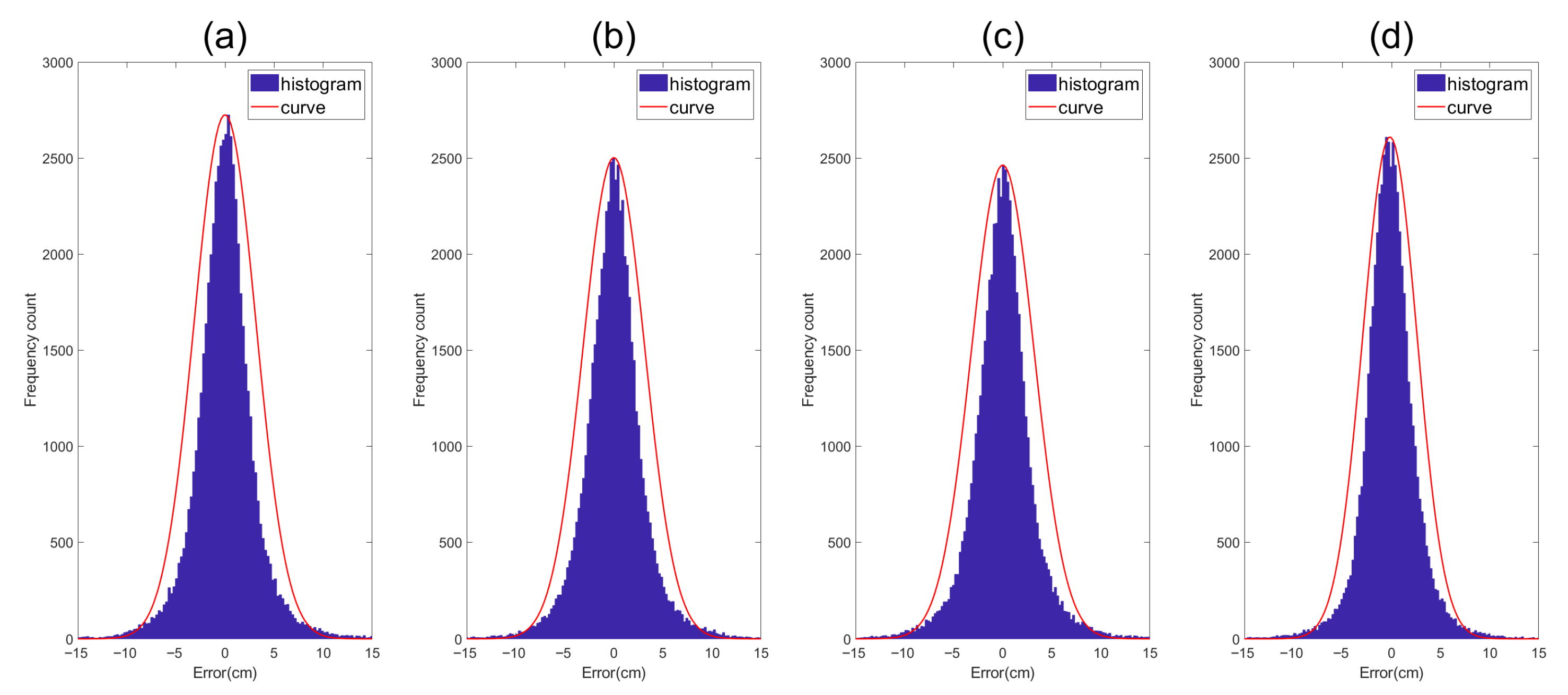
The probability distribution histograms of fitting errors for the three methods, as shown in Figure 5a–c, reveal symmetric error distributions centered around 0 cm for all B-spline methods, indicating no systematic biases in the fitting results. The bi-quadratic quasi-uniform B-spline (Figure 5a) exhibits the highest histogram peak, with a significantly greater frequency of errors concentrated near 0 cm and the narrowest distribution range (spanning the smallest error interval on the horizontal axis). This demonstrates that the bi-quadratic method achieves tighter fits to local fluctuations in the original data, resulting in more consistent and near-zero errors. In comparison, the bi-cubic quasi-uniform B-spline (Figure 5b) shows a slightly lower histogram peak and a marginally wider error distribution than Figure 5a, reflecting less concentrated residuals. The bi-quartic quasi-uniform B-spline (Figure 5c) displays the lowest histogram peak and the broadest error distribution, underscoring its relatively inferior consistency in fitting precision. Figure 5d displays the probability distribution histogram of discrepancies between the Level-4 gridded data and satellite along-track data, exhibiting intermediate characteristics between the error patterns of bi-quadratic and bi-cubic quasi-uniform B-spline fitting results. This observation provides additional evidence supporting the reliability of accuracy comparisons across the three fitting methods.
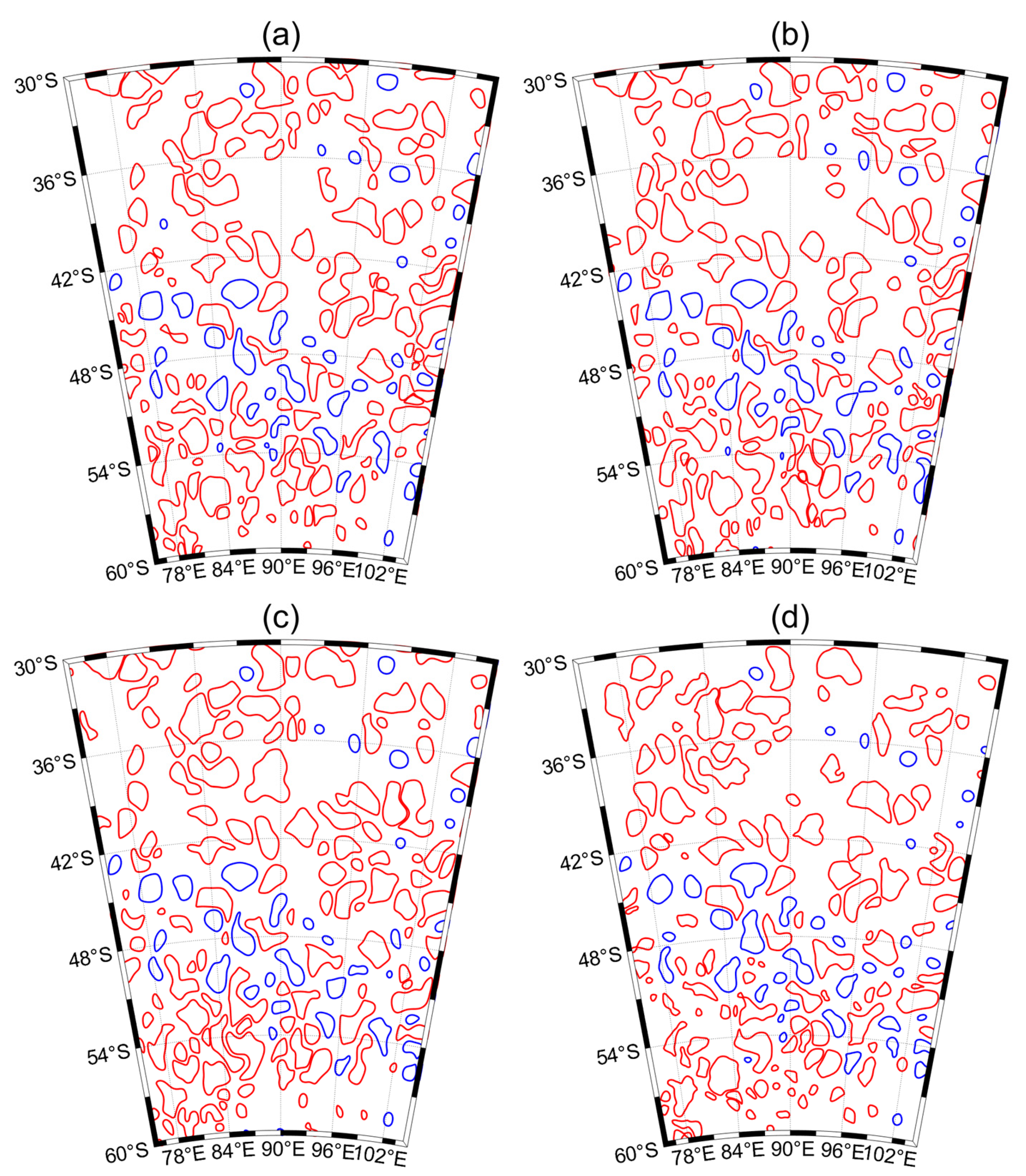
For intuitive comparison of the three fitting methods’ capability in identifying mesoscale eddies, contour-based extraction was applied to delineate eddy boundaries from their respective fitting results, as shown in Figure 6. The bi-quadratic quasi-uniform B-spline (Figure 6a), characterized by strong local approximation capability and weak smoothing strength, preserves more localized details and small-scale fluctuations in the original data. This results in reconstructed eddy boundaries with the following features: a higher count of detected eddies (particularly smaller-scale vortices), enhanced structural details capturing intricate local variations, and improved resolution of nested sub-vortex patterns. The bi-cubic quasi-uniform B-spline (Figure 6b) produces smoother boundaries with fewer small-scale vortices, emphasizing representative mesoscale eddy structures through moderate regularization. Meanwhile, the bi-quartic quasi-uniform B-spline (Figure 6c) generates the most simplified boundaries: small vortices are substantially reduced, large-scale eddy outlines become clearer. To quantitatively compare the differences in mesoscale eddy contours extracted from the fitting results of the three methods, we calculated the mean radius, median radius, and minimum radius (area-equivalent radius) of the mesoscale eddies presented in Figure 6a–c. The mean, median, and minimum radii of eddies extracted from the bi-quadratic B-spline results are 61.4 km, 54.4 km, and 5.3 km, respectively. For the bi-cubic B-spline results, the corresponding values are 60.7 km, 52.1 km, and 10.6 km, while the bi-quartic B-spline yields 63.2 km, 58.0 km, and 13.1 km. These statistics indicate that the mean and median radii of the extracted eddies do not differ substantially among the three methods. However, the minimum eddy radius increases markedly with the degree of the B-spline. The comparative analysis between Figure 6d (Level-4 gridded data) and Figure 6a–c (spline fitting results) reveals slightly rough in eddy contour edges, attributable to spatial resolution limitations inherent in the gridded product.
While the CMEMS along-track data have undergone rigorous corrections and appear smooth, we further investigate the performance of the three B-spline methods on less smooth data. To simulate real-world measurement errors and data variability, we added uniformly distributed random noise with maximum amplitudes of ±2, ±4, ±6, ±8, and ±10 cm to the original along-track SLA data. The results, presented in Table 6, demonstrate that all three B-spline methods effectively suppress noise and maintain reasonable reconstruction accuracy even with increasingly noisy inputs. The MAE and RMSE values increase gradually with noise amplitude, but the growth is significantly lower than the average noise amplitude. This indicates that the quasi-uniform B-spline approach remains robust when applied to less smooth observational data, which may arise from various sources of measurement uncertainty or environmental variability.
While the systematic comparison of surface-fitting accuracy has established the bi-quadratic B-spline method’s advantages in computational efficiency and stability, geometric precision alone remains insufficient for evaluating oceanographic applicability. In practical mesoscale dynamics studies, the ultimate concern lies not in surface reconstruction errors but in the physical validity of derived parameters—particularly vorticity, the core metric quantifying eddy rotational characteristics. The accuracy of vorticity calculations directly determines the scientific reliability of downstream analyses. To fundamentally assess these methods’ dynamical credibility, we systematically compare their vorticity fields, completing the evaluation chain from geometric fitting to physical parameter retrieval.
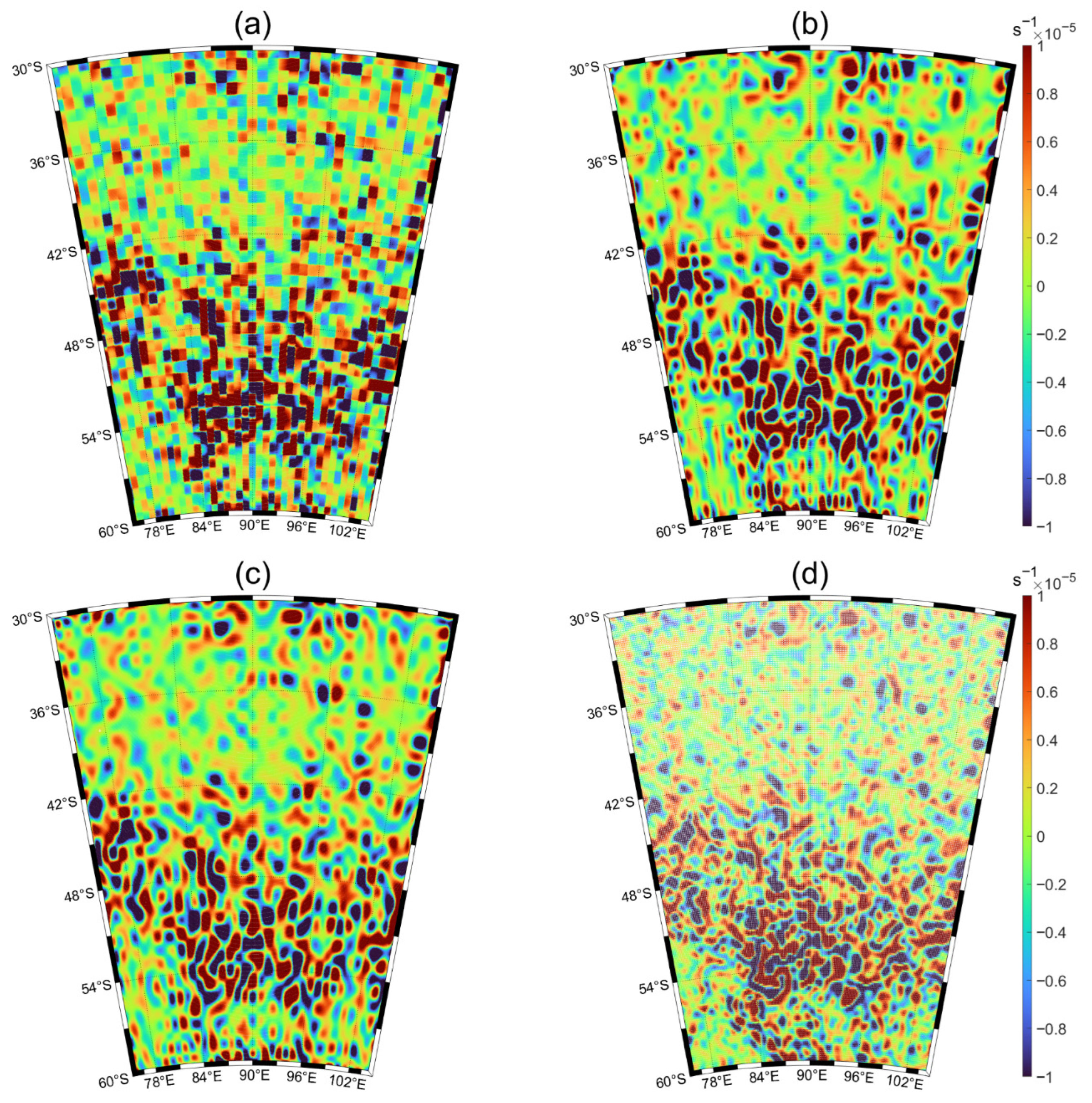
Figure 7 presents the vorticity fields calculated from the three B-spline fitting results. The relatively faded appearance of Figure 7d is a direct result of the native spatial resolution (0.125° × 0.125°) of the CMEMS Level-4 gridded data. For a consistent and fair comparison of the inherent resolution across all data products and methods, all subplots in Figure 7 were visualized by plotting a data point at the center of each grid cell without any additional interpolation or smoothing. Consequently, the L4 data, with its coarser grid density, exhibits a sparser distribution of points in this visualization, leading to its lighter shading. Visual comparison and analysis reveal fundamental differences in their morphological features, directly reflecting the mathematical nature and physical applicability of B-splines of varying degrees. The vorticity field derived from the bi-quadratic quasi-uniform B-spline (Figure 7a) exhibits discontinuous characteristics, manifesting as block-like artifacts resembling stacked small squares. This phenomenon originates mathematically from the continuity of first derivatives but discontinuity of second derivatives (i.e., vorticity) at nodal points. Consequently, the vorticity field reconstructed through this method introduces artificial discontinuities absent in actual oceanic systems, creating nonphysical vorticity mutation lines that invalidate its use for rigorous dynamical analyses.
The bi-cubic quasi-uniform B-spline (Figure 7b) generates globally continuous vorticity fields, yet discernible angular artifacts persist. This indicates that while the method ensures the existence and continuity of second derivatives (thereby producing continuous vorticity fields), potential discontinuities in third derivatives result in visually apparent angular features. Physically, these irregularities imply insufficient smoothness in vorticity gradient fields, which may introduce computational errors when modeling advective or diffusive processes.
In contrast, the bi-quartic quasi-uniform B-spline (Figure 7c) produces vorticity fields with complete continuity and smoothness. By providing higher-order continuity, this method guarantees smooth transitions not only in the vorticity field itself but also in its gradient field. From a physical modeling perspective, such reconstructed vorticity fields best capture the inherently continuous and smooth characteristics of mesoscale ocean eddies, demonstrating the highest physical credibility.
Notably, some differences exist between the eddy contours extracted from the B-spline reconstructions (Figure 6a–c) and those from the L4 gridded product (Figure 6d). Specific features of interest are the anti-cyclonic eddies appearing in Figure 6c (bi-quartic B-spline) near 84°E, 54°S and 90°E, 39°S. Cross-validation with the corresponding relative vorticity fields in Figure 7 reveals two distinct scenarios: (1) The area near 84°E, 54°S consistently exhibits a negative vorticity signal across all four vorticity plots (including the one derived from L4 data). This confirms the anti-cyclonic feature as a genuine oceanic structure that was not delineated by the contour method applied to the smoother L4 SLA field, likely due to its inherent smoothness or resolution. (2) In contrast, the vorticity field near 90°E, 39°S shows no corresponding broad negative signature. Therefore, the anti-cyclonic contour at this location is identified as a detection artifact. This artifact likely arose because the contouring algorithm connected several subtle undulations in the highly smooth bi-quartic SLA surface, forming a large spurious closed contour.
Visual inspection of the relative vorticity fields in Figure 7 reveals a notable latitudinal dependence: the magnitudes of relative vorticity are generally lower in the lower-latitude regions (e.g., north of 42°S) across all subplots, including the CMEMS Level-4 data. This phenomenon aligns with fundamental geophysical fluid dynamics principles. The planetary vorticity (Coriolis parameter, f) decreases with decreasing latitude, which influences the strength of currents and relative vorticity that can be generated by a given sea surface height gradient within the geostrophic framework. Consequently, relative vorticity signals associated with mesoscale eddies are typically weaker in lower latitudes, even under the forcing of similar oceanic dynamical processes.
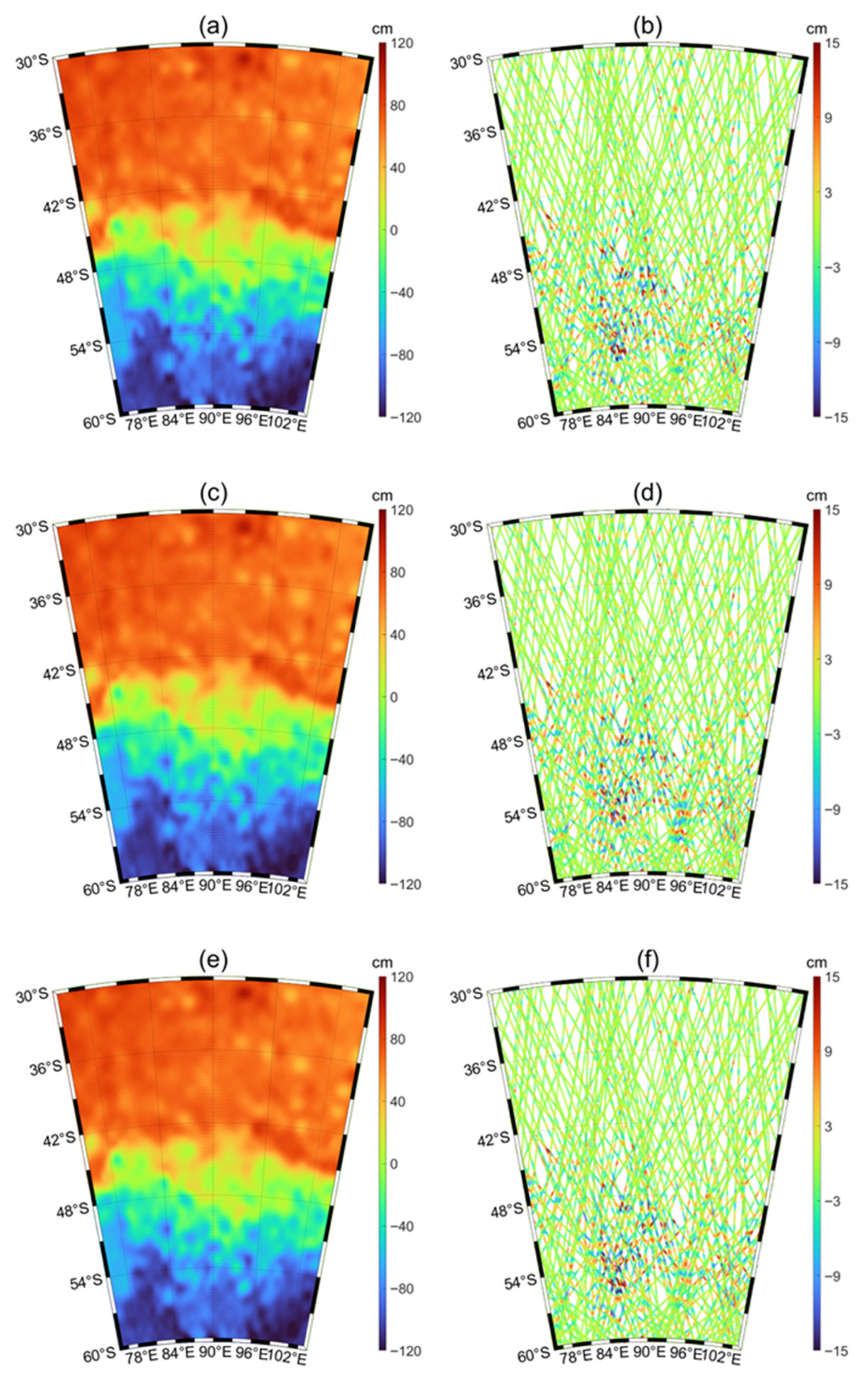
Finally, the performance of the three methods was evaluated for fitting the absolute dynamic topography (ADT). The resulting reconstructions and their corresponding error distributions are presented in Figure 8. All three methods yielded visually plausible and structurally consistent representations of the ADT field. The bi-quadratic, bi-cubic, and bi-quartic quasi-uniform B-spline fittings achieved MAEs of 2.24 cm, 2.25 cm, and 2.28 cm, and RMSEs of 3.21 cm, 3.20 cm, and 3.25 cm, respectively. The differences in accuracy among the methods were marginal. Compared to the errors obtained from SLA fitting, all methods exhibited a slight increase in both MAE and RMSE when applied to ADT. This is attributed to the broader dynamic range of the ADT signal, which incorporates the larger-scale mean dynamic topography in addition to the anomaly. The spatial patterns of the error distributions for the ADT fitting results (Figure 8) were consistent with those observed for the SLA fitting results (Figure 4).

5. Discussion

This study evaluated bi-quadratic, bi-cubic, and bi-quartic quasi-uniform B-splines for reconstructing mesoscale eddies from satellite along-track SLA data in the South Indian Ocean. The analysis yielded two main findings: an optimal temporal window for reconstruction and a distinct trade-off between computational efficiency and physical fidelity that is dictated by the choice of spline degree.
First, our identification of a 6-day optimal temporal window for the South Indian Ocean challenges the intuitive assumption that longer data durations invariably improve reconstruction quality. While idealized experiments suggested monotonic accuracy improvements with extended temporal coverage, real-world analyses revealed a non-monotonic relationship where reconstruction quality peaks at approximately 6 days before exhibiting minor fluctuations. This divergence is attributed to the dynamic nature of mesoscale eddies, which typically translate at speeds of several to tens of kilometers per day. Beyond this 6-day window, the along-track data begins to conflate signals from different eddy states or background fields, introducing ambiguity that outweighs the benefit of increased data density. This finding highlights the need to consider the advective timescales of eddies when designing reconstruction windows from along-track data, which is relevant for operational eddy monitoring systems.
Second, the performance comparison reveals a practical, application-oriented principle for selecting B-spline degrees. For sea surface height anomaly (SLA) reconstruction tasks—such as eddy identification and morphological characterization—the bi-quadratic B-spline demonstrates an optimal balance of computational efficiency (twice and four times faster than bi-cubic and bi-quartic methods, respectively), parametric robustness, and precision comparable to the operational CMEMS Level-4 product (MAE difference of 0.01 cm). This makes it particularly suitable for large-scale or near-real-time applications. However, for dynamical analyses that require the computation of vorticity—a second-derivative field—the requirements shift fundamentally. The bi-quadratic B-spline, constrained by its inherent C1 continuity, generates discontinuous vorticity fields with nonphysical block-like artifacts, while the bi-cubic B-spline produces continuous but angular vorticity patterns. Only the bi-quartic B-spline, with C3 continuity, delivers vorticity fields with the smoothness required for physically credible dynamical analyses. This distinction highlights the differing requirements for different oceanographic applications: while geometric reconstruction prioritizes efficiency and stability, dynamical analysis demands mathematical properties that guarantee physical plausibility, even at higher computational cost.
Notably, our bi-quadratic B-spline achieved accuracy comparable to the CMEMS Level-4 product, which typically employs optimal interpolation methods, suggesting that B-spline approaches offer a viable alternative for specialized regional analyses.
Looking forward, our findings illuminate several promising investigative pathways. The parameter sensitivity observed in higher-degree B-splines suggests that adaptive node placement strategies, rather than uniform configurations, could further enhance both precision and computational efficiency. Additionally, physically constrained frameworks incorporating dynamical priors (e.g., geostrophic balance constraints or vorticity conservation principles) may yield ocean fields that simultaneously satisfy mathematical optimality and hydrodynamic realism. Such advancements would bridge the persistent gap between geometric accuracy and physical fidelity, promoting deeper integration of satellite remote sensing in operational oceanography and climate research. This study validated the quasi-uniform B-spline method by demonstrating its high consistency with the CMEMS Level-4 product, which itself is constrained by a global suite of in situ observations. For more direct validation in future work, we plan to utilize temperature and salinity profiles from Argo floats within the South Indian Ocean study region. We will calculate dynamic height anomalies from these profiles to serve as an independent “sea truth” dataset for a point-by-point statistical comparison against the concurrent SSHA fields reconstructed from satellite along-track data. This direct comparison will further quantify the capability of our method in recovering the three-dimensional ocean structure as captured by in situ instruments and provide stronger groundwork for potential operational applications.

6. Conclusions

This study systematically evaluated the performance of bi-quadratic, bi-cubic, and bi-quartic quasi-uniform B-spline surfaces for reconstructing mesoscale eddies from satellite along-track SLA data in the South Indian Ocean. Our investigation, integrating idealized experiments with real-world data analysis, yields the following main conclusions.
For the study region and the current multi-satellite constellation, a 6-day data window provides the optimal balance between sufficient along-track coverage and the mitigation of reconstruction ambiguity caused by eddy advection. Within our study area (60°S–30°S, 75°E–105°E), this 6-day composite from eight altimeters provides a total of 59,638 observations, yielding an average data density of approximately one observation per 40 km × 40 km area. This dense spatial sampling underpins the effectiveness of the identified temporal window. Longer durations do not necessarily improve accuracy due to the mixing of different oceanic signals.
The choice of B-spline degree can be selected based on the specific scientific objective:
For efficient SLA field reconstruction and eddy detection, the bi-quadratic B-spline is highly recommended. It delivers accuracy comparable to operational gridded products and higher-degree methods, with significantly faster computation (approximately 50% and 27% of the time required by bi-cubic and bi-quartic fits, respectively) and greater robustness to parameter choices.
Conversely, for applications requiring the calculation of derived dynamic parameters, particularly vorticity, the bi-quartic B-spline is indispensable. Due to its C3 continuity, it alone produces smooth, physically plausible vorticity fields. Lower-degree splines result in discontinuous (bi-quadratic) or non-smooth (bi-cubic) vorticity, rendering them unsuitable for rigorous dynamical analysis.
In summary, this work provides a selection principle and demonstrates its application for reconstructing mesoscale eddies from along-track data. The demonstrated trade-off between efficiency and physical fidelity can inform the selection of the most appropriate tool based on their immediate goals, thereby aiding in the utilization of current and future high-resolution altimetry data.

Author Contributions

Conceptualization, C.K. and C.L.; methodology, X.L.; software, C.K.; validation, C.K., C.L. and X.L.; formal analysis, C.K. and W.Z.; investigation, C.K.; resources, W.Z.; data curation, C.K. and C.L.; writing—original draft preparation, C.K.; writing—review and editing, C.K., W.Z. and X.L.; visualization, C.K. and C.L.; supervision, W.Z. and X.L.; project administration, W.Z.; funding acquisition, W.Z. and X.L. All authors have read and agreed to the published version of the manuscript.

Funding

This work was funded by Guangdong Basic and Applied Basic Research Foundation (Grant No. 2024B1515020099). Supported by the Strategic Priority Research Program of the Chinese Academy of Sciences, Grant No. XDA 0370404 and the Technical Innovation Project for Instrument and Equipment Function Development at the Chinese Academy of Sciences led by Wei Zhou.

Data Availability Statement

The Level-3 satellite along-track SLA data and Level-4 gridded SLA data are provided by Copernicus Marine Environment Monitoring Service (https://marine.copernicus.eu/, accessed on 10 September 2025).

Acknowledgments

We would like to express our sincere gratitude to Luochuan Xu for his foundational contributions to this work.

Conflicts of Interest

The authors declare no conflicts of interest.

References

  1. He, J.; Xu, Y.; Sun, H.; Jiang, Q.; Yang, L.; Kong, W.; Liu, Y. Sea surface height wavenumber spectrum from airborne interferometric radar altimeter. Remote Sens. 2024, 16, 1359. [Google Scholar] [CrossRef]
  2. Wang, J.; Fu, L.; Torres, H.S.; Chen, S.; Qiu, B.; Menemenlis, D. On the spatial scales to be resolved by the surface water and ocean topography ka-band radar interferometer. J. Atmos. Ocean. Technol. 2019, 36, 87–99. [Google Scholar] [CrossRef]
  3. Yu, Y.; Sandwell, D.T.; Gille, S.T.; Villas Bôas, A.B. Assessment of ICESat-2 for the recovery of ocean topography. Geophys. J. Int. 2021, 226, 456–467. [Google Scholar] [CrossRef]
  4. Jiang, M.; Xu, K.; Wang, J. Evaluation of sentinel-6 altimetry data over ocean. Remote Sens. 2023, 15, 12. [Google Scholar] [CrossRef]
  5. Valle-Rodríguez, J.; Trasviña-Castro, A. Sea level anomaly measurements from satellite coastal altimetry and tide gauges at the entrance of the Gulf of California. Adv. Space Res. 2020, 66, 1593–1608. [Google Scholar] [CrossRef]
  6. Liu, T.; Chen, X.; Chen, G. Multi-scale eddy characterization using SWOT-integrated altimetry data. Int. J. Remote Sens. 2025, 46, 6189–6213. [Google Scholar] [CrossRef]
  7. de Marez, C. Synoptic observation of a full mesoscale eddy lifetime and its secondary instabilities in the Gulf of Mexico. Ocean Sci. 2025, 21, 1933–1942. [Google Scholar] [CrossRef]
  8. Gronniger, J.L.; Gray, P.C.; Niebergall, A.K.; Johnson, Z.I.; Hunt, D.E. A gulf stream frontal eddy harbors a distinct microbiome compared to adjacent waters. PLoS ONE 2023, 18, e0293334. [Google Scholar] [CrossRef] [PubMed]
  9. Cabrera, M.; Santini, M.; Lima, L.; Carvalho, J.; Rosa, E.; Rodrigues, C.; Pezzi, L. The Southwestern Atlantic Ocean mesoscale eddies: A review of their role in the air-sea interaction processes. J. Mar. Syst. 2022, 235, 103785. [Google Scholar] [CrossRef]
  10. Mason, E.; Pascual, A.; Gaube, P.; Ruiz, S.; Pelegrí, J.L.; Delepoulle, A. Subregional characterization of mesoscale eddies across the Brazil-Malvinas Confluence. J. Geophys. Res. Ocean. 2017, 122, 3329–3357. [Google Scholar] [CrossRef]
  11. Hwang, C.; Chen, S. Circulations and eddies over the South China Sea derived from TOPEX/Poseidon altimetry. J. Geophys. Res. Ocean. 2000, 105, 23943–23965. [Google Scholar] [CrossRef]
  12. He, J.; Lin, X. Co-variation of the surface wind speed and the sea surface temperature over mesoscale eddies in the gulf stream region: Momentum vertical mixing aspect. J. Oceanol. Limnol. 2019, 37, 1154–1164. [Google Scholar] [CrossRef]
  13. Leyba, I.M.; Saraceno, M.; Solman, S.A. Air-sea heat fluxes associated to mesoscale eddies in the Southwestern Atlantic Ocean and their dependence on different regional conditions. Clim. Dyn. 2017, 49, 2491–2501. [Google Scholar] [CrossRef]
  14. Pezzi, L.P.; de Souza, R.B.; Santini, M.F.; Miller, A.J.; Carvalho, J.T.; Parise, C.K.; Quadro, M.F.; Rosa, E.B.; Justino, F.; Sutil, U.A.; et al. Oceanic eddy-induced modifications to air–sea heat and CO2 fluxes in the Brazil-Malvinas confluence. Sci. Rep. 2021, 11, 10648. [Google Scholar] [CrossRef]
  15. Yun, J.; Ha, K.; Lee, S. Impact of greenhouse warming on mesoscale eddy characteristics in high-resolution climate simulations. Environ. Res. Lett. 2024, 19, 14078. [Google Scholar] [CrossRef]
  16. Chaigneau, A.; Gizolme, A.; Grados, C. Mesoscale eddies off Peru in altimeter records: Identification algorithms and eddy spatio-temporal patterns. Prog. Oceanogr. 2008, 79, 106–119. [Google Scholar] [CrossRef]
  17. Zhang, L.; Ma, X.; Xu, W.; Wan, X.; Chen, Q. A novel mesoscale eddy identification method using enhanced interpolation and a posteriori guidance. Sensors 2025, 25, 457. [Google Scholar] [CrossRef] [PubMed]
  18. Xie, H.; Xu, Q.; Dong, C. Deep learning for mesoscale eddy detection with feature fusion of multisatellite observations. IEEE J. Sel. Top. Appl. Earth Obs. Remote Sens. 2024, 17, 18351–18364. [Google Scholar] [CrossRef]
  19. Huo, J.; Zhang, J.; Yang, J.; Li, C.; Liu, G.; Cui, W. High kinetic energy mesoscale eddy identification based on multi-task learning and multi-source data. Int. J. Appl. Earth Obs. Geoinf. 2024, 128, 103714. [Google Scholar] [CrossRef]
  20. Zheng, D. The Application of Cubic Spline Function to the Processing of Ocean Data; Periodical of Ocean University of China: Qingdao, China, 1989. [Google Scholar]
  21. Jiang, J.Z.; Zhou, Y.S. Spline Function Method Applied to Processing Hydrographic Data. Oceanol. Limnol. Sin. 1984, 15, 399–408. [Google Scholar]
  22. Wang, X.; Liu, Y.; Wang, C.H.; Li, B.L.; Zhong, S. Application and Comparison of Interpolation Methods for the Distribution of Sea Salinity. Mar. Sci. Bull. 2016, 35, 324–330. [Google Scholar]
  23. Zhang, X.H.; Li, Y.; Hao, P.Z.; Qu, J.; Gao, W.Y. Discussion on the Interpolation Calculation Methods of Hydrological Data. Mar. Forecasts 2008, 25, 5–13. [Google Scholar]
  24. Kong, C.; Jiao, S.; Cao, X.; Lv, X. Application of a bicubic quasi-uniform b-spline surface fitting method for characterizing mesoscale eddies in the Atlantic Ocean. Remote Sens. 2025, 17, 2744. [Google Scholar] [CrossRef]
  25. Xu, L.; Gao, M.; Zhang, Y.; Guo, J.; Lv, X.; Zhang, A. Oceanic mesoscale eddies identification using b-spline surface fitting model based on along-track SLA data. Remote Sens. 2022, 14, 5713. [Google Scholar] [CrossRef]
  26. Farin, G. Chapter 10—B-splines. In Curves and Surfaces for Computer-Aided Geometric Design, 3rd ed.; Farin, G., Ed.; Academic Press: Boston, MA, USA, 1993; pp. 157–187. [Google Scholar]
  27. Rogers, D.F.; Satterfield, S.G. B-spline surfaces for ship hull design. ACM SIGGRAPH Comput. Graph. 1980, 14, 211–217. [Google Scholar] [CrossRef]
  28. Farin, G. Chapter 1—P. Bézier: How a simple system was born. In Curves and Surfaces for Computer-Aided Geometric Design, 3rd ed.; Farin, G., Ed.; Academic Press: Boston, MA, USA, 1993; pp. 1–12. [Google Scholar]
  29. de Boor, C. A Practical Guide to Spline; Springer: Berlin/Heidelberg, Germany, 1978. [Google Scholar]
  30. Piegl, L.A.; Tiller, W. The NURBS Book; Springer: Berlin/Heidelberg, Germany, 1997. [Google Scholar]
  31. de Boor, C. On calculating with b-splines. J. Approx. Theory 1972, 6, 50–62. [Google Scholar] [CrossRef]
  32. Barsky, B.A. A Study of the Parametric Uniform B-Spline Curve and Surface Representations; EECS Department; University of California: Berkeley, CA, USA, 1983. [Google Scholar]
  33. Liu, X.; Xu, W. Uniform b-spline curve and surface with shape parameters. In Proceedings of the 2008 International Conference on Computer Science and Software Engineering, Wuhan, China, 12–14 December 2008. [Google Scholar]
  34. Kong, C.; Zhang, Y.; Shi, J.; Lv, X. Oceanic mesoscale eddy fitting using legendre polynomial surface fitting model based on along-track sea level anomaly data. Remote Sens. 2024, 16, 2799. [Google Scholar] [CrossRef]
  35. Kohavi, R. A study of cross-validation and bootstrap for accuracy estimation and model selection. In Proceedings of the 14th International Joint Conference on Artificial Intelligence (IJCAI’95), Montreal, QC, Canada, 20–25 August 1995; Morgan Kaufmann Publishers Inc.: San Francisco, CA, USA, 1995; pp. 1137–1143. [Google Scholar]
  36. Franklin, J. The elements of statistical learning: Data mining, inference and prediction. Math. Intell. 2005, 27, 83–85. [Google Scholar] [CrossRef]
Figure 1. (a) Geographical location of the study area (highlighted in the red box, 60°S–30°S, 75°E–105°E). (b) Distribution of satellite subsatellite point SLA data within the study area.
Remotesensing 18 00735 g001
Figure 2. (a) Gaussian surface in the idealized experiment serving as the mesoscale eddy model; (b) Surface elevation values corresponding to the satellite’s subsatellite points within a 12-day temporal dataset.
Remotesensing 18 00735 g002
Figure 3. (a,c,e) The results of fitting the 8-day data using bi-quadratic, bi-cubic, and bi-quartic quasi-uniform B-splines, respectively. (b,d,f) Corresponding error distributions for each B-spline configuration.
Remotesensing 18 00735 g003
Figure 4. (a,c,e) Results of fitting the 6-day data using bi-quadratic, bi-cubic, and bi-quartic quasi-uniform B-splines, respectively. (b,d,f) The error distributions corresponding to these fittings. (g) The temporally averaged CMEMS Level-4 gridded data. (h) The differences between the satellite along-track data and the Level-4 data linearly interpolated to the satellite ground tracks.
Remotesensing 18 00735 g004
Figure 5. Error Frequency Distribution Histograms and Probability Density Curves. (a) Errors from bi-quadratic quasi-uniform B-spline fittings. (b) Errors from bi-cubic quasi-uniform B-spline fittings. (c) Errors from bi-quartic quasi-uniform B-spline fittings. (d) Errors from Level-4 gridded data.
Remotesensing 18 00735 g005
Figure 6. The contour map of mesoscale eddies extracted using the contour line discrimination method, with red representing anticyclonic eddies and blue representing cyclonic eddies. (a) Based on the fitting results of the bi-quadratic quasi-uniform B-spline; (b) Based on the fitting results of the bi-cubic quasi-uniform B-spline. (c) Based on the fitting results of the bi-quartic quasi-uniform B-spline. (d) Based on the Level-4 gridded data.
Remotesensing 18 00735 g006
Figure 7. Relative vorticity calculated from the fitting results. (a) Based on the fitting results of the bi-quadratic quasi-uniform B-spline; (b) Based on the fitting results of the bi-cubic quasi-uniform B-spline; (c) Based on the fitting results of the bi-quartic quasi-uniform B-spline; (d) Based on the Level-4 gridded data.
Remotesensing 18 00735 g007
Figure 8. (a,c,e) Results of fitting the 6-day ADT data using bi-quadratic, bi-cubic, and bi-quartic quasi-uniform B-splines, respectively. (b,d,f) The error distributions corresponding to these fittings.
Remotesensing 18 00735 g008
Table 1. Daily Data Volume for Each Satellite within the Latitude Range of 60°S to 30°S and Longitude Range of 75°E to 105°E.
DateHY-2BCryosat-2Sentinel-3ASentinel-3BSentinel-6AJason-3Saral/AltiKaSWOTTotal Number
1 July 20241305105312891216137016491217104610,145
2 July 20241266153012481208148111681508102510,434
3 July 2024822104951612561642139188210828640
4 July 202414991388125912421052829114211079518
5 July 20241317104912851167137116331285113810,245
6 July 20241265126612761239166615351189122010,656
7 July 20246250107712591555925013296770
8 July 20248421232123812331502165365312069559
9 July 202414369681277111210291562136011339877
10 July 2024128812081283128015521511939110010,161
11 July 202412159971114127015001519115710749846
12 July 202488713351220123215411097131810279657
Total Number13,76713,07514,08214,71417,26116,47212,65013,487115,508
Table 2. Minimum MAE values (cm) from ten-fold cross-validation for bi-quadratic, bi-cubic, and bi-quartic quasi-uniform B-Spline fittings of data in different time ranges.
Days
3456789101112
bi-quadratic B-spline8.767.936.885.735.394.843.953.923.853.66
bi-cubic B-spline8.708.036.905.735.404.843.953.913.853.66
bi-quartic B-spline8.397.756.825.745.404.843.953.923.853.67
Table 3. Minimum MAE values (cm) for three fitting methods under varying noise levels in 6-day, 7-day, and 8-day datasets.
Noise-to-Signal Ratio
01%2%3%4%5%6%7%8%
6 daysbi-quadratic B-spline5.735.775.845.896.026.136.246.256.39
bi-cubic B-spline5.735.785.815.976.016.056.206.266.54
bi-quartic B-spline5.745.785.845.916.066.136.206.296.54
7 daysbi-quadratic B-spline5.395.435.495.595.735.755.926.016.04
bi-cubic B-spline5.405.455.505.585.695.825.856.006.15
bi-quartic B-spline5.405.435.485.615.695.825.956.036.14
8 daysbi-quadratic B-spline4.844.884.955.085.195.335.345.515.75
bi-cubic B-spline4.844.894.985.085.215.275.425.525.63
bi-quartic B-spline4.844.904.985.065.205.275.345.545.67
Table 4. The minimum MAE values (cm) for the bi-quadratic, bi-cubic, and bi-quartic quasi-uniform B-spline fitting methods applied to data across different time ranges.
Days
3456789101112
bi-quadratic B-spline12.486.803.293.022.792.912.542.532.642.27
bi-cubic B-spline7.275.253.722.952.642.732.342.432.542.28
bi-quartic B-spline6.576.684.322.992.722.842.372.442.552.28
Table 5. MAE (cm) for ten-fold cross-validation of each node number combination in bi-quadratic, bi-cubic, and bi-quartic quasi-uniform B-spline fittings, using data with a 6-day time range.
Number of Nodes in the East–West Direction
bi-quadratic B-spline353637383940
Number of nodes in the north–south direction353.153.213.243.233.273.30
363.253.193.223.233.283.30
373.183.173.043.073.093.12
383.373.183.243.023.063.09
393.553.393.173.393.093.14
403.713.503.323.113.703.16
bi-cubic B-spline
Number of nodes in the north–south direction353.373.643.984.464.995.55
364.183.634.074.715.446.24
373.134.924.215.016.017.15
383.323.246.465.687.028.64
393.483.313.209.058.3710.63
403.603.413.193.133.002.95
bi-quartic B-spline
Number of nodes in the north–south direction357.749.9412.553.243.243.23
369.9510.103.103.143.123.13
373.2510.8012.063.083.093.08
383.343.308.7512.153.143.16
393.463.243.333.613.043.05
403.533.393.163.524.452.99
The bold numbers indicate the minimum Mean Absolute Error (MAE) value among the three fitting methods (bi-quadratic, bi-cubic, and bi-quartic quasi-uniform B-splines) for the corresponding time range.
Table 6. MAE and RMSE (cm) for bi-quadratic, bi-cubic, and bi-quartic quasi-uniform B-spline fittings under varying noise amplitudes.
Noise Amplitude
0246810
MAEbi-quadratic B-spline1.942.432.973.704.545.39
bi-cubic B-spline2.122.442.983.684.525.39
bi-quartic B-spline2.252.473.013.724.535.42
RMSEbi-quadratic B-spline2.733.343.874.645.556.49
bi-cubic B-spline3.033.333.874.615.526.50
bi-quartic B-spline3.203.393.944.665.556.52
Disclaimer/Publisher’s Note: The statements, opinions and data contained in all publications are solely those of the individual author(s) and contributor(s) and not of MDPI and/or the editor(s). MDPI and/or the editor(s) disclaim responsibility for any injury to people or property resulting from any ideas, methods, instructions or products referred to in the content.