


Highlights
What are the main findings?
- An estimation framework is proposed to enable stable retrieval of mean insect body length from operational radar observations over a biologically relevant size range (5–25 mm), demonstrating consistent sensitivity to body-length variability.
- The specific differential phase derived from dual-polarization weather radar is utilized to estimate mean body length, with insect number density serving as a critical constraint.
What are the implications of the main findings?
- The results provide a scalable pathway for extracting population-level biological information from existing weather radar networks, supporting regional insect monitoring and ecological remote sensing.
Abstract
Weather radars enable the monitoring of airborne insects over spatial scales ranging from hundreds to thousands of kilometers. Quantitative information on migration intensity and spatial distribution can be obtained from weather radar observations. However, insect biological characteristics cannot be directly retrieved from weather radar, which limits species identification. Among the parameters associated with insect species, body length describes an important aspect of individual morphological characteristics. In this study, we propose a method for estimating the mean body length of airborne insect populations based on S-band polarimetric weather radar observations. A theoretical relationship is established between mean body length, insect number density, and the specific differential phase, which is defined as the range derivative of the phase difference between horizontally and vertically polarized radar signals. Electromagnetic simulations are conducted to analyze the relationship between specific differential phase and mean body length under known number density. Furthermore, the method is validated using joint observations from weather radar and entomological radar. The experimental results show that, for insects with body lengths ranging from 5 to 25 mm, the proposed method achieves a mean absolute percentage error (MAPE) of 10.75% in body length estimation, demonstrating its capability to accurately estimate the mean body length of insect populations. This study provides data support for species identification in current weather-radar-based insect monitoring and shows promise for applications in large-scale pest early warning, species classification, and ecological dynamics research.
1. Introduction
As a critical component of ecosystems, airborne insects play a dual role: some are beneficial (pollinators, predators of pest species); others are pests or vectors of diseases and pose significant threats to food security and public health [1,2,3]. Achieving large-scale, continuous, and accurate monitoring of airborne insect populations is a key prerequisite for effective pest management and ecological environmental governance [4]. Ground-based dual-polarization weather radars provide all-weather and broad-area observation capabilities and have been widely used for detecting airborne scatterers [5,6,7]. At present, several hundred operational weather radars are deployed worldwide as part of national or regional monitoring networks. For example, the United States operates approximately 160 S-band dual-polarization radars within the NEXRAD network, and similar modernized infrastructures are expanding across Europe and East Asia [7]. While the global distribution of these systems is heterogeneous—concentrated primarily in regions with advanced meteorological services—they constitute the primary data source for routine atmospheric monitoring over land. Within these networks, the commonly used volume coverage pattern mode 21 (VCP-21) contains nine elevation slices, and its lowest elevation angle (approximately 0.5°) is frequently employed for extracting and analyzing low-altitude insect targets [8]. Estimating insect body length from weather radar observations can provide important information for the identification of airborne insects and offer technical support for improving agricultural early warning capabilities.
Dual-polarization weather radars provide a range of observational parameters, including reflectivity factor Z, radial velocity V, spectrum width W, differential reflectivity , correlation coefficient , and differential phase [9,10,11]. By analyzing the characteristics of these variables, it is possible to distinguish among different types of biological scatterers to some extent [12,13,14,15], as well as to retrieve macro-level information such as migration direction, altitude, and density [16,17,18]. For instance, Radhakrishna et al. proposed a fuzzy logic-based algorithm that utilizes both polarimetric and non-polarimetric radar variables for target identification and classification [19]. Other researchers have employed machine learning techniques to classify echoes from insects and birds using polarimetric and non-polarimetric features [20,21]. Furthermore, the distribution characteristics of variables such as , , and have been used to effectively discriminate between insect and bird targets [22,23]. In addition, Doppler spectral features—such as differences in polarimetric spectral peaks and spectral velocity distributions—have also been utilized to distinguish between insects and birds [24,25].
From an application perspective, large-scale monitoring of airborne insect populations requires observation systems that provide continuous spatial coverage over regional to continental scales. Although entomological radars can deliver detailed biological information at high resolution, their deployment is typically limited to sparse locations, which constrains their applicability for operational monitoring. In contrast, S-band dual-polarization weather radar networks are already widely deployed and routinely operated for meteorological purposes, offering continuous, real-time observations over large areas. Therefore, the ability to exploit existing weather radar networks to retrieve biologically meaningful parameters, such as population-mean insect body length, would be of substantial value for large-scale monitoring of airborne insect populations, with important implications for ecological studies, species characterization, and agricultural pest surveillance.
Although existing studies have demonstrated the basic capability of weather radar to distinguish between insects and birds, significant challenges remain in the fine-scale retrieval of insect body size. The strong dependence of polarimetric measurements on the size, shape, and orientation of scatterers offers valuable information about their physical characteristics of the insects. However, the application of such measurements to biological research is still in its early stages [26,27], with only a limited number of studies addressing this area [21,24,25,28]. Due to the relatively wide beamwidth and limited spatial resolution of weather radar, its ability to resolve polarimetric features of individual insects is constrained, making it difficult to distinguish between insect taxa or to extract biological parameters at the individual level. For example, Chilson et al. noted that although dual-polarization weather radar can detect insect echoes, its accuracy is significantly lower than that of specialized entomological radar systems [29]. Similarly, Dokter et al. emphasized that weather radar is primarily suited for monitoring overall trends in aerial fauna abundance, rather than for the fine-scale classification and characterization of insect groups [30]. Therefore, the estimation of insect morphological parameters using weather radar remains a considerable challenge, necessitating the development of new theoretical models and parameter estimation methods to overcome the limitations of existing approaches.
To address the above issues, this study focuses on the differential propagation phase of dual-polarization electromagnetic waves and establishes a theoretical relationship among the mean body length L of insect populations, the number density N of airborne insects, and the radar-observed specific differential phase . The proposed relationship is validated using both electromagnetic simulations and observational data. Based on this framework, a new method is developed for estimating L. The main contributions of this study are summarized as follows:
- Based on polarimetric scattering theory and the Rayleigh scattering prolate-spheroid model, the major-axis length of the spheroid is explicitly incorporated into the expression for the theoretical specific differential phase, and a theoretical relationship among the major-axis length, specific differential phase, and number density of the spheroid population is derived. This work establishes a new theoretical link that connects insect body length, radar phase measurements, and insect concentration.
- A polarimetric scattering model is developed in which individual insects are represented by prolate spheroids. Electromagnetic simulations are conducted across a range of major-axis lengths and number densities to quantify the dependence of specific differential phase on body length under different population densities. In practical terms, this modeling framework quantifies how radar phase responds to changes in insect body size across realistic density conditions.
- Using joint observations from weather radar and entomological radar, the proposed theoretical model is applied to the practical estimation of insect parameters. An estimation method for L is developed based on the observed and N. The estimation performance and applicability of the proposed method are systematically evaluated across different number density regimes. Ultimately, we developed and validated a practical method capable of estimating the average body size of airborne insects using operational weather radar data.
2. Methods
In this section, the methodological framework of the study is presented. First, the theoretical relationship among three variables is derived based on a Rayleigh scattering prolate-spheroid model for airborne insects. The variables include the major-axis of the spheroid representing the insect body length L, the number density of the particle population N, and the specific differential phase . This derivation establishes a physical link between particle geometry, population characteristics, and polarimetric radar observables. Subsequently, quantitative performance evaluation metrics are introduced to assess the accuracy of the proposed body-length retrieval method.
2.1. Theoretical Model of Polarimetric Scattering from Insect Populations
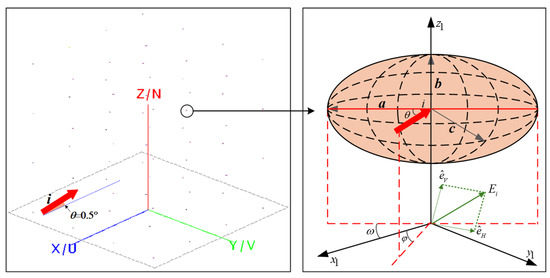
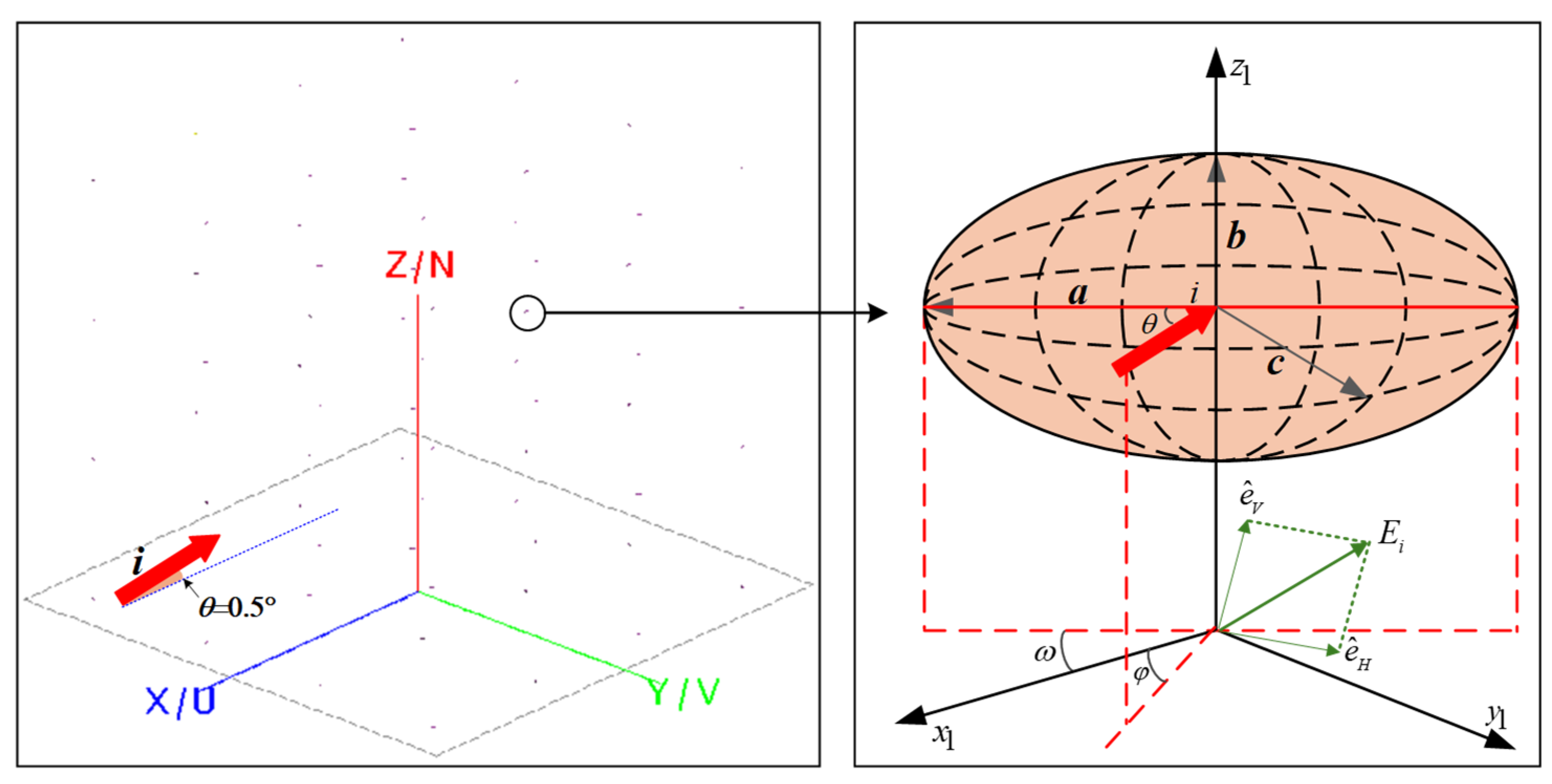
The prolate-spheroid model is an appropriate choice for representing the geometric structure of insect targets [20,31]. Let , , and denote the three semi-axes of the spheroid, satisfying . A schematic of the spheroid particle model and its parameters is shown in Figure 1. For a homogeneous and isotropic spheroidal particle, the phase delay during electromagnetic scattering and propagation can be characterized by the polarizability tensor . Under the quasi-static condition (i.e., particle size much smaller than the wavelength, Rayleigh-scattering approximation), the principal components of the polarizability tensor along each axis can be expressed as [32]:
where is the relative permittivity, is the permittivity of free space, and is the volume of the spheroid. The principal polarizabilities along the major axis and the minor axes are denoted by and , respectively. The depolarization factor along the i-th principal axis is determined by the eccentricity , given by [32]:
Figure 1.
Schematic diagram of the geometric relationship for insect target observation based on the prolate-spheroid model. : Incident wave. : The orientation angle (relative to x-axis). : Incident elevation angle. : Incident azimuth angle. : Electric field vector. : Electric field oriented vertically. : Electric field oriented horizontally.
By treating a dilute medium composed of polarizable dipoles as an effective medium, and assuming that the number density of particles is N, effective relative permittivity in the dilute limit () can be expressed as [33]:
Let , the propagation constant can therefore be written as [34,35]:
Applying a first-order expansion to the square root yields the difference between the wavenumbers of the two polarizations:
The specific differential phase is a derived polarimetric variable in dual-polarization weather radar. It is defined as the range derivative of the differential propagation phase , representing the phase difference per unit propagation distance between horizontally and vertically polarized waves [32,36]:
where denotes the real part. Substituting (5) into (6) yields:
Let the angle between the insect’s major axis and the incident radar wave (approximately horizontally incident) be , and let the probability density of body-axis orientation in the horizontal plane be . The effective polarizability in the H-polarization for an insect oriented at angle can then be expressed as:
Since the major axis always lies in the horizontal plane, the V-polarized component is independent of . Following the common practice in polarimetric scattering analysis and orientation averaging, the population orientation is averaged to obtain the ensemble polarizability of the insect population [37,38]:
where denotes the expectation with respect to the orientation probability density.
In this study, which aims at a preliminary estimation, we assume that airborne insects exhibit random orientation during flight (i.e., all directions equally probable), and therefore the orientation moments can be treated as constants. Under this assumption,
Consequently, we obtain:
This implies that, under the Rayleigh scattering regime and for a fixed shape ratio, is proportional to /N. The proportionality constant depends on the operating wavenumber , the dielectric permittivity , the depolarization factor , and .
Through joint observations using a weather radar and a high-resolution entomological radar, both radar polarimetric parameters and biological characteristics of insect populations can be simultaneously obtained, enabling further evaluation of the accuracy of estimation for average body length. As insect number density can be derived directly from radar observations, we focus on the relationship between body length and the specific differential phase from weather radar.
2.2. Performance Evaluation Metrics
To quantitatively assess the retrieval accuracy of the proposed method, three commonly used performance metrics—root mean square error (RMSE), mean absolute percentage error (MAPE), and coefficient of determination (R2)—are employed. Specifically, RMSE reflects the overall magnitude of the prediction error and serves as an effective measure of the accuracy of the regression model; a smaller RMSE indicates better fitting performance. MAPE represents the average relative deviation between the predicted and true values in percentage form, enabling an intuitive assessment of estimation errors in a normalized manner. R2 quantifies the proportion of variance in the target variable explained by the model, reflecting the goodness of fit; values closer to 1 indicate stronger explanatory capability [39].
Assuming that there are samples, with the observed values denoted by , the corresponding model predictions by and the mean of the observed values by , the three performance metrics are calculated as follows:
3. Data
We conducted a joint observation experiment using a weather radar and an entomological radar, which served as an essential foundation for subsequent modeling and validation. The weather radar provides macroscopic parameters of insect populations, such as , while the entomological radar supplies in situ measurements of body size and density information. These measurements offer critical inputs for electromagnetic scattering simulations, and for evaluating the performance of the proposed body length estimation method (Section 4). The resulting dataset is characterized by strong temporal synchronization and a large atmospheric volume sampled simultaneously by both radars, allowing a realistic representation of the polarimetric scattering behavior of insect populations.
3.1. Radar Observation Experiment
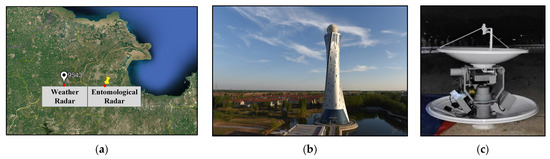
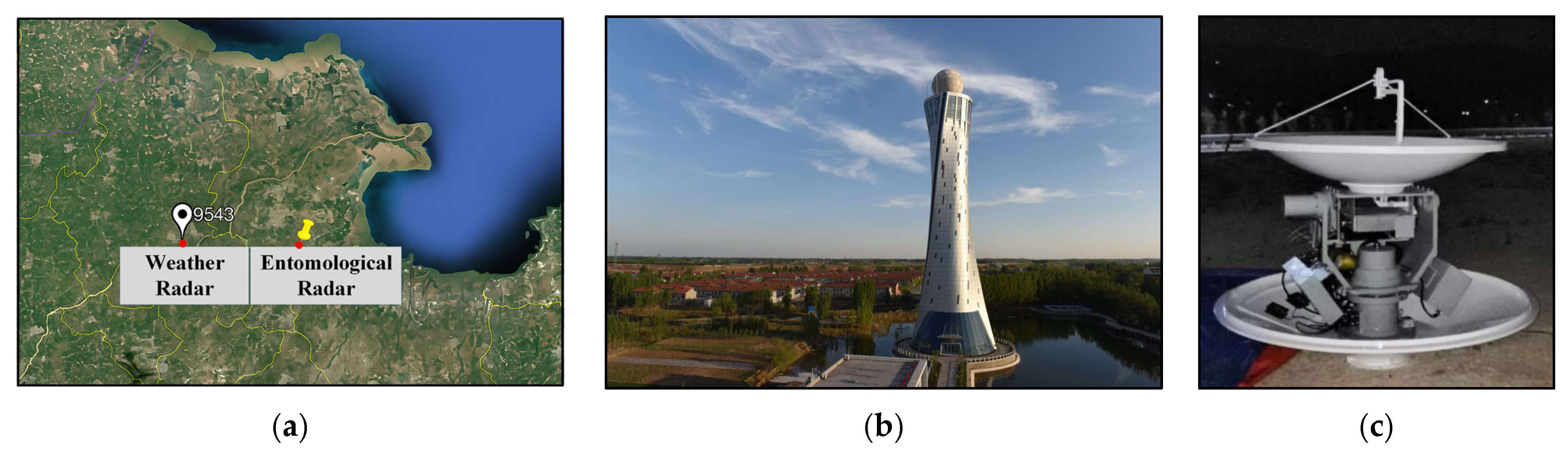
This study employs the Binzhou S-band dual-polarization Doppler weather radar as the primary source of polarimetric measurements, and deploys a high-resolution, fully polarimetric vertical-looking entomological radar 56 km east of it to provide ground-truth information on insect body size, abundance, and other biological attributes. Together, the two systems enable coordinated observations of insect populations. The experimental layout is shown in Figure 2.
Figure 2.
Weather radar and entomological radar used in the joint observation experiment. (a) Locations of the radar installations in Binzhou and Dongying, Shandong Province, China; (b) Binzhou weather radar; (c) Vertical-looking entomological radar.
The experiment targeted the Bohai Bay migratory corridor, focusing on Dongying City, Shandong Province, China, and its surrounding areas. Binzhou weather radar is located at 118.0°E and 37.4°N with an antenna height of approximately 104.2 m. It operates with a range resolution of 1 km and uses the VCP21 scanning strategy, completing one full volumetric scan every 6 min. The radar provides stable outputs of polarimetric variables, which characterize the macroscopic scattering behavior of insect populations. The vertical-looking entomological radar operates in a coherent mode at a center frequency of 16.2 GHz, using a stepped-frequency waveform with an 800 MHz total bandwidth, achieving a range resolution of 0.2 m and a minimum detectable range of 150 m. It is equipped with a 1-m dual-polarized parabolic antenna with a 1.5° beamwidth. During operation, the radar samples at approximately 10 s intervals. A servo-controlled pointing system and short-time Fourier transform (STFT) processing are used to suppress stationary clutter and accurately detect individual airborne insects [40].
A total of 62 days of data were collected between 1 July and 31 August 2024. To ensure the reliable classification of biological echoes, specific attention was paid to the regional phenology of insects and birds.
Data from the midday period (11:00–13:00 local time) were selected for analysis. This temporal selection serves to minimize contamination from avian scatterers, as the primary migratory bird groups in this region (e.g., passerines and shorebirds) are predominantly nocturnal migrants [41]. Furthermore, diurnal bird activity is typically suppressed during these peak solar radiation hours. In contrast, insect activity peaks during this window due to strong thermal convection, which facilitates high-altitude flight [42]. Based on entomological records in Northern China [43,44,45], the airborne insect community during July and August is dominated by species such as Neuroptera (e.g., Chrysopidae), Lepidoptera, various planthopper pests and Diptera, all of which are known to exploit these midday thermals.
Although midday conditions are generally dominated by insect flight, potential contamination from birds was rigorously addressed. Following the classification principles described in [46], we identified and excluded bird echoes based on their distinct polarimetric and Doppler signatures: specifically, birds exhibit reduced cross-correlation coefficient, elevated spectrum width due to wing beating, and discrete, grainy spatial textures in PPI scans, in contrast to the smooth and diffuse echo layers typically associated with airborne insect populations.
The temporal sampling interval of the weather radar is 6 min, while the entomological radar operates with an interval of approximately 10 s. To establish correspondence between the two datasets, a time-synchronization strategy was implemented as follows.
To address the scale mismatch between the two radar systems, we adopted the method described by Chapman et al. [47], in which entomological radar measurements were averaged over 6-min intervals corresponding to the volume scan period of the weather radar, to ensure temporal consistency between the two datasets.
For spatial matching, in order to estimate the vertical coverage of the WSR beam at the VLR location, we applied the standard radar propagation model [48]. The beam center height h is calculated as:
where T is temperature, P is pressure, is vapor pressure, r is the slant range, and is Earth’s radius. The effective earth radius factor is determined by the vertical gradient of the atmospheric refractive index (N), which is a function of temperature (T), pressure (P), and water vapor pressure ():
Although variations in the refractive index gradient can alter the beam path, we assumed a standard atmosphere () for our geometric calculations. This assumption is justified by the specific timing of our observations (11:00–13:00 LT). During this period, the development of the Convective Boundary Layer (CBL) promotes vigorous vertical mixing [46], which minimizes the strong vertical gradients (e.g., temperature inversions) required for anomalous propagation.
Based on this model, the WSR beam covers approximately 184–1161 m. Considering the operational parameters of the VLR, we selected the 180–980 m range for analysis. While this does not represent a strict geometric alignment, it captures the majority of the illuminated scattering volume. Furthermore, the convective mixing during midday hours tends to distribute insects relatively uniformly within the boundary layer [42]. Therefore, we consider the VLR observations within this range to be a representative subsample of the total air mass illuminated by the WSR, robust against minor fluctuations in beam propagation.
3.2. Data Processing and Construction of the Joint Dataset
As an initial investigation, this study assumes that airborne biological targets within the same altitude interval are uniformly distributed. High-resolution entomological radar observations provide accurate measurement of airborne insect density within the sampled airspace, which is adopted as an estimate of the mean number density N corresponding to the weather radar observation volume.
Because natural variability exists in insect body size within a given time window and altitude layer, all individual body length measurements falling within the defined time window are aggregated to form a dataset . To prevent individual outliers from biasing the statistical results, the interquartile-range (IQR) method is employed for outlier detection [49]. For each dataset, the first quartile and the third quartile are computed to obtain the IQR. Body length values satisfying (14) are discarded, and only the valid data within the normal range are retained. The mean body length of the valid samples within each time window is then calculated and taken as the estimated mean body length L for that time window.
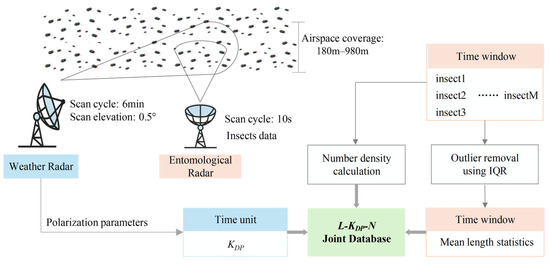
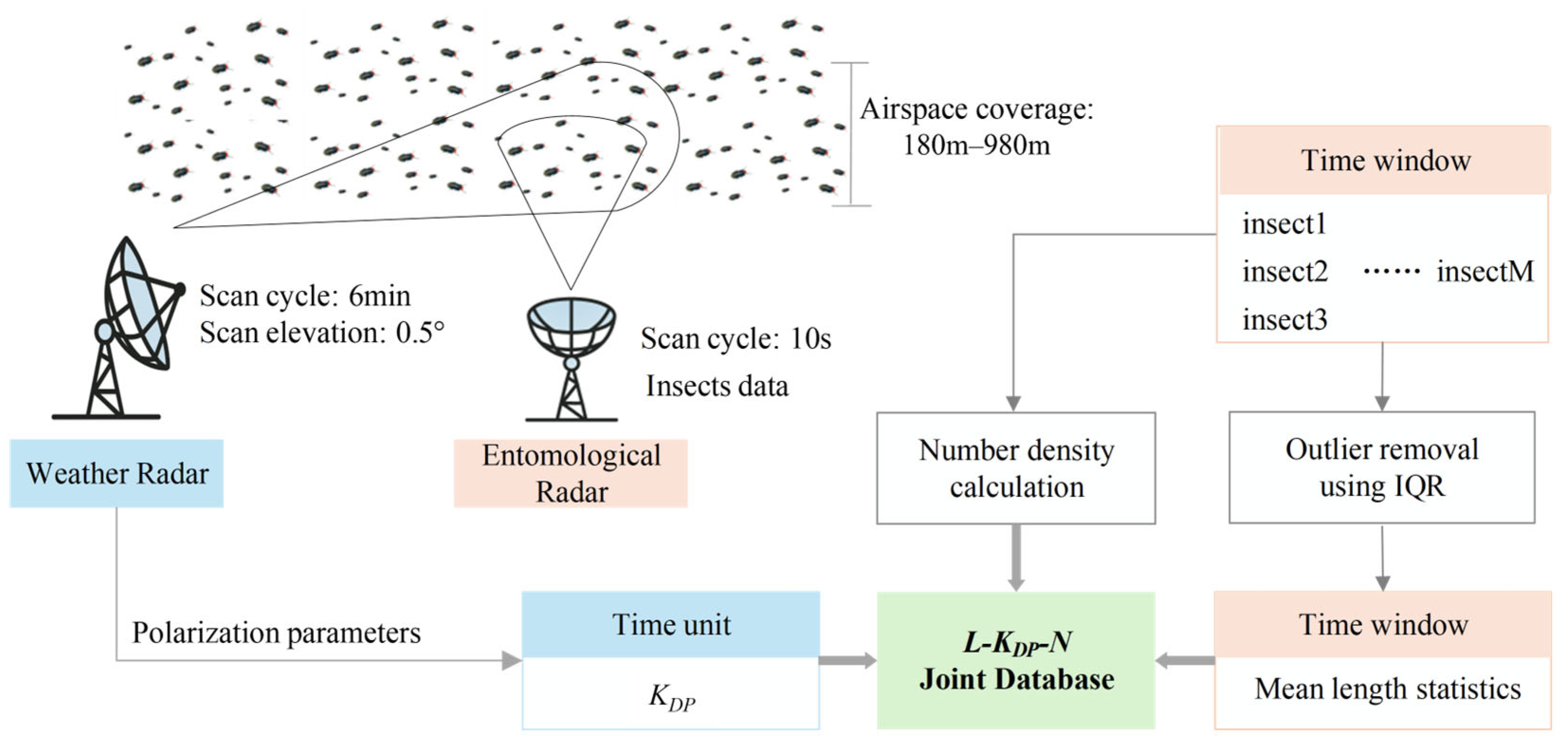
Based on the observation period and radar scanning parameters, the total number of insects detected in the raw dataset was 117,946. After removing 10,648 outliers, a total of 107,298 valid body length measurements were retained. To ensure temporal consistency with the weather radar, these individual measurements were averaged within fixed 6-min time windows corresponding to the weather radar scan cycles, using the method described above. After matching with the available polarimetric observations, the final dataset consisted of 1201 usable mean body length samples. Together with the corresponding and N in each time window, these measurements form the “L--N” joint dataset. A schematic illustration of the processing workflow is shown in Figure 3.
Figure 3.
Data processing flow of weather radar and entomological radar during the joint observation experiment.
3.3. Simulation Experiment
Building upon the previously established theoretical relationships, methods are described in this section for further developing an electromagnetic scattering model for insect targets and for conducting simulation experiments. The simulations yield polarimetric scattering responses of insect populations, and the relationship among the mean body length, specific differential phase, and number density are analyzed at the population scale.
According to the fundamental principles of weather radar detection, when the average spacing between individual insects is much larger than the radar wavelength, multiple scattering within the population does not occur, and the scattered phases from different individuals are random. In this case, the population echo can be regarded as the incoherent sum of the backscattered powers from numerous independent scatterers [32]. To analyze the polarimetric characteristics of insect populations observed by weather radar, this study adopts a hybrid modeling strategy that combines “single-target scattering” with “population-level superposition” in the simulations. A single-insect electromagnetic simulation is used as the basis function representing the scattering response of an individual within the population. By computing scattering responses of randomly oriented insects under different incident azimuth angles and applying an incoherent power summation, the overall average polarimetric signature of the population can be obtained. This approach is physically consistent with the radar scattering mechanism, significantly reduces the computational burden of full-wave simulations, and has been demonstrated in previous studies to be an effective method for characterizing the polarimetric properties of biological targets [50].
The first step of the simulation is to construct an approximate morphological model for individual insects. As emphasized in Section 2, a prolate spheroid is adopted to represent the insect body. Body lengths are varied from 5 mm to 25 mm. Due to the complexity of the biological composition of insects, a homogeneous dielectric constant is used to approximate the mean dielectric properties, avoiding the modeling difficulty associated with internal boundaries [51]. In this study, the insect body is modeled as a homogeneous dielectric spheroid with a relative permittivity of 29.6–7.97j and a density of 1.038 g/cm−3, representative of biological tissue at S-band frequencies. In addition, our previous anechoic-chamber measurements on 183 individuals from 22 insect species indicate that the average body-axis ratio is 3.859 [52]. Therefore, to further simplify the modeling, the prolate-spheroid insect model is assigned an axis ratio of 4:1:1.
Table 1 lists the density distributions of several airborne insect populations from representative regions [53]. For insects within the 5–25 mm body length range, the mean spacing during flight activity typically falls between 4 m and 6 m—much larger than the S-band wavelength—indicating that secondary scattering among individuals can be neglected. During simulation, the geometric shape and dielectric properties of all insect models are kept constant, while only the azimuth angle of the incident wave is varied from 0° to 360° with a step of 10°. The elevation angle is fixed at 0.5°, representing the lowest tilt of the weather radar, thereby capturing scattering variability associated with different body orientations. Under this configuration, the scattering response for each incident direction represents the electromagnetic scattering of a randomly oriented insect within the population. The simulation parameter settings are summarized in Table 2.
Table 1.
Density of airborne insect populations (data from [53]).
Table 2.
Simulation experiment parameter setting.
The simulations are conducted using the FEKO electromagnetic simulation software (Version 2021.1), with the incident wave frequency set to 2.8 GHz. The scattered electric-field components are calculated under horizontal and vertical polarization conditions, including the real part, imaginary part, and phase distributions of the scattered fields along the two orthogonal directions. The spacing between adjacent range gates is set to 250 m, and each range gate is assumed to contain multiple individual insects. The overall mean echo power is obtained by incoherently summing the squared magnitudes of the scattered field intensities over all incident angles, thereby yielding an equivalent polarimetric response of the insect populations. In the parametric study, the body length is set to range from 5 mm to 25 mm in 1-mm steps, resulting in a total of 21 categories. During post-processing, for each body length, 15 values are uniformly selected within the interval from 5 × 10⁻⁴ m−3 to 5 × 10⁻³ m−3 as the number density. This experimental design ultimately comprises 21 body length levels and 15 number density levels, yielding a total of 315 simulated population scenarios.
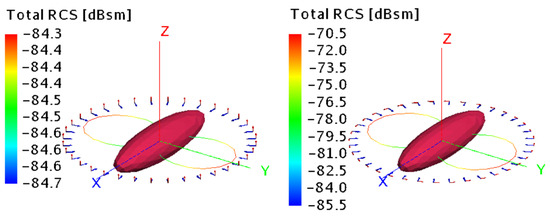
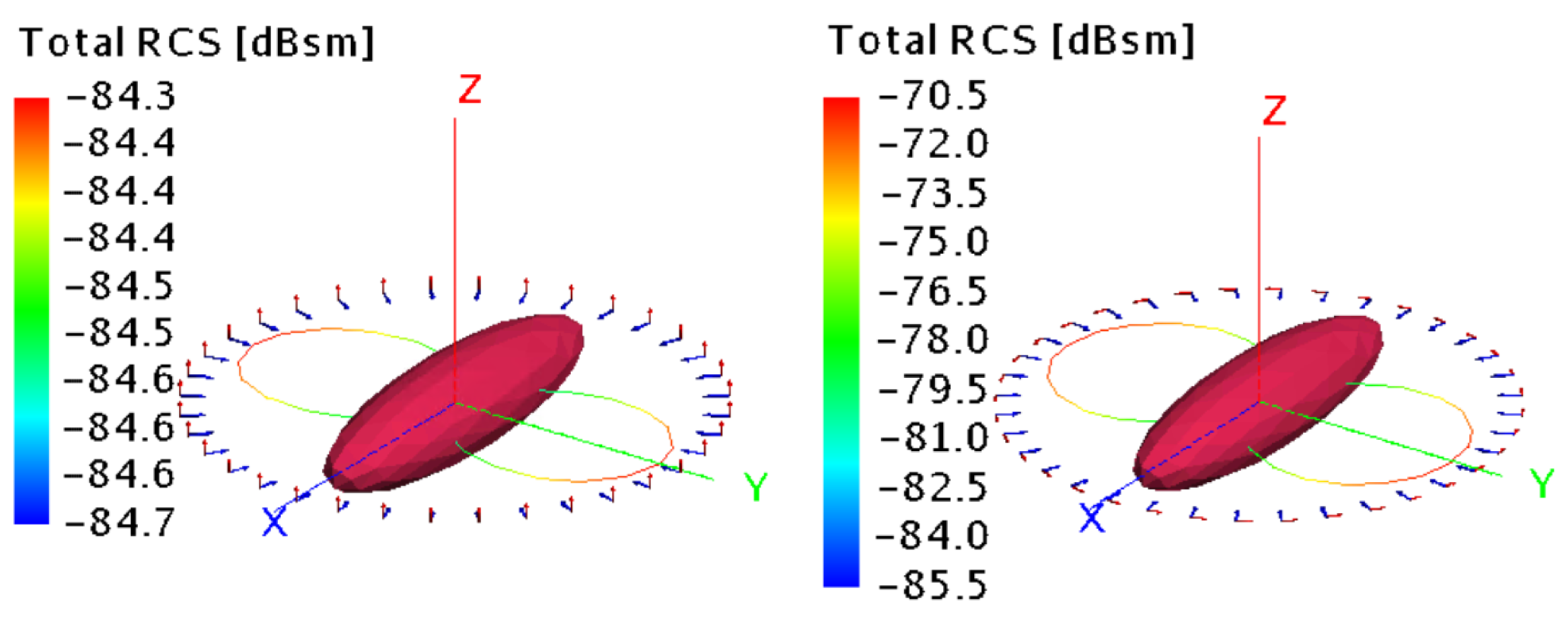
Taking an individual insect model with a body length of 10 mm as an example, Figure 4 shows the electromagnetic scattering simulation results under vertical and horizontal polarization conditions. The major axis of the ellipsoid corresponds to the head–tail direction of the insect, while the minor axis corresponds to the abdomen. The blue arrows indicate the incident wave direction, and the red arrows denote the polarization direction. The left and right panels of Figure 4 present the variations in radar cross section (RCS) with incident angle under vertical and horizontal polarization, respectively. To simulate the dual-polarization measurement mode of weather radar, horizontal- and vertical-polarization simulations are performed separately for each model. Based on these simulations, specific differential phases of insect populations are further calculated for different number densities at the given body length, thereby obtaining the corresponding relationship among the three variables.
Figure 4.
Simulated radar cross section (RCS) of the 10 mm scattering model. (Left): Vertical polarization. (Right): Horizontal polarization.
The simulation outputs are post-processed to derive the joint relationship among insect body length L, specific differential phase , and number density N. For clarity, the results are visualized using two-dimensional projection plots, in which different colors and symbols are used to represent different number density levels. Based on the simulation results, regression analysis is applied to the simulated dataset to establish an empirical relationship among the three variables. The corresponding physical relationships are analyzed in Section 4.
4. Results Analysis
This section presents the results of electromagnetic scattering simulations and observational analyses aimed at elucidating the relationships among the mean insect body length L, specific differential phase , and number density N. Using both simulation outputs and radar observations, the resulting estimation relationships for L are examined under different number density conditions. The experimental results show that, although some overall errors remain, the proposed method demonstrates the capability for effective estimation of L.
4.1. Analysis of Simulation Experiment Results
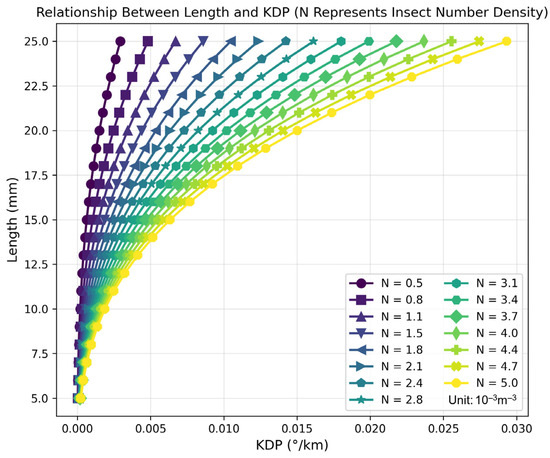
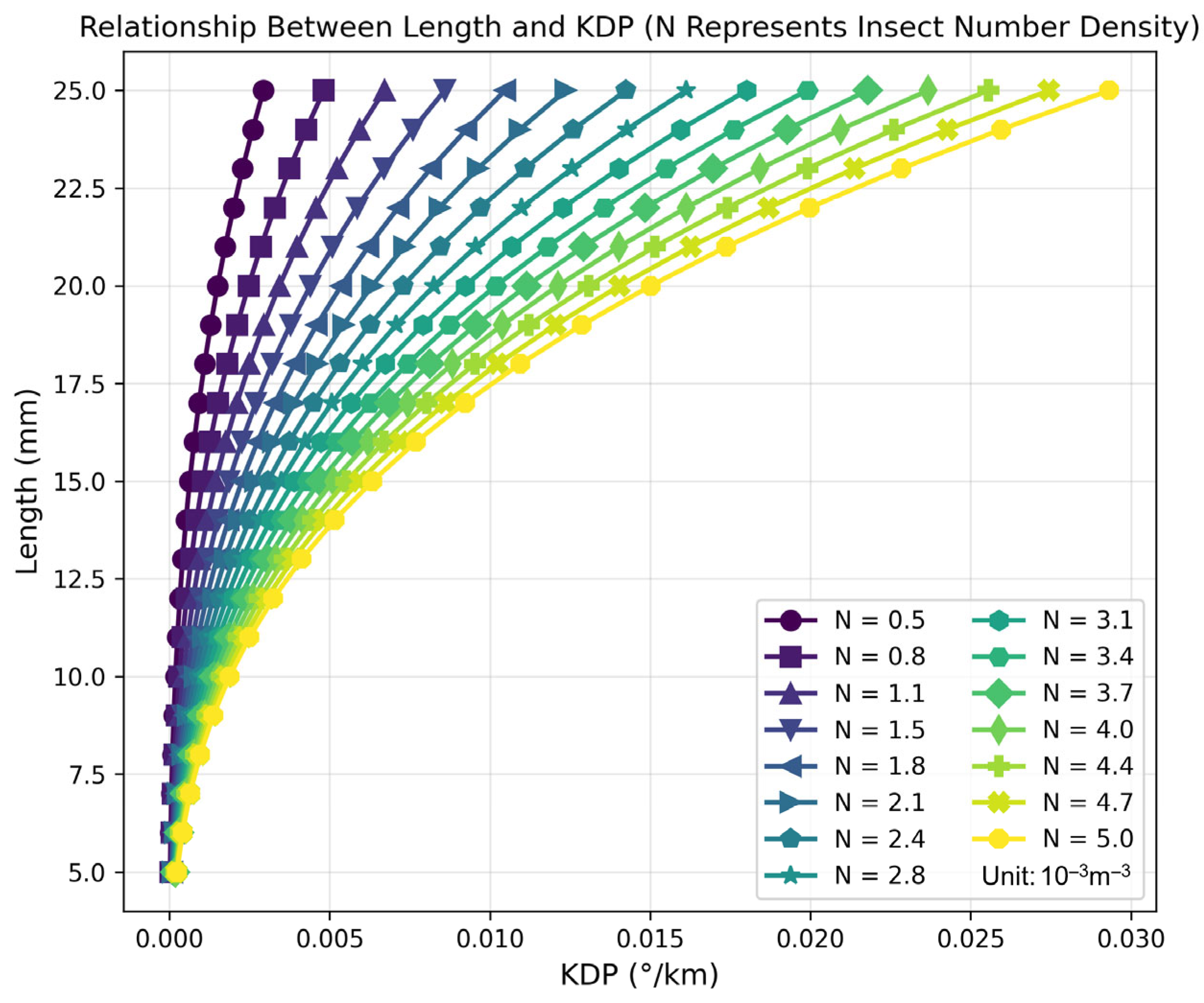
Figure 5 summarizes the electromagnetic scattering simulation results by illustrating the relationship among insect body length L, specific differential phase , and number density N. As illustrated in Figure 5, for a fixed N, L increases monotonically with increasing , indicating a well-defined response of L to variations in . This monotonic behavior provides a physical basis for estimation. On the other hand, for a given , substantial differences in L are observed across different number densities, manifested by the requirement that larger body lengths correspond to lower number densities, and vice versa. This behavior reflects the influence of N on body length estimation in polarimetric scattering.
Figure 5.
The relationship between and L under different number densities in the simulation experiment.
In addition, the curve shape indicates that L is sensitive to variations in in the low- region, with a relatively high growth rate. As increases, the rate of change of L gradually decreases, exhibiting nonlinear behavior. This result indicates that body length estimation based on a single polarimetric parameter may lead to non-unique solutions. Introducing the number density N effectively constrains the solution space, thereby improving the stability and physical consistency of body length estimation.
Overall, the simulation results are consistent with the theoretically derived L––N relationship, validating the rationality of the proposed model. Furthermore, the simulation results reveal a clear quantitative relationship among the mean insect body length, specific differential phase, and insect number density. This relationship can be summarized by the following expression:
4.2. Analysis of Observational Results
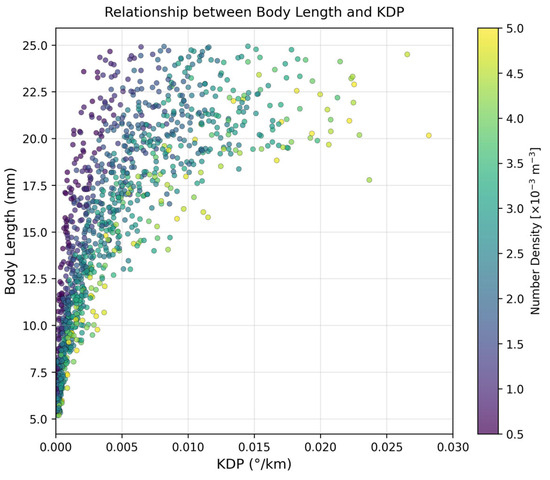
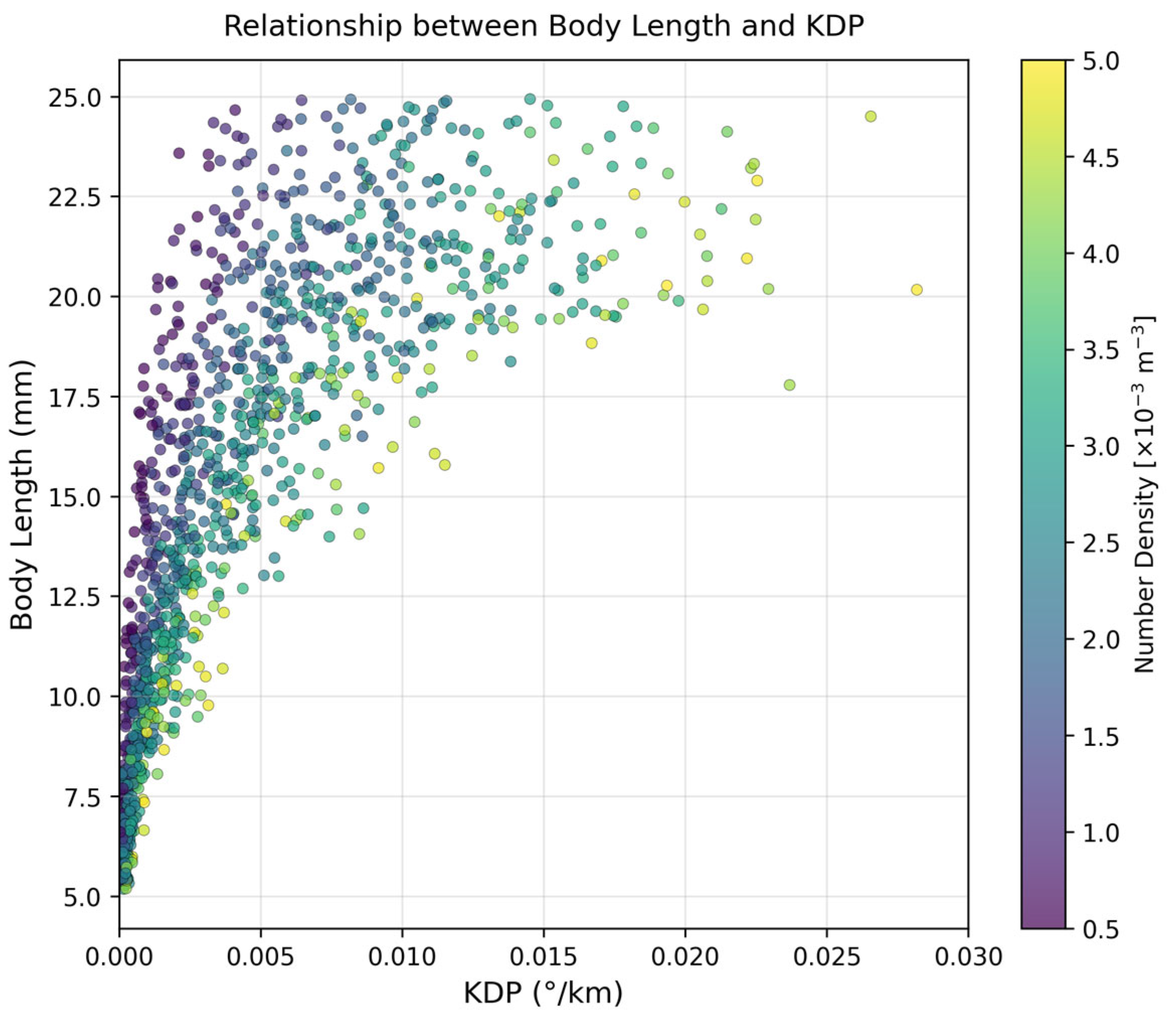
Using the radar observation dataset constructed in Section 3.2, two-dimensional projection plots are generated as shown in Figure 6. The horizontal axis represents , the vertical axis denotes the observed insect body length L, and different colors indicate the insect number density N. The observed samples show an overall increasing trend of L with increasing , indicating a clear response of insect body length to variations in . This behavior is consistent with the electromagnetic scattering simulation results shown in Figure 5 in terms of both overall trend and variation pattern.
Figure 6.
2D distribution of body length, , and number density in radar observations.
Further analysis shows that the distribution of scatter points reflects the influence of variations in N. Under similar conditions, higher values of N generally correspond to smaller body lengths, whereas lower values of N correspond to larger body lengths. This behavior is consistent with the theoretical dependence of on insect number density (N) and body length (L). The results indicate that body length cannot be uniquely determined using a single polarimetric parameter, and that introducing number density as a constraint variable is necessary.
On this basis, the relationship among the three variables is fitted using observational data, yielding the following estimation method for the mean body length of insect populations:
To further interpret these results and to examine their theoretical consistency, we next compare the expressions derived from the analytical model and the simulation-based formulation. By comparing Equations (18) and (19), it can be seen that the two expressions exhibit a high degree of consistency in their functional forms. Both indicate a stable cube-root relationship between L and /N, supporting the theoretical derivation underlying the proposed method. The two equations differ mainly in the proportional coefficients, with a small relative deviation (), indicating that the proposed method is generally applicable to real observational data. In practical measurements, factors such as target orientation distribution and observational noise are expected to affect polarimetric scattering responses. These non-ideal factors may contribute to the observed discrepancy between the two equations.
Based on the evaluation metrics defined in Section 2.2, the retrieval performance of the proposed method was examined using real observational data. Overall, the model yields an RMSE of 1.84 mm, an R2 of 0.86, and a MAPE of 10.75%. These results indicate that, under real observational conditions, the model effectively captures variations in insect body length. The estimation errors for most samples remain within an acceptable range, and the overall retrieval accuracy is stable.
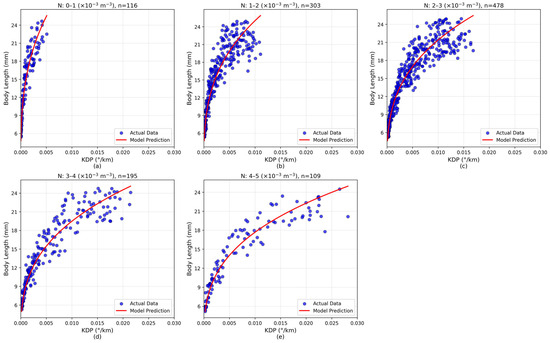
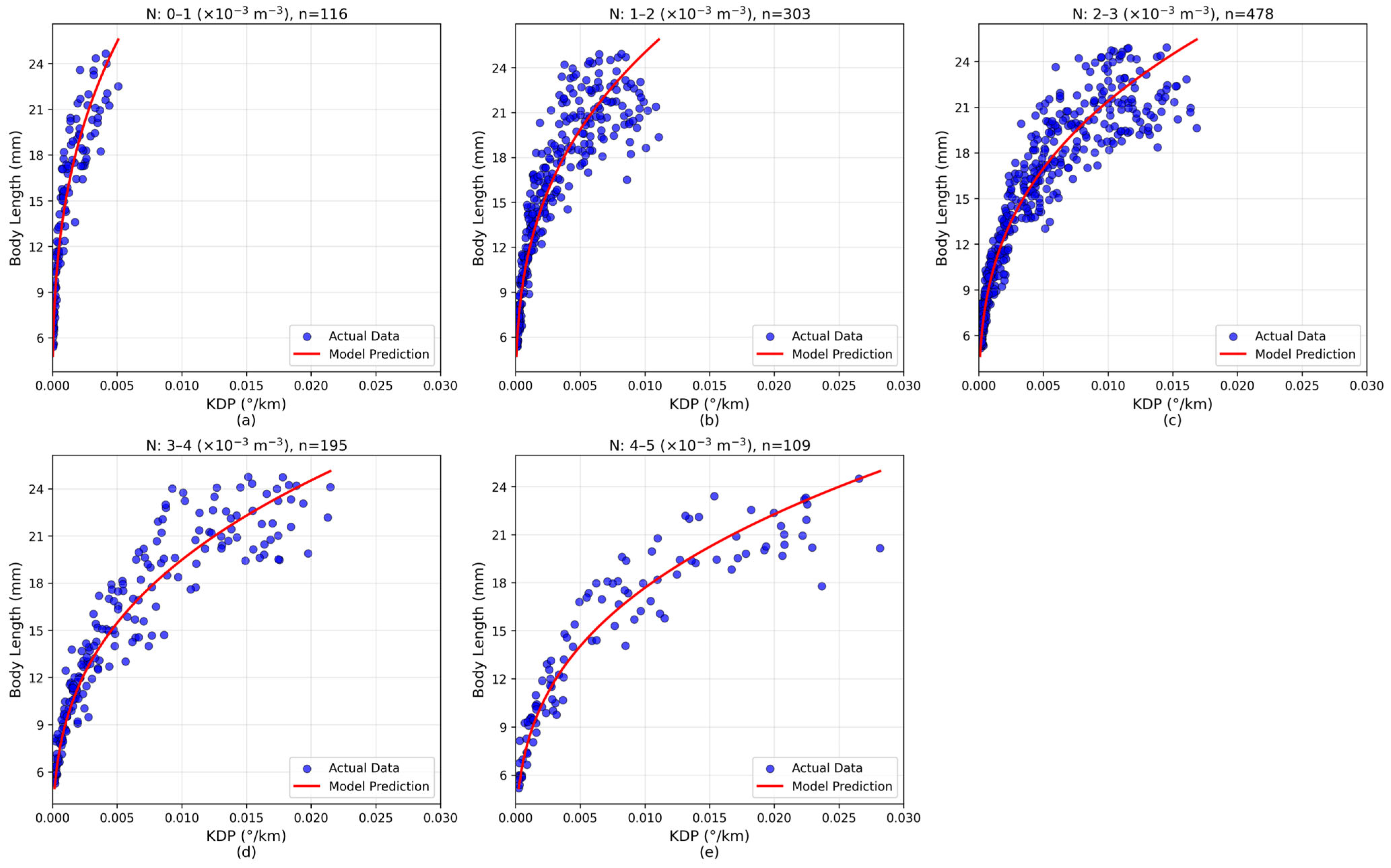
To further evaluate the model performance, the samples are divided into five subsets according to N. The proposed body length estimation method is applied to each subset, and a conditional analysis of the relationship between and L is performed. The results shown in Figure 7. Results are shown, within the same number density range, to exhibit a clear monotonic relationship between L and . As increases, the growth rate of L gradually decreases, exhibiting a nonlinear behavior consistent with the simulation results. Distinct differences in the fitted curves are observed among the subsets, indicating that insect number density exerts a significant impact on body length estimation results, and that independent estimates of N are required to resolve the ambiguity and obtain a unique solution. The above results validate the physical consistency of linking polarimetric observables to biological parameters. It is also important to highlight a trend observed in Figure 7, where the dispersion of the measured data points around the global fitting curve increases with body length. While data for smaller insects are tightly clustered, indicating high precision, the scatter notably expands for larger insects. This indicates that the estimation uncertainty may be related to insect body size.
Figure 7.
Relationship between and body length at different number densities (N). Subplots correspond to different number-density ranges and effective sample sizes: (a) N: 0~1 (×10−3 m−3), n = 116; (b) N: 1~2 (×10−3 m−3), n = 303; (c) N: 2~3 (×10−3 m−3), n = 478; (d) N: 3~4 (×10−3 m−3), n = 195; (e) N: 4~5 (×10−3 m−3), n = 109. “Actual data” denote measurements obtained from the joint weather-radar and entomological-radar field experiment, including directly observed insect body lengths and corresponding values. “Model prediction” refers to body lengths estimated using Equation (19) applied to each subset.
The error statistics are summarized in Table 3. With increasing N, both MAPE and RMSE show an overall increasing trend, while R2 shows a slight decrease. This suggests that higher insect number density may lead to a more heterogeneous polarimetric scattering response, thereby increasing the uncertainty in body length estimation. Nevertheless, across all subsets, the error metrics remain within reasonable ranges. This indicates that the proposed model exhibits good applicability and stability under different insect number density conditions and effectively captures the relationship among L, , and N.
Table 3.
Error comparison.
To further investigate the body length estimation errors in the joint observation experiments, an additional analysis is conducted. Taking the period from 12:12 to 12:18 LT on 21 July 2024 as an example, the entomological radar recorded 114 valid body length samples. The overall distribution shows that most samples are concentrated in the range of approximately 10–13 mm, while a considerable number of samples are also observed below 8 mm and above 18 mm. This distribution indicates the coexistence of airborne insects with different body lengths within the sampled radar volume. The detailed data distribution is summarized in Table 4.
Table 4.
Distribution of entomological radar data (12:12–12:18 LT, 21 July 2024).
Using the IQR method, the first quartile is calculated as 11.28 mm, the third quartile as 13.45 mm, and the IQR as 2.17 mm, corresponding to an interval of [8.03, 16.70] mm. A total of 37 outliers (32.46%) are removed, leaving 77 valid samples, whose mean body length is 12.17 mm. This value is taken as the representative mean body length for the selected period. The observed characteristics of the body-length distributions indicate non-negligible variability among cases. Possible factors leading to uncertainties in the estimated body length are further discussed in Section 5.
5. Discussion
This study demonstrates that polarimetric weather radar observations can be used to estimate the mean body length of insect populations. The results provide a new way to extract biologically meaningful size information from operational weather radar data. Such population-level body length estimates are valuable for insect migration studies, as body size is closely related to flight performance, flight capacity, and the broad taxonomic composition of insect assemblages, particularly in situations where direct biological sampling is difficult.
We further analyze the possible sources of body length estimation errors in the joint observation experiments, as outlined below. During the radar observation period, the airborne population did not consist of a single insect species with similar body length. This is a common natural phenomenon in high-altitude insect migration. Under favorable meteorological conditions, multiple insect species with different body lengths often migrate simultaneously [54]. Such scenarios result in a high dispersion of body length measurements. For multimodal body length distributions, the IQR method removes a substantially larger proportion of samples [55]. As a result, the retained interval may not cover the full range of body lengths, potentially leading to biased estimates of the mean body length within the corresponding time window. However, the exclusion ratio for this group was not adjusted, since manual adjustment may introduce subjective bias. Instead, the original processing results were retained, and a supplementary analysis of the possible causes was provided. This approach helps maintain objectivity and may offer useful references for investigating the structural diversity of insect assemblages. In addition, when processing the radar observation data, the insect number density derived from entomological radar observations was used as the mean insect number density within the weather radar sampling volume. However, the internal organization of insect populations is inherently heterogeneous, and both the spatial distribution of insects and the individual flight orientation may exhibit random and time-varying variability. These factors can introduce uncertainty into the estimation of the actual insect number density.
We examined potential reasons for the influence of body length on the estimation uncertainty of the proposed method. Although the underlying mechanism cannot be clearly identified from the existing dataset, the observed increase in dispersion for larger insects can be discussed within the Rayleigh scattering regime relevant to our experiment, and may reflect the combined influence of several biological and physical factors:
While insects of all sizes exhibit biological diversity, larger insects often possess more complex anatomical structures (e.g., developed exoskeletons, wing structures, and internal water distribution) compared to smaller, simpler organisms. This structural complexity introduces greater variability in the scattering response for a given body length. Differences in body composition and water content lead to variations in dielectric properties, which in turn affect the scattering response for a given size [53]. In addition, polarimetric variables are sensitive to the orientation distribution of insects [51]. While flight wobbling occurs across all sizes, the resulting absolute fluctuation in the radar signal is proportional to the scattering magnitude. Thus, orientation irregularities in large insects generate significantly larger absolute deviations in compared to smaller ones [56]. As a result, while the proposed method provides a robust estimation of the general size distribution, the precision is higher for small-to-medium-sized insects.
The current simulation adopts a simplified insect size distribution to establish a baseline relationship between polarimetric radar variables and mean body length. This approach is consistent with previous entomological radar studies, in which idealized or unimodal size distributions are commonly assumed to isolate the dominant physical controls on radar observables (e.g., radar cross-section and differential phase) [57,58]. However, radar backscattering cross-section of insects scales nonlinearly and approximately as a high power of body dimensions, reflecting the combined effects of target size, shape, and dielectric structure [59]. As a result, radar-based retrievals are inherently sensitive to the breadth and shape of the underlying size distribution. For a population with a broad distribution (e.g., a mixture of many small and a few large insects), the radar signal is disproportionately dominated by the larger individuals, which contribute most strongly to the total backscattered power. Under such conditions, the retrieved body length should be interpreted as a radar-weighted effective mean rather than a simple arithmetic average of individual body lengths.
The method is expected to perform best when the insect population is dominated by individuals with comparable body lengths or exhibits an approximately unimodal size distribution, under which the estimated mean body length remains ecologically meaningful and representative. In contrast, when multiple species with substantially different body sizes coexist within the radar sampling volume, the resulting mean body length may obscure underlying multimodal distributions and lose ecological interpretability. Consequently, the proposed approach is not suitable for fine-scale taxonomic analysis in mixed-species assemblages.
From a practical perspective, the proposed method is designed for population-level analysis of airborne insects using S-band dual-polarization weather radar data. It enables the estimation of mean body length over large spatial domains and extended time periods, which is difficult to achieve using field sampling or site-specific entomological radar systems. Such information can support studies of insect migration dynamics, seasonal changes in size structure, and broad shifts in dominant insect assemblages.
In the context of China, the proposed approach is particularly relevant due to the frequent occurrence of large-scale seasonal insect migration and the extensive coverage of operational S-band dual-polarization weather radar networks. Many economically important migratory insects in eastern and northern China, including both pest species and beneficial insects, undertake long-distance movements that span hundreds of kilometers [3]. Conventional field-based sampling and localized entomological radar observations are often insufficient to capture such processes at regional scales. By contrast, weather radar networks routinely provide continuous, wide-area observations, making them well suited for monitoring population-level characteristics of airborne insects. The ability to estimate mean body length from these observations offers a practical means of characterizing dominant size classes during flight events, which may support large-scale assessments of potential agricultural risk.
However, several limitations should be noted. First, the applicability of the proposed approach is constrained by the radar wavelength, the associated scattering regime, and the physical dimensions of the insects. This study focuses on insects with body lengths of approximately 5–25 mm observed by S-band weather radar, for which the scattering behavior can be reasonably approximated by the Rayleigh regime. Within this regime, polarimetric observables exhibit a relatively smooth and monotonic dependence on target properties [32,56]. However, the Rayleigh assumption implies a limit on the electrical size of the targets. When the radar wavelength is shortened (e.g., at C- or X-band), or when insects are substantially larger than the considered size range (even at the S-band wavelength used in this study), a larger fraction of the population may transition into the Mie scattering regime [53]. Under such conditions, radar backscattering and differential phase responses become strongly non-linear and oscillatory functions of body size, reducing the robustness of the retrieval relationship derived here and potentially rendering the estimation method unreliable for exceptionally large species.
Second, insect morphology varies markedly across taxa, and the effective mean axis ratio of airborne populations is likely to fluctuate with diurnal and seasonal shifts in species composition [56,60]. While the current fixed value serves as a reasonable statistical baseline for the volume-averaged observations typical of weather radar, this assumption may introduce uncertainties, particularly during flight events dominated by species with extreme body shapes [61]. Future iterations of this method could mitigate this uncertainty by incorporating real-time taxonomic information to apply a dynamic, composition-dependent body-axis ratio.
It should be noted that, in the present study, the estimation of population-mean body length relies on insect number density information obtained from entomological radar observations. This dependence constrains the direct spatial applicability of the method; therefore, the present study should currently be regarded as a proof-of-concept, rather than a fully operational retrieval scheme based solely on weather radar.
Finally, population-mean body length alone is insufficient for direct species identification, particularly under mixed-species scenarios, as operational weather radar observations primarily support population-level inference rather than individual-level taxonomic classification. Nevertheless, population-mean body length represents a biologically interpretable morphological parameter that can help constrain plausible species groups or functional categories when integrated with observation timing, altitude distribution, and regional species composition [4,20,53]. In this sense, the proposed method may support ecological interpretation and pest monitoring at regional scales, rather than serving as a standalone species identification tool.
Despite these limitations, the proposed approach provides a physically interpretable and practically useful tool for extracting size-related information from operational weather radar networks under well-defined conditions. When applied within its intended range, it significantly enhances the capabilities of these existing networks by enabling insect body size estimation at spatial and temporal scales relevant for broad-scale ecological monitoring.
6. Conclusions
This study adopts an integrated research framework combining theoretical analysis, electromagnetic simulations, and validation using observational data to systematically investigate the relationships among mean body length L, specific differential phase , and number density N. Based on polarimetric scattering theory, a functional model relating L, , and N is derived, clarifying the role of /N in characterizing L. On this basis, the relationship between L and under different number density conditions is analyzed through electromagnetic scattering simulation experiments, revealing a stable relationship among the three variables. Furthermore, an estimation method for L is developed using observations from weather radar and entomological radar. The results demonstrate that L can be effectively estimated from and N, and the proposed method is feasible and reliable under practical observation conditions.
Looking ahead, relying on China’s widely distributed S-band dual-polarization weather radar network, body-size parameter estimation of airborne insect populations can be conducted over millions of square kilometers in real time. This method is expected to provide high-spatiotemporal-resolution foundational data for large-scale monitoring of airborne insects, species identification, and early warning of agricultural pests.
Author Contributions
Conceptualization, K.C. and X.L.; methodology, X.L.; software, J.L.; validation, X.L. and X.D.; formal analysis, X.L. and X.D.; investigation, R.W. and X.D.; resources, W.L. and C.H.; data curation, J.L.; writing—original draft preparation, X.L.; writing—review and editing, K.C.; visualization, X.L.; supervision, K.C. and W.L.; project administration, K.C. and W.L.; funding acquisition, C.H. All authors have read and agreed to the published version of the manuscript.
Funding
This work was supported by the National Natural Science Foundation of China under Grant 62301048, 62225104, Shandong Provincial Natural Science Foundation under Grant ZR2023QF035, Shandong Long Island National Climate Observatory Open Fund under Grant 2023cdkfz03, and Young Elite Scientists Sponsorship Program of the Beijing High Innovation Plan.
Data Availability Statement
The datasets generated during the current study are available from the corresponding author on reasonable request.
Acknowledgments
The authors would like to thank the Meteorological Observation Center, China Meteorological Administration, Beijing, China, for providing weather radar data.
Conflicts of Interest
The authors declare no conflicts of interest.
References
- Eigenbrode, S.D.; Adhikari, S. Climate change and managing insect pests and beneficials in agricultural systems. Agron. J. 2023, 115, 2194–2215. [Google Scholar] [CrossRef] [Scilit]
- Reynolds, S.K.; Clem, C.S.; Fitz-Gerald, B.; Young, A.D. A comprehensive review of long-distance hover fly migration (Diptera: Syrphidae). Ecol. Entomol. 2024, 49, 749–767. [Google Scholar] [CrossRef] [Scilit]
- Huang, J.; Feng, H.; Drake, V.A.; Reynolds, D.R.; Gao, B.; Chen, F.; Zhang, G.; Zhu, J.; Gao, Y.; Zhai, B.; et al. Massive seasonal high-altitude migrations of nocturnal insects above the agricultural plains of East China. Proc. Natl. Acad. Sci. USA 2024, 121, e2317646121. [Google Scholar] [CrossRef]
- Bauer, S.; Tielens, E.K.; Haest, B. Monitoring aerial insect biodiversity: A radar perspective. Philos. Trans. R. Soc. B Biol. Sci. 2024, 379, 20230113. [Google Scholar] [CrossRef] [Scilit]
- Chandrasekar, V.; Hou, A.; Smith, E.; Bringi, V.N.; Rutledge, S.A.; Gorgucci, E.; Petersen, W.A.; Jackson, G.S. Potential role of dual-polarizaiton radar in the validation of satellite precipitation measurements: Rationale and Opportunities. Bull. Am. Meteorol. Soc. 2008, 89, 1127–1146. [Google Scholar] [CrossRef] [Scilit]
- Doviak, R.J.; Bringi, V.; Ryzhkov, A.; Zahrai, A.; Zrnić, D. Considerations for Polarimetric Upgrades to Operational WSR-88D Radars. J. Atmos. Ocean. Technol. 2000, 17, 257–278. [Google Scholar] [CrossRef] [Scilit]
- Hu, C.; Cui, K.; Wang, R.; Long, T.; Wu, D.; Wu, K. Review of Weather Radar Aeroecology Monitoring. J. Signal Process. 2024, 40, 94–113. [Google Scholar] [CrossRef]
- Crum, T.D.; Alberty, R.L. The WSR-88D and the WSR-88D Operational Support Facility. Bull. Am. Meteorol. Soc. 1993, 74, 1669–1688. [Google Scholar] [CrossRef] [Scilit]
- Notaroš, B.M. Polarimetric Weather Radar: Overview of principles and applications. IEEE Antennas Propag. Mag. 2022, 64, 43–54. [Google Scholar] [CrossRef] [Scilit]
- Hu, J.; Ryzhkov, A. Climatology of the Vertical Profiles of Polarimetric Radar Variables and Retrieved Microphysical Parameters in Continental/Tropical MCSs and Landfalling Hurricanes. J. Geophys. Res. Atmos. 2022, 127, e2021JD035498. [Google Scholar] [CrossRef] [Scilit]
- Lukach, M.; Dally, T.; Evans, W.; Hassall, C.; Duncan, E.J.; Bennett, L.; Addison, F.I.; Kunin, W.E.; Chapman, J.W.; Neely, R.R., III. The development of an unsupervised hierarchical clustering analysis of dual-polarization weather surveillance radar observations to assess nocturnal insect abundance and diversity. Remote Sens. Ecol. Conserv. 2022, 8, 698–716. [Google Scholar] [CrossRef] [Scilit]
- Tang, L.; Zhang, J.; Langston, C.; Krause, J.; Howard, K.; Lakshmanan, V. A Physically Based Precipitation–Nonprecipitation Radar Echo Classifier Using Polarimetric and Environmental Data in a Real-Time National System. Weather Forecast. 2014, 29, 1106–1119. [Google Scholar] [CrossRef] [Scilit]
- Krause, J.M. A Simple Algorithm to Discriminate between Meteorological and Nonmeteorological Radar Echoes. J. Atmos. Ocean. Technol. 2016, 33, 1875–1885. [Google Scholar] [CrossRef] [Scilit]
- Alku, L.; Moisseev, D.; Aittomäki, T.; Chandrasekar, V. Identification and Suppression of Nonmeteorological Echoes Using Spectral Polarimetric Processing. IEEE Trans. Geosci. Remote Sens. 2015, 53, 3628–3638. [Google Scholar] [CrossRef] [Scilit]
- Melnikov, V.M.; Istok, M.J.; Westbrook, J.K. Asymmetric Radar Echo Patterns from Insects. J. Atmos. Ocean. Technol. 2015, 32, 659–674. [Google Scholar] [CrossRef] [Scilit]
- Park, H.S.; Ryzhkov, A.V.; Zrnić, D.S.; Kim, K.-E. The Hydrometeor Classification Algorithm for the Polarimetric WSR-88D: Description and Application to an MCS. Weather Forecast. 2009, 24, 730–748. [Google Scholar] [CrossRef] [Scilit]
- Chandrasekar, V.; Keränen, R.; Lim, S.; Moisseev, D. Recent advances in classification of observations from dual polarization weather radars. Atmos. Res. 2013, 119, 97–111. [Google Scholar] [CrossRef] [Scilit]
- Chilson, P.; Frick, W.; Kelly, J.; Howard, K.; Larkin, R.; Diehl, R.; Kelly, T.; Kunz, T. Partly Cloudy with a Chance of Migration: Weather, Radars, and Aeroecology. Bull. Am. Meteorol. Soc. 2012, 93, 669–686. [Google Scholar] [CrossRef] [Scilit]
- Radhakrishna, B.; Fabry, F.; Kilambi, A. Fuzzy Logic Algorithms to Identify Birds, Precipitation, and Ground Clutter in S-Band Radar Data Using Polarimetric and Nonpolarimetric Variables. J. Atmos. Ocean. Technol. 2019, 36, 2401–2414. [Google Scholar] [CrossRef] [Scilit]
- Gauthreaux, S.; Diehl, R. Discrimination of Biological Scatterers in Polarimetric Weather Radar Data: Opportunities and Challenges. Remote Sens. 2020, 12, 545. [Google Scholar] [CrossRef] [Scilit]
- Jatau, P.; Melnikov, V.; Yu, T.-Y. A Machine Learning Approach for Classifying Bird and Insect Radar Echoes with S-Band Polarimetric Weather Radar. J. Atmos. Ocean. Technol. 2021, 38, 1797–1812. [Google Scholar] [CrossRef] [Scilit]
- Stepanian, P.M.; Horton, K.G.; Melnikov, V.M.; Zrnić, D.S.; Gauthreaux, S.A., Jr. Dual-polarization radar products for biological applications. Ecosphere 2016, 7, e01539. [Google Scholar] [CrossRef] [Scilit]
- Jiang, Y.; Xu, Q.; Zhang, P.; Nai, K.; Liu, L. Using WSR-88D Polarimetric Data to Identify Bird-Contaminated Doppler Velocities. Adv. Meteorol. 2013, 2013, 769275. [Google Scholar] [CrossRef] [Scilit]
- Bachmann, S.; Zrnić, D. Spectral Density of Polarimetric Variables Separating Biological Scatterers in the VAD Display. J. Atmos. Ocean. Technol. 2007, 24, 1186–1198. [Google Scholar] [CrossRef] [Scilit]
- Melnikov, V.; Leskinen, M.; Koistinen, J. Doppler Velocities at Orthogonal Polarizations in Radar Echoes From Insects and Birds. IEEE Geosci. Remote Sens. Lett. 2014, 11, 592–596. [Google Scholar] [CrossRef] [Scilit]
- Gauthreaux, S.A., Jr.; Livingston, J.W.; Belser, C.G. Detection and discrimination of fauna in the aerosphere using Doppler weather surveillance radar. Integr. Comp. Biol. 2008, 48, 12–23. [Google Scholar] [CrossRef] [Scilit]
- Bridge, E.S.; Thorup, K.; Bowlin, M.S.; Chilson, P.B.; Diehl, R.H.; Fléron, R.W.; Hartl, P.; Kays, R.; Kelly, J.F.; Robinson, W.D.; et al. Technology on the Move: Recent and Forthcoming Innovations for Tracking Migratory Birds. BioScience 2011, 61, 689–698. [Google Scholar] [CrossRef] [Scilit]
- Van Den Broeke, M.S. Polarimetric Radar Observations of Biological Scatterers in Hurricanes Irene (2011) and Sandy (2012). J. Atmos. Ocean. Technol. 2013, 30, 2754–2767. [Google Scholar] [CrossRef] [Scilit]
- Chilson, P.; Bridge, E.; Frick, W.; Chapman, J.; Kelly, J. Radar aeroecology: Exploring the movements of aerial fauna through radio-wave remote sensing. Biol. Lett. 2012, 8, 698–701. [Google Scholar] [CrossRef] [Scilit]
- Dokter, A.M.; Liechti, F.; Stark, H.; Delobbe, L.; Tabary, P.; Holleman, I. Bird migration flight altitudes studied by a network of operational weather radars. J. R. Soc. Interface 2011, 8, 30–43. [Google Scholar] [CrossRef] [Scilit]
- Zhang, P.; Ryzhkov, A.V.; Zrnic, D.S. Polarimetric Prototype of the WSR-88D Radar Observations of Birds and Insects; NOAA/National Severe Storms Laboratory: Norman, OK, USA, 2005. [Google Scholar]
- Bringi, V.N.; Chandrasekar, V. Polarimetric Doppler Weather Radar: Principles and Applications; Cambridge University Press: Cambridge, UK, 2001. [Google Scholar]
- Sihvola, A.H. Electromagnetic Mixing Formulas and Applications; The Institution of Electrical Engineers (IET): London, UK, 1999. [Google Scholar]
- David, L.; Fawwaz, U. Microwave Radar and Radiometric Remote Sensing; Artech: Riverside, CA, USA, 2015; p. 1. [Google Scholar]
- Ramo, S.; Whinnery, J.R.; Van Duzer, T. Fields and Waves in Communication Electronics; Wiley: Hoboken, NJ, USA, 1994. [Google Scholar]
- Zrnic, D.S.; Ryzhkov, A.V. Advantages of Rain Measurements Using Specific Differential Phase. J. Atmos. Ocean. Technol. 1996, 13, 454–464. [Google Scholar] [CrossRef] [Scilit]
- Bohren, C.F.; Huffman, D.R. Particles Small Compared with the Wavelength. In Absorption and Scattering of Light by Small Particles; John Wiley & Sons: Hoboken, NJ, USA, 1998; pp. 130–157. [Google Scholar]
- Zhang, G.; Vivekanandan, J.; Brandes, E. A method for estimating rain rate and drop size distribution from polarimetric radar measurements. IEEE Trans. Geosci. Remote Sens. 2001, 39, 830–841. [Google Scholar] [CrossRef] [Scilit]
- Chicco, D.; Warrens, M.J.; Jurman, G. The coefficient of determination R-squared is more informative than SMAPE, MAE, MAPE, MSE and RMSE in regression analysis evaluation. PeerJ Comput. Sci. 2021, 7, e623. [Google Scholar] [CrossRef] [Scilit]
- Long, T.; Hu, C.; Wang, R.; Zhang, T.; Kong, S.; Li, W.; Cai, J.; Tian, W.; Zeng, T. Entomological Radar Overview: System and Signal Processing. IEEE Aerosp. Electron. Syst. Mag. 2020, 35, 20–32. [Google Scholar] [CrossRef] [Scilit]
- Xia, S.; Lv, H.; Duan, H.; Yu, X. Deteriorating habitat suitability and connectivity of waterbirds in the Bohai Sea Rim: Consequences of land use transformation. Glob. Ecol. Conserv. 2024, 51, e02930. [Google Scholar] [CrossRef] [Scilit]
- Reynolds, D.R.; Chapman, J.W.; Edwards, A.S.; Smith, A.D.; Wood, C.R.; Barlow, J.F.; Woiwod, I.P. Radar studies of the vertical distribution of insects migrating over southern Britain: The influence of temperature inversions on nocturnal layer concentrations. Bull. Entomol. Res. 2005, 95, 259–274. [Google Scholar] [CrossRef] [Scilit] [PubMed]
- Wang, X.; Ma, H.; Zhao, Y.; Gao, Y.; Wu, K. Abundance and Seasonal Migration Patterns of Green Lacewings (Neuroptera: Chrysopidae) across the Bohai Strait in Eastern Asia. Insects 2024, 15, 321. [Google Scholar] [CrossRef] [Scilit] [PubMed]
- Feng, H.Q.; Zhao, X.C.; Wu, X.F.; Wu, B.; Wu, K.M.; Cheng, D.F.; Guo, Y.Y. Autumn migration of Mythimna separata (Lepidoptera: Noctuidae) over the Bohai Sea in northern China. Environ. Entomol. 2008, 37, 774–781. [Google Scholar] [CrossRef] [Scilit]
- Hu, G.; Feng, H.; Otuka, A.; Reynolds, D.R.; Drake, V.A.; Chapman, J.W. The East Asian Insect Flyway: Geographical and Climatic Factors Driving Migration Among Diverse Crop Pests. Annu. Rev. Entomol. 2025, 70, 1–22. [Google Scholar] [CrossRef] [Scilit] [PubMed]
- Stull, R.B. Convective Mixed Layer. In An Introduction to Boundary Layer Meteorology; Stull, R.B., Ed.; Springer: Dordrecht, The Netherlands, 1988; pp. 441–497. [Google Scholar]
- Chapman, J.W.; Reynolds, D.R.; Smith, A.D. Vertical-Looking Radar: A New Tool for Monitoring High-Altitude Insect Migration. BioScience 2003, 53, 503–511. [Google Scholar] [CrossRef] [Scilit]
- Doviak, R.J.; Zrnić, D.S. 2—Electromagnetic Waves and Propagation. In Doppler Radar and Weather Observations, 2nd ed.; Academic Press: San Diego, CA, USA, 1993; pp. 10–29. [Google Scholar]
- Páez, A.; Boisjoly, G. Exploratory Data Analysis. In Discrete Choice Analysis with R; Páez, A., Boisjoly, G., Eds.; Springer International Publishing: Cham, Switzerland, 2022; pp. 25–64. [Google Scholar]
- Melnikov, V.M.; Zrnić, D.S. Autocorrelation and Cross-Correlation Estimators of Polarimetric Variables. J. Atmos. Ocean. Technol. 2007, 24, 1337–1350. [Google Scholar] [CrossRef] [Scilit]
- Mirkovic, D.; Stepanian, P.M.; Kelly, J.F.; Chilson, P.B. Electromagnetic Model Reliably Predicts Radar Scattering Characteristics of Airborne Organisms. Sci. Rep. 2016, 6, 35637. [Google Scholar] [CrossRef] [Scilit] [PubMed]
- Kong, S.; Hu, C.; Wang, R.; Zhang, F.; Wang, L.; Long, T.; Wu, K. Insect Multifrequency Polarimetric Radar Cross Section: Experimental Results and Analysis. IEEE Trans. Geosci. Remote Sens. 2021, 59, 6573–6585. [Google Scholar] [CrossRef] [Scilit]
- Drake, V.A.; Reynolds, D. Radar Entomology: Observing Insect Flight and Migration; CABI: London, UK, 2012. [Google Scholar]
- Hu, G.; Lim, K.S.; Reynolds, D.R.; Reynolds, A.M.; Chapman, J.W. Wind-Related Orientation Patterns in Diurnal, Crepuscular and Nocturnal High-Altitude Insect Migrants. Front. Behav. Neurosci. 2016, 10, 32. [Google Scholar] [CrossRef] [Scilit] [PubMed]
- Langford, E. Quartiles in Elementary Statistics. J. Stat. Educ. 2006, 14, 1–20. [Google Scholar] [CrossRef] [Scilit]
- Riley, J.R. Radar cross section of insects. Proc. IEEE 1985, 73, 228–232. [Google Scholar] [CrossRef] [Scilit]
- Rui, W.; Weidong, L.; Cheng, H.; Muyang, L.; Huafeng, M. Insect Biological Parameters Estimation Method and Field Quantitative Experiment Verification for Fully Polarimetric Entomological Radar. J. Signal Process. 2021, 37, 199–208. [Google Scholar] [CrossRef]
- Drake, V.A.; Chapman, J.W.; Lim, K.S.; Reynolds, D.R.; Riley, J.R.; Smith, A.D. Ventral-aspect radar cross sections and polarization patterns of insects at X band and their relation to size and form. Int. J. Remote Sens. 2017, 38, 5022–5044. [Google Scholar] [CrossRef] [Scilit]
- Alistair Drake, V.; Mirkovic, D.; Steinbauer, M.J. Insects as radar targets: Size, form, density and permittivity. Int. J. Remote Sens. 2024, 45, 2985–3002. [Google Scholar] [CrossRef] [Scilit]
- Chapman, J.W.; Drake, V.A.; Reynolds, D.R. Recent insights from radar studies of insect flight. Annu. Rev. Entomol. 2011, 56, 337–356. [Google Scholar] [CrossRef] [Scilit]
- Bauer, S.; Chapman, J.W.; Reynolds, D.R.; Alves, J.A.; Dokter, A.M.; Menz, M.M.H.; Sapir, N.; Ciach, M.; Pettersson, L.B.; Kelly, J.F.; et al. From Agricultural Benefits to Aviation Safety: Realizing the Potential of Continent-Wide Radar Networks. BioScience 2017, 67, 912–918. [Google Scholar] [CrossRef] [Scilit]

Disclaimer/Publisher’s Note: The statements, opinions and data contained in all publications are solely those of the individual author(s) and contributor(s) and not of MDPI and/or the editor(s). MDPI and/or the editor(s) disclaim responsibility for any injury to people or property resulting from any ideas, methods, instructions or products referred to in the content. |
© 2026 by the authors. Licensee MDPI, Basel, Switzerland. This article is an open access article distributed under the terms and conditions of the Creative Commons Attribution (CC BY) license.