Highlights
What are the main findings?
- This paper proposes a method for monitoring surface subsidence basins induced by coal mining by integrating D-InSAR and UAV photogrammetry.
- The method involves utilizing the subsidence data obtained from D-InSAR and UAV photogrammetry as constraints to inversely predict parameters through the probability integral method. The predicted values are then used as evaluation criteria to iteratively fuse the overlapping regions of D-InSAR and UAV photogrammetry by making optimal selections.
- The overall accuracy of the surface subsidence basin obtained through this fusion method is 0.182 m. Compared with the single D-InSAR method or the UAV photogrammetry method, the accuracy has improved by 83.6% and 27.8%, respectively.
- The subsidence coefficient (0.71) and the tangent of the main influence angle (2.32) inverted from the fusion results closely align with the actual parameters, with a relative error of only 7.2%.
What are the implications of the main findings?
- This method provides a reference for the integrated monitoring of InSAR, UAV measurements, and other techniques, promoting the integrated innovation of modern surveying and mapping technologies in monitoring deformation in mining areas.
- By combining the advantages of remote sensing and near-ground measurement, this method is suitable for large-scale monitoring of significant deformation gradients. It is particularly applicable for high-precision monitoring of surface subsidence caused by high-intensity mining in western regions.
Abstract
This study proposes a feature-level fusion method that integrates Differential Interferometric Synthetic Aperture Radar (D-InSAR) and Unmanned Aerial Vehicle photogrammetry (UAV-P) for monitoring mining-induced subsidence basin (MSB). The method begins by extracting key subsidence characteristics based on the patterns of coal-mining-related surface displacement; the centimeter-level subsidence boundary is determined from D-InSAR data, while the meter-scale deformation at the subsidence center is derived from UAV-P. These extracted features are then used to invert the parameters of the probability integral method (PIM). The subsidence basin predicted by the inverted parameters serves as a criterion to select the superior dataset between the D-InSAR and UAV-derived results. Finally, the selected subsidence data are fused to generate a composite subsidence map. The proposed method was applied to the 2S201 panel in the Wangjiata Coal Mine using eight Sentinel-1A images and two UAV surveys. The fusion results were evaluated for their regional and overall accuracy against 30 ground control points measured by total station and GPS. The results demonstrate that the fusion method not only accurately extracts large-scale deformations in the mining area, with a maximum subsidence of 2.5 m and a root mean square error (RMSE) of 0.277 m in the subsidence center area, but also precisely identifies the subsidence boundary region with an accuracy of 0.039 m. The fused subsidence basin exhibits an overall accuracy of 0.182 m, which represents a significant improvement of 83.6% and 27.8% over the results obtained using D-InSAR and UAV alone, respectively. This method effectively reconstructs the complete morphology of the mining-induced subsidence basin, confirming its feasibility for practical applications.
1. Introduction
Coal has been supporting China’s national economic development as the main energy resource for a long time [1,2,3]. However, the process of coal mining can break the original stress equilibrium of overlying strata, which in turn causes the surface and strata to move and deform, causing damage to the buildings and structures located in the subsidence area, including railways, highways, bridges and transmission lines [4]. This can also cause geo-environmental issues and disasters in mining areas, such as the water-level drawdown of aquifers, ground-collapse pits, and landslides [1,5,6]. Therefore, monitoring mining subsidence and studying its patterns play an important role in surface treatment, environmental protection, and prediction and prevention of subsidence disasters in mining areas. Despite their high accuracy, traditional mining subsidence monitoring technologies, such as total station surveys, leveling surveys, and GNSS, have many problems, including long observation periods, high labor intensity, and high cost [7]. Moreover, the traditional layout of observation stations only obtains discrete point data rather than data on continuous area deformation. In this sense, the information acquired is not comprehensive [4,8].
Interferometric Synthetic Aperture Radar (InSAR), is a new type of active micro-wave remote-sensing technology with several advantages, including availability in all weather conditions and at all times, low cost, wide coverage, and high spatial resolution, making it widely used in many fields [9,10,11]. At the end of the 20th century, Carnec et al. [12] successfully modeled the surface deformation of the Gardanne mining area in France using synthetic aperture radar differential interferometry technology for the first time. Subsequently, scholars from around the world have conducted extensive research on monitoring surface deformation in mining areas using this technology [13,14,15]. Mirmazloumi et al. [16] used machine learning and InSAR time series to predict surface deformation in a mining area, effectively reducing geological hazards. Wang et al. [17] accurately predicted surface deformation using Boltzmann-based D-InSAR technology in the Huainan mining area, which can effectively prevent hazards such as damage to buildings. Hou et al. [18] used an improved probability integral method prediction model combined with D-InSAR technology to accurately predict surface subsidence in a mining area. In 2002, the Small Baseline Subset Interferometric Synthetic Aperture Radar (SBAS-InSAR) was proposed [19], which uses multiple images and a small baseline strategy to effectively reduce errors and noise caused by changes in time and space baselines, atmospheric effects, and surface scattering characteristics [20,21,22]. By utilizing SBAS-InSAR to investigate the surface and foundation subsidence of mines, the settlement intensity and potential damage risks in key areas were elucidated. Based on the correction of horizontal data, the accuracy and reliability of the results were improved [23,24]. Nonetheless, the monitoring accuracy of InSAR is seriously reduced owing to its limitations, which include time–space decorrelation, vulnerability to atmospheric effects, and unwrapping errors of deformation gradient [25,26]. In addition, high rates of surface subsidence and high deformation gradients, which are beyond InSAR’s gradient monitoring capacity, lead to a decorrelation of the related phase, and hence, high deformation gradients cannot be extracted accurately.
Due to their low cost, high precision, high mobility, high efficiency, and suitability for multi-scale monitoring tasks, Unmanned Aerial Vehicle (UAV) photogrammetry has been widely used in recent years in many fields, such as water conservancy and hydropower, emergency handling of disasters, major state construction projects, and deformation monitoring [27,28,29,30]. It has gradually taken the place of traditional methods of subsidence monitoring in mining. Using UAV photogrammetry, Zhou et al. [31] monitored the surface subsidence of the 2S201 working face in Wangjiata Coal Mine in Inner Mongolia, and modeled a three-period surface dynamic subsidence basin with a subsidence root mean square error (RMSE) of 121 mm, and calculated reliable subsidence parameters. Using the advantages of UAV photogrammetry, Zhang Huichao [32] obtained highly accurate image data of the surface subsidence in the western area of Chengchao Iron Mine in Ezhou. Y ang et al. [33] used drone LiDAR data to monitor the three-dimensional surface deformation in a mining area, and the monitoring accuracy was improved by more than 50% compared to traditional methods. Zheng et al. [34] established a digital settlement model for monitoring coal mine deformation based on UAV LiDAR, with a monitoring accuracy at the centimeter level, which can accurately describe the settlement of large surface deformations. However, its accuracy is relatively low at the edge of subsidence basins, and so the monitoring results are not reliable. In conclusion, UAV photogrammetry can make up for the deficiencies of InSAR when monitoring large deformations caused by subsidence in mining areas, and vice versa. The high-precision monitoring needs of entire basins are difficult to achieve with a single technology. The Probability Integration Method (PIM) is based on the theory of stochastic media and can quantitatively describe the morphological characteristics of surface subsidence basins in the form of mathematical functions through geometric and geological parameters, providing a theoretical basis for multi-source data fusion [18,35].
We propose a fusion method combining InSAR and UAV photogrammetry based on PIM to extract data on surface subsidence deformation. Remote sensing image fusion can be divided into pixel, feature, and decision levels [36,37]. Feature-level fusion refers to the method of extracting relevant features from different data points and generating new features or eigenvectors through the fusion of extracted features for subsequent surface feature interpretation [38,39]. Unlike traditional image processing, the feature-level fusion used in this paper does not refer to the inherent spectral or texture features of remote sensing images, but rather to the surface subsidence and deformation features obtained based on data inversion. Due to the short mining cycle and limited Sentinel-1A data in the experimental area, we combined unmanned aerial vehicle photogrammetry and D-InSAR at the feature level based on the characteristics of surface subsidence. The basic idea is that the data from micro deformations on the edge of the subsidence basin extracted by D-InSAR and high-gradient deformation data from the center of the subsidence basin acquired by UAV photogrammetry are fused based on the probability integral method, so as to obtain the complete mining subsidence basin accurately.
2. Materials and Methods
2.1. Characteristics of Surface Subsidence in Coal Mining
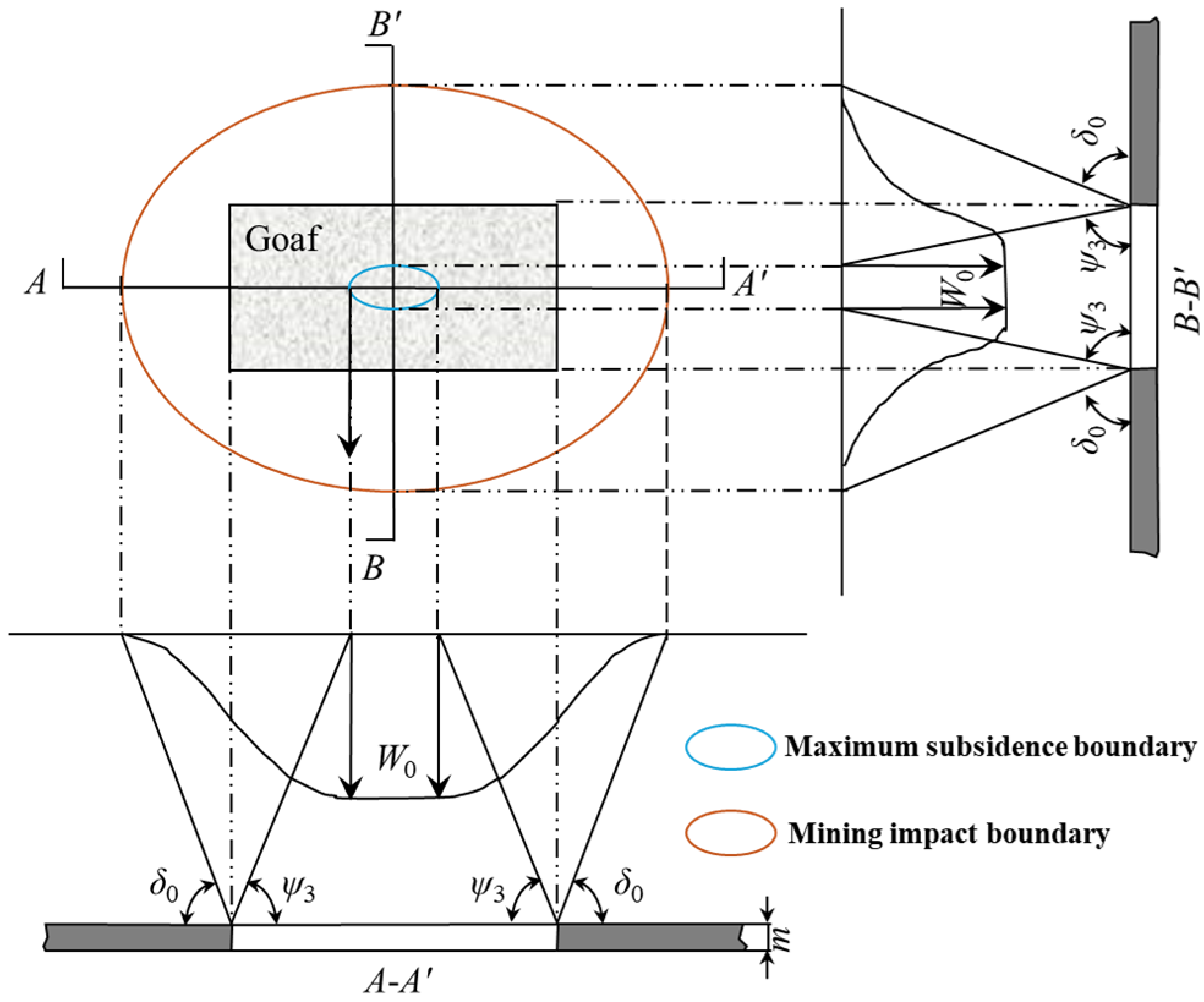
During underground coal mining, the continuous advancement of the working face influences the surface, which then subsides from its original elevation. The surface above the goaf forms a subsidence basin much larger than the goaf area. The surface subsidence basin formed after the horizontal coal seam or near-horizontal coal seam is fully mined (Figure 1) has the following characteristics:
Figure 1.
Schematic diagram of surface subsidence basin when horizontal or near-horizontal coal seam is fully mined.
- The center of the subsidence basin has a flat bottom, located directly above the middle of the goaf. The maximum subsidence value is at the center of the basin, and the subsidence value gradually decreases from the center to the edge of the basin. The subsidence value is zero at the boundary of the basin.
- The shape of the subsidence basin is symmetrical to the goaf. The inflection point is the boundary point between the inner and outer edge areas of the subsidence basin, roughly located directly above or slightly deviated from the boundary of the goaf. The subsidence value at the inflection point is about half of the maximum subsidence value W0.
In Figure 1, m is the coal thickness; W0 is the maximum subsidence value of the surface subsidence basin; A-A’ is the strike main section; B-B’ is the dip main section; δ0 is the boundary angle; ψ3 is the sufficient mining angle.
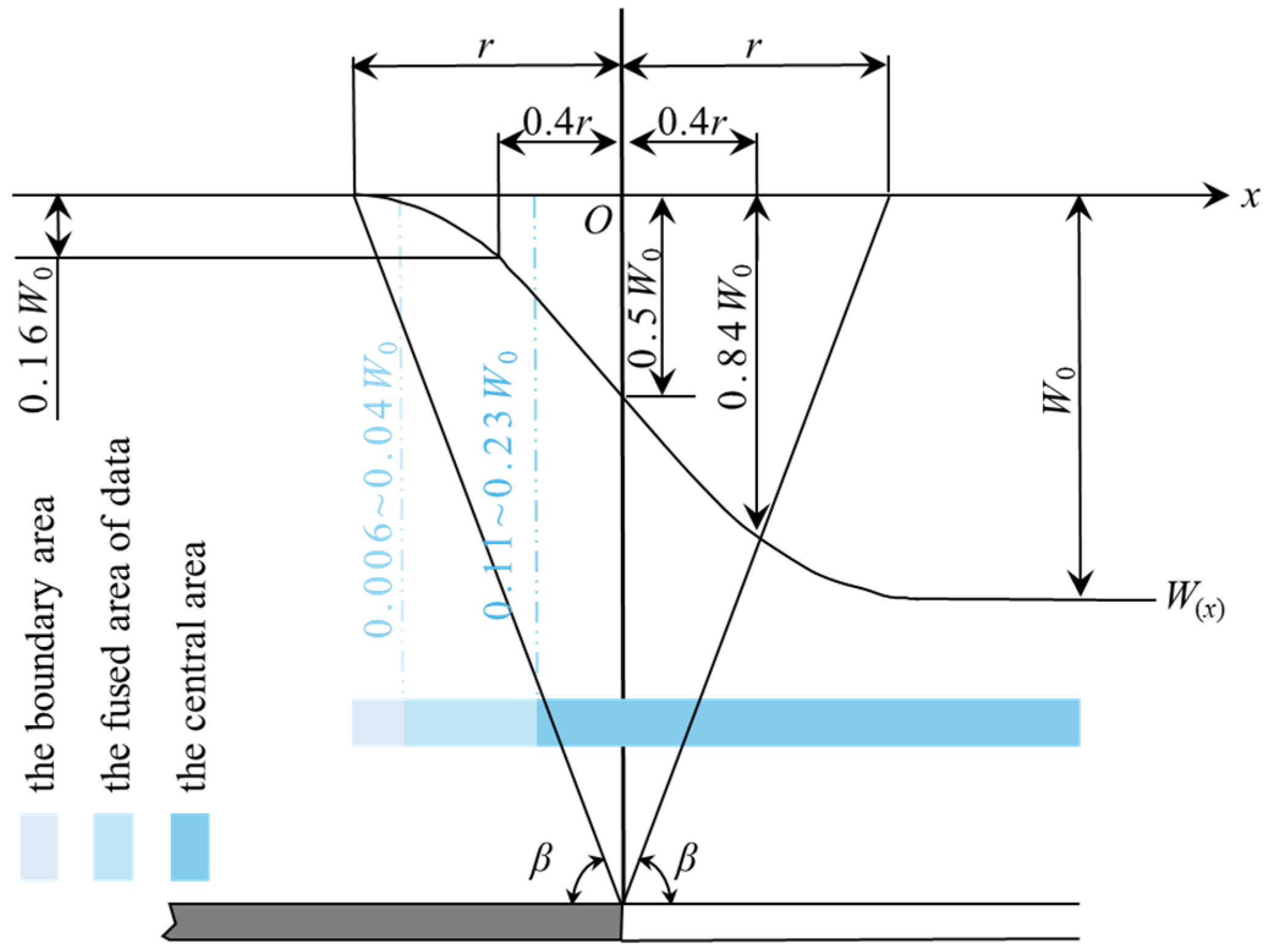
The process of rock and surface movement caused by coal mining is similar to the process of particle movement, so discontinuous stochastic medium models are commonly used to study it. The probability integration method is a typical model. According to the probability integration method, the subsidence curve W(x) of the strike main section of the semi-infinite mining is shown in Figure 2.
Figure 2.
Subsidence curve of strike main section in semi-infinite mining.
In Figure 2, r is the distance from the inflection point of the subsidence curve of the autonomous section to the maximum subsidence point or from this inflection point to the boundary point of the subsidence basin, which is called the main influence radius. The acute angle β between the surface point of x = ±r connected to the coal wall and the horizontal line is called the main influence angle. At x > +r, the sinking approaches or reaches the maximum value W0; at x < −r, the sinking value is in the range of (0.006~0.04) W0. According to the mining subsidence theory, the deformation at the edge of the basin is small, and the subsidence range is usually defined as 0.006 W0~0.04 W0. The data fusion area is the transition area from small deformation to large deformation, and the theoretical range is usually 0.11 W0~0.23 W0. The remaining area is the center of the subsidence basin.
Under critical mining conditions, the horizontal distance between the points with subsidence values of 0.16 W0 and 0.84 W0 and the inflection point on the measured subsidence curve of the main section is 0.4 r [5]. Based on this characteristic, the size of the main influence radius r can be calculated to determine the approximate impact range of surface subsidence caused by underground coal mining.
2.2. Fusion Method and Thought
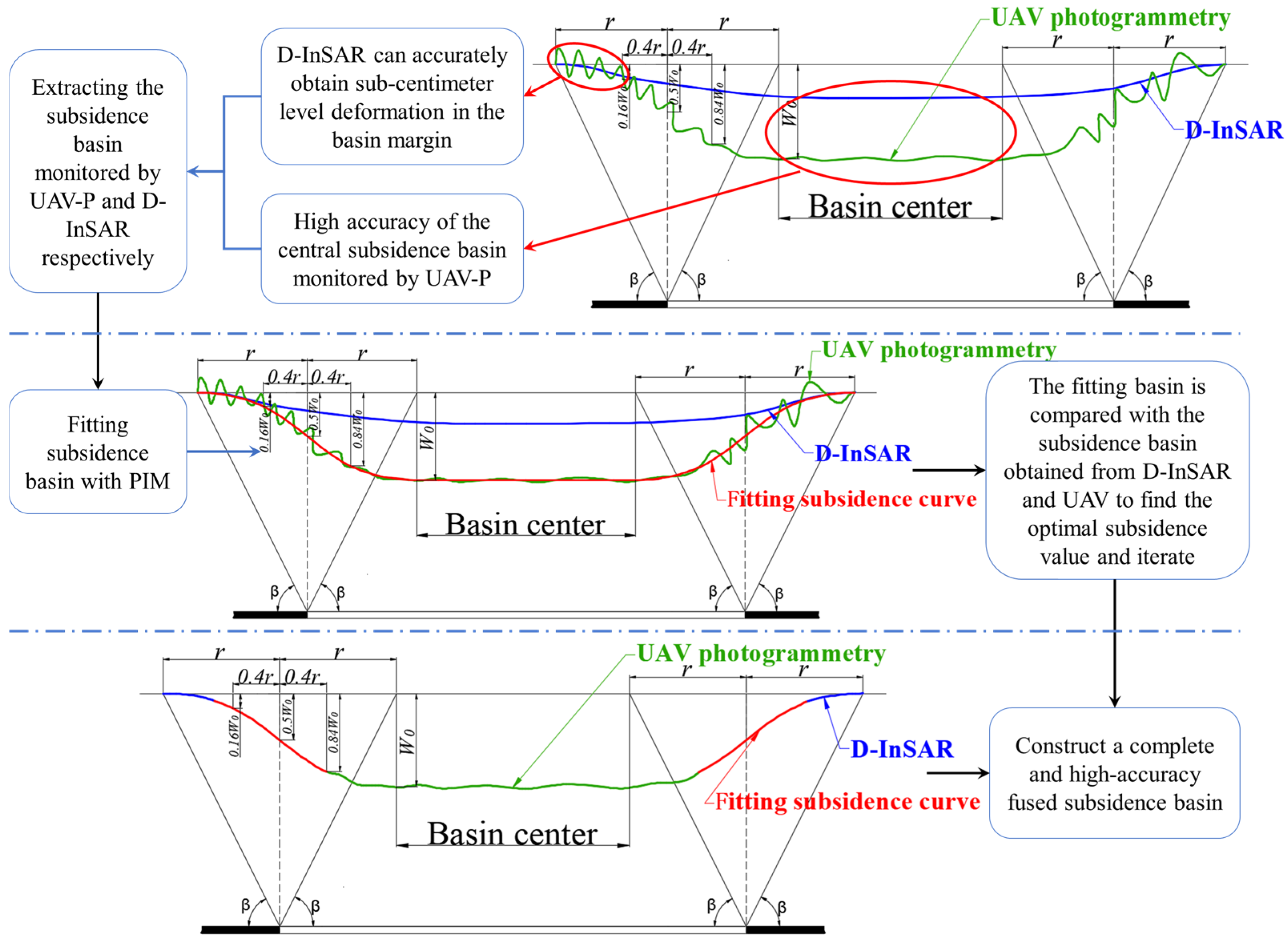
Since D-InSAR is prone to time–space decorrelation when monitoring deformation gradients beyond its capacity, using it to monitor the large-scale deformation in the center of the subsidence basin yields inaccurate results. However, D-InSAR can accurately model centimeter-level deformation on the edge of the subsidence basin in the mining area. UAV photogrammetry can effectively extract data on the large-scale deformation in the central subsidence basin with relatively high accuracy, which can make up for the deficiency of D-InSAR. In order to model the actual terrain of the subsidence basin in the mining area, the respective advantages of D-InSAR and UAV photogrammetry technology should be fully utilized and combined with the characteristics of surface subsidence. The inflection point of the subsidence basin is taken as the origin, and the distance ±r from the inflection point is the boundary. The small deformation of the basin edge monitored by D-InSAR is extracted at a position less than −r, and the large-scale deformation of the basin center monitored by UAV photogrammetry is extracted at a location greater than +r. Taking the high-precision basin edge and center subsidence data as the constraints, the probability integral method is then used to fit the subsidence basin, calculate the difference between the fit value and the measured value, and find the optimal subsidence value according to the degree of deviation of the difference. Then, the optimized subsidence data are taken as the constraint condition, iterations are carried out until the error between the fitting basin and the optimized basin (i.e., the fusion basin) is minimized, and eventually a complete and accurate model of the subsidence basin is obtained. Figure 3 shows an outline of the method.
Figure 3.
Outline of the integration of D-InSAR and UAV photogrammetry technology for monitoring mining subsidence.
The detailed steps are as follows:
- The strike and dip main sections of the subsidence basin are determined in terms of the maximum subsidence value W0 and its position coordinates obtained by UAV photogrammetry.
- The subsidence data of the main sections monitored by UAV photogrammetry are extracted, and then the subsidence curve is fitted by interpolation.
- The points of 0.16 W0 and 0.84 W0 on the measured subsidence curve of the strike main section are determined, and the horizontal distance between them and the point with the subsidence value of 0.5 W0 is calculated, so as to obtain the major influence radius r.
- The distance r beyond the inflection point of the subsidence curve is used as the boundary to extract the subsidence data of the subsidence edge monitored by D-InSAR, and the distance r within the inflection point of the subsidence curve is used as the boundary to extract the subsidence data of the subsidence center monitored by UAV. Subsidence data of the main section monitored by D-InSAR and UAV photogrammetry are extracted according to the determined boundary.
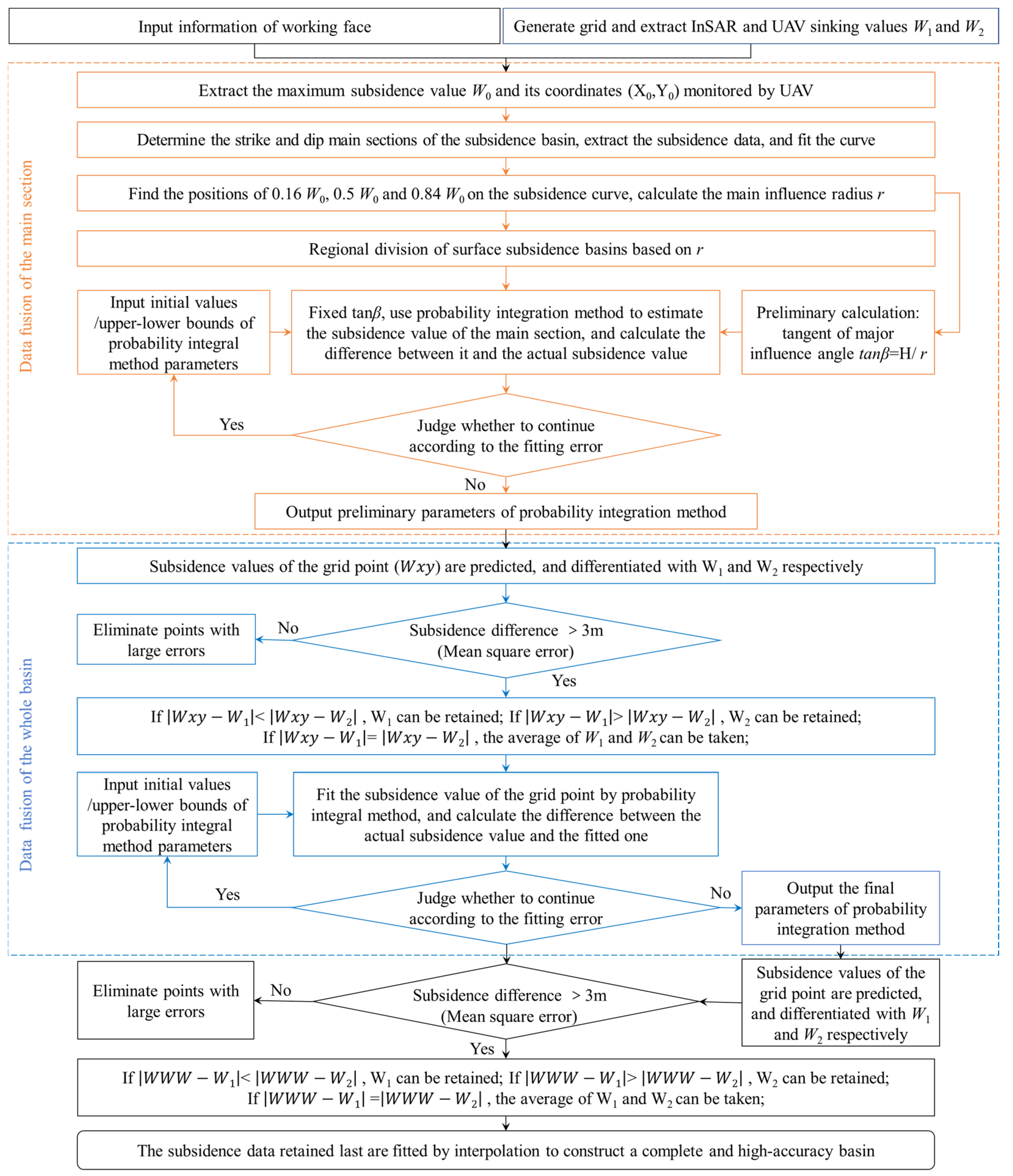
- The error of the data of the interval where the left and right distance of the inflection point is r monitored by D-InSAR and UAV is large, which does not apply to parameter inversion, while the determination of the tangent of major influence angle tanβ, relies on the data of this interval. Therefore, tanβ is initially determined by means of empirical methods. With tanβ fixed, mining subsidence prediction parameters, namely subsidence coefficient q and deviation of inflection point (left and uphill) S1, S3, is inversed based on the subsidence data extracted by Step (4).
- The subsidence basin is fitted using the probability integral method and the foregoing prediction parameters, and differentiated with that extracted by D-InSAR and UAV photogrammetry. When calculating the difference between all points and the expected subsidence basin, if the difference in a point is greater than three times the mean square error, the subsidence value of that point will be removed. Otherwise, data selection will continue. If the deviation of the subsidence extracted by D-InSAR is greater than that extracted by UAV photogrammetry, the subsidence data of the latter can be retained, and vice versa. If the deviation of the two is equal, the average value is taken.
- The subsidence basin data retained in Step (6) is used for the inversion of mining subsidence prediction parameters. Steps (6) and (7) are repeated until the error between the fitted basin and the fusion basin is minimized.
- The subsidence data retained last are fitted by interpolation to construct a complete and accurate basin.
The above fusion steps are realized by MATLAB 2020a. The specific implementation process is illustrated in Figure 4.
Figure 4.
Flow chart of the fusion method of D-InSAR and UAV photogrammetry.
Dynamic parameter calculation can obtain values for the final subsidence coefficient q, the main influence angle tangent tan β, the mining influence propagation angle θ, and the inflection point offset s, excluding the horizontal movement coefficient.
3D laser scanning and UAV cannot directly obtain the horizontal movement values of each point; it can only be obtained through other measurement methods or after modeling the features. When calculating parameters, it is necessary to select different initial values for cyclic iteration. Appropriate initial values of parameters should be selected according to the actual situation of the mining area. Generally, three initial values of large, medium, and small parameters are selected, as shown in Table 1. When different initial values converge to the same result, the parameter result is proven to be stable.
Table 1.
Parameter initial value selection.
2.3. Method of Accuracy Evaluation
In order to verify the feasibility of the fusion method, quantitative analysis of the fusion results is required. The traditional accuracy evaluation method involves extracting the subsidence values of multiple points across the whole basin and compares them with high-precision reference data, and the errors between the measured data and the reference data are used to reflect the overall accuracy of the subsidence basin. Subsidence basins usually appear “funnel-shaped” with large central subsidence and small boundary subsidence, so there are differences in the monitoring accuracy requirements for the center and boundary of the basin. In the western mining area with high-intensity and large-scale mining, the subsidence in the center of the subsidence basin usually reaches several meters or even tens of meters, and monitoring accurate at the decimeter level can fully meet the monitoring requirements. However, at the subsidence basin boundary, the subsidence is usually only a few tens of millimeters. In this case, the monitoring needs to be accurate at the centimeter or millimeter level. Therefore, in order to accurately evaluate the accuracy of the fusion method, this paper proposes to analyze the sub-regional accuracy of the subsidence basin, and calculate the overall accuracy of the subsidence basin according to the weights occupied by different regions.
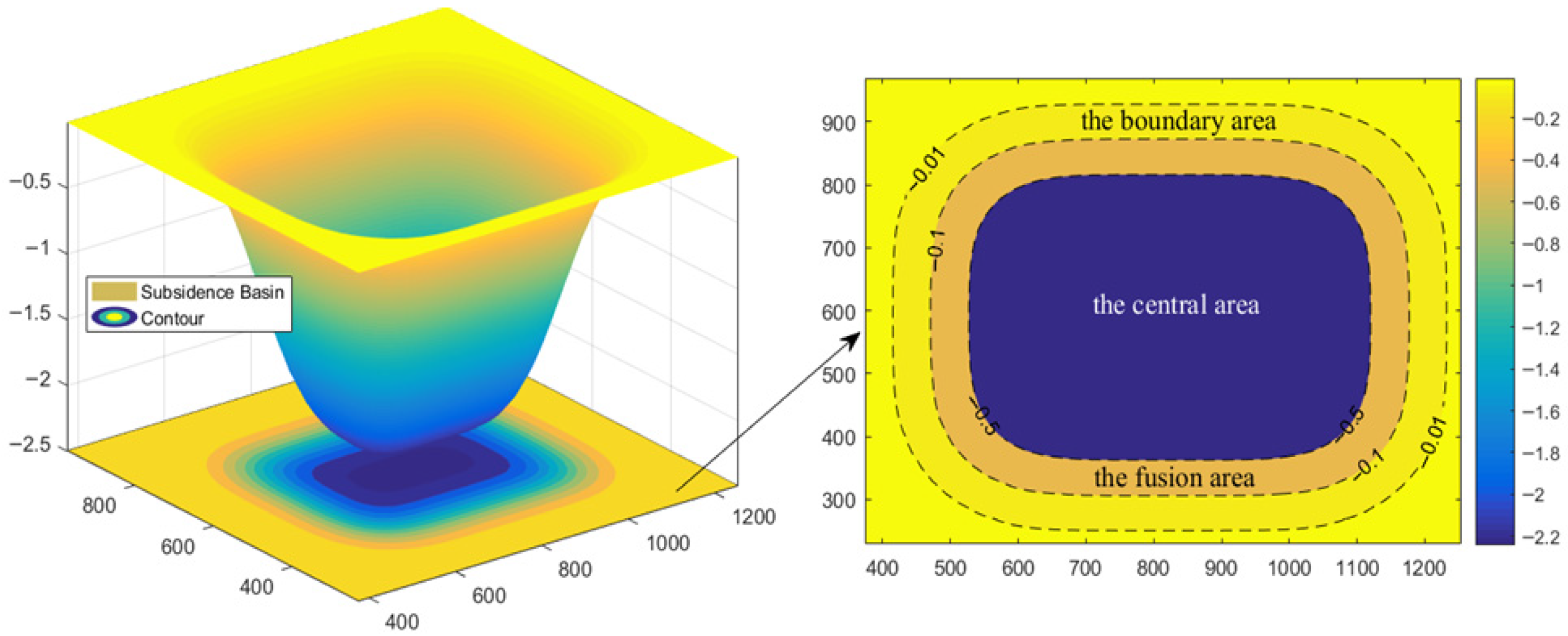
In this paper, the surface subsidence basin is divided into three regions, namely the central area, where the subsidence is less than −0.5 m; the fused area of D-InSAR and UAV photogrammetry data, where the subsidence is between −0.5 m and −0.1 m; and the boundary area, where the subsidence is greater than −0.1 m (see Figure 5).
Figure 5.
Schematic diagram of regional division of subsidence basin.
The weight of different regions is determined by the area of each region in the entire subsidence basin. The weighting method is shown in Equation (1):
where Pi is the weight of each area of the surface subsidence basin; S is the area of the entire subsidence basin, and Si is the area of each sub-region.
Due to the complex and changeable surface subsidence, it is difficult to directly count the actual area of each region. In this paper, the subsidence basin predicted by the probability integration method is used to estimate the areas of three sub-regions and the whole basin; this is then used to determine the weight of each region is determined.
According to the law of error propagation, the overall accuracy of the subsidence basin can be expressed as Equation (2):
where m1 is the RMSE of the central area of the subsidence basin, m2 is the RMSE of the fused area, m3 is the RMSE of the boundary area of the subsidence basin, and mz is the overall accuracy of the surface subsidence basin.
2.4. Overview of Experimental Area
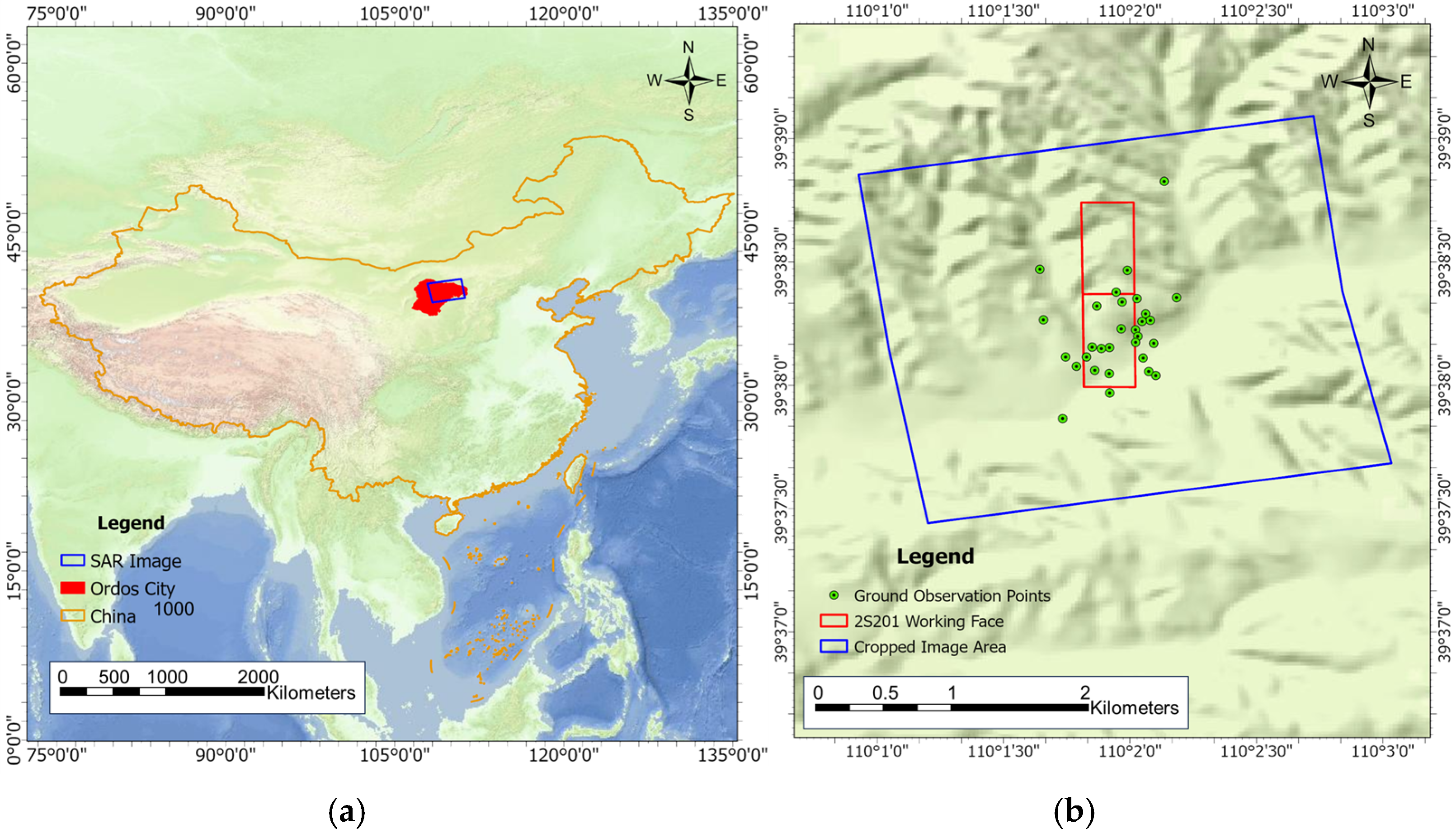
The study area is the 2S201 working face of Wangjiata Coal Mine, located in the southwest of Wanli Mining Area of Dongsheng Coalfield in Ejin Horo Banner, Ordos City, Inner Mongolia Autonomous Region, with a longitude of 110°01′56.42″E and latitude of 39°38′20.85″N, as shown in Figure 6. It is an erosive hilly terrain with sparse vegetation and no perennial water bodies such as rivers and reservoirs. The 2S201 working face is located in the east of 2# South Panel of 2-2 Coal Seam, which is the first mining face of 2# South Panel. On the east side is the main return airway of the south 2-2 lower coal seam group, on the west side is 2S202 working face, and on the south side is the coal pillar of the mine field boundary. To the north is the main belt haulage roadway of 2# South Panel of 2-2 Coal Seam. There is no other nearby mining engineering affecting the 2S201 working face. The working face began to produce coal on 11 July 2018 and closed on 25 October 2018. The dip length of working face is 260 m and the strike length is 1253 m. The average dip angle of the coal seam is 2°, the average mining depth is about 200 m, and the actual average mining thickness is 3.17 m. The experiment focuses on the surface subsidence induced by mining at 2S201 working face from the beginning of coal production to 3 September 2018.
Figure 6.
(a) Location of the experimental area: Ordos City, China. (b) Topographic map of 2S201 working face of Wangjiata coal mine. The positions of ground observation points, and mining progress of the working face are marked.
2.5. Data Processing
2.5.1. SAR Data Processing
In the experiment, IW SLC image data of eight scenes from Sentinel-1A with a resolution of 20 m in the study area were acquired from 11 June 2018 to 3 September 2018. SRTM DEM V3.0 data with spatial resolution of 30 m was used as the external DEM data. The Sentinel-1A data time interval was 12 d, the working waveband was C-band, and the polarization mode was VV polarization, as shown in Table 2. Seven interference pairs were formed by D-InSAR processing, the interference pair combination is shown in Table 3. We perform differential interference processing on each interference pair to obtain the unwrapping phase:
where φi is the unwrapping phase of the i-th interference pair, ϕi is the phase of the phase i image, and unwrap [·] is the phase unwrapping operation.
Table 2.
Sentinel-1A image information.
Table 3.
Interference pair combination.
The seven unwrapping phases were converted into deformation values in the LOS direction:
D-InSAR processing was realized based on the SARscape module of ENVI 5.6, which includes SAR image registration, interferometric processing, flat-earth effect removal, filtering, phase unwrapping, and geocoding [40]. Since the deformation obtained by phase unwrapping is along the sight line, while the deformation of surface subsidence is vertical [41]. Generally, in the absence of more observation information, the horizontal and vertical deformation are approximately calculated according to the deformation values in LOS direction:
where is the deformation along the sight line; is the horizontal deformation; stands for the vertical deformation; is the incident angle of radar.
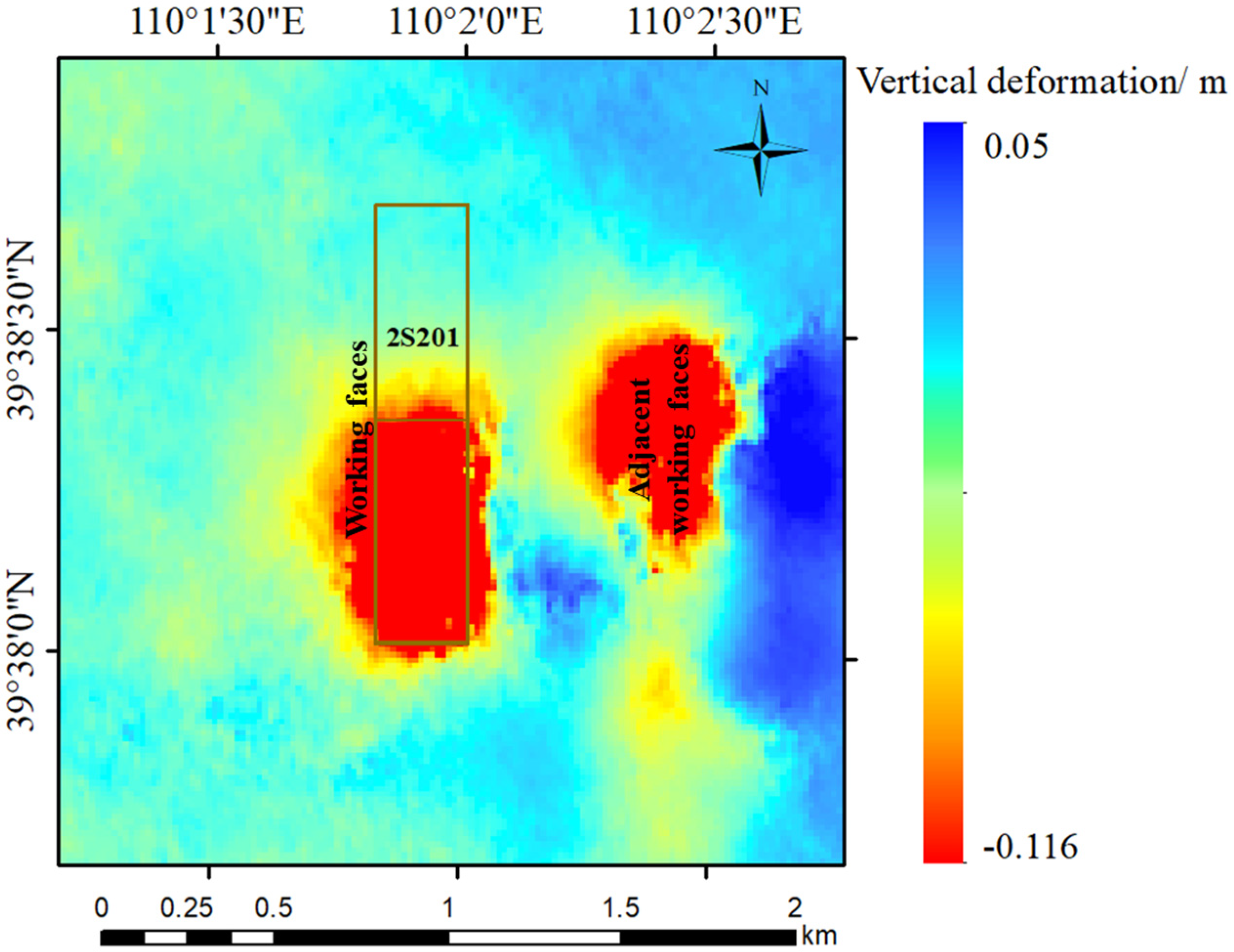
Thus, seven periods of vertical ground subsidence in the experimental area within the image time interval were obtained and then accumulated by means of ArcGIS 10.8. Finally, the accumulated ground subsidence from 11 June 2018 to 3 September 2018 was modeled, as shown in Figure 7.
Figure 7.
Surface cumulative subsidence monitored by D-InSAR at 2S201 working face.
2.5.2. UAV Photogrammetry Data Processing
In the experiment, photogrammetry of surface subsidence in the experimental area was conducted on 9 June 2018 and 4 September 2018 through UAV, and two periods of aerial photographs were obtained. The detailed aerial photographic information is shown in Table 4.
Table 4.
Information about UAV images.
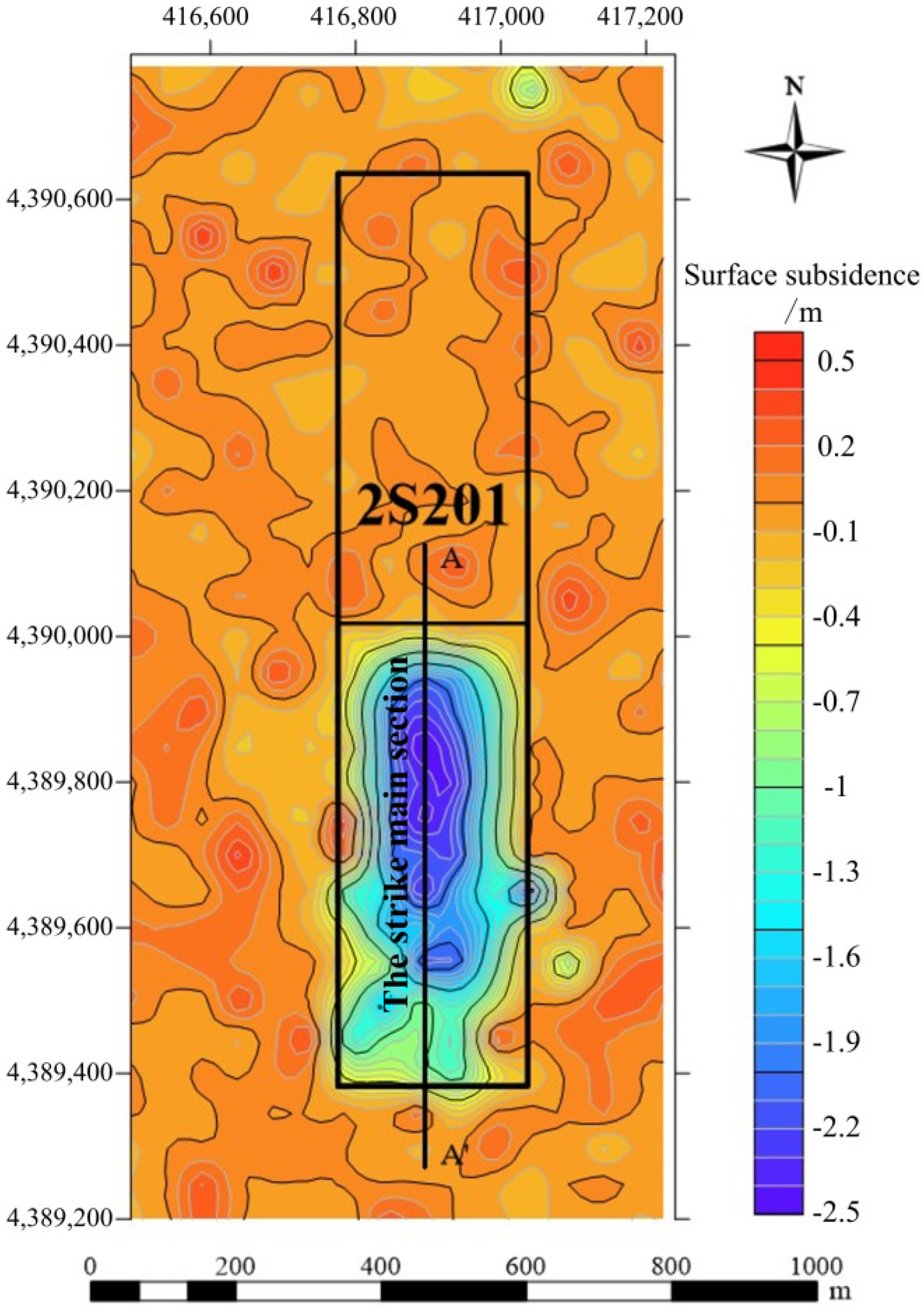
Processing for the two periods of aerial photographs, such as aerial triangulation resolution, dense matching, point cloud filtering and interpolation, was performed respectively by Agisoft Photo Scan in order to build digital elevation models (DEMs). Upon subtracting one DEM from the other in ArcGIS, the mining-induced surface subsidence in the experimental area from 9 June 2018 to 4 September 2018 can be visualized, as shown in Figure 8.
Figure 8.
Surface subsidence in experimentation area monitored by UAV Photogrammetry.
3. Results
3.1. Fusion Result
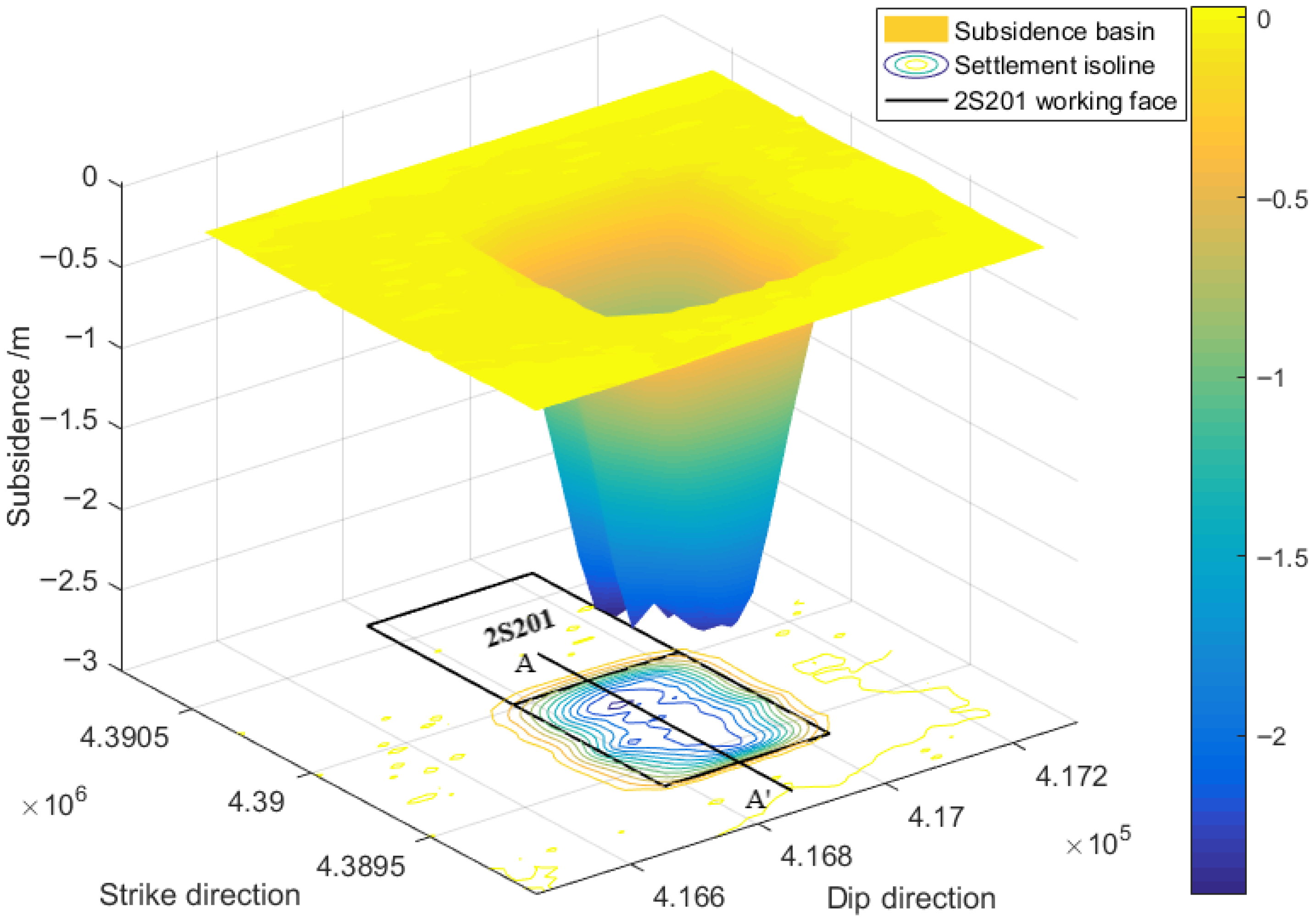
The results of the data processing show that the maximum subsidence that can be monitored by D-InSAR is −0.116 m, while the actual value measured in the experimental mining area is at the meter level. It is obvious that D-InSAR technology cannot effectively extract the large-gradient deformation of the subsidence center. However, it can accurately model the centimeter-level deformation at the subsidence boundary, where subsidence is at the scale of −0.01 m. The maximum subsidence monitored by UAV photogrammetry is about −2.5 m, which is basically consistent with the actual value in the mining area. As can be seen from the subsidence contour in Figure 8, the subsidence of −0.4 m to −2.5 m basically conforms to the pattern of surface movement and deformation, while that of 0 m to −0.4 m has a relatively large error. Hence, the subsidence boundary cannot be accurately acquired. Based on the fusion of D-InSAR and UAV photogrammetry, the subsidence basin can be modeled by fusing the centimeter-level deformation on the subsidence periphery accurately extracted by D-InSAR and meter-level deformation in the center extracted by UAV photogrammetry. The result is illustrated in Figure 9. Compared with the other two methods, the fusion method models deformation with high accuracy, both on the edge and in the center of the subsidence area. The data in which the monitoring errors of the two methods were originally large were fitted according to the prediction parameters of mining subsidence inverted by the two datasets. Thus, the fusion method can completely restore the full view of the subsidence basin in mining areas.
Figure 9.
Results of fusing D-InSAR and UAV photogrammetry technology.
Predicted parameters of mining subsidence were calculated using the fused subsidence basin and the probability integral method. The results of parameter inversion are demonstrated in Table 5. According to the surface movement pattern and parameter data of rock stratum movement of Wangjiata Coal Mine, the subsidence coefficient q = 0.72, tangent of major influence angle tanβ = 2.5, and deviation of inflection point S = (0.1~0.15)H. The subsidence coefficient and deviation of the inflection point calculated by the fusion method basically accord with the actual parameters, and the relative error of tangent of major influence angle is only 7.2%. Therefore, the results of parameters calculated by the fusion method can better predict the real surface subsidence of the mining area, which indirectly verifies the reliability of the fusion method.
Table 5.
Parameters inversion results of fusion data.
3.2. Accuracy Analysis
In this experiment, GPS-RTK and total station were used to collect checkpoints in the survey area. A total of 30 points were randomly selected from them, and their subsidence values were compared with those obtained by UAV photogrammetry, D-InSAR, and the fusion method. In view of the error range of this study and the vertical accuracy of RTK, this can be used as a checkpoint [42,43]. The subsidence values of 30 randomly selected points are arranged in ascending order, and according to the aforementioned accuracy evaluation method, they were divided into the central area of the subsidence basin with subsidence less than −0.5 m, including 10 points, the fused area between −0.5 m to −0.1 m, containing seven points, and the boundary area of the subsidence basin with subsidence greater than −0.1 m, consisting of 13 points. Then, the accuracy analysis was carried out. The results are shown in Table 6, Table 7 and Table 8.
Table 6.
Accuracy analysis results of the central area of the subsidence basin.
Table 7.
Accuracy analysis results of the fused area.
Table 8.
Accuracy analysis results of the boundary area of the subsidence basin.
It can be seen from Table 6 hat when monitoring the central area of the subsidence basin, the accuracy of D-InSAR technology is extremely low, and the accuracy of UAV photogrammetry is the best, while the fusion method inherits the advantages of UAV photogrammetry in monitoring large-gradient subsidence, whose accuracy is similar to that of the UAV method. The accuracies of the UAV and fusion methods in the central area of the subsidence basin are 0.252 m and 0.277 m, respectively, which meet the requirements relative to large-scale subsidence. As shown in Table 7, the fusion method retains the more accurate data from each of the two methods in the fused area. Compared with the single D-InSAR and UAV photogrammetry methods, the accuracy of the fused area has been successfully improved from decimeter to centimeter level through the fusion method. Table 8 shows that when monitoring the boundary area of the subsidence basin, the error of the UAV photogrammetry method is still at the decimeter level, which means it cannot accurately detect the real subsidence conditions of the subsidence basin edge area with subsidence less than 0.1 m, or distinguish the impact boundary of mining subsidence. The D-InSAR method exerts its advantages in monitoring small deformation, as its accuracy is at the centimeter level. The fusion method inherits the advantages of the D-InSAR method, and the monitoring accuracy in this area reaches 0.039 m, which complements the shortcoming of large monitoring error of UAV photogrammetry method in the boundary area of the subsidence basin.
Using the probability integration method, the parameters of the subsidence basin predicted with parameters inversed by the fusion data were used to estimate the areas of the three sub-regions. The weights of each region are 0.4, 0.1, and 0.5, as shown in Table 9.
Table 9.
Determination of the weights.
Table 10 shows the calculation results of the accuracy of each sub-region and the overall accuracy of the surface subsidence basin obtained by UAV photogrammetry, D-InSAR, and fusion methods using the accuracy evaluation model. The RMSE of the subsidence obtained by UAV photogrammetry in each region is a decimeter. However, due to the limited deformation gradients that can be monitored by D-InSAR, it cannot accurately monitor the large-scale deformation in the central area of the subsidence basin, and so the RMSE of the subsidence in this area is large; however, its precision when monitoring the small deformation in the boundary area of the subsidence basin is high. The overall accuracies of the subsidence basins obtained by the three methods are 0.252 m, 1.112 m, and 0.182 m, respectively. The accuracy of D-InSAR method is the lowest, followed by UAV photogrammetry method. Combining the advantages of the two methods, the accuracy of the fusion method is improved by 83.6% compared with D-InSAR method, and 27.8% compared with UAV photogrammetry method, which is a significant improvement in the overall accuracy.
Table 10.
Accuracy assessment results of the three methods.
4. Discussion
As China shifts its focus on coal mining from the east to the west, large-scale and high-intensity mining has become common in western China. The problem of surface subsidence triggered by such mining is particularly acute in western areas with a vulnerable ecological environment, which severely restricts the sustainable development of coal mine enterprises and people’s health. Therefore, it is urgent to develop a technical method which is capable of adapting to monitoring mining-induced environmental damage under new situations. In spite of high-accuracy single-point monitoring, the limited point data obtained by traditional measurement methods from observation stations have shortcomings, such as their small scale, the heavy workload required, and incompleteness of the dataset, which fail to meet the needs of subsidence basin monitoring. D-InSAR can be used in all weather conditions, at any time, and at low cost; it can obtain micro-surface subsidence data with accuracy up to the centimeter or even millimeter level. However, it is unable to model large-scale subsidence in mining areas owing to its susceptibility to time–space decorrelation. In this paper, the maximum subsidence of the subsidence basin in the experimental mining area extracted by D-InSAR is −0.116 m, which is not in line with the measured data. In addition, the D-InSAR method has an accuracy of 1.741 m when monitoring the large-scale subsidence in the central area of the subsidence basin. Compared with the actual maximum subsidence of 2.5 m, the relative error is as high as 69.6. UAV photogrammetry, on the other hand, is characterized by low cost, flexibility, efficiency and accuracy, and can rapidly attain subsidence data across the whole basin with an accuracy up to the decimeter level. However, the method is unable to accurately extract the subsidence boundary where subsidence is 0.01 m. As the basis for the determination of boundary angles, the subsidence boundary is instructive and is of practical value for mine safety and efficient production. It can be seen from Figure 8 that the boundary of the surface subsidence basin obtained by UAV photogrammetry technology is fuzzy, and according to the accuracy analysis, the RMSE of subsidence in the boundary area is 0.279 m, which is relatively large relative to the boundary area with a subsidence of only a few centimeters or even a few millimeters. It is therefore difficult to determine the boundary position of the mining subsidence in this mining area.
In summary, the existing mining subsidence methods each have their own pros and cons. In order to monitor mining-induced environmental damage in a precise, low-cost, and comprehensive way, it is necessary to integrate the advantages of each technology. Research on the fusion method of various technologies therefore represents the current general trend in coal mining subsidence monitoring. By means of multi-technology fusion, subsidence data of the whole basin can be obtained with higher precision, and elaborate studies on surface basin deformation can be conducted. By means of multi-source data fusion, data not only on surface deformation but also on the ecological environment in the mining area and its changes can be acquired, providing accurate and rich basic data for the ecological restoration, environmental assessment, and post-assessment of mining areas.
D-InSAR can accurately detect centimeter-level deformation at the periphery of coal mining surface subsidence, and the subsidence boundary of the experimental mining area can be clearly identified and located in Figure 7. UAV photogrammetry can obtain meter-level subsidence data with high accuracy in the central area of the subsidence basin. In this experiment, the maximum subsidence of the subsidence basin in the experimental area extracted by UAV photogrammetry is about −2.5 m, which accords with the measured data. In terms of the subsidence contour, a subsidence of −0.4 m to −2.5 m is consistent with the basic features of mining subsidence in mining area.
Feature level fusion of the two datasets was carried out along with the probability integral method, which takes full advantage of D-InSAR and UAV photogrammetry. The obtained subsidence basin is displayed in Figure 9. Through the quantitative analysis of the fusion results, it is found that the accuracy of the surface subsidence basin obtained by the fusion method is better than that obtained by the single D-InSAR and UAV photogrammetry methods. At the same time, the accuracy of the fused area where both errors are at the decimeter level is also optimized to the centimeter level, so that the overall accuracy of the fusion subsidence basin has been significantly improved.
The inverted subsistence basin parameters obtained by the fusion method, namely subsidence coefficient and deviation of inflection point, are broadly in line with the actual data of the experimental mining area, and the relative error of the tangent of major influence angle is only 7.2%. Therefore, the more accurate mining subsidence prediction parameters can be inversed through fusing the results of D-InSAR and UAV photogrammetry, which is important to provide guidance for mining safety and determining appropriate protective measures.
5. Conclusions
Considering the advantages and limitations of D-InSAR and UAV photogrammetry in monitoring mining subsidence, a feature level fusion method of D-InSAR and UAV photogrammetry based on the surface subsidence characteristics of coal mining is proposed. With the mining surface subsidence of Wangjiata Coal Mine 2S201 working face as an example, eight scenes of Sentinel-1A SAR image data and two periods of UAV photogrammetry data collected in the experimental area were processed. Then, data fusion was conducted to model the basin of the experimental area. The main conclusions are as follows:
- The foundational idea of the fusion method of D-InSAR and UAV photogrammetry is as follows: according to the surface subsidence characteristics of coal mining, extract the subsidence data with high precision of the boundary and the central area of the subsidence basins monitored by D-InSAR and UAV photogrammetry, respectively. The subsidence basin is fitted with the probability integral method, and compared with those extracted by D-InSAR and UAV photogrammetry, until the error between the fusion basin and the fitted basin after optimization is the smallest, so as to obtain a complete and accurate subsidence basin.
- A sub-regional weighted accuracy evaluation model is proposed, and the accuracy of the fusion method is evaluated and analyzed. The monitoring accuracy of the fusion method is 0.182 m, which is 83.6% and 27.8% higher than that of D-InSAR and UAV photogrammetry methods, respectively. The maximum subsidence of the experimental area obtained by the method is 2.5 m, and the errors of the central area and the boundary area of the subsidence basin are 0.277 m and 0.039 m respectively. The method can effectively extract data on the small deformation of the subsidence basin boundary and the large-scale deformation of the central area, thus accurately restoring the real form of the subsidence basin in the mining area. Moreover, reliable prediction parameters of the mining subsidence can be obtained through the inversion of fusion results, in which the subsidence coefficient q is 0.71 and the tangent of major influence angle tanβ is 2.32, providing basic data for instructions of mine safety and the comprehensive improvement and protection of the ecological environment.
- This paper discusses the advantages and disadvantages of traditional subsidence monitoring methods, D-InSAR and UAV photogrammetry, and analyzes the benefits of the fusion method. We conclude that a variety of technologies should be taken advantage of and that elaborate research should be conducted by means of multi-technology fusion. With the development of new mapping and surveying technologies, the accurate monitoring of eco-environmental damage employing multi-source data fusion represents the current general trend of mining subsidence monitoring.
Author Contributions
S.A.: Conceptualization, Data curation, Formal analysis, Investigation, Methodology, Validation, Visualization, Writing—original draft. L.Y.: Conceptualization, Formal analysis, Methodology, Supervision, Writing—review and editing. Q.L.: Conceptualization, Formal analysis, Methodology, Supervision, Writing—review and editing. All authors have read and agreed to the published version of the manuscript.
Funding
This research was supported by the National Natural Science Foundation of China No. 22104174, National Natural Science Foundation of China No. 42401328, and Ningxia Hui Autonomous Region Key Research and Development Program No. 2022BEG03065.
Data Availability Statement
The raw data supporting the conclusions of this article will be made available by the authors on request.
Acknowledgments
The authors are grateful to anonymous reviewers for their insightful feedback.
Conflicts of Interest
The authors declare no conflicts of interest.
References
- Wang, L.; Wei, T.; Li, N.; Chi, S.-S.; Jiang, C.; Fang, S.-Y. Research on probability integration parameter inversion of mining-induced surface subsidence based on quantum annealing. Environ. Earth Sci. 2018, 77, 740. [Google Scholar] [CrossRef]
- Xie, H.; Wu, L.; Zheng, D. Prediction on the energy consumption and coal demand of China in 2025. J. China Coal Soc. 2019, 44, 1949–1960. [Google Scholar]
- Yang, H.; Ning, S.; Ding, L.; Liu, Z. Chinese Coal Industry Status Quo in New Period and Countermeasures Study. Coal Geol. China 2021, 33, 44–48. [Google Scholar]
- Ge, L.; Chang, H.C.; Rizos, C. Mine Subsidence Monitoring Using Multi-source Satellite SAR Images. Photogramm. Eng. Remote Sens. 2007, 73, 259–266. [Google Scholar] [CrossRef]
- He, G.; Yang, L.; Ling, G.; Jia, F.; Hong, D. Mining Subsidence Science; China University of Mining and Technology Press: Xuzhou, China, 1991. [Google Scholar]
- Zhu, J.J.; Yang, Z.F.; Li, Z.W. Recent progress in retrieving and predicting mining-included 3D displacements using InSAR. Acta Geod. Cartogr. Sin. 2019, 48, 135–144. [Google Scholar] [CrossRef]
- Pawluszek-Filipiak, K.; Borkowski, A. Integration of DInSAR and SBAS Techniques to Determine Mining-Related Deformations Using Sentinel-1 Data: The Case Study of Rydułtowy Mine in Poland. Remote Sens. 2020, 12, 242. [Google Scholar] [CrossRef]
- Chen, L.; Zhao, X. Recent advances of large gradient deformation monitoring in the mining area combined with InSAR. Bull. Surv. Mapp. 2018, 7, 18–23. [Google Scholar]
- Gabriel, A.K.; Goldstein, R.M.; Zebker, H.A. Mapping small elevation changes over large areas: Differential radar interferometry. J. Geophys. Res. 1989, 94, 9183–9191. [Google Scholar] [CrossRef]
- Zhou, D.; Wang, L.; An, S.; Wang, X.; An, Y. Integration of unmanned aerial vehicle (UAV)-based photogrammetry and InSAR for mining subsidence and parameters inversion: A case study of the Wangjiata Mine, China. Bull. Eng. Geol. Environ. 2022, 81, 343. [Google Scholar] [CrossRef]
- Zhang, G.; Xu, Z.; Chen, Z.; Wang, S.; Liu, Y.; Gong, X. Analyzing surface deformation throughout China’s territory using multi-temporal InSAR processing of Sentinel-1 radar data. Remote Sens. Environ. 2024, 305, 114105. [Google Scholar] [CrossRef]
- Carnec, C.; Massonnet, D.; King, C. Two examples of the use of SAR interferometry on displacement fields of small spatial extent. Geophys. Res. Lett. 1996, 23, 3579–3582. [Google Scholar] [CrossRef]
- Fan, H.D.; Lian, X.G.; Yang, W.F.; Ge, L.L.; Hu, H.F.; Du, Z.Y. Mining large-gradient subsidence monitoring using D-InSAR optimized by GNSS. Imaging Sci. J. 2021, 69, 207–218. [Google Scholar] [CrossRef]
- Klein, E.; Vigny, C.; Fleitout, L.; Grandin, R.; Jolivet, R.; Rivera, E.; Métois, M. A comprehensive analysis of the Illapel 2015 Mw8. 3 earthquake from GPS and InSAR data. Earth Planet. Sci. Lett. 2017, 469, 123–134. [Google Scholar] [CrossRef]
- Budetta, P.; Nappi, M.; Santoro, S.; Scalese, G. DinSAR monitoring of the landslide activity affecting a stretch of motorway in the Campania region of Southern Italy. Transp. Res. Procedia 2020, 45, 285–292. [Google Scholar] [CrossRef]
- Mirmazloumi, S.M.; Wassie, Y.; Nava, L.; Cuevas-González, M.; Crosetto, M.; Monserrat, O. InSAR time series and LSTM model to support early warning detection tools of ground instabilities: Mining site case studies. Bull. Eng. Geol. Environ. 2023, 82, 374. [Google Scholar] [CrossRef]
- Wang, L.; Teng, C.Q.; Jiang, K.G.; Jiang, C.; Zhu, S.J. D-InSAR monitoring method of mining subsidence based on Boltzmann and its application in building mining damage assessment. KSCE J. Civ. Eng. 2022, 26, 353–370. [Google Scholar] [CrossRef]
- Hou, Z.; Yang, K.; Li, Y.; Gao, W.; Wang, S.; Ding, X.; Li, Y. Dynamic prediction model of mining subsidence combined with D-InSAR technical parameter inversion. Environ. Earth Sci. 2022, 81, 307. [Google Scholar] [CrossRef]
- Berardino, P.; Fornaro, G.; Lanari, R.; Sansosti, E. A new algorithm for surface deformation monitoring based on small baseline differential SAR interferograms. IEEE Trans. Geosci. Remote Sens. 2002, 40, 2375–2383. [Google Scholar] [CrossRef]
- Chen, Y.J.; Dong, X.; Qi, Y.L.; Huang, P.P.; Sun, W.Q.; Xu, W.; Tan, W.X.; Li, X.J.; Liu, X.L. Integration of DInSAR-PS-stacking and SBAS-PS-InSAR methods to monitor mining-related surface subsidence. Remote Sens. 2023, 15, 2691. [Google Scholar] [CrossRef]
- Liu, Y.H.; Zhang, J. Integrating SBAS-InSAR and AT-LSTM for time-series analysis and prediction method of ground subsidence in mining areas. Remote Sens. 2023, 15, 3409. [Google Scholar] [CrossRef]
- Shi, M.Y.; Yang, H.L.; Wang, B.C.; Peng, J.H.; Gao, Z.Z.; Zhang, B. Improving boundary constraint of probability integral method in SBAS-InSAR for deformation monitoring in mining areas. Remote Sens. 2021, 13, 1497. [Google Scholar] [CrossRef]
- Liu, Z.Y.; Mei, G.; Sun, Y.J.; Xu, N.X. Investigating mining-induced surface subsidence and potential damages based on SBAS-InSAR monitoring and GIS techniques: A case study. Environ. Earth Sci. 2021, 80, 817. [Google Scholar] [CrossRef]
- Chen, Y.; Tong, Y.X.; Tan, K. Coal mining deformation monitoring using SBAS-InSAR and offset tracking: A case study of Yu County, China. IEEE J. Sel. Top. Appl. Earth Obs. Remote Sens. 2020, 13, 6077–6087. [Google Scholar] [CrossRef]
- Hu, B.; Wang, H. Urban land subsidence measurement by two-pass DInSAR. Eng. Surv. Mapp. 2010, 19, 37–41. [Google Scholar]
- Li, X.; Zhou, L.; Su, F.; Wu, W. Application of InSAR technology in landslide hazard: Progress and prospects. Natl. Remote Sens. Bull. 2021, 25, 614–629. [Google Scholar]
- Cheng, M.-L.; Matsuoka, M.; Liu, W.; Yamazaki, F. Near-real-time gradually expanding 3D land surface reconstruction in disaster areas by sequential drone imagery. Autom. Constr. 2022, 135, 104105. [Google Scholar] [CrossRef]
- Nappo, N.; Mavrouli, O.; Nex, F.; van Westen, C.; Gambillara, R.; Michetti, A.M. Use of UAV-based photogrammetry products for semi-automatic detection and classification of asphalt road damage in landslide-affected areas. Eng. Geol. 2021, 294, 106363. [Google Scholar] [CrossRef]
- Zhao, S.; Kang, F.; Li, J.; Ma, C. Structural health monitoring and inspection of dams based on UAV photogrammetry with image 3D reconstruction. Autom. Constr. 2021, 130, 103832. [Google Scholar] [CrossRef]
- Liu, Y.; Zhang, Z.; Wu, S.; Ding, X.; Shi, G.; Zhang, Z.; Abdallah, M.; Zhang, B. A novel 3D model for joint estimation of the repositioning and tilting error in GPRI-II terrestrial radar interferometry. ISPRS J. Photogramm. Remote Sens. 2025, 230, 804–819. [Google Scholar] [CrossRef]
- Zhou, D.; Qi, L.; Zhang, D.; Zhou, B.; Guo, L. Unmanned Aerial Vehicle (UAV) Photogrammetry Technology for Dynamic Mining Subsidence Monitoring and Parameter Inversion: A Case Study in China. IEEE Access 2020, 8, 16372–16386. [Google Scholar] [CrossRef]
- Zhang, H. Application of Photogrammetry Based on UAV in Surface Collapse Deformation Monitoring. Ph.D. Dissertation, Wuhan University, Wuhan, China, 2018. [Google Scholar]
- Yang, Q.; Tang, F.Q.; Wang, F.; Tang, J.Y.; Fan, Z.G.; Ma, T.; Su, Y.; Xue, J.L. A new technical pathway for extracting high accuracy surface deformation information in coal mining areas using UAV LiDAR data: An example from the Yushen mining area in western China. Measurement 2023, 218, 113220. [Google Scholar] [CrossRef]
- Zheng, J.L.; Yao, W.Q.; Lin, X.H.; Ma, B.L.; Bai, L.X. An accurate digital subsidence model for deformation detection of coal mining areas using a UAV-based LiDAR. Remote Sens. 2022, 14, 421. [Google Scholar] [CrossRef]
- Xia, Y.P.; Wang, Y.J. InSAR-and PIM-based inclined goaf determination for illegal mining detection. Remote Sens. 2020, 12, 3884. [Google Scholar] [CrossRef]
- Pohl, C.; Van Genderen, J.L. Review article Multisensor image fusion in remote sensing: Concepts, methods and applications. Int. J. Remote Sens. 1998, 19, 823–854. [Google Scholar] [CrossRef]
- Ukwuoma, C.C.; Cai, D.; Bamisile, O.; Ukwuoma, C.D.; Otuka, C.I.; Anyanwu, N.O.; Ukwuoma, C.O.; Huang, Q. Optimized Multi-Hierarchical Feature Fusion with Multi-Kernel CNN and Spectral-Spatial Convolutions for Remote Sensing Image Classification. Remote Sens. Appl. Soc. Environ. 2025, 40, 101727. [Google Scholar]
- Jiang, Y.; Zang, S.; Wang, J. Research on the Technology of Multi-source Remote Sensing Image Data Fusion. Geomat. Spat. Inf. Technol. 2009, 32, 46–50. [Google Scholar]
- Gao, S.; Lin, L.; Zhang, Z.; Wang, J. Temporal downscaling meteorological variables to unseen moments: Continuous temporal downscaling via Multi-source Spatial–temporal-wavelet feature Fusion and Time-Continuous Manifold. ISPRS J. Photogramm. Remote Sens. 2025, 230, 32–54. [Google Scholar] [CrossRef]
- Lanari, R.; Fornaro, G.; Riccio, D.; Migliaccio, M.; Papathanassiou, K.P.; Moreira, J.R.; Schwabisch, M.; Dutra, L.; Puglisi, G.; Franceschetti, G.; et al. Generation of digital elevation models by using SIR-C/X-SAR multifrequency two-pass interferometry: The Etna case study. IEEE Trans. Geosci. Remote Sens. 1996, 34, 1097–1114. [Google Scholar] [CrossRef]
- Chen, B.; Deng, K.; Fan, H. Combining D-InSAR and SVR for monitoring and prediction of mining susidence. J. China Univ. Min. Technol. 2014, 43, 880–886. [Google Scholar]
- Dlamini, S.M.; Ouma, Y.O. Large-Scale Topographic Mapping Using RTK-GNSS and Multispectral UAV Drone Photogrammetric Surveys: Comparative Evaluation of Experimental Results. Geomatics 2025, 5, 25. [Google Scholar] [CrossRef]
- Elhassan, I.M. Accuracy comparison of Total Station (TS) and Global Positioning System (GPS) in determining height within an urban environment. World J. Eng. Res. Technol. 2019, 5, 246–262. [Google Scholar]
Disclaimer/Publisher’s Note: The statements, opinions and data contained in all publications are solely those of the individual author(s) and contributor(s) and not of MDPI and/or the editor(s). MDPI and/or the editor(s) disclaim responsibility for any injury to people or property resulting from any ideas, methods, instructions or products referred to in the content. |
© 2026 by the authors. Licensee MDPI, Basel, Switzerland. This article is an open access article distributed under the terms and conditions of the Creative Commons Attribution (CC BY) license.