The Application of Amino Acids as a Sustainable Strategy for Managing Water Stress in Vineyards

 ,
,  ,
,  , and
, and
Highlights
- UAV-derived multispectral and thermal indices successfully captured grapevine vigor and water stress responses to amino acid-based biostimulants under contrasting drought conditions.
- Foliar application of pyroglutamic acid was associated with higher yield components and more stable canopy thermal response in non-irrigated vines, particularly under moderate drought.
- Pyroglutamic acid shows potential as a complementary drought-mitigation strategy alongside irrigation management in water-limited viticulture systems.
- The NGRDI index, derived from low-cost RGB imagery, emerged as a promising indicator for vineyard water status monitoring in precision viticulture.
Abstract
1. Introduction
2. Materials and Methods
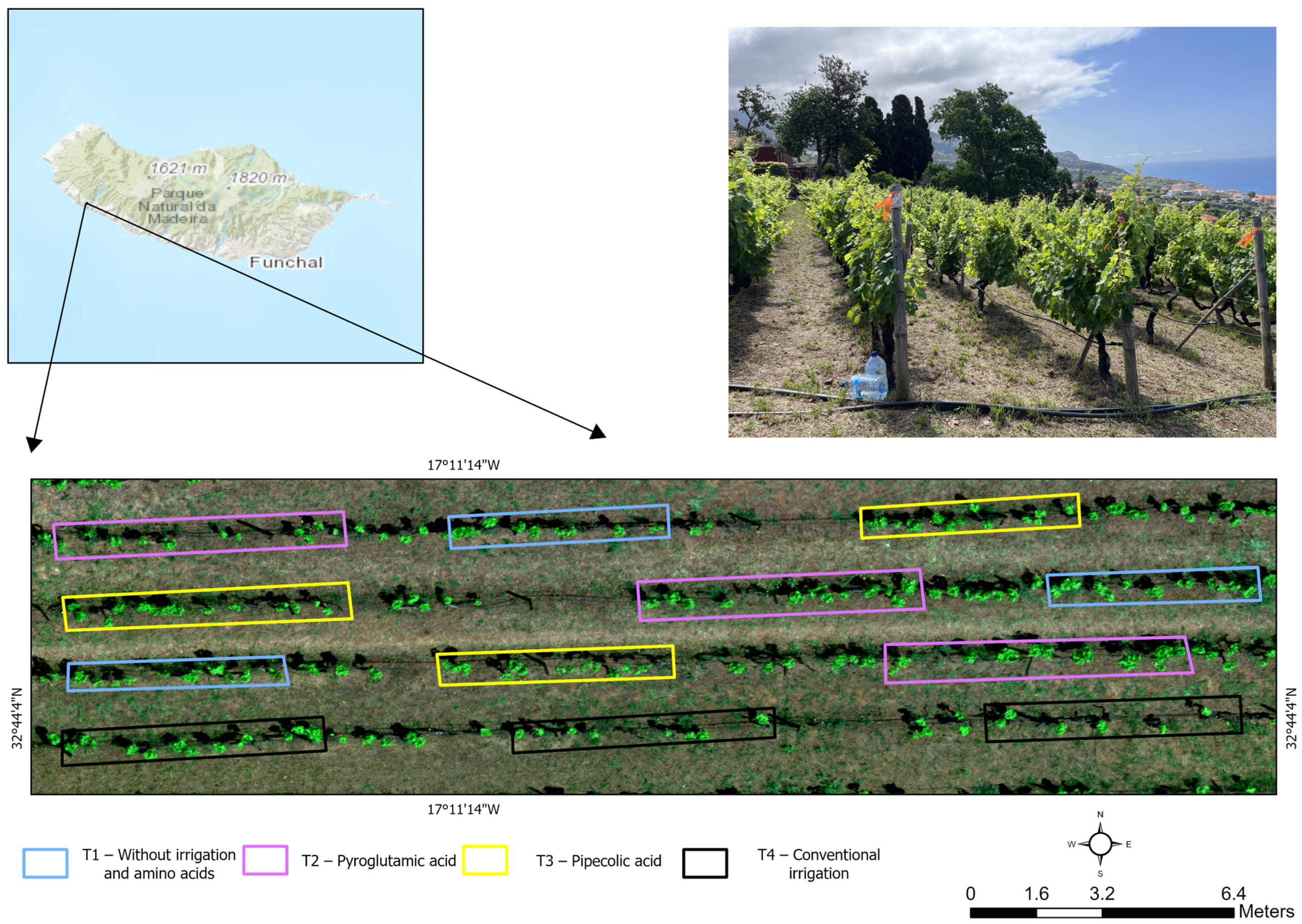
2.1. Study Area and Experimental Design
2.2. Preparation and Application of Amino Acids
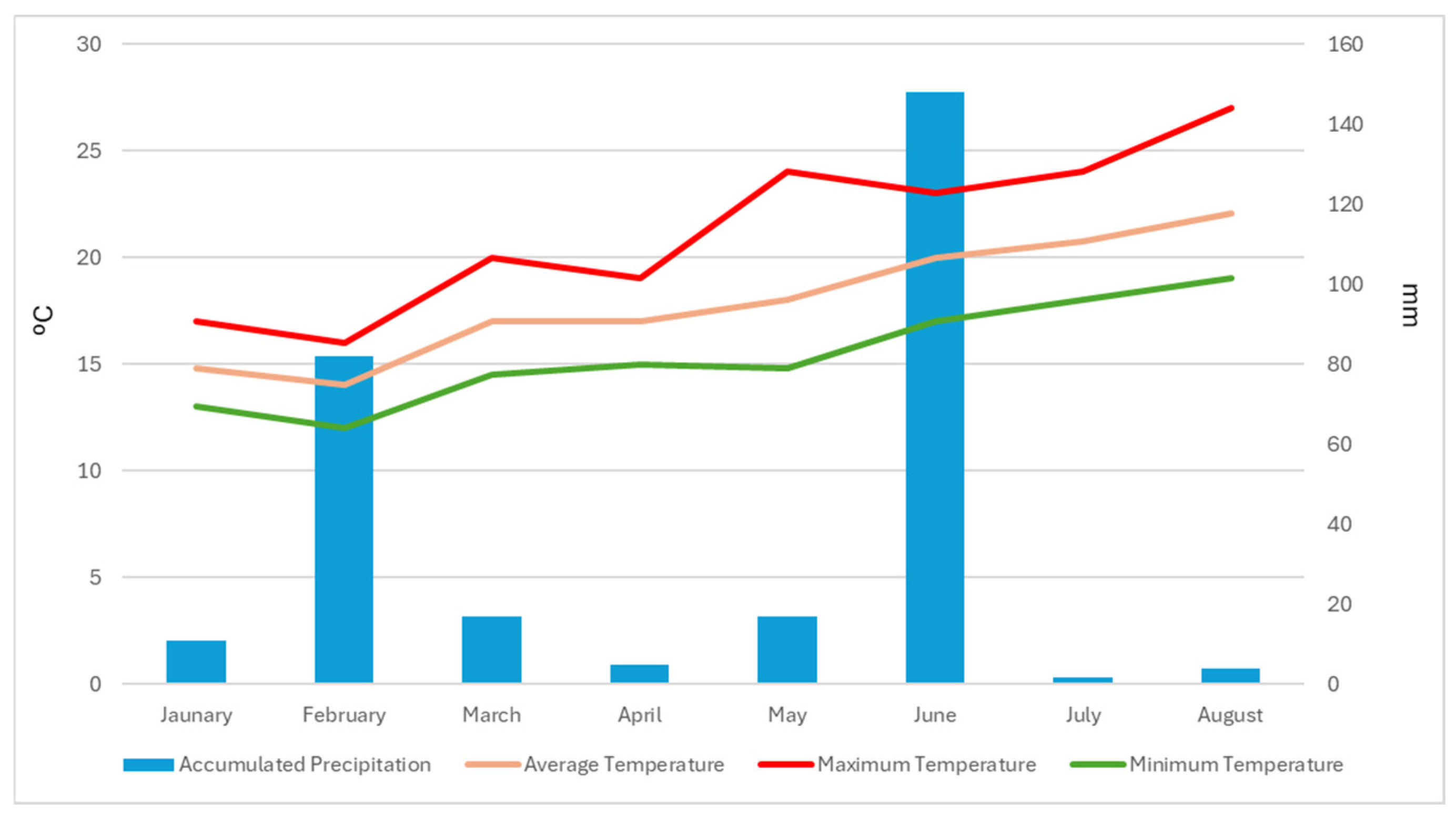
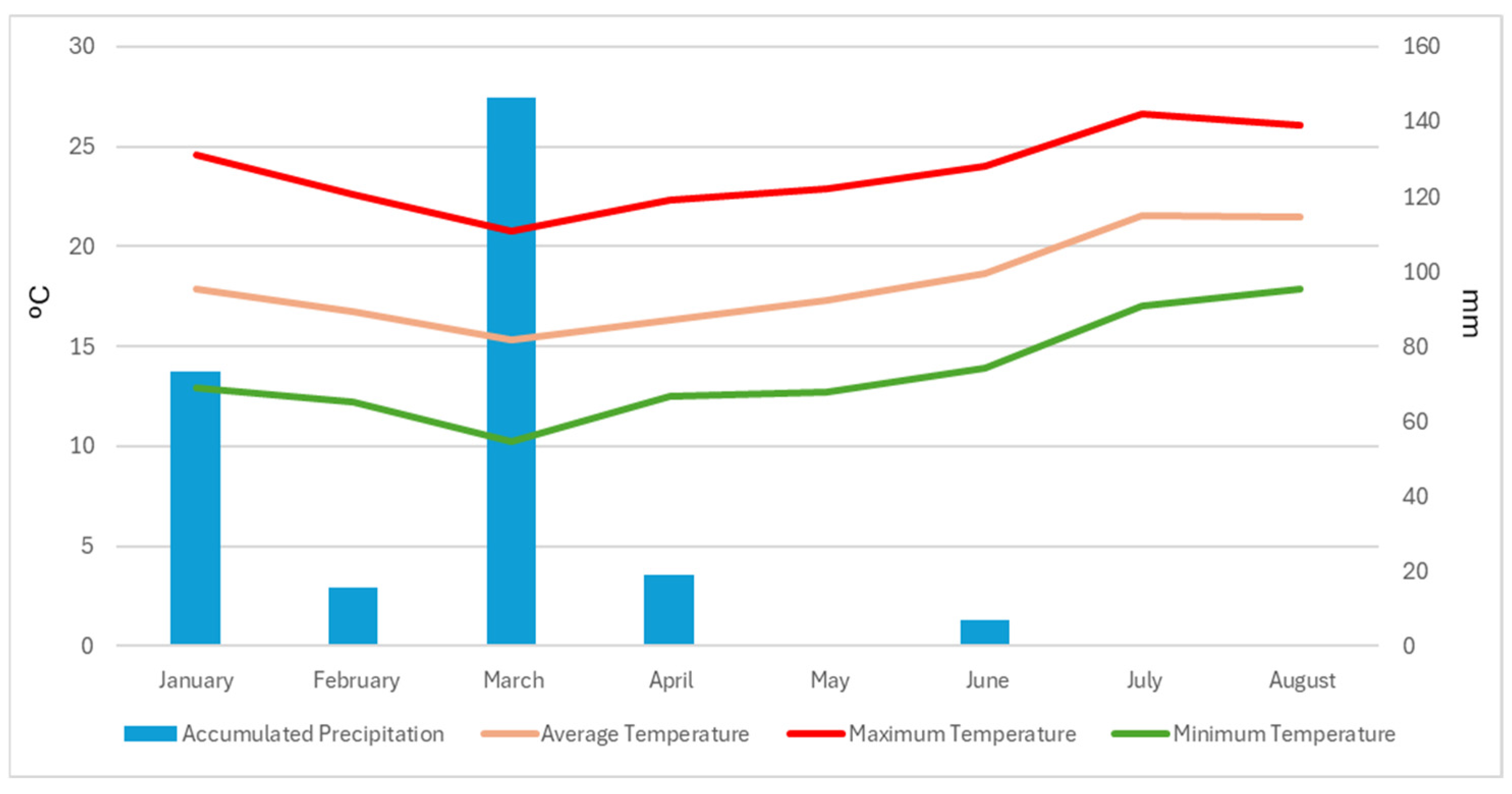
2.3. Climate Data
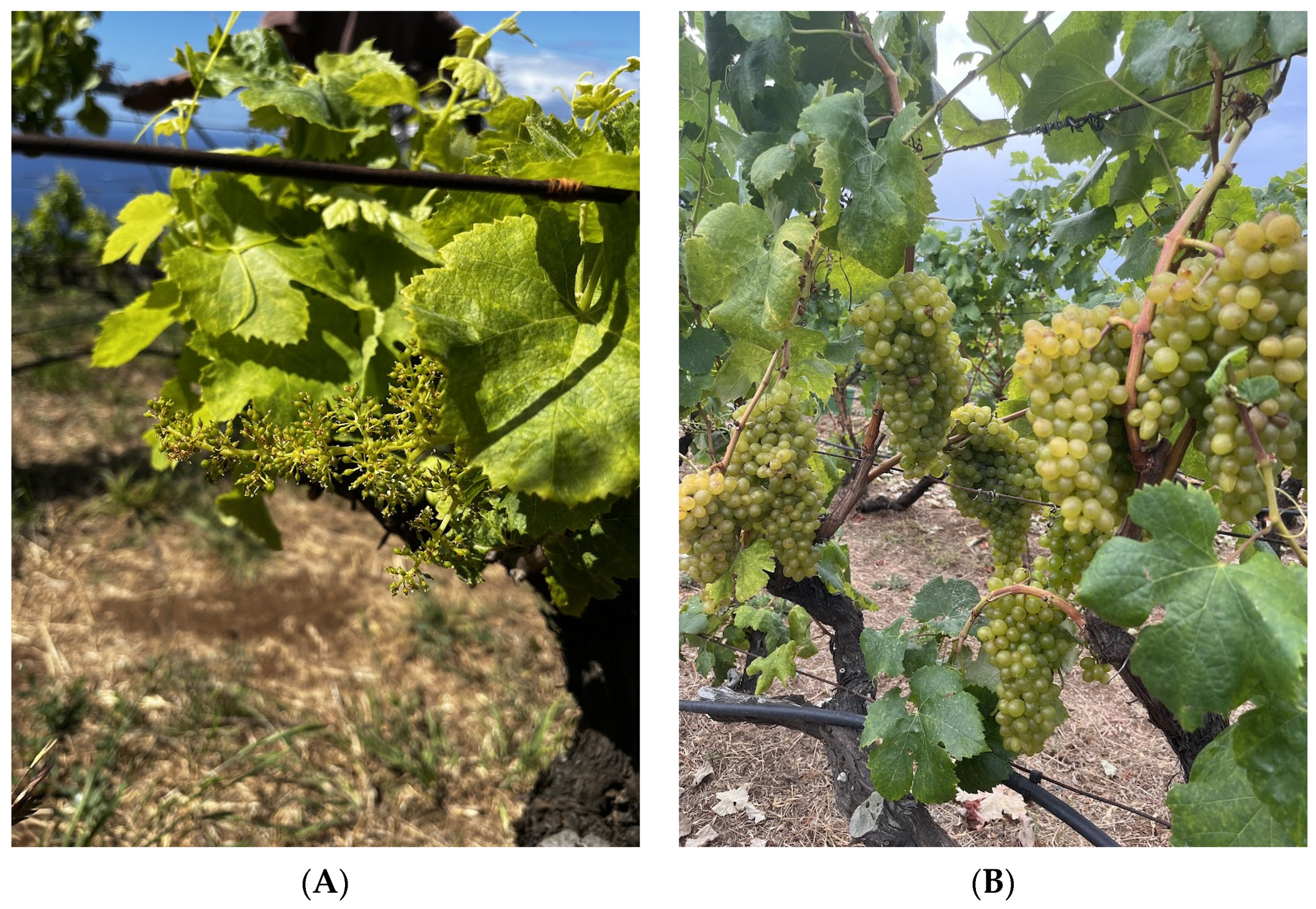
2.4. Yield and Yield Components
2.5. UAV Data Acquisition and Processing

| Index | Formula | Reference | Equation Number |
|---|---|---|---|
| Green Leaf Index | [36] | (1) | |
| Green Normalized Vegetation Index | [37] | (2) | |
| Normalized Difference Red Edge | [38] | (3) | |
| Normalized Difference Vegetation Index | [39] | (4) | |
| Normalized Green Red Difference Index | [40] | (5) | |
| Crop Water Stress Index Simplified | [33] | (6) |
2.6. Statistical Analysis
3. Results
3.1. Agronomic Performance Under Different Treatments (2023)
3.2. Agronomic Performance Under Different Treatments (2024)
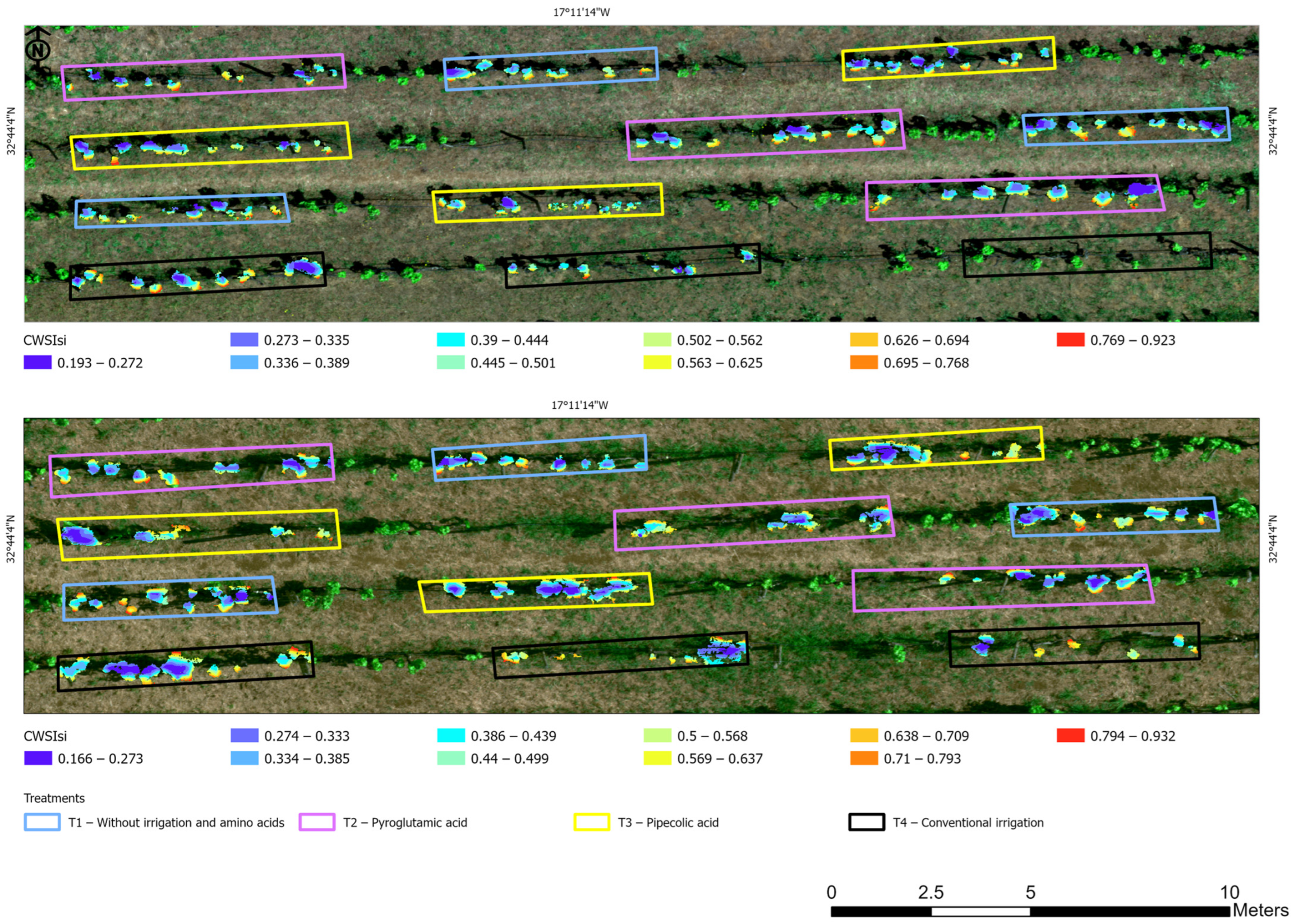
3.3. Interannual Comparison of Canopy Water Stress After Biostimulant Application (2023 vs. 2024)
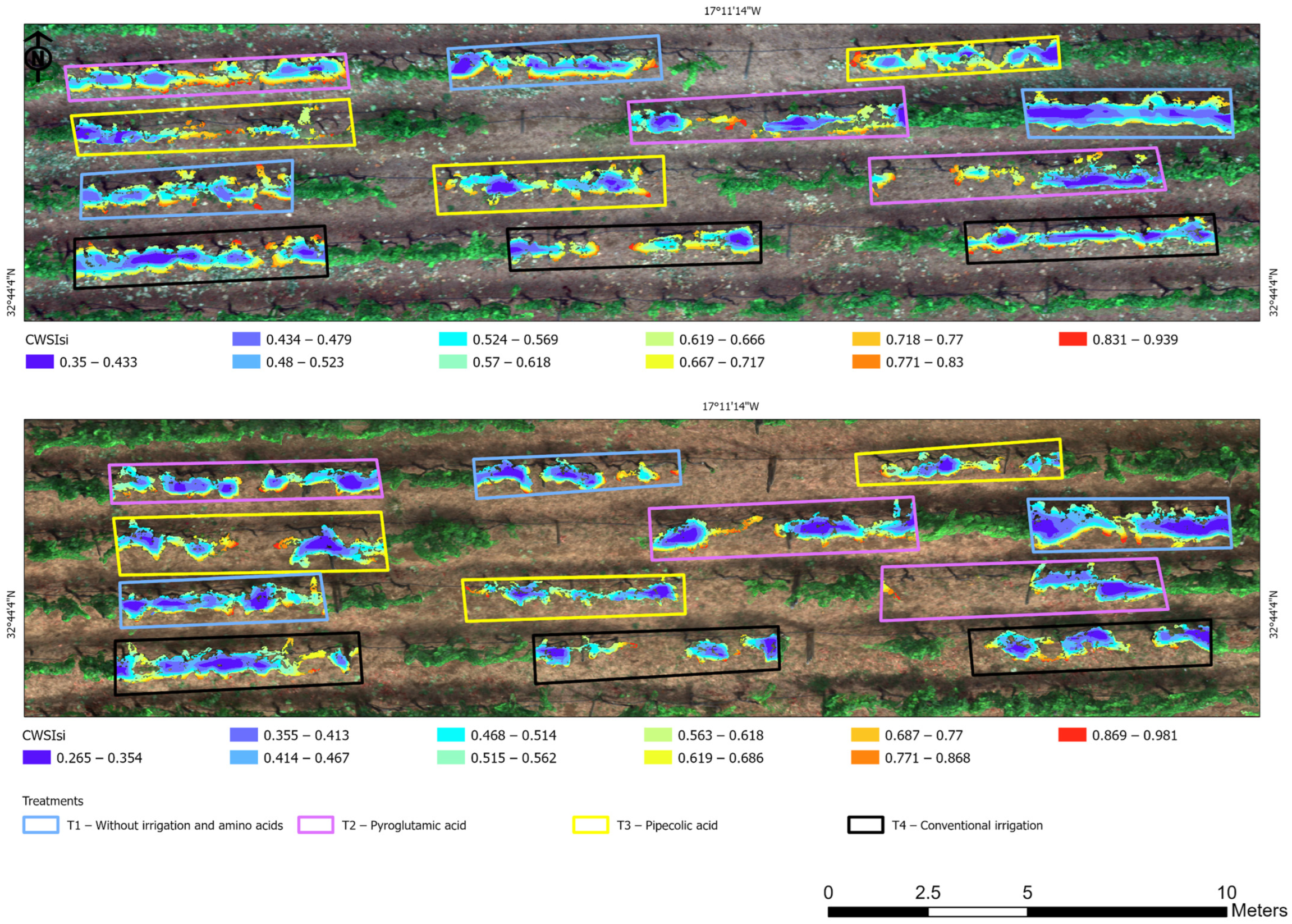
3.4. Interannual Comparison of Canopy Water Stress at Harvest in 2023 and 2024
3.5. Correlation Between Morphological Parameters and Vegetation Indices in 2023
3.6. Correlation Between Morphological Parameters and Vegetation Indices in 2024
4. Discussion
4.1. Agronomic Performance Under Contrasting Climatic Conditions
4.2. Integrated Discussion: Spectral–Morphological Relationships Across Two Drought-Affected Seasons
4.3. Interannual Comparison of Canopy Water Stress Following Biostimulant Application (2023 vs. 2024)
4.4. Consistency and Divergence in Spectral Index Performance
5. Conclusions
Author Contributions
Funding
Data Availability Statement
Acknowledgments
Conflicts of Interest
References
- Organisation Internationale de la Vigne et du Vin (OIV). 2023 Statistical Report on World Viticulture; Organisation Internationale de la Vigne et du Vin (OIV): Dijon, France, 2024. [Google Scholar]
- Fraga, H.; Atauri, I.G.d.C.; Santos, J.A. Viticultural Irrigation Demands under Climate Change Scenarios in Portugal. Agric. Water Manag. 2018, 196, 66–74. [Google Scholar] [CrossRef]
- Santos, J.A.; Fraga, H.; Malheiro, A.C.; Moutinho-Pereira, J.; Dinis, L.-T.; Correia, C.; Moriondo, M.; Leolini, L.; Dibari, C.; Costafreda-Aumedes, S.; et al. A Review of the Potential Climate Change Impacts and Adaptation Options for European Viticulture. Appl. Sci. 2020, 10, 3092. [Google Scholar] [CrossRef]
- Williams, L.E.; Ayars, J.E. Grapevine Water Use and the Crop Coefficient Are Linear Functions of the Shaded Area Measured beneath the Canopy. Agric. For. Meteorol. 2005, 132, 201–211. [Google Scholar] [CrossRef]
- Iglesias, A.; Garrote, L. Adaptation Strategies for Agricultural Water Management under Climate Change in Europe. Agric. Water Manag. 2015, 155, 113–124. [Google Scholar] [CrossRef]
- Kriedemann, P.E.; Goodwin, I. Regulated Deficit Irrigation and Partial Root-Zone Drying. In An Overview of Principles and Application; Land and Water Australia: Canberra, Australia, 2003. [Google Scholar]
- Zarrouk, O.; Costa, J.M.; Francisco, R.; Lopes, C.; Chaves, M.M. Drought and Water Management in Mediterranean Vineyards. In Grapevine in a Changing Environment; Wiley: Hoboken, NJ, USA, 2015; pp. 38–67. [Google Scholar]
- Pinheiro de Carvalho, M.Â.A.; Ragonezi, C.; Oliveira, M.C.O.; Reis, F.; Macedo, F.L.; de Freitas, J.G.R.; Nóbrega, H.; Ganança, J.F.T. Anticipating the Climate Change Impacts on Madeira’s Agriculture: The Characterization and Monitoring of a Vine Agrosystem. Agronomy 2022, 12, 2201. [Google Scholar] [CrossRef]
- Macedo, F.L.; Nóbrega, H.; de Freitas, J.G.R.; Pinheiro de Carvalho, M.A.A. Assessment of Vegetation Indices Derived from UAV Imagery for Weed Detection in Vineyards. Remote Sens. 2025, 17, 1899. [Google Scholar] [CrossRef]
- Ray, R.L.; Fares, A.; Risch, E. Effects of Drought on Crop Production and Cropping Areas in Texas. Agric. Environ. Lett. 2018, 3, 170037. [Google Scholar] [CrossRef]
- Irani, H.; ValizadehKaji, B.; Naeini, M.R. Biostimulant-Induced Drought Tolerance in Grapevine Is Associated with Physiological and Biochemical Changes. Chem. Biol. Technol. Agric. 2021, 8, 5. [Google Scholar] [CrossRef]
- AL-Quraan, N.A.; Al-Ajlouni, Z.I.; Qawasma, N.F. Physiological and Biochemical Characterization of the GABA Shunt Pathway in Pea (Pisum sativum L.) Seedlings under Drought Stress. Horticulturae 2021, 7, 125. [Google Scholar] [CrossRef]
- Strack, T.; Stoll, M. Soil Water Dynamics and Drought Stress Response of Vitis vinifera L. in Steep Slope Vineyard Systems. Agric. Water Manag. 2022, 274, 107967. [Google Scholar] [CrossRef]
- Ricci, M.; Tilbury, L.; Daridon, B.; Sukalac, K. General Principles to Justify Plant Biostimulant Claims. Front. Plant Sci. 2019, 10, 494. [Google Scholar] [CrossRef] [PubMed]
- Colla, G.; Rouphael, Y.; Canaguier, R.; Svecova, E.; Cardarelli, M. Biostimulant Action of a Plant-Derived Protein Hydrolysate Produced through Enzymatic Hydrolysis. Front. Plant Sci. 2014, 5, 448. [Google Scholar] [CrossRef] [PubMed]
- du Jardin, P. Plant Biostimulants: Definition, Concept, Main Categories and Regulation. Sci. Hortic. 2015, 196, 3–14. [Google Scholar] [CrossRef]
- Mire, G.L.; Nguyen, M.L.; Fassotte, B.; Jardin, P.D.; Verheggen, F.; Delaplace, P.; Jijakli, M.H. Review: Implementing Plant Biostimulants and Biocontrol Strategies in the Agroecological Management of Cultivated Ecosystems. BASE 2016, 20, 299–313. [Google Scholar] [CrossRef]
- Van Oosten, M.J.; Pepe, O.; De Pascale, S.; Silletti, S.; Maggio, A. The Role of Biostimulants and Bioeffectors as Alleviators of Abiotic Stress in Crop Plants. Chem. Biol. Technol. Agric. 2017, 4, 5. [Google Scholar] [CrossRef]
- Caradonia, F.; Battaglia, V.; Righi, L.; Pascali, G.; La Torre, A. Plant Biostimulant Regulatory Framework: Prospects in Europe and Current Situation at International Level. J. Plant Growth Regul. 2019, 38, 438–448. [Google Scholar] [CrossRef]
- Jiménez-Arias, D.; García-Machado, F.J.; Morales-Sierra, S.; Luis, J.C.; Suarez, E.; Hernández, M.; Valdés, F.; Borges, A.A. Lettuce Plants Treated with L-Pyroglutamic Acid Increase Yield under Water Deficit Stress. Environ. Exp. Bot. 2019, 158, 215–222. [Google Scholar] [CrossRef]
- Jiménez-Arias, D.; García-Machado, F.J.; Morales-Sierra, S.; García-García, A.L.; Herrera, A.J.; Valdés, F.; Luis, J.C.; Borges, A.A. A Beginner’s Guide to Osmoprotection by Biostimulants. Plants 2021, 10, 363. [Google Scholar] [CrossRef]
- Wang, P.; Luo, Q.; Yang, W.; Ahammed, G.J.; Ding, S.; Chen, X.; Wang, J.; Xia, X.; Shi, K. A Novel Role of Pipecolic Acid Biosynthetic Pathway in Drought Tolerance through the Antioxidant System in Tomato. Antioxidants 2021, 10, 1923. [Google Scholar] [CrossRef]
- Batista-Silva, W.; Heinemann, B.; Rugen, N.; Nunes-Nesi, A.; Araújo, W.L.; Braun, H.; Hildebrandt, T.M. The Role of Amino Acid Metabolism during Abiotic Stress Release. Plant Cell Environ. 2019, 42, 1630–1644. [Google Scholar] [CrossRef]
- Keller, M. The Science of Grapevines, 3rd ed.; Elsevier Academic Press: London, UK, 2020. [Google Scholar]
- Nur Koc, F.; Seckin Dinler, B. Pipecolic Acid in Plants: Biosynthesis, Signalling, and Role under Stress. Botanica 2022, 28, 4–14. [Google Scholar] [CrossRef]
- Gago, J.; Douthe, C.; Coopman, R.E.; Gallego, P.P.; Ribas-Carbo, M.; Flexas, J.; Escalona, J.; Medrano, H. UAVs Challenge to Assess Water Stress for Sustainable Agriculture. Agric. Water Manag. 2015, 153, 9–19. [Google Scholar] [CrossRef]
- Bellvert, J.; Zarco-Tejada, P.J.; Marsal, J.; Girona, J.; González-Dugo, V.; Fereres, E. Vineyard Irrigation Scheduling Based on Airborne Thermal Imagery and Water Potential Thresholds. Aust. J. Grape Wine Res. 2016, 22, 307–315. [Google Scholar] [CrossRef]
- Idso, S.B.; Jackson, R.D.; Pinter, P.J.; Reginato, R.J.; Hatfield, J.L. Normalizing the Stress-Degree-Day Parameter for Environmental Variability. Agric. Meteorol. 1981, 24, 45–55. [Google Scholar] [CrossRef]
- Jackson, R.D.; Idso, S.B.; Reginato, R.J.; Pinter, P.J. Canopy Temperature as a Crop Water Stress Indicator. Water Resour. Res. 1981, 17, 1133–1138. [Google Scholar] [CrossRef]
- Lorenz, D.; Eichhorn, K.; Bleiholder, H.; Klose, R.; Meier, U.; Weber, E. Growth Stages of the Grapevine: Phenological Growth Stages of the Grapevine (Vitis vinifera L. ssp. vinifera)—Codes and Descriptions According to the Extended BBCH Scale. Aust. J. Grape Wine Res. 1995, 1, 100–103. [Google Scholar] [CrossRef]
- Agisoft. Agisoft Metashape Professional, Version 2.1.1. Computer Software. Agisoft: St. Petersburg, Russia, 2024. Available online: https://www.agisoft.com/ (accessed on 20 June 2025).
- Macedo, F.L.; Nóbrega, H.; de Freitas, J.G.R.; Ragonezi, C.; Pinto, L.; Rosa, J.; Pinheiro de Carvalho, M.A.A. Estimation of Productivity and Above-Ground Biomass for Corn (Zea mays) via Vegetation Indices in Madeira Island. Agriculture 2023, 13, 1115. [Google Scholar] [CrossRef]
- Bian, J.; Zhang, Z.; Chen, J.; Chen, H.; Cui, C.; Li, X.; Chen, S.; Fu, Q. Simplified Evaluation of Cotton Water Stress Using High Resolution Unmanned Aerial Vehicle Thermal Imagery. Remote Sens. 2019, 11, 267. [Google Scholar] [CrossRef]
- DeJonge, K.C.; Taghvaeian, S.; Trout, T.J.; Comas, L.H. Comparison of Canopy Temperature-Based Water Stress Indices for Maize. Agric. Water Manag. 2015, 156, 51–62. [Google Scholar] [CrossRef]
- Esri. ArcGIS Pro, Version 3.3.2. Computer Software. Environmental Systems Research Institute: Redlands, CA, USA, 2024. Available online: https://www.esri.com/ (accessed on 25 June 2025).
- Louhaichi, M.; Borman, M.M.; Johnson, D.E. Spatially Located Platform and Aerial Photography for Documentation of Grazing Impacts on Wheat. Geocarto Int. 2001, 16, 65–70. [Google Scholar] [CrossRef]
- Gitelson, A.A.; Kaufman, Y.J.; Merzlyak, M.N. Use of a Green Channel in Remote Sensing of Global Vegetation from EOS-MODIS. Remote Sens. Environ. 1996, 58, 289–298. [Google Scholar] [CrossRef]
- Gitelson, A.; Merzlyak, M.N. Spectral Reflectance Changes Associated with Autumn Senescence of Aesculus hippocastanum L. and Acer platanoides L. Leaves. Spectral Features and Relation to Chlorophyll Estimation. J. Plant Physiol. 1994, 143, 286–292. [Google Scholar] [CrossRef]
- Rouse, J.W.; Haas, R.H.; Schell, J.A.; Deering, D.W. Monitoring Vegetation Systems in the Great Plains with ERTS. In Proceedings of the 3rd Earth Resources Technology Satellite Symposium, Washington, DC, USA, 10–14 December 1973; pp. 309–318. [Google Scholar]
- Tucker, C.J. Red and Photographic Infrared Linear Combinations for Monitoring Vegetation. Remote Sens. Environ. 1979, 8, 127–150. [Google Scholar] [CrossRef]
- The Jamovi Project; Jamovi (Version 2.6) [Computer Software]. 2024. Available online: https://www.jamovi.org (accessed on 27 May 2025).
- Schober, P.; Boer, C.; Schwarte, L.A. Correlation Coefficients: Appropriate Use and Interpretation. Anesth. Analg. 2018, 126, 1763–1768. [Google Scholar] [CrossRef]
- Intrigliolo, D.S.; Castel, J.R. Response of Grapevine Cv. ‘Tempranillo’ to Timing and Amount of Irrigation: Water Relations, Vine Growth, Yield and Berry and Wine Composition. Irrig. Sci. 2010, 28, 113–125. [Google Scholar] [CrossRef]
- Lopes, C.; Cadima, J. Grapevine Bunch Weight Estimation Using Image-Based Features: Comparing the Predictive Performance of Number of Visible Berries and Bunch Area. OENO One 2021, 55, 209–226. [Google Scholar] [CrossRef]
- Victorino, G.; Poblete-Echeverría, C.; Lopes, C.M. A Multicultivar Approach for Grape Bunch Weight Estimation Using Image Analysis. Horticulturae 2022, 8, 233. [Google Scholar] [CrossRef]
- Lanza, B.; Botturi, D.; Gnutti, A.; Lancini, M.; Nuzzi, C.; Pasinetti, S. A Stride Toward Wine Yield Estimation from Images: Metrological Validation of Grape Berry Number, Radius, and Volume Estimation. Sensors 2024, 24, 7305. [Google Scholar] [CrossRef]
- Palacios, F.; Diago, M.P.; Melo-Pinto, P.; Tardaguila, J. Early Yield Prediction in Different Grapevine Varieties Using Computer Vision and Machine Learning. Precis. Agric. 2023, 24, 407–435. [Google Scholar] [CrossRef]
- Atencia Payares, L.K.; Gomez-del-Campo, M.; Tarquis, A.M.; García, M. Thermal Imaging from UAS for Estimating Crop Water Status in a Merlot Vineyard in Semi-Arid Conditions. Irrig. Sci. 2025, 43, 87–103. [Google Scholar] [CrossRef]
- Araújo-Paredes, C.; Portela, F.; Mendes, S.; Valín, M.I. Using Aerial Thermal Imagery to Evaluate Water Status in Vitis vinifera Cv. Loureiro. Sens. 2022, 22, 8056. [Google Scholar] [CrossRef]
- Burchard-Levine, V.; Borra-Serrano, I.; Peña, J.M.; Kustas, W.P.; Guerra, J.G.; Dorado, J.; Mesías-Ruiz, G.; Herrezuelo, M.; Mary, B.; McKee, L.M.; et al. Evaluating the Precise Grapevine Water Stress Detection Using Unmanned Aerial Vehicles and Evapotranspiration-Based Metrics. Irrig. Sci. 2025, 43, 65–85. [Google Scholar] [CrossRef]
- Giovos, R.; Tassopoulos, D.; Kalivas, D.; Lougkos, N.; Priovolou, A. Remote Sensing Vegetation Indices in Viticulture: A Critical Review. Agriculture 2021, 11, 457. [Google Scholar] [CrossRef]
- Rehman, T.H.; Lundy, M.E.; Linquist, B.A. Comparative Sensitivity of Vegetation Indices Measured via Proximal and Aerial Sensors for Assessing N Status and Predicting Grain Yield in Rice Cropping Systems. Remote Sens 2022, 14, 2770. [Google Scholar] [CrossRef]
- Anzar, S.M.; Sherin, K.; Panthakkan, A.; Al Mansoori, S.; Al-Ahmad, H. Evaluation of UAV-Based RGB and Multispectral Vegetation Indices for Precision Agriculture in Palm Tree Cultivation. In Proceedings of the International Archives of the Photogrammetry, Remote Sensing and Spatial Information Sciences—ISPRS Archives; International Society for Photogrammetry and Remote Sensing: Hannover, Germany, 2025; Volume 48, pp. 163–170. [Google Scholar]
- Matyukira, C.; Mhangara, P. Utilising RGB Drone Imagery and Vegetation Indices for Accurate Above-Ground Biomass Estimation: A Case Study of the Cradle Nature Reserve, Gauteng Province, South Africa. Geocarto Int. 2024, 39, 2390512. [Google Scholar] [CrossRef]
- Jones, H.G.; Serraj, R.; Loveys, B.R.; Xiong, L.; Wheaton, A.; Price, A.H. Thermal Infrared Imaging of Crop Canopies for the Remote Diagnosis and Quantification of Plant Responses to Water Stress in the Field. Funct. Plant Biol. 2009, 36, 978–989. [Google Scholar] [CrossRef] [PubMed]
- Matese, A.; Di Gennaro, S.F. Technology in Precision Viticulture: A State of the Art Review. Int. J. Wine Res. 2015, 7, 69–81. [Google Scholar] [CrossRef]
- Berry, A.; Vivier, M.A.; Poblete-Echeverría, C. Evaluation of Canopy Fraction-Based Vegetation Indices, Derived from Multispectral UAV Imagery, to Map Water Status Variability in a Commercial Vineyard. Irrig. Sci. 2025, 43, 135–153. [Google Scholar] [CrossRef]


| Flights | Date | Images Collected | Point Density (pt/cm2) | GSD (cm.pix−1) | Flying Altitude (m) |
|---|---|---|---|---|---|
| 1 | 2 May 2023 | 1.074 | 0.23 | 1.04 | 23 |
| 2 | 25 August 2023 | 1.074 | 0.18 | 1.17 | 24 |
| 3 | 25 May 2024 | 1.032 | 0.18 | 1.15 | 24 |
| 4 | 27 August 2024 | 1.074 | 0.18 | 1.17 | 26 |
| Treatments | Number of Bunches | Total Bunch Weight (kg Plant−1) | Weight of 3 Bunches (g) | Length of Bunches (cm) | Diameter of Berries (mm) |
|---|---|---|---|---|---|
| T1 | 9.13 ± 4.34 b | 1888.54 ± 1318 b | 246.74 ± 60.82 a | 15.22 ± 1.72 a | 17.11 ± 1.28 a |
| T2 | 12.26 ± 8.24 b | 2714.71 ± 2040 b | 251.08 ± 124.89 a | 13.98 ± 4.33 a | 16.04 ± 4.47 a |
| T3 | 10.33 ± 7.69 b | 1976.93 ± 1794 b | 237.50 ± 104.97 a | 14.59 ± 4.33 a | 16.46 ± 1.53 a |
| T4 | 19.46 ± 10.04 a | 3867.96 ± 1736 a | 253.33 ± 54.85 a | 15.10 ± 1.15 a | 17.43 ± 1.41 a |
| Treatments | Number of Bunches | Total Bunch Weight (kg Plant−1) | Weight of 3 Bunches (g) | Length of Bunches (cm) | Diameter of Berries (mm) |
|---|---|---|---|---|---|
| T1 | 2.46 ± 1.49 a | 0.34 ± 0.31 a | 205.38 ± 104.41 a | 16.40 ± 3.62 a | 13.93 ± 1.19 a |
| T2 | 4.18 ± 2.55 a | 0.65 ± 0.44 a | 166.18 ± 73.10 a | 14.90 ± 3.65 a | 13.54 ± 1.31 a |
| T3 | 3.45 ± 2.90 a | 0.69 ± 0.92 a | 167.75 ± 93.65 a | 14.40 ± 4.05 a | 13.34 ± 1.00 a |
| T4 | 3.30 ± 3.00 a | 0.53 ± 0.76 a | 148.26 ± 60.32 a | 14.29 ± 2.93 a | 13.62 ± 1.24 a |
| 2 May 2023 | 25 May 2024 | |||||||
|---|---|---|---|---|---|---|---|---|
| r1 | r2 | r3 | Mean | r1 | r2 | r3 | Mean | |
| T1 | 0.38370 | 0.46600 | 0.47899 | 0.44290 | 0.43954 | 0.25195 | 0.33194 | 0.34114 |
| T2 | 0.47738 | 0.40341 | 0.42895 | 0.43658 | 0.36494 | 0.26999 | 0.43207 | 0.35567 |
| T3 | 0.41018 | 0.42136 | 0.49511 | 0.4422 | 0.29659 | 0.36278 | 0.24048 | 0.29995 |
| T4 | 0.39036 | 0.41937 | 0.48459 | 0.43144 | 0.35667 | 0.25091 | 0.48446 | 0.36401 |
| 25 August 2023 | 27 August 2024 | |||||||
|---|---|---|---|---|---|---|---|---|
| r1 | r2 | r3 | Mean | r1 | r2 | r3 | Mean | |
| T1 | 0.41255 | 0.33324 | 0.36559 | 0.37046 | 0.392105 | 0.176471 | 0.364664 | 0.31108 |
| T2 | 0.31953 | 0.36482 | 0.38205 | 0.35547 | 0.339801 | 0.327399 | 0.249414 | 0.30543 |
| T3 | 0.38542 | 0.34868 | 0.43926 | 0.39112 | 0.39200 | 0.37541 | 0.47167 | 0.41303 |
| T4 | 0.28785 | 0.31929 | 0.38155 | 0.32957 | 0.29585 | 0.46229 | 0.30937 | 0.35584 |
| Relationship | Global | T1 | T2 | T3 | T4 |
|---|---|---|---|---|---|
| Total weight of bunches × Number of bunches | 0.884 *** | 0.643 ** | 0.922 *** | 0.856 *** | 0.874 *** |
| Total weight of bunches × Weight of 3 bunches | 0.505 *** | – | 0.821 *** | 0.661 ** | – |
| Total weight of bunches × Length of bunches | 0.354 ** | – | – | 0.646 * | – |
| Total weight of bunches × Diameter of berries | 0.292 * | – | – | - | – |
| Length of bunches × Weight of 3 bunches | 0.640 *** | 0.630 * | 0.525 * | 0.825 *** | 0.698 ** |
| Diameter of berries × Weight of 3 bunches | 0.441 *** | 0.604 * | – | – | – |
| Diameter of berries × Length of bunches | 0.352 ** | – | 0.539 * | – | – |
| Number of bunches × Weight of 3 bunches | – | – | 0.606 * | – | −0.541 * |
| Length of bunches × Number of bunches | – | – | – | – | −0.521 * |
| Number of bunches × CWSIsi | – | – | 0.579 * | – | 0.632 * |
| Length of bunches × GLI | – | – | −0.550 * | – | – |
| CWSIsi × GLI | −0.820 *** | −0.771 ** | −0.682 ** | −0.811 *** | −0.904 *** |
| CWSIsi × GNDVI | −0.588 *** | −0.832 *** | −0.686 ** | −0.889 *** | −0.893 *** |
| CWSIsi × NDRE | −0.587 *** | −0.836 *** | −0.721 ** | −0.889 *** | −0.829 *** |
| CWSIsi × NDVI | −0.776 *** | −0.850 *** | −0.711 ** | −0.918 *** | −0.900 *** |
| CWSIsi × NGRDI | −0.823 *** | −0.821 *** | −0.639 * | −0.846 *** | −0.932 *** |
| Relationship | Global | T1 | T2 | T3 | T4 |
|---|---|---|---|---|---|
| Total weight of bunches × Number of bunches | 0.844 *** | 0.671 * | 0.919 *** | 0.901 *** | 0.778 ** |
| Total weight of bunches × Weight of 3 bunches | 0.709 *** | 0.819 ** | – | 0.618 * | 0.890 *** |
| Total weight of bunches × Length of bunches | 0.629 *** | 0.718 ** | – | – | 0.871 *** |
| Total weight of bunches × Diameter of berries | 0.500 *** | – | 0.682 * | 0.665 * | – |
| Number of bunches × Weight of 3 bunches | 0.462 *** | 0.614 * | – | – | – |
| Number of bunches × Length of bunches | 0.488 *** | 0.629 * | – | – | 0.599 * |
| Number of bunches × Diameter of berries | 0.460 ** | – | – | 0.749 ** | – |
| Weight of 3 bunches × Length of bunches | 0.850 *** | 0.883 *** | 0.756 ** | 0.645 * | 0.835 *** |
| Weight of 3 bunches × Diameter of berries | 0.543 *** | 0.747 ** | 0.627 * | – | – |
| Diameter of berries × Length of bunches | 0.370 ** | – | – | – | – |
| Total weight of bunches × CWSIsi | – | – | 0.709 * | – | −0.610 * |
| Number of bunches × CWSIsi | – | – | 0.711 * | – | – |
| Total weight of bunches × NGRDI | 0.456 ** | – | – | – | 0.665 * |
| Total weight of bunches × NDVI | 0.332 * | – | – | – | – |
| Total weight of bunches × GLI | 0.437 ** | – | – | – | – |
| Number of bunches × NGRDI | 0.293 * | – | – | – | – |
| Weight of 3 bunches × NGRDI | 0.293 * | – | – | – | – |
| Diameter of berries × NGRDI | 0.289 * | – | – | – | – |
| Diameter of berries × NDVI | 0.344 * | – | – | – | – |
| CWSIsi × GNDVI | −0.492 *** | – | – | – | −0.676 * |
| CWSIsi × NDRE | −0.618 *** | −0.610 * | – | – | −0.835 *** |
| CWSIsi × NDVI | −0.465 *** | −0.577 * | – | – | −0.857 *** |
| CWSIsi × GLI | – | – | – | – | −0.610 * |
Disclaimer/Publisher’s Note: The statements, opinions and data contained in all publications are solely those of the individual author(s) and contributor(s) and not of MDPI and/or the editor(s). MDPI and/or the editor(s) disclaim responsibility for any injury to people or property resulting from any ideas, methods, instructions or products referred to in the content. |
© 2026 by the authors. Licensee MDPI, Basel, Switzerland. This article is an open access article distributed under the terms and conditions of the Creative Commons Attribution (CC BY) license.
Share and Cite
Macedo, F.L.; Ragonezi, C.; Ganança, J.F.T.; Nóbrega, H.; de Freitas, J.G.R.; Borges, A.A.; Jiménez-Arias, D.; Pinheiro de Carvalho, M.A.A. The Application of Amino Acids as a Sustainable Strategy for Managing Water Stress in Vineyards. Remote Sens. 2026, 18, 641. https://doi.org/10.3390/rs18040641
Macedo FL, Ragonezi C, Ganança JFT, Nóbrega H, de Freitas JGR, Borges AA, Jiménez-Arias D, Pinheiro de Carvalho MAA. The Application of Amino Acids as a Sustainable Strategy for Managing Water Stress in Vineyards. Remote Sensing. 2026; 18(4):641. https://doi.org/10.3390/rs18040641
Chicago/Turabian StyleMacedo, Fabrício Lopes, Carla Ragonezi, José Filipe Teixeira Ganança, Humberto Nóbrega, José G. R. de Freitas, Andrés A. Borges, David Jiménez-Arias, and Miguel A. A. Pinheiro de Carvalho. 2026. "The Application of Amino Acids as a Sustainable Strategy for Managing Water Stress in Vineyards" Remote Sensing 18, no. 4: 641. https://doi.org/10.3390/rs18040641
APA StyleMacedo, F. L., Ragonezi, C., Ganança, J. F. T., Nóbrega, H., de Freitas, J. G. R., Borges, A. A., Jiménez-Arias, D., & Pinheiro de Carvalho, M. A. A. (2026). The Application of Amino Acids as a Sustainable Strategy for Managing Water Stress in Vineyards. Remote Sensing, 18(4), 641. https://doi.org/10.3390/rs18040641