Article

A Comparison of Non-Contact Methods for Measuring Turbidity in the Colorado River

1
U.S. Geological Survey, Colorado Water Science Center, Grand Junction, CO 81501, USA
2
U.S. Geological Survey, Water Resources Mission Area Observing Systems Division, Boise, ID 83702, USA
3
U.S. Geological Survey, Cascades Volcano Observatory, Vancouver, WA 98683, USA
*
Author to whom correspondence should be addressed.
Remote Sens. 2026, 18(4), 638; https://doi.org/10.3390/rs18040638
Submission received: 8 January 2026 / Revised: 8 February 2026 / Accepted: 13 February 2026 / Published: 18 February 2026
(This article belongs to the Special Issue Remote Sensing in Water Quality Monitoring)

Highlights

What are the main findings?
  • Bank-mounted cameras and satellite-based sensors were demonstrated to accurately monitor turbidity in the Colorado River, with models developed for one platform performing well on imagery from the other.
  • Linear regression models of turbidity were proportional to near-infrared light and inversely proportional to green light.
What is the implication of the main finding?
  • In places with strong sediment to turbidity relations, cameras and satellite imagery may be useful in expanding monitoring of sediment transport and could be achieved using low-cost, commercially available equipment.
  • Transferability of models across bank-mounted and satellite-based sensors could enable high-frequency monitoring and accelerated model development through paired sensor datasets.

Abstract

Monitoring suspended-sediment concentration (SSC) is essential to better understand how sediment transport could adversely affect water availability for human communities and ecosystems. Aquatic remote sensing methods are increasingly utilized to estimate SSC and turbidity in rivers; however, an evaluation of their quantitative performance is limited. This study evaluates the performance of three multispectral sensors, which vary in resolution and ease of deployment, to estimate turbidity in the Colorado River: the Multispectral Instrument (MSI) on board the European Space Agency’s Sentinel-2 satellite, an industrial-grade 10-band dual camera system mounted on a cable car, and a consumer-grade 6-band dual camera system positioned on the riverbank. We use multivariate linear regression to compare in situ turbidity measurements with concurrent spectral reflectance data from each sensor. Models for all three sensors selected similar spectral information and resulted in mean errors <35% in predicting turbidity. A cross-sensor comparison showed that little accuracy is lost when applying models developed for satellite-based systems to ground-based systems, and vice versa. Transferability of satellite-based models to ground-based systems could support continuous water-quality monitoring between satellite overpasses and avoid issues associated with cloud interference. Conversely, continuously operating ground-based systems could be used to rapidly establish datasets and models for application in satellite imagery, thus accelerating remote sensing applications. The encouraging performance of the consumer-grade system indicates that SSC could be monitored for low cost.

1. Introduction

Elevated suspended-sediment concentrations (SSC) can substantially degrade aquatic habitats and adversely affect water availability for human communities and ecosystems [1,2]. Anthropogenic activities, including dam operation and land use change, wildfires [3], and the hydrological and sedimentological effects of climate variability [4] can all contribute to increased SSC. The Colorado River, whose name translates to “colored reddish” in Spanish, is recognized for its large sediment load. Much of the Upper Colorado River Basin (UCRB) upstream from Lake Powell is underlain by highly erodible sedimentary formations that contribute to substantial increases in suspended-sediment [5] loads, particularly during spring snowmelt runoff. These seasonal events can lead to dramatic fluctuations in water quality as sediment is mobilized and transported downstream. Monitoring SSC supports increased understanding of how discrete events (e.g., wildfires or floods) and longer-term changes (e.g., shifts in land use/cover or climatic variability) can influence sediment transport.
Traditional SSC monitoring relies on sample-based methods [6,7]. These methods are often limited by cost and logistical challenges and can yield inaccurate estimates due to the episodic nature of SSC fluctuations [8,9]. Instream turbidity, a measure of water clarity, can be a useful surrogate for SSC monitoring efforts [10,11,12,13,14] and mitigates some of these issues by reducing the uncertainty of interpretation between sequential physical sample data [10]. Turbidity is typically measured with an in situ optical sensor [13] that collects 15 min, near-real-time data. Turbidity sensors offer advantages such as ease of use, lower costs, and increased safety compared to traditional SSC sampling methods. However, these instruments also have limitations, including being fixed to one location, susceptibility to biofouling and drift [14], potential damage during storm events, regular sensor calibration requirements, and hysteresis attributed to particle size distribution [15].
Non-contact methods have increasingly been used to complement SSC and turbidity monitoring as they can overcome many of the challenges associated with traditional monitoring. Aquatic remote sensing methods are based on the relation between the concentration of water-quality constituents and the spectral characteristics of the light reflected by the water column [16]. Optically significant constituents, including suspended sediment, plant pigments, and dissolved organic matter, cause scattering and attenuation of light that modifies the incident solar radiation. From a camera’s perspective above the water surface, water with high SSC reflects some incoming radiation more strongly than clear water [17,18]. Empirical relations can be developed between surface reflectance and SSC or turbidity by linking in situ turbidity measurements to concurrent spectral reflectance data. Empirical relations assume a constant correlation between variables, in this case, turbidity or SSC and reflectance data. These relations can be used to predict values beyond the temporal range of in situ samples and can be applied across large spatial scales.
Turbidity was one of the first water-quality constituents to be mapped with earth observing satellite data [19]. Satellite-based remote sensing is increasingly used in ocean applications; however, inland waters, especially rivers, pose a unique challenge because of their smaller spatial scale and optical complexity [20]. Atmospheric correction is a key processing step for satellite-based remote sensing, where the ratio of water-leaving radiance to downwelling irradiance at the water surface [21] is recovered from satellite measurements by correcting for surface effects and atmospheric influences. This process is one of the largest sources of error in remote sensing, particularly for inland waters [22], and can be exacerbated in mountainous environments [23]. The ground sampling distance of satellite-based sensors can also limit their use at scales relevant to inland waters [22]. Long return intervals (~4–5 days) can limit these sensors’ ability to capture turbidity on daily or sub-daily timescales, which can be critical for monitoring rapid fluctuations caused by events like wildfires, weather, or human activities. Despite these challenges, satellite-based remote sensing has successfully been used to estimate turbidity in river systems [20,24], even though standardized surface reflectance products are not yet available for inland water applications.
Uncrewed airborne system (UAS)- and ground-based remote sensing methods can provide greater temporal and spatial resolution than satellite-based sensors [25]. However, UAS operations can require substantial labor and equipment expenses and are more suitable for capturing images during specific events [26] or applied mapping [27], rather than continuous water-quality monitoring efforts. Though limited to one location, ground-based cameras can be automated for effective continuous data acquisition. Additionally, their proximity minimizes atmospheric interference and may allow for evaluation of the atmospheric correction of satellite sensors. Despite these advantages, there is currently no standardized or widely adopted protocol for ground-based multispectral cameras, which presents challenges for consistency and comparability across studies.
Recent advances in ground-based non-contact sensors, such as the SedCam [28,29] system developed at the U.S. Geological Survey (USGS) Cascades Volcano Observatory, have shown potential in monitoring SSC in small rivers. These studies used altered consumer-grade 6-band broadband sensors to estimate SSC through simple linear regression of the peak response of a single band. However, Mosbrucker and Wood [29] called for investigating the efficacy of narrower bandwidth near-infrared (NIR) spectra in combination with other bands and more sophisticated multivariate stepwise regression modeling techniques to refine this nascent technology.
The USGS maintains a network of SSC and turbidity monitoring sites as part of a national water-quality monitoring effort. These data are used for various applications, including estimating suspended-sediment loads and assessing the effects of wildfire [30] and land use change [31] on water quality. However, these monitoring networks are inherently location-based, capturing water-quality conditions at one location in the network through time. Aligned with the USGS Water Science Strategy [32], which emphasizes the development of remotely sensed water-quality products, this study evaluates multiple remote sensing approaches to advance the SSC and turbidity monitoring network by expanding the spatial and temporal scales of data collection. While numerous remote sensing approaches have been tested to estimate turbidity [20,24,33,34], an evaluation of the performance and uncertainty of each method remains limited.
To support and expand USGS SSC and turbidity monitoring efforts, this study has two objectives: (1) to assess the performance of one satellite-based and two ground-based multispectral sensors for estimating turbidity in the Colorado River, and (2) to evaluate how a ground-based camera can be used to verify the atmospheric correction of the satellite sensor. The systems include the Multispectral Instrument (MSI) on board the European Space Agency’s Sentinel-2 satellite fleet, a MicaSense RedEdge dual camera system mounted on a cable car over the river, and a SedCam dual camera system positioned on the riverbank. Each system was selected based on recent results showing promise in remote sensing of turbidity in other environments [20,28,29,34], and all were validated using in situ turbidity measurements. Specifically, MSI on the Sentinel-2 (herein referred to as the “satellite-based system”) was selected for the 20 m spatial resolution available for most bands making it suitable for imaging the study site, the MicaSense RedEdge system (herein referred to as the “10-band ground-based system”) was selected for its similarity to the sensors on the satellite-based system to allow for verification of the atmospheric correction, and the SedCam (herein referred to as the “6-band ground-based system”) was selected for its similarity to widely available sensors that could greatly expand the USGS sediment monitoring network. Additionally, the ground-based sensors were evaluated as they may represent an alternative to placing equipment and people in contact with flowing water, thus reducing risk to life and property. Satellite data were assessed because they have the potential of mapping river turbidity over large spatial scales, thus potentially expanding the coverage of the USGS water quality monitoring network.

2. Materials and Methods

2.1. Study Site

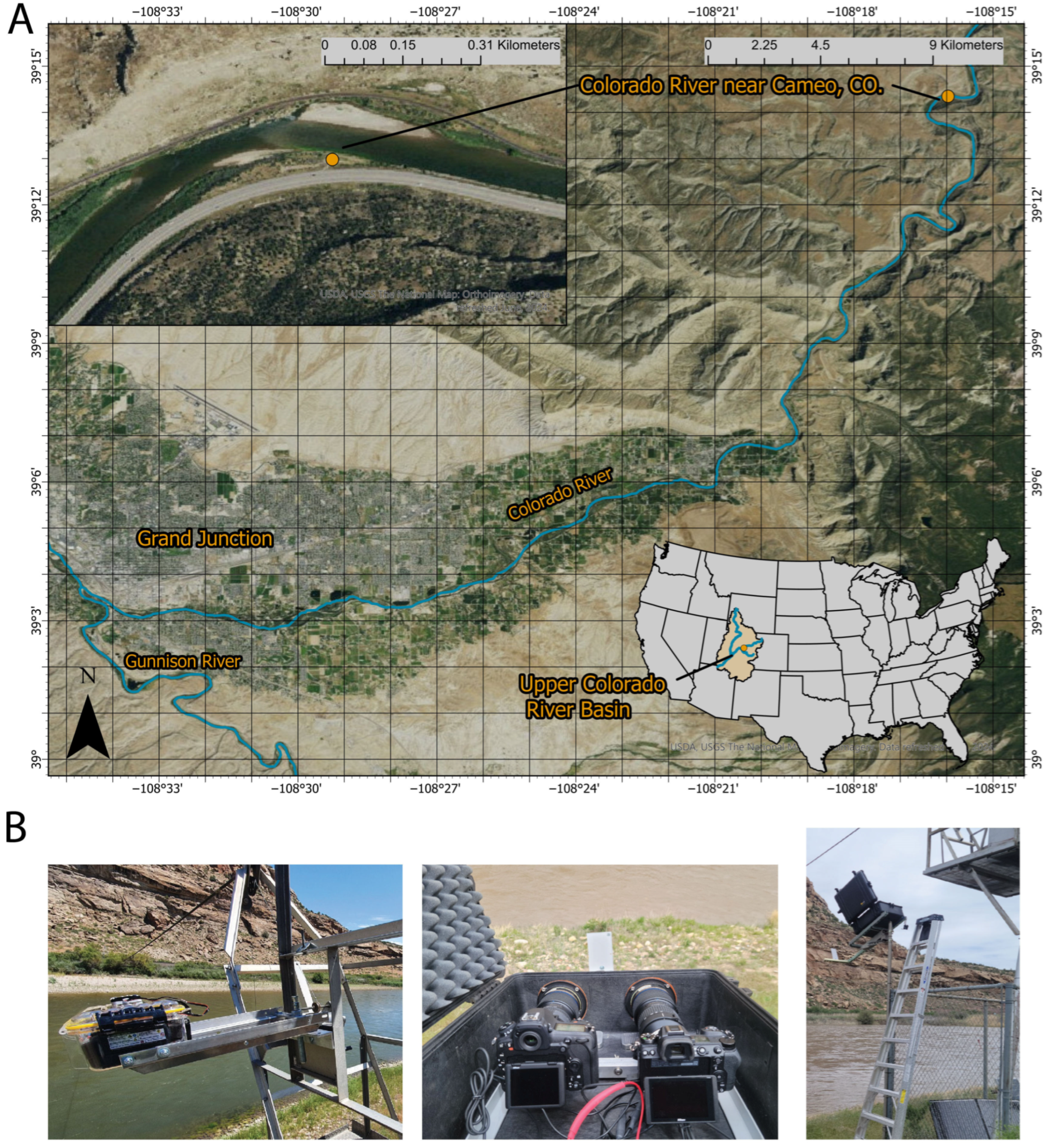
This work was conducted at a USGS gaging station (USGS-09095500 Colorado River near Cameo, CO, USA [35]), hereafter referred to as the study site (Figure 1A). The monitoring location is located ~40 km upstream from the city of Grand Junction, Colorado. Basin hydrology is dominated by snowmelt runoff, with peak discharge in the spring, followed by monsoonal rain-driven peaks in the summer, resulting in an annual average discharge of 104 m3s−1 during the period of record (1933–2024) [35]. Discharge typically recedes to base flow conditions in October and remains low through the winter months. This site was chosen because it is a heavily instrumented streamgage and water-quality sampling location with infrastructure on which to mount the ground-based cameras. The river in this location varies in width from approximately 60 to 100 m, the average cross-section depth is approximately 1 m, and it is relatively unobstructed by vegetation and canyon walls (Figure 1A), making it a good candidate for satellite-based remote sensing. Geology upstream from the site to the town of Glenwood Springs (~96 km upstream) is composed predominantly of sedimentary shales and sandstones of marine origin, with lesser amounts of Tertiary volcanic deposits [36]. Location information and annual streamflow statistics can be accessed from the USGS National Water Information System database [35].

2.2. Turbidity and Suspended Sediment

The remote sensing approaches were calibrated using observed turbidity data. Turbidity was used as a surrogate for SSC because (1) it is well established in hydrologic monitoring (e.g., Rasmussen et al. [14]) and (2) a more robust matched dataset can be produced between non-contact data and continuous in situ sensor data than is feasible with physical samples. Turbidity data were measured at 15 min intervals with a Yellow Spring Instruments EXO generation multiparameter sonde with a smart turbidity sensor mounted near the downstream left bank (when looking downstream). This sensor measured near-infrared light emitted at approximately 860 nm that was reflected at 90 degrees. As part of the official water-quality record at the USGS streamgage, the sensor underwent regular calibration, and published data records were subject to USGS quality assurance and control standards [37].
For the purposes of this study, we acquired physical samples to evaluate the veracity of using turbidity as an SSC surrogate via correlation analysis. Depth-integrating samplers [38] (D-95 or DH95) deployed from a cable car [39] were used to collect single vertical and surface grab samples (top 1 m of the water column). Samples were collected from the middle of the channel and ~10 m from the left bank. All samples were collected following approved USGS methods [6]. Samples were analyzed for SSC and particle size at the USGS New Mexico Water Science Center Sediment Laboratory using an evaporation method following USGS protocols [40]. Briefly, samples are dried at 85–95 °C until all visible water has evaporated. Samples are then dried for an additional 3 h or overnight at 103 °C ± 2 °C. Samples are cooled completely before obtaining gross weights and calculation of dissolved solids. Details on size analysis and quality control are found in Stiles [40]. During 6-month study periods (May–October 2022; May–October 2023), a total of 94 samples were collected on 24 different days [35]. Sample laboratory results showed a wide variation in sediment conditions (15–7130 mg/L; 35–100% of material finer than sand (63 µm)). Concentration and particle size of mid-channel and left-bank sample pairs differed by <10% on average, and the ratios between surface grab and single vertical samples averaged 1.0 ± 0.29 (95% confidence interval), with a range of 0.56 to 1.34, indicating reasonable mixing in both the cross section and vertical water column. All discrete suspended sediment and instantaneous turbidity data can be accessed from the USGS National Water Information System database [35].

2.3. Image Acquisition and Processing

2.3.1. 6-Band Ground-Based System Image Acquisition and Processing

The 6-band “SedCam 2.1” ground-based system developed at the USGS Cascades Volcano Observatory expands upon earlier designs, described by Mosbrucker et al. [28] and Mosbrucker and Wood [29]. Two consumer-grade cameras are housed within one waterproof housing (Figure 1B). The first, referred to here as Camera A, measures light in the visible spectrum (380–680 nm), whereas the second (Camera B) measures NIR wavelengths (720–1100 nm) (Table 1, Figure 2). Camera A is a Nikon D850 (model 1585, Nikon, Tokyo, Japan) digital single-lens reflex body housing with an 858-mm2 Sony sensor (model IMX309AQJ, Sony, Tokyo, Japan) with 45.75 million pixels, 14.8 exposure values (EV) of dynamic range, 26.4 bits of color depth, and a very high signal-to-noise ratio (47.1 dB) [41]. Camera B is a Nikon Z7II mirrorless digital camera (Nikon, Tokyo, Japan) with an identical sensor as Camera A, except its ultraviolet-NIR interference filter was modified to only allow NIR to reach the sensor. Both cameras use Tamron SP 70–200 mm f/2.8 Di LD (model A001N, Tamron, Saitama, Japan) lenses, which are not subject to NIR light leaks [29]. Programmable external intervalometers and redundant power supplies are used for each camera.
Cameras were configured to acquire images every 15 min, using aperture-priority mode with a fixed f/5.6 lens aperture at base ISO 64, relying on the camera to adjust shutter speed for optimal exposure during changing lighting conditions. RAW image files (i.e., unprocessed and uncompressed 32-bit data) permitted color balance calibration during post-processing, rather than automatically by the camera’s processor. The SedCam system was configured to minimize specular reflectance and shadows. The sensor housing was mounted on a cableway anchor point on the left river bank ~3 m above ground level at a 45-degree angle from nadir (down-looking) to maximize water-surface penetration (i.e., minimize reflection) at mid-latitudes (Figure 1B). A 70 mm lens focal length (28.8° horizontal field of view) measured an area of approximately 80 m2, depending on river stage, representing a nominal water-surface-sampling distance of 1.3 mm per pixel at the center of the frame and typical stage. An 18% gray calibration reference panel, mounted outside the 6-band ground-based system housing and visible in each frame, was used in post processing to normalize measured radiance to remove color cast caused by varying incident lighting conditions. Reflectance data from the 6-band ground-based system were computed as:
R 6 B , i = C D N c a l i b r a t i o n , i
where R6B,i is unitless color-balanced reflectance for band “i”, C is a scalar defined by calibration reference panel reflectance in a given color space and bit depth, and DNcalibration,i is the digital number in band i for pixels that represent the calibration reference panel prior to transformation [28,29].
Image processing methodology for the 6-band ground-based sensors includes spectral normalization, file conversion, and statistical calculations on the resulting 3-band raster files. Spectral normalization is performed on the RAW files by manually setting color balance to the calibration reference panel in the same incident light as the water surface (Figure 1B) using a RAW file converter. Non-representative portions of the frame (~40%) are then removed, such as debris in the water, surface reflection, or heterogeneous shadows, before exporting TIF files (uncompressed 32-bit in AdobeRGB color space). Lastly, maximum reflectance within the image was calculated for each band for use in the turbidity model [28,29].

2.3.2. 10-Band Ground-Based System Image Acquisition and Processing

Imagery was collected with the MicaSense RedEdge dual camera system (MicaSense, Seattle, WA, USA) on days with cloud-free skies that coincided with satellite-based sensor imagery acquisition. The camera system has 10 spectral bands (Table 1, Figure 2) and a nominal water-surface-sampling distance of 1 cm per pixel at 15 m above the river surface. The 10-band ground-based system was designed for use on a UAS platform; however, in this study, the system was mounted on a cable car (Figure 1B). We recorded 1 Hz images while transporting the cable car across the river. A white balance calibration reference panel made of SpectralonTM (Labsphere, North Sutton, NH, USA) was photographed before and after each cross-section to correct for changes in ambient illumination conditions. Reflectance data from the 10-band ground-based system were computed as:
R 10 B , i = D N w a t e r , i ( D N w h i t e   b a l a n c e , i ) / D N c a l i b r a t i o n , i
where R10B,i is unitless reflectance for band i, DNwater,i and DNwhite balance,i are the mean digital numbers in band i for pixels that represent water and the white balance pixels, respectively, and DNcalibration,i is the reflectance value for band i provided by the manufacturer [44].
Images were selected to best represent the conditions of the middle of the cross-section based on the manual identification of the image’s location along the cableway and a clear view of the water. Image metadata, such as location, time in universal coordinated time (UTC), and the image identifier, were accessed via ExifTool (https://exiftool.org/, accessed 5 June 2024) in Python (v. 3.7.12) [45]. Each image, or “band”, was processed individually, as a lack of tie points in the imagery of the water surface precluded aligning the bands. We expected the bands to have almost complete overlap and assumed that any variation in area sampled between bands had a negligible effect on the measured spectra, given the visually uniform target. We also noted that the water surface completely filled the field of view for each image, limiting the effect of slight variations in sampled areas. Irradiance was converted to reflectance for each band of the selected image using Spectralon calibration reference panels. Reflectance values greater than 0.2 (20%) were masked out to remove specular reflection, given the nadir orientation of the instrument. Median reflectance values were calculated by band for the remaining pixels.

2.3.3. Satellite-Based System Image Acquisition and Processing

We used satellite imagery collected with the European Space Agency’s multispectral instrument (MSI) on the Sentinel-2A and 2B satellites in relative orbit 041 for tile T12SYJ. A version that was atmospherically corrected with the Dark Spectrum Fitting (DSF) approach implemented in ACOLITE version 20221114.0 [46] was used; a key benefit of DSF is that the approach largely avoids amplifying glint and adjacency effects [46]. Data and full details are available in King et al. [47] and in the ACOLITE user manual [48]. Atmospheric correction was applied to MSI bands 1, 2, 3, 4, 5, 6, 7, 8, 8a, 11, and 12, which range from blue to short-wave infrared with central wavelengths of approximately 443, 490, 560, 665, 705, 740, 783, 842, 865, 1610, and 2190 nm, respectively; though only bands 1–8a were considered in this study (Table 1, Figure 2). Atmospheric correction was evaluated through comparison with corresponding data from the 10-band ground-based system that was collected close enough to the water to avoid atmospheric interference. In the atmospheric correction process, bands 2, 3, 4, and 8 were downsampled to 20 m, and band 1 was upsampled to 20 m pixels, aligned with the 20 m pixels of bands 5, 6, 7, and 8a. Aquatic reflectance, noted as Rhow in ACOLITE documentation, is defined here as unitless water-leaving radiance reflectance and represents the ratio of water-leaving radiance (units of watts per square meter per steradian per nanometer) to downwelling radiance (units of watts per square meter per steradian per nanometer). Assuming a Lambertian surface with a uniform bidirectional reflectance distribution, aquatic reflectance (Rhow) is equivalent to remote sensing reflectance (often denoted Rrs) multiplied by π [47].
Aquatic reflectance products were masked to only include pixels completely within the National Hydrography Plus High-Resolution area representing the Colorado River [49]. These data were further masked using band 11 to identify water within a given image. A threshold of 0.05 was manually selected and visually inspected to ensure that land and cloud pixels were removed while water pixels were retained. Mean aquatic reflectance values were then extracted from the remaining pixels that were within 500 m of the center of the river at the study site. Extracted data were used in training a turbidity model and in evaluating the atmospheric correction routine.

2.4. Analyses

2.4.1. Assessing Turbidity as a Surrogate for Suspended Sediment Concentration

Physically sampled SSC values were paired with instantaneous in-stream measurements of turbidity and compared using linear regression [14]. Paired turbidity and SSC data used in this analysis were limited to samples collected for this project and represent conditions during May to October 2022 and May to October 2023 (Table A1). We measured the strength of association between these two variables with Pearson’s correlation coefficient (PCC) [50].

2.4.2. Atmospheric Correction Evaluation

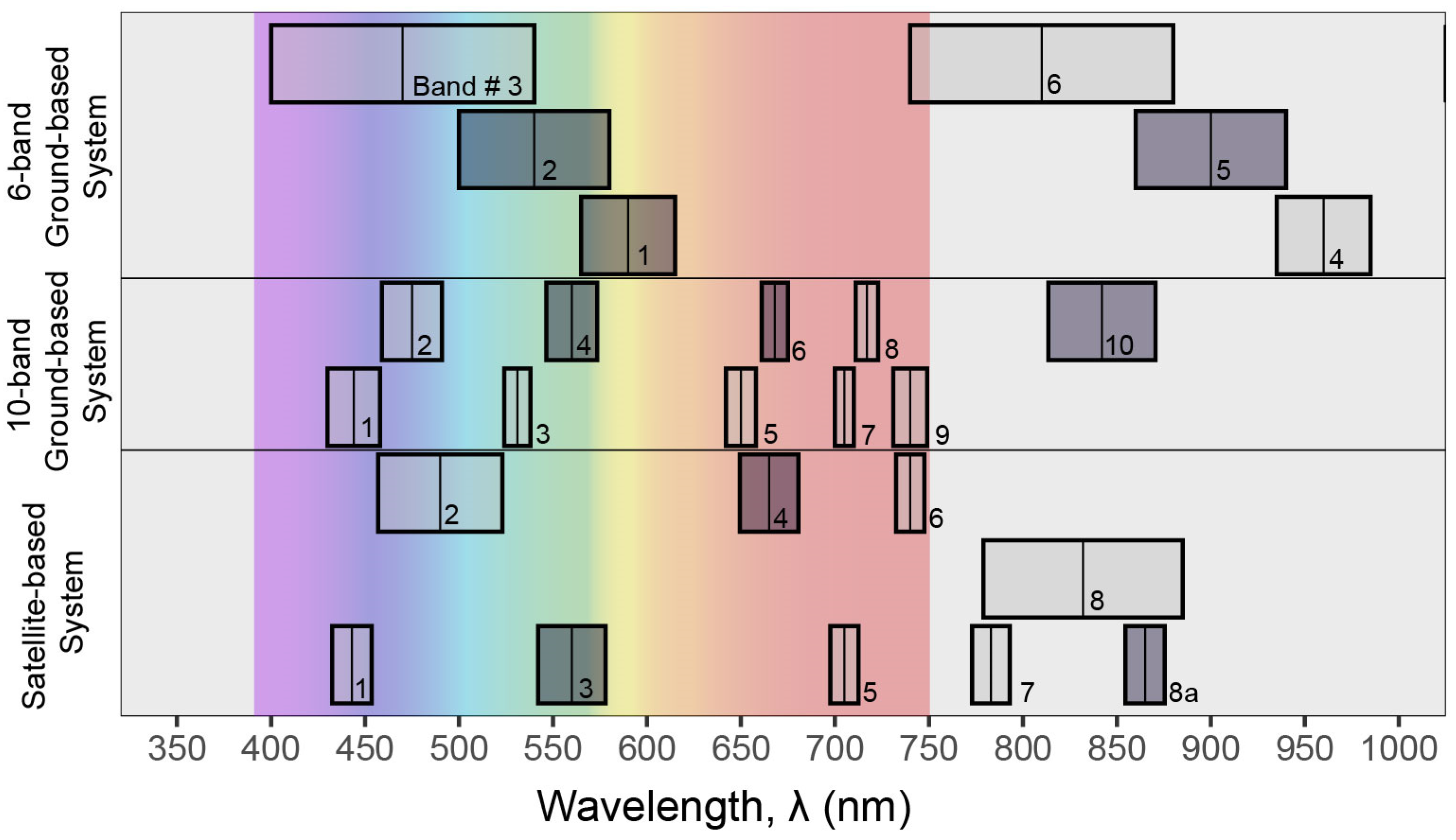
To evaluate the satellite-based system’s atmospheric correction routine, aquatic reflectance values were compared against those collected with the 10-band ground-based system. The 10-band ground-based system was used for this evaluation, given the alignment in bands between the 10-band ground-based system and satellite-based system (Figure 2, Table 2). The reported central wavelengths and full-width half-maximum values for both sensors [42,43] were used to identify seven overlapping bands (Table 2; Figure 2). Overlap is defined as the range of wavelengths that are shared between comparable bands. The percent of each band that falls within the overlap region is reported in Table 2. The seven comparable bands had overlapping ranges of 45 to 100%.
Reflectance values were compared for dates with stable turbidity values, defined as a change of <100 formazin nephelometric units (FNU) between the time the 10-band ground-based and satellite-based imagery were collected. We also restricted the analysis to matchups when the 10-band ground-based and satellite-based images were collected within 1.5 h of each other to ensure relatively stable incident lighting conditions for direct comparison. The PCC, mean absolute percent error (MAPE, Equation (3)), and bias (Equation (4)) were computed for each band for the seven pairs of 10-band ground-based and satellite-based system reflectance values that met these screening criteria. MAPE for band i was computed as:
M A P E i = R S a t , i R 10 B , i R 10 B , i 100
where RSat,i and R10B,i represent unitless reflectance for band i from satellite-based and 10-band ground-based imagery, respectively. Bias for band i was computed as:
B i a s i = m e a n R S a t , i R 10 B , i

2.4.3. Turbidity Modeling

Turbidity models were developed for the ground-based and satellite-based sensors’ imagery collected between 14 May 2022 and 6 October 2023 (Table A2). A turbidity model was developed for all 10 dates with usable imagery from the 10-band ground-based system. Turbidity models for the 6-band ground-based system and satellite-based system were trained on 24 concurrent dates when both systems had usable imagery. On those 24 dates, imagery from both systems was collected within ~3 h of each other, and the instantaneous turbidity values associated with each camera’s imagery were used in the regression. Log-transformed turbidity values closest in time to each camera’s imagery were used in the regression models [51]. Regression models considered all single bands and the normalized difference turbidity index (NDTI) [52]. The NDTI utilizes two spectral bands: red and green. In pure (sediment-free) water, reflectance is higher in the green band compared to the red band. As described by Garg et al. [24], an increase in turbidity due to suspended particles in the water causes the reflectance of the red band to become more than that of the green. This reversal of the relation between red and green can be used to detect turbidity in water. The formula for NDTI [52] is:
NDTI = (red bandgreen band)/(red band + green band)
where red band and green band represent band reflectance in satellite-based and 10-band ground-based systems (Table 2). NDTI was not calculated for the 6-band ground-based system, as there is no red band similar to the other sensors (Figure 2).
The optimal turbidity model for each camera was determined by forward stepwise regression with the Akaike Information Criterion using the stepAIC function in the R statistical software [53] (v.4.4.0) and the “MASS” package (https://www.stats.ox.ac.uk/pub/MASS4/, accessed 4 June 2024). Generalized linear models were used with the log link transformation using the glm function of the R package “stats” (https://rdrr.io/r/stats/stats-package.html, accessed 4 June 2024), and turbidity predictions were made using the predictions function of the R package “marginal effects” (https://marginaleffects.com/, accessed 17 February 2025). A Durbin–Watson (DW) statistic was calculated for each regression model to test for temporal autocorrelation and independence of variables within the model using the dwtest function of the R package “lmtest” (https://cran-e.com/package/lmtest, accessed 17 February 2025). Model performance was evaluated using deviance explained, root mean square error (RMSE), relative root mean square error (RRMSE), PCC, and MAPE. Model performance was evaluated using leave-one-out cross-validation (LOOCV). In this method, each observation is excluded once, the model is trained on the remaining data points, and then tested on the excluded observation. This process is repeated for all observations. The mean squared error (MSE) is reported, and the predicted values are visually presented. All reflectance and observed turbidity data used in turbidity models are found in a USGS data release [51]. Observed and predicted turbidity data are also located in Table A2.

2.4.4. Cross-Sensor Comparison

The turbidity models developed in Section 2.4.3 were also evaluated across different sensors to assess their transferability. This assessment was conducted using the models from the satellite-based sensor and the 10-band ground-based sensor due to the alignment in bands (Figure 2, Table 2). Model comparison was evaluated using RMSE, RRMSE, PCC, and MAPE.

3. Results

3.1. Turbidity and Sediment

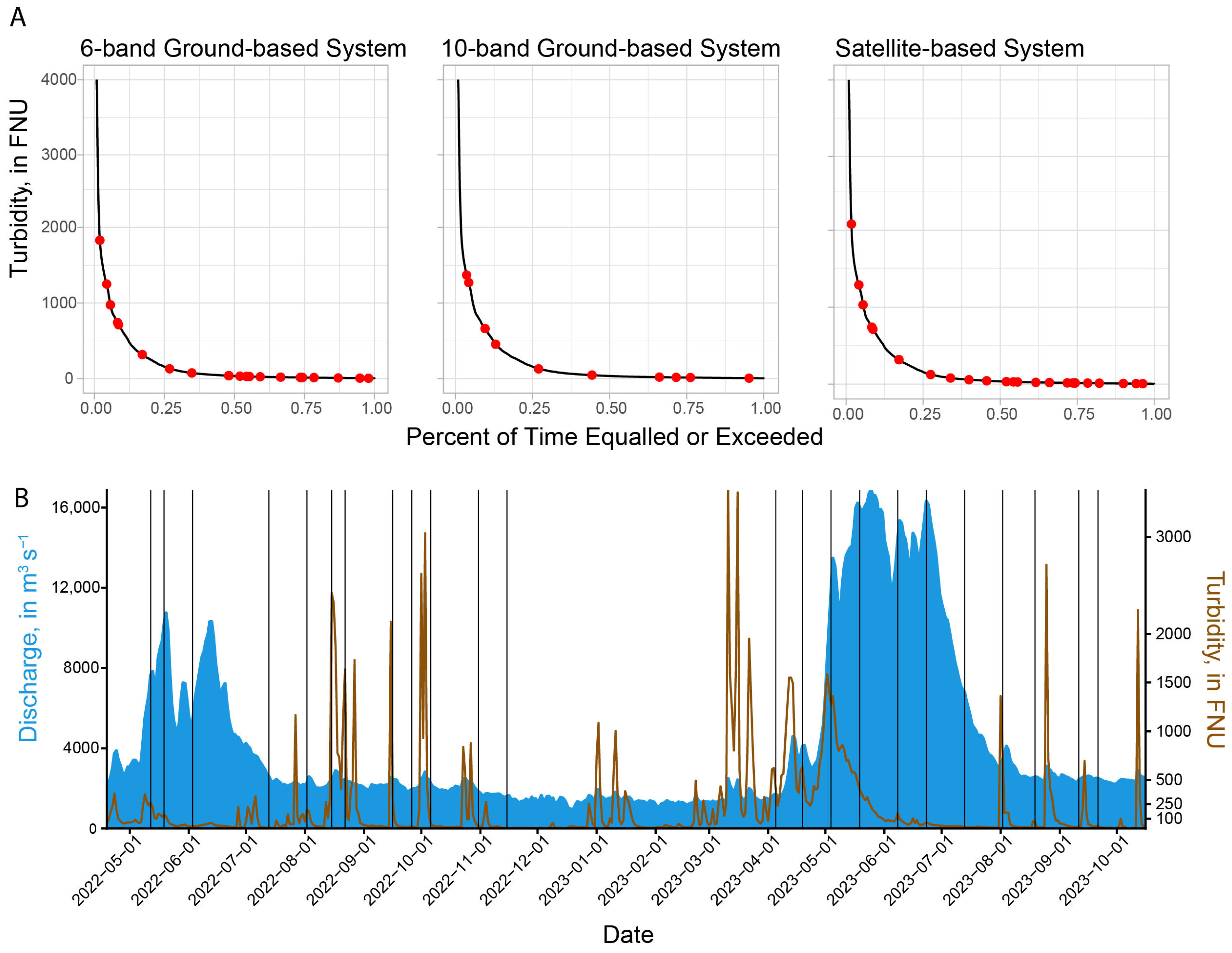
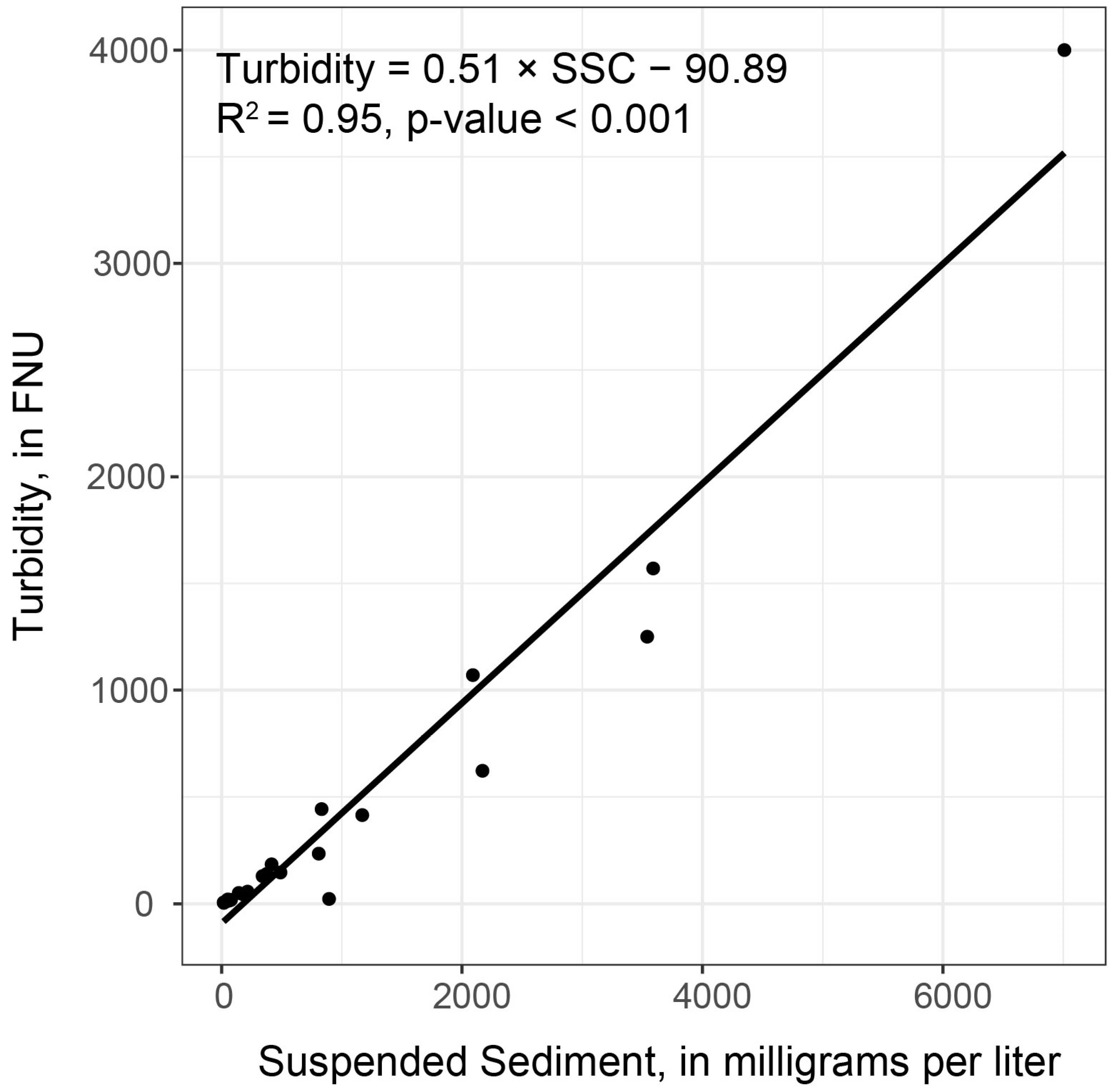
Mean annual discharge for 2022 and 2023 was 68 and 115%, respectively, of the mean annual discharge during the period of record (1933–2024) [35]. Instantaneous turbidity sensor values measured on imagery collection dates ranged from 5.1 to 2080 FNU (Table A2; Figure 3A), whereas turbidity during the entire study period (19 April 2022 to 16 October 2023) ranged from 1.4 to >4000 FNU [35] (<1% of values were >4000 FNU; Figure 3B). Fluctuations in turbidity were often associated with changes in discharge, including seasonal snowmelt runoff and summer monsoon events (Figure 3A). Turbidity at this site was highly correlated with SSC (R2 = 0.95, Figure A1), supporting the use of turbidity as a surrogate for suspended-sediment transport [14]. Correlations between turbidity and all SSC samples (mid-channel, left-bank, surface grab, and single vertical; Table A1) were all ≥0.95.
The turbidity value on 6 October 2023 that was closest in time to a collected image was an outlier spike, likely caused by debris in front of the sensor. A turbidity value that represented the daily mean turbidity value for that day was used instead, and the outlier value of 30 FNU was replaced with a mean daily value of 10 FNU (Table A2).

3.2. Atmospheric Correction

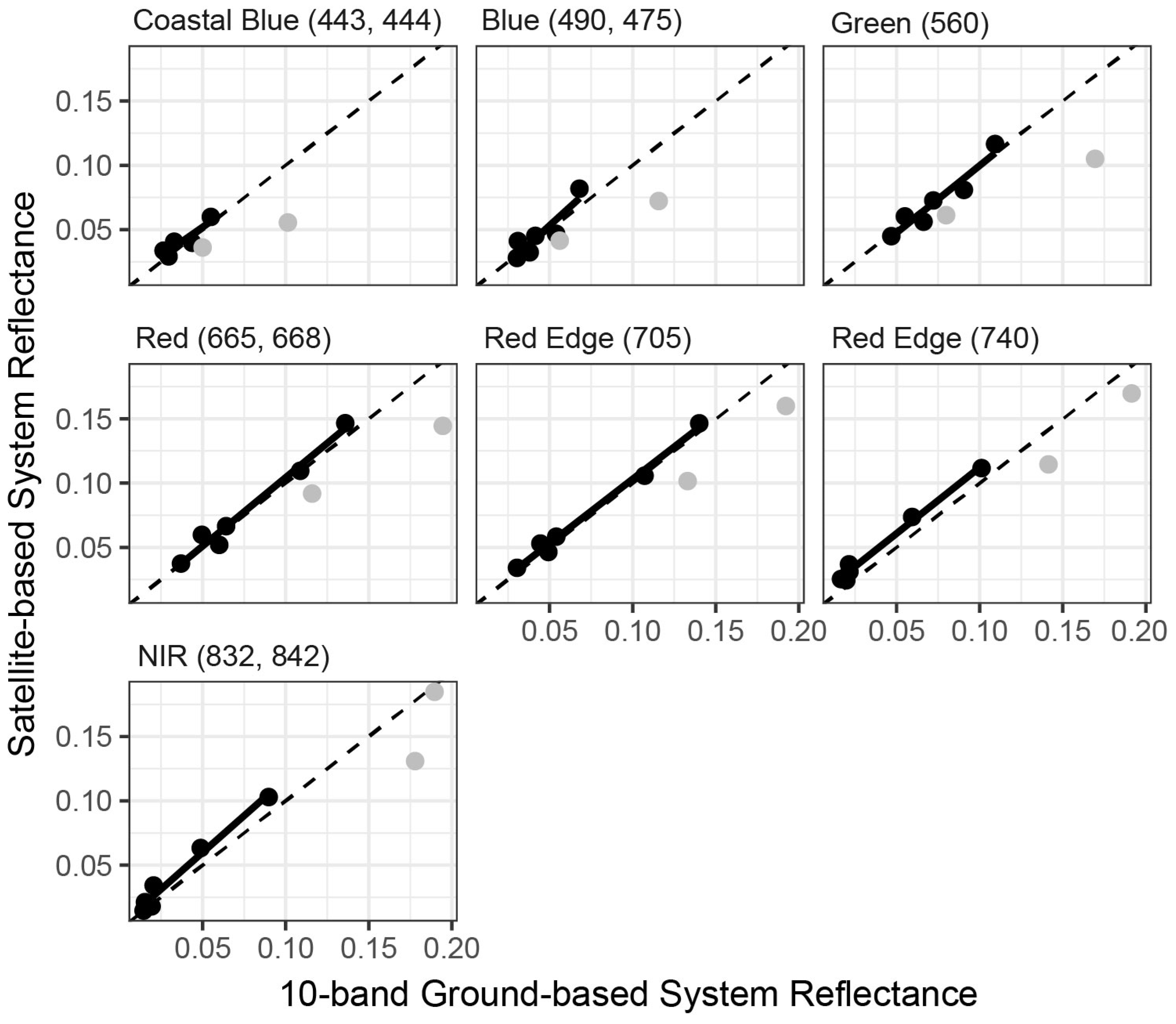
Reflectance values from the satellite-based system were highly correlated with reflectance values collected with the 10-band ground-based system (Table 3, Figure 4). There were 8 days with usable imagery from both systems, and 6 of those were collected under similar enough conditions to be included in a regression analysis. All bands had average biases ≤ 1.1%. Green and red bands had the lowest MAPE values of ~8%, whereas Red Edge 2 bands had the highest MAPE value, at ~38%. The Red Edge 2 bands have a relatively large bias, and the reflectance values are small, resulting in a larger MAPE value than other bands. Coastal Blue, Blue, and NIR bands had the lowest correlations, all < 0.92, whereas all the other bands were correlated between 0.96 and 0.99. Slopes ranged from 0.90 to 1.18 (Table 3).

3.3. Turbidity Model Comparison

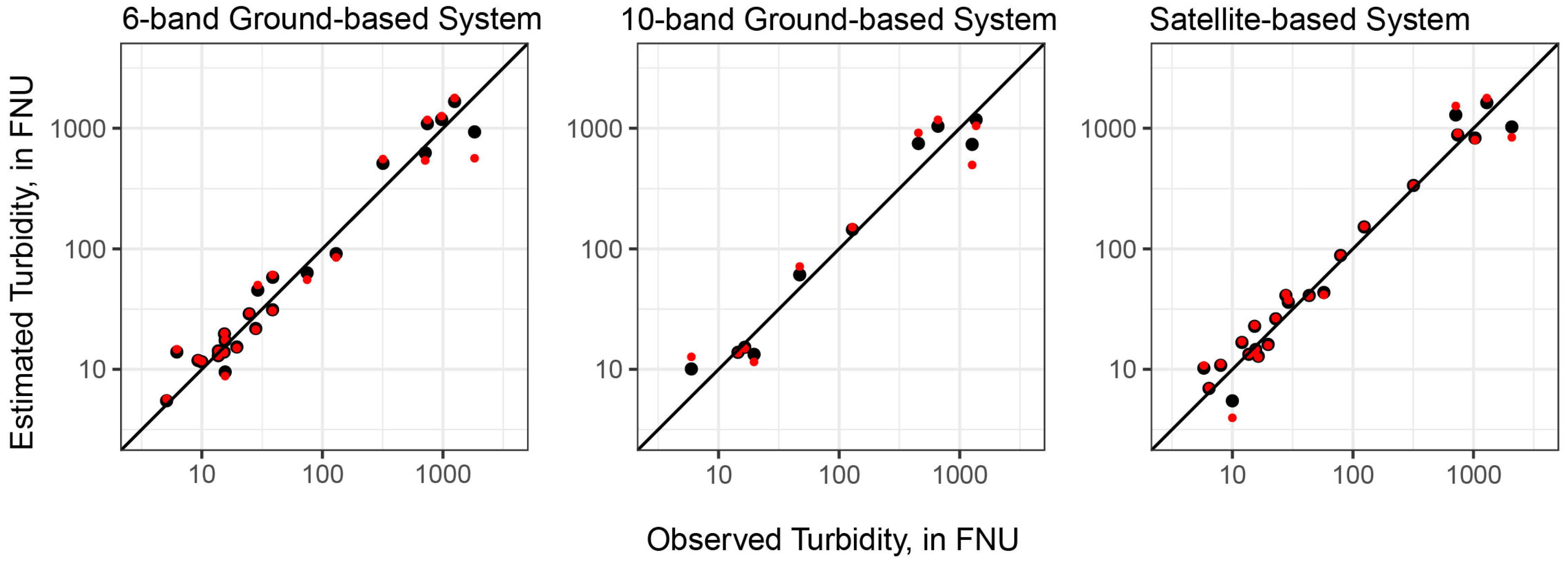
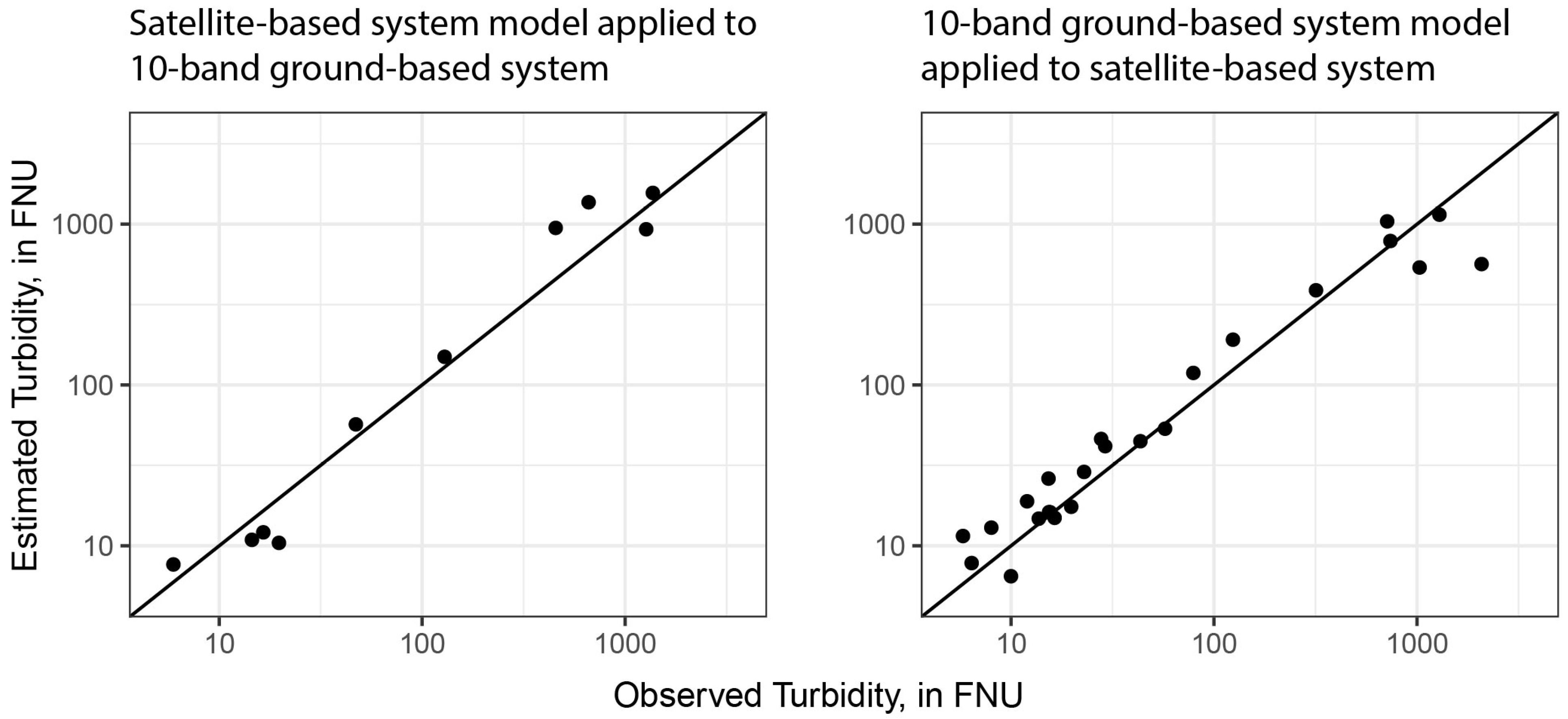
Model statistics show a strong fit for turbidity models for all three sensors (Table 4, Figure 5). All models had deviance explained values of 0.95 or greater, suggesting that the reflectance values from selected bands explained much of the variance in turbidity in each sensor’s respective dataset. Mean absolute percent error was similar for satellite-based and 6-band ground-based sensors (~30%), where reflectance data from the same dates were used in regressions. Durbin–Watson tests show that autocorrelation between the bands used in each sensor’s model was not significant (p-value > 0.05) and that the bands are independent of one another. Satellite-based and 10-band ground-based sensors had similar regression equations, which included NIR bands and the NDTI (Table 4, Figure 2). Results from the cross-sensor comparison, where models from the satellite-based sensor were applied to data from the 10-band ground-based sensor and vice versa, indicate that there may be transferability of models across sensors. Pearson’s correlation coefficients were slightly lower compared to the sensor-specific models, but still showed reasonable agreement (0.79 compared to 0.85 for the satellite-based system and 0.89 compared to 0.88 for the 10-band ground-based system; Figure A2). The 6-band ground-based regression model included bands in the NIR and two other bands, which collectively capture the same wavelengths as the satellite-based and 10-band ground-based sensor’s green bands, plus some of the red spectrum (Figure 2).

4. Discussion

4.1. Cross-Sensor Evaluation

The high correlation in reflectance data between the satellite-based and 10-band ground-based sensors (Table 3, Figure 4) indicates that the atmospheric correction performed reasonably well for the satellite-based data despite the challenging conditions of a relatively narrow river in a canyon environment. The bias was largest for the bands with the longest wavelength (Table 3, Figure 4), as expected. The agreement between the dark spectrum fitting algorithm and the 10-band ground-based sensor in situ radiometric data may be improved by explicitly accounting for adjacency effects in topographically complex terrain [23,54]. The degree of sensor overlap (Table 2) was not related to the level of agreement between the sensors (Table 3).
Results from the cross-sensor comparison (Figure A2) indicate that models developed from satellite observations can be applied to ground-based sensors, and vice versa, with reasonable accuracy. This is supported by the strong agreement between satellite-based and in situ reflectance measurements across a wide range of turbidity conditions (Table 4). Cross-sensor model development and application opens the possibility of establishing high-frequency monitoring with near-proximal sensors using satellite-based models that can leverage historic water quality observations to build empirical relationships. Additionally, paired near-proximal and in situ sensors could be used to rapidly amass a matched dataset and model that could then be applied to satellite imagery, thus accelerating model development and application.

4.2. Turbidity Model Evaluation

Near-infrared, red, and green light were selected for all three sensor designs. In all three cases, the best performing linear regression simulated turbidity as proportional to red and near-infrared reflectance and inversely proportional to reflectance of green light. This relation was explicit for the 6-band ground-based system, where each band was included individually in the selected model. Models from the satellite-based and 10-band ground-based systems leveraged the NDTI to capture the relation between red and green light. Similarity in model formulation and close agreement in model output across the three disparate platforms indicated that the underlying signal in this dataset was stronger than inter-sensor differences. We noted that at-sensor signals were a product of both light-scattering particles that elevated in situ turbidity and light-absorbing substances (e.g., total dissolved solids) that impacted water color but did not impact in situ turbidity. The selection of red and green bands in the final models showed that turbidity-generating particles in the water at this site predominantly scatter and reflect red light.
Previous remote sensing of turbidity models have used red, green, and NIR bands either independently or in combination [18,55]. Reflectance from bands in the red part of the spectrum is often used for low-to-moderate turbidity values in inland waters [56,57], whereas moderate-to-high SSCs (>100 mg/L) are more easily detected in the NIR [18]. Single-band models can sometimes be preferred for simplicity, but multiband models or models with band ratios or normalized indices might be better suited for rivers like the Colorado River that experience wide ranges in turbidity and are optically complex. Ratios and normalized indices, like the NDTI, have the additional advantage of comparing relative reflectance magnitudes, thus limiting the influence of inter-image differences due to uncertainty in atmospheric correction [20].
Despite having comparatively coarse spectral resolution, the 6-band ground-based system’s model produced accurate estimates of turbidity. While the model lacks the range to capture red wavelengths used in the satellite-based and 10-band ground-based models, the 6-band system model extracted the necessary spectral information to estimate turbidity from the available broadband wavelengths. Although Mosbrucker et al. [28] used blue wavelengths (470 nm) in their 6-band ground-based SSC models, and Mosbrucker and Wood [29] used yellow-orange wavelengths (590 nm), the 6-band ground-based turbidity models in this study also incorporated green wavelengths. This difference could be due to the greater organic content present in the Colorado River compared to the North Fork Toutle River (Washington, USA) or East Branch Brandywine Creek (Pennsylvania, USA) in cited studies, indicating the importance of site-specific optical properties in model selection.
The turbidity models presented here have similar accuracy to other remote sensing efforts. In addition to turbidity, we include SSC modeling efforts in our comparison due to the limited number of studies on remote sensing of turbidity in rivers. For example, Mosbrucker et al. [28] and Mosbrucker and Wood [29] reported correlations with point measurements of SSC of 0.90 and 0.93. Similarly, Pearson’s correlation from our turbidity models was 0.88 (Table 3). They reported a relative percent error < 40%, similar to the 30% reported here (Table 3). Our 10-band ground-based sensor model with a 28% relative RMSE was similar in performance to that reported by Windle and Silsbe [33], where total SSC was reported with a relative RMSE of 9%. Additionally, De Keukelaere et al. [34] simulated turbidity with 10-band ground-based sensor imagery across a wide range of environments in Europe and reported an RMSE of 10.13 FNU and a correlation of 0.71 between in situ and modeled turbidity. Lastly, Dogliotti et al. [18] reported errors of 12 to 22% in modeling turbidity with satellite data in ocean environments, and Nechad et al. [55] reported errors < 30% when remotely sensing total suspended matter in marine environments. Kuhn et al. [20] reported a turbidity model accuracy in large rivers of 3% for imagery atmospherically corrected with the ACOLITE DSF approach used in the present study and the model presented in Dogliotti et al. [18]. Hossain et al. [58] reported a correlation of 0.95 for a single band model of turbidity in the Tennessee River using the red band from Landsat 8 imagery. In summary, the 0.97 deviance explained, RMSE of 260 FNU, and relative RMSE of 28% are similar to other regression approaches that use multispectral satellite imagery to model turbidity.

4.3. Model Application and Limitations

In this study, to support the advancement of USGS water quality monitoring networks and techniques, we evaluated the performance of three different systems for non-contact monitoring of turbidity at a site on the Colorado River. Although all three platforms successfully estimated turbidity across a wide range of conditions, there are distinct limitations and strengths to each approach (Table 5). Whether performing broad-scale trend assessments or quantifying the effects of specific events, the need will dictate the most suitable remote sensing method to employ. Because turbidity–SSC relationships and optical properties vary across locations, site-specific models, like those presented here, must be validated before broader application.
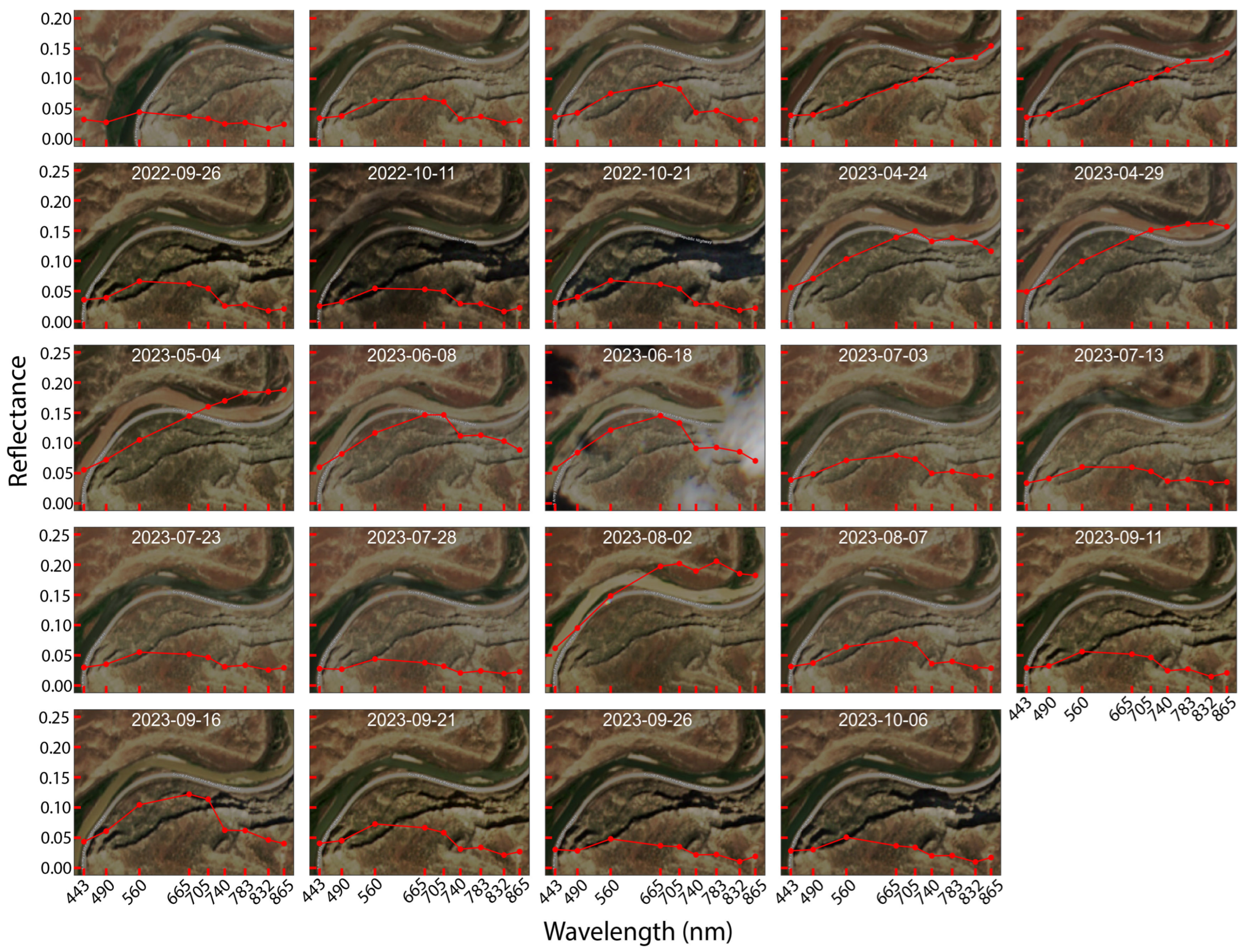
Satellite-based imagery is well-suited for covering large areas at regular intervals at minimal cost to the end-user. A mature and active user community means that datasets and tools are broadly available to automate image processing [59]. However, the spatial resolution of 20 m limits retrieval to relatively large, >60 m wide targets to avoid mixed land and water pixels. Likewise, terrestrial adjacency effects and terrain shading further limit the use of satellite imagery in many areas due to topography. This is exacerbated in canyon settings where canyon walls cast shade on the river. We note that the river was not topographically shaded in any of the images used in this study (Figure A3) and that model performance may deteriorate if applied to shaded pixels in other sections of the river. The temporal resolution of Sentinel-2 satellite data is also not suitable for all applications, with flyovers occurring nominally every 5 days for most locations. Additionally, conditions at the exact time of satellite overpass are indelibly encoded in the satellite imagery. If clouds, sun glint, or other interference degrade pixel quality, there is no chance for a second measurement until the next overpass. The use of satellite-derived measurements is, therefore, best-suited for examining large-scale spatial and temporal patterns and trends in turbidity.
Although the two ground-based methods evaluated in this study lack the spatial reach of satellite imagery, they can provide high-frequency, near-real-time estimates of turbidity data for hydrologic monitoring programs. These near-proximal sensors also have the advantage of avoiding cloud interference that can occlude satellite observations while also avoiding fouling and kinetic damage from storm events that are common for in situ methods. Some operational considerations are needed when deploying these sensors, including the need for adequate power and cooling capacity. For example, the 10-band ground-based system was designed to operate with active cooling, such as on an aerial vehicle, and overheated several times during field data collection despite attempts to cool the system. Additionally, the 6-band and 10-band ground-based systems can come with high end-user costs, including capital investment for the initial purchase, ongoing maintenance, and upgrades. These financial considerations could be a barrier to their adoption. Finally, the user community developing software to process imagery from the 6-band and 10-band ground-based systems is relatively small. As such, bespoke code was developed for processing imagery from these systems that currently rely on manual workflows, thus posing a potential challenge for operational scalability. The near-proximal sensors are likely best-suited for high-frequency sampling applications with site-specific monitoring. Operationalizing these methods at a site-specific scale will require sufficient paired sediment and imagery datasets to validate models across the full range of streamflow and turbidity conditions, along with automated approaches to mask unwanted pixels and extract reflectance values from imagery and apply them within the models.
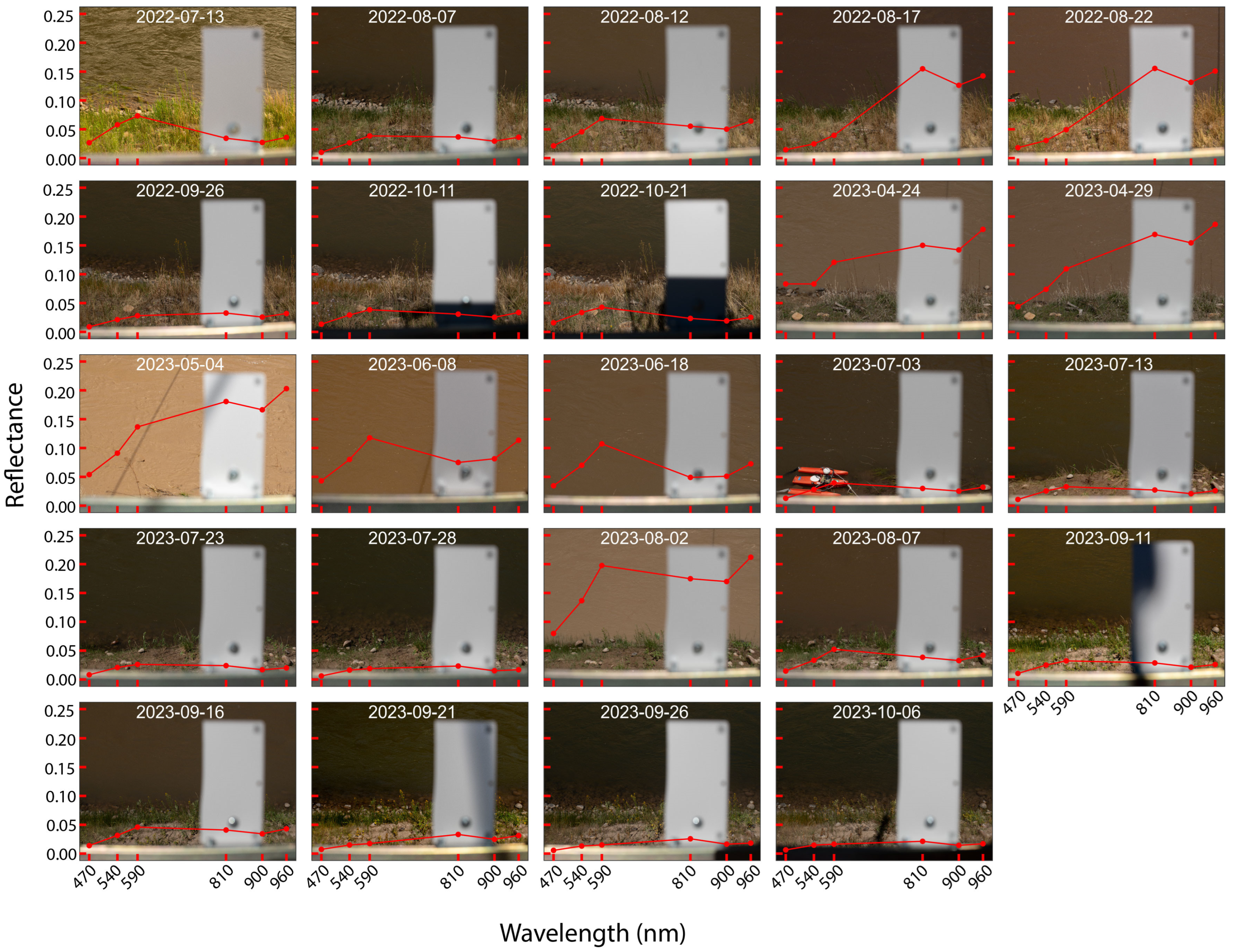
The dataset used in this analysis is also limited in some ways. The number of data points was constrained, with only 24 days available for model evaluation. Additionally, the dataset was restricted to observations made in May through October, reducing the seasonal scope of these results. As such, the predictive power of the models is not well known. Despite having a limited dataset, a wide range of turbidity conditions and sediment color (Figure A3 and Figure A4) were represented in the model dataset. Specifically, there were dates with high turbidity and SSC with red (17 August 2022), brown (4 May 2023), and white (2 August 2023) sediments (Figure A3 and Figure A4), and the models performed equally well regardless of sediment color. Both 6-band and 10-band ground-based systems require customized workflows that do not follow automated routines [28,29,60]. Implementing artificial intelligence and machine learning could potentially help automate these processes. However, the current reliance on manual workflows remains a challenge for operational scalability.

5. Conclusions

To meet the needs of the USGS to expand the spatial and temporal scales of data collection across the nation, three non-contact methods for estimating turbidity in the Colorado River near Cameo, Colorado, were evaluated. We evaluate the performance, strengths, and weaknesses of measuring turbidity with a USGS-developed 6-band ground-based camera, a 10-band ground-based camera, and satellite-based multispectral imagery. These three systems were selected based on their demonstrated ability to estimate turbidity in other water bodies [20,28,29,34] and complementary designs. Specifically, data from the satellite-based system were selected because its 20 m spatial resolution makes it suitable for imaging the study site, the 10-band ground-based system was selected for its similarity to the satellite-based sensors to allow for verification of the atmospheric correction, and the 6-band ground-based system was selected for its similarity to widely available commercial sensors that could greatly expand the USGS sediment monitoring network at modest cost. Across all three platforms, multivariate linear regression resulted in similar models that are proportional to near-infra-red and red light, and inversely proportional to green light. The similarity in band selection indicates that all three systems relied on similar spectral features in modeling turbidity at this site. Results from a cross-sensor comparison indicate that models developed for satellite-based systems may be applicable to 10-band ground-based system imagery, and vice versa. Applying satellite-based models to bank-mounted sensors could result in continuous water-quality monitoring between satellite overpasses that are not susceptible to cloud interference, while applying models developed with ground-based data to satellite imagery could greatly expedite model development and application. Further, regression analysis confirmed a high correlation between turbidity and suspended-sediment concentration (SSC) at this site. Finally, the observed accuracy of the 6-band ground-based system suggests that non-contact SSC monitoring could be achieved using low-cost, commercially available equipment.

Author Contributions

Conceptualization, N.K.D.; methodology, N.K.D., T.V.K. and A.R.M.; formal analysis, N.K.D., T.V.K. and A.R.M.; data curation, N.K.D.; writing—original draft preparation, N.K.D. and T.V.K.; writing—review and editing, N.K.D., T.V.K. and A.R.M.; visualization, N.K.D.; project administration, N.K.D.; funding acquisition, N.K.D. All authors have read and agreed to the published version of the manuscript.

Funding

Research was funded by the U.S. Geological Survey Water Resources Mission Area as part of their Next Generation Water Observing System.

Data Availability Statement

Imagery and associated reflectance data and turbidity data used in models are available in a USGS data release [51] at https://doi.org/10.5066/P14PIAUG (accessed 5 January 2026). All site location information, annual streamflow statistics, and daily, discrete, and instantaneous data are available online [35].

Acknowledgments

We acknowledge Carl Legleiter and Erin Hennessy for their thoughtful reviews of this article. Any use of trade, firm, or product names is for descriptive purposes only and does not imply endorsement by the U.S. Government.

Conflicts of Interest

The authors declare no conflicts of interest.

Abbreviations

The following abbreviations are used in this manuscript:
SSCSuspended-sediment concentration
UASUncrewed aerial system
NIRNear-infrared radiation
MSIMultispectral instrument
USGSU.S. Geological Survey
CWCentral wavelength
FWHMFull-width half maximum
NDTINormalized difference turbidity index
FNUFormazin nephelometric units
LOOCVLeave-one-out-cross-validation
MAPEMean absolute percent error
MSEMean squared error
RMSERoot mean square error
RRMSERelative root mean square error
PCCPearson’s correlation coefficient

Appendix A

Table A1. Discharge, turbidity, and discrete suspended-sediment concentration (SSC) measured at Colorado River near Cameo, CO [35]. MST = Mountain Standard Time; m3s1 = cubic meters per second; FNU = formazin nephelometric units; mgL1 = milligrams per liter.
DateTurbidity and Discharge Time (MST)Discharge (m3s−1)Turbidity (FNU)SSC Sample Time (MST)SSC 1 (mgL−1)
19 April 202215:1560.951.215:15143
12 May 202211:15214.423511:20808
19 May 202213:30291.714713:35490
3 June 202213:15153.818.913:1078
13 July 202213:3071.95.213:3519
2 August 202212:3061.418512:32416
15 August 202210:0067.1400010:027010
22 August 202211:4569.7107011:492090
16 September 202212:3068.014012:27376
26 September 202210:1555.81410:1147
6 October 202210:0064.845.69:57177
31 October 202211:3053.02111:2853
15 November 202211:4546.26.911:4117
5 April 202312:0046.244312:06832
19 April 202311:15119.862211:142170
4 May 202310:15334.1125010:153540
19 May 202311:00458.741511:011170
8 June 202310:45407.813010:42341
23 June 20238:45458.757.58:52216
13 July 202310:45190.315.710:4264
2 August 202311:0097.4157011:053590
19 August 202322:4573.123.422:52894
11 September 202311:1568.813.811:1142
21 September 202310:1570.817.310:0846
1 Suspended-sediment concentration (SSC) of mid-channel surface grab sample.
Table A2. Image collection times, measured turbidity values used in training turbidity models for each sensor, and predicted turbidity values from the model, using 6-band ground-based system (SedCam); 10-band ground-based system (MicaSense RedEdge); and satellite-based system (multispectral instrument (MSI) on the Sentinel-2 satellites). MST = Mountain Standard Time; FNU = formazin nephelometric units.
6-Band Ground-Based System 10-Band Ground-Based System Satellite-Based System
Date Time (MST) Measured
Turbidity (FNU)
Predicted Turbidity (FNU) Time (MST) Measured Turbidity (FNU) Predicted Turbidity (FNU) Time (MST) Measured Turbidity (FNU) Predicted Turbidity (FNU)
13 July 202213:595.15.4811:375.9510.0711:595.810.23
2 August 2022---9:2247.1560.90---
7 August 202214:2424.728.89---11:5922.926.27
12 August 202212:5438.758.10---11:5943.441.04
17 August 202212:541830933.92---11:5920801026.43
22 August 202212:239751185.5410:1913701178.7311:591030830.80
26 September 202212:0815.419.67---12:0115.413.89
11 October 202212:0819.515.33---12:0219.816.10
21 October 202213:0515.69.50---12:0316.412.84
5 April 2023---10:27455748.22---
19 April 2023---9:456611041.02---
24 April 202312:05318512.16---11:59318335.58
29 April 202311:367431093.16---11:59740881.19
4 May 202310:3412501668.998:461270735.5411:5912901632.37
8 June 202311:0013091.189:51129144.5311:59124152.02
18 June 202312:3174.763.22---11:5979.188.14
3 July 202312:322821.82---11:5927.841.06
13 July 202312:0715.313.929:3716.515.2311:5915.322.76
23 July 202315:0813.712.98---11:591216.72
28 July 202315:089.311.84---11:59810.80
2 August 202312:00713625.44---11:597131291.26
7 August 202312:0029.145.47---11:5929.136.07
11 September 202311:5913.714.2210:0514.513.8411:5913.713.34
16 September 202313:5938.631.24---11:5957.443.46
21 September 202312:0015.617.379:0119.713.3112:0015.614.61
26 September 202314:006.213.92---12:006.46.94
6 October 202312:011011.53---12:01105.48
Figure A1. Relationship between suspended-sediment concentration (SSC) of mid-channel surface grab samples and turbidity measured at Colorado River near Cameo, CO [35]. FNU = formazin nephelometric units.
Remotesensing 18 00638 g0a1
Figure A2. Cross-sensor turbidity model comparison. The 10-band (MicaSense RedEdge) ground-based model was applied to Sentinel-2 satellite data (left), and the satellite model was applied to 10-band ground-based data (right). The diagonal line represents a 1:1 relation. FNU = formazin nephelometric units.
Remotesensing 18 00638 g0a2
Figure A3. Image showing the color of water from satellite-based (multispectral instrument (MSI) on the Sentinel-2 satellites) imagery and associated reflectance spectra on dates used in the satellite-based sensor’s turbidity model [51]. nm = nanometers.
Remotesensing 18 00638 g0a3
Figure A4. Image showing the color of water from the 6-band (SedCam) ground-based system and associated reflectance spectra on dates used in the 6-band ground-based system’s turbidity model [51]. nm = nanometers.
Remotesensing 18 00638 g0a4

References

  1. Bilotta, G.S.; Brazier, R.E. Understanding the Influence of Suspended Solids on Water Quality and Aquatic Biota. Water Res. 2008, 42, 2849–2861. [Google Scholar] [CrossRef] [PubMed]
  2. Wohl, E. Legacy Effects on Sediments in River Corridors. Earth-Sci. Rev. 2015, 147, 30–53. [Google Scholar] [CrossRef]
  3. Williams, A.P.; Livneh, B.; McKinnon, K.A.; Hansen, W.D.; Mankin, J.S.; Cook, B.I.; Smerdon, J.E.; Varuolo-Clarke, A.M.; Bjarke, N.R.; Juang, C.S.; et al. Growing Impact of Wildfire on Western US Water Supply. Proc. Natl. Acad. Sci. USA 2022, 119, e2114069119. [Google Scholar] [CrossRef]
  4. Sankey, J.B.; Kreitler, J.; Hawbaker, T.J.; McVay, J.L.; Miller, M.E.; Mueller, E.R.; Vaillant, N.M.; Lowe, S.E.; Sankey, T.T. Climate, Wildfire, and Erosion Ensemble Foretells More Sediment in Western USA Watersheds. Geophys. Res. Lett. 2017, 44, 8884–8892. [Google Scholar] [CrossRef]
  5. Leib, K.; Linard, J.; Williams, C. Statistical Relations of Salt and Selenium Loads to Geospatial Characteristics of Corresponding Subbasins of the Colorado and Gunnison Rivers in Colorado; Scientific Investigations Report; U.S. Geological Survey: Reston, VA, USA, 2012; Volume 31. [CrossRef]
  6. Edwards, T.K.; Glysson, G.D. Field Methods for Measurement of Fluvial Sediment; U.S. Geological Survey: Reston, VA, USA, 1999; pp. 1–89. [CrossRef]
  7. Gray, J.R.; Landers, M.N. Measuring Suspended Sediment. In Comprehensive Water Quality and Purification; U.S. Geological Survey: Reston, VA, USA, 2013; Volume 1, pp. 157–204. [Google Scholar]
  8. Leigh, C.; Kandanaarachchi, S.; McGree, J.M.; Hyndman, R.J.; Alsibai, O.; Mengersen, K.; Peterson, E.E. Predicting Sediment and Nutrient Concentrations from High-Frequency Water-Quality Data. PLoS ONE 2019, 14, e0215503. [Google Scholar] [CrossRef]
  9. Villa, A.; Fölster, J.; Kyllmar, K. Determining Suspended Solids and Total Phosphorus from Turbidity: Comparison of High-Frequency Sampling with Conventional Monitoring Methods. Environ. Monit. Assess. 2019, 191, 605. [Google Scholar] [CrossRef] [PubMed]
  10. Uhrich, M.A.; Kolasinac, J.; Booth, P.L.; Fountain, R.L.; Spicer, K.R.; Mosbrucker, A.R. Correlations of Turbidity to Suspended-Sediment Concentration in the Toutle River Basin, near Mount St. Helens, Washington, 2010–11; Scientific Investigations Report; U.S. Geological Survey: Reston, VA, USA, 2014. [CrossRef][Green Version]
  11. Horsburgh, J.S.; Spackman Jones, A.; Stevens, D.K.; Tarboton, D.G.; Mesner, N.O. A Sensor Network for High Frequency Estimation of Water Quality Constituent Fluxes Using Surrogates. Environ. Model. Softw. 2010, 25, 1031–1044. [Google Scholar] [CrossRef]
  12. Jones, A.S.; Stevens, D.K.; Horsburgh, J.S.; Mesner, N.O. Surrogate Measures for Providing High Frequency Estimates of Total Sus Pended Solids and Total Phosphorus Concentrations. JAWRA J. Am. Water Resour. Assoc. 2011, 47, 239–253. [Google Scholar] [CrossRef]
  13. Gippel, C.J. Potential of Turbidity Monitoring for Measuring the Transport of Suspended Solids in Streams. Hydrol. Process. 1995, 9, 83–97. [Google Scholar] [CrossRef]
  14. Rasmussen, P.P.; Gray, J.R.; Glysson, G.D.; Ziegler, A.C. Guidelines and Procedures for Computing Time-Series Suspended-Sediment Concentrations and Loads from In-Stream Turbidity-Sensor and Streamflow Data; U.S. Geological Survey: Reston, VA, USA, 2009. [CrossRef]
  15. Landers, M.N.; Sturm, T.W. Hysteresis in Suspended Sediment to Turbidity Relations Due to Changing Particle Size Distributions. Water Resour. Res. 2013, 49, 5487–5500. [Google Scholar] [CrossRef]
  16. International Ocean Colour Coordinating Group (IOCCG). Remote Sensing of Inherent Optical Properties: Fundamentals, Tests of Algorithms, and Applications; IOCCG: Dartmouth, NS, Canada, 2006. [Google Scholar] [CrossRef]
  17. Doxaran, D.; Froidefond, J.-M.; Castaing, P. A Reflectance Band Ratio Used to Estimate Suspended Matter Concentrations in Sediment-Dominated Coastal Waters. Int. J. Remote Sens. 2002, 23, 5079–5085. [Google Scholar] [CrossRef]
  18. Dogliotti, A.I.; Ruddick, K.G.; Nechad, B.; Doxaran, D.; Knaeps, E. A Single Algorithm to Retrieve Turbidity from Remotely-Sensed Data in All Coastal and Estuarine Waters. Remote Sens. Environ. 2015, 156, 157–168. [Google Scholar] [CrossRef]
  19. Moore, G.K. Satellite Remote Sensing of Water Turbidity/Sonde de Télémesure Par Satellite de La Turbidité de l’eau. Hydrol. Sci. Bull. 1980, 25, 407–421. [Google Scholar] [CrossRef]
  20. Kuhn, C.; Valerio, A.; Ward, N.D.; Loken, L.; Sawakuchi, H.O.; Kampel, M.; Richey, J.E.; Stadler, P.; Crawford, J.; Striegl, R.G.; et al. Performance of Landsat-8 and Sentinel-2 Surface Reflectance Products f or River Remote Sensing Retrievals of Chlorophyll-a and Turbidity. Remote Sens. Environ. 2019, 224, 104–118. [Google Scholar] [CrossRef]
  21. Mobley, C.D. Estimation of the Remote-Sensing Reflectance from above-Surface Measurements. Appl. Opt. 1999, 38, 7442–7455. [Google Scholar] [CrossRef]
  22. Mouw, C.B.; Greb, S.; Aurin, D.; DiGiacomo, P.M.; Lee, Z.; Twardowski, M.; Binding, C.; Hu, C.; Ma, R.; Moore, T.; et al. Aquatic Color Radiometry Remote Sensing of Coastal and Inland Waters: Challenges and Recommendations for Future Satellite Missions. Remote Sens. Environ. 2015, 160, 15–30. [Google Scholar] [CrossRef]
  23. Wu, Y.; Knudby, A.; Lapen, D. Topography-Adjusted Monte Carlo Simulation of the Adjacency Effect in Remote Sensing of Coastal and Inland Waters. J. Quant. Spectrosc. Radiat. Transf. 2023, 303, 108589. [Google Scholar] [CrossRef]
  24. Garg, V.; Aggarwal, S.P.; Chauhan, P. Changes in Turbidity along Ganga River Using Sentinel-2 Satellite Data during Lockdown Associated with COVID-19. Geomat. Nat. Hazards Risk 2020, 11, 1175–1195. [Google Scholar] [CrossRef]
  25. Lee, J.-S.; Baek, J.-Y.; Shin, J.; Kim, J.-S.; Jo, Y.-H. Suspended Sediment Concentration Estimation along Turbid Water Outflow Using a Multispectral Camera on an Unmanned Aerial Vehicle. Remote Sens. 2023, 15, 5540. [Google Scholar] [CrossRef]
  26. Kislik, C.; Dronova, I.; Kelly, M. UAVs in Support of Algal Bloom Research: A Review of Current Applications and Future Opportunities. Drones 2018, 2, 35. [Google Scholar] [CrossRef]
  27. Larson, M.D.; Simic Milas, A.; Vincent, R.K.; Evans, J.E. Multi-Depth Suspended Sediment Estimation Using High-Resolution Remote -Sensing UAV in Maumee River, Ohio. Int. J. Remote Sens. 2018, 39, 5472–5489. [Google Scholar] [CrossRef]
  28. Mosbrucker, A.R.; Spicer, K.R.; Christianson, T.S.; Uhrich, M.A. Estimating Concentrations of Fine-Grained and Total Suspended Sediment from Close-Range Remote Sensing Imagery. Available online: https://pubs.usgs.gov/publication/70137268 (accessed on 24 March 2025).
  29. Mosbrucker, A.R.; Wood, M.S. Development of ‘SedCam’—A Close-Range Remote Sensing Method of Estimat Ing Suspended-Sediment Concentration in Small Rivers. Geomorphology 2025, 476, 109642. [Google Scholar] [CrossRef]
  30. Clow, D.W.; Akie, G.A.; Murphy, S.F.; Gohring, E.J. Dynamic Water-Quality Responses to Wildfire in Colorado. Hydrol. Process. 2024, 38, e15291. [Google Scholar] [CrossRef]
  31. Murphy, J.C. Changing Suspended Sediment in United States Rivers and Streams: Linking Sediment Trends to Changes in Land Use/Cover, Hydrology and Climate. Hydrol. Earth Syst. Sci. 2020, 24, 991–1010. [Google Scholar] [CrossRef]
  32. Evenson, E.J.; Jones, S.A.; Barber, N.L.; Barlow, P.M.; Blodgett, D.L.; Bruce, B.W.; Douglas-Mankin, K.R.; Farmer, W.H.; Fischer, J.M.; Hughes, W.B.; et al. Continuing Progress Toward a National Assessment of Water Availability and Use; U.S. Geological Survey: Reston, VA, USA, 2018. [CrossRef]
  33. Windle, A.E.; Silsbe, G.M. Evaluation of Unoccupied Aircraft System (UAS) Remote Sensing Reflectance Retrievals for Water Quality Monitoring in Coastal Waters. Front. Environ. Sci. 2021, 9, 674247. [Google Scholar] [CrossRef]
  34. De Keukelaere, L.; Moelans, R.; Knaeps, E.; Sterckx, S.; Reusen, I.; De Munck, D.; Simis, S.G.H.; Constantinescu, A.M.; Scrieciu, A.; Katsouras, G.; et al. Airborne Drones for Water Quality Mapping in Inland, Transitional and Coastal Waters—MapEO Water Data Processing and Validation. Remote Sens. 2023, 15, 1345. [Google Scholar] [CrossRef]
  35. U.S. Geological Survey (USGS). Water Data for the Nation: USGS-09095500 Colorado River near Cameo, Co. in U.S. Geological Survey National Water Information System Database. Available online: https://waterdata.usgs.gov/nwis/dv?referred_module=sw&re-88%20ferred_module=sw&site_no=09095500 (accessed on 5 May 2025).
  36. Tweto, O. MI-16 1979 Geologic Map of Colorado. Available online: https://coloradogeologicalsurvey.org/publications/tweto-geologic-map-c (accessed on 10 July 2025).
  37. Wagner, R.J.; Boulger, R.W., Jr.; Oblinger, C.J.; Smith, B.A. Guidelines and Standard Procedures for Continuous Water-Quality Monitors: Station Operation, Record Computation, and Data Reporting; Techniques and Methods; U.S. Geological Survey: Reston, VA, USA, 2006. [CrossRef]
  38. Davis, B.E. A Guide to the Proper Selection and Use of Federally Approved Sediment and Water-Quality Samplers; Open File Report; U.S. Geological Survey: Reston, VA, USA, 2005. [CrossRef]
  39. Guy, H.P. Laboratory Theory and Methods for Sediment Analysis; U.S. Geological Survey: Reston, VA, USA, 1969. [CrossRef]
  40. Stiles, J.A. Quality-Assurance Plan for the Analysis of Fluvial Sediment by the U.S. Geological Survey New Mexico Water Science Center Sediment Laboratory; Open-File Report; U.S. Geological Survey: Reston, VA, USA, 2006. [CrossRef]
  41. Camera Sensor Evaluation Database. Available online: https://www.dxomark.com/ (accessed on 2 January 2025).
  42. European Space Agency. S-2 Mission Overview. Available online: https://sentiwiki.copernicus.eu/web/s2-mission (accessed on 4 April 2025).
  43. Micasense Comparison of MicaSense Cameras. Available online: https://support.micasense.com/hc/en-us/articles/1500007828482-Comparison-of-MicaSense-Cameras (accessed on 4 April 2025).
  44. Micasense Use of Calibrated Reflectance Panels For MicaSense Data. Available online: https://support.micasense.com/hc/en-us/articles/115000765514-Use-of-Calibrated-Reflectance-Panels-For-MicaSense-Data (accessed on 4 April 2025).
  45. Python Language Reference Python Software Foundation. Available online: http://www.python.org (accessed on 4 April 2024).
  46. Vanhellemont, Q. Sensitivity Analysis of the Dark Spectrum Fitting Atmospheric Correction for Metre- and Decametre-Scale Satellite Imagery Using Autonomous Hyperspectral Radiometry. Opt. Express 2020, 28, 29948–29965. [Google Scholar] [CrossRef] [PubMed]
  47. King, T.V.; Meyer, M.F.; Hundt, S.A.; Ball, G.P.; Hafen, K..; Avouris, D.M.; Ducar, S.D.; Wakefield, B.F.; Stengel, V.G.; Vanhellemont, Q. Sentinel-2 ACOLITE-DSF Aquatic Reflectance for the Conterminous United States; Data Release; U.S. Geological Survey: Reston, VA, USA, 2024. [CrossRef]
  48. Vanhellemont, Q. ACOLITE User Manual. Available online: https://github.com/acolite/acolite/releases/download/20221114.0/acolite_manual_20221114.0.pdf (accessed on 2 January 2025).
  49. U.S. Geological Survey. National Hydrography Dataset Plus High Resolution. Available online: https://www.usgs.gov/national-hydrography/access-national-hydrography-products (accessed on 1 April 2024).
  50. Helsel, D.R.; Hirsch, R.M.; Ryberg, K.R.; Archfield, S.A.; Gilroy, E.J. Statistical Methods in Water Resources; Techniques and Methods; U.S. Geological Survey: Reston, VA, USA, 2020. [CrossRef]
  51. Day, N.K.; Mosbrucker, A.; King, T.V. Turbidity Model Input and Output Data and Associated Imagery Acquired May 2022 to November 2023 at Colorado River near Cameo, Colorado; Data Release; U.S. Geological Survey: Reston, VA, USA, 2026. Available online: https://www.usgs.gov/data/turbidity-model-input-and-output-data-and-associated-imagery-may-2022-november-2023-colorado (accessed on 5 January 2026).
  52. Lacaux, J.P.; Tourre, Y.M.; Vignolles, C.; Ndione, J.A.; Lafaye, M. Classification of Ponds from High-Spatial Resolution Remote Sensing: Application to Rift Valley Fever Epidemics in Senegal. Remote Sens. Environ. 2007, 1, 66–74. [Google Scholar] [CrossRef]
  53. R Core Team. A Language and Environment for Statistical Computing. Available online: https://www.r-project.org (accessed on 4 April 2024).
  54. Castagna, A.; Vanhellemont, Q. A Generalized Physics-Based Correction for Adjacency Effects. Appl. Opt. 2025, 64, 2719–2743. [Google Scholar] [CrossRef]
  55. Nechad, B.; Ruddick, K.G.; Park, Y. Calibration and Validation of a Generic Multisensor Algorithm for Mapping of Total Suspended Matter in Turbid Waters. Remote Sens. Environ. 2010, 114, 854–866. [Google Scholar] [CrossRef]
  56. Bustamante, J.; Pacios, F.; Díaz-Delgado, R.; Aragonés, D. Predictive Models of Turbidity and Water Depth in the Doñana Marshes u Sing Landsat TM and ETM+ Images. J. Environ. Manag. 2009, 90, 2219–2225. [Google Scholar] [CrossRef]
  57. Chen, Z.; Muller-Karger, F.E.; Hu, C. Remote Sensing of Water Clarity in Tampa Bay. Remote Sens. Environ. 2007, 109, 249–259. [Google Scholar] [CrossRef]
  58. Hossain, A.K.M.A.; Mathias, C.; Blanton, R. Remote Sensing of Turbidity in the Tennessee River Using Landsat 8 Sat Ellite. Remote Sens. 2021, 13, 3785. [Google Scholar] [CrossRef]
  59. Planet Labs Sentinel-2 L2A. Available online: https://docs.sentinel-hub.com/api/latest/data/sentinel-2-l2a/ (accessed on 10 July 2025).
  60. Micasense MicaSense Camera Image Processing Workflow. Available online: https://support.micasense.com/hc/en-us/articles/115003099813-MicaSense-Camera-Image-Processing-Workflow (accessed on 1 October 2024).
Figure 1. (A) Location of study area at Colorado River near Cameo, Colorado, gaging station (USGS-09095500 [35]), (B) images (from left to right) of the 10-band ground-based system (MicaSense RedEdge) mounted to a cable car, the 6-band ground-based system (SedCam) with calibration card mounted in front of the housing, and the 6-band ground-based system (SedCam) mounted next to the Colorado River. Photographs by the U.S. Geological Survey.
Remotesensing 18 00638 g001
Figure 2. Spectral band comparison between the 6-band ground-based system (SedCam) [41], 10-band ground-based system (MicaSense RedEdge) [43], and satellite-based system (multispectral instrument (MSI) on the Sentinel-2 satellites) [42]. Each box represents the spectral range of an individual camera band, with the central wavelength indicated and full-width half maximum defining the band’s span (Table 1). For visualization purposes, central wavelengths and full-width half maximums from satellite-based sensor A are displayed. Band combinations used in turbidity regressions are shaded in darker gray. Band # = band number; nm = nanometers.
Remotesensing 18 00638 g002
Figure 3. (A) Turbidity duration curves with dots representing turbidity values at image times used in training turbidity models; (B) daily mean discharge and daily mean turbidity. Dates with suspended-sediment samples are shown as vertical black lines.
Remotesensing 18 00638 g003
Figure 4. Scatter plot of reflectance values for similar bands from satellite-based (multispectral instrument (MSI) on the Sentinel-2 satellites) and 10-band ground-based (MicaSense RedEdge) systems. Black points represent reflectance values from imagery collected across similar turbidity conditions that were used in the regression. Gray points represent reflectance values from imagery collected on dates when turbidity conditions or lighting conditions changed between imagery collection and were not included in the regression. Numbers in parentheses represent the central wavelengths of satellite-based and 10-band ground-based systems, respectively (Table 3).
Remotesensing 18 00638 g004
Figure 5. Turbidity models for the Colorado River near Cameo, CO, using data from the 6-band (SedCam) and 10-band (MicaSense RedEdge) ground-based systems and the satellite-based (multispectral instrument (MSI) on the Sentinel-2 satellites) system [42] (Table 4 and Table A1). Black points represent predictions from generalized linear models. Red points represent predictions from the leave-one-out-cross-validation method. The diagonal line represents a 1 to 1 relation.
Remotesensing 18 00638 g005
Table 1. Spectral information for 6-band ground-based system (SedCam), 10-band ground-based system (MicaSense RedEdge), and satellite-based system (Multispectral instrument (MSI) on the Sentinel-2 satellites) [42]. Satellite-based values in parentheses correspond to the MSI on Sentinel-2B.
SensorBand NumberCentral Wavelength in NanometersFull-Width Half Maximum in Nanometers
6-band ground-based Camera A159050
252080
3470140
6-band ground-based Camera B496050
590080
6810140
10-band ground-based Blue Sensor144428
247532
353114
456027
565016
10-band ground-based Red Sensor666814
770510
871712
974018
1084257
Satellite-based A (B)1442.7 (442.2)20 (20)
2492.7 (492.3)64 (65)
3559.8 (558.9)35 (35)
4664.6 (664.9)30 (31)
5704.1 (703.8)14 (15)
6740.5 (739.1)14 (14)
7782.8 (779.7)20 (20)
8832.8 (832.9)118 (115)
8a864.7 (864.0)20 (20)
Table 2. Comparison of the 10-band ground-based (MicaSense RedEdge) and satellite-based (multispectral instrument (MSI) on the Sentinel-2 satellites) systems’ central wavelengths (CWs), full-width half maximums (FWHMs), and the overlap between the two systems. NIR = near-infrared radiation; -- = not applicable; nm = nanometers.
Harmonized Band NameSatellite-Based Sensor CW 1 (nm)Satellite-Based Sensor FWHM 1 (nm)10-Band Ground-Based Sensor CW (nm)10-Band Ground-Based Sensor FWHM (nm)Overlap (nm)Percent of
Satellite-Based Sensor Band in Overlap
Percent of
10-Band Ground-Based Sensor Band in Overlap
Coastal Blue443214442821100%75%
Blue49066475323248%100%
------53114------
Green56036560272775%100%
------65016------
Red66531668141445%100%
Red Edge 170515705101067%100%
------71712------
Red Edge 2740157401815100%83%
--78320----------
NIR8321068425788100%91%
--86521----------
1 Satellite-based sensor A wavelengths [42] reported.
Table 3. Comparison metrics of reflectance values from satellite-based (multispectral instrument (MSI) on the Sentinel-2 satellites) and 10-band ground-based (MicaSense RedEdge) systems used to evaluate atmospheric correction routine of satellite-based system. nm = nanometers; NIR = near-infrared radiation; n = number of paired samples; MAPE = mean absolute percent error; PCC = Pearson’s correlation coefficient.
Band NameSatellite-Based System Central Wavelength (nm)10-Band Ground-Based
System Central Wavelength (nm)
SlopenMAPEPCCBias
Coastal Blue4434440.90614.280.9150.003
Blue4904751.18616.3830.9020.002
Green5605601.0567.8320.958−0.001
Red6656681.0767.9080.9870.003
Red Edge 17057051.068.5110.9950.003
Red Edge 27407401.03637.940.9940.011
NIR8328421.14614.280.9150.003
Table 4. Generalized linear model equations between turbidity measurements and reflectance data and model performance metrics, including root mean square error (RMSE), relative root mean square error (RRMSE), mean absolute percent error (MAPE), and Pearson’s correlation coefficient (PCC). NDTI = normalized difference turbidity index; n = number of paired samples; DW = Durbin–Watson statistic; LOOCV MSE = leave-one-out-cross-validation mean squared error.
SensorModelnDeviance
Explained
RMSE (FNU)RRMSE (%)MAPE (%)PCCDW/p-ValueLOOCV MSE
6-band Ground-basedLog-transformed Turbidity = 31.64 × R6B,5 − 174.79 × R6B,2 + 112.47 × R6B,1 + 2.71240.97222.9930.2830.280.89DW = 2.30
p-value = 0.69
0.21
10-band Ground-basedLog-transformed Turbidity = 18.67 × R10B,10 + 5.97 × NDTI + 2.65100.95235.1858.9633.310.89DW = 3.06
p-value = 0.94
0.29
Satellite-basedLog-transformed Turbidity = 20.93 × RSat,8a + 6.63 × NDTI + 2.41240.97260.0527.7027.700.86DW = 1.66
p-value = 0.16
0.18
Table 5. Summary of systems tested in this work. NA = not applicable.
Considerations6-Band Ground-Based
System
10-Band Ground-Based SystemSatellite-Based System
Spatial resolution1 mm1 cm10–20 m
Spatial coveragem2m2km2
Data complexitymoderatehighhigh
Temporal frequencyseconds–hoursseconds–minutes5 days
Deviance Explained0.970.950.97
Field deployment difficultymoderatechallengingNA
Standardized equipmentNoYesYes
Disclaimer/Publisher’s Note: The statements, opinions and data contained in all publications are solely those of the individual author(s) and contributor(s) and not of MDPI and/or the editor(s). MDPI and/or the editor(s) disclaim responsibility for any injury to people or property resulting from any ideas, methods, instructions or products referred to in the content.