Machine Learning and Deep Learning for Cultural Heritage Conservation: A Bibliometric and Task-Oriented Review



Highlights
- This review reveals that machine learning and deep learning methodologies within the cultural heritage domain exhibit distinct task-oriented distributions, which can be categorized into three core themes: recognition, reconstruction and virtual restoration, alongside monitoring and prediction.
- Through bibliometric and content analysis, it is evident that the applicability of artificial intelligence models in cultural heritage is highly contingent upon specific task objectives, the characteristics of heritage objects, and the modalities and structures of the data.
- The proposed “data + technology + task” framework provides a systematic reference for selecting AI model paradigms within the cultural heritage domain, facilitating effective alignment between methodological approaches and heritage conservation objectives.
- Future AI research in cultural heritage should prioritize the development of standardized heritage benchmark datasets, the integration of explainable AI strategies, and collaborative design methodologies between conservation specialists and AI systems. This will underpin more reliable and sustainable decision-making in heritage conservation.
Abstract
1. Introduction
- Research landscape from a bibliometric perspective: encompassing temporal evolution of research volume, global collaboration networks, interdisciplinary trends, and thematic structures;
- Technical systems of ML and DL in cultural heritage: covering representative machine learning models, deep learning architectures, and their applicable data modalities;
- Specific application scenarios of AI methods in cultural heritage tasks: including identification and detection, 3D modeling and virtual restoration, monitoring and prediction, material and chemical analysis, etc.
2. Materials and Methods
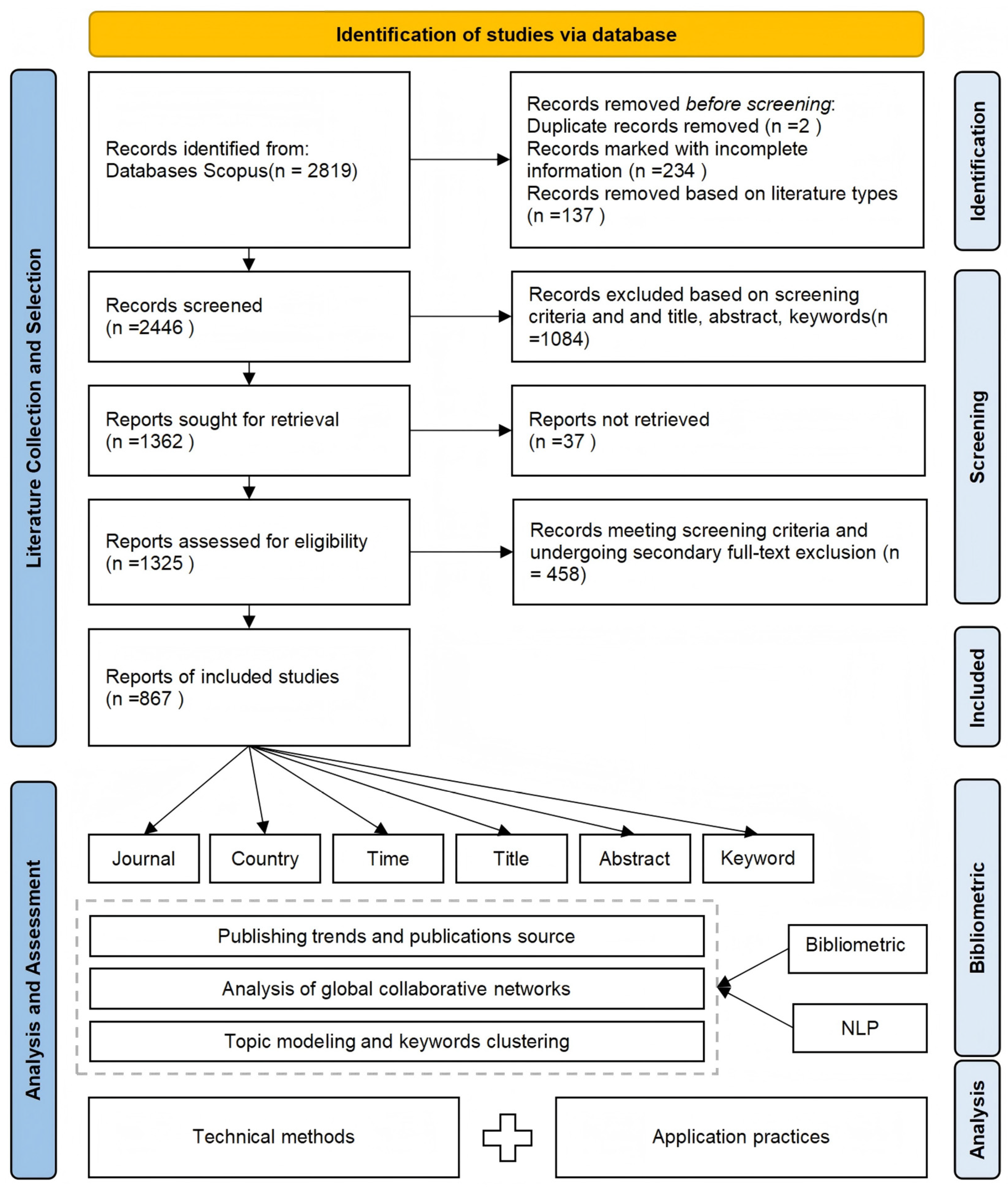
2.1. Literature Collection and Selection
- Focus on the field of cultural heritage preservation, emphasizing heritage science research.
- Study subjects include the physical cultural heritage itself and its digital carriers, as well as intangible cultural heritage integrated with physical airlines (e.g., characters, scripts, inscriptions).
- Research must apply at least one machine learning or deep learning technique to address practical problems in heritage conservation.
2.2. Literature Analysis and Assessment
2.2.1. Social Network Analysis
2.2.2. PyBibX: Topic Modeling and Network Analysis
2.2.3. VOSviewer: Keyword Co-Occurrence Analysis
3. Results
3.1. Bibliometric Analysis
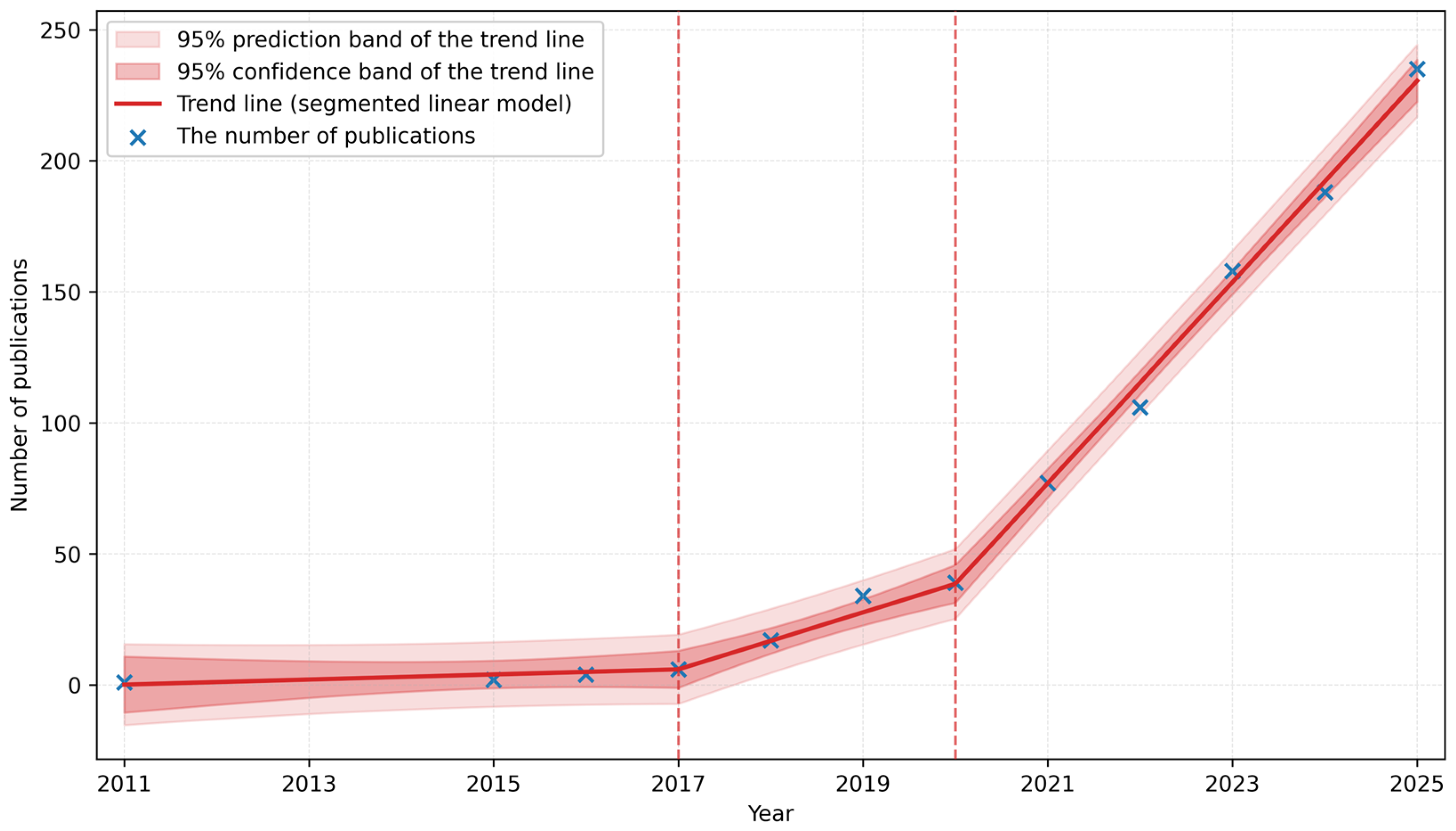
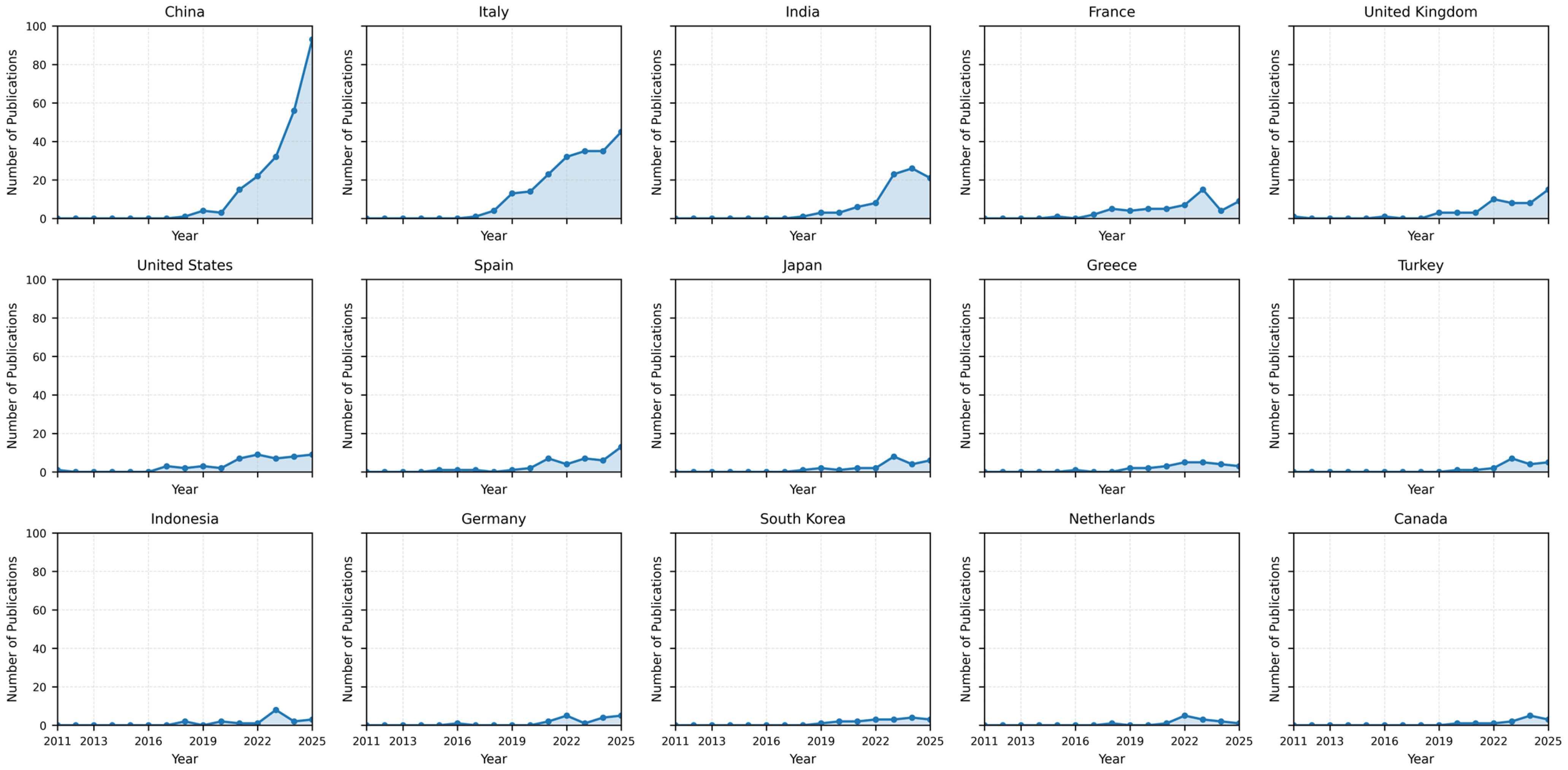
3.1.1. Publishing Trends and Publication Source
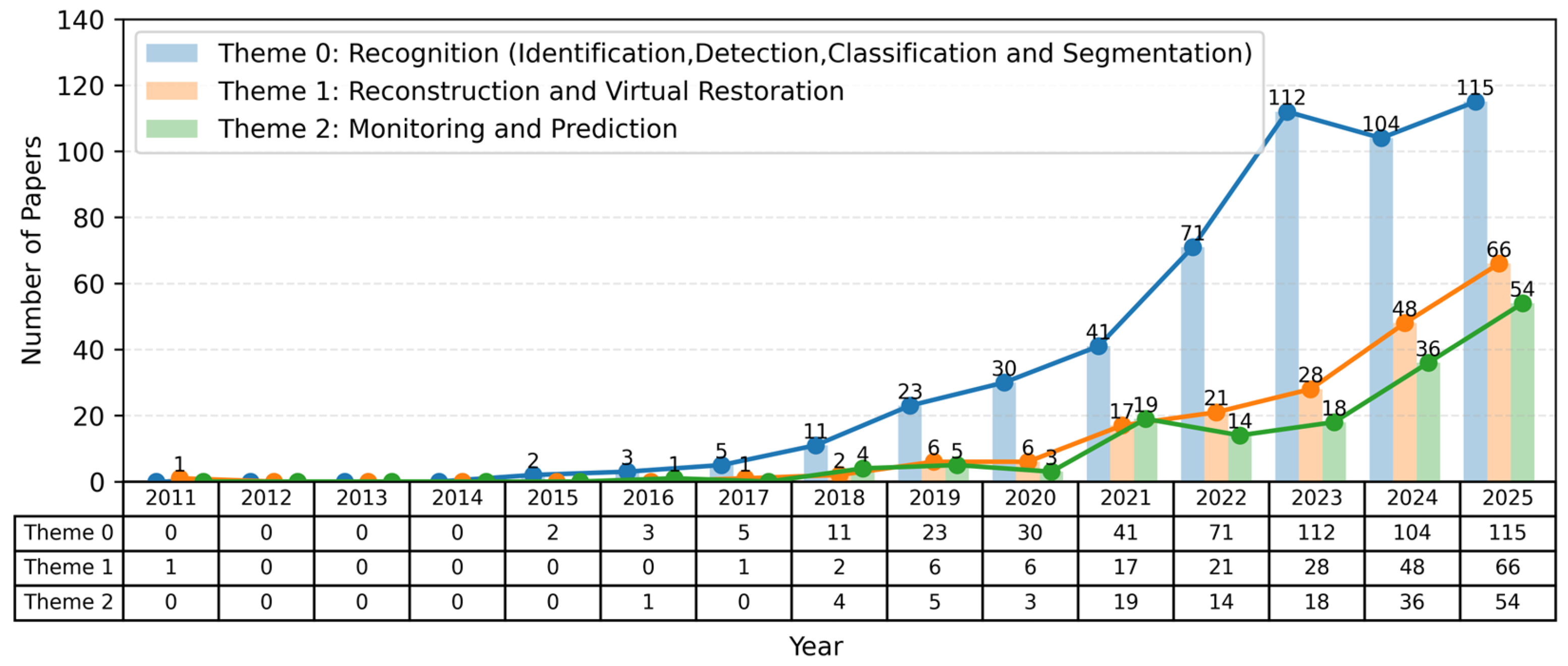
- Annual Publication Volume Trends
- 2.
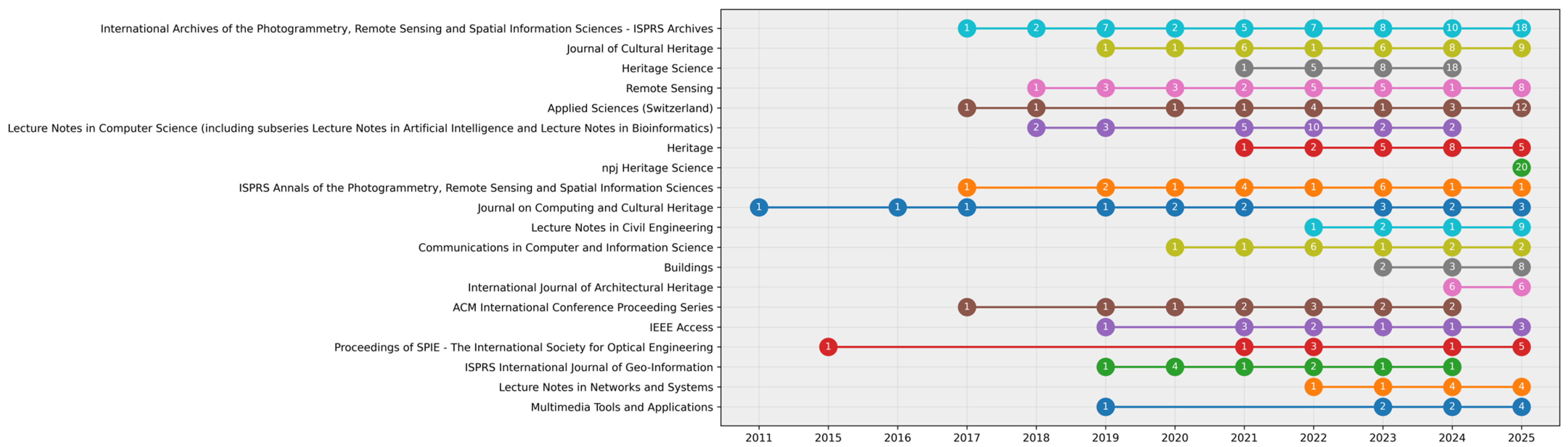
- Publication Sources and Disciplinary Distribution
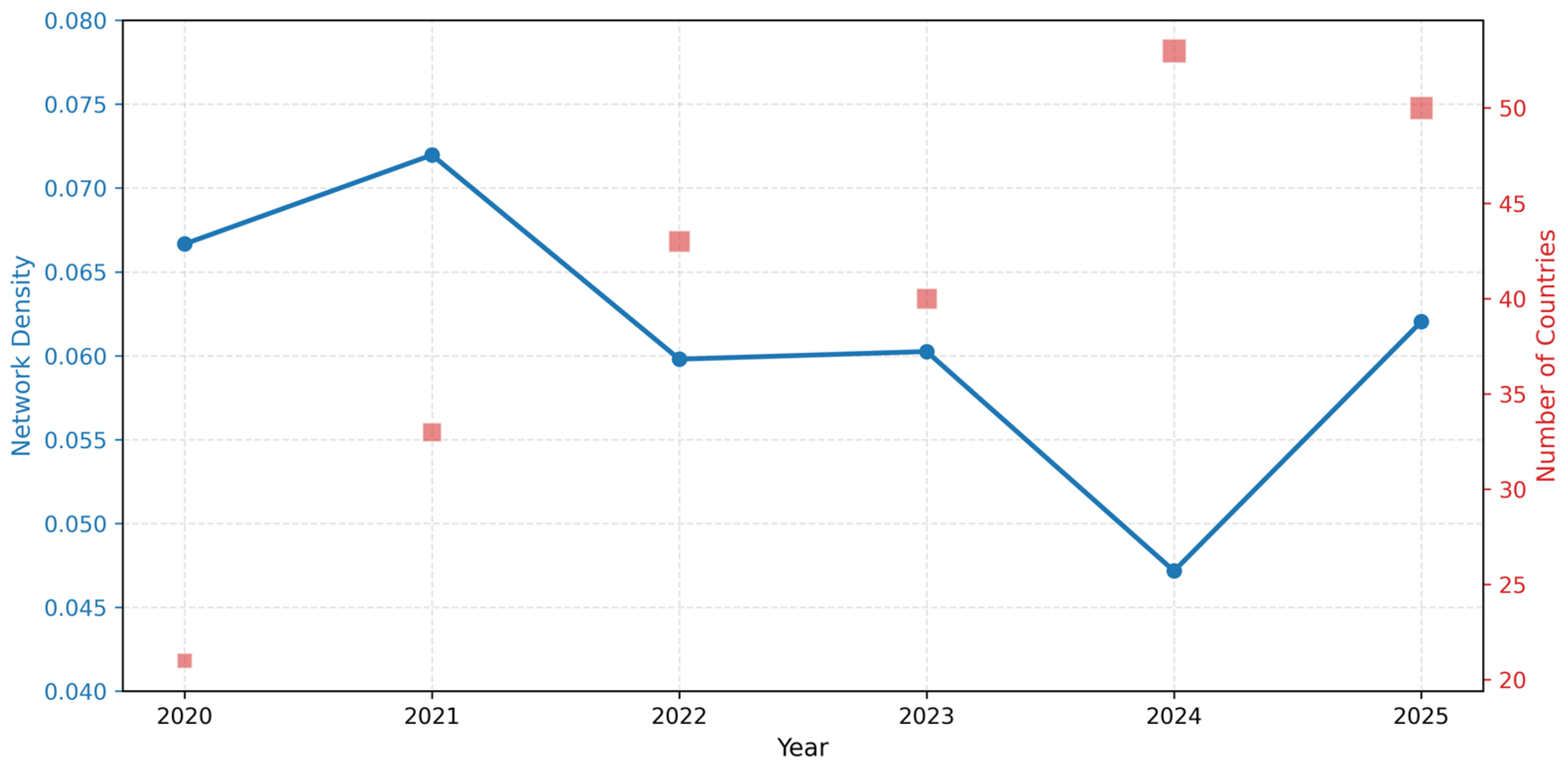
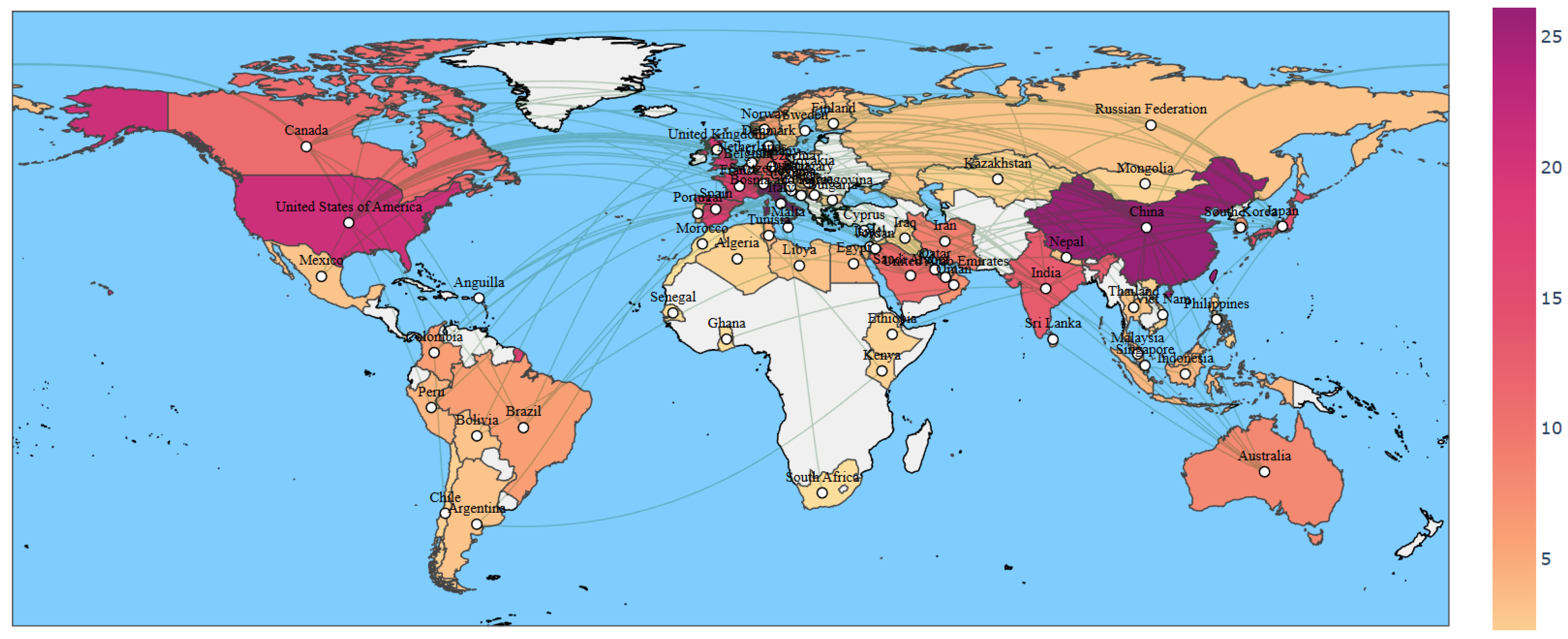
3.1.2. Analysis of Global Collaborative Networks
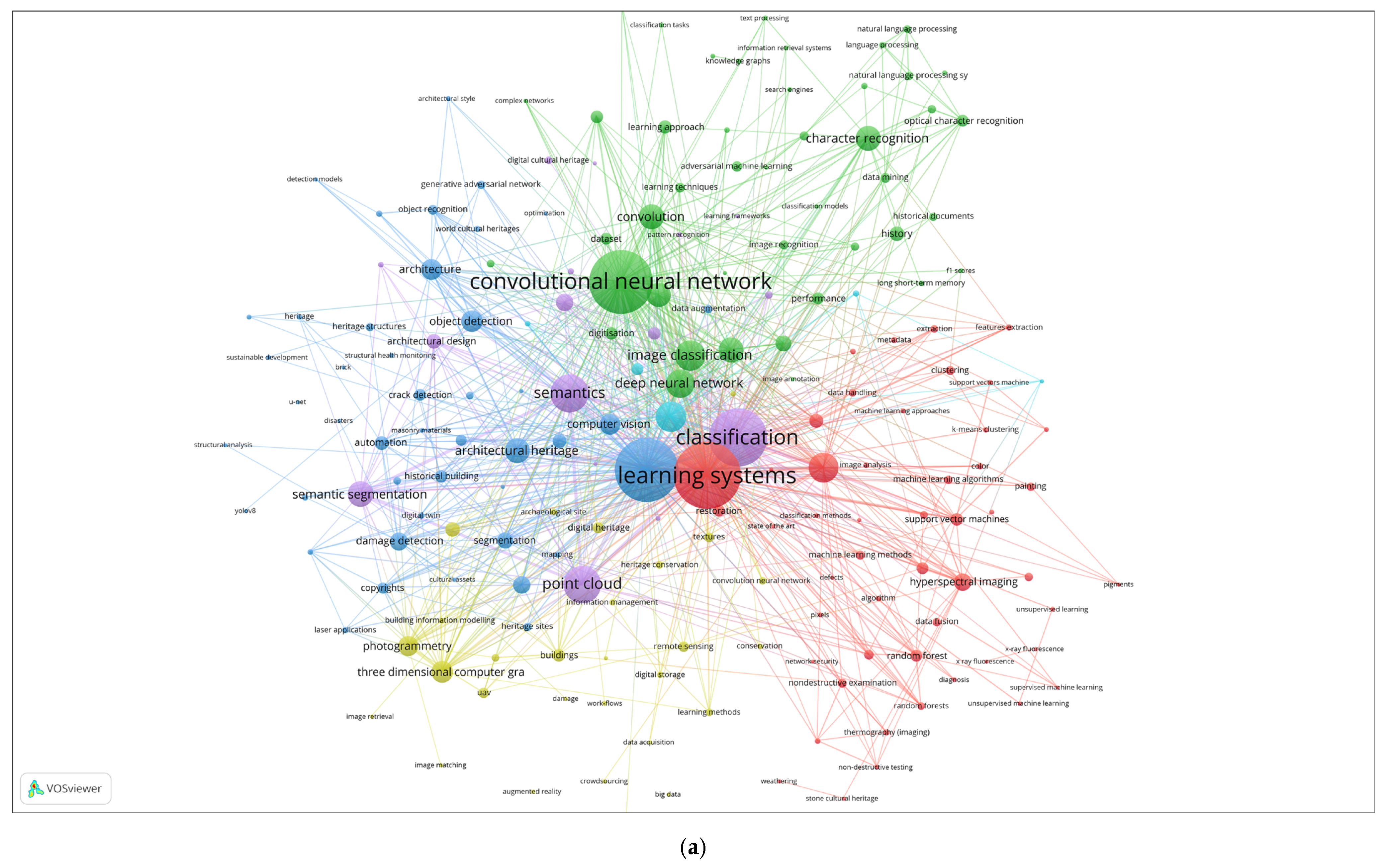
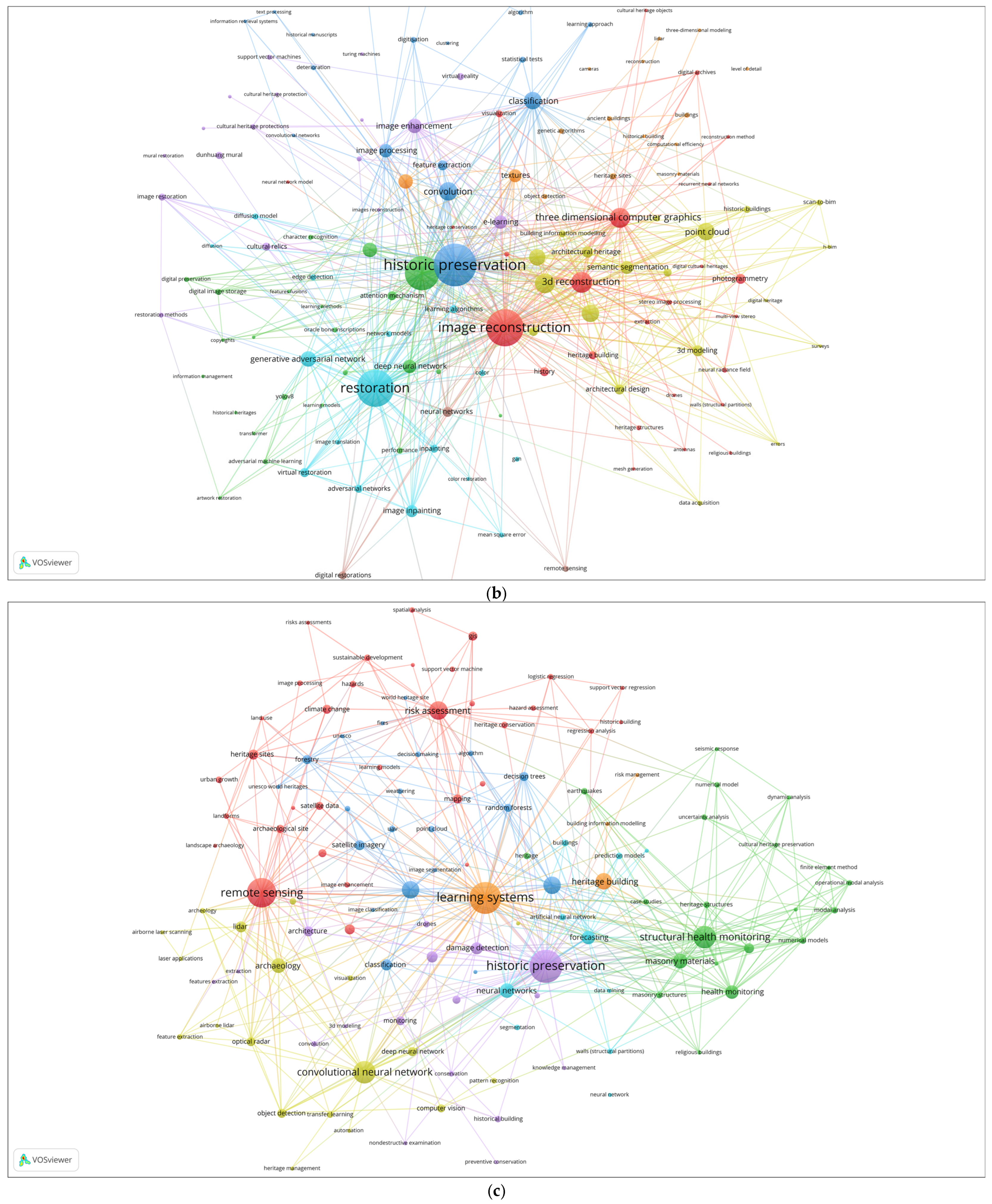
3.1.3. Topic Modeling and Keywords Clustering
3.2. ML and DL Technology in Cultural Heritage Conservation
3.2.1. Machine Learning and Deep Learning
3.2.2. Classic Procedures of ML and DL Applications in CH
- 1.
- Multimodal Data and Data Preprocessing for Digital Cultural Heritage
- 2.
- Model Selection, Model Training, and Model Evaluation
3.3. Applications of ML and DL in Cultural Heritage Conservation
3.3.1. Recognition
3.3.2. Reconstruction and Virtual Restoration
3.3.3. Monitoring and Prediction
4. Discussion
4.1. Exploring Characteristics of Interdisciplinary Research on CH and AI Through Bibliometric Results
4.2. Interoperability and Standardisation Challenges for Multimodal CH Data
4.3. The Rise and Limitations of Synthetic Datasets
4.4. Human–Machine Collaborative Decision-Making Pathways for “Data + Technology + Task”
5. Conclusions and Prospects
- Shared cultural heritage benchmarks: The development of open, standardized, and well-documented benchmark datasets tailored to cultural heritage tasks, enabling fair comparison of methods and improving reproducibility.
- Explainable AI (XAI) protocols: The integration of explainability frameworks to enhance transparency, interpretability, and trust in AI-assisted heritage analysis and conservation decision-making.
- AI–conservator co-design approaches: The promotion of collaborative workflows in which AI systems are designed and validated in close cooperation with conservators, restorers, and domain experts, ensuring methodological relevance and ethical compliance.
Author Contributions
Funding
Data Availability Statement
Acknowledgments
Conflicts of Interest
Appendix A

| Architecture/Models | Backbone/Family/Variants/Frameworks | CH Applications |
|---|---|---|
| Deep Neural Network (DNN) | MLP, Custom architectures | Classification, Regression, Feature Embedding, Attribute Prediction |
| Convolutional Neural Network (CNN) | AlexNet, Inception (GoogLeNet), ResNet family, VGG family, DenseNet, MobileNet, EfficientNet | Image recognition, classification, object detection, semantic segmentation and classification, instance segmentation, point cloud classification and segmentation, feature extraction, image classification, object detection, feature extraction |
| R-CNN variants, RetinaNet, YOLO family, Single Shot Multibox Detector (SSD), Mask R-CNN | ||
| Recurrent Neural Network (RNN) | RNN, Long Short-Term Memory (LSTM), GRU | Sequence prediction, time series analysis and monitoring, speech recognition, sensor signal analysis, text processing, OCR recognition, speech data analysis |
| Graph Neural Network (GNN) | GCN, GAT, GraphSAGE | Network relationship analysis, multimodal association, structural modeling, network topology inference, relationship modeling, knowledge graph |
| Generative Adversarial Network (GAN) | DCGAN, StyleGAN, CycleGAN, Pix2Pix | Image enhancement, image generation, style transfer, virtual restoration, and synthetic training data |
| Transformer | BERT, ViT, DPT, Swin | Long Sequence and Multimodal Data Processing, Depth Estimation, Visual Reconstruction, Language Data Processing, Multimodal Fusion, Text Generation, Sentiment Recognition |
| Autoencoder (AE) | AE, VAE, U-Net, FCRN-Depth | Image reconstruction, noise reduction, semantic segmentation, monocular depth estimation (MDE), 3D reconstruction |
| Diffusion Models | DDPM, Stable Diffusion | Generative Enhancement, Missing Data Restoration, Virtual Reconstruction |
| Hybrid Models | CNN + Transformer (Swin Transformer), GNN + Transformer (Graph Transformer) | Classification, detection, segmentation, recognition, etc. |
| CH Sub-Task | ML/DL Method | Case | Data | Evaluation | Reference |
|---|---|---|---|---|---|
| Archaeological remains detection (Neolithic burial mound) | RF | The megalithic funeral structures in the region of Carnac, the Bay of Quiberon, and the Gulf of Morbihan (France) | Signature (Maximum Terrain Deviation at Three Scales) | confusion matrix, Cohen’s kappa coefficient, precision, recall; probability map | [70] |
| Pottery fragments detection | RF | Archaeological Project at Abdera and Xanthi (APAX), Greece | Signature (RGB and gradient) | Detection rate | [74] |
| Early Fire Detection in Cultural Heritage Buildings | Fire-Det, Fire-Det Nano | The Forbidden City, Prince Gong’s Mansion (China) | Video frame | Recall, Precision, mAP_0.5, Confusion Matrix | [58] |
| Architectural heritage classification | AlexNet, Inception V3, ResNet, and Inception-ResNet-v2 | Architectural Heritage Elements Dataset (AHE_Dataset) | Images | Accuracy, F1 score, Recall, Precision, Confusion Matrix | [22] |
| archaeological/architectural scenarios classification | Fast RF, K-means, RF (implemented in Weka and ImageJ/Fiji) | Basilica and Temple of Neptune (Paestum), Porticoes (Bologna), Mausoleum (Trento), Italy | 2D texture images, and 3D point clouds | Precision, Recall, F1-score, Confusion Matrix | [40] |
| Monumental architectural style façade classification | EXplainable Neural-Symbolic Learning, X-NeSyL (EXPLANet and SHAP-Backprop) | MonuMAI dataset | Images | Accuracy, mAP | [96] |
| architectural structural elements semantic segmentation | PointNet, PointNet++, PCNN, DGCNN and improved-DGCNN | ArCH (architectural cultural heritage) dataset | point clouds and feature vectors | Confusion matrix, Precision, Recall, F1-Score, IoU | [25] |
| architectural structural elements semantic segmentation | kNN, NB, DT, RF; DGCNN, improved-DGCNN, DGCNN-Mod, DGCNN-3Dfeat, DGCNN-Mod+3Dfeat | ArCH (architectural cultural heritage) dataset | point clouds and feature vectors | Overall Accuracy (OA), weighted Precision, Recall and F1-Score, IoU | [24] |
| Ceramics automatic classification | ResNet-18, SVM, RF | the binary image database of Iberian wheel-made pottery vessels’ profiles | binary images | Accuracy, Precision, Recall, F1-Score | [42] |
| Monumental Heritage Architectural Styles Classification Key Elements | MonuNet and MonuMAI-KED (Faster R-CNN, ResNet-101) | MonuMAI dataset | Images | Precision, Recall, F1-Score, mAP, mAR | [97] |
| Character Segmentation in Historical Document Images | Customized CNN | Historical Document Images (Tripitaka Koreana in Han) | Images | IoU, Precision, Recall, F1-Score | [98] |
| Classification of Ancient Egyptian Hieroglyphs | ResNet-50, Inception-v3, Xception and | Merging of two distinct pictographic data sets (derived from pyramid walls, texts, carvings, and murals) | Grayscale images and RGB images | Accuracy, Precision, Recall, F1-Score | [38] |
| cavernous weathering extent | RF | Hegra (UNESCO World Heritage Site, Kingdom of Saudi Arabia) | TLS and UAV-DP point clouds | Accuracy, Recall, Precision | [99] |
| CH Sub-Task | ML/DL Method | Heritage Object | Data | Evaluation | Reference |
|---|---|---|---|---|---|
| Architectural structural elements semantic segmentation to HBIM | RF | The Pisa Charterhouse (Italy) | Feature Vectors, 3D point clouds | Precision, recall, overall accuracy, and F-measure, confusion matrix | [26] |
| Archaeological artifacts fragment matching | M5P regression trees (implemented in Weka) | Fresco Fragments | Feature Vectors (extracted from color images, point clouds, 2D contours) | Precision, Recall | [1] |
| Building façade 3D reconstruction | FCRN-Depth for Single Image Depth Estimation (SIDE), Pix2Pix GAN for Facade Structural Element | Building Façade | RGB images | MSE, Absolute distance deviation | [73] |
| Reliefs 3D reconstruction | Soft-edge-enhanced Depth Estimation Network | Reliefs | 2D Monocular photographs, 2D Edge Images | RMSE, Threshold Accuracy | [100] |
| 3D digitization and immersive visualization of historic buildings | NeRF, Mask R-CNN | Interior Scenes of Historic Buildings | 360° images frame from video, camera poses | PSNR, SSIM, Precision, Error | [77] |
| Degraded artefacts restoration and 3D rendering reconstruction | Stable Diffusion, NeRF | Ceramic artifacts | Images and camera poses, text | MSE, PSNR, SSIM, UIQI, VIF | [79] |
| 3D rendering reconstruction | NeRF | Terpsichore statue, Eagle-shaped lectern, Caprona Tower | Images and camera poses | Cloud-to-cloud deviation analysis | [78] |
| Restoration of painted decorations on heritage building structures | U-Net-MobileNet, Pix2pix, GauGAN | The Forbidden City, China | Mobile phone photographs | Accuracy, Intersection over Union, IoU | [82] |
| Restoration of the Giant Mural | Hybrid CNN-VIT, GLGAN | Yongle Palace, China | Experimental Mural Data | MAE, MSE, PSNR, SSIM | [80] |
| Restoration of the missing mural area | GAN, FCN | Wutaishan, Shanxi Province, China | Images | MSE, PSNR, SSIM | [84] |
| CH Sub-Task | ML/DL Method | Case | Data | Evaluation | Category | Reference |
|---|---|---|---|---|---|---|
| Assessment of landslide susceptibility | GBM, MaxEnt, Ensemble modelling | Cinque Terre National Park (World Heritage site) of northern Italy | 260 landslides points, 13 predisposing factors (PFs) | k-fold cross-validation, ROC (Receiver Operating Characteristics)/AUC (Area Under Curve), True Skill Statistic (TSS), Coefficient of Variation (CV) | landslide | [31] |
| Future rainfall, Future land use analysis, and hazard susceptibility assessment | Boosted Regression Tree, BRT Bayesian Additive Regression Tree, BART Bayesian Generalized Linear Model, BGLM | 27 CH sites and monuments in the Sikkim state of northeastern India | 22 multi-hazard causative factors, 269 and 67 seismic induced debris and rock fall data points from multi-sourse data | receiver operating characteristics-area under curve (ROC-AUC), sensitivity (TPR), specificity (TNR), positive predictive value (PPV) and negative predictive value (NPV) | debris fall, rock fall, and their multi-hazard (MH) | [30] |
| Tide level prediction | M5P Regression Tree, Random Forest, RF, Multilayer Perceptron, MLP | Venice, Italy | Tide gauge data (Punta della Salute) and meteorological data (CNR platform) | R2, Mean Absolute Error (MAE), Root Mean Squared Error (RMSE), Relative Absolute Error (RAE) | Tide level | [32] |
| stone relics hollowing deterioration prediction | SVM-based hollowing deterioration prediction model (SVM-HDPM) | Yungang Grottoes, China | 40 stone fragments 2 mm thick from the Yungang Grottoes sandstone sample | leave-one-out cross-validation (LOOCV), mean square error (MSE), Accuracy | hollowing deterioration | [43] |
References
- Funkhouser, T.; Shin, H.; Toler-Franklin, C.; Castañeda, A.G.; Brown, B.; Dobkin, D.; Rusinkiewicz, S.; Weyrich, T. Learning How to Match Fresco Fragments. J. Comput. Cult. Herit. JOCCH 2011, 4, 1–13. [Google Scholar] [CrossRef]
- Mishra, M. Machine Learning Techniques for Structural Health Monitoring of Heritage Buildings: A State-of-the-Art Review and Case Studies. J. Cult. Herit. 2021, 47, 227–245. [Google Scholar] [CrossRef]
- Tejedor, B.; Lucchi, E.; Bienvenido-Huertas, D.; Nardi, I. Non-Destructive Techniques (NDT) for the Diagnosis of Heritage Buildings: Traditional Procedures and Futures Perspectives. Energy Build. 2022, 263, 112029. [Google Scholar] [CrossRef]
- Mishra, M.; Lourenço, P.B. Artificial Intelligence-Assisted Visual Inspection for Cultural Heritage: State-of-the-Art Review. J. Cult. Herit. 2024, 66, 536–550. [Google Scholar] [CrossRef]
- Yang, S.; Hou, M.; Li, S. Three-Dimensional Point Cloud Semantic Segmentation for Cultural Heritage: A Comprehensive Review. Remote Sens. 2023, 15, 548. [Google Scholar] [CrossRef]
- Argyrou, A.; Agapiou, A. A Review of Artificial Intelligence and Remote Sensing for Archaeological Research. Remote Sens. 2022, 14, 6000. [Google Scholar] [CrossRef]
- Bickler, S.H. Machine Learning Arrives in Archaeology. Adv. Archaeol. Pract. 2021, 9, 186–191. [Google Scholar] [CrossRef]
- Li, Y.; Zhao, L.; Chen, Y.; Zhang, N.; Fan, H.; Zhang, Z. 3D LiDAR and Multi-Technology Collaboration for Preservation of Built Heritage in China: A Review. Int. J. Appl. Earth Obs. Geoinf. 2023, 116, 103156. [Google Scholar] [CrossRef]
- Li, Y.; Du, Y.; Yang, M.; Liang, J.; Bai, H.; Li, R.; Law, A. A Review of the Tools and Techniques Used in the Digital Preservation of Architectural Heritage within Disaster Cycles. Herit. Sci. 2023, 11, 199. [Google Scholar] [CrossRef]
- Fiorucci, M.; Khoroshiltseva, M.; Pontil, M.; Traviglia, A.; Del Bue, A.; James, S. Machine Learning for Cultural Heritage: A Survey. Pattern Recognit. Lett. 2020, 133, 102–108. [Google Scholar] [CrossRef]
- Page, M.J.; Moher, D.; Bossuyt, P.M.; Boutron, I.; Hoffmann, T.C.; Mulrow, C.D.; Shamseer, L.; Tetzlaff, J.M.; Akl, E.A.; Brennan, S.E.; et al. PRISMA 2020 Explanation and Elaboration: Updated Guidance and Exemplars for Reporting Systematic Reviews. BMJ 2021, 372, n160. [Google Scholar] [CrossRef]
- Page, M.J.; McKenzie, J.E.; Bossuyt, P.M.; Boutron, I.; Hoffmann, T.C.; Mulrow, C.D.; Shamseer, L.; Tetzlaff, J.M.; Akl, E.A.; Brennan, S.E.; et al. The PRISMA 2020 Statement: An Updated Guideline for Reporting Systematic Reviews. BMJ 2021, 372, n71. [Google Scholar] [CrossRef] [PubMed]
- Jan van Eck, N.; Waltman, L. Text Mining and Visualization Using VOSviewer. arXiv 2011, arXiv:1109.2058. [Google Scholar] [CrossRef]
- Wasserman, S.; Faust, K. Social Network Analysis: Methods and Applications; Cambridge University Press: Cambridge, UK, 1994. [Google Scholar] [CrossRef]
- Freeman, L.C. Centrality in Social Networks Conceptual Clarification. Soc. Netw. 1978, 1, 215–239. [Google Scholar] [CrossRef]
- Brandes, U. A Faster Algorithm for Betweenness Centrality. J. Math. Sociol. 2001, 25, 163–177. [Google Scholar] [CrossRef]
- Sabidussi, G. The Centrality Index of a Graph. Psychometrika 1966, 31, 581–603. [Google Scholar] [CrossRef]
- Pereira, V.; Basilio, M.P.; Santos, C.H.T. PyBibX—A Python Library for Bibliometric and Scientometric Analysis Powered with Artificial Intelligence Tools. Data Technol. Appl. 2025, 59, 302–337. [Google Scholar] [CrossRef]
- Mallinis, G.; Mitsopoulos, I.; Beltran, E.; Goldammer, J.G. Assessing Wildfire Risk in Cultural Heritage Properties Using High Spatial and Temporal Resolution Satellite Imagery and Spatially Explicit Fire Simulations: The Case of Holy Mount Athos, Greece. Forests 2016, 7, 46. [Google Scholar] [CrossRef]
- Llamas, J.; Lerones, P.M.; Zalama, E.; Gómez-García-Bermejo, J. Applying Deep Learning Techniques to Cultural Heritage Images within the INCEPTION Project. In Digital Heritage. Progress in Cultural Heritage: Documentation, Preservation, and Protection; Lecture Notes in Computer Science (Including Subseries Lecture Notes in Artificial Intelligence and Lecture Notes in Bioinformatics); Springer: Cham, Switzerland, 2016; Volume 10059, pp. 25–32. [Google Scholar] [CrossRef]
- Obeso, A.M.; Benois-Pineau, J.; Álvaro, A.; Acosta, R.; Saraí, M.; Vázquez, G.; Montoya Obeso, A.; García, M.S.; Saraí García Vázquez, M. Architectural Style Classification of Mexican Historical Buildings Using Deep Convolutional Neural Networks and Sparse Features. J. Electron. Imaging 2016, 26, 11016. [Google Scholar] [CrossRef]
- Llamas, J.; Lerones, P.M.; Medina, R.; Zalama, E.; Gómez-García-Bermejo, J. Classification of Architectural Heritage Images Using Deep Learning Techniques. Appl. Sci. 2017, 7, 992. [Google Scholar] [CrossRef]
- Bassier, M.; Vergauwen, M.; Van Genechten, B. Automated classification of heritage buildings for as-built BIM using machine learning techniques. ISPRS Ann. Photogramm. Remote Sens. Spat. Inf. Sci. 2017, 4, 25–30. [Google Scholar] [CrossRef]
- Matrone, F.; Grilli, E.; Martini, M.; Paolanti, M.; Pierdicca, R.; Remondino, F. Comparing Machine and Deep Learning Methods for Large 3D Heritage Semantic Segmentation. ISPRS Int. J. Geo Inf. 2020, 9, 535. [Google Scholar] [CrossRef]
- Pierdicca, R.; Paolanti, M.; Matrone, F.; Martini, M.; Morbidoni, C.; Malinverni, E.S.; Frontoni, E.; Lingua, A.M. Point Cloud Semantic Segmentation Using a Deep Learning Framework for Cultural Heritage. Remote Sens. 2020, 12, 1005. [Google Scholar] [CrossRef]
- Croce, V.; Caroti, G.; De Luca, L.; Jacquot, K.; Piemonte, A.; Véron, P. From the Semantic Point Cloud to Heritage-Building Information Modeling: A Semiautomatic Approach Exploiting Machine Learning. Remote Sens. 2021, 13, 461. [Google Scholar] [CrossRef]
- Teruggi, S.; Grilli, E.; Russo, M.; Fassi, F.; Remondino, F. A Hierarchical Machine Learning Approach for Multi-Level and Multi-Resolution 3D Point Cloud Classification. Remote Sens. 2020, 12, 2598. [Google Scholar] [CrossRef]
- Matrone, F.; Lingua, A.; Pierdicca, R.; Malinverni, E.S.; Paolanti, M.; Grilli, E.; Remondino, F.; Murtiyoso, A.; Landes, T. A benchmark for large-scale heritage point cloud semantic segmentation. Int. Arch. Photogramm. Remote Sens. Spat. Inf. Sci. 2020, XLIII-B2-2020, 1419–1426. [Google Scholar] [CrossRef]
- Hatir, M.E.; Barstuğan, M.; İnce, İ. Deep Learning-Based Weathering Type Recognition in Historical Stone Monuments. J. Cult. Herit. 2020, 45, 193–203. [Google Scholar] [CrossRef]
- Saha, A.; Pal, S.C.; Santosh, M.; Janizadeh, S.; Chowdhuri, I.; Norouzi, A.; Roy, P.; Chakrabortty, R. Modelling Multi-Hazard Threats to Cultural Heritage Sites and Environmental Sustainability: The Present and Future Scenarios. J. Clean. Prod. 2021, 320, 128713. [Google Scholar] [CrossRef]
- Di Napoli, M.; Carotenuto, F.; Cevasco, A.; Confuorto, P.; Di Martire, D.; Firpo, M.; Pepe, G.; Raso, E.; Calcaterra, D. Machine Learning Ensemble Modelling as a Tool to Improve Landslide Susceptibility Mapping Reliability. Landslides 2020, 17, 1897–1914. [Google Scholar] [CrossRef]
- Granata, F.; Di Nunno, F. Artificial Intelligence Models for Prediction of the Tide Level in Venice. Stoch. Environ. Res. Risk Assess. 2021, 35, 2537–2548. [Google Scholar] [CrossRef]
- Mehta, S.; Kukreja, V.; Bordoloi, D. Heritage Coin Identification Using Convolutional Neural Networks: A Multi-Classification Approach for Numismatic Research. In Proceedings of the 2023 2nd International Conference on Augmented Intelligence and Sustainable Systems, ICAISS 2023, Trichy, India, 23–25 August 2023; pp. 1–6. [Google Scholar] [CrossRef]
- Cardellicchio, A.; Ruggieri, S.; Nettis, A.; Renò, V.; Uva, G. Physical Interpretation of Machine Learning-Based Recognition of Defects for the Risk Management of Existing Bridge Heritage. Eng. Fail. Anal. 2023, 149, 107237. [Google Scholar] [CrossRef]
- Trier, Ø.D.; Reksten, J.H.; Løseth, K. Automated Mapping of Cultural Heritage in Norway from Airborne Lidar Data Using Faster R-CNN. Int. J. Appl. Earth Obs. Geoinf. 2021, 95, 102241. [Google Scholar] [CrossRef]
- Lei, Y.; Shen, Z.; Tian, F.; Yang, X.; Wang, F.; Pan, R.; Wang, H.; Jiao, S.; Kou, W. Fire Risk Level Prediction of Timber Heritage Buildings Based on Entropy and XGBoost. J. Cult. Herit. 2023, 63, 11–22. [Google Scholar] [CrossRef]
- Gallwey, J.; Eyre, M.; Tonkins, M.; Coggan, J. Bringing Lunar LiDAR Back Down to Earth: Mapping Our Industrial Heritage through Deep Transfer Learning. Remote Sens. 2019, 11, 1994. [Google Scholar] [CrossRef]
- Barucci, A.; Cucci, C.; Franci, M.; Loschiavo, M.; Argenti, F. A Deep Learning Approach to Ancient Egyptian Hieroglyphs Classification. IEEE Access 2021, 9, 123438–123447. [Google Scholar] [CrossRef]
- Adamopoulos, E. Learning-Based Classification of Multispectral Images for Deterioration Mapping of Historic Structures. J. Build. Pathol. Rehabil. 2021, 6, 41. [Google Scholar] [CrossRef]
- Grilli, E.; Remondino, F. Classification of 3D Digital Heritage. Remote Sens. 2019, 11, 847. [Google Scholar] [CrossRef]
- Grilli, E.; Remondino, F. Machine Learning Generalisation across Different 3D Architectural Heritage. ISPRS Int. J. Geo Inf. 2020, 9, 379. [Google Scholar] [CrossRef]
- Navarro, P.; Cintas, C.; Lucena, M.; Fuertes, J.M.; Delrieux, C.; Molinos, M. Learning Feature Representation of Iberian Ceramics with Automatic Classification Models. J. Cult. Herit. 2021, 48, 65–73. [Google Scholar] [CrossRef]
- Meng, T.; Huang, R.; Lu, Y.; Liu, H.; Ren, J.; Zhao, G.; Hu, W. Highly Sensitive Terahertz Non-destructive Testing Technology for Stone Relics Deterioration Prediction Using SVM-Based Machine Learning Models. Herit. Sci. 2021, 9, 24. [Google Scholar] [CrossRef]
- Capobianco, G.; Pronti, L.; Gorga, E.; Romani, M.; Cestelli-Guidi, M.; Serranti, S.; Bonifazi, G. Methodological Approach for the Automatic Discrimination of Pictorial Materials Using Fused Hyperspectral Imaging Data from the Visible to Mid-Infrared Range Coupled with Machine Learning Methods. Spectrochim. Acta A Mol. Biomol. Spectrosc. 2024, 304, 123412. [Google Scholar] [CrossRef] [PubMed]
- Coppola, F.; Frigau, L.; Markelj, J.; Malešič, J.; Conversano, C.; Strlič, M. Near-Infrared Spectroscopy and Machine Learning for Accurate Dating of Historical Books. J. Am. Chem. Soc. 2023, 145, 12305–12314. [Google Scholar] [CrossRef] [PubMed]
- Molada-Tebar, A.; Marqués-Mateu, Á.; Lerma, J.L.; Westland, S. Dominant Color Extraction with K-Means for Camera Characterization in Cultural Heritage Documentation. Remote Sens. 2020, 12, 520. [Google Scholar] [CrossRef]
- Standoli, G.; Salachoris, G.P.; Masciotta, M.G.; Clementi, F. Modal-Based FE Model Updating via Genetic Algorithms: Exploiting Artificial Intelligence to Build Realistic Numerical Models of Historical Structures. Constr. Build. Mater. 2021, 303, 124393. [Google Scholar] [CrossRef]
- Salachoris, G.P.; Standoli, G.; Betti, M.; Milani, G.; Clementi, F. Evolutionary Numerical Model for Cultural Heritage Structures via Genetic Algorithms: A Case Study in Central Italy. Bull. Earthq. Eng. 2024, 22, 3591–3625. [Google Scholar] [CrossRef]
- Gara, F.; Nicoletti, V.; Arezzo, D.; Cipriani, L.; Leoni, G. Model Updating of Cultural Heritage Buildings Through Swarm Intelligence Algorithms. Int. J. Archit. Herit. 2025, 19, 259–275. [Google Scholar] [CrossRef]
- Sheng, J.; Song, C.; Wang, J.; Han, Y. Convolutional Neural Network Style Transfer towards Chinese Paintings. IEEE Access 2019, 7, 163719–163728. [Google Scholar] [CrossRef]
- Peng, X.; Zhao, H.; Wang, X.; Zhang, Y.; Li, Z.; Zhang, Q.; Wang, J.; Peng, J.; Liang, H. C3N: Content-Constrained Convolutional Network for Mural Image Completion. Neural Comput. Appl. 2022, 35, 1959–1970. [Google Scholar] [CrossRef]
- Wang, N.; Zhao, X.; Asce, A.M.; Wang, L.; Zou, Z. Novel System for Rapid Investigation and Damage Detection in Cultural Heritage Conservation Based on Deep Learning. J. Infrastruct. Syst. 2019, 25, 04019020. [Google Scholar] [CrossRef]
- Guyot, A.; Lennon, M.; Lorho, T.; Hubert-Moy, L. Combined Detection and Segmentation of Archeological Structures from LiDAR Data Using a Deep Learning Approach. J. Comput. Appl. Archaeol. 2021, 4, 1–19. [Google Scholar] [CrossRef]
- Kumar, P.; Gupta, V. Restoration of Damaged Artworks Based on a Generative Adversarial Network. Multimed. Tools Appl. 2023, 82, 40967–40985. [Google Scholar] [CrossRef]
- Kumar, P.; Gupta, V.; Grover, M. Dual Attention and Channel Transformer Based Generative Adversarial Network for Restoration of the Damaged Artwork. Eng. Appl. Artif. Intell. 2024, 128, 107457. [Google Scholar] [CrossRef]
- Pathak, R.; Saini, A.; Wadhwa, A.; Sharma, H.; Sangwan, D. An Object Detection Approach for Detecting Damages in Heritage Sites Using 3-D Point Clouds and 2-D Visual Data. J. Cult. Herit. 2021, 48, 74–82. [Google Scholar] [CrossRef]
- Karimi, N.; Mishra, M.; Lourenço, P.B. Deep Learning-Based Automated Tile Defect Detection System for Portuguese Cultural Heritage Buildings. J. Cult. Herit. 2024, 68, 86–98. [Google Scholar] [CrossRef]
- Gao, S.; Huang, G.; Chen, X.; Jiang, H.; Zhou, L.; Gao, X. Two-Stage Deep Learning-Based Video Image Recognition of Early Fires in Heritage Buildings. Eng. Appl. Artif. Intell. 2024, 129, 107598. [Google Scholar] [CrossRef]
- Grilli, E.; Özdemir, E.; Remondino, F. Application of machine and deep learning strategies for the classification of heritage point clouds. Int. Arch. Photogramm. Remote Sens. Spat. Inf. Sci. 2019, XLII-4/W18, 447–454. [Google Scholar] [CrossRef]
- Grilli, E.; Farella, E.M.; Torresani, A.; Remondino, F. Geometric features analysis for the classification of cultural heritage point clouds. Int. Arch. Photogramm. Remote Sens. Spat. Inf. Sci. ISPRS Arch. 2019, 42, 541–548. [Google Scholar] [CrossRef]
- Long, L.; Gan, Z.; Liu, Z.; Zhao, B.; Li, Q. MSD-Det: Masonry Structures Damage Detection Dataset for Preventive Conservation of Heritage. J. Cult. Herit. 2025, 73, 358–370. [Google Scholar] [CrossRef]
- Xu, Z.; Yang, Y.; Fang, Q.; Chen, W.; Xu, T.; Liu, J.; Wang, Z. A Comprehensive Dataset for Digital Restoration of Dunhuang Murals. Sci. Data 2024, 11, 955. [Google Scholar] [CrossRef]
- Li, B.; Feng, J.; Yan, Y.; Kou, G.; Li, H.; Du, Y.; Wang, X.; Li, T.; Peng, Y.; Guo, K.; et al. Building a Chinese Ancient Architecture Multimodal Dataset Combining Image, Annotation and Style-Model. Sci. Data 2024, 11, 1137. [Google Scholar] [CrossRef]
- Dondi, P.; Lombardi, L.; Setti, A. DAFNE: A Dataset of Fresco Fragments for Digital Anastlylosis. Pattern Recognit. Lett. 2020, 138, 631–637. [Google Scholar] [CrossRef]
- Samhouri, M.; Al-Arabiat, L.; Al-Atrash, F. Prediction and Measurement of Damage to Architectural Heritages Facades Using Convolutional Neural Networks. Neural Comput. Appl. 2022, 34, 18125–18141. [Google Scholar] [CrossRef]
- Fu, X.; Angkawisittpan, N. Detecting Surface Defects of Heritage Buildings Based on Deep Learning. J. Intell. Syst. 2024, 33, 20230048. [Google Scholar] [CrossRef]
- Yan, L.; Chen, Y.; Zheng, L.; Zhang, Y. Application of Computer Vision Technology in Surface Damage Detection and Analysis of Shedthin Tiles in China: A Case Study of the Classical Gardens of Suzhou. Herit. Sci. 2024, 12, 72. [Google Scholar] [CrossRef]
- Idjaton, K.; Janvier, R.; Balawi, M.; Desquesnes, X.; Brunetaud, X.; Treuillet, S. Detection of Limestone Spalling in 3D Survey Images Using Deep Learning. Autom. Constr. 2023, 152, 104919. [Google Scholar] [CrossRef]
- Mishra, M.; Barman, T.; Ramana, G.V. Artificial Intelligence-Based Visual Inspection System for Structural Health Monitoring of Cultural Heritage. J. Civ. Struct. Health Monit. 2022, 14, 103–120. [Google Scholar] [CrossRef]
- Guyot, A.; Hubert-Moy, L.; Lorho, T. Detecting Neolithic Burial Mounds from LiDAR-Derived Elevation Data Using a Multi-Scale Approach and Machine Learning Techniques. Remote Sens. 2018, 10, 225. [Google Scholar] [CrossRef]
- Stott, D.; Kristiansen, S.M.; Sindbæk, S.M. Searching for Viking Age Fortresses with Automatic Landscape Classification and Feature Detection. Remote Sens. 2019, 11, 1881. [Google Scholar] [CrossRef]
- Meng, L.; Lyu, B.; Zhang, Z.; Aravinda, C.V.; Kamitoku, N.; Yamazaki, K. Oracle Bone Inscription Detector Based on SSD. In New Trends in Image Analysis and Processing—ICIAP 2019; Lecture Notes in Computer Science (Including Subseries Lecture Notes in Artificial Intelligence and Lecture Notes in Bioinformatics); Springer: Cham, Switzerland, 2019; Volume 11808, pp. 126–136. [Google Scholar] [CrossRef]
- Bacharidis, K.; Sarri, F.; Ragia, L. 3D Building Façade Reconstruction Using Deep Learning. ISPRS Int. J. Geo Inf. 2020, 9, 322. [Google Scholar] [CrossRef]
- Orengo, H.A.; Garcia-Molsosa, A. A Brave New World for Archaeological Survey: Automated Machine Learning-Based Potsherd Detection Using High-Resolution Drone Imagery. J. Archaeol. Sci. 2019, 112, 105013. [Google Scholar] [CrossRef]
- Morbidoni, C.; Pierdicca, R.; Paolanti, M.; Quattrini, R.; Mammoli, R. Learning from Synthetic Point Cloud Data for Historical Buildings Semantic Segmentation. J. Comput. Cult. Herit. JOCCH 2020, 13, 1–16. [Google Scholar] [CrossRef]
- Kulkarni, U.; Meena, S.M.; Gurlahosur, S.V.; Mudengudi, U. Classification of Cultural Heritage Sites Using Transfer Learning. In Proceedings of the 2019 IEEE 5th International Conference on Multimedia Big Data, BigMM 2019, Singapore, 11–13 September 2019; pp. 391–397. [Google Scholar] [CrossRef]
- Baradaran Rahimi, F.; Demers, C.M.H.; Karimi Dastjerdi, M.R.; Lalonde, J.F. Agile Digitization for Historic Architecture Using 360° Capture, Deep Learning, and Virtual Reality. Autom. Constr. 2025, 171, 105986. [Google Scholar] [CrossRef]
- Croce, V.; Billi, D.; Caroti, G.; Piemonte, A.; De Luca, L.; Véron, P. Comparative Assessment of Neural Radiance Fields and Photogrammetry in Digital Heritage: Impact of Varying Image Conditions on 3D Reconstruction. Remote Sens. 2024, 16, 301. [Google Scholar] [CrossRef]
- Stoean, R.; Bacanin, N.; Stoean, C.; Ionescu, L. Bridging the Past and Present: AI-Driven 3D Restoration of Degraded Artefacts for Museum Digital Display. J. Cult. Herit. 2024, 69, 18–26. [Google Scholar] [CrossRef]
- Yang, J.; Intan Raihana Ruhaiyem, N.; Zhou, C. A 3M-Hybrid Model for the Restoration of Unique Giant Murals: A Case Study on the Murals of Yongle Palace. IEEE Access 2025, 13, 38809–38824. [Google Scholar] [CrossRef]
- Xu, Z.; Geng, C. Color Restoration of Mural Images Based on a Reversible Neural Network: Leveraging Reversible Residual Networks for Structure and Texture Preservation. Herit. Sci. 2024, 12, 351. [Google Scholar] [CrossRef]
- Zou, Z.; Zhao, P.; Zhao, X. Virtual Restoration of the Colored Paintings on Weathered Beams in the Forbidden City Using Multiple Deep Learning Algorithms. Adv. Eng. Inform. 2021, 50, 101421. [Google Scholar] [CrossRef]
- Mei, Y.; Yang, L.; Wang, M.; Yu, T.; Wu, K. DunHuangStitch: Unsupervised Deep Image Stitching of Dunhuang Murals. IEEE Trans. Vis. Comput. Graph. 2025, 31, 4226–4240. [Google Scholar] [CrossRef]
- Cao, J.; Zhang, Z.; Zhao, A.; Cui, H.; Zhang, Q. Ancient Mural Restoration Based on a Modified Generative Adversarial Network. Herit. Sci. 2020, 8, 7. [Google Scholar] [CrossRef]
- Yang, R.; Ota, K.; Dong, M.; Wu, X. Semantic Layout-Guided Diffusion Model for High-Fidelity Image Synthesis in ‘The Thousand Li of Rivers and Mountains’. Expert Syst. Appl. 2025, 263, 125645. [Google Scholar] [CrossRef]
- Deng, Y.; Ju, H.; Li, Y.; Hu, Y.; Li, A. Abnormal Data Recovery of Structural Health Monitoring for Ancient City Wall Using Deep Learning Neural Network. Int. J. Archit. Herit. 2024, 18, 389–407. [Google Scholar] [CrossRef]
- Parida, L.; Moharana, S.; Ferreira, V.M.; Giri, S.K.; Ascensão, G. A Novel CNN-LSTM Hybrid Model for Prediction of Electro-Mechanical Impedance Signal Based Bond Strength Monitoring. Sensors 2022, 22, 9920. [Google Scholar] [CrossRef] [PubMed]
- General Office of the State Council. The 14th Five-Year Plan for Cultural Heritage Protection and Scientific and Technological Innovation. 2021. Available online: https://www.mct.gov.cn/whzx/whyw/202111/t20211109_928893.htm (accessed on 4 February 2026).
- General Office of the Central Committee of the Communist Party of China; General Office of the State Council. Opinions on Promoting the Implementation of the National Cultural Digitization Strategy. 2022. Available online: https://www.mee.gov.cn/zcwj/zyygwj/202205/t20220522_982842.shtml (accessed on 4 February 2026).
- The Cultural Heritage Cloud—Research and Innovation—European Commission. Available online: https://research-and-innovation.ec.europa.eu/research-area/social-sciences-and-humanities/cultural-heritage-and-cultural-and-creative-industries-ccis/cultural-heritage-cloud_en?f_link_type=f_linkinlinenote&flow_extra=eyJkb2NfcG9zaXRpb24iOjAsImRvY19pZCI6IjBkYWMzZGQxYzZhYjA1MWMtMjEzN2E4MWU1YzI3NjQzMCIsImlubGluZV9kaXNwbGF5X3Bvc2l0aW9uIjowfQ%3D%3D&prefLang=es (accessed on 4 February 2026).
- The Common European Data Space for Cultural Heritage—Strategy 2025–2030|Shaping Europe’s Digital Future. Available online: https://digital-strategy.ec.europa.eu/en/library/common-european-data-space-cultural-heritage-strategy-2025-2030 (accessed on 4 February 2026).
- Orzechowski, M.; Opioła, Ł.; Martínez, I.L.; Ioannides, M.; Panayiotou, P.N.; Dutka, Ł.; Słota, R.G.; Kitowski, J. Integrated Data, Metadata, and Paradata Management System for 3D Digital Cultural Heritage Objects: Workflow Automation, Federated Authentication, and Publication. Future Gener. Comput. Syst. 2026, 174, 107964. [Google Scholar] [CrossRef]
- Discover Europe’s Digital Cultural Heritage|Europeana. Available online: https://www.europeana.eu/en (accessed on 4 February 2026).
- Tiribelli, S.; Pansoni, S.; Frontoni, E.; Giovanola, B. Ethics of Artificial Intelligence for Cultural Heritage: Opportunities and Challenges. IEEE Trans. Technol. Soc. 2024, 5, 293. [Google Scholar] [CrossRef]
- Battini, C.; Ferretti, U.; De Angelis, G.; Pierdicca, R.; Paolanti, M.; Quattrini, R. Automatic Generation of Synthetic Heritage Point Clouds: Analysis and Segmentation Based on Shape Grammar for Historical Vaults. J. Cult. Herit. 2024, 66, 37–47. [Google Scholar] [CrossRef]
- Díaz-Rodríguez, N.; Lamas, A.; Sanchez, J.; Franchi, G.; Donadello, I.; Tabik, S.; Filliat, D.; Cruz, P.; Montes, R.; Herrera, F. EXplainable Neural-Symbolic Learning (X-NeSyL) Methodology to Fuse Deep Learning Representations with Expert Knowledge Graphs: The MonuMAI Cultural Heritage Use Case. Inf. Fusion 2022, 79, 58–83. [Google Scholar] [CrossRef]
- Lamas, A.; Tabik, S.; Cruz, P.; Montes, R.; Martínez-Sevilla, Á.; Cruz, T.; Herrera, F. MonuMAI: Dataset, Deep Learning Pipeline and Citizen Science Based App for Monumental Heritage Taxonomy and Classification. Neurocomputing 2021, 420, 266–280. [Google Scholar] [CrossRef]
- Xie, Z.; Huang, Y.; Jin, L.; Liu, Y.; Zhu, Y.; Gao, L.; Zhang, X. Weakly Supervised Precise Segmentation for Historical Document Images. Neurocomputing 2019, 350, 271–281. [Google Scholar] [CrossRef]
- Beni, T.; Nava, L.; Gigli, G.; Frodella, W.; Catani, F.; Casagli, N.; Gallego, J.I.; Margottini, C.; Spizzichino, D. Classification of Rock Slope Cavernous Weathering on UAV Photogrammetric Point Clouds: The Example of Hegra (UNESCO World Heritage Site, Kingdom of Saudi Arabia). Eng. Geol. 2023, 325, 107286. [Google Scholar] [CrossRef]
- Pan, J.; Li, L.; Yamaguchi, H.; Hasegawa, K.; Thufail, F.I.; Brahmantara; Tanaka, S. 3D Reconstruction of Borobudur Reliefs from 2D Monocular Photographs Based on Soft-Edge Enhanced Deep Learning. ISPRS J. Photogramm. Remote Sens. 2022, 183, 439–450. [Google Scholar] [CrossRef]




| Level | Metrics | Formula | Parameter Description | Note |
|---|---|---|---|---|
| Overall | Network Density | L: The total number of nodes in the network. | Measuring the closeness of connections between nodes within a network. | |
| Individual | Degree Centrality | is the number of nodes in the network. | Measures the number of directly connected neighbors for a node, reflecting its level of activity within the network. | |
| Betweenness Centrality | . | The number of times a node serves as the shortest path “bridge” between other nodes reflects its connectivity role within the network. | ||
| Closeness Centrality | . | The reciprocal of the average distance from a node to all other nodes in the network reflects whether that node is “close” to the entire network and can reach all other nodes more quickly. |
| Country | Partners Count | Degree Centrality | Betweenness Centrality | Closeness Centrality |
|---|---|---|---|---|
| Italy | 34 | 0.425 | 0.237 | 0.619 |
| China | 33 | 0.413 | 0.285 | 0.586 |
| USA | 26 | 0.325 | 0.126 | 0.545 |
| UK | 21 | 0.263 | 0.068 | 0.527 |
| France | 18 | 0.225 | 0.077 | 0.534 |
| Spain | 17 | 0.213 | 0.117 | 0.506 |
| Japan | 15 | 0.188 | 0.131 | 0.510 |
| Germany | 14 | 0.175 | 0.068 | 0.481 |
| India | 13 | 0.163 | 0.056 | 0.503 |
| Canada | 13 | 0.163 | 0.028 | 0.494 |
| Greece | 10 | 0.125 | 0.017 | 0.476 |
| Saudi Arabia | 10 | 0.125 | 0.070 | 0.443 |
| Qatar | 9 | 0.113 | 0.016 | 0.479 |
| Netherlands | 9 | 0.113 | 0.009 | 0.481 |
| Poland | 9 | 0.113 | 0.009 | 0.433 |
| Theme | Topic Number | Example Keywords | Number of Documents |
|---|---|---|---|
| Recognition (Identification, Detection, Classification, Segmentation) | 0, 4, 5, 6, 8 | classification, image, recognition, characters, script, manuscripts, handwritten, text, inscriptions, historical, point, semantic, segmentation, damage, detection, building, tiles, wall, gray, types, deterioration, stone, pores, weathering, hollowing, castles, yolo, cracks, fractured, accuracy, proposed, archaeological, sites, potential, remote, lidar, sensing, fragments, visual, art, dataset, content, related, pieces | 517 |
| Reconstruction and Virtual Restoration | 1, 2, 10 | BIM, information, building, techniques, point, reconstruction, reliefs, hidden, visible, parts, texture, depth, restoration, mural, image, color, paintings, network, patterns, segmentation, clouds, semantic, cloud, buildings, architectural, murals, model, health, masonry, structural, detection, historical | 196 |
| Monitoring and Prediction | 3, 7, 9 | archaeological, sites, lidar, remote, sensing, underwater, structural, monitoring, masonry, health, SHM, based, parameters, risk, fire, temperature, climate, timber, regions, seismic, minarets, assessment, accuracy, dataset, classification, performance, architectural, historical, xrf, spectral, pigment, hyperspectral, analysis, materials | 154 |
| Paradigm | Main Advantages | Limitations in the Cultural Heritage Context |
|---|---|---|
| CNN | High robustness in visual feature extraction; effective for textures, patterns, and surface damage | Require large annotated datasets; limited generalization across different sites, periods, and materials; low interpretability for conservation decision-making |
| RF/SVM | Good interpretability; effective on small to medium-sized datasets; stable training behavior | Strong dependence on manual feature engineering; limited performance on high-complexity data such as raw images or unstructured point clouds |
| GAN | High capability for visual restoration and content generation | Risk of introducing non-authentic or hallucinated features; difficult historical and artistic validation; ethical concerns related to authenticity and falsification |
| Transformer | Effective modeling of long-range dependencies and multimodal data | High computational cost; strong dependence on large-scale pretraining; limited availability of sufficiently large CH datasets |
| Diffusion Models | High-quality reconstruction and completion of missing or degraded areas | Limited controllability of the generative process; lack of CH-specific evaluation metrics; risk of over-restoration |
| GNN | Explicit modeling of structural, spatial, and relational information | Non-trivial graph construction; lack of standardized workflows for CH applications |
| Hybrid Models (CNN + Transformer) | Improved balance between local feature extraction and global contextual reasoning | Increased pipeline complexity; reduced interpretability; higher risk of overfitting on small or site-specific datasets |
| Data Type | Data Source | |
|---|---|---|
| Visual | RGB Image | RGB Cameras, Optical Satellites, Aerial Imagery, UAVs equipped with RGB cameras |
| Panoramic Image | Panoramic Cameras | |
| Video | RGB Cameras, Panoramic Cameras, UAV-based Cameras, Surveillance Cameras | |
| Multispectral and Hyperspectral Image | Multispectral Cameras (MSI), Hyperspectral Sensors (HSI), UAVs equipped with Multispectral Cameras | |
| Thermal Image | Thermal Imaging Cameras, UAVs equipped with Thermal Imaging Cameras | |
| Geometric | Point Cloud | Terrestrial Laser Scanner (TLS), Mobile LiDAR (MLS), UAV LiDAR, RGB-D Cameras, Structured-light Scanners |
| Mesh Models | Photogrammetry Pipelines, 3D Laser Scanners, Structured-light Scanners | |
| Parametric Model | Derived from point cloud and mesh model through parametric and rule-based modeling | |
| Spectroscopic | Spectroscopic data | Raman Spectroscopy, X-ray Fluorescence Spectrometer (XRF), Fourier-transform infrared spectroscopy (FTIR) |
| Acoustic | Audio Recordings | Microphones, Audio Recorders, Field Recorders |
| Sensor Time-series | Environmental Monitoring Time Series | Temperature and Humidity Sensors, Vibration Sensors, Strain Gauges, Displacement Sensor, Gas Sensor, Light Sensors |
| Geophysical Time Series | Ground-penetrating Radar (GPR), Electrical Resistivity Tomography (ERT), Magnetometry Sensors, Ultrasound Devices, Seismometers | |
| Textual | Text Data | Text Extraction from Inscriptions and Rubbings, Historical Documents, Ancient Books and Archives |
| Structured and Semantic | Tabular and Relational Database | Management Systems, Databases, GIS Attribute Tables |
| Knowledge Graphs | Knowledge Extraction, Semantic Analysis, Semantic Reasoning Systems | |
| Social and Relational Networks | ||
| CH Theme | Model Evaluation |
|---|---|
| Recognition (Identification, Detection, Classification, Segmentation) | OA, Mean Accuracy (MA), Precision, Recall, F1-score, Intersection over Union (IoU), Area Under ROC Curve (AUC), Mean Average Precision (mAP), Mean Average Recall (mAR), Confusion Matrix |
| Reconstruction and Virtual Restoration | PSNR, SSIM, LPIPS, Mean Square Error (MSE), Universal Image Quality Index (UQI), Visual Information Fidelity (VIF) |
| Monitoring and Prediction | RMSE, MAE, Mean Square Error (MSE), Mean Absolute Percentage Error (MAPE), R2, Sensitivity, Frequency Error (FE), Modal Assurance Criterion (MAC) |
| CH Theme | ML Method | DL Method | Specific Heritage Task |
|---|---|---|---|
| Recognition (Identification, Detection, Classification, Segmentation) | SVM, RF, DT, kNN, K-Means, DBSCAN, Naive Bayes (NB), K-means | CNNs, Faster R-CNN, YOLO family, RetinaNet, ResNet, VGG, Inception, Inception-ResNet, Xception, AlexNet, EfficientNet, MobileNet, U-Net, Mask R-CNN, ViT, Swin Transformer, Autoencoder, Bi-LSTM, DenseNet | Archaeological site and heritage landscape identification, detection, and pattern recognition (e.g., underwater sites, burial mounds, traditional settlements, topography, fortress ruins, heritage monuments); Structural damage detection, deterioration identification, and semantic segmentation (e.g., heritage buildings, historic masonry, wooden structures, caves, grottoes, palaces); Artifact detection and classification (e.g., pottery shards, heritage coins, reliefs, painted rocks, rock carvings, Buddha statues, sculptures); Historical script and document recognition (e.g., ancient scripts, Oracle Bone script, Pictographic writing, historical manuscripts, historical maps); Style and typological classification (e.g., architectural styles, monument styles, ancient painting types); Material identification and spectral analysis (e.g., painting pigments, chemical elements). |
| Reconstruction, Virtual and Restoration | Regression Trees, RF, PCA | U-Net, CNNs, GANs, Mask R-CNN, DGCNN, PointNet, PointNet++, PCNN, Pix2pix, CycleGAN, Diffusion Models, ResNet-based autoencoders, NeRF, Stable Diffusion (SD) | Semi-automatic HBIM reconstruction; Structural completion and fragment reconstruction (e.g., temples, artefacts, ceramics, murals, relics); Digital restoration of damaged heritage surfaces and objects (e.g., murals, paintings, historical documents); Generative style transfer and artistic reconstruction (e.g., architectural decoration, traditional painting). |
| Monitoring and Prediction | Boosted Regression Trees (BRT), Bayesian Additive Regression Trees (BART), Generalized Bayesian Linear Models (GBLM), RF, M5P Regression Trees, XGBoost, Generalized Boosting Model (GBM), Gradient Boosting Decision Tree (GBDT) | LSTM, RNNs, CNNs, U-Net, GCN, GNNs, Seq2Seq, CNN-LSTM Hybrid Model, Gated Recurrent Unit (GRU) | Structural health monitoring and condition assessment (e.g., crack evolution, structural damage evaluation); Deterioration modelling and prediction (e.g., surface degradation, stone weathering, displacement prediction, hollow deterioration, deformation prediction); Environmental hazard monitoring and risk assessment (e.g., flood, erosion, landslide, tidal risk, seismic, fire risk). |
Disclaimer/Publisher’s Note: The statements, opinions and data contained in all publications are solely those of the individual author(s) and contributor(s) and not of MDPI and/or the editor(s). MDPI and/or the editor(s) disclaim responsibility for any injury to people or property resulting from any ideas, methods, instructions or products referred to in the content. |
© 2026 by the authors. Licensee MDPI, Basel, Switzerland. This article is an open access article distributed under the terms and conditions of the Creative Commons Attribution (CC BY) license.
Share and Cite
Li, X.; Chiabrando, F.; Sammartano, G. Machine Learning and Deep Learning for Cultural Heritage Conservation: A Bibliometric and Task-Oriented Review. Remote Sens. 2026, 18, 628. https://doi.org/10.3390/rs18040628
Li X, Chiabrando F, Sammartano G. Machine Learning and Deep Learning for Cultural Heritage Conservation: A Bibliometric and Task-Oriented Review. Remote Sensing. 2026; 18(4):628. https://doi.org/10.3390/rs18040628
Chicago/Turabian StyleLi, Xinchen, Filiberto Chiabrando, and Giulia Sammartano. 2026. "Machine Learning and Deep Learning for Cultural Heritage Conservation: A Bibliometric and Task-Oriented Review" Remote Sensing 18, no. 4: 628. https://doi.org/10.3390/rs18040628
APA StyleLi, X., Chiabrando, F., & Sammartano, G. (2026). Machine Learning and Deep Learning for Cultural Heritage Conservation: A Bibliometric and Task-Oriented Review. Remote Sensing, 18(4), 628. https://doi.org/10.3390/rs18040628