Application of the Thermo-RAdiometric Normalization of Crop Observations (TRANCO) Back in Time: An Assessment of the Potential for Crop Time-Series Generalization to Past Years Using Wheat as a Proxy
 , ,
, ,  ,
,  , ,
, ,  , and
, and 
Highlights
- The TRANCO approach is able to normalize time-series through time.
- The addition of TRANCO into a classifier improves its performance.
- The tests performed in this research show that the TRANCO approach is able to generalize information outside its time component, allowing normalized time-series outside its year of origin to be used by classifiers.
- Such normalization of time-series could allow improving deeper classifiers, even empower the classification of past years’ crops, in which ground truth data could be scarce, by training in recent years.
Abstract
1. Introduction
1.1. Literature Review
Crop Type Maps
- 1.
- 2.
- The phenology shift among distant areas. Mainly caused by the natural change of the climate with latitude, although we also had to take into account areas with altitudes well differentiated on a regional scale. This also influences the type of classification approach used, which must account for these phenomena [18,37,44,48,49,50,51,52,53,54,55,56,57,58,59,60,61].
- 3.
2. Objectives and Questions
3. Materials
3.1. Crop Calendars
3.2. Crop Data Layer
3.3. ERA-5
3.4. Landsat
4. Methodology
4.1. Creating the Analysis Ready Dataset


| CDL Code | Crop |
|---|---|
| 22 | Durum wheat |
| 23 | Spring wheat |
| 24 | Winter wheat |
| 26 | Winter wheat/Soybeans |
| 225 | Winter wheat/Maize |
| 230 | Lettice/Durum Wheat |
| 234 | Durum Wheat/Sorghum |
| 236 | Winter wheat/Sorghum |
| 238 | Winter wheat/Cotton |
Definition of the Study Blocks
4.2. Data Acquisition and Preprocessing
4.2.1. Band Combinations
4.2.2. Normalizations
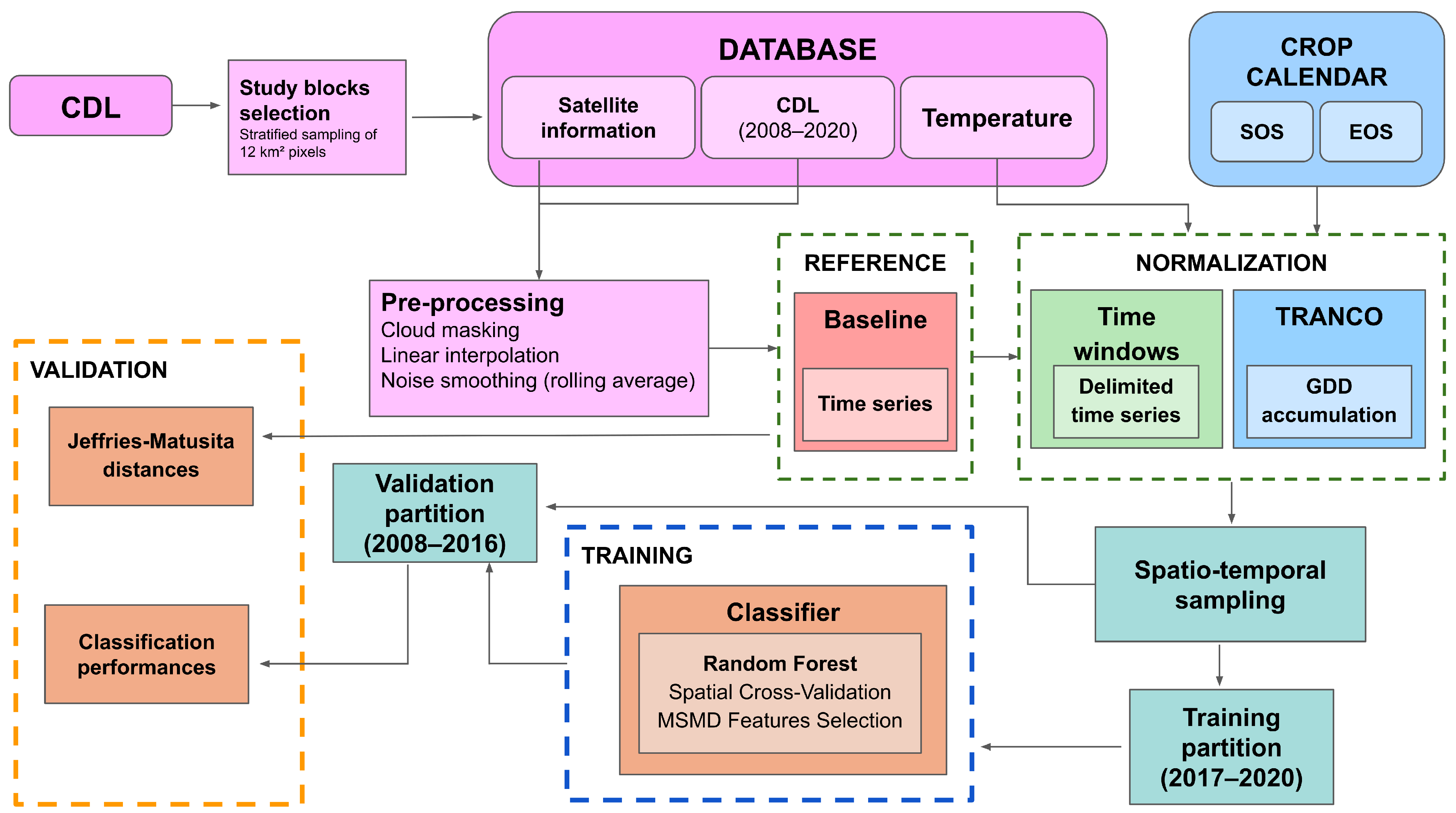
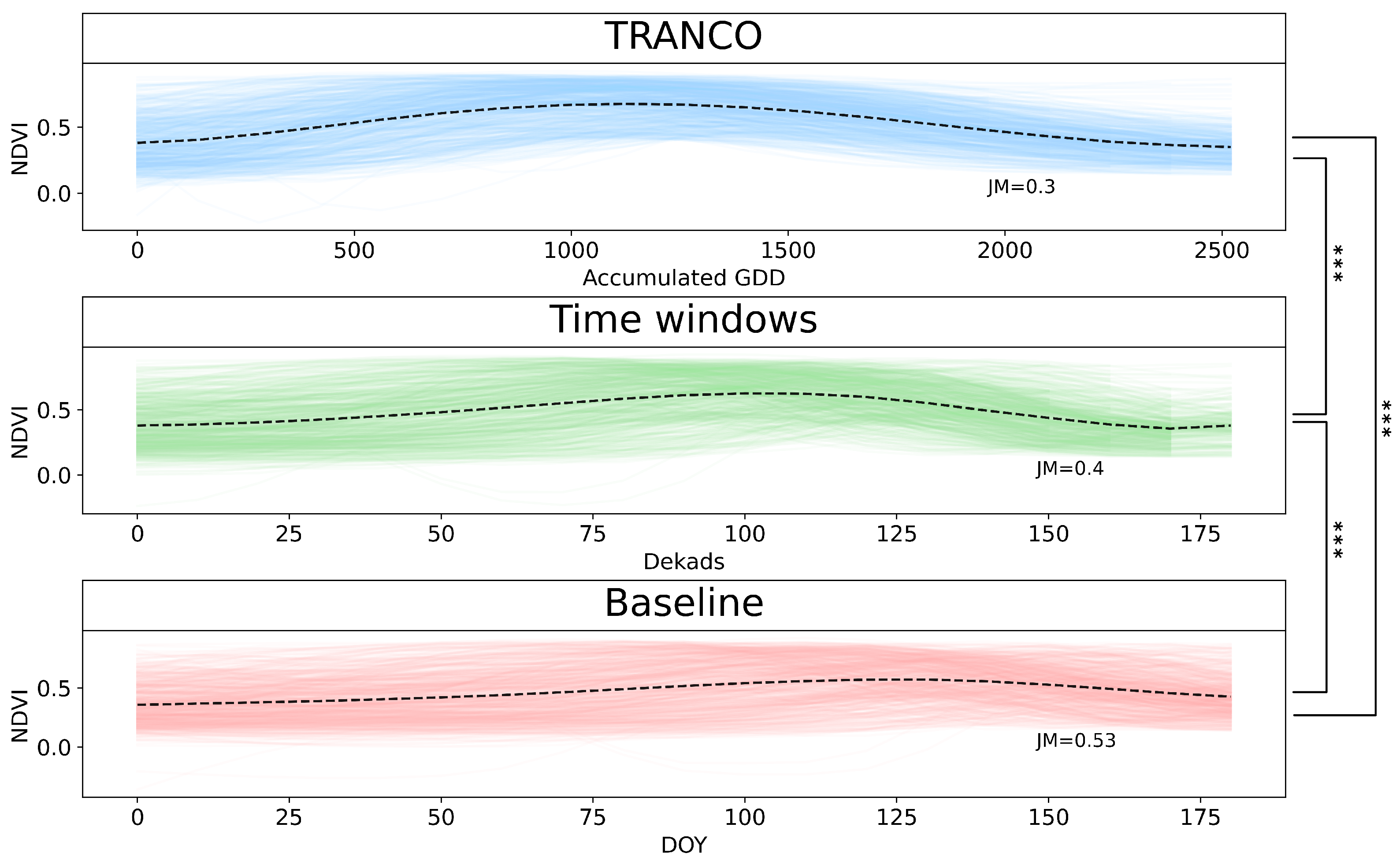
- TRANCO. Vegetation metabolism is related to daily temperature accumulation within maximum and minimum boundaries. If any of these boundaries is surpassed, the metabolism of a plant is reduced to a minimum (minimum boundary) or reaches the maximum activity (maximum boundary) [85,86]. These boundaries, which vary among plant species [87], are used by the GDD to compute effective temperatures, meaning temperatures at which vegetation metabolizes. In our approach, we followed the mathematical definition of [88]:where , , , , and are Growing Degree Days, maximum temperature, minimum temperature, base temperature, and maximum boundary, respectively. Specifically for wheat, the is 0 °C, and the is 25 °C. Although we explored this, we did not consider the maximum boundary here, as our ARD is located in the Northern Hemisphere, where wheat crops develop through winter and early spring, and temperatures usually do not reach the maximum boundary. In fact, generally, the maximum boundary can be omitted and still achieve good results [18,65,67].Furthermore, to accumulate GDD temperatures, it is necessary to know the biofix date, or the date when a phenological cycle begins. In the specific case of wheat crops, this date corresponds to the sowing date, which can be derived from LSP analysis and interpolation or obtained from existing crop calendars [67].TRANCO used Cintas et al. [66] predicted Crop Calendars to define when the accumulation process starts (SOS) and finishes (EOS). We computed the GDD from the AgERA5 2-m air temperature time series [71] and accumulated it from the SOS to the EOS. Then, we translated the time coordinates into temperature ones, defining 140 °C steps: from 0 °C to 2520 °C, and averaged the radiometric signals at each step. When the accumulated GDD series stopped before reaching 2520 °C, the subsequent steps were filled with 0 values. The 2520 °C limit and the 140 °C steps were defined to match the number of model features in the Time windows normalization.
- Time windows. We compared the performance of the TRANCO against a simpler normalization based on time windows. Such time windows limit the wheat time-series to the SOS and EOS dates defined in the predicted Crop Calendars. In other words, a Time windows’ time-series starts at the SOS and grows until it reaches the EOS. In addition, we averaged the radiometric signal inside the time windows into 10-day composites (i.e., dekads).
- Baseline. We evaluated how well both normalizations performed compared with an approach without any normalization, starting the time series on 1 January. and finishing on the 31 December. As in the Time windows case, we averaged the radiometric signals into dekads.
4.3. Maximum Separability Minimum Distance
4.4. Spatio-Temporal Stratified Sampling
- 1.
- The sampling design satisfies the inclusion probabilities given in ∏ (i.e., ).
- 2.
- The longitudinal sample is as spread over time as possible for all the observations, in the sense that once a unit has been selected, it should remain out of the following samples as long as possible.
- 3.
- The cross-sectional sample is as spread in space as possible, for all , in the sense that we avoid selecting geographically neighboring units.
4.5. Time-Series Normalization Assessment
4.5.1. Based on Jeffries–Matusita Distances
4.5.2. An Approximation with a Random Forest Classifier
- Spatial cross-validation strategy. Cross-validation is a key algorithm used throughout this study, from feature selection to error assessment. It is useful for training a model and assessing its performance on data it has never seen before, since it avoids overfitting to the training partition. Cross-validation approaches involve sampling a dataset iteratively, usually from the training partition. In each iteration, the training partition is split into training and test sets to train the model and assess its performance. Commonly, the aggregated results of all the iterations describe better the performance of the model and reduce its variance, ensuring that the model is able to predict new data within an acceptable error [94,95,96].In addition, when dealing with large amounts of data, samples can be correlated, leading to overoptimistic results if the sampling process is not carefully designed. Although a good sampling strategy can be implemented, in some cases, such as when the dataset is heavily biased, it is difficult to eliminate autocorrelation. In order to solve that, we use a specific cross-validation algorithm to minimize the autocorrelation among samples, while keeping as much information as possible. In this study, we used an implementation of the spatial cross-validation algorithm of Brenning [97] but using the Leave One Group Out (LOGO) strategy with the groups defined by the latitude and longitude coordinates of each observation. In the LOGO cross-validation algorithm, k groups are created in each iteration. These groups are based on a defined property of the data, such as color, height, altitude, longitude, or latitude. Once the groups are created, the data associated with k − 1 groups are assigned to the training set, while the remaining group is assigned to the test set; this process is repeated until all the groups have taken the test set role. Then cross-validation continues until the predefined number of iterations is reached. We used the scikit-learn implementation of LOGO found in Pedregosa et al. [93].
4.5.3. Training and Validation Strategies
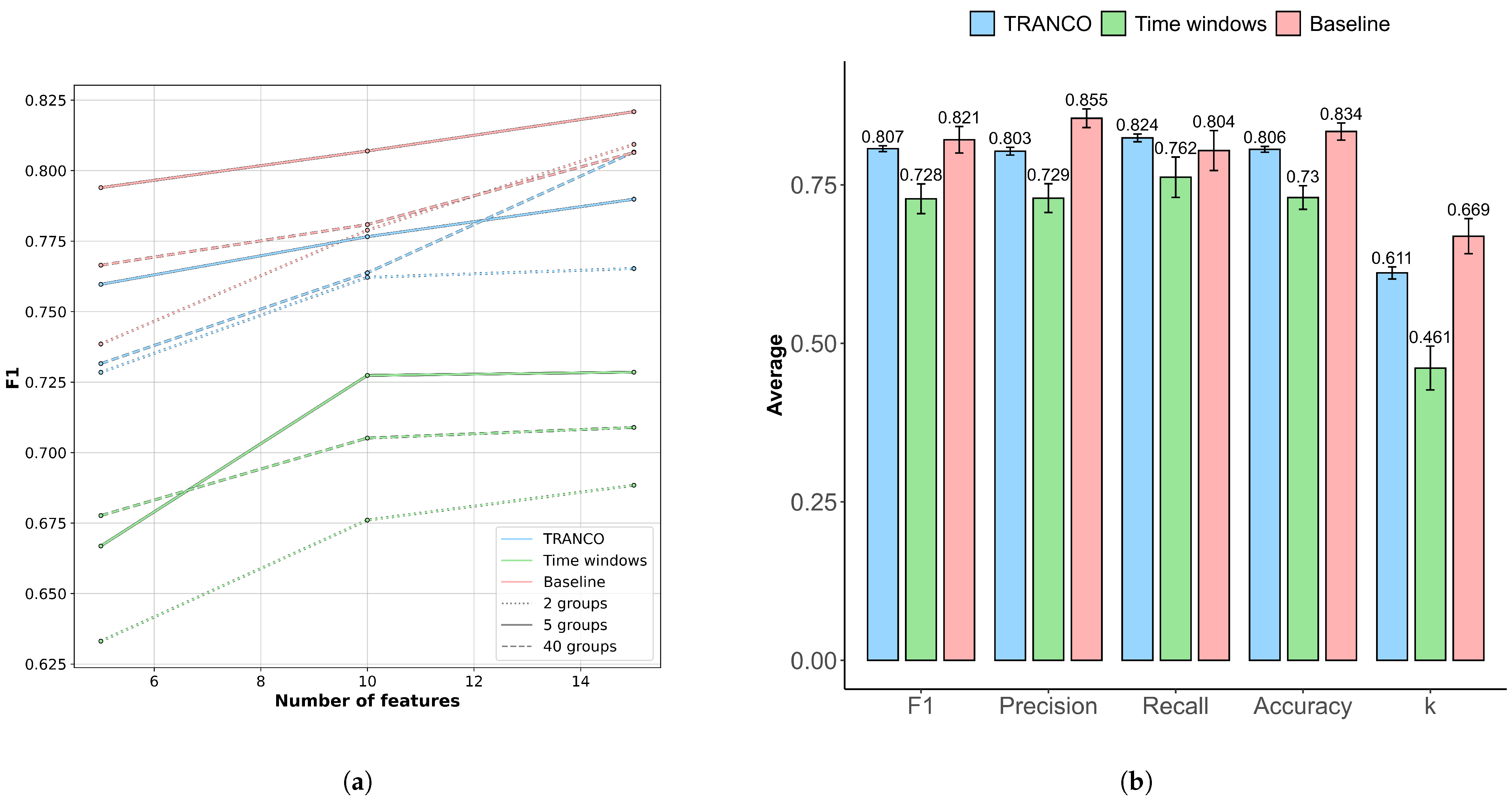
- Training strategy. The spatial cross-validation strategy needs to split the training partition, i.e., the ARD limited to the training period, into a given number of spatial groups. Hence, for each approach, we assessed 11 spatial configurations: 2, 3, 4, 5, 6, 7, 8, 9, 10, 20, and 40 groups, to keep those configurations free of spatial autocorrelation. This autocorrelation was measured by means of two methods: test of independence [98] and Crammer’s V [99]. Once we selected the best configurations, we split the training partition into training (70%) and validation (30%) sets. Then, we trained a random forest classifier on the training set using spatial cross-validation, with groups defined by the selected configurations, for TRANCO, Time windows, and the Baseline. Hence, because we used the full four years of the training period, we did not account for temporal autocorrelation. Furthermore, we computed the MSMD feature scores during the training. This process was repeated 20 times for each approach and configuration.
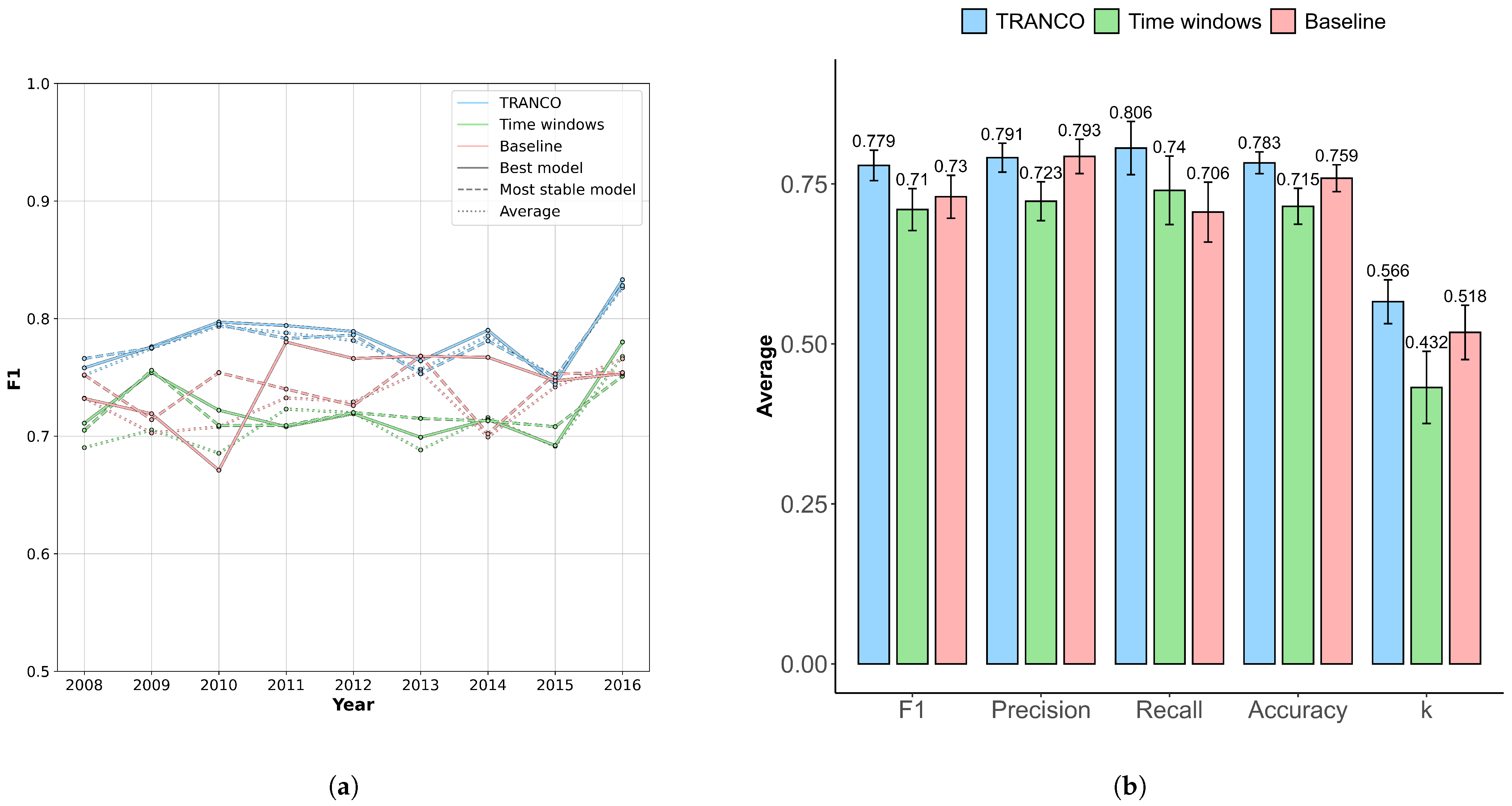
- Validation strategy. The validation was performed in two ways and using typical classification score metrics: F1 [48], precision [100], recall [100], accuracy [101], and [102]. First, we assessed the performance of the best model configuration on the validation set during the training period (2017–2020), which represents the best combination of groups and number of features. Secondly, the best models were used to predict the crop labels within the blocks and for each year in the validation period (i.e., 2008–2016); meaning that each validation was year independent. In this way, we wanted to evaluate how TRANCO performs over time and whether it can normalize better than other approaches, such as Time windows or the Baseline. Such validation was also performed using the spatial cross-validation algorithm, with the group configuration of their respective models. Also, this process was repeated 20 times at random to assess the model’s stability under input variability.
5. Results
5.1. Normalization Performance
5.2. Autocorrelation
5.3. Training Results
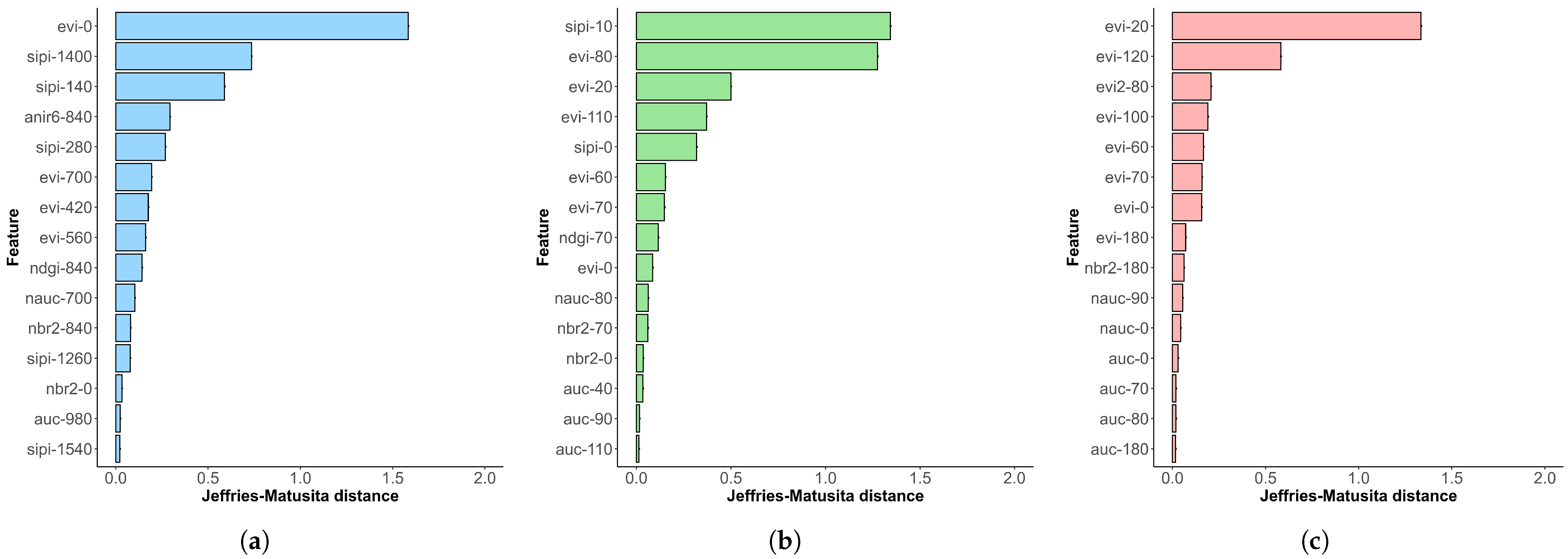
5.4. Features Importance
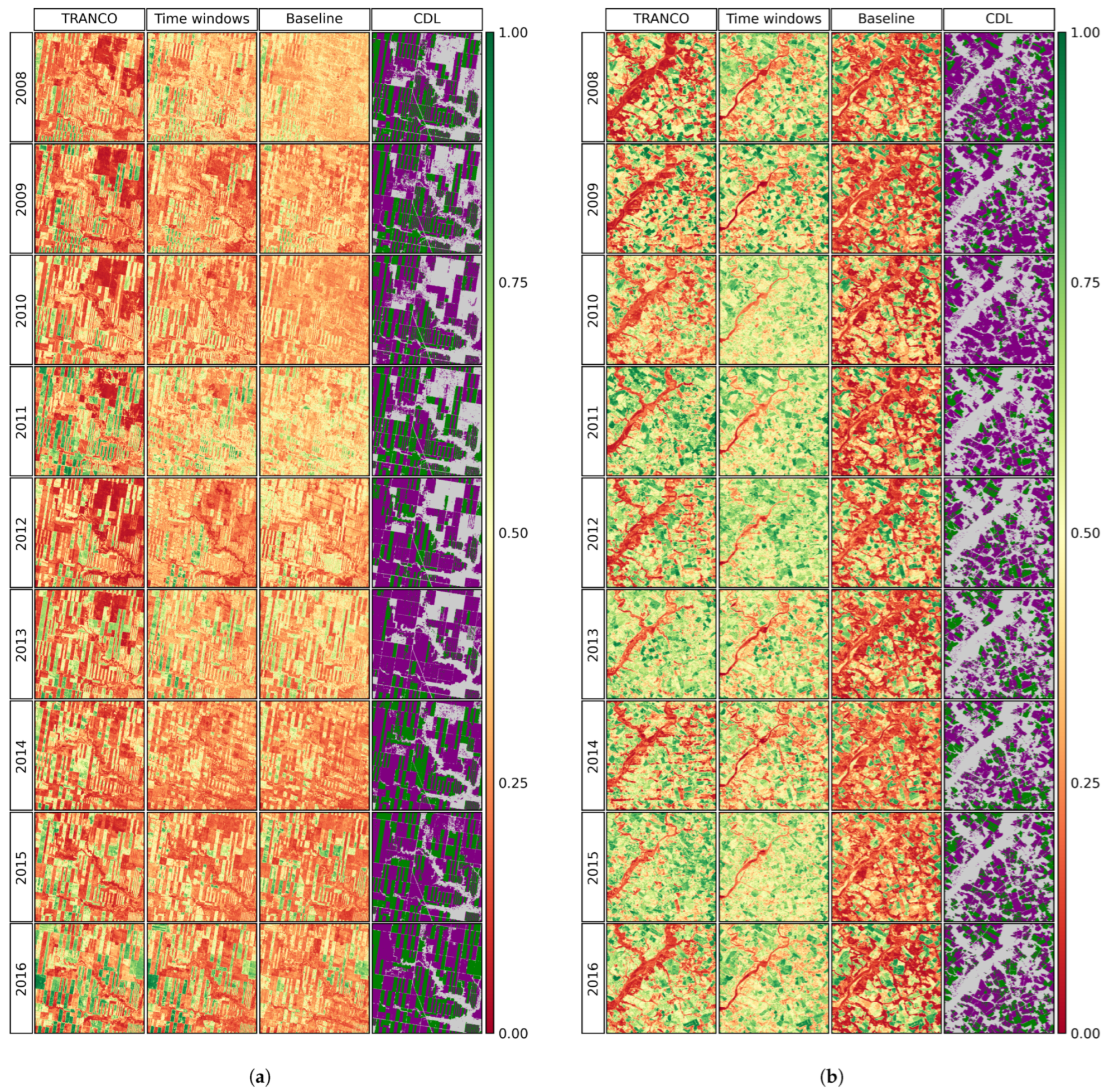
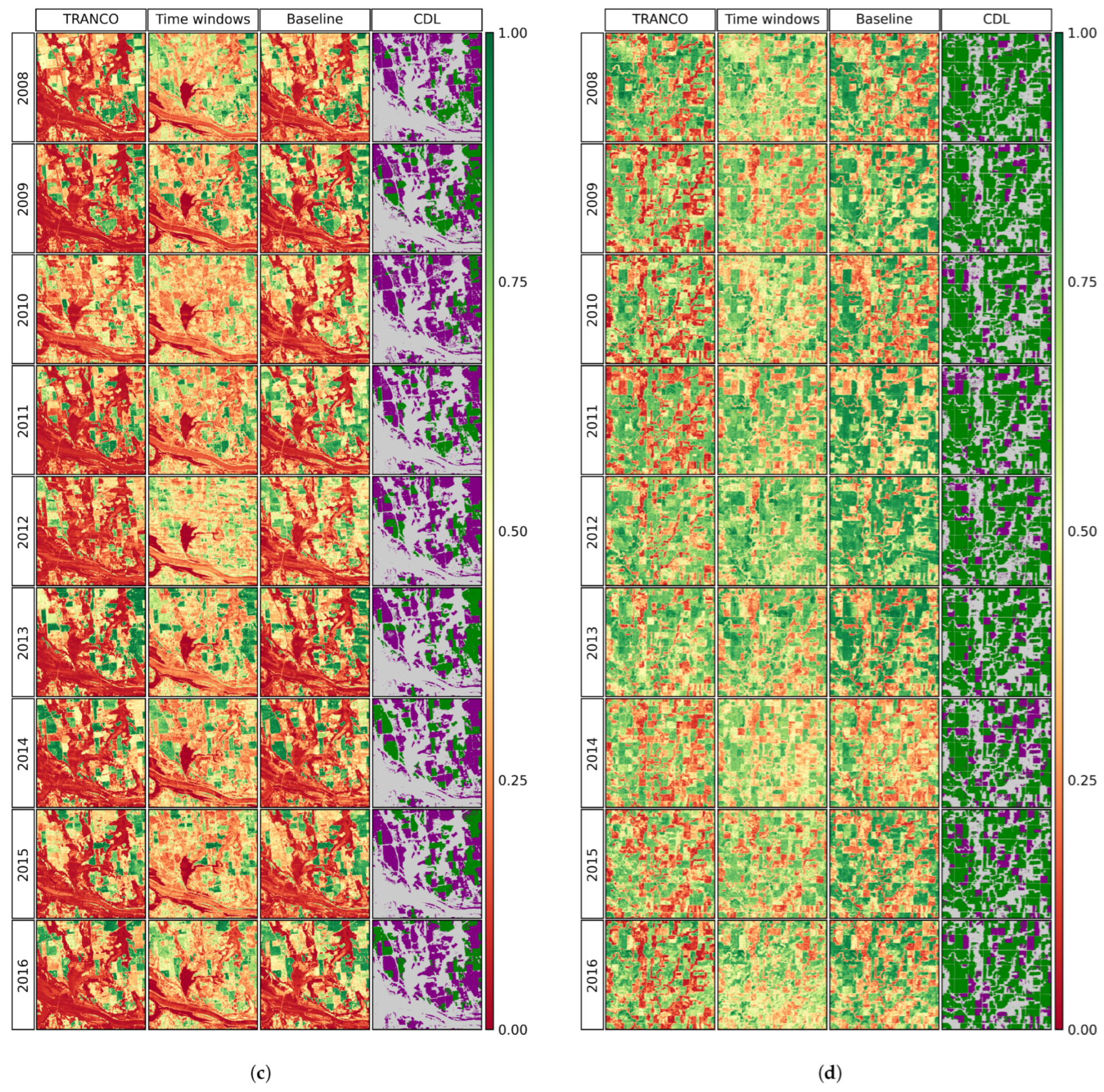
5.5. Performance in the Validation Period
6. Discussion
- 1.
- We are limited to the information common to Landsat-5, 7, and 8, which can lead to a reduction in the information needed to discern some crops. Also, to enable a limited comparison between what we obtained in this study and the results of our previous work [36], we omitted valuable information, such as the thermal bands from Landsat.
- 2.
- 3.
- Because of the temporal resolution of Landsat imagery (i.e., 16 days between passes) and the difficulties of finding enough cloud-free information, we aggregated Landsat information in composites of 30 days that we then interpolated daily to match AgERA-5 temporal resolution. Given the fast biophysical changes of crops, and especially cereals, along their growing season, this low temporal resolution might mask or minimize critical remote sensing signals. This risk is larger in the case of TRANCO, since we aggregated the accumulated GDD in 140 °C steps, which can mask more than 16 days depending on the daily temperatures. However, the accumulated GDD is used in a wide variety of studies to describe phenological stages; hence, it is not fully clear what effects such aggregation could have on TRANCO, and a more detailed study must be performed to clarify them.
- 4.
- When aggregating Landsat 5 to 8 information, we did not account for algorithms to harmonize their data; hence, lower performance is expected. More importantly for classification, we did not fix Landsat-7’s strip problem, which could reduce the classification performance of the three approaches. Nonetheless, because of the averaging step in the normalization approaches, we expect this effect to be more pronounced in TRANCO, since each step does notcorrespond to a fixed number of days.
- 5.
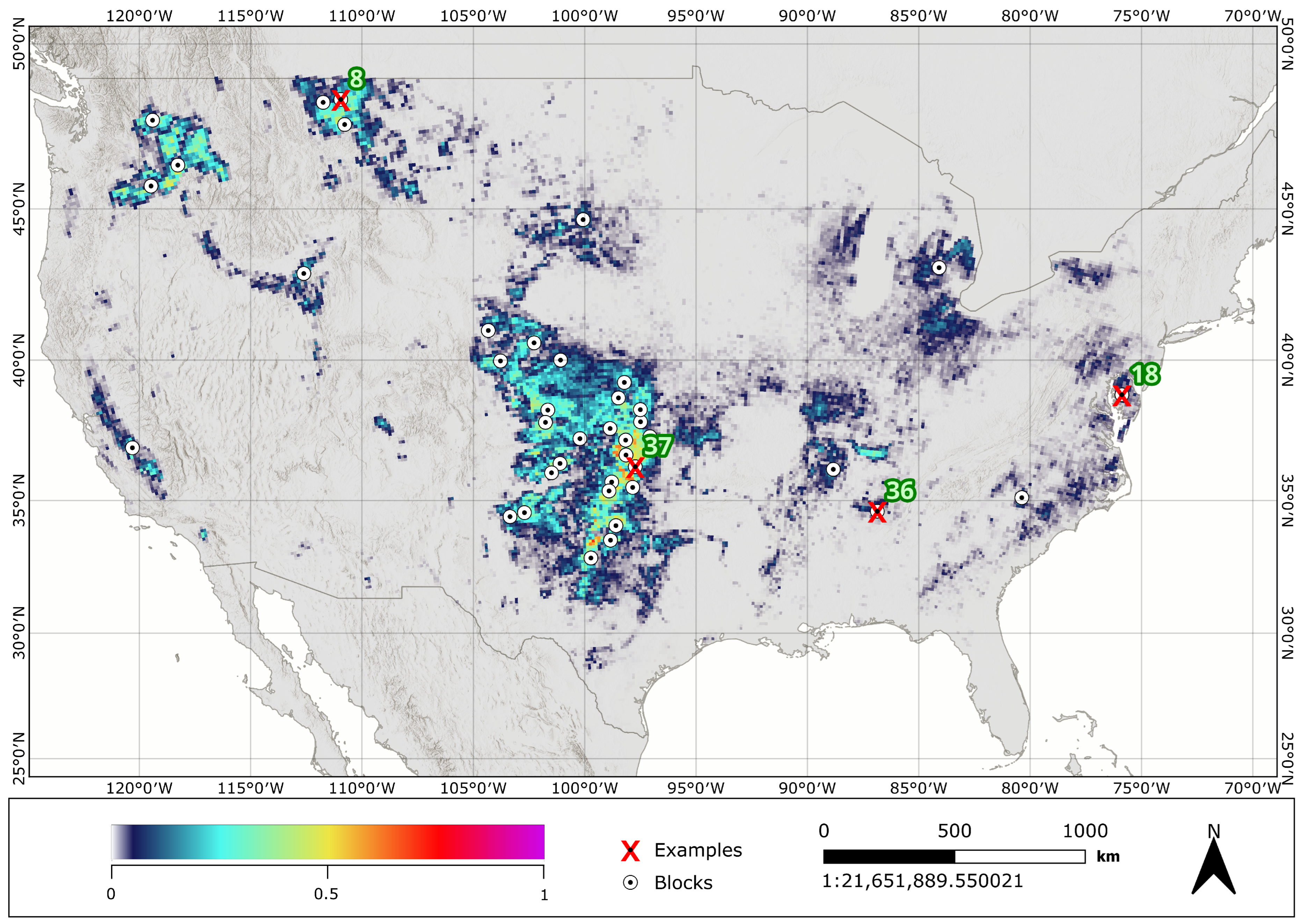
- We used the CDL as ground-truth data; however, its classification performances are not as high as other approaches found in the literature (F1 = 0.54), at least for the crops we considered as wheat (Table 1) and for the period considered. Nonetheless, some of the blocks considered, mainly those with high wheat aggregation, show high performance (F1 > 0.85). Hence, our classification performances do not strictly show how good classifiers are, but how well they describe the CDL dataset with its errors, which could make the interpretation of our results difficult.
7. Conclusions
Author Contributions
Funding
Institutional Review Board Statement
Informed Consent Statement
Data Availability Statement
Conflicts of Interest
References
- Gerten, D.; Heck, V.; Jägermeyr, J.; Bodirsky, B.L.; Fetzer, I.; Jalava, M.; Kummu, M.; Lucht, W.; Rockström, J.; Schaphoff, S.; et al. Feeding ten billion people is possible within four terrestrial planetary boundaries. Nat. Sustain. 2020, 3, 200–208. [Google Scholar] [CrossRef]
- FAO. Climate Change and Food Security: A Framework Document; FAO: Rome, Italy, 2008. [Google Scholar]
- Mbow, C.; Rosenzweig, C.; Barioni, L.G.; Benton, T.G.; Herrero, M.; Krishnapillai, M.; Liwenga, E.; Pradhan, P.; Rivera-Ferre, M.G.; Sapkota, T.; et al. Food Security. In Climate Change and Land: An IPCC Special Report on Climate Change, Esertification, Land Degradation, Sustainable Land Management, Food Security, and Greenhouse Gas Fluxes in Terrestrial Ecosystems; Shukla, P., Skea, J., Calvo Buendia, E., Masson-Delmotte, V., Pörtner, H.O., Roberts, D., Zhai, P., Slade, R., Connors, S., van Diemen, R., et al., Eds.; FAO: Rome, Italy, 2019; p. 114. [Google Scholar]
- FAO. Climate Change and Food Security: Risks and Responses; FAO: Rome, Italy, 2015. [Google Scholar]
- Godfray, H.C.J.; Beddington, J.R.; Crute, I.R.; Haddad, L.; Lawrence, D.; Muir, J.F.; Pretty, J.; Robinson, S.; Thomas, S.M.; Toulmin, C. Food Security: The Challenge of Feeding 9 Billion People. Science 2010, 327, 812–818. [Google Scholar] [CrossRef] [PubMed]
- World Food Program. WFP 2025 Global Outlook; World Food Program: Rome, Italy, 2025. [Google Scholar]
- Abay, K.A.; Breisinger, C.; Glauber, J.; Kurdi, S.; Laborde, D.; Siddig, K. The Russia-Ukraine war: Implications for global and regional food security and potential policy responses. Glob. Food Secur. 2023, 36, 100675. [Google Scholar] [CrossRef]
- Arndt, C.; Diao, X.; Dorosh, P.; Pauw, K.; Thurlow, J. The Ukraine war and rising commodity prices: Implications for developing countries. Glob. Food Secur. 2023, 36, 100680. [Google Scholar] [CrossRef]
- Whitcraft, A.K.; Becker-Reshef, I.; Justice, C.O.; Gifford, L.; Kavvada, A.; Jarvis, I. No pixel left behind: Toward integrating Earth Observations for agriculture into the United Nations Sustainable Development Goals framework. Remote Sens. Environ. 2019, 235, 111470. [Google Scholar] [CrossRef]
- Bolfe, E.L.; Parreiras, T.C.; Silva, L.A.P.D.; Sano, E.E.; Bettiol, G.M.; Victoria, D.D.C.; Sanches, I.D.; Vicente, L.E. Mapping Agricultural Intensification in the Brazilian Savanna: A Machine Learning Approach Using Harmonized Data from Landsat Sentinel-2. ISPRS Int. J. Geo-Inf. 2023, 12, 263. [Google Scholar] [CrossRef]
- Gray, J.; Friedl, M.; Frolking, S.; Ramankutty, N.; Nelson, A.; Gumma, M.K. Mapping Asian Cropping Intensity with MODIS. IEEE J. Sel. Top. Appl. Earth Obs. Remote Sens. 2014, 7, 3373–3379. [Google Scholar] [CrossRef]
- Su, S.; Zhou, X.; Wan, C.; Li, Y.; Kong, W. Land use changes to cash crop plantations: Crop types, multilevel determinants and policy implications. Land Use Policy 2016, 50, 379–389. [Google Scholar] [CrossRef]
- Verburg, P.H.; Veldkamp, A. The role of spatially explicit models in land-use change research: A case study for cropping patterns in China. Agric. Ecosyst. Environ. 2001, 85, 177–190. [Google Scholar] [CrossRef]
- Rivera-Marin, D.; Dash, J.; Ogutu, B. The use of remote sensing for desertification studies: A review. J. Arid Environ. 2022, 206, 104829. [Google Scholar] [CrossRef]
- Minacapilli, M.; Agnese, C.; Blanda, F.; Cammalleri, C.; Ciraolo, G.; D’Urso, G.; Iovino, M.; Pumo, D.; Provenzano, G.; Rallo, G. Estimation of actual evapotranspiration of Mediterranean perennial crops by means of remote-sensing based surface energy balance models. Hydrol. Earth Syst. Sci. 2009, 13, 1061–1074. [Google Scholar] [CrossRef]
- Nowakowski, A.; Mrziglod, J.; Spiller, D.; Bonifacio, R.; Ferrari, I.; Mathieu, P.P.; Garcia-Herranz, M.; Kim, D.H. Crop type mapping by using transfer learning. Int. J. Appl. Earth Obs. Geoinf. 2021, 98, 102313. [Google Scholar] [CrossRef]
- Ofori-Ampofo, S.; Pelletier, C.; Lang, S. Crop Type Mapping from Optical and Radar Time Series Using Attention-Based Deep Learning. Remote Sens. 2021, 13, 4668. [Google Scholar] [CrossRef]
- Skakun, S.; Franch, B.; Vermote, E.; Roger, J.C.; Becker-Reshef, I.; Justice, C.; Kussul, N. Early season large-area winter crop mapping using MODIS NDVI data, growing degree days information and a Gaussian mixture model. Remote Sens. Environ. 2017, 195, 244–258. [Google Scholar] [CrossRef]
- Wu, B.; Meng, J.; Li, Q.; Yan, N.; Du, X.; Zhang, M. Remote sensing-based global crop monitoring: Experiences with China’s CropWatch system. Int. J. Digit. Earth 2014, 7, 113–137. [Google Scholar] [CrossRef]
- Becker-Reshef, I.; Barker, B.; Whitcraft, A.; Oliva, P.; Mobley, K.; Justice, C.; Sahajpal, R. Crop Type Maps for Operational Global Agricultural Monitoring. Sci. Data 2023, 10, 172. [Google Scholar] [CrossRef]
- Becker-Reshef, I.; Barker, B.; Whitcraft, A.; Oliva, P.; Mobley, K.; Justice, C.; Sahajpal, R. GEOGLAM Best Available Crop Type Masks. 2022. Available online: https://zenodo.org/records/7230863 (accessed on 8 September 2023).
- Aneece, I.; Thenkabail, P.S. Classifying Crop Types Using Two Generations of Hyperspectral Sensors (Hyperion and DESIS) with Machine Learning on the Cloud. Remote Sens. 2021, 13, 4704. [Google Scholar] [CrossRef]
- Van Tricht, K.; Gobin, A.; Gilliams, S.; Piccard, I. Synergistic Use of Radar Sentinel-1 and Optical Sentinel-2 Imagery for Crop Mapping: A Case Study for Belgium. Remote Sens. 2018, 10, 1642. [Google Scholar] [CrossRef]
- Blickensdörfer, L.; Schwieder, M.; Pflugmacher, D.; Nendel, C.; Erasmi, S.; Hostert, P. Mapping of crop types and crop sequences with combined time series of Sentinel-1, Sentinel-2 and Landsat 8 data for Germany. Remote Sens. Environ. 2022, 269, 112831. [Google Scholar] [CrossRef]
- Boryan, C.G. The USDA NASS Cropland Data Layer Program; Technical Report; United States Department of Agriculture National Agricultural Statistics Service: Washington, DC, USA, 2010.
- Di Tommaso, S.; Wang, S.; Lobell, D.B. Combining GEDI and Sentinel-2 for wall-to-wall mapping of tall and short crops. Environ. Res. Lett. 2021, 16, 125002. [Google Scholar] [CrossRef]
- Fisette, T.; Rollin, P.; Aly, Z.; Campbell, L.; Daneshfar, B.; Filyer, P.; Smith, A.; Davidson, A.; Shang, J.; Jarvis, I. AAFC annual crop inventory. In Proceedings of the 2013 Second International Conference on Agro-Geoinformatics (Agro-Geoinformatics), Fairfax, VA, USA, 12–16 August 2013; pp. 270–274. [Google Scholar] [CrossRef]
- Johnson, D.M.; Mueller, R. Pre- and within-season crop type classification trained with archival land cover information. Remote Sens. Environ. 2021, 264, 112576. [Google Scholar] [CrossRef]
- King, L.; Adusei, B.; Stehman, S.V.; Potapov, P.V.; Song, X.P.; Krylov, A.; Di Bella, C.; Loveland, T.R.; Johnson, D.M.; Hansen, M.C. A multi-resolution approach to national-scale cultivated area estimation of soybean. Remote Sens. Environ. 2017, 195, 13–29. [Google Scholar] [CrossRef]
- Pfeil, I.; Reub, F.; Vreugdenhil, M.; Navacchi, C.; Wagner, W. Classification of Wheat and Barley Fields Using Sentinel-1 Backscatter. In Proceedings of the IGARSS 2020—2020 IEEE International Geoscience and Remote Sensing Symposium, Waikoloa, HI, USA, 26 September–2 October 2020; pp. 140–143. [Google Scholar] [CrossRef]
- Song, X.P.; Potapov, P.V.; Krylov, A.; King, L.; Di Bella, C.M.; Hudson, A.; Khan, A.; Adusei, B.; Stehman, S.V.; Hansen, M.C. National-scale soybean mapping and area estimation in the United States using medium resolution satellite imagery and field survey. Remote Sens. Environ. 2017, 190, 383–395. [Google Scholar] [CrossRef]
- Wardlow, B.D.; Egbert, S.L. Large-area crop mapping using time-series MODIS 250 m NDVI data: An assessment for the U.S. Central Great Plains. Remote Sens. Environ. 2008, 112, 1096–1116. [Google Scholar] [CrossRef]
- Zhong, L.; Hawkins, T.; Biging, G.; Gong, P. A phenology-based approach to map crop types in the San Joaquin Valley, California. Int. J. Remote Sens. 2011, 32, 7777–7804. [Google Scholar] [CrossRef]
- Van Tricht, K.; Degerickx, J.; Gilliams, S.; Zanaga, D.; Savinaud, M.; Battude, M.; Buguet de Chargère, R.; Dubreule, G.; Grosu, A.; Brombacher, J.; et al. ESA WorldCereal 10 m 2021 v100. 2023. Available online: https://zenodo.org/records/7875105 (accessed on 12 May 2023).
- Van Tricht, K.; Degerickx, J.; Gilliams, S.; Zanaga, D.; Battude, M.; Grosu, A.; Brombacher, J.; Lesiv, M.; Bayas, J.C.L.; Karanam, S.; et al. WorldCereal: A dynamic open-source system for global-scale, seasonal, and reproducible crop and irrigation mapping. Earth Syst. Sci. Data 2023, 15, 5491–5515. [Google Scholar] [CrossRef]
- Cintas, J.; Franch, B.; Van-Tricht, K.; Boogaard, H.; Degerickx, J.; Becker-Reshef, I.; Moletto-Lobos, I.; Mollà-Bononad, B.; Sobrino, J.A.; Gilliams, S.; et al. TRANCO: Thermo radiometric normalization of crop observations. Int. J. Appl. Earth Obs. Geoinf. 2023, 118, 103283. [Google Scholar] [CrossRef]
- Hansen, M.C.; Defries, R.S.; Townshend, J.R.G.; Sohlberg, R. Global land cover classification at 1 km spatial resolution using a classification tree approach. Int. J. Remote Sens. 2000, 21, 1331–1364. [Google Scholar] [CrossRef]
- Hansen, M.C.; Potapov, P.V.; Pickens, A.H.; Tyukavina, A.; Hernandez-Serna, A.; Zalles, V.; Turubanova, S.; Kommareddy, I.; Stehman, S.V.; Song, X.P.; et al. Global land use extent and dispersion within natural land cover using Landsat data. Environ. Res. Lett. 2022, 17, 034050. [Google Scholar] [CrossRef]
- Chen, J.; Chen, J.; Liao, A.; Cao, X.; Chen, L.; Chen, X.; He, C.; Han, G.; Peng, S.; Lu, M.; et al. Global land cover mapping at 30m resolution: A POK-based operational approach. ISPRS J. Photogramm. Remote Sens. 2015, 103, 7–27. [Google Scholar] [CrossRef]
- Brown, C.F.; Brumby, S.P.; Guzder-Williams, B.; Birch, T.; Hyde, S.B.; Mazzariello, J.; Czerwinski, W.; Pasquarella, V.J.; Haertel, R.; Ilyushchenko, S.; et al. Dynamic World, Near real-time global 10 m land use land cover mapping. Sci. Data 2022, 9, 251. [Google Scholar] [CrossRef]
- Szantoi, Z.; Geller, G.N.; Tsendbazar, N.E.; See, L.; Griffiths, P.; Fritz, S.; Gong, P.; Herold, M.; Mora, B.; Obregón, A. Addressing the need for improved land cover map products for policy support. Environ. Sci. Policy 2020, 112, 28–35. [Google Scholar] [CrossRef]
- Atzberger, C. Advances in Remote Sensing of Agriculture: Context Description, Existing Operational Monitoring Systems and Major Information Needs. Remote Sens. 2013, 5, 949–981. [Google Scholar] [CrossRef]
- Becker-Reshef, I.; Vermote, E.; Lindeman, M.; Justice, C. A generalized regression-based model for forecasting winter wheat yields in Kansas and Ukraine using MODIS data. Remote Sens. Environ. 2010, 114, 1312–1323. [Google Scholar] [CrossRef]
- Nguyen, L.H.; Joshi, D.R.; Clay, D.E.; Henebry, G.M. Characterizing land cover/land use from multiple years of Landsat and MODIS time series: A novel approach using land surface phenology modeling and random forest classifier. Remote Sens. Environ. 2020, 238, 111017. [Google Scholar] [CrossRef]
- Becker-Reshef, I.; Barker, B.; Humber, M.; Puricelli, E.; Sanchez, A.; Sahajpal, R.; McGaughey, K.; Justice, C.; Baruth, B.; Wu, B.; et al. The GEOGLAM crop monitor for AMIS: Assessing crop conditions in the context of global markets. Glob. Food Secur. 2019, 23, 173–181. [Google Scholar] [CrossRef]
- Dimitrov, P.; Dong, Q.; Eerens, H.; Gikov, A.; Filchev, L.; Roumenina, E.; Jelev, G. Sub-Pixel Crop Type Classification Using PROBA-V 100 m NDVI Time Series and Reference Data from Sentinel-2 Classifications. Remote Sens. 2019, 11, 1370. [Google Scholar] [CrossRef]
- Franch, B.; Vermote, E.; Skakun, S.; Santamaria-Artigas, A.; Kalecinski, N.; Roger, J.C.; Becker-Reshef, I.; Barker, B.; Justice, C.; Sobrino, J. The ARYA crop yield forecasting algorithm: Application to the main wheat exporting countries. Int. J. Appl. Earth Obs. Geoinf. 2021, 104, 102552. [Google Scholar] [CrossRef]
- Orynbaikyzy, A.; Gessner, U.; Mack, B.; Conrad, C. Crop Type Classification Using Fusion of Sentinel-1 and Sentinel-2 Data: Assessing the Impact of Feature Selection, Optical Data Availability, and Parcel Sizes on the Accuracies. Remote Sens. 2020, 12, 2779. [Google Scholar] [CrossRef]
- Descals, A.; Verger, A.; Yin, G.; Penuelas, J. A threshold method for robust and fast estimation of land-surface phenology using Google Earth Engine. IEEE J. Sel. Top. Appl. Earth Obs. Remote Sens. 2021, 14, 601–606. [Google Scholar] [CrossRef]
- Helman, D. Land surface phenology: What do we really ‘see’ from space? Sci. Total Environ. 2018, 618, 665–673. [Google Scholar] [CrossRef] [PubMed]
- Meroni, M.; d’Andrimont, R.; Vrieling, A.; Fasbender, D.; Lemoine, G.; Rembold, F.; Seguini, L.; Verhegghen, A. Comparing land surface phenology of major European crops as derived from SAR and multispectral data of Sentinel-1 and -2. Remote Sens. Environ. 2021, 253, 112232. [Google Scholar] [CrossRef] [PubMed]
- Heupel, K.; Spengler, D.; Itzerott, S. A Progressive Crop-Type Classification Using Multitemporal Remote Sensing Data and Phenological Information. PFG-J. Photogramm. Remote Sens. Geoinf. Sci. 2018, 86, 53–69. [Google Scholar] [CrossRef]
- Mingwei, Z.; Qingbo, Z.; Zhongxin, C.; Jia, L.; Yong, Z.; Chongfa, C. Crop discrimination in Northern China with double cropping systems using Fourier analysis of time-series MODIS data. Int. J. Appl. Earth Obs. Geoinf. 2008, 10, 476–485. [Google Scholar] [CrossRef]
- Buchhorn, M.; Lesiv, M.; Tsendbazar, N.E.; Herold, M.; Bertels, L.; Smets, B. Copernicus Global Land Cover Layers—Collection 2. Remote Sens. 2020, 12, 1044. [Google Scholar] [CrossRef]
- Konduri, V.S.; Kumar, J.; Hargrove, W.W.; Hoffman, F.M.; Ganguly, A.R. Mapping crops within the growing season across the United States. Remote Sens. Environ. 2020, 251, 112048. [Google Scholar] [CrossRef]
- Teluguntla, P.; Thenkabail, P.S.; Oliphant, A.; Xiong, J.; Gumma, M.K.; Congalton, R.G.; Yadav, K.; Huete, A. A 30-m landsat-derived cropland extent product of Australia and China using random forest machine learning algorithm on Google Earth Engine cloud computing platform. ISPRS J. Photogramm. Remote Sens. 2018, 144, 325–340. [Google Scholar] [CrossRef]
- Weissteiner, C.J.; López-Lozano, R.; Manfron, G.; Duveiller, G.; Hooker, J.; van der Velde, M.; Baruth, B. A Crop Group-Specific Pure Pixel Time Series for Europe. Remote Sens. 2019, 11, 2668. [Google Scholar] [CrossRef]
- Cheng, K.; Wang, J. Forest-Type Classification Using Time-Weighted Dynamic Time Warping Analysis in Mountain Areas: A Case Study in Southern China. Forests 2019, 10, 1040. [Google Scholar] [CrossRef]
- Csillik, O.; Belgiu, M.; Asner, G.P.; Kelly, M. Object-Based Time-Constrained Dynamic Time Warping Classification of Crops Using Sentinel-2. Remote Sens. 2019, 11, 1257. [Google Scholar] [CrossRef]
- Maus, V.; Camara, G.; Cartaxo, R.; Sanchez, A.; Ramos, F.M.; de Queiroz, G.R. A Time-Weighted Dynamic Time Warping Method for Land-Use and Land-Cover Mapping. IEEE J. Sel. Top. Appl. Earth Obs. Remote Sens. 2016, 9, 3729–3739. [Google Scholar] [CrossRef]
- Tseng, G.; Nakalembe, C.; Zvonkov, I.; Kerner, H. CropHarvest: A global satellite dataset for crop type classification. In Proceedings of the 35th Conference on Neural Information Processing Systems, Online, 6–14 December 2021; p. 15. [Google Scholar]
- Eustache, E.; Jauslin, R.; Tillé, Y. Spatiotemporal sampling with spatial spreading and rotation of units in time. Spat. Stat. 2022, 47, 100613. [Google Scholar] [CrossRef]
- Wang, J.Y. A Critique of the Heat Unit Approach to Plant Response Studies. Ecology 1960, 41, 785–790. [Google Scholar] [CrossRef]
- European Commission; Joint Research Centre. JRC MARS Bulletin: Global Outlook: Crop Monitoring European Neighbourhood Ukraine; Publications Office: Luxembourg, 2023.
- Franch, B.; Vermote, E.; Becker-Reshef, I.; Claverie, M.; Huang, J.; Zhang, J.; Justice, C.; Sobrino, J. Improving the timeliness of winter wheat production forecast in the United States of America, Ukraine and China using MODIS data and NCAR Growing Degree Day information. Remote Sens. Environ. 2015, 161, 131–148. [Google Scholar] [CrossRef]
- Cintas, J.; Franch, B.; Becker-Reshef, I.; Sanchez-Torres, M.J.; Roger, J.; Skakun, S.; Sobrino, J.A.; Van-Tricht, K.; Degerickx, J.; Gilliams, S.; et al. Global Crop Calendars of Maize and Wheat in the Framework of the WorldCereal Project. 2022. Available online: https://doi.pangaea.de/10.1594/PANGAEA.946550 (accessed on 1 September 2023).
- Franch, B.; Cintas, J.; Becker-Reshef, I.; Sanchez-Torres, M.J.; Roger, J.; Skakun, S.; Sobrino, J.A.; Van Tricht, K.; Degerickx, J.; Gilliams, S.; et al. Global crop calendars of maize and wheat in the framework of the WorldCereal project. GISci. Remote Sens. 2022, 59, 885–913. [Google Scholar] [CrossRef]
- Lark, T.J.; Schelly, I.H.; Gibbs, H.K. Accuracy, Bias, and Improvements in Mapping Crops and Cropland across the United States Using the USDA Cropland Data Layer. Remote Sens. 2021, 13, 968. [Google Scholar] [CrossRef]
- Larsen, A.E.; Hendrickson, B.T.; Dedeic, N.; MacDonald, A.J. Taken as a given: Evaluating the accuracy of remotely sensed crop data in the USA. Agric. Syst. 2015, 141, 121–125. [Google Scholar] [CrossRef]
- Parker, W.S. Reanalyses and Observations: What’s the Difference? Bull. Am. Meteorol. Soc. 2016, 97, 1565–1572. [Google Scholar] [CrossRef]
- Boogard, H.; van der Grijn, G. Data Stream 2: AgERA5 Historic and near Real Time Forcing Data; User guide and Specification; ECMFW: Reading, UK, 2019. [Google Scholar]
- Hersbach, H.; Bell, B.; Berrisford, P.; Hirahara, S.; Horányi, A.; Nicolas, J.; Peubey, C.; Radu, R.; Simmons, A.; Soci, C.; et al. The ERA5 global reanalysis. Q. J. R. Meteorol. Soc. 2020, 146, 1999–2049. [Google Scholar] [CrossRef]
- Souverijns, N.; Buchhorn, M.; Horion, S.; Fensholt, R.; Verbeeck, H.; Verbesselt, J.; Herold, M.; Tsendbazar, N.E.; Bernardino, P.N.; Somers, B.; et al. Thirty Years of Land Cover and Fraction Cover Changes over the Sudano-Sahel Using Landsat Time Series. Remote Sens. 2020, 12, 3817. [Google Scholar] [CrossRef]
- Gao, B.C. NDWI—A normalized difference water index for remote sensing of vegetation liquid water from space. Remote Sens. Environ. 1996, 58, 257–266. [Google Scholar] [CrossRef]
- Alcaras, E.; Costantino, D.; Guastaferro, F.; Parente, C.; Pepe, M. Normalized Burn Ratio Plus (NBR+): A New Index for Sentinel-2 Imagery. Remote Sens. 2022, 14, 1727. [Google Scholar] [CrossRef]
- Dvorakova, K.; Shi, P.; Limbourg, Q.; van Wesemael, B. Soil Organic Carbon Mapping from Remote Sensing: The Effect of Crop Residues. Remote Sens. 2020, 12, 1913. [Google Scholar] [CrossRef]
- Nedkov, R. Normalized Differential Greennes Index for Vegetation Dynamics Assessment. Comptes Rendus L’AcadéMie Sci. La Vie Sci. 2017, 70, 1143. [Google Scholar]
- Fitzgerald, G.J.; Rodriguez, D.; Christensen, L.K.; Belford, R.; Sadras, V.O.; Clarke, T.R. Spectral and thermal sensing for nitrogen and water status in rainfed and irrigated wheat environments. Precis. Agric. 2006, 7, 233–248. [Google Scholar] [CrossRef]
- Jiang, Z.; Huete, A.; Didan, K.; Miura, T. Development of a two-band enhanced vegetation index without a blue band. Remote Sens. Environ. 2008, 112, 3833–3845. [Google Scholar] [CrossRef]
- Rondeaux, G.; Steven, M.; Baret, F. Optimization of soil-adjusted vegetation indices. Remote Sens. Environ. 1996, 55, 95–107. [Google Scholar] [CrossRef]
- Clevers, J.G.; de Jong, S.M.; Epema, G.F.; van der Meer, F.; Bakker, W.H.; Skidmore, A.K.; Addink, E.A. MERIS and the red-edge position. Int. J. Appl. Earth Obs. Geoinf. 2001, 3, 313–320. [Google Scholar] [CrossRef]
- Peñuelas, J.; Filella, I. Semi-empirical indices to assess carotenoids/chlorophyll a ratio from leaf spectral reflectance. Photosynthetica 1995, 31, 221–230. [Google Scholar]
- Veloso, A.; Mermoz, S.; Bouvet, A.; Le Toan, T.; Planells, M.; Dejoux, J.F.; Ceschia, E. Understanding the temporal behavior of crops using Sentinel-1 and Sentinel-2-like data for agricultural applications. Remote Sens. Environ. 2017, 199, 415–426. [Google Scholar] [CrossRef]
- Nasirzadehdizaji, R.; Balik Sanli, F.; Abdikan, S.; Cakir, Z.; Sekertekin, A.; Ustuner, M. Sensitivity Analysis of Multi-Temporal Sentinel-1 SAR Parameters to Crop Height and Canopy Coverage. Appl. Sci. 2019, 9, 655. [Google Scholar] [CrossRef]
- Lambers, H.; Chapin, F.S.; Pons, T.L. Plant Physiological Ecology; Springer: New York, NY, USA, 2008. [Google Scholar] [CrossRef]
- Reigosa Roger, M.J.; Pedrol, N.; Sanchez, A. La Ecofisiologia Vegetal: Una Ciencia de Sintesis; Paraninfo: Madrid, Spain, 2004; OCLC: 567020761. [Google Scholar]
- Bailey, S.J. Using Growing Degree Days to Predict Plant Stages; Montguide; Montana State University: Bozeman, MT, USA, 2018; p. 8. [Google Scholar]
- Bonhomme, R.; Derieux, M.; Edmeades, G.O. Flowering of Diverse Maize Cultivars in Relation to Temperature and Photoperiod in Multilocation Field Trials. Crop Sci. 1994, 34, 156–164. [Google Scholar] [CrossRef]
- Khosravi, I.; Safari, A.; Homayouni, S. MSMD: Maximum separability and minimum dependency feature selection for cropland classification from optical and radar data. Int. J. Remote Sens. 2018, 39, 2159–2176. [Google Scholar] [CrossRef]
- Fox, E.W.; Ver Hoef, J.M.; Olsen, A.R. Comparing spatial regression to random forests for large environmental data sets. PLoS ONE 2020, 15, e0229509. [Google Scholar] [CrossRef]
- Probst, P.; Wright, M.N.; Boulesteix, A. Hyperparameters and tuning strategies for random forest. WIREs Data Min. Knowl. Discov. 2019, 9, e1301. [Google Scholar] [CrossRef]
- Tatsumi, K.; Yamashiki, Y.; Canales Torres, M.A.; Taipe, C.L.R. Crop classification of upland fields using Random forest of time-series Landsat 7 ETM+ data. Comput. Electron. Agric. 2015, 115, 171–179. [Google Scholar] [CrossRef]
- Pedregosa, F.; Varoquaux, G.; Gramfort, A.; Michel, V.; Thirion, B.; Grisel, O.; Blondel, M.; Prettenhofer, P.; Weiss, R.; Dubourg, V.; et al. Scikit-learn: Machine Learning in Python. Mach. Learn. Python 2011, 12, 2825–2830. [Google Scholar]
- James, G.; Witten, D.; Hastie, T.; Tibshirani, R. An Introduction to Statistical Learning; Springer Texts in Statistics; Springer: New York, NY, USA, 2013; Volume 103. [Google Scholar] [CrossRef]
- Géron, A. Hands-On Machine Learning with Scikit-Learn, Keras, and Tensorflow: Concepts, Tools, and Techniques to Build Intelligent Systems, 2nd ed.; O’Reilly Media: Sebastopol, CA, USA, 2019. [Google Scholar]
- Chollet, F. Deep Learning with Python; Manning Publications Co.: Shelter Island, NY, USA, 2018. [Google Scholar]
- Brenning, A. Spatial cross-validation and bootstrap for the assessment of prediction rules in remote sensing: The R package sperrorest. In Proceedings of the 2012 IEEE International Geoscience and Remote Sensing Symposium, Munich, Germany, 22–27 July 2012; pp. 5372–5375. [Google Scholar] [CrossRef]
- Agresti, A. Introduction to Categorical Data Analysis; Wiley Series in Probability and Statistics; Wiley: Hoboken, NJ, USA, 2007. [Google Scholar]
- Acock, A.C.; Stavig, G.R. A measure of Association for Nonparametric Statistics. Soc. Forces 1979, 57, 1381–1386. [Google Scholar] [CrossRef]
- Wang, S.; Di Tommaso, S.; Deines, J.M.; Lobell, D.B. Mapping twenty years of corn and soybean across the US Midwest using the Landsat archive. Sci. Data 2020, 7, 307. [Google Scholar] [CrossRef]
- Olofsson, P.; Foody, G.M.; Herold, M.; Stehman, S.V.; Woodcock, C.E.; Wulder, M.A. Good practices for estimating area and assessing accuracy of land change. Remote Sens. Environ. 2014, 148, 42–57. [Google Scholar] [CrossRef]
- Cohen, J. A Coefficient of Agreement for Nominal Scales. Educ. Psychol. Meas. 1960, 20, 37–46. [Google Scholar] [CrossRef]
- Dobrinić, D.; Gašparović, M.; Medak, D. Sentinel-1 and 2 Time-Series for Vegetation Mapping Using Random Forest Classification: A Case Study of Northern Croatia. Remote Sens. 2021, 13, 2321. [Google Scholar] [CrossRef]
- Zhang, H.; Du, H.; Zhang, C.; Zhang, L. An automated early-season method to map winter wheat using time-series Sentinel-2 data: A case study of Shandong, China. Comput. Electron. Agric. 2021, 182, 105962. [Google Scholar] [CrossRef]
- Gao, S.; Yan, K.; Liu, J.; Pu, J.; Zou, D.; Qi, J.; Mu, X.; Yan, G. Assessment of remote-sensed vegetation indices for estimating forest chlorophyll concentration. Ecol. Indic. 2024, 162, 112001. [Google Scholar] [CrossRef]
- Nyborg, J.; Pelletier, C.; Assent, I. Generalized Classification of Satellite Image Time Series with Thermal Positional Encoding. In Proceedings of the 2022 IEEE/CVF Conference on Computer Vision and Pattern Recognition Workshops (CVPRW), New Orleans, LA, USA, 19–24 June 2022; pp. 1391–1401. [Google Scholar] [CrossRef]
- Awad, B.; Erer, I. Enhancing crop classification with growing Degree days: Bridging classical models and regional generalization. Remote Sens. Lett. 2025, 16, 1315–1324. [Google Scholar] [CrossRef]


| Region | Landsat-5 | Landsat-7 | Landsat-8 | Harmonized |
|---|---|---|---|---|
| Blue | B1 | B1 | B2 | B2 |
| Green | B2 | B2 | B3 | B3 |
| Red | B3 | B3 | B4 | B4 |
| NIR | B4 | B4 | B5 | B5 |
| SWIR1 | B5 | B5 | B6 | B6 |
| SWIR2 | B7 | B7 | B7 | B7 |
| Spatial Groups | p-Value | Cramer’s V | |
|---|---|---|---|
| 2 | 3.36 | 0.07 | 0.017 |
| 3 | 7.26 | 0.03 | 0.024 |
| 4 | 13.67 | 0.00 | 0.033 |
| 5 | 7.89 | 0.10 | 0.025 |
| 10 | 21.55 | 0.01 | 0.042 |
| 20 | 31.80 | 0.03 | 0.051 |
| 40 | 45.93 | 0.21 | 0.061 |
Disclaimer/Publisher’s Note: The statements, opinions and data contained in all publications are solely those of the individual author(s) and contributor(s) and not of MDPI and/or the editor(s). MDPI and/or the editor(s) disclaim responsibility for any injury to people or property resulting from any ideas, methods, instructions or products referred to in the content. |
© 2026 by the authors. Licensee MDPI, Basel, Switzerland. This article is an open access article distributed under the terms and conditions of the Creative Commons Attribution (CC BY) license.
Share and Cite
Cintas, J.; Guirado, E.; Martínez-Valderrama, J.; Moletto-Lobos, I.; López-Zayas, C.; Escamilla, T.; Becker-Reshef, I.; Cabello, J.; Salinas-Bonillo, M.J.; Franch, B. Application of the Thermo-RAdiometric Normalization of Crop Observations (TRANCO) Back in Time: An Assessment of the Potential for Crop Time-Series Generalization to Past Years Using Wheat as a Proxy. Remote Sens. 2026, 18, 571. https://doi.org/10.3390/rs18040571
Cintas J, Guirado E, Martínez-Valderrama J, Moletto-Lobos I, López-Zayas C, Escamilla T, Becker-Reshef I, Cabello J, Salinas-Bonillo MJ, Franch B. Application of the Thermo-RAdiometric Normalization of Crop Observations (TRANCO) Back in Time: An Assessment of the Potential for Crop Time-Series Generalization to Past Years Using Wheat as a Proxy. Remote Sensing. 2026; 18(4):571. https://doi.org/10.3390/rs18040571
Chicago/Turabian StyleCintas, Juanma, Emilio Guirado, Jaime Martínez-Valderrama, Italo Moletto-Lobos, Carmen López-Zayas, Tamara Escamilla, Inbal Becker-Reshef, Javier Cabello, Maria Jacoba Salinas-Bonillo, and Belén Franch. 2026. "Application of the Thermo-RAdiometric Normalization of Crop Observations (TRANCO) Back in Time: An Assessment of the Potential for Crop Time-Series Generalization to Past Years Using Wheat as a Proxy" Remote Sensing 18, no. 4: 571. https://doi.org/10.3390/rs18040571
APA StyleCintas, J., Guirado, E., Martínez-Valderrama, J., Moletto-Lobos, I., López-Zayas, C., Escamilla, T., Becker-Reshef, I., Cabello, J., Salinas-Bonillo, M. J., & Franch, B. (2026). Application of the Thermo-RAdiometric Normalization of Crop Observations (TRANCO) Back in Time: An Assessment of the Potential for Crop Time-Series Generalization to Past Years Using Wheat as a Proxy. Remote Sensing, 18(4), 571. https://doi.org/10.3390/rs18040571