


A Method for Mangrove Extraction Integrating Multi-Source Remote Sensing Data with Topographic Mechanism Correction

Highlights
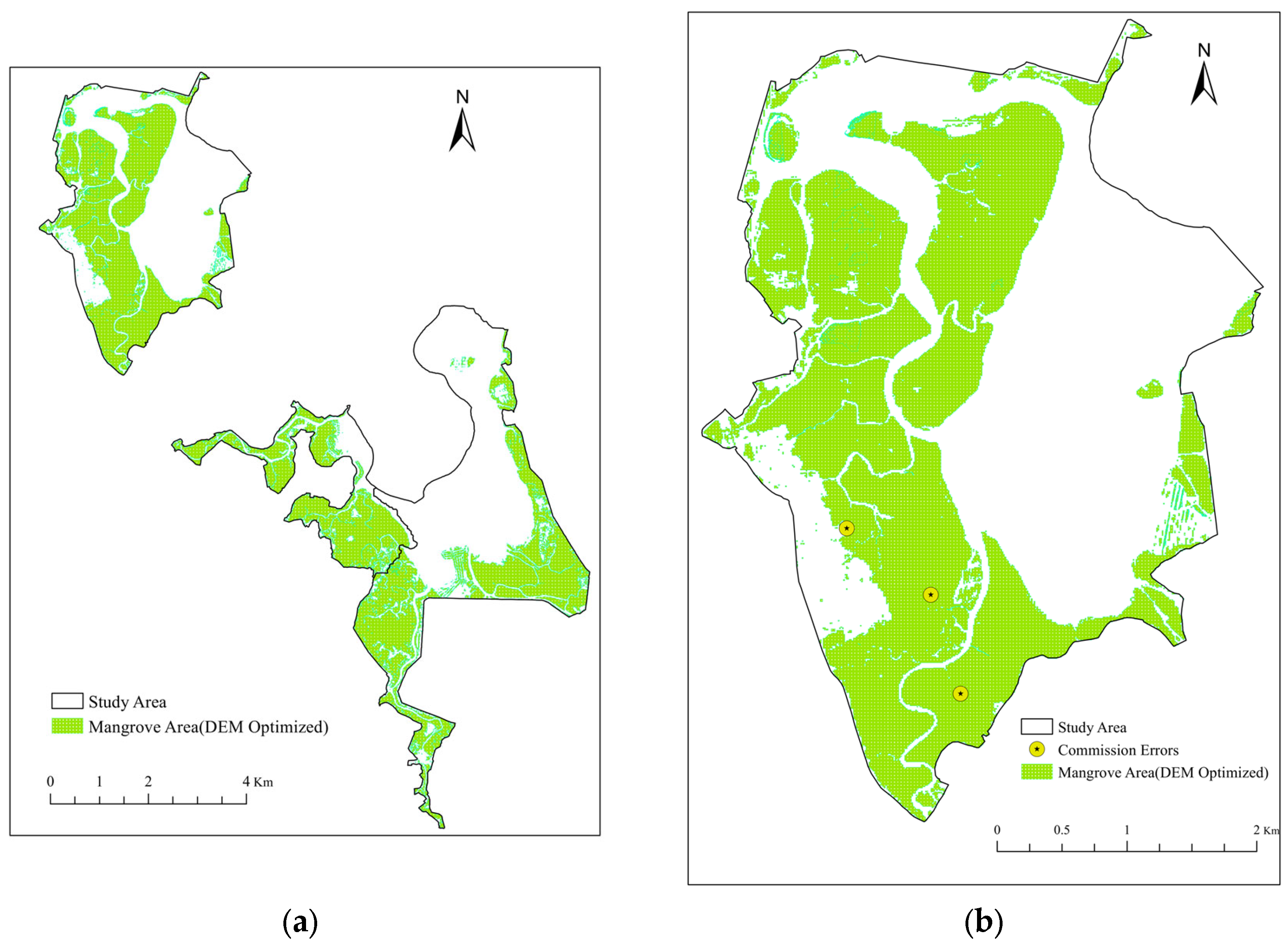
- This study developed a novel “spectral-spatial-terrain” stepwise correction framework that integrates Sentinel-2, GF-2, and DEM data, achieving high-precision mangrove extraction with a Kappa coefficient of 0.97.
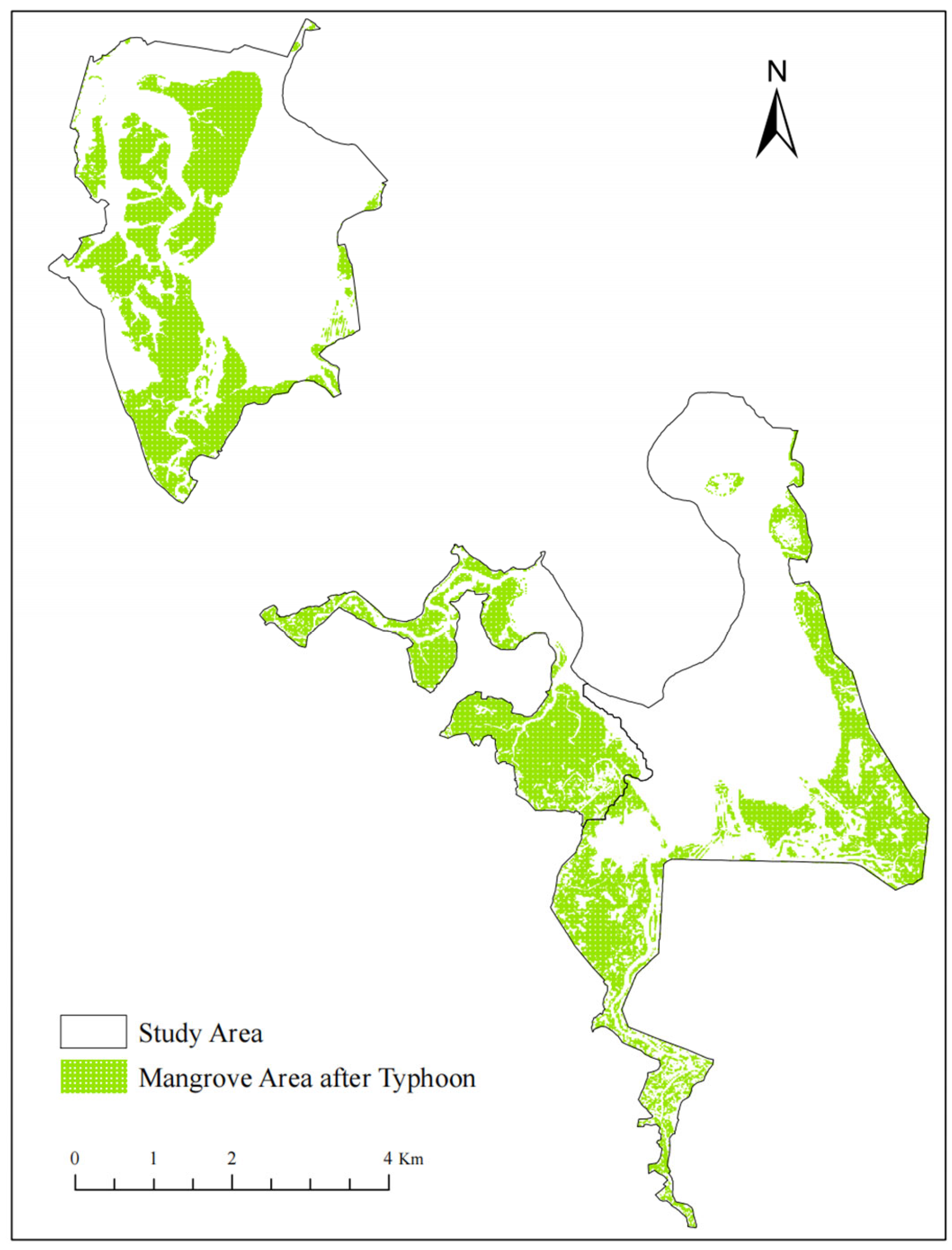
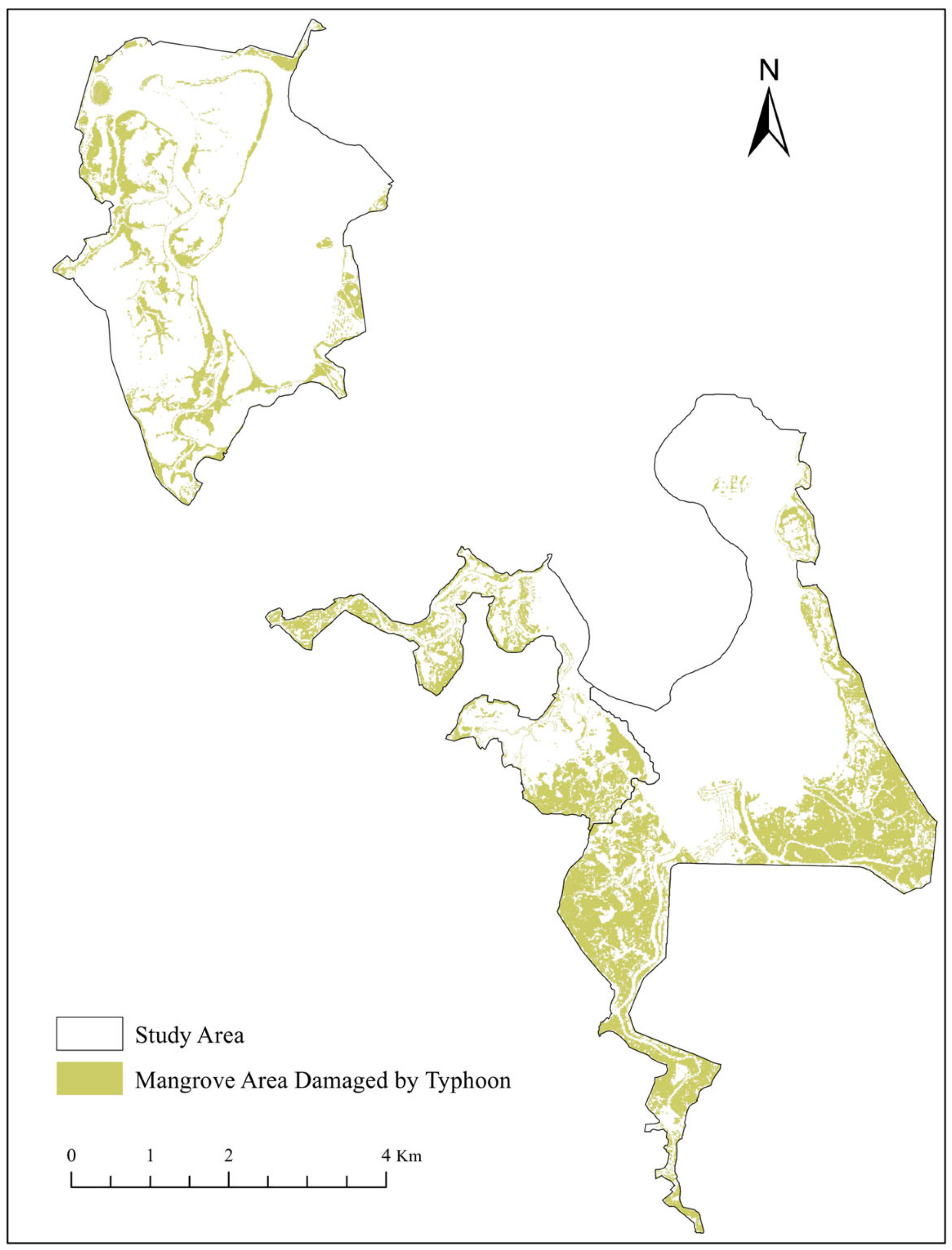
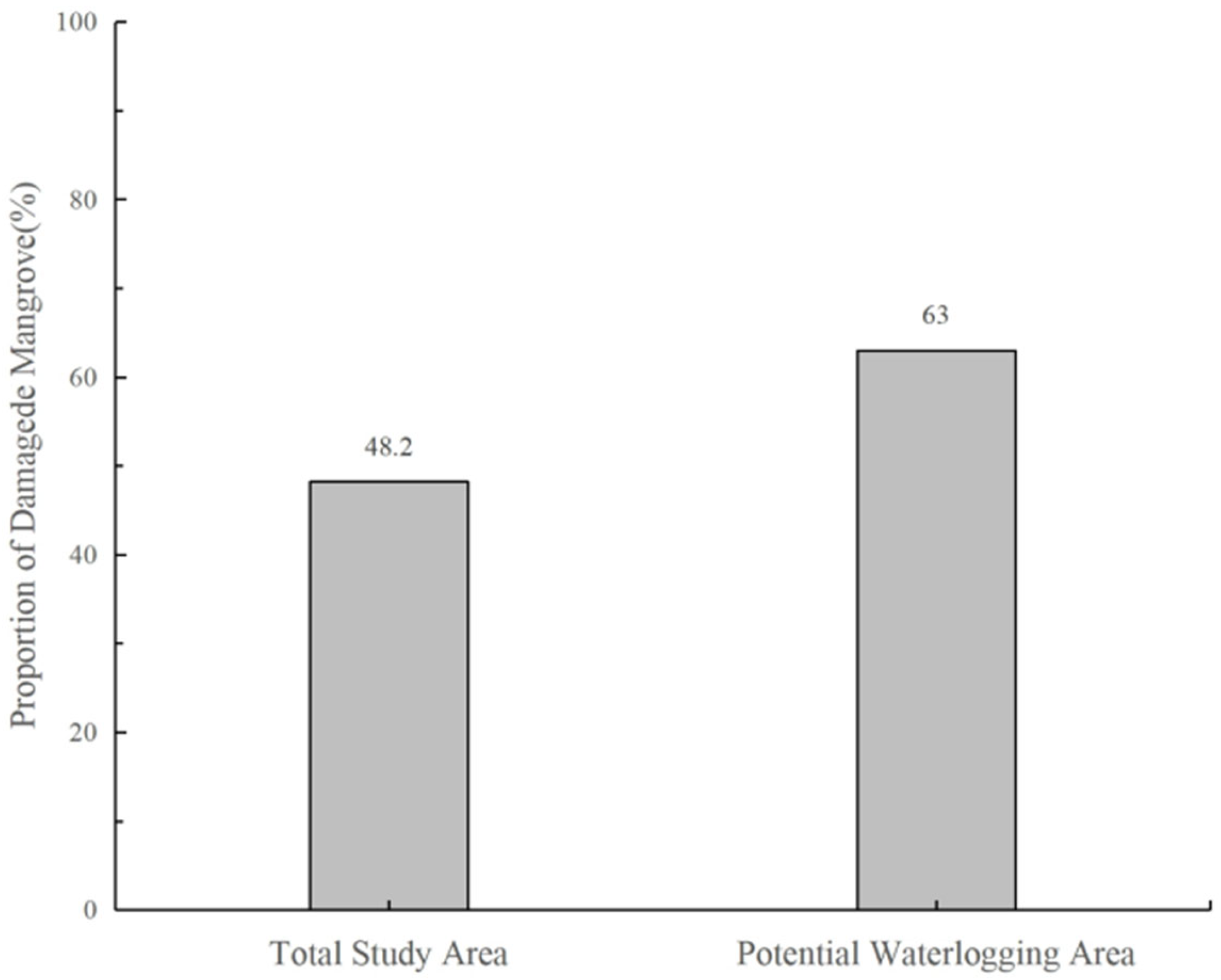
- Remote sensing-based quantification revealed that Typhoon Yagi caused a 48.2% decline in mangrove coverage area, with a significantly higher damage rate (63.0%) within DEM-identified potential waterlogging zones.
- The proposed framework, particularly the innovative use of the Potential Waterlogging Index (PWI) as an independent corrective factor, provides a mechanistic and transferable solution to spectral confusion in flat coastal environments.
- The findings reveal the critical role of micro-topography in modulating typhoon impacts on mangroves, offering scientific support for targeted conservation, restoration prioritization, and nature-based disaster risk management.
Abstract
1. Introduction
2. Study Area and Data
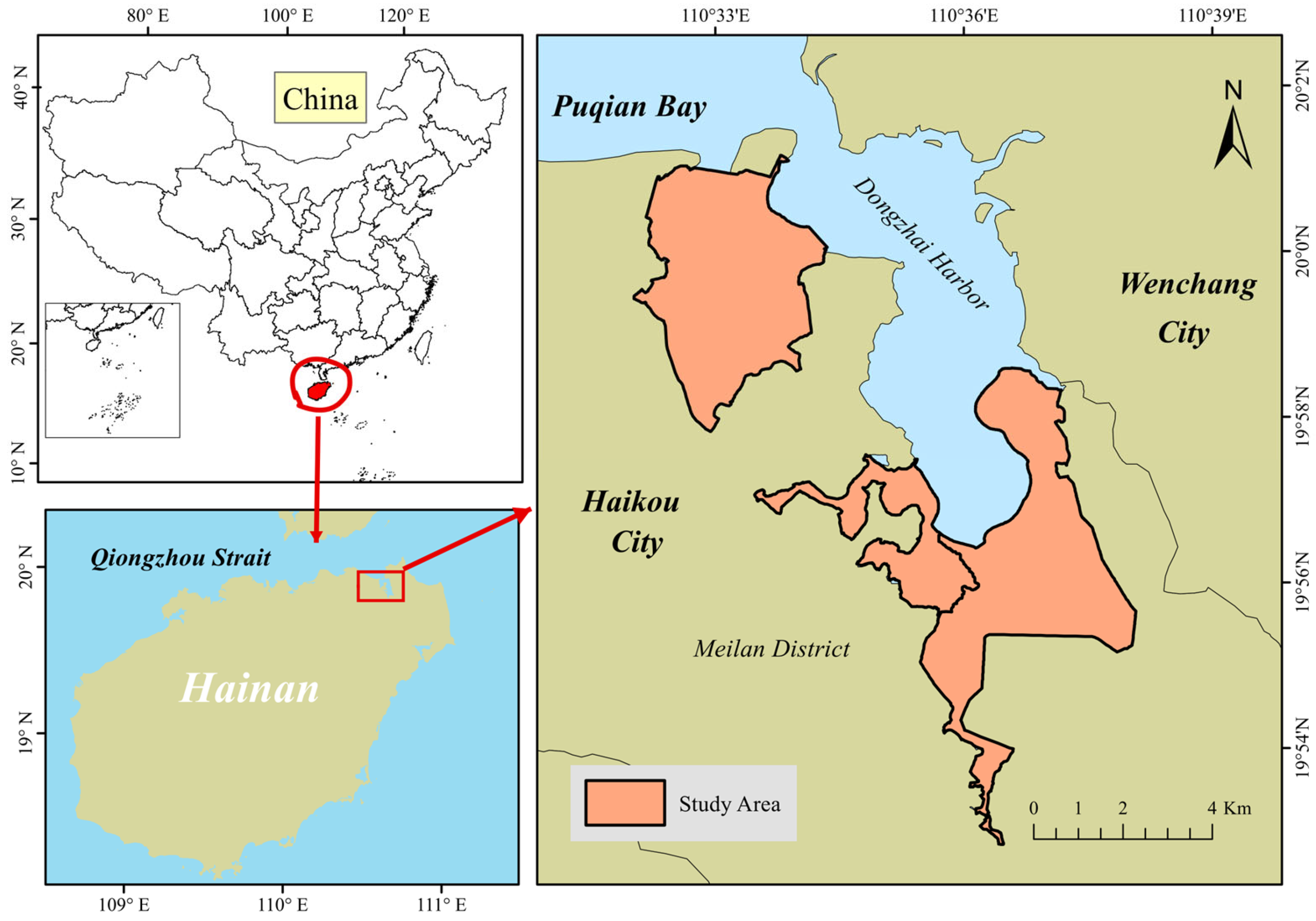
2.1. Study Area Overview
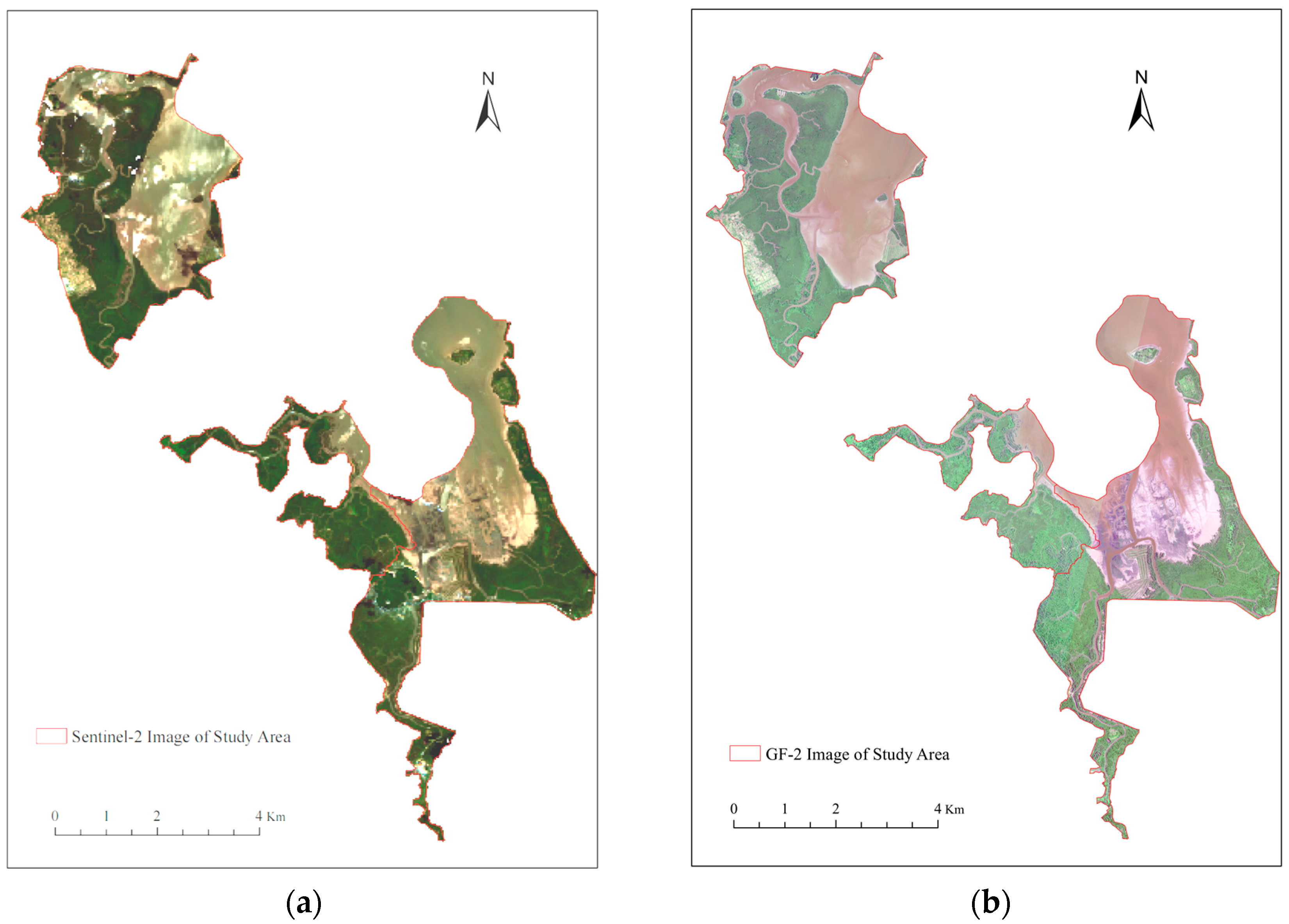
2.2. Data Sources
2.3. Data Preprocessing
2.3.1. Radiometric Calibration and Atmospheric Correction
2.3.2. Cloud Detection and Cloud Removal Processing
2.3.3. Image Registration and Study Area Clipping
2.3.4. Derived Topographic Features
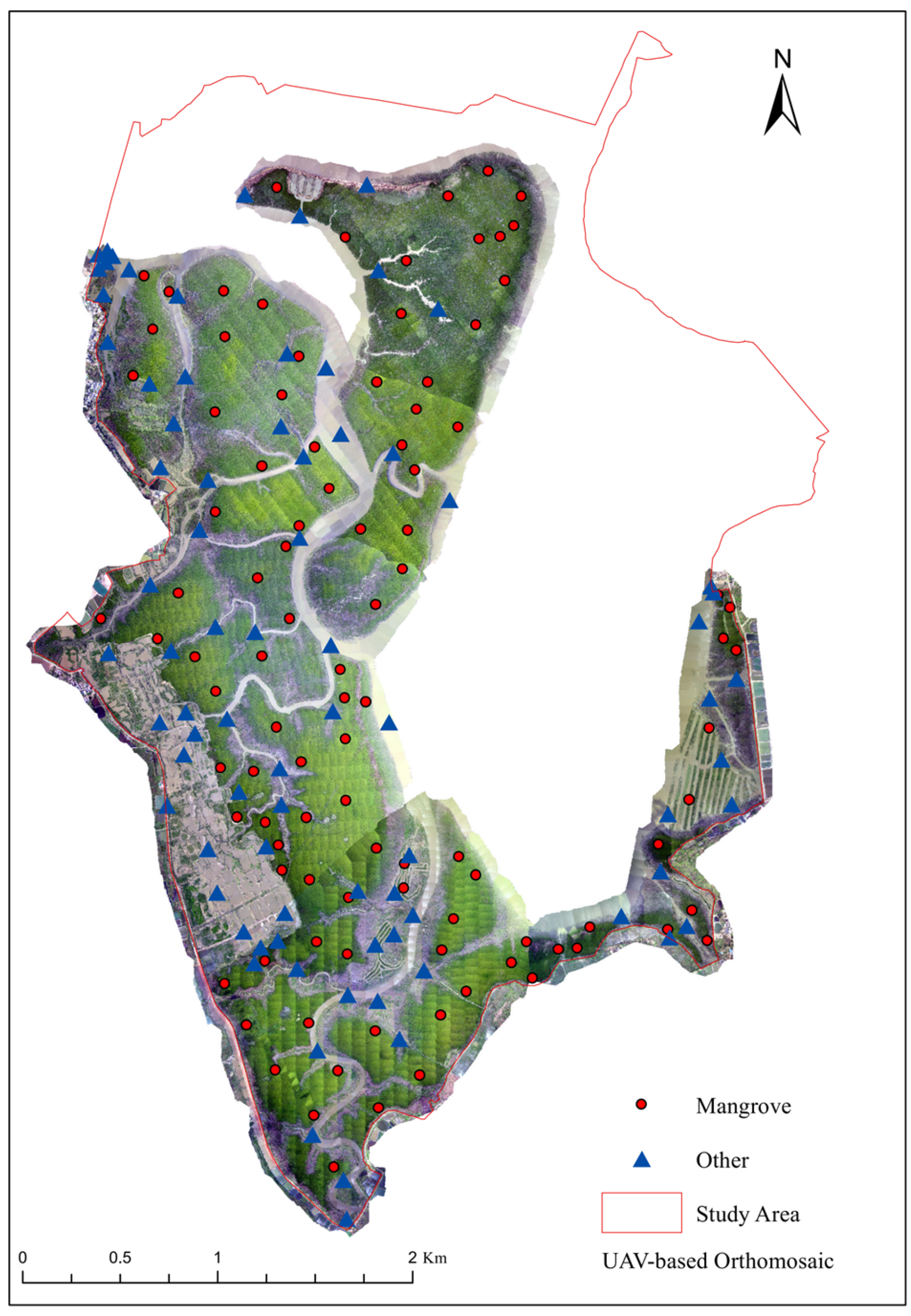
2.4. UAV Imagery and Accuracy Validation Points
3. Research Methodology
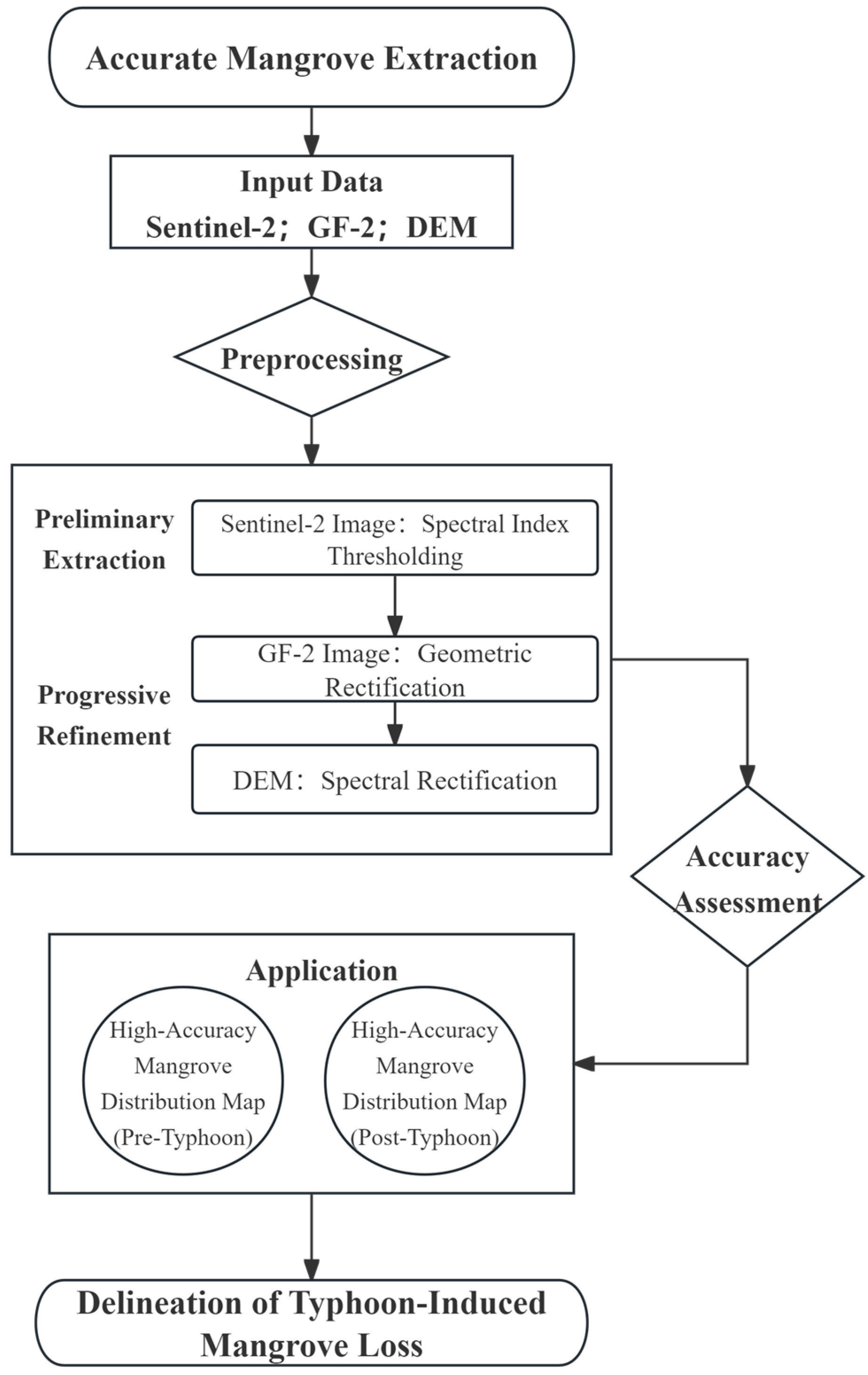
3.1. Overall Technical Approach
3.2. Large-Scale Preliminary Extraction Using Sentinel-2 Imagery
3.3. First Correction: Spatial Geometric Optimization Based on GF-2 Imagery
3.4. Second Correction: Spectral Property Optimization Based on DEM Data
3.5. Accuracy Validation Method
3.6. AI Tools Declaration
4. Results and Analysis
4.1. Mangrove Extraction Accuracy
4.2. Mangrove Extraction Results and Analysis
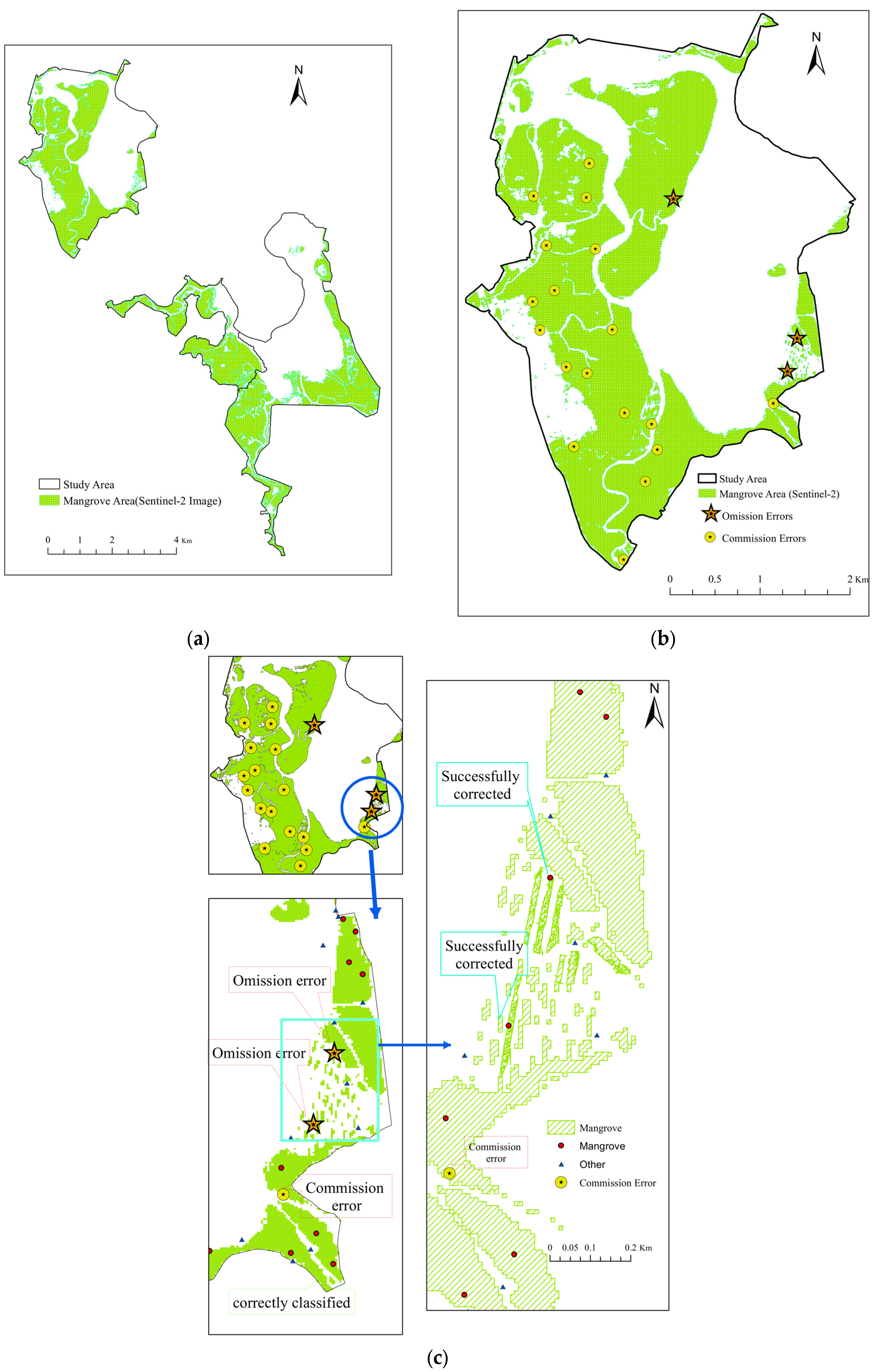
4.2.1. Rapid Identification and Extraction of Mangroves Based on Sentinel-2 Imagery
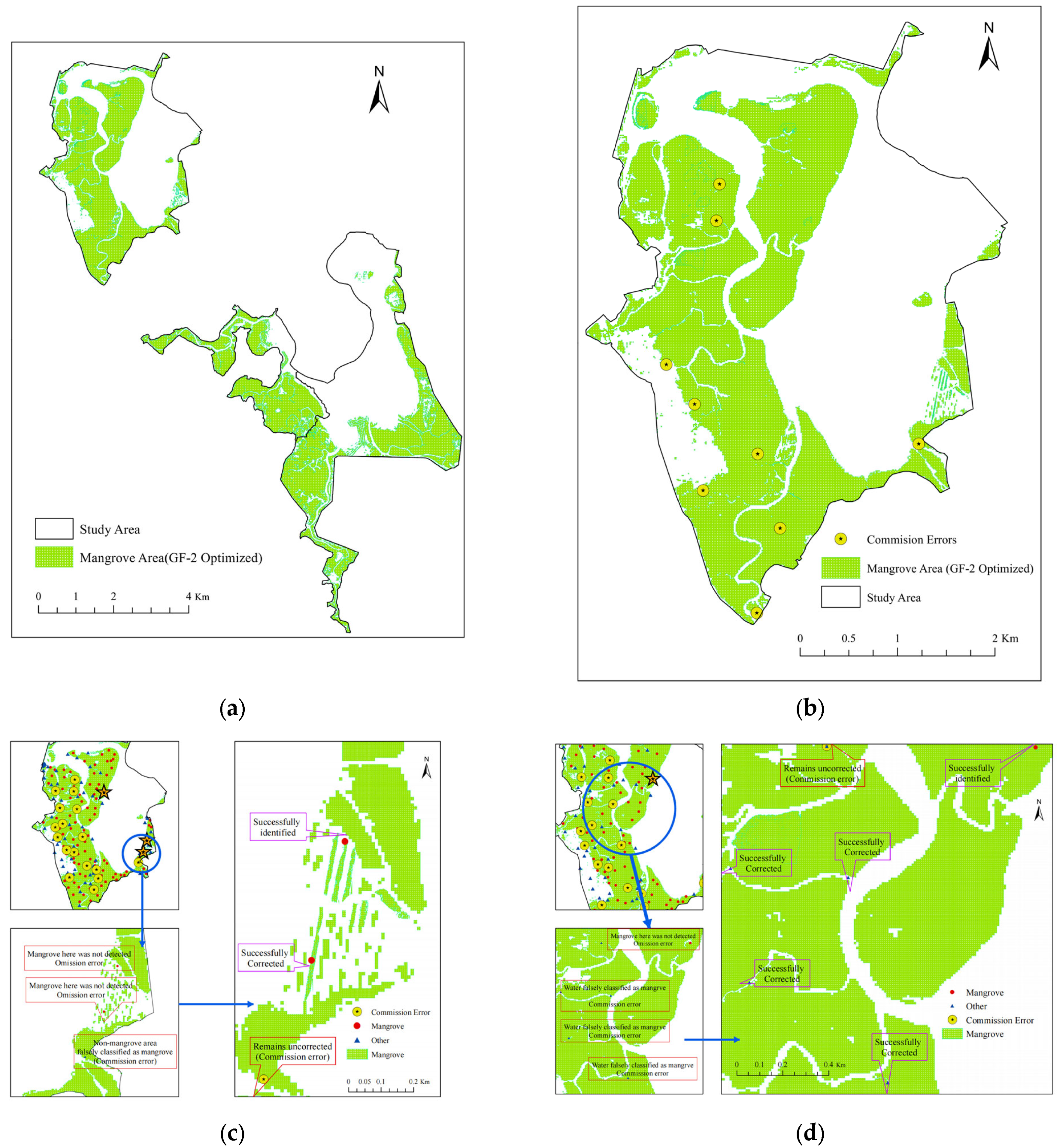
4.2.2. Preliminary Correction Based on GF-2 Imagery
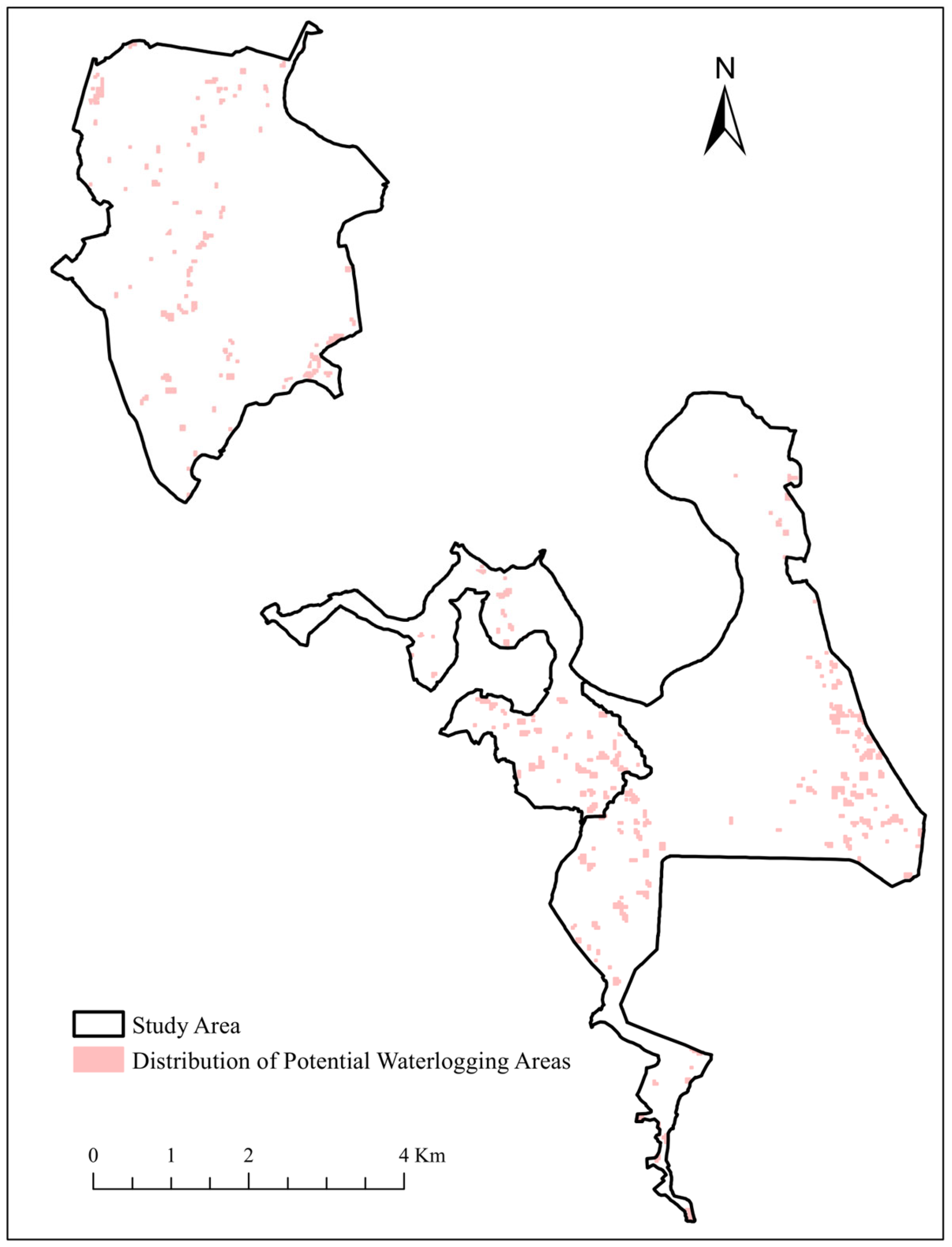
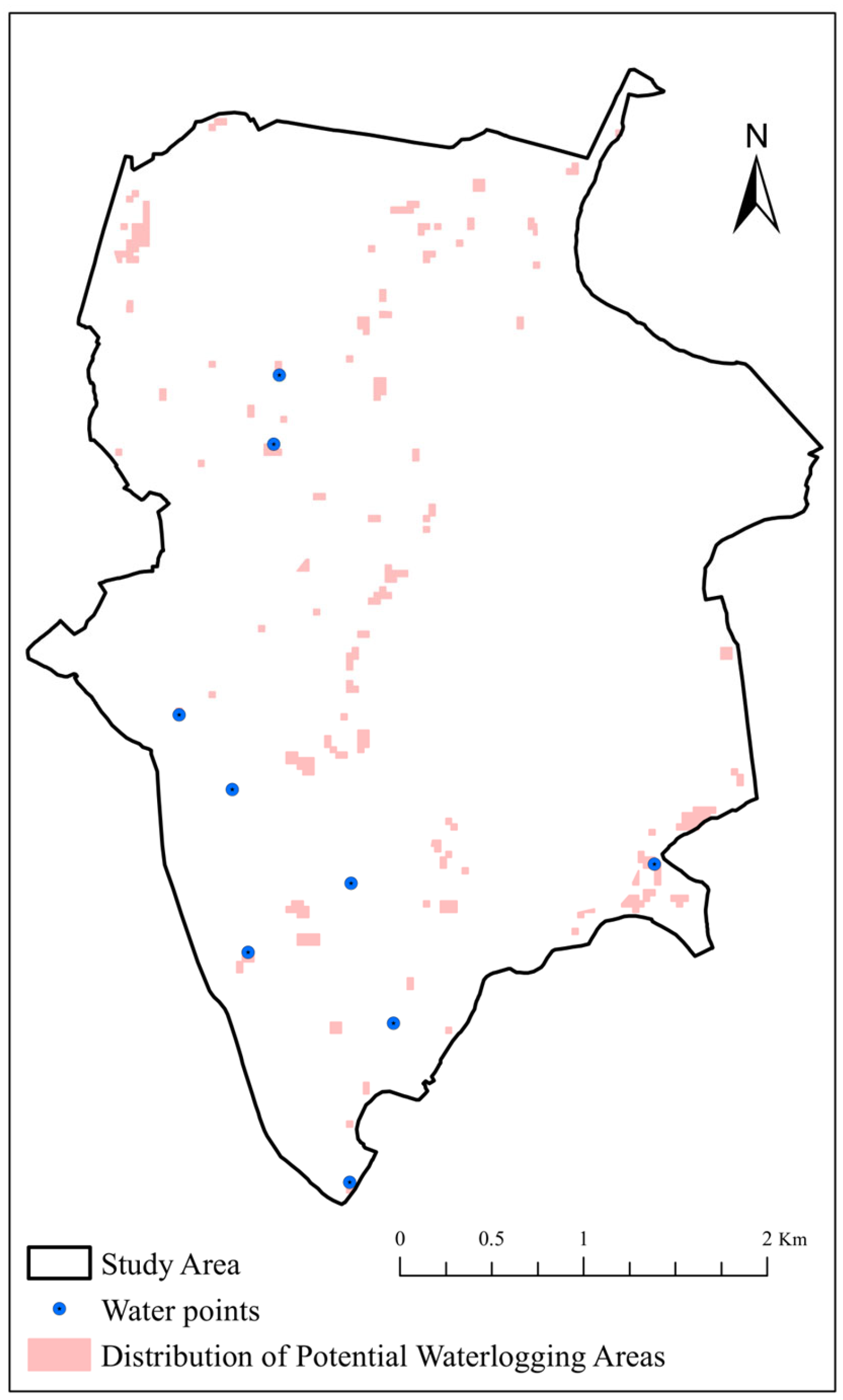
4.2.3. Identification and Re-Optimization of “Potential Waterlogging Zones” Based on DEM
4.3. Spatial Distribution of Mangrove Damage
4.4. Analysis of the Controlling Role of “Potential Waterlogging Zones” on Damage Patterns
5. Discussion
5.1. Innovation, Effectiveness, and Limitations of the Stepwise Correction Framework
5.2. Robustness of the PWI Threshold and Statistical Validation
5.3. Discussion on the Mechanism of Micro-Topography Modulating Typhoon Damage to Mangroves
5.4. Comparison with Existing Methods and Generalizability
6. Conclusions and Outlook
Author Contributions
Funding
Data Availability Statement
Acknowledgments
Conflicts of Interest
References
- Akram, H.; Hussain, S.; Mazumdar, P.; Chua, K.O.; Butt, T.E.; Harikrishna, J.A. Mangrove Health: A Review of Functions, Threats, and Challenges Associated with Mangrove Management Practices. Forests 2023, 14, 1698. [Google Scholar] [CrossRef]
- Wang, Z.; Liu, K.; Cao, J.; Peng, L.; Wen, X. Annual Change Analysis of Mangrove Forests in China during 1986–2021 Based on Google Earth Engine. Forests 2022, 13, 1489. [Google Scholar] [CrossRef]
- Liu, X.; Liao, J.; Shen, G.; Zhang, L.; Chen, B. Extraction of 10 m Resolution Global Mangrove in 2022. Remote Sens. 2024, 16, 2723. [Google Scholar] [CrossRef]
- Bhaumik, K.; Das, S. Computational Hydrodynamics Based Flow Accumulation Models to Identify Urban Waterlogging at Deltaic Plain Using GIS. Environ. Earth Sci. 2022, 81, 10330. [Google Scholar] [CrossRef]
- Turner, H.C.; Galford, G.L.; Lopez, N.H.; Méndez, A.F.; Borroto-Escuela, D.Y.; Ramos, I.H.; González-Díaz, P. Extent, Severity, and Temporal Patterns of Damage to Cuba’s Ecosystems following Hurricane Irma: MODIS and Sentinel-2 Hurricane Disturbance Vegetation Anomaly (HDVA). Remote Sens. 2023, 15, 2495. [Google Scholar] [CrossRef]
- Tian, J.; Wang, L.; Yin, D.; Li, X.; Diao, C.; Gong, H.; Shi, C.; Menenti, M.; Ge, Y.; Nie, S.; et al. Development of Spectral-Phenological Features for Deep Learning to Understand Spartina Alterniflora Invasion. Remote Sens. Environ. 2020, 242, 111745. [Google Scholar] [CrossRef]
- Zhang, R.; Jia, M.; Wang, Z.; Zhou, Y.; Wen, X.; Tan, Y.; Cheng, L. A Comparison of Gaofen-2 and Sentinel-2 Imagery for Mapping Mangrove Forests Using Object-Oriented Analysis and Random Forest. IEEE J. Sel. Top. Appl. Earth Obs. Remote Sens. 2021, 14, 4185–4193. [Google Scholar] [CrossRef]
- Zhang, X.; Ge, Z.; Zhen, X.; Jiang, N.; Dong, T. Identification of Mangrove Forest via Remote Sensing Combined with Tidal Level and DEM. J. Nanjing Univ. Inf. Sci. Technol. (Nat. Sci. Ed.) 2024, 16, 727–736. [Google Scholar] [CrossRef]
- Meng, X.; Bao, Y.; Liu, H.; Zhang, X.; Wang, X. A New Digital Soil Mapping Method with Temporal-Spatial-Spectral Information Derived from Multi-Source Satellite Images. Geoderma 2022, 425, 116065. [Google Scholar] [CrossRef]
- Xue, Z.; Li, W.; Tian, Z.; Zhu, M.; Zhu, J. GEE-Based Fine-Scale Classification of Mangrove Species in Hainan Island Consid-ering Polarization and Topographic Features. Remote Sens. Nat. Resour. 2025, 37, 274–284. [Google Scholar] [CrossRef]
- Fu, C.; Song, X.; Xie, Y.; Wang, C.; Luo, J.; Fang, Y.; Cao, B.; Qiu, Z. Research on the Spatiotemporal Evolution of Mangrove Forests in the Hainan Island from 1991 to 2021 Based on SVM and Res-UNet Algorithms. Remote Sens. 2022, 14, 5554. [Google Scholar] [CrossRef]
- Zhao, Y.; Wu, S.; Zhang, X.; Luo, H.; Chen, H.; Song, C. EIAGA-S: Rapid Mapping of Mangroves Using Geospatial Data without Ground Truth Samples. Forests 2024, 15, 1512. [Google Scholar] [CrossRef]
- Guo, M.; Yu, Z.; Xu, Y.; Huang, Y.; Li, C. ME-Net: A Deep Convolutional Neural Network for Extracting Mangrove Using Sentinel-2A Data. Remote Sens. 2021, 13, 1292. [Google Scholar] [CrossRef]
- Liang, X.; Dai, Z.; Huang, H.; Wang, J.; Li, S.; Wang, R.; Pang, W. Elevation Inversion of Mangrove Tidal Flat Geomorphology Based on UAV Aerial Survey. Adv. Mar. Sci. 2024, 42, 384–399. [Google Scholar] [CrossRef]
- Zhang, Q.; Yuan, Q.; Li, Z.; Sun, F.; Zhang, L. Combined Deep Prior with Low-Rank Tensor Svd for Thick Cloud Removal in Multitemporal Images. ISPRS J. Photogramm. Remote Sens. 2021, 177, 161–173. [Google Scholar] [CrossRef]
- Zheng, X.; Han, L.; He, G.; Wang, N.; Wang, G.; Feng, L. Semantic Segmentation Model for Wide-Area Coseismic Landslide Extraction Based on Embedded Multichannel Spectral–Topographic Feature Fusion: A Case Study of the Jiuzhaigou Ms7.0 Earthquake in Sichuan, China. Remote Sens. 2023, 15, 1084. [Google Scholar] [CrossRef]
- Jia, M.; Wang, Z.; Wang, C.; Mao, D.; Zhang, Y. A New Vegetation Index to Detect Periodically Submerged Mangrove Forest Using Single-Tide Sentinel-2 Imagery. Remote Sens. 2019, 11, 2043. [Google Scholar] [CrossRef]
- Waśniewski, A.; Hościło, A.; Zagajewski, B.; Moukétou-Tarazewicz, D. Assessment of Sentinel-2 Satellite Images and Random Forest Classifier for Rainforest Mapping in Gabon. Forests 2020, 11, 941. [Google Scholar] [CrossRef]
- Liu, Y.; Zhu, X. Tracking Mangrove Light Use Efficiency Using Normalized Difference Red Edge Index. Ecol. Indic. 2024, 168, 112774. [Google Scholar] [CrossRef]
- Routhier, M.R.; Moore, G.E.; Rock, B.N.; Glidden, S.; Duckett, M.; Zaluski, S. Assessing Mangrove Forest Recovery in the British Virgin Islands After Hurricanes Irma and Maria with Sentinel-2 Imagery and Google Earth Engine. Remote Sens. 2025, 17, 2485. [Google Scholar] [CrossRef]
- Xue, J.; Zhang, Z.; Zhou, Y.; Yuan, L.; He, D.; Liu, X. Geographic Prior Guided Subpixel Mapping for Fine-Grained Urban Tree Cover Reconstruction. IEEE Geosci. Remote Sens. Lett. 2025, 22, 2502305. [Google Scholar] [CrossRef]
- Chen, R.; Zhang, R.; Zhao, C.; Wang, Z.; Jia, M. High-Resolution Mapping of Mangrove Species Height in Fujian Zhangjiangkou National Mangrove Nature Reserve Combined GF-2, GF-3, and UAV-LiDAR. Remote Sens. 2023, 15, 5645. [Google Scholar] [CrossRef]
- Aji, M.A.P.; Kamal, M.; Farda, N.M. Mangrove Species Mapping Through Phenological Analysis Using Random Forest Algorithm on Google Earth Engine. Remote Sens. Appl. Soc. Environ. 2023, 30, 100978. [Google Scholar] [CrossRef]
- Gao, E.; Zhou, G.; Li, S.; Fu, B.; Xiao, Y.; Lan, Y.; Wang, F.; Xu, J.; Zhu, Q.; Bai, Y. Spatio-Temporal Evolution Monitoring and Analysis of Tidal Flats in Beibu Gulf From 1987 to 2021 Using Multisource Remote Sensing. IEEE J. Sel. Top. Appl. Earth Obs. Remote Sens. 2024, 17, 6099–6114. [Google Scholar] [CrossRef]
- Chen, Y.; Li, Y.; Thompson, C.; Wang, X.; Cai, T.; Chang, Y. Differential sediment trapping abilities of mangrove and saltmarsh vegetation in a subtropical estuary. Geomorphology 2018, 318, 270–282. [Google Scholar] [CrossRef]
- Tang, R.; Dai, Z.; Zhou, X.; Li, S. Tropical cyclone-induced water and suspended sediment discharge delivered by mountainous rivers into the Beibu Gulf, South China. Geomorphology 2021, 389, 107844. [Google Scholar] [CrossRef]
- Long, J.; Giri, C.; Primavera, J.; Trivedi, M. Damage and Recovery Assessment of the Philippines’ Mangroves Following Super Typhoon Haiyan. Mar. Pollut. Bull. 2016, 109, 734–743. [Google Scholar] [CrossRef]
- Yuan, Y.; Wen, Q.; Xu, J.; Wang, C.; Zhao, X.; Liu, S.; Xie, R. Remote Sensing Monitoring of Mangrove Forest Changes from 1990 to 2020 in Guangdong-Hong Kong-Macao Greater Bay Area. Natl. Remote Sens. Bull. 2023, 27, 1496–1510. [Google Scholar] [CrossRef]
- Pinkaew, S.; Koedsin, W.; Chan, J.C.-W.; Huete, A. Large-Scale Mangrove Mapping in Thailand Using Multi-Sensor Ensemble Machine Learning with Sentinel-1/2 and SRTM Data. Remote Sens. Appl. Soc. Environ. 2025, 40, 101744. [Google Scholar] [CrossRef]
- Yang, X.; Xie, F.; Liu, S.; Zhu, Y.; Fan, J.; Zhao, H.; Fu, Y.; Duan, Y.; Fu, R.; Guo, S. Mapping Debris-Covered Glaciers Using High-Resolution Imagery (GF-2) and Deep Learning Algorithms. Remote Sens. 2024, 16, 2062. [Google Scholar] [CrossRef]
- Wang, J.; Liang, J.; Li, L.; Cha, Z.; Liu, Y. Deriving and Application of the Catchment Characteristics for Urban Flood Point Based on DEM. J. Hohai Univ. (Nat. Sci.) 2018, 46, 390–394. [Google Scholar] [CrossRef]
- Fang, Y.; Huang, H.; Zhou, G.; Wang, Q.; Gao, F.; Li, C.; Liu, Y.; Lin, J. An Animal Model Study on the Gene Expression Profile of Meniscal Degeneration. Sci. Rep. 2020, 10, 21469. [Google Scholar] [CrossRef]
- Patra, P.; Das, U.; Agrawal, S. Satellite Imagery-Based Tropical Cyclone Impact Assessment on LULC and Vegetation: A Case Study of Cyclone Biparjoy. Environ. Monit. Assess. 2024, 196, 748. [Google Scholar] [CrossRef]
- Li, H.; Li, Z.; Shen, Z.-J.; Luo, M.-R.; Liu, Y.-L.; Wei, M.-Y.; Wang, W.-H.; Qin, Y.-Y.; Gao, C.-H.; Li, K.-K.; et al. Physiological and Proteomic Responses of Mangrove Plant Avicennia Marina Seedlings to Simulated Periodical Inundation. Plant Soil 2020, 450, 231–254. [Google Scholar] [CrossRef]
- Xia, Q.; Li, J.; Dai, S.; Zhang, H.; Xing, X. Mapping High-Resolution Mangrove Forests in China Using GF-2 Imagery Under the Tide. Natl. Remote Sens. Bull. 2023, 27, 1320–1333. [Google Scholar] [CrossRef]
- Gugan, I.; Aldehim, G.; Alotaibi, F.A.; Allafi, R. Modelling the Elevation of the Exposed Intertidal Zone Using a Continental Scale Approach and Machine Learning Techniques. J. S. Am. Earth Sci. 2025, 154, 105391. [Google Scholar] [CrossRef]

| Data Category | Data | Resolution | Acquisition Date | Band | Purpose |
|---|---|---|---|---|---|
| Medium Resolution Imagery | Sentinel-2 | 10.0 m | 9 August 2024 | Multispectral 13 bands | Preliminary Extraction and Change Detection of Large-Scale Mangrove Forests |
| High-Resolution Imagery | GF-2 | 0.8 m | 4 August 2024 | R,G,B 3 bands | Training Sample Generation, First Correction (Geometric Optimization) |
| Terrain data | DEM | 12.5 m | 2020 (static) | Elevation, slope, and other derived terrain features | Terrain Factor Correction |
| Study area boundary | Official vector data | - | - | - | Study Area Clipping |
| Validation Data | UAV (Drone) Imagery | 0.1 m | September 2024 | - | Accuracy Assessment |
| Extraction Method | Producer Accuracy (PA) | User Accuracy (UA) | Overall Accuracy (OA) | Kappa | F1 Score |
|---|---|---|---|---|---|
| Sentinel-2 Preliminary Extraction | 97.00% | 84.35% | 88.33% | 0.7592 | 0.9023 |
| GF-2 Preliminary Correction | 100% | 91.74% | 95.00% | 0.8976 | 0.9565 |
| Secondary Correction via DEM Data | 100% | 97.09% | 98.33% | 0.9661 | 0.9852 |
Disclaimer/Publisher’s Note: The statements, opinions and data contained in all publications are solely those of the individual author(s) and contributor(s) and not of MDPI and/or the editor(s). MDPI and/or the editor(s) disclaim responsibility for any injury to people or property resulting from any ideas, methods, instructions or products referred to in the content. |
© 2026 by the authors. Licensee MDPI, Basel, Switzerland. This article is an open access article distributed under the terms and conditions of the Creative Commons Attribution (CC BY) license.
Share and Cite
Li, Y.; Ma, W.; Lv, S.; Wang, Q.; Fu, C.; Shi, Y.; Ren, Z.; Zhang, Y. A Method for Mangrove Extraction Integrating Multi-Source Remote Sensing Data with Topographic Mechanism Correction. Remote Sens. 2026, 18, 567. https://doi.org/10.3390/rs18040567
Li Y, Ma W, Lv S, Wang Q, Fu C, Shi Y, Ren Z, Zhang Y. A Method for Mangrove Extraction Integrating Multi-Source Remote Sensing Data with Topographic Mechanism Correction. Remote Sensing. 2026; 18(4):567. https://doi.org/10.3390/rs18040567
Chicago/Turabian StyleLi, Yi, Wandong Ma, Shuguo Lv, Qiwei Wang, Chuanhui Fu, Yuanli Shi, Zhihua Ren, and Yuhuan Zhang. 2026. "A Method for Mangrove Extraction Integrating Multi-Source Remote Sensing Data with Topographic Mechanism Correction" Remote Sensing 18, no. 4: 567. https://doi.org/10.3390/rs18040567
APA StyleLi, Y., Ma, W., Lv, S., Wang, Q., Fu, C., Shi, Y., Ren, Z., & Zhang, Y. (2026). A Method for Mangrove Extraction Integrating Multi-Source Remote Sensing Data with Topographic Mechanism Correction. Remote Sensing, 18(4), 567. https://doi.org/10.3390/rs18040567

