Assessing the Hydrological Utility of Multiple Satellite Precipitation Products in the Yellow River Source Region with Error Propagation Analysis


Highlights
- In hydrological processes, the propagation of systematic and random errors in satellite-based precipitation products exhibits distinct statistical characteristics and spatial patterns.
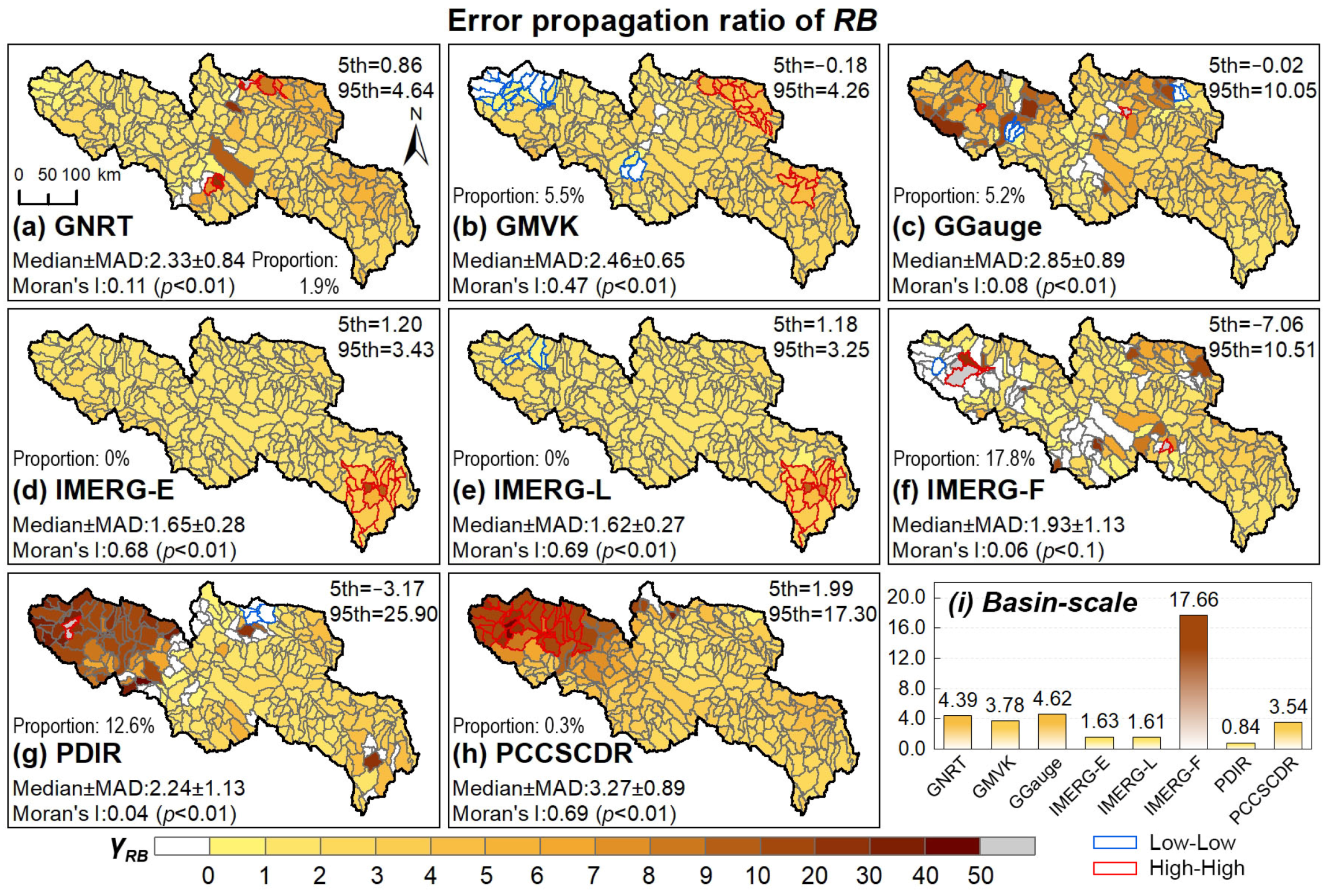
- Hydrological simulations show that systematic bias in precipitation data tends to be amplified, while random error is suppressed, with the propagation ratio of random error exhibiting notable spatial clustering features.
- The different propagation behaviors of systematic and random error in satellite-based precipitation data emphasize the need for targeted strategies in data modification for hydrological application.
- Error propagation patterns help to identify zones that are sensitive to precipitation errors and it is suggested that their distributions are associated with continuous watershed attributes, such as basin slope.
Abstract
1. Introduction
2. Study Area and Datasets
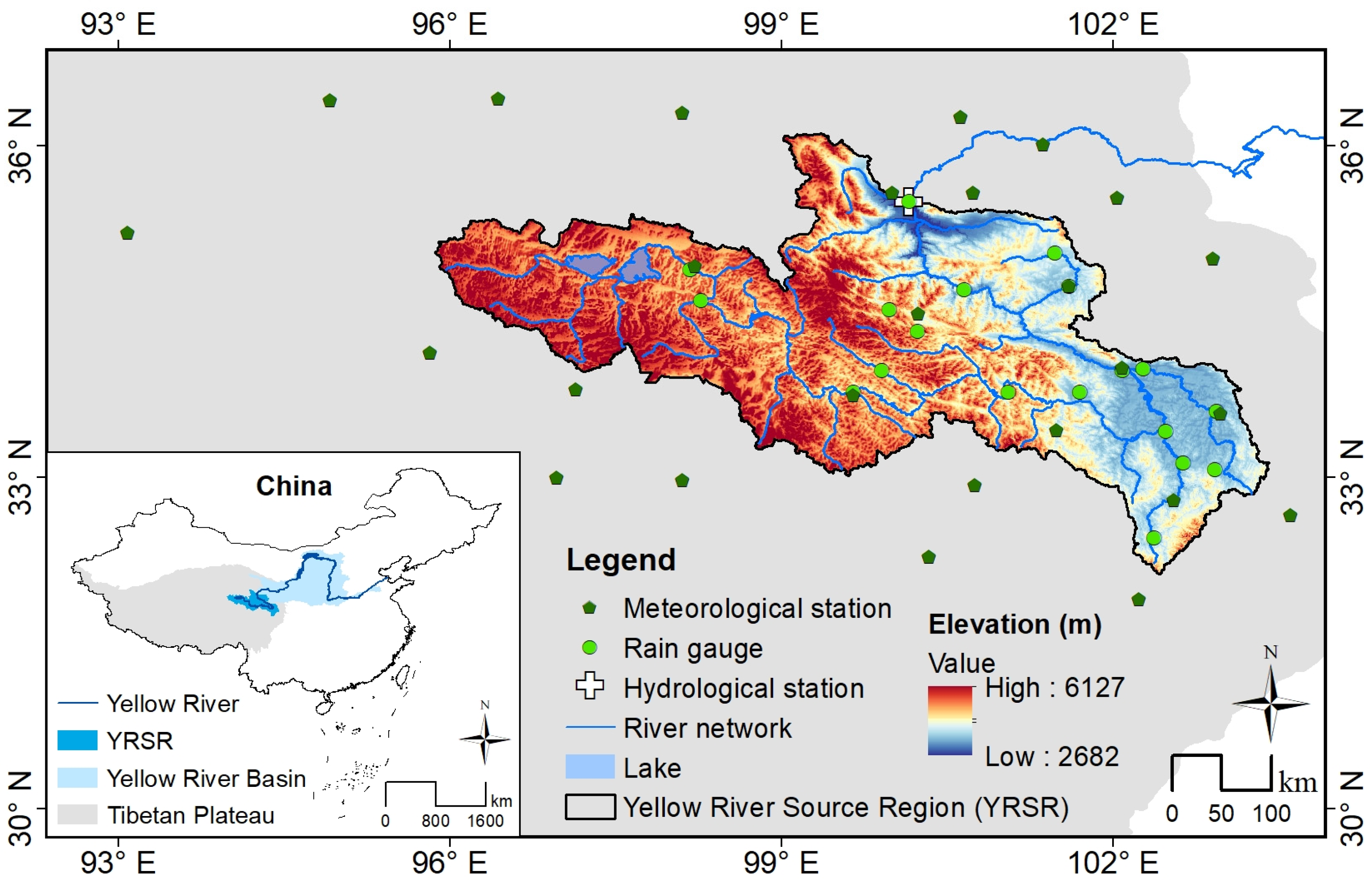
2.1. Study Area
2.2. Data Sources and Processing
2.2.1. Satellite-Based Precipitation Datasets
2.2.2. Meteorological and Hydrological Observations
2.2.3. Geographic Information Data
3. Methodology
3.1. Statistical Evaluation of SPPs
3.2. SWAT Model Simulation, Calibration and Validation in YRSR
3.3. Hydrological Evaluation and Error Propagation Analysis of SPPs
4. Results
4.1. Overall Performance of SPPs for Precipitation Estimation
4.2. Hydrological Utility of SPPs in Runoff Simulation
4.2.1. Model Applicability
4.2.2. Substitutability of SPPs for Ground-Based Observations
4.2.3. Potential of SPPs for Hydrological Modeling
4.3. Propagation Analysis of Systematic and Random Errors in SPPs
4.3.1. Error Propagation Properties from SPPs to Runoff Simulation
4.3.2. Spatial Consistency of Precipitation and Runoff Errors
5. Discussion
5.1. Surface Factors Influencing the Spatial Pattern of Error Propagation
5.2. Anomalies in the Propagation of Systematic Error
5.3. Uncertainties and Limitations
6. Conclusions
- (1)
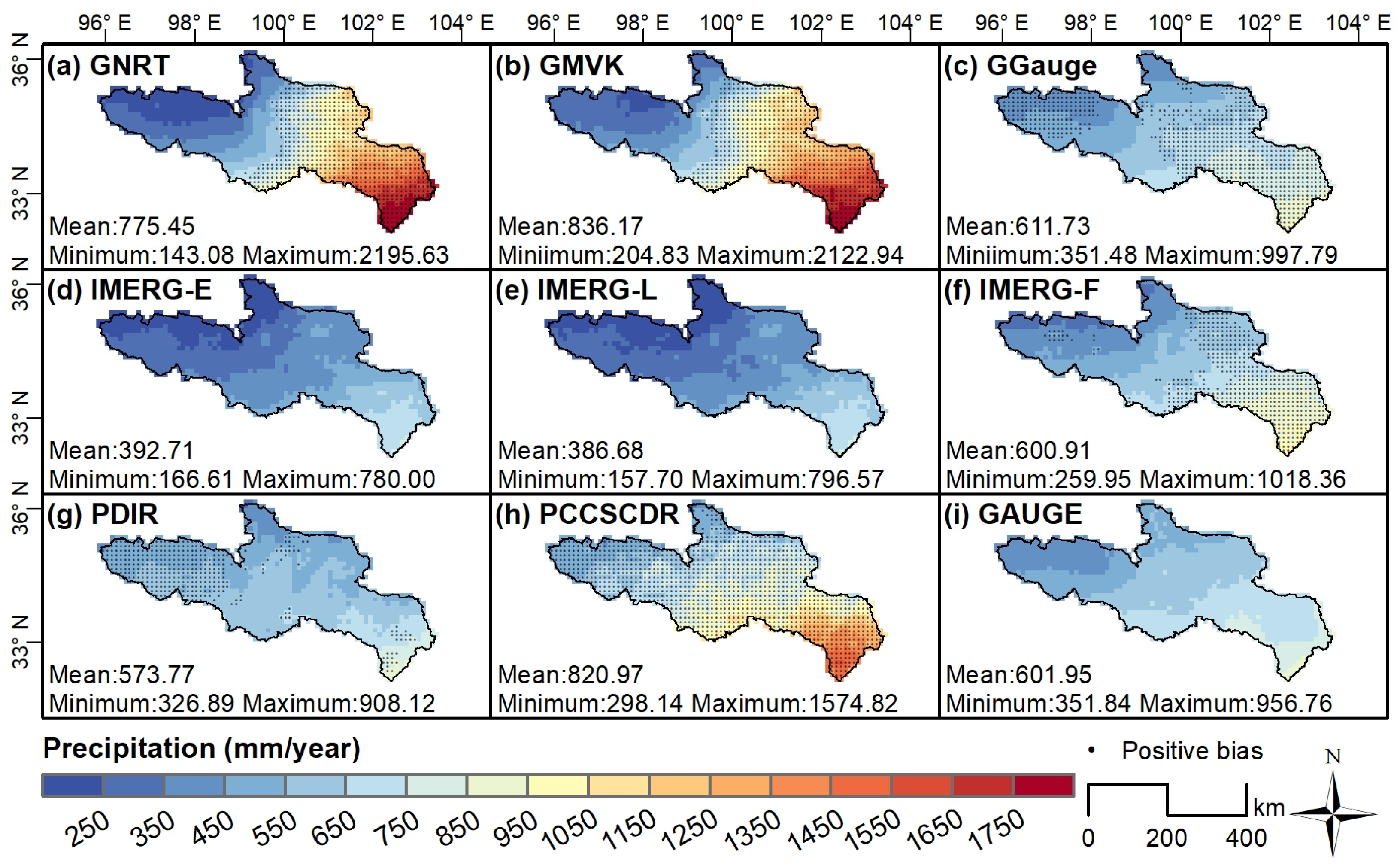
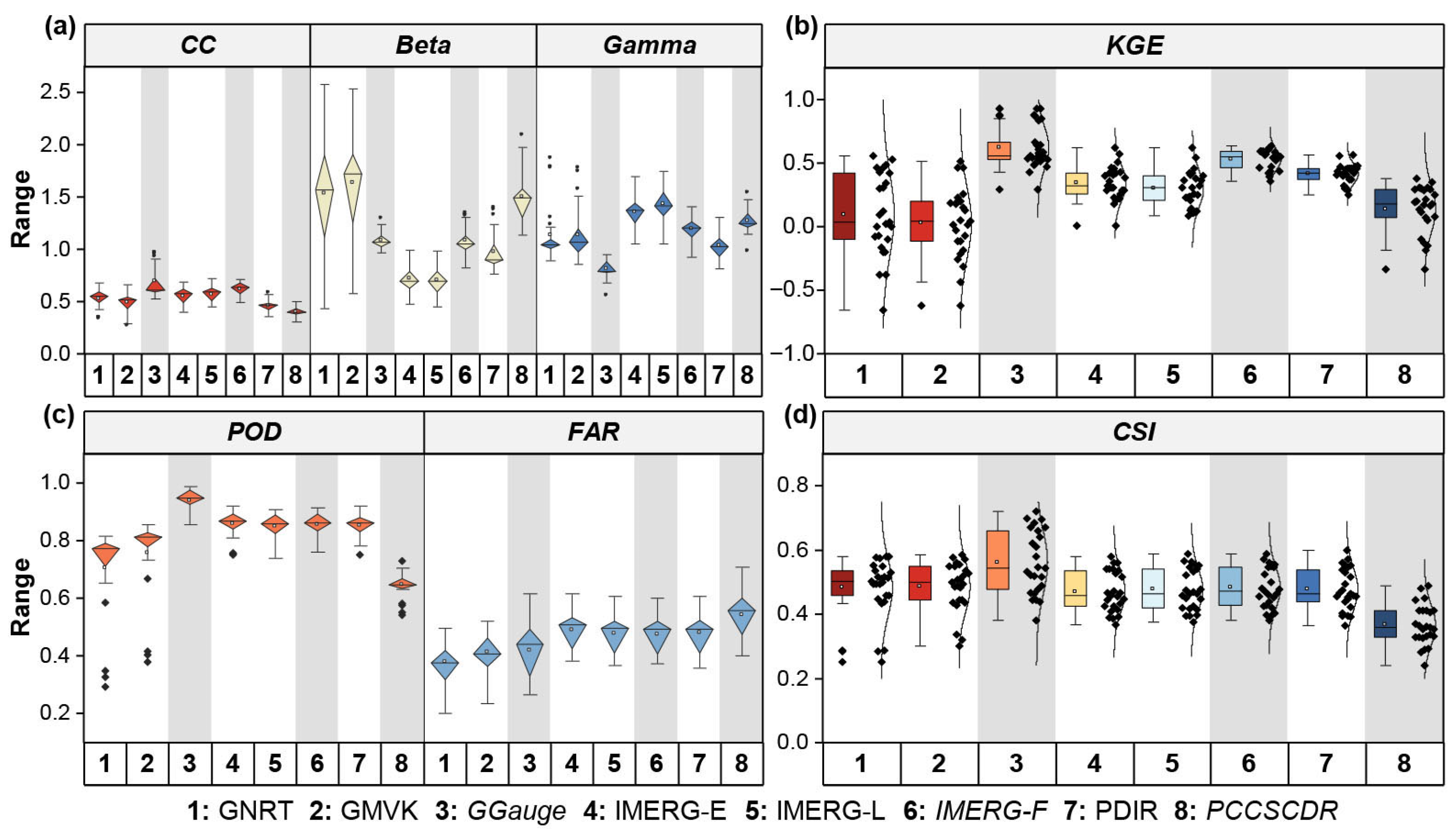
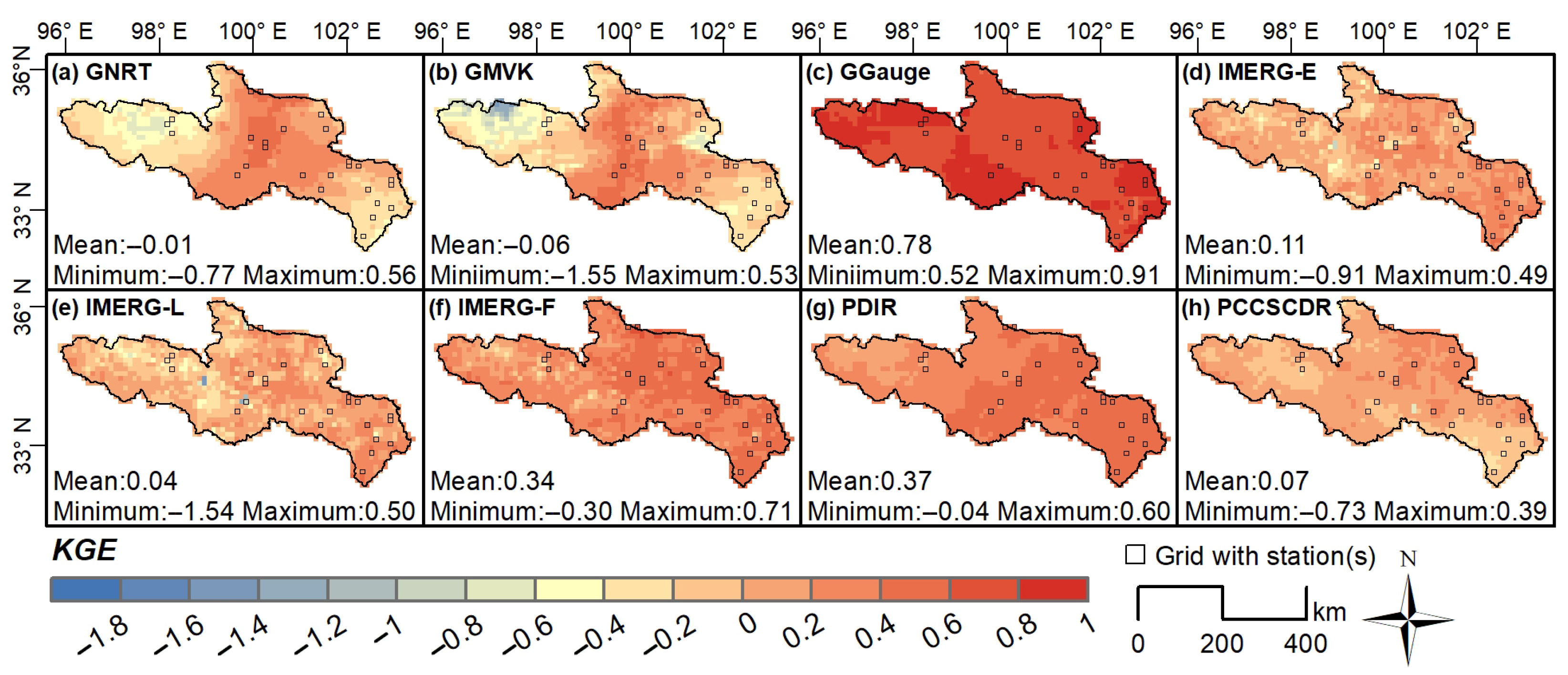
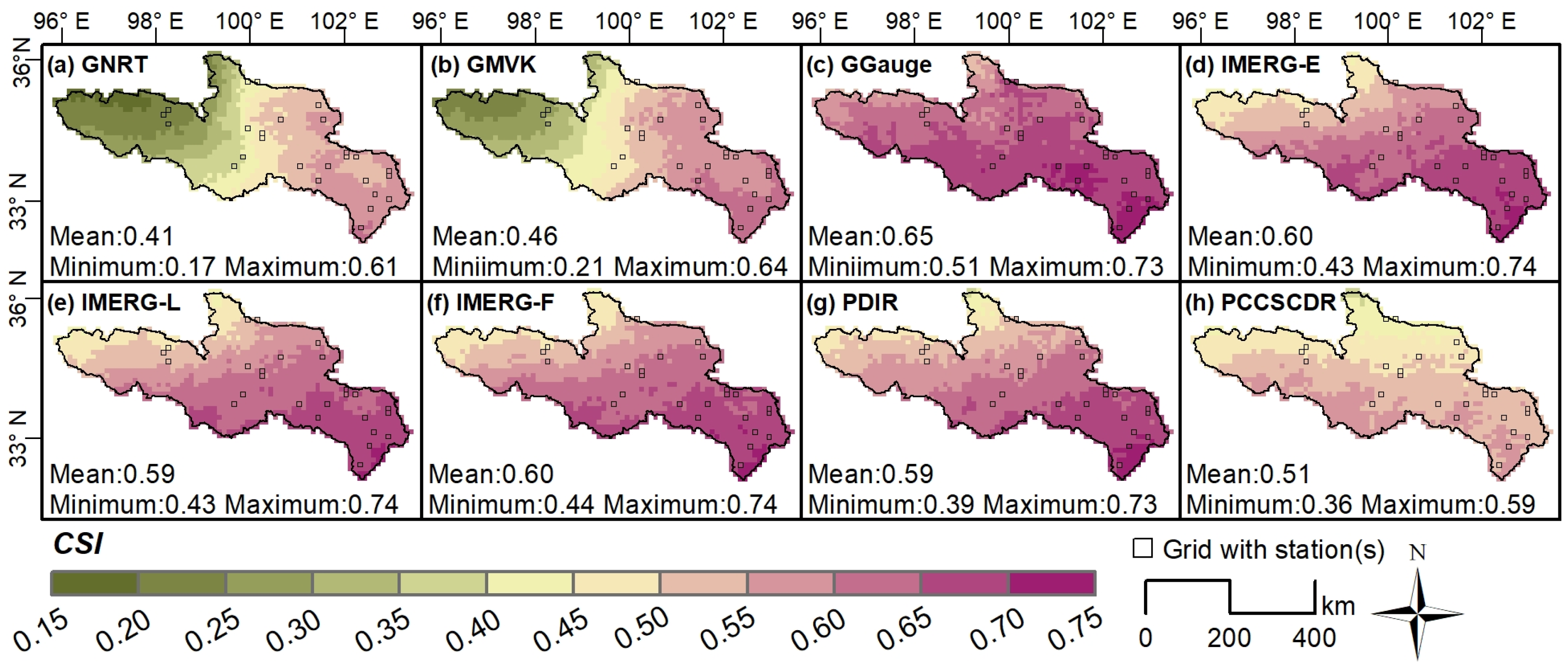
- All the SPPs can depict the spatial variation in mean annual precipitation, increasing from the northwest to the southeast in the YRSR, though there are differences across the datasets in estimating precipitation amounts and capturing precipitation events. Post-processed SPPs generally outperform near-real-time datasets, with the exception of the PERSIANN products. Based on the KGE and CSI values, the post-processed product GGauge, followed by IMERG-F, is superior to other SPPs. The ability of SPPs to quantify precipitation amounts, represented by KGE, shows notable distinctions. However, CSI values are comparable, with similar spatial patterns, and their ability to detect rainfall events is better in wetter and flatter areas.
- (2)
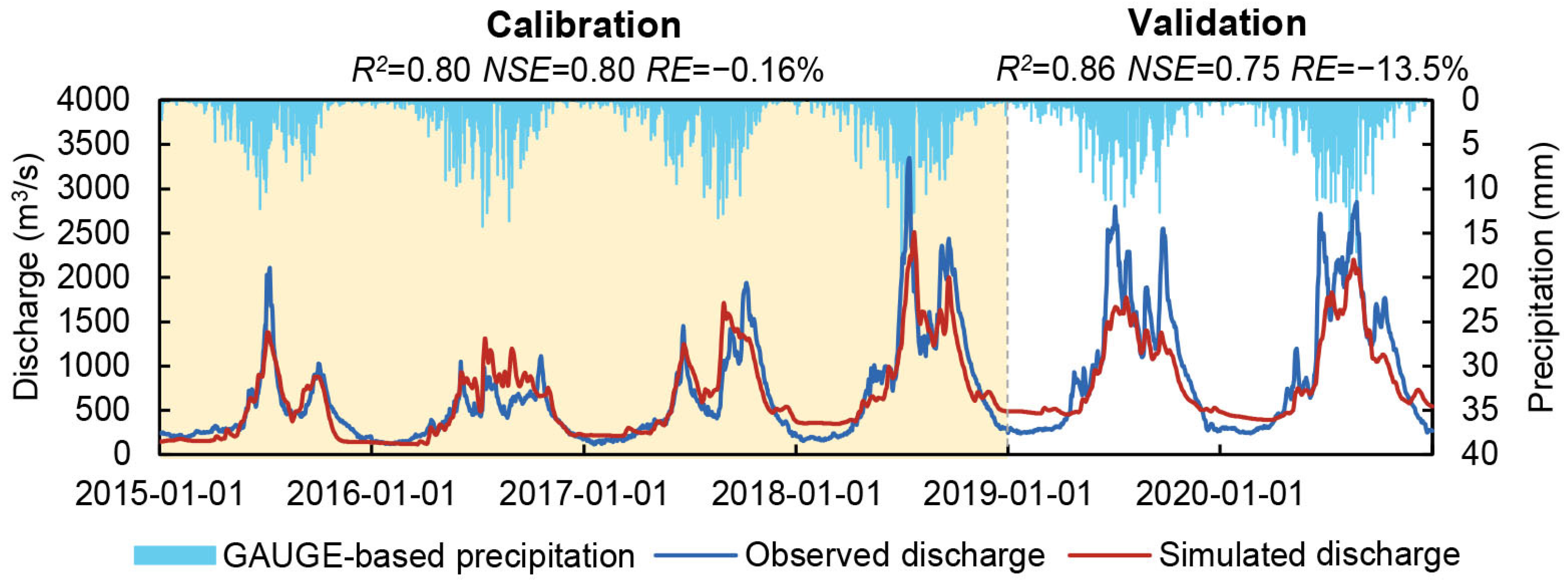
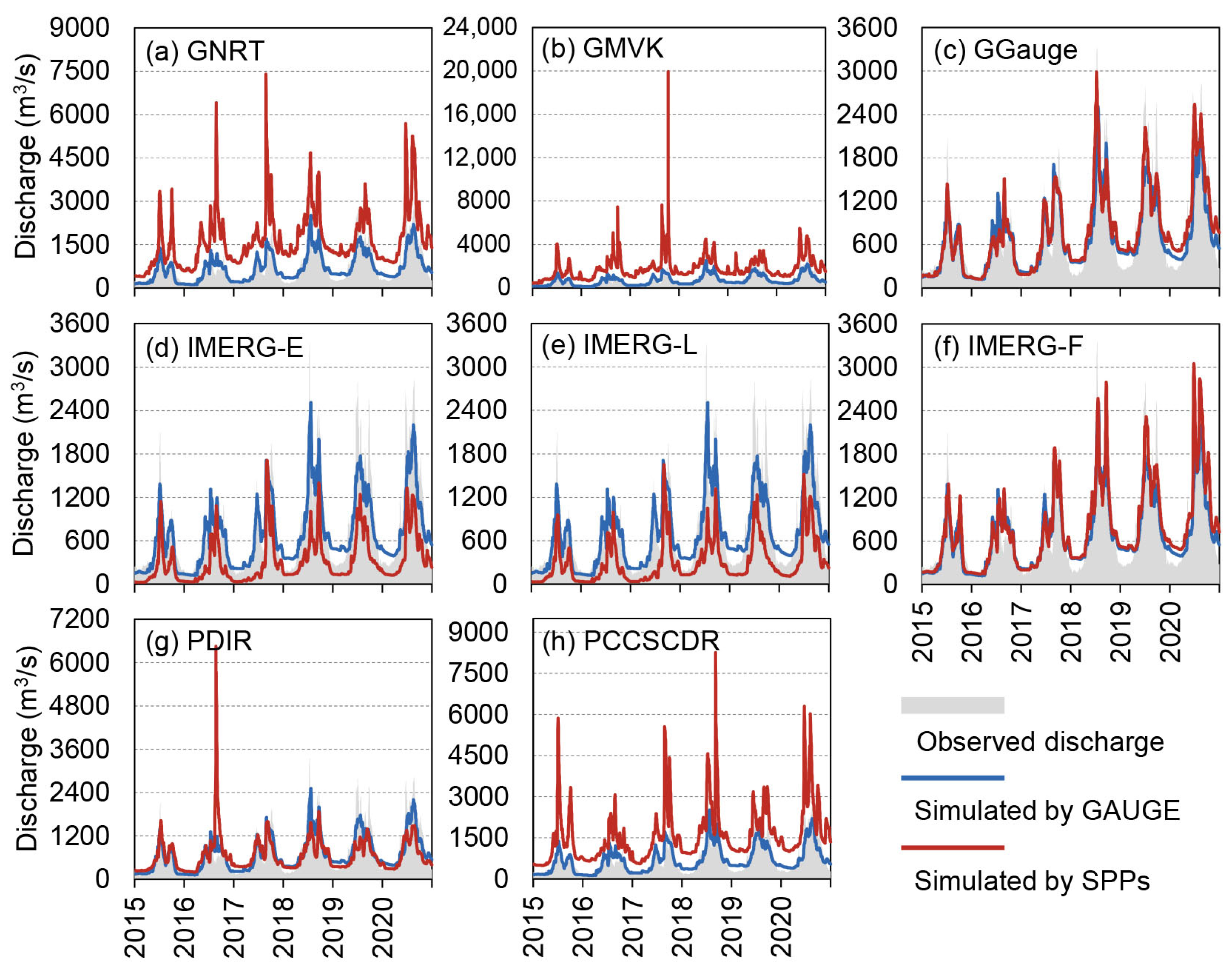
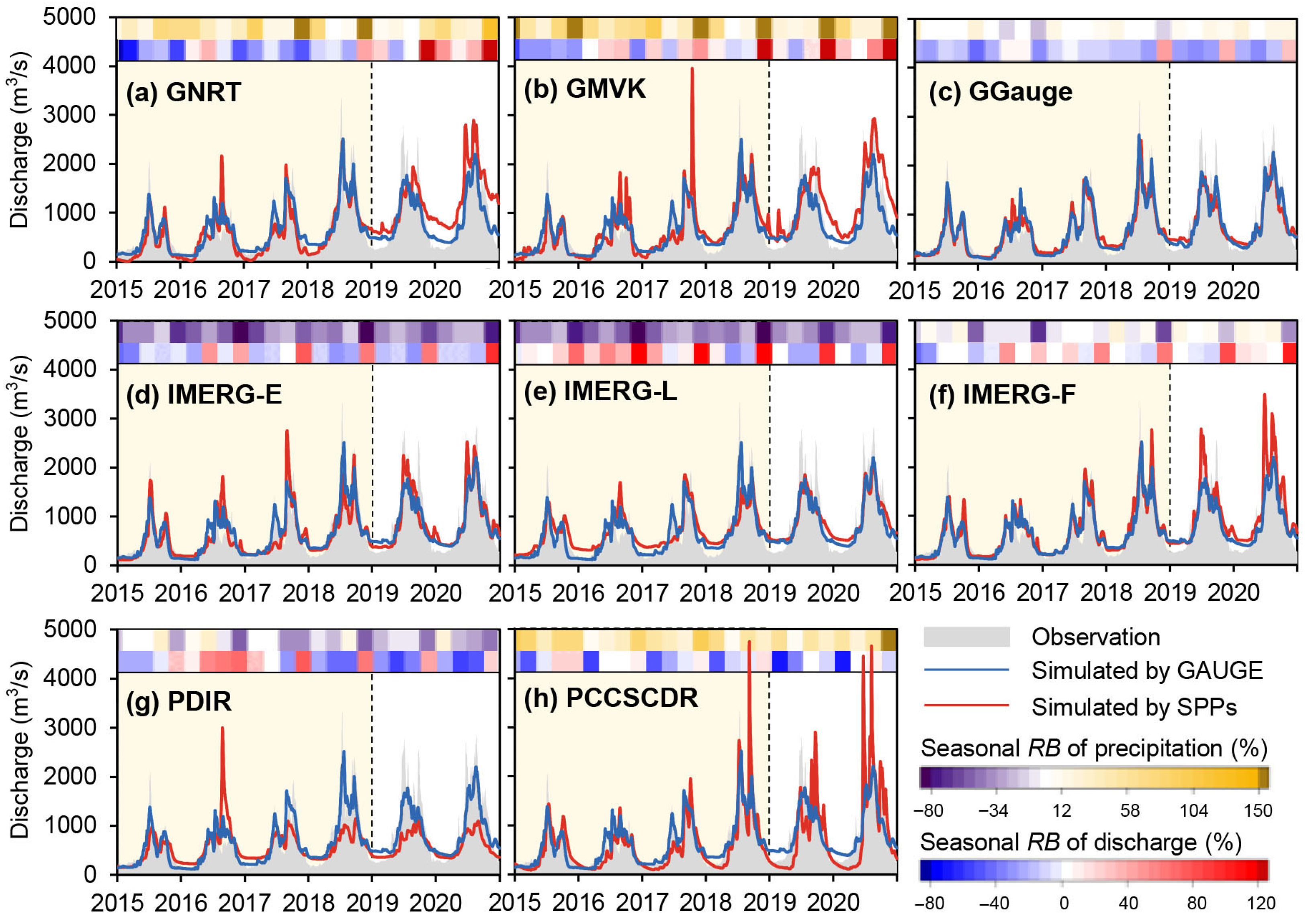
- The hydrological utility of SPPs varies, and their performance in streamflow simulation is not consistently reflected by their accuracy in precipitation estimation. Based on the site-optimal parameter set, GGauge and IMERG-F exhibit considerable substitutability for gauge-observed precipitation with good hydrological performance (R2 > 0.75, NSE > 0.65, RB ≤ ±15%), while other SPPs perform inadequately (R2 ≤ 0.50, NSE ≤ 0.50, RB > ±25%). Recalibration of model parameters enhances the applicability of SPPs, with GGauge demonstrating substantial potential for streamflow modeling (R2 = 0.86, NSE = 0.85, RB = −5.24%), which is comparable to gauge-derived simulations. IMERG-F follows GGauge, and the near-real-time SPPs of IMERG and GSMaP algorithms achieve satisfactory performance (0.50 < R2 ≤ 0.75, 0.50 < NSE ≤ 0.65, ±15% < RB ≤ ±25%). The PDIR dataset performs the worst, despite its relatively high accuracy in precipitation estimation.
- (3)
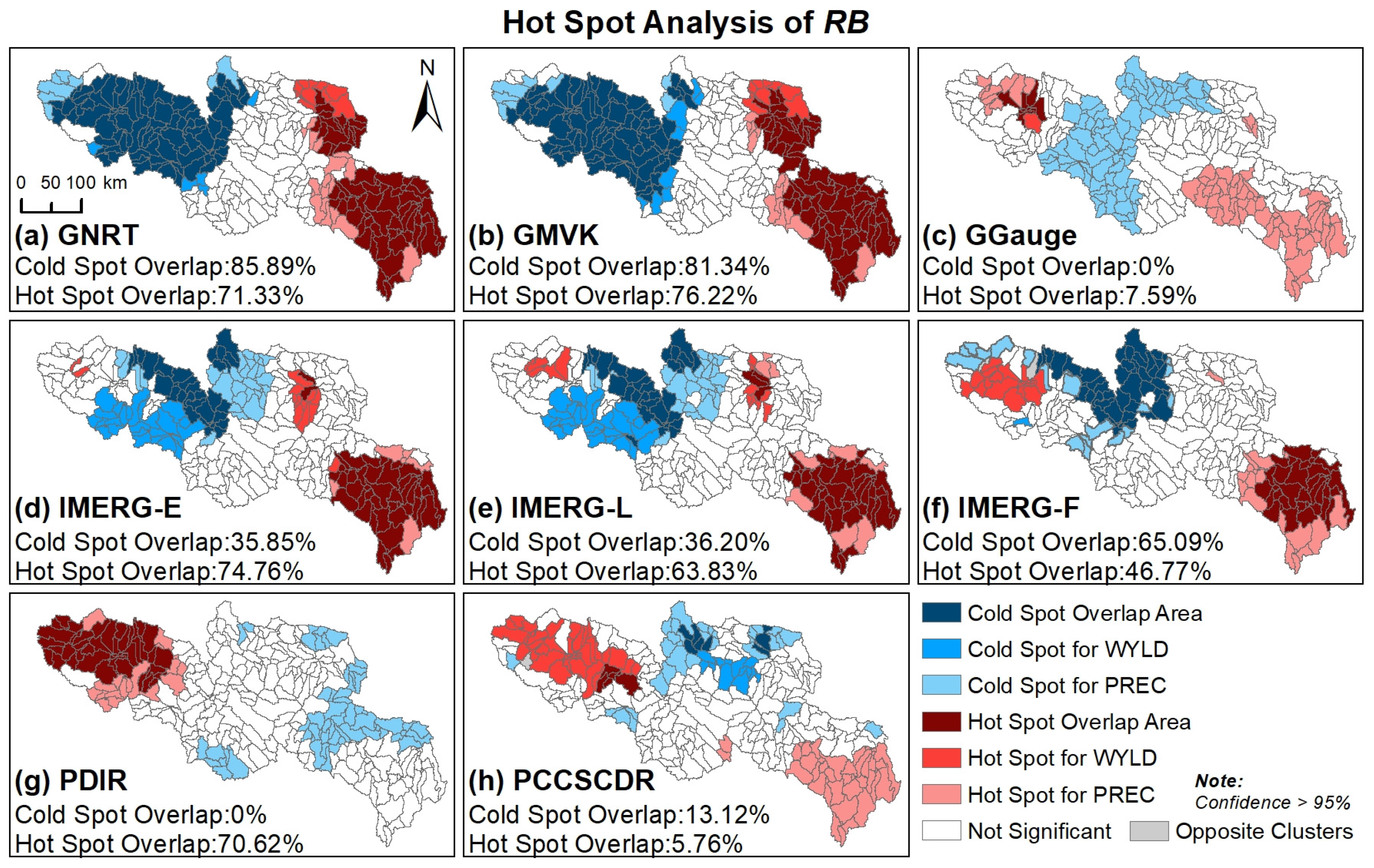
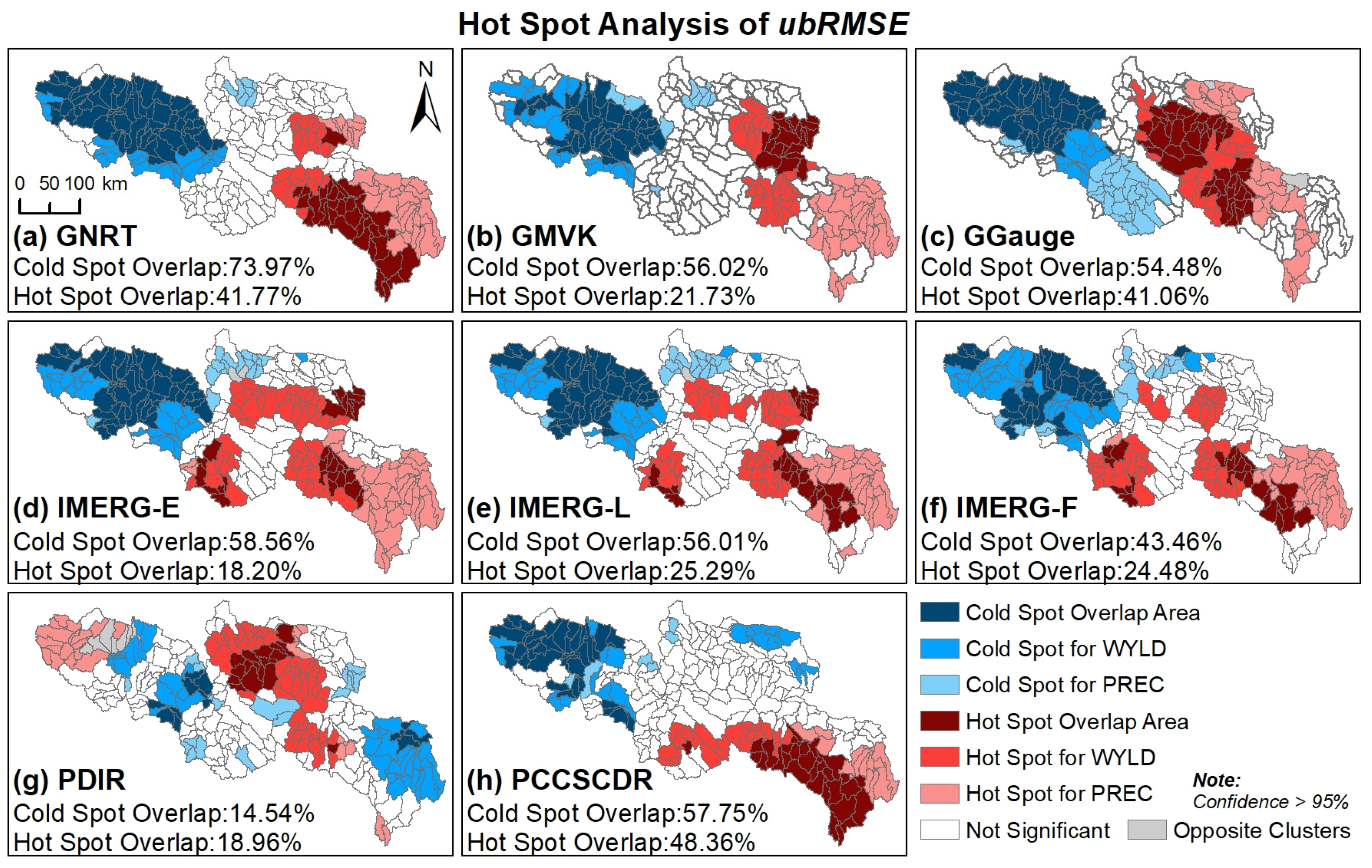
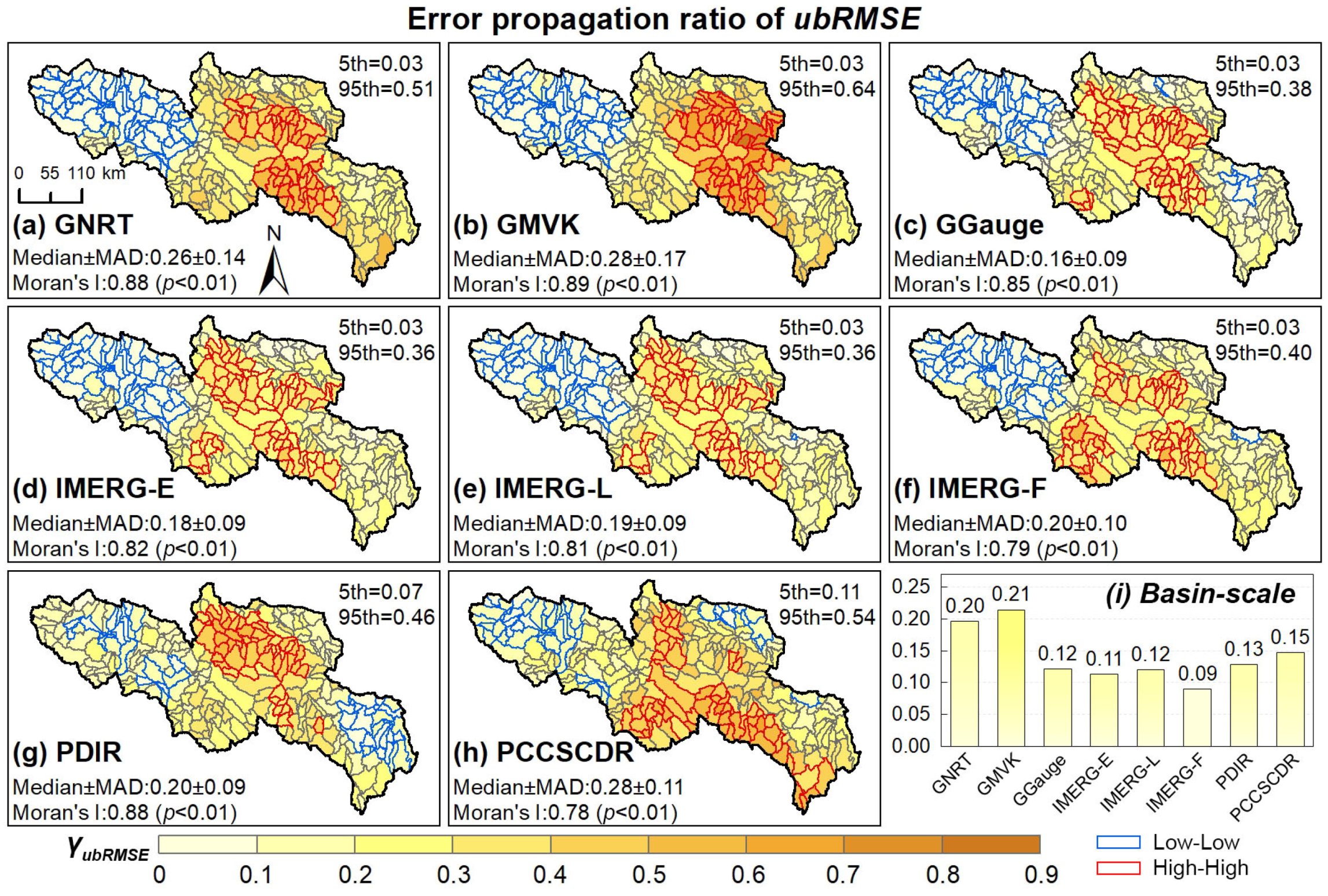
- The propagation of systematic and random errors from SPPs to simulated runoff exhibits different statistical characteristics and spatial patterns. Most γRB values are greater than one, while γubRMSE indices are less than one, suggesting that systematic bias in precipitation data is more likely to be amplified, whereas random error tends to be suppressed. The spatial pattern of γRB is less pronounced than that of γubRMSE with weaker autocorrelation. The cold and hot spot clusters of γubRMSE for each SPP are distributed in the western and central YRSR, respectively, and are related to watershed surface attributes, especially the basin slope. This reveals the zones that are sensitive to precipitation errors in the study area and indicates an association with spatially continuous watershed attributes.
Supplementary Materials
Author Contributions
Funding
Data Availability Statement
Acknowledgments
Conflicts of Interest
Appendix A

| Parameter | Definition | Value |
|---|---|---|
| r__CN2.mgt | Initial SCS runoff curve number for moisture condition | −0.368704 |
| r__EPCO.hru | Plant uptake compensation factor | −0.341931 |
| r__HRU_SLP.hru | Average slope steepness | 1.165213 |
| r__SOL_K(1).sol | Saturated hydraulic conductivity of first soil layer (mm/h) | 0.130712 |
| r__SOL_Z(1).sol | Depth to bottom of first soil layer (mm) | −0.222578 |
| v__ALPHA_BF.gw | Baseflow alpha factor (days) | 0.777567 |
| v__ALPHA_BNK.rte | Baseflow alpha factor for bank storage (days) | 1.081093 |
| v__CH_K2.rte | Effective hydraulic conductivity in main channel alluvium (mm/h) | 191.99173 |
| v__CH_N2.rte | Manning’s “n” value for the main channel | 0.097902 |
| v__GW_REVAP.gw | Groundwater delay (days) | 0.07834 |
| v__GWQMN.gw | Groundwater “revap” coefficient | 230.803696 |
| v__SMFMX.bsn | Maximum melt rate for snow during year (mm H2O/°C/day) | 3.2629 |
| v__SMTMP.bsn | Snow melts base temperature (°C) | 11.721601 |
| v__SURLAG.bsn | Surface runoff lag time (days) | 1.067742 |
| v__TIMP.bsn | Snow pack temperature lag factor | −0.125726 |
| Rate | GNRT | GMVK | GGauge | IMERG-E | IMERG-L | IMERG-F | PDIR | PCCSCDR |
|---|---|---|---|---|---|---|---|---|
| Hit | 27.92 ± 7.50 | 29.97 ± 7.30 | 37.08 ± 6.20 | 33.91 ± 5.93 | 33.49 ± 5.84 | 33.77 ± 5.75 | 33.76 ± 6.05 | 25.63 ± 5.13 |
| Miss | 11.52 ± 5.57 | 9.47 ± 5.06 | 2.36 ± 1.48 | 5.53 ± 1.68 | 5.95 ± 1.74 | 5.67 ± 1.66 | 5.68 ± 1.45 | 13.81 ± 1.55 |
| False | 17.39 ± 6.45 | 21.45 ± 6.79 | 26.75 ± 6.39 | 32.47 ± 5.61 | 30.63 ± 5.54 | 30.44 ± 5.71 | 30.97 ± 5.79 | 30.11 ± 3.79 |
| Non-events | 43.17 ± 8.21 | 39.11 ± 8.40 | 33.81 ± 3.54 | 28.09 ± 6.12 | 29.93 ± 5.92 | 30.12 ± 6.13 | 29.59 ± 6.68 | 30.45 ± 3.45 |
References
- Maggioni, V.; Massari, C. On the performance of satellite precipitation products in riverine flood modeling: A review. J. Hydrol. 2018, 558, 214–224. [Google Scholar] [CrossRef]
- Miao, C.; Gou, J.; Hu, J.; Duan, Q. Impacts of different satellite-based precipitation signature errors on hydrological modeling performance across China. Earth’s Future 2024, 12, e2024EF004954. [Google Scholar] [CrossRef]
- Shen, Y.; Hong, Z.; Pan, Y.; Yu, J.; Maguire, L. China’s 1 km merged gauge, radar and satellite experimental precipitation dataset. Remote Sens. 2018, 10, 264. [Google Scholar] [CrossRef]
- Min, C.; Chen, S.; Gourley, J.J.; Chen, H.; Zhang, A.; Huang, Y.; Huang, C. Coverage of China new generation weather radar network. Adv. Meteorol. 2019, 2019, 5789358. [Google Scholar] [CrossRef]
- Sun, Q.; Miao, C.; Duan, Q.; Ashouri, H.; Sorooshian, S.; Hsu, K.L. A review of global precipitation data sets: Data sources, estimation, and intercomparisons. Rev. Geophys. 2018, 56, 79–107. [Google Scholar] [CrossRef]
- Wu, H.; Adler, R.F.; Hong, Y.; Tian, Y.; Policelli, F. Evaluation of global flood detection using satellite-based rainfall and a hydrologic model. J. Hydrometeorol. 2012, 13, 1268–1284. [Google Scholar] [CrossRef]
- Gebrechorkos, S.H.; Leyland, J.; Dadson, S.J.; Cohen, S.; Slater, L.; Wortmann, M.; Ashworth, P.J.; Bennett, G.L.; Boothroyd, R.; Cloke, H. Global scale evaluation of precipitation datasets for hydrological modelling. Hydrol. Earth Syst. Sci. 2024, 28, 3099–3118. [Google Scholar] [CrossRef]
- Hinge, G.; Hamouda, M.A.; Long, D.; Mohamed, M.M. Hydrologic utility of satellite precipitation products in flood prediction: A meta-data analysis and lessons learnt. J. Hydrol. 2022, 612, 128103. [Google Scholar] [CrossRef]
- Zhang, L.; Li, X.; Cao, Y.; Nan, Z.; Wang, W.; Ge, Y.; Wang, P.; Yu, W. Evaluation and integration of the top-down and bottom-up satellite precipitation products over mainland China. J. Hydrol. 2020, 581, 124456. [Google Scholar] [CrossRef]
- Xiao, S.; Zou, L.; Xia, J.; Yang, Z.; Yao, T. Bias correction framework for satellite precipitation products using a rain/no rain discriminative model. Sci. Total Environ. 2022, 818, 151679. [Google Scholar] [CrossRef] [PubMed]
- Zhang, L.; Li, X.; Zheng, D.; Zhang, K.; Ma, Q.; Zhao, Y.; Ge, Y. Merging multiple satellite-based precipitation products and gauge observations using a novel double machine learning approach. J. Hydrol. 2021, 594, 125969. [Google Scholar] [CrossRef]
- Derin, Y.; Yilmaz, K.K. Evaluation of multiple satellite-based precipitation products over complex topography. J. Hydrometeorol. 2014, 15, 1498–1516. [Google Scholar] [CrossRef]
- Bai, P.; Liu, X. Evaluation of five satellite-based precipitation products in two gauge-scarce basins on the Tibetan Plateau. Remote Sens. 2018, 10, 1316. [Google Scholar] [CrossRef]
- Maggioni, V.; Meyers, P.C.; Robinson, M.D. A review of merged high-resolution satellite precipitation product accuracy during the Tropical Rainfall Measuring Mission (TRMM) era. J. Hydrometeorol. 2016, 17, 1101–1117. [Google Scholar] [CrossRef]
- Chen, H.; Yong, B.; Shen, Y.; Liu, J.; Hong, Y.; Zhang, J. Comparison analysis of six purely satellite-derived global precipitation estimates. J. Hydrol. 2020, 581, 124376. [Google Scholar] [CrossRef]
- Tang, G.; Clark, M.P.; Papalexiou, S.M.; Ma, Z.; Hong, Y. Have satellite precipitation products improved over last two decades? A comprehensive comparison of GPM IMERG with nine satellite and reanalysis datasets. Remote Sens. Environ. 2020, 240, 111697. [Google Scholar] [CrossRef]
- Willmott, C.J.; Robeson, S.M.; Feddema, J.J. Estimating continental and terrestrial precipitation averages from rain-gauge networks. Int. J. Climatol. 1994, 14, 403–414. [Google Scholar] [CrossRef]
- AghaKouchak, A.; Mehran, A.; Norouzi, H.; Behrangi, A. Systematic and random error components in satellite precipitation data sets. Geophys. Res. Lett. 2012, 39, L09406. [Google Scholar] [CrossRef]
- Chen, H.; Yong, B.; Kirstetter, P.-E.; Wang, L.; Hong, Y. Global component analysis of errors in three satellite-only global precipitation estimates. Hydrol. Earth Syst. Sci. 2021, 25, 3087–3104. [Google Scholar] [CrossRef]
- Maggioni, V.; Sapiano, M.R.; Adler, R.F. Estimating uncertainties in high-resolution satellite precipitation products: Systematic or random error? J. Hydrometeorol. 2016, 17, 1119–1129. [Google Scholar] [CrossRef]
- Li, Y.; Zhang, K.; Bardossy, A.; Shen, X.; Cheng, Y. Evaluation and error decomposition of IMERG product based on multiple satellite sensors. Remote Sens. 2023, 15, 1710. [Google Scholar] [CrossRef]
- Falck, A.S.; Maggioni, V.; Tomasella, J.; Vila, D.A.; Diniz, F.L. Propagation of satellite precipitation uncertainties through a distributed hydrologic model: A case study in the Tocantins–Araguaia basin in Brazil. J. Hydrol. 2015, 527, 943–957. [Google Scholar] [CrossRef]
- Wu, H.; Kimball, J.S.; Li, H.; Huang, M.; Leung, L.R.; Adler, R.F. A new global river network database for macroscale hydrologic modeling. Water Resour. Res. 2012, 48, W09701. [Google Scholar] [CrossRef]
- Wu, H.; Adler, R.F.; Tian, Y.; Huffman, G.J.; Li, H.; Wang, J. Real-time global flood estimation using satellite-based precipitation and a coupled land surface and routing model. Water Resour. Res. 2014, 50, 2693–2717. [Google Scholar] [CrossRef]
- Gebregiorgis, A.S.; Hossain, F. Understanding the dependence of satellite rainfall uncertainty on topography and climate for hydrologic model simulation. IEEE Trans. Geosci. Remote Sens. 2012, 51, 704–718. [Google Scholar] [CrossRef]
- Jiang, L.; Bauer-Gottwein, P. How do GPM IMERG precipitation estimates perform as hydrological model forcing? Evaluation for 300 catchments across Mainland China. J. Hydrol. 2019, 572, 486–500. [Google Scholar] [CrossRef]
- Li, X.-H.; Zhang, Q.; Xu, C.-Y. Suitability of the TRMM satellite rainfalls in driving a distributed hydrological model for water balance computations in Xinjiang catchment, Poyang lake basin. J. Hydrol. 2012, 426, 28–38. [Google Scholar] [CrossRef]
- Nikolopoulos, E.I.; Anagnostou, E.N.; Hossain, F. Error propagation of satellite-rainfall in flood prediction applications over complex terrain: A case study in northeastern Italy. In Satellite Rainfall Applications for Surface Hydrology; Springer: Berlin/Heidelberg, Germany, 2009; pp. 215–227. [Google Scholar]
- Gangrade, S.; Ghimire, G.R.; Kao, S.-C.; Morales-Hernández, M.; Tavakoly, A.A.; Gutenson, J.L.; Sparrow, K.H.; Darkwah, G.K.; Kalyanapu, A.J.; Follum, M.L. Unraveling the 2021 Central Tennessee flood event using a hierarchical multi-model inundation modeling framework. J. Hydrol. 2023, 625, 130157. [Google Scholar] [CrossRef]
- Zhang, D.; Liu, X.; Bai, P.; Li, X.-H. Suitability of satellite-based precipitation products for water balance simulations using multiple observations in a humid catchment. Remote Sens. 2019, 11, 151. [Google Scholar] [CrossRef]
- Pang, J.; Zhang, H.; Xu, Q.; Wang, Y.; Wang, Y.; Zhang, O.; Hao, J. Hydrological evaluation of open-access precipitation data using SWAT at multiple temporal and spatial scales. Hydrol. Earth Syst. Sci. 2020, 24, 3603–3626. [Google Scholar] [CrossRef]
- Ehsan Bhuiyan, M.A.; Nikolopoulos, E.I.; Anagnostou, E.N.; Polcher, J.; Albergel, C.; Dutra, E.; Fink, G.; Martínez-de la Torre, A.; Munier, S. Assessment of precipitation error propagation in multi-model global water resource reanalysis. Hydrol. Earth Syst. Sci. 2019, 23, 1973–1994. [Google Scholar] [CrossRef]
- Chen, J.; Li, Z.; Li, L.; Wang, J.; Qi, W.; Xu, C.-Y.; Kim, J.-S. Evaluation of multi-satellite precipitation datasets and their error propagation in hydrological modeling in a monsoon-prone region. Remote Sens. 2020, 12, 3550. [Google Scholar] [CrossRef]
- Maggioni, V.; Vergara, H.J.; Anagnostou, E.N.; Gourley, J.J.; Hong, Y.; Stampoulis, D. Investigating the applicability of error correction ensembles of satellite rainfall products in river flow simulations. J. Hydrometeorol. 2013, 14, 1194–1211. [Google Scholar] [CrossRef]
- Nanding, N.; Wu, H.; Tao, J.; Maggioni, V.; Beck, H.E.; Zhou, N.; Huang, M.; Huang, Z. Assessment of precipitation error propagation in discharge simulations over the contiguous United States. J. Hydrometeorol. 2021, 22, 1987–2008. [Google Scholar] [CrossRef]
- Gou, J.; Miao, C.; Sorooshian, S.; Duan, Q.; Guo, X.; Su, T. Satellite-based precipitation error propagation in the hydrological modeling chain across China. J. Hydrol. 2024, 632, 130906. [Google Scholar] [CrossRef]
- Mei, Y.; Nikolopoulos, E.I.; Anagnostou, E.N.; Borga, M. Evaluating satellite precipitation error propagation in runoff simulations of mountainous basins. J. Hydrometeorol. 2016, 17, 1407–1423. [Google Scholar] [CrossRef]
- Lan, Y.; Zhao, G.; Zhang, Y.; Wen, J.; Liu, J.; Hu, X. Response of runoff in the source region of the Yellow River to climate warming. Quat. Int. 2010, 226, 60–65. [Google Scholar] [CrossRef]
- Yuan, F.; Wang, B.; Shi, C.; Cui, W.; Zhao, C.; Liu, Y.; Ren, L.; Zhang, L.; Zhu, Y.; Chen, T. Evaluation of hydrological utility of IMERG Final run V05 and TMPA 3B42V7 satellite precipitation products in the Yellow River source region, China. J. Hydrol. 2018, 567, 696–711. [Google Scholar] [CrossRef]
- Shi, J.; Yuan, F.; Shi, C.; Zhao, C.; Zhang, L.; Ren, L.; Zhu, Y.; Jiang, S.; Liu, Y. Statistical evaluation of the latest GPM-Era IMERG and GSMaP satellite precipitation products in the Yellow River source region. Water 2020, 12, 1006. [Google Scholar] [CrossRef]
- Hu, Y.; Maskey, S.; Uhlenbrook, S. Trends in temperature and rainfall extremes in the Yellow River source region, China. Clim. Change 2012, 110, 403–429. [Google Scholar] [CrossRef]
- Ushio, T.; Sasashige, K.; Kubota, T.; Shige, S.; Okamoto, K.i.; Aonashi, K.; Inoue, T.; Takahashi, N.; Iguchi, T.; Kachi, M. A Kalman filter approach to the Global Satellite Mapping of Precipitation (GSMaP) from combined passive microwave and infrared radiometric data. J. Meteorol. Soc. Jpn. 2009, 87, 137–151. [Google Scholar] [CrossRef]
- Mega, T.; Ushio, T.; Takahiro, M.; Kubota, T.; Kachi, M.; Oki, R. Gauge-adjusted global satellite mapping of precipitation. IEEE Trans. Geosci. Remote Sens. 2018, 57, 1928–1935. [Google Scholar] [CrossRef]
- Huffman, G.J.; Bolvin, D.T.; Braithwaite, D.; Hsu, K.; Joyce, R.; Xie, P.; Yoo, S.-H. NASA global precipitation measurement (GPM) integrated multi-satellite retrievals for GPM (IMERG). In Algorithm Theoretical Basis Document Version; National Aeronautics and Space Administration: Washington, DC, USA, 2015; Volume 4. [Google Scholar]
- Nguyen, P.; Ombadi, M.; Gorooh, V.A.; Shearer, E.J.; Sadeghi, M.; Sorooshian, S.; Hsu, K.; Bolvin, D.; Ralph, M.F. Persiann dynamic infrared–rain rate (PDIR-now): A near-real-time, quasi-global satellite precipitation dataset. J. Hydrometeorol. 2020, 21, 2893–2906. [Google Scholar] [CrossRef] [PubMed]
- Sadeghi, M.; Lee, J.; Nguyen, P.; Hsu, K.; Sorooshian, S.; Braithwaite, D. Precipitation Estimation from Remotely Sensed Information using Artificial Neural Networks-Cloud Classification System-Climate Data Record (PERSIANN-CCS-CDR). In AGU Fall Meeting Abstracts; AGU: Washington, DC, USA, 2019; p. H13P-1964. [Google Scholar]
- Hutchinson, M. ANUSPLIN Version 4.36 User Guide; Centre for Resource and Environmental Studies: Canberra, Australia, 2006. [Google Scholar]
- Xu, X.; Zhang, X.; Li, X. Evaluation of the applicability of three methods for climatic spatial interpolation in the Hengduan Mountains Region. J. Hydrometeorol. 2023, 24, 35–51. [Google Scholar] [CrossRef]
- Zhang, Y.; Liang, K.; Liu, X.; Liu, C. Enlarging Difference Between Persistent Extreme Precipitation and Fixed-Time Extremes in China. Earth’s Future 2025, 13, e2024EF005877. [Google Scholar] [CrossRef]
- Guo, B.; Zhang, J.; Meng, X.; Xu, T.; Song, Y. Long-term spatio-temporal precipitation variations in China with precipitation surface interpolated by ANUSPLIN. Sci. Rep. 2020, 10, 81. [Google Scholar] [CrossRef]
- Hu, X.; Shi, S.; Zhou, B.; Ni, J. A 1 km monthly dataset of historical and future climate changes over China. Sci. Data 2025, 12, 436. [Google Scholar] [CrossRef]
- Meng, C.; Mo, X.; Liu, S.; Hu, S. Extensive evaluation of IMERG precipitation for both liquid and solid in Yellow River source region. Atmos. Res. 2021, 256, 105570. [Google Scholar] [CrossRef]
- Eum, H.I.; Yonas, D.; Prowse, T. Uncertainty in modelling the hydrologic responses of a large watershed: A case study of the Athabasca River basin, Canada. Hydrol. Process. 2014, 28, 4272–4293. [Google Scholar] [CrossRef]
- Han, J.; Miao, C.; Gou, J.; Zheng, H.; Zhang, Q.; Guo, X. A new daily gridded precipitation dataset for the Chinese mainland based on gauge observations. Earth Syst. Sci. Data 2023, 15, 3147–3161. [Google Scholar] [CrossRef]
- Hu, Y.; Zhang, L. Added value of merging techniques in precipitation estimates relative to gauge-interpolation algorithms of varying complexity. J. Hydrol. 2024, 645, 132214. [Google Scholar] [CrossRef]
- Gupta, H.V.; Kling, H.; Yilmaz, K.K.; Martinez, G.F. Decomposition of the mean squared error and NSE performance criteria: Implications for improving hydrological modelling. J. Hydrol. 2009, 377, 80–91. [Google Scholar] [CrossRef]
- Kling, H.; Fuchs, M.; Paulin, M. Runoff conditions in the upper Danube basin under an ensemble of climate change scenarios. J. Hydrol. 2012, 424, 264–277. [Google Scholar] [CrossRef]
- Schaefer, J.T. The critical success index as an indicator of warning skill. Weather Forecast. 1990, 5, 570–575. [Google Scholar] [CrossRef]
- Neitsch, S.L.; Arnold, J.G.; Kiniry, J.R.; Williams, J.R. Soil and Water Assessment Tool Theoretical Documentation Version 2009; Texas Water Resources Institute: College Station, TX, USA, 2011.
- Wang, X.; Zhou, J.; Ma, J.; Luo, P.; Fu, X.; Feng, X.; Zhang, X.; Jia, Z.; Wang, X.; Huang, X. Evaluation and comparison of reanalysis data for runoff simulation in the data-scarce watersheds of alpine regions. Remote Sens. 2024, 16, 751. [Google Scholar] [CrossRef]
- Li, M.; Di, Z.; Yao, Y.; Ma, Q. Variations in water conservation function and attributions in the Three-River Source Region of the Qinghai–Tibet Plateau based on the SWAT model. Agric. For. Meteorol. 2024, 349, 109956. [Google Scholar] [CrossRef]
- Abbaspour, K.C. SWAT Calibration and Uncertainty Programs—A User Manual; Swiss Federal Institute of Aquatic Science and Technology: Eawag, Switzerland, 2015; p. 100. [Google Scholar]
- Abbaspour, K.C.; Rouholahnejad, E.; Vaghefi, S.; Srinivasan, R.; Yang, H.; Kløve, B. A continental-scale hydrology and water quality model for Europe: Calibration and uncertainty of a high-resolution large-scale SWAT model. J. Hydrol. 2015, 524, 733–752. [Google Scholar] [CrossRef]
- Moriasi, D.N.; Arnold, J.G.; Van Liew, M.W.; Bingner, R.L.; Harmel, R.D.; Veith, T.L. Model evaluation guidelines for systematic quantification of accuracy in watershed simulations. Trans. ASABE 2007, 50, 885–900. [Google Scholar] [CrossRef]
- Zhang, L.; Gao, L.; Chen, J.; Zhao, L.; Zhao, J.; Qiao, Y.; Shi, J. Comprehensive evaluation of mainstream gridded precipitation datasets in the cold season across the Tibetan Plateau. J. Hydrol. Reg. Stud. 2022, 43, 101186. [Google Scholar] [CrossRef]
- Tong, K.; Su, F.; Yang, D.; Hao, Z. Evaluation of satellite precipitation retrievals and their potential utilities in hydrologic modeling over the Tibetan Plateau. J. Hydrol. 2014, 519, 423–437. [Google Scholar] [CrossRef]
- Li, R.; Guilloteau, C.; Kirstetter, P.E.; Foufoula-Georgiou, E. A new event-based error decomposition scheme for satellite precipitation products. Geophys. Res. Lett. 2023, 50, e2023GL105343. [Google Scholar] [CrossRef]
- Valdés-Pineda, R.; Demaría, E.M.; Valdés, J.B.; Wi, S.; Serrat-Capdevilla, A. Bias correction of daily satellite-based rainfall estimates for hydrologic forecasting in the Upper Zambezi, Africa. Hydrol. Earth Syst. Sci. Discuss. 2016, 2016, 1–28. [Google Scholar]
- Clark, M.P.; Vrugt, J.A. Unraveling uncertainties in hydrologic model calibration: Addressing the problem of compensatory parameters. Geophys. Res. Lett. 2006, 33, L06406. [Google Scholar] [CrossRef]
- Wang, J.; Zhuo, L.; Han, D.; Liu, Y.; Rico-Ramirez, M.A. Hydrological model adaptability to rainfall inputs of varied quality. Water Resour. Res. 2023, 59, e2022WR032484. [Google Scholar] [CrossRef]
- Liu, H.; Yan, H.; Guan, M. Evaluating the effects of topography and land use change on hydrological signatures: A comparative study of two adjacent watersheds. Hydrol. Earth Syst. Sci. 2025, 29, 2109–2132. [Google Scholar] [CrossRef]
- Lei, Q.; Zhang, T.; An, M.; Luo, J.; Qin, L.; Zhu, A.-X.; Qiu, W.; Du, X.; Liu, H. Sensitivity analysis of SWAT streamflow and water quality to the uncertainty in soil properties generated by the SoLIM model. J. Hydrol. 2024, 642, 131879. [Google Scholar] [CrossRef]
- Zhu, D.; Peng, D.; Cluckie, I. Statistical analysis of error propagation from radar rainfall to hydrological models. Hydrol. Earth Syst. Sci. 2013, 17, 1445–1453. [Google Scholar] [CrossRef]
- Zehe, E.; Becker, R.; Bárdossy, A.; Plate, E. Uncertainty of simulated catchment runoff response in the presence of threshold processes: Role of initial soil moisture and precipitation. J. Hydrol. 2005, 315, 183–202. [Google Scholar] [CrossRef]
- Zhang, Y.; Wei, H.; Nearing, M. Effects of antecedent soil moisture on runoff modeling in small semiarid watersheds of southeastern Arizona. Hydrol. Earth Syst. Sci. 2011, 15, 3171–3179. [Google Scholar] [CrossRef]
- Schoener, G.; Stone, M.C. Impact of antecedent soil moisture on runoff from a semiarid catchment. J. Hydrol. 2019, 569, 627–636. [Google Scholar] [CrossRef]
- Nikolopoulos, E.I.; Anagnostou, E.N.; Hossain, F. Understanding the scale relationships of uncertainty propagation of satellite rainfall through a distributed hydrologic model. J. Hydrometeorol. 2010, 11, 520–532. [Google Scholar] [CrossRef]
- Mei, Y.; Nikolopoulos, E.I.; Anagnostou, E.N.; Zoccatelli, D.; Borga, M. Error analysis of satellite precipitation-driven modeling of flood events in complex alpine terrain. Remote Sens. 2016, 8, 293. [Google Scholar] [CrossRef]
- Mihara, K.; Kuramochi, K.; Toma, Y.; Hatano, R. Effect of water movement in frozen soil on long-term hydrological simulation of Soil and Water Assessment Tool in cold climate watershed in Hokkaido, Japan. Soil Sci. Plant Nutr. 2024, 70, 160–173. [Google Scholar] [CrossRef]





| Dataset | Spatial/Temporal Resolution | Latency | Period | Ground-Based Adjustment | Reference | Abbreviation |
|---|---|---|---|---|---|---|
| GSMaP_NRT | 0.1°/1 h | 4 h | 2003~Present | No | Ushio et al. [42] | GNRT |
| GSMaP_MVK | 0.10° /1 h | 3 d | 2000~Present | No | Ushio et al. [42] | GMVK |
| GSMaP_Gauge | 0.1°/1 h | 3 d | 2000~Present | Yes | Mega et al. [43] | GGauge |
| IMERG Early run | 0.1°/30 min | 4 h | 2001~Present | No | Huffman et al. [44] | IMERG-E |
| IMERG Late run | 0.10° /30 min | 12 h | 2001~Present | No | Huffman et al. [44] | IMERG-L |
| IMERG Final run | 0.1°/30 min | 3.5 months | 2001~Present | Yes | Huffman et al. [44] | IMERG-F |
| PDIR-Now | 0.04°/1 h | 1 h | 2000~Present | No | Nguyen et al. [45] | PDIR |
| PERSIANN-CCS-CDR | 0.04°/3 h | 3 months | 1983–2020 | Yes | Sadeghi et al. [46] | PCCSCDR |
| Performance Rating | R2 | NSE | RB |
|---|---|---|---|
| Very good | R2 > 0.85 | 0.75 < NSE ≤ 1 | RB ≤ ±10% |
| Good | 0.75 < R2 ≤ 0.85 | 0.65 < NSE ≤ 0.75 | ±10% < RB ≤ ±15% |
| Satisfactory | 0.50 < R2 ≤ 0.75 | 0.50 < NSE ≤ 0.65 | ±15% < RB ≤ ±25% |
| Unsatisfactory | 0 ≤ R2 ≤ 0.50 | NSE ≤ 0.50 | RB > ±25 |
| Precipitation Datasets | R2 | NSE | RB (%) | Performance Rating |
|---|---|---|---|---|
| GNRT | 0.59 | −2.08 | 123.58 | Unsatisfactory |
| GMVK | 0.49 | −3.39 | 146.56 | Unsatisfactory |
| GGauge | 0.85 | 0.84 | 3.61 | Good |
| IMERG-E | 0.64 | 0.09 | −57.56 | Unsatisfactory |
| IMERG-L | 0.66 | 0.08 | −58.62 | Unsatisfactory |
| IMERG-F | 0.84 | 0.83 | 4.90 | Good |
| PDIR | 0.31 | 0.26 | −10.60 | Unsatisfactory |
| PCCSCDR | 0.65 | −1.80 | 114.83 | Unsatisfactory |
| Precipitation Datasets | Calibration Period (2015–2018) | Validation Period (2019–2020) | Period of 2015–2020 | |||||||
|---|---|---|---|---|---|---|---|---|---|---|
| R2 | NSE | RB | R2 | NSE | RB | R2 | NSE | RB | Performance | |
| GNRT | 0.71 | 0.67 | −14 | 0.69 | 0.6 | 21.91 | 0.69 | 0.67 | 2.3 | Satisfactory |
| GMVK | 0.62 | 0.58 | 1.07 | 0.65 | 0.56 | 21.53 | 0.66 | 0.61 | 10.3 | Satisfactory |
| GGauge | 0.85 | 0.85 | 1.16 | 0.89 | 0.81 | −12.99 | 0.86 | 0.85 | −5.24 | Very good |
| IMERG-E | 0.58 | 0.56 | −5.7 | 0.78 | 0.76 | −8.75 | 0.7 | 0.69 | −7.1 | Satisfactory |
| IMERG-L | 0.58 | 0.56 | 10.91 | 0.81 | 0.71 | −6.79 | 0.71 | 0.67 | 2.9 | Satisfactory |
| IMERG-F | 0.8 | 0.8 | 4.87 | 0.84 | 0.82 | 8.95 | 0.84 | 0.83 | 6.7 | Good |
| PDIR | 0.3 | 0.28 | −7.93 | 0.74 | 0.15 | −40.33 | 0.36 | 0.28 | −22.6 | Unsatisfactory |
| PCCSCDR | 0.76 | 0.72 | −9.8 | 0.71 | 0.57 | −15.5 | 0.74 | 0.68 | −12.4 | Satisfactory |
| Datasets | RB of Precipitation and Runoff | ubRMSE of Precipitation and Runoff | ||||
|---|---|---|---|---|---|---|
| Lee’s L | Bivariate Moran’s I | Lee’s L | Bivariate Moran’s I | |||
| GNRT | 0.96 | 0.95 | 0.95 | 0.77 | 0.72 | 0.68 |
| GMVK | 0.94 | 0.93 | 0.94 | 0.86 | 0.71 | 0.74 |
| GGauge | 0.39 | 0.35 | 0.41 | 0.63 | 0.59 | 0.61 |
| IMERG-E | 0.75 | 0.68 | 0.69 | 0.57 | 0.48 | 0.45 |
| IMERG-L | 0.76 | 0.67 | 0.69 | 0.59 | 0.44 | 0.43 |
| IMERG-F | 0.64 | 0.53 | 0.50 | 0.61 | 0.45 | 0.41 |
| PDIR | 0.77 | 0.73 | 0.26 | 0.26 | 0.17 | 0.22 |
| PCCSCDR | 0.28 | 0.17 | 0.19 | 0.79 | 0.71 | 0.55 |
Disclaimer/Publisher’s Note: The statements, opinions and data contained in all publications are solely those of the individual author(s) and contributor(s) and not of MDPI and/or the editor(s). MDPI and/or the editor(s) disclaim responsibility for any injury to people or property resulting from any ideas, methods, instructions or products referred to in the content. |
© 2026 by the authors. Licensee MDPI, Basel, Switzerland. This article is an open access article distributed under the terms and conditions of the Creative Commons Attribution (CC BY) license.
Share and Cite
Meng, C.; Mo, X.; Han, L. Assessing the Hydrological Utility of Multiple Satellite Precipitation Products in the Yellow River Source Region with Error Propagation Analysis. Remote Sens. 2026, 18, 537. https://doi.org/10.3390/rs18040537
Meng C, Mo X, Han L. Assessing the Hydrological Utility of Multiple Satellite Precipitation Products in the Yellow River Source Region with Error Propagation Analysis. Remote Sensing. 2026; 18(4):537. https://doi.org/10.3390/rs18040537
Chicago/Turabian StyleMeng, Chengcheng, Xingguo Mo, and Liqin Han. 2026. "Assessing the Hydrological Utility of Multiple Satellite Precipitation Products in the Yellow River Source Region with Error Propagation Analysis" Remote Sensing 18, no. 4: 537. https://doi.org/10.3390/rs18040537
APA StyleMeng, C., Mo, X., & Han, L. (2026). Assessing the Hydrological Utility of Multiple Satellite Precipitation Products in the Yellow River Source Region with Error Propagation Analysis. Remote Sensing, 18(4), 537. https://doi.org/10.3390/rs18040537