Article

Assessing the Hydrological Utility of Multiple Satellite Precipitation Products in the Yellow River Source Region with Error Propagation Analysis


1
School of Geography and Tourism, Henan Normal University, Xinxiang 453007, China
2
Key Laboratory of Water Cycle and Related Land Surface Processes, Institute of Geographic Sciences and Natural Resources Research, Chinese Academy of Sciences, Beijing 100101, China
3
College of Resources and Environment, University of Chinese Academy of Sciences, Beijing 101408, China
4
Sino-Danish College, University of Chinese Academy of Sciences, Beijing 101408, China
*
Author to whom correspondence should be addressed.
Remote Sens. 2026, 18(4), 537; https://doi.org/10.3390/rs18040537
Submission received: 23 December 2025 / Revised: 3 February 2026 / Accepted: 5 February 2026 / Published: 7 February 2026

Highlights

What are the main findings?
  • In hydrological processes, the propagation of systematic and random errors in satellite-based precipitation products exhibits distinct statistical characteristics and spatial patterns.
  • Hydrological simulations show that systematic bias in precipitation data tends to be amplified, while random error is suppressed, with the propagation ratio of random error exhibiting notable spatial clustering features.
What are the implications of the main findings?
  • The different propagation behaviors of systematic and random error in satellite-based precipitation data emphasize the need for targeted strategies in data modification for hydrological application.
  • Error propagation patterns help to identify zones that are sensitive to precipitation errors and it is suggested that their distributions are associated with continuous watershed attributes, such as basin slope.

Abstract

Satellite precipitation products (SPPs) generally exhibit varying accuracy and error characteristics, which influence their applicability in hydrological modeling. Based on gauge-observed precipitation and streamflow data, as well as runoff simulations from the SWAT model, this study evaluates the data accuracy, hydrological utility, and error propagation characteristics of eight SPPs derived from the GSMaP, IMERG, and PERSIANN algorithms in the Yellow River Source Region (YRSR), an alpine mountainous watershed. Results show that for estimating precipitation amounts and detecting precipitation events, post-processed GSMaP_Gauge (GGauge) performs best, followed by IMERG Final run data. These two datasets present good substitutability for gauge-based observations and demonstrate considerable potential in streamflow modeling. Specifically, after parameter recalibration, the performance of GGauge is comparable to that of gauge-derived simulations. Most propagation ratios of systematic bias (γRB) exceed one, while the ratios of random error (γubRMSE) are below 1, indicating that, through hydrological simulation, systematic bias in precipitation data is more likely to be amplified, whereas random error is generally suppressed. Additionally, γubRMSE exhibits more pronounced autocorrelation than γRB, with hotspots in the central region and cold spots in the western part of the YRSR, which is highly related to the basin slope. The statistical features and spatial patterns of error propagation indices help to identify zones that are sensitive to precipitation errors in the study area and highlight the need for targeted strategies to address different types of data error in the modification of SPPs for hydrological application.

1. Introduction

The spatiotemporal information of precipitation is the basis for meteorological and hydrological studies. As a key component of hydrological simulation, the accuracy, resolution, update time and acquisition of precipitation data play decisive roles in the applicability of hydrological modeling [1,2]. Ground rainfall gauges and ground-based weather radars can generally provide accurate rainfall data at specific sites or regions, but it is difficult to depict the continuous spatial distribution for data-scarce and ungauged areas [3,4]. Generating rainfall data through spaceborne sensors, with data retrieval and fusion, could compensate for the lack of ground measurements and ultimately release a series of quasi-global precipitation products [5]. Multisource satellite-based precipitation products (SPPs) with high resolution, wide coverage, timely updates and convenient access have received widespread attention and have been extensively applied in large-scale hydrological modeling [6,7]. While the quality of different SPPs is not uniform and their error characteristics exhibit distinct temporal and spatial heterogeneity, the performance of SPPs shows significant regional variability [1,2,5]. Therefore, assessing data quality and hydrological utility remains essential for specific study regions. The evaluation of SPPs’ performance in estimating precipitation and simulating hydrological elements can provide insights into the quality of these datasets from both direct and indirect perspectives, thereby facilitating a more comprehensive understanding of the potential of SPPs in practical applications [2,8].
Satellite-based estimation of precipitation is an indirect method, and as such, SPPs are inherently subject to various errors arising from spaceborne sensors, data processing algorithms, sampling frequencies, and other factors [1,5,9]. From the perspective of data accuracy evaluation, the discrepancies mainly manifest in the retrieval of precipitation amounts and the detection of precipitation events [10,11], which can be revealed by two types of statistical metrics: continuous and categorical indicators [12,13]. For instance, continuous metrics, such as the correlation coefficient (CC), relative bias (RB), mean square error (MSE), and Kling–Gupta efficiency (KGE), reflect the consistency or deviation of SPPs compared with gauge-observed rainfall. The categorical indices focus on whether the events have been captured, with the probability of detection (POD), false alarm rate (FAR), and critical success index (CSI) being commonly utilized. These statistical indices illustrate that the performance of SPPs varies across different geographical and meteorological conditions, as well as at discrepant spatiotemporal scales [14,15,16]. From the perspective of spaceborne observation technology and precipitation retrieval algorithms, errors in SPPs can be generally classified into systematic bias and random errors [17,18]. Both errors are found to be influenced by terrain, seasons and precipitation intensity, and thus present spatiotemporal heterogeneity [18,19,20]. In this context, the two types of errors differ in magnitude, distribution, and influencing factors, as systematic bias generally arises from satellite-based measurements and retrieval algorithms, while random error results from uncertainties in sensor sampling [14,19,21]. Spatiotemporal variations in SPP’s accuracy further interferes their efficiency in hydrological simulations, through which the errors of rainfall propagate into runoff [1,22]. Hence, evaluating SPP quality in a quantitative manner is necessary for conducting SPP-derived hydrological modeling.
SPPs can provide quasi-global precipitation information and are conducive to conducting large-scale hydrological simulations. For example, the Global Flood Monitoring System (GFMS) was developed using TRMM Multi-satellite Precipitation Analysis (TMPA) and Global Precipitation Measurement (GPM) Integrated Multi-Satellite Retrievals for GPM (IMERG) to drive the VIC model for real-time global flood monitoring within the 50°N–50°S [6,23,24]. Related studies have also compared the efficiencies of near-real-time and post-processed SPPs in runoff modeling to reveal the effect of SPP accuracy on the runoff simulation, which could be further improved by ground-based correction of precipitation data and calibration of model parameters [2,25]. In detail, the effectiveness of SPPs in hydrological modeling is influenced by precipitation features, geographic location, spatiotemporal resolution, seasons, and the selected hydrological model [1]. Taking watershed-scale applications as examples, Miao et al. [2] evaluated the performance of 10 SPPs in 366 catchments across China to analyze how errors existing in different precipitation types impact hydrological simulations with the VIC model. Jiang and Bauer-Gottwein [26] used the HBV model to verify the hydrological utility of the TMPA and IMERG datasets in more than 300 watersheds across China and identified the deficiencies of SPPs in arid areas compared with those in humid regions. Moreover, the hydrological utility of SPPs would vary across different regions and periods and could be improved by increasing the spatiotemporal resolution [27,28]. These quantitative analyses of the hydrological utility of SPPs indicated that precipitation uncertainty is one of the major factors affecting the performance of hydrological modeling [29].
The errors in the precipitation data propagate through the modeling process and are ultimately reflected in simulations of other hydrological elements, especially streamflow [30,31]. Moreover, when using precipitation data with errors for simulation, it not only affects the evaluation indicators of hydrological simulation, but also has an impact on hydrological processes. Changing precipitation input data significantly alters internal hydrological components in the SWAT model, i.e., surface runoff, lateral flow, and baseflow, even when overall runoff patterns remain similar [13,31,32]. Decomposing the errors of precipitation data and analyzing their propagation characteristics in runoff simulations could help to provide a deeper understanding of the hydrological potential of SPPs [33,34]. The use of statistical metrics, i.e., the error propagation index, is a common method for describing the relationship between rainfall and runoff errors via the analysis of systematic bias and random error [22,35,36]. Generally, the two types of metrics differ in magnitude and spatiotemporal distribution across different SPPs, with the influence of climatic and geographic conditions [35,36]. According to the regional variation in data error, their transmitting features also present spatial and temporal variations [35], and is related to climatic conditions and basin attributes, such as the aridity index, catchment area, elevation and vegetation cover [22,36,37]. Analyzing the characteristics of precipitation error transmission helps us to explore the impact of different error types on hydrological processes and the mechanism by which precipitation data errors affect runoff simulation accuracy. The error propagation analysis aids in distinguishing the strengths and limitations of SPPs and offers valuable references for advancing their performance in hydrological applications.
This study aims to evaluate the hydrological utility of muti-source SPPs in the Yellow River source region (YRSR), which is located in the northeastern Qinghai–Tibet Plateau and features typical climatic and geomorphic features of the plateau mountainous region. The YRSR covers 16.2% of the Yellow River Basin and acts as a key component of the Water Tower of Asia [38]. However, the region is equipped with sparse rain-gauges for precipitation measurements, and the density is generally 1.1/10,000 km2, referring to previous studies [39,40]. Thus, the application of SPPs serves as a particularly important supplement to precipitation monitoring and hydrological modeling. To address this issue, this study evaluated the data accuracy and hydrological utility of eight widely used SPPs, including both near-real-time and post-processed datasets, with the consideration of error propagation features and their spatial heterogeneity through the rainfall–runoff process. The objectives of this study are three aspects: (1) to illustrate the overall performance of SPPs in the YRSR with statistical metrics; (2) to demonstrate the hydrological utility and potential of mainstream SPPs in runoff simulations over the YRSR with the SWAT model; and (3) to reveal the propagation characteristics and spatial patterns of systematic and random errors in SPPs through the precipitation–runoff process at both basin-wide and sub-basin scales. The spatial consistency between precipitation input and runoff output errors, as well as the factors influencing error transmission, were also investigated.

2. Study Area and Datasets

2.1. Study Area

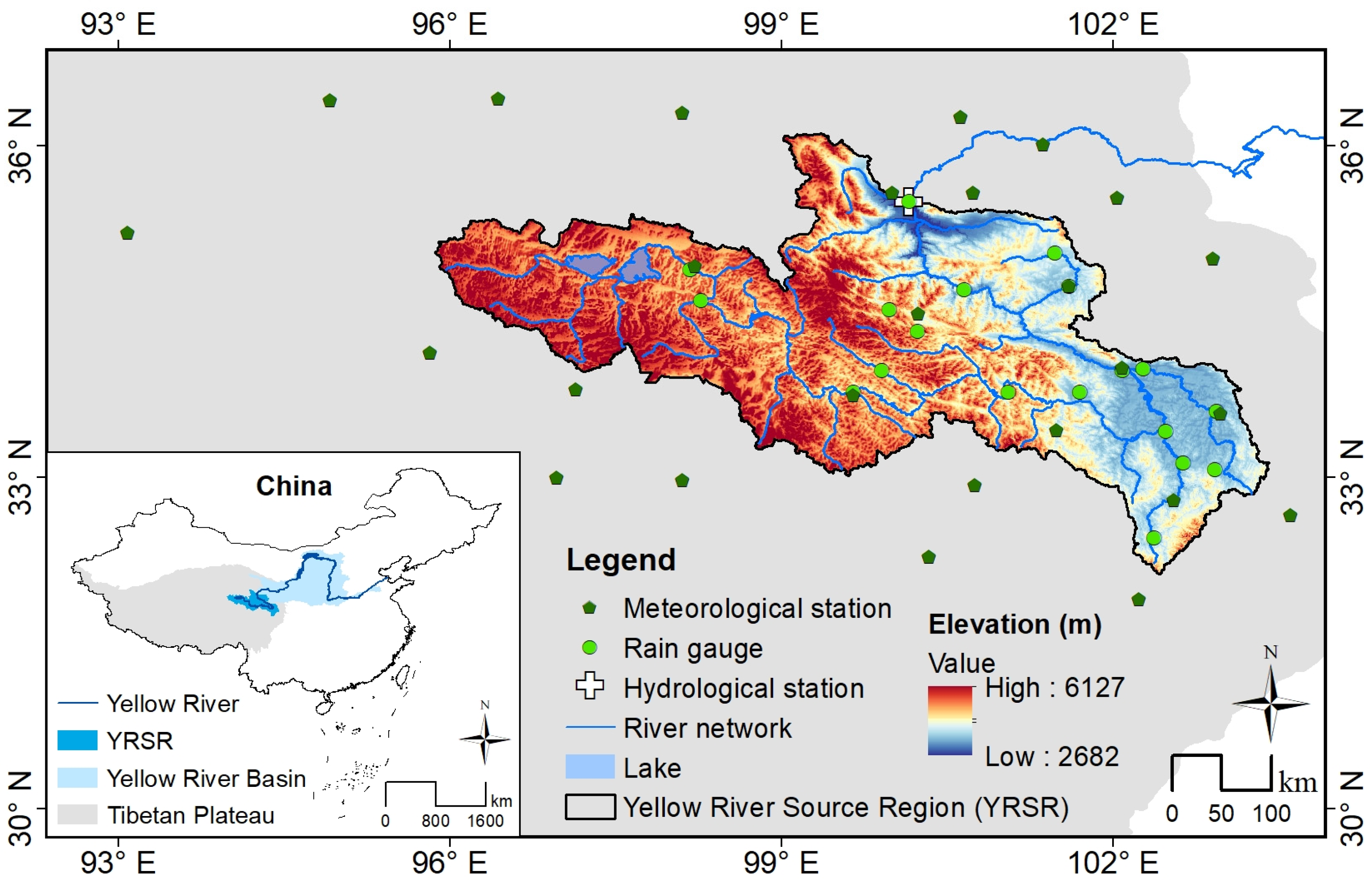
The Yellow River source region (YRSR), generally referred to as the catchment above the Tangnaihai (TNH) hydrological station, is located in the northeastern Qinghai–Tibet Plateau (Figure 1). The basin spans 95°50′–103°30′E and 30°00′–32°30′N, covering an area of 12.20 × 10⁴ km2, and is characterized by complex terrain with an average elevation of 4473 m. Dominated by a distinct plateau climate, the mean annual temperature of the YRSR is approximately 0 °C, and the average value of annual precipitation is 250–750 mm. The precipitation occurring from June to September accounts for 75% to 90% of the annual total, and thus, more than 70% of the runoff is generated in the flood season (May–October) [41]. The annual runoff volume at the TNH station is 199.03 × 10⁸ m3 (1956–2016), which supplies approximately 34.5% of the natural runoff for the whole Yellow River Basin [38]. Therefore, the monitoring and simulation of hydrological elements in the YRSR, especially rainfall and streamflow, are important for hydrology research and water resource management in the Yellow River Basin.

2.2. Data Sources and Processing

2.2.1. Satellite-Based Precipitation Datasets

The hydrological utility of eight satellite-based precipitation products (SPPs) was evaluated in this study. The datasets are generated by three mainstream retrieval algorithms, i.e., Global Satellite Mapping of Precipitation (GSMaP), IMERG and Precipitation Estimation from Remotely Sensed Information using Artificial Neural Networks (PERSIANN). GSMaP is developed by the Japan Aerospace Exploration Agency (JAXA), with datasets accessible from the JAXA Global Rainfall Watch website: https://sharaku.eorc.jaxa.jp/GSMaP/ (accessed on 22 December 2025). IMERG is produced by National Aeronautics and Space Administration (NASA) and can be downloaded from the NASA Goddard Earth Sciences (GES) Data and Information Services Center (DISC) site: http://disc.sci.gsfc.nasa.gov/ (accessed on 22 December 2025). The PERSIANN, developed by the Center for Hydrometeorology and Remote Sensing (CHRS), is available for download at the UCI CHRS Data Portal: https://chrsdata.eng.uci.edu/ (accessed on 22 December 2025). Basic information and abbreviations for SPPs used in this study are provided in Table 1. Note that IMERG V06B and PERSIANN-CCS-CDR V1R1 were utilized in this study. Both near-real-time and post-processed products were taken into consideration. The data from 2014 to 2020 were collected and unified as daily precipitation, which was accumulated from 00:00 to 24:00 UTC, corresponding to 8:00–8:00 UTC + 8 (Beijing time). Missing values in SPP pixels, caused by technical issues that have not been addressed by multi-source merging algorithms, were manually set to 0 to maintain the original precision of the SPPs and minimize potential interference from additional interpolation. The spatial resolutions of the PERSIANN datasets were resampled from 0.04° × 0.04° to 0.1° × 0.1° with an area-weighted average approach to be consistent with those of the other datasets. With discrepant accuracies and latencies, these SPPs have been widely applied to develop large-scale estimation algorithms for rainfall monitoring and hydrological modeling, especially at global and regional scales. Thus, understanding the statistical accuracy and hydrological efficiency of these datasets is highly important.

2.2.2. Meteorological and Hydrological Observations

The meteorological data used in this study for hydrological simulation included precipitation (mm), maximum and minimum temperatures (°C), sunshine hours (h), average wind speed (m/s), and average relative humidity (%) at a daily scale. The meteorological series during the period of 2014–2020 from 26 stations within and surrounding YRSY were provided by the China Meteorological Data Service Centre: https://data.cma.cn/ (accessed on 22 December 2025). Additionally, daily precipitation data from 19 rain gauges within the YRSR were collected from the Hydrology Bureau of the Ministry of Water Resources of China as an important complement to deal with the spatial heterogeneity of precipitation across the basin. Note that the precision of the in situ precipitation records was 0.1 mm/d and could be regarded as the rain/no rain threshold for both the SPPs and ground observations. The daily precipitation data observed by both meteorological stations and rain gauges were utilized in the data evaluation and hydrological simulation. In detail, sites within the region were applied to the grid-station scale assessment of data accuracy. When multiple stations are located within one pixel, the mean values of gauge observations and their geographical information were calculated for the grid-point scale evaluation, and 26 effective grids were used in this study. To conduct the basin-wide evaluation of SPPs, observations from 45 gauges, corresponding to 43 effective grids, were interpolated to 0.1° × 0.1° grid cells using Australian National University Spline (ANUSPLIN, Version 4.3) software with a thin plate smoothing spline (TPSS) function that accounts for geographic properties (i.e., longitude, latitude, and altitude) in the YRSR [47]. Taking altitude as an independent covariate, the interpolation method can reliably handle the effect of the topography on precipitation distribution in complex-terrain regions [48]. The ANUSPLIN has been extensively adopted to construct high-quality precipitation products applied in SPPs assessment, hydrological modeling and related research [49,50,51,52,53]. Moreover, the TPSS function for data interpolation in ANUSPLIN has been optimized automatically by minimizing the predictive error given by generalized cross validation [47]. In addition, the performance of ANUSPLIN for generating gauge-interpolated daily precipitation data (hereafter GAUGE) was objectively evaluated with fivefold cross-validation and presented RMSE of 2.49 ± 0.65 mm/d (Figure S1). The evaluation suggests that the accuracy of GAUGE meets or slightly exceeds the performance of gauge-based or gauge-adjusted data reported in previous studies across comparable regions [54,55]. Using the GAUGE gridded data, the daily areal precipitation for each sub-basin was obtained by spatial averaging to drive the SWAT model. Hydrological observations, i.e., daily discharges, from 2014 to 2020 at the TNH station were utilized to calibrate and validate the hydrological model. Each of the daily values was generated from 8:00 to 8:00 UTC + 8 (Beijing time). The spatial configurations of the meteorological sites, rain gauges and hydrological stations are shown in Figure 1.

2.2.3. Geographic Information Data

The spatial data required for the SWAT model included digital elevation model (DEM), land use and land cover data (LULC) and soil type datasets. The DEM data, namely the ASTER GDEM, were obtained from the Geospatial Data Cloud: http://www.gscloud.cn (accessed on 22 December 2025). With an original resolution of 30 m, the data were resampled to 250 m spatial resolution to improve model computational efficiency. The LULC data for the year 2018 with a 1 km spatial resolution was used to drive the SWAT model. The data were extracted from the CNLUCC datasets provided by the Resource and Environmental Science Data Platform: http://www.resdc.cn/ (accessed on 22 December 2025). The types of LULC were reclassified to meet the needs of the SWAT model. The Harmonized World Soil Database (HWSD) developed by the Food and Agriculture Organization (FAO) was used to form the soil dataset of the SWAT model, which included soil type maps and a soil attribute database. Based on the HWSD, a portion of the required soil information was computed using the Soil–Plant–Air–Water (SPAW) program. Each of the geographic information data were converted into Lambert azimuthal equal-area projection.

3. Methodology

This study first evaluated the accuracy of SPPs in the YRSR from a statistical perspective. Ground-based and satellite-based precipitation data were then used to drive the SWAT model. Two scenarios were designed—specifically, site-optimal and re-calibrated parameter scenarios—to assess the hydrological utility of SPPs, using model performance metrics, and explore how systematic and random errors in precipitation data propagated in runoff simulations with error propagation indices.

3.1. Statistical Evaluation of SPPs

The accuracy of SPPs in YRSR was evaluated in two aspects: precipitation amount estimation and rainfall event detection. Comprehensive indicators—namely, the KGE [56,57] and CSI [58]—were used for the grid-station and basin-wide scale evaluations.
The KGE is used to evaluate how well the SPPs estimate daily precipitation amounts and combines three parts: C C , bias ratio ( B e t a ) and variability ratio ( G a m m a ). The range of the indicator is ( , 1], with 1 as the optimal value, which indicates perfect agreement between the SPP and gauge observations. The KGE is calculated as follows:
K G E = 1 1 C C 2 + 1 B e t a 2 + 1 G a m m a 2
C C = i = 1 n S i S ¯ G i G ¯ i = 1 n S i S ¯ 2 i = 1 n G i G ¯ 2
B e t a = μ s μ g
G a m m a = σ s / μ s σ g / μ g
where S and G stand for satellite-based estimations and gauge-based observations of daily series, respectively: i is the time step; n is the number of time steps; and μ and σ represent the mean value and standard deviation, respectively.
Given 0.1 mm/d for the rain/no-rain event threshold, a contingency matrix is used to divide pairs of precipitation events from SPPs and gauge-based observations into hit (H), miss (M), false (F), and non-event. On this basis, the CSI is calculated to assess how well the SPPs estimate the occurrence of precipitation events. The indicator considers both POD and FAR. The range of the indicator is [0, 1], and 1 is the optimal value. The equations to calculate CSI are as follows:
P O D = H H + M
F A R = F H + F
C S I = H H + F + M = 1 1 / ( 1 FAR ) + 1 / POD 1
where H is the number of hit events detected by both ground observations and satellite estimations; M is the number of missed events that are recorded only in ground observations; and F is the number of false events that are recorded only in satellite datasets.

3.2. SWAT Model Simulation, Calibration and Validation in YRSR

The SWAT model, also known as the Soil and Water Assessment Tool, is a semi-distributed hydrological model developed by the Agricultural Research Service (ARS) of the United States Department of Agriculture (USDA). The model accounts for the impacts of spatial variations in terrain, land use, soil types, and other attributes within the study area on hydrological processes by dividing the entire basin into sub-watersheds. Furthermore, through the division of sub-watersheds into hydrological response units (HRUs), which contain unique land cover, soil, and management measures, spatial heterogeneity can be simplified to enhance model operability [59]. The SWAT model has been widely used in hydrological studies in the headwaters of the Yellow River, and has been proven to be effective in streamflow simulations in this region [39,60,61].
By overlaying the geographic information datasets, i.e., DEM, LULC, and soil type datasets, the YRSR was delineated into 309 sub-basins and 3811 HURs. Meteorological records from stations and gauge-based precipitation data for each sub-basin were then used to drive the SWAT model. Daily discharges (m3/s) measured at the TNH hydrological station were used to optimize the SWAT model using the SUFI-2 method integrated into the SWAT-CUP (Version 5.1.6) software. To initialize the model environment, the length of the warm-up period was tested through practical trials and the year 2014 was selected as the warm-up period. Then, the SWAT model was calibrated from 2015 to 2018 and validated from 2019 to 2020. The Nash–Sutcliffe efficiency coefficient (NSE) was used as the objective function to conduct model iteration with Latin hypercube sampling.
A sensitive analysis of the model parameters was also carried out with the SUFI-2 method. The SUFI-2 method for SWAT model parameter sensitivity analysis and selection involves initializing the model with input data and defining parameter uncertainty ranges. The algorithm uses Monte Carlo sampling to explore the parameter space, running multiple simulations to evaluate model performance through the objective functions’ NSE. With global sensitivity analysis, p-values and t-values are used to assess the significance of individual parameters [62]. A highly sensitive parameter is typically characterized by a large absolute t-value and a small p-value (e.g., <0.05). The process iteratively refines the parameter ranges, optimizing the objective functions’ NSE and quantifying the uncertainty in the predictions. The top 15 sensitive parameters were considered in the subsequent optimization. The descriptions and values of sensitive parameters are presented in Table A1. In addition, parameters related to the changes in frozen soil were required. Through iterative processes, the simulated discharge gradually approached the observed series as the parameter ranges and uncertainty narrowed. The SUFI-2 method measures parameter uncertainty via the P-factor and R-factor. The P-factor represents the percentage of observed data falling within the 95% prediction confidence interval, and the R-factor is the ratio of the average thickness of this interval to the standard deviation of the observations. In this study, the parameter uncertainty was considered acceptable when the P-factor exceeded 0.7 and the R-factor was less than 1.5 [63]. Given this range of parameters and level of uncertainty, an optimal parameter set and the corresponding discharge simulations could be obtained. Then, the applicability of the SWAT model in the YRSR was further assessed with statistical metrics for hydrological modeling, i.e., the coefficient of determination (R2), NSE, and RB. The evaluation criteria for the model are shown in Table 2 [64]. The calculations of the metrics are as follows:
R 2 = [ i = 1 i = n G i G ¯ S i S ¯ ] 2 i = 1 i = n ( G i G ) 2 i = 1 i = n ( S i S ¯ ) 2
N S E = 1 i = 1 i = n ( G i S i ) 2 i = 1 i = n ( G i G ¯ ) 2
R B = i = 1 n S i G i i = 1 n G i × 100 %

3.3. Hydrological Evaluation and Error Propagation Analysis of SPPs

Site-optimal and re-calibrated parameter scenarios were built to evaluate the hydrological alternative and potential of SPPs in runoff simulation. In the site-optimal parameter scenario, the gauge-based precipitation data were sequentially replaced by the eight SPPs, while all other input data and model parameters remained the same as those described in Section 3.2. This scenario was designed to evaluate the ability of SPPs to serve as alternatives to precipitation observations in hydrological modeling. The re-calibrated parameter scenario involves the recalibration of model parameters after replacing gauge-based precipitation with SPP data, thereby assessing the hydrological potential of the eight SPPs in the YRSR.
Error propagation analysis was conducted under the site-optimal parameter scenario by comparing the systematic bias and random error in precipitation and runoff generation. In this analysis, both precipitation and runoff are expressed as an equivalent water depth in millimeters (mm). The gauge-interpolated precipitation and the corresponding runoff simulations for the entire YRSR and its sub-basins were regarded as benchmarks to calculate the input (precipitation) and output (runoff) errors. Furthermore, the ratios of precipitation to runoff errors, in terms of RB and the unbiased root mean square error (ubRMSE), were calculated to quantitatively describe the characteristics of error propagation [22,33], denoted as γRB and γubRMSE. These two metrics reflect how the systematic bias and random error in precipitation data propagate through runoff simulation. When the ratio exceeds 1, the precipitation input error is amplified, whereas a ratio below 1 indicates that the error is suppressed. Formulas of γRB and γubRMSE are as follows:
u b R M S E = i = 1 n ( G i S i ) 2 n i = 1 n ( G i S i ) n 2
γ R B = R B   o f   r u n o f f R B   o f   p r e c i p i t a t i o n
γ u b R M S E = u b R M S E   o f   r u n o f f u b R M S E   o f   p r e c i p i t a t i o n
Spatial autocorrelation analysis of γRB and γubRMSE were conduct based on Moran’s index (Moran’s I) to examine their spatial clustering patterns. The spatial consistency of precipitation input and runoff output error is analyzed with Pearson correlation coefficients (CC), Lee’s L index, and the Bivariate Moran’s I that quantify the linear correlation and spatial similarity of the two errors.

4. Results

4.1. Overall Performance of SPPs for Precipitation Estimation

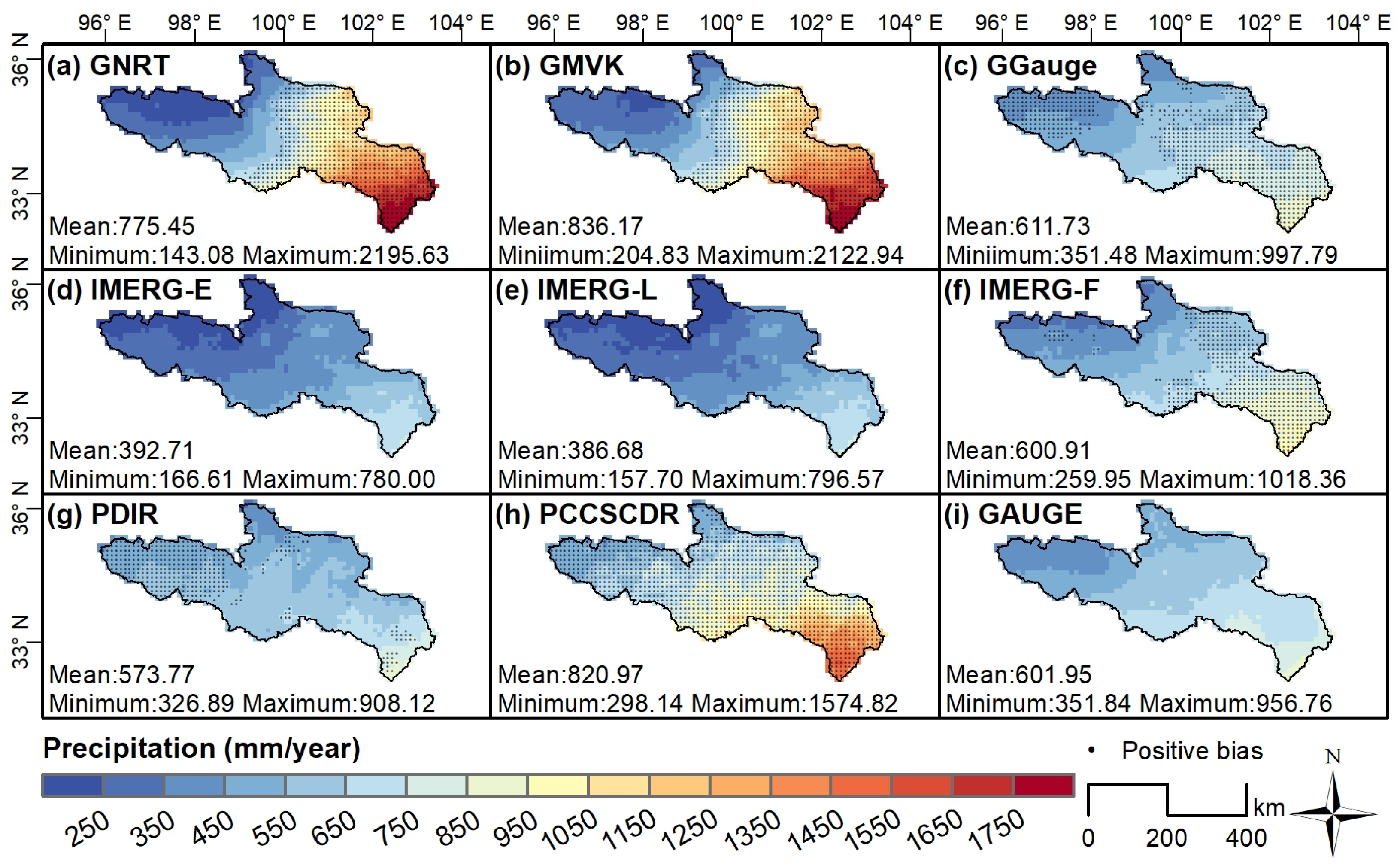
The spatial distribution of the average annual precipitation, estimated by GAUGE and SPPs from 2014 to 2020 in the YRSR, is shown in Figure 2. According to the gauge-interpolated data (Figure 2i), the regional average annual precipitation in YRSR is 601.95 mm, with a minimum of 351.84 mm and a maximum of 956.76 mm. The eight SPPs used in this study are able to capture the spatial pattern of annual precipitation, which increases from northwest to southeast across the YRSR (Figure 2a–h). The post-processed products, namely GGauge and IMERG-F, and the near-real-time product PDIR show estimates are closest to the observed data, both in terms of spatial distribution and regional mean precipitation. SPPs generated by the same retrieval algorithm tend to exhibit similar performance. For instance, there are no notable differences in annual precipitation patterns between GNRT and GMVK, nor between IMERG-E and IMERG-L. Both GNRT and GMVK tend to underestimate precipitation in the low-value areas of northwestern YRSR and overestimate it in its high-value southeastern areas, leading to an overall overestimation for the entire basin. In contrast, IMERG-E and IMERG-L generally underestimate the annual precipitation across the region. Compared with other near-real-time satellite products, the PDIR data are relatively more consistent with both the precipitation estimates and spatial distributions observed in the YRSR. However, the PCCSCDR data exhibit an overestimation across the study area. Additionally, the SPPs retrieved using the PERSIANN algorithm show noticeable seam lines, particularly in southeastern Tibet, which are related to the input data used by the retrieval algorithm and its mosaicking process [65,66]. The comparative analysis of the ability of the SPPs to estimate annual precipitation reveals the differences in precipitation data accuracy and suggests the effectiveness of the ground-based correction process in most cases.
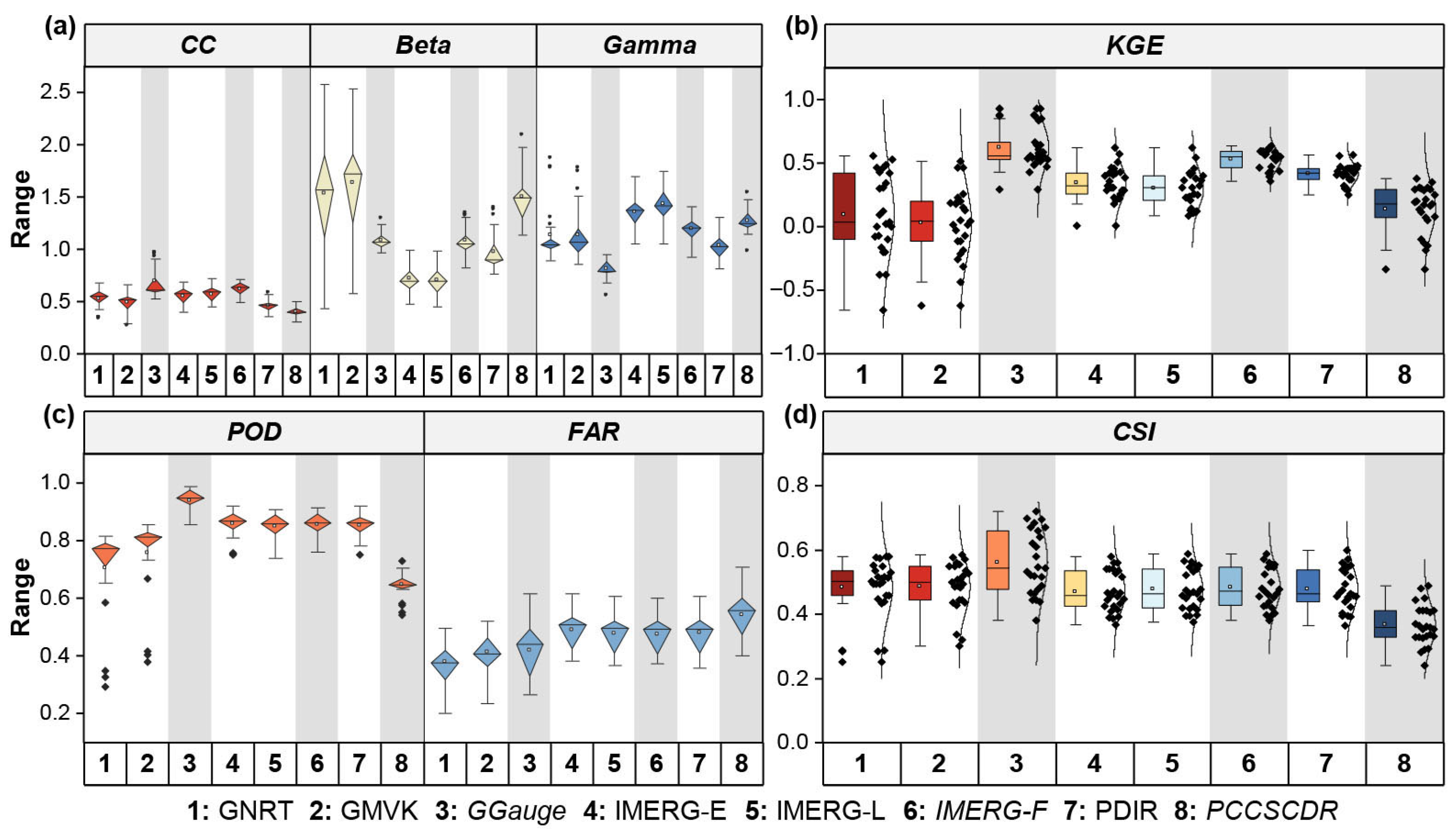
Statistical metrics quantitatively assess the accuracy of SPPs in terms of estimating precipitation amounts and detecting precipitation events. The boxplots in Figure 3 present the grid-point indicators of eight SPPs at the daily scale, calculated for each grid cell that contains stations. For the near-real-time SPPs, the CSI values are similar, but notable differences in KGE have been observed across the datasets. According to the KGE indicator, PDIR is slightly superior to IMERG-E and IMERG-L, and all three outperform GNRT and GMVK. A comparison of the near-real-time SPPs using CC, Beta, and Gamma indicates that the high KGE of PDIR is primarily attributed to its smaller bias. In contrast, the IMERG-E and IMERG-L datasets present good agreement and relatively low deviation when compared to ground-based observations in the YRSR. However, GNRT and GMVK exhibit noticeable bias, causing substantial underestimations of daily precipitation in the region. Based on KGE and CSI, the gauge adjustment of IMERG data at a monthly scale primarily improves their accuracy in estimating precipitation amounts, while daily scale post-processing in the GSMaP algorithm further enhances the ability to detect precipitation events. Regarding the post-processed products, GGauge exhibits the highest accuracy in the YRSR, followed by the IMERG-F. The PCCSCDR data performed relatively poorly: even worse than some of the near-real-time SPPs. Table A2 additionally presents the hit, false, miss, and non-event rates for the eight SPPs at the grid-point scale. The missing events in SPPs represent the instances where SPPs fail to detect actual rainfall and cause negative bias, which are generally associated with factors such as cloud cover, snow cover, mountainous precipitation, and winter weather systems [67]. GGauge exhibits the lowest miss rate, whereas PCCSCDR shows the highest miss rate, followed by GNRT. Low miss rates are accompanied by higher false alarm rates, such as in IMERG-E. This drizzle effect is a common issue in satellite precipitation products, where sensors and algorithms fail to accurately detect light precipitation, leading to the accumulation of positive errors [68].
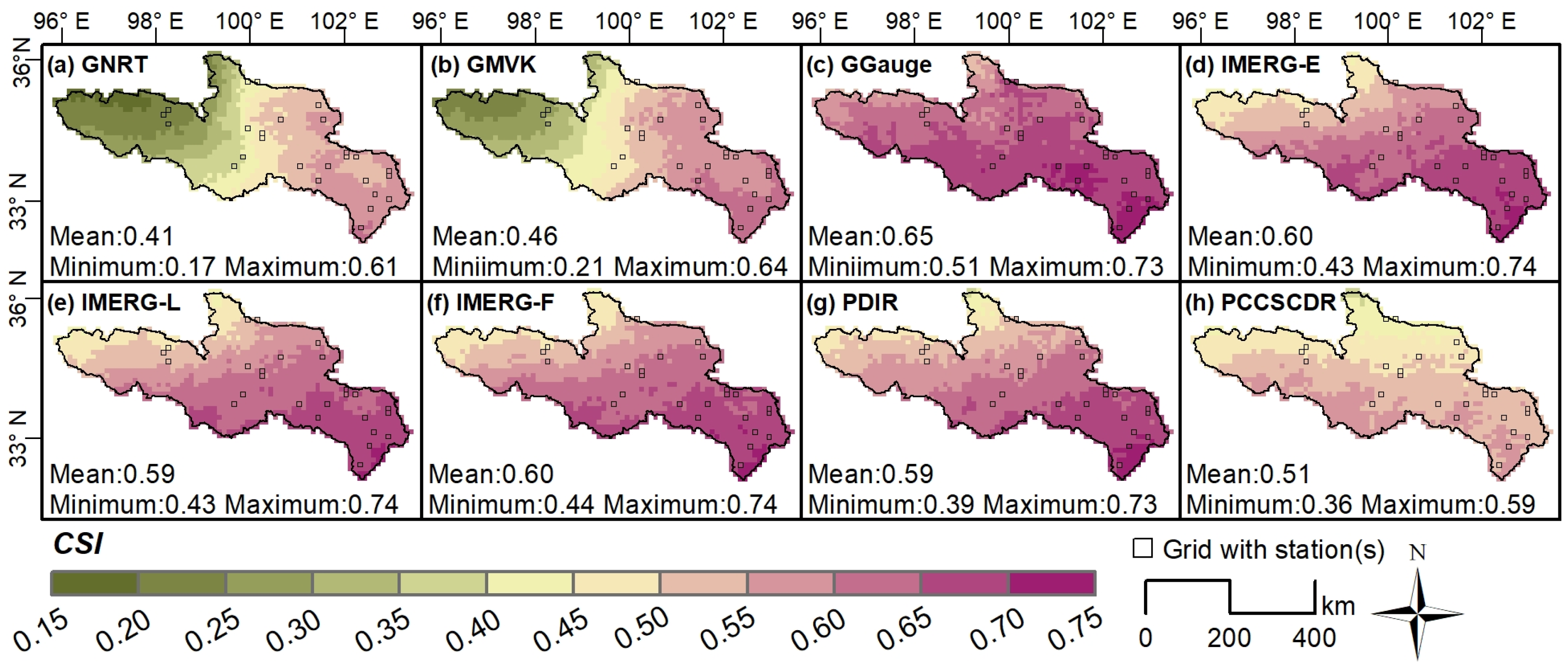
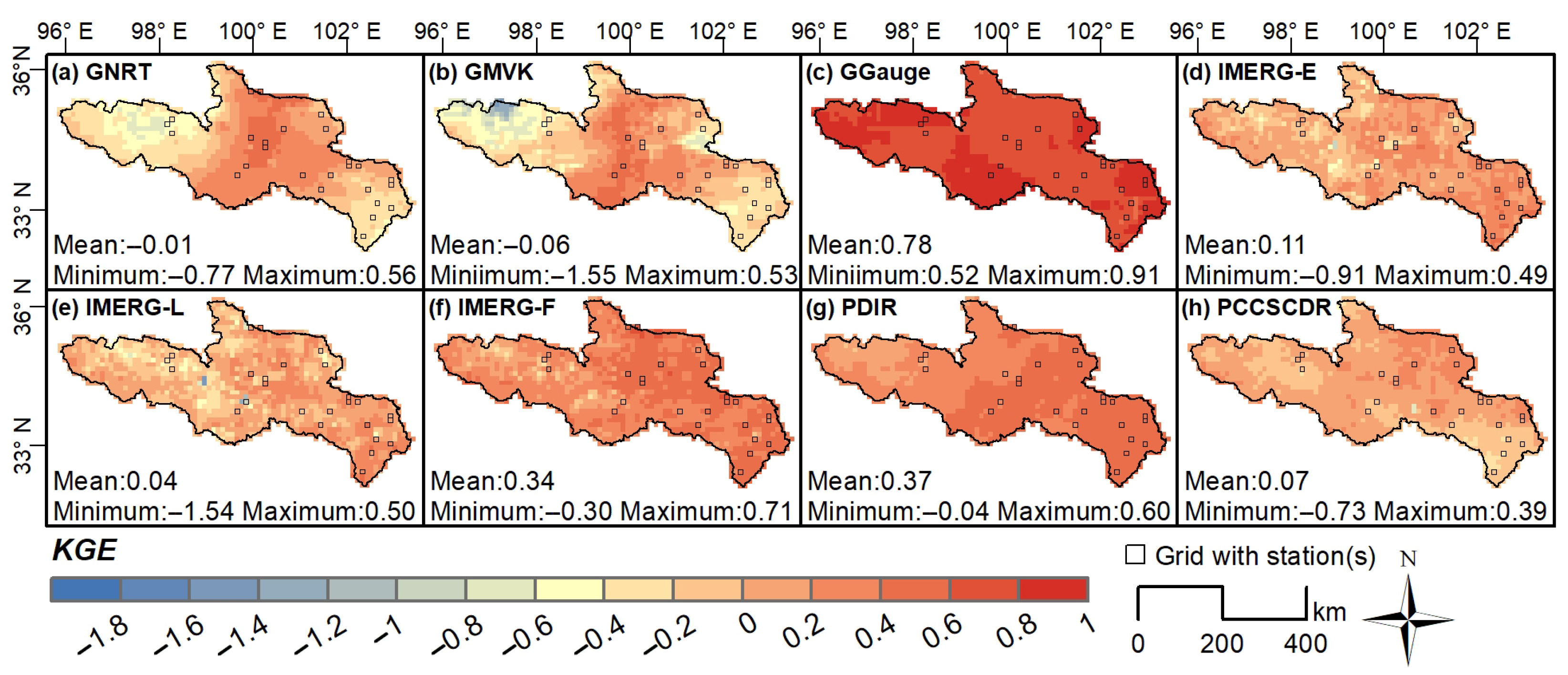
The performance of SPPs exhibits spatial variability. A basin-wide scale assessment was conducted at a 0.1° × 0.1° resolution in the YRSR, utilizing the daily gauge-interpolated data, GAUGE, as a reference. Figure 4 and Figure 5 present the spatial distributions of the daily scale KGE and CSI for the eight SPPs. The CSI of the eight SPPs increase from northwest to southeast, which is consistent with the observed trend of increasing annual precipitation in the YRSR. These results suggest that SPPs generally exhibit improved accuracy in capturing precipitation events under wetter conditions. Additionally, the southeastern part of the YRSR is relatively flat, which facilitates the detection capabilities of satellite-based sensors in this area. The spatial variation in KGE for the three IMERG algorithm datasets and the PDIR data further supports this result. However, owing to the underestimation of precipitation in the northwest and overestimation in the southeast by the GNRT and GMVK datasets (Figure 2a,b), relatively high KGE values are observed in the central part of the region. The KGE values of post-processed products, namely, GGauge, IMERG-F and PCCSCDR, do not exhibit clear spatial patterns as near-real-time products do. Among these, GGauge has the highest basin-averaged KGE and CSI across the YRSR. The spatial variations in the statistical metrics reflect the influence of meteorological, topographical, and land cover conditions on the accuracy of SPPs. Differences in precipitation retrieval algorithms lead to satellite-based products containing varying precipitation characteristics. The post-processing of SPPs with ground observations can improve data accuracy to some extent and may also increase their hydrological utility.

4.2. Hydrological Utility of SPPs in Runoff Simulation

4.2.1. Model Applicability

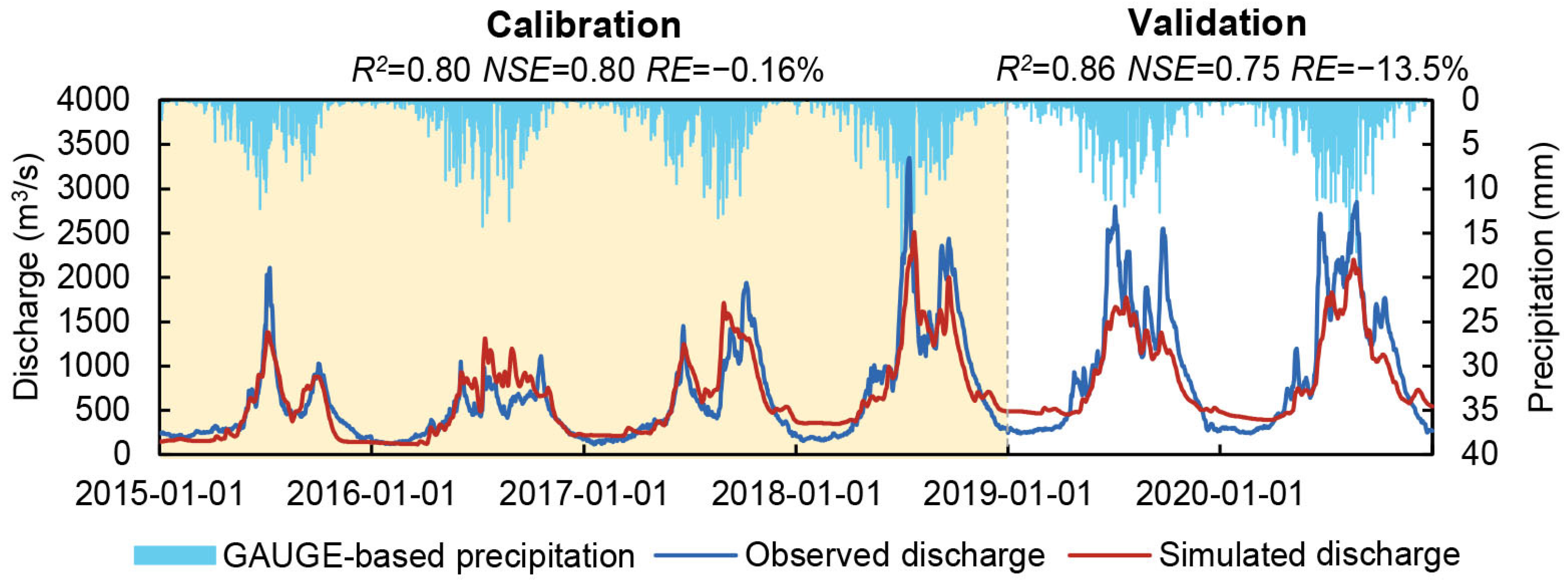
As described in Section 3.2, this study utilized daily discharge generation at the TNH hydrological station for the period of 2015–2018 to drive parameter calibration and data from 2019 to 2020 for model validation. The evaluation metrics R2, NSE and RB were applied to assess model applicability. Figure 6 shows the simulation results of daily discharge and the evaluation metrics of the SWAT model driven by ground-based precipitation observations in the YRSR. During the calibration period, the SWAT model achieved a “Good” performance, with R2 of 0.8, NSE of 0.8, and RB of −0.16%. During the validation period, this set of parameters performed “Good” as well, yielding R2, NSE and RB values of 0.86, 0.75 and −13.5%, respectively. The results demonstrate that the SWAT model has good applicability in YRSR and is reliable for evaluating the hydrological utility of SPPs.

4.2.2. Substitutability of SPPs for Ground-Based Observations

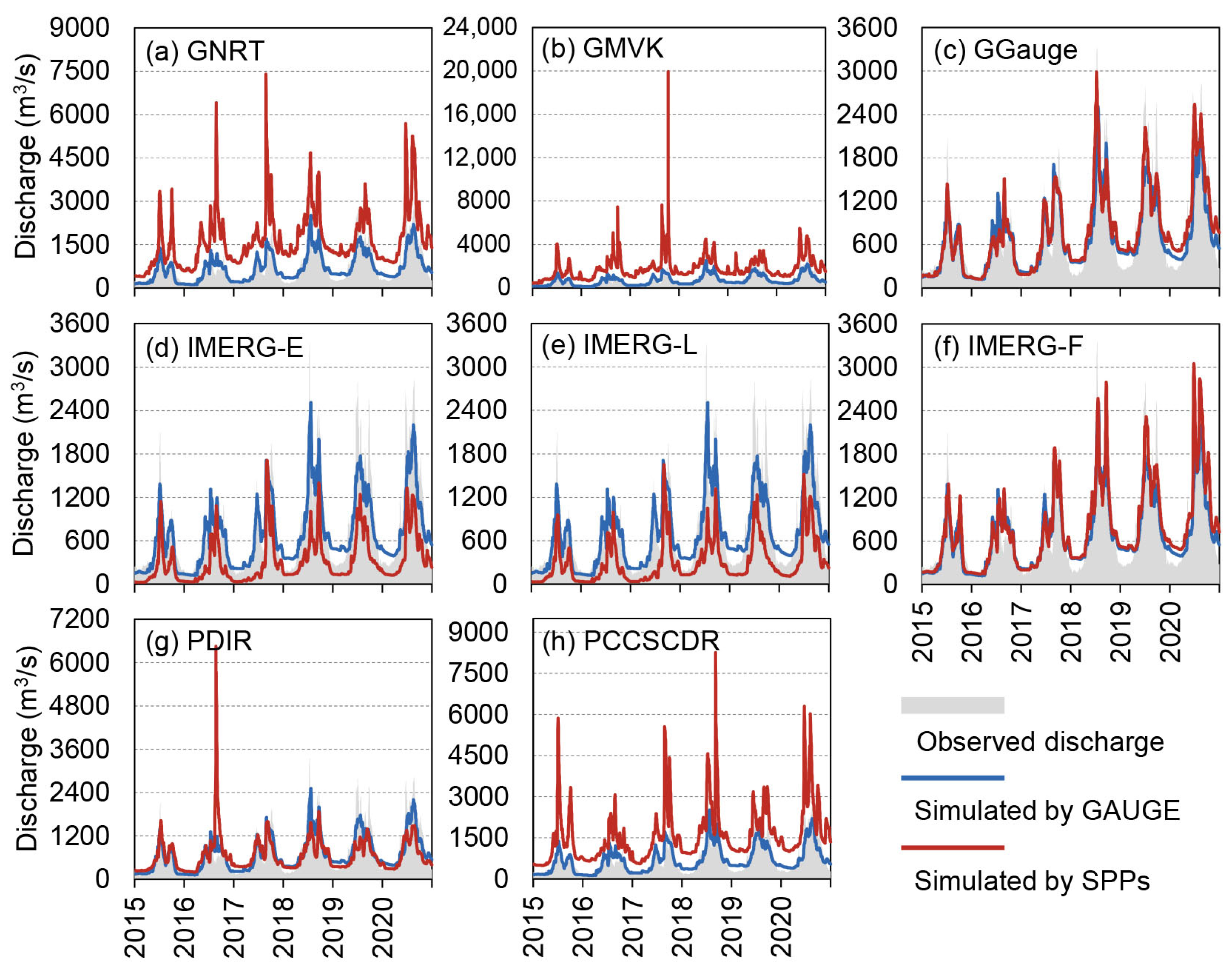
Using the optimal parameter set obtained from model calibration with gauge-based precipitation observations, the SWAT model was driven by the daily precipitation of SPPs in YRSR. The evaluation metrics for the period 2015–2020 are presented in Table 3 and Figure 7. The results indicated that in the site-optimal parameter scenario, near-real-time SPPs generally led to obvious discrepancies between the simulated and observed streamflow data and exhibited unsatisfactory substitutability for gauge-observed precipitation. Datasets generated from the same algorithm exhibit similar hydrological performances. In detail, the GNRT and GMVK overestimate daily discharges at the outlet station (RB > 100%) and result in negative NSE values. The IMERG-E and IMERG-L presented NSE values that were close to zero, with massive underestimations (RB < −50%). Notably, the shortcomings of PDIR data in driving the SWAT model were revealed by R2 (0.31) and NSE (0.26) simultaneously. Although PDIR exhibits relatively good performance in estimating precipitation (illustrated in Section 4.1), its hydrological utility is inferior to that of other SPPs. This can be attributed to errors in simulating rainfall–runoff peaks, as indicated by the hydrograph (Figure 7).
Daily discharge simulations of SWAT model derived by the post-processed SPPs are all superior to those obtained from near-real-time datasets. Both IMERG-F and GGauge data demonstrate “Good” hydrological utility as substitutes for ground-based precipitation data. Under the site-optimal parameter scenario, their suitability is comparable and superior to that of PCCSCDR data. For the perspective of practicality, the GGauge has a shorter time lag than IMERG-F data. Moreover, among the three products, GGauge data are modified with CPC Unified Gauge-Based Analysis of Global Daily Precipitation at a daily scale, while both the IMERG-F and PCCSCDR are adjusted at a monthly scale, using the Global Precipitation Climatology Centre (GPCC). Therefore, the hydrological utility of the SPPs in the study area is influenced by the original data and also the post-processing procedures.

4.2.3. Potential of SPPs for Hydrological Modeling

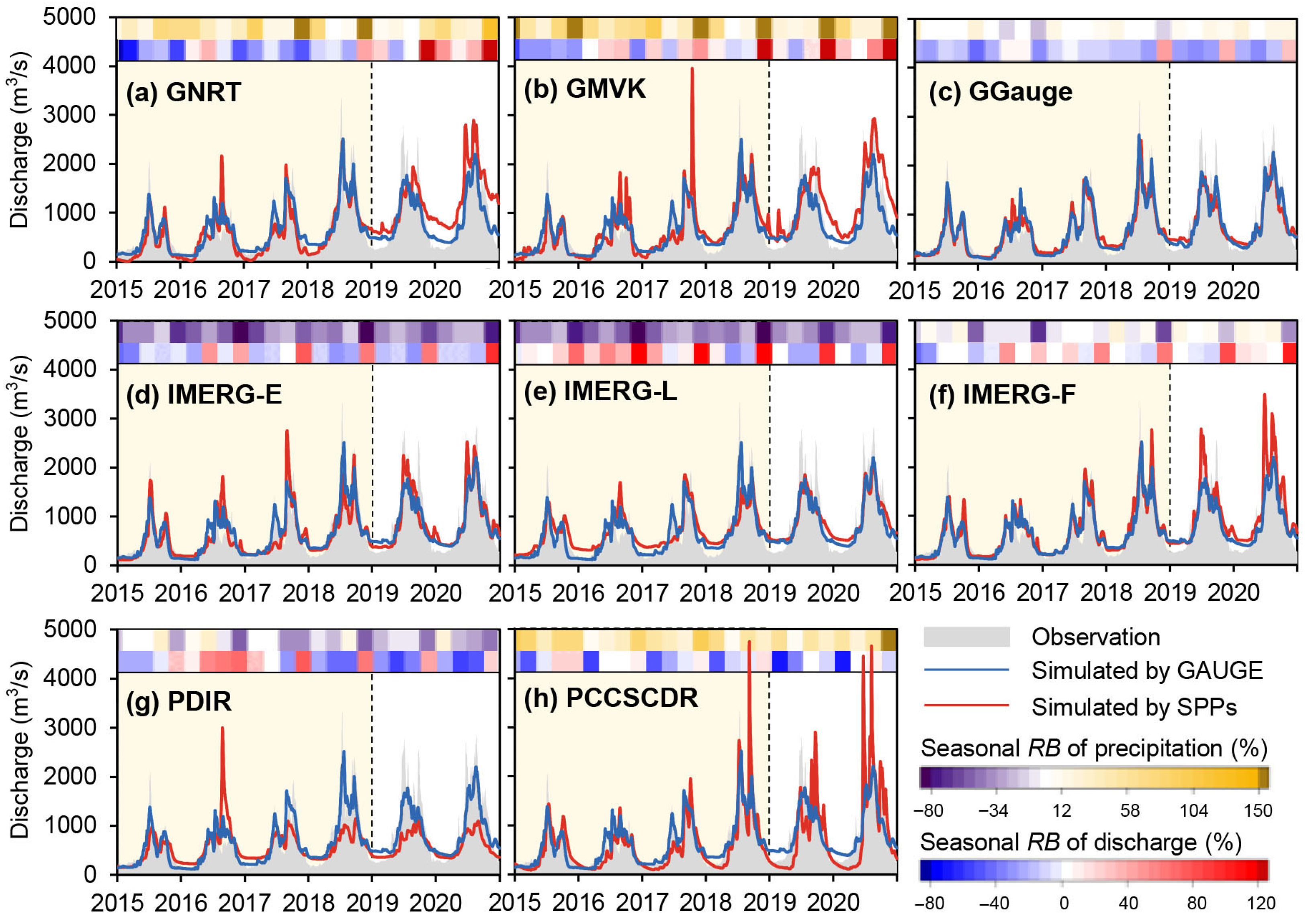
Differences in precipitation amounts and spatial distributions between gauge data and SPPs interfere with the applicability of site-optimal parameters, thereby limiting the effective use of SPPs. To explore the optimal performance in streamflow simulation across the YRSR, site-optimal parameters were recalibrated for each of the eight SPPs. The hydrographs and evaluation metric of daily discharge simulations in the re-calibrated parameters scenario are shown in Table 4 and Figure 8.
For the near-real-time SPPs without ground-based correction, the discharge simulation accuracy has been improved substantially after parameter recalibration. For example, the performance of the near-real-time products of GSMaP and IMERG (i.e., GNRT, GMVK, IMERG-E and IMERG-L) have been elevated from “Unsatisfactory” to “Satisfactory”. The four products show comparable accuracies, with R2 and NSE values above 0.6. Among them, GNRT and IMERG-L have lower RB values. Overall, IMERG products outperform GSMaP products in terms of both statistical metrics and flow hydrographs.
In particular, IMERG-E and IMERG-L perform better in the validation period than in the calibration period. For instance, the R2 and NSE of IMERG-E increases from 0.58 and 0.56 during 2015–2018 to 0.78 and 0.76 in 2019–2020, respectively. This variation from the calibration to the validation periods is related to the improvement in SPPs’ accuracy and the hydrological model’s adaptability to precipitation errors. As demonstrated in the site-optimal parameter scenario (Figure 7d,e), the hydrographs show improved consistency with observed discharges as the research period extends, accompanied by increasingly accurate baseflow. This phenomenon reveals that the calibration of hydrological models generally compensates for errors in rainfall inputs, thereby enhancing the adaptability of the model [69,70]. Parameter recalibration further enhances the differences in hydrological performance between the two periods (Table 4). As the two IMERG datasets exhibit persistent negative biases throughout the study period, the time-variant bias with a consistent direction enables the allocation of hydrological components to remain adaptable when using the parameter sets optimized during the calibration period. When each SPP-forced simulation is driven by an optimal parameter set, the accumulation of the compensation effect progressively enhances model performance as the simulation period extends [70].
In terms of the GSMaP products, the two datasets tend to overestimate the peak discharges during flood seasons (Figure 8a,b). In addition, GSMaP products generally show positive biases for precipitation in all seasons, with the GMVK product showing the largest overestimation of winter precipitation. The continuous overestimation of precipitation causes an increasing bias in the baseflow, which cannot be eliminated by parameter adjustment. The PDIR product remains “Unsatisfactory” after model recalibration, with the largest RB being for streamflow simulation, suggesting its deficiency in the YRSR. Overall, the near-real-time products of the GSMaP and IMERG algorithms achieve reasonable accuracy in hydrological modeling. With respect to data latency, GNRT shows greater potential for near-real-time simulation, although its bias during heavy rainfalls in summer may cause outliers of flood peaks. It should also be noted that when the input precipitation contains large errors, the recalibration process may distort the physical process of estimating individual hydrological components [31].
For the post-processed products with reliable accuracy, GGauge and IMERG-F maintains “Good” performance in the re-calibrated parameter scenario. The runoff simulation accuracy of the PCCSCDR product has been advanced from “Unsatisfactory” to “Satisfactory”, with the NSE increasing from −1.8 to 0.68 and RB decreasing from 114.83% to −12.4%. According to the hydrographs in Figure 8, daily discharges simulated by GGauge presented relatively stable performance, which was likely due to its lower RB for precipitation in all seasons. By comparison, although IMERG-F had a similar accuracy to that of GGauge, it is prone to overestimating precipitation and streamflow in winter and flood peaks in several years, especially for the validation period. The PCCSCDR also suffers from these issues and shows stronger negative biases for discharge simulation in spring than in other seasons. Combined with the analysis of the site-optimal parameter scenario, the limitations of PCCSCDR could be related to the insufficient correction of precipitation bias.
On the whole, the recalibration process targeting outlet discharge made the model parameters more suitable for SPPs. The post-processed GSMaP and IMERG products demonstrated good hydrological applicability, with GGauge presenting better potential than IMERG-F and comparable performance to gauge-based simulations. The PCCSCDR product showed clear limitations in runoff simulation in the YRSR. The near-real-time SPPs achieved “Satisfactory” simulation accuracy in the study area, except for PDIR. These datasets provide valuable precipitation information for hydrological simulations in data-scarce regions. Notably, caution is warranted regarding potential biases in flow peak estimation during the wet season and baseflow during the dry season when using SPPs for hydrological modeling.

4.3. Propagation Analysis of Systematic and Random Errors in SPPs

4.3.1. Error Propagation Properties from SPPs to Runoff Simulation

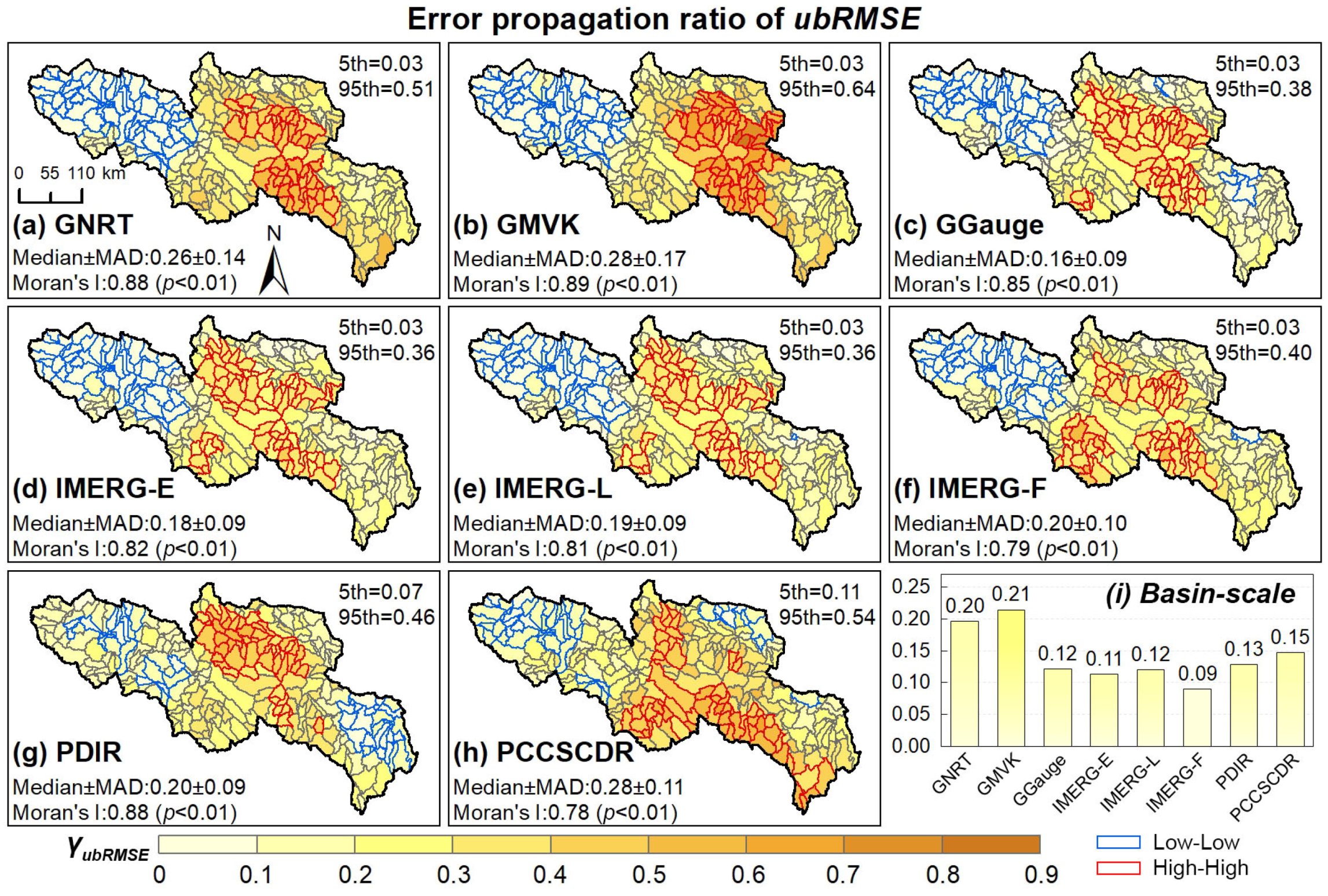
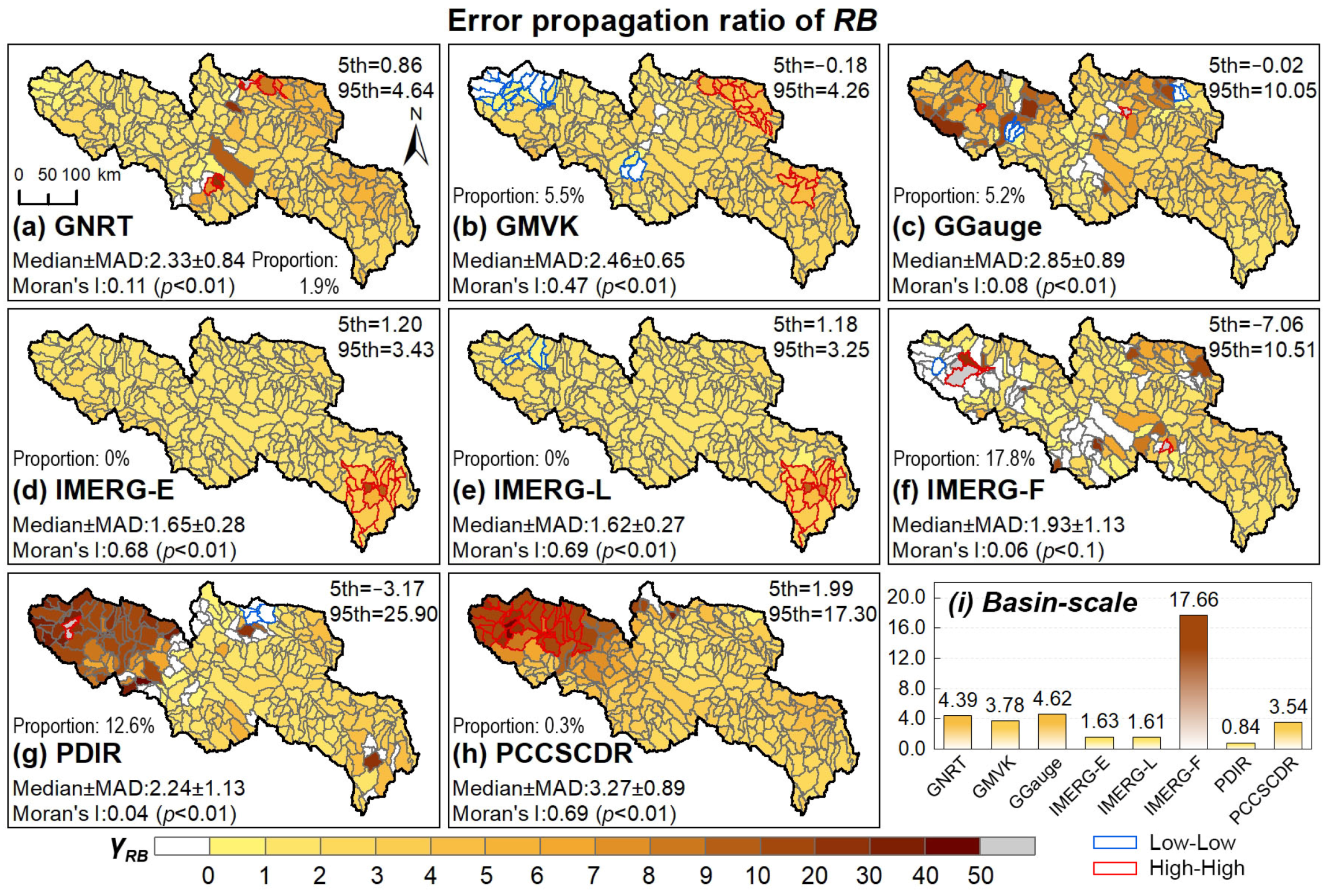
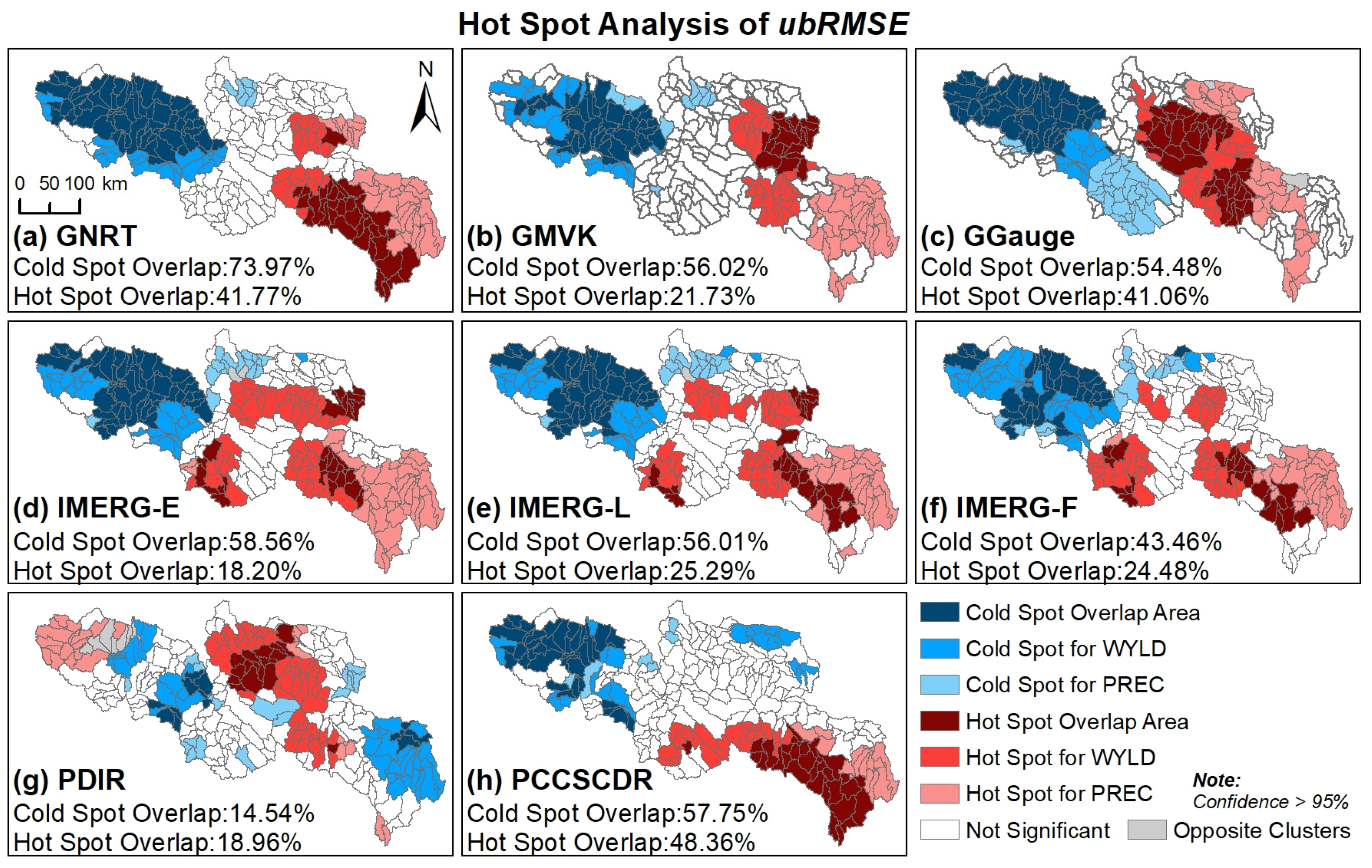
Under the site-optimal parameter scenario, the characteristics of precipitation–runoff error propagation at both the basin-wide scale and sub-basin scale were calculated with an analysis of spatial autocorrelation. As illustrated in Figure 9 and Figure 10, the propagation characteristics of systematic bias and random errors vary for different SPPs. The calculation of error propagation indices at basin-wide scale utilized the basin-averaged precipitation, along with the runoff depth converted from the discharges at the TNH station. In most instances, the γRB tends to be greater than 1 and the γubRMSE is generally less than 1 (Figure 9i and Figure 10i). Consistent with the findings of previous studies, the γRB tends to be amplified, whereas the γubRMSE is generally suppressed through hydrological modeling [33,34], with these findings being applicable to an independent research unit involving a complete process of model construction and calibration. Although the model parameters were calibrated using only basin outlet data, the error propagation indices calculated for sub-basins typically present similar properties based on the median value shown in Figure 9a–h and Figure 10a–h, where precipitation (PREC) and water yield (WYLD) at each subbasin were used.
The statistical characteristics of γRB exhibit greater spatial variation and differences between datasets than γubRMSE. As shown in Figure 9, a majority of the sub-basins exhibit positive values for the systematic error propagation indicator, revealing that the biases in precipitation and water yield have the same sign. However, several sub-basins exhibit negative γRB, with varying proportions across different SPPs (Figure 9a–h). This suggests that a more complex influencing mechanism exists in the propagation process of systematic errors. The phenomenon is further verified by the spatial autocorrelation analysis of the error propagation indices. The γRB exhibit a relatively low Moran’s I value, indicating a weak level of spatial autocorrelation. Additionally, for the majority of SPPs, the cold and hot spot regions of γRB are not prominent. Compared with the γRB, the γubRMSE has higher Moran’s I value and more clearly cold and hot spot regions (Figure 10). Although there are numerical differences, the high–high clustering and low–low clustering areas of the γubRMSE for these different precipitation input datasets are mainly concentrated in the central and the western source area of the basin, respectively. Results imply that the propagation of ubRMSE are associated with certain inherent spatially continuous features of the basin, leading to a consistent spatial clustering pattern.
These phenomena can be attributed to the different response mechanisms of the hydrological system to systematic and random errors in the precipitation data. For random errors, fluctuations in precipitation input are buffered through hydrological processes such as depression filling, infiltration, and evaporation [32,37]. These processes smooth the errors in the input data, reducing their transfer to the simulated runoff [22,32]. The extent of this smoothing effect is related to basin surface characteristics, such as slope, soil type, and land use [71,72], which exhibit spatial continuity. As a result, the underlying surface conditions differ in their ability to suppress random errors, leading to distinct cold and hot zones in the spatial distribution of γubRMSE. This index reflects the model’s capacity to dampen input noise. In the alpine headwaters of the YRSR, which act as an important water conservation region, the dampening effect on random precipitation errors is more evident. Thus, across all precipitation datasets, the random error propagation indices are considerably lower than one. In contrast, the transfer of systematic errors in precipitation input is controlled mainly by the nonlinear responses of hydrological processes [73]. Specifically, under continuously positive or negative precipitation biases, the runoff generation process is further influenced by the runoff generation thresholds and mechanisms [74]. During this process, factors such as antecedent precipitation and soil moisture play critical roles and show strong spatiotemporal heterogeneity [75,76]. Since it is usually challenging to establish a stable long-term relationship between these factors and the basin’s underlying surface attributes, the γRB indicators present no clear spatial pattern in the study area. A detailed analysis of the effect of surface attributes on the spatial patterns of γRB and γubRMSE and the potential reasons for several anomalies in error propagation are provided in the Discussion.

4.3.2. Spatial Consistency of Precipitation and Runoff Errors

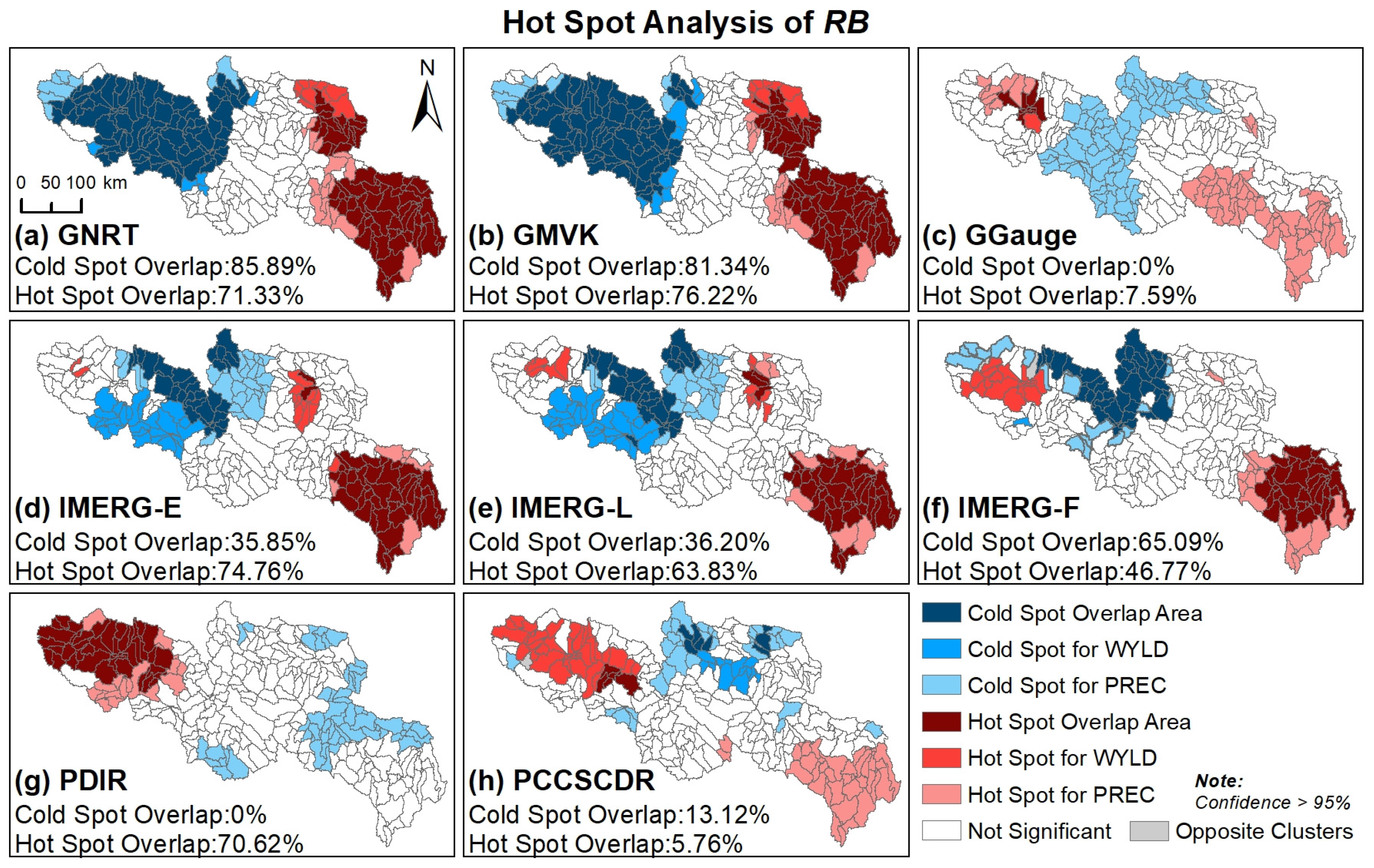
The propagation indices reflect the ratio of the precipitation error transferred during hydrological simulation, which quantifies the runoff generation error caused by the unit precipitation error and indicates the model’s sensitivity to input errors. By analyzing the propagation of systematic bias and random error, this study reveals differences in how the watershed system and hydrological model respond to errors in different types of SPPs, and highlights the influence of spatially continuous watershed attributes on random error propagation. To further explore the potential influence of the spatial pattern of precipitation errors on the error propagation process, water yield data from 309 sub-basins were used to analyze the spatial correlation and consistency between precipitation and runoff errors. Pearson correlation coefficients C C , Lee’s L index, and the Bivariate Moran’s I were applied to quantify the linear correlation and spatial similarity of precipitation input and runoff output errors, with RB and ubRMSE calculated separately. For the eight SPPs, the spatial correlation statistics are summarized in Table 5 and the Bivariate LISA analysis is shown in Figure 11 and Figure 12. Results suggest that precipitation error is one of the major sources of runoff simulation error. Although the C C , Lee’s L, and Bivariate Moran’s I values differ among datasets, all the indicators are statistically significant (p < 0.05). The linear relations between streamflow and precipitation error have also been revealed in previous studies, such as Nanding et al. [35] and Gou et al. [36]. This finding reveals a consistent precipitation–runoff error relationship: larger precipitation errors tend to produce larger runoff errors, with both resulting in similar spatial distributions and clustering patterns.
With respect to systematic errors, all datasets except GGauge and PCCSCDR show a strong linear relationship between precipitation and runoff errors ( C C > 0.6, p < 0.05). The spatial pattern of precipitation errors is reflected in the spatial distribution of runoff errors, both of which have similar patterns (Lee’s L > 0.5, p < 0.05) and significant spatial aggregation (p value of Bivariate Moran’s I < 0.05). This finding indicates that runoff errors are strongly influenced by precipitation errors and that both may be controlled by the same large-scale background field. Thus, when the error propagation ratio is calculated, the influence of this background field is partly removed, leading to no distinct spatial pattern of the γRB (Figure 9 and Figure 11). During this process, the spatial pattern of precipitation errors is reorganized. The spatial consistency, reflected by Lee’s L and Bivariate Moran’s I, is often lower than the linear correlation. For example, in PDIR data, cold spots with systematic biases in precipitation do not correspond to those with runoff errors. Meanwhile, because of the weak clustering of RBWYLD of PDIR, the Bivariate Moran’s I is smaller than Lee’s L. The exceptions of GGauge and PCCSCDR may result from the magnitude and spatial characteristics of their inherent systematic biases. For the post-processed products corrected at the daily scale, the systematic bias has been directly adjusted, resulting in distinct features compared to other datasets. The monthly correction of SPPs may not fully eliminate daily scale biases. Therefore, the IMERG-F product still shows residual systematic bias in daily runoff simulations. As a result, its error pattern is similar to that of the near-real-time products but shows lower spatial consistency indices than IMERG-E and IMERG-L. It should also be noted that bias can be either positive or negative, and its hydrological effects differ. According to the threshold effects and runoff generation mechanisms, positive biases are more likely to amplify runoff errors and cause local anomalies in runoff simulations.
For random errors, except for PDIR, strong spatial consistency between precipitation and runoff errors has been revealed by significant statistics in Table 5 (p < 0.5). However, the spatial consistency of ubRMSE between precipitation and runoff is generally weaker than that of systematic bias. A comparison of Figure 10 and Figure 12 reveals that differences exist in the spatial distributions of cold and hot spots of precipitation and runoff ubRMSE, but the maps of γubRMSE display similar spatial structures, with high-value regions located mainly in the central part of the YRSR. The maps of the error propagation indicators not only reflect the effects of precipitation errors but also reveal the sensitivity of sub-basins to these errors and indicate potential “risk zones” where precipitation errors are more prone to causing simulation errors. The anomalous behavior of PDIR arises from the differences in the ranges of ubREMSPREC and ubREMSWYLD. Specifically, unlike other datasets, the variability of ubREMSPREC (STD = 0.28) is notably narrower than that of ubREMSWYLD (STD = 1.34). Consequently, weak correlation and spatial autocorrelation are observed between ubREMSPREC and ubREMSWYLD. These results suggest a stable, non-random relationship between ubREMSPREC and ubREMSWYLD for PDIR, as seen with other SPPs, but with limited explanatory power. Overall, the analysis demonstrates that the spatial pattern of systematic error propagation is complex and difficult to predict, while random error propagation, influenced by inherent catchment attributes, is more predictable. These findings suggest that distinct strategies should be employed to address systematic and random errors during precipitation correction and runoff simulation.
In practice, the spatial correlation of hydrological components is typically influenced by watershed attributes and hydrological processes. The nonlinear processes make error propagation more complex, with impacts on the simulation of hydrological components [31]. This study focused solely on the two indicators of precipitation and runoff, and lacks an investigation into the error propagation pathways, associated with other hydrological elements. Additionally, the influence of watershed attributes, model structure and parameters on error propagation characteristics requires further consideration [2,36]. These limitations offer suggestions for further studies. Integrating multi-objective calibration to strengthen the analysis of the hydrological component modeling with the interference of input errors will provide a scientific basis for improving precipitation correction algorithms and the satellite-based hydrological simulations.

5. Discussion

5.1. Surface Factors Influencing the Spatial Pattern of Error Propagation

Based on the semi-distributed SWAT model, both numerical and spatial characteristics of error propagation were analyzed using basin-wide and sub-basin scale statistics. With systematic and random errors represented by RB and ubRMSE separately, the amplification of systematic error and suppression of random error were observed through the rainfall–runoff simulation. This result is consistent with previous studies, such as Chen et al. [33] and Maggioni et al. [34], which were conducted in five watersheds in the United States and a monsoon-climate watershed in China, respectively, while the error transmission would also pronounce different features as the statistical metrics changed [77,78]. For instance, when using the mean relative error to quantify systematic error, a dampening effect has also been revealed, as demonstrated by Mei et al. [78]. As illustrated in Figure 9 and Figure 10, the propagation of random errors possesses more generalized characteristics than systematic errors, which has also been reported in relative studies employing consistent or similar metrics to describe random errors [22,35,36,37]. Moreover, the propagation of random error presented a more evident spatial pattern that is governed by the underlying surface features and hydroclimatic factors [35,37].
In this section, the potential relations between surface attributes and the spatial patterns of γRB and γubRMSE were further analyzed across the 309 sub-basins nested in YRSR, using the Spearman correlation coefficient. Factors in three aspects were considered, including terrain factors, soil attributes and vegetation conditions (detailed in Table S1). The results are illustrated in Tables S2 and S3. As presented in Figure 9, γRB exhibits weak spatial autocorrelation and lacks a distinct spatial pattern. While geographical location (i.e., Latitude and Longitude), elevation, and NDVI show statistical correlations with γRB, the relationships are weak and inconsistent across the eight SPPs (Table S1). Thus, generalizing the effect of surface features on RB propagation is challenging. In contrast, γubRMSE displays strong spatial autocorrelation (Figure 10), with the influence of surface parameters remaining consistent across different precipitation inputs. Spatial distributions of surface features with significant relations with γubRMSE are provided in Figure S3: namely, sub-basin slope, slope length and NDVI. Specifically, the subbasin slope is positively correlated with γubRMSE, while the slope length is negatively correlated. This reflects how the slope gradient and length influence runoff generation and concentration in hydrological processes. When slopes are gentle and the length is long, runoff paths are slow, allowing for more infiltration and better redistribution of precipitation in the soil layer. In this case, random errors in rainfall are filtered during runoff yielding, and the role of terrain in suppressing error transmission increases, resulting in a smaller γubRMSE. In addition to the stronger effect of terrain factors, a positive correlation between NDVI and γubRMSE has also been detected, indicating the impact of vegetation interception on random error propagation.
In summary, the effect of the sub-basin slope is most pronounced in YRSR, which is helpful for further identifying zones that are sensitive to precipitation random errors as a prior prediction in SPP-driven hydrological modeling.

5.2. Anomalies in the Propagation of Systematic Error

The suppression of random errors in precipitation–runoff process has been widely recognized in relevant studies [33,34,36], whereas the propagation of systematic bias makes it more difficult to generalize a unified feature. Due to the relative complex influence of systematic bias in the hydrological simulation process, several anomalies in the results of γRB require further explanation.
Regarding the basin-scale propagation of RB (Figure 9i), IMERG-F products manifest the highest γRB, due to its relatively small inherent systematic bias (basin-wide RB of IMERG-F is 0.67%) and the excessive bias introduced by mismatched model parameters is calibrated with gauge-based precipitation. PDIR data are the only exception at the basin scale, as indicated by its γRB. When calculating the evaluation metrics of PDIR against GAUGE-driven simulations in terms of basin-averaged precipitation, a relative low RB of −5.57% was observed. However, the R2 and NSE values were unsatisfactory (R2 = 0.46 and NSE = 0.29). This suggests that the precipitation estimated by PDIR have mean values close to GAUGE, but there are deficiencies in monitoring precipitation variations and extreme values. This characteristic results in a similar feature of PDIR-driven discharges against GAUGE-driven simulations at TNH station in terms of relative deviation (R2 = 0.47, NSE = 0.37, and RB = 4.70%). Therefore, it can be inferred that errors in PDIR are primarily retained in random errors, and the propagation ratio of RB may lack representativeness.
Regarding the γRB at the sub-basin scale (Figure 9a–h), negative values exist that are related to the nonlinear response of input errors in the hydrological process. Examples are provided in Figure S2. As the example represented in Figure S2a–c shows, accumulated positive precipitation bias can lead to an overall increase in soil water storage, which in turn reduces the infiltration capacity. As a result, subsequent precipitation primarily converts to surface runoff or quick flow, significantly increasing runoff. However, due to the lag effect in the runoff response to precipitation changes, when precipitation shifts from positive to negative bias, soil moisture declines. Nevertheless, cumulative runoff may remain overestimated due to the continued effects of antecedent precipitation and soil moisture. Another example shown in Figure S2d–f is related to the evapotranspiration process. When initial soil moisture approaches a critical threshold, small precipitation changes can lead to a nonlinear shift in evapotranspiration under the regulation of soil moisture stress. In this context, if the SPPs present negative bias, a notable reduction in evapotranspiration and an increase in runoff would be generated compared with GAUGE-driven conditions. Consequently, even when the cumulative precipitation exhibited a negative bias by the end of the study period, the cumulative runoff could remain at a positive level.
Due to the complex nonlinear response in the hydrological process, the above diagnosis of negative γRB serves as an example to aid our understanding of the propagation of precipitation error and its effect on hydrological elements. When using site-optimal parameters, the compensation for precipitation errors from model calibration is ineffective, leading to the accumulation of error interference and deviations in hydrological components. Meanwhile, due to the mismatch between the parameters and the input data, as well as the inconsistency between hydrological and calendar years, the runoff generated from distorted hydrological components may result in the observed abnormal transmission of precipitation bias, such as inverse amplification. When recalibration is performed for each precipitation product, input errors interfere with the optimization of parameter regionalization and water budget estimation. As a result, error propagation is influenced by both the inherent error features and the compensation effect. More extensive and detailed studies need to be conducted in future studies to derive generalizable patterns.
Moreover, the transmission of RB may be associated with the distribution of frozen soil. During the frozen period, the impermeable layer contributes to the early occurrence and rapid increase in spring flood peaks. In the thaw period, water storage in the active layer increases, leading to a gradual baseflow. In the SWAT model, runoff from the frozen soil occurs when the temperature in the first soil layer drops below 0 °C, while under this condition, infiltration is still allowed when the frozen soil is dry [59]. In addition, the model does not account for the response of runoff to permafrost changes. Therefore, parameters are adjusted to match observations and to compensate for deficiencies in the model description, which distorts soil water parameters to control infiltration and increase the sensitivity of streamflow simulations to precipitation bias. In this context, systematic bias in runoff simulation originates from both precipitation data and model structure. Improvement of the hydrological model that considers frozen soil permeability would be useful for investigating the underlying mechanisms of precipitation error propagation [79].

5.3. Uncertainties and Limitations

Uncertainties in this study primarily arise from precipitation data processing. A key uncertainty involves the benchmark precipitation data generated by ANUSPLIN interpolation, which is associated with the evaluation of SPPs and analysis of error propagation. Although fivefold cross-validation was conducted to ensure the precision of the observed-reference data (RMSE = 2.49 ± 0.65 mm/d, Figure S1), with a comparable performance to the gauge-derived precipitation products reported in previous studies [54,55], employing a more realistic precipitation background field would help to improve the reliability of the analysis of error propagation characteristics. The uncertainty in the handling of SPPs is related to the replacement of missing values with zero, which potentially affects the performance of SPPs, particularly under snow-covered winter conditions. As shown in Figure 8, the biases of SPPs have seasonal variations; thus, the zero-imputation would lead to an underestimation of the absolute value of RB. The effect of imputation of missed data on detection skill of SPPs, e.g., POD and CSI, is linked to the rainfall threshold. When a higher threshold is set, the probability of misclassification is relatively low, resulting in a smaller impact on POD and CSI. In contrast, when a lower precipitation threshold is used, the values of POD and CSI become more sensitive to the zero-filling process due to the increase in misclassified events, leading to a systematic underestimation of the metrics. However, this impact would be limited during winter in this study, as weak precipitation events in this season are prone to result in false events and higher FAR metrics in YRSR [52], thus reducing the interference with actual detection ability.
Another uncertainty in data processing is the area-weighted average approach of gridded precipitation data, which includes two aspects: the resampling of PERSIANN products and the precipitation averaging for each sub-basin. The resampling of PDIR and PCCSCDR from 0.04° to 0.1° resolution would smooth the grid values and affect the calculation of error propagation indicators. In general, the resample from a high resolution to a low resolution influences the systematic and random errors of SPPs in different ways. Theoretically, the impact of resampling on systematic bias depends on the direction of deviation in SPPs. If the bias direction is consistent across the resampling window, the systematic deviation will be amplified; if inconsistent, the error may be reduced due to the offset. For random error, the impact of resampling is related to the spatial variability of the gridded precipitation data. When the distribution is uniform, resampling has little impact, but in areas with significant local fluctuations, it may worsen random errors. Focusing on the differences in systematic and random errors between the PDIR and PCCSCDR datasets at 0.1° and 0.04° resolutions, only in cases where significant differences were detected, the evaluation metrics were generally reduced by the resampling process, leading to an overestimation of error propagation ratios, i.e., γRB and γubRMSE. Since the spatial characteristics of SPPs vary, the influence of resampling on the error propagation ratio would not exhibit systematic patterns across different SPPs.
The limitations of this work lie in the geographical scope of YRSR and the model structure of SWAT. Selecting YRSR as the research region, which is characterized by mountainous terrain, contributes to detecting the relationships between surface features and error propagation patterns in this study, while considering basins with more diverse characteristics to analyze error propagation features and their influencing factors, including both numerical values and spatial patterns, will help in obtaining more generalized conclusions. The YRSR is located at the northeastern edge of the permafrost zone in the Tibetan Plateau. However, the SWAT model simplifies the effects of frozen soil by determining the runoff generation or infiltration process, based on the temperature of the first soil layer, which does not explicitly account for the seasonal thawing and freezing of the soil [59]. Therefore, considering that the hydrological features of freeze–thaw processes may further enhance the performance of SPPs in the YRSR, especially in high-altitude areas, and improve the analysis of error propagation path through hydrological processes, it is important to make full use of the advantages of semi-distributed hydrological models in simulating hydrological processes and their spatial distributions. This would enable a quantitative analysis of the spatiotemporal variation in hydrological elements caused by precipitation errors and suggest directions for future research.

6. Conclusions

This study evaluated the data accuracy and hydrological applicability of eight widely used SPPs (near-real-time: GNRT, GMVK, IMERG-E, IMERG-L, and PDIR; post-processed: GGauge, IMERG-F, and PCCSCDR) in a typical alpine region located in the Yellow River source area, complemented by an analysis of error propagation in the precipitation and runoff processes. Main conclusions can be drawn as follows:
(1)
All the SPPs can depict the spatial variation in mean annual precipitation, increasing from the northwest to the southeast in the YRSR, though there are differences across the datasets in estimating precipitation amounts and capturing precipitation events. Post-processed SPPs generally outperform near-real-time datasets, with the exception of the PERSIANN products. Based on the KGE and CSI values, the post-processed product GGauge, followed by IMERG-F, is superior to other SPPs. The ability of SPPs to quantify precipitation amounts, represented by KGE, shows notable distinctions. However, CSI values are comparable, with similar spatial patterns, and their ability to detect rainfall events is better in wetter and flatter areas.
(2)
The hydrological utility of SPPs varies, and their performance in streamflow simulation is not consistently reflected by their accuracy in precipitation estimation. Based on the site-optimal parameter set, GGauge and IMERG-F exhibit considerable substitutability for gauge-observed precipitation with good hydrological performance (R2 > 0.75, NSE > 0.65, RB ≤ ±15%), while other SPPs perform inadequately (R2 ≤ 0.50, NSE ≤ 0.50, RB > ±25%). Recalibration of model parameters enhances the applicability of SPPs, with GGauge demonstrating substantial potential for streamflow modeling (R2 = 0.86, NSE = 0.85, RB = −5.24%), which is comparable to gauge-derived simulations. IMERG-F follows GGauge, and the near-real-time SPPs of IMERG and GSMaP algorithms achieve satisfactory performance (0.50 < R2 ≤ 0.75, 0.50 < NSE ≤ 0.65, ±15% < RB ≤ ±25%). The PDIR dataset performs the worst, despite its relatively high accuracy in precipitation estimation.
(3)
The propagation of systematic and random errors from SPPs to simulated runoff exhibits different statistical characteristics and spatial patterns. Most γRB values are greater than one, while γubRMSE indices are less than one, suggesting that systematic bias in precipitation data is more likely to be amplified, whereas random error tends to be suppressed. The spatial pattern of γRB is less pronounced than that of γubRMSE with weaker autocorrelation. The cold and hot spot clusters of γubRMSE for each SPP are distributed in the western and central YRSR, respectively, and are related to watershed surface attributes, especially the basin slope. This reveals the zones that are sensitive to precipitation errors in the study area and indicates an association with spatially continuous watershed attributes.
Further analysis of the spatial relationship between precipitation and runoff errors demonstrates that for both systematic and random errors, the spatial clustering patterns of input–output error pairs are similar. That is, larger input errors tend to bring larger output errors; however, there are other factors that influence their propagation ratios and result in different features for the two error types. Therefore, it is recommended to establish distinct strategies for systematic and random errors in the data modification and hydrological application of SPPs. Moreover, the propagation pathways and driving factors of precipitation errors through hydrological processes should also be quantitatively explored in future studies.

Supplementary Materials

The following supporting information can be downloaded at: https://www.mdpi.com/article/10.3390/rs18040537/s1, Figure S1: RMSE of ANUSPLIN interpolation method in estimating daily precipitation with five-fold cross validation; Figure S2: Hydrological elements in the subbasins with negative γRB; Figure S3: Spatial distribution of subbasin slope (Slo), field slope length (Sll) and NDVI in YRSR and its linear relationship with γubRMSE; Table S1: Abbreviation and definition of surface factors; Table S2: Spearman correlation coefficients between γRB and surface factors; Table S3: Spearman correlation coefficients between γubRMSE and surface factors.

Author Contributions

Conceptualization, C.M. and X.M.; methodology, C.M.; formal analysis, C.M.; resources, X.M. and L.H.; data curation, C.M.; writing—original draft, C.M.; writing—review and editing, X.M. and L.H.; visualization, C.M.; funding acquisition, X.M., L.H. and C.M. All authors have read and agreed to the published version of the manuscript.

Funding

This research was funded by the National Key Research and Development Program of China (Nos. 2022YFF0801804 and 2018YFE0106500), the Major Science and Technology Projects in Gansu Province (24ZDGE002), and the Doctoral Research Initiation Foundation of Henan Normal University (Grant 5101209171327).

Data Availability Statement

Meteorological station data can be requested from the China Meteorological Data Service Centre: https://data.cma.cn/ (accessed on 22 December 2025). Observations of rain gauges and hydrological stations are sourced from the Hydrological Yearbook of the People’s Republic of China, published by the Hydrology Bureau, Ministry of Water Resources, China. The GSMaP datasets can be downloaded from the website of JAXA: https://sharaku.eorc.jaxa.jp/GSMaP (accessed on 22 December 2025). The IMERG datasets can be downloaded from the website of GES DISC: https://gpm.nasa.gov/data/imerg (accessed on 22 December 2025). The PEISIANN datasets can be downloaded from the website of UCI CHRS Data Portal: https://chrsdata.eng.uci.edu/ (accessed on 22 December 2025).

Acknowledgments

The authors thank all the data provision and technical support during manuscript preparation. We are also grateful to the academic editor and anonymous reviewers for their valuable time and constructive comments.

Conflicts of Interest

The authors declare no conflicts of interest.

Appendix A

Table A1. Descriptions and values of sensitive parameters used for model calibration.
ParameterDefinitionValue
r__CN2.mgtInitial SCS runoff curve number for moisture condition−0.368704
r__EPCO.hruPlant uptake compensation factor−0.341931
r__HRU_SLP.hruAverage slope steepness1.165213
r__SOL_K(1).solSaturated hydraulic conductivity of first soil layer (mm/h)0.130712
r__SOL_Z(1).solDepth to bottom of first soil layer (mm)−0.222578
v__ALPHA_BF.gwBaseflow alpha factor (days)0.777567
v__ALPHA_BNK.rteBaseflow alpha factor for bank storage (days)1.081093
v__CH_K2.rteEffective hydraulic conductivity in main channel alluvium (mm/h)191.99173
v__CH_N2.rteManning’s “n” value for the main channel0.097902
v__GW_REVAP.gwGroundwater delay (days)0.07834
v__GWQMN.gwGroundwater “revap” coefficient230.803696
v__SMFMX.bsnMaximum melt rate for snow during year (mm H2O/°C/day)3.2629
v__SMTMP.bsnSnow melts base temperature (°C)11.721601
v__SURLAG.bsnSurface runoff lag time (days)1.067742
v__TIMP.bsnSnow pack temperature lag factor−0.125726
Note: v__ and r__ represent a replacement and a relative change to initial parameter values, respectively.
Table A2. Hit, miss, false, and non-event rate (%) for the eight SPPs at grid-point scale.
RateGNRTGMVKGGaugeIMERG-EIMERG-LIMERG-FPDIRPCCSCDR
Hit27.92 ± 7.5029.97 ± 7.3037.08 ± 6.2033.91 ± 5.9333.49 ± 5.8433.77 ± 5.7533.76 ± 6.0525.63 ± 5.13
Miss11.52 ± 5.579.47 ± 5.062.36 ± 1.485.53 ± 1.685.95 ± 1.745.67 ± 1.665.68 ± 1.4513.81 ± 1.55
False17.39 ± 6.4521.45 ± 6.7926.75 ± 6.3932.47 ± 5.6130.63 ± 5.5430.44 ± 5.7130.97 ± 5.7930.11 ± 3.79
Non-events43.17 ± 8.2139.11 ± 8.4033.81 ± 3.5428.09 ± 6.1229.93 ± 5.9230.12 ± 6.1329.59 ± 6.6830.45 ± 3.45
Note: Mean ± STD. The rain/no-rain event threshold is 0.1 mm/d.

References

  1. Maggioni, V.; Massari, C. On the performance of satellite precipitation products in riverine flood modeling: A review. J. Hydrol. 2018, 558, 214–224. [Google Scholar] [CrossRef]
  2. Miao, C.; Gou, J.; Hu, J.; Duan, Q. Impacts of different satellite-based precipitation signature errors on hydrological modeling performance across China. Earth’s Future 2024, 12, e2024EF004954. [Google Scholar] [CrossRef]
  3. Shen, Y.; Hong, Z.; Pan, Y.; Yu, J.; Maguire, L. China’s 1 km merged gauge, radar and satellite experimental precipitation dataset. Remote Sens. 2018, 10, 264. [Google Scholar] [CrossRef]
  4. Min, C.; Chen, S.; Gourley, J.J.; Chen, H.; Zhang, A.; Huang, Y.; Huang, C. Coverage of China new generation weather radar network. Adv. Meteorol. 2019, 2019, 5789358. [Google Scholar] [CrossRef]
  5. Sun, Q.; Miao, C.; Duan, Q.; Ashouri, H.; Sorooshian, S.; Hsu, K.L. A review of global precipitation data sets: Data sources, estimation, and intercomparisons. Rev. Geophys. 2018, 56, 79–107. [Google Scholar] [CrossRef]
  6. Wu, H.; Adler, R.F.; Hong, Y.; Tian, Y.; Policelli, F. Evaluation of global flood detection using satellite-based rainfall and a hydrologic model. J. Hydrometeorol. 2012, 13, 1268–1284. [Google Scholar] [CrossRef]
  7. Gebrechorkos, S.H.; Leyland, J.; Dadson, S.J.; Cohen, S.; Slater, L.; Wortmann, M.; Ashworth, P.J.; Bennett, G.L.; Boothroyd, R.; Cloke, H. Global scale evaluation of precipitation datasets for hydrological modelling. Hydrol. Earth Syst. Sci. 2024, 28, 3099–3118. [Google Scholar] [CrossRef]
  8. Hinge, G.; Hamouda, M.A.; Long, D.; Mohamed, M.M. Hydrologic utility of satellite precipitation products in flood prediction: A meta-data analysis and lessons learnt. J. Hydrol. 2022, 612, 128103. [Google Scholar] [CrossRef]
  9. Zhang, L.; Li, X.; Cao, Y.; Nan, Z.; Wang, W.; Ge, Y.; Wang, P.; Yu, W. Evaluation and integration of the top-down and bottom-up satellite precipitation products over mainland China. J. Hydrol. 2020, 581, 124456. [Google Scholar] [CrossRef]
  10. Xiao, S.; Zou, L.; Xia, J.; Yang, Z.; Yao, T. Bias correction framework for satellite precipitation products using a rain/no rain discriminative model. Sci. Total Environ. 2022, 818, 151679. [Google Scholar] [CrossRef] [PubMed]
  11. Zhang, L.; Li, X.; Zheng, D.; Zhang, K.; Ma, Q.; Zhao, Y.; Ge, Y. Merging multiple satellite-based precipitation products and gauge observations using a novel double machine learning approach. J. Hydrol. 2021, 594, 125969. [Google Scholar] [CrossRef]
  12. Derin, Y.; Yilmaz, K.K. Evaluation of multiple satellite-based precipitation products over complex topography. J. Hydrometeorol. 2014, 15, 1498–1516. [Google Scholar] [CrossRef]
  13. Bai, P.; Liu, X. Evaluation of five satellite-based precipitation products in two gauge-scarce basins on the Tibetan Plateau. Remote Sens. 2018, 10, 1316. [Google Scholar] [CrossRef]
  14. Maggioni, V.; Meyers, P.C.; Robinson, M.D. A review of merged high-resolution satellite precipitation product accuracy during the Tropical Rainfall Measuring Mission (TRMM) era. J. Hydrometeorol. 2016, 17, 1101–1117. [Google Scholar] [CrossRef]
  15. Chen, H.; Yong, B.; Shen, Y.; Liu, J.; Hong, Y.; Zhang, J. Comparison analysis of six purely satellite-derived global precipitation estimates. J. Hydrol. 2020, 581, 124376. [Google Scholar] [CrossRef]
  16. Tang, G.; Clark, M.P.; Papalexiou, S.M.; Ma, Z.; Hong, Y. Have satellite precipitation products improved over last two decades? A comprehensive comparison of GPM IMERG with nine satellite and reanalysis datasets. Remote Sens. Environ. 2020, 240, 111697. [Google Scholar] [CrossRef]
  17. Willmott, C.J.; Robeson, S.M.; Feddema, J.J. Estimating continental and terrestrial precipitation averages from rain-gauge networks. Int. J. Climatol. 1994, 14, 403–414. [Google Scholar] [CrossRef]
  18. AghaKouchak, A.; Mehran, A.; Norouzi, H.; Behrangi, A. Systematic and random error components in satellite precipitation data sets. Geophys. Res. Lett. 2012, 39, L09406. [Google Scholar] [CrossRef]
  19. Chen, H.; Yong, B.; Kirstetter, P.-E.; Wang, L.; Hong, Y. Global component analysis of errors in three satellite-only global precipitation estimates. Hydrol. Earth Syst. Sci. 2021, 25, 3087–3104. [Google Scholar] [CrossRef]
  20. Maggioni, V.; Sapiano, M.R.; Adler, R.F. Estimating uncertainties in high-resolution satellite precipitation products: Systematic or random error? J. Hydrometeorol. 2016, 17, 1119–1129. [Google Scholar] [CrossRef]
  21. Li, Y.; Zhang, K.; Bardossy, A.; Shen, X.; Cheng, Y. Evaluation and error decomposition of IMERG product based on multiple satellite sensors. Remote Sens. 2023, 15, 1710. [Google Scholar] [CrossRef]
  22. Falck, A.S.; Maggioni, V.; Tomasella, J.; Vila, D.A.; Diniz, F.L. Propagation of satellite precipitation uncertainties through a distributed hydrologic model: A case study in the Tocantins–Araguaia basin in Brazil. J. Hydrol. 2015, 527, 943–957. [Google Scholar] [CrossRef]
  23. Wu, H.; Kimball, J.S.; Li, H.; Huang, M.; Leung, L.R.; Adler, R.F. A new global river network database for macroscale hydrologic modeling. Water Resour. Res. 2012, 48, W09701. [Google Scholar] [CrossRef]
  24. Wu, H.; Adler, R.F.; Tian, Y.; Huffman, G.J.; Li, H.; Wang, J. Real-time global flood estimation using satellite-based precipitation and a coupled land surface and routing model. Water Resour. Res. 2014, 50, 2693–2717. [Google Scholar] [CrossRef]
  25. Gebregiorgis, A.S.; Hossain, F. Understanding the dependence of satellite rainfall uncertainty on topography and climate for hydrologic model simulation. IEEE Trans. Geosci. Remote Sens. 2012, 51, 704–718. [Google Scholar] [CrossRef]
  26. Jiang, L.; Bauer-Gottwein, P. How do GPM IMERG precipitation estimates perform as hydrological model forcing? Evaluation for 300 catchments across Mainland China. J. Hydrol. 2019, 572, 486–500. [Google Scholar] [CrossRef]
  27. Li, X.-H.; Zhang, Q.; Xu, C.-Y. Suitability of the TRMM satellite rainfalls in driving a distributed hydrological model for water balance computations in Xinjiang catchment, Poyang lake basin. J. Hydrol. 2012, 426, 28–38. [Google Scholar] [CrossRef]
  28. Nikolopoulos, E.I.; Anagnostou, E.N.; Hossain, F. Error propagation of satellite-rainfall in flood prediction applications over complex terrain: A case study in northeastern Italy. In Satellite Rainfall Applications for Surface Hydrology; Springer: Berlin/Heidelberg, Germany, 2009; pp. 215–227. [Google Scholar]
  29. Gangrade, S.; Ghimire, G.R.; Kao, S.-C.; Morales-Hernández, M.; Tavakoly, A.A.; Gutenson, J.L.; Sparrow, K.H.; Darkwah, G.K.; Kalyanapu, A.J.; Follum, M.L. Unraveling the 2021 Central Tennessee flood event using a hierarchical multi-model inundation modeling framework. J. Hydrol. 2023, 625, 130157. [Google Scholar] [CrossRef]
  30. Zhang, D.; Liu, X.; Bai, P.; Li, X.-H. Suitability of satellite-based precipitation products for water balance simulations using multiple observations in a humid catchment. Remote Sens. 2019, 11, 151. [Google Scholar] [CrossRef]
  31. Pang, J.; Zhang, H.; Xu, Q.; Wang, Y.; Wang, Y.; Zhang, O.; Hao, J. Hydrological evaluation of open-access precipitation data using SWAT at multiple temporal and spatial scales. Hydrol. Earth Syst. Sci. 2020, 24, 3603–3626. [Google Scholar] [CrossRef]
  32. Ehsan Bhuiyan, M.A.; Nikolopoulos, E.I.; Anagnostou, E.N.; Polcher, J.; Albergel, C.; Dutra, E.; Fink, G.; Martínez-de la Torre, A.; Munier, S. Assessment of precipitation error propagation in multi-model global water resource reanalysis. Hydrol. Earth Syst. Sci. 2019, 23, 1973–1994. [Google Scholar] [CrossRef]
  33. Chen, J.; Li, Z.; Li, L.; Wang, J.; Qi, W.; Xu, C.-Y.; Kim, J.-S. Evaluation of multi-satellite precipitation datasets and their error propagation in hydrological modeling in a monsoon-prone region. Remote Sens. 2020, 12, 3550. [Google Scholar] [CrossRef]
  34. Maggioni, V.; Vergara, H.J.; Anagnostou, E.N.; Gourley, J.J.; Hong, Y.; Stampoulis, D. Investigating the applicability of error correction ensembles of satellite rainfall products in river flow simulations. J. Hydrometeorol. 2013, 14, 1194–1211. [Google Scholar] [CrossRef]
  35. Nanding, N.; Wu, H.; Tao, J.; Maggioni, V.; Beck, H.E.; Zhou, N.; Huang, M.; Huang, Z. Assessment of precipitation error propagation in discharge simulations over the contiguous United States. J. Hydrometeorol. 2021, 22, 1987–2008. [Google Scholar] [CrossRef]
  36. Gou, J.; Miao, C.; Sorooshian, S.; Duan, Q.; Guo, X.; Su, T. Satellite-based precipitation error propagation in the hydrological modeling chain across China. J. Hydrol. 2024, 632, 130906. [Google Scholar] [CrossRef]
  37. Mei, Y.; Nikolopoulos, E.I.; Anagnostou, E.N.; Borga, M. Evaluating satellite precipitation error propagation in runoff simulations of mountainous basins. J. Hydrometeorol. 2016, 17, 1407–1423. [Google Scholar] [CrossRef]
  38. Lan, Y.; Zhao, G.; Zhang, Y.; Wen, J.; Liu, J.; Hu, X. Response of runoff in the source region of the Yellow River to climate warming. Quat. Int. 2010, 226, 60–65. [Google Scholar] [CrossRef]
  39. Yuan, F.; Wang, B.; Shi, C.; Cui, W.; Zhao, C.; Liu, Y.; Ren, L.; Zhang, L.; Zhu, Y.; Chen, T. Evaluation of hydrological utility of IMERG Final run V05 and TMPA 3B42V7 satellite precipitation products in the Yellow River source region, China. J. Hydrol. 2018, 567, 696–711. [Google Scholar] [CrossRef]
  40. Shi, J.; Yuan, F.; Shi, C.; Zhao, C.; Zhang, L.; Ren, L.; Zhu, Y.; Jiang, S.; Liu, Y. Statistical evaluation of the latest GPM-Era IMERG and GSMaP satellite precipitation products in the Yellow River source region. Water 2020, 12, 1006. [Google Scholar] [CrossRef]
  41. Hu, Y.; Maskey, S.; Uhlenbrook, S. Trends in temperature and rainfall extremes in the Yellow River source region, China. Clim. Change 2012, 110, 403–429. [Google Scholar] [CrossRef]
  42. Ushio, T.; Sasashige, K.; Kubota, T.; Shige, S.; Okamoto, K.i.; Aonashi, K.; Inoue, T.; Takahashi, N.; Iguchi, T.; Kachi, M. A Kalman filter approach to the Global Satellite Mapping of Precipitation (GSMaP) from combined passive microwave and infrared radiometric data. J. Meteorol. Soc. Jpn. 2009, 87, 137–151. [Google Scholar] [CrossRef]
  43. Mega, T.; Ushio, T.; Takahiro, M.; Kubota, T.; Kachi, M.; Oki, R. Gauge-adjusted global satellite mapping of precipitation. IEEE Trans. Geosci. Remote Sens. 2018, 57, 1928–1935. [Google Scholar] [CrossRef]
  44. Huffman, G.J.; Bolvin, D.T.; Braithwaite, D.; Hsu, K.; Joyce, R.; Xie, P.; Yoo, S.-H. NASA global precipitation measurement (GPM) integrated multi-satellite retrievals for GPM (IMERG). In Algorithm Theoretical Basis Document Version; National Aeronautics and Space Administration: Washington, DC, USA, 2015; Volume 4. [Google Scholar]
  45. Nguyen, P.; Ombadi, M.; Gorooh, V.A.; Shearer, E.J.; Sadeghi, M.; Sorooshian, S.; Hsu, K.; Bolvin, D.; Ralph, M.F. Persiann dynamic infrared–rain rate (PDIR-now): A near-real-time, quasi-global satellite precipitation dataset. J. Hydrometeorol. 2020, 21, 2893–2906. [Google Scholar] [CrossRef] [PubMed]
  46. Sadeghi, M.; Lee, J.; Nguyen, P.; Hsu, K.; Sorooshian, S.; Braithwaite, D. Precipitation Estimation from Remotely Sensed Information using Artificial Neural Networks-Cloud Classification System-Climate Data Record (PERSIANN-CCS-CDR). In AGU Fall Meeting Abstracts; AGU: Washington, DC, USA, 2019; p. H13P-1964. [Google Scholar]
  47. Hutchinson, M. ANUSPLIN Version 4.36 User Guide; Centre for Resource and Environmental Studies: Canberra, Australia, 2006. [Google Scholar]
  48. Xu, X.; Zhang, X.; Li, X. Evaluation of the applicability of three methods for climatic spatial interpolation in the Hengduan Mountains Region. J. Hydrometeorol. 2023, 24, 35–51. [Google Scholar] [CrossRef]
  49. Zhang, Y.; Liang, K.; Liu, X.; Liu, C. Enlarging Difference Between Persistent Extreme Precipitation and Fixed-Time Extremes in China. Earth’s Future 2025, 13, e2024EF005877. [Google Scholar] [CrossRef]
  50. Guo, B.; Zhang, J.; Meng, X.; Xu, T.; Song, Y. Long-term spatio-temporal precipitation variations in China with precipitation surface interpolated by ANUSPLIN. Sci. Rep. 2020, 10, 81. [Google Scholar] [CrossRef]
  51. Hu, X.; Shi, S.; Zhou, B.; Ni, J. A 1 km monthly dataset of historical and future climate changes over China. Sci. Data 2025, 12, 436. [Google Scholar] [CrossRef]
  52. Meng, C.; Mo, X.; Liu, S.; Hu, S. Extensive evaluation of IMERG precipitation for both liquid and solid in Yellow River source region. Atmos. Res. 2021, 256, 105570. [Google Scholar] [CrossRef]
  53. Eum, H.I.; Yonas, D.; Prowse, T. Uncertainty in modelling the hydrologic responses of a large watershed: A case study of the Athabasca River basin, Canada. Hydrol. Process. 2014, 28, 4272–4293. [Google Scholar] [CrossRef]
  54. Han, J.; Miao, C.; Gou, J.; Zheng, H.; Zhang, Q.; Guo, X. A new daily gridded precipitation dataset for the Chinese mainland based on gauge observations. Earth Syst. Sci. Data 2023, 15, 3147–3161. [Google Scholar] [CrossRef]
  55. Hu, Y.; Zhang, L. Added value of merging techniques in precipitation estimates relative to gauge-interpolation algorithms of varying complexity. J. Hydrol. 2024, 645, 132214. [Google Scholar] [CrossRef]
  56. Gupta, H.V.; Kling, H.; Yilmaz, K.K.; Martinez, G.F. Decomposition of the mean squared error and NSE performance criteria: Implications for improving hydrological modelling. J. Hydrol. 2009, 377, 80–91. [Google Scholar] [CrossRef]
  57. Kling, H.; Fuchs, M.; Paulin, M. Runoff conditions in the upper Danube basin under an ensemble of climate change scenarios. J. Hydrol. 2012, 424, 264–277. [Google Scholar] [CrossRef]
  58. Schaefer, J.T. The critical success index as an indicator of warning skill. Weather Forecast. 1990, 5, 570–575. [Google Scholar] [CrossRef]
  59. Neitsch, S.L.; Arnold, J.G.; Kiniry, J.R.; Williams, J.R. Soil and Water Assessment Tool Theoretical Documentation Version 2009; Texas Water Resources Institute: College Station, TX, USA, 2011.
  60. Wang, X.; Zhou, J.; Ma, J.; Luo, P.; Fu, X.; Feng, X.; Zhang, X.; Jia, Z.; Wang, X.; Huang, X. Evaluation and comparison of reanalysis data for runoff simulation in the data-scarce watersheds of alpine regions. Remote Sens. 2024, 16, 751. [Google Scholar] [CrossRef]
  61. Li, M.; Di, Z.; Yao, Y.; Ma, Q. Variations in water conservation function and attributions in the Three-River Source Region of the Qinghai–Tibet Plateau based on the SWAT model. Agric. For. Meteorol. 2024, 349, 109956. [Google Scholar] [CrossRef]
  62. Abbaspour, K.C. SWAT Calibration and Uncertainty Programs—A User Manual; Swiss Federal Institute of Aquatic Science and Technology: Eawag, Switzerland, 2015; p. 100. [Google Scholar]
  63. Abbaspour, K.C.; Rouholahnejad, E.; Vaghefi, S.; Srinivasan, R.; Yang, H.; Kløve, B. A continental-scale hydrology and water quality model for Europe: Calibration and uncertainty of a high-resolution large-scale SWAT model. J. Hydrol. 2015, 524, 733–752. [Google Scholar] [CrossRef]
  64. Moriasi, D.N.; Arnold, J.G.; Van Liew, M.W.; Bingner, R.L.; Harmel, R.D.; Veith, T.L. Model evaluation guidelines for systematic quantification of accuracy in watershed simulations. Trans. ASABE 2007, 50, 885–900. [Google Scholar] [CrossRef]
  65. Zhang, L.; Gao, L.; Chen, J.; Zhao, L.; Zhao, J.; Qiao, Y.; Shi, J. Comprehensive evaluation of mainstream gridded precipitation datasets in the cold season across the Tibetan Plateau. J. Hydrol. Reg. Stud. 2022, 43, 101186. [Google Scholar] [CrossRef]
  66. Tong, K.; Su, F.; Yang, D.; Hao, Z. Evaluation of satellite precipitation retrievals and their potential utilities in hydrologic modeling over the Tibetan Plateau. J. Hydrol. 2014, 519, 423–437. [Google Scholar] [CrossRef]
  67. Li, R.; Guilloteau, C.; Kirstetter, P.E.; Foufoula-Georgiou, E. A new event-based error decomposition scheme for satellite precipitation products. Geophys. Res. Lett. 2023, 50, e2023GL105343. [Google Scholar] [CrossRef]
  68. Valdés-Pineda, R.; Demaría, E.M.; Valdés, J.B.; Wi, S.; Serrat-Capdevilla, A. Bias correction of daily satellite-based rainfall estimates for hydrologic forecasting in the Upper Zambezi, Africa. Hydrol. Earth Syst. Sci. Discuss. 2016, 2016, 1–28. [Google Scholar]
  69. Clark, M.P.; Vrugt, J.A. Unraveling uncertainties in hydrologic model calibration: Addressing the problem of compensatory parameters. Geophys. Res. Lett. 2006, 33, L06406. [Google Scholar] [CrossRef]
  70. Wang, J.; Zhuo, L.; Han, D.; Liu, Y.; Rico-Ramirez, M.A. Hydrological model adaptability to rainfall inputs of varied quality. Water Resour. Res. 2023, 59, e2022WR032484. [Google Scholar] [CrossRef]
  71. Liu, H.; Yan, H.; Guan, M. Evaluating the effects of topography and land use change on hydrological signatures: A comparative study of two adjacent watersheds. Hydrol. Earth Syst. Sci. 2025, 29, 2109–2132. [Google Scholar] [CrossRef]
  72. Lei, Q.; Zhang, T.; An, M.; Luo, J.; Qin, L.; Zhu, A.-X.; Qiu, W.; Du, X.; Liu, H. Sensitivity analysis of SWAT streamflow and water quality to the uncertainty in soil properties generated by the SoLIM model. J. Hydrol. 2024, 642, 131879. [Google Scholar] [CrossRef]
  73. Zhu, D.; Peng, D.; Cluckie, I. Statistical analysis of error propagation from radar rainfall to hydrological models. Hydrol. Earth Syst. Sci. 2013, 17, 1445–1453. [Google Scholar] [CrossRef]
  74. Zehe, E.; Becker, R.; Bárdossy, A.; Plate, E. Uncertainty of simulated catchment runoff response in the presence of threshold processes: Role of initial soil moisture and precipitation. J. Hydrol. 2005, 315, 183–202. [Google Scholar] [CrossRef]
  75. Zhang, Y.; Wei, H.; Nearing, M. Effects of antecedent soil moisture on runoff modeling in small semiarid watersheds of southeastern Arizona. Hydrol. Earth Syst. Sci. 2011, 15, 3171–3179. [Google Scholar] [CrossRef]
  76. Schoener, G.; Stone, M.C. Impact of antecedent soil moisture on runoff from a semiarid catchment. J. Hydrol. 2019, 569, 627–636. [Google Scholar] [CrossRef]
  77. Nikolopoulos, E.I.; Anagnostou, E.N.; Hossain, F. Understanding the scale relationships of uncertainty propagation of satellite rainfall through a distributed hydrologic model. J. Hydrometeorol. 2010, 11, 520–532. [Google Scholar] [CrossRef]
  78. Mei, Y.; Nikolopoulos, E.I.; Anagnostou, E.N.; Zoccatelli, D.; Borga, M. Error analysis of satellite precipitation-driven modeling of flood events in complex alpine terrain. Remote Sens. 2016, 8, 293. [Google Scholar] [CrossRef]
  79. Mihara, K.; Kuramochi, K.; Toma, Y.; Hatano, R. Effect of water movement in frozen soil on long-term hydrological simulation of Soil and Water Assessment Tool in cold climate watershed in Hokkaido, Japan. Soil Sci. Plant Nutr. 2024, 70, 160–173. [Google Scholar] [CrossRef]
Figure 1. Geographical location, elevation, and distribution of meteorological and hydrological sites in the Yellow River source region (YRSR).
Remotesensing 18 00537 g001
Figure 2. Spatial distributions of the mean annual precipitation of eight satellite precipitation products and gauge-interpolated data in the Yellow River source region from 2014 to 2020: (a) GNRT, (b) GMVK, (c) GGauge, (d) IMERG-E, (e) IMERG-L, (f) IMERG-F, (g) PDIR, (h) PCCSCDR, and (i) GAUGE. Dots within grids represent positive bias relative to GAUGE.
Remotesensing 18 00537 g002
Figure 3. Boxplots of statistical metrics for precipitation evaluation in YRSR at grid-station scale: (a) CC, Beta and Gamma in KGE; (b) KGE; (c) POD and FAR in CSI; (d) CSI. The gray-background represents post-processed dataset.
Remotesensing 18 00537 g003
Figure 4. Spatial distribution of KGE for eight satellite precipitation products, based on gauge-interpolated data in the Yellow River source region: (a) GNRT, (b) GMVK, (c) GGauge, (d) IMERG-E, (e) IMERG-L, (f) IMERG-F, (g) PDIR, and (h) PCCSCDR. The metrics in the lower-left corner are zonal statistics aggregated over all grid cells.
Remotesensing 18 00537 g004
Figure 5. Spatial distribution of CSI for eight satellite precipitation products, based on gauge-interpolated data in the Yellow River source region: (a) GNRT, (b) GMVK, (c) GGauge, (d) IMERG-E, (e) IMERG-L, (f) IMERG-F, (g) PDIR, and (h) PCCSCDR. The metrics in the lower-left corner are zonal statistics aggregated over all grid cells.
Remotesensing 18 00537 g005
Figure 6. Simulation of daily runoff, using SWAT model driven by gauge-based precipitation observations from 2015 to 2020.
Remotesensing 18 00537 g006
Figure 7. Simulated daily discharges in the Yellow River source region with site-optimal parameter set: (a) GNRT, (b) GMVK, (c) GGauge, (d) IMERG-E, (e) IMERG-L, (f) IMERG-F, (g) PDIR and (h) PCCSCDR.
Remotesensing 18 00537 g007
Figure 8. Simulated daily discharges and seasonal relative bias (RB) in the Yellow River source region with parameter recalibration for each SPP: (a) GNRT, (b) GMVK, (c) GGauge, (d) IMERG-E, (e) IMERG-L, (f) IMERG-F, (g) PDIR and (h) PCCSCDR. The yellow-background represents calibration period.
Remotesensing 18 00537 g008
Figure 9. Propagation metric of systematic error (γRB) of SPPs in the Yellow River source region with spatial autocorrelation analysis. (a–h) Spatial distributions of γRB at sub-basin scale and (i) γRB for the entire watershed. MAD represents median absolute deviation. Proportion represents the percentage of sub-basins exhibiting negative γRB.
Remotesensing 18 00537 g009
Figure 10. Propagation metric of random error (γubRMSE) of SPPs in the Yellow River source region with spatial autocorrelation analysis. (a–h) Spatial distributions of γubRMSE at sub-basin scale and (i) γubRMSE for the entire watershed. MAD represents median absolute deviation.
Remotesensing 18 00537 g010
Figure 11. Bivariate LISA analysis of cold and hot spots between precipitation (PREC) and water yield (WYLD) systematic biases represented by RB: (a) GNRT, (b) GMVK, (c) GGauge, (d) IMERG-E, (e) IMERG-L, (f) IMERG-F, (g) PDIR and (h) PCCSCDR.
Remotesensing 18 00537 g011
Figure 12. Bivariate LISA analysis of cold and hot spots between precipitation (PREC) and water yield (WYLD) random errors represented by ubRMSE: (a) GNRT, (b) GMVK, (c) GGauge, (d) IMERG-E, (e) IMERG-L, (f) IMERG-F, (g) PDIR and (h) PCCSCDR.
Remotesensing 18 00537 g012
Table 1. Details and abbreviations of the SPPs used in the study.
DatasetSpatial/Temporal ResolutionLatencyPeriodGround-Based AdjustmentReferenceAbbreviation
GSMaP_NRT0.1°/1 h4 h2003~PresentNoUshio et al. [42]GNRT
GSMaP_MVK0.10°
/1 h
3 d2000~PresentNoUshio et al. [42]GMVK
GSMaP_Gauge0.1°/1 h3 d2000~PresentYesMega et al. [43]GGauge
IMERG Early run0.1°/30 min4 h2001~PresentNoHuffman et al. [44]IMERG-E
IMERG Late run0.10°
/30 min
12 h2001~PresentNoHuffman et al. [44]IMERG-L
IMERG Final run0.1°/30 min3.5 months2001~PresentYesHuffman et al. [44]IMERG-F
PDIR-Now0.04°/1 h1 h2000~PresentNoNguyen et al. [45]PDIR
PERSIANN-CCS-CDR0.04°/3 h3 months1983–2020YesSadeghi et al. [46]PCCSCDR
Table 2. Evaluation criteria for the SWAT model in YRSR.
Performance RatingR2NSERB
Very goodR2 > 0.850.75 < NSE ≤ 1RB ≤ ±10%
Good0.75 < R2 ≤ 0.850.65 < NSE ≤ 0.75±10% < RB ≤ ±15%
Satisfactory0.50 < R2 ≤ 0.750.50 < NSE ≤ 0.65±15% < RB ≤ ±25%
Unsatisfactory0 ≤ R2 ≤ 0.50NSE ≤ 0.50RB > ±25
Table 3. Evaluation metric of daily streamflow modeling by SWAT, using satellite precipitation products under the site-optimal parameter scenario.
Precipitation DatasetsR2NSERB (%)Performance Rating
GNRT0.59−2.08123.58Unsatisfactory
GMVK0.49−3.39146.56Unsatisfactory
GGauge0.850.843.61Good
IMERG-E0.640.09−57.56Unsatisfactory
IMERG-L0.660.08−58.62Unsatisfactory
IMERG-F0.840.834.90Good
PDIR0.310.26−10.60Unsatisfactory
PCCSCDR0.65−1.80114.83Unsatisfactory
Note: Metrics in the table are calculated for the period of 2015–2020.
Table 4. Evaluation metrics of daily discharge modeling by SWAT using SPPs-derived parameters.
Precipitation DatasetsCalibration Period
(2015–2018)
Validation Period
(2019–2020)
Period of 2015–2020
R2NSERBR2NSERBR2NSERBPerformance
GNRT0.710.67−140.690.621.910.690.672.3Satisfactory
GMVK0.620.581.070.650.5621.530.660.6110.3Satisfactory
GGauge0.850.851.160.890.81−12.990.860.85−5.24Very good
IMERG-E0.580.56−5.70.780.76−8.750.70.69−7.1Satisfactory
IMERG-L0.580.5610.910.810.71−6.790.710.672.9Satisfactory
IMERG-F0.80.84.870.840.828.950.840.836.7Good
PDIR0.30.28−7.930.740.15−40.330.360.28−22.6Unsatisfactory
PCCSCDR0.760.72−9.80.710.57−15.50.740.68−12.4Satisfactory
Table 5. Spatial correlation statistical indicators of RB and ubRMSE for precipitation and runoff.
DatasetsRB of Precipitation and RunoffubRMSE of Precipitation and Runoff
C C Lee’s LBivariate
Moran’s I
C C Lee’s LBivariate
Moran’s I
GNRT0.96 0.950.95 0.77 0.720.68
GMVK0.94 0.930.94 0.86 0.710.74
GGauge0.39 0.350.41 0.63 0.590.61
IMERG-E0.75 0.680.69 0.57 0.480.45
IMERG-L0.76 0.670.69 0.59 0.440.43
IMERG-F0.64 0.530.50 0.61 0.450.41
PDIR0.77 0.730.26 0.26 0.170.22
PCCSCDR0.28 0.170.19 0.79 0.710.55
Note: p < 0.05.
Disclaimer/Publisher’s Note: The statements, opinions and data contained in all publications are solely those of the individual author(s) and contributor(s) and not of MDPI and/or the editor(s). MDPI and/or the editor(s) disclaim responsibility for any injury to people or property resulting from any ideas, methods, instructions or products referred to in the content.