Article

Potential of RGB-Derived Vegetation Indices as an Alternative to NIR-Based Vegetation Indices to Monitor Nitrogen Status in Maize

by
Mohammad Mhaidat
1,
Iván González-Pérez
1,
José Ramón Rodríguez-Pérez
1,
Jesús P. Val-Aguasca
2 and
Enoc Sanz-Ablanedo
1,*
1
Geomatics Engineering Research Group (GEOINCA), Universidad de León, Av. de Astorga, sn, 24401 Ponferrada-León, Spain
2
Research and Development Department, EuroChem Agro Iberia, S.L., C/Tànger, 98, 08018 Barcelona, Spain
*
Author to whom correspondence should be addressed.
Remote Sens. 2026, 18(3), 528; https://doi.org/10.3390/rs18030528
Submission received: 19 December 2025 / Revised: 2 February 2026 / Accepted: 3 February 2026 / Published: 6 February 2026
(This article belongs to the Special Issue Perspectives of Remote Sensing for Precision Agriculture)

Highlights

What are the main findings?
  • RGB-based vegetation indices showed a good capability in estimating nitrogen status in maize, with performance close to that of NIR-based vegetation indices.
  • Indices derived from the blue and red channels (e.g., NDGBI and NDRBI) demonstrated clear sensitivity to nitrogen fertilization levels across different growth stages.
What are the implications of the main findings?
  • RGB sensors can serve as an effective, low-cost alternative or complementary tool to NIR-based systems for nitrogen monitoring.
  • The findings support more accurate and timely nitrogen management decisions in maize fields, especially in regions lacking advanced spectral equipment.

Abstract

Unmanned aerial vehicles (UAVs) are increasingly used for crop monitoring, but their widespread adoption is limited since they often rely on non-standard specialized cameras equipped with near-infrared (NIR) sensors. More affordable and scalable crop monitoring solutions would be enabled, however, if data could be collected using standard RGB sensors. We compared visible-band indices that incorporate blue spectral range (NDGBI and NDRBI) with traditional NIR-based indices (NDVI and GNDVI) for their effectiveness in monitoring maize growth and nitrogen status. UAV multispectral data capture at different maize growth stages was complemented by ground-based spectroradiometer measurements for calibration and validation. Various agronomic and yield variables (including cornstalk NO3–N content, grain yield, grain moisture, number of corncobs, and grain test weight) were recorded to link spectral responses with plant performance and nutritional status. The results show that the overall performance of the RGB-based approach was comparable to that of the NIR-based approach, with the visible-band indices proving to be highly sensitive to physiological stress, chlorophyll degradation, and nitrogen variability in maize. Our findings highlight the potential of the RGB-based indices to complement or even replace specialized NIR-based indices, providing a cost-effective, high-resolution tool for precision agriculture.

1. Introduction

Agriculture is the cornerstone of global food security and depends heavily on major staple crops. One of the world’s most important such crops is maize (Zea mays L.), which provides over half of non-meat calories and approximately 70% of the energy used in animal feed [1]. Its high productivity and broad applications in food, feed, and industry make maize a fundamental component of the global agricultural economy [2]. In 2023–2024, global maize production reached approximately 1.15 billion tonnes, with the USA, China, and Brazil accounting for 390, 277, and 129 million tonnes, respectively [3].
To ensure sustainable production and improved yields for maize, the effective management of essential nutrients, particularly nitrogen (N) and water, is critical. Adequate nitrogen availability promotes vigorous canopy development, enhances leaf greenness, and supports greater biomass accumulation and grain yield [4]. However, excessive nitrogen use can lead to physiological imbalances in plants and significant environmental impacts, such as nitrate leaching into groundwater, the eutrophication of surface waters, and increased emissions of greenhouse gases [5]. Empirical studies highlighting the inefficiency of the excessive fertilization of maize have shown that, when nitrogen is applied beyond the economic optimal rate, around 90% of the last units are lost to the environment or remain in the soil [6]. Therefore, the continuous monitoring of nitrogen levels is essential to optimizing fertilization efficiency, maintaining crop health, and minimizing environmental risks. Precision crop management aims to enhance crop productivity while optimizing the use of critical resources such as water and nitrogen, thereby reducing environmental impacts. Recent studies have highlighted the importance of soil water dynamics and irrigation optimization for improving crop performance, particularly in arid and semi-arid regions. For example, ref. [7] demonstrated that assessing soil water balance can significantly improve irrigation scheduling for flood-irrigated maize fields with different cultivation histories. Similarly [8] emphasized the role of understanding soil water movement processes, using water isotope data, to optimize irrigation strategies in arid irrigated farmlands. In parallel, nitrogen management has been recognized as a key factor influencing both crop productivity and environmental sustainability.
Nitrogen, in playing a central role in chlorophyll synthesis, photosynthetic efficiency, and overall plant vigor, directly influences crop growth and productivity [9]. Since chlorophyll molecules contain nitrogen as a key structural component, leaf chlorophyll content is strongly influenced by nitrogen availability. Consequently, chlorophyll concentration can serve as a key indicator of nitrogen status and physiological condition, thereby supporting precision fertilizer management and enhanced crop performance [10,11].
Chlorophyll content and, more broadly, the vegetative condition of plants can be inferred from their characteristic absorption and reflectance patterns across the electromagnetic spectrum, most particularly within the visible (VIS) and near-infrared (NIR) regions that constitute the basis for remote sensing approaches to monitoring plant nitrogen status [9]. Remote sensing technologies include a wide range of tools for accurate, non-destructive crop monitoring [12,13]. Satellite remote sensing is useful for analyzing large-scale trends and monitoring agricultural growth, as it allows coverage of large areas and access to long-term historical data. However, its spatial and temporal resolution is limited, and images affected by clouds and atmospheric conditions reduce the possibility of tracking fine-scale crop changes [14]. Portable spectroradiometers offer precise, non-destructive measurements of nutrient content in leaves and enable the real-time monitoring of physiological and biochemical changes but involve the drawback that their coverage is restricted by the sample area [15]. In contrast, multispectral and hyperspectral cameras, mounted on unmanned aerial vehicles (UAVs) or proximal ground platforms, provide high spatial and spectral resolution, enabling a detailed analysis of plant traits such as chlorophyll content, nitrogen status, and biomass [16,17].
The proliferation of small commercial UAVs has revolutionized agricultural monitoring due to their cost effectiveness, operational flexibility, and superior spatiotemporal resolution. Capable of operating autonomously, they can capture high-resolution imagery across extensive agricultural and forestry landscapes. Especially noteworthy, automated flight protocols enable seamless mission resumption following battery replacement, ensuring precise data acquisition for diverse environmental applications [18,19].
The recent literature validates the efficacy of UAV imagery for the agronomic assessment of a diverse range of cropping systems. Studies have successfully estimated plant density in wheat (Triticum aestivum L.) [20,21], determined phenotypic traits in maize [22,23], and predicted yields for rice (Oryza sativa L.), wheat [23], and grapes [24]. Extensive research has specifically targeted maize analyses, with methodologies including assessments of responses to water and nitrogen inputs using red–green–blue (RGB) and hyperspectral indices [25] and stress detection via vegetation indices (VIs) such as the Excess Green (ExG) index [26]. Furthermore, the integration of multispectral imagery with field topographic metrics and soil properties has enabled predictions of canopy nitrogen weight (g·m−2) [27], while spectral and fluorescent techniques have enhanced the monitoring of general nitrogen status [28]. Although RGB-based vegetation indices have already been employed in agricultural remote sensing, most existing studies have primarily focused on qualitative stress detection, crop vigor assessment, or relative comparisons among treatment effects, rather than on the quantitative evaluation of crop nitrogen status across different growth stages [29,30]. Recent research has highlighted the potential of RGB indices to capture nutrient-related stress signals [31,32]; however, their capability of accurately quantifying nitrogen variability over time remains insufficiently investigated, particularly under field-scale conditions and across multiple phenological stages. In this context, the present study advances RGB-based remote sensing research by moving beyond stress detection toward a quantitative assessment of maize nitrogen status throughout key growth stages.
A diverse array of sensors is available to fully exploit remote sensing capabilities. Hyperspectral sensors measure reflectance across hundreds of narrow and contiguous spectral bands, enabling early stress detection and disease diagnosis [33]. Multispectral sensors typically capture reflectance in the near-infrared (NIR) and red-edge regions in addition to the visible (VIS) range, enabling the assessment of key physiological traits such as chlorophyll concentration and nitrogen status [34]. Concurrently, low-cost RGB cameras equipped with high-resolution true-color arrays can be used to estimate canopy structure, plant cover, and overall crop condition [35].
Regardless of the sensor type, data processing requires careful radiometric consideration. Images can be radiometrically processed as either calibrated or uncalibrated data. Calibrated datasets use reference targets or incident light sensors to derive absolute reflectance values, ensuring consistency and comparability across different photos and flights [36]. Uncalibrated datasets provide only relative radiometric differences within a single scene, although this may be sufficient for isolated analyses conducted under stable illumination.
Vegetation indices are employed in crop remote sensing, since the spectral differences caused by physiological stress are often subtle. The effectiveness of VIs stems from two main features: first, they combine spectral bands that exhibit opposing absorption or reflectance behaviors regarding the studied trait; second, they typically use ratios or normalized differences. Mathematical normalization mitigates systematic deviations caused by sensor variability and changing illumination, thereby significantly improving the detection of subtle physiological changes [37,38].
Among the most widely used VIs in agricultural remote sensing applications are the Normalized Difference Vegetation Index (NDVI) and the Green Normalized Difference Vegetation Index (GNDVI), which effectively assesses crop vigor, canopy density, and nitrogen status [39]. NDVI and GNDVI are calculated using NIR reflectance combined with the red or green band, respectively, since healthy vegetation strongly reflects NIR light while absorbing red and, to a lesser extent, green light for photosynthesis [40]. Although these VIs have consistently performed well in numerous studies, both require cameras sensitive to NIR radiation, i.e., specialized imaging sensors.
Of the spectral regions used for remote sensing, the blue band is arguably one of the least exploited. An illustrative example is found in the design evolution of DJI professional multispectral drones: in 2022, the Mavic 3 Multispectral omitted the blue band previously included in the Phantom IV Multispectral, retaining only the red, green, red-edge, and NIR channels. The limited adoption of the blue band for remote sensing applications may stem, at least in part, from a legacy of satellite-based observation practices. In orbital remote sensing, solar radiation must traverse the entire atmospheric column before reaching the sensor, but because shorter wavelengths are affected by Rayleigh scattering, surface contrast is reduced, and atmospheric path radiance is increased [41]. While indeed relevant to satellite observations, those effects are substantially less in UAV-based remote sensing, where the target-to-sensor optical path is typically in the order of tens of meters. Under such conditions, the contribution of atmospheric scattering is minimal, and this would suggest that the blue band may be undervalued in close-range imaging contexts. Several spectroscopic studies have highlighted the diagnostic potential of blue wavelengths in plants [42]. For instance, they have demonstrated that indices derived from blue-band reflectance exhibit sensitivity to chlorophyll-b and carotenoid absorption, while more recent research indicates that the blue spectral region shows enhanced responsiveness to early physiological variations, nutrient imbalances, and stress conditions such as water deficit or disease ones [43]. Collectively, those findings underscore the need to pay renewed attention to blue-band-based VIs, as they may offer improved capabilities for early crop status assessment and precision nitrogen management.
We evaluated the effectiveness of UAV-derived VIs for monitoring maize growth and condition by comparing traditional VIs such as NDVI and GNDVI with two VIS-band indices that incorporate blue reflectance information, namely the Normalized Difference Green–Blue Index (NDGBI) and the Normalized Difference Red–Blue Index (NDRBI). By integrating UAV-acquired high-resolution multispectral imaging data with field spectroradiometer measurements collected for differentiated nitrogen fertilization regimes, this research seeks to improve understanding of maize canopy spectral behaviors and to advance the development of precise and sustainable early-growth crop monitoring strategies.

2. Materials and Methods

2.1. Study Area and Experimental Design

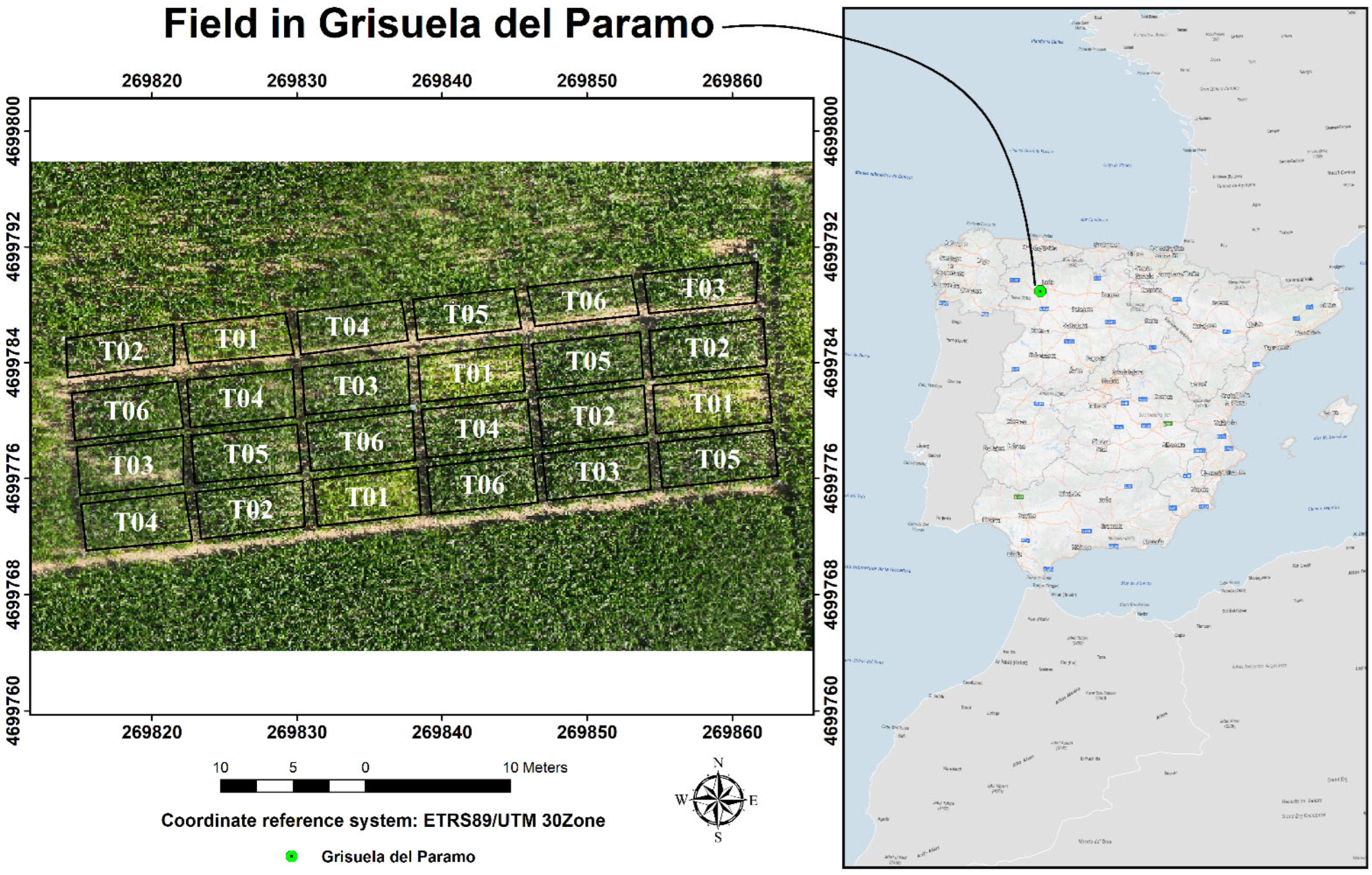
The research was carried out during the 2024 growing season on a commercial maize field situated in Grisuela del Páramo in León, Spain (coordinates: 42°24′58″N, 5°47′50″W, WGS84) (Figure 1). The soil was classified as sandy clay loam, with electrical conductivity of 0.084 dS/m and organic matter content of 1.94%.
Maize requires a consistent supply of nitrogen throughout its growth cycle, with roughly one third of total nitrogen uptake occurring after pollination. Conventional fertilization practices involve two main nitrogen applications: the first before sowing or during early growth stages, and the second at the 6–7-leaf stage (V6–V7) when leaf collars are visible.
In our experimental field, three nitrogen rates were tested: 0, 320, and 382 kg N/ha. For each of six treatments (T1 to T6), the designated quantities of nitrogen, P2O5 and K2O were distributed in the pre-sowing and the second and sixth leaf stages (V2 and V6, respectively) (Table 1). The DEKALB 5362 maize variety was sown on 24 May 2024 at a density of 99,000 seeds/ha in rows spaced 0.65 m apart, and seedlings emerged on 31 May 2024. The experiment was arranged in a randomized complete block design with four replications. The main plots, measuring 32 m2, consisted of six lines 8 m rows. All data were collected from the two central lines to minimize edge effects and treatment interference. The selected fertilizer doses and timing reflect common local farming practices and comply with regional guidelines. This experimental setup enabled the assessment of crop growth under each treatment and the evaluation of nitrogen use efficiency.

2.2. Data Collection

2.2.1. Image Acquisition and Processing

Multispectral and field reflectance data were collected to evaluate the canopy response of maize to nitrogen fertilization. Used for aerial data acquisition was a DJI Mavic 3M Multispectral quadcopter (SZ DJI Technology Co., Ltd., Shenzhen-Nanshan, China), featuring vertical take-off and landing (VTOL) capability and high flight stability, and suitable for precise operations over experimental plots. All flights were conducted autonomously using predefined waypoints in the DJI Pilot 2 (v.14) software, with mission parameters set to ensure consistency and reproducibility across flights. UAV data capture was planned for a mean altitude of 30 m with a flight speed of 4 m s−1, achieving a 75% image overlap (front and side) and a ground sample distance (GSD) of 1–3 cm per pixel per band, under clear sky conditions during the central hours of the day (to minimize shadows). The integrated cameras captured high-resolution images. The multispectral radiometrically calibrated camera captured raw, 16-bit, tiff, 2592 × 1944-pixel images across four spectral bands: green (560 ± 16 nm, range: 544–576 nm), red (650 ± 16 nm, range: 634–666 nm), red-edge (730 ± 16 nm, range: 714–746 nm), and NIR (860 ± 26 nm, range: 834–886 nm). The standard RGB camera captured 8-bit, jpg, 5472 × 3648-pixel, non-radiometrically calibrated images.
Imagery was acquired on 24 June, 22 July, 5 August 2024, and 10 September 2024, corresponding to approximately 12, 19, and >60 days after nitrogen fertilization at the V2 (12 June) and V6 (3 July) growth stages (Table 2). Those dates, representing the early, mid, and late maize growth stages, enabled an assessment of canopy development and reflectance variations driven by nitrogen availability during the growing season. The UAV was factory-equipped with both a multispectral camera (with red, green, red-edge, and NIR sensors) and a standard RGB camera. Images were georeferenced using the UAV integrated real-time kinematic (RTK) system, providing centimeter-level spatial accuracy and so eliminating the need for ground control points (GCPs). No image correction or enhancement was applied in this study due to the favorable conditions; however, several types of image corrections are commonly used in remote sensing to improve the accuracy of extracted spectral indices and should be considered in future studies if adverse weather or environmental conditions are encountered. These include radiometric correction and atmospheric correction [44].
Although the multispectral camera automatically recorded digital images and simultaneously an onboard sensor captures irradiance, the high-resolution multispectral orthoimages processed in Agisoft Metashape (Agisoft LLC, Saint Petersburg, Russia) did not provide reliable absolute reflectance values. Consequently, a manual radiometric calibration was applied to scale multispectral imagery using independent spectroradiometer measurements.
In parallel with the UAV flights, ground-based reflectance data were acquired using a portable FieldSpec 4 spectroradiometer (ASD-FS4; Analytical Spectral Devices Inc., Boulder, CO, USA), which measures spectral reflectance across the 350–2500 nm range. The instrument includes a silicon photodiode array covering the visible and near-infrared regions (350–1000 nm) and two indium–gallium–arsenide (InGaAs) detectors for the shortwave infrared ranges (1000–1800 nm and 1800–2500 nm). A plant probe fitted with a quartz halogen light source and a leaf clip was used to obtain direct, non-destructive leaf reflectance measurements while minimizing stray light interference. Spectral data were collected at the V4 (24 June), V8 (22 July), and R1 (28 August) growth stages, corresponding to key phenological phases in maize development (Table 2).
For each sampling date, treatment, and replicate, ten healthy and fully developed maize plants per plot were selected for leaf measurements. To avoid potential edge effects, five plants from each of the two central rows of the plot were selected, representing 12.5% of the plants per row or 2.1% of the total plants per plot. In each selected plant, the last fully expanded and healthy leaf was measured using a contact probe on the upper leaf surface, avoiding the central vein and leaf spots. Before measuring the first leaf in each plot, the spectroradiometer was allowed to warm up for 50 min and was calibrated using a white reference panel. Following the methodology described by [15], a total of 240 fresh leaves were measured across three measurement campaigns, resulting in 720 leaf samples for all field measurements.
UAV data were collected on multiple dates; however, it was not possible to perform ground spectroradiometer measurements on August 5 and September 10 due to logistical constraints and field conditions. Therefore, UAV data from these two dates were compared with spectroradiometer measurements acquired on 28 August, resulting in a temporal gap of 23 days for 5 August and 13 days for 10 September. Maize grows rapidly during the mid-to-late stages, and canopy spectral characteristics can change. This temporal discrepancy was considered during data interpretation to ensure the reliability of the analysis.

2.2.2. Vegetation Indices

Four VIs derived from UAV-based multispectral imagery were used to evaluate maize canopy development and nitrogen fertilization response. The selected VIs were NDVI and GNDVI, which are commonly used to assess canopy vigor and chlorophyll content [35], and two additional VIs based on the VIS spectral bands, namely, NDGBI and NDRBI, both of which use blue, green, and red bands to enhance sensitivity to early-stage vegetation variations. Table 3 summarizes details of these VIs, including their mathematical expressions and spectral band combinations.
To ensure that only vegetation pixels were included in the analyses, several image classification strategies were investigated. Unsupervised classifications proved unreliable due to high spectral similarity between shadows, bare soil, and sparse vegetation. Supervised classification introduced considerable subjectivity and inconsistency, particularly when distinguishing shaded soil from vegetation under varying illumination conditions. Moreover, the combined effects of shadows, sunlit soil, and heterogeneous canopy structures further complicated accurate pixel discrimination. Given those limitations, a reflectance-based filtering approach was finally adopted. Specifically, the top 10% reflectance values in the NIR band were extracted to represent the densest vegetation areas, and this NIR-derived mask was then applied to the other spectral bands (green, red, red-edge, and blue) to isolate vegetation pixels and exclude soil and shadow pixels. All the bands were then clipped according to this vegetation mask, ensuring that the dataset exclusively represented plant-covered areas. For each experimental plot, the mean value of each VI was then calculated to provide a representative indicator of canopy condition. This approach, which minimized the influence of soil- and shadow-induced noise, improved the accuracy and consistency of VI comparisons across growth stages and treatments. Note, however, that such selective masking is rarely performed or even required in most practical agricultural applications, as crop canopies typically cover most of the field surface, and the underlying soil, which is generally homogeneous at the plot scale, is considered to exert a neutral influence on index estimation [34].
To ensure consistency with field spectroradiometer data, empirical line calibration was applied by adjusting the digital values of the UAV images using an appropriate scaling factor. Based on these readings, VIs were calculated using the following central wavelengths: blue (450 nm), green (560 nm), red (660 nm), red edge (730 nm), and NIR (860 nm). These field-based reflectance values served as a reference for calibrating UAV-derived imagery and validating spectral accuracy across different sensors.

2.2.3. Agronomic and Yield Variables

To assess maize grain yield, corncob development, and plant nutrient status, all ears from the two central rows of each experimental plot were harvested. The number of corncobs per plot was counted; the grains were separated and weighed, and grain volume and moisture content were measured to calculate grain yield (t/ha), grain moisture (%), and grain test weight (kg/hl); and finally, cornstalk NO3–N content (ppm) was determined using ultraviolet spectroscopy. Those five measurements, reported in Table 4, were the basis for analyzing and linking plant performance with UAV-derived imagery and spectroradiometer readings, enabling a comprehensive assessment of maize productivity and nutritional status.

3. Results

3.1. Indices

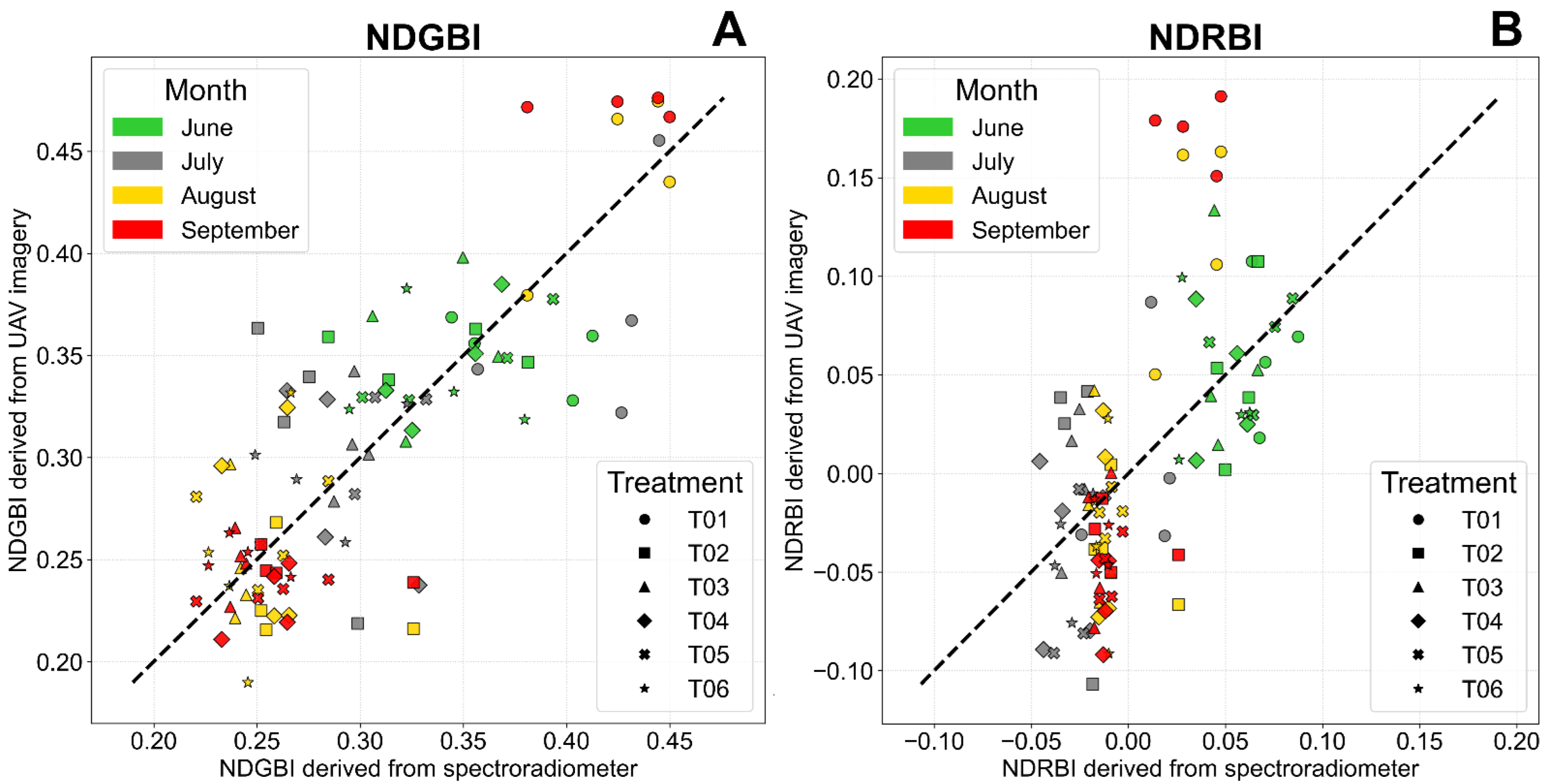
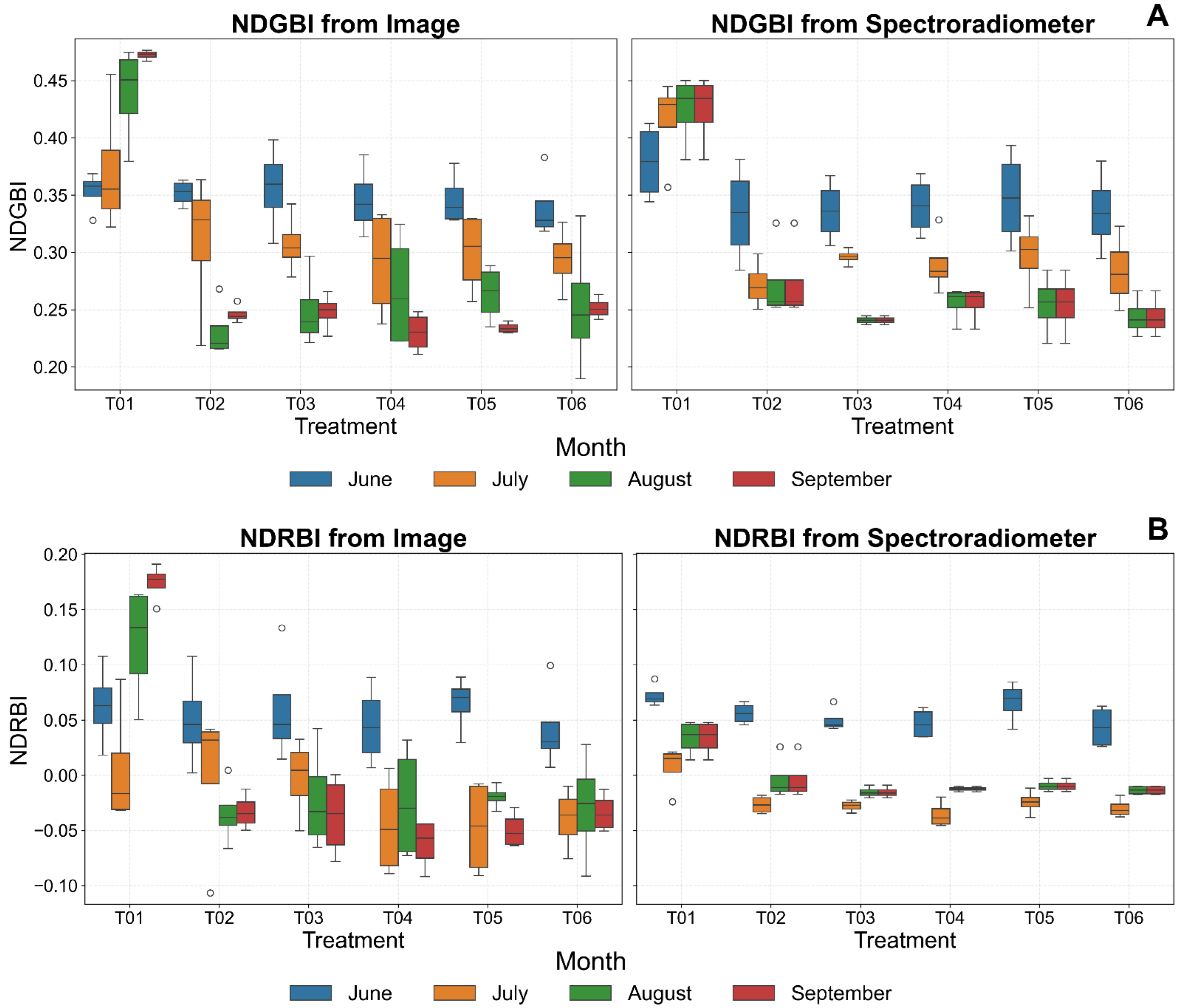
The VIs were calculated from multispectral images and spectroradiometer measurements for each data acquisition date, as explained in the following sections. Scatter plots of different growth stages and boxplots of different treatments depict VI values for NDVI and GNDVI (Figure 2 and Figure 3) and for NDGBI and NDRBI (Figure 4 and Figure 5). Numerical data by treatment are available as a worksheet in the additional material files.

3.1.1. NIR-Based Indices: NDVI and GNDVI

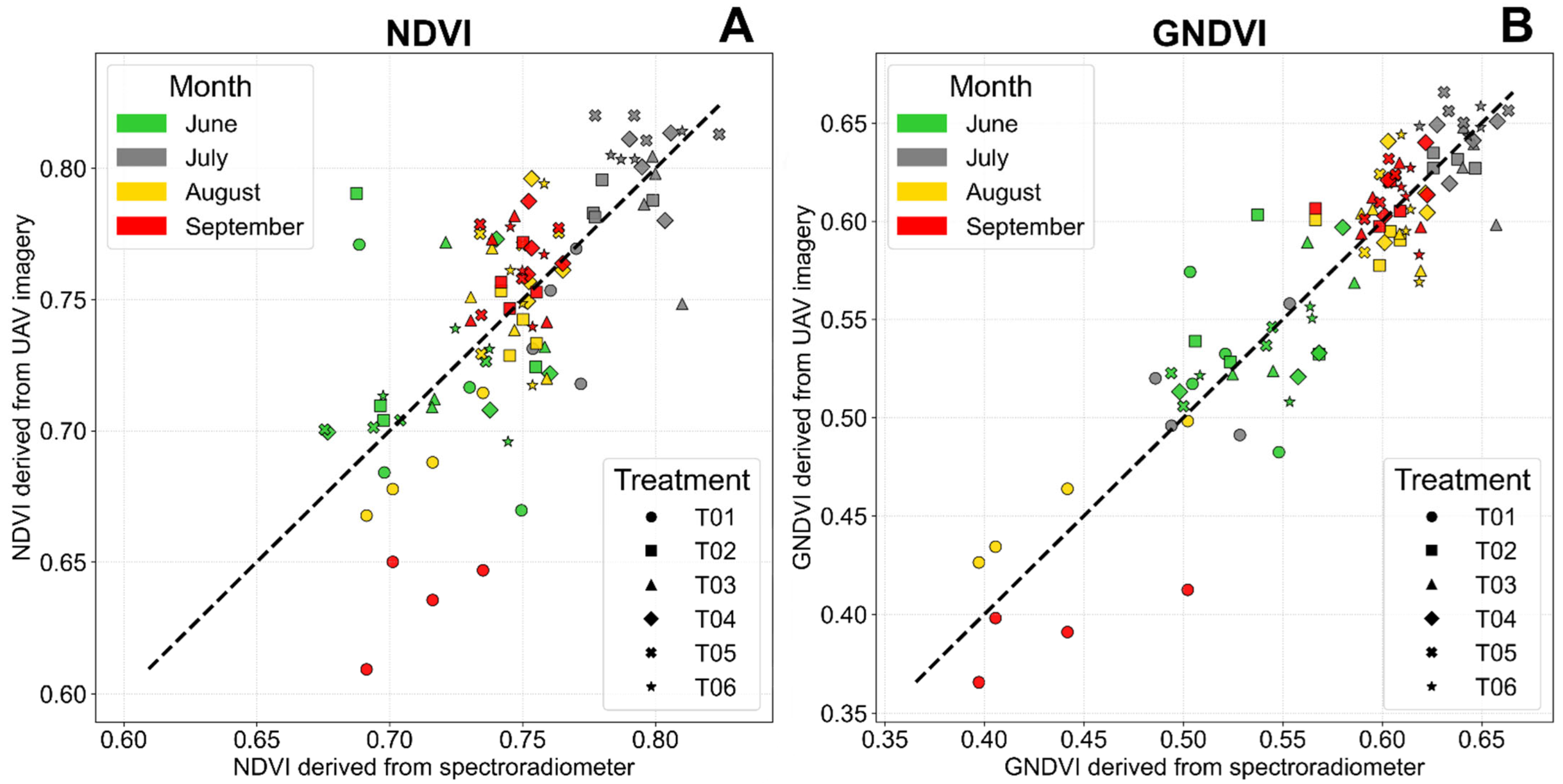
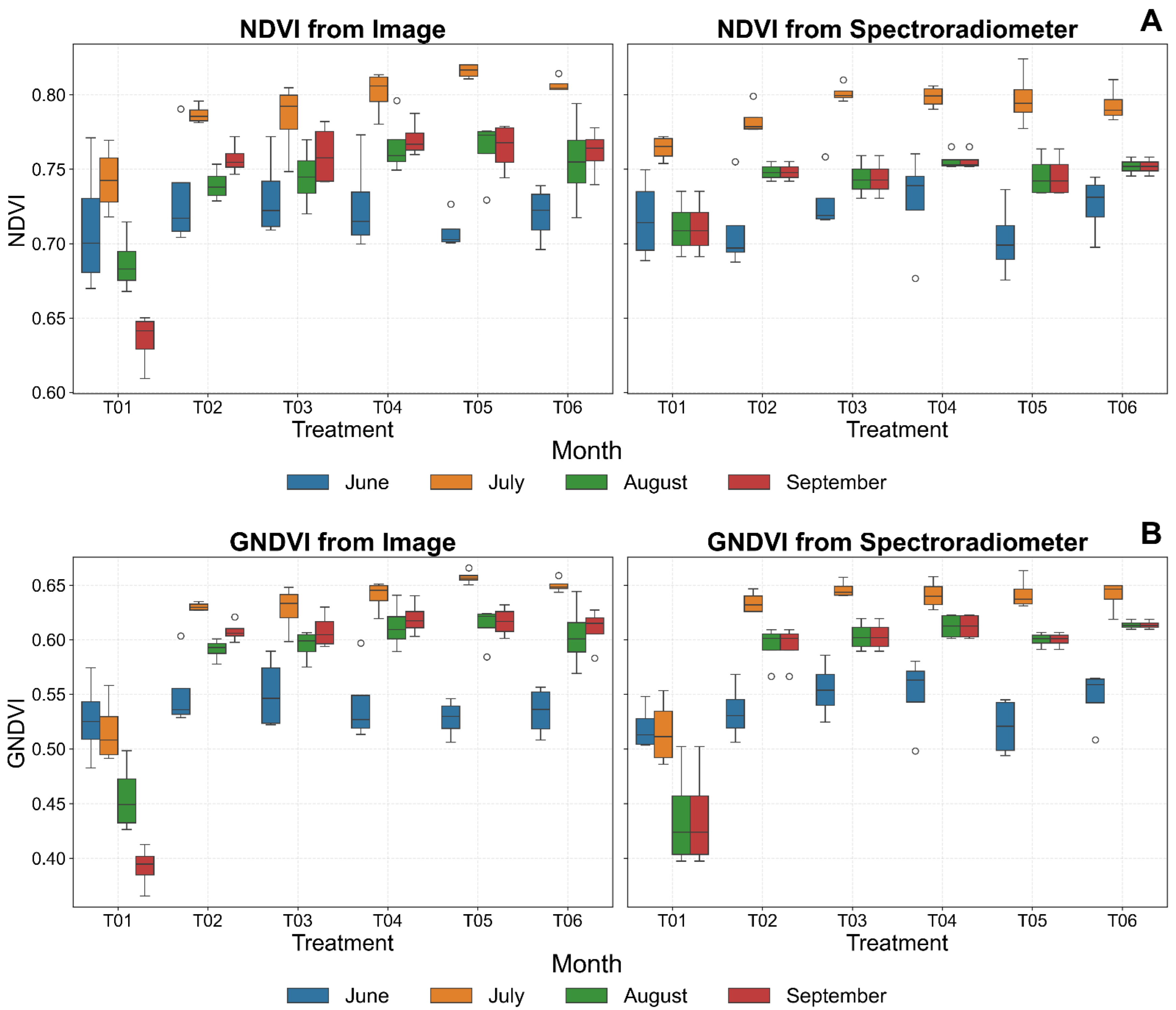
Figure 2A shows that the agreement between UAV multispectral imagery and field spectroradiometer measurements was nearly nonexistent in June (R2 ≈ 0.0005) and improved progressively throughout the growing season, reaching moderate in July (R2 ≈ 0.28), good in August (R2 ≈ 0.51), and very good in September (R2 ≈ 0.65), with a slight decrease in RMSE. These values indicate a clear improvement in agreement between the two sources over the months (Table 5). Figure 3A shows that following fertilization, i.e., by July 2024, plots with higher nitrogen rates (T3–T5) exhibited clear NDVI increases, particularly for UAV-derived data, which captured sharper contrasts and greater within-treatment variability. In August 2024, treatment differences became more pronounced: T5 and T6 consistently recorded the highest NDVI, while T1 produced the lowest response in both datasets. UAV imagery showed greater sensitivity to treatment effects and spatial heterogeneity, whereas spectroradiometer measurements presented a more homogeneous pattern. By September 2024, NDVI differences across treatments reached their peak. UAV-derived estimates maintained a strong ability to highlight subtle variations and within-plot heterogeneity, reinforcing the suitability of this approach for detecting fine-scale crop responses to nitrogen fertilization.
As for GNDVI, Figure 2B shows that the agreement between UAV multispectral imagery and field spectroradiometer measurements was strong throughout the growing season. In June, the agreement was weak to moderate (R2 ≈ 0.15), increased markedly in July (R2 ≈ 0.83), reached very good agreement in August (R2 ≈ 0.87), and peaked in September (R2 ≈ 0.92), with relatively low RMSE values, indicating high stability in the agreement between the two sources over the months (Table 5). Figure 3B shows noticeable early fertilization responses in July 2024, while the response of the non-fertilized control (T1) remained weak. Treatments T5 (320 kg N/ha at early growth) and T6 (pre-sowing fertilization) resulted in higher GNDVI, and UAV imagery slightly outperformed field spectroradiometer measurements in detecting these early responses. Clearer increases were evident by late July 2024, after V6 treatments with higher nitrogen rates (T3–T5), with UAV-derived GNDVI better distinguishing between treatments and capturing within-plot variability. GNDVI values continued to rise and stabilize in August 2024, with UAV imagery and spectroradiometer readings closely aligned across most treatments (T2–T6) reflecting canopy maturation. However, UAV imagery detected slightly higher values in T3 and T6, indicating enhanced spatial sensitivity, while values for T1 remained the lowest. By September 2024, GNDVI plateaued for all fertilization treatments (T3–T6), with only minor differences between UAV imagery and field measurements; this is likely because the images captured male inflorescences (tassels or panicles) present at this stage, meaning they were visible in the UAV imagery but not evident in the spectroradiometer measurements. T1 continued to show significantly lower GNDVI, reflecting persistent nitrogen deficiency and underdeveloped vegetation.
Figure 2. UAV-derived and field spectroradiometer measurement correlations for NDVI (A) and GNDVI (B) for different growth stages. Note: For the August and September calculations, the measurements taken with the spectroradiometer on 28 August were used. The dashed line indicates the bisector between the axes.
Remotesensing 18 00528 g002
Figure 3. UAV-derived and field spectroradiometer measurements compared for NDVI (A) and GNDVI (B) for different treatments. Note: For the August and September calculations, the measurements taken with the spectroradiometer on 28 August were used. Small circles indicate atypical cases (outliers).
Remotesensing 18 00528 g003

3.1.2. RGB-Based Indices: NDGBI and NDRBI

Figure 4A shows that the NDGBI index reflected a gradual improvement in the agreement between UAV imagery and field spectroradiometer measurements, from the weakest agreement in June (R2 ≈ 0.04) to the strongest in September (R2 ≈ 0.86), with a relative decrease in RMSE over the months, indicating increased accuracy in agreement as the growing season progressed. The results also revealed a clear response to nitrogen fertilization, as index values gradually increased over the months (Table 6). Figure 5A shows that, on 24 June (nine days before fertilization at V6), while differences between treatments were small, UAV imagery values were slightly higher, indicating greater sensitivity to early crop growth. The highest NDGBI values were recorded for treatments T5 (V2 fertilization) and T6 (the most pre-sowing fertilization), while the lowest value was for T1 (non-fertilized control). By 22 July 2024 (19 days after fertilization), treatment effects became more pronounced, particularly for T3, T4, and T5 with high nitrogen rates, with the UAV imagery more clearly distinguishing between treatments than the field measurements. NDGBI values rose to a peak in August and then stabilized. Agreement was strong between both data sources, reflecting a mature canopy and high chlorophyll content. Highlighting its ability to capture fine spatial variability, UAV imagery recorded slightly higher values for some treatments (T3 and T6). By September, NDGBI values plateaued for all fertilized treatments (T3–T6), with strong agreement in the late season reflecting only minor differences.
Figure 4B shows that the NDRBI index exhibited a weak early-season relationship between UAV imagery and field spectroradiometer measurements in June (R2 ≈ 0.02), which gradually improved over the following months, reaching a relatively good agreement in September (R2 ≈ 0.68), accompanied by a gradual increase in RMSE, reflecting the changing values between the two methods as the growing season progressed (Table 6). Figure 5B points to wide dispersion between treatments for image-derived NDRBI in July 2024, with values for T1 lower than for the fertilization treatments, while spectroradiometer measurements recorded negative or near-zero values for some treatments. In August, the image-derived NDRBI values increased for T4, T5, and T6 and remained near zero or negative for T1 and T2, while spectroradiometer values were less dispersed. By September, image-derived NDRBI values reached their highest levels, particularly for T1 and T4, while spectroradiometer readings reflecting the same general pattern were lower. Treatments T3–T6 showed similar values for both data sources.
Figure 4. UAV-derived and field spectroradiometer measurement correlations for NDGBI (A) and NDRBI (B) for different growth stages. Note: For the August and September calculations, the measurements taken with the spectroradiometer on 28 August were used.
Remotesensing 18 00528 g004
Figure 5. UAV-derived and field spectroradiometer measurements compared for NDGBI (A) and NDRBI (B) for different treatments. Note: For the August and September calculations, the measurements taken with the spectroradiometer on 28 August were used. Small circles indicate atypical cases (outliers).
Remotesensing 18 00528 g005

3.2. Relationship with Agronomic and Yield Variables

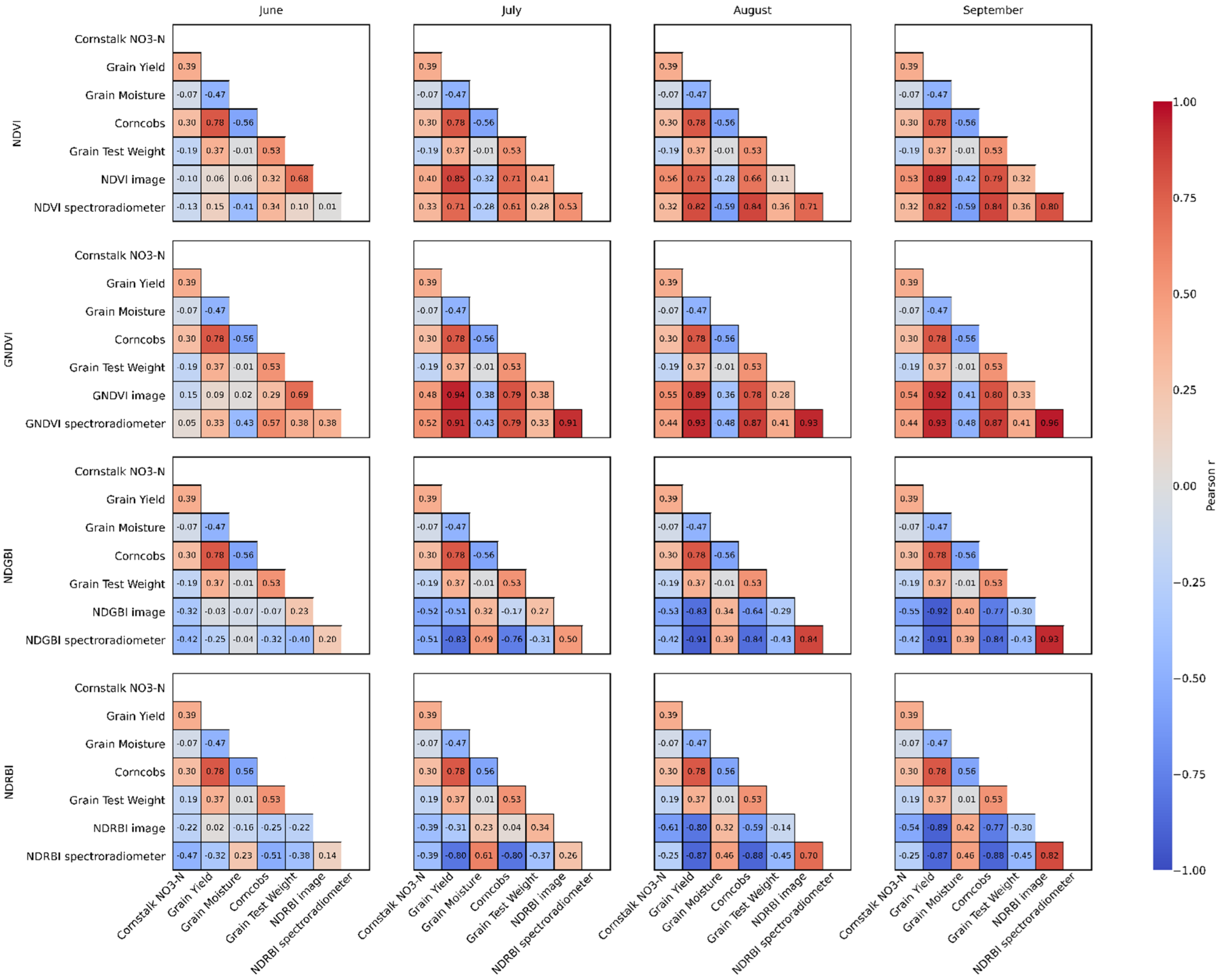
Figure 6 shows, for each image-derived and field spectroradiometer-measured VI (GNDVI, NDVI, NDGBI, and NDRBI) and for each growth stage (June, July, August, and September), the Pearson correlation coefficients for key variables, namely, grain yield, number of corncobs, cornstalk NO3–N content, grain moisture, and grain test weight.
The correlation with NDVI derived from both data sources for grain yield gradually increased from low early in June to strongly positive by September. The number of corncobs remained consistently and strongly correlated with NDVI derived from both data sources, with the highest correlations observed from July through to September. Cornstalk NO3–N showed a weak correlation with NDVI in June but gradually improved to moderate levels by July. Grain moisture exhibited low to moderate negative correlation with NDVI derived from both data sources, particularly in July. In contrast, the grain test weight showed a moderate positive correlation with NDVI throughout the entire season. Overall, the agreement between UAV-derived NDVI and spectroradiometer-derived NDVI improved progressively as the season advanced.
Regarding GNDVI derived from both data sources, the grain yield showed a gradual increase in correlation over time, changing from low in June to very strong by September. Cornstalk NO3–N correlation with GNDVI was weak in June but increased noticeably mid-season. Similarly, the number of corncobs displayed progressively increased in correlation with GNDVI, rising to strong correlations by September. Grain moisture showed a negative, low to moderate correlation with GNDVI, whereas grain test weight showed a moderate positive correlation with GNDVI becoming the strongest in September. Agreement between UAV-derived and spectroradiometer-derived GNDVI overall increased over the season, with the highest consistency observed in September.
NDGBI derived from both sources reflected a distinct seasonal pattern in the relationship with the agronomic and yield variables. The grain yield gradually shifted from a weak negative correlation in June to a stronger negative correlation by September. The number of corncobs also showed an incrementally stronger negative correlation with NDGBI, with a moderately negative correlation mid-season becoming more strongly negative by September for both data sources. Weak cornstalk NO3–N correlation with NDGBI in June improved to moderate levels mid-season. The grain moisture correlation with NDGBI ranged from low to moderate negative values. In contrast, the grain test weight went from a slightly positive correlation in June to a moderately negative correlation later in the season. The overall agreement between the UAV-derived and spectroradiometer-derived NDGBI improved as the season progressed, particularly toward September, when correlation patterns between both data sources became more consistent.
NDRBI derived from both sources also exhibited a progressive change in the relationship with the agronomic and yield variables. The correlation with the grain yield changed from weakly negative in June to more strongly negative in September, and similarly, there was a gradual shift from weak to moderate negative correlation with the number of corncobs as the season advanced. Cornstalk NO3–N maintained a moderately negative correlation with NDRBI, with the strongest relationship occurring around mid-season. The correlation between grain moisture and NDRBI, which was negative in June, became positive from mid-season onward. The correlation with the grain test weight was consistently negative, with this relationship strengthening by September. Overall, the agreement between the UAV-derived and spectroradiometer-derived NDRBI improved notably towards the end of the season, with correlations with agronomic and yield variables becoming more similar.
In summary, while the NIR-based NDVI and GNDVI remain effective in assessing chlorophyll content and green biomass, VIS-based indices that use blue and red bands, i.e., NDGBI and NDRBI, provide a complementary perspective on crop spectral assessment. NIR-derived indices may be limited or affected by reflectance value saturation, whereas VIS-based indices show sensitivity to canopy structure, surface conditions, and moisture, which makes them especially valuable for large-scale monitoring. VIS-based indices also enhance the interpretation of UAV imagery by capturing both physiological and morphological traits. Throughout the season, we consistently observed strong agreement between VIS-based indices derived from UAV imagery and spectroradiometer measurements, confirming the former’s reliability under field conditions. For precision agriculture overall, VIS-band indices offer a practical and information-rich tool capable of complementing NIR-based indices in monitoring subtle changes in vegetation.

4. Discussion

Comparing traditional NIR-based indices, NDVI and GNDVI, and RGB-based indices, NDGBI and NDRBI, revealed clear differences in their temporal monitoring of maize growth and nitrogen status. RGB-based indices potentially enhance the comprehension of maize physiological responses, such as chlorophyll degradation, early stress, and nitrogen fluctuations. While NDGBI initially showed less agreement with field spectroradiometer-derived measurements, agreement improved towards the mid- and late-season stages, indicating nitrogen-related stress reflected in higher values, pointing to lower nitrogen content. Early in the season, while the NDRBI values were low, they captured general trends in canopy biomass accumulation, thereby offering a complementary perspective on stress responses.
Our findings highlight the potential of RGB-based indices such as NDRBI and NDGBI, most especially in growth stages when NDVI and GNDVI exhibit less sensitivity, and, moreover, are consistent with the literature demonstrating the effectiveness of RGB-based indices in proactive crop stress monitoring. For example, ref. [25] reported reliable estimates for nitrogen and water status in maize for RGB-based indices, while [26] achieved 89% accuracy in detecting corn stress using UAV-derived RGB imagery. Likewise, ref. [48] pointed to the satisfactory performance of RGB-based indices in monitoring vegetation cover and biomass growth stages, confirming their usefulness for precision agriculture applications. This can be explained by nitrogen being closely linked to chlorophyll content, and nitrogen deficiency leads to reduced chlorophyll concentration and alterations in pigment composition, including chlorophylls and carotenoids. The blue spectral radiation is strongly absorbed by these pigments, making blue-band reflectance particularly sensitive to early physiological changes associated with nitrogen status. Consequently, RGB indices that incorporate the blue band can capture subtle spectral differences among nitrogen fertilization treatments [49].
The traditional NIR indices, NDVI and GNDVI, performed as expected. NDVI progressively improved over the growing season in terms of agreement with field spectroradiometer measurements to track canopy growth and treatment effects; however, it proved poor at detecting nitrogen status in early growth stages, corroborating previous findings [27,50]. A possible explanation is that NDVI saturation at high biomass levels reduces its sensitivity under dense canopy conditions [51,52]. GNDVI outperformed NDVI in the mid- and late-season stages, demonstrating strong agreement with field spectroradiometer measurements and showing high sensitivity to plant growth and nitrogen content [25]. Those findings are consistent with other UAV-based studies showing that GNDVI better captures nitrogen variations in maize [53,54]. Given the extensive literature on both NDVI and GNDVI, no novel contributions were identified.
Regarding correlations with agronomic and yield variables, grain yield positively correlated with NDVI and GNDVI but negatively correlated with NDGBI and NDRBI, reflecting relative, rather than absolute, absorption effects between spectral bands in the latter. Corncob development followed a similar pattern: NDVI and GNDVI correlations were strong and stable, whereas the RGB-based indices captured stress responses more than direct biomass measurements. Cornstalk nitrate content (NO3-N) showed weak correlations with all the indices early in the season; GNDVI demonstrated higher sensitivity mid-season, while NDGBI and NDRBI consistently highlighted nitrogen stress. Grain moisture was inversely correlated with NDVI and GNDVI but positively correlated with NDGBI and NDRBI, reflecting differences in spectral responses between the NIR- and RGB-based indices. Grain test weight correlations were moderately positive with NDVI and GNDVI and, as the season progressed, increasingly negative with NDGBI and NDRBI. This behavior consists of greater NIR band reflectance versus greater blue-band absorption for more vigorous plants.
As the season progressed, the agreement between UAV-derived indices and field measurements broadly improved, demonstrating the reliability of UAV imagery as a cost-effective and widely applicable tool for crop monitoring [25,48,53]. Crucially, the RGB-based indices, NDGBI and NDRBI, exhibited high sensitivity to stress and nitrogen fluctuations, achieving comparable performance to that of the NIR-based indices. Our findings suggest that RGB cameras could complement NIR sensors, thereby offering practical means for perfect spatial resolution in the monitoring of fertilized crops in precision agriculture systems. Affordable RGB cameras are now available for mounting on drones or ground-based platforms, with simplified image processing workflows compared to multispectral systems, making them suitable for on-field use by farmers or agronomists, such as DJI Phantom / Mavic RGB cameras. These data can be integrated with crop growth models such as WRF-Crop or multi-source data fusion approaches to improve fertilization and irrigation management and to assess crop status in a cost-effective manner [55,56].
Despite the promising results of using RGB-derived vegetation indices for assessing maize nitrogen status, several limitations should be acknowledged. First, this study was conducted during a single growing season and at a single experimental site, which may limit the generalizability of the findings to other agricultural or climatic conditions, highlighting the need for future studies across multiple sites and seasons. Second, the stability of the RGB camera under varying weather conditions was not tested, as measurements were performed exclusively on sunny days; factors such as cloud cover or intense solar radiation may affect index accuracy and should be addressed in future research. Third, the slight influence of atmospheric scattering on the blue band, which can be affected by UAV flight altitude, should be considered to further improve the accuracy of vegetation indices in practical applications.

5. Conclusions

RGB-derived indices (NDGBI and NDRBI) demonstrated strong potential for monitoring maize nitrogen dynamics by capturing pigment-driven physiological responses (e.g., chlorophyll degradation and early stress signatures) that are not always expressed as changes in canopy structure. Their consistency increased as the season progressed, with improved agreement with field spectroradiometer measurements in mid- and late-season stages, suggesting that RGB indices can reliably discriminate nitrogen-related stress once canopy development is sufficient and treatment effects become clearer at the canopy scale. In addition, RGB indices can remain responsive in periods when NIR indices—particularly NDVI—show reduced sensitivity due to saturation under high biomass or dense canopy conditions.
Based on these results, RGB indices can replace NIR-based indices in specific, decision-oriented applications, especially those centered on within-field stress detection and nitrogen management: routine UAV scouting with standard RGB cameras, spatial zoning for variable-rate fertilization, and the prioritization of sampling or corrective actions. In these workflows, the primary need is the robust relative mapping of stress patterns at very high spatial resolution with low-cost sensors and simplified processing, rather than universal biophysical retrieval.
For broader agronomic interpretation, however, RGB indices should be considered complementary, rather than universal, substitutes. NDVI and particularly GNDVI retained stronger and more stable relationships with canopy vigor and yield-related variables, while NDGBI and NDRBI tended to encode stress responses and often exhibited different correlation directions. Moreover, RGB indices are more sensitive to acquisition variability (illumination changes, blue-band atmospheric effects, flight conditions), which can limit cross-site and cross-season transferability without careful radiometric standardization. Consequently, the most defensible conclusion is a conditional replacement: RGB indices are viable substitutes for NIR indices in operational nitrogen-stress monitoring and management zoning, but they are best used alongside NDVI/GNDVI for general crop growth assessment, yield-oriented monitoring, and broader comparability.

Author Contributions

M.M.: data processing, data analysis, UAV-based data interpretation, and writing—original draft preparation; I.G.-P.: UAV image processing and field data collection; J.R.R.-P.: conceptualization, funding acquisition, formal analysis, validation, and writing—review and editing; J.P.V.-A.: field data collection; E.S.-A.: conceptualization, supervision, project administration, and writing—review and editing. All authors have read and agreed to the published version of the manuscript.

Funding

This research was funded by EuroChem Agro Iberia, S.L., grant number 2024/00133/001 (T171), and by the Instituto Tecnológico Agrario de Castilla y León (ITACyL) under the 2023 call for proposals for industrial research or experimental development projects within the agrifood R&D promotion framework, aimed at attracting scientific and technical talent (BDNS identifier: 712150).

Data Availability Statement

The data supporting the findings of this study are available from the corresponding author upon reasonable request.

Acknowledgments

The research team gratefully acknowledges José María, a farmer from Grisuela del Páramo, for his collaboration in providing the experimental field used in this study.

Conflicts of Interest

The authors declare no conflict of interest.

Abbreviations

The following abbreviations are used in this manuscript:
UAVsUnmanned Aerial Vehicles
NIRNear-Infrared
VISVisible
RGBRed–Green–Blue
ExGExcess Green
VIsVegetation Indices
NDVINormalized Difference Vegetation Index
GNDVIGreen Normalized Difference Vegetation Index
NDGBINormalized Difference Green–Blue Index
NDRBINormalized Difference Red–Blue Index
VTOLVertical Take-off and Landing
GSDGround Sample Distance
RTKReal-Time Kinematic
RMSERoot Mean Square Error
R2Determination Coefficient

References

  1. Guo, Y.; Zhang, X.; Chen, S.; Wang, H.; Jayavelu, S.; Cammarano, D.; Fu, Y. Integrated UAV-Based Multi-Source Data for Predicting Maize Grain Yield Using Machine Learning Approaches. Remote Sens. 2022, 14, 6290. [Google Scholar] [CrossRef]
  2. Silva, D.; Madari, B.E.; Santana, C.; Costa, J.V.S.; Ferreira, M.E. Planning and Optimization of Nitrogen Fertilization in Corn Based on Multispectral Images and Leaf Nitrogen Content Using Unmanned Aerial Vehicle (UAV). Precis. Agric. 2025, 26, 30. [Google Scholar] [CrossRef]
  3. Arorra, A. Top-Corn Producing Countries in the World 2024. Adda247 2024. Available online: https://currentaffairs.adda247.com/top-10-corn-producing-countries-in-the-world (accessed on 16 May 2024).
  4. Cai, S.; Zhao, X.; Yan, X. Towards Precise Nitrogen Fertilizer Management for Sustainable Agriculture. Earth Crit. Zone 2025, 2, 100026. [Google Scholar] [CrossRef]
  5. Vries, W. Impacts of Nitrogen Emissions on Ecosystems and Human Health: A mini review. Curr. Opin. Env. Sci. Health 2021, 21, 100249. [Google Scholar] [CrossRef]
  6. Kitchen, N.; Ransom, C.; Schepers, J.; Hatfield, J.; Massey, R.; Drummond, T. A New Perspective When Examining Maize Fertilizer Nitrogen Use Efficiency, incrementally. PLoS ONE 2022, 17, E0267215. [Google Scholar] [CrossRef]
  7. Yi, J.; Li, H.; Zhao, Y.; Shao, M.; Zhang, H.; Liu, M. Assessing Soil Water Balance to Optimize Irrigation Schedules of Flood-Irrigated Maize Fields with Different Cultivation Histories in the Arid Region. Agric. Water Manag. 2022, 265, 107543. [Google Scholar] [CrossRef]
  8. Lu, S.; Zhu, G.; Qiu, D.; Li, R.; Jiao, Y.; Meng, G.; Lin, X.; Wang, Q.; Zhang, W.; Chen, L. Optimizing Irrigation in Arid Irrigated Farmlands Based on Soil Water Movement Processes: Knowledge from Water Isotope Data. Geoderma 2025, 460, 117440. [Google Scholar] [CrossRef]
  9. Duan, J.; Rudnick, D.; Proctor, C.; Heeren, D.; Nakabuye, H.N.; Katimbo, A.; Shi, Y.; de Sousa Ferreira, V. Estimation of Corn Nitrogen Demand under Different Irrigation Conditions Based on UAV Multispectral Technology. Agric. Water Manag. 2024, 304, 109075. [Google Scholar] [CrossRef]
  10. Zheng, H.; Ma, J.; Zhou, M.; Li, D.; Yao, X.; Cao, W.; Zhu, Y.; Cheng, T. Enhancing the Nitrogen Signals of Rice Canopies across Critical Growth Stages through the Integration of Textural and Spectral Information from Unmanned Aerial Vehicle (UAV) Multispectral Imagery. Remote Sens. 2020, 12, 957. [Google Scholar] [CrossRef]
  11. Zahir, S.; Jamlos, M.F.; Omar, A.F.; Jamlos, M.A.; Mamat, R.; Muncan, J.; Tsenkova, R. Review-Plant Nutritional Status Analysis Employing the Visible and Near-Infrared Spectroscopy Spectral Sensor. Spectrochim. Acta A Mol. Biomol. Spectrosc. 2024, 304, 123273. [Google Scholar] [CrossRef] [PubMed]
  12. Vergara, O.; Zaman-Allah, M.; Masuka, B.; Hornero, A.; Zarco-Tejada, P.; Prasanna, B.; Cairns, J.E.; Araus, J.L. A Novel Remote Sensing Approach for Prediction of Maize Yield under Different Conditions of Nitrogen Fertilization. Front. Plant Sci. 2016, 7, 666. [Google Scholar] [CrossRef]
  13. Parida, P.K.; Somasundaram, E.; Krishnan, R.; Radhamani, S.; Uthandi, S.E.P.; Parameswari, E.; Raja, R.; Shri Rangasami, S.R.; Sangeetha, S.P.; Gangai Selvi, R. Unmanned Aerial Vehicle-Measured Multispectral Vegetation Indices for Predicting LAI, SPAD Chlorophyll, and Yield of Maize. Agriculture 2024, 14, 1110. [Google Scholar] [CrossRef]
  14. Abdelmajeed, A.; Juszczak, R. Challenges and Limitations of Remote Sensing Applications in Northern Peatlands: Present and Future Prospects. Remote Sens. 2024, 16, 591. [Google Scholar] [CrossRef]
  15. Val, J.; González-Pérez, I.; Sanz-Ablanedo, E.; Maresma, Á.; Rodríguez-Pérez, J. Field Spectroscopy for Monitoring Nitrogen Fertilization and Estimating Cornstalk Nitrate Content in Maize. AgriEngineering 2025, 7, 264. [Google Scholar]
  16. Di Gennaro, S.F.; Toscano, P.; Gatti, M.; Poni, S.; Berton, A.; Matese, A. Spectral Comparison of UAV-Based Hyper and Multispectral Cameras for Precision Viticulture. Remote Sens. 2022, 14, 449. [Google Scholar] [CrossRef]
  17. Yu, K.; Belwalkar, A.; Wang, W.; Hu, Y.; Hunegnaw, A.; Nurunnabi, A.; Ruf, T.; Li, F.; Jia, L.; Kooistra, L.; et al. UAV Hyperspectral Remote Sensing for Crop Nitrogen Monitoring: Progress, Challenges, and Perspectives. Smart Agric. Technol. 2025, 12, 101507. [Google Scholar] [CrossRef]
  18. Feng, H.; Tao, H.; Li, Z.; Yang, G.; Zhao, C. Comparison of UAV RGB Imagery and Hyperspectral Remote-Sensing Data for Monitoring Winter Wheat Growth. Remote Sens. 2022, 14, 3811. [Google Scholar] [CrossRef]
  19. Guan, S.; Fukami, K.; Matsunaka, H.; Okami, M.; Tanaka, R.; Nakano, H.; Sakai, T.; Nakano, K.; Ohdan, H.; Takahashi, K. Assessing Correlation of High-Resolution NDVI with Fertilizer Application Level and Yield of Rice and Wheat Crops Using Small UAVs. Remote Sens. 2019, 11, 112. [Google Scholar] [CrossRef]
  20. Naik, B.; Nayak, H.; Govinda, S. Prediction of Wheat Yield by Using UAV RGB Drone Imagery and Advanced Machine Learning Techniques. Int. J. Stat. Appl. Math. 2023, 8, 961–969. [Google Scholar]
  21. Anzar, S.M.; Sherin, K.; Panthakkan, A.; Al Mansoori, S.; Al-Ahmad, H. Evaluation of UAV-Based RGB and Multispectral Vegetation Indices for Precision Agriculture in Palm Tree Cultivation. Int. Arch. Photogramm. Remote Sens. Spat. Inf. Sci. 2025, XLVIII-G-2, 163–170. Available online: https://isprs-archives.copernicus.org/articles/XLVIII-G-2025/163/2025/ (accessed on 2 February 2026). [CrossRef]
  22. Radocz, L.; Juhász, C.; Tamás, A.; Illés, Á.; Ragán, P. Multispectral UAV-Based Disease Identification Using Vegetation Indices for Maize Hybrids. Agriculture 2024, 14, 2002. [Google Scholar] [CrossRef]
  23. Santana, D.; Cotrim, M.; Flores, M.; Shiratsuchi, L.; Silva, C.; Ribeiro, L.; Teodoro, P.E. UAV-Based Multispectral Sensor to Measure Variations in Corn as a Function of Nitrogen Topdressing. Remote Sens. Appl. Soc. Environ. 2021, 22, 100534. [Google Scholar] [CrossRef]
  24. García-Fernández, M.; Sanz-Ablanedo, E.; Rodríguez-Pérez, J.R. High-Resolution Drone-Acquired RGB Imagery to Estimate Spatial Grape Quality Variability. Agronomy 2021, 11, 655. [Google Scholar] [CrossRef]
  25. Colovic, M.; Stellacci, A.; Mzid, N.; Di Venosa, M.; Todorovic, M.; Cantore, V.; Albrizio, R. Comparative Performance of Aerial RGB vs. Ground Hyperspectral Indices for Evaluating Water and Nitrogen Status in Sweet Maize. Agronomy 2024, 14, 562. [Google Scholar] [CrossRef]
  26. Cvetković, N.; Đoković, A.; Dobrota, M.; Radojicic, M. New Methodology for Corn Stress Detection Using Remote Sensing and Vegetation Indices. Sustainability 2023, 15, 5487. [Google Scholar] [CrossRef]
  27. Yu, J.; Wang, J.; Leblon, B. Evaluation of Soil Properties, Topographic Metrics, Plant Height, and Unmanned Aerial Vehicle Multispectral Imagery Using Machine Learning Methods to Estimate Canopy Nitrogen Weight in Corn. Remote Sens. 2021, 13, 3105. [Google Scholar] [CrossRef]
  28. Murtrey, J.; Middleton, E.; Campbell, L.; Daughtry, C. Optical Reflectance and Fluorescence for Detecting Nitrogen Needs in Zea mays L. In Proceedings of the 2003 IEEE International Geoscience and Remote Sensing Symposium Proceedings (IEEE Cat No03CH37477); IEEE: Piscataway, NJ, USA, 2003; pp. 4602–4604. [Google Scholar] [CrossRef]
  29. Pereira, L.; Rodrigues, C.; Marques, C.; Santos, T. Applying RGB-Based Vegetation Indices Obtained from UAS Imagery for Monitoring the Rice Crop at the Field Scale: A Case Study in Portugal. Agriculture 2023, 13, 1916. [Google Scholar] [CrossRef]
  30. Saberioon, M.M.; Amin, M.S.M.; Aimrun, W.; Gholizadeh, A.; Anuar, A.R. Assessment of colour indices derived from conventional digital camera for determining nitrogen status in rice plants. J. Food Agric. Environ. 2013, 11, 655–662. [Google Scholar]
  31. Sastre, L.F.; Alte da Veiga, N.M.S.; Ruiz, N.M.; Carrión-Prieto, P.; Marcos-Robles, J.L.; Navas-Gracia, L.M.; Martín-Ramos, P. Assessment of RGB Vegetation Indices to Estimate Chlorophyll Content in Sugar Beet Leaves in the Final Cultivation Stage. AgriEngineering 2020, 2, 128–149. [Google Scholar] [CrossRef]
  32. Bendig, J.; Bolten, A.; Bennertz, S.; Broscheit, J.; Eichfuss, S.; Bareth, G. Estimating Biomass of Barley Using Crop Surface Models (CSMs) Derived from UAV-Based RGB Imaging. Remote Sens. 2014, 6, 10395–10412. [Google Scholar] [CrossRef]
  33. Szechyńska-Hebda, M.; Hołownicki, R.; Doruchowski, G.; Sas, K.; Puławska, J.; Jarecka-Boncela, A.; Ptaszek, M.; Włodarek, A. Application of Hyperspectral Imaging for Early Detection of Pathogen-Induced Stress in Cabbage as Case Study. Agronomy 2025, 15, 1516. [Google Scholar] [CrossRef]
  34. Zheng, H.; Cheng, T.; Li, D.; Yao, X.; Tian, Y.; Cao, W.; Zhu, Y. Combining Unmanned Aerial Vehicle (UAV)-Based Multispectral Imagery and Ground-Based Hyperspectral Data for Plant Nitrogen Concentration Estimation in Rice. Front. Plant Sci. 2018, 9, 936. [Google Scholar] [CrossRef]
  35. Lee, K.J.; Lee, B.W. Estimating Canopy Cover from Color Digital Camera Image of Rice Field. J. Crop. Sci. Biotechnol. 2011, 14, 151–155. [Google Scholar] [CrossRef]
  36. Bagnall, G.; Thomasson, J.; Yang, C.; Wang, T.; Han, X.; Sima, C.; Chang, A. Uncrewed Aerial Vehicle Radiometric Calibration: A Comparison of Autoexposure and Fixed Exposure. Plant Phenome J. 2023, 6, e20082. [Google Scholar] [CrossRef]
  37. Xue, J.; Su, B. Significant Remote Sensing Vegetation Indices: A Review of Developments and Applications. J. Sens. 2017, 2017, 1353691. [Google Scholar] [CrossRef]
  38. Dutta, R. Review of Vegetation Indices for Vegetation Monitoring. In Proceedings of the 35th Asian Conference on Remote Sensing (ACRS 2014); Asian Conference on Remote Sensing Society: Pathumthani, Thailand, 2014. [Google Scholar]
  39. Maresma, Á.; Ariza, M.; Martínez, E.; Lloveras, J.; Martínez-Casasnovas, J.A. Analysis of Vegetation Indices to Determine Nitrogen Application and Yield Prediction in Maize (Zea mays L.) from a Standard UAV Service. Remote Sens. 2016, 8, 973. [Google Scholar] [CrossRef]
  40. Kavak, M.; Karadogan, S.; Özdemir, G. A Long Term NDVI Investigation of Hevsel Gardens Using Remote Sensing Techniques. In Remote Sensing; Dicle University: Diyarbakır, Turkey, 2007. [Google Scholar]
  41. Schowengerdt, R.A. Remote Sensing: Models and Methods for Image Processing, 3rd ed.; Elsevier: Amsterdam, The Netherlands, 2007. [Google Scholar]
  42. Hunt, E.; Hively, W.; Fujikawa, S.; Linden, D.; Daughtry, C.; McCarty, G. Acquisition of NIR-Green-Blue Digital Photographs from Unmanned Aircraft for Crop Monitoring. Remote Sens. 2010, 2, 290–305. [Google Scholar] [CrossRef]
  43. Woebbecke, D.; Meyer, E.; Von Bargen, K. Color Indices for Weed Identification Under Various Soil, Residue, and Lighting Conditions. Trans. ASAE 1995, 38, 259–269. [Google Scholar] [CrossRef]
  44. Xue, B.; Ming, B.; Xin, J.; Yang, H.; Gao, S.; Guo, H.; Feng, D.; Nie, C.; Wang, K.; Li, S. Radiometric Images Captured under Changing Ambient Light Conditions and Applications in Crop Monitoring. Drones 2023, 7, 223. [Google Scholar] [CrossRef]
  45. Rouse, J.W.; Haas, R.H.; Schell, J.A.; Deering, D.W. Monitoring Vegetation Systems in the Great Plains with ERTS. In Proceedings of the Third Earth Resources Technology Satellite-1 Symposium; NASA Special Publication SP-351; NASA: Washington, DC, USA, 1974; Volume 1, pp. 309–317. [Google Scholar]
  46. Gitelson, A.A.; Kaufman, Y.J.; Merzlyak, M.N. Use of a Green Channel in Remote Sensing of Global Vegetation from EOS-MODIS. Remote Sens. Environ. 1996, 58, 289–298. [Google Scholar] [CrossRef]
  47. Gitelson, A.; Kaufman, Y.; Stark, R.; Rundquist, D. Novel Algorithms for Remote Estimation of Vegetation Fraction. Remote Sens. Environ. 2002, 80, 76–87. [Google Scholar] [CrossRef]
  48. Marcial, M.D.J.; González-Sanchez, A.; Jiménez-Jiménez, S.; Ontiveros-Capurata, R.E.; Ojeda, W. Estimation of Vegetation Fraction Using RGB and Multispectral Images from UAV. Int. J. Remote Sens. 2018, 40, 420–438. [Google Scholar] [CrossRef]
  49. Tilling, A.K.; O’Leary, G.J.; Ferwerda, J.G.; Jones, S.D.; Fitzgerald, G.J.; Rodriguez, D.; Belford, R. Remote sensing of nitrogen and water stress in wheat. Field Crops Res. 2007, 104, 77–85. [Google Scholar] [CrossRef]
  50. Miller, E.; Bushong, J.; Raun, W.; Abit, J.; Arnall, B. Predicting Early Season Nitrogen Rates of Corn Using Indicator Crops. Agron. J. 2017, 109, 2863–2870. [Google Scholar] [CrossRef]
  51. Furukawa, F.; Maruyama, K.; Saito, Y.; Kaneko, M. Corn Height Estimation Using UAV for Yield Prediction and Crop Monitoring. In Unmanned Aerial Vehicle: Applications in Agriculture and Environment; Springer International Publishing: Cham, Switzerland, 2020; pp. 51–69. [Google Scholar]
  52. Jjagwe, P.; Chandel, A.; Langston, D. Pre-Harvest Corn Grain Moisture Estimation Using Aerial Multispectral Imagery and Machine Learning Techniques. Land 2023, 12, 2188. [Google Scholar] [CrossRef]
  53. Killeen, P.; Kiringa, I.; Yeap, T.; Branco, P. Corn Grain Yield Prediction Using UAV-Based High Spatiotemporal Resolution Imagery, Machine Learning, and Spatial Cross-Validation. Remote Sens. 2024, 16, 683. [Google Scholar] [CrossRef]
  54. García-Martínez, H.; Flores-Magdaleno, H.; Ascencio-Hernández, R.; Khalil-Gardezi, A.; Tijerina-Chávez, L.; Mancilla-Villa, O.R.; Vázquez-Peña, M.A. Corn Grain Yield Estimation from Vegetation Indices, Canopy Cover, Plant Density, and a Neural Network Using Multispectral and RGB Images Acquired with Unmanned Aerial Vehicles. Agriculture 2020, 10, 277. [Google Scholar] [CrossRef]
  55. Wang, N.; Wu, Q.; Gui, Y.; Hu, Q.; Li, W. Cross-Modal Segmentation Network for Winter Wheat Mapping in Complex Terrain Using Remote-Sensing Multi-Temporal Images and DEM Data. Remote Sens. 2024, 16, 1775. [Google Scholar] [CrossRef]
  56. Bao, L.; Yu, L.; Yu, E.; Li, R.; Cai, Z.; Yu, J.; Li, X. Improving the Simulation of Maize Growth Using WRF-Crop Model Based on Data Assimilation and Local Maize Characteristics. Agric. For. Meteorol. 2025, 365, 110478. [Google Scholar] [CrossRef]
Figure 1. Location of the experimental field in Grisuela del Páramo (León, Spain) and the UAV RGB image acquired on 5 August 2025, showing the spatial distribution of experimental plots (T01–T06). Each plot is labeled according to the applied treatment. The map on the right shows the geographical location of the study area within Spain.
Remotesensing 18 00528 g001
Figure 6. Pearson correlation coefficients for cornstalk NO3–N content (ppm), grain yield (kg/ha), grain moisture (%), number of corncobs (n), and grain test weight (kg/hl) according to UAV-derived and field spectroradiometer measurements for the analysis’s vegetation indices (NDVI GNDVI, NDGBI, and NDRBI) at different growth stages in 2024.
Remotesensing 18 00528 g006
Table 1. Growth stages and nitrogen application dates and quantities (kg N/ha).
TreatmentPre-Sowing
(8 May 2024)
V2—Second Leaf
(12 June 2024)
V6—Sixth Leaf
(3 July 2024)
N Rate (kg N·ha−1)
T010000
T02910229320
T031170203320
T041400180320
T0503200320
T062200162382
Table 2. Field spectroradiometer measurement and UAV flight dates.
Date of Spectroradiometer MeasurementDate of UAV Flight
24 June 202424 June 2024
22 July 202422 July 2024
28 August 20245 August 2024
10 September 2024
Table 3. Studied vegetation indices.
IndexExpressionReferences
Normalized Difference Vegetation Index (NDVI)(NIR − R)/(NIR + R)[45]
Green Normalized Difference Vegetation Index (GNDVI)(NIR − G)/(NIR + G)[46]
Normalized Difference Green–Blue Index (NDGBI)(G − B)/(G + B)[47]
Normalized Difference Red–Blue Index (NDRBI)(R − B)/(R + B)[47]
Table 4. Agronomic and yield variables. The nitrogen treatment codes reflect replication (e.g., T01R01 refers to treatment 01 and replicate 01).
TreatmentCornstalk NO3–N Content (ppm)Grain Yield (kg/Plot)Grain Yield (t/ha)Grain Moisture (%)Grain Test Weight (kg/hl)Corncobs (n)
T01R01679.8110.28321.072.363
T01R023647.077.41121.770.453
T01R0316566.546.85522.170.051
T01R046786.616.92920.073.653
T02R01200317.7818.63720.872.171
T02R02446717.2718.10220.472.172
T02R0316,37714.5415.24121.170.760
T02R04449516.5117.30619.774.173
T03R01373418.9319.84220.573.172
T03R02812117.2718.10321.572.272
T03R03783115.4916.23620.772.664
T03R04595217.3218.15520.074.273
T04R0112,71719.8320.78621.373.282
T04R0210,01817.2918.12321.870.374
T04R03576917.6118.45921.371.972
T04R04404018.1619.03520.075.881
T05R0155521.4922.52620.373.783
T05R02781518.1319.00421.372.567
T05R03911018.6619.55921.572.780
T05R04814217.9718.83620.073.472
T06R01141217.0617.88220.273.574
T06R0218,70215.8616.62421.471.366
T06R03600217.9218.78420.971.775
T06R0414,67918.5019.39220.972.179
Table 5. A quantitative assessment of the agreement between UAV and field spectroradiometer measurements for NDVI and GNDVI throughout the growing season, showing R2 and RMSE values.
Vegetation IndexDateR2RMSE
NDVIJune0.00050.039
July0.2840.023
August0.5080.024
September0.6470.037
GNDVIJune0.1450.032
July0.8310.021
August0.8680.024
September0.9190.028
Table 6. Quantitative assessment of agreement between UAV and field spectroradiometer measurements for NDGBI and NDRBI throughout the growing season, showing R2 and RMSE values.
IndexDateR2RMSE
NDGBIJune0.0410.038
July0.2460.052
August0.7070.043
September0.8610.035
NDRBIJune0.0210.037
July0.0680.047
August0.4840.055
September0.6750.069
Disclaimer/Publisher’s Note: The statements, opinions and data contained in all publications are solely those of the individual author(s) and contributor(s) and not of MDPI and/or the editor(s). MDPI and/or the editor(s) disclaim responsibility for any injury to people or property resulting from any ideas, methods, instructions or products referred to in the content.