Article

Time-Series Monitoring and Mechanism Analysis of Surface Subsidence in Changchun City Using E-PS-InSAR


1
College of Geoexploration Science and Technology, Jilin University, Changchun 130026, China
2
The State Key Laboratory of Lunar and Planetary Sciences, Macau University of Science and Technology, Macau 999078, China
3
Sichuan Provincial Communications Survey and Design Research Institute Co., Ltd., Chengdu 610017, China
*
Author to whom correspondence should be addressed.
Remote Sens. 2026, 18(3), 530; https://doi.org/10.3390/rs18030530
Submission received: 19 December 2025 / Revised: 30 January 2026 / Accepted: 2 February 2026 / Published: 6 February 2026
(This article belongs to the Section Urban Remote Sensing)

Highlights

What are the main findings?
  • The E-PS-InSAR technology achieves dual assurance in monitoring point density and accuracy compared to traditional PS-InSAR and SBAS-InSAR. It accomplishes complete spatial coverage of low-coherence areas such as urban and vegetated regions in Changchun City.
  • Changchun City’s surface subsidence displays unique seasonal and spatiotemporal patterns. Land use categories are correlated with it.
What are the implications of the main findings?
  • E-PS-InSAR is a dependable instrument for tracking surface deformation in intricate urban–rural contexts because it combines Permanent Scatterers and Distributed Scatterers. It can help with infrastructure safety management and urban planning.
  • A scientific foundation for targeted ground subsidence prevention and control in medium-sized towns is provided by the discovered lagged response of surface subsidence to temperature and precipitation, as well as the highest contribution rate of cultivated land to surface subsidence.

Abstract
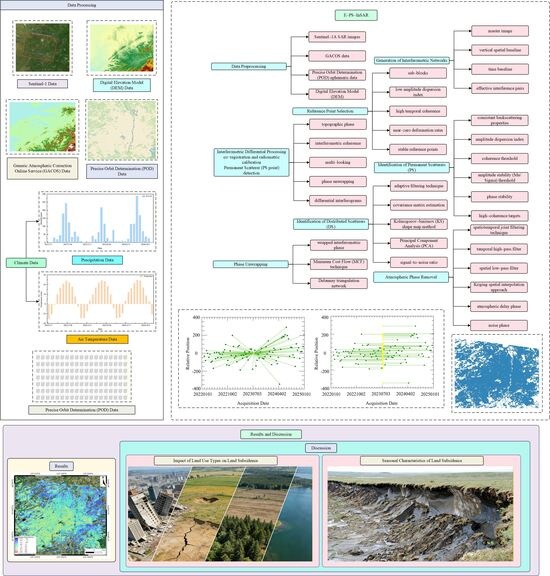
Surface subsidence has grown to be a major geological problem for big and medium-sized cities in the context of urbanization and climate change. Changchun, a city of moderate size and rapid development, was chosen as the study region for this project. The Enhanced Permanent Scatterer Interferometric Synthetic Aperture Radar (E-PS-InSAR) technique was used based on Sentinel-1A imagery to gather time-series surface deformation information in order to perform long-term, high-precision monitoring and a mechanistic study of surface deformation in urban–rural integration areas. Subsequently, temperature and land-use type data were then integrated for a thorough investigation using techniques including correlation analysis and functional fitting. The following are the primary conclusions: (1) The E-PS-InSAR technique integrating both PS and DS targets can significantly improve the density of monitoring points compared to traditional methods, providing the complete spatial coverage. (2) Changchun has an average annual subsidence rate of −0.14 mm and an average cumulative subsidence of −0.08 mm. The highest cumulative subsidence is up to −41.31 mm, and the maximum subsidence rate is −17.27 mm/yr. (3) Surface subsidence was correlated with land use types, and cultivated land was the primary contributor to subsidence. (4) Surface subsidence exhibits distinct seasonal fluctuations, and climatic factors exhibit a lagged influence on surface subsidence. These results are crucial for safe infrastructure operation, urban planning, and promptly preventing geological dangers in mid-sized cities.

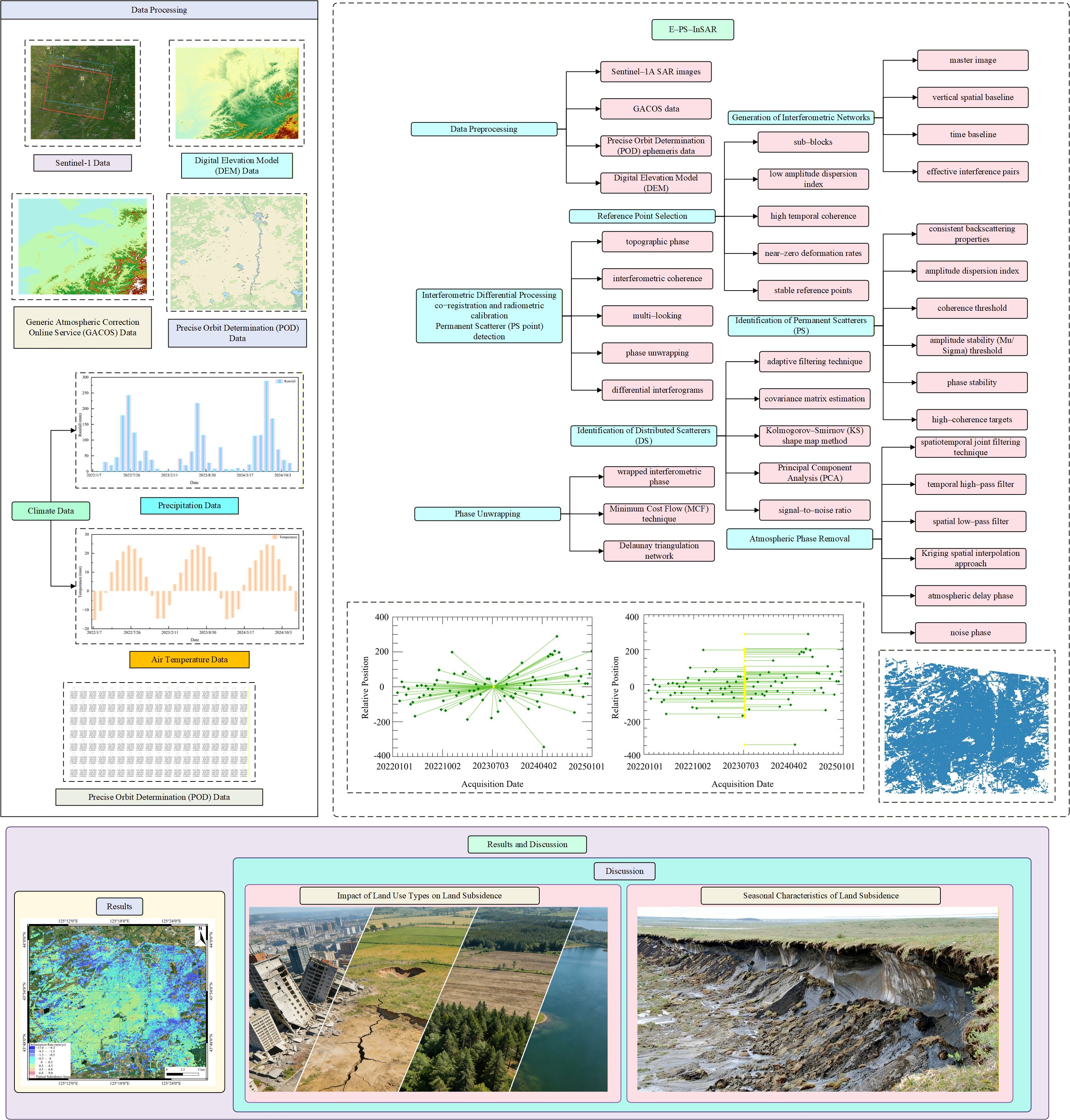
Graphical Abstract

1. Introduction

As urbanization continues to progress, it causes stress imbalance in local geological bodies, which increases the risk of land subsidence. The risk and unpredictability of surface subsidence are further increased in the context of climate change by irregular hydro-mechanical characteristics of soil brought on by precipitation and yearly freeze–thaw cycles brought on by abrupt temperature swings.
Levelling, bedrock and layered marker readings, and the Global Navigation Satellite System (GNSS) are some of the conventional methods for monitoring land subsidence [1]. By using point-based observations, these techniques allow for high-precision measurement. However, they have drawbacks that make it challenging to provide large-scale, continuous, and real-time monitoring, such as restricted geographical coverage and high field operation costs [2]. High-precision remote sensing technology is called Interferometric Synthetic Aperture Radar (InSAR) [3]. Surface subsidence data are derived using radar phase information. This technology is widely used due to its benefits, which include minimal monitoring costs and broad coverage. Small Baseline Subsets Interferometric Synthetic Aperture Radar (SBAS-InSAR) [4] and Permanent Scatterer Interferometric Synthetic Aperture Radar (PS-InSAR) [5,6] are now the most used time-series InSAR techniques for monitoring ground subsidence.
SBAS-InSAR technology is suitable for monitoring large-scale, gradual surface deformation in non-urban areas. However, when multi-looking processing is used, it has a restricted ability to detect significantly nonlinear deformation [5,6] and a relatively low spatial resolution [7].
In contrast, the PS-InSAR technique proposed by Ferretti et al. [6] is suitable for high-precision deformation monitoring of high-coherence targets such as buildings in urban areas. This technique effectively suppresses the effects of temporal and spatial decorrelation and atmospheric delay by processing at least 25 SAR images and constructing interferograms, demonstrating significant advantages in identifying strongly nonlinear deformation [8]. Based on PS-InSAR technology, Zhang et al. [9] analyzed the spatiotemporal evolution characteristics of surface deformation in Wuxi City from 2015 to 2023; Chai et al. [10] acquired subsidence information along the Shanghai Metro lines and conducted a ground subsidence susceptibility assessment by integrating the LightGBM machine learning algorithm; Zhu et al. [11] analyzed surface subsidence phenomena in Zhuhai City between October 2018 and November 2020 and validated the accuracy of InSAR monitoring results using synchronized GNSS observation data; Guo et al. [12] implemented and analyzed nearly 20 years of subsidence monitoring along the Beijing Metro Line 22 corridor; Tao et al. [13] proposed an optimized PS-InSAR method through spatiotemporal data processing. This method eliminates displacement outliers and corrects PS point geocoding errors, significantly enhancing the reliability of railway displacement anomaly detection. Consequently, PS-InSAR has become a crucial technique for monitoring urban surface deformation.
However, due to the lack of steady scattering targets, PS-InSAR frequently experiences signal decorrelation in recently created locations, demolition sites, or thickly vegetated regions, making it challenging to get a continuous and comprehensive deformation field. Ferretti et al. [14] created the Enhanced Permanent Scatterer Interferometric Synthetic Aperture Radar (E-PS-InSAR) methodology [15] after proposing the Squee-SAR method in 2011 to address this PS-InSAR restriction. Liu Junjie et al. [15] obtained high-precision land subsidence data along the high-speed railway in Kaifeng City using E-PS-InSAR, proving that this technique greatly surpasses both PS-InSAR and SBAS-InSAR in terms of monitoring point density and result accuracy.
Changchun City has seen tremendous urban growth in recent years. The region’s ground sinking shows notable regional variation. Overall, the central urban area is still rather stable. On the other hand, sinking is comparatively more noticeable in the outlying urban areas [16]. This makes the city an ideal subject for studying the mechanisms of urban surface deformation. Thus, this work extracts surface deformation information for the main urban region of Changchun from 2022 to 2024 using time-series Sentinel-1 imagery and E-PS-InSAR technology. Verifying the benefits of this technical approach is the goal. Additionally, it aims to demonstrate how freeze–thaw cycles and agricultural irrigation work together to cause surface subsidence. Seasonal fluctuations and land use patterns have an impact on these two parameters.

2. Materials and Methods

2.1. Study Area

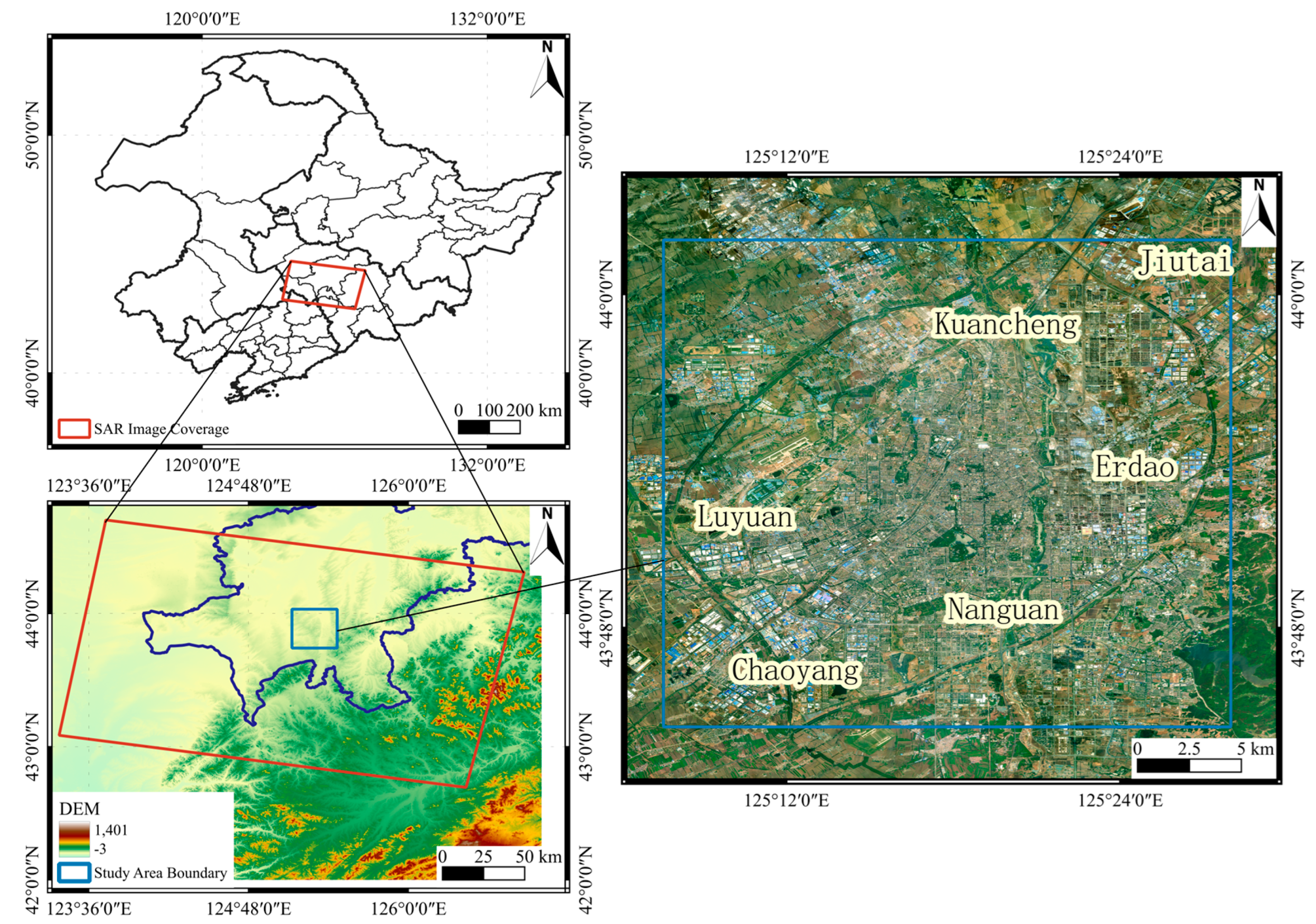
Changchun City, the capital of Jilin Province, is located in central Northeast China. It borders Jilin City to the east, Songyuan City to the west, Siping City to the south, and Harbin City of Heilongjiang Province to the north. According to 2023 figures, the city has a permanent population of 9.097 million people and a total area of 24,593.5 km2 [17]. The primary urban region of Changchun, which is roughly located between 43°44′N and 44°01′N and 125°07′E and 125°27′E, is the subject of this study. In particular, it encompasses portions of the districts of Nanguan, Kuancheng, Chaoyang, Erdao, Luyuan, and Jiutai (Figure 1).
The geomorphology of Changchun City is predominantly characterized by platform plains, alluvial plains, low mountains and hills, and volcanic cones, with plains accounting for approximately 50% of the total area, while the distribution of mountains and hills is relatively limited. The exposed strata are primarily Quaternary. In terms of major geomorphological units, Changchun City is situated within the transitional contact zone between the Songliao Plain and the Dahei Mountain low hill region [17].
Changchun City has a mid-temperate continental semi-humid monsoon climate. The multi-year average temperature is 6.1 °C, with January being the coldest month (extreme minimum temperature reaching −39.9 °C) and July the warmest (extreme maximum temperature of 39.8 °C). The multi-year average precipitation is 566.9 mm, with an average of 91.7 rainy days per year. Over 80% of the annual precipitation occurs from May to September. The maximum freezing depth of seasonal frozen soil reaches 1.70 m [18].
The urban core of Changchun City is dominated by high-density built-up land for residential, commercial, and transportation purposes. In contrast, the urban periphery, especially the subsidence hotspot areas identified in this study, features extensive cultivated land, constituting the primary agricultural landscape. Additionally, scattered ecological land uses such as woodland, grassland, and water bodies are mosaicked between the built-up areas and cultivated land [19]. This land use structure exhibits a high degree of correlation with the spatial pattern of surface subsidence monitored in this study, providing crucial spatial context for the subsequent analysis of the relationship between subsidence and land use types [20,21,22].

2.2. Data

The Sentinel-1A data were obtained from the C-band Synthetic Aperture Radar (SAR) satellite mission of the European Copernicus Programme [23] (https://search.asf.alaska.edu, accessed on 30 July 2025). Its imaging modes include Interferometric Wide Swath (IW), Strip Map (SM), and Extra Wide Swath (EW). Owing to its advantages of short revisit period, wide-area coverage, and free accessibility, Sentinel-1A data have been widely used in applications such as urban subsidence and seismic deformation monitoring. This study selected a total of 90 Sentinel-1A images, with an acquisition time span from 27 January 2022, to 30 December 2024. The spatial coverage of the imagery is shown in Figure 1. The selected Sentinel-1A images are Interferometric Wide Swath (IW) mode, descending orbit, single-look complex (SLC) products with VV polarization. The center incidence angle of the images is approximately 39.16°, and the spatial resolution is about 5 m (range) × 20 m (azimuth).
This study utilized the 30 m resolution AW3D30 (Advanced Wide Field-of-View 3D) Digital Elevation Model (DEM) (https://www.eorc.jaxa.jp/ALOS/en/aw3d30/data/index.htm, accessed on 30 July 2025) for precise co-registration of SAR images and correction of topographic phase contributions in the interferograms. Precise Orbit Determination (POD) ephemeris data (https://browser.dataspace.copernicus.eu/, accessed on 30 July 2025) were employed to mitigate baseline errors caused by orbital inaccuracies. The specific parameters of the multi-source data used in this study are presented in Table 1.
This study used daily temperature data from the National Centers for Environmental Information (NCEI) of the National Oceanic and Atmospheric Administration (NOAA) and daily precipitation data from the China Meteorological Administration (CMA) to clarify the climatic driving mechanisms of temperature and precipitation on surface subsidence. Time-series comparison and correlation analysis were used to integrate these data with the subsidence monitoring findings. Concurrently, this study used officially released land use classification data from the Changchun Planning and Natural Resources Bureau to examine the possible effects of human activity on subsidence. This was used to identify the relationship between the spatial pattern of surface subsidence and various land use categories, such as agricultural production and urban/rural building [24,25].
To validate the reliability and local accuracy of the E-PS-InSAR monitoring results [7,21], this study incorporates synchronous observation data from a continuously operating GNSS reference station located in the main urban area of Changchun City. The station is situated at 43.790°N, 125.443°E, with a ground elevation of 271.958 m. Its location lies within the urban–suburban transitional zone, adjacent to farmland and major transportation corridors, effectively capturing the characteristics of surface deformation in peri-urban areas. This study acquired the vertical displacement time-series data from this station for the period 2022–2024, which will be compared with the E-PS-InSAR results to assess the monitoring accuracy and reliability of the method at the local scale [26,27].

2.3. Methods

The Enhanced Permanent Scatterer Interferometric Synthetic Aperture Radar (E-PS-InSAR) method was used in this investigation. For time-series analysis, this technique combines Distributed Scatterers (DS) with Permanent Scatterers (PS) [28]. Using adaptive filtering techniques, this method successfully extracts deformation information from dispersed scatterer targets like vegetation and bare soil while preserving the high-precision deformation monitoring capability for persistent scatterer targets like buildings and bedrock. As a result, it makes it possible to obtain surface deformation velocities and cumulative deformation with millimeter-level precision. This study’s primary data processing procedure is based on Sentinel-1 SAR imagery:
(1)
Preprocessing of data. In order to gather data for Changchun’s main urban area, this study used 90 Sentinel-1A SAR photos that were taken between 2022 and 2024. The interferometric phase was subjected to systematic correction in order to improve the accuracy and dependability of deformation monitoring. Among the primary methods were: First, an elevation reference based on an ellipsoidal model was established in order to minimize the phase contribution from topographic relief. Next, a Digital Elevation Model (DEM) was created to erase the topographic phase. Second, 90 epochs of GACOS data, temporally aligned with the SAR image acquisition times, were introduced to facilitate the subsequent correction of atmospheric delay effects. Simultaneously, Precise Orbit Determination (POD) ephemeris data were employed to mitigate orbital errors. This preprocessing effectively reduced phase noise, providing a high-quality interferometric data foundation for the subsequent time-series analysis.
(2)
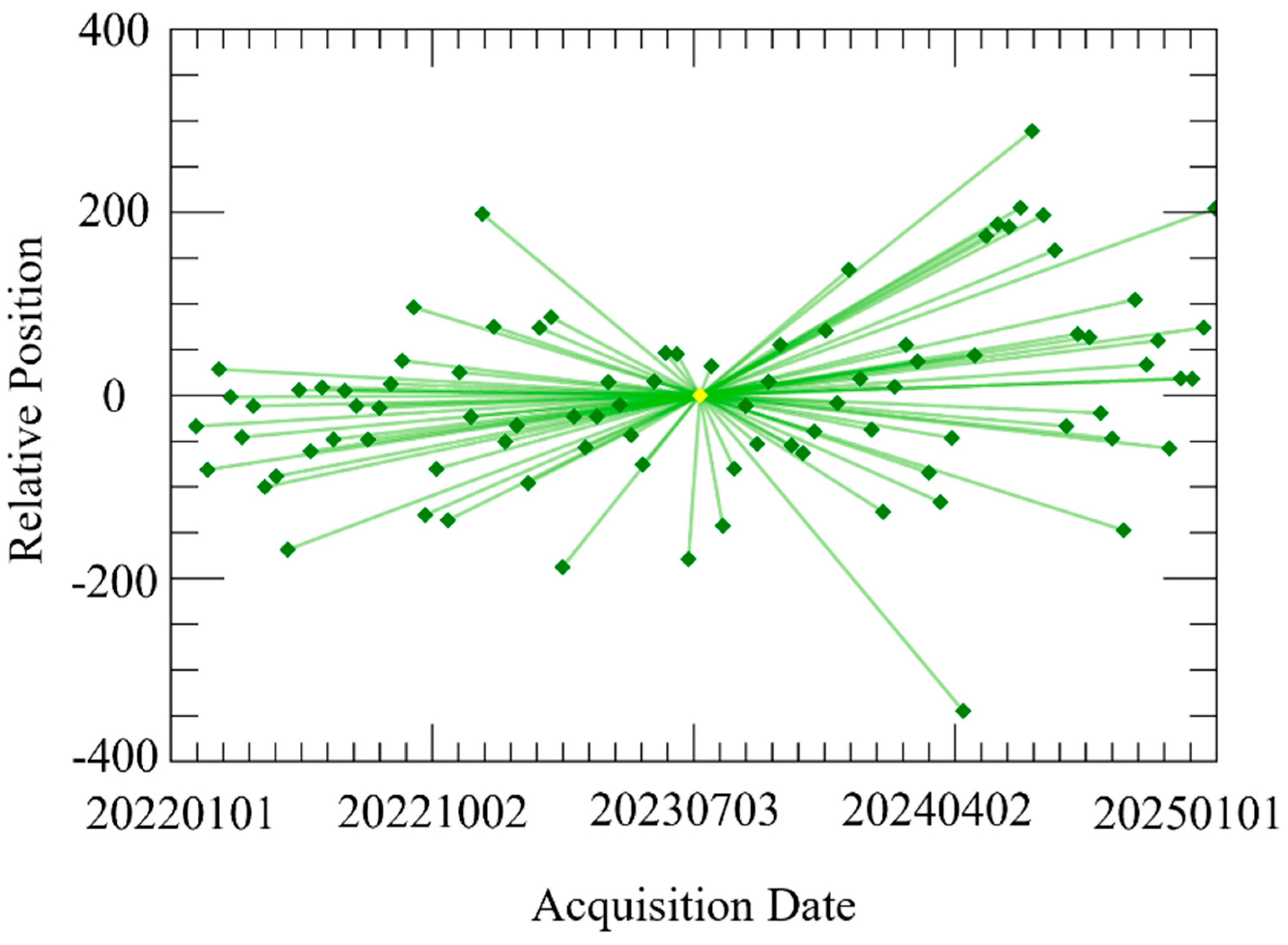
Generation of Interferometric Networks. The image obtained on 9 July 2023 was chosen as the master image for this investigation based on the spatiotemporal baseline optimisation principle. It was then matched with the remaining 89 auxiliary images, and 89 effective interference pairs were produced based on the connection requirement that no interference pair’s vertical spatial baseline should be greater than 10% of the crucial baseline [29,30]. Figure 2 displays the dispersion of its spatiotemporal baseline. The vertical spatial baseline range is −344.9 m to +289.0 m, while the time baseline range is roughly 12 days to 527 days [31]. Every interference pair’s baseline parameters are managed within the threshold.
(3)
Reference Point Selection. The study area was divided into sub-blocks, each measuring 25 km2. Within each sub-block, candidate points exhibiting low amplitude dispersion index (<0.25), high temporal coherence (>0.7), and near-zero deformation rates were selected as stable reference points [32].
(4)
Interferometric Differential Processing. First, the obtained image stack was subjected to co-registration, radiometric calibration, Permanent Scatterer (PS point) detection, and preliminary interferometric processing in accordance with the basic principles of Permanent Scatterer Interferometric Synthetic Aperture Radar (PS-InSAR). Differential interferometric processing was then carried out. The topographic phase contribution was eliminated using an external AW3D30 Digital Elevation Model (DEM). The interferometric coherence was computed. To balance spatial resolution and phase noise reduction, multi-looking was applied with a factor of 1 in azimuth and 2 in range. Phase unwrapping was applied to the flattened and filtered interferograms [33], ultimately yielding the differential interferograms. The interferometric phase for each pixel in an interferogram is composed of several physical components [6], as detailed below:
φ = φ 0 + φ t o p o + φ d e f o + φ a t m + φ n o i s e
where φ is the total interferometric phase, φ 0 is the phase on the reference ellipsoid, φ t o p o is the topographic phase, φ d e f o is the deformation phase, φ a t m is the phase induced by changes in atmospheric conditions between the two radar acquisitions, and φ n o i s e is the random noise phase.
(5)
Identification of Permanent Scatterers (PS). Over time, Permanent Scatterers show consistent backscattering properties. Over time, their echo amplitudes have particular statistical characteristics. The amplitude dispersion index is frequently employed for the initial screening of PS candidates by measuring the degree of amplitude fluctuation of a target as a reflection of phase stability [34]. A genuine PS point is commonly regarded as having a low amplitude dispersion index, that is, below a predetermined threshold [35,36,37], maintaining stable scattering properties during the observation period, and being consistently and reliably detected by the SAR system [26]. In this study, PS candidates were screened using an amplitude dispersion threshold of 0.25, combined with a coherence threshold of 0.7 and an amplitude stability (Mu/Sigma) threshold of 3.2. This multi-threshold approach enhanced the reliability and spatial representativeness of the selected PS points. The formula for calculating the amplitude dispersion index D is:
D = σ a μ a
where σ a is the standard deviation of the point’s amplitude over the time series, and μ a is the mean amplitude over the time series, and D is inversely proportional to the mean amplitude.
Based on the amplitude dispersion index and coherence coefficient, a total of 1,210,359 PS points were screened in this experiment, accounting for approximately 14.7% of the total pixels in the study area. These PS points are primarily distributed over high-coherence targets such as buildings and exposed bedrock, or in areas with low vegetation cover.
(6)
Identification of Distributed Scatterers (DS). Distributed Scatterers (DS) outperform conventional Permanent Scatterers (PS) in low-coherence zones, successfully correcting for PS points’ detection blind spots in these locations. This study used an adaptive filtering technique [38] within the E-PS-InSAR architecture to extract DS from the interferometric phase. The main procedures included statistical detection of homogeneous pixel sets and covariance matrix estimation. Firstly, based on the co-registered and radiometrically calibrated SAR image stack, pixel sets with similar statistical properties were identified using the Kolmogorov–Smirnov (KS) shape map method with a spatial window size of 100 m in azimuth and 100 m in range. Subsequently, areas meeting the DS detection threshold of 20 were selected, and the interferometric phase components corresponding to the DS were decomposed using an adaptive filtering method based on Principal Component Analysis (PCA). This method extracts the dominant stable signal by performing PCA combined with eigenvalue decomposition on the interferometric phase covariance matrix [15]. Its mathematical expression is:
C = n = 1 N λ n x n x n H n
where C is the covariance matrix of the interferometric phase,   λ n is the n -th eigenvalue,   x n is the corresponding eigenvector, and x n H denotes its conjugate transpose. The most stable scattering signal is represented by the component with the biggest eigenvalue, which can be used as the amplitude and phase data vector for DS detection. By automatically extracting the most stable and coherent scattering component from mixed signals, this technique greatly improves the signal-to-noise ratio and temporal coherence of the data, giving future deformation inversion a more dependable phase observation basis. Effective augmentation and extraction of stable signals in low-coherence regions are made possible by this method, which is physically consistent with the collective response mechanism of dispersed scatterers and demonstrates significant statistical robustness without depending on rigid distributional assumptions.
This study found 4,963,585 DS points, or roughly 18.2% of all the pixels in the studied area. The number of effective monitoring points increased by approximately 410% when PS and DS points were integrated, as opposed to when PS points were used alone. This improvement is mainly due to the contribution of DS points; in low-coherence environments like farms, grassland, bare soil, scree slopes, and homogeneous artificial surfaces, it successfully makes up for the detection blind spots of traditional PS points. The experimental results show that a sufficient number of monitoring points with dependable phase quality were successfully extracted using the DS method in these areas where it was previously challenging to acquire high-quality PS signals, significantly improving the capability of InSAR technology for monitoring large-area surface deformation.
(7)
Phase Unwrapping. It is crucial to unwrap the wrapped interferometric phase to restore its continuous absolute phase values in order to obtain accurate surface deformation information. For phase unwrapping, this study used the Minimum Cost Flow (MCF) technique, which is based on a Delaunay triangulation network. This technique converts the phase unwrapping problem into a graph theory network flow optimization model. The minimum cost flow algorithm determines the globally optimal solution by building a triangulation network to link neighbouring pixels and employing phase gradient stability as a constraint. This guarantees the spatial continuity and consistency of the unwrapping results while successfully suppressing phase jumps brought on by noise [39].
(8)
Atmospheric Phase Removal. Within the time series, strong unpredictability and high temporal variability, along with good spatial correlation and smooth fluctuation, are characteristics of the atmospheric phase in SAR analysis. This work used a spatiotemporal joint filtering technique to eliminate this interference in order to successfully suppress it. Initially, the nonlinear deformation and high-frequency turbulent atmospheric signals were separated using a temporal high-pass filter. The topography-correlated steady-state atmospheric stratification effect was then extracted using a spatial low-pass filter [40]. By combining PS point measurements from every SAR picture, a spatiotemporal model of the atmospheric phase field was created based on the atmospheric phase components separated by the aforementioned procedure. The Kriging spatial interpolation approach was then used to obtain an accurate subtraction of the atmospheric phase throughout the entire region and pixel-level quantitative reconstruction [41].
By separating and removing the atmospheric delay phase ( φ a t m ) and the noise phase ( φ n o i s e ), this study extracted the deformation phase series reflecting the true surface movement. Based on this series, the linear displacement velocity field of the surface was inverted, and the cumulative deformation was reconstructed for each time period, ultimately obtaining a high spatiotemporal resolution deformation time series for the entire monitoring period.

3. Results

This study carried out an investigation from three dimensions in order to systematically uncover the patterns of surface subsidence in Changchun City’s main metropolitan area: seasonal fluctuations, spatiotemporal evolution features, and the association with land use types.

3.1. Surface Deformation Monitoring Results

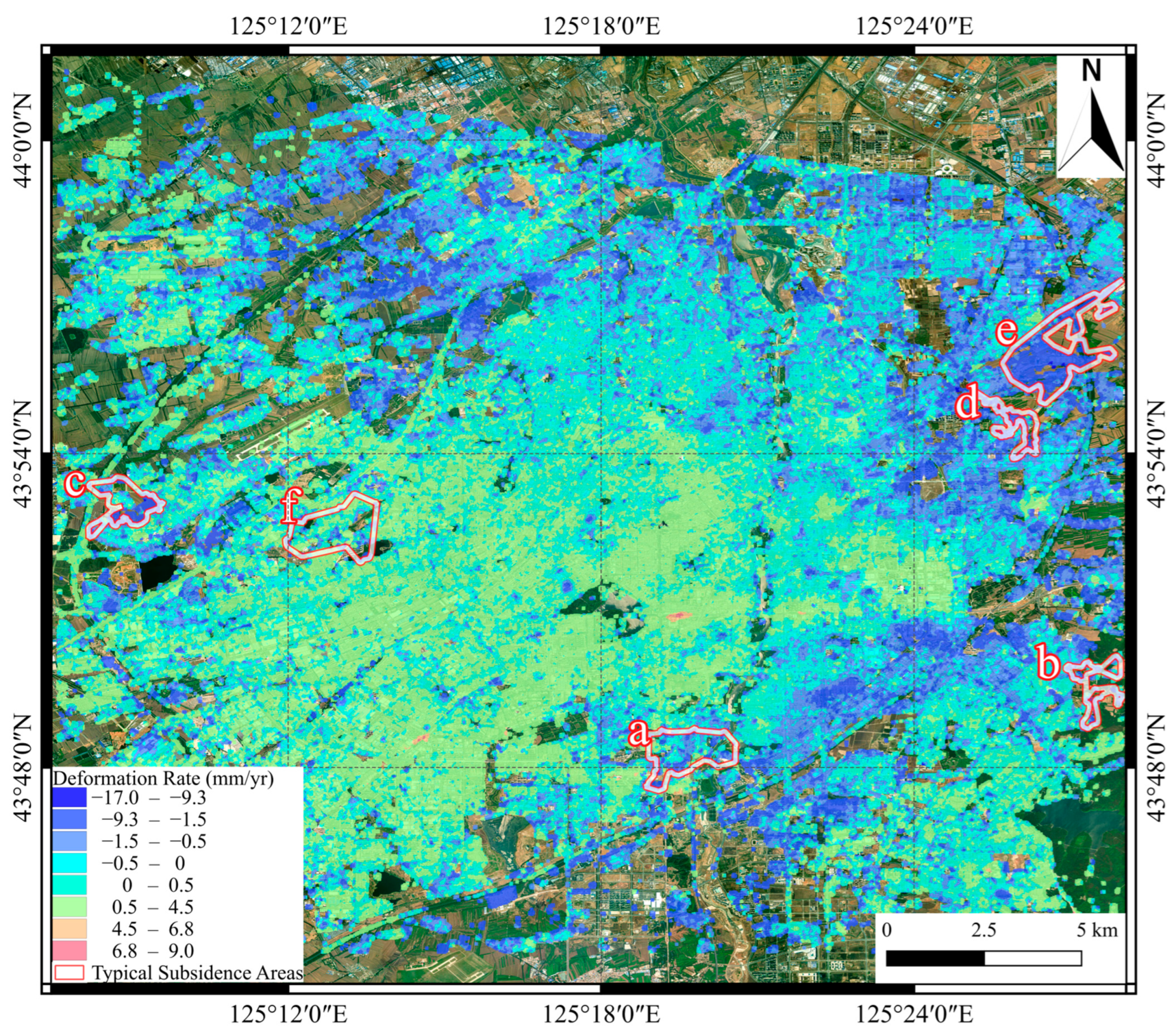
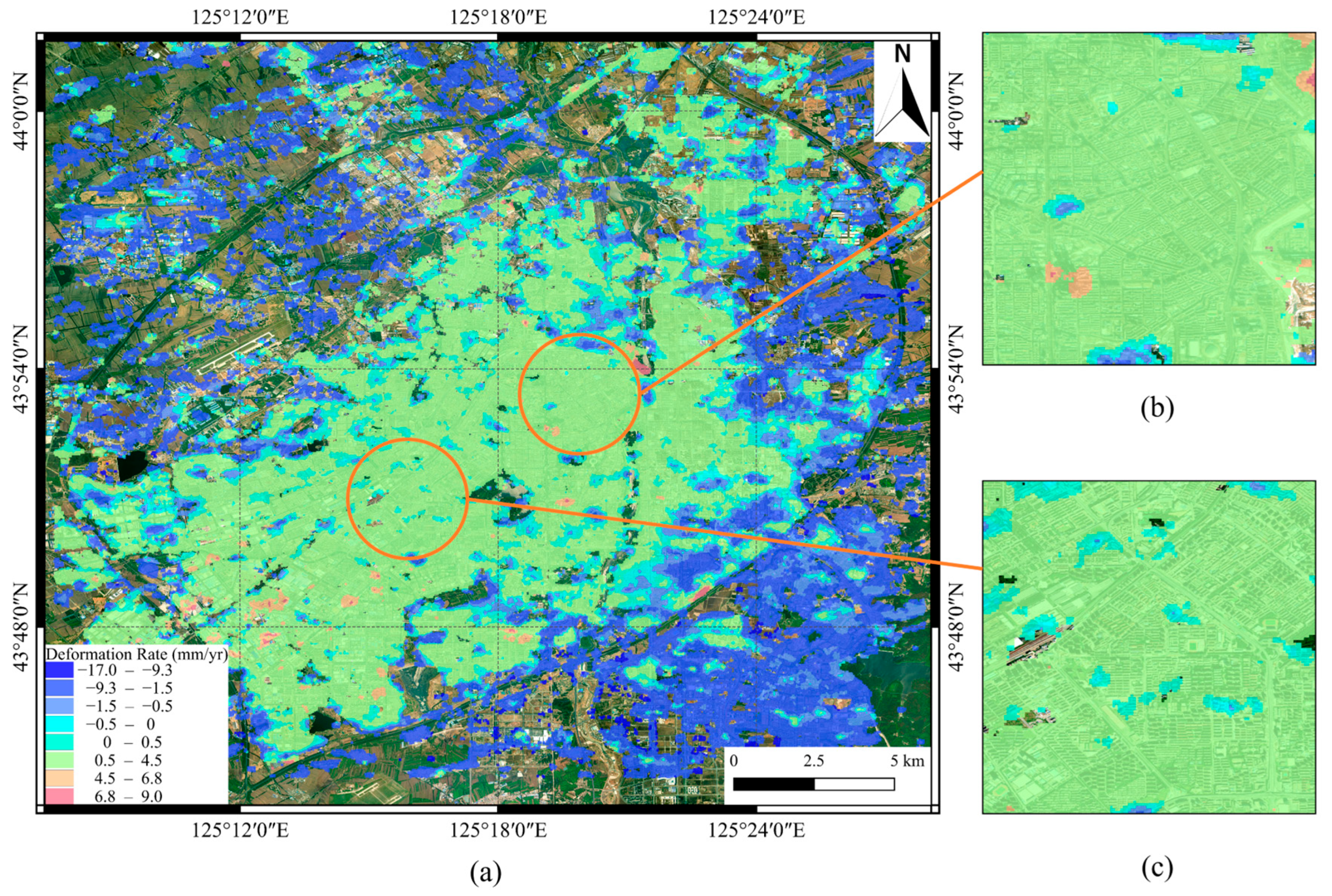
The aforementioned inverted results were converted from the radar coordinate system to the geographic coordinate system for easier analysis and visualisation. This produced the general spatial distribution and evolutionary features of land subsidence in the research region (Figure 3).
Based on the E-PS-InSAR method, high-precision monitoring of surface deformation patterns from January 2022 to December 2024 showed that the study area’s deformation velocity during this time ranged from [−17.0, 9.0] mm/yr, with an average subsidence rate of −0.14 mm/yr (standard deviation: 1.2 mm/yr). With an average cumulative subsidence of −0.08 mm (standard deviation: 4.2 mm), the cumulative deformation varied between [−41.0, 24.0] mm. These findings show that while there is considerable differential subsidence locally, the overall subsidence trend in Changchun’s main metropolitan region is low.

3.2. Accuracy Assessment of Surface Deformation

To evaluate the reliability and comprehensive performance of the E-PS-InSAR method for monitoring surface deformation in the main urban area of Changchun, this study first conducted an independent verification of its monitoring accuracy based on GNSS field measurement data, and then clarified its reliability and technical advantages through systematic comparison with traditional InSAR methods.
For accuracy validation, the study introduced the vertical displacement time series (2022–2024) from a continuously operating GNSS reference station (43.790°N, 125.443°E) located in a suburban transition zone. This GNSS series was compared with the mean deformation series derived from the E-PS-InSAR monitoring points. The results indicate that the average absolute difference between the two datasets is 11.4160976 mm, with a maximum difference of 27.97 mm. Notably, 64% of the sample differences are less than 10 mm. These findings confirm that the E-PS-InSAR method possesses strong monitoring capability.
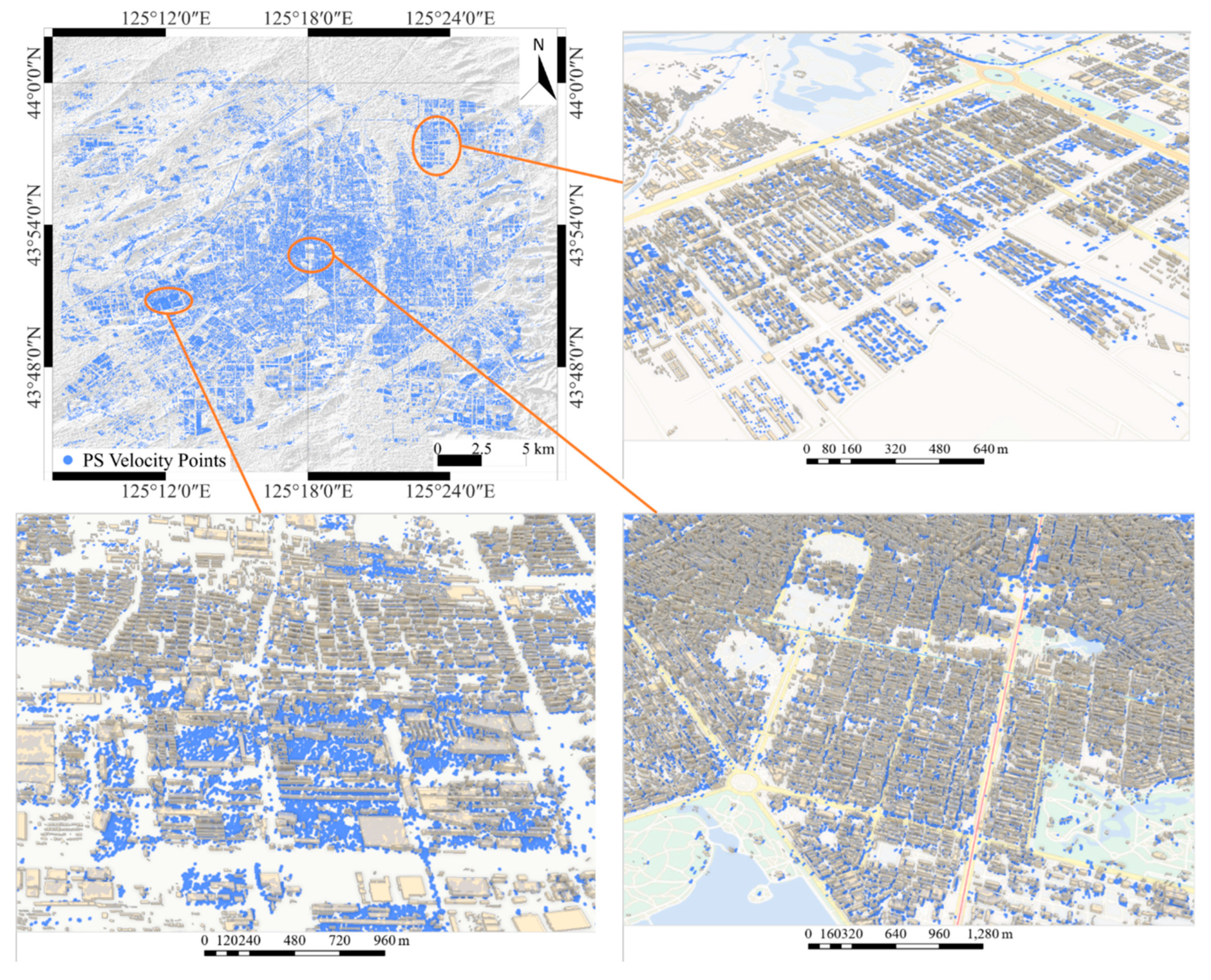
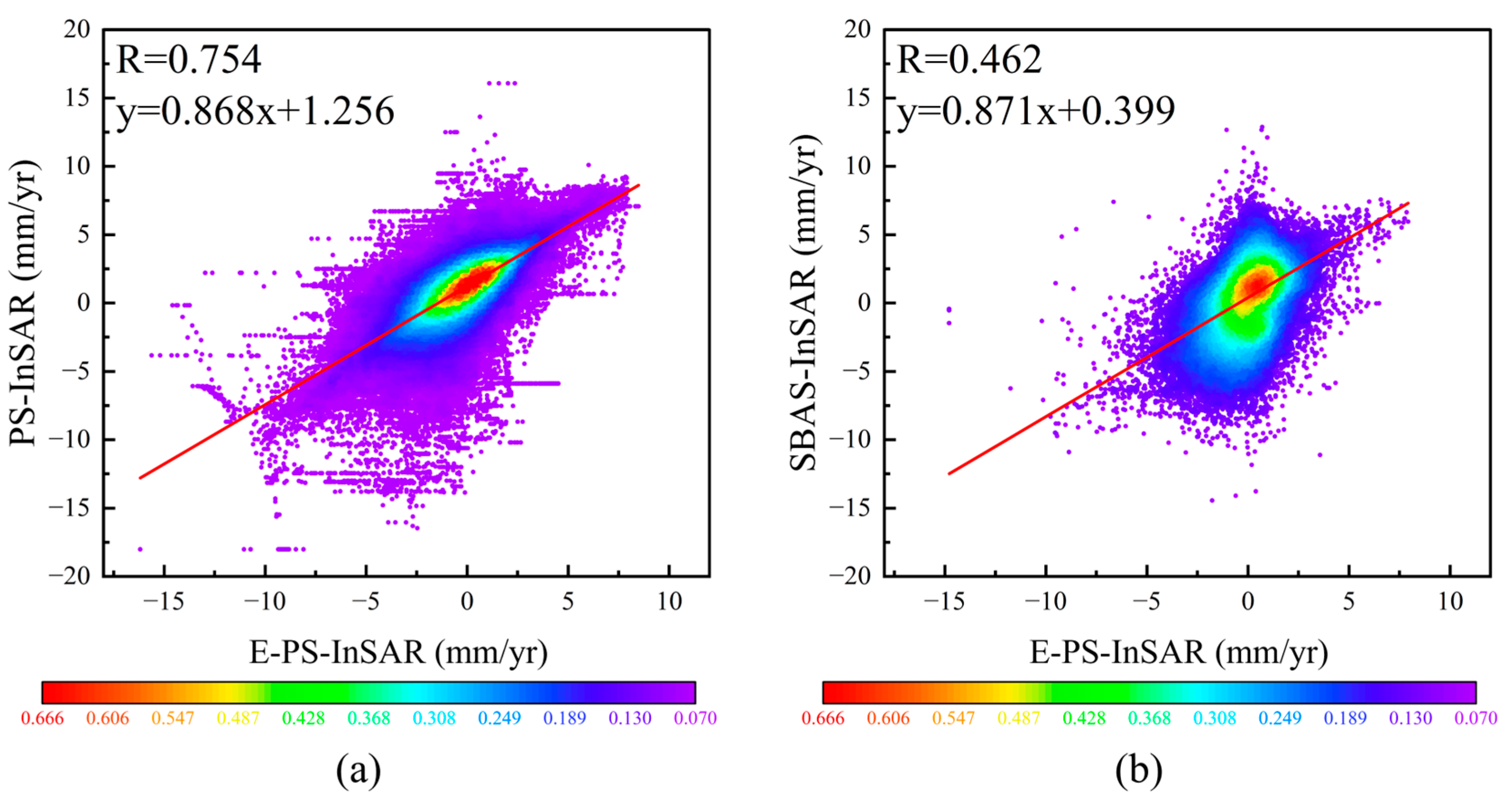
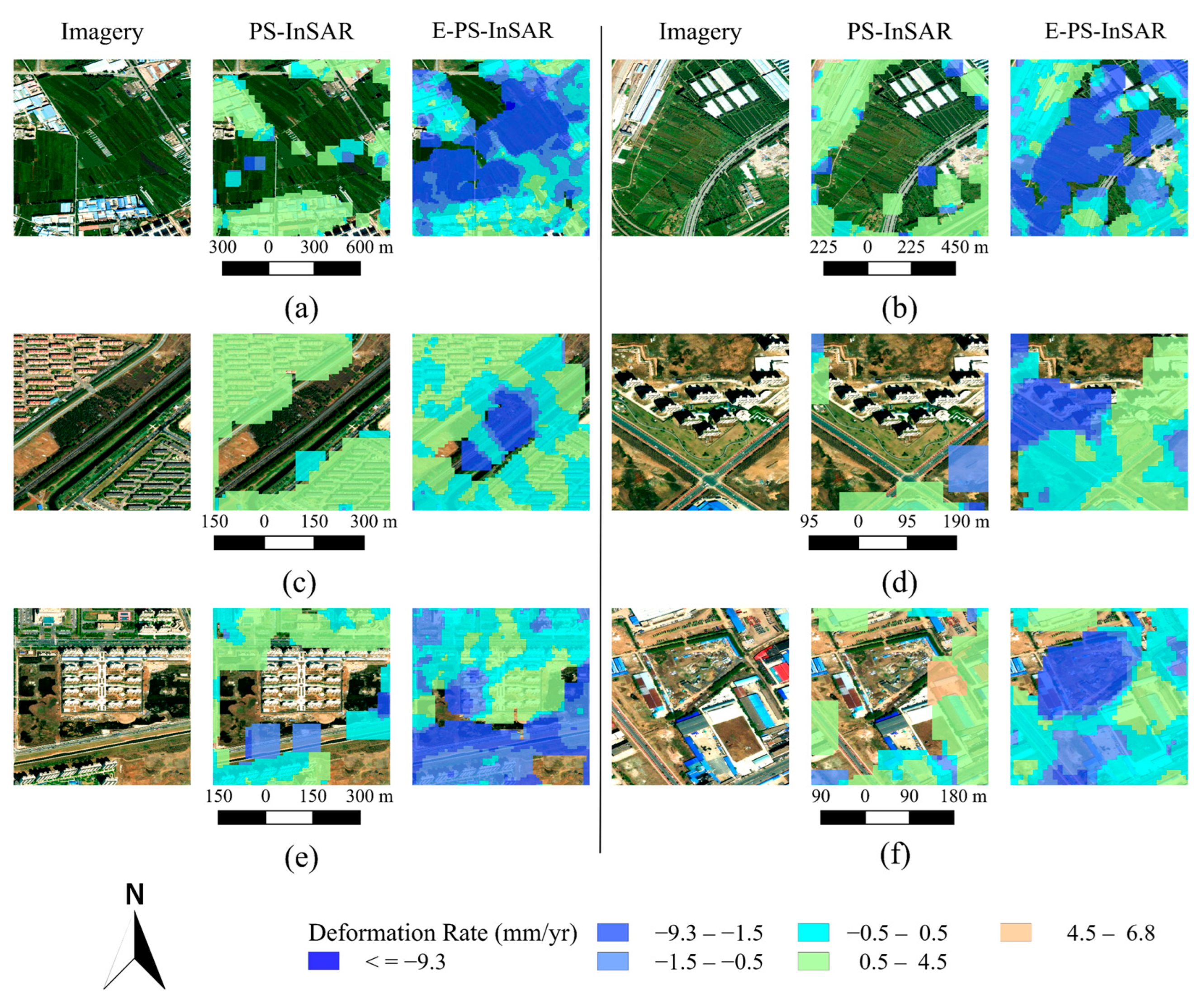
The monitoring outcomes of PS-InSAR and SBAS-InSAR were compared and examined with those of E-PS-InSAR. Figure 4 illustrates how PS-InSAR can obtain high-density, high-precision deformation data for point objects in heavily populated locations. The study’s E-PS-InSAR results and the matching PS-InSAR results had a correlation coefficient of 0.754 (Figure 5a). Because permanent scatterers dominate the surface scattering mechanism in stable urban built-up areas, and because the E-PS-InSAR approach inherits and optimises the processing framework for permanent scatterers from traditional PS-InSAR, there is a high link. Therefore, E-PS-InSAR may obtain high-precision deformation results that are very similar to those of classic PS-InSAR in areas with enough PS sites, confirming the method’s reliability for monitoring urban deformation. However, in areas such as farmland (Figure 6a,b), urban green belts (Figure 6c), newly developed construction zones (Figure 6d,e), and sparsely built areas (Figure 6f), a scarcity of permanent scatterers often leads to sparse monitoring points or even data gaps.
In contrast, although SBAS-InSAR technology can effectively capture large-scale, continuous surface deformation trends (Figure 7a), its phase unwrapping algorithms often fail in urban environments. The high-gradient characteristics of deformation between buildings and the ground surface, coupled with prevalent low coherence, violate the fundamental spatial continuity assumption required for reliable phase unwrapping, leading to unwrapping errors [27,42]. These errors propagate during the time-series inversion process, ultimately resulting in a deformation field that loses localized details and retains only broad, continuous trends [43]. As a result, the technique smoothes out tiny deformation differences between buildings and the surrounding ground surface in densely populated locations due to phase unwrapping issues (Figure 7 b,c). With a correlation coefficient of just 0.462, this leads to a comparatively poorer correlation with the E-PS-InSAR data (Figure 5b). With an overall monitoring point density of 6971.35 points/km2, E-PS-InSAR outperformed both PS-InSAR and SBAS-InSAR. By integrating the wide-area coverage capabilities of SBAS-InSAR with the precision advantage of PS-InSAR in urban settings, E-PS-InSAR exhibits excellent complete performance.

4. Discussion

4.1. Influence of Land Use Types on Surface Subsidence

To investigate the spatial clustering patterns of land subsidence [44,45], this study conducted a spatial hotspot analysis based on the deformation velocity raster data using the Getis-Ord Gi* statistic. The spatial neighbourhood is defined in this research using a set distance band of 20 m. The high-resolution features and spatial autocorrelation of InSAR data are taken into consideration while choosing this distance, which conceptualises the spatial link using a fixed distance weight matrix based on Euclidean distance. The statistical significance of the Gi* z-score was evaluated at a 99% confidence level. Areas identified as cold spots under these parameters were defined as subsidence zones (Figure 3). This analysis aims to perform an objective clustering examination of the deformation velocity field, thereby systematically revealing the spatial distribution characteristics of land subsidence.
As a visual representation of the critical impact of human activity on the spatial pattern of subsidence, the subsidence hot spots that were correctly identified through significance testing are mainly concentrated in newly developed built-up areas, along major transportation corridors, and on cultivated land on the urban periphery. Among other high-value clusters are the Huaqing Road Metro Station in Nanguan District (Figure 3(a)), Fujiatun Farmland in Nanguan District (Figure 3(b)), the Farmland at the intersection of Jingbei Road and Haoyue Avenue in Luyuan District (Figure 3(c)), Changqing Village in Erdao District (Figure 3(d)), the Changchun-Hunchun Intercity Railway Line in Erdao District (Figure 3(e)), and the Nanyang Road area in Luyuan District (Figure 3(f)), among other high-value clusters. The specific conditions of the subsidence areas are shown in Table 2. Statistical results indicate that the overall surface deformation trend during the study period was one of subsidence, with both the mean deformation rate and the mean deformation amount being less than zero. The subsidence hotspots generally show a ring-shaped spatial structure, with the periphery experiencing greater subsidence than the centre. From the standpoint of spatial statistics, this pattern suggests that surface subsidence is more noticeable in vegetated regions and urban expansion zones.
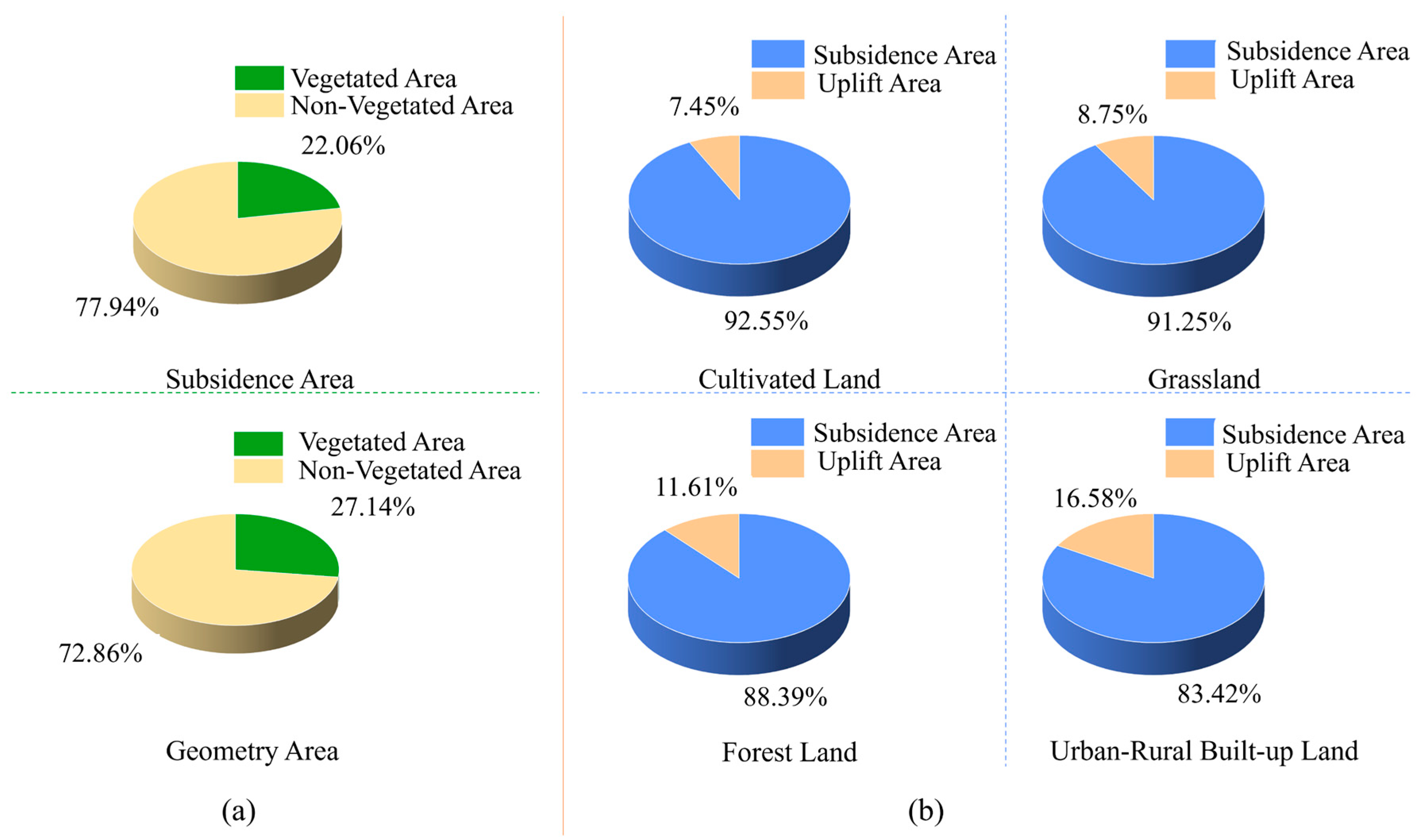
The crucial significance of vegetated regions, especially cultivated land, in the land subsidence process is revealed by the integrated study of subsidence monitoring and land use types in Changchun City’s main metropolitan area. Although they make up only 22.06% of the study area, vegetated zones comprise 27.14% of the sinking area (Figure 8). In these vegetated zones, the ratio of uplift area to subsidence area can reach 11.82, which is significantly higher than the ratio of 5.07 in non-vegetated areas. 80.61% of land sinking occurs on cultivated land, followed by grassland (5.04%) and forestland (0.95%), according to additional statistical analysis of land subsidence categorised by vegetation cover types. Spatially, cultivated land is mainly concentrated in the suburban fringe areas around the main urban zones, which is consistent with the spatial distribution pattern of subsidence. This spatial distribution pattern is consistent with observations from agricultural regions such as the North China Plain [46,47], where studies have indicated that severe subsidence areas are predominantly located in agriculturally intensive zones, and a significant correlation exists between agricultural irrigation and groundwater over-extraction. In this study, cultivated land exhibited the highest contribution rate to subsidence, which is spatially consistent with the pattern of agricultural irrigation and potential groundwater extraction reported in other regions (e.g., North China Plain). This suggests that agricultural activities may be associated with surface deformation, possibly through groundwater-related processes, though direct hydrological evidence is not available in this study.
From a mechanistic perspective, the significant subsidence of cultivated land may be associated with the soil layer compaction mechanism induced by groundwater over-extraction due to agricultural irrigation. Existing studies have indicated that intensive groundwater pumping during irrigation periods will lead to a decline in aquifer water pressure, which in turn increases effective stress and triggers soil layer consolidation settlement [47,48,49]. In regions with inadequate hydraulic connection and well-developed fine-grained soil layers, this process is more noticeable. Additionally, seasonal buildup and hysteresis are frequently seen in the subsidence response, which is strongly associated with irrigation cycles and variations in groundwater levels. The response of land surface subsidence to changes in groundwater might be delayed by one to two months in areas where deep aquifers are overexploited [46].
There are two basic ways that prolonged vegetation root activity decreases the mechanical characteristics of soil. On the one hand, the groundwater hydrological system is severely disrupted by seasonally concentrated, intensive irrigation and pumping [50]. Changes in groundwater storage are the main factor influencing the spatial distribution of land subsidence, according to a quantitative study using the Geodetector [46]. Its explanatory power (q statistic) is significantly larger than that of other natural and man-made causes. Conversely, vegetation root systems are important biological elements that influence the mechanical and structural characteristics of soil [51]. The formation of solid biopore structures is facilitated by the deep root networks of perennial woodland and grassland, which improve soil integrity and water conductivity. On the other hand, annual crops grown on cultivated land have shallower roots. The upper soil layer in cultivated land is more vulnerable to prolonged compression under external stress, such as the rise in effective stress brought on by groundwater decrease, when combined with periodic tillage that breaks the continuity of soil structure. As a result, compared to grassland and woods, cultivated land shows a larger contribution rate to land subsidence.

4.2. Seasonal Characteristics of Land Subsidence

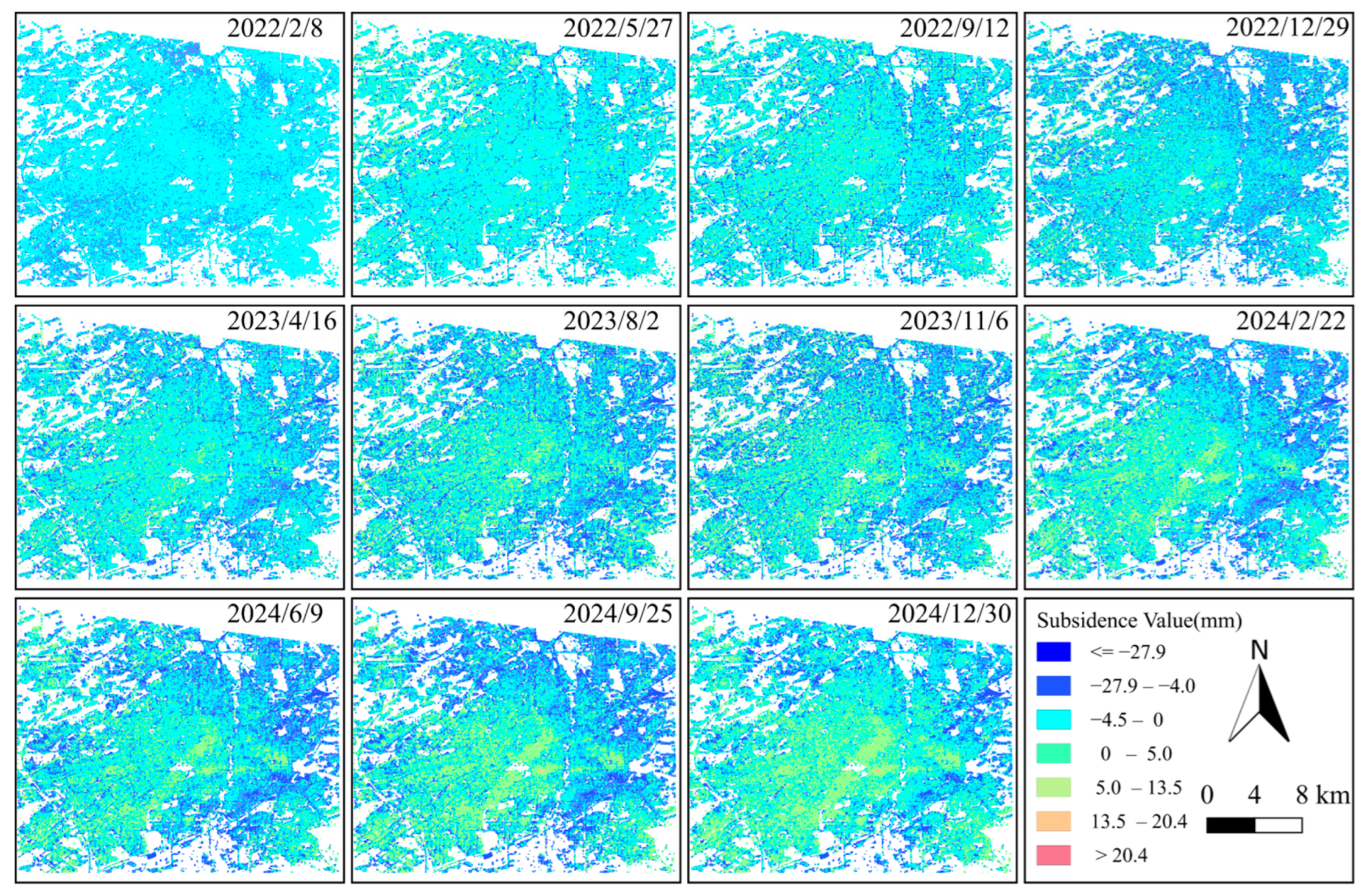
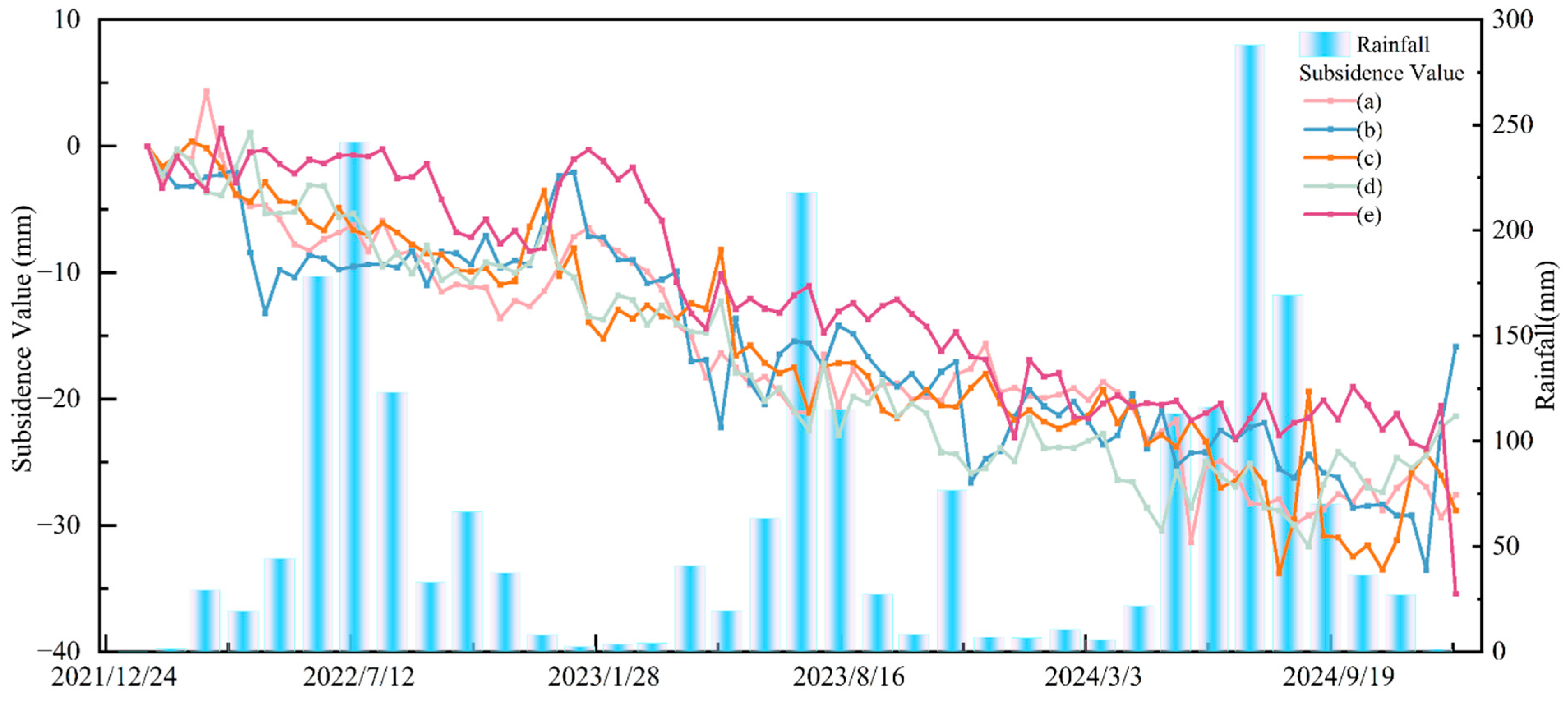
In the temporal dimension, the time-series deformation results shown in Figure 9 reveal the existence of several regions exhibiting distinct temporal deformation patterns within the main urban area of Changchun City. To delve deeper into the temporal variation patterns of surface deformation in the study area and their association with climatic factors, the subsidence hotspots extracted from the time-series cumulative deformation results (as shown in Figure 3) were analyzed for their correlation with climatic factors.
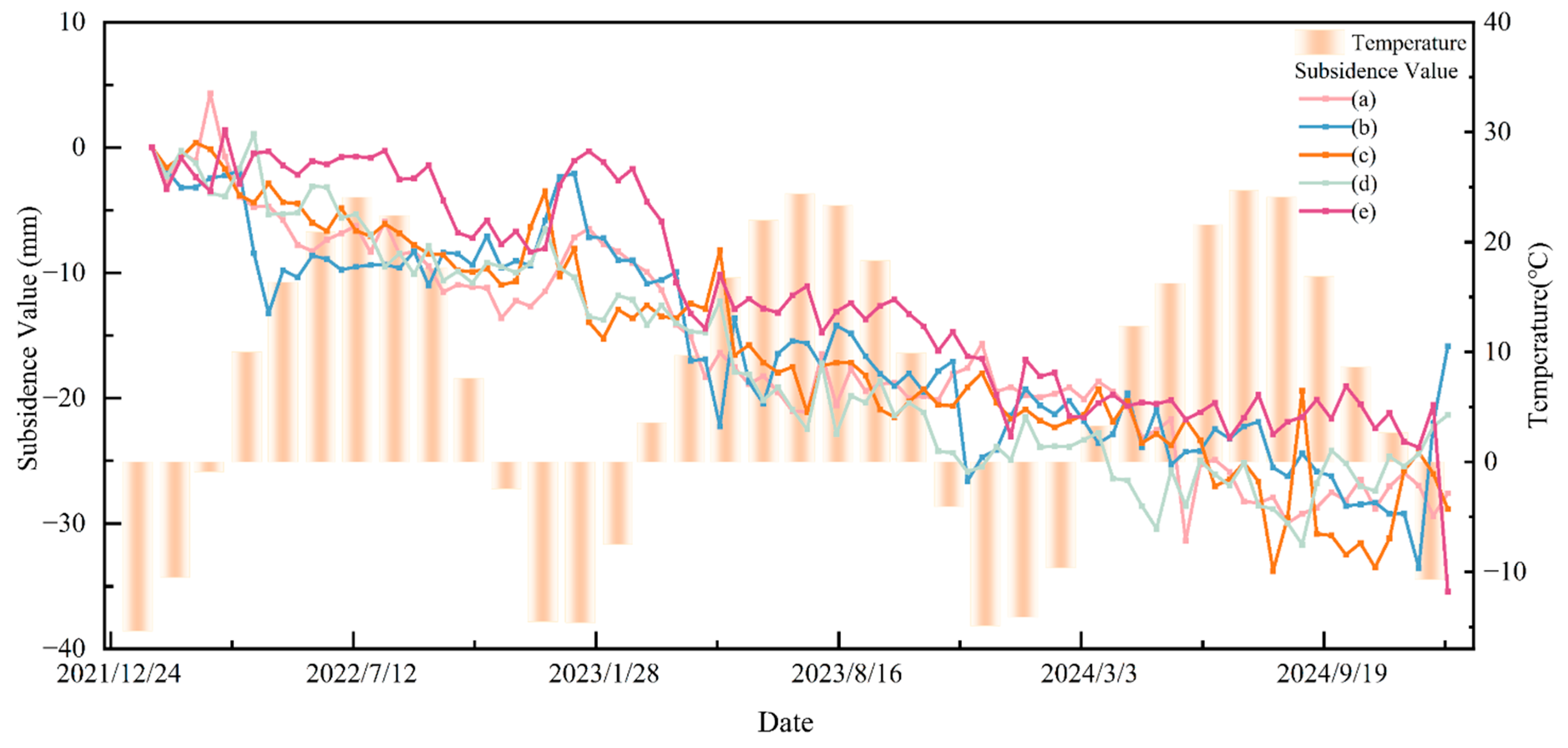
Figure 10 and Figure 11, respectively, illustrate the temporal variation relationship between land subsidence and climatic factors such as temperature and precipitation in the study area. The locations of the monitoring points are shown in Figure 3 and include: a (Huaqing Road Metro Station, Nanguan District, Changchun City), b (Fujiatun Farmland, Nanguan District, Changchun City), c (Farmland at the Intersection of Jingbei Road and Haoyue Avenue, Luyuan District, Changchun City), d (Changqing Village, Erdao District, Changchun City), and e (Xinglong Avenue, Erdao District, Changchun City). This confirms that significant surface subsidence has occurred at these corresponding locations.
Each monitoring point has the following surface subsidence characteristics. Between 16 March and 11 November 2022, the Huaqing Road Metro Station in Nanguan District (point a) underwent a cumulative subsidence of roughly 17.93 mm, and between 11 March and 13 October 2023, a cumulative subsidence of roughly 29.95 mm. Between 11 March and 30 November 2023, the Fujiatun Farmland in Nanguan District (point b) experienced a sinking of roughly 15.76 mm. From 17 March to 31 October 2024, the farmland at the intersection of Jingbei Road and Haoyue Avenue in Luyuan District (point c) displayed a cumulative subsidence of almost 14.25 mm. Furthermore, from 8 February to 16 March 2022, and from 11 November 2022 to 22 January 2023, the Huaqing Road Metro Station (point a) had a cumulative uplift of roughly 7.05 mm and 7.12 mm, respectively. From 5 December 2022 to 10 January 2023, the Fujiatun Farmland (point b) saw a cumulative uplift of approximately 7.35 mm; from 30 November 2023 to 17 January 2024, the uplift was approximately 7.37 mm; and from 6 December to 30 December 2024, it was approximately 17.69 mm. Between 11 November and 17 December 2022, the farmland at the intersection of Jingbei Road and Haoyue Avenue (point c) displayed a cumulative elevation of almost 7.47 mm. A thorough investigation shows that while short-term uplift mostly happens in winter, subsidence is mostly focused in summer and autumn. According to statistical findings, surface sinking caused by soil frost heave displays a lag phenomenon when temperatures drop below 0 °C. This pattern is quite similar to the normal seasonal freeze–thaw cycle of frozen soil. The land surface in the research area often shows a subsidence trend in summer and fall, followed by a recovery in winter, according to an analysis of contemporaneous imagery combined with the temporal variation features. The temporal subsidence features also show that surface sinking mostly happens between March and November of each year, which is consistent with the pattern of summer thaw settlement in frozen ground and winter frost heave. In this area, surface sinking is mostly caused by the freeze–thaw process. Moreover, short-term surface uplift can be caused by intense precipitation episodes.
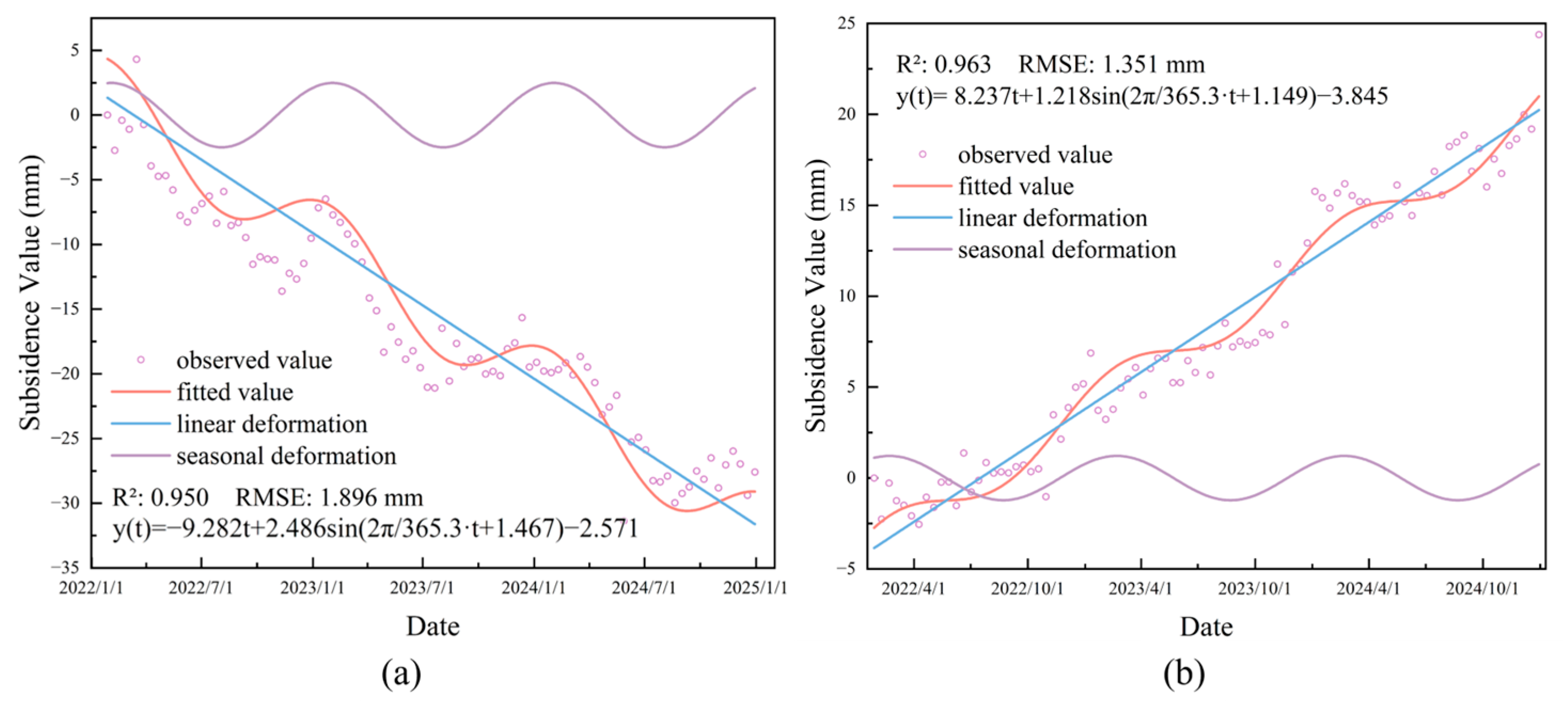
This study separated the surface subsidence process into a long-term trend and a seasonal subsidence process in order to methodically examine the delayed influence mechanism of climatic elements on land subsidence [52]. Regional engineering efforts and global climate change are the main factors influencing the long-term trend, while seasonal variation is more complicated and primarily determined by temperature and precipitation. It shows up as the cyclic subsidence typical of frost heave-thaw settlement, which is caused by changes in groundwater state with seasonal shifts [53]. Therefore, the subsidence process in permafrost regions can be described using a combination of a linear model and a periodic model:
y = a t + b s i n ( 2 π T t + φ 0 ) + c
where the sinusoidal term represents the periodic variation in frost heave–thaw settlement, T is the deformation period, φ 0 is the initial phase of the periodic deformation, a represents the long-term linear deformation rate, and c is the initial constant term. Based on this model, the seasonal deformation amplitude at point a was fitted by setting T to 365.3 days. Using R2 and RMSE as evaluation metrics [54], the results show R2 values of 0.950 and 0.963, and RMSE values of 1.896 and 1.351, indicating a good overall fit of the model (Figure 12), and both exhibit seasonal deformation characteristics.
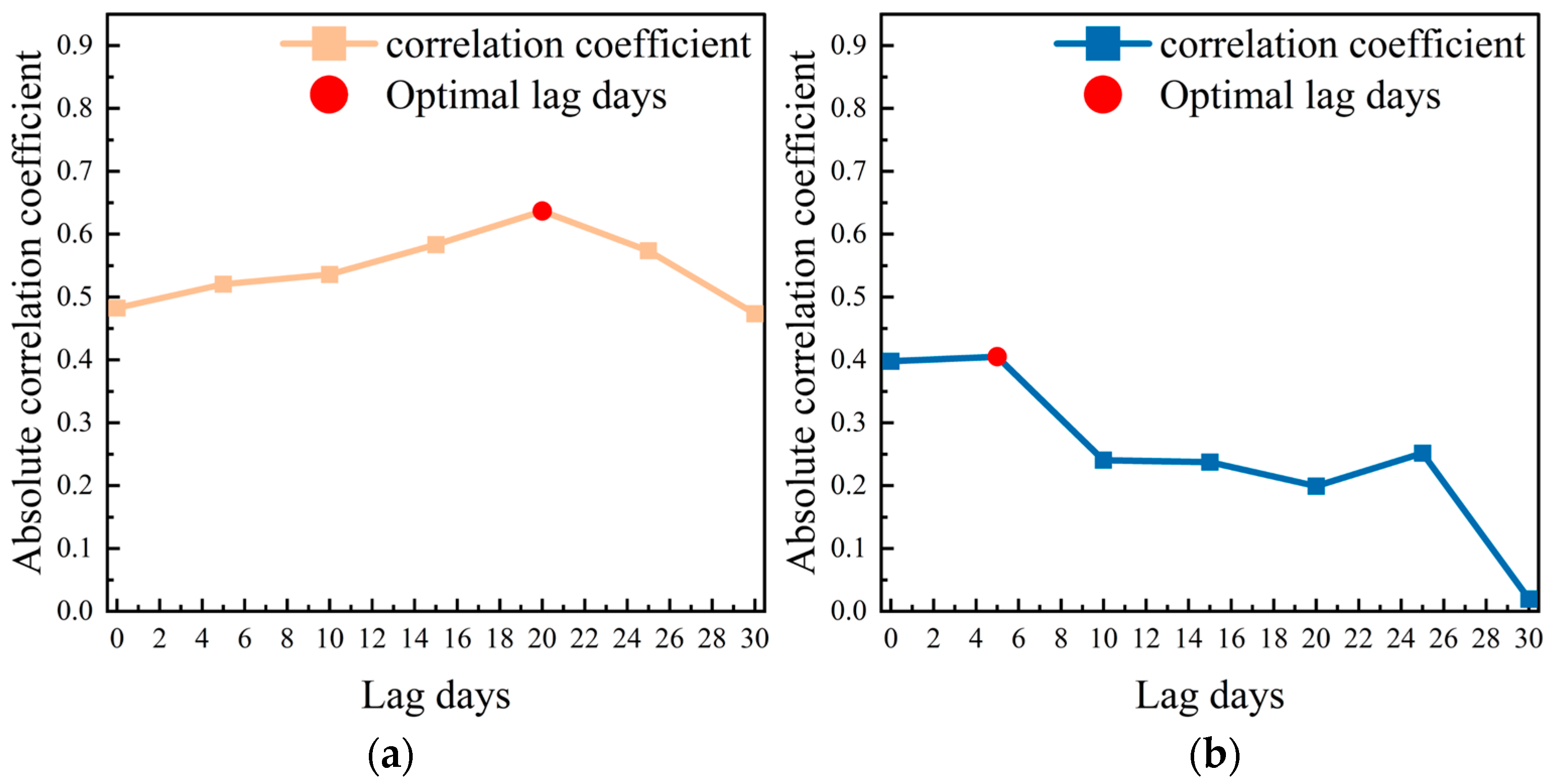
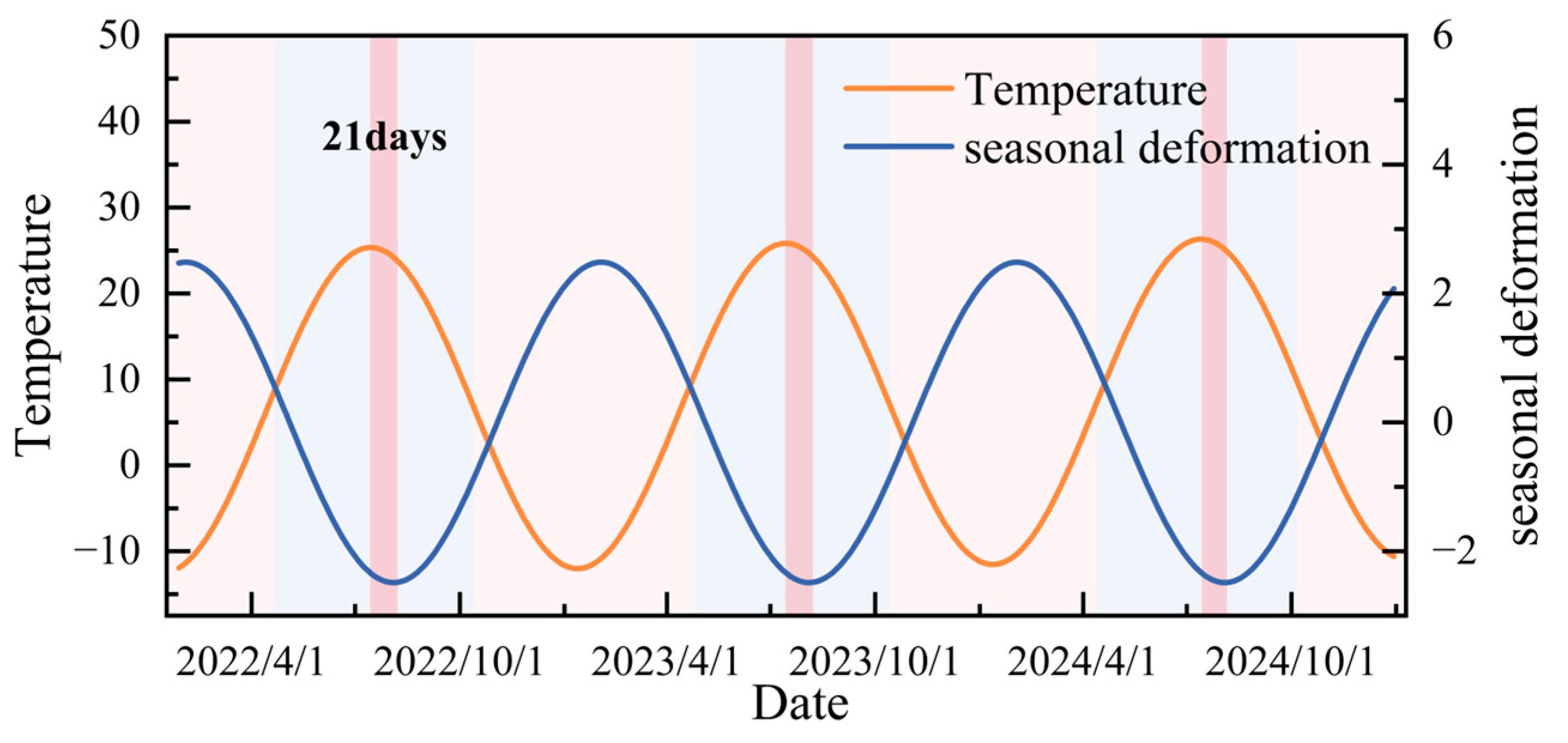
This study also discovered a considerable lag response between the surface deformation based on InSAR inversion and the seasonal change in surface temperature. It is initially demonstrated that the peak value of surface subsidence lags after the peak value of temperature by roughly 21 days by fitting the seasonal characteristics of surface deformation and temperature (Figure 13). This study used a total of seven lag days—0, 5, 10, 15, 20, 25, and 30 days—to systematically quantify this lag relationship and investigate its relationship with climate factors. It then computed the correlation coefficients of surface subsidence sequence and temperature and precipitation data under various lag conditions, including Pearson, Spearman, and Kendall correlation coefficients, and used a two-sided t-test to assess its statistical significance [24].
This study employed the Bonferroni, FDR, and Holm techniques to correct multiple comparisons in order to reduce the possibility of false positives. Following Bonferroni correction, α′ = 0.05/7 ≈ 0.007143 was chosen as the significance level. The association between temperature and subsidence at each of the seven lag days passed the correction test, according to the data (7/7 significant). The optimal lag time of surface subsidence change in relation to temperature data was found to be approximately 20 days (Figure 14a) and approximately 5 days in relation to precipitation data (Figure 14b), based on the combination of the corrected p-value (all less than 0.007143) and the absolute value of the correlation coefficient.
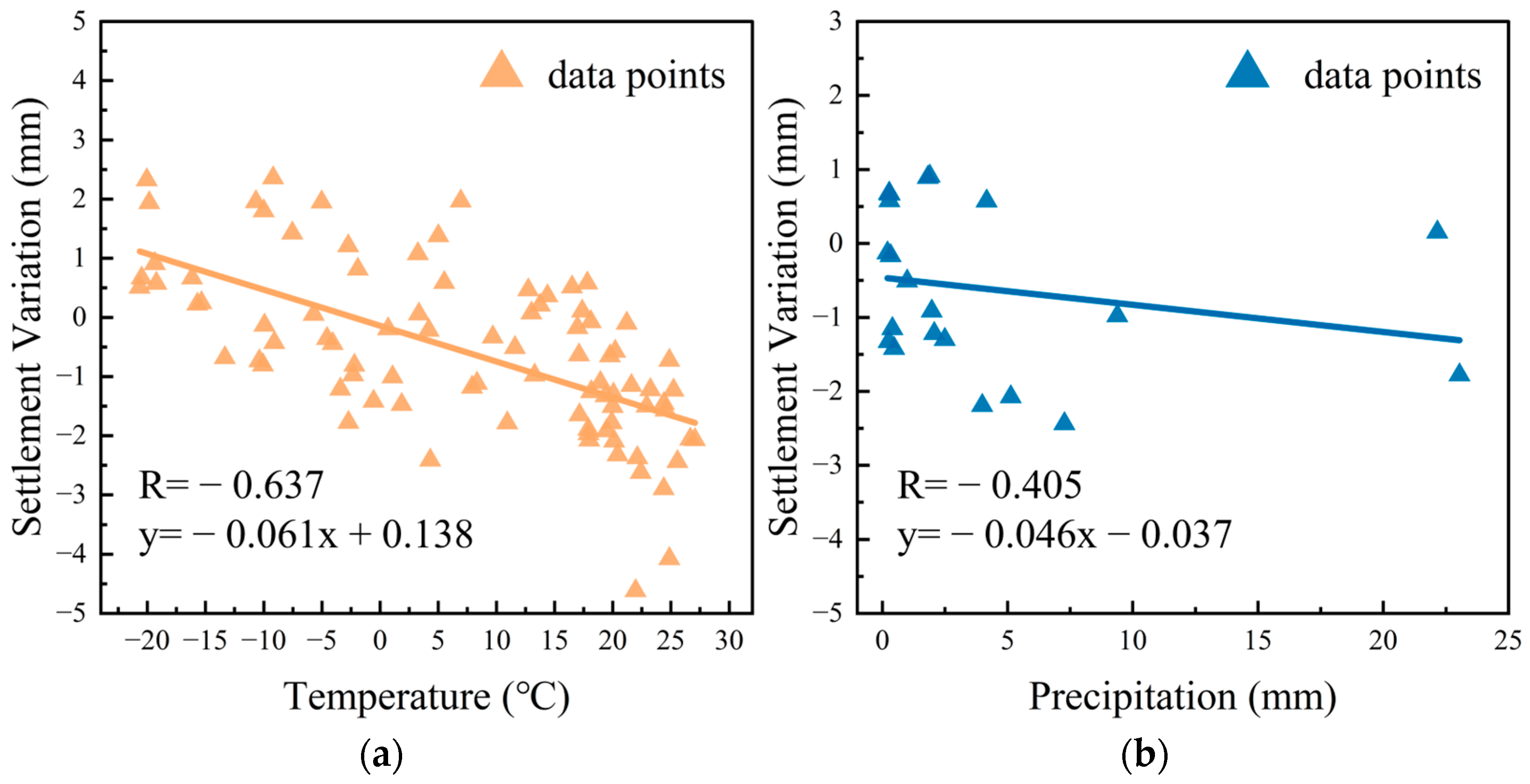
This led to the establishment of linear fitting models for temperature data with a lag of 20 days, precipitation data with a latency of 5 days, and subsidence data. With correlation coefficients of −0.637 (Figure 15a) and −0.405 (Figure 15b), respectively, the findings show that temporal fluctuations in surface subsidence are negatively linked with both air temperature and precipitation [55]. This suggests that the monthly average temperature has a greater impact on surface deformation than precipitation.

5. Conclusions

This work used the E-PS-InSAR technique to systematically monitor surface deformation in Changchun City’s main urban area based on 90 Sentinel-1A pictures taken between January 2022 and December 2024. This produced a millimeter-level accurate deformation time series and, through the integration of multi-source data, disclosed the spatiotemporal features and creation mechanisms of the sinking. The following are the primary conclusions:
(1)
Over the course of the monitoring period, Changchun’s main urban area showed a generally mild subsidence tendency, with an average cumulative subsidence of −0.08 mm and an average subsidence rate of −0.14 mm/yr. Nonetheless, there was noticeable localized differential settling. The Huaqing Road subway transfer station, Nanyang Road, the connection of the Changchun–Hunchun intercity railway, and the Beijing–Harbin Motorway in Erdao District, and other large infrastructure projects were among the areas where subsidence was most prevalent. Among these, the largest cumulative subsidence was −41.31 mm, and the maximum subsidence rate was −17.27 mm/yr. need constant attention.
(2)
The surface deformation showed clear seasonal fluctuation characteristics, with thaw settlement predominating in summer and fall and extensive frost heave and uplift in winter. The reaction of soil frost heave to temperature changes was delayed by about 20 days, while the response to rainfall was delayed by about 5 days. The main natural mechanism influencing the periodic change in subsidence in this area was ffreeze–thawseasonal freeze-thaw cycles.
(3)
Surface sinking shows a strong spatial association with cultivated land, which is consistent with patterns observed in irrigation-intensive regions. This suggests that agricultural water use may play a role in local subsidence, though further hydrological validation is needed.
(4)
In both low-coherence vegetated areas and densely populated metropolitan areas, the E-PS-InSAR approach successfully obtained high-density and high-precision monitoring points, reaching a point density of 6971.35 points/km2. It showed distinct advantages in terms of spatial coverage completeness and detail identification capabilities when compared to conventional PS-InSAR and SBAS-InSAR techniques. This approach successfully compensates for monitoring blind spots in low-coherence zones by incorporating both PS and DS points. As a result, it is more suited for monitoring subsidence in intricate urban and peri-urban settings.
The spatiotemporal patterns, seasonal variations, and land-use-specific subsidence responses of surface sinking in Changchun City are methodically documented in this work. The results offer a scientific foundation for agricultural water management, infrastructure safety and upkeep, territorial spatial planning, and early detection of geological hazards in urban areas. The improvement of urban safety and resilience, as well as improved urban governance, is supported by these findings.

Author Contributions

Conceptualization, Y.L., Y.Y. and Z.M.; methodology, Y.L., Y.Y. and Z.M.; software, Y.L., D.L. and C.S.; validation, Y.L., D.L. and C.S.; formal analysis, Y.L. and K.L.; data curation, Y.L. and K.L.; writing—original draft preparation, Y.L.; writing—review and editing, Y.L., Y.Y., Z.M., Q.D. and K.L.; visualization, K.L. and Y.L.; supervision, Y.Y.; project administration, Y.Y. and Z.M.; funding acquisition, Q.D. and Z.M. All authors have read and agreed to the published version of the manuscript.

Funding

This research was funded by the National Key R&D Project of China, grant number 2021YFA0715104, the National Natural Science Foundation of China, grant number 42501577, and the National-Level Funded Project under the “College Students’ Innovation and Entrepreneurship Training Program” of Jilin University, grant number 202510183253.

Data Availability Statement

Sentinel-1B SAR images and Sentinel-2 data were downloaded from the European Space Agency (ESA) (https://search.asf.alaska.edu, accessed on 30 July 2025). The POD precise orbit ephemerides data were downloaded from the European Space Agency (ESA) (https://browser.dataspace.copernicus.eu/, accessed on 30 July 2025). The ALOS World 3D DEM was downloaded from Japan Aerospace Exploration Agency (JAXA) (https://www.eorc.jaxa.jp/ALOS/en/aw3d30/data/index.htm, accessed on 30 July 2025).

Acknowledgments

The authors acknowledge the use of the SARscape software (v6.1) for the processing of Synthetic Aperture Radar Interferometry (InSAR) data during this study. The authors have reviewed and edited the output and take full responsibility for the content of this publication.

Conflicts of Interest

Author Ying Yang was employed by the company Sichuan Provincial Communications Survey and Design Research Institute Co., Ltd. The remaining authors declare that the research was conducted in the absence of any commercial or financial relationships that could be construed as a potential conflict of interest.

References

  1. Lin, C.; Chen, K.; Liang, C.; Zhu, H.; Cui, W.; Chai, H.; Li, M.; Xue, C.; Zheng, Z.; Qing, Z. Subsidence detection in southwest Guangdong–Hong Kong–Macao Greater Bay Area using InSAR with GNSS corrected tropospheric delays. Adv. Space Res. 2025, 75, 190–204. [Google Scholar] [CrossRef]
  2. Fan, Y.; Lyu, Y.; Yang, N. Monitoring and Analysis of Surface Deformation in Baode Mining Area Based on SBAS-InSAR. Sci. Technol. Eng. 2024, 24, 941–951. [Google Scholar] [CrossRef]
  3. Gabriel, A.K.; Goldstein, R.M.; Zebker, H.A. Mapping small elevation changes over large areas: Differential radar interferometry. J. Geophys. Res. Solid Earth 2012, 94, 9183–9191. [Google Scholar] [CrossRef]
  4. Berardino, P.; Fornaro, G.; Lanari, R.; Sansosti, E. A new algorithm for surface deformation monitoring based on small baseline differential SAR interferograms. IEEE Trans. Geosci. Remote Sens. 2002, 40, 2375–2383. [Google Scholar] [CrossRef]
  5. Chen, Y.; Zhu, C.; Zheng, J.; Wang, S. Monitoring and Analysis of Land Subsidence Based on PS-InSAR and SBAS-InSAR: A Case Study of the Riverside Area Along the Yangtze River in Nanjing. ISPRS Int. J. Geo-Inf. 2023, 54, 160–165. [Google Scholar] [CrossRef]
  6. Ferretti, A.; Prati, C.; Rocca, F. Permanent scatterers in SAR interferometry. IEEE Trans. Geosci. Remote Sens. 2001, 39, 8–20. [Google Scholar] [CrossRef]
  7. Crosetto, M.; Monserrat, O.; Cuevas-González, M.; Devanthéry, N.; Crippa, B. Persistent Scatterer Interferometry: A review. ISPRS J. Photogramm. Remote Sens. 2016, 115, 78–89. [Google Scholar] [CrossRef]
  8. Ferretti, A.; Prati, C.; Rocca, F. Nonlinear subsidence rate estimation using permanent scatterers in differential SAR interferometry. IEEE Trans. Geosci. Remote Sens. 2000, 38, 2202–2212. [Google Scholar] [CrossRef]
  9. Zhang, S.; Xu, L.; Long, R.; Chen, L.; Wang, S.; Ning, S.; Song, F.; Zhang, L. Quantitative Assessment and Impact Analysis of Land Surface Deformation in Wuxi Based on PS-InSAR and GARCH Model. Remote Sens. 2024, 16, 1568. [Google Scholar] [CrossRef]
  10. Chai, L.; Xie, X.; Wang, C.; Tang, G.; Song, Z. Ground subsidence risk assessment method using PS-InSAR and LightGBM: A case study of Shanghai metro network. Int. J. Digit. Earth 2024, 17, 2297842. [Google Scholar] [CrossRef]
  11. Zhu, B.; Tang, C.; Ren, Z.; Ma, Z.; Zhang, Q.; Li, Y. Monitoring and Driving Force Analysis of Surface Deformation in Zhuhai City Based on PS-InSAR Technology. Sci. Surv. Mapp. 2022, 108–113. [Google Scholar] [CrossRef]
  12. Guo, F.; Lyu, M.; Li, X.; Jiang, J.; Wang, L.; Guo, L.; Zhang, K.; Luo, H.; Wang, F. Deformation Monitoring Along Beijing Metro Line 22 Using PS-InSAR Technology. Land 2025, 14, 1098. [Google Scholar] [CrossRef]
  13. Tao, R.; Lau, A.; Mossefin, M.E.; Kong, G.; Nordal, S.; Pan, Y. Monitoring of ground displacement-induced railway anomalies using PS-InSAR techniques. Measurement 2025, 248, 116863. [Google Scholar] [CrossRef]
  14. Ferretti, A.; Fumagalli, A.; Novali, F.; Prati, C.; Rocca, F.; Rucci, A. A New Algorithm for Processing Interferometric Data-Stacks: SqueeSAR. IEEE Trans. Geosci. Remote Sens. 2011, 49, 3460–3470. [Google Scholar] [CrossRef]
  15. Liu, J.; Gong, X.; Liang, Q.; Li, Z.; Lu, T. Subsidence Monitoring and Analysis Along High-speed Railway Using E-PS-InSAR. Sci. Surv. Mapp. 2025, 50, 107–116. [Google Scholar] [CrossRef]
  16. Sun, T.; Liu, G.; Sang, M.; Chen, K.; Qian, K.; Zhang, R. Monitoring and Analysis of InSAR-based Surface Subsidence and Transportation Infrastructure Deformation in Changchun City. Geomat. Sci. Technol. 2022, 10, 51–60. [Google Scholar] [CrossRef]
  17. Hu, X. Research on Susceptibility and Risk Assessment of Geological Disasters in Changchun City Based on GIS and Stacking Fusion Model. Master’s Thesis, Jilin University, Changchun, China, 2020. [Google Scholar]
  18. Pan, L.; Yang, C.; Ren, Z.; Zhang, S.; Xu, X.; Wei, T.; Liu, L. Monthly variation characteristics of urban heat island effect and its influencing factors in Changchun City. Chin. J. Ecol. 2024, 43, 2257–2265. [Google Scholar] [CrossRef]
  19. Fan, M.; Jiang, H.; Zhang, S.; Lyu, Z.; Wang, L. Spatio-temporal Transition of Land Use and Its Eco-environmental Response in Changchun City. Radioengineering 2024, 54, 114–120. [Google Scholar]
  20. Chen, F.; Lin, H.; Zhang, Y.; Lu, Z. Ground subsidence geo-hazards induced by rapid urbanization: Implications from InSAR observation and geological analysis. Nat. Hazards Earth Syst. Sci. 2012, 12, 935–942. [Google Scholar] [CrossRef]
  21. Zhou, C.; Gong, H.; Chen, B.; Li, J.; Gao, M.; Zhu, F.; Chen, W.; Liang, Y. InSAR Time-Series Analysis of Land Subsidence under Different Land Use Types in the Eastern Beijing Plain, China. Remote Sens. 2017, 9, 380. [Google Scholar] [CrossRef]
  22. Bateson, L.; Novellino, A.; Hussain, E.; Arnhardt, R.; Nguyen, H.K. Urban development induced subsidence in deltaic environments: A case study in Hanoi, Vietnam. Int. J. Appl. Earth Obs. Geoinf. 2023, 125, 103585. [Google Scholar] [CrossRef]
  23. Sherwin, C.W.; Ruina, J.P.; Rawcliffe, R.D. Some Early Developments in Synthetic Aperture Radar Systems. IRE Trans. Mil. Electron. 1962, MIL6, 111–115. [Google Scholar] [CrossRef]
  24. Ghaderpour, E.; Mugnozza, G.S.; Mineo, S.; Meisina, C.; Pappalardo, G. Ground Deformation Monitoring Using InSAR and Meteorological Time Series and Least-Squares Wavelet Software: A Case Study in Catania, Italy. Adv. Geosci. 2024, 64, 1–5. [Google Scholar] [CrossRef]
  25. Ardizzone, F.; Gariano, S.L.; Volpe, E.; Antronico, L.; Coscarelli, R.; Manunta, M.; Mondini, A.C. A Procedure for the Quantitative Comparison of Rainfall and DInSAR-Based Surface Displacement Time Series in Slow-Moving Landslides: A Case Study in Southern Italy. Remote Sens. 2023, 15, 320. [Google Scholar] [CrossRef]
  26. Awasthi, S.; Jain, K.; Bhattacharjee, S.; Gupta, V.; Varade, D.; Singh, H.; Narayan, A.B.; Budillon, A. Analyzing urbanization induced groundwater stress and land deformation using time-series Sentinel-1 datasets applying PSInSAR approach. Sci. Total Environ. 2022, 844, 157103. [Google Scholar] [CrossRef]
  27. Yunjun, Z.; Fattahi, H.; Amelung, F. Small baseline InSAR time series analysis: Unwrapping error correction and noise reduction. Comput. Geosci. 2019, 133, 104331. [Google Scholar] [CrossRef]
  28. Du, Y.; Yan, S.; Zhang, H.; Zhao, F.; Qiu, C. Phase Optimization of DS-InSAR Integrating Region Growing and Its Application. Geomat. Inf. Sci. Wuhan Univ. 2024, 49, 216–224. [Google Scholar] [CrossRef]
  29. Guo, J.; Xi, W.; Yang, Z.; Huang, G.; Xiao, B.; Jin, T.; Hong, W.; Gui, F.; Ma, Y. Study on Optimization Method for InSAR Baseline Considering Changes in Vegetation Coverage. Sensors 2024, 24, 4783. [Google Scholar] [CrossRef] [PubMed]
  30. Wu, C.; Shen, P.; Tebaldini, S.; Yu, Y.; Liao, M. Forest Vertical Structure Inversion Based on Baseline Optimization InSAR Phase Histogram Technique. Wuhan Univ. J. Nat. Sci. 2025, 50, 1608–1618. [Google Scholar] [CrossRef]
  31. Li, S.; Zhang, S.; Li, T.; Gao, Y.; Chen, Q.; Zhang, X. Modeling the Optimal Baseline for a Spaceborne Bistatic SAR System to Generate DEMs. ISPRS Int. J. Geo-Inf. 2020, 9, 108. [Google Scholar] [CrossRef]
  32. Luo, X.; Xiang, X.; Lü, Y. PS Correction for Time-Series InSAR Deformation Monitoring of a Collapse in Longli. Remote Sens. Nat. Resour. 2022, 34, 82–87. [Google Scholar] [CrossRef]
  33. Hou, J.; Xu, B.; Li, Z.; Chen, Q.; Zhu, Y.; Mao, W. Separating and Unwrapping of Residual Topographical and Time-Series Deformation Phases in PS-InSAR Based on Zero-Temporal Baseline Combination and Time-Domain Differentiation. IEEE J. Sel. Top. Appl. Earth Obs. Remote Sens. 2024, 17, 705–718. [Google Scholar] [CrossRef]
  34. Shen, P.; Wang, C.; Lu, L.; Luo, X.; Hu, J.; Fu, H.; Zhu, J. A Novel Polarimetric PSI Method Using Trace Moment-Based Statistical Properties and Total Power Interferogram Construction. IEEE Trans. Geosci. Remote Sens. 2022, 60, 4402815. [Google Scholar] [CrossRef]
  35. Huang, C.; Hu, J.; Yang, Y. A Permanent Scatterer Detection Method Based on Empirical Mode Decomposition. Acta Opt. Sin. 2019, 39, 371–381. [Google Scholar] [CrossRef]
  36. Wang, S.; Yang, K.; Ding, X.; Hou, Z.; Li, Y.; Li, Y. Safety Analysis of Dynamic Subsidence Monitoring of Buildings and Roads in Mining Areas Using PS-InSAR. China Saf. Sci. J. 2022, 18, 111–117. [Google Scholar]
  37. Han, J.; Lai, T.; Zhao, Y.; Huang, J. A PS Point Detection Method for PS-DInSAR with Small Datasets. PLA Inf. Eng. Univ. 2015, 31, 679–685. [Google Scholar]
  38. Li, S.; Zhang, S.; Li, T.; Gao, Y.; Chen, Q.; Zhang, X. An Adaptive Phase Optimization Algorithm for Distributed Scatterer Phase History Retrieval. IEEE J. Sel. Top. Appl. Earth Obs. Remote Sens. 2021, 14, 3914–3926. [Google Scholar] [CrossRef]
  39. Costantini, M.; Malvarosa, F.; Minati, F. A General Formulation for Redundant Integration of Finite Differences and Phase Unwrapping on a Sparse Multidimensional Domain. IEEE Trans. Geosci. Remote Sens. 2012, 50, 758–768. [Google Scholar] [CrossRef]
  40. Ma, Z.-F.; Wei, S.-J.; Aoki, Y.; Liu, J.-H.; Huang, T. A New Spatiotemporal InSAR Tropospheric Noise Filtering: An Interseismic Case Study Over Central San Andreas Fault. IEEE Trans. Geosci. Remote Sens. 2022, 60, 5235016. [Google Scholar] [CrossRef]
  41. Duan, M.; Li, Z.; Xu, B.; Jiang, W.; Cao, Y.; Xiong, Y.; Wei, J. Turbulent atmospheric phase correction for SBAS-InSAR. J. Geod. 2024, 98, 81. [Google Scholar] [CrossRef]
  42. Lee, J.-C.; Shirzaei, M. Novel algorithms for pair and pixel selection and atmospheric error correction in multitemporal InSAR. Remote Sens. Environ. 2023, 286, 113447. [Google Scholar] [CrossRef]
  43. Yu, Z.; Zhang, G.; Huang, G.; Cheng, C.; Zhang, Z.; Zhang, C. SSBAS-InSAR: A Spatially Constrained Small Baseline Subset InSAR Technique for Refined Time-Series Deformation Monitoring. Remote Sens. 2024, 16, 3515. [Google Scholar] [CrossRef]
  44. Zhao, B.; Yang, X.; Wu, Q.; Xiao, W.; Yang, W.; Deng, M. Uncovering the Structural Effect Mechanisms of Natural and Social Factors on Land Subsidence: A Case Study in Beijing. Sustainability 2022, 14, 10139. [Google Scholar] [CrossRef]
  45. Chu, H.-J.; Tatas; Patra, S.R.; Burbey, T.J. Spatiotemporal subsidence feature decomposition and hotspot identification. Environ. Earth Sci. 2024, 83, 124. [Google Scholar] [CrossRef]
  46. Huang, Z.-h.; Huo, Z.-b.; Wang, W.; Zhu, J.-x.; Zhang, C.-h.; Xi, R.-p. Analysis of driving factors for land subsidence in typical cities of the North China Plain based on geodetector technology. J. Groundw. Sci. Eng. 2025, 13, 74–89. [Google Scholar] [CrossRef]
  47. Zhao, L.; Jiang, X.-W.; Li, Y.-M.; Luo, Y.; Lei, K.-C.; Kou, W.-J.; Tian, F.; Tian, M.-Z.; Sha, T.; Wang, S.-F.; et al. Mechanisms of groundwater recovery and land subsidence mitigation in a piedmont plain. J. Hydrol. 2025, 658, 133165. [Google Scholar] [CrossRef]
  48. Li, J.; Smith, R.; Grote, K. Analyzing spatio-temporal mechanisms of land subsidence in the Parowan Valley, Utah, USA. Hydrogeol. J. 2023, 31, 293–311. [Google Scholar] [CrossRef]
  49. Abd-Elaty, I.; Fathy, I.; Kuriqi, A.; John, A.P.; Straface, S.; Ramadan, E.M. Impact of Modern Irrigation Methods on Groundwater Storage and Land Subsidence in High-water Stress Regions. Water Resour. Manag. 2023, 37, 1827–1840. [Google Scholar] [CrossRef]
  50. Shen, Z.; Jin, L.; Xin-Zhang, C.; Miao-Zhang, Y. Study of the distribution and change law of stress in subgrade immersed in water in the hetao irrigation area. J. Test. Eval. 2022, 50, 4540–4549. [Google Scholar] [CrossRef]
  51. Xiao, T.; Li, P.; Fei, W.; Wang, J. Effects of vegetation roots on the structure and hydraulic properties of soils: A perspective review. Sci. Total Environ. 2024, 906, 167524. [Google Scholar] [CrossRef]
  52. Chen, J.; Wu, T.; Zou, D.; Liu, L.; Wu, X.; Gong, W.; Zhu, X.; Li, R.; Hao, J.; Hu, G.; et al. Magnitudes and patterns of large-scale permafrost ground deformation revealed by Sentinel-1 InSAR on the central Qinghai-Tibet Plateau. Remote Sens. Environ. 2022, 268, 112778. [Google Scholar] [CrossRef]
  53. Huang, Y.; Ma, W.; He, P.; Li, X. Experimental study of thaw-settlement process of frozen soil under different load conditions. J. Glaciol. Geocryol. 2021, 43, 184–194. [Google Scholar] [CrossRef]
  54. Kardani, N.; Kumar, A.; Kumar, S.; Karr, O.; Bardhan, A. A Deep Learning Approach for Modelling of Resilient Modulus of Compacted Subgrade Subjected to Freezing-Thaw Cycles and Moistures. Transp. Infrastruct. Geotechnol. 2024, 11, 3805–3828. [Google Scholar] [CrossRef]
  55. Fan, C.; Mu, C.; Liu, L.; Zhang, T.; Jia, S.; Wang, S.; Sun, W.; Zhao, Z. Time-Series models for ground subsidence and heave over permafrost in InSAR Processing: A comprehensive assessment and new improvement. ISPRS J. Photogramm. Remote Sens. 2025, 222, 167–185. [Google Scholar] [CrossRef]
Figure 1. Overview of the study area.
Remotesensing 18 00530 g001
Figure 2. Spatiotemporal Baseline Distribution of Interferometric Synthetic Aperture Radar (InSAR) Pairs. The green diamonds are the slave images, the yellow diamonds represent the super master images, and each line represents an interferometric pair.
Remotesensing 18 00530 g002
Figure 3. Spatial distribution of surface deformation rates of Changchun City: (a) Huaqing Road Metro Station, Nanguan District; (b): Fujiatun Farmland, Nanguan District; (c): Farmland at the Intersection of Jingbei Road and Haoyue Avenue, Luyuan District; (d): Changqing Village, Erdao District; (e): Changchun-Hunchun Intercity Railway Line, Erdao District; and (f): Nanyang Road Area, Luyuan District.
Remotesensing 18 00530 g003
Figure 4. High-Density and High-Precision Permanent Scatterer Interferometric Synthetic Aperture Radar (PS-InSAR) Points in Densely Built-Up Areas. Blue dots represent PS-InSAR monitoring points, and yellow solids represent buildings.
Remotesensing 18 00530 g004
Figure 5. Scatterer plots of the E-PS-InSAR and traditional methods: (a) Enhanced Permanent Scatterer Interferometric Synthetic Aperture Radar (E-PS-InSAR) vs. PS-InSAR; and (b) E-PS-InSAR vs. Small Baseline Subsets Interferometric Synthetic Aperture Radar (SBAS-InSAR). Red lines represent the fitting lines.
Remotesensing 18 00530 g005
Figure 6. Deformation monitoring points: PS-InSAR vs. E-PS-InSAR in typical low-coherence areas: (a) Farmland in Kaiyuan Village, Luyuan District; (b) Farmland 1300 m west of Changchun West Railway Station, Luyuan District; (c) Urban green space northwest of the intersection of Jingha Railway and Xihu Road, Luyuan District; (d) Newly developed urban area in Chaoyang District; (e) Newly developed urban area in Kuancheng District; (f) Sparsely built area in Chaoyang District.
Remotesensing 18 00530 g006
Figure 7. Smoothing effect of SBAS-InSAR on building-to-ground deformation in urban areas; (a) Spatial distribution of surface deformation rates in Changchun City based on the SBAS-InSAR method; (b,c) SBAS-InSAR smoothes out tiny deformation differences between buildings and the surrounding ground surface in densely populated locations due to phase unwrapping issues.
Remotesensing 18 00530 g007
Figure 8. Pie Chart: (a) Geometric vs. subsidence area in vegetated/non-vegetated zones; (b) Subsidence and uplift area by land use type.
Remotesensing 18 00530 g008
Figure 9. Time-Series Cumulative Surface Deformation.
Remotesensing 18 00530 g009
Figure 10. Time-series relationship between surface subsidence and temperature.
Remotesensing 18 00530 g010
Figure 11. Time-series relationship between surface subsidence and precipitation.
Remotesensing 18 00530 g011
Figure 12. Time-series fitting and decomposition: (a) Surface subsidence fitting; (b) Surface Uplift fitting.
Remotesensing 18 00530 g012
Figure 13. Land subsidence and temperature-induced periodic deformation. The magenta color represents the time lag (in days).
Remotesensing 18 00530 g013
Figure 14. Analysis of the lag effect of climatic factors on surface subsidence: (a) Correlation between surface subsidence and air temperature with different time lags; (b) Correlation between surface subsidence and precipitation with different time lags.
Remotesensing 18 00530 g014
Figure 15. Analysis of correlations at optimal time lags: (a) Correlation between surface subsidence and air temperature with the optimal time lag; (b) Correlation between surface subsidence and precipitation with the optimal time lag. The straight line is the fitting line.
Remotesensing 18 00530 g015
Table 1. Parameters of Sentinel-1A SAR, DEM, and POD Precise Orbit Data.
DataTypeParameter
Sentinel-1AOrbit TypeSun-synchronous satellite
Revisit Cycle/day12
Number of Images90
Data Acquisition Period27 January 2022–30 December 2024
Sensor ModeInterferometric Wide Swath
PolarizationVV
BandC
Wavelength/cm5.6 cm
Product TypeSLC
Orbit DirectionDescending
Incidence Angle/°39.16°
Resolution/m5 × 20
AW3D30 DEMResolution/m30
Vertical Accuracy/m12.1
PODOrbit Accuracy/cm≤5
Table 2. Statistics of Deformation Rate and Deformation Amount for Subsidence Areas in Changchun City.
Monitoring Point IDLocation DescriptionDeformation Rate (mm/yr)Deformation (mm)
MinMaxMeanMinMaxMean
aHuaqing Road Metro Station, Nanguan District−10.168.20−1.17−29.8119.89−3.12
bFujiatun Farmland, Nanguan District−14.593.31−1.97−41.3111.86−4.99
cFarmland at the Intersection of Jingbei Road and Haoyue Avenue, Luyuan District−10.641.78−2.04−30.2511.64−5.82
dChangqing Village, Erdao District−12.312.08−2.66−30.886.17−7.37
eChangchun-Hunchun Intercity Railway Line, Erdao District−17.271.76−3.02−44.2716.71−8.14
fNanyang Road Area, Luyuan District−14.794.19−0.05−38.1724.93−0.01
Disclaimer/Publisher’s Note: The statements, opinions and data contained in all publications are solely those of the individual author(s) and contributor(s) and not of MDPI and/or the editor(s). MDPI and/or the editor(s) disclaim responsibility for any injury to people or property resulting from any ideas, methods, instructions or products referred to in the content.